le monde de la finance regarde les chiffres de la croissance , le nombre de gens qui sortent de la pauvreté et se contre fout des bas du front qui pensent vivre dans un monde immuable ou l occidental est un seigneur et l'autochtone un serviteur.
si vous aimiez ce pays et ses habitants autant que vous le prétendez vous devriez etre enchantés
de voir le bath s'apprécié
le monde de la finance regarde les chiffres de la croissance , le nombre de gens qui sortent de la pauvreté et se contre fout des bas du front qui pensent vivre dans un monde immuable ou l occidental est un seigneur et l'autochtone un serviteur.
si vous aimiez ce pays et ses habitants autant que vous le prétendez vous devriez etre enchantés
de voir le bath s'apprécié
Pas sûr que les producteurs de riz, de latex, de sucre...... partagent votre point de vue.
le monde de la finance regarde les chiffres de la croissance , le nombre de gens qui sortent de la pauvreté et se contre fout des bas du front
Je ne cite pas tout car les " fôtes d'ortografe " ( sic ) me hérissent le poil ...😠
Et comme l’écrit Earthquake ...suis pas sûr que les producteurs de quoi que ce soit en Thaïlande soient heureux de voir un baht fort, les exportations sont de plus en plus difficiles et les acheteurs ( le monde de la finance , ah!ah!ah! ) préfèrent se tourner vers des pays comme le Vietnam ou le Cambodge pour acheter leurs produits à bas prix ..
Avec ça, nous qui vivons ici depuis de nombreuses années nous voyons bien ce que le baht fort produit : quelques milliardaires de plus mais surtout de plus en plus de pauvres .
Quant à l'expression " bas du front " , c'est très mal connaitre la Thaïlande pour l'employer ici ..
Les sympathisants de la Marine seraient considérés ici comme des gauchistes ou mieux des trotskistes
Avec ça, nous qui vivons ici depuis de nombreuses années nous voyons bien ce que le baht fort produit : quelques milliardaires de plus mais surtout de plus en plus de pauvres .
Sans compter les pensionnés en euros qui voient leur pouvoir d'achat fondre au soleil. Il paraîtrait même que certains septuagénaires se verraient contraints à reprendre des activités plus ou moins légales: travaux agricoles, locations saisonnières, transports de touristes...Quelle misère!
C'est le cas d'un pote à Pathum Thani, qui a dû réouvrir son école d'anglais pour femmes autochtones cherchant un mari occidental. Et je ne sais même pas si ça lui suffira pour éviter de me taper de quelques centaines de bahts la prochaine fois que je le verrai.
La Thaïlande, c'est parfait pour les vacances. Pour le reste, entre dictature militaire, maladies tropicales, pollutions massives, chaleur accablante, culture limitée, bouffe pimentée à l'excès, cultes infantiles, patrimoine historique inexistant et veille obligée sur le taux de change: intérêt très limité.
Je ne sais d'ailleurs pas pourquoi ça attire encore tant de fantasmes. Et pourtant, ce n'est pas faute d'esprits éclairés qui tentent d'ouvrir les yeux aux lecteurs sur les vraies réalités du pays où ils vivent.
La Thaïlande, c'est parfait pour les vacances. Pour le reste, entre dictature militaire, maladies tropicales, chaleur accablante, culture limitée, bouffe pimentée à l'excès, cultes infantiles, patrimoine historique inexistant et veille obligée sur le taux de change: aucun intérêt.
Présenté comme ça, même pour les vacances, ça ne fait pas envie.
Bon, d'un autre côté, ça m'a jamais fait vraiment envie...
Avec ça, nous qui vivons ici depuis de nombreuses années nous voyons bien ce que le baht fort produit : quelques milliardaires de plus mais surtout de plus en plus de pauvres.
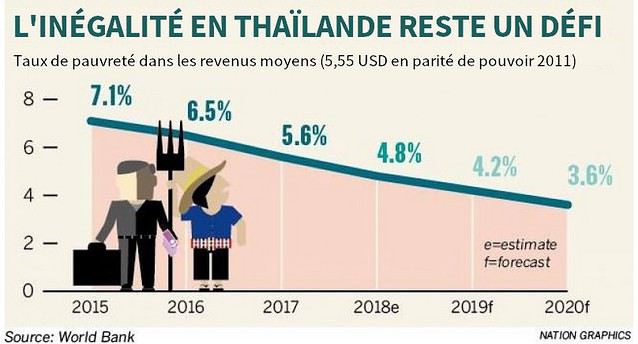
Graphique peut-être exact mais pendant une baisse de l'écart des revenus moyens, l'écart entre les extrêmes peut se creuser en même temps: vous pouvez avoir un"tassement" dans les classes sociales intermédiaires, tandis que les classes ultra-supérieures et les classes ultra-inférieures voient leur écart s'agrandir.
Et d'ailleurs, le seul cours du baht n'est qu'un critère parmi d'autres. Si les experts en débattent sans fin, c'est que caractériser richesse et pauvreté, et situer leurs évolutions, ça ne se fait pas en regardant un champ de canne à sucre ou le cours du tapioca.
Pour ceux que ces phénomènes complexes intéressent, voir la thèse de Thanasak Jenmana, sortie fin 2018 ( son référent est Thomas Piketty) très documentée sur le sujet, et qui met d'ailleurs en relation classe sociale et "couleur" politique.
En plus, il y a un rappel historique des dernières décennies, ce qui n'est pas inutile pour essayer de comprendre ne serait-ce qu'un peu la situation actuelle de ce pays.
Présenté comme ça, même pour les vacances, ça ne fait pas envie.
Bon, d'un autre côté, ça m'a jamais fait vraiment envie...
Je ne devrais pas le trahir mais il commence à être réputé dans cette section pour son second degré. Il faut donc fréquemment interpréter la réponse dans l'exact sens contraire de sa formulation.
Ce procédé employé avec subtilité est un moyen habile de mettre en relief les contradictions ou formulations erronées d'un intervenant , voire de démontrer a contrario l'absurdité d'une théorie.
Appliquée à un individu, cette méthode permet indirectement de lui offrir les moyens de se défaire de quelques défauts, pour peu qu'il sache faire la part des choses.
D'autre part, nous sommes quelques-uns à ne pas insister exagérément sur les avantages de ce pays idyllique, ce qui aurait pour fâcheuse conséquence d'y attirer trop de monde avec pour conséquence des nuisances dont nous souffririons nous-mêmes.
Bien entendu, soyons discrets et que cela reste entre nous.
« Tout le monde s'interroge sur comment laisser une meilleure planète à nos enfants, mais on devrait plutôt penser à laisser de meilleurs enfants pour notre planète. » Clint Eastwood
le graphique avait pour but de démontrer l absurdité de l affirmation :" y a de plus en plus de pauvres en thaillande". je rentre pas dans le débat sur la situation socio politico économico .....de ce pays.😉
et d'une manière générale les pleurnicheuses m'exaspèrent
Message posté après 18 heures et non modifié.
Résultat : deux fois le même mot dans la même phrase. C'est ta faute. 😎
« Tout le monde s'interroge sur comment laisser une meilleure planète à nos enfants, mais on devrait plutôt penser à laisser de meilleurs enfants pour notre planète. » Clint Eastwood
D'autre part, nous sommes quelques-uns à ne pas insister exagérément sur les avantages de ce pays idyllique, ce qui aurait pour fâcheuse conséquence d'y attirer trop de monde.
Vu l'augmentation exponentielle des arrivées de touristes, il va falloir songer sérieusement à augmenter la portée de vos discours.
Apprenez le chinois, par exemple.
Avec mes progrès peu sensibles au rythme de cinq mots thai par an, on aura déjà écrit mon épitaphe alors que je n'aurai pas encore envisagé me lancer dans cette ambitieuse entreprise.
« Tout le monde s'interroge sur comment laisser une meilleure planète à nos enfants, mais on devrait plutôt penser à laisser de meilleurs enfants pour notre planète. » Clint Eastwood
Ce n'est pas à moi qu'il faut envoyer ce lien mais à Lolo333 qui adore les graphiques et croit dur comme fer les infos de BFM TV ou écrite dans Le Monde ..🤪
Tous aux abris! Le farang de l'Issan est parti en campagne électorale!...
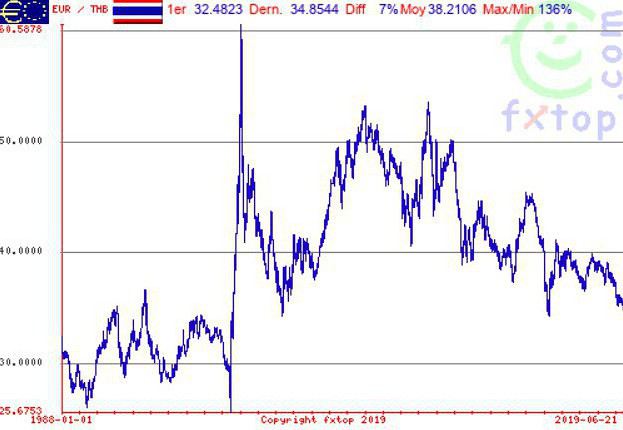
Pour le reste, sauf erreur (vu que je m'en tamponne), en 10 ans, l'euro a baissé de 20% par rapport au baht (belle cassure en 2015), et de son côté le dollar US a perdu 10% par rapport à ce même baht.
Comme quoi, si cette monnaie sympathique s'apprécie, le farang retraité US ressentira bien moins cette appréciation que le farang retraité français.
On peut comprendre les humeurs changeantes de ce dernier, assez mal corrigées des variations saisonnières, d'ailleurs.
Pour les éventuels futurs investisseurs, les raisons de cette santé du baht, en quelques phrases.
www.gavroche-thailande.com/...ht-une-bonne-affaire
On pourrait y voir plus clair après les élections, ou pas du tout (pas les élections européennes, mais les élections générales siamoises).
Quoiqu'il advienne, sur place la terre n'a pas fini de flamber, les pauvres de rester pauvres, et les riches de s'enrichir. Quelles nouvelles renversantes ...
1 euro = 34.90 chez superrich ce matin... c'est la bérézina (pas sur de l'orthographe !) 😉
Pourquoi, on fait ses courses avec des bahts à Bourgoin-Jallieu?🙂
Blague à part, on a vu pire comme cours. En 1989 on avait à peine 4 bahts pour un franc soit 26 bahts pour un euro.
Pour un touriste c'est pas un drame, par contre pour un expat à petit budget ça peut être problématique.
Ca va finir par remonter.
Pour un expat ça ne doit pas changer grand chose car ici tout est hyper bon marché.
Si ça devient compliqué pour lui ici, qu'en serait-il en métropole ?
En fait je me suis mal exprimé, je pensais expat retraité.
Si on fait les choses dans les règles, il faut un revenu minimum (en bahts) pour renouveler son visa. 800 000 bahts par an soit 1667€ par mois à 40 bahts/€ ou 1905€ par mois à 35 bahts/€.
En plus en Thailande on cumule la perte du change avec une inflation plus forte qu'en France.
Pour un expat ça ne doit pas changer grand chose car ici tout est hyper bon marché.
Ce n'est pas que tout est bon marché (allez voir les tarifs des carburants ou ceux de pratiquement tous les produits importés), c'est qu'un expat de "classe moyenne" se retrouve d'emblée avec des revenus comparativement beaucoup plus élevés qu'un Thaï de "classe moyenne".
Nuance.
Si ça devient compliqué pour lui ici, qu'en serait-il en métropole ?
Vous oubliez les transferts sociaux, beaucoup plus élevés en France qu'en Thaïlande.
c'est qu'un expat de "classe moyenne" se retrouve d'emblée avec des revenus comparativement beaucoup plus élevés qu'un Thaï de "classe moyenne".
Nuance.
Nuance, vouiiii ;
c'est à ce genre de réflexion qu'on voit que Charlie n'habite pas en Thaïlande ..
Sinon il n’écrirait pas de belles bêtises😛 ...
D'abord, c'est quoi un thaï de classe moyenne ?
J'en connais pas mal des thaï de " classe moyenne " , on va dire aisée en fait ;
des personnes qui prennent l'avion comme moi je monte sur mon VTT ;
des personnes qui ont des berlines de " classe moyenne " Toyota Camry hybride , SUV Honda , Mercedes jusqu’à la 250 ...
Tu te mets le doigt grave dans l’œil monsieur Charlie, ces personnes de " classe moyenne " ont un train de vie que la plupart des expat de " classe moyenne " n'ont pas et n'auront jamais .
Ne jamais oublier que 99,9% des expats ont un contrat local, rien à voir avec les expats du 20* siècle .
Sache aussi que des millions de thaïlandais travaillent outremer : Taiwan, Japon, Israel , Norvège, les pays du Golfe et leurs salaires sont comparables à un ouvrier qualifié ou un contremaître, un agent de maîtrise en France : de l'ordre de 1500 à 2500 euros mensuels .
D’ après toi, comment font ces paysans qui gagnent 300 baht par jour quand ils ont la chance de trouver un taf en dehors de leurs champs pour se payer des tracteurs neufs, des moissonneuses a deux millions de baht , des pick-up dernier cri ...
C'est très simple, un ou des enfants travaillent outremer ...
Si ça devient compliqué pour lui ici, qu'en serait-il en métropole ?
Vous oubliez les transferts sociaux, beaucoup plus élevés en France qu'en Thaïlande.
Sur ce coup là, entièrement d'accord avec Charlie ...( comme quoi, hein ! )
Si en plus le gars trouve le moyen d’être logé gratos moyennant gardiennage, entretien de propriété..c'est tout bénef ;
il vivra même mieux en France qu'en Thaïlande ...il n'aura plus les gogos de WS 😎, il compensera en allant de temps à autre dans un eros center en Allemagne ..😉
c'est à ce genre de réflexion qu'on voit que Charlie n'habite pas en Thaïlande ..
Sinon il n’écrirait pas de belles bêtises😛 ...
- et donc à regarder votre production industrielle de perles, on pourrait croire que vous n'y habitez pas. Logique.
D'ailleurs, "ne pas y habiter", c'est un peu ça, puisque vous en dites bien plus sur une petite faune pathétique et le regard condescendant qu'elle porte sur le pays que sur ce pays lui-même.
Quant à penser qu'on "vit un pays" alors qu'on y passe ses journées sur son clavier... Passons, ne serait-ce que par charité envers les personnes âgées.
C'est quoi la classe moyenne?... Les économistes ont plusieurs définitions, l'une d'entre elles en fait la classe intermédiaire entre la classe pauvre et la classe aisée. Ca me semble assez simple à comprendre.
Et en Thaïlande, pays des plus inégalitaires où la reproduction sociale n'est pas une formule pour sociologue attardé, les Thaïs n'ont guère besoin de raisonnements à la noix pour savoir à quelle classe ils appartiennent, même si dans la classe moyenne, on aime se donner l'illusion d'être plus aisé qu'on ne l'est en réalité.
Et comme vous savez vous aussi ce que veut dire "rouler à crédit"...
- et donc à regarder votre production industrielle de perles, .
Vous avez les perles que vous méritez monsieur le belge ( fume c'est du belge ! 😉)
Quant à vivre à crédit ;
une fois de plus, vous méconnaissez totalement le fonctionnement des expat retraités ;
le crédit nous est interdit ;
la seule carte de banque que nous pouvons avoir est une carte de débit .
une fois de plus, vous méconnaissez totalement le fonctionnement des expat retraités ;
le crédit nous est interdit ;
C'est curieux de toujours oublier un mot ici ou là... par exemple à "expat-retraité", il manque "expat-retraité-visa-thaï-wife"
Mais la présentation de votre situation, c'est un peu comme les pizzas surgelées: appétissant sur la boîte, mais quand on l'ouvre... on découvre que la photo n'était qu'une "suggestion"...D'ailleurs, vous ne devriez pas vous lancer sur un terrain si glissant. Votre pickup n'a que 2 roues motrices. Vous qui n'avez de cesse de radoter les dangers des routes du pays, ce ne serait pas très prudent.
une fois de plus, vous méconnaissez totalement le fonctionnement des expat retraités ;
le crédit nous est interdit ;
C'est curieux de toujours oublier un mot ici ou là... par exemple à "expat-retraité", il manque "expat-retraité-visa-thaï-wife"
Ça ne change rien en ce qui concerne les deux expressions ;
ni les retraités ni ceux qui ont le visa " thai wife "n'ont droit à une carte de crédit .
Et puis monsieur jesaitou devrait savoir que certains bureaux d'Immigration obligent les retraités mariés à une thaïlandaise à utiliser le visa " thai wife " même s'ils ont la possibilité d'utiliser l'autre visa .
C'est ainsi que la vie s’écoule tranquillement dans les rizières de Thaïlande où on crève de chaud depuis quelques jours ..
Votre petite canicule française n'est rien par rapport à ce que nous subissons actuellement.
Faut arrêter l'herbe qui fait rire Charlie, où avez-vous été pêcher que j'ai une vie d'aventurier ?
Je sens comme une pointe de jalousie dans vos propos :
" vous êtes juste réfugié économique dans un bled paumé " .
Ça ne change rien en ce qui concerne les deux expressions ;
ni les retraités ni ceux qui ont le visa " thai wife "n'ont droit à une carte de crédit .
- et qui a dit le contraire?... Conclusion: vous roulez dans un pickup acheté à crédit par votre épouse. Et que j'espère vous avez aidée à le rembourser. Ca tient en une phrase, rien de particulier, rien de honteux.
Et puis monsieur jesaitou
N'importe quoi.
C'est ainsi que la vie s’écoule tranquillement dans les rizières de Thaïlande où on crève de chaud depuis quelques jours ..
Votre petite canicule française n'est rien par rapport à ce que nous subissons actuellement.
De l'art de noyer le poisson...
Je sens comme une pointe de jalousie dans vos propos
Euh... je ne sais qui pourrait envier votre situation. En tout cas, certainement pas moi!...
Je parle de votre situation réelle, bien entendu. En être réduit à bosser dans les champs et à jouer les éboueurs de fossés... à un âge où l'on devrait regarder mûrir les mangues et gâter ses petits-enfants...
Regardez-vous tel que vous êtes, et venez-nous en parler avec sincérité. Alors, je vous considérerai autrement. Peut-être.
Bonsoir
Et si vous echangiez en MP ce serait profitable pour tous ceux qui cherchent des infos sur ce forum
Merci
Demandez au membre d'autoriser les MP. Et de ne pas y proférer d'insultes sur ma propre famille comme par le passé.
Pour le reste, les tombereaux d'insanités qu'il déverse en public sur la Thaïlande ne me semblant en effet pas influer sur le cours du baht, refermons la parenthèse.
Contactez la modération, qu'elle efface mes messages mais aussi les siens.
Si vous souhaitez des informations sur le cours du baht: la Banque de Thaïlande estime qu'il est grosso modo à un niveau correct, dans le sens où il favorise les exportations sans trop pénaliser les importations. Par contre, plus fort, ça pourrait nuire.
Ce pays est considéré comme "stable" (récemment entendu encore lors d'une interview du président des plus anciennes compagnies tenue par une famille germano-thaï sur Skynews), et des taux de change à 1 euro les 50 bahts comme on a pu en connaître ne devraient pas se revoir de sitôt.
Tant que le baht sera considéré comme une monnaie intéressante par les spéculateurs, ce pays facile pour les investisseurs et que les USA feront marcher la planche à billets et gesticuleront sur la scène internationale, le baht s'appréciera.
Aucune expertise personnelle (j'en serais bien incapable), je relaie juste ce que j'ai vu et entendu sur les médias.
Personnellement, ça nuit à mon pouvoir d'achat bien évidemment, et par conséquent, je consomme moins, c'est tout.
Ça ne change rien en ce qui concerne les deux expressions ;
ni les retraités ni ceux qui ont le visa " thai wife "n'ont droit à une carte de crédit .
- et qui a dit le contraire?... Conclusion: vous roulez dans un pickup acheté à crédit par votre épouse.
Fausse conclusion, comme d'hab, mais vous nous y avez habitué ..
Pickup acheté comptant, , à mon nom ;
Quant à faire " l’éboueur de fossé " c'est un plaisir 😉que j’ôte aux thaïlandais ..
Je ne leur ôte rien en fait ; s'ils voulaient le faire, ils le feraient, mais ...... mais........... mais leur plus grand plaisir n'est pas de nettoyer leur pays mais de l'enlaidir en jetant tout et n'importe quoi par les fenêtres de leurs véhicules...
Ils ne sont malheureusement pas les seuls , les vietnamiens, les laotiens, les cambodgiens jouent eux aussi dans la cour des grands ...
et en Europe, la France est elle aussi dans la cour des grands et même le number one ...🤪
" Selon une étude de WWF, 600.000 tonnes de plastiques sont rejetées chaque année en Méditerranée, la France est le plus important producteur de déchets plastiques de la région "
Si vous souhaitez des informations sur le cours du baht: la Banque de Thaïlande estime qu'il est grosso modo à un niveau correct, dans le sens où il favorise les exportations sans trop pénaliser les importations. Par contre, plus fort, ça pourrait nuire.
Ce pays est considéré comme "stable" (récemment entendu encore lors d'une interview du président des plus anciennes compagnies tenue par une famille germano-thaï sur Skynews), et des taux de change à 1 euro les 50 bahts comme on a pu en connaître ne devraient pas se revoir de sitôt.
Tant que le baht sera considéré comme une monnaie intéressante par les spéculateurs, ce pays facile pour les investisseurs et que les USA feront marcher la planche à billets et gesticuleront sur la scène internationale, le baht s'appréciera.
Aucune expertise personnelle (j'en serais bien incapable), je relaie juste ce que j'ai vu et entendu sur les médias.
Personnellement, ça nuit à mon pouvoir d'achat bien évidemment, et par conséquent, je consomme moins, c'est tout.
Tiens, pour retrancher de l'eau à votre moulin quelques nouvelles toutes fraîches :
" Strong Thai Baht is also one of the factors to dampen Thailand’s outbound shipment. Kasikorn Research Center however expected the Monetary Policy Committee (MPC) to keep the policy rates unchanged at 1.75 percent during its meeting on June 26. This is despite calls from the exporters for the central bank to rein in the Thai Baht to boost exports.
Kasikorn Research Center predicted that the central bank is unlikely to lower the interest rate because of its concerns over rising household debts which have risen for three consecutive quarters and the quality of debt which begins to show deteriorating signs. "
et en français avec notre ami Google traduction :
" La vigueur du baht thaïlandais est également l’un des facteurs qui ont freiné les exportations de la Thaïlande. Le Centre de recherche Kasikorn s'attend toutefois à ce que le Comité de politique monétaire (CPM) maintienne ses taux directeurs inchangés à 1,75% au cours de sa réunion du 26 juin. Ceci malgré les appels des exportateurs à la banque centrale de contrôler le Baht thaïlandais afin de stimuler les exportations.
Le Centre de recherche Kasikorn a prédit qu'il était peu probable que la banque centrale baisse le taux d'intérêt en raison de son inquiétude face à la hausse de la dette des ménages, en hausse depuis trois trimestres consécutifs, et à la qualité de la dette, qui commence à montrer des signes de détérioration.
Ça vient d'ici, car je cite mes sources contrairement à vous qui lisez ceci ou cela mais sans jamais nous dire d'ou ça vient ..
Donc le taux directeur de la banque centrale de Thaïlande ne va pas bouger à cause de la hausse de la dette des ménages et de la qualité de la dette ..
Ça ne va pas faire plaisir aux exportateurs ;
or la Thaïlande vit principalement de ses exportations de produits finis ( poisson, matériels électroniques, véhicules ..) et de ses touristes qui avec ce baht trop fort vont aller voir ailleurs si l'herbe est y plus verte...
La "qualité de la dette" 😎 😎😎qu'on peut appeler créance douteuse et même pourrie car elle ne sera jamais remboursée;
on s'achemine doucement mais surement vers un magnifique crack auprès duquel celui de 1997 ressemblera à un amuse gueule .
Message à l'attention des pénibles de service du forum Thailande qui se reconnaîtront : vos attaques et chamailleries perpétuelles - au demeurant sans intérêt - ont de plus en plus tendance à gonfler tout le monde, nous compris.
Donc, nous allons être très clair. Si les choses devaient continuer de la sorte vos comptes (y compris sous forme de "réincarnation" dont certains ce sont fait ici une spécialité) seraient alors définitivement fermés. Il n'y aura pas de second avertissement.
Bangkok (VNA) - Les investissements encouragés par le nouveau gouvernement devraient accélérer l’économie thaïlandaise et aider son PIB à augmenter plus rapidement au second semestre de 2019, a déclaré le Vice-Premier ministre, Somkid Jatusripitak. Selon le Premier ministre adjoint, la nouvelle administration devrait entrer en fonction d'ici le mois d'août, tandis que le budget de l'exercice 2020 devrait être décaissé en décembre. Le budget de l'exercice 2020 est fixé à 3,2 milliards de bahts (plus de 104 milliards USD), soit 200 milliards de bahts (6,5 milliards USD) de plus que celui de l'exercice 2019, qui se terminera le 30 septembre, avec un déficit budgétaire prévisionnel de 450 milliards de baht. comme lors de l'exercice précédent, selon les médias locaux. Le nouveau gouvernement s'est engagé à maintenir le système national de carte de protection sociale, alors que le Bureau du budget de la Thaïlande a déjà approuvé le financement de ce programme à hauteur de 100 milliards de bahts, a déclaré Somkid cité par la presse locale. Le nouveau ministre des Finances prendra une décision sur les mesures à prendre pour soutenir les personnes à faible revenu, a-t-il déclaré. Le Premier ministre adjoint a déclaré que le secteur du tourisme devrait rester fort, citant un rapport de l'autorité thaïlandaise du tourisme (TAT) selon lequel le nombre de visiteurs étrangers au premier semestre de l'année a totalisé 19,9 millions, en hausse de 2% par rapport à l'année précédente, générant 1 billion de dollars de recettes, en hausse de 3%. La TAT prévoit que le secteur du tourisme générera un total de 3,4 trillions de bahts en 2019, en hausse de 11,5% par rapport à 2018. Selon M. Somkid, les investissements étrangers en Thaïlande, en particulier dans le corridor économique de l'Est, continueront à augmenter avec l'afflux prévu d'investisseurs étrangers originaires de Chine et du Japon qui délocalisent leurs bases de production. Le Bureau de la politique budgétaire (FPO) a prédit que le PIB de la Thaïlande augmenterait de 3% au premier semestre et pourrait atteindre 4% au cours du second semestre.
BANGKOK- THE NATION Le baht thaïlandais a atteint son plus haut niveau en six ans, atteignant 31,05 dollars américains hier après que la Réserve fédérale américaine a annoncé une possible réduction des taux d'intérêt. La Fed américaine a déclaré que son assouplissement monétaire serait une réponse à l'incertitude économique accrue et à la baisse des anticipations d'inflation. La devise thaïlandaise devrait continuer à s'échanger dans une fourchette de 31,15 à 31,25 pour un dollar américain.
Lors d'une réunion tenue mercredi, la Fed a maintenu ses taux d'intérêt inchangés dans une fourchette cible de 2,25 à 2,5%, malgré les tensions commerciales avec la Chine. C'était suffisant pour pousser le baht à son plus haut niveau depuis octobre 2013. Jitipol Puksamatanan, stratège boursier en chef de la Banque Krungthai, a déclaré que l’un des membres de la Fed, aux Etats-Unis, avait voté en faveur d’une réduction des taux. Sept des 17 décideurs politiques de la Fed prévoyaient une réduction des taux de 50 points de base cette année. Les actions américaines ont augmenté après la déclaration, l'indice S & P500 progressant de 0,3%. Le dollar américain s'est déprécié par rapport à tous les actifs, des principales monnaies au pétrole brut et à l'or. Le baht aurait bénéficié du soutien des marchés des capitaux, qui sont exposés à davantage de risques et aux perspectives découlant d'un assouplissement net de la politique monétaire américaine. Les négociations commerciales en cours, ainsi que le ralentissement économique aux États-Unis résultant des incertitudes politiques, constituent les principaux risques de la dépréciation continue du dollar américain. Les opérateurs économiques thaïlandais exhortent le nouveau gouvernement à réduire le coût de la vie élevé pour les citoyens ordinaires dans le cadre des efforts visant à réduire les inégalités de revenus, tout en stimulant les investissements publics. Ils ont également déclaré que les progrès du système de transport du pays devraient être poussés à accroître la connectivité et à stimuler l’expansion économique. Des efforts supplémentaires sont également déployés pour promouvoir de nouveaux marchés d'exportation pour les produits agricoles dans le contexte de la guerre commerciale entre les États-Unis et la Chine. Les destinations touristiques dans les petites collectivités devraient être encouragées, parallèlement au soutien visant à accroître les possibilités de commercialisation des produits dans le cadre du programme One Tambon, One Product.
The Taiger (21/06)-Mythe: un baht fort détourne les touristes occidentaux de la Thaïlande
La montée continue du baht thaïlandais, qui a franchi mercredi la barre des 31.05 sur le dollar américain, vient à bout d’une décennie mouvementée contre les mouvements de certaines monnaies occidentales. L’augmentation du taux de change de la décennie s’est également accompagnée d’une explosion météoritique dans le tourisme qui a propulsé la Thaïlande parmi les dix principales destinations touristiques du monde. En 2009, la Thaïlande a attiré 14 149 841 touristes. En 2018, il est passé à 38 millions et on prévoit qu'il dépassera les 40 millions d'ici fin 2019. Le commentaire habituel dans les médias sociaux (y compris les commentaires sur la page Facebook de The Thaiger) a été que la montée du baht thaïlandais par rapport aux monnaies occidentales «détruit» le tourisme des marchés occidentaux traditionnels. Les statistiques n’ont pas tendance à confirmer ce sentiment. Il ne fait aucun doute que l'essentiel des arrivées de touristes au cours des dix dernières années sont les Chinois, passant de 778 000 en 2009 à 10 536 000 l’année dernière, ce qui représente une poussée vertigineuse et un changement profond dans la composition touristique du pays du sourire. Dans le même temps, le plus grand nombre de touristes en Thaïlande, les pays de l’ANASE, est passé de 3 969 000 à 10 284 000 l’année dernière, ce qui représente une forte augmentation du tourisme régional qui a également eu un impact considérable sur le nombre de touristes thaïlandais. Mais les augmentations sont également venues de la plupart des pays occidentaux au cours de la même décennie, alors que leurs monnaies ont mal performé contre le baht thaïlandais. En règle générale, le baht ayant augmenté par rapport à leur monnaie, de plus en plus de touristes visitent la Thaïlande, même si ce n'est pas avec la même vigueur que le nombre de touristes chinois. Ainsi, les touristes occidentaux ne «fuient pas en masse» mais restent des secteurs importants du mix touristique thaïlandais. Le marché russe a également connu une autre hausse et un recul remarquables au cours de la dernière décennie. En 2009, 337 000 Russes sont arrivés en Thaïlande. En 2018, ils étaient 1 473 000, mais le pic a été atteint en 2013, atteignant 1 747 000 arrivées.
Royaume-Uni et livre Au cours des dix années écoulées depuis 2009, le nombre annuel d'arrivées en Thaïlande est passé de 841 000 à 987 000 (chiffre arrondi au millier le plus proche) au pays du sourire l'année dernière. L'année a été la plus forte pour les voyageurs britanniques en 2016, avec un chiffre dépassant la barre du million (1.003.000). Les Britanniques voyagent régulièrement en Thaïlande, même si ce chiffre n’augmente pas beaucoup par rapport à certaines autres nationalités. Au cours de la même période, la baisse de la livre a été perceptible et traverse encore quelques bosses au Brexit. Au cours des dix dernières années, la Thaïlande est devenue l’un des favoris des touristes américains, passant de 627 000 en 2009 à 1 123 248 visiteurs l’année dernière. Leur monnaie a connu beaucoup plus de hauts et de bas au cours de la décennie, mais la fourchette de changement est devenue plus étroite que certaines des autres monnaies du monde, entre 31 et 36,5 Baht par rapport au dollar américain. En 2013, le dollar américain était encore plus bas par rapport au baht thaïlandais.
Les Australiens et le Dollar Oz Les Australiens qui arrivent en Thaïlande ont définitivement ressenti le problème avec une chute progressive de leur pouvoir d'achat passant de 33 bahts à l'AUD en 2012 pour se situer autour de 21 bahts à l'AUD maintenant. Mais le tourisme des Australiens a été assez constant, passant de 647 000 en 2009 à 802 000 en 2018. Le nombre d'arrivées a atteint un sommet en 2012, atteignant 930 000 visiteurs en Thaïlande.
Les Européens et l'Euro L'euro a également connu une baisse constante d'une décennie, passant d'un sommet d'environ 50 euros au baht thaïlandais, à environ 35 euros maintenant. Les deux plus grands marchés européens d'alimentation ont été les touristes français et allemands. • Les touristes français sont des arrivées régulières en Thaïlande. En 2009, ils étaient 427 000 et sont passés à 750 000 en 2018. • Le nombre d'arrivées allemandes est passé de 573 000 il y a dix ans à 890 000 touristes allemands en visite en Thaïlande en 2018. • Les touristes suédois sont restés stables tout au long de la décennie, oscillant entre 351 000 arrivées en 2009 et 312 000 l'année dernière.
The Taiger (26/06) Le chef de TAT accuse le baht élevé d'avoir causé une baisse du nombre de touristes en Thaïlande
Le nombre de touristes thaïlandais a diminué au cours des trois derniers mois, par rapport aux prévisions et par rapport aux chiffres d’une année à l’autre. Et le jeu du qui a fait quoi a commencé.
Le chef de la TAT (Office du tourisme de Thaïlande), Yuthasak Suphasorn, attribue à la valeur élevée du baht thaïlandais les chiffres du tourisme pires que prévu. Il admet que les visiteurs européens font plus attention à leur argent et que les tsars du tourisme thaïlandais devront désormais se tourner vers l'Inde, par exemple, pour soutenir leur croissance.
C’est la première fois que des représentants de la TAT mentionnent que le baht aurait un tel impact sur l’industrie du tourisme, ce qui fera sûrement quelques vagues dans les milieux gouvernementaux.
Les médias thaïlandais évoquent généralement le "Brexit", la "guerre commerciale entre les Etats-Unis et la Chine" et la "récession imminente" dans les pays de l'Ouest.
Yuthasak s'est confié au Daily News, les chiffres montrant que le nombre d'arrivées de touristes au premier semestre de l'année a été de 20 millions, un chiffre inférieur aux prévisions. Du côté positif, les dépenses ont été de 1 000 milliards de bahts par les visiteurs étrangers et de 560 milliards à l'intérieur du pays - considérées comme acceptables au vu des perspectives économiques mondiales actuelles.
Yuthasak a déclaré que les agences de voyage européennes avaient été obligées d'augmenter leurs prix locaux de 10 à 20%, ce qui signifie que de nombreux Européens cherchaient à voyager ailleurs pour un bon rapport qualité-prix. Il a également admis que ceux qui viennent en Thaïlande font plus attention à leurs dépenses car ils reçoivent moins de bahts lorsqu'ils échangent leur monnaie.
Le nombre de touristes chinois a diminué depuis janvier cette année avec des baisses de près de 9% en avril et en mai. Cela fait suite à des baisses de 10 à 20% tous les mois au cours du second semestre de l’année dernière, principalement imputables à la tragédie du «Phoenix» à Patong. Les pourcentages finissent par représenter nombre de touristes chinois voyageant vers des destinations autres que la Thaïlande.
Toutefois, il a rappelé des perspectives générales restant optimistes, estimant que le tourisme devrait générer 3 400 milliards de bahts cette année et que 40 à 45 millions de visiteurs sont attendus en 2019. Cela se comparerait favorablement à 38,5 millions l’an dernier.
Statistiquement, pour atteindre ses chiffres annoncés, la Thaïlande, sans solution immédiate apparente, devra connaître un second semestre en plein essor, ce qui, selon les tendances actuelles, est improbable étant donné que le pays est en saison des pluies.
Aujourd'hui le change est 25 % plus bas qu'il y a un an (35,84 et 44,39), pensez a gonfler votre budget car, en plus, les prix ont aussi augmente en un an.…
1 euro=39.83bath a la bkk bank depuis un moment ca chute, le benzen a 44,60bath, tout qui augmente petit a petit et l'euro tjr en baisse il est ou le temps du…
Un euro à 1,24 US dollar ce soir, et 40 bahts only pour un euro, si ce n'est pas moins demain.. à ce compte là, la destination Bangkok - Thaïlande vaut elle…
Hi there,
I’m planning a family trip (my wife and I, both 47, and our two sons, aged 5 and 12) to Malaysia for the last week of June and the first two weeks of July 2027.
We used to love road trips as a couple, then as a trio, but since our second child arrived, we’ve taken a break with "camping village" style trips.
Now feels like the right time to get back to our old habits, while adjusting the pace for the kids.
We’re craving Asia. We’ve been lucky enough to visit Thailand, Indonesia (Bali and Lombok), and Sri Lanka before.
Friends have raved about Malaysia, so we’re definitely tempted.
For those who know and love Malaysia, what would be a good itinerary starting from Kuala Lumpur, with a maximum of 3-4 stops? We’d like a mix of culture, nature, and relaxation (just to clarify, we’re not big beach fans). All of this without rushing, of course.
Bonjour, qui serait sur place en ce moment à Flores? d apres des sites internet, tout serait fermé, la situation serait difficile ; notre guide dirait que ça va ; qui croire? nous sommes censés partir le 2 septembre ; merci à celles et ceux qui sont à Flores en ce moment
Hello,
We’re a family of four with two teens aged 16 and 18. We’re heading to Thailand this summer. We’ll arrive in Bangkok and plan to take a flight to Luang Prabang.
I’ve seen there are some great visits and excursions to do (temples, markets, waterfalls) and maybe even venture a bit north to places like Nong Khiaw, Muang Xay, Muang Ngoy, or Oudom Xay.
But I’ve also heard about the Bokeo region with the Gibbon Experience.
Since we won’t be able to do everything, I’d love to hear about your experiences, impressions, and advice on the two options I’m considering, especially since we’ll be meeting family in Chiang Mai, Thailand, afterward.
Option 1: A loop from Luang Prabang heading slightly north, then a flight from Luang Prabang to Chiang Mai.
Option 2: A few days in Luang Prabang, exploring within a few dozen kilometers around, then heading to Bokeo province for the 2-day/1-night Gibbon Experience. For this option, I saw on Rome2Rio that it’s possible to book a ferry trip on the Mekong from Luang Prabang to Huay Xay—they mention about 8 hours. But is that realistic? What type of boat is it?
Then, to get to Chiang Mai, there aren’t many options—bus or minivan—but how does crossing the border work?
Finally, for those of you who’ve been to Laos in August, what was the weather like?
We’ve already visited Thailand, Vietnam, and Cambodia during the same period over the past four years and weren’t really bothered by bad weather.
I’m starting a discussion about guides in the Mekong Delta because we’ve just finished our trip in this region and had a hard time finding a French-speaking guide. We had Thanh—she speaks French really well and travels all over the delta region, including Ho Chi Minh City. She’s super friendly and flexible. I recommend her wholeheartedly. If it can help someone...
Feel free to contact us for her number.
Hi everyone,
I couldn’t find any recent info on Kuching.
Can anyone recommend a hotel or guesthouse for under 100 RM that’s nice and affordable? No dorms, please.
Also, does it rain a lot in November, and is it still worth visiting Semenggoh or Bako?
We’ll be arriving in Phnom Penh this coming January and we’re thinking of starting our trip with a stop in Kampong Cham, then Kratie.
After Kratie, we’re considering heading toward Siem Reap with a stop in Kampong Thom.
That said, I’m not really sure how long the Kratie–Kampong Thom journey might take or how complicated it is.
Does this stop on the way to Siem Reap seem like a good idea to you?
If we don’t visit the Sambor Prei Kuk site, are there still any walks or sights worth checking out in Kampong Thom?
Silly question—backpack or hard-shell suitcase for the Sepilok, Kinabatangan, Tioman, KL trip?
I’m struggling to fit all my son’s and my stuff into the 70L backpack... and I’m thinking a suitcase would be easier, but I’m not sure if it’ll work for getting around.
Hi there,
I didn’t plan to return to Thailand this year, but my health conditions mean it’ll be the best place for me to stay between two trips to India. The tourism setup there is so well-organized that it’s the most "comfortable" country for a short visit. Thailand feels too sanitized for my taste, and there’s too much religion, Buddha, and the King, but it’s still the best option given how my health has been evolving. I’d considered two weeks in ThaTon for hiking, but I got too sick from the burn-offs during my trips to the mountains around Chiang Rai. So I’m not sure where to go this year. Definitely not the sea, touristy spots, or the mountains with burn-offs...
After a stay on Koh Phayam this coming November, I’d like to spend 2 or 3 days on Koh Phra Thong before heading further south.
Do you think it’s doable to leave Koh Phayam early enough to catch the 10 AM boat from Khura Buri to Koh Phra Thong? The next one isn’t until 4 PM, which would cost me a whole day.
I’m planning a trip to Indonesia, specifically Sulawesi and Java, in September for 10 days.
I don’t know this part of the world at all—any advice is welcome!
I’ll be traveling solo and would also love tips on meeting other travelers or locals.
Hello everyone,
Not long ago, I used to travel as a couple, but my husband has since passed away, and I’ve decided to set off again. The trip I took to Cambodia in January 2025 did me a world of good.
I’m now considering Thailand, a destination we never included in our plans because even 15 years ago, people said it was too touristy. Still, I’m thinking about the itinerary below, but I don’t feel up to arranging buses, trains, or guides on my own while I’m there. I’m looking for one or more drivers and have been in touch with an agency, but their offers are just copy-paste group tours that I don’t want.
So, if you have any contacts, experiences, or advice, I’d be so grateful if you’d share them with me. Here’s my rough plan:
Arrival in Bangkok
Ayutthaya (2 nights)
Kanchanaburi (2 or 3 nights)
Sangkhlaburi/Sai Yok (3 nights)
Sukhothai (2 nights)
Lampang (I’ve planned 3 nights, but that might be a bit much—it depends on what time I arrive in the city)
Chiang Mai
Chiang Dao
Pai
Chiang Rai
I was thinking about the Mae Hong Son loop—thoughts?
What do you think about staying overnight at the Golden Triangle?
When I look online, of course, I can find agencies that organize tours to national parks, etc.
I’m retired but in great physical shape. I’d rather go hiking than sit in hot springs with crowds of tourists who’ve all arranged meet-ups. I don’t want to spend a day at an elephant camp, and I don’t want to visit Karen villages.
I’d love to hear your advice.
Thank you all,
Hi,
On September 1st, we're heading to Kalimantan for six weeks, probably from Pontianak to the Derawan Islands.
I've scoured this site, which is usually my go-to 😉, and others like VoyageForum, but recent info is pretty scarce.
I'd love any tips on places you've visited—our itinerary is still a work in progress.
We're two couples traveling with backpacks, using buses, boats, guesthouses, and homestays.
Thanks in advance!
Hi everyone,
Could you share your thoughts on my 3-week itinerary?
We’re a small group (family + friends) of 12 people, planning to leave around January 21, 2027.
Here’s my itinerary:
3 nights in Bangkok
4 nights in Chiang Mai
3 nights on Koh Samui
3 nights on Koh Phangan
4 nights in Krabi
4 nights in Phuket
I’m also open to any great tips you might have...
Thanks, everyone! Alain.
Hi,
From Malacca to get to Jerantut, is it better to go back to KL and take a bus from there, or take a bus to Tampin and then a train? Any feedback on the "Jungle Train"? (duration, price, comfort, etc.). Thanks
Hi there,
We’re planning a 3-week family trip next summer with our three kids, who’ll be 8, 8, and 7 years old.
After some research, we’re leaning toward Malaysia to combine nature/forests and paradise beaches. The idea is to introduce our kids to the country’s culture, nature, and wildlife.
We want a great trip but without splurging on luxury options like high-end lodges and resorts. We’re looking for comfort with a touch of authenticity—basically, a good middle ground.
I’ve started putting together an itinerary and would love your expert advice and tips to help us build this amazing trip with our little ones.
Day 1: Departure from France
Day 2: Kuala Lumpur
Stay at a hotel near the airport or KL Sentral.
Just one night.
Day 3: Morning flight to Sandakan (Borneo).
Stay in Sepilok
Day 4: Sepilok:
* Orangutan Center
* Malayan Sun Bear Center
* Rainforest Discovery Centre
Day 5: Depart for Kinabatangan.
Boat safari in the late afternoon.
Day 6: Sunrise safari.
Jungle walk.
Evening safari.
Day 7: Final safari.
Return to Sandakan.
Flight to Kuala Lumpur, then to Kota Bharu (or overnight transit depending on schedules).
Day 8: Transfer to the port.
Boat to the Perhentian Islands.
Days 9 to 13: Perhentian Besar
5 full days.
* Snorkeling
* Hiking
* Turtle watching
* Wild beaches
* Relaxation
Day 14: Return to the mainland.
Bus or private car to Taman Negara.
Hi everyone,
We’re heading to Flores and then Bali at the end of September.
We’ve already visited both but this time, once we’re in Labuan Bajo, we’d like to take a boat to the Komodo Islands to see the famous Komodo dragons.
I don’t want to sleep on the boat—just a day trip would be perfect.
Does anyone know a reliable and friendly provider to recommend?
Thanks in advance, and have a great summer!
Summer seems to be the best time weather-wise for Bali.
And since summer’s when we can take a long trip, let’s go for Bali... even though we know it’ll be *packed* with people!
So we’ll steer clear of the island’s south...
Our current plan (19 days on the ground, 7 stops):
- 4 Nights (3 days) in Ubud
2 days for rice terraces / activities (Tegallalang, Campuhan Ridge, Monkey Forest, Bird Park, coffee plantation, market (?), dance "pestacle," cooking class and/or spa)
1 day with a driver for the Temples (Pura Gunung Kawi, Tirta Empul Spring, Pura Mengening, Goa Gajah...)
- 2 nights in Sidemen (1 day for Pura Kehen + Batur Caldera + Pura Besakih and 1 day to relax in the rice terraces)
- 3 nights on Gili Meno (Rest and beaches) from Padangbai
- 2 nights in Amed (1 day from Padangbai with the Abang rice terrace and Tirta Gangga baths, and the next day a boat tour in Amed)
- 4 nights in Pemuteran (1 day for transfer and rest, 1 day to visit Kawah Ijen, and 2 days of snorkeling at Menjangan Island)
- 2 nights in Munduk (1 day with the Dayang rice terrace and the 3-waterfall hike, 1 day at Pura Ulun Danu Bratan)
- 2 nights in Jatiluwih (1 day in the rice terraces, and on the last day, we’ll stop by Pura Taman Ayun in Mengwi and Pura Tanah Lot before catching our red-eye flight).
Accommodations in homestays or hotels.
Transportation to be arranged on-site with the lodgings (?)
Boat to Gili Meno to book in advance (?)
Kawah Ijen excursion to plan ahead (?)—check with the homestay (?)
Thanks for your thoughts/comments to help us explore this destination...
After reading and researching, we're planning the following stops in Cambodia in January 2027:
- Phnom Penh
- Kampong Cham
- Kratie
- Siem Reap
- Battambang
- Kampot (round trip)
I'm wondering about the direction of these stops, which could also influence our international flights.
Either a round trip from Phnom Penh in the order above.
Or landing in Siem Reap with the following order:
This second option would save us the Battambang - PP - Kampot trip but means doing a round trip to Battambang from Siem Reap and placing the "highlight of the trip" (Angkor) at the beginning of our stay.
We’ll be arriving in Phnom Penh this coming January and we’re thinking of starting our trip with a stop in Kampong Cham, then Kratie.
After Kratie, we’re considering heading toward Siem Reap with a stop in Kampong Thom.
However, I’m not quite sure how long the Kratie–Kampong Thom journey might take or how complicated it is.
Does this stop on the way to Siem Reap seem like a good idea to you?
If we don’t visit the Sambor Prei Kuk site, are there still some walks and/or things to see in Kampong Thom?
Hi there,
We’re planning to travel from Chiang Rai to Luang Prabang next November.
We’d like to take a slow boat from Chiang Khong—or rather from Huay Xai in Laos—with an overnight stop in Pakbeng.
Could you let us know if the boat still leaves Huay Xai in the late morning? If so, what time roughly, and what’s the price for the trip?
Thanks for your help!
Alod
We (3 adults: 68, 65, and 25 years old) are just back from a short trip to the Philippines, and I’d like to share a little summary of our journey. First of all, I’d like to thank everyone who contributes to this forum about this destination and answers the questions of those who aren’t familiar with it. I should also mention that my comments are personal and don’t reflect anyone else’s opinions. Since I don’t have any literary or photographic talent, I’ll stick to the facts and share a few details about the sights, hotels, and restaurants.
Preparations:
We chose this destination in December and quickly booked our flight tickets (540 € with Turkish Airlines) for a departure on February 16 and return on March 5, 2019. We then contacted two French-speaking tour operators based in Manila, asking them to put together an itinerary based on our wishes (places to visit, type of accommodation) and our budget. We wanted to see the rice terraces in northern Luzon, the hanging coffins in Sagada, before flying to the Visayas (Bohol, Siquijor, etc.), and the Taal Volcano, while limiting our nights in Manila as much as possible. In the end, we opted for Alize, whose itinerary and quote matched our request almost perfectly. Our exchanges helped us refine our circuit.
International flights:
The round-trip flights went smoothly. Turkish Airlines, while not at the level of Asian or Gulf airlines, does the job just fine.
Day 1:
We landed on time (6:15 PM) on Monday, February 16, at Terminal 3. We exchanged our euros (near the car rental counters), and I can confirm the exchange rate was very good. On the way to the St. Giles Hotel (decent and affordable for a transit night), we got our first glimpse of Manila’s dense traffic. The Makati district, where our hotel was located, offers a wide choice of restaurants, so we grabbed a quick bite to recover from the trip.
Day 2:
This day was dedicated to transferring to Banaue. Fortunately, we had a comfortable van and an excellent driver for this journey, which took all day (8 to 9 hours with stops). We got a taste of driving in the Philippines—and it’s terrifying. You wouldn’t want to drive on these roads. The first thing that struck us was the relatively good condition of the roads and the cleanliness (a change from other Southeast Asian countries). This impression lasted throughout our trip. Around 6 PM, we checked into our room at the Banaue Hotel (large, charm-free, but with a beautiful view of the rice terraces).
Day 3:
With the help of a local guide, we took a jeepney to Batad. And then—wow! The rice terraces form an amphitheater overlooking the small village. Under the sun, it’s simply spectacular and breathtaking! Even though we’re familiar with rice terraces (Sapa, Bali, Thailand, etc.), we were dazzled by so much beauty. We spent the day walking along the terrace walls. This place is timeless and fully deserves its UNESCO World Heritage status. However, we returned to the hotel exhausted (due to our ages and lack of exercise). We had dinner with our driver at the Las Vegas restaurant in the center of Banaue. The meal was decent, cheap, and the Filipino owner played the guitar to accompany our dinner.
Day 4:
Today, our driver took us to Sagada. The mountain road offered spectacular landscapes (about 1.5 to 2 hours). Along the way, we stopped in Bontoc to visit the small but interesting anthropological museum. It features old photos and various objects from the Ifugao tribes, as well as a reconstruction of primitive dwellings.
We then went on a short hike in Sagada with a very friendly local guide who explained the region’s funeral rites. The walk started at the communal cemetery before reaching “Echo Valley,” where we saw the first coffins hanging on the cliff. We continued to the “Underground River” and a small waterfall, ending our journey in the “Lumiang Cave” burial cave. All in all, this day was very interesting. On the way back, we made a few photo stops.
In the evening, on our driver’s recommendation, we ate at the “Bistro,” a French enclave in the center of Banaue (good pizza, roasted quail, homemade fries).
Day 5:
Today was a transfer day. To limit fatigue and nights in Manila, our tour operator arranged a flight from Clark to Tagbilaran (Bohol), saving us 2 to 3 hours of driving. But to catch our flight, we had to leave very early: 5:30 AM. Our kind driver dropped us off on time at the airport. To use it, we had to pay a 150 PHP tax per person. The Philippine Airlines flight (15 minutes) left early and was far from full. Upon arrival, we were taken to the Loboc River Hotel, on the banks of the river of the same name. A very charming lodge lost in a tropical garden. We stayed in a stilt cottage overlooking the river. We relaxed a bit in the lovely pool. This place is really great—the staff is charming, and the food is excellent for a reasonable price.
Day 6:
This day was dedicated to exploring Bohol. The program was classic, starting with the tarsier sanctuary. We saw a few specimens in a small garden, each pointed out by a staff member. It was both good and disappointing because the animals were in pseudo-freedom in a small enclosure. Then we went to the “Chocolate Hills” and climbed 240 steps to admire the panoramic view of the hills—but by 10 AM, it was crowded. On the way back, we stopped at the butterfly garden, which was uninteresting: tiny, with few butterflies. We consoled ourselves by photographing beautiful flowers. To please our teen, we stopped at the Loboc Eco Tourism Adventure Park and crossed the river lying down, suspended from a steel cable (300 PHP). Finally, we had the traditional lunch-cruise on the Loboc River. It was a factory-like experience, and the meal was unremarkable. The only good thing was the singer on each boat and the lush vegetation. Afterward, we visited colonial churches and the cathedral, remnants of the Spanish presence, before returning to the hotel for a well-deserved dip in the pool. Note that for those interested, there’s an arena near the hotel where cockfights are held every Sunday—something Filipinos are passionate (if not obsessed) about.
Day 8:
Very early departure for the port. We boarded a *banca* in search of dolphins. After about an hour of sailing, we were lucky enough to spot around a hundred dolphins. Our boat then headed to the small and charming island of Pamilacan. After a walk through the little village, we came across locals traditionally building a boat. They told us it takes about a month to finish their outrigger boat. Then we had to choose our snorkeling spot between the coral garden, the fish park, and the turtle enclosure. Note that a fee is charged for each spot: 150 PHP per place and per person. It felt a bit like we were being ripped off, especially since the spots weren’t amazing—we’d see much better on Apo for much less. We had lunch on the island at one of the many small eateries (350 PHP per person).
Days 9 and 10:
On our return, we were taken to the Bohol Sea Resort on Panglao Island, where we stayed for 2 nights. It’s a small, recent establishment in a quiet corner of the island. It’s relaxing—maybe a bit too much. It has a nice pool and access to Danao Beach, but the view is blocked by a flotilla of boats. We didn’t try their diving school. The meals were good. If we had to do it again, we’d skip this stop to spend more time in Negros.
Days 11 and 12:
We took a fast ferry (Ocean Jet) from Tagbilaran port to Dumaguete and were taken to the Thalatta Resort, about 20 km away near Zamboanguita. We stayed there for 2 nights. Let’s just say it was our favorite. It’s a small place facing Apo Island. The rooms are simple, and the pool, nestled in a magnificent tropical garden, is fantastic. The staff is friendly, and the meals are very good. The hotel has its own diving center (snorkeling gear provided) and its own boats. We booked the Apo Island excursion: 1,350 PHP per person, including lunch. It was incredible: magnificent corals, colorful fish, and turtles of all sizes. The crew was endlessly kind and didn’t hesitate to dive to guide us to the best spots. In short, a perfect day. This site is ranked among the top 5 diving spots in the Philippines.
Since we were lucky enough to be there on a Wednesday morning, we explored the surprising Malapay Market, a 10-minute walk from our hotel. You’ll find numerous stalls selling vegetables, fruits, live or dried fish, and handicrafts. Enclosures are set up for selling livestock (calves, zebu, pigs). There are also restaurants. We were lucky to see two pigs roasted traditionally on a spit. There are few Europeans, and the people are warm. A great moment.
We left this beautiful place with regret because we didn’t have time to visit the island or go swimming with whale sharks.
Days 12 to 15:
From Dumaguete port, we took a short crossing (1 hour with Ocean Jet) to Siquijor Island to reach the Coco Grove Beach Resort. A beautiful hotel nestled in a spacious tropical garden. Several restaurants and bars, 4 pools. Despite the size of the place, it remains intimate. You can snorkel (corals and fish) right in front of the beautiful beach. We stayed in a very pleasant duplex suite. For those interested, there’s a spa and a diving center. You can also take the Apo Island excursion (offered at 1,950 PHP).
We spent our days relaxing between the pool and the beach. In the evening, the sunsets over Negros and Apo were stunning.
We booked an island tour with a comfortable tricycle from the hotel (1,500 PHP). The circuit was classic and allowed us to go around the island. We discovered beaches, the famous 400-year-old ficus tree with its enormous roots, and its equally famous foot bath with its cleaning fish. Then we visited the St. Isidore Convent before heading to the Cambugahay waterfalls and their four pools. The setting is idyllic, and the water is surprisingly good—we had a lot of fun swimming. We had dinner at a restaurant overlooking the island, where you can see Apo, Cebu, and Negros. In the end, Siquijor turned out to be a real little tropical paradise.
Since the hotel restaurants were expensive, we dined at nearby establishments: Fuego (clean, good—excellent raw fish—and quiet), Chekesch (louder), and the very pleasant Baha Bar, which brews its own beer and offers more refined cuisine.
Days 15 to 16:
We left at dawn to return to Dumaguete and its airport by ferry. We had breakfast at the Coco Grande Hotel, an annex of the previous one. The Philippine Airlines flight went smoothly. A driver took us to the town of Taal. We stayed at Paradores Del Castillo, right in the heart of the old town. It’s a charming old house with only 6 rooms. The various rooms are decorated with antiques—a real little museum. The garden is pleasant and opens onto the town.
It’s an old early 19th-century house converted into a hotel, beautifully arranged with 6 rooms in the heart of the city. The restaurant in the garden is very pleasant and offers a panoramic view.
We visited an old Spanish house before heading to the beautiful Basilica of St. Martin of Tours, one of the most beautiful religious buildings in the Philippines. A mass was in progress, allowing us to gauge the Filipinos’ fervor before we could visit. When we left, it was dark, and we could admire the illuminated building. We ended our evening by exploring the night market with its many fruit and skewer stalls. A nice surprise.
In the morning, we were taken to the shores of Taal Lake, an ancient caldera where a second volcano has formed in the middle of the lake, which in turn contains another lake. We boarded a *banca* to reach the island in the middle of the lake. This was followed by an uphill walk, made difficult by the high temperature (36°C) and the dust on the path. The dust was worsened by the many horses carrying (or bringing back) the less courageous. To illustrate the difficulty of the climb, the trail is marked by the Stations of the Cross and its 14 stations. We were panting while our guide trotted far ahead. Our effort was rewarded when we reached the summit and its viewpoints over the inner lake and the surroundings. The wisps of smoke seen here and there confirmed we were on an active volcano. Inside the lake, there are supposedly 45 small volcanoes, one of which emerged during its last eruption in 1911.
On the way back, we had lunch by the lake before returning to Manila and the Bayleaf Hotel, whose main merit is its location in the Intramuros district. In the late afternoon, we walked along the walls of the old city.
We had dinner on the hotel’s panoramic terrace overlooking the city and the bay.
Day 17:
Last day! Our tour operator joined us for a tour of the Intramuros district. He enriched the visit with comments on the history, geopolitics, and economy of the Philippines. We visited the Manila Cathedral, destroyed 7 times in the past (6 earthquakes and the 1945 bombing). It’s beautiful, and its stained glass is magnificent. We couldn’t enter the San Agustin Church, the oldest Catholic building in Manila. We passed by the memorial to the Battle of Manila, which claimed over 100,000 lives. We visited the area around Casa Manila, which was closed on Monday, and had a drink at Barbara’s cabaret, located in a historic house. A very enriching morning.
Then we went to the Mall of Asia, the world’s largest shopping mall, to buy some souvenirs (Kultura store) before being taken to the airport. We exchanged our last pesos at the buying rate right after check-in.
The return flight went smoothly. We regretted not being able to use the facilities of Istanbul’s new airport, as its opening was delayed by another month.
Finances:
In the end, we spent 1,640 € for the international flights, 4,200 € for the stay (hotels, visits, various transports) with the agency (whose professionalism we can only praise), and about 700 € for meals, tips, and souvenirs.
Summary:
Luckily, we had beautiful weather throughout our stay, with temperatures between 26 and 35°C. Discovering the Philippines was a wonderful experience. The diversity of the landscapes, the kindness of the Filipinos, the cleanliness, and the truly delicious fruits (especially pineapples and mangoes). We were never harassed, unlike in many touristy countries. On the other hand, the food, though generally cheap, wasn’t exceptional.
Since this country is so vast, we might return in the near future.
Though I’m not a specialist on this destination, I’m happy to answer your questions based on my experience.
So, my flight tickets have just been booked for a trip to Cambodia from November 4th to 27th, 2025.
I’ll be traveling solo and want to explore this amazing country while getting a bit off the beaten path.
I’m arriving in Phnom Penh and also departing from Phnom Penh.
My goal is to travel as much as possible by bus and scooter.
What itinerary would you recommend?
What are the must-do things?
I’m open to all tips and info.
Thanks in advance for your help and responses.
We got back enchanted from a 6-week trip to Cambodia!
Our itinerary: Kampot - Kampong Chhnang - Battambang - Siem Reap - Kampong Cham - Sen Monorom (Mondulkiri) - Banlung (Ratanakiri) - Kratie - Kampong Thom - Phnom Penh.
We traveled by bus, minivan, boat (between Battambang and Siem Reap), overnight bus, scooter, tuk-tuk, and rickshaw for shorter distances. We stayed in guesthouses, homestays, and even in the jungle during a trek.
While the Angkor temples are fabulous, it’s the people you should visit Cambodia for—the "Land of Smiles" truly lives up to its nickname! Tourists gather in Angkor but are quite rare elsewhere, even though the country is easy to travel around.
I won’t describe our trip in detail but instead highlight a few favorite moments.
From Kampot, don’t hesitate to head out around 6 AM to see the fishermen return and their wives selling their catch (just 10 minutes away by the coast). Guaranteed picturesque!
In Battambang, known for its food scene, we discovered a cooking class with Smokin’ Pot (authentic Khmer cooking class). They pick you up from your guesthouse to shop for ingredients (we made fish amok and beef lok lak) at their village market, then cook and eat together. A private class—just the two of us! They also send the recipes via WhatsApp as a PDF. +855 12 821 400
In Siem Reap, I can recommend a francophone tuk-tuk driver who was very attentive to our wishes. We visited tourist spots but also more remote villages and local grilled-pork restaurants with him. He’s a wealth of information about local life, and chatting with him was a real pleasure—we left with regret! You can reach him on WhatsApp: Vung Hem, +855 96 614 0146.
We did a 2-day, 1-night trek in Mondulkiri. Don’t expect a super dense jungle—it looks more like a forest similar to ours. But Nara, our Bunong ethnic guide, made the experience adventurous and ultimately very immersive! WhatsApp +855 86 630 489
Bee Bee’s Chalets homestay: If you pass through Banlung in Ratanakiri, we *loved* this family and their budget-friendly bungalows. Playing Uno, enjoying Nita’s cooking (ask for her fish amok—amazing!), it was a true homestay experience! Contact Nita on WhatsApp: +855 88 818 5525.
In Kratie, rent a scooter and follow the Mekong north for 40 km at your own pace. Being so close to the locals was a treat! Same goes for heading south if you have time.
Kampong Thom: Head 25 km out to visit the pre-Angkorian temples of Sambor Prei Kuk. Around a hundred monuments spread across three sites… and hardly anyone there!
A few practical tips:
Though prices are often listed in dollars, you can always pay in riels (1 USD = 4000 riels), which is what we preferred.
PassApp: An app to book tuk-tuks or rickshaws (and most importantly, know the price upfront).
Virak Buntham: A bus company connecting several cities, bookable online.
Feel free to ask me questions about places, accommodations, etc.—I’d be happy to answer!
We’re planning our second trip to Thailand (2 weeks on-site, late April/early May) as a family with our 5- and 7-year-olds.
On our first trip, we visited Bangkok, Ayutthaya, the River Kwai, Koh Lipe, Koh Phi Phi, and Khao Lak. We especially loved Koh Phi Phi for its limestone cliffs and lush vegetation, as well as Koh Lipe for its crystal-clear waters and snorkeling.
This time, I’m thinking of spending 7 days on the islands. I was considering Koh Tao and Koh Phangan. We’d like some scenery, snorkeling right from the beach, and a bit of atmosphere—but not too much (just enough to grab dinner in the evening).
For the other part of the trip, we’re torn between Chiang Mai and Khao Sok. One or the other… or both? We don’t want to rush, but we’re really nature-focused, so we won’t be hitting too many temples…
Hi there, I’ll be on vacation in Malaysia in November and plan to spend 5 days in Penang. After that, I’d like to visit some temples and places in Butterworth or nearby, and also explore the city. Since I usually get around on foot, which neighborhood would be best for me—meaning within a 30-minute walk of attractions, street food stalls, bus lines, etc.? Thanks in advance for your help!
Françoise
Hello, it’s been a while since I last asked for your help on this forum—I’ve really missed it! I hope you’re all doing well, whether you're new or returning members.
I’m planning a trip from February 6 to 18, 2027, with my sister (we’re 47 and 50—time flies!). I’ve got my eye on a flight from Paris that lands in Bangkok on February 7 at 3 PM, with a return flight from Bangkok on February 18 at noon.
My sister has never been to this destination, and it’ll be her first time in Asia. Her priorities: beaches, sunshine, and cocktails by the shore. For me, I love that too, but I also enjoy exploring, nature, forests, and a bit of comfort (mixing guesthouses and higher-end hotels with pools). A little evening entertainment would be great, but not too much—good cocktails in a nice atmosphere rather than a rave party ;-). And I can’t help but dream of taking her on a little trek through a tropical forest (guaranteed memories and laughs, though she might curse me at the time) and showing her some karst landscapes.
I’ve been to Thailand before, but it was 15 years ago...
The idea is to give her a taste of Bangkok for 1 or 2 nights, a few days on an island (but which one...?), a tropical forest excursion with 1 or 2 nights on-site (Khao Sok?), and then back to Bangkok.
For the "main" island, even after reading the *Guide du Routard*, I’m still undecided. It’s hard to find a place that ticks all the boxes without feeling as crowded as the French Riviera in August: Koh Lanta? Khao Lak (though it’s not an island)? Koh Tao (I could maybe get my PADI certification, but I’m afraid she’d get bored, and it might be better to save that for a solo trip)? Koh Yao Yai (I worry we’d be bored in the evenings)? What a dilemma!
Thank you if you’ve read this far! Feel free to share any advice—it’ll all be warmly welcomed.
Here’s a rough outline of the itinerary (I’d rather skip a night in Bangkok if needed):
· Saturday, February 6, 2027: departure (overnight flight)
· Sunday, February 7, 2027: arrival at 3 PM, probably at the hotel by 6 PM, evening in Bangkok (overnight in Bangkok)
· Monday, February 8, 2027: day in Bangkok (Wat Pho and a floating market?) (overnight in Bangkok)
· Tuesday, February 9, 2027: travel to Koh Lanta or another island (flight to Phuket or Krabi?) (overnight on island "x")
· Wednesday, February 10, 2027: beach and walks (overnight on island "x")
· Thursday, February 11, 2027: beach and walks (overnight on island "x")
· Friday, February 12, 2027: beach and walks (overnight on island "x")
· Saturday, February 13, 2027: beach and walks (overnight on island "x")
· Sunday, February 14, 2027: beach and walks (overnight on island "x")
· Monday, February 15, 2027: travel to Khao Sok—nighttime excursion to Khao Sok (overnight in Khao Sok)
· Tuesday, February 16, 2027: exploration and hike in Khao Sok (overnight in Khao Sok)
· Wednesday, February 17, 2027: return trip to Bangkok (overnight in Bangkok)
· Thursday, February 18, 2027: return flight to Paris at noon
I’m planning a trip to Cambodia and was set on visiting the Ratanakiri region, which seemed to match what we love most in terms of landscapes: forests, jungle, greenery...
However, as I started looking into the area, I read that deforestation there is massive, and some of the info on the topic is years old—the situation hasn’t improved since, unfortunately.
So my question is: is Ratanakiri still worth visiting, and does it justify the long travel time and distance to get there?
I’ve seen that jungle treks are possible, but from experience, I know guides sometimes hesitate to venture deep into the forest and stick to shorter walks along the edges of parks.
Hi there,
I’ve found so many tips and reviews on this forum, so it’s my turn to contribute a little.
We spent just over two weeks with our family, with the following itinerary:
- Hanoi: 5 days
- Halong Bay: 3 days and 2 nights
- Tam Coc: 3 days
- Mai Chau: 2 days
- Sapa: 3 days
We got around by bike, scooter, Grab, and bus.
Our main accommodations were homestays and hotels in Hanoi.
We visited lots of museums, temples, and neighborhoods in Hanoi.
We did a 2-day, 1-night trek in Sapa with May, a Hmong local, without going through an agency.
A few small regrets: the weather was overcast, and we couldn’t make it to Fansipan, but nothing major 😅. We also couldn’t find transport to get from Sapa to Mu Cang Chai.
Other than that, this trip will stay in our memories for the kindness of the Vietnamese people, the connections we made, the food (street food, homestays...), the coffee 😋, the landscapes, and how easy it was to get around...
Our goal was to take our time and focus only on a small part of northern Vietnam.
If you need any tips or recommendations, don’t hesitate to ask.
Looking forward to hearing from you.
Cédric.
Hi there, we’re landing at Hanoi Airport and would like to head straight to Cao Bang without going into Hanoi. Does anyone know if there are buses that go directly from the airport to Cao Bang (especially in the early afternoon)? Thanks in advance!