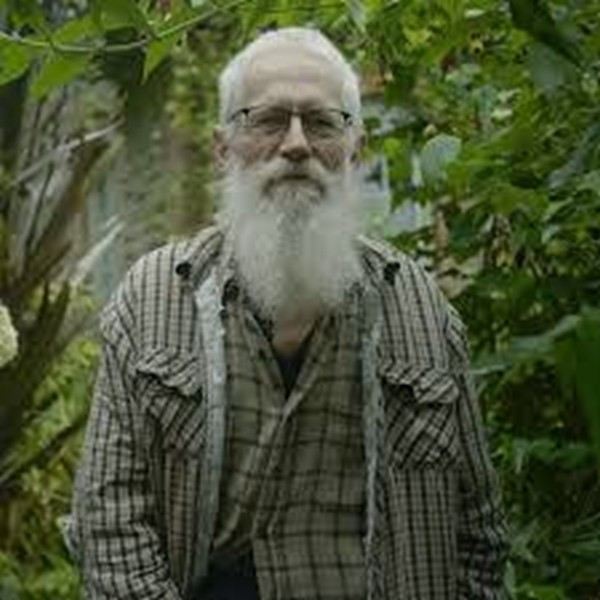
James David "Jamie" Muir, a talented drummer and percussionist and brief member of King Crimson, who left the world of pop music and show business to retreat to a Buddhist monastery in Scotland before dedicating himself almost entirely to painting, passed away last year at the age of 81. His artwork was recently featured in two exhibitions in Cornwall and London...
Born in Edinburgh, Scotland, in 1942, Jamie Muir attended the College of Art there in the 1960s. Early on, he was drawn to jazz.
Later settling in London, Jamie Muir played jazz trombone before turning to percussion. Influenced by American drummers like Tony Williams, Kenny Clarke, and Milford Graves, as well as musicians such as Pharoah Sanders and Albert Ayler, he gravitated toward free music, meaning improvisation. It was during this time that he began assembling an arsenal of household objects he later used alongside his standard drum kit: rattles, whistles, horns, chimes, bells, gongs, sheets of metal, shakers, drums, and plastic bottles.
After a brief stint in a multimedia group, Jamie Muir worked with choreographer Lindsay Kemp (as did David Bowie), played music in the short-lived jazz-rock group Sunship (with guitarist Allan Holdsworth, formerly of Soft Machine), and became involved in the ensemble known as The Music Improvisation Society, with Derek Bailey, Hugh Davies, and Evan Parker between 1968 and 1971. The Music Improvisation Society recorded an album for the ECM label in 1971 (never reissued on CD except in Japan) and a posthumous album (1968–71). Both records gained a cult following among fans of experimental and improvised music. After this experience, Muir played in Pete Brown’s Battered Ornaments and then in the band Boris with Jamie Peters, Don Weller, and former Colosseum member Jim Roache. He also briefly joined Assagai, an Afro-rock group featuring South African and Nigerian musicians from the legendary South African band Blue Notes (including drummer Louis Moholo, saxophonist Dudu Pukwana, and trumpeter/flutist Mongezi Feza).
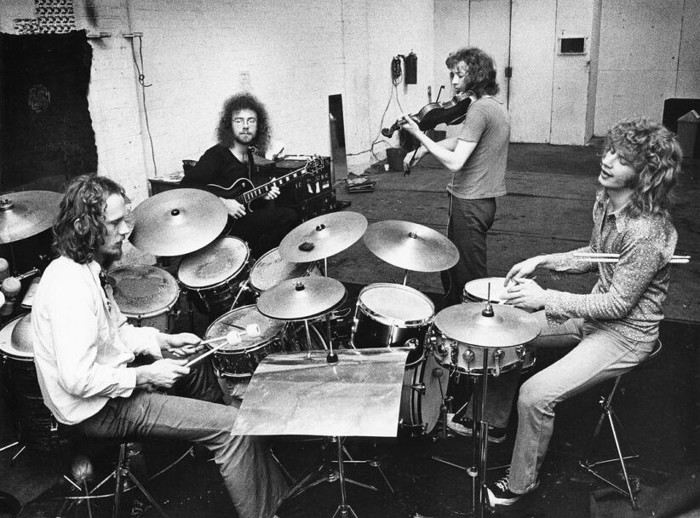
In the summer of 1972, Robert Fripp, leader and guitarist of King Crimson, whom a journalist from *Melody Maker* had suggested meet this percussionist from the English experimental scene, invited Jamie Muir to join the new King Crimson lineup he was assembling: Robert Fripp (guitar, mellotron), David Cross (violin), John Wetton (bass), Bill Bruford (drums), and Jamie Muir (percussion). "King Crimson was the ideal for me because it was a rock band that had more than three brain cells. I was very much more an instrumental style of musician rather than being song-based, and there weren’t many other bands that I would have been any good in. I was extremely pleased and felt completely at home with Crimson." Once formed, the new group honed their sound on stage from early October to mid-December 1972 (see the 1972 live albums in the discography below), before recording the album Larks’ Tongues in Aspic in early 1973. A grand album, one of the band’s best, and one of the best of the 1970s.
However, after a concert at the Marquee Club in London, Jamie Muir left not only the band but also the music world entirely, with immediate effect. During the six months Muir spent with King Crimson, his presence completely upended the group’s philosophy, loosening the notoriously strict rules imposed by Fripp and pushing the boundaries of improvisation. Jamie Muir’s contribution—clearly heard on Larks’ Tongues in Aspic—was to introduce a touch of anarchy into Robert Fripp’s music, which was usually so tight, rational, and meticulously structured.
Muir returned to Scotland, to the Samye Ling Monastery near Eskdalemuir in Dumfries and Galloway (in the south), where he spent several years as a Buddhist monk, the pleasures of his former life giving way to retreat and meditation.
Muir came back to London and music in the 1980s, playing and recording with Derek Bailey and Evan Parker from the Music Improvisation Company, as well as with former King Crimson member Michael Giles on the soundtrack for the independent British film Ghost Dance (1983).
In 1990, Muir left music behind once more and increasingly devoted himself to painting, a discipline he maintained until his death. In his later years, he began exploring digital art as another form of expression.
In recent years, he lived in Penzance, Cornwall, where he passed away in February 2025.
Hery
Discography:
A. Jamie Muir with King Crimson: • Larks’ Tongues In Aspic (1973) • Larks’ Tongues In Aspic (The Complete Recordings) (2023, 4 CDs) • Cosmic Muir (1998, Japan, unofficial release) • The Beat Club Bremen 1972 (1999) • Live at the Zoom Club Frankfurt, Germany (October 13, 1972) (2002, 2 CDs) • Live in Guildford (November 13, 1972) (2003) • Live in Newcastle (December 8, 1972) (2019, mono) B. Jamie Muir and other projects: • The Music Improvisation Company: The Music Improvisation Company (1970) • The Music Improvisation Company: 1968–1971 (1976) • Derek Bailey / Jamie Muir: Dart Drug (1981) • Michael Giles / Jamie Muir / David Cunningham: Ghost Dance (1996) • Evan Parker / Jamie Muir / Paul Rodgers: The Ayes Have It (2001)
Links:
https://www.jamiemuirart.com/
https://www.youtube.com/watch?v=eDyf0ofV5n4 (King Crimson: "Larks' Tongues in Aspic") https://www.youtube.com/watch?v=ZgoKT8hEBFQ&list=RDJ2FjbpvX8dA&index=2 (Michael Giles, Jamie Muir, David Cunningham)
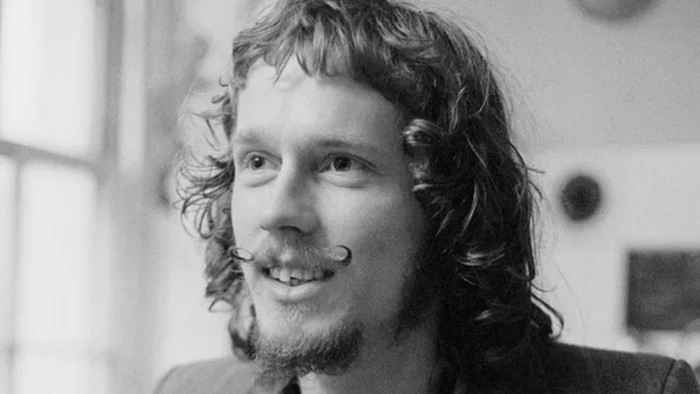 The musician
 The painter
 The band (l. to r.: Muir, Fripp, Cross, Bruford)
 Hi everyone,
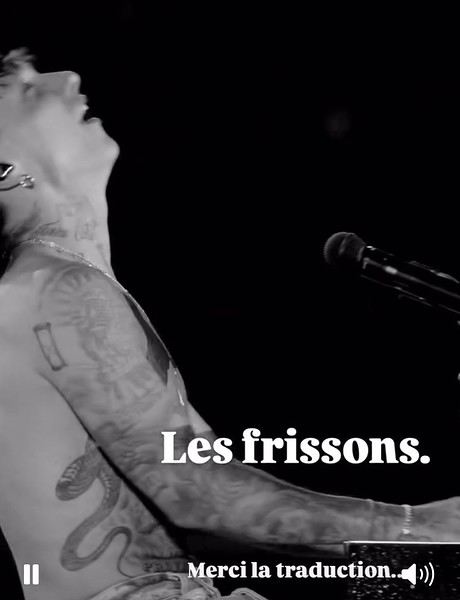
From this photo, can you tell me which song the artist Ultimo is performing—or at least give me as much info as possible so I can track down the title of this song?
Hi everyone,
From this photo, can you tell me which song the artist Ultimo is performing—or at least give me as much info as possible so I can track down the title of this song?