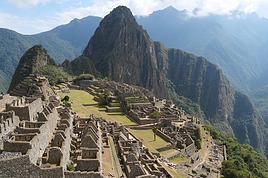
Il y a peu de temps une nouvelle cite a ete decouverte au Perou.
Si vous avez des infos concernant cette nouvelle n hesitez pas, je suis actuellement moi meme entrain d en chercher.
Je n'ai pas le temps de te faire la traduction, voici l'info en anglais
"Ruins show 'lost city' of the Incas was part of vast complex
By David Keys Archaeology Correspondent
07 November 2003
The world's most famous "lost city" - the Inca ruins of Machu Picchu in
Peru, found in the early 20th century - was part of a much larger
complex, according to sensational new archaeological discoveries.
While investigating a mountain ridge facing the Andean city, an
Anglo-American expedition has discovered a previously unknown series of
high-status sacred ceremonial buildings scattered over at least a square
mile of jungle.
So far, using airborne infra-red reconnaissance and exploration of the
jungle itself, the team - led by the British explorer Hugh Thomson and
the American archaeologist Gary Ziegler - have found 33 previously
unknown buildings. They also found seven others which had originally
been located by the American explorer Hiram Bingham in 1912, but the
whereabouts of which had been lost, as Bingham left no compass bearings.
Preliminary examination of the ruins suggests that the complex was a
large religious centre used for ceremonies and astronomical
observations.
The new area istwo miles from Machu Picchu itself. The expedition has
identified, as well as the buildings, eight plazas, seven
10ft-highplatforms and a series of walled walkways connecting
structures. The buildings include a massive storehouse, a probable sun
temple (resembling in several ways the great sun temple in the Inca
capital, Cuzco, 45 miles away), and a two-storey observatory, for
watching solar equinoxes and solstices.
The archaeologists believe that the complex was probably built by the
Inca emperor Pachacuti in the mid-15th century. The complex, known as
Llactapata, appears to have been constructed along with Machu Picchu as
part of one overall plan. Buildings in both Machu Picchu and Llactapata
are aligned with each other and with Mount Machu Picchu, which dominates
the site.
The ruined fortress city of Machu Picchu ("manly peak")consists of about
200 buildings at an altitude of 8, 000ft. It was probably used to provide
seasonal high-status accommodation and some ceremonial facilities for
the ruler and his entourage, with room for 1, 200 people, possibly during
the winter when Cuzco became very cold. Llactapata, on the other hand,
appears to have been more ceremonial in nature. The sites therefore
complemented each other and formed a greater whole facing each other
across the Aobamba River.
Mr Ziegler said: "This is an important discovery which may completely
alter our view of Machu Picchu, as the Llactapata site is closely
related to it."
Mr Thomson, who has just returned to the UK after four months in Peru,
said: "This must be one of the last places left on the planet where
major above-ground archaeological monuments are still being located. We
are extremely excited by this find."
Archaeologists say the discovery reinforces the need to expand the Machu
Picchu Historical Sanctuary's borders to include and protect a wider
area. At present the ruins at Llactapata lie outside the protection of
the Peruvian National Park Service and so are vulnerable to looters.
The expedition discovered evidence suggesting that looters had been
active at the site, despite the fact that archaeologists were unaware of
the site's existence.
The Inca ruins are visited by 500, 000 tourists every year.
The exploration was carried out with the support of the Royal
Geographical Society.
LONDON, Nov. 6 - An Anglo-American team of explorers has found Inca
ruins lost for centuries in the Peruvian jungles despite being within
sight of the key religious center at Machu Picchu. Using infrared aerial
photography to penetrate the forest canopy, the team led by Briton Hugh
Thomson and American Gary Zeigler located the ruins at Llactapata, 50
miles northwest of the ancient Inca capital Cusco.
"THIS IS a very important discovery. It is very close to
Machu Picchu and aligned with it. This adds significantly to our
knowledge about Machu Picchu, " Thomson told Reuters by telephone on
Thursday. "Llactapata adds to its significance."
The site was first mentioned by explorer Hiram Bingham,
the discoverer of Machu Picchu, in 1912. But he was very vague about its
location, and the ruins have lain undisturbed ever since.
After locating the city from the air the expedition,
which only last year found another lost Inca town at Cota Coca 60 miles
(100 kilometers) west of Cusco, used machetes to hack through the jungle
to reach it, 9, 000 feet (3, 000 meters) up the side of a mountain.
They found stone buildings including a solar temple and
houses covering several square kilometres in the same alignment with the
Pleiades and the June solstice sunrise as Machu Picchu, which was a
sacred center.
"This gives the site great ritual importance, " Thomson
said.
Not only was Llactapata probably a ceremonial site in its own
right, excavations suggested that it might also have acted as a granary
and dormitory for its sacred neighbor, he added.
The Incas abandoned their towns and cities and retreated
from the treasure-hunting Spanish invaders after the Conquistadors
captured and executed the last Inca leader, Tupac Amaru, in 1572.
Some of the cities have since been rediscovered, but many
more are believed to lie hidden in the dense jungle, almost impossible
to detect without new technology or a chance encounter.
"The fact that we have found two in two years means there
could be many more out there, " Thomson said.
He said the use for the first time of an infrared camera
to locate a set of ruins from the air had been a breakthrough, but one
that did not make the humble machete redundant.
"It makes wielding the machete slightly more purposeful at least you know where you are going and that there is something
definitely in front of you - but it certainly won't put it out of
business, " Thomson said."
Travailler, étudier et vivre à l'étranger › Pérou · 4 replies
Nous envisageons de partir vivre au Pérou en famille (2 adultes et 2 enfants) proche du Machu Pichu, dans une maison familliale pour y faire des chambres…
Alors que des milliers de touristes visitent la région autour de Cabanaconde, j'ai voyage dans la partie la plus profonde du Canyon de Colca sans en voir aucun…
M’apprêtant à partir pour un voyage autour du monde de 8mois (notamment en Amérique du Sud et Népal), je suis allée chez mon généraliste pour qu’il me…
Le pont routier de urubamba qui relie cuzco à Ollantaytambo et quillabamba s'est en partie ecroulé aux passages incessant des camions lourdement chargés. Un…
AVIS IMPORTANT A TOUS LES VISITEURS DU MACHU PICCHU Depuis ce 20 juillet 2011, le ministère péruvien de la culture a limité à 2500 par jour le nombre d'entrées…
Bonjour
Nous pensons partir 1 mois au Chili , faire une boucle peut etre ?
Du 23 /12 au 22/01
Quelles sont les visites à faire sachant que nous sommes intéressés par l'aspect culturel du pays et non par les plages.
Merci
Hi there,
I’m planning a trip with my partner (no kids this time—thanks, Grandma!) for two weeks to celebrate her 40th birthday. I’ve been thinking about Chile. We’re looking at leaving around September 18, 2027, starting in the south and returning in early April.
Here’s what I had in mind:
8 nights in a van in the Lake District and the start of the Carretera Austral (up to the Chaitén area). We’re set to arrive in Puerto Montt around 2:00 PM. We don’t want to go too far south since we’re planning to explore the heart of Patagonia (Chile and Argentina) with the kids when they’re older. The idea is to spend 3 nights discovering the lakes (up to Cochamó) and 3 nights in Pumalín Park. I’ve also added two transition nights.
7 nights in the Atacama to experience another side of Chile (San Pedro), taking a domestic flight from Puerto Montt to Calama in the early afternoon. We’ll depart for France in the early evening from Santiago.
My partner and I are planning our 3-week trip to Ecuador for the summer of 2027. Yes, we’re getting a head start—we’re planning to visit the Galapagos Islands and want to make the most of our budget.
While researching online, I keep coming across ToutEquateur. Has anyone here used them before?
I’ve seen some interesting prices, especially for Amazon stays and Galapagos cruises, but I’m wondering if it’s worth booking through them or if I could get better deals by contacting lodges or boats directly (though I don’t speak much Spanish).
If you have any firsthand experiences to share, I’d love to hear them.
Hi everyone,
We're planning a trip to southern Chile in November. Here's our tentative itinerary:
Day 1: Arrival in Santiago, then a flight the next day to Balmaceda where we'll pick up a rental car to reach Coyhaique.
Day 3: Walk in the Coyhaique National Reserve, then continue to Puerto Chacabuco. Return to Coyhaique for the second night.
Day 4: Drive to Villa Cerro Castillo for a hike in the national park. Continue to Puerto Tranquilo and stay there for 3 nights.
Day 5: Boat tour on Laguna San Rafael.
Day 6: Day trip to Monte San Valentin Glacier.
Day 7: Excursion to the Marble Chapels, then drive to Puerto Guadal. We'll stay there for 3 nights.
Day 8: Walk along Lago Carrera and return to Puerto Guadal.
Day 9: Rio Baker Valley and, if possible, a glacier excursion.
Day 10: Drive to Cochrane and hike in Tamango National Reserve. We'll stay 2 nights in Cochrane.
Day 11: Walk in the Chacabuco Valley.
Day 12: Drive to Caleta Tortel. We'll stay there for 2 nights.
Day 13: Cruise in the Rio Baker delta.
Day 14: Return to Cochrane.
Day 15: Return to Balmaceda in two stages.
Day 16: Continue the return journey.
Day 17: Return the rental car and head back to Santiago.
After this, we're also planning to explore northern Santiago. I'll post about that part once I have a clearer idea of the route.
What do you think of this itinerary? Is it doable in 17 days?
Thanks in advance for your tips and recommendations.
martine
Hi everyone! So happy to be back on this forum—it’s packed with such useful info! 🙂 My husband and I are planning a 2.5-week self-drive trip to Colombia at the end of the year, including some domestic flights. My first question is: is it possible, easy, and safe to do a road trip in Colombia?
Below is our draft itinerary (with questions at each stop):
29/11: France → Colombia. Overnight in Bogotá.
30/11: Exploring Bogotá: La Candelaria and Montserrate.
01/12: Gold Museum (closed on Mondays). Drive to Zipaquirá (1.5 hrs) to visit the Salt Cathedral. Then drive to Villa de Leyva (3 hrs). Explore the town. Overnight in Villa de Leyva.
02/12: Return to Bogotá via Laguna de Guatavita (5 hrs). Is it worth the detour? Overnight in Bogotá.
03/12: Flight to Pereira. Drive to Salento. Overnight in Salento.
04/12: Cocora Valley (hike among the wax palms) followed by a drive around the area. Are there any waterfalls or other sights nearby?
05/12: Visit a coffee finca—any recommendations? Then explore the surroundings: Filandia, Manizales, waterfalls? Hot springs? Which ones?
06/12: Flight to Medellín.
07/12: Exploring Medellín: Centro, Plaza Botero, Comuna 13. How do you visit Comuna 13? Is it easy to get around Medellín? Metro? Buses?
08/12: Drive to Guatapé (2 hrs). Visit the town, stroll around the lake, then El Peñol. Overnight in Guatapé.
09/12: Return to Medellín.
10/12: Flight to Santa Marta. Drive to a hotel near Tayrona Park.
11/12: Tayrona—El Zaino entrance.
12/12: Tayrona—Palangana entrance, then Bahia Concha and Santa Marta. What do you think?
13/12: Drive to Minca (45 mins). Can we reach the village by car? Pozo Azul and Marinka waterfalls. Overnight in Minca (or back in Tayrona?).
14/12: Drive to Puerto Nao (5 hrs). Stop in Ciénaga on the way + boat tour in Nueva Venecia and/or Buena Vista? Not enough time? Overnight in Puerto Nao.
15/12: Exploring Cartagena: Centro, Getsemaní, the walls + La Boquilla if we have time.
16/12: La Boquilla (is it really worth it?) if we didn’t have time yesterday, then back to the beach.
17/12: Return to France.
So, what do you think? Is this doable, or should we tweak it? Thanks in advance for your invaluable feedback and tips! 🙂
Hi there, I’ll be in Brazil from December 10th to the end of February.
I’ve sketched out a rough itinerary but I’m not sure how to arrange it—considering the climate, year-end holidays, and Carnival.
Basically, I’m thinking of the Amazon, the Northeast coast with Lençóis Maranhenses National Park (but skipping Chapada Diamantina),
Ouro Preto, Paraty, and Ilha Grande—but no Rio visit.
Is this doable in 3 months?
Which direction should I take for this itinerary?
Thanks in advance!
Hi everyone, does anyone know the agency Ventura Travel Agency (not ventura travel)? After lots of research and quotes, it’s the only one offering Uyuni at a reasonable price while meeting all the criteria: transfer to the border, private-room accommodation, and a very fair rate. Other agencies or guides either offer shared rooms, no border transfer, or prices that are way too high. But I’d love to hear some reviews about this agency. Thanks in advance!
Hi everyone,
We're planning a trip to Chile to visit the Atacama Desert and then head toward Putre, Lauca, Salar de Surire, etc.
Which would be the better time to go, April or November?
Is an SUV enough?
Looking forward to your tips!
Hi everyone, French travelers in Chile—what credit cards do you use for your various car rentals in the country? I’m traveling in September and was planning to switch my regular debit card (a VISA PREMIER in deferred debit mode) for the deposit guarantee.
My rentals are with Figal in Punta Arenas, Econautos in Arica, and Chilean Rent a Car in Temuco, and all of them want the deposit on a credit card. For me, deferred debit *should* work, but I’ve read comments saying the opposite.
How’s it actually working on the ground with these rental companies right now? Will a deferred debit card work, or not at all?
In France, banks don’t issue credit cards, right—or am I mistaken?
Hi everyone, is it still possible to travel in Ecuador outside the Amazon region? If so, do you have a reliable agency to recommend? All your recent experiences from the past few months would be greatly appreciated. Thanks so much
Hi,
We’re heading to Buenos Aires for 3 days in November and would like to do a guided tour of a few neighborhoods. There are "free" tours, but none in French. Does anyone have a guide to recommend so we can really get to know the city beyond just the architecture?
Thanks
Hi there,
I’m desperately looking for info on the schedules and routes of (shared) boats to visit the islands of Lake Titicaca.
From what I’ve found, there’s a *combi* (bus) that leaves from Puno to go to Llachon. Where do you catch it? What are the schedules and frequency? Does it take about 1 hour?
Then in Llachon, you can take a boat to Amantani (45 min). Same question—where do you check for frequency and schedule?
After that, from Amantani, boats go to Taquile and then Uros. Do you have enough time to visit the islands between two boats? Frequency and schedule?
The goal is to do this tour independently (no agency) over 2 days. Thanks for any tips you might have!
I just got back from a trip to Bolivia and wow—what a wake-up call. It’s not the easiest country, but it’s absolutely stunning.
I started with Isla del Sol, perfect for easing into the altitude at a relaxed pace. Try to stay in the northern part of the island—it’s quieter and the views are insane. And the trout there? Unreal. Quick tip: bring cash in small bills; they almost never have change, and cards are rarely accepted.
Next up, La Paz. The city’s pretty wild, built in every direction. I did a few hikes in the area, including the famous Charquini Lagoon (the blue lake) at over 5,000 m—let’s just say I struggled 😅 but it was so beautiful it was totally worth it.
After that, I headed to Sajama. It’s cool, especially for the hot springs, and I stayed in Tomarapi. But honestly, if you’re short on time, you can skip it without too many regrets.
The highlight of the trip: the Salar. I did it starting from Tupiza, and I *highly* recommend going Tupiza → Uyuni. Way less crowded at the start and the landscapes are super varied. For the tour, I used SplitYourGuide to find a group, and it worked out great. Super handy for splitting costs and meeting people.
I wrapped up in Sucre—this city is gorgeous, all white, with such a chill vibe. And the salteñas + ice cream? Next level 😋
Bottom line: Bolivia’s a bit rough around the edges, sometimes exhausting (shoutout to the altitude), but it’s 1000% worth it.
If you’ve got questions or need tips, I’m happy to help!
Martin
I was planning to go to Réunion and stay in half-board accommodation with non-professionals, but it seems that’s not really the custom there—or maybe my budget isn’t big enough.
So, since I’ve already traveled around Ecuador and Peru, I’m now looking at Argentina, especially for its mountains (like the ones in Réunion that tempted me, even though—frustratingly—I could only admire them from below).
I plan to get around by bus and don’t know in advance where I’ll sleep, so I won’t book ahead. If I like a place, I might stay for several days.
I know that in Chile, it’s easy to find half-board accommodation, but what about in Argentina?
I’d like to stay with locals in half-board without it being a professional setup. I’m not sure if this is common practice there. It’s up to me to find someone willing to host me.
What do you think?
What would be a fair price (keeping in mind that 40 to 50 € is the max I can spend on accommodation, breakfast, and dinner)?
Hi everyone,
We’re heading to Patagonia for three weeks in November, starting from Coyhaique in Chile.
We won’t have a car, and I’m struggling to find information about transportation options for a few parts of the itinerary we’d like to do:
1) From Perito Moreno (the town, near Los Antiguos), we’d like to travel down Ruta 40 to visit Perito Moreno National Park and then cross into Chile via the Paso Roballos (at the latitude of Bajo Caracoles) to reach the road to Cochrane. Without a car, it seems we’ll need to use private agencies to get to the national park—do you have any recommendations or suggestions? Also, does anyone know if it’s possible to cross into Chile via Paso Roballos (from Bajo Caracoles) without a rental car? That is, without having to go all the way down to El Chaltén or back up toward Perito Moreno/Los Antiguos, etc.?
2) The second stretch that seems a bit tricky (though still easier, in theory) is from Caleta Tortel to Villa O’Higgins on the Chilean side. Do we have to go back through Cochrane, or are there ways to get directly from Tortel to Villa O’Higgins?
3) Finally, we’d like to hike into Argentina (El Chaltén) from O’Higgins. Any recommendations for this? Do we need to go through an agency? What’s the estimated duration of the trek?
As you’ve probably gathered, we want to visit some off-the-beaten-path spots but don’t have a car, so we’re looking for the best possible compromises.
Thanks so much in advance for all your suggestions!
Thomas
Hi,
we’re planning a round trip from San Pedro de Atacama, Chile, to Salta, Argentina, in two months. On the way there, we’ll take the northern route via Susques, Route 27, then 52. But for the return, we were thinking of taking the southern route via San Antonio de los Cobres, Route 51, then 23. Is it similar to the northern route in terms of road surface? How busy is it, and are there gas stations? Basically, should we be worried about doing it in an SUV that’s supposedly 4x4 but has regular road tires and no second spare wheel, obviously...
I’ve seen that we can stop over in San Antonio de los Cobres.
Thanks for your feedback.
Raf.
Hi,
we’ll be in Calama at the end of March 2026, and I’m looking for a reliable car rental there for a 7-day road trip to Salta, Argentina. But I’m struggling with the car rental agencies in Calama because the reviews can be scary. I saw Gyg, which has great ratings, but I’m a bit wary (5/5 from 59 reviews—either the guy’s amazing or it’s fake...), but I can’t find any recent reviews on VF in general.
For Punta Arenas, I booked with Dachelet and didn’t have any issues with email exchanges.
Thanks in advance.
Raf.
I’m planning the trip of my dreams for next November—Chile!
I’d love to get your thoughts on my potential itinerary. I know it’s a big investment in terms of both time and money, so every bit of feedback, suggestion, or info helps immensely. Thank you in advance!!
1-Flight to Santiago
2-Explore Santiago
3-Explore Santiago
4-Bus from STG to Valpo (2h) + visit Valparaíso + night in Viña
5-Visit Valparaíso + bus back to STG (2h)
6-Flight to Calama + bus to San Pedro + explore and acclimate in San Pedro + car rental in the afternoon (+Chaxa?)
7-(Very early) Valle del Arcoíris + Laguna Cejar + Valle de la Luna
Good evening,
We’d love to go in November to enjoy some beautiful beaches for about two weeks, preferably around Bahia, as November/December seems like a great time.
We’ve already traveled to Brazil several times and know the south of Rio as well as the region between São Luís and Fortaleza, and Chapada Diamantina...
What advice would you give us: the south with Itaparica, Morro de São Paulo, Boipeba, Barra Grande—or all four? Or maybe the north?
Thanks in advance for your help
Hi everyone, it’s been a while since I last posted!
First time in South America for me, my wife, and our 7-year-old son. I’ve put together this itinerary and would love to hear your thoughts:
Bogotá 28/07 – 30/07: Arrival. Which neighborhood and outings would you recommend?
Flight to
2 Filandia 30/07 – 03/08: (255 €). Waterfalls and horseback riding,
Cocora Valley,
Hiking,
Nearby villages.
Flight to
3 Tayrona 03/08 – 07/08: Hotel La Casablanca
Hike with Tierra Nevada and the Kogui village (any feedback?). Return by inner tube for the little one.
Short night hike.
Second hike to La Piscina, etc., return by 🐎.
4 Cartagena 07/08 – 10/08: Air-conditioned bus.
Staying in Getsemaní? Mangroves & the Castle, exploring the city.
5 Bogotá 10/08 – 12/08
Feel free to share your feedback!
Have a great day!
Hi,
During an upcoming trip to Peru, we’ll have one day to explore around Arequipa (excluding Colca Canyon) with a car and driver.
We’ve got a few options:
- Toro Muerto petroglyphs and dinosaur footprints at Querulpa
- Ruta del Sillar and Quebrada de Culebrillas
We’re a group of 6 friends with an average age of 70, all mobile, and we’re planning a trip to Peru in September/October 2026. Below is an idea of what we’re looking for: a French-speaking guide, accommodation in 3-star hotels or homestays with comfort.
Duration: 16 to 20 days on-site.
Visit the main sites with immersion in the culture and way of life.
Which francophone agency in Peru would you recommend? Thanks
Hi there!
I’m putting together my itinerary for Brazil, looking for beautiful natural spots with wildlife, flora, and great hikes...
I’ve come across the Cananeia / Super Agui / Ilha do Mel region and the PETAR / Intervales / Alto Ribeira area.
Has anyone here been to these places? If so, do you have any recommendations for accommodations and activities?
Thanks in advance!
Best,
Olivier 🌍
I’ll be in ARICA in northern Chile at the end of May 2026 and want to get to TACNA.
Are there taxis, buses, or collectivos that run the border crossing route?
After that, bus to AREQUIPA (Peru): any bus company you’d recommend?
Hi there,
We’re spending 3 weeks in Brazil, arriving in São Paulo—a couple plus a teen—and we’ll have a rental car.
We especially love nature: hiking, wildlife watching, birds, etc.
We’re planning to wrap up with a week around Paraty and Ilha Grande.
We’re not really into visiting big cities like São Paulo or Rio unless you think we’d be missing out big time.
So we’ve got 2 weeks to explore the south/southwest region of São Paulo.
What do you recommend?
National parks? Off-the-beaten-path nature spots? Iguazu Falls?
Hi there,
Do you have any recommendations for comfortable accommodation in Leyva and Barichara? We're also looking for a guide to explore the areas around these two towns (parks, waterfalls, etc.).
Thanks for your tips!
I visited Colombia in January 2016 and I’m heading back from August 6th to 17th with the same airline to see how things have changed. Starting August 18th, I’ll continue with independent exploration. I prefer slow travel and enjoying places at my own pace.
Any tips—especially for getting around or must-see spots—are welcome!
Thu Aug 06. Fly Montreal to Bogotá 20:55-04:05+1 Air Canada
Fri Aug 07. Bogotá
Sat Aug 08. Bogotá
Sun Aug 09. Bogotá
Mon Aug 10. Fly Bogotá to Medellín
Tue Aug 11. Medellín - Explore Guatapé
Wed Aug 12. Comuna 8 & Hill of Values - PM Fly to Pereira
Thu Aug 13. Montenegro
Fri Aug 14. Salento - Cocora Valley
Sat Aug 15. Fly to Cartagena
Sun Aug 16. Explore Cartagena
Mon Aug 17. Explore Cartagena
Tue Aug 18. Fly Cartagena to Cali 12:20-14:55 Latam
Wed Aug 19. Cali
Thu Aug 20. Cali
Fri Aug 21. Cali
Sat Aug 22. Bus Cali to Popayán 09:00-13:00
Sun Aug 23. Popayán
Mon Aug 24. Popayán
Tue Aug 25. Popayán - Day trip to Silvia (Market Day)
Wed Aug 26. Overland Popayán to Tierradentro by public transportation 4h, 100km
Thu Aug 27. Tierradentro
Fri Aug 28. Tierradentro
Sat Aug 29. Overland Tierradentro to Garzón via La Plata
Sun Aug 30. Bus Garzón to San Agustín 10:30-13:00
Mon Aug 31. San Agustín
Tue Sep 01. San Agustín
Wed Sep 02. San Agustín
Thu Sep 03. San Agustín
Fri Sep 04. Overland San Agustín to Tatacoa Desert via Neiva
Sat Sep 05. Tatacoa Desert
Sun Sep 06. Fly to Bogotá via Neiva 16:00-17:00 Latam
Mon Sep 07. Bogotá
Tue Sep 08. Fly Bogotá to Montreal 09:00-16:30 Air Canada
Hi there,
Three years ago during a trip to Java (no, I didn’t post in the wrong forum!), I came across the address of former miners who had switched to “tourism” and organized nighttime ascents of the Kawah Ijen volcano and descents into the crater.
So I was thinking—maybe there are miners on the salt flats too, either former or still active, who do the same thing. If you’ve had an experience like this, I’d love any tips you can share.
Thanks in advance.