Hello everyone, the program for the Itinérance Travel Festival in Cornimont is finalized. Over four days, conferences will take place from 11:00 AM to 12:00 PM, 2:00 PM to 7:00 PM, and from 8:30 PM to 9:00 PM on May 8, 9, and 10. On May 11, the schedule is 11:00 AM to 12:00 PM and 2:00 PM to 5:30 PM. The event will be held at the multi-activity hall, 16 rue des Grands Meix, Cornimont 88310.
The speakers will share their experiences traveling by bike, on foot, and also in mountaineering.
Cornimont can be reached via a 25-kilometer cycling path from Remiremont train station, which is very well connected.
Photo exhibitions will be displayed on the following themes:
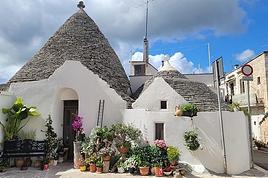
The Abruzzo region
Wildlife of the Vosges
The road workers of the Himalayas
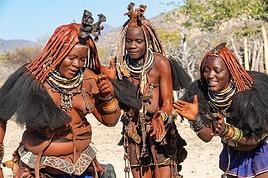
Faces of the world: photos taken during an 8-year walk around the Earth
The photo series by the Cyclo Camping International association
On the mornings of May 9, 10, and 11, meet-ups will be organized at scenic high points around Cornimont for intuitive music performances and readings of excerpts from long-term travelers' books, particularly by Caroline Moireaux (you can easily find her website).
The meet-ups start at 6:15 AM, with returns no later than 10:00 AM.
Admission is free.
Don’t hesitate to contact the Cornimont tourist office for all practical details.
By phone at +33 3 29 24 12 17 or via their website, which you can easily find online.
Hope to see many of you there!
Feel free to reach out to me in this thread if you have any questions.
Luc
Hi everyone, it’s with a little pang in my heart that I’m back here chatting after four long years away.
In May 2025, the village of Cornimont is organizing a travel festival called Itinérance. I’m sharing the two communication documents, knowing that we’re also looking for speakers. We already have quite a few lined up. We’re not just looking for technically polished films with stunning drone footage. We’re looking for people who want to share their passion, whether it’s a trip around their department or a journey around the world.
ITINERANCE PRESS RELEASE – October 2024
Itinérance, the travel festival, from your doorstep to the ends of the Earth First edition, May 8–11, 2025, Polyactivity Center in Cornimont (Vosges)
What could be a more beautiful journey than one that loops right from your doorstep, on foot or by bike, in the spirit of the ancient pilgrims of Saint-Jacques-de-Compostelle?
For this first edition, Itinérance aims to celebrate local travel, in France and nearby regions, while also making room for distant expeditions that require motorized transport.
Talks, photo exhibitions, personal stories, films... will highlight the harmony with nature, the joy of unexpected encounters along the trail or road, the lightness of minimalist logistics, and the discovery of landscapes in all their simplicity and authenticity.
Cornimont is an hour’s bike ride from Remiremont train station via the Voie Verte, in the heart of the Parc Naturel Régional des Ballons des Vosges, in the Hautes-Vosges area. A bus line also connects Remiremont train station to the center of Cornimont.
For more information: itinerance.cornimont@gmail.com Facebook: Itinérance Cornimont
In May 2025, the village of Cornimont is organizing a travel festival called Itinérance. I’m sharing the two communication documents, knowing that we’re also looking for speakers. We already have quite a few lined up. We’re not just looking for technically polished films with stunning drone footage. We’re looking for people who want to share their passion, whether it’s a trip around their department or a journey around the world.
ITINERANCE PRESS RELEASE – October 2024
Itinérance, the travel festival, from your doorstep to the ends of the Earth First edition, May 8–11, 2025, Polyactivity Center in Cornimont (Vosges)
What could be a more beautiful journey than one that loops right from your doorstep, on foot or by bike, in the spirit of the ancient pilgrims of Saint-Jacques-de-Compostelle?
For this first edition, Itinérance aims to celebrate local travel, in France and nearby regions, while also making room for distant expeditions that require motorized transport.
Talks, photo exhibitions, personal stories, films... will highlight the harmony with nature, the joy of unexpected encounters along the trail or road, the lightness of minimalist logistics, and the discovery of landscapes in all their simplicity and authenticity.
Cornimont is an hour’s bike ride from Remiremont train station via the Voie Verte, in the heart of the Parc Naturel Régional des Ballons des Vosges, in the Hautes-Vosges area. A bus line also connects Remiremont train station to the center of Cornimont.
For more information: itinerance.cornimont@gmail.com Facebook: Itinérance Cornimont
Cycling Through Provence's Big Climbs
In the autumn of 2011, Provence was hit by apocalyptic weather—torrential rain and a particularly violent east wind, reaching 130 kilometers per hour, whipping up waves as high as seven meters. It wasn’t the best time to venture outside. Yet, I told myself that after the storm, calm would return. I kept an eye on the weather forecast and noticed that starting November 10th, a favorable window should open for a little 600-kilometer cycling trip across Provence. The weather reports promised a high-pressure system that would keep the bad weather at bay over these highlands. That was all I needed to decide to set off. The planned route would take me through Provence’s biggest climbs: Mont Ventoux, Montagne de Lure, the Verdon Gorge, the Massif des Maures, and Sainte-Baume.
And so, despite my doubts, the call of adventure was stronger. The train pulled away, and once again, a journey began at Part-Dieu station. This time, I headed toward Haute-Provence for a cycling adventure. It would be my first solo bike trip. I was a little nervous—cycling with panniers makes you feel vulnerable to theft. I’d already been robbed while traveling in a group in Peru, and that experience left me deeply shaken. Alone, I hesitated. But no need to panic—I’d read accounts from long-distance cyclists who hadn’t been robbed, even if it does happen sometimes. I was particularly thinking of a young schoolteacher who had taken a sabbatical to cycle around the world. Her students had remarked, "Teacher, you’re not sporty—how will you manage to cycle around the world?" This young woman was full of resourcefulness. In South America, before flying to China, she locked her bike to a post to take care of a natural need. When she returned, the post had been torn out, and her bike—along with all her gear—was gone. It was a shock for many, but not for her. She boarded her flight to the Middle Kingdom, bought the essentials (including a new bike) once there, and continued her journey! Remembering this story, I almost felt ashamed of my cowardice. These were the thoughts running through my mind as the Rhône Valley rolled by toward Orange, the starting point of my Provençal adventure through the big climbs.
Day One: Orange to Sault via Mont Ventoux – 90 km
9:30 AM, I stepped off the train. With all my gear, I had to navigate the underground passage—no easy feat, given that my bike and luggage weighed 35 kilos. At this time of year, I expected some areas to be deserted, so I’d packed enough to bivouac comfortably. Once outside the station, the southern light flooded over me. I understood why people dream of retiring in these sun-drenched regions. As always, after disembarking from public transport, I had to get my bearings and decide which way to go. The sun, still low on the horizon, pointed east. The roar of fighter jet engines helped me locate the Air Base 115. That was all I needed to "reset the gyros."
As soon as I started pedaling, all my apprehensions vanished. The joy of discovery and physical effort took over, and euphoria washed over me. It’s amazing how emotions can shift from one moment to the next based on seemingly minor circumstances.
The weather was splendid—the forecast had predicted continuous showers, but it was completely wrong. I quickly left the city behind. Mont Ventoux loomed mysteriously, its dimensions hard to gauge. It was even more enigmatic with its summit hidden beneath swirling, mottled clouds clinging to the ridges. It reminded me of a great South American volcano. I struggled to imagine that in a few hours, I’d be up there under that blanket of mist.
The countryside was shaking off its autumnal nighttime dampness. The vineyards, interspersed with tall cypress hedges, confirmed I was in the magnificent Côtes du Rhône wine region. The distinctive Dentelles de Montmirail were very much in evidence. The air force base wasn’t far. I passed the runway’s end markers. A Mirage 2000 flew overhead in a tight turn, followed by another roaring into takeoff. It came straight at me before climbing sharply with a thunderous roar. Thirty years spent in that captivating world came rushing back. I recalled countless extraordinary human and technical experiences from my time in the service. But the purpose of this post isn’t to promote the air force—though I might post some articles one day about travels among men at war.
I continued on my way, leaving my past loves behind. As I pedaled, delightful names rolled by: Violès, Vacqueyras, Gigondas, Beaumes-de-Venise—the crème de la crème of the Côtes du Rhône Villages appellation. I let myself be enchanted by the vineyards and the little paths crisscrossing them. I started to doubt my route, though the imposing mass of Mont Ventoux in the distance acted like a giant beacon. At a crossroads, a car appeared. I approached to ask the driver for directions, but she didn’t even look at me and sped off, clearly frightened. I’d almost forgotten what a fearful world we live in, no doubt traumatized by all the horrors we see in the news and on TV.
The kilometers started adding up, but was my day’s goal too ambitious? It had been two months since I’d last ridden my bike. True, my last trip had been good training—the Route des Grandes Alpes—but that was two months ago. I can’t just take my bike out for a day trip; I need that sense of adventure to find the courage to exercise.
Two cyclists overtook me. Intrigued by my load, they struck up a conversation. They were skeptical when I told them I planned to cross Mont Ventoux that day. One of them pointed out a small chapel near the summit where I could bivouac sheltered. That motivated me even more to reach the top on this first stage. The chapel also had a mythical name for me—Sainte-Anne, the name of my parents’ villa. It was already noon, and I’d covered 50 kilometers. Malaucène appeared—the sacred village of Ventoux’s mad cyclists. Surprisingly, I didn’t see any other cyclists today. I remembered this place in June, teeming with aspirants for the king of summits. Before tackling the climb ahead, I needed to refuel. I enjoyed a pleasant gastronomic break at Max’s. At 1 PM, I started the most famous climb in cycling—21 kilometers, which would actually be 23. I knew it would be tough, especially with two handicaps: 50 kilometers already in my legs and 20 kilos of luggage. But I was counting on my tiny chainring, which let me climb trees to tackle the steep ramps.
I set off at a brisk pace along a deserted road. My speed held up for the first few kilometers. I quickly rose above the valley, the horizon widening. I was surprised to see no one on this world-renowned route among cycling enthusiasts. During the climb and descent, I’d only see five cyclists—but I’ll come back to that. I passed a sign explaining that the effort would be roughly equivalent to climbing the Col de la Bonnette. Having done the latter in September, I figured I’d be fine. I crossed paths with my first cyclist—a woman speeding downhill. After 12 kilometers, I hit slopes averaging 12%. I don’t know if the number 12 is cursed, but I got such a "bamboo" hit that I’d never experienced before. I thought I wouldn’t make it to the summit today. I stopped. My thighs burned so much I could barely walk—lactic acid overload. I looked for a relatively flat spot to pitch my tent. It was 3:30 PM, with two hours of daylight left. But I found nothing.
I got back on my bike, intending to stop as soon as I found a good bivouac spot. But nothing came up. However, my strength slowly returned, perhaps because the slope eased, though it remained around 10%. I entered the summit mists. A cyclist overtook me. I was in the zone where I had to pass the summit. Dusk caught me in the final difficulties. The atmosphere was downright austere. In the twilight, a kilometer from the summit, a cyclist was fixing his bike. I asked if he needed help. He made it clear he didn’t understand. So I asked, "Do you need some help?" His answer was clear: "No, thank you." He showed me his new inner tube. Inside, I thought, "Phew!" If I’d had to stop, sweating in the falling night with the cold intensifying, I’d have struggled to get going again. But he managed, and I continued into the twilight fog. I could barely make out the summit’s large antennas in the clouds, like immense ghosts trying to evade sight. The bike delivered sensations worthy of mountain racing. My goal was to quickly find the famous chapel in the descent to take shelter. As I glided down the southern slope, two cyclists without lights crossed my path in the night—probably heading to the station above, its lights visible in the fog.
I scanned the roadside in the dark for the chapel but saw nothing. After a kilometer or two, I lost all hope. I stopped to put on more clothes as the cold became intense. I had no idea where I could stop on these steep slopes to set up camp. Between the swirls of mist, I could intermittently see the Rhône Valley below, dotted with illuminated towns and villages. The sight was striking. What was I doing on this mountain at night? Then the miracle happened—the clouds parted, and from the ridge above me to the east, a beautiful full moon emerged, casting enough light to consider a nighttime descent to Sault, 26 kilometers away.
In this eerie atmosphere between the moon’s pale rays and patches of fog, I began my descent through a hazy, almost unreal world. The Ventoux’s characteristic white scree reflected the moonlight faintly, dimmed by the mist. In places, entire mountainsides were plunged into complete darkness, and I lost all sense of the road’s path. Then, around a tight bend caused by a land shift, the light returned. It seemed extreme compared to the darkness I’d left behind. I could once again clearly see the road’s contours, though not its potholes or gravel patches. Still, I let the slope carry me, and the speed felt significant, though the low light prevented me from reading my speedometer. In these moments, concentration was at its peak—all senses alert, reflexes ready to react to the slightest incident that could lead to a fall.
I was relieved to see Sault’s lights growing closer. In less than an hour, I reached it, considering the final little climb that required one last push. This village, bustling in summer, was deserted at this time of year—almost dead. The first hotel I came across was closed. A quick shadow passed in a small sloping street. Before it disappeared into the darkness at a house corner, I chased after it and asked about accommodation options. Very kindly, I was directed to what was probably the only hotel open in November. I quickly found it, and the reception was open. I entered wearing my black balaclava, bought in the Ayacucho region—the birthplace of Peru’s Shining Path. At this late hour, I saw questioning glances directed at me. I prefaced, "This isn’t a hold-up." Clearly, the owners had a sense of humor—they started smiling. I took off my balaclava and asked for a room. No problem, and from that moment, the pressure eased. I really didn’t feel like going back out to find a spot to pitch my tent in the biting cold.
The stage had been nearly 100 kilometers, and it was the first. It had been two months since I’d touched my bike, and I probably lacked even minimal training, even though my last bike trip had been crossing the French Alps. I really had to dig deep to overcome my weakness on Ventoux’s steep section. I don’t remember ever having to search so deeply for the energy to keep going. I knew the stage I’d set for tomorrow was significant, with the climb up Montagne de Lure’s northern slope—Ventoux’s little sister, whose ascent is reputed to be endless, over 25 kilometers. I hoped this first day wouldn’t leave me too sore to avoid suffering excessively tomorrow.
For now, relaxation—a hot shower did me a world of good, followed by a good meal. I ate a delicious andouillette from Troyes, very fine, with a particularly successful herb seasoning. I loved it, and yet I’m from Lyon and pride myself on knowing a thing or two about andouillette—not just a sausage but a whole category! A bit chauvinistic, I had to admit, though reluctantly, that I found it better than the ones I usually eat in the Lyon region!
Day Two: Sault to Forcalquier via Montagne de Lure – 116 km
This morning, the weather was magnificent—the air clear, still, very fresh, and invigorating, as only the late season can offer on these Provençal highlands. In summer, they’re known for their scorching heat and drought, but often overlooked is how harsh they can be with cold and storms. Authors like Giono or Bosco described them and their inhabitants wonderfully in books like "Les Âmes Fortes."
The miracle of the night had worked. I wasn’t sore anywhere and felt in great shape. I set off well-equipped, but the effort and sun soon made me sweat. It was time to shed some layers—hat and gloves. A gentle warmth replaced the cold, making for excellent cycling conditions. On the road to Trinit, there was no traffic—only the occasional hunters’ cars parked in the distance. These vehicles were recognizable by their large cages, used to transport hunting dogs. Sometimes, the silence was broken by a distant gunshot. The deciduous forests were losing their foliage, taking on that dull brown hue of late autumn, though here and there, a tree or shrub still resisted, displaying vivid yellow or red. The meadows, their grass already scorched by the cold, were damp from the night’s heavy humidity. The low sun highlighted thousands of spider webs that had trapped insects during the warm season.
Behind me, Mont Ventoux dominated these vast spaces. As often, its imposing, stony summit was crowned with a blanket of clouds. What an impressive mountain—it’s always so hard to gauge its dimensions. I struggled to realize that last night I’d been at the summit and descended its immense southern ridge in the dark. I hoped to return one day in favorable conditions—daylight and no clouds—to enjoy the vast panorama from this unique summit.
Leaving the very Provençal village of Trinit, I tackled my first climb of the day—the Col de l’Homme Mort. The road rose moderately for five kilometers in gentle warmth. The view over the region widened, and I felt the sheer joy of pedaling. At a good pace, I overcame this first little challenge. Once at the pass, I couldn’t resist the ritual of photographing my bike in front of the sign, giving the name and altitude—1,213 meters.
The northern slope was austere and still in shadow. The cold bit again. The road was wet and covered with leaves in places. It wasn’t impossible that some treacherous patches of black ice lurked around a bend. I descended toward the Jabron Valley with caution. Suddenly, around a bend in a forest clearing, the freshly snow-covered Alps, gleaming in the sun, leapt into view, blocking the horizon. I thought I recognized the distinctive silhouette of the Écrins’ south face above a multitude of jagged peaks.
This snow and these mountains awakened a flood of memories of great joys, but I also thought of the guide and his client who had just lost their lives on the Grandes Jorasses’ north face, at the top of a route called the Linceul. The name comes from the face’s appearance—a great ice slope bordering the Grandes Jorasses’ north wall. It was first climbed by René Desmaison in 1968. He passed away a few years ago and, in his final wishes, asked that his ashes be scattered in the Dévoluy Massif at the foot of Pic de Bure, not far from here in these immense pre-Alpine folds.
At my feet, the Jabron Valley stretched almost endlessly east toward Sisteron. In the distance, the dark mass of Montagne de Lure’s north face loomed. This mountain shares similarities with Mont Ventoux. It has the same summit scree of bright limestone, the same forests climbing up to the final rocky stretch, and that blanket of clouds adding a secretive, austere touch to the scene.
I turned left past the town of Séderon and headed toward the little Col de la Pigière, which in a few kilometers allowed me to truly plunge into the beautiful Jabron Valley. I passed through several villages with charming local names—Saint-Vincent, Noyer-sur-Jabron. The river offered lovely views of its narrow gorges with clear, cold water. Autumn seemed less advanced here than on the plateau I’d just left. Many trees still wore brilliant colors, some revealing extraordinary hues—mixes of crimson, pink, and bright red.
Arriving in Noyer-sur-Jabron, I took a tiny road on the river’s right bank, leading in a few kilometers to the foot of Montagne de Lure. In the village of Valbelle, I picnicked on leftovers I’d brought from home—an old cheese and a somewhat stale loaf of bread. It was 1:30 PM. I began the long climb of about 25 kilometers. According to a friend who’s a cycling expert in the region, this section is tough. No wonder it’s called Ventoux’s little sister—the Mont Blanc of cyclists. The elevation gain on this side is still 1,200 meters, while Ventoux via Malaucène is nearly 1,600 meters.
I hoped to reach the summit before nightfall and avoid reliving a nighttime descent. The route wound through a vast forest, following the terrain’s folds. There was activity—mushroom hunters were busy searching for the coveted chanterelle. The climb, though never very steep (only one kilometer at 9%), was interminable. Though traffic was practically nonexistent, I was overtaken by a group of Harley bikers—I counted about forty. Perched high on their machines, hands in the air on wildly shaped handlebars, some with their feet nearly in the sky due to the high footpegs, they didn’t even glance my way. What’s this idiot doing, unable to ride a motorcycle and forced to climb these mountains on a bike with big bags! I wasn’t offended—real Harley purists often see other motorcyclists as renegades, so bikes are even lower on the totem pole! But I didn’t want to start a debate about motorcycles. In my youth, when I was a wild motorcyclist (22 accidents on two wheels), clans were divided into Japanese, German, Italian, and British bike owners. The latter, on their vibrating, oil-leaking machines, considered themselves the purest. But let’s not fight—there’s a statute of limitations, and it’s been nearly forty years.
As yesterday, a few kilometers below the summit, I entered the fog, and the light dropped suddenly. What a hostile mountain in these conditions! It heightened the sense of living an incredible experience. The conditions we encounter play a major role in how the adventure imprints on our memory. I realized once again that in France, you can feel like you’re very far away. Finally, after this very long climb, the Pas de Graille sign suddenly appeared out of the grayness. Strange! Below the sign, a kilometer marker indicated this same pass was over three kilometers away. Clearly, the climb continued. In these final kilometers through the scree, I gained another 130 meters of elevation. Finally, the road’s high point was reached—1,720 meters. It was cold and damp. I quickly covered up, added my balaclava under my helmet, and put on warm gloves. As I was about to start the descent, a car stopped at the summit, and one of the passengers was surprised to find a bike there in these chilly, twilight conditions.
A 20-kilometer descent led me to the village of Saint-Étienne-les-Orgues. I hoped to find a place to stay for the night. No such luck! Everything was clearly closed—no chance of finding shelter. Tonight was getting complicated. I already had exactly 100 kilometers in my legs and didn’t feel like pedaling anymore, especially at night. But I had even less desire to sleep outside. What to do to avoid it? The town of Forcalquier was 16 kilometers away—I hoped the road would descend. I set off in that direction. The first third was along a beautiful, lightly trafficked departmental road with a slight downhill—I pedaled hard. But it got tougher. I joined a busier road, and night had fallen. A several-kilometer climb finished the journey. I knew my magnetic lights weren’t very powerful—hence the danger. They were even less so on the climb because the slower I went, the less they illuminated. Cars coming the opposite way often saw me late and blinded me with their high beams. After passing, I was plunged into total darkness for a few seconds while my pupils readjusted to the night. I imagined those coming up behind me saw me with little warning, despite my slightly fluorescent jacket. When the roadside was clear, I always positioned myself to quickly jump off the road. But unfortunately, in this long final climb, a guardrail prevented any escape to the right in case of sudden braking behind me. That was even more anxiety-inducing since I was stuck at a snail’s pace. Time seemed long. I pedaled as hard as I could, on the verge of asphyxiation, trying to escape this dangerous situation as quickly as possible. My only reference point was the vehicles in front of me, letting me know the climb wasn’t over. Then suddenly, the ordeal ended—the road’s high point was reached. The town and its lights emerged from the void, and clarity returned. Phew! I glided down toward this little town bathed in light. On November 11th, I hoped to find an open hotel since I’d clearly exceeded 100 kilometers, and the idea of having to leave town to find a bivouac spot somewhat frightened me.
I arrived in the town center. Activity was low. The first hotel was closed, but I spotted a lit sign for another establishment further on. I headed there, got off my bike, and entered. The welcome was immediately friendly—a big cat came to rub against me. For me, that was a very good sign, and the first impression was confirmed. I still had to go out to eat. I covered the minimum distance. A restaurant advertised "Mom’s Cooking." I expected Provençal specialties, but they were Moroccan. I chose a delicious tagine with lime and olives, followed by almond and honey ice cream. Exhausted after this 116-kilometer stage, I returned to my room. As often after intense efforts, it was hard to fall asleep.
Day Three: Forcalquier to Moustiers-Sainte-Marie – 58 km
On this third day, due to the progress made yesterday, the stage would be short. I’d call it a transition between two mountain ranges. Indeed, the next big climb is the Verdon Gorge. I planned to position myself at its foot this evening in preparation for a tough stage tomorrow. I made a few purchases—bread, bananas, and medicine for stomach burns (the midday sausage wasn’t always kind to me). The weather was still perfect. The route began with a long descent toward the Durance. It’s always nice to start a cycling day with a downhill—it boosts morale and allows for a gentle warm-up.
I quickly reached the town of Oraison. Just at its entrance, I crossed the Durance, which still bore traces of last week’s heavy rains along its sandbanks. Indeed, numerous stumps and trunks were scattered along its vast gravel bed, along with less ecological debris like old tires.
A little south of Oraison, I took the D907, a small road heading due east between scrubland and meadows. There it was—the Provence we imagine. This stable autumn weather, with still air, neither hot nor cold, just a fresh feeling when emerging from a shaded valley or a slight warmth under the sun, was ideal for a cyclist. After about ten kilometers at the bottom of a small valley I quickly passed through, the village of Le Brunet appeared on the right. It clung to the slopes leading to the Valensole Plateau. A few steep kilometers along a tiny winding road, and suddenly a vast panorama unfolded as the climb ended.
What a magnificent plateau! Though known for its wind, luckily today was completely calm. Far to the east, the Verdon’s great cliffs blocked the horizon. This allowed me to contemplate part of tomorrow’s stage. This place is full of mysteries—many UFO and extraterrestrial encounter stories are associated with it. Moreover, for about thirty years, France hid its ground-to-ground nuclear ballistic missiles here, grouped in the 1st GMS (Ballistic Missile Group), under the air force. Naturally, these rockets fueled fantasies, and pacifist groups settled in the region to protest this type of armament. This gives many reasons to shroud this austere, deserted land in mystery.
I took a dirt path leading to the heart of this zone and stopped at the forest’s edge for lunch. The silence was total, the view stretched very far. But nothing strange or bizarre manifested. No Martian came to share my frankly moldy cheese, very peppery sausage, or bruised banana—sniff! I resumed my route, and as often when crossing places with strong character, I tended to slow down to enjoy them longer. The immense lavender fields stretched endlessly, not very fragrant at this season. I arrived at a group of truffle oaks protected by a fence, with large red signs warning "Firearm." Clearly, the war for the black diamond was raging in this region. I remembered a novel where an old farmer made buyers believe nothing grew on his land. Every year, he secretly stole the mushrooms from the unsuspecting owners. Then one day, they discovered the truth, catching this "polite" neighbor trying to hide a basket full of beautiful, large truffles!
In these vast spaces, I felt good—a sense of plenitude. It’s strange that I only conceive of cycling through wandering. I struggle to plan a day trip. And if I do, it’s highly likely I won’t get up. I need that sense of adventure to fully appreciate my physical effort. Maybe one day I should get psychoanalyzed, but at my age, it’s probably too late! Today, I had all the time in the world—the stage was half as long as yesterday’s, with very little elevation gain. Not a sound, an impressive calm, a beautiful landscape—I pedaled in a wonderful place. That’s probably happiness!
I reached the village of Puimoisson on the plateau’s eastern edge—only 12 kilometers left to Moustiers. I took my time, sat at a café terrace in the sun, and leisurely enjoyed a coffee while listening to the village come to life. I was delighted by these melodious southern voices, bursting into great laughter. There are places where, despite the anxieties caused by our debt-ridden, dysfunctional societies, some have decided to take life on the bright side and show a saving insouciance.
The rest of the journey was a simple formality—I let the slope carry me toward the pretty little town of Moustiers-Sainte-Marie, clinging to the cliff and famous for its faïence. Arriving early for once, I went to the tourist office to choose a comfortable hotel. Indeed, the Hôtel des Restanques was very comfortable and admirably well-located. But at this time of year, I’d have to return to the village center for dinner. The very kind receptionist reserved a table for me at La Treille Muscate, a restaurant with a magnificently arranged room on the church square. It was only 3:30 PM—I continued to take my time, showering and relaxing in front of the TV. Then I set off to explore—or rather, re-explore—this village I’d visited several times before. But I’d never climbed to its chapel perched in the middle of the great cliff towering over the houses. A stony, aerial path led there. The first mentions of the Notre-Dame de Beauvoir chapel, known in ancient times as Notre-Dame d’Entre-Roches, date back to the 9th century. It’s one of the rare "respite" chapels found in Provence. These are chapels where stillborn children were brought to be revived for a few moments, just long enough to baptize them. They could then be buried religiously, ensuring the salvation of their souls. I was also very moved by reading some ex-votos, like the one from "A mother for her three children returned from the war."
The place was impressive, especially as night fell. I was alone and watched the shadows fill the great cliffs above me. With an old climber’s reflex, I looked for possible climbing routes among these slabs and cracks. But climbing is probably forbidden here, too close to the houses. Then I descended to stroll through the village, admiring the magnificent, finely crafted faïence patterns found in many shops. Finally, dinnertime arrived, and I joined my restaurant, which had been highly recommended. I was delighted by the foie gras ravioli and the pieds et paquets—the chef’s specialty. I’ll come back with family.
Day Four: Moustiers to Fréjus via the Verdon – 122 km
A hearty breakfast prepared me for the day’s tough efforts. Next to me, four Chinese people chatted animatedly. Of course, I didn’t understand a word—it was a language with strange intonations and sounds. I left the dining room and prepared my bike on the terrace. Seeing the volume of my luggage, my Chinese friends rushed over and asked to take turns having their photo taken in front of this funny setup. All laughing, they took photos in front of what they probably considered a French coolie off on some trading business! When they show these photos to their relatives, they’ll likely be perplexed about what motivates some to travel by bike rather than car. For them, the car is a symbol of success—according to an article I read last year, 14,000 cars are registered in China every day!
This morning, the air was fresh. As yesterday, I started with a long descent, this time leading to the edge of Lac de Sainte-Croix. A strong, biting headwind slowed me down. It wouldn’t last, as it was generated by the gorge’s outlet, which I’d reach in a few kilometers. On this cold morning, the lake’s shores exuded great tranquility. The sun was still hidden behind the Verdon’s mountainous mass. Trees with yellow leaves stood out against the water’s pale blue. The bridge marking the gorge’s beginning at the lake’s edge was an ideal spot to admire this natural splendor. At this early hour, the play of light and shadow on the water and the immense cliffs delivered a grandiose spectacle in beautiful harmony. This first contact with the gorges, which I knew well, amazed me.
Once past the bridge, the wind calmed. A little further on, I began the long climb that would take me to the top of this immense natural gash, which water had taken millions of years to carve. I was in good shape and highly motivated by the splendors to come. First, I reached the village of Aiguines, which offered a magnificent viewpoint over the lake. Then I continued toward the Corniche Sublime, where countless breathtaking panoramas unfolded as I progressed. But the climb was sustained and long, requiring effort—though my small chainring worked miracles. I first passed the Col d’Illoire, already 500 meters above the lake. Seeing all these great cliffs, countless climbing memories came flooding back. The classic routes of the Escalès cliff, over 300 meters high, flashed by. Routes with legendary names—La Demande, Les Écureuils, Luna-Bong, and many others. The one that left me with the best memory was ULA—a crack, vertical or even overhanging, of sheer beauty rising above a 40-meter slab in one go for 280 meters of sustained, beautiful climbing on extraordinary rock. It made me want to return to climb there, to immerse myself in the atmosphere of those past times. But climbing habits have changed—now routes are accessed from above by rappel, and people don’t always bother to do these great climbs in their entirety, focusing instead on shorter but technically much more difficult enterprises.
At almost every bend, I stopped and scanned these great cliffs, searching for memories of past experiences and emotions in these secret rock folds. The road climbed well above the pass, exceeding 1,200 meters. It was cool, especially since I was sweating. Finally reaching the high point of the Corniche Sublime, I couldn’t gain speed on the descent—my gaze was always drawn to this astonishing canyon. Around a bend, two cyclists with funny small-wheeled bikes. Wow! It was a couple of Australians doing a year-long tour of France. We chatted passionately about our two-wheeled experiences for a moment. But time was passing, and if I wanted to reach Fréjus before nightfall, I’d have to pedal seriously.
I stopped at the Pont de l’Artuby, where bungee jumping was in full swing. But I quickly set off again toward Comps. The wind was against me, and it was climbing. I started to doubt whether I’d make it to the coast that evening. At 2 PM, I was in Comps-sur-Artuby. I didn’t stop, knowing that before reaching the coast, I’d have no alternative to bivouacking, and I had 70 kilometers left to cover. Sure, it should be downhill, but a few climbs were on the program. After a descent out of the village, I crossed the Artuby River again on the Canjuers military camp. A several-kilometer climb followed, fortunately not too steep. I took the D19 toward Barjols. From there, despite the late hour, I opted for a tiny road passing through Claviers, a small perched village. Time passed quickly, but the kilometers added up. I regained hope. Fifteen kilometers after this last village, I reached Saint-Paul-en-Forêt via a magnificent forested route. I had plenty of time to observe mushroom hunters. I asked one who clearly had some in a plastic bag. He gave me this hilarious answer with a magnificent southern accent: "I only picked the bad ones." No reply was possible. I moved on with a smile. A little further on, another hunter carried a basket. As soon as he saw me, he quickly hid it—just in case I saw what it contained. Arriving at the village involved a steep climb, and I was close to 100 kilometers. I still had a little over 20 kilometers to go before reaching Fréjus. The race against nightfall had begun. Over there to my right, I saw the sun setting behind Roquebrune-sur-Argens’ distinctive rock. The sea appeared. There it was—I was in Fréjus’ industrial zone. On this Sunday evening, traffic was heavy. Indeed, many had taken advantage of the return of good weather after very heavy storms to go for a walk. After quite a few detours, I arrived at the seaside just as night fell. My odometer showed 122 km for the day. I quickly found a simple hotel, ate just as quickly, and went to bed.
Day Five: Fréjus to Solliès-Pont – 92 km
Once again, the night had done its restorative work, and I prepared to cross the Massif des Maures feeling quite fresh. The weather forecast was still favorable for today, but a deterioration was expected tomorrow. I tended to trust it because the east wind was blowing, and in the region, that’s a sign of rain. For now, in the short term, this wind would be very useful—it would push me generously throughout the day.
I started calmly along the harbor quays, looking at the boats. Then I joined the road to Saint-Aygulf and followed the coast for forty kilometers to Port-Grimaud. All these seaside resorts—Saint-Aygulf, Les Issambres, Sainte-Maxime—reminded me of my youth when we spent all our vacations fishing, whether from shore, underwater, or by boat. Looking at the sea roll by, I knew what the seabeds looked like under that surface hiding them. The marine areas we knew best were now under the parking lots and commercial zones of Saint-Raphaël’s new port. In our youth, these infrastructures didn’t exist, and their construction came at the expense of coastal marine areas. Our wonderful fishing spots were permanently buried. I remember seeing the first big trucks that came to dump their loads of earth and rubble, destroying all those wonderful places—sandbanks, seaweed beds, groups of rocky holes teeming with fish that enchanted our youth. Over forty years later, I can still visualize them in my imagination under those parking lots and stores, with the names we gave them—my brothers and I: le casse-croûte, le casse-pipe, les montagnes, la digue, la grille, la mare à mulets, la petite-plage, le trou, etc.
Let’s not be overwhelmed by nostalgia. I left the coast and took the little road through the Maures to Collobrières. The route led from ridge to ridge following the terrain’s movements. At this time of year, the region was admirable. Due to the heavy storms of recent weeks, water was streaming everywhere. Waterfalls and streams murmured all along the way. I didn’t recognize the Maures, which I knew for their dryness causing apocalyptic fires. Indeed, around a bend, I came across a small rest area where a memorial had been erected for three firefighters who lost their lives here while fighting one of those gigantic fires fanned by the mistral.
This forest holds treasures—first, the cork oak, then the arbutus, chestnut trees, and of course, mushrooms that love this granitic soil:
The cork oak can be found all along the road. It’s the forest’s essential element. You can recognize it by its light bark (before exploitation), which forms large bulges along the trunk. But after exploitation, the trunks are much smoother, less voluminous, and dark in color. The arbutus is a large berry with red skin covered in small protuberances, growing on the arbutus tree. This fruit, common in Mediterranean areas, ripens in November. That means today, there were plenty around me. Its flesh is orange, with the consistency of firm purée, and it crushes softly in the mouth. The taste of this berry is sweet and excellent. I didn’t hold back—I gorged myself on them, which served as my midday meal. Sometimes I had to climb embankments to get them.
The chestnut tree, a true industry of the region, brings wealth to the surrounding villages. They make candied chestnuts, ice cream, and other products derived from chestnut flour. Be careful not to stop just anywhere to pick this fruit, as the tree owners might not agree. They even make this clear with signs and surround their chestnut trees with fences. Mushrooms—saffron milk caps and porcini—are highly prized in the area. I saw a few hunters, but it clearly wasn’t miraculous. Supposedly, there had been too much rain?
There’s no time to get bored along this little road, from which you can sometimes see the sea. I passed the Col de Taillude at over 400 meters. I began the descent to Collobrières, the chestnut capital, whose festival attracts many people. Before entering, about a hundred meters from the first houses, a cyclist—probably an agricultural worker—came toward me. As he passed, he cheerfully called out, "Go on, little guy! It’s almost there!" We both smiled. At the end of November, the village was cold and almost deserted. Dead leaves swept the wet streets of the town. You could feel winter on the way. I continued my route to Pierrefeu-du-Var, on the western edge of the Massif des Maures. So I gave my last pedal strokes in this pretty little massif so characteristic of Provence.
I looked for a hotel in Cuers but without success. I descended toward Toulon and finally found one on the outskirts of Solliès-Pont. It catered to people coming to work in the region, so nothing very bucolic. But if the weather were to deteriorate tomorrow and turn to rain, I could quickly reach Hyères or Toulon station, which was a significant advantage. Indeed, November rains aren’t usually very pleasant on a bike.
Day Six: Solliès-Pont to Cassis via Sainte-Baume – 85 km
This morning, contrary to the weather forecast, the weather was beautiful, and the latest bulletin seemed to contradict yesterday’s. So no escape to Toulon—I resumed my route toward Sainte-Baume. I left the hotel via a tiny road that, through ups and downs, led me via shortcuts to the road to Belgentier. My body had gotten used to intense daily efforts, and I felt in Olympic form. At a good pace, I launched into a long climb with a moderate slope. The road was busy, but fortunately, the side lane for cyclists often made the exercise more pleasant. The villages rolled by—Méounes, La Roquebrussanne. Near the latter, I observed a Tiger combat helicopter in training. It hovered motionless for long periods—perhaps the pilots were training to master their increasingly sophisticated weapon systems, requiring even more learning?
I left the busy road and headed via an almost deserted route toward the village of Mazaugues. The climbs became steeper. A long descent, and there I was in this pretty village. A grocery store, which besides selling a few ingredients also served as a café. I sat near the electric heater—it was cold, and I was sweaty. I watched customers come and go and listened to the shopkeeper tell me about village life. The name Mazaugues comes from "water mass," which is why drought doesn’t usually affect this area. Apparently, you can even find mushrooms here in summer! I had a good time, and as I was leaving, a local cyclist started a conversation and told me about her dreams of long bike trips, currently limited by her situation as a mother of terrible children. She settled for day trips with her club, which was already good in this very hilly region. I told her the story of a man who, at 73, cycled solo around Morocco. So no panic—she still had thirty or forty years to realize her wildest dreams!
I was warned that it would be a tough climb to reach Sainte-Baume’s northern slope. Indeed, over eight kilometers, the average slope was sustained, but the landscape was wonderful. Here too, water was streaming everywhere. I passed one of those famous icehouses that used to supply Marseille with ice throughout the year. This northern slope of Sainte-Baume is very cold, and this characteristic was exploited in previous centuries to produce ice. Large cylindrical structures, well-protected to the north and semi-buried, received large quantities of water in late autumn, which froze during winter and was kept cool for months until the following winter. Ice blocks were cut and delivered by cart to the city. That’s how, in ancient times, ice was available in summer to keep fish fresh in Marseille. Did pastis exist at that time? If not, the ice cubes must have been bored!
Once the climb was over, the long ridge of Sainte-Baume appeared, and I could see its characteristic antennas. Nestled at the foot of the cliffs, the magnificent millennial forest revealed itself with its autumn colors. I stopped at the monastery. I’d been there several times before and had even slept there during a long walking trip. The welcome had been first-rate by the Dominicans, especially the sisters in their long immaculate robes. They radiated a serenity that was very contagious. Don’t hesitate to stop there for the night. I struggled to get back on my way—some places have a special spirit.
I was soon at the end of my journey. I continued along this magnificent mountain to the Col de l’Espigoulier. To the north, another immense wave of white limestone rose—Montagne Sainte-Victoire, a high place in Provence that painter Cézanne made world-famous. Once at the pass, the entire city of Marseille spread out at my feet, the Mediterranean coast revealed itself from the Calanques to La Ciotat, passing by the famous Cap Canaille, Europe’s highest sea cliff. Above me, bathed in sunlight, Bartagne’s northwest face, very popular among climbers, showed all its reliefs. With an old climber’s reflex, I spotted the many climbs I’d done there. I let myself be carried into a steep, winding descent toward the village of Gémenos in a beautiful setting full of cliffs.
A few more kilometers of climbing toward the Col de l’Ange, then toward Roquefort-la-Bédoule. In this last climb, I raced with two cyclists, admittedly not very young. Then, in a six-kilometer descent, I reached Cassis station, the endpoint of my six-day journey through this wild Provençal land between sea and mountain. I experienced great pleasure during these 570 kilometers through these renowned yet wild French massifs. As always, when a beautiful project comes to an end, you feel a bit orphaned by a beautiful dream come true. You have to quickly envision the next one to avoid a vague sense of emptiness taking over. My next adventure is already taking shape in my mind, but that’s another story.
In the autumn of 2011, Provence was hit by apocalyptic weather—torrential rain and a particularly violent east wind, reaching 130 kilometers per hour, whipping up waves as high as seven meters. It wasn’t the best time to venture outside. Yet, I told myself that after the storm, calm would return. I kept an eye on the weather forecast and noticed that starting November 10th, a favorable window should open for a little 600-kilometer cycling trip across Provence. The weather reports promised a high-pressure system that would keep the bad weather at bay over these highlands. That was all I needed to decide to set off. The planned route would take me through Provence’s biggest climbs: Mont Ventoux, Montagne de Lure, the Verdon Gorge, the Massif des Maures, and Sainte-Baume.
And so, despite my doubts, the call of adventure was stronger. The train pulled away, and once again, a journey began at Part-Dieu station. This time, I headed toward Haute-Provence for a cycling adventure. It would be my first solo bike trip. I was a little nervous—cycling with panniers makes you feel vulnerable to theft. I’d already been robbed while traveling in a group in Peru, and that experience left me deeply shaken. Alone, I hesitated. But no need to panic—I’d read accounts from long-distance cyclists who hadn’t been robbed, even if it does happen sometimes. I was particularly thinking of a young schoolteacher who had taken a sabbatical to cycle around the world. Her students had remarked, "Teacher, you’re not sporty—how will you manage to cycle around the world?" This young woman was full of resourcefulness. In South America, before flying to China, she locked her bike to a post to take care of a natural need. When she returned, the post had been torn out, and her bike—along with all her gear—was gone. It was a shock for many, but not for her. She boarded her flight to the Middle Kingdom, bought the essentials (including a new bike) once there, and continued her journey! Remembering this story, I almost felt ashamed of my cowardice. These were the thoughts running through my mind as the Rhône Valley rolled by toward Orange, the starting point of my Provençal adventure through the big climbs.
Day One: Orange to Sault via Mont Ventoux – 90 km
9:30 AM, I stepped off the train. With all my gear, I had to navigate the underground passage—no easy feat, given that my bike and luggage weighed 35 kilos. At this time of year, I expected some areas to be deserted, so I’d packed enough to bivouac comfortably. Once outside the station, the southern light flooded over me. I understood why people dream of retiring in these sun-drenched regions. As always, after disembarking from public transport, I had to get my bearings and decide which way to go. The sun, still low on the horizon, pointed east. The roar of fighter jet engines helped me locate the Air Base 115. That was all I needed to "reset the gyros."
As soon as I started pedaling, all my apprehensions vanished. The joy of discovery and physical effort took over, and euphoria washed over me. It’s amazing how emotions can shift from one moment to the next based on seemingly minor circumstances.
The weather was splendid—the forecast had predicted continuous showers, but it was completely wrong. I quickly left the city behind. Mont Ventoux loomed mysteriously, its dimensions hard to gauge. It was even more enigmatic with its summit hidden beneath swirling, mottled clouds clinging to the ridges. It reminded me of a great South American volcano. I struggled to imagine that in a few hours, I’d be up there under that blanket of mist.
The countryside was shaking off its autumnal nighttime dampness. The vineyards, interspersed with tall cypress hedges, confirmed I was in the magnificent Côtes du Rhône wine region. The distinctive Dentelles de Montmirail were very much in evidence. The air force base wasn’t far. I passed the runway’s end markers. A Mirage 2000 flew overhead in a tight turn, followed by another roaring into takeoff. It came straight at me before climbing sharply with a thunderous roar. Thirty years spent in that captivating world came rushing back. I recalled countless extraordinary human and technical experiences from my time in the service. But the purpose of this post isn’t to promote the air force—though I might post some articles one day about travels among men at war.
I continued on my way, leaving my past loves behind. As I pedaled, delightful names rolled by: Violès, Vacqueyras, Gigondas, Beaumes-de-Venise—the crème de la crème of the Côtes du Rhône Villages appellation. I let myself be enchanted by the vineyards and the little paths crisscrossing them. I started to doubt my route, though the imposing mass of Mont Ventoux in the distance acted like a giant beacon. At a crossroads, a car appeared. I approached to ask the driver for directions, but she didn’t even look at me and sped off, clearly frightened. I’d almost forgotten what a fearful world we live in, no doubt traumatized by all the horrors we see in the news and on TV.
The kilometers started adding up, but was my day’s goal too ambitious? It had been two months since I’d last ridden my bike. True, my last trip had been good training—the Route des Grandes Alpes—but that was two months ago. I can’t just take my bike out for a day trip; I need that sense of adventure to find the courage to exercise.
Two cyclists overtook me. Intrigued by my load, they struck up a conversation. They were skeptical when I told them I planned to cross Mont Ventoux that day. One of them pointed out a small chapel near the summit where I could bivouac sheltered. That motivated me even more to reach the top on this first stage. The chapel also had a mythical name for me—Sainte-Anne, the name of my parents’ villa. It was already noon, and I’d covered 50 kilometers. Malaucène appeared—the sacred village of Ventoux’s mad cyclists. Surprisingly, I didn’t see any other cyclists today. I remembered this place in June, teeming with aspirants for the king of summits. Before tackling the climb ahead, I needed to refuel. I enjoyed a pleasant gastronomic break at Max’s. At 1 PM, I started the most famous climb in cycling—21 kilometers, which would actually be 23. I knew it would be tough, especially with two handicaps: 50 kilometers already in my legs and 20 kilos of luggage. But I was counting on my tiny chainring, which let me climb trees to tackle the steep ramps.
I set off at a brisk pace along a deserted road. My speed held up for the first few kilometers. I quickly rose above the valley, the horizon widening. I was surprised to see no one on this world-renowned route among cycling enthusiasts. During the climb and descent, I’d only see five cyclists—but I’ll come back to that. I passed a sign explaining that the effort would be roughly equivalent to climbing the Col de la Bonnette. Having done the latter in September, I figured I’d be fine. I crossed paths with my first cyclist—a woman speeding downhill. After 12 kilometers, I hit slopes averaging 12%. I don’t know if the number 12 is cursed, but I got such a "bamboo" hit that I’d never experienced before. I thought I wouldn’t make it to the summit today. I stopped. My thighs burned so much I could barely walk—lactic acid overload. I looked for a relatively flat spot to pitch my tent. It was 3:30 PM, with two hours of daylight left. But I found nothing.
I got back on my bike, intending to stop as soon as I found a good bivouac spot. But nothing came up. However, my strength slowly returned, perhaps because the slope eased, though it remained around 10%. I entered the summit mists. A cyclist overtook me. I was in the zone where I had to pass the summit. Dusk caught me in the final difficulties. The atmosphere was downright austere. In the twilight, a kilometer from the summit, a cyclist was fixing his bike. I asked if he needed help. He made it clear he didn’t understand. So I asked, "Do you need some help?" His answer was clear: "No, thank you." He showed me his new inner tube. Inside, I thought, "Phew!" If I’d had to stop, sweating in the falling night with the cold intensifying, I’d have struggled to get going again. But he managed, and I continued into the twilight fog. I could barely make out the summit’s large antennas in the clouds, like immense ghosts trying to evade sight. The bike delivered sensations worthy of mountain racing. My goal was to quickly find the famous chapel in the descent to take shelter. As I glided down the southern slope, two cyclists without lights crossed my path in the night—probably heading to the station above, its lights visible in the fog.
I scanned the roadside in the dark for the chapel but saw nothing. After a kilometer or two, I lost all hope. I stopped to put on more clothes as the cold became intense. I had no idea where I could stop on these steep slopes to set up camp. Between the swirls of mist, I could intermittently see the Rhône Valley below, dotted with illuminated towns and villages. The sight was striking. What was I doing on this mountain at night? Then the miracle happened—the clouds parted, and from the ridge above me to the east, a beautiful full moon emerged, casting enough light to consider a nighttime descent to Sault, 26 kilometers away.
In this eerie atmosphere between the moon’s pale rays and patches of fog, I began my descent through a hazy, almost unreal world. The Ventoux’s characteristic white scree reflected the moonlight faintly, dimmed by the mist. In places, entire mountainsides were plunged into complete darkness, and I lost all sense of the road’s path. Then, around a tight bend caused by a land shift, the light returned. It seemed extreme compared to the darkness I’d left behind. I could once again clearly see the road’s contours, though not its potholes or gravel patches. Still, I let the slope carry me, and the speed felt significant, though the low light prevented me from reading my speedometer. In these moments, concentration was at its peak—all senses alert, reflexes ready to react to the slightest incident that could lead to a fall.
I was relieved to see Sault’s lights growing closer. In less than an hour, I reached it, considering the final little climb that required one last push. This village, bustling in summer, was deserted at this time of year—almost dead. The first hotel I came across was closed. A quick shadow passed in a small sloping street. Before it disappeared into the darkness at a house corner, I chased after it and asked about accommodation options. Very kindly, I was directed to what was probably the only hotel open in November. I quickly found it, and the reception was open. I entered wearing my black balaclava, bought in the Ayacucho region—the birthplace of Peru’s Shining Path. At this late hour, I saw questioning glances directed at me. I prefaced, "This isn’t a hold-up." Clearly, the owners had a sense of humor—they started smiling. I took off my balaclava and asked for a room. No problem, and from that moment, the pressure eased. I really didn’t feel like going back out to find a spot to pitch my tent in the biting cold.
The stage had been nearly 100 kilometers, and it was the first. It had been two months since I’d touched my bike, and I probably lacked even minimal training, even though my last bike trip had been crossing the French Alps. I really had to dig deep to overcome my weakness on Ventoux’s steep section. I don’t remember ever having to search so deeply for the energy to keep going. I knew the stage I’d set for tomorrow was significant, with the climb up Montagne de Lure’s northern slope—Ventoux’s little sister, whose ascent is reputed to be endless, over 25 kilometers. I hoped this first day wouldn’t leave me too sore to avoid suffering excessively tomorrow.
For now, relaxation—a hot shower did me a world of good, followed by a good meal. I ate a delicious andouillette from Troyes, very fine, with a particularly successful herb seasoning. I loved it, and yet I’m from Lyon and pride myself on knowing a thing or two about andouillette—not just a sausage but a whole category! A bit chauvinistic, I had to admit, though reluctantly, that I found it better than the ones I usually eat in the Lyon region!
Day Two: Sault to Forcalquier via Montagne de Lure – 116 km
This morning, the weather was magnificent—the air clear, still, very fresh, and invigorating, as only the late season can offer on these Provençal highlands. In summer, they’re known for their scorching heat and drought, but often overlooked is how harsh they can be with cold and storms. Authors like Giono or Bosco described them and their inhabitants wonderfully in books like "Les Âmes Fortes."
The miracle of the night had worked. I wasn’t sore anywhere and felt in great shape. I set off well-equipped, but the effort and sun soon made me sweat. It was time to shed some layers—hat and gloves. A gentle warmth replaced the cold, making for excellent cycling conditions. On the road to Trinit, there was no traffic—only the occasional hunters’ cars parked in the distance. These vehicles were recognizable by their large cages, used to transport hunting dogs. Sometimes, the silence was broken by a distant gunshot. The deciduous forests were losing their foliage, taking on that dull brown hue of late autumn, though here and there, a tree or shrub still resisted, displaying vivid yellow or red. The meadows, their grass already scorched by the cold, were damp from the night’s heavy humidity. The low sun highlighted thousands of spider webs that had trapped insects during the warm season.
Behind me, Mont Ventoux dominated these vast spaces. As often, its imposing, stony summit was crowned with a blanket of clouds. What an impressive mountain—it’s always so hard to gauge its dimensions. I struggled to realize that last night I’d been at the summit and descended its immense southern ridge in the dark. I hoped to return one day in favorable conditions—daylight and no clouds—to enjoy the vast panorama from this unique summit.
Leaving the very Provençal village of Trinit, I tackled my first climb of the day—the Col de l’Homme Mort. The road rose moderately for five kilometers in gentle warmth. The view over the region widened, and I felt the sheer joy of pedaling. At a good pace, I overcame this first little challenge. Once at the pass, I couldn’t resist the ritual of photographing my bike in front of the sign, giving the name and altitude—1,213 meters.
The northern slope was austere and still in shadow. The cold bit again. The road was wet and covered with leaves in places. It wasn’t impossible that some treacherous patches of black ice lurked around a bend. I descended toward the Jabron Valley with caution. Suddenly, around a bend in a forest clearing, the freshly snow-covered Alps, gleaming in the sun, leapt into view, blocking the horizon. I thought I recognized the distinctive silhouette of the Écrins’ south face above a multitude of jagged peaks.
This snow and these mountains awakened a flood of memories of great joys, but I also thought of the guide and his client who had just lost their lives on the Grandes Jorasses’ north face, at the top of a route called the Linceul. The name comes from the face’s appearance—a great ice slope bordering the Grandes Jorasses’ north wall. It was first climbed by René Desmaison in 1968. He passed away a few years ago and, in his final wishes, asked that his ashes be scattered in the Dévoluy Massif at the foot of Pic de Bure, not far from here in these immense pre-Alpine folds.
At my feet, the Jabron Valley stretched almost endlessly east toward Sisteron. In the distance, the dark mass of Montagne de Lure’s north face loomed. This mountain shares similarities with Mont Ventoux. It has the same summit scree of bright limestone, the same forests climbing up to the final rocky stretch, and that blanket of clouds adding a secretive, austere touch to the scene.
I turned left past the town of Séderon and headed toward the little Col de la Pigière, which in a few kilometers allowed me to truly plunge into the beautiful Jabron Valley. I passed through several villages with charming local names—Saint-Vincent, Noyer-sur-Jabron. The river offered lovely views of its narrow gorges with clear, cold water. Autumn seemed less advanced here than on the plateau I’d just left. Many trees still wore brilliant colors, some revealing extraordinary hues—mixes of crimson, pink, and bright red.
Arriving in Noyer-sur-Jabron, I took a tiny road on the river’s right bank, leading in a few kilometers to the foot of Montagne de Lure. In the village of Valbelle, I picnicked on leftovers I’d brought from home—an old cheese and a somewhat stale loaf of bread. It was 1:30 PM. I began the long climb of about 25 kilometers. According to a friend who’s a cycling expert in the region, this section is tough. No wonder it’s called Ventoux’s little sister—the Mont Blanc of cyclists. The elevation gain on this side is still 1,200 meters, while Ventoux via Malaucène is nearly 1,600 meters.
I hoped to reach the summit before nightfall and avoid reliving a nighttime descent. The route wound through a vast forest, following the terrain’s folds. There was activity—mushroom hunters were busy searching for the coveted chanterelle. The climb, though never very steep (only one kilometer at 9%), was interminable. Though traffic was practically nonexistent, I was overtaken by a group of Harley bikers—I counted about forty. Perched high on their machines, hands in the air on wildly shaped handlebars, some with their feet nearly in the sky due to the high footpegs, they didn’t even glance my way. What’s this idiot doing, unable to ride a motorcycle and forced to climb these mountains on a bike with big bags! I wasn’t offended—real Harley purists often see other motorcyclists as renegades, so bikes are even lower on the totem pole! But I didn’t want to start a debate about motorcycles. In my youth, when I was a wild motorcyclist (22 accidents on two wheels), clans were divided into Japanese, German, Italian, and British bike owners. The latter, on their vibrating, oil-leaking machines, considered themselves the purest. But let’s not fight—there’s a statute of limitations, and it’s been nearly forty years.
As yesterday, a few kilometers below the summit, I entered the fog, and the light dropped suddenly. What a hostile mountain in these conditions! It heightened the sense of living an incredible experience. The conditions we encounter play a major role in how the adventure imprints on our memory. I realized once again that in France, you can feel like you’re very far away. Finally, after this very long climb, the Pas de Graille sign suddenly appeared out of the grayness. Strange! Below the sign, a kilometer marker indicated this same pass was over three kilometers away. Clearly, the climb continued. In these final kilometers through the scree, I gained another 130 meters of elevation. Finally, the road’s high point was reached—1,720 meters. It was cold and damp. I quickly covered up, added my balaclava under my helmet, and put on warm gloves. As I was about to start the descent, a car stopped at the summit, and one of the passengers was surprised to find a bike there in these chilly, twilight conditions.
A 20-kilometer descent led me to the village of Saint-Étienne-les-Orgues. I hoped to find a place to stay for the night. No such luck! Everything was clearly closed—no chance of finding shelter. Tonight was getting complicated. I already had exactly 100 kilometers in my legs and didn’t feel like pedaling anymore, especially at night. But I had even less desire to sleep outside. What to do to avoid it? The town of Forcalquier was 16 kilometers away—I hoped the road would descend. I set off in that direction. The first third was along a beautiful, lightly trafficked departmental road with a slight downhill—I pedaled hard. But it got tougher. I joined a busier road, and night had fallen. A several-kilometer climb finished the journey. I knew my magnetic lights weren’t very powerful—hence the danger. They were even less so on the climb because the slower I went, the less they illuminated. Cars coming the opposite way often saw me late and blinded me with their high beams. After passing, I was plunged into total darkness for a few seconds while my pupils readjusted to the night. I imagined those coming up behind me saw me with little warning, despite my slightly fluorescent jacket. When the roadside was clear, I always positioned myself to quickly jump off the road. But unfortunately, in this long final climb, a guardrail prevented any escape to the right in case of sudden braking behind me. That was even more anxiety-inducing since I was stuck at a snail’s pace. Time seemed long. I pedaled as hard as I could, on the verge of asphyxiation, trying to escape this dangerous situation as quickly as possible. My only reference point was the vehicles in front of me, letting me know the climb wasn’t over. Then suddenly, the ordeal ended—the road’s high point was reached. The town and its lights emerged from the void, and clarity returned. Phew! I glided down toward this little town bathed in light. On November 11th, I hoped to find an open hotel since I’d clearly exceeded 100 kilometers, and the idea of having to leave town to find a bivouac spot somewhat frightened me.
I arrived in the town center. Activity was low. The first hotel was closed, but I spotted a lit sign for another establishment further on. I headed there, got off my bike, and entered. The welcome was immediately friendly—a big cat came to rub against me. For me, that was a very good sign, and the first impression was confirmed. I still had to go out to eat. I covered the minimum distance. A restaurant advertised "Mom’s Cooking." I expected Provençal specialties, but they were Moroccan. I chose a delicious tagine with lime and olives, followed by almond and honey ice cream. Exhausted after this 116-kilometer stage, I returned to my room. As often after intense efforts, it was hard to fall asleep.
Day Three: Forcalquier to Moustiers-Sainte-Marie – 58 km
On this third day, due to the progress made yesterday, the stage would be short. I’d call it a transition between two mountain ranges. Indeed, the next big climb is the Verdon Gorge. I planned to position myself at its foot this evening in preparation for a tough stage tomorrow. I made a few purchases—bread, bananas, and medicine for stomach burns (the midday sausage wasn’t always kind to me). The weather was still perfect. The route began with a long descent toward the Durance. It’s always nice to start a cycling day with a downhill—it boosts morale and allows for a gentle warm-up.
I quickly reached the town of Oraison. Just at its entrance, I crossed the Durance, which still bore traces of last week’s heavy rains along its sandbanks. Indeed, numerous stumps and trunks were scattered along its vast gravel bed, along with less ecological debris like old tires.
A little south of Oraison, I took the D907, a small road heading due east between scrubland and meadows. There it was—the Provence we imagine. This stable autumn weather, with still air, neither hot nor cold, just a fresh feeling when emerging from a shaded valley or a slight warmth under the sun, was ideal for a cyclist. After about ten kilometers at the bottom of a small valley I quickly passed through, the village of Le Brunet appeared on the right. It clung to the slopes leading to the Valensole Plateau. A few steep kilometers along a tiny winding road, and suddenly a vast panorama unfolded as the climb ended.
What a magnificent plateau! Though known for its wind, luckily today was completely calm. Far to the east, the Verdon’s great cliffs blocked the horizon. This allowed me to contemplate part of tomorrow’s stage. This place is full of mysteries—many UFO and extraterrestrial encounter stories are associated with it. Moreover, for about thirty years, France hid its ground-to-ground nuclear ballistic missiles here, grouped in the 1st GMS (Ballistic Missile Group), under the air force. Naturally, these rockets fueled fantasies, and pacifist groups settled in the region to protest this type of armament. This gives many reasons to shroud this austere, deserted land in mystery.
I took a dirt path leading to the heart of this zone and stopped at the forest’s edge for lunch. The silence was total, the view stretched very far. But nothing strange or bizarre manifested. No Martian came to share my frankly moldy cheese, very peppery sausage, or bruised banana—sniff! I resumed my route, and as often when crossing places with strong character, I tended to slow down to enjoy them longer. The immense lavender fields stretched endlessly, not very fragrant at this season. I arrived at a group of truffle oaks protected by a fence, with large red signs warning "Firearm." Clearly, the war for the black diamond was raging in this region. I remembered a novel where an old farmer made buyers believe nothing grew on his land. Every year, he secretly stole the mushrooms from the unsuspecting owners. Then one day, they discovered the truth, catching this "polite" neighbor trying to hide a basket full of beautiful, large truffles!
In these vast spaces, I felt good—a sense of plenitude. It’s strange that I only conceive of cycling through wandering. I struggle to plan a day trip. And if I do, it’s highly likely I won’t get up. I need that sense of adventure to fully appreciate my physical effort. Maybe one day I should get psychoanalyzed, but at my age, it’s probably too late! Today, I had all the time in the world—the stage was half as long as yesterday’s, with very little elevation gain. Not a sound, an impressive calm, a beautiful landscape—I pedaled in a wonderful place. That’s probably happiness!
I reached the village of Puimoisson on the plateau’s eastern edge—only 12 kilometers left to Moustiers. I took my time, sat at a café terrace in the sun, and leisurely enjoyed a coffee while listening to the village come to life. I was delighted by these melodious southern voices, bursting into great laughter. There are places where, despite the anxieties caused by our debt-ridden, dysfunctional societies, some have decided to take life on the bright side and show a saving insouciance.
The rest of the journey was a simple formality—I let the slope carry me toward the pretty little town of Moustiers-Sainte-Marie, clinging to the cliff and famous for its faïence. Arriving early for once, I went to the tourist office to choose a comfortable hotel. Indeed, the Hôtel des Restanques was very comfortable and admirably well-located. But at this time of year, I’d have to return to the village center for dinner. The very kind receptionist reserved a table for me at La Treille Muscate, a restaurant with a magnificently arranged room on the church square. It was only 3:30 PM—I continued to take my time, showering and relaxing in front of the TV. Then I set off to explore—or rather, re-explore—this village I’d visited several times before. But I’d never climbed to its chapel perched in the middle of the great cliff towering over the houses. A stony, aerial path led there. The first mentions of the Notre-Dame de Beauvoir chapel, known in ancient times as Notre-Dame d’Entre-Roches, date back to the 9th century. It’s one of the rare "respite" chapels found in Provence. These are chapels where stillborn children were brought to be revived for a few moments, just long enough to baptize them. They could then be buried religiously, ensuring the salvation of their souls. I was also very moved by reading some ex-votos, like the one from "A mother for her three children returned from the war."
The place was impressive, especially as night fell. I was alone and watched the shadows fill the great cliffs above me. With an old climber’s reflex, I looked for possible climbing routes among these slabs and cracks. But climbing is probably forbidden here, too close to the houses. Then I descended to stroll through the village, admiring the magnificent, finely crafted faïence patterns found in many shops. Finally, dinnertime arrived, and I joined my restaurant, which had been highly recommended. I was delighted by the foie gras ravioli and the pieds et paquets—the chef’s specialty. I’ll come back with family.
Day Four: Moustiers to Fréjus via the Verdon – 122 km
A hearty breakfast prepared me for the day’s tough efforts. Next to me, four Chinese people chatted animatedly. Of course, I didn’t understand a word—it was a language with strange intonations and sounds. I left the dining room and prepared my bike on the terrace. Seeing the volume of my luggage, my Chinese friends rushed over and asked to take turns having their photo taken in front of this funny setup. All laughing, they took photos in front of what they probably considered a French coolie off on some trading business! When they show these photos to their relatives, they’ll likely be perplexed about what motivates some to travel by bike rather than car. For them, the car is a symbol of success—according to an article I read last year, 14,000 cars are registered in China every day!
This morning, the air was fresh. As yesterday, I started with a long descent, this time leading to the edge of Lac de Sainte-Croix. A strong, biting headwind slowed me down. It wouldn’t last, as it was generated by the gorge’s outlet, which I’d reach in a few kilometers. On this cold morning, the lake’s shores exuded great tranquility. The sun was still hidden behind the Verdon’s mountainous mass. Trees with yellow leaves stood out against the water’s pale blue. The bridge marking the gorge’s beginning at the lake’s edge was an ideal spot to admire this natural splendor. At this early hour, the play of light and shadow on the water and the immense cliffs delivered a grandiose spectacle in beautiful harmony. This first contact with the gorges, which I knew well, amazed me.
Once past the bridge, the wind calmed. A little further on, I began the long climb that would take me to the top of this immense natural gash, which water had taken millions of years to carve. I was in good shape and highly motivated by the splendors to come. First, I reached the village of Aiguines, which offered a magnificent viewpoint over the lake. Then I continued toward the Corniche Sublime, where countless breathtaking panoramas unfolded as I progressed. But the climb was sustained and long, requiring effort—though my small chainring worked miracles. I first passed the Col d’Illoire, already 500 meters above the lake. Seeing all these great cliffs, countless climbing memories came flooding back. The classic routes of the Escalès cliff, over 300 meters high, flashed by. Routes with legendary names—La Demande, Les Écureuils, Luna-Bong, and many others. The one that left me with the best memory was ULA—a crack, vertical or even overhanging, of sheer beauty rising above a 40-meter slab in one go for 280 meters of sustained, beautiful climbing on extraordinary rock. It made me want to return to climb there, to immerse myself in the atmosphere of those past times. But climbing habits have changed—now routes are accessed from above by rappel, and people don’t always bother to do these great climbs in their entirety, focusing instead on shorter but technically much more difficult enterprises.
At almost every bend, I stopped and scanned these great cliffs, searching for memories of past experiences and emotions in these secret rock folds. The road climbed well above the pass, exceeding 1,200 meters. It was cool, especially since I was sweating. Finally reaching the high point of the Corniche Sublime, I couldn’t gain speed on the descent—my gaze was always drawn to this astonishing canyon. Around a bend, two cyclists with funny small-wheeled bikes. Wow! It was a couple of Australians doing a year-long tour of France. We chatted passionately about our two-wheeled experiences for a moment. But time was passing, and if I wanted to reach Fréjus before nightfall, I’d have to pedal seriously.
I stopped at the Pont de l’Artuby, where bungee jumping was in full swing. But I quickly set off again toward Comps. The wind was against me, and it was climbing. I started to doubt whether I’d make it to the coast that evening. At 2 PM, I was in Comps-sur-Artuby. I didn’t stop, knowing that before reaching the coast, I’d have no alternative to bivouacking, and I had 70 kilometers left to cover. Sure, it should be downhill, but a few climbs were on the program. After a descent out of the village, I crossed the Artuby River again on the Canjuers military camp. A several-kilometer climb followed, fortunately not too steep. I took the D19 toward Barjols. From there, despite the late hour, I opted for a tiny road passing through Claviers, a small perched village. Time passed quickly, but the kilometers added up. I regained hope. Fifteen kilometers after this last village, I reached Saint-Paul-en-Forêt via a magnificent forested route. I had plenty of time to observe mushroom hunters. I asked one who clearly had some in a plastic bag. He gave me this hilarious answer with a magnificent southern accent: "I only picked the bad ones." No reply was possible. I moved on with a smile. A little further on, another hunter carried a basket. As soon as he saw me, he quickly hid it—just in case I saw what it contained. Arriving at the village involved a steep climb, and I was close to 100 kilometers. I still had a little over 20 kilometers to go before reaching Fréjus. The race against nightfall had begun. Over there to my right, I saw the sun setting behind Roquebrune-sur-Argens’ distinctive rock. The sea appeared. There it was—I was in Fréjus’ industrial zone. On this Sunday evening, traffic was heavy. Indeed, many had taken advantage of the return of good weather after very heavy storms to go for a walk. After quite a few detours, I arrived at the seaside just as night fell. My odometer showed 122 km for the day. I quickly found a simple hotel, ate just as quickly, and went to bed.
Day Five: Fréjus to Solliès-Pont – 92 km
Once again, the night had done its restorative work, and I prepared to cross the Massif des Maures feeling quite fresh. The weather forecast was still favorable for today, but a deterioration was expected tomorrow. I tended to trust it because the east wind was blowing, and in the region, that’s a sign of rain. For now, in the short term, this wind would be very useful—it would push me generously throughout the day.
I started calmly along the harbor quays, looking at the boats. Then I joined the road to Saint-Aygulf and followed the coast for forty kilometers to Port-Grimaud. All these seaside resorts—Saint-Aygulf, Les Issambres, Sainte-Maxime—reminded me of my youth when we spent all our vacations fishing, whether from shore, underwater, or by boat. Looking at the sea roll by, I knew what the seabeds looked like under that surface hiding them. The marine areas we knew best were now under the parking lots and commercial zones of Saint-Raphaël’s new port. In our youth, these infrastructures didn’t exist, and their construction came at the expense of coastal marine areas. Our wonderful fishing spots were permanently buried. I remember seeing the first big trucks that came to dump their loads of earth and rubble, destroying all those wonderful places—sandbanks, seaweed beds, groups of rocky holes teeming with fish that enchanted our youth. Over forty years later, I can still visualize them in my imagination under those parking lots and stores, with the names we gave them—my brothers and I: le casse-croûte, le casse-pipe, les montagnes, la digue, la grille, la mare à mulets, la petite-plage, le trou, etc.
Let’s not be overwhelmed by nostalgia. I left the coast and took the little road through the Maures to Collobrières. The route led from ridge to ridge following the terrain’s movements. At this time of year, the region was admirable. Due to the heavy storms of recent weeks, water was streaming everywhere. Waterfalls and streams murmured all along the way. I didn’t recognize the Maures, which I knew for their dryness causing apocalyptic fires. Indeed, around a bend, I came across a small rest area where a memorial had been erected for three firefighters who lost their lives here while fighting one of those gigantic fires fanned by the mistral.
This forest holds treasures—first, the cork oak, then the arbutus, chestnut trees, and of course, mushrooms that love this granitic soil:
The cork oak can be found all along the road. It’s the forest’s essential element. You can recognize it by its light bark (before exploitation), which forms large bulges along the trunk. But after exploitation, the trunks are much smoother, less voluminous, and dark in color. The arbutus is a large berry with red skin covered in small protuberances, growing on the arbutus tree. This fruit, common in Mediterranean areas, ripens in November. That means today, there were plenty around me. Its flesh is orange, with the consistency of firm purée, and it crushes softly in the mouth. The taste of this berry is sweet and excellent. I didn’t hold back—I gorged myself on them, which served as my midday meal. Sometimes I had to climb embankments to get them.
The chestnut tree, a true industry of the region, brings wealth to the surrounding villages. They make candied chestnuts, ice cream, and other products derived from chestnut flour. Be careful not to stop just anywhere to pick this fruit, as the tree owners might not agree. They even make this clear with signs and surround their chestnut trees with fences. Mushrooms—saffron milk caps and porcini—are highly prized in the area. I saw a few hunters, but it clearly wasn’t miraculous. Supposedly, there had been too much rain?
There’s no time to get bored along this little road, from which you can sometimes see the sea. I passed the Col de Taillude at over 400 meters. I began the descent to Collobrières, the chestnut capital, whose festival attracts many people. Before entering, about a hundred meters from the first houses, a cyclist—probably an agricultural worker—came toward me. As he passed, he cheerfully called out, "Go on, little guy! It’s almost there!" We both smiled. At the end of November, the village was cold and almost deserted. Dead leaves swept the wet streets of the town. You could feel winter on the way. I continued my route to Pierrefeu-du-Var, on the western edge of the Massif des Maures. So I gave my last pedal strokes in this pretty little massif so characteristic of Provence.
I looked for a hotel in Cuers but without success. I descended toward Toulon and finally found one on the outskirts of Solliès-Pont. It catered to people coming to work in the region, so nothing very bucolic. But if the weather were to deteriorate tomorrow and turn to rain, I could quickly reach Hyères or Toulon station, which was a significant advantage. Indeed, November rains aren’t usually very pleasant on a bike.
Day Six: Solliès-Pont to Cassis via Sainte-Baume – 85 km
This morning, contrary to the weather forecast, the weather was beautiful, and the latest bulletin seemed to contradict yesterday’s. So no escape to Toulon—I resumed my route toward Sainte-Baume. I left the hotel via a tiny road that, through ups and downs, led me via shortcuts to the road to Belgentier. My body had gotten used to intense daily efforts, and I felt in Olympic form. At a good pace, I launched into a long climb with a moderate slope. The road was busy, but fortunately, the side lane for cyclists often made the exercise more pleasant. The villages rolled by—Méounes, La Roquebrussanne. Near the latter, I observed a Tiger combat helicopter in training. It hovered motionless for long periods—perhaps the pilots were training to master their increasingly sophisticated weapon systems, requiring even more learning?
I left the busy road and headed via an almost deserted route toward the village of Mazaugues. The climbs became steeper. A long descent, and there I was in this pretty village. A grocery store, which besides selling a few ingredients also served as a café. I sat near the electric heater—it was cold, and I was sweaty. I watched customers come and go and listened to the shopkeeper tell me about village life. The name Mazaugues comes from "water mass," which is why drought doesn’t usually affect this area. Apparently, you can even find mushrooms here in summer! I had a good time, and as I was leaving, a local cyclist started a conversation and told me about her dreams of long bike trips, currently limited by her situation as a mother of terrible children. She settled for day trips with her club, which was already good in this very hilly region. I told her the story of a man who, at 73, cycled solo around Morocco. So no panic—she still had thirty or forty years to realize her wildest dreams!
I was warned that it would be a tough climb to reach Sainte-Baume’s northern slope. Indeed, over eight kilometers, the average slope was sustained, but the landscape was wonderful. Here too, water was streaming everywhere. I passed one of those famous icehouses that used to supply Marseille with ice throughout the year. This northern slope of Sainte-Baume is very cold, and this characteristic was exploited in previous centuries to produce ice. Large cylindrical structures, well-protected to the north and semi-buried, received large quantities of water in late autumn, which froze during winter and was kept cool for months until the following winter. Ice blocks were cut and delivered by cart to the city. That’s how, in ancient times, ice was available in summer to keep fish fresh in Marseille. Did pastis exist at that time? If not, the ice cubes must have been bored!
Once the climb was over, the long ridge of Sainte-Baume appeared, and I could see its characteristic antennas. Nestled at the foot of the cliffs, the magnificent millennial forest revealed itself with its autumn colors. I stopped at the monastery. I’d been there several times before and had even slept there during a long walking trip. The welcome had been first-rate by the Dominicans, especially the sisters in their long immaculate robes. They radiated a serenity that was very contagious. Don’t hesitate to stop there for the night. I struggled to get back on my way—some places have a special spirit.
I was soon at the end of my journey. I continued along this magnificent mountain to the Col de l’Espigoulier. To the north, another immense wave of white limestone rose—Montagne Sainte-Victoire, a high place in Provence that painter Cézanne made world-famous. Once at the pass, the entire city of Marseille spread out at my feet, the Mediterranean coast revealed itself from the Calanques to La Ciotat, passing by the famous Cap Canaille, Europe’s highest sea cliff. Above me, bathed in sunlight, Bartagne’s northwest face, very popular among climbers, showed all its reliefs. With an old climber’s reflex, I spotted the many climbs I’d done there. I let myself be carried into a steep, winding descent toward the village of Gémenos in a beautiful setting full of cliffs.
A few more kilometers of climbing toward the Col de l’Ange, then toward Roquefort-la-Bédoule. In this last climb, I raced with two cyclists, admittedly not very young. Then, in a six-kilometer descent, I reached Cassis station, the endpoint of my six-day journey through this wild Provençal land between sea and mountain. I experienced great pleasure during these 570 kilometers through these renowned yet wild French massifs. As always, when a beautiful project comes to an end, you feel a bit orphaned by a beautiful dream come true. You have to quickly envision the next one to avoid a vague sense of emptiness taking over. My next adventure is already taking shape in my mind, but that’s another story.
INTRODUCTION
Travel journal updated in MAY 2025
Since our travel plans outside Canada were canceled due to Covid-19, we decided to take our vacation in Quebec this summer and cover over 5,270 kilometers to explore the various tourist attractions of the North Shore and Gaspésie.
This summary will cover our experiences on the North Shore, while Gaspésie will be the subject of a future summary.
The North Shore, known for its stunning nature, is the perfect spot for outdoor enthusiasts since you can enjoy activities like hiking, wildlife observation, sea kayaking, fishing, and hunting (to name just a few).
It’s also one of the best places in the world to see whales.
Our journey along the North Shore took place between the villages of Tadoussac and Kegaska, as Route 138 ends at the beautiful, long beach in Kegaska.
Travel journal updated in MAY 2025
Since our travel plans outside Canada were canceled due to Covid-19, we decided to take our vacation in Quebec this summer and cover over 5,270 kilometers to explore the various tourist attractions of the North Shore and Gaspésie.
This summary will cover our experiences on the North Shore, while Gaspésie will be the subject of a future summary.
The North Shore, known for its stunning nature, is the perfect spot for outdoor enthusiasts since you can enjoy activities like hiking, wildlife observation, sea kayaking, fishing, and hunting (to name just a few).
It’s also one of the best places in the world to see whales.
Our journey along the North Shore took place between the villages of Tadoussac and Kegaska, as Route 138 ends at the beautiful, long beach in Kegaska.
Hi there,
I'm urgently planning a trip to Tunisia in November, backpacker-style (no agency, no guide or taxi, public transport, youth hostels or small hotels, local restaurants). I'm not interested in the beach, and I like to take my time at archaeological sites and museums (twice as long as the average visitor). I'm aiming for about two weeks, give or take.
First, I'm trying to roughly outline a route/schedule so I can book my flight as soon as possible (no desert in the south this time—I went there years ago and want to stay independent). I’ve sketched out the following itinerary, knowing that apparently, there are quite a few towns without budget-friendly hotels (even on Airbnb), which means I’ll be staying longer where they’re available. Three questions: 1. Does this seem reasonable overall (time spent in each city)? 2. Should I add other cities, maybe in the northwest? 3. For hotels, in November, is it better to scout options on booking sites first, then book on the spot for cheaper rates (no site commission + possible negotiation)? Also, are hotels not listed online and found randomly on-site much cheaper?
ROUGH ITINERARY (order to be confirmed)
TUNIS 5 days (cheap accommodations: 13 or 19 €) 2 days: Medina, souks, Bardo Museum, Royal Mausoleum of Tourbet El Bey, Zitouna Mosque (exterior) 1 day: Sidi Bou Said 1 day: Carthage 1 day: A-R Dougga (bus to Tebersouk 2h + taxi) – pack a picnic + option: hike to Zaghouan (750m+, 10km round trip) – worth it? Doable alone?
KAIROUAN 2 days (very expensive room: 40-50 €!) Great Mosque, Medina, Three Doors Mosque, medieval cemetery, Sidi Sahbi Mosque...
SOUSSE 3 days (room 15 €) 2 days: Medina, archaeological museum, Port El Kantaoui, the Ribat (fortress), Contemporary Art Museum Dar Am Taïeb, Dar Essid (17th-century traditional house) 1 day: A-R El Jem (60km away) + option: 1 day A-R Monastir? Worth it? + option: 1 day A-R Mahdia (or 2 days sleeping there)?
OPTIONS -> Gabes to mix things up? But is it easy to find cheap lodging and get around/visit alone? -> Other sights or stops to sleep: Sfax, El Kef, others? -> Kerkenna Islands (easy accommodation?)
Thanks for your thoughts and opinions on these options. Once I’ve adjusted the duration, I’ll book my tickets for early November! (By the way, do you think I should arrive and depart from two different airports?)
I'm urgently planning a trip to Tunisia in November, backpacker-style (no agency, no guide or taxi, public transport, youth hostels or small hotels, local restaurants). I'm not interested in the beach, and I like to take my time at archaeological sites and museums (twice as long as the average visitor). I'm aiming for about two weeks, give or take.
First, I'm trying to roughly outline a route/schedule so I can book my flight as soon as possible (no desert in the south this time—I went there years ago and want to stay independent). I’ve sketched out the following itinerary, knowing that apparently, there are quite a few towns without budget-friendly hotels (even on Airbnb), which means I’ll be staying longer where they’re available. Three questions: 1. Does this seem reasonable overall (time spent in each city)? 2. Should I add other cities, maybe in the northwest? 3. For hotels, in November, is it better to scout options on booking sites first, then book on the spot for cheaper rates (no site commission + possible negotiation)? Also, are hotels not listed online and found randomly on-site much cheaper?
ROUGH ITINERARY (order to be confirmed)
TUNIS 5 days (cheap accommodations: 13 or 19 €) 2 days: Medina, souks, Bardo Museum, Royal Mausoleum of Tourbet El Bey, Zitouna Mosque (exterior) 1 day: Sidi Bou Said 1 day: Carthage 1 day: A-R Dougga (bus to Tebersouk 2h + taxi) – pack a picnic + option: hike to Zaghouan (750m+, 10km round trip) – worth it? Doable alone?
KAIROUAN 2 days (very expensive room: 40-50 €!) Great Mosque, Medina, Three Doors Mosque, medieval cemetery, Sidi Sahbi Mosque...
SOUSSE 3 days (room 15 €) 2 days: Medina, archaeological museum, Port El Kantaoui, the Ribat (fortress), Contemporary Art Museum Dar Am Taïeb, Dar Essid (17th-century traditional house) 1 day: A-R El Jem (60km away) + option: 1 day A-R Monastir? Worth it? + option: 1 day A-R Mahdia (or 2 days sleeping there)?
OPTIONS -> Gabes to mix things up? But is it easy to find cheap lodging and get around/visit alone? -> Other sights or stops to sleep: Sfax, El Kef, others? -> Kerkenna Islands (easy accommodation?)
Thanks for your thoughts and opinions on these options. Once I’ve adjusted the duration, I’ll book my tickets for early November! (By the way, do you think I should arrive and depart from two different airports?)
Hello! 🙂
In 2017, struck by western addiction, our first road trip gave us an irresistible urge to return, which we did from September 2nd to 24th, 2019, on a loop from Denver to Denver via Yellowstone. The westernmost point of this journey, which took us through the geographical center of the USA, brought us within about a hundred kilometers of Moab, which had been the easternmost point of our last trip.
We’ve been back for over a month now, and I realize I’m starting to forget some details—it’s high time I started my travel journal before my brain turns into Swiss cheese and lets everything slip away. As I mentioned in my last story, it’ll take me quite a while to finish, so if any travelers have specific questions, don’t hesitate to message me privately. Once again, I’d like to thank everyone who helped me (and there were many!) prepare our road trip, with a special shout-out to Disneydiddl, Hiacinthe, and Titou (ladies first) as well as Fred and Itat, whom I bombarded with questions for months and who always kindly and patiently gave me tons of great tips. It’s thanks to all of you that this trip was such a success. I was a little worried I wouldn’t recapture the emotion and enthusiasm of our 2017 trip, but this one was just as "Wow" as the last.
For those who don’t know us, let me introduce our little group. We’re four friends in our sixties (this time, everyone made it, which let us score some "senior" discounts...). We live in the Var region, have known each other for over 20 years, and this was our second trip together to this magical West.
Mimi (Michèle): always the smallest and the funniest. Thank goodness she was there to speak English! Maumau (Maurice): her husband, always with his white hair, his Gallic mustache, his humor, and his Southern accent. He drove every other day. DD (André): the one with the beard, with whom I celebrated our 41st wedding anniversary at Yellowstone. Our second driver appreciated having a peaceful mind since he’s been retired since July. Marcalamar (Martine): that’s me—still blonde with glasses, still talking a lot, and still terrified of messing up the organization of this trip despite all the hours spent on the forum.
 Recognize us? Ha ha ha!!!! No, just kidding!!!!
That’s us!!!
Recognize us? Ha ha ha!!!! No, just kidding!!!!
That’s us!!!
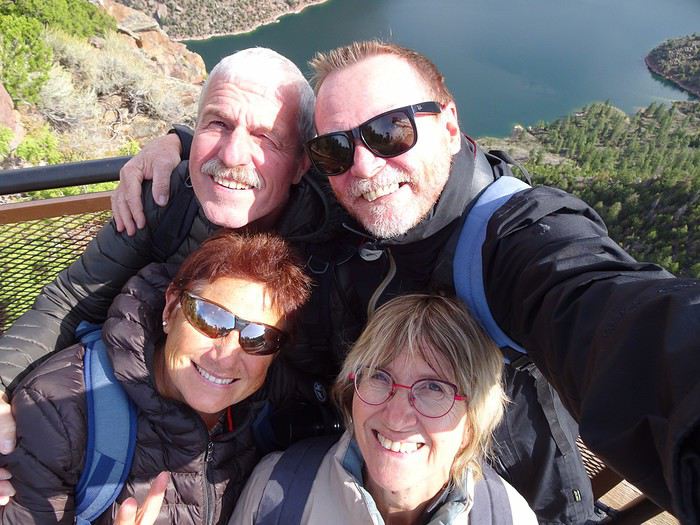
In 2017, struck by western addiction, our first road trip gave us an irresistible urge to return, which we did from September 2nd to 24th, 2019, on a loop from Denver to Denver via Yellowstone. The westernmost point of this journey, which took us through the geographical center of the USA, brought us within about a hundred kilometers of Moab, which had been the easternmost point of our last trip.
We’ve been back for over a month now, and I realize I’m starting to forget some details—it’s high time I started my travel journal before my brain turns into Swiss cheese and lets everything slip away. As I mentioned in my last story, it’ll take me quite a while to finish, so if any travelers have specific questions, don’t hesitate to message me privately. Once again, I’d like to thank everyone who helped me (and there were many!) prepare our road trip, with a special shout-out to Disneydiddl, Hiacinthe, and Titou (ladies first) as well as Fred and Itat, whom I bombarded with questions for months and who always kindly and patiently gave me tons of great tips. It’s thanks to all of you that this trip was such a success. I was a little worried I wouldn’t recapture the emotion and enthusiasm of our 2017 trip, but this one was just as "Wow" as the last.
For those who don’t know us, let me introduce our little group. We’re four friends in our sixties (this time, everyone made it, which let us score some "senior" discounts...). We live in the Var region, have known each other for over 20 years, and this was our second trip together to this magical West.
Mimi (Michèle): always the smallest and the funniest. Thank goodness she was there to speak English! Maumau (Maurice): her husband, always with his white hair, his Gallic mustache, his humor, and his Southern accent. He drove every other day. DD (André): the one with the beard, with whom I celebrated our 41st wedding anniversary at Yellowstone. Our second driver appreciated having a peaceful mind since he’s been retired since July. Marcalamar (Martine): that’s me—still blonde with glasses, still talking a lot, and still terrified of messing up the organization of this trip despite all the hours spent on the forum.
Recognize us? Ha ha ha!!!! No, just kidding!!!!
That’s us!!!Hi everyone.
Because that’s also what sparks the desire in every traveler (well, at least for me) to set foot on Australian soil: discovering a new continent.
Right now, I’ve got some time on my hands—those who follow me know that. A nasty muscle tear (which really doesn’t want to heal) is keeping me grounded for another week, so I’ve decided to open a new travel journal, recounting my recent trip from December 14, 2024, to January 12, 2025, in Australia.
The origins of this trip started last May in Crete, an island I chose for a 10-day break. It’s really lovely, by the way, but that’s not the point… It’s around this time every year that we decide on our next winter destination, and Argentina was at the top of the list—Sydney wasn’t even on the radar… I’d been looking at flights to Buenos Aires for a while, and the prices were shocking… But by the pool one lazy afternoon, scrolling on my iPhone, a promo from Geneva to Sydney caught my eye. The deal ticked two boxes on my traveler’s bucket list: a flight to Australia and a flight with Singapore Airlines, often ranked as the world’s best airline. A quick chat with the missus (well, of course!) and the decision was made: off to the land of kangaroos! Now, once you add luggage and Economy Plus, it still comes to 1600 € per person, but that’s a reasonable price. Either way, we already know what we’re in for—Australia is a budget commitment!

Thanks to 123rf for the image loan 😛
Right now, I’ve got some time on my hands—those who follow me know that. A nasty muscle tear (which really doesn’t want to heal) is keeping me grounded for another week, so I’ve decided to open a new travel journal, recounting my recent trip from December 14, 2024, to January 12, 2025, in Australia.
The origins of this trip started last May in Crete, an island I chose for a 10-day break. It’s really lovely, by the way, but that’s not the point… It’s around this time every year that we decide on our next winter destination, and Argentina was at the top of the list—Sydney wasn’t even on the radar… I’d been looking at flights to Buenos Aires for a while, and the prices were shocking… But by the pool one lazy afternoon, scrolling on my iPhone, a promo from Geneva to Sydney caught my eye. The deal ticked two boxes on my traveler’s bucket list: a flight to Australia and a flight with Singapore Airlines, often ranked as the world’s best airline. A quick chat with the missus (well, of course!) and the decision was made: off to the land of kangaroos! Now, once you add luggage and Economy Plus, it still comes to 1600 € per person, but that’s a reasonable price. Either way, we already know what we’re in for—Australia is a budget commitment!
Thanks to 123rf for the image loan 😛
Hi everyone,
I’m a die-hard fan of India, but it’s time I discovered Thailand too to broaden my Asian horizons.
I’m heading there on January 19, 2025, for a 46-day trip (no visa needed as I’m French). I’ve pored over a few guidebooks and travel blogs. Based on what caught my interest, I’ve put together a rough itinerary and list of sights. But since I know absolutely nothing about Thailand, I’m kind of flying blind here.
Since I’m not exactly a spring chicken anymore, I’ve opted for a few bases where I’ll stay several days in the same place. That way, I won’t have to change locations and hotels every day or so, packing and unpacking my suitcase constantly. Instead, I plan to explore the surrounding area each day, within a maximum radius of 50 to 70 km.
So, first question: Is that kind of round-trip distance manageable in a day in Thailand?
In India, renting a car for a day—with a driver—currently costs around 35 to 40 € per day. Knowing that 1,300 to 1,500 THB would be my absolute max, and even then, only if I don’t rent a car every single day.
Which brings me to my second question: Am I being unrealistic?
Otherwise—third question—once I’m settled in the city I’ve chosen as my base, can I get around within that 50–70 km radius using public transport?
I’ve already booked all my hotels—with free cancellation—on booking.com at an average price of 950/1,000 THB per night. Does that put me in a good range for value for money? Or am I dreaming?
Here’s my plan:
BANGKOK (13 days, 14 nights): 1 week for exploring Bangkok – Kanchanaburi/Erawan National Park? – Ayutthaya/Lopburi? – Muang Boran – Samut – Songkram/Amphawa
Bangkok -> Chiang Mai by overnight train in first-class sleeper
CHIANG MAI (6 days/6 nights): Mae Hong Son – Hot springs – Chiang Dao – caves – Lamphun – other places to be decided on the spot based on what’s worth seeing and transport options
Chiang Mai -> Chiang Rai
CHIANG RAI (7 days/8 nights): Fang – Tha Ton – Chiang Saen – Doi Tung – Chiang Khong – Doi Ang Khang, Phu Chi Fah, etc.
Chiang Rai -> Phrae
PHRAE (4 days/5 nights): Lampang and surrounding areas, depending on what’s interesting to see
Phrae -> Loei
LOEI (4 days/5 nights): Phu Kradung – Chiang Khan and surrounding areas, depending on what’s worth seeing
Loei -> Buriram
PHIMAI (Nakhon Ratchasima/Khorat) (5 days/6 nights): Phimai – Prasat Muang Tam – Phanom Rung – Prasat Phanom Wan
Phimai -> Khorat (airport or train station) -> Bangkok (overnight in Bangkok)
Day 46: BANGKOK -> KOCHI
Thanks in advance for your thoughts and advice!
Here’s my plan:
BANGKOK (13 days, 14 nights): 1 week for exploring Bangkok – Kanchanaburi/Erawan National Park? – Ayutthaya/Lopburi? – Muang Boran – Samut – Songkram/Amphawa
Bangkok -> Chiang Mai by overnight train in first-class sleeper
CHIANG MAI (6 days/6 nights): Mae Hong Son – Hot springs – Chiang Dao – caves – Lamphun – other places to be decided on the spot based on what’s worth seeing and transport options
Chiang Mai -> Chiang Rai
CHIANG RAI (7 days/8 nights): Fang – Tha Ton – Chiang Saen – Doi Tung – Chiang Khong – Doi Ang Khang, Phu Chi Fah, etc.
Chiang Rai -> Phrae
PHRAE (4 days/5 nights): Lampang and surrounding areas, depending on what’s interesting to see
Phrae -> Loei
LOEI (4 days/5 nights): Phu Kradung – Chiang Khan and surrounding areas, depending on what’s worth seeing
Loei -> Buriram
PHIMAI (Nakhon Ratchasima/Khorat) (5 days/6 nights): Phimai – Prasat Muang Tam – Phanom Rung – Prasat Phanom Wan
Phimai -> Khorat (airport or train station) -> Bangkok (overnight in Bangkok)
Day 46: BANGKOK -> KOCHI
Thanks in advance for your thoughts and advice!
Hello! 🙂
January 2026 Here we go again for new adventures and the pleasure of sharing them with you here! First of all, I’d like to thank everyone who helped me with the preparations, even with some last-minute improvisations just days before departure. Thanks to Montagnard74, Jojoone1, Songsam, Attila, Dennis2, NadegerFERM, and the authors whose travel journals about Laos inspired me (Montagnard74, Muriel18, Mavietongs...).
In this story, written by Richard and illustrated by me, we’ll tell you about the journey of four friends: Catherine, Richard, Nathalie, and Bruno. A reinvented but overall successful trip, filled with discoveries and surprises, the scents of spices and frangipani flowers, (too) spicy food, sunsets, and... one big mess.
January 2026 Here we go again for new adventures and the pleasure of sharing them with you here! First of all, I’d like to thank everyone who helped me with the preparations, even with some last-minute improvisations just days before departure. Thanks to Montagnard74, Jojoone1, Songsam, Attila, Dennis2, NadegerFERM, and the authors whose travel journals about Laos inspired me (Montagnard74, Muriel18, Mavietongs...).
In this story, written by Richard and illustrated by me, we’ll tell you about the journey of four friends: Catherine, Richard, Nathalie, and Bruno. A reinvented but overall successful trip, filled with discoveries and surprises, the scents of spices and frangipani flowers, (too) spicy food, sunsets, and... one big mess.
Hi there,
We’re heading to Ouarzazate and southern Morocco in 7 days. Here’s our route (map). We’re a family of 2 adults and 3 kids (11, 9, and 5 years old). Could you let me know if there are even more scenic roads to take, and any must-see spots, please? 😉
Day 1: Ouarzazate – Skoura – Dadès Day 2: Dadès + Todra Day 3: Tinegir – Djbel Saghro – N'Kob Day 4: Tazzarine – M'Hamid (overnight in Erg Lihoudi) Day 5: M'Hamid – Draa Valley – Agdz Day 6: Agdz – Fint – Ben Haddou Day 7: Telouet – Ouarzazate
We’re heading to Ouarzazate and southern Morocco in 7 days. Here’s our route (map). We’re a family of 2 adults and 3 kids (11, 9, and 5 years old). Could you let me know if there are even more scenic roads to take, and any must-see spots, please? 😉
Day 1: Ouarzazate – Skoura – Dadès Day 2: Dadès + Todra Day 3: Tinegir – Djbel Saghro – N'Kob Day 4: Tazzarine – M'Hamid (overnight in Erg Lihoudi) Day 5: M'Hamid – Draa Valley – Agdz Day 6: Agdz – Fint – Ben Haddou Day 7: Telouet – Ouarzazate
Me voici revenue de ma première croisière et je n'ai qu'un mot pour la résumer merveilleuse.
Je suis partie de Marseille avec mon chéri le 05 novembre 2011 et nous avions peur du mauvais temps annoné.
Nous avons eu un temps magnifique avec des après midi ensolleillés chaque fois que nous sommes descendus à terre.
Nous avons trouvé facilement le parking à Marseille en suivant les indications de tous ceux qui ont déposé ici même des indications.L'embarquement a commencé vers 14h, nous venions d'arriver, en un rien de temps nous voici appelés pour entrer sur le bateau et là de suite nous avions été éblouis par autant de magnificence!
Etant surclassé nous avons hérité de la mini suite 8457 pont 8, à l'arrière du bateau côté droit, avec tous les avantages d'une suite.Une corbeille de fruits nous attendait ainsi qu'une bouteille de mousseux au frais et quelques canapés.Nous avions deux peignoirs et des chaussons qui nous attendaient.
Cette mini suite est magique, il y a une petite table avec deux fauteuils un très grand lit et une porte avec deux fenêtres donnant sur une terrasse balcon de plus de 10 mètres de long qu permet une vue des deux côtés...
Après nous être installés, nous sommes sortis faire le tour du bateau.
Nous avions sur notre lit le journal today avec toutes les informations pour le soir ainsi que nos cartes costa pour tous les paiements qui servent aussi de clef.Le soir nous sommes de suite allés au spectacle magnifique et après ayant choisi le repas de 21h, nous étions bien calés avec la réception dans notre chambre, nous sommes allés dîner au restaurant Vesta servis à une table pour quatre personnes , comme des rois , ce soir là en partant il y avait des vagues de 10m et nous n'avons rien senti...Nous avons dormi comme des bébés...
Who are you? Where are you from? Where are you going?
Like last year at this time, a post about bike travel ideas.
How many of us are preparing a trip planned for this year? Probably a lot.
What’s yours—the one you’ve been dying to do for so long, maybe too long? For us, it’s a modest PARIS-MARATHON by bike, followed by MARATHON-ATHENS on foot in June 2010. And you?
May the passion keep growing before, during, and after! Happy planning and safe travels to everyone.
Like last year at this time, a post about bike travel ideas.
How many of us are preparing a trip planned for this year? Probably a lot.
What’s yours—the one you’ve been dying to do for so long, maybe too long? For us, it’s a modest PARIS-MARATHON by bike, followed by MARATHON-ATHENS on foot in June 2010. And you?
May the passion keep growing before, during, and after! Happy planning and safe travels to everyone.
I'm starting my first travel journal since VF reopened!
This will mostly be to share my impressions and some photos, with a few days' delay, but I'm starting this journal while I'm still here.
First, I'd like to thank those who helped me prepare for this trip.
I was able to organize this stay in one of the most expensive countries in the world thanks to the home-exchange principle. Not necessarily a direct swap, but through a points system, which is more practical for choosing where you want to go without it having to be a reciprocal exchange.
For this trip, there will already be two different accommodations. We'll see how it goes after that.
The first place is near Yverdon-les-Bains, close to Lake Neuchâtel.
So, we're going to explore this area!
We arrived under capricious weather that won’t leave us for the next few days!
We had dinner at a pizzeria recommended by *Le Routard* in Yverdon, then took a little nighttime stroll through the town center before heading inland to settle into our accommodation.
We discovered a very large, quiet house—and especially the cat that stayed behind! Funny for a couple of mice! He’ll be sleeping with us 😹
This will mostly be to share my impressions and some photos, with a few days' delay, but I'm starting this journal while I'm still here.
First, I'd like to thank those who helped me prepare for this trip.
I was able to organize this stay in one of the most expensive countries in the world thanks to the home-exchange principle. Not necessarily a direct swap, but through a points system, which is more practical for choosing where you want to go without it having to be a reciprocal exchange.
For this trip, there will already be two different accommodations. We'll see how it goes after that.
The first place is near Yverdon-les-Bains, close to Lake Neuchâtel.
So, we're going to explore this area!
We arrived under capricious weather that won’t leave us for the next few days!
We had dinner at a pizzeria recommended by *Le Routard* in Yverdon, then took a little nighttime stroll through the town center before heading inland to settle into our accommodation.
We discovered a very large, quiet house—and especially the cat that stayed behind! Funny for a couple of mice! He’ll be sleeping with us 😹
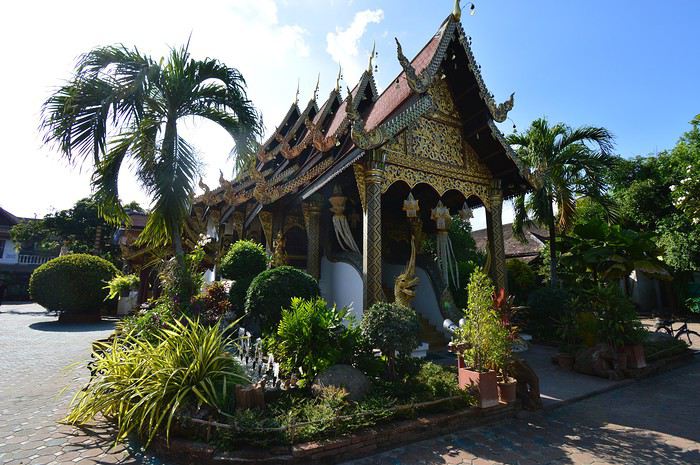
Hi everyone,
In these dark times, and after two months of lockdown, I thought now would be a good moment to write up the travel journal of our last trip to Thailand, to (maybe) help some of you escape a little. The idea is also, and above all, to give back to this forum, and I hope my tips or ideas will help future travelers. Don’t hesitate to contact me via private message or in the comments if you have any questions.
Before I start this story, I must warmly thank the people who patiently informed, advised, and guided us. Jojoone, Jodelavega, Jungletrool, DearPatsy, Tarajellow, and the others—thank you so much. This trip wouldn’t have been as wonderful without your help.
We’re a couple in our thirties who love traveling (we did a round-the-world trip several years ago now), and we’re big fans of Thailand, where we’ve been multiple times. We’re used to backpacking and even have a bit of wanderlust! But this year, everything was different since we were traveling for the first time with our baby, who was just under 2 years old (22 months). This raised HUGE questions for us, as we usually travel pretty casually and intuitively. While I found some answers on this forum, there was still a lot of information I couldn’t find, so I apologize in advance to those who travel without young kids—I plan to address that with a dedicated section. Generally, I think preparation is the key to a successful trip with a little one. For us, lots of questions beforehand meant no stress during the trip—everything was simple, and there were no bad surprises.
For those in a hurry, here’s a summary: 3-week stay (09/30/19 to 10/18/2019) Flight tickets (2 adults, 1 baby without a seat): 1052 € Itinerary: Bangkok 5 days, Chiang Mai 5 days, Lampang 3 days, Kanchanaburi 3 days, Bangkok 2 days.
General info about traveling with babies:
Here are the topics that caused us the most concern, our choices, and our observations after the trip.
1- Choosing the itinerary / road safety
This was THE biggest concern for us. Living in France with a top-rated rear-facing car seat, we were terrified at the idea of putting our baby in a car, bus, or any vehicle without protection (not to mention Thailand’s terrible reputation for road safety). We ended up making a radical decision that removed all our stress and let us enjoy a fantastic trip: no road travel (though you’ll see later that we had to bend this rule once, and everything went fine). We decided to follow the railway route heading north (for safety reasons, we didn’t consider the south and its islands with a baby) and chose our stops based on that. The train is a super comfortable way to travel with a young child. Sure, it’s slow—we were warned—but the best advice I can give is to take your time with a little one. Thailand is hot, noisy, and crowded—everything is tiring. Taking it slow is the best way to enjoy your trip. And I think (this is just my opinion) trying to keep an adult’s pace would only lead to frustration and exhaustion for everyone. The only car trips we took were short transfers in the city, and for those, we brought a sling (like a pre-tied baby carrier) so the baby was strapped to one of us, and we were both buckled up with the seatbelt passing between the baby and the parent carrying them. In case of a crash, there was no risk of crushing the baby (though obviously, it wasn’t completely safe, but we figured at city speeds, it was manageable).
2- Gear / what to pack?
In everyday life, we already keep things simple, so for travel, it was obvious we wouldn’t overpack. Crib, stroller, car seat, etc.—we decided to bring almost nothing and didn’t regret it. In my opinion, a stroller isn’t useful in Thailand. The sidewalks are unusable, packed with people and stalls. In busy places like night markets, you’ll prefer having your child close to you, at adult height, rather than in the crowd. Of course, it depends on where you go, but generally, a stroller will be more of a hassle than a help. We opted for a small, non-bulky hiking backpack and a sling (which fit in the backpack’s pocket) made of thin fabric for car trips. In hindsight, I think this was the perfect choice.
For cribs, high chairs, etc., there’s no need to bring your own—every place finds solutions for babies, and you can even contact them beforehand to put your mind at ease. During our stay, we were offered a baby crib, a futon on the floor, a single bed (not suitable for a baby, though), and always a solution for seating at meals. Only one hotel in Chiang Mai refused to help and asked for an outrageous extra fee, but I think that’s unusual, and we generally have mixed memories of that place. We brought a small fabric seat that attaches to any chair—it takes up the space of a folded raincoat and was very useful (though you can manage just fine by having the baby eat on your lap).
For baby food, diapers, etc., we didn’t bring anything. Just enough to last two days while we got settled, and that was plenty—no need to overpack. You can easily find diapers at Tesco, Lotus, or even 7/11. For food, we’d gotten our daughter used to eating pieces a few months before the trip, and we ordered broths to “dilute” the dishes. She loved it, tried everything with pleasure, and never had any issues. That said, I don’t know about milk—my daughter doesn’t drink it.
Here’s our “packing list” for 3 weeks with a 22-month-old:
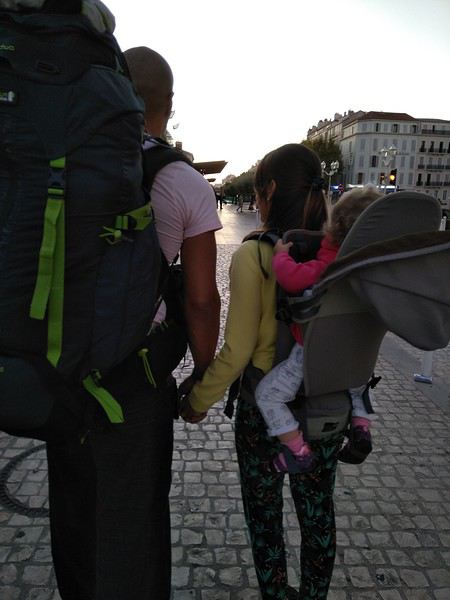
My partner: 1 travel backpack and a small empty (cabin-sized) rolling suitcase for shopping on the way back. For me: baby in a hiking backpack (with a sling and the small folded seat in the backpack’s pocket). It was simple for getting around, and I think if we’d packed more, we would’ve struggled without gaining any extra comfort.
3- Mosquitoes / Malaria / Dengue / Vaccines
As if on purpose, just months before our trip, a flood of articles on the forum and online warned us that Thailand was in the middle of a dengue epidemic, and locals advised us to be careful. Not exactly reassuring when traveling with a baby…🤪 After much hesitation, we decided to bring a small mosquito net (recommended by a mom on the forum—shoutout to Popinette) that opens like a pop-up tent (and folds just as easily). For how little space it took up, we didn’t regret it. It was attached to the back of the travel backpack and let us sleep soundly :p If it helps anyone, here’s the one we had: Deryan Peuter model.
We also brought a mosquito net for ourselves but didn’t end up using it—with precautions, we didn’t have any mosquitoes at night.
For protection, we chose Insect Ecran (tropical version, the red one) because it doesn’t contain DEET but uses Icaridin, which is less toxic for little ones. We also pre-treated our clothes with Insect Ecran textile spray. We also decided to dress our daughter in light, long-sleeved outfits (covering arms and legs), and she wasn’t any hotter but was protected. It was a great choice, and we ended up dressing like her. Contrary to what I’d read, I didn’t find the smell strong—I actually thought it was quite discreet. My daughter and my partner didn’t get a single bite. As for me, I still got bites on exposed areas (I’m *very* prone to mosquito bites), so I switched to a local product—less well-formulated but apparently more effective for me.
We had our daughter vaccinated against Hepatitis A. We got conflicting advice on this: the pediatrician said it was unnecessary if she didn’t eat from street stalls (where dishes are washed in questionable water), but my GP said the opposite. We decided to book an appointment at a travel vaccination center, and the doctor was clear—she needed the vaccine.
4- Book in advance?
Finally, a question that had never crossed our minds before: should we book in advance? Again, this is just my opinion, but I think yes. It makes things much easier. Since we wanted to minimize road travel, it was much simpler to find well-located accommodations that let us do everything on foot (and with a baby, reducing travel and lightening the schedule is really helpful). Booking ahead meant no bad surprises, no fully booked places, and no hassle walking around with luggage and a baby. We booked everything in advance via Booking and Agoda, and by comparing with on-site prices, we didn’t pay more (we were traveling in the low season).
Here’s our feedback and observations. If they can help other parents prepare for their trip, I’d be thrilled.
With all that said, time for vacation!
Bonjour
Je reviens d’une croisière de repositionnement à bord du Costa Magica au départ de Venise et à destination de Marseille.
Je vous passe les innombrables défauts constatés :
_ Embarquement incroyablement laborieux et bordélique à Venise : 3 h d’attente !
_ Exercice de sécurité de 45 min PENDANT le départ "magique" de Venise (à cause du retard à l’embarquement). Merci de nous avons gâché ce départ.
_ Personnel des bars franchement désagréable et blasé, n’ayant manifestement aucune envie de travailler
_ Pack inclusive : encore faut-il trouver un serveur qui souhaite un peu travailler : il fallait attendre 1 h pour avoir une boisson en moyenne dans les bars du 5eme (sauf bar de l’atrium au 3eme, qui fonctionne un peu). Une serveuse a carrément refusé de prendre une commande au motif qu’elle était fatiguée de servir les « all inclusive » !
_ Salle de sport qui pue le moisi, au point de vous prendre à la gorge (dégâts des eaux un peu partout dans la salle)
_ Navire tour simplement laid, mention spéciale grotesque, style fête foraine, au restaurant « Costa Smeralda » et au self/ Piscine… même le spa était très laid. le navire le plus laid que j’ai vu, il faut coller le décorateur en taule car ses agissements sont criminels ! Rien à faire à bord, animation inexistante, sauf de très beaux spectacles le soir.
_ Draps très sales et usés jusqu’à la trame, avec de nombreux trous… nous retrouvions systématiquement notre porte de cabine ouverte car le stewart ne les refermait pas…
Le vrai sujet de ce post est la bouffe immonde qui nous a été servie pendant 7 jours…
C’est ma 8eme croisière (1 MSC, 2 Croisières de France, 2 Louis Cruise, 1 NCL,1 RCL) et je n’ai jamais été dégouté à ce point.
Tout était au mieux limite mangeable, voir franchement répugnant : pâtisserie chimique à la limite du dentifrice (au moins, la gueule des desserts nous a bien fait rire), viandes composées essentiellement de graisse, salade dans un état de fraîcheur qui faisait peine à voir… aucune sauce ou presque...
Nous avons été malades plusieurs fois et ce n’était pas le mal de mer. Pour digérer cette malbouffe, il nous fallait prendre du coca, sinon, ça nous restait sur l’estomac pendant 24 h.
Et le self était encore pire… y a t il seulement 1 % de viande dans les steacks hachés? le bacon était réduit à un morceau de graisse. Lasagnes répugnantes. Glaces à l'eau et aux colorants, mais vraiment à l'eau! Les merveilles de la chimie dans l'alimentation sont chez COSTA.
Pas de buffet de minuit d’ailleurs, pas de repas du chef… même la soirée de gala a été un fiasco culinaire digne d’une cantine de prison…
Les jus d'orange 'offerts" ressemblaient aux médicaments solubles de mon enfance. Avec le "ALL INCLUSIVE", nous avions droit à des jus de fruits frais mais ils n'y en avait plus!
Même en mangeant, j'étais toujours à moitié affamé et à moitié dégouté, avec cette impression désagréable d'avoir absorbé des substances nuisibles pour la santé. Il m'a fallu deux jours de nourriture un peu normale, chez moi, pour m'en remettre et retouver un peu d'énergie et de vitalité.
ça doit être ça que ressent les américains qui bouffent de la merde tout le temps: de la fatigue et la nécessité de boire des sodas pour digérer.
Nous avons coincé le directeur de la restauration et avons pu lui dire tout le mal que nous pensions de cette bouffe au rabais qui n’a vraiment pas dû coûter bien cher.
Je m’interroge : COSTA est-il toujours aussi dégueulasse par rapport à la quasi excellence constatée chez Croisière de France en 2008 et à la très bonne qualité savourée chez les autres compagnies en 2007, 2009 et 2010 ?
La qualité de la restauration est-elle en baisse chez toutes les compagnies pour faire des économies ?
Cette croisière COSTA a été ma première réelle mauvaise expérience en croisière.
Pour faire pire que ça, il aurait fallu que le navire coule. Ce qui n'aurait pas été une grosse perte pour les beaux arts!
Je reviens d’une croisière de repositionnement à bord du Costa Magica au départ de Venise et à destination de Marseille.
Je vous passe les innombrables défauts constatés :
_ Embarquement incroyablement laborieux et bordélique à Venise : 3 h d’attente !
_ Exercice de sécurité de 45 min PENDANT le départ "magique" de Venise (à cause du retard à l’embarquement). Merci de nous avons gâché ce départ.
_ Personnel des bars franchement désagréable et blasé, n’ayant manifestement aucune envie de travailler
_ Pack inclusive : encore faut-il trouver un serveur qui souhaite un peu travailler : il fallait attendre 1 h pour avoir une boisson en moyenne dans les bars du 5eme (sauf bar de l’atrium au 3eme, qui fonctionne un peu). Une serveuse a carrément refusé de prendre une commande au motif qu’elle était fatiguée de servir les « all inclusive » !
_ Salle de sport qui pue le moisi, au point de vous prendre à la gorge (dégâts des eaux un peu partout dans la salle)
_ Navire tour simplement laid, mention spéciale grotesque, style fête foraine, au restaurant « Costa Smeralda » et au self/ Piscine… même le spa était très laid. le navire le plus laid que j’ai vu, il faut coller le décorateur en taule car ses agissements sont criminels ! Rien à faire à bord, animation inexistante, sauf de très beaux spectacles le soir.
_ Draps très sales et usés jusqu’à la trame, avec de nombreux trous… nous retrouvions systématiquement notre porte de cabine ouverte car le stewart ne les refermait pas…
Le vrai sujet de ce post est la bouffe immonde qui nous a été servie pendant 7 jours…
C’est ma 8eme croisière (1 MSC, 2 Croisières de France, 2 Louis Cruise, 1 NCL,1 RCL) et je n’ai jamais été dégouté à ce point.
Tout était au mieux limite mangeable, voir franchement répugnant : pâtisserie chimique à la limite du dentifrice (au moins, la gueule des desserts nous a bien fait rire), viandes composées essentiellement de graisse, salade dans un état de fraîcheur qui faisait peine à voir… aucune sauce ou presque...
Nous avons été malades plusieurs fois et ce n’était pas le mal de mer. Pour digérer cette malbouffe, il nous fallait prendre du coca, sinon, ça nous restait sur l’estomac pendant 24 h.
Et le self était encore pire… y a t il seulement 1 % de viande dans les steacks hachés? le bacon était réduit à un morceau de graisse. Lasagnes répugnantes. Glaces à l'eau et aux colorants, mais vraiment à l'eau! Les merveilles de la chimie dans l'alimentation sont chez COSTA.
Pas de buffet de minuit d’ailleurs, pas de repas du chef… même la soirée de gala a été un fiasco culinaire digne d’une cantine de prison…
Les jus d'orange 'offerts" ressemblaient aux médicaments solubles de mon enfance. Avec le "ALL INCLUSIVE", nous avions droit à des jus de fruits frais mais ils n'y en avait plus!
Même en mangeant, j'étais toujours à moitié affamé et à moitié dégouté, avec cette impression désagréable d'avoir absorbé des substances nuisibles pour la santé. Il m'a fallu deux jours de nourriture un peu normale, chez moi, pour m'en remettre et retouver un peu d'énergie et de vitalité.
ça doit être ça que ressent les américains qui bouffent de la merde tout le temps: de la fatigue et la nécessité de boire des sodas pour digérer.
Nous avons coincé le directeur de la restauration et avons pu lui dire tout le mal que nous pensions de cette bouffe au rabais qui n’a vraiment pas dû coûter bien cher.
Je m’interroge : COSTA est-il toujours aussi dégueulasse par rapport à la quasi excellence constatée chez Croisière de France en 2008 et à la très bonne qualité savourée chez les autres compagnies en 2007, 2009 et 2010 ?
La qualité de la restauration est-elle en baisse chez toutes les compagnies pour faire des économies ?
Cette croisière COSTA a été ma première réelle mauvaise expérience en croisière.
Pour faire pire que ça, il aurait fallu que le navire coule. Ce qui n'aurait pas été une grosse perte pour les beaux arts!
Hi there,
On this forum, I shared my first trip to Tunisia from mid-February to early March (https://voyageforum.com/forum/impressions-tunisiennes-en-direct-d11460662/), a stay I enjoyed so much that six weeks later, I’m back in Tunisia for a full 15 days (I return on April 27).
This time, I landed in Monastir on a direct flight from Nice, again with Tunisair. We left about ten minutes late, and the flight lasted around 1 hour 30 minutes. A meal was served on board (cucumber salad with Edam-like cheese, carrots, and two small portions of dishes I couldn’t identify—semolina with peppers, olives, and parsley, two small rolls, a square of processed cheese, and a chocolate cake). It’s worth noting because it’s not common on flights this short.
In February, France and Tunisia were in the same time zone, but now Tunisia is one hour behind. This time difference and the flight duration work perfectly for a short 15-day trip since it takes me a few days to adjust to jet lag.
Luckily, I’d asked my hotel about the taxi fare from the airport because the drivers (there were several around me) didn’t hesitate to quote outrageous prices. The actual fare is 20 dinars, but one asked for 120 dinars. I refused, and another offered 60 dinars. I replied, "That’s too expensive—I’ll take the metro!" (Having tried the Tunis metro, I had no desire to repeat the experience in Monastir with a suitcase!). I started walking toward the metro, and one of the drivers caught up with me, saying, "20 dinars is fine!" I’ll skip the details, but the negotiation took a little while. When I arrived at the hotel, I told the receptionist someone had asked for 120 dinars. He put his hands to his head and said, "They’re awful!" He remembered our phone call two days earlier when I’d booked (he’s the one who told me I could take the metro).
The Mezri Hotel isn’t expensive. I got a sea-view room for 75 dinars (22 €). (I’d booked a balcony room for 90 dinars but wouldn’t have had time to enjoy it.) It’s well-located but noisy because there’s no double glazing. The receptionist is a very kind older gentleman. He called a friend whose wife is from Tozeur to find out if I should take a bus or a *louage* tomorrow and what time.
I arrived at the hotel around 7:00 PM and had time to stroll along the corniche to the ribat. Despite some run-down buildings, the seaside seemed livelier and cheerier than Sousse’s.
Monastir is the hometown of former president Bourguiba. I passed his mausoleum by taxi. There are Tunisian flags along the avenue by the sea because every year on April 6—the anniversary of Habib Bourguiba’s death—the president of the Republic visits the Bourguiba Mausoleum in Monastir to pay respects.
The taxi driver mentioned other Tunisian presidents. He complained about rising prices and insecurity, blaming President Kaïs Saïed (I’d already heard that security was better under Ben Ali).
At the end of my stay, I’ll take time to explore Monastir, but tomorrow morning, I’m off to Tozeur—a long bus ride awaits me.
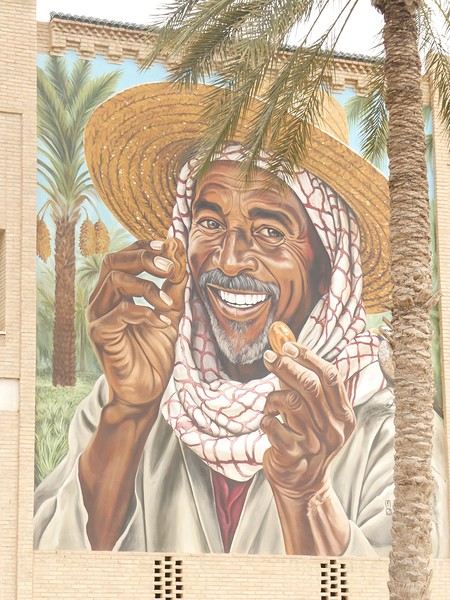

TO BE CONTINUED....
On this forum, I shared my first trip to Tunisia from mid-February to early March (https://voyageforum.com/forum/impressions-tunisiennes-en-direct-d11460662/), a stay I enjoyed so much that six weeks later, I’m back in Tunisia for a full 15 days (I return on April 27).
This time, I landed in Monastir on a direct flight from Nice, again with Tunisair. We left about ten minutes late, and the flight lasted around 1 hour 30 minutes. A meal was served on board (cucumber salad with Edam-like cheese, carrots, and two small portions of dishes I couldn’t identify—semolina with peppers, olives, and parsley, two small rolls, a square of processed cheese, and a chocolate cake). It’s worth noting because it’s not common on flights this short.
In February, France and Tunisia were in the same time zone, but now Tunisia is one hour behind. This time difference and the flight duration work perfectly for a short 15-day trip since it takes me a few days to adjust to jet lag.
Luckily, I’d asked my hotel about the taxi fare from the airport because the drivers (there were several around me) didn’t hesitate to quote outrageous prices. The actual fare is 20 dinars, but one asked for 120 dinars. I refused, and another offered 60 dinars. I replied, "That’s too expensive—I’ll take the metro!" (Having tried the Tunis metro, I had no desire to repeat the experience in Monastir with a suitcase!). I started walking toward the metro, and one of the drivers caught up with me, saying, "20 dinars is fine!" I’ll skip the details, but the negotiation took a little while. When I arrived at the hotel, I told the receptionist someone had asked for 120 dinars. He put his hands to his head and said, "They’re awful!" He remembered our phone call two days earlier when I’d booked (he’s the one who told me I could take the metro).
The Mezri Hotel isn’t expensive. I got a sea-view room for 75 dinars (22 €). (I’d booked a balcony room for 90 dinars but wouldn’t have had time to enjoy it.) It’s well-located but noisy because there’s no double glazing. The receptionist is a very kind older gentleman. He called a friend whose wife is from Tozeur to find out if I should take a bus or a *louage* tomorrow and what time.
I arrived at the hotel around 7:00 PM and had time to stroll along the corniche to the ribat. Despite some run-down buildings, the seaside seemed livelier and cheerier than Sousse’s.
Monastir is the hometown of former president Bourguiba. I passed his mausoleum by taxi. There are Tunisian flags along the avenue by the sea because every year on April 6—the anniversary of Habib Bourguiba’s death—the president of the Republic visits the Bourguiba Mausoleum in Monastir to pay respects.
The taxi driver mentioned other Tunisian presidents. He complained about rising prices and insecurity, blaming President Kaïs Saïed (I’d already heard that security was better under Ben Ali).
At the end of my stay, I’ll take time to explore Monastir, but tomorrow morning, I’m off to Tozeur—a long bus ride awaits me.
TO BE CONTINUED....
This catchy and somewhat mysterious title comes from several questions I’ve been asking myself.
VF has been back open for a reasonable number of weeks and months now. The number of visitors overall matches past averages, but the number of members online in the last 24 hours seems relatively lower than what we used to see.
Yet, to my surprise, I’m seeing fewer travel journals, way fewer messages, and way fewer questions. I don’t see many new registered users online, and I notice a number of members who are logged in but either aren’t participating or have stopped participating.
Something’s not adding up for me because, in my opinion, VF is still appealing, and I don’t see which other sites could really compete.
Was there a real break between pre- and post-Covid? Does it just take more time for some people to discover the site or learn that it’s active again? Do people now prefer quick consumption on sites like FB or others I’m not familiar with? Where have the site’s old-timers gone, and what are they doing with their time now? What’s really going on here?
VF has been back open for a reasonable number of weeks and months now. The number of visitors overall matches past averages, but the number of members online in the last 24 hours seems relatively lower than what we used to see.
Yet, to my surprise, I’m seeing fewer travel journals, way fewer messages, and way fewer questions. I don’t see many new registered users online, and I notice a number of members who are logged in but either aren’t participating or have stopped participating.
Something’s not adding up for me because, in my opinion, VF is still appealing, and I don’t see which other sites could really compete.
Was there a real break between pre- and post-Covid? Does it just take more time for some people to discover the site or learn that it’s active again? Do people now prefer quick consumption on sites like FB or others I’m not familiar with? Where have the site’s old-timers gone, and what are they doing with their time now? What’s really going on here?
Hi there, just back from a three-week round trip to Quebec and a side trip to New Brunswick.
Departed from Montpellier, via CDG, then arrived in Montreal from July 31 to August 20, 2024.
AF flights went smoothly.
The RT itinerary (without the visit details):
Arrival in Montreal; Trois-Rivières; Tadoussac; Matane; Gaspé; Campbellton; Trois-Pistoles; Quebec City; Montreal and return to France, AF to CDG then Hop! to Montpellier.
Observations:
Getting out of Montreal airport is a nightmare! Two hours at Avis Auto to pick up the car (nice ride, though—a WW SUV Atlas V6 for two). From what I’ve heard, Montreal Airport is a pain because it was initially under-dimensioned for its infrastructure, and it seems impossible to reorganize everything.
Quebecers: Wonderful people in terms of hospitality and behavior toward tourists—especially French ones. You can ask them for advice at the supermarket, for directions here and there, and those distant cousins are great! That said, I’d exclude Montreal, which, due to its size and perhaps its cosmopolitanism, can’t be considered as welcoming as the countryside and small towns we passed through. A bit like Paris, you could say.
Quebecers prefer Quebec City over Montreal, and I get it. On a positive note for the city, I left some money in the hotel at the end of my stay. Once back in France, I contacted the hotel (day before yesterday), and they confirmed the oversight and are taking steps to send the money back. A nice gesture. It’s the Nouvel Hôtel, 1740 Avenue René Lévesque. Well-located, too.
Tourists: Same as always!
Americans: Still lacking in culture and education, but we already knew that. Loud, intrusive, annoying, you could say. And I’ll skip the “Oh my God! Oh my God!” all day long. And always with a coffee cup in hand on the streets. Not just American tourists, actually. Coffee is either enjoyed at the counter of a café or at home in front of the day’s news. It must also be said that our cousins’ coffee is more like dishwater.
Tourists from the Middle Kingdom: No change there! Flagrant lack of European culture and respect. They can be quite annoying at times. Thankfully, they don’t like the countryside or small towns.
Tourists from the Land of the Rising Sun: As usual, impeccable behavior. Both in terms of dress and discretion.
The British: They feel at home. Well, they kind of are, actually. Distant, inaccessible—typical English folks.
South Americans: A lot of them in Montreal during my stay. Quite noisy, especially at breakfast. But deep down, they’re great and very polite. I really like them. Must be my 36.1% Iberian DNA from my ancestry test that makes me say that.
And the French? Always the same! Complainers, grumblers, never happy with the meal, always finding prices too high, cutting in line, sometimes with a Quechua backpack but not always. In short, we don’t change. That said, there were some really nice people and great encounters that will leave wonderful memories. Some folks from Marseille in Quebec City, Toulouse in Montreal, Perpignan... But not many Parisians. Or maybe they just don’t talk to outsiders. When I think that my wife is from the 14th arrondissement...
And lots of lovely young French people there on a Working Holiday Visa for two years.
Others? Italians? Didn’t run into many. Eastern Europeans? Didn’t see any, or they were super discreet.
The trip started on July 31. 2,000 photos to sort through. More to come later.
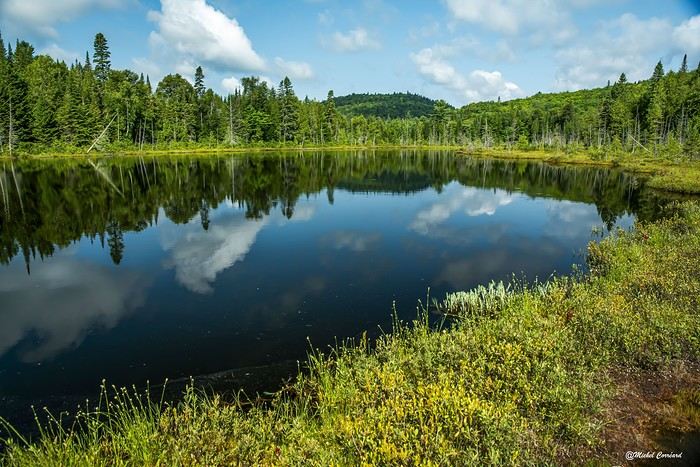
The RT itinerary (without the visit details):
Arrival in Montreal; Trois-Rivières; Tadoussac; Matane; Gaspé; Campbellton; Trois-Pistoles; Quebec City; Montreal and return to France, AF to CDG then Hop! to Montpellier.
Observations:
Getting out of Montreal airport is a nightmare! Two hours at Avis Auto to pick up the car (nice ride, though—a WW SUV Atlas V6 for two). From what I’ve heard, Montreal Airport is a pain because it was initially under-dimensioned for its infrastructure, and it seems impossible to reorganize everything.
Quebecers: Wonderful people in terms of hospitality and behavior toward tourists—especially French ones. You can ask them for advice at the supermarket, for directions here and there, and those distant cousins are great! That said, I’d exclude Montreal, which, due to its size and perhaps its cosmopolitanism, can’t be considered as welcoming as the countryside and small towns we passed through. A bit like Paris, you could say.
Quebecers prefer Quebec City over Montreal, and I get it. On a positive note for the city, I left some money in the hotel at the end of my stay. Once back in France, I contacted the hotel (day before yesterday), and they confirmed the oversight and are taking steps to send the money back. A nice gesture. It’s the Nouvel Hôtel, 1740 Avenue René Lévesque. Well-located, too.
Tourists: Same as always!
Americans: Still lacking in culture and education, but we already knew that. Loud, intrusive, annoying, you could say. And I’ll skip the “Oh my God! Oh my God!” all day long. And always with a coffee cup in hand on the streets. Not just American tourists, actually. Coffee is either enjoyed at the counter of a café or at home in front of the day’s news. It must also be said that our cousins’ coffee is more like dishwater.
Tourists from the Middle Kingdom: No change there! Flagrant lack of European culture and respect. They can be quite annoying at times. Thankfully, they don’t like the countryside or small towns.
Tourists from the Land of the Rising Sun: As usual, impeccable behavior. Both in terms of dress and discretion.
The British: They feel at home. Well, they kind of are, actually. Distant, inaccessible—typical English folks.
South Americans: A lot of them in Montreal during my stay. Quite noisy, especially at breakfast. But deep down, they’re great and very polite. I really like them. Must be my 36.1% Iberian DNA from my ancestry test that makes me say that.
And the French? Always the same! Complainers, grumblers, never happy with the meal, always finding prices too high, cutting in line, sometimes with a Quechua backpack but not always. In short, we don’t change. That said, there were some really nice people and great encounters that will leave wonderful memories. Some folks from Marseille in Quebec City, Toulouse in Montreal, Perpignan... But not many Parisians. Or maybe they just don’t talk to outsiders. When I think that my wife is from the 14th arrondissement...
And lots of lovely young French people there on a Working Holiday Visa for two years.
Others? Italians? Didn’t run into many. Eastern Europeans? Didn’t see any, or they were super discreet.
The trip started on July 31. 2,000 photos to sort through. More to come later.
Pour discuter autour du concours de juillet 2020, Verticale(s), ça se passe ici.
Hi everyone,
In this age of zero-commission cards and fee-free accounts, I’m curious why some travelers still prefer to set off with a wallet stuffed with bills and exchange money on the spot.
I get it for those whose income comes from undeclared activities, but what about everyone else?
Between the risk of theft, scams at exchange counters, and fees that often end up being higher, I’m really puzzled.
The last time I traveled with a wad of cash was because I had to pay for accommodation in cash only, the local currency was the dollar (easy to exchange at a very low cost), and I was still paying some fees.
I’m still wondering about my next trip to Argentina because the situation there is very specific, but otherwise?
Is it an allergy to modern payment methods?
A budget so tight that an extra 20 € (the fees some local banks charge for withdrawals) on a 2000 € budget would be impossible to manage?
Thanks for shedding some light on this!
In this age of zero-commission cards and fee-free accounts, I’m curious why some travelers still prefer to set off with a wallet stuffed with bills and exchange money on the spot.
I get it for those whose income comes from undeclared activities, but what about everyone else?
Between the risk of theft, scams at exchange counters, and fees that often end up being higher, I’m really puzzled.
The last time I traveled with a wad of cash was because I had to pay for accommodation in cash only, the local currency was the dollar (easy to exchange at a very low cost), and I was still paying some fees.
I’m still wondering about my next trip to Argentina because the situation there is very specific, but otherwise?
Is it an allergy to modern payment methods?
A budget so tight that an extra 20 € (the fees some local banks charge for withdrawals) on a 2000 € budget would be impossible to manage?
Thanks for shedding some light on this!
Here we go...
It’s been almost a month since we got back, and my head is still over there... Just like every time... For my own sake, I know travel journals are useful for travelers planning a trip to a country. But selfishly, they’re also helpful for me—to put the final stone on each journey and revisit it from time to time, just for the memories...
So, this trip won’t be any different, and I invite you to follow along on our Andean adventure, from Lima to the Southern Lipez, from December 16, 2016, to January 14, 2017. It’s a chronological journal because I don’t know how to approach it any other way. It doesn’t hold any absolute truths—just my experiences and feelings, which are obviously personal and not objective!
But if it inspires you to visit these magical countries (and I assume you’re already interested if you’re here) or gives you a couple of tips, then I’ll consider it a win!
So, let’s hit the road for the land of wide-open spaces!
It’s been almost a month since we got back, and my head is still over there... Just like every time... For my own sake, I know travel journals are useful for travelers planning a trip to a country. But selfishly, they’re also helpful for me—to put the final stone on each journey and revisit it from time to time, just for the memories...
So, this trip won’t be any different, and I invite you to follow along on our Andean adventure, from Lima to the Southern Lipez, from December 16, 2016, to January 14, 2017. It’s a chronological journal because I don’t know how to approach it any other way. It doesn’t hold any absolute truths—just my experiences and feelings, which are obviously personal and not objective!
But if it inspires you to visit these magical countries (and I assume you’re already interested if you’re here) or gives you a couple of tips, then I’ll consider it a win!
So, let’s hit the road for the land of wide-open spaces!
Many of us longtime members surely remember the little frieze of monuments that used to decorate the top of VF pages.
Eiffel Tower, Statue of Liberty, Taj Mahal...
The famous must-see icons of architectural heritage!
Today, I’m inviting you to dig through your archives and share 3 photos of these international stars made of stone, marble, concrete, or steel.
I can already hear some of you protesting that this theme isn’t very original.
Well, it’s up to you to think outside the box...
So the monument doesn’t have to be the original. It could be its twin in Las Vegas, a matchstick replica made by Uncle Bob, a piece of jewelry, a gorgeous snow globe made in China, and so on.
The monument can be photographed from above, below, in the rain, as a reflection...
Deserted or swarming with visitors...
Montages are also allowed! 😉
In short, a classic topic that’ll become original thanks to your creative take.
Now, there are still 3 rules:
- No selfies (But a photo showing people taking selfies in front of a monument is allowed...🤪)
- Once a monument has been posted by someone, no one else can post it again. I don’t want to see the same thing 10 times...😊
- The theme isn’t about the monument’s originality. Please don’t post a photo of a monument known only to you or almost no one...😏
You can post your photos (one per message) until January 21, 2015, at 11:55 PM
Voting will take place from January 22, 2015, at 12:05 AM to January 29, 2015, at 11:55 PM.
During the vote, you’ll choose your 3 favorite photos, awarding 3 points to your top pick, 2 to your second, and 1 to your third.
Please clearly indicate the photographer’s name and the number of the winning photo!
For the rest, I’m using Cocottte’s rules:
The winner is the one with the most points. In case of a tie, the winner will be the one with the most first-place votes, or, if still tied, the most second-place votes. If there’s a perfect tie, the winner will be the one who reached their score first. The winner will then choose a theme for February’s contest and organize it. Ties for any place other than first won’t be broken.
You can vote without participating, participate without voting, or do neither. Slideshow
Finally, here’s the little off-topic link where all your comments and other expressions of good humor are welcome!
Eiffel Tower, Statue of Liberty, Taj Mahal...
The famous must-see icons of architectural heritage!
Today, I’m inviting you to dig through your archives and share 3 photos of these international stars made of stone, marble, concrete, or steel.
I can already hear some of you protesting that this theme isn’t very original.
Well, it’s up to you to think outside the box...
So the monument doesn’t have to be the original. It could be its twin in Las Vegas, a matchstick replica made by Uncle Bob, a piece of jewelry, a gorgeous snow globe made in China, and so on.
The monument can be photographed from above, below, in the rain, as a reflection...
Deserted or swarming with visitors...
Montages are also allowed! 😉
In short, a classic topic that’ll become original thanks to your creative take.
Now, there are still 3 rules:
- No selfies (But a photo showing people taking selfies in front of a monument is allowed...🤪)
- Once a monument has been posted by someone, no one else can post it again. I don’t want to see the same thing 10 times...😊
- The theme isn’t about the monument’s originality. Please don’t post a photo of a monument known only to you or almost no one...😏
You can post your photos (one per message) until January 21, 2015, at 11:55 PM
Voting will take place from January 22, 2015, at 12:05 AM to January 29, 2015, at 11:55 PM.
During the vote, you’ll choose your 3 favorite photos, awarding 3 points to your top pick, 2 to your second, and 1 to your third.
Please clearly indicate the photographer’s name and the number of the winning photo!
For the rest, I’m using Cocottte’s rules:
The winner is the one with the most points. In case of a tie, the winner will be the one with the most first-place votes, or, if still tied, the most second-place votes. If there’s a perfect tie, the winner will be the one who reached their score first. The winner will then choose a theme for February’s contest and organize it. Ties for any place other than first won’t be broken.
You can vote without participating, participate without voting, or do neither. Slideshow
Finally, here’s the little off-topic link where all your comments and other expressions of good humor are welcome!
I'm currently converting a DAF/HEULIEZ MB205 bus.
Cheaper and more spacious than a regular vehicle, the paperwork (in France) isn't too difficult for approval.
I'm ready to help anyone who wants to tackle this kind of project. Those who know, help those who want to....
Cheaper and more spacious than a regular vehicle, the paperwork (in France) isn't too difficult for approval.
I'm ready to help anyone who wants to tackle this kind of project. Those who know, help those who want to....
Bonjour,
Afin de rassembler toutes les informations pouvant être utiles, à un instant T, à nos amies et amis de passage en Madinina, j'ouvre ce sujet. J'y mettrai, avec l'aide d'autres j'espère, les éléments variants pouvant interférer dans le bon vécu d'un voyage ou expliquant certaines situations ponctuelles. Lorsqu'il y aura des points communs avec la Guadeloupe, je le signalerai.
Bonne prochaine venue dans nos îles.
Afin de rassembler toutes les informations pouvant être utiles, à un instant T, à nos amies et amis de passage en Madinina, j'ouvre ce sujet. J'y mettrai, avec l'aide d'autres j'espère, les éléments variants pouvant interférer dans le bon vécu d'un voyage ou expliquant certaines situations ponctuelles. Lorsqu'il y aura des points communs avec la Guadeloupe, je le signalerai.
Bonne prochaine venue dans nos îles.
Hi everyone,
Starting tomorrow (the first day of the month), the April contest kicks off with the theme "Fish."
Important note: There was a contest in January 2020 on the theme "Fishing," where we hardly saw any fish. So this time, it should not be about fishing but mainly about fish. Live fish (1), dead fish (2), fish used in various artistic (3), commercial (4), or other illustrations (5).
Practical details:
Participation: Each VF member can submit up to 3 photos, until Saturday, April 26 at 11:59 PM Brussels time. Each photo should be posted in a separate message, with its number (1, 2, or 3). Don’t forget to add a little explanation (comment, location, etc.).
Voting: Each VF member can vote for the 3 photos they think are the best, based on their own criteria and the theme.
Voting will take place from Sunday, April 27 to Wednesday, April 30 at 11:59 PM Brussels time.
The selected photos will be ranked in order of preference: - 1st photo: 3 points - 2nd: 2 points - 3rd: 1 point
The winner is the photographer whose photo receives the most points.
Results will be published on May 1. In case of a tie, the number of first-place votes will decide. The winner will have the honor of organizing the May 2025 contest.
Photos that have already been nominated (1st, 2nd, or 3rd place) in another contest are not eligible for this one.
This thread is exclusively for photos submitted to the contest. All discussions, comments, and chit-chat should be posted in the thread: Discussion on the April 2025 contest theme "Fish"
(1) Japanese fish (not yet turned into sushi 😛)
(2) Fish considered small fry and left on an Indonesian beach
(3) Street art in Bristol (England)
(4) Sign in Bristol (England)
(5) Hikiyama Exhibition Hall in Karatsu (Kyushu, Japan)
Good luck! 😛
PS: Whales, sperm whales, porpoises, and dolphins are welcome—let’s be inclusive! 😎
Starting tomorrow (the first day of the month), the April contest kicks off with the theme "Fish."
Important note: There was a contest in January 2020 on the theme "Fishing," where we hardly saw any fish. So this time, it should not be about fishing but mainly about fish. Live fish (1), dead fish (2), fish used in various artistic (3), commercial (4), or other illustrations (5).
Practical details:
Participation: Each VF member can submit up to 3 photos, until Saturday, April 26 at 11:59 PM Brussels time. Each photo should be posted in a separate message, with its number (1, 2, or 3). Don’t forget to add a little explanation (comment, location, etc.).
Voting: Each VF member can vote for the 3 photos they think are the best, based on their own criteria and the theme.
Voting will take place from Sunday, April 27 to Wednesday, April 30 at 11:59 PM Brussels time.
The selected photos will be ranked in order of preference: - 1st photo: 3 points - 2nd: 2 points - 3rd: 1 point
The winner is the photographer whose photo receives the most points.
Results will be published on May 1. In case of a tie, the number of first-place votes will decide. The winner will have the honor of organizing the May 2025 contest.
Photos that have already been nominated (1st, 2nd, or 3rd place) in another contest are not eligible for this one.
This thread is exclusively for photos submitted to the contest. All discussions, comments, and chit-chat should be posted in the thread: Discussion on the April 2025 contest theme "Fish"
(1) Japanese fish (not yet turned into sushi 😛)
(2) Fish considered small fry and left on an Indonesian beach
(3) Street art in Bristol (England)
(4) Sign in Bristol (England)
(5) Hikiyama Exhibition Hall in Karatsu (Kyushu, Japan)
Good luck! 😛
PS: Whales, sperm whales, porpoises, and dolphins are welcome—let’s be inclusive! 😎
Avant de mettre mon carnet ici( déjà sur un autre forum) je souhaite remercier tout ce qui m'ont aidé.
Mes sites de reference ( roadtrippin.fr, west-usa-dream.blogspot.fr etc ...)

Description et budget
Nous sommes partis a deux, mon amis et moi ( 30 et 42 ans au début du voyage / 31 et 43 ans en fin ! )
Du 5 mai au 24 mai 2016.( 3 semaines )
Circuit effectué en voiture ( Jeep Cherokee 4x4).
Nous aurons dépensé 5400��� pour nous deux tout compris.
Dont avion 1247€ ( 623.5€/ personne) Voiture 580€ ( 19 j avec Alamo/ jeep cherokee 4x4) Essence 230 $ Hotel1522€ ( 80€/ nuit avec hotel.com et en direct ) ( dessus on pourrait enlever le cash back 50€ + une nuit gratuite a utiliser ) Activités 500$ ( cheval/bateau/ state park/casino ) restaurant, repas nourriture 1500$
Circuit : 3621 km route/piste et environ 140km de randonnée et ballade
J1 Las vegas- Henderson. Prise en charge voiture.
J2 Henderson - Grand canyon Route 66 (hacberry/seligman/williams) Grand canyon (hermist rest road)
J3 Grand canyon - Page Desert view drive Little colorado Marble canyon (cathedral wash/lee fery's) Page (horseshoebend)
J4 Page Edmaier's secret Paria rimrock Lake powell (bateau)
J5 Page - Monument valley Lower antelope canyon Monument valley (Scenic drive/cheval/sunset)
J6 Monument valley - Monticello Valley of the godes Moky dugway mule point natural bridge(scenic drive/sipapu bridge/owachomo bridge)
J7 Monticello - Moab Canyonland the needles (cheysler Park viewpoint/cave sping/riverside ruine/scenic drive) wilson arch
J8 Arches Devils garden trail Sand dune arch et brocken arch balance rock the windows double arch delicate arch ( sunset )
J9 Canyonland in the sky Dead horse point scenic drive Mesa arch Green river overlook white rim overlook Grand viewpoint overlook
J10 environs de Moab Mesa arch (Sunrise) Shafer road+ potash road (muselman arch) Botie et corona arch Onion creek
J11 Moab - Torrey Goblin valley Little wild horse canyon
J12 Capitol reef Hickman bridge fruita area Cohab canyon Scenic drive
J13 Torrey - Bryce canyon Scenic 12 Escalante petrified forest Willis creek Mossy cave
J14 Bryce canyon Figure 8 Scenic drive
J15 Bryce canyon - Zion Canyon overlook trail emeralds pool trail
J16 Zion Angel landing scenic drive( navette)
J17 Zion - Overton Yant flat Valley of fire (boucle 7 merveilles)
J18 Overton - Las vegas Valley of fire Las vegas (freemont street/outlet nord/strip
J19 Las vegas Outlet sud signe strip
J20 Las vegas - France Strip retour
Voila pour le descriptif.
Pat 😉
Description et budget
Nous sommes partis a deux, mon amis et moi ( 30 et 42 ans au début du voyage / 31 et 43 ans en fin ! )
Du 5 mai au 24 mai 2016.( 3 semaines )
Circuit effectué en voiture ( Jeep Cherokee 4x4).
Nous aurons dépensé 5400��� pour nous deux tout compris.
Dont avion 1247€ ( 623.5€/ personne) Voiture 580€ ( 19 j avec Alamo/ jeep cherokee 4x4) Essence 230 $ Hotel1522€ ( 80€/ nuit avec hotel.com et en direct ) ( dessus on pourrait enlever le cash back 50€ + une nuit gratuite a utiliser ) Activités 500$ ( cheval/bateau/ state park/casino ) restaurant, repas nourriture 1500$
Circuit : 3621 km route/piste et environ 140km de randonnée et ballade
J1 Las vegas- Henderson. Prise en charge voiture.
J2 Henderson - Grand canyon Route 66 (hacberry/seligman/williams) Grand canyon (hermist rest road)
J3 Grand canyon - Page Desert view drive Little colorado Marble canyon (cathedral wash/lee fery's) Page (horseshoebend)
J4 Page Edmaier's secret Paria rimrock Lake powell (bateau)
J5 Page - Monument valley Lower antelope canyon Monument valley (Scenic drive/cheval/sunset)
J6 Monument valley - Monticello Valley of the godes Moky dugway mule point natural bridge(scenic drive/sipapu bridge/owachomo bridge)
J7 Monticello - Moab Canyonland the needles (cheysler Park viewpoint/cave sping/riverside ruine/scenic drive) wilson arch
J8 Arches Devils garden trail Sand dune arch et brocken arch balance rock the windows double arch delicate arch ( sunset )
J9 Canyonland in the sky Dead horse point scenic drive Mesa arch Green river overlook white rim overlook Grand viewpoint overlook
J10 environs de Moab Mesa arch (Sunrise) Shafer road+ potash road (muselman arch) Botie et corona arch Onion creek
J11 Moab - Torrey Goblin valley Little wild horse canyon
J12 Capitol reef Hickman bridge fruita area Cohab canyon Scenic drive
J13 Torrey - Bryce canyon Scenic 12 Escalante petrified forest Willis creek Mossy cave
J14 Bryce canyon Figure 8 Scenic drive
J15 Bryce canyon - Zion Canyon overlook trail emeralds pool trail
J16 Zion Angel landing scenic drive( navette)
J17 Zion - Overton Yant flat Valley of fire (boucle 7 merveilles)
J18 Overton - Las vegas Valley of fire Las vegas (freemont street/outlet nord/strip
J19 Las vegas Outlet sud signe strip
J20 Las vegas - France Strip retour
Voila pour le descriptif.
Pat 😉
Bonjour,
Nous allons faire une croisière avec Croisière de France, croisière Medina sur le Zenith du 3 au 10 mai 2014, . Habituellement, nous partons toujours avec Costa, mais cette fois-ci, les dates et le budget nous ont fait changer de compagnie. Aux vues de certains commentaires, j'arrive à me demander si j'ai bien fait de choisir cette compagnie... Bref. Nous faisons comme escales: Gibraltar, Tanger, Cassablanca, Alicante et Palamos au départ de Marseille.
Plusieurs questions se posent: J'aimerai avoir des conseils sur les visites à faire absolument et les pièges à éviter.(Hors de question de prendre les excursions qui sont un plume pigeon). J'ai lu sur le forum une description assez détaillée de cette même croisière l'an dernier certes, mais plusieurs avis seraient beaucoup mieux. Surtout, qu'il ne faut être nécessairement croisiériste pour connaître ces villes! Par contre, l'avis de passagers de cette compagnie me seraient aussi fort utiles!
Petite précision: nous sommes 2 adultes et 2 adolescents. (Et si toutefois des personnes font la même croisière que nous, ce serait sympa de se faire signe).
Merci de vos précieux conseils.
Nous allons faire une croisière avec Croisière de France, croisière Medina sur le Zenith du 3 au 10 mai 2014, . Habituellement, nous partons toujours avec Costa, mais cette fois-ci, les dates et le budget nous ont fait changer de compagnie. Aux vues de certains commentaires, j'arrive à me demander si j'ai bien fait de choisir cette compagnie... Bref. Nous faisons comme escales: Gibraltar, Tanger, Cassablanca, Alicante et Palamos au départ de Marseille.
Plusieurs questions se posent: J'aimerai avoir des conseils sur les visites à faire absolument et les pièges à éviter.(Hors de question de prendre les excursions qui sont un plume pigeon). J'ai lu sur le forum une description assez détaillée de cette même croisière l'an dernier certes, mais plusieurs avis seraient beaucoup mieux. Surtout, qu'il ne faut être nécessairement croisiériste pour connaître ces villes! Par contre, l'avis de passagers de cette compagnie me seraient aussi fort utiles!
Petite précision: nous sommes 2 adultes et 2 adolescents. (Et si toutefois des personnes font la même croisière que nous, ce serait sympa de se faire signe).
Merci de vos précieux conseils.
La Sicile volcanique :
Nous avons décidé cette année pour des raisons pratiques de ne pas partir trois semaines mais trois fois une semaine sur des destinations plus proches, moins couteuses en aérien. Peu coutumiers de l' Europe , ce fut néanmoins la Sicile qui a retenue la première notre attention, mais pas n'importe quelle Sicile : la Sicile volcanique! Ce fut donc , cette fois , facile de tracer un itinéraire , de réserver via booking ( annulation jusque 24h avant) nos hébergements et de s'en tirer à moindre frais avec un vol easyjet…. du très , très facile . De plus , la saison s'y prêtée à merveille : beau, pas trop chaud environ 28°, animée mais pas surpeuplée!
J'ai , une fois de plus , réalisé un rêve car la Sicile n'était pour moi : ni Palerme, ni la douceur de Syracuse , ni la mafia, ni ses merveilles archéologiques mais , la vulcanologie .
Je vous propose un petit compte rendu qui n'engage que moi et un carnet de voyage pour ceux qui auront le courage d'en lire plus .
ITINERAIRE : du 5 mai au 15 mai
J1 : Valence / Paris / Catane J2 : Journée à l 'Etna J3 : Visite de Catane et son marché / Arci trezza / Arcireale / Linguaglossa/ Castiglione di sicilia/ Novara di sicilia / Milazzo J4 : Milazzo/ Lipari . Tour de l'île et musée archéologique J5 : Vulcano J6 : Salina J7 : Lipari/ Stromboli J8 : Stromboli / Milazzo / Taormina J9 : Etna / Syracuse : Ortigia J10 : Cava grande de passibile / capo di passero / Novo / Catane J11 : Retour
LES TRANSPORTS :
Aérien : vol Paris / Catane AR 180e/ personne
TGV : 64 e AR Valence / Paris
Location de voiture :
- par autoeurope ( chez budget) d'une Kia Ceed pour 9 jours : 270e Km illimité et un plein d'essence : 65e ( 1,79 / L) - Sur Lipari : à la journée : Smart chez Pit shop ( sur le port ) : 25e - Sur Vulcano : Mehari citroën chez Nolo spring da Luidgi : 55e - Sur Salina : chez Bongiorno , à la journée , d'une ' mini car' : 35 e ( entre le scooter et la voiturette… bof)
Ferry :
Nous avons fait le choix pour ne pas trimballer les valises chaque jour, de passer trois nuits à Lipari et rayonner vers les autres îles à la journée. C'est largement faisable et très facile. Nous avons changé que pour Stromboli plus loin et surtout car nous souhaitions voir le volcan de nuit.
- Milazzo/ Lipari ( ustica lines ) aller: 14,70 / pers : 1H - Lipari / Vulcano ( siremar) AR 11e / pers: 15mn - Lipari/ Salina ( ustica line) AR 17,20/ pers : 30 mn - Lipari/ Stromboli Aller 18,30 / pers : 1H10 - Stromboli / Milazzo Aller ( ustica line) 20,35/ pers : 2H20
Aussi bien l'ustica line que siremar sont très ponctuels et respectent leurs horaires affichés. Attention n'arrivez surtout pas une minute en retard ... Prendre son billet le jour même permet d'économiser 1,5 e par billet. Nous n'avons eu aucun problème de place mais je dirai 'gare' en pleine saison sur certaines lignes.
Parking à Milazzo : J'avais étudié toutes les possibilités… Et on ne savait toujours que faire de la voiture partagé entre la sécurité et le prix exorbitant des parkings privés. Nous avons finalement pris le risque de stationner la voiture en ville , en prenant bien gare à être sur une place blanche , non payante. Cela nous a demandé de marcher 20MN en bord de mer vers la citadelle. Au retour , elle nous attendait sagement . On a économisé 75e.
Autoroute : Milazzo / Taormina : 4e
HEBERGEMENTS
- Catane : Globetrotter BB : 75E la nuit avec petit déjeuner pour un appartement 3 pers . A 500 m du domo , dans une toute petite rue , stationnement gratuit , un joli appartement très bien décoré pour 3, cuisine tout équipée et spacieuse . Accueil excellent et ambiance conviviale et internationale. Je le recommande . Il dispose aussi de chambres.
- Catane : Castello d'Urso Somma : 79 e la nuit avec petit déjeuner self service. 🙂🙂 En fin de séjour à Catane , à 15mn du centre et 10 de l'aéroport. On s'y est si bien senti que nous avons regretté de ne pas y rester plus. Magnifique chambre d'hôte dans l'annexe neuve d'un château. Très agréablement décorée , rien n'est laissé au hasard. WIFI, Immense piscine , nombreuses terrasses, grand parc arboré… Un excellent endroit pour se détendre. Accueil exceptionnel par Santuza qui parle un français impeccable et de très bon conseil. On se croirait faire partie de la famille.
- Milazzo : Hotel Cassisi : 80e la nuit avec petit déjeuner buffet. Choisi pour sa proximité de l'embarcadère des ferrys. Un hôtel où on a rien à reprocher mais sans âme et accueil quelconque …Cependant belle chambre et très propre.
- Lipari Case Vacanze Arcobaleno : appartement 55e Reservé pour 3 nuits . A 1 KM du port et 10 mn du centre. Très spacieux et propre. Pratique . La fille du propriétaire vient vous chercher à l'embarcadère. Belle terrasse panoramique sur le toit , très agréable.
- Stromboli : COUP DE COEUR 🙂🙂🙂 Pension Aquilone : 50e avec petit déjeuner. Un des pets paradis comme on les aime ! Dans le centre , proche de l'église . Dans une ruelle, dans un vaste jardin qui ressemble au paradis , au milieu des arbres fruitiers, des fleurs à profusion… des petits bungalows avec une chambre, SDB et terrasse privative. Trés calme. Accueil super sympa et bon petit déjeuner servi en terrasse…. Bref on a ADORE !!!!
- Syracuse : Globetrotter : 70E avec petit déjeuner Très bien situé , dans un immeuble de la rue principale d'Ortigia. Quelques chambres très propres , WIFI, Clim, petit balcon. Accueil fort sympathique comme à Catane , convivial et de bons conseils. Seul inconvénient de part sa situation: un peu bruyant.
- Taormina: Villa fiorita : 130 e avec petit déjeuner : MAUVAIS RAPPORT QUALITE/PRIX 😠 Sans doute l'erreur du séjour. Très bien placé ( prés téléphérique, du centre, derrière le théâtre ) avec panorama formidable sur la baie … mais sans vie… Rustique, vieillot, accueil quelconque , piscine vetuste . Chambre confortable mais ancienne , SDB propre mais aussi vétuste. On se croirait dans un château hanté… Bref , ce n'est même pas que nous n'avons pas aimé mais surtout que le prix ne se justifiait absolument pas …
SORTIES ET VISITES :
- Une journée à l'Etna : avec Etna expérience : 59E / pers la journée Excellente prestation , tout comme les nombreux echanges avec Agata avant la réservation. Très pro . Le prix comprenait le mini bus, le guide francophone, le déjeuner dans une auberge pour y déguster des spécialités sicilienne( dégustation de vins) . Programme: 2h de rando à la valle del Bove , ancienne coulée de lave. Balade jsuqu'au cratère de Silvestri au milieu d'une bétulaie . Visite d'une grotte de lave ( casque et torches fournis) La visite des gorges del Alcantara. Départ 9h et retour 19h . Très agréable et beaucoup d'explication sur l'Etna. Nous recommandons :)
- Etna : tour complet : 60 e / pers . Comprend montée en téléphérique, montée en bus chenillé, rando 1h avec guide au sommet.
- Lipari Musée archéologique et volcanique : 6e / pers
- Accés à Vulcano : 3e / Pers
- Bateau de nuit à Stromboli : 20e / pers avec Pipo barque. Sympa. Tous au même prix sur le port mais le bateau était plus grand que certaines compagnies …
RESTAURANTS RECOMMANDES :
- La Tavernetta , via cavour , ortigia à Syracuse. 🙂🙂 Un régal !!!!!! Une magnifique carte , très diversifiée et pleine de découverte. Patron charmant , de bons conseils. On s'est regalé notamment avec un risotto au potiron et une grande assiette mix grilled de poisson: thon, espadon, rouget, calamars, gambas, sébaste..
- Ritrovo Sottomonadtero à Lipari ( proche du port sur avenue principale sur la gauche) Très sympa et portion généreuse. les recettes de pâtes autant que de pizza y sont bonnes et à prix modérées.
- La Ciciulena à Catane : COUP DE COEUR via di sangiuliano 207. 🙂🙂🙂 Recommandé par la chambre d'hôte : MERCI !! Cuisine originale avec les produits du pays. Excellents conseils du patron Tito ( charmant et mignon chut..) . Amenagement moderne , trés agréable . Prix modérés. Un excellent moment et produits de qualité!
GUIDES : - le routard et le guide vert
APPRECIATIONS GENERALES DU SEJOUR :
- Nous avons adoré : les îles pour leur diversité : Stromboli l'endormie au pied du monstre : la cuisine
- Nous avons aimé : la vulcanologie omniprésente dans notre programme : L'accueil des siciliens ( j'ose dire à la différence de la froideur des italiens du nord et des romains roublards) : La petite vie animée de Lipari , excellent point d'ancrage pour visiter les îles : l'animation des duomo : Le port Marina Conti à Lipari
- Nous n'avons pas aimé : bof des détails agaçants sur le coups mais si vite oubliés… : le prix exorbitant du repas 'al cratère' sur vulcano
CARNET DE VOYAGE :
5 mai : Arrivée à Catane , vol bien passé, on récupére la voiture de location et 15 mn plus tard , nous sommes au Globetrotter. On dépose nos valises , repas à la trattoria en bas très familiale, on file vers le duomo très animé… Nous revoilà plongés dans la ferveur italienne, la cathédrale nous charme … Bref , le voyage peut commencer !!!
6 mai : Nous avons décidé d'aborder l'Etna de deux façons différentes : les alentours de l' Etna et son 'sommet sur deux journées différentes. Aujourd'hui , visite avec Etna expérience, en petit groupe , nous étions 8 de tout horizon ce qui a rendu la journée très agréable et conviviale. Vicenze , notre guide très pro et agréable a largement contribué à cette belle journée . Incollable en vulcanologie , super intéressant. Belle rando de deux heures dans la vallée del Bove et ses paysages lunaires ou au milieu des chênes et châtaigniers. Belle balade jusqu'au cratère Salvestri au milieu d'une bétulaie contrastant avec les paysage de lave. Découverte des cratères en boutonnières. Visite d'une grotte de lave : grotte Cassone où on entreposait les blocs de glace. Systéme de formation intéressante. Pause déjeuner dans une auberge agritouristique pour y savourer les produits du terroir( charcuterie, tomates, légumes, champignons, fromage, vins. Un beau moment d'échange entre convives. Puis arrêt aux gorges del Alcantara. J'avais lu les avis partagés sur ces gorges. Nous n'avons pas regretté car la rencontre de la lave et la glace a magnifiquement sculpté le paysage. De belles roches un peu comme les potholes en Afrique du sud mais en tout petit) et des tuyaux d'orgues :) . J'adore les tuyaux d'orgue donc rien que cela m'a ravie. Le site peu fréquenté a , sans doute aussi, rendu la visite plus agréable. Retour à Catane à 19H30. Une journée bien remplie. Nous avons dejeuné tard donc , ce soir , on se contente d'une glace ( bon , je sais 'se contenter' pour une glace italienne est un terme un peu exagéré:)
7 mai : Visite du centre historique de Catane( centre baroque, fontaine de l'éléphant, St Agathe…) et surtout du marché dont le marché aux poissons ;.. moment que j'adore !!! c'est la vraie vie !!!! On y achéte notre pique nique du midi . Départ vers Milazzo. On devait rejoindre Milazzo par Messine mais , nous n'avions pas envie de perdre de vue l'Etna … Premier arrêt à Arci Trezza pour y voir les Faraglioni die cyclope ( rochers que le cyclope aurait mythologiquement lancé en direction d'Ulysse) . Joli effet et vie du port. Aciréale , la ville aux 100 églises. Linguaglossa : arrêt pique nique sur la place du village. Visite des magnifiques village speeches de Castiglione di Sicilia et Novara di Sicila. Bref un bel itinéraire de montagne et petites routes sinueuses. Nous ne trouverons pas grand charme à Milazzo.
8 mai : Départ vers Lipari par le ferry. Mareza nous attend à l'embarcadère et nous améne à l'appartement. On constate avec plaisir , en la traversant, qu'il s'agit d'une petite ville pleine d'animation:). Nous louons une smart pour faire le tour de l'île (en trois heures ) :Canneto minuscule village, les anciennes exploitations de pierres ponce, la veine obsidienne… En 1km , on passe de la roche blanche, poreuse à une roche dure, noire et brillante… Que la Nature est surprenante. Puis les plateaux plus arides, Pianoconte et le clou du spectacle le belvédère de Quattochi avec les pitons rocheux ( faraglioni) et une vue idyllique sur Vulcano. Pause resto ( voir ci dessus) Visite de Lipari centre et du musée archéologique et volcanique ( nous avons passé deux heures). Très beau musée mais toutes les salles ne sont pas ouvertes hélas… et la salle vulcanologie , très à la pointe voit tous ses commentaires uniquement en italien … On devine , dommage car un étage est consacré à la vulcanologie en général et deux aux îles éoliennes. C'était une excellente mise en bouche pour ce que nous allions découvrir.La salle âge classique recéle des merveilles jarres de crémation, sarcophages, vases grecs mais surtout une collection de statuettes des personnages de la tragédie grecque. Très fin , subtil …. superbe dans les expressions. Nous avons aussi passé beaucoup d temps dans les jardins à savourer le panorama et le calme …enchanteur! Nous avons fini sur le petit port Marina Conti avec ses bateaux colorés, une petite chapelle ( à l'intérieur, une reconstitution en santons de la vie sicilienne : sympa)… un bel endroit.
9 mai : Aujourd'hui , journée consacrée à Vulcano , atteinte en 10mn en ferry. Location pour le fun d'une Mehari, jaune canari auprès de luidgi et sa femme super sympa et francophone. En 5 mn paperasse faite et partis vers le cratère:) Nous commençons l'ascension vers 1OH30, il fait déjà chaud. On y montait en 45 mn , photos après photos. Après 400m de dénivelle : une autre planète!!!!!!!!! Fumerolles, fusion du soufre, couleurs jaunes écarlates, vue sur le cratère , les alentours c'est prodigieux ! Tour du cratère en 40mn ce qui permet de voir l'autre côté de l'île puis redescende… Bref 2h de bonheur intense qui nous ont comblées et fascinées… jamais , je n'arriverai à me lasser de cette vie sous nos pieds, on parait si petit.. Direction Capo grillo , panorama de carte postale qui permet d'embrasser les éoliennes au complet… C'était serein juste avant l'arrivée d'un groupe russe , au combien bruyant et gras … GRRR , franchement aucun respect. Dejeuner 'Al Cratere' bof cher , qualité passable, une adresse de plus du routard à ne pas suivre… Belle balade dans la Vallée des monstres ( côté vulcanello) , reste d'une explosion de 1888 au milieu de la végétation. Concrétions très photogéniques . Pause sur la plage de sable noire de Porto Ponente. On finit le tour en poussant jusqu'au capo gels mais outre la superbe vue du hait , en autre sur l'Etna, on ne vous conseille pas de descendre car il n'y a rien de plus en bas part une toute petite plage. Nous n'avons pas souhaité aller aux bains de boue: pas envie, pas motivés à embarquer maillots de bains … et on préfére garder en tête, pour l'instant , les fabuleux bains en Islande. Bref chacun ses choix mais pour les amateurs , ils se situent juste derrière le port . Retour par le ferry de 18H10 encore une journée bien remplie :)
10 mai : Au tour de Salina ! attention moins de navettes que pour les autres îles ) Comme chaque jour, location en arrivant , chez Anna de bongiorno , d'une mini car pour le fun encore… entre la voiturette et le scooter… Ben le fun n'a pas duré longtemps car c'est bruyant, très bruyant et inconfortable !!! Bon c'était une expérience … Balade à salins Marina et composition de notre panier pique nique.Joli bourg endormi. Puis Lingua: l'endroit que j'ai préferé sur l'île. Toute blanche, toute calme… on reviendra s'y reposer dans l'après-midi. Passage à capo afro puis arrêt plus animé à Malfa. Pique nique qui aurait pu être idyllique au panorama de Pollara… Mais à peine installés, vous n'allez pas le croire, qui a debarqué? Ben oui, grrrr et re grrrr : les russes d'hier , ni plus respectueux, ni moins bruyants . J'avais presque envie de demander 'vous allez où demain ? ' mais je ne parle pas russe… Puis cap sur rinelli et Lini. Nous avons fait le tour de l'île en 4h. Pas de ferry… nous attendrons à Lingua avec une glace et les russes:( salins est encore complètement différente de Lipari la vivante et Vulcano la volcanique … Ici c'est Salina la Nature : petites routes , végétations de massifs, figuiers, genêts en fleur, myrtes, fougéres, vignes… Par contre, ne connaissant pas l'arbre, nous n'avons pas vu la culture des câpres… nous le verrons sur Stromboli. Retour par le ferry de 16H10 avec la ferme intention en rentrant de revoir ' le facteur ' avec Massimo Troisi. Longue pause sur la terrasse de l'appartement à se régaler des fraises et d'oranges ( ben quoi , cela ne fait pas grossir ) et en rêvassant à demain , à l'apothéose du voyage : Stromboli.
11 mai : On quitte Lipari pour Stromboli.
STROMBOLI …. toute petite c'était 'le méchant' de Pinnochio, vers 7 ans c'est devenu une force de la Nature en feuilletant des magazines de voyage, ma lecture de chevet, puis ado c'est devenu l'ultime étape de 'voyage au centre de la Terre… Hier , on l'apercevait au loin , aujourd'hui , non sans la petite angoisse du dernier moment d être déçue, le réve devient réalité !!! On s'est posé et reposé la question depuis des semaines : ascension ou pas ? belvédère ou la mer ? On ré étudie la question . Programme : 3h de montée dont 2h dans lave sablonneuse puis 2h de descente de nuit en groupe :( … Depuis la Dominique , j'ai des problèmes à un genou qui commence juste à se remettre. On prend la décision la plus sage … avec l'âge deviendrions nous sages ? On renonce le coeur dans l'âme… On dépose nos bagages à la pension aquilons qui nous enchante de suite. On s'y restaure avec les produits de l'épicerie du coin. On part finalement marcher jusqu'au belvédère de suite malgré la chaleur et nous prendrons la bateau , ce soir, pour voir le Stromboli dans la nuit… Faute de grive … Une rando de 4h absolument génial, seuls au monde, avec , à intervalles réguliers, des explosions.. Jusqu'à l'Observattorio c'est une balade de santé, puis sentier montant régulièrement sur 400m de dénivelle jusqu'au prier belvédère 'scira del fufo' , puis tronçon pentu , assez glissant… on pensait finir par voir une interdiction d'aller plus loin mais non… on se rendra compte après qu'on pouvait atteindre le cratère. Nous sommes monté jusqu'à 600 m. Tout était en fleur, c'était superbe ? Quelques éruptions par moment , explosion, jets de pierres, crépitement , grondement, coulée de pierre chaudes dans la mer… on y restés longtemps fascinés… premier grand moment d'émotions. Pause sur notre petite terrasse… enchanteur.. Un Panini acheté au vol et embarquement pour aller voir le Stromboli de nuit. Le bateau se positionne à la sciera de fugo que nous voyons cette fois du bas… après tout est question de patience… Une heure à admirer les effusions rougeâtres, les jets de lave et de pierres embrasées… Bien sûr , cela ne vaut surement pas d'être au dessus mais c'était magique ! Encore un grand moment d'émotion!!! 0 22H retour à la pension, des images plein la tête…
12 mai : Petit déjeuner en terrasse puis on descendra vers le port , nostalgiques de partir si vite ... On a adoré cette île pour sa beauté sauvage , sa flore, son isolement, son mystère, son impression de bout du monde, son magnifique village blanc , son dédales de ruelles, le bleu unique de la mer marié au couleur de l'île , ses vues, le strombolicchio, Tout y est paisible pourtant sous terre… Un paradis !!!!! 2H30 plus tard , nous revoilà à Milazzo direction Taormina par l'autoroute. Vue magnifique sur la côte et le continent italien. Belle balade dans le centre en pleine effervescence , avec ses multiples mariages… Coucher de soleil admirable sur la baie et l'Etna. Une ville où il fait bon s'y promener mais qu'on sent riche et très touristique .
13 mai : Après le petit déjeuner, on part pour le théâtre grec . Premier gloups : le prix : 8e / Pers … Deuxiéme loups : le panneau ' le théâtre est partiellement visible' . En effet , en raison du festival, on ne voit plus l'orchestre et les gradins recouverts de sièges… Plus très grec tout cela et le prix n'est pas pour autant 'partiellement' divisé. On renonce , presque par principe… Serions nous sauvage sur les îles ? Route vers l'Etna par Nicolosi pour notre seconde approche : y monter . Très simple, un peu cher mais pas de doublon avec ce que nous avions fait et très intéressant. Multiples formules proposées; on choisit 'la compléte' … : téléphérique , puis bus, puis balade d'une heure à pied au bord du cratère. La route Nicolosi / sapienza est étonnante car tracée au milieu de coulées de lave, c'est dantesque! La montée en téléphérique offre de belles vues tant sur les petits cratères que sur le paysage côtier. La montée en bus ( 400m de dénivelé) d'ailleurs possible à pied , est lunaire entre le paysage noir et la route tracée entre des parois de glace. Au sommet , n'être plus qu'à 200 m de dénivelé des principaux cratères est magique : fumerolles, terre chaude… décidemment en vulcanologie rien n'est lassant!
Pause déjeuner au petit troquet Pic Nic dans Nicolosi où on mange sur le pouce de la cuisine familiale pour 6e : primo, secundo, boisson.
Route vers Syracuse .On va passer des heures à flâner au fil des ruelles, au bord de mer , au gré de superbes monuments , le nez en l'air à admirer les balcons…. La ferveur est à son comble dans la ville avec la procession de la patronne de la ville : sainte Lucie qui est ' promenée' dans toute la ville. Coup d égueulé néanmoins : l'expo Caravage ( mon peintre par excellence ) de St Lucie n'est ouverte que de 10H à 13H et fermée le LUNDI : GRRRRR
Succulent repas pour couronner cette superbe journée!!
14 mai : Ce matin , nous voulions visiter le 'Neapolis' : théâtre grec et romain , latonie.. mais même scénario pour les mêmes raisons : le festival… le musée étant fermé, même décision : on renonce. On s'improvise donc un petit programme… Direction la cava grande de cassable qui offre une magnifique balade dans un canyon… Le sort s'acharnerait il contre nous ??? Il a plu cette nuit ( seul moment d emauvais temps du séjour) , le canyon ets donc fermé… Dommage car du haut le paysage a l'air grandiose/. Passage à Capo di passero mais franchement ( oui j'ose l'avouer :() uniquement pour le snobisme d'être descendus au point le plus bas de la Sicile car il n'y a rien. Ensuite visite de Noto, une vingtaine d'églises de palais baroques, un petit joyau aux couleurs tendres rosâtres… Superbe. On achéve notre séjour à Catane par une longue pause dans le jardin du castello d'urso somma à faire le bilan de notre voyage, regarder nos photos et fignoler le carnet de voyage :)
15 mai : Retour
https://www.facebook.com/media/set/?set=a.237540469687798.48414.100002955416595&type=3 https://www.facebook.com/media/set/?set=a.237526546355857.48408.100002955416595&type=3
Nous avons décidé cette année pour des raisons pratiques de ne pas partir trois semaines mais trois fois une semaine sur des destinations plus proches, moins couteuses en aérien. Peu coutumiers de l' Europe , ce fut néanmoins la Sicile qui a retenue la première notre attention, mais pas n'importe quelle Sicile : la Sicile volcanique! Ce fut donc , cette fois , facile de tracer un itinéraire , de réserver via booking ( annulation jusque 24h avant) nos hébergements et de s'en tirer à moindre frais avec un vol easyjet…. du très , très facile . De plus , la saison s'y prêtée à merveille : beau, pas trop chaud environ 28°, animée mais pas surpeuplée!
J'ai , une fois de plus , réalisé un rêve car la Sicile n'était pour moi : ni Palerme, ni la douceur de Syracuse , ni la mafia, ni ses merveilles archéologiques mais , la vulcanologie .
Je vous propose un petit compte rendu qui n'engage que moi et un carnet de voyage pour ceux qui auront le courage d'en lire plus .
ITINERAIRE : du 5 mai au 15 mai
J1 : Valence / Paris / Catane J2 : Journée à l 'Etna J3 : Visite de Catane et son marché / Arci trezza / Arcireale / Linguaglossa/ Castiglione di sicilia/ Novara di sicilia / Milazzo J4 : Milazzo/ Lipari . Tour de l'île et musée archéologique J5 : Vulcano J6 : Salina J7 : Lipari/ Stromboli J8 : Stromboli / Milazzo / Taormina J9 : Etna / Syracuse : Ortigia J10 : Cava grande de passibile / capo di passero / Novo / Catane J11 : Retour
LES TRANSPORTS :
Aérien : vol Paris / Catane AR 180e/ personne
TGV : 64 e AR Valence / Paris
Location de voiture :
- par autoeurope ( chez budget) d'une Kia Ceed pour 9 jours : 270e Km illimité et un plein d'essence : 65e ( 1,79 / L) - Sur Lipari : à la journée : Smart chez Pit shop ( sur le port ) : 25e - Sur Vulcano : Mehari citroën chez Nolo spring da Luidgi : 55e - Sur Salina : chez Bongiorno , à la journée , d'une ' mini car' : 35 e ( entre le scooter et la voiturette… bof)
Ferry :
Nous avons fait le choix pour ne pas trimballer les valises chaque jour, de passer trois nuits à Lipari et rayonner vers les autres îles à la journée. C'est largement faisable et très facile. Nous avons changé que pour Stromboli plus loin et surtout car nous souhaitions voir le volcan de nuit.
- Milazzo/ Lipari ( ustica lines ) aller: 14,70 / pers : 1H - Lipari / Vulcano ( siremar) AR 11e / pers: 15mn - Lipari/ Salina ( ustica line) AR 17,20/ pers : 30 mn - Lipari/ Stromboli Aller 18,30 / pers : 1H10 - Stromboli / Milazzo Aller ( ustica line) 20,35/ pers : 2H20
Aussi bien l'ustica line que siremar sont très ponctuels et respectent leurs horaires affichés. Attention n'arrivez surtout pas une minute en retard ... Prendre son billet le jour même permet d'économiser 1,5 e par billet. Nous n'avons eu aucun problème de place mais je dirai 'gare' en pleine saison sur certaines lignes.
Parking à Milazzo : J'avais étudié toutes les possibilités… Et on ne savait toujours que faire de la voiture partagé entre la sécurité et le prix exorbitant des parkings privés. Nous avons finalement pris le risque de stationner la voiture en ville , en prenant bien gare à être sur une place blanche , non payante. Cela nous a demandé de marcher 20MN en bord de mer vers la citadelle. Au retour , elle nous attendait sagement . On a économisé 75e.
Autoroute : Milazzo / Taormina : 4e
HEBERGEMENTS
- Catane : Globetrotter BB : 75E la nuit avec petit déjeuner pour un appartement 3 pers . A 500 m du domo , dans une toute petite rue , stationnement gratuit , un joli appartement très bien décoré pour 3, cuisine tout équipée et spacieuse . Accueil excellent et ambiance conviviale et internationale. Je le recommande . Il dispose aussi de chambres.
- Catane : Castello d'Urso Somma : 79 e la nuit avec petit déjeuner self service. 🙂🙂 En fin de séjour à Catane , à 15mn du centre et 10 de l'aéroport. On s'y est si bien senti que nous avons regretté de ne pas y rester plus. Magnifique chambre d'hôte dans l'annexe neuve d'un château. Très agréablement décorée , rien n'est laissé au hasard. WIFI, Immense piscine , nombreuses terrasses, grand parc arboré… Un excellent endroit pour se détendre. Accueil exceptionnel par Santuza qui parle un français impeccable et de très bon conseil. On se croirait faire partie de la famille.
- Milazzo : Hotel Cassisi : 80e la nuit avec petit déjeuner buffet. Choisi pour sa proximité de l'embarcadère des ferrys. Un hôtel où on a rien à reprocher mais sans âme et accueil quelconque …Cependant belle chambre et très propre.
- Lipari Case Vacanze Arcobaleno : appartement 55e Reservé pour 3 nuits . A 1 KM du port et 10 mn du centre. Très spacieux et propre. Pratique . La fille du propriétaire vient vous chercher à l'embarcadère. Belle terrasse panoramique sur le toit , très agréable.
- Stromboli : COUP DE COEUR 🙂🙂🙂 Pension Aquilone : 50e avec petit déjeuner. Un des pets paradis comme on les aime ! Dans le centre , proche de l'église . Dans une ruelle, dans un vaste jardin qui ressemble au paradis , au milieu des arbres fruitiers, des fleurs à profusion… des petits bungalows avec une chambre, SDB et terrasse privative. Trés calme. Accueil super sympa et bon petit déjeuner servi en terrasse…. Bref on a ADORE !!!!
- Syracuse : Globetrotter : 70E avec petit déjeuner Très bien situé , dans un immeuble de la rue principale d'Ortigia. Quelques chambres très propres , WIFI, Clim, petit balcon. Accueil fort sympathique comme à Catane , convivial et de bons conseils. Seul inconvénient de part sa situation: un peu bruyant.
- Taormina: Villa fiorita : 130 e avec petit déjeuner : MAUVAIS RAPPORT QUALITE/PRIX 😠 Sans doute l'erreur du séjour. Très bien placé ( prés téléphérique, du centre, derrière le théâtre ) avec panorama formidable sur la baie … mais sans vie… Rustique, vieillot, accueil quelconque , piscine vetuste . Chambre confortable mais ancienne , SDB propre mais aussi vétuste. On se croirait dans un château hanté… Bref , ce n'est même pas que nous n'avons pas aimé mais surtout que le prix ne se justifiait absolument pas …
SORTIES ET VISITES :
- Une journée à l'Etna : avec Etna expérience : 59E / pers la journée Excellente prestation , tout comme les nombreux echanges avec Agata avant la réservation. Très pro . Le prix comprenait le mini bus, le guide francophone, le déjeuner dans une auberge pour y déguster des spécialités sicilienne( dégustation de vins) . Programme: 2h de rando à la valle del Bove , ancienne coulée de lave. Balade jsuqu'au cratère de Silvestri au milieu d'une bétulaie . Visite d'une grotte de lave ( casque et torches fournis) La visite des gorges del Alcantara. Départ 9h et retour 19h . Très agréable et beaucoup d'explication sur l'Etna. Nous recommandons :)
- Etna : tour complet : 60 e / pers . Comprend montée en téléphérique, montée en bus chenillé, rando 1h avec guide au sommet.
- Lipari Musée archéologique et volcanique : 6e / pers
- Accés à Vulcano : 3e / Pers
- Bateau de nuit à Stromboli : 20e / pers avec Pipo barque. Sympa. Tous au même prix sur le port mais le bateau était plus grand que certaines compagnies …
RESTAURANTS RECOMMANDES :
- La Tavernetta , via cavour , ortigia à Syracuse. 🙂🙂 Un régal !!!!!! Une magnifique carte , très diversifiée et pleine de découverte. Patron charmant , de bons conseils. On s'est regalé notamment avec un risotto au potiron et une grande assiette mix grilled de poisson: thon, espadon, rouget, calamars, gambas, sébaste..
- Ritrovo Sottomonadtero à Lipari ( proche du port sur avenue principale sur la gauche) Très sympa et portion généreuse. les recettes de pâtes autant que de pizza y sont bonnes et à prix modérées.
- La Ciciulena à Catane : COUP DE COEUR via di sangiuliano 207. 🙂🙂🙂 Recommandé par la chambre d'hôte : MERCI !! Cuisine originale avec les produits du pays. Excellents conseils du patron Tito ( charmant et mignon chut..) . Amenagement moderne , trés agréable . Prix modérés. Un excellent moment et produits de qualité!
GUIDES : - le routard et le guide vert
APPRECIATIONS GENERALES DU SEJOUR :
- Nous avons adoré : les îles pour leur diversité : Stromboli l'endormie au pied du monstre : la cuisine
- Nous avons aimé : la vulcanologie omniprésente dans notre programme : L'accueil des siciliens ( j'ose dire à la différence de la froideur des italiens du nord et des romains roublards) : La petite vie animée de Lipari , excellent point d'ancrage pour visiter les îles : l'animation des duomo : Le port Marina Conti à Lipari
- Nous n'avons pas aimé : bof des détails agaçants sur le coups mais si vite oubliés… : le prix exorbitant du repas 'al cratère' sur vulcano
CARNET DE VOYAGE :
5 mai : Arrivée à Catane , vol bien passé, on récupére la voiture de location et 15 mn plus tard , nous sommes au Globetrotter. On dépose nos valises , repas à la trattoria en bas très familiale, on file vers le duomo très animé… Nous revoilà plongés dans la ferveur italienne, la cathédrale nous charme … Bref , le voyage peut commencer !!!
6 mai : Nous avons décidé d'aborder l'Etna de deux façons différentes : les alentours de l' Etna et son 'sommet sur deux journées différentes. Aujourd'hui , visite avec Etna expérience, en petit groupe , nous étions 8 de tout horizon ce qui a rendu la journée très agréable et conviviale. Vicenze , notre guide très pro et agréable a largement contribué à cette belle journée . Incollable en vulcanologie , super intéressant. Belle rando de deux heures dans la vallée del Bove et ses paysages lunaires ou au milieu des chênes et châtaigniers. Belle balade jusqu'au cratère Salvestri au milieu d'une bétulaie contrastant avec les paysage de lave. Découverte des cratères en boutonnières. Visite d'une grotte de lave : grotte Cassone où on entreposait les blocs de glace. Systéme de formation intéressante. Pause déjeuner dans une auberge agritouristique pour y savourer les produits du terroir( charcuterie, tomates, légumes, champignons, fromage, vins. Un beau moment d'échange entre convives. Puis arrêt aux gorges del Alcantara. J'avais lu les avis partagés sur ces gorges. Nous n'avons pas regretté car la rencontre de la lave et la glace a magnifiquement sculpté le paysage. De belles roches un peu comme les potholes en Afrique du sud mais en tout petit) et des tuyaux d'orgues :) . J'adore les tuyaux d'orgue donc rien que cela m'a ravie. Le site peu fréquenté a , sans doute aussi, rendu la visite plus agréable. Retour à Catane à 19H30. Une journée bien remplie. Nous avons dejeuné tard donc , ce soir , on se contente d'une glace ( bon , je sais 'se contenter' pour une glace italienne est un terme un peu exagéré:)
7 mai : Visite du centre historique de Catane( centre baroque, fontaine de l'éléphant, St Agathe…) et surtout du marché dont le marché aux poissons ;.. moment que j'adore !!! c'est la vraie vie !!!! On y achéte notre pique nique du midi . Départ vers Milazzo. On devait rejoindre Milazzo par Messine mais , nous n'avions pas envie de perdre de vue l'Etna … Premier arrêt à Arci Trezza pour y voir les Faraglioni die cyclope ( rochers que le cyclope aurait mythologiquement lancé en direction d'Ulysse) . Joli effet et vie du port. Aciréale , la ville aux 100 églises. Linguaglossa : arrêt pique nique sur la place du village. Visite des magnifiques village speeches de Castiglione di Sicilia et Novara di Sicila. Bref un bel itinéraire de montagne et petites routes sinueuses. Nous ne trouverons pas grand charme à Milazzo.
8 mai : Départ vers Lipari par le ferry. Mareza nous attend à l'embarcadère et nous améne à l'appartement. On constate avec plaisir , en la traversant, qu'il s'agit d'une petite ville pleine d'animation:). Nous louons une smart pour faire le tour de l'île (en trois heures ) :Canneto minuscule village, les anciennes exploitations de pierres ponce, la veine obsidienne… En 1km , on passe de la roche blanche, poreuse à une roche dure, noire et brillante… Que la Nature est surprenante. Puis les plateaux plus arides, Pianoconte et le clou du spectacle le belvédère de Quattochi avec les pitons rocheux ( faraglioni) et une vue idyllique sur Vulcano. Pause resto ( voir ci dessus) Visite de Lipari centre et du musée archéologique et volcanique ( nous avons passé deux heures). Très beau musée mais toutes les salles ne sont pas ouvertes hélas… et la salle vulcanologie , très à la pointe voit tous ses commentaires uniquement en italien … On devine , dommage car un étage est consacré à la vulcanologie en général et deux aux îles éoliennes. C'était une excellente mise en bouche pour ce que nous allions découvrir.La salle âge classique recéle des merveilles jarres de crémation, sarcophages, vases grecs mais surtout une collection de statuettes des personnages de la tragédie grecque. Très fin , subtil …. superbe dans les expressions. Nous avons aussi passé beaucoup d temps dans les jardins à savourer le panorama et le calme …enchanteur! Nous avons fini sur le petit port Marina Conti avec ses bateaux colorés, une petite chapelle ( à l'intérieur, une reconstitution en santons de la vie sicilienne : sympa)… un bel endroit.
9 mai : Aujourd'hui , journée consacrée à Vulcano , atteinte en 10mn en ferry. Location pour le fun d'une Mehari, jaune canari auprès de luidgi et sa femme super sympa et francophone. En 5 mn paperasse faite et partis vers le cratère:) Nous commençons l'ascension vers 1OH30, il fait déjà chaud. On y montait en 45 mn , photos après photos. Après 400m de dénivelle : une autre planète!!!!!!!!! Fumerolles, fusion du soufre, couleurs jaunes écarlates, vue sur le cratère , les alentours c'est prodigieux ! Tour du cratère en 40mn ce qui permet de voir l'autre côté de l'île puis redescende… Bref 2h de bonheur intense qui nous ont comblées et fascinées… jamais , je n'arriverai à me lasser de cette vie sous nos pieds, on parait si petit.. Direction Capo grillo , panorama de carte postale qui permet d'embrasser les éoliennes au complet… C'était serein juste avant l'arrivée d'un groupe russe , au combien bruyant et gras … GRRR , franchement aucun respect. Dejeuner 'Al Cratere' bof cher , qualité passable, une adresse de plus du routard à ne pas suivre… Belle balade dans la Vallée des monstres ( côté vulcanello) , reste d'une explosion de 1888 au milieu de la végétation. Concrétions très photogéniques . Pause sur la plage de sable noire de Porto Ponente. On finit le tour en poussant jusqu'au capo gels mais outre la superbe vue du hait , en autre sur l'Etna, on ne vous conseille pas de descendre car il n'y a rien de plus en bas part une toute petite plage. Nous n'avons pas souhaité aller aux bains de boue: pas envie, pas motivés à embarquer maillots de bains … et on préfére garder en tête, pour l'instant , les fabuleux bains en Islande. Bref chacun ses choix mais pour les amateurs , ils se situent juste derrière le port . Retour par le ferry de 18H10 encore une journée bien remplie :)
10 mai : Au tour de Salina ! attention moins de navettes que pour les autres îles ) Comme chaque jour, location en arrivant , chez Anna de bongiorno , d'une mini car pour le fun encore… entre la voiturette et le scooter… Ben le fun n'a pas duré longtemps car c'est bruyant, très bruyant et inconfortable !!! Bon c'était une expérience … Balade à salins Marina et composition de notre panier pique nique.Joli bourg endormi. Puis Lingua: l'endroit que j'ai préferé sur l'île. Toute blanche, toute calme… on reviendra s'y reposer dans l'après-midi. Passage à capo afro puis arrêt plus animé à Malfa. Pique nique qui aurait pu être idyllique au panorama de Pollara… Mais à peine installés, vous n'allez pas le croire, qui a debarqué? Ben oui, grrrr et re grrrr : les russes d'hier , ni plus respectueux, ni moins bruyants . J'avais presque envie de demander 'vous allez où demain ? ' mais je ne parle pas russe… Puis cap sur rinelli et Lini. Nous avons fait le tour de l'île en 4h. Pas de ferry… nous attendrons à Lingua avec une glace et les russes:( salins est encore complètement différente de Lipari la vivante et Vulcano la volcanique … Ici c'est Salina la Nature : petites routes , végétations de massifs, figuiers, genêts en fleur, myrtes, fougéres, vignes… Par contre, ne connaissant pas l'arbre, nous n'avons pas vu la culture des câpres… nous le verrons sur Stromboli. Retour par le ferry de 16H10 avec la ferme intention en rentrant de revoir ' le facteur ' avec Massimo Troisi. Longue pause sur la terrasse de l'appartement à se régaler des fraises et d'oranges ( ben quoi , cela ne fait pas grossir ) et en rêvassant à demain , à l'apothéose du voyage : Stromboli.
11 mai : On quitte Lipari pour Stromboli.
STROMBOLI …. toute petite c'était 'le méchant' de Pinnochio, vers 7 ans c'est devenu une force de la Nature en feuilletant des magazines de voyage, ma lecture de chevet, puis ado c'est devenu l'ultime étape de 'voyage au centre de la Terre… Hier , on l'apercevait au loin , aujourd'hui , non sans la petite angoisse du dernier moment d être déçue, le réve devient réalité !!! On s'est posé et reposé la question depuis des semaines : ascension ou pas ? belvédère ou la mer ? On ré étudie la question . Programme : 3h de montée dont 2h dans lave sablonneuse puis 2h de descente de nuit en groupe :( … Depuis la Dominique , j'ai des problèmes à un genou qui commence juste à se remettre. On prend la décision la plus sage … avec l'âge deviendrions nous sages ? On renonce le coeur dans l'âme… On dépose nos bagages à la pension aquilons qui nous enchante de suite. On s'y restaure avec les produits de l'épicerie du coin. On part finalement marcher jusqu'au belvédère de suite malgré la chaleur et nous prendrons la bateau , ce soir, pour voir le Stromboli dans la nuit… Faute de grive … Une rando de 4h absolument génial, seuls au monde, avec , à intervalles réguliers, des explosions.. Jusqu'à l'Observattorio c'est une balade de santé, puis sentier montant régulièrement sur 400m de dénivelle jusqu'au prier belvédère 'scira del fufo' , puis tronçon pentu , assez glissant… on pensait finir par voir une interdiction d'aller plus loin mais non… on se rendra compte après qu'on pouvait atteindre le cratère. Nous sommes monté jusqu'à 600 m. Tout était en fleur, c'était superbe ? Quelques éruptions par moment , explosion, jets de pierres, crépitement , grondement, coulée de pierre chaudes dans la mer… on y restés longtemps fascinés… premier grand moment d'émotions. Pause sur notre petite terrasse… enchanteur.. Un Panini acheté au vol et embarquement pour aller voir le Stromboli de nuit. Le bateau se positionne à la sciera de fugo que nous voyons cette fois du bas… après tout est question de patience… Une heure à admirer les effusions rougeâtres, les jets de lave et de pierres embrasées… Bien sûr , cela ne vaut surement pas d'être au dessus mais c'était magique ! Encore un grand moment d'émotion!!! 0 22H retour à la pension, des images plein la tête…
12 mai : Petit déjeuner en terrasse puis on descendra vers le port , nostalgiques de partir si vite ... On a adoré cette île pour sa beauté sauvage , sa flore, son isolement, son mystère, son impression de bout du monde, son magnifique village blanc , son dédales de ruelles, le bleu unique de la mer marié au couleur de l'île , ses vues, le strombolicchio, Tout y est paisible pourtant sous terre… Un paradis !!!!! 2H30 plus tard , nous revoilà à Milazzo direction Taormina par l'autoroute. Vue magnifique sur la côte et le continent italien. Belle balade dans le centre en pleine effervescence , avec ses multiples mariages… Coucher de soleil admirable sur la baie et l'Etna. Une ville où il fait bon s'y promener mais qu'on sent riche et très touristique .
13 mai : Après le petit déjeuner, on part pour le théâtre grec . Premier gloups : le prix : 8e / Pers … Deuxiéme loups : le panneau ' le théâtre est partiellement visible' . En effet , en raison du festival, on ne voit plus l'orchestre et les gradins recouverts de sièges… Plus très grec tout cela et le prix n'est pas pour autant 'partiellement' divisé. On renonce , presque par principe… Serions nous sauvage sur les îles ? Route vers l'Etna par Nicolosi pour notre seconde approche : y monter . Très simple, un peu cher mais pas de doublon avec ce que nous avions fait et très intéressant. Multiples formules proposées; on choisit 'la compléte' … : téléphérique , puis bus, puis balade d'une heure à pied au bord du cratère. La route Nicolosi / sapienza est étonnante car tracée au milieu de coulées de lave, c'est dantesque! La montée en téléphérique offre de belles vues tant sur les petits cratères que sur le paysage côtier. La montée en bus ( 400m de dénivelé) d'ailleurs possible à pied , est lunaire entre le paysage noir et la route tracée entre des parois de glace. Au sommet , n'être plus qu'à 200 m de dénivelé des principaux cratères est magique : fumerolles, terre chaude… décidemment en vulcanologie rien n'est lassant!
Pause déjeuner au petit troquet Pic Nic dans Nicolosi où on mange sur le pouce de la cuisine familiale pour 6e : primo, secundo, boisson.
Route vers Syracuse .On va passer des heures à flâner au fil des ruelles, au bord de mer , au gré de superbes monuments , le nez en l'air à admirer les balcons…. La ferveur est à son comble dans la ville avec la procession de la patronne de la ville : sainte Lucie qui est ' promenée' dans toute la ville. Coup d égueulé néanmoins : l'expo Caravage ( mon peintre par excellence ) de St Lucie n'est ouverte que de 10H à 13H et fermée le LUNDI : GRRRRR
Succulent repas pour couronner cette superbe journée!!
14 mai : Ce matin , nous voulions visiter le 'Neapolis' : théâtre grec et romain , latonie.. mais même scénario pour les mêmes raisons : le festival… le musée étant fermé, même décision : on renonce. On s'improvise donc un petit programme… Direction la cava grande de cassable qui offre une magnifique balade dans un canyon… Le sort s'acharnerait il contre nous ??? Il a plu cette nuit ( seul moment d emauvais temps du séjour) , le canyon ets donc fermé… Dommage car du haut le paysage a l'air grandiose/. Passage à Capo di passero mais franchement ( oui j'ose l'avouer :() uniquement pour le snobisme d'être descendus au point le plus bas de la Sicile car il n'y a rien. Ensuite visite de Noto, une vingtaine d'églises de palais baroques, un petit joyau aux couleurs tendres rosâtres… Superbe. On achéve notre séjour à Catane par une longue pause dans le jardin du castello d'urso somma à faire le bilan de notre voyage, regarder nos photos et fignoler le carnet de voyage :)
15 mai : Retour
https://www.facebook.com/media/set/?set=a.237540469687798.48414.100002955416595&type=3 https://www.facebook.com/media/set/?set=a.237526546355857.48408.100002955416595&type=3
Bonjour tout le monde !
Nous partons pour notre 1ère croisière MSC cet été. Nous avons déjà fait une transatlantique Costa, pour notre voyage de noce, il y a 2 ans et avons attrapé le virus ! 😛
Cette fois nous partons avec nos 2 filles de 6 et 12 ans et sommes preneurs de tous les conseils que vous pourrez nous donner sur cette destination (Italie, Grèce, croatie), mais aussi sur l'organisation MSC en comparaison de Costa.
N'hésitez pas à échanger avec nous aussi sur ce post si vous partez pour la même croisières, ça nous donnera l'occasion de faire connaissance avant le départ et d'échanger nos bons plans, avant un apéro bien mérité sur le bateau !! 😏
@ vous lire donc !
Isa&Nico
Nous partons pour notre 1ère croisière MSC cet été. Nous avons déjà fait une transatlantique Costa, pour notre voyage de noce, il y a 2 ans et avons attrapé le virus ! 😛
Cette fois nous partons avec nos 2 filles de 6 et 12 ans et sommes preneurs de tous les conseils que vous pourrez nous donner sur cette destination (Italie, Grèce, croatie), mais aussi sur l'organisation MSC en comparaison de Costa.
N'hésitez pas à échanger avec nous aussi sur ce post si vous partez pour la même croisières, ça nous donnera l'occasion de faire connaissance avant le départ et d'échanger nos bons plans, avant un apéro bien mérité sur le bateau !! 😏
@ vous lire donc !
Isa&Nico