Bonjour à tous
LA TERRASSE DU ROI LEPREUX
- Maurice Glaize écrit dans son livre "Les monuments du groupe d'Angkor", que les sculptures de cette terrasse sont du style du Bayon. Ce style se situe entre 1181 et 1243, il pense donc que le roi constructeur est Jayavarman VII (qui pratiquait le bouddhisme Mahayana ou Grand véhicule).
- Claude Jacques dans son livre "Angkor cité khmère", écrit que ce monument est du style du Bayon ou Post Bayon (1243 - 15ème siècle). Il précise que cette terrasse ne date probablement pas du règne de Jayavarman VII comme on le dit généralement, mais du règne de Jayavarman VIII.
- Dégagement en 1911 par Jean de Mecquemem (membre de l'EFEO) et en 1917 par Henri Marchal (également membre de l'EFEO)
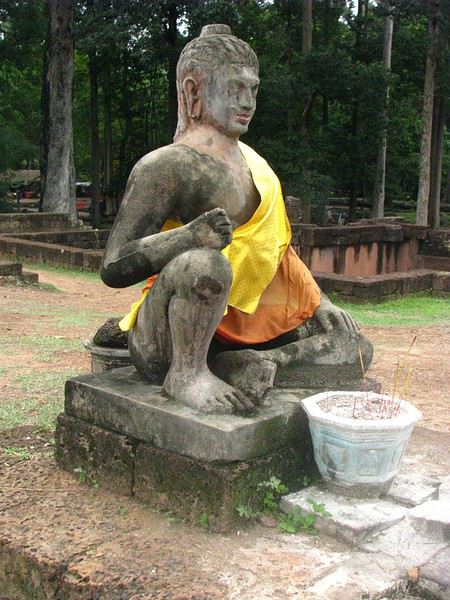
- Au centre de la terrasse, on a trouvé une statue :
"A cause de l'étrangeté du personnage et des taches de lichen qui marquaient la surface de la pierre, on l'a appelé, le "Roi lépreux", d'après une vieille légende populaire qui veut qu'un des rois d'Angkor ait été lépreux". (Claude Jacques).
Après une tentative de vol la statue a été placée au musée de Phnom Penh, elle a été remplacée par un moulage.
- Jean Commaille dans son livre "Guide aux ruines d'Angkor" mentionne quelques hypothèses émises par des chercheurs :
• Il s'agirait de Kubera, dieu des richesses. Kubera est représenté comme un nain bedonnant difforme.
• Il s'agirait peut-être de la représentation du roi Yaçovarman qui était lépreux. Je n'ai jamais lu que ce roi était lépreux, c'est peut-être possible ?
• Jean Commaille quant à lui pense qu'étant donné que le personnage est représenté est nu, il s'agirait de Çiva sous l'aspect d'un ascète ?
- Madeleine Giteau dans son livre " Histoire d'Angkor" mentionne ceci : "Ce Roi lépreux" qui n'est pas, de loin, une des plus belles sculptures de l'époque, porte des crocs à la commissure des lèvres ; il pourrait représenter une divinité des morts ou des mondes infernaux".
Comme on peut le constater les avis divergent.
"Cette statue du "Roi Lépreux" est peut-être en définitive – si l'on en croit une courte inscription du XVème siècle gravée sur son socle – un "Dharmarâja". C'est le nom sous lequel on désigne tantôt Yama, le Juge Suprême, tantôt l'un de ses assesseurs" (Maurice Glaize).
Il s'agit maintenant de l'hypothèse qui a été retenue.
Il serait donc plus exact, comme l'écrit Madeleine Giteau, de nommer cette terrasse de la façon suivante Terrasse dite du Roi Lépreux.
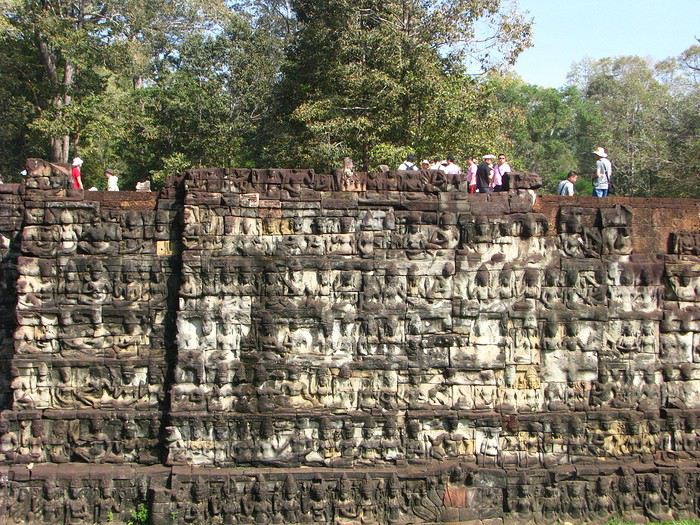
- Cette terrasse est constituée par un massif en maçonnerie d'environ 25 m de côté pour 6 m de haut. Ses faces sont entièrement sculptées de personnages juxtaposés et répartis sur sept registres, dont le dernier a presque totalement disparu.
- George Cœdès estime que la Terrasse du Roi Lépreux avec ses étages superposés d'êtres fabuleux représente sans nul doute le Meru.
Le Méru est une montagne dans la mythologie hindouiste et bouddhiste…
- Les travaux de dégagement ont révélé l'existence à deux mètres en retrait de la face extérieure d'un second système de murs également sculptés de bas-reliefs.
- Depuis la restauration complète du monument, menée par l'EFEO au début des années l990, on peut pénétrer à l'intérieur de la terrasse pour admirer ses magnifiques parois sculptées
Visite :
- Commencer la visite par le passage intérieur, accès au Sud de cette terrasse un peu en retrait. Il y a de jolies sculptures dans ce passage.
- En sortant de ce passage (au Nord) il y a l'escalier qui permet d'accéder à la terrasse pour voir la statue.
- Terminer cette visite en faisant le tour de la terrasse où là encore on peut voir de belles sculptures.
LA LEGENDE DU ROI LEPREUX
Le bas-relief du Bayon : galerie des bas-relief intérieurs (1), façade Est, juste à droite du Gopura (entrée), on voit une petite partie en retrait avec à gauche un petit escalier.
Ce bas-relief présente "la légende du Roi lépreux", identifié pat Victor Goloubew (membre de l'EFEO de 1920 à 1945). Ce bas-relief se lit de gauche à droite.
A droite de l'escalier :
"Un roi trône dans son palais, près de son épouse, entouré de sa cour avec en haut des apsaras et en bas un orchestre et des danseuses.
Ensuite, le roi combat un énorme serpent à mains nues, tandis qu'au-dessous la foule commente l'événement. Le monstre l'ayant souillé de son venin, il contracte la lèpre ; assis dans son palais, il donne des ordres à ses serviteurs qui, descendant un escalier, semblent se précipiter pour aller consulter dans la forêt des ascètes guérisseurs. Des femmes entourant le souverain malade examinent sur ses mains les progrès du mal ; on le voit enfin couché, avec un ascète debout à ses côtés. La dernière scène montrerait les progrès de la maladie.
On remarquera sous la scène de la lutte contre le serpent une pierre mobile servant à boucher l'orifice d'une canalisation intérieure d'évacuation des eaux". (Maurice Glaize, "Les monuments du groupe d'Angkor") (2)
JAYAVARMAN VII AVAIT-IL LA LEPRE ?
C'est la question que se pose George Cœdès dans son livre "Pour mieux comprendre Angkor"
- Les hôpitaux de Jayavarman VII
Une stèle du ta Prrohm (1186) nous apprend que Jayavarman VII a fait construire 102 hôpitaux disséminés dans son royaume. Il y en a quatre autour d'Angkor Thom : Ta Prohm Kel au Sud, la Chapelle de l'hôpital à l'Est, Tonle Sgnout et un quatrième près de la porte Ouest (en ruine) (3)
- Etudes de Victor Goloubew
Deux bas-reliefs, dont l'un sert de fronton à la chapelle dite de l'Hôpital, représentent, d'après les spécialistes, un traitement de cette manifestation nerveuse de la lèpre que les médecins nomment "griffe cubitale" et qui se manifeste par une contraction des doigts de la main.
Victor Goloubew a contacté le Dr Mesnard – Directeur de l'Institut Pasteur de Saigon – pour qu'il puisse faire des recherches sur cette légende du roi lépreux.
Le Dr Mesnard a remis en 1934 une note à Victor Goloubew dont voici des extraits :
- Les avant-bras et les mains du patient sont l'objet des soins attentifs de la part des femmes qui l'entourent. Le geste de l'une d'elles me paraît caractéristique : elle maintient l'auriculaire droit en extension comme pour redresser une griffe cubitale. Par sa pose elle semble attirer l'attention de ses voisins sur ce point particulier si important".
- Les membres inférieurs sont soutenus par un objet placé sous les genoux.
- L'une des femmes soutient de sa main gauche le pied droit du personnage et de sa main droite elle semble lui frictionner la jambe gauche.
- Les gestes de ces femmes semblent bien indiquer qu'il est atteint d'une affection à localisations marquées aux extrémités des membres ; troubles sensitifs et trophiques de la lèpre ?"
- Autre remarque importante : de chaque côté du malade un personnage porte un vase rempli de fruits de forme ronde. Ne seraient-ce pas des graines de Chaulmoogra (Krabao) ? L'Hydnocarpus anthelmintica, appelé Krabao, est un arbre très répandu dans la forêt d'Angkor" (4).
- Interprétation possible : lèpre à localisation nerveuse à la période de névrite".
- Avis de George Cœdès
"Le malade représenté sur le fronton de la chapelle de l'Hôpital et sur le bas-relief du Bayon est certainement un personnage de très haut rang, probablement le roi lui-même.
On est tenté de mettre ces images en rapport avec la légende du roi lépreux, dont la persistance au Cambodge permet de supposer qu'elle a quelque fondement historique, et dont on trouve l'écho dans un texte médiéval hindou qui relate le pèlerinage dans l'Inde d'un roi du Cambodge atteint de la lèpre ; et l'on en vient à se demander si la fondation par Jayavarman VII de 102 hôpitaux n'a pas une certaine relation avec cette maladie soit que le roi, atteint lui-même de la lèpre, ait voulu en fondant des hôpitaux pour soigner les maladies de ses sujets, acquérir des mérites susceptibles de soulager sa propre infortune, soit que, sain de corps, il ait voulu réaliser cette œuvre d'assistance médicale pour en reporter les mérites sur un de ses parents victime de ce mal redouté, généralement considéré comme la punition de fautes antérieures". ("Pour mieux comprendre Angkor")
(1) Au Bayon il y a deux galeries de bas-reliefs :
- Galerie des bas-relief intérieurs sur les murs de la première enceinte, la plus près du sanctuaire central
- Galerie des bas-reliefs extérieurs sur les murs de la deuxième enceinte
(2) Claude Jacques ("Angkor cité khmère") et Michel Petrotchenko ("Le guide des temples d'Angkor") font une description de ce bas-reliefs pratiquement identique à celle de Maurice Glaize.
(3) Je ne conseille pas la visite de la Chapelle de l'hôpitalet deTa Prohm Kel. A mon avis sans grand intérêt.
(4)Encore actuellement les Cambodgiens traitent la lèpre en faisant absorber aux malades des graines torréfiées de Krabao.
C'est toujours un plaisir de lire tes exposés, minutieusement documentés.
George Cœdès estime que la Terrasse du Roi Lépreux avec ses étages superposés d'êtres fabuleux représente sans nul doute le Meru. Le Méru est une montagne dans la mythologie hindouiste et bouddhiste
Dans ces mythologies, c'est plus qu'une montagne, c'est le centre du monde.
Sauf erreur de ma part, les temples-montagnes khmers sont supposés être une représentation du Mont Meru / Mérou. Un mode architectural qui s'étend au célèbre Angkot Vat.
De manière générale, les enceintes multiples d'un temple khmer correspondaient à la description du Mont Mérou ceint de plusieurs chaînes de montagnes.
Que cette terrasse dite du Roi Lépreux soit une représentation du Mont Mérou, ajoute à l'importance de cette place centrale d'Angkor. Le documentaire "Angkor redécouvert" détaille la thèse comme quoi cette terrasse aurait été le lieu de crémation des rois khmers, d'où la présence de la statue de Yama. Une thèse cohérente.
La terrasse dite du Roi Lépreux reste l'un des grands moments de ma visite d'Angkor. En partie parce que j'avais lu quelques décennies auparavant la nouvelle de la découverte de la façade interne.
C'est toujours un plaisir de lire tes exposés, minutieusement documentés.
C'est également un plaisir pour moi de discuter avec un passionné des temples angkoriens.
Je suis entièrement d'accord avec ce que tu as écrit.
Voici quelques précisions (que tu connais peut-être) :
Les anciens Khmers ont essayé de construire leurs temples à l'image de l'idée qu'ils se faisaient des dieux. C'est ce que décrit Georges Cœdèsdans son livre"Pour mieux comprendre Angkor" : dans son livre il y a un chapitre concernant le symbolisme architectural, voici un bref extrait de ce chapitre :
"Dans la conception hindoue du monde, un continent central, le Jambudvîpa, au centre duquel s'élève la montagne cosmique, le Meru entouré des planètes, est encerclé par six continents annulaires et concentriques et par sept océans, dont le septième est borné à l'extérieur par une grande muraille rocheuse. Au sommet du Meru se trouve la ville de Brahma, le monde des dieux, entouré par les huit gardiens des points cardinaux.
Le système bouddhique, assez différent dans le détail, repose-lui aussi sur l'idée d'une montagne centrale, le Meru, au-dessus de laquelle s'étagent les divers cieux. Elle est entourée par sept chaînes de montagnes circulaires et concentriques séparées par autant de mers. Autour de ce complexe s'étend le grand océan, dans lequel baignent quatre continents insulaires, un dans chaque région de l'espace, celui du Sud ou Jambudvîpa constituant le séjour des hommes. Cet univers est entouré, comme dans la cosmologie brahmanique, par une immense muraille de rochers. Au sommet du mont Meru, se trouve la résidence des quatre régents despointscardinaux. Au-dessus trôneIndra, entouré de33 dieux; au-dessus encore s'étagent les cieux, en nombre plus ou moins grand suivant les sectes et les époques.
Dans la cosmologie hindoue, le trait d'union entre les hommes et les dieux est représenté par l'arc-en-ciel. De nombreux indices convergents ont permis à Paul Mus de montrer que les ponts à balustrade de nagas, permettant de franchir les douves et de passer ainsi du monde des hommes au monde des dieux.
Dans tout l'Extrême-Orient, comme dans l'Inde, l'arc-en-ciel est comparé à un serpent. Il est parfois question de deux serpents, car il arrive souvent que l'arc-en-ciel soit double. Il est évident que c'est ce double arc-en-ciel, marquant un chemin divin dans l'espace, qui a inspiré la construction d'une balustrade de nagas de chaque côté des ponts, représentation terrestre de ce chemin divin.
J'ajouterai que, Buddha redescend du ciel des Trente-trois situé au sommet du Meru, où il avait été prêcher la Loi à sa mère, il a utilisé un escalier, qui n'est autre chose qu'un arc-en-ciel, et qui est représenté par une échelle dont les montants ont la forme de nagas.
Les temples sont donc un ensemble de conventions qui donnent aux hommes une image du monde divin"
Maurice Glaize dans son livre "Les monuments du groupe d'Angkor" écrit ceci : "Tantôt la pyramide est couronnée d'un sanctuaire unique, tantôt d'un quinconce de tours évoquant les cinq sommets du Mérou".
C'est le cas d'Angkor Vat. En arrivant par l'Ouest il y a une chaussée à nagas qui permet de franchir les douves et de "passer du monde des hommes au monde des dieux", comme le dit Paul Mus (1902- 1969, membre de l'EFEO de 1927 à 1946)
Véro et Eddy (encore des passionnés de temples) m'avait communiqué les références d'un hors-série du Monde de Juillet-Aout 2018 : "ANGKOR, découvrir, restaurer, visiter". J'ai acheté ce hors-série que j'ai trouvé intéressant.
Dans un chapitre il était mentionné que pour le temple d'Angkor, pour soulager le pont (chaussée à nagas) qui menaçait de s'écrouler sous les pieds des 4 millions de visiteurs par an, les autorités ont installé un pont provisoire que l'on peut voir en photo. Il s'agit d'un pont blanc qui doit être à gauche de la chaussée à nagas initiale. Lors de ma dernière visite en 2016, ce pont provisoire n'avait pas été construit.
Pour la terrasse dite du Roi lépreux, j'ai bien aimé sa façade interne avec de jolies sculptures. J'ai constaté que de nombreux touristes ne visitent pas cet endroit.
Bonjour Jacques et Fabrice,
effectivement la terrasse du roi Lépreux est un grand moment de découverte sur le site d'Angkor Thom mais est-ce peut-être parce que cet endroit est situé en plein soleil qu'il invite les visiteurs à passer l'endroit plus vite qu'ils ne le devraient... ?
Je n'ai eu l'occasion de ne voir le pont provisoire qu'en photo et je ne sais ce qu'il en est aujourd'hui , mais ceci m'a toutefois un peu étonné , car il y a déjà de cela quelques années , d'importanst travaux avaient déjà été entrepris pour refaire le dallage de pierre , complètement hors niveau , et les rambardes sur cet accès.
Il semblerait donc que cette fois , ce serait plutôt dans les fondations ?
Je voudrais profiter aussi de mon poste ici pour vous poser une questions : j'ai eu la chance d'aller souvent voir les temples d'Angkor , mais jamais je n'ai manqué de repasser dans la cité d'Angkor Thom , et je n'ai jamais manqué de visiter et d'admirer le Bayon , et particulièrement pour avoir une vue directe sur la complexité de ses fondations , et , ceci est bien sûr un avis strictement personnel , mais j'ai toujours trouvé ce temple bien différent des autres sur le site d'Angkor ; y a t'il une raison à cela que son style soit autre , est-ce peut-être une question d'époque, car mises à part les imposantes têtes de pierre que l'on peut retrouver aussi sur les hauteurs des portes d'accès dans la cité, il me semble que aucun autre temple n'a l'air du même style dans l'enceinte d'Angkor Thom , et même une fois sorti de la cité.
Ces temples m'ont toujours passionné, leur histoire un peu moins .
Voilà donc une bonne occasion pour en savoir plus.
Puissiez-vous vous avoir la chance de revenir encore ici de nombreuses fois !
Sincère remerciements , bien à vous , Ch
Voici quelques précisions (que tu connais peut-être)
C'est exactement ce que j'avais appris par la lecture. Avec moins de détail pour la version bouddhique.
Mais j'ignorais tout de l'assimilation du naga à l'arc-en-ciel.
Pour la terrasse dite du Roi lépreux, j'ai bien aimé sa façade interne avec de jolies sculptures.
Je me suis mal exprimé auparavant.
C'est vraiment la façade interne qui m'a émerveillé. Je ne m'attendais aucunement à la finesse de ces sculptures, bénéfice d'avoir été couvertes (et donc protégées) lors de la construction de la façade externe.
Et quand on visite cette façade interne, on y est bien à l'abri du soleil. 🙂
Bonjour Christian
Sur le style du Bayon voici quelques précisions :
Les styles architecturaux durant la période angkorienne :
- On a pu déterminer une chronologie des rois par l'épigraphie (étude des inscriptions) (1) avec le nom des temples qu'ils ont fait construire.
- C'est à Philippe Stern (2) et à Gilberte de Coral-Rémusat (3) que nous devons une nouvelle méthode de classification des monuments, basée sur le groupement par styles au moyen de l'étude analytique des thèmes de décoration (aspect général du monument, colonnettes, linteaux…).
- Par la suite on a pu établir une liste précise des styles angkoriens avec le nom des rois correspondants à chaque style
- Il y a 11 styles angkoriens : nous savons donc que le style du Bayon va de 1181 à 1243, dates qui correspondent aux règnes de Jayavarmam VII et son successeur Indracvarman II.
Le style du Bayon ne correspond donc pas à lui seul à un style mais à un ensemble de temples.
L'architecture du Bayon
Pour moi, le Bayon est le temple que je trouve le plus complexe sur le plan architectural. Je me suis demandé, et je me demande encore, comment ce temple a été construit.
Dans le livre de Georges Coedès, "Pour mieux comprendre Angkor" il y a un chapitre intitulé "Le mystère du Bayon". Celui-ci a écrit :
"Mystérieux, le Bayon l'est par son plan compliqué résultant de transformations successives, par ses courettes profondes comme des puits, par ses galeries obscures – mystérieux encore par ses bas-reliefs en partie inexpliqués, par ses niches vidées de leurs idoles, par cette décoration des tours qui est unique dans l'histoire des arts – mystérieux, il l'a toujours semblé à ceux qui l'ont approché".
Il a cité Henri Parmentier :
"Le monument dans son état présent, dit H Parmentier, produit une bizarre impression d'entassement et de resserrement ; les tours s'accumulent les unes contre les autres, les édifices se serrent sans libre circulation, les cours sont des puits sans air et sans lumière".
- Nous n'avons pas de texte – plus exactement nous n'en n'avons pas trouvé, mais bien sûr je peux me tromper – concernant la construction des temples. Cependant, nous pouvons voir plusieurs sculptures représentant des méthodes utilisées par les khmers sur les bas-reliefs du Bayon. Dans son livre "Les monuments du groupe d'Angkor", Maurice Glaize en parle :
- Bas-reliefs extérieurs : Pavillon d'angle Sud-Est
"Les sculptures de ce pavillon sont restées inachevées : le premier panneau montre fort bien les méthodes de travail des Khmers. Partant d'un mur préalablement dressé, ils procédaient par taille directe ; dessin gravé au trait, léger défoncement, mise en volume et fignolage. Deux charmantes apsaras dansent à droite, tandis qu'à gauche sont ébauchées trois tours surmontées d'un trident, celle du centre abritant un linga (?). Les autres panneaux sont consacrés à des scènes nautiques".
- Bas-reliefs extérieurs, galerie Ouest, section Sud
"Au-dessus la construction des temples : ouvriers halant un bloc de pierre sur lequel est un contremaître armé d'un rotin, d'autres portant des matériaux, d'autres enfin procédant au rodage des blocs suspendus a un bâti spécial."
- Bas-reliefs intérieurs, galerie Ouest, section Sud
"Entre deux tours : à droite, scène d'adoration du dieu Vishnou a quatre bras, surmontant quelques épisodes de la construction d’un temple, traités de façon plus complète que sur les bas-reliefs de la galerie extérieure : des coolies halent un bloc de pierre glissant sur des rouleaux, d'autres procèdent au rodage des blocs à l'aide d'un système spécial à levier et en effectuent la pose, d'autres enfin transportent des matériaux sous la menace du rotin"
(1) En architecture l'épigraphe est une inscription que l'on trouve sur des monuments. Ces inscriptions dont gravées sur les matériaux non putrescibles comme la pierre, le métal...
L'Epigraphie : science qui étudie les épigraphes
L'Epigraphiste : personne qui étudie les épigraphes
(2) Philippe Stern (1895-1979) : historien de l'art de l'Inde et de l'Asie du sud Est. Il a été conservateur du Musée Guimet. Bien que n'étant pas membre de l'EFEO il a écrit 5 BEFEO (Bulletin de l'EFEO).
(3) Gilberte de Coral-Rémusat (1903-1943). Spécialiste dans les arts asiatique et surtout dans l'art khmer. Tout comme Philippe Stern elle n'était pas membre de l'EFEO mais elle a écrit 2 BEFEO en 1934 et 1936
Jacques
Le documentaire "Angkor redécouvert" détaille la thèse comme quoi cette terrasse aurait été le lieu de crémation des rois khmers, d'où la présence de la statue de Yama. Une thèse cohérente.
Dans le BEFEO de George Cœdes de 1940 – volume 40, N° 40-2 – pp. 315-349 : "II. Études cambodgiennes, La destination funéraire des grands monuments khmers", page 339 on peut lire ceci :
J'incline à penser que la Terrasse du Roi Lépreux n'était pas autre chose qu'un Men permanent, ce qui expliquerait pourquoi, à une époque où l'on se souvenait encore de cette destination, on y a rassemblé des images de Dharmaràja, le dieu des morts.
Le Men est un pavillon crématoire
- En décembre 2015 tu avais mentionné le documentaire "Le mystère d'Angkor"
Un anthropologue néo-zélandais intervient dans ce document, il a affirmé que les cendres du Roi Sûryavarman II, constructeur d'Angkor Vat avaient été placées au sanctuaire central de ce temple. (*)
Dans le livre de George Cœdes "Pour mieux comprendre Angkor" on apprend, se basant sur les rites funéraires javano-balinais, que les cendres des rois de ce pays étaient placées dans des pierres à dépôts. On n'a a pas trouvé de cendres dans les cavités de ces pierres à dépôt dans les temples angkoriens. On ne peut donc pas affirmer (jusqu'à preuve du contraire) que les cendres des rois angkoriens étaient placées dans ces cavités.
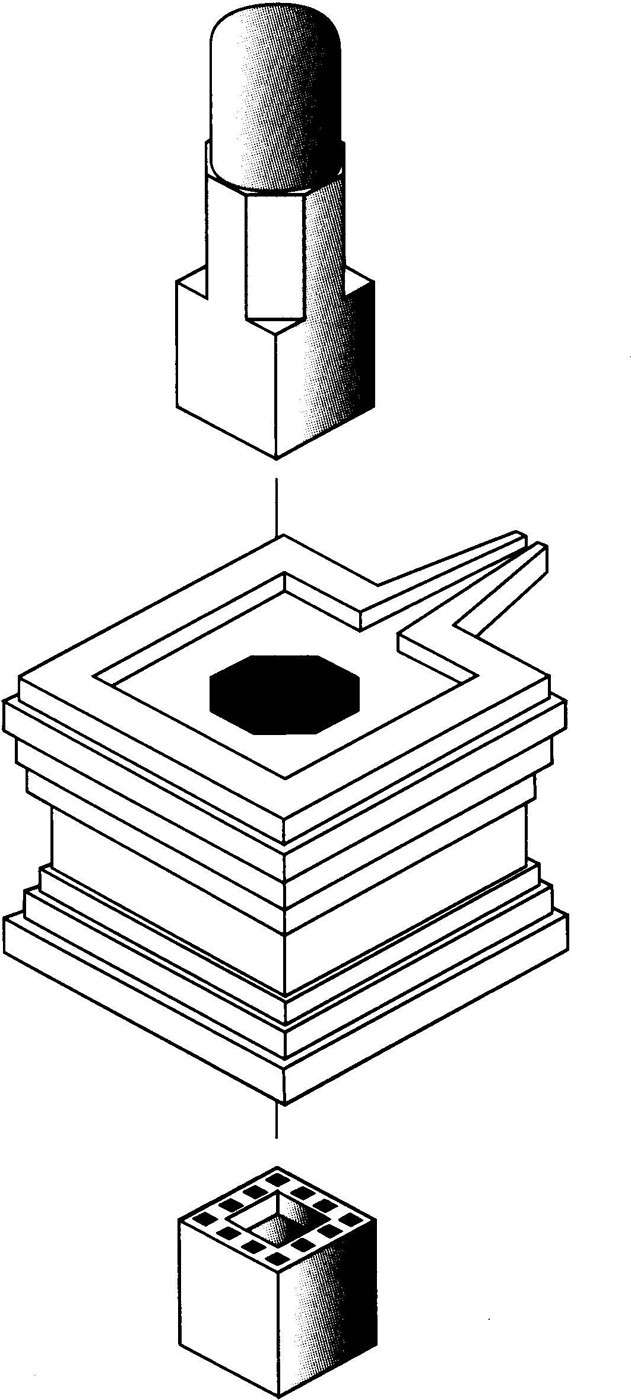
Les pierres à dépôt : voir le schéma joint au présent, la pierre à dépôt est située sous le yoni. Il s'agit d'un socle de statue ou de sculpture, on peut y voir des cavités dans lesquelles ont y plaçait des objets précieux, on a retrouvé quelques petits fragments d'or. Beaucoup de statues ont été renversées par les pilleurs pour accéder à ces objets précieux. On peut encore voir dans des temples des pierres à dépôt.
- Les cuves funéraires
Voici un extrait du BEFEO "La destination funéraire des grands monuments khmers"
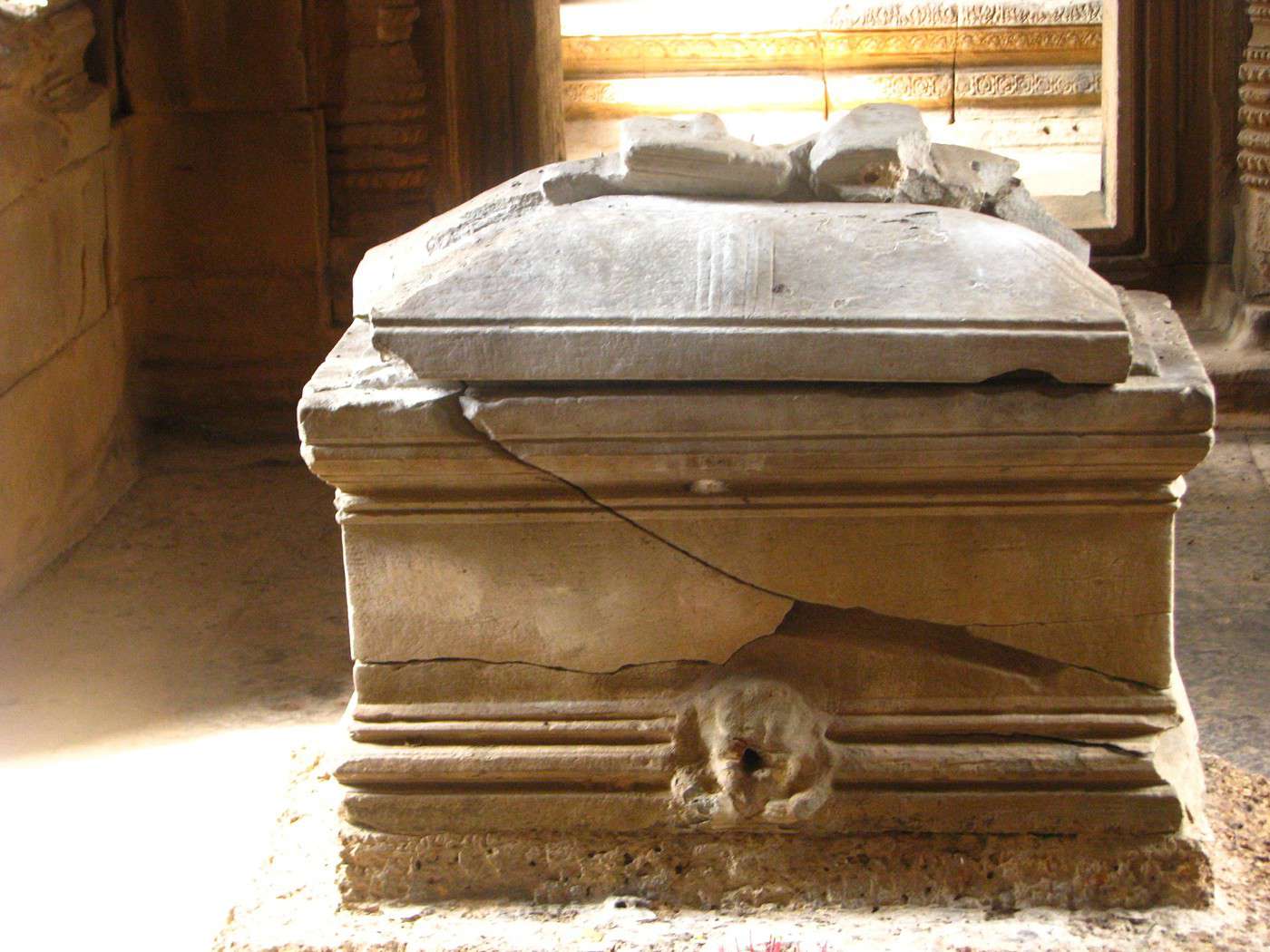
"Durant ces dernières années, les travaux de la Conservation d'Angkor ont ramené au jour une quinzaine de cuves en pierre : une seule possède encore son couvercle, et toutes celles dont la partie inférieure est conservée présentent, sauf une, la caractéristique d'être percées d'un trou d'écoulement"
"La cuve du Banteay Samre a été découverte au pied des marches de l'entrée secondaire Sud du Gopura I Est. Cuve complète avec couvercle percé d'un trou au centre. Trou d'écoulement : décoré à l'extérieur d'une tête de Rahu ou de Kirtimukha sur une des grandes faces".
Voir la photo jointe de la cuve du Banteay Samre
On ne connait pas la fonction de ces cuves. Toutes ces cuves ont été retrouvées vides. Certains chercheurs pensent qu'il s'agit peut-être d'urnes funéraires ?
Comme on peut le constater, il y a encore beaucoup de choses que nous ignorons sur les temples angkoriens et en particulier sur les rites funéraires. En l'absence de documents précis ou de découvertes importantes, on ne peut donc pas affirmer comment se déroulaient exactement les rites funéraires concernant les rois angkoriens.
Hi, I’ve read that these two volcanoes are super popular and that there are *tons* of people for sunrise, especially in July. I’m looking for firsthand accounts from anyone who’s done it later, around 9–10 a.m.
Thanks for your help!
Laëtitia
Hello everyone! I’m heading off solo in February and wanted to share my rough itinerary with you. Does this sound doable?
PS: I’m not really into beaches.
D1 Departure on February 17, 2027
D2 Arrival in Kuala Lumpur – stroll through Chinatown and visit the Petronas Towers
D3: Kuala Lumpur – Chow Kit Market, Batu Caves, Little India, Bukit Bintang downtown area
D4: Early morning bus to Malacca. Explore Malacca in the afternoon and evening
D5: Another 2–3 hours in Malacca in the morning, then bus back to Kuala Lumpur. Merdeka Square area. Stay in Chinatown
D6: Bus trip to Kuala Tahan. Night tour
D7: Morning – canopy walk and Bukit Terisek hike. Afternoon – off to Lata Berkoh
D8 & D9: 2-day jungle trek in Taman Negara National Park
D10: Head to Cameron Highlands
D11: Morning hike through the plantations. Afternoon still to be decided
D12: Morning – excursion to Mossy Forest and Sungei Plantation. Afternoon bus to Ipoh
D13: Morning – Mirror Lake / Sam Poh Temple area. Afternoon – explore downtown Ipoh
D14: Morning train to Penang. Afternoon – wander around Georgetown
D15: Morning – Penang Hill and Keh Loh Temple. Afternoon – Georgetown
D16: Bus to Butterfly Garden and Spice Garden. Late afternoon – Burmese and Thai temples
D17: Morning flight to Singapore. Afternoon – Chinatown and Marina Bay tour
D18: Morning – Gardens by the Bay area. Afternoon – Boat Quay, Clarke Quay, Kampong Glam
D19: Morning – The Ridges area and Botanical Garden. Afternoon – Little India, then back to Chinatown before 11:15 PM return flight
D20: Morning arrival
Has anyone traveled with the Laos travel agency ADV ?
I’m planning a trip to Laos and have received several quotes. Among them, this agency’s seem very reasonable, and so far, the interactions have been positive.
I’ve found a few positive reviews online, but I’d love to hear from travelers who’ve actually booked with them: how’s the organization, guide quality, accommodations, on-the-ground responsiveness, etc.
Thanks for sharing your experiences!
First stop on our discovery of the peninsula: Amphawa. It’s our first night in Thailand (we arrived at Suvarnabhumi at 8:50 AM).
Our initial plan was to explore the area before heading further south. The Mae Klong Railway Market is tempting... but what else is there to do????
We’ll be there on a Wednesday, and from what I’ve read on the forum, some say there’s absolutely nothing to do during the week—no floating market, barely any shops open, no restaurants, etc.
Others, though, say the place is actually more charming without the weekend crowds.
Could you share your thoughts? Missing the floating market is one thing, but if it’s really a ghost town on Wednesdays, I might just drop our bags somewhere else.
Amphawa seemed like a good first stop, just 1.5 hours from the airport, but I’d still like to settle somewhere a bit lively for our first evening.
We’ll be there at the end of October.
Thanks!
Hi,
I wanted to visit the plantations in the morning with GetYourGuide or by just showing up.
How much time should I really plan for?
I’d like to catch either the 3 PM or 5 PM bus back to KL.
Thanks
Hi,
I wanted to get some info about the cable car and the bridge—I see lots of different options...
How much time should we allow for these two activities? If we arrive around 4 PM, will we have enough time to visit without rushing?
Thanks
Hi there,
I didn’t plan to return to Thailand this year, but my health conditions mean it’ll be the best place for me to stay between two trips to India. The tourism setup there is so well-organized that it’s the most "comfortable" country for a short visit. Thailand feels too sanitized for my taste, and there’s too much religion, Buddha, and the King, but it’s still the best option given how my health has been evolving. I’d considered two weeks in ThaTon for hiking, but I got too sick from the burn-offs during my trips to the mountains around Chiang Rai. So I’m not sure where to go this year. Definitely not the sea, touristy spots, or the mountains with burn-offs...
Hi,
On September 1st, we're heading to Kalimantan for six weeks, probably from Pontianak to the Derawan Islands.
I've scoured this site, which is usually my go-to 😉, and others like VoyageForum, but recent info is pretty scarce.
I'd love any tips on places you've visited—our itinerary is still a work in progress.
We're two couples traveling with backpacks, using buses, boats, guesthouses, and homestays.
Thanks in advance!
Hi fellow travelers,
First trip to Vietnam.
We’ll be arriving in Ho Chi Minh City during Tet.
Is it complicated to find accommodation and get around during this period?
Any tips would be welcome.
Thanks for your replies.
Hi! I’d like to split my trip into two parts: 15 days in Phuket and 15 days in Krabi. Do you know if I can rent a car and drop it off in Krabi when I fly back to France?
Thanks for your feedback!
Have a great Sunday!
Martine
Hello,
After 1 night in Khao Sok, I’d like to find a 2 Days 1 Night package on the lake.
After reading a lot, I decided to "break the bank" and treat ourselves to a private tour—mainly to avoid the crowds.
But after contacting several operators, they offer "private tours" that are very expensive (around 700 €), yet in the details, the boats can only leave from the pier at 10 AM like everyone else. (I was hoping to leave much earlier.) The morning program is the same for everyone too (private or not). They drop us off at noon at our floating hotel (I’d chosen Phupha Waree). Free afternoon (swimming or kayaking in front of the hotel). We head back by boat for a 1-hour sunset ride. And the next morning, we leave the hotel at 8 AM to be at the pier by 9:30 AM at the latest—end of the trip.
So basically, we’re paying a lot for a private tour just to do the same thing as everyone else at the same time.
Or maybe I just had bad luck in my search.
I contacted Panida Ladi, who’s very popular on forums. We’d agreed on a private tour that matched my request (departure from the pier at 8 AM, very personalized itinerary). We settled on the itinerary and price, she asked for a Wise transfer for a 30% deposit, confirmed receipt of the deposit. Then 30 minutes later, she messaged me to say she was canceling everything because it was impossible to do the requested tour—and promised a quick refund of my deposit.
So here’s my question: Who’s done a *real* private tour on this lake? Who can recommend a reliable agency? Is it even really possible to do a private tour here?
I’m searching for a real gem for my 3rd stay in Koh Lanta: a lovely, high-quality hotel right by an easily accessible beach in a lively spot.
If you know of anything that fits what I’m looking for and want to share, don’t hesitate!
Hi, is anyone there in Flores right now? According to some websites, everything is closed and the situation is tough. But our guide says it's fine. Who should we believe? We're supposed to leave on September 2nd. Thanks to anyone in Flores at the moment!
Hi dear community,
I'm planning to visit Cambodia this winter, right after Christmas, for my first solo trip and my first trip to Asia. For two weeks (yes, I know it's short, but I really can't do more...). I have two main desires: Siem Reap and the countryside, the villages, the Mekong...
What do you think of this itinerary? Arrival in Siem Reap, departure from Phnom Penh.
SR: 5 days (1 day for arrival, 3 for the temples, 1 for the lake and its villages)
Kratie (stop on the way to Mondolkiri): 3 days (1 day of travel, 2 days there)
Mondolkiri/Sen Monorom: 4 days (1 day of travel, 1 day there, 2 days of treks)
PP: 3 days (1 day of travel, 2 days of sightseeing)
I think I need to cut one day somewhere if I travel from Saturday to Saturday or Sunday to Sunday. In Kratie, maybe? Or in PP? And I'll miss the boat trip that everyone recommends (SR-Battambang), but I don't see where to fit it in. Unless I do a PP-PP loop starting in the east, skip Kratie or just stay one night, then SR, then PP.
In my timing, Mondolkiri seems closer than Ratanakiri, which also tempted me a lot! Will it be too complicated alone? I'm thinking of using local guides or a small local agency for a nature and village getaway.
I've read that Siem Reap is very crowded between Christmas and New Year's. I could also do the circuit in the opposite direction. But I thought it would be easier to get familiar with the country by arriving in a touristy area—I might be wrong...
Thanks for your advice and opinions!
Hi everyone.
I’m planning my trip, and based on all the posts I’ve read, this country is amazing.
Of course, I’ve got a ton of questions for you.
Here’s a possible itinerary: Vientiane - Vang Vieng - Phonsavan - Sam Neua - Nong Khiaw + villages - Phongsali - Luang Namtha and the area - Udomxai - Huay Xai - Luang Prabang and back to Vientiane.
What do you think?
We’re planning to prioritize local transport—is it possible to do this loop?
We’d also love to go kayaking, but I’m not sure if the season’s right or where the best spot is.
For trekking—I read that Phongsali is the most authentic spot to visit villages and see wildlife. Do you know of a reliable agency and a guesthouse with reasonable prices?
Is it worth taking a slow boat for a stretch on the Mekong, and if so, which route?
For accommodations, is it better to book through Booking.com and Agoda or look when we arrive?
Are mosquitoes bad in Laos, and should we take malaria prophylaxis?
What’s the average daily budget (accommodation, food, visits)?
Is renting scooters a good option for exploring towns, and if so, which ones?
From what I’ve read, it’s best to carry cash—euros or dollars? Is it risky to walk around with that much cash?
I’ve still got tons of questions. Thanks to anyone who can help, and I’m open to all tips, info, etc.
Thanks again
Hi there,
I’m planning a family trip (my wife and I, both 47, and our two sons, aged 5 and 12) to Malaysia for the last week of June and the first two weeks of July 2027.
We used to love road trips as a couple, then as a trio, but since our second child arrived, we’ve taken a break with "camping village" style trips.
Now feels like the right time to get back to our old habits, while adjusting the pace for the kids.
We’re craving Asia. We’ve been lucky enough to visit Thailand, Indonesia (Bali and Lombok), and Sri Lanka before.
Friends have raved about Malaysia, so we’re definitely tempted.
For those who know and love Malaysia, what would be a good itinerary starting from Kuala Lumpur, with a maximum of 3-4 stops? We’d like a mix of culture, nature, and relaxation (just to clarify, we’re not big beach fans). All of this without rushing, of course.
Hello,
We’re a family of four with two teens aged 16 and 18. We’re heading to Thailand this summer. We’ll arrive in Bangkok and plan to take a flight to Luang Prabang.
I’ve seen there are some great visits and excursions to do (temples, markets, waterfalls) and maybe even venture a bit north to places like Nong Khiaw, Muang Xay, Muang Ngoy, or Oudom Xay.
But I’ve also heard about the Bokeo region with the Gibbon Experience.
Since we won’t be able to do everything, I’d love to hear about your experiences, impressions, and advice on the two options I’m considering, especially since we’ll be meeting family in Chiang Mai, Thailand, afterward.
Option 1: A loop from Luang Prabang heading slightly north, then a flight from Luang Prabang to Chiang Mai.
Option 2: A few days in Luang Prabang, exploring within a few dozen kilometers around, then heading to Bokeo province for the 2-day/1-night Gibbon Experience. For this option, I saw on Rome2Rio that it’s possible to book a ferry trip on the Mekong from Luang Prabang to Huay Xay—they mention about 8 hours. But is that realistic? What type of boat is it?
Then, to get to Chiang Mai, there aren’t many options—bus or minivan—but how does crossing the border work?
Finally, for those of you who’ve been to Laos in August, what was the weather like?
We’ve already visited Thailand, Vietnam, and Cambodia during the same period over the past four years and weren’t really bothered by bad weather.
I’m starting a discussion about guides in the Mekong Delta because we’ve just finished our trip in this region and had a hard time finding a French-speaking guide. We had Thanh—she speaks French really well and travels all over the delta region, including Ho Chi Minh City. She’s super friendly and flexible. I recommend her wholeheartedly. If it can help someone...
Feel free to contact us for her number.
Hi everyone,
I couldn’t find any recent info on Kuching.
Can anyone recommend a hotel or guesthouse for under 100 RM that’s nice and affordable? No dorms, please.
Also, does it rain a lot in November, and is it still worth visiting Semenggoh or Bako?
We’ll be arriving in Phnom Penh this coming January and we’re thinking of starting our trip with a stop in Kampong Cham, then Kratie.
After Kratie, we’re considering heading toward Siem Reap with a stop in Kampong Thom.
That said, I’m not really sure how long the Kratie–Kampong Thom journey might take or how complicated it is.
Does this stop on the way to Siem Reap seem like a good idea to you?
If we don’t visit the Sambor Prei Kuk site, are there still any walks or sights worth checking out in Kampong Thom?
Silly question—backpack or hard-shell suitcase for the Sepilok, Kinabatangan, Tioman, KL trip?
I’m struggling to fit all my son’s and my stuff into the 70L backpack... and I’m thinking a suitcase would be easier, but I’m not sure if it’ll work for getting around.
After a stay on Koh Phayam this coming November, I’d like to spend 2 or 3 days on Koh Phra Thong before heading further south.
Do you think it’s doable to leave Koh Phayam early enough to catch the 10 AM boat from Khura Buri to Koh Phra Thong? The next one isn’t until 4 PM, which would cost me a whole day.
I’m planning a trip to Indonesia, specifically Sulawesi and Java, in September for 10 days.
I don’t know this part of the world at all—any advice is welcome!
I’ll be traveling solo and would also love tips on meeting other travelers or locals.
Hello everyone,
Not long ago, I used to travel as a couple, but my husband has since passed away, and I’ve decided to set off again. The trip I took to Cambodia in January 2025 did me a world of good.
I’m now considering Thailand, a destination we never included in our plans because even 15 years ago, people said it was too touristy. Still, I’m thinking about the itinerary below, but I don’t feel up to arranging buses, trains, or guides on my own while I’m there. I’m looking for one or more drivers and have been in touch with an agency, but their offers are just copy-paste group tours that I don’t want.
So, if you have any contacts, experiences, or advice, I’d be so grateful if you’d share them with me. Here’s my rough plan:
Arrival in Bangkok
Ayutthaya (2 nights)
Kanchanaburi (2 or 3 nights)
Sangkhlaburi/Sai Yok (3 nights)
Sukhothai (2 nights)
Lampang (I’ve planned 3 nights, but that might be a bit much—it depends on what time I arrive in the city)
Chiang Mai
Chiang Dao
Pai
Chiang Rai
I was thinking about the Mae Hong Son loop—thoughts?
What do you think about staying overnight at the Golden Triangle?
When I look online, of course, I can find agencies that organize tours to national parks, etc.
I’m retired but in great physical shape. I’d rather go hiking than sit in hot springs with crowds of tourists who’ve all arranged meet-ups. I don’t want to spend a day at an elephant camp, and I don’t want to visit Karen villages.
I’d love to hear your advice.
Thank you all,
Hi everyone,
Could you share your thoughts on my 3-week itinerary?
We’re a small group (family + friends) of 12 people, planning to leave around January 21, 2027.
Here’s my itinerary:
3 nights in Bangkok
4 nights in Chiang Mai
3 nights on Koh Samui
3 nights on Koh Phangan
4 nights in Krabi
4 nights in Phuket
I’m also open to any great tips you might have...
Thanks, everyone! Alain.
Hi there,
We’re planning a 3-week family trip next summer with our three kids, who’ll be 8, 8, and 7 years old.
After some research, we’re leaning toward Malaysia to combine nature/forests and paradise beaches. The idea is to introduce our kids to the country’s culture, nature, and wildlife.
We want a great trip but without splurging on luxury options like high-end lodges and resorts. We’re looking for comfort with a touch of authenticity—basically, a good middle ground.
I’ve started putting together an itinerary and would love your expert advice and tips to help us build this amazing trip with our little ones.
Day 1: Departure from France
Day 2: Kuala Lumpur
Stay at a hotel near the airport or KL Sentral.
Just one night.
Day 3: Morning flight to Sandakan (Borneo).
Stay in Sepilok
Day 4: Sepilok:
* Orangutan Center
* Malayan Sun Bear Center
* Rainforest Discovery Centre
Day 5: Depart for Kinabatangan.
Boat safari in the late afternoon.
Day 6: Sunrise safari.
Jungle walk.
Evening safari.
Day 7: Final safari.
Return to Sandakan.
Flight to Kuala Lumpur, then to Kota Bharu (or overnight transit depending on schedules).
Day 8: Transfer to the port.
Boat to the Perhentian Islands.
Days 9 to 13: Perhentian Besar
5 full days.
* Snorkeling
* Hiking
* Turtle watching
* Wild beaches
* Relaxation
Day 14: Return to the mainland.
Bus or private car to Taman Negara.
Summer seems to be the best time weather-wise for Bali.
And since summer’s when we can take a long trip, let’s go for Bali... even though we know it’ll be *packed* with people!
So we’ll steer clear of the island’s south...
Our current plan (19 days on the ground, 7 stops):
- 4 Nights (3 days) in Ubud
2 days for rice terraces / activities (Tegallalang, Campuhan Ridge, Monkey Forest, Bird Park, coffee plantation, market (?), dance "pestacle," cooking class and/or spa)
1 day with a driver for the Temples (Pura Gunung Kawi, Tirta Empul Spring, Pura Mengening, Goa Gajah...)
- 2 nights in Sidemen (1 day for Pura Kehen + Batur Caldera + Pura Besakih and 1 day to relax in the rice terraces)
- 3 nights on Gili Meno (Rest and beaches) from Padangbai
- 2 nights in Amed (1 day from Padangbai with the Abang rice terrace and Tirta Gangga baths, and the next day a boat tour in Amed)
- 4 nights in Pemuteran (1 day for transfer and rest, 1 day to visit Kawah Ijen, and 2 days of snorkeling at Menjangan Island)
- 2 nights in Munduk (1 day with the Dayang rice terrace and the 3-waterfall hike, 1 day at Pura Ulun Danu Bratan)
- 2 nights in Jatiluwih (1 day in the rice terraces, and on the last day, we’ll stop by Pura Taman Ayun in Mengwi and Pura Tanah Lot before catching our red-eye flight).
Accommodations in homestays or hotels.
Transportation to be arranged on-site with the lodgings (?)
Boat to Gili Meno to book in advance (?)
Kawah Ijen excursion to plan ahead (?)—check with the homestay (?)
Thanks for your thoughts/comments to help us explore this destination...
After reading and researching, we're planning the following stops in Cambodia in January 2027:
- Phnom Penh
- Kampong Cham
- Kratie
- Siem Reap
- Battambang
- Kampot (round trip)
I'm wondering about the direction of these stops, which could also influence our international flights.
Either a round trip from Phnom Penh in the order above.
Or landing in Siem Reap with the following order:
This second option would save us the Battambang - PP - Kampot trip but means doing a round trip to Battambang from Siem Reap and placing the "highlight of the trip" (Angkor) at the beginning of our stay.