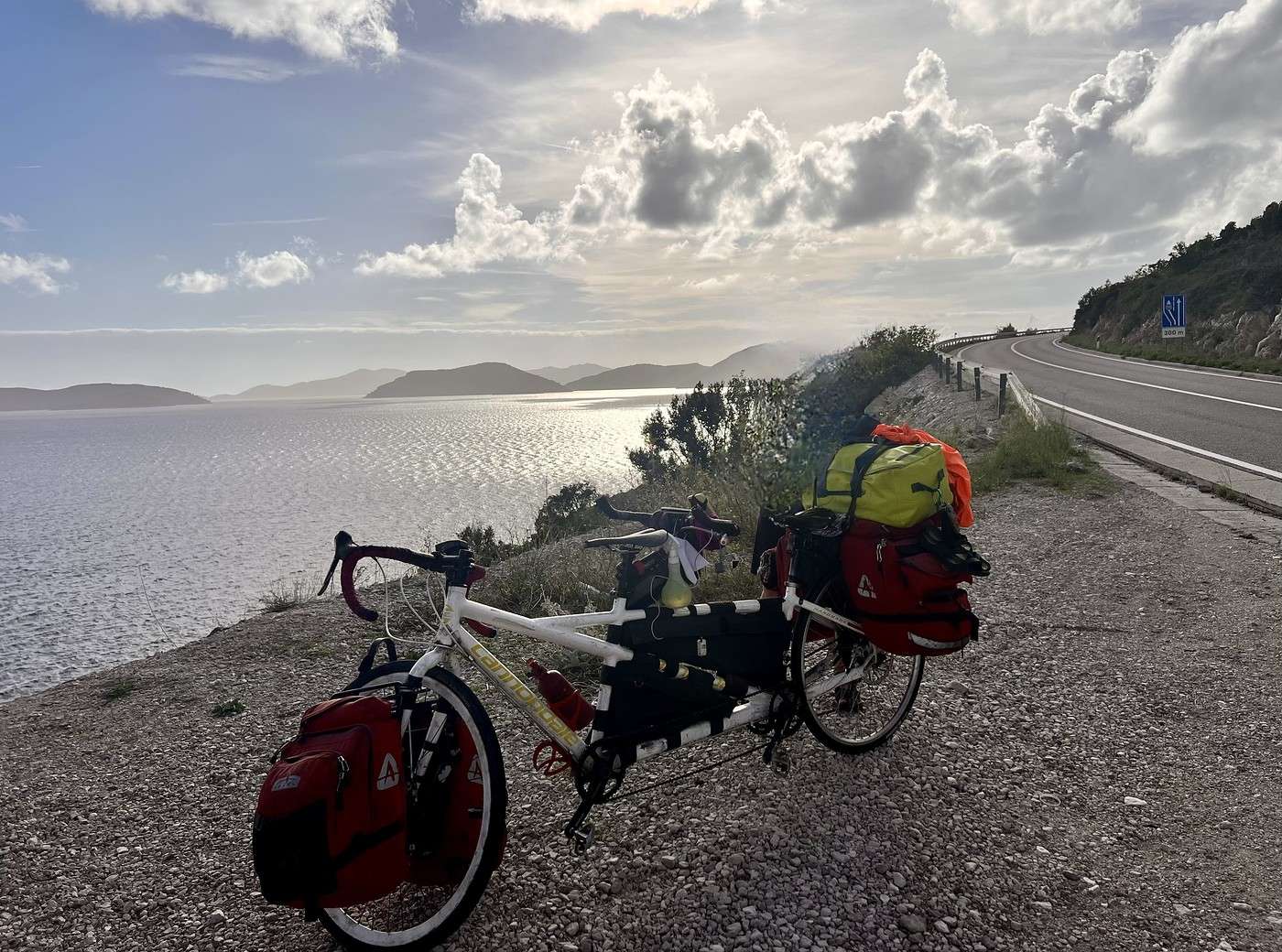
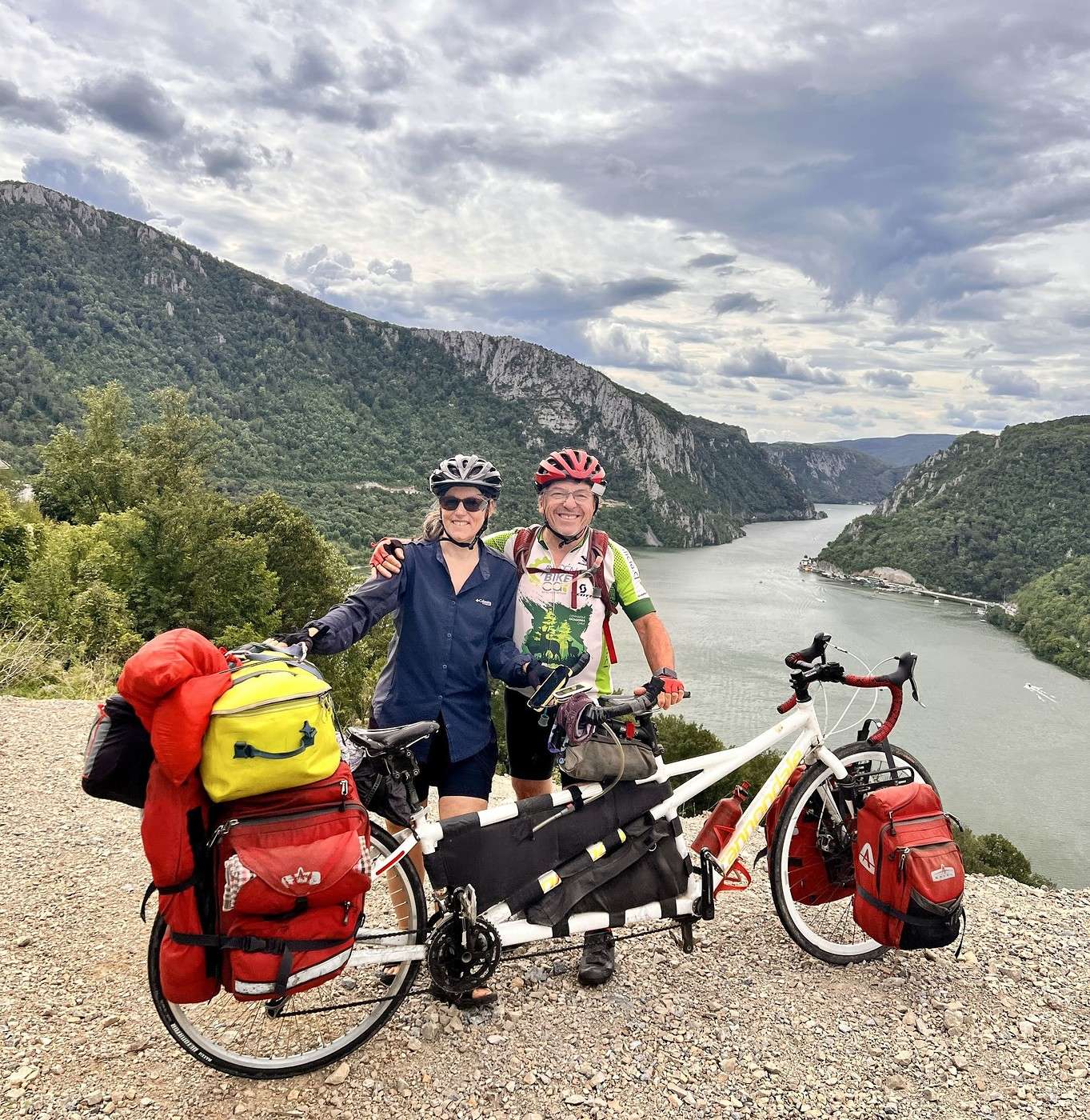
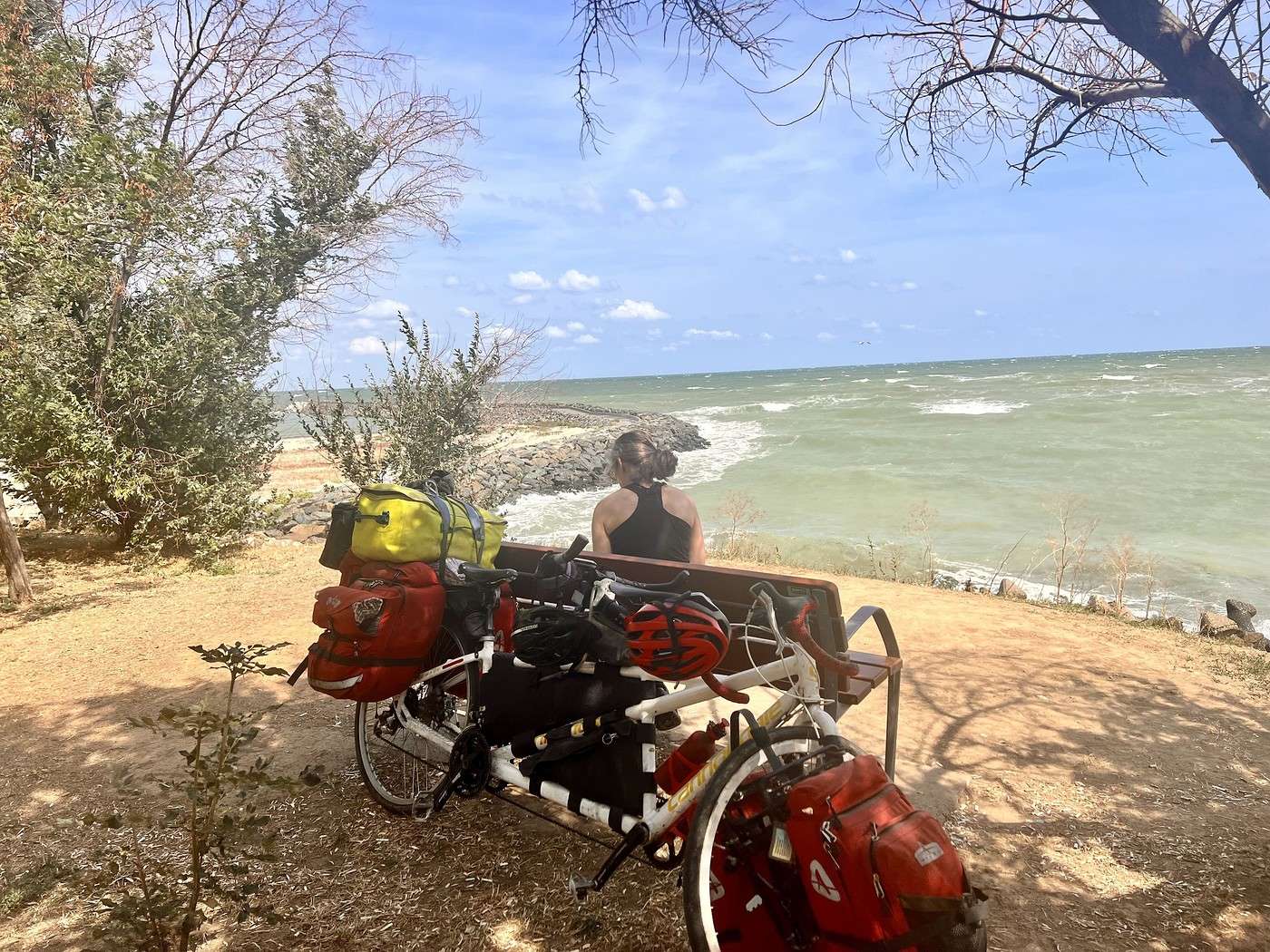
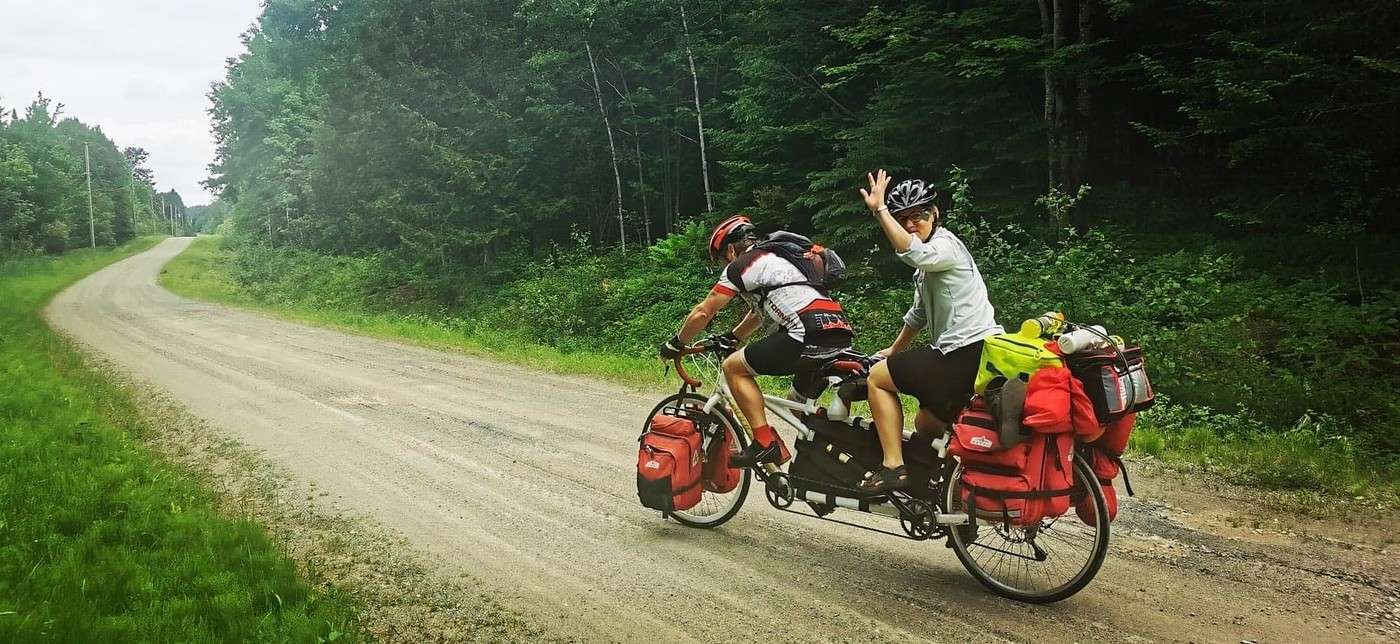
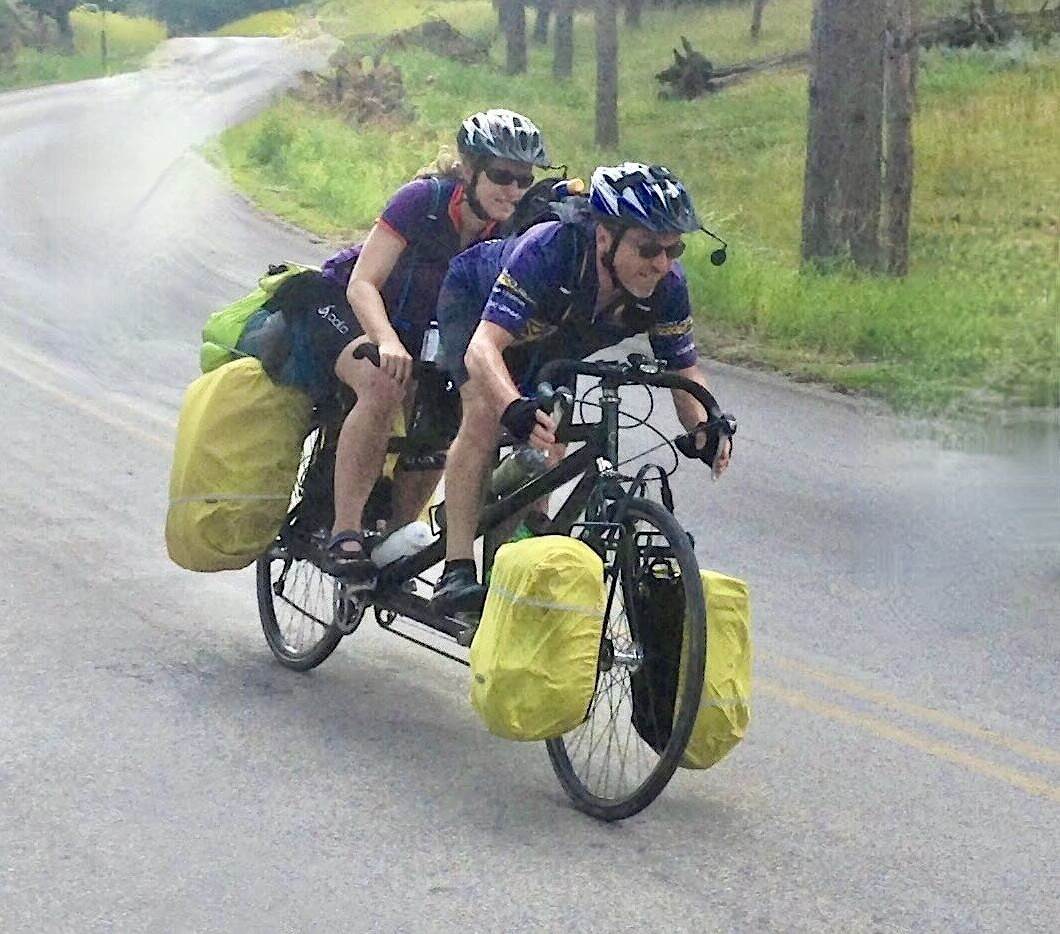
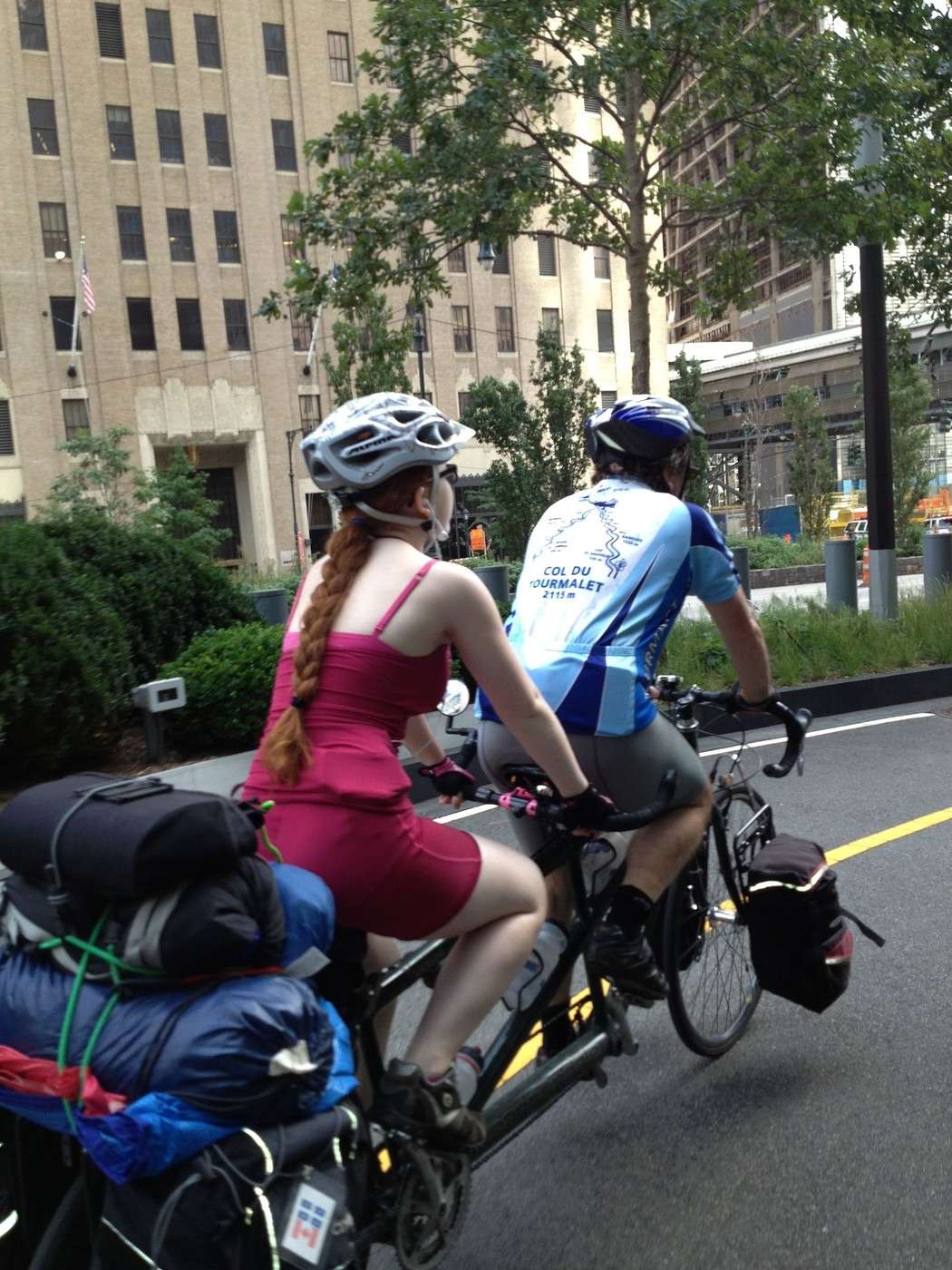
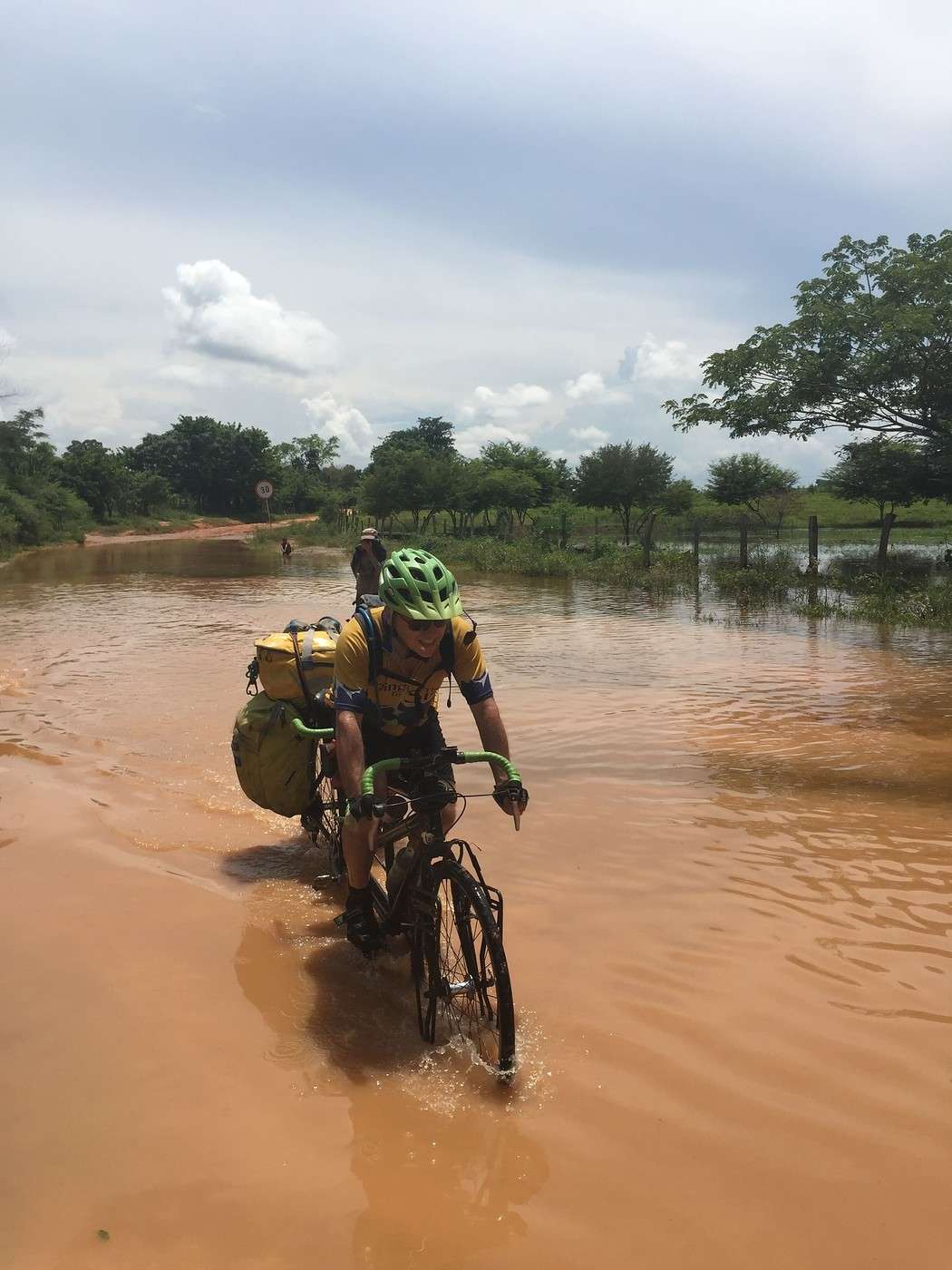
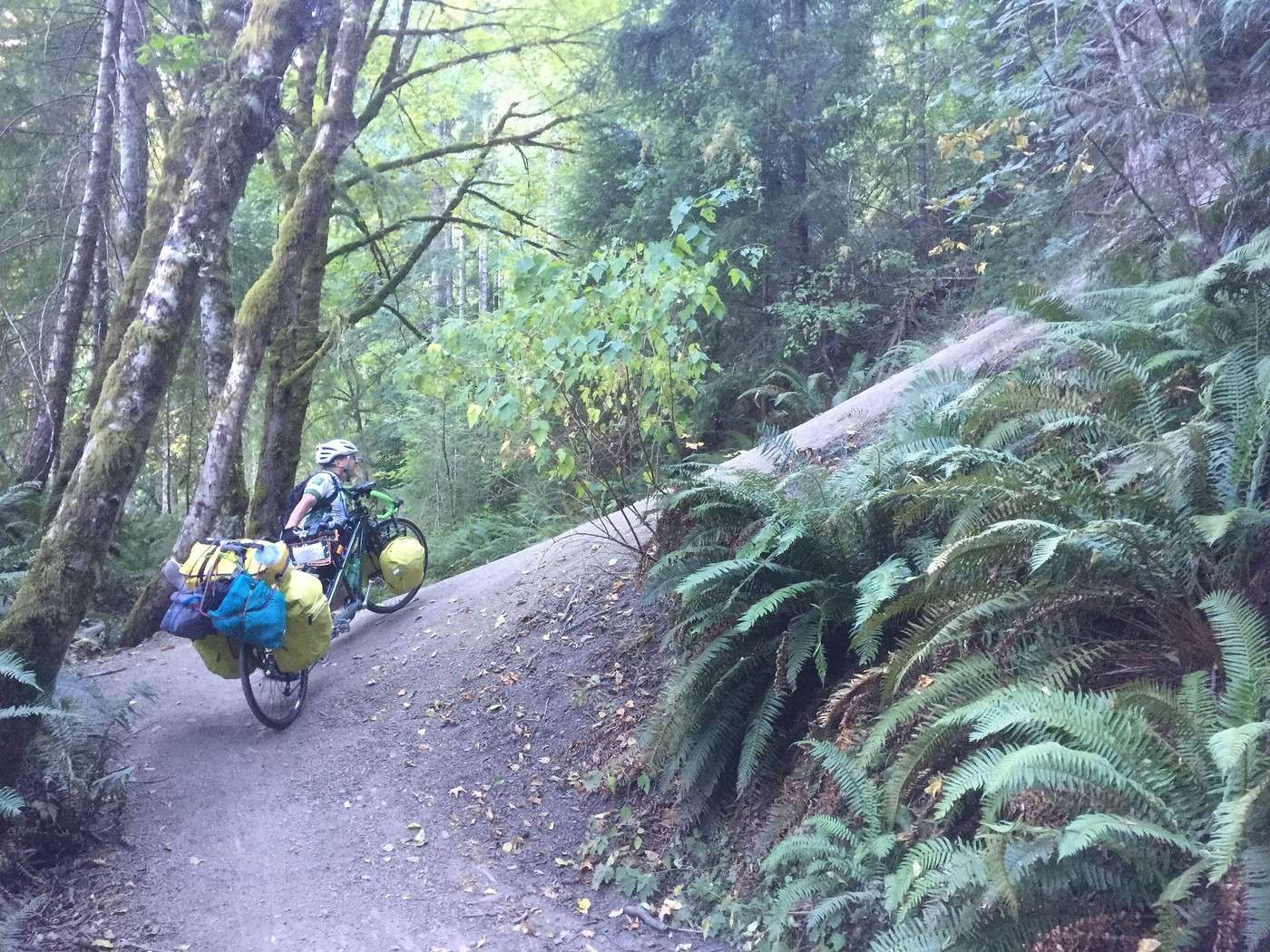
I’m currently looking for a bike to do my first bike trip across France, with the ultimate goal of cycling through Latin America. I’ve got a lot of questions and I’d love to hear if you have any answers or advice to share.
First off, I’ve been through this before with hiking. I want to get top-quality gear right away. When I started hiking, I ended up buying everything three times—first beginner gear, then intermediate, then expert, etc.
For biking, I’d prefer to skip that process and invest right now in a bike that could ideally handle Latin America.
I’ve set a total max budget of around 5000 € (roughly 4000–4500 € for the bike and the rest for accessories: panniers, helmet, cycling shorts, etc.).
So, I’ve got quite a few questions:
* I’ve read in several places that some people recommend buying the bike directly in Latin America. Since I need a first bike to train in Europe, would it be better to buy an entry-level bike in France (and sell it before the big departure)? Or is it preferable to start right away with my final bike to get used to it? Is buying it there just to save a bit of money?
* For a long-term trip (around six months) in Latin America, is it better to go for a gravel bike or a mountain bike?
* Should I buy a new bike or a refurbished one? Even more so given that I’m planning a long trip—could a refurbished bike end up causing more breakdowns?
If you have any advice on models, technical features to prioritize, or recommended sellers or resellers, I’d love to hear it. I’m a total beginner—I’ve only just started watching videos and reading up on the subject, and all the technical specs are new to me!
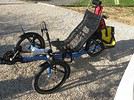
Personally, when traveling in Europe, I chose a recumbent tricycle for its great comfort and the absence of various pains linked to upright bikes.
But with it, it's impossible to take a train or bus.
Otherwise, check out recumbent two-wheelers—some people have even gone around the world with them.
Safe travels and long live your project!
Rien ne sert d'aller vite, il faut arriver à point.
Du moment que j'avance, je sais où je vais ... . Devant!
5000 euros for a touring bike—and not even equipped? A platinum-plated frame, maybe? Seriously though, you can hit the road with a 500-euro bike if you start with a used one. But even with a new bike, I don’t see the point of spending that much money. As long as everything runs smoothly and works, that’s what matters. Disc brakes, for example? They’re fragile—why bother? V-brakes are perfect, easy to repair, and sturdy. You can also go with an aluminum frame—the chance of it breaking is so slim. Nowadays, some people rightly think steel is more flexible, but hey. In Central Asia, I had an old Decathlon MTB with 36-inch wheels. I removed the elastomer fork (risk of issues) and swapped it for a rigid one. Five panniers, good tires, solid rims, and that’s it.
At worst, you can find a good new hybrid bike or a new gravel bike for around 1000 or 1200 euros, I think.
Happy searching..
Hi Anton,
I agree with Thifou. 5000 € for a touring bike is excessive, especially for a first purchase.
You’ll need to make choices based on the roads you’ll take without getting swept up in trends.
First, wheel size: 26 or 28 inches. Here, 26-inch wheels have been phased out in favor of 28-inch ones in recent years. But is the same true in South America? Don’t forget that on that continent, major cities are often far apart, and local repairs aren’t always easy.
Common issues with touring bikes often stem from weak rims and spokes. So, good rims like ZAC 2000 and quality spokes (e.g., DT Swiss) are key. Rim width will depend on the type of tires you want to use—and thus the terrain: asphalt, ripio, sand, etc.
Another common issue is the drivetrain. The trend is toward double chainrings with an 11- or 12-speed cassette. A thin chain designed for a 12-speed cassette will be more fragile than one made for an 8-speed. For a long time, touring bikes used triple chainrings with an 8-speed cassette.
Thifou already covered frame materials and brakes, so I won’t revisit that.
Should you buy here or at your destination? Buying here lets you test your gear before the big departure, learn how to maintain it properly, and be able to repair it if needed.
To give you an idea, the year I turned 70, I crossed a small part of Argentina over 3400 km. I knew I’d encounter corrugated dirt roads, sand, and ripio on Ruta 40 near Cachi. My bike: a Giant steel MTB frame, 26-inch ZAC 2000 rims (the kind used on postal bikes), tandem spokes, Shimano Deore 3x8 drivetrain, cantilever brakes, and Tubus racks. Aside from six flat tires, nothing broke.
Good luck with your search, and happy trails!
Bernard.
Hi,
I built a bike for this kind of trip using a Fuji Touring frame equipped with a Shimano Deore 9-speed groupset, 36-spoke DT Swiss Alpin wheels, and Deore XTR hubs assembled by a craftsman.
Originally, I wanted a Surly LHT, but it was impossible to find one with V-Brakes and 700c wheels.
[...] rien n'étant jamais parfait, rien n'est jamais parfaitement désespéré [...]
If you're also considering the idea of traveling as a pair, here’s how we do it.
Besides, your question is broad—there are as many ways to ride as there are cyclists, and as many ways to travel as there are cycle-tourers.
- Ultra-light, with nights in hotels and meals at restaurants?
- Fully self-sufficient with wild camping?
- Or maybe a mix somewhere between the two extremes.
Likewise, Latin America is a vast region with a bunch of countries, some huge like Mexico and Argentina, where you’d need all 6 months just for one. And others tiny, which you can cross in a few days, like El Salvador and Honduras.
We can help—just share a bit more about your needs and plans...
5000 euros is a big budget. If you love high-end gear, you won’t have any trouble spending it—there are plenty of options. If you're torn between gravel and mountain bikes, you could go for something in between, like a monstercross, which is a great choice for crossing Latin America. The German brand Tout Terrain has a model equipped with a Pinion gearbox, known for its reliability. It’s top-of-the-line gear. The model is the Outback Xplore. I know Tristan Ridley, who’s traveling the world on this bike. For the long haul, Pinion or Rohloff drivetrains are excellent options in terms of reliability and even cost (derailleur systems can get really expensive when you go high-end, with pretty quick wear and tear). Of course, there are plenty of other options, like custom builds from frame builders...
But again, you can travel the world on a simple touring bike or gravel bike. It’s up to you...
Hi there,
So, picturing my solo project—why not! I plan to ride with people I’ll meet along the way, but basically, I’m setting off alone.
As for my travel style, it’ll be mostly self-sufficient/bikepacking. A few nights in accommodations here and there to rest up, but otherwise, that’s the plan.
I also had a question: lots of people have been telling me about clipless pedals.
What do you think for a trip as long and as rugged as Latin America?
Hi there,
I’ve understood that it’s not always necessary to spend a fortune on the budget, which is great for my wallet. I just wanted to start with quality gear right away, but I’ve realized that what I really need is something sturdy yet simple enough to repair anywhere.
I wanted to ask: did you use clipless pedals? A lot of people mention them, but I’m not sure what to think for a long-distance trip, especially with sometimes rough roads. Thanks for your reply! :)
Hi,
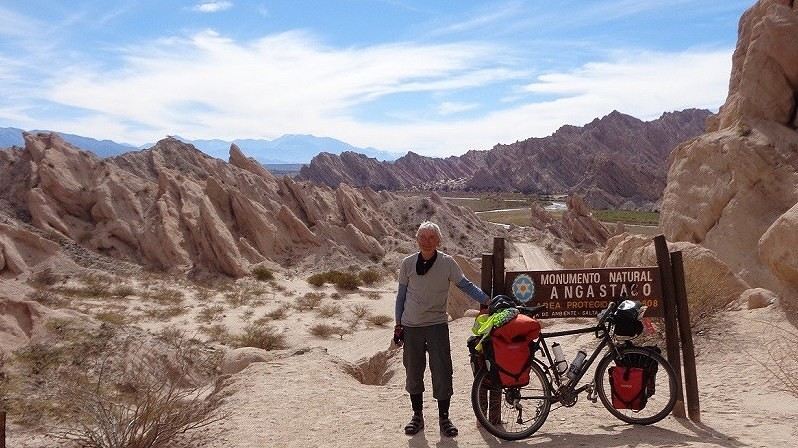
Since I'm old-school, I'm not a fan of clipless pedals. At the start of this trip in Argentina, I was wearing low-cut hiking shoes wedged into cages attached to the pedals. After the first thousand kilometers, the nails on my big toes turned black from the cages rubbing against the top of my shoes. Seeing that I risked losing my nails, I switched to sandals and thick socks, and surprisingly, my feet didn’t get cold even at high altitudes. Maybe with clipless pedals, I wouldn’t have had this issue, which just goes to show how important it is to test your gear—shoes included—early on before you set off. Take a good look at the photo I posted; I’m in sandals.
Hello,
...
I also had a question: a lot of people have been talking to me about clipless pedals.
What do you think about them for a trip as long and as precarious as Latin America?
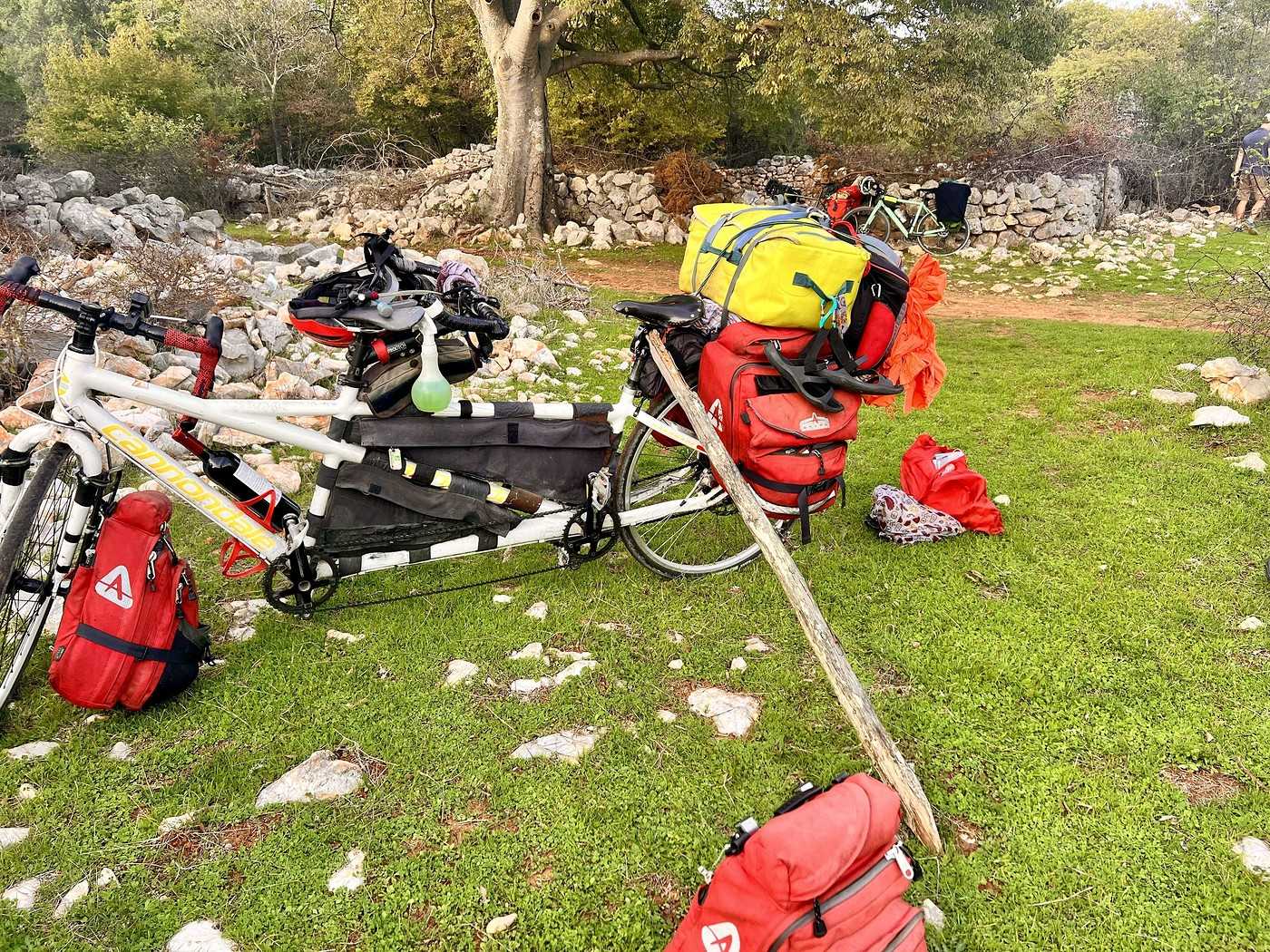
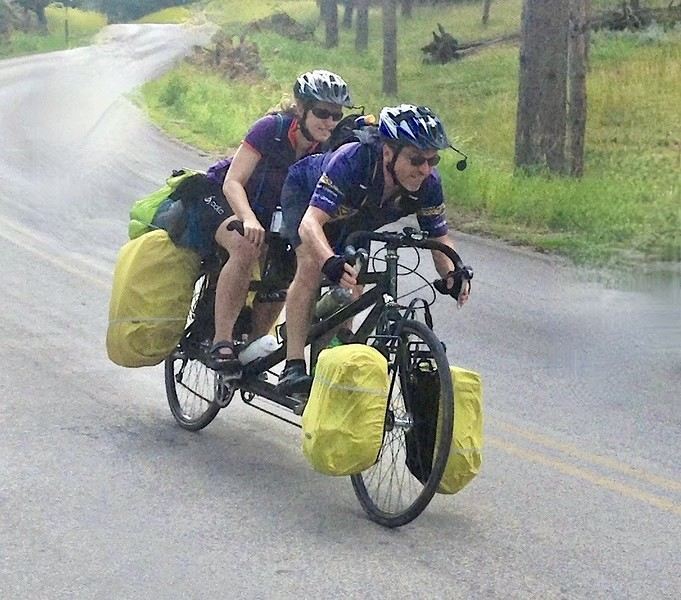
It’s really up to each person; both my partner and I much prefer clipless pedals, especially with the tandem. Your foot is more stable, doesn’t slip off the pedal at the slightest bump, and it’s also more efficient—muscle energy is transferred to the crankset with less loss.
However, there’s a small learning curve for beginners. It can be a bit intimidating at first if you’re not used to it, but you quickly get the hang of it. You learn to unclip effectively and just in time.
Besides, there are also hybrid pedals—clipless on one side and flat on the other. This lets you ride with sandals or lightweight shoes without clips at the end of the day, for example, when running errands or exploring our stopover village.
With the tandem, I sometimes ride with passengers other than my life and adventure partner. Since they’re usually not clipped in, I notice their relative instability right away, like when we hit potholes or bumps. It becomes much easier for both them and me as the pilot once they’re using clipless shoes.
Finally, if you go for this option, it’s important to choose shoes and pedals suited for mountain biking or city riding. Unlike road bike setups, the mechanism is built into the sole—it doesn’t stick out like road cycling shoes. This makes walking easy and lets you explore without risking damage to wooden floors or other delicate surfaces.
Happy planning! You’ve got an amazing project ahead of you!
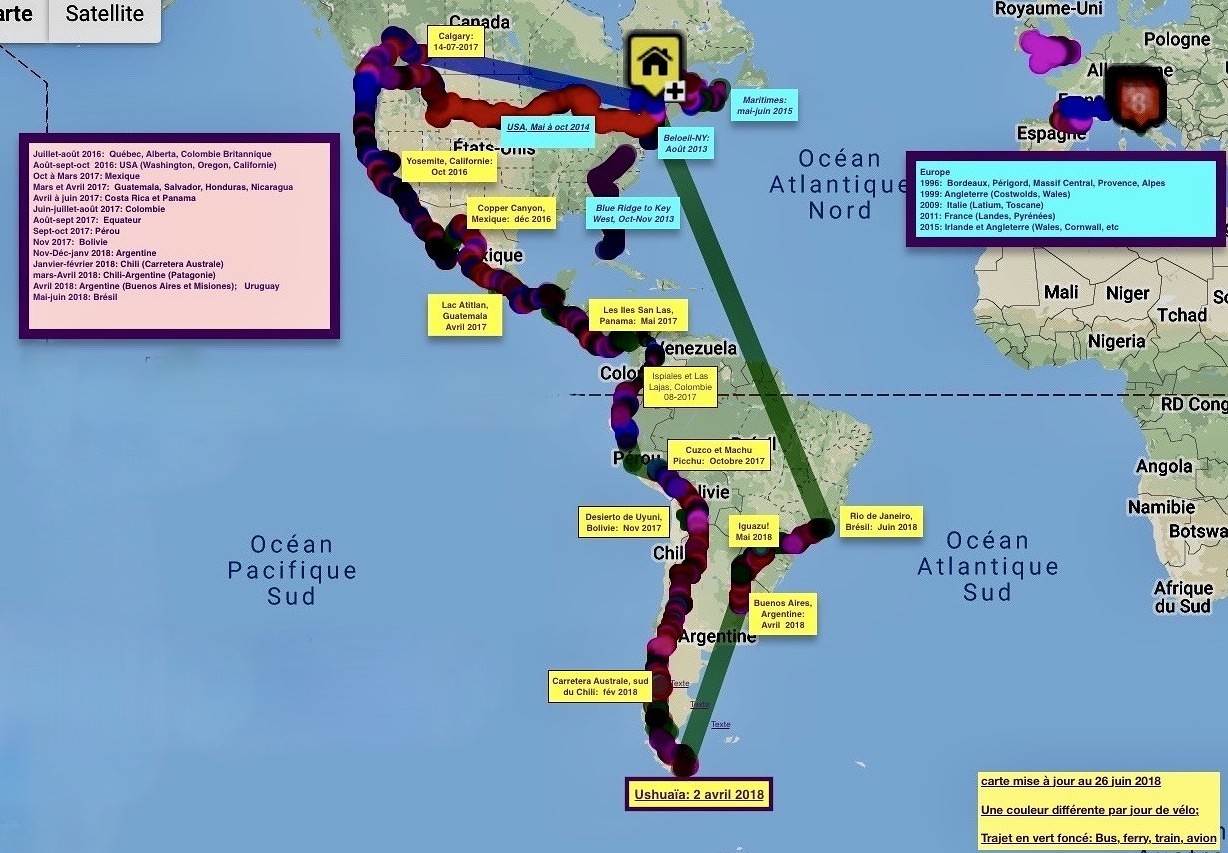
P.S.: If you need it, here’s the link to our blog, written during our crossing of the 3 Americas (July 2016 to June 2018, 31,000 km by bike). We compiled daily info and stats, including our bivouac spots, people we met, daily maps, etc. Also, on the map below, you’ll find the routes of our 3 crossings of the Americas. For the 2014 and 2016-2018 trips, each day of cycling is shown in a different color from the previous one. The map (the original) can be zoomed in almost infinitely, giving you both an overview and precise details of every little road we took. I can share the link to the original map if needed.
Thanks so much for all this info—hybrid pedals really do seem like a great compromise.
I’ll definitely check out your blog, thanks for the link! I had one last little question: what about lighting systems? Do you think it’s mandatory to have a dynamo-powered lighting system? How reliable is that kind of system in a place like Latin America?
Anyway, if you have any insights on that, I’d love to hear them. Thanks again for all the info—I spent the morning trying to wrap my head around all the technical specs of different bike parts. I went to a shop in Annecy that recommended the French bike brand Histoire, and I’m leaning toward the LA RTT (Randonneuse Tout Terrain) Expédition or La Grande Randonneuse Expédition models.
... one last little question: what about the lighting system? In your opinion, is it mandatory to have a dynamo-powered lighting system? How reliable is this kind of system in an environment like Latin America?
....
The downsides of dynamos are numerous:
- Uncertain durability and reliability.
- Fragility of the setup and wiring, especially during transport by plane, ferry, sailboat, bus, or in a pickup truck—so common among our American neighbors! Wiring can get cut or broken, moving parts can wear out or break, and other issues like torrential rain, snow, ice...
- Dynamo friction: it’s not the end of the world, but it adds to your load, the mountains, and the length of your days.
For long-distance bike trips, we preferred using lithium batteries and rechargeable accessories—they’re more reliable and durable.
I particularly like the NiteRider brand, especially the super powerful Lumina Dual 1800, which lights up to 1,800 lumens for a weight of just 250 grams. Pair it with a flashing red rear light. That said, we don’t use them continuously on the road; more often than not, we just ride with the rear flash attached to the back of our helmets.
NiteRider Lumina Dual 1800
Low - 6:00h at 350 Lumens
Med - 3:00h at 700 Lumens
High - 1:30h at 1500 Lumens
Boost - 0:45h at 1800 Lumens
Pulse Flash - 10:00h at 1500 Lumens
Fast Flash - 16:30h at 1500 Lumens
Additionally, plan for a rechargeable headlamp to use in the evening at camp or as a backup on the road, just in case.
For camping, we also use a solar-powered Lucy brand lamp in the evenings—it’s foldable, super lightweight, lasts all evening if needed, and is more than enough inside the tent.
... and I'm leaning towards the LA RTT (Randonneuse Tout Terrain) Expédition models or La Grande Randonneuse Expédition.
In the end, it’s important not to stray too far from the type of cycling that you enjoy the most. If, like us, you come from a road cycling background (from the world of ...), then I’d recommend not going too heavy—prioritize a bike that rolls well and is efficient: smoother, narrower tires, drop handlebars, and a gearing system that lets you maintain good speeds when the opportunity arises (tailwind, slight downhill, etc.). We estimate that at least 80% of our journey across the 3 Americas was on decently paved roads. On the flip side, we were sometimes penalized on certain sections in Peru, on the Trampolín de la Muerte in Colombia, and on parts of Ruta 40 in Argentina and the Carretera Austral in Chile.
On the other hand, all-terrain touring bikes with wider tires, heavier frames, and less aerodynamic designs will give you more versatility in all conditions, but they’ll be less efficient on the road and less effective against headwinds. Also, with these bikes geared more for off-road than road use, you’ll quickly hit a speed limit on descents—once you go beyond 35-40 km/h—assuming your largest chainring is 44 teeth and your smallest rear cog is 13. By comparison, I’m geared 53-11 on our touring tandem, which still gives me power at 60 km/h. Many long-distance travelers argue that speed doesn’t matter when you’re heavily loaded, which isn’t wrong... but that doesn’t mean you can’t still enjoy the thrill of going fast and carving through hairpin turns.
That’s why it’s key to know your needs and understand what you love about cycling.
I’ve been traveling by bike for a few years now. I started with a bike I bought at Decathlon and then added some pannier bags, etc. After a few years, the bike started showing signs of wear.
When I had the funds—around 2000 €—to buy a new bike, I ordered one from Cyclo Randonnée because it matched what I was looking for.
It’s been six years now since I got this bike, and I regret not buying it sooner. It’s been with me on many trips across Africa, Latin America, and Spain. I give it almost annual maintenance, and it still runs like new.
The frame is steel, and the wheels are 26 inches, which is ideal because you can get them repaired anywhere in the world—26-inch wheels are everywhere. It’s also super comfortable with its butterfly handlebars.
Je voyage chaque année à vélo par période de 3/4 mois.
@cyclovoyages
bicycle traveler here—I’ve had the same bike, named Bamako, since 2002, and it’s sentimental; I even talk to it. I’ve even told my wife that if I go before her, she should bury me with my bike so I can keep riding up there—apparently, it’s all flat.
My first big trip with it was from Dargoire in the Loire region all the way to Bamako, Mali. After that, I covered a large part of the continents: all of South America, Vietnam, India, Indonesia, Turkey, Cameroon, and more.
The bike I paid 600 € for is a Specialized steel-frame MTB with 36-spoke rims, front toe clips, interchangeable sliding brakes, Schwalbe Marathon tires with a Kevlar strip molded into the tread—practically no more punctures. It’s got butterfly handlebars and a waterproof Ortlieb pannier.
On my travel blog, I share tips about bicycle touring with plenty of advice.
As many cyclists as there are, as many opinions on bikes. Budget is the first criterion, but then you'll need to make choices about the bike's specific equipment.
For example, I see in your photos a road-style handlebar, round and sporty. From our experience, this isn't ideal at all for long-distance touring: you stay bent over all day, which unnecessarily strains your back muscles and puts pressure on your internal organs.
Still based on our experience, there's one thing we couldn't do without anymore: the rearview mirror. It's an accessory that changes everything in terms of safety!
And if you want to start looking at specific models, I'd suggest a classic from a very experienced brand: the Koga WorldTraveller. This iconic touring bike has recently been redesigned, with a completely new look, almost "armored." With this bike, you'll probably go to the ends of the earth :)
S.
Cycling Thread - suivez-nous sur Komoot:
pour les meilleures collections d’itinéraires à vélo
And if you want to start looking at specific models, I’d suggest a true classic from a very experienced brand: the Koga WorldTraveller. This iconic touring bike has recently been redesigned with a whole new look—almost "armored." With this bike, you could probably ride to the ends of the earth! :)
Now that’s a concrete and interesting tip! I’m not really a cyclist, just an active person (mostly long-distance mountain hiking), but I do take week-long bike trips on roads and drivable dirt trails in the mountains... My old 1970s bike isn’t exactly the best for that anymore. I won’t be riding to the ends of the earth, but I’ll definitely think about getting a new bike.
Not sure if you're still active on the forum, but I have a quick question. If it’s not too personal, what size do you think would work best for a Koga WorldTraveller for someone who’s 1.75 m tall?
I don’t know if you’re still active on the forum, but I have a quick question. If it’s not too personal, what size do you think would be best for a Koga Worldtraveller for someone who’s 1.75 m tall?
Recommended size
For someone who’s 1.75 m tall, the most suitable size is usually:
Classic frame (in cm): 54 cm
New S-Series system (S/M/L): Size M
The total height isn’t everything. It’s the length of your legs that will confirm the best fit.
Inseam length. Suggested size:
78 cm - 83 cm: 54 (M) - Ideal for you
84 cm - 87 cm: 57 (L) - Only if you have very long legs
If needed, you can cut the seat post and adjust the stem.
Thanks so much for your reply. Yep, based on your info, I’m definitely going with a size M.
I’d more or less calculated that based on my measurements, so this just confirms what I’d found.
I’m not totally sure which bike model I’ll go for yet, but I’m working on it 😉
The goal is to cover long distances.
Hi, I agree with the previous messages—5000 € is a lot for a touring bike. But I’d like to suggest a different approach where you could get a high-end carbon gravel bike like the Cannondale Topstone, which you can then outfit with all kinds of bikepacking bags :) Once loaded, you’ll have optimized weight.
At Cannondale, frames are guaranteed for life. And this type of gravel bike is very popular among riders who prioritize the bike's minimum weight.
That said, like any high-end model, there are trade-offs. A carbon frame is more likely to crack under a major impact, whereas a steel or aluminum frame will bend, though there’s no guarantee it can be straightened.
In the end, it comes down to the same thing. You might also want to check out bikes from Histoire Bike, which are 100% designed for bike touring.
About carbon frames, but not just that.
First, the lifetime warranty only applies to the original buyer, so it’s not valid for a second-hand bike. Plus, in my opinion, it’s purely a marketing argument—Cannondale knows full well that most cyclists don’t keep a bike for life, especially when they upgrade every 5 years or so...
As for long-distance touring bikes, pretty much any bike can work, regardless of the frame material.
The real question is making sure your setup matches your preferences and the routes you’ll be taking.
If you like traveling with a lot of comfort, camping with full autonomy, and visiting countries where bike shops are rare, you’ll want a super sturdy bike that can handle heavy loads. So, think steel frame, 26" or 27.5" wheels, and two Tubus racks.
I might be wrong, but I don’t think there are carbon frames on the market designed for that kind of use.
On the other hand, if you enjoy a more athletic approach and can handle more basic camping, a carbon gravel bike with bikepacking bags works just fine.
Last year in Patagonia, I met a group of young Spaniards who had crossed South America from north to south on this type of bike. They slept in ultralight tents and occasionally in youth hostels.
We’re lucky that bike touring is becoming trendy—just 20 years ago, our only option was to ride heavy bikes like the TX400 with ridiculously heavy tires (though admittedly durable!).
With the rise of gravel bikes—some thought it was just a passing fad—we now have bikes perfectly suited for travel: comfortable, sturdy, sporty or not, with a huge range of tires, efficient brakes, and more...
Personally, after a decade of traveling on a lightweight steel touring bike, I bought a carbon gravel bike with a single-chainring drivetrain and 27.5" wheels. I have to admit, even though I’m very attached to my touring bike (which has a high-end steel frame), I enjoy riding my gravel bike more.
Some say carbon frames are less comfortable because they don’t absorb road vibrations as well, which is true—except that with wide, slightly deflated tires, I don’t really feel the difference...
But the efficiency is definitely better.
I’ve shed quite a few kilos—just two racks and five bags alone weigh nearly 4 kg empty!
I used to travel with 25–30 kg of gear on a 14 kg bike, and now I’m down to 15 kg on a 9 kg gravel bike.
That’s 15 kg less on the climbs—let me tell you, it makes all the difference!
Stages that used to take me 6 hours now take 4.5 hours.
On my touring bike, I had a powerful LED lighting system powered by a dynamo hub. After 15 years, I realize I only used it about three times. Plus, since I rarely average more than 20 km/h, charging my phone took forever. So now I use two external batteries, which give me 4–5 days of autonomy.
For lighting, a flashing red rear light and a good headlamp keep me safe when going through tunnels.
Regarding the lifetime warranty, if the second owner keeps the original purchase receipt, the warranty will still apply. As long as you can provide a purchase receipt, retailers are generally accommodating. I worked in a bike shop for 6 years, and when a repair needed to be covered, the purchase receipt was enough—we very rarely asked for the customer’s name.
However, we did sometimes charge for the repair if the bike hadn’t been bought from us 😉
There’s one thing to admit about carbon: all those old carbon rim-brake bikes were part of a product generation from another era where everything had to be ultra-stiff. Remember those Look 7** frames where you had to cut the seatpost clamp because it was integrated into the frame?
And today, carbon still suffers from that outdated reputation, even though the materials have really evolved a lot !
Thanks everyone,
I went for a touring bike because I was mainly looking for comfort over speed. I’ve done my first 100 kilometers, and honestly, it’s a dream.
Sure, it’s nothing like a Gravel bike, but that’ll probably be my next fun purchase.
For now, I was really in the mindset of cruising easy on long-distance rides.
I found a brand-new Histoire-bike in-store at 20% off. Expedition touring model.
Gorgeous bike, perfect for what I want to do in the coming years.
This was the bike I was initially aiming for because of the price. But I ended up finding a Histoire-bike (Grande randonneuse expédition) brand new for 1799 €.
So I went for it... I really liked the "Made in France" aspect even more.
You made a great choice! Just a heads-up, the brand is French, but the frames aren’t welded in France—they’re done somewhere in Europe, though I can’t remember exactly where.
Yeah, I saw that, but the fact that the bikes are assembled in France is already a great reason for me to buy from them. Before making my purchase, I contacted them—they’re awesome! Super attentive, with great advice.
In short, I didn’t hesitate for a second. And honestly, it’s a really beautiful bike! I’m so happy with my purchase.
Claudio tried and wore out several plows—
from a customized MTB to a custom-made touring bike, and finally an American bike made in China! (the shame, but not on purpose—great performance and goes everywhere).
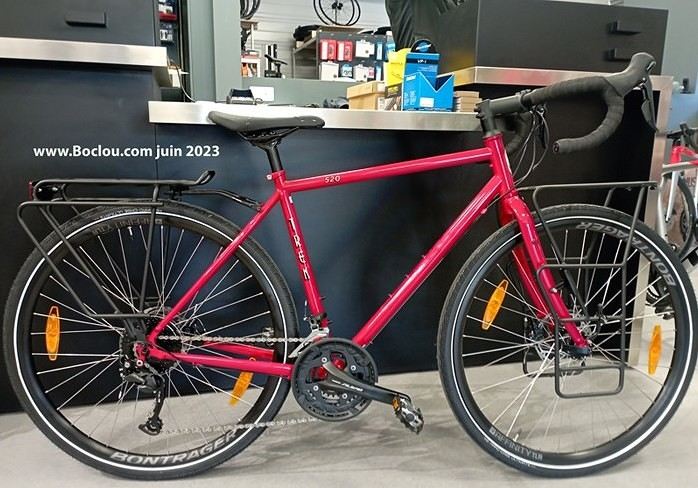
The latest is a Trek 520 for 1,800 €.
With big tires, it goes everywhere, even on rough trails
(in France, though).
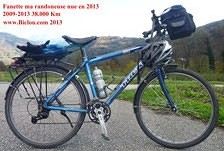
Already 16,000 km; not too many issues, bottom bracket changed at 15,000 km. Watch out for cable disc brakes—braking is so-so.
Be careful with pad changes (not easy to do).
Otherwise, there’s the Trek MTB with 1.5-inch road tires and classic brakes (that’s better).
http://cbandiera.free.fr/matos/fanette/
Indestructible if you replace parts as needed (wheels and bottom bracket).
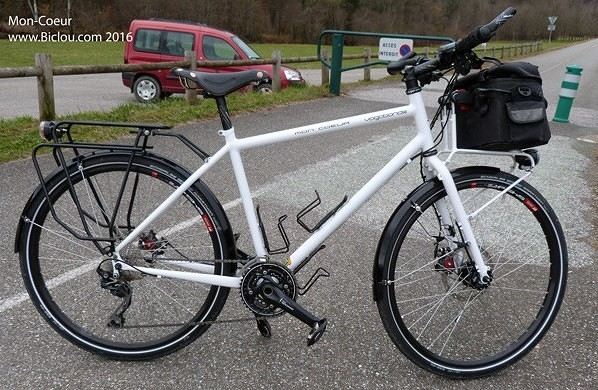
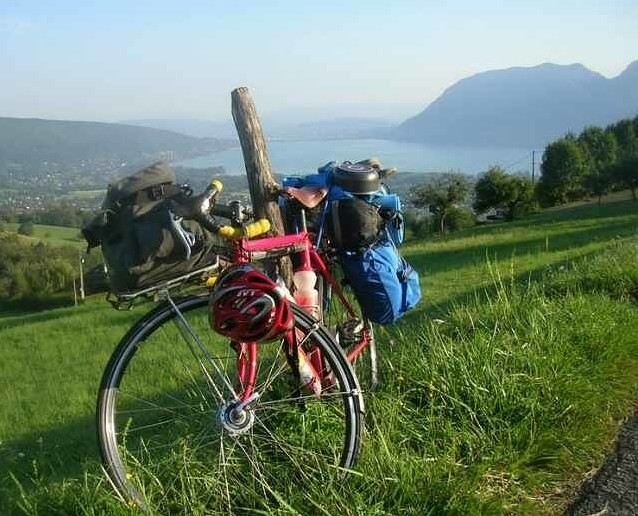
Or the touring bike—reliable but a bit heavy.
http://cbandiera.free.fr/matos/mon-coeur/
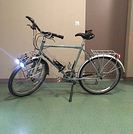
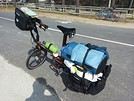
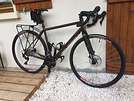
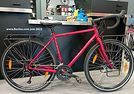
In order of the images: an expensive touring bike at 4,500 €.
Renato from Trek at 1,800 €.
The Trek MTB at 1,800 €.
And finally, a beautiful touring bike built by Cycles P.. in Albertville (24 years old!). It’s seen plenty of action over the years, but it’s a bit light (back when Claudio was more of a daredevil). Now it’s for roads and crappy greenways—but it still rides with Claudio occasionally on local loops.
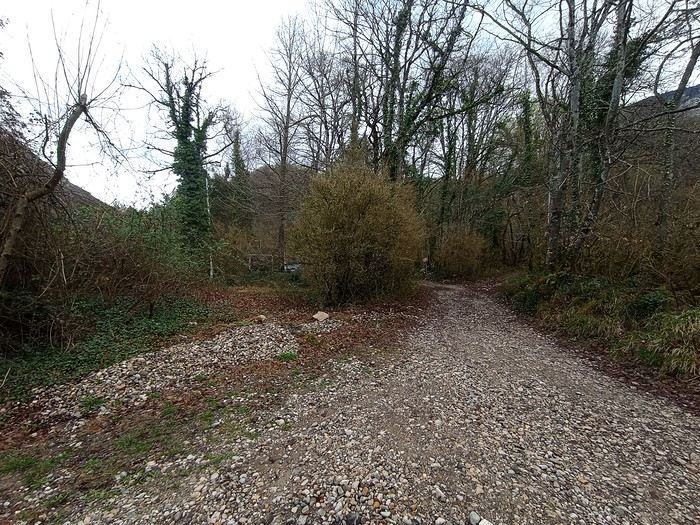
And to finish, an example of the kind of terrain these bikes tackle in 2025–26.
It’s not South America, sure, but southern France.
Claudio de la Faverges.
Bonjour amis cyclotouristes, claude passionné de voyages à vélo favergien et défenseur du cycliste.
plus la carte bleue est foncée et plus le bagage est léger
en anglais "the more the card is blu the less the luggage is heavy"
The Trek 520 is, on one hand, gorgeous and the oldest model still sold by the brand! I had the chance to build one when I worked at a Trek shop—it’s unbreakable and super efficient for a bike that’s great for travel, commuting, or work. And best of all, it attracts fewer thieves unless they’re in the know.
The Trek 520 is, on one hand, gorgeous and the oldest model still sold by the brand! I had the chance to ride one when I worked at a Trek shop—it’s unbreakable and efficient for a bike that does both touring and commuting. And best of all, it attracts fewer thieves unless they know what they’re looking at.
As far as I know, Trek hasn’t made it since 2023, unfortunately.
Je compte faire Santiago du Chili à Ushuaïa en vélo de octobre à début décembre 2005. Que me conseillez vous comme vélo? un vtt ou un vtc? (à Décathlon ya des…
Sportif averti ayant eu l' occasion de faire de nombreux treks, j' ai envie de decouvrir l' am sud a vélo. Cependant quelle ranonneuse prendre?? Acier.alu? 26…
Bonjour
quelles sont les moyen les plus simple pour revenir du Cap Nord sans pédaler
train, Bateau, avion ?
qui à déjà fait l’expérience ?
Merci de nous renseigner
17 days, 1,400 km, and 17,500 m of elevation gain cycling in northern Vietnam! 🇻🇳 🚴🇻🇳
From the misty Fansipan to the breathtaking landscapes of the Ha Giang Loop, from remote villages to vibrant markets...
I cycled through the north of the country, getting up close with its people—through mud, heat, endless mountain passes, and unforgettable encounters.
Most importantly, I discovered a Vietnam far different from the usual tourist circuits.
Join me on this adventure through a video that captures these 17 days of travel. :)
If Vietnam calls to you, come ride a stretch with me!
Bonjour,
Je dois arriver en vélo à Thessalonique à la fin Septembre et je prévois de rejoindre Istambul par la côte.
Quelqu'un pourrait m'aider à choisir la meilleure route.Sécurité, difficulté.
Merci d'avance.
Marc
Hi,
can anyone give us some tips on how to get to North Cape from Lyon Gerland?
What’s the best route to join the EuroVelo 7?
How many kilometers is it from Lyon to North Cape via EuroVelo 7?
The best month to leave—we’re thinking early May.
Thanks for any advice!
Looking for a female travel companion for a cycling trip (arriving by plane in Porto Alegre, Brazil, and cycling toward Montevideo, Uruguay, returning by plane to France from Buenos Aires, Argentina) – 1,500 km
Hello everyone!
I’m planning a cycling trip across Brazil, Uruguay, and Argentina, with a departure set for late October, November, or December. I’m looking for a travel companion to share this long-distance adventure with.
Experience:
I already have solid experience in bicycle touring in Georgia, Kazakhstan, and Kyrgyzstan. Currently, I maintain excellent physical condition by cycling an average of 250 km over 3 days per week (4 hours a day at 20 km/h).
The trip & the pace:
Daily pace: Between 50 and 80 km per day, to make steady progress while taking time to explore.
Accommodation: Flexible and authentic. We’ll alternate between wild camping, campsites, Warmshowers, small guesthouses, and budget hotels depending on opportunities and the weather.
Looking forward to reading your message and planning this amazing journey together!
I’m planning to leave Nice for Toulouse around 10/15 and I’m looking for tips / great deals regarding:
- The route: I was thinking of taking Nice - Grasse - Draguignan - Salernes - Cadarache - Cavaillon - Arles, then the Camargue, Sète, and the Canal du Midi to Toulouse. The idea is to avoid high-traffic roads and too many steep climbs. Are there any spots to avoid or must-see stops? Since it’s been a while since I’ve been on the road, I was thinking that sleeping indoors might be preferable. If you have any budget-friendly accommodation suggestions along part of the route, don’t hesitate!
Thanks in advance, and if you’re in the area around that time, we could ride together... Ciao.
Another long-time dream of Claudio’s: the Petit Mont Cenis pass and the dam at the eponymous lake.
A place where many Italians, including my father, worked in the 1950s–60s.
Faverges → St-Michel-de-Maurienne → Lanslebourg → Petit Mont Cenis → return. 315 km, 3 days. Bivouac at St-Michel-de-M.
Brouter link
Leg One: Faverges → St-Michel-de-Maurienne
Leg Two: St-Michel → Lanslebourg → Mont Cenis Lake → St-Michel
Leg Three: St-Michel → Faverges
And it finally happened in August 2026: in the Maurienne Valley about the famous cycle route known as the V67
🇷🇼 Cycling in Rwanda: 4 episodes, an off-the-beaten-path adventure
After 3 weeks and nearly 1,200 km by bike across Rwanda, I made 4 videos to share this adventure in a different way: the landscapes, the encounters, the villages… but above all, all those incredible scenes of everyday life.
The 4 episodes are available here:
👉 https://www.youtube.com/playlist?list=PLGnfbxjccWAg
The 4th episode focuses on rural Rwandan life: simple, authentic, and sometimes surprising scenes that you only truly discover when you take the time to travel by bike.
If you have a few minutes, let yourself be transported to Rwanda…
Hi, I'm looking for info on cycling to Nordkapp via the EuroVelo 7. Has anyone done it already, and where’s the best place to start the EuroVelo 7?
Thanks
Hi,
We bought the MSR bike tent model (2-person + large awning that can fit 2 bikes) back in 2005. It’s served us really well, especially during a year-long trip in Africa. Now, one of the poles is broken, and we’d love to replace it since that’s the only issue with the tent—we still love it! The poles are 9.35 mm in diameter, with 8 sections of 49 cm and 2 sections of 28 cm. Total length when assembled: 416 cm. Actually, two large sections are broken: one straight and one curved. It’s a pain to find replacements since this model is no longer sold anywhere.
Would anyone have this model lying around unused and be willing to sell me a pole?
Hi everyone,
In early April, I’m redoing the Vélo Francette (La Rochelle to Ouistreham), and then I’d like to cycle along the Cotentin Peninsula (which I don’t know at all), follow the coast up to Cherbourg, and then head back down to at least Saint-Malo. I’d love to know if it’s pleasant for cycling—are the roads nice? Not too windy? What are the must-see spots? Any great campsites? All your tips and advice are more than welcome, and I thank you in advance.
Hi there,
I’m planning to bike to meet some friends in Côte d’Ivoire in early November.
I’ll be starting in Abidjan and heading to Abengourou, which is close to the Ghana border.
I’d like to take the trails. Does anyone have recent info on eastern Côte d’Ivoire?
Any tips, safety advice, or must-see stops? I’m open to all suggestions.
Thanks in advance for your help!
Fx
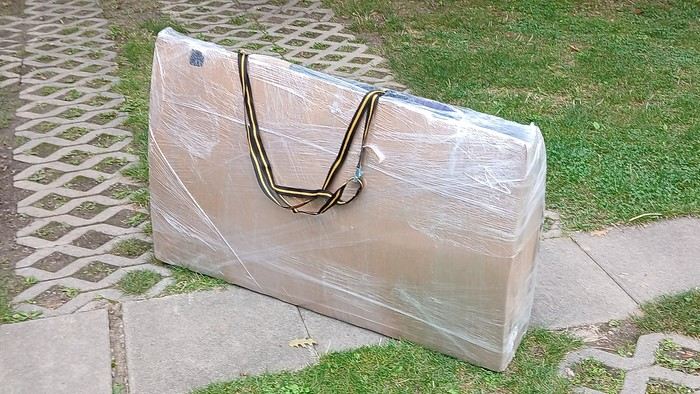
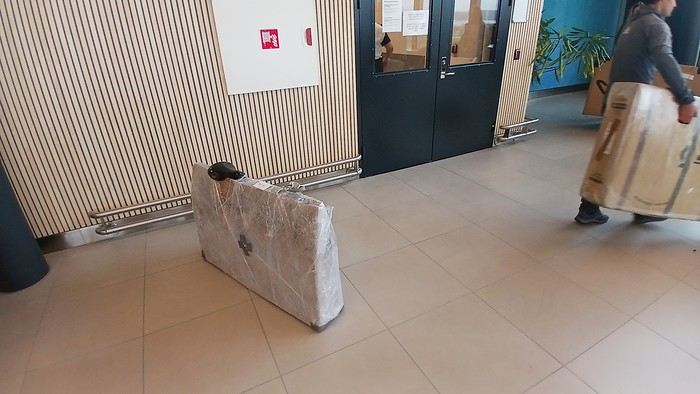
After testing it for three years across various modes of transport, I’m sharing this video of a bike packing case. It’s made from recycled cardboard and shrink-wrapped, with adjustable thickness and added bubble wrap depending on the level of protection you want.
Installing spacers at the fork and chainstays makes the packaging compact. With the fifteen-odd euros for shrink-wrapping at the airport, this case travels really well.
https://youtu.be/_GDJi-GqmkM
- Low bulk (1.10m x 0.70m x 0.25m for a large frame), it fits vertically in train luggage compartments and the total dimensions (x+y+z) don’t exceed 2.40m.
- Two carrying solutions for public transport and easy handling by airport staff (no more tears in the cardboard from openings).
- Discreet packaging when dealing with bus drivers and train conductors, as it looks like an ordinary parcel.
- No need to return to the starting point to retrieve the case from your outbound trip, which you’d otherwise have to store somewhere, or deal with a bulky cover to pack in your panniers.
- You can still check tire pressure through the plastic film without damaging the packaging too much.
Drawbacks: Around 3 hours for this lengthy and meticulous process—removing the wheels, pedals, handlebars, and derailleur without misaligning them, then securing all components to the frame.
If you get a chance to test it, send me your feedback for future improvements.
I just took a trip in Tunisia from Tozeur to Douz, skirting Chott el Jerid to the south. I’m back with the urge to keep going further south via the 4x4 tracks to connect Douz to Ksar Ghilane. Has anyone driven this route recently or explored southern Tunisia?
Thanks for your tips!
fix
😎Fellow traveling cyclists or not, all of you who love travel, the pleasure of physical effort, nature, beautiful machines, people with true passions they seek to fulfill, and who also enjoy reading great literature about all this—the *200* magazine is for you just as it is for me. I should mention I have no financial or other interest in this (in an era where we accuse our politicians of all sorts of vile interests, I prefer to take precautions). I’ve been subscribed since the beginning, and every three months, I get my 130 pages of dreams (the magazine just went from 110 to 130 pages).
It covers everything from the trans-America route to the TCR (Trans Continental Race) from Belgium to a small town in Turkey, with mind-blowing averages—4,000 km and 80,000 m of elevation gain in 8 days and 15 hours for the winner. Let that sink in, and all of it without assistance—accepting a patch could penalize you. There’s also a story about crossing Iran, encountering one of the world’s most welcoming populations, following in the footsteps of Nicolas Bouvier, as well as retirees leisurely traversing France. The common thread in all these stories? Beautiful writing. Take, for example, a stunning article: *"Passengers of the Cold: From Edinburgh to Thurso, at the very north of Scotland, 550 km of moors, coasts, and icy wind. In Thurso, the road ends at a quay, facing the Orkney Islands. We wanted a November trip, off-season. We wanted to surprise winter. Just before the snow."* A sublime piece on the experience of facing adversity and the chance encounters along the road and in the elements.
Before I embarked on my own bike trips, I dreamed a lot about them—from the Atacama to the Gobi, along the Mekong, and not forgetting France. And now, these 130 pages every quarter keep those dreamy vibes alive through stories written in the most beautiful prose.
I’ll stop here because it might sound like I’m advertising, but if you don’t know *200*, I invite you to discover it. It’ll give you wings for the most incredible challenges or simply reinforce your desire for slow rides with your eyes open to others and nature.
A little news to wrap up: Axel Carion and a friend just broke the record for crossing South America from Colombia to Ushuaia in 59 days. On its own, that doesn’t mean much, but I can’t help it—it makes me dream. You should see how he talks about it, the flashes of that wild nature he’s stored away: a snowstorm at Paso Jama and the surreal sight of the suddenly snow-covered Licancabur!
Luc
PS: The magazine is called *200* because a day’s ride starts at 200 km—well, I’ve never done a ride like that since my longest was 167 km (with 18 kg of luggage, mind you), but why not one day? The magazine will explain how to tackle your first 200, and then the question in conclusion: when will you do your first 300?😏
I’ve got my flight ticket sorted—departing in mid-November and returning in mid-March. I’ll arrive in Santiago and leave from Buenos Aires.
I’ve already been to southern Argentina, specifically Torres del Paine National Park, and I’d love to go back to do the full W trek (I only did the shorter version last time).
I also want to do some hiking and maybe even tackle a summit. I climb and occasionally do some mountaineering, so I’ll definitely be going with a guide.
I plan to start around Temuco in Chile, with the idea of heading toward the lakes, then taking the Carretera Austral.
I’m not sure if I’ll go all the way to Ushuaia—it’s supposed to not be *that* worth it, except for the bragging rights of saying you’ve been to the end of the world.
I saw there are lakes in Argentina too.
I don’t have a precise itinerary, but what I’d love is, once I reach the southernmost point of my trip, to take a mini-cruise to see some wildlife. Any tips for that?
What kind of sleeping bag did you take? Is a 0°C (32°F) one enough?
And one last question: white gas stove or can I get by with my gas stove?
I'm developing a free and open-source web app for planning walking and cycling trips (and even car trips). You can create a route by clicking directly on the map to add waypoints, and it can consist of multiple stages. The app provides tools to edit the stages and the overall route, and to display useful information (distances, altitudes, and elevation changes). A relief profile can be shown as a graph for a specific stage or the entire route.
Once the route is ready, it can be exported as a GPX file, which can then be used with a GPS or a mobile navigation app.
The app is built in JavaScript and runs entirely in the web browser. It uses the Leaflet library and several OpenStreetMap-based services. Initially developed for my personal needs (I enjoy hiking and cycle touring), I’d be happy to share it with anyone who might find it useful. It’s free to use, doesn’t require an account, and the source code is available.
hello fellow cycling enthusiasts
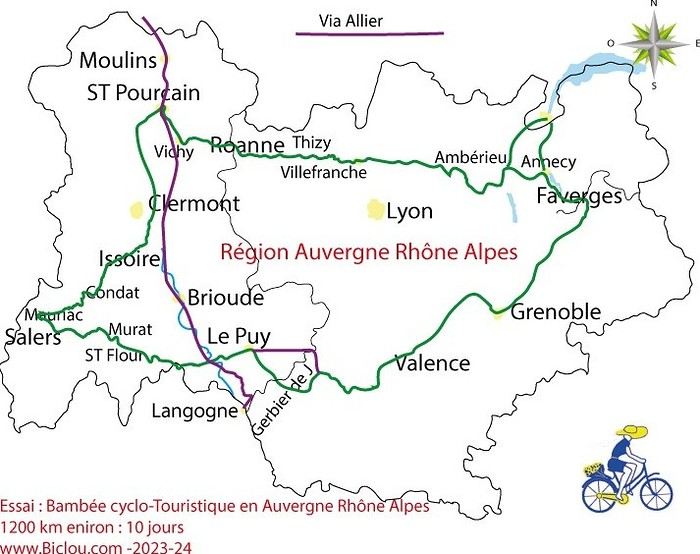
here’s a travel journal of the cycling tour through the Rhône-Alpes Auvergne region by Claudio
zouli
it was the plan
http://cbandiera.free.fr/parcours/auvergne-Ralpes/
the trip was completed
story being posted online soon
1100 km in 11 days
beautiful and varied regions
Hello,
We’d like to go on a 3- to 4-month bike trip starting in December, crossing from Assam (northeast India) to New Delhi via Nepal.
Are there routes with light traffic along the Brahmaputra and through Nepal?
We’re also looking for any info on accommodations, wild camping, local interactions, etc.
Thanks,
Michel
I’m planning to cycle from Morlaix to Brest (via Roscoff and the V45 coastal route). We’ll start riding on August 16th for 13 days (with stops for island visits, surfing, etc.). Is there a lot of traffic at this time of year? I’ve got two kids, 11 and 13, and we don’t like riding in the middle of cars (we’ve already done the Vélomaritime—Caen to Cherbourg—the Loire route from Orléans to Saumur, the Vélodyssée from Nantes to Royans, and the canals like the Nivernais and Bourgogne, where there were plenty of bike-only lanes, which isn’t the case on this route).
Thanks for your help if you’ve already done this route in late August!
Virginie
Hi there,
I’ve been road cycling for several years, and I’m about to switch to gravel in the next few days—I’m waiting for my bike, which should arrive this week.
I’m planning a bikepacking trip in a few weeks along the Véloroute V81, also known as the Vélosud, from Biarritz to Le Barcarès.
Has anyone here already done this route? Any info is welcome, whether it’s about the route itself, gear, or accommodation. I’ll prioritize staying with locals as much as possible. On that note, I just signed up for the brand-new site *Guidon et Couette* ((www.guidon-et-couette.fr)), which offers free accommodation between cyclists across the country, but there’s almost no one listed along my route!
Thanks in advance.
Laurent.
Hi there, I’m planning a cross-Canada bike trip, and I’ve got a question that might seem silly, but could someone tell me how to pack a bike (in a box, with a fragile sticker... I don’t know) for a flight? Thanks in advance!
This summer, we’re planning to cycle along the EV 19 that follows the Meuse River from Langres all the way to Rotterdam.
My question is about getting back to Nantes.
Do any of you know what the best return option might be? I’d love to hear about your experiences.
I saw that FlixBus doesn’t take bikes.
By train, I think it’s possible but would involve multiple local trains.
We were also wondering if there’s a boat from Rotterdam to Saint-Nazaire that could take passengers with bikes.
Any tips or experiences you can share would be really helpful—thanks in advance!
Have a great evening
I’ve gotten used to crossing Europe by bus to return by bike.
It was really convenient to take the bike without having to disassemble it.
But FlixBus no longer accepts bikes...
What alternatives do you know about?
Thanks.
Hi there,
I’m planning to ride the Dutch section of the EuroVelo 19, from Maastricht to Rotterdam.
Since it’s too complicated to bring my bike on the train, I’m looking to rent one locally.
I’d love any tips or bike rental shop recommendations—I’m struggling to find options even in Rotterdam.
The plan is to rent in Rotterdam, take the train to Maastricht with the bike, then cycle back to Rotterdam.
Thanks in advance for any advice or suggestions!
Nath
I’m planning to build a new touring bike.
I want to prioritize lightness.
That said, I’m tempted by a suspension fork that could offer some comfort on rougher roads.
The recent appearance of gravel suspension forks on the market might meet my needs—at least on paper.
I’m particularly considering the RockShox Rudy Ultimate XPLR fork.
Unlike MTB forks, its travel is short: either 30 mm or 40 mm.
It weighs 1400 g, which is 400/500 g more than a steel fork.
Any thoughts or real-world feedback on this?
I’m also wondering about the durability of magnesium (lower leg) for long-distance bike touring.
And what’s the impact of skipping the manufacturer-recommended maintenance every 50 and 200 hours? That’s bound to happen on a long trip unless you carry extra gear.
More generally, how reliable are these kinds of forks?