Hydraulic disc brakes and breakdowns
by Hélaine34
Translated into English.
Original post
First of all... happy New Year! Wishing you great roads in 2017!
I’ve been traveling for a few years now with a high-quality mountain bike, but it’s equipped with hydraulic disc brakes. I live (pedal) with the constant worry of a breakdown (leak, air bubble, heat causing the fluid to...). My bike mechanic tells me it’s impossible to switch them out for V-brakes.
What do you all think? Am I taking a big risk continuing (alone) with these brakes? Thanks in advance for your great tips!
"On croit qu'on fait un voyage mais c'est le voyage qui vous fait et vous défait."
Nicolas Bouvier. L'usage du monde
You can always install cable disc brakes.
je fus navigateur navigaterre , je reste navigaterre.
Qu'importe d'où nous venons, car nous pouvons aller beaucoup plus loin que ce dont nous avions révé .
Happy New Year to you too! We’ve had hydraulic brakes on our tandem for eight years now—never had a breakdown, even though we’ve descended cols with panniers and a trailer. Just remember to bleed or even flush the oil every now and then. But we always do that before a trip, and a bike mechanic handles it. Check out our site for more: http://tandamour.e-monsite.com/
la vrai liberté ? le vagabondage
Ah! Thanks a million, you’ve put my mind at ease! I’ll check out your site.
Thanks! !
"On croit qu'on fait un voyage mais c'est le voyage qui vous fait et vous défait."
Nicolas Bouvier. L'usage du monde
I bought a second-hand KTM bike on LBC—it was about ten years old. Since then, I’ve ridden over 15,000 km. As a precaution, I picked up a bleed kit for any potential repairs.
In the end, I never had to touch the Magura Hs11 hydraulic rim brakes.
That’s a great idea! I’ll talk to my bike shop about it—maybe bring something to convert hydraulic brakes to cable brakes if needed.
A2Cmieu’s reply reassured me too. It’s true that you can find recent touring bike models equipped with hydraulic brakes these days.
Thanks, friends! I’m already less worried about my solo trip through the Peloponnese, Albania, etc.
While I’m at it, another concern… Do you bring a spare tire? I’ve got Marathon Schwalbe tires, so they’re tough, but I’ve read stories of blowouts… Even in Europe, there are remote spots where you can’t find repair or replacement parts.
You’ll probably say that with rice powder, mascara, two mirrors (in case one breaks), an evening dress (for the dance halls in Albania), skis (for the mountains in Greece), and my cat, I’m not exactly counting grams anymore—and I can totally bring a little spare tire!
"On croit qu'on fait un voyage mais c'est le voyage qui vous fait et vous défait."
Nicolas Bouvier. L'usage du monde
Ah, yes, good idea with the bleed kit!
I'm making progress thanks to you and feeling more confident!
Thanks, thanks.
"On croit qu'on fait un voyage mais c'est le voyage qui vous fait et vous défait."
Nicolas Bouvier. L'usage du monde
That’s a great idea! I’ll talk to my bike shop about it—maybe bring something to convert hydraulic brakes to cable brakes if needed?
A2Cmieu’s reply reassured me too. It’s true that you can find recent touring bike models equipped with hydraulic brakes on the market.
Thanks, friends! I’m already less worried about my solo trip through the Peloponnese, Albania, etc.
While I’m at it, another concern... Do you bring a spare tire? I’ve got Marathon Schwalbe tires, so they’re tough, but I’ve read stories of blowouts... Even in Europe, there are remote spots where you can’t find repair or replacement parts.
You’ll tell me that with rice powder, mascara, two mirrors (in case one breaks), an evening dress (for Albanian dance halls), skis (for the Greek mountains), and my cat, I’m not exactly counting grams anymore—and I might as well throw in a spare tire! 😄
You’re not bringing your fridge? More seriously, there are foldable-bead tires that fit in a pannier—we do that. Schwalbe makes them, pricier than rigid ones, but good prep.
la vrai liberté ? le vagabondage
What brand are your brakes? We can help you find the right kit, along with detailed instructions for bleeding and adjusting them...
If it's Magura, their website is really well done.
Hi Hélène,
Hydraulic disc brakes are now completely reliable. The only risk would be damaging a hose and having a leak, but if you protect them well during transport, there’s no reason that should happen. If it did, the chance of both brakes failing at the same time is highly unlikely. If one brake gives out, you could still continue your journey calmly to the next bike repair shop. These days, there’s no country in Europe where you can’t get this kind of issue fixed.
We make a "mountain" out of hydraulics, but it’s just oil in a sealed tube instead of a cable in a sheath. If the system is checked and maintained, it’s actually much more reliable than cable technology.
Taking a spare cable brake would mean bringing a caliper, a cable and its sheath, as well as a brake lever.
As for tires, personally, for a long trip, I set off with new tires for peace of mind. The option of carrying a spare folding tire in a pannier is possible, but again, in Europe, you can find tires everywhere...
Hydraulic disc brakes are now completely reliable. The only risk would be damaging a hose and having a leak, but if you protect them well during transport, there’s no reason that should happen. If it did, the chance of both brakes failing at the same time is highly unlikely. If one brake gives out, you could still continue your journey calmly to the next bike repair shop. These days, there’s no country in Europe where you can’t get this kind of issue fixed.
We make a "mountain" out of hydraulics, but it’s just oil in a sealed tube instead of a cable in a sheath. If the system is checked and maintained, it’s actually much more reliable than cable technology.
Taking a spare cable brake would mean bringing a caliper, a cable and its sheath, as well as a brake lever.
As for tires, personally, for a long trip, I set off with new tires for peace of mind. The option of carrying a spare folding tire in a pannier is possible, but again, in Europe, you can find tires everywhere...
Hi there.
Hydraulic brakes are super reliable—way more than cables—but like any brake system, it's good to carry a few spare parts.
I’d pack:
Bleed kit for your brake brand Rear hose the same length as yours, with fittings Set of brake pads Maybe a few spare bolts.
Everything’s small and lightweight.
Learn how to bleed your brakes and change your pads—YouTube’s your friend!
If you run into trouble or need to bleed them, you can use vegetable brake fluid instead of the original fluid—like the kind used in (older?) Citroën cars.
Serge
Hydraulic brakes are super reliable—way more than cables—but like any brake system, it's good to carry a few spare parts.
I’d pack:
Bleed kit for your brake brand Rear hose the same length as yours, with fittings Set of brake pads Maybe a few spare bolts.
Everything’s small and lightweight.
Learn how to bleed your brakes and change your pads—YouTube’s your friend!
If you run into trouble or need to bleed them, you can use vegetable brake fluid instead of the original fluid—like the kind used in (older?) Citroën cars.
Serge
Yeah, it's true that in Europe you can find tires "almost everywhere," but when there’s a tear, it’s good to have a spare. I’m talking about our case with a tandem and trailer—it’s tough to push the whole setup! For brakes, always keep a set of pads in your kit.
la vrai liberté ? le vagabondage
Sram brakes.
Thanks in advance!
Ln
"On croit qu'on fait un voyage mais c'est le voyage qui vous fait et vous défait."
Nicolas Bouvier. L'usage du monde
Hmm, not sure if this is clear, but there are 4 types of braking systems:
rim brakes: hydraulic or not
disc brakes: hydraulic or not.
And the secondary ones: putting your foot on the rear tire and backpedaling on single speeds.
It's very rare to find frames that let you choose between rim brakes and disc brakes for the same frame.
The Surly Ogre, for example:

If you're setting off for roughly 3,000 km, you put on new tires, and if you feel your rear tire is worn, well, you swap it with the front one to finish the trip. Besides, it’s not the end of the world if a tire blows out—you can just buy and fit a lower-quality tire for a few hundred kilometers. Enough time to find a good tire or simply finish the trip.
To wrap up, on rough roads, you’re more likely to bend your wheel than blow a tire. * And that’s where disc brakes really shine compared to rim brakes—you can ride without worry with a slightly bent wheel if you don’t know how to true a rim perfectly.
For me, bringing a bleed kit seems insane for self-supported travel, but hey, everyone carries the cross they choose. I’ve had disc brakes for nearly 10 years from some obscure budget brand, and this summer, I traveled about 4,000 km and only had to make a quick 2-minute adjustment to bring the pads closer as they wore down.

If you're setting off for roughly 3,000 km, you put on new tires, and if you feel your rear tire is worn, well, you swap it with the front one to finish the trip. Besides, it’s not the end of the world if a tire blows out—you can just buy and fit a lower-quality tire for a few hundred kilometers. Enough time to find a good tire or simply finish the trip.
To wrap up, on rough roads, you’re more likely to bend your wheel than blow a tire. * And that’s where disc brakes really shine compared to rim brakes—you can ride without worry with a slightly bent wheel if you don’t know how to true a rim perfectly.
For me, bringing a bleed kit seems insane for self-supported travel, but hey, everyone carries the cross they choose. I’ve had disc brakes for nearly 10 years from some obscure budget brand, and this summer, I traveled about 4,000 km and only had to make a quick 2-minute adjustment to bring the pads closer as they wore down.
Sram is the brand—next, you’d need the model, which is usually written on the brake levers and/or the brake itself.
That should give us the info unless it’s a model that’s no longer distributed. https://www.sram.com/en
A link that might be useful for you:
SRAM hydraulic specifics DOT 5.1 The system is hydraulic, so it's the fluid flowing inside the cables that, pushed by a master cylinder, controls the caliper. SRAM uses a specific fluid, DOT 5.1, a synthetic oil that withstands high temperatures during powerful braking. In fact, the caliper heats up quickly when in use, and some fluids tend to lose their effectiveness at high temperatures. Read the practical guide: Bike hydraulic brakes: The fluids In theory, SRAM found that DOT 5.1 takes twice as long to reach the boiling point compared to DOT 4, thus offering superior performance in extreme conditions. For info, DOT 5.1 is highly corrosive and should be wiped off quickly if it gets on a frame or lever. Learn how: How to bleed SRAM hydraulic brakes for road bikes?
Thank you so much for this post. I feel even more reassured about using my brakes in extreme heat now. No need to cross the Atacama—I had almost two weeks at 45°C in Romania last spring!
Thanks again! Ln
"On croit qu'on fait un voyage mais c'est le voyage qui vous fait et vous défait."
Nicolas Bouvier. L'usage du monde
Hi,
Just a note about Schwalbe and folding-bead tires: there are tons of other options—every manufacturer makes them (Conti, Hutchinson, Clement, etc.). And Schwalbe isn’t necessarily the only or best choice, despite what gets repeated endlessly from forum to forum.
As for folding-bead tires, not only can you fold them and they take up less space in your pannier than rigid ones, but they’re also significantly lighter. Best,
JM
Just a note about Schwalbe and folding-bead tires: there are tons of other options—every manufacturer makes them (Conti, Hutchinson, Clement, etc.). And Schwalbe isn’t necessarily the only or best choice, despite what gets repeated endlessly from forum to forum.
As for folding-bead tires, not only can you fold them and they take up less space in your pannier than rigid ones, but they’re also significantly lighter. Best,
JM
Thanks for the details.
Are flexible-bead tires as sturdy as the others (it’s true that everyone says you don’t get flats with Schwalbe!)?
Thanks in advance and have a great afternoon.
"On croit qu'on fait un voyage mais c'est le voyage qui vous fait et vous défait."
Nicolas Bouvier. L'usage du monde
It's not the flexible or rigid rod that determines a tire's durability.
It's the quality of the rubber and/or an internal protective strip, for example, or even the thickness of the tread that will determine whether a "foreign object" punctures the tire or not.
Swabble chose to make very thick tires, so they rarely puncture and last a long time.
The downside is that they're very heavy, which has an extremely negative impact on the bike's efficiency.
In short: poor efficiency but excellent durability.
Other brands opt for a Kevlar protective strip, so the tire stays light but resists punctures well. Downside: it's often more expensive. As always, the question is finding the right balance between your desires, your needs, and your wallet!
Hi Hélène,
All the best for 2017! Sorry if I’m partly to blame for your "spellbinding" question, but those brake "blowouts" were in the Alps and Laos—and the Atacama is yours whenever you want in 2018 for the Pasos Agua Negra and San Francisco, with or without disc brakes ;).
Safe travels in the Balkans and Rroftë Shqipëri!
Luc
Hi there,
Just a little tip.
I’m chiming in years later—sorry about that—I just read this today. But still a seasoned traveler!
I left without a bleed kit and had a real hassle.
Headed to a pharmacy, got 2 big syringes, needles, and catheters. Then used organic olive oil instead of some impossible-to-find liquid. I spilled some on the ground—no big deal, unlike the original oil, it doesn’t pollute.
Result: bleed went fine, braking was perfect (works in summer, but of course, if it’s really cold, don’t use olive oil). FYI, the boiling point is around 300°C—just as good as the best mineral oils (which are polluting). Min temp: -3°C.
Just a little tip.
I’m chiming in years later—sorry about that—I just read this today. But still a seasoned traveler!
I left without a bleed kit and had a real hassle.
Headed to a pharmacy, got 2 big syringes, needles, and catheters. Then used organic olive oil instead of some impossible-to-find liquid. I spilled some on the ground—no big deal, unlike the original oil, it doesn’t pollute.
Result: bleed went fine, braking was perfect (works in summer, but of course, if it’s really cold, don’t use olive oil). FYI, the boiling point is around 300°C—just as good as the best mineral oils (which are polluting). Min temp: -3°C.
Hi there.
That’s a great tip, thanks so much! Where I’m going, coconut oil is easier to find, so I’ll try it on an old brake to see how it works.
As for the bleed kit, I’ve got two updates.
Some older Shimano brakes, like the 2003 XT M755s—which still stop really well—have a small cover on the reservoir, so you don’t even need a bleed kit.
You can still find them cheaply on the second-hand market. The ergonomics are old-school (two or three fingers), but for travel, they’re usually perfect.
For other brakes, you can find a small aluminum reservoir with a screw-on lid on AliExpress, plus a rod that screws onto the brake, compatible with Shimano. It works as both an oil container and a bleed funnel.
That’s a great tip, thanks so much! Where I’m going, coconut oil is easier to find, so I’ll try it on an old brake to see how it works.
As for the bleed kit, I’ve got two updates.
Some older Shimano brakes, like the 2003 XT M755s—which still stop really well—have a small cover on the reservoir, so you don’t even need a bleed kit.
You can still find them cheaply on the second-hand market. The ergonomics are old-school (two or three fingers), but for travel, they’re usually perfect.
For other brakes, you can find a small aluminum reservoir with a screw-on lid on AliExpress, plus a rod that screws onto the brake, compatible with Shimano. It works as both an oil container and a bleed funnel.
Coconut oil operating temperatures aren’t ideal because its solidification point is 24°C~26°C, so not great.
FYI:
Comparison of emergency fluids (Mineral System only) FluidSolidification (Freezes)Boiling Point (Smoke Point)Verdict for MTB LHM Plus (Auto)-50°C~250°CThe best (reliable and stable) Rapeseed Oil-10°C~204°CBest emergency fluid Sunflower Oil-17°C~232°CVery good (heat-resistant) Olive Oil+6°C~190°CFair (risk of solidifying) Coconut Oil+24°C~177°C (Virgin)Avoid (solid in the shade) Water0°C100°CDanger (boils too quickly) for DOT systems only
A temporary fix should be very short-term, as there are long-term harmful effects.
A crucial point to watch out for:
Warning: This fix ONLY works if your brakes use mineral oil.
If your MTB uses DOT brake fluid (SRAM, Hope, Formula), putting olive oil in will swell and destroy your EPDM seals in just a few hours. DOT and oil are not chemically compatible at all.
Mineral System (Shimano): Seals made of NBR or Urethane (which like oil). => see vegetable oil table
DOT System (SRAM, Hope, Formula): Seals made of EPDM (Ethylene-Propylene-Diene Monomer). => Water or glycol (yuck)
In an emergency, use water—putting vegetable oil in a system designed for DOT is disastrous.
FYI:
Comparison of emergency fluids (Mineral System only) FluidSolidification (Freezes)Boiling Point (Smoke Point)Verdict for MTB LHM Plus (Auto)-50°C~250°CThe best (reliable and stable) Rapeseed Oil-10°C~204°CBest emergency fluid Sunflower Oil-17°C~232°CVery good (heat-resistant) Olive Oil+6°C~190°CFair (risk of solidifying) Coconut Oil+24°C~177°C (Virgin)Avoid (solid in the shade) Water0°C100°CDanger (boils too quickly) for DOT systems only
A temporary fix should be very short-term, as there are long-term harmful effects.
A crucial point to watch out for:
Warning: This fix ONLY works if your brakes use mineral oil.
If your MTB uses DOT brake fluid (SRAM, Hope, Formula), putting olive oil in will swell and destroy your EPDM seals in just a few hours. DOT and oil are not chemically compatible at all.
Mineral System (Shimano): Seals made of NBR or Urethane (which like oil). => see vegetable oil table
DOT System (SRAM, Hope, Formula): Seals made of EPDM (Ethylene-Propylene-Diene Monomer). => Water or glycol (yuck)
In an emergency, use water—putting vegetable oil in a system designed for DOT is disastrous.
Log in first, then come back to this page.
You might also like
Densha Otaku - Lesser-Known Regions
Two weeks under the Puglia sun
Return to Swedish Lapland: Trekking the Kungsleden and Crossing Sarek
Off on a winter adventure in the American West!
3 weeks in Laos, at a relaxed pace
Draw Me Your Japan...
South Africa in safari mode: February/March 2026
Back in Tunisia (live account)
More discussions
I’ve gotten used to crossing Europe by bus to return by bike.
It was really convenient to take the bike without having to disassemble it.
But FlixBus no longer accepts bikes...
What alternatives do you know about?
Thanks.
Hi there,
I’m planning to cycle from Morlaix to Brest (via Roscoff and the V45 coastal route). We’ll start riding on August 16th for 13 days (with stops for island visits, surfing, etc.). Is there a lot of traffic at this time of year? I’ve got two kids, 11 and 13, and we don’t like riding in the middle of cars (we’ve already done the Vélomaritime—Caen to Cherbourg—the Loire route from Orléans to Saumur, the Vélodyssée from Nantes to Royans, and the canals like the Nivernais and Bourgogne, where there were plenty of bike-only lanes, which isn’t the case on this route).
Thanks for your help if you’ve already done this route in late August! Virginie
I’m planning to cycle from Morlaix to Brest (via Roscoff and the V45 coastal route). We’ll start riding on August 16th for 13 days (with stops for island visits, surfing, etc.). Is there a lot of traffic at this time of year? I’ve got two kids, 11 and 13, and we don’t like riding in the middle of cars (we’ve already done the Vélomaritime—Caen to Cherbourg—the Loire route from Orléans to Saumur, the Vélodyssée from Nantes to Royans, and the canals like the Nivernais and Bourgogne, where there were plenty of bike-only lanes, which isn’t the case on this route).
Thanks for your help if you’ve already done this route in late August! Virginie
Coming soon:
https://www.Biclou.com/parcours/durance/
Starting from Faverges: 900 km over 9 days

Here’s the detailed Durance route starting from Briançon

Here’s the detailed Durance route starting from Briançon

Hi there,
I’ve got my flight ticket sorted—departing in mid-November and returning in mid-March. I’ll arrive in Santiago and leave from Buenos Aires. I’ve already been to southern Argentina, specifically Torres del Paine National Park, and I’d love to go back to do the full W trek (I only did the shorter version last time). I also want to do some hiking and maybe even tackle a summit. I climb and occasionally do some mountaineering, so I’ll definitely be going with a guide.
I plan to start around Temuco in Chile, with the idea of heading toward the lakes, then taking the Carretera Austral. I’m not sure if I’ll go all the way to Ushuaia—it’s supposed to not be *that* worth it, except for the bragging rights of saying you’ve been to the end of the world.
I saw there are lakes in Argentina too.
I don’t have a precise itinerary, but what I’d love is, once I reach the southernmost point of my trip, to take a mini-cruise to see some wildlife. Any tips for that?
What kind of sleeping bag did you take? Is a 0°C (32°F) one enough? And one last question: white gas stove or can I get by with my gas stove?
Nath
I’ve got my flight ticket sorted—departing in mid-November and returning in mid-March. I’ll arrive in Santiago and leave from Buenos Aires. I’ve already been to southern Argentina, specifically Torres del Paine National Park, and I’d love to go back to do the full W trek (I only did the shorter version last time). I also want to do some hiking and maybe even tackle a summit. I climb and occasionally do some mountaineering, so I’ll definitely be going with a guide.
I plan to start around Temuco in Chile, with the idea of heading toward the lakes, then taking the Carretera Austral. I’m not sure if I’ll go all the way to Ushuaia—it’s supposed to not be *that* worth it, except for the bragging rights of saying you’ve been to the end of the world.
I saw there are lakes in Argentina too.
I don’t have a precise itinerary, but what I’d love is, once I reach the southernmost point of my trip, to take a mini-cruise to see some wildlife. Any tips for that?
What kind of sleeping bag did you take? Is a 0°C (32°F) one enough? And one last question: white gas stove or can I get by with my gas stove?
Nath
Hi everyone,
This summer, we’re planning to cycle along the EV 19 that follows the Meuse River from Langres all the way to Rotterdam. My question is about getting back to Nantes. Do any of you know what the best return option might be? I’d love to hear about your experiences. I saw that FlixBus doesn’t take bikes. By train, I think it’s possible but would involve multiple local trains. We were also wondering if there’s a boat from Rotterdam to Saint-Nazaire that could take passengers with bikes.
Any tips or experiences you can share would be really helpful—thanks in advance! Have a great evening
This summer, we’re planning to cycle along the EV 19 that follows the Meuse River from Langres all the way to Rotterdam. My question is about getting back to Nantes. Do any of you know what the best return option might be? I’d love to hear about your experiences. I saw that FlixBus doesn’t take bikes. By train, I think it’s possible but would involve multiple local trains. We were also wondering if there’s a boat from Rotterdam to Saint-Nazaire that could take passengers with bikes.
Any tips or experiences you can share would be really helpful—thanks in advance! Have a great evening
Hi there,
I’ve been road cycling for several years, and I’m about to switch to gravel in the next few days—I’m waiting for my bike, which should arrive this week.
I’m planning a bikepacking trip in a few weeks along the Véloroute V81, also known as the Vélosud, from Biarritz to Le Barcarès.
Has anyone here already done this route? Any info is welcome, whether it’s about the route itself, gear, or accommodation. I’ll prioritize staying with locals as much as possible. On that note, I just signed up for the brand-new site *Guidon et Couette* ((www.guidon-et-couette.fr)), which offers free accommodation between cyclists across the country, but there’s almost no one listed along my route!
Thanks in advance.
Laurent.
Hi there,
I’m planning to build a new touring bike. I want to prioritize lightness. That said, I’m tempted by a suspension fork that could offer some comfort on rougher roads. The recent appearance of gravel suspension forks on the market might meet my needs—at least on paper. I’m particularly considering the RockShox Rudy Ultimate XPLR fork. Unlike MTB forks, its travel is short: either 30 mm or 40 mm. It weighs 1400 g, which is 400/500 g more than a steel fork.
Any thoughts or real-world feedback on this?
I’m also wondering about the durability of magnesium (lower leg) for long-distance bike touring. And what’s the impact of skipping the manufacturer-recommended maintenance every 50 and 200 hours? That’s bound to happen on a long trip unless you carry extra gear. More generally, how reliable are these kinds of forks?
Thanks in advance
I’m planning to build a new touring bike. I want to prioritize lightness. That said, I’m tempted by a suspension fork that could offer some comfort on rougher roads. The recent appearance of gravel suspension forks on the market might meet my needs—at least on paper. I’m particularly considering the RockShox Rudy Ultimate XPLR fork. Unlike MTB forks, its travel is short: either 30 mm or 40 mm. It weighs 1400 g, which is 400/500 g more than a steel fork.
Any thoughts or real-world feedback on this?
I’m also wondering about the durability of magnesium (lower leg) for long-distance bike touring. And what’s the impact of skipping the manufacturer-recommended maintenance every 50 and 200 hours? That’s bound to happen on a long trip unless you carry extra gear. More generally, how reliable are these kinds of forks?
Thanks in advance
Hi everyone,
I wanted to share with you the incredible feat my friend José, who’s 72 years old, is currently undertaking. He left Auterive near Toulouse on Monday, May 18, 2026, on his non-electric bike, heading for the North Cape in Norway!
You can follow his route on the link below—he’s currently in Sweden:
https://thierry-thomas.travelmap.net/jose-de-toulouse-a-nord-cap-2026
You can zoom in on the map and click on each stopover town to see the photos
Hi there!
I’m making an exception and creating a separate post this time, since it’s all about France. In May, we spent a week in Provence, specifically in the Luberon, exploring the cycling routes *Autour du Luberon à Vélo*, the *Véloroute du Calavon* (part of EuroVelo 8), and the shorter *Les Ocres à Vélo* route. Together, they gave us an amazing journey through rolling hills, vineyards, lavender fields still green in spring, and some of the most stunning landscapes in southern France.

It was, of course, the perched villages that impressed us the most. We visited Gordes, Roussillon, Bonnieux, Lacoste, Lourmarin, Ménerbes, Oppède-le-Vieux, Cucuron, and Lauris. Many of them are among the most beautiful villages in Provence, and it’s hard not to agree with that reputation.


One interesting point is the route of EuroVelo 8 in this part of the region. The official path mainly follows the old railway line of the *Véloroute du Calavon*, which is very comfortable and safe. But in our opinion, cyclists traveling EuroVelo 8 around the Mediterranean would discover even more treasures if the route passed through villages like Bonnieux, Lacoste, or Oppède-le-Vieux.


We were also pleasantly surprised by how safe cycling felt. Most of the route takes small local roads, but traffic is light, drivers are respectful, and road design really takes cyclists into account. It’s one of those places where you can ride peacefully even without separated bike lanes.


Our full story:
Around Luberon by bicycle - the most beautiful villages of Provence
You can also find all our cycling travel stories on the forum:
Cycling Thread - Europe’s most beautiful bike routes
S.
I’m making an exception and creating a separate post this time, since it’s all about France. In May, we spent a week in Provence, specifically in the Luberon, exploring the cycling routes *Autour du Luberon à Vélo*, the *Véloroute du Calavon* (part of EuroVelo 8), and the shorter *Les Ocres à Vélo* route. Together, they gave us an amazing journey through rolling hills, vineyards, lavender fields still green in spring, and some of the most stunning landscapes in southern France.

It was, of course, the perched villages that impressed us the most. We visited Gordes, Roussillon, Bonnieux, Lacoste, Lourmarin, Ménerbes, Oppède-le-Vieux, Cucuron, and Lauris. Many of them are among the most beautiful villages in Provence, and it’s hard not to agree with that reputation.


One interesting point is the route of EuroVelo 8 in this part of the region. The official path mainly follows the old railway line of the *Véloroute du Calavon*, which is very comfortable and safe. But in our opinion, cyclists traveling EuroVelo 8 around the Mediterranean would discover even more treasures if the route passed through villages like Bonnieux, Lacoste, or Oppède-le-Vieux.


We were also pleasantly surprised by how safe cycling felt. Most of the route takes small local roads, but traffic is light, drivers are respectful, and road design really takes cyclists into account. It’s one of those places where you can ride peacefully even without separated bike lanes.


Our full story:
Around Luberon by bicycle - the most beautiful villages of Provence
You can also find all our cycling travel stories on the forum:
Cycling Thread - Europe’s most beautiful bike routes
S.
Hi there, we’re a group of 4 cyclists looking to get from Treviso in Italy to Munich with our 4 non-folding bikes. It seems complicated! Are there any solutions? Thanks so much.
hello fellow cycling enthusiasts
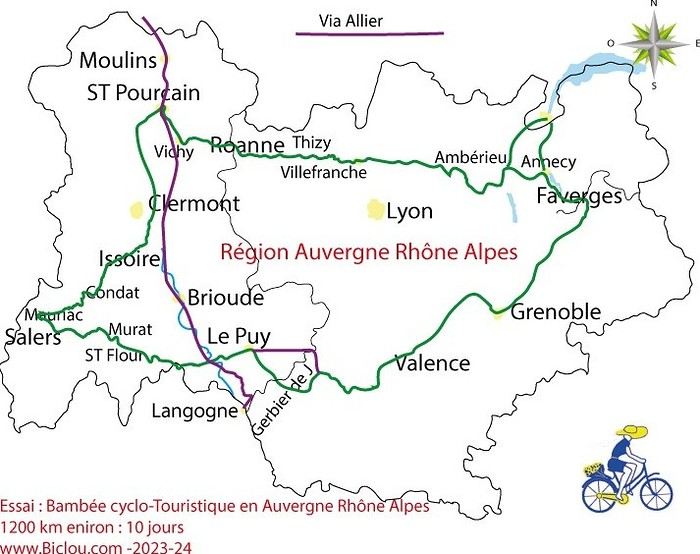
here’s a travel journal of the cycling tour through the Rhône-Alpes Auvergne region by Claudio
zouli
it was the plan
http://cbandiera.free.fr/parcours/auvergne-Ralpes/
the trip was completed story being posted online soon 1100 km in 11 days beautiful and varied regions
claudio

the trip was completed story being posted online soon 1100 km in 11 days beautiful and varied regions
claudio

Hi, I'm looking for a Pino tandem bike for sale in Quebec and I can't find any. Does anyone have any info, please? Thanks a bunch!
Hi there, we’re planning a Munich to Venice bike trip at the end of June 2026. Getting back from Venice to Toulouse by train with 4 bikes isn’t straightforward. What return options have others who’ve done this trip chosen? Any tips or great deals would be much appreciated. Thanks a bunch! !
Hi everyone,
Happy owner of a Pegasus Estremo bike with a Rohloff hub, which is giving me trouble with the SF11-NCX-FT-E-LITE 700C TS 300/0 fork (serial number TD01329060). It’s starting to show its age, and I’d like to repair it to extend the life of my beloved bike.
The suspension is gone, and there’s an oil leak from the seals.
Does anyone know how to repair it? Where can I find parts that are about fifteen years old? Or where to find an identical replacement fork? Just to clarify, the Magura HS11 brakes are mounted using Firm Tech, meaning they’re on pivots behind the fork, facing the frame.
Thanks for your help! Have a great day, Alexandre
The suspension is gone, and there’s an oil leak from the seals.
Does anyone know how to repair it? Where can I find parts that are about fifteen years old? Or where to find an identical replacement fork? Just to clarify, the Magura HS11 brakes are mounted using Firm Tech, meaning they’re on pivots behind the fork, facing the frame.
Thanks for your help! Have a great day, Alexandre
Hi, I'd like to know if anyone has done this route recently or has reliable info.
Does the track exist, and most importantly, is there sand (for biking)?
Any info is welcome.
Cheers,
diego ambilobe: mangaoka, manondro, ramena vohemar sambava: masondrono, tanambao
Hi there,
New to bike touring,
I’d love to start with a section of the Via Rhona to explore and share (route to be decided).
Looking forward to exchanging tips!
hey everyone,
I’m landing in Madagascar with a buddy before the end of April 2026. We’re planning to bike around for about twenty days or so. We don’t have a specific goal other than exploring the country and meeting the locals.
Ideally, we’d prefer a loop route starting from Antananarivo with a good chunk of it along the coast. On the bike side, we’re used to riding 6 to 8 hours a day, depending on the needs, encounters, and mood 😉 Any feedback or tips from trips around this length?
Thanks in advance, Jérôme
I’m landing in Madagascar with a buddy before the end of April 2026. We’re planning to bike around for about twenty days or so. We don’t have a specific goal other than exploring the country and meeting the locals.
Ideally, we’d prefer a loop route starting from Antananarivo with a good chunk of it along the coast. On the bike side, we’re used to riding 6 to 8 hours a day, depending on the needs, encounters, and mood 😉 Any feedback or tips from trips around this length?
Thanks in advance, Jérôme
A big thank you to Lazarou for all the info you share in this forum!
I'm passionate about Morocco, which I cycled through back in 2009.
Last year, my wife and I explored the High Atlas by tandem. Completely smitten, we're heading back in April (Anti Atlas) and May (High and Middle Atlas), still on our tandem.
Do you have any info on the track between Amezri and Ali Ait Nito? Are the river crossings in the Tessaout still there? It's not easy to navigate with a loaded tandem... especially if the river level is high due to this year's heavy snowmelt!
Thanks in advance for any tips you might have, and best wishes for health in this new year!
A shout-out to a cycling colleague from Savoie
Claudio specializes in the route of the Savoie lakes Here are his travels Between Bornes, Chartreuse, the Savoie foothills, and Dauphiné Five lakes: Léman, Annecy, Paladru, Aiguebelette, Bourget, not to mention a few ponds along the way Plenty of accommodation options: camping, hotels, and more...
A lovely route not far from his place Rural and quite peaceful A road cycling route created by Serge B...
N+1 reconnaissance trips on a loop of about 400 km This way, he avoids the SNCF and its troubles http://cbandiera.free.fr/vv/lacs-savoie/recos.php

The latest reconnaissance trip from April to May 2026 http://cbandiera.free.fr/recits/2026-grenoble-H/index.php

Claudio specializes in the route of the Savoie lakes Here are his travels Between Bornes, Chartreuse, the Savoie foothills, and Dauphiné Five lakes: Léman, Annecy, Paladru, Aiguebelette, Bourget, not to mention a few ponds along the way Plenty of accommodation options: camping, hotels, and more...
A lovely route not far from his place Rural and quite peaceful A road cycling route created by Serge B...
N+1 reconnaissance trips on a loop of about 400 km This way, he avoids the SNCF and its troubles http://cbandiera.free.fr/vv/lacs-savoie/recos.php


The latest reconnaissance trip from April to May 2026 http://cbandiera.free.fr/recits/2026-grenoble-H/index.php

Hi everyone,
First post here to share a quick recap of our west-to-east bike trip along Algeria’s coast in January 2025. It was just the two of us—my partner and I—with French passports and not a word of Arabic. No friends or welcoming hosts in the country.
Under those conditions, we’d strongly advise against going.
Our original plan was to follow the coast from Algiers to Tunis. We ended up cycling from Algiers to Béjaia, then took the train from Béjaia to Annaba (with a stop in Constantine), and finally biked to the border. We were tailed by police the whole way—whether on our bikes, on the train, or even on foot while exploring towns. On top of that, we couldn’t wild camp and were limited to the few state-approved hotels that accept foreigners. Under those circumstances, connecting with locals was especially tough.
With such an omnipresent and intrusive police presence, we’d definitely recommend against this destination for bike touring. A really sad situation that completely cuts you off from the local population...
We’d been warned, we went to check it out, and we weren’t disappointed!
You’ve been warned.
First post here to share a quick recap of our west-to-east bike trip along Algeria’s coast in January 2025. It was just the two of us—my partner and I—with French passports and not a word of Arabic. No friends or welcoming hosts in the country.
Under those conditions, we’d strongly advise against going.
Our original plan was to follow the coast from Algiers to Tunis. We ended up cycling from Algiers to Béjaia, then took the train from Béjaia to Annaba (with a stop in Constantine), and finally biked to the border. We were tailed by police the whole way—whether on our bikes, on the train, or even on foot while exploring towns. On top of that, we couldn’t wild camp and were limited to the few state-approved hotels that accept foreigners. Under those circumstances, connecting with locals was especially tough.
With such an omnipresent and intrusive police presence, we’d definitely recommend against this destination for bike touring. A really sad situation that completely cuts you off from the local population...
We’d been warned, we went to check it out, and we weren’t disappointed!
You’ve been warned.
Hi there,
I’m planning the route to cycle from Lille to Nordkapp with my partner.
Duration: 3 months, from May 1st to July 31st, 2026.
In the attached details below, I need to add some "non-riding" days (rest days, basically).
So I’m looking to "shorten" the trip by taking ferries or trains for some stretches. Which areas could I skip?
Thanks in advance for your great tips.
Have a good evening.
https://www.komoot.com/fr-fr/collection/4023980/-lille-cap-nord-1er-mai-au-31-juillet-2026?ref=collection
Hi there,
I’m planning to bike back from Poland this summer. Does anyone know a way to ship it there without having to take it apart? Otherwise, it’s a real hassle to fine-tune all the settings before departure! Thanks in advance.
Hi, has anyone recently bought Primus or Butagaz gas, possibly puncture-style, in Dubrovnik or the surrounding area? Same question for Albania... thanks. aichatou
Hi there,
Coming from Laos (*), I’m planning to enter Thailand by bike via the Fourth Thai–Lao Friendship Bridge.
Before this bridge was built, I’d already cycled the road from Louang Namtha to Houei Sai and crossed the river by boat to reach Thailand.
At the time, the condition of that road was impeccable, and most importantly, traffic was light.
So I’m wondering if anyone who’s taken it recently can tell me whether traffic has increased since the bridge opened.
Thanks in advance!
(*) I’m currently cycling in China (Yunnan)
Coming from Laos (*), I’m planning to enter Thailand by bike via the Fourth Thai–Lao Friendship Bridge.
Before this bridge was built, I’d already cycled the road from Louang Namtha to Houei Sai and crossed the river by boat to reach Thailand.
At the time, the condition of that road was impeccable, and most importantly, traffic was light.
So I’m wondering if anyone who’s taken it recently can tell me whether traffic has increased since the bridge opened.
Thanks in advance!
(*) I’m currently cycling in China (Yunnan)
Hi there,
Just a few words about the loop I did by bike in Yunnan.
Entry and exit
I entered China through the Sino-Vietnamese border crossing at Lào Cai / Hekou under the 30-day visa exemption currently available to French nationals and others.
The process was simple and quick. A Chinese police officer even helped me complete my electronic pre-registration at a computer kiosk. I wasn’t aware this formality was required—it’s similar to Thailand’s TM6.
No issues with the bike.
I left the country via the Sino-Laotian border crossing at Mohan / Boten.
The atmosphere was a bit chaotic there, but again, no problems with the bike.
The timing
I visited Yunnan in February 2026.
Weather-wise, at higher altitudes (between 1,500 and 2,000 meters), it was around ten degrees at night and in the mornings, and around twenty degrees at the hottest part of the day.
I had two days of rain, so I took the bus to keep moving. Otherwise, clear blue skies.
Culturally, Chinese New Year fell on February 17th (and the 15 days following), right in the middle of my trip. Because of this, my take on the traffic might be off.
Accommodation and food I always found a hotel to stay in for prices ranging from 8 to 15 €. Except in Kunming (the capital), where many hotels were fully booked (Chinese New Year). I ended up at a 100 € hotel with great value for money.
A bowl of noodles costs about 1.5 € on average.
Onboard electronics Since my smartphone doesn’t support eSIMs, I subscribed to a China plan with my carrier. Otherwise, for much cheaper, Alipay offers eSIMs for foreigners that allow access to services usually blocked for Chinese users (WhatsApp, Facebook, etc.).
An internet connection is essential for paying with Alipay or WeChat, as this payment method is widespread.
I only managed to use Alipay.
Either way, always carry cash because sometimes there’s no signal, or the merchant only accepts WeChat.
Also, it’s best to bring a power adapter when you arrive rather than struggling to find one.
Traffic and roads The Chinese aren’t reckless drivers. They follow traffic rules and watch out for cyclists. This is slightly less true in Xishuangbanna (the region bordering Myanmar and Laos).
In urban areas, there are almost always wide bike lanes, separated from other roads, where bikes, electric mini-scooters, and scooters share the space pretty harmoniously.
The roads are in great condition, and traffic is generally manageable—even light—except for one stretch (Eshan -> Yangwu).
Most traffic is absorbed by expressways, China’s equivalent of highways: toll roads that are off-limits to slow vehicles.
You’re never far from these expressways; sometimes you even ride alongside them, which can be noisy at times.
The climbs are usually reasonable, around 5% to 6%. From what I remember, the steepest section was between Menglun and Mengla, with gradients of 8% to 10%, sometimes more.
Riding at these altitudes—though modest—took a bit of getting used to.
The route I didn’t plan anything in advance. My only goal was to reach Kunming. I don’t know why, but just hearing the name of that city, like Yunnan, always felt dreamy to me.
Here’s the breakdown: Hekou -> Man Hao (94 km); Man Hao -> Yuanyang (64 km); Yuanyang -> Jianshui (bus); Jianshui -> Tong Hai (78 km); Tong Hai -> Chenjiang (85 km); Chenjiang -> Kunming (60 km); Kunming -> Kunyang (60 km); Kunyang -> Eshan (67 km); Eshan -> Yangwu (58 km); Yangwu -> Yuanjiang (59 km); Yuanjiang -> Pu'er (bus); Pu'er -> Dadugang (75 km); Dadugang -> Jinghong (80 km); Jinghong -> Menglun (67 km); Menglun -> Mengyuancun (51 km); Mengyuancun -> Mengla (43 km); Mengla -> Boten (67 km).
Otherwise, I’m currently in Thailand and just hoping my return flight with Qatar won’t get canceled.
Oh well... 😉
Just a few words about the loop I did by bike in Yunnan.
Entry and exit
I entered China through the Sino-Vietnamese border crossing at Lào Cai / Hekou under the 30-day visa exemption currently available to French nationals and others.
The process was simple and quick. A Chinese police officer even helped me complete my electronic pre-registration at a computer kiosk. I wasn’t aware this formality was required—it’s similar to Thailand’s TM6.
No issues with the bike.
I left the country via the Sino-Laotian border crossing at Mohan / Boten.
The atmosphere was a bit chaotic there, but again, no problems with the bike.
The timing
I visited Yunnan in February 2026.
Weather-wise, at higher altitudes (between 1,500 and 2,000 meters), it was around ten degrees at night and in the mornings, and around twenty degrees at the hottest part of the day.
I had two days of rain, so I took the bus to keep moving. Otherwise, clear blue skies.
Culturally, Chinese New Year fell on February 17th (and the 15 days following), right in the middle of my trip. Because of this, my take on the traffic might be off.
Accommodation and food I always found a hotel to stay in for prices ranging from 8 to 15 €. Except in Kunming (the capital), where many hotels were fully booked (Chinese New Year). I ended up at a 100 € hotel with great value for money.
A bowl of noodles costs about 1.5 € on average.
Onboard electronics Since my smartphone doesn’t support eSIMs, I subscribed to a China plan with my carrier. Otherwise, for much cheaper, Alipay offers eSIMs for foreigners that allow access to services usually blocked for Chinese users (WhatsApp, Facebook, etc.).
An internet connection is essential for paying with Alipay or WeChat, as this payment method is widespread.
I only managed to use Alipay.
Either way, always carry cash because sometimes there’s no signal, or the merchant only accepts WeChat.
Also, it’s best to bring a power adapter when you arrive rather than struggling to find one.
Traffic and roads The Chinese aren’t reckless drivers. They follow traffic rules and watch out for cyclists. This is slightly less true in Xishuangbanna (the region bordering Myanmar and Laos).
In urban areas, there are almost always wide bike lanes, separated from other roads, where bikes, electric mini-scooters, and scooters share the space pretty harmoniously.
The roads are in great condition, and traffic is generally manageable—even light—except for one stretch (Eshan -> Yangwu).
Most traffic is absorbed by expressways, China’s equivalent of highways: toll roads that are off-limits to slow vehicles.
You’re never far from these expressways; sometimes you even ride alongside them, which can be noisy at times.
The climbs are usually reasonable, around 5% to 6%. From what I remember, the steepest section was between Menglun and Mengla, with gradients of 8% to 10%, sometimes more.
Riding at these altitudes—though modest—took a bit of getting used to.
The route I didn’t plan anything in advance. My only goal was to reach Kunming. I don’t know why, but just hearing the name of that city, like Yunnan, always felt dreamy to me.
Here’s the breakdown: Hekou -> Man Hao (94 km); Man Hao -> Yuanyang (64 km); Yuanyang -> Jianshui (bus); Jianshui -> Tong Hai (78 km); Tong Hai -> Chenjiang (85 km); Chenjiang -> Kunming (60 km); Kunming -> Kunyang (60 km); Kunyang -> Eshan (67 km); Eshan -> Yangwu (58 km); Yangwu -> Yuanjiang (59 km); Yuanjiang -> Pu'er (bus); Pu'er -> Dadugang (75 km); Dadugang -> Jinghong (80 km); Jinghong -> Menglun (67 km); Menglun -> Mengyuancun (51 km); Mengyuancun -> Mengla (43 km); Mengla -> Boten (67 km).
Otherwise, I’m currently in Thailand and just hoping my return flight with Qatar won’t get canceled.
Oh well... 😉
Hi! I’m planning to visit the Stockholm Archipelago by bike in early April.
Do you know if the boats will be running between the different islands at that time of year? For those who’ve already been, all your tips and recommendations are welcome—accommodation, etc. Also, do you know where I can rent a bike in Stockholm? Thanks so much in advance for your help!
Hello there, pedal-powered Young Boys!
Claudio (still from Faverges)
dreaming about a cycling getaway in Italy from Faverges (train all the way to Turin)
from Turin down to Venice along the Po River and back via the Padana (Alta Italia da attraversare – Northern Italy to cross)
The tricky part is getting from Chioggia to Venice.
I read it’s possible by hopping on a boat from island to island,
but it sounds a bit stressful.
Has anyone already tackled this route?
Thanks, and cheers to all! http://cbandiera.free.fr/parcours/Padania/
Claudio
Thanks, and cheers to all! http://cbandiera.free.fr/parcours/Padania/
Claudio

Hi there,
I’m currently looking for a bike to do my first bike trip across France, with the ultimate goal of cycling through Latin America. I’ve got a lot of questions and I’d love to hear if you have any answers or advice to share. First off, I’ve been through this before with hiking. I want to get top-quality gear right away. When I started hiking, I ended up buying everything three times—first beginner gear, then intermediate, then expert, etc. For biking, I’d prefer to skip that process and invest right now in a bike that could ideally handle Latin America. I’ve set a total max budget of around 5000 € (roughly 4000–4500 € for the bike and the rest for accessories: panniers, helmet, cycling shorts, etc.).
So, I’ve got quite a few questions:
* I’ve read in several places that some people recommend buying the bike directly in Latin America. Since I need a first bike to train in Europe, would it be better to buy an entry-level bike in France (and sell it before the big departure)? Or is it preferable to start right away with my final bike to get used to it? Is buying it there just to save a bit of money?
* For a long-term trip (around six months) in Latin America, is it better to go for a gravel bike or a mountain bike?
* Should I buy a new bike or a refurbished one? Even more so given that I’m planning a long trip—could a refurbished bike end up causing more breakdowns?
If you have any advice on models, technical features to prioritize, or recommended sellers or resellers, I’d love to hear it. I’m a total beginner—I’ve only just started watching videos and reading up on the subject, and all the technical specs are new to me!
Thanks in advance for your help!
I’m currently looking for a bike to do my first bike trip across France, with the ultimate goal of cycling through Latin America. I’ve got a lot of questions and I’d love to hear if you have any answers or advice to share. First off, I’ve been through this before with hiking. I want to get top-quality gear right away. When I started hiking, I ended up buying everything three times—first beginner gear, then intermediate, then expert, etc. For biking, I’d prefer to skip that process and invest right now in a bike that could ideally handle Latin America. I’ve set a total max budget of around 5000 € (roughly 4000–4500 € for the bike and the rest for accessories: panniers, helmet, cycling shorts, etc.).
So, I’ve got quite a few questions:
* I’ve read in several places that some people recommend buying the bike directly in Latin America. Since I need a first bike to train in Europe, would it be better to buy an entry-level bike in France (and sell it before the big departure)? Or is it preferable to start right away with my final bike to get used to it? Is buying it there just to save a bit of money?
* For a long-term trip (around six months) in Latin America, is it better to go for a gravel bike or a mountain bike?
* Should I buy a new bike or a refurbished one? Even more so given that I’m planning a long trip—could a refurbished bike end up causing more breakdowns?
If you have any advice on models, technical features to prioritize, or recommended sellers or resellers, I’d love to hear it. I’m a total beginner—I’ve only just started watching videos and reading up on the subject, and all the technical specs are new to me!
Thanks in advance for your help!
Calling all travelers.
We’ll be landing at Lyon Airport and want to bike to La Verpillière train station (with panniers and camping gear, etc.) to catch a TER to Voreppe.
What’s the safest route for this bike trip?
Thanks in advance