Films hindous
by Nabennour
This discussion is in French, the community’s main language.
Original post
bonsoir tout le monde
alor je vous dis que j'ai un grand amour pour les films hindou
je ne parle pas des ancien mes surtout des nouveaux ceux de Bollywood
j'adore sharukhan j'adore la belle kareena kapoor, rani mukherjee est une foule d'autre acteurs
et j'espere un jour visiter l'inde in challah
il faut bien profiter de chaque moment dans la vie
On ne dit pas film hindou mais indien. Hindou, ça concerne la religion. Or, beaucoup d'acteurs sont musulmans, et les thèmes ne concerne pas particulièrement l'hindouisme.
Sharukh Khan, Amir Khan, Salman Khan, Saif Ali Khan, pour ne citer que 4 des plus connus qui sont parmi les plus grandes star de Bollywood (voire les plus grande stars) et qui squattent les affiches de toutes les superproductions. En plus, ils produisent de nombreux films. Beaucoup de producteurs de Bombay sont musulmans... Le hindi parlé dans Bollywood est très ourdouisé... Pour Kollywood c'est normal, c'est une région où il y a peu de musulmans.
Et même sans ça, on ne peut pas parler de films hindous, ce ne sont pas des films religieux. Ce serait comme parler de films chrétiens en parlant des productions américaines de Hollywood.
Je ne comprends pas vraiment ton intervention, je n'ai jamais dit que tous les acteurs étaient musulmans. Ce n'était pas vraiment le sujet...
Et même sans ça, on ne peut pas parler de films hindous, ce ne sont pas des films religieux. Ce serait comme parler de films chrétiens en parlant des productions américaines de Hollywood.
Je ne comprends pas vraiment ton intervention, je n'ai jamais dit que tous les acteurs étaient musulmans. Ce n'était pas vraiment le sujet...
Je suis tout à fait d'accord avec Pagaljavab.
Il y a aussi d'autre comme Yusuf Khan ( Dilip Kumar), Pran, Shabana Azmi, Katrina Kaif, Mumtaz, Malaika -arora-khan, Soha ali khan, Tabu, etc. En plus beaucoup des cineastes, et ecrivains et poetes ( bollywood) comme Jawaid Akhtar, Salim Khan , Gulzar, .Meme dans la cinema du sud du L"Inde , il y a Jamshed Cethirakath ( Arya ) , Prem Nazir, Music composer A.R. Rahman , etc etc .
Les acteurs bollywoodiens musulmans, qui sont nombreux, ont été cités.
On aurait pu aussi parler de Farah Khan, chorégraphe majeure de Bollywood et cinéaste, Javed Akhtar, l'un des meilleurs paroliers de chansons de films, et bien d'autres.
Bollywood est l'un des milieux où les musulmans peuvent le mieux réussir en Inde du Nord, contrastant avec les discriminations habituelles dont cette communauté fait l'objet.
A Kollywood, il y a moins de musulmans, car leur communauté est très minoritaire numériquement en pays tamoul. On peut néanmoins citer les acteurs Nassar, Shaam, BH Abdul Hameed et Rajkiran (né Khadar), le compositeur de musiques de film A.R. Rahman (dont la portée est allée jusqu'à Hollywood avec Slumdog Millionnaire), le cinéaste Ameer Sultan, le chanteur en playback Shahul Hameed.
Si tu ouvres tes yeux d'enfant, le voyage commence au seuil de ta maison
Tu as dû comprendre qu'il ne faut pas dire "films hindous", car, en français, hindou signifie hindouiste (adèpte de la religion hindoue).
On t'a dit de dire "films indiens", mais ce n'est pas assez précis. On parle 20 langues officielles en Inde, et un grand nombre d'entre elles ont leur propre cinéma.
Les films que tu aimes, tournés à Bombay, dans les studios de Bollywood, sont en langue hindi. On les appelle donc "hindi films" dans toute l'Inde. Tu dois donc dire: "films hindis" ou "films bollywood".
On t'a dit de dire "films indiens", mais ce n'est pas assez précis. On parle 20 langues officielles en Inde, et un grand nombre d'entre elles ont leur propre cinéma.
Les films que tu aimes, tournés à Bombay, dans les studios de Bollywood, sont en langue hindi. On les appelle donc "hindi films" dans toute l'Inde. Tu dois donc dire: "films hindis" ou "films bollywood".
Si tu ouvres tes yeux d'enfant, le voyage commence au seuil de ta maison
Non?
"Taj Mahal" a été bloqué pour des raisons politiques propres à l'Inde: les autorités indiennes, garantes de la censure, ne tiennent pas à ce qu'un film fasse la promotion de l'époque moghole, pendant laquelle l'Inde était gouvernée par les musulmans.
Cette période historique, on le comprendra aisément, est, au contraire, prisée par le Pakistan, ennemi mortel de l'Inde.
Si tu ouvres tes yeux d'enfant, le voyage commence au seuil de ta maison
Ok pour "Taj Mahal", mais ce n'est pas pour autant que le cinéma de Bollywood doit être qualifié d'hindou. En plus, la personne qui a démarré le sujet parlait du cinéma de Bollywood en général. Et si des autorités ont décidé à une certaine époque de l'interdiction d'un film parce qu'il parle de la période de domination moghole, je ne vois pas pourquoi rebaptiserait Bollywood "cinéma hindou"...
Il me semble que personne n'a parlé de films "hindous" dans cette discussion, à l'exception de l'initiateur de la discussion, qui n'a fait que reproduire une erreur de vocabulaire extrêmement répandue, perpétuant un ancien usage: jusqu'à 1947 on disait "hindou" pour désigner les habitants de l'Inde, et de nombreux francophones continuent à le faire, sans aucune référence volontaire à une religion que la plupart d'entre eux ignorent, ou confondent avec le bouddhisme.
Si tu ouvres tes yeux d'enfant, le voyage commence au seuil de ta maison
Il me semble que personne n'a parlé de films "hindous" dans cette discussion, à l'exception de l'initiateur de la discussion
Euh... Il me semble que la plupart des gens ont justement répondu directement ou indirectement à l'initiateur de la discussion... qui parle justement -à tort- de "film" hindou 😉
de nombreux francophones continuent à le faire, sans aucune référence volontaire à une religion que la plupart d'entre eux ignorent, ou confondent avec le bouddhisme
Merci je n'étais pas au courant 😏 Sérieusement... C'est justement la raison pour laquelle je me permets de corriger cette erreur, qui bien qu'involontaire (je précise encore, on sait jamais) ne respecte pas les Indiens qui ne sont pas hindous. C'était la raison de ma réponse à l'initiateur de la discussion. On le disait avant l'Indépendance, mais déjà c'était une erreur. Essaie de dire (même involontairement), à un musulman, un sikh ou un bouddhiste, un parsi ou un chrétien qu'il est hindou: tu me diras sa réaction.
Euh... Il me semble que la plupart des gens ont justement répondu directement ou indirectement à l'initiateur de la discussion... qui parle justement -à tort- de "film" hindou 😉
de nombreux francophones continuent à le faire, sans aucune référence volontaire à une religion que la plupart d'entre eux ignorent, ou confondent avec le bouddhisme
Merci je n'étais pas au courant 😏 Sérieusement... C'est justement la raison pour laquelle je me permets de corriger cette erreur, qui bien qu'involontaire (je précise encore, on sait jamais) ne respecte pas les Indiens qui ne sont pas hindous. C'était la raison de ma réponse à l'initiateur de la discussion. On le disait avant l'Indépendance, mais déjà c'était une erreur. Essaie de dire (même involontairement), à un musulman, un sikh ou un bouddhiste, un parsi ou un chrétien qu'il est hindou: tu me diras sa réaction.
"Avant l'Indépendance... c'était une erreur". Cela dépend de quand l'on parle, car si l'on regarde les textes français d'avant la fin du XIX° siècle, on voit que les hindouistes sont appelés "brahmaniques", et les musulmans sont désignés sous le vocable "mahométan". Ainsi, on pouvait appeler les habitants de l'Inde, indifféremment "Indiens" ou "Hindous".
D'ailleurs, le pays fut longtemps appelé "hindoustan", et la principale langue du nord "hindoustani". La Sorbonne fut la première université occidentale à avoir une chaire d' "hindoustani" aux XIX°s.
Le député de l'Inde française de 1910 à 1924, Paul Bluysen intitulait son récit de voyage chez ses administrés "Mes amis les Hindous" ( http://gallica.bnf.fr/ark:/12148/bpt6k5455287h ).
Le journal officiel de l'Inde française en langue tamoule s'appelait d'ailleurs "L'Hindou" ( http://gallica.bnf.fr/ark:/12148/cb32786694s/date ).
En français, le terme "hindou" n'a commencé à désigner les adeptes de la religion brahmanique, appelée à son tour "hindouisme", que sous l'influence de la langue anglaise, s'imposant définitivement aux gens instruits et informés au moment des luttes pour l'Indépendance de l'Inde. Malheureusement, plus de 60 ans après, la majorité des francophones ne sont pas du tout instruits de tout cela. Ainsi, en banlieue parisienne, on parle encore et toujours de "films hindous" (je l'ai même vu écrit sur l'étal d'un vendeur au marché d'Argenteuil!), ou de "films pakatt"... et, comme toi, je passe mon temps à essayer de faire comprendre aux gens qu'il faut dire "indiens" quand on parle des habitants de l'Inde.
Tu vas rigoler, ou t'arracher les cheveux quand je t'aurai dit qu'on me demande souvent si je parle... "hindou"!
Le député de l'Inde française de 1910 à 1924, Paul Bluysen intitulait son récit de voyage chez ses administrés "Mes amis les Hindous" ( http://gallica.bnf.fr/ark:/12148/bpt6k5455287h ).
Le journal officiel de l'Inde française en langue tamoule s'appelait d'ailleurs "L'Hindou" ( http://gallica.bnf.fr/ark:/12148/cb32786694s/date ).
En français, le terme "hindou" n'a commencé à désigner les adeptes de la religion brahmanique, appelée à son tour "hindouisme", que sous l'influence de la langue anglaise, s'imposant définitivement aux gens instruits et informés au moment des luttes pour l'Indépendance de l'Inde. Malheureusement, plus de 60 ans après, la majorité des francophones ne sont pas du tout instruits de tout cela. Ainsi, en banlieue parisienne, on parle encore et toujours de "films hindous" (je l'ai même vu écrit sur l'étal d'un vendeur au marché d'Argenteuil!), ou de "films pakatt"... et, comme toi, je passe mon temps à essayer de faire comprendre aux gens qu'il faut dire "indiens" quand on parle des habitants de l'Inde.
Tu vas rigoler, ou t'arracher les cheveux quand je t'aurai dit qu'on me demande souvent si je parle... "hindou"!
Si tu ouvres tes yeux d'enfant, le voyage commence au seuil de ta maison
Tu vas rigoler, ou t'arracher les cheveux quand je t'aurai dit qu'on me demande souvent si je parle... "hindou"!
Oh non tu sais, j'ai droit à la même chose: "parler hindou", "parler indien", et j'en passe!
Pour le reste on est d'accord sur le fond. Je pense juste que le point de vue occidental ne peut pas tout expliquer. Les musulmans ne se désignaient pas eux même comme "hindou". D'ailleurs comme tu l'as dit toi-même, certains Occidentaux distinguaient quand même "indou" (oui, sans "h" dans certaines sources) et mahométans). Même chez des chercheurs comme Max Weber au début du XXème siècle, on retrouve ce vocabulaire. Si le pays a été appelé Hindustan, c'est que "l'envahisseur" a nommé ce pays d'après le nom qu'on donnait alors à ces habitants (ce qui vivent au-delà du fleuve Indus), et pas parce qu'eux même se voyaient hindous. Si les Occidentaux nommaient tout le monde hindou vu de l'extérieur, d'un point du vue interne, on faisait bien la différence. Seulement, entre temps, le monde a changé, les configurations ne sont plus les mêmes, le temps béni des colonies est fini. L'Inde est un pays communautariste depuis l'époque coloniale, qui attache beaucoup d'importance aux identités religieuses. Dans un climat aussi tendu entre les communautés que ce qu'il est en ce moment, je trouve bien de ne pas justifier qu'on dise "hindou" pour tous les Indiens sous prétexte que le sens commun occidental le voulait.
Malheureusement, plus de 60 ans après, la majorité des francophones ne sont pas du tout instruits de tout cela
C'est vrai, c'est pour ça qu'un peu d'information n'est jamais inutile, même si c'est souvent peine perdue. Même parmi des personnes qui voyagent en Inde, on peut lire sur ce forum: "j'ai rencontré des hindi, ils sont très gentils".
Oh non tu sais, j'ai droit à la même chose: "parler hindou", "parler indien", et j'en passe!
Pour le reste on est d'accord sur le fond. Je pense juste que le point de vue occidental ne peut pas tout expliquer. Les musulmans ne se désignaient pas eux même comme "hindou". D'ailleurs comme tu l'as dit toi-même, certains Occidentaux distinguaient quand même "indou" (oui, sans "h" dans certaines sources) et mahométans). Même chez des chercheurs comme Max Weber au début du XXème siècle, on retrouve ce vocabulaire. Si le pays a été appelé Hindustan, c'est que "l'envahisseur" a nommé ce pays d'après le nom qu'on donnait alors à ces habitants (ce qui vivent au-delà du fleuve Indus), et pas parce qu'eux même se voyaient hindous. Si les Occidentaux nommaient tout le monde hindou vu de l'extérieur, d'un point du vue interne, on faisait bien la différence. Seulement, entre temps, le monde a changé, les configurations ne sont plus les mêmes, le temps béni des colonies est fini. L'Inde est un pays communautariste depuis l'époque coloniale, qui attache beaucoup d'importance aux identités religieuses. Dans un climat aussi tendu entre les communautés que ce qu'il est en ce moment, je trouve bien de ne pas justifier qu'on dise "hindou" pour tous les Indiens sous prétexte que le sens commun occidental le voulait.
Malheureusement, plus de 60 ans après, la majorité des francophones ne sont pas du tout instruits de tout cela
C'est vrai, c'est pour ça qu'un peu d'information n'est jamais inutile, même si c'est souvent peine perdue. Même parmi des personnes qui voyagent en Inde, on peut lire sur ce forum: "j'ai rencontré des hindi, ils sont très gentils".
Bonjour,
A chaque fois, quand il y a une question soit sur la religion, soit sur la tradition d'un pays, à mon avis, il faudrait s'abstenir à raconter des bêtises.Il ne faudra pas oublier que nous sommes des touristes.On part passer quelque semaine, quelque mois voire quelque années dans des pays étrangers.ce n'est pas ça qui va nous éclaircir les mistères d'un pays
L'autre jour, il y avait un debat sur les habits.c'est parti en vrile.saree blanc, crane rasé, veuve , pas veuve.
J'interviens en tant qu'indien...Nous , on ne se casse pas la tête avec tous ces conneries. Hindous, musulmans, catholiques et d'autres réligions y cohabitent.Il y a des gens qui prient tous les dieux.On peut bien voir un hindou dans une église.un chrétien dans un temple.On s'en fou de tous ça. Peu importe la réligion, on n'a qu'une seule destination.Pensez à ça et vivez heureux.
J'interviens en tant qu'indien...Nous , on ne se casse pas la tête avec tous ces conneries.
Parce que tu es indien, tu penses pouvoir parler au nom de tous les Indiens?? Beaucoup d'Indiens que je rencontre prennent très au sérieux ces histoires de communauté et de religion prennent tout ça très au sérieux. J'ai entendu en Haryana des Sikhs très offensés d'être assimilés à des musulmans à des touristes; des hindous dire que les musulmans devraient se convertir s'ils veulent rester en Inde (j'ai même entendu bien pire, et pas qu'une seule personne à un seul endroit); un chauffeur de rickshaw chrétien qui m'a dit que les pèlerins hindous étaient des idiots avec leurs t-shirts oranges. J'en passe... Ce ne sont pas des comportement généraux, mais c'est très fréquent et loin du monde idéal dont tu parles où tous les frères indiens s'aiment et vont prier dans les mêmes temples, églises, mosquées... Et ça ne fait pas de mal que les touristes se renseignent un minimum sur la culture du pays où ils vont. Les Indiens y sont justement très sensible.
Tu as raison, nul ne peut nier que l'Inde est majoritairement une mosaïque de communautés ethniques, religieuses, et de caste très cloisonnées, même si les mentalités évoluent un peu dans les villes.
La façon de choisir la personne que l'on va épouser en est le meilleur indicateur. Il suffit d'ouvrir un journal indien à la rubrique matrimoniale pour voir que les annonces sont classées selon ces 3 critères, sans compter quelques autres que l'on découvre en lisant: le niveau social, le niveau d'études, la profession, et une peau la plus claire possible (pour les filles). Les annonces marquées "Cast no bar" (la caste n'a pas d'importance) sont généralement les moins nombreuses. Elle tiendront néanmoins le plus souvent compte des critères socio-professionnels.
Il faut ajouter, pour couronner le tout, que le droit de la famille sous le régime duquel les couples s'unissent légalement diffère selon la religion des fiancés. Il y a 4 formules légales possibles: hindu marriage, muslim marriage, christian marriage, ou special marriage. Les adeptes des religions nées en Inde (hindouisme, jaïnisme, bouddhisme, sikhisme) sont sous le régime de l'hindu marriage Act.
Pour rebondir sur le sujet de cette discussion, les films populaires indiens mettent très souvent en scène des amours impossibles entre deux partenaires issus de communautés différentes.
La façon de choisir la personne que l'on va épouser en est le meilleur indicateur. Il suffit d'ouvrir un journal indien à la rubrique matrimoniale pour voir que les annonces sont classées selon ces 3 critères, sans compter quelques autres que l'on découvre en lisant: le niveau social, le niveau d'études, la profession, et une peau la plus claire possible (pour les filles). Les annonces marquées "Cast no bar" (la caste n'a pas d'importance) sont généralement les moins nombreuses. Elle tiendront néanmoins le plus souvent compte des critères socio-professionnels.
Il faut ajouter, pour couronner le tout, que le droit de la famille sous le régime duquel les couples s'unissent légalement diffère selon la religion des fiancés. Il y a 4 formules légales possibles: hindu marriage, muslim marriage, christian marriage, ou special marriage. Les adeptes des religions nées en Inde (hindouisme, jaïnisme, bouddhisme, sikhisme) sont sous le régime de l'hindu marriage Act.
Pour rebondir sur le sujet de cette discussion, les films populaires indiens mettent très souvent en scène des amours impossibles entre deux partenaires issus de communautés différentes.
Si tu ouvres tes yeux d'enfant, le voyage commence au seuil de ta maison
Tous ce que tu dis c'est vrai.Mais ça n'existe pas qu'en inde. ça existe dans les pays où on previlégie le mariage arrangé.C'est aussi simple que ça.
Voyons, hônnetement, ça n'existe pas en france dans certaines origines?
Les habitants de l'inde veulent respecter leurs coutumes parce qu'ils vivent en communauté.On veut respecter les une et les autres pour être respecté par la suite.
En générale, on vit en famille , plus tôt, on vivait en famille.
Par peur de ne pas pouvoir trouver un mari pour sa fille, en marient son fils avec une fille d'autre race ou religion , on veut trouver une fille de même niveau sociale pour marier son fils.Je ne sais pas si j'étais claire!!! :c
C'est compliqué à expliquer et comprendre parce qu'il y a beaucoup de choses rentrent en jeu.
Et puis le films, c'est bidon.C'est un des moyen pour faire de l'argent.Nous, on fait la lasagne, eux, ils font des films.Au moins ils ont 3 heures de bonheures à chaque films.
Personne suit les conseils donnés dans ces films.ça je vous confirme!!! :D
bonsoir tout le monde
alor je vous dis que j'ai un grand amour pour les films hindou
je ne parle pas des ancien mes surtout des nouveaux ceux de Bollywood
j'adore sharukhan j'adore la belle kareena kapoor, rani mukherjee est une foule d'autre acteurs
et j'espere un jour visiter l'inde in challah
Bref, pour répondre à la question "cinéma" initiale, je conseille deux films (même si je n'en ai pas vu tellement):
- "Omkara", avec Kareena Kapoor notamment. Très beau, et bien joué en plus si je me souviens bien. C'est "Othello" de Shakespeare transposé en Inde. - "Dil se", avec Shah Rukh Kahn. Beau film, belles images, belles musique et un scénario intéressant. Même si SRK joue comme toujours assez mal (mon avis).
Bref, pour répondre à la question "cinéma" initiale, je conseille deux films (même si je n'en ai pas vu tellement):
- "Omkara", avec Kareena Kapoor notamment. Très beau, et bien joué en plus si je me souviens bien. C'est "Othello" de Shakespeare transposé en Inde. - "Dil se", avec Shah Rukh Kahn. Beau film, belles images, belles musique et un scénario intéressant. Même si SRK joue comme toujours assez mal (mon avis).
bsr
merci à Dina de revenir à la question du cinéma. je viens de voir le DVD "Jab Tak hai jaan" avec SHahrukh justement, un très beau film où pour la 1ère fois il a embrassé !! Katrina Kaif et il a expliqué par ailleurs (je l'ai lu aussi) que c'était à la demande de Yash Chopra (directeur et producteur mort de la dengue en octobre 2012 avant la sortie du film) - sinon il a 3 devises ds un film : ne jamais monter à cheval, ne pas embrasser et la 3è j'ai oublié ...
j'ai aussi aimé Omkara. un beau film à voir aussi est "Salma"..
Je suis tjs épatée lorsque je vais aller acheter un DVD, qd je vois tous ces films en rayon, on n'a que l'embarras du choix, on ne sait plus que choisir. en plus on peut en avoir 4 pour 10 €, des originaux d'occasion coûtent 5 €, sinon des originaux on peut en avoir entre 8 et 15 € (où le français est bien traduit) mais pour les 4 pour 10 €, la qualité de l'image peut laisser à désirer et où il faut privilégier le sous-titrage en anglais plutôt, pays anglophone oblige.....
Les boutiques de DVD foisonnent tout au long du bd de Strasbourg St-Denis jusqu'à gare de l'est pour ceux qui cherchent une adresse ....
Je cherche le film "8 - Shani" ou "8 - the power of Shani" sorti en 2006, un film d'horreur dont aucune boutique ne vend, même commandé depuis 1 mois, ce n'est tjs pas arrivé...
Je leur ai dit c'est tt de même incroyable que je n'arrive pas à trouver ce film, au milieu de tous ceux qu'ils vendent !!
Alors, si qq'un peut me donner des tuyaux, merci d'avance 😏
bakoly
bjr Brice, lorsqu'il y a des scènes où on doit monter à cheval, il ne les fera pas...
bakoly
oui.tu n"as pas tord.jette un coup d'oeil sur ce lien quand même.
http://www.youtube.com/watch?v=Aa5lE4Dxpj8.
j'adore la belle kareena kapoor, rani mukherjee est une foule d'autre acteurs
+1 Qui m'ont permit une belle decouverte d'un Bollywood different:
Talaash 2012
+1 Qui m'ont permit une belle decouverte d'un Bollywood different:
Talaash 2012
Farah Khan, chorégraphe majeure de Bollywood et cinéaste, Javed Akhtar, l'un des meilleurs paroliers de chansons de films, et bien d'autres
les acteurs Nassar, Shaam, BH Abdul Hameed et Rajkiran (né Khadar), le compositeur de musiques de film A.R. Rahman (dont la portée est allée jusqu'à Hollywood avec Slumdog Millionnaire), le cinéaste Ameer Sultan
Sawadee Krap Nalesnik
Désirant aller plus loin dans ma découverte du cinéma Indien, Hors films musicaux, Pourrais-tu me donner des titres de films un peu dans la lignée du lien que j’ai mis dans mon précèdent message (Le magnifique Slumdog, j’ai déjà vu)
Merci d’avance.
Sawadee Krap Nalesnik
Désirant aller plus loin dans ma découverte du cinéma Indien, Hors films musicaux, Pourrais-tu me donner des titres de films un peu dans la lignée du lien que j’ai mis dans mon précèdent message (Le magnifique Slumdog, j’ai déjà vu)
Merci d’avance.
A chaque fois, quand il y a une question soit sur la religion, soit sur la tradition d'un pays, à mon avis, il faudrait s'abstenir à raconter des bêtises.
Bah justement, il faudrait commencer par toi-même. Parce qu'entre les conneries que tu racontes sur la situation des femmes en Inde et sur ce fil - où tu sembles défendre le qualificatif "hindou" alors que Pagaljavab a parfaitement raison de dire qu'on dit "indien" et non "hindou" - on va atteindre le point Godwin...
Slumdog Millionaire n'est pas un film indien mais britannique. Il a d'ailleurs beaucoup choqué en Inde, car il montrait des réalités que les Indiens ne veulent pas voir au cinéma, et montrait le côté misérable de leur pays. Amithab Bachchan a été outré de se voir intégré à une scène où un enfant couvert de merde lui demandait un autographe. Les jeunes acteurs du film ont été accueillis avec un sourire pincé à la remise des Filmfare Awards, puis ils sont retournés à leur bidonville natal.
Sans chansons ni danses, un film bollywood est dénaturé, à mon avis. Il y a très peu de films non musicaux produits par Bollywood. Il me faut chercher dans ma mémoire pour en trouver.
Pour l'instant, je pense à Black de Sanjay Leela Bhansali, aux deux Sarkar de Ram Gopal Varma (remakes du Parrain de Coppola). Je crois que Bhoot (Fantômes - film fantastique) ne comporte pas de chansons.
J'en ai vu un ou deux cette année, mais il me faut me rappeler les titres. Je les mettrai dans un prochain message si cela me revient.
Sans chansons ni danses, un film bollywood est dénaturé, à mon avis. Il y a très peu de films non musicaux produits par Bollywood. Il me faut chercher dans ma mémoire pour en trouver.
Pour l'instant, je pense à Black de Sanjay Leela Bhansali, aux deux Sarkar de Ram Gopal Varma (remakes du Parrain de Coppola). Je crois que Bhoot (Fantômes - film fantastique) ne comporte pas de chansons.
J'en ai vu un ou deux cette année, mais il me faut me rappeler les titres. Je les mettrai dans un prochain message si cela me revient.
Si tu ouvres tes yeux d'enfant, le voyage commence au seuil de ta maison
Merci bien
Je pense à présent à:
- Nishabd de Ram Gopal Varma, remake de Lolita de Kubrick & Nabokov, adapté aux valeurs indiennes - Rocket Singh Salesman of the Year, de Shimit Amin, satyre sociale sur la malhonnêteté des entreprises indiennes - Maine Gandhi Ko Nahin Mara de Januh Barua (Je n'ai pas tué Gandhi), conte moral sur l'abandon des idéaux du Mahatma par la société indienne actuelle
Il me semble aussi qu'il n'y a pas d'effets de comédie musicale dans Mumbai Meri Jaan de Nishkhant Kamath (film les attentats du 11 juillet 2006 et la façon dont ils bouleversent la vie de personnages ordinaires)
Je pense que c'est aussi le cas de Gandhi to Hitler (appelé aussi Dear Friend Hitler), de Rakesh Ranjam Sharma que je n'ai pas encore vu. Ce film très controversé parle, dit-on, des lettres écrites par le Mahatma à Hitler, et de la relation amoureuse de ce dernier avec Eva Braun.
Puisque tu as l'air d'aimer ce que les Indiens appellent "serious films", il ne faudrait pas rater, même s'ils comportent des chansons (Celles-ci sont d'ailleurs bien intégrées au déroulement de l'histoire, plus souvent comme effet musical dramatique supplémentaire que comme parenthèse de comédie musicale) ces films bollywood:
- Swades, d'Ashutosh Gowariker, sur le dilemme, pour les Indiens diplomés, entre vivre confortablement en Occident ou prendre la responsabilité de rentrer au pays et de participer à son développement. Ce film aborde légèrement la difficile question de l'intouchabilité (rare à Bollywood), tout comme le précedent film de Gowariker, le superbe Lagaan (l'histoire d'un match de Cricket entre des paysans indiens colonisés et des soldats britannique).
- Rang de Basanti, de Rakesh Omprakash Mehra, sur la nécessité, pour la jeune génération, de combattre la corruption comme les héros de l'Indépendance ont combattu le colonialisme.
- Araakshan, de Prakash Jha, sur la difficile intégration des Intouchables, même diplômés, dans le cadre de l'enseignement.
- Dor, de Nagesh Kukunoor, sur le sort terrible fait aux veuves au Rajasthan
- Le célèbre et déjà très ancien Mother India, de Mehboob Khan, sur le sort de la paysannerie indienne face aux usuriers et aux accidents terribles de la vie
- Plus légèrement, il y a le récent et gentil English Vinglish, de Gauri Shinde, sur l'autonomie de la femme indienne, et l'emprise de l'anglais sur tout progrès social ou personnel
Et puis il y a les films hindis non produits par Bollywood comme:
- Matrubhoomi de Manish Jha, sur la pénurie de filles dans le nord de l'Inde, suite aux infanticides et avortements sélectifs
- La série des films de Deepa Mehta: Fire, Earth, Water (classique!)et aussi Bollywood Hollywood (sympathique parodie de film d'amour bollywoodien) 1947 Earth montre comment le drame de la partition de l'Inde dissout un groupe multiconfessionnel d'amis et en transforme certains en loups pour les autres. Water aborde le sort difficile des veuves au Bengale Occidental. Le sujet difficile de Fire n'est autre que celui de la relation amoureuse entre deux lesbiennes.
- Tous les films de Mira Naïr, en particulier Salaam Bombay, Monsoon Wedding, et The Namesake Salaam Bombay montre la vie d'un enfant des rues de Bombay, sans les artifices spectaculaires de Slumdog Millionaire. Monsoon Wedding (Le Mariage des Moussons) raconte les 3 jours fous d'une noce dans la bourgeoisie penjabi de Delhi. Grouillant, truculent, coloré, drôle, ce film aborde cependant le thème tabou en Inde de la pédophilie. The Namesake (Un Nom pour un Autre) narre 20 ans de la vie aux USA d'une femme bengali qui a fait un mariage arrangé avec un homme travaillant dans ce pays. Les thèmes majeurs sont ceux du destin, du sacrifice, et de l'identité perdue et retrouvée
Enfin quelques films non hindis:
- Chroniques indiennes (Mondo meyer upakhyan), film bengali de Buddhadeb Dasgupta, raconte la vie dans un bordel, et la nécessité pour une prostituée de trouver un riche protecteur pour garantir son avenir
- Kaadhal, film tamoul de Balaji Shaktivel, aborde l'amour impossible et tragique d'un mécano intouchable et d'une lycéenne de bonne famille. Basé sur une histoire vraie, ce fut un grand succès au Tamil Nadu. Il y a des chansons bien intégrées au scénario.
- Je ne parlerai pas des films bengalis de Satyajit Ray, considérés comme d'incontournables chefs d’œuvre en Occident. Ils ont tendance à m'endormir. Mais je te recommande de les essayer, puisque ce sont des classiques, et qu'ils te plairont peut-être.
Voilà, je crois que tu n'as que l'embarras du choix.
- Nishabd de Ram Gopal Varma, remake de Lolita de Kubrick & Nabokov, adapté aux valeurs indiennes - Rocket Singh Salesman of the Year, de Shimit Amin, satyre sociale sur la malhonnêteté des entreprises indiennes - Maine Gandhi Ko Nahin Mara de Januh Barua (Je n'ai pas tué Gandhi), conte moral sur l'abandon des idéaux du Mahatma par la société indienne actuelle
Il me semble aussi qu'il n'y a pas d'effets de comédie musicale dans Mumbai Meri Jaan de Nishkhant Kamath (film les attentats du 11 juillet 2006 et la façon dont ils bouleversent la vie de personnages ordinaires)
Je pense que c'est aussi le cas de Gandhi to Hitler (appelé aussi Dear Friend Hitler), de Rakesh Ranjam Sharma que je n'ai pas encore vu. Ce film très controversé parle, dit-on, des lettres écrites par le Mahatma à Hitler, et de la relation amoureuse de ce dernier avec Eva Braun.
Puisque tu as l'air d'aimer ce que les Indiens appellent "serious films", il ne faudrait pas rater, même s'ils comportent des chansons (Celles-ci sont d'ailleurs bien intégrées au déroulement de l'histoire, plus souvent comme effet musical dramatique supplémentaire que comme parenthèse de comédie musicale) ces films bollywood:
- Swades, d'Ashutosh Gowariker, sur le dilemme, pour les Indiens diplomés, entre vivre confortablement en Occident ou prendre la responsabilité de rentrer au pays et de participer à son développement. Ce film aborde légèrement la difficile question de l'intouchabilité (rare à Bollywood), tout comme le précedent film de Gowariker, le superbe Lagaan (l'histoire d'un match de Cricket entre des paysans indiens colonisés et des soldats britannique).
- Rang de Basanti, de Rakesh Omprakash Mehra, sur la nécessité, pour la jeune génération, de combattre la corruption comme les héros de l'Indépendance ont combattu le colonialisme.
- Araakshan, de Prakash Jha, sur la difficile intégration des Intouchables, même diplômés, dans le cadre de l'enseignement.
- Dor, de Nagesh Kukunoor, sur le sort terrible fait aux veuves au Rajasthan
- Le célèbre et déjà très ancien Mother India, de Mehboob Khan, sur le sort de la paysannerie indienne face aux usuriers et aux accidents terribles de la vie
- Plus légèrement, il y a le récent et gentil English Vinglish, de Gauri Shinde, sur l'autonomie de la femme indienne, et l'emprise de l'anglais sur tout progrès social ou personnel
Et puis il y a les films hindis non produits par Bollywood comme:
- Matrubhoomi de Manish Jha, sur la pénurie de filles dans le nord de l'Inde, suite aux infanticides et avortements sélectifs
- La série des films de Deepa Mehta: Fire, Earth, Water (classique!)et aussi Bollywood Hollywood (sympathique parodie de film d'amour bollywoodien) 1947 Earth montre comment le drame de la partition de l'Inde dissout un groupe multiconfessionnel d'amis et en transforme certains en loups pour les autres. Water aborde le sort difficile des veuves au Bengale Occidental. Le sujet difficile de Fire n'est autre que celui de la relation amoureuse entre deux lesbiennes.
- Tous les films de Mira Naïr, en particulier Salaam Bombay, Monsoon Wedding, et The Namesake Salaam Bombay montre la vie d'un enfant des rues de Bombay, sans les artifices spectaculaires de Slumdog Millionaire. Monsoon Wedding (Le Mariage des Moussons) raconte les 3 jours fous d'une noce dans la bourgeoisie penjabi de Delhi. Grouillant, truculent, coloré, drôle, ce film aborde cependant le thème tabou en Inde de la pédophilie. The Namesake (Un Nom pour un Autre) narre 20 ans de la vie aux USA d'une femme bengali qui a fait un mariage arrangé avec un homme travaillant dans ce pays. Les thèmes majeurs sont ceux du destin, du sacrifice, et de l'identité perdue et retrouvée
Enfin quelques films non hindis:
- Chroniques indiennes (Mondo meyer upakhyan), film bengali de Buddhadeb Dasgupta, raconte la vie dans un bordel, et la nécessité pour une prostituée de trouver un riche protecteur pour garantir son avenir
- Kaadhal, film tamoul de Balaji Shaktivel, aborde l'amour impossible et tragique d'un mécano intouchable et d'une lycéenne de bonne famille. Basé sur une histoire vraie, ce fut un grand succès au Tamil Nadu. Il y a des chansons bien intégrées au scénario.
- Je ne parlerai pas des films bengalis de Satyajit Ray, considérés comme d'incontournables chefs d’œuvre en Occident. Ils ont tendance à m'endormir. Mais je te recommande de les essayer, puisque ce sont des classiques, et qu'ils te plairont peut-être.
Voilà, je crois que tu n'as que l'embarras du choix.
Si tu ouvres tes yeux d'enfant, le voyage commence au seuil de ta maison
Tu crois vraiment que les réponses que je t'ai donné je les ai trouvé sur gogol ou sur wikipedia?? Autre chose: être Indien ne donne pas forcément plus d'autorité, surtout vu le nombre d'Indiens qui ne savent quasiment rien de leur culture...
L'avantage que j'ai, je ne suis pas obligé d'aller chercher sur le net ou ailleurs pour comprendre c'est quoi hindu et c'est quoi indien comme certains.
L'avantage que j'ai, c'est que je n'ai pas besoin d'aller sur le net pour connaître la définition d'un mot. Un mot est un mot, il a une signification, c'est comme ça... Hindou = personne adepte de l'hindouisme (même si on peut également utiliser le terme "hindouiste") Indien = personne habitant l'Inde.
Un film hindou est donc un film qui a trait à la religion hindoue. Pas besoin d'aller sur le net pour savoir ça... 😛
L'avantage que j'ai, c'est que je n'ai pas besoin d'aller sur le net pour connaître la définition d'un mot. Un mot est un mot, il a une signification, c'est comme ça... Hindou = personne adepte de l'hindouisme (même si on peut également utiliser le terme "hindouiste") Indien = personne habitant l'Inde.
Un film hindou est donc un film qui a trait à la religion hindoue. Pas besoin d'aller sur le net pour savoir ça... 😛
Comment veux tu qu'un indien illettré par manque de moyen ou d'autres raisons , sache de sa culture?Nous, on vit dans un pays comme la france vachement avancée n'arrive pas ecrire un mot connu mondialement qui est "google".On est ecrit "gogol" et on critique les autres.Bravo M.pagal.même nombre de lettres. :D
Tu as jeté un coup d'oeil sur "gogol" comme M.pagal?
Je sais que ça doit être dur pour toi : découvrir le monde des mots, des définitions, quitter les livres à images, tout ça tout ça... Mais t'inquiète pas, ça va bien se passer, bois un verre et reste positif ^^
Un film hindou est donc un film qui a trait à la religion hindoue. Pas besoin d'aller sur le net pour savoir ça... 😛
tu en ai encore la !!je pensé ce sujet super sympa , découvrir quelques films c'est pas tres grave non ?
pourtant quand j'en met un a la maison sa me saoule , je trouve les films indiens mais nul a un point , j'ai vraiment trop l'impression qu'ils prennent leurs peuple pour des con 🤪 a chaque fois que j'en vois un (chez moi en france ) ...
je vais regarder un peut les films que propose nalesnik ....
sinon moi j'ai bien aimé a bord du darjeeling limited 😎
maintenant avant de regarder un film hindou 😊 , j'écoute la musique du film en question et si j'aime bien la musique je regarde .
donc un film que j'ai bien aimé (mais surtout la musique ) le film Ghajini et bien sur la musique qui va avec http://www.youtube.com/watch?v=ztPa6vkM-yY
ou sinon sa aussi : singh is king avec la chanson qui va bien http://www.youtube.com/watch?v=Pt-fldlyZoM
ciao
tu en ai encore la !!je pensé ce sujet super sympa , découvrir quelques films c'est pas tres grave non ?
pourtant quand j'en met un a la maison sa me saoule , je trouve les films indiens mais nul a un point , j'ai vraiment trop l'impression qu'ils prennent leurs peuple pour des con 🤪 a chaque fois que j'en vois un (chez moi en france ) ...
je vais regarder un peut les films que propose nalesnik ....
sinon moi j'ai bien aimé a bord du darjeeling limited 😎
maintenant avant de regarder un film hindou 😊 , j'écoute la musique du film en question et si j'aime bien la musique je regarde .
donc un film que j'ai bien aimé (mais surtout la musique ) le film Ghajini et bien sur la musique qui va avec http://www.youtube.com/watch?v=ztPa6vkM-yY
ou sinon sa aussi : singh is king avec la chanson qui va bien http://www.youtube.com/watch?v=Pt-fldlyZoM
ciao
"je vais regarder un peut les films que propose Nalesnik ...." dis-tu.
Merci, c'est sympa. Mais il ne faut pas oublier que Nalesnik a fait sa liste en fonction de la demande de Tokara. Nalesnik pourrait établir des listes très différentes selon les demandes. D'ailleurs, Nalesnik adore les films masala pleins de musique et de danses. Au delà des apparences, ils ont beaucoup à nous apprendre sur la sensibilité, la mentalité, les valeurs, la vision du monde des Indiens, très différentes de celles des Occidentaux. Ce sont justement ces films là qui ont donné à Nalesnik l'envie d'approfondir la culture indienne, d'aller en Inde, et... de visiter des studios de cinéma... où il a rencontré son épouse. 🙂
Sans le savoir, tu fais exactement ce que fait le public indien: deux mois avant la sortie d'un film, la musique est lancée sur les radios, et si le public l'aime, il va aller massivement voir le film la semaine de sa sortie. Si le film est bon, le succès s'établira sur la lancée impulsée par la bande musicale.
Merci, c'est sympa. Mais il ne faut pas oublier que Nalesnik a fait sa liste en fonction de la demande de Tokara. Nalesnik pourrait établir des listes très différentes selon les demandes. D'ailleurs, Nalesnik adore les films masala pleins de musique et de danses. Au delà des apparences, ils ont beaucoup à nous apprendre sur la sensibilité, la mentalité, les valeurs, la vision du monde des Indiens, très différentes de celles des Occidentaux. Ce sont justement ces films là qui ont donné à Nalesnik l'envie d'approfondir la culture indienne, d'aller en Inde, et... de visiter des studios de cinéma... où il a rencontré son épouse. 🙂
Sans le savoir, tu fais exactement ce que fait le public indien: deux mois avant la sortie d'un film, la musique est lancée sur les radios, et si le public l'aime, il va aller massivement voir le film la semaine de sa sortie. Si le film est bon, le succès s'établira sur la lancée impulsée par la bande musicale.
Si tu ouvres tes yeux d'enfant, le voyage commence au seuil de ta maison
Sans le savoir, tu fais exactement ce que fait le public indien: deux mois avant la sortie d'un film, la musique est lancée sur les radios, et si le public l'aime, il va aller massivement voir le film la semaine de sa sortie. Si le film est bon, le succès s'établira sur la lancée impulsée par la bande musicale.
bein non je le sais tres bien et c'est sa que j'aime bien finalement dans les films indiens , parce que passer trois heures devant un écran et en plus avec de la musique pas top , je m'endort direct meme si il y kareena kapoor qui joue dedans 😉 .
juste pour vous envoyer un petit tableau sur le cinéma Indien, et vous dire que j'ai été voir le dernier film à la mode dans le Tamilnadu, ,, ,, "Paradesi" dont la chef des costumes a eu un Howard pour son travail.
La musique ne m'a pas véritablement emballé comme le fut celle de "KUMKI" ainsi que son scénario, une histoire d'amour d'un kornak (?)avec son éléphant, sa fiancée, ses amis et sa famille. les images sont de toutes beauté.
bonsoir de Pondichery
Jacques
Jacques du 06 le cycliste globe rider est devenu pondichérien? !!! 😉
Je n'ai pas encore entendu parler de ce film. On va le guetter au quartier tamoul de Paris.
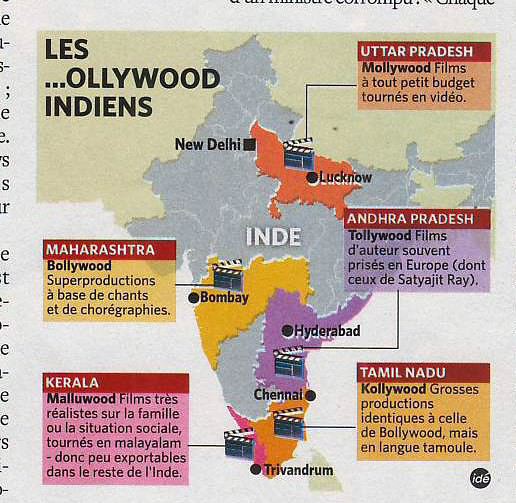
La carte que tu as jointe est extraite d'un numéro spécial de l'Express paru en décembre 2012. Elle comporte de grosses erreurs:
- confondant deux Tollywood, celui de Calcutta (Tollywood Bangla) et celui d'Hyderabad (Tollywood Telugu), elle place la légende due aux films bengalis intellos de Calcutta sur l'emplacement géographique d'Hyderabad, capitale du cinéma populaire télougou!
- elle omet que le cinéma malayali du Kérala ne s'appelle pas seulement "Malluwood" mais plus fréquemment "Mollywood", tout comme le cinéma rural à petit budget de l'Uttar Pradresh qu'elle montre.
- elle omet l'existence du cinéma kannada du Karnataka (Sandalwood, studios de Bangalore et Mysore) et du cinéma oriya de l'Orissa (Ollywood sans "h")
Et puis, elle oublie de mentionner les langues employées par la plupart des cinémas qu'elle évoque.
Je n'ai pas encore entendu parler de ce film. On va le guetter au quartier tamoul de Paris.
La carte que tu as jointe est extraite d'un numéro spécial de l'Express paru en décembre 2012. Elle comporte de grosses erreurs:
- confondant deux Tollywood, celui de Calcutta (Tollywood Bangla) et celui d'Hyderabad (Tollywood Telugu), elle place la légende due aux films bengalis intellos de Calcutta sur l'emplacement géographique d'Hyderabad, capitale du cinéma populaire télougou!
- elle omet que le cinéma malayali du Kérala ne s'appelle pas seulement "Malluwood" mais plus fréquemment "Mollywood", tout comme le cinéma rural à petit budget de l'Uttar Pradresh qu'elle montre.
- elle omet l'existence du cinéma kannada du Karnataka (Sandalwood, studios de Bangalore et Mysore) et du cinéma oriya de l'Orissa (Ollywood sans "h")
Et puis, elle oublie de mentionner les langues employées par la plupart des cinémas qu'elle évoque.
Si tu ouvres tes yeux d'enfant, le voyage commence au seuil de ta maison
Bonjour,
Dire qu'il y a un ou deux acteurs d'origine musulmane n'est pas correcte. Et à partir du moment où les musulmans représenteraient les quelques 13% de la population, ils ne peuvent avoir le monopole et Bollywood ne serait plus bollywood si tous étaient hindus, Sikhs or Musulmans. Bollywood tente de ressembler et rassembler la population pour un maximum d'impact et de profit. Après qu'ils pratiquent ou pas, c'est leurs problèmes.
Dans le top dix du moment il y a Shahrukh Khan, Salman Khan, Saif Ali Khan qui sont à l'affiche chaque année.
Il y a aussi Naseeruddin Shah, Waheeda Rehman... et bien d'autres, des mauvais et des bons comme partout ailleurs :-)
Dire qu'il y a un ou deux acteurs d'origine musulmane n'est pas correcte. Et à partir du moment où les musulmans représenteraient les quelques 13% de la population, ils ne peuvent avoir le monopole et Bollywood ne serait plus bollywood si tous étaient hindus, Sikhs or Musulmans. Bollywood tente de ressembler et rassembler la population pour un maximum d'impact et de profit. Après qu'ils pratiquent ou pas, c'est leurs problèmes.
Dans le top dix du moment il y a Shahrukh Khan, Salman Khan, Saif Ali Khan qui sont à l'affiche chaque année.
Il y a aussi Naseeruddin Shah, Waheeda Rehman... et bien d'autres, des mauvais et des bons comme partout ailleurs :-)
Nous, on vit dans un pays comme la france vachement avancée n'arrive pas ecrire un mot connu mondialement qui est "google".On est ecrit "gogol" et on critique les autres.
C'était ce qu'on appelle un jeu de mot ici en France. Chor do, koi bat nahi 😕
Shahrukh Khan
encore un film avec le mec qui fait toute les pubs a la télé , qui veut gagner des millions !! ah oui il fait des films aussi . quand est ce que quelqu'un va lui dire d'arreter la comedie a ce type , a chaque fois en inde j'ai l'impression de voir que ce mec, voilas exactement le genre de film que je zappe direct !!
celui par contre je pense bien aimé http://www.youtube.com/watch?v=njzTBH8mZLU vivement qu'il sorte sur youtube !!
et petite question , les films vous les regarder en langue indienne ou en anglais sous titré ?
sinon happy holi
ciao

encore un film avec le mec qui fait toute les pubs a la télé , qui veut gagner des millions !! ah oui il fait des films aussi . quand est ce que quelqu'un va lui dire d'arreter la comedie a ce type , a chaque fois en inde j'ai l'impression de voir que ce mec, voilas exactement le genre de film que je zappe direct !!
celui par contre je pense bien aimé http://www.youtube.com/watch?v=njzTBH8mZLU vivement qu'il sorte sur youtube !!
et petite question , les films vous les regarder en langue indienne ou en anglais sous titré ?
sinon happy holi
ciao

moi, je regarde les films en V.O. sous-titrés anglais car le sous titrage en français laisse à désirer, vraiment....
bakoly
Log in first, then come back to this page.
You might also like
Retour du Rajasthan: chaotique India!FR
Le Ladakh seulement pour les trekkeurs?FR
En Inde du Sud juste avant le confinementFR
Discovering Assam and Nagaland 2025
Le Tamil Nadu en transports en communFR
Ladakh, deux sexagénaires à l'assaut d'un 6 000FR
7-week trip feedback: Rajasthan and Varanasi, October-November-December 2025
More discussions
"400 pages of verbal pyrotechnics and animal magic" — The Times
"Bulawayo leans into exaggeration and irony to tell hard truths. *Glory* is jam-packed with comedy and farce, poking fun at an autocratic regime while illustrating the absurdity and surreal nature of a police state." — The Guardian
The cruelty and savagery of Zimbabwe’s (and Africa’s in general) "powerful animals"
Zimbabwean author NoViolet Bulawayo has written a novel that illustrates better than any documentary the complexity of colonial legacy. In doing so, she revisits George Orwell’s Animal Farm. Her novel *Glory* is a political satire about Zimbabwe—and it’s brimming with humor.
For thirty years, Zimbabwe has been stagnating under Robert Mugabe’s presidency. Human rights violations, corruption, and international sanctions have kept the population mired in poverty and oppression, while the regime exploits the meager earnings of the economy. As the 2017 elections approach, a power struggle erupts over the succession of the very elderly Father of the Nation (Mugabe). On the streets, people hope for long-awaited reforms; the people feel their moment has come.
And indeed, the army ousts Mugabe and his wife—"with her Gucci heels" (p.32)—who was positioning herself for the presidency. Hopes are dashed, however. The generals install former vice-president Emmerson Mnangagwa in power; the regime merely changes faces, but the problems remain the same.
In the novel, the country is called "Jidada, with a -da and another -da" (p.1); there’s no mistaking that this fictional state is Zimbabwe.
For *Glory*, her second novel, NoViolet Bulawayo invents a whole series of codes whose strength lies precisely in how easy they are to decipher. Like George Orwell’s Animal Farm, the characters populating Bulawayo’s universe aren’t humans but horses, goats, or crocodiles with all-too-human traits. Mugabe and Mnangagwa are horses, the spiritual leader is a pig, the soldiers are all bloodthirsty dogs, while the populace consists of goats, chickens, donkeys, and cats. The shift to the animal world serves only to better grasp the laws of despotism—and to ridicule real-life models. On one hand, the animals are humanized: they tweet, torture, travel in private jets. On the other, their greed, stupidity, and brutality stem from their animal nature.
It’s the old trick of fable: dressing men in animal disguises to make them easier to recognize. That’s how Orwell, in Animal Farm, traced how the promise of liberation from the Russian Revolution turned into Stalinist terror. In his 1945 fable, George Orwell describes how the animals of a farm drive out their farmer to organize the exploitation themselves, collectively. For a time, they truly taste freedom, but a clique of pigs ends up taking control. The central figures of the Soviet story—Stalin, Trotsky, Molotov—were easily recognizable.
Yet Bulawayo departs sharply from Orwell. She’s less concerned with precision and the force of argument than with satirical exaggeration. The deposed president is a senile old man who believes he can control even the sun’s course. The new stallion in power is a greedy debaucher. His soldiers sniff respectfully at his tail and backside.
In Bulawayo’s *Glory*, things are more complicated, but her novel also tells of a failed, incomplete liberation. In the author’s Animal Farm, Jidada, the colonial exploiters are followed by new forms of oppression. Because the former liberators become tyrants themselves. And because global power dynamics persist in neocolonial structures.
Wouldn’t that be enough to fuel a deeply depressing narrative? No—Bulawayo turns it into a blazing satire, full of wit and uncompromising criticism of power, a thread running through contemporary (not just) Zimbabwean history. The old warhorses in NoViolet Bulawayo’s Jidada, who continue to act as pack leaders, are easily recognizable as caricatures of the longtime dictator Robert Mugabe and his successor, current president Emmerson Mnangagwa.
The plot kicks off in high gear with independence day festivities. From the crack of dawn, everyone waits on Jidada Square for the Old Horse, the Father of the Nation and former liberator, whose reign "was nearing all of—not one, not two, not three, but four solid decades" (p.1). Everywhere, the colors of the Jidada Party shine; everywhere, true supporters cheer. Even the scorching sun plays its part: "At this point the sun, upon seeing arrive the leader who was decreed by God himself to rule and rule and keep ruling, a leader who'd in turn decreed the very sun to head his cheerleading squad, took a deep, deep breath and thoroughly blazed to impress" (p.2).
Finally, the Old Horse’s luxury carriage approaches "with the slowness of a hearse" (p.2), and "hoping to catch a glimpse of the legendary Father of the Nation," which causes "the animals fell over themselves like intoxicated frogs" (p.2). The sovereign’s speech is delayed a moment longer: "what I really want is a nap," groans the Old Horse as he takes his seat with such care "like his backside was made of expensive porcelain" (p.6).
Meanwhile, Bulawayo parades his entourage: the president’s wife (who earns her doctorate at Jidada University faster than "you could say diss, for dissertation. Tholukuthi it was as easy as ordering from a KFC drive-through, or perhaps even easier being that it was cheaper than KFC; it in fact cost her nothing and the degree actually came with a zero-calorie Diet Coke and a purple straw" (p.41), and she’s now known as Dr Sweet Mother. The cabinet includes "the Minister of the Revolution, the Minister of Corruption, the Minister of Order, the Minister of Things, the Minister of Nothing, the Minister of Propaganda, the Minister of Homophobic Affairs, the Minister of Disinformation and the Minister of Looting" (p.9). And of course the vice-president, who will soon become interim president when the Old Horse finally kicks the bucket—and then settle in as the new long-term president, who in the novel is called Tuvius Delight Shasha, or "Tuvy" for short (p.253), none other than Emmerson Mnangagwa. It’s him Bulawayo reserves her most merciless character description for.
"New Dispensation" (p.109) is Tuvy’s slogan for Jidada, and he loves repeating it so much he even named his parrot after it ("So inspired was Tuvy by the realisation that he rechristened his new pet parrot with the name New Dispensation—tholukuthi the bird having been acquired explicitly for the purposes of tweeting eulogies and accordingly glorifying the Saviour throughout the airs and skies of the nation. Tuvy then went on to hire a lecturer in English from the University of Jidada to teach New Dispensation to say the phrase 'New Dispensation'" p.110). But Tuvy’s Zimbabwe remains a nation without free, fair, and credible elections ("#freefairncredibleelection" p.161), and the promised equal treatment applies only insofar as Zimbabweans now queue up without discrimination in endless lines—and everyone is as poor as the next in the "queuenation" (p.283). Except for the powerful. They can "yes, tholukuthi, her immeasurable riches theirs to take. And take they did—
just take—take—take—take—take—take—take—take—take—take—take—take—take—take—take—take—take—take—take—take—take—take—take—take—take—take—take" (p.249-250).
In short: Bulawayo brilliantly depicts how former independence fighters become exploiters themselves. And how the country threatens to suffocate under the weight of corruption and repression. But she also literally stages the polyphony with which the people oppose imposed obedience to the official line.
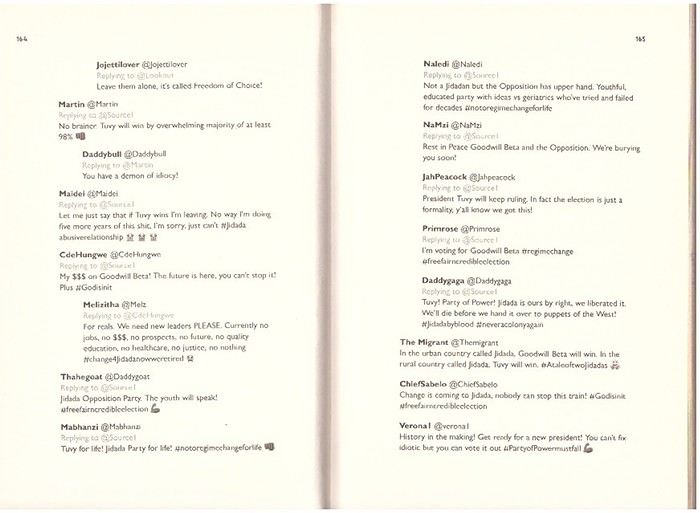
Controversial online discussions keep interrupting the narrative—dialogues and social threads (see photo below) that Bulawayo masterfully integrates. From a literary standpoint, it’s a brilliant idea. And it shows, above all, that the author’s sympathy—so likeable—goes to all those who refuse to let their dream of true freedom be stolen, not even by the corrupt elites of their own country.
In the book’s acknowledgments, the first tribute goes to "The Jidadas of the world, clamouring for freedom on many fronts—A luta continua." (p.401) This reflects the realization that, not only in Jidada-Zimbabwe but in many other corners of the world, the end of colonial domination is still far from meaning the freedom hoped for by the vast majority of people. But it also means, more broadly, that this freedom must be won "on many fronts" (see above), both domestically and geopolitically.
That’s precisely what *Glory* so vividly highlights: how complex the project behind the term "postcolonialism" really is. With *Glory*, Bulawayo also delivers a scathing critique of the persistence of colonial mindsets in the West.
In the novel, the murder of George Floyd, racist police violence, and white-supremacist ideology in Trump’s United States perfectly illustrate the persistence of racism. It’s especially in the final chapters that Bulawayo lets Jidada’s inhabitants explicitly and unflinchingly criticize a neocolonial world order:
"It was not lost on us how the West, which loved to 'save' Africa and announce every action to the whole world, did so with one limb while manipulating, looting and fleecing us with the rest of its limbs so that more money in fact poured out of the continent than trickled in." (p.376)
"It was no mistake that multinational corporations yearly reaped and shipped colossal profits from Africa back to their countries as had been the case during colonial times. Even the sticks and stones would tell you that the African earth at any given time howled and shook and heaved from the extraction of its precious minerals that rarely benefited its own miserable children." (p.376)
"(...) we vowed to wage yet another war for Africa's second Liberation from neocolonial oppression. From exploitation. From plunder. From Western dominion. From indignity. From Abuse. We wanted real freedom. We wanted greedy, thieving paws off our wealth. We wanted Justice. We wanted a new world; we wanted a brand-new world so much we didn't sleep a wink that night." (p.377)
The Jidadas of this world must fight two enemies: Western neocolonialism and the autocratic instrumentalization of that argument; the persistence of Western racism and the populist appropriation of that humiliation by tyrants from their own ranks. Neither of these obstacles to freedom diminishes the historical and current guilt of the other. But the path to postcolonial liberation must overcome all these forms of oppression. After all, the colonizers didn’t bequeath democracies to formerly dominated nations, but instability and the principles of oppression and exploitation—which the so-called liberators have also internalized. Yet the fact that a satirical novel can capture the complexity of historical relationships while remaining, despite all the darkness of the subject, hilarious—well, that’s truly astonishing.
Finally, *Glory* ties into a major trauma in Zimbabwe’s post-independence history: the so-called Gukurahundi massacres. Between 1983 and 1987, tens of thousands of civilians were murdered by Mugabe’s bloody henchmen, most of them Ndebele. The State Security Minister and head of secret services at the time? You guessed it—Emmerson Mnangagwa.
When *Glory* turns to the massacres, the novel’s tone shifts completely. The story is now told through the narrative of the goat called Destiny, who, like NoViolet Bulawayo herself, left her home country at 18 for the United States and only returned after 13 years. In the book, the city of Bulawayo becomes a village where Destiny retraces her family’s history—and learns that part of it was also brutally murdered during the massacres.
The abuse of power and life under a dictatorship, dispossession, and a fiercely proud awareness of the psychological wounds and emotional vulnerability of a uprooted and disenfranchised people who had to forge a new language—a new set of names—to express their lived experiences are at the heart of this wonderful Zimbabwean author’s literary work, NoViolet Bulawayo. Shortly after her studies, she was already writing short stories about postcolonial power dynamics in Africa. But her playful, masterful, and often unconventional approach to language also plays a key role in her work. With virtuosity, she shifts from cynical images of power-obsessed elites to compassionate descriptions of the people’s suffering, ending with a hopeful sermon on courage—the courage to break free from fear and thus gain the strength for change ("And every one of them understood that whatever they heard within those hearts was the new national anthem, tholukuthi an anthem that spoke of the kind of glory that burns eternal and glows with living light." p.400). This novel is a genuine pleasure to read. And it’s exceptional. Good, African...
Book info (original English and German translation):
NoViolet Bulawayo. Glory. Chatto & Windus, 2022. NoViolet Bulawayo. Glory. Suhrkamp, 2023.
Hery
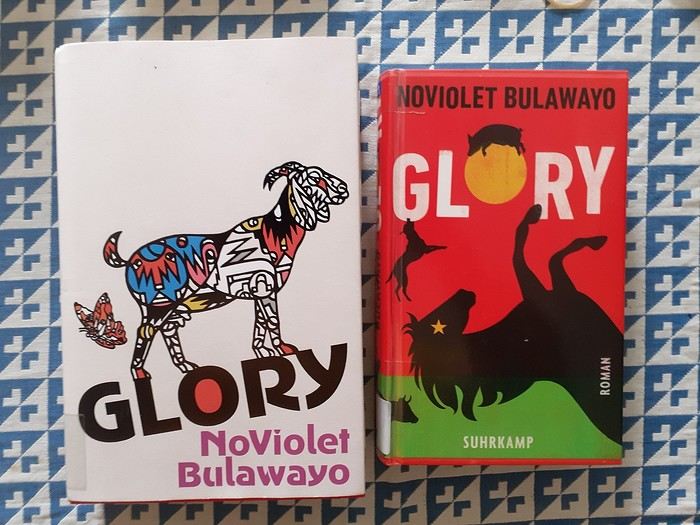
The books (in English, in German)
Author NoViolet Bulawayo, Zimbabwe
Threads (p.164-165)
"Bulawayo leans into exaggeration and irony to tell hard truths. *Glory* is jam-packed with comedy and farce, poking fun at an autocratic regime while illustrating the absurdity and surreal nature of a police state." — The Guardian
The cruelty and savagery of Zimbabwe’s (and Africa’s in general) "powerful animals"
Zimbabwean author NoViolet Bulawayo has written a novel that illustrates better than any documentary the complexity of colonial legacy. In doing so, she revisits George Orwell’s Animal Farm. Her novel *Glory* is a political satire about Zimbabwe—and it’s brimming with humor.
For thirty years, Zimbabwe has been stagnating under Robert Mugabe’s presidency. Human rights violations, corruption, and international sanctions have kept the population mired in poverty and oppression, while the regime exploits the meager earnings of the economy. As the 2017 elections approach, a power struggle erupts over the succession of the very elderly Father of the Nation (Mugabe). On the streets, people hope for long-awaited reforms; the people feel their moment has come.
And indeed, the army ousts Mugabe and his wife—"with her Gucci heels" (p.32)—who was positioning herself for the presidency. Hopes are dashed, however. The generals install former vice-president Emmerson Mnangagwa in power; the regime merely changes faces, but the problems remain the same.
In the novel, the country is called "Jidada, with a -da and another -da" (p.1); there’s no mistaking that this fictional state is Zimbabwe.
For *Glory*, her second novel, NoViolet Bulawayo invents a whole series of codes whose strength lies precisely in how easy they are to decipher. Like George Orwell’s Animal Farm, the characters populating Bulawayo’s universe aren’t humans but horses, goats, or crocodiles with all-too-human traits. Mugabe and Mnangagwa are horses, the spiritual leader is a pig, the soldiers are all bloodthirsty dogs, while the populace consists of goats, chickens, donkeys, and cats. The shift to the animal world serves only to better grasp the laws of despotism—and to ridicule real-life models. On one hand, the animals are humanized: they tweet, torture, travel in private jets. On the other, their greed, stupidity, and brutality stem from their animal nature.
It’s the old trick of fable: dressing men in animal disguises to make them easier to recognize. That’s how Orwell, in Animal Farm, traced how the promise of liberation from the Russian Revolution turned into Stalinist terror. In his 1945 fable, George Orwell describes how the animals of a farm drive out their farmer to organize the exploitation themselves, collectively. For a time, they truly taste freedom, but a clique of pigs ends up taking control. The central figures of the Soviet story—Stalin, Trotsky, Molotov—were easily recognizable.
Yet Bulawayo departs sharply from Orwell. She’s less concerned with precision and the force of argument than with satirical exaggeration. The deposed president is a senile old man who believes he can control even the sun’s course. The new stallion in power is a greedy debaucher. His soldiers sniff respectfully at his tail and backside.
In Bulawayo’s *Glory*, things are more complicated, but her novel also tells of a failed, incomplete liberation. In the author’s Animal Farm, Jidada, the colonial exploiters are followed by new forms of oppression. Because the former liberators become tyrants themselves. And because global power dynamics persist in neocolonial structures.
Wouldn’t that be enough to fuel a deeply depressing narrative? No—Bulawayo turns it into a blazing satire, full of wit and uncompromising criticism of power, a thread running through contemporary (not just) Zimbabwean history. The old warhorses in NoViolet Bulawayo’s Jidada, who continue to act as pack leaders, are easily recognizable as caricatures of the longtime dictator Robert Mugabe and his successor, current president Emmerson Mnangagwa.
The plot kicks off in high gear with independence day festivities. From the crack of dawn, everyone waits on Jidada Square for the Old Horse, the Father of the Nation and former liberator, whose reign "was nearing all of—not one, not two, not three, but four solid decades" (p.1). Everywhere, the colors of the Jidada Party shine; everywhere, true supporters cheer. Even the scorching sun plays its part: "At this point the sun, upon seeing arrive the leader who was decreed by God himself to rule and rule and keep ruling, a leader who'd in turn decreed the very sun to head his cheerleading squad, took a deep, deep breath and thoroughly blazed to impress" (p.2).
Finally, the Old Horse’s luxury carriage approaches "with the slowness of a hearse" (p.2), and "hoping to catch a glimpse of the legendary Father of the Nation," which causes "the animals fell over themselves like intoxicated frogs" (p.2). The sovereign’s speech is delayed a moment longer: "what I really want is a nap," groans the Old Horse as he takes his seat with such care "like his backside was made of expensive porcelain" (p.6).
Meanwhile, Bulawayo parades his entourage: the president’s wife (who earns her doctorate at Jidada University faster than "you could say diss, for dissertation. Tholukuthi it was as easy as ordering from a KFC drive-through, or perhaps even easier being that it was cheaper than KFC; it in fact cost her nothing and the degree actually came with a zero-calorie Diet Coke and a purple straw" (p.41), and she’s now known as Dr Sweet Mother. The cabinet includes "the Minister of the Revolution, the Minister of Corruption, the Minister of Order, the Minister of Things, the Minister of Nothing, the Minister of Propaganda, the Minister of Homophobic Affairs, the Minister of Disinformation and the Minister of Looting" (p.9). And of course the vice-president, who will soon become interim president when the Old Horse finally kicks the bucket—and then settle in as the new long-term president, who in the novel is called Tuvius Delight Shasha, or "Tuvy" for short (p.253), none other than Emmerson Mnangagwa. It’s him Bulawayo reserves her most merciless character description for.
"New Dispensation" (p.109) is Tuvy’s slogan for Jidada, and he loves repeating it so much he even named his parrot after it ("So inspired was Tuvy by the realisation that he rechristened his new pet parrot with the name New Dispensation—tholukuthi the bird having been acquired explicitly for the purposes of tweeting eulogies and accordingly glorifying the Saviour throughout the airs and skies of the nation. Tuvy then went on to hire a lecturer in English from the University of Jidada to teach New Dispensation to say the phrase 'New Dispensation'" p.110). But Tuvy’s Zimbabwe remains a nation without free, fair, and credible elections ("#freefairncredibleelection" p.161), and the promised equal treatment applies only insofar as Zimbabweans now queue up without discrimination in endless lines—and everyone is as poor as the next in the "queuenation" (p.283). Except for the powerful. They can "yes, tholukuthi, her immeasurable riches theirs to take. And take they did—
just take—take—take—take—take—take—take—take—take—take—take—take—take—take—take—take—take—take—take—take—take—take—take—take—take—take—take" (p.249-250).
In short: Bulawayo brilliantly depicts how former independence fighters become exploiters themselves. And how the country threatens to suffocate under the weight of corruption and repression. But she also literally stages the polyphony with which the people oppose imposed obedience to the official line.
Controversial online discussions keep interrupting the narrative—dialogues and social threads (see photo below) that Bulawayo masterfully integrates. From a literary standpoint, it’s a brilliant idea. And it shows, above all, that the author’s sympathy—so likeable—goes to all those who refuse to let their dream of true freedom be stolen, not even by the corrupt elites of their own country.
In the book’s acknowledgments, the first tribute goes to "The Jidadas of the world, clamouring for freedom on many fronts—A luta continua." (p.401) This reflects the realization that, not only in Jidada-Zimbabwe but in many other corners of the world, the end of colonial domination is still far from meaning the freedom hoped for by the vast majority of people. But it also means, more broadly, that this freedom must be won "on many fronts" (see above), both domestically and geopolitically.
That’s precisely what *Glory* so vividly highlights: how complex the project behind the term "postcolonialism" really is. With *Glory*, Bulawayo also delivers a scathing critique of the persistence of colonial mindsets in the West.
In the novel, the murder of George Floyd, racist police violence, and white-supremacist ideology in Trump’s United States perfectly illustrate the persistence of racism. It’s especially in the final chapters that Bulawayo lets Jidada’s inhabitants explicitly and unflinchingly criticize a neocolonial world order:
"It was not lost on us how the West, which loved to 'save' Africa and announce every action to the whole world, did so with one limb while manipulating, looting and fleecing us with the rest of its limbs so that more money in fact poured out of the continent than trickled in." (p.376)
"It was no mistake that multinational corporations yearly reaped and shipped colossal profits from Africa back to their countries as had been the case during colonial times. Even the sticks and stones would tell you that the African earth at any given time howled and shook and heaved from the extraction of its precious minerals that rarely benefited its own miserable children." (p.376)
"(...) we vowed to wage yet another war for Africa's second Liberation from neocolonial oppression. From exploitation. From plunder. From Western dominion. From indignity. From Abuse. We wanted real freedom. We wanted greedy, thieving paws off our wealth. We wanted Justice. We wanted a new world; we wanted a brand-new world so much we didn't sleep a wink that night." (p.377)
The Jidadas of this world must fight two enemies: Western neocolonialism and the autocratic instrumentalization of that argument; the persistence of Western racism and the populist appropriation of that humiliation by tyrants from their own ranks. Neither of these obstacles to freedom diminishes the historical and current guilt of the other. But the path to postcolonial liberation must overcome all these forms of oppression. After all, the colonizers didn’t bequeath democracies to formerly dominated nations, but instability and the principles of oppression and exploitation—which the so-called liberators have also internalized. Yet the fact that a satirical novel can capture the complexity of historical relationships while remaining, despite all the darkness of the subject, hilarious—well, that’s truly astonishing.
Finally, *Glory* ties into a major trauma in Zimbabwe’s post-independence history: the so-called Gukurahundi massacres. Between 1983 and 1987, tens of thousands of civilians were murdered by Mugabe’s bloody henchmen, most of them Ndebele. The State Security Minister and head of secret services at the time? You guessed it—Emmerson Mnangagwa.
When *Glory* turns to the massacres, the novel’s tone shifts completely. The story is now told through the narrative of the goat called Destiny, who, like NoViolet Bulawayo herself, left her home country at 18 for the United States and only returned after 13 years. In the book, the city of Bulawayo becomes a village where Destiny retraces her family’s history—and learns that part of it was also brutally murdered during the massacres.
The abuse of power and life under a dictatorship, dispossession, and a fiercely proud awareness of the psychological wounds and emotional vulnerability of a uprooted and disenfranchised people who had to forge a new language—a new set of names—to express their lived experiences are at the heart of this wonderful Zimbabwean author’s literary work, NoViolet Bulawayo. Shortly after her studies, she was already writing short stories about postcolonial power dynamics in Africa. But her playful, masterful, and often unconventional approach to language also plays a key role in her work. With virtuosity, she shifts from cynical images of power-obsessed elites to compassionate descriptions of the people’s suffering, ending with a hopeful sermon on courage—the courage to break free from fear and thus gain the strength for change ("And every one of them understood that whatever they heard within those hearts was the new national anthem, tholukuthi an anthem that spoke of the kind of glory that burns eternal and glows with living light." p.400). This novel is a genuine pleasure to read. And it’s exceptional. Good, African...
Book info (original English and German translation):
NoViolet Bulawayo. Glory. Chatto & Windus, 2022. NoViolet Bulawayo. Glory. Suhrkamp, 2023.
Hery
The books (in English, in German)
Author NoViolet Bulawayo, Zimbabwe
Threads (p.164-165)“When the Whites came to Africa, we had the land and they had the Bible. They taught us to pray with our eyes closed: when we opened them, the Whites had the land and we had the Bible.” Jomo Kenyatta (p.7)
The Maggi cube, an unchallenged hegemony, and so much more
“The hopeless continent,” headlined The Economist, a British magazine, in July 2000 about Africa. Eleven years later, the same magazine headlined “Africa rising” instead. Images of Africa in the prosperous North constantly oscillate between apocalyptic scenarios and enthusiastic projections. A key issue with such images lies in the generalization they entail. If you look at the continent, considerable contrasts emerge depending on space and time. It’s no surprise that a region of the world encompassing such diverse ecological zones, maintaining such varied ties with other continents, comprising nearly fifty nation-states in sub-Saharan Africa alone, and characterized by a great diversity of languages, belief systems, and historical paths, doesn’t share a single destiny.
And yet, for many people outside Africa, as well as for many Africans, the continent constitutes a single entity, defined by criteria such as skin color, a colonial past, poverty, and the art of survival. Until now, these perspectives were generally accompanied by the idea that Africa had to—or should have—followed a single path together, sometimes called development, sometimes modernization, sometimes liberation, then a market economy. None of these paths delivered on their promises.
The two writers Alain Mabanckou and Abdourahman Waberi—one from Congo, the other raised in Djibouti, both long settled in France and now professors at renowned North American universities (Los Angeles, Washington)—have had enough of pessimistic scenarios: “We are aware that Africa is in the world and the world is in Africa. The same goes for all other continents, as our destinies are inextricably linked for better or worse. We refuse to see Africa as a reservoir of misfortunes or a continent cursed by atavistic misfortune and characterized by ethnic conflicts. [...] It’s this passionate flame we wanted to capture in a book [...] a kind of stroll through African cultures, without any demands, each letter of the alphabet leading us to a notion, a practice, a concept, a moment in history, literature, painting, politics, economics, cuisine, etc.” (p.10-11). Africa, they write, is on the verge of “imposing a signature, a style, a way of being in the world and in relation to the rest of the world.” (p.11) To put words to the continent’s diversity and dynamism, the two authors created a “rambling ABC,” a kind of portrait—or more precisely, a mythography—that lets you see and feel the pulse of a vast continent whose cultural power is unfolding before our eyes. Once marginalized or even mocked, the voice and importance of the Continent in global affairs are now undeniable” (p.11), containing over a hundred entries, mostly concise, written in a relaxed and casual style. The optimistic, even exuberant tone is set from the brief introduction. The duo of authors wants to “sing a love song to the cultures of our continent, to its inhabitants past and present, to its exceptional resources and its spectacular globalization despite a certain pollution that still clouds our skies due to the unmatched duration of dictatorships in some of our regions.” (p.12) In doing so, they don’t want to be too distracted by today’s Afewerki-Biya-Bongo-Déby & Co. ...
Of course, you’ll find tributes to great precursors like Frantz Fanon (“[...] it was a love story and admiration that wasn’t dimmed by the four decades separating his birth from ours. Let’s add that we were born while the native of Fort-de-France had left the world’s stage four years earlier, in the prime of life” p.141), Mongo Beti (“You must read and reread Mongo Beti, a genius who used his fame to support often just causes in Africa, like defending oppressed groups. His place is already in History. His oppressors, like the dictators Ahmadou Ahidjo and Paul Biya, can’t compete in the same category” p.64), the Malian Amadou Hampâté Bâ
(“Posterity remembers him mainly as an tireless defender of African cultures. His plea for the collection and preservation of traditional African knowledge remains a major event for all men and women of good will. One day in 1960, at the UNESCO podium, the native of Bandiagara sounded the alarm: ‘[...] Since we’ve admitted that the humanity of each people is the heritage of all humanity, if African traditions aren’t collected in time and written down, they’ll one day be missing from the universal archives of humanity.’” p.51),
Kwame Nkrumah, “one of the founders of Pan-Africanism, father of Ghana’s independence” (p.239), as well as the historian Cheikh Anta Diop, the writer, poet, and politician Aimé Césaire, and the economist and thinker Samir Amin, but also very warm tributes to certain contemporary African intellectuals like Souleymane Bachir Diagne and Achille Mbembe
(“A few years ago, in dominant economic circles, a rumor often resurfaced, usually disguised as a cold and scientifically proven analysis: Africa is useless. It’s a burden for the rest of the human community. With its 2% share in world trade, it would disappear from stock market radars without anyone noticing. So? Maybe it’ll be pulled up by other continents. Wanting to surpass itself is a crazy bet for Africans, they concluded. Arrogant or clueless, President Nicolas Sarkozy declared before an audience of students and teachers at Cheikh Anta Diop University in Dakar: ‘The African man hasn’t entered history enough [...] He only knows the eternal repetition of time marked by the endless repetition of the same gestures and words.’ That was in 2007. For decades, armed only with reason, an intellectual often steps up to debunk prejudices, lazy readings, and dishonest frameworks used as false fronts by those who, like Nicolas Sarkozy or former journalist Stephen Smith, out of ignorance, contempt, or condescension, distort African reality. This intellectual is none other than the historian and political scientist Achille Mbembe. This heir of Frantz Fanon, Amílcar Cabral, Jean-Marc Ela, and Fabien Eboussi-Boulaga was born in 1957 in Cameroon, in the Bassa region. Marked early by the upheavals of a fratricidal war, Achille Mbembe became the guardian of the memory of martyrs. After brilliant studies in Paris, he went on to teach at the best American universities, but the call of the Continent was stronger than anything else. In Dakar, he once directed CODESRIA (Council for the Development of Social Science Research in Africa) before joining the University of the Witwatersrand in Johannesburg, South Africa. Even though the author of *Critique of Black Reason* (Éditions La Découverte, 2015) spends a few months at Duke University in North Carolina, his observation post remains South Africa. From Johannesburg, Achille Mbembe scrutinizes Africa and the whole world. A lucid observer with an elegant and generous pen, Achille Mbembe knows how to blend big and small history: ‘I was born one day in July, as the month was drawing to a close. It was 1957, in that part of Africa recently named ‘Cameroon,’ a memory of the wonder that seized Portuguese sailors in the 15th century when, sailing up the river near Douala, they couldn’t help but note the presence of a multitude of crustaceans, and named it *Rio dos Camarões*, meaning ‘River of Shrimp.’ I grew up in the shadow of this nameless land, since, in a way, the name it bears is only the product of someone else’s astonishment: a lexical mistake, if you will.’ From this mistake or wound, he made leaven, a springboard to compose a rich work, recognized worldwide. To denounce barriers and barbarians too. But that’s not enough. Among his peers in circles of thought and action, Achille Mbembe passionately and consistently defends human dignity and the beauty of the world. In doing so, he fulfills the mission Frantz Fanon entrusted to him.” (p.227-229),
as well as entries dedicated to lesser-known artists and intellectuals, like the French journalist and activist Rokhaya Diallo, daughter of Senegalese and Gambian parents, or the Ethiopian filmmaker Haile Gerima, who has long lived in the United States. Other names from politics, sports, music, art, and literature: Kofi Annan, p.36; Barack Obama, p.243; Thomas Sankara, p.277; Ousmane Sow, p.285; Yambo Ouologuem, p.250; Léopold Sédar Senghor, p.282; Muhammad Ali, p.30; Nuruddin Farah, p.146; Salif Keita, p.203; Ahmadou Kourouma, p.206; Ngũgĩ wa Thiong’o, p.236; Winnie Mandela, p.224; Kylian Mbappé, p.226 ...
The authors, who resolutely commit to a “mythography” (p.11) of Africa, also pay special attention to local social movements, cultural events, and aspects of daily life. *Y’en a marre*, “which also meant ‘we’re fed up with sitting on our hands’” (p.320-321), emerged about a decade ago in Senegal as a citizen movement of peaceful resistance and symbolizes, the authors emphasize, the fact that African youth are increasingly fed up “with the political circus deployed in Africa since independence, as our parents would say, ‘since the White man left’...” (p.321). A full entry is dedicated to the Maggi bouillon cube, which has flooded African markets for about forty years and enjoys immense popularity (“It’s everywhere in Africa, from Dakar to Djibouti, and from Tangier to Cape Town. It’s in every pot, every stew. Little hands put it in every sauce, every local or adapted dish. An unchallenged hegemony! You’ll find it in diasporas too. The culinary strolls in Paris, in the [...] neighborhood” p.90). Critics blame it not only for impoverishing the aromatic diversity of local dishes but also for being harmful to health. And yet, “he poorest Africans, those who eat only once a day, a few spoonfuls of white beans and a ball of *foufou*, for example, are the most fervent users of the magic cube.” (p.92-93)
For *fonio*, “the new trendy cereal. [...] From the millet family, fonio is probably the oldest cereal cultivated in West Africa, and mainly in its sub-Saharan part, for millennia. [...] Easy to grow, water-efficient, fonio grows everywhere except on clay soils. Long neglected because it was considered the poor man’s crop, fonio is now a source of pride for the farmers who cultivate it and cherish it like the apple of their eye” (p.156-157), the authors immediately offer a detailed recipe, letting the reader know that “e can’t resist sharing this fonio with chicken recipe from Mali with you:
Ingredients: 1 chicken 3 large ripe red tomatoes 4 tbsp tomato paste 4 large onions 1 garlic clove 1/2 cup oil 2 Maggi cubes or salt 2 large carrots 1 turnip 1 large cabbage 2 large potatoes 1 celery stalk 1 packet pre-cooked fonio 4 okra (or okra powder) salt, pepper
Preparation: 1. Prepare the sauce: wash and cut the chicken. Peel the onions, garlic, and vegetables. 2. In a pot, fry the chicken pieces. 3. Dice the onions, tomatoes, carrots, and turnip very small and add them to the pot. 4. Add the tomato paste, salt, and pepper. 5. Simmer for 15 min, then add 2 L of water and the cooked chicken pieces. 6. Simmer for 30 min, then add the crushed garlic and celery, plus the cabbage cut into 4 and the potatoes cut in half. 7. Prepare the fonio: cover it with warm water, let it rest for 15 min, and cook it over low heat. 8. In a small pot, boil the okra and crush them. 9. Mix the crushed okra with the cooked fonio, then salt. Serve hot.” (p.158-159)
The comedy *Black Mic Mac*, released in French theaters in 1986 and addressing France’s increasingly restrictive immigration policy at the time, also gets an entry, as do *Tintin in the Congo*, the popular comic, and *Jip’s Café* (“[...] a little Africa in the heart of Paris, with passersby stopping to admire the ‘ambianceurs’ on the dance floor or attend the cultural events offered by the place” (p.194), an African establishment in Paris that Alain Mabanckou already immortalized in one of his novels.
The duo of authors also tackles thorny subjects like jihadism (p.119), the Rwandan genocide (p.272), the CFA franc (p.82), and dictatorship (p.110). While the two strike the right tone here, many entries leave a slightly bitter taste. Two examples: why doesn’t the text on Barack Obama mention the great disappointment of many people in Africa, who expected more from the African policy of the first U.S. president with African roots than just occasional warm words? Why do the comments on Winnie Mandela gloss over the fact that she was a highly controversial icon of the anti-apartheid movement due to her involvement in kidnappings, acts of torture, and murders of alleged apartheid collaborators? Instead, there’s a compassion that brings tears to the eyes: “She was often reduced to a secondary role, the wife of a great man” or “When victory came, she didn’t taste its fruits. Divorced, isolated. She would never be a ‘first lady’ in an evening gown, posing before a bed of chrysanthemums. They’d keep her far from the circles of power” (p.224-225). At this point, I would’ve liked the authors to take a slightly more critical stance...
That said, these “weaknesses” (if you can call them that) shouldn’t overshadow the book as a whole. It remains an informative, sometimes very entertaining, and often even original work in its own way.
Book information (the original French and the German translation):
Alain Mabanckou/Abdourahman Waberi. Dictionnaire enjoué des cultures africaines. Fayard, 2019. Alain Mabanckou/Abdourahman Waberi. Der Puls Afrikas. Eine Liebeserklärung von A bis Z. Reclam, 2022.
Hery
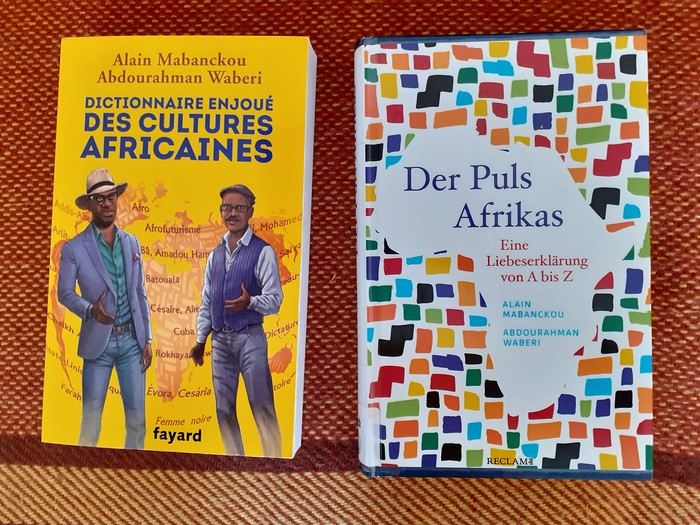
The Maggi cube, an unchallenged hegemony, and so much more
“The hopeless continent,” headlined The Economist, a British magazine, in July 2000 about Africa. Eleven years later, the same magazine headlined “Africa rising” instead. Images of Africa in the prosperous North constantly oscillate between apocalyptic scenarios and enthusiastic projections. A key issue with such images lies in the generalization they entail. If you look at the continent, considerable contrasts emerge depending on space and time. It’s no surprise that a region of the world encompassing such diverse ecological zones, maintaining such varied ties with other continents, comprising nearly fifty nation-states in sub-Saharan Africa alone, and characterized by a great diversity of languages, belief systems, and historical paths, doesn’t share a single destiny.
And yet, for many people outside Africa, as well as for many Africans, the continent constitutes a single entity, defined by criteria such as skin color, a colonial past, poverty, and the art of survival. Until now, these perspectives were generally accompanied by the idea that Africa had to—or should have—followed a single path together, sometimes called development, sometimes modernization, sometimes liberation, then a market economy. None of these paths delivered on their promises.
The two writers Alain Mabanckou and Abdourahman Waberi—one from Congo, the other raised in Djibouti, both long settled in France and now professors at renowned North American universities (Los Angeles, Washington)—have had enough of pessimistic scenarios: “We are aware that Africa is in the world and the world is in Africa. The same goes for all other continents, as our destinies are inextricably linked for better or worse. We refuse to see Africa as a reservoir of misfortunes or a continent cursed by atavistic misfortune and characterized by ethnic conflicts. [...] It’s this passionate flame we wanted to capture in a book [...] a kind of stroll through African cultures, without any demands, each letter of the alphabet leading us to a notion, a practice, a concept, a moment in history, literature, painting, politics, economics, cuisine, etc.” (p.10-11). Africa, they write, is on the verge of “imposing a signature, a style, a way of being in the world and in relation to the rest of the world.” (p.11) To put words to the continent’s diversity and dynamism, the two authors created a “rambling ABC,” a kind of portrait—or more precisely, a mythography—that lets you see and feel the pulse of a vast continent whose cultural power is unfolding before our eyes. Once marginalized or even mocked, the voice and importance of the Continent in global affairs are now undeniable” (p.11), containing over a hundred entries, mostly concise, written in a relaxed and casual style. The optimistic, even exuberant tone is set from the brief introduction. The duo of authors wants to “sing a love song to the cultures of our continent, to its inhabitants past and present, to its exceptional resources and its spectacular globalization despite a certain pollution that still clouds our skies due to the unmatched duration of dictatorships in some of our regions.” (p.12) In doing so, they don’t want to be too distracted by today’s Afewerki-Biya-Bongo-Déby & Co. ...
Of course, you’ll find tributes to great precursors like Frantz Fanon (“[...] it was a love story and admiration that wasn’t dimmed by the four decades separating his birth from ours. Let’s add that we were born while the native of Fort-de-France had left the world’s stage four years earlier, in the prime of life” p.141), Mongo Beti (“You must read and reread Mongo Beti, a genius who used his fame to support often just causes in Africa, like defending oppressed groups. His place is already in History. His oppressors, like the dictators Ahmadou Ahidjo and Paul Biya, can’t compete in the same category” p.64), the Malian Amadou Hampâté Bâ
(“Posterity remembers him mainly as an tireless defender of African cultures. His plea for the collection and preservation of traditional African knowledge remains a major event for all men and women of good will. One day in 1960, at the UNESCO podium, the native of Bandiagara sounded the alarm: ‘[...] Since we’ve admitted that the humanity of each people is the heritage of all humanity, if African traditions aren’t collected in time and written down, they’ll one day be missing from the universal archives of humanity.’” p.51),
Kwame Nkrumah, “one of the founders of Pan-Africanism, father of Ghana’s independence” (p.239), as well as the historian Cheikh Anta Diop, the writer, poet, and politician Aimé Césaire, and the economist and thinker Samir Amin, but also very warm tributes to certain contemporary African intellectuals like Souleymane Bachir Diagne and Achille Mbembe
(“A few years ago, in dominant economic circles, a rumor often resurfaced, usually disguised as a cold and scientifically proven analysis: Africa is useless. It’s a burden for the rest of the human community. With its 2% share in world trade, it would disappear from stock market radars without anyone noticing. So? Maybe it’ll be pulled up by other continents. Wanting to surpass itself is a crazy bet for Africans, they concluded. Arrogant or clueless, President Nicolas Sarkozy declared before an audience of students and teachers at Cheikh Anta Diop University in Dakar: ‘The African man hasn’t entered history enough [...] He only knows the eternal repetition of time marked by the endless repetition of the same gestures and words.’ That was in 2007. For decades, armed only with reason, an intellectual often steps up to debunk prejudices, lazy readings, and dishonest frameworks used as false fronts by those who, like Nicolas Sarkozy or former journalist Stephen Smith, out of ignorance, contempt, or condescension, distort African reality. This intellectual is none other than the historian and political scientist Achille Mbembe. This heir of Frantz Fanon, Amílcar Cabral, Jean-Marc Ela, and Fabien Eboussi-Boulaga was born in 1957 in Cameroon, in the Bassa region. Marked early by the upheavals of a fratricidal war, Achille Mbembe became the guardian of the memory of martyrs. After brilliant studies in Paris, he went on to teach at the best American universities, but the call of the Continent was stronger than anything else. In Dakar, he once directed CODESRIA (Council for the Development of Social Science Research in Africa) before joining the University of the Witwatersrand in Johannesburg, South Africa. Even though the author of *Critique of Black Reason* (Éditions La Découverte, 2015) spends a few months at Duke University in North Carolina, his observation post remains South Africa. From Johannesburg, Achille Mbembe scrutinizes Africa and the whole world. A lucid observer with an elegant and generous pen, Achille Mbembe knows how to blend big and small history: ‘I was born one day in July, as the month was drawing to a close. It was 1957, in that part of Africa recently named ‘Cameroon,’ a memory of the wonder that seized Portuguese sailors in the 15th century when, sailing up the river near Douala, they couldn’t help but note the presence of a multitude of crustaceans, and named it *Rio dos Camarões*, meaning ‘River of Shrimp.’ I grew up in the shadow of this nameless land, since, in a way, the name it bears is only the product of someone else’s astonishment: a lexical mistake, if you will.’ From this mistake or wound, he made leaven, a springboard to compose a rich work, recognized worldwide. To denounce barriers and barbarians too. But that’s not enough. Among his peers in circles of thought and action, Achille Mbembe passionately and consistently defends human dignity and the beauty of the world. In doing so, he fulfills the mission Frantz Fanon entrusted to him.” (p.227-229),
as well as entries dedicated to lesser-known artists and intellectuals, like the French journalist and activist Rokhaya Diallo, daughter of Senegalese and Gambian parents, or the Ethiopian filmmaker Haile Gerima, who has long lived in the United States. Other names from politics, sports, music, art, and literature: Kofi Annan, p.36; Barack Obama, p.243; Thomas Sankara, p.277; Ousmane Sow, p.285; Yambo Ouologuem, p.250; Léopold Sédar Senghor, p.282; Muhammad Ali, p.30; Nuruddin Farah, p.146; Salif Keita, p.203; Ahmadou Kourouma, p.206; Ngũgĩ wa Thiong’o, p.236; Winnie Mandela, p.224; Kylian Mbappé, p.226 ...
The authors, who resolutely commit to a “mythography” (p.11) of Africa, also pay special attention to local social movements, cultural events, and aspects of daily life. *Y’en a marre*, “which also meant ‘we’re fed up with sitting on our hands’” (p.320-321), emerged about a decade ago in Senegal as a citizen movement of peaceful resistance and symbolizes, the authors emphasize, the fact that African youth are increasingly fed up “with the political circus deployed in Africa since independence, as our parents would say, ‘since the White man left’...” (p.321). A full entry is dedicated to the Maggi bouillon cube, which has flooded African markets for about forty years and enjoys immense popularity (“It’s everywhere in Africa, from Dakar to Djibouti, and from Tangier to Cape Town. It’s in every pot, every stew. Little hands put it in every sauce, every local or adapted dish. An unchallenged hegemony! You’ll find it in diasporas too. The culinary strolls in Paris, in the [...] neighborhood” p.90). Critics blame it not only for impoverishing the aromatic diversity of local dishes but also for being harmful to health. And yet, “he poorest Africans, those who eat only once a day, a few spoonfuls of white beans and a ball of *foufou*, for example, are the most fervent users of the magic cube.” (p.92-93)
For *fonio*, “the new trendy cereal. [...] From the millet family, fonio is probably the oldest cereal cultivated in West Africa, and mainly in its sub-Saharan part, for millennia. [...] Easy to grow, water-efficient, fonio grows everywhere except on clay soils. Long neglected because it was considered the poor man’s crop, fonio is now a source of pride for the farmers who cultivate it and cherish it like the apple of their eye” (p.156-157), the authors immediately offer a detailed recipe, letting the reader know that “e can’t resist sharing this fonio with chicken recipe from Mali with you:
Ingredients: 1 chicken 3 large ripe red tomatoes 4 tbsp tomato paste 4 large onions 1 garlic clove 1/2 cup oil 2 Maggi cubes or salt 2 large carrots 1 turnip 1 large cabbage 2 large potatoes 1 celery stalk 1 packet pre-cooked fonio 4 okra (or okra powder) salt, pepper
Preparation: 1. Prepare the sauce: wash and cut the chicken. Peel the onions, garlic, and vegetables. 2. In a pot, fry the chicken pieces. 3. Dice the onions, tomatoes, carrots, and turnip very small and add them to the pot. 4. Add the tomato paste, salt, and pepper. 5. Simmer for 15 min, then add 2 L of water and the cooked chicken pieces. 6. Simmer for 30 min, then add the crushed garlic and celery, plus the cabbage cut into 4 and the potatoes cut in half. 7. Prepare the fonio: cover it with warm water, let it rest for 15 min, and cook it over low heat. 8. In a small pot, boil the okra and crush them. 9. Mix the crushed okra with the cooked fonio, then salt. Serve hot.” (p.158-159)
The comedy *Black Mic Mac*, released in French theaters in 1986 and addressing France’s increasingly restrictive immigration policy at the time, also gets an entry, as do *Tintin in the Congo*, the popular comic, and *Jip’s Café* (“[...] a little Africa in the heart of Paris, with passersby stopping to admire the ‘ambianceurs’ on the dance floor or attend the cultural events offered by the place” (p.194), an African establishment in Paris that Alain Mabanckou already immortalized in one of his novels.
The duo of authors also tackles thorny subjects like jihadism (p.119), the Rwandan genocide (p.272), the CFA franc (p.82), and dictatorship (p.110). While the two strike the right tone here, many entries leave a slightly bitter taste. Two examples: why doesn’t the text on Barack Obama mention the great disappointment of many people in Africa, who expected more from the African policy of the first U.S. president with African roots than just occasional warm words? Why do the comments on Winnie Mandela gloss over the fact that she was a highly controversial icon of the anti-apartheid movement due to her involvement in kidnappings, acts of torture, and murders of alleged apartheid collaborators? Instead, there’s a compassion that brings tears to the eyes: “She was often reduced to a secondary role, the wife of a great man” or “When victory came, she didn’t taste its fruits. Divorced, isolated. She would never be a ‘first lady’ in an evening gown, posing before a bed of chrysanthemums. They’d keep her far from the circles of power” (p.224-225). At this point, I would’ve liked the authors to take a slightly more critical stance...
That said, these “weaknesses” (if you can call them that) shouldn’t overshadow the book as a whole. It remains an informative, sometimes very entertaining, and often even original work in its own way.
Book information (the original French and the German translation):
Alain Mabanckou/Abdourahman Waberi. Dictionnaire enjoué des cultures africaines. Fayard, 2019. Alain Mabanckou/Abdourahman Waberi. Der Puls Afrikas. Eine Liebeserklärung von A bis Z. Reclam, 2022.
Hery


Hi,
We’re going on a guided trip to South Africa. I’d love to know which guidebook is the most interesting: Routard, Lonely Planet, Michelin, Guide Vert, or Hachette’s Guide Voir.
Thanks so much for your advice. Marie
Hi, I'm looking for a good (digital) wildlife and bird guide for South Africa.
I'm planning a 2-month road trip through the parks and tourist spots.
I'm torn between *Duncan Butcher’s Wildlife of South Africa*, *Wildlife of Southern Africa Collins Traveller Guide*, and *Newman’s Birds Guide* for birds. Any other suggestions?! It can be in English, French, or Spanish! Thanks
During the 60s and 70s, thousands of travelers hit the road to India. Some were backpackers or hippies, but not all. In this collective anthology featuring around twenty contributors (including GeorgesOz), you’ll also find truth-seekers, a couple who went on their honeymoon to get married in Bengal... and "crazy" folks who set off on VéloSolex bikes...
Worth noting: all contributors donated their royalties to support the Céline Hegron clinic in a poor neighborhood of Varanasi.
Hi there,
I’m looking to watch films and series with my Thai girlfriend :-) I was wondering if you know of any sites where we can watch films or series in Thai or French with Thai or French subtitles ^^ We sometimes watch in English with English or Thai subtitles, but it’s quite hard for me ^^ I have to concentrate, and it’s not really enjoyable.
Thanks :-)
I’m looking to watch films and series with my Thai girlfriend :-) I was wondering if you know of any sites where we can watch films or series in Thai or French with Thai or French subtitles ^^ We sometimes watch in English with English or Thai subtitles, but it’s quite hard for me ^^ I have to concentrate, and it’s not really enjoyable.
Thanks :-)
Hi there,
Nice feature on the haenyeo and the gorgeous Jeju ❤️
South Korea: The Island of Women Divers | TF1 Info
Nice feature on the haenyeo and the gorgeous Jeju ❤️
South Korea: The Island of Women Divers | TF1 Info
Hi there,
I have a few GEO and Grands Reportages magazines in very good condition to give away. They date from 2006 to 2011.
If you're interested, please DM me.
I have a few GEO and Grands Reportages magazines in very good condition to give away. They date from 2006 to 2011.
If you're interested, please DM me.
Hi,
Could someone recommend a good book to help me recognize the animals I’ll come across in Namibia???
Thanks in advance! Tit&Lou
Departure planned for September 16, 2008!!
Could someone recommend a good book to help me recognize the animals I’ll come across in Namibia???
Thanks in advance! Tit&Lou
Departure planned for September 16, 2008!!
Hi,
I just finished reading Lettres de Barcelone by Caroline Leblanc. It's a collection of letters without a recipient that the author wrote during her 3 years of expatriation in Barcelona. So it's an inside look at the city, off the beaten path, even though the major tourist spots are also part of the scenery.
It's full of humor, very open to current events, the history of the city, Catalonia, and Spain. I really enjoyed it. 🙂
Hi there, I traveled to the Sultanate of Oman last January and had the book *Oman Off Road* in digital format in English, plus a second version in French. For anyone planning their trip, if this book interests you, don’t hesitate to reach out—it’s a real bible for off-the-beaten-path travel. Here’s my email for direct contact:
xavierpous@orange.fr
Or through Voyage Forum, which we’re always happy to use.
Take a step back, forget your bearings, and momentarily set aside the boxes we use to categorize life: humans on one side, animals on the other. Immerse yourself in that unsettling zone where man, stripped of his humanity, and the beast—capable of emotions and sensitivity—stand face to face.
Who is the predator, who is the prey? Where do fear, barbarism, or extreme violence lie, and where do compassion and philosophy reside?
In this book steeped in anthropomorphism, Stéphanie Artarit weaves a cruel plot and pushes the boundaries of darkness without ever wallowing in the grim or sordid.
A story of love and vengeance, of fierce beasts and humans, where the abominable, the unbearable, and the unthinkable are pierced by the candor and fragile luminosity of the heroine, Bambi, around whom (very) dark passions rage.
The action takes place in the Pyrenees in the mid-1970s. A dilapidated, isolated house, the theater of the unthinkable, where a shattered family ignored by social services lives—or survives: a missing father, a helpless mother, two degenerate twins, Sam and Valerien, a violent older brother, Martin, an absolute bastard, a dog... and a young adolescent, Bambi, the precarious pillar of this teetering balance. To escape this hopeless daily life, she regularly finds refuge in a nearby zoo. Caught during yet another sneaky visit, she is taken to the owner of the place, Noel Rivière, who, moved by her misery (and her ethereal, unreal beauty...), hires her as an apprentice.
This could have been the start of a fairy tale, redemption through love, the bastard permanently neutralized... and a breather for the reader.
But no.
The zoo serves as the backdrop for the second part of the story, which introduces new characters... a little girl, Feline, and a chimpanzee, Adam, placed in an isolated enclosure upon arrival because he was aggressive and unable to live among his own kind.
Humans with primitive animality, animals with astonishing humanity... a deranged, fierce, and heartbreaking Jungle Book. A noir novel with fluid, poetic writing.
A breathless read, almost devoured in one go (in two sittings) because it’s impossible to catch your breath before finding out how far the author will push the limits and what fate she has in store for her characters...
You Don’t Eat Cannibals Stéphanie ARTARIT Belfond Noir
In this book steeped in anthropomorphism, Stéphanie Artarit weaves a cruel plot and pushes the boundaries of darkness without ever wallowing in the grim or sordid.
A story of love and vengeance, of fierce beasts and humans, where the abominable, the unbearable, and the unthinkable are pierced by the candor and fragile luminosity of the heroine, Bambi, around whom (very) dark passions rage.
The action takes place in the Pyrenees in the mid-1970s. A dilapidated, isolated house, the theater of the unthinkable, where a shattered family ignored by social services lives—or survives: a missing father, a helpless mother, two degenerate twins, Sam and Valerien, a violent older brother, Martin, an absolute bastard, a dog... and a young adolescent, Bambi, the precarious pillar of this teetering balance. To escape this hopeless daily life, she regularly finds refuge in a nearby zoo. Caught during yet another sneaky visit, she is taken to the owner of the place, Noel Rivière, who, moved by her misery (and her ethereal, unreal beauty...), hires her as an apprentice.
This could have been the start of a fairy tale, redemption through love, the bastard permanently neutralized... and a breather for the reader.
But no.
The zoo serves as the backdrop for the second part of the story, which introduces new characters... a little girl, Feline, and a chimpanzee, Adam, placed in an isolated enclosure upon arrival because he was aggressive and unable to live among his own kind.
Humans with primitive animality, animals with astonishing humanity... a deranged, fierce, and heartbreaking Jungle Book. A noir novel with fluid, poetic writing.
A breathless read, almost devoured in one go (in two sittings) because it’s impossible to catch your breath before finding out how far the author will push the limits and what fate she has in store for her characters...
You Don’t Eat Cannibals Stéphanie ARTARIT Belfond Noir
Hi there,
Planning a trip to AOTEAROA in Feb 2026, I’m starting to gather info.
After several attempts searching in local bookshops and online, it seems this guide is no longer published—meaning it’s impossible to find a new French copy.
You can find used ones online, but only in English...
Lonely Planet has released a new "version" of their New Zealand guide, but it’s not really a "Guide" anymore—it’s called "Best Itineraries."
So, my question: Does anyone have a French-language Lonely Planet New Zealand guide from a not-too-old edition? For sale second-hand?
Or
Any recommendations for another guidebook-style book from a different publisher?
Thanks in advance!
Claude
So, my question: Does anyone have a French-language Lonely Planet New Zealand guide from a not-too-old edition? For sale second-hand?
Or
Any recommendations for another guidebook-style book from a different publisher?
Thanks in advance!
Claude
Mountain chronicle from the Hautes Vosges radio station. The last broadcast before summer. It won’t be about long-distance hiking or alpine feats, but rather an equally astonishing adventure that involved thousands of airmen supplying China as it fought against Japan during World War II: the air bridge over the Himalayas.
https://www.resonance-fm.com/podcast/2706%20chronique%20montagne%20The%20Hump%20la%20liaison%20a%C3%A9rienne%20Inde%20Chine%20au%20dessus%20de%20l'Himalaya%20.MP3
It seems like it's hard to find the book *Compagnon de Safari*, which is a guide to the wildlife of Namibia and Botswana.
Actually, you can order it directly from the author, Caroline Oriol.
http://guide-faune.voyage-namibie.fr/
It’s quick—you’ll get it by mail in 2 days! !
Hi there,
As a follow-up to the exhibition "Royal Bronzes of Angkor" organized by the Guimet Museum (Paris), France 5 is airing a documentary called "Angkor, The Mystery of the Bronze Temples."
You can already watch it on replay.
https://www.france.tv/documentaires/documentaires-science/7241768-angkor-le-mystere-des-temples-de-bronze.html
All you need to do is create an account. It’s free and no commitment required.


Sometimes a trip, a desire to travel, a travel dream... begins between the pages of a book.
These three invite you to Scotland, on the Isle of Lewis. And although they’re published by Babel Noir, Actes Sud’s collection dedicated to crime novels with a dark atmosphere, and even though each book features a crime to solve, these three stories go far beyond the genre.
The central character, Fin, a man who wasn’t gifted with lightness or whimsy at birth, used to be a cop. He isn’t anymore, having left the police after a personal tragedy... A crime with a modus operandi similar to a case he was handling brings him back to Lewis... He’ll stay there. Because the time seems right for him to retrace the steps of his own story... a story deeply rooted in this land of melancholic geography, this island battered and rebattered by the winds, frozen in the past, where beliefs and traditions endure, defying time.
This austere island where his tender years were bruised. This harsh land that closes in on the dead... and returns them to the living years later, when the time seems right for them to put their childhood to rest, by facing the figures and ghosts that once crossed it.
Past and present intertwine, the memories of one explaining and perhaps unraveling the shadows of the other... and it’s only by confronting the darkness that he’ll find a strength he didn’t know he had, one that may—likely will—help him overcome the unspeakable.
In each book, Peter May, like a historian and anthropologist rolled into one, explores a page of the past, highlighting some of Scotland’s darker chapters: the omnipresence of religion, the conflict between Protestants and Catholics, the rituals marking the passage into adulthood, the terrible fate of orphans... the shadowy corners of the human soul.
A poetic, dense, and minimalist writing style that cuts to the essence, with just the right words to describe childhood, solitude, second chances—those who offer them and those who seize them—the weight of things... and happiness sometimes so close yet not always allowed to be grasped.
Three intense stories set in the same landscape: nature ever-present, the icy dampness, the slippery machair, the dry peat that fuels the fires... and Gaelic, that language with its harsh, guttural, rugged sounds?... which isn’t pronounced exactly as it’s written.
Peter May The Scottish Trilogy, Complete edition by Éditions du Rouergue Or In paperback, Actes Sud publisher, Babel Noir collection 1/ The Blackhouse 2/ The Lewis Man 3/ The Chessmen
The central character, Fin, a man who wasn’t gifted with lightness or whimsy at birth, used to be a cop. He isn’t anymore, having left the police after a personal tragedy... A crime with a modus operandi similar to a case he was handling brings him back to Lewis... He’ll stay there. Because the time seems right for him to retrace the steps of his own story... a story deeply rooted in this land of melancholic geography, this island battered and rebattered by the winds, frozen in the past, where beliefs and traditions endure, defying time.
This austere island where his tender years were bruised. This harsh land that closes in on the dead... and returns them to the living years later, when the time seems right for them to put their childhood to rest, by facing the figures and ghosts that once crossed it.
Past and present intertwine, the memories of one explaining and perhaps unraveling the shadows of the other... and it’s only by confronting the darkness that he’ll find a strength he didn’t know he had, one that may—likely will—help him overcome the unspeakable.
In each book, Peter May, like a historian and anthropologist rolled into one, explores a page of the past, highlighting some of Scotland’s darker chapters: the omnipresence of religion, the conflict between Protestants and Catholics, the rituals marking the passage into adulthood, the terrible fate of orphans... the shadowy corners of the human soul.
A poetic, dense, and minimalist writing style that cuts to the essence, with just the right words to describe childhood, solitude, second chances—those who offer them and those who seize them—the weight of things... and happiness sometimes so close yet not always allowed to be grasped.
Three intense stories set in the same landscape: nature ever-present, the icy dampness, the slippery machair, the dry peat that fuels the fires... and Gaelic, that language with its harsh, guttural, rugged sounds?... which isn’t pronounced exactly as it’s written.
Peter May The Scottish Trilogy, Complete edition by Éditions du Rouergue Or In paperback, Actes Sud publisher, Babel Noir collection 1/ The Blackhouse 2/ The Lewis Man 3/ The Chessmen
Tonight on Channel 5
Échappées belles in SENEGAL
https://television.telerama.fr/tele/magazine/echappees-belles,6640,emission162356169.php
Hi there,
I’m looking for links to the five episodes of the excellent 2014 France Culture podcast series called Pages from Nicolas Bouvier’s *The Way to the Orient*.
The episodes are: 1) Belgrade, 2) Tehran, 3) Afghanistan, 4) Ceylon, 5) Japan.
Unfortunately, they’re no longer available on France Culture.
Here’s the (expired) link to episode 1: https://www.radiofrance.fr/franceculture/podcasts/fictions-le-feuilleton/belgrade-9795251.
Maybe someone on this forum has downloaded these episodes or shared them on other platforms—like a blog, social media, or elsewhere.
Thanks so much in advance for any help!
Aude
For the kids and/or for us, do you have any good book recommendations for identifying and learning about the animals of Namibia (or Southern Africa)?
Hello to all travel lovers!
I'm leaving for several weeks to accompany groups in Namibia (I'm over the moon). It's a country I know because I've already spent three months there.
I'll be talking about culture, geography, history... but I'd also like to see my "clients" touched by the wildlife, maybe more specifically the birds. Unfortunately, I'm a lousy ornithologist.
:-p
So, if you could recommend a book on the world of birds we're about to see, that would be... awesome!
For those who are on the same journey as me and to avoid duplicates, here are the ones I've found (but haven't bought yet):
- *Compagnon de safari* by Oriol (2003) ??
- *Les oiseaux de l'ouest africain* by Serle and Morel (2005) ??
- *Guide des mammifères d'Afrique* by Kingdom (2013) ?? (No, birds aren't mammals!!)
- And then... that's not much 😕
Haven't found anything specific to Namibia.
So there you go, thank you all, and I wish you a very happy journey too!
I rarely post on the forum, but I've talked (well... written) a lot. Thanks for your attention! :-)
Nathaniel. (For those interested, I could share the link to photos from my previous trips.)
Beace!
I rarely post on the forum, but I've talked (well... written) a lot. Thanks for your attention! :-)
Nathaniel. (For those interested, I could share the link to photos from my previous trips.)
Beace!
In this charming open-air library, I came across a novel by Perumal Murugan, a Tamil writer and professor of Tamil literature, sometimes controversial because he’s accused of advocating too strongly for women’s rights.
It’s a harsh novel about love and caste. The love between Kumaresan and Saroja in today’s rural India.
The title: *The Pyre*(A belated tribute on this forum)

Abdulrazak Gurnah, an author with a unique journey and identity (Tanzania)
Big surprise in Stockholm: the 2021 Nobel Prize in Literature was awarded to novelist Abdulrazak Gurnah. The Tanzanian author, who writes in English, is best known for his novels Paradise (1994) and By the Sea (2001). He was recognized for his "uncompromising and compassionate portrayal of the effects of colonialism and the fate of refugees caught between cultures and continents", according to the Nobel Committee.His work moves away from "stereotypical descriptions and opens our eyes to a culturally diverse East Africa that is little known in many parts of the world".
Gurnah is the first African author since 2003 to win the prestigious prize, and the fifth from the African continent overall—following Wole Soyinka (1986), Naguib Mahfouz (1988), Nadine Gordimer (1991), and J.M. Coetzee (2003). Once again, the prize passed over Kenyan Ngugi wa Thiong’o, who has long been among the favorites for the award.
Born in Zanzibar (now part of Tanzania) in 1948, Abdulrazak Gurnah grew up in an Arab family originally from Yemen. He sought refuge in the UK in the late 1960s, a few years after independence, at a time when the Muslim minority there was being persecuted. He wasn’t able to return to Zanzibar until 1984.
Since 1987, he has published around ten novels and several short stories in English (his native language is Swahili). None have become bestsellers, but his body of work as a whole offers a different perspective on issues like immigration and cultural diversity. His work sheds light on the effects of colonialism, exile, and the plight of refugees, "speaking" of his love for Africa and his fight against neocolonialism. Though Gurnah’s stories aren’t explicitly autobiographical, they’re inspired by his life as an immigrant in the UK.
Gurnah was also a professor of English and postcolonial literature at the University of Kent in Canterbury until his recent retirement.
Does this award bring more attention to African literature? Who knows? At the very least, it might give it a boost. If African literature is less visible in the West, it’s partly because it isn’t widely accessible: Gurnah is rarely translated into French or German, and not at all into Arabic.
In Tanzania and its Zanzibar archipelago, he’s being celebrated with joy. "This means a lot for Zanzibar’s struggle for self-determination," says Ismail Jussa, a literary critic from Zanzibar. "It helps put Zanzibar back on the map." The Swedish Committee acknowledged that his work has helped understand "the divisions caused by colonialists, but also the heartbreak of being torn between the homeland one comes from and the life of exile one is forced into."
By the Sea. Bloomsbury Publishing, 2001 (Fr.: Près de la Mer. Galaade Éd., 2006)
Paradise. Bloomsbury Publishing, 1994/2004 (Fr.: Paradis. Motifs, 1999)
Desertion. Bloomsbury Publishing, 2005 (Fr.: Adieu Zanzibar. Galaade Éd., 2009)
Afterlives. Bloomsbury Publishing, 2020 (Fr.: Les vies d’après. Denoël, 2023)
Hery
Abdulrazak Gurnah, an author with a unique journey and identity (Tanzania)
Big surprise in Stockholm: the 2021 Nobel Prize in Literature was awarded to novelist Abdulrazak Gurnah. The Tanzanian author, who writes in English, is best known for his novels Paradise (1994) and By the Sea (2001). He was recognized for his "uncompromising and compassionate portrayal of the effects of colonialism and the fate of refugees caught between cultures and continents", according to the Nobel Committee.His work moves away from "stereotypical descriptions and opens our eyes to a culturally diverse East Africa that is little known in many parts of the world".
Gurnah is the first African author since 2003 to win the prestigious prize, and the fifth from the African continent overall—following Wole Soyinka (1986), Naguib Mahfouz (1988), Nadine Gordimer (1991), and J.M. Coetzee (2003). Once again, the prize passed over Kenyan Ngugi wa Thiong’o, who has long been among the favorites for the award.
Born in Zanzibar (now part of Tanzania) in 1948, Abdulrazak Gurnah grew up in an Arab family originally from Yemen. He sought refuge in the UK in the late 1960s, a few years after independence, at a time when the Muslim minority there was being persecuted. He wasn’t able to return to Zanzibar until 1984.
Since 1987, he has published around ten novels and several short stories in English (his native language is Swahili). None have become bestsellers, but his body of work as a whole offers a different perspective on issues like immigration and cultural diversity. His work sheds light on the effects of colonialism, exile, and the plight of refugees, "speaking" of his love for Africa and his fight against neocolonialism. Though Gurnah’s stories aren’t explicitly autobiographical, they’re inspired by his life as an immigrant in the UK.
Gurnah was also a professor of English and postcolonial literature at the University of Kent in Canterbury until his recent retirement.
Does this award bring more attention to African literature? Who knows? At the very least, it might give it a boost. If African literature is less visible in the West, it’s partly because it isn’t widely accessible: Gurnah is rarely translated into French or German, and not at all into Arabic.
In Tanzania and its Zanzibar archipelago, he’s being celebrated with joy. "This means a lot for Zanzibar’s struggle for self-determination," says Ismail Jussa, a literary critic from Zanzibar. "It helps put Zanzibar back on the map." The Swedish Committee acknowledged that his work has helped understand "the divisions caused by colonialists, but also the heartbreak of being torn between the homeland one comes from and the life of exile one is forced into."
By the Sea. Bloomsbury Publishing, 2001 (Fr.: Près de la Mer. Galaade Éd., 2006)
Paradise. Bloomsbury Publishing, 1994/2004 (Fr.: Paradis. Motifs, 1999)
Desertion. Bloomsbury Publishing, 2005 (Fr.: Adieu Zanzibar. Galaade Éd., 2009)
Afterlives. Bloomsbury Publishing, 2020 (Fr.: Les vies d’après. Denoël, 2023)
Hery
I just read this introduction
https://www.isabelleetlevelo.fr/2024/11/27/les-archives-de-lucien-peraire-enfin-prises-en-charge/
Then I went to the site created by La Maison des Sciences de l’Homme.
https://peraire.huma-num.fr/
It’s a scholarly site, an inventory of all the documents from his journey.
I read the presentation of his travel journals.
https://peraire.huma-num.fr/introduction.php
I was immediately won over by the man and the excerpts from his travel journals. What he writes feels like documentation of the peoples and societies he encountered, along with reflections that lead to broader thoughts on our humanity.
It really whets the appetite. Unfortunately, Éditions Garnier gave up on publishing his account. Péraire self-published it under the title *À travers le monde à vélo et en espéranto*, but it seems impossible to find.
The French journals are readable on the site, but they’re facsimiles. They’re handwritten and in an uncomfortable format—PDF. Plus, the ink has faded in parts.
Happy travels
https://www.isabelleetlevelo.fr/2024/11/27/les-archives-de-lucien-peraire-enfin-prises-en-charge/
Then I went to the site created by La Maison des Sciences de l’Homme.
https://peraire.huma-num.fr/
It’s a scholarly site, an inventory of all the documents from his journey.
I read the presentation of his travel journals.
https://peraire.huma-num.fr/introduction.php
I was immediately won over by the man and the excerpts from his travel journals. What he writes feels like documentation of the peoples and societies he encountered, along with reflections that lead to broader thoughts on our humanity.
It really whets the appetite. Unfortunately, Éditions Garnier gave up on publishing his account. Péraire self-published it under the title *À travers le monde à vélo et en espéranto*, but it seems impossible to find.
The French journals are readable on the site, but they’re facsimiles. They’re handwritten and in an uncomfortable format—PDF. Plus, the ink has faded in parts.
Happy travels
Hello,
Some travel to the ends of the Earth to climb Everest, but I set off more modestly to take on a challenge just as beautiful and demanding: walking the entire coast of Brittany.
Four months on the land of my ancestors... Four months with my thoughts... Four months living an adventure that changed my life...
No mountain to climb, no extreme weather conditions—just following the ocean and putting one foot in front of the other for 2,100 km to connect Saint-Nazaire to Mont Saint-Michel along the Customs Officers' Path.
I’d never walked that many days in a row. No performance to achieve, no record to break—just a path I followed. More than a path, I’d say it was a journey. I let my steps carry me, gradually letting go of the plan I’d set for myself to truly embrace the moment. I lived one of the most beautiful experiences of my life. An unforgettable adventure filled with encounters, joy, tears, and powerful moments etched into my memory. How could I not be touched by the warmth of the Bretons who opened their doors—and above all, their hearts—to me?
I cried tears of happiness. It felt so good. I felt alive, present, connected to myself and to others. I celebrated life. Everything reminded me of the luck I had to be on Earth. Everything amazed me—from the sound of the waves to the songs of birds, the endless colors of the sea, and the wind rushing through the trees, not to mention all the little signs life sent my way. I loved all those "chances" (were they really just coincidences?), all those unexpected encounters. Yes, life is beautiful! This path reminded me of the luck I have to be alive and here on this Earth. When you wake up every day to the sound of nature, how can you not appreciate your existence?
Everyone walks for a reason, whether it’s the Camino de Santiago or the Customs Officers' Path—it’s first and foremost a personal journey. I wanted to experience long-distance walking to discover new things. I got my share of answers, but also new questions. I wrote in my travel journal every day to remember every moment, every sensation, every encounter, every thought.
Now, it’s time to share this adventure with as many people as possible through a book I’ve been working on for two years... Readers’ feedback has been unanimous: "It’s simply a brilliant book."
I truly hope it will inspire you and give you the desire to pursue your own dreams too.
The book is available in bookstores, on Amazon, and on my website GR34 Aventure if you’d like a signed copy.
Thank you
Some travel to the ends of the Earth to climb Everest, but I set off more modestly to take on a challenge just as beautiful and demanding: walking the entire coast of Brittany.
Four months on the land of my ancestors... Four months with my thoughts... Four months living an adventure that changed my life...
No mountain to climb, no extreme weather conditions—just following the ocean and putting one foot in front of the other for 2,100 km to connect Saint-Nazaire to Mont Saint-Michel along the Customs Officers' Path.
I’d never walked that many days in a row. No performance to achieve, no record to break—just a path I followed. More than a path, I’d say it was a journey. I let my steps carry me, gradually letting go of the plan I’d set for myself to truly embrace the moment. I lived one of the most beautiful experiences of my life. An unforgettable adventure filled with encounters, joy, tears, and powerful moments etched into my memory. How could I not be touched by the warmth of the Bretons who opened their doors—and above all, their hearts—to me?
I cried tears of happiness. It felt so good. I felt alive, present, connected to myself and to others. I celebrated life. Everything reminded me of the luck I had to be on Earth. Everything amazed me—from the sound of the waves to the songs of birds, the endless colors of the sea, and the wind rushing through the trees, not to mention all the little signs life sent my way. I loved all those "chances" (were they really just coincidences?), all those unexpected encounters. Yes, life is beautiful! This path reminded me of the luck I have to be alive and here on this Earth. When you wake up every day to the sound of nature, how can you not appreciate your existence?
Everyone walks for a reason, whether it’s the Camino de Santiago or the Customs Officers' Path—it’s first and foremost a personal journey. I wanted to experience long-distance walking to discover new things. I got my share of answers, but also new questions. I wrote in my travel journal every day to remember every moment, every sensation, every encounter, every thought.
Now, it’s time to share this adventure with as many people as possible through a book I’ve been working on for two years... Readers’ feedback has been unanimous: "It’s simply a brilliant book."
I truly hope it will inspire you and give you the desire to pursue your own dreams too.
The book is available in bookstores, on Amazon, and on my website GR34 Aventure if you’d like a signed copy.
Thank you
I just came across an incredible magazine: America. Nearly 200 pages per issue. This quarterly, which will only be published during Trump’s presidency, gives a voice to the greatest French and American writers to try to understand America in the age of Donald Trump through reports, investigations, major interviews, and columns.
Issue 5 (america.aboshop.fr/...n/product-article/11) is entirely dedicated to what we all love here and is titled "What Remains of Wild America?" It covers wide-open spaces, nature, national parks, and shows how Trump has launched a systematic demolition of America’s environmental legacy. I’m thinking of buying the whole collection because this magazine is truly extraordinary.
Hello everyone. Colombia is a country that has been plagued by clichés for decades—often unflattering ones—that, of course, don’t reflect (or only in a very caricatured way) the realities. Having lived in Cali for eight years, where I worked, I discovered a land full of life, colors, and diversity. If you're planning to explore this country that gave birth to the myth of El Dorado (which, by the way, is the name of Bogotá’s airport), you can certainly pick up the various guides published about it. For my part, I’d like to recommend one of the rare "beautiful books" (photos and text) dedicated to this country. It’s just been released by Géorama and is titled *Colombia, Magia de la Vida*. Click here to learn more by browsing the official site. I’m the author, and I’m happy to answer any questions or comments about Colombia or this book. Thanks, and happy travels!
A fascinating documentary about a Khmer treasure discovered in the Savannakhet region. The documentary places this discovery within the cultural environment of the Khmer era, from Wat Phu (Champassak - Laos) to Angkor (Cambodia).
https://www.arte.tv/fr/videos/116856-000-A/laos-le-tresor-oublie-de-la-civilisation-khmere/
Bonjour à tous,
Je compte voyager en Grande-Bretagne (quand cette crise sera finie) et voudrais savoir quels livres vous me conseilleriez pour la découvrir en termes d'histoire, de culture, de politique, etc. ; et je recherche des œuvres littéraires comme des romans, des récits de voyages ou des essais, pas pas des guides de voyages.
Merci,
Caro
Je compte voyager en Grande-Bretagne (quand cette crise sera finie) et voudrais savoir quels livres vous me conseilleriez pour la découvrir en termes d'histoire, de culture, de politique, etc. ; et je recherche des œuvres littéraires comme des romans, des récits de voyages ou des essais, pas pas des guides de voyages.
Merci,
Caro
Je vous invite à découvrir mon récit de voyage publié chez BoD : https://www.bod.fr/librairie/les-immensites-secretes-matthieu-stelvio-9782322236336
Vous pouvez consulter des illustrations sur cette page : https://atlae.blogspot.com/2020/09/parution-du-livre-les-immensites.html
J'espère qu'il intéressera au moins l'un d'entre vous...
Matthieu
Vous pouvez consulter des illustrations sur cette page : https://atlae.blogspot.com/2020/09/parution-du-livre-les-immensites.html
J'espère qu'il intéressera au moins l'un d'entre vous...
Matthieu