Interdiction de fumer en Inde en 2012
by Gontran789
This discussion is in French, the community’s main language.
Original post
Bonjour,
Je prépare un séjour de plusieurs mois en Inde, où je ne suis pas allé depuis plusieurs années, et je souhaite savoir s'il reste possible, malgré l'interdiction, de fumer dans des lieux publics.
Je suis conscient que fumer, ce n'est pas bien... Je suis capable aussi de discrétion, de respect de la population. Cependant, je refuse d'avoir à me cacher et je tiens au moins à pouvoir fumer: dans ma chambre d'hôtel; dans des cafés; dans la rue.
Merci pour vos réponses.
chambre d'hôtel : merci pour ceux qui suivent !, cafés, je ne crois pas, la rue, ça dépend de l'humeur de ceux qui verbalisent, mais je n'en ai jamais vu ! on a fait grand cas au moment où ils ont introduit cette loi, d'une jeune femme qui avait été verbalisée parcequ'elle tenait sa cigarette en dehors de la vitre sa voiture (donc sur un lieu public) en conduisant ! mais bon c'est l'extrême qui a marqué les esprits.
bonjour
fumé dans des cafés non fumé dans les bars(wine shop) oui , fumé dans les restaurants non , dans les dhaba oui fumé dans les gares de bus oui mais pas sur la plateforme ou tout le monde attend le bus fumé dans la rue , oui meme si tu peut te prendre quelques réflexions mais rien de méchant, tout le monde fume d'abord !!
a hassan au mois de janvier dernier, je sors de mon hotel pour aller prendre un bus pour halebid , je m'arrete a un chai chop et fume ma cigarette tout en sirotant mon thé , il y avait un policier ;il vient me voir en me disant que c'est interdit de fumer dans la rue et que l'amende est de 100rps , je lui montre les deux gars a 10m de moi qui fumé aussi leur clope , on a sourit tous les deux et il est parti !! 🤪
et si tu fume du tabac a rouler prépare toi a partager car les indiens se posent beaucoup de question quand ils te regardent preparer ta clope , du coup j'aime bien en faire une pour qu'ils goutent !! achete des clopes au duty free , les clopes indienne sont a gerber !!
fumé dans des cafés non fumé dans les bars(wine shop) oui , fumé dans les restaurants non , dans les dhaba oui fumé dans les gares de bus oui mais pas sur la plateforme ou tout le monde attend le bus fumé dans la rue , oui meme si tu peut te prendre quelques réflexions mais rien de méchant, tout le monde fume d'abord !!
a hassan au mois de janvier dernier, je sors de mon hotel pour aller prendre un bus pour halebid , je m'arrete a un chai chop et fume ma cigarette tout en sirotant mon thé , il y avait un policier ;il vient me voir en me disant que c'est interdit de fumer dans la rue et que l'amende est de 100rps , je lui montre les deux gars a 10m de moi qui fumé aussi leur clope , on a sourit tous les deux et il est parti !! 🤪
et si tu fume du tabac a rouler prépare toi a partager car les indiens se posent beaucoup de question quand ils te regardent preparer ta clope , du coup j'aime bien en faire une pour qu'ils goutent !! achete des clopes au duty free , les clopes indienne sont a gerber !!
chambre d'hôtel : merci pour ceux qui suivent !
Quand tu entres dans ta chambre et que tu vois qu'ils n'ont même pas vidé le cendrier 🏴☠️
En tout cas merci à la législation indienne pour son interdiction de fumer. C'est bien mieux qu'en Chine ou en Indonésie. On voit de moins en moins d'Indiens fumer. Par contre ils se rattrappent autrement 🏴☠️

Mais si je te comprends bien : il est interdit de fumer dans les espaces publics en ce compris dans la rue. Ça serait bien de l'appliquer également en Europe cette loi.
Quand tu entres dans ta chambre et que tu vois qu'ils n'ont même pas vidé le cendrier 🏴☠️
En tout cas merci à la législation indienne pour son interdiction de fumer. C'est bien mieux qu'en Chine ou en Indonésie. On voit de moins en moins d'Indiens fumer. Par contre ils se rattrappent autrement 🏴☠️

Mais si je te comprends bien : il est interdit de fumer dans les espaces publics en ce compris dans la rue. Ça serait bien de l'appliquer également en Europe cette loi.
"Nous ne sommes plus une communauté d'être humains qui se parlent mais un conglomérat de grappes de consommateurs en niches, séparés les uns des autres par des obsessions diverses et innombrables. Nous sommes de l'ère de la désintégration." Marc Moulin (1942-2008) in Humoeurs
Tu ne serais pas un ancien fumeur toi ??
C'est exactement cela ! les + intolerants !! 🤪 Ils y a des gens tres bien qui fument et qui sont bien eleves 😎 Et je ne supporte pas la discrimination quelqu'elle soit 🙁
Je suis en Inde pr 5 mois et depuis janvier dans la vie de ts les jours, rien n'a change(r)
Pas de suite, FIN./
C'est exactement cela ! les + intolerants !! 🤪 Ils y a des gens tres bien qui fument et qui sont bien eleves 😎 Et je ne supporte pas la discrimination quelqu'elle soit 🙁
Je suis en Inde pr 5 mois et depuis janvier dans la vie de ts les jours, rien n'a change(r)
Pas de suite, FIN./
Le ciel c'est comme la mer à l’envers,
Par dessus tout, c'est la joie qui m'en impose,
Et je vends ma sublime 500 Royal Enfield, qui se bronze à GOA !
Par dessus tout, c'est la joie qui m'en impose,
Et je vends ma sublime 500 Royal Enfield, qui se bronze à GOA !
Bien sûr.
Mais j'ai compris que fumer c'était aussi enfumer ceux qui n'avaient pas demandé à l'être et donc je me suis arrêté. Et si moi je l'ai fait tout le monde pourrait le faire aussi, non ?
Allez, fume, c'est du belge Les Fumeurs 01.avi - YouTube 😎😎😎😎😎😎😎😎
Dohad (Gujarat)
Mais j'ai compris que fumer c'était aussi enfumer ceux qui n'avaient pas demandé à l'être et donc je me suis arrêté. Et si moi je l'ai fait tout le monde pourrait le faire aussi, non ?
Allez, fume, c'est du belge Les Fumeurs 01.avi - YouTube 😎😎😎😎😎😎😎😎
Dohad (Gujarat)"Nous ne sommes plus une communauté d'être humains qui se parlent mais un conglomérat de grappes de consommateurs en niches, séparés les uns des autres par des obsessions diverses et innombrables. Nous sommes de l'ère de la désintégration." Marc Moulin (1942-2008) in Humoeurs
Ils y a des gens ... qui sont bien eleves
😎
Je respecte les gens bien élevés - en fait je ne les remarque quelque fois même pas tant ils sont bien élevés - qu'ils soient fumeurs ou pas.
Mais il est très, très rare de croiser un fumeur qui s'inquiète de savoir si cela dérange quelqu'un s'il fume.
Petite anecdote, j'étais dans un cybercafé à Medan (Sumatra) et un jeune occidental vient s'assoir au PC à côté de moi et se met à fumer, m'envoyant la fumée dans les yeux. Je lui demande de s'arrêter de fumer et il me dit : mais on est en Indonésie !?
Certaines personnes ne fument pas dans certains lieux quand ils sont chez eux mais n'en ont plus rien à ... faire une fois qu'ils sont à l'étranger. Etrange, non ?
Qiubei (Yunnan)
😎
Je respecte les gens bien élevés - en fait je ne les remarque quelque fois même pas tant ils sont bien élevés - qu'ils soient fumeurs ou pas.
Mais il est très, très rare de croiser un fumeur qui s'inquiète de savoir si cela dérange quelqu'un s'il fume.
Petite anecdote, j'étais dans un cybercafé à Medan (Sumatra) et un jeune occidental vient s'assoir au PC à côté de moi et se met à fumer, m'envoyant la fumée dans les yeux. Je lui demande de s'arrêter de fumer et il me dit : mais on est en Indonésie !?
Certaines personnes ne fument pas dans certains lieux quand ils sont chez eux mais n'en ont plus rien à ... faire une fois qu'ils sont à l'étranger. Etrange, non ?
Qiubei (Yunnan)"Nous ne sommes plus une communauté d'être humains qui se parlent mais un conglomérat de grappes de consommateurs en niches, séparés les uns des autres par des obsessions diverses et innombrables. Nous sommes de l'ère de la désintégration." Marc Moulin (1942-2008) in Humoeurs
En tant que fumeurs nous avons tjrs fumé dans la rue en Inde, et dans les restos sur les places autorisées (terrasses en général) en fait seul les resto climatisés étaient la plupart du temps non fumeur. Sinon par principe, jamais de cigarettes dans les chambres d'hotel (par respect pour les prochains occupants) on trouve toujours un endroit ou fumer sa clope, .... Dans la rue je ne vois pas en quoi les gens sont dérangés faut quand même pas exagéré, et en Inde vu tout ce qu'on sent dan rue, la cigarette c'est moindre mal !
A Vagator (Goa), je me suis pris 100 Rs d'amende parce que je fumais mon bidi avec mon chaï sur une terrasse de resto, un dimanche matin. Le soir d'avant, il y avait des dizaines de fumeurs de shilom au même endroit...
Plus problématique pour les fumeurs: c'est aussi interdit dans les trains. Pour les restos, le mieux, c'est de simplement demander.
shiva108
Infos et conseils de voyages (Inde & Asie): www.ontheroad-again.com
sur Facebook...
"En voyage, l'essentiel n'est pas la destination, mais le chemin parcouru pour y parvenir."
bonjour
en inde le seul endroit ou il n'est pas interdit de fumer, c'est chez soi.meme dans la rue vous etes passible d'une amende.j'ai eu affaire a la police deux fois alors que je fumais dans la rue.la premiere fois je me suis tire vite fait et la seconde j'ai ecrase mon megot et je lui ai dit que je ne fumais pas , qu'il avait mal vue.j'ai toujours eu affaire avec un flic seul, car avec plusieurs je pense que j'aurai ete mis a l'amende.personnellement je continu a fumer dans la rue en inde et uniquement dans la rue.
christian
papirer christian
Vingt fois sur le métier remettez votre ouvrage, Polissez-le sans cesse, et le repolissez. Boileau
Moradabad (Uttar Prasesh)
Moradabad (Uttar Prasesh)"Nous ne sommes plus une communauté d'être humains qui se parlent mais un conglomérat de grappes de consommateurs en niches, séparés les uns des autres par des obsessions diverses et innombrables. Nous sommes de l'ère de la désintégration." Marc Moulin (1942-2008) in Humoeurs
. Et si moi je l'ai fait tout le monde pourrait le faire aussi, non ?
NON
NON
Je vous remercie pour toutes vos réponses. Elles me sont utiles, quoique parfois contradictoires: certains disent qu'il n'est réellement possible de fumer que chez soi, et certains évoquent d'autres lieux...
Je suppose aussi que l'application de la loi varie selon les Etats, non? (Le Kerala étant plus strict, notamment.)
Quant aux chambres d'hôtel, un balcon peut me suffire; je trouverais d'ailleurs aberrant qu'on m'y interdise de fumer.
... J'ajoute (pour certains) que je ne tiens pas à cesser de fumer. C'est mon choix.
ça, c'était à Bangalore (sauf erreur...). lol
shiva108
Infos et conseils de voyages (Inde & Asie): www.ontheroad-again.com
sur Facebook...
"En voyage, l'essentiel n'est pas la destination, mais le chemin parcouru pour y parvenir."
Vagator , encore ...
Devant le Mango-tree qui à un bar ouvert sur la rue (vraiment sur la rue ) . Les flics passent en Jeep , s'arrêtent et distribuent des amendes aux fumeurs qui sont dehors 🤪 . Bon , heureusement c'est pas tous les jours .
Je me suis fait jeter par une indienne dans un bar à ciel ouvert (au bord de la mer ) à Anjuna . Et elle rigolait pas .
Be careful !
Devant le Mango-tree qui à un bar ouvert sur la rue (vraiment sur la rue ) . Les flics passent en Jeep , s'arrêtent et distribuent des amendes aux fumeurs qui sont dehors 🤪 . Bon , heureusement c'est pas tous les jours .
Je me suis fait jeter par une indienne dans un bar à ciel ouvert (au bord de la mer ) à Anjuna . Et elle rigolait pas .
Be careful !
bonjour
j'ai été le plus gros fumeur du monde.
j'ai donc sans doute parfois , sans le vouloir, gêné tel où tel mais ai surtout été victime d'une incroyable persécution.
j'ai réussi à m'en sortir il y a une douzaine d'années , j'ai alors choisi de ne pas à mon tour faire preuve de cette intolérance dont j'avais été victime: ni l' esprit de vengeance .... ni le si redoutable fanatisme du converti. tu devrais peut être te remettre à fumer. 😉 p s. pourquoi avoir changé d'avatar ? 😏😏
B.
j'ai réussi à m'en sortir il y a une douzaine d'années , j'ai alors choisi de ne pas à mon tour faire preuve de cette intolérance dont j'avais été victime: ni l' esprit de vengeance .... ni le si redoutable fanatisme du converti. tu devrais peut être te remettre à fumer. 😉 p s. pourquoi avoir changé d'avatar ? 😏😏
B.
une fois dans un restaurant d'hôtel à pune, il y avait un panneau "interdit de fumer". notre voisin fumait cigarette sur cigarette et nous avons demandé au serveur s'il avait le droit. il a dit non et l'a signifié au type, qui s'est mis très en colère, a hurlé, a menacé, c'était terrible pour nous. nous ne savions plus où nous mettre. c'était un restau mais il servait aussi de bar. nous étions entourés de buveurs qui tous se sont mis à fumer pour soutenir l'autre. situation horrible.
tartinnette
je me suis fais plusieurs fois interpellé pour avoir fumé dans la rue, notemment à OOTY, je réside à Pondi là c'est plus cool, mais il faut le faire avec intelligence.
les lieux publics: comme les gares, les bus stands ou autres cela reste rigoureusement interdit.
dans le train je suivais de nombreux fumeurs vers les portes du train restées ouvertes pendant le trajet.
dans tous les cas, je regardai autour de moi ce que faisaient les tamouls.
dans les retaus je fais comme en france, je trouve toujours une terrasse où l'on fume ensemble.
De toute façon cela reste "outrageous" et je culpabilise souvent et j'évite de fumer en public.
Fumer sur la promenade à pondicherry est interdit, et si un foreigner fume les policiers ne se privent pas de sanctionner, aussi c'est inutile de leur en donner l'occasion.
Finalement, ce post prete quand même à sourire.....en Inde il est "outrageous" de fumer mais il n'est pas outrageous :
- de balancer des ordures dans la rue
- de cracher partout
- de pisser et chier dans la rue, sur la plage,
- de polluer les cours d'eau
et pire encore ;
- de laisser les gens crevés dans la rue.....ou de les expropriés de leurs pauvres bicoques pour construire des buildings de luxe.
Ce pays quel apradoxe !🤪
But I like it 
Les Indiens sont un peuple curieux. Avec eux toute vie semble sacrée, sauf la vie humaine. Mark Twain

Les Indiens sont un peuple curieux. Avec eux toute vie semble sacrée, sauf la vie humaine. Mark Twain
"Nous ne sommes plus une communauté d'être humains qui se parlent mais un conglomérat de grappes de consommateurs en niches, séparés les uns des autres par des obsessions diverses et innombrables. Nous sommes de l'ère de la désintégration." Marc Moulin (1942-2008) in Humoeurs
Finalement, ce post prete quand même à sourire.....en Inde il est "outrageous" de fumer mais il n'est pas outrageous :
- de cracher partout
Ah non ! 😉 ça aussi , c'est maintenant interdit .
Les trottoirs repeins en rouge par le bétel , ça faisait désordre .
Ah non ! 😉 ça aussi , c'est maintenant interdit .
Les trottoirs repeins en rouge par le bétel , ça faisait désordre .
INCREDIBLE INDIA
partout des panneaux avec des symboles:
interdit de pisser et chier dans la rue,
des camions de ramassage d'ordure passent régulierement apres les récuperateurs de plastiques
ou de bouteilles vides (qui les revendent bien sur)
les vaches dites sacrées continuent de consommer les papiers et autres choses digérables.
cracher dans la rue, c'est une habitude plus religieuse (ne pas ingerer des poussieres) que je vois meme en france à Nice.
quant aux sans abri, cela fait foison en France, la difference c'est le climat.
Par exemple, plusieurs de mes amis tamouls ont leurs parents qui ne dorment pas dans leurs cahutes, car s'ils leur arrivent quelques choses, ils veulent etre vu en cas de problemes!
si vous vous souvenez il y a quarante ans, le tout à l'égout c'etait une perle rare en france! quant au tri selectif chez nous, c'est pas encore une habitude.
cracher dans la rue, c'est une habitude plus religieuse ...
T'as pas le droit de m'interdire de cracher dans la rue ! Tu attaques ma religion !
Mais où va t'on ? 🤪
T'as pas le droit de m'interdire de cracher dans la rue ! Tu attaques ma religion !
Mais où va t'on ? 🤪
"Nous ne sommes plus une communauté d'être humains qui se parlent mais un conglomérat de grappes de consommateurs en niches, séparés les uns des autres par des obsessions diverses et innombrables. Nous sommes de l'ère de la désintégration." Marc Moulin (1942-2008) in Humoeurs
Mais où va t'on ?
Nul part, la decadence ns a ouvert ses bras ! 😎
Le ciel c'est comme la mer à l’envers,
Par dessus tout, c'est la joie qui m'en impose,
Et je vends ma sublime 500 Royal Enfield, qui se bronze à GOA !
Par dessus tout, c'est la joie qui m'en impose,
Et je vends ma sublime 500 Royal Enfield, qui se bronze à GOA !
Je dirais plutôt la désintégration (cf ma signature actuelle)
Nous ne sommes plus une communauté d'êtres humains qui se parlent mais un conglomérat de grappes de consommateurs en niches, séparés les uns des autres par des obsessions diverses et innombrables. Nous sommes de l'ère de la désintégration. Marc Moulin
"Nous ne sommes plus une communauté d'être humains qui se parlent mais un conglomérat de grappes de consommateurs en niches, séparés les uns des autres par des obsessions diverses et innombrables. Nous sommes de l'ère de la désintégration." Marc Moulin (1942-2008) in Humoeurs
En France ou ailleurs d'ailleurs, on crache effectivement dans la rue mais on peut aussi fumer !!!!
Sinon, les "sans abris" à foison, faut pas exagérer, même si hélas il y a de plus en plus de gens à la rue...Pour le climat, il y aussi des endroits très froids en Inde sinon, j'ai peu vu de ramassage d'ordures en tout cas dans le nord de l'Inde, dans le Sud, c'est vrai que cela m'a semblé plus clean ! Cela dit les choses évoluent très vite dans le monde et il y a peut être eu en 3 ans beaucoup de progrès.....
"on peut fumer" en France? je vis les choses très différemment. D'où la question: la situation est-elle devenue pire en Inde? Je ne veux pas m'infantiliser en me cachant comme un gamin ou un drogué, je ne suis pas non plus capable de culpabiliser pour une cigarette fumée dans la rue (dans un intérieur, je peux comprendre, mais que la clope gêne quelqu'un dans la rue, c'est une plaisanterie). D'où quelques scénarios: prévoir un budget quotidien pour les amendes; n'aller que dans des lieux tolérants pour touristes (bof, bof); renoncer à aller en Inde.
... que la clope gêne quelqu'un dans la rue, c'est une plaisanterie
Non ce n'est pas une plaisanterie. On voit bien que vous n'êtes pas non fumeur !
Donc si vous n'en aviez pas conscience sachez que la clope gêne également dans la rue. Plus particulièrement aux terrasses des cafés et encore plus à celles des restaurants à moins que les non fumeurs attablés à la table à côté de la vôtre ne mangent des harengs fumés car là il n'y verront que du feu 😉.
Que les fumeurs se mettent à la place des non fumeurs et ils comprendront peut être.
Non ce n'est pas une plaisanterie. On voit bien que vous n'êtes pas non fumeur !
Donc si vous n'en aviez pas conscience sachez que la clope gêne également dans la rue. Plus particulièrement aux terrasses des cafés et encore plus à celles des restaurants à moins que les non fumeurs attablés à la table à côté de la vôtre ne mangent des harengs fumés car là il n'y verront que du feu 😉.
Que les fumeurs se mettent à la place des non fumeurs et ils comprendront peut être.
"Nous ne sommes plus une communauté d'être humains qui se parlent mais un conglomérat de grappes de consommateurs en niches, séparés les uns des autres par des obsessions diverses et innombrables. Nous sommes de l'ère de la désintégration." Marc Moulin (1942-2008) in Humoeurs
Je parlais de la rue, pas des terrasses de café ou de restaurant.
Et je dois être incorrigible: quand j'étais gamin, j'adorais l'odeur des gauloises brunes que ma grand-mère fumait du matin au soir.
Finalement, ce post prete quand même à sourire.....en Inde il est "outrageous" de fumer mais il n'est pas outrageous :
- de balancer des ordures dans la rue
Bonsoir,
C'est malheureux à dire mais en Europe beaucoup de fumeurs qui ramassent leurs ordures et sont propres jettent trop souvent leurs mégos sur le sol ( et même souvent le paquet aussi ). Et oui, c'est difficile d'être à côté d'un fumeur dans la rue, surtout si vous marchez derrière lui. Quand on est non fumeur, on a du mal à le supporter.
Après, de la à tout interdire, il ne faut pas exagérer non plus.
Bonne soirée !
Bonsoir,
C'est malheureux à dire mais en Europe beaucoup de fumeurs qui ramassent leurs ordures et sont propres jettent trop souvent leurs mégos sur le sol ( et même souvent le paquet aussi ). Et oui, c'est difficile d'être à côté d'un fumeur dans la rue, surtout si vous marchez derrière lui. Quand on est non fumeur, on a du mal à le supporter.
Après, de la à tout interdire, il ne faut pas exagérer non plus.
Bonne soirée !
"Sauve un arbre, mange un castor"
Les indiens ne sont quasiment pas fumeurs, a part quelques jeunes, cette loi s'adresse donc particulierement
au etrangers, touristes histoire de recuperer un peu d, argent 😎 J'adore l'Inde, mais c'est une poubelle 😉
Mais quand une democratie vote des lois donnant la possibilite a une partie de la population de discriminer une autre partie de cette meme population, ce n'est plus pr moi une democratie. Et il y a 2 discriminations au moins; sur le plan humain et social, et sur le plan financier. Mais il est plus facile et moins couteux de faire des lois, que d'enseigner le civisme et l'education. Les campagnes sur le tabagisme passif ont etes financees par les labos vendeurs de patchs et autres produits de substitution. Je ne dis pas que fumer est bon pr la sante, mais entre la pollution, l'alcool, les drogues, les guerres, tout ce que l'on ignore et tout ce que l'on nous prepare ! 🤪 mais je le repete ! ou va t'on ?? 😎
Le ciel c'est comme la mer à l’envers,
Par dessus tout, c'est la joie qui m'en impose,
Et je vends ma sublime 500 Royal Enfield, qui se bronze à GOA !
Par dessus tout, c'est la joie qui m'en impose,
Et je vends ma sublime 500 Royal Enfield, qui se bronze à GOA !
T'as mis quoi dans ta cigarette pour raconter de telles inepties ?
Tu serais pas descendu dans cet hôtel par hasard ? 😇

Mais comme tu es en Inde je peux te comprendre 😊 Il m'arrive aussi sur place de délirer mais sans aucun artifice; à moins que le tchaï ne serait drogué à l'insu de mon moi-même 😇
Sinon d'accord avec ta phrase
J'adore l'Inde, mais c'est une poubelle 😉
moi aussi 😎

En tout cas à lire au second degré c'est vraiment très marrant/fumant 🤪 J'aurais pas fait mieux.
Tu serais pas descendu dans cet hôtel par hasard ? 😇

Mais comme tu es en Inde je peux te comprendre 😊 Il m'arrive aussi sur place de délirer mais sans aucun artifice; à moins que le tchaï ne serait drogué à l'insu de mon moi-même 😇
Sinon d'accord avec ta phrase
J'adore l'Inde, mais c'est une poubelle 😉
moi aussi 😎

En tout cas à lire au second degré c'est vraiment très marrant/fumant 🤪 J'aurais pas fait mieux.
"Nous ne sommes plus une communauté d'être humains qui se parlent mais un conglomérat de grappes de consommateurs en niches, séparés les uns des autres par des obsessions diverses et innombrables. Nous sommes de l'ère de la désintégration." Marc Moulin (1942-2008) in Humoeurs
j'ai jamais dit d'interdire de cracher dans la rue??????????????
et je n'ai pas nommé de religion
Décidément y'a que des marrants sur ce forum 🤪 Mais toujours au second degré 😛
"Nous ne sommes plus une communauté d'être humains qui se parlent mais un conglomérat de grappes de consommateurs en niches, séparés les uns des autres par des obsessions diverses et innombrables. Nous sommes de l'ère de la désintégration." Marc Moulin (1942-2008) in Humoeurs
Rassure toi, tu n'en fais pas partie ! 😛
Le ciel c'est comme la mer à l’envers,
Par dessus tout, c'est la joie qui m'en impose,
Et je vends ma sublime 500 Royal Enfield, qui se bronze à GOA !
Par dessus tout, c'est la joie qui m'en impose,
Et je vends ma sublime 500 Royal Enfield, qui se bronze à GOA !
Log in first, then come back to this page.
You might also like
More discussions
Hello,
We’ve already traveled to India twice before, but only for two-week stretches (2013, a loop from Mumbai including Hampi, and in 2019, Tamil Nadu). This time, we’re leaving at the end of October for nearly three months of travel—something completely new for us! We’ll arrive in Delhi and depart from Bangalore. Our goal is to explore Northern India and then head down to Kerala, taking a maximum of one flight and prioritizing trains.
Traveling for this long should let us plan longer stops to slow down the pace and fully enjoy our trip...
What are the places you’ve loved with this in mind? I’ve already thought of Gokarna... Do you have any other suggestions, especially in Northern India? Thanks in advance for your tips!
Traveling for this long should let us plan longer stops to slow down the pace and fully enjoy our trip...
What are the places you’ve loved with this in mind? I’ve already thought of Gokarna... Do you have any other suggestions, especially in Northern India? Thanks in advance for your tips!
Bonsoir la communauté,
Je vais atterir àSrinagar le 23 octobre J'ai choisi d'aller visiter cette region de l'inde que je ne connais pas encore pour y decouvrir de nouveaux paysages et surtout leurs artisanats . Je n'ai pour l'instant rien de prévu .J'y resterai 2 semaines environ avant de retourner me poser à Pushkar. Je suis preneuse de tous les conseils que vous pourriez me donner pour decouvrir des petites villes ou des villages, des idées d'hebergements pas chers et authentiques, des ateliers à visiter....etc.J'accueille toutes vos idées. J'irai peut etre en direction de Jammu ou un hote se propose de m'accueillir qq jours. Par avance merci et prenez soin de vous
Hello,
We are two couples of friends aged between 65 and 70. Do you have a local agency or a local French-speaking driver-guide to recommend for a trip around Sri Lanka between February 14 and March 14, 2027? We’re open to any tips for our trip. The reviews and advice for agencies found on the forum are several years old. Thanks for your help.
Hi,
I’m looking for an organized tour in Northern India that goes through Agra (of course!) over about twenty days, prioritizing 2-day stops given the long distances or flights.
So far, my search has led me to these tours:
Intimate Rajasthan + Ganges Valley
Intimate Rajasthan and Goa
Confidential Rajasthan + Goa circuit
The number of kilometers is still pretty overwhelming and a bit scary.
Thanks for your feedback!
bcricri14
Hi there! 🙂
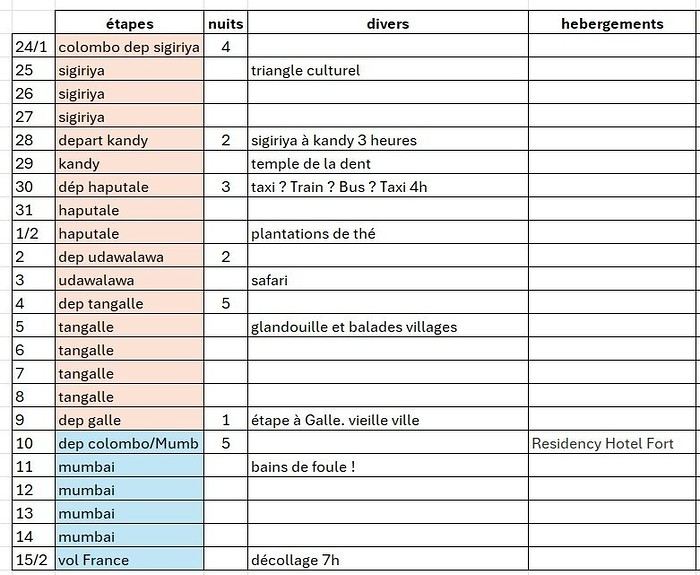
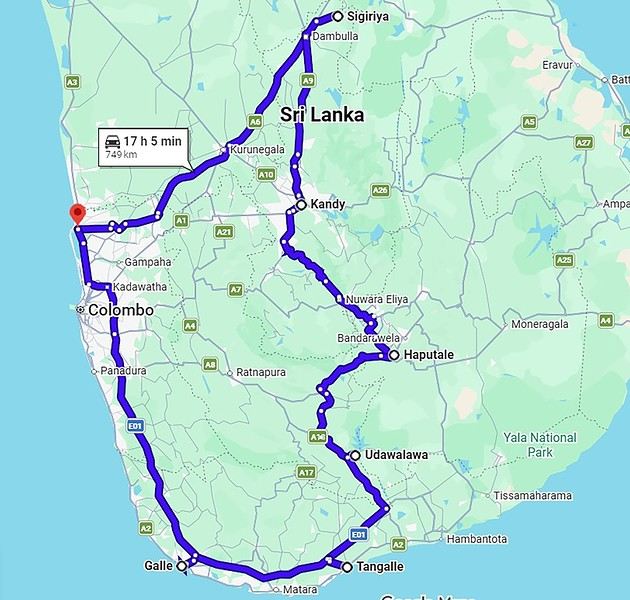
We’re heading to Sri Lanka for 23 days in January 2027—there are four of us—and we’ll wrap up the trip with 5 days in Mumbai. Our itinerary is coming together, but what do you think? (We can’t change the dates since our flights are already booked.)
We still have one night to slot in, and I’ve tentatively planned it in Tangalle, though it was a bit random. Would it make more sense to place it at a different stop? Or is there an intermediate stop I might be missing?
I’ve got accommodations sorted everywhere except Mumbai—it’s a nightmare (either way too expensive or really dodgy). By default, we’ve spotted the Residency Hotel Fort, but 70 € a night (with a discount) for a hotel that doesn’t offer anything special in India?!
Thanks so much for your help!


We’re heading to Sri Lanka for 23 days in January 2027—there are four of us—and we’ll wrap up the trip with 5 days in Mumbai. Our itinerary is coming together, but what do you think? (We can’t change the dates since our flights are already booked.)
We still have one night to slot in, and I’ve tentatively planned it in Tangalle, though it was a bit random. Would it make more sense to place it at a different stop? Or is there an intermediate stop I might be missing?
I’ve got accommodations sorted everywhere except Mumbai—it’s a nightmare (either way too expensive or really dodgy). By default, we’ve spotted the Residency Hotel Fort, but 70 € a night (with a discount) for a hotel that doesn’t offer anything special in India?!
Thanks so much for your help!


Practical tips from my 105 days of erratic wandering in India
Day 1 (10/10/2006): arrived in Mumbai around noon. Bus No. 338 5 Rs + 5 Rs (bag) 20' to Andheri station. Train 6 Rs to Dadar. Train 41 Rs to Lonavla 2h30 Hotel Chandralok 500 Rs **
Day 2: bike rental 7 Rs/h (too expensive, normal price 2-3 Rs/h) visit to the caves of Bhaja and Karla.
Day 3: train 28 Rs to Pune 1h20 Hotel National 416 Rs *
Day 4: train 141 Rs (with reservation) to Satara 2h45 Hotel Sagar 364 Rs **
Day 5: bus 110 Rs to Pandharpur 4h Hotel Aishwarya 450 Rs ***
Day 6: bike rental 2 Rs/h
Day 7: bus 125 Rs to Ahmadnagar 4h20 Hotel Parijat 250 Rs *
Day 8: train 151 Rs (!ticket for a mini 600 km trip!) to Jalgaon 5h30 Hotel Plaza 200 Rs **
Day 9: round-trip bus 38 Rs to Ajanta 1h30 + shuttle 6 Rs 5' Site entrance 250 Rs
Day 10: train 47 Rs to Khandwa 3h + bus 40 Rs to Omkareshwar 2h Ganesh G.H. 150 Rs *
Day 11 to 13: Omkareshwar
Day 14: bus 35 Rs to Maheshwar 2h45 Akashdeep Rest House 200 Rs **
Day 15: bus 8 Rs to Dhamnod 20' bus 20 Rs to crossroads 14 km from Mandu 1h40 bus 9 Rs to Mandu 20' Ram Mandir Dharamshala 100 Rs + 5 Rs for hot water *
Day 16: bike rental 3 Rs/h
Day 17: bus 50 Rs to Indore 4h Hotel Neelam 209 Rs
Day 18 to 20: Indore + round-trip bus 30 Rs to Ujjain 1h45
Day 21: train 82 Rs to Bhopal 5h30 Hotel Ranjeet 358 Rs *
Day 22: train 10 Rs to Sanchi 1h20 Jaiswal Lodge 200 Rs + 15 Rs for hot water! *
Day 23 and 24: visit to Sanchi + bike rental to visit the caves of Udayagiri
Day 25: train 69 Rs to Jhansi 5h + tempo 5 Rs to bus station + tempo 10 Rs + 5 Rs (bag) to Orccha 25' Sri Mahant G.H. 200 Rs **
Day 26 and 27: bike rental + train 20 Rs to Datia 30' + bemo 6 Rs to city center. Return bus 15 Rs 1h15
Day 28: bus 100 Rs to Khajuraho 4h Yogi Lodge 150 Rs **
Day 29: bike rental 30 Rs/day to visit the temples
Day 30: bus 70 Rs to Satna 4h + train 56 Rs to Jabalpur 3h Hotel Banjara 350 Rs **
Day 31: bike rental 2 Rs/h and visit to the Marble Rocks (50 km round trip)
Day 32: bus 50 Rs to Mandla 3h Hotel Satyam 250 Rs ** Round-trip bus 15 Rs to Ramnagar 1h15
Day 33: bus 60 Rs to Dindori 4h + bus 45 Rs to Amarkantak 3h (hellish road) Sarvodya Lodge 250 Rs °
Day 34: Amarkantak
Day 35: bus 25 Rs to Pendra Road 1h30 + train 120 Rs + 109 Rs (reservation) to Nagpur 8h Hotel Grand 257 Rs **
Day 36 and 37: bike rental + round-trip 25 Rs to Ramtek 1h40
Day 38: train 141 Rs + 125 Rs to Hyderabad 10h Hotel 3 Castles 200 Rs ° + Hotel Suhail 200 Rs °
Day 39 to 41: stay in Hyderabad
Day 42: train 48 Rs to Warangal 3h30 Hotel Surya 410 Rs **
Day 43: 60 Rs to Vijayawada 4h15 Hotel Sindhuri 275 Rs **
Day 44: round-trip bus 21 Rs to Amaravati 2h
Day 45: train 98 Rs to Visakhapatnam 7h30! (normally 6h) Hotel Sri Sampath Residency 250 Rs **
Day 46: train 111 Rs + 95 Rs to Puri 11h30 Travellers Inn 100 Rs ° + Hotel Z 300 Rs ***
Day 47 to 52: Puri + round-trip to Konarak
Day 53: train 38 Rs to Bhubaneshwar 1h15 Hotel Upasana 275 Rs *
Day 54: train 70 Rs to Balasore 4h bus 26 Rs to Baripada 1h40 Hotel Ambika 225 Rs °
Day 55: bus 25 Rs to Balasore 1h40 train 66 Rs + 68 Rs to Calcutta 6h30 Hotel Paragon 270 Rs * Hotel Crystal 350 Rs **
Day 56 to 62: Calcutta
Day 63: 60 Rs to Bishnupur 5h Hotel Monalisa 200 Rs *
Day 64: stay in Bishnupur no bike rental!
Day 65: bus 20 Rs to Bankura 1h30 bus 20 Rs to Durgapur 1h15 bus 28 Rs to Bolpur 2h15 Hotel Nisa 150 Rs *
Day 66 and 67: visit to Bolpur/Shantiniketan. Refused bike rental at ... 100 Rs/day!!! (Communist state of Bengal!!!)
Day 68: bus 20 Rs to Sainthia bus 35 Rs to Baharampur 4h30 bus 7 Rs to Murshidabad 40' Hotel Manjusha 350 Rs **
Day 69: bike lent by the friendly hotel owner and visit to Murshidabad
Day 70: bus 8 Rs to Baharampur 35' bus 60 Rs to Malda 6h (hellish road) Hotel Pratapaditya 231 Rs **
Day 71: train 66 Rs + 70 Rs to New Jalpaiguri 4h Hotel Holydon 250 Rs °
Day 72: train 52 Rs to Darjeeling 9h30! (normally 7h) Hotel Pineridge 500 Rs **
Day 73 to 75: Darjeeling
Day 76: train to New Jalpaiguri 9h30 + overnight train 271 Rs
Day 77: Patna Hotel President 482 Rs **
Day 78: stay in Patna
Day 79: train 18 Rs to Gaya 3h10 tempo 10 Rs to Bodhgaya 30' Deep G.H. 400 Rs!! °°
Day 80: return to Patna
Day 81: round-trip train 36 Rs to Rajgir 4h! (normally 3h)
Day 82: train 75 Rs to Varanasi 5h! (normally 4h) Yogi Lodge 150 Rs *
Day 83 to 87: Varanasi
Day 88: overnight train 310 Rs to Jaipur Evergreen G.H. 250 Rs **
Day 89: bike rental 30 Rs/day round-trip to Amber
Day 90: bus 59 Rs to Sikar 2h30 bus 23 Rs to Fatehpur 1h30 Rajshri Rest House 300 Rs *
Day 91: round-trip bus 12 Rs to Mandawa 30'
Day 92: round-trip bus 17 Rs to Churu 1h30
Day 93: bus 80 Rs to Jaipur 3h30 Evergreen G.H.
Day 94: bus 105 Rs to Bundi 5h30 Shivam G.H. 200 Rs **
Day 95: bike rental 3 Rs/h
Day 96: auto-rickshaw to station 45 Rs 25' train 44 Rs + 50 Rs to Chittorgarh train 21 Rs to Udaipur (total trip 8h) Badi Haveli 330 Rs **
Day 97 to 99: Udaipur + round-trip bus 45 Rs to Ranakpur 3h30
Day 100: bus 143 Rs to Ahmedabad 5h30 Hotel Manila 300 Rs **
Day 101: Ahmedabad
Day 102: bus 99 Rs to Bhavnagar 4h30 Hotel Vrindavan 200 Rs *
Day 103: round-trip bus 22 Rs to Palitana 1h10
Day 104: bus 85 Rs! to Ahmedabad 5h30 + overnight train ? Rs (feels like the end of the trip!)
Day 105 (January 22, 2007): train 6 Rs from Dadar to Andheri 20' + bus 5 Rs + 5 Rs (bag) to International Airport 20'
More figures British Airways flight price Brussels-London-Mumbai-London-Brussels 576 € Exchange rate from 55 Rs to 58.6 Rs per euro Average room price 272 Rs/night Daily budget 11 € Chai from 1 Rs (Calcutta-Bengal) to 6/7 Rs (Rajasthan) Bottle of water from 6 Rs (Udaipur), 8 Rs (Varanasi) to 12/13 Rs Internet from 8 Rs (Warangal), 10 Rs (Calcutta, Indore, Hyderabad), 20 Rs (often) to 40/60 Rs!! (Rajasthan) Beer in a restaurant from 85/100 Rs (often) to 150/165 Rs (Varanasi/Udaipur) More details on request
Hello everyone,
we got back from our trip to Kashmir and Ladakh three weeks ago.
We spent 4 weeks there, including one in Kashmir.
We’re really happy with our stay in Srinagar and Sonamarg. The Kashmiris gave us a very warm welcome and seemed pleased to see tourists who weren’t Indian. In fact, over the 4 days we spent in Srinagar, we only saw 4 people who looked European... Srinagar is stunning with its lakes and the lively Mughal gardens. No trouble getting around, whether by shikara, rickshaw, taxi, or on foot. The houseboats are gorgeous, unfortunately controlled by consortiums. We took a taxi to Sonamarg (20 €).
Sonamarg (two nights) and its glacier are easy to explore, either on horseback or on foot, but it’s becoming a leisure spot for Indians. To get to Ladakh afterward, we opted for a private taxi (quite expensive at 100 €, but the road is long). Since we’re a couple, it allowed us to stop whenever we wanted... and the route is beautiful all the way to Lamayuru, with our first snow-covered pass under snow when we crossed around May 21st. Then we stopped in Mulbek and Kargil before arriving in Lamayuru (three nights). We took another taxi to Alchi (26 €), spent one night there, and took the local bus at around 8 AM to Leh (3 €, a comfortable one-hour ride). We arrived in Leh around 9:30 AM, and Gyatsel from Tsarap Guesthouse came to pick us up with our backpacks. His guesthouse is located 500 meters from the market square in Leh, in a quiet little alley with no traffic. We highly recommend it because Gyatsel is invaluable for arranging taxis and organizing off-agency circuits...
His accommodation is super comfortable, and he cooks with vegetables from his garden. His wife also helps out... It’s Gyatsel’s mother who tends the garden. Through him, we arranged permits for the Nubra Valley up to Turtuk, then the Pangong and Tso Moriri lakes (we didn’t do the latter due to snow overnight!). We also crossed the Changtang (magnificent) to reach Thiksey, Stakna, Hemis, and returned to Leh. Six days in a private taxi (400 €). Since the roads were clear, we headed to Zanskar for 5 days in a shared taxi (28 € round trip for both of us). The route from Leh to Zangla follows the Zanskar gorges (impressive!).
We discovered Padum, Pibiting, Karsha, and Puktal, which you can reach via a small 7 km road and a 45-minute walk to finish, plus the sacred summit on the way to Manali.
Back in Leh, we extended our permit to visit the Aryan Valley by taxi (round trip, two days, 90 €). We spent our last two days resting in Leh—the altitude is really tiring...
I’m sharing these taxi prices as a guide for a couple. Accommodation ranged from 12 € in Leh to 30 € at Pangong Lake (the most expensive), but averaged around 15-17 € per night.
We’re not trekkers, but we love walks, discovery, and meeting people along the way. It was an amazing trip, and we even discovered a very old monastery a few kilometers before Lamayuru, where a monk took us—timeless...
I’m sharing these details because it’s hard to find precise information about Kashmir.
Sonamarg (two nights) and its glacier are easy to explore, either on horseback or on foot, but it’s becoming a leisure spot for Indians. To get to Ladakh afterward, we opted for a private taxi (quite expensive at 100 €, but the road is long). Since we’re a couple, it allowed us to stop whenever we wanted... and the route is beautiful all the way to Lamayuru, with our first snow-covered pass under snow when we crossed around May 21st. Then we stopped in Mulbek and Kargil before arriving in Lamayuru (three nights). We took another taxi to Alchi (26 €), spent one night there, and took the local bus at around 8 AM to Leh (3 €, a comfortable one-hour ride). We arrived in Leh around 9:30 AM, and Gyatsel from Tsarap Guesthouse came to pick us up with our backpacks. His guesthouse is located 500 meters from the market square in Leh, in a quiet little alley with no traffic. We highly recommend it because Gyatsel is invaluable for arranging taxis and organizing off-agency circuits...
His accommodation is super comfortable, and he cooks with vegetables from his garden. His wife also helps out... It’s Gyatsel’s mother who tends the garden. Through him, we arranged permits for the Nubra Valley up to Turtuk, then the Pangong and Tso Moriri lakes (we didn’t do the latter due to snow overnight!). We also crossed the Changtang (magnificent) to reach Thiksey, Stakna, Hemis, and returned to Leh. Six days in a private taxi (400 €). Since the roads were clear, we headed to Zanskar for 5 days in a shared taxi (28 € round trip for both of us). The route from Leh to Zangla follows the Zanskar gorges (impressive!).
We discovered Padum, Pibiting, Karsha, and Puktal, which you can reach via a small 7 km road and a 45-minute walk to finish, plus the sacred summit on the way to Manali.
Back in Leh, we extended our permit to visit the Aryan Valley by taxi (round trip, two days, 90 €). We spent our last two days resting in Leh—the altitude is really tiring...
I’m sharing these taxi prices as a guide for a couple. Accommodation ranged from 12 € in Leh to 30 € at Pangong Lake (the most expensive), but averaged around 15-17 € per night.
We’re not trekkers, but we love walks, discovery, and meeting people along the way. It was an amazing trip, and we even discovered a very old monastery a few kilometers before Lamayuru, where a monk took us—timeless...
I’m sharing these details because it’s hard to find precise information about Kashmir.
Hi everyone!
I’m planning a short visit to Pokhara around mid-February 2027 (it’ll be my 4th time in Nepal 😊, over 40 years!). I’d like to book a room in advance rather than looking when I arrive. I’ve checked a bit on Bxxking.com and see lots of options. I’m used to scoping out the surroundings of places listed, just to avoid ending up in areas that are either unappealing or far from everything.
So, I see quite a few offers around the lake (Lakeside?), but every time I check what it looks like, the streets seem really uninviting. It’s kind of like a construction site with buildings everywhere… Nothing like Bhaktapur (for example) or even Thamel, where the streets seem way more pleasant.
Could anyone give me some advice?
Also, I don’t really get the impression that Pokhara is worth a visit of several days. The lake, sure, but once you’ve seen it—what else is there?
I’m planning a short visit to Pokhara around mid-February 2027 (it’ll be my 4th time in Nepal 😊, over 40 years!). I’d like to book a room in advance rather than looking when I arrive. I’ve checked a bit on Bxxking.com and see lots of options. I’m used to scoping out the surroundings of places listed, just to avoid ending up in areas that are either unappealing or far from everything.
So, I see quite a few offers around the lake (Lakeside?), but every time I check what it looks like, the streets seem really uninviting. It’s kind of like a construction site with buildings everywhere… Nothing like Bhaktapur (for example) or even Thamel, where the streets seem way more pleasant.
Could anyone give me some advice?
Also, I don’t really get the impression that Pokhara is worth a visit of several days. The lake, sure, but once you’ve seen it—what else is there?
Hi there. I’d like to know about accommodation options for unguided hikers. I see there are campsites—are the tents already set up, or do we need to bring our own? Same question for sleeping bags—ours are a bit tight, I think (comfort temp 0°C). Are blankets provided? I’m picturing a camp where everything’s taken care of, including meals, but I’m worried I might be mistaken...
Thanks in advance
Hi everyone,
I’m heading to Assam and I’d like to know what type of electrical adapter I need—is it M or D, or both?
Thanks
Hello,
I’m heading to Sri Lanka for 3 weeks in July with my two 11-year-old kids, and I’m wondering about how to organize the trip. We’re used to traveling on the go, staying 1 to 2 or 3 nights per place depending on how we feel.
Do you recommend planning the itinerary and booking accommodations in advance to save time once we’re there? Or is it pretty easy to organize everything as we go without any issues?
Same question for activities: Should we book safaris and tours ahead of time, or can we arrange them easily on the spot? Is there a risk of not getting a spot, for example, to visit a park since we’ll be there in July?
We’ll be using local transport (train, VTC via PickMe, tuk-tuk) to get from one place to another.
In short: Are there any must-book things we should reserve now? So far, I only have the flight tickets!
Thanks in advance for your help! 😊
I’m heading to Sri Lanka for 3 weeks in July with my two 11-year-old kids, and I’m wondering about how to organize the trip. We’re used to traveling on the go, staying 1 to 2 or 3 nights per place depending on how we feel.
Do you recommend planning the itinerary and booking accommodations in advance to save time once we’re there? Or is it pretty easy to organize everything as we go without any issues?
Same question for activities: Should we book safaris and tours ahead of time, or can we arrange them easily on the spot? Is there a risk of not getting a spot, for example, to visit a park since we’ll be there in July?
We’ll be using local transport (train, VTC via PickMe, tuk-tuk) to get from one place to another.
In short: Are there any must-book things we should reserve now? So far, I only have the flight tickets!
Thanks in advance for your help! 😊
Hi there, I think you're on the right track—you plan the itinerary and book the rooms in advance, and that’s it.
Not only do you save time, but you also know where you’ll be staying each night. Choosing well on Booking (or elsewhere) is actually a pleasure!
For safaris, given the number of jeeps with drivers available, it’s unlikely you’ll be turned away... the real issue is more about the concentration of jeeps around the animals.
I travel like you do—train, bus, tuk-tuk, and sometimes taxi. Ride-hailing apps like PickMe and other VTCs are mostly in big cities.
For the mountain train, due to severe flooding, service was interrupted on the line between Kandy and Ella. Check ahead, because reservations for this train are very complicated, if not impossible.
For the Colombo/Kandy train, you reserve your seats by buying the ticket before boarding. In the south, no need to book in advance for trains.
In Sri Lanka, there’s always a solution for getting around—just ask your hosts. They have trusted contacts at their fingertips. But still, compare prices—😏 smart move!
I stick to booking my nights and keep pre-planned activities to a minimum.
For reservations you can’t skip, it’s the beach stays you’ll want to secure.
Hi there,
I’m trying to find out if it’s still possible to travel from Mumbai to Goa by ferry or any other sea route. My search results aren’t very clear, and if it *is* possible, I can’t figure out where to book... If anyone has any info, I’d really appreciate it—thanks in advance!
Have a great day,
Virginie
I’m trying to find out if it’s still possible to travel from Mumbai to Goa by ferry or any other sea route. My search results aren’t very clear, and if it *is* possible, I can’t figure out where to book... If anyone has any info, I’d really appreciate it—thanks in advance!
Have a great day,
Virginie
It seems there’s a ferry from Nagapattinam to Jaffna in India. Has anyone here taken this ferry before? My main question is how to get to Nagapattinam—by train, bus? And from which town further south, of course.
Thanks, friends!
Gaston
Gaston
Hi there.
We’re spending a month in Sri Lanka in March, and we’ll have one week left after leaving Polonnaruwa.
We’re torn between spending it in the Jaffna region or on the east coast between Batticaloa and Trincomalee.
We’re divers, so the east coast appeals to us for snorkeling, beaches, and lagoons—but it seems like late March might not be the best time for that coast. What do you think?
As for Jaffna, the culture of the region, its more authentic feel since it’s less touristy, and the offshore islands all appeal to us too—but it seems far from the rest of the country and harder to access.
We have to choose because we won’t be able to visit both sides, and I’d love to hear your thoughts.
Thanks, Marie
Hi there,
We just got back from a 2-week trip to Sri Lanka as a couple, and while planning the trip, we found plenty of info on the itinerary, places to see, and transportation, but much fewer clear reports on the actual budget to expect once there. Yet, that was an important point for us because we like to plan ahead a little before traveling.
So, we took the time to break down our complete budget after the trip. In our case, we spent around **930 € per person** for 2 weeks, being careful without depriving ourselves, mixing guesthouses, more comfortable hotels, quite a few activities, and even a private driver for part of the stay.
What we found interesting when crunching the numbers is that in Sri Lanka, it’s not necessarily meals or short trips that blow the budget, but rather flights, certain accommodations, cultural activities, and all those little expenses we sometimes forget, like tips.
If this can help other travelers get a better idea, we’ve put everything together on our blog with our experience, a detailed breakdown of expenses, and practical info on money while there, withdrawals, and tipping:
https://aventures-sans-mesaventure.com/budget-sri-lanka-pour-un-voyage-de-2-semaines/
Happy travels and enjoy your adventure! !
Hi everyone,
We’re a group of 5 heading to the Everest Base Camp trek in early April. We won’t have a porter or guide—we’re used to hiking independently and have already done the Langtang trek and the Annapurna Circuit (back in 2003!).
I’d love to know if it’s necessary to book lodges in advance or if we’ll easily find availability during this busy season. Also, will we find lodges all along the route between the main stopover villages, or only in those villages? I remember there were plenty everywhere on the Annapurna Circuit. We want to stay as flexible as possible.
Thanks for your feedback!
We’re a group of 5 heading to the Everest Base Camp trek in early April. We won’t have a porter or guide—we’re used to hiking independently and have already done the Langtang trek and the Annapurna Circuit (back in 2003!).
I’d love to know if it’s necessary to book lodges in advance or if we’ll easily find availability during this busy season. Also, will we find lodges all along the route between the main stopover villages, or only in those villages? I remember there were plenty everywhere on the Annapurna Circuit. We want to stay as flexible as possible.
Thanks for your feedback!
Hi there,
We’re heading to India in March 2026 and had planned to visit the parts of the Meenakshi Temple that are open to non-Hindus. However, the temple is currently undergoing major renovations—with all the towers covered in scaffolding—which might really take away from the experience and our stop in Madurai.
After some frustrating and vague online searches, and before we reshuffle our itinerary, I’d love to know—if possible—the most accurate expected completion date for the renovation work.
Thanks in advance.
We’re heading to India in March 2026 and had planned to visit the parts of the Meenakshi Temple that are open to non-Hindus. However, the temple is currently undergoing major renovations—with all the towers covered in scaffolding—which might really take away from the experience and our stop in Madurai.
After some frustrating and vague online searches, and before we reshuffle our itinerary, I’d love to know—if possible—the most accurate expected completion date for the renovation work.
Thanks in advance.
Hi there,
We’re planning a trip to Nepal and would love to do a helicopter tour to Everest with Namche Heli Service. Has anyone here used this agency? I can’t seem to find any reviews online. Thanks in advance!
Kloki
We’re planning a trip to Nepal and would love to do a helicopter tour to Everest with Namche Heli Service. Has anyone here used this agency? I can’t seem to find any reviews online. Thanks in advance!
Kloki
Hey fellow travelers,
I’m spending two weeks studying Hindi in the mornings in Delhi, in the Hauz Khas neighborhood. What spots should I check out in this area? Any cafés to chill at? How do I get to other parts of Delhi? By rickshaw? Is it easy to negotiate the price upfront?
Thanks in advance. 😊 Marlène
I’m spending two weeks studying Hindi in the mornings in Delhi, in the Hauz Khas neighborhood. What spots should I check out in this area? Any cafés to chill at? How do I get to other parts of Delhi? By rickshaw? Is it easy to negotiate the price upfront?
Thanks in advance. 😊 Marlène
Hi,
I’m leaving this Saturday for Northern India from 15/02 to 27/02. I’m planning to visit New Delhi, Agra, Chand Baori, Jaipur, Ranthambore, Bundi, Udaipur, and Jodhpur.
What’s the best way to get around? I was thinking of doing everything by train. Maybe taking the bus for some stretches?
As for renting a car with a driver, it seems expensive, so I’ve pretty much ruled that out. Unless someone’s got space for the same dates?
Thanks for your insights!
What’s the best way to get around? I was thinking of doing everything by train. Maybe taking the bus for some stretches?
As for renting a car with a driver, it seems expensive, so I’ve pretty much ruled that out. Unless someone’s got space for the same dates?
Thanks for your insights!
Hi everyone,
We’re heading out in March for this trek. We’re used to hiking and long-distance treks, but this’ll be our first time in Nepal.
QUESTION: People from Nepal are telling us it’s MANDATORY to have guides! Is this true, or is it just agencies trying to get work for their staff?
The Lonely Planet says: "In April 2023, the government announced that every trekker would need to hire the services of a porter or a licensed guide to obtain the TIMS permit. The law isn’t enforced, and by 2025, there were no longer any obligations for teahouse treks."
What do you think? What’s your experience? Thanks for your feedback.
We’re heading out in March for this trek. We’re used to hiking and long-distance treks, but this’ll be our first time in Nepal.
QUESTION: People from Nepal are telling us it’s MANDATORY to have guides! Is this true, or is it just agencies trying to get work for their staff?
The Lonely Planet says: "In April 2023, the government announced that every trekker would need to hire the services of a porter or a licensed guide to obtain the TIMS permit. The law isn’t enforced, and by 2025, there were no longer any obligations for teahouse treks."
What do you think? What’s your experience? Thanks for your feedback.
Hi,
I’d like to arrive in India at New Delhi Airport with some cash. I was wondering if the exchange rates at the airport are any good or if it’s best to avoid them (and exchange in the city instead?).

Thanks for your help.
NAMASTE NEPAL! PRACTICAL INFO AND EXPERIENCE FEEDBACK
Stay from March 25 to April 16, 2025
· Flight tickets Air India (via Delhi) (via Skyscanner) = 1130 € per person · Planned budget (and respected without too many restrictions and while buying a few small gifts) = 2000 € for the stay for two. Buses, taxis, and entrance fees to various sites represent a budget to consider. Meals are cheap. Drinks like beer/Coke, however, are not cheap and cost the equivalent of a meal. · Exchange rate of the rupee during our stay = 0.0064 € (the exchange rate is almost identical everywhere, including at the airport). · At the airport, purchase of two SIM cards (phone) = 1000 NPR x 2 for 28 days. · Kathmandu: we had booked the hotel upon arrival: Kathmandu Boutique Hotel (+977 015 357 446 – email: booking@kathmanduboutiquehotel.com), very well located in a quiet alley off the street, south of Thamel, a 10-minute walk from Durbar Square. A hotel like Nepal knows how to do, where tall people will have to duck. Night + breakfast = 18 € for two. Very warm welcome, great location, excellent value for money. · Bhaktapur: we had also booked a hotel for the end of our stay because the chance of the year 2025 made the Nepali New Year and Bisket Jatra particularly festive in Bhaktapur: Manju Baha Hotel School (+977 976 7234014 – email: manjubahahotel@gmail.com) located in an old monastery. "A social enterprise transforming an old monastery into a charming hotel, offering professional hospitality training to underprivileged Nepali youth." Night + breakfast = 32 € for two. Beautifully decorated room. Very warm welcome. Don’t miss the Changunarayan site (near Bhaktapur), it’s amazing. And if you’re lucky enough to be in Bhaktapur in mid-April for 3 days, there’s the Bisket Jatra festivities (Newari festival), joyful, noisy, fun, and wild… · Pokhara (hotel recommended by the Kathmandu hotel): Hotel Green Tara, Lakeside, 10th street, set back, quiet (Tel. +977 61 462698 – email: greentara_67@hotmail.com) · Trek permit (Lower Mustang, no need for an agency or guide, permits checked at Ghasa and Jomsom) = 2000 NPR per person (2 ID photos) · Bus Kathmandu/Pokhara and return = 2000 NPR per person · Bus Pokhara/Jomsom, 2 one-way tickets = 2800 NPR. · Taxi: negotiation with a driver we recommend, Vicky (+977 984 075 599). You explain what you want, negotiate the price, and he waits for you during the visit. Very charming, we used him several times. For example: departure from our hotel at 10 AM -> Boudhanath/Pashupatinath/Patan return at 5 PM to the hotel = 6500 NPR – Swayambhunath (round trip) = 1200 NPR · Site prices: https://ntb.gov.np/plan-your-trip/before-you-come/heritage-site-entry-fees o Visitor Pass for Kathmandu Durbar Square (for the duration of the stay, show your visa) = 1000 NPR per person (1 ID photo) o Bhaktapur Durbar Square (old town) = 1800 NPR per person o Patan = 1000 NPR per person o Swayambhu Stupa = 200 NPR per person o Boudha Stupa = 200 NPR per person o Pashupatinath Temple = 1000 NPR per person (interesting to take a guide) o Changunarayan Temple (6 km north of Bhaktapur) = 400 NPR per person o Mountain Museum in Pokhara = 750 NPR per person · E-cigarettes: e-cigarettes are banned in India and confiscated whether they’re in carry-on or checked luggage. On the way there, we had kept them in our carry-on, they were confiscated in Delhi. On the way back, learning from our previous experience, we put them in our checked luggage. Someone came to get us to take them out of our bags and confiscate them… You can find e-cigarettes and products in Kathmandu.
* * *
I’m 74 years old. I went to Nepal in 1982, 1983, and the last time in 1986. I wanted to introduce this beautiful and endearing country to my husband, and it was… now or never. So we decided it was now.
I knew the trek starting from Pokhara: Naudanda/Birethanti/Ghorepani/Tatopani/Kalopani. There was no way I was going to do that trek, especially the 1000-meter staircase to reach Ghorepani… You have to stay humble with age.
Back then, the road didn’t exist. I didn’t consider, with the construction of this road (NH48) along the western bank of the Kali Gandaki, doing a trek along a windy and dusty road. Was there an alternative hiking trail on the eastern bank? No one answered my question on VoyageForum, so I did my research online. And I found this site: "Andrées de Ruiter and Prem Rai - Trekking the Annapurna Circuit, including the new NATT trails that avoid the road - A guide to one of the most beautiful trekking regions in Nepal and the world (2011) - NATT = New Annapurna Trekking Trail".
Phew! A solution was emerging. This circuit from 2011 wasn’t fully marked. The idea was to go from Jomsom to Tatopani, so we needed to make sure the path was well-marked all the way, which we did, and the path exists, marked in red and white!
So, with the walking times information, we built our 8-day circuit:
· Jomsom/Thinigaon · Thinigaon/Chimang · Chimang/Saura · Saura/Kokhetanti · Rest day or, if in good shape: loop to Sekong Lake · Kokhetanti/Jhipra Deurali · Jhipra Deurali/Kopchepani · Kopchepani/Tatopani
It’s a senior trek, after all. So the walking times noted on the sites indicated 3 hours or even 4 hours for the two longest stages. That pace suited us fine.
On March 29, we left Kathmandu (1400m), after visiting the must-see sites, by bus to Pokhara: 200 km and 8.5 hours on a chaotic road under construction. I had a memory of Pokhara where it was the first city where you could see the Himalayan range, especially Machhapuchhare. But the pollution is such, the dust raised by traffic and construction, that no horizon is visible except the first hills around Pokhara.
We stayed 24 hours in Pokhara (820m), and on March 31, we left our luggage at the hotel and set off with our lightest backpacks: change of clothes, toiletries, first aid kit, anti-chafing cream, water bottle, sleeping bag liner, and light shoes for the stages.
We took the bus to Jomsom: 160 km/7.5 hours including stops for bathroom breaks, tea, and lunch. The road is nothing but a chaos of potholes, landslides, construction, dust, rebuilding, and mudslides. In Ghasa, the bus stops, and we’re told we’re at a checkpoint and that the two foreigners in the bus, my husband and I, need to have our permits checked, which takes a few minutes. The driving is rock-and-roll, surprising, and courteous. The drivers have their codes, and on these improbable roads, they’re virtuosos.
We could have chosen the plane, but several reasons dissuaded us: if there’s too much wind, the planes don’t take off; personally, I wasn’t reassured about landing in Jomsom, and this transport has a cost.
We arrived around 2 PM in Jomsom (2720m), and despite the early wake-up, the nearly 8 hours on the bus, and the altitude, we decided to head straight to Thinigaon (2840m). At the Jomsom checkpoint, they told us it was a 30-minute walk. Great! Except we took an hour and a half on an uphill road, bent over to fight a strong wind. But the Himalayan range is there! The Dhaulagiri, the Nilgiri, the Annapurnas as a reward.
In Thinigaon, we found a room at the "Nilgiri View Hotel" run by a didi (big sister in Nepali). From the lodge’s roof, she proudly showed us the different peaks surrounding the village and told us, worried, that it hadn’t snowed here for 3 years. She said there are very few tourists, that the season is rather in September/October/November. It seems there’s not a soul in this village, yet mules pass through the narrow street paved with large flat stones, their bells ringing. We dine at 6 PM and go to bed… Room = 1200 NPR and dinner, breakfast, and drinks = 2560 NPR.
On April 1, we set off at 9 AM, not for Chimang as planned but for Marpha! The didi from the Thinigaon lodge had said it was a 3-hour walk. The first part of this stage is attractive, the mountains are magnificent and imposing, the landscape is superb, there’s no one around, a feeling of being "alone in the world." We follow Dhumbra Tal, this small green lake. The path is a rocky track that climbs steeply. Then, around a hill, we start the big descent that joins the Kali Gandaki. We face the wind head-on, and the violent gusts take our breath away, throw us off balance, and envelop us in dust. We see the road on the other side of the Kali Gandaki. We arrive in the village of Chhairo at 2 PM, completely exhausted and with blistered feet, after 5 hours of walking instead of the planned 3.5 hours.
We’re welcomed by the village nurse, who tells us there’s a lodge in the village. Chhairo is a Tibetan village, a 20-minute walk from Marpha (according to the locals, multiply by 2 or even 3 for us…). We’re going to revise our trek plan and, first of all, spend the night in Chhairo.
The lodge is quite pleasant, and Karma, the hostess, is very friendly. She asks about our plans and suggests we stay in Chhairo the next day, from where we can visit Marpha and also Chimang, a 1-hour walk away, in light mode, meaning without backpacks. She invites us to participate in a village ceremony the next evening.
We immediately accept the proposal, as our feet need rest and the welcome is so warm… Dinner and bed!
We reworked our trek plan, which was too ambitious for our untrained bodies and, let’s face it… no longer in our first youth. In the initial plan, we thought there wouldn’t be too much elevation gain following the Kali Gandaki, but checking the map, we realize there might be significant elevation changes between Sauru and Sirkung. So we plan:
· Tomorrow: visit Marpha (2670m) and Chimang (2744m) · April 3: bus from Chhairo (2700m) to Kalopani (2530m) and continue on foot to Ghasa (2010m) · April 4: Ghasa/Pairataplo (1940m) · April 5: Pairatapla/Gadpar (1580m) · April 6: Gadpar/Narchyang (1510m) · April 7: Narchyang/Tatopani (1190m) · April 8: return to Pokhara.
Normally, it’s all downhill…
April 2, a rest day then… We set off in the morning to explore Marpha. We have to take a temporary bridge because the suspension bridge is closed due to road construction. We join the road and arrive in Marpha, a village famous for its apple orchards, brandy, cider, and apple juice production. This village is magnificent with its stone houses and monastery clinging to the hillside. The road construction spared it. There are people, but very few Western tourists.
We have lunch in Marpha and go back through Chhairo to take the path to Chimang. We cross a fragrant pine forest and find the rocky path; the landscape is splendid. We walk quietly, passing peaceful buffaloes and cows, and arrive at the foot of a stone staircase… 275 steps (which we counted on the way back) leading us to the village of Chimang. Chimang is an isolated Newari village that seems a bit desolate. Despite the slopes, there are crops on every little bit of land. Thankfully, we changed our initial program because there’s no lodge in this village, contrary to what we saw on a map… We wander through the village, which seems very deserted, have coffee in a house from another world, and then head back to Chhairo.
A rest day? = 5 hours of walking!!
Dinner and village ceremony. From what we understand, this ceremony is in honor of the Dalai Lama. Men, women, and children in traditional costumes gather twice a month; they dance, make, and offer small sweet cakes with Tibetan tea (made from tea, yak butter—often rancid—water, and salt). Surprising for first-timers…
Around 10 PM, we leave the ceremony; tomorrow morning, we need to be on the roadside by 7 AM to catch the bus to Kalopani…
This village of Chhairo is very pleasant and welcoming, no tourists, just two motorcyclists who arrived in the evening, one of whom participated in the ceremony and discreetly poured his Tibetan tea outside.
Lodge: "Norsang Tibetan Guesthouse and Restaurant". Total bill for 2 nights, 2 dinners, 2 breakfasts, and drinks = 8000 NPR.
April 3: bus from Chhairo to Kalopani, about 1.5 hours for the 20 km (200 NPR per person). We descend on the right bank of the Kali Gandaki. We find the red and white markings to resume the trek toward Ghasa. We’re in a fragrant pine forest, the Dhaulagiri on one side and the Annapurnas on the other, magnificent, and the path is pleasant and easy. We get a bit lost in this forest, always looking for the markings. Near Lete, two trekkers pass us, and we meet them again a little further on with two very young children, to whom we give the 2 hard-boiled eggs I didn’t eat this morning. They accepted them without hesitation.
We arrive in a village and ask for directions to Ghasa. The young girls point the way. But we come across a forest being logged, trees cut in all directions. We turn back and ask for confirmation. They confirm… But the two young girls catch up with us and clear the way. We have to step over, go around, and cross the felled trees, with no indication at all. Through this pick-up sticks of felled trees, the girls lead us to the top of a stone staircase, indicating that was the path. It’s the only place where we saw rhododendrons in bloom.
We descend the staircase. At the bottom, to the left, there’s a bridge to go toward Choyo, and to the right, a path to Ghasa. We take the right path and join the road. We should normally find the red and white markings, but we don’t… So we continue on the western bank road of the Kali Gandaki.
A little before the village of Misi, we see fumaroles on the opposite bank that seem to come from the ground. We don’t understand. We stopped to eat in the village of Misi (noodle soup = 600 NPR), but it’s hard to communicate with the elderly people running the guesthouse.
We continued on the road, not finding the marked path parallel to the road. Landslides, both on the left and right banks, seem to have taken over the marked routes. It’s a place where the Kali Gandaki gorge narrows, and on the opposite bank, the mountain smokes more and more, and we now hear the crackling of fire. Across from us, the mountain is burning… Our initial plan had us passing on that burning bank right now…
We arrive in Ghasa at 3:30 PM, a 6.5-hour stage but with a 1-hour stop at noon. We’re at the "Florida Guesthouse and Restaurant." From our room, we see the mountain smoking on the other side of the river, and at night, we see the flames. In this village, posters show Himalayan eagles and vultures that seem to be protected species. Indeed, we saw (and heard) 3 eagles circling today.
April 4 – Today, heading to Pairothapla or Kopchepani depending on our feet, accommodation options, and simply our desires.
No more smoke on the mountain this morning. It’s chilly, 7:45 AM, the sky is clear, just a smell of smoke outside.
Price of the lodge = 1000 NPR for the night + 3580 NPR for meals.
We cross Ghasa, which stretches over more than a kilometer. We have a drink at the last guesthouse in the village, and the didi, when she learns our destination, tells us to be careful because the villages we’re going to aren’t safe. Should we distribute our rupees in different pockets? Nah, we kept going.
At the exit of Ghasa, we find the red and white markings and take the suspension bridge to cross the boiling waters of the Kali Gandaki. The passage is impressive because the river is tumultuous. Lots of climbs and even more descents. We’re back on the eastern bank. It’s hot! On the narrow path, we meet a group of buffaloes. Who has the right of way? We decide to stick as close as possible to the rock wall and move forward calmly. The buffaloes look at us, chewing placidly, with no intention of jumping on us. Phew!
After a 5-hour stage (including stops), we arrive in Pairothapla, with hot feet and firm thighs, and decide we won’t go any further. It’s a good thing because there’s a lodge, the most basic so far, but with a great welcome. We have a meal and a short nap. The buffaloes we met on the way belong to this house. They come to drink at the fountain by the path.
Our host, very pleasant, doesn’t know what to do to please us and is very attentive. He wants to chat. He has two children, a 4-year-old girl and a 7-year-old boy. Where do they go to school? Do they go? He tells us that the fires in the mountain are caused by people, but for what reason? We won’t find out, but it’s illegal. From here, we can still see smoke rising in the distance. The wife is a bit less friendly. Corn kernels dry on a woven straw mat on the ground, and the mom sorts them.
From where we are, we overlook the valley and see the road under construction winding along the mountainside on the other bank.
Dinner on the terrace of the house overlooking the path, windbreaker and fleece on: dal bhat chicken for me and chicken curry for my husband: "organic" products, at least local production. There are small vegetable gardens everywhere with all sorts of vegetables.
April 5 – While we’re having breakfast on the terrace of our lodge, 5 porters, straps on their foreheads, heavily loaded, pass by on the path. A few minutes later, a group of 9 people appears. It must be said that since the beginning of our journey, we’ve met very few hikers. Two backpackers in Chhairo, the two hikers near Lete, two female hikers passed us before Pairothapla, a solo female hiker passed us…
The lodge in Pairothapla is called "Bimala Lodge & Thakali Kitchen" – Price for night + 4 meals + 2 breakfasts = 3000 NPR.
The descent toward the Kali Gandaki involves climbs whose steps we didn’t count. Clearly, the landslides on the mountain cause changes to the official ACAP trek marked in red and white, and the marking updates can’t keep up with the pace of these landslides. It’s almost always by chance that we find the markings. Fortunately, we can follow the power line that guides us somewhat.
Drink stop in Kopchepani, the legs are fine, but the feet don’t like being tightly enclosed. A group of trekkers with porters passes on the path. We met buffaloes that we kindly let pass; the path was wide enough, but it was a staircase going up, and we didn’t want to take any risks.
Across, a view of the magnificent Rupse Waterfall on the other bank of the Kali Gandaki, at the bottom, lots of vehicles and people.
Arrival in Gadpar after crossing a rather unwelcoming small village and cultivated gardens between dry stone walls, each better built than the last.
First lodge spotted, first lodge adopted to answer the call of our feet, and a very warm welcome from the owner. Since we hadn’t eaten at noon, we had Tibetan bread/jam. 6-hour stage including 1 hour of stops. Night + dinner + breakfast + drinks = 5060 NPR
April 6 – Today, heading to Narchyang.
For several days, we’ve seen banana trees with their bunches of fruit and even a prickly pear with large fruits ripening.
This stage is quite peaceful and pleasant. We take a suspension bridge to cross a tributary of the Kali Gandaki. While we’re resting for a moment before crossing the bridge, a couple of porters, a man and a woman, arrive and start across the bridge with their wood load in a basket held by a strap on their forehead, making them bend. We set off too… lighter than them.
On the other side of the bridge… a stone staircase, and it climbs steeply. The porter couple didn’t take this staircase; they went right on the path.
At the top of the staircase, we arrive in Narchyang after a 4-hour stage. A magnificent waterfall overlooks the village. We get lost in this fairly large village looking for a lodge. After wandering around for a while, we ask for directions, and an 84-year-old man takes us through the whole village and accompanies us to a very nice lodge run by a woman.
We chat with our hostess, who asks where we’re from and where we’re going. We explain that we want to reach Tatopani the next day and then return to Pokhara. She tells us there are 4x4s going directly to Pokhara and that it would probably be easier than taking a bus that might be full in Tatopani. After a quick consultation, we decide to return to Pokhara the next day by 4x4. She finds us a 4x4 with 2 seats left, departure at 8 AM – 5 hours on the road and 1500 NPR per person. A charming didi who does everything to be pleasant and helpful.
Narchyang community lodge = night + snacks + dinner + breakfast = 3000 NPR.
There you go, our trek ends tomorrow. Many necessary changes and adaptations to our initial trek, but no regrets, it was superb and a great experience that, for my part, I won’t be able to repeat. Always this encounter with the endearing, welcoming, curious, and very kind Nepali people. It was now or never, and we did it!
* * *
In conclusion, 3 full weeks in Nepal is a duration that allows visiting Kathmandu, Patan, and Bhaktapur, enjoying the various sites, and soaking in the atmosphere and urban Nepali life.
The trek, even revised and corrected, allowed us to get close to the impressive Annapurna and Dhaulagiri peaks. One or two acclimatization days might be necessary to get the body in tune with this magical and extraordinary land.
Stay from March 25 to April 16, 2025
· Flight tickets Air India (via Delhi) (via Skyscanner) = 1130 € per person · Planned budget (and respected without too many restrictions and while buying a few small gifts) = 2000 € for the stay for two. Buses, taxis, and entrance fees to various sites represent a budget to consider. Meals are cheap. Drinks like beer/Coke, however, are not cheap and cost the equivalent of a meal. · Exchange rate of the rupee during our stay = 0.0064 € (the exchange rate is almost identical everywhere, including at the airport). · At the airport, purchase of two SIM cards (phone) = 1000 NPR x 2 for 28 days. · Kathmandu: we had booked the hotel upon arrival: Kathmandu Boutique Hotel (+977 015 357 446 – email: booking@kathmanduboutiquehotel.com), very well located in a quiet alley off the street, south of Thamel, a 10-minute walk from Durbar Square. A hotel like Nepal knows how to do, where tall people will have to duck. Night + breakfast = 18 € for two. Very warm welcome, great location, excellent value for money. · Bhaktapur: we had also booked a hotel for the end of our stay because the chance of the year 2025 made the Nepali New Year and Bisket Jatra particularly festive in Bhaktapur: Manju Baha Hotel School (+977 976 7234014 – email: manjubahahotel@gmail.com) located in an old monastery. "A social enterprise transforming an old monastery into a charming hotel, offering professional hospitality training to underprivileged Nepali youth." Night + breakfast = 32 € for two. Beautifully decorated room. Very warm welcome. Don’t miss the Changunarayan site (near Bhaktapur), it’s amazing. And if you’re lucky enough to be in Bhaktapur in mid-April for 3 days, there’s the Bisket Jatra festivities (Newari festival), joyful, noisy, fun, and wild… · Pokhara (hotel recommended by the Kathmandu hotel): Hotel Green Tara, Lakeside, 10th street, set back, quiet (Tel. +977 61 462698 – email: greentara_67@hotmail.com) · Trek permit (Lower Mustang, no need for an agency or guide, permits checked at Ghasa and Jomsom) = 2000 NPR per person (2 ID photos) · Bus Kathmandu/Pokhara and return = 2000 NPR per person · Bus Pokhara/Jomsom, 2 one-way tickets = 2800 NPR. · Taxi: negotiation with a driver we recommend, Vicky (+977 984 075 599). You explain what you want, negotiate the price, and he waits for you during the visit. Very charming, we used him several times. For example: departure from our hotel at 10 AM -> Boudhanath/Pashupatinath/Patan return at 5 PM to the hotel = 6500 NPR – Swayambhunath (round trip) = 1200 NPR · Site prices: https://ntb.gov.np/plan-your-trip/before-you-come/heritage-site-entry-fees o Visitor Pass for Kathmandu Durbar Square (for the duration of the stay, show your visa) = 1000 NPR per person (1 ID photo) o Bhaktapur Durbar Square (old town) = 1800 NPR per person o Patan = 1000 NPR per person o Swayambhu Stupa = 200 NPR per person o Boudha Stupa = 200 NPR per person o Pashupatinath Temple = 1000 NPR per person (interesting to take a guide) o Changunarayan Temple (6 km north of Bhaktapur) = 400 NPR per person o Mountain Museum in Pokhara = 750 NPR per person · E-cigarettes: e-cigarettes are banned in India and confiscated whether they’re in carry-on or checked luggage. On the way there, we had kept them in our carry-on, they were confiscated in Delhi. On the way back, learning from our previous experience, we put them in our checked luggage. Someone came to get us to take them out of our bags and confiscate them… You can find e-cigarettes and products in Kathmandu.
* * *
I’m 74 years old. I went to Nepal in 1982, 1983, and the last time in 1986. I wanted to introduce this beautiful and endearing country to my husband, and it was… now or never. So we decided it was now.
I knew the trek starting from Pokhara: Naudanda/Birethanti/Ghorepani/Tatopani/Kalopani. There was no way I was going to do that trek, especially the 1000-meter staircase to reach Ghorepani… You have to stay humble with age.
Back then, the road didn’t exist. I didn’t consider, with the construction of this road (NH48) along the western bank of the Kali Gandaki, doing a trek along a windy and dusty road. Was there an alternative hiking trail on the eastern bank? No one answered my question on VoyageForum, so I did my research online. And I found this site: "Andrées de Ruiter and Prem Rai - Trekking the Annapurna Circuit, including the new NATT trails that avoid the road - A guide to one of the most beautiful trekking regions in Nepal and the world (2011) - NATT = New Annapurna Trekking Trail".
Phew! A solution was emerging. This circuit from 2011 wasn’t fully marked. The idea was to go from Jomsom to Tatopani, so we needed to make sure the path was well-marked all the way, which we did, and the path exists, marked in red and white!
So, with the walking times information, we built our 8-day circuit:
· Jomsom/Thinigaon · Thinigaon/Chimang · Chimang/Saura · Saura/Kokhetanti · Rest day or, if in good shape: loop to Sekong Lake · Kokhetanti/Jhipra Deurali · Jhipra Deurali/Kopchepani · Kopchepani/Tatopani
It’s a senior trek, after all. So the walking times noted on the sites indicated 3 hours or even 4 hours for the two longest stages. That pace suited us fine.
On March 29, we left Kathmandu (1400m), after visiting the must-see sites, by bus to Pokhara: 200 km and 8.5 hours on a chaotic road under construction. I had a memory of Pokhara where it was the first city where you could see the Himalayan range, especially Machhapuchhare. But the pollution is such, the dust raised by traffic and construction, that no horizon is visible except the first hills around Pokhara.
We stayed 24 hours in Pokhara (820m), and on March 31, we left our luggage at the hotel and set off with our lightest backpacks: change of clothes, toiletries, first aid kit, anti-chafing cream, water bottle, sleeping bag liner, and light shoes for the stages.
We took the bus to Jomsom: 160 km/7.5 hours including stops for bathroom breaks, tea, and lunch. The road is nothing but a chaos of potholes, landslides, construction, dust, rebuilding, and mudslides. In Ghasa, the bus stops, and we’re told we’re at a checkpoint and that the two foreigners in the bus, my husband and I, need to have our permits checked, which takes a few minutes. The driving is rock-and-roll, surprising, and courteous. The drivers have their codes, and on these improbable roads, they’re virtuosos.
We could have chosen the plane, but several reasons dissuaded us: if there’s too much wind, the planes don’t take off; personally, I wasn’t reassured about landing in Jomsom, and this transport has a cost.
We arrived around 2 PM in Jomsom (2720m), and despite the early wake-up, the nearly 8 hours on the bus, and the altitude, we decided to head straight to Thinigaon (2840m). At the Jomsom checkpoint, they told us it was a 30-minute walk. Great! Except we took an hour and a half on an uphill road, bent over to fight a strong wind. But the Himalayan range is there! The Dhaulagiri, the Nilgiri, the Annapurnas as a reward.
In Thinigaon, we found a room at the "Nilgiri View Hotel" run by a didi (big sister in Nepali). From the lodge’s roof, she proudly showed us the different peaks surrounding the village and told us, worried, that it hadn’t snowed here for 3 years. She said there are very few tourists, that the season is rather in September/October/November. It seems there’s not a soul in this village, yet mules pass through the narrow street paved with large flat stones, their bells ringing. We dine at 6 PM and go to bed… Room = 1200 NPR and dinner, breakfast, and drinks = 2560 NPR.
On April 1, we set off at 9 AM, not for Chimang as planned but for Marpha! The didi from the Thinigaon lodge had said it was a 3-hour walk. The first part of this stage is attractive, the mountains are magnificent and imposing, the landscape is superb, there’s no one around, a feeling of being "alone in the world." We follow Dhumbra Tal, this small green lake. The path is a rocky track that climbs steeply. Then, around a hill, we start the big descent that joins the Kali Gandaki. We face the wind head-on, and the violent gusts take our breath away, throw us off balance, and envelop us in dust. We see the road on the other side of the Kali Gandaki. We arrive in the village of Chhairo at 2 PM, completely exhausted and with blistered feet, after 5 hours of walking instead of the planned 3.5 hours.
We’re welcomed by the village nurse, who tells us there’s a lodge in the village. Chhairo is a Tibetan village, a 20-minute walk from Marpha (according to the locals, multiply by 2 or even 3 for us…). We’re going to revise our trek plan and, first of all, spend the night in Chhairo.
The lodge is quite pleasant, and Karma, the hostess, is very friendly. She asks about our plans and suggests we stay in Chhairo the next day, from where we can visit Marpha and also Chimang, a 1-hour walk away, in light mode, meaning without backpacks. She invites us to participate in a village ceremony the next evening.
We immediately accept the proposal, as our feet need rest and the welcome is so warm… Dinner and bed!
We reworked our trek plan, which was too ambitious for our untrained bodies and, let’s face it… no longer in our first youth. In the initial plan, we thought there wouldn’t be too much elevation gain following the Kali Gandaki, but checking the map, we realize there might be significant elevation changes between Sauru and Sirkung. So we plan:
· Tomorrow: visit Marpha (2670m) and Chimang (2744m) · April 3: bus from Chhairo (2700m) to Kalopani (2530m) and continue on foot to Ghasa (2010m) · April 4: Ghasa/Pairataplo (1940m) · April 5: Pairatapla/Gadpar (1580m) · April 6: Gadpar/Narchyang (1510m) · April 7: Narchyang/Tatopani (1190m) · April 8: return to Pokhara.
Normally, it’s all downhill…
April 2, a rest day then… We set off in the morning to explore Marpha. We have to take a temporary bridge because the suspension bridge is closed due to road construction. We join the road and arrive in Marpha, a village famous for its apple orchards, brandy, cider, and apple juice production. This village is magnificent with its stone houses and monastery clinging to the hillside. The road construction spared it. There are people, but very few Western tourists.
We have lunch in Marpha and go back through Chhairo to take the path to Chimang. We cross a fragrant pine forest and find the rocky path; the landscape is splendid. We walk quietly, passing peaceful buffaloes and cows, and arrive at the foot of a stone staircase… 275 steps (which we counted on the way back) leading us to the village of Chimang. Chimang is an isolated Newari village that seems a bit desolate. Despite the slopes, there are crops on every little bit of land. Thankfully, we changed our initial program because there’s no lodge in this village, contrary to what we saw on a map… We wander through the village, which seems very deserted, have coffee in a house from another world, and then head back to Chhairo.
A rest day? = 5 hours of walking!!
Dinner and village ceremony. From what we understand, this ceremony is in honor of the Dalai Lama. Men, women, and children in traditional costumes gather twice a month; they dance, make, and offer small sweet cakes with Tibetan tea (made from tea, yak butter—often rancid—water, and salt). Surprising for first-timers…
Around 10 PM, we leave the ceremony; tomorrow morning, we need to be on the roadside by 7 AM to catch the bus to Kalopani…
This village of Chhairo is very pleasant and welcoming, no tourists, just two motorcyclists who arrived in the evening, one of whom participated in the ceremony and discreetly poured his Tibetan tea outside.
Lodge: "Norsang Tibetan Guesthouse and Restaurant". Total bill for 2 nights, 2 dinners, 2 breakfasts, and drinks = 8000 NPR.
April 3: bus from Chhairo to Kalopani, about 1.5 hours for the 20 km (200 NPR per person). We descend on the right bank of the Kali Gandaki. We find the red and white markings to resume the trek toward Ghasa. We’re in a fragrant pine forest, the Dhaulagiri on one side and the Annapurnas on the other, magnificent, and the path is pleasant and easy. We get a bit lost in this forest, always looking for the markings. Near Lete, two trekkers pass us, and we meet them again a little further on with two very young children, to whom we give the 2 hard-boiled eggs I didn’t eat this morning. They accepted them without hesitation.
We arrive in a village and ask for directions to Ghasa. The young girls point the way. But we come across a forest being logged, trees cut in all directions. We turn back and ask for confirmation. They confirm… But the two young girls catch up with us and clear the way. We have to step over, go around, and cross the felled trees, with no indication at all. Through this pick-up sticks of felled trees, the girls lead us to the top of a stone staircase, indicating that was the path. It’s the only place where we saw rhododendrons in bloom.
We descend the staircase. At the bottom, to the left, there’s a bridge to go toward Choyo, and to the right, a path to Ghasa. We take the right path and join the road. We should normally find the red and white markings, but we don’t… So we continue on the western bank road of the Kali Gandaki.
A little before the village of Misi, we see fumaroles on the opposite bank that seem to come from the ground. We don’t understand. We stopped to eat in the village of Misi (noodle soup = 600 NPR), but it’s hard to communicate with the elderly people running the guesthouse.
We continued on the road, not finding the marked path parallel to the road. Landslides, both on the left and right banks, seem to have taken over the marked routes. It’s a place where the Kali Gandaki gorge narrows, and on the opposite bank, the mountain smokes more and more, and we now hear the crackling of fire. Across from us, the mountain is burning… Our initial plan had us passing on that burning bank right now…
We arrive in Ghasa at 3:30 PM, a 6.5-hour stage but with a 1-hour stop at noon. We’re at the "Florida Guesthouse and Restaurant." From our room, we see the mountain smoking on the other side of the river, and at night, we see the flames. In this village, posters show Himalayan eagles and vultures that seem to be protected species. Indeed, we saw (and heard) 3 eagles circling today.
April 4 – Today, heading to Pairothapla or Kopchepani depending on our feet, accommodation options, and simply our desires.
No more smoke on the mountain this morning. It’s chilly, 7:45 AM, the sky is clear, just a smell of smoke outside.
Price of the lodge = 1000 NPR for the night + 3580 NPR for meals.
We cross Ghasa, which stretches over more than a kilometer. We have a drink at the last guesthouse in the village, and the didi, when she learns our destination, tells us to be careful because the villages we’re going to aren’t safe. Should we distribute our rupees in different pockets? Nah, we kept going.
At the exit of Ghasa, we find the red and white markings and take the suspension bridge to cross the boiling waters of the Kali Gandaki. The passage is impressive because the river is tumultuous. Lots of climbs and even more descents. We’re back on the eastern bank. It’s hot! On the narrow path, we meet a group of buffaloes. Who has the right of way? We decide to stick as close as possible to the rock wall and move forward calmly. The buffaloes look at us, chewing placidly, with no intention of jumping on us. Phew!
After a 5-hour stage (including stops), we arrive in Pairothapla, with hot feet and firm thighs, and decide we won’t go any further. It’s a good thing because there’s a lodge, the most basic so far, but with a great welcome. We have a meal and a short nap. The buffaloes we met on the way belong to this house. They come to drink at the fountain by the path.
Our host, very pleasant, doesn’t know what to do to please us and is very attentive. He wants to chat. He has two children, a 4-year-old girl and a 7-year-old boy. Where do they go to school? Do they go? He tells us that the fires in the mountain are caused by people, but for what reason? We won’t find out, but it’s illegal. From here, we can still see smoke rising in the distance. The wife is a bit less friendly. Corn kernels dry on a woven straw mat on the ground, and the mom sorts them.
From where we are, we overlook the valley and see the road under construction winding along the mountainside on the other bank.
Dinner on the terrace of the house overlooking the path, windbreaker and fleece on: dal bhat chicken for me and chicken curry for my husband: "organic" products, at least local production. There are small vegetable gardens everywhere with all sorts of vegetables.
April 5 – While we’re having breakfast on the terrace of our lodge, 5 porters, straps on their foreheads, heavily loaded, pass by on the path. A few minutes later, a group of 9 people appears. It must be said that since the beginning of our journey, we’ve met very few hikers. Two backpackers in Chhairo, the two hikers near Lete, two female hikers passed us before Pairothapla, a solo female hiker passed us…
The lodge in Pairothapla is called "Bimala Lodge & Thakali Kitchen" – Price for night + 4 meals + 2 breakfasts = 3000 NPR.
The descent toward the Kali Gandaki involves climbs whose steps we didn’t count. Clearly, the landslides on the mountain cause changes to the official ACAP trek marked in red and white, and the marking updates can’t keep up with the pace of these landslides. It’s almost always by chance that we find the markings. Fortunately, we can follow the power line that guides us somewhat.
Drink stop in Kopchepani, the legs are fine, but the feet don’t like being tightly enclosed. A group of trekkers with porters passes on the path. We met buffaloes that we kindly let pass; the path was wide enough, but it was a staircase going up, and we didn’t want to take any risks.
Across, a view of the magnificent Rupse Waterfall on the other bank of the Kali Gandaki, at the bottom, lots of vehicles and people.
Arrival in Gadpar after crossing a rather unwelcoming small village and cultivated gardens between dry stone walls, each better built than the last.
First lodge spotted, first lodge adopted to answer the call of our feet, and a very warm welcome from the owner. Since we hadn’t eaten at noon, we had Tibetan bread/jam. 6-hour stage including 1 hour of stops. Night + dinner + breakfast + drinks = 5060 NPR
April 6 – Today, heading to Narchyang.
For several days, we’ve seen banana trees with their bunches of fruit and even a prickly pear with large fruits ripening.
This stage is quite peaceful and pleasant. We take a suspension bridge to cross a tributary of the Kali Gandaki. While we’re resting for a moment before crossing the bridge, a couple of porters, a man and a woman, arrive and start across the bridge with their wood load in a basket held by a strap on their forehead, making them bend. We set off too… lighter than them.
On the other side of the bridge… a stone staircase, and it climbs steeply. The porter couple didn’t take this staircase; they went right on the path.
At the top of the staircase, we arrive in Narchyang after a 4-hour stage. A magnificent waterfall overlooks the village. We get lost in this fairly large village looking for a lodge. After wandering around for a while, we ask for directions, and an 84-year-old man takes us through the whole village and accompanies us to a very nice lodge run by a woman.
We chat with our hostess, who asks where we’re from and where we’re going. We explain that we want to reach Tatopani the next day and then return to Pokhara. She tells us there are 4x4s going directly to Pokhara and that it would probably be easier than taking a bus that might be full in Tatopani. After a quick consultation, we decide to return to Pokhara the next day by 4x4. She finds us a 4x4 with 2 seats left, departure at 8 AM – 5 hours on the road and 1500 NPR per person. A charming didi who does everything to be pleasant and helpful.
Narchyang community lodge = night + snacks + dinner + breakfast = 3000 NPR.
There you go, our trek ends tomorrow. Many necessary changes and adaptations to our initial trek, but no regrets, it was superb and a great experience that, for my part, I won’t be able to repeat. Always this encounter with the endearing, welcoming, curious, and very kind Nepali people. It was now or never, and we did it!
* * *
In conclusion, 3 full weeks in Nepal is a duration that allows visiting Kathmandu, Patan, and Bhaktapur, enjoying the various sites, and soaking in the atmosphere and urban Nepali life.
The trek, even revised and corrected, allowed us to get close to the impressive Annapurna and Dhaulagiri peaks. One or two acclimatization days might be necessary to get the body in tune with this magical and extraordinary land.
Hi there,
My partner and I are heading to Nepal for 15 days in March—she’s a schoolteacher. We’ll be trekking to Everest Base Camp and then doing the loop via the Gokyo Lakes.
We’d love to set up a fundraiser to donate to a school in Namche, along with visiting the school. It’s something that really matters to us. But it’s been tough to get in touch with a school—any ideas on how to go about this? Thanks!
My partner and I are heading to Nepal for 15 days in March—she’s a schoolteacher. We’ll be trekking to Everest Base Camp and then doing the loop via the Gokyo Lakes.
We’d love to set up a fundraiser to donate to a school in Namche, along with visiting the school. It’s something that really matters to us. But it’s been tough to get in touch with a school—any ideas on how to go about this? Thanks!
Hello my fellow globetrotters, could anyone tell me how to find the French colonial cemetery in Pondicherry? It seems tricky to locate.
Thanks so much for your help! Take care, pace yourselves, and travel far.
Cheers, Régine
Thanks so much for your help! Take care, pace yourselves, and travel far.
Cheers, Régine
I'm looking for a small, not-too-touristy restaurant in Fort Kochi. Do you know one not too far from Jacob Road?
Thanks
Hi there,
My wife and I are getting ready for this tour from March 27 to April 8.
I’d love to know if anyone’s traveled with Salaun Holidays before? How many people are usually in a group? How much cash should we bring?
We’re also unsure about what clothes to pack..... plus sheets and pillowcases?
And if you’ve got any tips to avoid being too bothered by beggars and touts.
Any advice you’ve got would be really helpful.
Thanks in advance!
Hi there,
I’d like to travel to Rajasthan and the Ganges Valley—it’s my first time going on a long-haul trip, and I’m thinking of booking with BTtours from Belgium (or Salaün in France). Has anyone here traveled with this agency before and can share their experience? I was planning to go around November, but some people tell me it might still be pretty cold (around 8°C)—is that true?
Also, what’s the best way to get money there? Can you enter India with cash on you?
Thanks for your help!
Also, what’s the best way to get money there? Can you enter India with cash on you?
Thanks for your help!
hi everyone,
I’m planning a trip to Northern India (Rajasthan, Ganges Valley with Varanasi (Benares)).
My travel agency is offering me two tour operators: Asia with the "Saris and Saddhus" circuit, and Salaun with the "Northern India and the Ganges Valley" circuit. I’ve already traveled to Sri Lanka and Southern India with Asia. The trips went really well.
I don’t know Salaun Holidays. Their circuit seems more comprehensive, with a day of relaxation (16 days on site). Travel with Air France.
Has any member of this forum done the "Northern India and the Ganges Valley" circuit with Salaun? Can I get your feedback on the tour operator Salaun Holidays?
Thanks so much
I’m planning a trip to Northern India (Rajasthan, Ganges Valley with Varanasi (Benares)).
My travel agency is offering me two tour operators: Asia with the "Saris and Saddhus" circuit, and Salaun with the "Northern India and the Ganges Valley" circuit. I’ve already traveled to Sri Lanka and Southern India with Asia. The trips went really well.
I don’t know Salaun Holidays. Their circuit seems more comprehensive, with a day of relaxation (16 days on site). Travel with Air France.
Has any member of this forum done the "Northern India and the Ganges Valley" circuit with Salaun? Can I get your feedback on the tour operator Salaun Holidays?
Thanks so much