Travel journals · Bolivia
FR

← Travel journals: all destinations

MA
Marati 6 months ago · Montagnard74
A Bold Combo: Southern Peru, Bolivia, and Northern Chile
Hello everyone,

For our latest 3-week family trip (yes, the kids are growing up, and two of them are about to enter the working world), we’re heading to South America! For our first time on this continent, I had planned a classic 3-week loop in Peru.

But since we won’t be returning to this part of the world anytime soon, I thought: why not follow in the footsteps of Franck, aka Bibouns51, who, in 18 days, didn’t just stick to Peru but also added two of the planet’s most stunning landscapes to his itinerary... the Salar de Uyuni in Bolivia and its neighbor, the fabulous Atacama Desert in northern Chile !!

So, I set about the tricky task of limiting the regions we’d visit in Peru to those we considered must-sees, to avoid rushing too much. The visit schedules were optimized, including several comfortable overnight buses that have the huge advantage of letting us hop between regions.

So, we’re off on a somewhat adventurous trip with three domestic flights (two on the first day and one on the last), two overnight buses for quick hops, several car rentals, the services of a few drivers to make the trip more comfortable, and even a tour operator for crossing the Salar...

Our main concern is altitude sickness, and we’re bringing Diamox, aspirin, etc., just in case.

Our second worry before departure was not even getting off the ground... Yes, for once, we’re leaving from France—Marseille, to be exact. The week before our departure, with the surprise air traffic controllers’ strike, I remembered why we usually prefer to leave from abroad, like Turin or Barcelona... In the end, it wasn’t the air traffic controllers who made us nervous but the early July wildfires that paralyzed the airport a few days before our departure. Fortunately, the fires were quickly brought under control, and on the big day, everything was smooth sailing!

Detailed itinerary (which changed on Day 1 due to departure hiccups): Day 0: Flight Marseille - Madrid - Lima PERU Theoretical and abandoned Day 1: Flight Lima - Cuzco and visit Cuzco (Puka Pukara, Tambomachay, Cristo Blanco Observatory, Sacsayhuaman sunset) - Night in Cuzco Day 2: Taxi -> Chinchero - Moray - Maras Salt Mines - Ollantaytambo - Train to Aguas Calientes Day 3: Machu Picchu - Return train to Ollantaytambo Day 4: 2-day taxi -> Pisac - Tipon - Andahuaylillas - Huaro - Night in San Pedro Day 5: Palcoyo - Checacupe - Vinicunca - Return and night in Cuzco Day 6: Day in Cuzco (catch-up on Sacsayhuaman, San Blas district, Temple of the Sun) - Overnight bus to Arequipa Day 7: Rental car -> On the road to Colca Canyon, night in Cabanaconde Day 8: Descent to the bottom of Colca Canyon, night at Oasis Sangalle Day 9: Ascent from the canyon - Maca - Chivay - Return and night in Arequipa Day 10: Visit Arequipa (Santa Catalina Convent, La Recoleta Church and Monastery, La Compañía Church, Cathedral) - Overnight bus to Puno Day 11: Lake Titicaca - Night in Puno BOLIVIA Day 12: Shared taxi -> Road to La Paz, visit downtown La Paz - Night 1 in La Paz Day 13: Moon Valley and Las Animas Valley - Night 2 in La Paz Day 14: Day in La Paz - Night 3 in La Paz Day 15: Flight to Uyuni - Day 1 of Salar de Uyuni tour - Night at the edge of the Salar Day 16: Crossing the Lipez region and lagoons - Night near Laguna Colorada Day 17: Sol de Mañana CHILE Day 17 cont.: Pre-booked transfer to SPDA - 4x4 rental - Pukara de Quitor - Stargazing tour - Night 1 in SPDA Day 18: Death Valley and Moon Valley - Night 2 in SPDA Day 19: Miscanti and Miniques Lagoons, Salar de Aguas Calientes and its Piedra Roja, Tebenquiche Lagoon and Quebrada del Diablo - Night 3 in SPDA Day 20: Rainbow Valley and swim in the Puritama River - Night 4 in SPDA Day 21: Tebenquiche Lagoon - Bus to Calama - Flight to Santiago Day 22: Return Santiago - Madrid - Marseille

Day 0 - 11/07: Destination Lima

Our first flight from Marseille went smoothly to our Iberia layover in Madrid.

In Madrid, just after getting off the plane around 8 PM, and as we were walking through the terminal, we got a rude awakening!!

We saw the word "Cancelled" next to our flight number on the display boards. Thinking it must be a glitch, we checked another screen, but the system was stubborn, and the same dreaded word appeared !

So, we headed to the Iberia counter, where an agent confirmed that our Friday evening flight was canceled and rescheduled for the next morning. The reason? A breakdown and no replacement plane, even though we were in Madrid, Iberia’s home base!

To make matters worse, I remembered our super-tight schedule, planned to the minute, with no buffer day in Lima. Since I’m a bit phobic of megacities and hadn’t found anything appealing in the Peruvian capital in our guidebooks, we’d planned to leave Lima as soon as possible for Cusco, the heart of the Sacred Valley, to spend our first day there.

Bad idea, because we already knew the 4-hour buffer wouldn’t be enough, and we’d miss the domestic flight, which was, of course, non-refundable and non-changeable. So, we had to call LATAM from Madrid to find another flight for Saturday evening and negotiate a rate to recover some of our initial outlay.

After an hour on the phone with customer service, several endless holds, and three failed attempts to dictate our credit card number over the phone to a Spaniard speaking English with a thick accent, we finally managed to confirm the transaction, securing our new flight tickets for a moderate extra cost of just 150 € total.

At first, we were pretty bummed about losing a day and incurring extra fees to reschedule the domestic flight, but then, when we learned from an Iberia customer service rep that we’d receive the max compensation of 600 € per traveler, we even ended up grinning... because 3000 € in refunds for only losing the first day in Cusco? We’d sign up for that 10 times over!!

Iberia then took care of us, putting us up in a hotel where we had dinner before a short 5-hour night and an early morning departure. I took the opportunity to improvise a quick day of sightseeing in Lima, focusing on the Barranco and Miraflores districts.
Open
TI
Ticapi 7 months ago · Ivanjou
Bolivia: Exploring the South Lipez by Self-Drive
Hi everyone,

The idea of traveling to Bolivia came to me after seeing Jean-François (Max68)’s photos on his website. I thought we *had* to see those stunning landscapes with the colorful lagoons for ourselves. But a self-drive trip didn’t seem doable at first. A few years ago, everyone advised against going to the South Lipez with just one car.

Laguna Kara

It was only after reading Laurent (Lolobe) and Pascal (Pepe874)’s travel journals—who explored the South Lipez solo with a car from Biz Rent a Car—that I thought we might be able to do the same. Meanwhile, we’d already contacted a local agency to organize a trip with a driver and guide. But the idea of a self-drive adventure really appealed to us. With encouragement and tips from Thierry (Tbernay) and Jean-François (Max68), we decided to plan our own self-drive trip. I’d like to thank them for their advice—it was *super* helpful. And a big thanks to all the other forum members for the info shared during our prep!

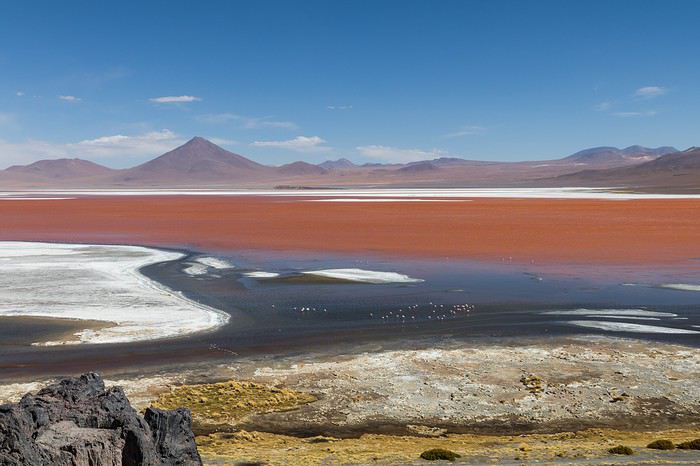
Laguna Colorada

Planning this trip happened during a tough time for our family. My mother-in-law’s illness and passing, plus a few health issues of my own, made us doubt the trip multiple times and nearly scrap the whole thing.

We booked our international flights in February with Swiss. They offered the best balance of travel time and price from Switzerland. Swiss operates Zurich–São Paulo with their own fleet, and São Paulo–Santa Cruz with GOL. In June, GOL canceled the Saturday flight and rebooked us on Sunday. Spending over 24 hours in that huge Brazilian city didn’t work for us at all, so we asked Swiss to put us on the next Zurich–São Paulo flight. Too bad—we lost a day in Bolivia and had to skip the Tarabucco market on Sunday.

Right after, we also booked the car in February. After contacting Imbex and Biz, we went with Biz. Not speaking Spanish, we were relieved to communicate with Alejandra in French. The contact was great—she answered all our questions patiently. Sometimes it took a few days to get a reply, but we could also reach her on WhatsApp. After our trip, we can *only* recommend Biz for rentals in Bolivia. The cars are well-prepped for the South Lipez tracks. The agency is reliable, and the vehicles are new and well-maintained.

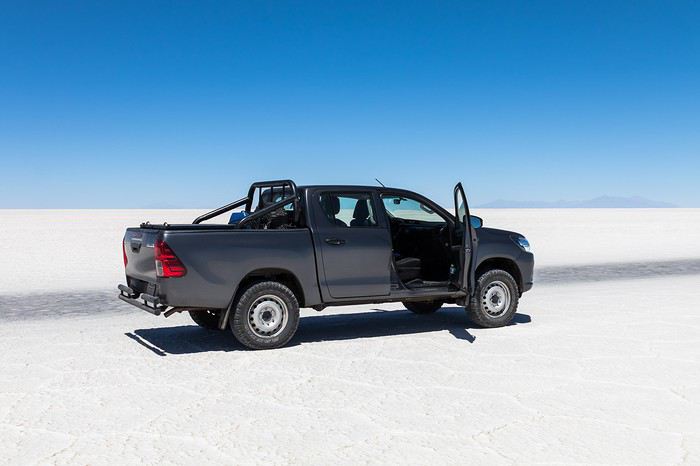
“Our” car, a Toyota Hilux

While planning, we realized the presidential elections would happen while we were in Bolivia. The risk of *bloqueos* (roadblocks and protests) was very real. But in Bolivia, *bloqueos* seem common—you always have to account for that kind of hassle. In late August/early September, Uyuni and the Salar region were blocked for days, leading to food, fuel, and cash shortages. Worried about a blockade in Uyuni and missing the Salar, we decided to visit it first *just in case*.

On election day, the whole country shut down. Planes were grounded, buses and taxis couldn’t circulate, and private cars were banned. There were a few exceptions—ambulances, police, or certain professions—but as tourists, we couldn’t get permission to drive. We asked the embassy, and Biz even requested a permit from the electoral office. So we had to plan to be somewhere with things to do *without* the car.

We decided not to book any accommodations in advance—a first for us. Usually, we plan our stops and reserve lodges, hotels, or campgrounds well ahead. This time, only the room in Sucre was booked, so we’d have a base when we arrived.

In July, Alex (Delhenry) reached out to propose joining part of the trip. He didn’t realize we were leaving in October. Still, we got fresh updates when he returned from the South Lipez. Thanks, Alex—your tips, especially about the Guadalupe–Tupiza stretch, were *super* useful.

In September, we connected with Jean-Louis (Avx) and Anne (Xeta), who were also heading to Bolivia in October, one and two weeks after us. We had dinner with Jean-Louis and his friend after our South Lipez trip and stayed in touch with Anne. It was great to chat with them! Unfortunately, Anne and her husband had a much rockier trip—they got hit hard by post-election issues.

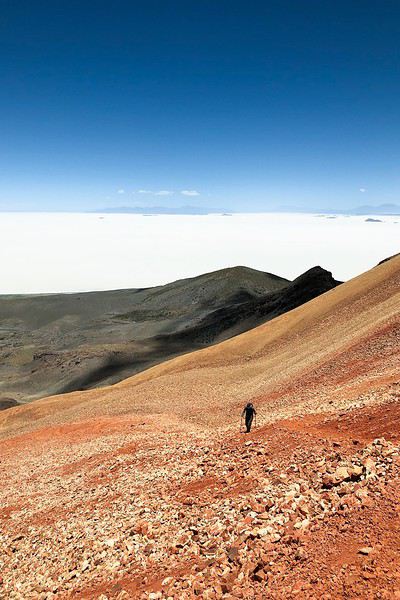
Climbing Volcán Tunupa

Our itinerary wasn’t set in stone—we decided to wing it on the spot. Two weeks before departure, I reconnected with Alejandra at Biz to move the car rental up by a day. With the elections, we wanted to leave Sucre ASAP and focus on the South Lipez. Outside Uyuni and Tupiza, the risk of blockades was zero. We also planned a two-night buffer in Sucre before our flights, just in case. It might sound overcautious, but in hindsight, we made the right call. If we’d left Sucre a day later, we wouldn’t have made it to Potosí—it was completely blocked. On the way back, we *just* dodged blockades in Potosí and elsewhere. Sometimes, you’ve gotta trust your gut.

Here’s our route—only the first two nights in Sucre were booked ahead:

D1 Departure from Switzerland

D2 Sucre (La Selenita)

D3 Sucre (La Selenita)

D4 Colchani (Hotel de Sal Luna Salada)

D5 Jirira (Auberge Doña Lupe)

D6 On the Salar (in the car)

D7 A few kilometers from Estancia Catal (in the car)

D8 Laguna Hedionda (Hotel Los Flamencos)

D9 Laguna Colorada (Lodge by the lagoon)

D10 Middle of nowhere, en route Laguna Verde–Mina Horsu–Quetena Chico (in the car)

D11 Quetena Chico (Lamphaya Lodge Andino)

D12 Quetena Chico (Lamphaya Lodge Andino)

D13 Guadalupe (Guest room at Celia’s)

D14 Along the Rio Grande (in the car)

D15 Tupiza (Hotel Mitru)

D16 Tupiza (Hotel Mitru)

D17 Sucre (La Selenita)

D18 Sucre (La Selenita)

D19 Santa Cruz (Hotel Sun)

D20 Departure from Santa Cruz

D21 Arrival in Switzerland

As you can see, we spent 13 nights in the South Lipez. Initially, we’d planned for nine, but Jean-François (Max68) suggested staying longer. Great advice—we didn’t regret it one bit. We could’ve even added 2–3 more days without getting bored.

Self-driving in the South Lipez takes some prep and a good GPS. We kept it simple and used maps.me to navigate. It’s a solid app—just save your waypoints ahead of time. For some stretches, I used Google Earth to visualize the tracks and sites. If you stick to the tour operator routes, you *almost* can’t get lost. But we often veered off the beaten path and took different routes. Some days, we didn’t see another car. So in case of a breakdown, it’s key to have water and food for several days. In some spots, there’s *zero* signal—your phone won’t work. Another must: it gets *cold* in the South Lipez, and a good sleeping bag is essential. We brought down sleeping bags rated for -10°C and didn’t regret it during our car nights.

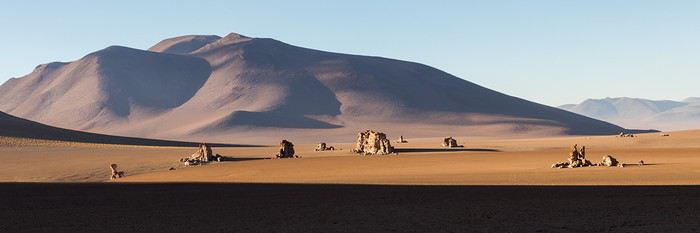
The Dalí Desert

Some tracks are *super* rocky—flat tires are a real risk. On those stretches, maps.me’s estimated travel time was way off. Some sections barely let us go over 15 km/h.

Lots of forum members recommend doing the South Lipez “loop” from Tupiza to Uyuni—ending with the Salar—to avoid Uyuni’s crowds. That might work for organized tours, but for self-drive, the direction *doesn’t* matter. I’ll say this: the few vehicles we saw mostly came from Tupiza and Chile, not Uyuni. So if starting from Uyuni works better for you, go for it! Ending in Tupiza means heading toward warmer weather. For our planned stops and climbs, starting in Uyuni helped with acclimatization. Spending a few nights between 3,600–3,800 m before going over 4,000 m is a smart move.

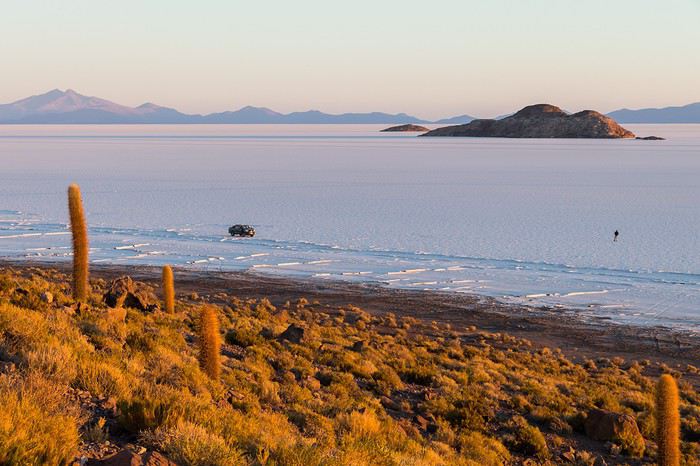
Uyuni Salt Flats in the morning

Overall, we barely saw anyone—except at Laguna Hedionda and Chalviri. There were several tour groups at Hotel Los Flamencos (Laguna Hedionda), but we didn’t cross paths during the day. Hardly anyone on the Salar, on the roads, or at the lodges in the evenings. The *only* place that shocked us was Chalviri. We’d planned to stay there, but it was fully booked—and we counted *forty* tour jeeps on-site. This was around noon! At the Polques hot springs (Chalviri), it was *packed*—we quickly nixed the idea of a dip. Plus, the vibe wasn’t great: soaking right by the road with lodges and restaurants in the background? Meh. Still, lots of tourists love it, so it’s up to you.

For the photos, I kept the colors and mood we saw. The lagoons’ hues are often stunning, but some online photos are *way* over-edited and oversaturated. The South Lipez’s landscapes are breathtaking—no need for excessive retouching.

If you don’t want to read all the details, the start of the travel journal is here: https://voyageforum.com/v.f?post=9888761;a=9888761
Open
JP
Jpm04 last year · Snack
5 weeks in Bolivia and southern Peru this summer
This quick summary of our trip follows a project I posted on VF back in March 2016. I can answer more specific questions, but here I’m highlighting the points that seem most important. Generally, we started our days early (~7 AM or even earlier), had lunch on the go—often in the street—and dinner at somewhat rustic restaurants (< 100 Bs for two). The hotels (unbooked except for our arrival day in La Paz) had so-called "matrimonial" rooms with private bathrooms, usually costing 150–200 Bs or less.

We had a few cold sweats right off the bat: our debit cards only worked at the last ATM (out of 12!) at the airport… and the next day, our flight to Rurrenabaque was grounded, leaving us stranded for a day. We found decent lodging at Hotel Avenida. The following morning, our plane was finally fixed and crossed the Cordillera without issue. Our stay (5 days / 4 nights in the jungle & pampa) with Mashaquipe was great (our guide Domingo played a big part in that). Very interesting and a reliable agency. We saw quite a few animals, though spotting them in the jungle is tricky. In the savanna, though, it’s easier, and Mashaquipe seems to be one of the few agencies with a site in the pampa (near Santa Rosa).

We flew back to La Paz that evening and got lucky—within an hour, we caught a flight to Santa Cruz. The next morning, our first encounter with bus stations: Santa Cruz’s is huge, and we got a little lost. But we found a bus to San José. We visited the church in the late morning, then headed to the bus station, where schedules seemed random and buses only left in the late afternoon at best. We decided to walk to the outskirts of town toward San Rafael and try hitchhiking. It worked—every (rare) vehicle stopped, and we hopped into the first one heading to San Rafael. When we arrived, we gave the driver half the bus fare (~60 Bs). The next morning, we visited the church early and positioned ourselves at the village exit. A pickup truck quickly picked us up and took us to San Miguel (for free). Then, the same thing happened on the way to San Ignacio, but this time it was a *collectivo* that stopped. We arrived in San Ignacio in the early afternoon, but it was Saturday, and the church was closed. It was supposed to open… but never did. Since the *flota* bus left for Concepción around 7 PM, we took it without getting to visit. The next day, we toured the church and attended mass (++) with a choir and musicians. Then, we took a bus to San Javier, visited the church, and caught a *flota* back to Santa Cruz that evening. It might seem a little rushed, but we were lucky. Verdict: the churches are hidden gems in this somewhat off-the-beaten-path province (almost no tourists). We loved the last two the most, but the others were great too.

The next morning, we flew to Sucre, a beautiful city (though I didn’t connect with it), especially compared to the others, at a moderate altitude for the country… except for the central market, the Museum of Indigenous Art, and the San Felipe Neri convent. By chance, we ended up at *Le Petit Parisien*, a café two steps from the main square (65 c. estudiante). Christian, the owner, is originally from Paris and serves French food. His wife, Anna, is Bolivian and organizes visits to the Jal’qa community west of Sucre. You have to enjoy walking (~35 km in 2 days) and be okay with a *camione* (truck) ride and rustic lodging. We said yes for the next morning (cost: 600 Bs for two). A great memory, especially our night with a Quechua family who had just harvested corn… and the otherworldly landscapes.

Then, an overnight bus to Tupiza, where we checked out agencies for a 4-day loop through Sud Lípez and the salt flats, returning to Uyuni. We were really impressed by *Granero del Oro* (though there were only two of us), but we ultimately went with *Tupiza Tours*, the biggest agency, which had other clients so we could leave as a group of four (it was late June, and there weren’t many tourists yet; cost: 2,600 Bs for two). No regrets—this agency seemed solid, with a well-maintained vehicle and a serious driver (Freddy) who stopped whenever we asked. With our +5°C sleeping bags, we weren’t cold since the hotels (which the Bolivians call *basico*) provided blankets. The landscapes were mind-blowing in color, variety, and scale… even though the weather was pretty variable. We saw quite a few vicuñas.

In Uyuni, we took an overnight bus to La Paz, then another to Puno less than two hours later, arriving in the afternoon. That gave us time to head to the port to find lodging on Amantani. We avoided the street vendors and found an office run by locals from the island. We left the next day with an Italian couple and stayed two nights in Occopampa with a host family. Instead of returning via Taquile, we took a boat to Chifrón, then a bus to Juliaca, and from there to Cusco. The island was nice, and we did a lot of walking. At one point, we ran into a horde of tourists (and the second night, there was a dance with quite a few tourists… but also some locals, though I didn’t connect much). I got the impression the northern part of the island is less touristy… but you don’t get to choose your lodging.

In Cusco, we stayed at Suecia 2 (almost quiet, since it’s on the edge of the happy-hour bars and nightclubs) and across from the excellent restaurant *Victor Victoria*. On Sunday, we took a *collectivo* to the Chinchero market. It was touristy but still fun. There were great textile deals, but we were broke and couldn’t find an ATM. Some regrets… We met two young Spanish women and shared a taxi to Moray (we didn’t visit because you need the *boleto turistico*) and Salinas. The taxi dropped us off for an hour—it was nice, especially in the late afternoon. The next day, though, we were really disappointed by Pisac, which felt 100% touristy and New Age… we’d recommend avoiding it. On the way back from Pisac, we asked the bus to stop at Sacsayhuamán, which we explored a bit without a ticket before walking back down to Cusco. The city itself was nice but nothing extraordinary. We only got the *boleto religioso* (cathedral + Iglesia San Blas + San Cristóbal). The Inca Museum and Qorikancha were highlights.

We’d booked the Lares Trek + Machu Picchu (MP) over 4 days with *Sam Travel Perú*. There were five couples and two guides (Eddy & Julian). Great organization, great guides, and the food… no complaints. The landscapes were stunning… and no altitude issues (we’d acclimatized well with Lípez and Lake Titicaca) or breathing problems since we were in shape. That wasn’t the case for the other participants, but it wasn’t a problem since we had two guides, and on the last day, we split into two groups. We stopped in Aguas Calientes before Lares, then took a car and train to Aguas Calientes. On the guide’s advice, we decided to line up at 4:30 AM (there were already hundreds of people) for the bus to MP. At the top, Eddy guided us until 9 AM, then we explored on our own. At first, it was peaceful with clouds clinging to the peaks, but then it got crowded and hot. We escaped with two other couples to climb Wayna Picchu (it’s steep, but with dry weather, no problem). Still, I’d recommend being in shape for the trek and the climb to WP to really enjoy it. We returned to Cusco in the late afternoon, and the next morning, we flew (booked in advance) to La Paz, where we explored a bit (cable car, San Francisco, Calle Jaén…).
Open
MO
Montagnard74 last year
Peru-Bolivia 2017: A Month in the Andes
Here we go...

It’s been almost a month since we got back, and my head is still over there... Just like every time... For my own sake, I know travel journals are useful for travelers planning a trip to a country. But selfishly, they’re also helpful for me—to put the final stone on each journey and revisit it from time to time, just for the memories...

So, this trip won’t be any different, and I invite you to follow along on our Andean adventure, from Lima to the Southern Lipez, from December 16, 2016, to January 14, 2017. It’s a chronological journal because I don’t know how to approach it any other way. It doesn’t hold any absolute truths—just my experiences and feelings, which are obviously personal and not objective!

But if it inspires you to visit these magical countries (and I assume you’re already interested if you’re here) or gives you a couple of tips, then I’ll consider it a win!

So, let’s hit the road for the land of wide-open spaces!

Open

Recommended for you

Previous Page 1 of 1 Next

49 more discussions in this forum are in French. Browse them on the French forum