last edited Dec 11, 2019
Introduction to the Amazon
Location Map of Amazon Rainforest
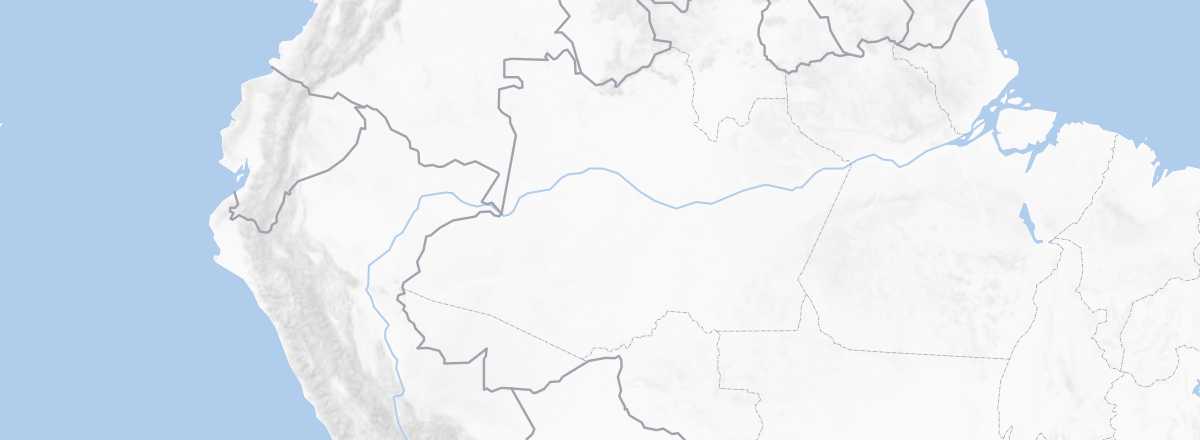 Amazon Rainforest
Open the interactive map
Amazon Rainforest
Open the interactive map
Quick Overview
Although the Amazon lies at the heart of Brazil and is most often associated with the country that hosts nearly two-thirds of it (63%), the planet's largest forest, covering 5.5 million km², also spans parts of eight other countries. These are Peru (10%), Colombia (7%), Bolivia (6%), Venezuela (6%), Guyana (3%), Suriname (2%), Ecuador (1.5%), and French Guiana (1.5%).
Schematically, the Amazon could be defined by the Atlantic coast of northern Brazil and the Guianas to the east, the Orinoco River to the north, the foothills of the Andes to the west, and the Brazilian Plateau to the south. More "officially," it also corresponds to the middle and lower basin of the Amazon River. The latter, fed by numerous waterways born in the surrounding mountain ranges, is the world's largest river by volume. It also holds more than one-fifth of the world's natural freshwater reserves. Stretching 7,000 km, the Amazon rises in the Peruvian Andes and flows into the Atlantic near Belém. While the terrain along the river is flat, it rises toward the edges of the Amazon.
Thanks to its vast forest, the region boasts some of the richest and most diverse flora and fauna on Earth, representing about a third of all known species. However, the Amazon has also suffered for decades from deforestation (over 20% of the original forest has disappeared!) due to unchecked exploitation—if not outright plundering—of its natural resources. Alongside this, another long-standing conflict persists: that of Indigenous peoples facing the advance of the "modern world" and the arrival of migrants, often poor, from other regions, as in Brazil.
Key Facts
- Type of place: region.
- Location: the world's largest forest in the heart of South America.
- Population: around 12 million inhabitants.
- Area: 5,500,000 km².
- Density: 2 inhabitants/km².
- Highest point: Pico da Neblina in Brazil (2,994 m).
- Lowest point: sea level.
Tourism
Spanning nine countries, the world's largest tropical forest has only partially opened up to tourism, though it is possible to explore a small part of its wonders, particularly along rivers and their banks.
Travel Essentials
- Destination: for all types of travelers, from beginners to experienced, depending on the trip and its organization.
- Backpacker daily budget: at best 50 to 60 € per person on-site for a minimally organized experience.
- Best for accommodation:
- Best for getting around: mainly canoes and other small boats.
- Risks: low to moderate in terms of health and safety (excluding a few advised-against areas).
- Best time for climate/crowds/prices:
- Interests (out of ): Nature ; Adventure ; Culture ; Relaxation/Holidays .