
Travel guide · Peru
Peru
Cusco, Machu Picchu, the Nazca Lines, the Sacred Valley, Lake Titicaca, the Andes in all their glory, the Amazon rainforest—Peru can’t be discovered in a single trip with so much to do and see...
Introduction to Peru
This is the traditional land of the Incas, giving rise to the most diverse country in all of Latin America, both in terms of landscapes and culture. Peru is made up of three distinct regions: the Costa , a narrow coastal desert where nearly 60% of the…
Regions of Peru
Pacific Coast

The Costa (the coast) is this long desert coastal plain that runs along the Pacific and occupies barely 10% of the territory. Paradoxically, it is also the most populated region, home to 60% of the inhabitants, particularly around a few fertile valleys. The capital is located on the coast, along with several interesting tourist spots such as Nazca, Paracas National Reserve, various pre-Columbian sites, or renowned surfing resorts like those around Lima or beyond Trujillo.
The Andes

This is the region that often comes to mind when thinking of Peru: the altiplano, its high peaks, llamas, locals in traditional dress, Cusco, the Machu Picchu, and more. Beyond the somewhat "clichéd" image, the Andean region remains the most visited and richest in heritage, nature, landscapes, and all kinds of activities.
Peruvian Amazon

Although the Amazon rainforest covers over 60% of Peru’s territory—making it the second-largest portion of the Amazon after Brazil—it is often overshadowed in tourism by the Andes and, of course, the Machu Picchu or Lake Titicaca. Yet Iquitos is THE major city in the upper Amazon and offers numerous ways to explore the region.
Peruvian Pacific Coast
The *Costa* (the coast) is this long desert coastal plain that runs along the Pacific and occupies barely 10% of the country. Paradoxically, it is also the most populated region, home to 60% of the inhabitants, particularly around a few fertile valleys. The…
Peruvian Andes
This is the region that matches what people often imagine of Peru: the altiplano, its high peaks, llamas, local populations in traditional dress, Cusco, Machu Picchu, and more. Beyond the somewhat "cliché" image, the Andean part of the country remains the…
Peruvian Amazon
Although the Amazon rainforest covers over 60% of Peru's territory—making the country home to the second-largest portion of the Amazon after Brazil—it is largely overshadowed in tourism by the Andes and, of course, Machu Picchu or Lake Titicaca. Yet Iquitos…
Geography and Environment of Peru
Geography of the Country
Natural Zones

National parks and nature reserves cover around 15% of Peru’s territory—and even more if you include the unclassified parts of the Amazon rainforest. Among the most interesting protected sites for travelers:
- Huascarán National Park: This stunning park in the Cordillera Blanca is home to Huascarán, the country’s highest peak (6,768 m). Hiking and climbing are popular here.
- Manu National Park: A UNESCO-listed site, this vast Amazonian park boasts some of the richest and most diverse wildlife and plant life.
- Pacaya-Samiria Reserve: Near Iquitos, this is one of Peru’s largest protected areas, teeming with wildlife and flora.
- Paracas National Reserve: In a desert region facing the Pacific, this beautiful marine reserve—visited by boat—is home to countless birds, dolphins, turtles, and sea lions. A giant 120-meter geoglyph (“Tres Cruces”) can also be seen here.
- San Fernando National Reserve: On the coast near Nazca, this reserve features breathtaking landscapes and colonies of birds, penguins, and sea lions.
- Tambopata-Candamo Reserve: In the southeast, bordering Bolivia, this area offers lush forests and wildlife. Rafting on the Tambopata River is also possible.
Wildlife and Plant Life
Climate and Weather in Peru
Peru has three distinct climate zones—the coast, the highlands, and the Amazon—with seasons reversed compared to the northern hemisphere. The Pacific coast is characterised by fairly stable and generally pleasant temperatures year-round (around 20°C during…
History of Peru
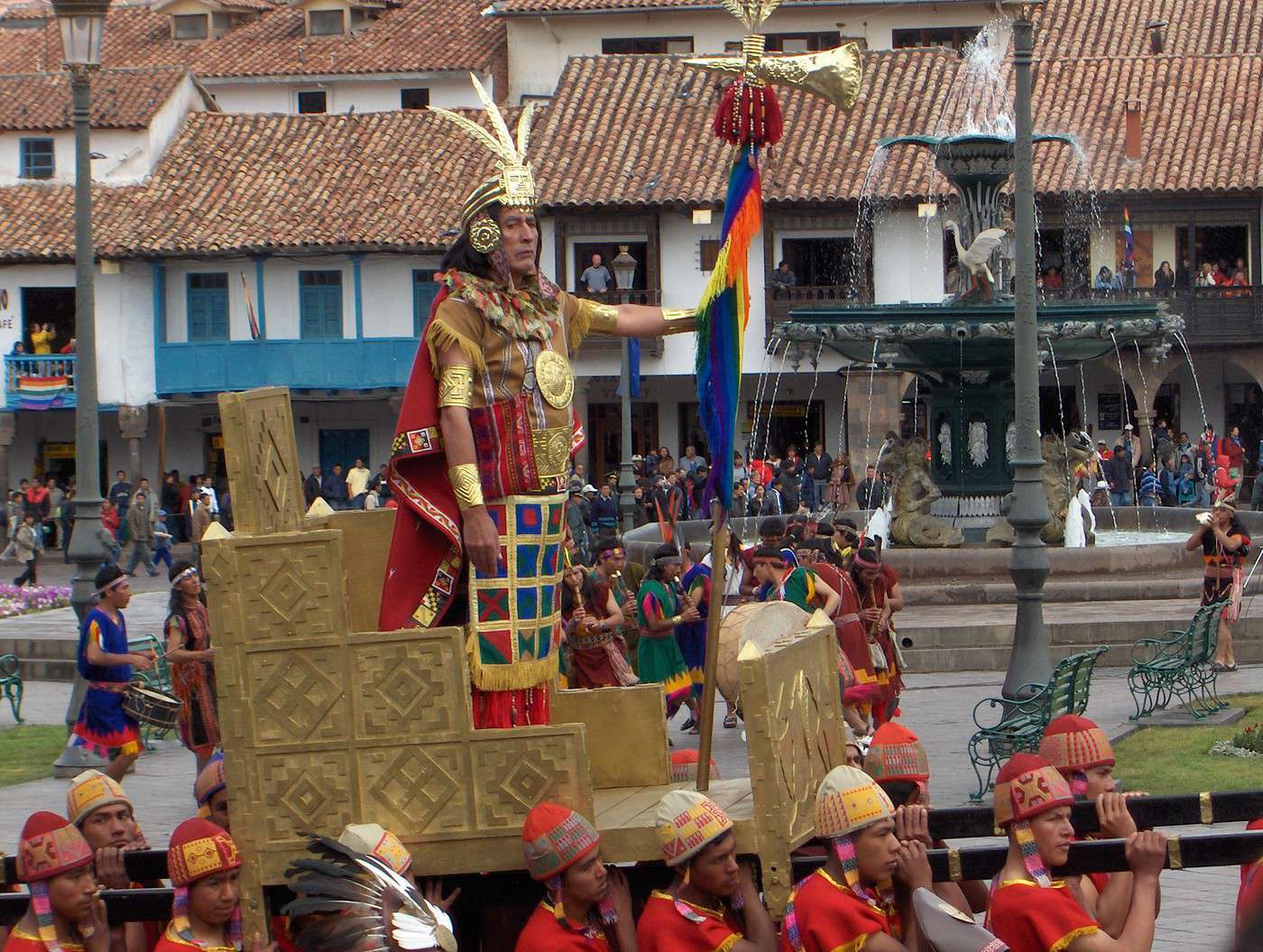
Cusco, Pérou · © VoyageForum 13th century: Although the region had long been home to local populations and kingdoms, it was around the 13th century that the Inca civilization emerged near present-day Cusco, quickly gaining dominance over other…
Peruvian Society
Population
Peruvian society is quite diverse, with around 45% of the population of Amerindian origin, 37% mestizo (mixed European and Amerindian), 15% White, and small minorities of Black, Chinese, Japanese, and Lebanese people.
Political Institutions
Economy
Religion
Colonised by the Spanish, Peru remains a traditionally Catholic country, with over 85% identifying as such, though many are non-practising. There is also significant syncretism among Amerindian populations, blending Christian rites with ancestral beliefs. The rest of the population largely identifies as Protestant, particularly belonging to the various US evangelical churches/sects increasingly present on the continent.
Culture and Customs of Peru
Arts, Crafts, and Architecture

Arts
Crafts
Architecture
Museums
Customs and Traditions
Local Traditions
Etiquette
Dress and Behavior
Sensitive or Taboo Topics
Languages
Spanish is the official language of Peru, spoken by 85% of the population, along with indigenous languages such as Quechua (13% of speakers) or Aymara (2%) in areas where they predominate. Around forty other local languages are also spoken. When it comes to foreign languages, while English is used in tourist areas, French is almost entirely unknown.
Glossary
A few useful local words and expressions to know while traveling:
Festivals and Celebrations
Major Events and Public Holidays
Books, Films, and Music
Peruvian Gastronomy
Local Cuisine
Other Cuisines
Specialities
Starters
Main Dishes
Desserts
Drinks
Where to Eat
Depending on your cravings, budget, and stomach’s resilience, you can choose to eat at markets, small local eateries, or more "classic" restaurants—touristy or not. Typically, restaurant prices include service (10%), but that doesn’t stop you from leaving a small tip.
Markets, street vendors, and "takeaway shops" are the most budget-friendly options, where you can eat simple, ultra-local dishes for under 2 €—though hygiene might unsettle sensitive stomachs. For just a little more, local establishments usually offer a hearty "dish of the day" or a "basic" menu. To enjoy a restaurant more accustomed to tourists, expect around 10 € for a full meal, and more for higher-end dining.
Additional Information
What to See in Peru
Peru has 12 sites inscribed on the UNESCO World Heritage list: Caral ★★ (2009) These are the remains of the oldest pre-Columbian city in the Americas. This UNESCO-listed archaeological site is located in the desert north of Lima. Chan Chan ★★ (1986) This is…
Things to Do in Peru
Mancora, Pérou · © VoyageForum Although Peru’s coastline stretches for about 3,000 km, the country isn’t particularly known for its beaches and seaside resorts. The coast sits at the intersection of the cold Humboldt Current and the seasonal warm…
Types of Travel in Peru
Interests (rated ★★★★ ) : Nature ★★★★ ; Adventure ★★★★ ; Culture ★★★★ ; Relaxation-holidays ★ . Like other Andean countries, Peru, with its volcanoes, high plateaus, Amazon rainforest, and Pacific coastline, has all the assets of a nature destination where…
When and Where to Go in Peru
Best Times to Visit Peru
Finding the best time to visit involves balancing climate conditions with crowd levels and the most attractive prices, both on-site and for travel.
Given the country's vast size and climatic diversity, the ideal time to visit Peru is quite relative. It largely depends on the places you want to see, though the Andean region's climate often dictates the choice. That said, late April to early October generally offers a good compromise for exploring the entire country. However, late June to mid-August sees higher visitor numbers in the cordillera (though it’s not packed), with prices to match, as do Christmas and the start of the year along the Pacific coast when Peruvians are on holiday. There’s also a bit more activity during Holy Week.
In short, considering all these factors, late April to early October is broadly the best time to go, though late June to mid-August can be busier in terms of crowds. You’ll need to adjust based on the specific places you plan to visit or activities you want to do.
| Jan. | Feb. | Mar. | Apr. | May | Jun. | Jul. | Aug. | Sep. | Oct. | Nov. | Dec. | |
|---|---|---|---|---|---|---|---|---|---|---|---|---|
| Coast climate | ||||||||||||
| Cordillera climate | ||||||||||||
| Amazon climate | ||||||||||||
| Avoid crowds | ||||||||||||
| Low prices |
: very favorable | : favorable | : moderately favorable | : unfavorable.
Where to Go Based on Travel Style and Interests
Flying to Peru
Given the country's size and terrain, Peru is well-equipped with around 200 airports and airfields. Of these, four serve international flights (Lima, Arequipa, Cuzco, Iquitos), and about twenty handle regular domestic routes. The most important by far is…
Getting to Peru by Land or Sea
Peru shares borders with five countries: Bolivia (1,075 km), Brazil (2,995 km), Chile (171 km), Colombia (1,800 km), and Ecuador (1,420 km). Excluding lake or river routes, three of Peru’s neighboring countries have land border crossings. Specifically:…
Getting Around Peru
Although three-quarters of Peru’s road network isn’t actually paved, it has been steadily improving for several years. The "Pan-American Highway" that crosses the country and the routes between major cities are in fairly good condition. Elsewhere, in rural…
Accommodation in Peru
Accommodation in Peru largely revolves around small hotels and guesthouses, with occasional options for lodges or bungalows in natural settings. In the Amazon, choices are more limited (and thus often more expensive), so it may be useful to bring your own…
Entry Requirements and Visa for Peru
For tourist travel, French citizens do not need a visa for stays of less than 3 months. A passport valid for 6 months beyond the planned entry date is sufficient. A return or onward ticket, including by bus, is technically required, though it is rarely…
Money, Budget, and Shopping in Peru
Devise: Sol (100 centimos). Billets: 10, 20, 50, 100 and 200 soles. Pièces: 10, 20 and 50 centimos + 1, 2 and 5 soles. Change: Major foreign currencies can be exchanged in the country. In practice, you’ll find exchange counters in most major banks in cities…
Health and Safety in Peru
In France, both for individuals and professionals, the "travel advice" from the Ministry of Foreign Affairs regarding precautions for each country has legal value. A similar online travel advice system exists in several countries: Foreign Affairs Belgium…
Other practical information for Peru
Except for the Amazon where lightweight items are sufficient, along with a light sweater for evenings and air conditioning, plan for all seasons with both lightweight and warm clothing for the coast, and very warm clothing for the highlands. In all cases,…
Something wrong or out of date? Report this page