A Turquoise Dream Come True in Uzbekistan - 2022
Translated into English.
33 replies
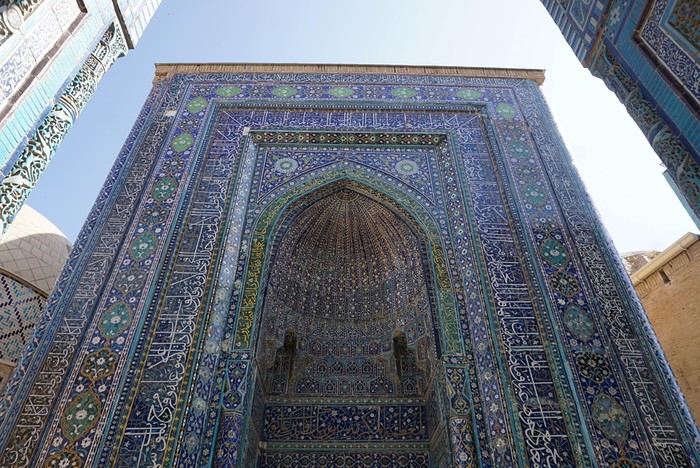
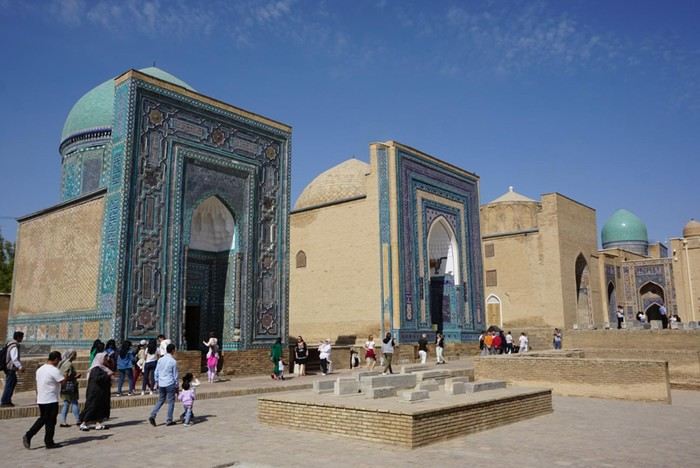
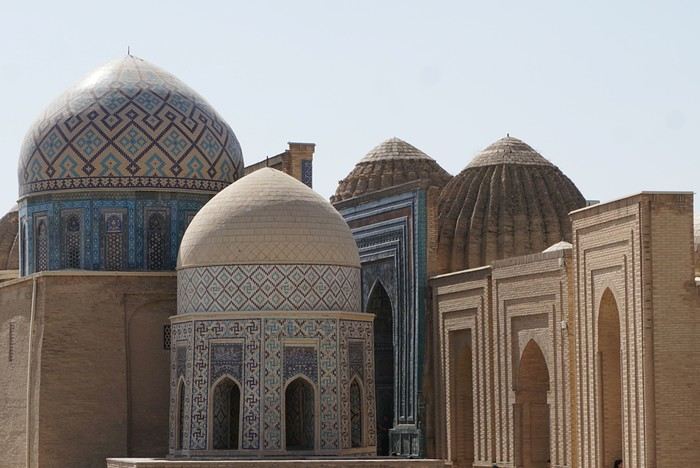
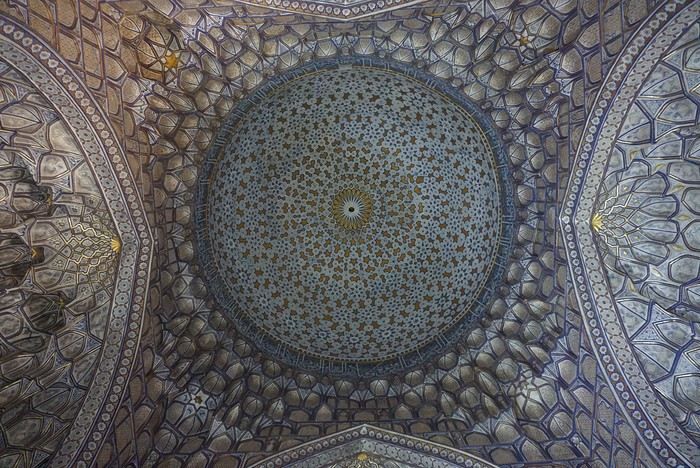
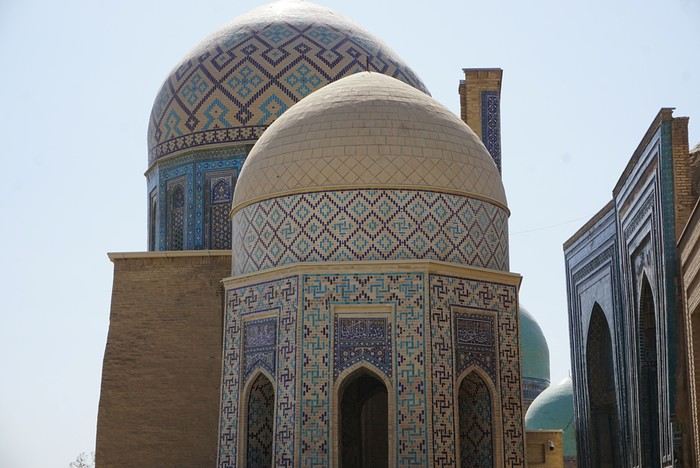
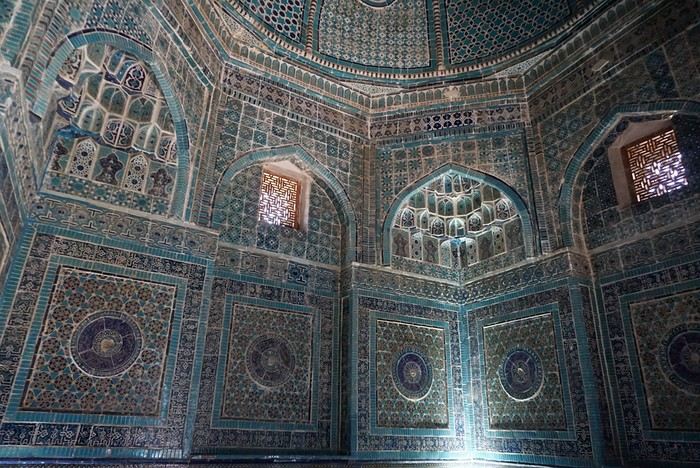
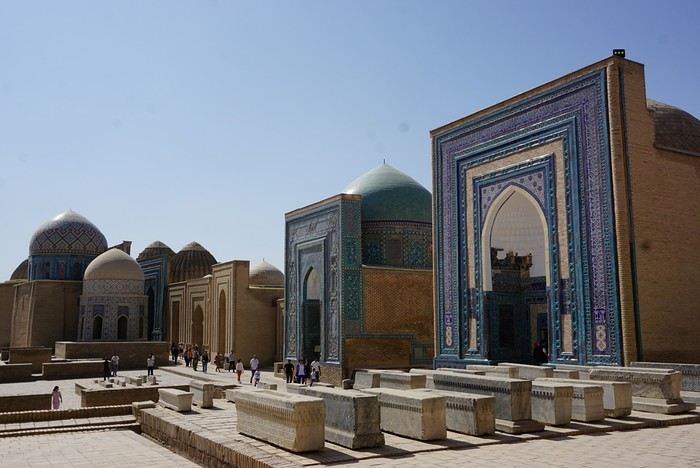
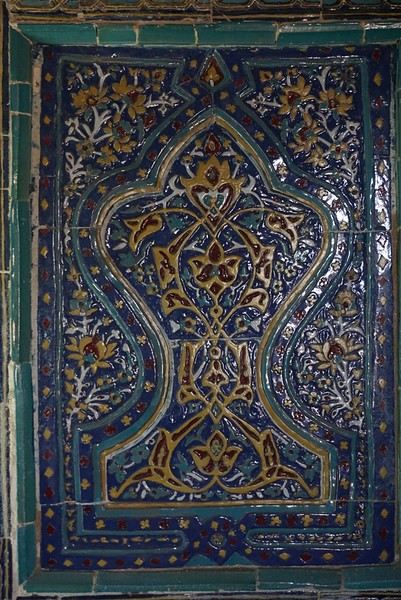
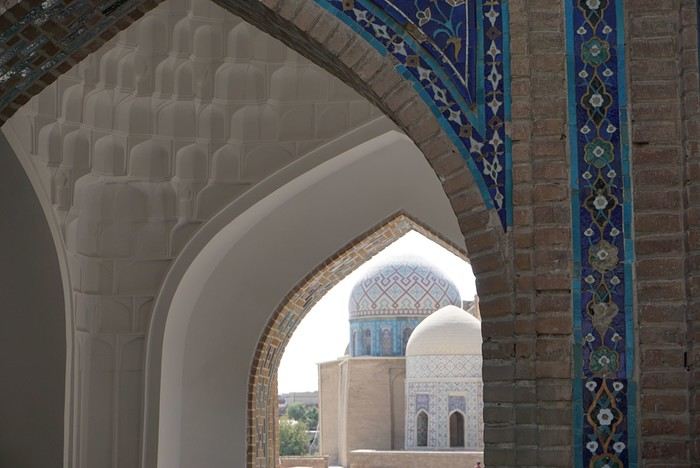
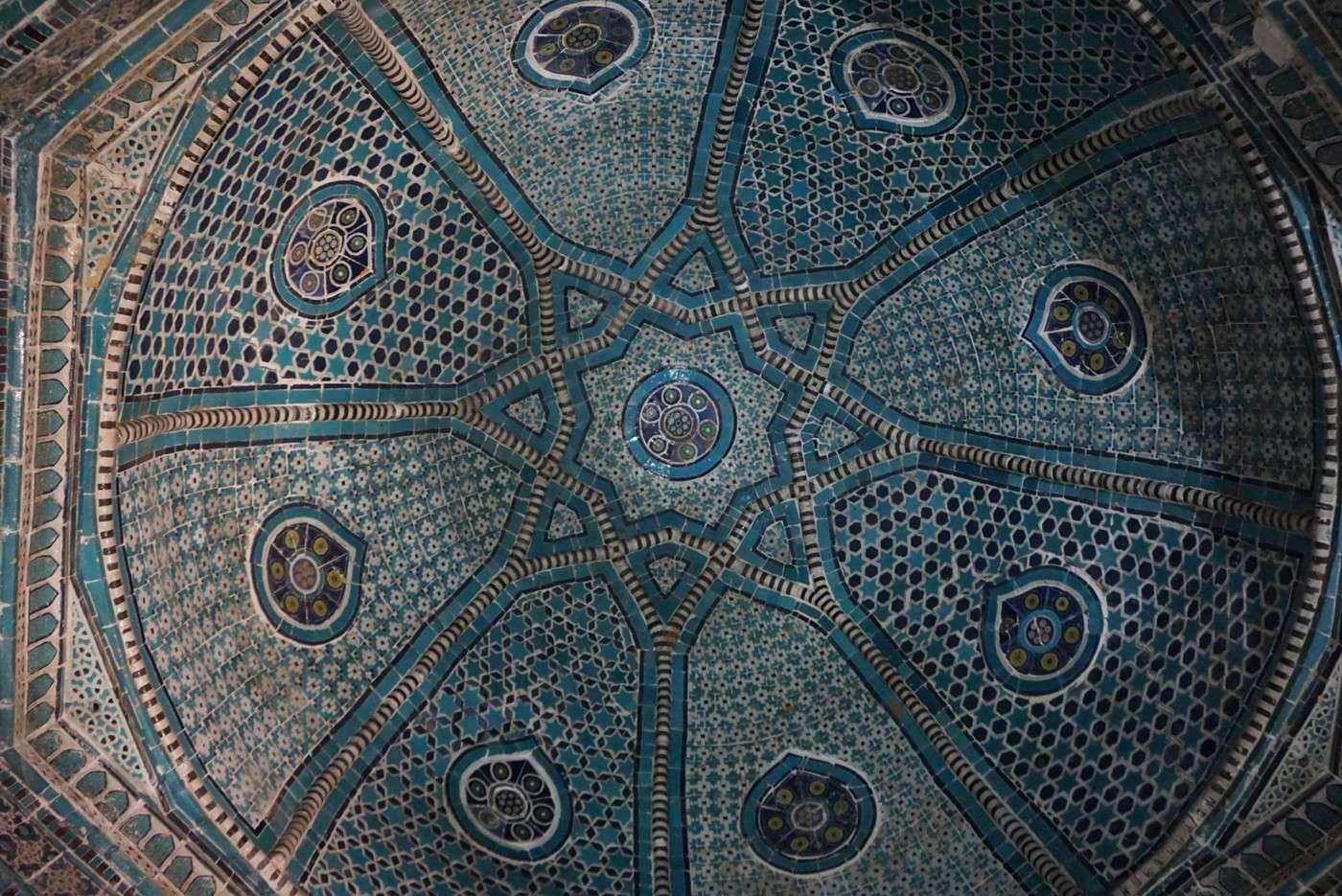

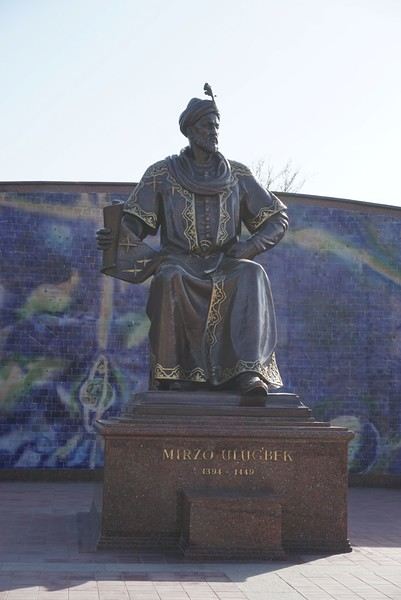
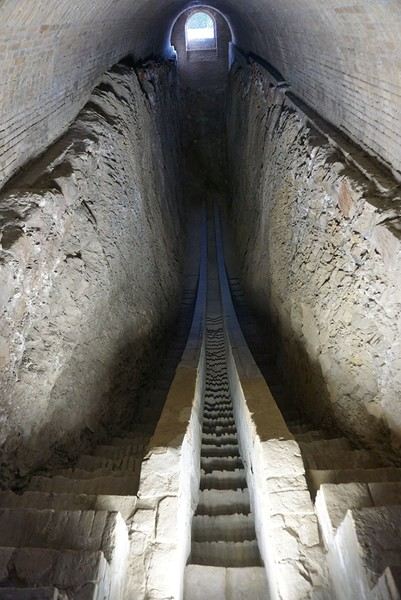
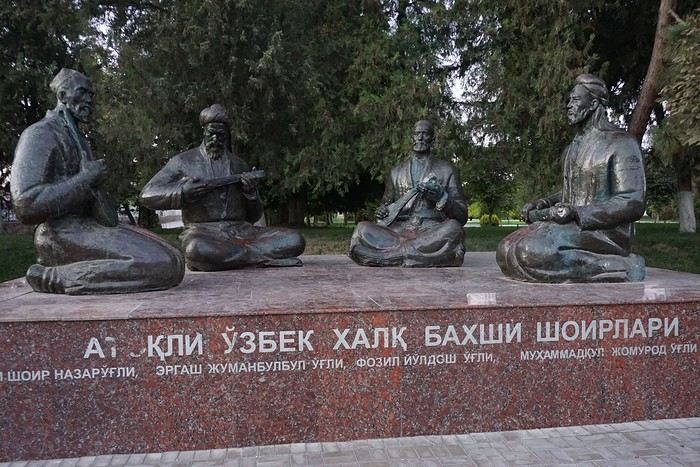
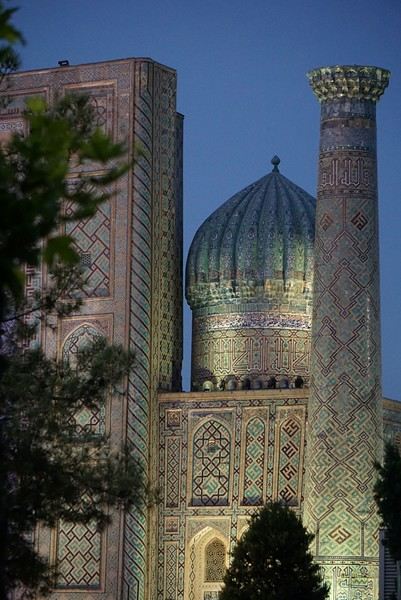
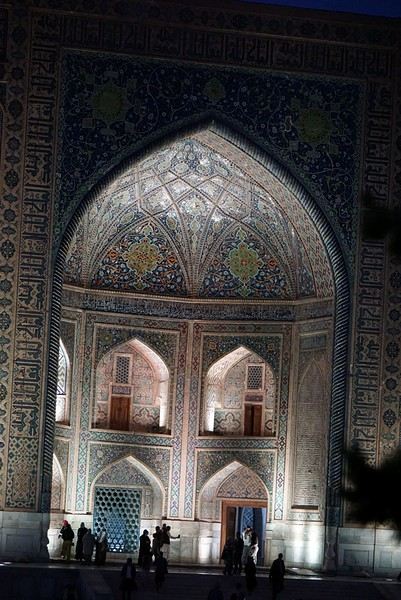

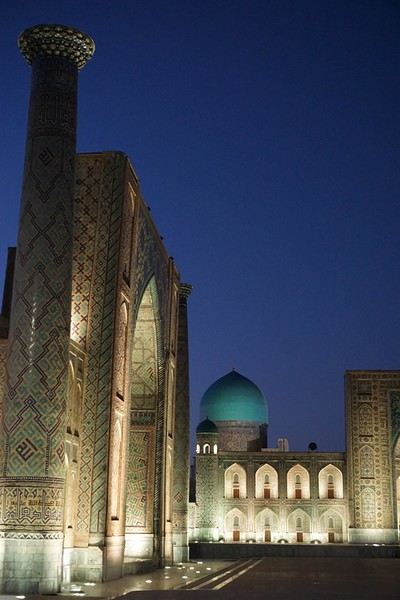
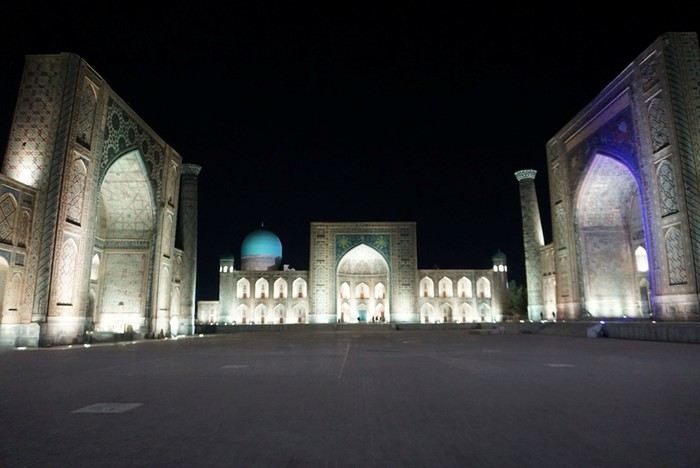
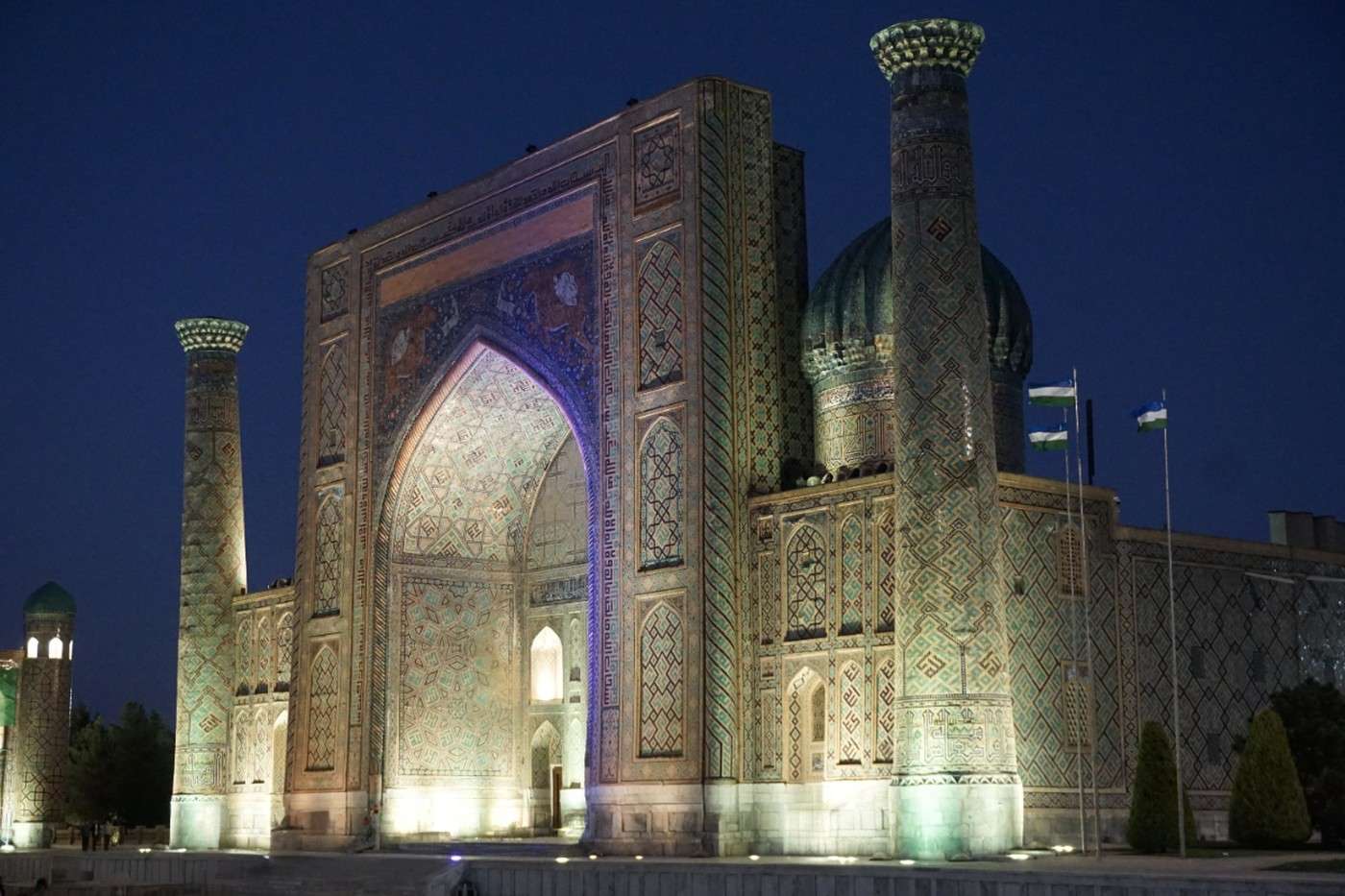
Step 7: Legendary Samarkand
October 2nd - Off-the-beaten-path Samarkand (Part 1/2)
Today, Nasrullo takes us to visit a few sites away from the tourist trails. We start with a mosque and a mausoleum that haven’t been restored yet. This gives us a better idea of the restoration work done on all the other sites. Just for that, along with his comments, this visit is really interesting.
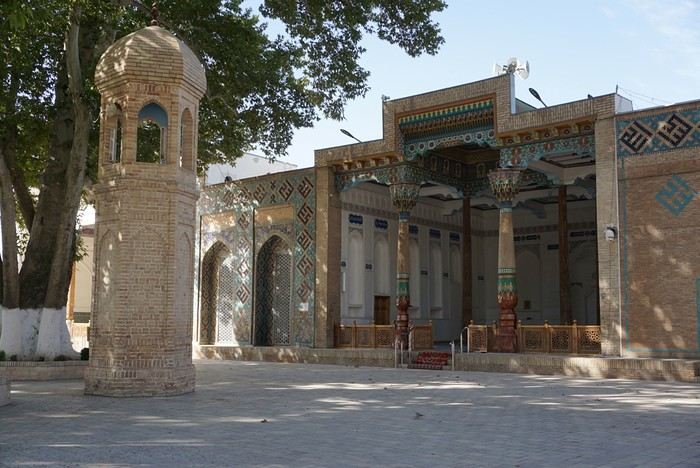
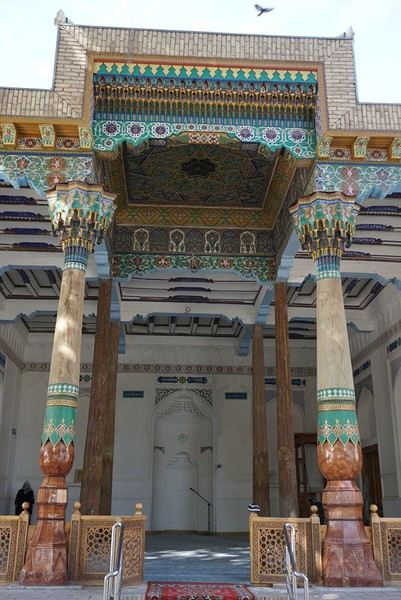
Then we head to another very peaceful site: a basin, very old plane trees (250 to 300 years old), a small minaret, a mosque, a saint’s tomb, and an imam who prays at the request of people and/or families who come here to pay their respects.
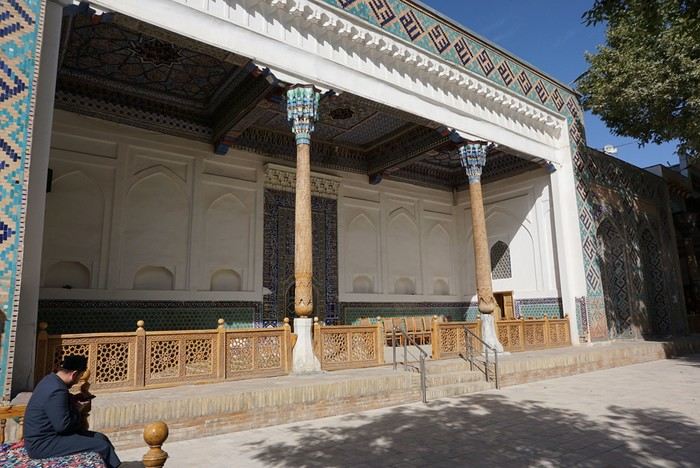
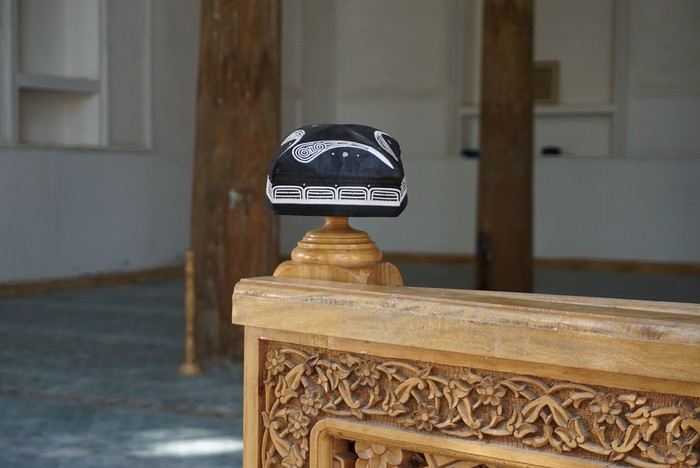
Anecdote under the plane trees: we watch a crow holding a walnut in its beak. In mid-flight, it drops it onto the ground. The shell breaks on impact. The crow lands and comes to eat the contents. Nasrullo wonders about the presence of jujube trees, imported from Saudi Arabia, in all the Sufi holy places. Sure, the fruit has benefits, especially against cholesterol. But that’s certainly not the ‘real reason.’ Here’s one possible explanation, taken from verse 28 of Surah Al-Waqi’a No. 56, the jujube trees of paradise: According to Salim Ibn Amir: The companions of the Prophet (peace and blessings be upon him) used to say: Allah has indeed benefited us through the Bedouins and their questions. One day, a Bedouin came and said: O Messenger of Allah! Allah mentioned that there is a tree in paradise that can harm, and I didn’t think there was a tree in paradise that could harm its owner. The Prophet (peace and blessings be upon him) said: « Which tree is that? ». The Bedouin said: The jujube tree, it certainly has thorns that harm. The Prophet (peace and blessings be upon him) said: « Didn’t Allah say: ‘thornless jujube trees’? Allah removed its thorns and put a fruit in place of each thorn. So this tree has fruits, and each fruit splits into 72 different kinds of food, none of which resemble one another. » (Reported by Ibn Abi Dunya and authenticated by Sheikh Albani in Sahih Targhib No. 3742)
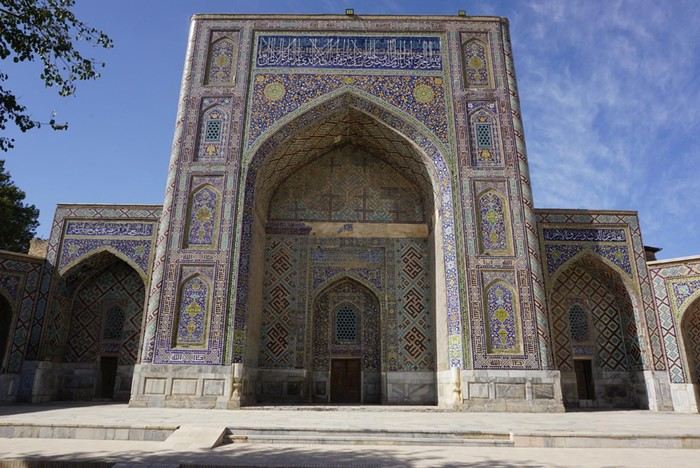
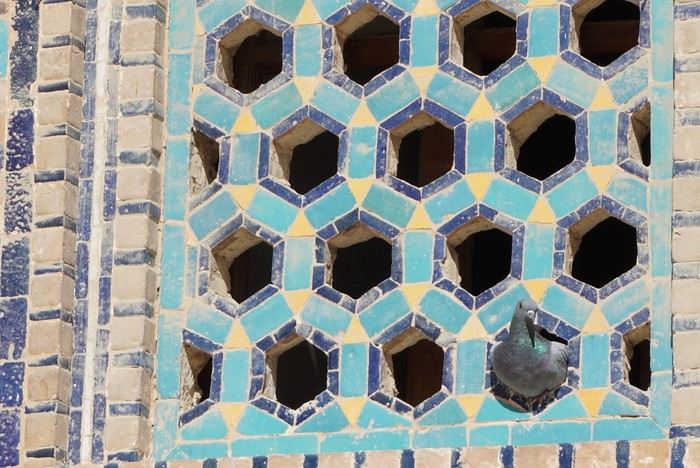
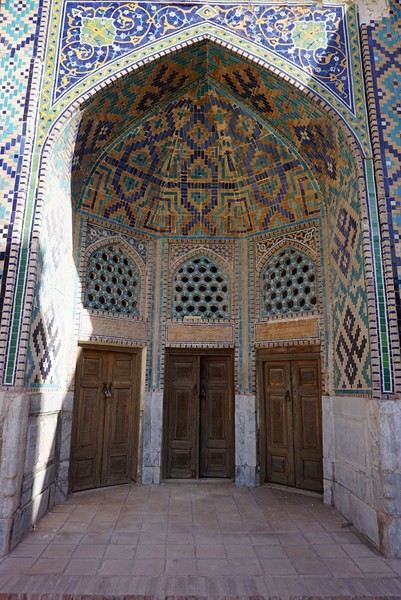
Right next door is a madrasa that’s been fully restored but is empty of both visitors and vendors. The artisans have indeed left this site, which is too far from the center of Samarkand to attract mass tourism and organized tour buses. So we take advantage of it! Just imagine! A completely restored madrasa all to ourselves! Our guide, the site guardian (entry is still paid, though!), my wife, and me… and a few pigeons!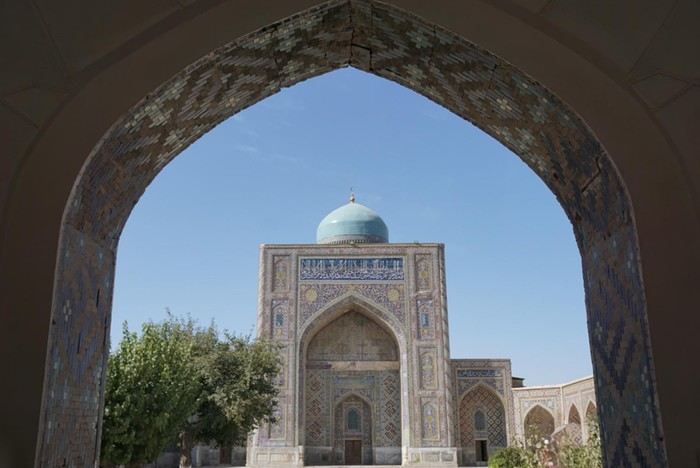
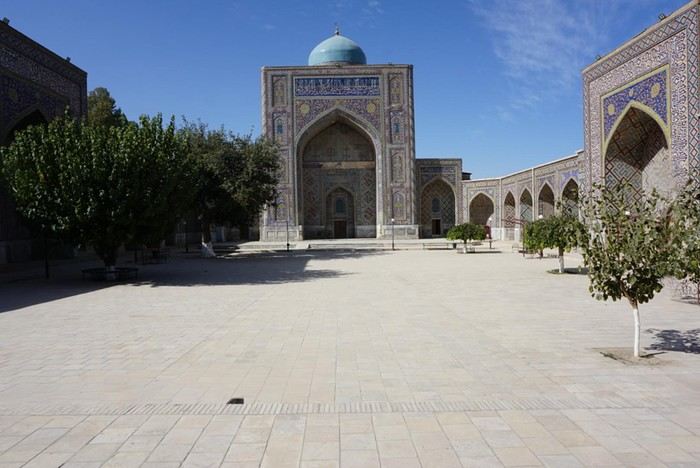
After all these visits away from the center, we return to Registan Square, which we’ll explore today with Nasrullo. This way, we’ll benefit from his insightful comments and explanations about the two madrasas, the mosque, and the esplanade itself. Then Nasrullo leaves us. We stay on the site to enjoy one last time the interiors and views of the three buildings at the heart of the square.
Then we head to another very peaceful site: a basin, very old plane trees (250 to 300 years old), a small minaret, a mosque, a saint’s tomb, and an imam who prays at the request of people and/or families who come here to pay their respects.
Anecdote under the plane trees: we watch a crow holding a walnut in its beak. In mid-flight, it drops it onto the ground. The shell breaks on impact. The crow lands and comes to eat the contents. Nasrullo wonders about the presence of jujube trees, imported from Saudi Arabia, in all the Sufi holy places. Sure, the fruit has benefits, especially against cholesterol. But that’s certainly not the ‘real reason.’ Here’s one possible explanation, taken from verse 28 of Surah Al-Waqi’a No. 56, the jujube trees of paradise: According to Salim Ibn Amir: The companions of the Prophet (peace and blessings be upon him) used to say: Allah has indeed benefited us through the Bedouins and their questions. One day, a Bedouin came and said: O Messenger of Allah! Allah mentioned that there is a tree in paradise that can harm, and I didn’t think there was a tree in paradise that could harm its owner. The Prophet (peace and blessings be upon him) said: « Which tree is that? ». The Bedouin said: The jujube tree, it certainly has thorns that harm. The Prophet (peace and blessings be upon him) said: « Didn’t Allah say: ‘thornless jujube trees’? Allah removed its thorns and put a fruit in place of each thorn. So this tree has fruits, and each fruit splits into 72 different kinds of food, none of which resemble one another. » (Reported by Ibn Abi Dunya and authenticated by Sheikh Albani in Sahih Targhib No. 3742)
Right next door is a madrasa that’s been fully restored but is empty of both visitors and vendors. The artisans have indeed left this site, which is too far from the center of Samarkand to attract mass tourism and organized tour buses. So we take advantage of it! Just imagine! A completely restored madrasa all to ourselves! Our guide, the site guardian (entry is still paid, though!), my wife, and me… and a few pigeons!
After all these visits away from the center, we return to Registan Square, which we’ll explore today with Nasrullo. This way, we’ll benefit from his insightful comments and explanations about the two madrasas, the mosque, and the esplanade itself. Then Nasrullo leaves us. We stay on the site to enjoy one last time the interiors and views of the three buildings at the heart of the square.
Step 7: Legendary Samarkand
October 2nd - Off-the-beaten-path Samarkand (2/2)
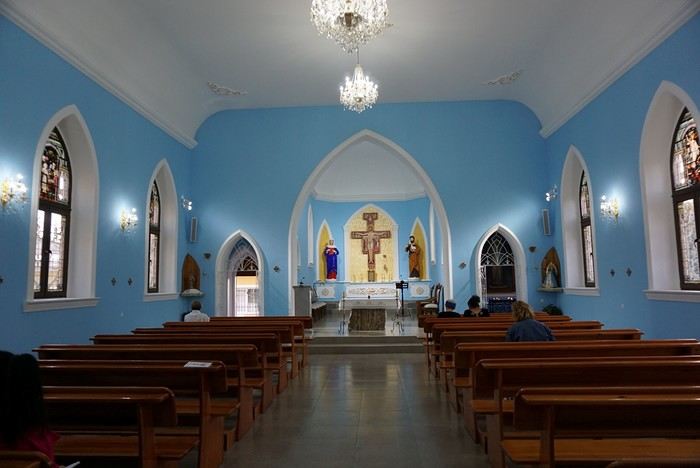
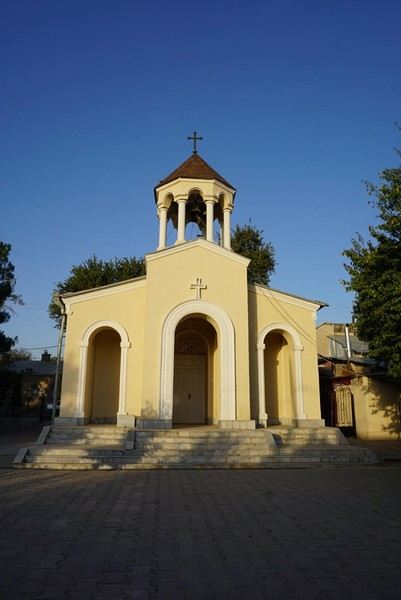
In the early afternoon, I decide to take a stroll through the Jewish quarter. I pass through a small entrance located between Registan Square and the Bibi-Khanym Mosque. I’d spotted a few sites on Maps.Me in the area: small mosques, a mausoleum, a synagogue, and a madrasa.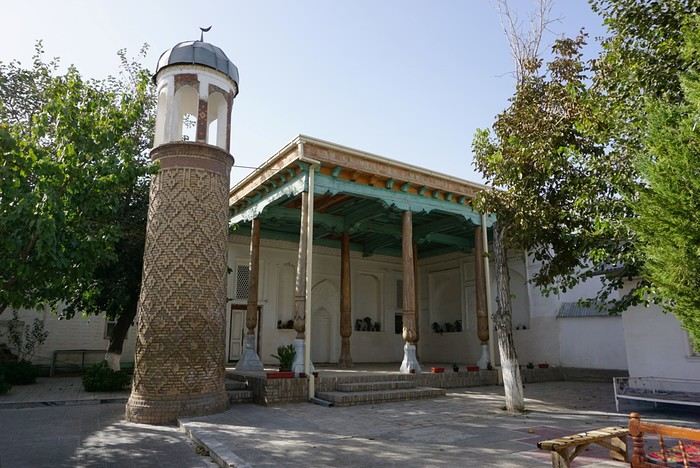
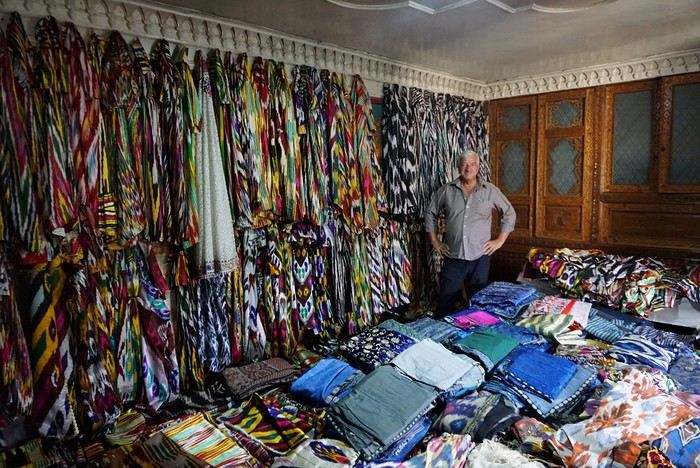
I start with the small Qurabay Aqsaqal Mosque, then move on to another equally tiny one (Mubarak Mosque). While I’m in its courtyard, the owner of the shop directly across (a second-hand and thrift store) comes out to invite me in. I accept once I’ve finished exploring the small courtyard. It’s a real Ali Baba’s cave! The owner is proud to show me his collections of teapots, cups, Russian military medals, plates, glasses, and other miscellaneous items. He then invites me into different rooms of this old house turned shop. In the first, there are second-hand hats, and in the second, fabrics and women’s tunics. I ask if I can take his photo among the fabrics. He agrees and poses proudly. Then, in the third and last room, I find men’s coats that I really like! I’ll have to come back here with my wife—I’m sure she’ll love this place!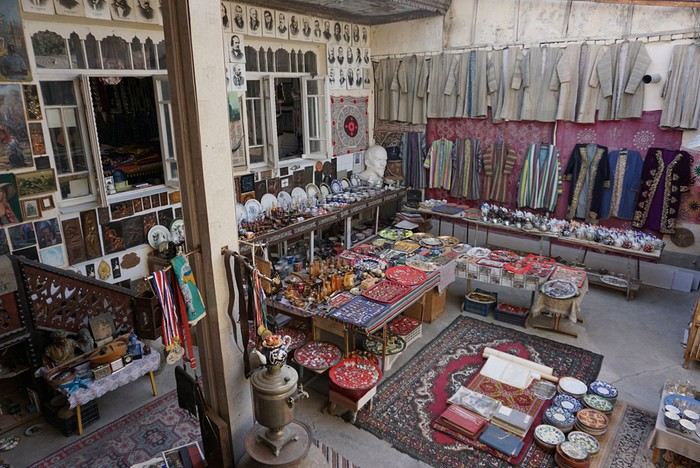
As I leave, I see a butcher in the street weighing a large piece of meat (half a sheep, a quarter of a cow?) before loading it into the back of a minivan. But where’s the refrigerated truck?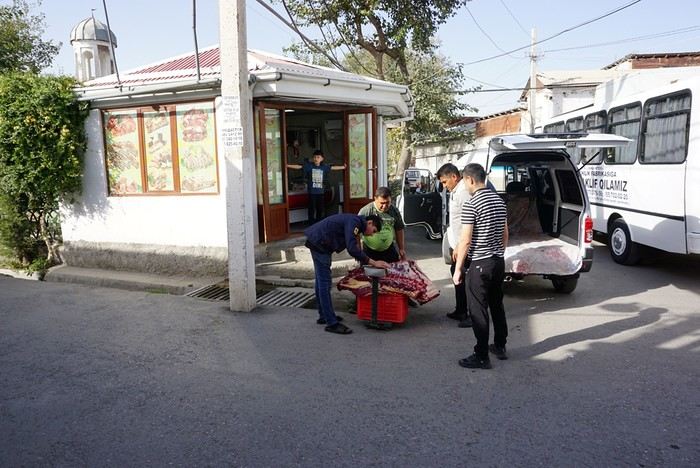
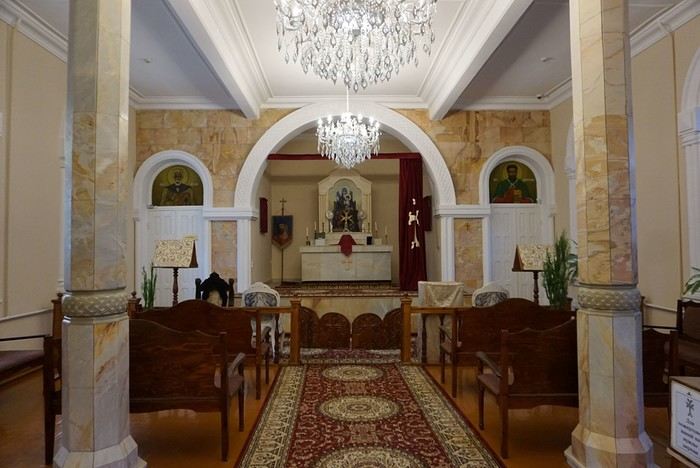
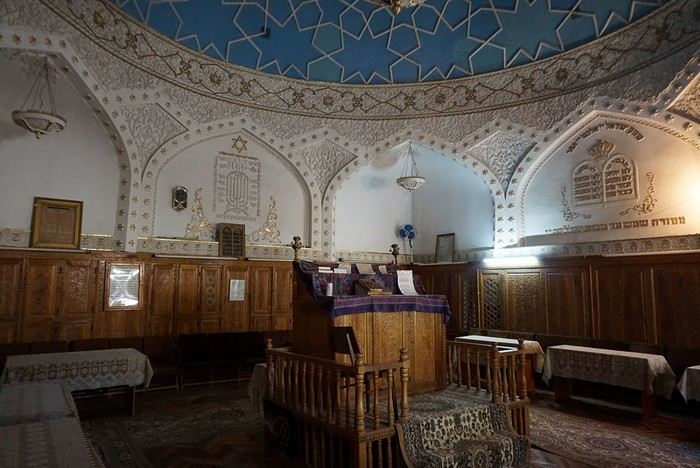
A little further on, I stop in front of the entrance to the synagogue. It’s closed. A woman passes by and sees me trying unsuccessfully to get in. She gently pushes me aside, starts shaking the door, and calls out to someone inside. After a few minutes, a man finally arrives. He seems delighted to have a visitor. We cross a small garden, climb a few steps, and find ourselves in a small corridor/porch with the synagogue’s entrance door at the end. On the wall of this ‘corridor,’ photos—probably of rabbis—are displayed. He comments on them, but of course, I don’t understand a word of what he’s saying. After fetching the key to the synagogue’s entrance, he opens it and immediately turns on the light. He continues his commentary inside. He invites me to take photos and opens cabinet/library doors to show me old books. As I’m about to leave, I realize I’m supposed to leave an offering. I pull out a 5,000 sum bill. He shows his dissatisfaction and makes it clear that 50,000 would be more appropriate. I comply, much to his satisfaction.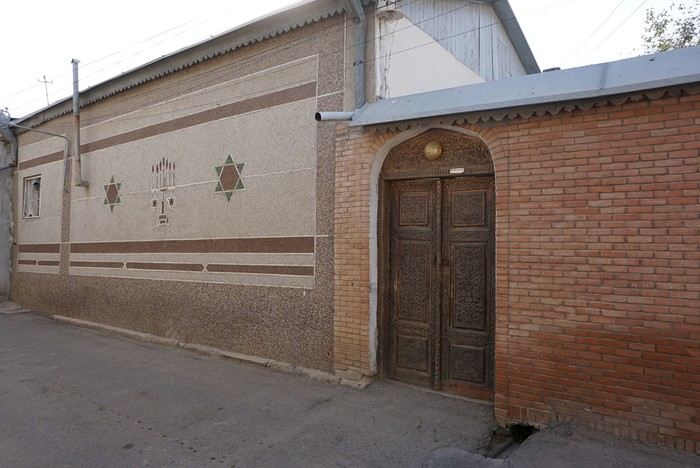
From the synagogue, I head to the small park and mausoleum of Imam Maturidi. I wanted to continue to another mosque where, in its courtyard, there’s the tomb of a scholar. But since it’s prayer time, I discreetly leave.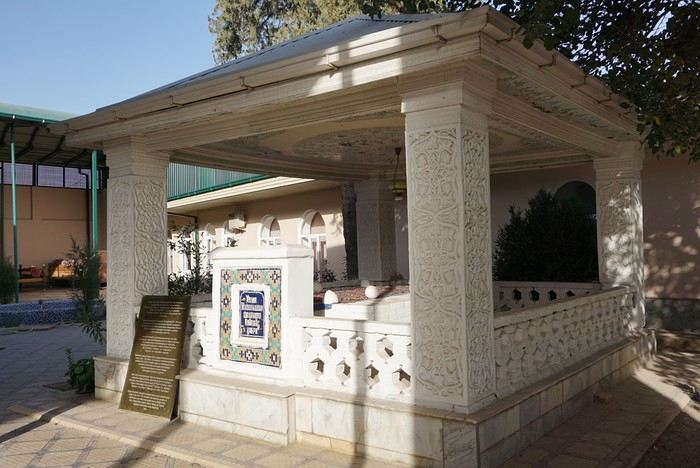
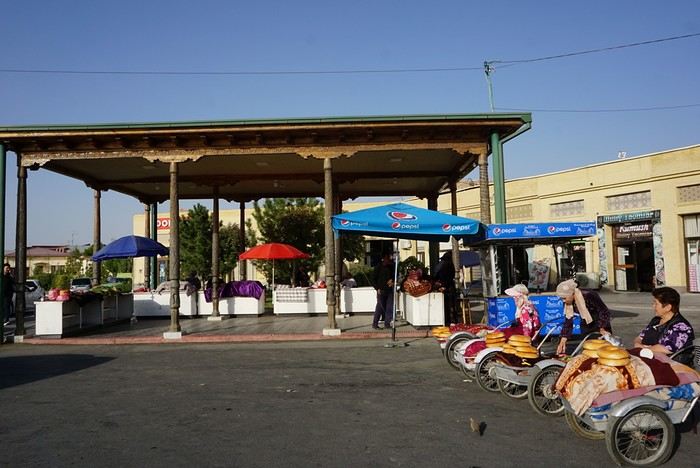
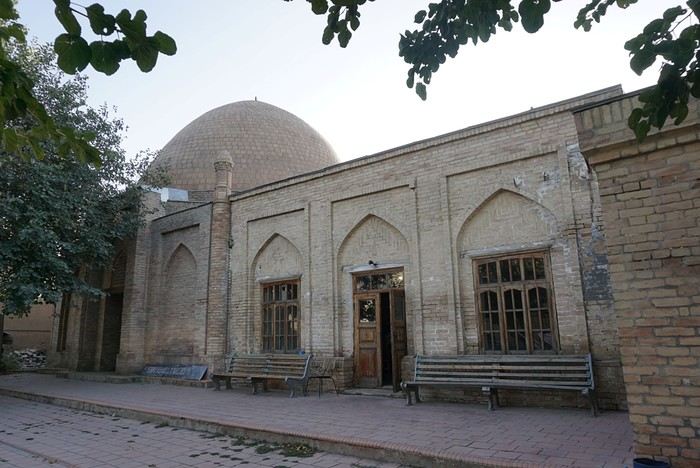
The last stop on this walk takes me to a small madrasa next to Panjakent Kso Street. In its courtyard, a group of young people are deep in conversation. One of them approaches me, explains that the others are Russians, and invites me into the building. Inside, I find four elderly men playing dominoes. I ask if I can sit at their table and watch them play a few rounds. As I’m leaving, one of them asks where I’m from. France? What does he say? Bingo! PSG! And he starts naming famous players! No problem here—I’ll definitely improve my knowledge of French football! Even more surprising, another player suddenly shouts ‘Charles Aznavour!’ and bursts out laughing.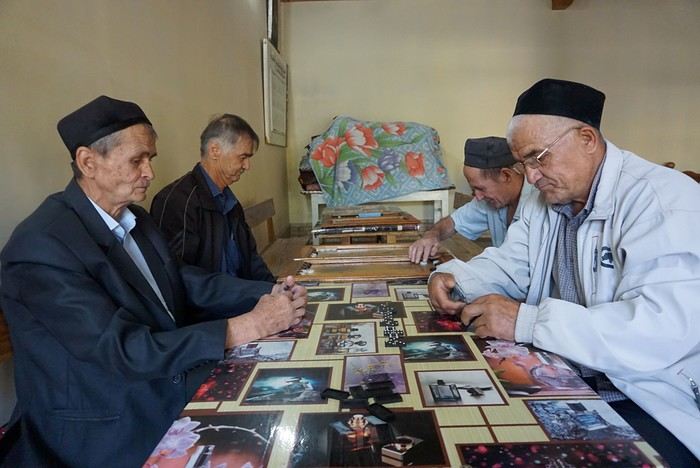
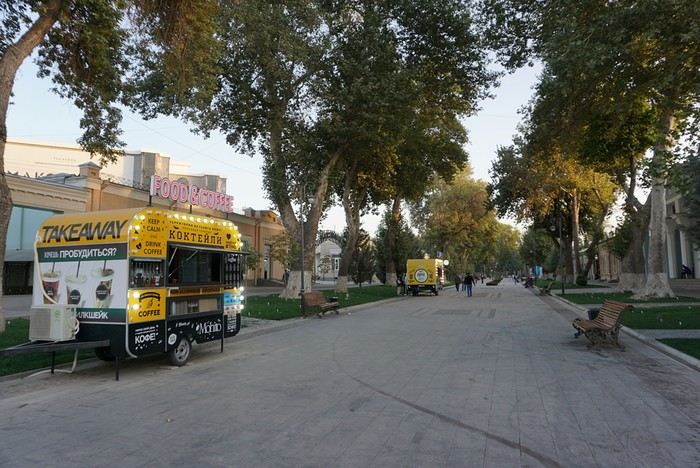
This concludes my solo walk. Back at the hotel, I show the photos of the shop to my wife, who, unsurprisingly, asks if we can go there. And off we go! Unfortunately, once we arrive, we find the door closed. Oh well, we’ll come back another day! We return quietly via the pedestrian path between the Bibi-Khanym Mosque and Registan Square.
In the early afternoon, I decide to take a stroll through the Jewish quarter. I pass through a small entrance located between Registan Square and the Bibi-Khanym Mosque. I’d spotted a few sites on Maps.Me in the area: small mosques, a mausoleum, a synagogue, and a madrasa.
I start with the small Qurabay Aqsaqal Mosque, then move on to another equally tiny one (Mubarak Mosque). While I’m in its courtyard, the owner of the shop directly across (a second-hand and thrift store) comes out to invite me in. I accept once I’ve finished exploring the small courtyard. It’s a real Ali Baba’s cave! The owner is proud to show me his collections of teapots, cups, Russian military medals, plates, glasses, and other miscellaneous items. He then invites me into different rooms of this old house turned shop. In the first, there are second-hand hats, and in the second, fabrics and women’s tunics. I ask if I can take his photo among the fabrics. He agrees and poses proudly. Then, in the third and last room, I find men’s coats that I really like! I’ll have to come back here with my wife—I’m sure she’ll love this place!
As I leave, I see a butcher in the street weighing a large piece of meat (half a sheep, a quarter of a cow?) before loading it into the back of a minivan. But where’s the refrigerated truck?
A little further on, I stop in front of the entrance to the synagogue. It’s closed. A woman passes by and sees me trying unsuccessfully to get in. She gently pushes me aside, starts shaking the door, and calls out to someone inside. After a few minutes, a man finally arrives. He seems delighted to have a visitor. We cross a small garden, climb a few steps, and find ourselves in a small corridor/porch with the synagogue’s entrance door at the end. On the wall of this ‘corridor,’ photos—probably of rabbis—are displayed. He comments on them, but of course, I don’t understand a word of what he’s saying. After fetching the key to the synagogue’s entrance, he opens it and immediately turns on the light. He continues his commentary inside. He invites me to take photos and opens cabinet/library doors to show me old books. As I’m about to leave, I realize I’m supposed to leave an offering. I pull out a 5,000 sum bill. He shows his dissatisfaction and makes it clear that 50,000 would be more appropriate. I comply, much to his satisfaction.
From the synagogue, I head to the small park and mausoleum of Imam Maturidi. I wanted to continue to another mosque where, in its courtyard, there’s the tomb of a scholar. But since it’s prayer time, I discreetly leave.
The last stop on this walk takes me to a small madrasa next to Panjakent Kso Street. In its courtyard, a group of young people are deep in conversation. One of them approaches me, explains that the others are Russians, and invites me into the building. Inside, I find four elderly men playing dominoes. I ask if I can sit at their table and watch them play a few rounds. As I’m leaving, one of them asks where I’m from. France? What does he say? Bingo! PSG! And he starts naming famous players! No problem here—I’ll definitely improve my knowledge of French football! Even more surprising, another player suddenly shouts ‘Charles Aznavour!’ and bursts out laughing.
This concludes my solo walk. Back at the hotel, I show the photos of the shop to my wife, who, unsurprisingly, asks if we can go there. And off we go! Unfortunately, once we arrive, we find the door closed. Oh well, we’ll come back another day! We return quietly via the pedestrian path between the Bibi-Khanym Mosque and Registan Square.
Step 8: Shahrisabz / Tersak
October 3rd - A Countryside Vibe
This morning, we leave our suitcases at the hotel (since we’ll be back in two days) and set off with our backpacks, packed with a few essentials.
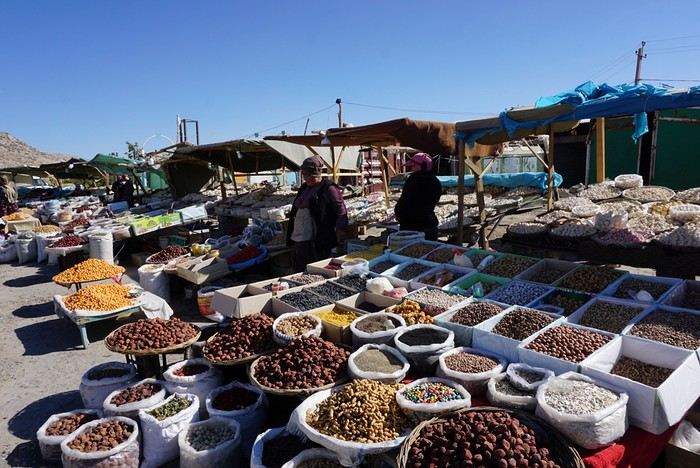
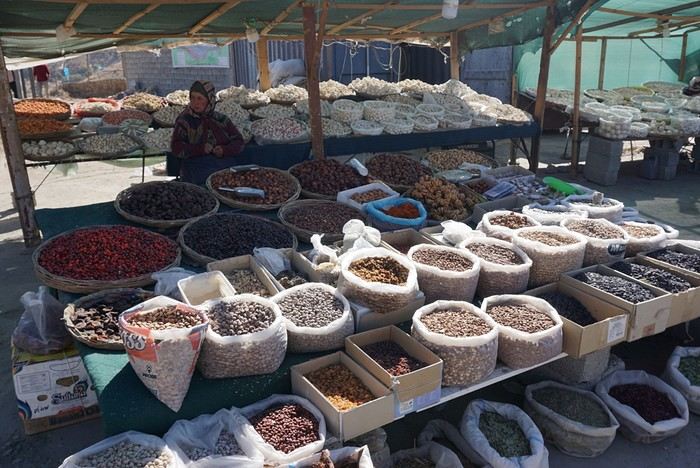
On the way to Shahrisabz, we stop at the top of a pass where there’s a small market. You’ll find lots of stalls selling *kuruts*—made from *suzima* (concentrated fermented milk)—usually shaped like little hardened balls, either plain (salted) or with herbs and chili. There’s also plenty of dried fruit, pears (it’s the season in the southern mountains), saffron, and various products the vendors claim are "medicine."
After this break, we continue to Shahrisabz, the birthplace of Tamerlane. Our visit starts at the remains of the palace entrance gate that Amir Temur built for his mother. As soon as we pass through these two ‘pillars,’ under a glass floor, we discover the ceramics that once covered the bottom of the palace pool (uncovered and restored by French archaeologists). After visiting a small mausoleum, we head toward the massive statue of Tamerlane. Then, on the way to the Kok Gumbaz Mosque, Nasrullo takes us to a painter’s shop so we can see a model and a painting reconstructing the palace as it once was—long before Russian revolutionaries decided to destroy it with cannons.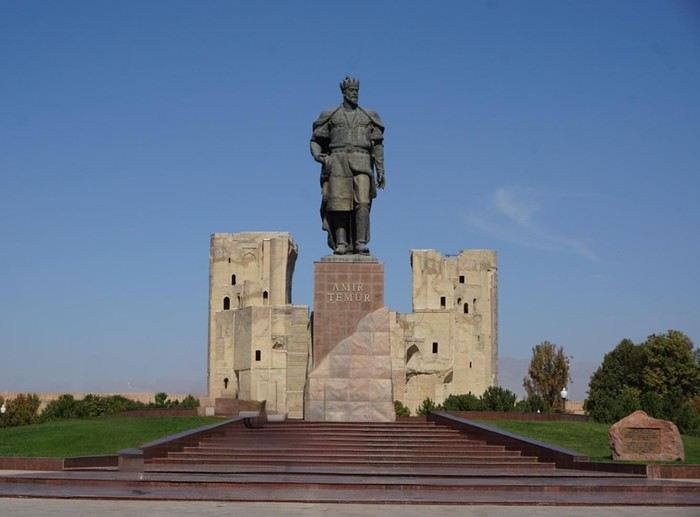
Tamerlane had this palace built for his mother. Construction took over 30 years, and he funded it with the spoils of 14 military campaigns and territorial conquests.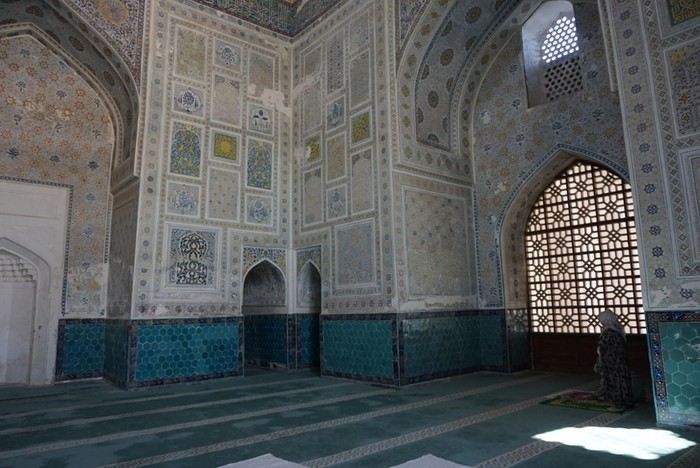
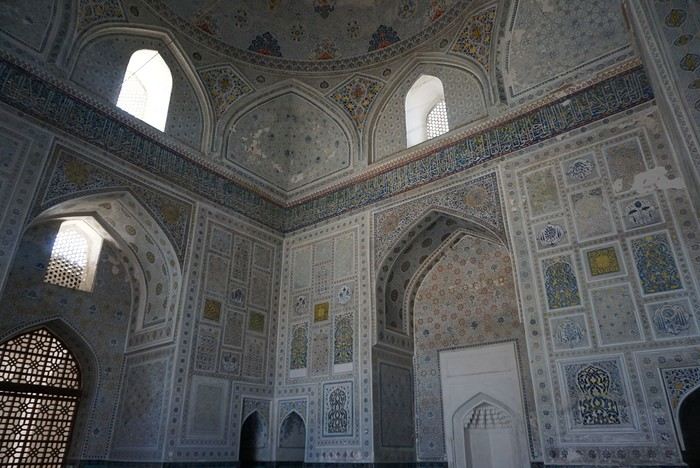
After visiting the mosque and the two madrasas in the architectural complex, we head off for lunch. Nasrullo has chosen a large restaurant where the owner seems honored by our visit. He seats us in a spacious room away from the other customers. The meal is hearty, and for dessert, he treats us to a delicious cake. At the end of the meal, it’s time to part ways. Nasrullo sets off to explore an isolated mountain village (he’d offered to take us along, but my wife wasn’t keen—especially since she wasn’t feeling well the day he suggested it). His goal is to eventually include it in his off-the-beaten-path travel offerings. As for us, we head to the village of Tersak as planned. We’ll spend two nights in this village. The guesthouse owner welcomes us warmly. He’s a local figure: a former village mayor, still a ‘general councilor’ and deputy. He also used to teach French in Tersak and the surrounding villages. And he’s still a farmer and livestock breeder. At 73, he’s the father of 11 children, has 30 (or 32?) grandchildren, and 5 or 6 great-grandchildren. He thanks me profusely for the gift we brought him (cookies from Martre Tolosane and some school supplies, just like we gave to Asraf). We’re served welcome tea with bunches of grapes.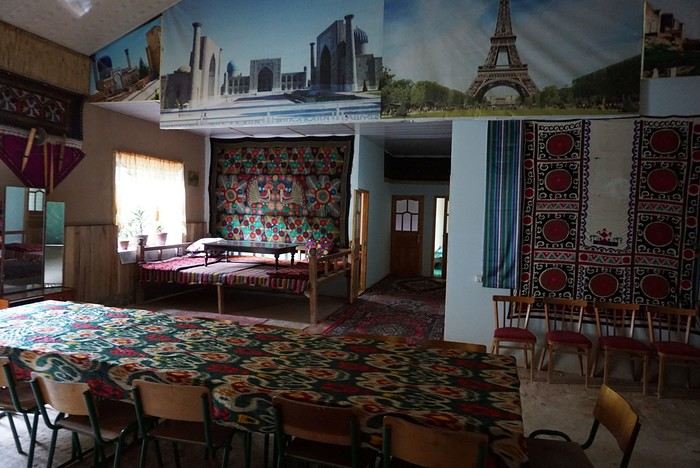
We settle into our room, locate the bathroom block (two showers and two toilets at the far end of the garden), and then take a stroll through the village. Everyone we pass—young and old—greets us with a big ‘Bonjour!’ (in French, as written) and broad smiles. A man calls out to me from his car, stopped by the side of the road. He grabs his little girl from the back seat and holds her up to the window so I can take her photo. A little further on, another man stops us because he wants me to take a photo of him with my wife. Then he invites us to eat at his place. Impossible, since we’re expected back at the guesthouse. We politely decline, careful not to offend him.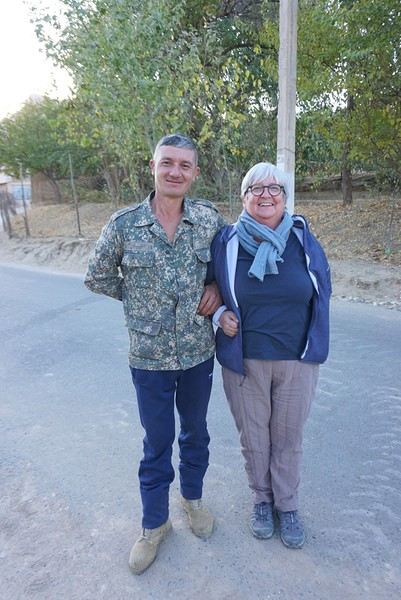
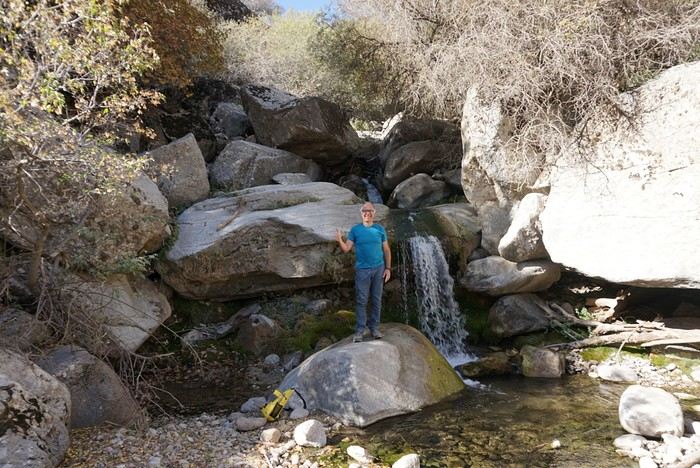
We return around 6:00 PM. It’s starting to get chilly. At 6:35 PM, the owner comes to fetch us. It’s mealtime. We’ll eat inside because it’s pitch black outside and barely 14°C (57°F). The meal starts with a round of vodka! One glass is enough! Despite our host’s insistence. The meal is hearty, and during it, he explains (in French!) that tomorrow his childhood friends are coming over. They meet once a month and take turns hosting. He says his friends will be thrilled to spend time with us. He also tells us that tomorrow morning, his grandson will take us to the ‘waterfall’ near the village. Dinner over, we quickly retreat under a thick blanket—it’s *freezing* here! October 4th After a nice hot shower (I’ll spare you—or almost—the details of the toilets without flushing, with a bucket and a pitcher acting as a flush—it somehow reminds me of a lumberjack village in Myanmar a few years back!), we have breakfast outside in the sun. Then we set off to explore the amazing waterfall about 5-6 km from the house. It’s a pretty nice walk where we follow and cross a stream several times on small wooden bridges (logs), and pass through little paths in the arid mountains. An easy hike that ends at a huge… waterfall of less than a meter!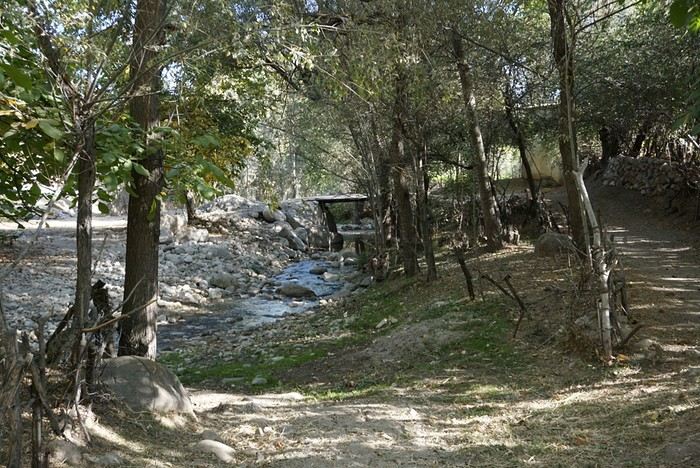
When we return, the friends and their wives have arrived. The men are seated outside, the women inside. The owner’s wife and youngest daughter started preparing this feast early this morning. Everyone’s been at the table for about an hour, and we join them around 10:00 AM. Picture the *tapchan* (a traditional piece of furniture: a large bench where you sit barefoot, with a low table in the middle) covered in food: dried fruit, fresh fruit (bananas, apples, grapes, watermelon, melon), candy, cakes, tomato/cucumber salad, bread, meat-filled pastries and pumpkin-filled ones, plenty of tea, sodas, mineral water (still and sparkling). My wife is invited to join us, and everyone insists we try everything. Then the wives come to fetch her… and insist she eat a bit of everything (the same lavish spread at the women’s table as the men’s! Poor thing!). I can join in the conversation because the owner acts as our interpreter. His friends introduce themselves and ask me some ‘odd’ questions: What’s the religion in France? What’s mine? Are there Muslims in France? Oh, really? Why? In the Maghreb countries, what’s their religion? Oh, they’re Muslim?! After telling me their jobs (police officers, engineer, owner of a large store) and their age (they’re all 73), they ask more typical questions. Around 12:45 PM, the owner tells me that at 1:00 PM, they’ll go pray, but not to worry—lunch will be served while they’re gone. What? Lunch? But we’ve already been eating for two hours! I’m really not hungry! And what about my wife, who’s already had two servings! Our places are set at the breakfast table. The young girl of the house brings us starters (yes, *starters*!): grilled eggplant salad and tomato/cucumber salad. Then a bowl of soup (yes, *soup*!) with a plate of boiled beef and vegetables (potatoes, carrots). There’s no way we can eat it all! Just a taste! For dessert, we get pieces of watermelon and melon. Faced with our fullness, the young girl laughs, teases us a little, and says, "Uzbeks eat a lot!" That’s an understatement! After the meal, we waddle back to our room for a digestive nap. Then a walk around the village is a must—after all, dinner is at 6:30 PM! The grandson joins us. He shows us his school: his classroom, the music room, the English room (since they no longer learn French in the village!), the sports field, and the ‘pool’ (an empty concrete tank).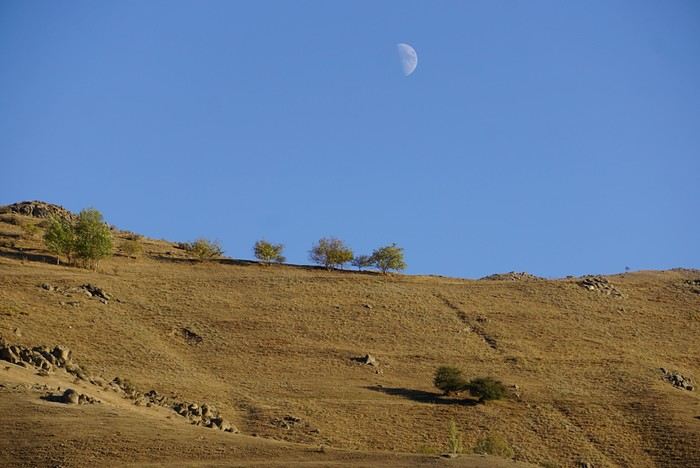
When we return, all the guests have left. Dinner is indoors again. It feels even colder than yesterday! The owner asks us about salaries in France and the cost of living. He tells us about his sons’ weddings: 400 guests for the first, 500 for the second, and up to 1,200 ("I had to—so many people know me!") for the last. He says he chose the wives for five of them. For the sixth, he’s not happy because his wife and son made the decision with the bride’s family while he was on vacation by the Black Sea… and they chose poorly, of course. It’s the only couple that isn’t doing ‘well’! His wife joins us and looks exhausted. The owner jokes that he’s tired from the day and has eaten too much, but we can’t really feel sorry for him. His wife, on the other hand… doesn’t complain. After a while, she leaves and quickly returns with the youngest grandson in her arms. He starts crying ‘baba, baba’ when he sees his grandfather. A sweet moment when she hands him to me, and I hold him briefly in my arms.
After this break, we continue to Shahrisabz, the birthplace of Tamerlane. Our visit starts at the remains of the palace entrance gate that Amir Temur built for his mother. As soon as we pass through these two ‘pillars,’ under a glass floor, we discover the ceramics that once covered the bottom of the palace pool (uncovered and restored by French archaeologists). After visiting a small mausoleum, we head toward the massive statue of Tamerlane. Then, on the way to the Kok Gumbaz Mosque, Nasrullo takes us to a painter’s shop so we can see a model and a painting reconstructing the palace as it once was—long before Russian revolutionaries decided to destroy it with cannons.
Tamerlane had this palace built for his mother. Construction took over 30 years, and he funded it with the spoils of 14 military campaigns and territorial conquests.
After visiting the mosque and the two madrasas in the architectural complex, we head off for lunch. Nasrullo has chosen a large restaurant where the owner seems honored by our visit. He seats us in a spacious room away from the other customers. The meal is hearty, and for dessert, he treats us to a delicious cake. At the end of the meal, it’s time to part ways. Nasrullo sets off to explore an isolated mountain village (he’d offered to take us along, but my wife wasn’t keen—especially since she wasn’t feeling well the day he suggested it). His goal is to eventually include it in his off-the-beaten-path travel offerings. As for us, we head to the village of Tersak as planned. We’ll spend two nights in this village. The guesthouse owner welcomes us warmly. He’s a local figure: a former village mayor, still a ‘general councilor’ and deputy. He also used to teach French in Tersak and the surrounding villages. And he’s still a farmer and livestock breeder. At 73, he’s the father of 11 children, has 30 (or 32?) grandchildren, and 5 or 6 great-grandchildren. He thanks me profusely for the gift we brought him (cookies from Martre Tolosane and some school supplies, just like we gave to Asraf). We’re served welcome tea with bunches of grapes.
We settle into our room, locate the bathroom block (two showers and two toilets at the far end of the garden), and then take a stroll through the village. Everyone we pass—young and old—greets us with a big ‘Bonjour!’ (in French, as written) and broad smiles. A man calls out to me from his car, stopped by the side of the road. He grabs his little girl from the back seat and holds her up to the window so I can take her photo. A little further on, another man stops us because he wants me to take a photo of him with my wife. Then he invites us to eat at his place. Impossible, since we’re expected back at the guesthouse. We politely decline, careful not to offend him.
We return around 6:00 PM. It’s starting to get chilly. At 6:35 PM, the owner comes to fetch us. It’s mealtime. We’ll eat inside because it’s pitch black outside and barely 14°C (57°F). The meal starts with a round of vodka! One glass is enough! Despite our host’s insistence. The meal is hearty, and during it, he explains (in French!) that tomorrow his childhood friends are coming over. They meet once a month and take turns hosting. He says his friends will be thrilled to spend time with us. He also tells us that tomorrow morning, his grandson will take us to the ‘waterfall’ near the village. Dinner over, we quickly retreat under a thick blanket—it’s *freezing* here! October 4th After a nice hot shower (I’ll spare you—or almost—the details of the toilets without flushing, with a bucket and a pitcher acting as a flush—it somehow reminds me of a lumberjack village in Myanmar a few years back!), we have breakfast outside in the sun. Then we set off to explore the amazing waterfall about 5-6 km from the house. It’s a pretty nice walk where we follow and cross a stream several times on small wooden bridges (logs), and pass through little paths in the arid mountains. An easy hike that ends at a huge… waterfall of less than a meter!
When we return, the friends and their wives have arrived. The men are seated outside, the women inside. The owner’s wife and youngest daughter started preparing this feast early this morning. Everyone’s been at the table for about an hour, and we join them around 10:00 AM. Picture the *tapchan* (a traditional piece of furniture: a large bench where you sit barefoot, with a low table in the middle) covered in food: dried fruit, fresh fruit (bananas, apples, grapes, watermelon, melon), candy, cakes, tomato/cucumber salad, bread, meat-filled pastries and pumpkin-filled ones, plenty of tea, sodas, mineral water (still and sparkling). My wife is invited to join us, and everyone insists we try everything. Then the wives come to fetch her… and insist she eat a bit of everything (the same lavish spread at the women’s table as the men’s! Poor thing!). I can join in the conversation because the owner acts as our interpreter. His friends introduce themselves and ask me some ‘odd’ questions: What’s the religion in France? What’s mine? Are there Muslims in France? Oh, really? Why? In the Maghreb countries, what’s their religion? Oh, they’re Muslim?! After telling me their jobs (police officers, engineer, owner of a large store) and their age (they’re all 73), they ask more typical questions. Around 12:45 PM, the owner tells me that at 1:00 PM, they’ll go pray, but not to worry—lunch will be served while they’re gone. What? Lunch? But we’ve already been eating for two hours! I’m really not hungry! And what about my wife, who’s already had two servings! Our places are set at the breakfast table. The young girl of the house brings us starters (yes, *starters*!): grilled eggplant salad and tomato/cucumber salad. Then a bowl of soup (yes, *soup*!) with a plate of boiled beef and vegetables (potatoes, carrots). There’s no way we can eat it all! Just a taste! For dessert, we get pieces of watermelon and melon. Faced with our fullness, the young girl laughs, teases us a little, and says, "Uzbeks eat a lot!" That’s an understatement! After the meal, we waddle back to our room for a digestive nap. Then a walk around the village is a must—after all, dinner is at 6:30 PM! The grandson joins us. He shows us his school: his classroom, the music room, the English room (since they no longer learn French in the village!), the sports field, and the ‘pool’ (an empty concrete tank).
When we return, all the guests have left. Dinner is indoors again. It feels even colder than yesterday! The owner asks us about salaries in France and the cost of living. He tells us about his sons’ weddings: 400 guests for the first, 500 for the second, and up to 1,200 ("I had to—so many people know me!") for the last. He says he chose the wives for five of them. For the sixth, he’s not happy because his wife and son made the decision with the bride’s family while he was on vacation by the Black Sea… and they chose poorly, of course. It’s the only couple that isn’t doing ‘well’! His wife joins us and looks exhausted. The owner jokes that he’s tired from the day and has eaten too much, but we can’t really feel sorry for him. His wife, on the other hand… doesn’t complain. After a while, she leaves and quickly returns with the youngest grandson in her arms. He starts crying ‘baba, baba’ when he sees his grandfather. A sweet moment when she hands him to me, and I hold him briefly in my arms.
Step 9: Urgut / Samarkand
October 5th - Return to Samarkand
This morning, our driver came to pick us up to head back to Samarkand. But first, we’re stopping in Urgut.
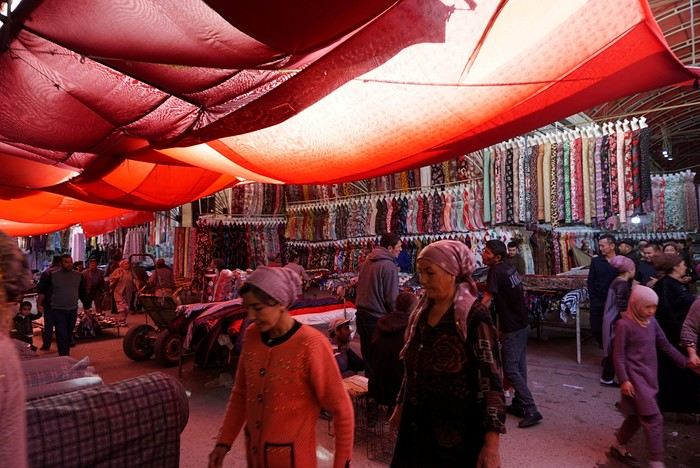
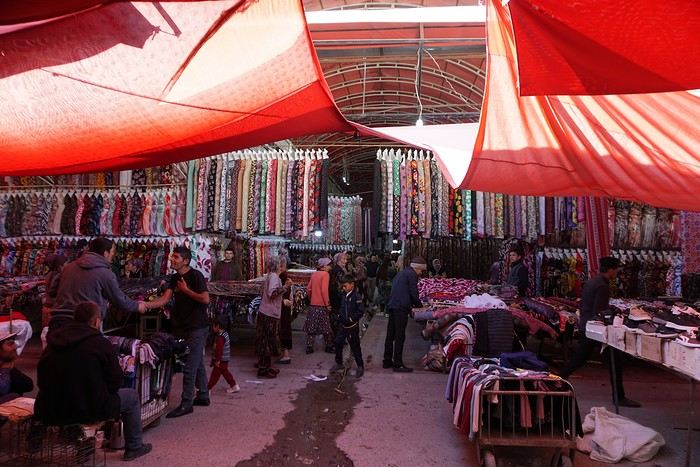
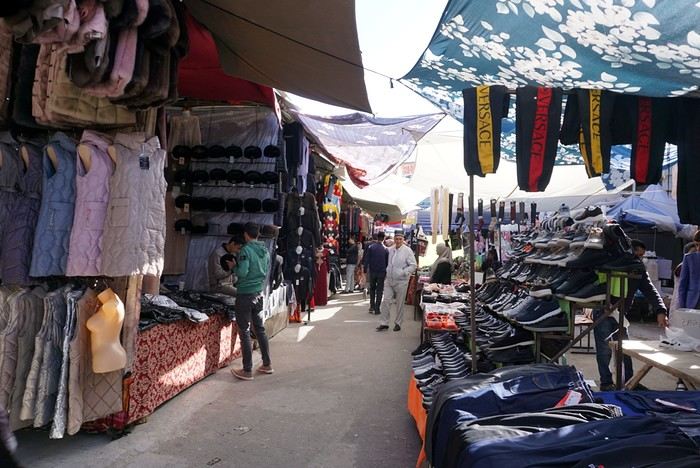
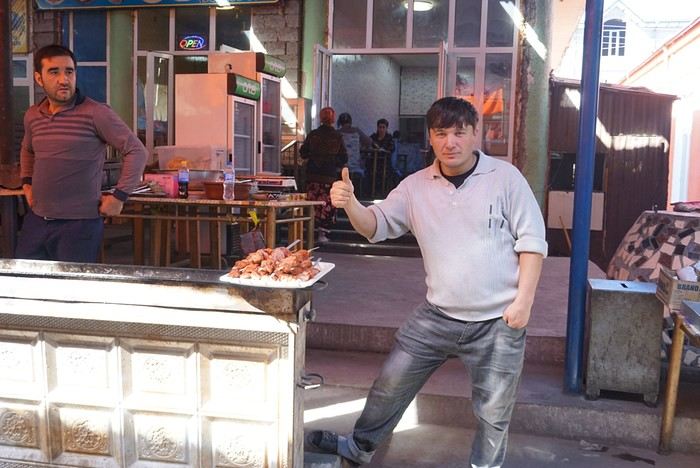
First stop: its huge market. So huge that we got lost among the stalls selling clothes, shoes, Uzbek hats, and... well, everything. We ran into Eric, the kebab vendor, who shouted from behind his grill, thumbs up, "PSG!" after asking where we were from, telling us his name, and asking us to take his photo.
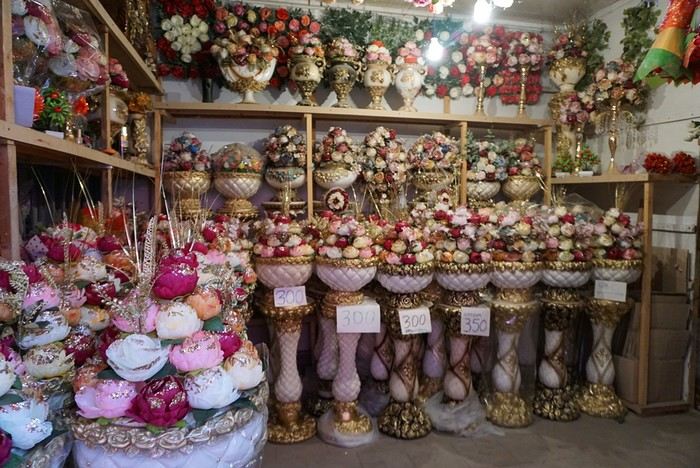
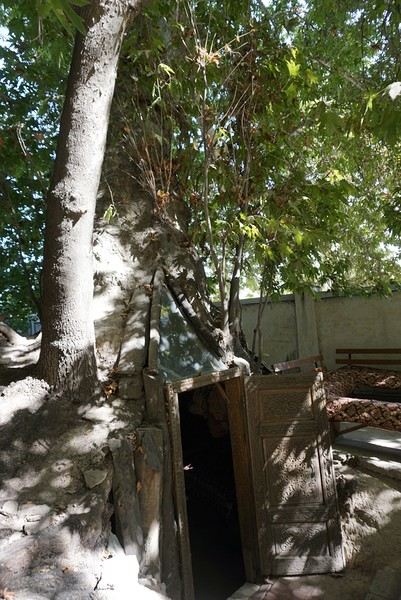
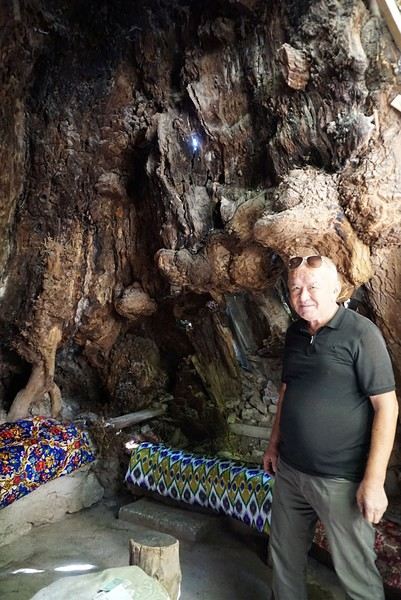
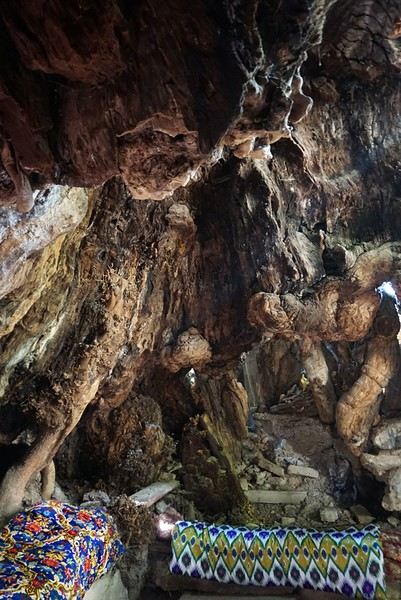
From the market, we headed into the town center and crossed through it. Second stop: Tchor Timor (Four Plane Trees). In this ancient garden, where sacred spring water flows, stand about fifty majestic plane trees, most of them 800 to 1,800 years old. Some have a circumference of over 16 meters! In one of them, near the entrance, time has formed a natural cave beneath its roots. At the back of the park, there’s a pool of crystal-clear water where sacred fish swim.
 Our driver
This peaceful stroll under the canopy of these giant trees was a nice change from the bustle of the market and town center.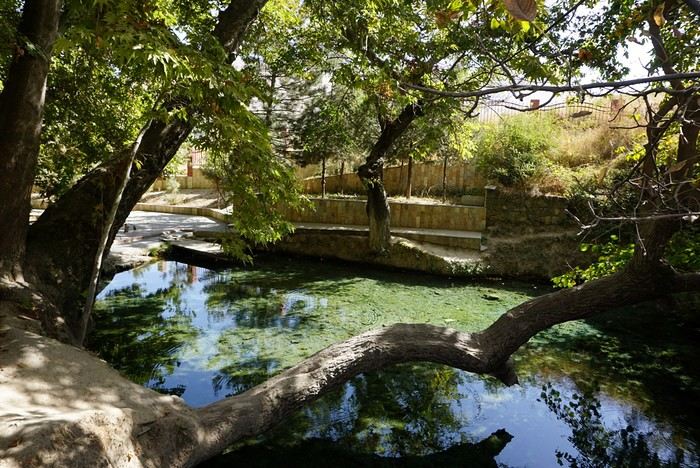
From there, we set off in search of the Gavsul A’Zam mausoleum, which our driver didn’t know. It was a little extra detour on our itinerary. He asked for directions several times, and we finally arrived at a site that really wasn’t a must-see. In fact, the pilgrims seemed quite surprised to see us there. Behind the mausoleum, we discovered a room in a building turned into a very surprising and unusual museum. Just see for yourselves! The exhibits were a real mix: stuffed animals, old tools and musical instruments, traditional clothing, pottery, ancient coins and banknotes, old photos, etc. And in one corner of the room, a stall selling plastic trinkets! On our way out, a group of women asked us to take their photo.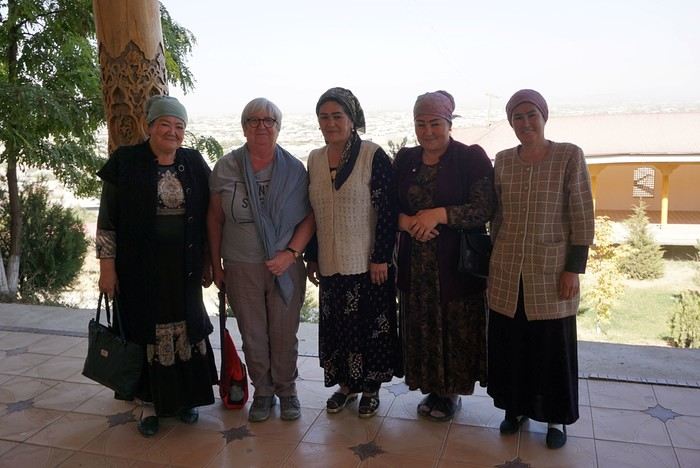
Then we headed back to Samarkand. Back at the hotel, we picked up our luggage and a room. In the mid-afternoon, we returned to the secondhand dealer/thrift shop, which was open today—much to my wife’s delight. I showed him the photo I’d taken of him two days earlier, which made him happy. After a purchase (a nice coat), we took one last little stroll through the market and a few artisan shops.
First stop: its huge market. So huge that we got lost among the stalls selling clothes, shoes, Uzbek hats, and... well, everything. We ran into Eric, the kebab vendor, who shouted from behind his grill, thumbs up, "PSG!" after asking where we were from, telling us his name, and asking us to take his photo.
From the market, we headed into the town center and crossed through it. Second stop: Tchor Timor (Four Plane Trees). In this ancient garden, where sacred spring water flows, stand about fifty majestic plane trees, most of them 800 to 1,800 years old. Some have a circumference of over 16 meters! In one of them, near the entrance, time has formed a natural cave beneath its roots. At the back of the park, there’s a pool of crystal-clear water where sacred fish swim.
Our driver
This peaceful stroll under the canopy of these giant trees was a nice change from the bustle of the market and town center.
From there, we set off in search of the Gavsul A’Zam mausoleum, which our driver didn’t know. It was a little extra detour on our itinerary. He asked for directions several times, and we finally arrived at a site that really wasn’t a must-see. In fact, the pilgrims seemed quite surprised to see us there. Behind the mausoleum, we discovered a room in a building turned into a very surprising and unusual museum. Just see for yourselves! The exhibits were a real mix: stuffed animals, old tools and musical instruments, traditional clothing, pottery, ancient coins and banknotes, old photos, etc. And in one corner of the room, a stall selling plastic trinkets! On our way out, a group of women asked us to take their photo.
Then we headed back to Samarkand. Back at the hotel, we picked up our luggage and a room. In the mid-afternoon, we returned to the secondhand dealer/thrift shop, which was open today—much to my wife’s delight. I showed him the photo I’d taken of him two days earlier, which made him happy. After a purchase (a nice coat), we took one last little stroll through the market and a few artisan shops.
Step 10: Samarkand / Tashkent / Istanbul
October 6 - End of the trip
Last morning in Samarkand before taking the train to Tashkent.
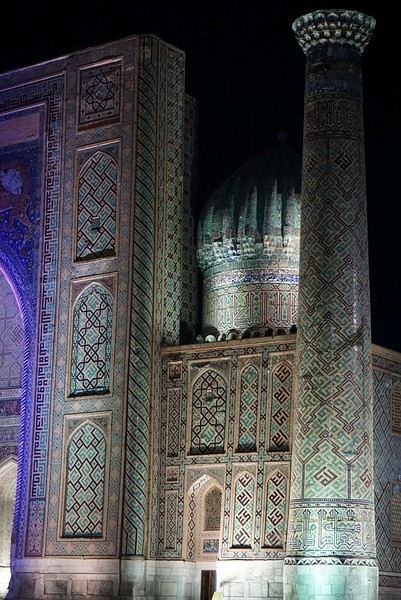
Final stroll around Registan Square.
Nasrullo joins us at the hotel around noon, and we head out for lunch together. He takes the opportunity to show us some photos of the mountain village he scouted. The surrounding peaks are already snow-covered. This spot could be offered to tourists looking to get off the beaten path. If you're interested, let me know, and I’ll put you in touch with him!
Once settled in the small neighborhood restaurant, Javlon gives us the lovely surprise of joining us. We have a really pleasant time!
But all good things must come to an end, and it’s time to head to the train station. Nasrullo and Javlon accompany us to the station, and we say goodbye at the entrance.
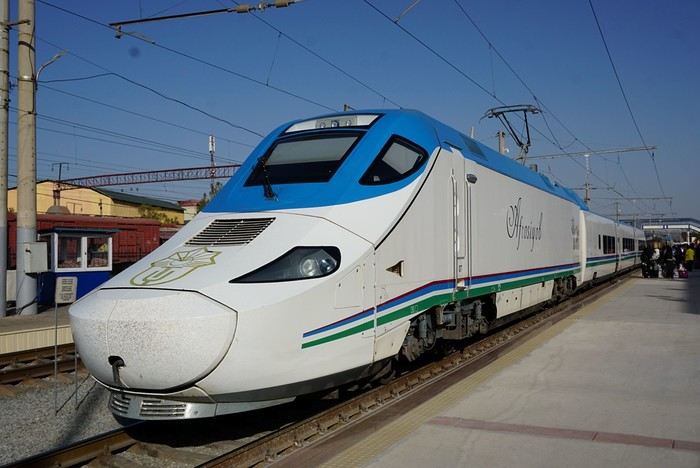
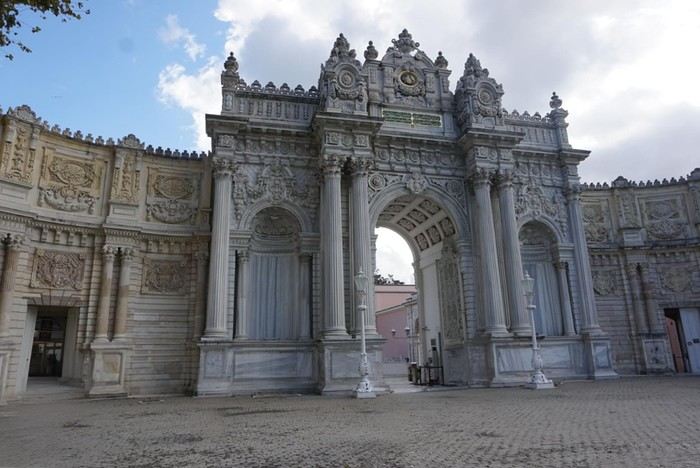
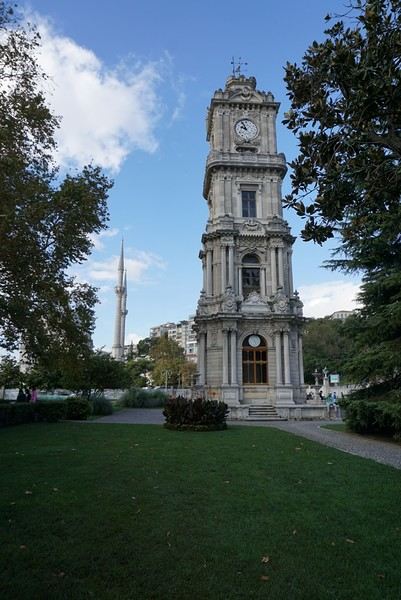
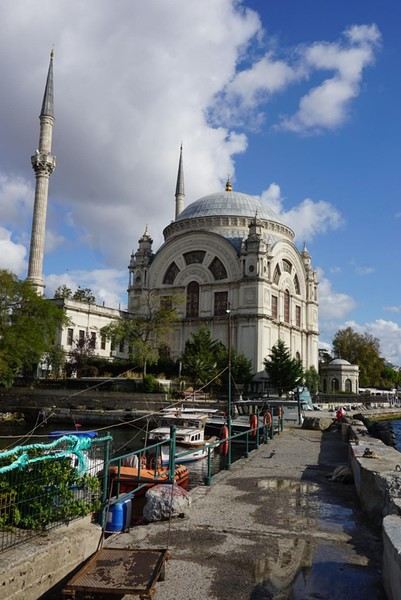
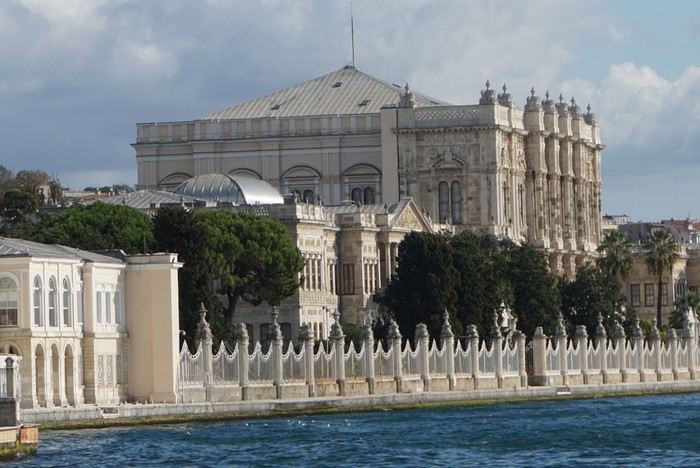
A little later, we board the local high-speed train. We’re really comfortable—no need to book first class; the second-class seats are perfect. Shortly after departure, a free onboard service is offered: tea or coffee, plus a packet with a cake and pastry. A little over two hours later, we arrive in Tashkent. The owner of the B&B where we stayed the first few days is waiting for us at the station exit. It’s arranged for us to rest at his place while he drives us to the airport around 11:30 PM. Dinner at a nearby restaurant specializing in pasta—way too filling! Our flight to Istanbul is slightly delayed, and we board around 2:45 AM. Our layover is scheduled for 6 hours. We take advantage of Turkish Airways’ long layover gift: a tour of Istanbul. Several programs are offered depending on the layover duration. We can only take the shortest one (a 3.5-hour walk from Galata Bridge to Dolmabahçe Palace). As a result, the layover didn’t feel as long as it could have!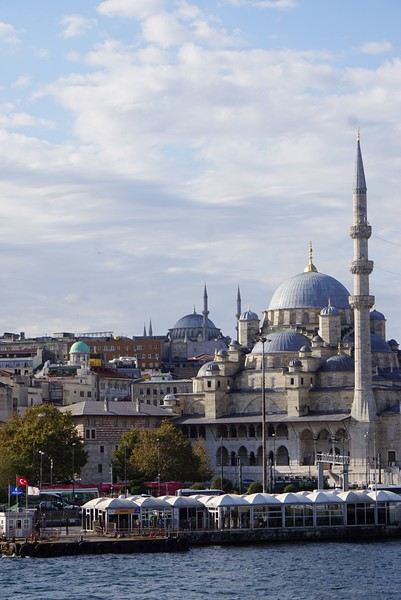
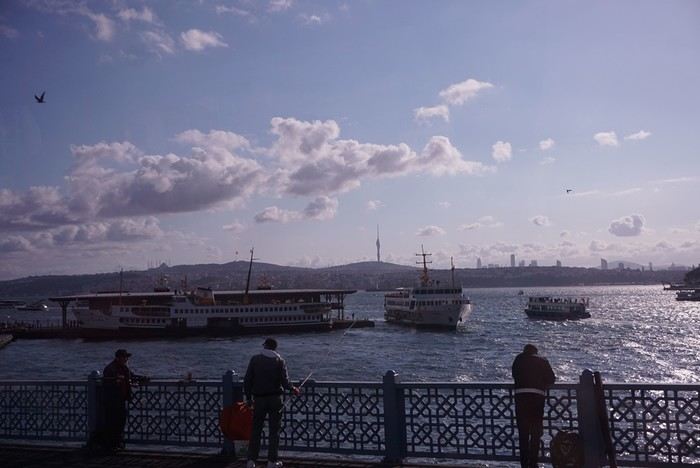
Return flight to Paris, landing around 5:30 PM. End of the trip!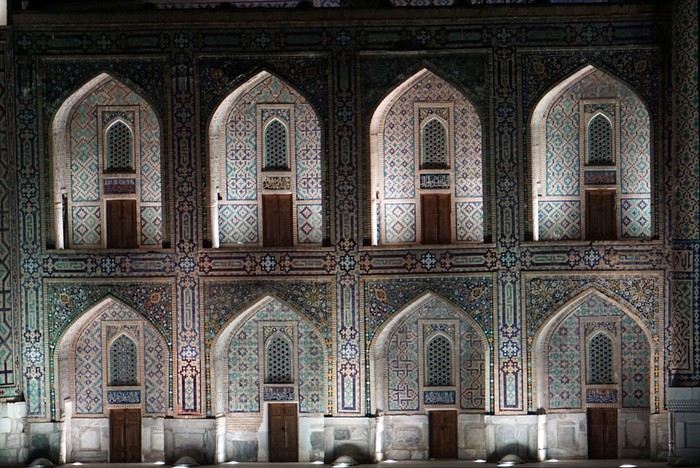
A huge thank you to Nasrullo and his team, who listened to me, were patient, gave advice, and adapted to my wishes (both during the planning and on the ground). All of this allowed us to return completely fulfilled from this wonderful trip!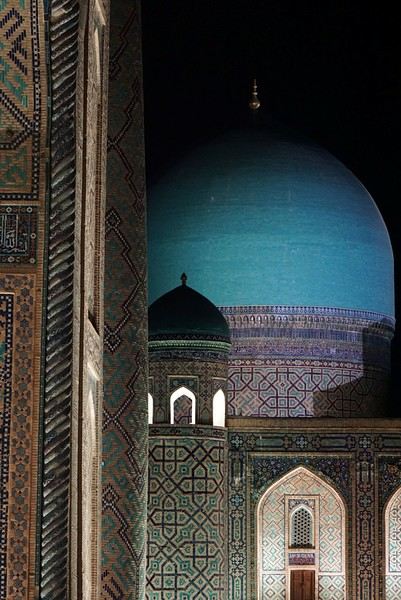
A little later, we board the local high-speed train. We’re really comfortable—no need to book first class; the second-class seats are perfect. Shortly after departure, a free onboard service is offered: tea or coffee, plus a packet with a cake and pastry. A little over two hours later, we arrive in Tashkent. The owner of the B&B where we stayed the first few days is waiting for us at the station exit. It’s arranged for us to rest at his place while he drives us to the airport around 11:30 PM. Dinner at a nearby restaurant specializing in pasta—way too filling! Our flight to Istanbul is slightly delayed, and we board around 2:45 AM. Our layover is scheduled for 6 hours. We take advantage of Turkish Airways’ long layover gift: a tour of Istanbul. Several programs are offered depending on the layover duration. We can only take the shortest one (a 3.5-hour walk from Galata Bridge to Dolmabahçe Palace). As a result, the layover didn’t feel as long as it could have!
Return flight to Paris, landing around 5:30 PM. End of the trip!
A huge thank you to Nasrullo and his team, who listened to me, were patient, gave advice, and adapted to my wishes (both during the planning and on the ground). All of this allowed us to return completely fulfilled from this wonderful trip!
P
Posabjumax· 2 years ago
Thanks Philippe for this amazing travel journal—I read it with so much interest since we’re also heading to Uzbekistan in April, but only for 10 days!
Pierre-Olivier (from Lavernose near Muret!)
Pierre-Olivier (from Lavernose near Muret!)
S
SDVent· 2 years ago
Thanks for your travel journal, which really helped us organize ours with Nasrullo Jumanov’s assistance. We’ve just returned from Uzbekistan, and it was flawless in terms of organizing our 24-day trip. From the preparation to our stay on-site, communication was easy, and Nasrullo’s responses to our questions were quick and precise. We highly recommend Turquoise Travel for their highly competent guides who speak excellent French, as well as for the transportation arrangements (trains, cars with drivers) and accommodations that met all our expectations. You can reach out to Nasrullo Jumanov with complete confidence. So many great memories and exceptional homestay experiences! We could’ve stayed a little longer...
Thanks, it’s always nice to know my travel journal was helpful. And I’m glad you were happy with Nasrullo’s services!
I’m planning to return to Central Asia between August and September 2026, probably for 5 or 6 weeks—first sharing the trip with my daughter (3 weeks of more active travel) and then my wife will join me there (3 weeks of more cultural exploration).
Of course, I’ve already started discussing the plans with Nasrullo, since the first part will need a bit more preparation.
In the meantime, my wife and I have other projects this year and early 2026 that are quite different from Uzbekistan. More travel journals to come after my latest one on Colombia.
Daffye· 11 months ago
Your story really inspired us! We’re lucky enough to be heading there for 20 days—a country I’ve wanted to visit for so long. We got in touch with your guide, and he’s offering to be our only guide for the entire trip. Do you think that’s a good idea, or will we miss out on human connections and different perspectives on the country and its people?
Hello,
you made a great choice—Nasrullo is fantastic! No, you won’t be cut off from contacts and encounters at every stop, especially if you’ve planned some free time for exploration.
As for me, in mid-August, I’ll be heading to Kyrgyzstan for three weeks with my daughter. At the end of the trip (the last week), we’ll attend the World Nomad Games. After that, I’ll return to Uzbekistan alone for two weeks, where I’ll have the great pleasure of seeing Nasrullo again. I haven’t finalized the itinerary with him yet, but I still have time to work that out.
Before that, in a few days, my wife and I are off to Mexico. If you have any questions about your trip, don’t hesitate to reach out. You’re in for a wonderful journey! !
You might also like
 Uzbek notes
Travel logs › Uzbekistan·47 photos
 A Turquoise Dream Come True in Uzbekistan - 2022
Travel logs › Uzbekistan·245 photos
 Off on an adventure in Uzbekistan!
Travel logs › Uzbekistan·268 photos
 On the Silk Road: Chronicles of a Sixty-Something Traveling Completely Independently
Travel logs › China / Uzbekistan / Kyrgyzstan·108 photos
 Back to Uzbekistan: From the Silk Road to the roads of craftsmanship and ancestral know-how
Travel logs › Uzbekistan·149 photos
 A Few Days in Turkmenistan from Uzbekistan
Travel logs › Turkmenistan·73 photos
 Breathtaking Kyrgyzstan!
Travel logs › Kyrgyzstan·304 photos
 Southern landscapes, northern wildlife: returning to South Africa
Travel logs › South Africa·260 photos