je précise que j'ai quelques bases en indonésiens, et déjà quelques trecks en forêt tropical malaisie et thailande, mais sur plus courte durée et terrain moins difficiles... merci pour vos infos
Faire une "transbornéo" de deux/trois semaines du côté de Kalimantan
by Niko1
This discussion is in French, the community’s main language.
Original post
Bonjour!!!
je cherche des infos pour faire une "transbornéo" côté kalimantan (en gros remonter la "sungai kuapas" puis passer les "muller range" et redescendre par "sungai mahakam"
quelqu'un à déjà tenté??
à savoir la durée (2 à 3 semaines assez??)
le prix indicatif,
comment trouver un bon guide?
et l'équipement particulier nécessaire??
je précise que j'ai quelques bases en indonésiens, et déjà quelques trecks en forêt tropical malaisie et thailande, mais sur plus courte durée et terrain moins difficiles... merci pour vos infos
Salut,
je n'ai pas essayé cette traversée mais j'ai entendu dire qu'elle ne valait pas vraiment le coup. Pourquoi?
Bien, la ballade dure une petite vingtaine de jours. La plus grosse partie du trajet se fait sur le Kapuas et le Mahakam. J'ai remonté le Kapuas jusqu'à Selimbau en 2001 (en bateau), et sincèrement, la forêt est presque complètement détruite. On m'a dit que du côté Est, sur la Mahakam, c'était la même chose. Du coup, seul l'hyper-centre de Bornéo, du côté des monts Muller, est encore préservé et très inaccessible (rapides, pas de sentiers...). Mais dans le cadre de cette traversée tu n'y passeras que 5 - 6 jours qui plus est à crapahuter dans les torrents. Plutôt léger.
Donc, si tu veux vraiment aller à Bornéo pour voir les Dayaks, je ne saurais trop que te conseiller de remonter le Kapuas, ou de te rendre à Putussibau en avion, puis de "rayonner" dans les alentours... il y a encore des longues maisons et des coins sans touristes... et pas loin, 3 parcs naturels pour un total de 1 million d'hectares répartis entre 2 pays et 3 provinces... Evidemment, c'est la grande aventure: aucune infrastructure, pas d'anglophones, flics méfiants...
A +
Plus concret:
The Cross Borneo trip is a special trekking programs which have been admitted by our past guests who did this trip before, as the most challenging and the most enjoyable trekking trip they ever had: Trekking cross Borneo Island from West to East. The ultimate challenge - crossing one of the most rugged islands on earth from East to West. Using roads, rivers and feet we traverse the jungle of Kalimantan (Indonesian Borneo). You must have a good level of fitness and adventurous spirit and a strong sense of determination, as conditions and accommodations are challenging. We will use busses, public house boat, chartered motorized canoes to access the jungle for a rugged days of trekking. We sleep in the simple houses of the villager with basic facilities and on the house boats. The trekking is tough and often wet, the only way to appreciate the primeveral jungle of Kalimantan and the most traditional Dayak Tribes settlements as well as the wildlife. The rough and uncharted terrain and has made this Borneo traverse trip is one of the toughest and the most challenging trekking programs in the world.. The unpredictable weather and river conditions made this trip an exploratory adventures "
To enjoy this trip, you need to be prepared to accept whatever the jungles and rivers serve up! A good fitness level, a strong sense of determination and a flexible attitude are essential. The rewards are the romance of the journey itself, the mix of river travel including long stretches of rapids, the experience of jungle trekking and contact with the local Dayak peoples. Descriptive day to day itinerary: DAY 01. JAKARTA ARRIVAL Upon arrival in Jakarta Soekarno Hatta Internatinal Airport, we will transfer you to hotel at down town in Jakarta. Free program all meals on your personal leisure.
DAY 02. JAKARTA PONTIANAK Transfer to Cengkareng Airport to catch your flight to Pontianak. Upon arrival in Pontianak . Accomodation at hotel Santika Pontianak. There are a lot of things to do while we are there. We can explore the riverbank area of Pontianak by the wooden boat, from where we can observe the old and the new Pontianak from the different perspective. We can do Pontianak sight seeing with this way. Among the highlights of the sightseeing trip is Pontianak harbor, Beting Permai water village, and the huge Kapuas bridge. We can do this for about 2 or 3 hours.
DAY 03. PONTIANAK - PUTUSSIBAU (AVAILABLE ON Monday, Tuesday, Wednesday, Thursday, Saturday. ) Departure by DAS (Dirgantara Air Service) at 09.00 arrival Putussibau at 11.00 (please recheck again the flight schedule). This flight use small plane with capassity of 24 passenger but only possible for 22 seat only as they have to refill the gasoline. This flight use propeller and little bit noisy. Ear plugs is recommended. They allow extra luggage for 10 kg maximum so please only bring the very important things when you start this expedition . They provide a glass of mineral water with snack. They have no luggage cabin and all the stuffs will put on the back. Stay at simple hotel in Putussibau.
DAY 04. PUTUSSIBAU - KAPUAS RIVER You will start your adventure expedition from here. After breakfast at hotel in Putussibau towards to the headwaters of the Kapuas by long boat. The long boat is about 1 ½ - 2 meter wide and 6 - 8 meter long with capacity for 4 - 5 passengers. The long boat without any roofs so it will be hot and also little noisy. Needed all necessary supplies, estimate day, as far upstream as possible. It is recommended to wear your water sport sandals (TeVa) or rubber shoes and bring ear plugs, hat, long sleeve, short pants, extra snacks & drinks and dry bags. You will take this journey with our porters as well as our guide's team. On the way may be the boat will be stop for toilet, cleaning the propeller, refill gasoline or fix the engine. You will pass some Dayak Village in the river side and their unique daily river life as well as some birds such as Eagle, King Fisher, Long Tailed Parakeet etc. Lunch on the way. Dinner and overnight at the riverside at tents or local house (B, L, D).
DAY 05. KAPUAS RIVER - BUNGAN RIVER After breakfast, continue our journey by long boats as far as up stream. On the way we may stop at the Dayak village to see the long house . We will also pass some rapids, slash and burn agriculture (shifting cultivation) as well as the local people looking for gold, some by traditional way and some by machine along the river side. In certain places we have to go down to the river to push the boat as the level of the water in the dry season s is too shallow. Here you will experience how amazing the boat man and what we call "the Stone Man" the boat crew who knows exactly where is the rock and how to get away from the rapids. It's a great challenge of adventure you will experience. If the rapids too challenging we have to walk along the rock, slash and burns trash barrier in the river side and the boat will pick us up. It's tough here. Lunch on the way. Dinner and overnight in the river side at tents or temporary house or local house. (B, L, D).
DAY 06. BUNGAN RIVER - TANJUNG LOKANG Continue our journey after breakfast. It's more and more challenging here with rapids. Go down boat, push the boat, walk on the rocks, or slash and burn trash barrier in the river side while the boat passing the rapids will give you more challenging experience. On the way you will see the tropical rain forest of Kalimantan, shifting cultivation, traditional gold mining in the river, temporary huts, till you reach Tanjung Lokan. Tanjung Lokan is small villages located inside Betung Kerihun National Park. If you are a handy craft collector you may find some nice basket, "Mandau" traditional machete, "Sumpit" blow gun, "Tangguy" traditional farmer hat etc. Lunch on the way, dinner and overnight at the local house. The guide teams will packing the stuffs to bring alng the expedition and divided between them so they will have the same weight to carry (B, L, D)
PS : The duration of the long boat journey is depend on what happen in the fields. Normally the journey started after breakfast till in the mid day for lunch. Then the long boat will stop before dark to set the tents and prepare meals. Sometimes we have to continue the journey longer to catch the best places to stay overnight. Here we need your flexibility so you will enjoy the journey more.
DAY 07. TANJUNG LOKAN - BOBO/SEI BULIT (SUNGAI BULET) After breakfast, start the trek across up Land Ladang "slash and burn, long fellow dry rice field through the forest. The first 2 hours we will high up the hill then another about 2 ½ hours passing the jungle and dry small river. After lunch on the way close to the river side, the trek will be high up and down again crossing the dry small river, and Nyinyit Cave (the local people collect the swallow nest that cost so expensive and very good to support their life inside the cave). Before dark we set the tent in the river side of Sei Bulit for dinner and overnight. The guides team will cook for you. Ultimate/rubber shoes is recommended. (B, L, D)
DAY 08. SEI BULIT - BUNGAN RIVER After breakfast, crossing the river, up and down passing the jungle, crossing small rivers, and cave. You may see exotic flora and fauna of Borneo. After lunch on the way in the river side, then crossing jungle, up and down passing the dry river, cave and temporary huts that the local people using it while they do shifting cultivation or hunting deer, wild pig, birds, and even sometimes clouded leopard. Before dark, set the tent close to Bungan River for dinner and overnight. (B, L, D)
DAY 09. BUNGAN RIVER - BUNGAN LEA RIVER
Now you need to prepare for the challenging trek. The trek is also varied but tougher. After breakfast crossing the big river about ½ - 1 meter deep. Wee will have lots of deal with water, walk on the cliff of the river side and rock. After lunch on the way in the river side, continue the trek up and down the cliff of the river. Overnight and dinner in the river side of Bungan Lea River. (B, L, D)
DAY 10. BUNGAN LEA RIVER - PIANG LO'ONG This is the longest and the toughest trek. After breakfast, crossing up and down passing the rivers, cliff of the rivers and the river side. After lunch continue the trek then started to trek almost the same like before lunch. The trek is so challenging and need more of adventure spirit and energy. Set a campsite close to the river for dinner and overnight. (B, L, D) DAY 11. PIANG LO'ONG - MULLER RANGE This is what the traveler will feel so different crossing the border of West & Esat Kalimantan! After breakfast, walked about two hours up and down river till reach the foot of Muller Range. It started from the altitude of 500 M ASL till reach the border of West and East Kalimantan at 1000 M ASL. The path is not so difficult only high up hill passing the jungle. It takes about 1 - 1 ½ hours depend on your ability. No need to rush as the jungle view is fantastic. After reaching the"TUGU PERBATASAN" (BORDER MONUMENT), you need to put one of some your belonging you wear for this expedition such as shocks, cloth or else in the stick around the border for offering to the spirit. After lunch on the way, the trek is easier down the hill until you reach the campsite in the river side. Dinner and overnight at the Muller Range. (B, L, D)
DAY 12. MULLER RANGE - MUARA CUTING. After breakfast the trek is almost the same before and after lunch passing the rivers - jungle - and rivers. On the way the Dayak will show you how to survive the jungle, collecting the rotan, hunting, catching the fish, set a trap and you may involved with them. Lunch on the way, overnight at tent in the river side of Muara Cuting. (B, L, D)
DAY 13. MUARA CUTING - SAITE This is the shortest trek. You will trek about only 3 hours to reach Saite so you will have lots of time for relaxing, swimming, take a break or else after hard trek. The trek passing the jungle and river. Breakfast, lunch and dinner at the river side. Overnight at Saite. (B, L, D)
DAY 14. MUARA SAITE - TIONG OHANG After breakfast then trek crossing the river and jungle to reach the mouth of the Mahakam River for 3 hours walk. You will pass slash and burn agriculture before reaching the river side. Upon arrival, the long boat or locally call Cest then take you to Tiong Ohang Village for about 6 - 7 hours journey. Lunch on the way. You will pass some temporary hut as well as slash and burn agriculture and jungle. Dinner at the local simple restaurant and overnight at the local simple house at Tiong Ohang. This is the first village you encounter after long days in the jungles. You may also find more handy craft from Kalimantan with the best quality. (B, L, D) DAY 15. TIONG OHANG - LONG BAGUN After breakfast at the local restaurant, continue the journey by long boat for 8 - 10 hours. On the way stop at the local restaurant for lunch. You will pass some big rapids, so you need to walk on the rock but it's not so difficult and the boat will pick you up. The views along the rivers so fantastic and you can walk around to see the long house and their unique daily life. Dinner and overnight at the local simple house. (B, L, D)
DAY 16. LONG BAGUN FOR CULTURAL PERFORMENCES/BOARDING THE BOAT As the Mahakam River has a unique characteristic river so you have to be aware about the tide of the river. In the dry season the level of the water could be so shallow so sometimes you have to leave Long Bagun earlier or otherwise you could not get the house boat when the level of the water is not reliable. Breakfast, Lunch and Dinner at the boat or Long Bagun. Overnight on boat or Long Bagun (B, L, D)
DAY 17. LONG BAGUN - SAIL ON THE HOUSE BOAT The boat will start normally at 10.00 but could be change without prior notice. Am. Both sail one day before or this day you will arrive at the same day as the boat has to stay overnight. But better leave earlier if the water is not reliable. The house boat is public traditional wooden boat with two deck, the first deck for carry the stuffs and economy class with capacity more about 100 passengers and the second deck is for executive with capacity 75 passengers. The economy room is more open both sides and no mattress while the others served mattress, luggage room below the bed but all is open no private room and no AC. There is Indonesia style toilet and simple restaurant that provide Indonesian meals, tea, coffee, and snacks in the first deck. The boat will stop sometimes for passengers and loading the stuffs. During the sailing trip you will explore and learn the local way of life "river side civilization" which is much different from what we have normally in the dry land area. Breakfast, Lunch, Dinner and overnight on the house boat (B, L, D)
DAY 18. HOUSE BOAT - SAMARINDA Arrival at the house boat I the afternoon about 10.00 Am - 12.00 Pm depend on the schedule. Upon arrival transfer by car to your hotel in Samarinda that takes about 20 - 30 minutes away. The rest of the day is free for your own activity and dinner will be served on your personal account. (B, L)
DAY 19. ONE EXTRA DAY This is an extra day. We shall use it at place during the trek where we may need it or just because we want to spend the time there. But it will be during the trek only.
DAY 20. SAMARINDA - BALIKPAPAN Breakfast at hotel then transfer to the appropriate time drive to Balikapapan Airport to catch your flight to the next destination. It takes about 3 hours from Samarinda to Balikpapan Airport (120 km ) depend on the traffic. Tours End. (B)
Ce qui fait 9 jours sur 20 dans la forêt...
Et sinon, je te parle de ce parc là: BETUNG KERIHUN Description Physical features
Betung Kerihun National Park located in Sub district of Embaloh Hulu, Embaloh Hilir and Putussibau, District of Kapuas Hulu, Province of West Kalimantan. BKNP covers an area of 800, 000 Ha. The Park is approximately 27.60% of the total area of Kapuas Hulu District,
around 40% of the total protected area in the district, or 5.5% of the total area of Kalimantan Barat Province (14, 807, 700 Ha).
In general, the climate in BKNP exhibits a very high rainfall, being the typical of wet inland Kalimantan. The average annual rainfall is around 2, 863 to 5, 517 mm, and the number of rainy days is between 120 and 309 per year. Drier months occur between June and September with approximately 100 mm rainfall per month. The driest year happened in 1976 with annual rainfall of 2, 863 mm and 120 rainy days during the year, while the wettest year occurred in 1988 with up to 5, 517 mm rainfall and 184 rainy days during the year. On the whole, the Park belongs to type A (wet) in Schmidt and Ferguson classification, with Q=2.6%.
The topography of BKNP is mainly hilly and mountainous, with altitude ranging from 150 to 2, 000 m asl. The largest part of the Park is located at altitude between 200 and 500 m asl (38%). followed by altitude between 500 and 700 m asl (28.14%), between 700 and 1, 000 m asl (15.90), between 1, 000 and 1, 500 m (11.19%), less than 200 m asl (5.34%), and up than
1, 500 m asl (0.92%). With its mountains and hills, the Park is characterized by steep slopes (45% and up) in up to 61.15% of its area. Moderate slopes (25-45%) occur in around 33.08% of the Park area, while slopes of less than 25% occur in 5.77% of the Park area.
BKNP area has at least 179 peaks, consisting of 65 peaks in the Embaloh watershed, 36 in the Sibau-Menjakan watershed, 26 in the Mendalam watershed, and 52 in the Hulu Kapuas/Koheng/Bungan watershed. Prominent peaks in the Embaloh watershed are Mt. Betting (1, 150 m asl) and Mt. Condong (1, 240 m asl); in the Sibau-Menjakan watershed, Mt. Lawit (1, 770 m asl); in the Kapuas/Koheng, Mt. Jemuki (1, 375 m asl) and Mt. Cemaru (1, 118 m asl); in the Bungan watershed, Mt. Kerihun (1, 790 m asl) and Mt. Dayang (1, 645 m asl).
The hydrology of BKNP is characterized by hundreds of streams and big rivers which form the Kapuas watersheds. Kapuas watersheds cover 9, 874, 910 Ha or around 67% of Kalimantan Barat Province area (14, 680, 700 Ha). On the whole, Kapuas watershed can be divided into five smaller sub-watersheds, namely Embaloh in the west area of the Park, Sibau-Menjakan and Mendalarn in the middle area, and Hulu Kapuas/Koheng and Bungan in the eastern area. Key rivers are Embaloh River (95 km long), Sibau River (25 km), Menjakan River (65 km), Mendalam River (30 Km), Hulu Kapuas/Koheng (100 km), and Bungan River (50 km)
The soil types of BKNP are varied. Organosol and decomposed Glei soils are dispersed in the Embaloh upriver sub-district. Alluvial soils occur in the Mendalam River areas, Sibau and Embaloh Rivers, while podzolic yellow-red, and complex podzolic yellow-red and latosol, which dominate the Park areas are identified are found in Puttusibau and in the Embaloh upriver sub-district.
b. Biological features b.1. Flora
Borneo, the richest of the Sunda islands floristically both in terms of total species richness and diversity (MacKinnon et al., 1996), has a flora richness which includes both Asian and Australian elements. In BKNP, the Asian element is generally seen in the lowland forest up to the lower montane forest. Meanwhile, the upper montane is generally inhabited by species of Australasian families, such as Leptospermum, Phyllocladus and Styphelia (Steenis, 1972).
The vegetation and floristic composition in BKNP can generally be divided into the following types:
1) Lowland dipterocarp forest
2) Alluvial forest
3) Swamp forest.
4) Old secondary forest
5) Hill dipterocarp forest
6) Limestone forest
7) Sub-montane forest 8) Montane forest
On the whole, the 8 forest ecosystems of BKNP harbor at least 1, 254 flora species. The family of Dipterocarpaceae has the most species of all flora families of BKNP (120 of a total 267 dipterocarp species found in Borneo). Other families having many species in BKNP include Euphorbiaceae (99 species), Myrtaceae (66), Annonaceae (38), Myristicaceae (31), and Burseraceae (21). Flora richness of BKNP also includes a large variety of orchid species. At ]least 97 species have been identified in the Park. Another flora richness of BKNP is its palm species. At least 49 species of palm have been identified in the Park area. Meanwhile, 133 species of bryophyte under 3 classes have been identified in BKNP (Sujadmiko, 1999). Nineteen families and 65 species of bryophyte belong to Hepaticopsidae, 1 family and 2 species belong to Anthocerotopsidae, whereas 19 families and 66 species belong to Bryopsidae.
2. Fauna
Like Borneo' fauna in general, BKNP's rich fauna is characteristically Asian in origin. It shares most of its fauna with the Asian mainland and the other Sunda islands, but shares few species with Sulawesi and the eastern islands which have a somewhat different faunal composition.
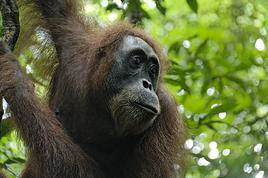
The Park harbors not least than 652 fauna species. Of them, at least 54 are mammal species. Mammal species of BKNP also includes 8 primate species, namely Pongo pygmaeus, Hylobates muelleri, Presbytis frontata, P. rubicunda, Macaca nemestrina, M. fascicularis, Nycticebus coucang and Tarsius bancanus. The distribution of Pongo pygmaeus, one of the two species of orangutan found in Indonesia is interestingly concentrated in the western part of BKNP area, especially in Embaloh Watershed, which border Lanjak Entimau Wildlife Sanctuary (LEWS) of Sarawak, Malaysia. Therefore, the establishment of BKNP-LEWS Biodiversity Conservation Area is considered very relevant for the conservation of Orangutan. Seventeen species of bats and 17 species of rodent, including Cheiromeles torquatus, which has been declared extinct in Java, are also members of the mammal diversity of the Park.
The Park harbors high herpetofauna diversity. At least 112 species, comprising 59 species of amphibian, 25 species of reptilia, 24 species of squamata, and 4 species of testudinata, have been identified in BKNP. Meanwhile, the Park provides habitats for 300 species of bird. The dominant species belong to family names of Muscicapidae, Pycnonotidae, and Timaliidae. Twenty five species are Bornean endemics and 6 species are newly found species to Indonesia. The fish diversity of BKNP is also high. At least 186 species of fresh¬water fish have been identified. Thirteen fish species have been identified endemic to Borneo. Finally, insect diversity of BKNP is interesting. At least 170 insects have been identified in the Park.
Justification of Outstanding Universal Values
Betung Kerihun National Park (BKNP) is located at the headwaters of the Kapuas River in the far interior of Kalimantan Barat (;Western Kalimantan) Province. The site covers an area of 800, 000 Ha and borders the 200, 000 Ha Lanjak Entimau Wildlife Sanctuary (LEWS) in Sarawak, Malaysia. Together the two protected areas form one of the first trans-border parks in Southeast Asia.
The topography of BKNP area ranges from lowland elevations at about 200 m asl to mountains almost 2, 000 m asl high. At such the site serves as an important water catchments area. Three out of Borneo's great rivers, the Rejang and Lupar River in Sarawak, Malaysia, and the Kapuas River in Kalimantan, Indonesia, have their origins here. Meanwhile, the Park's eight types of forest ecosystems, ranging from lowland dipterocarp forest, alluvial forest, swamp forest, old secondary forest, hill dipterocarp forest, limestone forest, sub-montane forest, to montane forest, provide habitats for the valuable Bornean biodiversity.
Initial surveys have discovered thousands of species of flora and fauna, including 67 threatened flora species and 81 threatened fauna species under the 2000 IUCN Red List of Threatened Species. Threatened flora species under the list include Dipterocarpus cornutus (CR), Dipterocarpus gracilis (CR), and Dipterocarpus grandiflorus (CR), and threatened fauna species include the orangutan Pongo pygmaeus (EN) and False Gavial Tomistoma schlegelii (EN). The surveys also reveal Bornean endemic species, such as Muntiacus atherodes, Presbytis frontata, Presbytis rubicunda and Reithrosciurus macrotis.
Forests of BKNP are also important for indigenous inhabitants of the region, a variety of Dayak tribes who live from hunting, collecting non-timber forest products and subsistence farming based on a pattern of shifting cultivation.
The Cross Borneo trip is a special trekking programs which have been admitted by our past guests who did this trip before, as the most challenging and the most enjoyable trekking trip they ever had: Trekking cross Borneo Island from West to East. The ultimate challenge - crossing one of the most rugged islands on earth from East to West. Using roads, rivers and feet we traverse the jungle of Kalimantan (Indonesian Borneo). You must have a good level of fitness and adventurous spirit and a strong sense of determination, as conditions and accommodations are challenging. We will use busses, public house boat, chartered motorized canoes to access the jungle for a rugged days of trekking. We sleep in the simple houses of the villager with basic facilities and on the house boats. The trekking is tough and often wet, the only way to appreciate the primeveral jungle of Kalimantan and the most traditional Dayak Tribes settlements as well as the wildlife. The rough and uncharted terrain and has made this Borneo traverse trip is one of the toughest and the most challenging trekking programs in the world.. The unpredictable weather and river conditions made this trip an exploratory adventures "
To enjoy this trip, you need to be prepared to accept whatever the jungles and rivers serve up! A good fitness level, a strong sense of determination and a flexible attitude are essential. The rewards are the romance of the journey itself, the mix of river travel including long stretches of rapids, the experience of jungle trekking and contact with the local Dayak peoples. Descriptive day to day itinerary: DAY 01. JAKARTA ARRIVAL Upon arrival in Jakarta Soekarno Hatta Internatinal Airport, we will transfer you to hotel at down town in Jakarta. Free program all meals on your personal leisure.
DAY 02. JAKARTA PONTIANAK Transfer to Cengkareng Airport to catch your flight to Pontianak. Upon arrival in Pontianak . Accomodation at hotel Santika Pontianak. There are a lot of things to do while we are there. We can explore the riverbank area of Pontianak by the wooden boat, from where we can observe the old and the new Pontianak from the different perspective. We can do Pontianak sight seeing with this way. Among the highlights of the sightseeing trip is Pontianak harbor, Beting Permai water village, and the huge Kapuas bridge. We can do this for about 2 or 3 hours.
DAY 03. PONTIANAK - PUTUSSIBAU (AVAILABLE ON Monday, Tuesday, Wednesday, Thursday, Saturday. ) Departure by DAS (Dirgantara Air Service) at 09.00 arrival Putussibau at 11.00 (please recheck again the flight schedule). This flight use small plane with capassity of 24 passenger but only possible for 22 seat only as they have to refill the gasoline. This flight use propeller and little bit noisy. Ear plugs is recommended. They allow extra luggage for 10 kg maximum so please only bring the very important things when you start this expedition . They provide a glass of mineral water with snack. They have no luggage cabin and all the stuffs will put on the back. Stay at simple hotel in Putussibau.
DAY 04. PUTUSSIBAU - KAPUAS RIVER You will start your adventure expedition from here. After breakfast at hotel in Putussibau towards to the headwaters of the Kapuas by long boat. The long boat is about 1 ½ - 2 meter wide and 6 - 8 meter long with capacity for 4 - 5 passengers. The long boat without any roofs so it will be hot and also little noisy. Needed all necessary supplies, estimate day, as far upstream as possible. It is recommended to wear your water sport sandals (TeVa) or rubber shoes and bring ear plugs, hat, long sleeve, short pants, extra snacks & drinks and dry bags. You will take this journey with our porters as well as our guide's team. On the way may be the boat will be stop for toilet, cleaning the propeller, refill gasoline or fix the engine. You will pass some Dayak Village in the river side and their unique daily river life as well as some birds such as Eagle, King Fisher, Long Tailed Parakeet etc. Lunch on the way. Dinner and overnight at the riverside at tents or local house (B, L, D).
DAY 05. KAPUAS RIVER - BUNGAN RIVER After breakfast, continue our journey by long boats as far as up stream. On the way we may stop at the Dayak village to see the long house . We will also pass some rapids, slash and burn agriculture (shifting cultivation) as well as the local people looking for gold, some by traditional way and some by machine along the river side. In certain places we have to go down to the river to push the boat as the level of the water in the dry season s is too shallow. Here you will experience how amazing the boat man and what we call "the Stone Man" the boat crew who knows exactly where is the rock and how to get away from the rapids. It's a great challenge of adventure you will experience. If the rapids too challenging we have to walk along the rock, slash and burns trash barrier in the river side and the boat will pick us up. It's tough here. Lunch on the way. Dinner and overnight in the river side at tents or temporary house or local house. (B, L, D).
DAY 06. BUNGAN RIVER - TANJUNG LOKANG Continue our journey after breakfast. It's more and more challenging here with rapids. Go down boat, push the boat, walk on the rocks, or slash and burn trash barrier in the river side while the boat passing the rapids will give you more challenging experience. On the way you will see the tropical rain forest of Kalimantan, shifting cultivation, traditional gold mining in the river, temporary huts, till you reach Tanjung Lokan. Tanjung Lokan is small villages located inside Betung Kerihun National Park. If you are a handy craft collector you may find some nice basket, "Mandau" traditional machete, "Sumpit" blow gun, "Tangguy" traditional farmer hat etc. Lunch on the way, dinner and overnight at the local house. The guide teams will packing the stuffs to bring alng the expedition and divided between them so they will have the same weight to carry (B, L, D)
PS : The duration of the long boat journey is depend on what happen in the fields. Normally the journey started after breakfast till in the mid day for lunch. Then the long boat will stop before dark to set the tents and prepare meals. Sometimes we have to continue the journey longer to catch the best places to stay overnight. Here we need your flexibility so you will enjoy the journey more.
DAY 07. TANJUNG LOKAN - BOBO/SEI BULIT (SUNGAI BULET) After breakfast, start the trek across up Land Ladang "slash and burn, long fellow dry rice field through the forest. The first 2 hours we will high up the hill then another about 2 ½ hours passing the jungle and dry small river. After lunch on the way close to the river side, the trek will be high up and down again crossing the dry small river, and Nyinyit Cave (the local people collect the swallow nest that cost so expensive and very good to support their life inside the cave). Before dark we set the tent in the river side of Sei Bulit for dinner and overnight. The guides team will cook for you. Ultimate/rubber shoes is recommended. (B, L, D)
DAY 08. SEI BULIT - BUNGAN RIVER After breakfast, crossing the river, up and down passing the jungle, crossing small rivers, and cave. You may see exotic flora and fauna of Borneo. After lunch on the way in the river side, then crossing jungle, up and down passing the dry river, cave and temporary huts that the local people using it while they do shifting cultivation or hunting deer, wild pig, birds, and even sometimes clouded leopard. Before dark, set the tent close to Bungan River for dinner and overnight. (B, L, D)
DAY 09. BUNGAN RIVER - BUNGAN LEA RIVER
Now you need to prepare for the challenging trek. The trek is also varied but tougher. After breakfast crossing the big river about ½ - 1 meter deep. Wee will have lots of deal with water, walk on the cliff of the river side and rock. After lunch on the way in the river side, continue the trek up and down the cliff of the river. Overnight and dinner in the river side of Bungan Lea River. (B, L, D)DAY 10. BUNGAN LEA RIVER - PIANG LO'ONG This is the longest and the toughest trek. After breakfast, crossing up and down passing the rivers, cliff of the rivers and the river side. After lunch continue the trek then started to trek almost the same like before lunch. The trek is so challenging and need more of adventure spirit and energy. Set a campsite close to the river for dinner and overnight. (B, L, D) DAY 11. PIANG LO'ONG - MULLER RANGE This is what the traveler will feel so different crossing the border of West & Esat Kalimantan! After breakfast, walked about two hours up and down river till reach the foot of Muller Range. It started from the altitude of 500 M ASL till reach the border of West and East Kalimantan at 1000 M ASL. The path is not so difficult only high up hill passing the jungle. It takes about 1 - 1 ½ hours depend on your ability. No need to rush as the jungle view is fantastic. After reaching the"TUGU PERBATASAN" (BORDER MONUMENT), you need to put one of some your belonging you wear for this expedition such as shocks, cloth or else in the stick around the border for offering to the spirit. After lunch on the way, the trek is easier down the hill until you reach the campsite in the river side. Dinner and overnight at the Muller Range. (B, L, D)
DAY 12. MULLER RANGE - MUARA CUTING. After breakfast the trek is almost the same before and after lunch passing the rivers - jungle - and rivers. On the way the Dayak will show you how to survive the jungle, collecting the rotan, hunting, catching the fish, set a trap and you may involved with them. Lunch on the way, overnight at tent in the river side of Muara Cuting. (B, L, D)
DAY 13. MUARA CUTING - SAITE This is the shortest trek. You will trek about only 3 hours to reach Saite so you will have lots of time for relaxing, swimming, take a break or else after hard trek. The trek passing the jungle and river. Breakfast, lunch and dinner at the river side. Overnight at Saite. (B, L, D)
DAY 14. MUARA SAITE - TIONG OHANG After breakfast then trek crossing the river and jungle to reach the mouth of the Mahakam River for 3 hours walk. You will pass slash and burn agriculture before reaching the river side. Upon arrival, the long boat or locally call Cest then take you to Tiong Ohang Village for about 6 - 7 hours journey. Lunch on the way. You will pass some temporary hut as well as slash and burn agriculture and jungle. Dinner at the local simple restaurant and overnight at the local simple house at Tiong Ohang. This is the first village you encounter after long days in the jungles. You may also find more handy craft from Kalimantan with the best quality. (B, L, D) DAY 15. TIONG OHANG - LONG BAGUN After breakfast at the local restaurant, continue the journey by long boat for 8 - 10 hours. On the way stop at the local restaurant for lunch. You will pass some big rapids, so you need to walk on the rock but it's not so difficult and the boat will pick you up. The views along the rivers so fantastic and you can walk around to see the long house and their unique daily life. Dinner and overnight at the local simple house. (B, L, D)
DAY 16. LONG BAGUN FOR CULTURAL PERFORMENCES/BOARDING THE BOAT As the Mahakam River has a unique characteristic river so you have to be aware about the tide of the river. In the dry season the level of the water could be so shallow so sometimes you have to leave Long Bagun earlier or otherwise you could not get the house boat when the level of the water is not reliable. Breakfast, Lunch and Dinner at the boat or Long Bagun. Overnight on boat or Long Bagun (B, L, D)
DAY 17. LONG BAGUN - SAIL ON THE HOUSE BOAT The boat will start normally at 10.00 but could be change without prior notice. Am. Both sail one day before or this day you will arrive at the same day as the boat has to stay overnight. But better leave earlier if the water is not reliable. The house boat is public traditional wooden boat with two deck, the first deck for carry the stuffs and economy class with capacity more about 100 passengers and the second deck is for executive with capacity 75 passengers. The economy room is more open both sides and no mattress while the others served mattress, luggage room below the bed but all is open no private room and no AC. There is Indonesia style toilet and simple restaurant that provide Indonesian meals, tea, coffee, and snacks in the first deck. The boat will stop sometimes for passengers and loading the stuffs. During the sailing trip you will explore and learn the local way of life "river side civilization" which is much different from what we have normally in the dry land area. Breakfast, Lunch, Dinner and overnight on the house boat (B, L, D)
DAY 18. HOUSE BOAT - SAMARINDA Arrival at the house boat I the afternoon about 10.00 Am - 12.00 Pm depend on the schedule. Upon arrival transfer by car to your hotel in Samarinda that takes about 20 - 30 minutes away. The rest of the day is free for your own activity and dinner will be served on your personal account. (B, L)
DAY 19. ONE EXTRA DAY This is an extra day. We shall use it at place during the trek where we may need it or just because we want to spend the time there. But it will be during the trek only.
DAY 20. SAMARINDA - BALIKPAPAN Breakfast at hotel then transfer to the appropriate time drive to Balikapapan Airport to catch your flight to the next destination. It takes about 3 hours from Samarinda to Balikpapan Airport (120 km ) depend on the traffic. Tours End. (B)
Ce qui fait 9 jours sur 20 dans la forêt...
Et sinon, je te parle de ce parc là: BETUNG KERIHUN Description Physical features
Betung Kerihun National Park located in Sub district of Embaloh Hulu, Embaloh Hilir and Putussibau, District of Kapuas Hulu, Province of West Kalimantan. BKNP covers an area of 800, 000 Ha. The Park is approximately 27.60% of the total area of Kapuas Hulu District,
around 40% of the total protected area in the district, or 5.5% of the total area of Kalimantan Barat Province (14, 807, 700 Ha).
In general, the climate in BKNP exhibits a very high rainfall, being the typical of wet inland Kalimantan. The average annual rainfall is around 2, 863 to 5, 517 mm, and the number of rainy days is between 120 and 309 per year. Drier months occur between June and September with approximately 100 mm rainfall per month. The driest year happened in 1976 with annual rainfall of 2, 863 mm and 120 rainy days during the year, while the wettest year occurred in 1988 with up to 5, 517 mm rainfall and 184 rainy days during the year. On the whole, the Park belongs to type A (wet) in Schmidt and Ferguson classification, with Q=2.6%.
The topography of BKNP is mainly hilly and mountainous, with altitude ranging from 150 to 2, 000 m asl. The largest part of the Park is located at altitude between 200 and 500 m asl (38%). followed by altitude between 500 and 700 m asl (28.14%), between 700 and 1, 000 m asl (15.90), between 1, 000 and 1, 500 m (11.19%), less than 200 m asl (5.34%), and up than
1, 500 m asl (0.92%). With its mountains and hills, the Park is characterized by steep slopes (45% and up) in up to 61.15% of its area. Moderate slopes (25-45%) occur in around 33.08% of the Park area, while slopes of less than 25% occur in 5.77% of the Park area.
BKNP area has at least 179 peaks, consisting of 65 peaks in the Embaloh watershed, 36 in the Sibau-Menjakan watershed, 26 in the Mendalam watershed, and 52 in the Hulu Kapuas/Koheng/Bungan watershed. Prominent peaks in the Embaloh watershed are Mt. Betting (1, 150 m asl) and Mt. Condong (1, 240 m asl); in the Sibau-Menjakan watershed, Mt. Lawit (1, 770 m asl); in the Kapuas/Koheng, Mt. Jemuki (1, 375 m asl) and Mt. Cemaru (1, 118 m asl); in the Bungan watershed, Mt. Kerihun (1, 790 m asl) and Mt. Dayang (1, 645 m asl).
The hydrology of BKNP is characterized by hundreds of streams and big rivers which form the Kapuas watersheds. Kapuas watersheds cover 9, 874, 910 Ha or around 67% of Kalimantan Barat Province area (14, 680, 700 Ha). On the whole, Kapuas watershed can be divided into five smaller sub-watersheds, namely Embaloh in the west area of the Park, Sibau-Menjakan and Mendalarn in the middle area, and Hulu Kapuas/Koheng and Bungan in the eastern area. Key rivers are Embaloh River (95 km long), Sibau River (25 km), Menjakan River (65 km), Mendalam River (30 Km), Hulu Kapuas/Koheng (100 km), and Bungan River (50 km)
The soil types of BKNP are varied. Organosol and decomposed Glei soils are dispersed in the Embaloh upriver sub-district. Alluvial soils occur in the Mendalam River areas, Sibau and Embaloh Rivers, while podzolic yellow-red, and complex podzolic yellow-red and latosol, which dominate the Park areas are identified are found in Puttusibau and in the Embaloh upriver sub-district.
b. Biological features b.1. Flora
Borneo, the richest of the Sunda islands floristically both in terms of total species richness and diversity (MacKinnon et al., 1996), has a flora richness which includes both Asian and Australian elements. In BKNP, the Asian element is generally seen in the lowland forest up to the lower montane forest. Meanwhile, the upper montane is generally inhabited by species of Australasian families, such as Leptospermum, Phyllocladus and Styphelia (Steenis, 1972).
The vegetation and floristic composition in BKNP can generally be divided into the following types:
1) Lowland dipterocarp forest
2) Alluvial forest
3) Swamp forest.
4) Old secondary forest
5) Hill dipterocarp forest
6) Limestone forest
7) Sub-montane forest 8) Montane forest
On the whole, the 8 forest ecosystems of BKNP harbor at least 1, 254 flora species. The family of Dipterocarpaceae has the most species of all flora families of BKNP (120 of a total 267 dipterocarp species found in Borneo). Other families having many species in BKNP include Euphorbiaceae (99 species), Myrtaceae (66), Annonaceae (38), Myristicaceae (31), and Burseraceae (21). Flora richness of BKNP also includes a large variety of orchid species. At ]least 97 species have been identified in the Park. Another flora richness of BKNP is its palm species. At least 49 species of palm have been identified in the Park area. Meanwhile, 133 species of bryophyte under 3 classes have been identified in BKNP (Sujadmiko, 1999). Nineteen families and 65 species of bryophyte belong to Hepaticopsidae, 1 family and 2 species belong to Anthocerotopsidae, whereas 19 families and 66 species belong to Bryopsidae.
2. Fauna
Like Borneo' fauna in general, BKNP's rich fauna is characteristically Asian in origin. It shares most of its fauna with the Asian mainland and the other Sunda islands, but shares few species with Sulawesi and the eastern islands which have a somewhat different faunal composition.
The Park harbors not least than 652 fauna species. Of them, at least 54 are mammal species. Mammal species of BKNP also includes 8 primate species, namely Pongo pygmaeus, Hylobates muelleri, Presbytis frontata, P. rubicunda, Macaca nemestrina, M. fascicularis, Nycticebus coucang and Tarsius bancanus. The distribution of Pongo pygmaeus, one of the two species of orangutan found in Indonesia is interestingly concentrated in the western part of BKNP area, especially in Embaloh Watershed, which border Lanjak Entimau Wildlife Sanctuary (LEWS) of Sarawak, Malaysia. Therefore, the establishment of BKNP-LEWS Biodiversity Conservation Area is considered very relevant for the conservation of Orangutan. Seventeen species of bats and 17 species of rodent, including Cheiromeles torquatus, which has been declared extinct in Java, are also members of the mammal diversity of the Park.
The Park harbors high herpetofauna diversity. At least 112 species, comprising 59 species of amphibian, 25 species of reptilia, 24 species of squamata, and 4 species of testudinata, have been identified in BKNP. Meanwhile, the Park provides habitats for 300 species of bird. The dominant species belong to family names of Muscicapidae, Pycnonotidae, and Timaliidae. Twenty five species are Bornean endemics and 6 species are newly found species to Indonesia. The fish diversity of BKNP is also high. At least 186 species of fresh¬water fish have been identified. Thirteen fish species have been identified endemic to Borneo. Finally, insect diversity of BKNP is interesting. At least 170 insects have been identified in the Park.
Justification of Outstanding Universal Values
Betung Kerihun National Park (BKNP) is located at the headwaters of the Kapuas River in the far interior of Kalimantan Barat (;Western Kalimantan) Province. The site covers an area of 800, 000 Ha and borders the 200, 000 Ha Lanjak Entimau Wildlife Sanctuary (LEWS) in Sarawak, Malaysia. Together the two protected areas form one of the first trans-border parks in Southeast Asia.
The topography of BKNP area ranges from lowland elevations at about 200 m asl to mountains almost 2, 000 m asl high. At such the site serves as an important water catchments area. Three out of Borneo's great rivers, the Rejang and Lupar River in Sarawak, Malaysia, and the Kapuas River in Kalimantan, Indonesia, have their origins here. Meanwhile, the Park's eight types of forest ecosystems, ranging from lowland dipterocarp forest, alluvial forest, swamp forest, old secondary forest, hill dipterocarp forest, limestone forest, sub-montane forest, to montane forest, provide habitats for the valuable Bornean biodiversity.
Initial surveys have discovered thousands of species of flora and fauna, including 67 threatened flora species and 81 threatened fauna species under the 2000 IUCN Red List of Threatened Species. Threatened flora species under the list include Dipterocarpus cornutus (CR), Dipterocarpus gracilis (CR), and Dipterocarpus grandiflorus (CR), and threatened fauna species include the orangutan Pongo pygmaeus (EN) and False Gavial Tomistoma schlegelii (EN). The surveys also reveal Bornean endemic species, such as Muntiacus atherodes, Presbytis frontata, Presbytis rubicunda and Reithrosciurus macrotis.
Forests of BKNP are also important for indigenous inhabitants of the region, a variety of Dayak tribes who live from hunting, collecting non-timber forest products and subsistence farming based on a pattern of shifting cultivation.

c'est vraiment dommage que la forêt soit autant détruite...
Mais merci bcp pour l'info! Au moins ca pourra m'éviter une déception par rapport à l'image que je m'en faisait...
Je vais peut être me contenter de "petites ballades " dans certains parks nationaux de qq jours...
Je vais probablemnet suivre tes conseils... pas de pb pour les flics méfiant (en asie centrale et au caucase j'ai l'habitude) quand au peu d'anglophones : mon indonésien et un petit peu "rouillé", mais ca suffira pour me débrouiller
Je prend un peu de tps pour lire dans le détail ton second message...
@+
Salut,
Si tu souhaites vraiment aller à Bornéo, cette carte t'aidera à te rendre compte de la végétation des lieux:
http://images.google.fr/imgres?imgurl=http://www.dephut.go.id/Halaman/Peta%2520Tematik/Perbatasan/kalbar.jpg&imgrefurl=http://www.dephut.go.id/index.php%3Fq%3Dnode/73&usg=__qBAboLssSJ9N5_ujwbjxFSLK5RM=&h=1499&w=2277&sz=781&hl=fr&start=2&um=1&tbnid=Et67D_-aRuERqM:&tbnh=99&tbnw=150&prev=/images%3Fq%3Ddepartmen%2Bkehutanan%2Bindonesia%2Bkalimantan%2Bbarat%26hl%3Dfr%26sa%3DN%26um%3D1
ou http://www.dephut.go.id/index.php?q=node/73
Tu as plusieurs liens vers des cartes (peta) du kalimantan barat (kalimantan occidental) qui à défaut d'être précises te permettent de localiser les coins où il y a encore de la forêt primaire... C'est celle qui est en vert foncé. Regarde bien, sur certaines cartes il n'y a plus de forêt primaire du tout... (site du mistère des forêts Indonésie)
Il faut vraiment aller vers le centre. Sinon, il y a un chouette parc du côté de Sanggauledo, à 4 h de Pontianak... mais les conditions sont rudes: sangsues, relief difficile...
Dis-moi si tu as besoin de plus d'infos... mais tu peux aussi t'orienter vers un parc naturel ailleurs en Indonésie...
Salut
merci pour les infos,
j'ai regardé un peu les cartes : effectivement il ne reste plus beaucoup de forêt primaire, sauf dans les zones montagneuses vers le centre...
Il est censé y a avoir une dizaine de parcs naturels nationaux a kalimantan, mais je me demande si ces parcs n'existent que sur le papier, ou si ceux sont vraiment des zones mieux préserver, avec des park rangers qui surveillent, ou guident etc...
Les sangsues, et autres bestiolles, le confort rustique ou des chemins un peu difficiles ce n'est pas trop un pb pour moi...
Non, ce sont vraiment des zones avec un statut particulier mais qui sont la proie de multiples agressions (trafiquants, illegal logging...). Les 2 réserves naturelles / parcs que je connais sont assez bien protégées... la réserve parce qu'elle est assez montagneuse et parce que les locaux tiennent à leur forêt pour diverses raisons d'ordre sacré / pratique, mais ce n'est pas un sanctuaire, la chasse y est autorisée et les coupes de bois à titre personnel et non lucratif, quant au parc, visité avec Naps (si tu connais) cet été, parce que les gouvernements locaux et nationaux incitent fortement (et notamment financièrement) les villageois à veiller à leur forêt... mais la superficie de celle-ci (20 km sur 30 km) et la proximité avec la frontière malaise rendent l'entreprise périlleuse... Et là aussi, la chasse est pratiquée bien qu'interdite... mais on trouve encore des orang outans, de très gros serpents, des animaux bizarres etc En tout cas, la forêt est dense et magnifique... et les gens du coin sont très très rudes et pour certains très "traditionnels".
Dans les deux cas, pas de rangers, mais des guides potentiels parmi les hommes des villages: des marcheurs incroyables (capables d'étapes de 8 - 10 H au pas de charge) et doués d'une connaissance pratique sans faille de ce milieu...
Ailleurs, en dehors des parcs et partout où il y a des voies d'eau et des routes, c'est un MASSACRE!!! Mes proches qui vivent là-bas ont grandi dans la jungle, aujourd'hui, il ne reste même plus UNE POCHE de forêt primaire dans tout leur département, 25 ans plus tard seulement!!!!!!!!!!!!!!!!!!! A une époque, les gens vendaient 50 000 RP (3, 5 E) leurs arbres à durians centenaires pour picoler et jouer aux cartes! Et même les forêts secondaires disparaîssent aujourd'hui du fait de la culture de l'huile de palme... A pleurer....🏴☠️
Bonjour Muhammad,
Je lis tes messages sur Borneo, partagé entre l'envie de partir et la tristesse. Je me demande finalement si j'ai envie de voir ce désastre de mes propres yeux, sachant que nous sommes impuissants. Arretez de faire bruler des bougies de cire ne changera rien au phénomène. J'ai vécu une expérience similaire l'été dernier dans la vallée de Lore Lindu au Sulawesi. QUID la situation dans l'ouest Kalimantan 2 ans après ton post ci-dessous ? A+ Nicolas
Bonjour,
Evidemment, plus le temps passe, plus la situation empire. Les vieux Dayaks meurent laissant derriere eux une generation qui ne sait plus vraiment d ou elle vient (ou plutot qui croit le savoir, mais se trompe), les dernieres poches de foret reculent etc...
Cependant, si tu souhaites "faire de la jungle" tu trouveras encore de sacres terrains de jeux. Je reviens de 10 jours en amont du Kahayan au Kalimantan Centre. Je suis monte au dernier village sur le fleuve. 3 jours de trajet depuis Palangkaraya dont une journee de pirogue. Depuis ce village perdu tu pouvais passer au Kalimantan Ouest a pied, par les monts Schwaner. 2 jours de remontee des rapides, 5 jours de marche, 1 journee de descente pour arriver en pirogue (ou radeau) au premier village du haut Melawi. Tout autour du Kahayan, dans ces montagnes, des millions d hectares de jungle ...
Evidemment, se rendre la bas a un prix. Une traversee pouvant s averer tres onereuse a moins d avoir un coup de bol formidable et de pouvoir se joindre a des gens. La, les prix baissent. A titre d exemple. La journee de pirogue m est revenue a 100 000 rp (8 E) car j ai juste aide un gars a payer l essence qu il allait de toute facon depenser. Si j avais loue une pirogue expres, on m aurait compte minimum 80 E ! Plus modestement on peut, depuis ce genre de village, se contenter d une ballade dans la jungle a partir d un camp de base.
Cote Dayaks ??? Des gens charmants, tres hospitaliers, encore quelques sacres phenomenes dans les villages, d authentiques hommes des forets, des chasseurs professionnels. Religion animiste encore tres presente, nombreux rituels. Mais aussi des gros gros problemes sociaux, d alcoolisme notamment (comas ethyliques, maladies du foie, meurtres). Et un avenir pas tres rose puisque d ici 2016 une route rejoindra ce bled... une route ou plutot une piste tracee le long du fleuve par ... une compagnie forestiere !
Log in first, then come back to this page.
You might also like
More discussions
Hi! I’d like to split my trip into two parts: 15 days in Phuket and 15 days in Krabi. Do you know if I can rent a car and drop it off in Krabi when I fly back to France?
Thanks for your feedback!
Have a great Sunday!
Martine
Hi fellow travelers,
First trip to Vietnam.
We’ll be arriving in Ho Chi Minh City during Tet.
Is it complicated to find accommodation and get around during this period?
Any tips would be welcome.
Thanks for your replies.
Hello,
After 1 night in Khao Sok, I’d like to find a 2 Days 1 Night package on the lake.
After reading a lot, I decided to "break the bank" and treat ourselves to a private tour—mainly to avoid the crowds.
But after contacting several operators, they offer "private tours" that are very expensive (around 700 €), yet in the details, the boats can only leave from the pier at 10 AM like everyone else. (I was hoping to leave much earlier.) The morning program is the same for everyone too (private or not). They drop us off at noon at our floating hotel (I’d chosen Phupha Waree). Free afternoon (swimming or kayaking in front of the hotel). We head back by boat for a 1-hour sunset ride. And the next morning, we leave the hotel at 8 AM to be at the pier by 9:30 AM at the latest—end of the trip.
So basically, we’re paying a lot for a private tour just to do the same thing as everyone else at the same time.
Or maybe I just had bad luck in my search. I contacted Panida Ladi, who’s very popular on forums. We’d agreed on a private tour that matched my request (departure from the pier at 8 AM, very personalized itinerary). We settled on the itinerary and price, she asked for a Wise transfer for a 30% deposit, confirmed receipt of the deposit. Then 30 minutes later, she messaged me to say she was canceling everything because it was impossible to do the requested tour—and promised a quick refund of my deposit.
So here’s my question: Who’s done a *real* private tour on this lake? Who can recommend a reliable agency? Is it even really possible to do a private tour here?
Thanks, PS: My trip is planned for November
So basically, we’re paying a lot for a private tour just to do the same thing as everyone else at the same time.
Or maybe I just had bad luck in my search. I contacted Panida Ladi, who’s very popular on forums. We’d agreed on a private tour that matched my request (departure from the pier at 8 AM, very personalized itinerary). We settled on the itinerary and price, she asked for a Wise transfer for a 30% deposit, confirmed receipt of the deposit. Then 30 minutes later, she messaged me to say she was canceling everything because it was impossible to do the requested tour—and promised a quick refund of my deposit.
So here’s my question: Who’s done a *real* private tour on this lake? Who can recommend a reliable agency? Is it even really possible to do a private tour here?
Thanks, PS: My trip is planned for November
Hi,
I wanted to get some info about the cable car and the bridge—I see lots of different options...
How much time should we allow for these two activities? If we arrive around 4 PM, will we have enough time to visit without rushing?
Thanks
Hi everyone, I’m back on the forum.
I’m searching for a real gem for my 3rd stay in Koh Lanta: a lovely, high-quality hotel right by an easily accessible beach in a lively spot. If you know of anything that fits what I’m looking for and want to share, don’t hesitate!
Thanks so much!
Marsyork
I’m searching for a real gem for my 3rd stay in Koh Lanta: a lovely, high-quality hotel right by an easily accessible beach in a lively spot. If you know of anything that fits what I’m looking for and want to share, don’t hesitate!
Thanks so much!
Marsyork
Hi,
On September 1st, we're heading to Kalimantan for six weeks, probably from Pontianak to the Derawan Islands.
I've scoured this site, which is usually my go-to 😉, and others like VoyageForum, but recent info is pretty scarce.
I'd love any tips on places you've visited—our itinerary is still a work in progress.
We're two couples traveling with backpacks, using buses, boats, guesthouses, and homestays.
Thanks in advance!
Hi, is anyone there in Flores right now? According to some websites, everything is closed and the situation is tough. But our guide says it's fine. Who should we believe? We're supposed to leave on September 2nd. Thanks to anyone in Flores at the moment!
Hi dear community,
I'm planning to visit Cambodia this winter, right after Christmas, for my first solo trip and my first trip to Asia. For two weeks (yes, I know it's short, but I really can't do more...). I have two main desires: Siem Reap and the countryside, the villages, the Mekong...
What do you think of this itinerary? Arrival in Siem Reap, departure from Phnom Penh.
SR: 5 days (1 day for arrival, 3 for the temples, 1 for the lake and its villages)
Kratie (stop on the way to Mondolkiri): 3 days (1 day of travel, 2 days there)
Mondolkiri/Sen Monorom: 4 days (1 day of travel, 1 day there, 2 days of treks)
PP: 3 days (1 day of travel, 2 days of sightseeing)
I think I need to cut one day somewhere if I travel from Saturday to Saturday or Sunday to Sunday. In Kratie, maybe? Or in PP? And I'll miss the boat trip that everyone recommends (SR-Battambang), but I don't see where to fit it in. Unless I do a PP-PP loop starting in the east, skip Kratie or just stay one night, then SR, then PP.
In my timing, Mondolkiri seems closer than Ratanakiri, which also tempted me a lot! Will it be too complicated alone? I'm thinking of using local guides or a small local agency for a nature and village getaway.
I've read that Siem Reap is very crowded between Christmas and New Year's. I could also do the circuit in the opposite direction. But I thought it would be easier to get familiar with the country by arriving in a touristy area—I might be wrong...
Thanks for your advice and opinions!
Hello,
I’m planning a trip to Laos in early 2027. Does anyone know the dates for the Vat Phou festival in Champasak? Thanks!
Hi everyone.
I’m planning my trip, and based on all the posts I’ve read, this country is amazing.
Of course, I’ve got a ton of questions for you.
Here’s a possible itinerary: Vientiane - Vang Vieng - Phonsavan - Sam Neua - Nong Khiaw + villages - Phongsali - Luang Namtha and the area - Udomxai - Huay Xai - Luang Prabang and back to Vientiane.
What do you think?
We’re planning to prioritize local transport—is it possible to do this loop?
We’d also love to go kayaking, but I’m not sure if the season’s right or where the best spot is.
For trekking—I read that Phongsali is the most authentic spot to visit villages and see wildlife. Do you know of a reliable agency and a guesthouse with reasonable prices? Is it worth taking a slow boat for a stretch on the Mekong, and if so, which route?
For accommodations, is it better to book through Booking.com and Agoda or look when we arrive?
Are mosquitoes bad in Laos, and should we take malaria prophylaxis? What’s the average daily budget (accommodation, food, visits)?
Is renting scooters a good option for exploring towns, and if so, which ones?
From what I’ve read, it’s best to carry cash—euros or dollars? Is it risky to walk around with that much cash?
I’ve still got tons of questions. Thanks to anyone who can help, and I’m open to all tips, info, etc. Thanks again
For trekking—I read that Phongsali is the most authentic spot to visit villages and see wildlife. Do you know of a reliable agency and a guesthouse with reasonable prices? Is it worth taking a slow boat for a stretch on the Mekong, and if so, which route?
For accommodations, is it better to book through Booking.com and Agoda or look when we arrive?
Are mosquitoes bad in Laos, and should we take malaria prophylaxis? What’s the average daily budget (accommodation, food, visits)?
Is renting scooters a good option for exploring towns, and if so, which ones?
From what I’ve read, it’s best to carry cash—euros or dollars? Is it risky to walk around with that much cash?
I’ve still got tons of questions. Thanks to anyone who can help, and I’m open to all tips, info, etc. Thanks again
Hi there,
I’m planning a trip to Vietnam in February, specifically Da Nang and Hoi An.
Does anyone know a French-speaking guide in the area?
Thanks for your help
Hi there,
I’m planning a family trip (my wife and I, both 47, and our two sons, aged 5 and 12) to Malaysia for the last week of June and the first two weeks of July 2027.
We used to love road trips as a couple, then as a trio, but since our second child arrived, we’ve taken a break with "camping village" style trips.
Now feels like the right time to get back to our old habits, while adjusting the pace for the kids.
We’re craving Asia. We’ve been lucky enough to visit Thailand, Indonesia (Bali and Lombok), and Sri Lanka before.
Friends have raved about Malaysia, so we’re definitely tempted.
For those who know and love Malaysia, what would be a good itinerary starting from Kuala Lumpur, with a maximum of 3-4 stops? We’d like a mix of culture, nature, and relaxation (just to clarify, we’re not big beach fans). All of this without rushing, of course.
Thanks in advance for your tips!
For those who know and love Malaysia, what would be a good itinerary starting from Kuala Lumpur, with a maximum of 3-4 stops? We’d like a mix of culture, nature, and relaxation (just to clarify, we’re not big beach fans). All of this without rushing, of course.
Thanks in advance for your tips!
Hello,
We’re a family of four with two teens aged 16 and 18. We’re heading to Thailand this summer. We’ll arrive in Bangkok and plan to take a flight to Luang Prabang.
I’ve seen there are some great visits and excursions to do (temples, markets, waterfalls) and maybe even venture a bit north to places like Nong Khiaw, Muang Xay, Muang Ngoy, or Oudom Xay.
But I’ve also heard about the Bokeo region with the Gibbon Experience.
Since we won’t be able to do everything, I’d love to hear about your experiences, impressions, and advice on the two options I’m considering, especially since we’ll be meeting family in Chiang Mai, Thailand, afterward.
Option 1: A loop from Luang Prabang heading slightly north, then a flight from Luang Prabang to Chiang Mai.
Option 2: A few days in Luang Prabang, exploring within a few dozen kilometers around, then heading to Bokeo province for the 2-day/1-night Gibbon Experience. For this option, I saw on Rome2Rio that it’s possible to book a ferry trip on the Mekong from Luang Prabang to Huay Xay—they mention about 8 hours. But is that realistic? What type of boat is it? Then, to get to Chiang Mai, there aren’t many options—bus or minivan—but how does crossing the border work?
Finally, for those of you who’ve been to Laos in August, what was the weather like? We’ve already visited Thailand, Vietnam, and Cambodia during the same period over the past four years and weren’t really bothered by bad weather.
Thanks for your feedback! Best regards, Aurélien
Option 1: A loop from Luang Prabang heading slightly north, then a flight from Luang Prabang to Chiang Mai.
Option 2: A few days in Luang Prabang, exploring within a few dozen kilometers around, then heading to Bokeo province for the 2-day/1-night Gibbon Experience. For this option, I saw on Rome2Rio that it’s possible to book a ferry trip on the Mekong from Luang Prabang to Huay Xay—they mention about 8 hours. But is that realistic? What type of boat is it? Then, to get to Chiang Mai, there aren’t many options—bus or minivan—but how does crossing the border work?
Finally, for those of you who’ve been to Laos in August, what was the weather like? We’ve already visited Thailand, Vietnam, and Cambodia during the same period over the past four years and weren’t really bothered by bad weather.
Thanks for your feedback! Best regards, Aurélien
I’m starting a discussion about guides in the Mekong Delta because we’ve just finished our trip in this region and had a hard time finding a French-speaking guide. We had Thanh—she speaks French really well and travels all over the delta region, including Ho Chi Minh City. She’s super friendly and flexible. I recommend her wholeheartedly. If it can help someone...
Feel free to contact us for her number.
Hi everyone,
I couldn’t find any recent info on Kuching.
Can anyone recommend a hotel or guesthouse for under 100 RM that’s nice and affordable? No dorms, please.
Also, does it rain a lot in November, and is it still worth visiting Semenggoh or Bako?
Hi there,
We’ll be arriving in Phnom Penh this coming January and we’re thinking of starting our trip with a stop in Kampong Cham, then Kratie.
After Kratie, we’re considering heading toward Siem Reap with a stop in Kampong Thom.
That said, I’m not really sure how long the Kratie–Kampong Thom journey might take or how complicated it is.
Does this stop on the way to Siem Reap seem like a good idea to you? If we don’t visit the Sambor Prei Kuk site, are there still any walks or sights worth checking out in Kampong Thom?
Thanks in advance for your help.
We’ll be arriving in Phnom Penh this coming January and we’re thinking of starting our trip with a stop in Kampong Cham, then Kratie.
After Kratie, we’re considering heading toward Siem Reap with a stop in Kampong Thom.
That said, I’m not really sure how long the Kratie–Kampong Thom journey might take or how complicated it is.
Does this stop on the way to Siem Reap seem like a good idea to you? If we don’t visit the Sambor Prei Kuk site, are there still any walks or sights worth checking out in Kampong Thom?
Thanks in advance for your help.
Hey everyone,
Silly question—backpack or hard-shell suitcase for the Sepilok, Kinabatangan, Tioman, KL trip? I’m struggling to fit all my son’s and my stuff into the 70L backpack... and I’m thinking a suitcase would be easier, but I’m not sure if it’ll work for getting around.
Thanks! 🙂
Silly question—backpack or hard-shell suitcase for the Sepilok, Kinabatangan, Tioman, KL trip? I’m struggling to fit all my son’s and my stuff into the 70L backpack... and I’m thinking a suitcase would be easier, but I’m not sure if it’ll work for getting around.
Thanks! 🙂
Hi there,
I didn’t plan to return to Thailand this year, but my health conditions mean it’ll be the best place for me to stay between two trips to India. The tourism setup there is so well-organized that it’s the most "comfortable" country for a short visit. Thailand feels too sanitized for my taste, and there’s too much religion, Buddha, and the King, but it’s still the best option given how my health has been evolving. I’d considered two weeks in ThaTon for hiking, but I got too sick from the burn-offs during my trips to the mountains around Chiang Rai. So I’m not sure where to go this year. Definitely not the sea, touristy spots, or the mountains with burn-offs...
Thanks, friends, if you’ve got any suggestions.
Hi everyone,
After a stay on Koh Phayam this coming November, I’d like to spend 2 or 3 days on Koh Phra Thong before heading further south.
Do you think it’s doable to leave Koh Phayam early enough to catch the 10 AM boat from Khura Buri to Koh Phra Thong? The next one isn’t until 4 PM, which would cost me a whole day.
Thanks
After a stay on Koh Phayam this coming November, I’d like to spend 2 or 3 days on Koh Phra Thong before heading further south.
Do you think it’s doable to leave Koh Phayam early enough to catch the 10 AM boat from Khura Buri to Koh Phra Thong? The next one isn’t until 4 PM, which would cost me a whole day.
Thanks
Hi,
I’m planning a trip to Indonesia, specifically Sulawesi and Java, in September for 10 days. I don’t know this part of the world at all—any advice is welcome! I’ll be traveling solo and would also love tips on meeting other travelers or locals.
Thanks
I’m planning a trip to Indonesia, specifically Sulawesi and Java, in September for 10 days. I don’t know this part of the world at all—any advice is welcome! I’ll be traveling solo and would also love tips on meeting other travelers or locals.
Thanks
Hello everyone,
Not long ago, I used to travel as a couple, but my husband has since passed away, and I’ve decided to set off again. The trip I took to Cambodia in January 2025 did me a world of good.
I’m now considering Thailand, a destination we never included in our plans because even 15 years ago, people said it was too touristy. Still, I’m thinking about the itinerary below, but I don’t feel up to arranging buses, trains, or guides on my own while I’m there. I’m looking for one or more drivers and have been in touch with an agency, but their offers are just copy-paste group tours that I don’t want.
So, if you have any contacts, experiences, or advice, I’d be so grateful if you’d share them with me. Here’s my rough plan:
Arrival in Bangkok
Ayutthaya (2 nights)
Kanchanaburi (2 or 3 nights)
Sangkhlaburi/Sai Yok (3 nights)
Sukhothai (2 nights)
Lampang (I’ve planned 3 nights, but that might be a bit much—it depends on what time I arrive in the city)
Chiang Mai
Chiang Dao
Pai
Chiang Rai
I was thinking about the Mae Hong Son loop—thoughts?
What do you think about staying overnight at the Golden Triangle?
When I look online, of course, I can find agencies that organize tours to national parks, etc.
I’m retired but in great physical shape. I’d rather go hiking than sit in hot springs with crowds of tourists who’ve all arranged meet-ups. I don’t want to spend a day at an elephant camp, and I don’t want to visit Karen villages.
I’d love to hear your advice.
Thank you all,
Hi everyone,
Could you share your thoughts on my 3-week itinerary?
We’re a small group (family + friends) of 12 people, planning to leave around January 21, 2027.
Here’s my itinerary:
3 nights in Bangkok
4 nights in Chiang Mai
3 nights on Koh Samui
3 nights on Koh Phangan
4 nights in Krabi
4 nights in Phuket
I’m also open to any great tips you might have...
Thanks, everyone! Alain.
Hi,
From Malacca to get to Jerantut, is it better to go back to KL and take a bus from there, or take a bus to Tampin and then a train? Any feedback on the "Jungle Train"? (duration, price, comfort, etc.). Thanks
Hi there,
We’re planning a 3-week family trip next summer with our three kids, who’ll be 8, 8, and 7 years old.
After some research, we’re leaning toward Malaysia to combine nature/forests and paradise beaches. The idea is to introduce our kids to the country’s culture, nature, and wildlife.
We want a great trip but without splurging on luxury options like high-end lodges and resorts. We’re looking for comfort with a touch of authenticity—basically, a good middle ground.
I’ve started putting together an itinerary and would love your expert advice and tips to help us build this amazing trip with our little ones.
Day 1: Departure from France
Day 2: Kuala Lumpur Stay at a hotel near the airport or KL Sentral. Just one night.
Day 3: Morning flight to Sandakan (Borneo). Stay in Sepilok
Day 4: Sepilok: * Orangutan Center * Malayan Sun Bear Center * Rainforest Discovery Centre
Day 5: Depart for Kinabatangan. Boat safari in the late afternoon.
Day 6: Sunrise safari. Jungle walk. Evening safari.
Day 7: Final safari. Return to Sandakan.
Flight to Kuala Lumpur, then to Kota Bharu (or overnight transit depending on schedules).
Day 8: Transfer to the port. Boat to the Perhentian Islands.
Days 9 to 13: Perhentian Besar 5 full days. * Snorkeling * Hiking * Turtle watching * Wild beaches * Relaxation
Day 14: Return to the mainland. Bus or private car to Taman Negara.
Days 15 and 16: Taman Negara.
Day 17: Return to Kuala Lumpur.
Day 18: Visit the Petronas Towers or Batu Caves
Day 19: Free day.
Day 20: Return flight.
Thanks in advance, everyone!
Baptiste
After some research, we’re leaning toward Malaysia to combine nature/forests and paradise beaches. The idea is to introduce our kids to the country’s culture, nature, and wildlife.
We want a great trip but without splurging on luxury options like high-end lodges and resorts. We’re looking for comfort with a touch of authenticity—basically, a good middle ground.
I’ve started putting together an itinerary and would love your expert advice and tips to help us build this amazing trip with our little ones.
Day 1: Departure from France
Day 2: Kuala Lumpur Stay at a hotel near the airport or KL Sentral. Just one night.
Day 3: Morning flight to Sandakan (Borneo). Stay in Sepilok
Day 4: Sepilok: * Orangutan Center * Malayan Sun Bear Center * Rainforest Discovery Centre
Day 5: Depart for Kinabatangan. Boat safari in the late afternoon.
Day 6: Sunrise safari. Jungle walk. Evening safari.
Day 7: Final safari. Return to Sandakan.
Flight to Kuala Lumpur, then to Kota Bharu (or overnight transit depending on schedules).
Day 8: Transfer to the port. Boat to the Perhentian Islands.
Days 9 to 13: Perhentian Besar 5 full days. * Snorkeling * Hiking * Turtle watching * Wild beaches * Relaxation
Day 14: Return to the mainland. Bus or private car to Taman Negara.
Days 15 and 16: Taman Negara.
Day 17: Return to Kuala Lumpur.
Day 18: Visit the Petronas Towers or Batu Caves
Day 19: Free day.
Day 20: Return flight.
Thanks in advance, everyone!
Baptiste
Hi everyone,
We’re heading to Flores and then Bali at the end of September.
We’ve already visited both but this time, once we’re in Labuan Bajo, we’d like to take a boat to the Komodo Islands to see the famous Komodo dragons.
I don’t want to sleep on the boat—just a day trip would be perfect.
Does anyone know a reliable and friendly provider to recommend?
Thanks in advance, and have a great summer!
Time to hit the road again!
Summer seems to be the best time weather-wise for Bali. And since summer’s when we can take a long trip, let’s go for Bali... even though we know it’ll be *packed* with people! So we’ll steer clear of the island’s south...
Our current plan (19 days on the ground, 7 stops): - 4 Nights (3 days) in Ubud 2 days for rice terraces / activities (Tegallalang, Campuhan Ridge, Monkey Forest, Bird Park, coffee plantation, market (?), dance "pestacle," cooking class and/or spa) 1 day with a driver for the Temples (Pura Gunung Kawi, Tirta Empul Spring, Pura Mengening, Goa Gajah...) - 2 nights in Sidemen (1 day for Pura Kehen + Batur Caldera + Pura Besakih and 1 day to relax in the rice terraces) - 3 nights on Gili Meno (Rest and beaches) from Padangbai - 2 nights in Amed (1 day from Padangbai with the Abang rice terrace and Tirta Gangga baths, and the next day a boat tour in Amed) - 4 nights in Pemuteran (1 day for transfer and rest, 1 day to visit Kawah Ijen, and 2 days of snorkeling at Menjangan Island) - 2 nights in Munduk (1 day with the Dayang rice terrace and the 3-waterfall hike, 1 day at Pura Ulun Danu Bratan) - 2 nights in Jatiluwih (1 day in the rice terraces, and on the last day, we’ll stop by Pura Taman Ayun in Mengwi and Pura Tanah Lot before catching our red-eye flight).
Accommodations in homestays or hotels. Transportation to be arranged on-site with the lodgings (?) Boat to Gili Meno to book in advance (?) Kawah Ijen excursion to plan ahead (?)—check with the homestay (?)
Thanks for your thoughts/comments to help us explore this destination...
Summer seems to be the best time weather-wise for Bali. And since summer’s when we can take a long trip, let’s go for Bali... even though we know it’ll be *packed* with people! So we’ll steer clear of the island’s south...
Our current plan (19 days on the ground, 7 stops): - 4 Nights (3 days) in Ubud 2 days for rice terraces / activities (Tegallalang, Campuhan Ridge, Monkey Forest, Bird Park, coffee plantation, market (?), dance "pestacle," cooking class and/or spa) 1 day with a driver for the Temples (Pura Gunung Kawi, Tirta Empul Spring, Pura Mengening, Goa Gajah...) - 2 nights in Sidemen (1 day for Pura Kehen + Batur Caldera + Pura Besakih and 1 day to relax in the rice terraces) - 3 nights on Gili Meno (Rest and beaches) from Padangbai - 2 nights in Amed (1 day from Padangbai with the Abang rice terrace and Tirta Gangga baths, and the next day a boat tour in Amed) - 4 nights in Pemuteran (1 day for transfer and rest, 1 day to visit Kawah Ijen, and 2 days of snorkeling at Menjangan Island) - 2 nights in Munduk (1 day with the Dayang rice terrace and the 3-waterfall hike, 1 day at Pura Ulun Danu Bratan) - 2 nights in Jatiluwih (1 day in the rice terraces, and on the last day, we’ll stop by Pura Taman Ayun in Mengwi and Pura Tanah Lot before catching our red-eye flight).
Accommodations in homestays or hotels. Transportation to be arranged on-site with the lodgings (?) Boat to Gili Meno to book in advance (?) Kawah Ijen excursion to plan ahead (?)—check with the homestay (?)
Thanks for your thoughts/comments to help us explore this destination...
Hello,
After reading and researching, we're planning the following stops in Cambodia in January 2027: - Phnom Penh - Kampong Cham - Kratie - Siem Reap - Battambang - Kampot (round trip)
I'm wondering about the direction of these stops, which could also influence our international flights. Either a round trip from Phnom Penh in the order above. Or landing in Siem Reap with the following order:
- Battambang (round trip) - Siem Reap / Angkor - Kratie - Kampong Cham - Phnom Penh - Kampot (round trip)
This second option would save us the Battambang - PP - Kampot trip but means doing a round trip to Battambang from Siem Reap and placing the "highlight of the trip" (Angkor) at the beginning of our stay.
What do you think?
Thanks in advance for your help.
Have a great Sunday
After reading and researching, we're planning the following stops in Cambodia in January 2027: - Phnom Penh - Kampong Cham - Kratie - Siem Reap - Battambang - Kampot (round trip)
I'm wondering about the direction of these stops, which could also influence our international flights. Either a round trip from Phnom Penh in the order above. Or landing in Siem Reap with the following order:
- Battambang (round trip) - Siem Reap / Angkor - Kratie - Kampong Cham - Phnom Penh - Kampot (round trip)
This second option would save us the Battambang - PP - Kampot trip but means doing a round trip to Battambang from Siem Reap and placing the "highlight of the trip" (Angkor) at the beginning of our stay.
What do you think?
Thanks in advance for your help.
Have a great Sunday
Hi there,
We’re planning to travel from Chiang Rai to Luang Prabang next November.
We’d like to take a slow boat from Chiang Khong—or rather from Huay Xai in Laos—with an overnight stop in Pakbeng.
Could you let us know if the boat still leaves Huay Xai in the late morning? If so, what time roughly, and what’s the price for the trip?
Thanks for your help!
Alod
Hello everyone,
We (3 adults: 68, 65, and 25 years old) are just back from a short trip to the Philippines, and I’d like to share a little summary of our journey. First of all, I’d like to thank everyone who contributes to this forum about this destination and answers the questions of those who aren’t familiar with it. I should also mention that my comments are personal and don’t reflect anyone else’s opinions. Since I don’t have any literary or photographic talent, I’ll stick to the facts and share a few details about the sights, hotels, and restaurants.
Preparations: We chose this destination in December and quickly booked our flight tickets (540 € with Turkish Airlines) for a departure on February 16 and return on March 5, 2019. We then contacted two French-speaking tour operators based in Manila, asking them to put together an itinerary based on our wishes (places to visit, type of accommodation) and our budget. We wanted to see the rice terraces in northern Luzon, the hanging coffins in Sagada, before flying to the Visayas (Bohol, Siquijor, etc.), and the Taal Volcano, while limiting our nights in Manila as much as possible. In the end, we opted for Alize, whose itinerary and quote matched our request almost perfectly. Our exchanges helped us refine our circuit.
International flights: The round-trip flights went smoothly. Turkish Airlines, while not at the level of Asian or Gulf airlines, does the job just fine.
Day 1: We landed on time (6:15 PM) on Monday, February 16, at Terminal 3. We exchanged our euros (near the car rental counters), and I can confirm the exchange rate was very good. On the way to the St. Giles Hotel (decent and affordable for a transit night), we got our first glimpse of Manila’s dense traffic. The Makati district, where our hotel was located, offers a wide choice of restaurants, so we grabbed a quick bite to recover from the trip.
Day 2: This day was dedicated to transferring to Banaue. Fortunately, we had a comfortable van and an excellent driver for this journey, which took all day (8 to 9 hours with stops). We got a taste of driving in the Philippines—and it’s terrifying. You wouldn’t want to drive on these roads. The first thing that struck us was the relatively good condition of the roads and the cleanliness (a change from other Southeast Asian countries). This impression lasted throughout our trip. Around 6 PM, we checked into our room at the Banaue Hotel (large, charm-free, but with a beautiful view of the rice terraces).
Day 3: With the help of a local guide, we took a jeepney to Batad. And then—wow! The rice terraces form an amphitheater overlooking the small village. Under the sun, it’s simply spectacular and breathtaking! Even though we’re familiar with rice terraces (Sapa, Bali, Thailand, etc.), we were dazzled by so much beauty. We spent the day walking along the terrace walls. This place is timeless and fully deserves its UNESCO World Heritage status. However, we returned to the hotel exhausted (due to our ages and lack of exercise). We had dinner with our driver at the Las Vegas restaurant in the center of Banaue. The meal was decent, cheap, and the Filipino owner played the guitar to accompany our dinner.
Day 4: Today, our driver took us to Sagada. The mountain road offered spectacular landscapes (about 1.5 to 2 hours). Along the way, we stopped in Bontoc to visit the small but interesting anthropological museum. It features old photos and various objects from the Ifugao tribes, as well as a reconstruction of primitive dwellings. We then went on a short hike in Sagada with a very friendly local guide who explained the region’s funeral rites. The walk started at the communal cemetery before reaching “Echo Valley,” where we saw the first coffins hanging on the cliff. We continued to the “Underground River” and a small waterfall, ending our journey in the “Lumiang Cave” burial cave. All in all, this day was very interesting. On the way back, we made a few photo stops. In the evening, on our driver’s recommendation, we ate at the “Bistro,” a French enclave in the center of Banaue (good pizza, roasted quail, homemade fries).
Day 5: Today was a transfer day. To limit fatigue and nights in Manila, our tour operator arranged a flight from Clark to Tagbilaran (Bohol), saving us 2 to 3 hours of driving. But to catch our flight, we had to leave very early: 5:30 AM. Our kind driver dropped us off on time at the airport. To use it, we had to pay a 150 PHP tax per person. The Philippine Airlines flight (15 minutes) left early and was far from full. Upon arrival, we were taken to the Loboc River Hotel, on the banks of the river of the same name. A very charming lodge lost in a tropical garden. We stayed in a stilt cottage overlooking the river. We relaxed a bit in the lovely pool. This place is really great—the staff is charming, and the food is excellent for a reasonable price.
Day 6: This day was dedicated to exploring Bohol. The program was classic, starting with the tarsier sanctuary. We saw a few specimens in a small garden, each pointed out by a staff member. It was both good and disappointing because the animals were in pseudo-freedom in a small enclosure. Then we went to the “Chocolate Hills” and climbed 240 steps to admire the panoramic view of the hills—but by 10 AM, it was crowded. On the way back, we stopped at the butterfly garden, which was uninteresting: tiny, with few butterflies. We consoled ourselves by photographing beautiful flowers. To please our teen, we stopped at the Loboc Eco Tourism Adventure Park and crossed the river lying down, suspended from a steel cable (300 PHP). Finally, we had the traditional lunch-cruise on the Loboc River. It was a factory-like experience, and the meal was unremarkable. The only good thing was the singer on each boat and the lush vegetation. Afterward, we visited colonial churches and the cathedral, remnants of the Spanish presence, before returning to the hotel for a well-deserved dip in the pool. Note that for those interested, there’s an arena near the hotel where cockfights are held every Sunday—something Filipinos are passionate (if not obsessed) about.
Day 8: Very early departure for the port. We boarded a *banca* in search of dolphins. After about an hour of sailing, we were lucky enough to spot around a hundred dolphins. Our boat then headed to the small and charming island of Pamilacan. After a walk through the little village, we came across locals traditionally building a boat. They told us it takes about a month to finish their outrigger boat. Then we had to choose our snorkeling spot between the coral garden, the fish park, and the turtle enclosure. Note that a fee is charged for each spot: 150 PHP per place and per person. It felt a bit like we were being ripped off, especially since the spots weren’t amazing—we’d see much better on Apo for much less. We had lunch on the island at one of the many small eateries (350 PHP per person).
Days 9 and 10: On our return, we were taken to the Bohol Sea Resort on Panglao Island, where we stayed for 2 nights. It’s a small, recent establishment in a quiet corner of the island. It’s relaxing—maybe a bit too much. It has a nice pool and access to Danao Beach, but the view is blocked by a flotilla of boats. We didn’t try their diving school. The meals were good. If we had to do it again, we’d skip this stop to spend more time in Negros.
Days 11 and 12: We took a fast ferry (Ocean Jet) from Tagbilaran port to Dumaguete and were taken to the Thalatta Resort, about 20 km away near Zamboanguita. We stayed there for 2 nights. Let’s just say it was our favorite. It’s a small place facing Apo Island. The rooms are simple, and the pool, nestled in a magnificent tropical garden, is fantastic. The staff is friendly, and the meals are very good. The hotel has its own diving center (snorkeling gear provided) and its own boats. We booked the Apo Island excursion: 1,350 PHP per person, including lunch. It was incredible: magnificent corals, colorful fish, and turtles of all sizes. The crew was endlessly kind and didn’t hesitate to dive to guide us to the best spots. In short, a perfect day. This site is ranked among the top 5 diving spots in the Philippines. Since we were lucky enough to be there on a Wednesday morning, we explored the surprising Malapay Market, a 10-minute walk from our hotel. You’ll find numerous stalls selling vegetables, fruits, live or dried fish, and handicrafts. Enclosures are set up for selling livestock (calves, zebu, pigs). There are also restaurants. We were lucky to see two pigs roasted traditionally on a spit. There are few Europeans, and the people are warm. A great moment. We left this beautiful place with regret because we didn’t have time to visit the island or go swimming with whale sharks.
Days 12 to 15: From Dumaguete port, we took a short crossing (1 hour with Ocean Jet) to Siquijor Island to reach the Coco Grove Beach Resort. A beautiful hotel nestled in a spacious tropical garden. Several restaurants and bars, 4 pools. Despite the size of the place, it remains intimate. You can snorkel (corals and fish) right in front of the beautiful beach. We stayed in a very pleasant duplex suite. For those interested, there’s a spa and a diving center. You can also take the Apo Island excursion (offered at 1,950 PHP). We spent our days relaxing between the pool and the beach. In the evening, the sunsets over Negros and Apo were stunning. We booked an island tour with a comfortable tricycle from the hotel (1,500 PHP). The circuit was classic and allowed us to go around the island. We discovered beaches, the famous 400-year-old ficus tree with its enormous roots, and its equally famous foot bath with its cleaning fish. Then we visited the St. Isidore Convent before heading to the Cambugahay waterfalls and their four pools. The setting is idyllic, and the water is surprisingly good—we had a lot of fun swimming. We had dinner at a restaurant overlooking the island, where you can see Apo, Cebu, and Negros. In the end, Siquijor turned out to be a real little tropical paradise. Since the hotel restaurants were expensive, we dined at nearby establishments: Fuego (clean, good—excellent raw fish—and quiet), Chekesch (louder), and the very pleasant Baha Bar, which brews its own beer and offers more refined cuisine.
Days 15 to 16: We left at dawn to return to Dumaguete and its airport by ferry. We had breakfast at the Coco Grande Hotel, an annex of the previous one. The Philippine Airlines flight went smoothly. A driver took us to the town of Taal. We stayed at Paradores Del Castillo, right in the heart of the old town. It’s a charming old house with only 6 rooms. The various rooms are decorated with antiques—a real little museum. The garden is pleasant and opens onto the town. It’s an old early 19th-century house converted into a hotel, beautifully arranged with 6 rooms in the heart of the city. The restaurant in the garden is very pleasant and offers a panoramic view. We visited an old Spanish house before heading to the beautiful Basilica of St. Martin of Tours, one of the most beautiful religious buildings in the Philippines. A mass was in progress, allowing us to gauge the Filipinos’ fervor before we could visit. When we left, it was dark, and we could admire the illuminated building. We ended our evening by exploring the night market with its many fruit and skewer stalls. A nice surprise. In the morning, we were taken to the shores of Taal Lake, an ancient caldera where a second volcano has formed in the middle of the lake, which in turn contains another lake. We boarded a *banca* to reach the island in the middle of the lake. This was followed by an uphill walk, made difficult by the high temperature (36°C) and the dust on the path. The dust was worsened by the many horses carrying (or bringing back) the less courageous. To illustrate the difficulty of the climb, the trail is marked by the Stations of the Cross and its 14 stations. We were panting while our guide trotted far ahead. Our effort was rewarded when we reached the summit and its viewpoints over the inner lake and the surroundings. The wisps of smoke seen here and there confirmed we were on an active volcano. Inside the lake, there are supposedly 45 small volcanoes, one of which emerged during its last eruption in 1911. On the way back, we had lunch by the lake before returning to Manila and the Bayleaf Hotel, whose main merit is its location in the Intramuros district. In the late afternoon, we walked along the walls of the old city. We had dinner on the hotel’s panoramic terrace overlooking the city and the bay.
Day 17: Last day! Our tour operator joined us for a tour of the Intramuros district. He enriched the visit with comments on the history, geopolitics, and economy of the Philippines. We visited the Manila Cathedral, destroyed 7 times in the past (6 earthquakes and the 1945 bombing). It’s beautiful, and its stained glass is magnificent. We couldn’t enter the San Agustin Church, the oldest Catholic building in Manila. We passed by the memorial to the Battle of Manila, which claimed over 100,000 lives. We visited the area around Casa Manila, which was closed on Monday, and had a drink at Barbara’s cabaret, located in a historic house. A very enriching morning. Then we went to the Mall of Asia, the world’s largest shopping mall, to buy some souvenirs (Kultura store) before being taken to the airport. We exchanged our last pesos at the buying rate right after check-in. The return flight went smoothly. We regretted not being able to use the facilities of Istanbul’s new airport, as its opening was delayed by another month.
Finances: In the end, we spent 1,640 € for the international flights, 4,200 € for the stay (hotels, visits, various transports) with the agency (whose professionalism we can only praise), and about 700 € for meals, tips, and souvenirs.
Summary: Luckily, we had beautiful weather throughout our stay, with temperatures between 26 and 35°C. Discovering the Philippines was a wonderful experience. The diversity of the landscapes, the kindness of the Filipinos, the cleanliness, and the truly delicious fruits (especially pineapples and mangoes). We were never harassed, unlike in many touristy countries. On the other hand, the food, though generally cheap, wasn’t exceptional. Since this country is so vast, we might return in the near future.
Though I’m not a specialist on this destination, I’m happy to answer your questions based on my experience.
We (3 adults: 68, 65, and 25 years old) are just back from a short trip to the Philippines, and I’d like to share a little summary of our journey. First of all, I’d like to thank everyone who contributes to this forum about this destination and answers the questions of those who aren’t familiar with it. I should also mention that my comments are personal and don’t reflect anyone else’s opinions. Since I don’t have any literary or photographic talent, I’ll stick to the facts and share a few details about the sights, hotels, and restaurants.
Preparations: We chose this destination in December and quickly booked our flight tickets (540 € with Turkish Airlines) for a departure on February 16 and return on March 5, 2019. We then contacted two French-speaking tour operators based in Manila, asking them to put together an itinerary based on our wishes (places to visit, type of accommodation) and our budget. We wanted to see the rice terraces in northern Luzon, the hanging coffins in Sagada, before flying to the Visayas (Bohol, Siquijor, etc.), and the Taal Volcano, while limiting our nights in Manila as much as possible. In the end, we opted for Alize, whose itinerary and quote matched our request almost perfectly. Our exchanges helped us refine our circuit.
International flights: The round-trip flights went smoothly. Turkish Airlines, while not at the level of Asian or Gulf airlines, does the job just fine.
Day 1: We landed on time (6:15 PM) on Monday, February 16, at Terminal 3. We exchanged our euros (near the car rental counters), and I can confirm the exchange rate was very good. On the way to the St. Giles Hotel (decent and affordable for a transit night), we got our first glimpse of Manila’s dense traffic. The Makati district, where our hotel was located, offers a wide choice of restaurants, so we grabbed a quick bite to recover from the trip.
Day 2: This day was dedicated to transferring to Banaue. Fortunately, we had a comfortable van and an excellent driver for this journey, which took all day (8 to 9 hours with stops). We got a taste of driving in the Philippines—and it’s terrifying. You wouldn’t want to drive on these roads. The first thing that struck us was the relatively good condition of the roads and the cleanliness (a change from other Southeast Asian countries). This impression lasted throughout our trip. Around 6 PM, we checked into our room at the Banaue Hotel (large, charm-free, but with a beautiful view of the rice terraces).
Day 3: With the help of a local guide, we took a jeepney to Batad. And then—wow! The rice terraces form an amphitheater overlooking the small village. Under the sun, it’s simply spectacular and breathtaking! Even though we’re familiar with rice terraces (Sapa, Bali, Thailand, etc.), we were dazzled by so much beauty. We spent the day walking along the terrace walls. This place is timeless and fully deserves its UNESCO World Heritage status. However, we returned to the hotel exhausted (due to our ages and lack of exercise). We had dinner with our driver at the Las Vegas restaurant in the center of Banaue. The meal was decent, cheap, and the Filipino owner played the guitar to accompany our dinner.
Day 4: Today, our driver took us to Sagada. The mountain road offered spectacular landscapes (about 1.5 to 2 hours). Along the way, we stopped in Bontoc to visit the small but interesting anthropological museum. It features old photos and various objects from the Ifugao tribes, as well as a reconstruction of primitive dwellings. We then went on a short hike in Sagada with a very friendly local guide who explained the region’s funeral rites. The walk started at the communal cemetery before reaching “Echo Valley,” where we saw the first coffins hanging on the cliff. We continued to the “Underground River” and a small waterfall, ending our journey in the “Lumiang Cave” burial cave. All in all, this day was very interesting. On the way back, we made a few photo stops. In the evening, on our driver’s recommendation, we ate at the “Bistro,” a French enclave in the center of Banaue (good pizza, roasted quail, homemade fries).
Day 5: Today was a transfer day. To limit fatigue and nights in Manila, our tour operator arranged a flight from Clark to Tagbilaran (Bohol), saving us 2 to 3 hours of driving. But to catch our flight, we had to leave very early: 5:30 AM. Our kind driver dropped us off on time at the airport. To use it, we had to pay a 150 PHP tax per person. The Philippine Airlines flight (15 minutes) left early and was far from full. Upon arrival, we were taken to the Loboc River Hotel, on the banks of the river of the same name. A very charming lodge lost in a tropical garden. We stayed in a stilt cottage overlooking the river. We relaxed a bit in the lovely pool. This place is really great—the staff is charming, and the food is excellent for a reasonable price.
Day 6: This day was dedicated to exploring Bohol. The program was classic, starting with the tarsier sanctuary. We saw a few specimens in a small garden, each pointed out by a staff member. It was both good and disappointing because the animals were in pseudo-freedom in a small enclosure. Then we went to the “Chocolate Hills” and climbed 240 steps to admire the panoramic view of the hills—but by 10 AM, it was crowded. On the way back, we stopped at the butterfly garden, which was uninteresting: tiny, with few butterflies. We consoled ourselves by photographing beautiful flowers. To please our teen, we stopped at the Loboc Eco Tourism Adventure Park and crossed the river lying down, suspended from a steel cable (300 PHP). Finally, we had the traditional lunch-cruise on the Loboc River. It was a factory-like experience, and the meal was unremarkable. The only good thing was the singer on each boat and the lush vegetation. Afterward, we visited colonial churches and the cathedral, remnants of the Spanish presence, before returning to the hotel for a well-deserved dip in the pool. Note that for those interested, there’s an arena near the hotel where cockfights are held every Sunday—something Filipinos are passionate (if not obsessed) about.
Day 8: Very early departure for the port. We boarded a *banca* in search of dolphins. After about an hour of sailing, we were lucky enough to spot around a hundred dolphins. Our boat then headed to the small and charming island of Pamilacan. After a walk through the little village, we came across locals traditionally building a boat. They told us it takes about a month to finish their outrigger boat. Then we had to choose our snorkeling spot between the coral garden, the fish park, and the turtle enclosure. Note that a fee is charged for each spot: 150 PHP per place and per person. It felt a bit like we were being ripped off, especially since the spots weren’t amazing—we’d see much better on Apo for much less. We had lunch on the island at one of the many small eateries (350 PHP per person).
Days 9 and 10: On our return, we were taken to the Bohol Sea Resort on Panglao Island, where we stayed for 2 nights. It’s a small, recent establishment in a quiet corner of the island. It’s relaxing—maybe a bit too much. It has a nice pool and access to Danao Beach, but the view is blocked by a flotilla of boats. We didn’t try their diving school. The meals were good. If we had to do it again, we’d skip this stop to spend more time in Negros.
Days 11 and 12: We took a fast ferry (Ocean Jet) from Tagbilaran port to Dumaguete and were taken to the Thalatta Resort, about 20 km away near Zamboanguita. We stayed there for 2 nights. Let’s just say it was our favorite. It’s a small place facing Apo Island. The rooms are simple, and the pool, nestled in a magnificent tropical garden, is fantastic. The staff is friendly, and the meals are very good. The hotel has its own diving center (snorkeling gear provided) and its own boats. We booked the Apo Island excursion: 1,350 PHP per person, including lunch. It was incredible: magnificent corals, colorful fish, and turtles of all sizes. The crew was endlessly kind and didn’t hesitate to dive to guide us to the best spots. In short, a perfect day. This site is ranked among the top 5 diving spots in the Philippines. Since we were lucky enough to be there on a Wednesday morning, we explored the surprising Malapay Market, a 10-minute walk from our hotel. You’ll find numerous stalls selling vegetables, fruits, live or dried fish, and handicrafts. Enclosures are set up for selling livestock (calves, zebu, pigs). There are also restaurants. We were lucky to see two pigs roasted traditionally on a spit. There are few Europeans, and the people are warm. A great moment. We left this beautiful place with regret because we didn’t have time to visit the island or go swimming with whale sharks.
Days 12 to 15: From Dumaguete port, we took a short crossing (1 hour with Ocean Jet) to Siquijor Island to reach the Coco Grove Beach Resort. A beautiful hotel nestled in a spacious tropical garden. Several restaurants and bars, 4 pools. Despite the size of the place, it remains intimate. You can snorkel (corals and fish) right in front of the beautiful beach. We stayed in a very pleasant duplex suite. For those interested, there’s a spa and a diving center. You can also take the Apo Island excursion (offered at 1,950 PHP). We spent our days relaxing between the pool and the beach. In the evening, the sunsets over Negros and Apo were stunning. We booked an island tour with a comfortable tricycle from the hotel (1,500 PHP). The circuit was classic and allowed us to go around the island. We discovered beaches, the famous 400-year-old ficus tree with its enormous roots, and its equally famous foot bath with its cleaning fish. Then we visited the St. Isidore Convent before heading to the Cambugahay waterfalls and their four pools. The setting is idyllic, and the water is surprisingly good—we had a lot of fun swimming. We had dinner at a restaurant overlooking the island, where you can see Apo, Cebu, and Negros. In the end, Siquijor turned out to be a real little tropical paradise. Since the hotel restaurants were expensive, we dined at nearby establishments: Fuego (clean, good—excellent raw fish—and quiet), Chekesch (louder), and the very pleasant Baha Bar, which brews its own beer and offers more refined cuisine.
Days 15 to 16: We left at dawn to return to Dumaguete and its airport by ferry. We had breakfast at the Coco Grande Hotel, an annex of the previous one. The Philippine Airlines flight went smoothly. A driver took us to the town of Taal. We stayed at Paradores Del Castillo, right in the heart of the old town. It’s a charming old house with only 6 rooms. The various rooms are decorated with antiques—a real little museum. The garden is pleasant and opens onto the town. It’s an old early 19th-century house converted into a hotel, beautifully arranged with 6 rooms in the heart of the city. The restaurant in the garden is very pleasant and offers a panoramic view. We visited an old Spanish house before heading to the beautiful Basilica of St. Martin of Tours, one of the most beautiful religious buildings in the Philippines. A mass was in progress, allowing us to gauge the Filipinos’ fervor before we could visit. When we left, it was dark, and we could admire the illuminated building. We ended our evening by exploring the night market with its many fruit and skewer stalls. A nice surprise. In the morning, we were taken to the shores of Taal Lake, an ancient caldera where a second volcano has formed in the middle of the lake, which in turn contains another lake. We boarded a *banca* to reach the island in the middle of the lake. This was followed by an uphill walk, made difficult by the high temperature (36°C) and the dust on the path. The dust was worsened by the many horses carrying (or bringing back) the less courageous. To illustrate the difficulty of the climb, the trail is marked by the Stations of the Cross and its 14 stations. We were panting while our guide trotted far ahead. Our effort was rewarded when we reached the summit and its viewpoints over the inner lake and the surroundings. The wisps of smoke seen here and there confirmed we were on an active volcano. Inside the lake, there are supposedly 45 small volcanoes, one of which emerged during its last eruption in 1911. On the way back, we had lunch by the lake before returning to Manila and the Bayleaf Hotel, whose main merit is its location in the Intramuros district. In the late afternoon, we walked along the walls of the old city. We had dinner on the hotel’s panoramic terrace overlooking the city and the bay.
Day 17: Last day! Our tour operator joined us for a tour of the Intramuros district. He enriched the visit with comments on the history, geopolitics, and economy of the Philippines. We visited the Manila Cathedral, destroyed 7 times in the past (6 earthquakes and the 1945 bombing). It’s beautiful, and its stained glass is magnificent. We couldn’t enter the San Agustin Church, the oldest Catholic building in Manila. We passed by the memorial to the Battle of Manila, which claimed over 100,000 lives. We visited the area around Casa Manila, which was closed on Monday, and had a drink at Barbara’s cabaret, located in a historic house. A very enriching morning. Then we went to the Mall of Asia, the world’s largest shopping mall, to buy some souvenirs (Kultura store) before being taken to the airport. We exchanged our last pesos at the buying rate right after check-in. The return flight went smoothly. We regretted not being able to use the facilities of Istanbul’s new airport, as its opening was delayed by another month.
Finances: In the end, we spent 1,640 € for the international flights, 4,200 € for the stay (hotels, visits, various transports) with the agency (whose professionalism we can only praise), and about 700 € for meals, tips, and souvenirs.
Summary: Luckily, we had beautiful weather throughout our stay, with temperatures between 26 and 35°C. Discovering the Philippines was a wonderful experience. The diversity of the landscapes, the kindness of the Filipinos, the cleanliness, and the truly delicious fruits (especially pineapples and mangoes). We were never harassed, unlike in many touristy countries. On the other hand, the food, though generally cheap, wasn’t exceptional. Since this country is so vast, we might return in the near future.
Though I’m not a specialist on this destination, I’m happy to answer your questions based on my experience.
So, my flight tickets have just been booked for a trip to Cambodia from November 4th to 27th, 2025.
I’ll be traveling solo and want to explore this amazing country while getting a bit off the beaten path.
I’m arriving in Phnom Penh and also departing from Phnom Penh.
My goal is to travel as much as possible by bus and scooter.
What itinerary would you recommend?
What are the must-do things?
I’m open to all tips and info.
Thanks in advance for your help and responses.