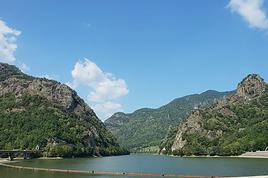
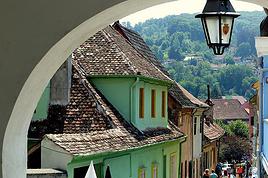
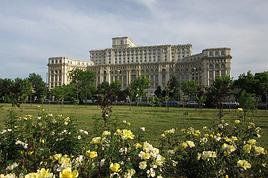
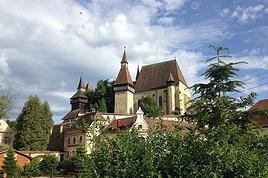
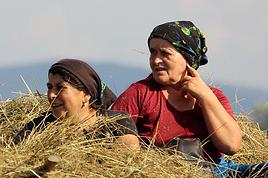
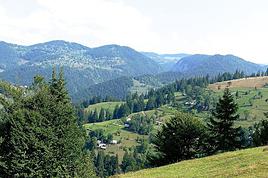
Lors de la petite promenade que nous avons faite en Europe de l’est (voir les premiers chapitres du livre Improvisation Nomade sur ce site), il s’est vraiment passé quelque chose de différent en Roumanie. Comme ci, après avoir traversé des pays étrangers, nous arrivions enfin en famille chez de proches cousins. Cousins où la vie serait restée celle d’entant avec la solidarité familiale et villageoise, avec l’alcool de prune à toutes les occasions, les animaux de la ferme dans toutes les cours, le foin ramassé à la main etc. Comme revenu chez mes grands-parents étant petit, les odeurs et les souvenirs me sont revenus aussitôt.
Mais la Roumanie n’est pas simplement ce que j’en ai vu ou ressenti et comme je n’ai pas pris le temps d’y retourner ainsi que je me l’étais promis, j’ai quand même fait quelques recherches sur ces lointains cousins.
Les Roumains sont originaires d’un peuple indo-européen venu 2000 avant JC : les thraces. Ceux qui resteront entre Carpates et Danube, en future Roumanie s’appelleront les Daces. D’où d’ailleurs la fameuse marque automobile Dacia. Les daces sont un peuple dont Hérodote, Historien grec, disait qu’ils étaient très puissants et qu’ils pourraient être craint s’ils ne se querellaient pas sans cesse entre eux. Les daces parlent dace, une langue presque totalement disparue et qui n’était pas écrite, peut-être pour se protéger de ses trop grands voisins. Mais ils étaient plutôt évolués puisqu’ils avaient un haut niveau de médecine, d’astrologie etc., et d’ailleurs étaient directement influencé par les Grecs.
A l’époque Romaine, les daces ne purent résister à l’empereur Trajan qui les vaincu et fit de la Dacie une province romaine (vers 150 ap JC). Ceux d’entres eux qui n’étaient pas contents s’en sont retournés dans les plus hautes montagnes jusqu’en 256 avant que l’envahisseur ne parte. Quand les Daces romanisés (avec la langue mais aussi avec quelques chromosomes) et ceux restés dans les montagnes se retrouvèrent, ils créèrent le roumain, une langue à forte inclinaison latine mêlée d’ancien dace.
Enfin, il faut savoir que l’un des plus grands empereurs romains nommé Galère était Dace. C’est d’ailleurs à ce moment que la capitale de l’empire romain devint Byzance (Istanbul) à défaut de Rome. L’empereur Constantin qui la rebaptisa juste après en son nom Constantinople fit de cette partie du monde le cœur de l’empire mais aussi, puisque entre temps était apparu le christianisme, le cœur de la chrétienté. C’est donc simplement que les Roumains devinrent chrétiens de rite byzantin, cad. Orthodoxes et ce jusqu’à nos jours.
Pendant de nombreux siècles, les Roumains vécurent parfaitement au sein de l’empire byzantin et aidèrent à son maintien en affrontant les peuples venus du nord et de l’est tels que les Goths ou les Huns… Pourtant, ce fut les Magyars et les Saxons, installés en Hongrie qui grignotèrent de plus en plus du côté de la Transylvanie puis enfin les Ottomans qui réduirent Constantinople en 1453 et ne tardèrent pas à prendre l’autre partie de la Roumanie, cad la Valachie et la Moldavie. D’ailleurs si l’on regarde la carte de Roumanie, l’on s’aperçoit que le cœur du pays, les montagnes des Carpates, a une partie de ses eaux qui descend vers l’Occident et l’autre vers l’Orient et la mer Noire. Une frontière qui perdura bon grès mal grès pendant 400 ans, jusqu’à l’indépendance de la Roumanie en 1878.
Pendant cette période de domination ottomane d’un côté et austro-hongroise de l’autre, de grands princes roumains résistants virent le jour. Ils sont encore très connus, notamment Dracula dont voici la petite histoire : La famille Dracul est une très vieille famille roumaine de sang royal dont le nom qui veut dire dragon vient du symbole Dace qui était représenté sur leur drapeau. Celui dont l’histoire deviendra un mythe était un prince venu à la tête de la Valachie et qui ne se laissa pas faire par l’occupant. Il était particulièrement cruel avec ses ennemis et n’hésitait pas à les faire découper, bouillir, enterrer vifs… mais surtout empaler ! Une fois que Mehmet 2 en eut marre de ce prince qui ne lui payait pas tribut, vint avec son armé et après de longues batailles contre le prince Dracul finit par laisser tomber devant le spectacle de 20 000 de ses soldats empalés au bord d’une forteresse et laissés là jusqu’à décomposition. La fin de l’histoire est moins drôle puisque Dracula fut prisonnier et tué par les austro-hongrois après une entente avec les Ottomans…
Avant d’aller plus loin, je suis obligé de dire un petit mot sur une partie de la population du pays qui n’est pas roumaine. Il s’agit des Roms. Ce peuple indo-européen est arrivé bien plus tard (autour du XIV siècle) et a était pris en esclavage lors de son passage à travers les pays européens, notamment une bonne partie en Roumanie. Malheureusement pour les Roumains ou par punition divine, ils s’appellent Roms et sont souvent confondus avec eux ce qui leur donnent la réputation que vous savez en France. D’ailleurs les deux populations se détestent la plupart du temps…
L’histoire du XX ème siècle est plus connue. Une fois la Roumanie plus ou moins libérée du joug ottoman, de petits princes se disputèrent pour prendre le pouvoir. Comme le risque était grand que le pays ne soit jamais réuni mais partagé entre ses grands voisins, la population décida que le futur roi serait un étranger et les protégerait ainsi de part ses liens familiaux. Comme la France avait de très bonnes relations avec les Roumains (la Roumanie s’est rapprochée de la France depuis la révolution… et aussi parceque tous les gens cultivés d’europe et même de Russie parlaient le français), Napoléon III conseilla à ses amis roumains de prendre comme roi un jeune prince Allemand dont la grand-mère était apparanté à Napolèon. Aussi le jeune prince devint le premier roi roumain et pris le nom de Carol Ier. Il s’associat à la Russie contre les Ottomans, ce fut un succès, enfin la Roumanie devint autonome et son roi servit bien ses habitants.
Carol Ier mourut en 1914 sans laisser d’héritier direct mais il avait depuis longtemps jeté son dévolu sur une autre jeune Prince Allemand, fils d’un de ses frères et depuis longtemps en Roumanie. Il fut donc accepté par la population. Marié avec Marie d’Edimbourg, petite fille de la reine Victoria d’Angleterre par son père et du Tsar Alexandre II par sa mère, ils avaient déjà deux enfants ensemble dont Carol II, qui serait succéseur à la couronne. Ferdinand dès le début de son règne dut prendre la descision de sa vie, à savoir s’il devait se battre avec ses frères allemands ou avec la France, dont les Roumains se sentaient beaucoup plus proches. Ils décidât par honeur à son rang de se battre du côté des alliés contre son pays d’origine. Il a bien fait d’ailleurs puisque les alliés sortent vainqueurs et que son fils deviendra bien roi après lui.
Après la guerre, la Roumanie connaît la période la plus faste de son existence. Bucarest est appelé « petit Paris », on y fait la fête et des affaires. Tout va bien jusqu’à la seconde guerre mondiale ou encore une fois, la Roumanie choisit le camp des alliés mais cette fois est envahi par l’Allemagne nasie puis à la fin de la guerre par l’URSS « libératrice. »
La Roumanie passera alors sous le joug de l’URSS pendant 40 ans et connaîtra une période très néfaste ou Caousescu et la Securitate exerceront une dictature intrétable avec les pires exactions.
C’est seulement une année après la chute du mur de Berlin qu’une soit disant révolution renverse et supprime Caousescu et met au pouvoir un de ses proche : Lliescu avec 85 % des voix. Un vrai coup d’état organisé ainsi que de fausses élections car rien ne changera vraiment en Roumanie avant 10 ans lors d’autres élections. Heureusement aujourd’hui, l’Europe a exigée de la justice et des affaires économiques du pays une plus grande clarté, cad moins de corruption pour rentrer au sein de l’Union Européene. Quand je suis passé en Roumanie en 2004, j’avais l’impression de rentrer dans un pays en guerre ou du moins qui avait connu la guerre et dont rien n’avait bougé depuis. Néamoins, j’avais senti une grande ambition de la part de ses jeunes, une grande envie de travailler et de réussir. Il ne m’étonnerai pas que la Roumanie devienne un grand pays d’ici peu de temps !
Merci d'apprécier ce travail personnel (que j'aime bien faire)
Cependant je ne suis pas historien et il faut se méfier de ce que j'écris
c'est certainement cousu de fautes et d'inepties
en plus d'apporter mes propres réflexions / préjugés.
Bref, à recouper si vous voulez en savoir plus
puis moi, je veux bien en apprendre encore et encore.
Salut Nico,
bravo pour ta petite histoire. j'ai decouvert la Roumanie il y a maintenant 1 an , par le travail. Mes collegues Roumains sont devenus rapidement des amis et la roumanie sera pour moi le lieu de mes vacances au mois d'aout.
Je connais la region de Brasov pour y travailler. Pour les vacances , nous partons à 3 copains vers les monts apuseni et le maramures.Nous profiterons de ces 3 semaines pour aller en pension chez des paysans.
As -tu des adresses?
buna seara,
ddrom
(voir les premiers chapitres du livre Improvisation Nomade sur ce site)
Bonjour,
J'avais beaucoup aimé ton texte Improvisation Nomade.
Il s'agit donc d'un livre ? Edité et en vente dans le commerce ?
Je lirai bien la suite en tous cas !
Non malheureusement, je n'ai pas d'adresse à te proposer.
j'avais rencontré des étudiants quand j'y suis allé mais je n'ai pas de nouvelle.
ça veut dire quoi "aller en pension chez des paysans" ?
Et qu'est ce que tu fais comme travail à Brasov ?
tout d'abord merci pour ta reponse, hier soir comme lecture j'ai lu ta petite histoire..Comme je te l'ai ecrit, nous partons 3 semaines en roumanie, la premiere est destinée à visiter Bucarest et les alentours de Brasov.
La 2em decouverte des monts apuseni et la 3 em le maramures. j'ai trouver un gite site : ursita.ro qui me parait pas mal . Nous preferons les relations avec les locaux que de nous retrouver en hotel, je pense que l'on doit pouvoir trouver des logements chez l'habitant et peut etre chez des paysans..??
Pour le travail je me suis occupé de la gestion d'ouverture d'un site de production en roumanie.J'y vais environ 1 fois tous les 2 mois
la sté est installée à Prejmer, 15 kil de brasov.
Le site du gîte à l'air vraiment sympa.
très nature et tradition mais en même temps très pro.
Pour se faire accueillir chez les gens, c'est possible certainement
mais je pense qu'il faut leur inspirer la nécessité, arriver à pieds, être en rando ou paumé
surtout si vous êtes plusieurs
je ne vois pourquoi vous iriez dormir chez des gens si il y a un gîte dans le coin
mais enfin je dis peut-être une connerie (J'irez dormir chez vous😎)
et en même temps, vu le gîte comme il est classe, je ne sais pas qui a financé ???
Pour ton travail, je me permets d'insister
c'est un site de production d'une société française ?
je ne sais pas si on peut savoir c qui et qu'est ce qu'ils font 😉
Non, ça m'intéresse vraiment dans le cadre du développement de la Roumanie.
J'aimerai bien même en savoir encore plus !
salut Nicodilo,
je pourrais t'en dire plus sur ma société, mais dans un cadre plus discret ! comme je te disais cela fait un an pratiquement jour pour jour que je vais en Roumanie et que depuis, j'en suis tombé un peu gaga.
Les roumains que je connais sont vraiment sympas... je passerai donc 3 semaines au mois d'aout .
Le gite que je t'ai presenté est tenu par une Belge?? je l'ai eue au tel et elle me deconseille une semaine au mois d'aout , parcequ'il y a un grouped'allemands et ils risquent de faire un peu de bruit.. donc à suivre...
j'ai trouvé d'autres gites peut etre moins sympa et des hebergements chez l'habitant.
Pour ce qui concerne j'irai coucher chez vous, je suis un peu comme cela avec en retour la reciprocité chez moi..j'habite le 72 les pieds dans l'eau en plein centre d'une ville qui se nomme la petite venise de l'ouest.
voila pour la reponse,
ddrom
nous voulons réserver nos billets pour visiter le site de l'Acropole et du musée lié.
pour ces réservations, il faut indiquer des créneaux d'entrées.
pour l'Acropole simple : 8h30 le premier créneau
pour le musée 10h ? 11h ?
nous aimons bien flâner, du coup la question : si au bout d'1h30 nous n'avons pas fini le site, au sortir du musée il est possible d'y retourner ?
nous allons prendre les billets sur les sites officiels : les audioguides sont indiqués. des retours d'expérience ? sur les sites type Get your Guide les tarifs sont tellement plus chers avec mention d'audio guide, mais celà signifie t'il une meilleure qualité ?
Hi, I’d like to buy a ticket to go to Terezín from Prague using the Pid Litacka app, but I don’t know which zone to get the ticket for. Thanks for your help! 😊
Hi there,
After booking an Airbnb last January for this summer’s vacation in Sarajevo... My "host" canceled our reservation without any reason—this has never happened to me before.
Of course, now it’s impossible to find a place to stay at a "normal" price in Sarajevo with parking...
So we’re falling back on the capital of the Republika Srpska, Banja Luka, which had already crossed my mind before I booked Sarajevo.
I already have quite a few ideas in mind, without having dug too deep into the region yet.
But if anyone has already been there and has suggestions? Even for restaurants—I’m all ears!
And even if it’s not right next door, I’m planning to spend a day in Sarajevo!
Hi, I’m going to Turkey for 3 weeks. I’ve heard that you can’t book through Booking.com once you’re there and that everything has to be reserved in advance. Is it true that Booking.com doesn’t work in Turkey? Thanks to anyone who’s already been or is there—if it’s true, how do you handle bookings?
I’d love to get your opinions and advice on a destination.
It’s actually for my 19-year-old son who wants to go to Greece with his cousin, who’s the same age.
They’re looking at leaving on October 24th for 7 to 10 days.
For their trip, they want gorgeous beaches where they can swim, beautiful typical villages and historic cities, stunning landscapes, but also lively spots for their nights out. In short, they’re not just going there to laze around—they want to make the most of it...
But here’s the thing: will the weather be too iffy at that time, especially for swimming?
Also, would Crete be the best choice for what they’re looking for?
Then, a travel agent suggested Tenerife instead because of the weather at that time of year—he said the climate there is the same all year round. But will they find landscapes and beaches as beautiful as in Crete?
Hello!
I’m planning a trip to Greece in May or June 2027. We’re independent travelers.
We’ll rent a car after our stay in Athens and book accommodations through Booking or similar sites.
What do you think of this itinerary? We’re taking our time (beach and swimming if the weather allows in May—is the water too cold?)
Athens, 3 days
Nafplio, 3 days (Mycenae, Epidaurus, Archaia)
Mystras, 2 days or Monemvasia, 2 days (Laconia peninsula)?? Dilemma between the two
Return trip from the Peloponnese via the Rio-Antirrio bridge
Nafpaktos, 1 night
Arachova, 2 days (Delphi, Osios Loukas Monastery)
Return to Athens and departure
Is it crowded in May or June for visits to archaeological sites?
Thanks for your suggestions or corrections!
Hi there,
Our first trip to Greece as a couple. We're planning to spend 7 days in Greece from August 30th to September 5th. We'll reserve 2 days for Athens at the end of the trip. For the remaining 5 days, we want to visit an island—any recommendations? Thanks for your tips and details, we really appreciate it.
Hi,
What tips can you give me for dealing with a car rental scam attempt in Lithuania?
In our case, it’s the Avis-Budget agency in Vilnius trying to scam us.
We rented a car at Vilnius Airport for 2 weeks on July 28, 2019, to return it in Tallinn on August 11.
We brought it back on August 11 at the airport, in perfect condition, and with a full tank at the gas station right by Tallinn Airport.
On the parking lot, the receptionist’s booth was closed. So we had to leave the car in the lot and go to the counter inside the airport. The person at the counter told us their colleague had gone for lunch!
But they refused to come out and do the inspection with us because they were alone at the counter.
They told us we could leave and that everything was fine!!!!
Two days later, we got an email from Avis-Budget with two invoices saying the car was damaged—scratched on both sides—and charging us for a full tank of gas. That’s two bills totaling 800 €!!!! Coincidentally, the deposit was 900 €!
It’s clear this isn’t over!!
Have any of you been through the same nightmare? How did you handle it?
Thanks in advance!
I’m spending 2 weeks in Crete in September and will need a rental car.
I usually go with Europcar, but comparing their offer to what Aegean Rentals has, I see Europcar is charging no less than 400 € more for the same car and similar insurance!
I’d love to hear if others have experience with Aegean Rentals, and if so, whether it was a good one?
Hi,
We’re heading to Greece in early October and will be staying in Kineta, north of the Saronic Gulf, and renting a car.
Is it feasible to visit Acrocorinth, Mycenae, Nafplio, and Epidaurus in a single day?
Thanks for your recommendations!
Hi there!
I’m sharing our itinerary for May/June 2027—23 days. This is our first time in Greece, so we’re starting with the must-see spots. We’re planning another trip later to explore the north, Thessaloniki, Macedonia, and some islands.
- Athens, 4 nights
- Corinth area, 2 nights (Heraion of Perachora, Canal, Acrocorinth)
- Nafplio, 3 nights (Mycenae, Epidaurus, Methana peninsula)
- Gefira, 2 nights (Monemvasia)
- Areopoli, 2 nights (Mani). Maybe add an extra night and stay on the peninsula??? Based on my calculations, the Mani loop is about 100 km—doable in a day, but it’d be a quick trip.
- Sparta or Pikoulianika, 2 nights (Mystras)
- Dimitsana, 2 nights (Lousios Gorge, monasteries)
- Olympia, 2 nights (via Lagkadia?)
- Delphi or Arachova, 3 nights (via the west coast, Galaxidi bridge) (Delphi, Hosios Loukas Monastery)
- And back to Athens.
This is just a rough draft for now. We’re planning to stay in hotels or book through Booking.com. What do you think? Thanks for your feedback and suggestions!
Over the past twenty-five years, I’ve traveled the roads between France and Moldova a good ten times, sometimes via Central Europe, other times via the Balkans.
It was while traveling like this—what I call "hitting the road the slow way"—that I realized something simple: our neighbors' neighbors are very clearly our neighbors too. And that’s not insignificant.
After a break of a few years, I’m planning to hit the road again in September, this time heading to Kosovo, crossing through Bosnia-Herzegovina and Montenegro.
Having gotten a bit older, I’ve no intention of rushing—no need to speed ahead of the music! 😄
I’d rather take my time.
I’m not looking to see everything, but to soak in the atmosphere of the places, always leaving room for the unexpected and for encounters.
I’m especially drawn to culturally immersive, authentic, and welcoming regions: lively villages, backroads, preserved landscapes, markets, local festivals, traditions that are still very much alive... and, why not, a few offbeat, forgotten, or slightly secret spots.
If any of you know Bosnia-Herzegovina, Montenegro, or Kosovo a little, I’d love to hear your suggestions for itineraries, stops, backroads, homestays, village festivals, or local contacts, for example.
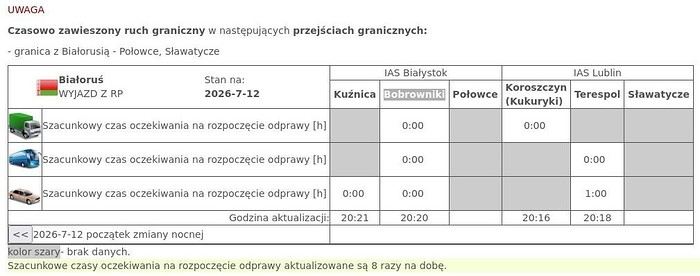
Planning to return to Belarus in mid-August, I just realized that since last September, Poland has reopened several border crossing points, and for buses, this means connections like Białystok-Grodno.
Several bus company routes, like on infobus.eu, take between 3 and 4 hours.
Trains from Warsaw to Białystok take about 1.5 to 2 hours.
This has the advantage of allowing comfortable train journeys with minimal time spent on a bus.
Also, the Terespol-Brest border might have shorter queues if you still prefer a Warsaw-Brest bus.
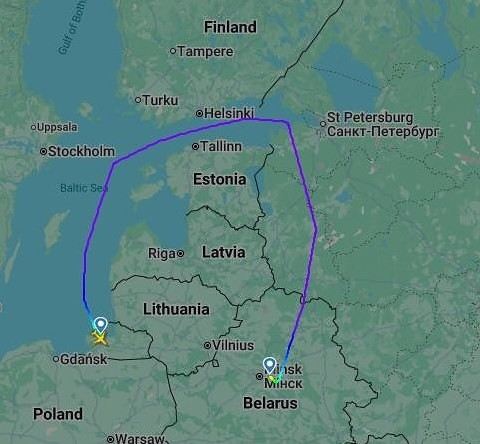
Note that another route to Minsk, if you have a paper Russian or Belarusian visa, is the Kaliningrad-Minsk train. It’s long—around ten or eleven hours—but you can lie down and sleep. An option if you fly into Gdańsk and then take a short bus to Kaliningrad.
There are also Belavia flights from Minsk to Kaliningrad, but they’re expensive. The route is scenic:
In any case, this adds a few more options compared to what’s been available over the last four years.
Hi there.
I’d like to know what the daily budget is for Greece in December. I’ll be landing in Athens and staying there for a week, then heading to some other islands—I don’t have a set itinerary yet. Also, I’ve heard that in December, or early January, the temperature is around 11–16°C. Is that accurate?
Finally, does anyone have a good recommendation for a cheap but clean hotel near the tourist sites? I don’t need a TV or any other extras. Also, is Greece gay-friendly?
I’d like to know the opening hours of physical stores between Germany and Austria, and between Austria and Slovenia, that sell the PAPER STICKER toll vignettes that still exist for 2026—non-digital ones. I don’t think they’re open 24/7, and I can’t find the info anywhere.
Thanks
Hi there,
We’re planning a 3-week trip in late September with our camper van to explore Bulgaria and Romania.
What routes would you recommend, starting from the South?
Is there an option to take a ferry in Italy, and is it worth it?
Thanks for all your tips!😊
Hi there, we’re a young couple and we’d love to go to the Blue Eye (Syri i Kalter) between today (26/06/26) and tomorrow (27/06/26).
Is anyone heading there and could give us a ride? We’re super friendly!
Thanks so much!
We're back. It's still a bit tough to get precise info, so here's a quick trip report!
A good starting point is Shkoder, a really pleasant city. You can easily explore Shkoder itself in a day or two.
Two accessible spots: Valbona and Theth.
In both cases, local travel agencies in Shkoder or online offer round-trip or one-way access packages. Super handy, especially for Valbona.
Valbona and Theth are both very steep! There aren’t many easy hikes for less sporty folks (like me!).
Valbona: The highlight is the amazing 2.5-hour boat ride across Lake Koman. There are day trips from Shkoder, but you’ll only get a short tour of the lake. The best option is to do the full crossing—so spend a night in Valbona (or two if you want to hike in the valley) and return.
Theth is deeply nestled in the mountains. The village at the end of the valley, which is a dead end, has lots of hotels, but they’re pricey. Other hostels are scattered along the mountainside road, but it’s a steep climb down to the village or to the start of the two easy hikes (waterfalls and the Blue Eye). For us, it was a one-hour descent (and ascent!). It’s fine if you have a car; otherwise, keep an eye out for a taxi (cheap) or try hitchhiking—it works really well.
Access from Shkoder to Theth is through an agency. The road is in great condition, and you can also rent a car for 2-3 days in Shkoder. If we did it again, that’s the option we’d choose.
We didn’t do the trek and returned to Shkoder each time. I can’t speak to its difficulty, but we were there in late May, and even experienced hikers had given up because of heavy rain and snow.
Hope this helps! It’s a stunning region you shouldn’t miss.
We’re a Canadian couple, both 77, and we’re already planning our vacation for fall 2027.
Timeframe: mid-September to mid-October... dates are flexible, and we might stay even longer.
Initially, I had planned this itinerary:
Athens (3), Naxos (4), Paros (4), Santorini (4), then a flight to Istanbul (7–10 days!!). This would let us maximize our flights and experience another culture.
That’s a lot of ferries, though... I’ve already cut out Milos.
Our second option would be to stay 2 x 15 days on two different islands, but I’d still keep Istanbul as our next destination... or maybe 30 days on one island that offers the chance to take day trips to other islands where the ferry ride is no more than 2 to 2.5 hours. For example, Naxos to Paros only takes 30 minutes. We could return the same evening or stay overnight.
Naxos seems like the best option!!!
For Istanbul, of course we want to do a day cruise on the Bosphorus and see Hagia Sophia. If we stay 6–7 days, what would be the other main attractions? Are there any points of interest we can reach by local bus?
Hi there!
We bought our tickets to Greece at the end of November 2025, and let’s just say the geopolitical climate has really taken a turn since then with the war started by the United States against Iran. Not to mention all the other conflicts happening around the world 😕... Anyway!
Our flight from Montreal is on May 1st, and I was wondering how things are currently being experienced in Greece.
We were planning to rent a car and had already booked accommodations on three Cyclades islands!!
The oil shortage is also worrying us...
If you could share some insights on this, that would be great!
A little trip report from an 11-day journey to Albania at the end of April 2026, with two friends in their early sixties and beyond...
Our route: Berat, Gjirokastër, Himarë, Tirana
Here are some opinions, tips, and great deals to share:
Flight Round-trip Beauvais-Tirana: Ryanair, 260 € with checked baggage (20 kg) and seat selection. Flight was fine and on time. 2h 30min flight.
Exchange: 1 € was worth 95 lek in April 2026. We were advised to exchange in the airport hall at the Illiria counter (98 lek outside the security zone), saying we wouldn’t find a better rate. However, the exchange rate was 93 lek for 1 euro, while in the city it was 95...
Car rental at Tirana airport for 9 days via Booking.com: 144 € (56 € for the car rental and 88 € for optional full insurance deductible waiver).
Wheego agency: the car was fine, but be careful when signing the contract—they tried to convince us that the insurance taken through Booking didn’t cover everything and insisted we take their own insurance for 250 €... We refused.
After reading about driving in Tirana, instead of starting our trip by visiting the capital, we decided to head straight to Berat upon arrival and return the car at the end of the trip to explore the city on foot. This turned out to be a great choice!
Accommodations: All our stays were booked via Booking.com. Everyone prefers to be paid in euros and in cash—they mention this when booking.
Berat: 2-hour drive from the airport.
Accommodation: Vila Arben Elezi: 135 € for 3 nights with breakfast and private parking. The room was decent and clean but a bit dark, located slightly below ground level near the parking. However, the breakfast on the rooftop was excellent, especially with the stunning view of the "city of a thousand windows." Great location.
Berat was our favorite—there are lovely walks through the different neighborhoods on both sides of the river, each with a very different vibe. The citadel visit is also fascinating, as it’s like a small town within the fortress.
The walk along the river is pleasant, with plenty of restaurant choices. Other restaurants in the old town are also very nice. The White House Restaurant, on the first floor along the road, is good and offers a great view of the Gorica district.
Gjirokastër:
Accommodation: Te Ajdini Guest House: 120 € for 3 nights with breakfast. A private home stay. There’s free parking just before entering the city, a 5-minute walk from the accommodation, which is very convenient since the cobblestone streets are narrow and parking is tricky. Yes, it’s a climb to get to the place, but everything in this city is uphill... The room was bright and clean. Breakfast was very good, hearty, and served in the courtyard with a view of the castle. The guesthouse is a 5-minute walk from the city center (the bazaar) but in a quiet area.
Restaurants: Rrapi and Kujtimi—good and affordable with their little pergolas.
The old town of Gjirokastër is charming but very touristy, with streets packed with souvenir shops and restaurant tables and chairs. Lots of people.
-The bunker visit (near the tourist office) is very interesting: Cold War Tunnel.
The castle offers a beautiful view of the city.
-Visit to the Ottoman house Skenduli: very well done. Don’t forget to climb the ladder facing a trapdoor in the ceiling to see the roof’s framework—it’s like a forest of beams: impressive!
-The bridge Ura e Ali Pasha: A steep 45-minute climb from the city to the site is worth it, but once you reach the viewpoint (which is stunning), you have to go back down a path to reach the bridge. You can drive to the viewpoint, but parking is very tricky.
Around Gjirokastër:
-Just outside the city: Lake Liqeni i Viroit: a nice, ordinary-looking lake, but at the end, there’s a natural spring making the water crystal clear and a brilliant blue—really spectacular, like photos of Blue Eye near Sarandë.
-Drive to Përmet along the gorges: beautiful viewpoints along the way and lovely countryside.
Himarë:
Accommodation: Vila Kosteli: 120 € for 2 nights with breakfast—slightly overpriced for this type of place but very close to a small beach and not far from the promenade with all the restaurants. Private parking, but very tight (4 cars on a tiny lot along the road). The "sea view" room is a bit obstructed by the building across the street. However, the rooftop breakfast view is beautiful. Friendly staff.
Himarë is a pleasant seaside resort, quite calm (but it was April...). There’s a cute promenade with restaurants along the beach. The castle on the heights of Himarë is worth a visit.
Around Himarë:
-Qeparo is worth a quick stop, but Qeparo village is really worth the detour: a village lost in the heights after a scenic drive up from the coastal road—narrow but well-maintained. Beautiful view from the top and a charming village.
-The Big Bunker and Llogora Panorama: take a right turn several kilometers after Dhermi—a road that climbs steeply from the start... A breathtaking winding road that reaches 900 meters in altitude. The view is stunning.
-Several small villages between Dhermi and Himarë are worth a quick stop.
-Porto Palermo Castle is somewhat disappointing.
Tirana:
Taxi from Tirana airport to the city center: 15 € with electric taxis (Green Taxi, Bee Taxi, Do Taxi).
Accommodation: Hotel Nevi Apartment: 63 € for 2 nights. A private apartment in an older building but very clean and well-equipped, with a kitchen and small enclosed balcony.
Great welcome and contact—the owner even booked a taxi for our departure. Very well located, close to the main square, shops, and restaurants. A small supermarket nearby is perfect for stocking up on breakfast supplies.
The city is lively and dynamic, with plenty of green spaces and promenades. Buildings are popping up everywhere, often with surprising architecture—like a building shaped like a face, a huge golden cube, and many others under construction.
-Sky Tower: at the top, a rotating bar offers a 360° view of the city and its buildings. Drinks are a bit pricier than usual, but it’s totally worth it (6 € for a beer or a glass of white wine, 3 € for coffee). We were there for sunset, and it was amazing! A must-do. Arrive early, as it fills up quickly.
-The House of Leaves: a house used for secret surveillance and interrogations during the dictatorship... A great way to learn about the surveillance systems of that era.
-Bunk’Art 2: a bunker in the heart of the city—very interesting, covering the dictatorship period and its system...
-The Pazari i Ri Bazaar: the new bazaar district. The large hall is worth a visit, but souvenir prices are often higher than elsewhere... The area is nice.
Restaurant: Kastrati Restaurant—a bit like a canteen with lots of traditional dishes. It’s on the first floor of a building. Excellent value for money, and the waitress explains the dishes in French.
That’s a little overview of our trip and my personal impressions!
Albania is a beautiful and pleasant country to visit.
If you have any questions, feel free to ask!
Hi everyone,
We’re thinking of spending 3 weeks in Crete between mid-August and early September, renting a car, quickly exploring a few spots in the east, and focusing on the west, southwest, and south.
I’m worried about the heavy tourist crowds. Is it really more noticeable than elsewhere in Greece? Is there a way to avoid the crowds without missing out on the iconic places, which I imagine are stunning in Crete? Thanks for your thoughts and experiences!
Hi,
I'm heading to Greece via Albania soon. Does anyone have info on transportation from Gjirokastër to Ioannina?
Which company, fares, and schedules—it's not very clear with Google.
I’m just passing through Bratislava quickly (one afternoon, one night, one morning) and I’d love to see the highlights of the city.
I’ve put together a little itinerary—feel free to let me know what you think!
Start at the castle and its beautiful viewpoint
Visit the Baroque gardens
St. Martin’s Cathedral, quick visit
National Theatre
Discover the Cumil statues
Primatial Palace via Hlavné Namestie
Michael’s Gate
Grassalkovich Palace via Obchodna
Walk across Namesti Slobody to head back to the upside-down pyramid
Head down to the Blue Church
Cross the Danube to see Sad Janka Krala, then return via the UFO Bridge
There you go—10 km and a packed day!
What do you think?
Hi there,
we’re heading to Crete from May 8th to 15th, staying at a hotel in Agia Pelagia, 20 km from Heraklion, on half-board, so we’ll be back every evening. What daily itinerary would you recommend? We love hiking and discovering local cultures...
Thanks in advance!!
Hello,
We’re heading to Prague with so much excitement from June 10th to 20th. I’ve got three main questions for those who live there or have visited:
- What are your thoughts on what to pack clothing-wise? What’s the weather usually like at this time of year? We’re a bit sensitive to the cold—we live way down in southern Andalusia and are used to the *calor* 😎... Should we pack rain gear? Are we likely to get a lot of rain (which we’re dreading a little, but we couldn’t choose other dates)?
- I’ve seen there are "passes" for various attractions, museums, and sites, including one that’s valid for 10 days but costs a whopping 160 € per person—that’s an average of 16 € per day. Do you think it’s really worth it? We won’t be spending our days rushing between every indoor site; we also love wandering the streets and discovering things a bit "at random." If we do two paid visits a day, that’ll probably be the max... Can we make it worth the cost with that? Of course, we want to visit the castle and take a boat trip as a minimum. Are the sites included in these passes iconic, or are they more "minor" attractions? Does having the pass help us skip long lines?
- Finally, a question about communication: I speak French, obviously, plus Spanish and English fluently, but very little German (haven’t practiced in ages), and no Russian or Czech at all. My husband knows a few words of Russian, but it’s "Cuban" Russian—about the same level as my current German 🙂 !! Can we still get by without too much trouble? We don’t want to spend 10 days not saying a word to anyone and communicating only with gestures!!
Thanks for your valuable tips and opinions.