Un mois en Namibie: récit!
by Elodie757
This discussion is in French, the community’s main language.
Original post
De retour de Namibie (+ Chobe et Vic Falls) après un magnifique voyage d’un mois dans des conditions très confortables (en lodges), je vous envoie modestement un petit compte rendu de cette expédition magnifique. La Namibie est une destination onéreuse mais ce furent sans doute les plus belles vacances de notre vie, nous avons tout aimé : les paysages, les gens, les animaux… Bref, tout, en général, était extraordinaire. Et puis, il y a un truc génial, en Namibie, l’hiver : certes, il fait parfois froid le matin et le soir (mais en lodge, tout va bien) mais le soleil est présent chaque jour dans un ciel bleu cobalt sans aucun nuage et ça, c’est le bonheur ! Par ailleurs, les routes sont parfois longues (je conseille absolument à ceux qui visitent le pays en lodges de se poser deux nuits plutôt qu’une dès que possible pour ne pas conduire tous les jours) mais elles sont belles. En conduisant à deux conducteurs et en partant à chaque fois tôt le matin (vers 8 H) pour ne pas passer trop de temps dans la voiture, les trajets nous ont globalement paru faciles et agréables (bon, malgré deux crevaisons…).
Voici, de façon rapide, notre récit de voyage et impressions : que ceux qui ont des questions n’hésitent pas !
Jour 1 : Vol Paris-Johannesburg puis Johannesburg-Windhoek, formalités d’arrivée, récupération de notre 4/4 de location… Puis Olive Grove Hotel pour une nuit.
Très joli boutique hôtel sur les hauteurs de Windhoek : chambre dépouillée et chic dans les tons gris/beige, petit spa, restauration délicieuse… Tout commence sous les meilleurs auspices !
Jour 2 : On a passé une grosse demi-journée à Windhoek à explorer un peu le centre ville (petit tour autour du parlement, de l’église principale, de la rue piétonne, du namibian craft center…) car ça nous paraissait bizarre d’explorer un pays sans voir ne serait-ce qu’un peu sa capitale. Mais il faut reconnaître que l’intérêt de Windhoek n’est pas démesuré. Puis route vers le Bagatelle Kalahari Game Ranch, dans les environs de Mariental pour deux nuits. Dès cette première route (la B1, pourtant goudronnée et pas encore typique des fameuses pistes, gravel roads, de Namibie), nous avons trouvé les paysages magnifiques. On s’est arrêtés pour pique niquer près d’un joli lac (Oanob) à 7 km de la route, qui nous a pris en tout environ 4 H.
Jour 3 : journée de détente à Bagatelle Kalahari Game Ranch. On a beaucoup aimé cet endroit en tant que première étape : ambiance du lodge très conviviale, avec une belle salle commune, de magnifiques chalets (ça vaut le coup de se payer un Dune chalet sur les dunes rouges du Kalahari, au sommet de la dune, plutôt qu’un chalet dans la vallée). Dans le Kalahari, le sable est d’un rouge encore plus intense qu’ailleurs, c’est superbe. On a randonné dans le bush et sur les dunes au milieu de nos premiers springboks, autruches, oryxs et on a fait deux game drives avec le lodge, l’une dans leur jolie réserve privée attenante au lodge avec pas mal d’animaux et l’autre à la rencontre des guépards qu’ils sauvent et réhabilitent dans un très grand enclos avant de les relâcher dans la nature en partenariat avec une fondation de conservation de l’espèce (c’était chouette car on n’a pas revu de guépards lors de la suite du séjour). A savoir : dans le Kalahari, il fait froid (on n’a pu enlever qu’un tout petit peu la polaire au plus chaud de la journée)… On a eu bcp plus chaud pendant le reste du séjour.
Jours 4/5/6 : route vers la base de Tok Tokkie Trails (environ 4 H) puis trek (3 jours/2 nuits) avec Tok Tokkie en petit groupe (deux touristes allemands + le guide + nous deux). Expérience extraordinaire, inoubliable : trek dans les paysages somptueux d’une immense réserve privée, la Namib Rand nature, aux paysages époustouflants. Le soir, on rejoint un campement quasi luxueux avec cuisinier, table dressée avec nappe en plein bush et même toilettes et douche en pleine nature ! On est tous seuls, c’est immense, on dort dehors à la belle étoile dans des lits de camps avec énormes couettes coupe-vent, la température est descendue à moins 7 la première nuit (les lits et le bout de nos bonnets étaient recouverts de glace !) mais sous la couette, on n’a pas eu froid. La rando est magnifique, les paysages à couper le souffle, au plus près de la nature et avec des animaux qu’on n’a pas revus ailleurs ensuite (comme les renards blancs du désert).
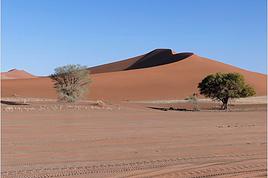
Jour 6, après-midi : route vers Sesriem (environ 2 H 30) et le Sossus Dune Lodge pour deux nuits. Lodge somptueux, le seul à être situé dans l’enceinte du parc national (donc, pas besoin d’attendre l’ouverture des portes !). Chalets immenses, superbement décorés, très bon accueil, restauration excellente. En fin de journée, coucher de soleil sur la Dune Elim.
Jour 7 : Comme on n’avait pas besoin d’attendre l’ouverture des portes, on est parti à l’aube, à 5 h du matin, du lodge, avec un pack petit déjeuner. Mais ce jour là, il y avait une tempête de sable, et un énorme brouillard, on ne voyait pas à un mètre et personne de pouvait descendre de sa voiture et encore moins gravir une dune, véridique ! On a du repartir vers l’entrée. On a donc visité le canyon de Sesriem, abrité du vent, puis on est repartis l’après midi jusqu’au bout du parc car heureusement, les conditions météo dantesques s’étaient apaisées. Ne pas rater Dead Vlei (ça n’est pas super bien indiqué) et ne pas hésiter à dégonfler les roues de son 4/4 pour ne pas s’ensabler.
Jour 7, matin : ascension de la dune 45 gratifiante mais difficile car le vent s’était de nouveau levé et soufflait très fort. Puis, route vers Solitaire. Arrêt au « Bagdad café » de Solitaire pour se dégourdir les jambes et déguster le fameux Apfel Strudel, puis, après avoir passé pas mal de temps sur la route à aider des touristes belges qui avaient crevé et n’avaient pas de bon cric, une super étape : Kuangu Kuangu. Sur l’immense territoire d’une ferme d’hôtes (Barchan Dune Retreat), il s’agit d’une sorte de cabane de luxe design adossée à la montagne avec une seule chambre et salle de bains extérieure, on est donc tous seuls, c’est romantique en diable. On a randonné, fait une chouette game drive (avec nos premiers zèbres du désert) avec le proprio de la ferme d’hôtes, caressé les suricates semi apprivoisées du domaine… C’était top.
Jour 8 : départ tardif de Kuangu Kuangu (pour une fois !) route Solitaire-Swakopmund via la Welwitchia Drive (ça rallonge la route, qui prend du coup environ 5/6 H en tout, mais les paysages sont à tomber par terre, on a beaucoup aimé). Arrivée pour le coucher du soleil à Swakopmund pour 3 nuits. Dîner dans un chouette resto de fruits de mer sur la baie, le Tug. Chouette boutique hôtel coloré et bien situé : la Villa Margherita.
Jour 9 : matin, balade dans Swakopmund, visite de la ville, achat d’artisanat… Bain de pied dans la mer (trop froide pour se mouiller en entier !)
J’avais lu des commentaires mitigés sur Swakopmund, eh bien, nous, on a beaucoup aimé cette petite cité balnéaire au milieu de palmiers (c’est différent du reste de la Namibie, ça change, c’est sympa), d’autant qu’on y a eu deux jours de plein soleil.
Après-midi : Tommy Desert living tour : on nous avait beaucoup vanté cette excursion dans les dunes près de Swakopmund à la recherche des petites bêtes du désert comme les caméléons avec un chouette guide, Tommy, mais ce jour là, ledit Tommy était malade, donc on ne l’a pas rencontré. Et, manque de chance, ses « remplaçants », d’autres guides, n’ont pas déniché beaucoup de bébêtes. Mais bon, ça arrive, et les paysages étaient splendides…
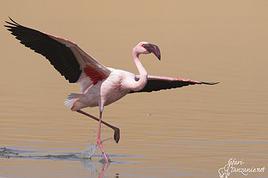
Jour 10 : journée d’excursion avec Mola Mola à partir de Walvis Bay… C’était fantastique : le matin, croisière au large dans un petit bateau avec pélicans, otaries qui grimpent même sur le bateau, et… Dauphins ! Puis tour à Sandwich Harbour, paysages somptueux où les dunes rencontrent la mer, déjeuner d’huîtres au bord de l’eau et volatiles par dizaines. Après, on a fait une petite balade dans Walvis Bay (flamands roses sur la jetée), on est allés voir le coucher de soleil sur la dune 7 à quelques km de Walvis et on a dîné, très bien, au Raft, le restaurant jumeau du Tug de Swakop.
Jour 11 : route pour Twyvelfontein. Notre agence nous avait indiqué 5 H de route et en fait il y a moins (plutôt 4 H). Du coup, par peur d’avoir trop de route, on a fait direct Swakopmund-Twyvelfontein et si on avait su, comme on avait deux nuits à Twyvel, on aurait fait un détour par les phoques de Cape Cross ou la peinture de la White lady du Brandberg car il faut savoir que les sites de Twyvelfontein se visitent très vite (les visites des peintures rupestres de Twyvelfontein et de la forêt pétrifiée sont plutôt intéressantes mais obligatoirement guidées et ne durent pas plus de 45 min chacune.) Notre lodge, le Doro Nawas, était une splendeur, là encore : chalets immenses, magnifiquement décorés, lodge principal en hauteur sur la montagne, le tout très luxueux mais en même temps, décontracté et sympathique.
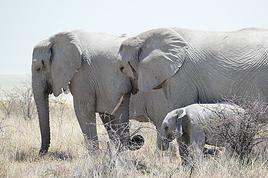
Jour 12 : le matin, éléphant tracking avec le lodge et nous avons eu beaucoup de chance car les éléphants étaient là et ô combien là, il y en avait plus d’une vingtaine et ils ont passé la journée autour du lodge. L’après midi, on a farnienté à la piscine de Doro Nawas (elle était assez chaude pour s’y baigner) car on avait visité tous les sites du coin et il y a eu un grand moment de ravissement pour les touristes (et de panique pour le staff du lodge) car un éléphant s’est approché tout près d’un des chalets sur lequel donnait la piscine (quel spectacle, il était presque sur le balcon du chalet) mais en a endommagé les panneaux solaires !
Jour 13 : route pas très longue (2 H) pour Grootberg Lodge, dans les environs de Palmwag. Génial. Lodge construit à pic d’un cratère (l’un des paysages les plus époustouflants du périple). Plus simple qu’à Doro Nawas par exemple, mais chalets très mignons et personnel namibien très gentil, souriant et décontracté. Malheureusement, nous n’y dormions qu’une seule nuit, on n’a pas donc pu faire le rhino tracking qu’ils proposent et qui dure une journée entière, mais en arrivant sur place assez tôt, nous avons tout de même pu passer pas mal de temps à discuter avec le jeune staff namibien du lodge, très sympa, faire une longue balade autour du cratère à partir du lodge (ils ont un sentier balisé) ainsi qu’une longue rando à cheval (accessible aux débutants) avec un guide adorable. Rencontrer les oryxs, springboks… à dos de cheval plutôt qu’en voiture, pour changer, c’était très chouette.
Jour 14 : route vers Opuwo : 4 H 30 en revenant sur nos pas depuis Grootberg vers Palmwag puis Seisfontein-Opuwo.
On s’est arrêtés rapidement à Seisfontein et avant ça, à la source naturelle du campsite de Warmquelle, ça fait un détour assez long (prévoir 2 H en tout avec baignade) mais c’est un chouette souvenir de s’être baignés tous seuls dans cette eau verte, cristalline et délicieusement tiède. Mais il faut savoir qu’ensuite, la route Seisfontein-Opuwo est difficile : elle grimpe, est remplie de grosses pierres, c’est très fatigant. Si vous logez à Grootberg, que vous montez ensuite sur Opuwo et que vous ne tenez pas particulièrement à vous baigner dans la source de Warmquelle, je conseille dans ce cas de prendre plutôt la route Grootberg-Kamanjab-Opuwo, certes moins « scénique » mais goudronnée donc beaucoup plus rapide, ce qui permet d’arriver plus tôt à Opuwo pour profiter de ce coin à l’atmosphère très dépaysante. Nous, on est arrivés un peu tard à Opuwo et on a un peu regretté de ne pas avoir davantage de temps pour flâner dans cette petite ville en soit plutôt moche mais donc nous avons beaucoup aimé l’ambiance et le mélange étonnant des populations (héréros, himbas…) tant dans la rue principale qu’au supermarché. L’Opuwo Country Hôtel est très bien : belle vue, très belle salle commune, superbe piscine à débordement (dont nous n’avons pas eu le temps de profiter, on a préféré se balader en ville), chambre plus banale avec deux lits twins éloignés l’un de l’autre (demander une luxury room) mais tout à fait confortable.
Jour 15 : très belle route Opuwo-Epupa Falls : 2 H 30 seulement car la piste est très belle, très roulante. Epupa Falls, on a adoré. Le site est bucolique, très reposant. Les chutes sont magnifiques (ne surtout pas se contenter de la chute principale mais randonner sur le sentier à gauche des chutes et monter au coucher du soleil au sommet de la colline qui les surplombe toutes). On a dormi à l’Epupa Falls Camp, le lodge le plus sophistiqué du coin, tout au bout. C’est assez cher compte tenu du fait que les tentes restent relativement simples mais elles sont très mignonnes, joliment décorées, avec un coin salle de bains en dur, la situation de ces tentes et des tables du restaurant en bord de la rivière, avec nappes et bougies, est idyllique. C’est une super adresse et une super étape.
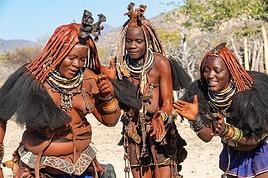
Jour 16 : journée sur place à Epupa. On a fait du rafting, qui s’apparente plutôt à une balade sur l’eau (qui est calme, il n’y a pas de rapides) mais les paysages sont superbes et il y a plein de crocodiles. Avec le lodge, on a fait aussi la visite d’un village himba. Bon, on a hésité et tous comptes fait, ça s’est bien passé. Au début, c’était assez artificiel car il s’agissait du village himba le plus proche des chutes, donc les habitants ont l’habitude de recevoir des visites, ils sont un peu blasés. Mais on a pris notre temps, on a essayé de communiquer par gestes avec les gens, on a joué avec les enfants, fait la ronde avec eux (plutôt que de se contenter de les mitrailler de photos) et peu à peu, l’atmosphère s’est réchauffée. Nous avons ensuite eu des échanges encore plus sympathiques avec d’autres himbas que nous avons rencontrés par nous-mêmes dans des villages non visités par les lodges et avec qui on est entrés en contact en offrant du sucre, du thé, de la farine, etc… Achetés au supermarché d’Opuwo. Les gens étaient surtout très contents car on avait un 4/4 avec un immense coffre recouvert et on a donc pu prendre en stop des himbas qui étaient ravis de profiter de notre moyen de transport. Beaucoup de sourires er de rires…
Jour 17 : en redescendant d’Epupa, étape d’une nuit à Hobatere Lodge, avant Kamanjab. L’étape est sympa mais il faut savoir que le lodge est situé à 20 km de piste de la route et que la game drive qu’il propose n’offre pas grand-chose à voir en matière d’animaux. Cela dit, les chambres sont agréables, le dîner est bon, le proprio présent et attentionné… Mais on s’est demandés si on n’aurait pas du partir très tôt le matin et tracer directement jusqu’à notre étape suivante, Okonjima, où nous n’avions qu’une nuit et où on aurait bien aimé en passer deux.
Jour 18 : route Hobatere lodge-Okonjima/Africat fondation
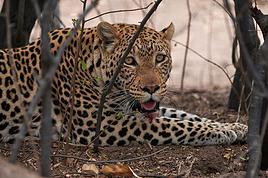
Okonjima, c’est une splendeur. Le plus beau lodge de notre séjour. On logeait au Bush Camp. Ca coûte une fortune, mais les chalets sont fantastiques, ouverts sur la nature, c’est somptueux. Sur place, on a fait une rando sur un de leurs sentiers balisés, on a fait le soir une chouette balade pour aller voir les porc épics et surtout, on a fait l’après-midi un inoubliable leopard tracking. Compte tenu du fait que les léopards sont difficiles à observer ailleurs, Okonjima est un must. Malheureusement, on n’a pas pu voir les guépards tôt le lendemain car on n’avait qu’une nuit sur place et on voulait arriver tôt dans Etosha mais je conseille à ceux qui le peuvent de passer absolument deux nuits plutôt qu’une dans cet endroit, afin de profiter de toutes les activités proposées.
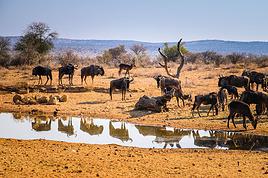
Jour 19/20/21 : route Okonjima-Etosha via les plaisantes villes d’Otjiwarongo et Outjo. Puis, Etosha. On a à la fois adoré parce qu’on est de grands fans d’animaux et qu’on y a donc vécu des moments inoubliables et en même temps, on a préféré le Kruger d’Afrique du sud (visité quelques années auparavant) ou Chobe, par exemple, car on aime bien conduire et rencontrer les animaux au hasard au fil des pistes plutôt que les attendre aux points d’eaux avec d’autres voitures. Or, à Etosha, on a eu l’impression de ne pas voir grand-chose sur les routes entre les points d’eau. Les modalités de visite sont différentes… C’est moins, « spontané ». Ceci étant dit, on a vu beaucoup d’animaux et parmi les moments les plus forts, des lions de près dans les points d’eau des environs d’Okaukuejo et un léopard au point d’eau Halali le soir. Ne pas rater les points d’eau éclairés le soir d’Okaukuejo et Halali, avec entre autres plusieurs rhinos.
Côté hébergement, on a passé une nuit à Okaukuejo (bush chalet) et une nuit à Halali (double room) avant de sortir d’Etosha pour la 3ème nuit. Les hébergements du NWR nous ont très agréablement surpris : c’est décoré simplement, mais propre, nickel, très confortable.
On a passé la 3ème nuit à Onguma Bush Camp, juste à la sortie d’Etosha : c’est le plus simple des différents lodges de la réserve privée d’Onguma mais c’est déjà très très bien.
Jour 22 : Route porte est d’Etosha/Rundu et étape au lodge Hakusembe.
Notre agence nous ayant indiqué Etosha-Rundu 6 H, puis Rundu-Divundu 3 H, on a fait étape à Rundu. Mais en fait, Etosha-Rundu ne prend que 4 H et Rundu-Divundu, 2 H. Donc, je conseille de zapper Rundu pour passer plutôt deux nuits dans les environ de Divundu, et s’y poser. D’autant que les attraits de la région de Divundu nous ont semblé similaires à ceux de Rundu , à Divundu il y a même les hippos en plus. Cela dit, Hakusembe est un lodge mignon, fleuri, très joli, nous avions le honeymoon chalet flottant sur l’eau (très romantique) et on a fait une chouette croisière au champagne sur la rivière (guide adorable et plein de crocos).
Jour 23 : route Rundu/Divundu, donc, et Divava Lodge.
Globalement, la bande de Caprivi, on a beaucoup aimé. Même si c’est pauvre. On voit des gens, des villages, du bétail, on peut s’arrêter acheter de l’artisanat, discuter avec les gens, les prendre en stop. C’est une Namibie différente des somptueux paysages de désert et c’est à voir aussi.
Le Divava Lodge est très beau, avec des chambres immenses et design, une belle piscine et un très agréable spa qui surplombe la rivière. Le lodge propose une chouette balade sur la rivière l’après midi ou le matin, au choix, avec beaucoup d’hippopotames et un petit arrêt aux mignonnes Popa Falls.
Nous avons aussi visité par nous-mêmes la petite réserve de Mahango qui nous a beaucoup plu, avec des baobabs, des buffles, des hippos, des rapaces, et les très belles antilopes Roan et antilopes des sables (noires) qu’on ne voit pas dans le reste de la Namibie.
Jour 24 : en quittant Divava Lodge, nous avons visité la réserve de Buffalo. Je ne sais pas si c’est son nom officiel mais il s’agit d’un parc pas du tout connu dont l’accès se trouve au lieu dit Buffalo, quelques km après Divundu. Il faut savoir que le plan, sommaire, distribué à l’entrée du parc, est très mal dessiné, et que les pistes y sont, à certains endroits, difficiles car vraiment très sablonneuses. On s’est ensablés plusieurs fois et on s’est fait quelques frayeurs. Mais l’endroit, absolument désert, est fantastique, avec là aussi des éléphants, buffles, rapaces, antilopes, hippos… Et quasi aucun touriste !
Nuit à Kongola au Mazambala Lodge qui nous a un peu déçus : l’accès est bucolique, par bateau, le restaurant, sur pilotis, agréable, le proprio très sympa, mais les bungalows sont sommaires et fatigués.
Jour 25 : route vers Kasane et visite de Chobe. Notre lodge, le Waterlily, conseillé par notre agence, ne nous a pas plu : c’est très moyen, pas joli, surfacturé. On a pris nos repas au Chobe Safari Lodge et au Chobe Marina, hôtels de grosse capacité mais très confortables.
Jour 26 : Chobe…
En revanche, Chobe, c’est inoubliable. Que ce soit la balade en bateau sur la rivière (à faire absolument l’après midi et sur un petit bateau, pas sur un gros, pour voir des dizaines d’oiseaux et les énormes troupeaux d’éléphants) ou les game drives dans le parc avec là aussi, éléphants, lions… Il faut savoir que les game drives organisés par les lodges de Kasane sont très bien (de toutes façons il y a tant d’animaux à Chobe qu’on ne peut pas être déçu) mais que c’est très business (jeeps les unes derrière les autres) et que, contrairement à ce que nous avait dit notre loueur (qui nous avait conseillé d’abandonner la voiture dès le premier jour à Kasane), Chobe se visite tout à fait par soi même : certes, le plan des pistes est mal dessiné, mais les pistes ne sont pas trop sablonneuses.
Jour 27 : route vers Vic Falls et Ilala Lodge pour deux nuits. L’Ilala Lodge est magnifique : architecture coloniale, personnel adorable, super restauration. Le peuple zimbabween a beaucoup de mérites, compte tenu des difficultés qui le frappent, et on a été contents d’avoir logé à Vic Falls. Mais quel que soit le côté où on loge, il faut absolument visiter les deux côtés des chutes : le côté zimbabwen, plus impressionnant, mais aussi le côté zambien, qui fournit des sensations différentes. On va facilement de l’un à l’autre à pied en franchissant le pont en une demi-heure environ. Tout ça coûte cher (il faut repayer un visa zambien, les entrées des chutes des deux côtés), mais ça vaut le coup. En revanche, on a repayé 30 dollars par personne pour voir le soir le « rayon de lune » (les soirs de pleine lune) sur les chutes et c’est un peu l’arnaque, on ne voit pas grand-chose, un pâle halo sur les chutes dans le noir, bof.
Jour 28 : Rafting inoubliable d’une demi journée (en juillet, les rapides sont trop dangereux pour être faits en entier sur la journée) et balade dans Vic Falls avec « high tea » au Vic Falls Hôtel.
Jour 29 : juste avant de reprendre l’avion Vic Falls-Johannesburg, on s’est offert une dernière activité nommée le Lion Encounter. Le principe, c’est que pour repeupler les réserves de lions, dont le nombre décroit, une fondation récupère les animaux blessés et élève aussi des petits, ils font de la reproduction. Les jeunes lions sont ensuite élevés dans des enclos, peu à peu éloignés des hommes, puis relâchés dans la nature. Mais au premier stade, lorsqu’ils sont encore jeunes, on les laisse approcher par les touristes qui peuvent marcher avec eux dans le bush, et même, craintivement, les caresser et se faire photographier avec eux. La contribution (généreuse) des touristes finance la fondation. Bon, j’espère que tout ça est vrai, et j’avoue que l’atmosphère était très, trop business. Mais cela dit, voir de tout près les lions, les approcher, marcher avec eux dans le bush, c’était incroyable.
Voilà… On rentre avec des souvenirs plein la tête… Et déjà, l’envie d’y retourner !
Elodie
Merci Elodie pour ce superbe récit et toutes les infos données....ça donne envie!!!
J'ai un voyage de ce style en prévision (Namibie + Chobe/Vic falls) mais il sera moins long (hélas!)
J'ai une petite question sur le waterlily lodge (que j'avais repéré car pas très cher pour Kasane): vous dites justement que vous trouvez le rapport qualité/prix pas terrible...qu'est ce qui vous a déplu?
Avez vous une autre adresse à conseiller? Avez vous fait les safaris/croisière avec le water lily lodge ou une autre agence?
Merci encore
Merci encore
Si tu diffères de moi, mon frère, loin de me léser, tu m'enrichis (Saint Exupéry)
Bonjour Muriel
Le Waterlily nous a été facturé 625 pulas par personne (soit environ 55 euros, ce qui fait autour de 110 euros la chambre) et c'est cher par rapport aux prestations. Les chambres sont très simples (deux lits twins éloignés, pas de déco à part quelques peintures murales) mais surtout, pas très bien tenues (insectes, ménage bof, murs et plafonds noirs de moisissures, petites tâches sur la literie ne partant pas au lavage mais literie pas remplacée pour autant...). Bref, c'est un hôtel très simple, d'entrée de gamme, style un peu "backpackers", qui, à mon avis, ne vaut pas son prix. La salle de resto est un peu lugubre et l'accueil/service, impersonnel et négligent... Par exemple, nous avions réservé avec le lodge une game drive qui revenait à 13 H puis une croisière qui partait à 15 H mais personne n'avait pris la peine de nous préciser que le lunch n'était plus servi après 13 H, donc on a du courir au supermarché acheter quelque chose à emporter, ils avaient aussi oublié de prévoir le transfert vers Vic Falls pourtant réservé et reconfirmé, etc... Pour le même prix ou à peu près (autour de 100/120 euros la chambre), vous pouvez avoir une chambre au Chobe Safari Lodge ou au Chobe Marina Lodge, où nous sommes allés prendre nos repas du soir sous forme de buffets plantureux dans des jardins colorés (car, encore une fois, la petite salle du Waterlily était déprimante....). Le Safari et le Marina sont des hôtels d'assez grosse capacité qui font un peu style "clubs" (et non de lodges intimes) mais ils sont très confortables (nous n'avons pas vu les chambres mais les parties communes sont très plaisantes, architecture en bois surplombant la rivière, jolies piscines, service niveau 4 étoiles...). Franchement, la différence de prix avec le Waterlily n'est pas énorme mais la différence de prestations, si. Sinon, le Cresta Mowana a l'air très bien aussi (mais plus cher, je crois). Enfin, dans le genre plus intime, le Kubu Lodge (petits chalets de charme) et le Garden Lodge (style mi boutique hôtel/mi chambre d'hôtes) ont l'air vraiment supers (voir leurs sites internet) mais ils étaient complets. Côté activités, en revanche, c'était bien : on a fait 2 game drives dans Chobe + la croisière d'après midi sur la rivière et on avait réservé ces activités via le Waterlily car ils ont une agence de voyages, Janala Tours, qui elle même travaille avec une autre agence, Bushtracks, et aussi bien pour la game drive que la croisière, on est partis du Waterlily mais on est allés chercher d'autres gens à Safari, au Marina, au Mowana etc... Donc de toutes façons tous les hôtels proposent les mêmes activités pour un prix très correct. Il faut juste s'assurer de faire la croisière l'après midi (sinon on ne voit pas les éléphants) et sur un petit bateau, pas sur un gros. Enfin, sache qu'avec un 4/4 (et en dégonflant les pneus), tu peux aussi visiter le parc de Chobe (partie terrestre, donc) par toi même : le plan des pistes distribué à l'entrée est sommaire mais il y a beaucoup de game drives des lodges dans le parc, aucun risque d'être perdu, tu peux les suivre plus ou moins... Et les pistes ne sont pas trop sablonneuses, c'est très praticable en 4/4. Chobe, c'est fantastique, question animaux, aussi bien la partie terrestre du parc que la rivière... N'hésite pas si tu as d'autres questions ! Elodie
Merci de prendre le temps de faire des réponses aussi complètes, c'est très sympa d'avoir toutes ces précisions!
J'avais aussi repéré le chobe safari lodge (prix encore assez raisonnables, enfin, pour mon budget), je vais aller visiter les sites des autres hôtels que tu mentionnes et je crois qu'on choisira plutôt un de ceux-là.
Sinon, pour le game drive, y a-t-il un moment à privilégier (matin, après midi ou peu importe?) (j'oublie le 4X4 car je pars avec une amie et nous n'avons ni l'une ni l'autre la moindre expérience de la conduite sur piste .....). En tout cas, ton voyage avait l'air extraordinaire!
Si tu diffères de moi, mon frère, loin de me léser, tu m'enrichis (Saint Exupéry)
Il n'y a pas forcément de règles concernant la présence des animaux...
Si ce n'est que les lions, c'est plutôt tôt le matin ou en fin de journée, et les gros troupeaux d'éléphants, plutôt dans l'après midi (ils convergent vers la rivière).
Nous on a fait Chobe une après midi seuls puis le lendemain, deux game drives à la suite, une de 6 à 9 h du mat et une de 10 à 13 H. A chaque fois, on a vu des trucs différents, dans l'après midi, de très gros troupeaux d'éléphants et de girafes, et le matin très tôt, des lionnes et leurs petits.
Elodie
Log in first, then come back to this page.
You might also like
Du sable namibien aux eaux tumultueuses de VictoriaFR
Deux semaines en Namibie, boucle habituelleFR
28 jours en NamibieFR
Namibie, quand tu nous tiens!FR
Le camping-car en Namibie, c’est bienFR
Carnet de Namibie ou un voyage au pays d'HiluxFR
Péripéties d'une famille en terres namibiennesFR
Botswana-Namibie octobre 2019... le retourFR
More discussions
Hi, I'm looking for information on the road conditions in Moremi. We're leaving in 15 days, and from what I've heard, the roads are pretty tough to drive on. Any advice?
Thanks
🏔️ KILIMANDJARO – 4 DERNIÈRES PLACES ! 🇹🇿
Vous rêvez de vous tenir sur le toit de l’Afrique à 5 895 m ?
Je recherche 4 personnes pour compléter notre groupe pour l’ascension du Kilimandjaro en Tanzanie.
📅 Du 17 au 28 septembre 2026
👥 Petit groupe
🥾 Ascension accessible aux bons randonneurs
🏔️ Objectif : Uhuru Peak – 5 895 m
🇹🇿 Équipe locale spécialisée Kilimandjaro
🎒 Porteurs pendant l’ascension
🍽️ Repas et organisation du trek pris en charge
👨🏫 Voyage accompagné par un Accompagnateur en Montagne français diplômé d’État
Septembre est une excellente période pour tenter l’ascension du Kilimandjaro.
🔥 Il reste seulement 4 places. Le départ est confirmé.
Pas besoin d’être alpiniste : il faut surtout avoir une bonne condition physique, aimer marcher et avoir envie de vivre une aventure exceptionnelle.
👉 Si vous êtes seul(e), aucun problème : vous rejoignez directement notre petit groupe.
📩 Envoyez-moi un message pour recevoir le programme complet, le tarif et toutes les informations.
N’hésitez pas à partager cette publication à vos amis randonneurs. 🙏
Mafate Randos
Hello everyone!
It's been a year since I've been longing for South Africa. Our first trip in August 2025 amazed us, and—rarely—it was a unanimous hit with our little family! We were touched to the core, and from the moment we got home, we couldn’t stop talking about going back. 😄
I’d like to take this opportunity to thank everyone who gave me advice on the itinerary for that first trip (Johannesburg loop: Blyde, Kruger, Eswatini, St. Lucia, Durban, Drakensberg)! Thanks to you, our trip went like a dream!
Since then, I haven’t stopped reading articles and discussions on VoyageForum to keep my head in South Africa a little longer!
So, we finally caved and just booked our tickets for January 2027 (from the 3rd to the 26th), with a plan to do a road trip from Cape Town to Johannesburg in about 3 weeks.
I’ve got a rough itinerary that seems great based on what I’ve read on various forums, but there are still some uncertain points, and that’s where I could use your advice.
3/01: Arrival in Johannesburg at 11:45 PM 4/01: Flight to Cape Town, pick up rental car. Afternoon sightseeing 5,6,7/01: Cape Town to visit the big classics in the area (any tips for finding accommodation: which neighborhood, a specific place?) 8/01: Overnight stop before Oudtshoorn—but where??? (Is it essential, or is the CT-Oudtshoorn drive manageable? If so, I’d gain a day in Oudtshoorn. Google Maps shows over 5 hours of driving...) 9,10/01: Oudtshoorn (or would 3 nights be better to really enjoy the area?) 11,12/01: Knysna, Plettenberg Bay (to have time for hiking—if you’ve got hiking tips, I’m all ears!) 13,14/01: Tsitsikamma (still to have time for hiking—who knows the must-do hikes in the area? But maybe 4 nights in the Knysna-Tsitsikamma area is too much—I’m not sure) 16,17/01: Addo Elephant (I’m torn between 3 nights at Addo or 3 nights at Mountain Zebra. Based on travel journals, especially Michel’s on MZ, I’ve scheduled 3 nights at MZ 😄...) 18,19,20/01: Mountain Zebra NP 21/01: Camdeboo NP (because it looks so beautiful!) 22/01: Overnight stop (where?) before wrapping up the trip with either 2 or 3 nights at Golden Gate NP or the Lesotho option, which appeals to me, but I don’t know if it’s doable in 3 days to be back in Johannesburg by the afternoon of the 26th.
That’s my trip idea for now... I’m eagerly waiting for your advice, ideas, and comments... Can’t wait to be back there again!
3/01: Arrival in Johannesburg at 11:45 PM 4/01: Flight to Cape Town, pick up rental car. Afternoon sightseeing 5,6,7/01: Cape Town to visit the big classics in the area (any tips for finding accommodation: which neighborhood, a specific place?) 8/01: Overnight stop before Oudtshoorn—but where??? (Is it essential, or is the CT-Oudtshoorn drive manageable? If so, I’d gain a day in Oudtshoorn. Google Maps shows over 5 hours of driving...) 9,10/01: Oudtshoorn (or would 3 nights be better to really enjoy the area?) 11,12/01: Knysna, Plettenberg Bay (to have time for hiking—if you’ve got hiking tips, I’m all ears!) 13,14/01: Tsitsikamma (still to have time for hiking—who knows the must-do hikes in the area? But maybe 4 nights in the Knysna-Tsitsikamma area is too much—I’m not sure) 16,17/01: Addo Elephant (I’m torn between 3 nights at Addo or 3 nights at Mountain Zebra. Based on travel journals, especially Michel’s on MZ, I’ve scheduled 3 nights at MZ 😄...) 18,19,20/01: Mountain Zebra NP 21/01: Camdeboo NP (because it looks so beautiful!) 22/01: Overnight stop (where?) before wrapping up the trip with either 2 or 3 nights at Golden Gate NP or the Lesotho option, which appeals to me, but I don’t know if it’s doable in 3 days to be back in Johannesburg by the afternoon of the 26th.
That’s my trip idea for now... I’m eagerly waiting for your advice, ideas, and comments... Can’t wait to be back there again!
Just returned from a three-week family trip to Kenya (with three kids aged 10, 12, and 15), and I wanted to share my experience. Forums were super helpful in planning this trip, especially if you want to get a bit off the beaten path.
First off, Kenya is an amazing destination with incredibly friendly and welcoming locals. It was easy to travel around because you can always find someone to give you directions or help you out.
For practical tips—though you’ve probably read this elsewhere—get a Safaricom SIM card when you arrive at the airport so you can pay via M-Pesa (you can top it up with a credit card using the Wise app) and chat with people on WhatsApp. It’ll make your life *so* much easier (booking trains, buses, park entries, etc.) and save you from carrying too much cash or hunting for ATMs.
Also, we went during the first three weeks of July, which wasn’t peak tourist season.
One thing to note: even if you’re using public transport and budget accommodations, Kenya can still be pricey because tourist attractions add up fast—often more expensive than in France. But honestly, it’s usually worth it!
We started our trip with a 5-day homestay. We were welcomed by a really lovely family in Loitokitok with a view of Kilimanjaro right from their garden entrance (just a heads-up: in July, it’s often shrouded in mist!). To find them, search for Greenfield Homestay in Loitokitok. It was a fantastic experience, especially with kids! On top of transfers, they organized several outings with locals: a hike to the Tanzanian border, a motorcycle ride on the foothills of Kilimanjaro, and a day safari in Amboseli. You can book with them eyes closed! For the safari, Anthony (who’s English-speaking) took us around—he’s from the area and knows the park like the back of his hand. Highly recommend him!
Anthony then drove us to Isiolo, a town in the north that’s just starting to open up to tourism. We wanted to see the Monday livestock market, where different ethnic groups gather to buy and sell goats, sheep, and cows (according to Lonely Planet). We were a bit disappointed and wouldn’t recommend it. We also visited Ngare Ndare Forest, which has a stunning waterfall, an interesting walk with an armed ranger (elephants are common), and a suspension bridge for admiring the canopy. Just make sure to let them know you’re coming at least three days in advance to guarantee a ranger will be available. We also did a second safari day in Samburu—it’s a great complement to Amboseli and totally worth it!
Next, we headed to Naivasha (still with Anthony). We found a place on Airbnb (Jasmine House) at Fischerman’s Camp, a campsite we really loved! You’ll spot hippos, monkeys, and beautiful birds there. We organized several activities: a boat ride on the lake to see birds, zebras, and giraffes; a bike safari in Hell’s Gate Park (the campsite is right by the entrance and rents bikes); and a hike to Crater Lake (departing by boat from the campsite), where you walk among zebras, giraffes, and different gazelles. Naivasha is way more touristy than Loitokitok or Isiolo, but there’s no shortage of things to do.
Finally, we spent our last week in Watamu on the coast. To get there, we took an overnight ENA Coach bus from Naivasha to Mombasa, booked via https://www.travler.africa/. It was comfortable and fast, but you’ll need to call the driver to arrange a pickup spot—the restaurant staff at the campsite helped us out with that! Then we took an Uber to Watamu since we had a lot of luggage (we skipped the matatu).
Watamu is nicknamed "Little Italy" because of all the Italian tourists. When we were there (third week of July), it wasn’t peak season yet, so the beaches weren’t cleaned. But we loved the laid-back vibe and how easy it was to get around. We *highly* recommend the marine turtle rescue center—it’s fascinating (especially with kids) and supports a great cause! We were a bit disappointed by the marine park, though—maybe because of the season? There weren’t many fish, and jellyfish kinda ruined the snorkeling. The mangrove tour is also a must-do.
For the trip back to Nairobi, we took the express train from Mombasa. We booked our tickets when we first arrived in Kenya (since payment is only via M-Pesa). The train is reliable and comfortable, and we saw lots of elephants along the way. Just a heads-up: there are *a lot* of security checks, and we almost weren’t allowed to board with our Opinel knife…
If you have any questions, feel free to ask!
All in all, we had an amazing trip—so much variety, great encounters, and the magic of safaris!
First off, Kenya is an amazing destination with incredibly friendly and welcoming locals. It was easy to travel around because you can always find someone to give you directions or help you out.
For practical tips—though you’ve probably read this elsewhere—get a Safaricom SIM card when you arrive at the airport so you can pay via M-Pesa (you can top it up with a credit card using the Wise app) and chat with people on WhatsApp. It’ll make your life *so* much easier (booking trains, buses, park entries, etc.) and save you from carrying too much cash or hunting for ATMs.
Also, we went during the first three weeks of July, which wasn’t peak tourist season.
One thing to note: even if you’re using public transport and budget accommodations, Kenya can still be pricey because tourist attractions add up fast—often more expensive than in France. But honestly, it’s usually worth it!
We started our trip with a 5-day homestay. We were welcomed by a really lovely family in Loitokitok with a view of Kilimanjaro right from their garden entrance (just a heads-up: in July, it’s often shrouded in mist!). To find them, search for Greenfield Homestay in Loitokitok. It was a fantastic experience, especially with kids! On top of transfers, they organized several outings with locals: a hike to the Tanzanian border, a motorcycle ride on the foothills of Kilimanjaro, and a day safari in Amboseli. You can book with them eyes closed! For the safari, Anthony (who’s English-speaking) took us around—he’s from the area and knows the park like the back of his hand. Highly recommend him!
Anthony then drove us to Isiolo, a town in the north that’s just starting to open up to tourism. We wanted to see the Monday livestock market, where different ethnic groups gather to buy and sell goats, sheep, and cows (according to Lonely Planet). We were a bit disappointed and wouldn’t recommend it. We also visited Ngare Ndare Forest, which has a stunning waterfall, an interesting walk with an armed ranger (elephants are common), and a suspension bridge for admiring the canopy. Just make sure to let them know you’re coming at least three days in advance to guarantee a ranger will be available. We also did a second safari day in Samburu—it’s a great complement to Amboseli and totally worth it!
Next, we headed to Naivasha (still with Anthony). We found a place on Airbnb (Jasmine House) at Fischerman’s Camp, a campsite we really loved! You’ll spot hippos, monkeys, and beautiful birds there. We organized several activities: a boat ride on the lake to see birds, zebras, and giraffes; a bike safari in Hell’s Gate Park (the campsite is right by the entrance and rents bikes); and a hike to Crater Lake (departing by boat from the campsite), where you walk among zebras, giraffes, and different gazelles. Naivasha is way more touristy than Loitokitok or Isiolo, but there’s no shortage of things to do.
Finally, we spent our last week in Watamu on the coast. To get there, we took an overnight ENA Coach bus from Naivasha to Mombasa, booked via https://www.travler.africa/. It was comfortable and fast, but you’ll need to call the driver to arrange a pickup spot—the restaurant staff at the campsite helped us out with that! Then we took an Uber to Watamu since we had a lot of luggage (we skipped the matatu).
Watamu is nicknamed "Little Italy" because of all the Italian tourists. When we were there (third week of July), it wasn’t peak season yet, so the beaches weren’t cleaned. But we loved the laid-back vibe and how easy it was to get around. We *highly* recommend the marine turtle rescue center—it’s fascinating (especially with kids) and supports a great cause! We were a bit disappointed by the marine park, though—maybe because of the season? There weren’t many fish, and jellyfish kinda ruined the snorkeling. The mangrove tour is also a must-do.
For the trip back to Nairobi, we took the express train from Mombasa. We booked our tickets when we first arrived in Kenya (since payment is only via M-Pesa). The train is reliable and comfortable, and we saw lots of elephants along the way. Just a heads-up: there are *a lot* of security checks, and we almost weren’t allowed to board with our Opinel knife…
If you have any questions, feel free to ask!
All in all, we had an amazing trip—so much variety, great encounters, and the magic of safaris!
Hi everyone!
My trip to South Africa is getting closer (still 2 months to go 😏), and I’m diving back into my itinerary: from Saturday to the following Sunday around Cape Town, then from Sunday to the following Saturday in Kruger.
For Cape Town, the plan was to avoid changing accommodation every day (we’ll do enough of that in the second part) but still see different landscapes. I know, I’m missing out on a lot, but you’ve got to make choices, and after all this time, I know what I like—and especially what I don’t (or like less) 😉
Here’s the breakdown:
Arrival Saturday at 11 AM: heading to Hermanus (2 nights). The idea is to stroll along the cliff path in the afternoon, and possibly drive to the Klein River Lagoon. Sunday: Stony Point, then depending on time and weather, a hike in Kogelberg Nature Reserve or Fernkloof Nature Reserve (which seems less scenic but has shorter walks). Monday: drive to Franschhoek (1 night). If everything lines up, a hike in Jonkershoek NR and a visit to a wine estate. Tuesday: drive to Mountceder Lodge in the Cederberg (2 nights). I’m thinking of visiting the Stadsaal Caves and the elephant paintings, and maybe one of the hikes listed on the lodge’s site or Maltese Cross. Thursday: heading to Hout Bay for 3 nights. In no particular order: a classic day trip around the peninsula, half a day at Kirstenbosch Gardens, and half a day at Lion’s Head. Sunday: flight to Johannesburg.
My questions are mostly about (short) hikes: Has anyone here done hikes in Kogelberg, Fernkloof, or Jonkershoek? At Mountceder Lodge (Michel, if you’re reading this… 😉), has anyone tried the hikes (guided or not) offered by the lodge? There’s still half a day to fill when we’re in Hout Bay—any ideas (not necessarily hikes)?
Lastly, regarding safety: the French foreign ministry (always alarmist, but still) recommends hiking in groups. Is it really risky in broad daylight? (I’m not sure a group of two women counts as a "group"…)
Thanks in advance for your answers, ideas, and comments!
My trip to South Africa is getting closer (still 2 months to go 😏), and I’m diving back into my itinerary: from Saturday to the following Sunday around Cape Town, then from Sunday to the following Saturday in Kruger.
For Cape Town, the plan was to avoid changing accommodation every day (we’ll do enough of that in the second part) but still see different landscapes. I know, I’m missing out on a lot, but you’ve got to make choices, and after all this time, I know what I like—and especially what I don’t (or like less) 😉
Here’s the breakdown:
Arrival Saturday at 11 AM: heading to Hermanus (2 nights). The idea is to stroll along the cliff path in the afternoon, and possibly drive to the Klein River Lagoon. Sunday: Stony Point, then depending on time and weather, a hike in Kogelberg Nature Reserve or Fernkloof Nature Reserve (which seems less scenic but has shorter walks). Monday: drive to Franschhoek (1 night). If everything lines up, a hike in Jonkershoek NR and a visit to a wine estate. Tuesday: drive to Mountceder Lodge in the Cederberg (2 nights). I’m thinking of visiting the Stadsaal Caves and the elephant paintings, and maybe one of the hikes listed on the lodge’s site or Maltese Cross. Thursday: heading to Hout Bay for 3 nights. In no particular order: a classic day trip around the peninsula, half a day at Kirstenbosch Gardens, and half a day at Lion’s Head. Sunday: flight to Johannesburg.
My questions are mostly about (short) hikes: Has anyone here done hikes in Kogelberg, Fernkloof, or Jonkershoek? At Mountceder Lodge (Michel, if you’re reading this… 😉), has anyone tried the hikes (guided or not) offered by the lodge? There’s still half a day to fill when we’re in Hout Bay—any ideas (not necessarily hikes)?
Lastly, regarding safety: the French foreign ministry (always alarmist, but still) recommends hiking in groups. Is it really risky in broad daylight? (I’m not sure a group of two women counts as a "group"…)
Thanks in advance for your answers, ideas, and comments!
hi
Question: we’re doing a 3-week trip in Namibia, including 5 days for Victoria Falls. I’ve booked one night in Brandberg, and then I have some questions. I was thinking of spending 2 nights in Palmwag, then heading to Etosha for one night in Okaukuejo and then 2 nights in Halali. Alternatively, from Brandberg, I could book a night near Galton Gate and then enter Etosha. I’m not really sure about the distances, especially with a 4x4. Same for the return trip: Halali to Windhoek seems long. Maybe it’d be smart to break it up on the way back? (We have 2 days to get back if needed.) If so, where?
Thanks for your tips and feedback!
Rachel
Question: we’re doing a 3-week trip in Namibia, including 5 days for Victoria Falls. I’ve booked one night in Brandberg, and then I have some questions. I was thinking of spending 2 nights in Palmwag, then heading to Etosha for one night in Okaukuejo and then 2 nights in Halali. Alternatively, from Brandberg, I could book a night near Galton Gate and then enter Etosha. I’m not really sure about the distances, especially with a 4x4. Same for the return trip: Halali to Windhoek seems long. Maybe it’d be smart to break it up on the way back? (We have 2 days to get back if needed.) If so, where?
Thanks for your tips and feedback!
Rachel
Jambo! I organized my trip through this kind of group, so I thought I’d share my experience here. We traveled as a group of four, including two kids aged 9 and 11. After requesting around twenty quotes, I decided to book the safari portion with MAKING MEMORIES IN AFRICA. Ally responded quickly and listened to all my requests—unlike other agencies—such as having a French-speaking guide, the order of park visits (Tarangire, Manyara, Serengeti, then Ngorongoro), and a mix of budget hotels and camping to keep costs down. There were still four agencies in the running, and price was the deciding factor. Even though they were the cheapest, I felt better taken care of than with others. For example, all meals were prepared by a Maasai chef, Louis, who accompanied us throughout the trip, while some others ate meals out of cardboard boxes. Samuel, our guide, explained so many things and answered all our questions. José drove us safely the whole way. Everything was done with great cheer!
At the end of the stay, Ally came to meet us and gave us t-shirts with the agency’s logo—we loved that they took the time to hear our feedback in person. In short, I highly recommend them +++, especially since it’s a local agency that also supports a charity for women and children.
For Zanzibar, I organized everything myself. I hesitated for a long time but eventually booked all four nights at the same place. We don’t like crowds, so I initially considered Jambiani but ended up choosing EVERGREEN BUNGALOWS in Bwejuu. We took their first airport-to-hotel transfer since we arrived at night, and it felt safer. Great value for money, in our opinion. Just be aware that it’s quite isolated—perfect for relaxing and going on excursions. There were very few beach vendors, unlike what I’d read about Zanzibar. We lived with our feet in the sand from morning to night, with a small basin of water outside our room to rinse off. Such a lovely spot!
I had asked for some excursion prices before leaving but ended up booking on-site. Not at our hotel, but at a nearby restaurant that was cheaper. After some thought, since we were based in Bwejuu, I wanted to do Blue Lagoon and Pungume (both departing from the south of Zanzibar).
Blue Lagoon: About 3 hours total, with snorkeling on a small reef full of fish (coral wasn’t great) and a stop at a spot with tons of starfish, plus local snacks, fruit, and drinks.
Pungume: An amazing day with a 50% chance of seeing dolphins (we missed them), a visit to the mangroves, then snorkeling at a spot with some nice coral and, of course, fish. We ended with a fantastic grill (tuna, shrimp, squid, lobster, and fries) on a sandbank in the shade.
Finally, before heading to Stone Town, we visited Paje Cave, which is much less known than Maalum. It’s smaller, but we saw bats, went for a swim, and fed the chickens and rabbits (great for the kids). To finish, we explored Stone Town on our own and had dinner at Forodhani Market.
For flights, we flew with Turkish Airlines from Barcelona to Kilimanjaro and back from Zanzibar—no issues there. However, I don’t recommend the Kilimanjaro-Zanzibar leg with Precision Air. Our luggage didn’t arrive, and according to the hotel, this happens often. We only got it back a day and a half later.
At the end of the stay, Ally came to meet us and gave us t-shirts with the agency’s logo—we loved that they took the time to hear our feedback in person. In short, I highly recommend them +++, especially since it’s a local agency that also supports a charity for women and children.
For Zanzibar, I organized everything myself. I hesitated for a long time but eventually booked all four nights at the same place. We don’t like crowds, so I initially considered Jambiani but ended up choosing EVERGREEN BUNGALOWS in Bwejuu. We took their first airport-to-hotel transfer since we arrived at night, and it felt safer. Great value for money, in our opinion. Just be aware that it’s quite isolated—perfect for relaxing and going on excursions. There were very few beach vendors, unlike what I’d read about Zanzibar. We lived with our feet in the sand from morning to night, with a small basin of water outside our room to rinse off. Such a lovely spot!
I had asked for some excursion prices before leaving but ended up booking on-site. Not at our hotel, but at a nearby restaurant that was cheaper. After some thought, since we were based in Bwejuu, I wanted to do Blue Lagoon and Pungume (both departing from the south of Zanzibar).
Blue Lagoon: About 3 hours total, with snorkeling on a small reef full of fish (coral wasn’t great) and a stop at a spot with tons of starfish, plus local snacks, fruit, and drinks.
Pungume: An amazing day with a 50% chance of seeing dolphins (we missed them), a visit to the mangroves, then snorkeling at a spot with some nice coral and, of course, fish. We ended with a fantastic grill (tuna, shrimp, squid, lobster, and fries) on a sandbank in the shade.
Finally, before heading to Stone Town, we visited Paje Cave, which is much less known than Maalum. It’s smaller, but we saw bats, went for a swim, and fed the chickens and rabbits (great for the kids). To finish, we explored Stone Town on our own and had dinner at Forodhani Market.
For flights, we flew with Turkish Airlines from Barcelona to Kilimanjaro and back from Zanzibar—no issues there. However, I don’t recommend the Kilimanjaro-Zanzibar leg with Precision Air. Our luggage didn’t arrive, and according to the hotel, this happens often. We only got it back a day and a half later.
Hi there,
I’m planning a potential trip to Namibia for a classic circuit in April 2027.
I’m surprised by how expensive the accommodations inside the parks are—really steep! Is it possible to stay outside the parks but still close enough to enjoy the game drives?
Do you have any recommendations for more reasonably priced lodging? I’m okay with spending 200 to 250 € per night.
No camping—the friend I’m traveling with absolutely refuses 😉, but maybe upgraded tents would work.
Thanks in advance, and have a great evening! !
I’m planning a potential trip to Namibia for a classic circuit in April 2027.
I’m surprised by how expensive the accommodations inside the parks are—really steep! Is it possible to stay outside the parks but still close enough to enjoy the game drives?
Do you have any recommendations for more reasonably priced lodging? I’m okay with spending 200 to 250 € per night.
No camping—the friend I’m traveling with absolutely refuses 😉, but maybe upgraded tents would work.
Thanks in advance, and have a great evening! !
Hi there,
Hope the pros are on the lookout!
March or May 2027. Around 15 days in the Western Cape, then 15 days in the southern KNP.
Arrival either in PE or George. The pros know I’m somewhat familiar with the area... that I don’t camp... that my accommodations can be simple and remote, self-catering but with basic comforts... that I’m looking for spots that are a bit off the beaten path... in a relaxed mode... From George: Late arrival... need some rest... Herolds Bay from George to the N1. Tsitsikamma is catching my eye (Storms River)... with or without a stop in Knysna. Question: What’s the current condition of the pass from Knysna to Uniondale? R339. And while I’m at it, the condition of the R340. Tsitsikamma, Knysna, and my questions still apply if arriving in PE.
Is the Swartberg still closed? Any recommendations for accommodation in Prince Albert? If I cross the escarpment, I’ll continue via Anysberg NR, Touwsrivier... any thoughts? From there... Tankwa Karoo or Mount Cedar (or both). Then heading back down to the coast... the highlands of Hermanus or Kogelberg NR (any opinions on the latter?).
Or,
A more classic route along the coast...
If I arrive (fairly late) in PE... any ideas for accommodation in that little area? Given that Nyathi Camp is winking at me... (For context... a while back, I stayed at Riverbend (same Addo sector, private concession)... and I visited the ruins of that abandoned lodge at the time, which has clearly been renovated since... located in a very quiet part of Addo...). Any feedback from the pros? Well, that’s about it... I’m open to any other tips or advice!
March or May 2027. Around 15 days in the Western Cape, then 15 days in the southern KNP.
Arrival either in PE or George. The pros know I’m somewhat familiar with the area... that I don’t camp... that my accommodations can be simple and remote, self-catering but with basic comforts... that I’m looking for spots that are a bit off the beaten path... in a relaxed mode... From George: Late arrival... need some rest... Herolds Bay from George to the N1. Tsitsikamma is catching my eye (Storms River)... with or without a stop in Knysna. Question: What’s the current condition of the pass from Knysna to Uniondale? R339. And while I’m at it, the condition of the R340. Tsitsikamma, Knysna, and my questions still apply if arriving in PE.
Is the Swartberg still closed? Any recommendations for accommodation in Prince Albert? If I cross the escarpment, I’ll continue via Anysberg NR, Touwsrivier... any thoughts? From there... Tankwa Karoo or Mount Cedar (or both). Then heading back down to the coast... the highlands of Hermanus or Kogelberg NR (any opinions on the latter?).
Or,
A more classic route along the coast...
If I arrive (fairly late) in PE... any ideas for accommodation in that little area? Given that Nyathi Camp is winking at me... (For context... a while back, I stayed at Riverbend (same Addo sector, private concession)... and I visited the ruins of that abandoned lodge at the time, which has clearly been renovated since... located in a very quiet part of Addo...). Any feedback from the pros? Well, that’s about it... I’m open to any other tips or advice!
Hi there,
I’m reaching out with a question about which park to choose for a 3-day safari in Kenya.
After 20 days in Uganda, I’m meeting up with my dad for a 3-day safari (that works for him). We’ll be meeting in Nairobi and have a full day to travel to a park (preferably the farthest from Nairobi to avoid crowds?) and spend 4 nights there before heading back to the capital for our flight to France.
I’d love to hear your recommendations since I’ve read so many great tips on this forum.
Thanks,
David
I’m reaching out with a question about which park to choose for a 3-day safari in Kenya.
After 20 days in Uganda, I’m meeting up with my dad for a 3-day safari (that works for him). We’ll be meeting in Nairobi and have a full day to travel to a park (preferably the farthest from Nairobi to avoid crowds?) and spend 4 nights there before heading back to the capital for our flight to France.
I’d love to hear your recommendations since I’ve read so many great tips on this forum.
Thanks,
David
Hi,
At the end of July, we’re heading to Namibia with a group of five for a three-week road trip and visit to the national parks. We’ve read conflicting info about buying entry tickets—either online (where?) or at the gate when we arrive?
Thanks in advance for your tips!!
Have a great day
At the end of July, we’re heading to Namibia with a group of five for a three-week road trip and visit to the national parks. We’ve read conflicting info about buying entry tickets—either online (where?) or at the gate when we arrive?
Thanks in advance for your tips!!
Have a great day
Hi there,
I’d love to hear your thoughts on the agencies you used to plan your trip to Uganda.
There’s the whole issue of gorilla permits, which need to be booked in advance and involve a significant financial commitment. That’s where I’m at with my trip planning. Between checking lutb.go.ug/ and reading online reviews, it’s hard to move forward with confidence.
I contacted the French Embassy, but they don’t provide any recommendations. I almost booked with an agency that had a really bad review from February specifically about the permit process.
How did you go about choosing your agency? Given the large sum involved, I’m this close to booking through a travel agency in France for this part.
From what I understand, no matter which agency books the permit, you’re ultimately guided by professionals trained for gorilla trekking based on the permit itself? I’m assuming that’s how it works.
Thanks for your feedback, and I’m really happy to see the forum’s new energy—it’s been super helpful to me in the past.
I’d love to hear your thoughts on the agencies you used to plan your trip to Uganda.
There’s the whole issue of gorilla permits, which need to be booked in advance and involve a significant financial commitment. That’s where I’m at with my trip planning. Between checking lutb.go.ug/ and reading online reviews, it’s hard to move forward with confidence.
I contacted the French Embassy, but they don’t provide any recommendations. I almost booked with an agency that had a really bad review from February specifically about the permit process.
How did you go about choosing your agency? Given the large sum involved, I’m this close to booking through a travel agency in France for this part.
From what I understand, no matter which agency books the permit, you’re ultimately guided by professionals trained for gorilla trekking based on the permit itself? I’m assuming that’s how it works.
Thanks for your feedback, and I’m really happy to see the forum’s new energy—it’s been super helpful to me in the past.
Hi everyone!
We’re heading to Uganda next summer for three weeks with our two kids, who’ll be 7 and 9 years old. We’ve been to Southern Africa before but not East Africa, and after a trip to South Africa two years ago, the kids wanted to return to Africa, while we wanted to explore a new region while staying independent... Uganda’s been catching our eye for a while, and with Rwandair offering relatively attractive prices, we’re going for it!
We’ll be traveling in a 4x4 (self-drive) with roof tents. I don’t have any 4x4 driving experience, so it’ll be a first for me, but we’ll manage 😉 No great apes for us—kids need to be 15, and we don’t want to do that experience without them.
I don’t usually ask the forum much for trip planning, but this time, I’d love your thoughts and advice!
First question: Karamoja or not? At first glance, if we want to add it to a "classic" loop in the southwest, it doesn’t seem realistic—too packed, too much driving. We could consider doing the full loop via Kidepo and then heading down to Murchison, but I’m worried the trip might feel less varied and less kid-friendly. That said, the region looks stunning, and I’m struggling to accept not going at all... What do you think?
If we skip Karamoja, we’d do a loop: Murchison/Fort Portal/QENP/Bunyonyi/Mburo, which seems pretty comprehensive and would let us take our time, which is nice. A few random questions: - How much time should we plan for the Fort Portal area? I was thinking at least 3 days to visit Bigodi Swamp, walk around the craters, and maybe do a community walk (any thoughts on that?). - Between Murchison Falls and the Fort Portal area, is it worth breaking up the drive? I spotted Lake Albert Safari Lodge on the shores of Lake Albert—it’s not too expensive and looks nice. - I’d love to do some easy walks/hikes at the foot of the Rwenzori Mountains, ideally without a guide, but it doesn’t seem straightforward. Do you know if it’s possible to do nice walks independently? I’ve read about hikes in the hills near Kilembe but nothing very specific. Maybe staying somewhere at the foot of the mountains, like Ruboni Community Camp, would allow that. - Lake Mutanda looks really cool, and so does Lake Bunyonyi... Ideally, I’d like to see both, but won’t that feel repetitive? Is Lake Mutanda worth the detour?
Last practical question, since we don’t have experience with this: for the car with kids, would you recommend two tents (a bit more space) or a four-person tent?
I’ll stop here—already a lot of questions...
Thanks in advance for your feedback, and looking forward to exchanging ideas! Gabriel
We’re heading to Uganda next summer for three weeks with our two kids, who’ll be 7 and 9 years old. We’ve been to Southern Africa before but not East Africa, and after a trip to South Africa two years ago, the kids wanted to return to Africa, while we wanted to explore a new region while staying independent... Uganda’s been catching our eye for a while, and with Rwandair offering relatively attractive prices, we’re going for it!
We’ll be traveling in a 4x4 (self-drive) with roof tents. I don’t have any 4x4 driving experience, so it’ll be a first for me, but we’ll manage 😉 No great apes for us—kids need to be 15, and we don’t want to do that experience without them.
I don’t usually ask the forum much for trip planning, but this time, I’d love your thoughts and advice!
First question: Karamoja or not? At first glance, if we want to add it to a "classic" loop in the southwest, it doesn’t seem realistic—too packed, too much driving. We could consider doing the full loop via Kidepo and then heading down to Murchison, but I’m worried the trip might feel less varied and less kid-friendly. That said, the region looks stunning, and I’m struggling to accept not going at all... What do you think?
If we skip Karamoja, we’d do a loop: Murchison/Fort Portal/QENP/Bunyonyi/Mburo, which seems pretty comprehensive and would let us take our time, which is nice. A few random questions: - How much time should we plan for the Fort Portal area? I was thinking at least 3 days to visit Bigodi Swamp, walk around the craters, and maybe do a community walk (any thoughts on that?). - Between Murchison Falls and the Fort Portal area, is it worth breaking up the drive? I spotted Lake Albert Safari Lodge on the shores of Lake Albert—it’s not too expensive and looks nice. - I’d love to do some easy walks/hikes at the foot of the Rwenzori Mountains, ideally without a guide, but it doesn’t seem straightforward. Do you know if it’s possible to do nice walks independently? I’ve read about hikes in the hills near Kilembe but nothing very specific. Maybe staying somewhere at the foot of the mountains, like Ruboni Community Camp, would allow that. - Lake Mutanda looks really cool, and so does Lake Bunyonyi... Ideally, I’d like to see both, but won’t that feel repetitive? Is Lake Mutanda worth the detour?
Last practical question, since we don’t have experience with this: for the car with kids, would you recommend two tents (a bit more space) or a four-person tent?
I’ll stop here—already a lot of questions...
Thanks in advance for your feedback, and looking forward to exchanging ideas! Gabriel
Hi everyone!
I’m looking for a French-speaking local guide for July 2019. Would anyone have a contact there? No tour operators, please.
Thanks in advance!
I’m looking for a French-speaking local guide for July 2019. Would anyone have a contact there? No tour operators, please.
Thanks in advance!
Hello,
We’re planning our second trip to South Africa in July 2026. In 2023, we did a loop from Joburg, Golden Gate, Drakensberg, Hluhluwe, St Lucia, Eswatini, Kruger, Blyde River Canyon, and back to Joburg. This time, we’d like to go to Cape Town and do a road trip to Port Elizabeth, then fly back to Joburg to return to Kruger. At this stage of my planning, here’s what it could look like:
D1 to D4: Cape Town and Cape of Good Hope (Table Mountain, Lion’s Head, Waterfront, Bo-Kaap, Boulders, Cape Point, Chapman’s Peak Drive). I’ve spotted a few places to stay between Camps Bay and Hout Bay (3 nights). D5 and D6: Either Karoo NP or Hermanus and De Hoop. Any opinions to tip the scales? I’ll admit I’m already leaning toward Karoo (the "wild" vibe of the landscapes and wildlife encounters appeal to me much more than the seaside, which feels less exotic). If we go for Karoo, where should we stay? Inside the park or in Beaufort West? I’ve seen good reviews for Ko-ka Tsara Bush Camp, but maybe it’s better to stay in the Sanparks cottages to make the most of the park? (2 nights) Option B is to do Stellenbosch (though vineyards aren’t great in winter) and/or the Whale Route—Betty’s Bay, Hermanus, De Hoop (2 nights near Gansbaai). D7 and D8: Klein Karoo, Oudtshoorn. Staying at De Cango Guest Farm (2 nights). D9 and D10: Knysna, Robberg Nature Reserve, Tsitsikamma (2 nights in Plettenberg Bay and 1 night in PE). D11: Flight from Port Elizabeth to Joburg at 7 AM and drive to Marloth Park.
For Kruger, I’ve booked 2 nights in Marloth Park, 1 night in Skukuza, 2 nights in Satara, and 1 night in Talamati, which we loved. I’ll book the last night in Graskop later since we want to revisit the Blyde Canyon area.
I’d love all the feedback you can give on my itinerary, especially for days 5 and 6. If you have recommendations for accommodations for 4 people, I’d appreciate those too. Thanks! 🙂
We’re planning our second trip to South Africa in July 2026. In 2023, we did a loop from Joburg, Golden Gate, Drakensberg, Hluhluwe, St Lucia, Eswatini, Kruger, Blyde River Canyon, and back to Joburg. This time, we’d like to go to Cape Town and do a road trip to Port Elizabeth, then fly back to Joburg to return to Kruger. At this stage of my planning, here’s what it could look like:
D1 to D4: Cape Town and Cape of Good Hope (Table Mountain, Lion’s Head, Waterfront, Bo-Kaap, Boulders, Cape Point, Chapman’s Peak Drive). I’ve spotted a few places to stay between Camps Bay and Hout Bay (3 nights). D5 and D6: Either Karoo NP or Hermanus and De Hoop. Any opinions to tip the scales? I’ll admit I’m already leaning toward Karoo (the "wild" vibe of the landscapes and wildlife encounters appeal to me much more than the seaside, which feels less exotic). If we go for Karoo, where should we stay? Inside the park or in Beaufort West? I’ve seen good reviews for Ko-ka Tsara Bush Camp, but maybe it’s better to stay in the Sanparks cottages to make the most of the park? (2 nights) Option B is to do Stellenbosch (though vineyards aren’t great in winter) and/or the Whale Route—Betty’s Bay, Hermanus, De Hoop (2 nights near Gansbaai). D7 and D8: Klein Karoo, Oudtshoorn. Staying at De Cango Guest Farm (2 nights). D9 and D10: Knysna, Robberg Nature Reserve, Tsitsikamma (2 nights in Plettenberg Bay and 1 night in PE). D11: Flight from Port Elizabeth to Joburg at 7 AM and drive to Marloth Park.
For Kruger, I’ve booked 2 nights in Marloth Park, 1 night in Skukuza, 2 nights in Satara, and 1 night in Talamati, which we loved. I’ll book the last night in Graskop later since we want to revisit the Blyde Canyon area.
I’d love all the feedback you can give on my itinerary, especially for days 5 and 6. If you have recommendations for accommodations for 4 people, I’d appreciate those too. Thanks! 🙂
Hi
Any feedback on the agency Mon Guide Zanzibar?
Hi everyone,
We’re a family of four (two daughters aged 18 and 21) and we’re planning a three-week trip to Tanzania. Zanzibar would be our main base, but we’d also like to do a safari on the mainland. Could you share any tips on: - the ideal length for such a safari, the best place to go during this period (and easily accessible by flight from Zanzibar) - your recommendations for the most suitable type of stay for a family like ours - reliable local agencies with reasonable prices that could help us with this plan
Thanks in advance!
Albin
We’re a family of four (two daughters aged 18 and 21) and we’re planning a three-week trip to Tanzania. Zanzibar would be our main base, but we’d also like to do a safari on the mainland. Could you share any tips on: - the ideal length for such a safari, the best place to go during this period (and easily accessible by flight from Zanzibar) - your recommendations for the most suitable type of stay for a family like ours - reliable local agencies with reasonable prices that could help us with this plan
Thanks in advance!
Albin
Hi everyone, I’m here to get some advice on visiting KRUGER Park.
From what I’ve gathered through my reading, I understand there are two ways to visit the park:
- Independently with your own vehicle
=> Do you drive all day?
- By booking with a professional
=> Safari early in the morning and late in the afternoon. But what do you do in between?
When it comes to accommodations, the options are: - Booking in one of the park’s camps, where the lodging is basic but functional - Booking in a private reserve, which is more comfortable but prohibitively expensive - Booking outside the park, which means entering the park every morning. But if you want to stay for 3 days, that doesn’t seem practical to me. Do you have any advice for accommodations?
To be honest, I’m really struggling to understand how it all works... Thanks to everyone for your help. Bidule 27
When it comes to accommodations, the options are: - Booking in one of the park’s camps, where the lodging is basic but functional - Booking in a private reserve, which is more comfortable but prohibitively expensive - Booking outside the park, which means entering the park every morning. But if you want to stay for 3 days, that doesn’t seem practical to me. Do you have any advice for accommodations?
To be honest, I’m really struggling to understand how it all works... Thanks to everyone for your help. Bidule 27
Hey everyone!
Heading to Namibia in a few days and I just read that the entry fees for all parks in Namibia have skyrocketed. Increases between 86 and 100%, and this has been in effect since April 1st (no joke). Have any of you heard about this, and if so, do you know if it’s actually being enforced?
For example, the fee for Etosha has gone from 150 NAD to 280 NAD per day per person.
Thanks in advance!
Namibia raises park fees by 86 to 100 percent
Hello,
I’m really interested in traveling to South Africa in September 2020. My question is whether I should go on an organized tour or plan my own itinerary. Organized trips are pretty expensive $$$$, but the security aspect reassures me. I’d love to hear your thoughts on safety in South Africa and whether it’s easy to arrange activities like visiting vineyards, Cape Town, and going on a safari on our own. Which is better in terms of cost—booking an organized trip or doing it ourselves? It’s definitely less exciting to follow a group for 10 days. We’re a couple in our 50s who love nature. 😊🦁
Hi everyone,
We’re heading out in April 2027 with our 4x4 to explore part of Southern Africa. Right now we’re researching all these beautiful countries and deciding where to ship our vehicle. We’re from Le Havre—has anyone here already shipped from that port to South Africa or East Africa? As for all these countries, is wild camping allowed, tolerated, easy, or difficult? We’ve already visited a few, but you can read just about anything online, so getting tips from real independent travelers is way better :) We’re all ears for any hacks, experiences, or spots you’d recommend. See you on the road with Doddy
Hi,
I’m starting to plan a great trip for the last three weeks of January 2027 (my first time in South Africa).
After spending a few hours (!) browsing this forum, here’s a rough first draft of my itinerary:
D0 Arrival at JNB D1, D2 Blyde River Canyon D3, D4, D5, D6, D7: Kruger D8, D9, D10: St Lucia and surrounding area D11, D12, D13, D14: Drakensberg + Lesotho
D15 A very long driving day to the south (hope the AC doesn’t break down!)
D16, D17, D18, D19 southwest coast (so far I’ve noted Oudtshoorn, Robberg Nature Reserve, Wilderness NP, De Hoop Reserve, and a bit of the wine route) D20, D21 Cape Town (peninsula and a bit of the city) + domestic flight and return flight (departure from JNB at 11 PM)
A few questions before refining this: - Do you see any major issues with this itinerary?
- We don’t have a choice on dates, and personally, I prefer green landscapes to desert ones anyway, but do you really see far fewer animals in January than in the dry season? Five days in Kruger should give us enough time to spot plenty of different animals despite the tall grass, right? As for the heat, we’re from Réunion, so we’re relatively used to it, even though I know it’s not the same type of heat.
- Can I trust the distances and driving times given by Google Maps?
- Picking up the vehicle in Johannesburg and dropping it off in Cape Town: how much might that cost us? I’m thinking it probably won’t be worse (in terms of time or money, since there are five of us—2 adults + 3 kids) than going back to Joburg after Lesotho, taking a flight to Cape Town, and renting another vehicle... but maybe I’m wrong.
- Finally, wouldn’t it be better to focus on just one of the two regions (either the northeast or Cape Town and the south coast)? If it were up to me, I’d stick to the first part and extend a few stops... but not everyone agrees! And we’re thinking that since it’ll be really hot, a second part of the trip that’s a bit """cooler""" would be welcome.
Thanks for your help
D0 Arrival at JNB D1, D2 Blyde River Canyon D3, D4, D5, D6, D7: Kruger D8, D9, D10: St Lucia and surrounding area D11, D12, D13, D14: Drakensberg + Lesotho
D15 A very long driving day to the south (hope the AC doesn’t break down!)
D16, D17, D18, D19 southwest coast (so far I’ve noted Oudtshoorn, Robberg Nature Reserve, Wilderness NP, De Hoop Reserve, and a bit of the wine route) D20, D21 Cape Town (peninsula and a bit of the city) + domestic flight and return flight (departure from JNB at 11 PM)
A few questions before refining this: - Do you see any major issues with this itinerary?
- We don’t have a choice on dates, and personally, I prefer green landscapes to desert ones anyway, but do you really see far fewer animals in January than in the dry season? Five days in Kruger should give us enough time to spot plenty of different animals despite the tall grass, right? As for the heat, we’re from Réunion, so we’re relatively used to it, even though I know it’s not the same type of heat.
- Can I trust the distances and driving times given by Google Maps?
- Picking up the vehicle in Johannesburg and dropping it off in Cape Town: how much might that cost us? I’m thinking it probably won’t be worse (in terms of time or money, since there are five of us—2 adults + 3 kids) than going back to Joburg after Lesotho, taking a flight to Cape Town, and renting another vehicle... but maybe I’m wrong.
- Finally, wouldn’t it be better to focus on just one of the two regions (either the northeast or Cape Town and the south coast)? If it were up to me, I’d stick to the first part and extend a few stops... but not everyone agrees! And we’re thinking that since it’ll be really hot, a second part of the trip that’s a bit """cooler""" would be welcome.
Thanks for your help
Hello everyone,
I imagine many of you have been captivated by the Masai Mara park and/or your safari experience with Tony Crocetta/Melting Pot Safari. Still, I’d like to share my perspective. First, I’m an avid traveler, especially in love with Africa, which my partner and I have explored a bit (Zambia, South Africa, Botswana, Kenya, Zimbabwe, Namibia...). That said, I want to express my deep disappointment with both the Masai Mara and Tony Crocetta’s camp, Melting Pot Safari, where we stayed last year.
First, about the park: it’s stunning, no doubt. But what a highly touristy place! I can’t find the words to describe the horror of being among 30 4x4 vehicles lined up in front of a lioness hunt, let alone encircling her right after her kill while her prey is still alive in her jaws... no respect for wildlife. The same goes for surrounding a young leopard playing with its small prey, a moment when I counted over 50 vehicles, most with their engines running... sickening. I turned away, both my gaze and my camera. What a disaster to see this natural wonder of Africa turned into a tourist hotspot.
Yes, I loved this place on Earth, but no, I won’t "promote" it anywhere or to anyone.
Next, I also wanted to share my dissatisfaction with Tony Crocetta’s famous camp, Melting Pot Safari: where to begin? We booked a private vehicle for four with two friends, and I have no complaints about the vehicle itself (though it obviously came at a cost). The windows and the vehicle weren’t very photo-friendly, but let’s move on. The trip between the sisters’ guesthouse (which was fine) and the camp went smoothly, except we arrived a bit too late. Result: "We’ll leave for the safari an hour later today because the driver has to respect his rest hours." Perfect—with park formalities, we only spent about an hour in the park that evening. The safari got off to a great start... During our 12-day stay, we saw some amazing things. Tony wasn’t at the camp—I don’t know what the atmosphere is like when he’s there, but it was rather cold during our trip. Sylvie, his wife, barely looked at us, never asking how our day, night, or game drive went (I think she spoke to us once during the stay, plus the day we arrived, of course). We felt invisible... (if I were mean, I’d say the money had already been deposited into Melting Pot’s bank account.) The evening meals, if I may say so, were a joke: not enough dessert (aside from fruit, but the few elaborate desserts—like 10 for 18 guests) for everyone, barely enough meat or sides. If you were unlucky like us and ended up with a group of 15 people who decided to skip the starter, you’d better hurry to get your main course, or there might not be any left—and no refills... We always ate our fill, but sometimes we had to serve ourselves in advance. Finally, I want to correct something about the quality of the meals: seriously, this buffet was really mediocre and far from the culinary standards I’d read about in my pre-trip research (see their Facebook page). Anyway, let’s move past the food—after all, the avocados were sublime, and we’re not there primarily to eat.
About the tent: the river views were beautiful, and the beds were very comfortable. No running water, individual showers outside the tent, and dry toilets—but it’s Africa, so we weren’t shocked. However, I’m disappointed that for this "modest" price, I wasn’t warned there’d be no soap (and no, I don’t travel with my own soap—and for the price, a little bar in the tent wouldn’t be a luxury). But let’s move on—the hippo views were fantastic. Oh, and to preserve the Masai Mara’s water (which makes sense) and for hygiene reasons, underwear isn’t washed by the camp staff—fair enough. But then what’s that little sign next to the bed? Oh right, for a hefty sum, underwear suddenly becomes "washable"...
Finally, my biggest gripe is about the essential part: the game drives. In France, they sell you a dream with a "photo safari" (what’s the difference, really? A room with a few more electrical outlets?). They promise guides especially suited for photography (not a given, sorry) and vehicles that can get close to animals and go off-road... but here’s the catch: the guides are bound by park laws and hounded by rangers looking to fine rule-breakers. Result: as soon as a white ranger vehicle is spotted, we have to abandon our spot for a wild chase through the grass. Fun once... The next day, we learned that another group’s guide got caught and had to pay $100 for breaking the rules—a sum he casually asked the travelers in his vehicle to cover... because of course, Melting Pot lures tourists with dreams, the poor rangers try to get close, all while breaking park laws... and they break those laws for Crocetta’s company, which, of course, won’t dip into its profits to pay the fines. Basically, it’s "keep the clients happy, but don’t get fined—or the fines are on you or you’ll have to ask the clients directly." Nice boss! Anyway, there were long discussions about this last year, especially among the guests in the fined vehicle. My partner and I found these practices unacceptable, and we were deeply disappointed by this attitude.
I know many people adore this park and/or this company—maybe you were luckier... or maybe you’re less demanding than we are when it comes to respecting rules, nature, and clients. But after traveling through much of southern Africa, I can tell you we personally came back frustrated from this experience and aren’t eager to return... You’ve been warned.
I imagine many of you have been captivated by the Masai Mara park and/or your safari experience with Tony Crocetta/Melting Pot Safari. Still, I’d like to share my perspective. First, I’m an avid traveler, especially in love with Africa, which my partner and I have explored a bit (Zambia, South Africa, Botswana, Kenya, Zimbabwe, Namibia...). That said, I want to express my deep disappointment with both the Masai Mara and Tony Crocetta’s camp, Melting Pot Safari, where we stayed last year.
First, about the park: it’s stunning, no doubt. But what a highly touristy place! I can’t find the words to describe the horror of being among 30 4x4 vehicles lined up in front of a lioness hunt, let alone encircling her right after her kill while her prey is still alive in her jaws... no respect for wildlife. The same goes for surrounding a young leopard playing with its small prey, a moment when I counted over 50 vehicles, most with their engines running... sickening. I turned away, both my gaze and my camera. What a disaster to see this natural wonder of Africa turned into a tourist hotspot.
Yes, I loved this place on Earth, but no, I won’t "promote" it anywhere or to anyone.
Next, I also wanted to share my dissatisfaction with Tony Crocetta’s famous camp, Melting Pot Safari: where to begin? We booked a private vehicle for four with two friends, and I have no complaints about the vehicle itself (though it obviously came at a cost). The windows and the vehicle weren’t very photo-friendly, but let’s move on. The trip between the sisters’ guesthouse (which was fine) and the camp went smoothly, except we arrived a bit too late. Result: "We’ll leave for the safari an hour later today because the driver has to respect his rest hours." Perfect—with park formalities, we only spent about an hour in the park that evening. The safari got off to a great start... During our 12-day stay, we saw some amazing things. Tony wasn’t at the camp—I don’t know what the atmosphere is like when he’s there, but it was rather cold during our trip. Sylvie, his wife, barely looked at us, never asking how our day, night, or game drive went (I think she spoke to us once during the stay, plus the day we arrived, of course). We felt invisible... (if I were mean, I’d say the money had already been deposited into Melting Pot’s bank account.) The evening meals, if I may say so, were a joke: not enough dessert (aside from fruit, but the few elaborate desserts—like 10 for 18 guests) for everyone, barely enough meat or sides. If you were unlucky like us and ended up with a group of 15 people who decided to skip the starter, you’d better hurry to get your main course, or there might not be any left—and no refills... We always ate our fill, but sometimes we had to serve ourselves in advance. Finally, I want to correct something about the quality of the meals: seriously, this buffet was really mediocre and far from the culinary standards I’d read about in my pre-trip research (see their Facebook page). Anyway, let’s move past the food—after all, the avocados were sublime, and we’re not there primarily to eat.
About the tent: the river views were beautiful, and the beds were very comfortable. No running water, individual showers outside the tent, and dry toilets—but it’s Africa, so we weren’t shocked. However, I’m disappointed that for this "modest" price, I wasn’t warned there’d be no soap (and no, I don’t travel with my own soap—and for the price, a little bar in the tent wouldn’t be a luxury). But let’s move on—the hippo views were fantastic. Oh, and to preserve the Masai Mara’s water (which makes sense) and for hygiene reasons, underwear isn’t washed by the camp staff—fair enough. But then what’s that little sign next to the bed? Oh right, for a hefty sum, underwear suddenly becomes "washable"...
Finally, my biggest gripe is about the essential part: the game drives. In France, they sell you a dream with a "photo safari" (what’s the difference, really? A room with a few more electrical outlets?). They promise guides especially suited for photography (not a given, sorry) and vehicles that can get close to animals and go off-road... but here’s the catch: the guides are bound by park laws and hounded by rangers looking to fine rule-breakers. Result: as soon as a white ranger vehicle is spotted, we have to abandon our spot for a wild chase through the grass. Fun once... The next day, we learned that another group’s guide got caught and had to pay $100 for breaking the rules—a sum he casually asked the travelers in his vehicle to cover... because of course, Melting Pot lures tourists with dreams, the poor rangers try to get close, all while breaking park laws... and they break those laws for Crocetta’s company, which, of course, won’t dip into its profits to pay the fines. Basically, it’s "keep the clients happy, but don’t get fined—or the fines are on you or you’ll have to ask the clients directly." Nice boss! Anyway, there were long discussions about this last year, especially among the guests in the fined vehicle. My partner and I found these practices unacceptable, and we were deeply disappointed by this attitude.
I know many people adore this park and/or this company—maybe you were luckier... or maybe you’re less demanding than we are when it comes to respecting rules, nature, and clients. But after traveling through much of southern Africa, I can tell you we personally came back frustrated from this experience and aren’t eager to return... You’ve been warned.
Hi there,
Here’s my feedback after a recent trip to Ethiopia, organized with a local guide.
Despite a signed quote, months of prep exchanges (over eight months!), and phone calls right up to departure day, the guide didn’t honor the commitments we’d agreed on.
Haile Haftu FANUAILE, manager of the agency www.charmethiopiantours.com—who we’d organized everything with—didn’t meet us as promised when we arrived in Addis Ababa. Without any warning, he sent a different guide to accompany us for the entire trip (with a flimsy excuse).
Several parts of the signed quote weren’t respected:
– Services included in the quote but not provided on-site (meals, water), – Hotels we’d chosen, booked, and paid for were swapped for lower-category places, – Visits were canceled because the timing wasn’t calculated properly, – One stop on the itinerary was dropped without any reason or explanation.
We’d paid a deposit for domestic flights, with a promise to refund any overpayment. A month after returning, 150 € per person (there were three of us) still hasn’t been refunded.
I’m sharing this to warn fellow travelers about the importance of solid guarantees to ensure contracts are actually honored. Double-check everything before committing!
Wishing everyone safe and smooth travel prep—Ethiopia is an incredible country!
--- Hello,
Feedback following a recent trip to Ethiopia, organized with a local guide.
Despite a signed quote, numerous preparatory exchanges over eight months, and phone calls right up until the day of departure, the guide did not fulfill his commitments. Haile Haftu FANUAILE, manager of the agency www.charmethiopiantours.com with whom we had organized everything, did not meet us as agreed upon our arrival in Addis Ababa; without warning us, he sent another guide in his place to accompany us throughout the trip (with a bogus excuse).
Several points in the signed quote were not honored: – services included in the quote but not provided on site (meals, water), – hotels chosen, booked, and paid for, replaced by lower-category establishments, – visits canceled due to lack of time, which had not been calculated correctly, – one stop on the itinerary canceled without reason or explanation.
A deposit had been paid for the booking of domestic flights, with a commitment to refund the overpayment. To date, one month after our return, 150 € per person (there were three of us) has still not been refunded.
This testimony is intended to alert travelers to the importance of solid guarantees for contracts that are actually honored, so that everyone can be extra vigilant before committing.
Good luck with your travel preparations, everyone. Ethiopia is an extraordinary country!
Here’s my feedback after a recent trip to Ethiopia, organized with a local guide.
Despite a signed quote, months of prep exchanges (over eight months!), and phone calls right up to departure day, the guide didn’t honor the commitments we’d agreed on.
Haile Haftu FANUAILE, manager of the agency www.charmethiopiantours.com—who we’d organized everything with—didn’t meet us as promised when we arrived in Addis Ababa. Without any warning, he sent a different guide to accompany us for the entire trip (with a flimsy excuse).
Several parts of the signed quote weren’t respected:
– Services included in the quote but not provided on-site (meals, water), – Hotels we’d chosen, booked, and paid for were swapped for lower-category places, – Visits were canceled because the timing wasn’t calculated properly, – One stop on the itinerary was dropped without any reason or explanation.
We’d paid a deposit for domestic flights, with a promise to refund any overpayment. A month after returning, 150 € per person (there were three of us) still hasn’t been refunded.
I’m sharing this to warn fellow travelers about the importance of solid guarantees to ensure contracts are actually honored. Double-check everything before committing!
Wishing everyone safe and smooth travel prep—Ethiopia is an incredible country!
--- Hello,
Feedback following a recent trip to Ethiopia, organized with a local guide.
Despite a signed quote, numerous preparatory exchanges over eight months, and phone calls right up until the day of departure, the guide did not fulfill his commitments. Haile Haftu FANUAILE, manager of the agency www.charmethiopiantours.com with whom we had organized everything, did not meet us as agreed upon our arrival in Addis Ababa; without warning us, he sent another guide in his place to accompany us throughout the trip (with a bogus excuse).
Several points in the signed quote were not honored: – services included in the quote but not provided on site (meals, water), – hotels chosen, booked, and paid for, replaced by lower-category establishments, – visits canceled due to lack of time, which had not been calculated correctly, – one stop on the itinerary canceled without reason or explanation.
A deposit had been paid for the booking of domestic flights, with a commitment to refund the overpayment. To date, one month after our return, 150 € per person (there were three of us) has still not been refunded.
This testimony is intended to alert travelers to the importance of solid guarantees for contracts that are actually honored, so that everyone can be extra vigilant before committing.
Good luck with your travel preparations, everyone. Ethiopia is an extraordinary country!
Hello,
With so many agencies out there, we're feeling a bit lost. Could you please share your experience—like recommending your agency if you were happy with them—and tell us why, and if possible, what budget we should expect? Feel free to send it in a private message :)
We’re just the two of us, and ideally, we’d like to go in a 4x4 alone or with another couple, or in a very small group.
Thanks so much in advance!
We’re just the two of us, and ideally, we’d like to go in a 4x4 alone or with another couple, or in a very small group.
Thanks so much in advance!
Hi there,
I’ve reached out to a few agencies for a week-long family safari next summer before heading to Zanzibar.
So far, the itinerary looks like this: Day 1: Late arrival at JRO and overnight in Arusha Day 2: Drive to Tarangire, park visit, and overnight in Tarangire Day 3: Tarangire, drive to and overnight in Karatu Day 4: Ngorongoro and overnight in Ngorongoro Day 5: Drive to Serengeti and safari in Seronera Day 6: Serengeti and overnight near Lobo Day 7: Serengeti and overnight in Seronera Day 8: Flight from Seronera to Zanzibar
On paper, it covers "everything," but maybe there’s a bit too much time lost on the road... Any alternatives?
To simplify (and cut costs), I was thinking: Day 1: Late arrival at JRO and overnight in Arusha Day 2: Arusha National Park with a walking safari and meeting the Maasai (?) Day 3: Drive to Tarangire, park visit, and overnight in Tarangire Day 4: Full day in Tarangire Day 5: Tarangire, drive to and overnight in Karatu Day 6: Ngorongoro and overnight in Ngorongoro Day 7: Morning in Manyara or Natron and drive to JRO Day 8: Flight to Zanzibar
Your thoughts and recommendations are welcome... Thanks
So far, the itinerary looks like this: Day 1: Late arrival at JRO and overnight in Arusha Day 2: Drive to Tarangire, park visit, and overnight in Tarangire Day 3: Tarangire, drive to and overnight in Karatu Day 4: Ngorongoro and overnight in Ngorongoro Day 5: Drive to Serengeti and safari in Seronera Day 6: Serengeti and overnight near Lobo Day 7: Serengeti and overnight in Seronera Day 8: Flight from Seronera to Zanzibar
On paper, it covers "everything," but maybe there’s a bit too much time lost on the road... Any alternatives?
To simplify (and cut costs), I was thinking: Day 1: Late arrival at JRO and overnight in Arusha Day 2: Arusha National Park with a walking safari and meeting the Maasai (?) Day 3: Drive to Tarangire, park visit, and overnight in Tarangire Day 4: Full day in Tarangire Day 5: Tarangire, drive to and overnight in Karatu Day 6: Ngorongoro and overnight in Ngorongoro Day 7: Morning in Manyara or Natron and drive to JRO Day 8: Flight to Zanzibar
Your thoughts and recommendations are welcome... Thanks
Hi everyone,
We have the opportunity to spend about ten days somewhere for Christmas, and I’m really tempted by Zanzibar. I’ve been dreaming for a long time about the Spice Island, Stone Town, diving...
Which hotels could you recommend? Not a big "resort"—we’re more into "boutique hotels" or even an Airbnb house. Somewhere quiet (we’re not party animals).
I’m thinking of staying the first few nights in Stone Town and then moving to a beach, preferably one where we can swim regardless of the tides, without ending up in seaweed and mud at low tide.
I’m a bit lost with all the beaches because apparently, the north is very crowded, the south is very windy, and the east has some good and some not-so-good spots, with big tides or not... HELP! 🤪
I’d like to limit myself to a maximum of 2 different places to stay over the 10 days.
Thanks in advance! 😉
We have the opportunity to spend about ten days somewhere for Christmas, and I’m really tempted by Zanzibar. I’ve been dreaming for a long time about the Spice Island, Stone Town, diving...
Which hotels could you recommend? Not a big "resort"—we’re more into "boutique hotels" or even an Airbnb house. Somewhere quiet (we’re not party animals).
I’m thinking of staying the first few nights in Stone Town and then moving to a beach, preferably one where we can swim regardless of the tides, without ending up in seaweed and mud at low tide.
I’m a bit lost with all the beaches because apparently, the north is very crowded, the south is very windy, and the east has some good and some not-so-good spots, with big tides or not... HELP! 🤪
I’d like to limit myself to a maximum of 2 different places to stay over the 10 days.
Thanks in advance! 😉
hi there
I’m reaching out because I don’t understand how Volcanoes National Park works. I looked at booking for the gorillas, but there’s just the price listed, and the same goes for the Diane Fossey tomb.
So I contacted a hotel in Kinigi, and they told me that for the gorillas, you need a car to get to the park headquarters, and then once you know your group, you need to get from the headquarters to the trekking start point?? Do you confirm this? Is that really how it works? They say the hotel has a driver and it would cost 100 DOLLARS!! I just found out that on top of the permit, there are other fees??? Uhh… Are there other options, knowing I don’t want to rent a 4x4 since I’m traveling alone?
And if I don’t get the gorilla permit but just want to visit the Diane Fossey tomb, is it the same issue? From Kinigi, do you need a 4x4? How far is the tomb from the headquarters? Is it a hike you can do alone OR DO YOU NEED A GUIDE, ON FOOT? By car?? If someone could explain everything to me… and is the DF Foundation different??
If I decide to go through an agency, is it possible in Musanze (which would save me trips) or is it mandatory to go through Kigali? Thanks so much for your help… Best regards
I’m reaching out because I don’t understand how Volcanoes National Park works. I looked at booking for the gorillas, but there’s just the price listed, and the same goes for the Diane Fossey tomb.
So I contacted a hotel in Kinigi, and they told me that for the gorillas, you need a car to get to the park headquarters, and then once you know your group, you need to get from the headquarters to the trekking start point?? Do you confirm this? Is that really how it works? They say the hotel has a driver and it would cost 100 DOLLARS!! I just found out that on top of the permit, there are other fees??? Uhh… Are there other options, knowing I don’t want to rent a 4x4 since I’m traveling alone?
And if I don’t get the gorilla permit but just want to visit the Diane Fossey tomb, is it the same issue? From Kinigi, do you need a 4x4? How far is the tomb from the headquarters? Is it a hike you can do alone OR DO YOU NEED A GUIDE, ON FOOT? By car?? If someone could explain everything to me… and is the DF Foundation different??
If I decide to go through an agency, is it possible in Musanze (which would save me trips) or is it mandatory to go through Kigali? Thanks so much for your help… Best regards
Hey everyone,
I’m in the middle of planning a road trip in Southern Africa, and I’m specifically working on the itinerary—especially the distances.
I’ve got the time, but I’m struggling with the transfer days (so much driving just to end up spending the whole day on the road). That’s why I’m trying to analyze travel times, even if it means adding extra stops.
My highlights in Zimbabwe would be: - Hwange - Victoria Falls (and maybe Matusadona) - Mana Pools - Harare - Gonarezhou - Great Zimbabwe
But the distances and travel times seem huge (over 4 hours each time), and I don’t see how to make the drives more chill or shorten them—even if it means adding stops (but which ones?) between each leg.
Would anyone be able to estimate the travel time between these highlights and maybe suggest some nice stops to take breaks?
I’m in the middle of planning a road trip in Southern Africa, and I’m specifically working on the itinerary—especially the distances.
I’ve got the time, but I’m struggling with the transfer days (so much driving just to end up spending the whole day on the road). That’s why I’m trying to analyze travel times, even if it means adding extra stops.
My highlights in Zimbabwe would be: - Hwange - Victoria Falls (and maybe Matusadona) - Mana Pools - Harare - Gonarezhou - Great Zimbabwe
But the distances and travel times seem huge (over 4 hours each time), and I don’t see how to make the drives more chill or shorten them—even if it means adding stops (but which ones?) between each leg.
Would anyone be able to estimate the travel time between these highlights and maybe suggest some nice stops to take breaks?
hi there
I’ve been to Rwanda twice before, in November 1991 and December 1993, mostly for solidarity work. I’m looking into going back this November or December for three weeks, but I’m a bit hesitant when I see the tourist offerings—it’s so far from how I like to travel...
I travel solo using public transport and stay in places like guesthouses (GH), or accommodations run by cooperatives, associations, or religious groups. I love villages, markets, hikes, and local crafts. So far, my searches for these kinds of lodging options haven’t turned up much.
For now, I’m considering visiting (in no particular order):
Butare: Kibeho, Bisesero, Nyanza Ngenda Akagera, Kibungo, Lake Muazi Dian Fossey’s tomb (with the possibility of seeing gorillas) Kibuye??? Is the political situation stable there? Or Cyangugu?
So here are my first questions: -Is French still widely spoken? -Are there lists of the types of accommodations I mentioned above, or places to find that info? -Is what I’m planning doable using public transport? From the towns, are moto-taxis still available to get to villages, sites, and—most importantly—back? -Is it possible to go hiking solo? -Which are the best markets and what days are they held?
I know that’s a lot of questions already, and I really appreciate any relevant answers you can share. Looking forward to exchanging more!
I’ve been to Rwanda twice before, in November 1991 and December 1993, mostly for solidarity work. I’m looking into going back this November or December for three weeks, but I’m a bit hesitant when I see the tourist offerings—it’s so far from how I like to travel...
I travel solo using public transport and stay in places like guesthouses (GH), or accommodations run by cooperatives, associations, or religious groups. I love villages, markets, hikes, and local crafts. So far, my searches for these kinds of lodging options haven’t turned up much.
For now, I’m considering visiting (in no particular order):
Butare: Kibeho, Bisesero, Nyanza Ngenda Akagera, Kibungo, Lake Muazi Dian Fossey’s tomb (with the possibility of seeing gorillas) Kibuye??? Is the political situation stable there? Or Cyangugu?
So here are my first questions: -Is French still widely spoken? -Are there lists of the types of accommodations I mentioned above, or places to find that info? -Is what I’m planning doable using public transport? From the towns, are moto-taxis still available to get to villages, sites, and—most importantly—back? -Is it possible to go hiking solo? -Which are the best markets and what days are they held?
I know that’s a lot of questions already, and I really appreciate any relevant answers you can share. Looking forward to exchanging more!