Hi,
A pretty serious issue has come up in the past few weeks for traveling to Tanzania.
What’s the deal with airlines in Tanzania?
https://www.capital.fr/economie-politique/ce-pays-est-tres-touristique-mais-ses-compagnies-aeriennes-sont-placees-sur-liste-noire-par-l-europe-1515325
https://www.charentelibre.fr/tourisme/la-tanzanie-sur-liste-noire-de-l-europe-des-vols-interieurs-a-haut-risque-pour-100-000-touristes-francais-25002566.php
Basically, all airlines have been blacklisted because they don’t meet European safety standards. They’re banned from flying in Europe but continue operating in Tanzania.
The main issue is that travel agencies’ civil liability no longer applies to blacklisted airlines.
So we can’t allow clients to fly with these carriers.
Of course, there’s huge pressure from European agencies, which are forced to disrupt their plans or even cancel trips because of this.
Personally, I’ve got a trip planned for February 2026 to the southern parks in Tanzania, so I’ll be keeping an eye on how this develops.
Do any of you have updates?
Thanks!
Loïc
2,761 similar discussions in English
Introduction
We arrived on the island of Madeira (Portugal) at the beginning of May 2023 and stayed for 5 weeks.
This island is renowned for its rich cultural heritage, its famous hikes through lush landscapes, and its seaside resorts. It offers an unforgettable experience for nature lovers.
In this travel journal, you’ll find a list of the many activities we did during our stay to explore the different attractions of this magnificent island.
These attractions are categorized to make it easier to search based on your interests, if needed.
Videos are included throughout the summary. Please click on the image to start the video.
To jump to a specific post, here are the appropriate links:
HIKES:
Calheta - PR19 Caminho Real do Paúl do Mar Santana - Ribeiro Frio - PR11 Vereda dos Balcões Sao Vicente - Gingas - PR16 Levada Fajã do Rodrigues Rabaçal - PR6.1 Levada do Risco & PR6 Levada das 25 fontes Rabaçal - PR6.2 Levada do Alecrim & PR6.3 Vereda da Lagoa do Vento Caniçal - PR8 Vereda da Ponta de São Lourenço São Jorge - PR18 Levada do Rei Ponta do Sol - PR7 modified - Levada Nova & Levada do Moinho Machico - PR5 Vereda das Funduras Funchal - PR1 Vereda do Areeiro (Pico do Areeiro to Pico Ruivo) Funchal - PR1 Vereda do Areeiro (Pico Ruivo to Pico do Areeiro) Funchal - PR1.2 Vereda do Pico Ruivo (outbound) Funchal - PR1.2 Vereda do Pico Ruivo (return) Porto Moniz - Fanal Forest Porto Moniz - PR14 Levada dos Cedros Ribeira Brava - PR17 Caminho do Pináculo e Folhadal (Encumeada) Ribeira Brava - PR17 Caminho do Pináculo e Folhadal (Lombo do Mouro) Ribeira Brava - PR17 Caminho do Pináculo e Folhadal (Bica da Cana) Santana - PR9 Levada do Caldeirão Verde Lamaceiros - Levada Ribeira da Janela Ribeiro Frio - PR10 Levada do Furado Tabua - Levada da Nova (Eastern Sector) Tabua - Levada da Nova (Western Sector) Boa Morte - Levada do Norte Verada da Levada do Facho - Levada do Norte (South) Vale Paraiso - Levada da Serra do Faial Porto Moniz - PR13 Vereda do Fanal Referta - Levada do Castelejo Porto da Cruz - Levada do Castelejo Estanquinhos - Pico Ruivo do Paul da Serra Boaventura - Levada de Cima & Levada da Acha Grande
SEASIDE RESORTS & NATURAL POOLS:
Natural pools of Seixal Seixal Naval Club Seaside Resort - Natural pool Natural pools of Porto Moniz Funchal - Lido Seaside Resort Santana - Foz da Ribeira do Faial Seaside Resort Câmara de Lobos - Salinas Seaside Resort Porto Moniz - Aquário/Cachalote Natural Pools Funchal - Doca do Cavacas Seaside Resort Funchal - Ponta Gorda Seaside Resort Caniço - Roca Mar Hotel Seaside Resort Caniço - Lido Galoma Seaside Resort Calhau de São Jorge Seaside Resort Ribeira Brava Seaside Resort
BEACHES:
São Jorge Beach Calheta Beach Seixal - Laje Beach (Jamaica) Porto de Seixal Beach Caniço - Reis Magos Beach Machico - Machico Beach (Banda d'Além) Machico - São Roque Beach Machico - Ribeira Natal Beach Caniçal - Prainha Beach Porto da Cruz - Alagoa Beach
TOWNS:
Stroll through the town of Ponta do Sol Stroll through the town of Câmara de Lobos Stroll through the town of Ribeira Brava Stroll through the town of Funchal Funchal - Wicker toboggan ride Stroll through the town of Machico Stroll through the town of Santana Stroll through the town of São Vicente São Vicente Caves Park
VIEWPOINTS:
Calheta Region Ponta do Sol Region Ribeira Brava Region Câmara de Lobos Region Funchal Region Santa Cruz Region Porto Moniz Region São Vicente Region Santana Region Machico Region On the road in Madeira
WATERFALLS ALONG THE WAY
Ponta do Sol - Anjos Waterfall Sao Vicente - Água d'Alto Waterfall Seixal - Córrego da Furna Waterfall
Hi there,
This summer, we’re heading to Bulgaria as a family (2 adults and 2 kids aged 15 and 12). Our flights and rental car are already booked, and our accommodations are pre-reserved (cancellable). Just so you know, we prefer nature over cities for our vacations.
I’d love your thoughts on our itinerary—specifically, any interesting sites, hikes, or nature activities you’d recommend. - Day 1: Arrival in Sofia at 11 PM - Day 2: Sofia - Day 3: Drive to Veliko Tarnovo, overnight there - Day 4: Drive to the Black Sea (we were supposed to go to Varna, but our booking was canceled) - Days 5–8: We were planning to stay in Varna and visit Balchik and Nesebar. But since our accommodation fell through, we’re wondering if we should spend only 2 nights in Varna and 3 in Nesebar instead. What do you think? - Day 9: Drive to Sinemorets - Days 10–11: Sinemorets, Strandja (3 nights in Sinemorets) - Days 12–13: Plovdiv - Days 14–16: Rhodopes, staying in Yagodina for 3 nights - Day 17: Melnik - Days 18–20: Bansko (Bansko Jazz Fest, hikes) - Day 21: Rila Monastery, then overnight in Sapareva Banya - Day 22: Seven Rila Lakes hike - Day 23: Return to Sofia and fly home
Does this route feel balanced, or too rushed? What do you think are the must-see spots along the way?
Thanks! PM
Hello everyone!
Booked the cruise a year in advance for a departure from Rio on April 5th.
Air France flight to Rio on April 3rd, arriving at the Windsor Plaza hotel, very well located just 300 meters from Copacabana Beach, with a pool on the 15th floor offering a view of Rio.
The next morning, a behind-the-scenes visit to Rio’s Carnival—there were still some floats not yet dismantled and a little samba session. At noon, lunch on Copacabana Beach, which was deserted due to rain and gray skies all day.
Saturday, April 5th, boarding the *Marina*—still raining :( To get around Rio, we used Uber, which was really cheap—5 euros for a 15-minute ride, while taxis cost double... Arrived at the cruise terminal, boarding was very quick as usual with Oceania. The cabins would be ready around 3 PM, with luggage at the cabin door. We had booked an inside cabin. Despite numerous offers from Oceania to upgrade (with a supplement, of course), we stuck with our first choice. It’s worth noting that at least 200 cabins remained unoccupied—about 800 passengers for this transatlantic crossing... Last September, since the cruise wasn’t filling up well, Oceania lowered the price by 1,000 euros per person for an inside cabin—a great deal for us, as they adjusted the rate downward when we asked.
For this cruise, weekends and drinks at the table were included—champagne, wine, beer...—plus an onboard credit that’s now only for excursions (before, it was more flexible—another downgrade, lol).
Headed to the Terrace Café for our first meal, and what a surprise when we saw the changes... No more staff mixing your chosen salad, and way fewer options: big bowls of salad, trays of potato salad, beets, lentils—I don’t remember seeing that before—thin slices of cold cuts and cheese. On the meat side, not much choice and lower quality. Desserts also had fewer options. Well, we’ll make up for it at Jacques on the first night ;) The menu hasn’t changed much—it’s still top-notch. The seasoning is average, but it’s a safe bet.
A little note on the 15-day cruise: we ate at 11 different restaurants—3 at Jacques, 3 at Polo Grill, 3 at Toscana, and 2 at Red Ginger. Not bad for two weeks ;) A French officer invited us to Toscana, which was really nice of her. Polo Grill is still amazing—I’d rank it second after Jacques, with Toscana third and Red Ginger last. I think since the ship wasn’t full, it was easier to get into these restaurants ;)
The staff was, as always, excellent. There were 3 French employees on the *Marina*: 1 waiter at Jacques, 1 manager at Wave, and 1 officer in the offices.
In the afternoon, Tea Time had way fewer pastry choices than before... Cost-cutting seems to be happening at every level. We met people who used to stay in Penthouse Suites—before, they got a bottle of champagne in their suite every night, but since January, it’s been Prosecco instead... Just a small example of Oceania’s cost reductions. At the Terrace Café in the evening, there was no more lobster on this cruise :(
Still, the value for money on this cruise was excellent given the price we paid per person. This transatlantic crossing had 4 stops in Brazil, 1 in the Cape Verde Islands, then Dakar in Senegal, and ended in the Canary Islands.
Mich74
Hi there,
I’m right in the middle of planning a trip to the American West—23 days from 07/30 to 08/23.
Departure from Orly to Los Angeles with a layover in San Francisco, and return from Los Angeles to Orly.
Day 1: Orly - San Francisco (1 night)
Day 2 & 3: Los Angeles (2 nights)
Day 4, 5 & 6: San Francisco (3 nights)
Day 7: Lake Tahoe (1 night)
Day 8 & 9: Portland (2 nights)
Day 10, 11 & 12: Seattle (3 nights)
Day 13 & 14: Yellowstone (2 nights)
Day 15 & 16: Salt Lake City (2 nights)
Day 17 & 18: Las Vegas (2 nights)
Day 19 & 20: Grand Canyon (2 nights)
Day 21 & 22: Los Angeles (2 nights)
Day 23: Return flight (1 night in the air)
The flight’s already booked: 2250 € for 3 people. Car’s reserved—just finalized the last booking today: a Rav4 for 23 days from Sixt in Santa Monica, 715 € (all insurance included). Hotels are booked with free cancellation since I keep finding better options, and the itinerary isn’t 100% set yet.
The flight’s already booked: 2250 € for 3 people. Car’s reserved—just finalized the last booking today: a Rav4 for 23 days from Sixt in Santa Monica, 715 € (all insurance included). Hotels are booked with free cancellation since I keep finding better options, and the itinerary isn’t 100% set yet.
Hi, I booked a ticket on January 2nd for a round trip from Lyon to Amman from August 13th to 27th.
I received an email on March 27th informing me that my departure and arrival airport would no longer be Lyon but Paris.
I contacted them to say I refused this change, since it’s 400 km between the two airports.
They replied that I could cancel my flight with cancellation fees of 130 € and a non-refundable tax of 29.82 €.
Or I could change the dates and still face a 130 € penalty.
I find this unbelievable—the airport change isn’t my fault, but theirs.
They told me Royal Jordanian no longer flies out of Lyon.
What should I do?
KARIBUUU
Over 5 years later, I’m finally getting around to writing the travel journal for our first trip to East Africa: Tanzania. *Polé Polé*, as they say! 😎
A trip I’d started planning just 6 years ago, in February 2019, for my post-internship exam vacation. After returning to South Africa in July 2019 with my family, this trip, planned for September 2019, would be all about discovery and a few firsts: first trip with friends, first trek, first time in East Africa. I really wanted to attempt the Kilimanjaro ascent, try to still see some of its "eternal" ice, and Alison wanted to do as much safari as possible. Unlike with the Zulus, Himbas, or San, visiting a Maasai village wasn’t on the agenda. Thanks to the Kessy Brothers agency, who were super responsive, Sandy from VF, and other members who helped prepare our trip, we settled on the following itinerary:
Day -1 (8/30): Departure from Pointe-à-Pitre Day 0 (8/31): Departure from Paris Day 1 (9/01): Arrival at Kilimanjaro Airport / Ameg Lodge (Moshi) DAY 2 (9/02): Machame gate / Machame camp DAY 3 (9/03): Shira / Shira camp DAY 4 (9/04): Baranco / Baranco camp DAY 5 (9/05): Barafu / Barafu camp DAY 6 (9/06): Barafu + Summit at midnight / Mweka camp DAY 7 (9/07): Mweka gate / Sal Salnero Hotel (Moshi) DAY 8 (9/08): Arusha National Park / Kanga camp DAY 9 (9/09): Tarangire National Park / Kanga camp DAY 10 (9/10): Tarangire National Park / Twiga Lodge DAY 11 (9/11): Lake Manyara / Twiga Lodge DAY 12 (9/12): Ngorongoro Crater / Simba campsite DAY 13 (9/13): Serengeti National Park / Seronera campsite DAY 14 (9/14): Serengeti National Park - Uoga Kuria Camp DAY 15 (9/15): Serengeti National Park / Waso campsite DAY 16 (9/16): Lake Natron / Maasai Giraffe Ecolodge DAY 17 (9/17): Kilimanjaro Airport Day 18 (9/18): Zanzibar Day 19 (9/19): Zanzibar Day 20 (9/20): Zanzibar Day 21 (9/21): Zanzibar
As I mentioned in my first travel journal about our South Africa trip, I’ve had a special connection to Tanzania for a long time. Growing up in the Indian Ocean without ever visiting Africa, those wildlife documentaries on TV when I skipped my pharmacy classes... I imagined and dreamed about this land and country so much.
The original plan was to go just the two of us with Alison, but somehow—though I don’t quite remember how—we ended up organizing the trip with our friends Mélissa and Doriane, who joined us in Arusha after our Kilimanjaro trek for the last two weeks and their very first safari. I think it was Melissa who had the idea to crash our trip, and she was right to do so! 😉 Flights: Pointe-à-Pitre-Grand Case and Grand Case-Paris with Air Caraïbes. Flights: Paris-JRO and ZNZ-Paris with Kenya Airways (layover in Nairobi). Flight: JRO-ZNZ with Air Tanzania.
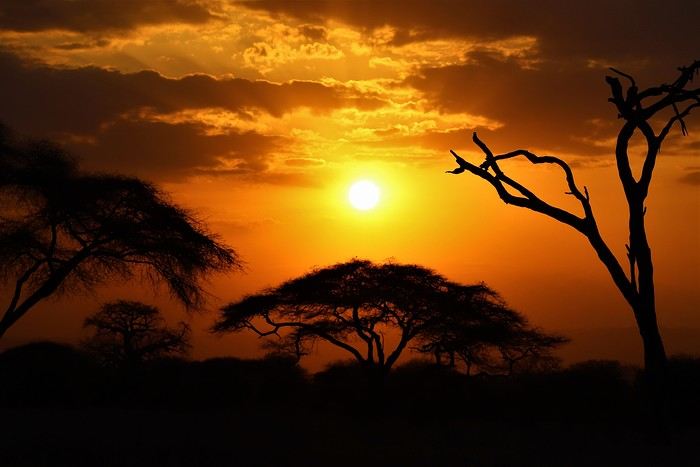
Safe travels! !
Over 5 years later, I’m finally getting around to writing the travel journal for our first trip to East Africa: Tanzania. *Polé Polé*, as they say! 😎
A trip I’d started planning just 6 years ago, in February 2019, for my post-internship exam vacation. After returning to South Africa in July 2019 with my family, this trip, planned for September 2019, would be all about discovery and a few firsts: first trip with friends, first trek, first time in East Africa. I really wanted to attempt the Kilimanjaro ascent, try to still see some of its "eternal" ice, and Alison wanted to do as much safari as possible. Unlike with the Zulus, Himbas, or San, visiting a Maasai village wasn’t on the agenda. Thanks to the Kessy Brothers agency, who were super responsive, Sandy from VF, and other members who helped prepare our trip, we settled on the following itinerary:
Day -1 (8/30): Departure from Pointe-à-Pitre Day 0 (8/31): Departure from Paris Day 1 (9/01): Arrival at Kilimanjaro Airport / Ameg Lodge (Moshi) DAY 2 (9/02): Machame gate / Machame camp DAY 3 (9/03): Shira / Shira camp DAY 4 (9/04): Baranco / Baranco camp DAY 5 (9/05): Barafu / Barafu camp DAY 6 (9/06): Barafu + Summit at midnight / Mweka camp DAY 7 (9/07): Mweka gate / Sal Salnero Hotel (Moshi) DAY 8 (9/08): Arusha National Park / Kanga camp DAY 9 (9/09): Tarangire National Park / Kanga camp DAY 10 (9/10): Tarangire National Park / Twiga Lodge DAY 11 (9/11): Lake Manyara / Twiga Lodge DAY 12 (9/12): Ngorongoro Crater / Simba campsite DAY 13 (9/13): Serengeti National Park / Seronera campsite DAY 14 (9/14): Serengeti National Park - Uoga Kuria Camp DAY 15 (9/15): Serengeti National Park / Waso campsite DAY 16 (9/16): Lake Natron / Maasai Giraffe Ecolodge DAY 17 (9/17): Kilimanjaro Airport Day 18 (9/18): Zanzibar Day 19 (9/19): Zanzibar Day 20 (9/20): Zanzibar Day 21 (9/21): Zanzibar
As I mentioned in my first travel journal about our South Africa trip, I’ve had a special connection to Tanzania for a long time. Growing up in the Indian Ocean without ever visiting Africa, those wildlife documentaries on TV when I skipped my pharmacy classes... I imagined and dreamed about this land and country so much.
The original plan was to go just the two of us with Alison, but somehow—though I don’t quite remember how—we ended up organizing the trip with our friends Mélissa and Doriane, who joined us in Arusha after our Kilimanjaro trek for the last two weeks and their very first safari. I think it was Melissa who had the idea to crash our trip, and she was right to do so! 😉 Flights: Pointe-à-Pitre-Grand Case and Grand Case-Paris with Air Caraïbes. Flights: Paris-JRO and ZNZ-Paris with Kenya Airways (layover in Nairobi). Flight: JRO-ZNZ with Air Tanzania.
Safe travels! !
Hi everyone,
so glad the forum’s back up!
I’m planning a trip for next June but I’m still torn between Papua and Papua New Guinea.
Solo backpacking trip, about 3 weeks (trekking, culture, and a tiny bit of beach time).
It’s still tough to find recent info—anyone know if backpacking is doable there?
Thanks in advance for your tips!
carpediem
Hello everyone,
My wife Fanny and I, along with our three kids (ages 10, 12, and 14), are planning a two-week trip to Asia during the February break. This would be our first big family trip, and we’re looking to mix discovery, a change of scenery, some relaxation, and cultural immersion. We want to avoid overly organized tours or over-touristed destinations.
Over 20 years ago, Fanny and I used to travel as a couple with backpacks, especially in India and Mongolia, but things have surely changed a lot since then. Now, we’re torn between:
• Thailand: for its diversity (beaches, temples, nature) and accessibility for a first family trip.
• Laos-Cambodia combo: for a potentially more authentic immersion, but we’re wondering if it’s well-suited for kids.
- Sri Lanka: it seems amazing and family-friendly? Is the political situation stable enough?
We have a few questions:
Which destination would you recommend for this kind of family setup? What itineraries might work for two weeks without feeling too rushed?
Logistics-wise: can we travel with a round-trip flight ticket, book a few basic hotels, and improvise the rest once we’re there? Or do we need to plan everything in advance (transport, accommodations, activities) for this time of year?
Thanks in advance for your valuable tips! Mathieu
Hi,
I’m supposed to be going on a university exchange in Shanghai from February to June 2025, and I’d love to return to Europe afterward via the Trans-Mongolian Railway. My plan was to fly from China to Mongolia’s capital and maybe spend 3-4 days exploring the country. Then, I could take the train, with a stop in Irkutsk before heading to Moscow for a two-day visit, followed by two days in Saint Petersburg. After that, I’d take a bus to Tallinn and possibly fly home from there due to time constraints. I was thinking this whole trip would take about two weeks. This site: Russian Train Tickets - Online Booking for Russian Train Tickets seems useful for buying tickets (though the ones that go through Mongolia need to be booked via a form or on tutu.travel), and this one for the bus from Russia to Estonia: St. Petersburg - Tallinn buses and tickets.
From what I’ve gathered, Russia now offers an e-visa, and Mongolia has suspended visas for Europeans until the end of next year.
Would anyone have any info or advice? Given the current situation in Russia, everything is pretty complicated to research, and most of the information is outdated.
Thanks in advance, Alicia
Hey everyone,
I’m sharing a slightly unusual travel journal with three goals. To make it work, this discussion should stay in the travel journal section so we can find it easily and keep adding info to existing posts.
This journal is meant to help "newbies" discover these magical places.
We go to Southern Africa not just for the animals, but also for that soft light, the atmosphere, and those incredible wild campsites where you feel so at home... I’d love for you all to share your favorite spots here—those we miss so much.
The last goal is figuring out how to photograph them. Honestly, I’m not happy with my photos because they don’t capture the feeling I get when I’m there or that unique atmosphere.
I’ll start with one of the first spots that, for me, is one of the most beautiful in Southern Africa: Passarge Valley 2 in the Central Kalahari. There, you’re alone—completely alone. The next campsite is over 25 km away, and that’s a half-day of 4x4 driving. In front of you, there’s nothing but the CKGR plains with herds of springboks... absolutely stunning 😎

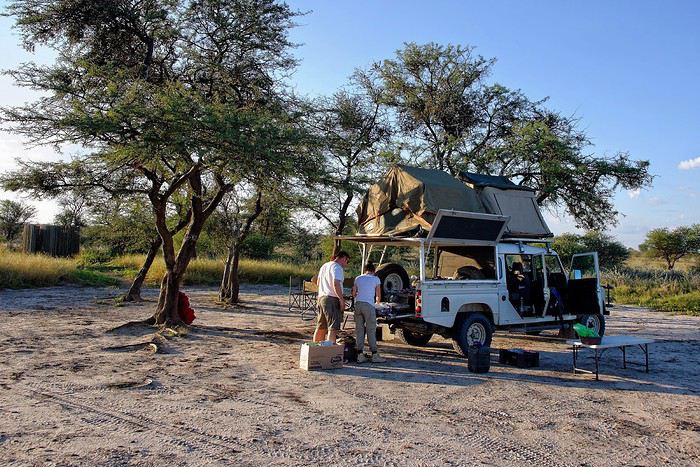
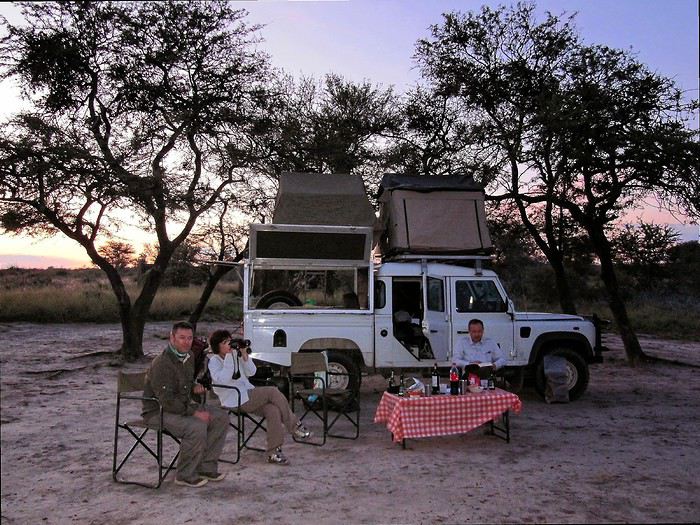
I’m sharing a slightly unusual travel journal with three goals. To make it work, this discussion should stay in the travel journal section so we can find it easily and keep adding info to existing posts.
This journal is meant to help "newbies" discover these magical places.
We go to Southern Africa not just for the animals, but also for that soft light, the atmosphere, and those incredible wild campsites where you feel so at home... I’d love for you all to share your favorite spots here—those we miss so much.
The last goal is figuring out how to photograph them. Honestly, I’m not happy with my photos because they don’t capture the feeling I get when I’m there or that unique atmosphere.
I’ll start with one of the first spots that, for me, is one of the most beautiful in Southern Africa: Passarge Valley 2 in the Central Kalahari. There, you’re alone—completely alone. The next campsite is over 25 km away, and that’s a half-day of 4x4 driving. In front of you, there’s nothing but the CKGR plains with herds of springboks... absolutely stunning 😎
Hi there,
We’d like to take our bikes to Sicily in early April for Easter, then cycle back home via Puglia to the Lyon area.
Has anyone got any tips?
1: How to get there? Train or ferry?
2: Camping or other options in big cities? Is it true that campsites are really expensive?
3: Recommended route
We’re open to all suggestions.
Thanks, and happy holidays!
We’re wrapping up our Sardinia tour by camper van. We stayed for 5 weeks, covered 2,150 km on this island, and will leave with mixed feelings!!
While the island is beautiful—especially for those who love beaches and all kinds of water sports—it’s also appealing for history buffs and archaeology enthusiasts. The mountains, scenic roads, and small villages are really lovely too.
That said, driving here can be pretty hazardous. Locals don’t respect speed limits or road rules, they roll through stops, zoom out of side streets, and often overtake without proper visibility. On top of that, the quality of roads and highways is really disappointing!! And service areas, whether paid or free, are few and far between and often poorly maintained.
One last thing: we’d heard Sardinians were welcoming... I don’t know if it’s because they’ve "endured" waves of tourists from all over during the summer months, but unfortunately, we didn’t find that to be true. Most seemed rather gloomy or even unwelcoming, with just a few exceptions saving Sardinia’s reputation!!
It’s a real shame for an island with so much potential. I think a serious review of how tourism is managed would be worth considering. That aside, we did notice some efforts and goodwill that were nice to see.
Hello everyone,
We’re heading to South America in February 2020 for our first three-month trip and plan to return in 2021 for another three-month adventure. We’ll be shipping our Toyota with a fitted camper (Azalaï) in a container. We chose Wave Logistics for the transport based on the tips we read here on the forum.
At the end of this first trip, around mid-May 2020, we’d like to find a secure spot near Santiago, Chile, where we can leave our vehicle for about eight months.
We’ve done this before in Zambia (two trips to Southern Africa in 2016 and 2017, leaving our Azalaï for eight months at a campsite near Lusaka) and we’d love to repeat the experience in South America.
Can anyone help us out or point us in the right direction?
Hello,
We’ve already traveled to India twice before, but only for two-week stretches (2013, a loop from Mumbai including Hampi, and in 2019, Tamil Nadu). This time, we’re leaving at the end of October for nearly three months of travel—something completely new for us! We’ll arrive in Delhi and depart from Bangalore. Our goal is to explore Northern India and then head down to Kerala, taking a maximum of one flight and prioritizing trains.
Traveling for this long should let us plan longer stops to slow down the pace and fully enjoy our trip...
What are the places you’ve loved with this in mind? I’ve already thought of Gokarna... Do you have any other suggestions, especially in Northern India? Thanks in advance for your tips!
Traveling for this long should let us plan longer stops to slow down the pace and fully enjoy our trip...
What are the places you’ve loved with this in mind? I’ve already thought of Gokarna... Do you have any other suggestions, especially in Northern India? Thanks in advance for your tips!
I hesitated about writing this travel journal...
This summer, we only did the classics (the 3 northern parks and Zanzibar) and let a local agency take care of everything from start to finish.
No craziness, no risks, no sleeping under the stars, no self-drive, no venturing off the beaten path, no incidents, and not even any delays in the pre-planned itinerary...
But don’t think we were disappointed! The whole family (there were 6 of us) came back with smiles and memories of great moments spent together. So, if you're looking for a "classic" way to discover Tanzania, this is the place to be.
Our 2-week itinerary: - Arusha (1 night upon arrival) - Tarangire (1 night) - Ngorongoro (2 nights in Karatu then Irmisigiyo) - Serengeti (3 nights in Robanda, Togoro Plains, and Seronera) - Zanzibar Stone Town (1 night) - Zanzibar Matemwe (3 nights) - Zanzibar Jambiani (3 nights)
Hakuna matata!
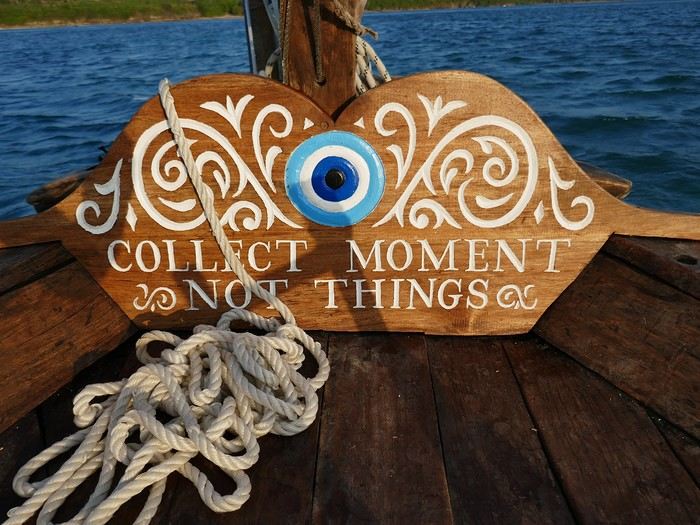
No craziness, no risks, no sleeping under the stars, no self-drive, no venturing off the beaten path, no incidents, and not even any delays in the pre-planned itinerary...
But don’t think we were disappointed! The whole family (there were 6 of us) came back with smiles and memories of great moments spent together. So, if you're looking for a "classic" way to discover Tanzania, this is the place to be.
Our 2-week itinerary: - Arusha (1 night upon arrival) - Tarangire (1 night) - Ngorongoro (2 nights in Karatu then Irmisigiyo) - Serengeti (3 nights in Robanda, Togoro Plains, and Seronera) - Zanzibar Stone Town (1 night) - Zanzibar Matemwe (3 nights) - Zanzibar Jambiani (3 nights)
Hakuna matata!
Hi there,
I’m heading to Guatemala for 18 days in August with my 11-year-old and I’m wondering if renting a car makes sense—not so much because of the road conditions, but because I’d like to spend about 3 days in Livingston. Since it’s only accessible by boat, I’d have to leave the car in Río Dulce. Maybe possible at a hotel, but that means paying for a rental for 3 days without using it... Same issue for Semuc Champey—it’s only reachable by 4x4, and I won’t be renting that type of vehicle.
Also, has anyone traveled from Panajachel (Lake Atitlán) to Cobán (to explore the caves and waterfalls in the area)? According to Google Maps, it’s a 6-hour, 44-minute drive... so whether by car or minibus, it’s *really* long (same for Cobán-Flores later). Are there any interesting stops along the way where I could spend a night? And if I’m not renting a car, is it possible to take two private shuttles for this route?
Thanks for your tips!
Hi everyone,
We’re a family of four (two daughters aged 18 and 21) and we’re planning a three-week trip to Tanzania. Zanzibar would be our main base, but we’d also like to do a safari on the mainland. Could you share any tips on: - the ideal length for such a safari, the best place to go during this period (and easily accessible by flight from Zanzibar) - your recommendations for the most suitable type of stay for a family like ours - reliable local agencies with reasonable prices that could help us with this plan
Thanks in advance!
Albin
Hello,
After several years, I’ve finally decided to repost a travel journal on the forum. We returned a few weeks ago from an incredible trip to Kenya, and it’s reignited my desire to share our emotions in the face of these animals.
Kenya wasn’t originally a priority for us in terms of safari—we had the impression it was too touristy. So, we started with other destinations: Namibia, Tanzania, Botswana, and South Africa. But as I did more research, especially on the forum (thanks in part to Sylvie’s many trips), I eventually convinced myself that Kenya could be magnificent, as long as we chose our itinerary carefully and avoided peak seasons.
We ended up going in January, from the 17th to the 31st. We worked with a travel agency (TP) that crafted a custom itinerary for us: Samburu-Ol Pejeta-Naivasha-Maji Moto-Maasai Mara-Diani. They partnered with a local French-speaking agency, and everything was perfectly organized. Our trip exceeded all our expectations, and none of it would’ve been as amazing without our guide, Alfred. He accompanied us for 10 days and was a fantastic travel companion—professional, respectful of the animals, and always in good spirits. We formed a great bond with him in such a short time.
- **January 17th** After meeting up with Juliette and Charlotte in Rennes the night before, we left at 4 AM for Roissy Charles de Gaulle Airport. The thick fog made the drive pretty rough, but we arrived safely around 7:45 AM. A Blue Valet driver was waiting to take our car. Check-in went smoothly, and we waited patiently for our 10:40 AM flight. Unfortunately, despite boarding on time, a passenger was missing, and we had to find a replacement last minute. Then, another passenger who had checked in and dropped off their luggage wasn’t on the plane, so they had to unload their bags. After a long period of uncertainty and spotty communication from the crew, we finally took off over an hour late.
We arrived in Nairobi in the late afternoon, 45 minutes behind schedule. The administrative formalities were endless—it took nearly 1.5 hours from landing to leaving the airport with our luggage. When we stepped out, Alfred, our guide, was waiting with a big smile and drove us to the Eka Hotel, not far from the airport. Exhausted from the long journey, we fell asleep quickly.
- **January 18th** Alfred met us at 7 AM for a long drive to Samburu Reserve. We had a peaceful night, unlike the girls, who barely slept because their neighbors were talking loudly all night. Things even escalated when Charlotte started shouting insults to get them to quiet down, but it didn’t work.
It was Sunday, so traffic around Nairobi and along the route was light. Aside from a quick "technical stop," we drove straight through and arrived in Samburu after just under 6 hours. Because of the lower altitude (around 1,000m on average), it was hot—over 30°C in mid-January.
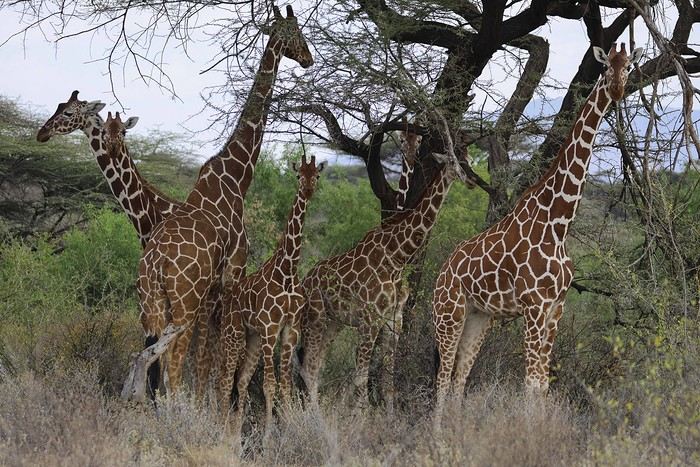
As soon as we entered the reserve, we spotted some impalas and quickly came across one of the region’s endemic species: the reticulated giraffe, which is absolutely stunning.
While heading to our camp for lunch, Alfred crossed paths with another vehicle and learned that a leopard was nearby. We started searching, and a few minutes later, Anny spotted a shape in a tree—it was our leopard!
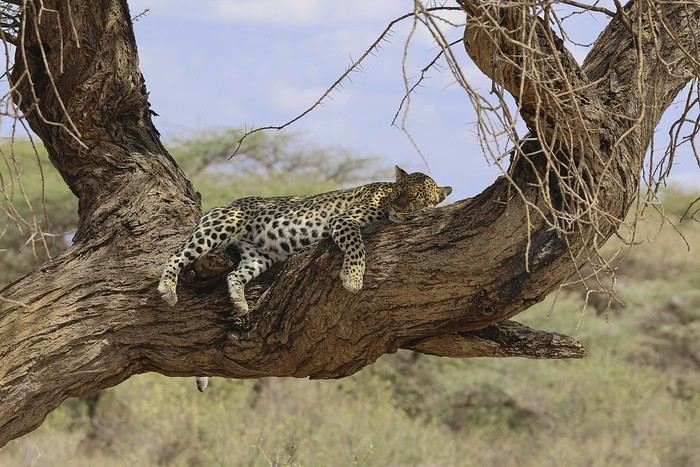
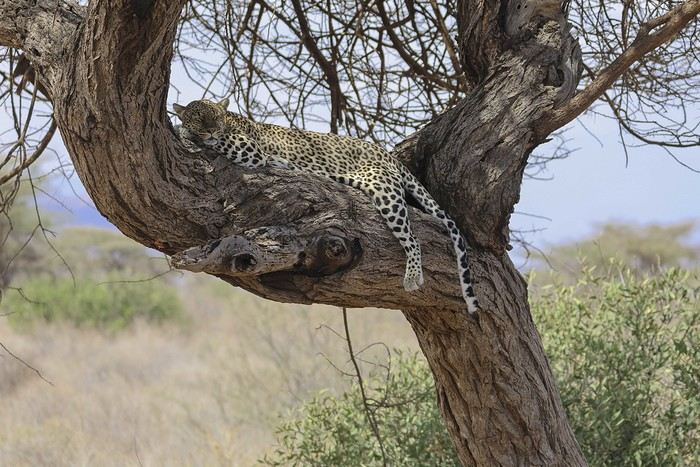
There were actually two of them—a mother and her adolescent. The young one was perched high in the tree, in the shade. We got to observe them for a good half-hour in excellent conditions, with just one other vehicle nearby.
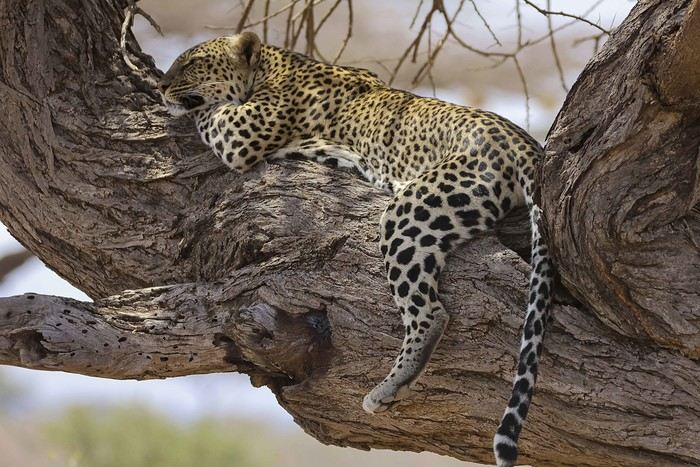
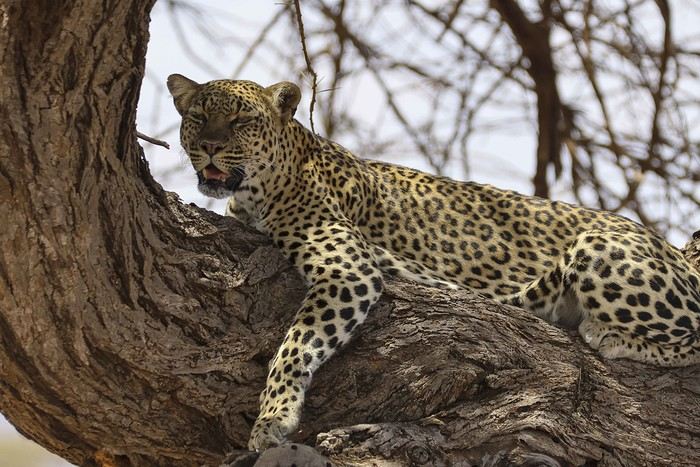
Alfred also noticed that the mother had hidden prey (a gerenuk gazelle) in the vegetation, away from prying eyes.
It was time to head to our camp, the Ashnil Samburu Camp, located in the Buffalo Springs area, by the river, in an idyllic setting surrounded by the region’s typical vegetation.
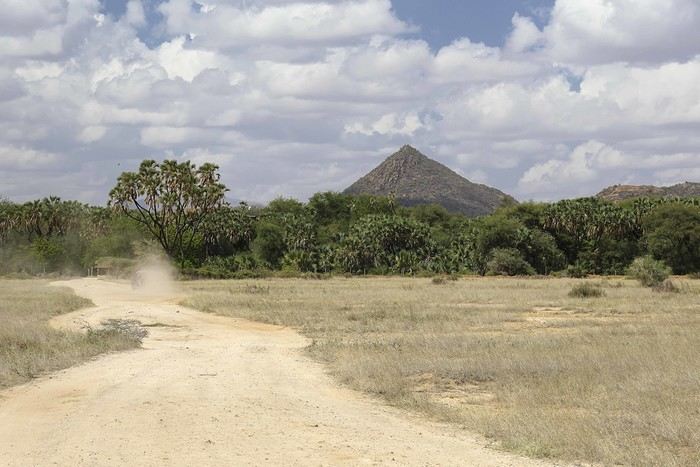
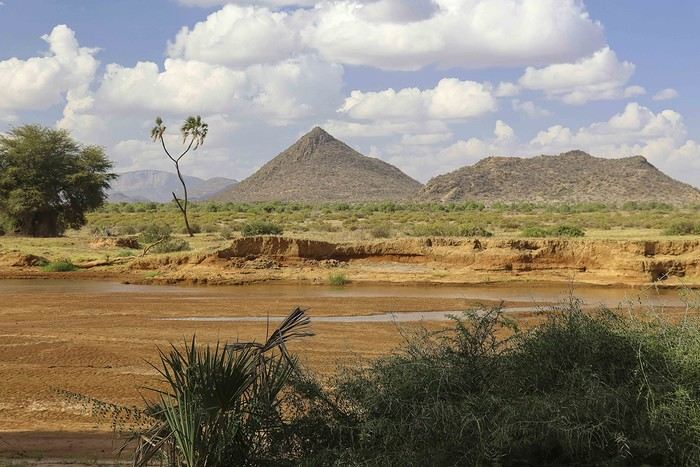
The welcome was fantastic—we immediately felt at home, and that feeling lasted throughout our 3-day stay in the reserve. It was 2 PM, but no one rushed us to the table. Our waitress, Sheila, who took care of us the whole time, was as lovely as the rest of the team. Barely seated, we were invited to watch an elephant passing right by the camp, in front of the restaurant. This trip was off to a great start!
After lunch, we relaxed by the pool. Monkeys, especially vervets, were everywhere, and a camp employee was assigned to keep an eye on them and shoo them away if needed (especially the baboons).
A little before 4 PM, we met up with Alfred for our first game drive. Just outside the camp, a few elephants were in the valley near the river.
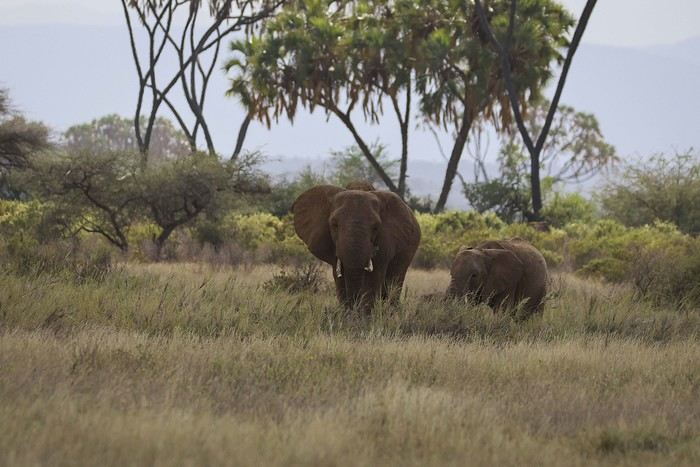
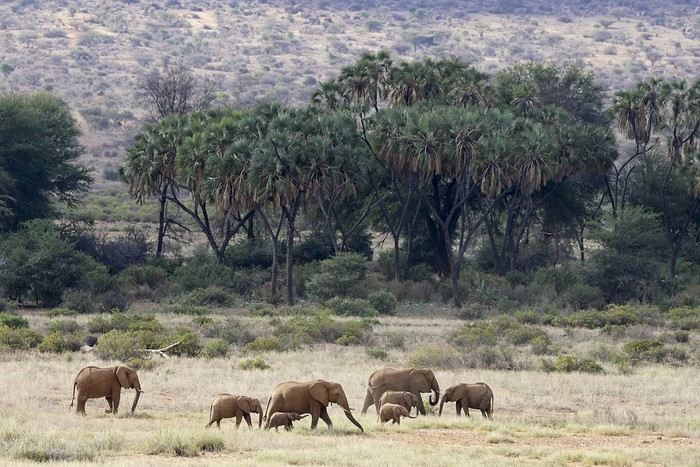
We’d see them in the same area almost every day. We also spotted some gazelles.
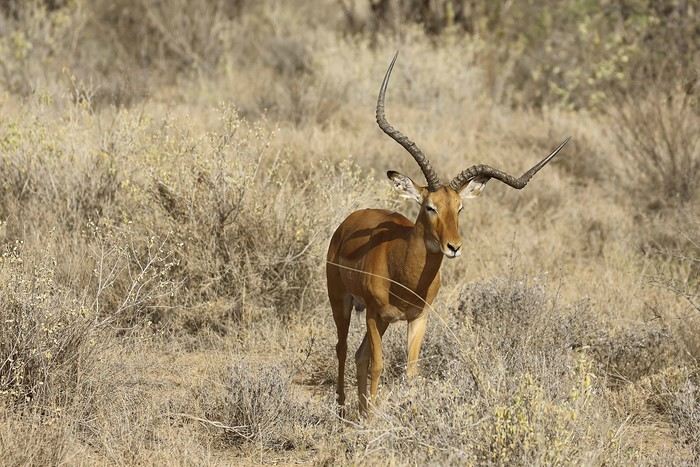
After several years, I’ve finally decided to repost a travel journal on the forum. We returned a few weeks ago from an incredible trip to Kenya, and it’s reignited my desire to share our emotions in the face of these animals.
Kenya wasn’t originally a priority for us in terms of safari—we had the impression it was too touristy. So, we started with other destinations: Namibia, Tanzania, Botswana, and South Africa. But as I did more research, especially on the forum (thanks in part to Sylvie’s many trips), I eventually convinced myself that Kenya could be magnificent, as long as we chose our itinerary carefully and avoided peak seasons.
We ended up going in January, from the 17th to the 31st. We worked with a travel agency (TP) that crafted a custom itinerary for us: Samburu-Ol Pejeta-Naivasha-Maji Moto-Maasai Mara-Diani. They partnered with a local French-speaking agency, and everything was perfectly organized. Our trip exceeded all our expectations, and none of it would’ve been as amazing without our guide, Alfred. He accompanied us for 10 days and was a fantastic travel companion—professional, respectful of the animals, and always in good spirits. We formed a great bond with him in such a short time.
- **January 17th** After meeting up with Juliette and Charlotte in Rennes the night before, we left at 4 AM for Roissy Charles de Gaulle Airport. The thick fog made the drive pretty rough, but we arrived safely around 7:45 AM. A Blue Valet driver was waiting to take our car. Check-in went smoothly, and we waited patiently for our 10:40 AM flight. Unfortunately, despite boarding on time, a passenger was missing, and we had to find a replacement last minute. Then, another passenger who had checked in and dropped off their luggage wasn’t on the plane, so they had to unload their bags. After a long period of uncertainty and spotty communication from the crew, we finally took off over an hour late.
We arrived in Nairobi in the late afternoon, 45 minutes behind schedule. The administrative formalities were endless—it took nearly 1.5 hours from landing to leaving the airport with our luggage. When we stepped out, Alfred, our guide, was waiting with a big smile and drove us to the Eka Hotel, not far from the airport. Exhausted from the long journey, we fell asleep quickly.
- **January 18th** Alfred met us at 7 AM for a long drive to Samburu Reserve. We had a peaceful night, unlike the girls, who barely slept because their neighbors were talking loudly all night. Things even escalated when Charlotte started shouting insults to get them to quiet down, but it didn’t work.
It was Sunday, so traffic around Nairobi and along the route was light. Aside from a quick "technical stop," we drove straight through and arrived in Samburu after just under 6 hours. Because of the lower altitude (around 1,000m on average), it was hot—over 30°C in mid-January.
As soon as we entered the reserve, we spotted some impalas and quickly came across one of the region’s endemic species: the reticulated giraffe, which is absolutely stunning.
While heading to our camp for lunch, Alfred crossed paths with another vehicle and learned that a leopard was nearby. We started searching, and a few minutes later, Anny spotted a shape in a tree—it was our leopard!
There were actually two of them—a mother and her adolescent. The young one was perched high in the tree, in the shade. We got to observe them for a good half-hour in excellent conditions, with just one other vehicle nearby.
Alfred also noticed that the mother had hidden prey (a gerenuk gazelle) in the vegetation, away from prying eyes.
It was time to head to our camp, the Ashnil Samburu Camp, located in the Buffalo Springs area, by the river, in an idyllic setting surrounded by the region’s typical vegetation.
The welcome was fantastic—we immediately felt at home, and that feeling lasted throughout our 3-day stay in the reserve. It was 2 PM, but no one rushed us to the table. Our waitress, Sheila, who took care of us the whole time, was as lovely as the rest of the team. Barely seated, we were invited to watch an elephant passing right by the camp, in front of the restaurant. This trip was off to a great start!
After lunch, we relaxed by the pool. Monkeys, especially vervets, were everywhere, and a camp employee was assigned to keep an eye on them and shoo them away if needed (especially the baboons).
A little before 4 PM, we met up with Alfred for our first game drive. Just outside the camp, a few elephants were in the valley near the river.
We’d see them in the same area almost every day. We also spotted some gazelles.
Hi,
We’re a young couple planning to travel to South Africa after spending about three weeks in Namibia. We’ll arrive in Cape Town around mid-December, with no fixed travel duration (though our budget will eventually set a limit).
After browsing through the forum, we’ve realized the country is packed with incredible spots, which makes choosing an itinerary tough. We’re looking for stunning landscapes, hikes, and so on. So, we’d love to hear your thoughts and experiences.
When we arrive in Cape Town, we’d like to settle in and take it easy until New Year’s, exploring at a relaxed pace. We know this period coincides with South African holidays—does that make finding accommodations (availability/prices) more difficult? Do you think it’s possible to stay in a nice place for about 15 days without aiming for the most upscale neighborhoods? Maybe somewhere a bit outside Cape Town, like Fish Hoek, and just visit the city occasionally.
After that, we’ll have plenty of time (about 2 to 2.5 months) to explore the country. We’d like to take our time. In your opinion, is it better to focus on the Cape Town region, or is it reasonable to consider more distant areas like the Drakensberg or Blyde River Canyon? Can everything be done by car if we take our time, or are domestic flights sometimes more practical?
Budget-wise, how much do car rentals cost? For accommodations, we usually look at Airbnb—are they affordable in South Africa? What’s the average nightly rate outside the biggest cities? Are there other platforms you’d recommend for saving on lodging?
Finally, regarding safety, are there any regions to avoid besides Johannesburg?
We know this is a lot of questions, but we’re still in the early planning stages!
Thanks in advance for your advice!
Hello,
We’re heading to Thailand for 26 days (excluding flights) next July with our two teens (12 and 15 years old).
My husband and I have been there several times before they were born—so that’s 15 years ago—and I’m a bit worried about some of the changes that might have happened since, especially with the rise in tourism...
I’d also like to keep a pace that allows us to settle in a bit and enjoy local life beyond just the main sights. Plus, we’re pretty active.
For now, our plan looks like this:
Arrival in Bangkok, where we’re thinking of spending several days (minimum 4) Chiang Mai for about a week 2 or 3 islands in the Gulf Return to Bangkok for 2 days before departure.
We’re pretty set on Bangkok and Chiang Mai, but we’re unsure about which islands to visit—I’ve read such mixed things that I’m even wondering if we should consider the coast instead. Organization-wise, I’d love any tips or feedback on whether we need to book in advance at this time of year, which transport options to prioritize (train, bus, or plane), and of course, any suggestions for stops or routes. Thanks in advance to anyone kind enough to help us prepare for this amazing trip!
Hi there,
I’m planning a trip to Zanzibar.
Do you think it’s possible to do a safari from Zanzibar in 1 or 2 days?
Thanks for your feedback!
Hi there,
I’d planned to go to Benin in 2026, but given the recent events and upcoming elections, I’m thinking I’ll wait to see what happens after the elections.
Has anyone traveled to Benin recently or is planning to go soon?
I’d planned to go to Benin in 2026, but given the recent events and upcoming elections, I’m thinking I’ll wait to see what happens after the elections.
Has anyone traveled to Benin recently or is planning to go soon?
Hi,
I’m heading to Thailand for the first time in early 2026 and I’m really struggling to pick a neighborhood to stay in Bangkok. Apart from being close to public transport (metro, skytrain, BRT), I’m torn between several areas. I don’t mind using public transport or walking long distances, but if every trip takes 45 minutes or an hour, it’ll quickly become a hassle given our relatively short time there.
We’ll be in Bangkok twice during our trip: first for a “short” 2-night stopover (arriving from France in the mid-afternoon, then leaving the day after next for southern Thailand by plane), and then again for 3 nights before flying back to France (arriving at the airport in the late afternoon, 3 nights there, then departing for France in the late morning).
I’ve seen so many different recommendations that I’m having a hard time deciding. I’ve read that staying near the river is great for sightseeing, and that taking the boat to get around is really pleasant. But I’m worried about being a bit isolated for evening outings (eating at a cheap little restaurant, having a drink—nothing too wild!).
Chinatown is tempting for the food—it looks amazing—and it doesn’t seem too far from the main sights with public transport. But I’ve read that it’s very noisy because it’s super touristy and there’s constant truck traffic. My friend isn’t thrilled about it, especially since another neighborhood interests her because she has a great discount at a hotel near Victory Monument/Phaya Thai (the Pullman hotel). Even though it’s close to public transport, I’ve seen that it’s mostly a shopping district? And even with transport, isn’t it a long trip to visit places like the Grand Palace?
We also had a plan to stay at an ibis near BTS Nana station in the Sukhumvit area, but again, I get the feeling it’s mostly a shopping district?
Anyway, I’d love to hear your thoughts because I’m really torn!
It’s also true that I haven’t really planned our Bangkok stays yet. I’d like to do the “classic” tourist sights like the Grand Palace and eat really well! Someone told me that the big shopping malls also have amazing food 🙂
Thanks for your input!
Hi everyone,
I’m planning a cycling trip in Algeria and looking for concrete firsthand accounts from cyclists who’ve recently traveled there (or residents who know the terrain well). My goal is to map out a realistic 2–4 week itinerary that prioritizes discovery, safety, and solid water/bivouac management.
My profile and gear
Semi-bivouac autonomous cyclist (light tent + sleeping bag + stove), with the option of simple accommodations in towns.
All-road/gravel bike with a rear rack, 40–45 mm tires (I can go up to 47–50 mm if needed).
Compact drivetrain with a small gear range for climbing while loaded.
Modular water capacity of 4–7 liters (soft flasks + bottles), plus a filter and purification tablets as backup.
Navigation via offline maps + GPS, GPX tracks if available.
Planned period
Late winter/early spring (timing to be refined based on your feedback about weather, wind, and day/night temperature swings). I’d love a seasonal breakdown: which areas are more pleasant/rideable during this time? Are there zones to avoid while others become ideal?
Preferred itinerary style
High plateaus and accessible Saharan fringes for a loaded bike, alternating between secondary roads and rideable tracks.
Moderate pace (60–90 km/day depending on terrain and wind), with stops in resource towns to restock, shower, and rest.
Safety and logistics (water/supplies) take priority over pure athletic performance.
My specific questions for those who’ve cycled in Algeria 1) Routes and areas
Which roads/tracks did you enjoy for their scenery and interest without being too rough for a loaded gravel bike?
If you’ve ridden the high plateaus: which connections do you recommend to avoid traffic and stick to small roads?
Saharan fringes: which sections are realistic for partial autonomy (reasonably spaced water points, rideable tracks, not too much soft sand)?
Areas to avoid by bike (recently) due to security, road conditions, katabatic winds, construction, etc.?
2) Water and supplies
How frequent were water points on your routes: reliable wells? taps? sources in towns/villages?
In “desert” sections, how many liters did you carry between secure points? Does a 6–7 L capacity seem comfortable, or should I aim for more on certain stretches?
Food: small shops, markets, availability of basics (semolina, sardines, dates, biscuits, powdered milk, etc.) — how often can you reasonably restock?
Filtration: did a filter + tablets suffice? Are there areas where you’d advise against filtering from unprotected wells?
3) Bivouacking and accommodations
Tolerance for discreet bivouacking (far from dwellings, leave-no-trace): recent experiences?
Simple alternatives: guesthouses, small hotels/hostels, campgrounds (if any), municipal lodgings?
Practical stopover towns for restocking, resting, and securing your bike overnight: reliable spots or neighborhoods to prioritize/avoid?
4) Roads, tracks, and weather
Road surface quality on secondary routes: generally decent or highly variable?
Tracks: rideable (compact gravel, laterite) or sometimes sand/washboard? At what tire width would you recommend switching (45 vs. 50 mm)?
Prevailing winds this season: direction, strength, most exposed hours; do you adjust your departures to ride “before the wind” in the morning?
Temperatures: day/night range; sun protection (long gloves, buff, sunscreen, sunglasses), managing nighttime cold at altitude or in the open desert.
5) Safety, formalities, and connectivity
Recently discouraged zones (please note the date if possible).
Roadside checks: which documents to keep handy; are there specific registrations or declarations required upon arrival or when moving between wilayas?
Local SIM/data: which operators work well on the routes you took; tips for recharging/buying credit.
Useful apps/maps on the ground (and reliable offline maps) for locating water, grocery stores, garages, accommodations, rideable segments, etc.
Bike security: how did you handle anti-theft and parking during errands/overnight stays?
6) Gear and adjustments
Recommended minimum gearing for loaded climbs on local roads/tracks.
Ideal tire width and casing (puncture resistance on gravel and rocks).
“Sweet spot” water capacity based on your experience (and tips: frame bags, extra bottles on the fork, bladders in frame bags, etc.).
Maintenance: dust/sand — greases/seals, drivetrain cleaning frequency, breathable filters, protective socks for zipped panniers.
Sample itinerary outline (to validate with your feedback)
Week 1: Arrival, adjustments, high plateaus, linking resource towns to get into the rhythm, test supplies and water.
Week 2: Accessible Saharan fringes, alternating road/track, nights in discreet bivouac when possible + simple accommodations every 3–4 days.
Week 3–4 (optional): Extend toward a second Saharan area or head back to a more temperate zone depending on weather/wind, prioritizing routes known to cyclists.
If you have GPX tracks (even partial), waypoints (water, grocery stores, accommodations), or a travel journal with dates, I’d love to see them. Dated info (year/month) will help me weigh what may have changed recently.
What I can share in return
After the trip, I’ll publish a detailed report with:
Final itinerary + cleaned GPX tracks,
List of confirmed water points and open supply spots,
Gear review (tires, gearing, water capacity),
Notes on bivouacking/accommodations and safety,
Budget and daily distances, to help future travelers.
Thanks in advance for your tips, warnings, good addresses, and updated feedback. Your experience is invaluable for planning a safe, smooth, and enjoyable cycling route in Algeria. Happy trails! 🚴
Hi,
I’m planning a trip to Australia—Paris to Melbourne.
I’m flying with Etihad and have a 1-hour connection in Abu Dhabi.
Does that seem doable to you?
Thanks for your feedback and experiences!
Hi there,
I'm urgently planning a trip to Tunisia in November, backpacker-style (no agency, no guide or taxi, public transport, youth hostels or small hotels, local restaurants). I'm not interested in the beach, and I like to take my time at archaeological sites and museums (twice as long as the average visitor). I'm aiming for about two weeks, give or take.
First, I'm trying to roughly outline a route/schedule so I can book my flight as soon as possible (no desert in the south this time—I went there years ago and want to stay independent). I’ve sketched out the following itinerary, knowing that apparently, there are quite a few towns without budget-friendly hotels (even on Airbnb), which means I’ll be staying longer where they’re available. Three questions: 1. Does this seem reasonable overall (time spent in each city)? 2. Should I add other cities, maybe in the northwest? 3. For hotels, in November, is it better to scout options on booking sites first, then book on the spot for cheaper rates (no site commission + possible negotiation)? Also, are hotels not listed online and found randomly on-site much cheaper?
ROUGH ITINERARY (order to be confirmed)
TUNIS 5 days (cheap accommodations: 13 or 19 €) 2 days: Medina, souks, Bardo Museum, Royal Mausoleum of Tourbet El Bey, Zitouna Mosque (exterior) 1 day: Sidi Bou Said 1 day: Carthage 1 day: A-R Dougga (bus to Tebersouk 2h + taxi) – pack a picnic + option: hike to Zaghouan (750m+, 10km round trip) – worth it? Doable alone?
KAIROUAN 2 days (very expensive room: 40-50 €!) Great Mosque, Medina, Three Doors Mosque, medieval cemetery, Sidi Sahbi Mosque...
SOUSSE 3 days (room 15 €) 2 days: Medina, archaeological museum, Port El Kantaoui, the Ribat (fortress), Contemporary Art Museum Dar Am Taïeb, Dar Essid (17th-century traditional house) 1 day: A-R El Jem (60km away) + option: 1 day A-R Monastir? Worth it? + option: 1 day A-R Mahdia (or 2 days sleeping there)?
OPTIONS -> Gabes to mix things up? But is it easy to find cheap lodging and get around/visit alone? -> Other sights or stops to sleep: Sfax, El Kef, others? -> Kerkenna Islands (easy accommodation?)
Thanks for your thoughts and opinions on these options. Once I’ve adjusted the duration, I’ll book my tickets for early November! (By the way, do you think I should arrive and depart from two different airports?)
Hi everyone,
I’m planning a trip to Taiwan in a few months. After spending a few days in Taipei, I’d like to explore the rest of the country. Could anyone share contact details for local agencies in Taipei?
Is English enough to get by outside of Taipei?
Thanks in advance!
Tara
Berlin in May is really nice.
Day 1: Flight from Orly to Berlin. We had a bit of a struggle finding the train or RER to get to "Mitte". The Berliners were quite helpful in trying to guide us. Settled into our hotel, we took some time to explore the northern part of "Mitte". Dinner at a pizzeria and off to bed.
Day 2: A 3-hour guided tour of Berlin East’s must-see spots. Great idea—it helped us plan the rest of our stay. After a quick lunch at a kebab place, we set off on foot to check out the graffitied Berlin Wall, including the Swiss Army Knife mural. We stopped by some cool bars along the way (we love walking). Back by metro—we’re starting to figure out how it works. Dinner near our hotel at a Chinese restaurant.
Day 3: We visited the Jewish quarter, walked to Charlottenburg, and then headed to the Memorial Museum, a must-see. Grabbed a snack with a slightly spicy Berlin sausage and made our way to the Jewish Museum. Since we’re not Jewish, we didn’t fully grasp its content, despite the richness of the exhibits. Walked back and had dinner at a traditional restaurant.
Day 4: Back in 1968, as a high school student, I stayed with a German family to improve my German—which I’ve since forgotten. I wanted to revisit Kurfürstendamm, but it was a mistake. This West Berlin neighborhood, with its bars, nightclubs, and luxury shops, has lost all its charm. It’s now just a residential area. We headed back through one of Berlin’s many beautiful parks.
Day 5: Our last day included a visit to Charlottenburg Palace—a mini Versailles—and a stroll around the Reichstag. The cherry on top of this trip was getting to visit the dome. Luckily, I’d read that you need to book in advance to access it. Three weeks before our departure, I logged on and—surprise—I got two spots for the day before we left at 6:30 PM. I confirmed right away. It’s true that on-site, buses drop off tourists who could crowd the dome, so booking early is *totally* worth it.
Day 6: Heading home. If we’d gotten a 72-hour metro pass, we could’ve saved a day. Sure, we walked a lot, but like in Paris, being outside lets you appreciate the city’s architecture even more.
Friday, April 18
Night in Guwahati
Before leaving the guesthouse, I drop off a small bag that I’ll pick up when I return.
I take a tuk-tuk at 7:40 AM to get to the sumo departure point for Shillong, the capital of Meghalaya.
My bag is loaded onto the roof, my seat is assigned, and we have to wait for the car to fill up.
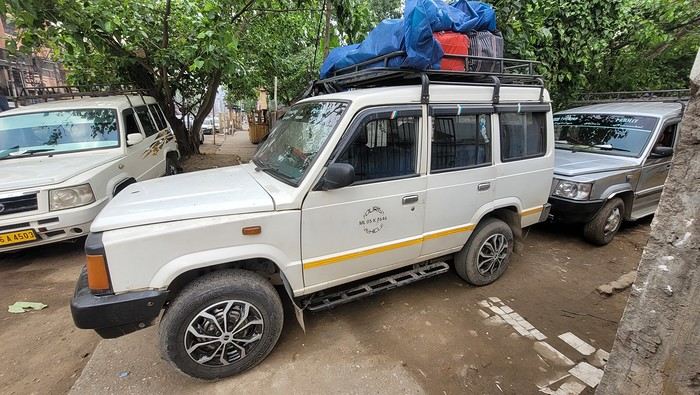
While waiting, I watch the street come to life. I have fun photographing the different modes of transport passing by.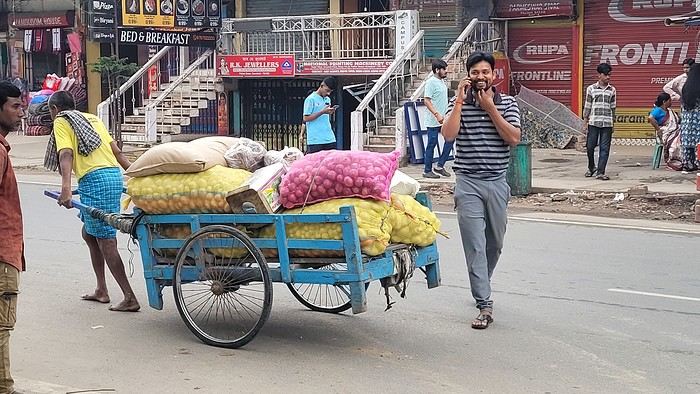
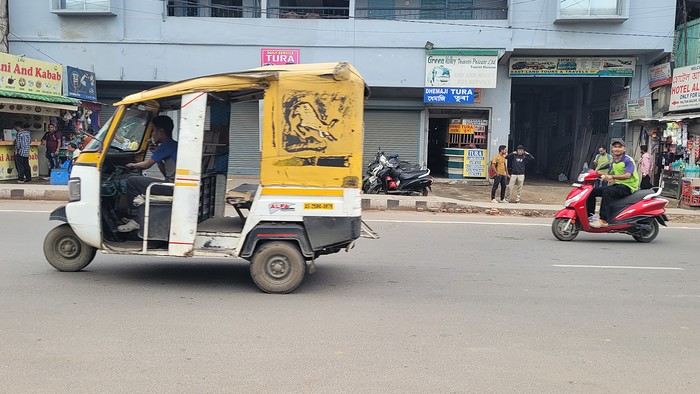
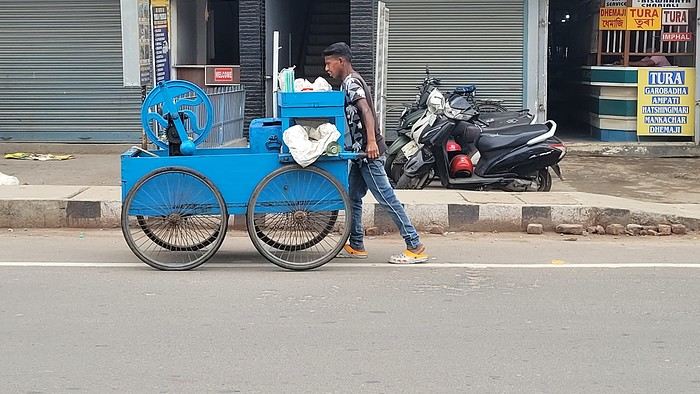
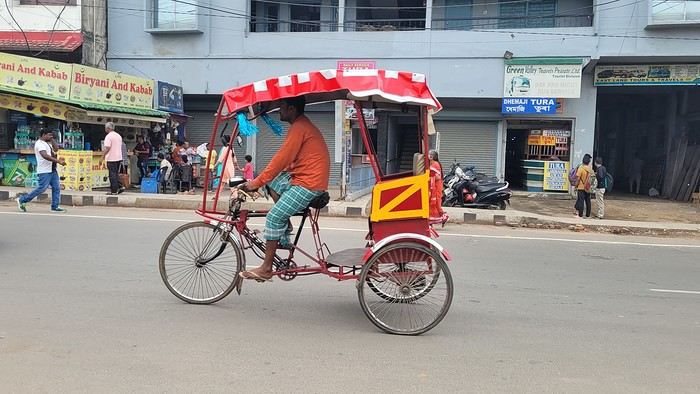
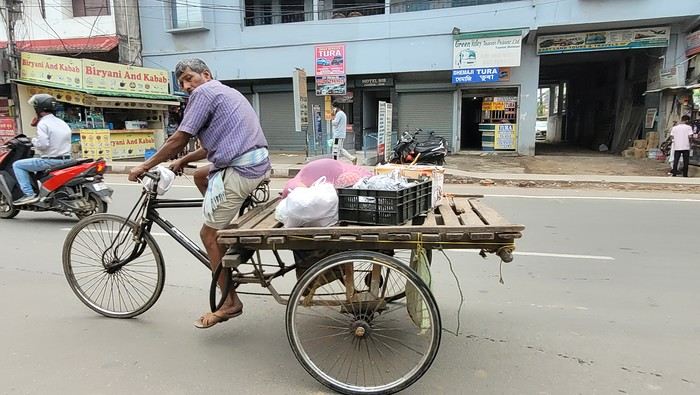
Time passes faster when you’re occupied. We leave at 8:20 AM, and the driver does door-to-door service along the way. We make our first stop for 25 minutes at 9:10 AM, then another for breakfast at 10:10 AM. The scenery is very different from Assam and Nagaland. We drive alongside a pine forest and a large lake. There are beautiful viewpoints, but the driver isn’t stopping for sightseeing, so I have to settle for looking through the car windows.
We finally arrive in Shillong at 11:45 AM. The driver stops in the middle of nowhere, so I have to walk up the street to find a taxi. I flag one down, and he agrees to take me to my new guesthouse, the Rockski Boutique Bed & Breakfast. No sooner do I arrive than a storm with a heavy downpour welcomes me. When I arrived in Guwahati at the end of October, I’d booked a guide with a car for this week. There’s no public transport to get from village to village, so I had to take a car to visit. The tourism manager, Sachin, sent me a message to let me know that the driver, Welbis, will pick me up tomorrow morning at 8 AM. The temperature is much cooler here—only 19°C. At 2:30 PM, the rain stops, and I take the opportunity to explore the city. I start with the cathedral. Today is Good Friday, so I’m going to see how it’s celebrated here. Meghalaya is a Catholic state. The cathedral isn’t far from the guesthouse—it’s huge and all blue.
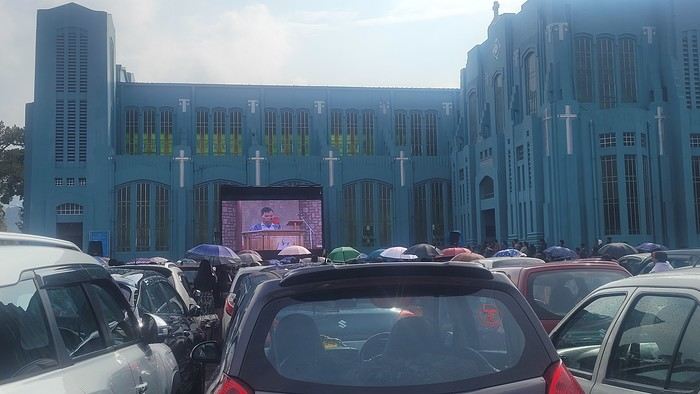
I arrive during mass, and it’s impossible to enter—the faithful are numerous outside in the parking lot. Giant screens broadcast the ceremony.

While waiting, I watch the street come to life. I have fun photographing the different modes of transport passing by.
Time passes faster when you’re occupied. We leave at 8:20 AM, and the driver does door-to-door service along the way. We make our first stop for 25 minutes at 9:10 AM, then another for breakfast at 10:10 AM. The scenery is very different from Assam and Nagaland. We drive alongside a pine forest and a large lake. There are beautiful viewpoints, but the driver isn’t stopping for sightseeing, so I have to settle for looking through the car windows.
We finally arrive in Shillong at 11:45 AM. The driver stops in the middle of nowhere, so I have to walk up the street to find a taxi. I flag one down, and he agrees to take me to my new guesthouse, the Rockski Boutique Bed & Breakfast. No sooner do I arrive than a storm with a heavy downpour welcomes me. When I arrived in Guwahati at the end of October, I’d booked a guide with a car for this week. There’s no public transport to get from village to village, so I had to take a car to visit. The tourism manager, Sachin, sent me a message to let me know that the driver, Welbis, will pick me up tomorrow morning at 8 AM. The temperature is much cooler here—only 19°C. At 2:30 PM, the rain stops, and I take the opportunity to explore the city. I start with the cathedral. Today is Good Friday, so I’m going to see how it’s celebrated here. Meghalaya is a Catholic state. The cathedral isn’t far from the guesthouse—it’s huge and all blue.
I arrive during mass, and it’s impossible to enter—the faithful are numerous outside in the parking lot. Giant screens broadcast the ceremony.