Hi there!
In August, I’m planning a flight with a layover between Las Vegas and Pointe-à-Pitre.
Departure from Las Vegas at 11:50 PM – Arrival in Miami at 7:50 AM
Layover from 7:50 AM to 9:55 AM
Departure from Miami at 9:55 AM, arrival in PTP at 1:10 PM
I’m a bit stressed about the 2h05 layover. What do you think? Is that enough time?
Thanks for your replies!
Marc
892 similar discussions in English
Hello, VoyageForum friends, and happy holidays!
I’m planning a trip with my 19-year-old grandson to Milan for Easter Saturday, Sunday, and Monday in 2025.
I’d love your insights on what we can visit in Milan that would interest both my grandson and me (I’m 75). Of course, I’m thinking of the must-sees, but not just those—cozy little restaurants, trendy neighborhoods, and anything else you’d recommend. I’m also looking for a comfortable hotel in the city center that isn’t too expensive!
I’m sure the VoyageForum community will help me uncover some hidden gems! Looking forward to your replies.
I’m sure the VoyageForum community will help me uncover some hidden gems! Looking forward to your replies.
Hi everyone,
Attached is an itinerary we’d love to do as a couple, and of course, the question is whether it’s doable.
(Hoping you can decipher my handwriting!)
Thanks for your replies and suggestions!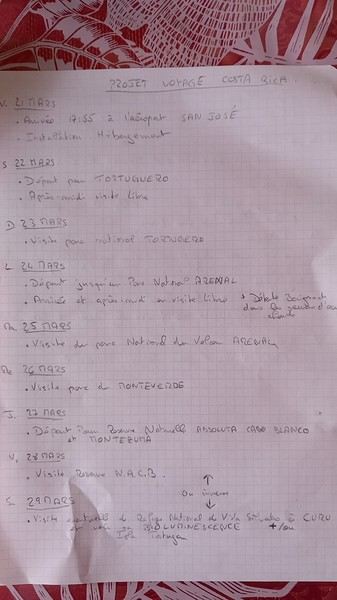
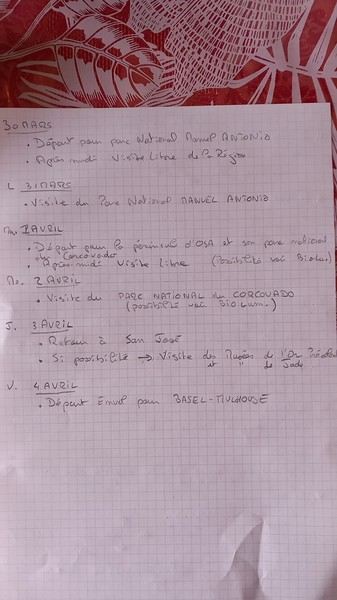
Attached is an itinerary we’d love to do as a couple, and of course, the question is whether it’s doable.
(Hoping you can decipher my handwriting!)
Thanks for your replies and suggestions!
Croatia
October 2024
Hi everyone, I wanted to share our family week in Croatia. Alex and I, with Apolline (6), Olympe (4), and Artémis (18 months).
Itinerary
Planning the itinerary was complicated, but in the end, I wouldn’t change a thing. Since we had a round-trip flight from Dubrovnik, I preferred to prioritize proximity, so we skipped Plitvice, which I’d really love to visit—but that’ll be for next time. We had time to... take our time, and it was really nice.
Day 1: Marseille-Dubrovnik flight. Night in Ston.
Day 2: Visit to Ston and Mali Ston. Ferry to Mljet. Night in Pomena (3 nights total).
Days 3 & 4: Walks in Mljet National Park and swimming.
Day 5: Return ferry. Visit to the Trsteno Arboretum. Night in Dubrovnik (3 nights total).
Day 6: Visit to Dubrovnik’s city walls and Old Town.
Day 7: Lokrum.
Day 8: Morning in Dubrovnik, then Cavtat and overnight flight back to Marseille.
Our visits
Ston area:
Ston village, small but charming. We walked the walls from Ston to Mali Ston. It’s a steep climb, but the views over Ston and then Mali Ston are stunning. Easy return by road, and we visited the fort. Stroller impossible on the walls.
Pratpano Beach before taking the ferry. A beautiful beach and our first swim!
Mljet
Everything is beautiful on Mljet—the villages, landscapes, beaches... There are plenty of hiking and biking trails of varying difficulty. We saw lots of bike rental shops (Pomena, Polače, at the dock for St. Mary’s...), with some bikes equipped with child seats (though no baby trailers). In Pomena, there’s a small national park office that provides maps, sells entry tickets, and gives info on possible routes. The trails are well-marked. The boat to St. Mary’s Island is included in the park entry fee.
On the first day, from Pomena, we were 20 minutes’ walk from the small saltwater lake and the dock for St. Mary’s Monastery. We visited the little island, but the monastery interior was closed. We swam in Malo Jezero Lake (but there are plenty of spots to swim in both lakes).
The next day, we did a big loop starting from Pomena, walking through the forest (with beautiful sea views) to Janik (across from the monastery), then returning along the shore paths for a swim. An easy hike with little elevation—Olympe did it without any problems. The route is clearly marked on the bike trail map from the park office.
On our last day before the 3 PM ferry, we swam and had a picnic on one of Saplunara’s gorgeous sandy beaches—we had the whole place to ourselves!
Trsteno Arboretum (30 minutes from Dubrovnik). A stunning botanical garden overlooking the sea, which we visited in the late afternoon. Stroller accessible.
Dubrovnik:
City walls. Very expensive, but worth it! Lets you see the whole Old Town and the port from above. Stroller impossible.
Old Town: lots of beautiful, narrow alleys where laundry dries between buildings. Stroller possible but not practical. We visited the two monasteries and the cathedral inside but skipped the Rector’s Palace and St. Lawrence Fort.
Lokrum: deserves a full day. A beautiful walk circles the island, alternating between coves, historic buildings, and botanical gardens. We were short on time before the last boat left, but there are plenty of great spots to swim. You can’t do the full loop with a stroller, but I think the main sights near the dock are accessible.
Cavtat: a great surprise—I’d recommend it if, like us, you have a late flight. Just 15 minutes from the airport, it’s a charming seaside village with a lovely waterfront promenade (stroller-friendly), several swimming coves, and a cute center with things to see if you have extra time (museum, mausoleum, church...), plus restaurants, gelato shops, and boutiques...
Even though the girls walked a lot and enjoyed the walks, they *loved* swimming almost every day.
Transportation
Flight with Volotea. 1-hour delay on the way back.
Rental car with Goldcar. Office 100m outside the airport (it’s small, so about a 10-minute walk from arrivals). We were first in line, and luckily so—the employee was alone, and the queue behind us got really long, so budget extra time.
Don’t plan on driving in central Dubrovnik—the parking is outrageously expensive (over 5 €/hour near the walls), so book accommodation with parking and be ready for some walking.
Ferry: punctual. This time of year, we didn’t need to be at the dock more than 30 minutes before departure. Booked online.
Accommodation
I won’t talk about our place in Ston—it wasn’t very comfortable—or the one in Pomena, where we were really poorly received. But both locations were great for sightseeing. In Dubrovnik, we spent 3 nights at Natasa’s Airbnb (Apt Kalea), which was well-equipped, comfortable, and well-located—20 minutes’ walk from the center, with parking, a garden, and... a washing machine. All right across from a supermarket and a great bakery. For those with bigger budgets, the Art Deco Hilton in the center had me dreaming for 3 days!
Food
We didn’t eat out much because of the prices, but when we did, the food was great. The cuisine blends Italian and Slavic influences, so expect amazing seafood dishes, cuttlefish ink risotto, and big mixed grilled meats, not to mention pepper sauce. Despite the price, I’d recommend the restaurant in Mali Ston, *Kapetanova Kuća*. The food was great, and the service was friendly. If you have a late flight like we did, don’t hesitate to eat at the bistro almost across from the airport, *Pod Dubom*—good, affordable menu and a smiling waiter!
A great local picnic specialty: *burek*, a delicious savory pie (meat or cheese) you’ll find in bakeries or supermarkets. Also, good dry sheep’s cheese.
For picnics in Dubrovnik, I’d recommend the pine grove at St. Lawrence Fort or the benches above the port (at the end of Dominika Street). Both have amazing views.
Weather
We had beautiful weather—perfect for swimming *and* hiking. A light sweater for mornings and late afternoons, T-shirt and swimsuit during the day. In this part of Croatia, I’d say it’s comparable to southeastern France, so ideal for a fall break.
Gear
We like taking our stroller (Yoyo) for airport trips, but it wasn’t much use otherwise. If you have to choose, a baby carrier is better—between the cobblestones and hiking trails, it’s often the only way to carry a little one. We have the Deuter Pro hiking carrier, and Artémis loves it. We had high chairs in the few restaurants we went to, but not in our accommodations, so I brought a foldable fabric seat that fits on any chair. We had a crib in Ston and Pomena but not in Dubrovnik—Artémis slept on the floor on a folded duvet.
I invested in a Minimax *cabin-sized* suitcase for Apolline for this trip—she was so proud to have her first rolling suitcase! It turned out to be practical and seems sturdy. It let us take just one checked bag for all five of us for the first time.
Good and bad impressions
The swims in Mljet’s stunning, nearly empty nature.
Unfortunately, we felt unwelcome. The guidebook mentioned that Croatians can be standoffish at first, but we never got past that first impression. The constant feeling of being in the way—even though we weren’t there in peak season—was a bit unsettling. On the way back, I found out everyone I talked to (with or without kids) felt the same. Of course, it’s not universal—some people were polite, even warm (yes, really!).
No major issues, but a few things to note:
The car rental company only accepted debit cards, not credit cards. It was clearly stated in the contract, but I didn’t take it seriously. Luckily, Alexandre had a professional debit card, but *double-check yours before you go*.
For the car, despite the super-low rental price, you’ll have to add fees if you plan to take a ferry (50 to 80 € depending on the agency).
On Mljet, the only supermarket in Pomena was closed. We had to drive 10 minutes to Polače for basics. For diapers, we had to go even farther. I only saw formula for newborns in small supermarkets—maybe you can find more in Dubrovnik or at a pharmacy. I ended up using regular milk for Artémis.
Health
No issues, and no one got sick. We swam in very accessible spots given the girls’ ages, but if you’re eyeing a gorgeous little cove, watch out for sea urchins—we saw a lot!
Portable DVD players for the plane and car, but we barely used them. The girls watched cartoons in English on TV.
Kidizoom cameras.
A few toys for Artémis.
Budget
We found Croatia expensive, and I imagine it’s even worse in summer. For restaurants, sightseeing, and groceries, expect to pay the same as—or more than—in France. On the other hand, flights were low-cost, and accommodations were reasonable. The rental car was almost a steal, even with the extra ferry fees.
Round-trip flight from Marseille: 583 €
Car for 8 days: 56 € (+50 € for ferry fees)
Accommodations (7 nights): 509 €
Sightseeing:
Mljet National Park entry: 15 €/adult for 2 days (boat to St. Mary’s included)
Arboretum: 10 €/adult
Dubrovnik walls: 35 €/adult
Ferry Pratpano-Mljet: 60 € round-trip
I’ve put together this information sheet based on my own experience, feedback from my clients, and reviews from travelers on various travel forums and social media.
I think it’s important to share the reality of these postcard-perfect little islands with their white sandy beaches and palm trees before you set off. That way, you can make the most of your trip to the San Blas Islands, know exactly what to expect, and decide if this destination is right for you.
The San Blas Islands are run by the indigenous Guna people. They have their own rules, and Panamanian law doesn’t really apply. Today, their main income comes from tourism, so please note that foreigners aren’t allowed to operate cabanas there. This means that as soon as you board their small boats, you’re in the hands of the Gunas, and it’ll be tough to complain about delays, logistical issues, or refunds. Wait times can be long, and the Gunas are pretty informal—at first glance, they might even seem unwelcoming. But you have to understand that their culture and way of life are simply different from yours.
You’ll find plenty of tour operators offering day trips or one- or two-night stays on the same islands at different prices. I think all these listings create confusion and uncertainty for travelers. You can book with operators who care about their clients and deal directly with them, while others act only as intermediaries or booking systems between travelers, the Gunas, and transport companies without providing any follow-up during your stay. Don’t forget that all the San Blas Islands are beautiful, and your choice shouldn’t be based on which of the 365 islands is the prettiest, but on the hospitality of the Guna family, the accommodation, and the service they provide. I also recommend avoiding San Blas on weekends and public holidays.
To explain the sometimes "low" level of service mentioned in traveler reviews, you need to understand that the San Blas Islands are very basic and rustic—that’s also the charm of the experience, which, for some of you, will push you out of your comfort zone. Not all huts have electricity, or even light. If you want to charge your phone, ask the island owner, who might charge you a small fee. Needless to say, WiFi isn’t available on all islands.
Not all Gunas working there have studied hospitality management, logistics, gastronomy, or tourism. There’s been a big "boom" in the last 10 years, and they haven’t been trained for it.
Regarding the 4x4 road transport, expect to be a bit cramped since the car can fit 6 passengers. Also, you might face delays, or the car might already be waiting for you because the pickup route can change, and sometimes other passengers are late, causing delays. To avoid this, I recommend paying extra for private transport—it’ll make your trip smoother and save you frustration before arriving in San Blas, as well as on your return to Panama City, which can sometimes be chaotic.
Stay flexible! Expect delays, lack of communication, waiting for someone or something without knowing why, rustic cabanas, no fish but pasta instead (yes! sometimes the fish season is low!), fried eggs and bread for breakfast—but in the end, everything works out if you can accept these little inconveniences. Just enjoy the adventure!
Finally, the San Blas Islands have a waste collection problem, so you might see trash on the islands, especially during the summer season due to strong currents. Most of the waste comes from the sea and the mainland. For the sake of the island, please take your trash with you.
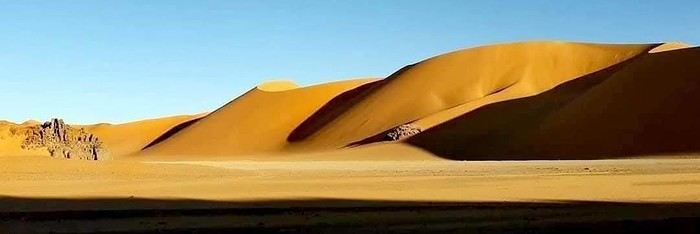 Where to go in 2025?
How about Algeria and a return to the Tassili n’Ajjer? This part of the Sahara is arguably one of the most beautiful deserts on the planet for its diversity and is accessible to everyone.
The vastness of the black rock forests and ochre dunes is complemented by the intimacy of the Djanet oasis, the heart of the Tuareg country, and the mineral memory of the Erg Admer, which bears traces of prehistoric human activity. Camping under the Milky Way, suspended in a sky of forgotten purity, adds another dimension to this rare journey.
Hello everyone! 🙂
So many silent months, and now Voyage Forum is accessible again. That’s cool because we can pick up our discussions for our mutual enjoyment.
I hope everyone is doing well and that you’ve been able to take some great trips, whether to the USA or elsewhere.
In September 2020, we had planned a round trip to explore Colorado, but unfortunately, a nasty virus messed up our plans, closing borders and keeping us stuck at home. Luckily for us, canceling the car, flights, and accommodations didn’t cost us a thing—everything was refunded.
In 2023, a loop from Las Vegas let us revisit places we’d seen in 2017 and discover new ones, this time spending more time at each stop with some lovely hikes.
In 2024, we finally revisited the 2020 plan, and I’ll start with that.
However, unforeseen circumstances mean I have much less time than before, so I’ll keep my trip reports shorter (ha ha ha—you’ll have less of my prose to endure).
Another change: for those who remember the "Gang of Four crazy sixty-somethings," it was just DD and me this time. Our dear Mimi and Maumau left the Var to focus on raising horses and can’t leave their little green paradise to join us anymore. We were unfortunately much tamer without them.
We traveled from September 11 to October 3.
The itinerary
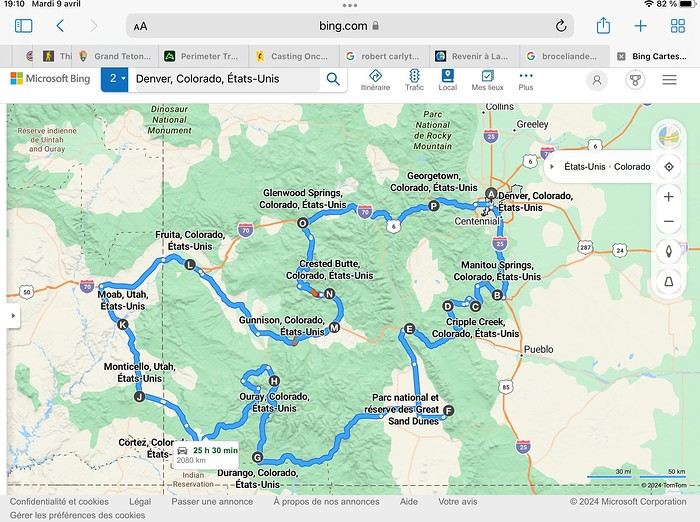
Day 1: Flight Marseille-Paris-Denver, then Manitou Springs (133 km) Day 2: Manitou Springs (49 km) Day 3: Cripple Creek (104 km) Day 4: Salida (254 km) Day 5: Great Sand Dunes (231 km) Day 6: Durango (283 km) Day 7: Durango (Durango-Silverton train) Day 8: Ouray (121 km) Day 9: Ouray (Perimeter Trail hike) Day 10: Cortez (213 km) Day 11: Cortez (Mesa Verde National Park, 134 km) Day 12: Monticello (268 km, detour to Chesler Park) Day 13: Moab (171 km, Delicate Arch) Day 14: Moab (98 km, Fisher Towers) Day 15: Moab (171 km, Canyonlands) Day 16: Fruita (210 km, Colorado National Monument) Day 17: Crested Butte (224 km via Kebler Pass) Day 18: Crested Butte (57 km) Day 19: Glenwood Springs (150 km) Day 20: Glenwood Springs (118 km, Rifle State Park) Day 21: Georgetown (258 km via Independence Pass) Day 22: Denver (123 km), then return flight
We speak very little English. We spent 21 nights there and covered a 3,400 km loop by car and 160 km on foot (we’re still trying to hike while we’re in shape) from Denver in September 2024. We wanted this road trip to help us explore Colorado a bit more—we’d only spent 6 nights there in 2019—and to see it during the fall foliage season. We also wanted to return to Utah (we love Moab) to enjoy its red rocks, which we adore.
In the prices you see (some in euros, others in dollars), I’ve included bank fees and exchange charges. The flights, car, and parking were paid by credit card when we booked in February. Usually, we book around November, but some obligations kept us from doing it earlier. We downloaded the MPC (Mobile Passport Control) app on our phone, which saved us time at immigration.
📊 **Budget: just under 8,500 € for both of us, all included**
📊 **Flights** Marseille-Paris (CDG)-Denver: 2,152 € for both of us, with one checked bag each
📊 **ESTA and America the Beautiful Pass** The ones from our 2023 road trip were still valid
📊 **Parking at Marseille airport: 122 €**
📊 **Car: Nissan Rogue (the French X-Trail) from Hertz: 1,165 €** By booking through Air France (and earning miles), we got a 15% discount. Hertz offers a free Hertz Gold Plus Rewards program, which gives us priority counter service.
📊 **Accommodation: 3,050 €** We stayed in motels and hotels of various ranges (from 100 € to 270 € per night, depending on the city), all booked through Hotels.com or Booking. Booking sometimes offers cheaper rates if you book via the "Booking mobile" app. We also got some preferential rates thanks to our Genius 2 status. Out of 21 nights, only one place didn’t include breakfast.
📊 **Other expenses (activities booked by credit card before leaving)** Durango-Silverton train: 210 € (we booked the enclosed vintage coach in March) Mesa Verde: Balcony House: 15.15 € (booked 14 days before the visit) Timed-entry passes for Arches National Park: 6 € for 3 days (booked June 1 for September entries via http://récreation.gov/). We booked three different days to play with the weather.
📊 **Supplementary insurance with AVA: 204 €** (due to our age 😅 and the high cost of medical consultations in the USA)
📊 **Cash: 1,540 €** We left with 1,000 € exchanged before departure and made two withdrawals (500 $ and 200 $). This cash was used to pay for: - Evening restaurants and tips (between 70 $ and 95 $ for two meals and two drinks) - Two state parks: Dead Horse State Park (20 $) and Rifle State Park (10 $) - The Monarch Pass gondola (24 $) - Midday picnics - Gas (slightly cheaper with cash): 204 $ for 3,400 km - Personal souvenirs and little treats.
Like in our previous road trips, we didn’t rent a GPS. We used the offline GPS app Here We Go, for which we’d downloaded maps of Colorado and Utah from France, as well as a new offline app called Organic Maps as a backup—though we didn’t end up needing it.
❤️❤️❤️ **Highlights (there are so many!)** 📍 The stunning landscapes of Colorado, especially with the fall colors 📍 A step back in time at the old farm in Florissant Fossil Beds National Monument 📍 The prairies of Cripple Creek and the mining remnants of the Vindicator Trail 📍 The cheeky chipmunks in the ghost town of St. Elmo 📍 Great Sand Dunes and its soft sand 📍 The steam train between Durango and Silverton: we’re glad we chose the round-trip because it rained heavily on the way there, but we got to enjoy the scenery on the way back when the sun came out 📍 The unexpected meet-up with Michèle from the group outside a restaurant in Durango 📍 The hot springs in Ouray 📍 Mesa Verde and its still-vibrant past 📍 The red rocks of Moab and Delicate Arch at sunset 📍 The lace-like Fisher Towers and the view from the end of the trail 📍 The gorgeous Route 128 leading to Colorado National Monument—small, easy to visit, and so beautiful 📍 The colors of the fabulous Kebler Pass, Crested Butte, and especially the hike through the golden aspens (Lower and Upper Loop) 📍 The waterfalls at Rifle State Park 📍 The tundra of Independence Pass 📍 The Halloween decorations in Georgetown and Idaho Springs
😞😞 **Flops (there are very few!)** 📍 The viewpoints we missed because they weren’t well-marked or we didn’t see the signs 📍 The closure of some hiking trails (Hanging Lake and parts of Canyonlands) and the Sal Mountain Loop road, which kept us from accessing it 📍😢 The Chesler Park hike we had to cut short due to poor time management—180 km between our stop in Cortez meant we didn’t arrive until 10:30 AM, way too late for a 17 km hike.
Hope this helps! Have a great evening, everyone, and see you soon! 😊
The itinerary
Day 1: Flight Marseille-Paris-Denver, then Manitou Springs (133 km) Day 2: Manitou Springs (49 km) Day 3: Cripple Creek (104 km) Day 4: Salida (254 km) Day 5: Great Sand Dunes (231 km) Day 6: Durango (283 km) Day 7: Durango (Durango-Silverton train) Day 8: Ouray (121 km) Day 9: Ouray (Perimeter Trail hike) Day 10: Cortez (213 km) Day 11: Cortez (Mesa Verde National Park, 134 km) Day 12: Monticello (268 km, detour to Chesler Park) Day 13: Moab (171 km, Delicate Arch) Day 14: Moab (98 km, Fisher Towers) Day 15: Moab (171 km, Canyonlands) Day 16: Fruita (210 km, Colorado National Monument) Day 17: Crested Butte (224 km via Kebler Pass) Day 18: Crested Butte (57 km) Day 19: Glenwood Springs (150 km) Day 20: Glenwood Springs (118 km, Rifle State Park) Day 21: Georgetown (258 km via Independence Pass) Day 22: Denver (123 km), then return flight
We speak very little English. We spent 21 nights there and covered a 3,400 km loop by car and 160 km on foot (we’re still trying to hike while we’re in shape) from Denver in September 2024. We wanted this road trip to help us explore Colorado a bit more—we’d only spent 6 nights there in 2019—and to see it during the fall foliage season. We also wanted to return to Utah (we love Moab) to enjoy its red rocks, which we adore.
In the prices you see (some in euros, others in dollars), I’ve included bank fees and exchange charges. The flights, car, and parking were paid by credit card when we booked in February. Usually, we book around November, but some obligations kept us from doing it earlier. We downloaded the MPC (Mobile Passport Control) app on our phone, which saved us time at immigration.
📊 **Budget: just under 8,500 € for both of us, all included**
📊 **Flights** Marseille-Paris (CDG)-Denver: 2,152 € for both of us, with one checked bag each
📊 **ESTA and America the Beautiful Pass** The ones from our 2023 road trip were still valid
📊 **Parking at Marseille airport: 122 €**
📊 **Car: Nissan Rogue (the French X-Trail) from Hertz: 1,165 €** By booking through Air France (and earning miles), we got a 15% discount. Hertz offers a free Hertz Gold Plus Rewards program, which gives us priority counter service.
📊 **Accommodation: 3,050 €** We stayed in motels and hotels of various ranges (from 100 € to 270 € per night, depending on the city), all booked through Hotels.com or Booking. Booking sometimes offers cheaper rates if you book via the "Booking mobile" app. We also got some preferential rates thanks to our Genius 2 status. Out of 21 nights, only one place didn’t include breakfast.
📊 **Other expenses (activities booked by credit card before leaving)** Durango-Silverton train: 210 € (we booked the enclosed vintage coach in March) Mesa Verde: Balcony House: 15.15 € (booked 14 days before the visit) Timed-entry passes for Arches National Park: 6 € for 3 days (booked June 1 for September entries via http://récreation.gov/). We booked three different days to play with the weather.
📊 **Supplementary insurance with AVA: 204 €** (due to our age 😅 and the high cost of medical consultations in the USA)
📊 **Cash: 1,540 €** We left with 1,000 € exchanged before departure and made two withdrawals (500 $ and 200 $). This cash was used to pay for: - Evening restaurants and tips (between 70 $ and 95 $ for two meals and two drinks) - Two state parks: Dead Horse State Park (20 $) and Rifle State Park (10 $) - The Monarch Pass gondola (24 $) - Midday picnics - Gas (slightly cheaper with cash): 204 $ for 3,400 km - Personal souvenirs and little treats.
Like in our previous road trips, we didn’t rent a GPS. We used the offline GPS app Here We Go, for which we’d downloaded maps of Colorado and Utah from France, as well as a new offline app called Organic Maps as a backup—though we didn’t end up needing it.
❤️❤️❤️ **Highlights (there are so many!)** 📍 The stunning landscapes of Colorado, especially with the fall colors 📍 A step back in time at the old farm in Florissant Fossil Beds National Monument 📍 The prairies of Cripple Creek and the mining remnants of the Vindicator Trail 📍 The cheeky chipmunks in the ghost town of St. Elmo 📍 Great Sand Dunes and its soft sand 📍 The steam train between Durango and Silverton: we’re glad we chose the round-trip because it rained heavily on the way there, but we got to enjoy the scenery on the way back when the sun came out 📍 The unexpected meet-up with Michèle from the group outside a restaurant in Durango 📍 The hot springs in Ouray 📍 Mesa Verde and its still-vibrant past 📍 The red rocks of Moab and Delicate Arch at sunset 📍 The lace-like Fisher Towers and the view from the end of the trail 📍 The gorgeous Route 128 leading to Colorado National Monument—small, easy to visit, and so beautiful 📍 The colors of the fabulous Kebler Pass, Crested Butte, and especially the hike through the golden aspens (Lower and Upper Loop) 📍 The waterfalls at Rifle State Park 📍 The tundra of Independence Pass 📍 The Halloween decorations in Georgetown and Idaho Springs
😞😞 **Flops (there are very few!)** 📍 The viewpoints we missed because they weren’t well-marked or we didn’t see the signs 📍 The closure of some hiking trails (Hanging Lake and parts of Canyonlands) and the Sal Mountain Loop road, which kept us from accessing it 📍😢 The Chesler Park hike we had to cut short due to poor time management—180 km between our stop in Cortez meant we didn’t arrive until 10:30 AM, way too late for a 17 km hike.
Hope this helps! Have a great evening, everyone, and see you soon! 😊
Hi there,
For my upcoming trip to Thailand, I’ve narrowed it down to Emirates and Air India and would love to hear recent feedback from members who’ve flown with them.
I’ve noticed on several sites that reviews for both airlines are pretty negative. I’m not surprised about Air India, but I read they’ve been acquired.
I flew Emirates twice in 2018 and was surprised by the drop in recent reviews. It almost makes me think of Etihad, which I initially liked but then declined (I’m not sure what their situation is like now).
Here’s a little story about my first trip to Japan with my partner.
We went for our first visit from October 29 to November 13, 2024.
I had planned this entire trip back in November 2020, but given the health situation at the time, I had to cancel...
Here’s the classic route we took: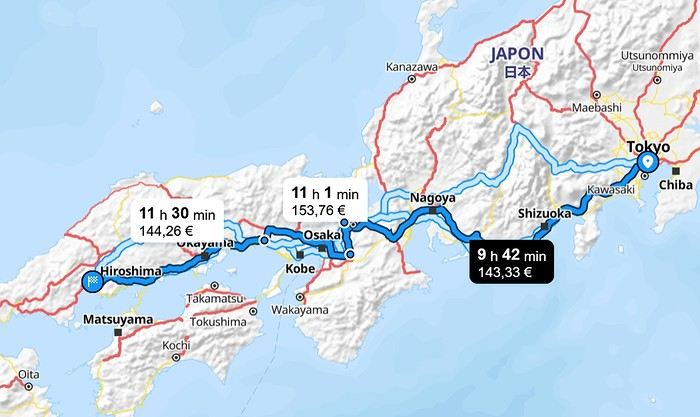
We booked everything ourselves and got a regional pass for the area from Kyoto to Hiroshima. The hotels were reserved 3 months in advance on Book... and Agod... (1030 € for 2 people for 13 nights = 80 €/night). For the flight, we chose a Qatar Airways flight with a layover to break up the long journey (950 € per person). We also got a pass on the same site (Japan-Experience) to take the train connecting Narita Airport to Shibuya Station (the N'EX Narita Express). Since the airport is 75 km from central Tokyo, we opted for this mode of transport, even though there are cheaper alternatives. After reading various posts on VoyageForum, I understood how important it was to have a Welcome Suica card to pay for public transport (subway, tram, bus, boat throughout the country), and we were able to buy one at Narita Airport. It turned out to be super useful! After a long but smooth journey, we found ourselves at Narita Airport in the evening. Even though we had a pass for the Narita Express, we had to go to a counter to make a reservation for the train (mandatory). Then, once we arrived at Shibuya Station, we took the subway for 2 stops and finally reached our hotel, exhausted (Hotel Asia Center of Japan – 270 € for 3 nights with breakfast included).
I had planned this entire trip back in November 2020, but given the health situation at the time, I had to cancel...
Here’s the classic route we took:
We booked everything ourselves and got a regional pass for the area from Kyoto to Hiroshima. The hotels were reserved 3 months in advance on Book... and Agod... (1030 € for 2 people for 13 nights = 80 €/night). For the flight, we chose a Qatar Airways flight with a layover to break up the long journey (950 € per person). We also got a pass on the same site (Japan-Experience) to take the train connecting Narita Airport to Shibuya Station (the N'EX Narita Express). Since the airport is 75 km from central Tokyo, we opted for this mode of transport, even though there are cheaper alternatives. After reading various posts on VoyageForum, I understood how important it was to have a Welcome Suica card to pay for public transport (subway, tram, bus, boat throughout the country), and we were able to buy one at Narita Airport. It turned out to be super useful! After a long but smooth journey, we found ourselves at Narita Airport in the evening. Even though we had a pass for the Narita Express, we had to go to a counter to make a reservation for the train (mandatory). Then, once we arrived at Shibuya Station, we took the subway for 2 stops and finally reached our hotel, exhausted (Hotel Asia Center of Japan – 270 € for 3 nights with breakfast included).
Hi there,
We’re supposed to fly in four days—my partner, our two kids, and me—for a one-month trip to Cambodia. While applying for an e-visa, we just realized that both our passports won’t be valid for 6 months after our stay ends, which is a key requirement for getting a Cambodian visa. I don’t know how, but we totally missed this info!! Our tickets aren’t refundable, and we’ve booked several non-refundable hotels there too...
Has anyone been in this situation or have any ideas or solutions?
Thanks so much in advance!!!!
Good evening everyone.
I’m so glad VoyageForum is back up and running.
This forum has helped me plan so many trips thanks to all your contributions.
So, I’m turning to you for advice on a trip I’m planning for March 2025, from the 7th to the 21st.
I was thinking of a classic itinerary:
Arrival in Delhi at 12:05 AM on Saturday, then taking a train in the afternoon to Agra.
2 nights in Agra
2 nights in Jaipur
2 nights in Pushkar
2 nights in Jodhpur
3 nights in Udaipur
Then flying back to Delhi.
The trip would mostly be by train (which we love) and bus.
However, after reading various travelers’ comments, some cities seem less interesting, while others I hadn’t included—like Bundi and Jaisalmer—are catching my eye. But traveling by train and bus, I’m worried it might get really complicated.
I’m not sure how to organize my stay anymore, especially since we love nature and peace and quiet… and I’m afraid of too much hassle if everything isn’t planned.
Also, how can I book trains and buses in advance from France?
Thanks in advance for your help.
Magali
Our trip to Norway was two years ago already, but I thought it might still be of interest—and it’ll let me relive it a bit by proxy.
Before booking our flight tickets, we debated the route: should we prioritize the north with the Lofoten and Senja islands, or the south with its countless fjords? I was tempted to stay in the south—the country is so vast, and the drive north is long... but my husband really didn’t want to miss the Lofoten. In the end, we figured that since Norway is known for being expensive, we might only visit once (funny how we said the same thing before our first trip to the American West, and look how that turned out 😎), so we didn’t want to skip anything. That meant a 2–3 day drive up north. With 22 days on the ground, it was doable. Especially since, as usual, we skip big cities and gave Oslo a pass.
Practical details: - Flight tickets: 1195 € for 4 with Air France (Paris–Oslo outbound, Tromsø–Bergen–Paris return) - Car rental: 2020 € for 21 days (including the outrageous drop-off fee between Oslo and Tromsø—about 1000 €) - Tolls and ferries: 250 € for the portion billed directly by the rental company. Some ferries required advance booking and payment at the time of reservation—I’ll note their prices as I go through the story. - Hotels: 4135 €, averaging 188 € per night. We blew past our usual budgets from trips to the U.S., but oh well... - Food: 1570 €, averaging 71 € per day for 4 in a country where everything’s expensive... How’d we manage? We rarely ate out, mostly grocery shopped, and even packed half a suitcase with non-perishables: pasta, rice, a few cans, and even some cured sausage! We also stayed 3 nights at Clarion Collection hotels, where an evening buffet was included in the room rate.
What we commonly call "Halong Bay" is actually made up of three bays. From south to north:
- The small Lan Ha Bay, south and east of Cat Ba Island, inaccessible to large cruise junks because the channels aren’t deep enough for big boats—so it’s more intimate and, above all, cleaner;
- Halong Bay itself, north of Cat Ba, also very beautiful but crowded with tourists since it can accommodate large boats (up to 35 cabins), making it very dirty due to many Asian tourists—except for the Japanese—who throw everything into the water: cigarette butts, bags, empty cans, etc.; - The large Bai Tu Long Bay, north of Halong Bay, characterized by larger islands with beautiful beaches and fewer tourists since it ideally takes 3 days to explore all three bays. PRIORITIZE LAN HA BAY FOR 2 DAYS AND BAI TU LONG BAY FOR THREE. Some travelers want to visit the bay in just one day. Strongly discouraged ! In fact, you need to allow 7 to 8 hours for the round trip between Hanoi and the bay; adding boarding time, you’ll only spend a few hours on a boat and barely scratch the surface of the bay. Plus, one of the most magical moments of the cruise is waking up in the morning surrounded by limestone karsts. Two days/1 night on a junk is the minimum to enjoy the enchanting landscapes. AVOID cheap junks! There’s no secret: cheap = limited comfort, laughable food, and service that’s barely acceptable. Never forget this is a unique site in the world, so it’s worth visiting under the best conditions. Don’t confuse Halong Bay with the "terrestrial Halong Bay" in Ninh Binh (Tam Coc). The first is 110 km north of Hanoi, the second 100 km south, right in the Red River Delta. Both are magnificent, and it’s now possible to take a direct bus from one to the other. To visit the bays, you have two options: - Travel to Cat Ba Island or Halong City on your own and book a junk on-site. We don’t recommend this, as there are many issues—especially overcharging for foreign tourists in ground transport and shortened cruises, not to mention you don’t speak Vietnamese. You’ll end up paying at least the same price as through a Hanoi agency, likely more, since you’re at high risk of being ripped off. - Book an organized tour in Hanoi with a good agency. Given the complexity of traveling from Hanoi to Halong and renting a junk on-site, this is by far the easiest option, with countless possibilities—from private junks (more expensive but with huge advantages) to luxury, superior, and standard group junks. Benefits: with a good agency, you’ll have a hassle-free cruise with no scams, and everything is included in the price: round-trip transfers from your hotel to the boat, guide, junk, all meals, site entries, kayaking, etc.
When it comes to choosing a junk, there are also two options: A private junk is by far the best for many reasons: - You’re the only passengers on board - Smaller than group junks, a private junk can navigate channels inaccessible to large boats and stop at small beaches also off-limits to big vessels - Private junks can anchor wherever the captain chooses, so in a quiet little bay, whereas all large junks are required to spend the night in the same big bay by local police order - Better service and food Of course, these advantages come at a cost—but after all, Halong is a once-in-a-lifetime trip! For luxury private junks, I recommend Bhaya Cruises and Indochina Junks. For superior, one of the best is Oriental Sun (2 cabins/2 bathrooms), owned by the excellent agency Oriental Bridge Travel. Also excellent are the two Dai Duong junks—the 02 with 2 cabins and the 03 with 3.
Group junks range from Deluxe to Superior. Choose a medium-sized junk (8-12 cabins). Among the Deluxe, Bhaya Cruises and Indochina Junks are flawless. For Budget, the superior Swan, Cozy Boutique, and Ocean 7 are great.
Warning: While group junks can be booked once in Hanoi (except during peak season), private junks must be reserved well in advance, especially in high season.
To make your choice and booking easier, the best is to contact Oriental Bridge Travel, which, unlike other agencies that offer every junk imaginable (from the best to the worst), has carefully selected 2 or 3 in each category. Check their website and, in the menu, click all the "Halong" links from "Luxury Private Junks" to "Superior Group Junks."
TRANSPORT TO HALONG BAY
Cruise prices include round-trip transfers between Hanoi and Cat Ba City or Hon Gai. If you want to go to Halong on your own, there are three departure ports for cruises: Cat Ba Island (especially for Lan Ha Bay), Halong City/Bai Chay port (Lan Ha, Halong, and Bai Tu Long), and Cai Rong, which serves only Bai Tu Long Bay. From Hanoi: To Cat Ba, take the Hanoi-Haiphong bus and the Haiphong-Cat Ba speedboat (3-hour journey). This is the fastest option since the boat arrives directly in Cat Ba City. Buy a combined ticket for Hanoi-Haiphong + Haiphong-Cat Ba speedboat. For Halong City, there are frequent direct buses. From other cities: Direct buses from Haiphong or Cat Ba City to Ninh Binh and Sapa. WHERE TO STAY IN CAT BA? If you spend a night in Cat Ba (not essential), there are more and more hotels. Here are the ones I liked among those I’ve visited: 2-star: Cat Ba Dream Impeccable, with a large terrace overlooking Cat Ba Bay, and unbeatable prices: $15-20 for a single/double/twin, $30 for a large triple. The owner is a great cook. 3-star: Hung Long Harbour Brand new and spotless, overlooking Cat Ba Bay. Ask for rooms with a balcony (the suites have very large terraces). Great value for the quality! Single/double: Standard 65 $, Deluxe 80 $, Suite 100 $, extra person: 30 $ There are also several bungalow hotels on the beach: on Monkey Island (3 km from Cat Ba City), the Cat Ba Monkey Island Resort; another on a different island 5 km south of Cat Ba City, the Cat Ba Ocean Beach Resort; and a third, the Cat Ba Beach Resort. In the mountains inside the island, you can stay at the Cat Ba Suoi Goi Resort and the Cat Ba Whisper Bungalows. RESTAURANTS In Cat Ba City, I’ve tried quite a few restaurants—more bad than good. Two excellent floating restaurants in Cat Beo, especially the one on the left. WHAT TO DO? Beyond cruises, there are some interesting sites to visit on the island: · Visit the Cannon Fort: No one goes there, and everyone’s wrong! It’s not far, just behind Cat Ba City on Nui Ngoc Road, the street leading to Cat Beo. You climb to 177 m altitude at the top of a hill with a superb panoramic view of Halong and Lan An Bays. In 1942, the French installed an artillery fort with three 137 mm cannons controlling the passages in the bay; two remain, along with the casemates. It later became an anti-aircraft post during the Vietnam War. Unfortunately, the last time I went, the road was blocked. Still worth a try—great views from the climb. Entry: 50,000 dong, and it’s worth it! · The national park: It covers three-quarters of the island. You can simply stroll or go trekking, especially the 15 km to Viet Hai village. No animals in sight. Just before the park entrance, visit the Viet Hospital, a series of caves remarkably set up as a hospital during the Vietnam War (there was even a natural pool and a cinema room). · The beaches (Cat Cô): The three beautiful beaches in coves at the southern end of Cat Ba City’s esplanade are taken—the first by a children’s water park and the other two by a huge hotel complex.
Good evening. I hope you're all doing well. Sorry in advance—my message will be a bit long, and sorry for any spelling mistakes.
So, here's the thing: I booked a flight ticket through an intermediary to go to Réunion from November 29th to December 16th. This evening, I was checking the dates and times of my flight, and—WHAT A NASTY SURPRISE!!
My outbound ticket is correct—no issues, the day and time match perfectly. But there’s NO flight at the time listed on my return ticket!!! I thought it must be a glitch. I refreshed the page several times, cleared my history, and even searched on other sites and in private browsing.
But it’s still the same—no flight on December 16th leaves at the time shown on my ticket. I went back to the intermediary’s site, then checked the airline’s website, and I had the idea to try December 15th for the departure—and BINGO! The return flight time, the airline, the type of plane—everything matches.
I realized then that the site that sold me the ticket made a mistake on the return date. I don’t know what to do because I can’t get anyone on the phone.
Since the error is on their end, are they obligated to change my flight to December 15th, or do I have to pay for a new ticket?
If I ask them to put me on another flight on the 16th, will I have to pay fees or not?
I’m completely lost and pretty upset, so if you have any answers to my questions, I’d really appreciate it. Thanks in advance!
Assalamu 'alaykum,
Hi everyone,
This thread is to echo some posts I’ve read on this forum while researching a potential bike trip from Annecy to Mecca. I came across several discussions where members mentioned being very interested in cycling to the holy city.
So, God willing, I plan to attempt this journey from January to June next year. The idea is to head to Turkey first, then assess the most reasonable routes based on the geopolitical situation around Palestine and as far as Iraq. Since the Turkish-Syrian border is closed, the only remaining (and I mean *only* remaining) overland option would be to go through Iraqi Kurdistan, Iraq, then Jordan, and finally Saudi Arabia.
That’s the first major challenge of this project. The second is timing. Due to the schedule, I’ll be starting in the middle of winter across Europe and finishing in the peak of summer in Saudi Arabia. If I’d had a choice, I’d have waited a good dozen years—but well, twelve years...
I won’t go into too much detail about the planned route in this post, but here are the broad strokes already set: Annecy to Istanbul. The rest is a bit too far ahead to map out properly. Crossing the Italian border via the Montgenèvre Pass. Straight through northern Italy as quickly as possible (not necessarily very pleasant) to reach Ljubljana. The fastest route through Croatia to spend as much time as possible in Bosnia-Herzegovina. Serbia via the Sandžak region. It crosses the Pešter plateau, which intimidates me at this time of year—its nickname, the "Siberia of the Balkans," says it all... Then Kosovo, North Macedonia, Greece, and Turkey.
I’m open to any advice on this itinerary. The choice was made to pass through as many Muslim-majority regions as possible. In the middle of winter in the Balkans, I don’t feel mentally up to bivouacking alone in that climate. So, I’ll try to find accommodations in mosques or even with locals as much as possible.
That’s the project in a nutshell. The big catch—some of you may have already noticed—is that I’m doing this solo. Yet, this is strongly discouraged by our Prophet—peace and blessings of Allah be upon him. So, I invite anyone interested in joining this project, whether closely or from afar, to reach out and contact me. Any contribution is welcome, whether it’s company for the whole journey (one can always hope!) or just part of it. Advice, contact suggestions, places to stay, and information about Hajj or Umrah are also appreciated.
Thanks for reading this far. I’ll try to check my VoyageForum account from time to time to see if anyone has responded to this thread and will happily reply to your messages and questions.
Take care, Assalamu'alaykum.
Sam
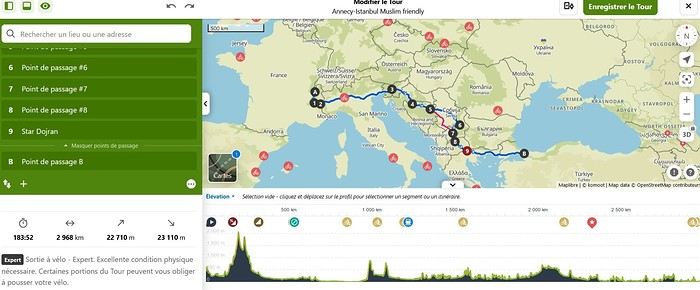
This thread is to echo some posts I’ve read on this forum while researching a potential bike trip from Annecy to Mecca. I came across several discussions where members mentioned being very interested in cycling to the holy city.
So, God willing, I plan to attempt this journey from January to June next year. The idea is to head to Turkey first, then assess the most reasonable routes based on the geopolitical situation around Palestine and as far as Iraq. Since the Turkish-Syrian border is closed, the only remaining (and I mean *only* remaining) overland option would be to go through Iraqi Kurdistan, Iraq, then Jordan, and finally Saudi Arabia.
That’s the first major challenge of this project. The second is timing. Due to the schedule, I’ll be starting in the middle of winter across Europe and finishing in the peak of summer in Saudi Arabia. If I’d had a choice, I’d have waited a good dozen years—but well, twelve years...
I won’t go into too much detail about the planned route in this post, but here are the broad strokes already set: Annecy to Istanbul. The rest is a bit too far ahead to map out properly. Crossing the Italian border via the Montgenèvre Pass. Straight through northern Italy as quickly as possible (not necessarily very pleasant) to reach Ljubljana. The fastest route through Croatia to spend as much time as possible in Bosnia-Herzegovina. Serbia via the Sandžak region. It crosses the Pešter plateau, which intimidates me at this time of year—its nickname, the "Siberia of the Balkans," says it all... Then Kosovo, North Macedonia, Greece, and Turkey.
I’m open to any advice on this itinerary. The choice was made to pass through as many Muslim-majority regions as possible. In the middle of winter in the Balkans, I don’t feel mentally up to bivouacking alone in that climate. So, I’ll try to find accommodations in mosques or even with locals as much as possible.
That’s the project in a nutshell. The big catch—some of you may have already noticed—is that I’m doing this solo. Yet, this is strongly discouraged by our Prophet—peace and blessings of Allah be upon him. So, I invite anyone interested in joining this project, whether closely or from afar, to reach out and contact me. Any contribution is welcome, whether it’s company for the whole journey (one can always hope!) or just part of it. Advice, contact suggestions, places to stay, and information about Hajj or Umrah are also appreciated.
Thanks for reading this far. I’ll try to check my VoyageForum account from time to time to see if anyone has responded to this thread and will happily reply to your messages and questions.
Take care, Assalamu'alaykum.
Sam
Hello everyone!
So glad to be back on this forum to swap some great tips.
I’m heading to Malaysia from mid-May to mid-August 2025 for nearly 3 months.
With my advanced certification in hand for a few years now, I’m on the lookout for the best dive spots in Malaysia.
I’ve obviously heard about the Perhentians and Sipadan.
Someone mentioned Tioman too, but not necessarily for diving.
Do you have any feedback on these places for diving? (visibility, marine life diversity, etc.)
Any idea about the rates for fun dives?
Dive centers you’d recommend?
Any help would be super valuable for planning the trip, so thanks a million in advance to those who take the time to reply.
Safe travels, everyone!!
I'm currently exploring how to create a travel itinerary using AI, specifically ChatGPT.
Question: Bike route from Bordeaux to Paris.
Rough response:
A bike route between Bordeaux and Paris is an incredible adventure, typically around 600 to 650 km depending on the chosen path. Here’s an example of an itinerary with key points:Main Option: La Scandibérique (EuroVelo 3) La Scandibérique is the French section of EuroVelo 3, connecting Bordeaux to Paris through stunning landscapes. This route is well-marked and takes you through small roads and greenways.Main Stages
Bordeaux → Libourne (about 40 km)
Follow the Garonne River, cross the vineyards of Entre-deux-Mers, and reach Libourne, a charming wine town. Greenways available.
Libourne → Périgueux (about 100 km)
Cross the Dordogne with stops in villages like Montpon-Ménestérol. Mix of quiet small roads and trails.
Périgueux → Châteauroux (about 160 km, in several stages)
Through the Parc Naturel Régional de la Brenne. This stage is longer but rich in nature and heritage.
Châteauroux → Orléans (about 110 km)
Reach the banks of the Loire to enjoy the famous Loire à Vélo, a beautiful section with châteaux.
Orléans → Paris (about 140 km)
Pass through the Forêt de Fontainebleau before joining the bike paths along the Seine all the way to Paris.
Travel Journal: 21 Days in La Gomera and La Palma
From February 6 to February 26, 2024
Tuesday, February 6 We left around 9 AM with our car, along with Pierre-Paul and Patricia, heading to the Bluepark parking lot in Bartenheim. As expected, we were awaited and left promptly for EuroAirport Basel. Took off at 12:25 PM for a 4-hour-15-minute flight under excellent conditions. Beautiful arrival in Tenerife with Teide in sight under a clear blue sky. Fifteen minutes later, we waited for bus No. 40 to Los Cristianos with quite a few other tourists, but we managed to find four seats. From the bus station, it was a 20-minute walk to our hotel. We checked into a lovely apartment for the four of us, complete with all the comforts. Outside, it was quite warm—at least 25°C! After dropping off our luggage, we went for a stroll. The immediate surroundings of the hotel held no interest for us: a modern, concrete area filled with hotels, bars, tourist agencies, and unappealing restaurants all offering the same bland international cuisine. Pat went to cool off at the pool, unfortunately overrun by loud, drunk English tourists. I took a walk to the paseo maritimo that leads to the port, skirting the seafront. The promenade was pleasant, but it could have been any seaside resort in the world—same old scene: a succession of bars with blaring music where many elderly people sipped cold beers waiting for the sunset, the backdrop a wall of resort-style hotels resembling rabbit hutches! Upon reaching the port, I scouted the route we’d take the next day to the Fred Olsen ferry. Back at the apartment, in the early evening, we looked for a non-touristy restaurant for dinner. Monique stopped a woman to ask her opinion! In this area, she told us, there’s no restaurant that serves Canarian or Spanish cuisine! The only place with decent restaurants is at the port. Off we went to the port, where we sat down at Al Bordo restaurant and ordered a seafood paella for four. Excellent, and at a very reasonable price (36 € for two). We returned to the hotel along the seafront.
Wednesday, February 7
Woke up at 6 AM. Had breakfast in the apartment with what we’d bought the day before at a supermarket. It was still dark when we left on foot toward the port, walking along the calm seafront at this early hour. Forty minutes later, we arrived and waited 10 minutes before the ferry docked. At 9:30 AM, we left the port of Los Cristianos for a 50-minute crossing on a calm sea under a beautiful blue sky. There were quite a few people on this large ferry, but many had no luggage, meaning they were visiting La Gomera for the day and would take the ferry back in the evening. Upon disembarking, we went straight to our rental car agency to pick up the car we’d booked online a few months earlier. It was a nice Peugeot 2008, spacious enough for the four of us and our luggage. We immediately took the beautiful road from San Sebastián that climbs directly into the mountains toward our rental in Vallehermoso. The road was in perfect condition—it seemed brand new, like all the others we’d take on this island later. This side of the island is very arid with little vegetation, and the terrain is particularly rugged, as it is throughout the island. We stopped at our first miradors, which would be followed by many more throughout our Canarian trip. Our first visit was to the small village of Agulo, perched on a promontory above the sea and at the foot of a high cliff. The village features typical Canarian houses with windows flush with the façade and black volcanic stone masonry on white or reddish-brown walls. The first recommended restaurant was already booked for a group, so we settled for the shaded terrace of the excellent El Alameda bar-restaurant. From Agulo, you can access the Abrante viewpoint via a winding road, where the view of Agulo, 600 meters below, is exceptional. A glass ledge over the void lets you test your fear of heights!
We drove to Vallehermoso to do our grocery shopping at the supermarket—a habit that would continue until the end of the trip. Our little house, "Casa rural El Encatadora," is located in a beautiful flower-filled valley a few kilometers west of Vallehermoso. Each of us had a bedroom with an en-suite bathroom, plus a living room, kitchen, and a small terrace overlooking the quiet street at the valley’s end, which didn’t bother us at all.
Thursday, February 8 The good weather seemed to follow us since our arrival in the Canary Islands. This morning, we took the road—still as beautiful and new—toward Arure, high up to the west. The landscape was magnificent, with breathtaking glimpses of the sea far below. In Arure, we parked in front of Conchita’s bar, where a hike (Rother No. 30) starts toward two viewpoints: Alojera, which we reached after 45 minutes on a lovely path. Monique, tired from the first steep climb, stopped at the first viewpoint and hitchhiked back to Arure. Meanwhile, we continued toward the second viewpoint, Los Barranquillos, where the view of the surroundings was partially hidden by misty clouds rising from the sea. The entire mountain is sculpted by ancient, endless terraces climbing until the slope becomes too steep for construction—visible traces of the hard work of past inhabitants trying to survive in a harsh environment. We had a decent lunch at La Conchita bar, then drove to the small seaside town of Puerto la Caleta, sheltered by an immense cliff plunging into the sea. Black sand beach, rough sea—despite our encouragement, Pat didn’t dare to swim! As for the old village of Caleta, it’s perched on the mountainside, and visiting it requires climbing steep, stair-filled alleys to discover a few traditional houses. Back at the casa, dinner in, and card games...
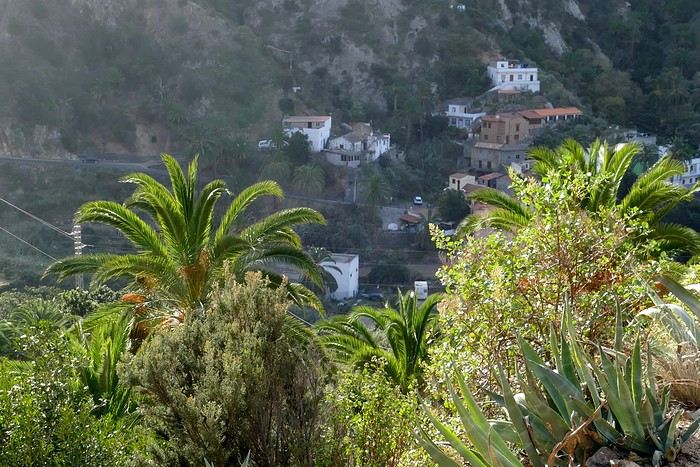 Vallehermoso
Friday, February 9 This morning, the sky was overcast, and the peaks around us were shrouded in clouds. We took the same road as yesterday to hike Las Creces. Quickly gaining altitude, we entered a thick fog—visibility was very limited. We stopped at the Las Creces parking lot; visibility improved, and the sun wasn’t far off. The hike is entirely within a beautiful laurel forest, with the sun playing hide-and-seek, but it wasn’t cold despite the altitude. After finishing the loop trail, we decided to picnic—not there, as it was too chilly—but on Vallehermoso’s beach, where we found a nice picnic area sheltered by large black rocks. A short digestive walk on the surrounding hill to admire the little beach from above. Back in Vallehermoso, we did some grocery shopping, then tried to return to the casa—only to find ourselves locked out because we’d left the key in the lock inside! After several attempts and with the help of Yéli, a relative of the owner we called for help, we were finally able to get back in!
Saturday, February 10
It rained last night, and the sky remained overcast. Monique decided to rest this morning. PP, Pat, and I set off on the hike that starts from the house toward the Marichal reservoir. The sun wasn’t far off, and by 11 AM, it was fully out. The pleasant hike passed by many flower-filled gardens and orchards—orange, lemon, and mandarin trees in fruit. The path climbed gently toward the reservoir, where the view of the Cano rock dominating the landscape was magnificent. The last part of the climb was a bit tough, overgrown with lush vegetation, and the trail was slippery from last night’s rain. We descended via a different, much more pleasant path and returned to the casa just in time for lunch, prepared by Monique. This valley is rich with its many farmers and market gardeners who’ve cultivated the entire valley, taking advantage of the water flowing down from the mountain, captured upstream and redistributed through countless pipes snaking along the paths. Numerous tanks also store water during dry periods. The houses are scattered across both sides of the valley, and these colorful little homes add a beautiful touch to the landscape. The many palm trees give this valley a distinctly tropical feel—you could almost imagine yourself in the Caribbean. Add to that some salsa music drifting from a hut where farmers were working, and the picture is complete. A well-chilled beer apéro capped off a lovely morning. The afternoon was dedicated to rest, relaxation, reading, and games.
Sunday, February 11 The blue sky returned, though a few clouds still capped the highest peaks. Today, we visited Garajonay National Park, which covers the highest central mountains. Up there, we were above the clouds, and the panoramas from the various viewpoints were stunning: first, Cherelepin, accessible from the Laguna Grande parking lot, then Alto de Garajonay, offering an exceptional view of Teide—over 3,000 meters high—emerging from the clouds on Tenerife, far in the distance. We continued to the Los Roques viewpoints, then stopped for lunch at the Degollada de Peraza restaurant, where the view of the barranco was impressive. We descended toward San Sebastián and checked into our new lodging, La Cabezada, located in the countryside about 3 km above San Sebastián. It’s a small apartment adjacent to the owner’s, with a lovely terrace overlooking the surrounding mountains and surrounded by a beautiful garden. Apéro, then dinner on our beautiful terrace.
Monday, February 12 This morning, we went down to visit San Sebastián de La Gomera: its old tower, main street with some beautiful traditional houses, and the Church of the Assumption. Back at the casa for lunch. In the afternoon, Pat, PP, and I set off on the short hike from San Sebastián beach to La Guancha beach. We drove down and parked on the beach. The path climbs along the hill overlooking San Sebastián, passes by the tall Christ statue dominating the landscape, and roughly follows the coast down to the isolated Guancha beach. A beautiful hike under a hot sun, and a swim was welcome, even if the beach and sea access weren’t very comfortable due to large pebbles and quickly deepening water. Apart from two nudist bathers, there was no one on this beach. We returned the same way.
Tuesday, February 13 Rest day. We went down to town to stroll and do some shopping. I took the opportunity to visit the parador, beautifully situated above the city in a lovely garden overlooking the port and town. Together, we went for a cuba libre at the "Cuba Libre" bar, then had lunch at Breñusca (mediocre paella!). Back at the casa, then we went back down to town to see a carnival parade, a "passacalles," which actually passed an hour earlier than scheduled. Oh well.
Wednesday, February 14 Each to their own program this morning. Pat went swimming at San Sebastián beach, Monique rested at the casa, and PP and I set off on the hike from Playa de Avalos to the Ermita de Guadalupe on Playa del Cangrejo. It wasn’t easy to find the right road or the parking spot, but we managed. The path seemed to have suffered landslides, according to a sign at the trailhead! We decided to check it out, ready to turn back if it seemed too dangerous. In the end, apart from one or two slightly tricky spots where we had to climb a pile of rocks, the trail remained passable, though a bit vertigo-inducing in places. The narrow path clings to very vertical cliffs nearly 300 meters above sea level! But what a magnificent view. At one point, the trail runs alongside a wall of basaltic pipes. We returned via the drivable track that parallels the trail a bit lower. Back at the house for lunch. In the late afternoon, we returned to town to attend the "Entierro de las Sardinas" (Burial of the Sardine), which closes the Canarian carnival festivities. While waiting, we strolled through the parador’s gardens and had mojitos in town. Around 9 PM, we heard the noise and cries of the mourners. The procession advanced, led by a large papier-mâché sardine on a float, surrounded by wailing mourners. The procession headed toward the sea, where the sardine was burned, and a mini fireworks display ended the procession. It was all very good-natured, and everyone had fun. We ended the evening with dinner at a good fish restaurant, El Pajar.
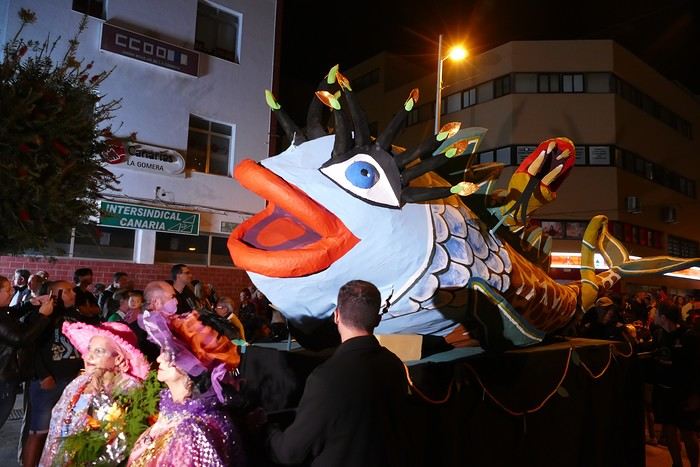 Entierro de la Sardina in San Sebastián de La Gomera
Thursday, February 15
Woke up at 5:15 AM. The only suitable ferry was at 7 AM, which would get us to La Palma by late morning rather than evening. We packed our bags, had breakfast, then headed to the port, left our rental car, and boarded the ferry to Tenerife, from where we’d continue to La Palma. Calm sea, beautiful sun—by 10:30 AM, we disembarked in La Palma. We picked up our car and immediately headed to our new apartment in Breña Alta. It’s a large apartment with a superb terrace facing the sea, fully equipped and very comfortable. The hosts recommended Casa Goyo restaurant, near the airport and close to us. It’s a restaurant with many small rooms, some of which can be reserved for families. The fish-based cuisine (chipirones, pulpo) was excellent, hearty, and reasonably priced. Since it’s in the airport’s flight path, we occasionally heard planes landing. Quick and efficient service. Afterward, we visited Santa Cruz de La Palma, which reminded us of the historic quarters of La Orotava in Tenerife or the capital of Gran Canaria.
Friday, February 16
Beautiful weather, blue sky. We headed to the San Bartolo viewpoint toward the northeast coast, then to the lovely village of San Andrés, which we explored. From there, we walked along the shore to the natural pools of Charco Azul, where we swam in the cool but "swimmable" sea. Back in San Andrés for lunch at the "San Andrés" restaurant on the beautiful church square. Very good fish-based meal. We got back in the car and continued along the north coast to the port of Espindola and the natural pools of Fajana near the Cumplida lighthouse. A fairly strong wind whipped up beautiful waves crashing onto the rocky coast in bursts of foam. Back in Santa Cruz, we stopped at the Mercadona supermarket to buy fresh shrimp for dinner.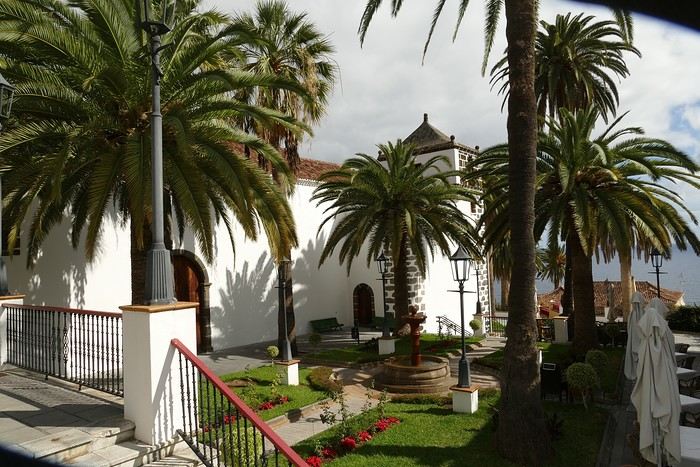 San Andrés
Saturday, February 17
Uniform blue sky, even on the heights. We took the beautiful road that winds up to the summit of the Caldera de Taburiente. Several viewpoints offer 360° views of the entire island and beyond: you can make out La Gomera, El Hierro, and, of course, Tenerife with the perfect triangle of Teide. We parked at the Los Andes viewpoint parking lot and started our hike to Pico de la Cruz along a trail following the ridge, offering superb views into the caldera. We got back in the car and passed by the Roque de los Muchachos astronomical complex, composed of numerous observatories, some with very aesthetic mirror telescopes. We hiked from the Roque de los Muchachos parking lot to the various viewpoints, always as impressive. Picnic on site, then back to Santa Cruz. We stopped by our car dealer because the oil warning light came on—better safe than sorry. The representative reassured us but preferred to give us a Fiat Cross SUV instead.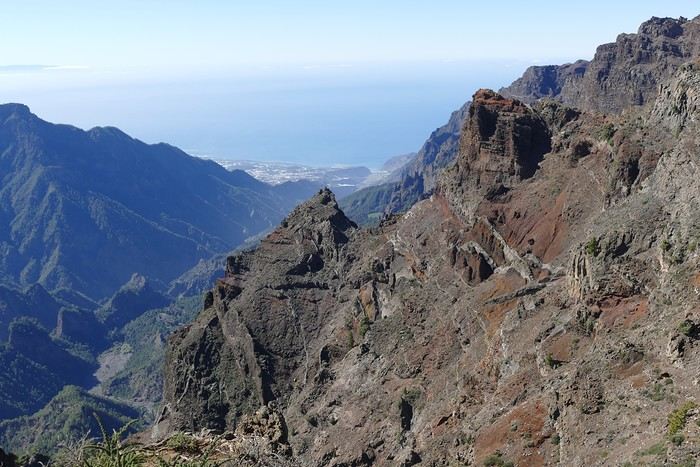 The Caldera de Taburiente
Sunday, February 18 The weather was a bit mixed, with cloudy patches. We set off to hike the Barranco de la Cuba de Galga. Unfortunately, the Los Tilos trail had been closed for several months due to a major landslide. The parking lot by the road was already quite full, and indeed, we crossed paths with many hikers along the way—it’s an easy hike with little elevation gain, which is rare here in La Palma! The beautiful path winds through a very narrow, deep gorge covered in lush tropical vegetation—you’d think you were in a Southeast Asian forest, especially with the humidity in the gorge bringing out earthy and floral scents. Halfway through, Monique turned back while the rest of us continued to the Cuba de Galga. A light drizzle accompanied us on the return. For lunch, we went to Chipi Chipi restaurant in the heights of Santa Cruz. The cool air forced us to leave the lovely terrace for the slightly noisy dining room. The meal was very good and hearty. Afternoon spent resting at our house.
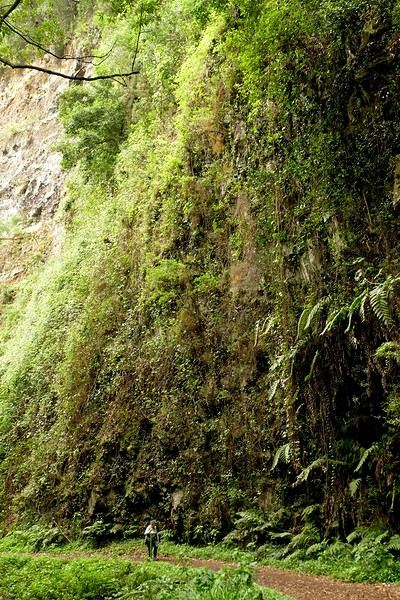 La Cuba de la Galga
Monday, February 19 A few clouds still clung to the nearby mountain peaks. We headed south to Los Canarios. We stopped in front of the small San Antonio Abad church, where a path leads to the viewpoint in 15 minutes. Then we visited the San Antonio Volcano Interpretation Center and climbed to the viewpoint via the trail along the crater’s edge, offering a plunging view into the crater. Then PP, Pat, and I headed toward the Teneguía volcano but turned back given the remaining distance and the intense heat bearing down on us! Plus, the landscape was rather arid and not very interesting. We got back in the car and drove down to the salt flats at the island’s southern tip. The ocean crashes here in large waves, exploding against the volcanic rocks and feeding a "blowhole" carved into the rock. We stopped for drinks at the salt flats restaurant, then headed home.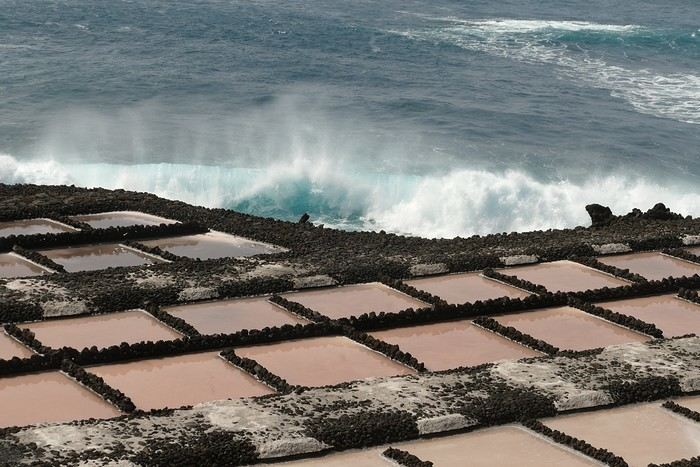 The salt flats in Fuencaliente
Tuesday, February 20 Beautiful weather with a few clouds clinging to the mountains, as usual. A relaxed morning since my parking reservation at La Cumbrecita didn’t start until 1 PM. It takes about 30 minutes from Santa Cruz to reach the valley floor via a beautiful but narrow road toward the end, though there’s very little traffic. Meanwhile, the clouds had disappeared, and the view from the La Cumbrecita viewpoint was superb. We recognized Pico de la Cruz in the distance, where we’d been a few days earlier. We then took the path leading to the Las Chozas viewpoint through a magnificent Canarian pine forest. We picnicked on site, then took the path to the Los Roques viewpoint. We returned the same way since the direct route was closed for construction. Back in Santa Cruz, we visited the Sanctuary of Las Nieves, with its beautiful golden Baroque altar.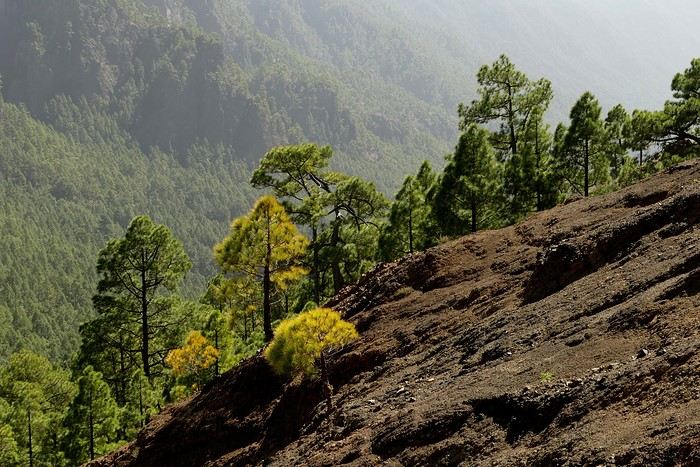 Hike from La Cumbrecita
Wednesday, February 21 After packing our things and loading the car, we left Santa Cruz under a very blue sky for Los Llanos de Aridane, where we stopped to visit this lovely town. The Church of Nuestra Señora de los Remedios has a beautiful coffered ceiling and an original papier-mâché Christ statue from the 16th century. Around it, colorful old Canarian houses brighten the streets of the town center. We took the opportunity to stroll, do some shopping, and finally sat down at La Pergola restaurant for a mediocre lunch. We got back in the car to check into our new house in Arecida. On the way, we stopped at the Mirador del Time, which once again offered an impressive panorama, allowing us—for the first time—to see the damage caused by the Tajogaite volcano eruption in 2021. You can clearly see the still-smoking crater and the large black lava flow covering the landscape down to the sea. We really liked our new accommodation: a local house that’s been renovated on the heights of Arecida, not far from the Canarian pine forest. From several terraces, we have a 360° view of the sea and mountains. We even have a private pool! There are two beautiful, brand-new bedrooms, each with its own bathroom—the best. Plus, we’re on the GR 131 trail that runs along the Barranco de las Angustias toward the northeast.
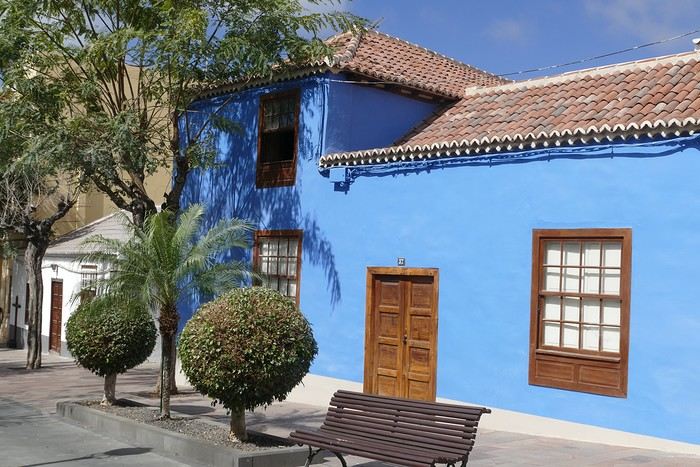 Los Llanos de Aridane
Thursday, February 22 Once again, beautiful weather greeted us when we woke up. We started the GR 131 with the goal of reaching the Torre del Time viewpoint—about 400 meters of elevation gain. The path, quite steep at first, winds through a superb Canarian pine forest. A few viewpoints let you appreciate the sheer drop of the Barranco de las Angustias—watch out for vertigo! At the Torre del Time viewpoint, there’s a nearly 1,000-meter vertical drop. We returned via another path, the PLP1, which meanders first through this beautiful forest, then along lovely flower-filled gardens adjacent to beautiful properties that cascade from the forest down to the road serving these neighborhoods. This afternoon, we tried to get closer to the area devastated by the 2021 lava flows. Several roads are still closed or reserved for residents, while others—brand new—have been rebuilt to open up this densely populated and cultivated region. In some places, the lava flow slightly diverted, sparing some properties that logically should have disappeared. Now, they’re encircled by a massive cooled lava field. In other spots, twisted and charred metal scraps or greenhouse remains protrude from the lava—all that’s left of the former banana plantations. A little higher up, you can see the slightly smoking crater of Tajogaite, responsible for this disaster. Back to Casa Barreros.
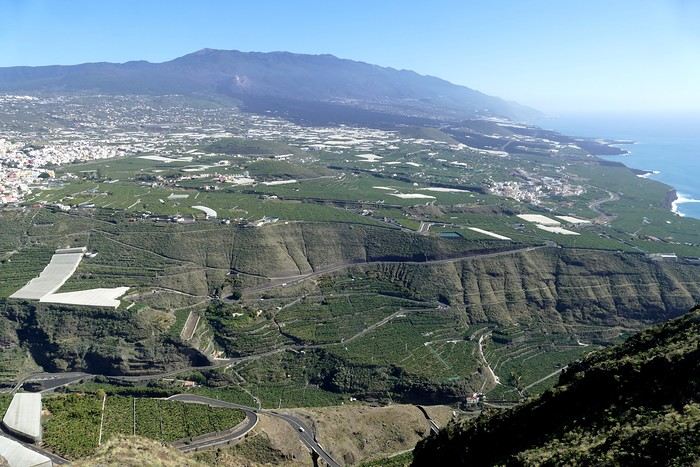 View of Los Llanos and, in the background, the 2021 lava flow
Friday, February 23
Though the sky was still blue, the temperature had dropped due to a chilly wind. By midday, it still rose to 22°C. Today, we headed north, specifically to the town of Tijarafe, where a very narrow road descends to the small port, Porís de Candelaria. The 3.7-kilometer road drops 700 meters in elevation, with gradients up to 30%—it was going to be intense! Indeed, the descent was scary, with the void right next to the very narrow road where passing was impossible except at a few rare spots. Everything went well—there was little traffic at this early hour. From the parking lot at the bottom, a path leads to Porís de Candelaria. It’s surprising to see this small fishing hamlet nestled in the shelter of an immense cave opening onto the sea, which was quite rough today. The sun, at this time of year, would appear late in the cave, which remained in shadow for much of the day. We returned via the same road, strolled through the small town of Puntagorda, and had lunch at El Jardín de los Naranjos restaurant—excellent meal.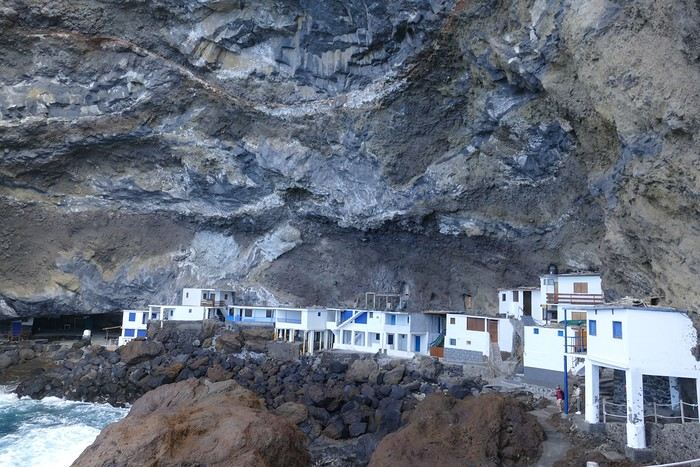 Fishing hamlet of Candelaria
Saturday, February 24 The air was still cool, but the sun was beautiful. While Monique stayed home to rest, the three of us headed to the village of Las Tricias to hike the Buracas Caves trail. We left the car parked on the LP1 road and took the small paved road down to the sign marking the trail’s start. The signage for all the trails we took here, as in La Gomera, was very well done. The path descended steadily, then more steeply toward the caves where the island’s first inhabitants lived—some petroglyphs are still visible in certain caves. The path then climbed back up, passing magnificent dragon trees and more or less elaborate huts occupied by Germans who’ve lived here for many years. Back at Casa Barreros for some rest.
Sunday, February 25 The weather once again blessed us with a beautiful day. This morning, we visited the local produce market held on weekends in Puntagorda. You’ll find agricultural products, crafts, and food to keep you going. A little further on, there’s a glass viewpoint overlooking the barranco plunging toward the sea, with a view of the thrill-seekers trying the zip line right next to it. Lunch at Naranjos—definitely a good spot—with their shrimp and spice tagliatelle. Back home for an afternoon of relaxation.
Monday, February 26 We left Arecida under a cloudy sky. Driving up from Los Llanos de Aridane toward the east, an enormous cascade of clouds poured from the mountain peaks into the Los Llanos plain—very impressive. Arriving in Santa Cruz, we went for a stroll, did some last-minute shopping, then had a final good-quality paella at La Chalana on the paseo maritimo. We left the car in the parking lot and took the 5 PM Olsen ferry to Tenerife on a slightly choppy sea, but the ferry didn’t rock too much. Arriving at 7:15 PM, we dropped off our things near the port in our reserved apartment and went for dinner at Abordo—rubbery chipirones. A digestive stroll among the ever-increasing number of tourists in Los Cristianos—restaurants were packed to the brim, the season is in full swing here. Gone is the calm of La Gomera and La Palma, and the laid-back tourism of German hikers among whom a few French were hiding!
Tuesday, February 27 To make our homemade breakfast more enjoyable, we went to buy pastries at the local bakery, then took one last walk on the paseo along the beaches, mingling with the many mobility scooters driven by elderly or disabled people, joggers, and tourists. Last apéro near the bus station, then off to the airport. After a smooth 4-hour-30-minute flight, we arrived in Basel-Mulhouse at 10:20 PM.
THE END
Conclusion A fantastic trip to two islands with magnificent and diverse nature, where landscapes range from desert-like to tropical depending on exposure to winds and clouds. Thanks to the many beautiful viewpoints, you can truly appreciate these exceptionally dynamic reliefs. A hiker’s paradise, the trails are all very well marked, though the choice of easy or moderate paths for "casual walkers" is quite limited. Another notable advantage, in our opinion, is that these islands are very lightly developed—you’ll hardly see any of those ugly hotel blocks that spoil the landscapes of some other Canary Islands. It’s true that the beaches on these two islands don’t meet traditional international tourism criteria: they’re small, with black sand, and often difficult to access. Special mention for the quality of the road network (except for a few small local roads), which seems brand new, well-paved, and well-signposted. We also enjoyed exceptional weather for February, with fewer than three days of gray or rainy weather out of 21.
Almost all the accommodations we chose met or exceeded our expectations, often at reasonable prices: an average of 98 € per night for an apartment or house with two bedrooms for four people.
All photos can be viewed by clicking this link: https://photos.app.goo.gl/G44pPk4g9PW1rNzg8
Tuesday, February 6 We left around 9 AM with our car, along with Pierre-Paul and Patricia, heading to the Bluepark parking lot in Bartenheim. As expected, we were awaited and left promptly for EuroAirport Basel. Took off at 12:25 PM for a 4-hour-15-minute flight under excellent conditions. Beautiful arrival in Tenerife with Teide in sight under a clear blue sky. Fifteen minutes later, we waited for bus No. 40 to Los Cristianos with quite a few other tourists, but we managed to find four seats. From the bus station, it was a 20-minute walk to our hotel. We checked into a lovely apartment for the four of us, complete with all the comforts. Outside, it was quite warm—at least 25°C! After dropping off our luggage, we went for a stroll. The immediate surroundings of the hotel held no interest for us: a modern, concrete area filled with hotels, bars, tourist agencies, and unappealing restaurants all offering the same bland international cuisine. Pat went to cool off at the pool, unfortunately overrun by loud, drunk English tourists. I took a walk to the paseo maritimo that leads to the port, skirting the seafront. The promenade was pleasant, but it could have been any seaside resort in the world—same old scene: a succession of bars with blaring music where many elderly people sipped cold beers waiting for the sunset, the backdrop a wall of resort-style hotels resembling rabbit hutches! Upon reaching the port, I scouted the route we’d take the next day to the Fred Olsen ferry. Back at the apartment, in the early evening, we looked for a non-touristy restaurant for dinner. Monique stopped a woman to ask her opinion! In this area, she told us, there’s no restaurant that serves Canarian or Spanish cuisine! The only place with decent restaurants is at the port. Off we went to the port, where we sat down at Al Bordo restaurant and ordered a seafood paella for four. Excellent, and at a very reasonable price (36 € for two). We returned to the hotel along the seafront.
Wednesday, February 7
Woke up at 6 AM. Had breakfast in the apartment with what we’d bought the day before at a supermarket. It was still dark when we left on foot toward the port, walking along the calm seafront at this early hour. Forty minutes later, we arrived and waited 10 minutes before the ferry docked. At 9:30 AM, we left the port of Los Cristianos for a 50-minute crossing on a calm sea under a beautiful blue sky. There were quite a few people on this large ferry, but many had no luggage, meaning they were visiting La Gomera for the day and would take the ferry back in the evening. Upon disembarking, we went straight to our rental car agency to pick up the car we’d booked online a few months earlier. It was a nice Peugeot 2008, spacious enough for the four of us and our luggage. We immediately took the beautiful road from San Sebastián that climbs directly into the mountains toward our rental in Vallehermoso. The road was in perfect condition—it seemed brand new, like all the others we’d take on this island later. This side of the island is very arid with little vegetation, and the terrain is particularly rugged, as it is throughout the island. We stopped at our first miradors, which would be followed by many more throughout our Canarian trip. Our first visit was to the small village of Agulo, perched on a promontory above the sea and at the foot of a high cliff. The village features typical Canarian houses with windows flush with the façade and black volcanic stone masonry on white or reddish-brown walls. The first recommended restaurant was already booked for a group, so we settled for the shaded terrace of the excellent El Alameda bar-restaurant. From Agulo, you can access the Abrante viewpoint via a winding road, where the view of Agulo, 600 meters below, is exceptional. A glass ledge over the void lets you test your fear of heights!
We drove to Vallehermoso to do our grocery shopping at the supermarket—a habit that would continue until the end of the trip. Our little house, "Casa rural El Encatadora," is located in a beautiful flower-filled valley a few kilometers west of Vallehermoso. Each of us had a bedroom with an en-suite bathroom, plus a living room, kitchen, and a small terrace overlooking the quiet street at the valley’s end, which didn’t bother us at all.
Thursday, February 8 The good weather seemed to follow us since our arrival in the Canary Islands. This morning, we took the road—still as beautiful and new—toward Arure, high up to the west. The landscape was magnificent, with breathtaking glimpses of the sea far below. In Arure, we parked in front of Conchita’s bar, where a hike (Rother No. 30) starts toward two viewpoints: Alojera, which we reached after 45 minutes on a lovely path. Monique, tired from the first steep climb, stopped at the first viewpoint and hitchhiked back to Arure. Meanwhile, we continued toward the second viewpoint, Los Barranquillos, where the view of the surroundings was partially hidden by misty clouds rising from the sea. The entire mountain is sculpted by ancient, endless terraces climbing until the slope becomes too steep for construction—visible traces of the hard work of past inhabitants trying to survive in a harsh environment. We had a decent lunch at La Conchita bar, then drove to the small seaside town of Puerto la Caleta, sheltered by an immense cliff plunging into the sea. Black sand beach, rough sea—despite our encouragement, Pat didn’t dare to swim! As for the old village of Caleta, it’s perched on the mountainside, and visiting it requires climbing steep, stair-filled alleys to discover a few traditional houses. Back at the casa, dinner in, and card games...
VallehermosoFriday, February 9 This morning, the sky was overcast, and the peaks around us were shrouded in clouds. We took the same road as yesterday to hike Las Creces. Quickly gaining altitude, we entered a thick fog—visibility was very limited. We stopped at the Las Creces parking lot; visibility improved, and the sun wasn’t far off. The hike is entirely within a beautiful laurel forest, with the sun playing hide-and-seek, but it wasn’t cold despite the altitude. After finishing the loop trail, we decided to picnic—not there, as it was too chilly—but on Vallehermoso’s beach, where we found a nice picnic area sheltered by large black rocks. A short digestive walk on the surrounding hill to admire the little beach from above. Back in Vallehermoso, we did some grocery shopping, then tried to return to the casa—only to find ourselves locked out because we’d left the key in the lock inside! After several attempts and with the help of Yéli, a relative of the owner we called for help, we were finally able to get back in!
Saturday, February 10
It rained last night, and the sky remained overcast. Monique decided to rest this morning. PP, Pat, and I set off on the hike that starts from the house toward the Marichal reservoir. The sun wasn’t far off, and by 11 AM, it was fully out. The pleasant hike passed by many flower-filled gardens and orchards—orange, lemon, and mandarin trees in fruit. The path climbed gently toward the reservoir, where the view of the Cano rock dominating the landscape was magnificent. The last part of the climb was a bit tough, overgrown with lush vegetation, and the trail was slippery from last night’s rain. We descended via a different, much more pleasant path and returned to the casa just in time for lunch, prepared by Monique. This valley is rich with its many farmers and market gardeners who’ve cultivated the entire valley, taking advantage of the water flowing down from the mountain, captured upstream and redistributed through countless pipes snaking along the paths. Numerous tanks also store water during dry periods. The houses are scattered across both sides of the valley, and these colorful little homes add a beautiful touch to the landscape. The many palm trees give this valley a distinctly tropical feel—you could almost imagine yourself in the Caribbean. Add to that some salsa music drifting from a hut where farmers were working, and the picture is complete. A well-chilled beer apéro capped off a lovely morning. The afternoon was dedicated to rest, relaxation, reading, and games.
Sunday, February 11 The blue sky returned, though a few clouds still capped the highest peaks. Today, we visited Garajonay National Park, which covers the highest central mountains. Up there, we were above the clouds, and the panoramas from the various viewpoints were stunning: first, Cherelepin, accessible from the Laguna Grande parking lot, then Alto de Garajonay, offering an exceptional view of Teide—over 3,000 meters high—emerging from the clouds on Tenerife, far in the distance. We continued to the Los Roques viewpoints, then stopped for lunch at the Degollada de Peraza restaurant, where the view of the barranco was impressive. We descended toward San Sebastián and checked into our new lodging, La Cabezada, located in the countryside about 3 km above San Sebastián. It’s a small apartment adjacent to the owner’s, with a lovely terrace overlooking the surrounding mountains and surrounded by a beautiful garden. Apéro, then dinner on our beautiful terrace.
Monday, February 12 This morning, we went down to visit San Sebastián de La Gomera: its old tower, main street with some beautiful traditional houses, and the Church of the Assumption. Back at the casa for lunch. In the afternoon, Pat, PP, and I set off on the short hike from San Sebastián beach to La Guancha beach. We drove down and parked on the beach. The path climbs along the hill overlooking San Sebastián, passes by the tall Christ statue dominating the landscape, and roughly follows the coast down to the isolated Guancha beach. A beautiful hike under a hot sun, and a swim was welcome, even if the beach and sea access weren’t very comfortable due to large pebbles and quickly deepening water. Apart from two nudist bathers, there was no one on this beach. We returned the same way.
Tuesday, February 13 Rest day. We went down to town to stroll and do some shopping. I took the opportunity to visit the parador, beautifully situated above the city in a lovely garden overlooking the port and town. Together, we went for a cuba libre at the "Cuba Libre" bar, then had lunch at Breñusca (mediocre paella!). Back at the casa, then we went back down to town to see a carnival parade, a "passacalles," which actually passed an hour earlier than scheduled. Oh well.
Wednesday, February 14 Each to their own program this morning. Pat went swimming at San Sebastián beach, Monique rested at the casa, and PP and I set off on the hike from Playa de Avalos to the Ermita de Guadalupe on Playa del Cangrejo. It wasn’t easy to find the right road or the parking spot, but we managed. The path seemed to have suffered landslides, according to a sign at the trailhead! We decided to check it out, ready to turn back if it seemed too dangerous. In the end, apart from one or two slightly tricky spots where we had to climb a pile of rocks, the trail remained passable, though a bit vertigo-inducing in places. The narrow path clings to very vertical cliffs nearly 300 meters above sea level! But what a magnificent view. At one point, the trail runs alongside a wall of basaltic pipes. We returned via the drivable track that parallels the trail a bit lower. Back at the house for lunch. In the late afternoon, we returned to town to attend the "Entierro de las Sardinas" (Burial of the Sardine), which closes the Canarian carnival festivities. While waiting, we strolled through the parador’s gardens and had mojitos in town. Around 9 PM, we heard the noise and cries of the mourners. The procession advanced, led by a large papier-mâché sardine on a float, surrounded by wailing mourners. The procession headed toward the sea, where the sardine was burned, and a mini fireworks display ended the procession. It was all very good-natured, and everyone had fun. We ended the evening with dinner at a good fish restaurant, El Pajar.
Entierro de la Sardina in San Sebastián de La GomeraThursday, February 15
Woke up at 5:15 AM. The only suitable ferry was at 7 AM, which would get us to La Palma by late morning rather than evening. We packed our bags, had breakfast, then headed to the port, left our rental car, and boarded the ferry to Tenerife, from where we’d continue to La Palma. Calm sea, beautiful sun—by 10:30 AM, we disembarked in La Palma. We picked up our car and immediately headed to our new apartment in Breña Alta. It’s a large apartment with a superb terrace facing the sea, fully equipped and very comfortable. The hosts recommended Casa Goyo restaurant, near the airport and close to us. It’s a restaurant with many small rooms, some of which can be reserved for families. The fish-based cuisine (chipirones, pulpo) was excellent, hearty, and reasonably priced. Since it’s in the airport’s flight path, we occasionally heard planes landing. Quick and efficient service. Afterward, we visited Santa Cruz de La Palma, which reminded us of the historic quarters of La Orotava in Tenerife or the capital of Gran Canaria.
Friday, February 16
Beautiful weather, blue sky. We headed to the San Bartolo viewpoint toward the northeast coast, then to the lovely village of San Andrés, which we explored. From there, we walked along the shore to the natural pools of Charco Azul, where we swam in the cool but "swimmable" sea. Back in San Andrés for lunch at the "San Andrés" restaurant on the beautiful church square. Very good fish-based meal. We got back in the car and continued along the north coast to the port of Espindola and the natural pools of Fajana near the Cumplida lighthouse. A fairly strong wind whipped up beautiful waves crashing onto the rocky coast in bursts of foam. Back in Santa Cruz, we stopped at the Mercadona supermarket to buy fresh shrimp for dinner.
San AndrésSaturday, February 17
Uniform blue sky, even on the heights. We took the beautiful road that winds up to the summit of the Caldera de Taburiente. Several viewpoints offer 360° views of the entire island and beyond: you can make out La Gomera, El Hierro, and, of course, Tenerife with the perfect triangle of Teide. We parked at the Los Andes viewpoint parking lot and started our hike to Pico de la Cruz along a trail following the ridge, offering superb views into the caldera. We got back in the car and passed by the Roque de los Muchachos astronomical complex, composed of numerous observatories, some with very aesthetic mirror telescopes. We hiked from the Roque de los Muchachos parking lot to the various viewpoints, always as impressive. Picnic on site, then back to Santa Cruz. We stopped by our car dealer because the oil warning light came on—better safe than sorry. The representative reassured us but preferred to give us a Fiat Cross SUV instead.
The Caldera de TaburienteSunday, February 18 The weather was a bit mixed, with cloudy patches. We set off to hike the Barranco de la Cuba de Galga. Unfortunately, the Los Tilos trail had been closed for several months due to a major landslide. The parking lot by the road was already quite full, and indeed, we crossed paths with many hikers along the way—it’s an easy hike with little elevation gain, which is rare here in La Palma! The beautiful path winds through a very narrow, deep gorge covered in lush tropical vegetation—you’d think you were in a Southeast Asian forest, especially with the humidity in the gorge bringing out earthy and floral scents. Halfway through, Monique turned back while the rest of us continued to the Cuba de Galga. A light drizzle accompanied us on the return. For lunch, we went to Chipi Chipi restaurant in the heights of Santa Cruz. The cool air forced us to leave the lovely terrace for the slightly noisy dining room. The meal was very good and hearty. Afternoon spent resting at our house.
La Cuba de la GalgaMonday, February 19 A few clouds still clung to the nearby mountain peaks. We headed south to Los Canarios. We stopped in front of the small San Antonio Abad church, where a path leads to the viewpoint in 15 minutes. Then we visited the San Antonio Volcano Interpretation Center and climbed to the viewpoint via the trail along the crater’s edge, offering a plunging view into the crater. Then PP, Pat, and I headed toward the Teneguía volcano but turned back given the remaining distance and the intense heat bearing down on us! Plus, the landscape was rather arid and not very interesting. We got back in the car and drove down to the salt flats at the island’s southern tip. The ocean crashes here in large waves, exploding against the volcanic rocks and feeding a "blowhole" carved into the rock. We stopped for drinks at the salt flats restaurant, then headed home.
The salt flats in FuencalienteTuesday, February 20 Beautiful weather with a few clouds clinging to the mountains, as usual. A relaxed morning since my parking reservation at La Cumbrecita didn’t start until 1 PM. It takes about 30 minutes from Santa Cruz to reach the valley floor via a beautiful but narrow road toward the end, though there’s very little traffic. Meanwhile, the clouds had disappeared, and the view from the La Cumbrecita viewpoint was superb. We recognized Pico de la Cruz in the distance, where we’d been a few days earlier. We then took the path leading to the Las Chozas viewpoint through a magnificent Canarian pine forest. We picnicked on site, then took the path to the Los Roques viewpoint. We returned the same way since the direct route was closed for construction. Back in Santa Cruz, we visited the Sanctuary of Las Nieves, with its beautiful golden Baroque altar.
Hike from La CumbrecitaWednesday, February 21 After packing our things and loading the car, we left Santa Cruz under a very blue sky for Los Llanos de Aridane, where we stopped to visit this lovely town. The Church of Nuestra Señora de los Remedios has a beautiful coffered ceiling and an original papier-mâché Christ statue from the 16th century. Around it, colorful old Canarian houses brighten the streets of the town center. We took the opportunity to stroll, do some shopping, and finally sat down at La Pergola restaurant for a mediocre lunch. We got back in the car to check into our new house in Arecida. On the way, we stopped at the Mirador del Time, which once again offered an impressive panorama, allowing us—for the first time—to see the damage caused by the Tajogaite volcano eruption in 2021. You can clearly see the still-smoking crater and the large black lava flow covering the landscape down to the sea. We really liked our new accommodation: a local house that’s been renovated on the heights of Arecida, not far from the Canarian pine forest. From several terraces, we have a 360° view of the sea and mountains. We even have a private pool! There are two beautiful, brand-new bedrooms, each with its own bathroom—the best. Plus, we’re on the GR 131 trail that runs along the Barranco de las Angustias toward the northeast.
Los Llanos de AridaneThursday, February 22 Once again, beautiful weather greeted us when we woke up. We started the GR 131 with the goal of reaching the Torre del Time viewpoint—about 400 meters of elevation gain. The path, quite steep at first, winds through a superb Canarian pine forest. A few viewpoints let you appreciate the sheer drop of the Barranco de las Angustias—watch out for vertigo! At the Torre del Time viewpoint, there’s a nearly 1,000-meter vertical drop. We returned via another path, the PLP1, which meanders first through this beautiful forest, then along lovely flower-filled gardens adjacent to beautiful properties that cascade from the forest down to the road serving these neighborhoods. This afternoon, we tried to get closer to the area devastated by the 2021 lava flows. Several roads are still closed or reserved for residents, while others—brand new—have been rebuilt to open up this densely populated and cultivated region. In some places, the lava flow slightly diverted, sparing some properties that logically should have disappeared. Now, they’re encircled by a massive cooled lava field. In other spots, twisted and charred metal scraps or greenhouse remains protrude from the lava—all that’s left of the former banana plantations. A little higher up, you can see the slightly smoking crater of Tajogaite, responsible for this disaster. Back to Casa Barreros.
View of Los Llanos and, in the background, the 2021 lava flowFriday, February 23
Though the sky was still blue, the temperature had dropped due to a chilly wind. By midday, it still rose to 22°C. Today, we headed north, specifically to the town of Tijarafe, where a very narrow road descends to the small port, Porís de Candelaria. The 3.7-kilometer road drops 700 meters in elevation, with gradients up to 30%—it was going to be intense! Indeed, the descent was scary, with the void right next to the very narrow road where passing was impossible except at a few rare spots. Everything went well—there was little traffic at this early hour. From the parking lot at the bottom, a path leads to Porís de Candelaria. It’s surprising to see this small fishing hamlet nestled in the shelter of an immense cave opening onto the sea, which was quite rough today. The sun, at this time of year, would appear late in the cave, which remained in shadow for much of the day. We returned via the same road, strolled through the small town of Puntagorda, and had lunch at El Jardín de los Naranjos restaurant—excellent meal.
Fishing hamlet of CandelariaSaturday, February 24 The air was still cool, but the sun was beautiful. While Monique stayed home to rest, the three of us headed to the village of Las Tricias to hike the Buracas Caves trail. We left the car parked on the LP1 road and took the small paved road down to the sign marking the trail’s start. The signage for all the trails we took here, as in La Gomera, was very well done. The path descended steadily, then more steeply toward the caves where the island’s first inhabitants lived—some petroglyphs are still visible in certain caves. The path then climbed back up, passing magnificent dragon trees and more or less elaborate huts occupied by Germans who’ve lived here for many years. Back at Casa Barreros for some rest.
Sunday, February 25 The weather once again blessed us with a beautiful day. This morning, we visited the local produce market held on weekends in Puntagorda. You’ll find agricultural products, crafts, and food to keep you going. A little further on, there’s a glass viewpoint overlooking the barranco plunging toward the sea, with a view of the thrill-seekers trying the zip line right next to it. Lunch at Naranjos—definitely a good spot—with their shrimp and spice tagliatelle. Back home for an afternoon of relaxation.
Monday, February 26 We left Arecida under a cloudy sky. Driving up from Los Llanos de Aridane toward the east, an enormous cascade of clouds poured from the mountain peaks into the Los Llanos plain—very impressive. Arriving in Santa Cruz, we went for a stroll, did some last-minute shopping, then had a final good-quality paella at La Chalana on the paseo maritimo. We left the car in the parking lot and took the 5 PM Olsen ferry to Tenerife on a slightly choppy sea, but the ferry didn’t rock too much. Arriving at 7:15 PM, we dropped off our things near the port in our reserved apartment and went for dinner at Abordo—rubbery chipirones. A digestive stroll among the ever-increasing number of tourists in Los Cristianos—restaurants were packed to the brim, the season is in full swing here. Gone is the calm of La Gomera and La Palma, and the laid-back tourism of German hikers among whom a few French were hiding!
Tuesday, February 27 To make our homemade breakfast more enjoyable, we went to buy pastries at the local bakery, then took one last walk on the paseo along the beaches, mingling with the many mobility scooters driven by elderly or disabled people, joggers, and tourists. Last apéro near the bus station, then off to the airport. After a smooth 4-hour-30-minute flight, we arrived in Basel-Mulhouse at 10:20 PM.
THE END
Conclusion A fantastic trip to two islands with magnificent and diverse nature, where landscapes range from desert-like to tropical depending on exposure to winds and clouds. Thanks to the many beautiful viewpoints, you can truly appreciate these exceptionally dynamic reliefs. A hiker’s paradise, the trails are all very well marked, though the choice of easy or moderate paths for "casual walkers" is quite limited. Another notable advantage, in our opinion, is that these islands are very lightly developed—you’ll hardly see any of those ugly hotel blocks that spoil the landscapes of some other Canary Islands. It’s true that the beaches on these two islands don’t meet traditional international tourism criteria: they’re small, with black sand, and often difficult to access. Special mention for the quality of the road network (except for a few small local roads), which seems brand new, well-paved, and well-signposted. We also enjoyed exceptional weather for February, with fewer than three days of gray or rainy weather out of 21.
Almost all the accommodations we chose met or exceeded our expectations, often at reasonable prices: an average of 98 € per night for an apartment or house with two bedrooms for four people.
All photos can be viewed by clicking this link: https://photos.app.goo.gl/G44pPk4g9PW1rNzg8
I'm looking for the best option to visit the Alhambra and Nasrid Palaces (guided tour + tickets), because there are so many choices and I'm overwhelmed trying to pick one that's good value for money and won't rip me off. Thanks! Sandrine
Hi everyone,
I’m a die-hard fan of India, but it’s time I discovered Thailand too to broaden my Asian horizons.
I’m heading there on January 19, 2025, for a 46-day trip (no visa needed as I’m French). I’ve pored over a few guidebooks and travel blogs. Based on what caught my interest, I’ve put together a rough itinerary and list of sights. But since I know absolutely nothing about Thailand, I’m kind of flying blind here.
Since I’m not exactly a spring chicken anymore, I’ve opted for a few bases where I’ll stay several days in the same place. That way, I won’t have to change locations and hotels every day or so, packing and unpacking my suitcase constantly. Instead, I plan to explore the surrounding area each day, within a maximum radius of 50 to 70 km.
So, first question: Is that kind of round-trip distance manageable in a day in Thailand?
In India, renting a car for a day—with a driver—currently costs around 35 to 40 € per day. Knowing that 1,300 to 1,500 THB would be my absolute max, and even then, only if I don’t rent a car every single day.
Which brings me to my second question: Am I being unrealistic?
Otherwise—third question—once I’m settled in the city I’ve chosen as my base, can I get around within that 50–70 km radius using public transport?
I’ve already booked all my hotels—with free cancellation—on booking.com at an average price of 950/1,000 THB per night. Does that put me in a good range for value for money? Or am I dreaming?
Here’s my plan:
BANGKOK (13 days, 14 nights): 1 week for exploring Bangkok – Kanchanaburi/Erawan National Park? – Ayutthaya/Lopburi? – Muang Boran – Samut – Songkram/Amphawa
Bangkok -> Chiang Mai by overnight train in first-class sleeper
CHIANG MAI (6 days/6 nights): Mae Hong Son – Hot springs – Chiang Dao – caves – Lamphun – other places to be decided on the spot based on what’s worth seeing and transport options
Chiang Mai -> Chiang Rai
CHIANG RAI (7 days/8 nights): Fang – Tha Ton – Chiang Saen – Doi Tung – Chiang Khong – Doi Ang Khang, Phu Chi Fah, etc.
Chiang Rai -> Phrae
PHRAE (4 days/5 nights): Lampang and surrounding areas, depending on what’s interesting to see
Phrae -> Loei
LOEI (4 days/5 nights): Phu Kradung – Chiang Khan and surrounding areas, depending on what’s worth seeing
Loei -> Buriram
PHIMAI (Nakhon Ratchasima/Khorat) (5 days/6 nights): Phimai – Prasat Muang Tam – Phanom Rung – Prasat Phanom Wan
Phimai -> Khorat (airport or train station) -> Bangkok (overnight in Bangkok)
Day 46: BANGKOK -> KOCHI
Thanks in advance for your thoughts and advice!
Hello,
We had booked a sea-view cabin through a Costa advisor in October 2023 for a departure on 13/10/24 on the Costa Favolosa, with a cruise lasting until 22/10/24. When we saw the cabin, what a disappointment: only one stool, no armchair or sofa like we were used to with Costa. The sea view wasn’t great because of a film on the porthole, and the cabin faced the crew promenade. The space between the wall and the edge of the bed was about 30 cm... not easy for getting into bed. We immediately asked to change cabins. After two days, the answer was that no cabins were available. We spent our days in the lounges because there wasn’t enough room for two people to sit—one had to sit on the stool and the other on the bed... Two days before disembarking in Marseille, reception offered us a sea-view cabin on deck 2. We asked to see it: what a difference—space, a sofa, an armchair, a stool, and a real sea view. Unfortunately, with only two days left before disembarking, it was difficult for us "seniors (85 and 73 years old)" to pack our suitcases and bags, unpack them in the new cabin, deal with the walker, and then repack two days later for disembarkation. We filed a complaint with Costa’s customer service, which responded quickly: "You found the cabin small. Please note that our cabins meet standards and are allocated accordingly. It is indeed possible to change cabins if the ship’s occupancy allows it. We offered you this change, which you later declined." In the end, they offered a "commercial discount as an exceptional gesture for booking a future cruise." This cabin 9201 is for one person, not two. The onboard staff were always as friendly and smiling as ever. There were long lines to access the buffets, so it was better to go to the restaurant at lunchtime when we didn’t have excursions. The shows were varied, and the indoor pool was very chilly. We won’t be sailing with Costa again. We’ve booked with MSC for 2025, but after reading some reviews... Mum49
We had booked a sea-view cabin through a Costa advisor in October 2023 for a departure on 13/10/24 on the Costa Favolosa, with a cruise lasting until 22/10/24. When we saw the cabin, what a disappointment: only one stool, no armchair or sofa like we were used to with Costa. The sea view wasn’t great because of a film on the porthole, and the cabin faced the crew promenade. The space between the wall and the edge of the bed was about 30 cm... not easy for getting into bed. We immediately asked to change cabins. After two days, the answer was that no cabins were available. We spent our days in the lounges because there wasn’t enough room for two people to sit—one had to sit on the stool and the other on the bed... Two days before disembarking in Marseille, reception offered us a sea-view cabin on deck 2. We asked to see it: what a difference—space, a sofa, an armchair, a stool, and a real sea view. Unfortunately, with only two days left before disembarking, it was difficult for us "seniors (85 and 73 years old)" to pack our suitcases and bags, unpack them in the new cabin, deal with the walker, and then repack two days later for disembarkation. We filed a complaint with Costa’s customer service, which responded quickly: "You found the cabin small. Please note that our cabins meet standards and are allocated accordingly. It is indeed possible to change cabins if the ship’s occupancy allows it. We offered you this change, which you later declined." In the end, they offered a "commercial discount as an exceptional gesture for booking a future cruise." This cabin 9201 is for one person, not two. The onboard staff were always as friendly and smiling as ever. There were long lines to access the buffets, so it was better to go to the restaurant at lunchtime when we didn’t have excursions. The shows were varied, and the indoor pool was very chilly. We won’t be sailing with Costa again. We’ve booked with MSC for 2025, but after reading some reviews... Mum49
Hi,
Over the past few months, I’ve been noticing more and more reports about safety issues in Tokyo and Osaka targeting tourists. I knew the local population didn’t want tourists—or at least a lot fewer—under the previous prime minister’s policies. Right now, some friends are in Tokyo—four guys traveling together—and this is what happened to them: a Japanese guy approached them in Akihabara with a map, pretending to ask for directions. Then, eight others came from behind, beat them up, stole their phones, and 30,000 yen. They ran off, and all this happened around 6:00 PM.
They went to the *koban* (police station), but the police just laughed at them. Luckily, two of the phones had trackers, which they mentioned to the police, but the cops didn’t do anything. So, they called the French embassy. The next day, they had a meeting with an embassy delegate at the police station, but nothing happened for 24 hours. Then, two days later, they were summoned back to the police station, and to their shock, the police offered them a deal: they’d get their phones and the 30,000 yen back if they withdrew their complaint. In the end, they got their phones back (one with a cracked screen) and the 30,000 yen without withdrawing their complaint.
Before leaving their hotel for Osaka, they received a letter saying they could be banned from the country for three years. When they arrived in Osaka, their ATM withdrawals with their card were limited to 20,000 yen. They asked the Japanese postal agent why, and the response was, "You’re flagged in the deportable travelers registry." Their hotel canceled their reservation, and the embassy is now taking over by involving the justice system. (more below)
Hi everyone, I’d like to take a trip from France to Malaysia and Thailand like this:
Paris to Kuala Lumpur Kuala Lumpur to Langkawi
Langkawi to Koh Lipe
Bangkok to Paris
I’m wondering if I’ll run into any visa issues on arrival since I won’t have an outbound flight ticket from Malaysia and I won’t have an inbound flight ticket to Thailand. If you’ve got any tips or have done this trip before, I’d really appreciate your help.
Thanks so much.
I’m planning a trip to Norway in June 2025 and I’d like to know how to handle tolls with a contract like I read about
We bought round-trip tickets from Mulhouse/Basel to Maun (Botswana) in January 2023 through Option Way.
Turkish Airlines issued the entire round-trip tickets. The flight plan was:
31 August 2023: TK 926 from Basel/Mulhouse to Istanbul and TK38 from Istanbul to Johannesburg 1 September 2023: Airlink (4Z)300 from Johannesburg to Maun. 11 September 2023: Airlink (4Z)301 from Maun to Johannesburg and TK43 from Johannesburg to Istanbul 12 September 2023: TK1923 from Istanbul to Basel/Mulhouse.
On 1 September, on the outbound trip, Turkish Airlines flight TK38 from Istanbul to Johannesburg arrived 1 hour and 30 minutes late due to airport congestion. As a result, we missed our connection with Airlink flight (4Z) 300 from Johannesburg to Botswana (even though the initial layover time was sufficient for the connection). Upon arrival at Johannesburg Airport, a Turkish Airlines agent greeted us, booked us a room near the airport, and rebooked us on the same flight for the following day, 2 September. On 2 September, after numerous difficulties checking in at the Airlink counter in Johannesburg, we finally reached our final destination with a 24-hour delay. We lost our first day of vacation in Botswana, including the activities that were planned for that day. On 11 September, during our return trip and almost certainly due to the rescheduling of the outbound flight, the Airlink check-in counter in Maun did not recognize our tickets issued by Turkish Airlines. After many searches and phone calls, we had to buy new tickets for the Maun/Johannesburg flight 4Z301. This cost us 9,306 Botswana pula (643 €). Upon arrival in Johannesburg, the Turkish Airlines check-in counter again had trouble identifying us for flight TK43 from Johannesburg to Istanbul. It’s clear that the root of our check-in problems stemmed from the renumbering of our tickets when the Turkish Airlines representative rebooked us on the Airlink (4Z)300 flight for 2 September. During this process, all subsequent flight tickets must have been canceled. Since our return, I’ve requested the following from Turkish Airlines: · Compensation under the European Regulation EC 261/2004 of 11 February 2004 for flight delays, amounting to 600 € per passenger. We meet all the conditions: departure from a Franco/Swiss airport, arrival at the final destination more than 4 hours late, and a distance greater than 3,500 kilometers. Turkish Airlines has not provided evidence that they did everything possible to avoid this delay. · Reimbursement for the Airlink Maun/Johannesburg tickets on 11 September, which we had to pay again to Airlink even though we had already paid for them through our agent, Option Way. Turkish Airlines refuses compensation on the grounds that they complied with all regulations. Turkish Airlines and Airlink are passing the buck when it comes to reimbursing the tickets we paid for twice. For Turkish Airlines, claims can only be made through their website, and each time a different agent responds. I’ve contacted our insurance, legal protection, the travel ombudsman... without success. Currently, the case is with a lawyer working for "Air Indemnité," but I have little hope. Obviously, I won’t be flying with Turkish Airlines again—they seem to have a habit of not respecting schedules or customer satisfaction. A good lesson for planning very long layovers.
Hi everyone,
I’m leaving for a little over 3 months starting at the end of January—Thailand (January-February), then Laos (February-March), Cambodia (March), and Vietnam (March-April).
I see that a lot of travelers don’t seem to book accommodations in advance and just go with the flow.
Given that I’ll be traveling during peak season (January to early May) and these are still very popular destinations, do you think I’ll be able to easily find places to stay on the spot without booking the day before?
Thanks!
Juliette
Hi there, We’re in Laos in March 2025,
does anyone know if it’s possible to travel down the Mekong from Luang Prabang to Vientiane?
Can you find a private boat? How long does it take?
Thanks for your replies_
Hi there,
I’m planning a 3-week trip to Oman this coming November. As I list the different places I’d like to visit, I’m trying to match each one with whether:
- a basic sedan is enough
- a small SUV with higher ground clearance is really necessary
- a 4x4 is absolutely essential.
This is to keep costs down and avoid renting a vehicle that’s too expensive for the whole trip.
Would you have any thoughts on the vehicle choices in the attached file?
Thanks for your insights, and have a great evening! Christophe
This is to keep costs down and avoid renting a vehicle that’s too expensive for the whole trip.
Would you have any thoughts on the vehicle choices in the attached file?
Thanks for your insights, and have a great evening! Christophe
Hello,
So glad the site is back up and running. It's such a useful treasure trove of information!
We're in the midst of planning our 4-week family trip to Thailand in July 2025. I've managed to sort out and book hotels and other activities across various sites, but I'm stuck on some transfers between different locations. Could you confirm or suggest better solutions, keeping in mind we're traveling with two kids aged 12 and 15 and I'd like to minimize risks for transfers.
I’d especially like to know if taxis/Grab are readily available for transfers 2, 3, and 6 below.
Transfers:
1. Bangkok - Kanchanaburi: planned by train 2. Kanchanaburi - Kaeng Krachan National Park: planned by taxi/Grab 3. Kaeng Krachan National Park - Hua Hin or San Roi Yot: planned by taxi/Grab 4. San Roi Yot to Bangkok Airport: planned by taxi, as trains wouldn’t get us there in time for our flight or would require an extra night in Bangkok 5. Bangkok - Chiang Rai: domestic flight 6. Chiang Rai - Chiang Mai: planned by public bus, taxi/Grab possible 7. Chiang Mai - Bangkok: domestic flight
Thanks for your feedback.
Hello everyone,
Here’s a little recap of our 3-week trip to India (retired couple) in January 2024. This is our personal experience and how we felt at the time. This is the 7th time we’ve been to India, and after experiencing public transport day and night—and with age catching up—we opted for a more "chill" pace this time, prioritizing flights and taxis while slightly increasing our accommodation budget. Regarding that accommodation budget (double room), we chose a range between 30 and 40 €, and we didn’t really notice much difference compared to the lower range we used to book on previous trips (between 20 and 30 €). But prices have likely gone up since my last visit in 2018.
So here are some personal tips and opinions, good addresses, and others to avoid. Exchange rate: In January 2024, 100 rupees were worth about 1.12 euros (1 euro = 89 INR at exchange bureaus). To convert rupees to euros: X rupees divided by 89 = X euros. For simplicity, we divided the price in rupees by 100 and added about 10% to get the equivalent in euros.
Our itinerary: Mumbai/Aurangabad (Ellora and Ajanta) / Badami / Hampi / Goa (Agonda) / Mumbai Flight: With British Airways—very (too) short layover in London (2 hours in theory...) for the connection to Mumbai, but a 1-hour delay on the flight from CDG, so we had to rush in London with two shuttles to take and security to clear before reaching the departure gate. We had a 15-minute margin by speeding... same stress on the way back...
Mumbai: On the day we arrived in Mumbai, we took a flight to Aurangabad with Indigo. **Note:** Terminal change for this flight. Free buses connect T2 to T1. The flight was fine, even with a 2-hour delay...
Aurangabad: Accommodation: Hotel JP International (35 €/night): Large, "decorated" room with comfortable bedding. But the hotel is showing its age. The air conditioning is a bit noisy, and the faucets and shower have seen better days... Breakfast is included in the price with a buffet—it’s decent. You just have to ask for toast, jam, and eggs, as it’s mostly an Indian buffet... The rooftop restaurant is okay. The hotel is a bit pricey for what it is... The owner, a bit gruff at first, was helpful and assisted us with taxis for visiting the Ellora and Ajanta sites, as it’s hard to find taxis for those trips on the street—no travel agencies in this area. Restaurant: Le Great Sagar (on the main street): Close to the hotel, good food, and plenty of choices. Exchange: We struggled to exchange euros in Aurangabad. No banks exchange money (we tried five...). Only Thomas Cook does: Jalna Road near the Ramgiri Hotel.
Ellora: A magnificent site 25 km from Aurangabad. **Tip:** Arrive early (by 9 AM max) and visit the Kailasha Temple first—it’s the world’s largest monolithic structure—and it gets much busier later.
Ajanta: About a 2-hour drive. **Great tip for this visit:** Ask your taxi to drop you off at the Ajanta View Point. Not only do you get a beautiful overview of the cliff and caves, but you can also walk down gently to the site. The descent is easy with stairs and paths, and you approach the site with stunning views. Cross the bridge, and you’re there (start from the end, as it’s less crowded: after crossing the bridge and paying at the ticket counter, turn left and go to the far end to begin your visit). The taxi waited for us at the "official" entrance after we finished exploring the caves.
Badami: To get to Badami, we took an early-morning flight from Aurangabad to Hubli with Indigo (scheduled takeoff at 6:20 AM...) to arrive in Hubli in the early afternoon and find a taxi to Badami. We found a taxi quickly at Hubli Airport. About 2.5 hours (3,400 INR). Hotel: KSTDC Hotel Mayura Chalukya (38 €/night): A state-run hotel that’s a bit dated, located 15 minutes from the center but quiet compared to the chaotic main street in Badami. Large room, a bit dark, slightly worn walls, rustic bathroom... The air conditioning is very noisy. The owner was very friendly and helped with transport. The staff was also very nice. The hotel restaurant is decent, which saves you from going back "into town." A bit pricey for the quality, but it’s peaceful... The visit to the sculpted caves is worth it, as is a walk around the lake. The short climb to the top of the hill from the museum is also worth it—you pass through small gorges. A relaxing atmosphere in these places.
Hampi: Trip from Badami to Hampi by taxi (3,500 INR) – 3 hours. Booked through the Badami hotel, as we couldn’t find taxis on the street or at reasonable prices... Accommodation: Thilak Home Stay (33 €/night): Located in Hampi Bazaar, a small guesthouse with 4 rooms. Simple room with two single beds and a nightstand. The owner was very helpful, making our stay easier with services like tuk-tuks for sightseeing, laundry, bus booking to Goa, and a tuk-tuk to Hospet. A bit pricey for the room quality, but recommended for the owner’s kindness. It was hard to find accommodation in Hampi Bazaar through booking platforms, as they all offer places outside the city, several kilometers away—which is a shame. But we realized you can find places directly on-site. **You must stay in Hampi Bazaar**—the atmosphere changes from morning to night (in the evening, around 9 PM, go into the courtyard of the main temple in Hampi Bazaar, which turns into a huge dormitory—it’s impressive...). Restaurant: Archana Roof Restaurant: Small restaurant on the 1st floor overlooking a banana field with the Hampi rocks in the background. Very friendly welcome, quiet, and excellent thalis. The Hampi site is in a magical natural setting among temples, pilgrims, ochre rocks, and rice fields. We did a one-day circuit with a tuk-tuk to visit the main sites (1,500 INR). We also rented a scooter on the other side of the river (to avoid a long detour from Hampi Bazaar) for a day trip around the area. Some places we visited: Anegondi village, Durga Temple, Hanuman Temple (go early—it’s a climb...), Sanapur Lake. The accommodations on the other side of the river, called "Hippie Island," have been completely destroyed.
Goa (Agonda Beach): Trip from Hampi to Agonda: Booked a sleeper bus with two beds! (1,300 INR/person). Departure at 9 PM from Hospet, theoretical arrival at 4 AM (for us, it was 6 AM) in Canacona, then a 20-minute tuk-tuk ride to Agonda. Comfortable bus with real berths, but the many speed bumps made sleep difficult... The train would have been much longer and more complicated to reach Agonda.
Agonda: Accommodation: New Common Home (35 €/night): Business-like welcome. Decent and fairly large room, rustic bathroom. Breakfast included in the price—it was okay. We only booked one night to choose accommodation afterward, right on the beach. But we didn’t account for the Indian national holiday at the end of the week—everything was fully booked... We found Saxony (44 €/night) at the far end of the beach (left when facing the sea), but only for 2 nights—after that, it was reserved... Decent room, average bathroom, but a beautiful terrace facing the sea. Then 2 nights at Agonda Holiday Home Stay (36 €/night), not on the beach: Very average, bathroom in poor condition, almost no view—but it was all that was left... Restaurant: The Rhino for dinner (not on the beach): Excellent tandoori, chicken tikka, and masala. Great value for money. Cool and friendly atmosphere. Agonda is a beautiful, long, quiet, and family-friendly beach for relaxing, with lovely walks to take. Beautiful sunset!
Mumbai: Trip from Agonda to Mumbai: Flight: We chose Vistara because the departure was in the late afternoon, while Indigo offered flights very early or very late. Bad choice... because this Vistara flight leaves from Mopa Airport, at the very north of Goa state. And from Agonda, it’s a 3-hour taxi ride... (3,700 INR...) **Always check which airport your flight leaves from to reach Mumbai!**
Mumbai: Accommodation: Broadway Hotel Bombay (39 €/night): Very well-located hotel in Colaba, on a street perpendicular to the busy main road. Ask for quiet rooms... Friendly, helpful, and accommodating staff. Very small room with a tiny window and little space to put bags or move around... Small but clean bathroom. Mumbai is expensive for accommodation, and cleanliness often leaves something to be desired... Restaurant: Delhi Darbar, very close to the hotel on the main street. Good, clean, not too noisy... and good value for money. Sightseeing: Mumbai is a bustling city, but the traffic is completely chaotic, and the horn often replaces the brake... The architecture is quite unique and worth a look, with some must-see visits: Crawford Market and its surroundings... Null Bazar and Chor Bazar, where poverty and dirt are quite present... Mani Bhavan: Gandhi’s house in Mumbai, with a very special atmosphere... Balbunath Temple, with its religious fervor. The beautiful Jain temple (Walkeshwar Mandir), where the atmosphere is very different from other temples and full of serenity. The Dhobi Ghats, the laundry district—very impressive. For a few hundred rupees, a "guide" will take you through these washhouses and thousands of clothes. Banganga Tank: A basin surrounded by ghats with a village-like (but quite poor) atmosphere, where Indians come to pray. The dabbawallahs: Their departure around 11 AM and the transport by bicycle of hundreds of lunchboxes from Churchgate Station. **Note:** It’s not easy to find them—we almost missed them, as it seems to be disappearing. They’re on the other side of the road where taxis usually drop you off for Churchgate Station, under some trees. They’re recognizable by their white attire and a crowd. Few passersby seemed to know about them... All these visits can be done easily by taking taxis, which are really cheap—**as long as they agree to use the meter.**
So here are some great tips to share, knowing that every trip is unique, and India remains a magnificent, often disconcerting, elusive country that challenges you. It’s unlike any other country we’ve visited but so fascinating... Good luck with your preparations, and if you need more info, don’t hesitate! I really regret that the new 2024/2025 South India GDR only includes Mumbai for Maharashtra and nothing else... and nothing on Karnataka or Goa. These states don’t seem to be selling points for the GDR anymore... Guy