Hi there,
The National Tourism Service SERNATUR published a small graphic summary of the current situation in the tourism sector for each region of the country on August 14th.
It shows the percentage of operational tourist attractions, accommodations, airports, and bus stations across Chile’s sixteen regions.
You can check out the map by following this link: https://www.sernatur.cl/operatividad-y-recomendaciones-de-las-regiones-del-pais/
As you can see, in several regions, no tourist attractions are currently available. In two regions, only half are open.
(A quick but important note: the small village of San Pedro de Atacama is in the Antofagasta administrative region, not the Atacama region.)
The situation for accommodations, regional airports, and bus stations is relatively better.
Some good news, though—Torres del Paine National Park is expected to gradually reopen starting September 1st.
Here’s a link to an article on the topic: https://laprensaaustral.cl/cronica/destacan-reapertura-gradual-del-paine/
(If all goes well, other national parks should follow suit.)
For the general situation in the country, there’s another discussion on this forum: https://voyageforum.com/discussion/situation-actuelle-chili-d10335492/
Any input is welcome!
Good luck.
892 similar discussions in English
FOREWORD
In July 2018, we decided to go on a road trip to Prince Edward Island. We had four days off, so it was the perfect opportunity to set off on an adventure.
This time, I hadn’t had much time to prepare an itinerary. I’d only done a bit of research online to try and find tourist attractions that might interest us.
I should say that it wasn’t our first visit to the island, and since our stay was quite short, we decided to complete the island loop by making stops along the coast to admire the lighthouses, small fishing villages, beaches, and the stunning steep cliffs.
We also made a few stops at lookouts along the road and even went for a hike in Greenwich National Park.
Our trip was more of an escape into nature. When we travel, we feel best when we’re far from the noise and crowds.
So, I invite you to discover the fabulous landscapes of Prince Edward Island.
To get there, we had to cover nearly 1,000 km. It took us a full day, and we had to cross parts of Quebec and New Brunswick.
The roads are beautiful. However, there isn’t much to see except the vast forests lining the highways.
The Confederation Bridge, which is 12.9 kilometers long, connects New Brunswick to Prince Edward Island.
There’s no fee to enter the island when you cross this bridge. However, a toll must be paid when leaving the island.
https://www.confederationbridge.com/fr/tolls-fees
https://youtu.be/UWhn5bqLONU
Hi everyone,
The idea of traveling to Bolivia came to me after seeing Jean-François (Max68)’s photos on his website. I thought we *had* to see those stunning landscapes with the colorful lagoons for ourselves. But a self-drive trip didn’t seem doable at first. A few years ago, everyone advised against going to the South Lipez with just one car.
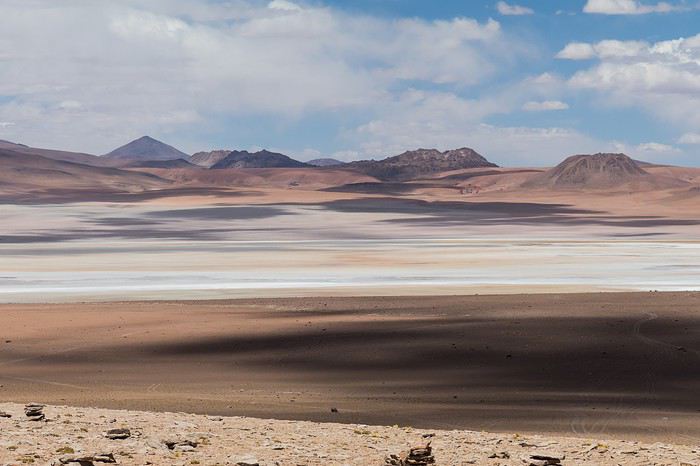 Laguna Kara
It was only after reading Laurent (Lolobe) and Pascal (Pepe874)’s travel journals—who explored the South Lipez solo with a car from Biz Rent a Car—that I thought we might be able to do the same. Meanwhile, we’d already contacted a local agency to organize a trip with a driver and guide. But the idea of a self-drive adventure really appealed to us. With encouragement and tips from Thierry (Tbernay) and Jean-François (Max68), we decided to plan our own self-drive trip. I’d like to thank them for their advice—it was *super* helpful. And a big thanks to all the other forum members for the info shared during our prep!
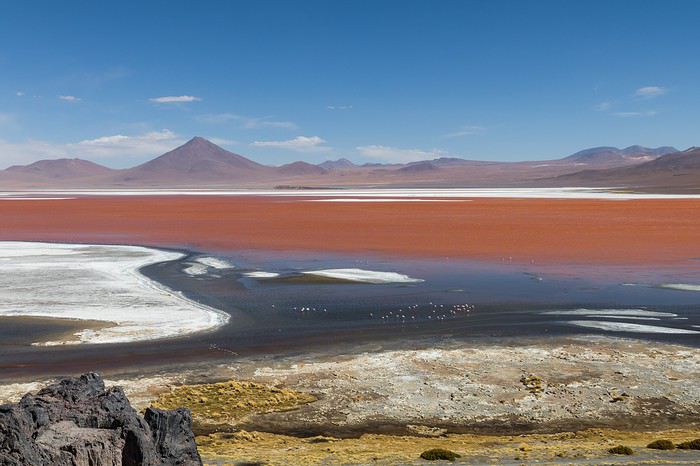 Laguna Colorada
Planning this trip happened during a tough time for our family. My mother-in-law’s illness and passing, plus a few health issues of my own, made us doubt the trip multiple times and nearly scrap the whole thing.
We booked our international flights in February with Swiss. They offered the best balance of travel time and price from Switzerland. Swiss operates Zurich–São Paulo with their own fleet, and São Paulo–Santa Cruz with GOL. In June, GOL canceled the Saturday flight and rebooked us on Sunday. Spending over 24 hours in that huge Brazilian city didn’t work for us at all, so we asked Swiss to put us on the next Zurich–São Paulo flight. Too bad—we lost a day in Bolivia and had to skip the Tarabucco market on Sunday.
Right after, we also booked the car in February. After contacting Imbex and Biz, we went with Biz. Not speaking Spanish, we were relieved to communicate with Alejandra in French. The contact was great—she answered all our questions patiently. Sometimes it took a few days to get a reply, but we could also reach her on WhatsApp. After our trip, we can *only* recommend Biz for rentals in Bolivia. The cars are well-prepped for the South Lipez tracks. The agency is reliable, and the vehicles are new and well-maintained.
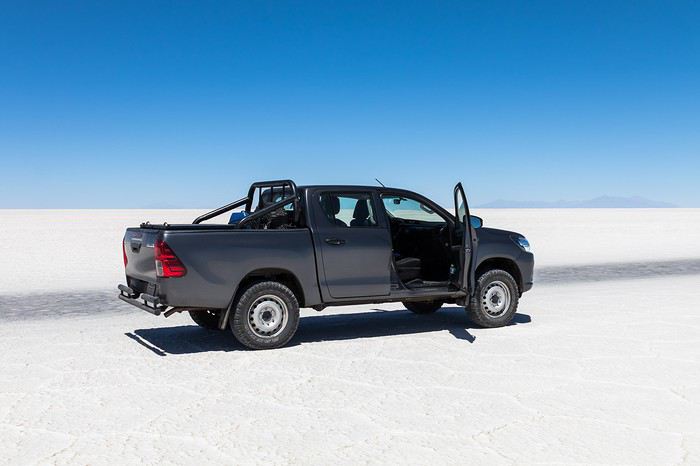 “Our” car, a Toyota Hilux
While planning, we realized the presidential elections would happen while we were in Bolivia. The risk of *bloqueos* (roadblocks and protests) was very real. But in Bolivia, *bloqueos* seem common—you always have to account for that kind of hassle. In late August/early September, Uyuni and the Salar region were blocked for days, leading to food, fuel, and cash shortages. Worried about a blockade in Uyuni and missing the Salar, we decided to visit it first *just in case*.
On election day, the whole country shut down. Planes were grounded, buses and taxis couldn’t circulate, and private cars were banned. There were a few exceptions—ambulances, police, or certain professions—but as tourists, we couldn’t get permission to drive. We asked the embassy, and Biz even requested a permit from the electoral office. So we had to plan to be somewhere with things to do *without* the car.
We decided not to book any accommodations in advance—a first for us. Usually, we plan our stops and reserve lodges, hotels, or campgrounds well ahead. This time, only the room in Sucre was booked, so we’d have a base when we arrived.
In July, Alex (Delhenry) reached out to propose joining part of the trip. He didn’t realize we were leaving in October. Still, we got fresh updates when he returned from the South Lipez. Thanks, Alex—your tips, especially about the Guadalupe–Tupiza stretch, were *super* useful.
In September, we connected with Jean-Louis (Avx) and Anne (Xeta), who were also heading to Bolivia in October, one and two weeks after us. We had dinner with Jean-Louis and his friend after our South Lipez trip and stayed in touch with Anne. It was great to chat with them! Unfortunately, Anne and her husband had a much rockier trip—they got hit hard by post-election issues.
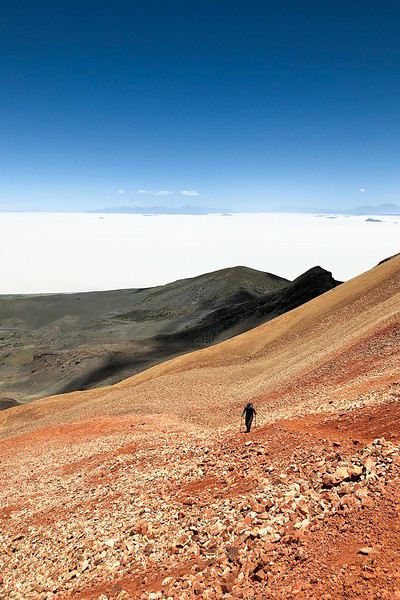 Climbing Volcán Tunupa
Our itinerary wasn’t set in stone—we decided to wing it on the spot. Two weeks before departure, I reconnected with Alejandra at Biz to move the car rental up by a day. With the elections, we wanted to leave Sucre ASAP and focus on the South Lipez. Outside Uyuni and Tupiza, the risk of blockades was zero. We also planned a two-night buffer in Sucre before our flights, just in case. It might sound overcautious, but in hindsight, we made the right call. If we’d left Sucre a day later, we wouldn’t have made it to Potosí—it was completely blocked. On the way back, we *just* dodged blockades in Potosí and elsewhere. Sometimes, you’ve gotta trust your gut.
Here’s our route—only the first two nights in Sucre were booked ahead:
D1 Departure from Switzerland
D2 Sucre (La Selenita)
D3 Sucre (La Selenita)
D4 Colchani (Hotel de Sal Luna Salada)
D5 Jirira (Auberge Doña Lupe)
D6 On the Salar (in the car)
D7 A few kilometers from Estancia Catal (in the car)
D8 Laguna Hedionda (Hotel Los Flamencos)
D9 Laguna Colorada (Lodge by the lagoon)
D10 Middle of nowhere, en route Laguna Verde–Mina Horsu–Quetena Chico (in the car)
D11 Quetena Chico (Lamphaya Lodge Andino)
D12 Quetena Chico (Lamphaya Lodge Andino)
D13 Guadalupe (Guest room at Celia’s)
D14 Along the Rio Grande (in the car)
D15 Tupiza (Hotel Mitru)
D16 Tupiza (Hotel Mitru)
D17 Sucre (La Selenita)
D18 Sucre (La Selenita)
D19 Santa Cruz (Hotel Sun)
D20 Departure from Santa Cruz
D21 Arrival in Switzerland
As you can see, we spent 13 nights in the South Lipez. Initially, we’d planned for nine, but Jean-François (Max68) suggested staying longer. Great advice—we didn’t regret it one bit. We could’ve even added 2–3 more days without getting bored.
Self-driving in the South Lipez takes some prep and a good GPS. We kept it simple and used maps.me to navigate. It’s a solid app—just save your waypoints ahead of time. For some stretches, I used Google Earth to visualize the tracks and sites. If you stick to the tour operator routes, you *almost* can’t get lost. But we often veered off the beaten path and took different routes. Some days, we didn’t see another car. So in case of a breakdown, it’s key to have water and food for several days. In some spots, there’s *zero* signal—your phone won’t work. Another must: it gets *cold* in the South Lipez, and a good sleeping bag is essential. We brought down sleeping bags rated for -10°C and didn’t regret it during our car nights.
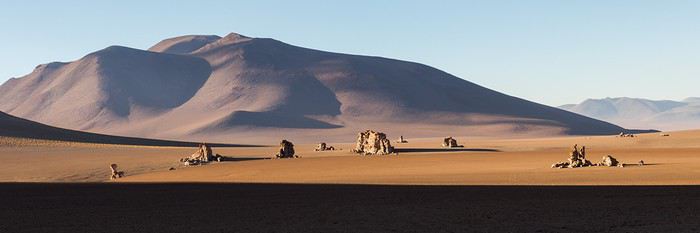 The Dalí Desert
Some tracks are *super* rocky—flat tires are a real risk. On those stretches, maps.me’s estimated travel time was way off. Some sections barely let us go over 15 km/h.
Lots of forum members recommend doing the South Lipez “loop” from Tupiza to Uyuni—ending with the Salar—to avoid Uyuni’s crowds. That might work for organized tours, but for self-drive, the direction *doesn’t* matter. I’ll say this: the few vehicles we saw mostly came from Tupiza and Chile, not Uyuni. So if starting from Uyuni works better for you, go for it! Ending in Tupiza means heading toward warmer weather. For our planned stops and climbs, starting in Uyuni helped with acclimatization. Spending a few nights between 3,600–3,800 m before going over 4,000 m is a smart move.
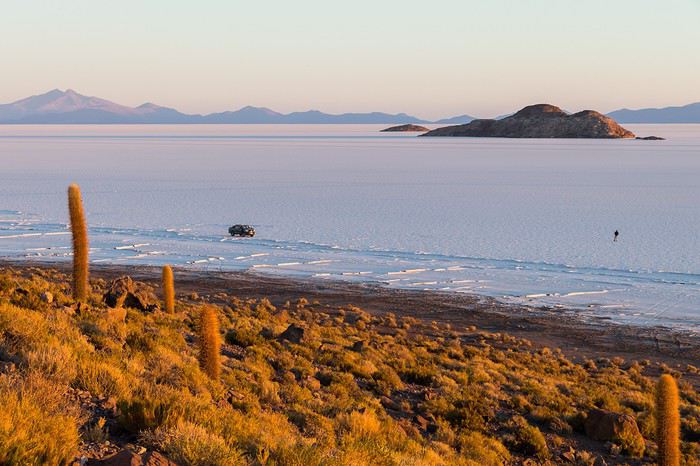 Uyuni Salt Flats in the morning
Overall, we barely saw anyone—except at Laguna Hedionda and Chalviri. There were several tour groups at Hotel Los Flamencos (Laguna Hedionda), but we didn’t cross paths during the day. Hardly anyone on the Salar, on the roads, or at the lodges in the evenings. The *only* place that shocked us was Chalviri. We’d planned to stay there, but it was fully booked—and we counted *forty* tour jeeps on-site. This was around noon! At the Polques hot springs (Chalviri), it was *packed*—we quickly nixed the idea of a dip. Plus, the vibe wasn’t great: soaking right by the road with lodges and restaurants in the background? Meh. Still, lots of tourists love it, so it’s up to you.
For the photos, I kept the colors and mood we saw. The lagoons’ hues are often stunning, but some online photos are *way* over-edited and oversaturated. The South Lipez’s landscapes are breathtaking—no need for excessive retouching.
If you don’t want to read all the details, the start of the travel journal is here: https://voyageforum.com/v.f?post=9888761;a=9888761
The idea of traveling to Bolivia came to me after seeing Jean-François (Max68)’s photos on his website. I thought we *had* to see those stunning landscapes with the colorful lagoons for ourselves. But a self-drive trip didn’t seem doable at first. A few years ago, everyone advised against going to the South Lipez with just one car.
Laguna KaraIt was only after reading Laurent (Lolobe) and Pascal (Pepe874)’s travel journals—who explored the South Lipez solo with a car from Biz Rent a Car—that I thought we might be able to do the same. Meanwhile, we’d already contacted a local agency to organize a trip with a driver and guide. But the idea of a self-drive adventure really appealed to us. With encouragement and tips from Thierry (Tbernay) and Jean-François (Max68), we decided to plan our own self-drive trip. I’d like to thank them for their advice—it was *super* helpful. And a big thanks to all the other forum members for the info shared during our prep!
Laguna ColoradaPlanning this trip happened during a tough time for our family. My mother-in-law’s illness and passing, plus a few health issues of my own, made us doubt the trip multiple times and nearly scrap the whole thing.
We booked our international flights in February with Swiss. They offered the best balance of travel time and price from Switzerland. Swiss operates Zurich–São Paulo with their own fleet, and São Paulo–Santa Cruz with GOL. In June, GOL canceled the Saturday flight and rebooked us on Sunday. Spending over 24 hours in that huge Brazilian city didn’t work for us at all, so we asked Swiss to put us on the next Zurich–São Paulo flight. Too bad—we lost a day in Bolivia and had to skip the Tarabucco market on Sunday.
Right after, we also booked the car in February. After contacting Imbex and Biz, we went with Biz. Not speaking Spanish, we were relieved to communicate with Alejandra in French. The contact was great—she answered all our questions patiently. Sometimes it took a few days to get a reply, but we could also reach her on WhatsApp. After our trip, we can *only* recommend Biz for rentals in Bolivia. The cars are well-prepped for the South Lipez tracks. The agency is reliable, and the vehicles are new and well-maintained.
“Our” car, a Toyota HiluxWhile planning, we realized the presidential elections would happen while we were in Bolivia. The risk of *bloqueos* (roadblocks and protests) was very real. But in Bolivia, *bloqueos* seem common—you always have to account for that kind of hassle. In late August/early September, Uyuni and the Salar region were blocked for days, leading to food, fuel, and cash shortages. Worried about a blockade in Uyuni and missing the Salar, we decided to visit it first *just in case*.
On election day, the whole country shut down. Planes were grounded, buses and taxis couldn’t circulate, and private cars were banned. There were a few exceptions—ambulances, police, or certain professions—but as tourists, we couldn’t get permission to drive. We asked the embassy, and Biz even requested a permit from the electoral office. So we had to plan to be somewhere with things to do *without* the car.
We decided not to book any accommodations in advance—a first for us. Usually, we plan our stops and reserve lodges, hotels, or campgrounds well ahead. This time, only the room in Sucre was booked, so we’d have a base when we arrived.
In July, Alex (Delhenry) reached out to propose joining part of the trip. He didn’t realize we were leaving in October. Still, we got fresh updates when he returned from the South Lipez. Thanks, Alex—your tips, especially about the Guadalupe–Tupiza stretch, were *super* useful.
In September, we connected with Jean-Louis (Avx) and Anne (Xeta), who were also heading to Bolivia in October, one and two weeks after us. We had dinner with Jean-Louis and his friend after our South Lipez trip and stayed in touch with Anne. It was great to chat with them! Unfortunately, Anne and her husband had a much rockier trip—they got hit hard by post-election issues.
Climbing Volcán TunupaOur itinerary wasn’t set in stone—we decided to wing it on the spot. Two weeks before departure, I reconnected with Alejandra at Biz to move the car rental up by a day. With the elections, we wanted to leave Sucre ASAP and focus on the South Lipez. Outside Uyuni and Tupiza, the risk of blockades was zero. We also planned a two-night buffer in Sucre before our flights, just in case. It might sound overcautious, but in hindsight, we made the right call. If we’d left Sucre a day later, we wouldn’t have made it to Potosí—it was completely blocked. On the way back, we *just* dodged blockades in Potosí and elsewhere. Sometimes, you’ve gotta trust your gut.
Here’s our route—only the first two nights in Sucre were booked ahead:
D1 Departure from Switzerland
D2 Sucre (La Selenita)
D3 Sucre (La Selenita)
D4 Colchani (Hotel de Sal Luna Salada)
D5 Jirira (Auberge Doña Lupe)
D6 On the Salar (in the car)
D7 A few kilometers from Estancia Catal (in the car)
D8 Laguna Hedionda (Hotel Los Flamencos)
D9 Laguna Colorada (Lodge by the lagoon)
D10 Middle of nowhere, en route Laguna Verde–Mina Horsu–Quetena Chico (in the car)
D11 Quetena Chico (Lamphaya Lodge Andino)
D12 Quetena Chico (Lamphaya Lodge Andino)
D13 Guadalupe (Guest room at Celia’s)
D14 Along the Rio Grande (in the car)
D15 Tupiza (Hotel Mitru)
D16 Tupiza (Hotel Mitru)
D17 Sucre (La Selenita)
D18 Sucre (La Selenita)
D19 Santa Cruz (Hotel Sun)
D20 Departure from Santa Cruz
D21 Arrival in Switzerland
As you can see, we spent 13 nights in the South Lipez. Initially, we’d planned for nine, but Jean-François (Max68) suggested staying longer. Great advice—we didn’t regret it one bit. We could’ve even added 2–3 more days without getting bored.
Self-driving in the South Lipez takes some prep and a good GPS. We kept it simple and used maps.me to navigate. It’s a solid app—just save your waypoints ahead of time. For some stretches, I used Google Earth to visualize the tracks and sites. If you stick to the tour operator routes, you *almost* can’t get lost. But we often veered off the beaten path and took different routes. Some days, we didn’t see another car. So in case of a breakdown, it’s key to have water and food for several days. In some spots, there’s *zero* signal—your phone won’t work. Another must: it gets *cold* in the South Lipez, and a good sleeping bag is essential. We brought down sleeping bags rated for -10°C and didn’t regret it during our car nights.
The Dalí DesertSome tracks are *super* rocky—flat tires are a real risk. On those stretches, maps.me’s estimated travel time was way off. Some sections barely let us go over 15 km/h.
Lots of forum members recommend doing the South Lipez “loop” from Tupiza to Uyuni—ending with the Salar—to avoid Uyuni’s crowds. That might work for organized tours, but for self-drive, the direction *doesn’t* matter. I’ll say this: the few vehicles we saw mostly came from Tupiza and Chile, not Uyuni. So if starting from Uyuni works better for you, go for it! Ending in Tupiza means heading toward warmer weather. For our planned stops and climbs, starting in Uyuni helped with acclimatization. Spending a few nights between 3,600–3,800 m before going over 4,000 m is a smart move.
Uyuni Salt Flats in the morningOverall, we barely saw anyone—except at Laguna Hedionda and Chalviri. There were several tour groups at Hotel Los Flamencos (Laguna Hedionda), but we didn’t cross paths during the day. Hardly anyone on the Salar, on the roads, or at the lodges in the evenings. The *only* place that shocked us was Chalviri. We’d planned to stay there, but it was fully booked—and we counted *forty* tour jeeps on-site. This was around noon! At the Polques hot springs (Chalviri), it was *packed*—we quickly nixed the idea of a dip. Plus, the vibe wasn’t great: soaking right by the road with lodges and restaurants in the background? Meh. Still, lots of tourists love it, so it’s up to you.
For the photos, I kept the colors and mood we saw. The lagoons’ hues are often stunning, but some online photos are *way* over-edited and oversaturated. The South Lipez’s landscapes are breathtaking—no need for excessive retouching.
If you don’t want to read all the details, the start of the travel journal is here: https://voyageforum.com/v.f?post=9888761;a=9888761
Preamble:
For summer 2019, the idea was to return to Africa. We had already been to Namibia in 2017 (+ a few days in Botswana and the end of the trip at Victoria Falls), which we loved, and a trip to Asia in 2018 (Borneo, Perhentian, and Singapore), a nature-focused trip but a bit disappointing due to environmental destruction. The desire to return to Africa was very strong. We wanted a change of scenery, nature, discoveries, to step out of our little comfort zone (a bit, anyway!) and experience travel differently. In short, we dreamed of authenticity, and we weren’t disappointed.
We traveled as a family of four with our daughters, aged 19 and 17. When the urge for Africa hit, Uganda quickly stood out, especially for the chance to see rare animals, particularly the famous mountain gorillas. When I looked into the budget, I was quickly disheartened. It’s really expensive. Too expensive… Then, after reading a few trip reports on "VoyageForum" (thanks Muriel J!), I decided to ask a local agency for a quote. The first contact was very friendly and responsive, and the initial offer for two weeks fit our budget :). A few images gathered from the internet (especially Sipi Falls) finally convinced us all. I asked for an adapted offer with a few more sites to extend the trip to three weeks and cover a fairly complete visit to the country (which, of course, increased the budget! To stay within an acceptable range, we prioritized activities over accommodations and regularly chose the cheapest options, with 2-3 nice lodges in between). It’s booked! We were in October 2018, and the first thing to do was reserve permits to see the gorillas and chimpanzees. Then, the agency took care of all the bookings except for the international flights, which we booked with Ethiopian Airlines. A few months of waiting to look forward to… and a little worry too! Two events didn’t reassure us: the kidnapping of an American tourist by four men at the DRC border and the Ebola outbreak in Congo, with confirmed cases in Uganda by mid-June…
Here we are in July, and departure is approaching. The suitcases are packed (warm clothes, long, short, dark, light, practical, sun, rain, hiking/trekking shoes, flip-flops—clothes for every situation! Don’t forget: headlamp (essential!), binoculars, cameras), and we’re ready.
One day before departure, our agency Mpolampola, through its manager Paul, informs us that he won’t be the one taking care of us during the trip but another guide named Moses. He has a big problem with a vehicle and can’t do otherwise. For us, as long as everything is okay, no worries, especially since I had read glowing reviews about Moses, who turned out to be a very pleasant guide, cautious (most important) on the road, clear about all the activities, and an expert on birds, his specialty. We briefly met Paul in the middle of the trip, who is also very friendly. In short, we 100% recommend this agency. Flights to Entebbe went smoothly; we arrived around 10:30 AM, filled out health forms (Ebola information signs everywhere), visas, baggage claim, and met Moses, who took us directly to the vehicle. It was in pretty good condition with huge tires (we’d understand why later!), but it had quite a few miles (400,000 on the odometer!). Just missing a seatbelt… Okay, it’s Africa!
Now, here’s our day-by-day itinerary, which I’ll summarize briefly with ratings for each activity: ****TOPISSIME (Amazing) ***Very good **Good *Meh
Day 1) Departure from the airport at 11:45 AM for some currency exchange. Stop along the way at the equator for a meal and souvenir photo! Arrival at Lake Mburo Park *** around 5:00 PM. Even before entering the park, we saw lots of antelopes, zebras, elks, etc.—it’s magnificent. On the way, we had already encountered many goats and cows, and we were impressed by their enormous horns. We enjoyed a nice game drive until about 7:00 PM, when we reached our lodge, one of the nicest of the trip, Eagle’s Nest ****, with a magnificent view, a tent with a nice bathroom/shower, and a very good meal.
Day 2) Departure at 7:00 AM for a game drive; we encountered many animals again, especially antelopes, zebras, and birds. There are no giraffes, lions, or cheetahs in this park. We didn’t get lucky enough to see a leopard… :-) Then, we continued to Lake Bunyonyi ***, where the road and views are very beautiful, but we were shocked to see locals (mostly women and children) breaking stones by hand on the mountainside in very precarious safety conditions. There are regularly dramatic accidents because, over time, entire sections detach and cause landslides. These stones are then used for road construction… Another world… This was the only place we saw this. Lake Bunyonyi is a nice stop (but less exotic in our opinion since we have many lakes back home too!). We took a boat to our accommodation, Byoona Amagara ***, which has a lot of charm. We stayed in huts called "geodomes," completely open to nature, so it was very cool at night. To reach the toilets located below, you had to be brave! The meal consisted of lake shrimp—good but a bit bland.
Day 3) After a good breakfast, departure at 9:00 AM to visit three islands. We took several nice walks with beautiful views of the lake and islands. A local meal was served on the last island. At 1:00 PM, we met Moses for the rest of the program and headed to Ruhija in Bwindi Forest****. The landscapes are breathtaking. After two hours of driving and many photo stops, we arrived at our accommodation near the trekking starting point, Ruhija Gorilla Friends Resort **. We stayed in a room instead of the initially planned tents, which was just as well because there was a lot of wind during the night. We still had time for an activity and decided to meet the Bwata pygmies despite the bad reviews in the guide… The first part of the visit was quite nice, with a visit to a school where the children gave us a very joyful welcome. We had a great time listening to them sing and dance! Then we met the Bwata pygmies who live on the edge of the forest. When Bwindi Forest was declared a national park, they had to leave their habitat because their activities weren’t compatible with nature and wildlife protection. We left on a somewhat sad note… The visit ended with a local doctor explaining different medicinal plants, and we watched the making of local beer from sorghum. Good meal. We had butterflies in our stomachs—tomorrow was a big day! I admit I was a bit stressed, not entirely confident in my physical abilities…
Day 4) After a short night due to excitement, breakfast, and departure at 7:30 AM. First, it started calmly with singing and dancing. Then, a 15-minute briefing and group assignments. No one asked if we had any physical problems or anything (when booking, I had inquired a bit, and they told me groups were assigned based on physical abilities). We were assigned to the Mukiza group. At first, I was pretty happy—it was a fairly large group with babies :). The ranger explained that for now, they didn’t know where the gorillas were… the trackers couldn’t find them… Oh… (that’s not a good sign!!!) We set off at a good pace, first on a reasonably sloped path. We were accompanied by a family of four Italians and five porters (four for us!). After an hour, the ranger stopped us and informed us they still couldn’t find them—they had fought with another group the day before and scattered throughout the forest, so they were very far away, and we needed to move faster… Hmm… we picked up the pace (we weren’t going slowly before!!!) and walked for another good hour—down, up, down again, up again, we kept going, but always more or less on paths. Then another stop. A 10-minute break waiting for news. The news wasn’t very precise, it seemed! The ranger decided to cut through the forest—machetes were used to clear the path. We descended unimaginable slopes, then climbed back up. Our stick kept getting stuck; luckily, our porter helped us, held our hands, and the terrain was vertical! An hour later, another stop: we heard gorilla cries (yay!!!). False hope—we waited again for news from the trackers, who informed our ranger that it was a non-habituated family, so we couldn’t see them. Cold shower—we had to go all the way back up and return to the starting point to maybe see another group. But time was running out… We arrived around 1:30 PM; all the other groups had already left long ago. Our guide was worried because we still had a long drive ahead. We quickly ate a banana, and off we went for another trek (I was exhausted!). Luckily, this group was close—about 45 minutes of steep descent (I was already thinking about the climb back and considering being adopted by a gorilla ). The forest was sublime, with magnificent tree ferns—the place was truly splendid. Finally, we were there. The porters stayed behind, we grabbed our cameras, and followed the ranger. The progress wasn’t easy, but suddenly, a female was in front of us, curled up in a little ball, eating—so cute. The emotion overwhelmed us. But she moved away—it’s hard to observe them; they move constantly, and the terrain is very steep and uneven. We saw a female descending from a tree with a baby on her back—too adorable. Then, here was the silverback, enormous, incredible, yet so calm and peaceful. He ate quietly and gave us a nice demonstration of nostril exploration! We could observe them for a good hour, but photographing them wasn’t easy because they kept moving, and we could barely stand! Toward the end, a large male (black back) suddenly stood up and decided to pass right where I was! I ended up in the bushes, and the male passed in front of me just a few centimeters away (he stepped on one of my daughters’ feet!) followed by the whole family. Just an exceptional moment. It was time to leave; we had to climb back up. I dreaded it because, I admit, I was exhausted. We finished the hike after 4:00 PM, exhausted but happy. The ranger gave us diplomas, and we didn’t linger because we still had a long drive—we needed to reach Ishasha before nightfall. Our guide was a bit stressed. If we were to do it again, we’d spend an extra night in Bwindi. However, it seems finishing so late is exceptional—it never happens, according to our guide! The road between Bwindi and Ishasha is sublime, with extraordinary landscapes, and despite the late hour, we regularly asked our guide to stop for photos. We arrived at Enjojo *** Lodge around 6:00 PM. The huts are located quite far from the reception and the bathrooms, a bit far from the huts, but otherwise, it was very nice.
Day 5) Departure at 8:00 AM after a good breakfast with the hope of seeing tree-climbing lions (no luck!). Overall, there weren’t many animals, and we arrived around 12:45 PM at our next stop, Parkview Safari Lodge ****, with a magnificent view, a beautiful family bungalow, and a good meal. We enjoyed a short relaxation by the lovely pool. At 4:00 PM, we left to see Kyambura Gorge *** and hike there. Unfortunately, this activity is no longer available, so we walked around the area—it was very beautiful. Back at the hotel, a little rest after the previous day wasn’t a bad idea! Reading, swimming, meals, and dances made the end of the day enjoyable.
Day 6) Departure at 6:30 AM—one of our daughters was sick (stomachache, cold sweats…). Safari in Queen Elizabeth ** (Kaseny Plains)—a bit disappointing. Stop by the salt lake with a nice view. A small market, but we weren’t thrilled by the crafts (overall, apart from some beautiful baskets/plates, there wasn’t much, and the wooden objects were, in our opinion, much less pretty than in Namibia). Then we took the crater road (27 km long) **** with magnificent landscapes. However, you absolutely must close the windows because it’s infested with tsetse flies. At noon, we arrived at Mweya, where we stayed in basic rooms, but the restaurant was well-placed with a beautiful view of the Kazinga Channel. At 2:00 PM, we enjoyed a magnificent cruise **** on the channel. Elephants, antelopes, crocodiles, hippos (including adorable babies), buffaloes, all kinds of birds. Wow!!! Two hours of pure bliss. Quiet end of the day playing cards with a view of the channel and elephants.
Day 7) Departure at 6:00 AM—still sick, we weren’t sure if it was due to the preventive treatment (Malarone) or something else… Another game drive in Queen Elizabeth (Kaseny Plains) and breakfast by the salt lake. Overall, we were a bit disappointed by this park. Then we took the road to Crater Lakes***, again with very beautiful landscapes. A hike of about an hour and a half allowed us to discover these beautiful crater lakes (the water mainly comes from the Rwenzoris). We crossed pretty villages and had nice encounters. End of the day at Tinka’s Home ****, with a family. We loved this place—very welcoming, where we took a cooking class with our hosts. A really great time. After the meal, we enjoyed African stories and dances. Really awesome.
Day 8) Departure at 7:30 AM for another highly anticipated discovery—the chimpanzees in Kibale Forest ****. We went to the meeting point and were split into groups of six, each with a guide. We saw three different groups, and for the last group, we followed a chimpanzee (slightly more comfortable running in the forest than we were!) that led us to the group. Their cries are very impressive, and we could observe them well, even though they were often high up in the trees. We were lucky enough to see two on the ground, very close to us. It was magnificent. End of the encounter and return to the starting point—it was noon. We went back to Tinka’s Home for the meal (delicious!). At 2:00 PM, we hiked in Bigodi Swamp ***, a marsh surrounded by beautiful vegetation, especially huge papyrus, and inhabited by many birds and monkeys. We saw, among others, black-and-white colobus monkeys, red colobus monkeys, and vervet monkeys. We also visited a basket-weaving workshop where we bought two beautiful baskets. Then a short stop in Fort Portal, where we stayed for two nights at Ruwenzori View Guesthouse ***, a nice place with a family room and very good communal meals.
Day 9) Departure at 8:00 AM for a hike in the Rwenzori****—it was a bit chaotic today. First, we had to exchange shillings because we wouldn’t have another chance in the following days. At the bank, employees went to get the bills by motorcycle from other buildings—it was quite surreal! And it took time! Then there was a misunderstanding between the organizer and me… I really wanted to see the region where chameleons are found in the Rwenzori—this region is south of the mountain range, and we were in the north! Anyway, the program included an ascent in the northern part with a positive elevation gain of over 1,500 meters… Talking to the guide scheduled for this hike (Noah), we explained that we really wanted to discover the vegetation and these famous chameleons, not necessarily achieve a physical feat… (we’d had enough!). The decision was made to go south, which meant quite a bit of driving. The hike was really enjoyable, with magnificent vegetation by the river. We saw three of the four chameleon species present, including the famous three-horned chameleon. The region is superb. We ended with a drink at Ruboni Camp, which has a magnificent view of the region (ideally, we should have stayed there). Two hours of driving to finish, and a good meal :).
Day 10) Departure at 8:00 AM—we had a long drive to Ziwa Rhino Ranch****. We passed through Hoima, had lunch in Masindi, and arrived in time for the rhino tracking walk. We could approach them closely on foot—it was impressive. We saw eight. Since we were staying on-site in the guesthouse **, we received precise safety instructions for moving between the rooms and the restaurant. And we quickly understood why!
Day 11) Departure at 6:00 AM for breakfast—surprise, in front of our room, several large rhinos were sleeping (we had also heard a lot of animal noises during the night—rhinos but also what seemed to be predators). So we had to take a detour to reach the restaurant! Second surprise—next to the restaurant, just three meters away at most, two mothers and their baby were also sleeping! Memorable! Then we had an appointment for the shoebill trek and canoe ride **** (package with the previous day’s walk). So there we were, in our boots, splashing through 30 cm of water in search of the shoebill (I really wanted to see one :))! It was really fun, and luck was on our side—a shoebill had just landed in the distance! We approached as best we could and observed it from afar. What a strange bird! There are very few left, and Uganda is one of the countries where the chances of seeing one are quite good. The tour continued with a canoe cruise where we saw a herd of cows (the famous ones with enormous horns) being swum as a dowry to the father of the future bride! A funny spectacle. This stop wasn’t the most anticipated, but we all thought it was really worth the detour. Road to Murchison Falls Park, and arrival around noon at Red Chili Rest Camp **, where we stayed for two nights (family banda). Good meal. Then a cruise to Murchison Falls*** where we disembarked and continued on foot. It was pretty. Back to Red Chili.
Day 12) This morning, early departure for a cruise in search of the shoebill*** (booked in case we didn’t see one at Ziwa). The landscapes were pretty, but there weren’t many birds in the end. We spotted the chosen one from afar after the first 10 minutes—so the suspense didn’t last long :-) It was a nice activity but quite long—5 hours. In the afternoon, safari in Murchison Park****—this park is sublime, the landscapes fabulous. Really one of our favorite parts of the trip. Lots of animals and even a leopard spotted with binoculars because it was far away! Night at Red Chili.
Day 13) Departure for the first morning ferry—it was drizzling, the sky was threatening at first, so the landscape was spectacular! Beautiful contrasts. In the middle of the morning, we were lucky to observe a whole group of lions, first from afar, then with a little patience, the whole group approached until they passed beside and in front of our vehicle. What emotion and excitement! We could then observe large groups of giraffes. They were magnificent. The morning was incredible. Then we headed to our lodge, Fort Murchison ****, and on the way, we saw a whole group of elephants—the view was magnificent. We had a very good meal and enjoyed the pool a bit. We also met Paul, the organizer of our trip. Very nice :). In the late afternoon, off for a short safari in the park. We slept in very well-equipped tents.
Day 14) Today, we had a long drive to Kidepo Park. It was raining, which didn’t help our guide—according to him, the tracks near Kidepo turn to mud with rain and become difficult to navigate. We saw, among other things, a bus in a bad situation in the ditch. Some sections were really tricky, and we were glad to have a driver. The end of the trip—the landscape was spectacular and original, and we saw some traditional villages. We arrived at Kidepo quite late. Short safari in the park before reaching the accommodation. We booked two simple bandas in the park camp**. It was clean but didn’t hold up well in the rain . The restaurant was very nice, though.
Day 15) The day was dedicated to discovering Kidepo Park **** where the landscapes were again superb. First encounter with a lioness resting on a rock. We saw other lions later and observed them for a long time. There were almost no other tourists in the park. Our daughter wasn’t feeling well, and by the time we arrived at the lodge, she had a temperature of 39.5°C (103.1°F)… A nap was necessary. In the late afternoon, we returned to the spot where we had seen the lions that morning, and they were still there—they weren’t happy because rain was threatening! It was a great photo opportunity. Then came the downpour, and our driver urged us to return quickly because the tracks were becoming impassable. Indeed, a jeep was in the ditch… The return was eventful, and several times we slid without being able to do anything… Wow, what a day!
Day 16) No safari this morning because of impassable tracks—the road to Kotido*** was longer than expected as we had to take a detour. The landscapes along the way were surprising. We finally arrived around 1:00 PM at the accommodation and left at 3:00 PM to visit the largest manyatta in East Africa with two translators. It was incredible—a very beautiful experience. The manyatta is immense and has 28,000 inhabitants. Night at Karamojaarts guesthouse*—very average meal.
Day 17) Departure for Moroto****—on the way, we saw many bird species. Moroto doesn’t look like other Ugandan cities. Life there seems very pleasant. We arrived at Kara-Tunga and had a bite to eat. At 4:00 PM, we left to visit a Karamojong village. We enjoyed beautiful dances and watched communal games—it was fun and so authentic. Then we headed to a kraal (where shepherds and herds are) to set up our camp. Moses had to get used to the idea of sleeping in the tribe in a tent! It was incredible to find ourselves in this universe. The place was beautiful, and we had a great time with the Karamojong. Some had never seen white people… had never been in a car… Their culture is incredible. During the evening, around the fire, to our guide’s dismay (a bird enthusiast), they grilled hornbills! On our side, we ate a meal prepared by Kara-Tunga for our sensitive stomachs! Night in a tent.
Day 18) Dawn wake-up in the fog—the atmosphere was quite strange. Our daughter was attacked by a cow—fortunately, more fear than harm, but she ended up with a lot of thorns in her buttocks and thighs ! Then we left for the Mount Elgon region, specifically Sipi Falls****. Lacam Lodge****, perched on the edge of the cliff with a direct view of one of the falls, was just magnificent. The view and landscapes were fabulous. Big favorite. We had dinner and then went for a hike to visit the three falls in the region, partly in the rain. The landscapes were breathtaking! Sunset at Lacam Lodge with the sun setting over the waterfall. We couldn’t get enough and stayed to admire until nightfall!
Day 19) Visit to coffee plantations*** where we were given all the useful explanations to understand the culture and the incredible work required for this product, which is ultimately not very glorified. The visit was very interesting, and we drank very good coffee with the owners. Last photos at Lacam Lodge, and then departure for Jinja, where we arrived in the middle of the afternoon. We took a small cruise to see the source of the Nile*. Very touristy and not at all to our taste… Then a meal at Jinja Base Camp** where we enjoyed guacamole. Our guide Moses left us because another group was waiting for him!
Day 20) Road to Kampala***, the market, the Gaddafi Mosque. Short but interesting visit. Last meal in Entebbe by Lake Victoria, where we almost felt like we were by the sea. Transfer to the airport and return to Switzerland…
Epilogue: All four of us were enchanted by this trip, which will undoubtedly remain one of the most beautiful we’ve ever taken. Talking about it gives me chills and brings tears to my eyes. It was simply a magnificent experience. However, I wouldn’t recommend this trip to everyone because you often have to overlook small inconveniences like toilets (the worst of my life) and certain comfort details that, for us, remain details but could be important to others.
Our favorites: - The gorilla trek - The cruise on Kazinga Channel - The Fort Portal region - The Rwenzori Mountains - The chimpanzee trek - Murchison Falls - Kidepo - Spending time with the Karamojong tribe - The Sipi Falls region - The accommodations: Eagle’s Nest, Byonna Amagara, Parkview Lodge, Tinka’s Home, Rwenzori Guesthouse, Fort Murchison, Night in the kraal, and Lacam Lodge
What we liked less: - Queen Elizabeth Park - Jinja - The accommodations: Ziwa Rhino Ranch, Karamojaarts Guesthouse
I’ll try to post some photos later. If you have any questions about a future trip, I’d be happy to answer them.
Hi there, I’ve traveled for work and taken several leisure trips with my late partner, and now friends are scarce at 74. I’d love to do more budget travel, either solo or with travel companions, but I don’t know where to start. Any help would be greatly appreciated! I’m from Quebec, Canada, and I speak French and a little English. Hervé
I recently took a six-week trip to Mexico with Y, my Thai partner. To be precise, we spent 43 days there plus a final half-day before heading to Mexico City Airport for our return flight to Europe.
I’d already been to Mexico about 40 years ago! But that was only for a week or so, between Mérida and the Belize border.
First off, I should mention that I’ve never seen a beach in Mexico. I say this because discussions about Mexico always seem to revolve around the Costa / Riviera Maya.
Let’s start with an overview of the trip. Our itinerary can be split into two halves:
- First half: Querétaro, San Miguel de Allende, Morelia, Guanajuato, Mexico City “CDMX” (the capital). - Second half: Palenque, San Cristóbal de Las Casas, Chiapa de Corzo, Oaxaca, Puebla, Cholula, and finally Mexico City CDMX.
To move from one part of the trip to the other, we took a flight from Mexico City CDMX to Villahermosa, then a bus to Palenque.
In six weeks, we visited maybe a quarter or a fifth of the country (see the attached maps). Mexico is about three times the size of France! And when I say “visited,” it was really just a quick stop—enough to get a first impression. I understand that some people can only spend one or two weeks on vacation in a given country, but that’s not my idea of travel. Personally, I’d say a country as rich in every way as Mexico deserves several months of travel before you can say you’ve “seen” it.
In my next post, I’ll break down the expenses. That might help future travelers plan their trips. You don’t go to a country for several weeks (or more) without thinking about the budget! Besides, one of those future travelers to Mexico is us—we were so thrilled by Mexico that we’re definitely going back.
It’s been almost six months since we returned from our 15-day trip to Botswana, ending in front of the majestic Victoria Falls in Zimbabwe.
Our itinerary: 1 night at Maun Lodge in Maun 3 nights in the Central Kalahari at Deception Valley Lodge 1 night at Maun Lodge in Maun 3 nights in the Okavango Delta at Sango Safari Camp 3 nights in Chobe National Park at Chobe Safari Lodge 2 nights at Victoria Falls at A’Zambezi River Lodge
We were on a tight budget, so we opted to rent a vehicle for the Central Kalahari and the Okavango Delta.
The lodges are expensive but all-inclusive—meals, drinks (alcohol included), laundry, and the usual two daily safaris. In short, everything.
The lodges mentioned above offer a very high-end experience, with a guide and a 4x4 for each tent. We shared a 4x4 once at Sango Safari with an English couple.
Another little tip: I’d avoid staying at Chobe Riverfront like we did. It’s extremely touristy and overpriced. I think we should’ve spent one night there for the cruise and two other nights at a lodge deeper in Chobe National Park.
We arrived in Maun after an endless flight: Paris-Frankfurt-Johannesburg-Maun. We headed to the car rental agency to pick up our 4x4, and what a surprise to learn they’d canceled our booking—no vehicle! After 6 hours of waiting, we finally received our 4x4 at our hotel, fell asleep peacefully, and were ready to head to our first destination: the Central Kalahari!
This three-week trip to Namibia was a big first for us:
- Visiting a country in winter, for someone who starts feeling comfortable at 25°C (77°F).
- Camping, when we usually feel at home in a starred hotel.
- Sleeping on the roof of a car—what an idea... when a comfy bed is waiting just a bit further.
- Grocery shopping, cooking, doing the dishes... all the things we usually avoid to fully enjoy our vacation.
- Washing up when and how we can, when we can’t imagine going a day without a shower.
- Driving a big 4x4 on the left, with a manual transmission, when we usually opt for an automatic for more comfort.
Yep! You guessed it—we stepped way out of our comfort zone during this trip.
I had quite a few doubts while planning this adventure, but the more I read travel journals about Namibia, the more I wanted to go.
Personally, without this forum, I never would’ve dared to hit the Namibian roads in a 4x4. I was really anxious during the planning, so I want to thank everyone who contributed with their journals and forum discussions for helping me leave more peacefully.
At first, I wasn’t even considering sleeping in a tent. But after my husband’s persuasion—and my own curiosity to experience what I’d read in those travel journals—I gave in. So off we went in a double-cab Hilux with a rooftop tent.
And of course, let’s talk about me—the big cold-weather wimp. One of the biggest pre-trip challenges was choosing a sleeping bag. After a while, sleeping bags had no more secrets for me: temperature ratings (comfort, limit, extreme), shapes (mummy, rectangular), fillings (synthetic, down), compression rate, and weight... all these factors were a real puzzle. In the end, to make sure I wouldn’t be put off camping in winter (Australian winter, mind you), I went for a sleeping bag with a comfort rating of -10°C. And just to be *extra* sure I wouldn’t get cold, I bought a liner (never knew what that was before) in Thermolite, which boosts the sleeping bag’s temperature by 11°C. There are liners that add up to 15°C, but let’s not exaggerate—we’re not heading to the North Pole! My husband, on the other hand, got a sleeping bag with a -5°C comfort rating and a silk liner.
Was it enough? You’ll find out soon. In the meantime, another big thank you to everyone who helped me make this choice with their advice and experience.
Over a year in advance, we planned a three-week itinerary for our first trip to Namibia—classic route, nothing too out there. We chose to do the circuit clockwise because we wanted to finish on a high note in Etosha and its wildlife. They say it’s like Noah’s Ark out there! And why not, the cherry on top... some big cats.
We used Tourmaline’s services to book our accommodations and the 4x4.
Here’s our planned itinerary with campsites and lodgings—yes, there are a few solid roofs in there; we didn’t want to push it too far.
Day 1: Windhoek – Windhoek Gardens Guesthouse Day 2: Kalahari Anib Campsite Day 3: Namibrand Family Hideout Day 4: Sesriem Camp Day 5: Sesriem Camp Day 6: Rostock Ritz Camp Day 7: Swakopmund - Sea Breeze Guesthouse Day 8: Swakopmund - Sea Breeze Guesthouse Day 9: Spitzkoppe Camp Tented Day 10: Brandberg White Lady Campsite Day 11: Grootberg Lodge Day 12: Opuwo Country Campsite Day 13: Epupa Camp Day 14: Hobatere Lodge Day 15: Etosha Olifantsrus Camp Day 16: Etosha Okaukuejo Camp Day 17: Etosha Halali Camp Day 18: Etosha Namutoni Camp Day 19: Cheetah Eco Lodge Day 20: Windhoek – Londiningi B&B
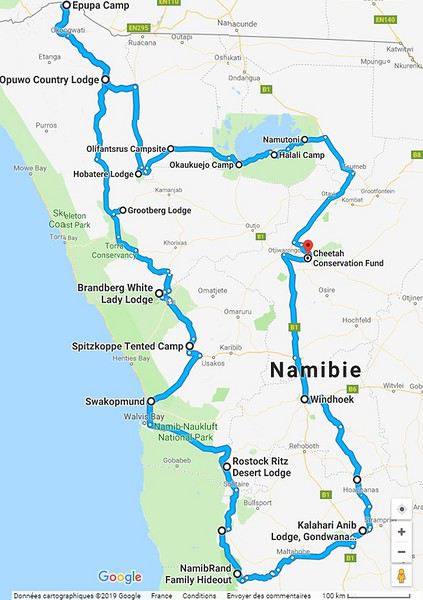
Alright! Are you ready to follow this adventure with us in our Hilux?
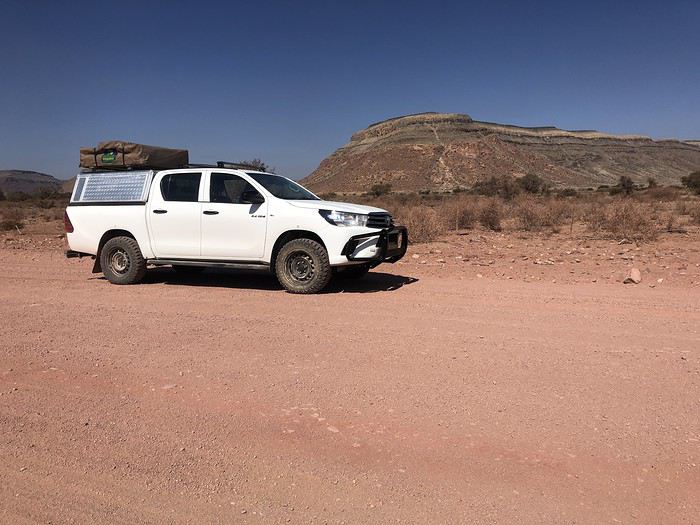
Yep! You guessed it—we stepped way out of our comfort zone during this trip.
I had quite a few doubts while planning this adventure, but the more I read travel journals about Namibia, the more I wanted to go.
Personally, without this forum, I never would’ve dared to hit the Namibian roads in a 4x4. I was really anxious during the planning, so I want to thank everyone who contributed with their journals and forum discussions for helping me leave more peacefully.
At first, I wasn’t even considering sleeping in a tent. But after my husband’s persuasion—and my own curiosity to experience what I’d read in those travel journals—I gave in. So off we went in a double-cab Hilux with a rooftop tent.
And of course, let’s talk about me—the big cold-weather wimp. One of the biggest pre-trip challenges was choosing a sleeping bag. After a while, sleeping bags had no more secrets for me: temperature ratings (comfort, limit, extreme), shapes (mummy, rectangular), fillings (synthetic, down), compression rate, and weight... all these factors were a real puzzle. In the end, to make sure I wouldn’t be put off camping in winter (Australian winter, mind you), I went for a sleeping bag with a comfort rating of -10°C. And just to be *extra* sure I wouldn’t get cold, I bought a liner (never knew what that was before) in Thermolite, which boosts the sleeping bag’s temperature by 11°C. There are liners that add up to 15°C, but let’s not exaggerate—we’re not heading to the North Pole! My husband, on the other hand, got a sleeping bag with a -5°C comfort rating and a silk liner.
Was it enough? You’ll find out soon. In the meantime, another big thank you to everyone who helped me make this choice with their advice and experience.
Over a year in advance, we planned a three-week itinerary for our first trip to Namibia—classic route, nothing too out there. We chose to do the circuit clockwise because we wanted to finish on a high note in Etosha and its wildlife. They say it’s like Noah’s Ark out there! And why not, the cherry on top... some big cats.
We used Tourmaline’s services to book our accommodations and the 4x4.
Here’s our planned itinerary with campsites and lodgings—yes, there are a few solid roofs in there; we didn’t want to push it too far.
Day 1: Windhoek – Windhoek Gardens Guesthouse Day 2: Kalahari Anib Campsite Day 3: Namibrand Family Hideout Day 4: Sesriem Camp Day 5: Sesriem Camp Day 6: Rostock Ritz Camp Day 7: Swakopmund - Sea Breeze Guesthouse Day 8: Swakopmund - Sea Breeze Guesthouse Day 9: Spitzkoppe Camp Tented Day 10: Brandberg White Lady Campsite Day 11: Grootberg Lodge Day 12: Opuwo Country Campsite Day 13: Epupa Camp Day 14: Hobatere Lodge Day 15: Etosha Olifantsrus Camp Day 16: Etosha Okaukuejo Camp Day 17: Etosha Halali Camp Day 18: Etosha Namutoni Camp Day 19: Cheetah Eco Lodge Day 20: Windhoek – Londiningi B&B
Alright! Are you ready to follow this adventure with us in our Hilux?
Hi everyone,
After years of traveling, I finally settled down a few years ago in the Togean Islands, Indonesia (on the main island of Sulawesi).
For those planning to visit the Togeans via Wakai (arriving either by ferry from Gorontalo or speedboat from Ampana), watch out for a person who goes by the name Bagong, also known as Farid.
This gentleman is a teacher and supplements his income with tourism-related activities. He often hangs around Wakai port looking for tourists to sell things to (a charter boat transfer, a cabin on the ferry, etc.), using dishonest methods and lining his pockets.
More recently, he was hired by the authorities of Togean Islands National Park (TNKT) to sell entry tickets. And this is even worse: in the name of the National Park, he outright scams tourists, either by selling tickets at a higher price, asking them to pay again, or charging children who are supposed to enter for free.
Here’s what you need to know: 1. Entry fee for the National Park: 150,000 IDR (ONLY FOR ADULTS, aged 18 and up)
2. This entry fee is only payable once, even if the ticket states it’s a daily price. These tickets were printed a long time ago, before tourists even had to pay anything, and since then the payment system has changed. So it’s indeed 150,000 IDR per person, payable once regardless of how long you stay in the Togeans.
3. Where to pay (depends on your entry point to the Togeans):
Ampana: entry fee payable when departing from Ampana port Gorontalo: entry fee payable upon arrival at Wakai port Bumbulan (Marisa): entry fee payable upon arrival at Dolong port
If you’re asked to pay these fees anywhere else or when leaving the Togeans, it’s a scam—don’t pay.
4. You should receive one receipt per person in exchange for the 150,000 IDR. If not, know that the money won’t go to the National Park but into the ticket seller’s pocket. If someone offers to charge you less (e.g., 100,000 IDR), you won’t get a receipt, so the money still won’t go to the National Park. Please don’t accept these practices, even if you think it’s good for your wallet (seriously, a 50,000 IDR discount is only about 3 €). The National Park needs these funds to protect the Togean Islands’ ecosystem. By saving 3 €, you’re just lining the pockets of a dishonest guy.
Several resorts have already reported Bagong’s (or Farid’s) dishonest practices to the National Park. The authorities are still struggling to find a trustworthy person to sell tickets in Wakai (no scams have been reported in the other two ports so far). We all hope this person will be replaced soon.
5. Contribution for the Ministry of Tourism: Since early 2019, every tourist staying in the Togean Islands must, in addition to the National Park entry fee, pay a 50,000 IDR contribution (regardless of the length of stay). These fees are to be paid at the same time as the 150,000 IDR for the National Park.
6. Price for renting a cabin on the ferry Wakai - Gorontalo (and vice versa): 500,000 IDR. If someone offers you 600,000 IDR, it’s a scam, and those extra 100,000 IDR will go into the same dishonest guy’s pocket (or one of his accomplices). Note that the 500,000 IDR already includes the commission for the person acting as an intermediary to rent the cabin.
7. Going rates for charter boats from Wakai to the various resorts (approximate prices, just to give you an idea—it may vary slightly from one boat operator to another or from one resort to another):
Wakai - Kadidiri (Harmony Bay, Kadidiri Paradise, Black Marlin, Pondo Lestari): usually free if the transfer is arranged by the resort (if you have a confirmed booking and stay more than one night), otherwise between 100,000 and 150,000 IDR Wakai - Una Una (Sanctum, Pristine Paradise): I’ll get back to you with the info, but you can also check with these two resorts. Wakai - Katupat (Fadhila Cottages and Bolilanga): 400,000 IDR Wakai - Bomba (Polyalisa, Poki-Poki, Araya Dive Resort, Island Retreat): 400,000 IDR Wakai - Malenge (Malenge Indah, Bahia Tomini, Sera Beach, Sandy Bay, Lestari Cottages): 600,000 IDR Wakai - Waleakodi (Lia Beach, Pulotiga Resort): 900,000 IDR
There you go, fellow travelers—my little contribution to help you avoid what’s known here as the "Wakai mafia."
I’ve included some photos of Bagong/Farid (found on Facebook) so you can recognize him. Note that he sometimes wears glasses, sometimes not, sometimes has a mustache, sometimes not, and sometimes wears his teacher’s uniform to appear more official or legitimate. Heh, the habit doesn’t make the monk ;)
Other shady individuals in Wakai:
Lamin: sometimes sells ferry tickets to Gorontalo, but mostly acts as a taxi to resorts, with shady deals and unfair prices. Uni: a seemingly charming woman, but not always honest. She offers cabin rentals on the ferry and arranges charter boat transfers to resorts.
And while I’m at it, if you meet "Miss Harbor" at Ampana port, run away like the plague. She doesn’t handle National Park ticket sales but will try to sell you a car rental for Toraja, Tentena, Luwuk, or Manado, a cabin rental on the ferry to Gorontalo, or other things. Her real name is Ulfa, and she’s a real scammer (on top of being an alcoholic and a bit unhinged). I’ll try to post something about her later.
Don’t worry, there are also plenty of great people in the Togean Islands :P :P
If, despite everything, you fall victim to these scammers’ schemes, be sure to report it to the resort where you’re staying. And of course, leave a comment here so I can report it to the National Park and the Ministry of Tourism (communications are difficult in the Togeans, and some resort owners don’t have many opportunities to contact the authorities). Together, we can put an end to these dishonest practices and make the Togean Islands even more beautiful :)
Have a great summer, travel safely, and return with your heart filled with the beauty of our world!
Hi everyone,
I wanted to share a really unpleasant experience from our last trip booked with Promoséjours and organized by FTI.
We booked an 8-day/7-night stay in Egypt, from June 8 to 15. The flight initially scheduled was changed a week before departure to take off at 10 PM from Paris CDG. In the end, it took off with a 1-hour delay and included an unmentioned stopover in Marsa Alam. We landed in Hurghada at 4 AM and arrived at the hotel at 6 AM. So, we spent our first night on the plane.
For the return trip, surprise—the flight was moved up. We left the hotel at 10:30 PM on Friday the 14th to take off at 2 AM and land at 7 AM at Paris CDG. So, we spent our last night on the plane too.
After sending a complaint letter to Promoséjours / FTI, they replied that the first and last days can be dedicated to transport (which I already knew) and that no matter how many nights you book, you’re not guaranteed to spend them in the hotel—it could just as well be on the plane.
I’m really questioning this.
Isn’t there a law that protects customers in cases like this? Because when I do the math, the first and part of the second day were spent on transport, same for the second-to-last and last day. And I paid for 7 nights for a stay that only lasted 5.
Anyway, I just want to say thanks to them—thanks to their two sleepless nights in transit, I’m coming back even more exhausted from a trip that was supposed to be restful!
I also want to warn anyone booking through this agency about visas for Egypt. At booking, they told me the visa was included in the price, then they sent me an email saying I’d have to pay for it on-site at 25 €. Once there, we were directed to a special line for FTI customers, and guess what? They charged us 30 €!
Basically, they’re great at making sure you *enjoy* your vacation—mostly by enjoying your wallet!
If anyone has dealt with this kind of situation and won their case, I’m all ears.
Thanks in advance!
Hi everyone,
I’ve got a full-day layover in Ibiza—arriving at 10 AM and leaving at 10 PM. Could you tell me if there are any local shuttles available when we disembark, without having to take the MSC buses? Do you know of a reliable car rental company?
Thanks in advance for your help.
I’ve got a full-day layover in Ibiza—arriving at 10 AM and leaving at 10 PM. Could you tell me if there are any local shuttles available when we disembark, without having to take the MSC buses? Do you know of a reliable car rental company?
Thanks in advance for your help.
Hello everyone,
Here’s the belated review of our 15-day Caribbean cruise on the COSTA MAGICA from March 1st to 15th.
It’ll be illustrated with photos for each port of call. You’ll need to click on them to enlarge.
We bought this cruise from AZUR CROISIÈRES, in an outside cabin, with the TOTAL COMFORT CLASSIC package, which includes: - The "Pranzo & cena - Lunch & Dinner" drinks package with unlimited drinks during meals: water, wine, sodas, and draft beer. - A discount on excursions: the more you book, the bigger the discount.
The "Pranzo & cena - Lunch & Dinner" package was offered onboard for 19.90 € per day per person for those who didn’t already have it.
The itinerary was as follows: Fort-de-France (Martinique) / Pointe-à-Pitre (Guadeloupe) / At sea / Scarborough (Tobago) / St. George’s (Grenada) / Bridgetown (Barbados) / Castries (St. Lucia) / Fort-de-France (Martinique) / Pointe-à-Pitre (Guadeloupe) / At sea / Willemstad (Curaçao) / Oranjestad (Aruba) / Kralendijk (Bonaire) / St. George’s (Grenada) / Fort-de-France (Martinique)
After many cruises with MSC, this was our first COSTA cruise. We couldn’t help but compare the two companies and made the following observations: - The elevators are faster on COSTA than MSC. You wait less often. - Fewer storage spaces in the cabin closets on COSTA than MSC. - Impossible to check your onboard account balance on the TV with COSTA. - The cost of excursions booked in advance online is deducted at the end of the cruise with COSTA, but immediately upon booking with MSC. - The decor is more contemporary and elegant on MSC than COSTA. - COSTA’s restaurant meals are just as good as MSC’s but more generous. - COSTA: On the first evening when you arrive at the restaurant for dinner, no staff member shows you to your table, unlike MSC! - The buffet desserts are better on COSTA. - COSTA: No "napkin folding" during the Italian evening, no pizzas at the buffet, no complimentary drinks in the lounges during the gala evening, and no Baked Alaska either! - The shows are slightly less impressive on COSTA but a bit longer. - COSTA offers the option to skip the evening turndown service (preparing the beds for the night with the sheets folded back).
Of course, this list may also depend on the ship you’re traveling on. Some of these observations might be specific to the COSTA MAGICA.
Before the cruise, we spent 2 days in Fort-de-France at the "La Batelière" hotel.
www.la-bateliere.com/
Some rooms need renovating, but the sea view is stunning. We had to carry our two large suitcases up two flights of stairs ourselves because there was no elevator in the part of the building where our room was. The restaurant is good, but service can be slow if it’s busy. Breakfast is excellent. The beds are comfortable. The area around the hotel isn’t interesting—it’s best not to venture out. At the foot of the hotel, there’s a tiny beach (not private) and a nice restaurant/bar with a good reputation: "Lili’s Beach." I recommend booking a superior category room rather than a standard one, or you might be disappointed.
Hi there,
I recently booked a cruise on the MSC MERAVIGLIA in a Yacht Club cabin, and the company assigned me a connecting cabin (with a shared side door to the neighboring cabin, which wasn’t occupied by anyone in our group). I really struggled with the soundproofing compared to the neighboring cabin. Just one door separates the two cabins, and while non-connecting cabins are usually very well soundproofed, the one we had let us hear the neighbors’ conversations and even their toothbrushing. I asked to change cabins, but the ship was fully booked. I think a single door (instead of two) isn’t enough for proper soundproofing, and if it’s even slightly misaligned, it lets air—and therefore sound—through.
If others have experienced this issue, I’d love to hear about it because MSC tells me it’s not a recognized problem (except by me, apparently!)...
Hi everyone,
I’ve finally gotten around to writing up a little recap of our Thailand trip in July 2017. Better late than never, right? 😛 It’s not a full travel journal, just a quick rundown with a few (modest) photos. I’d been wanting to explore Asia for a while, but nothing was set in stone. Then, by chance, I found some great flight deals from Toulouse to Bangkok (1650 € for the three of us—my husband, my 17-year-old son, and me). What the heck, I booked them! We arrived on July 6th around 6 PM and left Bangkok on the 25th in the late afternoon. So, now I had to plan the route… Let’s be honest: with only three months to prepare and zero knowledge of Asia, sleep wasn’t going to be a priority! That’s where I have to say a huge *thank you* to all the forum members who love this country! I devoured as many travel journals as I could on the forum, discovered all sorts of blogs, and managed to "put together" an itinerary. My husband isn’t a fan of crowded places, so we decided to see a few "must-sees" and then head to spots that are much less frequented by tourists—way more peaceful.
Here’s our route with the accommodations (prices for 3 adults):
- 3 nights in Bangkok (Isanook HOTEL, 180 € with breakfast) - 1 night on the train to Chiang Mai (69 € for a sleeper berth) - 3 nights in Chiang Mai (Lanna Tree Boutique Hotel, 230 € with breakfast) - 1 night in Donsak (Lam Tong Resort, 37 € with breakfast) - 3 nights on Koh Phaluai (Angthong Beach Resort, 135 € with breakfast) - 3 nights in Bang Saphan (Palms Gardens, 111 € without breakfast) - 3 nights in Prachuap Khiri Khan (Sunbeach Hotel, 94 € without breakfast) - 1 night in Bangkok (Anajak Hotel, 129 € with breakfast—we treated ourselves 🙂) For the hotels, we could’ve gone cheaper, but being able to take a quick dip in a pool isn’t so bad, right? Especially in Bangkok and Chiang Mai, I think I booked a little late, so options were more limited. No regrets with any of the accommodations—every single one lived up to what we’d seen and read about them. I’ll say it again: without the travel journals from the active members of this forum, I wouldn’t have been able to plan this trip. I won’t name names, but you’ll recognize your contributions here and there. I was starting from scratch with zero knowledge of the country, and what matters most to me when I travel is gathering as much info as possible on local customs—so we can blend in and avoid any major faux pas! Thanks again to all of you!!! 🙂 😉
Practical details: - The overnight train was booked as soon as reservations opened, about two months in advance. - From Chiang Mai to Surat Thani, we flew with Air Asia for 196 € with three checked bags, booked two months ahead. From Surat Thani to Donsak, we arranged for the son of the Lam Tong Resort owner to pick us up at the airport for 1500 baht. - The round-trip ferry from Donsak to Koh Phaluai cost 1200 baht for the three of us. - On Koh Phaluai, we hired a guide, Ton, for two days to explore Angthong Marine Park: 8700 baht (including lunch). I booked these two days through Mathilde, who’s been mentioned on this forum. - From Surat Thani to Bang Saphan: train, tickets bought the same day. - From Bang Saphan to Prachuap: same. - From Prachuap to Bangkok: public bus.
Bangkok:
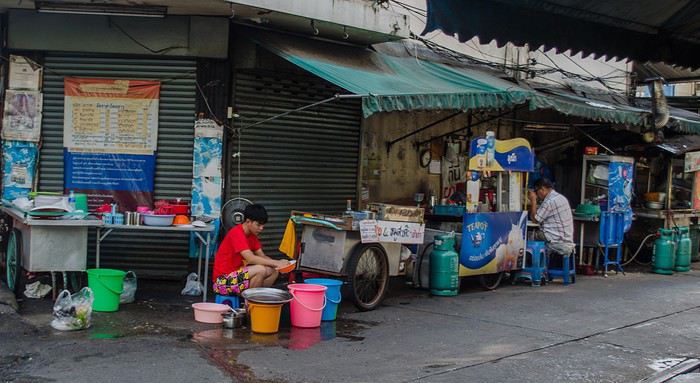
Our hotel was in a neighborhood away from the city’s most touristy spots, so we really got to experience "normal" life. How else to describe it? It’s like being in Paris in the heart of the 20th arrondissement, far from the Eiffel Tower… You wouldn’t think you were in a megacity like Bangkok! We loved this part of town, especially the Sam Yan metro station with its market, its cows (!), and its temple. We also enjoyed the street food stalls right by the hotel, with no crowds.
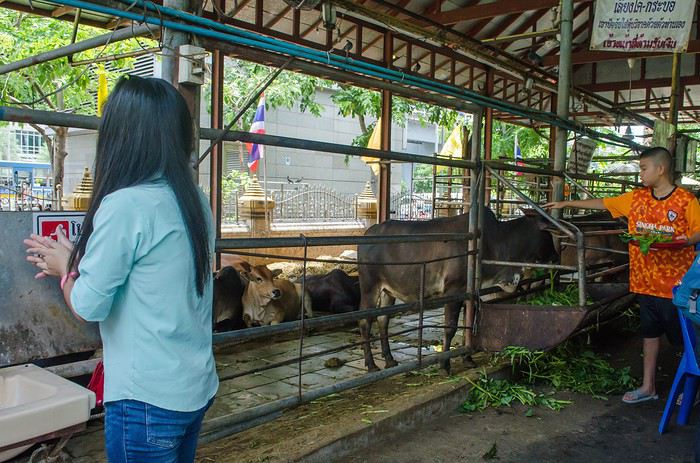
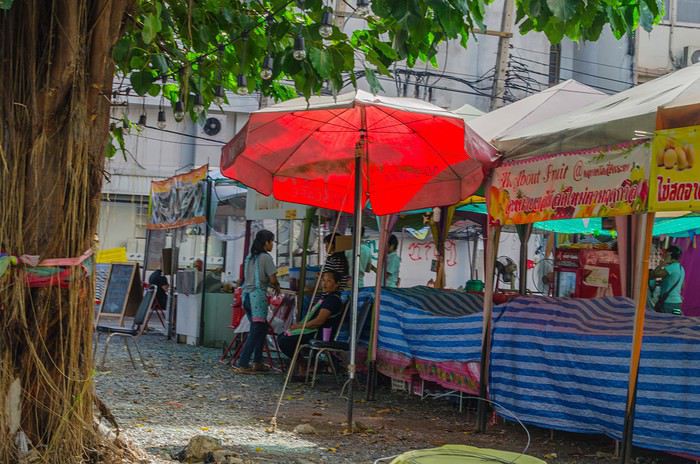
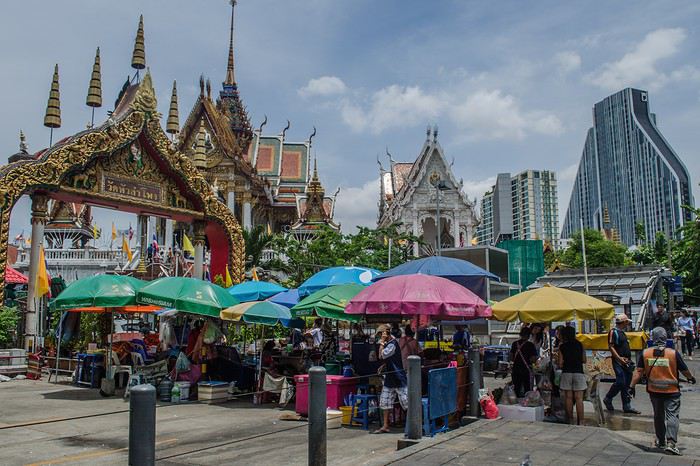
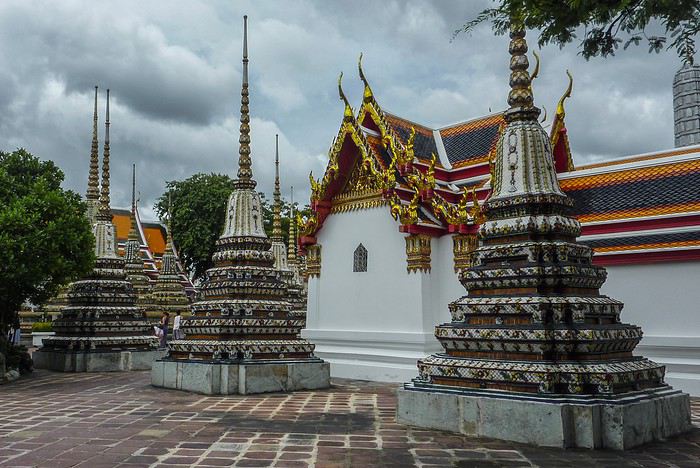
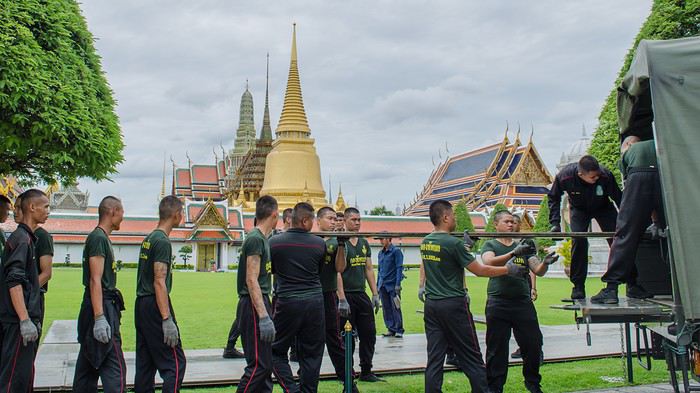
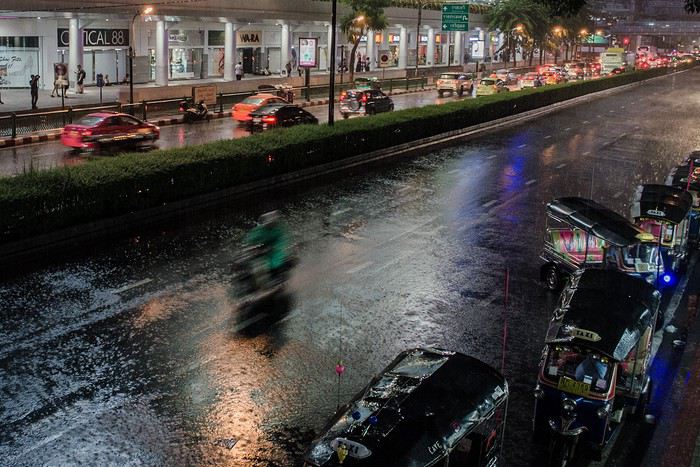
We loved visiting Wat Pho in the morning before the crowds arrived. We weren’t alone, of course! (They wouldn’t give us a private tour… 🤪) But it was smooth and peaceful, and we got to watch groups of schoolkids singing together on the floor or drawing. The Grand Palace later in the morning was a different story—so many people, long lines at the checkpoints and ticket counters, and *very* loud crowds. Khao San Road during the day was pretty "calm." We just passed through and spent more time around Soi Rambuttri, eating at a small restaurant where a waiter showed us why Thailand is called the Land of Smiles. We loved hanging out at the end of the street by the river. We also stumbled upon a little market in that area, but I have no idea which streets it was on. Taking the river shuttles was such a nice way to enjoy the views of the riverbanks. We really liked Chinatown with its narrow alleys, vendors, hustle and bustle, and smells (not all of them pleasant…). The greenery and calm of Lumpini Park were so refreshing—not just for tourists, but for locals too, who come to eat, play board games, or go for a walk. The contrast between the hyper-modern side of the city with its massive malls, skyscrapers, and more working-class neighborhoods is fascinating!
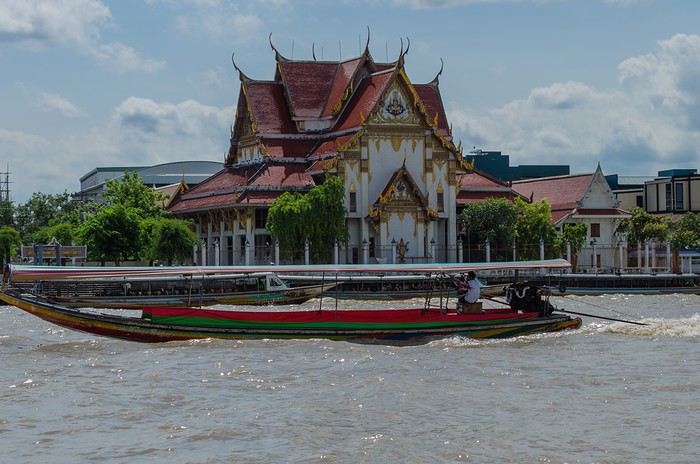
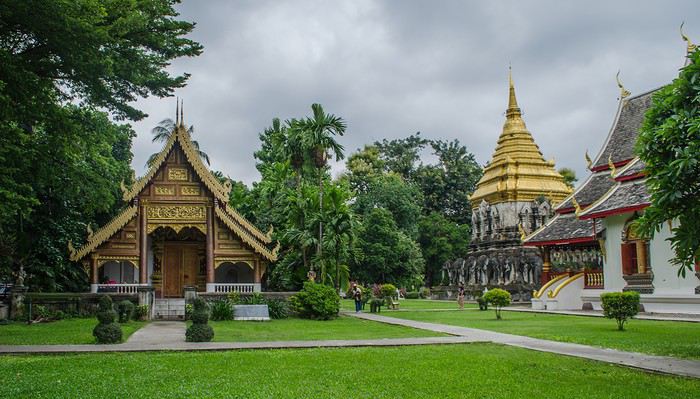
Chiang Mai: Very touristy, but we knew that going in, so we knew what to expect. We’re not big on temples, but we still really enjoyed discovering some of them as we wandered around—some packed, others much quieter. We loved getting "lost" in the old city’s alleys. The Doi Suthep site is truly exceptional, and despite the crowds, we managed to find little corners where there was almost no one! So we could enjoy the site and the views of the surrounding landscapes in peace. Still on the hunt for quiet spots, we headed to Mon Cham, about 40 km from Chiang Mai by scooter. Such a relaxing place—what a great discovery! During our stay in Chiang Mai, the rain played cat and mouse with us, and I’ll admit, it often won!
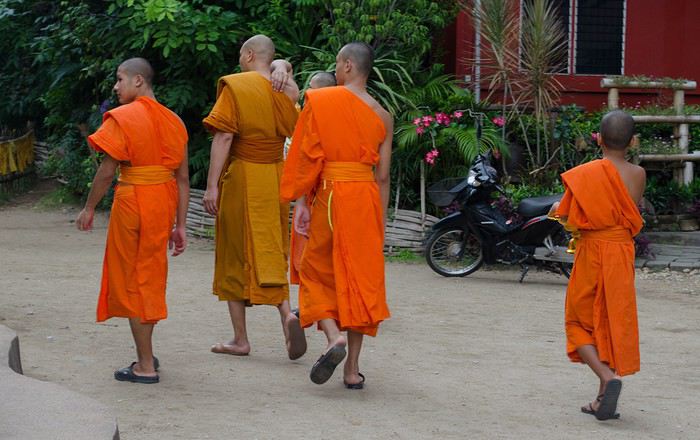
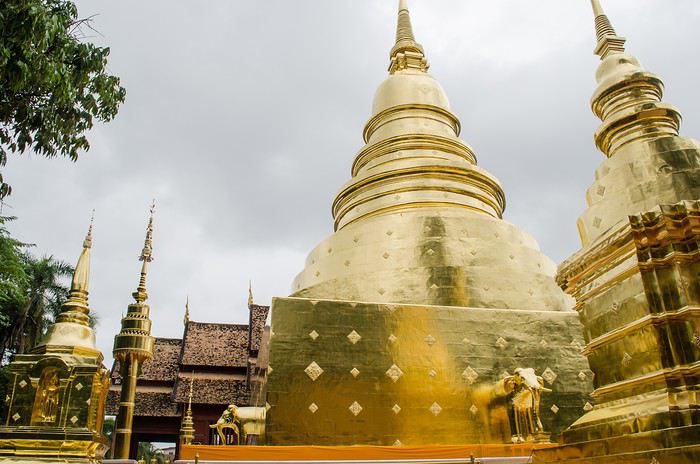
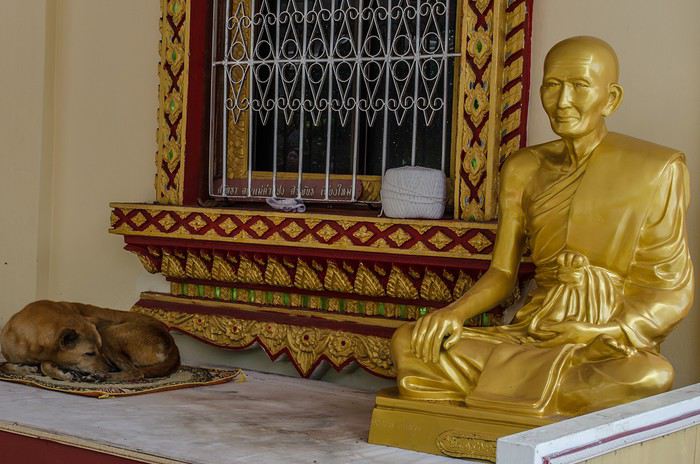
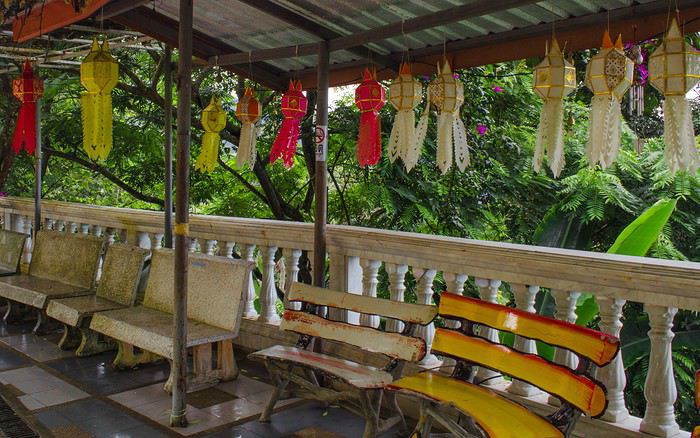
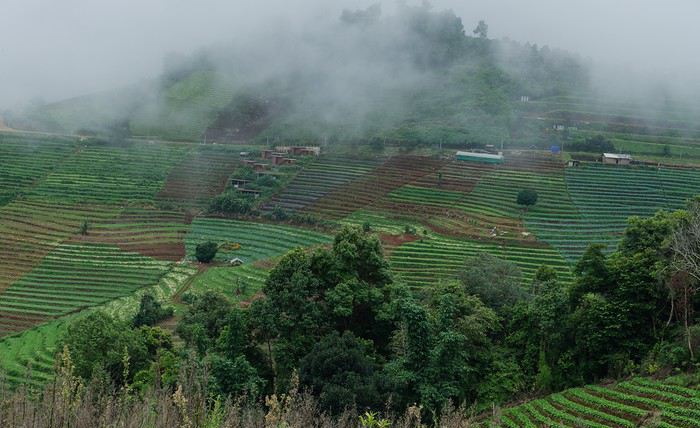
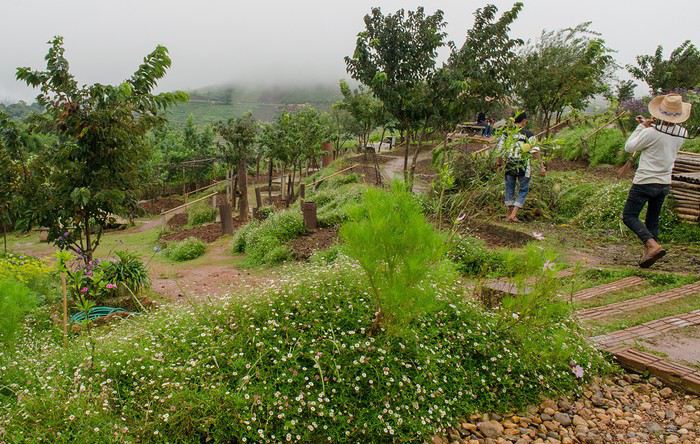
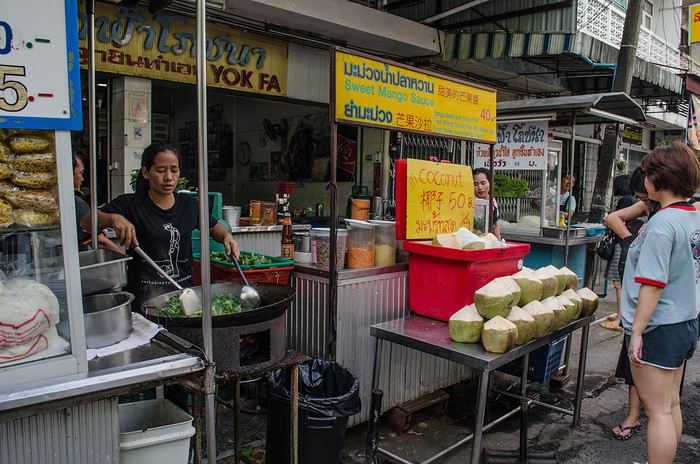
More to come soon…. Fabienne.
I’ve finally gotten around to writing up a little recap of our Thailand trip in July 2017. Better late than never, right? 😛 It’s not a full travel journal, just a quick rundown with a few (modest) photos. I’d been wanting to explore Asia for a while, but nothing was set in stone. Then, by chance, I found some great flight deals from Toulouse to Bangkok (1650 € for the three of us—my husband, my 17-year-old son, and me). What the heck, I booked them! We arrived on July 6th around 6 PM and left Bangkok on the 25th in the late afternoon. So, now I had to plan the route… Let’s be honest: with only three months to prepare and zero knowledge of Asia, sleep wasn’t going to be a priority! That’s where I have to say a huge *thank you* to all the forum members who love this country! I devoured as many travel journals as I could on the forum, discovered all sorts of blogs, and managed to "put together" an itinerary. My husband isn’t a fan of crowded places, so we decided to see a few "must-sees" and then head to spots that are much less frequented by tourists—way more peaceful.
Here’s our route with the accommodations (prices for 3 adults):
- 3 nights in Bangkok (Isanook HOTEL, 180 € with breakfast) - 1 night on the train to Chiang Mai (69 € for a sleeper berth) - 3 nights in Chiang Mai (Lanna Tree Boutique Hotel, 230 € with breakfast) - 1 night in Donsak (Lam Tong Resort, 37 € with breakfast) - 3 nights on Koh Phaluai (Angthong Beach Resort, 135 € with breakfast) - 3 nights in Bang Saphan (Palms Gardens, 111 € without breakfast) - 3 nights in Prachuap Khiri Khan (Sunbeach Hotel, 94 € without breakfast) - 1 night in Bangkok (Anajak Hotel, 129 € with breakfast—we treated ourselves 🙂) For the hotels, we could’ve gone cheaper, but being able to take a quick dip in a pool isn’t so bad, right? Especially in Bangkok and Chiang Mai, I think I booked a little late, so options were more limited. No regrets with any of the accommodations—every single one lived up to what we’d seen and read about them. I’ll say it again: without the travel journals from the active members of this forum, I wouldn’t have been able to plan this trip. I won’t name names, but you’ll recognize your contributions here and there. I was starting from scratch with zero knowledge of the country, and what matters most to me when I travel is gathering as much info as possible on local customs—so we can blend in and avoid any major faux pas! Thanks again to all of you!!! 🙂 😉
Practical details: - The overnight train was booked as soon as reservations opened, about two months in advance. - From Chiang Mai to Surat Thani, we flew with Air Asia for 196 € with three checked bags, booked two months ahead. From Surat Thani to Donsak, we arranged for the son of the Lam Tong Resort owner to pick us up at the airport for 1500 baht. - The round-trip ferry from Donsak to Koh Phaluai cost 1200 baht for the three of us. - On Koh Phaluai, we hired a guide, Ton, for two days to explore Angthong Marine Park: 8700 baht (including lunch). I booked these two days through Mathilde, who’s been mentioned on this forum. - From Surat Thani to Bang Saphan: train, tickets bought the same day. - From Bang Saphan to Prachuap: same. - From Prachuap to Bangkok: public bus.
Bangkok:
Our hotel was in a neighborhood away from the city’s most touristy spots, so we really got to experience "normal" life. How else to describe it? It’s like being in Paris in the heart of the 20th arrondissement, far from the Eiffel Tower… You wouldn’t think you were in a megacity like Bangkok! We loved this part of town, especially the Sam Yan metro station with its market, its cows (!), and its temple. We also enjoyed the street food stalls right by the hotel, with no crowds.
We loved visiting Wat Pho in the morning before the crowds arrived. We weren’t alone, of course! (They wouldn’t give us a private tour… 🤪) But it was smooth and peaceful, and we got to watch groups of schoolkids singing together on the floor or drawing. The Grand Palace later in the morning was a different story—so many people, long lines at the checkpoints and ticket counters, and *very* loud crowds. Khao San Road during the day was pretty "calm." We just passed through and spent more time around Soi Rambuttri, eating at a small restaurant where a waiter showed us why Thailand is called the Land of Smiles. We loved hanging out at the end of the street by the river. We also stumbled upon a little market in that area, but I have no idea which streets it was on. Taking the river shuttles was such a nice way to enjoy the views of the riverbanks. We really liked Chinatown with its narrow alleys, vendors, hustle and bustle, and smells (not all of them pleasant…). The greenery and calm of Lumpini Park were so refreshing—not just for tourists, but for locals too, who come to eat, play board games, or go for a walk. The contrast between the hyper-modern side of the city with its massive malls, skyscrapers, and more working-class neighborhoods is fascinating!
Chiang Mai: Very touristy, but we knew that going in, so we knew what to expect. We’re not big on temples, but we still really enjoyed discovering some of them as we wandered around—some packed, others much quieter. We loved getting "lost" in the old city’s alleys. The Doi Suthep site is truly exceptional, and despite the crowds, we managed to find little corners where there was almost no one! So we could enjoy the site and the views of the surrounding landscapes in peace. Still on the hunt for quiet spots, we headed to Mon Cham, about 40 km from Chiang Mai by scooter. Such a relaxing place—what a great discovery! During our stay in Chiang Mai, the rain played cat and mouse with us, and I’ll admit, it often won!
More to come soon…. Fabienne.
Hi everyone, after a trip to India last October, I stayed in touch with an Indian guide who speaks French. His dream is to visit France. To get his visa, he told me he needs a letter from me confirming that I met him during my trip to his country and that I’m able to host him. He has other contacts in France, and he mentioned he’s asked them for the same thing. I’m reaching out to see if his request is legitimate or if he’s taking advantage of my kindness. I’m sorry if I offend anyone—it’s not my intention. I’m very spontaneous and don’t want to put myself in a bad situation. Thanks for your feedback. Have a great weekend. Florence/florie73
I'm about to leave for Tulum, and unlike many who worry about which amusement park they can visit, I'm doing in-depth research on the place I'm going to. And this time, the more I look, the scarier it gets. Numerous articles, mostly in English (with a few rare ones in French like this one: https://parismatch.be/actualites/environnement/114152/la-pollution-la-face-cachee-de-tulum), show that Tulum, behind the postcard image, is an extremely polluted area because it developed very quickly without putting in place the infrastructure to handle human waste.
Two key points:
- 80% of the hotels, which are multiplying in Tulum, dump their wastewater directly into nature (the sea and the ground)! We know that Tulum's subsoil is like Swiss cheese, with water circulating in an interconnected way. Fecal pollution is everywhere, as is chemical pollution from everyday products. You're swimming in sewage in the sea and in the cenotes, which are all interconnected. The water in your shower is polluted with fecal matter. The water used for cooking is too.
- Trash is dumped in the jungle 10 km from Tulum. A massive landfill there grows every day.
Greenwashing is intense there, even more so than elsewhere. And the hipsters lounge around on Instagram without a care about where their... well, you know, goes. I contacted about ten hotels, explicitly asking which wastewater treatment plant their sewage goes to and how they recycle their waste. I got no response, except for one very arrogant one, explaining that this isn't the developed world and that waste isn't viewed the same way here. The manager, who has the look of a mobster, claimed not to know where his wastewater and waste go and advised me to look elsewhere. I don't think I'll be giving my money to this place or risking my health just to say "I went there too."
Hello
A brand-new project has just come up: spending 15 days in Costa Rica. If you have any recommendations for a French-speaking agency or guide, I’d love to hear them. I’m thinking of leaving in late February or early March. There’ll be two of us women on this trip. What are the most beautiful spots to explore? Preferably hiking spots. Véronique
A brand-new project has just come up: spending 15 days in Costa Rica. If you have any recommendations for a French-speaking agency or guide, I’d love to hear them. I’m thinking of leaving in late February or early March. There’ll be two of us women on this trip. What are the most beautiful spots to explore? Preferably hiking spots. Véronique
Hello everyone,
We’re going on a cruise in January 2017 from Rio, and I’m looking for a French-speaking driver/guide in Rio de Janeiro.
Can anyone help? Do you have any contacts?
I’d also love to hear your tips and ideas.
Thanks in advance, and have a great day!
Francine
We’re going on a cruise in January 2017 from Rio, and I’m looking for a French-speaking driver/guide in Rio de Janeiro.
Can anyone help? Do you have any contacts?
I’d also love to hear your tips and ideas.
Thanks in advance, and have a great day!
Francine
Hi everyone,
A quick introduction. I'm 27, I live in Picardy, and I'm getting married in 2017. We'd like to spend our honeymoon in French Polynesia for 3 weeks.
I'm open to all kinds of advice!!!
I think we'll use a travel agency because our work schedules don't leave us much time to organize the trip... Unless I change my mind! ;-)
But we don’t want our trip to turn into tourist clichés—we really don’t like that. That said, we *do* want to see those postcard-perfect beaches and landscapes!
We don’t dive, but I think we’ll try a beginner’s dive, and maybe even get our Level 1 certification, depending on how it goes (I read some comments about it on this forum).
Anyway, I’m looking for any information and internet links to make this trip a success.
This is THE trip of a lifetime, and it has to be perfect!
Thanks for your help!
I’m also checking out the different threads about Polynesia on this forum ;-)
Hi everyone,
I’m new to the forum. I’d love to know if any of you have hiked in the Drakensberg, as I’m thinking of signing up for a trekking trip there.
I’ve heard about the "Sentinel Ladders" to reach the top plateau of the Amphitheatre.
Has anyone here done it? Is it as impressive as it sounds (I sometimes get vertigo)?
Otherwise, what are your impressions of this part of South Africa and Lesotho?
Thanks in advance for your replies.
Elisabeth
Hi there,
Please, does anyone have an idea about a private driver who could pick us up from NICE TERMINAL 2 on August 15th? Scheduled arrival is at 11 PM (assuming no flight delays, of course).
I read somewhere that there are private transport vehicles available. Any recommendations? Are they trustworthy?
If not, I found a taxi for 50 €, but I’d rather not spend that much.
For the bus, I found the 98, but it’s from Terminal 1 and the last departure is at 11:50 PM.
I’ll admit, I’m not great at internet searches, so if anyone can help me find a lead, I’d really appreciate it.
Drop-off address: Rue Alexis Mossa in Gambetta.
Thanks in advance.
Here’s our third travel journal with photos, following Vietnam in 2012 and Southern Thailand + Angkor in 2013.
Once again, we’d like to thank everyone who brightens up this site with their experiences and tips. Every year, some parts of our itinerary are made easier or richer thanks to your contributions.
We hope our own story will do the same for other travelers.
**10 JULY 2014**
We booked our flight tickets back in September to get a better deal than last year. We were happy with the 1291 € price for two people from Paris—until mid-January, when several airlines started offering promotions we hadn’t expected for our travel dates. Next year, we’ll take the gamble and wait longer, hoping to fly with Qatar Airways, for example. Fate had us flying with Indian Airlines. The Paris-to-Delhi leg was on a brand-new Boeing Dreamliner—obviously fresh off the assembly line. After a quick four-hour layover to stretch our legs, we boarded an Airbus A321 that looked prehistoric for the Delhi-to-Bangkok flight. Honestly, if the outside of the plane had matched the inside, we’d never have made it. Broken screens, shattered armrests—you name it. As for the meal trays, we would’ve devoured them only after a week stranded on a desert island. The cabin crew didn’t win us over either. And we really didn’t appreciate the behavior, attitudes, or stares from most of the people we encountered during our layovers in Delhi. This year’s experience has definitely put us off flying with this airline again—or even setting foot in India ever again. That’s just our personal take, but it’s clear.
Stepping onto Thai soil was an immense relief. After exchanging just a few euros, we took a taxi from the designated spot and had a completely different experience from last year: the driver was normal and efficient. So efficient, in fact, that we arrived at our destination much earlier than expected. A well-deserved tip, and it seemed to make his day.
We dropped our bags at reception and rushed to Harmonique restaurant, just 300 meters away, just in time for the last dinner service. We’d talked about this place at length last year. We’d been looking forward to it for a year, but we only managed to nibble on some spring rolls because what we really wanted was a good night’s sleep. While quite a few customers were still around, four staff members walked through the dining area with two large trash bins from the day’s service. They were clearly pleased with themselves and having a good laugh. It made us chuckle too—seeing something like that done so naturally, when back home, some people would’ve been outraged to witness it in a similar establishment!
A quick word about the Swan Hotel: we’re grateful to those who recommended it on this site and on their blogs. It’s quietly located in the Silom district, just steps from the river. We have fond memories of the giant, ultra-comfortable bed and the well-maintained pool. It was very peaceful, though we were there during a quieter season. At 30 € with breakfast when we booked (and around 20 € without breakfast now), we can’t imagine finding a better-suited hotel in Bangkok.
**11 JULY**
We couldn’t find an open bank and had to withdraw cash from an ATM. Now we know: July 11 is a public holiday in Thailand. It suddenly occurred to us that next year, we’ll keep some baht from our return trip to save time at the airport and avoid little hiccups like this.
We decided not to head straight to Laos and instead spent the day visiting Muang Boran, also known as Ancient City, about 30 km southeast of Bangkok.
There are plenty of ways to get there. We ruled out taxis—too expensive. Besides, we enjoy using local transport; it’s more fun. We took a taxi to Democracy Monument, then found the bus stop about 100 meters from the roundabout, on one of the avenues leading to it. Someone always points you in the right direction. We hopped on bus 511 for a long ride, with two major slowdowns at red lights. The same happened on the way back, as our route crossed busier roads. We told the driver our destination, and he let us know when to get off. No problem—someone already flagged us down 20 meters later to put us in a *songthaew* (a shared taxi-van) that took us straight to the site. The bus and *songthaew* fares were minimal. Already, the people around us were smiling, and we were smiling back.
The entrance fee has gone up: 700 baht. That includes bike rental, a tour minibus, and a boat ride on the river. We still hadn’t fully recovered from the flight, and with the heavy, humid heat, we opted for the electric cart instead—no regrets. Still, 150 baht per hour.
We had an amazing day, beyond our expectations. The park features full-scale or scaled-down replicas of Thailand’s main landmarks, along with countless statues and landscaped gardens. There are also reconstructions of a typical Thai village, a northern Thai village, a farm with animals, and a floating village.
Almost everything we saw was well-made and aesthetically pleasing. The whole place is absolutely worth the trip. We spent six solid hours there without dawdling.
Here’s a very incomplete sample of what we admired:


Visitors will find restrooms, restaurants, and a few shops scattered throughout the site. On the way back, just cross the road using the pedestrian bridge about 250 meters to the left of the exit. Flag down a *songthaew* as it passes.
The whole day flew by between the visit and the commute. We still had time to return to Harmonique to try their famous crab curry. Once you’ve finished it, you think—life isn’t so bad after all.
**10 JULY 2014**
We booked our flight tickets back in September to get a better deal than last year. We were happy with the 1291 € price for two people from Paris—until mid-January, when several airlines started offering promotions we hadn’t expected for our travel dates. Next year, we’ll take the gamble and wait longer, hoping to fly with Qatar Airways, for example. Fate had us flying with Indian Airlines. The Paris-to-Delhi leg was on a brand-new Boeing Dreamliner—obviously fresh off the assembly line. After a quick four-hour layover to stretch our legs, we boarded an Airbus A321 that looked prehistoric for the Delhi-to-Bangkok flight. Honestly, if the outside of the plane had matched the inside, we’d never have made it. Broken screens, shattered armrests—you name it. As for the meal trays, we would’ve devoured them only after a week stranded on a desert island. The cabin crew didn’t win us over either. And we really didn’t appreciate the behavior, attitudes, or stares from most of the people we encountered during our layovers in Delhi. This year’s experience has definitely put us off flying with this airline again—or even setting foot in India ever again. That’s just our personal take, but it’s clear.
Stepping onto Thai soil was an immense relief. After exchanging just a few euros, we took a taxi from the designated spot and had a completely different experience from last year: the driver was normal and efficient. So efficient, in fact, that we arrived at our destination much earlier than expected. A well-deserved tip, and it seemed to make his day.
We dropped our bags at reception and rushed to Harmonique restaurant, just 300 meters away, just in time for the last dinner service. We’d talked about this place at length last year. We’d been looking forward to it for a year, but we only managed to nibble on some spring rolls because what we really wanted was a good night’s sleep. While quite a few customers were still around, four staff members walked through the dining area with two large trash bins from the day’s service. They were clearly pleased with themselves and having a good laugh. It made us chuckle too—seeing something like that done so naturally, when back home, some people would’ve been outraged to witness it in a similar establishment!
A quick word about the Swan Hotel: we’re grateful to those who recommended it on this site and on their blogs. It’s quietly located in the Silom district, just steps from the river. We have fond memories of the giant, ultra-comfortable bed and the well-maintained pool. It was very peaceful, though we were there during a quieter season. At 30 € with breakfast when we booked (and around 20 € without breakfast now), we can’t imagine finding a better-suited hotel in Bangkok.
**11 JULY**
We couldn’t find an open bank and had to withdraw cash from an ATM. Now we know: July 11 is a public holiday in Thailand. It suddenly occurred to us that next year, we’ll keep some baht from our return trip to save time at the airport and avoid little hiccups like this.
We decided not to head straight to Laos and instead spent the day visiting Muang Boran, also known as Ancient City, about 30 km southeast of Bangkok.
There are plenty of ways to get there. We ruled out taxis—too expensive. Besides, we enjoy using local transport; it’s more fun. We took a taxi to Democracy Monument, then found the bus stop about 100 meters from the roundabout, on one of the avenues leading to it. Someone always points you in the right direction. We hopped on bus 511 for a long ride, with two major slowdowns at red lights. The same happened on the way back, as our route crossed busier roads. We told the driver our destination, and he let us know when to get off. No problem—someone already flagged us down 20 meters later to put us in a *songthaew* (a shared taxi-van) that took us straight to the site. The bus and *songthaew* fares were minimal. Already, the people around us were smiling, and we were smiling back.
The entrance fee has gone up: 700 baht. That includes bike rental, a tour minibus, and a boat ride on the river. We still hadn’t fully recovered from the flight, and with the heavy, humid heat, we opted for the electric cart instead—no regrets. Still, 150 baht per hour.
We had an amazing day, beyond our expectations. The park features full-scale or scaled-down replicas of Thailand’s main landmarks, along with countless statues and landscaped gardens. There are also reconstructions of a typical Thai village, a northern Thai village, a farm with animals, and a floating village.
Almost everything we saw was well-made and aesthetically pleasing. The whole place is absolutely worth the trip. We spent six solid hours there without dawdling.
Here’s a very incomplete sample of what we admired:
Visitors will find restrooms, restaurants, and a few shops scattered throughout the site. On the way back, just cross the road using the pedestrian bridge about 250 meters to the left of the exit. Flag down a *songthaew* as it passes.
The whole day flew by between the visit and the commute. We still had time to return to Harmonique to try their famous crab curry. Once you’ve finished it, you think—life isn’t so bad after all.
Hello,
I’m an agronomy student specializing in tropical regions, and I need to do my 4-month internship near Tuléar. However, I only found out about it yesterday, and I’m supposed to leave on September 16th. I’ve never done this kind of trip before—neither alone nor with someone else. So, I’m a little lost and, um… panicking! I also need to transport valuable equipment that doesn’t take up too much space!
I’m not sure how to get between the two cities, Antananarivo and Tuléar. I plan to carry my luggage in an 80L hiking backpack to avoid drawing attention in Antananarivo.
Has anyone taken a *taxi-brousse* on this route before? How much time should I allow between the two cities, and what budget should I plan for this trip? Where can I find *taxis-brousses* (TB) in Antananarivo?
Any info will be helpful and reassuring! Thanks!
PS: What do you think about safety in Tuléar?
Hi there,
I’m reaching out because I’m finally living my dream later this year, and I could really use your advice!
On December 26th, I’m flying to Tahiti, then Moorea, and finally Bora-Bora.
Since I’ll be staying in Bora-Bora for several days, I’d love to take a day trip to another island: either Maupiti or Tahaa-Raiatea (my top picks...).
My issue is that the schedules for getting to Tahaa and then to Raiatea don’t quite work for me. Here are the two options I’ve looked into:
**Option 1: Day trip to Tahaa-Raiatea** - Morning departure at 7:00 AM to Tahaa from Vaitape (I’ll be staying on a motu, so I need to check if there’s a shuttle connecting the motu to Vaitape early enough). - Arrival at 8:15 AM in Poutoru, Tahaa. Tour of the island, visit to a vanilla plantation. - Hire a "private" boat to Raiatea around 12:00–1:00 PM. - Tour of Raiatea. - Departure at 4:00 PM from Uturoa (Raiatea) back to Bora-Bora.
**Option 2: Day trip to Maupiti** - Morning departure from Bora-Bora at 8:30 AM. - Arrival in Maupiti at 10:05 AM. Visit the island and the motus. - Return in the evening at 4:00 PM.
My questions: - Will I have enough time to explore Tahaa-Raiatea from 8:00 AM to 4:00 PM? - Car rental? Bike rental? For all three islands... - Time lost during rentals? - Distance between rental shops and the ports where I arrive? - For Tahaa and Raiatea, should I hire a guide? Would that be better organized, meaning no car rental needed, to save time or explore the island on my own? - Finally, what do you think of these three islands and their points of interest? Which would you choose between Maupiti and Tahaa-Raiatea?
If you can shed some light on this, I’d be so grateful!!!!!!!
I can’t wait to hear your thoughts, comments, suggestions, and advice!
Hi there,
I’m heading to Laos next spring, but I have a question about the Thai arrival/departure form. I’ll be flying PAR-BKK, then taking the train to Laos (so exiting Thailand), and later re-entering Thailand by train to catch my return flight. Do I need to fill out two forms in this case?
Thanks for your help! !
Hi everyone,
I’m leaving on Monday, August 3rd for my very first long-distance trek: the GR223 from Coutances to Mont Saint-Michel, over 6-7 days (~11-14 miles/day), solo.
I’m looking for tips from people who know this section well (Coutances → Regnéville-sur-Mer → Hauteville-sur-Mer → Bréhal → Granville → Genêts → bay crossing):
Budget-friendly accommodations: I’m struggling to find affordable stopover lodgings (a lot of what I find online are expensive vacation rentals, not really suited for a solo hiker). If you have any great spots (hostels, hiker-friendly B&Bs, nice campgrounds), I’d love to hear them! Bay crossing: Any feedback on guides/providers leaving from Genêts for the final crossing? General tips for a first long-distance trek: What you wish you’d known before your first time, pitfalls to avoid, etc.
Budget-friendly accommodations: I’m struggling to find affordable stopover lodgings (a lot of what I find online are expensive vacation rentals, not really suited for a solo hiker). If you have any great spots (hostels, hiker-friendly B&Bs, nice campgrounds), I’d love to hear them! Bay crossing: Any feedback on guides/providers leaving from Genêts for the final crossing? General tips for a first long-distance trek: What you wish you’d known before your first time, pitfalls to avoid, etc.
Hello,
After reading and researching, we're planning the following stops in Cambodia in January 2027: - Phnom Penh - Kampong Cham - Kratie - Siem Reap - Battambang - Kampot (round trip)
I'm wondering about the direction of these stops, which could also influence our international flights. Either a round trip from Phnom Penh in the order above. Or landing in Siem Reap with the following order:
- Battambang (round trip) - Siem Reap / Angkor - Kratie - Kampong Cham - Phnom Penh - Kampot (round trip)
This second option would save us the Battambang - PP - Kampot trip but means doing a round trip to Battambang from Siem Reap and placing the "highlight of the trip" (Angkor) at the beginning of our stay.
What do you think?
Thanks in advance for your help.
Have a great Sunday
Hello, I’d like to take a trip for my 70th birthday this winter, but I’m looking for itineraries with a few days (1 or 2) at each stop to rest. I’ve recently had a stroke and, unfortunately, can’t travel the way I used to. So, I’m looking for itineraries that aren’t too demanding but still let me and my husband explore something new. We’ve traveled quite a bit before and would love to do one last trip (South America…). Thanks for your help!
Hi,
I booked an Etihad ticket on their website for Dusseldorf-Abu Dhabi. In the first name field, I entered all my first names (something I never do and I regret it, but the site was confusing). Everything is spelled correctly, but the problem is that I just received my new passport and only my first two first names and the first letter of the third appear—there’s no trace of the last one.
I called Etihad, and of course, they tried to charge me $100 USD to remove that last first name. But I’m hesitant because usually, I only put my first first name and not the others, and I’ve never had an issue... So I’m wondering if having that extra first name, which isn’t on my passport, could get me denied at check-in. Thanks for your feedback!
I called Etihad, and of course, they tried to charge me $100 USD to remove that last first name. But I’m hesitant because usually, I only put my first first name and not the others, and I’ve never had an issue... So I’m wondering if having that extra first name, which isn’t on my passport, could get me denied at check-in. Thanks for your feedback!
Hi there!
For my 60th birthday (yes, I’m jumping the gun a bit!), I’m starting to plan a self-drive trip to Tanzania (in June).
I also considered Zimbabwe but I’m worried it might be a bit chilly at night in June.
I’ve revisited an itinerary I’d thought about before, tweaking it since I’ll have more days to dedicate to this trip. Still no big northern classics for the same reasons as before (too expensive, too crowded, too many tour operators).
Here’s what I’ve got so far:
(Arrival/departure from Kilimanjaro Airport)
Night 1: Arusha
Night 2: Arusha
Night 3: Lake Manyara
Night 4: On the way to Iringa (any ideas???)
Night 5: Iringa
Nights 6–8: Ruaha NP
Nights 9–10: Mikumi NP
Night 11: Bagamoyo
Nights 12–15: Beach Nights 16–17: Lushoto
Nights 18–19: Mkomazi NP
Night 20: Toward Marangu – eastern Kilimanjaro
Night 21: Western Kilimanjaro
End of trip
All your ideas, tweaks, info, and suggestions on this route are welcome!
I could move one beach night somewhere else if needed.
Also, if you have a car rental company to recommend or thoughts on the bandas rented in the parks, I’m all ears!
Finally, what are the roads like in Ruaha in June? The rental company I’m looking at seems to allow this park with a small 4x4. (Off-limits: Serengeti and Natron)
Thanks! :)