Cycling Through Provence's Big Climbs
In the autumn of 2011, Provence was hit by apocalyptic weather—torrential rain and a particularly violent east wind, reaching 130 kilometers per hour, whipping up waves as high as seven meters. It wasn’t the best time to venture outside. Yet, I told myself that after the storm, calm would return. I kept an eye on the weather forecast and noticed that starting November 10th, a favorable window should open for a little 600-kilometer cycling trip across Provence. The weather reports promised a high-pressure system that would keep the bad weather at bay over these highlands. That was all I needed to decide to set off. The planned route would take me through Provence’s biggest climbs: Mont Ventoux, Montagne de Lure, the Verdon Gorge, the Massif des Maures, and Sainte-Baume.
And so, despite my doubts, the call of adventure was stronger. The train pulled away, and once again, a journey began at Part-Dieu station. This time, I headed toward Haute-Provence for a cycling adventure. It would be my first solo bike trip. I was a little nervous—cycling with panniers makes you feel vulnerable to theft. I’d already been robbed while traveling in a group in Peru, and that experience left me deeply shaken. Alone, I hesitated. But no need to panic—I’d read accounts from long-distance cyclists who hadn’t been robbed, even if it does happen sometimes. I was particularly thinking of a young schoolteacher who had taken a sabbatical to cycle around the world. Her students had remarked, "Teacher, you’re not sporty—how will you manage to cycle around the world?" This young woman was full of resourcefulness. In South America, before flying to China, she locked her bike to a post to take care of a natural need. When she returned, the post had been torn out, and her bike—along with all her gear—was gone. It was a shock for many, but not for her. She boarded her flight to the Middle Kingdom, bought the essentials (including a new bike) once there, and continued her journey! Remembering this story, I almost felt ashamed of my cowardice. These were the thoughts running through my mind as the Rhône Valley rolled by toward Orange, the starting point of my Provençal adventure through the big climbs.
Day One: Orange to Sault via Mont Ventoux – 90 km
9:30 AM, I stepped off the train. With all my gear, I had to navigate the underground passage—no easy feat, given that my bike and luggage weighed 35 kilos. At this time of year, I expected some areas to be deserted, so I’d packed enough to bivouac comfortably. Once outside the station, the southern light flooded over me. I understood why people dream of retiring in these sun-drenched regions. As always, after disembarking from public transport, I had to get my bearings and decide which way to go. The sun, still low on the horizon, pointed east. The roar of fighter jet engines helped me locate the Air Base 115. That was all I needed to "reset the gyros."
As soon as I started pedaling, all my apprehensions vanished. The joy of discovery and physical effort took over, and euphoria washed over me. It’s amazing how emotions can shift from one moment to the next based on seemingly minor circumstances.
The weather was splendid—the forecast had predicted continuous showers, but it was completely wrong. I quickly left the city behind. Mont Ventoux loomed mysteriously, its dimensions hard to gauge. It was even more enigmatic with its summit hidden beneath swirling, mottled clouds clinging to the ridges. It reminded me of a great South American volcano. I struggled to imagine that in a few hours, I’d be up there under that blanket of mist.
The countryside was shaking off its autumnal nighttime dampness. The vineyards, interspersed with tall cypress hedges, confirmed I was in the magnificent Côtes du Rhône wine region. The distinctive Dentelles de Montmirail were very much in evidence. The air force base wasn’t far. I passed the runway’s end markers. A Mirage 2000 flew overhead in a tight turn, followed by another roaring into takeoff. It came straight at me before climbing sharply with a thunderous roar. Thirty years spent in that captivating world came rushing back. I recalled countless extraordinary human and technical experiences from my time in the service. But the purpose of this post isn’t to promote the air force—though I might post some articles one day about travels among men at war.
I continued on my way, leaving my past loves behind. As I pedaled, delightful names rolled by: Violès, Vacqueyras, Gigondas, Beaumes-de-Venise—the crème de la crème of the Côtes du Rhône Villages appellation. I let myself be enchanted by the vineyards and the little paths crisscrossing them. I started to doubt my route, though the imposing mass of Mont Ventoux in the distance acted like a giant beacon. At a crossroads, a car appeared. I approached to ask the driver for directions, but she didn’t even look at me and sped off, clearly frightened. I’d almost forgotten what a fearful world we live in, no doubt traumatized by all the horrors we see in the news and on TV.
The kilometers started adding up, but was my day’s goal too ambitious? It had been two months since I’d last ridden my bike. True, my last trip had been good training—the Route des Grandes Alpes—but that was two months ago. I can’t just take my bike out for a day trip; I need that sense of adventure to find the courage to exercise.
Two cyclists overtook me. Intrigued by my load, they struck up a conversation. They were skeptical when I told them I planned to cross Mont Ventoux that day. One of them pointed out a small chapel near the summit where I could bivouac sheltered. That motivated me even more to reach the top on this first stage. The chapel also had a mythical name for me—Sainte-Anne, the name of my parents’ villa. It was already noon, and I’d covered 50 kilometers. Malaucène appeared—the sacred village of Ventoux’s mad cyclists. Surprisingly, I didn’t see any other cyclists today. I remembered this place in June, teeming with aspirants for the king of summits. Before tackling the climb ahead, I needed to refuel. I enjoyed a pleasant gastronomic break at Max’s. At 1 PM, I started the most famous climb in cycling—21 kilometers, which would actually be 23. I knew it would be tough, especially with two handicaps: 50 kilometers already in my legs and 20 kilos of luggage. But I was counting on my tiny chainring, which let me climb trees to tackle the steep ramps.
I set off at a brisk pace along a deserted road. My speed held up for the first few kilometers. I quickly rose above the valley, the horizon widening. I was surprised to see no one on this world-renowned route among cycling enthusiasts. During the climb and descent, I’d only see five cyclists—but I’ll come back to that. I passed a sign explaining that the effort would be roughly equivalent to climbing the Col de la Bonnette. Having done the latter in September, I figured I’d be fine. I crossed paths with my first cyclist—a woman speeding downhill. After 12 kilometers, I hit slopes averaging 12%. I don’t know if the number 12 is cursed, but I got such a "bamboo" hit that I’d never experienced before. I thought I wouldn’t make it to the summit today. I stopped. My thighs burned so much I could barely walk—lactic acid overload. I looked for a relatively flat spot to pitch my tent. It was 3:30 PM, with two hours of daylight left. But I found nothing.
I got back on my bike, intending to stop as soon as I found a good bivouac spot. But nothing came up. However, my strength slowly returned, perhaps because the slope eased, though it remained around 10%. I entered the summit mists. A cyclist overtook me. I was in the zone where I had to pass the summit. Dusk caught me in the final difficulties. The atmosphere was downright austere. In the twilight, a kilometer from the summit, a cyclist was fixing his bike. I asked if he needed help. He made it clear he didn’t understand. So I asked, "Do you need some help?" His answer was clear: "No, thank you." He showed me his new inner tube. Inside, I thought, "Phew!" If I’d had to stop, sweating in the falling night with the cold intensifying, I’d have struggled to get going again. But he managed, and I continued into the twilight fog. I could barely make out the summit’s large antennas in the clouds, like immense ghosts trying to evade sight. The bike delivered sensations worthy of mountain racing. My goal was to quickly find the famous chapel in the descent to take shelter. As I glided down the southern slope, two cyclists without lights crossed my path in the night—probably heading to the station above, its lights visible in the fog.
I scanned the roadside in the dark for the chapel but saw nothing. After a kilometer or two, I lost all hope. I stopped to put on more clothes as the cold became intense. I had no idea where I could stop on these steep slopes to set up camp. Between the swirls of mist, I could intermittently see the Rhône Valley below, dotted with illuminated towns and villages. The sight was striking. What was I doing on this mountain at night? Then the miracle happened—the clouds parted, and from the ridge above me to the east, a beautiful full moon emerged, casting enough light to consider a nighttime descent to Sault, 26 kilometers away.
In this eerie atmosphere between the moon’s pale rays and patches of fog, I began my descent through a hazy, almost unreal world. The Ventoux’s characteristic white scree reflected the moonlight faintly, dimmed by the mist. In places, entire mountainsides were plunged into complete darkness, and I lost all sense of the road’s path. Then, around a tight bend caused by a land shift, the light returned. It seemed extreme compared to the darkness I’d left behind. I could once again clearly see the road’s contours, though not its potholes or gravel patches. Still, I let the slope carry me, and the speed felt significant, though the low light prevented me from reading my speedometer. In these moments, concentration was at its peak—all senses alert, reflexes ready to react to the slightest incident that could lead to a fall.
I was relieved to see Sault’s lights growing closer. In less than an hour, I reached it, considering the final little climb that required one last push. This village, bustling in summer, was deserted at this time of year—almost dead. The first hotel I came across was closed. A quick shadow passed in a small sloping street. Before it disappeared into the darkness at a house corner, I chased after it and asked about accommodation options. Very kindly, I was directed to what was probably the only hotel open in November. I quickly found it, and the reception was open. I entered wearing my black balaclava, bought in the Ayacucho region—the birthplace of Peru’s Shining Path. At this late hour, I saw questioning glances directed at me. I prefaced, "This isn’t a hold-up." Clearly, the owners had a sense of humor—they started smiling. I took off my balaclava and asked for a room. No problem, and from that moment, the pressure eased. I really didn’t feel like going back out to find a spot to pitch my tent in the biting cold.
The stage had been nearly 100 kilometers, and it was the first. It had been two months since I’d touched my bike, and I probably lacked even minimal training, even though my last bike trip had been crossing the French Alps. I really had to dig deep to overcome my weakness on Ventoux’s steep section. I don’t remember ever having to search so deeply for the energy to keep going. I knew the stage I’d set for tomorrow was significant, with the climb up Montagne de Lure’s northern slope—Ventoux’s little sister, whose ascent is reputed to be endless, over 25 kilometers. I hoped this first day wouldn’t leave me too sore to avoid suffering excessively tomorrow.
For now, relaxation—a hot shower did me a world of good, followed by a good meal. I ate a delicious andouillette from Troyes, very fine, with a particularly successful herb seasoning. I loved it, and yet I’m from Lyon and pride myself on knowing a thing or two about andouillette—not just a sausage but a whole category! A bit chauvinistic, I had to admit, though reluctantly, that I found it better than the ones I usually eat in the Lyon region!
Day Two: Sault to Forcalquier via Montagne de Lure – 116 km
This morning, the weather was magnificent—the air clear, still, very fresh, and invigorating, as only the late season can offer on these Provençal highlands. In summer, they’re known for their scorching heat and drought, but often overlooked is how harsh they can be with cold and storms. Authors like Giono or Bosco described them and their inhabitants wonderfully in books like "Les Âmes Fortes."
The miracle of the night had worked. I wasn’t sore anywhere and felt in great shape. I set off well-equipped, but the effort and sun soon made me sweat. It was time to shed some layers—hat and gloves. A gentle warmth replaced the cold, making for excellent cycling conditions. On the road to Trinit, there was no traffic—only the occasional hunters’ cars parked in the distance. These vehicles were recognizable by their large cages, used to transport hunting dogs. Sometimes, the silence was broken by a distant gunshot. The deciduous forests were losing their foliage, taking on that dull brown hue of late autumn, though here and there, a tree or shrub still resisted, displaying vivid yellow or red. The meadows, their grass already scorched by the cold, were damp from the night’s heavy humidity. The low sun highlighted thousands of spider webs that had trapped insects during the warm season.
Behind me, Mont Ventoux dominated these vast spaces. As often, its imposing, stony summit was crowned with a blanket of clouds. What an impressive mountain—it’s always so hard to gauge its dimensions. I struggled to realize that last night I’d been at the summit and descended its immense southern ridge in the dark. I hoped to return one day in favorable conditions—daylight and no clouds—to enjoy the vast panorama from this unique summit.
Leaving the very Provençal village of Trinit, I tackled my first climb of the day—the Col de l’Homme Mort. The road rose moderately for five kilometers in gentle warmth. The view over the region widened, and I felt the sheer joy of pedaling. At a good pace, I overcame this first little challenge. Once at the pass, I couldn’t resist the ritual of photographing my bike in front of the sign, giving the name and altitude—1,213 meters.
The northern slope was austere and still in shadow. The cold bit again. The road was wet and covered with leaves in places. It wasn’t impossible that some treacherous patches of black ice lurked around a bend. I descended toward the Jabron Valley with caution. Suddenly, around a bend in a forest clearing, the freshly snow-covered Alps, gleaming in the sun, leapt into view, blocking the horizon. I thought I recognized the distinctive silhouette of the Écrins’ south face above a multitude of jagged peaks.
This snow and these mountains awakened a flood of memories of great joys, but I also thought of the guide and his client who had just lost their lives on the Grandes Jorasses’ north face, at the top of a route called the Linceul. The name comes from the face’s appearance—a great ice slope bordering the Grandes Jorasses’ north wall. It was first climbed by René Desmaison in 1968. He passed away a few years ago and, in his final wishes, asked that his ashes be scattered in the Dévoluy Massif at the foot of Pic de Bure, not far from here in these immense pre-Alpine folds.
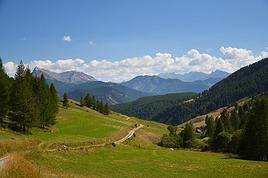
At my feet, the Jabron Valley stretched almost endlessly east toward Sisteron. In the distance, the dark mass of Montagne de Lure’s north face loomed. This mountain shares similarities with Mont Ventoux. It has the same summit scree of bright limestone, the same forests climbing up to the final rocky stretch, and that blanket of clouds adding a secretive, austere touch to the scene.
I turned left past the town of Séderon and headed toward the little Col de la Pigière, which in a few kilometers allowed me to truly plunge into the beautiful Jabron Valley. I passed through several villages with charming local names—Saint-Vincent, Noyer-sur-Jabron. The river offered lovely views of its narrow gorges with clear, cold water. Autumn seemed less advanced here than on the plateau I’d just left. Many trees still wore brilliant colors, some revealing extraordinary hues—mixes of crimson, pink, and bright red.
Arriving in Noyer-sur-Jabron, I took a tiny road on the river’s right bank, leading in a few kilometers to the foot of Montagne de Lure. In the village of Valbelle, I picnicked on leftovers I’d brought from home—an old cheese and a somewhat stale loaf of bread. It was 1:30 PM. I began the long climb of about 25 kilometers. According to a friend who’s a cycling expert in the region, this section is tough. No wonder it’s called Ventoux’s little sister—the Mont Blanc of cyclists. The elevation gain on this side is still 1,200 meters, while Ventoux via Malaucène is nearly 1,600 meters.
I hoped to reach the summit before nightfall and avoid reliving a nighttime descent. The route wound through a vast forest, following the terrain’s folds. There was activity—mushroom hunters were busy searching for the coveted chanterelle. The climb, though never very steep (only one kilometer at 9%), was interminable. Though traffic was practically nonexistent, I was overtaken by a group of Harley bikers—I counted about forty. Perched high on their machines, hands in the air on wildly shaped handlebars, some with their feet nearly in the sky due to the high footpegs, they didn’t even glance my way. What’s this idiot doing, unable to ride a motorcycle and forced to climb these mountains on a bike with big bags! I wasn’t offended—real Harley purists often see other motorcyclists as renegades, so bikes are even lower on the totem pole! But I didn’t want to start a debate about motorcycles. In my youth, when I was a wild motorcyclist (22 accidents on two wheels), clans were divided into Japanese, German, Italian, and British bike owners. The latter, on their vibrating, oil-leaking machines, considered themselves the purest. But let’s not fight—there’s a statute of limitations, and it’s been nearly forty years.
As yesterday, a few kilometers below the summit, I entered the fog, and the light dropped suddenly. What a hostile mountain in these conditions! It heightened the sense of living an incredible experience. The conditions we encounter play a major role in how the adventure imprints on our memory. I realized once again that in France, you can feel like you’re very far away. Finally, after this very long climb, the Pas de Graille sign suddenly appeared out of the grayness. Strange! Below the sign, a kilometer marker indicated this same pass was over three kilometers away. Clearly, the climb continued. In these final kilometers through the scree, I gained another 130 meters of elevation. Finally, the road’s high point was reached—1,720 meters. It was cold and damp. I quickly covered up, added my balaclava under my helmet, and put on warm gloves. As I was about to start the descent, a car stopped at the summit, and one of the passengers was surprised to find a bike there in these chilly, twilight conditions.
A 20-kilometer descent led me to the village of Saint-Étienne-les-Orgues. I hoped to find a place to stay for the night. No such luck! Everything was clearly closed—no chance of finding shelter. Tonight was getting complicated. I already had exactly 100 kilometers in my legs and didn’t feel like pedaling anymore, especially at night. But I had even less desire to sleep outside. What to do to avoid it? The town of Forcalquier was 16 kilometers away—I hoped the road would descend. I set off in that direction. The first third was along a beautiful, lightly trafficked departmental road with a slight downhill—I pedaled hard. But it got tougher. I joined a busier road, and night had fallen. A several-kilometer climb finished the journey. I knew my magnetic lights weren’t very powerful—hence the danger. They were even less so on the climb because the slower I went, the less they illuminated. Cars coming the opposite way often saw me late and blinded me with their high beams. After passing, I was plunged into total darkness for a few seconds while my pupils readjusted to the night. I imagined those coming up behind me saw me with little warning, despite my slightly fluorescent jacket. When the roadside was clear, I always positioned myself to quickly jump off the road. But unfortunately, in this long final climb, a guardrail prevented any escape to the right in case of sudden braking behind me. That was even more anxiety-inducing since I was stuck at a snail’s pace. Time seemed long. I pedaled as hard as I could, on the verge of asphyxiation, trying to escape this dangerous situation as quickly as possible. My only reference point was the vehicles in front of me, letting me know the climb wasn’t over. Then suddenly, the ordeal ended—the road’s high point was reached. The town and its lights emerged from the void, and clarity returned. Phew! I glided down toward this little town bathed in light. On November 11th, I hoped to find an open hotel since I’d clearly exceeded 100 kilometers, and the idea of having to leave town to find a bivouac spot somewhat frightened me.
I arrived in the town center. Activity was low. The first hotel was closed, but I spotted a lit sign for another establishment further on. I headed there, got off my bike, and entered. The welcome was immediately friendly—a big cat came to rub against me. For me, that was a very good sign, and the first impression was confirmed. I still had to go out to eat. I covered the minimum distance. A restaurant advertised "Mom’s Cooking." I expected Provençal specialties, but they were Moroccan. I chose a delicious tagine with lime and olives, followed by almond and honey ice cream. Exhausted after this 116-kilometer stage, I returned to my room. As often after intense efforts, it was hard to fall asleep.
Day Three: Forcalquier to Moustiers-Sainte-Marie – 58 km
On this third day, due to the progress made yesterday, the stage would be short. I’d call it a transition between two mountain ranges. Indeed, the next big climb is the Verdon Gorge. I planned to position myself at its foot this evening in preparation for a tough stage tomorrow. I made a few purchases—bread, bananas, and medicine for stomach burns (the midday sausage wasn’t always kind to me). The weather was still perfect. The route began with a long descent toward the Durance. It’s always nice to start a cycling day with a downhill—it boosts morale and allows for a gentle warm-up.
I quickly reached the town of Oraison. Just at its entrance, I crossed the Durance, which still bore traces of last week’s heavy rains along its sandbanks. Indeed, numerous stumps and trunks were scattered along its vast gravel bed, along with less ecological debris like old tires.
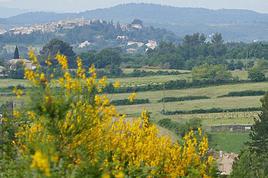
A little south of Oraison, I took the D907, a small road heading due east between scrubland and meadows. There it was—the Provence we imagine. This stable autumn weather, with still air, neither hot nor cold, just a fresh feeling when emerging from a shaded valley or a slight warmth under the sun, was ideal for a cyclist. After about ten kilometers at the bottom of a small valley I quickly passed through, the village of Le Brunet appeared on the right. It clung to the slopes leading to the Valensole Plateau. A few steep kilometers along a tiny winding road, and suddenly a vast panorama unfolded as the climb ended.
What a magnificent plateau! Though known for its wind, luckily today was completely calm. Far to the east, the Verdon’s great cliffs blocked the horizon. This allowed me to contemplate part of tomorrow’s stage. This place is full of mysteries—many UFO and extraterrestrial encounter stories are associated with it. Moreover, for about thirty years, France hid its ground-to-ground nuclear ballistic missiles here, grouped in the 1st GMS (Ballistic Missile Group), under the air force. Naturally, these rockets fueled fantasies, and pacifist groups settled in the region to protest this type of armament. This gives many reasons to shroud this austere, deserted land in mystery.
I took a dirt path leading to the heart of this zone and stopped at the forest’s edge for lunch. The silence was total, the view stretched very far. But nothing strange or bizarre manifested. No Martian came to share my frankly moldy cheese, very peppery sausage, or bruised banana—sniff! I resumed my route, and as often when crossing places with strong character, I tended to slow down to enjoy them longer. The immense lavender fields stretched endlessly, not very fragrant at this season. I arrived at a group of truffle oaks protected by a fence, with large red signs warning "Firearm." Clearly, the war for the black diamond was raging in this region. I remembered a novel where an old farmer made buyers believe nothing grew on his land. Every year, he secretly stole the mushrooms from the unsuspecting owners. Then one day, they discovered the truth, catching this "polite" neighbor trying to hide a basket full of beautiful, large truffles!
In these vast spaces, I felt good—a sense of plenitude. It’s strange that I only conceive of cycling through wandering. I struggle to plan a day trip. And if I do, it’s highly likely I won’t get up. I need that sense of adventure to fully appreciate my physical effort. Maybe one day I should get psychoanalyzed, but at my age, it’s probably too late! Today, I had all the time in the world—the stage was half as long as yesterday’s, with very little elevation gain. Not a sound, an impressive calm, a beautiful landscape—I pedaled in a wonderful place. That’s probably happiness!
I reached the village of Puimoisson on the plateau’s eastern edge—only 12 kilometers left to Moustiers. I took my time, sat at a café terrace in the sun, and leisurely enjoyed a coffee while listening to the village come to life. I was delighted by these melodious southern voices, bursting into great laughter. There are places where, despite the anxieties caused by our debt-ridden, dysfunctional societies, some have decided to take life on the bright side and show a saving insouciance.
The rest of the journey was a simple formality—I let the slope carry me toward the pretty little town of Moustiers-Sainte-Marie, clinging to the cliff and famous for its faïence. Arriving early for once, I went to the tourist office to choose a comfortable hotel. Indeed, the Hôtel des Restanques was very comfortable and admirably well-located. But at this time of year, I’d have to return to the village center for dinner. The very kind receptionist reserved a table for me at La Treille Muscate, a restaurant with a magnificently arranged room on the church square. It was only 3:30 PM—I continued to take my time, showering and relaxing in front of the TV. Then I set off to explore—or rather, re-explore—this village I’d visited several times before. But I’d never climbed to its chapel perched in the middle of the great cliff towering over the houses. A stony, aerial path led there. The first mentions of the Notre-Dame de Beauvoir chapel, known in ancient times as Notre-Dame d’Entre-Roches, date back to the 9th century. It’s one of the rare "respite" chapels found in Provence. These are chapels where stillborn children were brought to be revived for a few moments, just long enough to baptize them. They could then be buried religiously, ensuring the salvation of their souls. I was also very moved by reading some ex-votos, like the one from "A mother for her three children returned from the war."
The place was impressive, especially as night fell. I was alone and watched the shadows fill the great cliffs above me. With an old climber’s reflex, I looked for possible climbing routes among these slabs and cracks. But climbing is probably forbidden here, too close to the houses. Then I descended to stroll through the village, admiring the magnificent, finely crafted faïence patterns found in many shops. Finally, dinnertime arrived, and I joined my restaurant, which had been highly recommended. I was delighted by the foie gras ravioli and the pieds et paquets—the chef’s specialty. I’ll come back with family.
Day Four: Moustiers to Fréjus via the Verdon – 122 km
A hearty breakfast prepared me for the day’s tough efforts. Next to me, four Chinese people chatted animatedly. Of course, I didn’t understand a word—it was a language with strange intonations and sounds. I left the dining room and prepared my bike on the terrace. Seeing the volume of my luggage, my Chinese friends rushed over and asked to take turns having their photo taken in front of this funny setup. All laughing, they took photos in front of what they probably considered a French coolie off on some trading business! When they show these photos to their relatives, they’ll likely be perplexed about what motivates some to travel by bike rather than car. For them, the car is a symbol of success—according to an article I read last year, 14,000 cars are registered in China every day!
This morning, the air was fresh. As yesterday, I started with a long descent, this time leading to the edge of Lac de Sainte-Croix. A strong, biting headwind slowed me down. It wouldn’t last, as it was generated by the gorge’s outlet, which I’d reach in a few kilometers. On this cold morning, the lake’s shores exuded great tranquility. The sun was still hidden behind the Verdon’s mountainous mass. Trees with yellow leaves stood out against the water’s pale blue. The bridge marking the gorge’s beginning at the lake’s edge was an ideal spot to admire this natural splendor. At this early hour, the play of light and shadow on the water and the immense cliffs delivered a grandiose spectacle in beautiful harmony. This first contact with the gorges, which I knew well, amazed me.
Once past the bridge, the wind calmed. A little further on, I began the long climb that would take me to the top of this immense natural gash, which water had taken millions of years to carve. I was in good shape and highly motivated by the splendors to come. First, I reached the village of Aiguines, which offered a magnificent viewpoint over the lake. Then I continued toward the Corniche Sublime, where countless breathtaking panoramas unfolded as I progressed. But the climb was sustained and long, requiring effort—though my small chainring worked miracles. I first passed the Col d’Illoire, already 500 meters above the lake. Seeing all these great cliffs, countless climbing memories came flooding back. The classic routes of the Escalès cliff, over 300 meters high, flashed by. Routes with legendary names—La Demande, Les Écureuils, Luna-Bong, and many others. The one that left me with the best memory was ULA—a crack, vertical or even overhanging, of sheer beauty rising above a 40-meter slab in one go for 280 meters of sustained, beautiful climbing on extraordinary rock. It made me want to return to climb there, to immerse myself in the atmosphere of those past times. But climbing habits have changed—now routes are accessed from above by rappel, and people don’t always bother to do these great climbs in their entirety, focusing instead on shorter but technically much more difficult enterprises.
At almost every bend, I stopped and scanned these great cliffs, searching for memories of past experiences and emotions in these secret rock folds. The road climbed well above the pass, exceeding 1,200 meters. It was cool, especially since I was sweating. Finally reaching the high point of the Corniche Sublime, I couldn’t gain speed on the descent—my gaze was always drawn to this astonishing canyon. Around a bend, two cyclists with funny small-wheeled bikes. Wow! It was a couple of Australians doing a year-long tour of France. We chatted passionately about our two-wheeled experiences for a moment. But time was passing, and if I wanted to reach Fréjus before nightfall, I’d have to pedal seriously.
I stopped at the Pont de l’Artuby, where bungee jumping was in full swing. But I quickly set off again toward Comps. The wind was against me, and it was climbing. I started to doubt whether I’d make it to the coast that evening. At 2 PM, I was in Comps-sur-Artuby. I didn’t stop, knowing that before reaching the coast, I’d have no alternative to bivouacking, and I had 70 kilometers left to cover. Sure, it should be downhill, but a few climbs were on the program. After a descent out of the village, I crossed the Artuby River again on the Canjuers military camp. A several-kilometer climb followed, fortunately not too steep. I took the D19 toward Barjols. From there, despite the late hour, I opted for a tiny road passing through Claviers, a small perched village. Time passed quickly, but the kilometers added up. I regained hope. Fifteen kilometers after this last village, I reached Saint-Paul-en-Forêt via a magnificent forested route. I had plenty of time to observe mushroom hunters. I asked one who clearly had some in a plastic bag. He gave me this hilarious answer with a magnificent southern accent: "I only picked the bad ones." No reply was possible. I moved on with a smile. A little further on, another hunter carried a basket. As soon as he saw me, he quickly hid it—just in case I saw what it contained. Arriving at the village involved a steep climb, and I was close to 100 kilometers. I still had a little over 20 kilometers to go before reaching Fréjus. The race against nightfall had begun. Over there to my right, I saw the sun setting behind Roquebrune-sur-Argens’ distinctive rock. The sea appeared. There it was—I was in Fréjus’ industrial zone. On this Sunday evening, traffic was heavy. Indeed, many had taken advantage of the return of good weather after very heavy storms to go for a walk. After quite a few detours, I arrived at the seaside just as night fell. My odometer showed 122 km for the day. I quickly found a simple hotel, ate just as quickly, and went to bed.
Day Five: Fréjus to Solliès-Pont – 92 km
Once again, the night had done its restorative work, and I prepared to cross the Massif des Maures feeling quite fresh. The weather forecast was still favorable for today, but a deterioration was expected tomorrow. I tended to trust it because the east wind was blowing, and in the region, that’s a sign of rain. For now, in the short term, this wind would be very useful—it would push me generously throughout the day.
I started calmly along the harbor quays, looking at the boats. Then I joined the road to Saint-Aygulf and followed the coast for forty kilometers to Port-Grimaud. All these seaside resorts—Saint-Aygulf, Les Issambres, Sainte-Maxime—reminded me of my youth when we spent all our vacations fishing, whether from shore, underwater, or by boat. Looking at the sea roll by, I knew what the seabeds looked like under that surface hiding them. The marine areas we knew best were now under the parking lots and commercial zones of Saint-Raphaël’s new port. In our youth, these infrastructures didn’t exist, and their construction came at the expense of coastal marine areas. Our wonderful fishing spots were permanently buried. I remember seeing the first big trucks that came to dump their loads of earth and rubble, destroying all those wonderful places—sandbanks, seaweed beds, groups of rocky holes teeming with fish that enchanted our youth. Over forty years later, I can still visualize them in my imagination under those parking lots and stores, with the names we gave them—my brothers and I: le casse-croûte, le casse-pipe, les montagnes, la digue, la grille, la mare à mulets, la petite-plage, le trou, etc.
Let’s not be overwhelmed by nostalgia. I left the coast and took the little road through the Maures to Collobrières. The route led from ridge to ridge following the terrain’s movements. At this time of year, the region was admirable. Due to the heavy storms of recent weeks, water was streaming everywhere. Waterfalls and streams murmured all along the way. I didn’t recognize the Maures, which I knew for their dryness causing apocalyptic fires. Indeed, around a bend, I came across a small rest area where a memorial had been erected for three firefighters who lost their lives here while fighting one of those gigantic fires fanned by the mistral.
This forest holds treasures—first, the cork oak, then the arbutus, chestnut trees, and of course, mushrooms that love this granitic soil:
The cork oak can be found all along the road. It’s the forest’s essential element. You can recognize it by its light bark (before exploitation), which forms large bulges along the trunk. But after exploitation, the trunks are much smoother, less voluminous, and dark in color. The arbutus is a large berry with red skin covered in small protuberances, growing on the arbutus tree. This fruit, common in Mediterranean areas, ripens in November. That means today, there were plenty around me. Its flesh is orange, with the consistency of firm purée, and it crushes softly in the mouth. The taste of this berry is sweet and excellent. I didn’t hold back—I gorged myself on them, which served as my midday meal. Sometimes I had to climb embankments to get them.
The chestnut tree, a true industry of the region, brings wealth to the surrounding villages. They make candied chestnuts, ice cream, and other products derived from chestnut flour. Be careful not to stop just anywhere to pick this fruit, as the tree owners might not agree. They even make this clear with signs and surround their chestnut trees with fences. Mushrooms—saffron milk caps and porcini—are highly prized in the area. I saw a few hunters, but it clearly wasn’t miraculous. Supposedly, there had been too much rain?
There’s no time to get bored along this little road, from which you can sometimes see the sea. I passed the Col de Taillude at over 400 meters. I began the descent to Collobrières, the chestnut capital, whose festival attracts many people. Before entering, about a hundred meters from the first houses, a cyclist—probably an agricultural worker—came toward me. As he passed, he cheerfully called out, "Go on, little guy! It’s almost there!" We both smiled. At the end of November, the village was cold and almost deserted. Dead leaves swept the wet streets of the town. You could feel winter on the way. I continued my route to Pierrefeu-du-Var, on the western edge of the Massif des Maures. So I gave my last pedal strokes in this pretty little massif so characteristic of Provence.
I looked for a hotel in Cuers but without success. I descended toward Toulon and finally found one on the outskirts of Solliès-Pont. It catered to people coming to work in the region, so nothing very bucolic. But if the weather were to deteriorate tomorrow and turn to rain, I could quickly reach Hyères or Toulon station, which was a significant advantage. Indeed, November rains aren’t usually very pleasant on a bike.
Day Six: Solliès-Pont to Cassis via Sainte-Baume – 85 km
This morning, contrary to the weather forecast, the weather was beautiful, and the latest bulletin seemed to contradict yesterday’s. So no escape to Toulon—I resumed my route toward Sainte-Baume. I left the hotel via a tiny road that, through ups and downs, led me via shortcuts to the road to Belgentier. My body had gotten used to intense daily efforts, and I felt in Olympic form. At a good pace, I launched into a long climb with a moderate slope. The road was busy, but fortunately, the side lane for cyclists often made the exercise more pleasant. The villages rolled by—Méounes, La Roquebrussanne. Near the latter, I observed a Tiger combat helicopter in training. It hovered motionless for long periods—perhaps the pilots were training to master their increasingly sophisticated weapon systems, requiring even more learning?
I left the busy road and headed via an almost deserted route toward the village of Mazaugues. The climbs became steeper. A long descent, and there I was in this pretty village. A grocery store, which besides selling a few ingredients also served as a café. I sat near the electric heater—it was cold, and I was sweaty. I watched customers come and go and listened to the shopkeeper tell me about village life. The name Mazaugues comes from "water mass," which is why drought doesn’t usually affect this area. Apparently, you can even find mushrooms here in summer! I had a good time, and as I was leaving, a local cyclist started a conversation and told me about her dreams of long bike trips, currently limited by her situation as a mother of terrible children. She settled for day trips with her club, which was already good in this very hilly region. I told her the story of a man who, at 73, cycled solo around Morocco. So no panic—she still had thirty or forty years to realize her wildest dreams!
I was warned that it would be a tough climb to reach Sainte-Baume’s northern slope. Indeed, over eight kilometers, the average slope was sustained, but the landscape was wonderful. Here too, water was streaming everywhere. I passed one of those famous icehouses that used to supply Marseille with ice throughout the year. This northern slope of Sainte-Baume is very cold, and this characteristic was exploited in previous centuries to produce ice. Large cylindrical structures, well-protected to the north and semi-buried, received large quantities of water in late autumn, which froze during winter and was kept cool for months until the following winter. Ice blocks were cut and delivered by cart to the city. That’s how, in ancient times, ice was available in summer to keep fish fresh in Marseille. Did pastis exist at that time? If not, the ice cubes must have been bored!
Once the climb was over, the long ridge of Sainte-Baume appeared, and I could see its characteristic antennas. Nestled at the foot of the cliffs, the magnificent millennial forest revealed itself with its autumn colors. I stopped at the monastery. I’d been there several times before and had even slept there during a long walking trip. The welcome had been first-rate by the Dominicans, especially the sisters in their long immaculate robes. They radiated a serenity that was very contagious. Don’t hesitate to stop there for the night. I struggled to get back on my way—some places have a special spirit.
I was soon at the end of my journey. I continued along this magnificent mountain to the Col de l’Espigoulier. To the north, another immense wave of white limestone rose—Montagne Sainte-Victoire, a high place in Provence that painter Cézanne made world-famous. Once at the pass, the entire city of Marseille spread out at my feet, the Mediterranean coast revealed itself from the Calanques to La Ciotat, passing by the famous Cap Canaille, Europe’s highest sea cliff. Above me, bathed in sunlight, Bartagne’s northwest face, very popular among climbers, showed all its reliefs. With an old climber’s reflex, I spotted the many climbs I’d done there. I let myself be carried into a steep, winding descent toward the village of Gémenos in a beautiful setting full of cliffs.
A few more kilometers of climbing toward the Col de l’Ange, then toward Roquefort-la-Bédoule. In this last climb, I raced with two cyclists, admittedly not very young. Then, in a six-kilometer descent, I reached Cassis station, the endpoint of my six-day journey through this wild Provençal land between sea and mountain. I experienced great pleasure during these 570 kilometers through these renowned yet wild French massifs. As always, when a beautiful project comes to an end, you feel a bit orphaned by a beautiful dream come true. You have to quickly envision the next one to avoid a vague sense of emptiness taking over. My next adventure is already taking shape in my mind, but that’s another story.
Now that the curtain has fallen on the past year, it’s time to see what’s happening around here.
It seems pretty quiet, but I’ll read more in detail later.
First, I need to tell you all an anecdote.
My eldest little girl, in her third year of law school, was really scared she wouldn’t pass the year. I told her: “Trust yourself, you’ve worked so hard, and worst case, if you fail, you’ll just redo the year.” “But I don’t think I’ll make it—they changed the rules, and if I mess up even one unit, I have to start all over.” I knew her grades weren’t exactly stellar, and with what I was about to say, I wasn’t taking much of a risk. “Here’s the deal, sweetheart: if you pass, I promise I’ll take you to India, just the two of us.” I have to admit, India is a country I’ve talked about so much to all my grandchildren that in their minds, it’s become a magical, mythical place (hmm).
July had barely begun when my phone rang, her name flashing on the screen. “Mamido, I did it!” My promise came rushing back—oh no, oh no, oh no! “Congratulations, sweetheart!” A little shyly, she said: “Is the India trip still on?”
And me, replying: “Of course it is!”
And that’s that—a promise is a promise, or you risk losing that precious trust that keeps hearts warm and at peace.
We’re leaving in February. Only 8 days—yikes, the carbon footprint! But we can’t miss her tutorials, or she’ll be kicked out. Personally, that works just fine for me.
Going to India has become a challenge for me. It’s far, it’s exhausting, I sweat, I hate mosquitoes, the spices bother my mouth when I used to love them. There’s noise all the time—at night, the dogs bark nonstop, and we almost get run over. I’ll get lost in the streets because my sense of direction has vanished. I don’t like rice anymore. All that chaos and those cultural differences that once enchanted me now just overwhelm me. But I promised.
The upside—and it’s a big one—Raman, the same driver I’ve had forever, will be at the airport with a sign with our names. We’ll stop at the same little shop for chai (or tea, plain and simple) with that aroma that intoxicates me, halfway through the trip.
It’ll be a tiny trip—staying with friends, I’ll show her a few places I love: Chidambaram, Mamallapuram, and the clinic where I worked. Then we’ll head back. My little girl will go home to her parents.
As for me, I’ll leave right away for our Scottish island with Homme for our chilly winter.
How can you love a country so much you want to live there, then suddenly reject it, no longer able to appreciate what once made it special? That’s the mystery of love, I guess.
First, I need to tell you all an anecdote.
My eldest little girl, in her third year of law school, was really scared she wouldn’t pass the year. I told her: “Trust yourself, you’ve worked so hard, and worst case, if you fail, you’ll just redo the year.” “But I don’t think I’ll make it—they changed the rules, and if I mess up even one unit, I have to start all over.” I knew her grades weren’t exactly stellar, and with what I was about to say, I wasn’t taking much of a risk. “Here’s the deal, sweetheart: if you pass, I promise I’ll take you to India, just the two of us.” I have to admit, India is a country I’ve talked about so much to all my grandchildren that in their minds, it’s become a magical, mythical place (hmm).
July had barely begun when my phone rang, her name flashing on the screen. “Mamido, I did it!” My promise came rushing back—oh no, oh no, oh no! “Congratulations, sweetheart!” A little shyly, she said: “Is the India trip still on?”
And me, replying: “Of course it is!”
And that’s that—a promise is a promise, or you risk losing that precious trust that keeps hearts warm and at peace.
We’re leaving in February. Only 8 days—yikes, the carbon footprint! But we can’t miss her tutorials, or she’ll be kicked out. Personally, that works just fine for me.
Going to India has become a challenge for me. It’s far, it’s exhausting, I sweat, I hate mosquitoes, the spices bother my mouth when I used to love them. There’s noise all the time—at night, the dogs bark nonstop, and we almost get run over. I’ll get lost in the streets because my sense of direction has vanished. I don’t like rice anymore. All that chaos and those cultural differences that once enchanted me now just overwhelm me. But I promised.
The upside—and it’s a big one—Raman, the same driver I’ve had forever, will be at the airport with a sign with our names. We’ll stop at the same little shop for chai (or tea, plain and simple) with that aroma that intoxicates me, halfway through the trip.
It’ll be a tiny trip—staying with friends, I’ll show her a few places I love: Chidambaram, Mamallapuram, and the clinic where I worked. Then we’ll head back. My little girl will go home to her parents.
As for me, I’ll leave right away for our Scottish island with Homme for our chilly winter.
How can you love a country so much you want to live there, then suddenly reject it, no longer able to appreciate what once made it special? That’s the mystery of love, I guess.
Hello everyone,
It’s something we often notice in this forum—and many others—this behavioral shift.
A long-time member, or even a new one, asks a question. They get one or more answers, some brief, some detailed, and then... nothing???
Not even a simple thank you!!!
From what I’ve gathered, if the answers don’t align with what they wanted to hear, it seems natural for the asker to just disappear!! 😕 Unless—(and I fear this is the case)—basic politeness is no longer part of our society????
Please forgive my little rant.
Wishing everyone all the best. Cheers,
Puma2A

...
It’s something we often notice in this forum—and many others—this behavioral shift.
A long-time member, or even a new one, asks a question. They get one or more answers, some brief, some detailed, and then... nothing???
Not even a simple thank you!!!
From what I’ve gathered, if the answers don’t align with what they wanted to hear, it seems natural for the asker to just disappear!! 😕 Unless—(and I fear this is the case)—basic politeness is no longer part of our society????
Please forgive my little rant.
Wishing everyone all the best. Cheers,
Puma2A
...
Itinérance Festival in Cornimont, Vosges, will return from April 24 to 26, 2026. The success of the 2025 edition confirmed the desire to continue the adventure.
Dedicated to human-powered travel, this year’s festival will feature a smaller but highly complementary lineup of speakers. A single guest may discuss bike or foot journeys, long-distance trekking across major European or remote mountain ranges, or even mountaineering. The sea will also be a key theme.
Most speakers are travel writers, and storytelling will take center stage—especially with Pierre Herant, a sought-after author among publishers. Among the standout topics, resilience in the face of illness will be explored through Alexandra Husta’s epic cycling journeys. Extreme travel will also be highlighted, driven by Blandine Dupuis’s physical and moral commitment. Hugo Faivre is biking across France to meet bears in the Pyrenees. Luc Devors will delve into the bonds formed with companions during demanding projects, while Julien Humbert will discuss the challenges of leaving home and being away for years. Sailors Gilles Jaulet will share his sailing experiences, and Guy Lecointre will recount his solo sea-kayak expedition to Cape Horn with total autonomy. All speakers will also share their solo travel experiences.
A special family session on Friday afternoon will let kids ask questions and chat freely with the speakers. Photographic exhibitions will round out the program, including one on Vosges mountain wildlife by a Cornimont native, whose close connection with wild animals is striking.
True to the 2025 edition, sunrise hikes will return on Saturday, April 25, and Sunday, April 26, to the town’s high points. These unique moments will combine landscape discovery—guided by a local expert—with readings from works by attending travel writers.
Cornimont’s town hall will provide its spacious polyactivity center, and admission will remain free, as in 2025. The association Cook’ Events Services, led by Nadège Perrier, will run the bar and catering, with proceeds supporting initiatives for people with disabilities.
Whether scaling rock faces, thriving on trails, hitting the road, or sailing the seas, the festival’s celebration of travel reminds us that age is never a barrier to exploring our world.
Dedicated to human-powered travel, this year’s festival will feature a smaller but highly complementary lineup of speakers. A single guest may discuss bike or foot journeys, long-distance trekking across major European or remote mountain ranges, or even mountaineering. The sea will also be a key theme.
Most speakers are travel writers, and storytelling will take center stage—especially with Pierre Herant, a sought-after author among publishers. Among the standout topics, resilience in the face of illness will be explored through Alexandra Husta’s epic cycling journeys. Extreme travel will also be highlighted, driven by Blandine Dupuis’s physical and moral commitment. Hugo Faivre is biking across France to meet bears in the Pyrenees. Luc Devors will delve into the bonds formed with companions during demanding projects, while Julien Humbert will discuss the challenges of leaving home and being away for years. Sailors Gilles Jaulet will share his sailing experiences, and Guy Lecointre will recount his solo sea-kayak expedition to Cape Horn with total autonomy. All speakers will also share their solo travel experiences.
A special family session on Friday afternoon will let kids ask questions and chat freely with the speakers. Photographic exhibitions will round out the program, including one on Vosges mountain wildlife by a Cornimont native, whose close connection with wild animals is striking.
True to the 2025 edition, sunrise hikes will return on Saturday, April 25, and Sunday, April 26, to the town’s high points. These unique moments will combine landscape discovery—guided by a local expert—with readings from works by attending travel writers.
Cornimont’s town hall will provide its spacious polyactivity center, and admission will remain free, as in 2025. The association Cook’ Events Services, led by Nadège Perrier, will run the bar and catering, with proceeds supporting initiatives for people with disabilities.
Whether scaling rock faces, thriving on trails, hitting the road, or sailing the seas, the festival’s celebration of travel reminds us that age is never a barrier to exploring our world.
Salut la communauté ! Préparant actuellement un voyage (ah bon ???) a vélo je me posais une petite question (grosse en fait). Je compte faire en moyenne 115km par jour avec environ 1100m de dénivelé, en moyenne. Est ce extravagant ?? Sachant que je fait pas mal de VTT mais que je n'ai jamais fait de vélo de route. Et que j'aurais environ 20kg de bagages. Devrais je baisser mes distances journalières ? Combien de mois avant le départ s'entraîner ?
Merci de vos (précieuses) réponses.
Ps: j'aurais 18 ans au moment du voyage.
Encore merci !!!
Bonjour à tous
Le festival international du film d'Autrans se déroulera du 28 NOVEMBRE AU 2 DECEMBRE. Films expositions, rencontre d'écrivains (avec Claude Lorius, Sylvain Jouty, Stephane Victor, Emmanuel Hussenet, Eric Brossier etc) Plusieurs avant première nationale vous seront également proposée. Vous pouvez consulter le site du festival et voir le programme. festival-autrans.com
Le festival international du film d'Autrans se déroulera du 28 NOVEMBRE AU 2 DECEMBRE. Films expositions, rencontre d'écrivains (avec Claude Lorius, Sylvain Jouty, Stephane Victor, Emmanuel Hussenet, Eric Brossier etc) Plusieurs avant première nationale vous seront également proposée. Vous pouvez consulter le site du festival et voir le programme. festival-autrans.com
Voilà 3 semaines que nous sommes rentrés de nos vacances d'été , et nous sommes déjà sur les vacances de juillet 2011, direction le Quebec.Après de nombreuses recherche , mon épouse, mes enfants (qui aurons 6 et 11 ans)et moi mème, nous avons élaboré ce circuit, avec des activités.N'oubliez pas que ce circuit est avant tout une ébauche et qu'il a été fait par nos enfants pour qui ce sera leurs 1er et grand voyage et nous mème , nous attendons vos suggestions et tous ce qui pourra nous aider à la réalisation de ce voyage.
jour 1:arrivée Montréal jour 2:visite de Biodome+stade olympique, Centre Bell (mon fils joue au Hockey)+visite de la ville en amphibus jour 3:parc animalier Oméga , ou nous prendrons par la suite la direction de Mt Tremblant jour 4/5/6:Mt Tremblant direction la pourvoirie Sacacomie pour ne pas le nommé +survol en hydravion jour 7 et 8:pourvoirie du Triton , dont 1 nuit sous tipi jour 9:Lac St Jean, visite du Zoo St Félicien, avec nuitée à La Maison Robertson jour 8/9/10/11:séjour à la Pourvoirie du fjord dans la région du Saguenay, nous profiterons de ce séjour pour visité Tadoussac, baleines obliges, Les Escoumins et profité des activités proposé par la Ferme 5 étoiles. jour 12:Les Eboulements , nuitée dans une auberge, si vous avez des idées de visites, nous sommes preneurs. jour 13/14:Quebec, nous en profiterons pour faire le canyon Ste Anne , Les Chutes Montmorency, le vieux Quebec, Lévis . jour 15:retour sur Montréal, journée que nous consacrerons certainement au magasinage. jour 16:Aéroport, retour sur Paris.
Nous vous remercions par avance de tout l'aide que vous pourrez nous apporter.
Merci.
jour 1:arrivée Montréal jour 2:visite de Biodome+stade olympique, Centre Bell (mon fils joue au Hockey)+visite de la ville en amphibus jour 3:parc animalier Oméga , ou nous prendrons par la suite la direction de Mt Tremblant jour 4/5/6:Mt Tremblant direction la pourvoirie Sacacomie pour ne pas le nommé +survol en hydravion jour 7 et 8:pourvoirie du Triton , dont 1 nuit sous tipi jour 9:Lac St Jean, visite du Zoo St Félicien, avec nuitée à La Maison Robertson jour 8/9/10/11:séjour à la Pourvoirie du fjord dans la région du Saguenay, nous profiterons de ce séjour pour visité Tadoussac, baleines obliges, Les Escoumins et profité des activités proposé par la Ferme 5 étoiles. jour 12:Les Eboulements , nuitée dans une auberge, si vous avez des idées de visites, nous sommes preneurs. jour 13/14:Quebec, nous en profiterons pour faire le canyon Ste Anne , Les Chutes Montmorency, le vieux Quebec, Lévis . jour 15:retour sur Montréal, journée que nous consacrerons certainement au magasinage. jour 16:Aéroport, retour sur Paris.
Nous vous remercions par avance de tout l'aide que vous pourrez nous apporter.
Merci.
j'ai retrouvé cet article qui m'a paru intéressant car nous n'avions plus de nouvelles sur voyage forum: il faut dire que çà fait 2 mois que j'étais parti aussi!!
De Paris au Grand Nord canadien, Jean-Gabriel Chelala, le "globe-pédaleur" de 27 ans, parti de la capitale française le 13 janvier dernier pour un tour du monde "à la force humaine", a déjà parcouru plus de 15.000 km et se trouve à mi-chemin de sa "circumpérégrination" inédite sur terre et sur mer. "30° celsius de chute depuis mon départ de Fort Lauderdale en Floride début septembre sur mon vélo couché... A Saskatoon (province d'Alberta au Canada), où je suis arrivé cette semaine après 6.000 km à travers les Etats-Unis, on attend la neige par 0°", a-t-il raconté mardi à l'AFP. Ingénieur en bâtiment franco-libanais et breton d'adoption, Chelala a traversé successivement la France, l'Espagne, le Portugal sur un vélo +normal+. Puis, il s'est embarqué sur son canot à pédales de 7, 50 m pour une transatlantique qui l'a d'abord conduit aux Antilles, s'offrant le record mondial de la traversée sur ce type d'embarcation. Il a enfin accosté en Floride d'où il a repris la route vers le nord sur son drôle d'engin au pédalage horizontal, plus confortable et mieux adapté aux grands espaces de l'ancien "Nouveau Monde". Mais l'aventurier qui au départ entendait achever son parcours en un an et se retrouver sur le parvis de Notre-Dame de Paris avant la St Sylvestre, a dû changer de programme. Il a en effet accumulé depuis son embarquement au Portugal, un retard de deux mois en raison notamment de tracasseries administratives, des caprices de la météo et de la rencontre inopinée entre le Maroc et les Canaries avec un cétacé qui brisa son safran. La suite de son voyage au long cours passe par l'Alaska, puis la mer de Béring (sur son "cyclomer"), la Sibérie orientale (de nouveau à vélo "normal") et enfin toute la Russie et l'Europe jusqu'à Paris. © 2008 AFP (Jean-Gabriel Chelala) Jean-Gabriel Chelala, à bord de son baterau à pédales près de Miami, le 12 août 2008
"En raison de ce retard et de l'arrivée rapide de l'hiver dans les hautes latitudes, je ne peux plus envisager d'enchaîner, avant la fin de l'année, ces étapes longues, difficiles et impraticables dans les grands froids", a-t-il raisonnablement estimé.
Le "globe-pédaleur" va donc marquer une pose jusqu'en mai 2009, non sans avoir décidé d'ajouter une épreuve de taille à son défi: il va continuer sa route pendant encore un mois jusqu'à la ville canadienne de WhiteHorse, dans la province septentrionale du Yukon (2.500 km devant ses roues), au bord de la rivière du même nom.
Mais en mai 2009, au lieu de rejoindre directement le littoral de l'Alaska, distant de quelque 300 km, il a décidé de reprendre son "pédaleau" à WhiteHorse pour une descente en forme de boucle de plus de 3.000 km sur la "Grande Rivière" (traduction de Yukon en langage des indiens Kutchin), à travers les espaces sauvages du Grand Nord canadien et de l'Alaska.
"Ce fleuve fut, à la fin du 19e siècle la principale voie de la légendaire +Ruée vers l'or+. Il n'y a que quatre ponts carrossables qui l'enjambent sur l'ensemble de son cours, c'est dire si la présence humaine sur ses rives y est rare. Cela sera une aventure dans l'aventure, un détour qui passera par le cercle polaire arctique...", s'enthousiasme par avance Philéas Fogg junior.
Et de l'embouchure de la Yukon river, dans la baie de Norton, il traversera sur son frêle esquif la mer de Béring au sud du détroit éponyme pour rejoindre la côte de la Sibérie orientale à la fonte des glaces. Lui restera alors une douzaine de milliers de kilomètres plein ouest sur la selle de sa petite reine, pour voir enfin la tour Eiffel.
Mais en attendant, Jean-Gabriel et son bateau seront présents au salon nautique à Paris en décembre prochain. Recherche de nouveaux sponsors (l'aventure ça coûte cher) oblige....
© 2008 AFP (Jean-Gabriel Chelala) Jean-Gabriel Chelala, à bord de son baterau à pédales près de Miami, le 12 août 2008
"En raison de ce retard et de l'arrivée rapide de l'hiver dans les hautes latitudes, je ne peux plus envisager d'enchaîner, avant la fin de l'année, ces étapes longues, difficiles et impraticables dans les grands froids", a-t-il raisonnablement estimé.
Le "globe-pédaleur" va donc marquer une pose jusqu'en mai 2009, non sans avoir décidé d'ajouter une épreuve de taille à son défi: il va continuer sa route pendant encore un mois jusqu'à la ville canadienne de WhiteHorse, dans la province septentrionale du Yukon (2.500 km devant ses roues), au bord de la rivière du même nom.
Mais en mai 2009, au lieu de rejoindre directement le littoral de l'Alaska, distant de quelque 300 km, il a décidé de reprendre son "pédaleau" à WhiteHorse pour une descente en forme de boucle de plus de 3.000 km sur la "Grande Rivière" (traduction de Yukon en langage des indiens Kutchin), à travers les espaces sauvages du Grand Nord canadien et de l'Alaska.
"Ce fleuve fut, à la fin du 19e siècle la principale voie de la légendaire +Ruée vers l'or+. Il n'y a que quatre ponts carrossables qui l'enjambent sur l'ensemble de son cours, c'est dire si la présence humaine sur ses rives y est rare. Cela sera une aventure dans l'aventure, un détour qui passera par le cercle polaire arctique...", s'enthousiasme par avance Philéas Fogg junior.
Et de l'embouchure de la Yukon river, dans la baie de Norton, il traversera sur son frêle esquif la mer de Béring au sud du détroit éponyme pour rejoindre la côte de la Sibérie orientale à la fonte des glaces. Lui restera alors une douzaine de milliers de kilomètres plein ouest sur la selle de sa petite reine, pour voir enfin la tour Eiffel.
Mais en attendant, Jean-Gabriel et son bateau seront présents au salon nautique à Paris en décembre prochain. Recherche de nouveaux sponsors (l'aventure ça coûte cher) oblige....
De Paris au Grand Nord canadien, Jean-Gabriel Chelala, le "globe-pédaleur" de 27 ans, parti de la capitale française le 13 janvier dernier pour un tour du monde "à la force humaine", a déjà parcouru plus de 15.000 km et se trouve à mi-chemin de sa "circumpérégrination" inédite sur terre et sur mer. "30° celsius de chute depuis mon départ de Fort Lauderdale en Floride début septembre sur mon vélo couché... A Saskatoon (province d'Alberta au Canada), où je suis arrivé cette semaine après 6.000 km à travers les Etats-Unis, on attend la neige par 0°", a-t-il raconté mardi à l'AFP. Ingénieur en bâtiment franco-libanais et breton d'adoption, Chelala a traversé successivement la France, l'Espagne, le Portugal sur un vélo +normal+. Puis, il s'est embarqué sur son canot à pédales de 7, 50 m pour une transatlantique qui l'a d'abord conduit aux Antilles, s'offrant le record mondial de la traversée sur ce type d'embarcation. Il a enfin accosté en Floride d'où il a repris la route vers le nord sur son drôle d'engin au pédalage horizontal, plus confortable et mieux adapté aux grands espaces de l'ancien "Nouveau Monde". Mais l'aventurier qui au départ entendait achever son parcours en un an et se retrouver sur le parvis de Notre-Dame de Paris avant la St Sylvestre, a dû changer de programme. Il a en effet accumulé depuis son embarquement au Portugal, un retard de deux mois en raison notamment de tracasseries administratives, des caprices de la météo et de la rencontre inopinée entre le Maroc et les Canaries avec un cétacé qui brisa son safran. La suite de son voyage au long cours passe par l'Alaska, puis la mer de Béring (sur son "cyclomer"), la Sibérie orientale (de nouveau à vélo "normal") et enfin toute la Russie et l'Europe jusqu'à Paris.
© 2008 AFP (Jean-Gabriel Chelala) Jean-Gabriel Chelala, à bord de son baterau à pédales près de Miami, le 12 août 2008
"En raison de ce retard et de l'arrivée rapide de l'hiver dans les hautes latitudes, je ne peux plus envisager d'enchaîner, avant la fin de l'année, ces étapes longues, difficiles et impraticables dans les grands froids", a-t-il raisonnablement estimé.
Le "globe-pédaleur" va donc marquer une pose jusqu'en mai 2009, non sans avoir décidé d'ajouter une épreuve de taille à son défi: il va continuer sa route pendant encore un mois jusqu'à la ville canadienne de WhiteHorse, dans la province septentrionale du Yukon (2.500 km devant ses roues), au bord de la rivière du même nom.
Mais en mai 2009, au lieu de rejoindre directement le littoral de l'Alaska, distant de quelque 300 km, il a décidé de reprendre son "pédaleau" à WhiteHorse pour une descente en forme de boucle de plus de 3.000 km sur la "Grande Rivière" (traduction de Yukon en langage des indiens Kutchin), à travers les espaces sauvages du Grand Nord canadien et de l'Alaska.
"Ce fleuve fut, à la fin du 19e siècle la principale voie de la légendaire +Ruée vers l'or+. Il n'y a que quatre ponts carrossables qui l'enjambent sur l'ensemble de son cours, c'est dire si la présence humaine sur ses rives y est rare. Cela sera une aventure dans l'aventure, un détour qui passera par le cercle polaire arctique...", s'enthousiasme par avance Philéas Fogg junior.
Et de l'embouchure de la Yukon river, dans la baie de Norton, il traversera sur son frêle esquif la mer de Béring au sud du détroit éponyme pour rejoindre la côte de la Sibérie orientale à la fonte des glaces. Lui restera alors une douzaine de milliers de kilomètres plein ouest sur la selle de sa petite reine, pour voir enfin la tour Eiffel.
Mais en attendant, Jean-Gabriel et son bateau seront présents au salon nautique à Paris en décembre prochain. Recherche de nouveaux sponsors (l'aventure ça coûte cher) oblige....Bonjour,
Je voudrais assister au festival d'imilchil 2011,
Pourriez-vous m'informer sur le programme de ce festival, ainsi les tarifs des auberges
Merci d'avance
Hôtel l’Arganier d’Ammelne vient de me confirmer les dates, du 28 février au 3 mars.
Ce sont exactement les dates de notre passage à Tafraout, je pense que c’est une chance !!
Les Rencontres du Bout du Monde d'ABM Caen vous invitent à venir participer au 8ème Festival du Voyage en Images le samedi 10 mars 2012 de 10 heures à minuit.
Le programme est actuellement en cours de finalisation.
Plus d'infos sur le site ABM Caen
Le programme est actuellement en cours de finalisation.
Plus d'infos sur le site ABM Caen
Bonsoir,
Je me rends à Bali au mois de juillet et je voulais me renseigner sur le Bali Arts Festival. Ou puis-je trouver le programme du festival? Quels sont les incontournables? Doit-on acheter les billets à l'avance?
Merci d'avance pour tous les bons tuyaux!
Je me rends à Bali au mois de juillet et je voulais me renseigner sur le Bali Arts Festival. Ou puis-je trouver le programme du festival? Quels sont les incontournables? Doit-on acheter les billets à l'avance?
Merci d'avance pour tous les bons tuyaux!
Bonjour,
A tous nos amis voyageurs qui seront au Vietnam en Avril 2015, notez sur vos tablettes :
Le festival des métiers traditionnels de Hue se déroulera du 29 avril au 3 mai 2015.
Cet événement bisanuel a pour objectif de présenter des métiers traditionnels connus de la province de Thua Thien-Hue tels que l'habillement, la broderie, la papèterie, la gravure, la joaillerie, la poterie, etc., ainsi que de promouvoir la gastronomie locale.
En outre, la ville de Hue invitera des artisans d'autres métiers traditionnels de différentes contrées du pays afin de créer un espace où les cultures et les métiers du pays convergent. Au programme également : des séminaires, la fête de la bière de Hue et le festival du cerf-volant. En 2013, l’évènement a réuni de nombreux maîtres-artisans des villages de métiers dans l'ensemble du pays comme Hanoi, Bac Ninh, Ha Giang, Nam Dinh, Ninh Binh, Quang Nam, An Giang, Ninh Thuan, Binh Duong..., outre des partenaires étrangers venus de France, du Japon, des Philippines et de Hong Kong (Chine). Le succès enregistré lors des différentes éditions de ce festival a permis de promouvoir la préservation des valeurs culturelles de Hue et de développer le tourisme local.
Un grand merci à Asia7 pour avoir mentionné cet article dans VNA.
Cordialement
A tous nos amis voyageurs qui seront au Vietnam en Avril 2015, notez sur vos tablettes :
Le festival des métiers traditionnels de Hue se déroulera du 29 avril au 3 mai 2015.
Cet événement bisanuel a pour objectif de présenter des métiers traditionnels connus de la province de Thua Thien-Hue tels que l'habillement, la broderie, la papèterie, la gravure, la joaillerie, la poterie, etc., ainsi que de promouvoir la gastronomie locale.
En outre, la ville de Hue invitera des artisans d'autres métiers traditionnels de différentes contrées du pays afin de créer un espace où les cultures et les métiers du pays convergent. Au programme également : des séminaires, la fête de la bière de Hue et le festival du cerf-volant. En 2013, l’évènement a réuni de nombreux maîtres-artisans des villages de métiers dans l'ensemble du pays comme Hanoi, Bac Ninh, Ha Giang, Nam Dinh, Ninh Binh, Quang Nam, An Giang, Ninh Thuan, Binh Duong..., outre des partenaires étrangers venus de France, du Japon, des Philippines et de Hong Kong (Chine). Le succès enregistré lors des différentes éditions de ce festival a permis de promouvoir la préservation des valeurs culturelles de Hue et de développer le tourisme local.
Un grand merci à Asia7 pour avoir mentionné cet article dans VNA.
Cordialement
Plus que quelques jours pour réserver les places ... Il a lieu les 16 et 17 janvier 2016, à Vincennes (proche de Paris, accès par le métro).
8 séances sur deux jours, 21 projections de toutes durées, deux salles de projection + exposants. Nous irons cette année en Inde, Afrique, Espagne, Europe du Nord, Massif central, Maghreb, Canada, USA ...
Nombreux stands en accès gratuit : associations de vélo et de voyage, livres de voyageurs (récits de voyage, guides et cartes... ), matériel de vélo et de camping. Il y a aussi des « points rencontre » et des ateliers sur des thèmes pratiques. Nouveauté, deux expositions de photographies. Tout est sur le site de l'association : http://www.cyclo-camping.international/festival/ Programme en musique : https://www.youtube.com/watch?v=_6Wirb1OyGc
Nombreux stands en accès gratuit : associations de vélo et de voyage, livres de voyageurs (récits de voyage, guides et cartes... ), matériel de vélo et de camping. Il y a aussi des « points rencontre » et des ateliers sur des thèmes pratiques. Nouveauté, deux expositions de photographies. Tout est sur le site de l'association : http://www.cyclo-camping.international/festival/ Programme en musique : https://www.youtube.com/watch?v=_6Wirb1OyGc
PRESENTATION DU FESTIVAL INTERNATIONAL DES METIERS ET ARTS (FIMAB)
Le Festival International des Métiers et Arts (FIMAB) est une initiative de monsieur SANKARA Adama, fils de la province du Kourweogo. Prévu pour se dérouler du 24 au 30 avril à BOUSSE 2014, chef-lieu de la province du Kourweogo, il permettra certainement de découvrir les actions et réalisations d'une jeunesse burkinabé et africaine dynamique et créative, promotrice du développement du continent. Durant une semaine, plusieurs représentants d'associations et d'entreprises africaines et du monde entier présenteront leurs actions dans les domaines de l'économie sociale et solidaire, du monde associatif et de la citoyenneté, des nouveaux métiers et artisans, des réseaux sociaux et de la culture. Il est prévu au programme des projections/débats de films documentaires portant sur les domaines des nouveaux métiers et artisans, du monde associatif, de l’économie sociale et solidaire, de l’environnement et du développement durable. Des extraits des pièces chorégraphiques de danse contemporaine. Une exposition d'art contemporain à la Galerie artisans et un concert final des artistes. Un film documentaire sur le festival présentera la synthèse des débats des différentes tables rondes, des interviews des participants et des personnalités présentes ainsi que les temps forts du Festival. Ce film sera diffusé au Burkina Faso et dans le monde entier avec le soutien des partenaires nationaux et internationaux.
LE PROMOTEUR DU FESTIVAL INTERNATIONAL DES METIERS ET ARTS (FIMAB)
Le Festival FIMAB est organisé par monsieur SANKARA Adama en partenariat avec des acteurs de la société civile de BOUSSE et le soutien des ministères et ONG œuvrant dans le domaine des arts, de la culture et du développement durable ; des entreprises financières et logistiques nationales et internationales.
LES RAISONS DU FESTIVAL INTERNATIONAL DES METIERS ET ARTS (FIMAB)
Le Burkina Faso a une société civile très dynamique engagée aux côtés des dirigeants pour l’atteinte d’un développement harmonieux du pays. Le FIMAB sera donc une tribune de mise en valeur des actions de la société civile burkinabé contribuant ainsi à une meilleure connaissance du pays en Afrique et dans le monde entier. Le FIMAB mettra en lumière les acteurs d’un Burkina en mouvement, dynamisée par sa jeunesse. Il se veut le catalyseur de nouvelles initiatives et projets pour bâtir un Burkina mondial dans les années à venir et souhaite par ce biais favoriser les échanges et la construction de passerelles entre les deux rives.
LES OBJECTIFS DU FESTIVAL INTERNATIONAL DES METIERS ET ARTS (FIMAB)
L’objectif général est la promotion du développement durable de métiers et arts africains. Plus spécifiquement, il s’agit de : - Favoriser l’établissement de contacts et échanges entre professionnels des métiers et arts ; - Contribuer à l'essor, au développement et à la sauvegarde des métiers et arts africains, en tant que moyens d'expression, d'éducation et de conscientisation ; - Aider la province du Kourweogo et le Burkina Faso à mieux tirer profit de l’importance sociale de la tradition de métiers et arts en mobilisant les acteurs dans des actions de développement à travers notamment :
La revalorisation des valeurs endogènes en voie de disparition et les initiatives de développement durable centrées sur l’homme ;
Le renforcement des capacités des acteurs des métiers et arts pour un développement durable : patrimoine culturel - agriculture durable - sécurité alimentaire - environnement - mobilité rurale - formation - santé - etc.
La promotion des échanges interculturels des sociétés des métiers et arts du Burkina Faso et d’ailleurs en vue de la restauration des identités et contribution de la province à la civilisation de l’universel pour une meilleure intégration dans les processus de développement économique et social.
PROGRAMME DE FESTIVAL ET CONFERENCES
* cérémonie d’ouverture * exposition * marche traditionnel participation des communautés locales * concours de musique traditionnelle * jeux populaires et animation musicale avec des gadgets des partenaires * concours de danse * compétions de lutte * course cycliste * défilé de mode * concours de théâtre * marché de dolo * concours des sketches * prestations d’artistes * danse des masques * concours de contes * rencontre avec des chefs traditionnels * visite des sites touristiques * rencontres avec des partenaires * danse des marionnettes * conférence internationale sur la qualité des produits artisanaux * conférence publique sur le marché sous régional : opportunités et enjeux pour les produits artisanaux * conférence publique sur le secteur des produits artisanaux: opportunités d’emploi et lutte contre la pauvreté * cérémonie de clôture * nuit des lauréats
Information - Conseil - Publicité
Des stands seront réservés aux structures d'appui (Services techniques, Instituts de recherche, Institutions financières) qui pourront y développer des activités d'information, de conseil et de publicité. L'installation des exposants se fera selon les domaines d'activités afin de faciliter les visites et l'orientation des forains. Des dispositions seront prises en matière d'assurance, de sécurité et de surveillance des stands.
Rencontres et ateliers d'échanges Des rencontres et ateliers d'échanges d'expériences auront lieu en marge de la foire entre acteurs des filières et hommes d'affaires. Un séminaire sur les normes internationales de la qualité des produits artisanaux sera organisé
Le Festival International des Métiers et Arts (FIMAB) est une initiative de monsieur SANKARA Adama, fils de la province du Kourweogo. Prévu pour se dérouler du 24 au 30 avril à BOUSSE 2014, chef-lieu de la province du Kourweogo, il permettra certainement de découvrir les actions et réalisations d'une jeunesse burkinabé et africaine dynamique et créative, promotrice du développement du continent. Durant une semaine, plusieurs représentants d'associations et d'entreprises africaines et du monde entier présenteront leurs actions dans les domaines de l'économie sociale et solidaire, du monde associatif et de la citoyenneté, des nouveaux métiers et artisans, des réseaux sociaux et de la culture. Il est prévu au programme des projections/débats de films documentaires portant sur les domaines des nouveaux métiers et artisans, du monde associatif, de l’économie sociale et solidaire, de l’environnement et du développement durable. Des extraits des pièces chorégraphiques de danse contemporaine. Une exposition d'art contemporain à la Galerie artisans et un concert final des artistes. Un film documentaire sur le festival présentera la synthèse des débats des différentes tables rondes, des interviews des participants et des personnalités présentes ainsi que les temps forts du Festival. Ce film sera diffusé au Burkina Faso et dans le monde entier avec le soutien des partenaires nationaux et internationaux.
LE PROMOTEUR DU FESTIVAL INTERNATIONAL DES METIERS ET ARTS (FIMAB)
Le Festival FIMAB est organisé par monsieur SANKARA Adama en partenariat avec des acteurs de la société civile de BOUSSE et le soutien des ministères et ONG œuvrant dans le domaine des arts, de la culture et du développement durable ; des entreprises financières et logistiques nationales et internationales.
LES RAISONS DU FESTIVAL INTERNATIONAL DES METIERS ET ARTS (FIMAB)
Le Burkina Faso a une société civile très dynamique engagée aux côtés des dirigeants pour l’atteinte d’un développement harmonieux du pays. Le FIMAB sera donc une tribune de mise en valeur des actions de la société civile burkinabé contribuant ainsi à une meilleure connaissance du pays en Afrique et dans le monde entier. Le FIMAB mettra en lumière les acteurs d’un Burkina en mouvement, dynamisée par sa jeunesse. Il se veut le catalyseur de nouvelles initiatives et projets pour bâtir un Burkina mondial dans les années à venir et souhaite par ce biais favoriser les échanges et la construction de passerelles entre les deux rives.
LES OBJECTIFS DU FESTIVAL INTERNATIONAL DES METIERS ET ARTS (FIMAB)
L’objectif général est la promotion du développement durable de métiers et arts africains. Plus spécifiquement, il s’agit de : - Favoriser l’établissement de contacts et échanges entre professionnels des métiers et arts ; - Contribuer à l'essor, au développement et à la sauvegarde des métiers et arts africains, en tant que moyens d'expression, d'éducation et de conscientisation ; - Aider la province du Kourweogo et le Burkina Faso à mieux tirer profit de l’importance sociale de la tradition de métiers et arts en mobilisant les acteurs dans des actions de développement à travers notamment :
La revalorisation des valeurs endogènes en voie de disparition et les initiatives de développement durable centrées sur l’homme ;
Le renforcement des capacités des acteurs des métiers et arts pour un développement durable : patrimoine culturel - agriculture durable - sécurité alimentaire - environnement - mobilité rurale - formation - santé - etc.
La promotion des échanges interculturels des sociétés des métiers et arts du Burkina Faso et d’ailleurs en vue de la restauration des identités et contribution de la province à la civilisation de l’universel pour une meilleure intégration dans les processus de développement économique et social.
PROGRAMME DE FESTIVAL ET CONFERENCES
* cérémonie d’ouverture * exposition * marche traditionnel participation des communautés locales * concours de musique traditionnelle * jeux populaires et animation musicale avec des gadgets des partenaires * concours de danse * compétions de lutte * course cycliste * défilé de mode * concours de théâtre * marché de dolo * concours des sketches * prestations d’artistes * danse des masques * concours de contes * rencontre avec des chefs traditionnels * visite des sites touristiques * rencontres avec des partenaires * danse des marionnettes * conférence internationale sur la qualité des produits artisanaux * conférence publique sur le marché sous régional : opportunités et enjeux pour les produits artisanaux * conférence publique sur le secteur des produits artisanaux: opportunités d’emploi et lutte contre la pauvreté * cérémonie de clôture * nuit des lauréats
Information - Conseil - Publicité
Des stands seront réservés aux structures d'appui (Services techniques, Instituts de recherche, Institutions financières) qui pourront y développer des activités d'information, de conseil et de publicité. L'installation des exposants se fera selon les domaines d'activités afin de faciliter les visites et l'orientation des forains. Des dispositions seront prises en matière d'assurance, de sécurité et de surveillance des stands.
Rencontres et ateliers d'échanges Des rencontres et ateliers d'échanges d'expériences auront lieu en marge de la foire entre acteurs des filières et hommes d'affaires. Un séminaire sur les normes internationales de la qualité des produits artisanaux sera organisé
Bonjour,
je suis à la recherche des dates auxquelles a lieu le marché de Takha (fonction du calendrier lunaire, je crois).
Nous serons dans le coin la première semaine de Décembre.
Je recherche aussi le programme des festivités liées au Festival de la Rivière Kwaï à Kanchanaburi.
Par avance, merci de vos indications.
Bonjour,
Je compte partir à Essaouira pendant le festival de Gnaoua, je voulais avoir une idée sur le niveau de sécurité dans cette ville , et si on craint rien en passant nos nuits en sac de couchage , et ou peut-on etre tranquil pour dormir de cette façon?
Je voulais aussi avoir une idée sur le programme du festival.
Merci d'avance.
Bonjour,
Ma soeur et ses amies partent à ce festival qui aura lieu cette année du 31 octobre au 4 novembre.
Etant en vacances à ce moment-là, j'ai bien l'envie d'y aller également. Mais j'ai quelques questions avant de me décider.
Si quelqu'un a déjà assisté à ce festival, est-ce possible de faire des excursions entre deux concerts ? et si oui, qu'y a-t-il à voir autour de Reykjavik ? Comment se loger à Reykjavik si on est 4 ou 5 ? Si on loue un appartement, est-ce que ça revient cher ?
Au vu des dates, faut prévoir la tenue de ski ? Je ne connais absolument pas ce coin du monde... est-ce plutôt neigeux ? sec ? humide ?
Merci pour vos réponses ! :)
Ma soeur et ses amies partent à ce festival qui aura lieu cette année du 31 octobre au 4 novembre.
Etant en vacances à ce moment-là, j'ai bien l'envie d'y aller également. Mais j'ai quelques questions avant de me décider.
Si quelqu'un a déjà assisté à ce festival, est-ce possible de faire des excursions entre deux concerts ? et si oui, qu'y a-t-il à voir autour de Reykjavik ? Comment se loger à Reykjavik si on est 4 ou 5 ? Si on loue un appartement, est-ce que ça revient cher ?
Au vu des dates, faut prévoir la tenue de ski ? Je ne connais absolument pas ce coin du monde... est-ce plutôt neigeux ? sec ? humide ?
Merci pour vos réponses ! :)
Bonjour à tous les Forumistes
pour le prochain Festival qui aura lieu les 21 et 22 janvier prochain, je propose que nous ( les VF ) en profitions pour se rencontrer à St Denis , à la bourse du Travail.( METRO Saint Denis porte de Paris ligne 13 )
Nous pourrions aussi aborder un thème , et comme nous serons en hiver , pourquoi ne pas aborder la randonnée à vélo l'hiver ? thème déjà évoqué ces jours ci sur VF.
Si vous avez d'autres idées de thème, pour débattre pourquoi ne pas en profiter pour les suggerer ici même ?
Nous prévoyons une info-débat sur les énérgies en voyage, animé par Guillaume , un voyageur expérimenté.
Nous allons boucler sous peu le programme...
Bientôt sur le site : www.cci.asso.fr plus d'info.
A+
SERGE
pour le prochain Festival qui aura lieu les 21 et 22 janvier prochain, je propose que nous ( les VF ) en profitions pour se rencontrer à St Denis , à la bourse du Travail.( METRO Saint Denis porte de Paris ligne 13 )
Nous pourrions aussi aborder un thème , et comme nous serons en hiver , pourquoi ne pas aborder la randonnée à vélo l'hiver ? thème déjà évoqué ces jours ci sur VF.
Si vous avez d'autres idées de thème, pour débattre pourquoi ne pas en profiter pour les suggerer ici même ?
Nous prévoyons une info-débat sur les énérgies en voyage, animé par Guillaume , un voyageur expérimenté.
Nous allons boucler sous peu le programme...
Bientôt sur le site : www.cci.asso.fr plus d'info.
A+
SERGE
Bonjour !
Loin de moi l'idée de concurrencer le we rando dans les Alpes des 23-24 juin... Mais je bosse le 23 juin et ne pourrai malheureusement pas participer.
Ce même week-end a lieu le festival "Rencontres et Racines" à Audincourt dans le Doubs : http://www.audincourt.com Qui serait partant pour s'y retrouver le dimanche après-midi, et notamment venir écouter Ismaël Lo ?
A bientôt !! Estelle
Loin de moi l'idée de concurrencer le we rando dans les Alpes des 23-24 juin... Mais je bosse le 23 juin et ne pourrai malheureusement pas participer.
Ce même week-end a lieu le festival "Rencontres et Racines" à Audincourt dans le Doubs : http://www.audincourt.com Qui serait partant pour s'y retrouver le dimanche après-midi, et notamment venir écouter Ismaël Lo ?
A bientôt !! Estelle
Le 3 Juin 2006, c'est la date d'ouverture du festival de Hue 2006 qui dure jusqu'au 11 Juin
Cette année, le Festival de Hue a pour thème "patrimoine culturel, intégration et développement", sous le signe 700 ans de Thuan Hoa - Phu Xuan - Thua Thien Hue
avec la participation des troupes artistiques Nationales et Internationales : Viêt Nam, France, Chine, Grande-Bretagne, Japon... et pour la première fois: Afrique et Amérique Latine.
Plus d'infos: * site officiel: www.huefestival.com * contact: Association des amis de Hue, 25 rue de Crimée - 75019 Paris / 01 42 39 04 88 / amisdehue@yahoo.fr

Cette année, le Festival de Hue a pour thème "patrimoine culturel, intégration et développement", sous le signe 700 ans de Thuan Hoa - Phu Xuan - Thua Thien Hue
avec la participation des troupes artistiques Nationales et Internationales : Viêt Nam, France, Chine, Grande-Bretagne, Japon... et pour la première fois: Afrique et Amérique Latine.
Plus d'infos: * site officiel: www.huefestival.com * contact: Association des amis de Hue, 25 rue de Crimée - 75019 Paris / 01 42 39 04 88 / amisdehue@yahoo.fr
Bonjour. Je m'occupe du Festival du film de Montagne et D'aventure d'Autrans. Autrans est situé dans le Vercors à 40 km de Grenoble. Ce festvival est consacré aux films de montagne, d'aventure. Vous pouvez y rencontrer tous les alpinistes et aventurier du momment. Pour plus de renseignements vous pouvez consulter le site du festival ; www.festival-autrans.com ou info@festival-autrans.com
Cette année à M'hamid el Ghizlane aura lieu les 16 , 17 et 18 mars 2017 , Le Festival International des Nomades .
Le programme n'est pas encore disponible sur le site , nomadsfestival.wordpress.com/ , mais ne saurait tarder.
L'entrée est gratuite comme chaque année.
Il existe de nombreuses possibilités d'hébergements sur place.
Bon, je m'y prends tard, je sais, mais je découvre tout juste ce site génial!
Donc, j'ai grosso modo 10 jours de libre en Aout, et suis a la recherche d'un festival sympa a découvrir... en même tant qu'un nouveau coin de france...
Style du voyage: plutot genre "sauvage" (je parle du camping!!)😛 en voiture ou moto!
Donc, si il y a prés de chez vous un petit festival, que vous me recomendriez, je suis preneur.
Et si vous voulez m'accompagner, c'est avec grand plaisir!
mes gouts musicaux: swing manouche, swing, jazz, salsa et tout le "latino", musique de rue ...et tout ce qui fait bouger!
A bientot de vos nouvelles!!
Dans le cadre de son 29ème Festival international films de femmes de Créteil, Mira Nair, réalisatrice indienne expatriée aux États-unis, est mise à l'honneur avec la projection de 5 de ses films dont le dernier, The Namesake, qui sera proposé, en sa présence, le 25 mars en avant-première quelques jours avant sa sortie mondiale.
Autres films de Mira Nair au programme du festival : India Cabaret Salaam Bombay ! Kama Sutra Le Mariage des moussons
Quand ? Festival du 23 mars au 1er avril 2007
Projection The Namesake Dimanche 25 mars 2007 à 21h
Où ? Grande salle de la maison des Arts Place Salvador Allende - 94000 Créteil Tél. 01.49.80.38.14 Métro : Créteil Préfecture (Terminus) Navettes gratuites tous les soirs depuis Créteil à destination de Paris Bastille et Châtelet au départ de la Maison des Arts après la fin de la dernière séance Navettes gratuites pour l’accès aux quatre séances de la Lucarne au départ de la Maison des Arts
Autres films de Mira Nair au programme du festival : India Cabaret Salaam Bombay ! Kama Sutra Le Mariage des moussons
Quand ? Festival du 23 mars au 1er avril 2007
Projection The Namesake Dimanche 25 mars 2007 à 21h
Où ? Grande salle de la maison des Arts Place Salvador Allende - 94000 Créteil Tél. 01.49.80.38.14 Métro : Créteil Préfecture (Terminus) Navettes gratuites tous les soirs depuis Créteil à destination de Paris Bastille et Châtelet au départ de la Maison des Arts après la fin de la dernière séance Navettes gratuites pour l’accès aux quatre séances de la Lucarne au départ de la Maison des Arts
Bonjour à tous les cyclonautes
Le 21ème festival du voyage à vélo organisé par CCI aura lieu les samedi 26 et dimanche 27 janvier 2006 à la Bourse du travail à St DENIS (93).
Nombreux diaporamas de voyage à vélo, stands de voyageurs, rencontres- débats avec des "pointures" du voyage comme Alain Guigny, Claude Hervé, Bernard Magneloux, Joël Lodé....
Rencontres, échanges et ambiance assurés!
Pour ceux qui préparent un voyage: à ne pas louper.
à+
François
bonjour
Début hier soir à Rabat / Salé du 13em festival Mawazine
http://www.leconomiste.com/article/907078-mawazine-c-est-reparti-pour-un-tour
bonne journée
Bonjour à tous,
Esque quelqu'un connaitraît des festivals, des concerts ayant lieu à berlin en aout?
merci beaucoup!🙂
Esque quelqu'un connaitraît des festivals, des concerts ayant lieu à berlin en aout?
merci beaucoup!🙂
Coucou,
je sais que je ne suis pas souvent là, c'est que je suis assez occupée en ce moment...formation+boulot+exam à passer, c'est pas évident. Même mon site est un peu au repos, malgré tout je voulais vous faire un petit coucou et vous relayer l'information suivante qu'on m'a transmise ce matin sur un festival de l'Inde. Ca m'a l'air pas mal.
La salle de spectacle CARRE D’ARGENT, à Pont-Château (44), programme un festival consacré à l’Inde « CAP SUR L’INDE » du 27 au 29 mai prochains. Vous trouverez ci-après toutes les informations. Pour tous renseignements, contactez-nous par mail ou par téléphone au 02 40 01 61 63. A très bientôt au CARRE D’ARGENT !
 Mardi 27, mercredi 28 et jeudi 29 mai - Cap sur l'Inde

 Cap sur l’IndeTrois jours consacrés à la musique et la danse indienne avec les concerts du Quartet indien et de Musafir, les gitans du Rajasthan.
Projections de films, stages de danses indiennes, spectacle pour enfants, exposition…
Cap sur l’IndeTrois jours consacrés à la musique et la danse indienne avec les concerts du Quartet indien et de Musafir, les gitans du Rajasthan.
Projections de films, stages de danses indiennes, spectacle pour enfants, exposition…
Mardi 27 mai 19h00 Conférence dansée par Malini Ranganathan Entrée libre 20h30 Le Quartet Indien (Musiques et danses) Raffinée et très rythmée, la danse kathak de Sharmila Sharma accompagnera la chanteuse et joueuse de tampura Swati Natekar ainsi que trois musiciens : Prabhu Edouard au tabla et dohl, Kartik Raghunathan au violon et Henri Tournier à la flûte, au bansuri et à l’octobass. Swati Natekar a été initiée très jeune par sa mère au chant Ghazal. Elle a ensuite travaillé avec de grands maîtres, dont Zakir Hussain. Sharmila Sharma, issue d’une famille d’artistes, a appris les danses folkloriques du Rajasthan et le Kathak sous la tutelle de sa mère, Tara Sharma, puis a ensuite fréquenté le plus grand institut de kathak au monde : le kathak Kendra de New Delhi. Cette grande artiste partage actuellement sa carrière entre l’Inde et l’Europe.
Mercredi 28 mai à 10h30 Jantamantra (Danse et conte indiens à partir de 8 ans) A travers ses contes, où se mêlent nature, beauté, légendes, histoires fantastiques et fables folkloriques, Flora Devi sensibilise son public à la culture indienne.
Jeudi 29 mai à 20h30 Musafir, tsiganes du Rajasthan Rencontre des musiques gitanes, hindoues et musulmanes, le spectacle de Musafir rappelle le chant qawali du célèbre Pakistanais Nusrat Fateh Ali Khan. Rythmée et envoûtante, la musique emporte la danseuse dans une chorégraphie évoquant les contorsions du serpent et accompagne le fakir dans des exploits inattendus. Laissez-vous embarquer dans ce voyage enivrant et hors du temps. Location : par téléphone au 02 40 01 61 01 – sur place, 1h avant le début du spectacle, dans la limite des places disponibles. places assises
Tarifs :Pour les spectacles Quartet Indien et Musafir : plein tarif : 14 € / tarif partenaire : 12 € / tarif réduit : 8 € Pass 2 concerts : 24 € Pour le spectacle Jantamantra : plein tarif : 7 € / tarif partenaire : 5 € / tarif réduit : 4 €
CARRE D’ARGENT – PONT-CHATEAU Informations et réservations : 02 40 01 61 01 / www.pontchateau.fr / billetteriecap@pontchateau.fr

CARRE D'ARGENT Service Accueil / Logistique Rue du Port du Four - 44160 PONT-CHATEAU Tél. : 02 40 01 61 63 logistiquecap@pontchateau.fr
A bientôt Jasmine
je sais que je ne suis pas souvent là, c'est que je suis assez occupée en ce moment...formation+boulot+exam à passer, c'est pas évident. Même mon site est un peu au repos, malgré tout je voulais vous faire un petit coucou et vous relayer l'information suivante qu'on m'a transmise ce matin sur un festival de l'Inde. Ca m'a l'air pas mal.
La salle de spectacle CARRE D’ARGENT, à Pont-Château (44), programme un festival consacré à l’Inde « CAP SUR L’INDE » du 27 au 29 mai prochains. Vous trouverez ci-après toutes les informations. Pour tous renseignements, contactez-nous par mail ou par téléphone au 02 40 01 61 63. A très bientôt au CARRE D’ARGENT !
Mardi 27 mai 19h00 Conférence dansée par Malini Ranganathan Entrée libre 20h30 Le Quartet Indien (Musiques et danses) Raffinée et très rythmée, la danse kathak de Sharmila Sharma accompagnera la chanteuse et joueuse de tampura Swati Natekar ainsi que trois musiciens : Prabhu Edouard au tabla et dohl, Kartik Raghunathan au violon et Henri Tournier à la flûte, au bansuri et à l’octobass. Swati Natekar a été initiée très jeune par sa mère au chant Ghazal. Elle a ensuite travaillé avec de grands maîtres, dont Zakir Hussain. Sharmila Sharma, issue d’une famille d’artistes, a appris les danses folkloriques du Rajasthan et le Kathak sous la tutelle de sa mère, Tara Sharma, puis a ensuite fréquenté le plus grand institut de kathak au monde : le kathak Kendra de New Delhi. Cette grande artiste partage actuellement sa carrière entre l’Inde et l’Europe.
Mercredi 28 mai à 10h30 Jantamantra (Danse et conte indiens à partir de 8 ans) A travers ses contes, où se mêlent nature, beauté, légendes, histoires fantastiques et fables folkloriques, Flora Devi sensibilise son public à la culture indienne.
Jeudi 29 mai à 20h30 Musafir, tsiganes du Rajasthan Rencontre des musiques gitanes, hindoues et musulmanes, le spectacle de Musafir rappelle le chant qawali du célèbre Pakistanais Nusrat Fateh Ali Khan. Rythmée et envoûtante, la musique emporte la danseuse dans une chorégraphie évoquant les contorsions du serpent et accompagne le fakir dans des exploits inattendus. Laissez-vous embarquer dans ce voyage enivrant et hors du temps. Location : par téléphone au 02 40 01 61 01 – sur place, 1h avant le début du spectacle, dans la limite des places disponibles. places assises
Tarifs :Pour les spectacles Quartet Indien et Musafir : plein tarif : 14 € / tarif partenaire : 12 € / tarif réduit : 8 € Pass 2 concerts : 24 € Pour le spectacle Jantamantra : plein tarif : 7 € / tarif partenaire : 5 € / tarif réduit : 4 €
CARRE D’ARGENT – PONT-CHATEAU Informations et réservations : 02 40 01 61 01 / www.pontchateau.fr / billetteriecap@pontchateau.fr
CARRE D'ARGENT Service Accueil / Logistique Rue du Port du Four - 44160 PONT-CHATEAU Tél. : 02 40 01 61 63 logistiquecap@pontchateau.fr
A bientôt Jasmine