Discussions similar to: Patrick Yangguizi
FR

161 similar discussions in English

Mimi and Maumau, Martine and DD Return! Or the Denver-Denver Loop of the 4 Friends
Hello! 🙂

In 2017, struck by western addiction, our first road trip gave us an irresistible urge to return, which we did from September 2nd to 24th, 2019, on a loop from Denver to Denver via Yellowstone. The westernmost point of this journey, which took us through the geographical center of the USA, brought us within about a hundred kilometers of Moab, which had been the easternmost point of our last trip.

We’ve been back for over a month now, and I realize I’m starting to forget some details—it’s high time I started my travel journal before my brain turns into Swiss cheese and lets everything slip away. As I mentioned in my last story, it’ll take me quite a while to finish, so if any travelers have specific questions, don’t hesitate to message me privately. Once again, I’d like to thank everyone who helped me (and there were many!) prepare our road trip, with a special shout-out to Disneydiddl, Hiacinthe, and Titou (ladies first) as well as Fred and Itat, whom I bombarded with questions for months and who always kindly and patiently gave me tons of great tips. It’s thanks to all of you that this trip was such a success. I was a little worried I wouldn’t recapture the emotion and enthusiasm of our 2017 trip, but this one was just as "Wow" as the last.

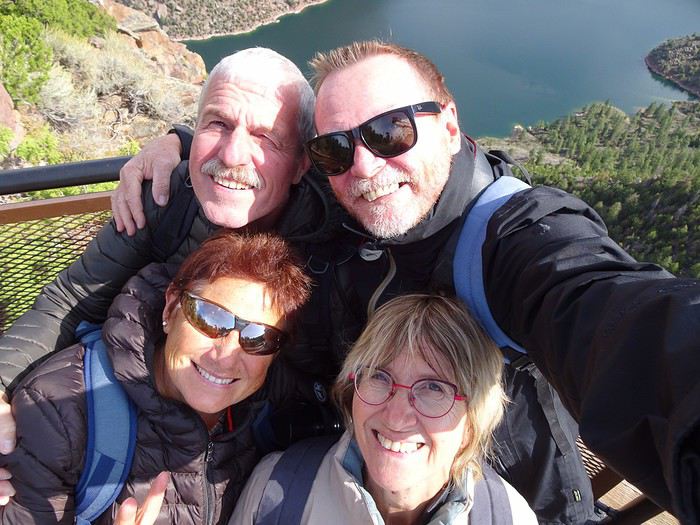
For those who don’t know us, let me introduce our little group. We’re four friends in our sixties (this time, everyone made it, which let us score some "senior" discounts...). We live in the Var region, have known each other for over 20 years, and this was our second trip together to this magical West.

Mimi (Michèle): always the smallest and the funniest. Thank goodness she was there to speak English! Maumau (Maurice): her husband, always with his white hair, his Gallic mustache, his humor, and his Southern accent. He drove every other day. DD (André): the one with the beard, with whom I celebrated our 41st wedding anniversary at Yellowstone. Our second driver appreciated having a peaceful mind since he’s been retired since July. Marcalamar (Martine): that’s me—still blonde with glasses, still talking a lot, and still terrified of messing up the organization of this trip despite all the hours spent on the forum.

Recognize us? Ha ha ha!!!! No, just kidding!!!! That’s us!!!

Open
Beware of scams at Wakai port (Togean Islands, Sulawesi)
Hi everyone,

After years of traveling, I finally settled down a few years ago in the Togean Islands, Indonesia (on the main island of Sulawesi).

For those planning to visit the Togeans via Wakai (arriving either by ferry from Gorontalo or speedboat from Ampana), watch out for a person who goes by the name Bagong, also known as Farid.

This gentleman is a teacher and supplements his income with tourism-related activities. He often hangs around Wakai port looking for tourists to sell things to (a charter boat transfer, a cabin on the ferry, etc.), using dishonest methods and lining his pockets.

More recently, he was hired by the authorities of Togean Islands National Park (TNKT) to sell entry tickets. And this is even worse: in the name of the National Park, he outright scams tourists, either by selling tickets at a higher price, asking them to pay again, or charging children who are supposed to enter for free.

Here’s what you need to know: 1. Entry fee for the National Park: 150,000 IDR (ONLY FOR ADULTS, aged 18 and up)

2. This entry fee is only payable once, even if the ticket states it’s a daily price. These tickets were printed a long time ago, before tourists even had to pay anything, and since then the payment system has changed. So it’s indeed 150,000 IDR per person, payable once regardless of how long you stay in the Togeans.

3. Where to pay (depends on your entry point to the Togeans):

Ampana: entry fee payable when departing from Ampana port Gorontalo: entry fee payable upon arrival at Wakai port Bumbulan (Marisa): entry fee payable upon arrival at Dolong port

If you’re asked to pay these fees anywhere else or when leaving the Togeans, it’s a scam—don’t pay.

4. You should receive one receipt per person in exchange for the 150,000 IDR. If not, know that the money won’t go to the National Park but into the ticket seller’s pocket. If someone offers to charge you less (e.g., 100,000 IDR), you won’t get a receipt, so the money still won’t go to the National Park. Please don’t accept these practices, even if you think it’s good for your wallet (seriously, a 50,000 IDR discount is only about 3 €). The National Park needs these funds to protect the Togean Islands’ ecosystem. By saving 3 €, you’re just lining the pockets of a dishonest guy.

Several resorts have already reported Bagong’s (or Farid’s) dishonest practices to the National Park. The authorities are still struggling to find a trustworthy person to sell tickets in Wakai (no scams have been reported in the other two ports so far). We all hope this person will be replaced soon.

5. Contribution for the Ministry of Tourism: Since early 2019, every tourist staying in the Togean Islands must, in addition to the National Park entry fee, pay a 50,000 IDR contribution (regardless of the length of stay). These fees are to be paid at the same time as the 150,000 IDR for the National Park.

6. Price for renting a cabin on the ferry Wakai - Gorontalo (and vice versa): 500,000 IDR. If someone offers you 600,000 IDR, it’s a scam, and those extra 100,000 IDR will go into the same dishonest guy’s pocket (or one of his accomplices). Note that the 500,000 IDR already includes the commission for the person acting as an intermediary to rent the cabin.

7. Going rates for charter boats from Wakai to the various resorts (approximate prices, just to give you an idea—it may vary slightly from one boat operator to another or from one resort to another):

Wakai - Kadidiri (Harmony Bay, Kadidiri Paradise, Black Marlin, Pondo Lestari): usually free if the transfer is arranged by the resort (if you have a confirmed booking and stay more than one night), otherwise between 100,000 and 150,000 IDR Wakai - Una Una (Sanctum, Pristine Paradise): I’ll get back to you with the info, but you can also check with these two resorts. Wakai - Katupat (Fadhila Cottages and Bolilanga): 400,000 IDR Wakai - Bomba (Polyalisa, Poki-Poki, Araya Dive Resort, Island Retreat): 400,000 IDR Wakai - Malenge (Malenge Indah, Bahia Tomini, Sera Beach, Sandy Bay, Lestari Cottages): 600,000 IDR Wakai - Waleakodi (Lia Beach, Pulotiga Resort): 900,000 IDR

There you go, fellow travelers—my little contribution to help you avoid what’s known here as the "Wakai mafia."

I’ve included some photos of Bagong/Farid (found on Facebook) so you can recognize him. Note that he sometimes wears glasses, sometimes not, sometimes has a mustache, sometimes not, and sometimes wears his teacher’s uniform to appear more official or legitimate. Heh, the habit doesn’t make the monk ;)

Other shady individuals in Wakai:

Lamin: sometimes sells ferry tickets to Gorontalo, but mostly acts as a taxi to resorts, with shady deals and unfair prices. Uni: a seemingly charming woman, but not always honest. She offers cabin rentals on the ferry and arranges charter boat transfers to resorts.

And while I’m at it, if you meet "Miss Harbor" at Ampana port, run away like the plague. She doesn’t handle National Park ticket sales but will try to sell you a car rental for Toraja, Tentena, Luwuk, or Manado, a cabin rental on the ferry to Gorontalo, or other things. Her real name is Ulfa, and she’s a real scammer (on top of being an alcoholic and a bit unhinged). I’ll try to post something about her later.

Don’t worry, there are also plenty of great people in the Togean Islands :P :P

If, despite everything, you fall victim to these scammers’ schemes, be sure to report it to the resort where you’re staying. And of course, leave a comment here so I can report it to the National Park and the Ministry of Tourism (communications are difficult in the Togeans, and some resort owners don’t have many opportunities to contact the authorities). Together, we can put an end to these dishonest practices and make the Togean Islands even more beautiful :)

Have a great summer, travel safely, and return with your heart filled with the beauty of our world!
Open
From France to Bulgaria by Train
September 2017. I’m setting off on a journey from the Atlantic to the Black Sea—entirely by TRAIN—crossing Switzerland, Austria, Slovenia, Serbia, and Bulgaria all the way to Varna. I leave the house, walk briskly for half an hour to the station. Haven’t carried a backpack in years. I arrive at the station drenched in sweat. It’s a scorching late summer. My T-shirt is soaked. First minor challenge, first thought: travel is discomfort. You have to put yourself in a state of discomfort, accept it, and move beyond it. My T-shirt will dry on me—portable, self-contained heating at a steady 37°C.


Departure on the Ouigo from Rennes station, arriving in Massy 1.5 hours later. And then the rush toward the exit. In a frantic rhythm, hundreds of passengers trample in the same direction like a single organism, as if driven by some urgency. The human snake with things to do. Meanwhile, the metal snake that teleported us here continues on its infinite path, perched on its two rails. At the station exit, ticket machines for the RER are under siege, lines stretching outside the building. I watch for a moment, then... veer off toward a café 200 meters away. A guy at the entrance greets me at the top of the stairs with humor. I stir my espresso and think how hot it is to be setting off on a trip—especially since I’m heading toward Southern Europe. Then comes a thought, maybe cliché but fitting: if you wait for ideal conditions to act, to leave, to do, you might wait forever.


PARIS, youth hostel at 8 Jules Ferry Street, 21 € for a bed in a dorm. Unbeatable price for sleeping in the capital. Friendly welcome and a nice neighborhood near République. They don’t ask for a hostel federation card. Paris is as beautiful as ever—and as polluted. My eyes and throat sting a little. I buy a ukulele (the reason for this stop in Paris), using my backpack as a case. First notes strummed in the empty hostel room. We’ll end up being four people sleeping here, mostly in their thirties or older. In the evening, I have a Grimp on the terrace of a nearby café. After a day of carrying my backpack in the heat, the first sips of cold beer are pure bliss. The window stays wide open all night because of the heat, to let in a little air. Feels like sleeping right on the boulevard, with motorcycles and cars passing all night long.


TGV from Paris to Strasbourg. The sound of the train is smooth and soft, almost nonexistent. I think to myself that the TGV is already a thing of the past—a time when we believed abolishing time would mean abolishing finitude, when in reality it only erased life. A time when we believed in the rise of a single, affluent upper-middle class with access to immediacy in a world of efficiency, profit, cleanliness, straight lines, no sweat, no dust. I think speed is part of the past. When you go fast, you rush, you’re never where you are—always just ahead, never here and now. Speed is a rejection of life, a sick movement, an illusion of power and joy. No yawning, no breathing, no dozing, no thinking. Speed abolishes time and space. People get sucked in. Quick, into the vacuum—never inspired, no time. Aspiration versus inspiration. A battle between unreal times (past and future) and the only real time: the present.


Second night. Youth hostel in Lucerne, Switzerland. Tough end to the day—tired, starting to get blisters. Lucerne, with its charms and hordes of tourists, wears me out. With my blisters, I drag myself to the station, buy some Asian takeaway, and wait for the bus to escape to the hostel. There, three massive Russian-speaking guys chat and down beers around a table on the terrace by the entrance. I sit a little apart. The Swiss hostel is twice as expensive as the one in Paris. The common areas are spacious, but the rooms are cramped and lack a sink. The opposite of the Parisian hostel, where the common spaces were minimal but the room was spacious and had a sink. I share the small room with two students from Singapore. Lights go out around 10 PM, but in the hallway, a group of overexcited girls from the next room scream, laugh, slam doors, and keep coming and going for over an hour. The next day, I’d find the girls’ bathroom floor covered in chips.


Day three. Departure from Lucerne station in the morning, change in Zurich, heading to Villach in Austria near the Slovenian border. The train is slow, skirting a large lake with mountains where rocks jut out by the water. The view through the window is soothing. The sounds of the train are pleasant. In front of me, two women speak softly while eating Swiss crackers. Then the train speeds up as we leave the lakeside. I decide to get off at Wörgl, a small station surrounded by mountains, instead of continuing to Salzburg. The train I take in Wörgl looks like our TER. Not many people, just three small carriages, well-balanced air conditioning. Good call: this little train winds through the Austrian mountains. It stops often, but the scenery is beautiful, and I’m in no hurry. Typical little villages, chalets on the mountainside, coniferous forests. To be honest, after a while, I get a bit tired of these endless valleys. Lack of perspective and distant views.


Villach. A pleasant town with a well-maintained old pedestrian center and its old bridge spanning the Drava. I arrive in the early evening. After a good walk, I pass through a mixed zone (industrial and sports) and find the youth hostel 2–3 km from the station. 25 € a night, but the hostel is "full," and of course, I haven’t booked. I never book in advance or use a phone to navigate. I prefer to improvise and ask for directions. I head back to the city center and find a room for 76 € in a three-star hotel. The guy at reception, very kind, looks like he stepped out of a comic book—a short, chubby guy with a serene face and voice. He’s not rushed at all, takes his time, which is really nice. The room isn’t great in terms of essentials, but a lot of effort (finishes, furniture) has gone into matching the hotel’s standards. No free space, window overlooking a narrow courtyard (smell of cooking in the morning), and a small, not-very-firm bed. Bathroom’s fine, and there’s a big screen (one channel in French). In the morning, a free breakfast with an incredibly varied spread—salty and sweet, meats, cooked dishes, pastries, dried fruits, cereals... Sitting with me in the room are mostly couples in their sixties.


Departure from Villach station. Train at 12:53 PM to Ljubljana. 17 €. Quite an old train, compartments with six seats, some patched up. I share a compartment with a very nice Croatian woman around 35. We start chatting, and I explain the nature of my trip. I also tell her about my first big train trip in Asia, which piques her interest, and she asks me quite a few questions. She’s seen documentaries about trains in Russia or India, and I give her a firsthand account from "reality." Her English is a bit better than mine, but we’re more or less on the same level, which I think helps the conversation flow and last. You could almost say we meet while traveling not because of shared interests but because our language levels match!


Ljubljana. No idea what this city looks like. I quickly checked a few forums and was expecting a somewhat dreary big city, pollution... Not at all. After a few minutes’ walk from the station, I enter a pedestrian and tourist area with beautiful, well-maintained, colorful buildings. The city seems immediately very pleasant, everything within reach. At the tourist office, I grab a map and see there’s no shortage of hostels. I find one in the city center in a large old building, with big rooms that haven’t been renovated in decades. 15 € a night. Ljubljana is actually a charming little city, touristy, with a completely pedestrianized center. Prices are already a bit lower than in big French cities. Example prices: 6 € for a large, very filling plate of excellent falafel, hummus, fries, and raw veggies; 2.5 € for a half-pint on a terrace in the city center; 1.50 € for a lungo coffee; 60 cents for a kind of jam-filled bread. In the narrow streets, you come across lots of bikes that seem to rule here. Pedestrians have to move aside. I reach a pedestrian crossing—maybe the only street in the city center open to cars. I’m about to cross (against the light for pedestrians), but a young Slovenian woman warns me in English; she says I could get fined for that.


The next day, it’s raining. During a break in the clouds, I manage to have breakfast on a terrace. I find a slightly more expensive hostel (21 €) but with nice common areas. A smaller room but better designed, with a locker for securing your bag. It’s going to rain all morning. I head up to the castle—a walk that, besides getting the legs moving, offers a great view of Ljubljana rather than the castle itself. Midday. It’s raining, so I eat a plate of fish with potatoes cooked by a street vendor at a market, sheltered by a flimsy umbrella. Not many people at the market brave the rain. But I’m loving it. The vendor, very Slavic-looking, corrects my attempt to say "thank you" in Slovenian ("hvala"). A few minutes’ walk away, I reach Ljubljana’s big park. You quickly arrive after a small climb into wild forest—seemingly not maintained at all. And we’re only 1 or 2 km from the tourist office! My feet are soaked—damn shoes that were supposed to be waterproof!

More travels and train sounds on my site crilef.free.fr and also crilef.fr
Open
Come discover Ireland with us
IRELAND - INTRODUCTION

We planned our 15-day trip to Ireland several months in advance to create an itinerary that would let us see a multitude of tourist attractions across various regions of the Republic of Ireland and Northern Ireland.

We researched the main attractions in each region and noted their GPS coordinates.

After that, we used Google Maps to create a packed but realistic daily route. We printed all the itineraries, and they proved extremely useful since some attractions weren’t listed on the GPS a friend lent us, and some roads aren’t clearly marked.

This way, we were able to stick to our daily schedule.

Three months before our departure, we rented a car directly from Autoescape’s website for 136.44 € over 14 days. The rental was with BUDGET, and the car we got was a ŠKODA Citigo.

This rate includes unlimited mileage, collision damage waiver (CDW), theft protection (TP) with a 1,500 € excess, and unlimited third-party liability coverage.

Some roads in Ireland are very narrow, so a compact car is much appreciated. Don’t forget that driving is on the left, and there are plenty of roundabouts.

Luckily, my partner finds driving this way easy, and our travels went smoothly.

It’s worth mentioning how courteous and patient Irish drivers are—it’s truly phenomenal.

Two weeks before our trip, we booked our accommodations at various places like B&Bs, hotels, and university campuses through Hotels.com. We’ll talk more about each of them later.

When we arrived at Dublin Airport, going through customs was quite tedious. There are two lines: one for EU citizens and another for other foreigners. The wait for non-EU travelers is significantly longer.

The car rental isn’t directly at the terminal. You have to take a shuttle to the rental center. Once there, a company representative finalizes the contract and hands over the keys to our rental car.

And off we went on our adventure!

It’s also important to note that some roads have tolls. For most of them, you pay directly at a toll booth, and the fees are usually under 2 €.

However, the M50 motorway around Dublin works differently—it’s a prepaid toll. You’re charged when you drive between Junction 6 (N3 Blanchardstown) and Junction 7 (N4 Lucan). A large purple sign warns you as you approach one of these junctions.

Cameras automatically record your license plate, and fees are applied based on your vehicle category. For a standard car, the fee is 3.10 €.

You have until 8:00 PM the next day to pay at an authorized retailer or online at https://www.eflow.ie/.

We prepaid these fees directly on the site mentioned above.

If you don’t pay within the required time, you’ll be charged substantial penalties.

For dining, most grocery stores and gas stations offer a great selection of hot and cold meals at very reasonable prices. That’s why we mostly bought our food at places like SuperValu, Lidl, Spar, and Centra.

We invite you to keep reading about our adventure in the next section.
Open
1987 Pilote R320 motorhome
Hi everyone!! My partner and I just got our very first motorhome!! It's second-hand and not exactly new (1987), but it runs well: it's a Trafic T1300 van with a Pilote R320 coachbuilt body (CE model: the one with 4 berths, a double bed up front on the dinette and 2 single bunk beds at the back). We're total beginners in this area (my partner knows a bit about car mechanics but not motorhomes) and we don't have a user manual. So, we're a bit lost—we don’t know what all the buttons on the control panel do. Can you help us???? We know what the bottom left one and the battery test do (except the one with the lightning bolt), but not the others.

What’s the red wire near the batteries for (it’s not connected)?? What exactly does the coupling/separator do (I’m a woman, lol)?? How do we operate the fridge—I think it’s original but not sure (Electrolux brand)?? What should we do when the motorhome is parked for the winter—any safety tips and tricks to prevent freezing, etc.?? Do we need to empty the water tanks, for example? I’m really new to this!! Other questions are pending, but we’ll see about those later. Thanks so much in advance for your help!!

PS: Where can we find cheap sites to buy accessories?? For example: screw cover seals, sealant, window frames, trimix fridge, chemical toilets... (aside from Leboncoin, of course!!)???
Open
Time-Lapse Video of My Road Trip in the Western USA – November 2013 & Travel Journal
I’ve never done a travel journal on VF before... so I’m giving it a go this year 😉. Just to share a bit of my 3-week trip around the West.

Since I couldn’t find anyone to share the trip with this year, I decided to go solo for 3 weeks at the last minute. So, it wasn’t a super organized or original trip—flight tickets booked last-minute, a loosely planned itinerary—but it was a choice I made.

I wanted to book zero hotels and just drive wherever I felt like. No set hikes or specific goals. Just a classic route through places I already knew for the most part, taking the time to soak in the landscapes. So, don’t expect a story about epic hikes leading to caves or hidden arches in unusual spots. It was more like a return to the roots of my first trip, with one twist: I wanted to explore some areas by mountain bike. Just to see things a little differently.

First up, instead of photos, I’ll share a little time-lapse I made during the trip.

Thursday, October 31: Left Nice early in the morning for Phoenix via London.

The trip was a bit long because I had to wait 5.5 hours in London. My flight ticket was booked kinda late, so I didn’t have much choice.

And then it hit me—when you’re prepping for a trip, you always think you’ll forget something. It was in London that I realized I’d left my driver’s license on my living room shelf. I searched everywhere, but nope, I didn’t bring it.🤪

Luckily, I had an international permit, but the rental contract clearly stated that both licenses had to be presented.

I called a friend to ask her to overnight it to my first hotel, crossing my fingers that the mail wouldn’t take two weeks to arrive.

The flight with British Airways went pretty well. Comfortable enough to watch two movies, eat, take a little nap, and boom—I was in Phoenix.

Around 8 PM local time, I got to the Alamo car rental agency, and surprise—they didn’t care about my license at all. They glanced at the international permit, told me to bring the other one when I got it (basically, they didn’t give a damn), and handed me my car! Woohoo! 😛


I headed to my hotel (the only one I’d booked for my first night), explained to the front desk that my license should arrive by mail so they’d be in the loop, and crashed for a well-deserved first night in the U.S.

Friday, November 1 (And yes! It was a holiday in France, which would complicate my mail situation later.)

I woke up super early with my first goal: find a decent mountain bike at a good price but sturdy enough to handle some national park trails.

As I mentioned earlier, I decided to switch things up this year and explore some mountain bike trails—or just ride whenever I got the chance 😉.

I checked two Walmarts before finally finding a solid bike for under $150. Some might wonder why I bought one—well, the reason’s simple. Renting a bike costs between $40 and $70 a day. My trip lasted 22 days. QED (that’s "quod erat demonstrandum" for those who didn’t get it).

I bought the bike, which fit in my Jeep Compass by folding down the back seats (not super convenient, but it worked).


Off I went on my first adventures.

I decided to head to Apache Junction.

First stop: the Apache Trail at Goldfield Ghost Town. Pretty cute, though super touristy. Some classic Western decor, a little chapel overlooking everything, a museum, a mine, a small Disneyland-style train, souvenir shops, and places to grab a snack. Nothing mind-blowing, but still a fun little visit—especially if you’ve got kids.


I got lucky and explored the ghost town with two school buses—about a hundred excited kids. Total chaos for a ghost town, but hilarious to watch from a distance 😎.

A little further down the Apache Trail, there’s Lost Dutchman State Park. I didn’t linger too long because my goal was to reach the lakes, and after my Walmart adventure and some driving, it was already almost 1 PM. I munched on a bag of chips and hit the road (lots of 20–25 mph speed limits).

I spotted N 1st Water Road along the way, planning to come back in a few days.

My plan to get to the lakes ASAP got derailed when I found a parking lot with a horse trail right in the middle of the saguaros.

I asked a ranger in the lot if I could ride the trail on my mountain bike. He said it’d probably be tough but gave me the green light.

Off I went in my padded shorts and helmet. First bike ride through the cacti with my trusty travel companion (my bike, obviously).


I started off super excited on what seemed like an easy trail, but I quickly realized horse trails don’t account for some key biking challenges 😎—like climbing rocks isn’t exactly a breeze on a mountain bike 😛. No biggie, I carried the bike a few times but got to see my first saguaros up close! A pretty cool way to explore—I don’t regret buying the bike at all!

I got back on the road after drinking 1.5 liters of water (even in November, the sun’s no joke) and headed toward Canyon Lake. With vibes like Lake Powell, I was blown away by the scenery and decided to hang out a bit—just to "soak it in" and enjoy the quiet to end my day. I didn’t see more of the Apache Trail because night falls fast, and for my first day, I figured that was plenty.


I’d decided not to stress about seeing everything at all costs since I’ve traveled a lot in the U.S. and plan to keep coming back. Whatever I missed, I’d catch next time—but I wanted to fully enjoy a few landscapes.

I drove back to Phoenix, grabbed a good burger, and spent the evening in my hotel room planning the next day. Originally, I was only supposed to stay one night in Phoenix, but with my license still MIA, I changed my plans. In the end, I was solo, no reservations anywhere, so I’d just take it day by day!

Saturday, November 2:

I decided to wake up early and head to Tucson for the day. The drive from Phoenix was pretty easy. About 2 hours later, I was at the entrance of Saguaro National Park.

And guess what? There was a little trail perfect for mountain biking. I parked my Jeep at the park entrance and hopped on my bike. I ended up biking the whole park from start to finish—about 20 kilometers, with a paved main road and a gorgeous central trail right through the saguaros! Stunning!


Even being careful, I still got a few cactus spines in my left arm from brushing too close (it stings!). Not easy to remove, so I’d advise anyone with the same idea to be more careful than I was. You’ll figure it out fast! 😉

I spent most of the day in this amazing park—it’s totally worth the detour. It feels like hundreds of chimneys all lined up at equal distances. A unique landscape you’ve gotta see.

Next, I headed to Tucson to check out the airplane boneyard. I’d seen it in a movie years ago and always wanted to see it for myself. Mission accomplished! It was pretty intense, but unfortunately, it didn’t seem possible to get to the most interesting plane alignments. There’s a museum with different types of planes and a guided tour. I settled for peeking through the fences at the planes guarded by military patrols.


I left around 6 PM and got back to Phoenix around 7:30–8 PM, super happy with my day of biking through the cacti!

Sunday, November 3:

Morning by the pool, lounging around—pure bliss. Around 11 AM, I headed to the Premium Outlets. Feeling pretty pleased with myself, I bought 5 pairs of Levi’s for the price of one in France. Just for that, I knew coming to the U.S. was worth it! After that, nothing super exciting—except a cotton field south of Phoenix that I couldn’t stop admiring for a good hour.


I drove around the city—pretty dead on a Sunday—and headed back to the Apache Trail to tackle N 1st Water Road, which I’d spotted two days earlier. A really fun trail to bike if you’ve got a mountain bike 😉. It gives access to several hikes and offers some great scenery. Highly recommend it.


Open
The Hippie Trail to India in the 60s and 70s
During the 60s and 70s, thousands of travelers hit the road to India. Some were backpackers or hippies, but not all. In this collective anthology featuring around twenty contributors (including GeorgesOz), you’ll also find truth-seekers, a couple who went on their honeymoon to get married in Bengal... and "crazy" folks who set off on VéloSolex bikes...

Worth noting: all contributors donated their royalties to support the Céline Hegron clinic in a poor neighborhood of Varanasi.
Open
An 80-Day Tour of Southern Africa

Back in South Africa

January 12, 2013, 5:30 AM, Flight BA043 London-Cape Town

Directly below, Windhoek glittered like a tangle of fairy lights still lit and tossed into a box.

The horizon, edged in purple, was setting up a backup fireworks display, and suddenly, like a cherry on the platter and with unbearable intensity, in less than two minutes the entire sun revealed a gray dam and then a vast, untouched massif.

A few more minutes and the glare to the east of the plane was total. In Africa, the sun is swift.

We still had a France to cross before landing, but it felt as if we were already there. To the west, the raking light revealed what looked like acne and long, swollen scars in a desert region that might be the Swartkloofberg. Further still, straight as far as the eye could see, the two parallel tracks of a dirt road.

At 11,500 meters altitude and 940 km/h, we had a sense of stillness until the Orange River appeared, an incongruous serpent, gray edged with green.

The first South African settlements were dotted with trees providing shade, then rivers highlighted by continuous lines of vegetation.

Water and shade that make life possible.

We’ll return here by the backroads.

Half an hour from Cape Town, the plane tilted toward the sea, crossing plantations (likely citrus) and then an explosion of cultivated greenery in circles on either side of an unruly river. Finally, the coastline was no longer just sand and water—a frothy hem, a suture?

A peninsula came into view, forming two magnificent bays, and... a flight attendant firmly instructed me to return to my seat: we’d arrived!

The Colors of Cape Town

The city was dressed up as I like them—deserted, fluid, free of its vendors.

In the parking lot of the endless beach next to the commercial port north of the city, about two hundred people were unloading their goods in front of their pickups or combis, none of which were from this century: mixed-race, ageless Black people, and white folks who looked like they’d stepped out of another era.

After a few minutes, intrigued, I played a game: first looking at the merchandise, then imagining who was selling it, and finally looking at who was actually manning the stall. Tall Black vendors were selling what they often sell in Europe—leather, sunglasses, watches; mixed-race folks offered discount bundles, and the tanned older white people seemed to have emptied their attics.

We left with an antique tin kettle for morning tea over an open fire, a pack of five exercise books (that’s 600 pages to fill), Bill Bryson’s earliest stories in English, some snoek rillettes (a local fish), and—never seen before—tuna biltong and snoek biltong.

In so-called advanced countries, Sunday is for sports: white cyclists dressed like pros sweating diligently, Black street vendors running in loops at red lights to sell trash bags that day; white golfers losing their balls, which a scantily clad Black man retrieves from the water; under the sails of kite surf boards, it’s all blondes, and in the foam, joyful splashes from a bunch of Black kids.

Searching for an unusual spot for lunch, we drove through the fishing port looking for a dive and, at the end of a dead-end road with no warning, we arrived at the Shimmy Beach Club—quite the program.

The place, open for just three weeks, aims to be ultra-trendy. You could be in San Francisco, Lisbon’s docks, or St. Barth. This time, the "visible" staff was diverse, but the clientele was exclusively white, except for one mixed-race couple.

For this Sunday lunch, the women had pulled out all the stops, and local starlets—who’d make ours look tame—were turning the terrace into a frenzy.

At Cape Town’s port, the girls have *port*. The trend seems to be crochet dresses over swimsuits.

For two hours, a team of employees watered and raked the sand, starting over when they finished. A child in a floaty pink dress and a gold headband, but a future adventurer, stepped onto the freshly raked artificial beach sand for the first time.

A lanky mixed-race man dragged a hose across the ground, followed by a white woman—enchanted?—who then started watering the sand herself, carelessly splashing the glass terrace her colleague had just swept. I suspect a tacit work arrangement to keep everyone employed.

A galleon packed with tourists (are there any in the hold? Does it take tourists to Robben Island?) left the port. A helicopter took off in its wake. Trawlers returned, cutting through a ballet of catamarans, their waterlines well above the water: a bad catch.

If there’s one country where you can’t pretend to ignore skin color, it’s this one. The question is in everyone’s mind, and here more than anywhere else, it’s a decisive economic and political factor.

Columbine of Brittany

200 km north of Cape Town and 9,000 km south of the Breton coast, but on the same cold ocean, we camped on the shore of the Columbine Cape Nature Reserve, sheltered by a rocky chaos that, at first light tomorrow, would transport us to Perros-Guirec.

Our first encounter with wild animals wouldn’t end well for them: it was crayfish season, and they were the size of lobsters at Lorient’s fish market. Bought for R60 (5.5 €) a pair from kids in Pater Noster, they’d end up between two rocks, over a fire. But first, we had to pair the Chenin blanc with some snoek biltong.

With no wood, I lit a fire at dawn with dried seaweed and kelp, as if petrified; it gave off a smell of court-bouillon and... tires. Two hundred fathoms away, on an outpost, an army of cormorants stood at attention, unmoved among the frolicking seals.

At the reserve’s exit, the guard spoke French; Patrick Mwanba had arrived from Congo three years earlier to study, but the cost of living here forced him to drop out. He’d like to return home because life is cheaper there, but the war made him hesitate.

Ding ding dong! Vroom! Arf arf, Woof! Buzz! (A night from hell!)

I’d long planned to visit Calvinia, the center of a region known for extensive sheep farming. An excellent provincial museum, run by an enthusiastic curator, kept us too late to start the drive north.

So we camped in a tiny, charming campsite set up in the garden of a house. A few trees, a patch of resilient grass, and a view of a pretty lit-up steeple—what else?

Well, it turned out to be a sound-and-light show, with the pretty steeple chiming the hours and half-hours. Then suddenly, we were in the VIP stands of the Karoo-Kalahari Truck Race: roaring trucks paraded under our canvas windows, and we realized we were on the main road through town. To top it off, we enjoyed an uninterrupted canine cacophony, from the *arf arf* of little dogs to the *woof* of a mastiff. Oh, and some mosquitoes—the first ones—insisted on keeping us company in the tent, and we hadn’t yet bought the arsenal to neutralize them.

I walked through Calvinia at night; the house gardens weren’t fenced, nor did they have the «Armed Response» signs so common in the country.

The Kalahari Trails

(No, no, I haven’t converted to hiking.)

North of Calvinia, in the south of the Northern Cape, small towns follow one another up to Upington, about a hundred kilometers apart—welcome havens. Between them, with no trees in sight, we stopped in the shade of a motionless cloud: the temperature exceeded 40°C in mid-January.

We were almost out of the High Karoo and into a region of pans drying up, until the first red dunes appeared, precursors of the Kalahari. In the sparse veld vegetation, gatherings of quiver trees in the kopjes, and a caravan of camels without a handler or packs, marching in perfect formation across a pan (no, I hadn’t overdone the Windhoek at the last stop, and no, I wasn’t dehydrated enough to hallucinate).

The historic part of these towns, European in style, was built on the same plans as those in the American Midwest or the Australian Outback: a grid of streets wide enough to turn a wagon pulled by eight pairs of oxen. The architecture was Dutch-inspired, tropicalized with awnings.

Then came more recent housing, functional in style, where the wealthier mixed-race people—who make up the majority of this state—lived, and further on, the township, an assemblage of corrugated iron and plastic, like everywhere else.

Orange, Right Bank

North of Augrabies Falls National Park, on the other side of the Orange River, stretches a rugged and wild territory the size of fifty Groix islands, crisscrossed by a few tracks—the Riemvasmaak.

The inhabitants were driven out half a century ago for a military base, and as soon as President Mandela was elected, he made it a symbol by allowing the exiled populations to return. Several ethnic groups live here on almost nothing, in government-built shacks.

A community camp is set up in a small cirque at the end of a canyon that, while not in the history books, offers a good descent. By mid-afternoon, the air was at 44°C, but luckily there was a spring... except it was a hot spring, with water at 38°C. And they haven’t invented a reversible spring yet. Once the birds and baboons had settled in, in absolute silence and far from any light pollution, we enjoyed the stars like nowhere else (well, that’s what they claim in the region).

The Orange didn’t choose the easy path: arriving from Lesotho, it was almost at the ocean. The terrain to the south and north of this massif seemed easier to cross. Was it to avoid the curse of the Okavango, whose waters disappear into the sands without ever seeing the sea, that it chose this rocky route, thinking that at least the granite wouldn’t steal its water?

I Love You, I Eat You

In the dry bed of the Auob, it lay panting, head raised, alert, between its paws but head-to-tail, a tawny springbok, motionless.

A few minutes earlier, their story had been written in a lightning-fast chase, captured in photos by the driver of the car that alerted us.

It would be a long time before it started eating at the groin without breaking its surveillance.

Earlier, there was a lion lounging in the shade and hundreds of antelopes: springboks and gemsboks (oryx) in herds, hartebeests and steenboks alone. Strange pairs, apart several times, formed by a springbok and a gemsbok.

A few solitary jackals moved slightly sideways, looking furtive. Ostriches, alone, looking a bit dazed.

It was a lucky morning in the Kgalagadi (KTP).

In and Out

Kgalagadi, Nossob Camp.

We were at the very end of the almost-empty camp, ten meters from the fence, whose structure wouldn’t resist an elephant (though there aren’t any here), but it was electrified.

At dusk, on the other side, ten meters away, three lions passed in a row, as if on parade, seemingly focused on their goal and indifferent to the camp, though they glanced at it.

A jackal had gotten into the camp and was trying to get out without success while scavenging. I offered it two pieces of snoek biltong (Don’t feed the animals!) from three meters away—it smelled strong and had bones (bones in biltong!). When it passed by again, it sniffed but didn’t dare approach. Curled up in the chair, motionless, by the faint moonlight, I finally saw it come closer, grab the nearest piece, and move ten meters away to enjoy it (how many jackals know the finer points of sea biltong?). A little reassured, it came back for the second piece.

Another Morning

By morning, the jackal was gone, but our luck hadn’t left us. Two cheetahs again, who found me in the way and slowly moved toward a calmer shadow. Enough birds of prey to form a squadron, but they’re solitary hunters. Two ostriches busy with their dozen unruly chicks. And while we’re at it, a group of four Kalahari lions, sprawled under a thorny bush. Lots of oryx crossing the dunes and herds of red hartebeest. Kori bustards and secretary birds.

It was the first time the Kgalagadi had spoiled us so much.
Open
Looking for a reliable round-trip flight Paris-Delhi
Hi there, I’m planning a winter trip across India. Departing in early December and returning to France in mid-April. My main concern is finding an airline that offers this round-trip with the fewest hassles regarding cancellations or flight schedule changes. The unstable geopolitical situation in the Middle East isn’t making this search any easier—recent reviews online about airlines from Gulf states describe quite a few struggles over the past few months. The direct Paris-Delhi round-trip flights offered by Air France or Air India are probably the safest options, but not the cheapest! Given this uncertainty, I’m still holding off on finalizing my ticket purchase... Maybe some of you India lovers on VoyageForum have tips or experiences to share? Thanks, and happy travels to all.
Open
Off to explore Lithuania!
December 13 - Day 1

"How about a Christmas market this year, huh? A little romantic weekend getaway... - Yes! That’d be cool! Strasbourg? Colmar? - Feels a bit déjà vu, doesn’t it? Plus, slim chance of snow there... And I’d love something a bit more exotic with a touch of originality..."

"Okay, Google, give me the list of the five most beautiful Christmas markets in Europe. - In fifth place, the Christmas market in Vilnius, the capital of Lithuania. - Save your breath! Lithuania, here we come!"


We wanted cold, and cold is exactly what we got the moment we set foot in this new, unknown land. As for landscapes, forests and lakes stretch as far as the eye can see across this vast plain, its vegetation scorched by the frost of a winter that’s clearly already well underway here.


Lakes, in fact, set the scene for our first visit to Trakai Castle, whose brick-red towers and walls rise proudly against the azure sky of our first day. Lakes, because this castle was built on an island and is only accessible on foot via a series of walkways spanning half-frozen lake offshoots. I couldn’t have picked a better spot to build my castle! Translation: We’re totally sold! Proof is we spend two hours hiking around the area, alternating between forests, reeds, and cozy houses tastefully decorated for Christmas.


Open
Road Trip - Canadian West
After exploring Dawson City, the final stop on our incredible road trip to the Yukon (see travel journal), it was time to head back to Quebec.

Instead of returning directly, we took advantage of this cross-country drive to make several stops in British Columbia and Alberta.

This part of the trip allowed us to discover some of the most beautiful attractions in Western Canada, from breathtaking landscapes to iconic natural sites that are must-sees in Canada.

Between majestic mountains, turquoise lakes, and jaw-dropping panoramas, every stop added a memorable touch to this already exceptional adventure.

A wonderful way to wrap up this journey across Canada while fully enjoying the richness and diversity of its vast landscapes.

In the upcoming posts, you’ll discover the highlights that marked our journey through Western Canada.

I invite you to watch the associated videos to fully experience the atmosphere, landscapes, and attractions we were lucky enough to explore.

To navigate to a specific post, here are the appropriate links:

Adventure on the Alaska Highway: Bald Eagles, Bison & Moose Adventure on the Alaska Highway: Bison, Caribou & Bears Yellowhead Highway (Alberta): Roche Miette, Jasper Lake & Emerald Pond Maligne Lake Road (Jasper) | Moose and Elk Exploring Mount Robson Provincial Park (BC) Must-Sees on the Icefields Parkway - Alberta David Thompson Highway11 (AB): A Stunning Scenic Route What to See in Yoho National Park (BC) Johnston Canyon: Hike to the Lower & Upper Falls Iconic Sites of East Kootenay, BC Lundbreck Falls - A Spectacular Waterfall in Southern Alberta Trails of Red Rock Canyon & Blakiston Falls - Waterton Waterton Village Under the Snow - A Unique Place Writing-on-Stone: A Park Famous for Its Hoodoos Red Rock Coulee Natural Area Alberta – A Supernatural Landscape Dinosaur Provincial Park Alberta - Mysterious Badlands Drumheller: Dinos, Hoodoos & Badlands Interpretive Trail Hike at Horsethief Canyon | Drumheller Badlands Red Deer: Public Art & Murals Downtown Calgary | Public Art, Skyline & Iconic Spots Medicine Hat | Public Art & Iconic Spots
Open
First Questions About Transportation and Accommodation in Japan
Hi everyone,

I’m starting to think about a trip to Japan, though I haven’t yet decided on the exact duration or itinerary, and I have a few questions for those who know the country well or have traveled there recently.

First, about getting around: what do you think are the most economical and reliable ways to travel across Japan and move between cities? I’m thinking of trains, overnight buses, domestic flights, regional passes, etc. I’m not necessarily looking for the fastest option, but rather a good balance between cost, simplicity, and reliability.

I also have a question about the return ticket. Since I don’t yet know how long I’ll stay in Japan—or even if I’ll return directly to France (I might continue to another Asian country)—is it mandatory to have a return or exit ticket before entering Japan? Would a ticket to another Asian country suffice?

Regarding accommodation, I usually prefer staying in youth hostels rather than hotels. Are hostels easy to find all over Japan, including outside Tokyo, Kyoto, and Osaka? And what’s the average budget per night for something clean and well-located?

Finally, I’d like to get an idea of the overall budget for the trip. Is Japan still relatively affordable when traveling simply, or do expenses add up quickly? I’m mainly thinking about:

transportation between cities; local transportation; youth hostels; food; potential domestic flights.

My plan is to travel fairly freely, without necessarily booking everything in advance, so I can adjust my itinerary or stay longer in places I like.

If anyone has traveled this way in Japan, I’d love to hear about your experiences, tips, and maybe an idea of the daily budget to expect.

Thanks in advance!
Open
Travel companions to share an excursion in Kazakhstan then Kyrgyzstan border
Hi there,

I contacted a travel agency in Almaty, and they’re offering a trip to Charyn Canyon and Altyn National Park with an overnight stay, then they can drop me off at the Kyrgyzstan border in Karkara (so I won’t be returning to Almaty). The cost is $700 USD—it’s pricey solo, but if there are 3 or 4 of us, it seems like a great deal. Are there any backpackers interested in joining this part of the trip on June 7, 2026? (My flight to Almaty is on June 4 from Lyon with Pegasus.)

Bye,

Patrice
Open
Crossing the border between Kazakhstan and Kyrgyzstan
Hi there,

I’m planning to visit Kazakhstan and Kyrgyzstan in early June, assuming the war doesn’t spread ??? Could anyone give me some info about the eastern border after visiting Charyn Canyon? First, is it possible to head east using public transport, or should I book a tour from Almaty and stay in the east to continue on to Kyrgyzstan toward Karakol? (I mean, not return to Almaty with the tour.) It’s a bit of a vague question, but those who’ve been there will know what I’m talking about;

Thanks!

Patrice
Open
Looking for a travel companion for Oman - March-April 2026
Hello, I’m 76 years old and travel a lot around the world. I’m planning to go to Oman from March 19 to April 8, 2026. (After that, I’m off to Turkey to meet some friends.) I’m looking for a fellow traveler to share a car rental to explore some off-the-beaten-path spots. I just got back from Cape Verde, and before that, I was in the USA, Japan, Chile, etc. I usually travel solo, and obviously, I meet a lot of people along the way. For Oman (and Namibia next year), it seems more practical to travel with 2 or 3 people. That’s all! Patrice
Open
Departure time from Fogo to Cha das Caldeiras
Hi,

I arrive in Fogo at 11 a.m. (if the ferry is on time) from the ferry departing Praia. From what I understand, the collectivos to Cha das Caldeiras leave late morning? Do you think I can leave the same day?

My question is: should I spend a night in São Filipe? I don’t want to take a taxi—it’s too expensive.

Thanks,

Patrice
Open
Exploring Oman in early 2026
An idea to mull over: heading to Oman at the start of the year (January, February). A car for freedom, bivouacs, hostels, desert, mountains, hiking, walks... For two, three, or four—depending on who’s in. Who’s tempted? Have a great week, and more, to everyone!
Open
Japan: Shikoku pilgrimage spring 2026
hi everyone, I’d like to do the Shikoku pilgrimage in spring 2026—the full circuit (88 temples) with a mix of walking and buses. Buses for the long, straight stretches on busy roads. You’ll need to be able to carry your own bag, so pack light like for a multi-day hike, and have some experience with long-distance walking. Who’s in? A small group of 3 or 4 would be perfect. If there are takers, we’ve got 6 months ahead of us to organize and fine-tune the trip. I’m 73 and used to traveling—I’m not a travel agency, so if you’re interested, at least get the basic info on the route and other useful details first… A trip like this is a group effort. Have a great day, everyone! 😉
Open
Camera Fee at Tadoba Andhari Tiger Reserve, India
Hi,

Does anyone have recent info on the camera fee amount at Tadoba-Moharli? We spent 8 days there in the second half of February, and the local tour operator (The Wild Cat Eyes) collected 2000 rupees per camera per safari without any receipt—totaling 240,000 rupees (~265 €) for 12 safaris (9 in core zones and 3 in buffer zones). The signs at the park entrance listed 250 rupees, and the tour operator ignored our requests for an official park receipt.

Thanks in advance! Pk
Open
8 days in Bulgaria: what to see and do for an amateur photographer?
Hi everyone,

So, I’m heading to Bulgaria this September. I’ll be based in Varna and plan to rent a car for a few days. I don’t know Bulgaria at all, so I’ve got everything to learn about this country.

I’m an amateur photographer, so I’d love to take some great landscape shots (sea or mountains) as well as photos of picturesque little villages... I’m open to all kinds of tips, and thanks in advance for reading!

Best regards, Patrice
Open
Looking for cycling partner(s) for Thailand and nearby countries
Hi there, I’m looking for a female and/or male cycling partner for bike trips in THAILAND and neighboring countries, late 2026, early 2027, or late 2027 (the best seasons for cycling). Born in 1952, I ride slowly and not too far: 40 to 70 km/day, 2 to 4 hours per day, depending on how I feel, the terrain, the people I meet, photo stops, etc. 5 or 6 days out of 7. Accommodation in modest guest houses. Looking forward to hearing from you! Patrice
Open
Carpooling in Oman December 2026
Hello,

I’m planning to go to Oman in December (the 9th, if there aren’t too many geopolitical issues) for a month. I canceled this trip last year because of the war. I’m flying with Pegasus for 350 € round trip (easy to cancel in case of war). Is there anyone interested in sharing a car rental? Man or woman. I’m 77 years old and travel a lot around the world. See you soon,

Patrice
Open
Hitchhiking in the 70s-80s


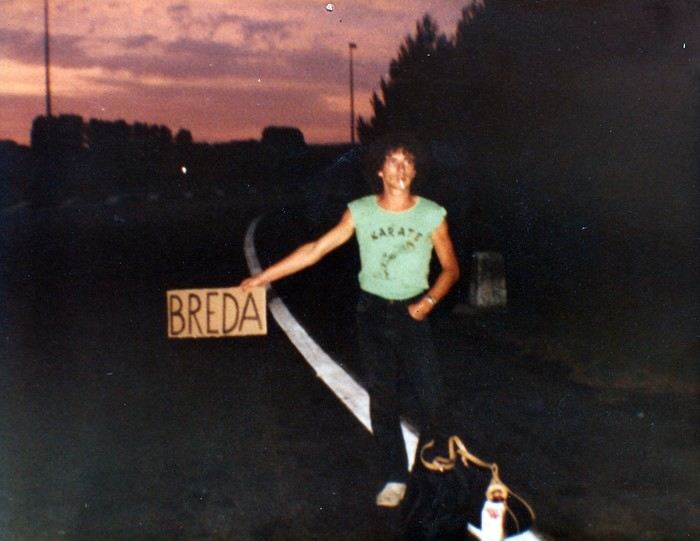
“Hey, your Marker... - My Marker? - The one you used to make hitchhiking signs.”

The marker in question is sitting proudly on the kitchen table. Marielle found it at the bottom of a moving box.

I’ve been meaning to tell the long story of my love affair with hitchhiking for years. Here we go.

To be honest, I’m not quite sure when it started. My earliest memory goes back to a fair with a bike race in my maternal grandparents’ village. I was with my cousin, my little sister, and three girl cousins. There were six of us, ages ranging from six or seven to thirteen or fourteen. Our parents stayed at the fair, and we’d had enough. So we decided to walk home. Only it was four kilometers away. So we hitchhiked. A guy driving an old car picked us all up and dropped us off at the farm. He probably found it amusing to see us thumbing a ride by the side of the road, but maybe it also worried him a bit. With everything you read in the papers...

Around fifteen or sixteen, I started hitchhiking regularly, alone or with a friend, to go to the nearby town. But it was especially when I started boarding school in Orléans that it became more regular. The first year, I’d leave Monday morning and come back Saturday noon by bus. It was an old, uncomfortable bus where we froze in winter. To make matters worse, I often got motion sickness if, as was too often the case, I ended up sitting in the back. In the spring, a high school friend suggested I hitchhike back. It meant a slight detour, but the advantage was taking only national roads.

So that’s how, from the end of tenth grade to twelfth grade, I’d thumb a ride every Saturday on the Pont de Bourgogne. Drivers were used to seeing young people hitchhiking, and it worked pretty well. Our biggest fear? Soldiers! At that time, military service was still mandatory, and on weekends, it wasn’t rare to see them competing with us. They’d keep their uniforms on to go home. That gave people confidence—with everything you read in the papers—and they’d rarely wait more than five minutes. We, with our long hair, were definitely less popular. From time to time, three big red-faced guys in a van coming back from a construction site would flip us off, yelling things like “go get a haircut, you bums!” Those were the good old days.

We still had a good laugh, though. Patrice, the friend I’d hitchhike back from school with on Saturdays, is a musician—I’d later discover he’s an excellent composer. A die-hard Beatles fan, he knows their repertoire by heart and spends his time singing at the top of his lungs while we thumb a ride. One Saturday late morning, we’d been waiting for a while at the exit of Châteauneuf-sur-Loire when a little lady came up to him and asked if he could please sing a little quieter: a baby was sleeping in the house. He put on the most sorry face: “Oh, sorry ma’am, we didn’t realize.” No sooner had the lady gone back inside than he started again. Luckily, a car stopped just then, sparing me the embarrassment of seeing the lady come back out.

Saturday was also the day when the cigarette pack was dangerously low. So before leaving, we’d go buy some “Parisiennes,” the “P4s” as we called them back then. They were slightly thinner cigarettes with a mix of tobacco scraps. Sometimes they tasted like light tobacco, sometimes like dark. Not great, but by the end of the week, our pocket money was gone. They were sold in small packs of four, hence the name P4. We’d only pay 20 centimes. On Saturdays, it was rare for the two of us to manage to scrape together 1.50 F to buy a whole pack of Gauloises...

The last twenty kilometers, I’d usually do alone, Patrice having reached his destination. From time to time, luck would smile on me: an acquaintance would just happen to pass by and stop. One January Saturday, at the exit of Gien, I ran into another guy from Argenton whom I knew a little. That day, the weather was nice, but the temperature was well below zero. It was around noon, and it was the off-peak hour. We were shivering, stamping our feet by the side of the road, when a Citroën “Tube” arrived: it was his father’s boss’s, a mason. They were both sitting in the front, but since they were obese, they had us climb onto the open back. Even though we huddled against the cab to shelter from the wind, the twenty kilometers felt very long, especially since we were only going sixty kilometers an hour. Our hands and cheeks were blue when we finally arrived.

The year I took my baccalaureate, a friend with a 2CV would take me Monday mornings with one or two others we’d pick up in nearby villages. We’d share the gas costs, but it was still cheaper than the bus. And in winter, the bus was my nightmare. You had to get up at five to catch it at six. Not enough sleep, and outside it was freezing or raining—or both. The 2CV was luxury. Plus, Philippe would pick me up at home. On the other hand, since I didn’t have class Saturday mornings—well, I did, but we only had PE the first two hours and nothing after—I’d skip class and slip out right after breakfast to thumb a ride at the Pont de Bourgogne.

Those three high school years were formative in this optional subject that was hitchhiking. Little by little, I learned the rules of the game. First, you shouldn’t walk along the road while thumbing. Cars go too fast and can’t stop easily. Accepting a ride that’s too short is also a no-go. The guy who offers to take you a little way but drops you off at some vague crossroads in the middle of nowhere? No thanks. You need to get dropped off in a town. If it’s a fairly big city, you often have to cross it from one end to the other, but it’s better. At the exit, you have to choose your spot well. Actually, you have to put yourself in the driver’s shoes: they need to see you early enough, not be going too fast, and be able to stop easily without risking an accident. So when leaving a city, it’s better not to go too far. It’s wiser to find a spot where cars go slowly and can stop easily. And preferably near a café. The café is for when you still have a few coins for a coffee and need to warm up. From time to time, you’d run into someone nice who’d make a detour to drop you off at a better spot to start again. Finally, if possible, avoid hitchhiking on Sundays. Cars are packed with whole families who, most of the time, aren’t going far. And then there’s the little worry of those people who rarely leave home: with everything you read in the papers...

During those high school years, it was only short trips, rarely exceeding a hundred kilometers. Later, I aimed bigger, and things were a bit different. In 1973-74, I crossed part of France for the first time on two or three occasions, coming back from the German border or returning to Bordeaux, where we lived briefly. Since there weren’t many highways back then, we took national roads. It was during these trips that I realized it was better to leave in the evening. As I said earlier, Sunday is to be avoided, but on weekdays, there’s another problem: if you leave in the morning, you only make short hops. First, it often takes longer to get going because drivers are people going to work nearby. Which brings us back to those who drop you off in a bad spot, far from everything. There, you have to know how to refuse. You thank the driver for stopping—oh, if only everyone could be like you—while explaining why you’d rather stay put. People don’t take offense, by the way. Those who pick up hitchhikers often hitchhiked themselves when they were in the military or before they had a car. In the late afternoon, you’d often run into salespeople or truckers, in other words, people who drive a lot. At that time, salespeople no longer had appointments and were more relaxed. They wanted to talk about something other than the merits of their products. On the radio, it was time for *Les Grosses Têtes*. You’d also quite often run into small business owners, professionals, or even hippies. The conversations were pleasant and often enriching. A little later in the evening, truckers would take over. They’d already driven a few hundred kilometers, and the depot or customs was still far away. So they’d gladly take a hitchhiker to stay awake at the wheel and chat. The radio with Max Ménier’s show *Les routiers sont sympas*, you’d eventually get tired of it. So a hitchhiker was a change. Others, who’d hit the road at midnight to be at their destination by morning, were nice and offered to let you lie down on the bunk while they drove. When you’d been hitchhiking since six in the evening, freezing in the wind between two vehicles, you weren’t unhappy to take a little nap.

Speaking of Max Ménier, he’d often make announcements for hitchhikers. One evening, I called him. It was getting late, and I still had quite a way to go. No luck: the show had ended for good the day before!

In short, it’s better not to rush, sleep in, and leave after lunch, or better yet, in the late afternoon. Obviously, I’m talking about when you have several hundred kilometers to cover. That’s when you have to play it pro.

First thing, especially at night, but it also applies in the middle of summer when the light is blinding: dress to be seen from far away. I’ll admit I have an advantage over most other hitchhikers: I’m small and don’t scare people. To balance that out, racist drivers often take me for an Arab and are less likely to pick me up, but overall, the balance tips in my favor. Back to the need to be seen: at night, I wear light-colored clothes. In headlights, you can see me from far away.

Second thing: travel light. Forget the big backpack with a frame. Drivers don’t always have room in the trunk or on the back seat, especially if it’s rained and the ground is wet. Plus, it forces them to get out of the car. If they’re nice enough to pick up a hitchhiker, you shouldn’t ask for too much either.

Third thing: bring a cardboard sign and a big marker—like the ones in the photo at the start of this post—to write the name of your destination. In the early 80s, I ran a tourist house in the Cher, but I lived in the Netherlands. In the off-season, it was only open on weekends. On Fridays, I’d leave Holland and return on Mondays. 1200 km round trip. On the way there, in Paris, I’d stand at Porte de la Chapelle. At that spot, the road is very wide, and drivers could stop easily. Obviously, on the sign, I didn’t write Eindhoven, which not everyone knows, and even less Amsterdam because of its seedy reputation. In that case, you’d expect to see a police car stop and two officers in kepis ask for your papers. So as a first destination, I’d write Compiègne. We were well out of Paris, and since it wasn’t too far, a trucker or salesperson was less reluctant to stop. Once past Compiègne, I’d take out my Lille sign. Once in Belgium, it wasn’t really necessary to use a sign anymore, since everyone was going in the same direction. Usually, the guy who picked me up at Porte de la Chapelle would say he wasn’t going far but could take me a little way. Before that, I’d still ask if there was a gas station on the highway where he could drop me off before exiting. While talking, the guy would realize he wasn’t dealing with a dangerous criminal. He’d pretend to check his watch, think for a moment, then say that actually, he was going to Belgium and could take me to the border or a little beyond. To leave Paris on the way back, I’d take the train to Melun, where it was easier to hitchhike than at Porte d’Italie.

Over all those years, I think I was pretty lucky. Or maybe philosophical enough not to imagine a car would stop after a few minutes. An hour’s wait was average. Sure, I sometimes waited three, four, or five hours. Most often at odd hours and in terrible weather. When it doesn’t work, it doesn’t work. But there’s always a moment when things pick up. Sure, when you’re soaked in freezing rain in the early morning after a sleepless night, you’re less philosophical than when I’m writing these lines comfortably at my computer, but it still holds true.

Earlier, I mentioned clothing and the importance of being well-rested before leaving. When you’ve eaten well and just gotten out of the shower, shaved, you’re in a better mood. And somehow, drivers sense it. Or at least, that’s the impression I’ve always had. It’s better to look in shape than disgusted at standing there, half-heartedly thumbing a ride. In short, when I’d start to get fed up with waiting, I’d go into the first café I saw for a coffee. Coming back out, I’d be refreshed, and most of the time, a car would stop within minutes. I’ve often said that when I stood by the side of the road thumbing a ride, I felt a bit like a gambler in front of a slot machine. It was a matter of giving luck a chance. And well, it worked out pretty well.

Then, there are countries where hitchhiking works really well and others where it’s harder. In the 70s-80s, it worked best in Germany and England. In the late afternoon, it wasn’t rare to be invited for tea. Well, that was in England. Tea meant being offered room and board. In Germany, they’d offer you coffee. Once there, they’d first show you the guest room and point out the bathroom before sitting you down in front of a big plate of cold cuts. In the evening, they’d go out in town, and the next morning, they’d usually drop you off at a good spot for hitchhiking. On the other hand, in Mediterranean and Scandinavian countries, you’d better be patient. In Spain or Italy, it’s better to take the train, which was dirt cheap back then. However, if you’re a couple traveling light, it’s already easier in most countries.

In 1982, I went on a trip around Turkey with my girlfriend. We only had two small bags, which was plenty. It was November-December, and we wore our warm, bulky clothes. Leaving Eindhoven at nine in the morning, we arrived in Graz, near the Yugoslav border, at eleven at night. 1300 km in a day! In just four or five vehicles. One to the German border, about fifty kilometers from Eindhoven, the second to Hagen in the Ruhr, the third to Salzburg, and the last to Graz at the Yugoslav border. Record broken. During the night crossing of Yugoslavia, we ran into a trucker close to retirement who lent us the truck’s bunk. So we arrived fresh and rested near Skopje the next morning. We continued to Thessaloniki in northern Greece before taking the train to Istanbul. In Turkey, we traveled a good part of the country by hitchhiking too. With truckers in old, overloaded, slow trucks that climbed hills at fifteen kilometers an hour, but also in cars where five or six people were already crammed in. And every time, we were invited for tea. Once, we were even picked up by a big shot in his Mercedes with a chauffeur. Until then, the average speed was around fifty kilometers an hour. There, we were going two hundred. On a national road, not a nice European highway.

I’ve also hitchhiked in Nepal, from Lumbini, Buddha’s birthplace, to a village on the way to Pokhara. It must have been midday. No bus until the next day. I gave it a try. A small truck overloaded with rice sacks, with two or three young people already perched on top, stopped. I rode on the roof of the cab. At fifty kilometers an hour when it was going well, with a breathtaking view. Coming back from India, I also crossed part of Iran by hitchhiking, from Tehran to the Turkish border. I did this trip with an Austrian I met at the hotel who, like me, had to watch his pennies. We gave it a shot. There was almost no traffic, but to our great surprise, the first car that passed in the area would always stop. They’d just ask for a modest contribution for gas, and it cost next to nothing.

Sometimes, you get scared too. After leaving Turkey in early December 82, we spent about two weeks in the southern Peloponnese harvesting olives. A few days before Christmas, we hitchhiked back to Holland. A girl picked us up in her little Fiat 500. We were driving on a mountain road, and that morning there was a bit of black ice. After crossing a pass, we saw the old Ford Taunus ahead of us at fifty meters start to skid. The driver let out a “heeee!” while grabbing my knees. I reflexively grabbed the wheel. Finally, the Taunus got back on track. And we didn’t swerve. But those few seconds felt very long.

In January 77, while I’d been living in Germany for a few months, I decided to spend a few days in Italy. By hitchhiking, of course. I left in the early afternoon, and by ten at night, I wasn’t far from Frankfurt. I saw a big Mercedes stop. The four or five young people crammed inside were listening to Schlager at full volume. Beer cans littered the floor. They didn’t have a precise destination, and as long as they were going south, that was fine with me. They’d finished their military service that very day and had clearly already celebrated their discharge. The driver was going 160, zigzagging dangerously from one side of the highway to the other. I should have realized he wasn’t entirely sober either. Luckily, there was almost no traffic. Finally, I managed to get dropped off at a gas station just before Frankfurt, relieved. I hope their trip didn’t end tragically.

Another time, coming back from Holland with my wife, we were picked up early in the morning near Senlis by two guys from Lille. They were going to work near Tours and could drop us off at Porte d’Italie. Apparently, they were coworkers but barely knew each other. The driver offered us a beer—at six in the morning, sure!—before opening another can for himself. He was clearly having trouble staying in the right lane. We politely declined, the passenger too. Everyone was tense. Luckily, it was rush hour on the ring road, and we were going slowly. When we got out of the car, the passenger said goodbye with the look of a guy being offered the condemned man’s rum and cigarette.

Finally, there are the annoying remarks from drivers who are either gay when you’re alone or turned on by the sight of your girlfriend when you’re a couple. In those cases, I’d get in the back so the guy wouldn’t feel too confident. And if the conversation got a little too suggestive, we’d deflect until we got dropped off.

And luckily, there are the times, not so rare after all, when you run into really nice people who invite you to eat and sleep at their place and drive you to a good spot the next morning. In Germany and England, that was common. And then there are the big strokes of luck, like during our trip to Turkey when we crossed most of Germany in one car, or that other time when some Germans drove me from the exit of Geneva all the way to the Costa Brava.

Going back to “with everything you read in the papers” and its variant “with everything you see on TV”—and now on the internet—it’s always left me perplexed. Personally, I’ve never heard of hitchhikers assaulting drivers, even if it may have happened. On the other hand, what was most common were hitchhikers being assaulted, especially girls. Anyway, even armed, it seems a bit stupid to assault the driver—wouldn’t that risk causing an accident?

Finally, since that time, I’ve occasionally wanted to hitchhike somewhere far away in France. Most often, too busy with work, it never happened, but the nostalgia hasn’t completely disappeared.

* * *

Other Hitchhikers

And then one day, I... settled down to become a driver myself. Ten years had passed, and you saw fewer and fewer hitchhikers. Or maybe I saw fewer because I had a regular job and wasn’t traveling the same way. And then I understood a few things.

Several times, I was tempted to pick up a hitchhiker, but they didn’t meet the required conditions. They were walking along the road instead of staying at the exit of the previous town. Hard to stop without risking an accident. Or the guy looked really scruffy. Or he was sulking, if not both. Then you think of that famous “with everything you read in the papers.” Not that I was scared, but unfortunately, the few hitchhikers I did pick up later were rarely interesting.

A few years ago, we picked up a young guy at the exit of a small town in Sologne. Not an easy spot for hitchhiking. Bad luck, he was a pretentious little jerk. He was barely 20 or 25 and talked like a bitter old man. He was a waiter in a restaurant. According to him, it was lucky he was there, otherwise the boss would have closed up shop long ago. You’d think he had thirty or forty years of professional experience behind him. As we approached Blois, he started ranting about Arabs, blaming them for all evils. And he laid it on thick. That morning, we were going to a teenager’s funeral who had just committed suicide, so he really got on our nerves, Mr. Know-It-All. Out of anger, I dropped him off next to a shopping center a few kilometers from downtown. Not nice, but it felt good.

Some time ago, we were driving around the Limousin on a Sunday to try out the used Twingo we’d just bought. We picked up a guy in his forties. A German who spoke French well. He started talking about the environment. He was a green Khmer. He got worked up all by himself with his pseudo-eco rant and, after a few kilometers, was almost yelling at us. As we were about to leave the main road for a small one, I dropped him off at a crossroads in the middle of nowhere. Normally, I would have made a little detour to take him to a better spot, but this time, I didn’t feel like doing the... eco-warrior a favor.

On the other hand, I’ve still done my good deed a few times. One June morning, coming back from Orléans, I saw a man in his sixties hitchhiking. The poor guy had had a rough time. He was from Montpellier and was coming back from Caen, where he’d been promised a job. Once there, they bluntly told him the position was already taken, and he had to go back. Except he didn’t have enough money left for the train. He’d spent the night hitchhiking without success. I could only take him as far as Lamotte-Beuvron, where I dropped him off near the fire station. Apparently, there was some vague shelter there or something, but it only opened a few hours later. In the meantime, he settled on the grass in a corner to sleep a little. While he was doing that, I quickly went to the train station to check the price of a ticket to Montpellier. It was within my means. Since he was sound asleep, I slipped the train ticket and 100 francs into his pocket. I couldn’t imagine him continuing to hitchhike all the way to Montpellier. And I bet he didn’t even have a piece of cardboard and a marker!

When we go to Brazil, we usually rent a small car. One day, we were coming back from Paracuru to Fortaleza when we saw a whole family hitchhiking. Two adults and two or three small children. Here near the equator, the sun sets very quickly, and it would soon be night. There was little traffic, and trucks wouldn’t stop because there was no room in the cab. As for the rich people driving big 4x4s, they wouldn’t stoop to picking up the lower classes. The only hope for this kind of family was usually a farmer or artisan who’d let them ride in the back of his pickup. Obviously, they were a bit surprised to see us. Everyone crammed in as best they could in the back of our little car. When we dropped them off, we got a whole string of “Deus lhes abençõe”—God bless you.

Still in Brazil, we were on the road from Barreirinhas to São Luís do Maranhão. About 150 km of deserted road with an isolated mud house here and there. A young woman flagged us down. She was very pregnant and had to get to the clinic twenty or thirty kilometers away to give birth. Someone was supposed to drive her, but the first signs of labor started earlier than expected, and the driver was unavailable. Even driving fast, we weren’t feeling great: it would be just our luck if she gave birth in the car!

Today, we’re in the age of smartphones and carpooling apps. Safety. With everything you see on TV... Three or four years ago, we signed up on a platform. Our first, and only, “client” was a little jerk who didn’t say a word the whole trip. No hello, no goodbye, and certainly no thank you. The next day, we found his Ray-Bans in the car. We didn’t run after him to give them back. Ha!
Open
Trip report: 2,700 km scooter ride from Lacanau-Océan to Névache (Briançon)
From Lacanau Océan to Névache, July 4–13, 2024. Stopping at roadside markers and signs in towns, on trails. I left home in Corsica, took the boat from L'Ile-Rousse to Sète, then headed up to Lacanau-Océan for the start of the 45th parallel. Destination: north of Briançon, Plampinet (Névache municipality). For more info and photos, check out my FB page "45th Parallel". I did it solo, on a 125cc scooter, a Honda Forza with no mechanical mods. Under-seat storage, a top case, a bag strapped to the rear seat with bungees, and two side bags that gave out in the first few days due to poor quality. Used a GPS, smartphone apps like the famous "68°", "my exact location", and "Ventusky" for weather. Plus paper road maps and a travel journal. Various accommodations (camping, B&Bs, a yurt, and staying with friends). In total: 2,700 km total, including 1,800 km from Lacanau to Névache via small, lost-but-so-pleasant backroads. Crappy weather from Sète to Lacanau, then nice conditions. Estimated fuel consumption: 3 liters per 100 km. No mechanical issues—neither with the scooter nor myself. One regret: I didn’t take enough time to meet people. For info...: At nearly 77, I still feel the need to do things differently—like the GTA (Grande Traversée des Alpes 😠, the climb to the metallic globe at Nordkapp, Norway (which I did by sea)😠, the trip to southern Portugal😠, etc. On top of that, after an accident and two major knee surgeries, I can’t hike, bike, trek in the desert, or even walk 1 km on sand. That’s also why I can’t ride a motorcycle with bent legs… * Feel free to share your thoughts or ask for more details.
Open
3 weeks in Laos, stress-free
Come along, I'm taking you to this country where it's so nice to wander and slow down...

This trip was in 2023, but when I wanted to write my travel journal, VF was still closed to contributions... So, now that I've just finished my Japan travel journal here, I figured it was high time to honor this destination we came back from so enchanted. Disclaimer 1: This is a written travel journal. There’ll be text! Too much, for some! Disclaimer 2: This is an illustrated travel journal. There’ll be photos! Too many, for some!

I have to say, every time I try to discipline myself, to keep it shorter, to include fewer photos... I end up adding more. It feels like my dear Aunt Nicole, who exhausted us with her slide-show evenings in the 70s/80s, decided to take her revenge. The upside for you, readers, is that you can slip away anytime without offending Aunt Nicole. I won’t even notice!

Anyway, since I love maps, here’s one to give you an idea of where I’m taking you. As you can see, we only saw a tiny part of Laos (the areas circled in red); we only had 3 weeks for ourselves (my husband’s newly retired, I still work), and we prefer taking our time over rushing around like crazy.


In broad strokes, it was very classic:

First, we “settled in” at Luang Prabang (8 days), because we wanted and needed to. From there, we took three days to venture a little further north—not far in kilometers, but as we know, distances aren’t just about km! Then we flew south to Paksé, letting ourselves drift down to the 4,000 Islands while stopping by the pre-Angkorian archaeological sites. We wrapped up with the Bolaven Plateau.

A few practical notes: We arrived via Bangkok, then took a Bangkok-Luang Prabang flight, having picked up our luggage in Bangkok to check it in for Luang Prabang. No issues—the Bangkok airport, which many of you know, is very well organized. We got our visas on arrival in Luang Prabang. Quick, but to be fair, we were on a “small” plane, and the big flights had arrived earlier, so we weren’t too crowded in line! At the end of our trip, we didn’t fly out of Paksé but from the nearby airport in Thailand, Ubon Ratchathani (a 2.5-hour drive from Paksé), then Bangkok and Paris. You’ll notice we skipped Vientiane to stay longer in Luang Prabang. That said, there’s now a high-speed train between Vientiane and Luang Prabang—good to know—and soon the (Chinese) train will go all the way to Bangkok and even Kuala Lumpur!

With that intro out of the way, let’s dive into the heart of the matter. To be continued: Slowing down the pace... in Luang Prabang
Open
Africa: A Heartfelt Love for a Continent
“When the Whites came to Africa, we had the land and they had the Bible. They taught us to pray with our eyes closed: when we opened them, the Whites had the land and we had the Bible.” Jomo Kenyatta (p.7)

The Maggi cube, an unchallenged hegemony, and so much more

“The hopeless continent,” headlined The Economist, a British magazine, in July 2000 about Africa. Eleven years later, the same magazine headlined “Africa rising” instead. Images of Africa in the prosperous North constantly oscillate between apocalyptic scenarios and enthusiastic projections. A key issue with such images lies in the generalization they entail. If you look at the continent, considerable contrasts emerge depending on space and time. It’s no surprise that a region of the world encompassing such diverse ecological zones, maintaining such varied ties with other continents, comprising nearly fifty nation-states in sub-Saharan Africa alone, and characterized by a great diversity of languages, belief systems, and historical paths, doesn’t share a single destiny.

And yet, for many people outside Africa, as well as for many Africans, the continent constitutes a single entity, defined by criteria such as skin color, a colonial past, poverty, and the art of survival. Until now, these perspectives were generally accompanied by the idea that Africa had to—or should have—followed a single path together, sometimes called development, sometimes modernization, sometimes liberation, then a market economy. None of these paths delivered on their promises.

The two writers Alain Mabanckou and Abdourahman Waberi—one from Congo, the other raised in Djibouti, both long settled in France and now professors at renowned North American universities (Los Angeles, Washington)—have had enough of pessimistic scenarios: “We are aware that Africa is in the world and the world is in Africa. The same goes for all other continents, as our destinies are inextricably linked for better or worse. We refuse to see Africa as a reservoir of misfortunes or a continent cursed by atavistic misfortune and characterized by ethnic conflicts. [...] It’s this passionate flame we wanted to capture in a book [...] a kind of stroll through African cultures, without any demands, each letter of the alphabet leading us to a notion, a practice, a concept, a moment in history, literature, painting, politics, economics, cuisine, etc.” (p.10-11). Africa, they write, is on the verge of “imposing a signature, a style, a way of being in the world and in relation to the rest of the world.” (p.11) To put words to the continent’s diversity and dynamism, the two authors created a “rambling ABC,” a kind of portrait—or more precisely, a mythography—that lets you see and feel the pulse of a vast continent whose cultural power is unfolding before our eyes. Once marginalized or even mocked, the voice and importance of the Continent in global affairs are now undeniable” (p.11), containing over a hundred entries, mostly concise, written in a relaxed and casual style. The optimistic, even exuberant tone is set from the brief introduction. The duo of authors wants to “sing a love song to the cultures of our continent, to its inhabitants past and present, to its exceptional resources and its spectacular globalization despite a certain pollution that still clouds our skies due to the unmatched duration of dictatorships in some of our regions.” (p.12) In doing so, they don’t want to be too distracted by today’s Afewerki-Biya-Bongo-Déby & Co. ...

Of course, you’ll find tributes to great precursors like Frantz Fanon (“[...] it was a love story and admiration that wasn’t dimmed by the four decades separating his birth from ours. Let’s add that we were born while the native of Fort-de-France had left the world’s stage four years earlier, in the prime of life” p.141), Mongo Beti (“You must read and reread Mongo Beti, a genius who used his fame to support often just causes in Africa, like defending oppressed groups. His place is already in History. His oppressors, like the dictators Ahmadou Ahidjo and Paul Biya, can’t compete in the same category” p.64), the Malian Amadou Hampâté Bâ

(“Posterity remembers him mainly as an tireless defender of African cultures. His plea for the collection and preservation of traditional African knowledge remains a major event for all men and women of good will. One day in 1960, at the UNESCO podium, the native of Bandiagara sounded the alarm: ‘[...] Since we’ve admitted that the humanity of each people is the heritage of all humanity, if African traditions aren’t collected in time and written down, they’ll one day be missing from the universal archives of humanity.’” p.51),

Kwame Nkrumah, “one of the founders of Pan-Africanism, father of Ghana’s independence” (p.239), as well as the historian Cheikh Anta Diop, the writer, poet, and politician Aimé Césaire, and the economist and thinker Samir Amin, but also very warm tributes to certain contemporary African intellectuals like Souleymane Bachir Diagne and Achille Mbembe

(“A few years ago, in dominant economic circles, a rumor often resurfaced, usually disguised as a cold and scientifically proven analysis: Africa is useless. It’s a burden for the rest of the human community. With its 2% share in world trade, it would disappear from stock market radars without anyone noticing. So? Maybe it’ll be pulled up by other continents. Wanting to surpass itself is a crazy bet for Africans, they concluded. Arrogant or clueless, President Nicolas Sarkozy declared before an audience of students and teachers at Cheikh Anta Diop University in Dakar: ‘The African man hasn’t entered history enough [...] He only knows the eternal repetition of time marked by the endless repetition of the same gestures and words.’ That was in 2007. For decades, armed only with reason, an intellectual often steps up to debunk prejudices, lazy readings, and dishonest frameworks used as false fronts by those who, like Nicolas Sarkozy or former journalist Stephen Smith, out of ignorance, contempt, or condescension, distort African reality. This intellectual is none other than the historian and political scientist Achille Mbembe. This heir of Frantz Fanon, Amílcar Cabral, Jean-Marc Ela, and Fabien Eboussi-Boulaga was born in 1957 in Cameroon, in the Bassa region. Marked early by the upheavals of a fratricidal war, Achille Mbembe became the guardian of the memory of martyrs. After brilliant studies in Paris, he went on to teach at the best American universities, but the call of the Continent was stronger than anything else. In Dakar, he once directed CODESRIA (Council for the Development of Social Science Research in Africa) before joining the University of the Witwatersrand in Johannesburg, South Africa. Even though the author of *Critique of Black Reason* (Éditions La Découverte, 2015) spends a few months at Duke University in North Carolina, his observation post remains South Africa. From Johannesburg, Achille Mbembe scrutinizes Africa and the whole world. A lucid observer with an elegant and generous pen, Achille Mbembe knows how to blend big and small history: ‘I was born one day in July, as the month was drawing to a close. It was 1957, in that part of Africa recently named ‘Cameroon,’ a memory of the wonder that seized Portuguese sailors in the 15th century when, sailing up the river near Douala, they couldn’t help but note the presence of a multitude of crustaceans, and named it *Rio dos Camarões*, meaning ‘River of Shrimp.’ I grew up in the shadow of this nameless land, since, in a way, the name it bears is only the product of someone else’s astonishment: a lexical mistake, if you will.’ From this mistake or wound, he made leaven, a springboard to compose a rich work, recognized worldwide. To denounce barriers and barbarians too. But that’s not enough. Among his peers in circles of thought and action, Achille Mbembe passionately and consistently defends human dignity and the beauty of the world. In doing so, he fulfills the mission Frantz Fanon entrusted to him.” (p.227-229),

as well as entries dedicated to lesser-known artists and intellectuals, like the French journalist and activist Rokhaya Diallo, daughter of Senegalese and Gambian parents, or the Ethiopian filmmaker Haile Gerima, who has long lived in the United States. Other names from politics, sports, music, art, and literature: Kofi Annan, p.36; Barack Obama, p.243; Thomas Sankara, p.277; Ousmane Sow, p.285; Yambo Ouologuem, p.250; Léopold Sédar Senghor, p.282; Muhammad Ali, p.30; Nuruddin Farah, p.146; Salif Keita, p.203; Ahmadou Kourouma, p.206; Ngũgĩ wa Thiong’o, p.236; Winnie Mandela, p.224; Kylian Mbappé, p.226 ...

The authors, who resolutely commit to a “mythography” (p.11) of Africa, also pay special attention to local social movements, cultural events, and aspects of daily life. *Y’en a marre*, “which also meant ‘we’re fed up with sitting on our hands’” (p.320-321), emerged about a decade ago in Senegal as a citizen movement of peaceful resistance and symbolizes, the authors emphasize, the fact that African youth are increasingly fed up “with the political circus deployed in Africa since independence, as our parents would say, ‘since the White man left’...” (p.321). A full entry is dedicated to the Maggi bouillon cube, which has flooded African markets for about forty years and enjoys immense popularity (“It’s everywhere in Africa, from Dakar to Djibouti, and from Tangier to Cape Town. It’s in every pot, every stew. Little hands put it in every sauce, every local or adapted dish. An unchallenged hegemony! You’ll find it in diasporas too. The culinary strolls in Paris, in the [...] neighborhood” p.90). Critics blame it not only for impoverishing the aromatic diversity of local dishes but also for being harmful to health. And yet, “he poorest Africans, those who eat only once a day, a few spoonfuls of white beans and a ball of *foufou*, for example, are the most fervent users of the magic cube.” (p.92-93)

For *fonio*, “the new trendy cereal. [...] From the millet family, fonio is probably the oldest cereal cultivated in West Africa, and mainly in its sub-Saharan part, for millennia. [...] Easy to grow, water-efficient, fonio grows everywhere except on clay soils. Long neglected because it was considered the poor man’s crop, fonio is now a source of pride for the farmers who cultivate it and cherish it like the apple of their eye” (p.156-157), the authors immediately offer a detailed recipe, letting the reader know that “e can’t resist sharing this fonio with chicken recipe from Mali with you:

Ingredients: 1 chicken 3 large ripe red tomatoes 4 tbsp tomato paste 4 large onions 1 garlic clove 1/2 cup oil 2 Maggi cubes or salt 2 large carrots 1 turnip 1 large cabbage 2 large potatoes 1 celery stalk 1 packet pre-cooked fonio 4 okra (or okra powder) salt, pepper

Preparation: 1. Prepare the sauce: wash and cut the chicken. Peel the onions, garlic, and vegetables. 2. In a pot, fry the chicken pieces. 3. Dice the onions, tomatoes, carrots, and turnip very small and add them to the pot. 4. Add the tomato paste, salt, and pepper. 5. Simmer for 15 min, then add 2 L of water and the cooked chicken pieces. 6. Simmer for 30 min, then add the crushed garlic and celery, plus the cabbage cut into 4 and the potatoes cut in half. 7. Prepare the fonio: cover it with warm water, let it rest for 15 min, and cook it over low heat. 8. In a small pot, boil the okra and crush them. 9. Mix the crushed okra with the cooked fonio, then salt. Serve hot.” (p.158-159)

The comedy *Black Mic Mac*, released in French theaters in 1986 and addressing France’s increasingly restrictive immigration policy at the time, also gets an entry, as do *Tintin in the Congo*, the popular comic, and *Jip’s Café* (“[...] a little Africa in the heart of Paris, with passersby stopping to admire the ‘ambianceurs’ on the dance floor or attend the cultural events offered by the place” (p.194), an African establishment in Paris that Alain Mabanckou already immortalized in one of his novels.

The duo of authors also tackles thorny subjects like jihadism (p.119), the Rwandan genocide (p.272), the CFA franc (p.82), and dictatorship (p.110). While the two strike the right tone here, many entries leave a slightly bitter taste. Two examples: why doesn’t the text on Barack Obama mention the great disappointment of many people in Africa, who expected more from the African policy of the first U.S. president with African roots than just occasional warm words? Why do the comments on Winnie Mandela gloss over the fact that she was a highly controversial icon of the anti-apartheid movement due to her involvement in kidnappings, acts of torture, and murders of alleged apartheid collaborators? Instead, there’s a compassion that brings tears to the eyes: “She was often reduced to a secondary role, the wife of a great man” or “When victory came, she didn’t taste its fruits. Divorced, isolated. She would never be a ‘first lady’ in an evening gown, posing before a bed of chrysanthemums. They’d keep her far from the circles of power” (p.224-225). At this point, I would’ve liked the authors to take a slightly more critical stance...

That said, these “weaknesses” (if you can call them that) shouldn’t overshadow the book as a whole. It remains an informative, sometimes very entertaining, and often even original work in its own way.

Book information (the original French and the German translation):

Alain Mabanckou/Abdourahman Waberi. Dictionnaire enjoué des cultures africaines. Fayard, 2019. Alain Mabanckou/Abdourahman Waberi. Der Puls Afrikas. Eine Liebeserklärung von A bis Z. Reclam, 2022.

Hery
Open
From Avignon to Casamance Without Flying
Hi there,

Last February, I made a trip using "public transport" from France to southern Senegal via Spain, Morocco, Western Sahara, and Mauritania.

It’s a journey of about 5,000 km, where I took trains (as far as Marrakech), ferries (to cross Gibraltar and then to reach Casamance from Dakar), and mostly buses on the long desert straightaways. I hadn’t planned any stops in advance or booked any hotels, except for the very first train to Spain, which left plenty of room for the unexpected. Why travel by land and sea? In recent years, flight-free travel has been gaining popularity. On social media, posts explaining how to cross Europe by train as quickly as possible go viral. Traveling without flying—and making sure people know about it—has become a great way to earn a badge of eco-responsibility: an essential totem for anyone wanting to prove both their dedication to the ecological cause and the wisdom of slow travel. I haven’t flown in years, and this journey to West Africa could easily be filed under "responsible travel." But it wouldn’t be honest to say that: in reality, it wasn’t really my aversion to flying that motivated this long trek. I see overland travel primarily as a way to experience the world’s geography at a grounded, earthly pace—the pace of the locals. Besides, I’ll be flying back, which disqualifies any claim to being a model of sustainability. So no eco-badge, and no adventurer’s badge either: you won’t find any heroic tales of camel rides in lost lands or mineral train wagons in this account (popular with influencers, the Mauritania iron ore train now attracts tourists from all over the world, turning "the experience" into something you "have to do at least once in your life"). This five-part story, written on the road, has no other ambition than to recount a journey through places and people, and to share the thoughts they inspire in me. As simply and, I hope, as humbly as possible.

I’m posting the episodes here, which you can also find on my blog (with more photos) at the following links:

Episode 1: Spain, from Avignon to Algeciras

Episode 2: Morocco, from Tangier to Tarfaya

Episode 3: Western Sahara, from Tarfaya to Guerguerat

Episode 4: Mauritania, from Guerguerat to Nouakchott

Episode 5: Senegal, from Rosso to Saloulou

To help those who might want to make the same trip, I’ve also put together a summary of the route with recommendations—you can read it at the end of the story and on the blog: From France to Senegal Without Flying: Route and Itinerary Recommendations

Happy reading, and safe travels!
Open