Hi there,
I’m planning a backpacking trip to China at the end of April, and I’ve got two key questions.
1. Money: where to exchange it?
My usual approach is to carry cash for the whole trip, so the question is: where can I get a decent rate? Airport, exchange bureau, bank, hotel, or jewelry store? The answer varies a lot depending on the country. What’s the best option for China? Extra detail: I might arrive on a Saturday.
2. Booking hotels day-by-day: how to do it?
Until 2022, I’d just show up at places I’d spotted and negotiate. Now, I bring a smartphone and use Booking or Agoda, but these sites now require an OTP sent by email to log in, and I won’t have access to my ProtonMail account in China (even with a VPN, it’s uncertain).
Can anyone tell me how to handle this? Worst case, by setting up a dedicated email account that works in China—but with which provider? Or maybe using a different booking platform?
Thanks.
Il y a un an, le 17 mai 2019, nous partions en Chine trois semaines, mon épouse et moi-même. Nous avions longtemps hésité à y aller, et quand nous y repensons maintenant, vu la crise sanitaire actuelle, nous nous disons que nous avions bien fait. Pourquoi ce récit maintenant ? D’abord pour les photos (lien à la fin), qui nous rappellent des souvenirs, meilleurs aujourd’hui que juste après le retour, et qui pourraient faire rêver de futurs voyageurs. Ensuite pour quelques explications des conditions de ce voyage, même si elles sont peut-être hors de propos aujourd’hui. Et évidemment, merci à tous ceux qui nous ont aidés sur ce forum par leurs publications, ou leurs réponses directes à nos questions.
Nos impressions générales La Grande muraille et tant d'autres sites, nous en rêvions, surtout après le récit et le film d'un cousin il y a six ans. Car auparavant, mon épouse avait de gros préjugés sur les Chinois (différend historique avec les Vietnamiens, bien qu'elle ait aussi des origines chinoises !), et je m'imaginais les voyages en Chine exclusivement urbains. Ces avis ont été nuancés. Nous avons volontairement choisi un parcours culturel, avec de nombreux sites classés à l'Unesco, au nord, la région historique la plus densément peuplée. Nous avons laissé de côté le sud, en se disant que ce serait pour un éventuel autre voyage, et sachant que certains paysages devaient ressembler au nord Vietnam que nous connaissons déjà. En trois semaines, impossible de visiter un pays 17 fois plus grand que la France. Au final, nous ne sommes pas mécontents de nos choix, mais le timing était quand même serré, car nous avons sous-estimé les temps de transports, la foule, la fatigue. Surtout à Pékin, ce n'est pas 4 jours qu'il nous fallait, mais 5 ou 6, tant il y a de choses à voir. Nous nous demandons toujours comment certains tours opérateurs enchaînent la Cité interdite, la Colline du charbon, et le temple du Ciel dans la même journée, sans compter les embouteillages pour leurs cars ! Ces premières journées à Pékin ont été difficiles, mal remis du décalage horaire, et sans repères culturels. Le premier dîner a été épique pour se faire comprendre et l'accueil pas très chaleureux à notre guesthouse. À Hangzhou, nous avions un programme chargé qui aurait nécessité 2 jours au lieu de 1 seul. Nous avons finalement privilégié les rencontres aux visites. A Shanghai, alors que nous avions planifié tout notre voyage en fonction de la date, nous avons raté la course des bateaux-dragons, car elle avait été avancée d'un jour. Le matin même à la télé au petit-déjeuner, nous avions vu des images... Nous nous disions, tiens, ils se préparent pour demain... Si nous avions compris le chinois... La date n'était même pas actualisée sur les rares sites internet en anglais ! Les réceptionnistes de l'hôtel ne connaissaient même pas la manifestation ! Finalement nous sommes retournés dans la vieille ville chinoise, où la foule était beaucoup plus nombreuse que la première fois. Côté foule justement, le pire pour nous a été la Cité Interdite, malgré nos précautions, puis dans une moindre mesure, le Palais d’été à Pékin (un dimanche, mais moins monde dans les espaces avec suppléments), l’armée de terre cuite à Xi’an (bien aménagé quand même), le jardin du Humble administrateur à Suzhou (dommage, mais nous étions prévenus), le temple suspendu près de Datong (très petit). À part deux demi-journées de pluie à Xi'an (bien trempés !) et Shanghai, et le ciel parfois gris, notamment à Pékin, le temps était magnifique et les températures autour de 30 degrés. Nous avons évité un 39 degrés de justesse à Xi'an.
Notre trajet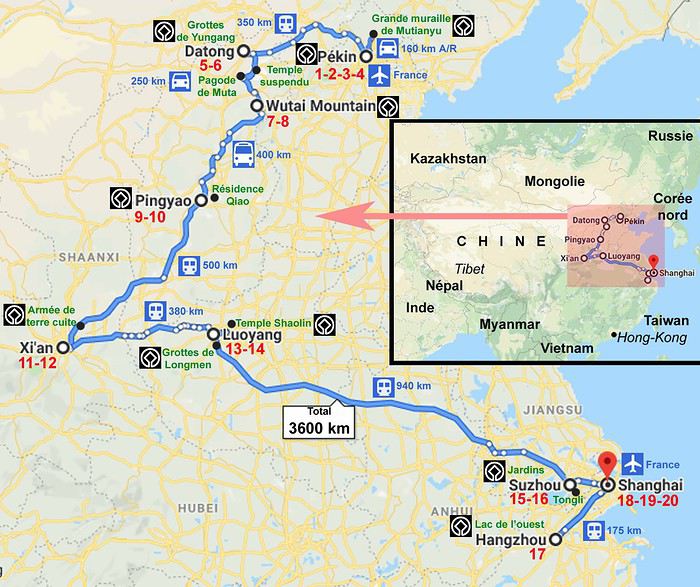
J1 # ven 17-mai # 23:20 Départ du vol Air France J2 # sam 18-mai # Arrivée 15:35 à PEKIN. Retrait des devises au DAB à l’aéroport + achat carte SIM / Transfert aéroport-hôtel en taxi (24 km, 40 mn) / Installation à l’hôtel pour 4 nuits près du temple des Lamas. J3 # dim 19-mai # Palais d'été (métro, A/S environ 1H, 20 km) J4 # lun 20-mai # Excursion aux tombeaux Ming + Grande muraille à Mutianyu (taxi A/R 160 km, 3H 30) J5 # mar 21-mai # Mat : Cité Interdite (métro) / AM : Temple du Ciel, jardin uniquement (métro) J6 # mer 22-mai # Mat : Temple des Lamas / hutongs (à pied, 400 m de l’hôtel) / AM : Taxi pour la gare. Départ du train à 14:16, arrivée à 20:43 à DATONG. Taxi pour l’hôtel (10 mn) dans le centre historique, et installation pour 2 nuits. J7 # jeu 23-mai # Mat : Excursion aux Grottes de Yungang (taxi A/R 35 km, 1H) / AM : Temple de Huayan (à pied, à 400 m de l’hôtel) J8 # ven 24-mai # Mat : Monastère suspendu (85 km, 1H15) et pagode en bois (58 km, 45 mn) / AM : Continuation en taxi vers les montagnes sacrées de WUTAISHAN (110 km, 2H 15). Installation à l’hôtel pour 2 nuits. J9 # sam 25-mai # Monastères de Wutaishan : Pusading, Xiantong, Tayuan, Nanshan (à pied/taxi) J10 # dim 26-mai # Mat : Route vers Pingyao (car, 400 km, environ 5H) / AM : Taxi et installation à l’hôtel à PINGYAO dans le centre historique pour 2 nuits. Début des visites à pied : remparts, temple de Confucius. J11 # lun 27-mai # Visite de la vieille ville de Pingyao (à pied). J12 # mar 28-mai # Mat : Excursion à la Résidence Qiao (taxi A/R, 50 km, 2H) / AM : Temple de Shuanglin (taxi, 8 km, 25 mn). Continuation vers la gare (8 km, 10 mn). Départ du train à 15:43, arrivée à XI’AN à 18:29. Taxi pour l’hôtel dans le centre historique (16 km, 45 mn), et installation pour 2 nuits. J13 # mer 29-mai # Mat : Armée en terre cuite (bus A/R 84 km, 2H) / AM : centre commercial près de l’hôtel J14 # jeu 30-mai # Mat : Musée du Shanxi, Grande pagode de l’Oie Sauvage (métro/à pied) / AM : Quartier Hui et Grande mosquée (à pied). Taxi pour la gare. Départ du train à 17:11, arrivée à 18:42 à LUOYANG. Taxi pour l’hôtel et installation pour 2 nuits. J15 # ven 31-mai # Excursion au Monastère Shaolin, puis au temple du Cheval blanc (Tour en bus, A/R 110 km) J16 # sam 01-juin # Mat : Grottes de Longmen (taxi A/R 30 km, 30 mn). Continuation pour la gare. / AM : Départ du train à 11:50 (dej à bord), arrivée à 17:13 à SUZHOU. Taxi pour l’hôtel et installation pour 2 nuits. J17 # dim 02-juin # Mat : Jardin de l’Humble Administrateur puis musée de la Soie (taxi / à pied) / AM : Excursion à Tongli (métro), bateau sur les canaux, jardins Pearl Tower et Tuisi. J18 # lun 03-juin # Mat : Marché aux fleurs, Jardin de la forêt de Lion (à pied) / AM : Canaux (à pied). Taxi pour la gare. Départ du train à 16:05, arrivée à 17:27 à HANGZHOU. Taxi pour l’hôtel et installation pour 1 seule nuit. J19 # mar 04-juin # Mat : Lac de l’Ouest (1ère visite à pied). Champs de thé de Longjin (voiture) / AM : Bateau sur le lac de l’Ouest pour l’île centrale. Centre historique avec une pharmacie de 1874. Taxi (vers 16H30) pour la gare. Départ du train à 18:06, arrivée à 19:00 à SHANGHAI. Taxi pour l’hôtel (20 km, 40 mn), et installation pour 3 nuits. J20 # mer 05-juin # Mat : Jardin Yu et vieille ville chinoise (taxi). / AM : Rue de Nankin, Bund, ferry, Pudong (métro/à pied/bateau) / Soir : Tour Jin Mao, puis Bund et rue de Nankin (taxi/ à pied/ métro) J21 # jeu 06-juin # Mat : Concession Française, dont parc Fuxing (métro/à pied/taxi) / AM : Musée de Shanghai, People square (à pied). J22 # ven 07-juin # Mat : Marché aux grillons, Suzhou creek pour la course des bateaux-dragons loupée, Temple de Jade (à pied/métro/taxi) / AM : Courses dans la vieille ville chinoise (métro/taxi/à pied) / Soir (vers 19H) : Taxi pour la gare de Longyang Road (12 km, 25 mn). Train Maglev pour l'aéroport (10 mn). Vol départ à 23:20. J23 # sam 08-juin # Arrivée à Paris à 05:40.
Notre budget final Avant de partir, nous avions contacté par internet des tours opérateurs sur place, pensant à la barrière de la langue. Les prix nous ont finalement dissuadés d'en sélectionner un. Au final, après comparaison, et même si les prestations sont forcément différentes, ils étaient plus élevés de 50 à 100% par rapport à ce que nous avons réalisé par nous-mêmes, moins de 2000 € par personne, se décomposant ainsi :
450 € pour le vol international A/R direct sur Air France. Vraiment pas cher, et un Airbus A380 au retour. 420 € pour les transports intérieurs, dont 84 € pour les métros/taxi en ville, 170 € pour 2500 km en train, et 166 € pour 1000 km en taxi/car. 38 € en moyenne (de 17 à 71 €) la chambre double. Moins de 12 € pour l’alimentaire par personne et par jour. 126 € par personne pour les frais de visa, parmi les plus chers au monde. Près de 300 € par personne pour nos visites. Presque tout est payant, et est même relativement cher par rapport au revenu moyen chinois, jusqu’à 120 ou 130 yuans certains sites, et encore nous avions des tarifs de moyenne saison. Nous nous sommes dit que c'était un moyen dissuasif de réduire la foule, que la tranquillité avait un prix. Mais dans les musées gratuits de Xi'an ou de Shanghai, il n'y avait pas vraiment plus de monde qu'ailleurs. A noter par ailleurs qu’à Mutianyu, les deux téléphériques n’appartenant pas à la même société, il faut payer deux fois pour la montée et pour la descente, et le prix est plus cher en haut qu’aux guichets en bas. Mieux vaut prévoir ! La visite de la Grande muraille nous est ainsi revenue à 560 yuans pour deux, mais sans regrets, car nous étions vraiment tranquilles. Cadeaux-souvenirs-achats « personnels » non compris.
Le taux de change nous est revenu en moyenne à 7,60 yuans par euro, hors frais bancaires.
Nos transports interurbains Pour les grandes distances, nous n’avons pris aucun vol intérieur, vu leurs coûts un peu élevés et les durées acceptables des trajets en trains.
Nous avons principalement pris des TGV en 2nde classe, réservés via le site internet fr.trip.com. Les rames sont nickel, les gares immenses comme des aéroports. Attention, il peut exister plusieurs gares dans les villes (TGV, non TGV, directions diverses). Bien revérifier sur sa réservation. Il est facile de se repérer avec les directions en caractères latins. Nous avons récupéré sans frais tous nos billets dans la première gare calme (Pingyao) pour éviter ensuite de faire la queue à chaque fois. Nous arrivions en général une heure avant le départ. Une seule fois, nous nous sommes mal placés sur les quais, à l'arrière au lieu de l'avant. Les agents nous ont alors aidés à porter nos bagages dans les couloirs de la rame. Les trains sont parfaitement à l'heure. Seul le Pékin-Datong n'était pas un TGV. Nous avions une cabine 1ère classe avec banquettes 4 lits, bien que nous circulions de jour. Nous avons eu toute la cabine pour nous seuls sur la seconde moitié du trajet, et de jeunes voisins sur la première moitié. Nous n'avons pas discuté avec eux, ils ne parlaient apparemment pas anglais. Comme plusieurs Chinois, nous avons utilisé deux fois les fontaines d'eau bouillante en bout de voiture pour nos boites de noodles. Des prises électriques étaient disponibles pour charger les smartphones.
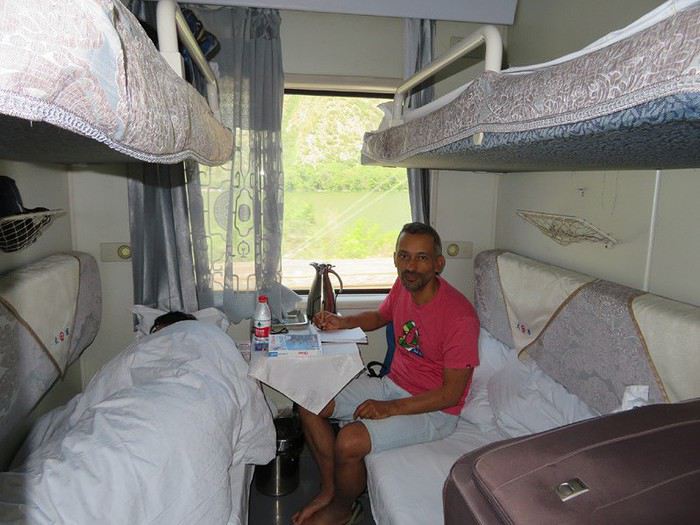 Train Pékin-Datong, où nos voisins font la sieste !
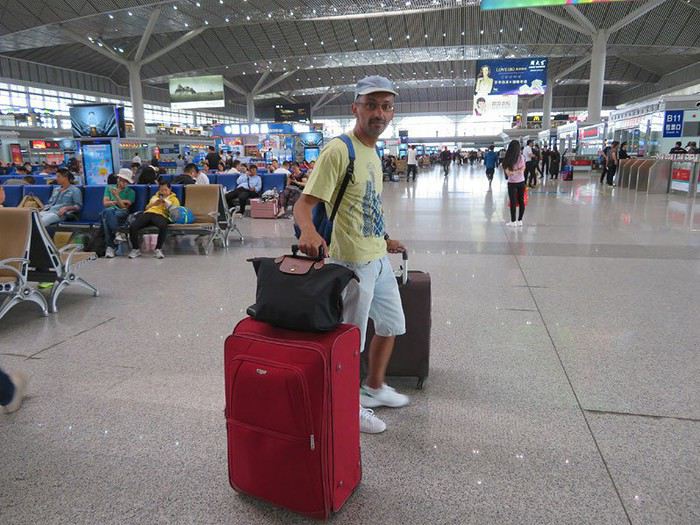 Gare de Xi'an, immense comme un aéroport.
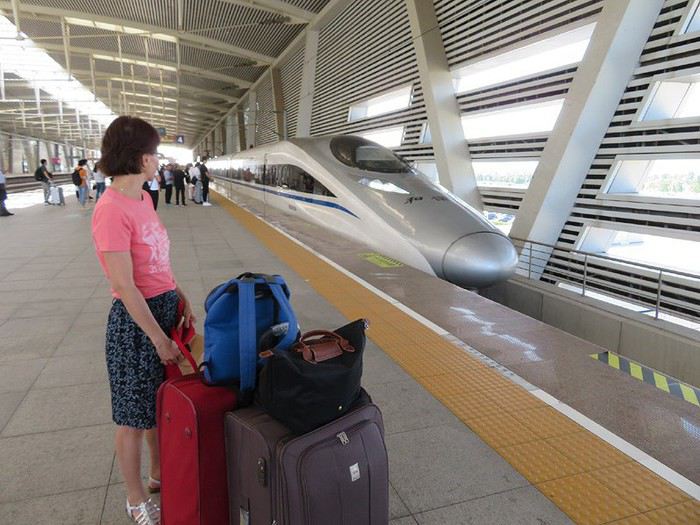 Quais à Shuzhou, prêts à monter comme tout le monde.
Entre Datong et Wutaishan, nous avons pris un taxi via notre hôtelier très sympathique. Le chauffeur ne parlait pas anglais mais nous avons réussi à nous comprendre via un traducteur. Nous avions plusieurs étapes prévues. Nous l'avons invité à déjeuner. Pour la Grande muraille, nous avons aussi trouvé notre jeune chauffeur via notre hôtelier. Il parlait anglais et nous avons eu des conversations très intéressantes. Il s'est baladé aussi avec nous et nous l'avons invité à déjeuner. C'était une très belle journée, sûrement mieux qu'avec un groupe.
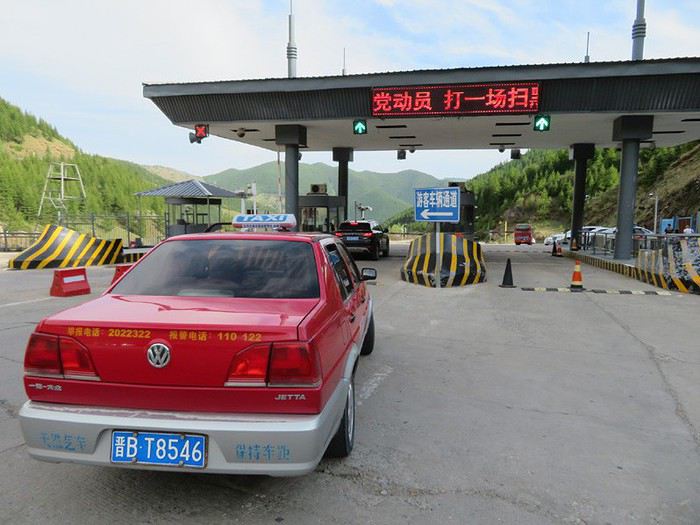 Notre taxi à la barrière de péage de la vallée de Wutaishan, où il a eu quelques problèmes administratifs.
Nous n’avons fait qu’un seul trajet en car régulier, entre Wutaishan et Pingyao. Notre hôtelier s’est occupé de la réservation, touchant sans doute une commission. Il nous a déconseillé le taxi en raison du prix, que je me suis fait confirmé directement auprès d’un chauffeur. Finalement, nous n'avons pas regretté. D'une part, nous n’avions que de l'autoroute et les paysages n’étaient pas extraordinaires. D'autre part, nous avons côtoyé un groupe sympathique de pèlerins, qui nous ont même offert à manger dans un arrêt routier. Et au terminus, une autre passagère s'est assurée que nous étions bien récupérés par un taxi avant de nous lâcher ! Nous étions les seuls occidentaux, mais certains Chinois travaillaient à l'étranger et parlaient très bien anglais.
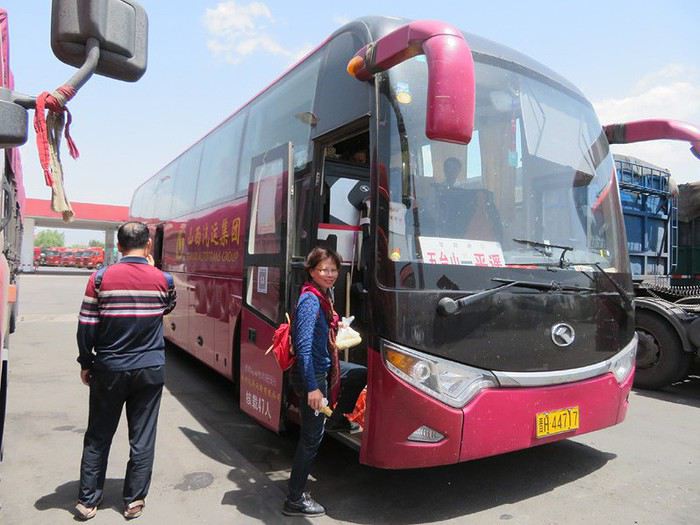 Dans un relais routier vers Pingyao.
Pour Shaolin, via notre hôtelier très sympathique, nous sommes partis en car avec un petit groupe, le seul du voyage, avec surtout des Chinois dont certains de l'étranger qui nous ont servi de traducteur... parfois... autrement dit, nous n'avons pas eu beaucoup d'explications. C'était plutôt bien organisé, avec des transferts en bus ou voiture en fonction des options, mais nous avons quand même perdu beaucoup de temps l'après-midi pour la visite du temple du Cheval blanc, qui à la limite ne méritait pas un détour : 45 mn de visite pour 3h de transports et d'attente. Nous aurions du prendre un taxi ou se contenter de Shaolin.
Nos transports urbains En ville, nous avons utilisé le métro, le taxi quand les stations étaient éloignées, et nos pieds ! Les villes ayant souvent plus d'un million d'habitants, elles disposent d'un métro (Pékin, Xi'an, Suzhou, Hangzhou, Shanghai). Nous nous sommes facilement repérés et avons pris les tickets à l'unité dans les distributeurs automatiques. Comme dans les aéroports et les gares, les voyageurs passent sous un portail électronique et les sacs passent aux rayons X. C'est quand même assez fluide, car peu de personnes ont un sac finalement. A la sortie Tiananmen, il y avait un contrôle supplémentaire des cartes d’identité ou passeports, et nous avons perdu 20 mn. Côté sécurité, pas de soucis, au moins une caméra tous les 2 mètres ! Pékin, qui doit avoir le plus ancien métro, a aussi peu d'escalators. Cela rajoute de la fatigue. Pas de PUB, peu de décoration, le métro est surtout fonctionnel et très propre.
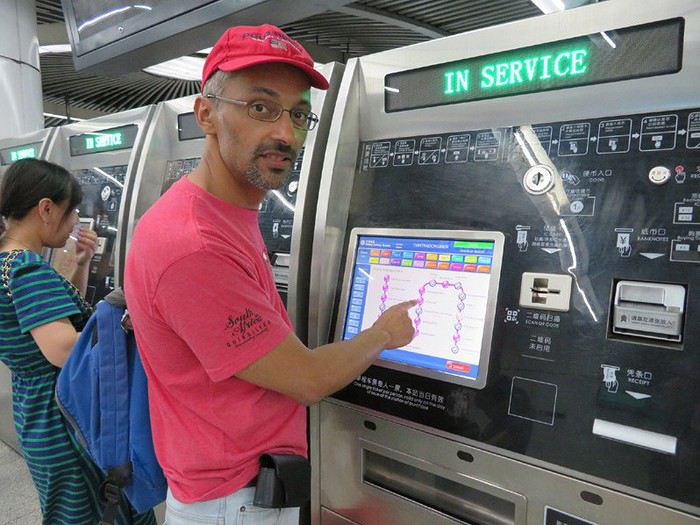 Distributeur automatique de billets dans le métro à Pékin
Le taxi n'est pas très cher, et est intéressant à partir du forfait kilométrique de 2 ou 3 km et pour deux personnes. Avec nos bagages, nous l'avons systématiquement pris entre les gares et nos hébergements, même à Luoyang où nous aurions pu marcher seulement sur 500 ou 700 m. Le chauffeur était d'ailleurs surpris, car par la route, le chemin était plus long ! Nous avons parfois eu beaucoup de difficultés à héler un taxi. Bien qu'ils soient nombreux, ceux-ci sont souvent réservés. Nous avons attendus parfois 20 à 30 mn, surtout à Xi'an, craignant même louper notre train. Certains chauffeurs n'ont pas voulu nous prendre à cause des bagages trop volumineux ou de la destination... Ils ne manquent pas de clients ! Bien que nous étions prévenus, nous avons été arnaqués une fois à Shanghai, la nuit. Le compteur ne fonctionnait pas et le chauffeur a baragouiné sans que nous lui demandions le prix de la course. Résultat : 100 yuans au lieu de sans doute 20 ou 30. Enfin, à la sortie nord de la Cité interdite, la station de métro est assez éloignée. Des bus sont disponibles, mais nous ne voulions pas nous aventurer, bien que des francophones auraient pu nous aider. Et les taxis étaient hors de prix, 100 yuans minimum. Nous sommes donc partis à pied jusqu'au métro, en faisant une pause resto.
Nos hébergements Parmi les 9, nous étions 3 fois dans des petites structures familiales (Pékin, Pingyao, Hangzhou), 3 fois en AJ ou moyennes structures (Datong, Wutaishan, Luoyang), et 3 fois en grands hôtels chinois (Xi'an, Suzhou, Shanghai). Les réservations via Booking.com étaient plutôt conformes, mais une a été annulée quelques jours avant et nous avons pu la remplacer sans soucis (Suzhou devait être une guesthouse). Nous étions plutôt dans les centres historiques. Pékin était un peu plus vieux, le reste était très propre. Les tarifs sont naturellement plus élevés dans les très grandes villes. Pour seulement 17 euros la nuit, nous avions quelques doutes sur Pingyao malgré de bons commentaires, mais c'était effectivement l'un de nos meilleurs hébergements. Les douches n'étaient généralement pas séparées des WC. Le wifi fonctionnait partout. L'accueil était plus distant dans les grands hôtels, pas beaucoup d'efforts pour nous aider ou parler en anglais, sachant que leur clientèle était surtout chinoise. Sinon nos logeurs nous ont toujours aidés pour des informations ou des déplacements. Quand nous avions le petit-déjeuner inclus, c'était chinois, et nous n'avons pas vraiment apprécié, même à Datong qui était top et où nous avions une corbeille de fruits chaque jour dans notre chambre. A Hangzhou, devant notre perplexité, la patronne nous a guidés à pied près du lac puis nous a baladés en voiture vers les champs de thé, gracieusement, avec un autre couple germano-chinois. Ce fut une matinée très sympa.
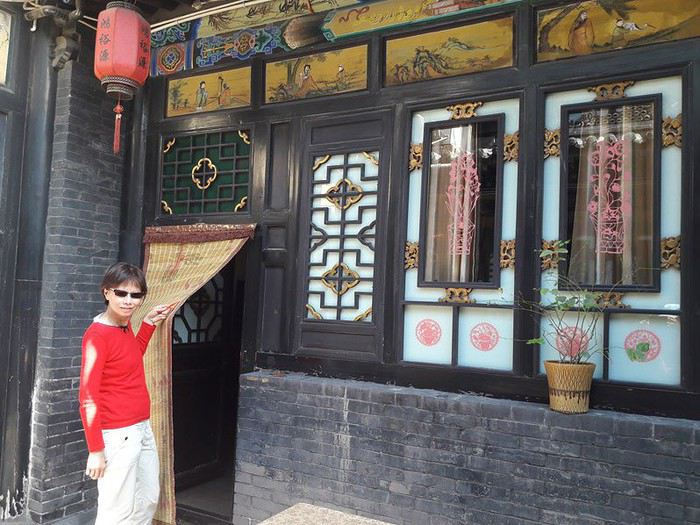 Entrée de notre chambre dans une cour carrée à Pingyao
Notre restauration Contrairement à nos habitudes, nous n'avons pas souvent cherché des restos recommandés, car ils étaient parfois éloignés. Nous avons privilégié les restos ayant des cartes avec photo à défaut de traduction anglaise (rare), des plats exposés en vitrine, ou de nombreux clients chinois. Des chinois parlant anglais des tables voisines nous ont parfois aidés à la compréhension des plats. Quelques belles surprises, comme un énorme poisson à Datong, ou le quartier Hui à Xi’an, mais nous en avons eu aussi des mauvaises entre les plats épicés ou non, le chaud-froid, le sucré-salé. Reste notre valeur sûre : les dumplings, de toutes sortes et vraiment pas chers. Nous avons aussi bien aimé les champignons très variés, avec diverses préparations en sauce, frits, sautés... Le canard laqué ? Pas gouté à Pékin, mais nous connaissons bien à Paris. Nous avons succombé une fois à une pizzeria (assez moyen et cher dans le chic quartier de Xiantidi à Shanghai), et deux fois à un Mac do (alors que nous y allons très rarement en France). En fait, c'était plus intéressant d'y voir les Chinois y manger. Côté desserts, le choix était restreint dans les restos. Dans des superettes et des épiceries fines, nous avons trouvé quelques gâteaux excellents, des bonbons et fruits confits. C’était difficile de comprendre la composition, nous hésitions beaucoup au début, moins à la fin ! Des choses que nous aimions, nous ne les avons pas retrouvées dans une autre région, et nous avons regretté. Les fruits nous ont manqué, et c'est seulement vers la fin, plus au sud, que nous en avons vu beaucoup, notamment des litchis. Nous n'avons jamais été malades, mais nous avons perdu quelques kilos, ce qui ne nous était jamais arrivé en voyage, même en Inde.
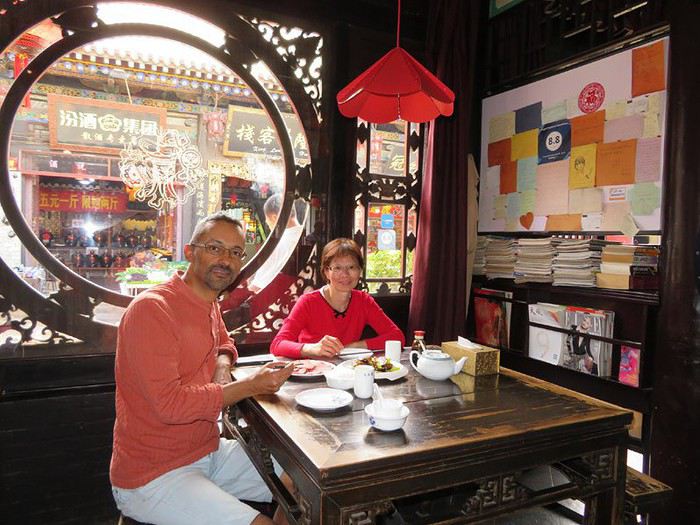 Resto Dejuyan à Pingyo, l'un des rares recommandés que nous ayons fait.
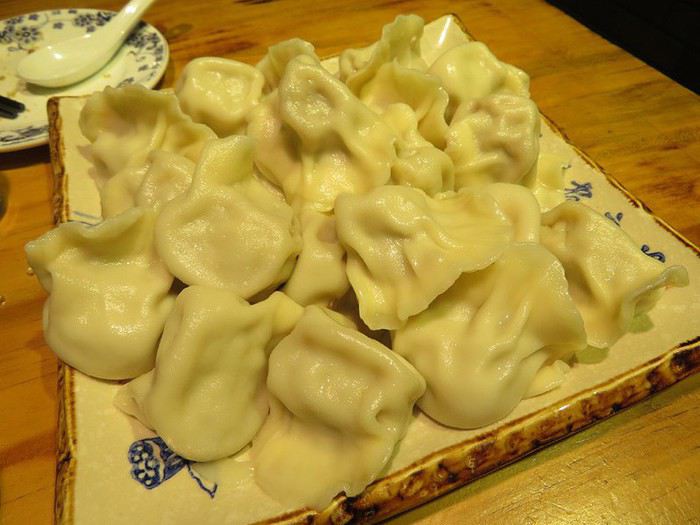 Les dumplings, une valeur sûre !
Nos facilités matérielles Dès l'arrivée à l'aéroport, nous avons retiré de l'argent à un DAB (retrait maxi de 3000 yuans, nous avons préféré Bank of China et ACBD), et avons pris une carte SIM dans un petit stand de China Mobile. Le forfait téléphone n'était pas élevé mais suffisant pour nos rares appels locaux. La carte SIM était aussi utile pour internet dans la rue, quoique le GPS maps.me n'en a pas besoin si les cartes sont préalablement téléchargées comme nous l’avions fait. Pour les appels internationaux (France, Etats-Unis, Vietnam), nous avons utilisé Viber avec le wifi dans les hôtels. J’avais installé l’application WeChat, mais impossible de payer avec. Elle a juste servi à quelques échanges avec deux Chinois. Nous avions aussi installé un VPN avant d’arriver dans le pays.
Nos contacts avec la population Comme beaucoup de touristes, notre crainte était la barrière de la langue, vu que très peu de Chinois parlent anglais, et que les idéogrammes remplacent notre alphabet. Alors oui, les contacts ont été limités, quoique... Nous avons eu une longue conversation avec notre jeune chauffeur qui s'est baladé avec nous sur la Grande muraille. Idem à Hangzhou. Les Chinois de l'étranger nous ont souvent bien aidé pour les traductions, sinon nous avions Google translate, et nos interlocuteurs avaient aussi une application. Le plus long échange ainsi a été avec notre hôtelier à Datong, une bonne demi-heure. Nous avons bien rigolé parfois, car les traductions n’étaient pas parfaites dans les deux sens. Mieux vaut des phrases courtes, et passer par la traduction Chinois-anglais que Chinois-français. Mais toujours être dépendant d'une machine, ne nous incitait pas à engager la conversation, nous cherchions à nous débrouiller seuls, et immanquablement, nous sommes passés à côté d'informations importantes, comme pour la fête des bateaux-dragon qui devait être le clou de notre voyage. Certains Chinois, qui voyaient bien que la conversation était impossible, nous ont même carrément tourné le dos. Pourquoi perdre son temps ? Le plus incroyable était dans un grand resto à Shanghai, qui était sûr de faire le plein. Du coup, nous sommes ressortis ! Mais en général, les Chinois ont été assez attentifs à nos attentes. Nous avons croisé très peu d'étrangers, ceux-ci étant souvent noyés dans la masse de tous les touristes chinois. Nous étions même des extraterrestres à Wutaishan. Shanghai était plus cosmopolite, mais il était trop tard pour échanger sur des expériences.
Nos cadeaux-souvenirs Nous ne sommes pas trop adeptes des objets décoratifs. Nous avons surtout ramené des produits alimentaires : champignons et fleurs de troellius (infusion) de Wutaishan, bœuf de Pingyao, bœuf séché, gâteaux divers, bonbons et fruits confits, ainsi que d’excellents litchis frais. Nous avons aussi acheté à Shanghai une paire de Feiyue, portée notamment par les moines de Shaolin.
Nos photos au cours de ce voyage C’est par ici : https://photos.google.com/share/AF1QipMbz1iSnD8-2C2FlzUyjiKaHFiHcv7YxnA7BFq0dXuLDTWOz2FeQvzF0LgIXugLFw?key=Zkt5eFNxd1pYWTFmdzZISDdZM3k5aDBNR0lNTlBB
Nos impressions générales La Grande muraille et tant d'autres sites, nous en rêvions, surtout après le récit et le film d'un cousin il y a six ans. Car auparavant, mon épouse avait de gros préjugés sur les Chinois (différend historique avec les Vietnamiens, bien qu'elle ait aussi des origines chinoises !), et je m'imaginais les voyages en Chine exclusivement urbains. Ces avis ont été nuancés. Nous avons volontairement choisi un parcours culturel, avec de nombreux sites classés à l'Unesco, au nord, la région historique la plus densément peuplée. Nous avons laissé de côté le sud, en se disant que ce serait pour un éventuel autre voyage, et sachant que certains paysages devaient ressembler au nord Vietnam que nous connaissons déjà. En trois semaines, impossible de visiter un pays 17 fois plus grand que la France. Au final, nous ne sommes pas mécontents de nos choix, mais le timing était quand même serré, car nous avons sous-estimé les temps de transports, la foule, la fatigue. Surtout à Pékin, ce n'est pas 4 jours qu'il nous fallait, mais 5 ou 6, tant il y a de choses à voir. Nous nous demandons toujours comment certains tours opérateurs enchaînent la Cité interdite, la Colline du charbon, et le temple du Ciel dans la même journée, sans compter les embouteillages pour leurs cars ! Ces premières journées à Pékin ont été difficiles, mal remis du décalage horaire, et sans repères culturels. Le premier dîner a été épique pour se faire comprendre et l'accueil pas très chaleureux à notre guesthouse. À Hangzhou, nous avions un programme chargé qui aurait nécessité 2 jours au lieu de 1 seul. Nous avons finalement privilégié les rencontres aux visites. A Shanghai, alors que nous avions planifié tout notre voyage en fonction de la date, nous avons raté la course des bateaux-dragons, car elle avait été avancée d'un jour. Le matin même à la télé au petit-déjeuner, nous avions vu des images... Nous nous disions, tiens, ils se préparent pour demain... Si nous avions compris le chinois... La date n'était même pas actualisée sur les rares sites internet en anglais ! Les réceptionnistes de l'hôtel ne connaissaient même pas la manifestation ! Finalement nous sommes retournés dans la vieille ville chinoise, où la foule était beaucoup plus nombreuse que la première fois. Côté foule justement, le pire pour nous a été la Cité Interdite, malgré nos précautions, puis dans une moindre mesure, le Palais d’été à Pékin (un dimanche, mais moins monde dans les espaces avec suppléments), l’armée de terre cuite à Xi’an (bien aménagé quand même), le jardin du Humble administrateur à Suzhou (dommage, mais nous étions prévenus), le temple suspendu près de Datong (très petit). À part deux demi-journées de pluie à Xi'an (bien trempés !) et Shanghai, et le ciel parfois gris, notamment à Pékin, le temps était magnifique et les températures autour de 30 degrés. Nous avons évité un 39 degrés de justesse à Xi'an.
Notre trajet
J1 # ven 17-mai # 23:20 Départ du vol Air France J2 # sam 18-mai # Arrivée 15:35 à PEKIN. Retrait des devises au DAB à l’aéroport + achat carte SIM / Transfert aéroport-hôtel en taxi (24 km, 40 mn) / Installation à l’hôtel pour 4 nuits près du temple des Lamas. J3 # dim 19-mai # Palais d'été (métro, A/S environ 1H, 20 km) J4 # lun 20-mai # Excursion aux tombeaux Ming + Grande muraille à Mutianyu (taxi A/R 160 km, 3H 30) J5 # mar 21-mai # Mat : Cité Interdite (métro) / AM : Temple du Ciel, jardin uniquement (métro) J6 # mer 22-mai # Mat : Temple des Lamas / hutongs (à pied, 400 m de l’hôtel) / AM : Taxi pour la gare. Départ du train à 14:16, arrivée à 20:43 à DATONG. Taxi pour l’hôtel (10 mn) dans le centre historique, et installation pour 2 nuits. J7 # jeu 23-mai # Mat : Excursion aux Grottes de Yungang (taxi A/R 35 km, 1H) / AM : Temple de Huayan (à pied, à 400 m de l’hôtel) J8 # ven 24-mai # Mat : Monastère suspendu (85 km, 1H15) et pagode en bois (58 km, 45 mn) / AM : Continuation en taxi vers les montagnes sacrées de WUTAISHAN (110 km, 2H 15). Installation à l’hôtel pour 2 nuits. J9 # sam 25-mai # Monastères de Wutaishan : Pusading, Xiantong, Tayuan, Nanshan (à pied/taxi) J10 # dim 26-mai # Mat : Route vers Pingyao (car, 400 km, environ 5H) / AM : Taxi et installation à l’hôtel à PINGYAO dans le centre historique pour 2 nuits. Début des visites à pied : remparts, temple de Confucius. J11 # lun 27-mai # Visite de la vieille ville de Pingyao (à pied). J12 # mar 28-mai # Mat : Excursion à la Résidence Qiao (taxi A/R, 50 km, 2H) / AM : Temple de Shuanglin (taxi, 8 km, 25 mn). Continuation vers la gare (8 km, 10 mn). Départ du train à 15:43, arrivée à XI’AN à 18:29. Taxi pour l’hôtel dans le centre historique (16 km, 45 mn), et installation pour 2 nuits. J13 # mer 29-mai # Mat : Armée en terre cuite (bus A/R 84 km, 2H) / AM : centre commercial près de l’hôtel J14 # jeu 30-mai # Mat : Musée du Shanxi, Grande pagode de l’Oie Sauvage (métro/à pied) / AM : Quartier Hui et Grande mosquée (à pied). Taxi pour la gare. Départ du train à 17:11, arrivée à 18:42 à LUOYANG. Taxi pour l’hôtel et installation pour 2 nuits. J15 # ven 31-mai # Excursion au Monastère Shaolin, puis au temple du Cheval blanc (Tour en bus, A/R 110 km) J16 # sam 01-juin # Mat : Grottes de Longmen (taxi A/R 30 km, 30 mn). Continuation pour la gare. / AM : Départ du train à 11:50 (dej à bord), arrivée à 17:13 à SUZHOU. Taxi pour l’hôtel et installation pour 2 nuits. J17 # dim 02-juin # Mat : Jardin de l’Humble Administrateur puis musée de la Soie (taxi / à pied) / AM : Excursion à Tongli (métro), bateau sur les canaux, jardins Pearl Tower et Tuisi. J18 # lun 03-juin # Mat : Marché aux fleurs, Jardin de la forêt de Lion (à pied) / AM : Canaux (à pied). Taxi pour la gare. Départ du train à 16:05, arrivée à 17:27 à HANGZHOU. Taxi pour l’hôtel et installation pour 1 seule nuit. J19 # mar 04-juin # Mat : Lac de l’Ouest (1ère visite à pied). Champs de thé de Longjin (voiture) / AM : Bateau sur le lac de l’Ouest pour l’île centrale. Centre historique avec une pharmacie de 1874. Taxi (vers 16H30) pour la gare. Départ du train à 18:06, arrivée à 19:00 à SHANGHAI. Taxi pour l’hôtel (20 km, 40 mn), et installation pour 3 nuits. J20 # mer 05-juin # Mat : Jardin Yu et vieille ville chinoise (taxi). / AM : Rue de Nankin, Bund, ferry, Pudong (métro/à pied/bateau) / Soir : Tour Jin Mao, puis Bund et rue de Nankin (taxi/ à pied/ métro) J21 # jeu 06-juin # Mat : Concession Française, dont parc Fuxing (métro/à pied/taxi) / AM : Musée de Shanghai, People square (à pied). J22 # ven 07-juin # Mat : Marché aux grillons, Suzhou creek pour la course des bateaux-dragons loupée, Temple de Jade (à pied/métro/taxi) / AM : Courses dans la vieille ville chinoise (métro/taxi/à pied) / Soir (vers 19H) : Taxi pour la gare de Longyang Road (12 km, 25 mn). Train Maglev pour l'aéroport (10 mn). Vol départ à 23:20. J23 # sam 08-juin # Arrivée à Paris à 05:40.
Notre budget final Avant de partir, nous avions contacté par internet des tours opérateurs sur place, pensant à la barrière de la langue. Les prix nous ont finalement dissuadés d'en sélectionner un. Au final, après comparaison, et même si les prestations sont forcément différentes, ils étaient plus élevés de 50 à 100% par rapport à ce que nous avons réalisé par nous-mêmes, moins de 2000 € par personne, se décomposant ainsi :
450 € pour le vol international A/R direct sur Air France. Vraiment pas cher, et un Airbus A380 au retour. 420 € pour les transports intérieurs, dont 84 € pour les métros/taxi en ville, 170 € pour 2500 km en train, et 166 € pour 1000 km en taxi/car. 38 € en moyenne (de 17 à 71 €) la chambre double. Moins de 12 € pour l’alimentaire par personne et par jour. 126 € par personne pour les frais de visa, parmi les plus chers au monde. Près de 300 € par personne pour nos visites. Presque tout est payant, et est même relativement cher par rapport au revenu moyen chinois, jusqu’à 120 ou 130 yuans certains sites, et encore nous avions des tarifs de moyenne saison. Nous nous sommes dit que c'était un moyen dissuasif de réduire la foule, que la tranquillité avait un prix. Mais dans les musées gratuits de Xi'an ou de Shanghai, il n'y avait pas vraiment plus de monde qu'ailleurs. A noter par ailleurs qu’à Mutianyu, les deux téléphériques n’appartenant pas à la même société, il faut payer deux fois pour la montée et pour la descente, et le prix est plus cher en haut qu’aux guichets en bas. Mieux vaut prévoir ! La visite de la Grande muraille nous est ainsi revenue à 560 yuans pour deux, mais sans regrets, car nous étions vraiment tranquilles. Cadeaux-souvenirs-achats « personnels » non compris.
Le taux de change nous est revenu en moyenne à 7,60 yuans par euro, hors frais bancaires.
Nos transports interurbains Pour les grandes distances, nous n’avons pris aucun vol intérieur, vu leurs coûts un peu élevés et les durées acceptables des trajets en trains.
Nous avons principalement pris des TGV en 2nde classe, réservés via le site internet fr.trip.com. Les rames sont nickel, les gares immenses comme des aéroports. Attention, il peut exister plusieurs gares dans les villes (TGV, non TGV, directions diverses). Bien revérifier sur sa réservation. Il est facile de se repérer avec les directions en caractères latins. Nous avons récupéré sans frais tous nos billets dans la première gare calme (Pingyao) pour éviter ensuite de faire la queue à chaque fois. Nous arrivions en général une heure avant le départ. Une seule fois, nous nous sommes mal placés sur les quais, à l'arrière au lieu de l'avant. Les agents nous ont alors aidés à porter nos bagages dans les couloirs de la rame. Les trains sont parfaitement à l'heure. Seul le Pékin-Datong n'était pas un TGV. Nous avions une cabine 1ère classe avec banquettes 4 lits, bien que nous circulions de jour. Nous avons eu toute la cabine pour nous seuls sur la seconde moitié du trajet, et de jeunes voisins sur la première moitié. Nous n'avons pas discuté avec eux, ils ne parlaient apparemment pas anglais. Comme plusieurs Chinois, nous avons utilisé deux fois les fontaines d'eau bouillante en bout de voiture pour nos boites de noodles. Des prises électriques étaient disponibles pour charger les smartphones.
Train Pékin-Datong, où nos voisins font la sieste !
Gare de Xi'an, immense comme un aéroport.
Quais à Shuzhou, prêts à monter comme tout le monde.Entre Datong et Wutaishan, nous avons pris un taxi via notre hôtelier très sympathique. Le chauffeur ne parlait pas anglais mais nous avons réussi à nous comprendre via un traducteur. Nous avions plusieurs étapes prévues. Nous l'avons invité à déjeuner. Pour la Grande muraille, nous avons aussi trouvé notre jeune chauffeur via notre hôtelier. Il parlait anglais et nous avons eu des conversations très intéressantes. Il s'est baladé aussi avec nous et nous l'avons invité à déjeuner. C'était une très belle journée, sûrement mieux qu'avec un groupe.
Notre taxi à la barrière de péage de la vallée de Wutaishan, où il a eu quelques problèmes administratifs.Nous n’avons fait qu’un seul trajet en car régulier, entre Wutaishan et Pingyao. Notre hôtelier s’est occupé de la réservation, touchant sans doute une commission. Il nous a déconseillé le taxi en raison du prix, que je me suis fait confirmé directement auprès d’un chauffeur. Finalement, nous n'avons pas regretté. D'une part, nous n’avions que de l'autoroute et les paysages n’étaient pas extraordinaires. D'autre part, nous avons côtoyé un groupe sympathique de pèlerins, qui nous ont même offert à manger dans un arrêt routier. Et au terminus, une autre passagère s'est assurée que nous étions bien récupérés par un taxi avant de nous lâcher ! Nous étions les seuls occidentaux, mais certains Chinois travaillaient à l'étranger et parlaient très bien anglais.
Dans un relais routier vers Pingyao.Pour Shaolin, via notre hôtelier très sympathique, nous sommes partis en car avec un petit groupe, le seul du voyage, avec surtout des Chinois dont certains de l'étranger qui nous ont servi de traducteur... parfois... autrement dit, nous n'avons pas eu beaucoup d'explications. C'était plutôt bien organisé, avec des transferts en bus ou voiture en fonction des options, mais nous avons quand même perdu beaucoup de temps l'après-midi pour la visite du temple du Cheval blanc, qui à la limite ne méritait pas un détour : 45 mn de visite pour 3h de transports et d'attente. Nous aurions du prendre un taxi ou se contenter de Shaolin.
Nos transports urbains En ville, nous avons utilisé le métro, le taxi quand les stations étaient éloignées, et nos pieds ! Les villes ayant souvent plus d'un million d'habitants, elles disposent d'un métro (Pékin, Xi'an, Suzhou, Hangzhou, Shanghai). Nous nous sommes facilement repérés et avons pris les tickets à l'unité dans les distributeurs automatiques. Comme dans les aéroports et les gares, les voyageurs passent sous un portail électronique et les sacs passent aux rayons X. C'est quand même assez fluide, car peu de personnes ont un sac finalement. A la sortie Tiananmen, il y avait un contrôle supplémentaire des cartes d’identité ou passeports, et nous avons perdu 20 mn. Côté sécurité, pas de soucis, au moins une caméra tous les 2 mètres ! Pékin, qui doit avoir le plus ancien métro, a aussi peu d'escalators. Cela rajoute de la fatigue. Pas de PUB, peu de décoration, le métro est surtout fonctionnel et très propre.
Distributeur automatique de billets dans le métro à PékinLe taxi n'est pas très cher, et est intéressant à partir du forfait kilométrique de 2 ou 3 km et pour deux personnes. Avec nos bagages, nous l'avons systématiquement pris entre les gares et nos hébergements, même à Luoyang où nous aurions pu marcher seulement sur 500 ou 700 m. Le chauffeur était d'ailleurs surpris, car par la route, le chemin était plus long ! Nous avons parfois eu beaucoup de difficultés à héler un taxi. Bien qu'ils soient nombreux, ceux-ci sont souvent réservés. Nous avons attendus parfois 20 à 30 mn, surtout à Xi'an, craignant même louper notre train. Certains chauffeurs n'ont pas voulu nous prendre à cause des bagages trop volumineux ou de la destination... Ils ne manquent pas de clients ! Bien que nous étions prévenus, nous avons été arnaqués une fois à Shanghai, la nuit. Le compteur ne fonctionnait pas et le chauffeur a baragouiné sans que nous lui demandions le prix de la course. Résultat : 100 yuans au lieu de sans doute 20 ou 30. Enfin, à la sortie nord de la Cité interdite, la station de métro est assez éloignée. Des bus sont disponibles, mais nous ne voulions pas nous aventurer, bien que des francophones auraient pu nous aider. Et les taxis étaient hors de prix, 100 yuans minimum. Nous sommes donc partis à pied jusqu'au métro, en faisant une pause resto.
Nos hébergements Parmi les 9, nous étions 3 fois dans des petites structures familiales (Pékin, Pingyao, Hangzhou), 3 fois en AJ ou moyennes structures (Datong, Wutaishan, Luoyang), et 3 fois en grands hôtels chinois (Xi'an, Suzhou, Shanghai). Les réservations via Booking.com étaient plutôt conformes, mais une a été annulée quelques jours avant et nous avons pu la remplacer sans soucis (Suzhou devait être une guesthouse). Nous étions plutôt dans les centres historiques. Pékin était un peu plus vieux, le reste était très propre. Les tarifs sont naturellement plus élevés dans les très grandes villes. Pour seulement 17 euros la nuit, nous avions quelques doutes sur Pingyao malgré de bons commentaires, mais c'était effectivement l'un de nos meilleurs hébergements. Les douches n'étaient généralement pas séparées des WC. Le wifi fonctionnait partout. L'accueil était plus distant dans les grands hôtels, pas beaucoup d'efforts pour nous aider ou parler en anglais, sachant que leur clientèle était surtout chinoise. Sinon nos logeurs nous ont toujours aidés pour des informations ou des déplacements. Quand nous avions le petit-déjeuner inclus, c'était chinois, et nous n'avons pas vraiment apprécié, même à Datong qui était top et où nous avions une corbeille de fruits chaque jour dans notre chambre. A Hangzhou, devant notre perplexité, la patronne nous a guidés à pied près du lac puis nous a baladés en voiture vers les champs de thé, gracieusement, avec un autre couple germano-chinois. Ce fut une matinée très sympa.
Entrée de notre chambre dans une cour carrée à PingyaoNotre restauration Contrairement à nos habitudes, nous n'avons pas souvent cherché des restos recommandés, car ils étaient parfois éloignés. Nous avons privilégié les restos ayant des cartes avec photo à défaut de traduction anglaise (rare), des plats exposés en vitrine, ou de nombreux clients chinois. Des chinois parlant anglais des tables voisines nous ont parfois aidés à la compréhension des plats. Quelques belles surprises, comme un énorme poisson à Datong, ou le quartier Hui à Xi’an, mais nous en avons eu aussi des mauvaises entre les plats épicés ou non, le chaud-froid, le sucré-salé. Reste notre valeur sûre : les dumplings, de toutes sortes et vraiment pas chers. Nous avons aussi bien aimé les champignons très variés, avec diverses préparations en sauce, frits, sautés... Le canard laqué ? Pas gouté à Pékin, mais nous connaissons bien à Paris. Nous avons succombé une fois à une pizzeria (assez moyen et cher dans le chic quartier de Xiantidi à Shanghai), et deux fois à un Mac do (alors que nous y allons très rarement en France). En fait, c'était plus intéressant d'y voir les Chinois y manger. Côté desserts, le choix était restreint dans les restos. Dans des superettes et des épiceries fines, nous avons trouvé quelques gâteaux excellents, des bonbons et fruits confits. C’était difficile de comprendre la composition, nous hésitions beaucoup au début, moins à la fin ! Des choses que nous aimions, nous ne les avons pas retrouvées dans une autre région, et nous avons regretté. Les fruits nous ont manqué, et c'est seulement vers la fin, plus au sud, que nous en avons vu beaucoup, notamment des litchis. Nous n'avons jamais été malades, mais nous avons perdu quelques kilos, ce qui ne nous était jamais arrivé en voyage, même en Inde.
Resto Dejuyan à Pingyo, l'un des rares recommandés que nous ayons fait.
Les dumplings, une valeur sûre !Nos facilités matérielles Dès l'arrivée à l'aéroport, nous avons retiré de l'argent à un DAB (retrait maxi de 3000 yuans, nous avons préféré Bank of China et ACBD), et avons pris une carte SIM dans un petit stand de China Mobile. Le forfait téléphone n'était pas élevé mais suffisant pour nos rares appels locaux. La carte SIM était aussi utile pour internet dans la rue, quoique le GPS maps.me n'en a pas besoin si les cartes sont préalablement téléchargées comme nous l’avions fait. Pour les appels internationaux (France, Etats-Unis, Vietnam), nous avons utilisé Viber avec le wifi dans les hôtels. J’avais installé l’application WeChat, mais impossible de payer avec. Elle a juste servi à quelques échanges avec deux Chinois. Nous avions aussi installé un VPN avant d’arriver dans le pays.
Nos contacts avec la population Comme beaucoup de touristes, notre crainte était la barrière de la langue, vu que très peu de Chinois parlent anglais, et que les idéogrammes remplacent notre alphabet. Alors oui, les contacts ont été limités, quoique... Nous avons eu une longue conversation avec notre jeune chauffeur qui s'est baladé avec nous sur la Grande muraille. Idem à Hangzhou. Les Chinois de l'étranger nous ont souvent bien aidé pour les traductions, sinon nous avions Google translate, et nos interlocuteurs avaient aussi une application. Le plus long échange ainsi a été avec notre hôtelier à Datong, une bonne demi-heure. Nous avons bien rigolé parfois, car les traductions n’étaient pas parfaites dans les deux sens. Mieux vaut des phrases courtes, et passer par la traduction Chinois-anglais que Chinois-français. Mais toujours être dépendant d'une machine, ne nous incitait pas à engager la conversation, nous cherchions à nous débrouiller seuls, et immanquablement, nous sommes passés à côté d'informations importantes, comme pour la fête des bateaux-dragon qui devait être le clou de notre voyage. Certains Chinois, qui voyaient bien que la conversation était impossible, nous ont même carrément tourné le dos. Pourquoi perdre son temps ? Le plus incroyable était dans un grand resto à Shanghai, qui était sûr de faire le plein. Du coup, nous sommes ressortis ! Mais en général, les Chinois ont été assez attentifs à nos attentes. Nous avons croisé très peu d'étrangers, ceux-ci étant souvent noyés dans la masse de tous les touristes chinois. Nous étions même des extraterrestres à Wutaishan. Shanghai était plus cosmopolite, mais il était trop tard pour échanger sur des expériences.
Nos cadeaux-souvenirs Nous ne sommes pas trop adeptes des objets décoratifs. Nous avons surtout ramené des produits alimentaires : champignons et fleurs de troellius (infusion) de Wutaishan, bœuf de Pingyao, bœuf séché, gâteaux divers, bonbons et fruits confits, ainsi que d’excellents litchis frais. Nous avons aussi acheté à Shanghai une paire de Feiyue, portée notamment par les moines de Shaolin.
Nos photos au cours de ce voyage C’est par ici : https://photos.google.com/share/AF1QipMbz1iSnD8-2C2FlzUyjiKaHFiHcv7YxnA7BFq0dXuLDTWOz2FeQvzF0LgIXugLFw?key=Zkt5eFNxd1pYWTFmdzZISDdZM3k5aDBNR0lNTlBB
bonjour
devant séjourner a hong kong et chine (shanghai) pendant 20 j , quelles sont les meilleures solutions pour avoir internet et telephone par carte sim ou autre
merci pour vos éclairages
devant séjourner a hong kong et chine (shanghai) pendant 20 j , quelles sont les meilleures solutions pour avoir internet et telephone par carte sim ou autre
merci pour vos éclairages
Bonjour!
Je m'en vais à Hong Kong dans une dizaine de jours pour ensuite traverser en Chine continentale. J'ai un portable débloqué et j'aimerais acheter une carte SIM à Hong Kong avec un forfait données - est-ce faisable et abordable? Aussi, est-ce que cette même carte va fonctionner en Chine continentale? Je vais faire Guilin, Yangshuo, Shanghai, Pékin et Xi'An.
Merci à l'avance!
Je m'en vais à Hong Kong dans une dizaine de jours pour ensuite traverser en Chine continentale. J'ai un portable débloqué et j'aimerais acheter une carte SIM à Hong Kong avec un forfait données - est-ce faisable et abordable? Aussi, est-ce que cette même carte va fonctionner en Chine continentale? Je vais faire Guilin, Yangshuo, Shanghai, Pékin et Xi'An.
Merci à l'avance!
Nous avons passé 18 jours en Chine du 29 03 au 15 04 2019. Nous avons 73 et 68 ans et l’habitude de voyager à 2, 3,4 ou 5. Ici nous étions 2, en couple.
Nous avons fait appel à l’agence Ciel Yunnan dont nous avions apprécié les services en Novembre 2016 pour visiter le Yunnan.
Au programme Pékin, la grande Muraille, les environs de Datong, Pingyao, Xi’an (et l’armée de terre cuite), les rizières de Longji, la rivière Li, Shanghai, Suzhou, Hangzhou. Nous avons élaboré ce programme grâce à de nombreux échanges avec l’agence.
Nous avions un chauffeur pour les « petits » déplacements et nous sommes débrouillés seuls dans les villes. Nous avons pris un guide à Xi’an, ce qui nous a permis (au bout d’une semaine) d’avoir des réponses aux questions que nous nous posions sur la Chine.
Les hôtels et les différents billets (train, avion, certaines entrées) avaient été réservés par l’agence et faisaient partie du forfait.
Tout s’est parfaitement passé et nous ne pouvons que recommander cette agence où plusieurs personnes parlent parfaitement le français.
Ah, j’oubliais de dire qu’un mobile nous a été remis à notre arrivée, grâce auquel nous pouvions contacter l’agence à tout moment en cas de difficultés (nous l’avons utilisé surtout pour communiquer … avec notre chauffeur !)
Bonsoir
J'ai parcouru quelques topics mais je ne trouve pas l'information .
Je pars en Chine en août et envisage d'utiliser Skype et/Ou Whatsapp pour rester en contact t avec ma famille.
J'ai cru comprendre qu'il y a pas mal de censure. Comment dois je faire ? Et pour accéder à internet ?
Merci
Bonjour, deux-trois réflexions sur l'argent en Chine. Je suis actuellement au Yunnan, c'est peut-être faux ailleurs. Je me pose la question pour l'an prochain ou je veux aller au Gansu et au Xinjiang...
Tout d'abord, avoir des euros, c'est moyen. Pas de change possible hors des agences officielles de la Bank of China. Il y en a peu et pas dans toutes les villes. Les horaires d'ouverture sont assez contraignants et surtout c'est terriblement long....... Hier à Shangri-La, un seul guichet et une dizaine de personnes à attendre. Puis vient la paperasse... Scrutage de passeport approfondi, photos avec leur smartphone + scan + photocopie.... Bref 1 heure pour changer 300€. 🤪
Alternative, des distributeurs partout, certains (Bank of China, agricultural Bank) acceptant la Visa. Temps de retrait : 3'
Par contre, aucun hôtel jusqu'à présent n'accepte les paiements en Visa.
Du coup, dans des contrées plus éloignées des zones touristiques, comment ça marche ? Y-A-T-IL des distributeurs Visa partout en Chine ? Est-ce que ça vaut le coup d'ouvrir un compte à la Bank of China et de demander la carte bleue locale ? Merci
Tout d'abord, avoir des euros, c'est moyen. Pas de change possible hors des agences officielles de la Bank of China. Il y en a peu et pas dans toutes les villes. Les horaires d'ouverture sont assez contraignants et surtout c'est terriblement long....... Hier à Shangri-La, un seul guichet et une dizaine de personnes à attendre. Puis vient la paperasse... Scrutage de passeport approfondi, photos avec leur smartphone + scan + photocopie.... Bref 1 heure pour changer 300€. 🤪
Alternative, des distributeurs partout, certains (Bank of China, agricultural Bank) acceptant la Visa. Temps de retrait : 3'
Par contre, aucun hôtel jusqu'à présent n'accepte les paiements en Visa.
Du coup, dans des contrées plus éloignées des zones touristiques, comment ça marche ? Y-A-T-IL des distributeurs Visa partout en Chine ? Est-ce que ça vaut le coup d'ouvrir un compte à la Bank of China et de demander la carte bleue locale ? Merci
Bonjour,
On m'a dit que certains sites (Facebook, Twitter, ect.) n'étaient pas aussi facilement accessibles en Chine qu'en Occident. Je pars en Chine dans 12 jours. Dois-je me procurer un VPN? Si oui, avez-vous des suggestions?
Merci,
François
On m'a dit que certains sites (Facebook, Twitter, ect.) n'étaient pas aussi facilement accessibles en Chine qu'en Occident. Je pars en Chine dans 12 jours. Dois-je me procurer un VPN? Si oui, avez-vous des suggestions?
Merci,
François
Bonjour à tous. Voilà maintenant quelques mois que je me penche sur un séjour en Chine. Je devais partir avec un ami, mais il semblerait que finalement, je parte seul.
J'ai lu en intégralité le Petit Futé et le Guide du Routard, j'ai passé des dizaines d'heures (voire des centaines...) sur le net à lire les périples d'autres personnes et à parcourir ce forum...et je pense avoir à peu près terminé mon parcours de 5 semaines.
Après beaucoup d'hésitation, j'aimerai vous le soumettre, afin d'avoir vos avis...
__
J1 Lundi 18 novembre Départ en avion
J2 Mardi 19 novembre Arrivée à Pékin. Repos ou balade dans les alentours (éventuellement Tour de la cloche et des tambours, temple de confucius et des lamas)
J3 Mercredi 20 novembre Pékin : Temple du ciel, visite des hutongs en vélo (puis complexe olympique ou autre)
J4 Jeudi 21 novembre Pékin : Cité interdite +colline du charbon + Tiananmen
J5 Vendredi 22 novembre Grande muraille (Mutianyu).
J6 Samedi 23 novembre Pékin Palais d'été (Départ à 18h55 pour Pingyao en train couchette)
J7 Dimanche 24 novembre Arrivée à 7h33 à Pingyao
J8 Lundi 25 novembre Pingyao. (Départ à 20h47 ou 21h38 pour X'ian en train couchette).
J9 Mardi 26 novembre Xi'an (ville et éventuellement alentours)
J10 Mercredi 27 novembre Xi'an - armée en terre cuite
J11 Jeudi 28 novembre Xi'an – Mont Huashan
J12 Vendredi 29 novembre Xi'an – Départ pour Guilin en avion
J13 Samedi 30 novembre Balade à Guilin (grotte de la flûte aux roseaux)
J14 Dimanche 1 décembre Yangshuo (balade à vélo aux alentours)
J15 Lundi 2 décembre Croisière sur la rivière Li
J16 Mardi 3 décembre Alentours de Yanghsuo et retour à Guilin
J17 Mercredi 4 décembre Trajet Guilin-Kunming (train à 15-17h)
J18 Jeudi 5 décembre Arrivée à Kunming vers 11h. Trajet Kunming-Dali. Repos.
J19 Vendredi 6 décembre Journée en bateau sur le lac Erhai (pêche au cormorans ?)
J20 Samedi 7 décembre Balade aux alentours de Dali.
J21 Dimanche 8 décembre Xizhou et Shaxi. Trajet pour Lijiang en soirée.
J22 Lundi 9 décembre Lijiang. Balade dans la vieille ville et étang du dragon noir.
J23 Mardi 10 décembre Trajet Lijiang-Qiaotou. Trek dans les gorges du saut du tigre.
J24 Mercredi 11 décembre Suite du trek. Nuit à Qiaotou (sauf si je trouve un bus pour Shangri-la après le trek)
J25 Jeudi 12 décembre Trajet Qiaotou-Shangri-la (2h). Shangri-la.
J26 Vendredi 13 décembre Shangri-la et alentours
J27 Samedi 14 décembre Shangri-la et alentours
J28 Dimanche 15 décembre Shangri-la et alentours
J29 Lundi 16 décembre Deqin et alentours
J30 Mardi 17 décembre Deqin et alentours
J31 Mercredi 18 décembre Deqin et alentours
J32 Jeudi 19 décembre Deqin et alentours
J33 Vendredi 20 décembre Deqin. Bus de nuit Deqin -> Kunming
J34 Samedi 21 décembre Arrivée à Kunming le matin. Eventuellement Xi Shan (montagne de l'ouest).
J35 Dimanche 22 décembre Forêt de pierre de Shilin (sauf si problème de transport, auquel cas ça saute).
J36 Lundi 23 décembre Kunming. Vol vers Paris
J37 Mardi 24 décembre Arrivée à Paris
__
Autres itinéraires envisagés :
A la base, je voulais passer à Chengde, mais j'ai l'impression que c'est redondant avec le Palais d'Eté de Pékin.
J'ai aussi voulu aller à Zhangjiajie et Fenghuan, mais j'ai le sentiment que ça fait faire beaucoup de trajet...
J'ai aussi envisagé de faire le vol Xi'an -> Hong-Kong et d'y passer 2-3 jours, dont un à Ocean Park tant pour les attractions que pour l'aquarium et le zoo, mais tout seul, je ne suis pas sûr d'en profiter autant, et la vie à Hong-Kong étant plus chère, cela me fera des économies.
J'ai tiré un trait sur Yuanyang, car je suis déjà allé à Sapa au Vietnam, et cela m'a l'air assez similaire.
Autres points :
J'ai tablé sur un budget moyen de 40€ par jour tout compris.
Un point qui me tient à coeur aussi, serait de faire du cheval du côté de Shangri-la ou Deqin. Savez-vous si c'est possible de participer à une excursion de 2-3 jours à cheval ? Un idée du budget ?
C'est mon premier voyage seul, j'ai déjà eu l'occasion de partir à deux au Vietnam et en Malaisie (dont une semaine seul), et j'ai fais quelques autres pays avec ma famille. J'ai 24 ans, et suis un homme, pour info. Du genre assez timide, cela me forcera à aller vers les gens...mais si vous avez des conseils à me donner, je suis preneur car j'avoue que j'ai un peu la trouille :)
Je me suis acheté un guide de conversation pour m'aider, je suis actuellement en train de le parcourir...
Je pars avec mon sac à dos, le plus léger possible (je me suis fait opérer de la colonne vertébrale l'an dernier, et je ne dois pas porter plus de 10kg :s). Je suis ouvert à dormir en auberge de jeunesse et hôtels pas chers. Je suis prêt à dormir dans des conditions pas terrible la plupart du temps, mais une nuit sur 3-4 dans un hôtel un chouya plus cher pour vraiment me reposer.
Merci d'avance pour tous vos avis et conseils ! Ce forum est une mine d'or !
J'ai lu en intégralité le Petit Futé et le Guide du Routard, j'ai passé des dizaines d'heures (voire des centaines...) sur le net à lire les périples d'autres personnes et à parcourir ce forum...et je pense avoir à peu près terminé mon parcours de 5 semaines.
Après beaucoup d'hésitation, j'aimerai vous le soumettre, afin d'avoir vos avis...
__
J1 Lundi 18 novembre Départ en avion
J2 Mardi 19 novembre Arrivée à Pékin. Repos ou balade dans les alentours (éventuellement Tour de la cloche et des tambours, temple de confucius et des lamas)
J3 Mercredi 20 novembre Pékin : Temple du ciel, visite des hutongs en vélo (puis complexe olympique ou autre)
J4 Jeudi 21 novembre Pékin : Cité interdite +colline du charbon + Tiananmen
J5 Vendredi 22 novembre Grande muraille (Mutianyu).
J6 Samedi 23 novembre Pékin Palais d'été (Départ à 18h55 pour Pingyao en train couchette)
J7 Dimanche 24 novembre Arrivée à 7h33 à Pingyao
J8 Lundi 25 novembre Pingyao. (Départ à 20h47 ou 21h38 pour X'ian en train couchette).
J9 Mardi 26 novembre Xi'an (ville et éventuellement alentours)
J10 Mercredi 27 novembre Xi'an - armée en terre cuite
J11 Jeudi 28 novembre Xi'an – Mont Huashan
J12 Vendredi 29 novembre Xi'an – Départ pour Guilin en avion
J13 Samedi 30 novembre Balade à Guilin (grotte de la flûte aux roseaux)
J14 Dimanche 1 décembre Yangshuo (balade à vélo aux alentours)
J15 Lundi 2 décembre Croisière sur la rivière Li
J16 Mardi 3 décembre Alentours de Yanghsuo et retour à Guilin
J17 Mercredi 4 décembre Trajet Guilin-Kunming (train à 15-17h)
J18 Jeudi 5 décembre Arrivée à Kunming vers 11h. Trajet Kunming-Dali. Repos.
J19 Vendredi 6 décembre Journée en bateau sur le lac Erhai (pêche au cormorans ?)
J20 Samedi 7 décembre Balade aux alentours de Dali.
J21 Dimanche 8 décembre Xizhou et Shaxi. Trajet pour Lijiang en soirée.
J22 Lundi 9 décembre Lijiang. Balade dans la vieille ville et étang du dragon noir.
J23 Mardi 10 décembre Trajet Lijiang-Qiaotou. Trek dans les gorges du saut du tigre.
J24 Mercredi 11 décembre Suite du trek. Nuit à Qiaotou (sauf si je trouve un bus pour Shangri-la après le trek)
J25 Jeudi 12 décembre Trajet Qiaotou-Shangri-la (2h). Shangri-la.
J26 Vendredi 13 décembre Shangri-la et alentours
J27 Samedi 14 décembre Shangri-la et alentours
J28 Dimanche 15 décembre Shangri-la et alentours
J29 Lundi 16 décembre Deqin et alentours
J30 Mardi 17 décembre Deqin et alentours
J31 Mercredi 18 décembre Deqin et alentours
J32 Jeudi 19 décembre Deqin et alentours
J33 Vendredi 20 décembre Deqin. Bus de nuit Deqin -> Kunming
J34 Samedi 21 décembre Arrivée à Kunming le matin. Eventuellement Xi Shan (montagne de l'ouest).
J35 Dimanche 22 décembre Forêt de pierre de Shilin (sauf si problème de transport, auquel cas ça saute).
J36 Lundi 23 décembre Kunming. Vol vers Paris
J37 Mardi 24 décembre Arrivée à Paris
__
Autres itinéraires envisagés :
A la base, je voulais passer à Chengde, mais j'ai l'impression que c'est redondant avec le Palais d'Eté de Pékin.
J'ai aussi voulu aller à Zhangjiajie et Fenghuan, mais j'ai le sentiment que ça fait faire beaucoup de trajet...
J'ai aussi envisagé de faire le vol Xi'an -> Hong-Kong et d'y passer 2-3 jours, dont un à Ocean Park tant pour les attractions que pour l'aquarium et le zoo, mais tout seul, je ne suis pas sûr d'en profiter autant, et la vie à Hong-Kong étant plus chère, cela me fera des économies.
J'ai tiré un trait sur Yuanyang, car je suis déjà allé à Sapa au Vietnam, et cela m'a l'air assez similaire.
Autres points :
J'ai tablé sur un budget moyen de 40€ par jour tout compris.
Un point qui me tient à coeur aussi, serait de faire du cheval du côté de Shangri-la ou Deqin. Savez-vous si c'est possible de participer à une excursion de 2-3 jours à cheval ? Un idée du budget ?
C'est mon premier voyage seul, j'ai déjà eu l'occasion de partir à deux au Vietnam et en Malaisie (dont une semaine seul), et j'ai fais quelques autres pays avec ma famille. J'ai 24 ans, et suis un homme, pour info. Du genre assez timide, cela me forcera à aller vers les gens...mais si vous avez des conseils à me donner, je suis preneur car j'avoue que j'ai un peu la trouille :)
Je me suis acheté un guide de conversation pour m'aider, je suis actuellement en train de le parcourir...
Je pars avec mon sac à dos, le plus léger possible (je me suis fait opérer de la colonne vertébrale l'an dernier, et je ne dois pas porter plus de 10kg :s). Je suis ouvert à dormir en auberge de jeunesse et hôtels pas chers. Je suis prêt à dormir dans des conditions pas terrible la plupart du temps, mais une nuit sur 3-4 dans un hôtel un chouya plus cher pour vraiment me reposer.
Merci d'avance pour tous vos avis et conseils ! Ce forum est une mine d'or !
Bonjour, comment communiquer depuis la chine ?quelle application télécharger sur mon telephone ?
bonjour ,
ça y est j'ai RV avec Shaolei pour prendre ma première leçon de Mandarin: en faite on va faire connaissance.
Je pars en juillet-aout 2018 sur 30 jours (à cause du visa sinon cela pourrait être 40 ou 50 jours)
avec un ami.
Mon but principal est de rencontrer les gens dans leur quotidien et plus particulièrement les ehtnies du sud ( Mao-Dong), car je pense qu'il ont su garder des valeurs ( accueil, solidarité) que la facilité de notre vie occidentale nous a fait oublié.
Je sais que l'échange avec les mots sera difficile voire impossible mais je pense aussi que tous ne passe pas par les mots ( il y a la musique, les sons, les odeurs, les émotions qui sont universels).
Par contre, je veux apprendre le minimun pour le premier pas qui est à mon avis le plus important et apprendre le minimum à faire pour ne pas blesser les gens que je vais rencontrer.
Mais là, je viens aussi vous faire part de mon désarroi pour que cela ne coûte pas trop cher.
J'ai demandé 1 devis à une agence de voyage car je n'ai pas forcément envie de me prendre la tête pour gagner 100€ mais si c'est pour en gagner 1000 là c'est autre chose.
Voilà mon programme ( pour 15 juillet-15 aout 2018 environ):
vol Montpellier-Pékin
visite cité interdite-grande muraille
nuit à Pékin
transfert en train vers Xi'an pour voir le mausolée de l'empereur Qin avec guide parlant français
nuit à Xi'an
transfert vers Guiyang
nuit à Guiyang
Et c'est là que ça commence vraiment pour moi, il nous restera au moins 20 jours pour partir à pied et en utilisant les transports locaux avec pour unique objectif de rencontrer les gens hors des sentiers touristiques.
vol retour Guiyang_Montpellier
Pour l'agence , pensez vous qu'elle peut me fournir cela pour 1000€.
Pensez vous possible de l'obtenir pour ce budget là.
Merci de vos réponses
Dominique
Bonjour,
Je veux faire un voyage avec Sinorama de 20 jours avec vol direct. Nous allons voir dans le forfait les terrasses de rizières et biens d'autres choses, comme une croisière de 3 jours.
Il y a un autre forfait avec Sinorama de 20 jours sans vol direct mais au lieu des terrasses de rizière on va voir les grottes de Longent et Hong Kong. Mais j'ai peur d'avoir un vol avec plein d'escale et très long mais les grottes ont l'air super.
Je me demandais si des gens avaient fait des circuits avec sinorama, votre impression et les grottes ou rizières.
Merci
Je veux faire un voyage avec Sinorama de 20 jours avec vol direct. Nous allons voir dans le forfait les terrasses de rizières et biens d'autres choses, comme une croisière de 3 jours.
Il y a un autre forfait avec Sinorama de 20 jours sans vol direct mais au lieu des terrasses de rizière on va voir les grottes de Longent et Hong Kong. Mais j'ai peur d'avoir un vol avec plein d'escale et très long mais les grottes ont l'air super.
Je me demandais si des gens avaient fait des circuits avec sinorama, votre impression et les grottes ou rizières.
Merci
bonjour, je cherche un petit hôtel sympa bien situé , calme à canton pour une durée de qq semaines cet été . Bien sûr je ne recherche surtout pas de forfait tout inclus. Je connais bien la Chine (mais pas Canton justement) et je souhaite m'intégrer le + possible.
- Y a-t-il des périodes à éviter en juillet et aout ?
- quel est le nom du quartier le mieux situé dans guangzhou ? avez-vous des noms d'hôtels à me conseiller ? je recherche ensuite l'hôtel sur ctrip et essaierai la réservation en ligne ou par email avec l'hotel .
Merci d'avance pour les précieux renseignements... patrick
- Y a-t-il des périodes à éviter en juillet et aout ?
- quel est le nom du quartier le mieux situé dans guangzhou ? avez-vous des noms d'hôtels à me conseiller ? je recherche ensuite l'hôtel sur ctrip et essaierai la réservation en ligne ou par email avec l'hotel .
Merci d'avance pour les précieux renseignements... patrick
hi! Is it easy to use for paying for all the small purchases at the markets? INSTALLATION AND USE WITHOUT ISSUES—do you also need a VPN for China?
Secondly, for using phone and internet, I have Orange—is it reliable, or should I go with Airalo instead?
Bonjour
Depuis longtemps nous avions envie d'aller à Hong-Kong mais il a fallu un séjour au Cambodge et la découverte d'un vol charter sur Lamnei Airlines à partir de Phnom Penh pour nous décider.
Après avoir longtemps cherché un logement pas trop cher et bien placé, nous avons atterri à Kowloon au Hop Inn Carnarvon Hostel et pour 75 usd la double avec salle de douche et wc privés (il y aussi moins cher en dortoir ou avec sdb commune), je pense que nous aurions difficilement pu trouver mieux : l'ambiance est plutôt auberge de jeunesse et l'immeuble pas top mais le salon est spacieux, le personnel serviable avec café/thé, frigo, laundry, disponibles à tout moment et la chambre, même si nous avions tout juste la place de mettre nos valises, était impeccable et confortable. Surtout, nous avons beaucoup apprécié le toit terrasse fleuri : un vrai luxe dans cette ville où chaque m2 coûte une fortune... Il y a des tas de commerces et restaurants autour et, en 5 minutes à pied, nous étions sur Nathan Road, tout près d'un arrêt du bus A21 qui dessert l'aéroport et à 10 minutes de l'embarcadère des Star Ferries pour l'île et Central.
Nous avions pris un forfait sur bigbustours.com, qui nous a permis de sillonner la ville dans tous les sens. A refaire, comme nous parlons anglais, ça n'était pas forcément une bonne idée car les attentes à chaque arrêt sont assez longues. De plus, les taxis, les ferries et le métro sont très bon marché et il est relativement facile de s'orienter. Nous avons adoré la baie splendide, les petites plages inattendues et le mélange incroyable de grands immeubles et de vie grouillante.
Quelques coups de coeur :
- sky 100 pour la vue à 360 degrés sur la ville, le Victoria Peak, le rooftop bar lounge Wooloomooloo (Immeuble Hennessy dans le quartier animé de Wang Chai) avec de super cocktails, de la bonne musique et une vue renversante sur la ville au coucher du soleil
- la ballade de nuit dans la baie, absolument magique avec tous les immeubles illuminés, sur une magnifique jonque (www.dukling.com.hk),
- Man Mo Temple et les antiquaires d'Hollywood Road sur l'île et le musée d'histoire à Kowloon
- l'immeuble PMK au 35 Aberdeen Street avec ses boutiques de designers, situé dans un quartier très animé quand les employés sortent des grands immeubles pour aller déjeuner sur le pouce dans des petites gargotes de rues
- la jolie plage de Stanley et son marché artisanal.
Par contre, on a moins aimé les habitants qui, sans aucune considération pour votre âge ou pour le fait que vous êtes étranger, vous bousculent tout le temps sans aucune vergogne pour passer devant vous que ce soit dans la rue ou dans les magasins. Heureusement qu'on nous avait conseillé d'acheter la carte Octopus (une sorte de carte de crédit locale et temporaire) en arrivant à l'aéroport et qu'on avait étudié, avant d'arriver, le plan de la ville car cela aurait été vraiment pénible de se faire sans cesse rembarrer dans les transports ou les boutiques parce qu'on n'allait pas assez vite pour trouver notre chemin et/ou pour payer.
Au final, Hong-Kong est quand même une ville extraordinaire, à découvrir absolument. Cordialement. Marie
Depuis longtemps nous avions envie d'aller à Hong-Kong mais il a fallu un séjour au Cambodge et la découverte d'un vol charter sur Lamnei Airlines à partir de Phnom Penh pour nous décider.
Après avoir longtemps cherché un logement pas trop cher et bien placé, nous avons atterri à Kowloon au Hop Inn Carnarvon Hostel et pour 75 usd la double avec salle de douche et wc privés (il y aussi moins cher en dortoir ou avec sdb commune), je pense que nous aurions difficilement pu trouver mieux : l'ambiance est plutôt auberge de jeunesse et l'immeuble pas top mais le salon est spacieux, le personnel serviable avec café/thé, frigo, laundry, disponibles à tout moment et la chambre, même si nous avions tout juste la place de mettre nos valises, était impeccable et confortable. Surtout, nous avons beaucoup apprécié le toit terrasse fleuri : un vrai luxe dans cette ville où chaque m2 coûte une fortune... Il y a des tas de commerces et restaurants autour et, en 5 minutes à pied, nous étions sur Nathan Road, tout près d'un arrêt du bus A21 qui dessert l'aéroport et à 10 minutes de l'embarcadère des Star Ferries pour l'île et Central.
Nous avions pris un forfait sur bigbustours.com, qui nous a permis de sillonner la ville dans tous les sens. A refaire, comme nous parlons anglais, ça n'était pas forcément une bonne idée car les attentes à chaque arrêt sont assez longues. De plus, les taxis, les ferries et le métro sont très bon marché et il est relativement facile de s'orienter. Nous avons adoré la baie splendide, les petites plages inattendues et le mélange incroyable de grands immeubles et de vie grouillante.
Quelques coups de coeur :
- sky 100 pour la vue à 360 degrés sur la ville, le Victoria Peak, le rooftop bar lounge Wooloomooloo (Immeuble Hennessy dans le quartier animé de Wang Chai) avec de super cocktails, de la bonne musique et une vue renversante sur la ville au coucher du soleil
- la ballade de nuit dans la baie, absolument magique avec tous les immeubles illuminés, sur une magnifique jonque (www.dukling.com.hk),
- Man Mo Temple et les antiquaires d'Hollywood Road sur l'île et le musée d'histoire à Kowloon
- l'immeuble PMK au 35 Aberdeen Street avec ses boutiques de designers, situé dans un quartier très animé quand les employés sortent des grands immeubles pour aller déjeuner sur le pouce dans des petites gargotes de rues
- la jolie plage de Stanley et son marché artisanal.
Par contre, on a moins aimé les habitants qui, sans aucune considération pour votre âge ou pour le fait que vous êtes étranger, vous bousculent tout le temps sans aucune vergogne pour passer devant vous que ce soit dans la rue ou dans les magasins. Heureusement qu'on nous avait conseillé d'acheter la carte Octopus (une sorte de carte de crédit locale et temporaire) en arrivant à l'aéroport et qu'on avait étudié, avant d'arriver, le plan de la ville car cela aurait été vraiment pénible de se faire sans cesse rembarrer dans les transports ou les boutiques parce qu'on n'allait pas assez vite pour trouver notre chemin et/ou pour payer.
Au final, Hong-Kong est quand même une ville extraordinaire, à découvrir absolument. Cordialement. Marie
Bonjour,
J'ai quasiment tout préparé pour mon voyage de 10 jours en Chine (je pars dans 10 jours), mais il reste un souci : séjournant 2 nuits à Luoyang, je voudrais vraiment visiter le Mont Song et temple de Shaolin, et y faire une belle randonnée (j'aime bien marcher). Mais d'après l'hotel à qui j'ai demandé les infos, il faut pas moins de 5 heures de bus aller-retour, auxquels s'ajouteraient le taxi pour aller jusqu'à la gare routière. Mon hotel est le Holiday Inn Express Luoyang City Center, situé assez loin de la gare routière. Ils m'ont déjà informé par mail, mais ils ne proposent apparemment pas d'excursions. Autrement, ils proposent le taxi, mais pour 500 y environ aller-retour, ce qui est hors budget pour moi, et je me méfie toujours du taxi en raison des surprises. Existe-t-il d'autres moyens ? Connaissez-vous une agence locale qui proposerait un forfait à la journée. Autant j'aime marcher et je n'hésite pas à faire des km, autant, perdre 5 heures en transport pour réduire le reste de la journée, çà me fait hésiter malgré la grande beauté du site. Il est prévu que je visite les grottes de Longmen (1/2 journée) et la vieille ville (1/2 journée également). Mais pour la journée complète qui me reste, j'hésite par rapport à l'excursion de Shaolin. Existe-t-il, plus proche, un site intéressant où, si possible, il y aurait de belles randos à faire sans trop de km de routes ?
J'ai quasiment tout préparé pour mon voyage de 10 jours en Chine (je pars dans 10 jours), mais il reste un souci : séjournant 2 nuits à Luoyang, je voudrais vraiment visiter le Mont Song et temple de Shaolin, et y faire une belle randonnée (j'aime bien marcher). Mais d'après l'hotel à qui j'ai demandé les infos, il faut pas moins de 5 heures de bus aller-retour, auxquels s'ajouteraient le taxi pour aller jusqu'à la gare routière. Mon hotel est le Holiday Inn Express Luoyang City Center, situé assez loin de la gare routière. Ils m'ont déjà informé par mail, mais ils ne proposent apparemment pas d'excursions. Autrement, ils proposent le taxi, mais pour 500 y environ aller-retour, ce qui est hors budget pour moi, et je me méfie toujours du taxi en raison des surprises. Existe-t-il d'autres moyens ? Connaissez-vous une agence locale qui proposerait un forfait à la journée. Autant j'aime marcher et je n'hésite pas à faire des km, autant, perdre 5 heures en transport pour réduire le reste de la journée, çà me fait hésiter malgré la grande beauté du site. Il est prévu que je visite les grottes de Longmen (1/2 journée) et la vieille ville (1/2 journée également). Mais pour la journée complète qui me reste, j'hésite par rapport à l'excursion de Shaolin. Existe-t-il, plus proche, un site intéressant où, si possible, il y aurait de belles randos à faire sans trop de km de routes ?
Bonjour à tous les forumistes
Mon compagnon et moi partons pour 2 mois et demi en septembre, octobre et novembre en Asie. Septembre : Java et Bali Octobre : Singapour, Chine Novembre : Macao et Hong-Kong
Mon compagnon s'occupe de l'Indonésie et Singapour, et moi de la Chine. Les billets d'avion sont déjà pris et j'ai déjà examiné tous les transports (terrestres) pour rendre possible le circuit que j'ai prévu.
Ce voyage est surtout orienté vers la grande nature (randos, vélo) et les villages anciens. Mais, car il y a toujours un mais, je me demande s'il n'y aura pas trop de paysages karstiques dans mes choix de sites.
Alors je m'adresse aux connaisseurs pour savoir ce qu'ils en pensent. Voici le projet :
Arrivée Hangzhou 21h30
Hangzhou-rando collines thé-Puits du Dragon-musée du thé
Hangzhou-musée de la soie-pagode des 6 harmonies-Mascaret
Bus Hangzhou / Wuzhen + visite
Bus Hangzhou / Huangshan Tunxi
Rando parc Qiyun Shan (ouest Tunxi)
Bus Tunxi (gare longues distances) / Wuyuan
Voir forfait 3 villages 1 journée
Visite village Xiao Likeng (est Wuyuan)
Bus Wuyuan / Jiujiang / Lushan
Visite Lushan et campagne
Trajet Lushan / Nanchang / Zhangjiajie
Rando Parc Wulingyuan
Rando Parc Wulingyuan
Bus Zhangjiajie / Jishou + bus 1h Dehang
Dehang
Bus Dehang / Jishou / Fenghuang
Fenhuang
Trajet Fenghuang / Guilin
Vélo campagne
Bateau Guilin / Yangshuo
Vélo campagne
Bâteau ? Yangshuo / Fuli
Vélo campagne
Train bulet Yangshuo / Guangzhou / Bus Kaiping
Visite Kaiping + jardin Li
Villages Zili et/ou Chikan (est)
Village Jinjiangli (nord)
Jour tampon
Sortie terrestre Chine continentale / Arrivée Macao
Les transports sont toujours de jour pour voir les paysages au passage et communiquer (un peu) avec les habitants.
Merci d'avance de vos suggestions
Mon compagnon et moi partons pour 2 mois et demi en septembre, octobre et novembre en Asie. Septembre : Java et Bali Octobre : Singapour, Chine Novembre : Macao et Hong-Kong
Mon compagnon s'occupe de l'Indonésie et Singapour, et moi de la Chine. Les billets d'avion sont déjà pris et j'ai déjà examiné tous les transports (terrestres) pour rendre possible le circuit que j'ai prévu.
Ce voyage est surtout orienté vers la grande nature (randos, vélo) et les villages anciens. Mais, car il y a toujours un mais, je me demande s'il n'y aura pas trop de paysages karstiques dans mes choix de sites.
Alors je m'adresse aux connaisseurs pour savoir ce qu'ils en pensent. Voici le projet :
Arrivée Hangzhou 21h30
Hangzhou-rando collines thé-Puits du Dragon-musée du thé
Hangzhou-musée de la soie-pagode des 6 harmonies-Mascaret
Bus Hangzhou / Wuzhen + visite
Bus Hangzhou / Huangshan Tunxi
Rando parc Qiyun Shan (ouest Tunxi)
Bus Tunxi (gare longues distances) / Wuyuan
Voir forfait 3 villages 1 journée
Visite village Xiao Likeng (est Wuyuan)
Bus Wuyuan / Jiujiang / Lushan
Visite Lushan et campagne
Trajet Lushan / Nanchang / Zhangjiajie
Rando Parc Wulingyuan
Rando Parc Wulingyuan
Bus Zhangjiajie / Jishou + bus 1h Dehang
Dehang
Bus Dehang / Jishou / Fenghuang
Fenhuang
Trajet Fenghuang / Guilin
Vélo campagne
Bateau Guilin / Yangshuo
Vélo campagne
Bâteau ? Yangshuo / Fuli
Vélo campagne
Train bulet Yangshuo / Guangzhou / Bus Kaiping
Visite Kaiping + jardin Li
Villages Zili et/ou Chikan (est)
Village Jinjiangli (nord)
Jour tampon
Sortie terrestre Chine continentale / Arrivée Macao
Les transports sont toujours de jour pour voir les paysages au passage et communiquer (un peu) avec les habitants.
Merci d'avance de vos suggestions
bonjour
mon telephone Samsung gte 1150 a clapet, oui je sais je suis en retard sur la mode. puis-je le servir en Chine (PEKIN ) pour appeller la FRANCE
merci a ceuxx qui savent.
bons voyages a vous Maurice le ptit vieux
bons voyages a vous Maurice le ptit vieux
We’ve just returned from a 30-day trip to China, 20 years after our last visit to this vast country.
What a transformation! So many new highways, high-speed trains, clean public restrooms, very comfortable and affordable hotels, and queues before boarding public transport… Has China really changed this much?
Language Technology has helped overcome—on a very small scale, of course—the language barrier thanks to translation apps on our phones. Unfortunately, very few Chinese people speak English, even in international hotels, which we find baffling, even frustrating, but that’s just how it is, and it’s up to us to adapt. It’s a shame, too, because no one makes an effort to communicate any other way than through their phone, which wasn’t the case when we were there 20 years ago. In restaurants, hotels, and some shops, they’ll show you a voice translation—usually in English—on a phone, and all you have to do is respond.
Payments We never withdrew cash in China. It’s possible to do so, but we never looked for an ATM. On the other hand, we tried to exchange 100 € as soon as we arrived in Xi’an, and it was a real ordeal. We had to do it at a specific bank, The Bank of China, and the administrative process took… an hour! So, no cash. Like everyone else, we used Alipay, one of the most popular online payment systems, and it’s super easy to use. WeChat also works well but is a bit more complicated to set up. It’s so convenient and used absolutely everywhere, even for purchases of 5 yuan, which is roughly the equivalent of about 55 euro cents. 10 yuan equals 1.22 €.
Phone As for the internet, I had installed a VPN before leaving—Let’s VPN—but it was completely useless since we had subscribed to an international plan with our carrier before the trip, which gave us 35 GB of data. No need to ask hotels for Wi-Fi; we only used roaming. It worked perfectly, no matter where we were. So, no VPN or SIM card for us.
TWO ESSENTIAL TOOLS FOR TRAVELING: your passport and your phone Traveling to China is much simpler than you might think. And let’s add that the Chinese, despite the language barrier, are very open and always ready to help.
The itinerary After carefully planning our route and considering the length of our stay (I had initially thought about applying for a visa longer than 30 days to stay for 6 weeks in China), we decided to take advantage of the recent option to stay for 30 days. Of course, we had to make some choices. I booked a one-way ticket from Paris to Xi’an and a return from Kunming to Paris once the itinerary was set: 9 days in northern Gansu 4 days in Hunan, specifically the well-known Zhangjiajie 15 days in Yunnan
Organization, transport, hotels This wasn’t a "backpacker" trip, as the hotels we booked were generally comfortable. I had arranged a car with a driver for the Yunnan portion through the Ciel Yunnan agency. Excellent choice—it allowed us to optimize our route. For the Gansu and Hunan portions, after much deliberation, we decided against hiring a driver. All our travel was by train and taxi. Taxis are available near train stations, airports, and some hotels in big cities. We also used "Didi," the Chinese equivalent of Uber. The app is available through Alipay. Getting around China by train is extremely easy. You just need to book your tickets on a travel site. I used trip.com and travelchina. Since we weren’t traveling during peak season, it was easy to get the tickets we wanted. You can buy train tickets up to 15 days before departure. You can book earlier, but there’s no guarantee you’ll get the time you want, especially during tourist seasons (usually the first week of October or May). Once at the station, you only need to show your passport, and you’ll need it again when leaving the station. Taxis are easy to find and not expensive. For day trips, we usually went through the hotel. Like everyone else, I had checked the prices of online tour agencies beforehand, and they were all overpriced. It’s better to wait until the last minute or, if possible, contact the hotel and ask them. I did this twice. We took domestic flights three times: Xi’an to Dunhuang Lanzhou to Changsha Changsha to Lijiang It’s best to buy flights shortly before departure, as prices are quite low then. There’s no point in booking months in advance. Often, flights only appear 2 months before departure. All hotel reservations were made on trip.com, except for three booked on Booking. Almost all exceeded our expectations in terms of comfort. Rooms were usually spacious, and new technology even makes its way into the rooms with "smart" toilets and automatic curtains… All for a very reasonable price.
The "attractions" That’s the term used on travel sites like trip.com for visits and activities, and it fits perfectly! Don’t expect to move freely around a natural tourist site. Cars aren’t allowed. The process is more or less the same everywhere: you arrive at the visitor center, pay the entrance fee, then, with your ticket or passport (always keep them on you!), you board a bus that takes you to the various viewpoints. The duration of the "tour" is usually indicated. It might seem confusing or even unnatural, but no one can avoid it unless you go to very remote, non-touristy places. Generally, the further west you go, the less this type of visit exists. The upside is that these places are better preserved since access is only by electric shuttle. On the downside, you sometimes have to deal with noisy tourist groups, their guides’ loudspeakers, and their non-stop chatter. But if you move a little further away, you’ll often find yourself alone.
Highlights of this trip:🙂 A 2-day escape to the Badan Jaran Desert—absolutely stunning. The colorful mountains near Zhangye. The Buddhist caves in Gansu. The breathtaking Hani and Yi rice terraces in Yuanyang. The architecture of the old towns, even if they sometimes feel a bit overdone. The warm welcome from the locals.
A little disappointed by: Zhangjiajie, despite its beauty. It was way too crowded, even though we were there in the off-season. And that’s nothing compared to the Stone Forest near Kunming… I also struggled with the food after a while. 😕
A few photos to come…
Language Technology has helped overcome—on a very small scale, of course—the language barrier thanks to translation apps on our phones. Unfortunately, very few Chinese people speak English, even in international hotels, which we find baffling, even frustrating, but that’s just how it is, and it’s up to us to adapt. It’s a shame, too, because no one makes an effort to communicate any other way than through their phone, which wasn’t the case when we were there 20 years ago. In restaurants, hotels, and some shops, they’ll show you a voice translation—usually in English—on a phone, and all you have to do is respond.
Payments We never withdrew cash in China. It’s possible to do so, but we never looked for an ATM. On the other hand, we tried to exchange 100 € as soon as we arrived in Xi’an, and it was a real ordeal. We had to do it at a specific bank, The Bank of China, and the administrative process took… an hour! So, no cash. Like everyone else, we used Alipay, one of the most popular online payment systems, and it’s super easy to use. WeChat also works well but is a bit more complicated to set up. It’s so convenient and used absolutely everywhere, even for purchases of 5 yuan, which is roughly the equivalent of about 55 euro cents. 10 yuan equals 1.22 €.
Phone As for the internet, I had installed a VPN before leaving—Let’s VPN—but it was completely useless since we had subscribed to an international plan with our carrier before the trip, which gave us 35 GB of data. No need to ask hotels for Wi-Fi; we only used roaming. It worked perfectly, no matter where we were. So, no VPN or SIM card for us.
TWO ESSENTIAL TOOLS FOR TRAVELING: your passport and your phone Traveling to China is much simpler than you might think. And let’s add that the Chinese, despite the language barrier, are very open and always ready to help.
The itinerary After carefully planning our route and considering the length of our stay (I had initially thought about applying for a visa longer than 30 days to stay for 6 weeks in China), we decided to take advantage of the recent option to stay for 30 days. Of course, we had to make some choices. I booked a one-way ticket from Paris to Xi’an and a return from Kunming to Paris once the itinerary was set: 9 days in northern Gansu 4 days in Hunan, specifically the well-known Zhangjiajie 15 days in Yunnan
Organization, transport, hotels This wasn’t a "backpacker" trip, as the hotels we booked were generally comfortable. I had arranged a car with a driver for the Yunnan portion through the Ciel Yunnan agency. Excellent choice—it allowed us to optimize our route. For the Gansu and Hunan portions, after much deliberation, we decided against hiring a driver. All our travel was by train and taxi. Taxis are available near train stations, airports, and some hotels in big cities. We also used "Didi," the Chinese equivalent of Uber. The app is available through Alipay. Getting around China by train is extremely easy. You just need to book your tickets on a travel site. I used trip.com and travelchina. Since we weren’t traveling during peak season, it was easy to get the tickets we wanted. You can buy train tickets up to 15 days before departure. You can book earlier, but there’s no guarantee you’ll get the time you want, especially during tourist seasons (usually the first week of October or May). Once at the station, you only need to show your passport, and you’ll need it again when leaving the station. Taxis are easy to find and not expensive. For day trips, we usually went through the hotel. Like everyone else, I had checked the prices of online tour agencies beforehand, and they were all overpriced. It’s better to wait until the last minute or, if possible, contact the hotel and ask them. I did this twice. We took domestic flights three times: Xi’an to Dunhuang Lanzhou to Changsha Changsha to Lijiang It’s best to buy flights shortly before departure, as prices are quite low then. There’s no point in booking months in advance. Often, flights only appear 2 months before departure. All hotel reservations were made on trip.com, except for three booked on Booking. Almost all exceeded our expectations in terms of comfort. Rooms were usually spacious, and new technology even makes its way into the rooms with "smart" toilets and automatic curtains… All for a very reasonable price.
The "attractions" That’s the term used on travel sites like trip.com for visits and activities, and it fits perfectly! Don’t expect to move freely around a natural tourist site. Cars aren’t allowed. The process is more or less the same everywhere: you arrive at the visitor center, pay the entrance fee, then, with your ticket or passport (always keep them on you!), you board a bus that takes you to the various viewpoints. The duration of the "tour" is usually indicated. It might seem confusing or even unnatural, but no one can avoid it unless you go to very remote, non-touristy places. Generally, the further west you go, the less this type of visit exists. The upside is that these places are better preserved since access is only by electric shuttle. On the downside, you sometimes have to deal with noisy tourist groups, their guides’ loudspeakers, and their non-stop chatter. But if you move a little further away, you’ll often find yourself alone.
Highlights of this trip:🙂 A 2-day escape to the Badan Jaran Desert—absolutely stunning. The colorful mountains near Zhangye. The Buddhist caves in Gansu. The breathtaking Hani and Yi rice terraces in Yuanyang. The architecture of the old towns, even if they sometimes feel a bit overdone. The warm welcome from the locals.
A little disappointed by: Zhangjiajie, despite its beauty. It was way too crowded, even though we were there in the off-season. And that’s nothing compared to the Stone Forest near Kunming… I also struggled with the food after a while. 😕
A few photos to come…
Hi there,
A quick recap of our 19-day trip to China – classic itinerary, half-family: dad and 13-year-old son, August 2025.
Arrived in Shanghai, the idea was to explore the city in the evening to help with jet lag. Day 1: Maglev (50 CNY), then metro to the hotel, night cruise on the Huangpu River, admiring the skyline. Day 2: Yuyuan Garden (meh), Lujiazui district, sunset from the top of Jinmao Tower, stroll along the Bund, admiring the skyline. Day 3: Chaos at the Shanghai Museum – should’ve booked in advance. Backup plan: Longhua Temple (nice), Tianzi Fang district (great). Day 4: Aquarium (okay), Pearl Tower, Fake Market (top), then flight to Guilin. Taxi from Guilin to Yangshuo (400 CNY arranged by the hotel). Verdict: Maybe one day too many. Late mornings (jet lag) kept us from visiting the water town. Day 5: Yangshuo – scooter ride (40 CNY) along the Yulong River. Day 6: Early Didi (30 min) to the top of Xiang Gong Shan (ideally for sunrise). Then a walk through the countryside to the Li River, crossing by boat (10 CNY) to Xingping. You can shorten the walk by flagging down a mini-shuttle that shuttles Chinese tourists in the opposite direction. Explored Xingping, scooter ride, 20 CNY viewpoint, sunset from Laozhai Hill, back to Yangshuo. Day 7: Scooter ride to spots we missed on Day 5. Verdict: It’s stunning. Might be worth staying in Guilin the first night and booking a cruise to Yangshuo the next day on the Li River. Day 8: Bus (4/5h, 100 CNY) to Longji/Dazhai. Hotel in Tianzhouzai – I think it’s better to stay in Ping’an, it’s more typical. Dazhai is generally overdeveloped. Day 9: Full-day hike from Dazhai to Ping’an, then bus back to Dazhai. Super nice walk, only crossed paths with 4 people. Day 10: Walk around the top of Dazhai, but the trails are poorly maintained – no loop possible. Verdict: Gorgeous, probably one day too many, but the area is very rainy, so it’s good to have a buffer. Day 11: Private taxi (4/5h, 200 €) to Fenghuang. Explored the town in the evening – really nice. Day 12: Short visit to Fenghuang during the day, then train to Zhangjiajie and Wulingyuan. Hotel pool. Day 13: Early start: Zhangjiajie Park via Wulingyuan entrance, Route A (starting with the cable car). Fabulous. If I did it again, I’d take Route B to get early access to the section near the giant elevator. Day 14: Early start: Zhangjiajie Park via the south entrance – superb. Day 15: Wulingyuan Grand Canyon, glass bridge – nice but not essential. Day 16: Tianmen Mountain in the afternoon. You can leave your luggage at the entrance. Routes A and B sell out quickly. Note that Route C no longer uses buses to the top – there’s a brand-new cable car instead, which I think is actually better than A and B. Really nice, worth doing. Evening flight to Beijing. Verdict: The canyon could be done the same morning as Tianmen Mountain, or even skipped. Day 17: Visited the Forbidden City (book a week in advance!), missed the entry slot for Tiananmen Square (book in advance!) due to security checks. Visited the Lama Temple. Stayed in a hutong. Day 18: Great Wall at Mutianyu. Private taxi (100 € round trip – probably overpaid) to arrive before 7 AM. Then back to Beijing, Temple of Heaven, and finally the modest skyline from the mall at Guomao metro station. Day 19: Fake markets (pointless – they’re stripped of their usual goods compared to Shanghai’s), Summer Palace, then Wangfujing Street. Headed to the airport. Verdict: 3 days is too short for Beijing.
Overall impressions: Highlights: Incredible places (cities and landscapes), often vast and fascinating, a total change of scenery. Very easy and smooth to travel despite the clear language barrier. Excellent food, very affordable, very few scams. Lowlights: Intense heat and humidity in August, *way* too many tourists (99.9% Chinese), a real circus that makes the trip exhausting. Walking is tiring in the long run (even though we’re very active) because it’s all on stone paths and stairs. To avoid crowds, you’d need to wake up early every day – tough with kids, especially with jet lag.
Logistics: - Buses and private taxis arranged last-minute through hotels. - Didi is widely available everywhere, plentiful, and cheap. - Flights and trains booked on Trip.com a month in advance (fills up fast). - Hotels on Booking and Trip.com. Only the one in Yangshuo was booked well in advance – hotel capacity is huge everywhere. - Apps: Didi, Alipay, WeChat, Maps.me, Google Translate. Free 35 GB data plan, SIM card from the airport.
A quick recap of our 19-day trip to China – classic itinerary, half-family: dad and 13-year-old son, August 2025.
Arrived in Shanghai, the idea was to explore the city in the evening to help with jet lag. Day 1: Maglev (50 CNY), then metro to the hotel, night cruise on the Huangpu River, admiring the skyline. Day 2: Yuyuan Garden (meh), Lujiazui district, sunset from the top of Jinmao Tower, stroll along the Bund, admiring the skyline. Day 3: Chaos at the Shanghai Museum – should’ve booked in advance. Backup plan: Longhua Temple (nice), Tianzi Fang district (great). Day 4: Aquarium (okay), Pearl Tower, Fake Market (top), then flight to Guilin. Taxi from Guilin to Yangshuo (400 CNY arranged by the hotel). Verdict: Maybe one day too many. Late mornings (jet lag) kept us from visiting the water town. Day 5: Yangshuo – scooter ride (40 CNY) along the Yulong River. Day 6: Early Didi (30 min) to the top of Xiang Gong Shan (ideally for sunrise). Then a walk through the countryside to the Li River, crossing by boat (10 CNY) to Xingping. You can shorten the walk by flagging down a mini-shuttle that shuttles Chinese tourists in the opposite direction. Explored Xingping, scooter ride, 20 CNY viewpoint, sunset from Laozhai Hill, back to Yangshuo. Day 7: Scooter ride to spots we missed on Day 5. Verdict: It’s stunning. Might be worth staying in Guilin the first night and booking a cruise to Yangshuo the next day on the Li River. Day 8: Bus (4/5h, 100 CNY) to Longji/Dazhai. Hotel in Tianzhouzai – I think it’s better to stay in Ping’an, it’s more typical. Dazhai is generally overdeveloped. Day 9: Full-day hike from Dazhai to Ping’an, then bus back to Dazhai. Super nice walk, only crossed paths with 4 people. Day 10: Walk around the top of Dazhai, but the trails are poorly maintained – no loop possible. Verdict: Gorgeous, probably one day too many, but the area is very rainy, so it’s good to have a buffer. Day 11: Private taxi (4/5h, 200 €) to Fenghuang. Explored the town in the evening – really nice. Day 12: Short visit to Fenghuang during the day, then train to Zhangjiajie and Wulingyuan. Hotel pool. Day 13: Early start: Zhangjiajie Park via Wulingyuan entrance, Route A (starting with the cable car). Fabulous. If I did it again, I’d take Route B to get early access to the section near the giant elevator. Day 14: Early start: Zhangjiajie Park via the south entrance – superb. Day 15: Wulingyuan Grand Canyon, glass bridge – nice but not essential. Day 16: Tianmen Mountain in the afternoon. You can leave your luggage at the entrance. Routes A and B sell out quickly. Note that Route C no longer uses buses to the top – there’s a brand-new cable car instead, which I think is actually better than A and B. Really nice, worth doing. Evening flight to Beijing. Verdict: The canyon could be done the same morning as Tianmen Mountain, or even skipped. Day 17: Visited the Forbidden City (book a week in advance!), missed the entry slot for Tiananmen Square (book in advance!) due to security checks. Visited the Lama Temple. Stayed in a hutong. Day 18: Great Wall at Mutianyu. Private taxi (100 € round trip – probably overpaid) to arrive before 7 AM. Then back to Beijing, Temple of Heaven, and finally the modest skyline from the mall at Guomao metro station. Day 19: Fake markets (pointless – they’re stripped of their usual goods compared to Shanghai’s), Summer Palace, then Wangfujing Street. Headed to the airport. Verdict: 3 days is too short for Beijing.
Overall impressions: Highlights: Incredible places (cities and landscapes), often vast and fascinating, a total change of scenery. Very easy and smooth to travel despite the clear language barrier. Excellent food, very affordable, very few scams. Lowlights: Intense heat and humidity in August, *way* too many tourists (99.9% Chinese), a real circus that makes the trip exhausting. Walking is tiring in the long run (even though we’re very active) because it’s all on stone paths and stairs. To avoid crowds, you’d need to wake up early every day – tough with kids, especially with jet lag.
Logistics: - Buses and private taxis arranged last-minute through hotels. - Didi is widely available everywhere, plentiful, and cheap. - Flights and trains booked on Trip.com a month in advance (fills up fast). - Hotels on Booking and Trip.com. Only the one in Yangshuo was booked well in advance – hotel capacity is huge everywhere. - Apps: Didi, Alipay, WeChat, Maps.me, Google Translate. Free 35 GB data plan, SIM card from the airport.
Hi there,
We’re planning a trip to China this autumn, and I just read that we won’t be able to use WhatsApp to stay in touch with people outside the country. What do you think would be the best alternative? Thanks!
Salut tout le monde, encore moi
Je voudrais savoir quelles sont les options pour quitter la Chine en solo vers l'ouest? Je voyagerai en indépendant, dépendant des transports communs et quitterai le pays vers octobre. Par où on peut partir facilement et sans passer par une agence de voyages ou demander un permis spécial? Népal, Asie centrale, Afghanistan, Pakistan? Et est-ce que les cols ne seront pas fermés à cette période?
Merci pour vos réponses;
zaijian!
Je voudrais savoir quelles sont les options pour quitter la Chine en solo vers l'ouest? Je voyagerai en indépendant, dépendant des transports communs et quitterai le pays vers octobre. Par où on peut partir facilement et sans passer par une agence de voyages ou demander un permis spécial? Népal, Asie centrale, Afghanistan, Pakistan? Et est-ce que les cols ne seront pas fermés à cette période?
Merci pour vos réponses;
zaijian!
J'envisage de partir avec PROMOVACANCES effectuer le circuit Chine Authentique à compter du 22 mars 2014.
J'aimerais avoir un retour d'informations sur cette agence et sur ce circuit ou à défaut un autre circuit si des personnes l'ont effectué. Avez-vous été surtout content de leurs prestations au rapport prix qualité.
Pour les appeler, nous devons utiliser un numéro surtaxé. N'en profitent-ils pas pour nous faire attendre exagérément.
Je remercie les correspondants qui me donneront toutes les informations utiles.
J'aimerais avoir un retour d'informations sur cette agence et sur ce circuit ou à défaut un autre circuit si des personnes l'ont effectué. Avez-vous été surtout content de leurs prestations au rapport prix qualité.
Pour les appeler, nous devons utiliser un numéro surtaxé. N'en profitent-ils pas pour nous faire attendre exagérément.
Je remercie les correspondants qui me donneront toutes les informations utiles.
Quelle difference entre les 2 ? Comment se rendre de l'aeroport a l'ile de HK?
Airport express et MTR se rejoingnent ils?
Merci de bien vouloir m'aider a y voir plus clair.
Je vais passer 2 nuits en transit ( hotel de l'aeroport) et a cette occasion je veux me rendre a HK island.
Here are some tips from our 6-week trip (summer 2026) to China, Vietnam, and Cambodia. We traveled as a family of four with two kids aged 15 and 12.
I hope these notes help other travelers!
CHINA General You’ll need to download and set up a few apps: - Alipay and WeChat for payments (I didn’t withdraw a single bill the entire trip) - Didi for taxis - Amap = Chinese Maps (works great, especially for subways) - A translation app (we used Papago, but it sometimes gave weird results) - Google Lens for translating menus or signs—super handy. - HelloRide for bikes - Gemini and ChatGPT for everything: understanding daily life, enhancing visits, checking the weather, finding things. - HomeExchange if you want to lower travel costs (few listings in Asia except in big cities, often expats) - Trip.com is very useful, even essential, for trains, domestic flights, and hotels. Like Booking.com, the more you book with them, the more perks you get. So I’d even suggest checking flight tickets on this site, even if it’s a bit pricier. However, buying train tickets is complicated because (1) they only open 15 days in advance, and (2) they sell out fast. Trip.com just promises to buy them as soon as they’re available but doesn’t always succeed. It’s stressful and might force you to change your plans, especially if you’re aiming for a sleeper car and there are no seats left. Watch out for station names—many cities have multiple stations, including a high-speed rail one outside the city. For internet, we got the Asia plan from Holafly. It worked but seemed much slower than Chinese internet. I regretted not buying a Chinese SIM card because without internet in China, everything is VERY complicated (money, transport, etc.).
For the firewall, we used ExpressVPN, but it wasn’t always reliable. A bit disappointing. Ask ChatGPT for tips with screenshots to improve the settings.
Since we only had one SIM card with internet, we couldn’t rent shared bikes. If I were to do it again, I’d get a SIM for each person, even the kids, because distances in cities are huge. We walked *a lot*. Same goes for buses—it’s tricky with just one internet connection. Better to have a phone per person with internet. Book your visits as far in advance as possible—they often sell out. Watch out for power banks: if they don’t explicitly say "3C," they’ll confiscate it. Even if there’s a little airplane logo.
Shanghai In the evening, the streets leading to the Bund from the metro were so crowded that police were out in force blocking roads. Arrive early. We went around the north side.
Suzhou Be careful—there are two stations (common in China), and the high-speed rail one is 45–50 minutes from the old town. The Humble Administrator’s Garden was *packed*—we don’t recommend it. It turned into a marathon day from Shanghai (almost 4 hours from our hotel to the garden).
Beijing Forbidden City: Don’t go—I know it’s a shame, but it’s too crowded. I couldn’t buy tickets on the official site because of the kids’ passports. We ended up with a guided tour, the only way to get in (tickets sell out fast). The visit was disappointing—bad guide *and* massive crowds. You’ll queue a lot to enter and see certain areas. You’ll be checked often, so pack your bags carefully. Great Wall at Mutianyu: Crowded. Two hours by bus, and even though we arrived early, people were already leaving! I really think the best option is to leave your big bags in Beijing and stay overnight near the Wall. That way, you’ll have it to yourself a bit more. For transport: get off at Tiananmen Square metro and look for buses with official guides in bright yellow-green vests. No need to buy tickets online—they made me cancel mine to rebook on the spot. Buses leave when full. Note: the cable car and chairlift are separate—if you want to go up one side and down the other, you’ll need different tickets. The endless queue for the toboggan ride put us off. Quick tip: Incredible swimming spot in Beijing—on the north shore of Houhai Lake, you can swim by crossing the barrier. We did it twice with about ten other people. Bring a swimsuit!
Shapotou Desert Amazing, but it gets *very* hot in the afternoon. We had a tent (not an air-conditioned bungalow), which was unbearable during the day. We hung out in the restaurant. The paid activities are fun, except the camels—they look sad. The real highlight is the evening and sunset. The only downside: you can’t explore the desert alone or far—they don’t rent 4x4s, for example. We stayed at "The Desert Camping Hotel of the Proprietress of Shapotou." They were lovely.
Zhongwei Gaomiao Temple and its underground: Fun and short—you’ll see quirky Buddhist hell paintings.
Xi’an Terracotta Army: We took a Didi because for four people, a car was almost the same price as four shuttle tickets. It was packed—chaotic to see properly. We visited the halls in order: 3, 2, then 1—a good choice. Hua Shan Mountains: Left before sunrise to arrive when the ticket office opened (7 AM, I think). We were shocked to see so many people already coming down. 45 minutes by bus to the west cable car, then 15 minutes up. We did the west, south, east, central, then north peaks (in that order) before taking the other cable car down (you can buy the ticket at the top). A beautiful day. In the city, check out...
Chengdu Panda Research Center: Like Hua Shan, plan to arrive when the ticket office opens. Already *tons* of people, and it moves fast to see the big pandas before their nap. Have them drop you at the west entrance (not south), or you’ll have to walk uphill. Leshan Giant Buddha: Interesting. The trip is a bit long (metro, then train, then city bus, then shuttle on-site). We didn’t take the boat option but walked. In the end, you only spend a few minutes at the Buddha’s feet, but it’s a nice day out. Hotel tip: Panda Enjoy Home Hotel Apartments (Chengdu East Railway Station Dongda Road Branch). The view is insane, and the neighborhood is super convenient and nice. 646 CNY for 2 nights. Swimming: The municipal pool is an interesting experience, but don’t expect to swim—no one does. Everyone just splashes around where they can stand. The hours are a bit odd, with a break in the late afternoon.
Kunming The bike path along Dian Lake is pretty and often well-protected from cars. But like everywhere in China, it’s *packed*. Not much to say about visits—the flower market is a wholesale market, not very interesting. The ethnic minorities museum closed right in front of us. All the big malls are good for shopping.
Dali We thought we could bike around the lake in two days. Wrong on two counts: First, the lake’s edge is blocked to traffic and reserved for bikes (or tourist mini-buses). So you’re stuck on the main road, which never gives you a view of the lake, with all the trucks and cars. Doing 120 km like that wouldn’t make sense, in our opinion. The rice fields around are nice but not as impressive as elsewhere, so Dali isn’t worth it for that. The old town, all restored, is pretty but *packed*—thousands of people, especially in the evening.
Hekou (Vietnam border) Comfortable train from Kunming. In the parking lot, a bus (not well-marked, but Didi is an option) takes you to the border in 15–20 minutes. Short wait at both border posts. Fun to see the two lampposts near the border line: the Chinese one is new, modern, with a surveillance camera (of course), while the Vietnamese one is old and a bit rusty.
VIETNAM General: - You’ll need the Grab app for taxis - Very disappointed with 12Go—it doesn’t show all buses, never connects you with the company, and refuses refunds. Try booking directly with companies like FUTA Bus instead. - Credit cards are often accepted (supermarkets and modern stores), otherwise, you’ll need cash
Lao Cai 2 km between the border and the train station. The sleeper bus to Hanoi with Sao Viet is well-organized—it works.
Hanoi Ho Chi Minh Mausoleum closes early (10:30 AM, I think). Women’s Museum: Very good, not too long Temple of Literature: Beautiful, fairly quick This is where you should buy souvenirs, clothes, and knockoffs—the prices are reasonable, and the sellers are nicer than elsewhere. We recommend Cho Dong Xuan.
Tu Long Bay We did 2 days, 1 night (so really 24 hours on the boat) with Parfum d’Automne (French-speaking agency), which put us on a Cycad Cruise boat. Cost: 300 € per person—expensive, but it was amazing, super luxurious, and the buffet meals were delicious. We don’t regret the splurge. The only downside: no swimming in the bay (but there’s a pool on the boat). To swim, you’d need a 3-day, 2-night trip to an area not protected by the maritime park.
Phong Nha If you didn’t do the northern mountains due to time or weather (like us), Phong Nha is a great stop for a motorbike ride. It’s beautiful, especially the mountains west of the city toward the caves. There are two (small) swimming spots at the Botanic Garden—a pleasant 45-minute walk without stops. Hotel tip: Sunbeam Village (very friendly, pool, breakfast by the river, motorbike rentals)
Da Nang Hotel tip: Meridians by Hsuite—you’ll have the beach almost to yourself. You’ll still need to walk 15–20 minutes to the hyper-touristy area if you want to rent surfboards (150–200k VND per hour). The beach is beautiful, and the water is 30°C—great for a break on a long trip, especially since all transport goes through Da Nang.
Hoi An 45 minutes from Da Nang, so it’s easy to visit in a day, especially since the city isn’t that big and it’s *very* hot. Cooking class: MS Hanh cooking class—great (the market tour is a bit useless). We don’t recommend the "basket boat" tour—it’s a bit sad on a big brown pond with elderly guides.
Ho Chi Minh City Ben Thanh Market is a nightmare: starting prices are exorbitant, and the vendors are aggressive. Don’t go. The War Remnants Museum can be really tough for kids.
Can Tho Avoid this city. We made the mistake of going to see the floating market—don’t.
Chau Doc No Grab in the city, but regular taxis. One day is enough if you go early to the forest and the mountain in the late afternoon. 250k VND per person for the forest and its canals (45 minutes by motorbike) The sunset at Victoria Nui Sam can be magnificent if the clouds cooperate. Cheap and good restaurant: Quan Nem Nuong Sau Hiep Hotel tip: Homestay Khoa (2,250,000 VND for 3 nights)—adorable hostess, full of tips, clean rooms.
The speedboat to Cambodia is more comfortable than a bus. Book with Hangchau a few days in advance—payment in cash on the day (1,640,000 đ).
CAMBODIA General: - Issues with the "Bakong Tourists" app—we had to go to a big bank to load money onto it. We barely used it afterward.
Phnom Penh For us, a day and a half is enough if you want to spend more time elsewhere. Markets close early (around 6 PM) and are less interesting than in Hanoi, for example. The Royal Palace has a break from 11 AM to 2 PM, but there aren’t many people in the afternoon.
Siem Reap Trip with Capitol company—the bus is basic but cheap. Departs at 10:15 AM, 7-hour ride. Angkor entrance fee: 62 USD per person for a 3-day pass. Tickets are picked up at Angkor Enterprise. Renting two 125cc motorbikes: 10 USD each, plus 7 USD for gas. By bike, it took me 25 minutes to reach Angkor Wat’s pools. A basic city bike rental was 1 USD per hour. Short circuit by motorbike (in reverse): 7 hours with stops everywhere. Grand tour by tuk-tuk: Only 5 temples, 4.5 hours. If you want to see lots of monkeys, they’re grouped west of Bayon. For the temples, we asked Gemini (AI) at each stop to point out details that might interest kids (who can get bored with the repetition). It gave fun facts and things to look for—great for the little ones. Hotel tip: The Five Senses, run by a Frenchman, Bruno, who knows Cambodia inside out and organizes tours. Restaurant tip: Wild (only spring rolls, but *so* many varieties—delicious and cheap) Watch out: 1 hour to the airport, 50 km from the city. Show tip: The Phare Circus
CHINA General You’ll need to download and set up a few apps: - Alipay and WeChat for payments (I didn’t withdraw a single bill the entire trip) - Didi for taxis - Amap = Chinese Maps (works great, especially for subways) - A translation app (we used Papago, but it sometimes gave weird results) - Google Lens for translating menus or signs—super handy. - HelloRide for bikes - Gemini and ChatGPT for everything: understanding daily life, enhancing visits, checking the weather, finding things. - HomeExchange if you want to lower travel costs (few listings in Asia except in big cities, often expats) - Trip.com is very useful, even essential, for trains, domestic flights, and hotels. Like Booking.com, the more you book with them, the more perks you get. So I’d even suggest checking flight tickets on this site, even if it’s a bit pricier. However, buying train tickets is complicated because (1) they only open 15 days in advance, and (2) they sell out fast. Trip.com just promises to buy them as soon as they’re available but doesn’t always succeed. It’s stressful and might force you to change your plans, especially if you’re aiming for a sleeper car and there are no seats left. Watch out for station names—many cities have multiple stations, including a high-speed rail one outside the city. For internet, we got the Asia plan from Holafly. It worked but seemed much slower than Chinese internet. I regretted not buying a Chinese SIM card because without internet in China, everything is VERY complicated (money, transport, etc.).
For the firewall, we used ExpressVPN, but it wasn’t always reliable. A bit disappointing. Ask ChatGPT for tips with screenshots to improve the settings.
Since we only had one SIM card with internet, we couldn’t rent shared bikes. If I were to do it again, I’d get a SIM for each person, even the kids, because distances in cities are huge. We walked *a lot*. Same goes for buses—it’s tricky with just one internet connection. Better to have a phone per person with internet. Book your visits as far in advance as possible—they often sell out. Watch out for power banks: if they don’t explicitly say "3C," they’ll confiscate it. Even if there’s a little airplane logo.
Shanghai In the evening, the streets leading to the Bund from the metro were so crowded that police were out in force blocking roads. Arrive early. We went around the north side.
Suzhou Be careful—there are two stations (common in China), and the high-speed rail one is 45–50 minutes from the old town. The Humble Administrator’s Garden was *packed*—we don’t recommend it. It turned into a marathon day from Shanghai (almost 4 hours from our hotel to the garden).
Beijing Forbidden City: Don’t go—I know it’s a shame, but it’s too crowded. I couldn’t buy tickets on the official site because of the kids’ passports. We ended up with a guided tour, the only way to get in (tickets sell out fast). The visit was disappointing—bad guide *and* massive crowds. You’ll queue a lot to enter and see certain areas. You’ll be checked often, so pack your bags carefully. Great Wall at Mutianyu: Crowded. Two hours by bus, and even though we arrived early, people were already leaving! I really think the best option is to leave your big bags in Beijing and stay overnight near the Wall. That way, you’ll have it to yourself a bit more. For transport: get off at Tiananmen Square metro and look for buses with official guides in bright yellow-green vests. No need to buy tickets online—they made me cancel mine to rebook on the spot. Buses leave when full. Note: the cable car and chairlift are separate—if you want to go up one side and down the other, you’ll need different tickets. The endless queue for the toboggan ride put us off. Quick tip: Incredible swimming spot in Beijing—on the north shore of Houhai Lake, you can swim by crossing the barrier. We did it twice with about ten other people. Bring a swimsuit!
Shapotou Desert Amazing, but it gets *very* hot in the afternoon. We had a tent (not an air-conditioned bungalow), which was unbearable during the day. We hung out in the restaurant. The paid activities are fun, except the camels—they look sad. The real highlight is the evening and sunset. The only downside: you can’t explore the desert alone or far—they don’t rent 4x4s, for example. We stayed at "The Desert Camping Hotel of the Proprietress of Shapotou." They were lovely.
Zhongwei Gaomiao Temple and its underground: Fun and short—you’ll see quirky Buddhist hell paintings.
Xi’an Terracotta Army: We took a Didi because for four people, a car was almost the same price as four shuttle tickets. It was packed—chaotic to see properly. We visited the halls in order: 3, 2, then 1—a good choice. Hua Shan Mountains: Left before sunrise to arrive when the ticket office opened (7 AM, I think). We were shocked to see so many people already coming down. 45 minutes by bus to the west cable car, then 15 minutes up. We did the west, south, east, central, then north peaks (in that order) before taking the other cable car down (you can buy the ticket at the top). A beautiful day. In the city, check out...
Chengdu Panda Research Center: Like Hua Shan, plan to arrive when the ticket office opens. Already *tons* of people, and it moves fast to see the big pandas before their nap. Have them drop you at the west entrance (not south), or you’ll have to walk uphill. Leshan Giant Buddha: Interesting. The trip is a bit long (metro, then train, then city bus, then shuttle on-site). We didn’t take the boat option but walked. In the end, you only spend a few minutes at the Buddha’s feet, but it’s a nice day out. Hotel tip: Panda Enjoy Home Hotel Apartments (Chengdu East Railway Station Dongda Road Branch). The view is insane, and the neighborhood is super convenient and nice. 646 CNY for 2 nights. Swimming: The municipal pool is an interesting experience, but don’t expect to swim—no one does. Everyone just splashes around where they can stand. The hours are a bit odd, with a break in the late afternoon.
Kunming The bike path along Dian Lake is pretty and often well-protected from cars. But like everywhere in China, it’s *packed*. Not much to say about visits—the flower market is a wholesale market, not very interesting. The ethnic minorities museum closed right in front of us. All the big malls are good for shopping.
Dali We thought we could bike around the lake in two days. Wrong on two counts: First, the lake’s edge is blocked to traffic and reserved for bikes (or tourist mini-buses). So you’re stuck on the main road, which never gives you a view of the lake, with all the trucks and cars. Doing 120 km like that wouldn’t make sense, in our opinion. The rice fields around are nice but not as impressive as elsewhere, so Dali isn’t worth it for that. The old town, all restored, is pretty but *packed*—thousands of people, especially in the evening.
Hekou (Vietnam border) Comfortable train from Kunming. In the parking lot, a bus (not well-marked, but Didi is an option) takes you to the border in 15–20 minutes. Short wait at both border posts. Fun to see the two lampposts near the border line: the Chinese one is new, modern, with a surveillance camera (of course), while the Vietnamese one is old and a bit rusty.
VIETNAM General: - You’ll need the Grab app for taxis - Very disappointed with 12Go—it doesn’t show all buses, never connects you with the company, and refuses refunds. Try booking directly with companies like FUTA Bus instead. - Credit cards are often accepted (supermarkets and modern stores), otherwise, you’ll need cash
Lao Cai 2 km between the border and the train station. The sleeper bus to Hanoi with Sao Viet is well-organized—it works.
Hanoi Ho Chi Minh Mausoleum closes early (10:30 AM, I think). Women’s Museum: Very good, not too long Temple of Literature: Beautiful, fairly quick This is where you should buy souvenirs, clothes, and knockoffs—the prices are reasonable, and the sellers are nicer than elsewhere. We recommend Cho Dong Xuan.
Tu Long Bay We did 2 days, 1 night (so really 24 hours on the boat) with Parfum d’Automne (French-speaking agency), which put us on a Cycad Cruise boat. Cost: 300 € per person—expensive, but it was amazing, super luxurious, and the buffet meals were delicious. We don’t regret the splurge. The only downside: no swimming in the bay (but there’s a pool on the boat). To swim, you’d need a 3-day, 2-night trip to an area not protected by the maritime park.
Phong Nha If you didn’t do the northern mountains due to time or weather (like us), Phong Nha is a great stop for a motorbike ride. It’s beautiful, especially the mountains west of the city toward the caves. There are two (small) swimming spots at the Botanic Garden—a pleasant 45-minute walk without stops. Hotel tip: Sunbeam Village (very friendly, pool, breakfast by the river, motorbike rentals)
Da Nang Hotel tip: Meridians by Hsuite—you’ll have the beach almost to yourself. You’ll still need to walk 15–20 minutes to the hyper-touristy area if you want to rent surfboards (150–200k VND per hour). The beach is beautiful, and the water is 30°C—great for a break on a long trip, especially since all transport goes through Da Nang.
Hoi An 45 minutes from Da Nang, so it’s easy to visit in a day, especially since the city isn’t that big and it’s *very* hot. Cooking class: MS Hanh cooking class—great (the market tour is a bit useless). We don’t recommend the "basket boat" tour—it’s a bit sad on a big brown pond with elderly guides.
Ho Chi Minh City Ben Thanh Market is a nightmare: starting prices are exorbitant, and the vendors are aggressive. Don’t go. The War Remnants Museum can be really tough for kids.
Can Tho Avoid this city. We made the mistake of going to see the floating market—don’t.
Chau Doc No Grab in the city, but regular taxis. One day is enough if you go early to the forest and the mountain in the late afternoon. 250k VND per person for the forest and its canals (45 minutes by motorbike) The sunset at Victoria Nui Sam can be magnificent if the clouds cooperate. Cheap and good restaurant: Quan Nem Nuong Sau Hiep Hotel tip: Homestay Khoa (2,250,000 VND for 3 nights)—adorable hostess, full of tips, clean rooms.
The speedboat to Cambodia is more comfortable than a bus. Book with Hangchau a few days in advance—payment in cash on the day (1,640,000 đ).
CAMBODIA General: - Issues with the "Bakong Tourists" app—we had to go to a big bank to load money onto it. We barely used it afterward.
Phnom Penh For us, a day and a half is enough if you want to spend more time elsewhere. Markets close early (around 6 PM) and are less interesting than in Hanoi, for example. The Royal Palace has a break from 11 AM to 2 PM, but there aren’t many people in the afternoon.
Siem Reap Trip with Capitol company—the bus is basic but cheap. Departs at 10:15 AM, 7-hour ride. Angkor entrance fee: 62 USD per person for a 3-day pass. Tickets are picked up at Angkor Enterprise. Renting two 125cc motorbikes: 10 USD each, plus 7 USD for gas. By bike, it took me 25 minutes to reach Angkor Wat’s pools. A basic city bike rental was 1 USD per hour. Short circuit by motorbike (in reverse): 7 hours with stops everywhere. Grand tour by tuk-tuk: Only 5 temples, 4.5 hours. If you want to see lots of monkeys, they’re grouped west of Bayon. For the temples, we asked Gemini (AI) at each stop to point out details that might interest kids (who can get bored with the repetition). It gave fun facts and things to look for—great for the little ones. Hotel tip: The Five Senses, run by a Frenchman, Bruno, who knows Cambodia inside out and organizes tours. Restaurant tip: Wild (only spring rolls, but *so* many varieties—delicious and cheap) Watch out: 1 hour to the airport, 50 km from the city. Show tip: The Phare Circus
Hi everyone,
This trip report covers a journey along the Silk Road in China (see detailed description below) undertaken in October 2025. The goal isn’t to recount the trip but to provide information that might help those who want to take a similar journey. Much of the information is valid for any trip to China.
Who we are: a retired couple, aged 63 and 65 (age gives discounts on entry to various sites and museums in China, which is why I won’t list prices here—I don’t know them, but you can easily find them online). We’re used to traveling independently. We speak English, which is the only foreign language spoken in China, though by very few people. I speak and read a little Chinese, which helped, but you can easily get by without it (without any English at all, I think it would be more difficult).
Period: We arrived just after "Golden Week," when all of China is on vacation, and after the summer, when schools are out, so we encountered very few tourists (99.99% of whom were Chinese). Our experience with booking visits in advance (which we didn’t need to do) isn’t representative for those who want to travel in the summer! The October-November period was perfect for our trip—it wasn’t too hot or too cold (one day of snow on the Tibetan Plateau), though it was only a few degrees on the Tibetan part, with altitudes between 2,000 and 3,000 meters. The trees were beautifully colored.
General remarks: Everyone we dealt with was very kind and perfectly honest. If you order a meal without really understanding what to do and the person modifies your order, trust them—the result is what you need. If a taxi driver signals that they’ll wait for you to finish your visit and pick you up afterward, trust them. It means there aren’t many taxis where you are, and it’ll be more convenient. For prices at street vendors, we always found the right ballpark, and sometimes they even added a little extra to please us. A taxi driver treated us to lunch, and an employee drove us back to the hotel after a visit because there were no taxis. If you struggle to buy a ticket online because there’s no counter, someone will come to help. People even spontaneously ask if everything’s okay and if you need anything.
Everywhere we went was very clean, including restrooms (trains, stations, hotels, museums, tourist sites) and streets. The old stereotypes about this no longer apply.
The trip can be challenging for those who have difficulty walking. The distances to cover on foot in stations, to access sites, and within the sites themselves can sometimes be really long.
We used the Lonely Planet guide in English (published at the end of August 2025) a little for preparation, but mostly relied on the internet.
Before leaving: No visa is needed for French citizens for stays under 30 days. You get a stamp on your passport upon arrival and departure, and the formalities themselves are very quick in both directions (excluding any potential queues). Just a photo and fingerprints upon arrival, and welcome to China’s facial recognition system.
Money: All your payments (see below) will go through your Visa card—there will be hundreds, including many payments of 20 cents to a few euros. So, you need an international option that allows unlimited card transactions. Since cash is rarely needed, the allowed number of ATM withdrawals can be low. We made 3 withdrawals totaling 800 € for a month and could have managed with just 2. The exchange rate charged on our Visa card was 12 € for 100 RMB (yuan).
Install the following apps on your smartphone before leaving (otherwise, you’ll only have access to the Chinese versions, if available): - Alipay, which is used to pay everywhere in China (details below). You need to link it to your credit card, then provide proof of identity by uploading a passport photo and completing a facial recognition session. Alipay gives access to Didi (China’s Uber), public transport (metro/bus), and can also translate phrases. - WeChat (Weixin in Chinese, pronounced *weishin*), which is also used for payments but also replaces WhatsApp. Unfortunately, to activate your account, you need someone who already has WeChat to sponsor you (preferably a Chinese person). We asked someone at our first accommodations to do this—no problem. By sharing your WeChat number with accommodations, they can send you messages that are automatically translated, and you can communicate with people thanks to the translation (translation to French is very poor; it’s much better in English, but unfortunately, WeChat detects your phone’s language). Alipay and WeChat are accepted almost everywhere, but some places only accept WeChat. - Amap, the international version of Baidu Maps, which replaces Google Maps (not at all up-to-date in China). The English names of hotels often have little to do with the Chinese names except for a phonetic resemblance. To find them on Amap, it’s best to copy the Chinese name found on your Trip reservation under "show address in Chinese." - A VPN. We had CyberGhost, which didn’t work, but according to other travelers, NordVPN and Windscribe do. Without a VPN, you can’t access Google services, on WhatsApp you can send and receive text but not photos, and you can’t send or receive emails on Gmail addresses. We managed without a VPN by using Firefox as a browser and Bing as a search engine. - Trip, for booking trains and accommodations, and buying some tickets. It’s the equivalent of Booking for accommodations, but Booking has very few listings in China, while Trip has hundreds in every city. Most hotels and trains are exchangeable and refundable until the day before, with no or minimal fees.
You don’t need contactless (NFC) payment on your phone. Either you scan a barcode and enter the amount to pay, or you display a barcode, and they scan it with a scanner, and the amount is deducted directly.
Upon arrival: - Buy a Chinese SIM card: 100 RMB for 300 GB of data and several hours of talk time (we didn’t use it). Set the Chinese number as a reference on Alipay, WeChat, and Amap. - Find someone to sponsor you on WeChat.
Transportation: - **Plane**: China Eastern, Paris-Canton then Canton-Urumqi on the way out, and Xian-Canton then Canton-Paris on the way back. International flights were smooth, but the schedules for the two domestic flights were changed. It was fine on the way out because we had some leeway, but on the way back, we were notified the morning of that our flight was canceled and replaced with one that didn’t allow for the connection. We called and changed to an earlier flight (I think we were lucky to find available seats). - **Train**: Most long distances were covered by high-speed trains (called D or G in China) at 240 or 300 km/h. Second class is perfect—just as comfortable and clean as our TGVs. The only advantage of first class is the wider seats for larger people, but the downside is that seats are often booked in advance and thus less available. You can book trains long in advance on Trip, but they only go on sale in China 15 days before departure, so that’s when you’ll know if you have a ticket. Initially, we booked first class, but there were no seats available on the day, so we ended up booking everything in second class, which was perfect. There’s no paper ticket—if you’ve bought one, you go to the station, show your passport, and enter. You do the same to access the platform 15 minutes before the train, and that’s it. Our train was canceled twice, but no problem—we went to the ticket counter, got a refund, and were offered a replacement. It didn’t delay us by more than an hour (maybe it would be harder in peak season). For prices, check Trip.com, but it’s significantly cheaper than in France. - **Bus**: We took the bus between Xining and Tongren, Tongren to Xiahe, and Hezuo to Lanzhou—about 3 hours each time for 200 km, 6 € per person, and departures were right on time. - **Taxi**: For trips between the station and hotel, or hotel and visits. If you take a Didi via the Alipay app, you activate your location, enter your destination, and it offers several taxis. You accept, and you get the car’s license plate and its real-time position on the map. When you get in, the driver often asks for the last four digits of your phone number to confirm. Otherwise, you go to the taxi stand outside the station. The price per kilometer is around 20 cents, so for a 30 km trip from the station to the hotel, you’ll pay about 6 €. We never tried to save more by taking local buses, but since the metro in Xian costs 25 cents per trip, it’s probably in the same ballpark. Amap provides public transport routes like Google Maps. - **Driver**: We hired a taxi/driver for the day several times for sightseeing. Prices ranged from 350 to 1,000 RMB (the most expensive was arranged through the Sofitel Xining concierge) for trips ranging from a few hours to a full day, sometimes covering over 300 km (see the detailed trip description).
Accommodations: All booked in advance on Trip, but several were changed during the trip. Off-season, there were no issues. We mostly stayed in upscale places, but in China, that means 50 to 60 € per night in the most central or convenient neighborhood. Note: Almost all hotels have a 5/5 rating on Trip, but it seems the Chinese avoid giving lower ratings to be polite. So, you have to read the comments to realize that in France, we might have given a 2 or 3!
Food: At the table, you’re served hot water or a hot infusion, presumably made with purified water. We never got sick from drinking it, but don’t drink tap water. Purified or mineral water is easy to find.
In restaurants, you can manage by pointing to the dish you want from another diner, on the wall where there are photos, or on the menu with pictures. The food in the region isn’t often spicy, and people usually ask or signal before adding the red spicy sauce, so you should be able to handle it if you don’t like chili at all.
The "fake old quarters" in several cities are great places to find all kinds of restaurants (see detailed trip below).
Like Google Maps, Amap can show you nearby restaurants.
Shopping: For dried fruits, buy them in Turfan—you won’t find the same variety and quality even in Xian. Generally, if you like something, buy it. If you wait, you might not find it outside the region where you are.
In Xian, there’s a "Tea City" where you can find all kinds of tea (from cheap to very expensive).
The trip in more detail: I won’t dwell on the beauty or interest of the sites here since that’s a matter of personal taste. However, I will do so for lesser-known places to give an idea to those who might be interested.
For many sites, there are shuttles (sometimes not included in the ticket price but costing around 1 €) that take you to the interesting spots. We always took them—it saves you from walking past countless shops or along uninteresting paths.
- **Urumqi**: We spent only one night there, arriving in the middle of the afternoon and leaving the next morning. We stayed at the Dana Hotel in the bazaar. Given the size of the city, it’s a good option because I don’t think there are many other interesting places. The bazaar is brand new and not at all "typical" (Turfan’s bazaar is infinitely more interesting), but the dining area is very nice.
- **Turfan**: Stayed at the New Dap Hostel, which was great. The neighborhood is nice, not far from the city, and easy to find food. The museum is closed until 2026 (Amap provides museum hours and closures). We took a day trip (for the two of us) with a driver to the Bezeklik Caves, Flaming Mountains, the abandoned city of Gaochang, the Tuyuk Village Museum, and the Emin Minaret for 500 RMB from 9 AM to 8 PM (arranged by the hostel). The landscape during the excursion was quite fabulous. We also visited the Karez Museum and the abandoned city of Jiaohe on our own the next day. At this time of year, the sun sets around 6 PM, and there’s often haze after 5 PM, so for Jiaohe, for example, which takes about 3 hours to visit, it’s best to be there by 1 or 2 PM at the latest.
The Dahua Market area is perfect for dried fruits (including the famous grapes), and you can eat there among locals in their traditional costumes. Next to it, there are buildings full of shops selling made-in-China items—it kept us busy for a good half-day, if not more.
- **Dunhuang**: Stayed in a guesthouse near the dunes—the city center isn’t far but seems quite artificial. Visited the dunes, with a ticket valid for 3 days. Lots of Chinese tourists—very typical and interesting from an ethnological perspective 😊. We got up early one morning to climb the highest dune, just beyond the one everyone goes to. It’s a bit long and tiring, but the view is worth it. Visited the Mogao Caves, buying the ticket on-site (no chance in season without booking in advance). We met two other French people and got a French-speaking guide (by pretending not to understand English). It was really worth it—a group of 4 instead of 20, and they took their time (2 hours) for the visit. We took a day trip to the Yulin Caves (2.5 hours by road and 160 km one way) with a driver for 350 RMB. We liked it a lot, but if the Mogao Caves are enough for you, it’s not very different.
- **Jiayuguan**: Stayed in a city-center hotel. Visited the Wei and Jin tombs (actually just one)—that’s where we were told the taxi should wait to take us back to the city. We went down into a crypt with lots of decorated bricks from the 3rd century. We really liked it, but it’s not as spectacular as the fort if you’re not a fan. Visited the Jiayuguan Fort and, with the same ticket, climbed a small section of the Great Wall 10 km away. Plan at least 3 good hours for all this—there’s plenty to see.
- **Zhangye**: Stayed at The Silk Road Travelers Hostel, rustic but very nice and organizes excursions. Visited the Danxia (colored mountains)—just as spectacular as the photos. You can easily spend 3 hours there, so plan to finish before sunset to avoid the haze (you can always stay longer for the sunset if the weather’s nice). The next day, visited the Mati Si Temple in the cliff. The 10,000 Buddha Caves are under renovation, but the setting and the main temple are well worth the visit (the paths through the cliff tunnels must be hellish in peak season). You can probably organize these two excursions yourself by asking any taxi driver. Also visited the Giant Buddha Temple in the city center—really worth it.
- **Xining**: Stayed in a city-center hotel. Visited the Tibetan Medicine Museum to see the world’s largest thangka (1 km long), made over 40 years by renowned artists. It’s absolutely magnificent, on par with the virtuosity (but over 1 km) of the thangkas painted by famous artists in Xiahe (see below). Hired a female taxi driver for the day to visit Kumbum Monastery (Ta’er Si in Chinese) and the Danxia area in Guide, 50 km beyond the monastery. It’s less spectacular than Zhangye’s Danxia, but we really liked it (including the journey’s landscape). The next day, visited the old Ming-era Qutan Monastery—no visitors, with beautiful murals (half under renovation). Accessible by train to Haidong or Ledu, then a taxi. Xining’s mosque is of no interest, but there’s a pedestrian street with food stalls nearby that’s very nice.
- **Tongren**: Stayed near the main monastery. Visited Longwu Monastery (several hours), with lots of nice shops along the street leading to it. Then visited Wutun Monastery, which is less lively but beautiful and close to thangka workshops. You can go in and watch the painters at work. For a thangka made by a renowned artist, count about a year of work for 1 m² and around 10,000 €.
- **Xiahe**: Stayed in a city-center hotel. Visited Labrang Monastery—very nice but not as much as Tongren’s because many halls were closed. I think it’s better to go in season and take an English-guided tour (but it’s still worth the trip, even off-season).
- **Langmusi**: Took a taxi, but you can also take a bus (though very early in the morning and longer). Particularly beautiful for us because we woke up to bright sunshine and 5 cm of snow everywhere. Visited the two temples (really nice) and did the classic hike in the gorges starting at the Fairy Cave. For those interested, we continued along the canyon path, and after the meadow where marmots are clearly visible in summer, we climbed toward a pass on the left at 3,800 meters. The view of Langmusi and, above all, the vast grasslands and distant mountains was fabulous (3 hours round trip from the temple). You could probably reach the 4,000-meter summit by continuing up the valley instead of turning left, but according to guides, it’s better to count 7 hours round trip (no technical difficulty). You can leave Langmusi by bus, but off-season, you first have to take a taxi to a stop outside the city and wait for the bus. We didn’t try and took a taxi to Hezuo instead.
Note on this region: A high-speed train is under construction from Xining to Langmusi and beyond (never seen such an impressive construction site!). When it’s operational (in one or two years, I think), access to the area will be revolutionized, and perhaps some of the charm will be lost.
- **Hezuo**: Stopped on the way from Langmusi to Lanzhou. Visited the Milarepa Pagoda, entirely destroyed during the Cultural Revolution and since rebuilt. We liked it since we were passing through, but it doesn’t necessarily justify a long detour.
- **Lanzhou**: Reached by one of the many buses from Hezuo. Stayed in the "fake old quarter," which is extremely pleasant, especially in the evening with restaurants, groups of Chinese women dancing to loud music, etc. Visited Bingling Si with a driver, 120 km away—the landscape and site are absolutely magnificent, with no one around at our time of year. Visited the Gansu Museum (where the famous Flying Horse is, but it’s a replica). We bought the ticket on entry, but in season, you probably need to book in advance.
- **Yinchuan**: Stayed in the city center. A city we discovered by chance in the Lonely Planet—worth it if you have time. On the way, we stopped for a few hours in Zhongwei, where there’s an incredible Taoist temple (I’ll let you be surprised). Visited the Western Xia tombs—we took the short option, which visits Tomb 3. We think the others are similar but less impressive. The surrounding landscape and site are quite spectacular. Visited the film sets (really fun if you like Chinese movies), the short but interesting Ningxia Museum, and finally the modern art museum. The architecture is avant-garde, and there are some beautiful works (we like it, but it’s far from the center—hire a driver who waits, or you might have to wait for an employee to offer a ride back).
- **Tianshui**: Stayed in the suburbs, but you should find a hotel near the "fake old quarter" between the Fu Xi Temples and the Taoist temple—it’s a very nice area, and the two temples (especially the Taoist one) are within walking distance. Visited the Maijishan Caves—the ticket includes the shuttle to get there. Took a taxi from Lanzhou for about 10 € in 45 minutes. We found these caves fabulous.
- **Xi’an**: Stayed 500 meters from the Bell Tower at Hantang Inn—very convenient. We’d been before, so we didn’t revisit the Terracotta Army. The calligraphy district is worth it, as is the Muslim Quarter, though it’s very touristy. The area indicated on the Lonely Planet’s walking tour near the old fruit and vegetable market isn’t very interesting. To buy tea, you can go to the Northwest International Tea City, with dozens of shops. We chose one at random, tasted, and bought various teas. There’s everything from cheap to extremely expensive, but you can find reasonable prices even in seemingly luxurious shops. Along the street north of this area, there are large stores with tons of Chinese goods selling dishes, wedding items, etc. We spent hours there. In the city center, there are only malls with more or less international brands.
- **Longmen Grottoes**: Visited as a round trip by high-speed train from Xian—1 hour 15 minutes to Longmen’s high-speed train station, and the site entrance is 15 minutes by taxi.
We didn’t go to Mount Hua Shan, but there’s a high-speed train station nearby, and there were people on the train who were clearly going there. So, you can probably do this excursion in a day from Xian as well.
Conclusion: We hope this report makes you want to go or helps you if you’re already planning to. If you have questions that you can’t find the answer to by searching properly online and we can answer, don’t hesitate.
This trip report covers a journey along the Silk Road in China (see detailed description below) undertaken in October 2025. The goal isn’t to recount the trip but to provide information that might help those who want to take a similar journey. Much of the information is valid for any trip to China.
Who we are: a retired couple, aged 63 and 65 (age gives discounts on entry to various sites and museums in China, which is why I won’t list prices here—I don’t know them, but you can easily find them online). We’re used to traveling independently. We speak English, which is the only foreign language spoken in China, though by very few people. I speak and read a little Chinese, which helped, but you can easily get by without it (without any English at all, I think it would be more difficult).
Period: We arrived just after "Golden Week," when all of China is on vacation, and after the summer, when schools are out, so we encountered very few tourists (99.99% of whom were Chinese). Our experience with booking visits in advance (which we didn’t need to do) isn’t representative for those who want to travel in the summer! The October-November period was perfect for our trip—it wasn’t too hot or too cold (one day of snow on the Tibetan Plateau), though it was only a few degrees on the Tibetan part, with altitudes between 2,000 and 3,000 meters. The trees were beautifully colored.
General remarks: Everyone we dealt with was very kind and perfectly honest. If you order a meal without really understanding what to do and the person modifies your order, trust them—the result is what you need. If a taxi driver signals that they’ll wait for you to finish your visit and pick you up afterward, trust them. It means there aren’t many taxis where you are, and it’ll be more convenient. For prices at street vendors, we always found the right ballpark, and sometimes they even added a little extra to please us. A taxi driver treated us to lunch, and an employee drove us back to the hotel after a visit because there were no taxis. If you struggle to buy a ticket online because there’s no counter, someone will come to help. People even spontaneously ask if everything’s okay and if you need anything.
Everywhere we went was very clean, including restrooms (trains, stations, hotels, museums, tourist sites) and streets. The old stereotypes about this no longer apply.
The trip can be challenging for those who have difficulty walking. The distances to cover on foot in stations, to access sites, and within the sites themselves can sometimes be really long.
We used the Lonely Planet guide in English (published at the end of August 2025) a little for preparation, but mostly relied on the internet.
Before leaving: No visa is needed for French citizens for stays under 30 days. You get a stamp on your passport upon arrival and departure, and the formalities themselves are very quick in both directions (excluding any potential queues). Just a photo and fingerprints upon arrival, and welcome to China’s facial recognition system.
Money: All your payments (see below) will go through your Visa card—there will be hundreds, including many payments of 20 cents to a few euros. So, you need an international option that allows unlimited card transactions. Since cash is rarely needed, the allowed number of ATM withdrawals can be low. We made 3 withdrawals totaling 800 € for a month and could have managed with just 2. The exchange rate charged on our Visa card was 12 € for 100 RMB (yuan).
Install the following apps on your smartphone before leaving (otherwise, you’ll only have access to the Chinese versions, if available): - Alipay, which is used to pay everywhere in China (details below). You need to link it to your credit card, then provide proof of identity by uploading a passport photo and completing a facial recognition session. Alipay gives access to Didi (China’s Uber), public transport (metro/bus), and can also translate phrases. - WeChat (Weixin in Chinese, pronounced *weishin*), which is also used for payments but also replaces WhatsApp. Unfortunately, to activate your account, you need someone who already has WeChat to sponsor you (preferably a Chinese person). We asked someone at our first accommodations to do this—no problem. By sharing your WeChat number with accommodations, they can send you messages that are automatically translated, and you can communicate with people thanks to the translation (translation to French is very poor; it’s much better in English, but unfortunately, WeChat detects your phone’s language). Alipay and WeChat are accepted almost everywhere, but some places only accept WeChat. - Amap, the international version of Baidu Maps, which replaces Google Maps (not at all up-to-date in China). The English names of hotels often have little to do with the Chinese names except for a phonetic resemblance. To find them on Amap, it’s best to copy the Chinese name found on your Trip reservation under "show address in Chinese." - A VPN. We had CyberGhost, which didn’t work, but according to other travelers, NordVPN and Windscribe do. Without a VPN, you can’t access Google services, on WhatsApp you can send and receive text but not photos, and you can’t send or receive emails on Gmail addresses. We managed without a VPN by using Firefox as a browser and Bing as a search engine. - Trip, for booking trains and accommodations, and buying some tickets. It’s the equivalent of Booking for accommodations, but Booking has very few listings in China, while Trip has hundreds in every city. Most hotels and trains are exchangeable and refundable until the day before, with no or minimal fees.
You don’t need contactless (NFC) payment on your phone. Either you scan a barcode and enter the amount to pay, or you display a barcode, and they scan it with a scanner, and the amount is deducted directly.
Upon arrival: - Buy a Chinese SIM card: 100 RMB for 300 GB of data and several hours of talk time (we didn’t use it). Set the Chinese number as a reference on Alipay, WeChat, and Amap. - Find someone to sponsor you on WeChat.
Transportation: - **Plane**: China Eastern, Paris-Canton then Canton-Urumqi on the way out, and Xian-Canton then Canton-Paris on the way back. International flights were smooth, but the schedules for the two domestic flights were changed. It was fine on the way out because we had some leeway, but on the way back, we were notified the morning of that our flight was canceled and replaced with one that didn’t allow for the connection. We called and changed to an earlier flight (I think we were lucky to find available seats). - **Train**: Most long distances were covered by high-speed trains (called D or G in China) at 240 or 300 km/h. Second class is perfect—just as comfortable and clean as our TGVs. The only advantage of first class is the wider seats for larger people, but the downside is that seats are often booked in advance and thus less available. You can book trains long in advance on Trip, but they only go on sale in China 15 days before departure, so that’s when you’ll know if you have a ticket. Initially, we booked first class, but there were no seats available on the day, so we ended up booking everything in second class, which was perfect. There’s no paper ticket—if you’ve bought one, you go to the station, show your passport, and enter. You do the same to access the platform 15 minutes before the train, and that’s it. Our train was canceled twice, but no problem—we went to the ticket counter, got a refund, and were offered a replacement. It didn’t delay us by more than an hour (maybe it would be harder in peak season). For prices, check Trip.com, but it’s significantly cheaper than in France. - **Bus**: We took the bus between Xining and Tongren, Tongren to Xiahe, and Hezuo to Lanzhou—about 3 hours each time for 200 km, 6 € per person, and departures were right on time. - **Taxi**: For trips between the station and hotel, or hotel and visits. If you take a Didi via the Alipay app, you activate your location, enter your destination, and it offers several taxis. You accept, and you get the car’s license plate and its real-time position on the map. When you get in, the driver often asks for the last four digits of your phone number to confirm. Otherwise, you go to the taxi stand outside the station. The price per kilometer is around 20 cents, so for a 30 km trip from the station to the hotel, you’ll pay about 6 €. We never tried to save more by taking local buses, but since the metro in Xian costs 25 cents per trip, it’s probably in the same ballpark. Amap provides public transport routes like Google Maps. - **Driver**: We hired a taxi/driver for the day several times for sightseeing. Prices ranged from 350 to 1,000 RMB (the most expensive was arranged through the Sofitel Xining concierge) for trips ranging from a few hours to a full day, sometimes covering over 300 km (see the detailed trip description).
Accommodations: All booked in advance on Trip, but several were changed during the trip. Off-season, there were no issues. We mostly stayed in upscale places, but in China, that means 50 to 60 € per night in the most central or convenient neighborhood. Note: Almost all hotels have a 5/5 rating on Trip, but it seems the Chinese avoid giving lower ratings to be polite. So, you have to read the comments to realize that in France, we might have given a 2 or 3!
Food: At the table, you’re served hot water or a hot infusion, presumably made with purified water. We never got sick from drinking it, but don’t drink tap water. Purified or mineral water is easy to find.
In restaurants, you can manage by pointing to the dish you want from another diner, on the wall where there are photos, or on the menu with pictures. The food in the region isn’t often spicy, and people usually ask or signal before adding the red spicy sauce, so you should be able to handle it if you don’t like chili at all.
The "fake old quarters" in several cities are great places to find all kinds of restaurants (see detailed trip below).
Like Google Maps, Amap can show you nearby restaurants.
Shopping: For dried fruits, buy them in Turfan—you won’t find the same variety and quality even in Xian. Generally, if you like something, buy it. If you wait, you might not find it outside the region where you are.
In Xian, there’s a "Tea City" where you can find all kinds of tea (from cheap to very expensive).
The trip in more detail: I won’t dwell on the beauty or interest of the sites here since that’s a matter of personal taste. However, I will do so for lesser-known places to give an idea to those who might be interested.
For many sites, there are shuttles (sometimes not included in the ticket price but costing around 1 €) that take you to the interesting spots. We always took them—it saves you from walking past countless shops or along uninteresting paths.
- **Urumqi**: We spent only one night there, arriving in the middle of the afternoon and leaving the next morning. We stayed at the Dana Hotel in the bazaar. Given the size of the city, it’s a good option because I don’t think there are many other interesting places. The bazaar is brand new and not at all "typical" (Turfan’s bazaar is infinitely more interesting), but the dining area is very nice.
- **Turfan**: Stayed at the New Dap Hostel, which was great. The neighborhood is nice, not far from the city, and easy to find food. The museum is closed until 2026 (Amap provides museum hours and closures). We took a day trip (for the two of us) with a driver to the Bezeklik Caves, Flaming Mountains, the abandoned city of Gaochang, the Tuyuk Village Museum, and the Emin Minaret for 500 RMB from 9 AM to 8 PM (arranged by the hostel). The landscape during the excursion was quite fabulous. We also visited the Karez Museum and the abandoned city of Jiaohe on our own the next day. At this time of year, the sun sets around 6 PM, and there’s often haze after 5 PM, so for Jiaohe, for example, which takes about 3 hours to visit, it’s best to be there by 1 or 2 PM at the latest.
The Dahua Market area is perfect for dried fruits (including the famous grapes), and you can eat there among locals in their traditional costumes. Next to it, there are buildings full of shops selling made-in-China items—it kept us busy for a good half-day, if not more.
- **Dunhuang**: Stayed in a guesthouse near the dunes—the city center isn’t far but seems quite artificial. Visited the dunes, with a ticket valid for 3 days. Lots of Chinese tourists—very typical and interesting from an ethnological perspective 😊. We got up early one morning to climb the highest dune, just beyond the one everyone goes to. It’s a bit long and tiring, but the view is worth it. Visited the Mogao Caves, buying the ticket on-site (no chance in season without booking in advance). We met two other French people and got a French-speaking guide (by pretending not to understand English). It was really worth it—a group of 4 instead of 20, and they took their time (2 hours) for the visit. We took a day trip to the Yulin Caves (2.5 hours by road and 160 km one way) with a driver for 350 RMB. We liked it a lot, but if the Mogao Caves are enough for you, it’s not very different.
- **Jiayuguan**: Stayed in a city-center hotel. Visited the Wei and Jin tombs (actually just one)—that’s where we were told the taxi should wait to take us back to the city. We went down into a crypt with lots of decorated bricks from the 3rd century. We really liked it, but it’s not as spectacular as the fort if you’re not a fan. Visited the Jiayuguan Fort and, with the same ticket, climbed a small section of the Great Wall 10 km away. Plan at least 3 good hours for all this—there’s plenty to see.
- **Zhangye**: Stayed at The Silk Road Travelers Hostel, rustic but very nice and organizes excursions. Visited the Danxia (colored mountains)—just as spectacular as the photos. You can easily spend 3 hours there, so plan to finish before sunset to avoid the haze (you can always stay longer for the sunset if the weather’s nice). The next day, visited the Mati Si Temple in the cliff. The 10,000 Buddha Caves are under renovation, but the setting and the main temple are well worth the visit (the paths through the cliff tunnels must be hellish in peak season). You can probably organize these two excursions yourself by asking any taxi driver. Also visited the Giant Buddha Temple in the city center—really worth it.
- **Xining**: Stayed in a city-center hotel. Visited the Tibetan Medicine Museum to see the world’s largest thangka (1 km long), made over 40 years by renowned artists. It’s absolutely magnificent, on par with the virtuosity (but over 1 km) of the thangkas painted by famous artists in Xiahe (see below). Hired a female taxi driver for the day to visit Kumbum Monastery (Ta’er Si in Chinese) and the Danxia area in Guide, 50 km beyond the monastery. It’s less spectacular than Zhangye’s Danxia, but we really liked it (including the journey’s landscape). The next day, visited the old Ming-era Qutan Monastery—no visitors, with beautiful murals (half under renovation). Accessible by train to Haidong or Ledu, then a taxi. Xining’s mosque is of no interest, but there’s a pedestrian street with food stalls nearby that’s very nice.
- **Tongren**: Stayed near the main monastery. Visited Longwu Monastery (several hours), with lots of nice shops along the street leading to it. Then visited Wutun Monastery, which is less lively but beautiful and close to thangka workshops. You can go in and watch the painters at work. For a thangka made by a renowned artist, count about a year of work for 1 m² and around 10,000 €.
- **Xiahe**: Stayed in a city-center hotel. Visited Labrang Monastery—very nice but not as much as Tongren’s because many halls were closed. I think it’s better to go in season and take an English-guided tour (but it’s still worth the trip, even off-season).
- **Langmusi**: Took a taxi, but you can also take a bus (though very early in the morning and longer). Particularly beautiful for us because we woke up to bright sunshine and 5 cm of snow everywhere. Visited the two temples (really nice) and did the classic hike in the gorges starting at the Fairy Cave. For those interested, we continued along the canyon path, and after the meadow where marmots are clearly visible in summer, we climbed toward a pass on the left at 3,800 meters. The view of Langmusi and, above all, the vast grasslands and distant mountains was fabulous (3 hours round trip from the temple). You could probably reach the 4,000-meter summit by continuing up the valley instead of turning left, but according to guides, it’s better to count 7 hours round trip (no technical difficulty). You can leave Langmusi by bus, but off-season, you first have to take a taxi to a stop outside the city and wait for the bus. We didn’t try and took a taxi to Hezuo instead.
Note on this region: A high-speed train is under construction from Xining to Langmusi and beyond (never seen such an impressive construction site!). When it’s operational (in one or two years, I think), access to the area will be revolutionized, and perhaps some of the charm will be lost.
- **Hezuo**: Stopped on the way from Langmusi to Lanzhou. Visited the Milarepa Pagoda, entirely destroyed during the Cultural Revolution and since rebuilt. We liked it since we were passing through, but it doesn’t necessarily justify a long detour.
- **Lanzhou**: Reached by one of the many buses from Hezuo. Stayed in the "fake old quarter," which is extremely pleasant, especially in the evening with restaurants, groups of Chinese women dancing to loud music, etc. Visited Bingling Si with a driver, 120 km away—the landscape and site are absolutely magnificent, with no one around at our time of year. Visited the Gansu Museum (where the famous Flying Horse is, but it’s a replica). We bought the ticket on entry, but in season, you probably need to book in advance.
- **Yinchuan**: Stayed in the city center. A city we discovered by chance in the Lonely Planet—worth it if you have time. On the way, we stopped for a few hours in Zhongwei, where there’s an incredible Taoist temple (I’ll let you be surprised). Visited the Western Xia tombs—we took the short option, which visits Tomb 3. We think the others are similar but less impressive. The surrounding landscape and site are quite spectacular. Visited the film sets (really fun if you like Chinese movies), the short but interesting Ningxia Museum, and finally the modern art museum. The architecture is avant-garde, and there are some beautiful works (we like it, but it’s far from the center—hire a driver who waits, or you might have to wait for an employee to offer a ride back).
- **Tianshui**: Stayed in the suburbs, but you should find a hotel near the "fake old quarter" between the Fu Xi Temples and the Taoist temple—it’s a very nice area, and the two temples (especially the Taoist one) are within walking distance. Visited the Maijishan Caves—the ticket includes the shuttle to get there. Took a taxi from Lanzhou for about 10 € in 45 minutes. We found these caves fabulous.
- **Xi’an**: Stayed 500 meters from the Bell Tower at Hantang Inn—very convenient. We’d been before, so we didn’t revisit the Terracotta Army. The calligraphy district is worth it, as is the Muslim Quarter, though it’s very touristy. The area indicated on the Lonely Planet’s walking tour near the old fruit and vegetable market isn’t very interesting. To buy tea, you can go to the Northwest International Tea City, with dozens of shops. We chose one at random, tasted, and bought various teas. There’s everything from cheap to extremely expensive, but you can find reasonable prices even in seemingly luxurious shops. Along the street north of this area, there are large stores with tons of Chinese goods selling dishes, wedding items, etc. We spent hours there. In the city center, there are only malls with more or less international brands.
- **Longmen Grottoes**: Visited as a round trip by high-speed train from Xian—1 hour 15 minutes to Longmen’s high-speed train station, and the site entrance is 15 minutes by taxi.
We didn’t go to Mount Hua Shan, but there’s a high-speed train station nearby, and there were people on the train who were clearly going there. So, you can probably do this excursion in a day from Xian as well.
Conclusion: We hope this report makes you want to go or helps you if you’re already planning to. If you have questions that you can’t find the answer to by searching properly online and we can answer, don’t hesitate.
Bonjour,
Qelles solutions pour faire le trajet Chengdu/Kunming.
Avec mes remerciements Ludi
Avec mes remerciements Ludi
Appel à tous!!
Je voyagerai seule durant 18 jours en avril et mon itinéraire pour le moment ressemble à ça.
Shanghai 3 nuits. Suzhou 2 nuits Nanjing 2 nuits Huangshan (monts Jaunes) 4 nuits Hangzhou 2 nuits ile Putuo 3 nuits Shanghai 2 nuits
J'aime prendre mon temps et voir des paysages ce qui explique mes choix. Est-ce que le nombres de jours vous semblent adéquats? Est-ce que je passe à coté de quelques choses dans cette ces régions? Un gros merci. Vos commentaires sur comment visiter le Mont- Jaune sont vraiment bienvenues.
Autres questions: quel VPN dois-je telecharger avant le départ? Et pour le cellulaire, que faites en vous Chine? Concernant la vaccination, je suis plutôt méfiante. Selon vous, y a t il des vaccins essentiels? Et les risques de malaria? Conseillez vous le ferry pour ile Putuo? Quel quartier habiter à Suzhou pour bien ressentir l'ambiance? Pour mes amis québécois, est-ce que la demande de Visa est facile? Est-ce vrai qu'il faut montrer des preuves de réservations d'hotel pour faire la demande? Et combien de temps à l'avance? Beaucoup de questions. Et beaucoup de fébrilité à préparer ce super voyage :)
Un gros merci à tous à l'avance. Manon
Shanghai 3 nuits. Suzhou 2 nuits Nanjing 2 nuits Huangshan (monts Jaunes) 4 nuits Hangzhou 2 nuits ile Putuo 3 nuits Shanghai 2 nuits
J'aime prendre mon temps et voir des paysages ce qui explique mes choix. Est-ce que le nombres de jours vous semblent adéquats? Est-ce que je passe à coté de quelques choses dans cette ces régions? Un gros merci. Vos commentaires sur comment visiter le Mont- Jaune sont vraiment bienvenues.
Autres questions: quel VPN dois-je telecharger avant le départ? Et pour le cellulaire, que faites en vous Chine? Concernant la vaccination, je suis plutôt méfiante. Selon vous, y a t il des vaccins essentiels? Et les risques de malaria? Conseillez vous le ferry pour ile Putuo? Quel quartier habiter à Suzhou pour bien ressentir l'ambiance? Pour mes amis québécois, est-ce que la demande de Visa est facile? Est-ce vrai qu'il faut montrer des preuves de réservations d'hotel pour faire la demande? Et combien de temps à l'avance? Beaucoup de questions. Et beaucoup de fébrilité à préparer ce super voyage :)
Un gros merci à tous à l'avance. Manon
Bonjour à tous,
Nous partons en Chine 4 semaines à 2 en individuel (avec nos téléphones portables et chacun notre ordi) J'oubliais on est « vieux » enfin « plus si jeunes » et pas doués en informatique. Mais on ne ne sait plus très bien comment faire « sans » !!! Plus grave encore nos adresse mails sont sur gmail.com Quelques questions qui paraîtront sans doute stupides à ceux qui « savent »
Coté Téléphone 1) Que dois-je faire : Acheter des cartes SIM chinoises et les glisser à la place des notres dans nos téléphones «smartphones ». J'imagine que j'aurais un nouveau numéro que je pourrais appeler mais que je ne serais plus joignable de France 2) Utiliser (ou acheter) un « vieux téléphone pas cher (un qui ne fait que téléphoner… ) et mettre dedans une puce chinoise Le cas échéant est-ce que je peux si besoin me servir de mon smartphone avec ma puce française pour appeler la France 3) SI je veux téléphoner en france ou recevoir des appels de France utiliser est-ce que SKYPE fonctionne en Chine ? mais dans ce cas est-ce que cela peut se faire à partir de mon compte gmail ou dois-je ouvrir un nouveau compte. Si c'est compliqué y-a-t-il une alternative à Skype (on m'a parlé de « WeChat » qui connaît et qu'en penser ???
Coté internet -Est-ce que je peux ou non continuer à utiliser mon adresse @gmail ? Ou dois-je m'ouvrir un nouveau compte.. mais dans ce cas je peux émettre mais pas recevoir ce que je reçevrais u jour le jour dans ma boite mail Si gmail est plus ou moins bloqué, d'autres fournisseurs d'accès type (@free.fr, @orange.fr, ou autre, ..) fonctionnent-ils sans problème. E si oui lesquels ?
On m'a dit que je pouvais garder mon adresse @gmail à la condition de passer par un « VPN ». Kesako ? Cela fonctionne comment ? Comment s'y « inscrire »
Coté "Outils" Y-a-t-il des alternatives chinoise (mais en français ou à défaut anglais) à « Google map » et « Google traduction » dont je me sert par habitude. Dernière question:Y-a-t-il des traducteurs pratiques du Français vers le Chinois en Idéogramme ou en « pinyin »… ou l'inverse !!!! Merci de m’éclairer un peu. Comme vous le voyez j'en ai bien besoin
On m'a dit que je pouvais garder mon adresse @gmail à la condition de passer par un « VPN ». Kesako ? Cela fonctionne comment ? Comment s'y « inscrire »
Coté "Outils" Y-a-t-il des alternatives chinoise (mais en français ou à défaut anglais) à « Google map » et « Google traduction » dont je me sert par habitude. Dernière question:Y-a-t-il des traducteurs pratiques du Français vers le Chinois en Idéogramme ou en « pinyin »… ou l'inverse !!!! Merci de m’éclairer un peu. Comme vous le voyez j'en ai bien besoin