Hello,
We’re planning a family trip (4 strong hikers, all adults) to Kashmir-Ladakh in August 2026!
We’d like to explore and do some treks—challenging but without technical difficulty (we’re not mountaineers).
To start, do you have any tips or recommendations for 4- to 6-day treks in Himalayan landscapes? Which town or village should we start from? We’ll figure out how to get there later.
Should we hire a local guide?
We’re just starting to organize, so we’re open to all your advice.
Is it possible to spend a few days in a monastery?
Thanks so much for your replies!
See you soon,
Laurent
58 similar discussions in English
Hi everyone, I just got back from a trip to Northern India with my family. Given the time it took to organize, I thought future travelers might find this useful.
Context: First time in India. Dates: August 5 to August 23. 2 adults + 2 boys (17 and 11 years old). Itinerary: Delhi - Shekawati (Bagar, Mandawa) - Bikaner - Thar Desert (Kaku) - Jaisalmer - Jodhpur - Udaipur - Bundi - Jaipur - Agra - Delhi. High-end hotels, travel in a Toyota Innova (like a Renault Espace) with a driver. Agency: Atithi Travels, contact: Rajeev, Driver: William. Budget: 3112 € for flights (Air India chartered by Air France and booked through Go Voyages), 1080 US$ per person for hotels with breakfast, car with driver, full-board night in the desert, camel ride, boat on the lake in Udaipur, farewell dinner, 1000 € for on-site expenses (drinks and meals—1 per day / various tips including driver (150 rupees per day) / monuments and outings / personal shopping and gifts (including 2 carpets 1x2m, 1 bedspread, a pair of curtains, 10 shirts, 2 pairs of pants, 2 tablecloths, 5 scarves, 1 small piece of jewelry, and various trinkets...). In short, about 1900 € per person all-inclusive for 17 nights.
Review of Atithi Travels: Very professional and accommodating. They responded quickly to my many prep emails, accepted all my hotel choices—even those they weren’t used to working with (I picked them beforehand using TripAdvisor, VoyageForum, the *Routard* guide, and Ulysses’ Rajasthan guide). They were the only agency out of the nine I consulted that accepted all my choices. Their pricing was reasonable, in the first quartile of the agencies I contacted. They allowed payment in three installments (1/3 at booking by bank transfer, 1/3 upon arrival in India, 1/3 in Udaipur). They checked in throughout the trip to ensure everything was going well with the driver and local reps. They offered a great solution for the night in the desert. My direct contact (Rajeev) personally picked us up at Delhi airport on the evening of the 5th (a Sunday). If I had to do it again, I’d go with Atithi again without hesitation—just negotiate the prices a bit.
Review of the Driver (William): He drove very cautiously (which is super important in this country). He kept his distance from his "guests," which worked perfectly for us. No hard sell to take us to shops or restaurants. Just so you know, the driver gets 150 rupees per day for lodging and meals. When he stops at a tourist restaurant, especially on the road, he eats for free (for you, if you eat there, it’s 2–3 times more expensive than elsewhere). Some shops, especially in Jaipur, give him commissions. Overall, we had an unspoken agreement. The driver would stop halfway through the journey at a tourist restaurant so we could use clean toilets, grab a Coke, and he could eat and rest (after 2.5 hours on the road in India, it’s well-deserved and necessary). After 30 minutes, we’d hit the road again. For shops, he didn’t pressure us, and we were very clear about stopping only at places we’d chosen (via Lonely Planet, for example). Overall, we were happy with his service.
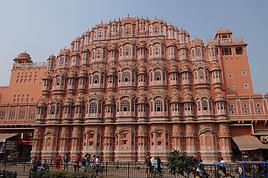
Review of the Stops: Generally speaking, in very touristy places, you’re constantly approached by touts and vendors. As soon as you move away from those spots, Indians are welcoming, friendly, and happy to chat with foreigners. Between each stop, it’s 4–6 hours because the roads are tough—average speed is 50 km/h. Keep this in mind when planning your route. We chose to stay 2 nights in most places to avoid spending all our time in the car. Delhi: Worth seeing, but rough for a first impression—loud in some areas, aggressive, but we don’t regret it. For our first taste of Indian cuisine, we dined at United Coffee House on Connaught Place, a restaurant for the Indian middle class. It was delicious, really nice, and reassured us that we’d enjoy the food. Shekawati: Amazing, off the beaten path, not very touristy, and the people are friendly. Note: Bagar, which we picked after reading an article in *Ulysses*. It’s off the usual routes. Result: we were the only tourists in this small town and had a fantastic evening. Mandawa (just an hour from Bagar) is on all the Shekhawati circuits, so it’s more touristy. But still nice because of the colorful Havelis (go see them alone, without clingy guides trying to charge you extra for every visit without giving all the details—only the rupees matter to them). Note: there’s a great, affordable cobbler on the main street of Mandawa (Main Bazaar), just before Sonathia Gate on the right. Beautiful handmade slippers for 300 rupees. By the end of the trip, I regretted not buying more pairs—the leather is so soft and comfortable. I haven’t seen any as nice since. Bikaner: Good, a necessary stop before crossing the desert if you’re heading to Jaisalmer (recommended). It lets you see the Karni Mata Temple (Temple of the Rats), a camel farm, a first Jain temple, a quiet spice bazaar (take a rickshaw for a morning), and the well-maintained fort. Kaku (night in the Thar Desert): A highlight, absolutely must-do. Nothing like what you’ll find in Jaisalmer. Simple, remote, and wild—no tourist buses, just you and the few Indians taking care of you. Watching the sunset, the starry sky, shooting stars, and sleeping under the stars is unforgettable. It’s neither too cold nor too hot. The toilet facilities are basic but hygienic. It’s fantastic, and the whole family loved it. Jaisalmer: Very exotic, at the edge of Rajasthan, right out of the Thar Desert. A magical little town. Watch the sunset near the cenotaphs, visit Gadi Sagar for a picturesque stop with a temple by the lake, lots of Indians feeding huge catfish, and pedal boats for rent. Nearby, the best lassi of the trip at "Mohan Juice Center." Don’t miss the three Havelis—take the back streets if you want to avoid the touristy areas. As for the classic camel ride at sunset, know that the dune spots are beautiful, but at the same spot, at the same time, hundreds (no exaggeration) of tourists arrive by the busload, each on their own camel (hundreds of them), with vendors selling drinks, trinkets, and impromptu shows. It kills the dream. Jodhpur: The Mehrangarh Fort is EXCEPTIONAL, very well maintained, with a great audio guide in French. The most beautiful fort/palace visit of the whole trip. The restaurant inside is excellent. Spend a morning there, and don’t forget to visit the temple at the end of the ramparts for a top-notch view of the Blue City. Around the Clock Tower, you can try delicious, fresh lassis at Shri Mishrilal Hotel, mostly frequented by locals, and grab a tasty masala omelet on the go at Vicky’s Omelette Shop—he’s always smiling and collects notebooks full of messages from his customers. We found beautiful cashmere scarves at Handloom House, a fixed-price shop with good prices. Ranakpur: Another highlight. An exceptional Jain temple in the middle of nature. We chatted with the high priest, ate in the refectory at 5 PM (meals at 5, 5:30, and 6 PM) with locals (super good, all-you-can-eat for 20 rupees per person). Our only regret: not staying overnight. For just 50 rupees more, you can sleep in simple but clean cells and attend the evening ceremony, see the temple at sunset (otherwise, it closes at 5 PM), and be alone in the middle of nowhere. It’s also a lush place full of non-aggressive monkeys that take what you give them from your hand. Don’t miss it under any circumstances. Udaipur: Unique and charming, our first glimpse of Ghats on this trip with Indians bathing in the morning and doing laundry. The lake is enchanting, and the Hindu temple is special. Dinner at Jagat Niwas Palace Hotel (where we were staying) with a stunning view of the lake. Very good food, reasonable prices, and an exceptional setting. Bundi: First regret. A charming little town off the tourist trail, but dull after Shekawati. Not much to see. Jaipur: Second regret. VERY aggressive, overcrowded, with glaring poverty in the streets, persistent beggars, relentless vendors, deafening traffic, and endless traffic jams. The Hawa Mahal is on a polluted main road, and the Amber Fort is a tourist trap. It’s poorly maintained, and the elephant ride is the ultimate tourist attraction: hundreds of tourists on elephants in a line, 550 rupees for 2 people for a 10-minute ride, with vendors shouting the whole way while the elephant handler reminds you 10 times to tip him. Tourism at its worst. Don’t go unless you’re with young kids who’ll remember riding an elephant forever. Even then, it’s possible in other cities like Udaipur. Don’t believe your driver if he says not to shop before Jaipur because that’s where the best selection and prices are. It’s false. There’s no more selection (except for jewelry), prices aren’t lower, and the quality isn’t better. It’s just a big city with lots of shops that pay commissions to touts. Still, there’s a beautiful textile shop that doesn’t look like much but has fixed prices, is affordable, and offers superb quality: SOMA (http://www.somashop.com/). The local middle and upper classes shop there for home textiles (tablecloths, bedspreads, sheets, curtains) and clothes. This shop is even mentioned by *Forbes* as one of the "World's Top Shops" (http://www.forbes.com/..._sb_1215feat_ls.html). The one positive in Jaipur: Raj Mandir, a historic, stunning cinema. You can go with your eyes closed—guaranteed atmosphere with Indians cheering, laughing, and taking sides for the characters. Even without speaking the language, we understood everything and had a great family moment. Plus, there’s an intermission to grab a snack. It’s fantastic. The theater is often full, but you can reserve. Nearby, the Galta Temple is picturesque with hundreds of monkeys and kids bathing in the pools. Fun, especially in the late afternoon. If we had to do it again, we’d skip Jaipur—too noisy, too aggressive. Agra: Just before Agra, stop at Fatehpur Sikri. The visit takes about 3 hours. It’s beautiful. I regret not staying overnight to admire Akbar the Great’s city at sunset. In Agra, the Taj Mahal is king. Our best photos were taken from the Yamuna River. From there, the Taj is stunning (its back = its front), and you can stay as long as you want (it’s free). The next day, we visited at 6 AM and stayed for 4 hours—it was peaceful and gorgeous.
Overall, we would’ve liked one more night in Ranakpur, one more in Udaipur, one in Fatehpur Sikri, and just one in Jaipur to see the Hawa Mahal and go to the Raj Mandir.
Review of the Hotels
Delhi / Amaraya Haveli: Clean and nice, run by two French people in a quiet neighborhood of New Delhi. Comfortable rooms, good breakfast, clean, a bit pricey. Satisfaction rating: 3 out of 5
Bagar / Piramal Haveli: A charming stop, a Haveli from the early 20th century, with very large rooms, warm and attentive service, and a GREAT dinner. All for a modest price since it’s off the tourist trail. Highly recommend. Satisfaction rating: 5 out of 5
Mandawa / Desert Resort: Outside the city, at the edge of the desert. Rooms are in "traditional" huts with all the comforts. There’s a pool, and it’s very quiet. Breakfast is mediocre. Avoid dinner—it’s a rip-off (three times more expensive than elsewhere and not good). Satisfaction rating: 4 out of 5
Bikaner / Lallgarh Palace: Former maharaja’s palace, well maintained, gorgeous rooms with marble everywhere, a large art-deco indoor pool, good restaurant, very classy. Worth the price. Satisfaction rating: 5 out of 5
Jaisalmer / Gorbandh Palace: Large modern hotel mimicking local architecture. Big pool, but the rooms are poor—noisy and small. Mediocre breakfast. Satisfaction rating: 2 out of 5
Jodhpur / Ajit Bhawan: Former residence, very classy, Hollywood-style pool with waterfalls and fountains, comfortable rooms tastefully decorated. Great breakfast. Satisfaction rating: 5 out of 5
Udaipur / Jagat Niwas Palace: By the lake, very charming, good food, restaurant with an exceptional view, very romantic, but the room amenities are mediocre. Satisfaction rating: 5 out of 5
Bundi / Braj Bhushanjee: The best hotel in Bundi, in a beautifully decorated old Haveli. The rooms are mediocre and very noisy. Breakfast is average, but the welcome is warm. Satisfaction rating: 2 out of 5
Jaipur / Samode Haveli: Exceptional, very comfortable, gorgeous pool, spacious rooms, attentive and non-pushy service, free Wi-Fi, beautiful restaurant, great breakfast. Satisfaction rating: 5 out of 5
Agra / Howard Park Plaza: A mid-range chain hotel with a small pool. Comfortable enough, limited service, terrible breakfast. Satisfaction rating: 1 out of 5
If this feedback was helpful, feel free to leave me a message.
Thierry
Context: First time in India. Dates: August 5 to August 23. 2 adults + 2 boys (17 and 11 years old). Itinerary: Delhi - Shekawati (Bagar, Mandawa) - Bikaner - Thar Desert (Kaku) - Jaisalmer - Jodhpur - Udaipur - Bundi - Jaipur - Agra - Delhi. High-end hotels, travel in a Toyota Innova (like a Renault Espace) with a driver. Agency: Atithi Travels, contact: Rajeev, Driver: William. Budget: 3112 € for flights (Air India chartered by Air France and booked through Go Voyages), 1080 US$ per person for hotels with breakfast, car with driver, full-board night in the desert, camel ride, boat on the lake in Udaipur, farewell dinner, 1000 € for on-site expenses (drinks and meals—1 per day / various tips including driver (150 rupees per day) / monuments and outings / personal shopping and gifts (including 2 carpets 1x2m, 1 bedspread, a pair of curtains, 10 shirts, 2 pairs of pants, 2 tablecloths, 5 scarves, 1 small piece of jewelry, and various trinkets...). In short, about 1900 € per person all-inclusive for 17 nights.
Review of Atithi Travels: Very professional and accommodating. They responded quickly to my many prep emails, accepted all my hotel choices—even those they weren’t used to working with (I picked them beforehand using TripAdvisor, VoyageForum, the *Routard* guide, and Ulysses’ Rajasthan guide). They were the only agency out of the nine I consulted that accepted all my choices. Their pricing was reasonable, in the first quartile of the agencies I contacted. They allowed payment in three installments (1/3 at booking by bank transfer, 1/3 upon arrival in India, 1/3 in Udaipur). They checked in throughout the trip to ensure everything was going well with the driver and local reps. They offered a great solution for the night in the desert. My direct contact (Rajeev) personally picked us up at Delhi airport on the evening of the 5th (a Sunday). If I had to do it again, I’d go with Atithi again without hesitation—just negotiate the prices a bit.
Review of the Driver (William): He drove very cautiously (which is super important in this country). He kept his distance from his "guests," which worked perfectly for us. No hard sell to take us to shops or restaurants. Just so you know, the driver gets 150 rupees per day for lodging and meals. When he stops at a tourist restaurant, especially on the road, he eats for free (for you, if you eat there, it’s 2–3 times more expensive than elsewhere). Some shops, especially in Jaipur, give him commissions. Overall, we had an unspoken agreement. The driver would stop halfway through the journey at a tourist restaurant so we could use clean toilets, grab a Coke, and he could eat and rest (after 2.5 hours on the road in India, it’s well-deserved and necessary). After 30 minutes, we’d hit the road again. For shops, he didn’t pressure us, and we were very clear about stopping only at places we’d chosen (via Lonely Planet, for example). Overall, we were happy with his service.
Review of the Stops: Generally speaking, in very touristy places, you’re constantly approached by touts and vendors. As soon as you move away from those spots, Indians are welcoming, friendly, and happy to chat with foreigners. Between each stop, it’s 4–6 hours because the roads are tough—average speed is 50 km/h. Keep this in mind when planning your route. We chose to stay 2 nights in most places to avoid spending all our time in the car. Delhi: Worth seeing, but rough for a first impression—loud in some areas, aggressive, but we don’t regret it. For our first taste of Indian cuisine, we dined at United Coffee House on Connaught Place, a restaurant for the Indian middle class. It was delicious, really nice, and reassured us that we’d enjoy the food. Shekawati: Amazing, off the beaten path, not very touristy, and the people are friendly. Note: Bagar, which we picked after reading an article in *Ulysses*. It’s off the usual routes. Result: we were the only tourists in this small town and had a fantastic evening. Mandawa (just an hour from Bagar) is on all the Shekhawati circuits, so it’s more touristy. But still nice because of the colorful Havelis (go see them alone, without clingy guides trying to charge you extra for every visit without giving all the details—only the rupees matter to them). Note: there’s a great, affordable cobbler on the main street of Mandawa (Main Bazaar), just before Sonathia Gate on the right. Beautiful handmade slippers for 300 rupees. By the end of the trip, I regretted not buying more pairs—the leather is so soft and comfortable. I haven’t seen any as nice since. Bikaner: Good, a necessary stop before crossing the desert if you’re heading to Jaisalmer (recommended). It lets you see the Karni Mata Temple (Temple of the Rats), a camel farm, a first Jain temple, a quiet spice bazaar (take a rickshaw for a morning), and the well-maintained fort. Kaku (night in the Thar Desert): A highlight, absolutely must-do. Nothing like what you’ll find in Jaisalmer. Simple, remote, and wild—no tourist buses, just you and the few Indians taking care of you. Watching the sunset, the starry sky, shooting stars, and sleeping under the stars is unforgettable. It’s neither too cold nor too hot. The toilet facilities are basic but hygienic. It’s fantastic, and the whole family loved it. Jaisalmer: Very exotic, at the edge of Rajasthan, right out of the Thar Desert. A magical little town. Watch the sunset near the cenotaphs, visit Gadi Sagar for a picturesque stop with a temple by the lake, lots of Indians feeding huge catfish, and pedal boats for rent. Nearby, the best lassi of the trip at "Mohan Juice Center." Don’t miss the three Havelis—take the back streets if you want to avoid the touristy areas. As for the classic camel ride at sunset, know that the dune spots are beautiful, but at the same spot, at the same time, hundreds (no exaggeration) of tourists arrive by the busload, each on their own camel (hundreds of them), with vendors selling drinks, trinkets, and impromptu shows. It kills the dream. Jodhpur: The Mehrangarh Fort is EXCEPTIONAL, very well maintained, with a great audio guide in French. The most beautiful fort/palace visit of the whole trip. The restaurant inside is excellent. Spend a morning there, and don’t forget to visit the temple at the end of the ramparts for a top-notch view of the Blue City. Around the Clock Tower, you can try delicious, fresh lassis at Shri Mishrilal Hotel, mostly frequented by locals, and grab a tasty masala omelet on the go at Vicky’s Omelette Shop—he’s always smiling and collects notebooks full of messages from his customers. We found beautiful cashmere scarves at Handloom House, a fixed-price shop with good prices. Ranakpur: Another highlight. An exceptional Jain temple in the middle of nature. We chatted with the high priest, ate in the refectory at 5 PM (meals at 5, 5:30, and 6 PM) with locals (super good, all-you-can-eat for 20 rupees per person). Our only regret: not staying overnight. For just 50 rupees more, you can sleep in simple but clean cells and attend the evening ceremony, see the temple at sunset (otherwise, it closes at 5 PM), and be alone in the middle of nowhere. It’s also a lush place full of non-aggressive monkeys that take what you give them from your hand. Don’t miss it under any circumstances. Udaipur: Unique and charming, our first glimpse of Ghats on this trip with Indians bathing in the morning and doing laundry. The lake is enchanting, and the Hindu temple is special. Dinner at Jagat Niwas Palace Hotel (where we were staying) with a stunning view of the lake. Very good food, reasonable prices, and an exceptional setting. Bundi: First regret. A charming little town off the tourist trail, but dull after Shekawati. Not much to see. Jaipur: Second regret. VERY aggressive, overcrowded, with glaring poverty in the streets, persistent beggars, relentless vendors, deafening traffic, and endless traffic jams. The Hawa Mahal is on a polluted main road, and the Amber Fort is a tourist trap. It’s poorly maintained, and the elephant ride is the ultimate tourist attraction: hundreds of tourists on elephants in a line, 550 rupees for 2 people for a 10-minute ride, with vendors shouting the whole way while the elephant handler reminds you 10 times to tip him. Tourism at its worst. Don’t go unless you’re with young kids who’ll remember riding an elephant forever. Even then, it’s possible in other cities like Udaipur. Don’t believe your driver if he says not to shop before Jaipur because that’s where the best selection and prices are. It’s false. There’s no more selection (except for jewelry), prices aren’t lower, and the quality isn’t better. It’s just a big city with lots of shops that pay commissions to touts. Still, there’s a beautiful textile shop that doesn’t look like much but has fixed prices, is affordable, and offers superb quality: SOMA (http://www.somashop.com/). The local middle and upper classes shop there for home textiles (tablecloths, bedspreads, sheets, curtains) and clothes. This shop is even mentioned by *Forbes* as one of the "World's Top Shops" (http://www.forbes.com/..._sb_1215feat_ls.html). The one positive in Jaipur: Raj Mandir, a historic, stunning cinema. You can go with your eyes closed—guaranteed atmosphere with Indians cheering, laughing, and taking sides for the characters. Even without speaking the language, we understood everything and had a great family moment. Plus, there’s an intermission to grab a snack. It’s fantastic. The theater is often full, but you can reserve. Nearby, the Galta Temple is picturesque with hundreds of monkeys and kids bathing in the pools. Fun, especially in the late afternoon. If we had to do it again, we’d skip Jaipur—too noisy, too aggressive. Agra: Just before Agra, stop at Fatehpur Sikri. The visit takes about 3 hours. It’s beautiful. I regret not staying overnight to admire Akbar the Great’s city at sunset. In Agra, the Taj Mahal is king. Our best photos were taken from the Yamuna River. From there, the Taj is stunning (its back = its front), and you can stay as long as you want (it’s free). The next day, we visited at 6 AM and stayed for 4 hours—it was peaceful and gorgeous.
Overall, we would’ve liked one more night in Ranakpur, one more in Udaipur, one in Fatehpur Sikri, and just one in Jaipur to see the Hawa Mahal and go to the Raj Mandir.
Review of the Hotels
Delhi / Amaraya Haveli: Clean and nice, run by two French people in a quiet neighborhood of New Delhi. Comfortable rooms, good breakfast, clean, a bit pricey. Satisfaction rating: 3 out of 5
Bagar / Piramal Haveli: A charming stop, a Haveli from the early 20th century, with very large rooms, warm and attentive service, and a GREAT dinner. All for a modest price since it’s off the tourist trail. Highly recommend. Satisfaction rating: 5 out of 5
Mandawa / Desert Resort: Outside the city, at the edge of the desert. Rooms are in "traditional" huts with all the comforts. There’s a pool, and it’s very quiet. Breakfast is mediocre. Avoid dinner—it’s a rip-off (three times more expensive than elsewhere and not good). Satisfaction rating: 4 out of 5
Bikaner / Lallgarh Palace: Former maharaja’s palace, well maintained, gorgeous rooms with marble everywhere, a large art-deco indoor pool, good restaurant, very classy. Worth the price. Satisfaction rating: 5 out of 5
Jaisalmer / Gorbandh Palace: Large modern hotel mimicking local architecture. Big pool, but the rooms are poor—noisy and small. Mediocre breakfast. Satisfaction rating: 2 out of 5
Jodhpur / Ajit Bhawan: Former residence, very classy, Hollywood-style pool with waterfalls and fountains, comfortable rooms tastefully decorated. Great breakfast. Satisfaction rating: 5 out of 5
Udaipur / Jagat Niwas Palace: By the lake, very charming, good food, restaurant with an exceptional view, very romantic, but the room amenities are mediocre. Satisfaction rating: 5 out of 5
Bundi / Braj Bhushanjee: The best hotel in Bundi, in a beautifully decorated old Haveli. The rooms are mediocre and very noisy. Breakfast is average, but the welcome is warm. Satisfaction rating: 2 out of 5
Jaipur / Samode Haveli: Exceptional, very comfortable, gorgeous pool, spacious rooms, attentive and non-pushy service, free Wi-Fi, beautiful restaurant, great breakfast. Satisfaction rating: 5 out of 5
Agra / Howard Park Plaza: A mid-range chain hotel with a small pool. Comfortable enough, limited service, terrible breakfast. Satisfaction rating: 1 out of 5
If this feedback was helpful, feel free to leave me a message.
Thierry
Before I begin, I’d like to thank Michèle Buisson and her "Misha’s travel journals," which really helped me plan this trip. It’s tough to find information about this part of India, which is quite different from the "more traditional India." I’m so grateful to her for introducing me to a family who hosted me for 4 nights and 3 days. I can’t wait to return the favor and welcome you all to my place in early July!
Thursday, March 20th. The alarm goes off super early, but I’m already awake—I was too worried I’d sleep through it. I leave the house at 4:00 AM. The rain has stopped, and at this hour, there aren’t many trucks on the road. I arrive at Barcelona Airport easily by 6:20 AM, let the valet know I’m there, and he quickly picks up my car. This time, I’m flying with Etihad Airways again. I booked the ticket during my trip to Cambodia: Barcelona/Kolkata, Delhi/Barcelona for 567 €. At that price, I didn’t hesitate for long—I knew I had to take it. And I’m glad I did because, by the time I returned, the price had gone up to 700 €. I can already hear the reactions: "Wow, how’d you get a ticket for that price? What site did you use? You’re amazing, MarieJo!" One thing’s for sure—I’m really happy with this deal. The flights from Barcelona to Abu Dhabi and Abu Dhabi to Kolkata go smoothly, and we arrive on time at 2:55 AM. There aren’t many people at immigration, so I get through quickly. My luggage isn’t on the carousel yet. After collecting my bag, I check in for my next flight with IndiGo, a 5:40 AM flight to Guwahati, arriving at 7:00 AM. I’m starting to feel pretty tired, so I take a taxi from the airport to Gruham Sojourn Homestay. The house is upstairs, and the neighborhood seems quiet, with restaurants lining the street. The room won’t be ready until 10:00 AM, so I rest on the bench in the meantime. Once in the room, I take a shower—it really helps me feel refreshed. I need to exchange some euros, so I look up a nearby exchange bureau on Google and head out to find it. I locate it easily, and the staff are super friendly. I get a great rate (1 € = 90 INR). I wander around the neighborhood. The train station isn’t far, and small markets line the streets. I head back to my area, walking along the main avenue. About 500 meters from my street, I discover a museum. The visit is fascinating—I see the famous Majuli masks, among other things.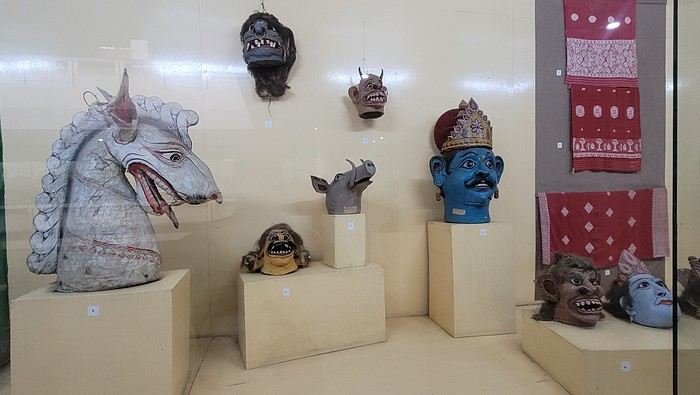

I’m not far from the Brahmaputra River, and the temptation to visit is too strong to resist. I’d hoped to find a promenade along the river, but that doesn’t exist here. I walk back calmly and notice several restaurants in my street. On the doorstep of my accommodation, I spot a pastry shop with cakes that look more like the ones we have in France than the typical ones here in India. A visit is a must, and I’m not disappointed!

Tonight, I’m dining at a restaurant in the street. The menu is a bit disappointing—burgers, pizzas, pasta—nothing very Indian. So, I’ll go with tomato pasta.
Thursday, March 20th. The alarm goes off super early, but I’m already awake—I was too worried I’d sleep through it. I leave the house at 4:00 AM. The rain has stopped, and at this hour, there aren’t many trucks on the road. I arrive at Barcelona Airport easily by 6:20 AM, let the valet know I’m there, and he quickly picks up my car. This time, I’m flying with Etihad Airways again. I booked the ticket during my trip to Cambodia: Barcelona/Kolkata, Delhi/Barcelona for 567 €. At that price, I didn’t hesitate for long—I knew I had to take it. And I’m glad I did because, by the time I returned, the price had gone up to 700 €. I can already hear the reactions: "Wow, how’d you get a ticket for that price? What site did you use? You’re amazing, MarieJo!" One thing’s for sure—I’m really happy with this deal. The flights from Barcelona to Abu Dhabi and Abu Dhabi to Kolkata go smoothly, and we arrive on time at 2:55 AM. There aren’t many people at immigration, so I get through quickly. My luggage isn’t on the carousel yet. After collecting my bag, I check in for my next flight with IndiGo, a 5:40 AM flight to Guwahati, arriving at 7:00 AM. I’m starting to feel pretty tired, so I take a taxi from the airport to Gruham Sojourn Homestay. The house is upstairs, and the neighborhood seems quiet, with restaurants lining the street. The room won’t be ready until 10:00 AM, so I rest on the bench in the meantime. Once in the room, I take a shower—it really helps me feel refreshed. I need to exchange some euros, so I look up a nearby exchange bureau on Google and head out to find it. I locate it easily, and the staff are super friendly. I get a great rate (1 € = 90 INR). I wander around the neighborhood. The train station isn’t far, and small markets line the streets. I head back to my area, walking along the main avenue. About 500 meters from my street, I discover a museum. The visit is fascinating—I see the famous Majuli masks, among other things.
I’m not far from the Brahmaputra River, and the temptation to visit is too strong to resist. I’d hoped to find a promenade along the river, but that doesn’t exist here. I walk back calmly and notice several restaurants in my street. On the doorstep of my accommodation, I spot a pastry shop with cakes that look more like the ones we have in France than the typical ones here in India. A visit is a must, and I’m not disappointed!
Tonight, I’m dining at a restaurant in the street. The menu is a bit disappointing—burgers, pizzas, pasta—nothing very Indian. So, I’ll go with tomato pasta.
Hi there,
We’d like to travel overland from Turkey to India in our converted van, but there are very few options these days. Crossing Iran seems risky and not particularly safe. Has anyone here done it? If so, which route did you take to minimize safety concerns?
Thanks for your replies, Julie 😎
We’d like to travel overland from Turkey to India in our converted van, but there are very few options these days. Crossing Iran seems risky and not particularly safe. Has anyone here done it? If so, which route did you take to minimize safety concerns?
Thanks for your replies, Julie 😎
Hello fellow travelers!
I’m adding my small contribution to the reopening celebration by posting this travel journal from India, made in January 2024. We’re 4 friends (2 couples), and we did a 3-week loop in Rajasthan, stopping by Delhi and Agra (which, as everyone knows, aren’t in Rajasthan 😛). Delhi - Agra - Jaipur - Bundi - Udaipur - Jodhpur - Jaisalmer - Delhi
We rented a car with a driver from Agra to Jaisalmer, 550 € for 14 days. https://chauffeurpriveeninde.com/fr/
We took the train from Delhi to Agra and the plane (Spicejet) from Jaisalmer to Delhi.
Most of the accommodations were booked on Booking before we left.
I’m sharing this story written by Richard and illustrated by me. We dedicate it to Nathalie and Bruno, our amazing travel companions.
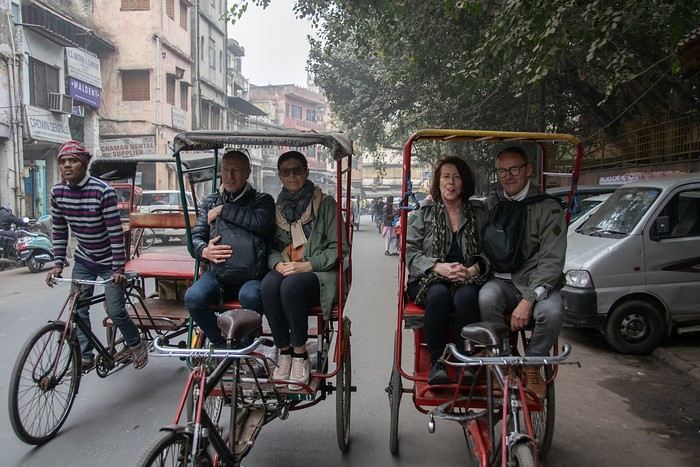
I’m adding my small contribution to the reopening celebration by posting this travel journal from India, made in January 2024. We’re 4 friends (2 couples), and we did a 3-week loop in Rajasthan, stopping by Delhi and Agra (which, as everyone knows, aren’t in Rajasthan 😛). Delhi - Agra - Jaipur - Bundi - Udaipur - Jodhpur - Jaisalmer - Delhi
We rented a car with a driver from Agra to Jaisalmer, 550 € for 14 days. https://chauffeurpriveeninde.com/fr/
We took the train from Delhi to Agra and the plane (Spicejet) from Jaisalmer to Delhi.
Most of the accommodations were booked on Booking before we left.
I’m sharing this story written by Richard and illustrated by me. We dedicate it to Nathalie and Bruno, our amazing travel companions.
During the 60s and 70s, thousands of travelers hit the road to India. Some were backpackers or hippies, but not all. In this collective anthology featuring around twenty contributors (including GeorgesOz), you’ll also find truth-seekers, a couple who went on their honeymoon to get married in Bengal... and "crazy" folks who set off on VéloSolex bikes...
Worth noting: all contributors donated their royalties to support the Céline Hegron clinic in a poor neighborhood of Varanasi.
Worth noting: all contributors donated their royalties to support the Céline Hegron clinic in a poor neighborhood of Varanasi.
Hello everyone!
We're off! After exploring the north, the four friends have now discovered the south. We’re excited to share this new travel journal, dedicated to our little group and our strong friendship, written by Richard and illustrated with Kate’s photos. I’ll chime in from time to time with practical tips.
First of all, a big thank you to everyone on VoyageForum who helped us plan this trip. It would’ve been quite different if we’d just relied on guidebooks.
The itinerary lasted just over 3 weeks: Mahabalipuram, Pondicherry, Thanjavur, the Chettinad region, Madurai, Munnar, Munroe Island, Cochin, and Chennai. We traveled by train, taxi, and private car with a driver, took a domestic flight, and stayed in guesthouses, Airbnb apartments, and hotels. For each of us, including flights, the total budget barely reached 2000 €, and we didn’t hold back—knowing we avoid resorts and love street food and small Indian restaurants.
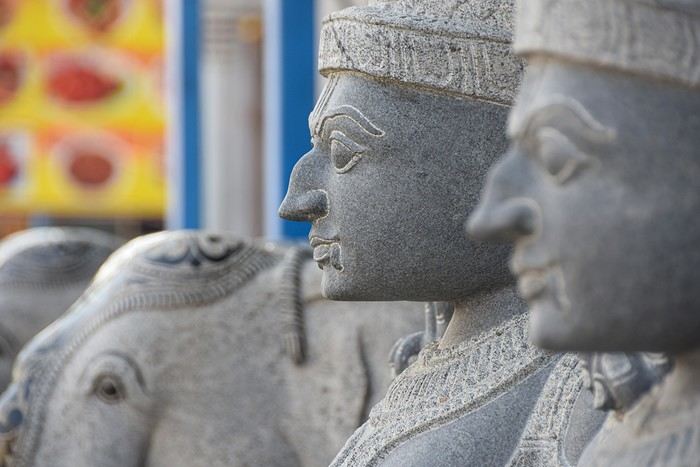
We're off! After exploring the north, the four friends have now discovered the south. We’re excited to share this new travel journal, dedicated to our little group and our strong friendship, written by Richard and illustrated with Kate’s photos. I’ll chime in from time to time with practical tips.
First of all, a big thank you to everyone on VoyageForum who helped us plan this trip. It would’ve been quite different if we’d just relied on guidebooks.
The itinerary lasted just over 3 weeks: Mahabalipuram, Pondicherry, Thanjavur, the Chettinad region, Madurai, Munnar, Munroe Island, Cochin, and Chennai. We traveled by train, taxi, and private car with a driver, took a domestic flight, and stayed in guesthouses, Airbnb apartments, and hotels. For each of us, including flights, the total budget barely reached 2000 €, and we didn’t hold back—knowing we avoid resorts and love street food and small Indian restaurants.
Just back from a 3-week trip in northern India, we spent 2 days in Varanasi. Since this city is so unique, to get a deeper look inside and better understand the spirituality that emanates from it, we hired a young French-speaking guide, Rakesh, who was recommended by our driver. Rakesh knows his city really well—he showed us places we never would’ve found on our own, all in perfect French. Thanks to him, we learned so much; he’s truly fascinating and very attentive. A huge thank you for this amazing experience. Don’t hesitate to reach out for his services.
Contact details in PM
Friday, November 4
My flight Barcelona - Abu Dhabi - Delhi went smoothly, it’s on time, and here I am back in India after 3 long years.
As I step off the plane, we head toward customs. It’s 3 AM, I’m tired but happy. The huge customs hall is below ground level and buzzing with people who’ve just arrived. In the end, they’re well organized—Indians to the left, foreigners to the right, and all along the hall, the customs officers’ posts, who remain very zen despite the crowd. It took me less than 2 hours to get out of the airport, which was pretty quick.
For this return trip, I got in touch with a driver from the "Lovers of India" group who was supposed to take me from the airport to Udaipur, passing through non-touristy villages like I love. This French-speaking driver had convinced me to travel by car, which was supposed to make moving from village to village easier. Two or three days before departure, I receive a message from the driver saying he was sick with a cold and sending another driver, his very kind brother who knows Rajasthan well but doesn’t speak French. I’m a bit disappointed by this message and doubtful about the driver’s sincerity, but I don’t have time to find another driver, so I stick to my plans, though I’m not at ease.
At the exit, the driver hasn’t arrived, and I wait half an hour before seeing him show up with a big smile, "Namaste." We don’t waste time and head to the car, which is clean and new.
We get to know each other in the car and hit the road toward Alwar. Along the way, we stop for lunch and to taste my first masala chai, which wakes up my taste buds.
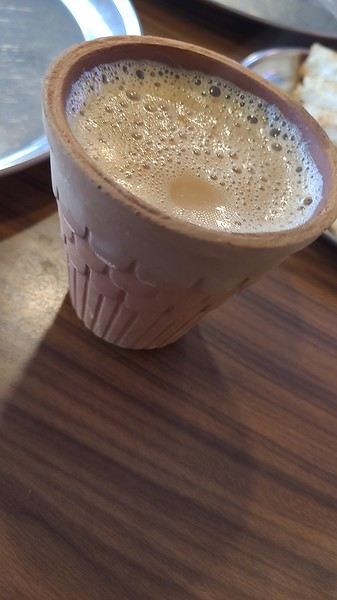
I doze off during the drive, and we arrive at the Atlantic Hotel in Alwar at 10:30 AM. My room is on the ground floor, and I settle in quickly. The Wi-Fi isn’t working, but the staff do everything they can to fix it. At noon, Gajender, the driver, suggests visiting the Qila Fort, which is on the heights of Alwar. The fort is closed for restoration, but safari tours are offered—jeep, guide, driver, and visit for 1600 Rs.
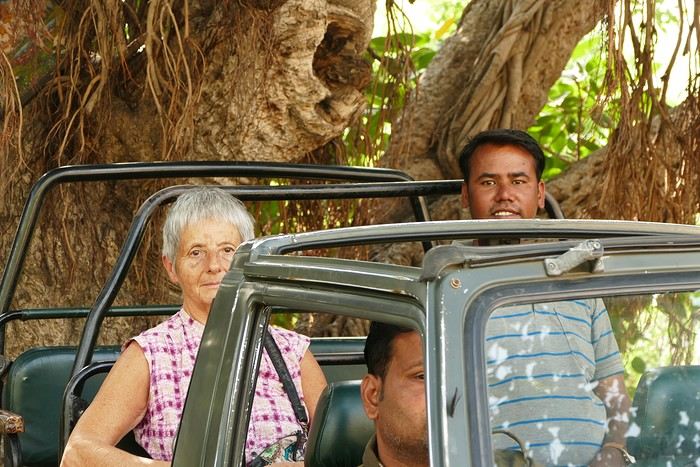
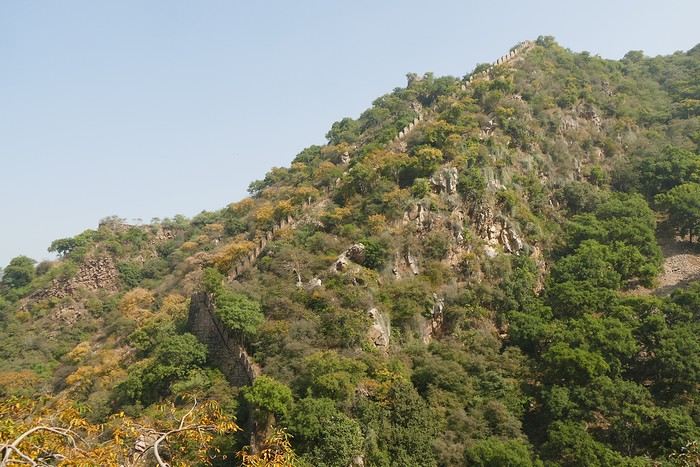
We follow the great wall, which is impressive—the second largest in India and the third in the world.
We spot peacocks and monkeys.
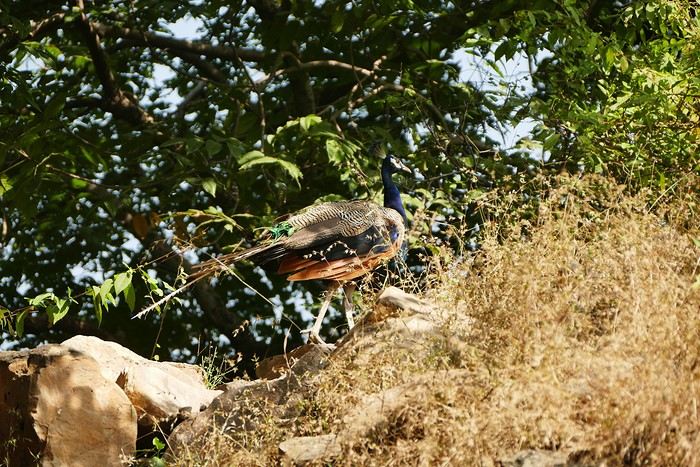
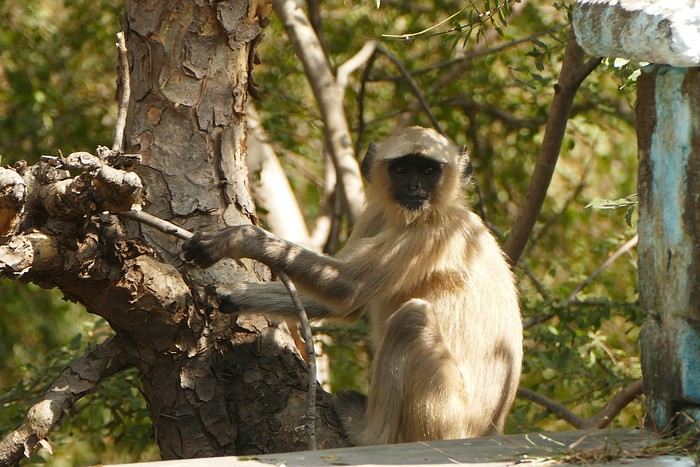
The guide shows me an old stepwell lost in nature. It’s always my thing to check out these baoris, which can be stunning, but this one isn’t anything special. We arrive at the palace overlooking the city.
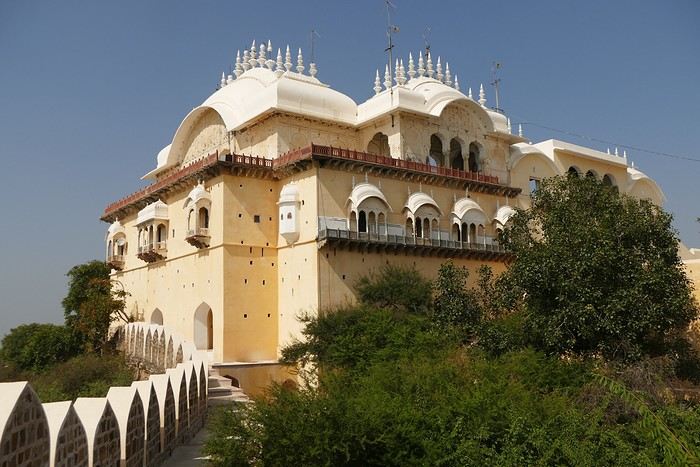
We walk around the palace, and I discover another stepwell that’s not worth lingering over.
The tour is over, and I had a great time despite the fatigue. We head back down to Alwar, near the City Palace, which has been turned into administrative offices. Gaju (the driver’s nickname) finds a parking spot near a dhaba where we have lunch (paneer masala, chapatis, chai)—it’s delicious. With my energy restored, we head to the palace. On the top floor is a museum that I visit.
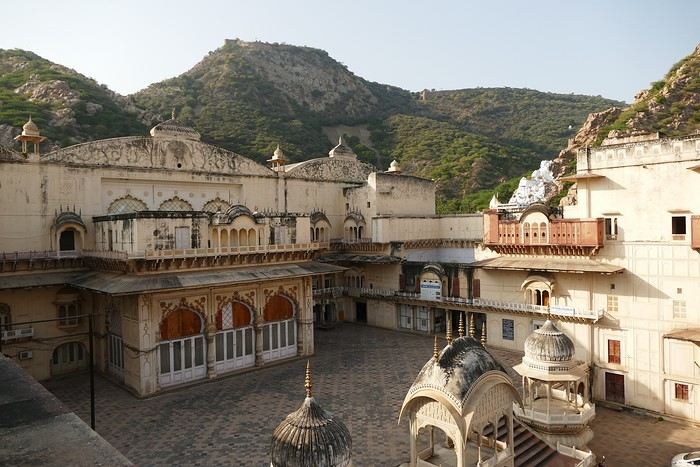
At the exit of the museum, we have to go back down and walk around the palace to get to the Moosi Maharani Chhatri. I’ve been here once before and really liked it, and the place is still the same—calm and relaxing.
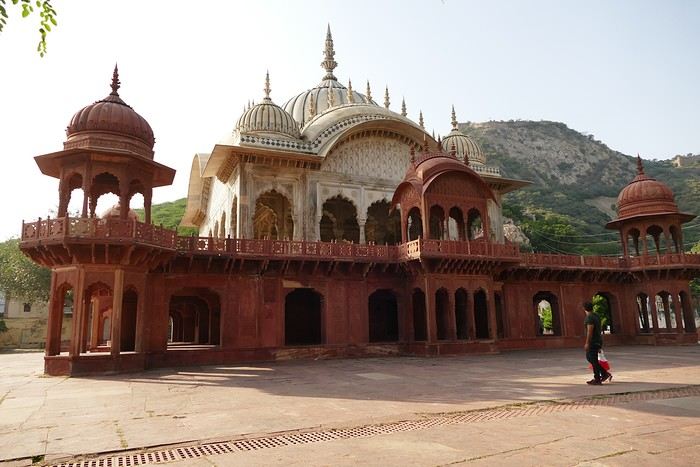
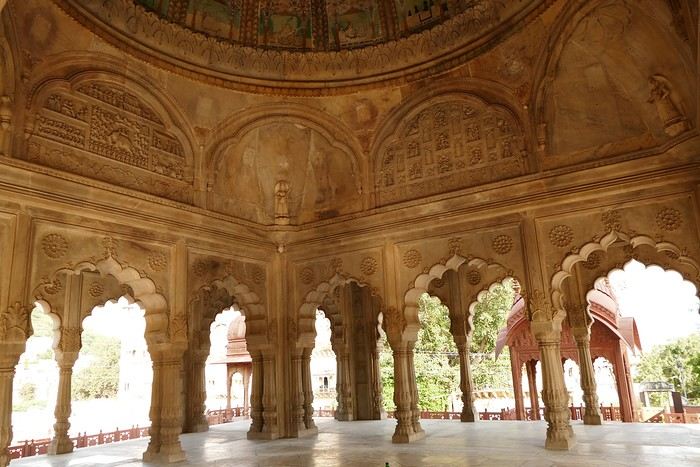
"This monument is the most artistic in Alwar and also the most royal, filled with fascinating history. Maharaja Vinay Singh of Alwar built this two-story cenotaph in 1815 in memory of his father, Maharaja Bakhtawar Singh. It’s also known as Moosi Maharani ki Chhatri, named after the king’s mistress, who performed sati upon his death. After the sati, she was accepted as the king’s wife. It’s an elegant monument, shaped like a flower and built with a mix of brown sandstone and white marble. The first floor is made of sandstone, while the upper floor and the chhatris (cenotaphs) are in white marble. Its sculpted pavilion has dome-shaped arches with intricate lace-like and exquisite floral patterns. There are complex motifs that shine brightly in the sunlight. The colorful circular ceiling is an important part of Moosi Maharani Ki Chhatri and is adorned with faded gold-leaf paintings of mythological figures and scenes. The footprints of Maharaja and Moosi Rani are engraved in marble inside the cenotaph, and locals pay their respects to them."
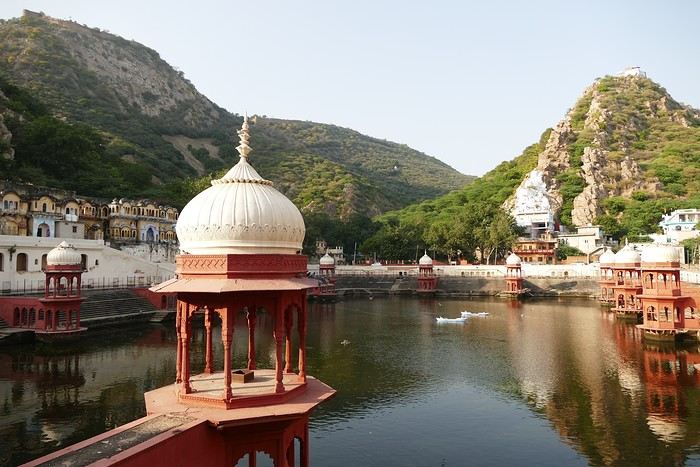
Near the chhatri, there’s a large water reservoir with a magnificent view. The place is peaceful and relaxing, and I stay here for a while, contemplating and daydreaming before heading back to the hotel for some well-deserved rest. The Wi-Fi is working now. I’m the only foreign guest, and since my room is near the entrance, I’ll be well taken care of throughout my stay.
I doze off during the drive, and we arrive at the Atlantic Hotel in Alwar at 10:30 AM. My room is on the ground floor, and I settle in quickly. The Wi-Fi isn’t working, but the staff do everything they can to fix it. At noon, Gajender, the driver, suggests visiting the Qila Fort, which is on the heights of Alwar. The fort is closed for restoration, but safari tours are offered—jeep, guide, driver, and visit for 1600 Rs.
We follow the great wall, which is impressive—the second largest in India and the third in the world.
We spot peacocks and monkeys.
The guide shows me an old stepwell lost in nature. It’s always my thing to check out these baoris, which can be stunning, but this one isn’t anything special. We arrive at the palace overlooking the city.
We walk around the palace, and I discover another stepwell that’s not worth lingering over.
The tour is over, and I had a great time despite the fatigue. We head back down to Alwar, near the City Palace, which has been turned into administrative offices. Gaju (the driver’s nickname) finds a parking spot near a dhaba where we have lunch (paneer masala, chapatis, chai)—it’s delicious. With my energy restored, we head to the palace. On the top floor is a museum that I visit.
At the exit of the museum, we have to go back down and walk around the palace to get to the Moosi Maharani Chhatri. I’ve been here once before and really liked it, and the place is still the same—calm and relaxing.
"This monument is the most artistic in Alwar and also the most royal, filled with fascinating history. Maharaja Vinay Singh of Alwar built this two-story cenotaph in 1815 in memory of his father, Maharaja Bakhtawar Singh. It’s also known as Moosi Maharani ki Chhatri, named after the king’s mistress, who performed sati upon his death. After the sati, she was accepted as the king’s wife. It’s an elegant monument, shaped like a flower and built with a mix of brown sandstone and white marble. The first floor is made of sandstone, while the upper floor and the chhatris (cenotaphs) are in white marble. Its sculpted pavilion has dome-shaped arches with intricate lace-like and exquisite floral patterns. There are complex motifs that shine brightly in the sunlight. The colorful circular ceiling is an important part of Moosi Maharani Ki Chhatri and is adorned with faded gold-leaf paintings of mythological figures and scenes. The footprints of Maharaja and Moosi Rani are engraved in marble inside the cenotaph, and locals pay their respects to them."
Near the chhatri, there’s a large water reservoir with a magnificent view. The place is peaceful and relaxing, and I stay here for a while, contemplating and daydreaming before heading back to the hotel for some well-deserved rest. The Wi-Fi is working now. I’m the only foreign guest, and since my room is near the entrance, I’ll be well taken care of throughout my stay.
Wednesday, April 1st
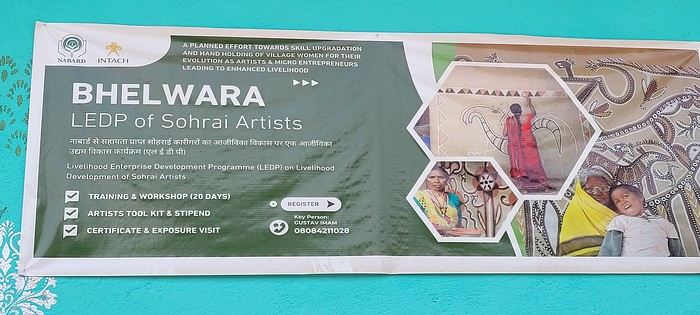
Hazaribagh I’ve got a meet-up with Adam Iman, a guide and painter. He picks me up from the hotel at 10 AM. Another traveler from Bangalore is supposed to join us, but while we wait for him to arrive, Adam takes me to see the paintings his mother and sister created at Hazaribagh station. The town became famous thanks to these murals, which can also be found in several surrounding villages. This art form has earned recognition and is now protected, a sign of its cultural importance. Once the visit is over, we go to pick up the other traveler and then head to our first village: Belwara, where Sohrai art is practiced. At the entrance, a sign proudly announces that we’re entering an artists’ village, where this art is created by women organized into micro-enterprises. Some even offer workshops for those who’d like to learn this tradition.
Sohrai art is tied to the harvest season, from October to mid-November. The motifs, in natural colors, celebrate fertility and abundance. The artists use pigments from the earth: red oxides, ochre, white kaolin, and black manganese. On the walls, you’ll see animals, fish, birds—all symbols of life and prosperity. As I look closer at the murals, I start to realize that each motif tells a story. Large animals like cows or bulls often take center stage. Their bodies are filled with intricate, almost hypnotic patterns. They symbolize wealth and prosperity for the household, as well as the deep respect for cattle, which are essential to daily life. On some facades, elephants stand out—massive and decorated with the same precision. They evoke quiet strength and protection. But it’s when I stop in front of one of the houses that I really take the time to look. The wall, a soft ochre, is entirely covered in murals. Two large animals stretch out on either side of the door, their elongated bodies fitting the length of the wall. Their silhouettes are filled with geometric patterns and incredibly fine curved lines, as if every space was patiently filled. Around them, stylized plants, flowers, and small decorative elements fill every gap. The door, dark and worn, becomes almost the silent center of the composition, framed by these living, protective forms. To the right, a more colorful motif catches the eye—a flower or a stylized lamp—like a touch of light on the earth. The whole thing gives an impression of perfect balance, between the rigor of the patterns and the freedom of the gesture.
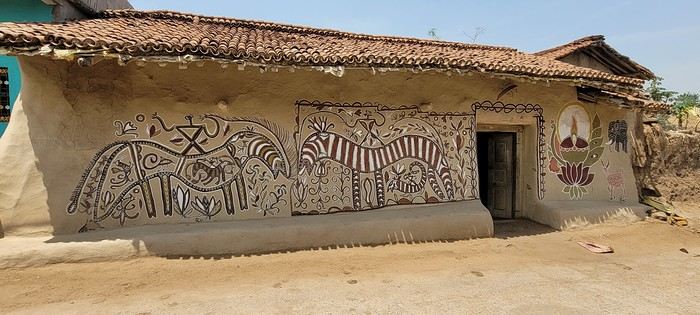
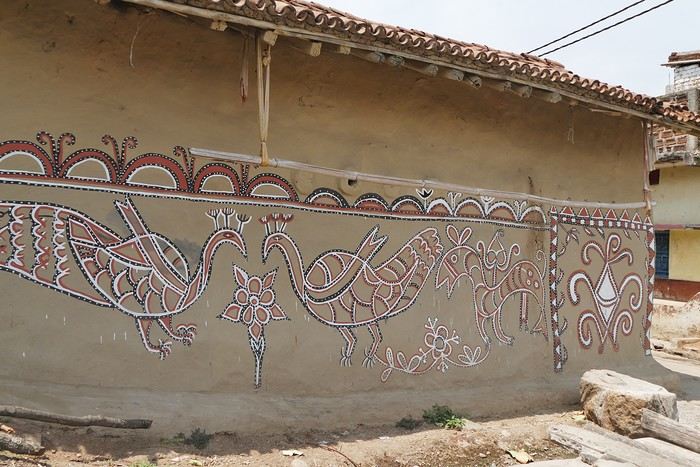
Elsewhere, birds and freer forms bring movement. Peacocks, recognizable by their stylized silhouettes, embody beauty and vitality, while fish symbolize water, fertility, and the continuity of life.
 On some paintings, the scenes become almost narrative: you can make out figures, everyday gestures, like a memory of the village inscribed in the walls. The decorative frames around the doors aren’t left to chance either—they symbolically protect the house, like a boundary between the inside and the outside world.
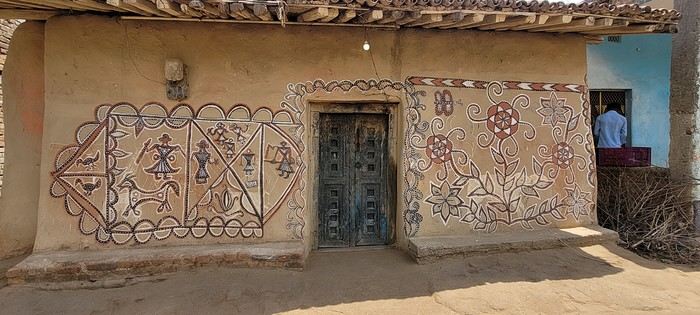
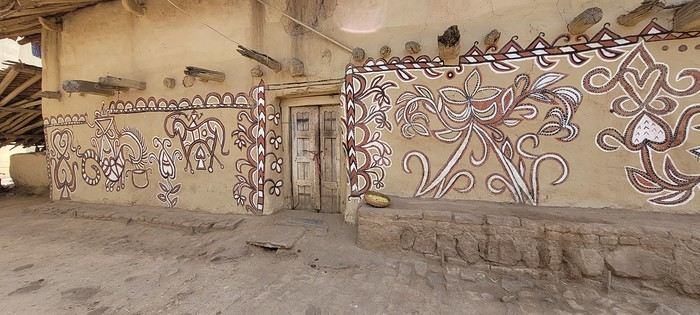
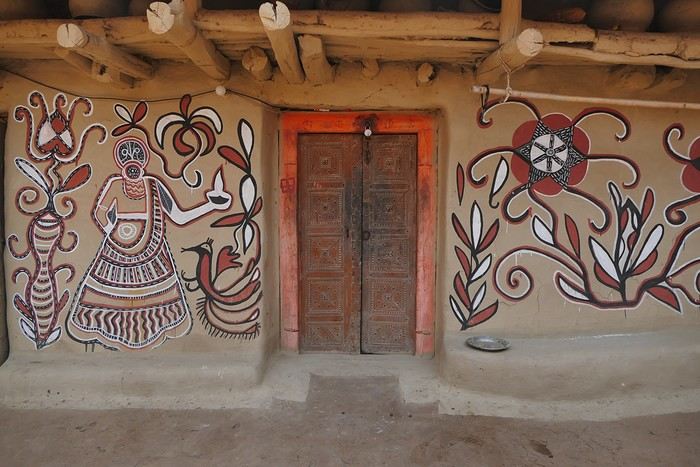
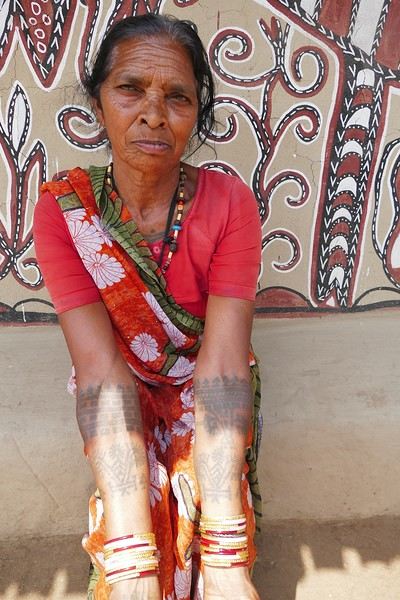
During the Sohrai festival, cattle are led into the jungle in the morning. Meanwhile, the women finish the *aripans*—these floor paintings—and continue the wall murals. Around noon, the animals return to the village, and the bulls’ horns are anointed with oil and vermilion in a gesture of gratitude, amid the vibrant colors adorning the houses. We visit several artists, including Parvat Devi, a well-known woman who has received many awards. Her arms are adorned with intriguing tattoos, which I’ll talk about in more detail later.
On another wall, the style changes completely. Here, no massive animals—just birds occupying the space, light and graceful, as if caught in mid-movement. Two silhouettes face each other, their long necks arched almost like mirrors, while their outstretched wings seem to vibrate with the patterns that compose them.
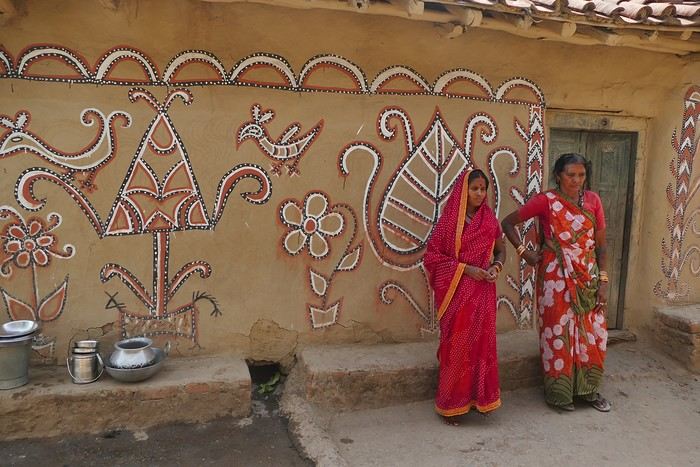
The design is more graphic, almost airy. The lines are smoother, more fluid, as if drawn in one confident stroke. The birds’ bodies aren’t solid—they’re filled with repetitive motifs like scales, stylized feathers, and spirals, giving a sense of continuous movement. Around them, everything comes to life: flowers burst open, arabesques swirl, and even the simplest shapes seem alive. What strikes me here is the sense of lightness. Where the large animals evoked stability and grounding, these birds bring something freer, almost joyful. They seem to embody movement, the circulation of life, like a breath flowing through the village.
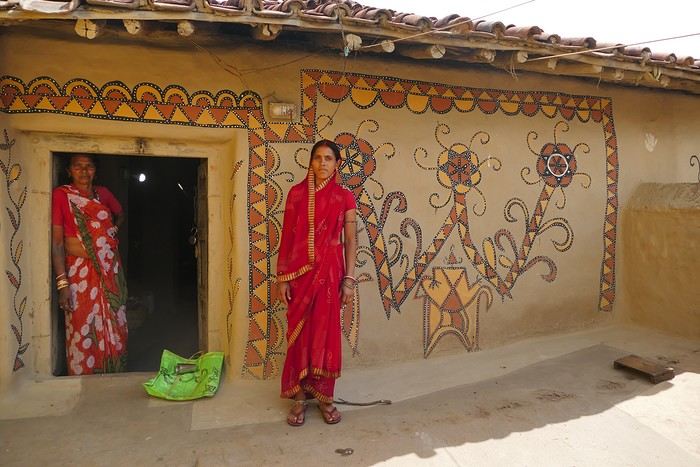
The colors remain the same—deep reds, intense blacks, and chalky white—but the rhythm is different. Faster, more spontaneous. As if each wall had its own personality, while still speaking the same language.
That’s probably why I’m so moved. I’d heard about these paintings from my friend Raja, and last year, I saw an exhibition in a village near my home. That first encounter made me want to come here. But seeing them in person is a whole different experience. These paintings are unique. This ancient art is passed down from mother to daughter, or mother-in-law to daughter-in-law, in a quiet, deeply living continuity. At first glance, it might seem almost childlike in its simplicity and pared-down forms. And yet, everything is thought out, balanced, mastered. Nothing is left to chance.
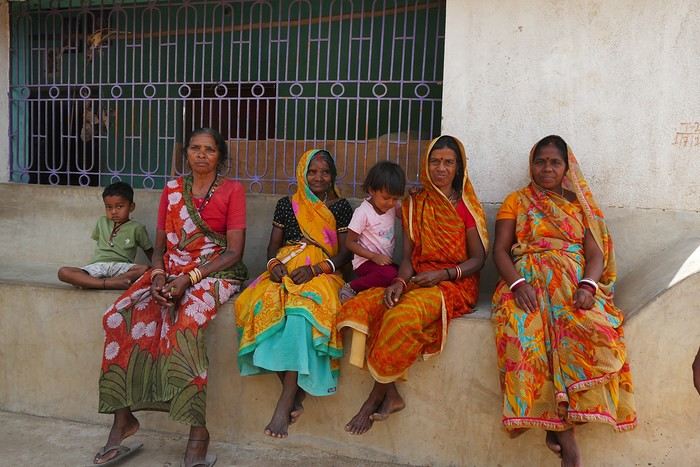
That apparent simplicity, combined with such rich symbolism, touches me deeply. There’s something sincere and essential in these walls—and that’s what moves me.
Hazaribagh I’ve got a meet-up with Adam Iman, a guide and painter. He picks me up from the hotel at 10 AM. Another traveler from Bangalore is supposed to join us, but while we wait for him to arrive, Adam takes me to see the paintings his mother and sister created at Hazaribagh station. The town became famous thanks to these murals, which can also be found in several surrounding villages. This art form has earned recognition and is now protected, a sign of its cultural importance. Once the visit is over, we go to pick up the other traveler and then head to our first village: Belwara, where Sohrai art is practiced. At the entrance, a sign proudly announces that we’re entering an artists’ village, where this art is created by women organized into micro-enterprises. Some even offer workshops for those who’d like to learn this tradition.
Sohrai art is tied to the harvest season, from October to mid-November. The motifs, in natural colors, celebrate fertility and abundance. The artists use pigments from the earth: red oxides, ochre, white kaolin, and black manganese. On the walls, you’ll see animals, fish, birds—all symbols of life and prosperity. As I look closer at the murals, I start to realize that each motif tells a story. Large animals like cows or bulls often take center stage. Their bodies are filled with intricate, almost hypnotic patterns. They symbolize wealth and prosperity for the household, as well as the deep respect for cattle, which are essential to daily life. On some facades, elephants stand out—massive and decorated with the same precision. They evoke quiet strength and protection. But it’s when I stop in front of one of the houses that I really take the time to look. The wall, a soft ochre, is entirely covered in murals. Two large animals stretch out on either side of the door, their elongated bodies fitting the length of the wall. Their silhouettes are filled with geometric patterns and incredibly fine curved lines, as if every space was patiently filled. Around them, stylized plants, flowers, and small decorative elements fill every gap. The door, dark and worn, becomes almost the silent center of the composition, framed by these living, protective forms. To the right, a more colorful motif catches the eye—a flower or a stylized lamp—like a touch of light on the earth. The whole thing gives an impression of perfect balance, between the rigor of the patterns and the freedom of the gesture.
Elsewhere, birds and freer forms bring movement. Peacocks, recognizable by their stylized silhouettes, embody beauty and vitality, while fish symbolize water, fertility, and the continuity of life.
On some paintings, the scenes become almost narrative: you can make out figures, everyday gestures, like a memory of the village inscribed in the walls. The decorative frames around the doors aren’t left to chance either—they symbolically protect the house, like a boundary between the inside and the outside world.During the Sohrai festival, cattle are led into the jungle in the morning. Meanwhile, the women finish the *aripans*—these floor paintings—and continue the wall murals. Around noon, the animals return to the village, and the bulls’ horns are anointed with oil and vermilion in a gesture of gratitude, amid the vibrant colors adorning the houses. We visit several artists, including Parvat Devi, a well-known woman who has received many awards. Her arms are adorned with intriguing tattoos, which I’ll talk about in more detail later.
On another wall, the style changes completely. Here, no massive animals—just birds occupying the space, light and graceful, as if caught in mid-movement. Two silhouettes face each other, their long necks arched almost like mirrors, while their outstretched wings seem to vibrate with the patterns that compose them.
The design is more graphic, almost airy. The lines are smoother, more fluid, as if drawn in one confident stroke. The birds’ bodies aren’t solid—they’re filled with repetitive motifs like scales, stylized feathers, and spirals, giving a sense of continuous movement. Around them, everything comes to life: flowers burst open, arabesques swirl, and even the simplest shapes seem alive. What strikes me here is the sense of lightness. Where the large animals evoked stability and grounding, these birds bring something freer, almost joyful. They seem to embody movement, the circulation of life, like a breath flowing through the village.
The colors remain the same—deep reds, intense blacks, and chalky white—but the rhythm is different. Faster, more spontaneous. As if each wall had its own personality, while still speaking the same language.
That’s probably why I’m so moved. I’d heard about these paintings from my friend Raja, and last year, I saw an exhibition in a village near my home. That first encounter made me want to come here. But seeing them in person is a whole different experience. These paintings are unique. This ancient art is passed down from mother to daughter, or mother-in-law to daughter-in-law, in a quiet, deeply living continuity. At first glance, it might seem almost childlike in its simplicity and pared-down forms. And yet, everything is thought out, balanced, mastered. Nothing is left to chance.
That apparent simplicity, combined with such rich symbolism, touches me deeply. There’s something sincere and essential in these walls—and that’s what moves me.
Hi everyone,
I’m in Masinagudi. I’d love to visit the Mudumalai Reserve. I’ve got conflicting info.
My guidebook (Lonely Planet) says you can buy tickets on the spot, but apparently it’s online-only now—and no availability…
Any useful tips?
Thanks! :)
Hi everyone, after a trip to India last October, I stayed in touch with an Indian guide who speaks French. His dream is to visit France. To get his visa, he told me he needs a letter from me confirming that I met him during my trip to his country and that I’m able to host him. He has other contacts in France, and he mentioned he’s asked them for the same thing. I’m reaching out to see if his request is legitimate or if he’s taking advantage of my kindness. I’m sorry if I offend anyone—it’s not my intention. I’m very spontaneous and don’t want to put myself in a bad situation. Thanks for your feedback. Have a great weekend. Florence/florie73
We’re a couple aged 58 and 63. We’ve just returned from a wonderful trip to South India in Tamil Nadu and a few days in Kerala. We traveled with a local French-speaking guide and his friend, the driver. They both live in Pondicherry. We spent 3 weeks with them in the most authentic way!
We covered just over 2,500 km and visited not only temples but also archaeological sites, museums, and small artisanal businesses making tiles, tea, sculptures, bronze, and silk spinning. We were lucky enough to visit a public school, attend a wedding, and even a death announcement in a small countryside village. We were fully immersed in the culture, food, noise, and colors—it was incredible!
The hotels and guesthouses we chose were very clean and mostly quiet. We’re returning from India with amazing discoveries!
We’re happy to share more info if you’d like! M-Claire and Jean
We covered just over 2,500 km and visited not only temples but also archaeological sites, museums, and small artisanal businesses making tiles, tea, sculptures, bronze, and silk spinning. We were lucky enough to visit a public school, attend a wedding, and even a death announcement in a small countryside village. We were fully immersed in the culture, food, noise, and colors—it was incredible!
The hotels and guesthouses we chose were very clean and mostly quiet. We’re returning from India with amazing discoveries!
We’re happy to share more info if you’d like! M-Claire and Jean
Hi there,
Who’s going to be in Ladakh this summer solo and up for a north-south trek in Zanskar? I’m planning an off-trail route… the kind of path where, like last year, I ran into a bear. Pretty rare, let me tell ya!!!
Option: a guide and one or two mules to travel light and support the locals, or go self-sufficient—we’ll see.
I’ve got a contact, so I can sort this out! No agency, just a direct arrangement with a local from Kanji, a remote hamlet.
Open to discussion.
Jérôme
Jérôme
Our trip through Nepal, Rajasthan, South India, and the Andaman Islands.
Dates: October 26 to January 14, 2025
Departure from Geneva to Kathmandu.
NEPAL, one month. 2 days of exploring between Kathmandu and Patan. 14 days of trekking from Kathmandu to Langtang, passing by sacred lakes. Trek with a French-speaking guide and 2 porters from the local French-speaking tour operator "NEPAL VOYAGE." Ended with a helicopter ride due to a wrist fracture on black ice at 3,900m. 3 days in the hospital in Kathmandu. Continued the trip in Nepal with a self-guided stay in Bhaktapur and Pokhara. Returned to Kathmandu by plane, then flew to Delhi.
RAJASTHAN. 18 days touring Rajasthan with a French-speaking driver "RAVINDRA MENA." Highlights: Bikaner, Jaisalmer, Jodhpur*, Ranakpur*, Udaipur*, Bundi, Pushkar*, Jaipur, Agra, Jaipur (Top spots marked with *). Flight from Jaipur to Kochi.
KERALA. Kochi, 3 nights—disappointing, but the Backwaters to the north by scooter were stunning and not touristy. Kochi to Varkala by Uber with a Canadian couple. Varkala, 4 nights—great for relaxing, but scooter rentals weren’t available, which was a shame. Varkala to Munroe Island by train. 2 nights in Monroe. Munroe Island to Kumilly. 2 nights on Christmas Day—meh, not much to do since all the park excursions were booked by Indian tourists. Kumilly to Munnar by local taxi, negotiated the day before. Munnar—processions, tea fields, and *so* many Indian tourists during this period that it was impossible to find scooters to rent.
TAMIL NADU Crossed Tamil Nadu from Munnar to Auroville in 3 days, stopping at the extraordinary Tamil temples of Madurai, Trichy, Thanjavur, Darasuram, Chidambaram, and others. With the lunar conjunction, pilgrimages, and year-end holidays, there were *tons* of pilgrims! Auroville to Pondicherry by scooter, then a tuk-tuk for New Year’s Eve—still *so* crowded! Pondicherry to Mahabalipuram by local bus. Mahabalipuram, 2 nights—nice and chill. Mahabalipuram to Chennai by Uber.
ANDAMAN ISLANDS Chennai to Port Blair by flight, Andaman Islands. Port Blair, 2 nights—almost too much! Speedboat to Havelock, 4 nights—still lots of Indian tourism. Couldn’t go snorkeling with a dive operator or rent gear. Luckily, we managed to buy some and do it ourselves. Speedboat to Neil Island, 3 days, 2 nights—too short, but excellent snorkeling from "Elephant, Four Wise Men." Phew, no biting flies, and we weren’t eaten by crocodiles. Back to Port Blair, then Delhi, one night, and return to Geneva.
Our impressions of India. Rajasthan and Tamil Nadu—we eventually got tired of palaces and temples. It’s always complicated and exhausting to get around on foot in the cities. During the year-end period from mid-December to mid-January, *so* many tourists! The Andaman Islands were a bit disappointing—too short, and for snorkeling, Indonesia is easier and less expensive.
Our photos========================= Trip summary NEPAL AND INDIA (140 photos) https://photos.app.goo.gl/NVY4qaLcArvXzUx58
All photos from the Nepal trek (81 photos) https://photos.app.goo.gl/pXkG3JaFyJg93k1s8
All photos NEPAL After the trek and Christine’s accident (87 photos) https://photos.app.goo.gl/UgbNWb6oAibif3837
All photos RAJASTHAN (tough to narrow down! 230 photos) https://photos.app.goo.gl/GghreEkzhZoq6Rcw7
All photos SOUTH INDIA KERALA, Tamil Nadu, Andaman (200 photos) https://photos.app.goo.gl/DYnp2JLyLR2UCM3R6
NEPAL, one month. 2 days of exploring between Kathmandu and Patan. 14 days of trekking from Kathmandu to Langtang, passing by sacred lakes. Trek with a French-speaking guide and 2 porters from the local French-speaking tour operator "NEPAL VOYAGE." Ended with a helicopter ride due to a wrist fracture on black ice at 3,900m. 3 days in the hospital in Kathmandu. Continued the trip in Nepal with a self-guided stay in Bhaktapur and Pokhara. Returned to Kathmandu by plane, then flew to Delhi.
RAJASTHAN. 18 days touring Rajasthan with a French-speaking driver "RAVINDRA MENA." Highlights: Bikaner, Jaisalmer, Jodhpur*, Ranakpur*, Udaipur*, Bundi, Pushkar*, Jaipur, Agra, Jaipur (Top spots marked with *). Flight from Jaipur to Kochi.
KERALA. Kochi, 3 nights—disappointing, but the Backwaters to the north by scooter were stunning and not touristy. Kochi to Varkala by Uber with a Canadian couple. Varkala, 4 nights—great for relaxing, but scooter rentals weren’t available, which was a shame. Varkala to Munroe Island by train. 2 nights in Monroe. Munroe Island to Kumilly. 2 nights on Christmas Day—meh, not much to do since all the park excursions were booked by Indian tourists. Kumilly to Munnar by local taxi, negotiated the day before. Munnar—processions, tea fields, and *so* many Indian tourists during this period that it was impossible to find scooters to rent.
TAMIL NADU Crossed Tamil Nadu from Munnar to Auroville in 3 days, stopping at the extraordinary Tamil temples of Madurai, Trichy, Thanjavur, Darasuram, Chidambaram, and others. With the lunar conjunction, pilgrimages, and year-end holidays, there were *tons* of pilgrims! Auroville to Pondicherry by scooter, then a tuk-tuk for New Year’s Eve—still *so* crowded! Pondicherry to Mahabalipuram by local bus. Mahabalipuram, 2 nights—nice and chill. Mahabalipuram to Chennai by Uber.
ANDAMAN ISLANDS Chennai to Port Blair by flight, Andaman Islands. Port Blair, 2 nights—almost too much! Speedboat to Havelock, 4 nights—still lots of Indian tourism. Couldn’t go snorkeling with a dive operator or rent gear. Luckily, we managed to buy some and do it ourselves. Speedboat to Neil Island, 3 days, 2 nights—too short, but excellent snorkeling from "Elephant, Four Wise Men." Phew, no biting flies, and we weren’t eaten by crocodiles. Back to Port Blair, then Delhi, one night, and return to Geneva.
Our impressions of India. Rajasthan and Tamil Nadu—we eventually got tired of palaces and temples. It’s always complicated and exhausting to get around on foot in the cities. During the year-end period from mid-December to mid-January, *so* many tourists! The Andaman Islands were a bit disappointing—too short, and for snorkeling, Indonesia is easier and less expensive.
Our photos========================= Trip summary NEPAL AND INDIA (140 photos) https://photos.app.goo.gl/NVY4qaLcArvXzUx58
All photos from the Nepal trek (81 photos) https://photos.app.goo.gl/pXkG3JaFyJg93k1s8
All photos NEPAL After the trek and Christine’s accident (87 photos) https://photos.app.goo.gl/UgbNWb6oAibif3837
All photos RAJASTHAN (tough to narrow down! 230 photos) https://photos.app.goo.gl/GghreEkzhZoq6Rcw7
All photos SOUTH INDIA KERALA, Tamil Nadu, Andaman (200 photos) https://photos.app.goo.gl/DYnp2JLyLR2UCM3R6
We’re back from an amazing trip to Northern India, which was incredible largely thanks to our driver Harpal, who accompanied us for nearly three weeks. Harpal isn’t just a driver—he’s also a guide. He knows the region perfectly and showed us the authentic side of India, with stops along the way to see peanut farmers at work, a family making bricks, an unlikely temple where devotees offer whisky to the deity, and so much more. Not to mention the conversations over a cup of chai!
Harpal is a very cautious driver, speaks English fluently, is attentive, and incredibly kind. On our first day, his family welcomed us like friends at their home in his village, and we even took part in a wedding celebration—an unforgettable moment. We contacted him through the Routard forum. We’d already planned our itinerary, and he gave us advice and even booked our train tickets. In short, I highly recommend Harpal for showing you his country off the beaten path. Contact details via PM.
Harpal is a very cautious driver, speaks English fluently, is attentive, and incredibly kind. On our first day, his family welcomed us like friends at their home in his village, and we even took part in a wedding celebration—an unforgettable moment. We contacted him through the Routard forum. We’d already planned our itinerary, and he gave us advice and even booked our train tickets. In short, I highly recommend Harpal for showing you his country off the beaten path. Contact details via PM.
Hi there,
I’ve already visited Southern India. Next up is Northern India for 2 months, from Gujarat all the way to Delhi, passing through Madhya Pradesh, Kolkata, Bengal, Bihar, Punjab, and Rajasthan. My itinerary is still in the works.
Anyone up for joining me on this little adventure?
See you soon, Brigitte
I’ve already visited Southern India. Next up is Northern India for 2 months, from Gujarat all the way to Delhi, passing through Madhya Pradesh, Kolkata, Bengal, Bihar, Punjab, and Rajasthan. My itinerary is still in the works.
Anyone up for joining me on this little adventure?
See you soon, Brigitte
Friday, April 18
Night in Guwahati
Before leaving the guesthouse, I drop off a small bag that I’ll pick up when I return.
I take a tuk-tuk at 7:40 AM to get to the sumo departure point for Shillong, the capital of Meghalaya.
My bag is loaded onto the roof, my seat is assigned, and we have to wait for the car to fill up.
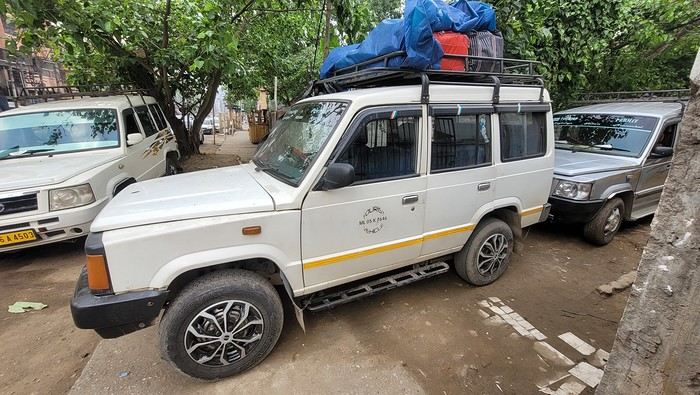
While waiting, I watch the street come to life. I have fun photographing the different modes of transport passing by.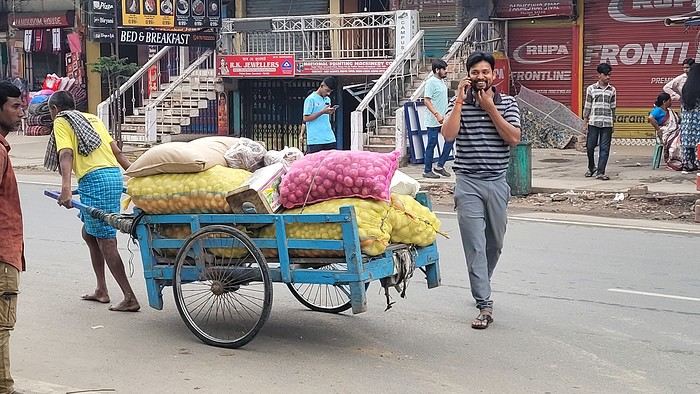
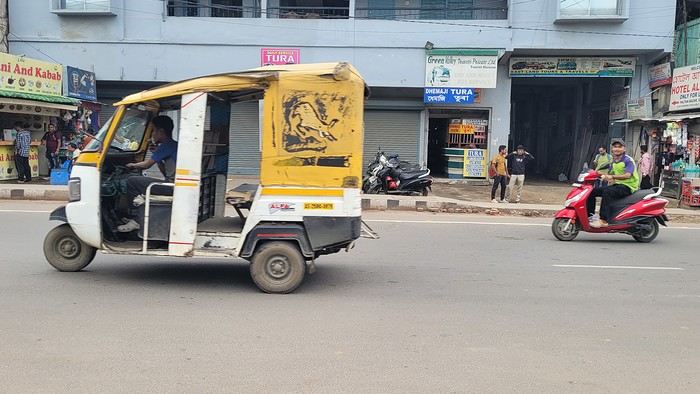
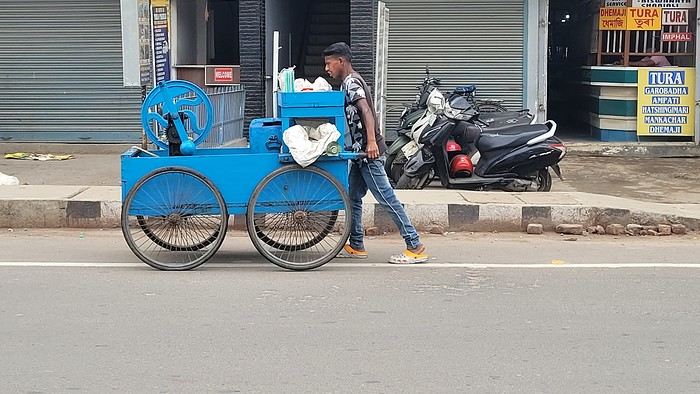
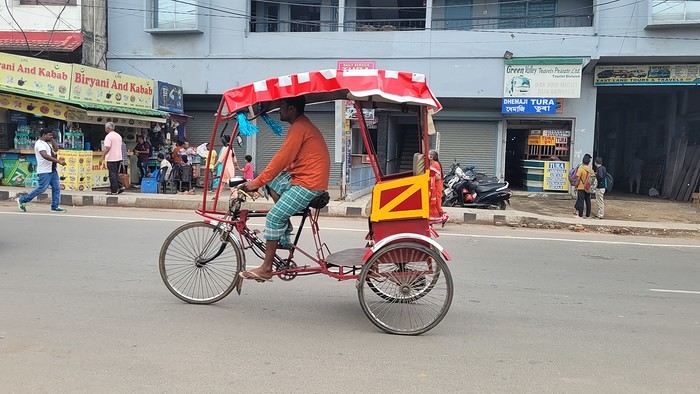
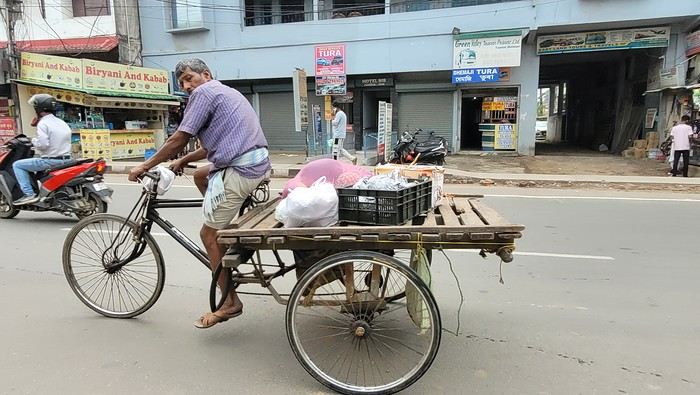
Time passes faster when you’re occupied. We leave at 8:20 AM, and the driver does door-to-door service along the way. We make our first stop for 25 minutes at 9:10 AM, then another for breakfast at 10:10 AM. The scenery is very different from Assam and Nagaland. We drive alongside a pine forest and a large lake. There are beautiful viewpoints, but the driver isn’t stopping for sightseeing, so I have to settle for looking through the car windows.
We finally arrive in Shillong at 11:45 AM. The driver stops in the middle of nowhere, so I have to walk up the street to find a taxi. I flag one down, and he agrees to take me to my new guesthouse, the Rockski Boutique Bed & Breakfast. No sooner do I arrive than a storm with a heavy downpour welcomes me. When I arrived in Guwahati at the end of October, I’d booked a guide with a car for this week. There’s no public transport to get from village to village, so I had to take a car to visit. The tourism manager, Sachin, sent me a message to let me know that the driver, Welbis, will pick me up tomorrow morning at 8 AM. The temperature is much cooler here—only 19°C. At 2:30 PM, the rain stops, and I take the opportunity to explore the city. I start with the cathedral. Today is Good Friday, so I’m going to see how it’s celebrated here. Meghalaya is a Catholic state. The cathedral isn’t far from the guesthouse—it’s huge and all blue.
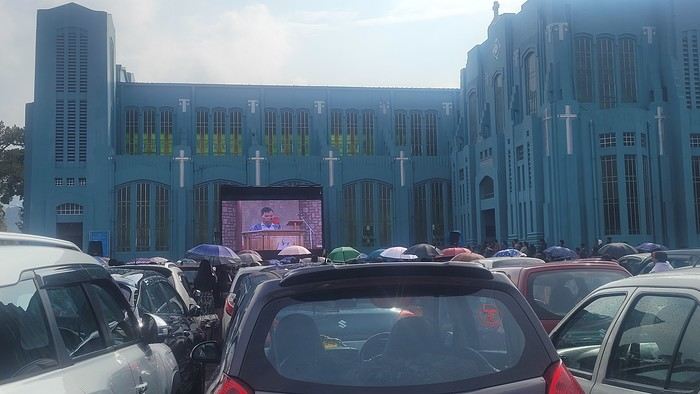
I arrive during mass, and it’s impossible to enter—the faithful are numerous outside in the parking lot. Giant screens broadcast the ceremony.

While waiting, I watch the street come to life. I have fun photographing the different modes of transport passing by.
Time passes faster when you’re occupied. We leave at 8:20 AM, and the driver does door-to-door service along the way. We make our first stop for 25 minutes at 9:10 AM, then another for breakfast at 10:10 AM. The scenery is very different from Assam and Nagaland. We drive alongside a pine forest and a large lake. There are beautiful viewpoints, but the driver isn’t stopping for sightseeing, so I have to settle for looking through the car windows.
We finally arrive in Shillong at 11:45 AM. The driver stops in the middle of nowhere, so I have to walk up the street to find a taxi. I flag one down, and he agrees to take me to my new guesthouse, the Rockski Boutique Bed & Breakfast. No sooner do I arrive than a storm with a heavy downpour welcomes me. When I arrived in Guwahati at the end of October, I’d booked a guide with a car for this week. There’s no public transport to get from village to village, so I had to take a car to visit. The tourism manager, Sachin, sent me a message to let me know that the driver, Welbis, will pick me up tomorrow morning at 8 AM. The temperature is much cooler here—only 19°C. At 2:30 PM, the rain stops, and I take the opportunity to explore the city. I start with the cathedral. Today is Good Friday, so I’m going to see how it’s celebrated here. Meghalaya is a Catholic state. The cathedral isn’t far from the guesthouse—it’s huge and all blue.
I arrive during mass, and it’s impossible to enter—the faithful are numerous outside in the parking lot. Giant screens broadcast the ceremony.
Hi there! Next October, I’m planning a family trip to Kerala (4 adults and 2 kids) and I’m looking for a car with a driver for this 2-week journey.
Hi there,
A friend and I are planning to visit Northern India from March 3rd to March 25th. We’ll arrive in New Delhi, then take a night train to Bikaner, Bikaner to Jaisalmer (train) Jaisalmer to Jodhpur (train) Jodhpur to Udaipur (car) Udaipur to Bundi (train) Bundi to Jaipur (train/bus) Jaipur to Agra by train Agra to Varanasi and return from Varanasi to Delhi by night train
We’re planning to stay 1 or 2 days in each city. This itinerary was recommended by a guide my friend has been talking to—what do you think?
It’s our first time in Northern India. I’ve only been to Southern India before—Pondicherry for 10 days about 10 years ago—so it’s nothing like the North. Thanks!
A friend and I are planning to visit Northern India from March 3rd to March 25th. We’ll arrive in New Delhi, then take a night train to Bikaner, Bikaner to Jaisalmer (train) Jaisalmer to Jodhpur (train) Jodhpur to Udaipur (car) Udaipur to Bundi (train) Bundi to Jaipur (train/bus) Jaipur to Agra by train Agra to Varanasi and return from Varanasi to Delhi by night train
We’re planning to stay 1 or 2 days in each city. This itinerary was recommended by a guide my friend has been talking to—what do you think?
It’s our first time in Northern India. I’ve only been to Southern India before—Pondicherry for 10 days about 10 years ago—so it’s nothing like the North. Thanks!
Exploring India by road is all about having a good driver. I highly recommend the one I’ve traveled with for 5 "safe" trips—Rajasthan 3 times over 16 years, Gujarat, Himachal Pradesh, and Punjab. He’s been driving tourists for 25 years now and is more than just a driver. He knows how to talk about his country, the cities you visit, and suggests alternative routes.
He’s well-connected with real local guides who don’t just ramble (as he puts it himself) or drag you into shops claiming to be run by their "so-called family." Depending on your preferences, he can suggest well-tested itineraries and recommend typical hotels like Havelis.
For dining, he oversees meal prep based on your spice-level preferences. He’s Sikh and deeply respectful of his passengers.
He speaks English better than French, but one of his daughters is studying French at university.
DM me if you’d like his contact details.
Happy travels!
He’s well-connected with real local guides who don’t just ramble (as he puts it himself) or drag you into shops claiming to be run by their "so-called family." Depending on your preferences, he can suggest well-tested itineraries and recommend typical hotels like Havelis.
For dining, he oversees meal prep based on your spice-level preferences. He’s Sikh and deeply respectful of his passengers.
He speaks English better than French, but one of his daughters is studying French at university.
DM me if you’d like his contact details.
Happy travels!
hi there
I’m planning a trip to Rajasthan in January, and after some research on VF, I’ve decided to go with a car rental with a driver.
I’ve looked at several agencies and gotten some quotes.
Is it better to book the accommodations through them as well?
Thanks for your advice!
kenavo
Hello!
We're a family of 4—3 adults and a 14-year-old. We're seasoned travelers with a passion for science, culture, and history. In short, we love discovering and learning.
We'll be in India for 3 weeks, from December 11, 2026 (in Goa) to January 3, 2027 (in Thiruvananthapuram).
We're looking for one or more drivers to handle the journey and guides who speak clear, fluent English, French, or Spanish. We'd love guides who are knowledgeable, passionate about their region, and able to answer our countless questions while giving us in-depth insights into the places, rituals, culture, and more.
Do you know of such guides or drivers, or have any tips on how to find people who can help us create unforgettable memories?
Thank you so much in advance!
Cat
hello fellow travelers
For my golden years, I'd like to drive to India in my 508. I want to avoid Iran and Pakistan. Instead, I’m thinking of going through Turkey, Georgia, Armenia, Azerbaijan, then taking the ferry from Baku to Türkmenbaşy in Turkmenistan, followed by the Silk Road through Central Asia—Uzbekistan and Kyrgyzstan.
After that, China? I’ve seen that some travelers manage to drive through China with their own vehicle... Then Tibet, Nepal, and India... But things get tricky with the Himalayan crossing. I’ve checked on Google—it looks tough.
Any tips or info on these routes? Thanks
After that, China? I’ve seen that some travelers manage to drive through China with their own vehicle... Then Tibet, Nepal, and India... But things get tricky with the Himalayan crossing. I’ve checked on Google—it looks tough.
Any tips or info on these routes? Thanks
Hi everyone! 🙂
My partner (who’s a teacher—hence the summer holidays) and I are heading to Eastern India for 23 days in July. This is my 5th trip to India, but her first.
We fly into Delhi on July 7th and leave from Delhi on the 23rd (since our flight to Kolkata arrived late at night, and I wanted to show Agra and Varanasi to my partner).
We love getting off the beaten track and meeting people, so we’ll mostly be taking the train.
Here’s what we’re planning:
- **DELHI**: 1 night on the way (short because the plane is supposed to land at 01:55), then we take the train at 13:00 - **GWALIOR**: 3 nights, including a day trip to **AGRA** by train to see the Taj Mahal and the Red Fort (I find Agra too touristy to stay overnight). Otherwise, in Gwalior, the Fort, the temples, the Man Mandir Palace, and the Jai Vilas Palace if we have time. - **ORCHHA**: 2 nights... *maybe skip this to spend more time in VARANASI?* - **VARANASI**: overnight train + 3 nights, the Ghats, temples... maybe a day trip to **SARNATH**. - **KOLKATA**: overnight train + 3 nights. Maybe a countryside excursion to the ashram in Channa. *- Here we’re hesitating over 2 nights: either 2 nights in **SHANTINIKETAN** with a visit to **CHANNA** on the way, or a 2-day excursion to the **SUNDARBAN** nature park. But is it worth it in July during the monsoon?* - **PURI**: overnight train + 4 nights. *We’re planning to do everything from Puri, as it seems nicer than staying in BHUBANESWAR. What do you think?* Visit **KONARK** and **CHILIKA LAKE**. *Is it worth visiting Chilika Lake this season? Another question: can you swim in Puri, or is it too dangerous (waves)?* - Train to **BHUBANESWAR**, then a flight from BHUBANESWAR to **DELHI**, - 2 nights in **DELHI**, visiting Jama Masjid, and *either Humayun’s Tomb, Safdarjung’s Tomb, or Qutb Minar.*
Back to Paris. Total: 23 nights.
What do you think of these choices? What about the options we’re still unsure about *(in bold/italics)*? Thanks so much! 🙂
We fly into Delhi on July 7th and leave from Delhi on the 23rd (since our flight to Kolkata arrived late at night, and I wanted to show Agra and Varanasi to my partner).
We love getting off the beaten track and meeting people, so we’ll mostly be taking the train.
Here’s what we’re planning:
- **DELHI**: 1 night on the way (short because the plane is supposed to land at 01:55), then we take the train at 13:00 - **GWALIOR**: 3 nights, including a day trip to **AGRA** by train to see the Taj Mahal and the Red Fort (I find Agra too touristy to stay overnight). Otherwise, in Gwalior, the Fort, the temples, the Man Mandir Palace, and the Jai Vilas Palace if we have time. - **ORCHHA**: 2 nights... *maybe skip this to spend more time in VARANASI?* - **VARANASI**: overnight train + 3 nights, the Ghats, temples... maybe a day trip to **SARNATH**. - **KOLKATA**: overnight train + 3 nights. Maybe a countryside excursion to the ashram in Channa. *- Here we’re hesitating over 2 nights: either 2 nights in **SHANTINIKETAN** with a visit to **CHANNA** on the way, or a 2-day excursion to the **SUNDARBAN** nature park. But is it worth it in July during the monsoon?* - **PURI**: overnight train + 4 nights. *We’re planning to do everything from Puri, as it seems nicer than staying in BHUBANESWAR. What do you think?* Visit **KONARK** and **CHILIKA LAKE**. *Is it worth visiting Chilika Lake this season? Another question: can you swim in Puri, or is it too dangerous (waves)?* - Train to **BHUBANESWAR**, then a flight from BHUBANESWAR to **DELHI**, - 2 nights in **DELHI**, visiting Jama Masjid, and *either Humayun’s Tomb, Safdarjung’s Tomb, or Qutb Minar.*
Back to Paris. Total: 23 nights.
What do you think of these choices? What about the options we’re still unsure about *(in bold/italics)*? Thanks so much! 🙂
For those planning a trip to Kerala, here’s a quick, practical summary.
For the most part: the stunning landscapes, the natural kindness of the locals, their cuisine, and their culture—you’ll get to enjoy all of that once you’re there...
Flight (arrival and departure to/from Cochin)
Avoid Air India and opt for flights via the Middle East: Saudi Arabia, Qatar, United Arab Emirates, Oman, etc.
Price: between 500 € and 600 €
Accommodations
Average price: 20 € per night for a couple (max: 40 €, min: 10 €, often including breakfast), via the usual booking sites.
Homestays (staying in the owner’s house) are of a higher standard.
Only 2 nights were spent in questionable cleanliness. The rest were good, even very good, or even *very* very good.
Car with Driver
All-inclusive daily price: tolls, fuel, driver’s lodging and meals... and of course, we often shared our meals with our driver too.
Toyota sedan (e.g., Corolla) for 4 travelers (1 in front, 3 in the back): 50 € / day,
Toyota SUV (e.g., Innova) for up to 6 travelers: 60 € / day
DM me if you’d like more details.
Overall budget (excluding flights and shopping) Around 1500 € for 1 couple for the 3 weeks... in "2-couple mode"! (i.e., sharing the driver’s cost). Itinerary
Night 1: Arrival in Cochin in the morning, departure for Attirappily Beautiful waterfalls
Night 2: Thrissur Via Vallachira, not much tourist interest, a stop to ease into the trip and shorten the journey to Wayanad
Nights 3, 4, 5: Wayanad, staying in Sultan Battery Coffee and tea plantations, dam lake, URAVU (bamboo craft workshop), ...
Night 6: Ooty Botanical garden, then a really fun tourist train the next afternoon to Metupalaiyam
Night 7: Toward Coimbatore
Nights 8, 9, 10: Munnar City visit, stunning tea plantations
Nights 11, 12: Thekkady/Kumilly Amazing tea plantations, sightseeing, Jeep ride, not-so-interesting boat tour on Periyar Lake, trekking options
Night 13: Marari Beach (near Alleppey) 4-hour backwaters tour, then beach (swimming, dinner)
Nights 14, 15, 16: Munroe Island Super chill, walks around the island (small coir rope factory), sunrise by boat or canoe, sunset
Night 17: Varkala Gorgeous beaches, shopping
Night 18: Trivandrum City center visit, then train back to Cochin the next day in 3 hours.
Night 19: Cochin Fort Kochi is a lovely way to wrap up the trip
Have a great trip in this incredible region, so unique in India!
Overall budget (excluding flights and shopping) Around 1500 € for 1 couple for the 3 weeks... in "2-couple mode"! (i.e., sharing the driver’s cost). Itinerary
Night 1: Arrival in Cochin in the morning, departure for Attirappily Beautiful waterfalls
Night 2: Thrissur Via Vallachira, not much tourist interest, a stop to ease into the trip and shorten the journey to Wayanad
Nights 3, 4, 5: Wayanad, staying in Sultan Battery Coffee and tea plantations, dam lake, URAVU (bamboo craft workshop), ...
Night 6: Ooty Botanical garden, then a really fun tourist train the next afternoon to Metupalaiyam
Night 7: Toward Coimbatore
Nights 8, 9, 10: Munnar City visit, stunning tea plantations
Nights 11, 12: Thekkady/Kumilly Amazing tea plantations, sightseeing, Jeep ride, not-so-interesting boat tour on Periyar Lake, trekking options
Night 13: Marari Beach (near Alleppey) 4-hour backwaters tour, then beach (swimming, dinner)
Nights 14, 15, 16: Munroe Island Super chill, walks around the island (small coir rope factory), sunrise by boat or canoe, sunset
Night 17: Varkala Gorgeous beaches, shopping
Night 18: Trivandrum City center visit, then train back to Cochin the next day in 3 hours.
Night 19: Cochin Fort Kochi is a lovely way to wrap up the trip
Have a great trip in this incredible region, so unique in India!
Why a local expert will never give you the same trip
Type “Kerala trip 15 days” into a search engine, or ask an AI for advice.
Here’s what you’ll get:
“Day 1: Cochin. Day 3: Munnar. Day 6: Thekkady. Day 9: Backwaters. Day 11: Beach.”
A perfectly polished itinerary, calibrated, with no wrong notes.
And completely interchangeable: whether you’re Pierre, Marie, or a group of 40 people, it’s the same copy-paste.
Smooth, safe, marketable... and devoid of meaning.
That’s what we call automated travel.
It “works,” yes.
But it doesn’t resonate.
Kerala from a brochure: when the dream becomes a product Munnar, Periyar, Alleppey, Marari... Exotic names lined up like on a TV show. Buses drop you off, photos follow one after another, the backwaters suffocate under engines and waste. Even Ayurveda is sold à la carte—“60-minute massage” instead of “a path to healing.” This is consumed Kerala, the one that promises “authenticity” but destroys what it claims to admire. And it’s not the travelers’ fault. It’s the system’s fault: cloned, standardized offers, disconnected from the ground.
What if? What if, instead of following the well-trodden paths, we dared to open another map of Kerala? A Kerala that’s quieter, greener, more human. Villages in the hills of Wayanad, tea plantations where leaves are still hand-picked, families who cook Ayurveda daily, markets where no one thinks of “Instagram.” There’s also Vagamon, Munroe Island, Athirappally, and so many others. This Kerala isn’t found in brochures or in the automated responses of forums or AIs. It’s discovered in slowness, in exchange, in connection.
I used to plan my trips to India myself, searching for authentic experiences. Then I realized that sometimes, you need to be accompanied—not to be guided, but to be introduced. Because a good local expert doesn’t impose an itinerary: they open doors. So I decided to become that travel facilitator—the one I was looking for. Because the India I’ve lived in daily for 25 years, I don’t want to reduce it to an AI. I’m Véro. And I’m available if you’d like to ask me questions. Photo credit: Frédéric Soltan
Kerala from a brochure: when the dream becomes a product Munnar, Periyar, Alleppey, Marari... Exotic names lined up like on a TV show. Buses drop you off, photos follow one after another, the backwaters suffocate under engines and waste. Even Ayurveda is sold à la carte—“60-minute massage” instead of “a path to healing.” This is consumed Kerala, the one that promises “authenticity” but destroys what it claims to admire. And it’s not the travelers’ fault. It’s the system’s fault: cloned, standardized offers, disconnected from the ground.
What if? What if, instead of following the well-trodden paths, we dared to open another map of Kerala? A Kerala that’s quieter, greener, more human. Villages in the hills of Wayanad, tea plantations where leaves are still hand-picked, families who cook Ayurveda daily, markets where no one thinks of “Instagram.” There’s also Vagamon, Munroe Island, Athirappally, and so many others. This Kerala isn’t found in brochures or in the automated responses of forums or AIs. It’s discovered in slowness, in exchange, in connection.
I used to plan my trips to India myself, searching for authentic experiences. Then I realized that sometimes, you need to be accompanied—not to be guided, but to be introduced. Because a good local expert doesn’t impose an itinerary: they open doors. So I decided to become that travel facilitator—the one I was looking for. Because the India I’ve lived in daily for 25 years, I don’t want to reduce it to an AI. I’m Véro. And I’m available if you’d like to ask me questions. Photo credit: Frédéric Soltan
Hello,
We recently went to Rajasthan.
For the duration, I’d recommend about 3 weeks if you can, so you can explore the region at a relaxed pace.
We also wanted to experience "the real Indian life," and our driver showed us small markets, little temples, and his village near Ranakpur in the Marwar region.
For your info, here are some hotels where we stayed—there’s a huge hotel scene in Rajasthan. No need to book in advance; day by day works really well. You arrive, visit, and if you don’t like it, you just move on—it’s no problem in India. No upfront payment, and you can even negotiate on the spot with this approach, which gives you flexibility with your itinerary.
Here are some hotels we stayed at:
Madhuban in Jaipur (Haveli house) and also in Jaipur, the Khandela Haveli, which we preferred
In Jodhpur, the Kuchaman Haveli
In Ranakpur (Ranakpur Hill Resort) with a great pool
Bikaner: Hotel Laxmi Niwas
Udaipur: Hotel Savroopvilas
Jaisalmer: Hotel Rang Mahal
Here’s the itinerary we followed over nearly three weeks:
1 - When we arrived in Delhi, we headed straight north to Nawalgarh and Mandawa (towns with Havelis = painted houses). Along the way, we stopped in Jhunjhunu to see the Rani Sati Temple. We slept in Mandawa (we arrived in the evening and explored the next morning).
2 - Then we drove to Bikaner (Junagarh Fort, but if you have to choose, the forts in Jodhpur and Jaipur are more interesting in our opinion). After that, we took the road to Deshnoke (temple with sacred rats) and before that, we saw a small temple on the way with white rats. In Deshnoke, the rats move freely among people. We’re not too squeamish, so it was fine. Anyway, it was interesting to see.
3 - Next, we headed to Pushkar, where we took a camel ride (you have to negotiate the price; it varies depending on the camel’s quality, the saddle, and its decoration). One to two hours is more than enough. There’s always someone riding with you on the camel (at least that’s how it was for us). There are also things to see along the way.
4 - From Pushkar, we went to Jodhpur (Mehrangarh Fort, Clock Tower, Jaswant Thada). From Jodhpur, we visited villages (including our driver’s village, which was ideal for connecting with locals, having tea, and exploring the village with part of the community tagging along—I think we went into almost every house). We also did a train safari in the hills. Then Ranakpur (splendid Jain temple, Adinath Temple). With a bit of luck, you might spot Raikas, nomadic herders. Then Kumbhalgarh Fort, and after that, Udaipur. Along the way, we spent the night in a very small town called Jojawar at the Rawla Jojawar hotel, owned by the former Maharaja. A wonderful memory.
5 - In Udaipur (City Palace; Monsoon Palace = depends on the weather—if it’s not clear, you won’t see much, but if it is, the view is stunning).
6 - On the way to Jaipur: Sas-Bahu Temple; then in Jaipur: City Palace, Jantar Mantar, Hawa Mahal (Palace of the Winds), the Hanuman Temple, etc.
7 - Heading toward Agra, the Galta Valley with lots of monkeys. We finished with Fatehpur Sikri and then Agra. Agra is *very* touristy, so people are less friendly and can be pushy about selling things or offering their services as guides. You have to stay polite but firm and not let them sweet-talk you. Hotels are also pricier and there’s not always much choice. For the Taj Mahal (closed on Fridays), go very early in the morning when it opens. It’s best to arrive the evening before and spend the night at a hotel before visiting. Inside the Taj Mahal site, it’s already calmer. After that, we visited Akbar’s mausoleum (in Sikandra, near Agra) and the so-called "Baby Taj" (in Agra). For the Taj, I’ve heard they’re doing renovations, but it’s still a must-see.
8 - In Delhi, if you still have time, check out the Jama Masjid mosque and Mahatma Gandhi’s tomb. Also see Humayun’s Mausoleum (in the Nizamuddin East neighborhood).
In Jaisalmer (spend a night in the dunes after a camel ride), Chittorgarh, Bundi, Ranthambore Park, Orchha, and Khajuraho. Actually, you’ll have to make choices, or you’ll spend your whole vacation traveling. The average driving speed is about 50–60 km/h.
Our other trips in India: Gujarat (we love it and have been twice), Himachal Pradesh, Punjab, and also Haridwar and Varanasi. In the south, Kerala, Tamil Nadu, and Karnataka.
In some cities, we visited with a local guide (about two hours), and some spoke French or English.
One last thing that comes to mind: if you go to Jaisalmer, check out Gadi Sagar Lake. Also worth seeing: the Demoiselle Cranes in Kichan, not far from Jodhpur. These are thousands of common cranes that migrate near the region’s lakes during the winter months. A beautiful ornithological spectacle. And Kichan or Keechan.
Happy trip planning!
Jean
Hi there, my husband and I are planning to visit the maharajas' palaces in Rajasthan in 2026. We're looking for a fairly long tour (10 days or more). Do you have any tips on which palaces to visit, cities and places to discover, the best tour operators, and the best time to go? Thanks in advance for your advice and recommendations!
Hi there,
I’m heading to Kerala in December. I’ve been searching without luck for air-conditioned buses, minivans—basically anything that’s not a bus without AC or windows, since my route from Cochin to Munnar is gonna be a long one and I don’t wanna struggle.
I checked around, and it’s crazy—you can’t find the name of a single private company, just overpriced transfers!
From what I can tell, it seems like there’s nothing but local buses… yet I went to Sri Lanka two years ago and there were plenty of options.
Thanks in advance for any tips! Caroline
I’m heading to Kerala in December. I’ve been searching without luck for air-conditioned buses, minivans—basically anything that’s not a bus without AC or windows, since my route from Cochin to Munnar is gonna be a long one and I don’t wanna struggle.
I checked around, and it’s crazy—you can’t find the name of a single private company, just overpriced transfers!
From what I can tell, it seems like there’s nothing but local buses… yet I went to Sri Lanka two years ago and there were plenty of options.
Thanks in advance for any tips! Caroline