Hello everyone,
My husband and I are planning a trip to Thailand from January 2 to 10.
Departure from Brussels on January 1 – arriving in Bangkok at 6:00 AM on January 2.
Departure from Bangkok on January 11 at 2:00 AM, arriving in Brussels at 1:25 PM the same day.
For professional and personal reasons, we can’t extend the trip.
I don’t plan on just lounging on a beach in Phuket, so with 9 days on the ground, I know it’s short... But having done this before in Hong Kong and Shanghai, I know it’s doable, refreshing, and enjoyable. We did it with the kids and included a 2- or 3-day stay at Disneyland in each city. Basically, we spent 5-6 days in each city.
Anyway, I’m reaching out because I’ve heard and read so many conflicting opinions that my head is spinning.
Following the saying, "don’t bite off more than you can chew," I’m assuming I should keep it simple.
So I’m torn between just Bangkok or Bangkok and Chiang Mai.
If I go with the second option, I’m debating whether to head straight to Chiang Mai on the day we arrive (but given the flight times, we’d lose pretty much the whole day) or spend two days in Bangkok first, then go to Chiang Mai for 3-4 days, and return to Bangkok.
Thanks for your advice!
Hi there,
As mentioned earlier, we're heading off for a month to explore some parts of Thailand in July/August, and I’ve got a few practical questions I’m hoping you can help with based on your experiences. Thanks in advance!
- Can you choose the denominations at exchange bureaus/ATMs? How do you avoid ending up with only 1000-baht notes when exchanging large sums? - If not, is there an easy way to get change? Any alternatives to buying stuff at 7-Eleven? - Can you buy train tickets from Thonburi to Kanchanaburi in advance? Is there usually space available, considering some people do the Death Railway day trip from Bangkok to Sai Yok Noi? - Is there room for luggage on the trains to Kanchanaburi? We’ll be traveling as a group of four with two large checked-baggage-sized suitcases (25 kg each). - Kanchanaburi: Most day tours allow around 3 hours at Erawan Falls. Is that enough, or is it worth spending the whole day there, especially at the start of the rainy season when it’s a bit greener? - In Sam Roi Yot, are there taxis/Grab/Bolt available for exploring the surrounding areas? I’d appreciate any numbers or addresses. - Does True (7-Eleven) have good coverage across Thailand, from Sam Roi Yot to Chiang Rai, or should we go with AIS? - In Bangkok, if you need to switch BTS lines, do you need a new ticket, or can you change lines as long as you don’t exit the station?
Happy to provide any additional details if needed.
- Can you choose the denominations at exchange bureaus/ATMs? How do you avoid ending up with only 1000-baht notes when exchanging large sums? - If not, is there an easy way to get change? Any alternatives to buying stuff at 7-Eleven? - Can you buy train tickets from Thonburi to Kanchanaburi in advance? Is there usually space available, considering some people do the Death Railway day trip from Bangkok to Sai Yok Noi? - Is there room for luggage on the trains to Kanchanaburi? We’ll be traveling as a group of four with two large checked-baggage-sized suitcases (25 kg each). - Kanchanaburi: Most day tours allow around 3 hours at Erawan Falls. Is that enough, or is it worth spending the whole day there, especially at the start of the rainy season when it’s a bit greener? - In Sam Roi Yot, are there taxis/Grab/Bolt available for exploring the surrounding areas? I’d appreciate any numbers or addresses. - Does True (7-Eleven) have good coverage across Thailand, from Sam Roi Yot to Chiang Rai, or should we go with AIS? - In Bangkok, if you need to switch BTS lines, do you need a new ticket, or can you change lines as long as you don’t exit the station?
Happy to provide any additional details if needed.
Hi everyone!
I’m heading back to Thailand in July 2026 with a stopover in Cambodia to visit the Angkor site.
After Angkor, I’ve booked a stay on Ko Chang island. Does anyone know if there are direct transport options from Cambodia to Ko Chang without having to go back through Bangkok? That would be amazing!!
I think there are, but I’d need more details!!
I went to Thailand in February 2025 and don’t remember having to apply for a visa—is that still the case now? And for Cambodia too?
Thanks so much!!!
Laurence from Bayonne
Hello,
Our flights are booked, and we’ll arrive in Thailand at the beginning of January.
Originally, we were supposed to spend 14 days there. But after booking the flights and seeing the prices, we’ll now be there for 20 days instead.
Our initial plan was: 2 days in Bangkok 1 day in Ayutthaya 4 days in Chiang Mai 6 days around Krabi
So we have 7 more days to fill. What do you recommend?
An extra day in Bangkok? Adding more days in the north? If so, where? Exploring another region, like Kanchanaburi or Cheow Lan Lake? Traveling north in stages instead of taking the overnight train?
A few extra details about us: For us, vacation isn’t about relaxation—we love walking, exploring, and packed days don’t bother us. Hiking for hours and doing active things is what makes us happy. That said, we also enjoy visiting villages and towns if they’re worth the detour. In Thailand, we’d like to visit temples too. We’re early risers, so our days tend to be long. 🙂 In short, we like to keep things moving during our trips. 😉
Unfortunately, seeing terraced rice fields isn’t possible in January. I read there are rice fields around Sukhothai. Are they green in January?
In the north, do you recommend Doi Inthanon, Huai Nam Dang, or Doi Chiang Dao National Parks? Which one is the most beautiful and best for January?
Our flights are booked, and we’ll arrive in Thailand at the beginning of January.
Originally, we were supposed to spend 14 days there. But after booking the flights and seeing the prices, we’ll now be there for 20 days instead.
Our initial plan was: 2 days in Bangkok 1 day in Ayutthaya 4 days in Chiang Mai 6 days around Krabi
So we have 7 more days to fill. What do you recommend?
An extra day in Bangkok? Adding more days in the north? If so, where? Exploring another region, like Kanchanaburi or Cheow Lan Lake? Traveling north in stages instead of taking the overnight train?
A few extra details about us: For us, vacation isn’t about relaxation—we love walking, exploring, and packed days don’t bother us. Hiking for hours and doing active things is what makes us happy. That said, we also enjoy visiting villages and towns if they’re worth the detour. In Thailand, we’d like to visit temples too. We’re early risers, so our days tend to be long. 🙂 In short, we like to keep things moving during our trips. 😉
Unfortunately, seeing terraced rice fields isn’t possible in January. I read there are rice fields around Sukhothai. Are they green in January?
In the north, do you recommend Doi Inthanon, Huai Nam Dang, or Doi Chiang Dao National Parks? Which one is the most beautiful and best for January?
Hi everyone,
I’m starting to plan my next trip to Southeast Asia this winter (2.5 months, leaving in early December), and here’s a rough outline of my route—I’d love to share it with you and hear your thoughts and tips.
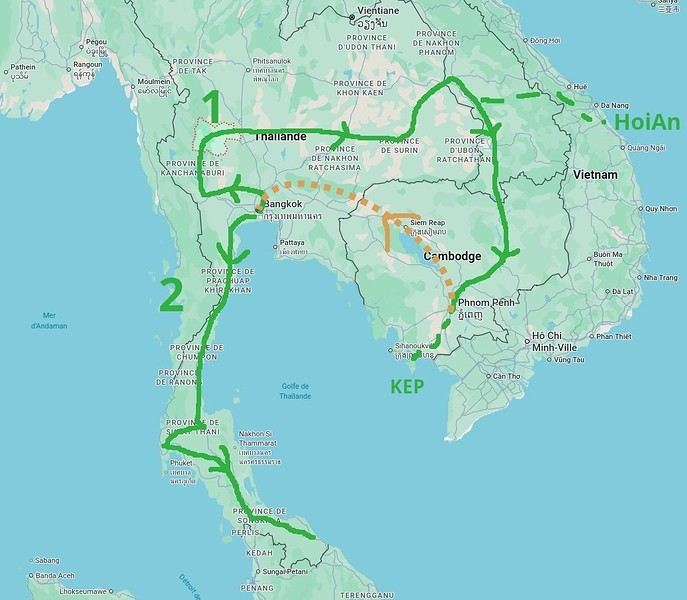
- I’ll start in Bangkok and already have three spots I’ve marked: Ayutthaya, Kanchanaburi, and Uthai Thani (I haven’t been to any of these places yet). - Next, I’d like to cross the country from west to east to reach the Laos border. I’d love suggestions for any interesting stops along this route—I don’t know this part of Thailand at all... - Then I’ll head into Laos, probably at Savannakhet (you can usually get a visa at the border). - > I’m tempted to spend a week in Hoi An, Vietnam, since I loved that city and the area when I visited two years ago. No visa needed for Vietnam now, so it could be a nice little detour. On the map, it doesn’t look too far, but I know you’ve got to be careful with these things, and I’m not sure if it’s a good idea. Any opinions on this? - Back to Laos (maybe via Dakta), and I’ll head south along the Mekong, probably doing the Bolaven Plateau loop that I missed last time. Then Paksé, the 4,000 Islands... I’ve been before, but I’d happily go back. - Crossing into Cambodia, I’ll follow the Mekong down to Phnom Penh (I know this area and love how untouristy it is). From there, I’ll probably spend a few days in Kep (quieter than Kampot). Still undecided, though. - Then back to Thailand (BKK), likely by plane from Phnom Penh since the borders between the two countries are currently closed (plus, let’s be honest, Cambodian roads... ;-). We’ll see how things look when the time comes. - After that, I’d like to explore southern Thailand, taking it slow with short hops. I’ve got my eye on Khao Sok National Park, and I’ve heard good things about Krabi... Again, I don’t know this region well, so any info or tips would be great.
So, I think this should be doable in 2.5 months, especially since I prefer short hops of 300 km max to avoid getting too tired, and I like staying 2-3 days in each place to explore. Plus, I’ll take a week off to relax if I find a spot I love—maybe by the sea for some real downtime.
Thanks for your feedback and for sharing your favorite spots! Pascal
- I’ll start in Bangkok and already have three spots I’ve marked: Ayutthaya, Kanchanaburi, and Uthai Thani (I haven’t been to any of these places yet). - Next, I’d like to cross the country from west to east to reach the Laos border. I’d love suggestions for any interesting stops along this route—I don’t know this part of Thailand at all... - Then I’ll head into Laos, probably at Savannakhet (you can usually get a visa at the border). - > I’m tempted to spend a week in Hoi An, Vietnam, since I loved that city and the area when I visited two years ago. No visa needed for Vietnam now, so it could be a nice little detour. On the map, it doesn’t look too far, but I know you’ve got to be careful with these things, and I’m not sure if it’s a good idea. Any opinions on this? - Back to Laos (maybe via Dakta), and I’ll head south along the Mekong, probably doing the Bolaven Plateau loop that I missed last time. Then Paksé, the 4,000 Islands... I’ve been before, but I’d happily go back. - Crossing into Cambodia, I’ll follow the Mekong down to Phnom Penh (I know this area and love how untouristy it is). From there, I’ll probably spend a few days in Kep (quieter than Kampot). Still undecided, though. - Then back to Thailand (BKK), likely by plane from Phnom Penh since the borders between the two countries are currently closed (plus, let’s be honest, Cambodian roads... ;-). We’ll see how things look when the time comes. - After that, I’d like to explore southern Thailand, taking it slow with short hops. I’ve got my eye on Khao Sok National Park, and I’ve heard good things about Krabi... Again, I don’t know this region well, so any info or tips would be great.
So, I think this should be doable in 2.5 months, especially since I prefer short hops of 300 km max to avoid getting too tired, and I like staying 2-3 days in each place to explore. Plus, I’ll take a week off to relax if I find a spot I love—maybe by the sea for some real downtime.
Thanks for your feedback and for sharing your favorite spots! Pascal
Hello everyone,
Not long ago, I used to travel as a couple, but my husband has since passed away, and I’ve decided to set off again. The trip I took to Cambodia in January 2025 did me a world of good.
I’m now considering Thailand, a destination we never included in our plans because even 15 years ago, people said it was too touristy. Still, I’m thinking about the itinerary below, but I don’t feel up to arranging buses, trains, or guides on my own while I’m there. I’m looking for one or more drivers and have been in touch with an agency, but their offers are just copy-paste group tours that I don’t want.
So, if you have any contacts, experiences, or advice, I’d be so grateful if you’d share them with me. Here’s my rough plan:
Arrival in Bangkok
Ayutthaya (2 nights)
Kanchanaburi (2 or 3 nights)
Sangkhlaburi/Sai Yok (3 nights)
Sukhothai (2 nights)
Lampang (I’ve planned 3 nights, but that might be a bit much—it depends on what time I arrive in the city)
Chiang Mai
Chiang Dao
Pai
Chiang Rai
I was thinking about the Mae Hong Son loop—thoughts?
What do you think about staying overnight at the Golden Triangle?
When I look online, of course, I can find agencies that organize tours to national parks, etc.
I’m retired but in great physical shape. I’d rather go hiking than sit in hot springs with crowds of tourists who’ve all arranged meet-ups. I don’t want to spend a day at an elephant camp, and I don’t want to visit Karen villages.
I’d love to hear your advice.
Thank you all,
Hi there,
I’m finally planning to spend 9 days/9 nights in Chiang Rai. What’s the best area to stay in?
Do you know any interesting spots within a 50–60 km radius? Preferably ones that aren’t overrun by mass tourism (sorry about that).
Thanks!
Joël—I’m reading your latest travel journal on this region...😉
Hi everyone,
We’re planning our second trip to Thailand (2 weeks on-site, late April/early May) as a family with our 5- and 7-year-olds.
On our first trip, we visited Bangkok, Ayutthaya, the River Kwai, Koh Lipe, Koh Phi Phi, and Khao Lak. We especially loved Koh Phi Phi for its limestone cliffs and lush vegetation, as well as Koh Lipe for its crystal-clear waters and snorkeling.
This time, I’m thinking of spending 7 days on the islands. I was considering Koh Tao and Koh Phangan. We’d like some scenery, snorkeling right from the beach, and a bit of atmosphere—but not too much (just enough to grab dinner in the evening).
For the other part of the trip, we’re torn between Chiang Mai and Khao Sok. One or the other… or both? We don’t want to rush, but we’re really nature-focused, so we won’t be hitting too many temples…
Thanks in advance for your tips and experiences!
We’re planning our second trip to Thailand (2 weeks on-site, late April/early May) as a family with our 5- and 7-year-olds.
On our first trip, we visited Bangkok, Ayutthaya, the River Kwai, Koh Lipe, Koh Phi Phi, and Khao Lak. We especially loved Koh Phi Phi for its limestone cliffs and lush vegetation, as well as Koh Lipe for its crystal-clear waters and snorkeling.
This time, I’m thinking of spending 7 days on the islands. I was considering Koh Tao and Koh Phangan. We’d like some scenery, snorkeling right from the beach, and a bit of atmosphere—but not too much (just enough to grab dinner in the evening).
For the other part of the trip, we’re torn between Chiang Mai and Khao Sok. One or the other… or both? We don’t want to rush, but we’re really nature-focused, so we won’t be hitting too many temples…
Thanks in advance for your tips and experiences!
Hi there,
we’ll be in Mai Chau in June and we’re thinking of heading to Sapa, but first spending a few days in Bac Ha to do some hiking and explore the area.
Is this a good idea for those who’ve been there?
How do you get there?
Thanks for your feedback.
Looking forward to hearing from you.
Cédric.
Hi,
I’m heading to Thailand for the first time in early 2026 and I’m really struggling to pick a neighborhood to stay in Bangkok. Apart from being close to public transport (metro, skytrain, BRT), I’m torn between several areas. I don’t mind using public transport or walking long distances, but if every trip takes 45 minutes or an hour, it’ll quickly become a hassle given our relatively short time there.
We’ll be in Bangkok twice during our trip: first for a “short” 2-night stopover (arriving from France in the mid-afternoon, then leaving the day after next for southern Thailand by plane), and then again for 3 nights before flying back to France (arriving at the airport in the late afternoon, 3 nights there, then departing for France in the late morning).
I’ve seen so many different recommendations that I’m having a hard time deciding. I’ve read that staying near the river is great for sightseeing, and that taking the boat to get around is really pleasant. But I’m worried about being a bit isolated for evening outings (eating at a cheap little restaurant, having a drink—nothing too wild!).
Chinatown is tempting for the food—it looks amazing—and it doesn’t seem too far from the main sights with public transport. But I’ve read that it’s very noisy because it’s super touristy and there’s constant truck traffic. My friend isn’t thrilled about it, especially since another neighborhood interests her because she has a great discount at a hotel near Victory Monument/Phaya Thai (the Pullman hotel). Even though it’s close to public transport, I’ve seen that it’s mostly a shopping district? And even with transport, isn’t it a long trip to visit places like the Grand Palace?
We also had a plan to stay at an ibis near BTS Nana station in the Sukhumvit area, but again, I get the feeling it’s mostly a shopping district?
Anyway, I’d love to hear your thoughts because I’m really torn!
It’s also true that I haven’t really planned our Bangkok stays yet. I’d like to do the “classic” tourist sights like the Grand Palace and eat really well! Someone told me that the big shopping malls also have amazing food 🙂
Thanks for your input!
We’ll be in Bangkok twice during our trip: first for a “short” 2-night stopover (arriving from France in the mid-afternoon, then leaving the day after next for southern Thailand by plane), and then again for 3 nights before flying back to France (arriving at the airport in the late afternoon, 3 nights there, then departing for France in the late morning).
I’ve seen so many different recommendations that I’m having a hard time deciding. I’ve read that staying near the river is great for sightseeing, and that taking the boat to get around is really pleasant. But I’m worried about being a bit isolated for evening outings (eating at a cheap little restaurant, having a drink—nothing too wild!).
Chinatown is tempting for the food—it looks amazing—and it doesn’t seem too far from the main sights with public transport. But I’ve read that it’s very noisy because it’s super touristy and there’s constant truck traffic. My friend isn’t thrilled about it, especially since another neighborhood interests her because she has a great discount at a hotel near Victory Monument/Phaya Thai (the Pullman hotel). Even though it’s close to public transport, I’ve seen that it’s mostly a shopping district? And even with transport, isn’t it a long trip to visit places like the Grand Palace?
We also had a plan to stay at an ibis near BTS Nana station in the Sukhumvit area, but again, I get the feeling it’s mostly a shopping district?
Anyway, I’d love to hear your thoughts because I’m really torn!
It’s also true that I haven’t really planned our Bangkok stays yet. I’d like to do the “classic” tourist sights like the Grand Palace and eat really well! Someone told me that the big shopping malls also have amazing food 🙂
Thanks for your input!
So, my flight tickets have just been booked for a trip to Cambodia from November 4th to 27th, 2025.
I’ll be traveling solo and want to explore this amazing country while getting a bit off the beaten path.
I’m arriving in Phnom Penh and also departing from Phnom Penh.
My goal is to travel as much as possible by bus and scooter.
What itinerary would you recommend?
What are the must-do things?
I’m open to all tips and info.
Thanks in advance for your help and responses.
hi there
we’ll arrive in Luang Prabang on November 8th from Bangkok and plan to leave from Vientiane on November 19th.
Little question—we’d love to visit northern Laos, but I can’t do mountain walks or climbing. My partner can, though. What do you recommend for us?
Thanks for your tips!
Best,
Monique
Hi there,
What are the transport options for getting from KL to Taman Negara National Park, please?
Where can I book the transport?
Thanks for your help! 😊
What are the transport options for getting from KL to Taman Negara National Park, please?
Where can I book the transport?
Thanks for your help! 😊
Hi there,
The round trip to Bangkok is almost booked.
Here’s the itinerary I’ve planned for this new trip to Thailand:
Arrival – 2 nights in Bangkok (any hotel recommendations? Very quiet, near Chinatown or by the river)
Train or taxi (which app should I use for Thailand?) to Phetchaburi – 2 nights (any hotel recommendations?)
Daytime train to Surat Thani – 1 night there (any hotel recommendations?)
Pick up the rental car and head to Khao Sok – 1 night there (any hotel recommendations?)
Drive to Ko Kho Khao – 3 nights – relaxation (any hotel recommendations?)
Drive to Phang Nga Bay – 1 night (any base recommendations?)
Excursion in the bay, then drive to Krabi – 2 nights (any hotel recommendations) or any other spot with beautiful, quiet beaches that you might know?
Return to Surat Thani – overnight train to Bangkok, then Ayutthaya (any hotel recommendations?)
Visit the site and transfer to the airport – sniff, time to head back!
If you have other suggestions, keeping in mind the trip’s vibe: beach time without crowds or entertainment, a bit of nature, a bit of culture, no stress... No domestic flights and charming accommodations (not at 150 € per night, even though the budget is reasonable!)
Not sure I’ll follow them all, but all your ideas are welcome! 😉
Thanks. 🙂
The round trip to Bangkok is almost booked.
Here’s the itinerary I’ve planned for this new trip to Thailand:
Arrival – 2 nights in Bangkok (any hotel recommendations? Very quiet, near Chinatown or by the river)
Train or taxi (which app should I use for Thailand?) to Phetchaburi – 2 nights (any hotel recommendations?)
Daytime train to Surat Thani – 1 night there (any hotel recommendations?)
Pick up the rental car and head to Khao Sok – 1 night there (any hotel recommendations?)
Drive to Ko Kho Khao – 3 nights – relaxation (any hotel recommendations?)
Drive to Phang Nga Bay – 1 night (any base recommendations?)
Excursion in the bay, then drive to Krabi – 2 nights (any hotel recommendations) or any other spot with beautiful, quiet beaches that you might know?
Return to Surat Thani – overnight train to Bangkok, then Ayutthaya (any hotel recommendations?)
Visit the site and transfer to the airport – sniff, time to head back!
If you have other suggestions, keeping in mind the trip’s vibe: beach time without crowds or entertainment, a bit of nature, a bit of culture, no stress... No domestic flights and charming accommodations (not at 150 € per night, even though the budget is reasonable!)
Not sure I’ll follow them all, but all your ideas are welcome! 😉
Thanks. 🙂
Hello.
In 1996, we crossed Vietnam from Saigon to Hanoi by motorbike—Minsk bikes we bought in Saigon. I haven’t been back since, and it seems like a lot has changed.
- We’re heading to the south (well, the north and center) with the family in July-August (3 people).
- Is the road network more developed now? Back then, there was only National Route 1 from south to north. I’m thinking of renting a car this time (no motorbike with the family—though in ’96, they had a Jawa sidecar for sale, and we hesitated… maybe it’s for the best).
- Is Halong Bay really something to avoid because of overtourism? Even back then, it was pretty crowded. Is there a less touristy alternative?
- We’ll be traveling from Hanoi down to Danang (the only city we didn’t stop in back in ’96). Even though it’s a bit overhyped in a Chinese-tourist kind of way (from what I’ve read), we’re only going for the beach—pure relaxation for 7 days. The beaches are stunning, and I know the South China Sea is warm like coffee.
- Then, we’ll visit Hoi An, where I stopped in ’96. It was already popular with backpackers back then, but no glowing boats or all the touristy fuss!
- After that, Hue, where I have great memories—it’s a beautiful city.
- And also the nature around Ninh Binh, followed by 2-3 days in Hanoi.
That’s the plan. I’d love to hear any tips to avoid mass tourism, and if anyone’s done this before: - Is it possible to rent a car in Danang and drop it off in Hanoi?
Thanks, and long live the Nam! !
- We’re heading to the south (well, the north and center) with the family in July-August (3 people).
- Is the road network more developed now? Back then, there was only National Route 1 from south to north. I’m thinking of renting a car this time (no motorbike with the family—though in ’96, they had a Jawa sidecar for sale, and we hesitated… maybe it’s for the best).
- Is Halong Bay really something to avoid because of overtourism? Even back then, it was pretty crowded. Is there a less touristy alternative?
- We’ll be traveling from Hanoi down to Danang (the only city we didn’t stop in back in ’96). Even though it’s a bit overhyped in a Chinese-tourist kind of way (from what I’ve read), we’re only going for the beach—pure relaxation for 7 days. The beaches are stunning, and I know the South China Sea is warm like coffee.
- Then, we’ll visit Hoi An, where I stopped in ’96. It was already popular with backpackers back then, but no glowing boats or all the touristy fuss!
- After that, Hue, where I have great memories—it’s a beautiful city.
- And also the nature around Ninh Binh, followed by 2-3 days in Hanoi.
That’s the plan. I’d love to hear any tips to avoid mass tourism, and if anyone’s done this before: - Is it possible to rent a car in Danang and drop it off in Hanoi?
Thanks, and long live the Nam! !
Hello!
We’re heading to Cambodia for a month in March. We’re planning to visit Phnom Penh, Battambang, Siem Reap, the Angkor temples, Kompong Luong, then head down to Kampot, Kep, and finish our trip on the islands of Koh Rong. Has anyone done this trip recently?
Any great spots to recommend? Neighborhoods to stay in Phnom Penh (lively but not too touristy)?
Tips for getting around between the major cities—bus, train, boat, motorbike?
Thanks for all the advice!
Fabienne
Hello everyone!
First stop on our discovery of the peninsula: Amphawa. It’s our first night in Thailand (we arrived at Suvarnabhumi at 8:50 AM). Our initial plan was to explore the area before heading further south. The Mae Klong Railway Market is tempting... but what else is there to do???? We’ll be there on a Wednesday, and from what I’ve read on the forum, some say there’s absolutely nothing to do during the week—no floating market, barely any shops open, no restaurants, etc. Others, though, say the place is actually more charming without the weekend crowds.
Could you share your thoughts? Missing the floating market is one thing, but if it’s really a ghost town on Wednesdays, I might just drop our bags somewhere else. Amphawa seemed like a good first stop, just 1.5 hours from the airport, but I’d still like to settle somewhere a bit lively for our first evening. We’ll be there at the end of October. Thanks!
First stop on our discovery of the peninsula: Amphawa. It’s our first night in Thailand (we arrived at Suvarnabhumi at 8:50 AM). Our initial plan was to explore the area before heading further south. The Mae Klong Railway Market is tempting... but what else is there to do???? We’ll be there on a Wednesday, and from what I’ve read on the forum, some say there’s absolutely nothing to do during the week—no floating market, barely any shops open, no restaurants, etc. Others, though, say the place is actually more charming without the weekend crowds.
Could you share your thoughts? Missing the floating market is one thing, but if it’s really a ghost town on Wednesdays, I might just drop our bags somewhere else. Amphawa seemed like a good first stop, just 1.5 hours from the airport, but I’d still like to settle somewhere a bit lively for our first evening. We’ll be there at the end of October. Thanks!
Hi everyone!
I’ve booked flights to Phnom Penh for August 26 (no layover in the Emirates as a precaution...). We arrive on Sunday, August 2 in the morning and leave on August 19 around 9 PM (also from Phnom Penh). We’re a couple traveling with three kids aged 9 to 16.
Among the many questions I have about our itinerary, a few are standing out:
If we arrive in Phnom Penh exhausted, I imagine we’ll need to stay one night there before heading to Siem Reap... but how much time should we spend there to enjoy Angkor in good conditions? Then, Mondulkiri or Battambang? (Because I don’t want it to be a total rush, changing accommodation every two days and praying that bus transfers or private drivers go as planned...). Where does Tonlé Sap Lake fit into all this? And if we end with a beach stay: is Koh Rong a must, or is there another spot? Also, what about the return logistics: should we spend the night before our flight in Phnom Penh to be safe... or do we do everything on August 19... like taking a boat and then the road from Sihanoukville to Phnom Penh, risking missing our flight if anything goes wrong?
Anyway, a huge thank you in advance for your valuable tips and feedback!
Hey everyone,
We're currently in Thailand. I'm opening this thread to share practical info for those planning their trip. As for impressions and feelings—I love it, but I'll let everyone form their own opinions. The goal here is more about: how to do this or that, how to get there, etc.
Hi there,
I’m looking for a beach spot within 3 hours max of Bangkok for the end of my trip (January). I know full well I won’t find that postcard-perfect vibe of the more remote islands! But I don’t have a choice. If you’ve got any ideas... no high-rises, obviously not Pattaya, somewhere quiet, swimming possible, a hotel right on the beach (and not too dirty, the beach itself!) I’ve looked at hotels around Ko Samet or, across from it, on the mainland. I spotted the Bann Pae Cabana. But nothing really exciting on either side. New ideas welcome! 🙂
I’m looking for a beach spot within 3 hours max of Bangkok for the end of my trip (January). I know full well I won’t find that postcard-perfect vibe of the more remote islands! But I don’t have a choice. If you’ve got any ideas... no high-rises, obviously not Pattaya, somewhere quiet, swimming possible, a hotel right on the beach (and not too dirty, the beach itself!) I’ve looked at hotels around Ko Samet or, across from it, on the mainland. I spotted the Bann Pae Cabana. But nothing really exciting on either side. New ideas welcome! 🙂
Hi there,
Yesterday in the Thailand section, 100% of the new threads were just about beach destinations 😕...
So here’s the counterattack in the form of this photo thread, dedicated solely to the countryside: the locals, their livestock, fields, farms, rice paddies, small rivers, and agricultural machinery. If you’ve got any pictures that fit these categories, feel free to add them!
Comments welcome.
For each photo, I’ll (or you can) indicate the area where it was taken.
Kanchanaburi: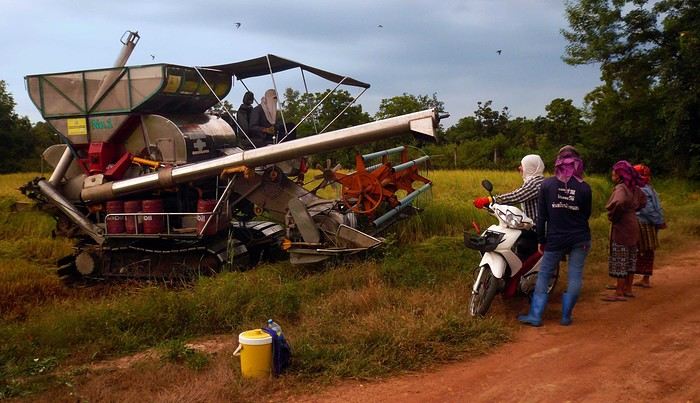
Kanchanaburi: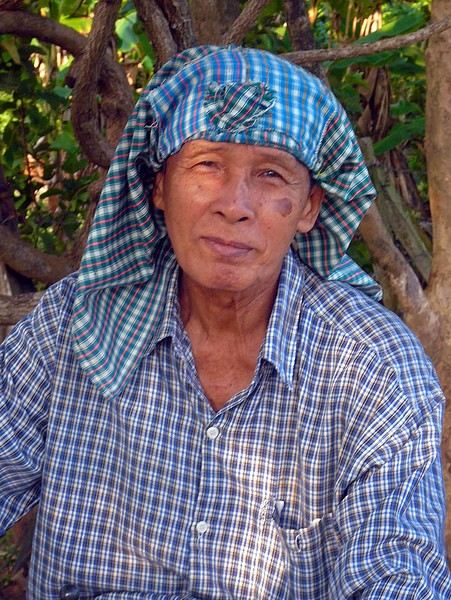
Sri Chiangmai: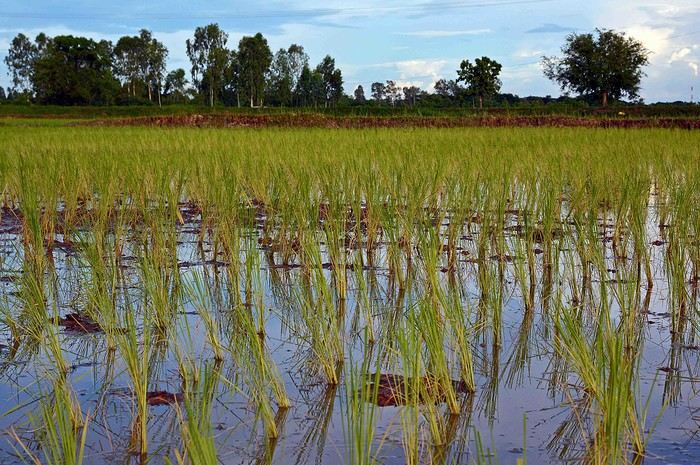
Soppong: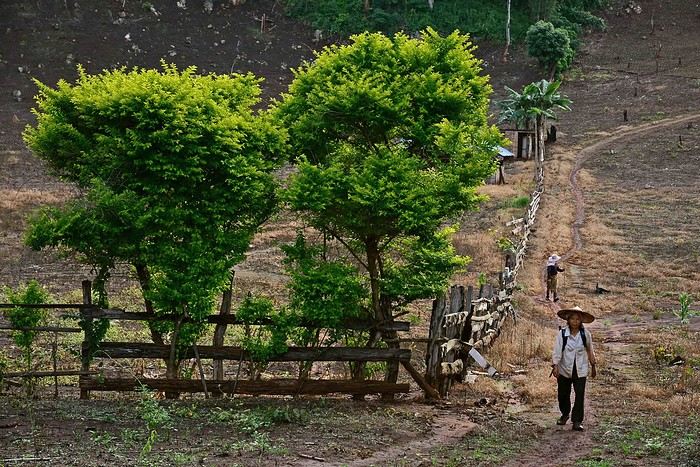
Tha Wang Pha: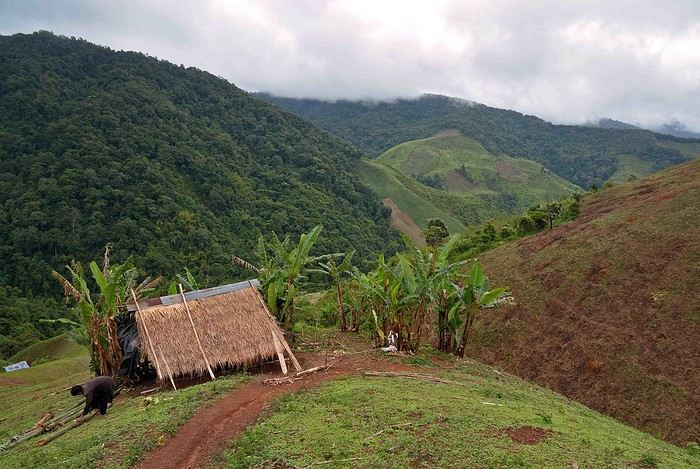
Kanchanaburi:
Kanchanaburi:
Sri Chiangmai:
Soppong:
Tha Wang Pha:
Hello,
I’m planning and organizing a wonderful trip to Vietnam from mid-March to mid-April 2026, traveling independently for a month with my wife to enjoy her new retirement. Here’s a summary of our itinerary: We arrive in Ho Chi Minh City on the morning of Wednesday, March 18, and depart from Hanoi on the evening of Thursday, April 16. First, I’d like to head to Ho Chi Minh City because the temperatures are high in that region in mid-March. After that, we’ll visit Phu Quoc Island and then the Mekong Delta. We’ll return to Ho Chi Minh City and take a flight to Hue for 2 days, then Tam Coc / Ninh Binh (2-3 days), and Cat Ba Island with a visit to Lan Ha Bay (4 days). We’ll spend a few days in Hanoi, followed by 3-4 days in Sapa with some hikes, and then the Ha Giang loop (4 days). (I’m a motorcyclist—I ride a BMW trail bike and have taken care of renewing my international license.) We’re considering renting a motorcycle or bicycles when needed, except in Ho Chi Minh City and Hanoi. The weather in northern Vietnam in early April should theoretically be decent. Finally, we’ll return to Hanoi before heading back to Paris and the Pays de la Loire. Unfortunately, I’m skipping Angkor in Cambodia. I’d like to have a guide for 1 or 2 days in Sapa (which typical agency would you recommend?), and I’m wondering if I should book an agency for the 4 days in Ha Giang. I prefer my independence and don’t really like the "group" aspect of agencies. I’ll rent a 150cc motorcycle, and my wife will ride with me. Other questions: What are some good, typical accommodations to book in the places we’ve identified? Thanks for any info. Did I forget anything, or should we adjust our itinerary? Thanks for your help and advice. Pimarguibou
I’m planning and organizing a wonderful trip to Vietnam from mid-March to mid-April 2026, traveling independently for a month with my wife to enjoy her new retirement. Here’s a summary of our itinerary: We arrive in Ho Chi Minh City on the morning of Wednesday, March 18, and depart from Hanoi on the evening of Thursday, April 16. First, I’d like to head to Ho Chi Minh City because the temperatures are high in that region in mid-March. After that, we’ll visit Phu Quoc Island and then the Mekong Delta. We’ll return to Ho Chi Minh City and take a flight to Hue for 2 days, then Tam Coc / Ninh Binh (2-3 days), and Cat Ba Island with a visit to Lan Ha Bay (4 days). We’ll spend a few days in Hanoi, followed by 3-4 days in Sapa with some hikes, and then the Ha Giang loop (4 days). (I’m a motorcyclist—I ride a BMW trail bike and have taken care of renewing my international license.) We’re considering renting a motorcycle or bicycles when needed, except in Ho Chi Minh City and Hanoi. The weather in northern Vietnam in early April should theoretically be decent. Finally, we’ll return to Hanoi before heading back to Paris and the Pays de la Loire. Unfortunately, I’m skipping Angkor in Cambodia. I’d like to have a guide for 1 or 2 days in Sapa (which typical agency would you recommend?), and I’m wondering if I should book an agency for the 4 days in Ha Giang. I prefer my independence and don’t really like the "group" aspect of agencies. I’ll rent a 150cc motorcycle, and my wife will ride with me. Other questions: What are some good, typical accommodations to book in the places we’ve identified? Thanks for any info. Did I forget anything, or should we adjust our itinerary? Thanks for your help and advice. Pimarguibou
Hi everyone,
I’m a die-hard fan of India, but it’s time I discovered Thailand too to broaden my Asian horizons.
I’m heading there on January 19, 2025, for a 46-day trip (no visa needed as I’m French). I’ve pored over a few guidebooks and travel blogs. Based on what caught my interest, I’ve put together a rough itinerary and list of sights. But since I know absolutely nothing about Thailand, I’m kind of flying blind here.
Since I’m not exactly a spring chicken anymore, I’ve opted for a few bases where I’ll stay several days in the same place. That way, I won’t have to change locations and hotels every day or so, packing and unpacking my suitcase constantly. Instead, I plan to explore the surrounding area each day, within a maximum radius of 50 to 70 km.
So, first question: Is that kind of round-trip distance manageable in a day in Thailand?
In India, renting a car for a day—with a driver—currently costs around 35 to 40 € per day. Knowing that 1,300 to 1,500 THB would be my absolute max, and even then, only if I don’t rent a car every single day.
Which brings me to my second question: Am I being unrealistic?
Otherwise—third question—once I’m settled in the city I’ve chosen as my base, can I get around within that 50–70 km radius using public transport?
I’ve already booked all my hotels—with free cancellation—on booking.com at an average price of 950/1,000 THB per night. Does that put me in a good range for value for money? Or am I dreaming?
Here’s my plan:
BANGKOK (13 days, 14 nights): 1 week for exploring Bangkok – Kanchanaburi/Erawan National Park? – Ayutthaya/Lopburi? – Muang Boran – Samut – Songkram/Amphawa
Bangkok -> Chiang Mai by overnight train in first-class sleeper
CHIANG MAI (6 days/6 nights): Mae Hong Son – Hot springs – Chiang Dao – caves – Lamphun – other places to be decided on the spot based on what’s worth seeing and transport options
Chiang Mai -> Chiang Rai
CHIANG RAI (7 days/8 nights): Fang – Tha Ton – Chiang Saen – Doi Tung – Chiang Khong – Doi Ang Khang, Phu Chi Fah, etc.
Chiang Rai -> Phrae
PHRAE (4 days/5 nights): Lampang and surrounding areas, depending on what’s interesting to see
Phrae -> Loei
LOEI (4 days/5 nights): Phu Kradung – Chiang Khan and surrounding areas, depending on what’s worth seeing
Loei -> Buriram
PHIMAI (Nakhon Ratchasima/Khorat) (5 days/6 nights): Phimai – Prasat Muang Tam – Phanom Rung – Prasat Phanom Wan
Phimai -> Khorat (airport or train station) -> Bangkok (overnight in Bangkok)
Day 46: BANGKOK -> KOCHI
Thanks in advance for your thoughts and advice!
Here’s my plan:
BANGKOK (13 days, 14 nights): 1 week for exploring Bangkok – Kanchanaburi/Erawan National Park? – Ayutthaya/Lopburi? – Muang Boran – Samut – Songkram/Amphawa
Bangkok -> Chiang Mai by overnight train in first-class sleeper
CHIANG MAI (6 days/6 nights): Mae Hong Son – Hot springs – Chiang Dao – caves – Lamphun – other places to be decided on the spot based on what’s worth seeing and transport options
Chiang Mai -> Chiang Rai
CHIANG RAI (7 days/8 nights): Fang – Tha Ton – Chiang Saen – Doi Tung – Chiang Khong – Doi Ang Khang, Phu Chi Fah, etc.
Chiang Rai -> Phrae
PHRAE (4 days/5 nights): Lampang and surrounding areas, depending on what’s interesting to see
Phrae -> Loei
LOEI (4 days/5 nights): Phu Kradung – Chiang Khan and surrounding areas, depending on what’s worth seeing
Loei -> Buriram
PHIMAI (Nakhon Ratchasima/Khorat) (5 days/6 nights): Phimai – Prasat Muang Tam – Phanom Rung – Prasat Phanom Wan
Phimai -> Khorat (airport or train station) -> Bangkok (overnight in Bangkok)
Day 46: BANGKOK -> KOCHI
Thanks in advance for your thoughts and advice!
Hi there,
I didn’t plan to return to Thailand this year, but my health conditions mean it’ll be the best place for me to stay between two trips to India. The tourism setup there is so well-organized that it’s the most "comfortable" country for a short visit. Thailand feels too sanitized for my taste, and there’s too much religion, Buddha, and the King, but it’s still the best option given how my health has been evolving. I’d considered two weeks in ThaTon for hiking, but I got too sick from the burn-offs during my trips to the mountains around Chiang Rai. So I’m not sure where to go this year. Definitely not the sea, touristy spots, or the mountains with burn-offs...
Thanks, friends, if you’ve got any suggestions.
Thanks, friends, if you’ve got any suggestions.
Hello everyone! :)
Our next trip to Thailand is coming up, and we just can't wait! We talk, eat, drink, and dream Thailand 😏
Our itinerary is mostly set, and we’ve found quite a few new things to explore, but I’d still love to hear your recommendations for Bangkok. Just so you know: we love this city, and every time we visit, we spend several days there without ever feeling like we’ve seen it all. So this year, we’re staying for 8 days! Here’s what we have planned this year: * Exploring Nonthaburi * A day trip to Nakhon Pathom (to test out our basic Thai skills 😛) * Khlong Lat Mayom floating market (we went 10 years ago—it’s probably changed a lot!) * The Erawan Museum (we visited Muang Boran on our last trip) * Finally taking the time to check out Wat Phra Sri Maha Mariamman and Wat Yannawa (we’ve planned to go several times but never made it—are they worth a visit?)
This is what we’ve picked so far, but I’d love to hear about the favorite spots and recommendations from travelers who, like us, adore Bangkok.
Thanks in advance for your help!
Laetitia and Benjamin.
Our next trip to Thailand is coming up, and we just can't wait! We talk, eat, drink, and dream Thailand 😏
Our itinerary is mostly set, and we’ve found quite a few new things to explore, but I’d still love to hear your recommendations for Bangkok. Just so you know: we love this city, and every time we visit, we spend several days there without ever feeling like we’ve seen it all. So this year, we’re staying for 8 days! Here’s what we have planned this year: * Exploring Nonthaburi * A day trip to Nakhon Pathom (to test out our basic Thai skills 😛) * Khlong Lat Mayom floating market (we went 10 years ago—it’s probably changed a lot!) * The Erawan Museum (we visited Muang Boran on our last trip) * Finally taking the time to check out Wat Phra Sri Maha Mariamman and Wat Yannawa (we’ve planned to go several times but never made it—are they worth a visit?)
This is what we’ve picked so far, but I’d love to hear about the favorite spots and recommendations from travelers who, like us, adore Bangkok.
Thanks in advance for your help!
Laetitia and Benjamin.
I really loved Thailand, but it was too touristy for my taste. So I'm hesitating about going back and wondering if Cambodia or Vietnam would be less crowded with tourists...
Hi everyone,
I’ve got a big project in northern Vietnam—discovering the most beautiful rice terraces before the harvest...
I’m planning to leave around September 15th until October 15th, then spend 15 days exploring the two bays, Lan Ha and Ha Long. In total, 45 days without a visa...
I’m traveling solo and very independent.
But is it possible to do this kind of trip using local trains and buses?
My plan is to leave Hanoi for Nghia Lo (2 days), then Mu Cang Chai (4 days), Sapa (4 days), Bac Ha (2 days), Ha Giang... Hoang Su Phi, then do the Meo Vac loop, Dong Van, etc., to see those stunning karst peaks before heading back to Hanoi.
In my research, I haven’t found any buses or vans going from Hanoi to Nghia Lo, even though it’s super popular for its rice terrace landscapes....
I don’t want a daily driver, but I’m thinking I could use moto-taxis to get around locally once I’m there....
What do you think?
These rice terraces are a dream for me, along with the markets and all the different ethnic groups, not to mention those spectacular rocky peaks...
Is the itinerary too ambitious? I’ve got time on my side.
Do you have any solutions? I’ve browsed the forum a lot, but the discussions are 5 or 6 years old, and I think things have changed since then.
Thanks for your help planning this adventure!
Back from Dong Van
Big plus: a brand-new highway between Hanoi airport and Tuyen Quang, halfway between Hanoi and Ha Giang. The speed limit is usually 50 km/h, but it still saves time.
In Ha Giang, the Truong Xuan Hotel (Ha Giang Resort) has gone downhill. Stay at the gorgeous guesthouse (varnished wooden bungalows with panoramic terrace and excellent meals) run by Mr. WIN (03 64 86 67 66) in Thôn Tha village, 5 kilometers before Ha Giang. If it's full, try next door at Mr. Cay’s place—also bungalows, but with a less stunning view: 09 79 76 94 67.
Dong Van has become so popular that there are now over 200 hotels and guesthouses (only one existed 5 years ago). I stayed at my usual spot, the Hoang Ngoc, which now has an elevator, but it’s gotten expensive (450,000 VND). Instead, check out one of the two 2-star hotels across the street.
On the other hand, dining options have really improved. The excellent Green Karst (one of the servers, Mr. Hung, is also a French-speaking guide) has two locations—one on the main street and another a bit uphill to the left. Go to the latter.
I revisited Lung Cu, still just as spectacular. There are now small electric trains that take you up to the viewpoint (30,000 VND per person round trip). The Hmong King’s Palace in Sa Phin is still standing strong. Small shops to the left of the staircase—the closest one is run by a descendant of the king, actually a traditional costume chief.
There’s a lovely guesthouse at the top of Ma Pi Leng, run by a super-friendly Hmong guy in a beret (a French legacy) who speaks decent French. The terrace overlooks the Nho Qué River canyon. 250,000 VND for two, breakfast included (dinner is 200,000 VND).
In Ha Giang, the Truong Xuan Hotel (Ha Giang Resort) has gone downhill. Stay at the gorgeous guesthouse (varnished wooden bungalows with panoramic terrace and excellent meals) run by Mr. WIN (03 64 86 67 66) in Thôn Tha village, 5 kilometers before Ha Giang. If it's full, try next door at Mr. Cay’s place—also bungalows, but with a less stunning view: 09 79 76 94 67.
Dong Van has become so popular that there are now over 200 hotels and guesthouses (only one existed 5 years ago). I stayed at my usual spot, the Hoang Ngoc, which now has an elevator, but it’s gotten expensive (450,000 VND). Instead, check out one of the two 2-star hotels across the street.
On the other hand, dining options have really improved. The excellent Green Karst (one of the servers, Mr. Hung, is also a French-speaking guide) has two locations—one on the main street and another a bit uphill to the left. Go to the latter.
I revisited Lung Cu, still just as spectacular. There are now small electric trains that take you up to the viewpoint (30,000 VND per person round trip). The Hmong King’s Palace in Sa Phin is still standing strong. Small shops to the left of the staircase—the closest one is run by a descendant of the king, actually a traditional costume chief.
There’s a lovely guesthouse at the top of Ma Pi Leng, run by a super-friendly Hmong guy in a beret (a French legacy) who speaks decent French. The terrace overlooks the Nho Qué River canyon. 250,000 VND for two, breakfast included (dinner is 200,000 VND).
Hi fellow travelers,
First trip to Vietnam.
We’ll be arriving in Ho Chi Minh City during Tet.
Is it complicated to find accommodation and get around during this period?
Any tips would be welcome.
Thanks for your replies.
Hey everyone,
I’m over in East Borneo in mid-July.
I’m struggling to wrap up the end of my itinerary, even though it’s pretty straightforward (long but simple).
Last year, we did Malaysia (KL and the mainland + around Kuching).
Day 1 – Arrive in Kota Kinabalu early, stroll around town and hit the must-sees. Day 2 – Excursion to Tunku Abdul Rahman Park, snorkeling at 3 islands. Day 3 – Hike around Mount Kinabalu without summiting (450 per person, no way). Day 4 – Poring Hot Springs + evening flight to Sandakan. Day 5-6-7 – Kinabatangan River (still looking for the right guide). Day 8 – Sepilok for the orangutans, the Sun Bear Centre, and Rainforest Discovery Centre. Day 9 – Selingan, turtle island. Day 10 – Head to Semporna. Day 11-12-13-14 – Sipadan, Mabul, Kapalai. Day 15 – Bohey Dulang. Day 16 to Day 25: I’M STUCK.
I looked into Danum Valley, but for 3 days/2 nights, they’re quoting 650 € per person—come on, that’s ridiculous. I checked out a detour into Indonesia (still East Borneo), but I’m having trouble deciding what would be amazing. I read about Sangalaki + Kakaban (2 islands, 1 base) / Mahakam Delta - Kutai (orangutans and river) / Sungai Boh (Dayak Kayan) – jungle & culture. But honestly, I’m struggling to finalize this itinerary. If we venture that way, we’d head back to KK from Balikpapan.
What do you all think? Thanks in advance!
Day 1 – Arrive in Kota Kinabalu early, stroll around town and hit the must-sees. Day 2 – Excursion to Tunku Abdul Rahman Park, snorkeling at 3 islands. Day 3 – Hike around Mount Kinabalu without summiting (450 per person, no way). Day 4 – Poring Hot Springs + evening flight to Sandakan. Day 5-6-7 – Kinabatangan River (still looking for the right guide). Day 8 – Sepilok for the orangutans, the Sun Bear Centre, and Rainforest Discovery Centre. Day 9 – Selingan, turtle island. Day 10 – Head to Semporna. Day 11-12-13-14 – Sipadan, Mabul, Kapalai. Day 15 – Bohey Dulang. Day 16 to Day 25: I’M STUCK.
I looked into Danum Valley, but for 3 days/2 nights, they’re quoting 650 € per person—come on, that’s ridiculous. I checked out a detour into Indonesia (still East Borneo), but I’m having trouble deciding what would be amazing. I read about Sangalaki + Kakaban (2 islands, 1 base) / Mahakam Delta - Kutai (orangutans and river) / Sungai Boh (Dayak Kayan) – jungle & culture. But honestly, I’m struggling to finalize this itinerary. If we venture that way, we’d head back to KK from Balikpapan.
What do you all think? Thanks in advance!