Hi there,
I’m planning a trip to Bangladesh for tourism during All Saints' Day 25. The government website is pretty discouraging! I’d love to hear from people living there or who’ve been recently before I buy my tickets.
How’s the security level and feasibility of a circuit (boat, train, bus around the country)? We’re used to basic conditions :)
Thanks in advance for your tips!
Cécile
Hi everyone,
for my 6th trip to India, I’ve chosen Ladakh and Zanskar. I’m planning a 15-day itinerary with a driver (one week in Ladakh and one week in Zanskar).
I’m looking for info and tips from people who’ve recently traveled to these regions—anything that could help me prepare my route, must-see spots (or not!), accommodation advice, etc.
Is it necessary to visit all three main lakes usually included in traditional circuits (Tso Moriri, Pangong, and Tso Kar)?
In the Nubra Valley, the Hunder dunes with the camels don’t really tempt me given the mixed reviews... What do you think?
Big question about altitude sickness—I’ve read that you should take it easy for a full day before hitting the road. Is that enough, or should I plan an extra day?
Is it easy and quick to get the Inner Line Permit for the regions where it’s required?
Thanks in advance for your tips!
For once, I'm sharing my experience after benefiting from other travelers' tips to take the plunge and rent a car (without a driver).
First, don’t hesitate! (Unless you just got your license the day before.) The roads are good—even very good in the north (the situation seems to have improved a lot). Driving is "Italian-style"—you can fit 3 or even 4 cars on a two-lane road. Sri Lankans aren’t suicidal (I wouldn’t have done it in India, though...). No issues with police checkpoints: we were never stopped in 25 days (unlike Sri Lankans...). These days, with Google and connectivity, you can’t get lost. Plan short trips (for us, it was between 2 and 4 hours with Google Maps estimates). Price: for a basic car, between 23 and 25 € per day, and gas isn’t expensive. I didn’t rent a car in Colombo (we used the PickMe app for tuk-tuks or car transfers with luggage). I also left the car parked in Kandy—it was a bit more intense there with narrow hillside streets and motorbikes/tuk-tuks driving a little wild. Big advantage: automatic transmission.
For me, aside from the first intersection, no stress—if you’re tired or not feeling it, you can drive as slowly as you want (unlike in France). I also drove and overtook like the Sri Lankans naturally.
Basic tips (but if you’re a driver, they’re obvious): - The bus is the boss: you’ve got to yield. - Unlike Sri Lankans, avoid overtaking without visibility. - Stay aware of your surroundings: cows, dogs, monitor lizards, pedestrians... so if there’s something, slow down!
I caught myself driving up to 90 km/h without realizing it but then slowed down (speed limits: 70 on rural roads, 100 on highways).
Of course, you’ll need an international driver’s permit or a temporary Sri Lankan license (I had both, but no one asked for them).
Renting a tuk-tuk was trendy among young travelers (I don’t get the appeal for a long trip—maybe 2 or 3 days since they’re slow, not that economical, more dangerous, and you can’t leave your stuff inside. Plus, the passenger sits behind the driver, and we had temps up to 37°C).
For a car, it’s great because it makes you independent: schedules, routes, supermarkets, restaurants...
Hope my feedback helps! !
First, don’t hesitate! (Unless you just got your license the day before.) The roads are good—even very good in the north (the situation seems to have improved a lot). Driving is "Italian-style"—you can fit 3 or even 4 cars on a two-lane road. Sri Lankans aren’t suicidal (I wouldn’t have done it in India, though...). No issues with police checkpoints: we were never stopped in 25 days (unlike Sri Lankans...). These days, with Google and connectivity, you can’t get lost. Plan short trips (for us, it was between 2 and 4 hours with Google Maps estimates). Price: for a basic car, between 23 and 25 € per day, and gas isn’t expensive. I didn’t rent a car in Colombo (we used the PickMe app for tuk-tuks or car transfers with luggage). I also left the car parked in Kandy—it was a bit more intense there with narrow hillside streets and motorbikes/tuk-tuks driving a little wild. Big advantage: automatic transmission.
For me, aside from the first intersection, no stress—if you’re tired or not feeling it, you can drive as slowly as you want (unlike in France). I also drove and overtook like the Sri Lankans naturally.
Basic tips (but if you’re a driver, they’re obvious): - The bus is the boss: you’ve got to yield. - Unlike Sri Lankans, avoid overtaking without visibility. - Stay aware of your surroundings: cows, dogs, monitor lizards, pedestrians... so if there’s something, slow down!
I caught myself driving up to 90 km/h without realizing it but then slowed down (speed limits: 70 on rural roads, 100 on highways).
Of course, you’ll need an international driver’s permit or a temporary Sri Lankan license (I had both, but no one asked for them).
Renting a tuk-tuk was trendy among young travelers (I don’t get the appeal for a long trip—maybe 2 or 3 days since they’re slow, not that economical, more dangerous, and you can’t leave your stuff inside. Plus, the passenger sits behind the driver, and we had temps up to 37°C).
For a car, it’s great because it makes you independent: schedules, routes, supermarkets, restaurants...
Hope my feedback helps! !
It seems there’s a ferry from Nagapattinam to Jaffna in India. Has anyone here taken this ferry before? My main question is how to get to Nagapattinam—by train, bus? And from which town further south, of course.
Thanks, friends!
Gaston
Gaston
Hi everyone,
We’re heading out in March for this trek. We’re used to hiking and long-distance treks, but this’ll be our first time in Nepal.
QUESTION: People from Nepal are telling us it’s MANDATORY to have guides! Is this true, or is it just agencies trying to get work for their staff?
The Lonely Planet says: "In April 2023, the government announced that every trekker would need to hire the services of a porter or a licensed guide to obtain the TIMS permit. The law isn’t enforced, and by 2025, there were no longer any obligations for teahouse treks."
What do you think? What’s your experience? Thanks for your feedback.
We’re heading out in March for this trek. We’re used to hiking and long-distance treks, but this’ll be our first time in Nepal.
QUESTION: People from Nepal are telling us it’s MANDATORY to have guides! Is this true, or is it just agencies trying to get work for their staff?
The Lonely Planet says: "In April 2023, the government announced that every trekker would need to hire the services of a porter or a licensed guide to obtain the TIMS permit. The law isn’t enforced, and by 2025, there were no longer any obligations for teahouse treks."
What do you think? What’s your experience? Thanks for your feedback.
NAMASTE NEPAL! PRACTICAL INFO AND EXPERIENCE FEEDBACK
Stay from March 25 to April 16, 2025
· Flight tickets Air India (via Delhi) (via Skyscanner) = 1130 € per person · Planned budget (and respected without too many restrictions and while buying a few small gifts) = 2000 € for the stay for two. Buses, taxis, and entrance fees to various sites represent a budget to consider. Meals are cheap. Drinks like beer/Coke, however, are not cheap and cost the equivalent of a meal. · Exchange rate of the rupee during our stay = 0.0064 € (the exchange rate is almost identical everywhere, including at the airport). · At the airport, purchase of two SIM cards (phone) = 1000 NPR x 2 for 28 days. · Kathmandu: we had booked the hotel upon arrival: Kathmandu Boutique Hotel (+977 015 357 446 – email: booking@kathmanduboutiquehotel.com), very well located in a quiet alley off the street, south of Thamel, a 10-minute walk from Durbar Square. A hotel like Nepal knows how to do, where tall people will have to duck. Night + breakfast = 18 € for two. Very warm welcome, great location, excellent value for money. · Bhaktapur: we had also booked a hotel for the end of our stay because the chance of the year 2025 made the Nepali New Year and Bisket Jatra particularly festive in Bhaktapur: Manju Baha Hotel School (+977 976 7234014 – email: manjubahahotel@gmail.com) located in an old monastery. "A social enterprise transforming an old monastery into a charming hotel, offering professional hospitality training to underprivileged Nepali youth." Night + breakfast = 32 € for two. Beautifully decorated room. Very warm welcome. Don’t miss the Changunarayan site (near Bhaktapur), it’s amazing. And if you’re lucky enough to be in Bhaktapur in mid-April for 3 days, there’s the Bisket Jatra festivities (Newari festival), joyful, noisy, fun, and wild… · Pokhara (hotel recommended by the Kathmandu hotel): Hotel Green Tara, Lakeside, 10th street, set back, quiet (Tel. +977 61 462698 – email: greentara_67@hotmail.com) · Trek permit (Lower Mustang, no need for an agency or guide, permits checked at Ghasa and Jomsom) = 2000 NPR per person (2 ID photos) · Bus Kathmandu/Pokhara and return = 2000 NPR per person · Bus Pokhara/Jomsom, 2 one-way tickets = 2800 NPR. · Taxi: negotiation with a driver we recommend, Vicky (+977 984 075 599). You explain what you want, negotiate the price, and he waits for you during the visit. Very charming, we used him several times. For example: departure from our hotel at 10 AM -> Boudhanath/Pashupatinath/Patan return at 5 PM to the hotel = 6500 NPR – Swayambhunath (round trip) = 1200 NPR · Site prices: https://ntb.gov.np/plan-your-trip/before-you-come/heritage-site-entry-fees o Visitor Pass for Kathmandu Durbar Square (for the duration of the stay, show your visa) = 1000 NPR per person (1 ID photo) o Bhaktapur Durbar Square (old town) = 1800 NPR per person o Patan = 1000 NPR per person o Swayambhu Stupa = 200 NPR per person o Boudha Stupa = 200 NPR per person o Pashupatinath Temple = 1000 NPR per person (interesting to take a guide) o Changunarayan Temple (6 km north of Bhaktapur) = 400 NPR per person o Mountain Museum in Pokhara = 750 NPR per person · E-cigarettes: e-cigarettes are banned in India and confiscated whether they’re in carry-on or checked luggage. On the way there, we had kept them in our carry-on, they were confiscated in Delhi. On the way back, learning from our previous experience, we put them in our checked luggage. Someone came to get us to take them out of our bags and confiscate them… You can find e-cigarettes and products in Kathmandu.
* * *
I’m 74 years old. I went to Nepal in 1982, 1983, and the last time in 1986. I wanted to introduce this beautiful and endearing country to my husband, and it was… now or never. So we decided it was now.
I knew the trek starting from Pokhara: Naudanda/Birethanti/Ghorepani/Tatopani/Kalopani. There was no way I was going to do that trek, especially the 1000-meter staircase to reach Ghorepani… You have to stay humble with age.
Back then, the road didn’t exist. I didn’t consider, with the construction of this road (NH48) along the western bank of the Kali Gandaki, doing a trek along a windy and dusty road. Was there an alternative hiking trail on the eastern bank? No one answered my question on VoyageForum, so I did my research online. And I found this site: "Andrées de Ruiter and Prem Rai - Trekking the Annapurna Circuit, including the new NATT trails that avoid the road - A guide to one of the most beautiful trekking regions in Nepal and the world (2011) - NATT = New Annapurna Trekking Trail".
Phew! A solution was emerging. This circuit from 2011 wasn’t fully marked. The idea was to go from Jomsom to Tatopani, so we needed to make sure the path was well-marked all the way, which we did, and the path exists, marked in red and white!
So, with the walking times information, we built our 8-day circuit:
· Jomsom/Thinigaon · Thinigaon/Chimang · Chimang/Saura · Saura/Kokhetanti · Rest day or, if in good shape: loop to Sekong Lake · Kokhetanti/Jhipra Deurali · Jhipra Deurali/Kopchepani · Kopchepani/Tatopani
It’s a senior trek, after all. So the walking times noted on the sites indicated 3 hours or even 4 hours for the two longest stages. That pace suited us fine.
On March 29, we left Kathmandu (1400m), after visiting the must-see sites, by bus to Pokhara: 200 km and 8.5 hours on a chaotic road under construction. I had a memory of Pokhara where it was the first city where you could see the Himalayan range, especially Machhapuchhare. But the pollution is such, the dust raised by traffic and construction, that no horizon is visible except the first hills around Pokhara.
We stayed 24 hours in Pokhara (820m), and on March 31, we left our luggage at the hotel and set off with our lightest backpacks: change of clothes, toiletries, first aid kit, anti-chafing cream, water bottle, sleeping bag liner, and light shoes for the stages.
We took the bus to Jomsom: 160 km/7.5 hours including stops for bathroom breaks, tea, and lunch. The road is nothing but a chaos of potholes, landslides, construction, dust, rebuilding, and mudslides. In Ghasa, the bus stops, and we’re told we’re at a checkpoint and that the two foreigners in the bus, my husband and I, need to have our permits checked, which takes a few minutes. The driving is rock-and-roll, surprising, and courteous. The drivers have their codes, and on these improbable roads, they’re virtuosos.
We could have chosen the plane, but several reasons dissuaded us: if there’s too much wind, the planes don’t take off; personally, I wasn’t reassured about landing in Jomsom, and this transport has a cost.
We arrived around 2 PM in Jomsom (2720m), and despite the early wake-up, the nearly 8 hours on the bus, and the altitude, we decided to head straight to Thinigaon (2840m). At the Jomsom checkpoint, they told us it was a 30-minute walk. Great! Except we took an hour and a half on an uphill road, bent over to fight a strong wind. But the Himalayan range is there! The Dhaulagiri, the Nilgiri, the Annapurnas as a reward.
In Thinigaon, we found a room at the "Nilgiri View Hotel" run by a didi (big sister in Nepali). From the lodge’s roof, she proudly showed us the different peaks surrounding the village and told us, worried, that it hadn’t snowed here for 3 years. She said there are very few tourists, that the season is rather in September/October/November. It seems there’s not a soul in this village, yet mules pass through the narrow street paved with large flat stones, their bells ringing. We dine at 6 PM and go to bed… Room = 1200 NPR and dinner, breakfast, and drinks = 2560 NPR.
On April 1, we set off at 9 AM, not for Chimang as planned but for Marpha! The didi from the Thinigaon lodge had said it was a 3-hour walk. The first part of this stage is attractive, the mountains are magnificent and imposing, the landscape is superb, there’s no one around, a feeling of being "alone in the world." We follow Dhumbra Tal, this small green lake. The path is a rocky track that climbs steeply. Then, around a hill, we start the big descent that joins the Kali Gandaki. We face the wind head-on, and the violent gusts take our breath away, throw us off balance, and envelop us in dust. We see the road on the other side of the Kali Gandaki. We arrive in the village of Chhairo at 2 PM, completely exhausted and with blistered feet, after 5 hours of walking instead of the planned 3.5 hours.
We’re welcomed by the village nurse, who tells us there’s a lodge in the village. Chhairo is a Tibetan village, a 20-minute walk from Marpha (according to the locals, multiply by 2 or even 3 for us…). We’re going to revise our trek plan and, first of all, spend the night in Chhairo.
The lodge is quite pleasant, and Karma, the hostess, is very friendly. She asks about our plans and suggests we stay in Chhairo the next day, from where we can visit Marpha and also Chimang, a 1-hour walk away, in light mode, meaning without backpacks. She invites us to participate in a village ceremony the next evening.
We immediately accept the proposal, as our feet need rest and the welcome is so warm… Dinner and bed!
We reworked our trek plan, which was too ambitious for our untrained bodies and, let’s face it… no longer in our first youth. In the initial plan, we thought there wouldn’t be too much elevation gain following the Kali Gandaki, but checking the map, we realize there might be significant elevation changes between Sauru and Sirkung. So we plan:
· Tomorrow: visit Marpha (2670m) and Chimang (2744m) · April 3: bus from Chhairo (2700m) to Kalopani (2530m) and continue on foot to Ghasa (2010m) · April 4: Ghasa/Pairataplo (1940m) · April 5: Pairatapla/Gadpar (1580m) · April 6: Gadpar/Narchyang (1510m) · April 7: Narchyang/Tatopani (1190m) · April 8: return to Pokhara.
Normally, it’s all downhill…
April 2, a rest day then… We set off in the morning to explore Marpha. We have to take a temporary bridge because the suspension bridge is closed due to road construction. We join the road and arrive in Marpha, a village famous for its apple orchards, brandy, cider, and apple juice production. This village is magnificent with its stone houses and monastery clinging to the hillside. The road construction spared it. There are people, but very few Western tourists.
We have lunch in Marpha and go back through Chhairo to take the path to Chimang. We cross a fragrant pine forest and find the rocky path; the landscape is splendid. We walk quietly, passing peaceful buffaloes and cows, and arrive at the foot of a stone staircase… 275 steps (which we counted on the way back) leading us to the village of Chimang. Chimang is an isolated Newari village that seems a bit desolate. Despite the slopes, there are crops on every little bit of land. Thankfully, we changed our initial program because there’s no lodge in this village, contrary to what we saw on a map… We wander through the village, which seems very deserted, have coffee in a house from another world, and then head back to Chhairo.
A rest day? = 5 hours of walking!!
Dinner and village ceremony. From what we understand, this ceremony is in honor of the Dalai Lama. Men, women, and children in traditional costumes gather twice a month; they dance, make, and offer small sweet cakes with Tibetan tea (made from tea, yak butter—often rancid—water, and salt). Surprising for first-timers…
Around 10 PM, we leave the ceremony; tomorrow morning, we need to be on the roadside by 7 AM to catch the bus to Kalopani…
This village of Chhairo is very pleasant and welcoming, no tourists, just two motorcyclists who arrived in the evening, one of whom participated in the ceremony and discreetly poured his Tibetan tea outside.
Lodge: "Norsang Tibetan Guesthouse and Restaurant". Total bill for 2 nights, 2 dinners, 2 breakfasts, and drinks = 8000 NPR.
April 3: bus from Chhairo to Kalopani, about 1.5 hours for the 20 km (200 NPR per person). We descend on the right bank of the Kali Gandaki. We find the red and white markings to resume the trek toward Ghasa. We’re in a fragrant pine forest, the Dhaulagiri on one side and the Annapurnas on the other, magnificent, and the path is pleasant and easy. We get a bit lost in this forest, always looking for the markings. Near Lete, two trekkers pass us, and we meet them again a little further on with two very young children, to whom we give the 2 hard-boiled eggs I didn’t eat this morning. They accepted them without hesitation.
We arrive in a village and ask for directions to Ghasa. The young girls point the way. But we come across a forest being logged, trees cut in all directions. We turn back and ask for confirmation. They confirm… But the two young girls catch up with us and clear the way. We have to step over, go around, and cross the felled trees, with no indication at all. Through this pick-up sticks of felled trees, the girls lead us to the top of a stone staircase, indicating that was the path. It’s the only place where we saw rhododendrons in bloom.
We descend the staircase. At the bottom, to the left, there’s a bridge to go toward Choyo, and to the right, a path to Ghasa. We take the right path and join the road. We should normally find the red and white markings, but we don’t… So we continue on the western bank road of the Kali Gandaki.
A little before the village of Misi, we see fumaroles on the opposite bank that seem to come from the ground. We don’t understand. We stopped to eat in the village of Misi (noodle soup = 600 NPR), but it’s hard to communicate with the elderly people running the guesthouse.
We continued on the road, not finding the marked path parallel to the road. Landslides, both on the left and right banks, seem to have taken over the marked routes. It’s a place where the Kali Gandaki gorge narrows, and on the opposite bank, the mountain smokes more and more, and we now hear the crackling of fire. Across from us, the mountain is burning… Our initial plan had us passing on that burning bank right now…
We arrive in Ghasa at 3:30 PM, a 6.5-hour stage but with a 1-hour stop at noon. We’re at the "Florida Guesthouse and Restaurant." From our room, we see the mountain smoking on the other side of the river, and at night, we see the flames. In this village, posters show Himalayan eagles and vultures that seem to be protected species. Indeed, we saw (and heard) 3 eagles circling today.
April 4 – Today, heading to Pairothapla or Kopchepani depending on our feet, accommodation options, and simply our desires.
No more smoke on the mountain this morning. It’s chilly, 7:45 AM, the sky is clear, just a smell of smoke outside.
Price of the lodge = 1000 NPR for the night + 3580 NPR for meals.
We cross Ghasa, which stretches over more than a kilometer. We have a drink at the last guesthouse in the village, and the didi, when she learns our destination, tells us to be careful because the villages we’re going to aren’t safe. Should we distribute our rupees in different pockets? Nah, we kept going.
At the exit of Ghasa, we find the red and white markings and take the suspension bridge to cross the boiling waters of the Kali Gandaki. The passage is impressive because the river is tumultuous. Lots of climbs and even more descents. We’re back on the eastern bank. It’s hot! On the narrow path, we meet a group of buffaloes. Who has the right of way? We decide to stick as close as possible to the rock wall and move forward calmly. The buffaloes look at us, chewing placidly, with no intention of jumping on us. Phew!
After a 5-hour stage (including stops), we arrive in Pairothapla, with hot feet and firm thighs, and decide we won’t go any further. It’s a good thing because there’s a lodge, the most basic so far, but with a great welcome. We have a meal and a short nap. The buffaloes we met on the way belong to this house. They come to drink at the fountain by the path.
Our host, very pleasant, doesn’t know what to do to please us and is very attentive. He wants to chat. He has two children, a 4-year-old girl and a 7-year-old boy. Where do they go to school? Do they go? He tells us that the fires in the mountain are caused by people, but for what reason? We won’t find out, but it’s illegal. From here, we can still see smoke rising in the distance. The wife is a bit less friendly. Corn kernels dry on a woven straw mat on the ground, and the mom sorts them.
From where we are, we overlook the valley and see the road under construction winding along the mountainside on the other bank.
Dinner on the terrace of the house overlooking the path, windbreaker and fleece on: dal bhat chicken for me and chicken curry for my husband: "organic" products, at least local production. There are small vegetable gardens everywhere with all sorts of vegetables.
April 5 – While we’re having breakfast on the terrace of our lodge, 5 porters, straps on their foreheads, heavily loaded, pass by on the path. A few minutes later, a group of 9 people appears. It must be said that since the beginning of our journey, we’ve met very few hikers. Two backpackers in Chhairo, the two hikers near Lete, two female hikers passed us before Pairothapla, a solo female hiker passed us…
The lodge in Pairothapla is called "Bimala Lodge & Thakali Kitchen" – Price for night + 4 meals + 2 breakfasts = 3000 NPR.
The descent toward the Kali Gandaki involves climbs whose steps we didn’t count. Clearly, the landslides on the mountain cause changes to the official ACAP trek marked in red and white, and the marking updates can’t keep up with the pace of these landslides. It’s almost always by chance that we find the markings. Fortunately, we can follow the power line that guides us somewhat.
Drink stop in Kopchepani, the legs are fine, but the feet don’t like being tightly enclosed. A group of trekkers with porters passes on the path. We met buffaloes that we kindly let pass; the path was wide enough, but it was a staircase going up, and we didn’t want to take any risks.
Across, a view of the magnificent Rupse Waterfall on the other bank of the Kali Gandaki, at the bottom, lots of vehicles and people.
Arrival in Gadpar after crossing a rather unwelcoming small village and cultivated gardens between dry stone walls, each better built than the last.
First lodge spotted, first lodge adopted to answer the call of our feet, and a very warm welcome from the owner. Since we hadn’t eaten at noon, we had Tibetan bread/jam. 6-hour stage including 1 hour of stops. Night + dinner + breakfast + drinks = 5060 NPR
April 6 – Today, heading to Narchyang.
For several days, we’ve seen banana trees with their bunches of fruit and even a prickly pear with large fruits ripening.
This stage is quite peaceful and pleasant. We take a suspension bridge to cross a tributary of the Kali Gandaki. While we’re resting for a moment before crossing the bridge, a couple of porters, a man and a woman, arrive and start across the bridge with their wood load in a basket held by a strap on their forehead, making them bend. We set off too… lighter than them.
On the other side of the bridge… a stone staircase, and it climbs steeply. The porter couple didn’t take this staircase; they went right on the path.
At the top of the staircase, we arrive in Narchyang after a 4-hour stage. A magnificent waterfall overlooks the village. We get lost in this fairly large village looking for a lodge. After wandering around for a while, we ask for directions, and an 84-year-old man takes us through the whole village and accompanies us to a very nice lodge run by a woman.
We chat with our hostess, who asks where we’re from and where we’re going. We explain that we want to reach Tatopani the next day and then return to Pokhara. She tells us there are 4x4s going directly to Pokhara and that it would probably be easier than taking a bus that might be full in Tatopani. After a quick consultation, we decide to return to Pokhara the next day by 4x4. She finds us a 4x4 with 2 seats left, departure at 8 AM – 5 hours on the road and 1500 NPR per person. A charming didi who does everything to be pleasant and helpful.
Narchyang community lodge = night + snacks + dinner + breakfast = 3000 NPR.
There you go, our trek ends tomorrow. Many necessary changes and adaptations to our initial trek, but no regrets, it was superb and a great experience that, for my part, I won’t be able to repeat. Always this encounter with the endearing, welcoming, curious, and very kind Nepali people. It was now or never, and we did it!
* * *
In conclusion, 3 full weeks in Nepal is a duration that allows visiting Kathmandu, Patan, and Bhaktapur, enjoying the various sites, and soaking in the atmosphere and urban Nepali life.
The trek, even revised and corrected, allowed us to get close to the impressive Annapurna and Dhaulagiri peaks. One or two acclimatization days might be necessary to get the body in tune with this magical and extraordinary land.
Stay from March 25 to April 16, 2025
· Flight tickets Air India (via Delhi) (via Skyscanner) = 1130 € per person · Planned budget (and respected without too many restrictions and while buying a few small gifts) = 2000 € for the stay for two. Buses, taxis, and entrance fees to various sites represent a budget to consider. Meals are cheap. Drinks like beer/Coke, however, are not cheap and cost the equivalent of a meal. · Exchange rate of the rupee during our stay = 0.0064 € (the exchange rate is almost identical everywhere, including at the airport). · At the airport, purchase of two SIM cards (phone) = 1000 NPR x 2 for 28 days. · Kathmandu: we had booked the hotel upon arrival: Kathmandu Boutique Hotel (+977 015 357 446 – email: booking@kathmanduboutiquehotel.com), very well located in a quiet alley off the street, south of Thamel, a 10-minute walk from Durbar Square. A hotel like Nepal knows how to do, where tall people will have to duck. Night + breakfast = 18 € for two. Very warm welcome, great location, excellent value for money. · Bhaktapur: we had also booked a hotel for the end of our stay because the chance of the year 2025 made the Nepali New Year and Bisket Jatra particularly festive in Bhaktapur: Manju Baha Hotel School (+977 976 7234014 – email: manjubahahotel@gmail.com) located in an old monastery. "A social enterprise transforming an old monastery into a charming hotel, offering professional hospitality training to underprivileged Nepali youth." Night + breakfast = 32 € for two. Beautifully decorated room. Very warm welcome. Don’t miss the Changunarayan site (near Bhaktapur), it’s amazing. And if you’re lucky enough to be in Bhaktapur in mid-April for 3 days, there’s the Bisket Jatra festivities (Newari festival), joyful, noisy, fun, and wild… · Pokhara (hotel recommended by the Kathmandu hotel): Hotel Green Tara, Lakeside, 10th street, set back, quiet (Tel. +977 61 462698 – email: greentara_67@hotmail.com) · Trek permit (Lower Mustang, no need for an agency or guide, permits checked at Ghasa and Jomsom) = 2000 NPR per person (2 ID photos) · Bus Kathmandu/Pokhara and return = 2000 NPR per person · Bus Pokhara/Jomsom, 2 one-way tickets = 2800 NPR. · Taxi: negotiation with a driver we recommend, Vicky (+977 984 075 599). You explain what you want, negotiate the price, and he waits for you during the visit. Very charming, we used him several times. For example: departure from our hotel at 10 AM -> Boudhanath/Pashupatinath/Patan return at 5 PM to the hotel = 6500 NPR – Swayambhunath (round trip) = 1200 NPR · Site prices: https://ntb.gov.np/plan-your-trip/before-you-come/heritage-site-entry-fees o Visitor Pass for Kathmandu Durbar Square (for the duration of the stay, show your visa) = 1000 NPR per person (1 ID photo) o Bhaktapur Durbar Square (old town) = 1800 NPR per person o Patan = 1000 NPR per person o Swayambhu Stupa = 200 NPR per person o Boudha Stupa = 200 NPR per person o Pashupatinath Temple = 1000 NPR per person (interesting to take a guide) o Changunarayan Temple (6 km north of Bhaktapur) = 400 NPR per person o Mountain Museum in Pokhara = 750 NPR per person · E-cigarettes: e-cigarettes are banned in India and confiscated whether they’re in carry-on or checked luggage. On the way there, we had kept them in our carry-on, they were confiscated in Delhi. On the way back, learning from our previous experience, we put them in our checked luggage. Someone came to get us to take them out of our bags and confiscate them… You can find e-cigarettes and products in Kathmandu.
* * *
I’m 74 years old. I went to Nepal in 1982, 1983, and the last time in 1986. I wanted to introduce this beautiful and endearing country to my husband, and it was… now or never. So we decided it was now.
I knew the trek starting from Pokhara: Naudanda/Birethanti/Ghorepani/Tatopani/Kalopani. There was no way I was going to do that trek, especially the 1000-meter staircase to reach Ghorepani… You have to stay humble with age.
Back then, the road didn’t exist. I didn’t consider, with the construction of this road (NH48) along the western bank of the Kali Gandaki, doing a trek along a windy and dusty road. Was there an alternative hiking trail on the eastern bank? No one answered my question on VoyageForum, so I did my research online. And I found this site: "Andrées de Ruiter and Prem Rai - Trekking the Annapurna Circuit, including the new NATT trails that avoid the road - A guide to one of the most beautiful trekking regions in Nepal and the world (2011) - NATT = New Annapurna Trekking Trail".
Phew! A solution was emerging. This circuit from 2011 wasn’t fully marked. The idea was to go from Jomsom to Tatopani, so we needed to make sure the path was well-marked all the way, which we did, and the path exists, marked in red and white!
So, with the walking times information, we built our 8-day circuit:
· Jomsom/Thinigaon · Thinigaon/Chimang · Chimang/Saura · Saura/Kokhetanti · Rest day or, if in good shape: loop to Sekong Lake · Kokhetanti/Jhipra Deurali · Jhipra Deurali/Kopchepani · Kopchepani/Tatopani
It’s a senior trek, after all. So the walking times noted on the sites indicated 3 hours or even 4 hours for the two longest stages. That pace suited us fine.
On March 29, we left Kathmandu (1400m), after visiting the must-see sites, by bus to Pokhara: 200 km and 8.5 hours on a chaotic road under construction. I had a memory of Pokhara where it was the first city where you could see the Himalayan range, especially Machhapuchhare. But the pollution is such, the dust raised by traffic and construction, that no horizon is visible except the first hills around Pokhara.
We stayed 24 hours in Pokhara (820m), and on March 31, we left our luggage at the hotel and set off with our lightest backpacks: change of clothes, toiletries, first aid kit, anti-chafing cream, water bottle, sleeping bag liner, and light shoes for the stages.
We took the bus to Jomsom: 160 km/7.5 hours including stops for bathroom breaks, tea, and lunch. The road is nothing but a chaos of potholes, landslides, construction, dust, rebuilding, and mudslides. In Ghasa, the bus stops, and we’re told we’re at a checkpoint and that the two foreigners in the bus, my husband and I, need to have our permits checked, which takes a few minutes. The driving is rock-and-roll, surprising, and courteous. The drivers have their codes, and on these improbable roads, they’re virtuosos.
We could have chosen the plane, but several reasons dissuaded us: if there’s too much wind, the planes don’t take off; personally, I wasn’t reassured about landing in Jomsom, and this transport has a cost.
We arrived around 2 PM in Jomsom (2720m), and despite the early wake-up, the nearly 8 hours on the bus, and the altitude, we decided to head straight to Thinigaon (2840m). At the Jomsom checkpoint, they told us it was a 30-minute walk. Great! Except we took an hour and a half on an uphill road, bent over to fight a strong wind. But the Himalayan range is there! The Dhaulagiri, the Nilgiri, the Annapurnas as a reward.
In Thinigaon, we found a room at the "Nilgiri View Hotel" run by a didi (big sister in Nepali). From the lodge’s roof, she proudly showed us the different peaks surrounding the village and told us, worried, that it hadn’t snowed here for 3 years. She said there are very few tourists, that the season is rather in September/October/November. It seems there’s not a soul in this village, yet mules pass through the narrow street paved with large flat stones, their bells ringing. We dine at 6 PM and go to bed… Room = 1200 NPR and dinner, breakfast, and drinks = 2560 NPR.
On April 1, we set off at 9 AM, not for Chimang as planned but for Marpha! The didi from the Thinigaon lodge had said it was a 3-hour walk. The first part of this stage is attractive, the mountains are magnificent and imposing, the landscape is superb, there’s no one around, a feeling of being "alone in the world." We follow Dhumbra Tal, this small green lake. The path is a rocky track that climbs steeply. Then, around a hill, we start the big descent that joins the Kali Gandaki. We face the wind head-on, and the violent gusts take our breath away, throw us off balance, and envelop us in dust. We see the road on the other side of the Kali Gandaki. We arrive in the village of Chhairo at 2 PM, completely exhausted and with blistered feet, after 5 hours of walking instead of the planned 3.5 hours.
We’re welcomed by the village nurse, who tells us there’s a lodge in the village. Chhairo is a Tibetan village, a 20-minute walk from Marpha (according to the locals, multiply by 2 or even 3 for us…). We’re going to revise our trek plan and, first of all, spend the night in Chhairo.
The lodge is quite pleasant, and Karma, the hostess, is very friendly. She asks about our plans and suggests we stay in Chhairo the next day, from where we can visit Marpha and also Chimang, a 1-hour walk away, in light mode, meaning without backpacks. She invites us to participate in a village ceremony the next evening.
We immediately accept the proposal, as our feet need rest and the welcome is so warm… Dinner and bed!
We reworked our trek plan, which was too ambitious for our untrained bodies and, let’s face it… no longer in our first youth. In the initial plan, we thought there wouldn’t be too much elevation gain following the Kali Gandaki, but checking the map, we realize there might be significant elevation changes between Sauru and Sirkung. So we plan:
· Tomorrow: visit Marpha (2670m) and Chimang (2744m) · April 3: bus from Chhairo (2700m) to Kalopani (2530m) and continue on foot to Ghasa (2010m) · April 4: Ghasa/Pairataplo (1940m) · April 5: Pairatapla/Gadpar (1580m) · April 6: Gadpar/Narchyang (1510m) · April 7: Narchyang/Tatopani (1190m) · April 8: return to Pokhara.
Normally, it’s all downhill…
April 2, a rest day then… We set off in the morning to explore Marpha. We have to take a temporary bridge because the suspension bridge is closed due to road construction. We join the road and arrive in Marpha, a village famous for its apple orchards, brandy, cider, and apple juice production. This village is magnificent with its stone houses and monastery clinging to the hillside. The road construction spared it. There are people, but very few Western tourists.
We have lunch in Marpha and go back through Chhairo to take the path to Chimang. We cross a fragrant pine forest and find the rocky path; the landscape is splendid. We walk quietly, passing peaceful buffaloes and cows, and arrive at the foot of a stone staircase… 275 steps (which we counted on the way back) leading us to the village of Chimang. Chimang is an isolated Newari village that seems a bit desolate. Despite the slopes, there are crops on every little bit of land. Thankfully, we changed our initial program because there’s no lodge in this village, contrary to what we saw on a map… We wander through the village, which seems very deserted, have coffee in a house from another world, and then head back to Chhairo.
A rest day? = 5 hours of walking!!
Dinner and village ceremony. From what we understand, this ceremony is in honor of the Dalai Lama. Men, women, and children in traditional costumes gather twice a month; they dance, make, and offer small sweet cakes with Tibetan tea (made from tea, yak butter—often rancid—water, and salt). Surprising for first-timers…
Around 10 PM, we leave the ceremony; tomorrow morning, we need to be on the roadside by 7 AM to catch the bus to Kalopani…
This village of Chhairo is very pleasant and welcoming, no tourists, just two motorcyclists who arrived in the evening, one of whom participated in the ceremony and discreetly poured his Tibetan tea outside.
Lodge: "Norsang Tibetan Guesthouse and Restaurant". Total bill for 2 nights, 2 dinners, 2 breakfasts, and drinks = 8000 NPR.
April 3: bus from Chhairo to Kalopani, about 1.5 hours for the 20 km (200 NPR per person). We descend on the right bank of the Kali Gandaki. We find the red and white markings to resume the trek toward Ghasa. We’re in a fragrant pine forest, the Dhaulagiri on one side and the Annapurnas on the other, magnificent, and the path is pleasant and easy. We get a bit lost in this forest, always looking for the markings. Near Lete, two trekkers pass us, and we meet them again a little further on with two very young children, to whom we give the 2 hard-boiled eggs I didn’t eat this morning. They accepted them without hesitation.
We arrive in a village and ask for directions to Ghasa. The young girls point the way. But we come across a forest being logged, trees cut in all directions. We turn back and ask for confirmation. They confirm… But the two young girls catch up with us and clear the way. We have to step over, go around, and cross the felled trees, with no indication at all. Through this pick-up sticks of felled trees, the girls lead us to the top of a stone staircase, indicating that was the path. It’s the only place where we saw rhododendrons in bloom.
We descend the staircase. At the bottom, to the left, there’s a bridge to go toward Choyo, and to the right, a path to Ghasa. We take the right path and join the road. We should normally find the red and white markings, but we don’t… So we continue on the western bank road of the Kali Gandaki.
A little before the village of Misi, we see fumaroles on the opposite bank that seem to come from the ground. We don’t understand. We stopped to eat in the village of Misi (noodle soup = 600 NPR), but it’s hard to communicate with the elderly people running the guesthouse.
We continued on the road, not finding the marked path parallel to the road. Landslides, both on the left and right banks, seem to have taken over the marked routes. It’s a place where the Kali Gandaki gorge narrows, and on the opposite bank, the mountain smokes more and more, and we now hear the crackling of fire. Across from us, the mountain is burning… Our initial plan had us passing on that burning bank right now…
We arrive in Ghasa at 3:30 PM, a 6.5-hour stage but with a 1-hour stop at noon. We’re at the "Florida Guesthouse and Restaurant." From our room, we see the mountain smoking on the other side of the river, and at night, we see the flames. In this village, posters show Himalayan eagles and vultures that seem to be protected species. Indeed, we saw (and heard) 3 eagles circling today.
April 4 – Today, heading to Pairothapla or Kopchepani depending on our feet, accommodation options, and simply our desires.
No more smoke on the mountain this morning. It’s chilly, 7:45 AM, the sky is clear, just a smell of smoke outside.
Price of the lodge = 1000 NPR for the night + 3580 NPR for meals.
We cross Ghasa, which stretches over more than a kilometer. We have a drink at the last guesthouse in the village, and the didi, when she learns our destination, tells us to be careful because the villages we’re going to aren’t safe. Should we distribute our rupees in different pockets? Nah, we kept going.
At the exit of Ghasa, we find the red and white markings and take the suspension bridge to cross the boiling waters of the Kali Gandaki. The passage is impressive because the river is tumultuous. Lots of climbs and even more descents. We’re back on the eastern bank. It’s hot! On the narrow path, we meet a group of buffaloes. Who has the right of way? We decide to stick as close as possible to the rock wall and move forward calmly. The buffaloes look at us, chewing placidly, with no intention of jumping on us. Phew!
After a 5-hour stage (including stops), we arrive in Pairothapla, with hot feet and firm thighs, and decide we won’t go any further. It’s a good thing because there’s a lodge, the most basic so far, but with a great welcome. We have a meal and a short nap. The buffaloes we met on the way belong to this house. They come to drink at the fountain by the path.
Our host, very pleasant, doesn’t know what to do to please us and is very attentive. He wants to chat. He has two children, a 4-year-old girl and a 7-year-old boy. Where do they go to school? Do they go? He tells us that the fires in the mountain are caused by people, but for what reason? We won’t find out, but it’s illegal. From here, we can still see smoke rising in the distance. The wife is a bit less friendly. Corn kernels dry on a woven straw mat on the ground, and the mom sorts them.
From where we are, we overlook the valley and see the road under construction winding along the mountainside on the other bank.
Dinner on the terrace of the house overlooking the path, windbreaker and fleece on: dal bhat chicken for me and chicken curry for my husband: "organic" products, at least local production. There are small vegetable gardens everywhere with all sorts of vegetables.
April 5 – While we’re having breakfast on the terrace of our lodge, 5 porters, straps on their foreheads, heavily loaded, pass by on the path. A few minutes later, a group of 9 people appears. It must be said that since the beginning of our journey, we’ve met very few hikers. Two backpackers in Chhairo, the two hikers near Lete, two female hikers passed us before Pairothapla, a solo female hiker passed us…
The lodge in Pairothapla is called "Bimala Lodge & Thakali Kitchen" – Price for night + 4 meals + 2 breakfasts = 3000 NPR.
The descent toward the Kali Gandaki involves climbs whose steps we didn’t count. Clearly, the landslides on the mountain cause changes to the official ACAP trek marked in red and white, and the marking updates can’t keep up with the pace of these landslides. It’s almost always by chance that we find the markings. Fortunately, we can follow the power line that guides us somewhat.
Drink stop in Kopchepani, the legs are fine, but the feet don’t like being tightly enclosed. A group of trekkers with porters passes on the path. We met buffaloes that we kindly let pass; the path was wide enough, but it was a staircase going up, and we didn’t want to take any risks.
Across, a view of the magnificent Rupse Waterfall on the other bank of the Kali Gandaki, at the bottom, lots of vehicles and people.
Arrival in Gadpar after crossing a rather unwelcoming small village and cultivated gardens between dry stone walls, each better built than the last.
First lodge spotted, first lodge adopted to answer the call of our feet, and a very warm welcome from the owner. Since we hadn’t eaten at noon, we had Tibetan bread/jam. 6-hour stage including 1 hour of stops. Night + dinner + breakfast + drinks = 5060 NPR
April 6 – Today, heading to Narchyang.
For several days, we’ve seen banana trees with their bunches of fruit and even a prickly pear with large fruits ripening.
This stage is quite peaceful and pleasant. We take a suspension bridge to cross a tributary of the Kali Gandaki. While we’re resting for a moment before crossing the bridge, a couple of porters, a man and a woman, arrive and start across the bridge with their wood load in a basket held by a strap on their forehead, making them bend. We set off too… lighter than them.
On the other side of the bridge… a stone staircase, and it climbs steeply. The porter couple didn’t take this staircase; they went right on the path.
At the top of the staircase, we arrive in Narchyang after a 4-hour stage. A magnificent waterfall overlooks the village. We get lost in this fairly large village looking for a lodge. After wandering around for a while, we ask for directions, and an 84-year-old man takes us through the whole village and accompanies us to a very nice lodge run by a woman.
We chat with our hostess, who asks where we’re from and where we’re going. We explain that we want to reach Tatopani the next day and then return to Pokhara. She tells us there are 4x4s going directly to Pokhara and that it would probably be easier than taking a bus that might be full in Tatopani. After a quick consultation, we decide to return to Pokhara the next day by 4x4. She finds us a 4x4 with 2 seats left, departure at 8 AM – 5 hours on the road and 1500 NPR per person. A charming didi who does everything to be pleasant and helpful.
Narchyang community lodge = night + snacks + dinner + breakfast = 3000 NPR.
There you go, our trek ends tomorrow. Many necessary changes and adaptations to our initial trek, but no regrets, it was superb and a great experience that, for my part, I won’t be able to repeat. Always this encounter with the endearing, welcoming, curious, and very kind Nepali people. It was now or never, and we did it!
* * *
In conclusion, 3 full weeks in Nepal is a duration that allows visiting Kathmandu, Patan, and Bhaktapur, enjoying the various sites, and soaking in the atmosphere and urban Nepali life.
The trek, even revised and corrected, allowed us to get close to the impressive Annapurna and Dhaulagiri peaks. One or two acclimatization days might be necessary to get the body in tune with this magical and extraordinary land.
Hi there,
We’re just back from a three-week trip to Sri Lanka, from July 15 to August 11. A few random tips—if you’ve got more specific questions, just ask. If we know the answer, we’ll be happy to help!
What an amazing country! I had a small bias at first, wasn’t totally convinced, but that disappeared fast. Stunning coastal and mountain landscapes, cultural visits, hikes, and such a warm welcome.
Here’s our itinerary in order: Colombo-Anuradhapura-Trincomalee-Polonnaruwa-Dambulla-Sigiriya-Kandy-Haputale-Ella-Tangalle-Galle-Negombo.
Whenever we can, we travel only by public transport, and in Sri Lanka, it’s totally doable. Trains, of course, and buses all the time—everywhere and super cheap. We’d head to the bus station to get a seat, but they also stop along the route. From the airport to Colombo Fort, take bus 187—it’s parked on the right as you exit.
Weather-wise, despite it being the less favorable season for some regions, we only had two half-days of rain. That was one of our worries, but maybe we just got lucky.
For hiking, beyond the well-known climbs in all the guidebooks and blogs (which are great too), there’s a long-distance trail in the mountain region (Kandy, Ella, etc.) that’s really well marked. It’s called the Pekoe Trail, and there’s an app you can download (Pekoe Trail) that gives you the full route and details for each stage—25 in total, I think, ranging from 9 to 15 km. We did 4 of them, not in a row, but starting from our different accommodations. They’re not loops, but you can always find a bus, train, or tuk-tuk to get back or to reach the end of a stage and return. The landscapes are beautiful, the encounters plentiful, and tourists are rare—which is nice sometimes.
Happy travels!
What an amazing country! I had a small bias at first, wasn’t totally convinced, but that disappeared fast. Stunning coastal and mountain landscapes, cultural visits, hikes, and such a warm welcome.
Here’s our itinerary in order: Colombo-Anuradhapura-Trincomalee-Polonnaruwa-Dambulla-Sigiriya-Kandy-Haputale-Ella-Tangalle-Galle-Negombo.
Whenever we can, we travel only by public transport, and in Sri Lanka, it’s totally doable. Trains, of course, and buses all the time—everywhere and super cheap. We’d head to the bus station to get a seat, but they also stop along the route. From the airport to Colombo Fort, take bus 187—it’s parked on the right as you exit.
Weather-wise, despite it being the less favorable season for some regions, we only had two half-days of rain. That was one of our worries, but maybe we just got lucky.
For hiking, beyond the well-known climbs in all the guidebooks and blogs (which are great too), there’s a long-distance trail in the mountain region (Kandy, Ella, etc.) that’s really well marked. It’s called the Pekoe Trail, and there’s an app you can download (Pekoe Trail) that gives you the full route and details for each stage—25 in total, I think, ranging from 9 to 15 km. We did 4 of them, not in a row, but starting from our different accommodations. They’re not loops, but you can always find a bus, train, or tuk-tuk to get back or to reach the end of a stage and return. The landscapes are beautiful, the encounters plentiful, and tourists are rare—which is nice sometimes.
Happy travels!
Hi everyone! 🙂
My partner (who’s a teacher—hence the summer holidays) and I are heading to Eastern India for 23 days in July. This is my 5th trip to India, but her first.
We fly into Delhi on July 7th and leave from Delhi on the 23rd (since our flight to Kolkata arrived late at night, and I wanted to show Agra and Varanasi to my partner).
We love getting off the beaten track and meeting people, so we’ll mostly be taking the train.
Here’s what we’re planning:
- **DELHI**: 1 night on the way (short because the plane is supposed to land at 01:55), then we take the train at 13:00 - **GWALIOR**: 3 nights, including a day trip to **AGRA** by train to see the Taj Mahal and the Red Fort (I find Agra too touristy to stay overnight). Otherwise, in Gwalior, the Fort, the temples, the Man Mandir Palace, and the Jai Vilas Palace if we have time. - **ORCHHA**: 2 nights... *maybe skip this to spend more time in VARANASI?* - **VARANASI**: overnight train + 3 nights, the Ghats, temples... maybe a day trip to **SARNATH**. - **KOLKATA**: overnight train + 3 nights. Maybe a countryside excursion to the ashram in Channa. *- Here we’re hesitating over 2 nights: either 2 nights in **SHANTINIKETAN** with a visit to **CHANNA** on the way, or a 2-day excursion to the **SUNDARBAN** nature park. But is it worth it in July during the monsoon?* - **PURI**: overnight train + 4 nights. *We’re planning to do everything from Puri, as it seems nicer than staying in BHUBANESWAR. What do you think?* Visit **KONARK** and **CHILIKA LAKE**. *Is it worth visiting Chilika Lake this season? Another question: can you swim in Puri, or is it too dangerous (waves)?* - Train to **BHUBANESWAR**, then a flight from BHUBANESWAR to **DELHI**, - 2 nights in **DELHI**, visiting Jama Masjid, and *either Humayun’s Tomb, Safdarjung’s Tomb, or Qutb Minar.*
Back to Paris. Total: 23 nights.
What do you think of these choices? What about the options we’re still unsure about *(in bold/italics)*? Thanks so much! 🙂
We fly into Delhi on July 7th and leave from Delhi on the 23rd (since our flight to Kolkata arrived late at night, and I wanted to show Agra and Varanasi to my partner).
We love getting off the beaten track and meeting people, so we’ll mostly be taking the train.
Here’s what we’re planning:
- **DELHI**: 1 night on the way (short because the plane is supposed to land at 01:55), then we take the train at 13:00 - **GWALIOR**: 3 nights, including a day trip to **AGRA** by train to see the Taj Mahal and the Red Fort (I find Agra too touristy to stay overnight). Otherwise, in Gwalior, the Fort, the temples, the Man Mandir Palace, and the Jai Vilas Palace if we have time. - **ORCHHA**: 2 nights... *maybe skip this to spend more time in VARANASI?* - **VARANASI**: overnight train + 3 nights, the Ghats, temples... maybe a day trip to **SARNATH**. - **KOLKATA**: overnight train + 3 nights. Maybe a countryside excursion to the ashram in Channa. *- Here we’re hesitating over 2 nights: either 2 nights in **SHANTINIKETAN** with a visit to **CHANNA** on the way, or a 2-day excursion to the **SUNDARBAN** nature park. But is it worth it in July during the monsoon?* - **PURI**: overnight train + 4 nights. *We’re planning to do everything from Puri, as it seems nicer than staying in BHUBANESWAR. What do you think?* Visit **KONARK** and **CHILIKA LAKE**. *Is it worth visiting Chilika Lake this season? Another question: can you swim in Puri, or is it too dangerous (waves)?* - Train to **BHUBANESWAR**, then a flight from BHUBANESWAR to **DELHI**, - 2 nights in **DELHI**, visiting Jama Masjid, and *either Humayun’s Tomb, Safdarjung’s Tomb, or Qutb Minar.*
Back to Paris. Total: 23 nights.
What do you think of these choices? What about the options we’re still unsure about *(in bold/italics)*? Thanks so much! 🙂
Hi,
I’d like to stay on several islands in the Maldives solo with a budget of under 120 € for 2 people per day for accommodation and food. I’m not including transport. Is this possible?
On Booking, I’ve found hotels for under 80 € that seem great, some even offer half-board for 20 € for 2.
I thought you’d need a much bigger budget… Do you know the price of a meal at a local restaurant on the inhabited islands? And drinks? From what I’ve heard, there’s no alcohol there, right?
I’d also like to know if it’s easy to travel between atolls and from one island to another by boat.
Do you have any island recommendations? I’m planning to stay for 3 weeks and visit 4-5 islands.
This destination is almost always offered as all-inclusive stays with pretty luxurious hotels, so I’m finding very little info on how to do it without pre-organized trips.
Thanks for your tips and travel feedback!
PS: Long live the return of VoyageForum!
Hi there.
We’re spending a month in Sri Lanka in March, and we’ll have one week left after leaving Polonnaruwa.
We’re torn between spending it in the Jaffna region or on the east coast between Batticaloa and Trincomalee.
We’re divers, so the east coast appeals to us for snorkeling, beaches, and lagoons—but it seems like late March might not be the best time for that coast. What do you think?
As for Jaffna, the culture of the region, its more authentic feel since it’s less touristy, and the offshore islands all appeal to us too—but it seems far from the rest of the country and harder to access.
We have to choose because we won’t be able to visit both sides, and I’d love to hear your thoughts.
Thanks, Marie
Just back from a 3-week trip in northern India, we spent 2 days in Varanasi. Since this city is so unique, to get a deeper look inside and better understand the spirituality that emanates from it, we hired a young French-speaking guide, Rakesh, who was recommended by our driver. Rakesh knows his city really well—he showed us places we never would’ve found on our own, all in perfect French. Thanks to him, we learned so much; he’s truly fascinating and very attentive. A huge thank you for this amazing experience. Don’t hesitate to reach out for his services.
Contact details in PM
I'm planning a return trip to India next year, and this time I want to check out what's nice on the way up to Manali. Since the bus rides are really long coming from the plains (Chandigarh or even Delhi), I'm looking for a place to stop along the way (my partner and I). I’ve spotted Kullu, about an hour from Manali, but no matter how much I study the map, I can’t tell if there’s an actual town there. We really don’t want to end up in some isolated hotel that’s only convenient for people traveling with their own transport—definitely not our style. We prefer to drop our bags in a room, freshen up a bit, then wander around streets or alleys with at least a little life.
So, I’m wondering if we’d be better off just skipping Kullu altogether.
What do you think, folks who’ve been there before?
So, I’m wondering if we’d be better off just skipping Kullu altogether.
What do you think, folks who’ve been there before?
Hi everyone.
The tickets for SRI LANKA are booked—arriving in COLOMBO on 12/21 and returning from the same place on 01/17. I’ve read here and there that it’ll be high season, but we don’t have a choice, so we’ll make do...
My first question is obviously about the itinerary: Most of the ones I’ve seen go clockwise, and I’m wondering if I should do it the other way: - To avoid the cultural triangle between Christmas and New Year’s - To start with a bit of rest (we’re really wiped out) Does that make sense?
My second question is about the time allocated to each stop, which you’ll find below. Is it balanced? Too much here and not enough there?
My third question will be about Jaffna: yes or no? How long is the trip from Anuradhapura? Where can I fit in the 3 days needed?
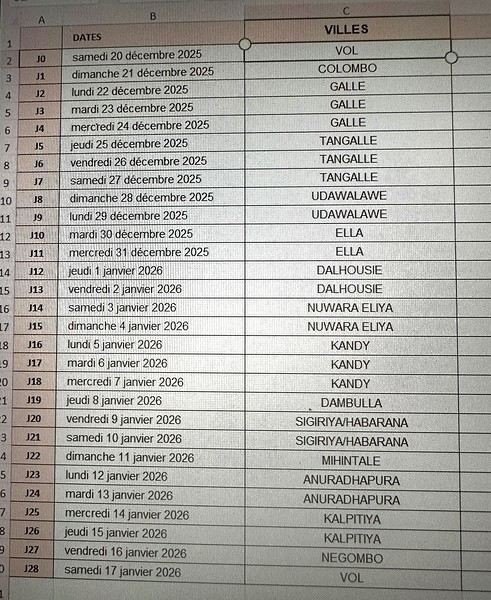
Thanks for your replies. A few details: ultra-independent travelers, using public transport, hikers, minimum 2 nights per accommodation. First time in Sri Lanka! !
The tickets for SRI LANKA are booked—arriving in COLOMBO on 12/21 and returning from the same place on 01/17. I’ve read here and there that it’ll be high season, but we don’t have a choice, so we’ll make do...
My first question is obviously about the itinerary: Most of the ones I’ve seen go clockwise, and I’m wondering if I should do it the other way: - To avoid the cultural triangle between Christmas and New Year’s - To start with a bit of rest (we’re really wiped out) Does that make sense?
My second question is about the time allocated to each stop, which you’ll find below. Is it balanced? Too much here and not enough there?
My third question will be about Jaffna: yes or no? How long is the trip from Anuradhapura? Where can I fit in the 3 days needed?
Thanks for your replies. A few details: ultra-independent travelers, using public transport, hikers, minimum 2 nights per accommodation. First time in Sri Lanka! !
Hello,
My husband and I usually spend a month in January/February in southern India. We end our trip in Gokarna and fly back from Vasco de Gama Airport in Dabolim. So, it might make sense to spend a few days in a nice, quiet spot in southern Goa. Do you have any recommendations?
Thanks
Hi there.
We’re heading to India at the end of December for a month.
I planned an itinerary: Delhi, Nawalgarh, Sikar, Jodhpur, Udaipur, Chittaurgarh, Bundi, Jaipur, Bharatpur, and back to Delhi.
Our driver told us it’s not possible because there are no roads.
He’s suggesting the usual tourist circuit, which we don’t want to do.
What do you think of my route?
Any tips?
Thanks, community!
My partner and I are planning a 2-week trip to Goa from late September to early October. It’s sandwiched between a trip to Nepal (September) and our return home to Thailand. We can’t stay longer, but cutting it shorter wouldn’t be worth the effort or flight costs.
I’ve visited several regions of India in the past (between 2000 and 2020) and spent a total of about 4 months there. My only time in Goa was a few days in Palolem in 2007—I didn’t like it. I found the place almost sordid with all the crowds... not at all the India I love.
But I have an Indian friend with 2 or 3 apartments in a residence in North Goa who keeps telling me to visit. I’m tempted. But where should we go? I don’t want to rent from him because it’s expensive (high-end) and I don’t want to feel too dependent on him either.
After 2 days in Panaji (since it’s near GOI), I’ve booked 5 days in Mandrem, which I’ve heard great things about. This’ll let us explore the Arambol area. I’m hesitant to stay there longer—if we don’t like it or get bored after a few days, spending the full 2 weeks there isn’t ideal! I’m thinking of trying South Goa instead, somewhere between Benaulim and Agonda. The downside? All the rumors about the vibe in different spots—loud techno here, jet skis there, "paunchy English tourists" elsewhere, package tours everywhere... not to mention the expected influx of Russians and/or Israelis (I’ve seen this in other parts of India, Thailand, and Vietnam). Plus, accommodation options are way more limited in the south.
Basically, I’m leaning toward Agonda—relaxed but not too quiet or isolated. But there’s so little availability on sites like Booking and Agoda...
Any recent tips or advice from folks who’ve been to Goa lately? I’d really appreciate it, thanks in advance!
I’ve visited several regions of India in the past (between 2000 and 2020) and spent a total of about 4 months there. My only time in Goa was a few days in Palolem in 2007—I didn’t like it. I found the place almost sordid with all the crowds... not at all the India I love.
But I have an Indian friend with 2 or 3 apartments in a residence in North Goa who keeps telling me to visit. I’m tempted. But where should we go? I don’t want to rent from him because it’s expensive (high-end) and I don’t want to feel too dependent on him either.
After 2 days in Panaji (since it’s near GOI), I’ve booked 5 days in Mandrem, which I’ve heard great things about. This’ll let us explore the Arambol area. I’m hesitant to stay there longer—if we don’t like it or get bored after a few days, spending the full 2 weeks there isn’t ideal! I’m thinking of trying South Goa instead, somewhere between Benaulim and Agonda. The downside? All the rumors about the vibe in different spots—loud techno here, jet skis there, "paunchy English tourists" elsewhere, package tours everywhere... not to mention the expected influx of Russians and/or Israelis (I’ve seen this in other parts of India, Thailand, and Vietnam). Plus, accommodation options are way more limited in the south.
Basically, I’m leaning toward Agonda—relaxed but not too quiet or isolated. But there’s so little availability on sites like Booking and Agoda...
Any recent tips or advice from folks who’ve been to Goa lately? I’d really appreciate it, thanks in advance!
Hi there,
For our trip to Sri Lanka from July 31 to August 21, 2025, we can't seem to find a reliable price range on various blogs for intercity taxi rides without private drivers. We'd like to alternate between trains, buses, and taxis (for 2 people) and would love to get an idea of the going rates for taxis, as well as any company names based on your experiences. I checked out "12Go Asia"—has anyone used this site to book transport in Sri Lanka? Is it reliable? Thanks in advance, Have a great day!
JL
For our trip to Sri Lanka from July 31 to August 21, 2025, we can't seem to find a reliable price range on various blogs for intercity taxi rides without private drivers. We'd like to alternate between trains, buses, and taxis (for 2 people) and would love to get an idea of the going rates for taxis, as well as any company names based on your experiences. I checked out "12Go Asia"—has anyone used this site to book transport in Sri Lanka? Is it reliable? Thanks in advance, Have a great day!
JL
Hi there!
I need your advice :)
We’ll be in Sri Lanka in April, a group of 9 adults.
Which safari would you recommend, please?
Thanks for your replies!
Lolo13500
Hello and happy travels for 2025!
Reading through the discussions, I’m wondering what to pick between Bikaner and Jaisalmer for spending a few days in the desert without running into too many tour groups. Should I skip Jaisalmer? Rent a motorcycle and go solo? I’d love to hear any tips. Thanks
Hi everyone, and first of all, I wish you all wonderful travels in 2025! ;)
My partner and I (we're seniors) are leaving at the end of January for a 40-day trip to India, arriving in Cochin and departing from Delhi. After reading lots of travel journals about India, I’ve put together an itinerary, but I’m worried it might be too (very?) packed... Here’s my plan:
5 or 6 days in the backwaters Munnar: 1 or 2 nights? Ideally next: Madurai, Trichy, Tanjore, Kumbakonam, Chidambaram, Pondi, Mahabalipuram (number of nights in each place to be decided if I keep Tamil Nadu) Flight from Chennai to Varanasi Varanasi: 2 or 3 nights Overnight train to Agra Agra: 1 night Drive to Jaipur with a stop in Fatehpur Sikri Jaipur: 3 nights Bundi: 3 nights Drive to Udaipur with a stop in Chittorgarh? Udaipur: 2 nights Drive to Jodhpur with a stop in Ranakpur Jodhpur: 1 night Jaisalmer: 3 nights Flight to Delhi, then back to France.
This all feels *very* packed. We’re thinking of taking taxis between cities fairly often if public transport is too complicated or time-consuming. Do you think this is doable? Otherwise, the alternative would be to spend more time in Kerala (though we’re not really beach people) and skip Tamil Nadu (which I’d hate to do!!) to focus more on the north instead. We’ve never been to India before, and I’m a little worried about feeling overwhelmed with all the city and temple visits. We’re more used to alternating nature and culture. Looking forward to your valuable advice to finalize our itinerary!
My partner and I (we're seniors) are leaving at the end of January for a 40-day trip to India, arriving in Cochin and departing from Delhi. After reading lots of travel journals about India, I’ve put together an itinerary, but I’m worried it might be too (very?) packed... Here’s my plan:
5 or 6 days in the backwaters Munnar: 1 or 2 nights? Ideally next: Madurai, Trichy, Tanjore, Kumbakonam, Chidambaram, Pondi, Mahabalipuram (number of nights in each place to be decided if I keep Tamil Nadu) Flight from Chennai to Varanasi Varanasi: 2 or 3 nights Overnight train to Agra Agra: 1 night Drive to Jaipur with a stop in Fatehpur Sikri Jaipur: 3 nights Bundi: 3 nights Drive to Udaipur with a stop in Chittorgarh? Udaipur: 2 nights Drive to Jodhpur with a stop in Ranakpur Jodhpur: 1 night Jaisalmer: 3 nights Flight to Delhi, then back to France.
This all feels *very* packed. We’re thinking of taking taxis between cities fairly often if public transport is too complicated or time-consuming. Do you think this is doable? Otherwise, the alternative would be to spend more time in Kerala (though we’re not really beach people) and skip Tamil Nadu (which I’d hate to do!!) to focus more on the north instead. We’ve never been to India before, and I’m a little worried about feeling overwhelmed with all the city and temple visits. We’re more used to alternating nature and culture. Looking forward to your valuable advice to finalize our itinerary!
Namaste everyone,
We went to Nepal last October and literally fell in love with this country (like so many others, it seems). During our trek, we had the chance to meet and travel with an incredible independent local guide, Apsara Luitel. She told us about a unique project she’s organizing starting mid-May, and we wanted to share it in case it interests anyone. We mentioned it on another travel forum, but just in case, we’re posting it here too to reach as many people as possible.
Apsara, who knows the Api mountain valley (a name as joyful as it is intriguing!) in Nepal’s Far West (on the border between India and Tibet, at the edge of the world) perfectly, is offering an off-the-beaten-path trek for a group of 3 to 8 people max. The program? An authentic and preserved itinerary combining homestays and small mountain lodges, all the way to the Api base camp. Once at base camp, locals will guide us to secret spots only they know, where we’ll harvest yarsagumba (those famous caterpillar-fungi, rare and prized for their medicinal properties in traditional Chinese medicine—they were going for $20,000 per kilo last year!).
Mid-May is the ideal time to discover this almost unexplored region and take part in harvesting these natural treasures. This kind of adventure, led by an inspiring young woman like Apsara, is rare, and we think it could appeal to Nepal lovers and those who enjoy authentic treks far from the usual tourist routes.
No matter how many participants there are (between 3 and 8), there will always be two guides: Apsara, who speaks English (and is learning French!), and a French-speaking guide. The dates are flexible around May 15th, depending on the availability of those who’d like to take on the adventure.
We went to Nepal last October and literally fell in love with this country (like so many others, it seems). During our trek, we had the chance to meet and travel with an incredible independent local guide, Apsara Luitel. She told us about a unique project she’s organizing starting mid-May, and we wanted to share it in case it interests anyone. We mentioned it on another travel forum, but just in case, we’re posting it here too to reach as many people as possible.
Apsara, who knows the Api mountain valley (a name as joyful as it is intriguing!) in Nepal’s Far West (on the border between India and Tibet, at the edge of the world) perfectly, is offering an off-the-beaten-path trek for a group of 3 to 8 people max. The program? An authentic and preserved itinerary combining homestays and small mountain lodges, all the way to the Api base camp. Once at base camp, locals will guide us to secret spots only they know, where we’ll harvest yarsagumba (those famous caterpillar-fungi, rare and prized for their medicinal properties in traditional Chinese medicine—they were going for $20,000 per kilo last year!).
Mid-May is the ideal time to discover this almost unexplored region and take part in harvesting these natural treasures. This kind of adventure, led by an inspiring young woman like Apsara, is rare, and we think it could appeal to Nepal lovers and those who enjoy authentic treks far from the usual tourist routes.
No matter how many participants there are (between 3 and 8), there will always be two guides: Apsara, who speaks English (and is learning French!), and a French-speaking guide. The dates are flexible around May 15th, depending on the availability of those who’d like to take on the adventure.
Hello,
We’ve already traveled to India twice before, but only for two-week stretches (2013, a loop from Mumbai including Hampi, and in 2019, Tamil Nadu). This time, we’re leaving at the end of October for nearly three months of travel—something completely new for us! We’ll arrive in Delhi and depart from Bangalore. Our goal is to explore Northern India and then head down to Kerala, taking a maximum of one flight and prioritizing trains.
Traveling for this long should let us plan longer stops to slow down the pace and fully enjoy our trip...
What are the places you’ve loved with this in mind? I’ve already thought of Gokarna... Do you have any other suggestions, especially in Northern India? Thanks in advance for your tips!
Traveling for this long should let us plan longer stops to slow down the pace and fully enjoy our trip...
What are the places you’ve loved with this in mind? I’ve already thought of Gokarna... Do you have any other suggestions, especially in Northern India? Thanks in advance for your tips!
I'm looking for a small, not-too-touristy restaurant in Fort Kochi. Do you know one not too far from Jacob Road?
Thanks
Hello,
I’m looking for people who’ve been very seriously ill or had major surgery in India (especially in Kerala). Thanks for sharing your experience.
Hi there,
I’ve sketched out a rough itinerary for Sri Lanka (from late February to late March), starting in Colombo and then going clockwise (so I’d begin with Negombo, Anuradhapura, and I don’t think I’ll head all the way north to Jaffna because that’s a lot of kilometers just for a round trip—unless you can convince me otherwise! ;)). After that, I’ll hit the Cultural Triangle and then the tea plantations in the center of the island. The east coast will depend on how much time I have left and the weather (I’ve heard March can be rough on the east coast). I’ll wrap up my trip with the beaches in the south, back to Colombo. 😊
What do you think of this 4-week itinerary? (On the map, a few points aren’t connected by lines—that means I’m not sure if I’ll go there):
https://www.google.com/maps/d/edit?mid=1TX9sgHSjh9iwINIIknOG4LtCieNdUOw&ll=7.716250171694787%2C81.39557361748045&z=7
Maybe there are a few too many stops, so I’d love some suggestions to streamline this itinerary a bit.
Thanks in advance for your feedback and advice on how many days to spend in each place! :)
Hi there,
Need a little help: How do I get from Tangalle (or from Beliatha/Beliatta) to Hatton (I’m staying a few days nearby in Dickoya)?
Thanks! Florent
Need a little help: How do I get from Tangalle (or from Beliatha/Beliatta) to Hatton (I’m staying a few days nearby in Dickoya)?
Thanks! Florent
Hey fellow travelers,
I’m spending two weeks studying Hindi in the mornings in Delhi, in the Hauz Khas neighborhood. What spots should I check out in this area? Any cafés to chill at? How do I get to other parts of Delhi? By rickshaw? Is it easy to negotiate the price upfront?
Thanks in advance. 😊 Marlène
I’m spending two weeks studying Hindi in the mornings in Delhi, in the Hauz Khas neighborhood. What spots should I check out in this area? Any cafés to chill at? How do I get to other parts of Delhi? By rickshaw? Is it easy to negotiate the price upfront?
Thanks in advance. 😊 Marlène
hi everyone, I’m putting together an itinerary for Sri Lanka in September 2026, so I’m focusing on the east side of the island because of the monsoon on the west coast:
Day 1 Kandy: botanical garden, fruit and vegetable market, traditional dance show
Day 2 Kandy-Ella train
Day 3-4 Kumana NP or Lunugamvehera Block 6+5
Day 5-6 Komari / Pottuvi lagoon safari
Day 7 head up the east coast along the beaches to reach Wasgamuwa NP
Day 8 Wasgamuwa NP early morning safari, then Polonnaruwa (temple and palace)
Day 9-10 Sigiriya Lion’s Rock and Dambulla, cave temple
Day 11-12 Wilpattu NP early morning safari, then late afternoon
Day 13-14 Kalpitiya, snorkeling and chilling
Day 15 return to Colombo
Thanks for sharing your thoughts on whether this route is doable—we’ll be traveling with a driver-guide.
Feel free to mention any great tips or good homestay experiences you’ve had, since we prefer those.
Hi everyone,
We’re planning our 3-week trip to Sri Lanka from July 31 to August 21, 2025. Our itinerary is coming together, but we could use some advice for our arrival. Our flight lands at 2:40 AM. What should we do? Book a hotel near the airport? Or in Negombo? Head straight to Colombo? What about currency exchange offices at 3 AM? And what about getting a SIM card?
Thanks in advance for your tips or firsthand experiences!
Have a great day.
We’re planning our 3-week trip to Sri Lanka from July 31 to August 21, 2025. Our itinerary is coming together, but we could use some advice for our arrival. Our flight lands at 2:40 AM. What should we do? Book a hotel near the airport? Or in Negombo? Head straight to Colombo? What about currency exchange offices at 3 AM? And what about getting a SIM card?
Thanks in advance for your tips or firsthand experiences!
Have a great day.
Hello,
I’m interested in the 10-day/8-night "Discover Nepal" tour offered by Capitales Tours, among others. For Day 4, it lists Kathmandu-Mugling-Pokhara as 200 km and 8/9 hours of travel. Is this duration due to the road conditions? I assume the stop in Mugling for lunch is included in the travel time.
For Pokhara-Chitwan, only the distance is mentioned: 160 km. Should I expect a long bus ride there as well?
The proposed flights would be with AIR-INDIA via DELHI. We had issues with AIR-INDIA before—they denied us boarding for Paris even though we arrived at the airport more than 3 hours early. There was no specific counter for PARIS; the counters were for all destinations, and we waited in line for over 2.5 hours only to be told "too late"... Thanks for your advice: Mum49 Is it still like this?
I’m interested in the 10-day/8-night "Discover Nepal" tour offered by Capitales Tours, among others. For Day 4, it lists Kathmandu-Mugling-Pokhara as 200 km and 8/9 hours of travel. Is this duration due to the road conditions? I assume the stop in Mugling for lunch is included in the travel time.
For Pokhara-Chitwan, only the distance is mentioned: 160 km. Should I expect a long bus ride there as well?
The proposed flights would be with AIR-INDIA via DELHI. We had issues with AIR-INDIA before—they denied us boarding for Paris even though we arrived at the airport more than 3 hours early. There was no specific counter for PARIS; the counters were for all destinations, and we waited in line for over 2.5 hours only to be told "too late"... Thanks for your advice: Mum49 Is it still like this?