Results for "Pologne+sécurité"
About 3,688 results.
More options
Many results are in French, the community’s main language. English translations are added over time.
Search results
Gps pour vélo
Un petit appareil très tendance en ce moment: Le GPS
Je me suis offert un GPS avec support guidon depuis un peine un an.
Ce gadget malheureusement encore trop onéreux est un complément indispensable à tous les férus de chiffres et données de toutes sortes.
Je vous invite à débattre sur ce sujet.......... @ + chefderayons 😉
Visa pour la Thaïlande avec la Gulf Air
Bonjour, nous partons pour bangkok au départ de Paris pour 5 semaines avec gulf air.
Nous n'abons pas pris de visa car nous pensons sortir une fois du pays pour pouvoir rester un peu plus longtemps.
Dans le guide du routard, il est dit que certaines compagnies peuvent nous refouler si nous n'avons pas de visa pour 5 semaines de séjour sur place.
Est-ce vrai?
Avez-vous déjà été confrontés à ce problème?
merci de pour vos expériences.
Laurent
Départ imminent et imprévu pour la Slovaquie
Bonjour à tous... Ayant déjà posté un msg dans le topic Bratislava, mais finalement, je me rends compte qu'il vaut mieux que j'en crée un nouveau !
Donc voici le topo : j'envisage de partir +/-8jours en Slovaquie. Départ prévu normalement en train (sauf si trop cher, alors voiture).
N'ayant toujours pas terminé mes examens de seconde sess....(etudes, quand tu nous tiens !🏴☠️), je n'ai encore RIEN prévu. Je pars le 9, et termine mes examens le 6 (3 jours, c'est bien assez non ? ^^).
Je voulais donc vous demander quelques petits renseignements. Premièrement, concernant le trajet en train, avez-vous un bon site internet à me conseiller pour l'achat des billets ?
Administrativement, que faut-il que j'emporte avec moi ? S'il faut un passeport, c'est foutu.... Je n'ai qu'une carte d'identité....(belge). Apparement, ce serait bon la carte d'identité ?
Que me conseillez vous comme région à visiter ?
A première vue, j'envisageais d'arriver à Bratslava et de passer la première nuit et dernière nuit dans la capitale (près du train quoi 😛)
Sinon, je suis fanna de randonnée (modéré, je suis etudiant, j'aime la bière, et mon ptit bout de gras a du mal à faire des efforts....😄😄) Mais j'ai tout de meme fait l'an passé toute l'irlande à pied (et en stop, bien sur 😎).
Le stop la bas ? Est-ce risqué ? pratique ? impossible ?
Parlent-ils anglais ? Car .... moi et la langue slovaque, on s'évite un peu par moment....🤪🤪
Je ne vous demande pas de préparer mon voyage à ma place (enfin, si vous insistez, je ne vous retiens pas hein ^^), mais juste de me rassurer pour les quelques interrogatives qui subsistent....
Je ne suis pas bien vieux et découvre à peine les joies du voyage avec sac a dos et tente, sans savoir où dormir.... ni savoir où aller ^^. (21 ans).
Donc voila, j'espère que vous me ferez profiter de votre expérience, afin que je profite un maximum de mon séjour en territoire slovaque !
Si vous avez aussi quelques anecdotes sur votre voyage..... 😉😉 allez-y ! dites moi tout !!!
Merci d'avance,
Francky
ps: je suis désolé si un tel post existe deja, j'ai vaguement fait une recherche, mais pris par le temps.... enfin, vous comprendrez j'espère !
Donc voici le topo : j'envisage de partir +/-8jours en Slovaquie. Départ prévu normalement en train (sauf si trop cher, alors voiture).
N'ayant toujours pas terminé mes examens de seconde sess....(etudes, quand tu nous tiens !🏴☠️), je n'ai encore RIEN prévu. Je pars le 9, et termine mes examens le 6 (3 jours, c'est bien assez non ? ^^).
Je voulais donc vous demander quelques petits renseignements. Premièrement, concernant le trajet en train, avez-vous un bon site internet à me conseiller pour l'achat des billets ?
Administrativement, que faut-il que j'emporte avec moi ? S'il faut un passeport, c'est foutu.... Je n'ai qu'une carte d'identité....(belge). Apparement, ce serait bon la carte d'identité ?
Que me conseillez vous comme région à visiter ?
A première vue, j'envisageais d'arriver à Bratslava et de passer la première nuit et dernière nuit dans la capitale (près du train quoi 😛)
Sinon, je suis fanna de randonnée (modéré, je suis etudiant, j'aime la bière, et mon ptit bout de gras a du mal à faire des efforts....😄😄) Mais j'ai tout de meme fait l'an passé toute l'irlande à pied (et en stop, bien sur 😎).
Le stop la bas ? Est-ce risqué ? pratique ? impossible ?
Parlent-ils anglais ? Car .... moi et la langue slovaque, on s'évite un peu par moment....🤪🤪
Je ne vous demande pas de préparer mon voyage à ma place (enfin, si vous insistez, je ne vous retiens pas hein ^^), mais juste de me rassurer pour les quelques interrogatives qui subsistent....
Je ne suis pas bien vieux et découvre à peine les joies du voyage avec sac a dos et tente, sans savoir où dormir.... ni savoir où aller ^^. (21 ans).
Donc voila, j'espère que vous me ferez profiter de votre expérience, afin que je profite un maximum de mon séjour en territoire slovaque !
Si vous avez aussi quelques anecdotes sur votre voyage..... 😉😉 allez-y ! dites moi tout !!!
Merci d'avance,
Francky
ps: je suis désolé si un tel post existe deja, j'ai vaguement fait une recherche, mais pris par le temps.... enfin, vous comprendrez j'espère !
Quel pays d'Europe avez-vous préféré?
J'aimerais avoir votre opinion sur le pays d'Europe que vous avez préférez lors de vos voayges??
Pour ma part pas difficile à comprendre non?? 😉
Bénévolat dans les camps au Québec
Bonjour à tous les amoureux du Québec, de ses paysages et de la nature,
De nouveaux champs sont en voie d'ouverture dans le domaine du bénévolat dans les camps au Québec. Des camps en loisir, en éducation, en arts, etc. Il s'agit de bénévoles pour aider à la vie de camps, au Québec, nous les appelons les aide de camp. Ces personnes sont logés et nourris en échange de leur services. Ce que vous pouvez en retirer? Beaucoup d'expérience, l'immersion totale dans une culture nouvelles, un contact privilégié avec la population, l'accès à des sites vraiment enchanteurs et... la chance d'agrandir votre toile de contacts pour vos prochain voyage.
Contactez-moi pour plus de détail.
Si vous désirez faire du bnévolat dans d'autre région du Canada et également dans d'autres pays, il m'est également possible de vous aider dans votre recherche et dans vos démarches. Pour le moment, je travaille plutôt avec le Bénin, le Sénégal et le Burkina Faso.
François Leblanc-Rioux
De nouveaux champs sont en voie d'ouverture dans le domaine du bénévolat dans les camps au Québec. Des camps en loisir, en éducation, en arts, etc. Il s'agit de bénévoles pour aider à la vie de camps, au Québec, nous les appelons les aide de camp. Ces personnes sont logés et nourris en échange de leur services. Ce que vous pouvez en retirer? Beaucoup d'expérience, l'immersion totale dans une culture nouvelles, un contact privilégié avec la population, l'accès à des sites vraiment enchanteurs et... la chance d'agrandir votre toile de contacts pour vos prochain voyage.
Contactez-moi pour plus de détail.
Si vous désirez faire du bnévolat dans d'autre région du Canada et également dans d'autres pays, il m'est également possible de vous aider dans votre recherche et dans vos démarches. Pour le moment, je travaille plutôt avec le Bénin, le Sénégal et le Burkina Faso.
François Leblanc-Rioux
La reputation de Air France
Bonsoir
J'aimerai savoir quelle est la popularité de Air France?
Perso j'adore mais vous quand pensez vous? 😉
J'aimerai savoir quelle est la popularité de Air France?
Perso j'adore mais vous quand pensez vous? 😉
l'agréssivité du monde occidental
Bonjour,
J'ai eu l'occasion dans ma vie de visiter pas mal de pays et ce que j'observe c'est la terrible agressivité de l'occident. Les sociétés occidentales veulent imposer aux monde entier leur mode de vie extrêmement réglementé, déshumanisé et veulent réduire les autres cultures à un simple ensemble de folklores.
Connaisez vous une association qui lutte contre ce pouvoir de l'occident, contre ce pouvoir de l'argent, contre ces multinationales, contre la plupart des ONG en oeuvre dans beaucoup de pays qui veulent imposer ce mode de vie unique ?
Merci,
J'ai eu l'occasion dans ma vie de visiter pas mal de pays et ce que j'observe c'est la terrible agressivité de l'occident. Les sociétés occidentales veulent imposer aux monde entier leur mode de vie extrêmement réglementé, déshumanisé et veulent réduire les autres cultures à un simple ensemble de folklores.
Connaisez vous une association qui lutte contre ce pouvoir de l'occident, contre ce pouvoir de l'argent, contre ces multinationales, contre la plupart des ONG en oeuvre dans beaucoup de pays qui veulent imposer ce mode de vie unique ?
Merci,
Thomas Cook Belgique
Bonjour,
Nous partons en avril en République Dominicaine à Punta Cana avec Thomas Cook départ de Bruxelles (hôtel Bahia Principe Bavaro)
Savez vous avec quel avion nous allons nous "envolé" .
Rassurez moi un peu car il semblerait que ce ne soit pas toujours "top" ( d'après certaines discussions ...)
Merci beaucoup. C'est notre premier voyage en avion
Nous partons en avril en République Dominicaine à Punta Cana avec Thomas Cook départ de Bruxelles (hôtel Bahia Principe Bavaro)
Savez vous avec quel avion nous allons nous "envolé" .
Rassurez moi un peu car il semblerait que ce ne soit pas toujours "top" ( d'après certaines discussions ...)
Merci beaucoup. C'est notre premier voyage en avion
Cuba: nouveau délire d'un dictateur sénile...
Dernier délire en date de la dictature cubaine et de son dirigeant sénile : l'obligation faite aux cubains, y compris et surtout ceux travaillant dans le tourisme, de limiter au maximum les contacts avec les étrangers et l'interdiction d'accepter des cadeaux et autres pourboires de leur part sous peine de devoir les restituer ensuite aux autorités cubaines ! Lorsqu'on sait qu'un cubain travaillant dans un hôtel à touristes gagne en moyenne l'équivalent d'une quinzaine de dollars US/mois, on imagine facilement les conséquences.
Quant au but officiel de la manoeuvre, il s'agit de "défendre la pureté de la révolution castriste et des valeurs socialistes", dixit le Ministre cubain du tourisme. Lamentable...
Kyrgyzstan: Practical Information 2026
Recent information about this country is scarce, so I’m starting this post in addition to my travel journal to help fill the gap.
- Which airline from Europe?
Turkish Airlines seems like an excellent option. The price is very reasonable (just over 500 €), the layover isn’t too long, the in-flight comfort is decent (great movie selection), and the planes are modern. Plus, the price automatically includes 30 kilos of luggage, which is perfect for campers.
The downside: the outrageous prices at Istanbul Airport.
- Bishkek Airport
The airport is under full reconstruction. It’s chaotic. There are SIM card vendors upon arrival, but no currency exchange or ATMs in the baggage claim area. You’ll find those in the departures section, which means you have to exit and re-enter under the current setup.
Personally, I pre-booked a VTC with my hotel for the transfer to the city. (Prices vary depending on the hotel’s standard—1200 soms for mine.)
There are taxis and a bus available.
- Entry Requirements
No visa is required for French citizens for stays of up to 30 days.
- Currency
The currency is the som, and the conversion is easy—just divide by 100...
You can get soms by exchanging euros (dollars are useless) or by withdrawing from an ATM. Some ATMs charge fees. Those from Mbank and Optimabank are fee-free.
The maximum withdrawal is usually 20,000 soms.
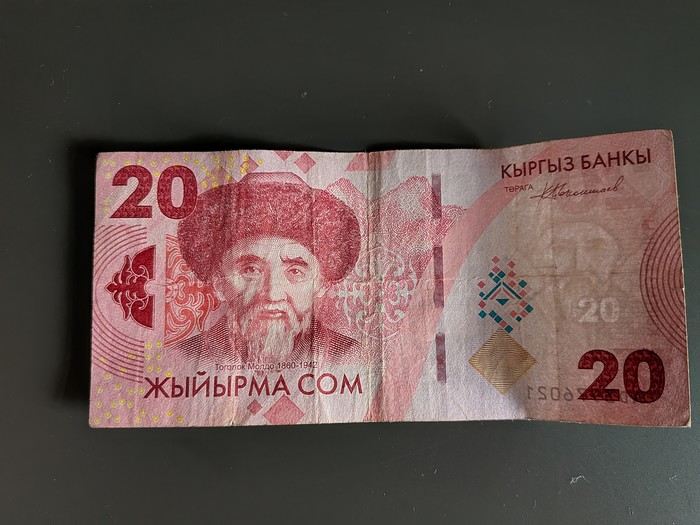
Bills come in 5000, 1000, 500, 200, 100, 50, and 20 soms.
Coins: 10, 5, 3, and 1 som.
- Paying
Card payments are accepted in supermarkets like Globus, some restaurants, gas stations of major chains (Bishkek Petroleum, Partner Neft, Red Petroleum), some hotels, national park entrances, tolls, etc.
But it doesn’t always work.
So always carry cash with you!
If the card works, great—otherwise, it’s back to the old days of wads of bills.
- Cost of Living
It’s really cheap (gas, affordable restaurants even at a decent standard, hotels, souvenirs, fruits, vegetables, water, bread...). For example, a lagman costs only 3.20 €, fixing a flat tire is 3.5 €, a full hour-long wash for a filthy 4x4 is 6 €, washing a big bag of laundry is 3 €, and a liter of 95-octane gas is 0.86 €...
On the pricier side: guesthouses and meals in guesthouses. The value for money is poor. I paid 40 € for a mediocre room with a very basic shared bathroom, while a double with AC, private bathroom, and fridge in a non-touristy hotel cost 20 €... Meals in guesthouses are the worst I’ve eaten and often the most expensive. Plus, they’re very light—don’t expect to fill up after a long day of hiking!
Car rentals are also quite expensive (70 $ per day for a RAV4 in my case).
In short, for two people, excluding accommodation and car rental, we spent an average of 45 € per day (groceries, restaurants, guesthouse dinners, souvenirs, paid activities, gas).
The trip cost us 2200 € per person all-inclusive for 3 weeks on the ground. Roughly 1/4 for the flight, 1/4 for the car, 1/4 for accommodation, and 1/4 for everything else.
- Getting Around
I’ve met cyclists, motorcyclists, people renting cars, those who drove their own vehicles from Europe, and others using public transport and taxis.
Personally, I chose to rent a car.
If you’re not planning long hikes or multi-day horse treks, it’s a great option for exploring the country.
Each car rental company has its own list of forbidden tracks. Make sure your planned route is allowed! Don’t think about ignoring this—vehicles are equipped with GPS trackers...
An international driver’s permit is required.
Police and speed cameras are everywhere, so it’s best to respect the signs (daytime running lights, seatbelts, 40-60 km/h in populated areas, 90 km/h on roads, zero tolerance for alcohol).
Locals have a unique driving style, and it can be dangerous on main roads (they overtake recklessly...). Like in Greece, South Africa, or Malta, a two-lane road is treated as a three-lane one. You pull over to let others pass or to let oncoming traffic overtake.
Without a car (at least a pseudo-4x4), you won’t be able to go everywhere. This country is a nature destination, but nature isn’t always accessible by public transport.
If a spot is near a road, great—the bus will get you almost to the door. Otherwise, you’ll need to hire an agency or take a taxi.
Cyclists will face steep climbs and dust. I’d advise avoiding main roads as much as possible—traffic isn’t on your side...
Motorcyclists will also eat a lot of dust and should research gas stations along their route (this advice also applies to vehicles running on 95-octane).
There’s a 95-octane pump in Kazarman and Gulcha.
Bikes and motorcycles have an advantage over cars, even 4x4s, as they can access some very remote tracks that other vehicles can’t (hikers and horses can obviously take them too!).
Be careful: some areas require a permit (border zones). Research this well in advance—the formalities don’t take an hour or even a day!
Be warned: Google Maps is completely unreliable (it shows roads that don’t exist, routes you through difficult tracks instead of paved roads, etc.). It’s essential to download Maps.me in advance. This app is much more reliable for this country, works offline, and is handy for hiking navigation.
A reminder: horseback riding is like cycling... If you’re not used to it or naturally padded in the right places, your backside will suffer in no time!
Think carefully before embarking on a multi-day trek!
Finally, this country is a kingdom of construction... The Chinese have taken over the market to improve truck circulation and are paving everywhere. (Good news: the Kazarman-Osh section via the tunnel is finally open in summer, even if the road isn’t quite finished.)
- Eating
I had prejudices about Kyrgyz food.
I was both wrong and right.
Supermarkets don’t offer much that’s appealing for picnics. It’s cheap, filling food, full of junk, and not gourmet. If you follow Yuka, I think you’ll be on a diet the whole trip. Bringing some pâté, sausages, or freeze-dried meals for certain nights is a good idea...
Guesthouse dinners consist of the eternal cucumber-tomato salad, a soup, and a light noodle or rice dish where you’ll be searching for the meat... Usually tough and unidentifiable. Beef? The bread is stale, and there’s no dessert or fruit.
Breakfasts always revolve around eggs or porridge... The homemade jam is usually good.
Tea is the number one drink, followed by kompot (a fruit-based drink), Coke, and Fanta.
If you want real coffee, bring your own—it’s very rare.
On the other hand, you eat well in restaurants. Lagman (homemade noodles, vegetables, spices, and usually beef), crispy eggplant, kuurdak (a kind of lamb stew with potatoes), kebabs, plov (pilaf rice with onions, carrots, and meat), and rainbow trout... For dessert? Nada!
And alcohol?
It’s available in all Globus stores: beer, wine, spirits, and you can consume your purchases in some guesthouses (depending on the owner’s religious tolerance). It’s also available in some restaurants (Bishkek, Karakol, Osh...).
The deadly specialty?
White fermented milk balls called kurut. If you think a raw-milk camembert is strong, steer clear! This is more like an old, dry, spicy goat cheese.
- Accommodation
In remote areas, it’s better to check availability on Booking a few days in advance rather than showing up last minute with high hopes.
Booking and Airbnb only offer a small portion of what’s available.
Not necessarily guesthouses, but mostly accommodations aimed at locals (business or leisure travel).
These places are generally more comfortable. There’s even some upscale options.
So it’s necessary to scour Google Maps or Yandex Maps... These accommodations are usually found on Instagram, and WhatsApp is handy for booking!
Prices are a bit of a lottery. So is the comfort. From 20 to 80 € for a double, usually with a private bathroom. (Average around 40 €). These rates are for mid-range options.
Otherwise, this country is a paradise for wild camping. In a camper van, rooftop tent, or ground tent... There are beautiful spots everywhere!
- Climate
I thought it would be quite cool/cold at altitude.
I packed too many warm clothes...
If you’re not doing high-altitude treks or sleeping in a tent, there’s no need to overload yourself with winter gear.
A good fleece, a windproof rain jacket, and technical base layers will be enough.
It only got really cold in the evenings at Song Kul Lake and Tash Rabat, and the yurts are equipped with thick blankets and a stove.
Elsewhere, temperatures ranged from 15 to 30 °C.
In short, I used the AC more than the heater! (It’s hard to drive with the windows open unless you want to be covered in dust in no time...)
- Communication
I bought an eSIM before the trip with a data plan for Kyrgyzstan (Beeline network). Perfect for communicating via WhatsApp right after landing, but this network isn’t the best in Kyrgyzstan.
We then got a physical SIM card with an unlimited one-month plan (less than 4 € including the SIM) at a Mega store downtown. This network is much better, and you get coverage in all cities and most villages. Usually in the mountain passes too.
To make yourself understood, it’s essential to download Google Translate with French, Kyrgyz, Russian, and English options.
Very useful for translating menus, signs, and communicating with locals.
Hosts and other tourism professionals will even pull out their phones to communicate with non-Russian speakers.
The police too...
- Religion
There’s a noticeable difference between the north and the southwest of the country.
In the north, it’s a bit like Albania. People are Muslim by culture but not really by religion.
In the southwest, radical Islam is growing. Mosques are more numerous and imposing. Men are more bearded, women more veiled.
For travelers, religion isn’t an issue except for the near-total absence of pork.
There’s Russian sausage, but reading the ingredient list, it’s more like a one-way ticket to cancer than an Auvergne dry sausage...
You can find the detailed account of the trip here.
- Which airline from Europe?
Turkish Airlines seems like an excellent option. The price is very reasonable (just over 500 €), the layover isn’t too long, the in-flight comfort is decent (great movie selection), and the planes are modern. Plus, the price automatically includes 30 kilos of luggage, which is perfect for campers.
The downside: the outrageous prices at Istanbul Airport.
- Bishkek Airport
The airport is under full reconstruction. It’s chaotic. There are SIM card vendors upon arrival, but no currency exchange or ATMs in the baggage claim area. You’ll find those in the departures section, which means you have to exit and re-enter under the current setup.
Personally, I pre-booked a VTC with my hotel for the transfer to the city. (Prices vary depending on the hotel’s standard—1200 soms for mine.)
There are taxis and a bus available.
- Entry Requirements
No visa is required for French citizens for stays of up to 30 days.
- Currency
The currency is the som, and the conversion is easy—just divide by 100...
You can get soms by exchanging euros (dollars are useless) or by withdrawing from an ATM. Some ATMs charge fees. Those from Mbank and Optimabank are fee-free.
The maximum withdrawal is usually 20,000 soms.
Bills come in 5000, 1000, 500, 200, 100, 50, and 20 soms.
Coins: 10, 5, 3, and 1 som.
- Paying
Card payments are accepted in supermarkets like Globus, some restaurants, gas stations of major chains (Bishkek Petroleum, Partner Neft, Red Petroleum), some hotels, national park entrances, tolls, etc.
But it doesn’t always work.
So always carry cash with you!
If the card works, great—otherwise, it’s back to the old days of wads of bills.
- Cost of Living
It’s really cheap (gas, affordable restaurants even at a decent standard, hotels, souvenirs, fruits, vegetables, water, bread...). For example, a lagman costs only 3.20 €, fixing a flat tire is 3.5 €, a full hour-long wash for a filthy 4x4 is 6 €, washing a big bag of laundry is 3 €, and a liter of 95-octane gas is 0.86 €...
On the pricier side: guesthouses and meals in guesthouses. The value for money is poor. I paid 40 € for a mediocre room with a very basic shared bathroom, while a double with AC, private bathroom, and fridge in a non-touristy hotel cost 20 €... Meals in guesthouses are the worst I’ve eaten and often the most expensive. Plus, they’re very light—don’t expect to fill up after a long day of hiking!
Car rentals are also quite expensive (70 $ per day for a RAV4 in my case).
In short, for two people, excluding accommodation and car rental, we spent an average of 45 € per day (groceries, restaurants, guesthouse dinners, souvenirs, paid activities, gas).
The trip cost us 2200 € per person all-inclusive for 3 weeks on the ground. Roughly 1/4 for the flight, 1/4 for the car, 1/4 for accommodation, and 1/4 for everything else.
- Getting Around
I’ve met cyclists, motorcyclists, people renting cars, those who drove their own vehicles from Europe, and others using public transport and taxis.
Personally, I chose to rent a car.
If you’re not planning long hikes or multi-day horse treks, it’s a great option for exploring the country.
Each car rental company has its own list of forbidden tracks. Make sure your planned route is allowed! Don’t think about ignoring this—vehicles are equipped with GPS trackers...
An international driver’s permit is required.
Police and speed cameras are everywhere, so it’s best to respect the signs (daytime running lights, seatbelts, 40-60 km/h in populated areas, 90 km/h on roads, zero tolerance for alcohol).
Locals have a unique driving style, and it can be dangerous on main roads (they overtake recklessly...). Like in Greece, South Africa, or Malta, a two-lane road is treated as a three-lane one. You pull over to let others pass or to let oncoming traffic overtake.
Without a car (at least a pseudo-4x4), you won’t be able to go everywhere. This country is a nature destination, but nature isn’t always accessible by public transport.
If a spot is near a road, great—the bus will get you almost to the door. Otherwise, you’ll need to hire an agency or take a taxi.
Cyclists will face steep climbs and dust. I’d advise avoiding main roads as much as possible—traffic isn’t on your side...
Motorcyclists will also eat a lot of dust and should research gas stations along their route (this advice also applies to vehicles running on 95-octane).
There’s a 95-octane pump in Kazarman and Gulcha.
Bikes and motorcycles have an advantage over cars, even 4x4s, as they can access some very remote tracks that other vehicles can’t (hikers and horses can obviously take them too!).
Be careful: some areas require a permit (border zones). Research this well in advance—the formalities don’t take an hour or even a day!
Be warned: Google Maps is completely unreliable (it shows roads that don’t exist, routes you through difficult tracks instead of paved roads, etc.). It’s essential to download Maps.me in advance. This app is much more reliable for this country, works offline, and is handy for hiking navigation.
A reminder: horseback riding is like cycling... If you’re not used to it or naturally padded in the right places, your backside will suffer in no time!
Think carefully before embarking on a multi-day trek!
Finally, this country is a kingdom of construction... The Chinese have taken over the market to improve truck circulation and are paving everywhere. (Good news: the Kazarman-Osh section via the tunnel is finally open in summer, even if the road isn’t quite finished.)
- Eating
I had prejudices about Kyrgyz food.
I was both wrong and right.
Supermarkets don’t offer much that’s appealing for picnics. It’s cheap, filling food, full of junk, and not gourmet. If you follow Yuka, I think you’ll be on a diet the whole trip. Bringing some pâté, sausages, or freeze-dried meals for certain nights is a good idea...
Guesthouse dinners consist of the eternal cucumber-tomato salad, a soup, and a light noodle or rice dish where you’ll be searching for the meat... Usually tough and unidentifiable. Beef? The bread is stale, and there’s no dessert or fruit.
Breakfasts always revolve around eggs or porridge... The homemade jam is usually good.
Tea is the number one drink, followed by kompot (a fruit-based drink), Coke, and Fanta.
If you want real coffee, bring your own—it’s very rare.
On the other hand, you eat well in restaurants. Lagman (homemade noodles, vegetables, spices, and usually beef), crispy eggplant, kuurdak (a kind of lamb stew with potatoes), kebabs, plov (pilaf rice with onions, carrots, and meat), and rainbow trout... For dessert? Nada!
And alcohol?
It’s available in all Globus stores: beer, wine, spirits, and you can consume your purchases in some guesthouses (depending on the owner’s religious tolerance). It’s also available in some restaurants (Bishkek, Karakol, Osh...).
The deadly specialty?
White fermented milk balls called kurut. If you think a raw-milk camembert is strong, steer clear! This is more like an old, dry, spicy goat cheese.
- Accommodation
In remote areas, it’s better to check availability on Booking a few days in advance rather than showing up last minute with high hopes.
Booking and Airbnb only offer a small portion of what’s available.
Not necessarily guesthouses, but mostly accommodations aimed at locals (business or leisure travel).
These places are generally more comfortable. There’s even some upscale options.
So it’s necessary to scour Google Maps or Yandex Maps... These accommodations are usually found on Instagram, and WhatsApp is handy for booking!
Prices are a bit of a lottery. So is the comfort. From 20 to 80 € for a double, usually with a private bathroom. (Average around 40 €). These rates are for mid-range options.
Otherwise, this country is a paradise for wild camping. In a camper van, rooftop tent, or ground tent... There are beautiful spots everywhere!
- Climate
I thought it would be quite cool/cold at altitude.
I packed too many warm clothes...
If you’re not doing high-altitude treks or sleeping in a tent, there’s no need to overload yourself with winter gear.
A good fleece, a windproof rain jacket, and technical base layers will be enough.
It only got really cold in the evenings at Song Kul Lake and Tash Rabat, and the yurts are equipped with thick blankets and a stove.
Elsewhere, temperatures ranged from 15 to 30 °C.
In short, I used the AC more than the heater! (It’s hard to drive with the windows open unless you want to be covered in dust in no time...)
- Communication
I bought an eSIM before the trip with a data plan for Kyrgyzstan (Beeline network). Perfect for communicating via WhatsApp right after landing, but this network isn’t the best in Kyrgyzstan.
We then got a physical SIM card with an unlimited one-month plan (less than 4 € including the SIM) at a Mega store downtown. This network is much better, and you get coverage in all cities and most villages. Usually in the mountain passes too.
To make yourself understood, it’s essential to download Google Translate with French, Kyrgyz, Russian, and English options.
Very useful for translating menus, signs, and communicating with locals.
Hosts and other tourism professionals will even pull out their phones to communicate with non-Russian speakers.
The police too...
- Religion
There’s a noticeable difference between the north and the southwest of the country.
In the north, it’s a bit like Albania. People are Muslim by culture but not really by religion.
In the southwest, radical Islam is growing. Mosques are more numerous and imposing. Men are more bearded, women more veiled.
For travelers, religion isn’t an issue except for the near-total absence of pork.
There’s Russian sausage, but reading the ingredient list, it’s more like a one-way ticket to cancer than an Auvergne dry sausage...
You can find the detailed account of the trip here.
Review of the CFC "Pearls of the Baltic" cruise June 2026
Hello,
We’re back from this cruise.
Boarding in Dunkirk: The doors opened around 12 PM. Since we were a bit early, I asked if my husband, who uses a walker, could wait inside instead of outside. I left him with the two suitcases and our two backpacks in the small hall while I parked the car in the reserved CFC parking lot for 10 € per day.
The shuttle that was supposed to take people from the parking lot to the model pavilion was supposed to arrive in 5 minutes, but after 15 minutes, nothing. After waiting 15 minutes, I saw a man walking and asked if I could follow him. In 15 minutes, we arrived, and still no sign of the shuttle—it must have passed us. Arrived at the model pavilion.
My husband had already checked in the suitcases with the help of a CFC staff member. The remaining formalities were completed quickly. We were on board by 12:15 PM. Headed to the buffet on deck 11 and waited in a lounge to access our cabin.
At 2 PM, we discovered our balcony cabin on deck 9 at the rear: spacious with a large balcony compared to MSC/COSTA.
Since we were at the rear, cabin 9202, there was always an issue with elevator number 4: "priority."
Elevator number 2 stops at deck 10... and elevator number 3 was often out of order, leaving only number 1 for those with mobility issues to reach the buffet, especially for people who struggle with stairs. Note: only one child on board and lots of "gray hair."
DAY 2: At sea. Lots of activities offered.
Day 3: GOTHENBURG (Sweden). Sunny, 19°C at 11 AM.
Excursion booked with CFC: Gothenburg and Haga for all.
Interesting visit with a great guide. The HAGA district, in our opinion, is full of cobblestones and nothing special, not suitable for people using a cane or wheelchair. Elevator number 3 was out of order again.
Day 4: Copenhagen. 15°C in the morning, showers in the afternoon.
We didn’t book an excursion since we’d already stopped here with CFC in 2025, and based on advice from this forum, we took the hop-on/hop-off bus right in front of the ship. I still went to see the Little Mermaid again.
No TV, but the elevator was fixed.
DAY 5: At sea. Still no TV.
DAY 6: GDANSK (Poland). 15°C, rain all day.
There’s a shuttle to get to the city center.
We took the excursion: Panorama of Gdansk.
The guide left us at the entrance of the city center for 45 minutes, telling us what to visit. Meet-up for the rest of the tour at 3 PM. The bus left at 3:15 PM to cover 10 km to see St. Mary’s Cathedral. We arrived at 4:16 PM... The guide said there are often traffic jams in that direction. We had 10 minutes on site before heading to see the lighthouse and the Westerplatte monument, where we also had 10 minutes.
Many of us wondered why we didn’t do the tour in the opposite direction since they knew there would be traffic...
I went to reception to complain about the organization. The staff member read me the program: we were supposed to start with the lighthouse, then go to the cathedral and stay for 30 minutes before heading to the center of Gdansk for a short guided walk with some free time to buy souvenirs, etc.
The guide did the complete opposite of what was planned and didn’t even give us a guided tour—just dropped us off in the city...
DAY 7: Bornholm Island (Denmark). 14°C, a few sunny spells.
We saw in the excursions that there was a walking tour of RØNNE. So, like many others, we explored on our own. There was a small orchestra welcoming us at the port and two people with city maps. We took the shuttle to leave the port—it ran every 15 minutes. The tourist office was next to the "shuttle bus." A pleasant visit at our own pace.
DAY 8: KIEL (Germany). 18–23°C, nice weather.
We took the "Kiel for all" excursion. Great guide and interesting visits.
The port is in the city, and in 10 minutes, we were in the city center by following a blue line on the ground from the port. Elevator 3 was stuck again... and the TV was back.
DAY 9: At sea. Elevator 3 works.
DAY 10: At sea. Elevator 3 is out of order again...
DAY 11: Disembarkation in Dunkirk.
Cabins had to be vacated by 7:30 AM. Buffet open until 9 AM.
Elevator number 1 was "reserved," leaving only number 2, which doesn’t go up to deck 11... a problem for people with mobility issues who had to cross the entire deck 11 and try to use one of the four working elevators at the front, which were crowded.
My opinion: Interesting stops.
The onboard staff were always welcoming, smiling, and mostly French-speaking.
Evening shows were better than in March/April 2025—better singers, dancers, and presenters, and the costumes were improved.
I liked the "magician" shows less.
There were three onboard lectures by a very cultured person, but they went off-topic and were too historical for my taste. I didn’t attend the other two; my husband went to the second but not the third.
For this cruise, there was a bridge theme, but we’re not players or interested.
We didn’t take a drink package on board—water, coffee, tea, and herbal teas were available.
We had a water leak in our cabin the night before disembarkation. We reported it, and after the technical staff came (with a translator who didn’t speak English), we were asked to leave the cabin for a while for repairs. We went to a lounge, and after 1.5 hours, I checked in at reception. The repair took longer than expected... we had to change cabins... not ideal the night before disembarkation. No balcony cabins were available, so we got an ocean-view cabin, 6075, with a bathtub (impossible for both of us to use). We packed our suitcases, took a shower in our cabin, and moved to the new one. Noise from chairs until 12:30 AM because the cabin was under a lounge, and constant ventilation noise in the hallway... sleep was hard to come by. Disembarkation: Well organized. We were helped with transporting the two suitcases and bags to the waiting room while I took the shuttle to get the car. Guylène
We had a water leak in our cabin the night before disembarkation. We reported it, and after the technical staff came (with a translator who didn’t speak English), we were asked to leave the cabin for a while for repairs. We went to a lounge, and after 1.5 hours, I checked in at reception. The repair took longer than expected... we had to change cabins... not ideal the night before disembarkation. No balcony cabins were available, so we got an ocean-view cabin, 6075, with a bathtub (impossible for both of us to use). We packed our suitcases, took a shower in our cabin, and moved to the new one. Noise from chairs until 12:30 AM because the cabin was under a lounge, and constant ventilation noise in the hallway... sleep was hard to come by. Disembarkation: Well organized. We were helped with transporting the two suitcases and bags to the waiting room while I took the shuttle to get the car. Guylène
Charles-de-Gaulle: temps entre avion et train
Bonjour,
Voila, j'atterie à Paris Charles de Gaule à 17h45, mon train part de Montparnasse à 19h12
Pensez vous que j'aurais le temps de mis rendre ou est ce trop court niveau temps?
Merci de vos réponse.
KLM: rerouted without notice!
Hi there,
This afternoon I had a flight at 5:10 PM to Amsterdam from Nice (final destination: Berlin). I arrived at the airport a little before 3:00 PM and saw that the flight was now leaving at 6:30 PM. I went to the counter to point out that I wouldn’t have time to make my connection, and they told me I’d be spending the night in Amsterdam.
When the agent checked her computer, she saw that I’d been put on a flight with another airline and asked if I hadn’t received an email.
In the end, I had to change terminals and leave at 7:05 PM with Swiss Airlines, then Air Baltic.
Just to clarify, I checked in less than 24 hours ago for both KLM flights (Nice-Amsterdam and Amsterdam-Berlin) where I had seats assigned. I checked my emails carefully, and I was never notified!
Luckily, the Swiss Airlines flight left later—otherwise, at 3:00 PM, I wouldn’t have had time to check in (I have a checked bag), and I don’t know how I would’ve proven I never got an email. Also, thankfully, I went to the counter much earlier than planned for the 6:30 PM departure.
In the end, I was lucky because with KLM, I would’ve lost a whole day. And it’s a good thing I always travel for at least two full weeks because I’ve often lost a day due to delays—I wouldn’t do that for a week or a weekend getaway...
This is the first time this has happened to me, but there’s a first time for everything!
This afternoon I had a flight at 5:10 PM to Amsterdam from Nice (final destination: Berlin). I arrived at the airport a little before 3:00 PM and saw that the flight was now leaving at 6:30 PM. I went to the counter to point out that I wouldn’t have time to make my connection, and they told me I’d be spending the night in Amsterdam.
When the agent checked her computer, she saw that I’d been put on a flight with another airline and asked if I hadn’t received an email.
In the end, I had to change terminals and leave at 7:05 PM with Swiss Airlines, then Air Baltic.
Just to clarify, I checked in less than 24 hours ago for both KLM flights (Nice-Amsterdam and Amsterdam-Berlin) where I had seats assigned. I checked my emails carefully, and I was never notified!
Luckily, the Swiss Airlines flight left later—otherwise, at 3:00 PM, I wouldn’t have had time to check in (I have a checked bag), and I don’t know how I would’ve proven I never got an email. Also, thankfully, I went to the counter much earlier than planned for the 6:30 PM departure.
In the end, I was lucky because with KLM, I would’ve lost a whole day. And it’s a good thing I always travel for at least two full weeks because I’ve often lost a day due to delays—I wouldn’t do that for a week or a weekend getaway...
This is the first time this has happened to me, but there’s a first time for everything!
What’s your definition of a nature destination?
Hi,
I’m starting this thread after a digression that began in the India section and continued in a travel journal about Kerala.
The original topic was whether India is—or isn’t—a nature destination.
I’ll let you all discuss and share your own definition of a nature destination. 🙂
I’m starting this thread after a digression that began in the India section and continued in a travel journal about Kerala.
The original topic was whether India is—or isn’t—a nature destination.
I’ll let you all discuss and share your own definition of a nature destination. 🙂
Des voyages après les annulations?
Bonjour à tous !
Pour faire suite au message fermé ( nos-experiences-demandes-remboursements-suite-annulation-cause-covid-19 ) car trop 'gonflé' : plus de 1200 réponses ! , j'ouvre un nouveau sujet, qui est la suite logique du précédent !
Après les annulations - demandes de remboursements abouties ou non cette année, suite au Covid, j'aimerais que vous nous racontiez la suite de l'histoire :
- Qu'est - il advenu de vos projets de vacances ? - Avez- vous persévéré et obtenu un remboursement ou un report ? - Faites- vous de nouveaux projets ou avez vous déjà pu tenter, avec réussite, un autre voyage ?
Pour démarrer le sujet, voici ce que nous avons prévu : -- les 2 voyages ( USA et Yucatan ) qui étaient prêts seraient reportés à 1 an, peut-être à 2 : c'est de l'optimisme ... -- le voyage de mai, 3 semaines dans les Pouilles : quasi complètement remboursé ; peut-être reporté au printemps : il est fin prêt aussi ! -- cette année, vacances de 6 nuits à la belge : 3 jours à la Côte et 3 jours dans les Ardennes ; un peu court mais une météo plus qu'agréable ; belle bouffée d'air ... J'espère que vous avez mieux à nous raconter !
Bonne journée à tous .
Après les annulations - demandes de remboursements abouties ou non cette année, suite au Covid, j'aimerais que vous nous racontiez la suite de l'histoire :
- Qu'est - il advenu de vos projets de vacances ? - Avez- vous persévéré et obtenu un remboursement ou un report ? - Faites- vous de nouveaux projets ou avez vous déjà pu tenter, avec réussite, un autre voyage ?
Pour démarrer le sujet, voici ce que nous avons prévu : -- les 2 voyages ( USA et Yucatan ) qui étaient prêts seraient reportés à 1 an, peut-être à 2 : c'est de l'optimisme ... -- le voyage de mai, 3 semaines dans les Pouilles : quasi complètement remboursé ; peut-être reporté au printemps : il est fin prêt aussi ! -- cette année, vacances de 6 nuits à la belge : 3 jours à la Côte et 3 jours dans les Ardennes ; un peu court mais une météo plus qu'agréable ; belle bouffée d'air ... J'espère que vous avez mieux à nous raconter !
Bonne journée à tous .
Concrete changes in how you travel during the crisis
Hi everyone,
I was wondering how the coronavirus pandemic has impacted the way you travel or plan your trips. I know some of these points have been discussed before, but what I’m interested in here is the concrete, present, and personal—no politics and nothing post-COVID.
Here are a few ideas—do any of these resonate with you?
- Traveling shorter distances / for shorter durations - Favoring rural or less crowded areas over urban or overcrowded ones - Opting for private transportation over public transit - Traveling solo or at least in pairs rather than in groups - Waiting until the crisis is over and saving money in the meantime - Reassessing health risks (and updating your first-aid kit/medications and vaccinations) - ...
I’m sure you’ll have other things to add. The floor is yours!
I was wondering how the coronavirus pandemic has impacted the way you travel or plan your trips. I know some of these points have been discussed before, but what I’m interested in here is the concrete, present, and personal—no politics and nothing post-COVID.
Here are a few ideas—do any of these resonate with you?
- Traveling shorter distances / for shorter durations - Favoring rural or less crowded areas over urban or overcrowded ones - Opting for private transportation over public transit - Traveling solo or at least in pairs rather than in groups - Waiting until the crisis is over and saving money in the meantime - Reassessing health risks (and updating your first-aid kit/medications and vaccinations) - ...
I’m sure you’ll have other things to add. The floor is yours!
My Battle with Excess Weight (How I Lost 5 Kilos in 2 Days, by Bike)
New, seen on TV, you won't believe it. Click here.
During my recent trek, I found that my bike—and my luggage—were heavy. Until now, the weight of my gear hadn’t been an issue. Maybe I’m getting old, or maybe I just can’t handle the SNCF’s stairs anymore.
It hit me in Toulouse. A 3-minute stop turned into a 6-hour delay because of a fire that was hard to control between Toulouse and Montauban. Eventually, our train was canceled, and we were told to take another train that was also waiting for the same destination. It was my fourth train of the day. It was 9:30 PM, and I’d left at 9:30 AM that morning. Suddenly, exhaustion took over.
That’s when I met two bike-packers who, without hesitation, lifted their bikes with all their gear attached, carried them down the steps of the Corail train, and then down the stairs to the underground passage. They were young and fit (they smelled like warm sand), and I definitely wasn’t. It was in that scorching heat, struggling up and down all those stairs (Oh Toulouse, as Nougaro would say, may you be cursed for seven generations), that I decided to go on a diet.
It’s a diet anyone can do, it works, and it’s free. So I’m sharing it right away.
No need to exercise or restrict yourself. No, all you have to do is think and do some research. You need a chair, a table, a scale, a computer, and a spreadsheet. Make a list of everything you’ve brought and weigh it all. Set a goal based on the type of trek and your comfort level. Remove everything that doesn’t help you reach that goal.
My goal: - Trekking in France from May to September, in the plains or at most on a plateau like Mont Aubrac, where at 800 m altitude, it can drop to 10 °C at night even in the middle of summer.
- Sleeping in a tent on a good mattress in a sleeping bag (I’m not changing that). Someone suggested I could sleep under the stars on bubble wrap. No way, are you crazy?
- Not cooking. I buy lunch on the way in the morning and dinner on the way in the afternoon (I’m not changing that either). Someone suggested Ducasse delivers everywhere in France. Uh, have you been smoking lemon weed?
That’s how I lost 5 kg, going from 17.7 kg to 12.8 kg, including luggage but not food or water. But I also reduced the volume and quantity of my gear.
Here are the before photos:
https://photos.app.goo.gl/XDfKaoVvHFNxDXrq5
And after:
https://photos.app.goo.gl/STRVKaWuVcNVeCfS9
of my bike.
You can see that a duffel bag is gone, as well as the extra bags behind the panniers. I don’t even use the mesh pockets at the bottom of each pannier anymore. You can also see I’m still carrying my 1 kg U-lock. I know, it’s unforgivable. I’m on the verge of being banned.
So I might do another trek in September to validate my choices.
For the rear panniers, I can save between 1 and 1.5 kg depending on the solution: Arkel Dry-lites (28 L pair, 0.540 kg) or Vaude Aqua Light (38 L pair, 1.080 kg).
I also need to cut down on the tools I bring. I should be able to shave off about 0.5 kg.
And the bike? I’m thinking about it. Someone suggested the folding Savadeck Z2, which only weighs 10 kg. Carbon? Oh, don’t spread the word—it’s even more taboo than aluminum in some circles, and I won’t even mention the belt drive.
During my recent trek, I found that my bike—and my luggage—were heavy. Until now, the weight of my gear hadn’t been an issue. Maybe I’m getting old, or maybe I just can’t handle the SNCF’s stairs anymore.
It hit me in Toulouse. A 3-minute stop turned into a 6-hour delay because of a fire that was hard to control between Toulouse and Montauban. Eventually, our train was canceled, and we were told to take another train that was also waiting for the same destination. It was my fourth train of the day. It was 9:30 PM, and I’d left at 9:30 AM that morning. Suddenly, exhaustion took over.
That’s when I met two bike-packers who, without hesitation, lifted their bikes with all their gear attached, carried them down the steps of the Corail train, and then down the stairs to the underground passage. They were young and fit (they smelled like warm sand), and I definitely wasn’t. It was in that scorching heat, struggling up and down all those stairs (Oh Toulouse, as Nougaro would say, may you be cursed for seven generations), that I decided to go on a diet.
It’s a diet anyone can do, it works, and it’s free. So I’m sharing it right away.
No need to exercise or restrict yourself. No, all you have to do is think and do some research. You need a chair, a table, a scale, a computer, and a spreadsheet. Make a list of everything you’ve brought and weigh it all. Set a goal based on the type of trek and your comfort level. Remove everything that doesn’t help you reach that goal.
My goal: - Trekking in France from May to September, in the plains or at most on a plateau like Mont Aubrac, where at 800 m altitude, it can drop to 10 °C at night even in the middle of summer.
- Sleeping in a tent on a good mattress in a sleeping bag (I’m not changing that). Someone suggested I could sleep under the stars on bubble wrap. No way, are you crazy?
- Not cooking. I buy lunch on the way in the morning and dinner on the way in the afternoon (I’m not changing that either). Someone suggested Ducasse delivers everywhere in France. Uh, have you been smoking lemon weed?
That’s how I lost 5 kg, going from 17.7 kg to 12.8 kg, including luggage but not food or water. But I also reduced the volume and quantity of my gear.
Here are the before photos:
https://photos.app.goo.gl/XDfKaoVvHFNxDXrq5
And after:
https://photos.app.goo.gl/STRVKaWuVcNVeCfS9
of my bike.
You can see that a duffel bag is gone, as well as the extra bags behind the panniers. I don’t even use the mesh pockets at the bottom of each pannier anymore. You can also see I’m still carrying my 1 kg U-lock. I know, it’s unforgivable. I’m on the verge of being banned.
So I might do another trek in September to validate my choices.
For the rear panniers, I can save between 1 and 1.5 kg depending on the solution: Arkel Dry-lites (28 L pair, 0.540 kg) or Vaude Aqua Light (38 L pair, 1.080 kg).
I also need to cut down on the tools I bring. I should be able to shave off about 0.5 kg.
And the bike? I’m thinking about it. Someone suggested the folding Savadeck Z2, which only weighs 10 kg. Carbon? Oh, don’t spread the word—it’s even more taboo than aluminum in some circles, and I won’t even mention the belt drive.
Plan de reprise des croisières Costa
Bonjour
Voilà ce qui serait prévu à partir de la mi-août :
http://crew-center.com/costa-cruises-plans-re-start-voyages-7-ships-5-phases
Cordialement
Voilà ce qui serait prévu à partir de la mi-août :
http://crew-center.com/costa-cruises-plans-re-start-voyages-7-ships-5-phases
Cordialement
A quand l'ouverture des frontières dans l'espace Schengen? (à vélo)
Hello,
C'est un peu la question qu'on se pose et qui nous oblige à revoir nos plans, pour l'instant c'est très flou, visiblement ce ne serait pas avant Septembre voir même pas envisageable cette année, mais si vous avez des infos de ce côté là n'hésitez pas à les partager.
Gilles
C'est un peu la question qu'on se pose et qui nous oblige à revoir nos plans, pour l'instant c'est très flou, visiblement ce ne serait pas avant Septembre voir même pas envisageable cette année, mais si vous avez des infos de ce côté là n'hésitez pas à les partager.
Gilles
Croisières, à quand la reprise?
Bonsoir,
beaucoup se posent la question, parfois avec un optimisme surprenant ! Voici un petit rappel :
Pour qu'il y ait des croisières il faut au moins réunir 3 conditions principales (et d'autres aussi) :
- 1 un bateau DÉSINFECTÉ avec son équipage au complet et opérationnel. Pour l'instant les équipages sont disséminés dans le monde. Il faudra les retrouver, les convaincre, certains auront peur. Les convaincus devront trouver des vols pour revenir ; enfin venant de pays "exotiques" ils devront être acceptés à l'entrée des pays où seront les bateaux. Pas gagné avec toutes ces contraintes !!
- 2 un minimum de passagers car en mer un bateau armé coûte beaucoup plus cher que désarmé dans 1 port ou au mouillage !!! Comment vont-ils arriver au port d'embarquement s'ils viennent de loin ? Et mêmes remarques que pour l'équipage, ils faudra qu'ils puissent entrer dans le pays de départ...
- 3 des ports qui acceptent les bateaux. Ce que diront les gouvernements est une chose, ce que décideront les locaux qui, déjà avant l'épidémie ne voyaient plus les croisiéristes d'un très bon œil en est une autre ! Pas gagné non plus pour beaucoup d'endroits où les populations risquent de très très mal réagir à l'arrivée de milliers de personnes potentiellement porteuses du virus même si elles ne sont pas malades.
On peut rêver, mais il faut aussi parfois revenir sur terre à défaut d'être en mer. Pour moi il y aura extrêmement peu de départs avant l'automne en étant très optimiste !!! Je prépare déjà un plan B pour notre départ du 17/10 depuis le Japon Nous avons heureusement des vols reportables. Qui vivra verra.... Qu'en pensez-vous ?
beaucoup se posent la question, parfois avec un optimisme surprenant ! Voici un petit rappel :
Pour qu'il y ait des croisières il faut au moins réunir 3 conditions principales (et d'autres aussi) :
- 1 un bateau DÉSINFECTÉ avec son équipage au complet et opérationnel. Pour l'instant les équipages sont disséminés dans le monde. Il faudra les retrouver, les convaincre, certains auront peur. Les convaincus devront trouver des vols pour revenir ; enfin venant de pays "exotiques" ils devront être acceptés à l'entrée des pays où seront les bateaux. Pas gagné avec toutes ces contraintes !!
- 2 un minimum de passagers car en mer un bateau armé coûte beaucoup plus cher que désarmé dans 1 port ou au mouillage !!! Comment vont-ils arriver au port d'embarquement s'ils viennent de loin ? Et mêmes remarques que pour l'équipage, ils faudra qu'ils puissent entrer dans le pays de départ...
- 3 des ports qui acceptent les bateaux. Ce que diront les gouvernements est une chose, ce que décideront les locaux qui, déjà avant l'épidémie ne voyaient plus les croisiéristes d'un très bon œil en est une autre ! Pas gagné non plus pour beaucoup d'endroits où les populations risquent de très très mal réagir à l'arrivée de milliers de personnes potentiellement porteuses du virus même si elles ne sont pas malades.
On peut rêver, mais il faut aussi parfois revenir sur terre à défaut d'être en mer. Pour moi il y aura extrêmement peu de départs avant l'automne en étant très optimiste !!! Je prépare déjà un plan B pour notre départ du 17/10 depuis le Japon Nous avons heureusement des vols reportables. Qui vivra verra.... Qu'en pensez-vous ?