Results for "Islande+souvenir+artisanat"
About 28,025 results.
More options
Many results are in French, the community’s main language. English translations are added over time.
Search results
Notre voyage en Thaïlande du 28 août au 18 septembre 2006: zéro galère!
Notre voyage en Thaïlande : 28/08 au 18/09/06 : zéro galère !
Zéro galère, 100% plaisir
Tout d’abord, merci à tous les VFistes pour leurs conseils pré-départ !
Ma femme et moi-même (chacun 33ans) étions déjà allé en Thaïlande en 2003 en voyage organisé (12 jours de circuit classique + jomtien). Malgré le « carcan » du groupe, nous avions été enchantés et n’avions qu’une envie : y retourner en free-lance
Notre but était de partir « le nez au vent » de dormir le + simplement possible (seule condition : wc et douche dans la piaule) de manger uniquement Thaï (si possible dans la rue) avec des Thaïs. 2 concessions sur la bouffe en 3 semaines: 1 restau Japonais au MBK et 1 sundae chez Mc Do
Je vais donc essayer de vous résumer notre voyage en mettant un maximum de renseignements, de prix (prix basse saison), de bons plans, et d’anecdotes…
Munis de 2 AR Lyon-Bangkok (2fois 700€ttc) et de 2 valises-sacs à dos quasi-vides, nous sommes arrivés le lundi midi à bangkok. Bus A2 (merci LP et VF !) pour le quartier de KSR avec pour idée de loger au New Siam (1 ou 2). Apres avoir visité le 1, nous sommes finalement allés au New Siam II (820baths au lieu de 700baths mais la piscine en +)
Jour 1 et 2 : Visite de Bkk : Gold mountain puis taxi boat sur le Klong (10bath la course en bateau public !) jusqu'à Jim Thompson House. Puis BTS + metro pour aller à la gare pour se renseigner sur les départs pour Kanchanaburi. De la gare, direction Chinatown (ou nous nous sommes perdus pendant près de 4 heures, mais absolument génial !). Embarcadère sur Chao Praya puis retour au New Siam (13 baths pour traverser quasiment toute la ville !).
Jour 3 : départ pour kanchanaburi par le train (100baths pour les farangs, 25 baths pour les Thaïs…). Dans le train, nous rencontrons Carron, une jeune Anglaise Francophone qui vient d’arriver a Bkk pour un stage de 6 mois, et B-J (Benoît-Joseph, intervenant sur VF, un « fondu de voyage », qui est en Thaïlande de juillet à Octobre ) On sympathise et décidons d’aller au Joly Frog. 200b pour nous 2, 70baths pour B-J. Jolie GH très bien tenue, très propre et franchement pas chère (20-30 baths le plat, 15 baths le kg de linge à laver !). Un peu de pluie en fin d’AM donc discussion avec nos nouveaux compagnons autour de quelques Singhas….
Jour 4 : départ pour le terminal des Bus pour aller à Erawan Waterfalls (env100b- 1h30) Ascension des 7 cascades (raide et glissante mais magique) toutes + belles les unes que les autres. Plongeons dans plusieurs cascades avec léchages des orteils par les poissons ! Retour en fin d’AM à la GH puis soirée au bord de la rivière avec restau local (pas vu un farang de toute la soirée ??...)
Jour 5 : retour Bkk par minibus. Arrivée 16h00, on se décide d’allez à Koh Tao, à 17h00 on avait nos billets, à 22h00 on était dans le bus VIP + Catamaran, le lendemain 9h00 on était sur l’île !! (Allez faire la même chose en France pour faire Lyon-Bastia…) 2 X 800 baths (32€).
Jour 6 à 12 : arrivée + visite de GH sur Sairee Beach. Nous nous décidons pour la GH « Pranees » 300baths, mais la quittons au bout de 3 nuits car un peu « limite » (cafard qui boulotte tous nos gâteaux + lézard géant (40cm) sous douche). Direction le « sairee hut » ou les mêmes cabanes sont à 400baths mais sont entretenues.
Koh Tao ; je vous conseille le tour de l’île (600baths) ou vous faites du snorkelling sur 5 ou 6 spots différents. Tout est compris, le matos, le repas, les boissons, les fruits, la prise en charge et le retour à votre GH….
Nous sommes souvent allés nous baigner à Janson Bay, sur la plage du « Charm Churee Villa » (droit d’entrée de 100 bath mais convertible en repas et boissons au bar restau de la plage). Contrairement à ce que j’avais pu lire sur Sairee Beach, on peut se baigner à marée haute et marée basse. Il y a même de très beaux coraux, suffit de s’éloigner un peu de la plage. Cette même plage est cependant un peu crado (bouteilles, ..)
Nous y avons également fait notre baptême de plongée au « Scuba junction » ou nous avons été encadrés par Yann, un Parisien fraîchement débarqué sur l’île. Je vous conseille fortement ce centre et Yann. Un instructeur pour 2 plongeurs, c’est rare.
Une excellente adresse pour la soirée : le DRY BAR sur Sairee. Lampions dans les arbres, coussins sur la plage, bougies, super musique lounge, super cocktails, bref super !!
Jour 12 : départ de nuit pour Krabi via Surat Thani (9 heures de bateau + 2 h de minibus) Krabi Railay en taxi boat, installation au « view point » sur la cote est un peu boueuse… Paysage absolument grandiose ! logements « bradés » hors saison. Une journée en bateau a visiter les îles aux alentours (à éviter : l’agence @rt canonying…)
Jour 14 à 16 : 3 nuits à Ao Nang au « sabai mansion » tip-top ! 400baths, tout confort, piscine, .. Visite de Krabi et environs. Une journée en speed boat vers Koh Phi Phi, Bamboo Island, … 1000baths tout compris (a recommander : agence Barraccuda à Ao Nang)
Jour 17 : krabi-bangkok avec Airasia.com 58€ pour 2 !! en réservant 3 jours avant. (40€ en réservant 7 jours avant).
Jour 17 à 20 : Bangkok : quelques Wats incontournables, marché aux amulettes (génial !) MBK, Siam center, Paragon, … et surtout Chatuchak le samedi des 8h00 jusqu'à 18h00 non stop ! (Je pense que Chatuchak fera l’objet d’un post ultérieur tellement y’a à dire…).
Conclusion : voyage génial !!
Budget (hors avion) : 1400€ pour 3 semaines à deux Dont 500€ cadeaux & souvenirs Dont 200€ de logement… Reste donc 700€ de transferts + bouffe + boissons + excursions…
Lyon-Bangkok : 12kg de bagages pour deux, Bangok-Lyon : 60kg…
Bon, je me rends compte que j’ai été un peu long…. Pourtant, j’ai du faire plein d’oublis… Vos remarques et questions sont les bienvenues.
FRED
Zéro galère, 100% plaisir
Tout d’abord, merci à tous les VFistes pour leurs conseils pré-départ !
Ma femme et moi-même (chacun 33ans) étions déjà allé en Thaïlande en 2003 en voyage organisé (12 jours de circuit classique + jomtien). Malgré le « carcan » du groupe, nous avions été enchantés et n’avions qu’une envie : y retourner en free-lance
Notre but était de partir « le nez au vent » de dormir le + simplement possible (seule condition : wc et douche dans la piaule) de manger uniquement Thaï (si possible dans la rue) avec des Thaïs. 2 concessions sur la bouffe en 3 semaines: 1 restau Japonais au MBK et 1 sundae chez Mc Do
Je vais donc essayer de vous résumer notre voyage en mettant un maximum de renseignements, de prix (prix basse saison), de bons plans, et d’anecdotes…
Munis de 2 AR Lyon-Bangkok (2fois 700€ttc) et de 2 valises-sacs à dos quasi-vides, nous sommes arrivés le lundi midi à bangkok. Bus A2 (merci LP et VF !) pour le quartier de KSR avec pour idée de loger au New Siam (1 ou 2). Apres avoir visité le 1, nous sommes finalement allés au New Siam II (820baths au lieu de 700baths mais la piscine en +)
Jour 1 et 2 : Visite de Bkk : Gold mountain puis taxi boat sur le Klong (10bath la course en bateau public !) jusqu'à Jim Thompson House. Puis BTS + metro pour aller à la gare pour se renseigner sur les départs pour Kanchanaburi. De la gare, direction Chinatown (ou nous nous sommes perdus pendant près de 4 heures, mais absolument génial !). Embarcadère sur Chao Praya puis retour au New Siam (13 baths pour traverser quasiment toute la ville !).
Jour 3 : départ pour kanchanaburi par le train (100baths pour les farangs, 25 baths pour les Thaïs…). Dans le train, nous rencontrons Carron, une jeune Anglaise Francophone qui vient d’arriver a Bkk pour un stage de 6 mois, et B-J (Benoît-Joseph, intervenant sur VF, un « fondu de voyage », qui est en Thaïlande de juillet à Octobre ) On sympathise et décidons d’aller au Joly Frog. 200b pour nous 2, 70baths pour B-J. Jolie GH très bien tenue, très propre et franchement pas chère (20-30 baths le plat, 15 baths le kg de linge à laver !). Un peu de pluie en fin d’AM donc discussion avec nos nouveaux compagnons autour de quelques Singhas….
Jour 4 : départ pour le terminal des Bus pour aller à Erawan Waterfalls (env100b- 1h30) Ascension des 7 cascades (raide et glissante mais magique) toutes + belles les unes que les autres. Plongeons dans plusieurs cascades avec léchages des orteils par les poissons ! Retour en fin d’AM à la GH puis soirée au bord de la rivière avec restau local (pas vu un farang de toute la soirée ??...)
Jour 5 : retour Bkk par minibus. Arrivée 16h00, on se décide d’allez à Koh Tao, à 17h00 on avait nos billets, à 22h00 on était dans le bus VIP + Catamaran, le lendemain 9h00 on était sur l’île !! (Allez faire la même chose en France pour faire Lyon-Bastia…) 2 X 800 baths (32€).
Jour 6 à 12 : arrivée + visite de GH sur Sairee Beach. Nous nous décidons pour la GH « Pranees » 300baths, mais la quittons au bout de 3 nuits car un peu « limite » (cafard qui boulotte tous nos gâteaux + lézard géant (40cm) sous douche). Direction le « sairee hut » ou les mêmes cabanes sont à 400baths mais sont entretenues.
Koh Tao ; je vous conseille le tour de l’île (600baths) ou vous faites du snorkelling sur 5 ou 6 spots différents. Tout est compris, le matos, le repas, les boissons, les fruits, la prise en charge et le retour à votre GH….
Nous sommes souvent allés nous baigner à Janson Bay, sur la plage du « Charm Churee Villa » (droit d’entrée de 100 bath mais convertible en repas et boissons au bar restau de la plage). Contrairement à ce que j’avais pu lire sur Sairee Beach, on peut se baigner à marée haute et marée basse. Il y a même de très beaux coraux, suffit de s’éloigner un peu de la plage. Cette même plage est cependant un peu crado (bouteilles, ..)
Nous y avons également fait notre baptême de plongée au « Scuba junction » ou nous avons été encadrés par Yann, un Parisien fraîchement débarqué sur l’île. Je vous conseille fortement ce centre et Yann. Un instructeur pour 2 plongeurs, c’est rare.
Une excellente adresse pour la soirée : le DRY BAR sur Sairee. Lampions dans les arbres, coussins sur la plage, bougies, super musique lounge, super cocktails, bref super !!
Jour 12 : départ de nuit pour Krabi via Surat Thani (9 heures de bateau + 2 h de minibus) Krabi Railay en taxi boat, installation au « view point » sur la cote est un peu boueuse… Paysage absolument grandiose ! logements « bradés » hors saison. Une journée en bateau a visiter les îles aux alentours (à éviter : l’agence @rt canonying…)
Jour 14 à 16 : 3 nuits à Ao Nang au « sabai mansion » tip-top ! 400baths, tout confort, piscine, .. Visite de Krabi et environs. Une journée en speed boat vers Koh Phi Phi, Bamboo Island, … 1000baths tout compris (a recommander : agence Barraccuda à Ao Nang)
Jour 17 : krabi-bangkok avec Airasia.com 58€ pour 2 !! en réservant 3 jours avant. (40€ en réservant 7 jours avant).
Jour 17 à 20 : Bangkok : quelques Wats incontournables, marché aux amulettes (génial !) MBK, Siam center, Paragon, … et surtout Chatuchak le samedi des 8h00 jusqu'à 18h00 non stop ! (Je pense que Chatuchak fera l’objet d’un post ultérieur tellement y’a à dire…).
Conclusion : voyage génial !!
Budget (hors avion) : 1400€ pour 3 semaines à deux Dont 500€ cadeaux & souvenirs Dont 200€ de logement… Reste donc 700€ de transferts + bouffe + boissons + excursions…
Lyon-Bangkok : 12kg de bagages pour deux, Bangok-Lyon : 60kg…
Bon, je me rends compte que j’ai été un peu long…. Pourtant, j’ai du faire plein d’oublis… Vos remarques et questions sont les bienvenues.
FRED
Hôtel pour des amoureux à Phuket
salut
j'emmene l'amour de ma vie a phuket debut avril,
desireux d'un moment de grand repos et 'amour(mais oui ca va ensemble!) j'avais selectionné le Twinpalms en lagoondeluxe room
magique, belle chambre qui donne accés direct dans piscine, mais voila, passé par asiarooms.com en reserve le 15/2/06 ceux ci me repondent aujourd hui que ce n'est plus dispo {{
je cherche donc un endroit idilique, de bon standing, voir tres bon, mais pas trop cher ! looooooooooooooool
soit un max de 150€/nuit
que ce soit en hotel ou en location mais avec du calme et si possible jacuzzi ou piscine privée (rien que ca)
merci d'avance de vos conseils😛😎
Vos conseils sur Tahiti et environs
Quelqu'un est déja aller a Tahiti? Si oui, j'aimerais bien avoir des informations sur les environs et les choses a ne pas manquer la bas !! J'y vais en octobre prochain comme arrêt avant d'arriver en Australie...N'importe quel informations serait la bienvenue!
Merci !!
J'envisage de ne plus "noter" / donner mon avis sur Tripadvisor
Bonjour,
Voici ce qui m'amène à ouvrir cette discussion :
Comme bon nombre d'entre vous, j'avais pour habitude de "noter - donner mon avis" sur Tripadvisor chaque fois que je séjourne quelque part.
En fait, comme je me sert des avis lus sur le site pour réserver ou non sur un hôtel, je trouvais tout à fait bon moi aussi de donner mon avis une fois après avoir séjourné dans tel ou tel lieu (hôtel, riad...).
Oui, mais voilà où le bas blesse et pourquoi j'envisage de ne plus poster sur Tripadvisor :
Suite aux très nombreux avis élogieux donnés par la communauté de Tripadvisor, plusieurs lieux ont obtenu le "label excellence", ce qui en somme est une bonne chose pour le propriétaire. Oui, mais voilà, certains propriétaires ont du coup trouver bon à augmenter leurs tarifs😕
Pour exemple, avant le "label excellence", un riad que je connais de 6 chambres à Marrakech avait les tarifs suivants :
1 chambre à 50 eur, 4 autres à 68 eur et la 5ème à 78e
à présent, avec le "label excellence" : les 5 premières chambres sont passées à 78e et la 6ème chambre à 98eur !!
Du coup, j'ai pris la décision de ne plus partager mes "bons plans" sur Tripadvisor et de garder une bonne adresse pour moi-même vu que certains propriétaires se sentent pousser des ailes et augmentent les tarifs.
Voici ce qui m'amène à ouvrir cette discussion :
Comme bon nombre d'entre vous, j'avais pour habitude de "noter - donner mon avis" sur Tripadvisor chaque fois que je séjourne quelque part.
En fait, comme je me sert des avis lus sur le site pour réserver ou non sur un hôtel, je trouvais tout à fait bon moi aussi de donner mon avis une fois après avoir séjourné dans tel ou tel lieu (hôtel, riad...).
Oui, mais voilà où le bas blesse et pourquoi j'envisage de ne plus poster sur Tripadvisor :
Suite aux très nombreux avis élogieux donnés par la communauté de Tripadvisor, plusieurs lieux ont obtenu le "label excellence", ce qui en somme est une bonne chose pour le propriétaire. Oui, mais voilà, certains propriétaires ont du coup trouver bon à augmenter leurs tarifs😕
Pour exemple, avant le "label excellence", un riad que je connais de 6 chambres à Marrakech avait les tarifs suivants :
1 chambre à 50 eur, 4 autres à 68 eur et la 5ème à 78e
à présent, avec le "label excellence" : les 5 premières chambres sont passées à 78e et la 6ème chambre à 98eur !!
Du coup, j'ai pris la décision de ne plus partager mes "bons plans" sur Tripadvisor et de garder une bonne adresse pour moi-même vu que certains propriétaires se sentent pousser des ailes et augmentent les tarifs.
Inside South Africa
Inside South Africa
The Burst Hose. The passenger is so impatient to arrive that the coachman whips a horse that barely tolerates the mistreatment. I can tell she’s gearing up for a kick, and suddenly, at full gallop, she stops responding. If I press the spur, she cuts out but accepts a half-pressed pedal. She pulled this stunt last year, right in the middle of the Kalahari Desert, and I can guess the trick: she blew a hose! An hour at a slow trot brings us to a Ford garage. A workshop manager, as sullen as he is efficient, has the necessary parts removed to reach the hose, then announces he doesn’t have the spare part and will need a week to get it. I suggest taking advantage of the access to make a temporary repair on the tear, but he refuses, arguing the pressure is so high that the patch would give way immediately—"It’s not a Testarossa, after all!" After reassembly, he refuses to charge us anything and advises us to head to the next town, 200 kilometers away—off we go for another four hours. Semi-trailers overtake us without mercy; I’m reminded of *Duel*. At the Land Rover dealership, we learn the part will take two working days to arrive, and it’s Thursday. I decide to have the hose delivered to the house without wheels—I’ll change it myself. Five hours later, climbing the pass in first gear, we reach the object of her desires. * Hide and Seek In Brittany, my neighbor is a taciturn, touchy fisherman. He’s anchored his old boat in the middle of the estuary that separates two departments and uses it as a storage space. It’s a jumble of nets, buoys, and traps. The old wooden vessel is falling apart, and the hull’s paint is nothing but a distant memory—so much so that the Maritime Affairs Directorate of his department orders him to remove it or repaint it. Asterix also runs a restaurant on the harbor, where he treats customers to his catch. One Sunday afternoon, we see him loading cooks, servers, and dishwashers armed with rollers, brushes, and paint cans into dinghies. Off they go for two hours of slapdash painting and laughter. Once the starboard side is done, everyone returns to prepare for the evening service. The port side will wait until the Maritime Affairs Directorate from the other department reacts. This story came back to me when I got home: the side visible from the road had been repainted, but the other side was left as is. * The Blonde, the Red, the White, and the Black Many workers are paid at the end of each week, but alcohol sales for takeaway are banned on Saturdays and Sundays. So, on Friday nights, the bars are packed, and liquor stores never empty—of people who are already full. Their limited means reduce them to cheap, harsh wines or bland beers. Yet, they still end up wasted.
* Seven In mainland France, you can easily raise seven sheep per hectare. In the Great Karoo, it takes seven hectares of sparse but tasty vegetation to feed just one sheep. Not to mention the energy spent moving around. Add to that the fact that a French sheep produces about one and a half lambs per year, while here, between droughts and jackals, it’s closer to 0.7, and you’ll understand why, with a 7,000-hectare farm—the local basic unit—a South African farmer’s income barely exceeds that of a farm a hundred times smaller in Brittany. This weekend, the annual agricultural show is taking place at the fairgrounds. Some come from far away, so a procession of pickups, trailers, and trucks loaded with sheep makes its way up the main street: we’re definitely in the Karoo. I expected a competition of lean, wiry ascetics, able to pass on traits useful to the environment, but I suspect these bodybuilder show animals don’t just graze on the bush and are doped with alfalfa. Besides, I caught a dealer red-handed with a bag of pellets. * They’re Not Dolls Ken is a professional hunting guide, working independently. When it’s not hunting season, he goes fishing for clients, mainly in the United States. He says Trump’s election—whom he slightly resembles, though younger—would be good for his business, but he doesn’t like Trump, nor, it seems, his clients much. He wanted to be a farmer, but in the post-apartheid context, taking over a farm was a gamble. His wife, who’s more beautiful than Barbie and Melania, silently agrees. * Neighbors That’s the problem with women: their *it girl* side. Within a year of her moving in, we got two new neighbors. One on the other side of the track, the other half an hour away (here, that’s *next door*). One only travels at the controls of his black helicopter, the other aboard his private Boeing 737. The first is a very wealthy farmer from the northeast of the country who’s expanding into the Karoo. He just bought two non-contiguous farms of 6,000 hectares each. I still don’t know what the owner of the farm in between is thinking. The newcomer plans to create a wildlife reserve for breeding purposes; our future neighbors will be giraffes, rhinos, and antelopes, including rare species like the Sable. They say he’s a man in a hurry, determined: when the municipality dragged its feet on his request to refurbish the public track that serves as our border, he just went ahead and did it himself. It was a historic farm, crossed by paths leading to other farms, home to a pond full of birds where water from the mountain ends up after the villagers have taken their share. That’s where the golf course I was about to become the 29th member of was located. Now, it’s all closed off, fenced, and lined with monumental gates. The Wild West in the Western Cape. Is it because his name ends in ‘-ski’ that rumors link him to Slavic mafias and advise against crossing him? The same rumors say he’s involved in the uranium market—well, there’s uranium in the Karoo’s subsoil. The second neighbor is a Saudi prince who just bought a modestly sized farm—3,500 hectares—but don’t think he’s a minor prince. He paid four and a half times the market price to get it! The farm had been in the same family for two centuries, and the owners refused to even consider selling. The prince’s agent—money, in this case, black gold—kept coming back every week despite repeated refusals, finally saying his client wanted this farm at any price. A price they were asked to set. And that’s how you sell your ancestors’ graves. There are plenty of huge farms for sale here, but the prince was looking for a property where he wouldn’t see any roads, tracks, or other houses or farms. He’ll come a few days a year to hunt. However, he’s annoyed: the runway at the nearest airport, two hours away, isn’t long enough for his private jet, so he’ll have to land in Cape Town, like me, and endure nearly two hours by helicopter. That’s how it goes in South Africa. I’d be curious to know what Julius Malema, leader of the EFF (Economic Freedom Fighters), who advocates the Zimbabwean model of land redistribution, thinks about it.
* Biko The autobiography of a journalist and politician of European descent, South African, is published this week. In 1977, this rookie got her editor’s permission to investigate the death in detention of black leader Steve Biko. The apartheid regime’s political police claimed he had died from a hunger strike. The bold young woman discovered that the medical examiners reported a slightly overweight corpse, and later, it was revealed that Biko had died from abuse, if not torture. Under pressure after publishing her investigation, Helen Zille, disillusioned, gave up journalism and turned to politics. She is one of the white South Africans who fought against apartheid, and it’s reassuring that some people have a conscience that transcends class or race. *
You Have the Watches... …we have the time. Anyone who’s worked with Africans knows this response they occasionally throw at us. Willem, the inconsistent gardener, couldn’t stand the observation: running around the place at top speed, even with a pitchfork over his shoulder, wasn’t getting the job done. So Jan replaced him. We share the same first name—no doubt we’ll accomplish great things. He’s known to be reliable, meaning he shows up for work, and he only speaks Afrikaans. We communicate like at the circus: thumbs up, thumbs down. Jan has the build of a bushman but the bone structure and features of a mixed-race person—multiple mixes. He’s a sprite, always moving, sometimes without purpose or destination (the journey is the path). I lose sight of him—it’s not exactly a virgin forest—and he reappears elsewhere, busy. Jan doesn’t understand wasted water—he must think the same of us trying to cultivate the desert. He’s a gardener like I’m a violinist, virtuosos of playback. After a very light lunch, he lies down on the ground in the shadow of the stables and falls asleep. If his arrival time in the morning is variable, it’s never before the agreed hour, but his departure time is unchanging: it’s 3 PM, no matter what. No point trying to fool him; he can count and shows me the fancy watch eating up his thin wrist. * Colours Veldrift, Oyster Catcher, Lobster Red, Namib, Dune, Lion's Den, Kalahari, Bush Fire, Karoo Dawn, Cape Fynbos, Safari Trail, African Pan, Bushveld Plains, African Queen, Karoo Drift. A bestiary? A herbarium? No, the colors offered by the country’s top paint manufacturer. All the shades of the continent from an armchair. * Pets She loves three mastiffs, a meter tall at the withers. Is it for their beauty? Their breed? Their deterrent power, because knowing these beasts exist, no one would dare enter her property without an invitation? A bit of all that, probably. She won’t say. She loves pets but likes other people’s less, especially the poor ones. So, she actively participates in the campaign to sterilize dogs and cats in the neighboring township. Just think, the poor things can’t afford to feed or care for them, meaning they can’t ensure them a decent life. She and others justify the pets section of the local mini-supermarket. Whether your pet is a puppy, adult, or mature, whether it likes fish or prefers beef (no one thought of a dog-based reference from the township?), you’ll find your happiness. While you order, many locals will only have access to the parking lot to beg. * Democracy in Africa
What would Tocqueville say about Democracy in America this fall? After the father, we had the son; after the husband, and by default, we might get the wife. No one else, really? Let’s not talk about France and its current vaudeville. A Ivorian academic believes African peoples aren’t ready for "Western-style" democracy (caricatured as a free T-shirt buying a vote). Does he know the same is true elsewhere, where many voters vote not for a vision, a project, or convictions, but to protect their own interests? Here in South Africa, national elections were held recently, confirming the ANC’s decline in favor of the Democratic Alliance (DA). Historically (since the end of apartheid) seen as the party of whites (who make up less than 10% of the population), it has managed to rally those disillusioned by the clientelism, incompetence, and corruption of Mandela’s unworthy heirs. The DA now governs five of the country’s six largest cities. In the neighboring township, long after the vote ended, ANC and DA T-shirt wearers cross paths courteously. Today, it’s different. The DA’s national leader is holding a rally in a vacant lot. A few hundred people are there, including a good third of children, three-quarters of them ragged. Not an ANC T-shirt in sight amid the smoke of braais and deafening music. Fewer than ten pale faces: the journalist I’m driving, a local official, and activists. A small convoy of limousines arrives—just four, fewer than any of President Zuma’s offspring’s private stables. The crowd stirs, flags wave, and ululations ring out. Mmusi Maimane is a light-skinned mixed-race man, towering over the assembly, which he gently parts, joining in the dances and posing for selfies. He’ll give his speech, half in English, half in Afrikaans, perched on a truck platform—the meeting’s cost must be bearable for taxpayers. A mediocre populist orator, no doubt, but skilled. Two hours later, in the evening, another gathering. This time in a historic town property. A hundred and fifty people, casual chic, all white except for three mixed-race individuals... and the DA President. A Rotary Club vibe: everyone the town has in terms of farmers, shopkeepers, and entrepreneurs has paid their dues to honor Mmusi Maimane’s visit. His admirers see him as a new Mandela or compare him to Obama; his opponents think he’s being manipulated, and his detractors call him a traitor. He’s under forty, intelligent, and his wife is white. The chance he’ll become President of South Africa isn’t zero. * Posh Port Out, Starboard Home. Sonja, who walks the desert at dawn, calls one of her acquaintances posh, meaning snobbish. She’s got a sharp tongue. Wealthy English people (not the ones sent to Australia as convicts one-way) traveling to India would book their cabin on the port side on the way out and starboard on the way back. That way, they had a view of the coast throughout the journey instead of the ocean’s emptiness—whatever Kersauzon says. I didn’t know that by choosing my seat on the plane, depending on the route and time, so the sun lights up the landscape instead of blinding me, I was being posh. * Cosmopolitan Wine Tasting A pale lookalike of Jacob Zuma, a painter teaching his art in Europe; an Antwerp writer in South Africa; a desert gardener with a surfer look; an Irishwoman teaching yoga in the Karoo; an Afrikaner passionate about world history; another, our host, up to his neck in wine; and two French observers—observed observers. Conversations flow, then bottles, just before some hosts leave. Recurring corruption scandals involving President Zuma and his inner circle. A Chenin Blanc. Napoleon, who could have changed the course of South African history. An unwooded Chardonnay. The snake, a puff adder, one found in her garden. A Sauvignon Blanc. The kudu hit by a car at the village exit, which didn’t survive. A Pinotage. The bloody Anglo-Boer War. A Shiraz named Down to Earth. * Little Patagonia A story of pressure or depression, temperature differentials, or perhaps an age-old war between the elements—almost every day at the end of the afternoon, as if tucking in, the wind rushes down the mountain and gives a free haircut. When it falls, you don’t know where, and you hope it hurt itself and won’t get back up. I’m going to build a mast on the house, hoist the sails, trim them, and sail across the desert—it will remember the sea. *
 Meeting in the township.

Since a cover is needed (in black and white)...
The Burst Hose. The passenger is so impatient to arrive that the coachman whips a horse that barely tolerates the mistreatment. I can tell she’s gearing up for a kick, and suddenly, at full gallop, she stops responding. If I press the spur, she cuts out but accepts a half-pressed pedal. She pulled this stunt last year, right in the middle of the Kalahari Desert, and I can guess the trick: she blew a hose! An hour at a slow trot brings us to a Ford garage. A workshop manager, as sullen as he is efficient, has the necessary parts removed to reach the hose, then announces he doesn’t have the spare part and will need a week to get it. I suggest taking advantage of the access to make a temporary repair on the tear, but he refuses, arguing the pressure is so high that the patch would give way immediately—"It’s not a Testarossa, after all!" After reassembly, he refuses to charge us anything and advises us to head to the next town, 200 kilometers away—off we go for another four hours. Semi-trailers overtake us without mercy; I’m reminded of *Duel*. At the Land Rover dealership, we learn the part will take two working days to arrive, and it’s Thursday. I decide to have the hose delivered to the house without wheels—I’ll change it myself. Five hours later, climbing the pass in first gear, we reach the object of her desires. * Hide and Seek In Brittany, my neighbor is a taciturn, touchy fisherman. He’s anchored his old boat in the middle of the estuary that separates two departments and uses it as a storage space. It’s a jumble of nets, buoys, and traps. The old wooden vessel is falling apart, and the hull’s paint is nothing but a distant memory—so much so that the Maritime Affairs Directorate of his department orders him to remove it or repaint it. Asterix also runs a restaurant on the harbor, where he treats customers to his catch. One Sunday afternoon, we see him loading cooks, servers, and dishwashers armed with rollers, brushes, and paint cans into dinghies. Off they go for two hours of slapdash painting and laughter. Once the starboard side is done, everyone returns to prepare for the evening service. The port side will wait until the Maritime Affairs Directorate from the other department reacts. This story came back to me when I got home: the side visible from the road had been repainted, but the other side was left as is. * The Blonde, the Red, the White, and the Black Many workers are paid at the end of each week, but alcohol sales for takeaway are banned on Saturdays and Sundays. So, on Friday nights, the bars are packed, and liquor stores never empty—of people who are already full. Their limited means reduce them to cheap, harsh wines or bland beers. Yet, they still end up wasted.
* Seven In mainland France, you can easily raise seven sheep per hectare. In the Great Karoo, it takes seven hectares of sparse but tasty vegetation to feed just one sheep. Not to mention the energy spent moving around. Add to that the fact that a French sheep produces about one and a half lambs per year, while here, between droughts and jackals, it’s closer to 0.7, and you’ll understand why, with a 7,000-hectare farm—the local basic unit—a South African farmer’s income barely exceeds that of a farm a hundred times smaller in Brittany. This weekend, the annual agricultural show is taking place at the fairgrounds. Some come from far away, so a procession of pickups, trailers, and trucks loaded with sheep makes its way up the main street: we’re definitely in the Karoo. I expected a competition of lean, wiry ascetics, able to pass on traits useful to the environment, but I suspect these bodybuilder show animals don’t just graze on the bush and are doped with alfalfa. Besides, I caught a dealer red-handed with a bag of pellets. * They’re Not Dolls Ken is a professional hunting guide, working independently. When it’s not hunting season, he goes fishing for clients, mainly in the United States. He says Trump’s election—whom he slightly resembles, though younger—would be good for his business, but he doesn’t like Trump, nor, it seems, his clients much. He wanted to be a farmer, but in the post-apartheid context, taking over a farm was a gamble. His wife, who’s more beautiful than Barbie and Melania, silently agrees. * Neighbors That’s the problem with women: their *it girl* side. Within a year of her moving in, we got two new neighbors. One on the other side of the track, the other half an hour away (here, that’s *next door*). One only travels at the controls of his black helicopter, the other aboard his private Boeing 737. The first is a very wealthy farmer from the northeast of the country who’s expanding into the Karoo. He just bought two non-contiguous farms of 6,000 hectares each. I still don’t know what the owner of the farm in between is thinking. The newcomer plans to create a wildlife reserve for breeding purposes; our future neighbors will be giraffes, rhinos, and antelopes, including rare species like the Sable. They say he’s a man in a hurry, determined: when the municipality dragged its feet on his request to refurbish the public track that serves as our border, he just went ahead and did it himself. It was a historic farm, crossed by paths leading to other farms, home to a pond full of birds where water from the mountain ends up after the villagers have taken their share. That’s where the golf course I was about to become the 29th member of was located. Now, it’s all closed off, fenced, and lined with monumental gates. The Wild West in the Western Cape. Is it because his name ends in ‘-ski’ that rumors link him to Slavic mafias and advise against crossing him? The same rumors say he’s involved in the uranium market—well, there’s uranium in the Karoo’s subsoil. The second neighbor is a Saudi prince who just bought a modestly sized farm—3,500 hectares—but don’t think he’s a minor prince. He paid four and a half times the market price to get it! The farm had been in the same family for two centuries, and the owners refused to even consider selling. The prince’s agent—money, in this case, black gold—kept coming back every week despite repeated refusals, finally saying his client wanted this farm at any price. A price they were asked to set. And that’s how you sell your ancestors’ graves. There are plenty of huge farms for sale here, but the prince was looking for a property where he wouldn’t see any roads, tracks, or other houses or farms. He’ll come a few days a year to hunt. However, he’s annoyed: the runway at the nearest airport, two hours away, isn’t long enough for his private jet, so he’ll have to land in Cape Town, like me, and endure nearly two hours by helicopter. That’s how it goes in South Africa. I’d be curious to know what Julius Malema, leader of the EFF (Economic Freedom Fighters), who advocates the Zimbabwean model of land redistribution, thinks about it.
* Biko The autobiography of a journalist and politician of European descent, South African, is published this week. In 1977, this rookie got her editor’s permission to investigate the death in detention of black leader Steve Biko. The apartheid regime’s political police claimed he had died from a hunger strike. The bold young woman discovered that the medical examiners reported a slightly overweight corpse, and later, it was revealed that Biko had died from abuse, if not torture. Under pressure after publishing her investigation, Helen Zille, disillusioned, gave up journalism and turned to politics. She is one of the white South Africans who fought against apartheid, and it’s reassuring that some people have a conscience that transcends class or race. *
You Have the Watches... …we have the time. Anyone who’s worked with Africans knows this response they occasionally throw at us. Willem, the inconsistent gardener, couldn’t stand the observation: running around the place at top speed, even with a pitchfork over his shoulder, wasn’t getting the job done. So Jan replaced him. We share the same first name—no doubt we’ll accomplish great things. He’s known to be reliable, meaning he shows up for work, and he only speaks Afrikaans. We communicate like at the circus: thumbs up, thumbs down. Jan has the build of a bushman but the bone structure and features of a mixed-race person—multiple mixes. He’s a sprite, always moving, sometimes without purpose or destination (the journey is the path). I lose sight of him—it’s not exactly a virgin forest—and he reappears elsewhere, busy. Jan doesn’t understand wasted water—he must think the same of us trying to cultivate the desert. He’s a gardener like I’m a violinist, virtuosos of playback. After a very light lunch, he lies down on the ground in the shadow of the stables and falls asleep. If his arrival time in the morning is variable, it’s never before the agreed hour, but his departure time is unchanging: it’s 3 PM, no matter what. No point trying to fool him; he can count and shows me the fancy watch eating up his thin wrist. * Colours Veldrift, Oyster Catcher, Lobster Red, Namib, Dune, Lion's Den, Kalahari, Bush Fire, Karoo Dawn, Cape Fynbos, Safari Trail, African Pan, Bushveld Plains, African Queen, Karoo Drift. A bestiary? A herbarium? No, the colors offered by the country’s top paint manufacturer. All the shades of the continent from an armchair. * Pets She loves three mastiffs, a meter tall at the withers. Is it for their beauty? Their breed? Their deterrent power, because knowing these beasts exist, no one would dare enter her property without an invitation? A bit of all that, probably. She won’t say. She loves pets but likes other people’s less, especially the poor ones. So, she actively participates in the campaign to sterilize dogs and cats in the neighboring township. Just think, the poor things can’t afford to feed or care for them, meaning they can’t ensure them a decent life. She and others justify the pets section of the local mini-supermarket. Whether your pet is a puppy, adult, or mature, whether it likes fish or prefers beef (no one thought of a dog-based reference from the township?), you’ll find your happiness. While you order, many locals will only have access to the parking lot to beg. * Democracy in Africa
What would Tocqueville say about Democracy in America this fall? After the father, we had the son; after the husband, and by default, we might get the wife. No one else, really? Let’s not talk about France and its current vaudeville. A Ivorian academic believes African peoples aren’t ready for "Western-style" democracy (caricatured as a free T-shirt buying a vote). Does he know the same is true elsewhere, where many voters vote not for a vision, a project, or convictions, but to protect their own interests? Here in South Africa, national elections were held recently, confirming the ANC’s decline in favor of the Democratic Alliance (DA). Historically (since the end of apartheid) seen as the party of whites (who make up less than 10% of the population), it has managed to rally those disillusioned by the clientelism, incompetence, and corruption of Mandela’s unworthy heirs. The DA now governs five of the country’s six largest cities. In the neighboring township, long after the vote ended, ANC and DA T-shirt wearers cross paths courteously. Today, it’s different. The DA’s national leader is holding a rally in a vacant lot. A few hundred people are there, including a good third of children, three-quarters of them ragged. Not an ANC T-shirt in sight amid the smoke of braais and deafening music. Fewer than ten pale faces: the journalist I’m driving, a local official, and activists. A small convoy of limousines arrives—just four, fewer than any of President Zuma’s offspring’s private stables. The crowd stirs, flags wave, and ululations ring out. Mmusi Maimane is a light-skinned mixed-race man, towering over the assembly, which he gently parts, joining in the dances and posing for selfies. He’ll give his speech, half in English, half in Afrikaans, perched on a truck platform—the meeting’s cost must be bearable for taxpayers. A mediocre populist orator, no doubt, but skilled. Two hours later, in the evening, another gathering. This time in a historic town property. A hundred and fifty people, casual chic, all white except for three mixed-race individuals... and the DA President. A Rotary Club vibe: everyone the town has in terms of farmers, shopkeepers, and entrepreneurs has paid their dues to honor Mmusi Maimane’s visit. His admirers see him as a new Mandela or compare him to Obama; his opponents think he’s being manipulated, and his detractors call him a traitor. He’s under forty, intelligent, and his wife is white. The chance he’ll become President of South Africa isn’t zero. * Posh Port Out, Starboard Home. Sonja, who walks the desert at dawn, calls one of her acquaintances posh, meaning snobbish. She’s got a sharp tongue. Wealthy English people (not the ones sent to Australia as convicts one-way) traveling to India would book their cabin on the port side on the way out and starboard on the way back. That way, they had a view of the coast throughout the journey instead of the ocean’s emptiness—whatever Kersauzon says. I didn’t know that by choosing my seat on the plane, depending on the route and time, so the sun lights up the landscape instead of blinding me, I was being posh. * Cosmopolitan Wine Tasting A pale lookalike of Jacob Zuma, a painter teaching his art in Europe; an Antwerp writer in South Africa; a desert gardener with a surfer look; an Irishwoman teaching yoga in the Karoo; an Afrikaner passionate about world history; another, our host, up to his neck in wine; and two French observers—observed observers. Conversations flow, then bottles, just before some hosts leave. Recurring corruption scandals involving President Zuma and his inner circle. A Chenin Blanc. Napoleon, who could have changed the course of South African history. An unwooded Chardonnay. The snake, a puff adder, one found in her garden. A Sauvignon Blanc. The kudu hit by a car at the village exit, which didn’t survive. A Pinotage. The bloody Anglo-Boer War. A Shiraz named Down to Earth. * Little Patagonia A story of pressure or depression, temperature differentials, or perhaps an age-old war between the elements—almost every day at the end of the afternoon, as if tucking in, the wind rushes down the mountain and gives a free haircut. When it falls, you don’t know where, and you hope it hurt itself and won’t get back up. I’m going to build a mast on the house, hoist the sails, trim them, and sail across the desert—it will remember the sea. *
Meeting in the township.Since a cover is needed (in black and white)...
Anecdotes (cocasses) de voyages
Bonjour à toutes et tous, j'espère que ce post aura du succès et qu'il trouvera des voyageurs voulant bien nous raconter leurs aventures ou mésaventures mais toujours souriantes, tendres, incroyables.... en deux mots des anecdotes cocasses et positives...
Je vais commencer par une aventure "tendre" qui m'est arrivée dans un orphelinat au sud de Hanoï. Une amie de Marseille m'avait demandé d'apporter quelques affaires à une jeune fille qu'elle marraine (mais qu'elle n'a jamais vue) par l'intermédiaire d'une association.
Je suis accompagné par un vieil homme parlant français (monsieur X), le contact de l'assos... je vous passe les détails de l'arrivée officielle et du protocole avec directrice, comptable et membre du gouvernement...
On va chercher la jeune fille (12ans) que j'appellerai ici, Hoa... je vois arriver une demoiselle toute intimidée de la présence de tant d'adultes inconnus... je la salue et lui offre les cadeaux de sa marraine, elle en est rouge de plaisir et les larmes aux yeux, c'est idiot mais je ne suis pas loin de les avoir aussi... je la prends dans mes bras et la sers contre moi, monsieur X fait des photos... je dépose un baiser sur la joue de Hoa ce qui la gêne terriblement, je lui dis que c'est de la part de sa marraine, elle en est contente c'est sûr mais gênée quand même.
Monsieur X me dit qu'au Vietnam les gens ne s'embrassent pas ou très peu. Je regarde Hoa et lui dis que si elle vient en France il faudra qu'elle s'habitue car dans mon pays tout le monde s'embrasse.... cette idée ne l'enchante guère çà se voit dans ses yeux mais à l'idée de venir en France son regard brille....
Voilà mon anecdote, elle n'est pas extraordinaire mais celà a été un moment fort de mon voyage... J'y retourne bientôt, j'ai d'autres cadeaux pour Hoa de la part de sa marraine.
A bientôt de vous lire René
Voilà mon anecdote, elle n'est pas extraordinaire mais celà a été un moment fort de mon voyage... J'y retourne bientôt, j'ai d'autres cadeaux pour Hoa de la part de sa marraine.
A bientôt de vous lire René
Concours photo du mois de janvier 2020: Allons à la pêche!
Meilleurs vœux à tous pour cette nouvelle année !
Je vous propose de commencer 2020 par un concours dont le thème est la pêche. Ainsi, vos photos pourront faire apparaitre des scènes de pêche en mer, en rivière, en lac, industrielle ou non, des hameçons, des pêcheurs à pied, en bateau, avec canne, filet, carrelets... Bref, tout l'univers de la pêche pourra être représenté sans pour autant tomber dans la poissonnerie (à savoir des étals de poissons). C'est davantage l'activité même qui nous intéresse ici.
Dépôt des photos jusqu’au mercredi 22 janvier minuit. Vous pouvez poster jusqu’à 3 photos, numérotées et postées dans des messages différents, accompagnées d’un petit descriptif (lieu, anecdote...)
Vote du jeudi 23 janvier au jeudi 30 janvier minuit. Merci d’indiquer le numéro de la photo, le pseudo et le nombre de points attribués. Photo n°1 = 3 pts Photo n°2 = 2 pts Photo n°3 = 1 pt Tous les membres de VF peuvent voter (même ceux qui n’ont pas déposé de photos).
En cas d’égalité de points pour la première position, la photo gagnante sera celle ayant obtenu le plus grand nombre de 1ères places, puis de secondes places ! L’heureux (se) gagnant(e) devra organiser le concours photo de février 2020.
La discussion, c'est par là
3,2,1 Partez !
Je vous propose de commencer 2020 par un concours dont le thème est la pêche. Ainsi, vos photos pourront faire apparaitre des scènes de pêche en mer, en rivière, en lac, industrielle ou non, des hameçons, des pêcheurs à pied, en bateau, avec canne, filet, carrelets... Bref, tout l'univers de la pêche pourra être représenté sans pour autant tomber dans la poissonnerie (à savoir des étals de poissons). C'est davantage l'activité même qui nous intéresse ici.
Dépôt des photos jusqu’au mercredi 22 janvier minuit. Vous pouvez poster jusqu’à 3 photos, numérotées et postées dans des messages différents, accompagnées d’un petit descriptif (lieu, anecdote...)
Vote du jeudi 23 janvier au jeudi 30 janvier minuit. Merci d’indiquer le numéro de la photo, le pseudo et le nombre de points attribués. Photo n°1 = 3 pts Photo n°2 = 2 pts Photo n°3 = 1 pt Tous les membres de VF peuvent voter (même ceux qui n’ont pas déposé de photos).
En cas d’égalité de points pour la première position, la photo gagnante sera celle ayant obtenu le plus grand nombre de 1ères places, puis de secondes places ! L’heureux (se) gagnant(e) devra organiser le concours photo de février 2020.
La discussion, c'est par là
3,2,1 Partez !
8-Day Trip to the Marquesas Islands from Papeete
This trip is a more budget-friendly—and shorter—alternative to the 14-day Aranui 5 cruise, which includes a few days at sea and a detour to Bora Bora in the Leeward Islands on the way back. The advantage of the cruise is that it lets you see and visit (though far too quickly) the two islands of Tahuata and Fatu Hiva, which don’t have airports. By plane, you’ll only be able to land on 4 of the 6 islands. However, Tahuata is accessible from Hiva Oa via a day trip (or two-day trip) shuttle. Plan for two extra days in your total time dedicated to the Marquesas Islands (called *Fenua Enata* in Marquesan language).
Our itinerary is perfect for those who aren’t excited by cruises and prefer to get closer to the local communities. This 9-day trip cost us around 2500 € all-inclusive. For a 14-day cruise on the Aranui, expect to pay 2300 € per person for a basic cabin for four, or 3800 € per person for a superior double cabin.
Air Tahiti offers a 4-island Marquesas Pass (Nuku Hiva, Ua Pou, Ua Huka, and Hiva Oa) for 86,000 XPF (about 700 €). The journey is made on an ATR 72 from Tahiti to Nuku Hiva or Hiva Oa, and on a 19-seat Twin Otter between the islands (often only 13 or 15 seats are available due to cargo, so book well in advance). We’re traveling as a couple. We booked our family-run guesthouse stays at the Tourism Fair in early February, where you can meet the owners and make your choice. Stays are almost always half-board or breakfast-only. Transfers are usually included, but you can always book a car or taxi.
**NUKU HIVA**
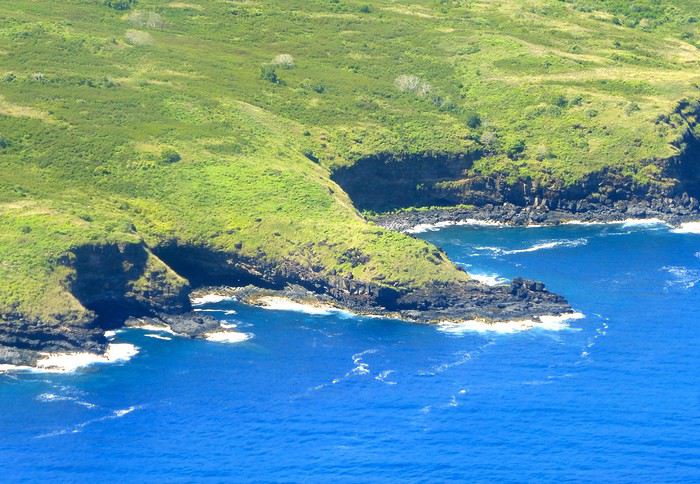
**A LITTLE GEOGRAPHY** Nuku Hiva (NH) is located about 1,500 km from Tahiti, in the north of French Polynesia. At 387 km², it’s the second-largest island in French Polynesia after Tahiti. It was formed by incredible volcanic phenomena and cataclysms between 1 and 6 million years ago, which lifted the island thousands of meters above the sea. Even after millennia of slow erosion, collapses, and settling, NH remains the most majestic of the Marquesas, with its sheer cliffs, deep valleys featuring immense waterfalls, and black walls that were once the inner walls of enormous volcanoes.
**A LITTLE HISTORY** The first contact between NH’s inhabitants and Europeans was in 1595 with Spanish navigators who only stayed briefly. It wasn’t until the late 18th century that Europeans arrived in greater numbers on NH (and the other Marquesas Islands), disrupting a very fragile social and cultural balance. It’s believed that nearly 100,000 people lived on Nuku Hiva at that time—a population decimated over the decades by epidemics, diseases brought by Europeans, and alcohol used for barter. The disastrous result: by the 1930s, only 2,500 people remained, having largely lost their identity and living in poverty. Today, the island has about 2,600 inhabitants spread across several villages, with Taiohae as the main one.
**NUKU HIVA IN LITERATURE**
1 / One of the famous writers who visited NH and stayed there was Herman Melville, who arrived in July 1842, the author of *Moby Dick*. The island had just come under French protectorate. Seduced by the enchanting *vahinés* and dazzled by his paradisiacal vision of the place, Melville deserted his ship. He ended up a prisoner of a local tribe, the Taipi, in Taipivai, where he stayed for a month and a half until an Australian ship captain secured his release in exchange for a musket and a roll of cotton fabric! Melville wrote a novel about this tumultuous episode in his life, considered a classic of travel literature. The book, *Typee: A Peep at Polynesian Life*, published in 1846 in the United States, was a huge success.
2 / Another famous Scottish writer, Robert Louis Stevenson, arrived in NH aboard a yacht that anchored in Anaho Bay, the island’s most beautiful, in July 1888. Stevenson was already known for two magnificent novels that marked their era: *Treasure Island* and *Dr. Jekyll & Mr. Hyde*. Stevenson, too, was captivated by the island’s natural beauty, though he also noted the devastating decline in identity, socio-cultural life, and physical health of a population ravaged by disease and alcohol. His account of his stay, *In the South Seas: An Account of Experiences and Observations in the Marquesas, Paumotus, and Gilbert Islands During Two Cruises on the Yacht Casco (1888) and the Schooner Equator (1889)*, was published in 1896 in New York, four years after his death in Apia, Western Samoa, where he had settled. It was also published in London in 1900.
3 / In August 1903, Victor Segalen, a French naval doctor, ethnologist, and archaeologist, landed in NH from the ship *La Durance*, sent to Polynesia to recover the possessions of the painter Paul Gauguin, who had died in April of that year. He, too, was enthralled by the Marquesas but lamented the loss of identity, dignity, and pride of the Māori, alienated by a Christianization that destroyed their culture and customs, denied their gods, and erased their past. He wrote about his experience, doubts, and fears in *Les Immémoriaux*.
4 / In December 1907, Jack London arrived in NH aboard the sailboat *Stark*, following in the footsteps of his illustrious predecessor, Herman Melville. London was in poor physical condition, exhausted from his relentless travels that had taken him from the Klondike in Canada to Japan, Australia, and London in Europe. He was appalled and shocked by Nuku Hiva’s degraded health situation: where Melville had encountered over 2,000 vigorous and healthy Marquesan warriors, London found only 12 suffering from various diseases—the rest had been wiped out by tuberculosis! His approach remained humanistic, and he maintained a sharp geopolitical awareness of these traditional Polynesian cultures, weakened by the inexorable advance of modernity in the early 20th century. He continued his journey to the Tuamotu Islands and Tahiti, publishing *Martin Eden*, the moving account of his initiatory voyage in the South Pacific, in 1911.
5 / Finally, Alain Gerbault, a writer, linguist, ethnologist, and tireless traveler, arrived in the Marquesas via the Panama Canal in December 1933. He was completely exhausted after an endless crossing on a small sailboat, the *Firecrest*. Enthralled by his stay in the Marquesas, he continued to the Tuamotu Islands in 1934, then Tahiti in 1935. Gerbault fought for the preservation of traditions, as well as the songs and dances banned by the Churches and the French Administration (these bans lasted over 50 years, mind you...!!!). Bora Bora remained his favorite island. A staunch Pétainist during World War II, he was forced to flee Bora Bora for Samoa, then Tonga, and finally Timor, a half-Portuguese island and thus neutral during the war. His travel accounts, *In Pursuit of the Sun: Logbook from New York to Tahiti* and *A Paradise Is Dying*, were published in the late 1940s. He died in Timor in 1941, and his ashes were repatriated to Bora Bora.
Back to our trip and stay.
**Day 1: April 27**
Departure from Papeete at 6:30 AM—we had to wake up two hours earlier and reach the airport in the dark. Takeoff at dawn, good weather en route, flight duration: 4 hours.
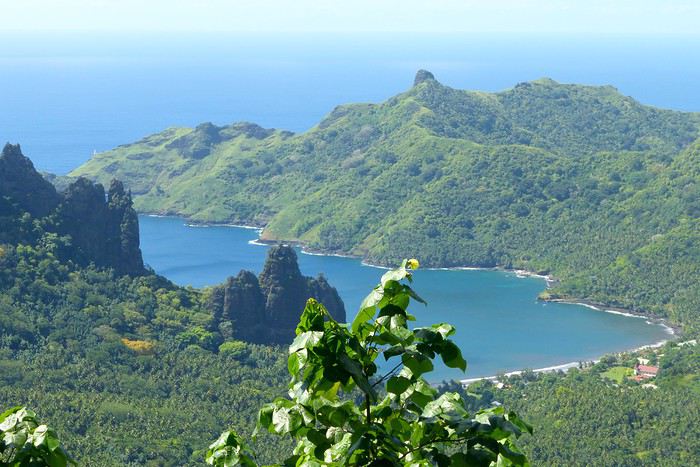
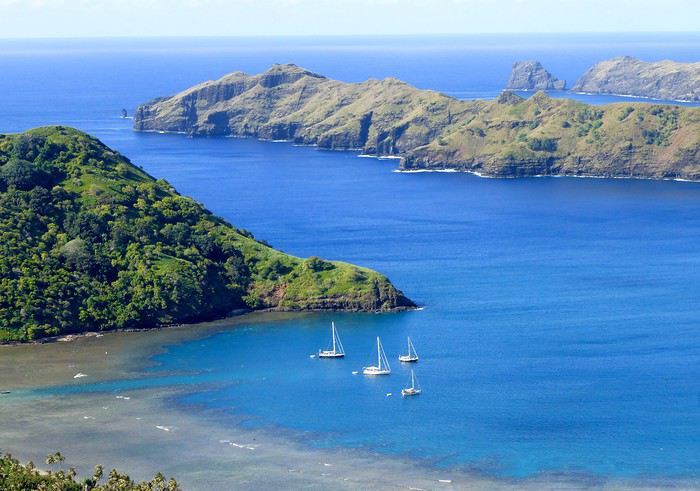
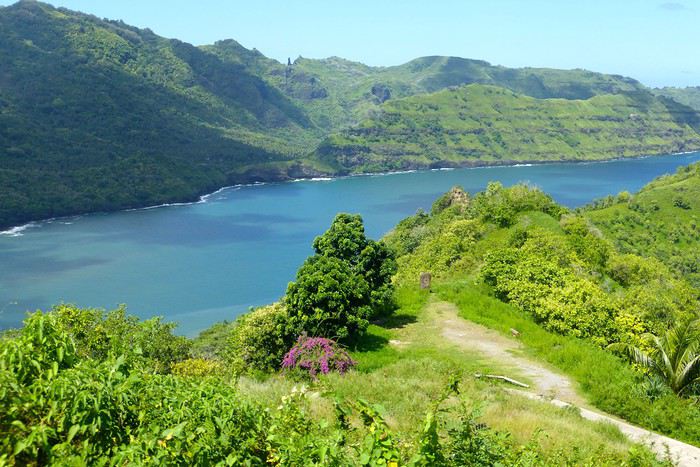
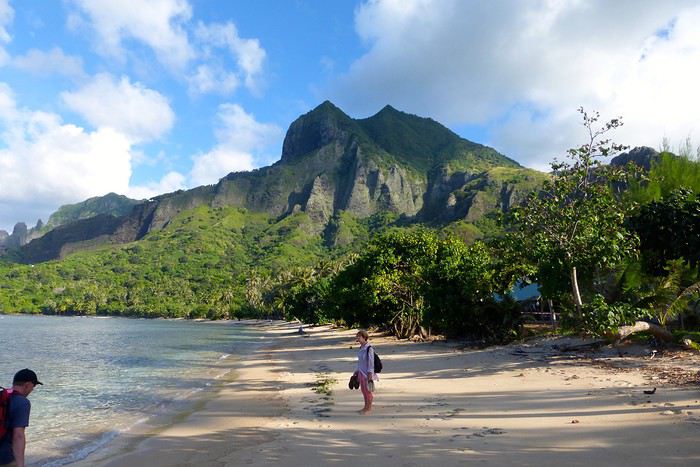
Arrival around 10:30 AM in Nuku Hiva, the first stop of this trip. We booked two nights in half-board at Pension Koku’u, transfers included. Maybe not such a great idea, those included transfers, especially on this unique island where the airport is located on *Terre Déserte*, on the other side of the mountain, opposite and about 45 km from the main village of Taiohae. They’re charged at a steep price. Expect 6,000 XPF round-trip by taxi, but 15,000 XPF charged by guesthouses or hotels. The difference is notable. It wasn’t the best idea, but we can’t go back. Even for residents like us who know how to travel in Polynesia, the Air Tahiti employee who sold me the Pass couldn’t give any useful advice about the stay itself—probably because he’d never been to the Marquesas. It’s really annoying! In short, the good idea to remember is renting a car (like a Suzuki) to be free to manage your time and stop at leisure. The road signage is a bit basic, but you’ll manage just fine. Our host Alvane waits for us—without a sign (sic!)—and after searching for each other for 5 minutes, we’re off on a journey of over an hour (with photo stops) in a Land Rover with smooth tires (luckily, it’s not raining!). The recently paved and marked mountain road is impeccable. No time to catch our breath at the guesthouse; we leave immediately (not a great idea after waking up at dawn plus 4 hours on a plane) for a half-day hike that was also included in the prepaid stay. A sandwich was provided (really pathetic for the physical effort required), we have water, and we fill a few bottles at the spring near the ceremonial site of Taipivai, our first stop. Then the hike begins in the Hanaheu Valley, descending toward Anaho Bay and its namesake beach. A magnificent and wild spot, a few sailboats anchored, we swim—the water is really warm, over 30°C at the shore. That warm is rare and not necessarily pleasant. We then have to climb a very steep slope; this hike is actually quite tough. The air is still, humid, and stifling under the foliage, there’s a bit of mud, and tiny ants (which don’t bite, I’ll have you know), locally called *fofolles*, running over shoes, ankles, and calves. Not very pleasant...! On top of that, there are mosquitoes to protect against! In hindsight, it seems wise to bring energy bars from Papeete if you plan to hike on the afternoon of your arrival day. We weren’t careful... Result: a moment of weakness for me and a hyperventilation attack climbing back up from Anaho Bay!!! We return to the guesthouse at night. There we find Claudine and her four children—Marquesan-style atmosphere, friendly and casual. We share family life. Very simple room with a bathroom, no mosquitoes, we can sleep with the window open, but the night will be noisy, as is often the case in Polynesia. Roosters are everywhere and don’t sleep, dogs bark or whine. So we end up waking up early... like everyone else.
**Day 2: April 28**
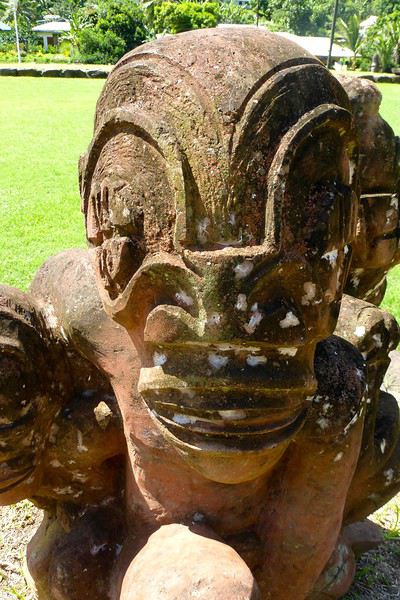
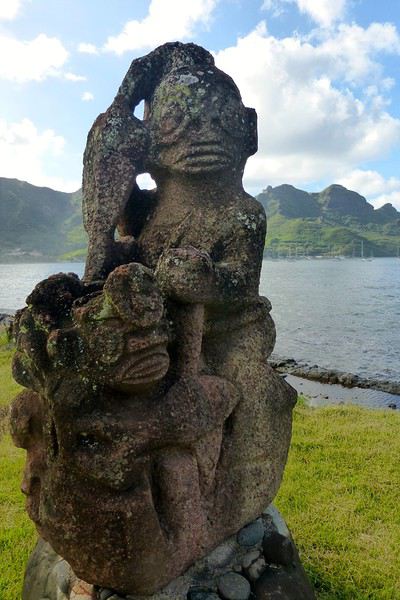
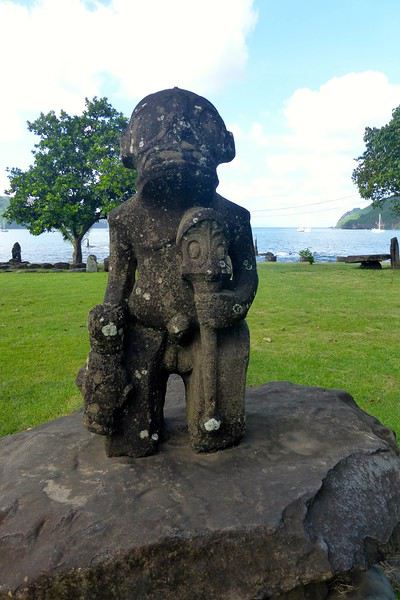
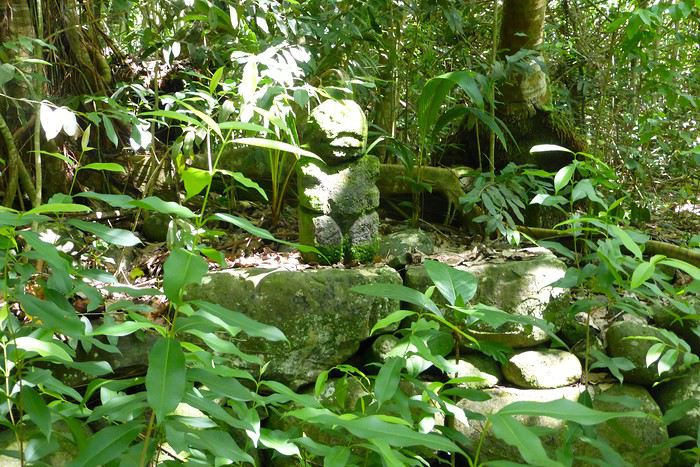
We booked a full-day excursion with Thierry: it starts with a 45-minute boat ride to reach Hakatea Beach, hidden in a small secret bay like many along Nuku Hiva’s coasts. From there, the hike lasts all day—11 km round-trip on flat but also rugged terrain (ancient paved and elevated paths over 1,000 years old)—and river crossings. Bring the right shoes (like plastic Crocs with high socks—not very stylish but practical). We cross the former village of Hakaui, walk along the foundations of dwellings, and there are still weathered tikis in the lush vegetation. The ultimate goal of this hike is to reach the tall Vaipo waterfall. The place is magical, with openings in the vegetation and immense trees allowing photos of the treetops and caves where funeral canoes containing the bones of chiefs or great warriors were once placed. We return the same way to the beach and take another boat ride to reach Taihoae’s port. Back at the guesthouse after a glimpse of Taihoae’s waterfront.
**UA POU**
**Day 3: April 29**
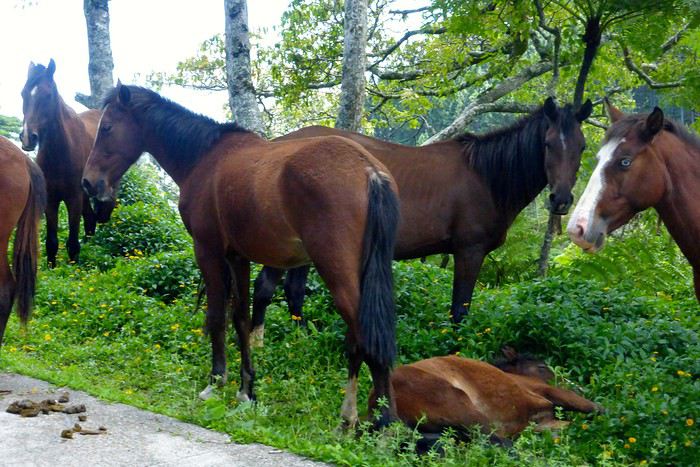
Back to the airport in the late morning for the second flight of the trip to Ua Pou. 20-minute crossing in a Twin Otter (18 seats but only 13 occupied due to cargo between the islands). Beautiful weather, blue sea, nice photos to take upon departure from NH and arrival in UP. We’re greeted by Jérôme, a former military man turned tourism professional, who runs Pension Pukue’e with his wife Elisa, a native of UP. We’re in for two exceptional days. The guesthouse is comfortable, Jérôme and Elisa are very professional and pleasant. Jérôme is also a professional hiker, and Elisa is an excellent cook. We leave quickly for a half-day excursion to Hohoi, after a stop at the archaeological, cultural, and religious site of Maui’a, the Tavaka tribe’s territory. Jérôme is there to explain how Marquesan society functioned at the time and the events that took place on a site still largely buried under vegetation. Then we visit a flower-stone sculptor he knows—the only place in the Marquesas where you’ll find these stones. They’re collected in the river flowing into the sea at Hohoi, sometimes on the beach itself. Back to the guesthouse.
**Day 4: April 30**
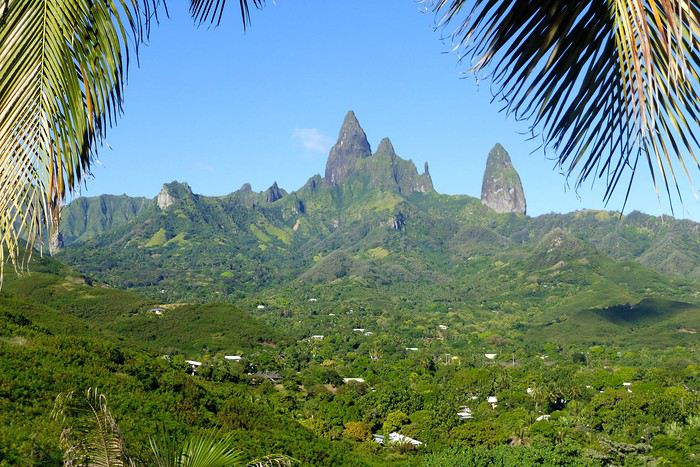
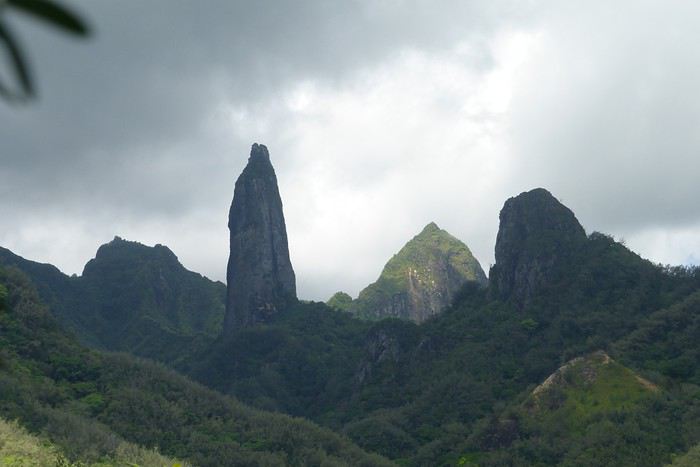
A nature hike in the mountains—moderately difficult—toward the Vaiea waterfall is on our program for a good 4 hours. It’s hot, there are mosquitoes, and the dip in the pool under the waterfall (24°C water) is a rare pleasure. Lunch at a friend of Jérôme’s, a former chef for French minister François Fillon, who prepares delicious food. Elisa picks us up by car to return to the guesthouse. Ua Pou is a beautiful and elegant island with its sharp peaks and wild nature. Our favorite, thanks to Jérôme and his wife.
**UA HUKA**
**Day 4: May 1**
Departure for Ua Huka, the smallest inhabited island in the northern group of the Marquesas, located about 1,300 km northeast of Tahiti. Landing is at the oldest airfield in the Marquesas, built in 1972, between the villages of Vaipaee and Hane. Ua Huka has about 680 inhabitants, according to the last census, spread across 3 villages (since the 1870s): Vaipaee, Hane, and Hokatu. The island peaks at Mount Hitikau at only 884 meters. Its origin: a Hawaiian-type shield volcano that—over a few million years—collapsed to become a caldera (or elliptical depression) in which two small volcanoes appeared, the craters of Tahoatikiau and Teepoepo, now part of the Vaikivi Park. The island is rugged and wild, lower than the others, so less cloud-covered and drier. The bays are jagged, the coastline in ochre tones above the intense blue of the sea, and the beaches are constantly disturbed by the powerful surf. The village of Hokatu is only a few kilometers away (just 14 km of road on the island), but Maurice, our host, drives slowly, and it takes time to go up and down. The road is entirely paved or concreted, which isn’t the case on Ua Pou, for example. The guesthouse is disappointing, perched above the village and thus isolated. Beautiful view of the famous Hane motu and the sparkling sea under the bright sun. Apart from that, there are mosquitoes and cockroaches, the bungalow isn’t clean. Meals are taken with Maurice and Delphine in the village—fine dining isn’t on the menu! Ouch!!! We didn’t luck out...
**Day 5: May 2**
Early in the morning, after breakfast, Delphine takes us to the craft center, which turns out to be a letdown—the items for sale are, in my opinion, crude and poorly carved. Nothing like what’s offered at the Marquesas Fair, held twice a year in Papeete, where you can admire and buy small wonders: wood carvings, flower stone, and coral. Delphine is disappointed we’re not interested, and it shows... She’s a bit sulky! These are items meant for Aranui cruise passengers who land on Ua Huka once every two weeks... Solo travelers like us don’t seem to interest her much. The rest of the day—spent with Maurice—is dedicated to visiting cultural centers and small museums, like the Sea Museum in Hane with its ancient canoes, the municipal archaeological museum on the Te Tumu site above the airfield, the petroglyph house near Hokatu Beach, and finally the Papuakeikaraa arboretum, which gathers endemic plants from all over Polynesia and an impressive citrus collection. No excursion planned to Vaikivi Park, toward the previously mentioned craters that recall the island’s volcanic past. Also missing are the viewpoints, the unique endemic vegetation, and especially the petroglyphs. Too bad... at that price!!! Still, in the evening, we go fishing—with sandwiches and drinks in coolers—with other villagers from the dock at the end of the paved road. It’s cool, windy, no mosquitoes, lots of fish caught, and a great atmosphere. Plus, magnificently starry skies.
Ua Huka is one of the rare islands not invaded by the black rat, which has preserved its birdlife, particularly the ultramarine lorikeet (or *pihiti* in Marquesan), which feeds almost exclusively on flower nectar (banana, coconut, hibiscus, mango, guava trees). A dog imported from New Zealand has been specially trained to detect rats: it inspects cargo unloaded from boats and the docks.
I recommend spending two full days on the island—one for visiting the various museums, the other for hiking in the island’s center park, where the archaeological sites are in their raw state: foundations of agricultural terrace walls, gathering places (or *tohua*), dwelling pavements (or *paepae*), sacred sites (or *me’ae* in Marquesan, *marae* in Tahitian) with their tikis and petroglyphs.
To finish, a bit of info on the island’s name, tied to Marquesan oral culture: according to the legend of the creation of the six Marquesas Islands, Ua Huka is the one that puts the finishing touch on the construction of the god Oatea’s house, each island having a defined architectural function. Ua Huka represents the hole (*ua*) where the god deposits what’s left (*huka* in Marquesan) of the unused materials during construction.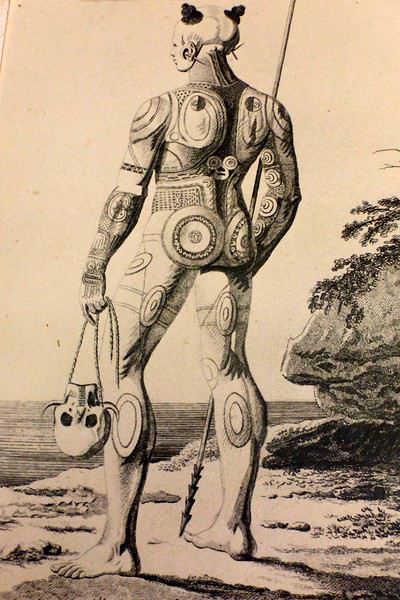
**HIVA OA**
**Day 6: May 3**
Departure in the late morning for Hiva Oa. Maurice—who had other things to do—dropped us off at the airfield 3 hours early... so this stop is a bit of a flop, even if we decided to stay positive! Hiva Oa is the third-largest island in French Polynesia after Tahiti and Nuku Hiva, and before Raiatea in the Leeward Islands. The island is beautiful, lush, verdant, and jagged. The mountains soar into the sky, the sea views are grand, the light is sublime—we’re lucky. Beautiful weather. Tania from Pension Kanahau waits for us at the airport. We’re in for two wonderful days with her. Tania is welcoming, smiling, and dynamic. What a pleasure to be with her, at her place—she cooks divinely and serves the best tuna in the world (the Big Eye reserved for the Japanese) and croquettes made with lobster, shrimp, and crab with breadfruit cubes, for example. Comfortable bungalow, no mosquitoes at night, we can sleep with the window open. It’s fantastic! After settling in, Tania takes us to town in Atuona, a pleasant and well-laid-out little village. We start with lunch—a delicious raw fish in coconut milk—then continue with the must-see attractions: the Catholic cemetery where Paul Gauguin and Jacques Brel’s graves are, overlooking the town; the abandoned Protestant cemetery, reclaimed by the bush, with impressive Marquesan warrior tombs made of huge coral slabs and adorned with a tiki head (harder to find, as no one goes there... ask for directions!); the craft center; the Gauguin Museum (and the Jacques Brel Museum); and the waterfront. While we stroll peacefully, Tania organizes an excursion for the next day, May 4, a full day with Pifa O’Connor, a 36-year-old who knows his island inside out, is passionate about local history, and with whom we’ll hit it off.
**Day 7: May 4**
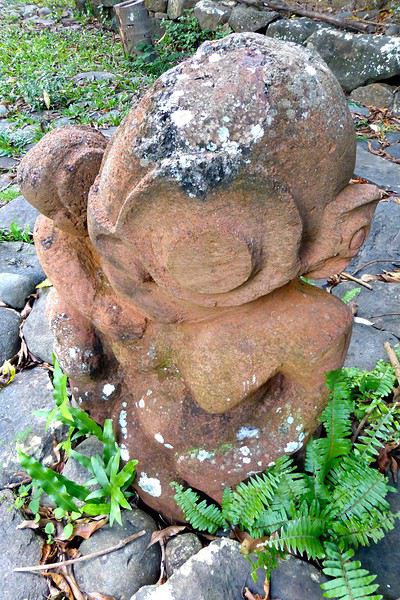
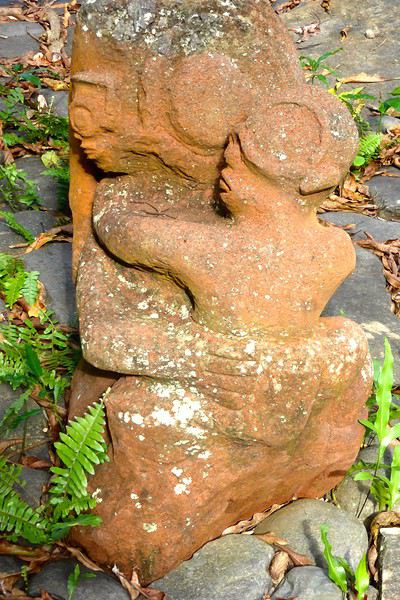
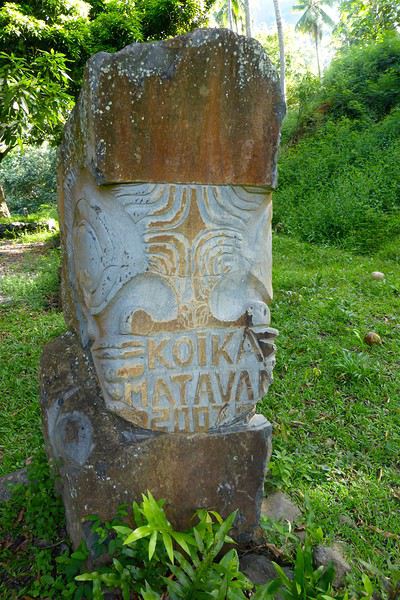
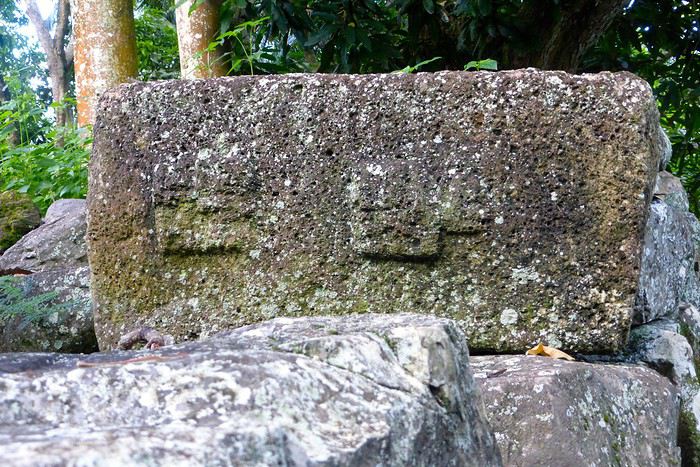
Pifa arrives at 8 AM sharp at the guesthouse, and we immediately buy sandwiches and water at a small supermarket in Atuona. First, we make a brief stop by the roadside at an unmarked spot, from which we descend a small path through dense vegetation leading to the famous smiling tiki—the only one of its kind in the Marquesas and Polynesia. The place is improbable, the tiki isn’t huge, but it’s beautiful and impressive. Then we’re off on the road that, dizzyingly, runs along and overlooks the island’s northern coast, at the edge of the ancient volcano. Few vehicles pass, the road—now a rocky track—is full of potholes, and we proceed slowly. (Note that this road has been fully paved since 2018.) The panoramas are majestic, with every shade of green against the blue sea. We stop again at the top of a cliff adorned with a huge stone, the *sacrifice stone*, from which young virgin girls were once thrown into the sea to appease angry gods. Another pause for lunch this time, at a small restaurant near the exceptional archaeological site of Puamau. We’ll experience the highlights of this trip during this excursion with our guide, Pifa, who spares no explanations. We discover, on a vast esplanade, the ceremonial complexes of Ta’a Oa and Meae Te I’Ipona, the latter featuring superb tikis, particularly the reclining tiki—or *Maki Taua Pepe*—representing Motherhood, a woman giving birth in a squatting position, as was often the case in many civilizations. Also notable is the *Takaii*, the largest tiki recorded in Polynesia to date. There’s also a huge stone with a now-blunt edge, on which the circumcision of chiefs’ and notables’ pre-adolescent sons was performed. A tough ordeal! But that’s not all! It seems there are more on the mountainside rising steeply behind the archaeological site—overturned tikis, platforms, and, apparently, a giant tiki at the top, which must have fallen but was visible from afar on the sea 30 or 40 years ago, according to the island’s elders. This meeting, worship, and living place—it was actually a small town—is immense. Thousands of people once lived in this part of the island. The site—a religious, social, and cultural sanctuary—would be the size of the largest Mayan sites in Yucatán, but the few concerned owners—two or three families who own the mountainside—don’t want to hear about intensive clearing or tree cutting for now. UNESCO rightly asks for some compliance efforts to grant special treatment to Hiva Oa in particular and the Marquesas in general. We’re not there yet, unfortunately, due to insurmountable local rigidities! This kind of attitude is quite typical in Polynesia: people are afraid to uncover *marae* buried under vegetation—they’re taboo and sometimes said to emit negative and deadly waves, so it’s better not to disturb or anger the ancient spirits or gods who might take revenge. The old religion is never far away in Polynesia, despite the successes of the missionaries.
We return to the guesthouse in the late afternoon. Last night in the Marquesas with Tania, who prepares a fine and delicious meal. Note that dinner costs 2,500 XPF per person.
**Day 8: May 5**
We take the plane as planned, via Nuku Hiva (short stopover). Arrival on time in Papeete.
May this travel journal inspire many of you to visit the Marquesas one day. It’s far, it’s expensive, it’s the trip of a lifetime—it’s unforgettable and unmissable.
Our itinerary is perfect for those who aren’t excited by cruises and prefer to get closer to the local communities. This 9-day trip cost us around 2500 € all-inclusive. For a 14-day cruise on the Aranui, expect to pay 2300 € per person for a basic cabin for four, or 3800 € per person for a superior double cabin.
Air Tahiti offers a 4-island Marquesas Pass (Nuku Hiva, Ua Pou, Ua Huka, and Hiva Oa) for 86,000 XPF (about 700 €). The journey is made on an ATR 72 from Tahiti to Nuku Hiva or Hiva Oa, and on a 19-seat Twin Otter between the islands (often only 13 or 15 seats are available due to cargo, so book well in advance). We’re traveling as a couple. We booked our family-run guesthouse stays at the Tourism Fair in early February, where you can meet the owners and make your choice. Stays are almost always half-board or breakfast-only. Transfers are usually included, but you can always book a car or taxi.
**NUKU HIVA**
**A LITTLE GEOGRAPHY** Nuku Hiva (NH) is located about 1,500 km from Tahiti, in the north of French Polynesia. At 387 km², it’s the second-largest island in French Polynesia after Tahiti. It was formed by incredible volcanic phenomena and cataclysms between 1 and 6 million years ago, which lifted the island thousands of meters above the sea. Even after millennia of slow erosion, collapses, and settling, NH remains the most majestic of the Marquesas, with its sheer cliffs, deep valleys featuring immense waterfalls, and black walls that were once the inner walls of enormous volcanoes.
**A LITTLE HISTORY** The first contact between NH’s inhabitants and Europeans was in 1595 with Spanish navigators who only stayed briefly. It wasn’t until the late 18th century that Europeans arrived in greater numbers on NH (and the other Marquesas Islands), disrupting a very fragile social and cultural balance. It’s believed that nearly 100,000 people lived on Nuku Hiva at that time—a population decimated over the decades by epidemics, diseases brought by Europeans, and alcohol used for barter. The disastrous result: by the 1930s, only 2,500 people remained, having largely lost their identity and living in poverty. Today, the island has about 2,600 inhabitants spread across several villages, with Taiohae as the main one.
**NUKU HIVA IN LITERATURE**
1 / One of the famous writers who visited NH and stayed there was Herman Melville, who arrived in July 1842, the author of *Moby Dick*. The island had just come under French protectorate. Seduced by the enchanting *vahinés* and dazzled by his paradisiacal vision of the place, Melville deserted his ship. He ended up a prisoner of a local tribe, the Taipi, in Taipivai, where he stayed for a month and a half until an Australian ship captain secured his release in exchange for a musket and a roll of cotton fabric! Melville wrote a novel about this tumultuous episode in his life, considered a classic of travel literature. The book, *Typee: A Peep at Polynesian Life*, published in 1846 in the United States, was a huge success.
2 / Another famous Scottish writer, Robert Louis Stevenson, arrived in NH aboard a yacht that anchored in Anaho Bay, the island’s most beautiful, in July 1888. Stevenson was already known for two magnificent novels that marked their era: *Treasure Island* and *Dr. Jekyll & Mr. Hyde*. Stevenson, too, was captivated by the island’s natural beauty, though he also noted the devastating decline in identity, socio-cultural life, and physical health of a population ravaged by disease and alcohol. His account of his stay, *In the South Seas: An Account of Experiences and Observations in the Marquesas, Paumotus, and Gilbert Islands During Two Cruises on the Yacht Casco (1888) and the Schooner Equator (1889)*, was published in 1896 in New York, four years after his death in Apia, Western Samoa, where he had settled. It was also published in London in 1900.
3 / In August 1903, Victor Segalen, a French naval doctor, ethnologist, and archaeologist, landed in NH from the ship *La Durance*, sent to Polynesia to recover the possessions of the painter Paul Gauguin, who had died in April of that year. He, too, was enthralled by the Marquesas but lamented the loss of identity, dignity, and pride of the Māori, alienated by a Christianization that destroyed their culture and customs, denied their gods, and erased their past. He wrote about his experience, doubts, and fears in *Les Immémoriaux*.
4 / In December 1907, Jack London arrived in NH aboard the sailboat *Stark*, following in the footsteps of his illustrious predecessor, Herman Melville. London was in poor physical condition, exhausted from his relentless travels that had taken him from the Klondike in Canada to Japan, Australia, and London in Europe. He was appalled and shocked by Nuku Hiva’s degraded health situation: where Melville had encountered over 2,000 vigorous and healthy Marquesan warriors, London found only 12 suffering from various diseases—the rest had been wiped out by tuberculosis! His approach remained humanistic, and he maintained a sharp geopolitical awareness of these traditional Polynesian cultures, weakened by the inexorable advance of modernity in the early 20th century. He continued his journey to the Tuamotu Islands and Tahiti, publishing *Martin Eden*, the moving account of his initiatory voyage in the South Pacific, in 1911.
5 / Finally, Alain Gerbault, a writer, linguist, ethnologist, and tireless traveler, arrived in the Marquesas via the Panama Canal in December 1933. He was completely exhausted after an endless crossing on a small sailboat, the *Firecrest*. Enthralled by his stay in the Marquesas, he continued to the Tuamotu Islands in 1934, then Tahiti in 1935. Gerbault fought for the preservation of traditions, as well as the songs and dances banned by the Churches and the French Administration (these bans lasted over 50 years, mind you...!!!). Bora Bora remained his favorite island. A staunch Pétainist during World War II, he was forced to flee Bora Bora for Samoa, then Tonga, and finally Timor, a half-Portuguese island and thus neutral during the war. His travel accounts, *In Pursuit of the Sun: Logbook from New York to Tahiti* and *A Paradise Is Dying*, were published in the late 1940s. He died in Timor in 1941, and his ashes were repatriated to Bora Bora.
Back to our trip and stay.
**Day 1: April 27**
Departure from Papeete at 6:30 AM—we had to wake up two hours earlier and reach the airport in the dark. Takeoff at dawn, good weather en route, flight duration: 4 hours.
Arrival around 10:30 AM in Nuku Hiva, the first stop of this trip. We booked two nights in half-board at Pension Koku’u, transfers included. Maybe not such a great idea, those included transfers, especially on this unique island where the airport is located on *Terre Déserte*, on the other side of the mountain, opposite and about 45 km from the main village of Taiohae. They’re charged at a steep price. Expect 6,000 XPF round-trip by taxi, but 15,000 XPF charged by guesthouses or hotels. The difference is notable. It wasn’t the best idea, but we can’t go back. Even for residents like us who know how to travel in Polynesia, the Air Tahiti employee who sold me the Pass couldn’t give any useful advice about the stay itself—probably because he’d never been to the Marquesas. It’s really annoying! In short, the good idea to remember is renting a car (like a Suzuki) to be free to manage your time and stop at leisure. The road signage is a bit basic, but you’ll manage just fine. Our host Alvane waits for us—without a sign (sic!)—and after searching for each other for 5 minutes, we’re off on a journey of over an hour (with photo stops) in a Land Rover with smooth tires (luckily, it’s not raining!). The recently paved and marked mountain road is impeccable. No time to catch our breath at the guesthouse; we leave immediately (not a great idea after waking up at dawn plus 4 hours on a plane) for a half-day hike that was also included in the prepaid stay. A sandwich was provided (really pathetic for the physical effort required), we have water, and we fill a few bottles at the spring near the ceremonial site of Taipivai, our first stop. Then the hike begins in the Hanaheu Valley, descending toward Anaho Bay and its namesake beach. A magnificent and wild spot, a few sailboats anchored, we swim—the water is really warm, over 30°C at the shore. That warm is rare and not necessarily pleasant. We then have to climb a very steep slope; this hike is actually quite tough. The air is still, humid, and stifling under the foliage, there’s a bit of mud, and tiny ants (which don’t bite, I’ll have you know), locally called *fofolles*, running over shoes, ankles, and calves. Not very pleasant...! On top of that, there are mosquitoes to protect against! In hindsight, it seems wise to bring energy bars from Papeete if you plan to hike on the afternoon of your arrival day. We weren’t careful... Result: a moment of weakness for me and a hyperventilation attack climbing back up from Anaho Bay!!! We return to the guesthouse at night. There we find Claudine and her four children—Marquesan-style atmosphere, friendly and casual. We share family life. Very simple room with a bathroom, no mosquitoes, we can sleep with the window open, but the night will be noisy, as is often the case in Polynesia. Roosters are everywhere and don’t sleep, dogs bark or whine. So we end up waking up early... like everyone else.
**Day 2: April 28**
We booked a full-day excursion with Thierry: it starts with a 45-minute boat ride to reach Hakatea Beach, hidden in a small secret bay like many along Nuku Hiva’s coasts. From there, the hike lasts all day—11 km round-trip on flat but also rugged terrain (ancient paved and elevated paths over 1,000 years old)—and river crossings. Bring the right shoes (like plastic Crocs with high socks—not very stylish but practical). We cross the former village of Hakaui, walk along the foundations of dwellings, and there are still weathered tikis in the lush vegetation. The ultimate goal of this hike is to reach the tall Vaipo waterfall. The place is magical, with openings in the vegetation and immense trees allowing photos of the treetops and caves where funeral canoes containing the bones of chiefs or great warriors were once placed. We return the same way to the beach and take another boat ride to reach Taihoae’s port. Back at the guesthouse after a glimpse of Taihoae’s waterfront.
**UA POU**
**Day 3: April 29**
Back to the airport in the late morning for the second flight of the trip to Ua Pou. 20-minute crossing in a Twin Otter (18 seats but only 13 occupied due to cargo between the islands). Beautiful weather, blue sea, nice photos to take upon departure from NH and arrival in UP. We’re greeted by Jérôme, a former military man turned tourism professional, who runs Pension Pukue’e with his wife Elisa, a native of UP. We’re in for two exceptional days. The guesthouse is comfortable, Jérôme and Elisa are very professional and pleasant. Jérôme is also a professional hiker, and Elisa is an excellent cook. We leave quickly for a half-day excursion to Hohoi, after a stop at the archaeological, cultural, and religious site of Maui’a, the Tavaka tribe’s territory. Jérôme is there to explain how Marquesan society functioned at the time and the events that took place on a site still largely buried under vegetation. Then we visit a flower-stone sculptor he knows—the only place in the Marquesas where you’ll find these stones. They’re collected in the river flowing into the sea at Hohoi, sometimes on the beach itself. Back to the guesthouse.
**Day 4: April 30**
A nature hike in the mountains—moderately difficult—toward the Vaiea waterfall is on our program for a good 4 hours. It’s hot, there are mosquitoes, and the dip in the pool under the waterfall (24°C water) is a rare pleasure. Lunch at a friend of Jérôme’s, a former chef for French minister François Fillon, who prepares delicious food. Elisa picks us up by car to return to the guesthouse. Ua Pou is a beautiful and elegant island with its sharp peaks and wild nature. Our favorite, thanks to Jérôme and his wife.
**UA HUKA**
**Day 4: May 1**
Departure for Ua Huka, the smallest inhabited island in the northern group of the Marquesas, located about 1,300 km northeast of Tahiti. Landing is at the oldest airfield in the Marquesas, built in 1972, between the villages of Vaipaee and Hane. Ua Huka has about 680 inhabitants, according to the last census, spread across 3 villages (since the 1870s): Vaipaee, Hane, and Hokatu. The island peaks at Mount Hitikau at only 884 meters. Its origin: a Hawaiian-type shield volcano that—over a few million years—collapsed to become a caldera (or elliptical depression) in which two small volcanoes appeared, the craters of Tahoatikiau and Teepoepo, now part of the Vaikivi Park. The island is rugged and wild, lower than the others, so less cloud-covered and drier. The bays are jagged, the coastline in ochre tones above the intense blue of the sea, and the beaches are constantly disturbed by the powerful surf. The village of Hokatu is only a few kilometers away (just 14 km of road on the island), but Maurice, our host, drives slowly, and it takes time to go up and down. The road is entirely paved or concreted, which isn’t the case on Ua Pou, for example. The guesthouse is disappointing, perched above the village and thus isolated. Beautiful view of the famous Hane motu and the sparkling sea under the bright sun. Apart from that, there are mosquitoes and cockroaches, the bungalow isn’t clean. Meals are taken with Maurice and Delphine in the village—fine dining isn’t on the menu! Ouch!!! We didn’t luck out...
**Day 5: May 2**
Early in the morning, after breakfast, Delphine takes us to the craft center, which turns out to be a letdown—the items for sale are, in my opinion, crude and poorly carved. Nothing like what’s offered at the Marquesas Fair, held twice a year in Papeete, where you can admire and buy small wonders: wood carvings, flower stone, and coral. Delphine is disappointed we’re not interested, and it shows... She’s a bit sulky! These are items meant for Aranui cruise passengers who land on Ua Huka once every two weeks... Solo travelers like us don’t seem to interest her much. The rest of the day—spent with Maurice—is dedicated to visiting cultural centers and small museums, like the Sea Museum in Hane with its ancient canoes, the municipal archaeological museum on the Te Tumu site above the airfield, the petroglyph house near Hokatu Beach, and finally the Papuakeikaraa arboretum, which gathers endemic plants from all over Polynesia and an impressive citrus collection. No excursion planned to Vaikivi Park, toward the previously mentioned craters that recall the island’s volcanic past. Also missing are the viewpoints, the unique endemic vegetation, and especially the petroglyphs. Too bad... at that price!!! Still, in the evening, we go fishing—with sandwiches and drinks in coolers—with other villagers from the dock at the end of the paved road. It’s cool, windy, no mosquitoes, lots of fish caught, and a great atmosphere. Plus, magnificently starry skies.
Ua Huka is one of the rare islands not invaded by the black rat, which has preserved its birdlife, particularly the ultramarine lorikeet (or *pihiti* in Marquesan), which feeds almost exclusively on flower nectar (banana, coconut, hibiscus, mango, guava trees). A dog imported from New Zealand has been specially trained to detect rats: it inspects cargo unloaded from boats and the docks.
I recommend spending two full days on the island—one for visiting the various museums, the other for hiking in the island’s center park, where the archaeological sites are in their raw state: foundations of agricultural terrace walls, gathering places (or *tohua*), dwelling pavements (or *paepae*), sacred sites (or *me’ae* in Marquesan, *marae* in Tahitian) with their tikis and petroglyphs.
To finish, a bit of info on the island’s name, tied to Marquesan oral culture: according to the legend of the creation of the six Marquesas Islands, Ua Huka is the one that puts the finishing touch on the construction of the god Oatea’s house, each island having a defined architectural function. Ua Huka represents the hole (*ua*) where the god deposits what’s left (*huka* in Marquesan) of the unused materials during construction.
**HIVA OA**
**Day 6: May 3**
Departure in the late morning for Hiva Oa. Maurice—who had other things to do—dropped us off at the airfield 3 hours early... so this stop is a bit of a flop, even if we decided to stay positive! Hiva Oa is the third-largest island in French Polynesia after Tahiti and Nuku Hiva, and before Raiatea in the Leeward Islands. The island is beautiful, lush, verdant, and jagged. The mountains soar into the sky, the sea views are grand, the light is sublime—we’re lucky. Beautiful weather. Tania from Pension Kanahau waits for us at the airport. We’re in for two wonderful days with her. Tania is welcoming, smiling, and dynamic. What a pleasure to be with her, at her place—she cooks divinely and serves the best tuna in the world (the Big Eye reserved for the Japanese) and croquettes made with lobster, shrimp, and crab with breadfruit cubes, for example. Comfortable bungalow, no mosquitoes at night, we can sleep with the window open. It’s fantastic! After settling in, Tania takes us to town in Atuona, a pleasant and well-laid-out little village. We start with lunch—a delicious raw fish in coconut milk—then continue with the must-see attractions: the Catholic cemetery where Paul Gauguin and Jacques Brel’s graves are, overlooking the town; the abandoned Protestant cemetery, reclaimed by the bush, with impressive Marquesan warrior tombs made of huge coral slabs and adorned with a tiki head (harder to find, as no one goes there... ask for directions!); the craft center; the Gauguin Museum (and the Jacques Brel Museum); and the waterfront. While we stroll peacefully, Tania organizes an excursion for the next day, May 4, a full day with Pifa O’Connor, a 36-year-old who knows his island inside out, is passionate about local history, and with whom we’ll hit it off.
**Day 7: May 4**
Pifa arrives at 8 AM sharp at the guesthouse, and we immediately buy sandwiches and water at a small supermarket in Atuona. First, we make a brief stop by the roadside at an unmarked spot, from which we descend a small path through dense vegetation leading to the famous smiling tiki—the only one of its kind in the Marquesas and Polynesia. The place is improbable, the tiki isn’t huge, but it’s beautiful and impressive. Then we’re off on the road that, dizzyingly, runs along and overlooks the island’s northern coast, at the edge of the ancient volcano. Few vehicles pass, the road—now a rocky track—is full of potholes, and we proceed slowly. (Note that this road has been fully paved since 2018.) The panoramas are majestic, with every shade of green against the blue sea. We stop again at the top of a cliff adorned with a huge stone, the *sacrifice stone*, from which young virgin girls were once thrown into the sea to appease angry gods. Another pause for lunch this time, at a small restaurant near the exceptional archaeological site of Puamau. We’ll experience the highlights of this trip during this excursion with our guide, Pifa, who spares no explanations. We discover, on a vast esplanade, the ceremonial complexes of Ta’a Oa and Meae Te I’Ipona, the latter featuring superb tikis, particularly the reclining tiki—or *Maki Taua Pepe*—representing Motherhood, a woman giving birth in a squatting position, as was often the case in many civilizations. Also notable is the *Takaii*, the largest tiki recorded in Polynesia to date. There’s also a huge stone with a now-blunt edge, on which the circumcision of chiefs’ and notables’ pre-adolescent sons was performed. A tough ordeal! But that’s not all! It seems there are more on the mountainside rising steeply behind the archaeological site—overturned tikis, platforms, and, apparently, a giant tiki at the top, which must have fallen but was visible from afar on the sea 30 or 40 years ago, according to the island’s elders. This meeting, worship, and living place—it was actually a small town—is immense. Thousands of people once lived in this part of the island. The site—a religious, social, and cultural sanctuary—would be the size of the largest Mayan sites in Yucatán, but the few concerned owners—two or three families who own the mountainside—don’t want to hear about intensive clearing or tree cutting for now. UNESCO rightly asks for some compliance efforts to grant special treatment to Hiva Oa in particular and the Marquesas in general. We’re not there yet, unfortunately, due to insurmountable local rigidities! This kind of attitude is quite typical in Polynesia: people are afraid to uncover *marae* buried under vegetation—they’re taboo and sometimes said to emit negative and deadly waves, so it’s better not to disturb or anger the ancient spirits or gods who might take revenge. The old religion is never far away in Polynesia, despite the successes of the missionaries.
We return to the guesthouse in the late afternoon. Last night in the Marquesas with Tania, who prepares a fine and delicious meal. Note that dinner costs 2,500 XPF per person.
**Day 8: May 5**
We take the plane as planned, via Nuku Hiva (short stopover). Arrival on time in Papeete.
May this travel journal inspire many of you to visit the Marquesas one day. It’s far, it’s expensive, it’s the trip of a lifetime—it’s unforgettable and unmissable.
Circuit au Cambodge de 16 jours en avril-mai 2016
Bonjour,
Nous avons prévu avec mon conjoint de passer 16j au Cambodge en avril-mai. C'est notre 1er voyage dans ce pays, toutefois nous avons déjà eu l'occasion de visiter d'autres pays d'Asie du sud-est : Thaïlande, Indonésie, Malaisie et Vietnam.
Pour l'instant, nous avons seulement réservé nos vols directs aller-retour Paris-Phnom Penh.
Nous avons esquissé un premier parcours que j'aimerais vous soumettre pour avis. N'hésitez pas à nous faire part de toutes vos remarques !!! Un grand merci par avance :-)
Jeudi 21/04 : arrivée à Phnom Penh tôt le matin. Visite de la ville.
Vend. 22/04 : Phnom Penh
Sam. 23/04 au merc. 27/04 inclus : Angkor (inclut une visite des temples situés au nord)
Jeudi 28/04 et vend. 29/04 : Battambang
Sam. 30/04 et dim. 1/05 : Sihanoukville
Lundi 2/05 et mardi 3/05 : Koh Rong
Merc. 4/05 et jeudi 5/05 : Kep
Vend. 6/05 : retour à Phnom Penh pour le dernier jour. Départ pour Paris le sam. 7/05 tôt le matin.
Ce qui m'intéresse en particulier dans vos retours : - notre itinéraire : est-il bien construit ? les durées pour chaque étape sont-elles les "bonnes" ? peut-on en zapper certaines au profit d'autres endroits que vous nous conseilleriez ? - les trajets : que privilégier comme mode de transport ? Quelle durée approximativement ? (on sait qu'en Asie ce n'est pas aussi "timé" qu'en France mais quand même ^^) - tout bon plan de manière générale Nous sommes très en attente de votre aide ! Merci encore ! Hestia
Ce qui m'intéresse en particulier dans vos retours : - notre itinéraire : est-il bien construit ? les durées pour chaque étape sont-elles les "bonnes" ? peut-on en zapper certaines au profit d'autres endroits que vous nous conseilleriez ? - les trajets : que privilégier comme mode de transport ? Quelle durée approximativement ? (on sait qu'en Asie ce n'est pas aussi "timé" qu'en France mais quand même ^^) - tout bon plan de manière générale Nous sommes très en attente de votre aide ! Merci encore ! Hestia
Plage à Locmiquelic
Bonjour,
J'aurais voulue savoir s'il y a une plage de baignade à Locmiquelic, si oui laquelle ? Et votre avis sur cette plage ainsi que sur cette commune pour y passer 2 semaines ? Biensûr nous comptons bouger ;)
Merci ;)
J'aurais voulue savoir s'il y a une plage de baignade à Locmiquelic, si oui laquelle ? Et votre avis sur cette plage ainsi que sur cette commune pour y passer 2 semaines ? Biensûr nous comptons bouger ;)
Merci ;)
Famille avec adolescents en voyage de trois semaines au Québec en août
Bonjour,
nous partons en famille avec nos 3 enfants (17,15 et 10 ans) au Quebec durant 3 semaines sur Aôut 2010.
Je n'ai chiffré que "aproximativement" le nombre de jours par étape , par contre, je pense que nous allons faire une boucle telle que cela:
Montréal/ Mauricie/ Saguenay , Lac St jean/Charlevoix/Quebec/ Montréal.
J'ai volontairement éliminer Toronto (les chutes du Niagara ) ainsi que la Gaspésie afin de ne pas faire un voyage "marathon" et privilégier la détente , profiter à notre rythme de la beauté des lieux et de la gentillesse légendaire 🙂 des Quebecois. J'aimerai aussi équilibrer les activités "sorties en nature" et les "sorties en ville" car j'ai 2 adolescents sur mes trois enfants plus branchés sur la WI que sur les activités sportives 😕.En même temps, nous aimons découvrir de nouveaux lieux et aller à la rencontre des gens et sommes prêts tous à faire des efforts pour marcher ou faire des activités distrayantes!
. Nous restons ouverts à toutes vospropositions sympathiques ! 😏
Voilà mes suggestions de sortie suivant chaque ville ou région , et j'aimerai avoir vos avis par rapport à mes ados(sans oublier mon loulou de 10 ans!) Jour 1: Arrivée Montréal. Pose -Bagage Jour 2 à 4 :visite de Montréal
Ex: Le quartier Ouest , le vieux MontréalShopping en ville souterrainePour les environs(si on a le temps...):Le parc Omega, le chateau Montebello?.Jour 5:Départ Pour la Mauricie(2 jours): je pense me rendre sur Saint jean des Piles , en passant par Trois rivières .Estce que la sortie Forge de St Maurice vaut le coup?
Jour6:Pensez-vous q'un survol en hydravion peut-être sympa dans cette région (ou vaut-il mieux survoler autour du FJORD de Saguenay ? )
Jour 7 Savez-vous si il existe des sorties pour observer la faune dans le parc de la Mauricie accompagné d'un guide?
Jour 8 :Départ pour Saguenay/ Lac st Jean : Là , j'aimerai trouver à loger ma petite famille dans un condo ou chalet soit prés de Jonquière, Alma ou vers Saint Henri de Taillon. Avez-vous des idées d'hébergements si possible avec piscine ou bien non loin des plages ?
Jour 9: visite du zoo de st félicien Jour 10:village d'antan. Là , j'aimerai trouver à loger ma petite famille dans un condo ou chalet soit prés de Jonquière, Alma ou vers Saint Henri de Taillon. Avez-vous des idées d'hébergements si possible avec piscine ou bien non loin des plages ?
Jour 12:Départ pour L'Anse st jean (1jours): Pose pour visiter le parc national du Saguenay. Croisière sur le FJORD de Saguenay
Jour 13 Départ pour CHARLEVOIX/TAdoussac: visite et observation des baleines Jour14:visite des environs Port au persil/ St Siméon Avez-vous des idées des adresses de condos ou gîtes sympathiques au bord du fleuve cette région ?
Jour 15 Départ Baie de St Paul- Visite de l'île au Coudres: Est-ce que l'été , le temps d'attente est important pour prendre le Traversier?
Jour 16 :Quebec visite de la ville - soirée spectacle ?
Jour 17: Quebec visite de la ville - chute de Montmorency
Jour 18: Quebec- Parc de Val cartier Jour 19:Montréal Biodôme+ville
Jour 20:Montréal Jour 21:Départ pour la France
Voilà, j'attends vos sages conseils à tous et merci d'avances! Stefanie
J'ai volontairement éliminer Toronto (les chutes du Niagara ) ainsi que la Gaspésie afin de ne pas faire un voyage "marathon" et privilégier la détente , profiter à notre rythme de la beauté des lieux et de la gentillesse légendaire 🙂 des Quebecois. J'aimerai aussi équilibrer les activités "sorties en nature" et les "sorties en ville" car j'ai 2 adolescents sur mes trois enfants plus branchés sur la WI que sur les activités sportives 😕.En même temps, nous aimons découvrir de nouveaux lieux et aller à la rencontre des gens et sommes prêts tous à faire des efforts pour marcher ou faire des activités distrayantes!
. Nous restons ouverts à toutes vospropositions sympathiques ! 😏
Voilà mes suggestions de sortie suivant chaque ville ou région , et j'aimerai avoir vos avis par rapport à mes ados(sans oublier mon loulou de 10 ans!) Jour 1: Arrivée Montréal. Pose -Bagage Jour 2 à 4 :visite de Montréal
Ex: Le quartier Ouest , le vieux MontréalShopping en ville souterrainePour les environs(si on a le temps...):Le parc Omega, le chateau Montebello?.Jour 5:Départ Pour la Mauricie(2 jours): je pense me rendre sur Saint jean des Piles , en passant par Trois rivières .Estce que la sortie Forge de St Maurice vaut le coup?
Jour6:Pensez-vous q'un survol en hydravion peut-être sympa dans cette région (ou vaut-il mieux survoler autour du FJORD de Saguenay ? )
Jour 7 Savez-vous si il existe des sorties pour observer la faune dans le parc de la Mauricie accompagné d'un guide?
Jour 8 :Départ pour Saguenay/ Lac st Jean : Là , j'aimerai trouver à loger ma petite famille dans un condo ou chalet soit prés de Jonquière, Alma ou vers Saint Henri de Taillon. Avez-vous des idées d'hébergements si possible avec piscine ou bien non loin des plages ?
Jour 9: visite du zoo de st félicien Jour 10:village d'antan. Là , j'aimerai trouver à loger ma petite famille dans un condo ou chalet soit prés de Jonquière, Alma ou vers Saint Henri de Taillon. Avez-vous des idées d'hébergements si possible avec piscine ou bien non loin des plages ?
Jour 12:Départ pour L'Anse st jean (1jours): Pose pour visiter le parc national du Saguenay. Croisière sur le FJORD de Saguenay
Jour 13 Départ pour CHARLEVOIX/TAdoussac: visite et observation des baleines Jour14:visite des environs Port au persil/ St Siméon Avez-vous des idées des adresses de condos ou gîtes sympathiques au bord du fleuve cette région ?
Jour 15 Départ Baie de St Paul- Visite de l'île au Coudres: Est-ce que l'été , le temps d'attente est important pour prendre le Traversier?
Jour 16 :Quebec visite de la ville - soirée spectacle ?
Jour 17: Quebec visite de la ville - chute de Montmorency
Jour 18: Quebec- Parc de Val cartier Jour 19:Montréal Biodôme+ville
Jour 20:Montréal Jour 21:Départ pour la France
Voilà, j'attends vos sages conseils à tous et merci d'avances! Stefanie
Croisière dans les Caraïbes sur le Emerald Princess le 27 janvier
😎Bonjour à tous!
Nous partons mons mon mari et moi-même (cinquantaine) dans les Caraibes pour 10 jours avec le Emerald Princess le 27 janvier 2011 départ de Fort Lauderdale!
Quelqu'un parmi vous l'a-t-il déjà fait? Si oui, quels sont vos commentaires!
Que doit-on apporter comme trousse de toilette?? Séchoir à cheveux, débarbouillettes, Shampooing savon etc., ou est-ce fourni dans la cabine??
Nous serons situés dans le milieu de bateau, BD Aloha Baja avec balcon!
Nous avons pris le" Eat Anytime" , je crois que ce sera plus pratique, pour pouvoir se reposer après les visites en escale!
Nous aimerions connaître des gens qui seront de la croisière ! Nous pourrions partager les taxis lors des escales!
Merci et bonne journée!
Merci et bonne journée!
Choisir un vélo couché
Bonjour,
D'ici un an ou deux, j'espère pouvoir m'offrir un vélo couché (d'occasion). Cependant, je réfléchis encore à l'opportunité d'un tel achat. J'ai parcouru pas mal de sites internets et de discussions sur ce forum, et j'ai bien pu peser les pours et les contres du vélo couché. Du coup, je vais vous décrire un peu ma pratique du vélo pour éclairer un peu votre avis.
Je fais des sorties à la journée ou sur deux/trois jours, de 50 à 100 km/jour. Je fais des sorties sur terrain varié, plat et côtes. Habituellement, je monte un col (1000 à 1500m de dénivelé en général). Quand je monte un col, je ne recherche jamais la vitesse et la performance. D'ailleurs, mon vélo droit actuel pèse environ 13 kg avec la sacoche de guidon. Je suis rarement en danseuse, je mouline avec un plateau de 26 et un pignon de 30 voire 32. Je m'arrête souvent pour admirer le paysage et faire des photos. Pour vous donner une idée, j'ai monté l'Iseran depuis Bourg Saint Maurice en 6 ou 7 heures environ (en comptant les poses)...
La question que je me pose porte sur les performances du vélo couché en montée. Est-il réellement plus "lourd", moins efficace dans les cols? Vais-je sentir une différence notable, en mieux ou en pire?
Cerise sur le gâteau, y a-t-il un vélociste aux environs d'Annecy qui propose un vélo couché en essai ou en location, pour voir?
D'ici un an ou deux, j'espère pouvoir m'offrir un vélo couché (d'occasion). Cependant, je réfléchis encore à l'opportunité d'un tel achat. J'ai parcouru pas mal de sites internets et de discussions sur ce forum, et j'ai bien pu peser les pours et les contres du vélo couché. Du coup, je vais vous décrire un peu ma pratique du vélo pour éclairer un peu votre avis.
Je fais des sorties à la journée ou sur deux/trois jours, de 50 à 100 km/jour. Je fais des sorties sur terrain varié, plat et côtes. Habituellement, je monte un col (1000 à 1500m de dénivelé en général). Quand je monte un col, je ne recherche jamais la vitesse et la performance. D'ailleurs, mon vélo droit actuel pèse environ 13 kg avec la sacoche de guidon. Je suis rarement en danseuse, je mouline avec un plateau de 26 et un pignon de 30 voire 32. Je m'arrête souvent pour admirer le paysage et faire des photos. Pour vous donner une idée, j'ai monté l'Iseran depuis Bourg Saint Maurice en 6 ou 7 heures environ (en comptant les poses)...
La question que je me pose porte sur les performances du vélo couché en montée. Est-il réellement plus "lourd", moins efficace dans les cols? Vais-je sentir une différence notable, en mieux ou en pire?
Cerise sur le gâteau, y a-t-il un vélociste aux environs d'Annecy qui propose un vélo couché en essai ou en location, pour voir?
Quoi faire autour de Magog?
Bonjour,
Je vais probablement échanger ma maison de France avec une située à Magog mais très honnêtement hormis les grandes villes canadiennes, je ne connais pas du tout le Canada !!!
Pourriez-vous me dire si c'est un endroit bien situé pour découvrir une partie du Canada ? Car hormis les activités hivernales, le site touristique est pas top pour le reste. Que faire au printemps ? Est-ce loin de Montéal, des autres sites incontournables de ce secteur....??? Pour info j'aurai une voiture alors je pourrais me déplacer et faire quelques heures de route s'il y a des choses à faire.
Voilà, je suis à la recherche de plein d'infos pour savoir si je tente l'expérience... et si le coin vaut le détour.
De même j'ai vu sur ce forum que l'hiver (en mars) était sympa pour découvrir le Canada, ça me dirait bien mais les routes sont-elles pratiquables ? Je ne voudrais pas rester coincer toutes les vacances dans une petite ville, aussi jolie soit-elle !!
Merci pour vos réponses !!
Conseils pour le Kerala
bonjour du kerala
comme je reçois beaucoup de vos questions directement en email et sur msn, me voici avec quelques conseils/infos qui pourront répondre à multiples de vos question:
état vraiment particulier de l'inde, clima tropical -
les vêtements:
pour les femmes: soit le 3-pièces local, soit la mode des touristes, enfin, cette mode made in india que vous trouvez aussi chez vous mais qui, n'est absolument jamais portée par la population locale, je nomme ça tourist fashion, en coton légérs sont très confortables. on peut les acheter sur place pour pas cher, donc, évitez de porter des tonnes de fringues qui ne feront que de vous peser durant vos déplacements. par respect pour la culture locale, couvrez toujours vos épaules et vos jambes. évitez les grands décolletés.
pour les hommes: si l'idée de vous vêtir d'un mundu vous plait, sachez que le mundu (tissus noué autour de la taille) vient remonté et noué à la hauteur de la hanche et non à la taille. avant de s'assoir, veuillez le rallonger. t-shirt ou chemise, ne vous balladez pas à torse nu.
pour maintenir votre santé:
chaqun sa propre bouteille, ne la partagez pas, vous ne vous transmettez pas d'éventuels problèmes. buvez impérativement 4 litres d'eau par jour et par personne. souvent je vois des voyageurs qui souffrent de nausée, maux de tête, maux d'estomac, chevilles et autres articulations enfles.... la plupart du temps ces symptomes sont dues à la déshydratation.
goûtez aux passé quarantes variétés de bananes. elles vous fourniront l'apport de potasse!
si vous souffrez le chaud, buvez des noix de coco fraiches et évitez la papaya, aliment chaud!
ne vous exposez pas longtemps au soleil qui est brûlant!
si vous avez besoin d'un medecin ou d'une pharmacie, vous en trouverez des trois branches: allopatie, homéopatie, ayurvéda
logements:
vous trouvez d'innombrables hotels, guesthouses et homestay à des prix variables, chez l'habitant souvent demi-pension comprise, souvent pas d'eau chaude courante (on peut demander un seau d'eau chaude pour la douche), mais jamais assez froide pour vraiment vous raffraichir. clim nécessaire dès la mi-avril jusqu'au début de la mousson (début juin).
déstinations conseillées en voyage au kerala avec les enfants:
bain des éléphants et ballade à dos d'éléphant, parcs aquatiques, endroit par excellence pour rencontrer des familles locales avec leurs enfants, partageant la joie de s'amuser.... c'est vraiment beau de voir les mamans indiennes s'assoir dans les pneus avec leurs enfants et descendre des tobogans d'eau, habillées en saris magnifiques.....visite de fermes, safari ou trekking dans les réserves naturelles, chuttes d'eau, observation des artisants au travail, kathakali, arts martiaux, backwaters
ayurveda
pour se soigner avec un traitement ayurvédique la meilleure saison est la mousson (juin - novembre). les hommes sont massés par des hommes, les femmes par des masseuses. pour qu'un traitement ayurvédique soit efficace au maximum, il est important de prendre d'eventuelles medecine avec précision, boire d'avantage (sauf avis contraire du médecin ayurvédique en cas particuliers)
plages
les plages de kovalam et varkala sont les plus touristiques et connues. mais il y en a d'autres que voici: cherrai beach (ernakulam district), kozhikode (calicut), muzhappilangad et payyambalam (kannur district) et bekal fort (kasargod district)
bon voyage à tous et que vos rêves se réalisent! monique de cochin
comme je reçois beaucoup de vos questions directement en email et sur msn, me voici avec quelques conseils/infos qui pourront répondre à multiples de vos question:
état vraiment particulier de l'inde, clima tropical -
les vêtements:
pour les femmes: soit le 3-pièces local, soit la mode des touristes, enfin, cette mode made in india que vous trouvez aussi chez vous mais qui, n'est absolument jamais portée par la population locale, je nomme ça tourist fashion, en coton légérs sont très confortables. on peut les acheter sur place pour pas cher, donc, évitez de porter des tonnes de fringues qui ne feront que de vous peser durant vos déplacements. par respect pour la culture locale, couvrez toujours vos épaules et vos jambes. évitez les grands décolletés.
pour les hommes: si l'idée de vous vêtir d'un mundu vous plait, sachez que le mundu (tissus noué autour de la taille) vient remonté et noué à la hauteur de la hanche et non à la taille. avant de s'assoir, veuillez le rallonger. t-shirt ou chemise, ne vous balladez pas à torse nu.
pour maintenir votre santé:
chaqun sa propre bouteille, ne la partagez pas, vous ne vous transmettez pas d'éventuels problèmes. buvez impérativement 4 litres d'eau par jour et par personne. souvent je vois des voyageurs qui souffrent de nausée, maux de tête, maux d'estomac, chevilles et autres articulations enfles.... la plupart du temps ces symptomes sont dues à la déshydratation.
goûtez aux passé quarantes variétés de bananes. elles vous fourniront l'apport de potasse!
si vous souffrez le chaud, buvez des noix de coco fraiches et évitez la papaya, aliment chaud!
ne vous exposez pas longtemps au soleil qui est brûlant!
si vous avez besoin d'un medecin ou d'une pharmacie, vous en trouverez des trois branches: allopatie, homéopatie, ayurvéda
logements:
vous trouvez d'innombrables hotels, guesthouses et homestay à des prix variables, chez l'habitant souvent demi-pension comprise, souvent pas d'eau chaude courante (on peut demander un seau d'eau chaude pour la douche), mais jamais assez froide pour vraiment vous raffraichir. clim nécessaire dès la mi-avril jusqu'au début de la mousson (début juin).
déstinations conseillées en voyage au kerala avec les enfants:
bain des éléphants et ballade à dos d'éléphant, parcs aquatiques, endroit par excellence pour rencontrer des familles locales avec leurs enfants, partageant la joie de s'amuser.... c'est vraiment beau de voir les mamans indiennes s'assoir dans les pneus avec leurs enfants et descendre des tobogans d'eau, habillées en saris magnifiques.....visite de fermes, safari ou trekking dans les réserves naturelles, chuttes d'eau, observation des artisants au travail, kathakali, arts martiaux, backwaters
ayurveda
pour se soigner avec un traitement ayurvédique la meilleure saison est la mousson (juin - novembre). les hommes sont massés par des hommes, les femmes par des masseuses. pour qu'un traitement ayurvédique soit efficace au maximum, il est important de prendre d'eventuelles medecine avec précision, boire d'avantage (sauf avis contraire du médecin ayurvédique en cas particuliers)
plages
les plages de kovalam et varkala sont les plus touristiques et connues. mais il y en a d'autres que voici: cherrai beach (ernakulam district), kozhikode (calicut), muzhappilangad et payyambalam (kannur district) et bekal fort (kasargod district)
bon voyage à tous et que vos rêves se réalisent! monique de cochin
Une rencontre à Mons (Belgique): 26 février 2005
 Lieu : Dans la Case de Simba! (l'adresse vs sera fournie en Pv)
Petite réflexion sur le "voyager léger" à vélo
Je suis avec attention cette rubrique Voyager à vélo. J'y lis des choses très intéressantes, avec des participants ayant de grandes connaissances techniques dans ce domaine. Je m'enrichis de leurs propos, leur expérience et leur savoir. Une tendance se dégage : le "voyager léger" occupe une très large place dans l'ensemble des discussions. J'adhère très souvent à ce qui se dit. Je suis moi-même dans une optique d'allégement, voire de remise en question de ma façon de voyager à vélo. Il y a cependant une chose qui me gêne, c'est le manque de confrontation des différentes pratiques, différentes conceptions. Les adeptes de l'hyper-léger occupent le terrain, avec des arguments souvent très convaincants. Face à cela, il n'y a rien.... ou presque...Très peu d'intervenants viennent défendre une façon plus classique de voyager à vélo. Et je trouve que cela manque beaucoup au débat de fond et à sa crédibilité. Il est dommage qu'une certaine conception du voyage soit absente ici-même. Je pense notamment à ceux qui partent très loin et très longtemps, des tourdumondistes habitués aux conditions les plus rudes, aux déserts, aux pistes himalayennes, africaines et andines. Ceux qui ne comptent pas les quelques kilos en plus ou en moins, parce que cela finit par être complètement accessoire dans le cadre d'une pratique autonome et jusqu'au-boutiste...
Bref, il manque des personnes tenant un discours inverse à celui que l'on lit tous les jours ici. Un Jaques Sirat, un Claude Marthaler, et bien d'autres encore, pour qui voyage ne rime pas avec légèreté. Ceux-ci ont des arguments tout à fait recevables, fruit d'une très grande expérience et d'une longue pratique, et ces mêmes arguments font cruellement défaut, pour la richesse du débat.
Discussion autour du thème du mois de juin 2018: "Murs murs du monde"
Je vous donne rendez-vous ici pour vos photos hors concours, pour discuter, échanger, conseiller, apprendre car... pas de murs entre nous !! 😛
Le concours est ici : voyageforum.com/...post=9045758#9045758
Les précédents concours c'est par là: herikles.free.fr/.VF/VFconcours.html
Le concours est ici : voyageforum.com/...post=9045758#9045758
Les précédents concours c'est par là: herikles.free.fr/.VF/VFconcours.html
Risque de tensions à Barcelone et en Catalogne
Hola 😉
Ne souhaitant pas rentrer dans un débat concernant les développements de la situation politique en Catalogne, débat qui n'a pas sa place dans ce forum, et espérant être clair et concis dans ce qui suit, il me paraît utile d'informer les voyageurs ayant prévu de se rendre dans les prochains jours et prochaines semaines, en Catalogne en général et à Barcelone en particulier, de la situation particulière que vit cette région, et des tensions résultant de la confrontation en cours entre Madrid et les autorités catalanes, tensions qui ne peuvent que s'amplifier dans les heures et jours à venir !!
Difficile de résumer cette situation en quelques mots... Les parlementaires nationalistes-indépendantistes catalans (majoritaires en sièges, mais minoritaires en voix) ont approuvé ces dernières 48 heures, "à la hussarde" (doux euphémisme au vu de la manière dont ont été menés les "débats"), sans information préalable sur les textes qui seraient débattus, sans possibilités pour l'opposition d'amender ces textes, sans tenir compte des avertissements des propres juristes du parlement quant à l'illégalité des procédures employée et des textes proposés, etc..., donc, dans ce contexte, le parlement autonome de la région, a approuvé deux textes. Le premier prévoit l'organisation d'un référendum sur l'indépendance de la Catalogne (prévu le 1er Octobre), et le second organisant dés le 2 Octobre la "déconnection" d'avec Madrid.
Alors que la procédure normale du Parlement de Catalogne, prévoit, comme dans tout parlement au fonctionnement démocratique, un débat contradictoire, puis avant la publication des textes adoptés, leur passage par divers filtres administratifs et juridiques pour en vérifier la légalité et la conformité, dans ce cas précis, ces dispositions conflictuelles ont été adoptées, ratifiées et publiées en 48 heures, au cours de sessions ininterrompues de plus de seize heures, sans laisser aucune possibilité de recours ou d'amendement, que ce soit aux parlementaires d'opposition ou aux juristes du propre parlement? Les débats ont été réduits au strict minimum en flagrante contradiction avec le règlement du Parlement catalan. Les partis opposés aux textes n'ayant eu la faculté que d'une seule et unique intervention, limitée en temps (d'une minute à 15 minutes selon le parti) et sans aucune possibilité d'amendement des textes ou de remise en cause de la procédure appliquée !!!
En dehors des seuls partis nationalistes et indépendantistes catalans, toutes les autres formations politiques, de gauche comme de droite, les corps constitués, le système judiciaire catalan, le système judiciaire espagnol, le gouvernement espagnol et surtout le Conseil Constitutionnel, donc toutes ces entités, chacune dans leur domaine, considèrent les décisions votées en ces circonstances, comme étant illégales et anti-constitutionnelles.
Le choc politique est d'envergure puisque les autorités politiques catalanes qui ont enclenché ce processus, sont en charge de l'autonomie (très large) de la Catalogne, au nom du "peuple espagnol dans son ensemble" et ont juré fidélité à la Constitution espagnole dont aujourd'hui ils disent ne plus reconnaître la légitimité. En "clair" et en résumé, c'est l'éclatement de l'Espagne dans sa forme actuelle qui a été voté !!
Le pouvoir central espagnol, ainsi défié, ne peut ni politiquement, ni légalement rester inactif et d'ores et déjà, moins de 24 heures après ces décisions, le Tribunal Constitutionnel espagnol a déclaré illégaux les textes adoptés par le parlement catalan, et précise que les promoteurs et signataires de ces textes visant à la "déconnection" d'avec Madrid et l'Espagne, seront poursuivis judiciairement, selon les modalités prévues dans la Constitution, pouvant aller jusqu'à la suspension de l'autonomie de la Catalogne et la "mise sous tutelle" de son administration par le pouvoir central, sans préjuger des poursuites et condamnations encourues par les promoteurs et signataires de ces dispositions inconstitutionnelles.
Devant cette menace clairement exprimée, les acteurs de la déconnection ont déclaré qu'ils n'hésiteraient pas à déplacer, "dans la rue", le débat politique en cas de veto madrilène.
Pour situer la dimension de cet imbroglio politico-social, le mouvement nationaliste-indépendantiste représente, au mieux, 50% de la population catalane. Les "autres" 50% se déclarant ouvertement unionistes. La fracture dans la société catalane est nette entre ces deux philosophie politiques, et cette donnée aura son importance dans les jours et semaines à venir.
Illustration de cette situation exceptionnellement compliquée : le Govern catalan dispose d'une force de police "autonome", placée sous son autorité, ce sont "Los Mossos D'squadra". A l'heure d'un éventuel référendum, c'est ce corps de police qui sera chargé, à la demande du Govern catalan, de la sécurité publique et du maintien de l'ordre pour en assurer le bon déroulement. Mais dans le même temps, ce même corps de police autonome fait partie intégrante des forces de sécurité nationale, dépendant directement du Ministère de l'intérieur espagnol, au même titre que la Guardia Civil ou la Policia Nacional. Tous les policiers catalans servant dans le corps des Mossos ont juré fidélité à la Constitution espagnole et obéissance aux autorités chargées de la faire respecter. Même si leur autorité de tutelle directe est le Govern catalan, qui vient par ailleurs de placer à leur tête, en tant que "Conseiller à l'Intérieur", un nationaliste-indépendantiste des plus intégristes, in fine ils sont placés sous l'autorité du Ministère de l'Intérieur espagnol (qui assure, entre autres, leurs salaires)
Il est facile d'imaginer le dilemme qui se posera à ces fonctionnaires de police, qui recevront, le même jour, l'ordre, de la part du Ministère de l'intérieur de Madrid, de prendre toutes les mesures pour empêcher le déroulement du référendum (retrait des urnes, saisies des listes et bulletins, fermetures des bureaux de vote), et dans le même temps, un autre ordre, émanant du Govern catalan, afin qu'ils prennent les dispositions pour que le référendum puisse se dérouler dans la "normalité", en assurant la sécurité des bureaux de vote, des scrutateurs et des électeurs !!
Enfin il est remarquable de constater la présence "côte à côte", dans ce mouvement nationaliste-indépendantiste, de partis politiques que tout oppose par ailleurs, comme JxSI (Juntos por si) regroupement de conservateurs libéraux et du parti ERC, parti de gauche anti-libéral et républicain (dans l'acception espagnole) et, de plus, à ce "joint-venture" et afin d'obtenir la majorité parlementaire, est venue s'ajouter la CUP, parti anti-système et anti-capitaliste de l'ultra gauche. C'est l'alliance de l'eau et du feu sous la banière sécessionniste.
Pour compléter le tableau, le 11 Septembre, comme tous les ans, sera célébrée, en Catalogne, la DIADA, qui est la "fête nationale" de cette région. Traditionnellement, l'acte le plus important de cette journée se déroule à Barcelone et rassemble plusieurs centaines de milliers de personnes. A l'origine, la DIADA est un acte commémoratif et festif, mais depuis quelques années il est clairement devenu une manifestation revendicative, une démonstration politique nationaliste et ouvertement anti-espagnole. Mais cette manifestation est toujours restée pacifique et festive. Par contre, dans trois jours se déroulera la Diada 2017 dans ce climat de confrontation entre nationaliste catalans et catalans unionistes, alors que les premières mesures "anti-référendum" auront été prises et pour certaines appliquées !!!
Après la manifestation de condamnation des attentats de Barcelone, le 27 Août, manifestation qui a été détournée de son objet par les nationalistes radicaux qui en ont fait un acte revendicatif anti-espagnol, et devant la réaction du gouvernement central dont les premières mesures visent à empêcher le déroulement de ce référendum du 1er Octobre, déclaré illégal, on peut espérer que les "pros" et les "antis" ne se retrouvent face à face dans la rue à l'occasion de la DIADA du 11 Septembre... Bien malin celui ou celle qui peut prévoir ce qui pourrait se passer !!!
D'ores et déjà, les injonctions contradictoires arrivent aux autorités administratives et judiciaires en ce qui concerne l'organisation de cet hypothétique référendum du 1er Octobre. Le Govern catalan ordonnant la mise à disposition des moyens nécessaires pour cette consultation (bureaux de vote, scrutateurs, listes électorales...) les autorités espagnoles et la justice (catalane et espagnole) avisant ces mêmes personnes qu'elles commettraient un délit en fournissant ces moyens pour l'organisation d'une consultation illégale !!!
L'information sur le sujet m'ayant paru très "discrète" et pour le moins "parcellaire" hors d'Espagne, il m'a paru intéressant de donner (modestement) à d'éventuels voyageurs vers la Catalogne et Barcelone, ce résumé de l'actualité politique dans la région, en espérant qu'il pourra, le cas échéant, leur permettre de mieux comprendre des situations ou évènements auxquels ils pourraient assister durant leur séjour.
Hasta luego 😎
Ne souhaitant pas rentrer dans un débat concernant les développements de la situation politique en Catalogne, débat qui n'a pas sa place dans ce forum, et espérant être clair et concis dans ce qui suit, il me paraît utile d'informer les voyageurs ayant prévu de se rendre dans les prochains jours et prochaines semaines, en Catalogne en général et à Barcelone en particulier, de la situation particulière que vit cette région, et des tensions résultant de la confrontation en cours entre Madrid et les autorités catalanes, tensions qui ne peuvent que s'amplifier dans les heures et jours à venir !!
Difficile de résumer cette situation en quelques mots... Les parlementaires nationalistes-indépendantistes catalans (majoritaires en sièges, mais minoritaires en voix) ont approuvé ces dernières 48 heures, "à la hussarde" (doux euphémisme au vu de la manière dont ont été menés les "débats"), sans information préalable sur les textes qui seraient débattus, sans possibilités pour l'opposition d'amender ces textes, sans tenir compte des avertissements des propres juristes du parlement quant à l'illégalité des procédures employée et des textes proposés, etc..., donc, dans ce contexte, le parlement autonome de la région, a approuvé deux textes. Le premier prévoit l'organisation d'un référendum sur l'indépendance de la Catalogne (prévu le 1er Octobre), et le second organisant dés le 2 Octobre la "déconnection" d'avec Madrid.
Alors que la procédure normale du Parlement de Catalogne, prévoit, comme dans tout parlement au fonctionnement démocratique, un débat contradictoire, puis avant la publication des textes adoptés, leur passage par divers filtres administratifs et juridiques pour en vérifier la légalité et la conformité, dans ce cas précis, ces dispositions conflictuelles ont été adoptées, ratifiées et publiées en 48 heures, au cours de sessions ininterrompues de plus de seize heures, sans laisser aucune possibilité de recours ou d'amendement, que ce soit aux parlementaires d'opposition ou aux juristes du propre parlement? Les débats ont été réduits au strict minimum en flagrante contradiction avec le règlement du Parlement catalan. Les partis opposés aux textes n'ayant eu la faculté que d'une seule et unique intervention, limitée en temps (d'une minute à 15 minutes selon le parti) et sans aucune possibilité d'amendement des textes ou de remise en cause de la procédure appliquée !!!
En dehors des seuls partis nationalistes et indépendantistes catalans, toutes les autres formations politiques, de gauche comme de droite, les corps constitués, le système judiciaire catalan, le système judiciaire espagnol, le gouvernement espagnol et surtout le Conseil Constitutionnel, donc toutes ces entités, chacune dans leur domaine, considèrent les décisions votées en ces circonstances, comme étant illégales et anti-constitutionnelles.
Le choc politique est d'envergure puisque les autorités politiques catalanes qui ont enclenché ce processus, sont en charge de l'autonomie (très large) de la Catalogne, au nom du "peuple espagnol dans son ensemble" et ont juré fidélité à la Constitution espagnole dont aujourd'hui ils disent ne plus reconnaître la légitimité. En "clair" et en résumé, c'est l'éclatement de l'Espagne dans sa forme actuelle qui a été voté !!
Le pouvoir central espagnol, ainsi défié, ne peut ni politiquement, ni légalement rester inactif et d'ores et déjà, moins de 24 heures après ces décisions, le Tribunal Constitutionnel espagnol a déclaré illégaux les textes adoptés par le parlement catalan, et précise que les promoteurs et signataires de ces textes visant à la "déconnection" d'avec Madrid et l'Espagne, seront poursuivis judiciairement, selon les modalités prévues dans la Constitution, pouvant aller jusqu'à la suspension de l'autonomie de la Catalogne et la "mise sous tutelle" de son administration par le pouvoir central, sans préjuger des poursuites et condamnations encourues par les promoteurs et signataires de ces dispositions inconstitutionnelles.
Devant cette menace clairement exprimée, les acteurs de la déconnection ont déclaré qu'ils n'hésiteraient pas à déplacer, "dans la rue", le débat politique en cas de veto madrilène.
Pour situer la dimension de cet imbroglio politico-social, le mouvement nationaliste-indépendantiste représente, au mieux, 50% de la population catalane. Les "autres" 50% se déclarant ouvertement unionistes. La fracture dans la société catalane est nette entre ces deux philosophie politiques, et cette donnée aura son importance dans les jours et semaines à venir.
Illustration de cette situation exceptionnellement compliquée : le Govern catalan dispose d'une force de police "autonome", placée sous son autorité, ce sont "Los Mossos D'squadra". A l'heure d'un éventuel référendum, c'est ce corps de police qui sera chargé, à la demande du Govern catalan, de la sécurité publique et du maintien de l'ordre pour en assurer le bon déroulement. Mais dans le même temps, ce même corps de police autonome fait partie intégrante des forces de sécurité nationale, dépendant directement du Ministère de l'intérieur espagnol, au même titre que la Guardia Civil ou la Policia Nacional. Tous les policiers catalans servant dans le corps des Mossos ont juré fidélité à la Constitution espagnole et obéissance aux autorités chargées de la faire respecter. Même si leur autorité de tutelle directe est le Govern catalan, qui vient par ailleurs de placer à leur tête, en tant que "Conseiller à l'Intérieur", un nationaliste-indépendantiste des plus intégristes, in fine ils sont placés sous l'autorité du Ministère de l'Intérieur espagnol (qui assure, entre autres, leurs salaires)
Il est facile d'imaginer le dilemme qui se posera à ces fonctionnaires de police, qui recevront, le même jour, l'ordre, de la part du Ministère de l'intérieur de Madrid, de prendre toutes les mesures pour empêcher le déroulement du référendum (retrait des urnes, saisies des listes et bulletins, fermetures des bureaux de vote), et dans le même temps, un autre ordre, émanant du Govern catalan, afin qu'ils prennent les dispositions pour que le référendum puisse se dérouler dans la "normalité", en assurant la sécurité des bureaux de vote, des scrutateurs et des électeurs !!
Enfin il est remarquable de constater la présence "côte à côte", dans ce mouvement nationaliste-indépendantiste, de partis politiques que tout oppose par ailleurs, comme JxSI (Juntos por si) regroupement de conservateurs libéraux et du parti ERC, parti de gauche anti-libéral et républicain (dans l'acception espagnole) et, de plus, à ce "joint-venture" et afin d'obtenir la majorité parlementaire, est venue s'ajouter la CUP, parti anti-système et anti-capitaliste de l'ultra gauche. C'est l'alliance de l'eau et du feu sous la banière sécessionniste.
Pour compléter le tableau, le 11 Septembre, comme tous les ans, sera célébrée, en Catalogne, la DIADA, qui est la "fête nationale" de cette région. Traditionnellement, l'acte le plus important de cette journée se déroule à Barcelone et rassemble plusieurs centaines de milliers de personnes. A l'origine, la DIADA est un acte commémoratif et festif, mais depuis quelques années il est clairement devenu une manifestation revendicative, une démonstration politique nationaliste et ouvertement anti-espagnole. Mais cette manifestation est toujours restée pacifique et festive. Par contre, dans trois jours se déroulera la Diada 2017 dans ce climat de confrontation entre nationaliste catalans et catalans unionistes, alors que les premières mesures "anti-référendum" auront été prises et pour certaines appliquées !!!
Après la manifestation de condamnation des attentats de Barcelone, le 27 Août, manifestation qui a été détournée de son objet par les nationalistes radicaux qui en ont fait un acte revendicatif anti-espagnol, et devant la réaction du gouvernement central dont les premières mesures visent à empêcher le déroulement de ce référendum du 1er Octobre, déclaré illégal, on peut espérer que les "pros" et les "antis" ne se retrouvent face à face dans la rue à l'occasion de la DIADA du 11 Septembre... Bien malin celui ou celle qui peut prévoir ce qui pourrait se passer !!!
D'ores et déjà, les injonctions contradictoires arrivent aux autorités administratives et judiciaires en ce qui concerne l'organisation de cet hypothétique référendum du 1er Octobre. Le Govern catalan ordonnant la mise à disposition des moyens nécessaires pour cette consultation (bureaux de vote, scrutateurs, listes électorales...) les autorités espagnoles et la justice (catalane et espagnole) avisant ces mêmes personnes qu'elles commettraient un délit en fournissant ces moyens pour l'organisation d'une consultation illégale !!!
L'information sur le sujet m'ayant paru très "discrète" et pour le moins "parcellaire" hors d'Espagne, il m'a paru intéressant de donner (modestement) à d'éventuels voyageurs vers la Catalogne et Barcelone, ce résumé de l'actualité politique dans la région, en espérant qu'il pourra, le cas échéant, leur permettre de mieux comprendre des situations ou évènements auxquels ils pourraient assister durant leur séjour.
Hasta luego 😎
L'inhospitalité en Bretagne
Vous faites une excursion dans ce pays magnifique, c'est l'été, le soleil se couche plus tard (C'est le piège car la côte devient encore plus belle), vous oubliez les horaires; vous restez un peu plus longtemps sur la plage; ou le bateau de votre excursion rentre tard.....
A un moment donné Il faut se résoudre à aller diner! Vous allez recevoir la punition de votre manque de vigilance : La plupart des restaurateurs vous annonceront parfois à 21:00 ou plus surement à 21:30 "On ne sert plus" ou "On a tout éteint" Comme s'il s'agissait d'une procédure compliquée de rallumer comme pour un haut fourneau. Une fois on nous a refusé un Croque Monsieur car le cuisinier était parti!
Autre cas de figure: Le Dimanche soir ou le Lundi sont des jours maudits; tout est fermé! Il m'est arrivé de trouver 4 restaurants fermés dans le Pays des Abers!
Dernier cas de figure: Les mois hors saisons de Mai, Juin, Septembre, Octobre; il fait encore beau, la clientèle est là: Retraités français, Etrangers fuyant la foule. Vous voyez tout ce petit monde errer de restaurant fermé en restaurant fermé.
Alors si vous ne vivez pas en gite ou en camping car pour cuisiner, vous allez vous rabattre sur les MacDo, les camions à pizza....Dur, dur quand on on pense au plat de langoustines que vous auriez pu avoir dans un restaurant classique.
Je n'ai jamais ressenti dans d'autres provinces françaises ce comportement borné et donc cette inhospitalité. Bien sûr dans les grandes stations bretonnes des restaurants restent ouverts tard. Dans les petites villes bretonnes il peut y avoir des exceptions: Un restaurant peut rester ouvert tard; on constate alors qu'il concentre la clientèle et la vie nocturne. En Grande Bretagne, dans les pubs on vous réchauffe un plat au micro onde à toute heure.
Pourtant la clientèle existe. Les Offices de Tourisme de Bretagne font un travail remarquable en mettant en avant des animations, des activités multiples, des festivals, des brochures très belles. A quoi cela rime si vous ne pouvez pas vous restaurer le soir. Ils devraient éditer la carte des MacDo.
Autre cas de figure: Le Dimanche soir ou le Lundi sont des jours maudits; tout est fermé! Il m'est arrivé de trouver 4 restaurants fermés dans le Pays des Abers!
Dernier cas de figure: Les mois hors saisons de Mai, Juin, Septembre, Octobre; il fait encore beau, la clientèle est là: Retraités français, Etrangers fuyant la foule. Vous voyez tout ce petit monde errer de restaurant fermé en restaurant fermé.
Alors si vous ne vivez pas en gite ou en camping car pour cuisiner, vous allez vous rabattre sur les MacDo, les camions à pizza....Dur, dur quand on on pense au plat de langoustines que vous auriez pu avoir dans un restaurant classique.
Je n'ai jamais ressenti dans d'autres provinces françaises ce comportement borné et donc cette inhospitalité. Bien sûr dans les grandes stations bretonnes des restaurants restent ouverts tard. Dans les petites villes bretonnes il peut y avoir des exceptions: Un restaurant peut rester ouvert tard; on constate alors qu'il concentre la clientèle et la vie nocturne. En Grande Bretagne, dans les pubs on vous réchauffe un plat au micro onde à toute heure.
Pourtant la clientèle existe. Les Offices de Tourisme de Bretagne font un travail remarquable en mettant en avant des animations, des activités multiples, des festivals, des brochures très belles. A quoi cela rime si vous ne pouvez pas vous restaurer le soir. Ils devraient éditer la carte des MacDo.