Results for "Tanzanie+itinéraire"
About 4,028 results.
More options
Many results are in French, the community’s main language. English translations are added over time.
Search results
Johannesbourg-Paris en voiture
Bonjour,
Nous vivons en Afrique du Sud depuis deux ans et nous aimerions rentrer en France en voiture.
Lorsque nous avons commencé à planifier notre voyage je voulais passer par le Mozambique et je voulais remonter les côtes de l'océan Indien. J'ai appris qu'il n'y avait pas de route dans le nord du mozambique... Donc changement de programme on a décidé de passer par le botswana, l'angola, le congo, le nigèria, le niger et l'algérie. Le problème est que je n'arrive pas à savoir s'il est vraiment possible de traverser ces pays au niveau route, mais surtout au point de vue sécurité. Je vis à 300 km de Johannesbourg et au niveau sécurité ce n'est pas toujours évident, nous devons nous imposer beaucoup de contraintes mais il ne nous ai jamais rien arriver de grave en deux ans. Si on écoutait la télé française on serait déja mort cent fois!!!
Nous aimerions travailler dans des centres des missionnaires de la charité durant notre périple, ou dans d'autres ordres catholiques.
Merci beaucoup aux personnes qui prendront le temps de répondre à mes questionnements, tous les conseils sont les bienvenues.
Agence pour safari en Afrique?
Bonjour,
Je désire planifier d'avance un safari en afrique. Est-ce que vous pouvez me suggérer une bonne agence dans la région de Québec ? Et avoir des conseils de personnes qui ont vécus cette belle aventure
Je désire planifier d'avance un safari en afrique. Est-ce que vous pouvez me suggérer une bonne agence dans la région de Québec ? Et avoir des conseils de personnes qui ont vécus cette belle aventure
Cherche personne qui irait au Malawi
Bonjour,
Ayant un peu voyagé en Afrique Australe, j'ai réalisé des enregistrements Audio. Je chercherai une persoonne qui irait bientot au Malawi et particulièrement à Monkey Bay pour donner a des enfants des enregistrements et photos que j'ai fait d'eux. Merci par avance
Cordialement
Grégoire Martini
Lonely ou routard pour l'Inde du Nord...?
Bonsoir..
tout es dis..je crois..
Merci...
ps: lonely 27e!!!!!!!!! routard 15e....
tout es dis..je crois..
Merci...
ps: lonely 27e!!!!!!!!! routard 15e....
Skyscrapers, Markets, Ice Cubes, Tourism, and Waterfalls... Thailand's Excesses
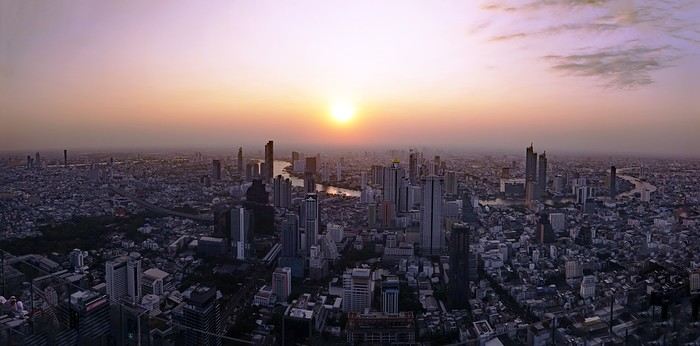
A somewhat lengthy title... I could have simply written: from Bangkok to Chiang Rai, via Chiang Mai, since that was my route. But when poets embellish our travel journals with their verbal flourishes, you’ve got to try not to be too ordinary.
Skyscrapers of excess? You’ll have gathered that from the photo illustrating this journal—though it might change as the trip goes on.
The excess of markets—not so much in their size, though... Chatuchak... But in their sheer number. Day markets, night markets, floating markets, fresh produce markets, fish markets, meat markets, spice markets, fabric markets... and even... amulet markets... For luck, good fortune, protection. Not to mention, sadly, the market for girls—and boys, incidentally. I’ve even heard they’re displayed in windows. I’ve heard about that one, like you have, but I didn’t set foot in it, so I can’t say anything about it. Some even claim there’s a black-market trade in children. Disgusting! It reminded me of the book *The Parcel* by Anosh Irani, which I recommended in another journal. The story is set in India, but I’ve been told it exists in Thailand too. So, the "famous Thai markets" we’re bombarded with in paper and online guides—sure, they amazed me in the first few days, and I don’t regret visiting them. But no matter how big they were, I quickly got my fill since you saw the same things at every stall...
I had a market overdose.
Excess of tourism? I should say *tourists*, since I saw them literally swarming in the streets and those famous markets. I’d forgotten about them. I’d lost the habit, living in an Indian city for so long...
Waterfalls are a bit like markets. At this time of year, they’re not particularly spectacular, but they’re everywhere. There are the ones everyone goes to see. For example, Erawan, which I decided to skip even though it was in my original itinerary—I guessed it’d be a nightmare with the selfie circus. On the other hand, you come across them all over the place, hidden in the mountains and forests, not listed in any guide. Not to mention the ones you can find in temples or even private homes... Yes, really! Thais love waterfalls, so they install them in their gardens—and I even saw one in the middle of the city, right on the street! Sometimes they’re tiny, but very photogenic.
But what do ice cubes have to do with this? Why the excess of ice cubes? Not only are they everywhere by the ton, but they put them in *everything* you drink. You’d think they’d even put them in soup! And it’s not just one or two ice cubes—no! They fill the container to the brim, whatever it is, then pour the liquid on top to fill the gaps. They’ll make you an excellent coffee right in front of you, piping hot, then—bam! An avalanche of ice cubes in the glass. Okay, I’m exaggerating a little. They *do* sometimes ask if you prefer your coffee—or tea—hot. Everything edible, and especially everything drinkable, is refrigerated: vegetables, fruit, hot drinks (I mean, drinks that are *usually* hot), but meat and fish are left out in the open. They just wave a little whisk to shoo away the flies when they get too eager. Mind you, I never put fruit, cheese, eggs, or water in the fridge in France, but I do in India. And I refrigerate meat and fish too... Though sometimes one of those little flies sneaks into the fridge...
You won’t find practical or technical details in this journal, like addresses or prices. Others do that better than me. You also won’t find the names of obscure or unknown places I discovered, or directions to get there.
I don’t really feel like recounting what I saw day by day, following my schedule and route. There might be flashbacks, projections into the future. It’ll depend on my memories, what I felt, what I hated, what comes back to me—and maybe your questions and our exchanges. And for those who’ve never read me before, you’ll have to get used to my parentheses and digressions, maybe on a completely different subject, as my thoughts wander. Stories within stories. There’ll also be long, endless sentences—but still punctuated, so you can follow along. Though I used to curse Proust and his sentences that started on one page and ended on the next, sometimes even further. I’d have to reread them twenty times to follow and understand what he was saying. I hated Proust. But hey, I was 20. Maybe I’d like him now?
See? The digressions are starting already. Forgive me.
You’ll find few photos here. First, the number is limited, and second, photos aren’t the main purpose of either VF or a travel journal. They’re too often used to mask the poverty of the text. And, sorry to say it, but so many of them are just plain ugly! If you really want to see photos, I’ll share some links where you can browse them at your leisure
Two weeks in Uganda, solo and using public transport
Hi everyone,
I’m taking advantage of the forum’s long-awaited reopening to dive back into my memories and start my first travel journal, destination Uganda!
Why Uganda?
Choosing this destination was almost by chance. I’d already traveled to East Africa two years earlier, to Kenya, and loved the experience. Of course, I wanted to return to the region and see that abundant wildlife I’d enjoyed so much. But Uganda wasn’t really on my radar... While looking for a destination for a two-week trip in May 2023, I came across cheap flights (~400 €) with Kenya Airways to Entebbe. Why not, I thought? I started looking into the country.
How did the trip go?
Most travelers whose posts I read had organized their trip with an agency and/or rented a vehicle, with or without a driver. That’s not at all how I like to explore a country... and besides, I don’t have a license ! Digging a little deeper, I saw that it seemed possible to reach the main sights using local transport, as long as I was ready to put up with the discomfort of the journeys. Challenge accepted! On the other hand, the budget accommodations near the parks that I’d managed to find in Kenya seemed much less common here. The trip was shaping up to be expensive, especially since the highlight—gorilla trekking—requires a permit costing several hundred dollars. Yikes, sticking to a reasonable budget was going to be tricky... In the end, I found a solution. Almost all lodges offer the option to pitch a tent on their grounds for a modest price (between $10 and $20 per night). That would let me enjoy the safaris while keeping this trip "relatively" affordable.
My itinerary
After studying the Lonely Planet East Africa guide, various travel journals and blogs, and the excellent site Safari Bookings, I finally settled on an itinerary (not counting the travel days):
Entebbe – 1 day Ziwa Rhino Sanctuary – 1 day Murchison Falls National Park – 2 days Crater Lakes – 1 day Queen Elizabeth National Park – 2 days Bwindi – 3 days Lake Bunyonyi – 1 day Kampala – 1 day
See you soon for the first stop in Entebbe!
Why Uganda?
Choosing this destination was almost by chance. I’d already traveled to East Africa two years earlier, to Kenya, and loved the experience. Of course, I wanted to return to the region and see that abundant wildlife I’d enjoyed so much. But Uganda wasn’t really on my radar... While looking for a destination for a two-week trip in May 2023, I came across cheap flights (~400 €) with Kenya Airways to Entebbe. Why not, I thought? I started looking into the country.
How did the trip go?
Most travelers whose posts I read had organized their trip with an agency and/or rented a vehicle, with or without a driver. That’s not at all how I like to explore a country... and besides, I don’t have a license ! Digging a little deeper, I saw that it seemed possible to reach the main sights using local transport, as long as I was ready to put up with the discomfort of the journeys. Challenge accepted! On the other hand, the budget accommodations near the parks that I’d managed to find in Kenya seemed much less common here. The trip was shaping up to be expensive, especially since the highlight—gorilla trekking—requires a permit costing several hundred dollars. Yikes, sticking to a reasonable budget was going to be tricky... In the end, I found a solution. Almost all lodges offer the option to pitch a tent on their grounds for a modest price (between $10 and $20 per night). That would let me enjoy the safaris while keeping this trip "relatively" affordable.
My itinerary
After studying the Lonely Planet East Africa guide, various travel journals and blogs, and the excellent site Safari Bookings, I finally settled on an itinerary (not counting the travel days):
Entebbe – 1 day Ziwa Rhino Sanctuary – 1 day Murchison Falls National Park – 2 days Crater Lakes – 1 day Queen Elizabeth National Park – 2 days Bwindi – 3 days Lake Bunyonyi – 1 day Kampala – 1 day
See you soon for the first stop in Entebbe!
La crise de l’aviation va faire exploser le prix des billets d'avion?
La crise de l’aviation va faire
exploser le prix des billets
les pistes explorées
pour convaincre les voyageurs sont diverses.
Mais il est déjà certain qu’elles vont
renchérir le prix des billets d’avion.
Certaines compagnies à bas prix ont déjà
fait faillite, et la pression sur les voyages low
● Prendre l’avion sera plus cher, et surtout
plus compliqué. Les compagnies cherchent
la parade.
Les mois qui viennent seront très compliquéspour l’aviation civile. Car il s’agit avant tout de regagner la confiance des usagers, tout en répondant aux nouvelles normes de sécurité sanitaire. Diminution des sièges en cabine, obligation de porter le masque, contrôle des températures est particulièrement forte. Certains prédisent carrément le retour à des prix que l’on connaissait avant les années 90. Et pour cette année, il faudrait s’attendre à une augmentation moyenne de près de 50%
Les mois qui viennent seront très compliquéspour l’aviation civile. Car il s’agit avant tout de regagner la confiance des usagers, tout en répondant aux nouvelles normes de sécurité sanitaire. Diminution des sièges en cabine, obligation de porter le masque, contrôle des températures est particulièrement forte. Certains prédisent carrément le retour à des prix que l’on connaissait avant les années 90. Et pour cette année, il faudrait s’attendre à une augmentation moyenne de près de 50%
Adventures of a Bygone Era: The Philippines in 1984
After several discussions on VF about travel journals from the Philippines, I decided to write this curiosity: a trip report from a journey made in 1984, when traveling to the Philippines was still an adventure.
A curiosity because writing a travel journal about a trip 35 years later isn’t common, but also (mostly?) because exploring the Philippines at that time had little in common with traveling there today.
Obviously, I’ve forgotten a number of facts, most of the details, but with the help of a few notes from that time and a stack of slides (yes, there was life before digital 😊), many memories came back and added to the highlights I’d never forgotten. The scanned slides aren’t always great quality, but there are still quite a few to brighten up this chatter. Back then, we didn’t snap photos like we do now—film was too expensive—so I don’t have pictures of every place we visited... too bad, comparing some of those spots to how they look today would’ve been interesting.
Why "Adventures"? Why call it "Adventures" in the Philippines in 1984, a word so often used for a simple exotic trip? - Because the lack of information (no *Guide du Routard*, no *Lonely Planet*, no *Michelin Guide*, nothing, and obviously no internet) gave this trip what’s at the heart of adventure: the unknown. - Because the political situation made the stay sometimes dangerous. - Because transportation conditions were always epic, often perilous. - Because the question of where we’d spend the night came up almost every evening. - And for... quite a few other reasons.
That said, we weren’t exactly explorers!
Why the Philippines? First of all, why go to the Philippines in 1984—a country not exactly set up for tourism and about which we knew very little? How could we get an idea of the beauty of the Philippines and its points of interest when we had no guides or photos?
The idea came to us from Thailand a year earlier, during our first long-haul trip. After touring the north of the country, we met a Frenchman living in Phuket, where there were only a few tourists in Patong, with just a few small hotels and guesthouses. Kata and Karon had no buildings or roads, Rawai only had three palm-thatched bungalows, including ours, and the other islands were unknown to tourists. There was plenty to discover, and we wanted to return to this beautiful country... but the Frenchman made us dream about the Philippines—a country to explore, with wild landscapes.
Long evenings of discussion over multiple Sprite-Mekong cocktails (what memories of those headaches!) finally convinced us we had to go to the Philippines.
Episode 0: Before Departure The decision was made: we’d go to the Philippines in May 1984. Our friends and family were surprised when we announced we were going on vacation to the Philippines (a bit like saying today we were going paddleboarding in the Kerguelen Islands 🤪).
These days, preparing for each of our trips takes long evenings of research, planning, and noting down good addresses... etc. But for the Philippines in 1984, preparation was quick: we had very little information about the country, we were leaving almost at random, and the discovery would only be more exciting.
We still had a few bits of info gathered here and there: the rice terraces in northern Luzon, volcanoes, Negros where we were supposed to visit an acquaintance, Cebu and its marine life (we ended up going elsewhere), and absolutely avoid Mindanao, which was practically at war with the regime. That was about it, but it was already a great itinerary.
Nothing was organized in advance; we’d see day by day. We had no idea about travel times or even the existence of transportation options. The main (and sometimes only) way to connect two islands was by overloaded, rusty ferry. Only the big cities had airports.
Let’s Go: Episode 1: Paris to Manila My travel journals always start after arriving at the airport—the Europe-to-“Other Continent” trip isn’t interesting—but the flight to the Philippines was already an adventure, so I’ll make an exception.
This was the era when only a few Asian airlines were on par with Western ones: Thai, Singapore Airlines, and Philippine Airlines. They had beautiful, brand-new planes, and to attract customers (almost exclusively “businessmen”) from the usual airlines (Air France, Lufthansa, British Airways), there was opulence on board: unlimited champagne, all sorts of cocktails... Compared to today’s long-haul flights, there was still one small difference: no personal screens, just one screen at the front of the cabin with one mandatory movie. And I don’t know why, but we only got James Bond films, both ways... that must’ve been the trend at the time.
The tourism boom to Southeast Asia hadn’t started yet, and the “Asian Tigers” weren’t a thing, so there weren’t many business trips. That meant long-haul flights made stops everywhere to fill the planes. Our Philippine Airlines Boeing 747 left London, picked us up in Paris, then stopped in Frankfurt to take on a few Germans. I don’t know why we then made a stop in Dubai—a totally exotic place at the time. There was nothing to do there... things have changed a lot since. It was a small town lost in the desert. The airport was tiny, with just one or two buildings and a supermarket. During the stopover, everyone had to get off the plane and walk to the supermarket. Photo and electronic equipment were dirt cheap—I guess that was the only reason for the stop. Maybe it was their first commercial move. Emirates didn’t exist yet, as I checked online, but anyway, the idea that such a remote place could have its own airline was unthinkable.
Online, I found this photo of Dubai Airport in 1980. Anyone who’s transited through today’s massive airport with its rows of A380s will appreciate it: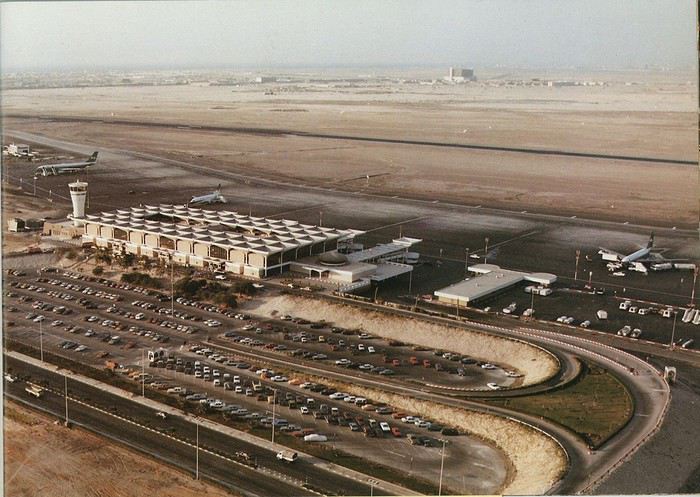
Next stop: New Delhi to drop off some Europeans and pick up a few Indians, and finally, the terminus: Manila. I don’t remember how long the trip took with its five stops—an unimaginable journey today. Despite all those stops to fill the plane, there was still enough space to stretch out on the four center seats of the 747, something that never happens these days despite all the flights in every direction.
So here we are, finally at Manila Airport around midnight.
Episode 1: Manila and Baguio To start, a quick note on the political and economic situation in the Philippines in 1984, which had consequences for us as tourists, as we’d soon realize upon arrival.
After several centuries of Spanish colonization, the Philippines became American at the start of the 20th century, then independent. In 1966, Marcos took power, and little by little, his regime sank into corruption and mismanagement, becoming a dictatorship with martial law, all for the benefit of his family and friends, who enriched themselves endlessly. The peak was the assassination of opposition leader Benigno Aquino in August 1983, which triggered harshly repressed protests. So we arrived a few months later in a very poor country, with omnipresent corruption and an extremely tense political situation, as we’d soon see for ourselves. Major protests took place in the main cities during our trip—I’ll come back to that. Two years later, Marcos fled to Hawaii after being forced out of power following rigged elections. This historical context explains a lot of the situations we found ourselves in over the following weeks.
Arriving in the middle of the night isn’t very cheerful. Manila was already a huge city with many slums, where you could find a few business hotels like the Hilton or Intercontinental—way out of our budget—and plenty of run-down hotels. Luckily, two Indians we’d chatted with on the plane offered to take us to their usual hotel. They came to Manila twice a year for business. We accepted their offer, relieved not to have to look for a place to stay in the middle of the night, figuring the address must be good since they came back every time... we were wrong 🙁
We left the airport and immediately got a taste of the local vibe when we got into the taxi: the police asked for our passports. We thought: what’s more normal than police in a dictatorship?
But that wasn’t it at all. Our two Indian friends explained that the police were noting our names along with the taxi number and time. Crime in Manila was so bad that the taxi driver would be held responsible if anything happened to us... welcome to the Philippines 😎 😎
Historically, the Philippines was a very violent country, where everything was settled with guns or machetes. Previous governments had banned carrying weapons, but Marcos later allowed the free sale and carrying of guns, and disputes were settled with pistols again (or worse, as we’d discover later). Since he’d released most of the criminals from prison to form a paramilitary militia at his service (I’ll talk about our encounter with these “heroes” later), it was pretty dangerous to go into many parts of Manila, where these “tonton macoutes” ruled.
We arrived at our hotel without incident... and then things started badly. The room was infested with big cockroaches—exactly what I hate most in those kinds of countries. No way to find another hotel at that hour. After the long flight, the urge to take a shower was so strong that we squeezed into the bathroom as best we could. After that, I don’t remember—I guess we must’ve fallen asleep exhausted under the sheets in the heat... air conditioning wasn’t widespread yet.
The next day, we just wanted to leave that dump as soon as possible. So we decided to head north right away, stopping in Baguio, and we’d visit Manila a bit on the way back.
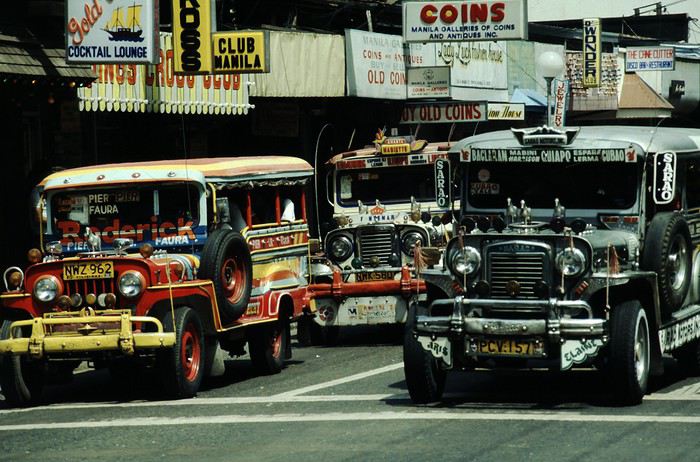
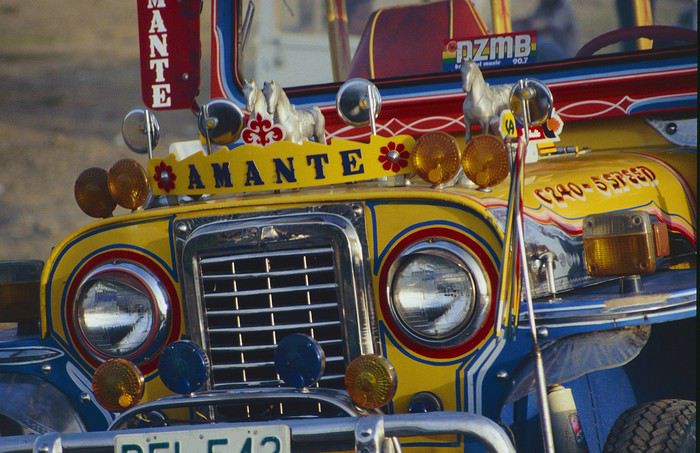
When we stepped outside, we discovered a pretty run-down neighborhood with potholed streets. But we also discovered the jeepneys. They were everywhere, flooding the streets.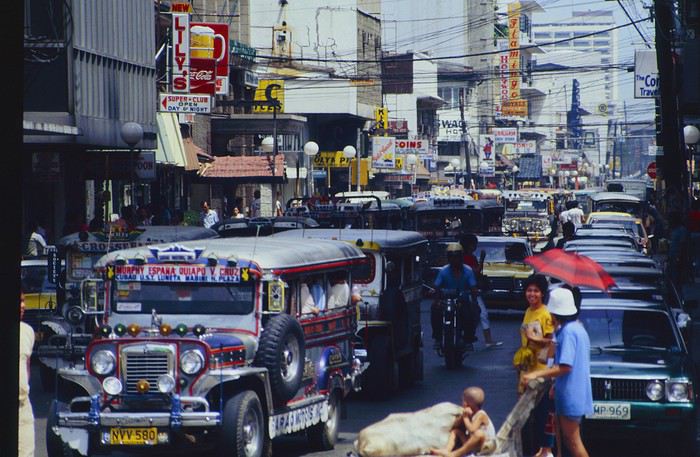
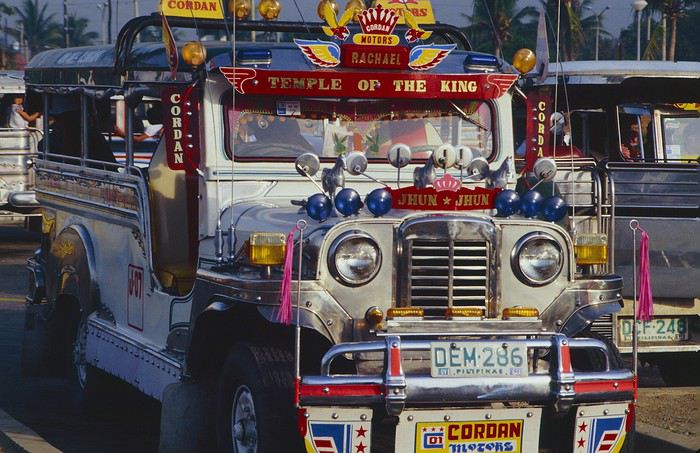
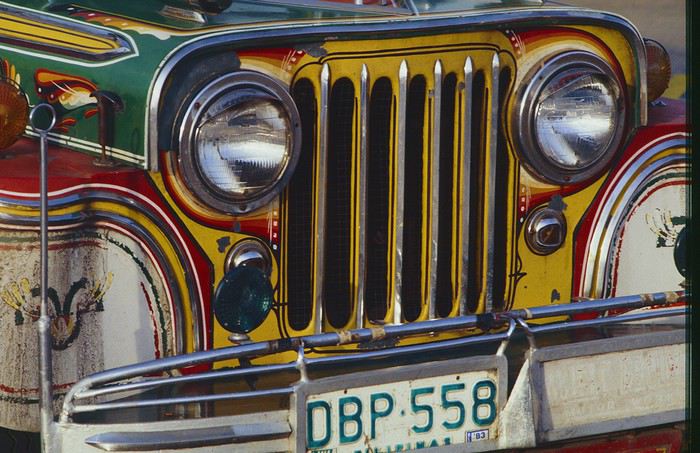
They had crazy sound systems, each one blasting louder than the last. The interiors were kitschy but fun. There weren’t many private cars—almost all transportation was by jeepney, with buses reserved for intercity trips.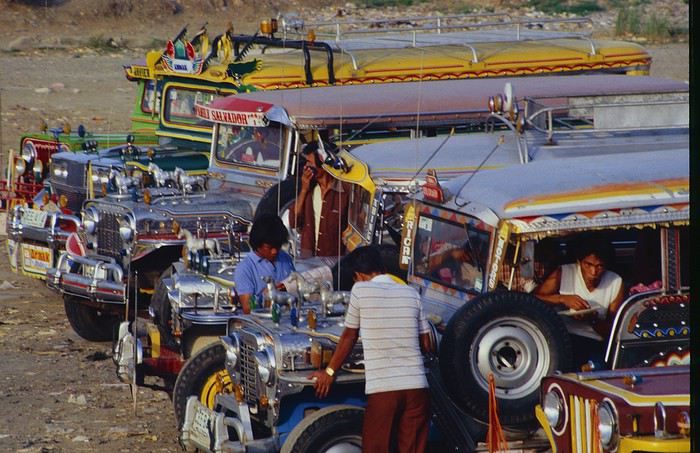
Before heading to the bus terminal for the north, somewhere on the outskirts of the city, we needed to exchange some money. I don’t remember how we ended up in a policeman’s jeep who offered his services: - Exchange money on the black market at a better rate than the banks. - Take us wherever we wanted, in this case, the bus terminal.
We accepted both offers (we’d still checked the official exchange rate from dollars to pesos). So we found ourselves in his jeep. After exchanging money, we left in his vehicle and stopped for gas. Without turning off the engine, he calmly smoked a cigarette while filling up. Since we were in a jeep with no doors or roof, we were ready to jump out if things went south, our travel bag in hand.
But we weren’t done with surprises yet. Once we left the small streets, we ended up in a neighborhood with wide avenues and not much traffic, which didn’t justify his incredible behavior. At every intersection, he made the sign of the cross, closed his eyes, and crossed without looking. I was more stunned than terrified! It wasn’t until we got out of the car later that I told Anne-Marie what had happened. I’d seen everything because the cop had put me in the front seat. Luckily, A-Marie hadn’t noticed anything from the back. Crossing Manila by trusting God rather than the rules of the road was ultimately effective. We were lucky—the trip was off to a good start. 🙂 🙂
We then passed through a neighborhood where slums stretched on for a while, and we left our policeman—friendly but a bit crazy—with relief.
A few hours by bus later, here we are in Baguio, cool in the mountains. My memories of Baguio are pretty fuzzy. I remember a small town. After some research while writing this journal, I found that the population was 120,000 in 1980. Given the population density in each home, that confirms my memory of a smallish town. Outside the “official” district with the president’s summer residence and government buildings, there were two or three paved streets with nice houses. The rest was very dirty and very poor, with lots of slums and dirt roads.
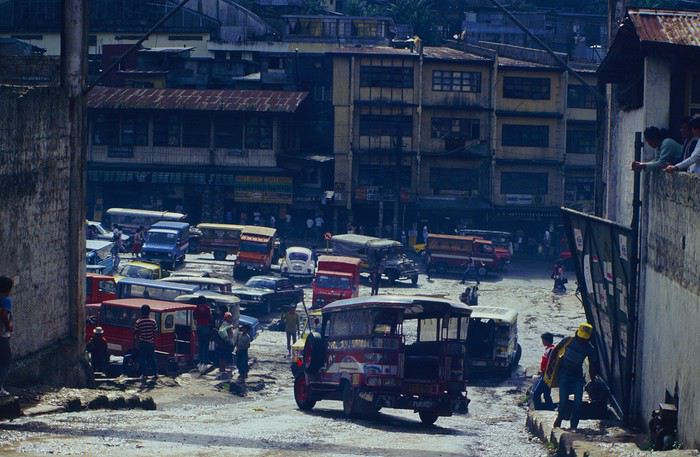
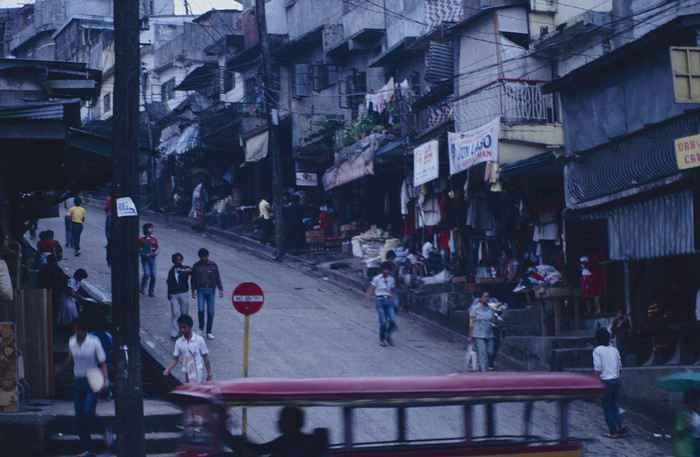
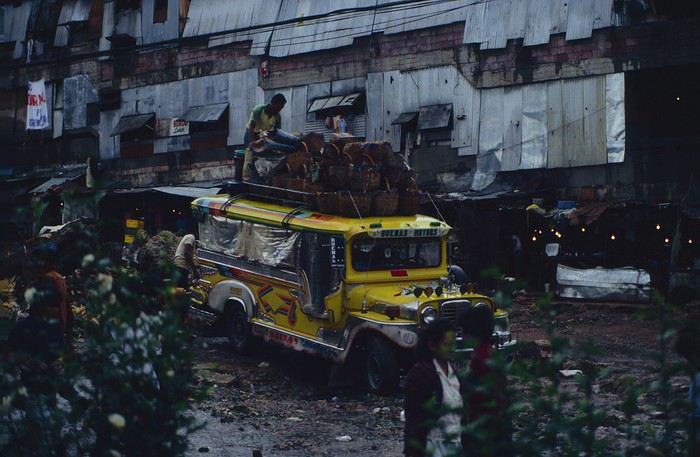
People we met on the street invited us to stay with them. These days, we wouldn’t just show up at strangers’ houses, which we should’ve done in Baguio—it would’ve saved us from an unimaginable and dangerous situation... which I won’t say anything about... !😊
The simple wooden house was on stilts at the edge of a hill with a view of the mountains. Since it was the start of the rainy season in a city that gets a lot of rain, we saw a lot of water. Our outings in town happened between downpours.
View from our lodging: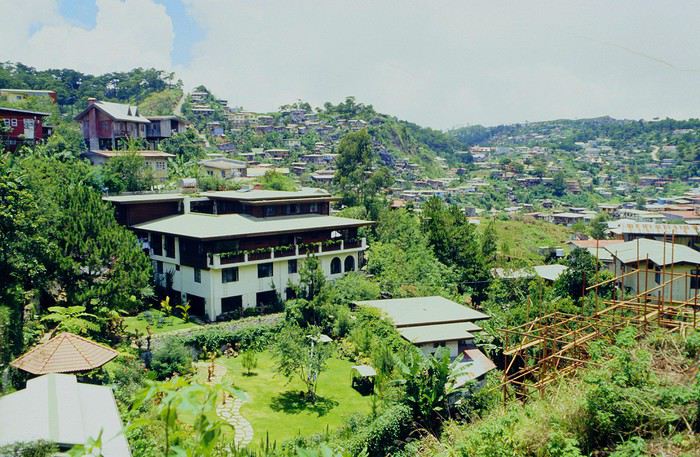
Episode 2: Baguio to Bontoc Aside from the situation briefly mentioned above, it was on the next leg to Bontoc that the adventure really began: an endless and dangerous road, a bus from another era, breathtaking landscapes, and surprising people.
We didn’t know the distance or how long it would take to get to Bontoc. When we arrived after about ten hours, we learned that Baguio to Bontoc was 140 km.
We got on a bus with wooden seats and settled in, two to a seat meant for two. As the bus filled up, passengers squeezed in three or four per seat, with chickens and baskets full of all sorts of things in the aisle. A little embarrassed, we didn’t know if we should squeeze in three on our seat. The seats were super tight (luckily, Filipinos are small), and I didn’t know where to put my legs given my height. I don’t remember if we stayed alone on our bench or if we ended up sharing with others.
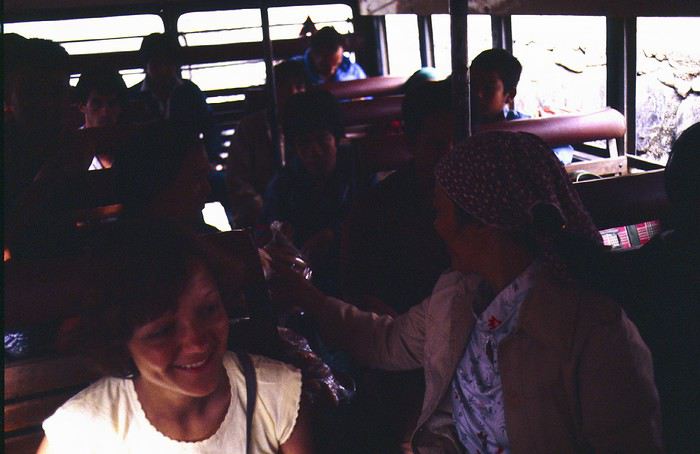
The “road” was a dirt track (or rather, a mud track) with endless turns. We held on as best we could to our slippery wooden seats—it was shaking in every direction. The woman behind us was carsick and throwing up... gross... but what were we doing there? Then we plunged into the Sierra Madre... just the name is dreamy!
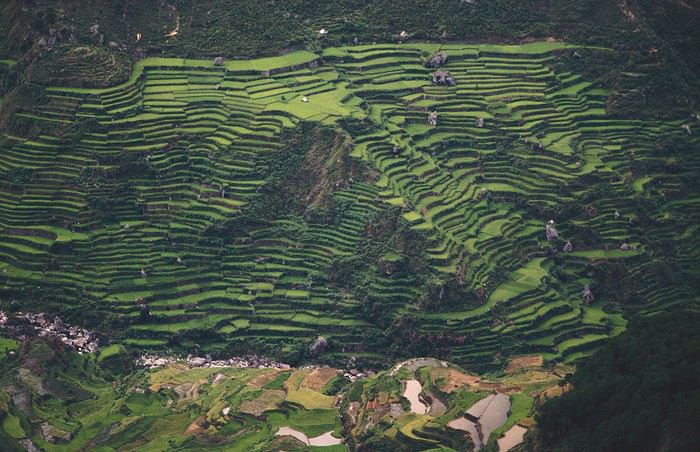
Rice terraces started to appear: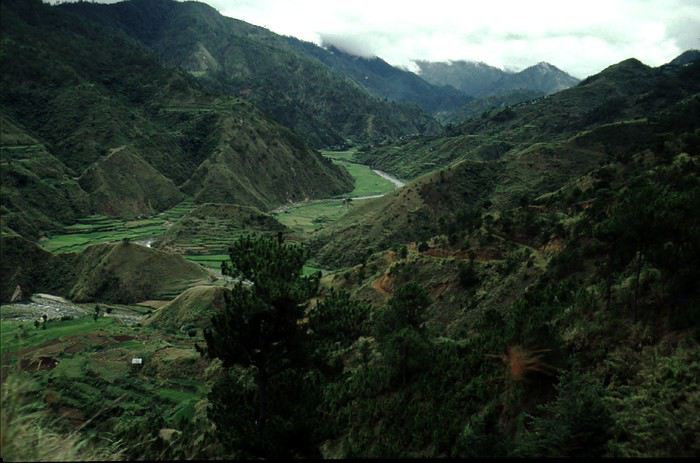
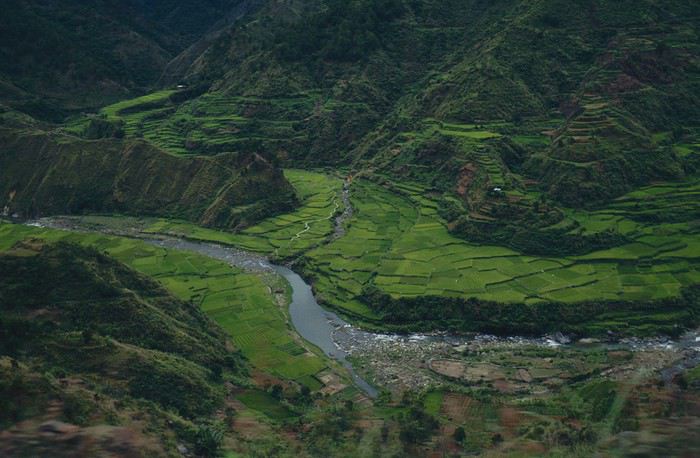
they took up more and more space along cliffs where we weren’t always reassured,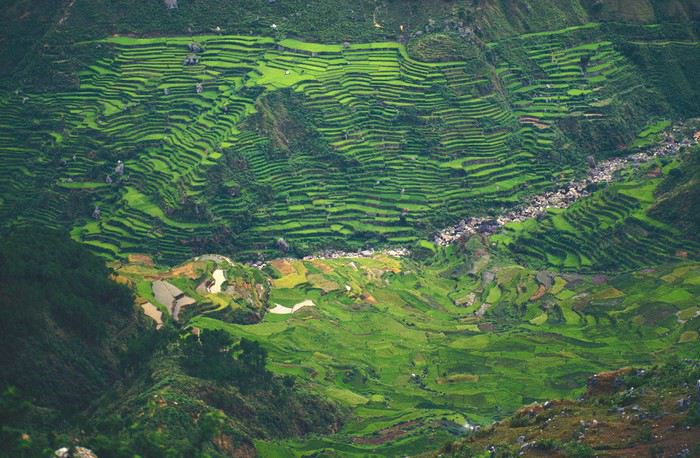
with lots of waterfalls (all that water had to go somewhere).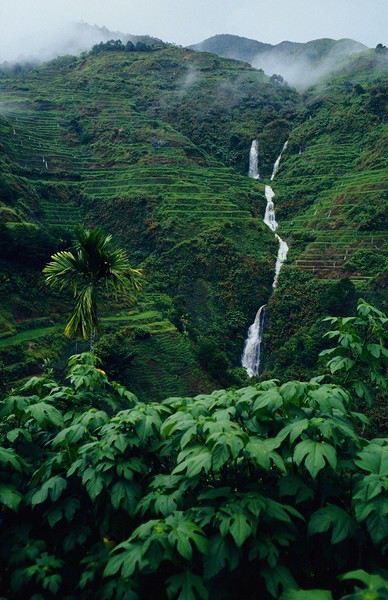
A few miserable villages stretched along the track, most often just a few houses balancing between the road and the drop. The bus stopped in every village—people got on or off and settled inside or on the roof. Street vendors offered their products to the bus passengers—a common sight in Asia, even today.
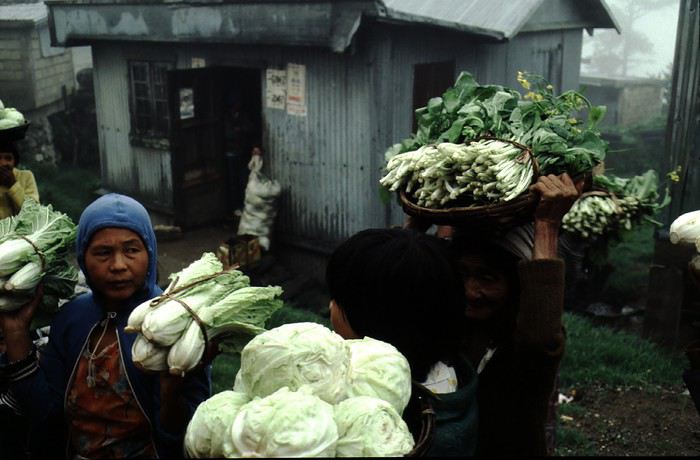
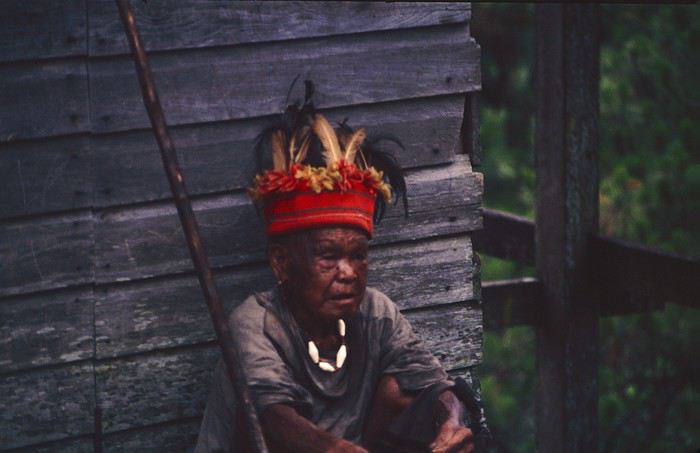
We were in another world—villagers were in loincloths, others had spears. The atmosphere was strange... but all good, we wanted exoticism, and we got it: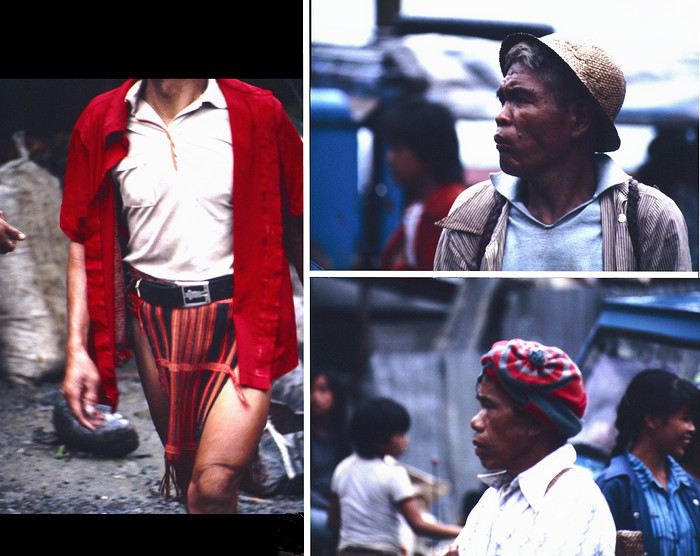
This so-called traditional outfit was everyday wear—it wasn’t for tourists since there weren’t any.
A curiosity because writing a travel journal about a trip 35 years later isn’t common, but also (mostly?) because exploring the Philippines at that time had little in common with traveling there today.
Obviously, I’ve forgotten a number of facts, most of the details, but with the help of a few notes from that time and a stack of slides (yes, there was life before digital 😊), many memories came back and added to the highlights I’d never forgotten. The scanned slides aren’t always great quality, but there are still quite a few to brighten up this chatter. Back then, we didn’t snap photos like we do now—film was too expensive—so I don’t have pictures of every place we visited... too bad, comparing some of those spots to how they look today would’ve been interesting.
Why "Adventures"? Why call it "Adventures" in the Philippines in 1984, a word so often used for a simple exotic trip? - Because the lack of information (no *Guide du Routard*, no *Lonely Planet*, no *Michelin Guide*, nothing, and obviously no internet) gave this trip what’s at the heart of adventure: the unknown. - Because the political situation made the stay sometimes dangerous. - Because transportation conditions were always epic, often perilous. - Because the question of where we’d spend the night came up almost every evening. - And for... quite a few other reasons.
That said, we weren’t exactly explorers!
Why the Philippines? First of all, why go to the Philippines in 1984—a country not exactly set up for tourism and about which we knew very little? How could we get an idea of the beauty of the Philippines and its points of interest when we had no guides or photos?
The idea came to us from Thailand a year earlier, during our first long-haul trip. After touring the north of the country, we met a Frenchman living in Phuket, where there were only a few tourists in Patong, with just a few small hotels and guesthouses. Kata and Karon had no buildings or roads, Rawai only had three palm-thatched bungalows, including ours, and the other islands were unknown to tourists. There was plenty to discover, and we wanted to return to this beautiful country... but the Frenchman made us dream about the Philippines—a country to explore, with wild landscapes.
Long evenings of discussion over multiple Sprite-Mekong cocktails (what memories of those headaches!) finally convinced us we had to go to the Philippines.
Episode 0: Before Departure The decision was made: we’d go to the Philippines in May 1984. Our friends and family were surprised when we announced we were going on vacation to the Philippines (a bit like saying today we were going paddleboarding in the Kerguelen Islands 🤪).
These days, preparing for each of our trips takes long evenings of research, planning, and noting down good addresses... etc. But for the Philippines in 1984, preparation was quick: we had very little information about the country, we were leaving almost at random, and the discovery would only be more exciting.
We still had a few bits of info gathered here and there: the rice terraces in northern Luzon, volcanoes, Negros where we were supposed to visit an acquaintance, Cebu and its marine life (we ended up going elsewhere), and absolutely avoid Mindanao, which was practically at war with the regime. That was about it, but it was already a great itinerary.
Nothing was organized in advance; we’d see day by day. We had no idea about travel times or even the existence of transportation options. The main (and sometimes only) way to connect two islands was by overloaded, rusty ferry. Only the big cities had airports.
Let’s Go: Episode 1: Paris to Manila My travel journals always start after arriving at the airport—the Europe-to-“Other Continent” trip isn’t interesting—but the flight to the Philippines was already an adventure, so I’ll make an exception.
This was the era when only a few Asian airlines were on par with Western ones: Thai, Singapore Airlines, and Philippine Airlines. They had beautiful, brand-new planes, and to attract customers (almost exclusively “businessmen”) from the usual airlines (Air France, Lufthansa, British Airways), there was opulence on board: unlimited champagne, all sorts of cocktails... Compared to today’s long-haul flights, there was still one small difference: no personal screens, just one screen at the front of the cabin with one mandatory movie. And I don’t know why, but we only got James Bond films, both ways... that must’ve been the trend at the time.
The tourism boom to Southeast Asia hadn’t started yet, and the “Asian Tigers” weren’t a thing, so there weren’t many business trips. That meant long-haul flights made stops everywhere to fill the planes. Our Philippine Airlines Boeing 747 left London, picked us up in Paris, then stopped in Frankfurt to take on a few Germans. I don’t know why we then made a stop in Dubai—a totally exotic place at the time. There was nothing to do there... things have changed a lot since. It was a small town lost in the desert. The airport was tiny, with just one or two buildings and a supermarket. During the stopover, everyone had to get off the plane and walk to the supermarket. Photo and electronic equipment were dirt cheap—I guess that was the only reason for the stop. Maybe it was their first commercial move. Emirates didn’t exist yet, as I checked online, but anyway, the idea that such a remote place could have its own airline was unthinkable.
Online, I found this photo of Dubai Airport in 1980. Anyone who’s transited through today’s massive airport with its rows of A380s will appreciate it:
Next stop: New Delhi to drop off some Europeans and pick up a few Indians, and finally, the terminus: Manila. I don’t remember how long the trip took with its five stops—an unimaginable journey today. Despite all those stops to fill the plane, there was still enough space to stretch out on the four center seats of the 747, something that never happens these days despite all the flights in every direction.
So here we are, finally at Manila Airport around midnight.
Episode 1: Manila and Baguio To start, a quick note on the political and economic situation in the Philippines in 1984, which had consequences for us as tourists, as we’d soon realize upon arrival.
After several centuries of Spanish colonization, the Philippines became American at the start of the 20th century, then independent. In 1966, Marcos took power, and little by little, his regime sank into corruption and mismanagement, becoming a dictatorship with martial law, all for the benefit of his family and friends, who enriched themselves endlessly. The peak was the assassination of opposition leader Benigno Aquino in August 1983, which triggered harshly repressed protests. So we arrived a few months later in a very poor country, with omnipresent corruption and an extremely tense political situation, as we’d soon see for ourselves. Major protests took place in the main cities during our trip—I’ll come back to that. Two years later, Marcos fled to Hawaii after being forced out of power following rigged elections. This historical context explains a lot of the situations we found ourselves in over the following weeks.
Arriving in the middle of the night isn’t very cheerful. Manila was already a huge city with many slums, where you could find a few business hotels like the Hilton or Intercontinental—way out of our budget—and plenty of run-down hotels. Luckily, two Indians we’d chatted with on the plane offered to take us to their usual hotel. They came to Manila twice a year for business. We accepted their offer, relieved not to have to look for a place to stay in the middle of the night, figuring the address must be good since they came back every time... we were wrong 🙁
We left the airport and immediately got a taste of the local vibe when we got into the taxi: the police asked for our passports. We thought: what’s more normal than police in a dictatorship?
But that wasn’t it at all. Our two Indian friends explained that the police were noting our names along with the taxi number and time. Crime in Manila was so bad that the taxi driver would be held responsible if anything happened to us... welcome to the Philippines 😎 😎
Historically, the Philippines was a very violent country, where everything was settled with guns or machetes. Previous governments had banned carrying weapons, but Marcos later allowed the free sale and carrying of guns, and disputes were settled with pistols again (or worse, as we’d discover later). Since he’d released most of the criminals from prison to form a paramilitary militia at his service (I’ll talk about our encounter with these “heroes” later), it was pretty dangerous to go into many parts of Manila, where these “tonton macoutes” ruled.
We arrived at our hotel without incident... and then things started badly. The room was infested with big cockroaches—exactly what I hate most in those kinds of countries. No way to find another hotel at that hour. After the long flight, the urge to take a shower was so strong that we squeezed into the bathroom as best we could. After that, I don’t remember—I guess we must’ve fallen asleep exhausted under the sheets in the heat... air conditioning wasn’t widespread yet.
The next day, we just wanted to leave that dump as soon as possible. So we decided to head north right away, stopping in Baguio, and we’d visit Manila a bit on the way back.
When we stepped outside, we discovered a pretty run-down neighborhood with potholed streets. But we also discovered the jeepneys. They were everywhere, flooding the streets.
They had crazy sound systems, each one blasting louder than the last. The interiors were kitschy but fun. There weren’t many private cars—almost all transportation was by jeepney, with buses reserved for intercity trips.
Before heading to the bus terminal for the north, somewhere on the outskirts of the city, we needed to exchange some money. I don’t remember how we ended up in a policeman’s jeep who offered his services: - Exchange money on the black market at a better rate than the banks. - Take us wherever we wanted, in this case, the bus terminal.
We accepted both offers (we’d still checked the official exchange rate from dollars to pesos). So we found ourselves in his jeep. After exchanging money, we left in his vehicle and stopped for gas. Without turning off the engine, he calmly smoked a cigarette while filling up. Since we were in a jeep with no doors or roof, we were ready to jump out if things went south, our travel bag in hand.
But we weren’t done with surprises yet. Once we left the small streets, we ended up in a neighborhood with wide avenues and not much traffic, which didn’t justify his incredible behavior. At every intersection, he made the sign of the cross, closed his eyes, and crossed without looking. I was more stunned than terrified! It wasn’t until we got out of the car later that I told Anne-Marie what had happened. I’d seen everything because the cop had put me in the front seat. Luckily, A-Marie hadn’t noticed anything from the back. Crossing Manila by trusting God rather than the rules of the road was ultimately effective. We were lucky—the trip was off to a good start. 🙂 🙂
We then passed through a neighborhood where slums stretched on for a while, and we left our policeman—friendly but a bit crazy—with relief.
A few hours by bus later, here we are in Baguio, cool in the mountains. My memories of Baguio are pretty fuzzy. I remember a small town. After some research while writing this journal, I found that the population was 120,000 in 1980. Given the population density in each home, that confirms my memory of a smallish town. Outside the “official” district with the president’s summer residence and government buildings, there were two or three paved streets with nice houses. The rest was very dirty and very poor, with lots of slums and dirt roads.
People we met on the street invited us to stay with them. These days, we wouldn’t just show up at strangers’ houses, which we should’ve done in Baguio—it would’ve saved us from an unimaginable and dangerous situation... which I won’t say anything about... !😊
The simple wooden house was on stilts at the edge of a hill with a view of the mountains. Since it was the start of the rainy season in a city that gets a lot of rain, we saw a lot of water. Our outings in town happened between downpours.
View from our lodging:
Episode 2: Baguio to Bontoc Aside from the situation briefly mentioned above, it was on the next leg to Bontoc that the adventure really began: an endless and dangerous road, a bus from another era, breathtaking landscapes, and surprising people.
We didn’t know the distance or how long it would take to get to Bontoc. When we arrived after about ten hours, we learned that Baguio to Bontoc was 140 km.
We got on a bus with wooden seats and settled in, two to a seat meant for two. As the bus filled up, passengers squeezed in three or four per seat, with chickens and baskets full of all sorts of things in the aisle. A little embarrassed, we didn’t know if we should squeeze in three on our seat. The seats were super tight (luckily, Filipinos are small), and I didn’t know where to put my legs given my height. I don’t remember if we stayed alone on our bench or if we ended up sharing with others.
The “road” was a dirt track (or rather, a mud track) with endless turns. We held on as best we could to our slippery wooden seats—it was shaking in every direction. The woman behind us was carsick and throwing up... gross... but what were we doing there? Then we plunged into the Sierra Madre... just the name is dreamy!
Rice terraces started to appear:
they took up more and more space along cliffs where we weren’t always reassured,
with lots of waterfalls (all that water had to go somewhere).
A few miserable villages stretched along the track, most often just a few houses balancing between the road and the drop. The bus stopped in every village—people got on or off and settled inside or on the roof. Street vendors offered their products to the bus passengers—a common sight in Asia, even today.
We were in another world—villagers were in loincloths, others had spears. The atmosphere was strange... but all good, we wanted exoticism, and we got it:
This so-called traditional outfit was everyday wear—it wasn’t for tourists since there weren’t any.
Uganda: 20 days discovering authenticity
Preamble:
For summer 2019, the idea was to return to Africa. We had already been to Namibia in 2017 (+ a few days in Botswana and the end of the trip at Victoria Falls), which we loved, and a trip to Asia in 2018 (Borneo, Perhentian, and Singapore), a nature-focused trip but a bit disappointing due to environmental destruction. The desire to return to Africa was very strong. We wanted a change of scenery, nature, discoveries, to step out of our little comfort zone (a bit, anyway!) and experience travel differently. In short, we dreamed of authenticity, and we weren’t disappointed.
We traveled as a family of four with our daughters, aged 19 and 17. When the urge for Africa hit, Uganda quickly stood out, especially for the chance to see rare animals, particularly the famous mountain gorillas. When I looked into the budget, I was quickly disheartened. It’s really expensive. Too expensive… Then, after reading a few trip reports on "VoyageForum" (thanks Muriel J!), I decided to ask a local agency for a quote. The first contact was very friendly and responsive, and the initial offer for two weeks fit our budget :). A few images gathered from the internet (especially Sipi Falls) finally convinced us all. I asked for an adapted offer with a few more sites to extend the trip to three weeks and cover a fairly complete visit to the country (which, of course, increased the budget! To stay within an acceptable range, we prioritized activities over accommodations and regularly chose the cheapest options, with 2-3 nice lodges in between). It’s booked! We were in October 2018, and the first thing to do was reserve permits to see the gorillas and chimpanzees. Then, the agency took care of all the bookings except for the international flights, which we booked with Ethiopian Airlines. A few months of waiting to look forward to… and a little worry too! Two events didn’t reassure us: the kidnapping of an American tourist by four men at the DRC border and the Ebola outbreak in Congo, with confirmed cases in Uganda by mid-June…
Here we are in July, and departure is approaching. The suitcases are packed (warm clothes, long, short, dark, light, practical, sun, rain, hiking/trekking shoes, flip-flops—clothes for every situation! Don’t forget: headlamp (essential!), binoculars, cameras), and we’re ready.
One day before departure, our agency Mpolampola, through its manager Paul, informs us that he won’t be the one taking care of us during the trip but another guide named Moses. He has a big problem with a vehicle and can’t do otherwise. For us, as long as everything is okay, no worries, especially since I had read glowing reviews about Moses, who turned out to be a very pleasant guide, cautious (most important) on the road, clear about all the activities, and an expert on birds, his specialty. We briefly met Paul in the middle of the trip, who is also very friendly. In short, we 100% recommend this agency. Flights to Entebbe went smoothly; we arrived around 10:30 AM, filled out health forms (Ebola information signs everywhere), visas, baggage claim, and met Moses, who took us directly to the vehicle. It was in pretty good condition with huge tires (we’d understand why later!), but it had quite a few miles (400,000 on the odometer!). Just missing a seatbelt… Okay, it’s Africa!
Now, here’s our day-by-day itinerary, which I’ll summarize briefly with ratings for each activity: ****TOPISSIME (Amazing) ***Very good **Good *Meh
Day 1) Departure from the airport at 11:45 AM for some currency exchange. Stop along the way at the equator for a meal and souvenir photo! Arrival at Lake Mburo Park *** around 5:00 PM. Even before entering the park, we saw lots of antelopes, zebras, elks, etc.—it’s magnificent. On the way, we had already encountered many goats and cows, and we were impressed by their enormous horns. We enjoyed a nice game drive until about 7:00 PM, when we reached our lodge, one of the nicest of the trip, Eagle’s Nest ****, with a magnificent view, a tent with a nice bathroom/shower, and a very good meal.
Day 2) Departure at 7:00 AM for a game drive; we encountered many animals again, especially antelopes, zebras, and birds. There are no giraffes, lions, or cheetahs in this park. We didn’t get lucky enough to see a leopard… :-) Then, we continued to Lake Bunyonyi ***, where the road and views are very beautiful, but we were shocked to see locals (mostly women and children) breaking stones by hand on the mountainside in very precarious safety conditions. There are regularly dramatic accidents because, over time, entire sections detach and cause landslides. These stones are then used for road construction… Another world… This was the only place we saw this. Lake Bunyonyi is a nice stop (but less exotic in our opinion since we have many lakes back home too!). We took a boat to our accommodation, Byoona Amagara ***, which has a lot of charm. We stayed in huts called "geodomes," completely open to nature, so it was very cool at night. To reach the toilets located below, you had to be brave! The meal consisted of lake shrimp—good but a bit bland.
Day 3) After a good breakfast, departure at 9:00 AM to visit three islands. We took several nice walks with beautiful views of the lake and islands. A local meal was served on the last island. At 1:00 PM, we met Moses for the rest of the program and headed to Ruhija in Bwindi Forest****. The landscapes are breathtaking. After two hours of driving and many photo stops, we arrived at our accommodation near the trekking starting point, Ruhija Gorilla Friends Resort **. We stayed in a room instead of the initially planned tents, which was just as well because there was a lot of wind during the night. We still had time for an activity and decided to meet the Bwata pygmies despite the bad reviews in the guide… The first part of the visit was quite nice, with a visit to a school where the children gave us a very joyful welcome. We had a great time listening to them sing and dance! Then we met the Bwata pygmies who live on the edge of the forest. When Bwindi Forest was declared a national park, they had to leave their habitat because their activities weren’t compatible with nature and wildlife protection. We left on a somewhat sad note… The visit ended with a local doctor explaining different medicinal plants, and we watched the making of local beer from sorghum. Good meal. We had butterflies in our stomachs—tomorrow was a big day! I admit I was a bit stressed, not entirely confident in my physical abilities…
Day 4) After a short night due to excitement, breakfast, and departure at 7:30 AM. First, it started calmly with singing and dancing. Then, a 15-minute briefing and group assignments. No one asked if we had any physical problems or anything (when booking, I had inquired a bit, and they told me groups were assigned based on physical abilities). We were assigned to the Mukiza group. At first, I was pretty happy—it was a fairly large group with babies :). The ranger explained that for now, they didn’t know where the gorillas were… the trackers couldn’t find them… Oh… (that’s not a good sign!!!) We set off at a good pace, first on a reasonably sloped path. We were accompanied by a family of four Italians and five porters (four for us!). After an hour, the ranger stopped us and informed us they still couldn’t find them—they had fought with another group the day before and scattered throughout the forest, so they were very far away, and we needed to move faster… Hmm… we picked up the pace (we weren’t going slowly before!!!) and walked for another good hour—down, up, down again, up again, we kept going, but always more or less on paths. Then another stop. A 10-minute break waiting for news. The news wasn’t very precise, it seemed! The ranger decided to cut through the forest—machetes were used to clear the path. We descended unimaginable slopes, then climbed back up. Our stick kept getting stuck; luckily, our porter helped us, held our hands, and the terrain was vertical! An hour later, another stop: we heard gorilla cries (yay!!!). False hope—we waited again for news from the trackers, who informed our ranger that it was a non-habituated family, so we couldn’t see them. Cold shower—we had to go all the way back up and return to the starting point to maybe see another group. But time was running out… We arrived around 1:30 PM; all the other groups had already left long ago. Our guide was worried because we still had a long drive ahead. We quickly ate a banana, and off we went for another trek (I was exhausted!). Luckily, this group was close—about 45 minutes of steep descent (I was already thinking about the climb back and considering being adopted by a gorilla ). The forest was sublime, with magnificent tree ferns—the place was truly splendid. Finally, we were there. The porters stayed behind, we grabbed our cameras, and followed the ranger. The progress wasn’t easy, but suddenly, a female was in front of us, curled up in a little ball, eating—so cute. The emotion overwhelmed us. But she moved away—it’s hard to observe them; they move constantly, and the terrain is very steep and uneven. We saw a female descending from a tree with a baby on her back—too adorable. Then, here was the silverback, enormous, incredible, yet so calm and peaceful. He ate quietly and gave us a nice demonstration of nostril exploration! We could observe them for a good hour, but photographing them wasn’t easy because they kept moving, and we could barely stand! Toward the end, a large male (black back) suddenly stood up and decided to pass right where I was! I ended up in the bushes, and the male passed in front of me just a few centimeters away (he stepped on one of my daughters’ feet!) followed by the whole family. Just an exceptional moment. It was time to leave; we had to climb back up. I dreaded it because, I admit, I was exhausted. We finished the hike after 4:00 PM, exhausted but happy. The ranger gave us diplomas, and we didn’t linger because we still had a long drive—we needed to reach Ishasha before nightfall. Our guide was a bit stressed. If we were to do it again, we’d spend an extra night in Bwindi. However, it seems finishing so late is exceptional—it never happens, according to our guide! The road between Bwindi and Ishasha is sublime, with extraordinary landscapes, and despite the late hour, we regularly asked our guide to stop for photos. We arrived at Enjojo *** Lodge around 6:00 PM. The huts are located quite far from the reception and the bathrooms, a bit far from the huts, but otherwise, it was very nice.
Day 5) Departure at 8:00 AM after a good breakfast with the hope of seeing tree-climbing lions (no luck!). Overall, there weren’t many animals, and we arrived around 12:45 PM at our next stop, Parkview Safari Lodge ****, with a magnificent view, a beautiful family bungalow, and a good meal. We enjoyed a short relaxation by the lovely pool. At 4:00 PM, we left to see Kyambura Gorge *** and hike there. Unfortunately, this activity is no longer available, so we walked around the area—it was very beautiful. Back at the hotel, a little rest after the previous day wasn’t a bad idea! Reading, swimming, meals, and dances made the end of the day enjoyable.
Day 6) Departure at 6:30 AM—one of our daughters was sick (stomachache, cold sweats…). Safari in Queen Elizabeth ** (Kaseny Plains)—a bit disappointing. Stop by the salt lake with a nice view. A small market, but we weren’t thrilled by the crafts (overall, apart from some beautiful baskets/plates, there wasn’t much, and the wooden objects were, in our opinion, much less pretty than in Namibia). Then we took the crater road (27 km long) **** with magnificent landscapes. However, you absolutely must close the windows because it’s infested with tsetse flies. At noon, we arrived at Mweya, where we stayed in basic rooms, but the restaurant was well-placed with a beautiful view of the Kazinga Channel. At 2:00 PM, we enjoyed a magnificent cruise **** on the channel. Elephants, antelopes, crocodiles, hippos (including adorable babies), buffaloes, all kinds of birds. Wow!!! Two hours of pure bliss. Quiet end of the day playing cards with a view of the channel and elephants.
Day 7) Departure at 6:00 AM—still sick, we weren’t sure if it was due to the preventive treatment (Malarone) or something else… Another game drive in Queen Elizabeth (Kaseny Plains) and breakfast by the salt lake. Overall, we were a bit disappointed by this park. Then we took the road to Crater Lakes***, again with very beautiful landscapes. A hike of about an hour and a half allowed us to discover these beautiful crater lakes (the water mainly comes from the Rwenzoris). We crossed pretty villages and had nice encounters. End of the day at Tinka’s Home ****, with a family. We loved this place—very welcoming, where we took a cooking class with our hosts. A really great time. After the meal, we enjoyed African stories and dances. Really awesome.
Day 8) Departure at 7:30 AM for another highly anticipated discovery—the chimpanzees in Kibale Forest ****. We went to the meeting point and were split into groups of six, each with a guide. We saw three different groups, and for the last group, we followed a chimpanzee (slightly more comfortable running in the forest than we were!) that led us to the group. Their cries are very impressive, and we could observe them well, even though they were often high up in the trees. We were lucky enough to see two on the ground, very close to us. It was magnificent. End of the encounter and return to the starting point—it was noon. We went back to Tinka’s Home for the meal (delicious!). At 2:00 PM, we hiked in Bigodi Swamp ***, a marsh surrounded by beautiful vegetation, especially huge papyrus, and inhabited by many birds and monkeys. We saw, among others, black-and-white colobus monkeys, red colobus monkeys, and vervet monkeys. We also visited a basket-weaving workshop where we bought two beautiful baskets. Then a short stop in Fort Portal, where we stayed for two nights at Ruwenzori View Guesthouse ***, a nice place with a family room and very good communal meals.
Day 9) Departure at 8:00 AM for a hike in the Rwenzori****—it was a bit chaotic today. First, we had to exchange shillings because we wouldn’t have another chance in the following days. At the bank, employees went to get the bills by motorcycle from other buildings—it was quite surreal! And it took time! Then there was a misunderstanding between the organizer and me… I really wanted to see the region where chameleons are found in the Rwenzori—this region is south of the mountain range, and we were in the north! Anyway, the program included an ascent in the northern part with a positive elevation gain of over 1,500 meters… Talking to the guide scheduled for this hike (Noah), we explained that we really wanted to discover the vegetation and these famous chameleons, not necessarily achieve a physical feat… (we’d had enough!). The decision was made to go south, which meant quite a bit of driving. The hike was really enjoyable, with magnificent vegetation by the river. We saw three of the four chameleon species present, including the famous three-horned chameleon. The region is superb. We ended with a drink at Ruboni Camp, which has a magnificent view of the region (ideally, we should have stayed there). Two hours of driving to finish, and a good meal :).
Day 10) Departure at 8:00 AM—we had a long drive to Ziwa Rhino Ranch****. We passed through Hoima, had lunch in Masindi, and arrived in time for the rhino tracking walk. We could approach them closely on foot—it was impressive. We saw eight. Since we were staying on-site in the guesthouse **, we received precise safety instructions for moving between the rooms and the restaurant. And we quickly understood why!
Day 11) Departure at 6:00 AM for breakfast—surprise, in front of our room, several large rhinos were sleeping (we had also heard a lot of animal noises during the night—rhinos but also what seemed to be predators). So we had to take a detour to reach the restaurant! Second surprise—next to the restaurant, just three meters away at most, two mothers and their baby were also sleeping! Memorable! Then we had an appointment for the shoebill trek and canoe ride **** (package with the previous day’s walk). So there we were, in our boots, splashing through 30 cm of water in search of the shoebill (I really wanted to see one :))! It was really fun, and luck was on our side—a shoebill had just landed in the distance! We approached as best we could and observed it from afar. What a strange bird! There are very few left, and Uganda is one of the countries where the chances of seeing one are quite good. The tour continued with a canoe cruise where we saw a herd of cows (the famous ones with enormous horns) being swum as a dowry to the father of the future bride! A funny spectacle. This stop wasn’t the most anticipated, but we all thought it was really worth the detour. Road to Murchison Falls Park, and arrival around noon at Red Chili Rest Camp **, where we stayed for two nights (family banda). Good meal. Then a cruise to Murchison Falls*** where we disembarked and continued on foot. It was pretty. Back to Red Chili.
Day 12) This morning, early departure for a cruise in search of the shoebill*** (booked in case we didn’t see one at Ziwa). The landscapes were pretty, but there weren’t many birds in the end. We spotted the chosen one from afar after the first 10 minutes—so the suspense didn’t last long :-) It was a nice activity but quite long—5 hours. In the afternoon, safari in Murchison Park****—this park is sublime, the landscapes fabulous. Really one of our favorite parts of the trip. Lots of animals and even a leopard spotted with binoculars because it was far away! Night at Red Chili.
Day 13) Departure for the first morning ferry—it was drizzling, the sky was threatening at first, so the landscape was spectacular! Beautiful contrasts. In the middle of the morning, we were lucky to observe a whole group of lions, first from afar, then with a little patience, the whole group approached until they passed beside and in front of our vehicle. What emotion and excitement! We could then observe large groups of giraffes. They were magnificent. The morning was incredible. Then we headed to our lodge, Fort Murchison ****, and on the way, we saw a whole group of elephants—the view was magnificent. We had a very good meal and enjoyed the pool a bit. We also met Paul, the organizer of our trip. Very nice :). In the late afternoon, off for a short safari in the park. We slept in very well-equipped tents.
Day 14) Today, we had a long drive to Kidepo Park. It was raining, which didn’t help our guide—according to him, the tracks near Kidepo turn to mud with rain and become difficult to navigate. We saw, among other things, a bus in a bad situation in the ditch. Some sections were really tricky, and we were glad to have a driver. The end of the trip—the landscape was spectacular and original, and we saw some traditional villages. We arrived at Kidepo quite late. Short safari in the park before reaching the accommodation. We booked two simple bandas in the park camp**. It was clean but didn’t hold up well in the rain . The restaurant was very nice, though.
Day 15) The day was dedicated to discovering Kidepo Park **** where the landscapes were again superb. First encounter with a lioness resting on a rock. We saw other lions later and observed them for a long time. There were almost no other tourists in the park. Our daughter wasn’t feeling well, and by the time we arrived at the lodge, she had a temperature of 39.5°C (103.1°F)… A nap was necessary. In the late afternoon, we returned to the spot where we had seen the lions that morning, and they were still there—they weren’t happy because rain was threatening! It was a great photo opportunity. Then came the downpour, and our driver urged us to return quickly because the tracks were becoming impassable. Indeed, a jeep was in the ditch… The return was eventful, and several times we slid without being able to do anything… Wow, what a day!
Day 16) No safari this morning because of impassable tracks—the road to Kotido*** was longer than expected as we had to take a detour. The landscapes along the way were surprising. We finally arrived around 1:00 PM at the accommodation and left at 3:00 PM to visit the largest manyatta in East Africa with two translators. It was incredible—a very beautiful experience. The manyatta is immense and has 28,000 inhabitants. Night at Karamojaarts guesthouse*—very average meal.
Day 17) Departure for Moroto****—on the way, we saw many bird species. Moroto doesn’t look like other Ugandan cities. Life there seems very pleasant. We arrived at Kara-Tunga and had a bite to eat. At 4:00 PM, we left to visit a Karamojong village. We enjoyed beautiful dances and watched communal games—it was fun and so authentic. Then we headed to a kraal (where shepherds and herds are) to set up our camp. Moses had to get used to the idea of sleeping in the tribe in a tent! It was incredible to find ourselves in this universe. The place was beautiful, and we had a great time with the Karamojong. Some had never seen white people… had never been in a car… Their culture is incredible. During the evening, around the fire, to our guide’s dismay (a bird enthusiast), they grilled hornbills! On our side, we ate a meal prepared by Kara-Tunga for our sensitive stomachs! Night in a tent.
Day 18) Dawn wake-up in the fog—the atmosphere was quite strange. Our daughter was attacked by a cow—fortunately, more fear than harm, but she ended up with a lot of thorns in her buttocks and thighs ! Then we left for the Mount Elgon region, specifically Sipi Falls****. Lacam Lodge****, perched on the edge of the cliff with a direct view of one of the falls, was just magnificent. The view and landscapes were fabulous. Big favorite. We had dinner and then went for a hike to visit the three falls in the region, partly in the rain. The landscapes were breathtaking! Sunset at Lacam Lodge with the sun setting over the waterfall. We couldn’t get enough and stayed to admire until nightfall!
Day 19) Visit to coffee plantations*** where we were given all the useful explanations to understand the culture and the incredible work required for this product, which is ultimately not very glorified. The visit was very interesting, and we drank very good coffee with the owners. Last photos at Lacam Lodge, and then departure for Jinja, where we arrived in the middle of the afternoon. We took a small cruise to see the source of the Nile*. Very touristy and not at all to our taste… Then a meal at Jinja Base Camp** where we enjoyed guacamole. Our guide Moses left us because another group was waiting for him!
Day 20) Road to Kampala***, the market, the Gaddafi Mosque. Short but interesting visit. Last meal in Entebbe by Lake Victoria, where we almost felt like we were by the sea. Transfer to the airport and return to Switzerland…
Epilogue: All four of us were enchanted by this trip, which will undoubtedly remain one of the most beautiful we’ve ever taken. Talking about it gives me chills and brings tears to my eyes. It was simply a magnificent experience. However, I wouldn’t recommend this trip to everyone because you often have to overlook small inconveniences like toilets (the worst of my life) and certain comfort details that, for us, remain details but could be important to others.
Our favorites: - The gorilla trek - The cruise on Kazinga Channel - The Fort Portal region - The Rwenzori Mountains - The chimpanzee trek - Murchison Falls - Kidepo - Spending time with the Karamojong tribe - The Sipi Falls region - The accommodations: Eagle’s Nest, Byonna Amagara, Parkview Lodge, Tinka’s Home, Rwenzori Guesthouse, Fort Murchison, Night in the kraal, and Lacam Lodge
What we liked less: - Queen Elizabeth Park - Jinja - The accommodations: Ziwa Rhino Ranch, Karamojaarts Guesthouse
I’ll try to post some photos later. If you have any questions about a future trip, I’d be happy to answer them.
For summer 2019, the idea was to return to Africa. We had already been to Namibia in 2017 (+ a few days in Botswana and the end of the trip at Victoria Falls), which we loved, and a trip to Asia in 2018 (Borneo, Perhentian, and Singapore), a nature-focused trip but a bit disappointing due to environmental destruction. The desire to return to Africa was very strong. We wanted a change of scenery, nature, discoveries, to step out of our little comfort zone (a bit, anyway!) and experience travel differently. In short, we dreamed of authenticity, and we weren’t disappointed.
We traveled as a family of four with our daughters, aged 19 and 17. When the urge for Africa hit, Uganda quickly stood out, especially for the chance to see rare animals, particularly the famous mountain gorillas. When I looked into the budget, I was quickly disheartened. It’s really expensive. Too expensive… Then, after reading a few trip reports on "VoyageForum" (thanks Muriel J!), I decided to ask a local agency for a quote. The first contact was very friendly and responsive, and the initial offer for two weeks fit our budget :). A few images gathered from the internet (especially Sipi Falls) finally convinced us all. I asked for an adapted offer with a few more sites to extend the trip to three weeks and cover a fairly complete visit to the country (which, of course, increased the budget! To stay within an acceptable range, we prioritized activities over accommodations and regularly chose the cheapest options, with 2-3 nice lodges in between). It’s booked! We were in October 2018, and the first thing to do was reserve permits to see the gorillas and chimpanzees. Then, the agency took care of all the bookings except for the international flights, which we booked with Ethiopian Airlines. A few months of waiting to look forward to… and a little worry too! Two events didn’t reassure us: the kidnapping of an American tourist by four men at the DRC border and the Ebola outbreak in Congo, with confirmed cases in Uganda by mid-June…
Here we are in July, and departure is approaching. The suitcases are packed (warm clothes, long, short, dark, light, practical, sun, rain, hiking/trekking shoes, flip-flops—clothes for every situation! Don’t forget: headlamp (essential!), binoculars, cameras), and we’re ready.
One day before departure, our agency Mpolampola, through its manager Paul, informs us that he won’t be the one taking care of us during the trip but another guide named Moses. He has a big problem with a vehicle and can’t do otherwise. For us, as long as everything is okay, no worries, especially since I had read glowing reviews about Moses, who turned out to be a very pleasant guide, cautious (most important) on the road, clear about all the activities, and an expert on birds, his specialty. We briefly met Paul in the middle of the trip, who is also very friendly. In short, we 100% recommend this agency. Flights to Entebbe went smoothly; we arrived around 10:30 AM, filled out health forms (Ebola information signs everywhere), visas, baggage claim, and met Moses, who took us directly to the vehicle. It was in pretty good condition with huge tires (we’d understand why later!), but it had quite a few miles (400,000 on the odometer!). Just missing a seatbelt… Okay, it’s Africa!
Now, here’s our day-by-day itinerary, which I’ll summarize briefly with ratings for each activity: ****TOPISSIME (Amazing) ***Very good **Good *Meh
Day 1) Departure from the airport at 11:45 AM for some currency exchange. Stop along the way at the equator for a meal and souvenir photo! Arrival at Lake Mburo Park *** around 5:00 PM. Even before entering the park, we saw lots of antelopes, zebras, elks, etc.—it’s magnificent. On the way, we had already encountered many goats and cows, and we were impressed by their enormous horns. We enjoyed a nice game drive until about 7:00 PM, when we reached our lodge, one of the nicest of the trip, Eagle’s Nest ****, with a magnificent view, a tent with a nice bathroom/shower, and a very good meal.
Day 2) Departure at 7:00 AM for a game drive; we encountered many animals again, especially antelopes, zebras, and birds. There are no giraffes, lions, or cheetahs in this park. We didn’t get lucky enough to see a leopard… :-) Then, we continued to Lake Bunyonyi ***, where the road and views are very beautiful, but we were shocked to see locals (mostly women and children) breaking stones by hand on the mountainside in very precarious safety conditions. There are regularly dramatic accidents because, over time, entire sections detach and cause landslides. These stones are then used for road construction… Another world… This was the only place we saw this. Lake Bunyonyi is a nice stop (but less exotic in our opinion since we have many lakes back home too!). We took a boat to our accommodation, Byoona Amagara ***, which has a lot of charm. We stayed in huts called "geodomes," completely open to nature, so it was very cool at night. To reach the toilets located below, you had to be brave! The meal consisted of lake shrimp—good but a bit bland.
Day 3) After a good breakfast, departure at 9:00 AM to visit three islands. We took several nice walks with beautiful views of the lake and islands. A local meal was served on the last island. At 1:00 PM, we met Moses for the rest of the program and headed to Ruhija in Bwindi Forest****. The landscapes are breathtaking. After two hours of driving and many photo stops, we arrived at our accommodation near the trekking starting point, Ruhija Gorilla Friends Resort **. We stayed in a room instead of the initially planned tents, which was just as well because there was a lot of wind during the night. We still had time for an activity and decided to meet the Bwata pygmies despite the bad reviews in the guide… The first part of the visit was quite nice, with a visit to a school where the children gave us a very joyful welcome. We had a great time listening to them sing and dance! Then we met the Bwata pygmies who live on the edge of the forest. When Bwindi Forest was declared a national park, they had to leave their habitat because their activities weren’t compatible with nature and wildlife protection. We left on a somewhat sad note… The visit ended with a local doctor explaining different medicinal plants, and we watched the making of local beer from sorghum. Good meal. We had butterflies in our stomachs—tomorrow was a big day! I admit I was a bit stressed, not entirely confident in my physical abilities…
Day 4) After a short night due to excitement, breakfast, and departure at 7:30 AM. First, it started calmly with singing and dancing. Then, a 15-minute briefing and group assignments. No one asked if we had any physical problems or anything (when booking, I had inquired a bit, and they told me groups were assigned based on physical abilities). We were assigned to the Mukiza group. At first, I was pretty happy—it was a fairly large group with babies :). The ranger explained that for now, they didn’t know where the gorillas were… the trackers couldn’t find them… Oh… (that’s not a good sign!!!) We set off at a good pace, first on a reasonably sloped path. We were accompanied by a family of four Italians and five porters (four for us!). After an hour, the ranger stopped us and informed us they still couldn’t find them—they had fought with another group the day before and scattered throughout the forest, so they were very far away, and we needed to move faster… Hmm… we picked up the pace (we weren’t going slowly before!!!) and walked for another good hour—down, up, down again, up again, we kept going, but always more or less on paths. Then another stop. A 10-minute break waiting for news. The news wasn’t very precise, it seemed! The ranger decided to cut through the forest—machetes were used to clear the path. We descended unimaginable slopes, then climbed back up. Our stick kept getting stuck; luckily, our porter helped us, held our hands, and the terrain was vertical! An hour later, another stop: we heard gorilla cries (yay!!!). False hope—we waited again for news from the trackers, who informed our ranger that it was a non-habituated family, so we couldn’t see them. Cold shower—we had to go all the way back up and return to the starting point to maybe see another group. But time was running out… We arrived around 1:30 PM; all the other groups had already left long ago. Our guide was worried because we still had a long drive ahead. We quickly ate a banana, and off we went for another trek (I was exhausted!). Luckily, this group was close—about 45 minutes of steep descent (I was already thinking about the climb back and considering being adopted by a gorilla ). The forest was sublime, with magnificent tree ferns—the place was truly splendid. Finally, we were there. The porters stayed behind, we grabbed our cameras, and followed the ranger. The progress wasn’t easy, but suddenly, a female was in front of us, curled up in a little ball, eating—so cute. The emotion overwhelmed us. But she moved away—it’s hard to observe them; they move constantly, and the terrain is very steep and uneven. We saw a female descending from a tree with a baby on her back—too adorable. Then, here was the silverback, enormous, incredible, yet so calm and peaceful. He ate quietly and gave us a nice demonstration of nostril exploration! We could observe them for a good hour, but photographing them wasn’t easy because they kept moving, and we could barely stand! Toward the end, a large male (black back) suddenly stood up and decided to pass right where I was! I ended up in the bushes, and the male passed in front of me just a few centimeters away (he stepped on one of my daughters’ feet!) followed by the whole family. Just an exceptional moment. It was time to leave; we had to climb back up. I dreaded it because, I admit, I was exhausted. We finished the hike after 4:00 PM, exhausted but happy. The ranger gave us diplomas, and we didn’t linger because we still had a long drive—we needed to reach Ishasha before nightfall. Our guide was a bit stressed. If we were to do it again, we’d spend an extra night in Bwindi. However, it seems finishing so late is exceptional—it never happens, according to our guide! The road between Bwindi and Ishasha is sublime, with extraordinary landscapes, and despite the late hour, we regularly asked our guide to stop for photos. We arrived at Enjojo *** Lodge around 6:00 PM. The huts are located quite far from the reception and the bathrooms, a bit far from the huts, but otherwise, it was very nice.
Day 5) Departure at 8:00 AM after a good breakfast with the hope of seeing tree-climbing lions (no luck!). Overall, there weren’t many animals, and we arrived around 12:45 PM at our next stop, Parkview Safari Lodge ****, with a magnificent view, a beautiful family bungalow, and a good meal. We enjoyed a short relaxation by the lovely pool. At 4:00 PM, we left to see Kyambura Gorge *** and hike there. Unfortunately, this activity is no longer available, so we walked around the area—it was very beautiful. Back at the hotel, a little rest after the previous day wasn’t a bad idea! Reading, swimming, meals, and dances made the end of the day enjoyable.
Day 6) Departure at 6:30 AM—one of our daughters was sick (stomachache, cold sweats…). Safari in Queen Elizabeth ** (Kaseny Plains)—a bit disappointing. Stop by the salt lake with a nice view. A small market, but we weren’t thrilled by the crafts (overall, apart from some beautiful baskets/plates, there wasn’t much, and the wooden objects were, in our opinion, much less pretty than in Namibia). Then we took the crater road (27 km long) **** with magnificent landscapes. However, you absolutely must close the windows because it’s infested with tsetse flies. At noon, we arrived at Mweya, where we stayed in basic rooms, but the restaurant was well-placed with a beautiful view of the Kazinga Channel. At 2:00 PM, we enjoyed a magnificent cruise **** on the channel. Elephants, antelopes, crocodiles, hippos (including adorable babies), buffaloes, all kinds of birds. Wow!!! Two hours of pure bliss. Quiet end of the day playing cards with a view of the channel and elephants.
Day 7) Departure at 6:00 AM—still sick, we weren’t sure if it was due to the preventive treatment (Malarone) or something else… Another game drive in Queen Elizabeth (Kaseny Plains) and breakfast by the salt lake. Overall, we were a bit disappointed by this park. Then we took the road to Crater Lakes***, again with very beautiful landscapes. A hike of about an hour and a half allowed us to discover these beautiful crater lakes (the water mainly comes from the Rwenzoris). We crossed pretty villages and had nice encounters. End of the day at Tinka’s Home ****, with a family. We loved this place—very welcoming, where we took a cooking class with our hosts. A really great time. After the meal, we enjoyed African stories and dances. Really awesome.
Day 8) Departure at 7:30 AM for another highly anticipated discovery—the chimpanzees in Kibale Forest ****. We went to the meeting point and were split into groups of six, each with a guide. We saw three different groups, and for the last group, we followed a chimpanzee (slightly more comfortable running in the forest than we were!) that led us to the group. Their cries are very impressive, and we could observe them well, even though they were often high up in the trees. We were lucky enough to see two on the ground, very close to us. It was magnificent. End of the encounter and return to the starting point—it was noon. We went back to Tinka’s Home for the meal (delicious!). At 2:00 PM, we hiked in Bigodi Swamp ***, a marsh surrounded by beautiful vegetation, especially huge papyrus, and inhabited by many birds and monkeys. We saw, among others, black-and-white colobus monkeys, red colobus monkeys, and vervet monkeys. We also visited a basket-weaving workshop where we bought two beautiful baskets. Then a short stop in Fort Portal, where we stayed for two nights at Ruwenzori View Guesthouse ***, a nice place with a family room and very good communal meals.
Day 9) Departure at 8:00 AM for a hike in the Rwenzori****—it was a bit chaotic today. First, we had to exchange shillings because we wouldn’t have another chance in the following days. At the bank, employees went to get the bills by motorcycle from other buildings—it was quite surreal! And it took time! Then there was a misunderstanding between the organizer and me… I really wanted to see the region where chameleons are found in the Rwenzori—this region is south of the mountain range, and we were in the north! Anyway, the program included an ascent in the northern part with a positive elevation gain of over 1,500 meters… Talking to the guide scheduled for this hike (Noah), we explained that we really wanted to discover the vegetation and these famous chameleons, not necessarily achieve a physical feat… (we’d had enough!). The decision was made to go south, which meant quite a bit of driving. The hike was really enjoyable, with magnificent vegetation by the river. We saw three of the four chameleon species present, including the famous three-horned chameleon. The region is superb. We ended with a drink at Ruboni Camp, which has a magnificent view of the region (ideally, we should have stayed there). Two hours of driving to finish, and a good meal :).
Day 10) Departure at 8:00 AM—we had a long drive to Ziwa Rhino Ranch****. We passed through Hoima, had lunch in Masindi, and arrived in time for the rhino tracking walk. We could approach them closely on foot—it was impressive. We saw eight. Since we were staying on-site in the guesthouse **, we received precise safety instructions for moving between the rooms and the restaurant. And we quickly understood why!
Day 11) Departure at 6:00 AM for breakfast—surprise, in front of our room, several large rhinos were sleeping (we had also heard a lot of animal noises during the night—rhinos but also what seemed to be predators). So we had to take a detour to reach the restaurant! Second surprise—next to the restaurant, just three meters away at most, two mothers and their baby were also sleeping! Memorable! Then we had an appointment for the shoebill trek and canoe ride **** (package with the previous day’s walk). So there we were, in our boots, splashing through 30 cm of water in search of the shoebill (I really wanted to see one :))! It was really fun, and luck was on our side—a shoebill had just landed in the distance! We approached as best we could and observed it from afar. What a strange bird! There are very few left, and Uganda is one of the countries where the chances of seeing one are quite good. The tour continued with a canoe cruise where we saw a herd of cows (the famous ones with enormous horns) being swum as a dowry to the father of the future bride! A funny spectacle. This stop wasn’t the most anticipated, but we all thought it was really worth the detour. Road to Murchison Falls Park, and arrival around noon at Red Chili Rest Camp **, where we stayed for two nights (family banda). Good meal. Then a cruise to Murchison Falls*** where we disembarked and continued on foot. It was pretty. Back to Red Chili.
Day 12) This morning, early departure for a cruise in search of the shoebill*** (booked in case we didn’t see one at Ziwa). The landscapes were pretty, but there weren’t many birds in the end. We spotted the chosen one from afar after the first 10 minutes—so the suspense didn’t last long :-) It was a nice activity but quite long—5 hours. In the afternoon, safari in Murchison Park****—this park is sublime, the landscapes fabulous. Really one of our favorite parts of the trip. Lots of animals and even a leopard spotted with binoculars because it was far away! Night at Red Chili.
Day 13) Departure for the first morning ferry—it was drizzling, the sky was threatening at first, so the landscape was spectacular! Beautiful contrasts. In the middle of the morning, we were lucky to observe a whole group of lions, first from afar, then with a little patience, the whole group approached until they passed beside and in front of our vehicle. What emotion and excitement! We could then observe large groups of giraffes. They were magnificent. The morning was incredible. Then we headed to our lodge, Fort Murchison ****, and on the way, we saw a whole group of elephants—the view was magnificent. We had a very good meal and enjoyed the pool a bit. We also met Paul, the organizer of our trip. Very nice :). In the late afternoon, off for a short safari in the park. We slept in very well-equipped tents.
Day 14) Today, we had a long drive to Kidepo Park. It was raining, which didn’t help our guide—according to him, the tracks near Kidepo turn to mud with rain and become difficult to navigate. We saw, among other things, a bus in a bad situation in the ditch. Some sections were really tricky, and we were glad to have a driver. The end of the trip—the landscape was spectacular and original, and we saw some traditional villages. We arrived at Kidepo quite late. Short safari in the park before reaching the accommodation. We booked two simple bandas in the park camp**. It was clean but didn’t hold up well in the rain . The restaurant was very nice, though.
Day 15) The day was dedicated to discovering Kidepo Park **** where the landscapes were again superb. First encounter with a lioness resting on a rock. We saw other lions later and observed them for a long time. There were almost no other tourists in the park. Our daughter wasn’t feeling well, and by the time we arrived at the lodge, she had a temperature of 39.5°C (103.1°F)… A nap was necessary. In the late afternoon, we returned to the spot where we had seen the lions that morning, and they were still there—they weren’t happy because rain was threatening! It was a great photo opportunity. Then came the downpour, and our driver urged us to return quickly because the tracks were becoming impassable. Indeed, a jeep was in the ditch… The return was eventful, and several times we slid without being able to do anything… Wow, what a day!
Day 16) No safari this morning because of impassable tracks—the road to Kotido*** was longer than expected as we had to take a detour. The landscapes along the way were surprising. We finally arrived around 1:00 PM at the accommodation and left at 3:00 PM to visit the largest manyatta in East Africa with two translators. It was incredible—a very beautiful experience. The manyatta is immense and has 28,000 inhabitants. Night at Karamojaarts guesthouse*—very average meal.
Day 17) Departure for Moroto****—on the way, we saw many bird species. Moroto doesn’t look like other Ugandan cities. Life there seems very pleasant. We arrived at Kara-Tunga and had a bite to eat. At 4:00 PM, we left to visit a Karamojong village. We enjoyed beautiful dances and watched communal games—it was fun and so authentic. Then we headed to a kraal (where shepherds and herds are) to set up our camp. Moses had to get used to the idea of sleeping in the tribe in a tent! It was incredible to find ourselves in this universe. The place was beautiful, and we had a great time with the Karamojong. Some had never seen white people… had never been in a car… Their culture is incredible. During the evening, around the fire, to our guide’s dismay (a bird enthusiast), they grilled hornbills! On our side, we ate a meal prepared by Kara-Tunga for our sensitive stomachs! Night in a tent.
Day 18) Dawn wake-up in the fog—the atmosphere was quite strange. Our daughter was attacked by a cow—fortunately, more fear than harm, but she ended up with a lot of thorns in her buttocks and thighs ! Then we left for the Mount Elgon region, specifically Sipi Falls****. Lacam Lodge****, perched on the edge of the cliff with a direct view of one of the falls, was just magnificent. The view and landscapes were fabulous. Big favorite. We had dinner and then went for a hike to visit the three falls in the region, partly in the rain. The landscapes were breathtaking! Sunset at Lacam Lodge with the sun setting over the waterfall. We couldn’t get enough and stayed to admire until nightfall!
Day 19) Visit to coffee plantations*** where we were given all the useful explanations to understand the culture and the incredible work required for this product, which is ultimately not very glorified. The visit was very interesting, and we drank very good coffee with the owners. Last photos at Lacam Lodge, and then departure for Jinja, where we arrived in the middle of the afternoon. We took a small cruise to see the source of the Nile*. Very touristy and not at all to our taste… Then a meal at Jinja Base Camp** where we enjoyed guacamole. Our guide Moses left us because another group was waiting for him!
Day 20) Road to Kampala***, the market, the Gaddafi Mosque. Short but interesting visit. Last meal in Entebbe by Lake Victoria, where we almost felt like we were by the sea. Transfer to the airport and return to Switzerland…
Epilogue: All four of us were enchanted by this trip, which will undoubtedly remain one of the most beautiful we’ve ever taken. Talking about it gives me chills and brings tears to my eyes. It was simply a magnificent experience. However, I wouldn’t recommend this trip to everyone because you often have to overlook small inconveniences like toilets (the worst of my life) and certain comfort details that, for us, remain details but could be important to others.
Our favorites: - The gorilla trek - The cruise on Kazinga Channel - The Fort Portal region - The Rwenzori Mountains - The chimpanzee trek - Murchison Falls - Kidepo - Spending time with the Karamojong tribe - The Sipi Falls region - The accommodations: Eagle’s Nest, Byonna Amagara, Parkview Lodge, Tinka’s Home, Rwenzori Guesthouse, Fort Murchison, Night in the kraal, and Lacam Lodge
What we liked less: - Queen Elizabeth Park - Jinja - The accommodations: Ziwa Rhino Ranch, Karamojaarts Guesthouse
I’ll try to post some photos later. If you have any questions about a future trip, I’d be happy to answer them.
Currency exchange while traveling: why do some still carry wads of cash?
Hi everyone,
In this age of zero-commission cards and fee-free accounts, I’m curious why some travelers still prefer to set off with a wallet stuffed with bills and exchange money on the spot.
I get it for those whose income comes from undeclared activities, but what about everyone else?
Between the risk of theft, scams at exchange counters, and fees that often end up being higher, I’m really puzzled.
The last time I traveled with a wad of cash was because I had to pay for accommodation in cash only, the local currency was the dollar (easy to exchange at a very low cost), and I was still paying some fees.
I’m still wondering about my next trip to Argentina because the situation there is very specific, but otherwise?
Is it an allergy to modern payment methods?
A budget so tight that an extra 20 € (the fees some local banks charge for withdrawals) on a 2000 € budget would be impossible to manage?
Thanks for shedding some light on this!
In this age of zero-commission cards and fee-free accounts, I’m curious why some travelers still prefer to set off with a wallet stuffed with bills and exchange money on the spot.
I get it for those whose income comes from undeclared activities, but what about everyone else?
Between the risk of theft, scams at exchange counters, and fees that often end up being higher, I’m really puzzled.
The last time I traveled with a wad of cash was because I had to pay for accommodation in cash only, the local currency was the dollar (easy to exchange at a very low cost), and I was still paying some fees.
I’m still wondering about my next trip to Argentina because the situation there is very specific, but otherwise?
Is it an allergy to modern payment methods?
A budget so tight that an extra 20 € (the fees some local banks charge for withdrawals) on a 2000 € budget would be impossible to manage?
Thanks for shedding some light on this!
Discovering the joys of camping in Namibia
This three-week trip to Namibia was a big first for us:
- Visiting a country in winter, for someone who starts feeling comfortable at 25°C (77°F).
- Camping, when we usually feel at home in a starred hotel.
- Sleeping on the roof of a car—what an idea... when a comfy bed is waiting just a bit further.
- Grocery shopping, cooking, doing the dishes... all the things we usually avoid to fully enjoy our vacation.
- Washing up when and how we can, when we can’t imagine going a day without a shower.
- Driving a big 4x4 on the left, with a manual transmission, when we usually opt for an automatic for more comfort.
Yep! You guessed it—we stepped way out of our comfort zone during this trip.
I had quite a few doubts while planning this adventure, but the more I read travel journals about Namibia, the more I wanted to go.
Personally, without this forum, I never would’ve dared to hit the Namibian roads in a 4x4. I was really anxious during the planning, so I want to thank everyone who contributed with their journals and forum discussions for helping me leave more peacefully.
At first, I wasn’t even considering sleeping in a tent. But after my husband’s persuasion—and my own curiosity to experience what I’d read in those travel journals—I gave in. So off we went in a double-cab Hilux with a rooftop tent.
And of course, let’s talk about me—the big cold-weather wimp. One of the biggest pre-trip challenges was choosing a sleeping bag. After a while, sleeping bags had no more secrets for me: temperature ratings (comfort, limit, extreme), shapes (mummy, rectangular), fillings (synthetic, down), compression rate, and weight... all these factors were a real puzzle. In the end, to make sure I wouldn’t be put off camping in winter (Australian winter, mind you), I went for a sleeping bag with a comfort rating of -10°C. And just to be *extra* sure I wouldn’t get cold, I bought a liner (never knew what that was before) in Thermolite, which boosts the sleeping bag’s temperature by 11°C. There are liners that add up to 15°C, but let’s not exaggerate—we’re not heading to the North Pole! My husband, on the other hand, got a sleeping bag with a -5°C comfort rating and a silk liner.
Was it enough? You’ll find out soon. In the meantime, another big thank you to everyone who helped me make this choice with their advice and experience.
Over a year in advance, we planned a three-week itinerary for our first trip to Namibia—classic route, nothing too out there. We chose to do the circuit clockwise because we wanted to finish on a high note in Etosha and its wildlife. They say it’s like Noah’s Ark out there! And why not, the cherry on top... some big cats.
We used Tourmaline’s services to book our accommodations and the 4x4.
Here’s our planned itinerary with campsites and lodgings—yes, there are a few solid roofs in there; we didn’t want to push it too far.
Day 1: Windhoek – Windhoek Gardens Guesthouse Day 2: Kalahari Anib Campsite Day 3: Namibrand Family Hideout Day 4: Sesriem Camp Day 5: Sesriem Camp Day 6: Rostock Ritz Camp Day 7: Swakopmund - Sea Breeze Guesthouse Day 8: Swakopmund - Sea Breeze Guesthouse Day 9: Spitzkoppe Camp Tented Day 10: Brandberg White Lady Campsite Day 11: Grootberg Lodge Day 12: Opuwo Country Campsite Day 13: Epupa Camp Day 14: Hobatere Lodge Day 15: Etosha Olifantsrus Camp Day 16: Etosha Okaukuejo Camp Day 17: Etosha Halali Camp Day 18: Etosha Namutoni Camp Day 19: Cheetah Eco Lodge Day 20: Windhoek – Londiningi B&B
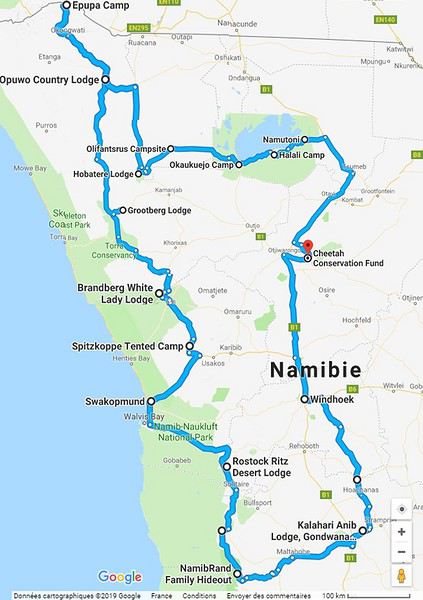
Alright! Are you ready to follow this adventure with us in our Hilux?
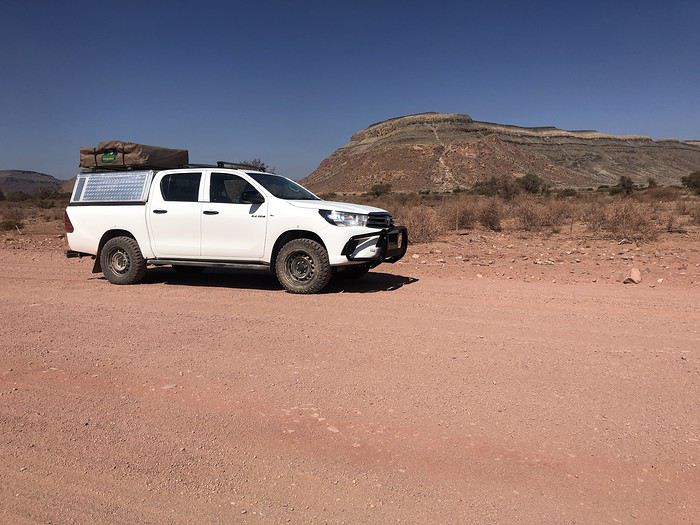
Yep! You guessed it—we stepped way out of our comfort zone during this trip.
I had quite a few doubts while planning this adventure, but the more I read travel journals about Namibia, the more I wanted to go.
Personally, without this forum, I never would’ve dared to hit the Namibian roads in a 4x4. I was really anxious during the planning, so I want to thank everyone who contributed with their journals and forum discussions for helping me leave more peacefully.
At first, I wasn’t even considering sleeping in a tent. But after my husband’s persuasion—and my own curiosity to experience what I’d read in those travel journals—I gave in. So off we went in a double-cab Hilux with a rooftop tent.
And of course, let’s talk about me—the big cold-weather wimp. One of the biggest pre-trip challenges was choosing a sleeping bag. After a while, sleeping bags had no more secrets for me: temperature ratings (comfort, limit, extreme), shapes (mummy, rectangular), fillings (synthetic, down), compression rate, and weight... all these factors were a real puzzle. In the end, to make sure I wouldn’t be put off camping in winter (Australian winter, mind you), I went for a sleeping bag with a comfort rating of -10°C. And just to be *extra* sure I wouldn’t get cold, I bought a liner (never knew what that was before) in Thermolite, which boosts the sleeping bag’s temperature by 11°C. There are liners that add up to 15°C, but let’s not exaggerate—we’re not heading to the North Pole! My husband, on the other hand, got a sleeping bag with a -5°C comfort rating and a silk liner.
Was it enough? You’ll find out soon. In the meantime, another big thank you to everyone who helped me make this choice with their advice and experience.
Over a year in advance, we planned a three-week itinerary for our first trip to Namibia—classic route, nothing too out there. We chose to do the circuit clockwise because we wanted to finish on a high note in Etosha and its wildlife. They say it’s like Noah’s Ark out there! And why not, the cherry on top... some big cats.
We used Tourmaline’s services to book our accommodations and the 4x4.
Here’s our planned itinerary with campsites and lodgings—yes, there are a few solid roofs in there; we didn’t want to push it too far.
Day 1: Windhoek – Windhoek Gardens Guesthouse Day 2: Kalahari Anib Campsite Day 3: Namibrand Family Hideout Day 4: Sesriem Camp Day 5: Sesriem Camp Day 6: Rostock Ritz Camp Day 7: Swakopmund - Sea Breeze Guesthouse Day 8: Swakopmund - Sea Breeze Guesthouse Day 9: Spitzkoppe Camp Tented Day 10: Brandberg White Lady Campsite Day 11: Grootberg Lodge Day 12: Opuwo Country Campsite Day 13: Epupa Camp Day 14: Hobatere Lodge Day 15: Etosha Olifantsrus Camp Day 16: Etosha Okaukuejo Camp Day 17: Etosha Halali Camp Day 18: Etosha Namutoni Camp Day 19: Cheetah Eco Lodge Day 20: Windhoek – Londiningi B&B
Alright! Are you ready to follow this adventure with us in our Hilux?
Visite du parc national de Tsavo Ouest (Kenya)
Bonjour à tous,
Pourriez-vous me donner votre avis sur le Parc National de Tsavo Ouest ( hébergement, faune et avifaune, paysage, accès et bon moment pour y aller et y faire un safari photo, compagnie de safari sérieuse….et d'autres aspects que vous auriez tirés de votre expérience de ce parc? Merci!
A+
Pourriez-vous me donner votre avis sur le Parc National de Tsavo Ouest ( hébergement, faune et avifaune, paysage, accès et bon moment pour y aller et y faire un safari photo, compagnie de safari sérieuse….et d'autres aspects que vous auriez tirés de votre expérience de ce parc? Merci!
A+
Voyager, ce n'est pas (forcément) backpacker
Salut salut,
Fort d'un nouveau voyage dans les Canaries (Fuerteventura pour être exact), je prolonge ici une discussion que j'avais entamé sur ce même forum et cette même rubrique il y a maintenant quelque chose comme 3 ans.
A ce moment-la, je venais d'essayer de voyager pour la première fois, a 22 ans, avec un Pass Interrail, sac sur le dos, sans avoir rien prévu ou presque, avec pour premiere destination Milan. J'étais revenu plus ou moins la queue entre les jambes. J'avais alors posté un message sur ce forum disant que je m'étais trompé sur l'idée de voyage, que peut-être je n'étais pas fait pour ca. Et a ce moment, nombreuses ont été les réponses productives et intelligentes sur le fait que l'idée de voyage, ca ne veut rien dire. Que je n'étais pas nécessairement forcé de faire comme les backpackers les plus célèbres que l'on trouve sur le net, sac sur le dos, a passer d'hostel en hostel toutes les semaines et qui s'en accommodent trés bien.
Trois ans plus tard, grâce à mon travail et ma volonté personnelle de voyager, j'ai pu bouger plusieurs fois et pris l'habitude de voyager. Et fort de ma superficielle mais néanmoins importante expérience acquise sur ces derniéres année, je pense qu'il est nécessaire pour moi de faire le point sur cette discussion pour que peut-être, d'autres personnes dans le meme cas que moi il y a trois ans puissent se reconnaitre et, je l'espère, etre rassuré par ce que j'ai vécu.
Et donc, je le confirme aujourd'hui, voyager, c'est un concept multiple. Il n'existe pas de bonne ou de mauvaise façon de voyager. Lors de mes premiers voyages, j'ai tenu a m'enfermer dans le carcan baroudeur et globe-trotteur quitte a ce que cela me frustre. Mais je pense qu'il nécessaire de dire le plus possible qu'il n'y a aucune honte a ne pas opter pour ce profil. Oui, un vrai voyageur peut detester les auberges de jeunesse. Oui, un vrai voyageur n'est pas forcement un mec qui n'aura aucun mal a parcourir le monde seul s'il en a envie. Non, un vrai voyageur n'est pas forcement quelqu'un qui va etre le meilleur pour trouver les bons plans a petits prix et optimiser ses dépenses.
Un vrai voyageur, c'est juste quelqu'un qui aime vivre et voir de nouvelles choses. Et ca s'arrête la. Il m'a fallu du temps et des voyages aux profils bien différents our me rendre compte, et chaque nouvelle destination apporte son lot d'apprentissage.
Et comme vous pouvez vous en douter, je correspond a la petite liste au dessus. Je préfère voyager avec quelqu'un, meme si voyager seul n'est pas non plus un vrai probleme. En revanche, voyager seul en auberge de jeunesse, c'est quelque chose que je supporte pas. Je ne supporte pas non plus economiser et prendre trois bus pour faire en 6 heures quelque chose que j'aurais pu faire en 2 en louant ma voiture, ou simplement en voyageant avec la mienne. La frustration qui découle de mon envie de beaucoup voir mais d'être limité par les transports et leurs horaires et itinéraires est absolument énorme pour moi, alors que cela ne posera pas beaucoup de problèmes a d'autres.
En bref, j'espère par ce message aider des voyagers relativement debutants qui auraient des doutes sur leur capacité a voyager parce qu'ils n'ont pas autant apprécié certains de leurs voyages comme ils en rêvaient, le soir, en furetant sur les blogs de voyage sur le net. L'important, c'est de trouver SA façon personnelle de voyager, celle qui maximisera notre plaisir face a l'inconnu.
Fort d'un nouveau voyage dans les Canaries (Fuerteventura pour être exact), je prolonge ici une discussion que j'avais entamé sur ce même forum et cette même rubrique il y a maintenant quelque chose comme 3 ans.
A ce moment-la, je venais d'essayer de voyager pour la première fois, a 22 ans, avec un Pass Interrail, sac sur le dos, sans avoir rien prévu ou presque, avec pour premiere destination Milan. J'étais revenu plus ou moins la queue entre les jambes. J'avais alors posté un message sur ce forum disant que je m'étais trompé sur l'idée de voyage, que peut-être je n'étais pas fait pour ca. Et a ce moment, nombreuses ont été les réponses productives et intelligentes sur le fait que l'idée de voyage, ca ne veut rien dire. Que je n'étais pas nécessairement forcé de faire comme les backpackers les plus célèbres que l'on trouve sur le net, sac sur le dos, a passer d'hostel en hostel toutes les semaines et qui s'en accommodent trés bien.
Trois ans plus tard, grâce à mon travail et ma volonté personnelle de voyager, j'ai pu bouger plusieurs fois et pris l'habitude de voyager. Et fort de ma superficielle mais néanmoins importante expérience acquise sur ces derniéres année, je pense qu'il est nécessaire pour moi de faire le point sur cette discussion pour que peut-être, d'autres personnes dans le meme cas que moi il y a trois ans puissent se reconnaitre et, je l'espère, etre rassuré par ce que j'ai vécu.
Et donc, je le confirme aujourd'hui, voyager, c'est un concept multiple. Il n'existe pas de bonne ou de mauvaise façon de voyager. Lors de mes premiers voyages, j'ai tenu a m'enfermer dans le carcan baroudeur et globe-trotteur quitte a ce que cela me frustre. Mais je pense qu'il nécessaire de dire le plus possible qu'il n'y a aucune honte a ne pas opter pour ce profil. Oui, un vrai voyageur peut detester les auberges de jeunesse. Oui, un vrai voyageur n'est pas forcement un mec qui n'aura aucun mal a parcourir le monde seul s'il en a envie. Non, un vrai voyageur n'est pas forcement quelqu'un qui va etre le meilleur pour trouver les bons plans a petits prix et optimiser ses dépenses.
Un vrai voyageur, c'est juste quelqu'un qui aime vivre et voir de nouvelles choses. Et ca s'arrête la. Il m'a fallu du temps et des voyages aux profils bien différents our me rendre compte, et chaque nouvelle destination apporte son lot d'apprentissage.
Et comme vous pouvez vous en douter, je correspond a la petite liste au dessus. Je préfère voyager avec quelqu'un, meme si voyager seul n'est pas non plus un vrai probleme. En revanche, voyager seul en auberge de jeunesse, c'est quelque chose que je supporte pas. Je ne supporte pas non plus economiser et prendre trois bus pour faire en 6 heures quelque chose que j'aurais pu faire en 2 en louant ma voiture, ou simplement en voyageant avec la mienne. La frustration qui découle de mon envie de beaucoup voir mais d'être limité par les transports et leurs horaires et itinéraires est absolument énorme pour moi, alors que cela ne posera pas beaucoup de problèmes a d'autres.
En bref, j'espère par ce message aider des voyagers relativement debutants qui auraient des doutes sur leur capacité a voyager parce qu'ils n'ont pas autant apprécié certains de leurs voyages comme ils en rêvaient, le soir, en furetant sur les blogs de voyage sur le net. L'important, c'est de trouver SA façon personnelle de voyager, celle qui maximisera notre plaisir face a l'inconnu.
Mésaventure avec agence en Éthiopie
Bonjour,
Sur la foi des bons avis publiés, notre ami d'ami, organisant un séjour complet de 24 jours pour 12 personnes Nord/Sud Ethiopie, a choisi l'agence "Amical Ethiopia Tour", guide/manager Yohannes Beckele.
Dès l'arrivée, nous avons cherché le guide presque 1h dans et devant l'aéroport, pour comprendre enfin qu'il nous attendait en bas sur le parking, n'ayant pas l'autorisation (?) d'accéder à l'aéroport.
Ensuite, ce fut une succession de déconvenues, allant du musée et des villages et ethnies comme les Konso, promis et non visité aux mensonges "de circonstance", quand, ne sachant pas répondre à nos questions, il mentait rapidement (réponses vérifiées le soir à la lecture de guides comme Olizanne/ Ethiopie Découverte, très utile et complet). Incapable de gérer un groupe, de prévoir par exemple des pique-nique décents (package payé 7€ pièce pour une poignée de riz + 1/2 boîte de sardine et 2 bananes!), de nous arrêter dans des lieux magiques à nos yeux, ne parlant qu'à ceux qui étaient proches (inaudible à + d'1m), jamais rassembleur, jamais à l'écoute (en 24 jours, il n’a su aucun de nos prénoms) montant chaque matin dans le bus sans saluer ni dire le programme du jour, etc. Dans le sud, 2 nuits en camping à 5mn d’un beau lodge (économie?) avec pour 2 d’entre nous, tente sans double toit et orage dans la nuit, campeurs et bagages trempés, la cocotte a explosé sur le guide, la patience a des limites...
Non, pas de forte tête ni de gens "qui se font attendre" dans ce groupe de copains, que des personnes respectueuses et en attente de découverte. Pour nous, nous avons cessé de le croire et d'espérer une vraie communication au bout d'1 semaine, quand il a prétendu que de l'ardoise était du marbre! Mais le pire : le bus loué prévu pour 20, (mais avec tous les bagages dedans) et Amar, chauffeur caractériel et très précautionneux de son véhicule, au point qu’il n’a pas dépassé les 30km/h hors quelques tronçons droits, sur 4000km. A vos calculettes ! et ne pas s’arrêter quand on en manifestait l’envie, juste aller d’un hôtel à l’autre. Même les tuk-tuk dans les villages nous doublaient! Départs du lever du jour à la nuit, photos volées entre les vitres, arrêts express sur les sites, marchés ou déjeuners expédiés.
Certains avaient apporté des cahiers et stylos, le guide avait prétendu connaître une école en fin de voyage, mais le dernier jour étant un dimanche (440km = 10h de route = tous largués direct à l'aéroport!), les cahiers ont été donné à l’improviste devant le bus, le chauffeur pressé s’est emparé des stylos et les a jeté aux enfants, écœurant !
Une grosse déception que ce voyage dont on attendait beaucoup, un arrière-goût de raté. On gardera en souvenir le sourire et la gentillesse des éthiopiens, les paysages fabuleux et l’envie d’y retourner un jour dans de meilleures conditions, en 4x4 obligatoire si boucle complète.
Vous voilà prévenus sur cette agence et son manager.
Précision: calculez juste votre budget car les Birs d'Ethiopie ne sont pas repris à l'aéroport, contrairement à ce que nous a affirmé ce guide, un malin attend les touristes avec commission de 30% en - et payés en dollars...
Stunning Botswana
Well, here goes—I’m taking the plunge. This is my first blog on VF, so I hope I don’t make too many blunders. In advance, you’ll have to excuse me because they’ll definitely happen anyway
Here’s the context of our trip:
- Project started: December 2015 ... yeah, that’s a while ago
- Family of 4: 2 adults, 1 teen (17) and a 10-year-old boy
- First trip to Southern Africa
Originally, we’d planned to go to Namibia. But after watching a TV documentary, we took a slight detour to the right and ended up in Botswana 🙂 Don’t worry, we’ll still do Namibia—just a bit later. It’s definitely not off the table. Quite the opposite!!
After that big decision, the question was: "Should we go alone or with an agency?" Through my son, who’s into music, we were lucky enough to meet some VF members who love Botswana: Marygabrielle and Yves (I won’t name-drop, but you know who you are). They were amazing and helped us with every aspect of our trip. We can’t thank them enough 😉 So, I didn’t even need to ask VF for all my questions 😛
For a first time in Southern Africa, and especially for Botswana, they easily convinced us to use a small local agency for at least part of the tour we wanted to do. After multiple conversations online—and thanks to Marygabrielle acting as our translator (our English is *terrible* )—our itinerary was finalized, and ... we ended up spending our entire vacation with this local agency:
Letsatsi Safaris (email for those interested: letsatsisafaris@gmail.com, website: www.letsatsisafarilodge.com, phone: +267 71692093/71351892) Joe and William (the owners) are brothers and true Batswana.
Since Marygabrielle and Yves knew them well, we set off with them in complete confidence. Everything was planned and paid for in advance, so all we had to do was relax once we arrived. Pure bliss for me—real vacation time without having to prepare meals 😛 and being able to fully enjoy everything. Everything was included: guides (them, in this case), accommodation (mostly in tents), and a cook. All we had to do was help set up and take down the tents. Indiana Jones better watch out—we’re going camping in the wild too 🙂 A dream come true!
Of course, there’s an extra cost compared to traveling solo. But this time, we splurged, and we don’t regret that choice at all.
They were all fantastic—professional, friendly—and it was a huge joy for us. We had an amazing time thanks to them. A big thank you to Joe, William, and all their staff we met: Jonah, Junien, and Doris.
Now, time for the story!
Originally, we’d planned to go to Namibia. But after watching a TV documentary, we took a slight detour to the right and ended up in Botswana 🙂 Don’t worry, we’ll still do Namibia—just a bit later. It’s definitely not off the table. Quite the opposite!!
After that big decision, the question was: "Should we go alone or with an agency?" Through my son, who’s into music, we were lucky enough to meet some VF members who love Botswana: Marygabrielle and Yves (I won’t name-drop, but you know who you are). They were amazing and helped us with every aspect of our trip. We can’t thank them enough 😉 So, I didn’t even need to ask VF for all my questions 😛
For a first time in Southern Africa, and especially for Botswana, they easily convinced us to use a small local agency for at least part of the tour we wanted to do. After multiple conversations online—and thanks to Marygabrielle acting as our translator (our English is *terrible* )—our itinerary was finalized, and ... we ended up spending our entire vacation with this local agency:
Letsatsi Safaris (email for those interested: letsatsisafaris@gmail.com, website: www.letsatsisafarilodge.com, phone: +267 71692093/71351892) Joe and William (the owners) are brothers and true Batswana.
Since Marygabrielle and Yves knew them well, we set off with them in complete confidence. Everything was planned and paid for in advance, so all we had to do was relax once we arrived. Pure bliss for me—real vacation time without having to prepare meals 😛 and being able to fully enjoy everything. Everything was included: guides (them, in this case), accommodation (mostly in tents), and a cook. All we had to do was help set up and take down the tents. Indiana Jones better watch out—we’re going camping in the wild too 🙂 A dream come true!
Of course, there’s an extra cost compared to traveling solo. But this time, we splurged, and we don’t regret that choice at all.
They were all fantastic—professional, friendly—and it was a huge joy for us. We had an amazing time thanks to them. A big thank you to Joe, William, and all their staff we met: Jonah, Junien, and Doris.
Now, time for the story!
De la Corse à l'Ouest américain en famille: 23 jours de bonheur!
Bonjour !
Inspirée et aidée par de nombreuses personnes du forum, je voulais partager notre premier roadtrip familial ! (et le début de nombreux autres, je l’espère!) En effet j’ai passé tellement de temps à lire tous vos carnets de voyages ou autres messages qu’il me paraissait inconcevable de ne pas partager notre expérience, si petite soit-elle. Et puis, depuis notre retour (d’ailleurs suis-je vraiment revenue ?) je me sens tellement nostalgique que narrer nos aventures me permet de prolonger le voyage, et aussi de le graver dans la pierre.
Alors les présentations :
Moi Sabrina, 41 ans, initiatrice, organisatrice, rédactrice un peu obsessionnelle... Lionel, mon amoureux, 45 ans, qui me suit les yeux fermés, sauf quand il conduit bien sûr ! Et nos 2 loulous : Hélio 12 ans et Adélie 10 ans, qui m’auront épatés pendant ces 3 semaines ! Ils se chamaillent beaucoup mais s’aiment beaucoup aussi, bien qu’ils ne veuillent pas se l’avouer... Nous vivons en Haute-Corse et de ce fait, avons l’habitude des randonnées en terrain accidenté. L’été dernier, en « vieux » couple que nous sommes, nous nous sommes enfin dits « oui »... Après avoir eu deux beaux enfants...
Je cherchais une destination pour notre voyage de noces, qui se déroulerait à 4 ! En effet, nous étions 3 ans auparavant, partis en amoureux 10 jours à NYC... On aime bien faire les choses de « travers », en quelque sorte un voyage de noces pré-nuptial ! 😉 Nous avons hésité... L’Islande, le Pérou, l’Ouest Américain, ou le Costa Rica, ou … Finalement, on se décide pour les USA ! On se dit que pour un premier roadtrip home made, cela sera plus facile et surtout que cela sera plus ludique pour nos 2 moustiques !
Tout s’enchaîne assez vite car quand bibi a une idée en tête et bien, elle l’a en tête... J’écume Internet, je lis beaucoup et comme conseillé, je prépare l’itinéraire avant de prendre les billets d’avion.
Le programme :
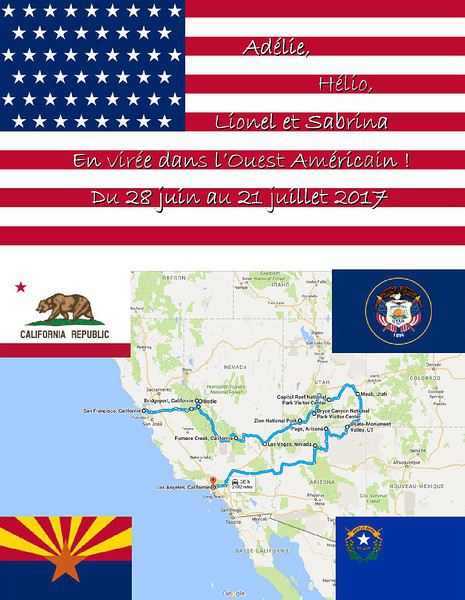 J1-28 juin : Vol Paris-San Francisco.
J2-29 juin : San Francisco
J3-30 juin : Les alentours de San Francisco
J4-01 juillet : San Francisco
J5-02 juillet : De San Francisco à Yosémite
J6-03 juillet : Yosémite/Panorama Trail
J7-04 juillet : Yosemite-Bridgeport via la Tioga Road+Mono Lake
J8-05 juillet : Bridgeport-Death Valley via Bodie
J9-06 juillet : Death Valley-Las Vegas
J10-07 juillet : Las Vegas/Spectacle The Dream
J11-08 juillet : Las Vegas-Zion
J12-09 juillet : Zion/Observation Point-Bryce
J13-10 juillet : Bryce/Navajo loop, Queen Garden-Torrey via l’UT12
J14-11 juillet : Torrey-Moab/Capitol Reef & Goblins Valley
J15-12 juillet : Moab-Arches National Park & Mill Creek
J16-13 juillet : Canyonlands-Arches/Windows Section
J17-14 juillet : Moab à Monument Valley/Natural Bridges+Muley Point & Mocky Dugway
J18-15 juillet : De Monument Valley à Page
J19-16 juillet : Page/Lower Antelope Canyon-Horseshoe Bend
J20-17 juillet : Page-Grand Canyon
J21-18 juillet : Grand Canyon-Los Angeles (oups...)
J22-19 juillet : Los Angeles-Universal Studios
J23-20 Juillet : Los Angeles
J24-21 juillet : Le départ et la conclusion
J1-28 juin : Vol Paris-San Francisco.
J2-29 juin : San Francisco
J3-30 juin : Les alentours de San Francisco
J4-01 juillet : San Francisco
J5-02 juillet : De San Francisco à Yosémite
J6-03 juillet : Yosémite/Panorama Trail
J7-04 juillet : Yosemite-Bridgeport via la Tioga Road+Mono Lake
J8-05 juillet : Bridgeport-Death Valley via Bodie
J9-06 juillet : Death Valley-Las Vegas
J10-07 juillet : Las Vegas/Spectacle The Dream
J11-08 juillet : Las Vegas-Zion
J12-09 juillet : Zion/Observation Point-Bryce
J13-10 juillet : Bryce/Navajo loop, Queen Garden-Torrey via l’UT12
J14-11 juillet : Torrey-Moab/Capitol Reef & Goblins Valley
J15-12 juillet : Moab-Arches National Park & Mill Creek
J16-13 juillet : Canyonlands-Arches/Windows Section
J17-14 juillet : Moab à Monument Valley/Natural Bridges+Muley Point & Mocky Dugway
J18-15 juillet : De Monument Valley à Page
J19-16 juillet : Page/Lower Antelope Canyon-Horseshoe Bend
J20-17 juillet : Page-Grand Canyon
J21-18 juillet : Grand Canyon-Los Angeles (oups...)
J22-19 juillet : Los Angeles-Universal Studios
J23-20 Juillet : Los Angeles
J24-21 juillet : Le départ et la conclusion
Les préparatifs :
Je m’inscris sur "algofly " et saute sur une promo au mois d’octobre en direct sur" United" : Environ 2.000 € pour nous 4, pour un Paris-San Francisco, Los Angeles-Paris du 28 juin au 21 juillet !!! Je trépigne ! Enfin du concret !!!
Le plus " compliqué " sera par contre le transport Bastia-Paris... Rien à moins de 1.000€, soit la moitié de la somme investie pour nous rendre outre-atlantique... Psychologiquement, je ne suis pas prête, je fulmine et je rage. Et je trouve une « solution »... Alors pour sûr cela sera moins cher mais plus long... Nous ferons : A l’aller : Vol Bastia-Lyon, nuit à Lyon où vit ma soeurette et le lendemain Ouigo jusqu’à Paris, et nuit à Paris où vit ma petite tantine ! Pour le retour, nous ferons un Ouigo Paris-Aix, nuit à Aix où vit ma belle-soeur et le lendemain vol Marseille-Bastia, où vit ...où nous vivons..
L’opération nous permet tout de même d’économiser près de 400€...
Ensuite s’enchaînent les réservations d’hôtels et de campings ! En effet, le blog de BonCampeur (Orionide), que je remercie au passage, nous a inspiré et décidé à sauter le pas. Nous casserons tout de même la tirelire dans quelques hôtels... Au Coventry Motor Inn à San Francisco car c’est la ville qui le veut, dans la Death Valley au Furnace Creek Ranch, à Las Vegas au Marriott Grand Château, à Dead Horse State Park pendant 2 nuits dans une yourte, le Red Cliff Lodges à Moab, et à Page au Best Western View. Pour les campings, les réservations ont été faites dès l’ouverture des ventes... Pour Zion, Bryce, le Grand Canyon, aucun problème, par contre pour Yosemite, j’ai dû batailler pour les 2 nuits. La 1ère nuit dans la vallée au Upper Pines Campground et la 2ème au Hodgdon Meadows Campground...Mon dieu, la bouffée de stress, pourtant je m’étais entraînée !!!
Et puis je me prends au jeu... Après les réservations, je me lance dans le programme un peu plus détaillé... Oh non je ne ferai pas de roadbook, c’est trop long et trop « rigide ». Et en fait j’en ferai un. Un gros classeur, qui nous sera utile, indispensable.
Pour ce voyage nous avons décidé de payer au fur et à mesure les logements, location de voiture et activités quand cela était possible afin d’étaler les dépenses. Du coup, je paie des frais bancaires quand les transactions sont en $. A cette époque 1€=1,05$, ce qui je pense gonflera bien la note par rapport à cet été où l’€ remonte... Ultérieurement, j’apprendrai que la Société Générale propose des forfaits mensuels qui permettent l'exonération des frais... 10€ pour un mois pour 6 opérations, 17,50€ en illimité... Finalement, sur place ne nous resteront à payer « que » quelques nuits d’hôtel, la nourriture, l’essence et les souvenirs...
Budget détaillé pour 4 personnes pour 23 nuits : A la louche environ 10.000€
Vol Paris-San Francisco/ Los Angeles-Paris : 1.979,16€ Hôtels et campings : 2.800€ Location Avis SUV standard sur le site irlandais : 820€ Visite Alcatraz : 126€ Navette Yosémite jusqu’à Glacier Point : 75€ Spectacle The dream à las Vegas : 512€ Visite Lower Antelope : 80€ Universal studios par Viator : 367€ Et tous les frais classiques afférents à l’ESTA, le Passeport...
Sur place nous dépenserons : Nourriture : 2.400€ Matériel camping : 117€ Essence : 370€ Et les souvenirs, visites...
Inspirée et aidée par de nombreuses personnes du forum, je voulais partager notre premier roadtrip familial ! (et le début de nombreux autres, je l’espère!) En effet j’ai passé tellement de temps à lire tous vos carnets de voyages ou autres messages qu’il me paraissait inconcevable de ne pas partager notre expérience, si petite soit-elle. Et puis, depuis notre retour (d’ailleurs suis-je vraiment revenue ?) je me sens tellement nostalgique que narrer nos aventures me permet de prolonger le voyage, et aussi de le graver dans la pierre.
Alors les présentations :
Moi Sabrina, 41 ans, initiatrice, organisatrice, rédactrice un peu obsessionnelle... Lionel, mon amoureux, 45 ans, qui me suit les yeux fermés, sauf quand il conduit bien sûr ! Et nos 2 loulous : Hélio 12 ans et Adélie 10 ans, qui m’auront épatés pendant ces 3 semaines ! Ils se chamaillent beaucoup mais s’aiment beaucoup aussi, bien qu’ils ne veuillent pas se l’avouer... Nous vivons en Haute-Corse et de ce fait, avons l’habitude des randonnées en terrain accidenté. L’été dernier, en « vieux » couple que nous sommes, nous nous sommes enfin dits « oui »... Après avoir eu deux beaux enfants...
Je cherchais une destination pour notre voyage de noces, qui se déroulerait à 4 ! En effet, nous étions 3 ans auparavant, partis en amoureux 10 jours à NYC... On aime bien faire les choses de « travers », en quelque sorte un voyage de noces pré-nuptial ! 😉 Nous avons hésité... L’Islande, le Pérou, l’Ouest Américain, ou le Costa Rica, ou … Finalement, on se décide pour les USA ! On se dit que pour un premier roadtrip home made, cela sera plus facile et surtout que cela sera plus ludique pour nos 2 moustiques !
Tout s’enchaîne assez vite car quand bibi a une idée en tête et bien, elle l’a en tête... J’écume Internet, je lis beaucoup et comme conseillé, je prépare l’itinéraire avant de prendre les billets d’avion.
Le programme :
J1-28 juin : Vol Paris-San Francisco.
J2-29 juin : San Francisco
J3-30 juin : Les alentours de San Francisco
J4-01 juillet : San Francisco
J5-02 juillet : De San Francisco à Yosémite
J6-03 juillet : Yosémite/Panorama Trail
J7-04 juillet : Yosemite-Bridgeport via la Tioga Road+Mono Lake
J8-05 juillet : Bridgeport-Death Valley via Bodie
J9-06 juillet : Death Valley-Las Vegas
J10-07 juillet : Las Vegas/Spectacle The Dream
J11-08 juillet : Las Vegas-Zion
J12-09 juillet : Zion/Observation Point-Bryce
J13-10 juillet : Bryce/Navajo loop, Queen Garden-Torrey via l’UT12
J14-11 juillet : Torrey-Moab/Capitol Reef & Goblins Valley
J15-12 juillet : Moab-Arches National Park & Mill Creek
J16-13 juillet : Canyonlands-Arches/Windows Section
J17-14 juillet : Moab à Monument Valley/Natural Bridges+Muley Point & Mocky Dugway
J18-15 juillet : De Monument Valley à Page
J19-16 juillet : Page/Lower Antelope Canyon-Horseshoe Bend
J20-17 juillet : Page-Grand Canyon
J21-18 juillet : Grand Canyon-Los Angeles (oups...)
J22-19 juillet : Los Angeles-Universal Studios
J23-20 Juillet : Los Angeles
J24-21 juillet : Le départ et la conclusionLes préparatifs :
Je m’inscris sur "algofly " et saute sur une promo au mois d’octobre en direct sur" United" : Environ 2.000 € pour nous 4, pour un Paris-San Francisco, Los Angeles-Paris du 28 juin au 21 juillet !!! Je trépigne ! Enfin du concret !!!
Le plus " compliqué " sera par contre le transport Bastia-Paris... Rien à moins de 1.000€, soit la moitié de la somme investie pour nous rendre outre-atlantique... Psychologiquement, je ne suis pas prête, je fulmine et je rage. Et je trouve une « solution »... Alors pour sûr cela sera moins cher mais plus long... Nous ferons : A l’aller : Vol Bastia-Lyon, nuit à Lyon où vit ma soeurette et le lendemain Ouigo jusqu’à Paris, et nuit à Paris où vit ma petite tantine ! Pour le retour, nous ferons un Ouigo Paris-Aix, nuit à Aix où vit ma belle-soeur et le lendemain vol Marseille-Bastia, où vit ...où nous vivons..
L’opération nous permet tout de même d’économiser près de 400€...
Ensuite s’enchaînent les réservations d’hôtels et de campings ! En effet, le blog de BonCampeur (Orionide), que je remercie au passage, nous a inspiré et décidé à sauter le pas. Nous casserons tout de même la tirelire dans quelques hôtels... Au Coventry Motor Inn à San Francisco car c’est la ville qui le veut, dans la Death Valley au Furnace Creek Ranch, à Las Vegas au Marriott Grand Château, à Dead Horse State Park pendant 2 nuits dans une yourte, le Red Cliff Lodges à Moab, et à Page au Best Western View. Pour les campings, les réservations ont été faites dès l’ouverture des ventes... Pour Zion, Bryce, le Grand Canyon, aucun problème, par contre pour Yosemite, j’ai dû batailler pour les 2 nuits. La 1ère nuit dans la vallée au Upper Pines Campground et la 2ème au Hodgdon Meadows Campground...Mon dieu, la bouffée de stress, pourtant je m’étais entraînée !!!
Et puis je me prends au jeu... Après les réservations, je me lance dans le programme un peu plus détaillé... Oh non je ne ferai pas de roadbook, c’est trop long et trop « rigide ». Et en fait j’en ferai un. Un gros classeur, qui nous sera utile, indispensable.
Pour ce voyage nous avons décidé de payer au fur et à mesure les logements, location de voiture et activités quand cela était possible afin d’étaler les dépenses. Du coup, je paie des frais bancaires quand les transactions sont en $. A cette époque 1€=1,05$, ce qui je pense gonflera bien la note par rapport à cet été où l’€ remonte... Ultérieurement, j’apprendrai que la Société Générale propose des forfaits mensuels qui permettent l'exonération des frais... 10€ pour un mois pour 6 opérations, 17,50€ en illimité... Finalement, sur place ne nous resteront à payer « que » quelques nuits d’hôtel, la nourriture, l’essence et les souvenirs...
Budget détaillé pour 4 personnes pour 23 nuits : A la louche environ 10.000€
Vol Paris-San Francisco/ Los Angeles-Paris : 1.979,16€ Hôtels et campings : 2.800€ Location Avis SUV standard sur le site irlandais : 820€ Visite Alcatraz : 126€ Navette Yosémite jusqu’à Glacier Point : 75€ Spectacle The dream à las Vegas : 512€ Visite Lower Antelope : 80€ Universal studios par Viator : 367€ Et tous les frais classiques afférents à l’ESTA, le Passeport...
Sur place nous dépenserons : Nourriture : 2.400€ Matériel camping : 117€ Essence : 370€ Et les souvenirs, visites...
Le Maroc et le bonheur d'être accueillie!
Bonjour à tous,
Voici un planning des posts avec les liens pour ceux qui ne veulent pas lire tous les posts; j'en ai profité pour corriger les chiffres des étapes dans lesquels s'étaient glissées des erreurs
Jour 1, Premiers pas dans un pays berbère musulman: le Maroc!
Jour 2, de Marrakech à Imlil, puis Tamatert. jour 3, De Tamatert à Taliouine, en passant par le tizi'n test jour 4, Visite des gorges de tislit et route de Taliouine à Foum zguid jour 4, suite, photos supplémentaires des gorges et route de Tislit à Foum zguid Jour 5, de foum zguid au bivouac de chez Nagui Suite de la journée 5, séjour au bivouac de l'erg Chegaga, Jour 6, du bivouac à Zagora, en passant par M'hamid jour 7, de Zagora à Amellagou, Jour 7 suite de Goulmina à Amellagou Jour 8 départ d'Amellagou en direction de Boumalne Jour 8 (suite) de Assoul en direction des gorges du todra jour 8 suite et fin en direction des gorges du Todra puis de Boumalne dadès Jour 9 circuit autour de Boumalne dadès! Jour 9 circuit autour de Boumalne dadès (suite)! Jour 10: départ de Boumalne Dadès et direction Ait Ben Haddou Jour 11 quelques compléments puis alentours d'Ait ben haddou.
Jour 11 suite: de Ait Ben Haddou à Télouet et la kasbah du Glaoui. (ça y est j'en ai eu le courage!!!) J11 suite et fin, J12 départ pour Paris.
Notre voyage s'est déroulé de fin février à début mars grâce à: - l'aide ultra précieuse de Attila, qui m'a donné envie d'aller visiter cette partie du monde, et qui a été un amour pour me proposer un itinéraire qui me convenait. Mille merci (dans ce cas, on met un "s" à merci?)😏 - l'aide non moins précieuse de Perju, pour les pistes à emprunter, qui pendant tout notre séjour, a surveillé les infos internationales en espérant qu'on n'y parle pas de 2 martiniquais disparus dans le désert..... Perju, tu es une vraie mère poule pour moi!!! Merciiiiiiiiiiiiiiiiiiiiiiiiiiiiiiiiiiiiiiiiiiiiiii.😄 - l'aide logistique et chaleureuse de Lacalo, qui nous a accueilli dans son riad. Il est génial ton riad et c'était super génial de te rencontrer et d'échanger avec toi. Gros gros Gros bisous!!! 😏 - l'aide de tous les membres du forum Maroc qui publie des carnets et donne une mine d'infos, et que je remercie énormément.
Jour 1, Premiers pas dans un pays berbère musulman: le Maroc!
A 12h15, nous avons quitté Paris sous la pluie, et sommes arrivés à Marrakech sous la pluie!!! La compagnie Royal Air Maroc est très bien, un déjeuner nous a été servi, du thé proposé, et le vol s'est bien déroulé, car j'étais assise à côté d'un charmant monsieur qui a bien voulu répondre à mes nombreuses questions et me donner plein de conseils sur mon voyage dans le sud marocain.
Après 3h de vol, nous découvrons le nouvel aéroport de Marrakech, qui a été inauguré pour la COP 22. Il est vraiment très beau, avec ses grands piliers blancs et son toit fait de lattes de différents coloris de bois. L'attente à la police des frontières est correcte comparée à la queue que nous avons eue à Orly.
A notre sortie, après avoir récupéré les bagages, je suis étonnée de ne pas voir Mohamed, le chauffeur qui est censé être venu nous chercher avec un panneau marqué "maison Do", nom du riad dans lequel nous dormons ce soir. Je téléphone donc à Lacalo, la propriétaire du riad, qui parait surprise aussi, appelle son chauffeur et me rappelle. Il est à l'extérieur de l'aéroport: les visiteurs n'ont pas le droit d'entrer dans le hall d'arrivée depuis les attentats!! Gloups!!! Les mesures de sécurité sont drastiques. Je me disais aussi que le hall immense avait l'air bien vide. Personne à l'intérieur à part les quelques voyageurs qui défilent au gré de la récupération de leurs bagages.
Nous sortons donc et faisons la connaissance du souriant et charmant Mohamed. La décision est prise de faire du change au centre ville de Marrakech. Nous découvrons donc la ville rose, où toutes les constructions sont faites de terre ocre, ce qui donne à l'ensemble un charme indiscutable. Nous longeons les remparts aérés de la vieille ville, et les nombreux trous d'aération ingénieusement disséminés dans les murs, font aujourd'hui le bonheur des pigeons qui y trouvent des lieux de nidification parfaits.
De nombreux arbres avec toutes leurs feuilles sont visibles le long de la route, des oliviers, des orangers avec des oranges, mais qui ne sont pas comestibles car elles sont amères!!!!! Dire qu'en Martinique, nous avons des oranges amères que nous consommons sans problème!!! De nombreux arbustes fleuris aussi attirent mon attention, car, il ne faut pas oublier que nous sommes en hiver, qu'il fait 15°C, l'après-midi. Devant mon étonnement, Mohamed m'explique que malgré la période hivernale, il pleut très peu à Marrakech, (et oui, nous arrivons l'un des rares jours où il pleut!!!!) l'ensoleillement est très important d'où les fleurs. Ma foi, quel contraste avec la région parisienne aux arbres complètement dénudés, que nous venons de quitter!!!
C'est marrant finalement, nous sommes partis de Martinique avec le soleil, et l'avons amené avec nous à Paris, ce que tous les habitants espéraient, et nous sommes partis de Paris avec la pluie et l'avons emmené avec nous, à Marrakech, ce qui fait le bonheur des Marrackchis!!!! Trop fort ces martiniquais!!!!!
A la recherche d'un bureau de change, Mohamed s'arrête tout d'abord près d'une banque, mais elle est fermée. Nous passons à travers des portes en arche, qui jalonnent les remparts, mais elles ne laissent passer qu'une voiture à la fois.
Nous sommes dans l'enceinte de la vieille ville. Je découvre avec plaisir ma première ville arabe, avec ses mosquées et leur minaret si emblématique, son palais royal et ses remparts.
Le dépaysement est total et tous mes sens sont en éveil. Les véhicules qui circulent sont très insolites: des motos qui tirent des bennes, des ânes qui tirent des charrettes, des calèches pour touristes tirées par des chevaux.... Je me sens comme une enfant de 5 ans qui découvre le monde. Tout est nouveau.
Nous nous dirigeons vers la medina, et passons par des ruelles ultra encombrées, de gens à pied, à bicyclette, à moto, conduisant des charrettes tirées par des ânes. Mohamed klaxonne maintenant de façon continue et avance régulièrement malgré la densité de la circulation, entre les échoppes régulièrement disposées le long des ruelles. Heureusement que ces rues sont à sens unique, malgré les motos qui circulent à contresens, nous sommes heureux de ne pas avoir à conduire dans ce dédale labyrinthique pour nous étrangers.
Mohamed s'arrête finalement devant une boutique et nous demande de suivre l'un des vigiles placés à l'entrée. Nous traversons un magasin remplis de babioles en tout genre, style brocante, mais brocante marocaine, porcelaine, instruments de musique, tapis, parfums, plats en bronze, horloges, .... Et les senteurs orientales sont un pur bonheur pour mes narines. Ah, nous voilà arrivés, ....... devant la caissière!!!! Et c'est elle qui va nous faire le change!!! On ne nous l'avait pas encore faite, celle là. Nous attendons donc un bon moment, que les clients de marchandises aient fini de régler leurs achats, pour que nous, les clients de devises, nous puissions échanger nos devises.
Lorsque nous retournons à la voiture, nous rencontrons Mohamed qui s'inquiétait de nous voir prendre tant de temps. Embarquement, puis direction maison Do. En cours de route, nous appelons Madame Yolande, pour qu'elle vienne à notre rencontre, au point de rendez- vous. Je découvre enfin avec plaisir, en vrai, le membre Lacalo du forum. Nous débarquons les bagages, et la suivons dans les ruelles pavées inégalement, sur 200m jusqu'à notre hébergement.
Nous entrons par une porte basse, typique des constructions locales, Jf, qui fait plus d'1,85m, doit se baisser et faire attention à sa tête. De surcroit, il faut lever les jambes pour franchir le pas de la porte, tout en se baissant, ce qui demande des qualités d'équilibriste. Moi, qui ne suis pas si grande, je suis comme un poisson dans l'eau. Même pas besoin de baisser la tête. Ce pays est fait pour moi. Quelques escaliers nous conduisent à un patio surmonté d'une verrière, sur lequel donnent les chambres.
D'un coté, un petit salon lecture. De l'autre, le salon petit déjeuner. C'est splendide. Nous découvrons note chambre duo, élégante, raffinée, orientale à souhait. La salle de bain attenante me fait me sentir dans une maison de poupée.
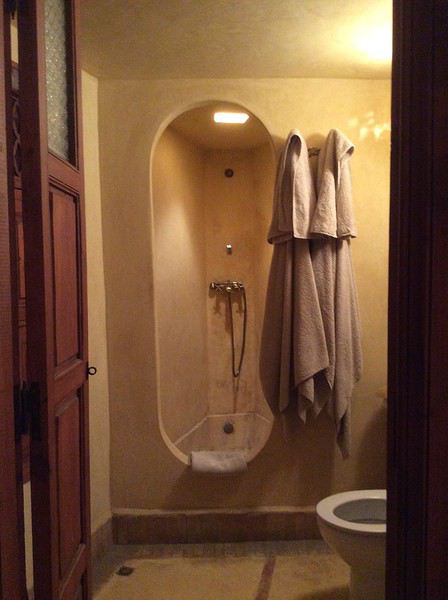
Une fois les bagages déposés, nous retournons au salon déguster un délicieux thé à la menthe, que nous triplons, tout en discutant avec Yolande qui nous donne plein de conseils pour visiter le souk, et la place Jemma el Fna. Elle nous donne aussi une carte de la médina, qui nous permettra de nous diriger. Nous faisons la connaissance d'Alli, charmant et souriant, qui est le gardien et s'occupe du petit déjeuner.
Puis, nous partons pour la place Jemma el fna, à travers le souk el kessabine. Les bicyclettes, les motos ne cessent de passer à côté de nous. Des gens nous proposent des objets à acheter, ou de nous conduire à une foire berbère. Heureusement, Yolande nous a prévenu d'ignorer les sollicitations. Les échoppes de vêtements succèdent aux boutiques de babouches, et aux boutiques de plats en étain ou en bronze. Nous arrivons à la place et tombons sur les animaux de foire: singes tenus en laisse, serpents dans des paniers que les hommes veulent absolument nous mettre sur les épaules ou autour du cou.
Pendant que nous avançons, nous entendons un cri qui semble venir de partout et de nulle part en même temps. C'est un cri rauque, long, qui s'amplifie. Puis nous comprenons que c'est l'appel à la prière. Nous traversons la place en direction d'une librairie pour y acheter une carte du Maroc, puis retournons dans un restaurant pour y dîner un couscous somme toute moyen, avec un délicieux jus d'orange, mais nous profitons d'une vue panoramique pour observer le soleil qui décline, la nuit qui s'installe, les lumières qui illuminent les roulottes qui se sont installées, et la place qui grouille de monde.
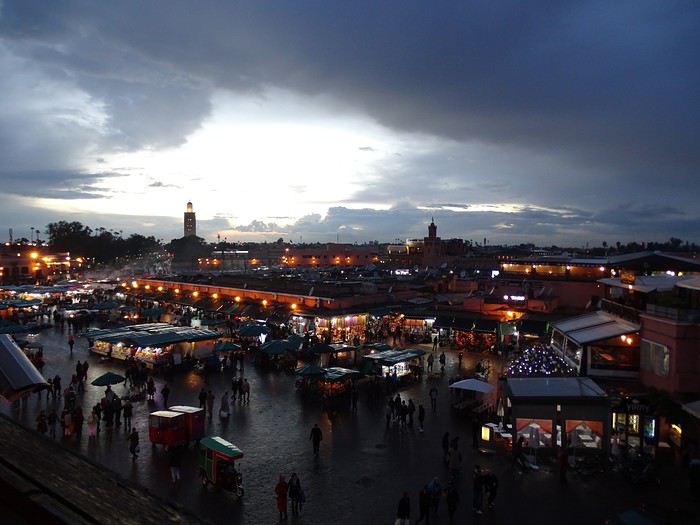
Une fois terminé le dîner, nous prenons le chemin du retour. Grâce à JF nous retrouvons sans encombre, notre trajet à travers le dédale des rues. A un moment, quand nous hésitons pour le choix de la porte d'entrée de Maison Do, des enfants nous montrent la bonne porte. Nous les remercions chaleureusement, et rentrons, dans nos appartements respectifs. Peu de temps, après, nous entendons de nouveau l'appel à la prière. C'est vraiment un bruit bizarre, et nous l'entendons de nos chambre, comme un bruit de fond. Il se produit 5 fois par jour, du coup, nous demandons à Ali à quelle heure est le premier appel. Etonné, il me demande si je veux prier.... 😇 Heu, non, c'est juste pour savoir à quelle heure je vais être réveillée!!! A 5h25 me répond Ali !!! Ah oui, si tôt??? Bon, bah, on va faire avec. Petit déj à 9h: Ok.
A 21h, dodo.
Voici un planning des posts avec les liens pour ceux qui ne veulent pas lire tous les posts; j'en ai profité pour corriger les chiffres des étapes dans lesquels s'étaient glissées des erreurs
Jour 1, Premiers pas dans un pays berbère musulman: le Maroc!
Jour 2, de Marrakech à Imlil, puis Tamatert. jour 3, De Tamatert à Taliouine, en passant par le tizi'n test jour 4, Visite des gorges de tislit et route de Taliouine à Foum zguid jour 4, suite, photos supplémentaires des gorges et route de Tislit à Foum zguid Jour 5, de foum zguid au bivouac de chez Nagui Suite de la journée 5, séjour au bivouac de l'erg Chegaga, Jour 6, du bivouac à Zagora, en passant par M'hamid jour 7, de Zagora à Amellagou, Jour 7 suite de Goulmina à Amellagou Jour 8 départ d'Amellagou en direction de Boumalne Jour 8 (suite) de Assoul en direction des gorges du todra jour 8 suite et fin en direction des gorges du Todra puis de Boumalne dadès Jour 9 circuit autour de Boumalne dadès! Jour 9 circuit autour de Boumalne dadès (suite)! Jour 10: départ de Boumalne Dadès et direction Ait Ben Haddou Jour 11 quelques compléments puis alentours d'Ait ben haddou.
Jour 11 suite: de Ait Ben Haddou à Télouet et la kasbah du Glaoui. (ça y est j'en ai eu le courage!!!) J11 suite et fin, J12 départ pour Paris.
Notre voyage s'est déroulé de fin février à début mars grâce à: - l'aide ultra précieuse de Attila, qui m'a donné envie d'aller visiter cette partie du monde, et qui a été un amour pour me proposer un itinéraire qui me convenait. Mille merci (dans ce cas, on met un "s" à merci?)😏 - l'aide non moins précieuse de Perju, pour les pistes à emprunter, qui pendant tout notre séjour, a surveillé les infos internationales en espérant qu'on n'y parle pas de 2 martiniquais disparus dans le désert..... Perju, tu es une vraie mère poule pour moi!!! Merciiiiiiiiiiiiiiiiiiiiiiiiiiiiiiiiiiiiiiiiiiiiiii.😄 - l'aide logistique et chaleureuse de Lacalo, qui nous a accueilli dans son riad. Il est génial ton riad et c'était super génial de te rencontrer et d'échanger avec toi. Gros gros Gros bisous!!! 😏 - l'aide de tous les membres du forum Maroc qui publie des carnets et donne une mine d'infos, et que je remercie énormément.
Jour 1, Premiers pas dans un pays berbère musulman: le Maroc!
A 12h15, nous avons quitté Paris sous la pluie, et sommes arrivés à Marrakech sous la pluie!!! La compagnie Royal Air Maroc est très bien, un déjeuner nous a été servi, du thé proposé, et le vol s'est bien déroulé, car j'étais assise à côté d'un charmant monsieur qui a bien voulu répondre à mes nombreuses questions et me donner plein de conseils sur mon voyage dans le sud marocain.
Après 3h de vol, nous découvrons le nouvel aéroport de Marrakech, qui a été inauguré pour la COP 22. Il est vraiment très beau, avec ses grands piliers blancs et son toit fait de lattes de différents coloris de bois. L'attente à la police des frontières est correcte comparée à la queue que nous avons eue à Orly.
A notre sortie, après avoir récupéré les bagages, je suis étonnée de ne pas voir Mohamed, le chauffeur qui est censé être venu nous chercher avec un panneau marqué "maison Do", nom du riad dans lequel nous dormons ce soir. Je téléphone donc à Lacalo, la propriétaire du riad, qui parait surprise aussi, appelle son chauffeur et me rappelle. Il est à l'extérieur de l'aéroport: les visiteurs n'ont pas le droit d'entrer dans le hall d'arrivée depuis les attentats!! Gloups!!! Les mesures de sécurité sont drastiques. Je me disais aussi que le hall immense avait l'air bien vide. Personne à l'intérieur à part les quelques voyageurs qui défilent au gré de la récupération de leurs bagages.
Nous sortons donc et faisons la connaissance du souriant et charmant Mohamed. La décision est prise de faire du change au centre ville de Marrakech. Nous découvrons donc la ville rose, où toutes les constructions sont faites de terre ocre, ce qui donne à l'ensemble un charme indiscutable. Nous longeons les remparts aérés de la vieille ville, et les nombreux trous d'aération ingénieusement disséminés dans les murs, font aujourd'hui le bonheur des pigeons qui y trouvent des lieux de nidification parfaits.
De nombreux arbres avec toutes leurs feuilles sont visibles le long de la route, des oliviers, des orangers avec des oranges, mais qui ne sont pas comestibles car elles sont amères!!!!! Dire qu'en Martinique, nous avons des oranges amères que nous consommons sans problème!!! De nombreux arbustes fleuris aussi attirent mon attention, car, il ne faut pas oublier que nous sommes en hiver, qu'il fait 15°C, l'après-midi. Devant mon étonnement, Mohamed m'explique que malgré la période hivernale, il pleut très peu à Marrakech, (et oui, nous arrivons l'un des rares jours où il pleut!!!!) l'ensoleillement est très important d'où les fleurs. Ma foi, quel contraste avec la région parisienne aux arbres complètement dénudés, que nous venons de quitter!!!
C'est marrant finalement, nous sommes partis de Martinique avec le soleil, et l'avons amené avec nous à Paris, ce que tous les habitants espéraient, et nous sommes partis de Paris avec la pluie et l'avons emmené avec nous, à Marrakech, ce qui fait le bonheur des Marrackchis!!!! Trop fort ces martiniquais!!!!!
A la recherche d'un bureau de change, Mohamed s'arrête tout d'abord près d'une banque, mais elle est fermée. Nous passons à travers des portes en arche, qui jalonnent les remparts, mais elles ne laissent passer qu'une voiture à la fois.
Nous sommes dans l'enceinte de la vieille ville. Je découvre avec plaisir ma première ville arabe, avec ses mosquées et leur minaret si emblématique, son palais royal et ses remparts.
Le dépaysement est total et tous mes sens sont en éveil. Les véhicules qui circulent sont très insolites: des motos qui tirent des bennes, des ânes qui tirent des charrettes, des calèches pour touristes tirées par des chevaux.... Je me sens comme une enfant de 5 ans qui découvre le monde. Tout est nouveau.
Nous nous dirigeons vers la medina, et passons par des ruelles ultra encombrées, de gens à pied, à bicyclette, à moto, conduisant des charrettes tirées par des ânes. Mohamed klaxonne maintenant de façon continue et avance régulièrement malgré la densité de la circulation, entre les échoppes régulièrement disposées le long des ruelles. Heureusement que ces rues sont à sens unique, malgré les motos qui circulent à contresens, nous sommes heureux de ne pas avoir à conduire dans ce dédale labyrinthique pour nous étrangers.
Mohamed s'arrête finalement devant une boutique et nous demande de suivre l'un des vigiles placés à l'entrée. Nous traversons un magasin remplis de babioles en tout genre, style brocante, mais brocante marocaine, porcelaine, instruments de musique, tapis, parfums, plats en bronze, horloges, .... Et les senteurs orientales sont un pur bonheur pour mes narines. Ah, nous voilà arrivés, ....... devant la caissière!!!! Et c'est elle qui va nous faire le change!!! On ne nous l'avait pas encore faite, celle là. Nous attendons donc un bon moment, que les clients de marchandises aient fini de régler leurs achats, pour que nous, les clients de devises, nous puissions échanger nos devises.
Lorsque nous retournons à la voiture, nous rencontrons Mohamed qui s'inquiétait de nous voir prendre tant de temps. Embarquement, puis direction maison Do. En cours de route, nous appelons Madame Yolande, pour qu'elle vienne à notre rencontre, au point de rendez- vous. Je découvre enfin avec plaisir, en vrai, le membre Lacalo du forum. Nous débarquons les bagages, et la suivons dans les ruelles pavées inégalement, sur 200m jusqu'à notre hébergement.
Nous entrons par une porte basse, typique des constructions locales, Jf, qui fait plus d'1,85m, doit se baisser et faire attention à sa tête. De surcroit, il faut lever les jambes pour franchir le pas de la porte, tout en se baissant, ce qui demande des qualités d'équilibriste. Moi, qui ne suis pas si grande, je suis comme un poisson dans l'eau. Même pas besoin de baisser la tête. Ce pays est fait pour moi. Quelques escaliers nous conduisent à un patio surmonté d'une verrière, sur lequel donnent les chambres.
D'un coté, un petit salon lecture. De l'autre, le salon petit déjeuner. C'est splendide. Nous découvrons note chambre duo, élégante, raffinée, orientale à souhait. La salle de bain attenante me fait me sentir dans une maison de poupée.
Une fois les bagages déposés, nous retournons au salon déguster un délicieux thé à la menthe, que nous triplons, tout en discutant avec Yolande qui nous donne plein de conseils pour visiter le souk, et la place Jemma el Fna. Elle nous donne aussi une carte de la médina, qui nous permettra de nous diriger. Nous faisons la connaissance d'Alli, charmant et souriant, qui est le gardien et s'occupe du petit déjeuner.
Puis, nous partons pour la place Jemma el fna, à travers le souk el kessabine. Les bicyclettes, les motos ne cessent de passer à côté de nous. Des gens nous proposent des objets à acheter, ou de nous conduire à une foire berbère. Heureusement, Yolande nous a prévenu d'ignorer les sollicitations. Les échoppes de vêtements succèdent aux boutiques de babouches, et aux boutiques de plats en étain ou en bronze. Nous arrivons à la place et tombons sur les animaux de foire: singes tenus en laisse, serpents dans des paniers que les hommes veulent absolument nous mettre sur les épaules ou autour du cou.
Pendant que nous avançons, nous entendons un cri qui semble venir de partout et de nulle part en même temps. C'est un cri rauque, long, qui s'amplifie. Puis nous comprenons que c'est l'appel à la prière. Nous traversons la place en direction d'une librairie pour y acheter une carte du Maroc, puis retournons dans un restaurant pour y dîner un couscous somme toute moyen, avec un délicieux jus d'orange, mais nous profitons d'une vue panoramique pour observer le soleil qui décline, la nuit qui s'installe, les lumières qui illuminent les roulottes qui se sont installées, et la place qui grouille de monde.
Une fois terminé le dîner, nous prenons le chemin du retour. Grâce à JF nous retrouvons sans encombre, notre trajet à travers le dédale des rues. A un moment, quand nous hésitons pour le choix de la porte d'entrée de Maison Do, des enfants nous montrent la bonne porte. Nous les remercions chaleureusement, et rentrons, dans nos appartements respectifs. Peu de temps, après, nous entendons de nouveau l'appel à la prière. C'est vraiment un bruit bizarre, et nous l'entendons de nos chambre, comme un bruit de fond. Il se produit 5 fois par jour, du coup, nous demandons à Ali à quelle heure est le premier appel. Etonné, il me demande si je veux prier.... 😇 Heu, non, c'est juste pour savoir à quelle heure je vais être réveillée!!! A 5h25 me répond Ali !!! Ah oui, si tôt??? Bon, bah, on va faire avec. Petit déj à 9h: Ok.
A 21h, dodo.
L'île de Ceylan, perle de l'océan indien
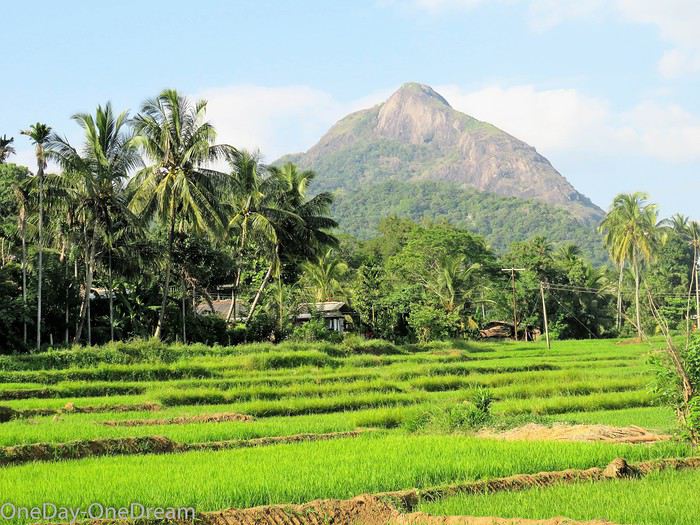
Le Sri Lanka, anciennement appelé Ceylan, est situé dans l’océan Indien, à environ 31 kilomètres au sud de l’Inde. C’est une île aux paysages variés. Plantations de thé à perte de vue, jardins d’épices, rizières, montagnes, cascades, plages aux eaux turquoises bordées de cocotiers. Mais le Sri Lanka, c’est aussi des festivals colorés, des éléphants majestueux, un riche patrimoine culturel et une population adorable, autant d’ingrédients qui nous invitent au voyage.
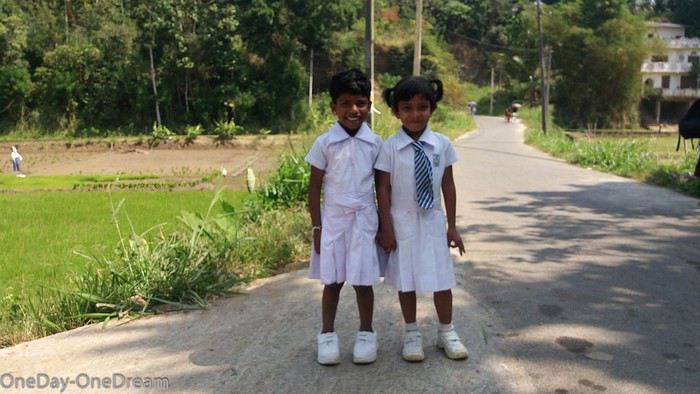
Le climat de l’île est équatorial avec une mousson sur la côte Est, d’octobre à fin janvier et une mousson sur la côte Ouest de mai à août. Alors que l’Inde souffrira d’une sècheresse avec des pics allant jusqu’à 45°C, le climat du Sri Lanka est chaud et humide. On peut visiter l’île toute l’année, cependant la meilleure saison reste tout de même de janvier à mars afin d’éviter les fortes pluies.
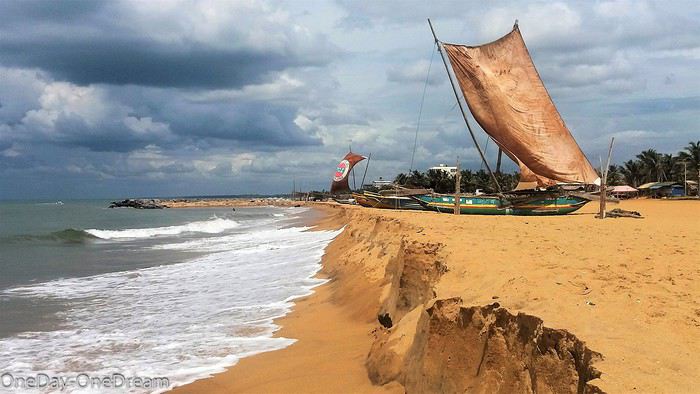
La proximité de l’océan rafraichit l’air et les températures oscillent entre 25/28°C toute l’année. Les régions montagneuses situées à l’intérieur de l’île bénéficient d’un climat plus frais et auront davantage de pluie. Les températures oscillaient entre 18/20°C lorsque j’étais en janvier à Nuwara Eliya et il pleuvait. C’est ici que l’on trouve ce qui fait la richesse de l’île, des plantations de thé à perte de vue, grâce à ce climat doux et humide.
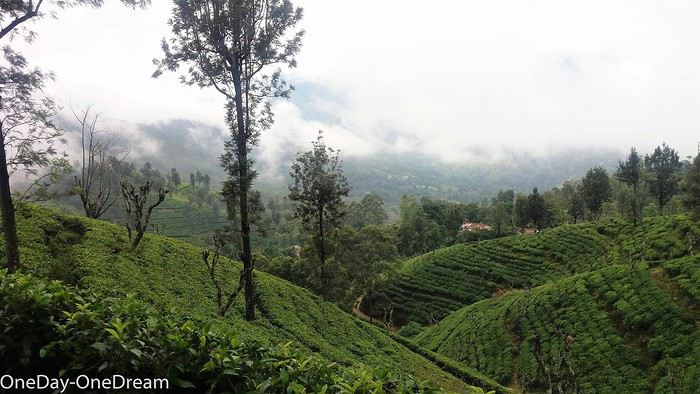
L’économie de l’île repose sur la culture du riz, l’exportation du thé, du caoutchouc et de la noix de coco. Le riz est la céréale la plus cultivée de l’île et elle est l’élément de base de la nourriture Sri Lankaise. Chaque repas est constitué de riz qui accompagne légumes, poisson ou poulet.
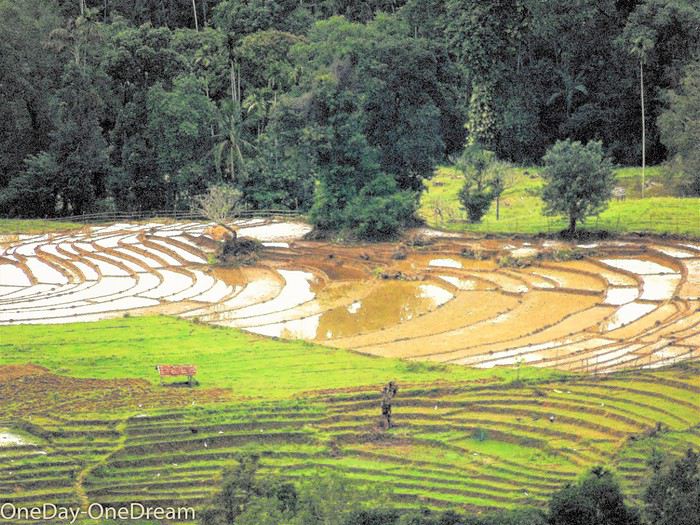
Vient ensuite le tourisme, partie importante aujourd’hui de l’économie. L’île s’est rouverte au tourisme en 2009 après plus de 30 ans de guerre entre les opposants indépendantistes tamouls et les forces gouvernementales Sri Lankaises. Le tsunami de 2004 a également fait d’importants dégâts matériels et humains principalement sur les côtes Sud et Est et ce triste évènement reste encore gravé dans la mémoire de tous les Sri Lankais. L’île s’est peu à peu reconstruite, de nouveaux hôtels ont vu le jour, l’état des routes s’est amélioré, les autoroutes sont en excellent état et les côtes possèdent de très belles plages.
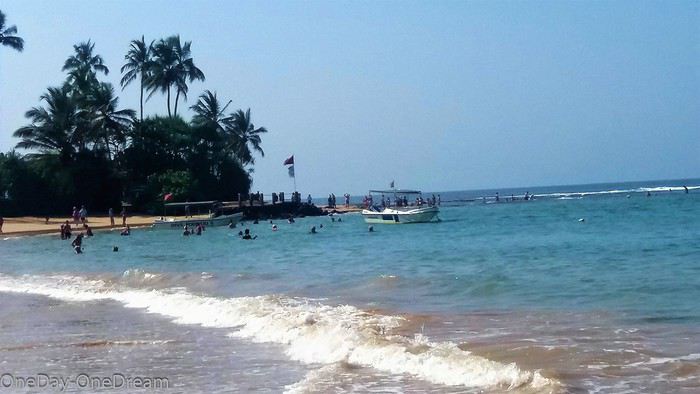
Le Sri Lanka est une île à dominante Bouddhiste, les temples sont omniprésents et vous en trouverez un peu partout, même dans les campagnes retirées.
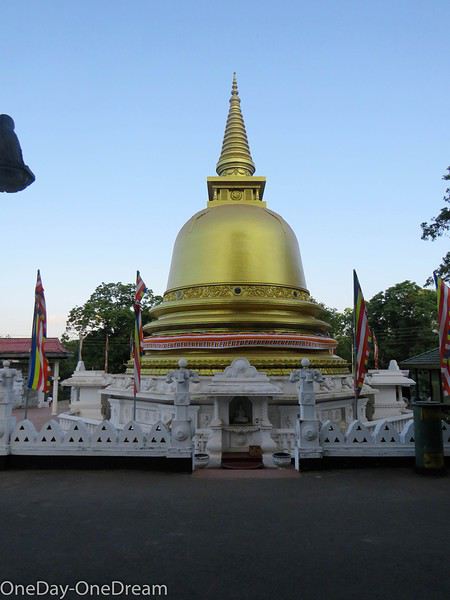
Chaque jour de pleine lune appelé ‘Poya’ est un jour sacré et férié dans le calendrier Sri Lankais. De nombreuses fêtes sont organisées tout au long de l’année comme la ‘Perahera’ de Kandy, la plus grande fête bouddhiste de l’île qui a lieu en août et dure 10 jours.
Vient ensuite la religion hindoue, introduite bien avant le Bouddhisme par les rois tamouls du sud de l’Inde. Elle est surtout présente dans le nord, l’Est et le centre de l’île où les Tamouls sont employés dans les plantations de thé. Les temples hindous appelés ‘Kovils’ sont nombreux au Sri Lanka et sont très colorés.
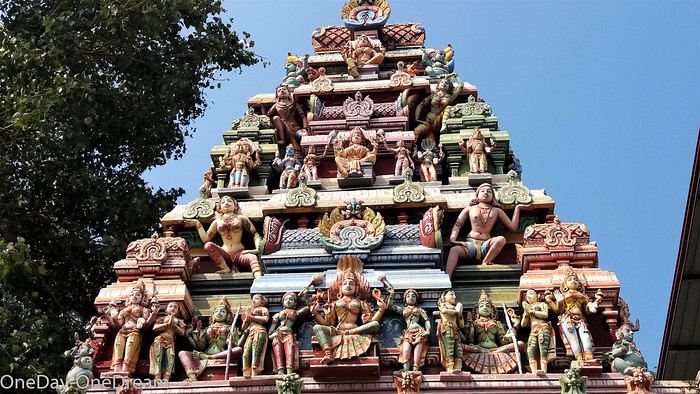
L’islam arrive en 3è position avec 2 millions de musulmans et environ 5000 mosquées au Sri Lanka. De nombreuses fêtes sont également organisées tout au long de l’année.
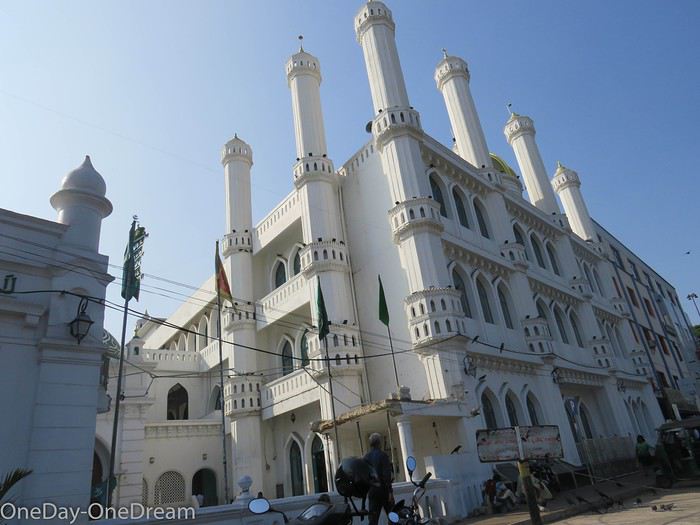
Et le christianisme, introduit au XVIè siècle par les missionnaires portugais. Il s’est surtout développé sur la côte ouest entre Colombo et Jaffna. Negombo compte d’ailleurs un nombre impressionnant d’églises. Toutes ces religions cohabitent et vous trouverez très souvent une église juste à côté d’un temple bouddhiste ou d’une mosquée.
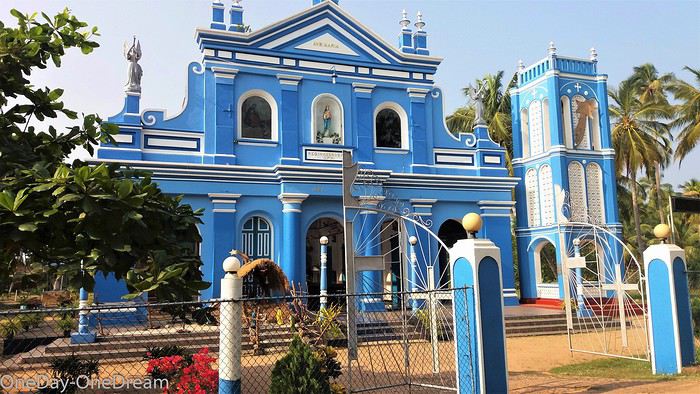
Les deux langues officielles sur l’île sont le cinghalais et le tamoul. Une bonne partie de la population parle également anglais sauf dans l’intérieur du pays et les campagnes retirées où très peu ont appris l’anglais.
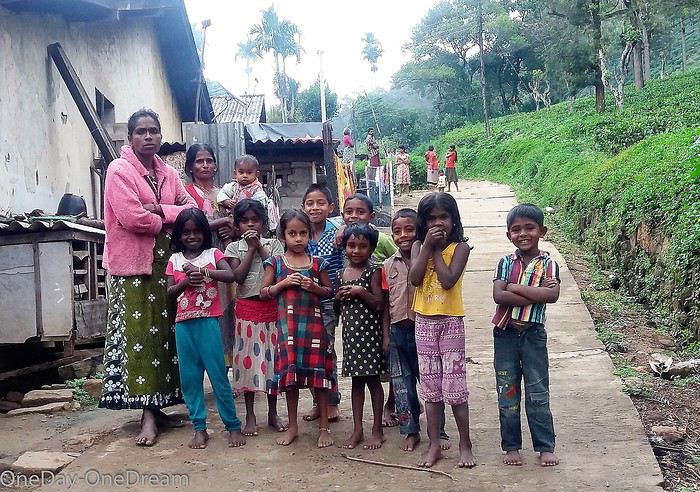
J’ai pu visiter une école Tamoule près de Passara, dans la région montagneuse de l’île où les tamouls travaillent dans les plantations de thé. J’ai été accueillie comme une reine avec un collier de fleurs et j’ai pu assister à plusieurs cours. Un grand merci à tous les enfants, professeurs et directeur pour leur gentillesse. Jamais je n’aurai eu un tel accueil en Europe.
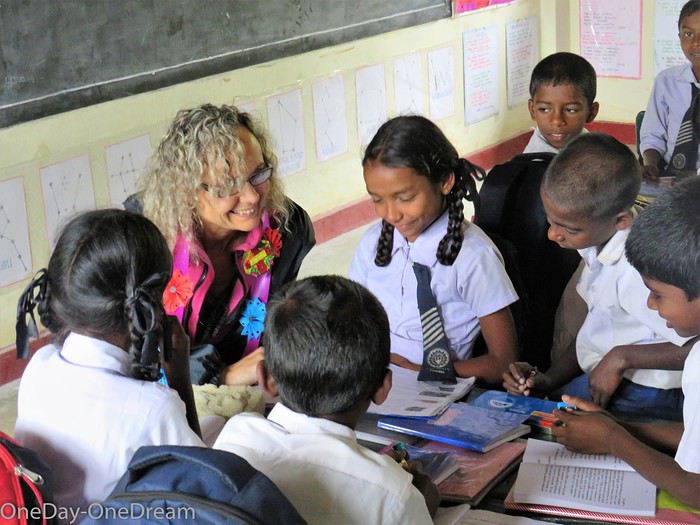 Comment se déplacer au Sri Lanka?
Le train est une bonne manière de voyager et ne coûte vraiment pas cher. Un billet Colombo/Hikkaduwa m’a coûté 1000 rupees, soit moins de 7 euros. Les trains partent de Colombo Fort, la gare de Colombo. Vous pouvez consulter les itinéraires et les horaires sur le site officiel ‘Sri Lanka Railways‘. Mais vous ne pourrez pas réserver en ligne. Voici un aperçu du site qui vous permettra de faire vos recherches d’horaires.
Un seul site vous permet de réserver en ligne. Il s’agit d’ Exporail où le choix est plus restreint. Une fois à la gare, vous devrez d’abord aller au guichet avec votre billet réservé en ligne et l’on émettra le vrai billet à présenter avant de monter dans le train.
Pour les autres destinations et horaires, vous devrez donc acheter votre billet sur place. Ce qui est l’inconvénient car les trains sont bien souvent complets et vous devrez vous rabattre sur le bus. J’ai voyagé en 3ème classe un samedi férié, le train était plein à craquer et j’ai passé 2h assise sur ma valise, mais finalement plutôt chanceuse alors que la plupart étaient debout serrés comme des sardines et sans climatisation.
Le plus beau trajet en train est Colombo à Kandy. Mais j’ai voyagé en train de Badulla à Nuwara Eliya et les paysages étaient aussi magnifiques, le train se déplace doucement, comme un bateau tanguerait sur la mer, entre forêt tropicale et plantations de thé.
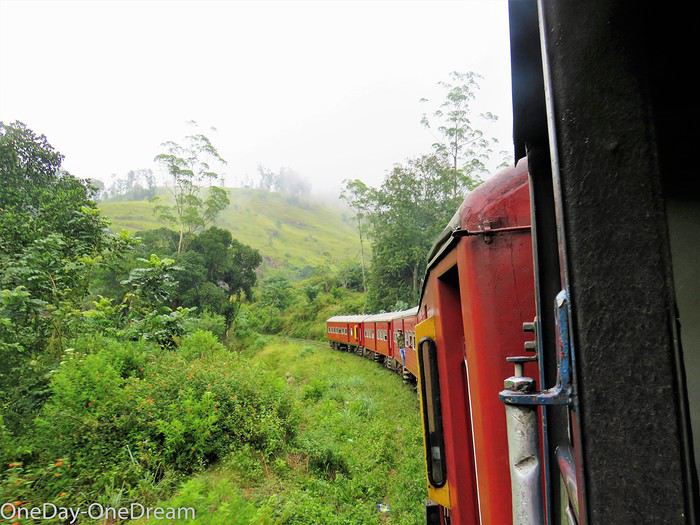
J’ai également voyagé en bus, expérience inoubliable. Vous trouverez des minibus climatisés où vous serez généralement assis et d’autres bus, de couleur rouge ou bleue un peu moins cher. Vous voyagerez bien souvent debout car les bus sont souvent pleins à craquer. Les billets se prennent dans le bus, le contrôleur passera et vous lui paierez votre ticket. Alors dépêchez-vous de trouver une place car il est préférable d’être assis dans les bus Sri Lankais.
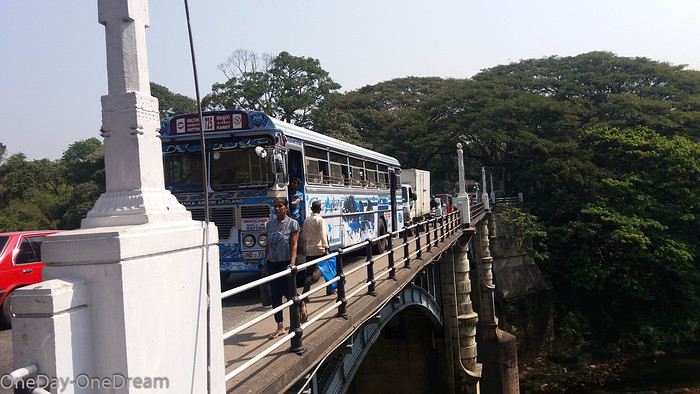
En effet, les bus ne se contentent pas de déposer les gens aux arrêts de bus mais surtout d’arriver à destination à l’heure et ils iront à une allure folle, se faufilant entre Tuk-Tuk, voitures et animaux traversant la route. La plupart dispose d’un écran de télévision et vous pourrez voyager au son du reggae sri lankais…
Les déplacement en Tuk-tuk sont à privilégier pour les courtes distances et sont très bon marché. A éviter en montagne pour une longue distance où les routes sont moins bonnes sauf si vous voulez être sûr de ne pas manquer votre train. Les Tuk-tuks se faufilent partout et au final vous gagnerez du temps par rapport au bus.
J’ai également voyagé avec Ruwan, un ami sri lankais qui vit à Hikkaduwa et qui tient une petite agence de tourisme Arya Lanka Tours. Il propose des packages mais vous pouvez également le contacter pour un transfert depuis Colombo ou pour tout autre itinéraire que vous auriez créé vous-même. J'ai également séjourné dans sa famille, sa femme a su me faire découvrir sa culture, sa cuisine colorée et ses enfants sont adorables. Si vous souhaitez séjourner chez l'habitant à Hikkaduwa, vous pouvez me contacter.
Quel itinéraire choisir? La plupart des circuits sont organisés autour des villes de Colombo, Negombo, Anuradhapura, Pinnawela, Dambulla, Sigiriya, Polonnaruwa, Kandy, Nuwara Eliya et le sud.
Je n’ai pas visité Anuradhapura par manque de temps, j’ai préféré privilégier d’autres villes et je ne suis pas allée non plus sur la côte Est, la saison étant inversée par rapport à la côte Ouest. Je conseille de visiter la côte Est de juin à août, période où les pluies sont moins importantes.
Voilà un premier article sur cette belle île qu’est le Sri Lanka. Une île que je détaillerai bien sûr dès que je le pourrai dans des articles à venir.
Pour lire l'article complet rendez-vous sur mon blog oneday-onedream.com/ Magali
Trois mois en Afrique Australe en Ford Figo
Amis baroudeurs, salut!
De retour d'un périple en solo de trois mois en Afrique australe (Afrique du Sud, Lesotho, Namibie, Botswana, Swaziland), l'occasion est belle de me lancer dans mon premier carnet de voyage.
Je me concentrerai sur les aspects pratiques, tout en agrémentant le "récit" de photos choisies avec amour (il va sans dire, même si je saurai me montrer sélectif 😏). Pour des questions de respect de la vie privée, je veillerai à ce que personne (à commencer par moi-même 😇) ne soit facilement reconnaissable ou identifiable sur les clichés publiés.
Dates du voyage: 30 mars-28 juin. Compagnie aérienne: South African Airlines. Vols: Genève-Johannesburg avec arrêt à Francfort. Idem au retour. Voiture de location: Ford Figo (type Polo) chez First Car Rental, 4480 km au compteur, 88 jours.
Quelques chiffres:
1 crevaison (seulement) 😎 2 chocs 🏴☠️ 5 pays visités 90 jours de voyage (vols compris) Env. 500 locaux pris en auto-stop 6000 photos (le tri continue 😏) 6156 francs suisses (5675 euros) dépensés au total (détail à venir) 19'900 km parcourus en voiture de location (soit l'équivalent de ce que je roule en près de quatre ans en Suisse 😮)
Les étapes (déplacements inclus)
Afrique du Sud + Lesotho (37 jours)
Arrivée à O.R. Tembo (Johannesburg), prise du véhicule puis route jusqu’à Clarens 1j 1) Drakensberg (Golden Gate Highlands NP) 2j 2) Drakensberg (Sentinel Hiking Trail) 1j 3) Drakensberg (Champagne Valley) 1,5j 4) Lesotho 5,5j 5) KwaZulu-Natal chez l'habitant 1,5j 6) Lake Eland GR + Oribi Gorge NR 0,5j 7) Wild Coast 1,5j 8) Hogsback 1j 9) Addo Elephant NP 1,5j 10) Jeffreys Bay + Tsitsikamma NP 1j 11) Camdeboo NP + Nieu Bethesda 2,5j 12) Prince Albert + Swartberg Pass 1,5j 13) Mossel Bay + Cape Agulhas 1j 14) Hermanus + Stellenbosch 1,5j 15) Cape Town 9j (dont 4j à travailler) 16) West Coast NP + Elands Bay 1j 17) Cederberg Wilderness Area 2,5j (dont 1j à travailler)
Namibie (20 jours)
18) Fish River Canyon + Fish River 2j 19) Lüderitz 2,5j (dont 1,5j à travailler) 20) Aus 0,5j 21) Sesriem/Sossusvlei 1.5j 22) Swakopmund 1j 23) Spitzkoppe 1j 24) Brandberg 1j 25) Henties Bay + Cape Cross Seal Reserve 1j 26) Skeleton Coast NP + Twyvelfontein + Petrified Forest 1j 27) Etosha NP 3,5j 28) Tsumeb + Waterberg 2,5j (dont 1j de repos) 29) Caprivi Strip 2j
Botswana (10 jours)
30) Kasane + Chobe NP 3j 31) Planet Baobab + Maun + Okavango Delta + Moremi Game Reserve 6j Route (1300 km avec détour) entre Maun (Botswana) et Pilanesberg NP (Afrique du Sud) 1j
Afrique du Sud + Swaziland (24 jours)
32) Pilanesberg NP 1j 33) Sun City + Marakele NP 1j 34) Tzaneen + King's Walden 1j 35) Musina + Mapungubwe NP 2,5j 36) Kruger NP 5j 37) Graskop + Blyde River Canyon 1,5j 38) Swaziland 2j 39) St Lucia + iSimangaliso Wetland Park 1j 40) Hluhluwe-iMfolozi Park 1j Route vers Kruger NP via Swaziland et Hlane Royal NP 1j 41) Kruger NP 5j (dont trek 4j) 42) Graskop 1j Route vers Jo’burg 1j
Edit: je remets ici la vidéo ajoutée en page 19 de mon carnet, près de six mois après mon retour. Cinq petites minutes pour "résumer" trois mois de périple... avec quelques floutés de rigueur. 😉
https://www.youtube.com/watch?v=bNsdBfIvNBw
De retour d'un périple en solo de trois mois en Afrique australe (Afrique du Sud, Lesotho, Namibie, Botswana, Swaziland), l'occasion est belle de me lancer dans mon premier carnet de voyage.
Je me concentrerai sur les aspects pratiques, tout en agrémentant le "récit" de photos choisies avec amour (il va sans dire, même si je saurai me montrer sélectif 😏). Pour des questions de respect de la vie privée, je veillerai à ce que personne (à commencer par moi-même 😇) ne soit facilement reconnaissable ou identifiable sur les clichés publiés.
Dates du voyage: 30 mars-28 juin. Compagnie aérienne: South African Airlines. Vols: Genève-Johannesburg avec arrêt à Francfort. Idem au retour. Voiture de location: Ford Figo (type Polo) chez First Car Rental, 4480 km au compteur, 88 jours.
Quelques chiffres:
1 crevaison (seulement) 😎 2 chocs 🏴☠️ 5 pays visités 90 jours de voyage (vols compris) Env. 500 locaux pris en auto-stop 6000 photos (le tri continue 😏) 6156 francs suisses (5675 euros) dépensés au total (détail à venir) 19'900 km parcourus en voiture de location (soit l'équivalent de ce que je roule en près de quatre ans en Suisse 😮)
Les étapes (déplacements inclus)
Afrique du Sud + Lesotho (37 jours)
Arrivée à O.R. Tembo (Johannesburg), prise du véhicule puis route jusqu’à Clarens 1j 1) Drakensberg (Golden Gate Highlands NP) 2j 2) Drakensberg (Sentinel Hiking Trail) 1j 3) Drakensberg (Champagne Valley) 1,5j 4) Lesotho 5,5j 5) KwaZulu-Natal chez l'habitant 1,5j 6) Lake Eland GR + Oribi Gorge NR 0,5j 7) Wild Coast 1,5j 8) Hogsback 1j 9) Addo Elephant NP 1,5j 10) Jeffreys Bay + Tsitsikamma NP 1j 11) Camdeboo NP + Nieu Bethesda 2,5j 12) Prince Albert + Swartberg Pass 1,5j 13) Mossel Bay + Cape Agulhas 1j 14) Hermanus + Stellenbosch 1,5j 15) Cape Town 9j (dont 4j à travailler) 16) West Coast NP + Elands Bay 1j 17) Cederberg Wilderness Area 2,5j (dont 1j à travailler)
Namibie (20 jours)
18) Fish River Canyon + Fish River 2j 19) Lüderitz 2,5j (dont 1,5j à travailler) 20) Aus 0,5j 21) Sesriem/Sossusvlei 1.5j 22) Swakopmund 1j 23) Spitzkoppe 1j 24) Brandberg 1j 25) Henties Bay + Cape Cross Seal Reserve 1j 26) Skeleton Coast NP + Twyvelfontein + Petrified Forest 1j 27) Etosha NP 3,5j 28) Tsumeb + Waterberg 2,5j (dont 1j de repos) 29) Caprivi Strip 2j
Botswana (10 jours)
30) Kasane + Chobe NP 3j 31) Planet Baobab + Maun + Okavango Delta + Moremi Game Reserve 6j Route (1300 km avec détour) entre Maun (Botswana) et Pilanesberg NP (Afrique du Sud) 1j
Afrique du Sud + Swaziland (24 jours)
32) Pilanesberg NP 1j 33) Sun City + Marakele NP 1j 34) Tzaneen + King's Walden 1j 35) Musina + Mapungubwe NP 2,5j 36) Kruger NP 5j 37) Graskop + Blyde River Canyon 1,5j 38) Swaziland 2j 39) St Lucia + iSimangaliso Wetland Park 1j 40) Hluhluwe-iMfolozi Park 1j Route vers Kruger NP via Swaziland et Hlane Royal NP 1j 41) Kruger NP 5j (dont trek 4j) 42) Graskop 1j Route vers Jo’burg 1j
Edit: je remets ici la vidéo ajoutée en page 19 de mon carnet, près de six mois après mon retour. Cinq petites minutes pour "résumer" trois mois de périple... avec quelques floutés de rigueur. 😉
https://www.youtube.com/watch?v=bNsdBfIvNBw
Circuit Afrique du Sud 15 jours fin octobre
Bonsoir,
Après des jours de lecture sur le forum, je me lance dans la création d'un post car j'ai du mal à organiser notre séjour idéal dans ce magnifique pays :-)
on a plus l'habitude de voyager aux Etats Unis et Canada (fait 4 fois et 3 fois) mais la j'ai du mal à optimiser au mieux
alors tout d'abors on pars entre frères et soeurs, on sera 3. à ce stade les vols ont été réservés, ça donne départ le 26/10/2016 de lyon pour Johannesburg, via Londres avec British Airways arrivée le 27/10 à 7h05 et retour le 09/11 Le Cap Lyon, via Londres toujours, départ 20h20 arrivée le lendemain dans la matinée à Lyon.
en terme de circuit, nous hésitons entre 2 options, la 1ère arrivée Joburg le 26/10, visite de Soweto en vélo surement et Musée de l'Apartheid, nuit à Joburg ou Dullstroom si c'est faisable en terme de distance et de fatigue? le lendemain selon l'endroit ou on aura dormi, on continuerait vers le Blyde River Canyon vers Graskop pour voir les classiques God's Window, Bourke Luck Potholes et Three Rondavels, sachant que les cascades (MacMacfalls, Berlin etc..) ont l'air classique non? on dormitait 1 ou 2 nuits dans le coin..Gaskop, ou ailleurs?
ensuite on partirait vers le Kruger bien sûr pour 3 nuits je pense mais c'est la déja que je bloque sur comment organiser le circuit dans le parc, où dormir? est ce que les self drive suffisent? ou faut il en faire tôt le matin ou le soir? quel ordre de prix faut il compter?
ensuite on continuerait direction le Swaziland pour 1 nuit, histoire de couper la route mais je sais pas trop quoi y faire et ou s'y arrêter. au niveau formalités j'ai cru comprendre qu'il fallait payer un droit d'entrée, est ce vrai et si oui c'est combien?
ensuite on filerai vers Durban où nous prendrions un vol pour Port Elizabeth pour faire principalement le Parc des Elephants Addo, est ce qu'il vaut le détour? ensuite direction Knysna pour 1 nuit ensuite 1 nuit dans la zone de Gansbaai ou Hermanus pour l'observation des baleines et peut être plonger avec les requins à cette époque la est ce qu'on aura des chances de voir des baleines? et les requins c'est impressionnant ou pas?
on continuerait notre périple vers Stellenbosch pour les vins puis 3 nuits au Cap avec les classiques Table Mountain, Cap de Bonne Espérance, Boulders Beach, l'ile ou Mandela a été emprisonné (j'ai oublié le nom) ou dormir dans l'idéal?
la 2ème option consisterait à faire une boucle Joburg Blyde Canyon Kruger Joburg puis vol vers Port Elizabeth et la suite serait la même dans quel sens faire les choses si on choisit cette option et aussi pour le Kruger afin de pas passer dans la mesure du possible par le même parcours
voila voila pour la foule de quetions je vous remercie par avance pour l'aide que vous pourrez m'apporter l'objectif étant de réserver vite pour le Kruger avant qu'on est plus de dispo
@ suivre désolé pour ce très long post
Après des jours de lecture sur le forum, je me lance dans la création d'un post car j'ai du mal à organiser notre séjour idéal dans ce magnifique pays :-)
on a plus l'habitude de voyager aux Etats Unis et Canada (fait 4 fois et 3 fois) mais la j'ai du mal à optimiser au mieux
alors tout d'abors on pars entre frères et soeurs, on sera 3. à ce stade les vols ont été réservés, ça donne départ le 26/10/2016 de lyon pour Johannesburg, via Londres avec British Airways arrivée le 27/10 à 7h05 et retour le 09/11 Le Cap Lyon, via Londres toujours, départ 20h20 arrivée le lendemain dans la matinée à Lyon.
en terme de circuit, nous hésitons entre 2 options, la 1ère arrivée Joburg le 26/10, visite de Soweto en vélo surement et Musée de l'Apartheid, nuit à Joburg ou Dullstroom si c'est faisable en terme de distance et de fatigue? le lendemain selon l'endroit ou on aura dormi, on continuerait vers le Blyde River Canyon vers Graskop pour voir les classiques God's Window, Bourke Luck Potholes et Three Rondavels, sachant que les cascades (MacMacfalls, Berlin etc..) ont l'air classique non? on dormitait 1 ou 2 nuits dans le coin..Gaskop, ou ailleurs?
ensuite on partirait vers le Kruger bien sûr pour 3 nuits je pense mais c'est la déja que je bloque sur comment organiser le circuit dans le parc, où dormir? est ce que les self drive suffisent? ou faut il en faire tôt le matin ou le soir? quel ordre de prix faut il compter?
ensuite on continuerait direction le Swaziland pour 1 nuit, histoire de couper la route mais je sais pas trop quoi y faire et ou s'y arrêter. au niveau formalités j'ai cru comprendre qu'il fallait payer un droit d'entrée, est ce vrai et si oui c'est combien?
ensuite on filerai vers Durban où nous prendrions un vol pour Port Elizabeth pour faire principalement le Parc des Elephants Addo, est ce qu'il vaut le détour? ensuite direction Knysna pour 1 nuit ensuite 1 nuit dans la zone de Gansbaai ou Hermanus pour l'observation des baleines et peut être plonger avec les requins à cette époque la est ce qu'on aura des chances de voir des baleines? et les requins c'est impressionnant ou pas?
on continuerait notre périple vers Stellenbosch pour les vins puis 3 nuits au Cap avec les classiques Table Mountain, Cap de Bonne Espérance, Boulders Beach, l'ile ou Mandela a été emprisonné (j'ai oublié le nom) ou dormir dans l'idéal?
la 2ème option consisterait à faire une boucle Joburg Blyde Canyon Kruger Joburg puis vol vers Port Elizabeth et la suite serait la même dans quel sens faire les choses si on choisit cette option et aussi pour le Kruger afin de pas passer dans la mesure du possible par le même parcours
voila voila pour la foule de quetions je vous remercie par avance pour l'aide que vous pourrez m'apporter l'objectif étant de réserver vite pour le Kruger avant qu'on est plus de dispo
@ suivre désolé pour ce très long post