Results for "Rwanda"
About 1,316 results.
More options
Many results are in French, the community’s main language. English translations are added over time.
Search results
Nouvelle grille tarifaire chez Air France pour l'Afrique dès le 1er octobre
AF vient de filer sa nouvelle grille tarifaire sur l'Afrique pour un départ après le premier octobre pour faire face à la concurrence.
Hors promotion, les niveaux d'appels ont été considérablement réduits, par exemple sur
ABJ:414 (-16%) BZV:644 (-20%) CKY:436 (-27%) DKR:353 (-12%) DLA:420 (-16%) LFW:421 (-21%) NIM:413 (-22%) NKC:387 (-28%)
Ces prix s'entendent hors taxes et aller retour. Les prix départ MRS, NCE, BOD et LYS ont aussi été considérablement revus à la baisse.
Comme quoi, la concurrence ça a du bon pour le consommateur ;)
Hors promotion, les niveaux d'appels ont été considérablement réduits, par exemple sur
ABJ:414 (-16%) BZV:644 (-20%) CKY:436 (-27%) DKR:353 (-12%) DLA:420 (-16%) LFW:421 (-21%) NIM:413 (-22%) NKC:387 (-28%)
Ces prix s'entendent hors taxes et aller retour. Les prix départ MRS, NCE, BOD et LYS ont aussi été considérablement revus à la baisse.
Comme quoi, la concurrence ça a du bon pour le consommateur ;)
Recherche chauffeur pour périple entre Bangkok et Chiang Mai
Salut !
Je cherche un chauffeur pour effectuer un périple de BKK jusqu'à Chiang Maï. nous sommes quatre: ma femme , moi et nos deux enfants de 5 et 7 ans.
Nous ne voulons pas un guide (trop cher) mais bien un chauffeur qui s'adaptera selon notre itinéraire, qui reste à définir clairement. mais l'idée est de remonter tranquillement en faisant étape un ou deux jours selon les sites.
Notre budget (tout compris: salaire du chauffeur, sa nourriture, son logement, la location de la voiture et l'essence) serait de 150000 bht environ.
Merci!
Je cherche un chauffeur pour effectuer un périple de BKK jusqu'à Chiang Maï. nous sommes quatre: ma femme , moi et nos deux enfants de 5 et 7 ans.
Nous ne voulons pas un guide (trop cher) mais bien un chauffeur qui s'adaptera selon notre itinéraire, qui reste à définir clairement. mais l'idée est de remonter tranquillement en faisant étape un ou deux jours selon les sites.
Notre budget (tout compris: salaire du chauffeur, sa nourriture, son logement, la location de la voiture et l'essence) serait de 150000 bht environ.
Merci!
Air Mauritius ou Air France pour l'île Maurice?
Bonjour,
Nous partons mercredi pour l'île Maurice. L'agence de voyages nous a assuré que le vol se faisait sur Air Mauritius, mais j'ai lu ça et là qu'Air France et Air Mauritius se paratgeaient les vols.
Qui peut me renseigner ?
Décollage à 16h20, ce que je lis sur le bon de vol c'est MK45.
Merci !
Traverser la Tanzanie du lac Victoria à Zanzibar à vélo en juillet-août: camping sauvage, climat?
Bonjour j'envisage pour les mois de Juillet-Aout 2009 de traverser la Tanzanie à vélo, grosso-modo du lac Victoria à Zanzibar.
J'aimerais en fait savoir ce qu'il en est du camping sauvage là bas. En termes de sécurité surtout. J'ai entendu que les habitants étaient accueillants, on n'est jamais à l'abri de se faire dépouiller c'est sûr, mais apparemment pas plus en Tanzanie qu'ailleurs. Je m'inquiète plus pour les rencontres avec les animaux en fait. Quelles sont vos expériences ou vos avis là-dessus ?
Et au niveau du climat ? Je pense à des réserves d'eau conséquentes, car on est encore plus loin de tout en vélo qu'en voiture.
Voilà, merci bien !
Joseph
J'aimerais en fait savoir ce qu'il en est du camping sauvage là bas. En termes de sécurité surtout. J'ai entendu que les habitants étaient accueillants, on n'est jamais à l'abri de se faire dépouiller c'est sûr, mais apparemment pas plus en Tanzanie qu'ailleurs. Je m'inquiète plus pour les rencontres avec les animaux en fait. Quelles sont vos expériences ou vos avis là-dessus ?
Et au niveau du climat ? Je pense à des réserves d'eau conséquentes, car on est encore plus loin de tout en vélo qu'en voiture.
Voilà, merci bien !
Joseph
Voyage en République Démocratique du Congo
Bonjour
En lisant le forum je me rends compte qu'il y a peu de discussion de personnes qui sont allées en République démocratique du Congo.
Je voudrais partir au mois d'août avec mon mari qui est originaire de la RDC et mes enfants agés de 4 1/2 et 7 1/2 ans. Y a-t-il des personnes mariées avec un autochtone qui y sont allé avec leurs enfants. Quels sont les précautions à prendre pour l'hygiène, la nourriture, peut-on dormir dans la famille ou vaut-il mieux dormir à l'hôtel. Je vous remercie par avance pour vos témoignages.
En lisant le forum je me rends compte qu'il y a peu de discussion de personnes qui sont allées en République démocratique du Congo.
Je voudrais partir au mois d'août avec mon mari qui est originaire de la RDC et mes enfants agés de 4 1/2 et 7 1/2 ans. Y a-t-il des personnes mariées avec un autochtone qui y sont allé avec leurs enfants. Quels sont les précautions à prendre pour l'hygiène, la nourriture, peut-on dormir dans la famille ou vaut-il mieux dormir à l'hôtel. Je vous remercie par avance pour vos témoignages.
Retour du Burundi
Bonjour,
Je reviens du Burundi où j'étais en vacance. Je recherche des personnes qui y ont voyagé, pour partager des moments vécus avec le peuple, les coutumes, les paysages .. les sensations, les émotions de leur accueil.
D'avance merci.
les plus beaux ponts
et nous ce que nous aimons c'est photographier les ponts!
A vous de nous faire rever!
A vous de nous faire rever!
Nouvelles fraîches du Népal (décembre 2003)
Je suis au Nepal (Pokhara) actuellement.
Je reviens d un trek de 11 jours Pokhara->Muktinath en passant par Ghorepani : aucun maoiste rencontre, juste plusieurs check-point mililaires passes sans encombre. Population accueillante et superbes paysages.
A Katmandou, tout semble calme.
Le trajet en bus touristique Katmadou->Pokhara c est effectue sans probleme et en 7h.
Il ne me semble pas utile d annuler votre voyage si vous prevoyez de venir dans ce superbe pays...
Gilles
(PartirOu.com)
Africa: A Heartfelt Love for a Continent
“When the Whites came to Africa, we had the land and they had the Bible. They taught us to pray with our eyes closed: when we opened them, the Whites had the land and we had the Bible.” Jomo Kenyatta (p.7)
The Maggi cube, an unchallenged hegemony, and so much more
“The hopeless continent,” headlined The Economist, a British magazine, in July 2000 about Africa. Eleven years later, the same magazine headlined “Africa rising” instead. Images of Africa in the prosperous North constantly oscillate between apocalyptic scenarios and enthusiastic projections. A key issue with such images lies in the generalization they entail. If you look at the continent, considerable contrasts emerge depending on space and time. It’s no surprise that a region of the world encompassing such diverse ecological zones, maintaining such varied ties with other continents, comprising nearly fifty nation-states in sub-Saharan Africa alone, and characterized by a great diversity of languages, belief systems, and historical paths, doesn’t share a single destiny.
And yet, for many people outside Africa, as well as for many Africans, the continent constitutes a single entity, defined by criteria such as skin color, a colonial past, poverty, and the art of survival. Until now, these perspectives were generally accompanied by the idea that Africa had to—or should have—followed a single path together, sometimes called development, sometimes modernization, sometimes liberation, then a market economy. None of these paths delivered on their promises.
The two writers Alain Mabanckou and Abdourahman Waberi—one from Congo, the other raised in Djibouti, both long settled in France and now professors at renowned North American universities (Los Angeles, Washington)—have had enough of pessimistic scenarios: “We are aware that Africa is in the world and the world is in Africa. The same goes for all other continents, as our destinies are inextricably linked for better or worse. We refuse to see Africa as a reservoir of misfortunes or a continent cursed by atavistic misfortune and characterized by ethnic conflicts. [...] It’s this passionate flame we wanted to capture in a book [...] a kind of stroll through African cultures, without any demands, each letter of the alphabet leading us to a notion, a practice, a concept, a moment in history, literature, painting, politics, economics, cuisine, etc.” (p.10-11). Africa, they write, is on the verge of “imposing a signature, a style, a way of being in the world and in relation to the rest of the world.” (p.11) To put words to the continent’s diversity and dynamism, the two authors created a “rambling ABC,” a kind of portrait—or more precisely, a mythography—that lets you see and feel the pulse of a vast continent whose cultural power is unfolding before our eyes. Once marginalized or even mocked, the voice and importance of the Continent in global affairs are now undeniable” (p.11), containing over a hundred entries, mostly concise, written in a relaxed and casual style. The optimistic, even exuberant tone is set from the brief introduction. The duo of authors wants to “sing a love song to the cultures of our continent, to its inhabitants past and present, to its exceptional resources and its spectacular globalization despite a certain pollution that still clouds our skies due to the unmatched duration of dictatorships in some of our regions.” (p.12) In doing so, they don’t want to be too distracted by today’s Afewerki-Biya-Bongo-Déby & Co. ...
Of course, you’ll find tributes to great precursors like Frantz Fanon (“[...] it was a love story and admiration that wasn’t dimmed by the four decades separating his birth from ours. Let’s add that we were born while the native of Fort-de-France had left the world’s stage four years earlier, in the prime of life” p.141), Mongo Beti (“You must read and reread Mongo Beti, a genius who used his fame to support often just causes in Africa, like defending oppressed groups. His place is already in History. His oppressors, like the dictators Ahmadou Ahidjo and Paul Biya, can’t compete in the same category” p.64), the Malian Amadou Hampâté Bâ
(“Posterity remembers him mainly as an tireless defender of African cultures. His plea for the collection and preservation of traditional African knowledge remains a major event for all men and women of good will. One day in 1960, at the UNESCO podium, the native of Bandiagara sounded the alarm: ‘[...] Since we’ve admitted that the humanity of each people is the heritage of all humanity, if African traditions aren’t collected in time and written down, they’ll one day be missing from the universal archives of humanity.’” p.51),
Kwame Nkrumah, “one of the founders of Pan-Africanism, father of Ghana’s independence” (p.239), as well as the historian Cheikh Anta Diop, the writer, poet, and politician Aimé Césaire, and the economist and thinker Samir Amin, but also very warm tributes to certain contemporary African intellectuals like Souleymane Bachir Diagne and Achille Mbembe
(“A few years ago, in dominant economic circles, a rumor often resurfaced, usually disguised as a cold and scientifically proven analysis: Africa is useless. It’s a burden for the rest of the human community. With its 2% share in world trade, it would disappear from stock market radars without anyone noticing. So? Maybe it’ll be pulled up by other continents. Wanting to surpass itself is a crazy bet for Africans, they concluded. Arrogant or clueless, President Nicolas Sarkozy declared before an audience of students and teachers at Cheikh Anta Diop University in Dakar: ‘The African man hasn’t entered history enough [...] He only knows the eternal repetition of time marked by the endless repetition of the same gestures and words.’ That was in 2007. For decades, armed only with reason, an intellectual often steps up to debunk prejudices, lazy readings, and dishonest frameworks used as false fronts by those who, like Nicolas Sarkozy or former journalist Stephen Smith, out of ignorance, contempt, or condescension, distort African reality. This intellectual is none other than the historian and political scientist Achille Mbembe. This heir of Frantz Fanon, Amílcar Cabral, Jean-Marc Ela, and Fabien Eboussi-Boulaga was born in 1957 in Cameroon, in the Bassa region. Marked early by the upheavals of a fratricidal war, Achille Mbembe became the guardian of the memory of martyrs. After brilliant studies in Paris, he went on to teach at the best American universities, but the call of the Continent was stronger than anything else. In Dakar, he once directed CODESRIA (Council for the Development of Social Science Research in Africa) before joining the University of the Witwatersrand in Johannesburg, South Africa. Even though the author of *Critique of Black Reason* (Éditions La Découverte, 2015) spends a few months at Duke University in North Carolina, his observation post remains South Africa. From Johannesburg, Achille Mbembe scrutinizes Africa and the whole world. A lucid observer with an elegant and generous pen, Achille Mbembe knows how to blend big and small history: ‘I was born one day in July, as the month was drawing to a close. It was 1957, in that part of Africa recently named ‘Cameroon,’ a memory of the wonder that seized Portuguese sailors in the 15th century when, sailing up the river near Douala, they couldn’t help but note the presence of a multitude of crustaceans, and named it *Rio dos Camarões*, meaning ‘River of Shrimp.’ I grew up in the shadow of this nameless land, since, in a way, the name it bears is only the product of someone else’s astonishment: a lexical mistake, if you will.’ From this mistake or wound, he made leaven, a springboard to compose a rich work, recognized worldwide. To denounce barriers and barbarians too. But that’s not enough. Among his peers in circles of thought and action, Achille Mbembe passionately and consistently defends human dignity and the beauty of the world. In doing so, he fulfills the mission Frantz Fanon entrusted to him.” (p.227-229),
as well as entries dedicated to lesser-known artists and intellectuals, like the French journalist and activist Rokhaya Diallo, daughter of Senegalese and Gambian parents, or the Ethiopian filmmaker Haile Gerima, who has long lived in the United States. Other names from politics, sports, music, art, and literature: Kofi Annan, p.36; Barack Obama, p.243; Thomas Sankara, p.277; Ousmane Sow, p.285; Yambo Ouologuem, p.250; Léopold Sédar Senghor, p.282; Muhammad Ali, p.30; Nuruddin Farah, p.146; Salif Keita, p.203; Ahmadou Kourouma, p.206; Ngũgĩ wa Thiong’o, p.236; Winnie Mandela, p.224; Kylian Mbappé, p.226 ...
The authors, who resolutely commit to a “mythography” (p.11) of Africa, also pay special attention to local social movements, cultural events, and aspects of daily life. *Y’en a marre*, “which also meant ‘we’re fed up with sitting on our hands’” (p.320-321), emerged about a decade ago in Senegal as a citizen movement of peaceful resistance and symbolizes, the authors emphasize, the fact that African youth are increasingly fed up “with the political circus deployed in Africa since independence, as our parents would say, ‘since the White man left’...” (p.321). A full entry is dedicated to the Maggi bouillon cube, which has flooded African markets for about forty years and enjoys immense popularity (“It’s everywhere in Africa, from Dakar to Djibouti, and from Tangier to Cape Town. It’s in every pot, every stew. Little hands put it in every sauce, every local or adapted dish. An unchallenged hegemony! You’ll find it in diasporas too. The culinary strolls in Paris, in the [...] neighborhood” p.90). Critics blame it not only for impoverishing the aromatic diversity of local dishes but also for being harmful to health. And yet, “he poorest Africans, those who eat only once a day, a few spoonfuls of white beans and a ball of *foufou*, for example, are the most fervent users of the magic cube.” (p.92-93)
For *fonio*, “the new trendy cereal. [...] From the millet family, fonio is probably the oldest cereal cultivated in West Africa, and mainly in its sub-Saharan part, for millennia. [...] Easy to grow, water-efficient, fonio grows everywhere except on clay soils. Long neglected because it was considered the poor man’s crop, fonio is now a source of pride for the farmers who cultivate it and cherish it like the apple of their eye” (p.156-157), the authors immediately offer a detailed recipe, letting the reader know that “e can’t resist sharing this fonio with chicken recipe from Mali with you:
Ingredients: 1 chicken 3 large ripe red tomatoes 4 tbsp tomato paste 4 large onions 1 garlic clove 1/2 cup oil 2 Maggi cubes or salt 2 large carrots 1 turnip 1 large cabbage 2 large potatoes 1 celery stalk 1 packet pre-cooked fonio 4 okra (or okra powder) salt, pepper
Preparation: 1. Prepare the sauce: wash and cut the chicken. Peel the onions, garlic, and vegetables. 2. In a pot, fry the chicken pieces. 3. Dice the onions, tomatoes, carrots, and turnip very small and add them to the pot. 4. Add the tomato paste, salt, and pepper. 5. Simmer for 15 min, then add 2 L of water and the cooked chicken pieces. 6. Simmer for 30 min, then add the crushed garlic and celery, plus the cabbage cut into 4 and the potatoes cut in half. 7. Prepare the fonio: cover it with warm water, let it rest for 15 min, and cook it over low heat. 8. In a small pot, boil the okra and crush them. 9. Mix the crushed okra with the cooked fonio, then salt. Serve hot.” (p.158-159)
The comedy *Black Mic Mac*, released in French theaters in 1986 and addressing France’s increasingly restrictive immigration policy at the time, also gets an entry, as do *Tintin in the Congo*, the popular comic, and *Jip’s Café* (“[...] a little Africa in the heart of Paris, with passersby stopping to admire the ‘ambianceurs’ on the dance floor or attend the cultural events offered by the place” (p.194), an African establishment in Paris that Alain Mabanckou already immortalized in one of his novels.
The duo of authors also tackles thorny subjects like jihadism (p.119), the Rwandan genocide (p.272), the CFA franc (p.82), and dictatorship (p.110). While the two strike the right tone here, many entries leave a slightly bitter taste. Two examples: why doesn’t the text on Barack Obama mention the great disappointment of many people in Africa, who expected more from the African policy of the first U.S. president with African roots than just occasional warm words? Why do the comments on Winnie Mandela gloss over the fact that she was a highly controversial icon of the anti-apartheid movement due to her involvement in kidnappings, acts of torture, and murders of alleged apartheid collaborators? Instead, there’s a compassion that brings tears to the eyes: “She was often reduced to a secondary role, the wife of a great man” or “When victory came, she didn’t taste its fruits. Divorced, isolated. She would never be a ‘first lady’ in an evening gown, posing before a bed of chrysanthemums. They’d keep her far from the circles of power” (p.224-225). At this point, I would’ve liked the authors to take a slightly more critical stance...
That said, these “weaknesses” (if you can call them that) shouldn’t overshadow the book as a whole. It remains an informative, sometimes very entertaining, and often even original work in its own way.
Book information (the original French and the German translation):
Alain Mabanckou/Abdourahman Waberi. Dictionnaire enjoué des cultures africaines. Fayard, 2019. Alain Mabanckou/Abdourahman Waberi. Der Puls Afrikas. Eine Liebeserklärung von A bis Z. Reclam, 2022.
Hery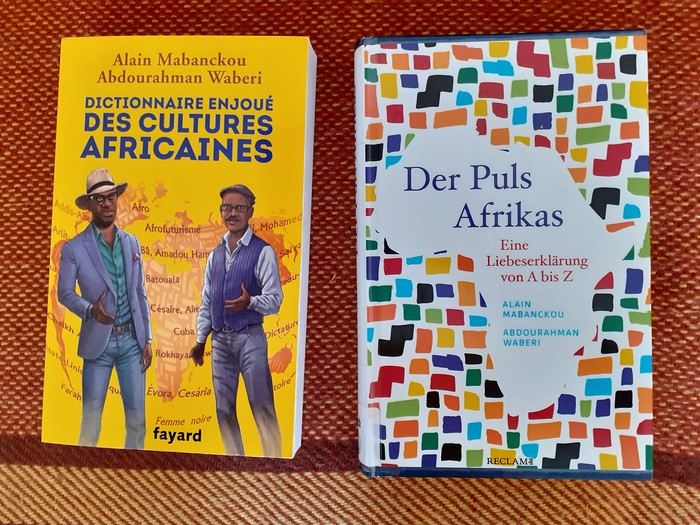
The Maggi cube, an unchallenged hegemony, and so much more
“The hopeless continent,” headlined The Economist, a British magazine, in July 2000 about Africa. Eleven years later, the same magazine headlined “Africa rising” instead. Images of Africa in the prosperous North constantly oscillate between apocalyptic scenarios and enthusiastic projections. A key issue with such images lies in the generalization they entail. If you look at the continent, considerable contrasts emerge depending on space and time. It’s no surprise that a region of the world encompassing such diverse ecological zones, maintaining such varied ties with other continents, comprising nearly fifty nation-states in sub-Saharan Africa alone, and characterized by a great diversity of languages, belief systems, and historical paths, doesn’t share a single destiny.
And yet, for many people outside Africa, as well as for many Africans, the continent constitutes a single entity, defined by criteria such as skin color, a colonial past, poverty, and the art of survival. Until now, these perspectives were generally accompanied by the idea that Africa had to—or should have—followed a single path together, sometimes called development, sometimes modernization, sometimes liberation, then a market economy. None of these paths delivered on their promises.
The two writers Alain Mabanckou and Abdourahman Waberi—one from Congo, the other raised in Djibouti, both long settled in France and now professors at renowned North American universities (Los Angeles, Washington)—have had enough of pessimistic scenarios: “We are aware that Africa is in the world and the world is in Africa. The same goes for all other continents, as our destinies are inextricably linked for better or worse. We refuse to see Africa as a reservoir of misfortunes or a continent cursed by atavistic misfortune and characterized by ethnic conflicts. [...] It’s this passionate flame we wanted to capture in a book [...] a kind of stroll through African cultures, without any demands, each letter of the alphabet leading us to a notion, a practice, a concept, a moment in history, literature, painting, politics, economics, cuisine, etc.” (p.10-11). Africa, they write, is on the verge of “imposing a signature, a style, a way of being in the world and in relation to the rest of the world.” (p.11) To put words to the continent’s diversity and dynamism, the two authors created a “rambling ABC,” a kind of portrait—or more precisely, a mythography—that lets you see and feel the pulse of a vast continent whose cultural power is unfolding before our eyes. Once marginalized or even mocked, the voice and importance of the Continent in global affairs are now undeniable” (p.11), containing over a hundred entries, mostly concise, written in a relaxed and casual style. The optimistic, even exuberant tone is set from the brief introduction. The duo of authors wants to “sing a love song to the cultures of our continent, to its inhabitants past and present, to its exceptional resources and its spectacular globalization despite a certain pollution that still clouds our skies due to the unmatched duration of dictatorships in some of our regions.” (p.12) In doing so, they don’t want to be too distracted by today’s Afewerki-Biya-Bongo-Déby & Co. ...
Of course, you’ll find tributes to great precursors like Frantz Fanon (“[...] it was a love story and admiration that wasn’t dimmed by the four decades separating his birth from ours. Let’s add that we were born while the native of Fort-de-France had left the world’s stage four years earlier, in the prime of life” p.141), Mongo Beti (“You must read and reread Mongo Beti, a genius who used his fame to support often just causes in Africa, like defending oppressed groups. His place is already in History. His oppressors, like the dictators Ahmadou Ahidjo and Paul Biya, can’t compete in the same category” p.64), the Malian Amadou Hampâté Bâ
(“Posterity remembers him mainly as an tireless defender of African cultures. His plea for the collection and preservation of traditional African knowledge remains a major event for all men and women of good will. One day in 1960, at the UNESCO podium, the native of Bandiagara sounded the alarm: ‘[...] Since we’ve admitted that the humanity of each people is the heritage of all humanity, if African traditions aren’t collected in time and written down, they’ll one day be missing from the universal archives of humanity.’” p.51),
Kwame Nkrumah, “one of the founders of Pan-Africanism, father of Ghana’s independence” (p.239), as well as the historian Cheikh Anta Diop, the writer, poet, and politician Aimé Césaire, and the economist and thinker Samir Amin, but also very warm tributes to certain contemporary African intellectuals like Souleymane Bachir Diagne and Achille Mbembe
(“A few years ago, in dominant economic circles, a rumor often resurfaced, usually disguised as a cold and scientifically proven analysis: Africa is useless. It’s a burden for the rest of the human community. With its 2% share in world trade, it would disappear from stock market radars without anyone noticing. So? Maybe it’ll be pulled up by other continents. Wanting to surpass itself is a crazy bet for Africans, they concluded. Arrogant or clueless, President Nicolas Sarkozy declared before an audience of students and teachers at Cheikh Anta Diop University in Dakar: ‘The African man hasn’t entered history enough [...] He only knows the eternal repetition of time marked by the endless repetition of the same gestures and words.’ That was in 2007. For decades, armed only with reason, an intellectual often steps up to debunk prejudices, lazy readings, and dishonest frameworks used as false fronts by those who, like Nicolas Sarkozy or former journalist Stephen Smith, out of ignorance, contempt, or condescension, distort African reality. This intellectual is none other than the historian and political scientist Achille Mbembe. This heir of Frantz Fanon, Amílcar Cabral, Jean-Marc Ela, and Fabien Eboussi-Boulaga was born in 1957 in Cameroon, in the Bassa region. Marked early by the upheavals of a fratricidal war, Achille Mbembe became the guardian of the memory of martyrs. After brilliant studies in Paris, he went on to teach at the best American universities, but the call of the Continent was stronger than anything else. In Dakar, he once directed CODESRIA (Council for the Development of Social Science Research in Africa) before joining the University of the Witwatersrand in Johannesburg, South Africa. Even though the author of *Critique of Black Reason* (Éditions La Découverte, 2015) spends a few months at Duke University in North Carolina, his observation post remains South Africa. From Johannesburg, Achille Mbembe scrutinizes Africa and the whole world. A lucid observer with an elegant and generous pen, Achille Mbembe knows how to blend big and small history: ‘I was born one day in July, as the month was drawing to a close. It was 1957, in that part of Africa recently named ‘Cameroon,’ a memory of the wonder that seized Portuguese sailors in the 15th century when, sailing up the river near Douala, they couldn’t help but note the presence of a multitude of crustaceans, and named it *Rio dos Camarões*, meaning ‘River of Shrimp.’ I grew up in the shadow of this nameless land, since, in a way, the name it bears is only the product of someone else’s astonishment: a lexical mistake, if you will.’ From this mistake or wound, he made leaven, a springboard to compose a rich work, recognized worldwide. To denounce barriers and barbarians too. But that’s not enough. Among his peers in circles of thought and action, Achille Mbembe passionately and consistently defends human dignity and the beauty of the world. In doing so, he fulfills the mission Frantz Fanon entrusted to him.” (p.227-229),
as well as entries dedicated to lesser-known artists and intellectuals, like the French journalist and activist Rokhaya Diallo, daughter of Senegalese and Gambian parents, or the Ethiopian filmmaker Haile Gerima, who has long lived in the United States. Other names from politics, sports, music, art, and literature: Kofi Annan, p.36; Barack Obama, p.243; Thomas Sankara, p.277; Ousmane Sow, p.285; Yambo Ouologuem, p.250; Léopold Sédar Senghor, p.282; Muhammad Ali, p.30; Nuruddin Farah, p.146; Salif Keita, p.203; Ahmadou Kourouma, p.206; Ngũgĩ wa Thiong’o, p.236; Winnie Mandela, p.224; Kylian Mbappé, p.226 ...
The authors, who resolutely commit to a “mythography” (p.11) of Africa, also pay special attention to local social movements, cultural events, and aspects of daily life. *Y’en a marre*, “which also meant ‘we’re fed up with sitting on our hands’” (p.320-321), emerged about a decade ago in Senegal as a citizen movement of peaceful resistance and symbolizes, the authors emphasize, the fact that African youth are increasingly fed up “with the political circus deployed in Africa since independence, as our parents would say, ‘since the White man left’...” (p.321). A full entry is dedicated to the Maggi bouillon cube, which has flooded African markets for about forty years and enjoys immense popularity (“It’s everywhere in Africa, from Dakar to Djibouti, and from Tangier to Cape Town. It’s in every pot, every stew. Little hands put it in every sauce, every local or adapted dish. An unchallenged hegemony! You’ll find it in diasporas too. The culinary strolls in Paris, in the [...] neighborhood” p.90). Critics blame it not only for impoverishing the aromatic diversity of local dishes but also for being harmful to health. And yet, “he poorest Africans, those who eat only once a day, a few spoonfuls of white beans and a ball of *foufou*, for example, are the most fervent users of the magic cube.” (p.92-93)
For *fonio*, “the new trendy cereal. [...] From the millet family, fonio is probably the oldest cereal cultivated in West Africa, and mainly in its sub-Saharan part, for millennia. [...] Easy to grow, water-efficient, fonio grows everywhere except on clay soils. Long neglected because it was considered the poor man’s crop, fonio is now a source of pride for the farmers who cultivate it and cherish it like the apple of their eye” (p.156-157), the authors immediately offer a detailed recipe, letting the reader know that “e can’t resist sharing this fonio with chicken recipe from Mali with you:
Ingredients: 1 chicken 3 large ripe red tomatoes 4 tbsp tomato paste 4 large onions 1 garlic clove 1/2 cup oil 2 Maggi cubes or salt 2 large carrots 1 turnip 1 large cabbage 2 large potatoes 1 celery stalk 1 packet pre-cooked fonio 4 okra (or okra powder) salt, pepper
Preparation: 1. Prepare the sauce: wash and cut the chicken. Peel the onions, garlic, and vegetables. 2. In a pot, fry the chicken pieces. 3. Dice the onions, tomatoes, carrots, and turnip very small and add them to the pot. 4. Add the tomato paste, salt, and pepper. 5. Simmer for 15 min, then add 2 L of water and the cooked chicken pieces. 6. Simmer for 30 min, then add the crushed garlic and celery, plus the cabbage cut into 4 and the potatoes cut in half. 7. Prepare the fonio: cover it with warm water, let it rest for 15 min, and cook it over low heat. 8. In a small pot, boil the okra and crush them. 9. Mix the crushed okra with the cooked fonio, then salt. Serve hot.” (p.158-159)
The comedy *Black Mic Mac*, released in French theaters in 1986 and addressing France’s increasingly restrictive immigration policy at the time, also gets an entry, as do *Tintin in the Congo*, the popular comic, and *Jip’s Café* (“[...] a little Africa in the heart of Paris, with passersby stopping to admire the ‘ambianceurs’ on the dance floor or attend the cultural events offered by the place” (p.194), an African establishment in Paris that Alain Mabanckou already immortalized in one of his novels.
The duo of authors also tackles thorny subjects like jihadism (p.119), the Rwandan genocide (p.272), the CFA franc (p.82), and dictatorship (p.110). While the two strike the right tone here, many entries leave a slightly bitter taste. Two examples: why doesn’t the text on Barack Obama mention the great disappointment of many people in Africa, who expected more from the African policy of the first U.S. president with African roots than just occasional warm words? Why do the comments on Winnie Mandela gloss over the fact that she was a highly controversial icon of the anti-apartheid movement due to her involvement in kidnappings, acts of torture, and murders of alleged apartheid collaborators? Instead, there’s a compassion that brings tears to the eyes: “She was often reduced to a secondary role, the wife of a great man” or “When victory came, she didn’t taste its fruits. Divorced, isolated. She would never be a ‘first lady’ in an evening gown, posing before a bed of chrysanthemums. They’d keep her far from the circles of power” (p.224-225). At this point, I would’ve liked the authors to take a slightly more critical stance...
That said, these “weaknesses” (if you can call them that) shouldn’t overshadow the book as a whole. It remains an informative, sometimes very entertaining, and often even original work in its own way.
Book information (the original French and the German translation):
Alain Mabanckou/Abdourahman Waberi. Dictionnaire enjoué des cultures africaines. Fayard, 2019. Alain Mabanckou/Abdourahman Waberi. Der Puls Afrikas. Eine Liebeserklärung von A bis Z. Reclam, 2022.
Hery
Namibia or Botswana?
Hi everyone,
We’re seriously considering a two-week trip in August 2026 with our kids, who’ll be 11 and 10 years old.
That’s where we’re torn on the destination. For those who’ve been to both, could you share the main differences? I get the impression that in Botswana, the landscapes are a bit samey everywhere, while Namibia offers more diversity? We’re looking for an "off-the-beaten-path" adventure: safaris, meeting local communities, etc., and not too many touristy spots. Thanks for your help!
Olivia
Tips for solo travel in Senegal
Hi everyone,
I’m 66 and just discovered solo travel in Uzbekistan—I loved it! So I’ve decided to explore Africa, starting with Senegal. I’m just beginning my research, but if anyone can give me advice on which month to go, what to see, and whether this destination is safe—or maybe suggest another African country—I’d really appreciate your tips!
2-day budget safari in northern Tanzania
Hi there,
We’re currently planning our trip to Tanzania for August 2025.
We’re a family with two teens (16 and 14) and we’re used to traveling with our backpacks, using local transport to create authentic exchanges with locals.
We’d like to do a short safari (2 days and 1 night) during our 3-week trip on a small budget.
If we had to choose just one park in Tanzania in August, which one would you recommend?
Is it easy to rent a jeep with a driver in August without going through an agency in Tanzania?
Who can help us decode the rates offered by agencies? - Park entry: how much per person? Does it vary by age? Are the rates different depending on the park? - Cost of the driver and a guide? - Is accommodation in the park taxed? - Do we need to budget for a tip?
We’d like to do a short safari (2 days and 1 night) during our 3-week trip on a small budget.
If we had to choose just one park in Tanzania in August, which one would you recommend?
Is it easy to rent a jeep with a driver in August without going through an agency in Tanzania?
Who can help us decode the rates offered by agencies? - Park entry: how much per person? Does it vary by age? Are the rates different depending on the park? - Cost of the driver and a guide? - Is accommodation in the park taxed? - Do we need to budget for a tip?
Resuming discussions and returning to Madagascar
Oh, the good news—the site is back up after such a long closure. I think many of us were really missing it, though some have moved on to other forums like Routard.
Hopefully, activity will pick up little by little. Travel habits have probably changed post-Covid, and some regulars won’t be coming back for all sorts of reasons.
But for the rest of us, the forum is here for travel journals and pre-trip questions. Anyway…
Back to the main point: my last trip to Madagascar was a while ago now—about a year—on the High Plateaus during the austral winter. It was really chilly, and to be honest, my feelings were mixed between the joy of returning to Madagascar and the sadness of seeing the state of the country. The infrastructure is crumbling, and the population is sinking into poverty at unprecedented levels. The country’s closure likely had immeasurable consequences, compounded by destructive cyclones. Even secondary cities have seen large numbers of rural people arriving in search of work, while some rural areas barely allow survival. I’ve never felt such despair over the situation in 20 years.
From Tana to Fianar, it was nothing but heartbreaking observations. Probably made worse by the drizzle and cold typical of that season in the region.
In a few weeks, I’m planning to return to the High Plateaus and also Sainte Marie. On that note, a few questions: has anyone stayed at Samaria Cosy Lodge, and what did you think of it? On Île aux Nattes, which hotel would you recommend for a few peaceful days, ideally on the coast best suited for snorkeling?
Thanks in advance
Back to the main point: my last trip to Madagascar was a while ago now—about a year—on the High Plateaus during the austral winter. It was really chilly, and to be honest, my feelings were mixed between the joy of returning to Madagascar and the sadness of seeing the state of the country. The infrastructure is crumbling, and the population is sinking into poverty at unprecedented levels. The country’s closure likely had immeasurable consequences, compounded by destructive cyclones. Even secondary cities have seen large numbers of rural people arriving in search of work, while some rural areas barely allow survival. I’ve never felt such despair over the situation in 20 years.
From Tana to Fianar, it was nothing but heartbreaking observations. Probably made worse by the drizzle and cold typical of that season in the region.
In a few weeks, I’m planning to return to the High Plateaus and also Sainte Marie. On that note, a few questions: has anyone stayed at Samaria Cosy Lodge, and what did you think of it? On Île aux Nattes, which hotel would you recommend for a few peaceful days, ideally on the coast best suited for snorkeling?
Thanks in advance
Le risque de contracter le paludisme à Libreville
Bonjour
Je pars vivre quelques mois à Libreville. Je ne prendrai pas de prophylaxie au long cours. Le risque de contracter le paludisme est il toujours aussi important en zone urbaine ? (je respecterai les gestes barrières...). Merci !
Je pars vivre quelques mois à Libreville. Je ne prendrai pas de prophylaxie au long cours. Le risque de contracter le paludisme est il toujours aussi important en zone urbaine ? (je respecterai les gestes barrières...). Merci !
Seul l'exotisme fait l'effet du voyage
J en ai connus qui ne supporteraient pas, ou plus, de prendre des vacances ou de voyager hors de leur pays, en Belgique en Suisse ou en France. Ou en Europe.
je ne suis pas de ceux là. Il me faut un cadre qui m eloigne de tout ce que je connais visuellement parlant. Des paysages radicalement differents, une tout autre restauration, des visages et un langage qui appartiennent a un "ailleurs". D autres coutumes une autre monnaie une autre musique. Sinon mon esprit ne ressent pas l apaisement la distraction et je ne sens pas les bienfaits de ce repos 1 fois dans une annee. Oh on arrive a s en passer mais il manque quelque chose. Les bienfaits de l exotisme, des alizees, des tropiques, un autre gout de vin ou de whisky.
nous voila drogués du voyage et en ce moment a la fois libres et en prison.
Retour au Canada et formalités administratives
Salut,
Finalement il y a des vols d’exception pour sortir de là où on est bloqués (des vols qui coûtent un bras) pour aller vers Istanbul et d’Istanbul on compte prendre un vol vers Toronto.
Ma femme canadienne m’accompagne. N’étant pas Canadien mais Français, que vont-ils me demander à l’embarquement ? Nous n’avons que la photocopie de notre acte de mariage canadien, l’original étant au Canada.
Merci.
Finalement il y a des vols d’exception pour sortir de là où on est bloqués (des vols qui coûtent un bras) pour aller vers Istanbul et d’Istanbul on compte prendre un vol vers Toronto.
Ma femme canadienne m’accompagne. N’étant pas Canadien mais Français, que vont-ils me demander à l’embarquement ? Nous n’avons que la photocopie de notre acte de mariage canadien, l’original étant au Canada.
Merci.
Préparation d'un voyage de deux semaines en Bulgarie
Bonjour,
A la recherche d'une destination pendant cette période très particulière de crise du Covid-19, mon choix s'est arrêté sur la Bulgarie. Départ le 25 juillet et retour en toute fin de journée le 9 août, soit 15 jours au total. Seule et en transport en commun.
J'envisage pour l'instant un parcours assez classique. Exploration de la région au sud de Sofia (Rila, Melnik, ...) puis remontée vers Plovdiv, Veliko Tarnovo et retour à Sofia. Mon objectif est de trouver quelques lieux où me poser et explorer les environs. Je ne suis intéressée par les églises, monastères, etc.. que s'ils se trouvent dans des environnements qui ont eux aussi un intérêt. Et je voudrais faire de belles balades, mais rien de trop difficile...
Mes questions : 1) la principale concerne la région au sud de Sofia (Pirin, Rhodopes, ...). Je n'arrive pas à me projeter dans un itinéraire qui fasse du sens. Je voudrais visiter Rila, bien sûr, mais aussi peut-être Melnik ainsi que les 7 lacs à partir du télé-siège à proximité de Panichishte. Où me poser ? Où loger pour visiter Rila ? Des villages sympas où se poser ?
2) quid également d'autres villages particulièrement sympas sur cette "diagonale" ?
3) je suis surtout habituée de voyager dans des pays (Asie, Afrique, Amérique Latine) où je ne me pose jamais trop de questions sur les transports. Une majorité de la population n'étant pas motorisée, il est toujours possible de trouver un moyen de transport (minibus, camion, moto, stop, taxi partagé ou individuel pas trop cher...) pour aller un peu partout. Est-ce que ce sera également le cas en Bulgarie, au-delà des bus ou trains dont il est fait mention dans les guides ???
4) Je n'ai pas prévu de réserver mes hébergements à l'avance. Particulièrement en cette période de Covid, je ne crois pas que cela posera un problème. Ok à cette période de l'année ?
5) Et une dernière question plus ouverte : si vous avez des hébergements, en particulier à la campagne, que vous auriez particulièrement apprécié, je suis à votre écoute. Je serais particulièrement heureuse de me dénicher une jolie petite pension avec deux arbres où accrocher mon hamac... 🙂
Bon voyage à toutes et tous...
A la recherche d'une destination pendant cette période très particulière de crise du Covid-19, mon choix s'est arrêté sur la Bulgarie. Départ le 25 juillet et retour en toute fin de journée le 9 août, soit 15 jours au total. Seule et en transport en commun.
J'envisage pour l'instant un parcours assez classique. Exploration de la région au sud de Sofia (Rila, Melnik, ...) puis remontée vers Plovdiv, Veliko Tarnovo et retour à Sofia. Mon objectif est de trouver quelques lieux où me poser et explorer les environs. Je ne suis intéressée par les églises, monastères, etc.. que s'ils se trouvent dans des environnements qui ont eux aussi un intérêt. Et je voudrais faire de belles balades, mais rien de trop difficile...
Mes questions : 1) la principale concerne la région au sud de Sofia (Pirin, Rhodopes, ...). Je n'arrive pas à me projeter dans un itinéraire qui fasse du sens. Je voudrais visiter Rila, bien sûr, mais aussi peut-être Melnik ainsi que les 7 lacs à partir du télé-siège à proximité de Panichishte. Où me poser ? Où loger pour visiter Rila ? Des villages sympas où se poser ?
2) quid également d'autres villages particulièrement sympas sur cette "diagonale" ?
3) je suis surtout habituée de voyager dans des pays (Asie, Afrique, Amérique Latine) où je ne me pose jamais trop de questions sur les transports. Une majorité de la population n'étant pas motorisée, il est toujours possible de trouver un moyen de transport (minibus, camion, moto, stop, taxi partagé ou individuel pas trop cher...) pour aller un peu partout. Est-ce que ce sera également le cas en Bulgarie, au-delà des bus ou trains dont il est fait mention dans les guides ???
4) Je n'ai pas prévu de réserver mes hébergements à l'avance. Particulièrement en cette période de Covid, je ne crois pas que cela posera un problème. Ok à cette période de l'année ?
5) Et une dernière question plus ouverte : si vous avez des hébergements, en particulier à la campagne, que vous auriez particulièrement apprécié, je suis à votre écoute. Je serais particulièrement heureuse de me dénicher une jolie petite pension avec deux arbres où accrocher mon hamac... 🙂
Bon voyage à toutes et tous...
Burundi's Awakening in 2021, and What Comes Next?
A massive explosion sets things off... then around 5:30 PM, a huge, coordinated crowd floods the streets of Bujumbura—and the rest of the country—growing by the minute and surging through the main arteries in deafening noise. Backed by every kind of vehicle—motorized or not—pedestrians, bikes, Bajaj, Volkswagens, and Toyota Coasters unite to raise their voices with blaring horns that could wake a nearby ancestor or the Supreme Guide.
The police and all law enforcement in the country—military included—are on high alert but haven’t intervened yet, keeping a very close eye on how the situation develops!
Still at work when RFI and France24 send me their "urgent" Burundi alerts, a full 90 minutes after the reliable outlet "Iwacu Burundi" broke the news. My trusty wall calendar and today’s date stamp confirm it’s March 23, 2019, backed up by my phone. Worried, I think to myself, *Oh no, here we go again in this tiny Central African country... But my God, why???*
Still at work when RFI and France24 send me their "urgent" Burundi alerts, a full 90 minutes after the reliable outlet "Iwacu Burundi" broke the news. My trusty wall calendar and today’s date stamp confirm it’s March 23, 2019, backed up by my phone. Worried, I think to myself, *Oh no, here we go again in this tiny Central African country... But my God, why???*
Frontières Canada-USA fermées jusqu'au 21 juillet
https://www.lapresse.ca/covid-19/2020-06-16/huit-semaines-de-plus-de-pcu-la-frontiere-fermee-jusqu-au-21-juillet
VoIci la nouvelle que les gens attendaient ou pas....pas de voyage aux USA et Canada du moins jusqu’au 21 juillet...Annoncé tout à l’heure au dernier point de presse.
« Le premier ministre a par ailleurs confirmé mardi une information qui avait déjà commencé à circuler : le Canada et les États-Unis se sont entendus pour prolonger de 30 jours, jusqu’au 21 juillet, les mesures frontalières qui sont déjà en place. « C’est une décision qui va protéger les gens des deux côtés de la frontière alors qu’on continue de lutter contre la COVID-19 », a-t-il argué. Les déplacements non essentiels sont interdits entre les deux pays depuis le 21 mars dernier »
VoIci la nouvelle que les gens attendaient ou pas....pas de voyage aux USA et Canada du moins jusqu’au 21 juillet...Annoncé tout à l’heure au dernier point de presse.
« Le premier ministre a par ailleurs confirmé mardi une information qui avait déjà commencé à circuler : le Canada et les États-Unis se sont entendus pour prolonger de 30 jours, jusqu’au 21 juillet, les mesures frontalières qui sont déjà en place. « C’est une décision qui va protéger les gens des deux côtés de la frontière alors qu’on continue de lutter contre la COVID-19 », a-t-il argué. Les déplacements non essentiels sont interdits entre les deux pays depuis le 21 mars dernier »
La crise de l’aviation va faire exploser le prix des billets d'avion?
La crise de l’aviation va faire
exploser le prix des billets
les pistes explorées
pour convaincre les voyageurs sont diverses.
Mais il est déjà certain qu’elles vont
renchérir le prix des billets d’avion.
Certaines compagnies à bas prix ont déjà
fait faillite, et la pression sur les voyages low
● Prendre l’avion sera plus cher, et surtout
plus compliqué. Les compagnies cherchent
la parade.
Les mois qui viennent seront très compliquéspour l’aviation civile. Car il s’agit avant tout de regagner la confiance des usagers, tout en répondant aux nouvelles normes de sécurité sanitaire. Diminution des sièges en cabine, obligation de porter le masque, contrôle des températures est particulièrement forte. Certains prédisent carrément le retour à des prix que l’on connaissait avant les années 90. Et pour cette année, il faudrait s’attendre à une augmentation moyenne de près de 50%
Les mois qui viennent seront très compliquéspour l’aviation civile. Car il s’agit avant tout de regagner la confiance des usagers, tout en répondant aux nouvelles normes de sécurité sanitaire. Diminution des sièges en cabine, obligation de porter le masque, contrôle des températures est particulièrement forte. Certains prédisent carrément le retour à des prix que l’on connaissait avant les années 90. Et pour cette année, il faudrait s’attendre à une augmentation moyenne de près de 50%