Results for "Îles+Vierges+britanniques"
About 54,436 results.
More options
Many results are in French, the community’s main language. English translations are added over time.
Search results
Asie du Sud Est: par quel pays commencer?
Par quelle terre commencer ? : Thailande, Cambodge, Laos, Vietnam, Birmanie, Indonésie, Malaisie, Philippines
Je pars fin 2006, je commence par le Népal puis j'aimerai passer plusieurs mois en asie du sud et dans les pays cités ci-dessus, mais au vue de toutes les contraintes de visa, de poste frontalier, d'argent.... je ne sais pas quel trajet grosso modo serait préférable, sans évidemment que cela me coûte trop cher en transport.
Si vous avez des suggestions, merci d'avance
Je pars fin 2006, je commence par le Népal puis j'aimerai passer plusieurs mois en asie du sud et dans les pays cités ci-dessus, mais au vue de toutes les contraintes de visa, de poste frontalier, d'argent.... je ne sais pas quel trajet grosso modo serait préférable, sans évidemment que cela me coûte trop cher en transport.
Si vous avez des suggestions, merci d'avance
vos impressions sur Isla Margarita
Nous pensons partir 3 semaines au Vénézuela, à Isla Margarita, avec nos enfants (3 et 7 ans). Nous aimons la nature et découvrir de nouveaux paysages + des plages aux eaux cristallines pour le farniente. Cette destination semblerait correspondre à nos goûts.
Nous aurions peut-être un logement sur la commune de Parguito, à 10 minutes de Playa el agua et 5 mn de Paya parguito.
Pouvez-vous nous donner des infos sur cette région, ce qu'il y a à voir sur cette île et les îles voisines (Mochima par exemple)?
+ climat en Août : la saison des pluies est-elle gênante dans ce pays?
+ conseils au niveau des vaccins pour les enfants
Et tout autres expériences à partager...
D'avance merci
Nous aurions peut-être un logement sur la commune de Parguito, à 10 minutes de Playa el agua et 5 mn de Paya parguito.
Pouvez-vous nous donner des infos sur cette région, ce qu'il y a à voir sur cette île et les îles voisines (Mochima par exemple)?
+ climat en Août : la saison des pluies est-elle gênante dans ce pays?
+ conseils au niveau des vaccins pour les enfants
Et tout autres expériences à partager...
D'avance merci
Offre infos sur la Thaïlande
Voila nous sommes a bgk et il fait tres chaud, demain nous rentrons en france mais nous avons passe 15 jours magnifiques koh samui, koh pha ngan, koh tao et ban saphan. Si vous voulez des renseignements n'hesitez pas.
Situation à Phi Phi
J'aimerais bien aller à Phi Phi, dont la plage de Ao Maya, où The Beach a été tourné... Est-ce que vous croyez que cette plage et ses installations sont en bon état ? De plus, est-ce que c'est mieux de faire de la plongée dans ce coin ou encore à Koh Phan Ngan ? Merci pour vos réponses :)
mon parcours en malasie
Bonsoir,
j'ai recolté des infos ici et là et voilà notre parcours de 41 jours en malaisie avec nos 2 enfants (5 ans et 17 ans )en juillet/ Aout, si vous connaissez bien cette destination, qu'en pensez vous ? que faut il eviter et qu'avons nous oublié ?
nous arrivons à Kuala lumpur le 6 juillet et nous pensons y rester 3 jours, (nous cherchons tjs un hôtel bien situé et pas trop cher, (max. 40€)> Selangor (brod de mer) 2jours ou direct Malacca 2 jours aussi
ensuite nous prenons un vol pour Johara Bahru nous y restons peut être 1 jour ensuite Singapour 2 jours
là nous prenons un vol pour Sarawak (nous pensons rester une douzaine de jour à bornéo) ou aller ??
ensuite à Sabah (vol pour Johara bahru ) là il nous reste normalement une vingtaine de jour et nous allons remonter la côte Est même question que faire et ou aller ? nous aurions aimé rester 5 /6 jours sur une Ile tranquille sans trop de touriste et avec une belle plage (style bungalow sur le bord de la plage et plongée)
nous pensions à l'île de Tioman /le parc National Taman Negara / Tanah rata(Cameron Highlands)
et enfin retour Kuala lumpur ou nous restons1 jours pour repartir 1 semaine à Bangkok
Nous allons prendre des vols d'ici donc il faut forcément reflechir un minimum au parcours mais biensûr nous nous laissons la possiblité de changer une fois sur place
A vous .....
j'ai recolté des infos ici et là et voilà notre parcours de 41 jours en malaisie avec nos 2 enfants (5 ans et 17 ans )en juillet/ Aout, si vous connaissez bien cette destination, qu'en pensez vous ? que faut il eviter et qu'avons nous oublié ?
nous arrivons à Kuala lumpur le 6 juillet et nous pensons y rester 3 jours, (nous cherchons tjs un hôtel bien situé et pas trop cher, (max. 40€)> Selangor (brod de mer) 2jours ou direct Malacca 2 jours aussi
ensuite nous prenons un vol pour Johara Bahru nous y restons peut être 1 jour ensuite Singapour 2 jours
là nous prenons un vol pour Sarawak (nous pensons rester une douzaine de jour à bornéo) ou aller ??
ensuite à Sabah (vol pour Johara bahru ) là il nous reste normalement une vingtaine de jour et nous allons remonter la côte Est même question que faire et ou aller ? nous aurions aimé rester 5 /6 jours sur une Ile tranquille sans trop de touriste et avec une belle plage (style bungalow sur le bord de la plage et plongée)
nous pensions à l'île de Tioman /le parc National Taman Negara / Tanah rata(Cameron Highlands)
et enfin retour Kuala lumpur ou nous restons1 jours pour repartir 1 semaine à Bangkok
Nous allons prendre des vols d'ici donc il faut forcément reflechir un minimum au parcours mais biensûr nous nous laissons la possiblité de changer une fois sur place
A vous .....
Malaisie ou Thaïlande?
Après BALI L'été dernier nous souhaitons retourner en asie avec nos deux enfants de 7et 9 ans cet été.
pour le moment notre choix se porte entre la MALAISIE ET LA THAILANDE, quelqu'un peut il nous aider a faire notre choix, , , , ,
surtout apres la tragédie de décembre;;;;
Nous aimons la nature, la plage, les animaux les coins sans trop de monde
merci pour vos conseils
pour le moment notre choix se porte entre la MALAISIE ET LA THAILANDE, quelqu'un peut il nous aider a faire notre choix, , , , ,
surtout apres la tragédie de décembre;;;;
Nous aimons la nature, la plage, les animaux les coins sans trop de monde
merci pour vos conseils
Excursions Punta Cana
Bonjour
Quelles sont les excursions intéressantes à faire à punta cana? Nous y sommes allés en mars de cette année, mais comme nous étions avec notre petite fille, nous avons simplement fait l'excursion du Manati Park. En février 2005, nous y retournons probablement, mais en adultes seulement.
Merci !!
Quelles sont les excursions intéressantes à faire à punta cana? Nous y sommes allés en mars de cette année, mais comme nous étions avec notre petite fille, nous avons simplement fait l'excursion du Manati Park. En février 2005, nous y retournons probablement, mais en adultes seulement.
Merci !!
Itinéraire pour un mois au Mexique
Hello,
J'ai l'intention de partir 1 mois au mexique avec 2 des mes amis et mon pack sac. et j'aimerais savoir quel itinéraire prendre, la best, jveux voir les ruines azteques, tout ce qu'il y a de beau ! Pour la derniere semaine j'aimerais me payer la traite sur le bord d'une des plus belle plage daqns les caraïbes.
P.S : j'veux tout faire sa en bus, toute facon ca prend 25 ans pour conduire a lexterieur et un permis internatinnals
Donner moi vos suggestions, je les attends avec impatience !😛😎
J'ai l'intention de partir 1 mois au mexique avec 2 des mes amis et mon pack sac. et j'aimerais savoir quel itinéraire prendre, la best, jveux voir les ruines azteques, tout ce qu'il y a de beau ! Pour la derniere semaine j'aimerais me payer la traite sur le bord d'une des plus belle plage daqns les caraïbes.
P.S : j'veux tout faire sa en bus, toute facon ca prend 25 ans pour conduire a lexterieur et un permis internatinnals
Donner moi vos suggestions, je les attends avec impatience !😛😎
Ile déserte en Thaïlande
hello ma femme et moi envisageons de partir en thailande mais nous sommes a la recherche d'une île deserte avec petit hotel confortable mais sans + avez vous des tuyaux pleaseeeeee merci d'avance!
Meilleure période et conseils sur la Scandinavie?
🙂 Bonjour à tous,
J'envisage sérieusement de me rendre dans un de ces pays du Nord, mais je me demande à quelle période il vaut mieux s'y rendre (pour profiter de la Nature)... quels mois de l'année sont à exclure (si il y a à exclure) et surtout quel mois me conseilleriez vous (été comme hiver)
autre petite chose : Norvège, Suède, Finlande, Danemark, Islande .... par où commencer ??? Pouvez vous me faire part d'expériences perso sur chacun de ces pays ... ce que vous avez aprécié, ce que vous avez detesté (si il y a à detester 😛) Enfin voilà ...
D'avance merci pour vos post,
Très cordialement
J'envisage sérieusement de me rendre dans un de ces pays du Nord, mais je me demande à quelle période il vaut mieux s'y rendre (pour profiter de la Nature)... quels mois de l'année sont à exclure (si il y a à exclure) et surtout quel mois me conseilleriez vous (été comme hiver)
autre petite chose : Norvège, Suède, Finlande, Danemark, Islande .... par où commencer ??? Pouvez vous me faire part d'expériences perso sur chacun de ces pays ... ce que vous avez aprécié, ce que vous avez detesté (si il y a à detester 😛) Enfin voilà ...
D'avance merci pour vos post,
Très cordialement
Vivre aux Antilles
Bonjour, J'aimerais connaitre vos opinions sur divers endroits ou il fait bon vivre dans les antilles avec 2 enfants. Que se soit pour les écoles ou les gens ect... Pour le travail mon mari est en informatique mais ce n'est pas essentiel qu'il travaille dans son domaine. Vos expériences serait les bienvenus, Merci à l'avance!
Quels pays pour 3 semaines en Europe?
bonjour! nous sommes 2 etudiants de 22 ans de montreal.. et nous souhaitons faire un voyage de 3 semaines cet ete... destination vers l'europe! nous sommes un peu confu face a toutes les destinations possibles... France? Italie? Espagne?...? tout a l'air si interessant.
Nous voulons decourvrir de beaux endroits et en fait on a pas bcp de criteres sauf s'amuser evidemment 😛
nous avions penser visiter 2 ou 3 pays... avec une passe de train (ferry)
budget de 3000$ chacun canadien 😕 (donc 2000 chaque parceque 1000 pour avions)
si vous avez queqlues suggestions pour nous.. elle seront les bienvenue! vous devez vous mettre dans la peau de 2 personnes qui n'ont jamais mi le pied en europe 😮
dates : 6 juillet au 26 juillet
Nous voulons decourvrir de beaux endroits et en fait on a pas bcp de criteres sauf s'amuser evidemment 😛
nous avions penser visiter 2 ou 3 pays... avec une passe de train (ferry)
budget de 3000$ chacun canadien 😕 (donc 2000 chaque parceque 1000 pour avions)
si vous avez queqlues suggestions pour nous.. elle seront les bienvenue! vous devez vous mettre dans la peau de 2 personnes qui n'ont jamais mi le pied en europe 😮
dates : 6 juillet au 26 juillet
April 2026 Theme Discussion: Feeling Peachy?
Hey there!
This is the spot where we can chill and chat about fishing at sea worldwide 😊
Here are two charming fishermen taking a well-deserved break near Zanzibar!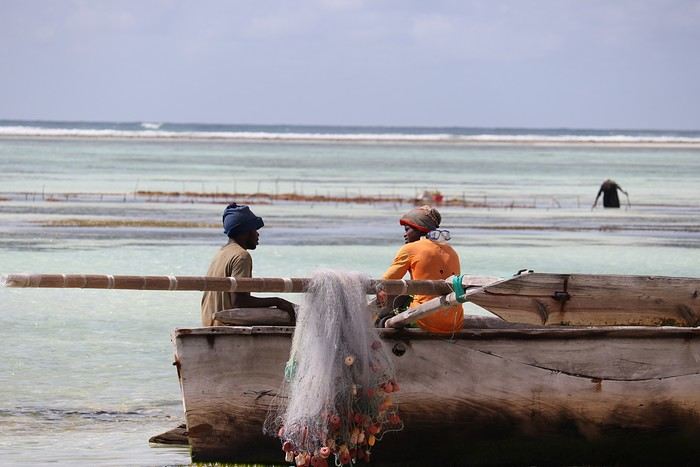
This is the spot where we can chill and chat about fishing at sea worldwide 😊
Here are two charming fishermen taking a well-deserved break near Zanzibar!
Off on an adventure to Java (and a bit of Bali)
Hey there, community! Back this weekend, below is my travel journal from my adventure in Indonesia. Enjoy the read!!!
Day 1 - August 10, 2025 New life downloading for three weeks! And for that, Flo and I launched a public tender... A public tender? What’s that got to do with a travel journal???... Well, when you think about it, few destinations tick all the boxes for an August adventure: Meaning, finding a place that’s exotic in the middle of August, not too expensive, not too packed with tourists, warm but not *too* warm, with postcard-perfect landscapes, dreamy beaches, tasty cuisine with a hint of exoticism, friendly and welcoming locals, where you’re free to sleep under the stars among the mosquitos, take transport surrounded by chickens, and even eat from a pig trough if you feel like it—well, turns out it’s not that easy to find! I’d even say, given how thick the list of requirements is, there’s a big risk the tender could be declared unsuccessful for failing to meet just one criterion. Let’s just say the candidates better submit a rock-solid proposal!
After reviewing all the responses and presentations from the candidates, the obvious choice for us is... Indonesia! Except that trying to explore a country as vast as Indonesia and its 17,504 islands in less than five years is a bit like reading the summary of a Proust novel without taking the time to savor each of its 950 pages! Don’t worry, I won’t name them all here. Besides, do they even all have names? No! Only 7,870 have been named—their parents clearly ran out of ideas for the rest. Anyway, our society, which worships the "work more to earn more" mantra, unfortunately limits our adventure time. So we’ll only get to see a small part of Indonesia, and we’ll have to make a tough choice to head for the best of the best in this archipelago of over seventeen thousand islands. Each one has its own selling points: Sumatra, Sulawesi, Java, the Celebes, Bali, Borneo, Papua, Timor, the Moluccas... So many names that smell of adventure... Another tender, another list of requirements, another review of proposals... Drumroll... Splash splash... And the lucky winner is... Ta-da... Java, Bali’s big sister, where I’ve already been eight years ago... Java the programming language. The Java of Broadway. We’re gonna *do* the Java. Java the coffee. And yes, Java is also an island!
This island, four times smaller than France, is home to 136 million people, making it the most populated island in the world! Fun fact: Indonesia, with its 260 million inhabitants, is just shy of the podium for the world’s most populated countries, after the winning trio of India, China, and the United States. And it’s on this island of Java that you’ll find Jakarta, the (soon-to-be-former) capital and main airport of the country, where we’ll soon land after our nineteen-hour flight! Yep, nineteen hours! I mean, Indonesia in general—and Java in particular—is a *tad* farther than going on vacation to Grandma Yoyo’s! Not sure where it is? Easy. Grab a map. Plant your finger on the big island at the bottom right—aka Australia for those who struggle with geography—move it up two centimeters, and bam, welcome to Indonesia!
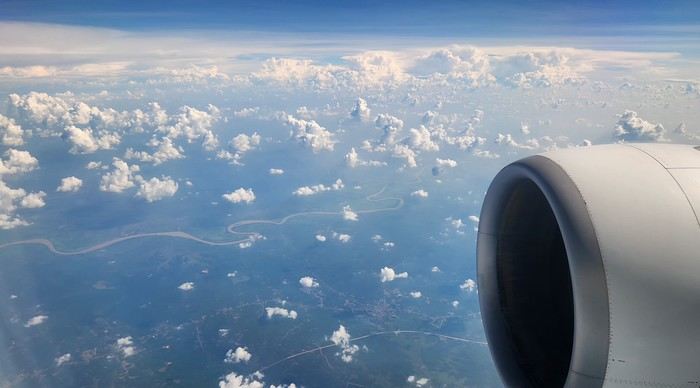
Nice transition, right? Because "Welcome to Indonesia" is exactly what the friendly flight attendant just said to me as we got off the plane! That’s it, our chakras are open, we’ve arrived at our (air)port. Time for rest, pool, cocktails, and a beach with our toes spread out... Wait, if you bought that, you clearly don’t know us yet! Since we still have energy to burn and need to adjust to the flight and time difference, we tackle the long administrative formalities to enter Indonesia, just to earn the right to hop in a 45-minute Grab taxi to the train station. The train station? What train station?... What do you usually do at a train station? Take a train, of course! Off we go for a three-hour train ride to Bandung, where we’ll officially start our adventure tomorrow after our first Indonesian night...
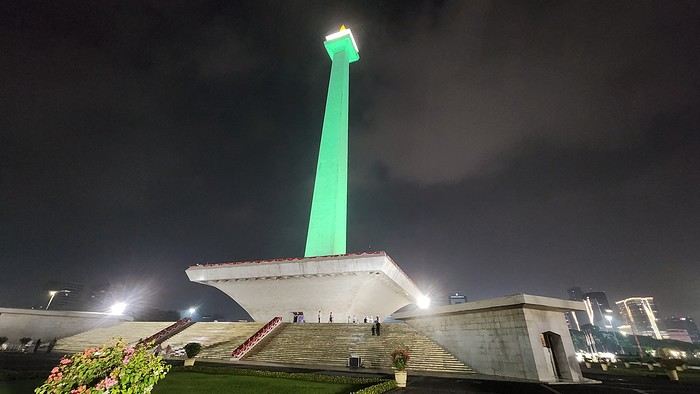
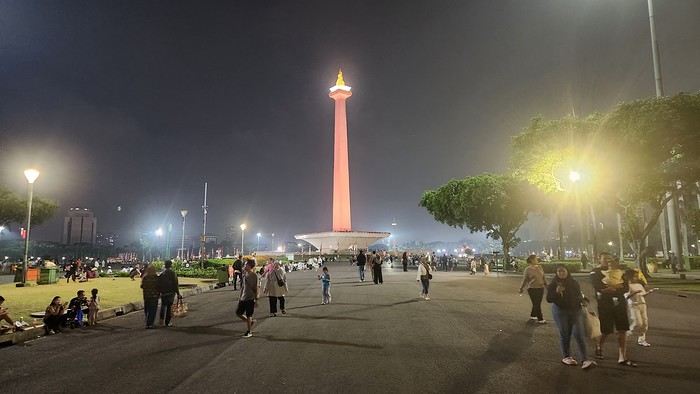
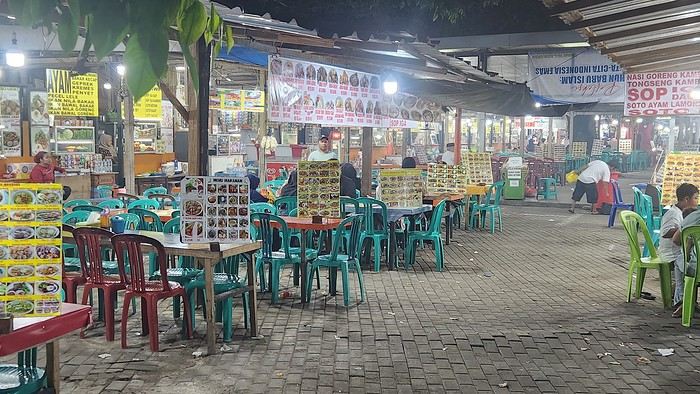
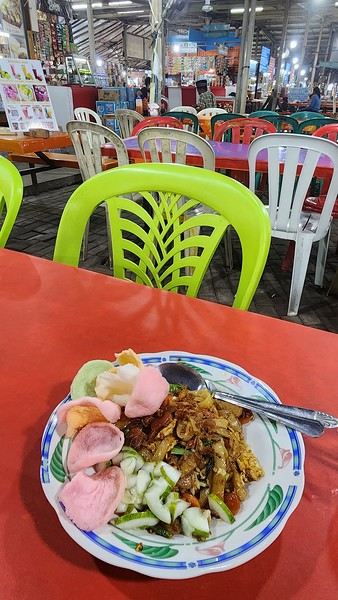
Unfortunately, we were a bit slow off the mark, which meant we missed the 6:25 PM train by two minutes. Oh well, we’ll have to wait until 11 PM. We take the opportunity to stretch our legs in Jakarta, soak up the atmosphere, and enjoy the delicious smells wafting from the *warungs*—those little typical street restaurants. A quick stop at the National Monument, a detour to a night market to devour our first *kwetiaw goreng* and *teh manis* for 60,000 rupiahs (that’s 3 € for two), and just like that, our penalty is lifted, and we’re allowed to hit the road again. Off to Bandung, where we arrive at 2 AM for... a *very* short night...
Day 1 - August 10, 2025 New life downloading for three weeks! And for that, Flo and I launched a public tender... A public tender? What’s that got to do with a travel journal???... Well, when you think about it, few destinations tick all the boxes for an August adventure: Meaning, finding a place that’s exotic in the middle of August, not too expensive, not too packed with tourists, warm but not *too* warm, with postcard-perfect landscapes, dreamy beaches, tasty cuisine with a hint of exoticism, friendly and welcoming locals, where you’re free to sleep under the stars among the mosquitos, take transport surrounded by chickens, and even eat from a pig trough if you feel like it—well, turns out it’s not that easy to find! I’d even say, given how thick the list of requirements is, there’s a big risk the tender could be declared unsuccessful for failing to meet just one criterion. Let’s just say the candidates better submit a rock-solid proposal!
After reviewing all the responses and presentations from the candidates, the obvious choice for us is... Indonesia! Except that trying to explore a country as vast as Indonesia and its 17,504 islands in less than five years is a bit like reading the summary of a Proust novel without taking the time to savor each of its 950 pages! Don’t worry, I won’t name them all here. Besides, do they even all have names? No! Only 7,870 have been named—their parents clearly ran out of ideas for the rest. Anyway, our society, which worships the "work more to earn more" mantra, unfortunately limits our adventure time. So we’ll only get to see a small part of Indonesia, and we’ll have to make a tough choice to head for the best of the best in this archipelago of over seventeen thousand islands. Each one has its own selling points: Sumatra, Sulawesi, Java, the Celebes, Bali, Borneo, Papua, Timor, the Moluccas... So many names that smell of adventure... Another tender, another list of requirements, another review of proposals... Drumroll... Splash splash... And the lucky winner is... Ta-da... Java, Bali’s big sister, where I’ve already been eight years ago... Java the programming language. The Java of Broadway. We’re gonna *do* the Java. Java the coffee. And yes, Java is also an island!
This island, four times smaller than France, is home to 136 million people, making it the most populated island in the world! Fun fact: Indonesia, with its 260 million inhabitants, is just shy of the podium for the world’s most populated countries, after the winning trio of India, China, and the United States. And it’s on this island of Java that you’ll find Jakarta, the (soon-to-be-former) capital and main airport of the country, where we’ll soon land after our nineteen-hour flight! Yep, nineteen hours! I mean, Indonesia in general—and Java in particular—is a *tad* farther than going on vacation to Grandma Yoyo’s! Not sure where it is? Easy. Grab a map. Plant your finger on the big island at the bottom right—aka Australia for those who struggle with geography—move it up two centimeters, and bam, welcome to Indonesia!
Nice transition, right? Because "Welcome to Indonesia" is exactly what the friendly flight attendant just said to me as we got off the plane! That’s it, our chakras are open, we’ve arrived at our (air)port. Time for rest, pool, cocktails, and a beach with our toes spread out... Wait, if you bought that, you clearly don’t know us yet! Since we still have energy to burn and need to adjust to the flight and time difference, we tackle the long administrative formalities to enter Indonesia, just to earn the right to hop in a 45-minute Grab taxi to the train station. The train station? What train station?... What do you usually do at a train station? Take a train, of course! Off we go for a three-hour train ride to Bandung, where we’ll officially start our adventure tomorrow after our first Indonesian night...
Unfortunately, we were a bit slow off the mark, which meant we missed the 6:25 PM train by two minutes. Oh well, we’ll have to wait until 11 PM. We take the opportunity to stretch our legs in Jakarta, soak up the atmosphere, and enjoy the delicious smells wafting from the *warungs*—those little typical street restaurants. A quick stop at the National Monument, a detour to a night market to devour our first *kwetiaw goreng* and *teh manis* for 60,000 rupiahs (that’s 3 € for two), and just like that, our penalty is lifted, and we’re allowed to hit the road again. Off to Bandung, where we arrive at 2 AM for... a *very* short night...
From Southern Shikoku, between land and sea, to the blue waters of Miyakojima and finally the Tokyo metropolis
From Southern Shikoku, between land and sea, to the blue waters of Miyakojima and finally Tokyo’s megacity
Hi everyone,
I have to admit, I really hesitated before deciding to write this travel journal... Writing one takes a lot of time and energy, and since this is my 4th trip, I wondered if it would even interest anyone other than myself (both for the discovery and the writing). But after a few people asked, "Are you going to write a journal?" and especially after rediscovering the joy of reading other travelers’ journals about Japan or elsewhere on this forum, I’ve decided to share my 4th installment in the Land of the Rising Sun here.
The itinerary: 27 full days, from late May to late June 2025, right in the middle of the rainy season, including:
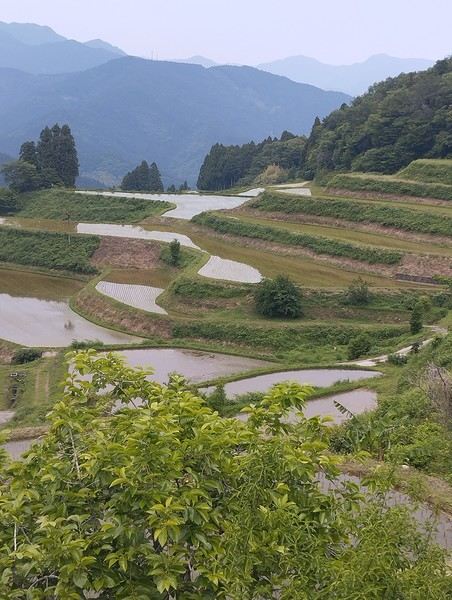
-->13 days in Shikoku, from Kochi (Kochi Prefecture) to Matsuyama (Ehime Prefecture)
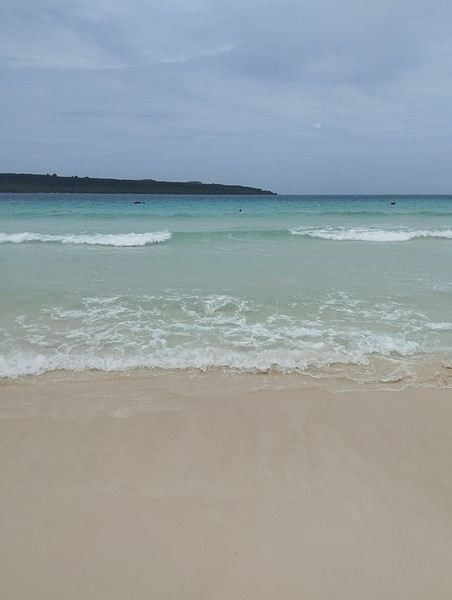
-->7 days in Miyakojima (Okinawa Prefecture)
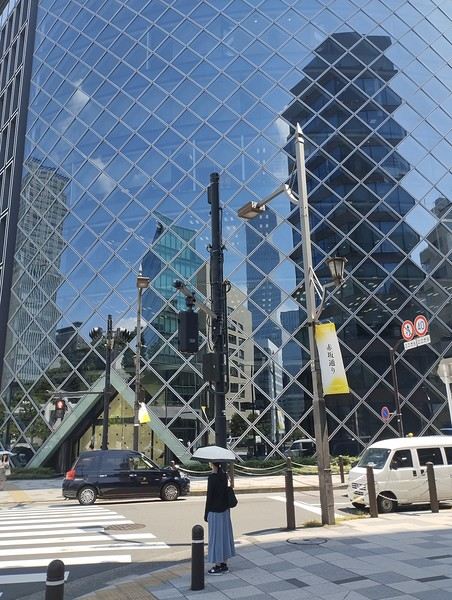
-->7 days in Tokyo
The trip was decided on fairly last-minute again this year.
Since I regularly check flight prices to track fluctuations for this destination even without concrete plans, stumbling upon a slightly cheaper direct flight (900 €) than what I’d seen in previous months (around 1,200–1,400 € on average) for a Paris-Tokyo route with Japanese airline ANA was too tempting to resist the urge to return to this enchanting country. After much hesitation between exploring the San’in region (Matsue, Tottori, Yamaguchi) and Southern Shikoku, the decision was made—I took the plunge! The ticket is booked: Paris to Kochi with a layover in Tokyo, all with ANA, the airline I’d been dreaming of... for 1,120 € per person. Okay, it’s not cheap, but it’s better than in 2023.
Departure in 2 weeks! Now I just have to get everything ready!
Intense prep work over these next 2 weeks to:
finalize a more precise itinerary and reach an agreement—yep, because even though we both love Japan, our preferences differ slightly, and we have to choose between exploring new places or revisiting beloved spots... decide how much time to spend in each area without rushing while still exploring research places that might interest us and watch videos about Japan book accommodations: yes, it’s possible to do this on the spot, but last year, we realized that last-minute options were pretty expensive, so we’re booking ahead—though we’ll keep a few options open in case better deals pop up later reserve rental cars order yen check the weather regularly and wonder if choosing the *tsuyu* (rainy season) was really a good idea—are we going to be drenched the whole time???
"What hard work," you might say! Going to Japan for a month—what a tough life! Despite this being my 4th trip, the excitement is just as intense as the first time.
The only small downside is that when we booked the flight, there weren’t many seats left, so we’re only sitting together on the international return flight. Plus, on the way there, we have middle seats. Another lingering question: what French-language films will be available? According to the internet, the selection seems limited. Oh well, these are just minor details—it’s already time to fly! PS: I’ll be posting slowly and irregularly... so for those interested, be patient, and maybe set an alert...
Hi everyone,
I have to admit, I really hesitated before deciding to write this travel journal... Writing one takes a lot of time and energy, and since this is my 4th trip, I wondered if it would even interest anyone other than myself (both for the discovery and the writing). But after a few people asked, "Are you going to write a journal?" and especially after rediscovering the joy of reading other travelers’ journals about Japan or elsewhere on this forum, I’ve decided to share my 4th installment in the Land of the Rising Sun here.
The itinerary: 27 full days, from late May to late June 2025, right in the middle of the rainy season, including:
-->13 days in Shikoku, from Kochi (Kochi Prefecture) to Matsuyama (Ehime Prefecture)
-->7 days in Miyakojima (Okinawa Prefecture)
-->7 days in Tokyo
The trip was decided on fairly last-minute again this year.
Since I regularly check flight prices to track fluctuations for this destination even without concrete plans, stumbling upon a slightly cheaper direct flight (900 €) than what I’d seen in previous months (around 1,200–1,400 € on average) for a Paris-Tokyo route with Japanese airline ANA was too tempting to resist the urge to return to this enchanting country. After much hesitation between exploring the San’in region (Matsue, Tottori, Yamaguchi) and Southern Shikoku, the decision was made—I took the plunge! The ticket is booked: Paris to Kochi with a layover in Tokyo, all with ANA, the airline I’d been dreaming of... for 1,120 € per person. Okay, it’s not cheap, but it’s better than in 2023.
Departure in 2 weeks! Now I just have to get everything ready!
Intense prep work over these next 2 weeks to:
finalize a more precise itinerary and reach an agreement—yep, because even though we both love Japan, our preferences differ slightly, and we have to choose between exploring new places or revisiting beloved spots... decide how much time to spend in each area without rushing while still exploring research places that might interest us and watch videos about Japan book accommodations: yes, it’s possible to do this on the spot, but last year, we realized that last-minute options were pretty expensive, so we’re booking ahead—though we’ll keep a few options open in case better deals pop up later reserve rental cars order yen check the weather regularly and wonder if choosing the *tsuyu* (rainy season) was really a good idea—are we going to be drenched the whole time???
"What hard work," you might say! Going to Japan for a month—what a tough life! Despite this being my 4th trip, the excitement is just as intense as the first time.
The only small downside is that when we booked the flight, there weren’t many seats left, so we’re only sitting together on the international return flight. Plus, on the way there, we have middle seats. Another lingering question: what French-language films will be available? According to the internet, the selection seems limited. Oh well, these are just minor details—it’s already time to fly! PS: I’ll be posting slowly and irregularly... so for those interested, be patient, and maybe set an alert...
Family trip to Asia
Hello everyone,
My wife Fanny and I, along with our three kids (ages 10, 12, and 14), are planning a two-week trip to Asia during the February break. This would be our first big family trip, and we’re looking to mix discovery, a change of scenery, some relaxation, and cultural immersion. We want to avoid overly organized tours or over-touristed destinations.
Over 20 years ago, Fanny and I used to travel as a couple with backpacks, especially in India and Mongolia, but things have surely changed a lot since then. Now, we’re torn between:
• Thailand: for its diversity (beaches, temples, nature) and accessibility for a first family trip.
• Laos-Cambodia combo: for a potentially more authentic immersion, but we’re wondering if it’s well-suited for kids.
- Sri Lanka: it seems amazing and family-friendly? Is the political situation stable enough?
We have a few questions:
Which destination would you recommend for this kind of family setup? What itineraries might work for two weeks without feeling too rushed?
Logistics-wise: can we travel with a round-trip flight ticket, book a few basic hotels, and improvise the rest once we’re there? Or do we need to plan everything in advance (transport, accommodations, activities) for this time of year?
Thanks in advance for your valuable tips! Mathieu
Which destination would you recommend for this kind of family setup? What itineraries might work for two weeks without feeling too rushed?
Logistics-wise: can we travel with a round-trip flight ticket, book a few basic hotels, and improvise the rest once we’re there? Or do we need to plan everything in advance (transport, accommodations, activities) for this time of year?
Thanks in advance for your valuable tips! Mathieu
Your itinerary ideas for 12 nights in Thailand
Hi everyone,
I know my post might sound a bit repetitive with the questions asked regularly on this forum, but I’m feeling a little lost and thought I’d still ask for your help.
Here’s my situation:
I’m traveling to Thailand with my wife and 12-year-old son during the February 2025 school holidays. We’ll be spending 12 nights in the country.
So far, I only have our flight tickets to and from Phuket.
Now, I need to plan an itinerary that lets us discover beautiful places and the culture of this country.
I’d like to stay by the sea, with stunning fine-sand beaches and breathtaking landscapes in areas that aren’t too urban, but also be able to see some beautiful monuments, typical villages, and wildlife not too far away. That said, I don’t want to be lost deep in the jungle either—I’d like a bit of atmosphere in the evenings (no nightclubs, but rather nice bars with music).
I’ve done some research and here’s a first draft of what I might do:
Spend my first 3 nights in the suburbs of Phuket to explore the city and the province more broadly, Then head to Ko Yao Noi for 2 nights to discover the charms of Phang Nga Bay, Next, fly from Krabi to spend 4 nights on Koh Samui (maybe with a little excursion to Ko Pha Ngan?), Then fly back to Krabi to reach Koh Phi Phi for 2 nights, Finally, return to the Phuket area for my last night in Thailand to be close for my flight the next day.
The idea is to explore several places without having to pack and unpack every day, and to avoid spending hours on transport every day. What do you think? Do the places seem relevant? If so, does the number of nights seem appropriate? Thanks in advance for your help, Best regards, Lionel
Spend my first 3 nights in the suburbs of Phuket to explore the city and the province more broadly, Then head to Ko Yao Noi for 2 nights to discover the charms of Phang Nga Bay, Next, fly from Krabi to spend 4 nights on Koh Samui (maybe with a little excursion to Ko Pha Ngan?), Then fly back to Krabi to reach Koh Phi Phi for 2 nights, Finally, return to the Phuket area for my last night in Thailand to be close for my flight the next day.
The idea is to explore several places without having to pack and unpack every day, and to avoid spending hours on transport every day. What do you think? Do the places seem relevant? If so, does the number of nights seem appropriate? Thanks in advance for your help, Best regards, Lionel
Adventures of a Bygone Era: The Philippines in 1984
After several discussions on VF about travel journals from the Philippines, I decided to write this curiosity: a trip report from a journey made in 1984, when traveling to the Philippines was still an adventure.
A curiosity because writing a travel journal about a trip 35 years later isn’t common, but also (mostly?) because exploring the Philippines at that time had little in common with traveling there today.
Obviously, I’ve forgotten a number of facts, most of the details, but with the help of a few notes from that time and a stack of slides (yes, there was life before digital 😊), many memories came back and added to the highlights I’d never forgotten. The scanned slides aren’t always great quality, but there are still quite a few to brighten up this chatter. Back then, we didn’t snap photos like we do now—film was too expensive—so I don’t have pictures of every place we visited... too bad, comparing some of those spots to how they look today would’ve been interesting.
Why "Adventures"? Why call it "Adventures" in the Philippines in 1984, a word so often used for a simple exotic trip? - Because the lack of information (no *Guide du Routard*, no *Lonely Planet*, no *Michelin Guide*, nothing, and obviously no internet) gave this trip what’s at the heart of adventure: the unknown. - Because the political situation made the stay sometimes dangerous. - Because transportation conditions were always epic, often perilous. - Because the question of where we’d spend the night came up almost every evening. - And for... quite a few other reasons.
That said, we weren’t exactly explorers!
Why the Philippines? First of all, why go to the Philippines in 1984—a country not exactly set up for tourism and about which we knew very little? How could we get an idea of the beauty of the Philippines and its points of interest when we had no guides or photos?
The idea came to us from Thailand a year earlier, during our first long-haul trip. After touring the north of the country, we met a Frenchman living in Phuket, where there were only a few tourists in Patong, with just a few small hotels and guesthouses. Kata and Karon had no buildings or roads, Rawai only had three palm-thatched bungalows, including ours, and the other islands were unknown to tourists. There was plenty to discover, and we wanted to return to this beautiful country... but the Frenchman made us dream about the Philippines—a country to explore, with wild landscapes.
Long evenings of discussion over multiple Sprite-Mekong cocktails (what memories of those headaches!) finally convinced us we had to go to the Philippines.
Episode 0: Before Departure The decision was made: we’d go to the Philippines in May 1984. Our friends and family were surprised when we announced we were going on vacation to the Philippines (a bit like saying today we were going paddleboarding in the Kerguelen Islands 🤪).
These days, preparing for each of our trips takes long evenings of research, planning, and noting down good addresses... etc. But for the Philippines in 1984, preparation was quick: we had very little information about the country, we were leaving almost at random, and the discovery would only be more exciting.
We still had a few bits of info gathered here and there: the rice terraces in northern Luzon, volcanoes, Negros where we were supposed to visit an acquaintance, Cebu and its marine life (we ended up going elsewhere), and absolutely avoid Mindanao, which was practically at war with the regime. That was about it, but it was already a great itinerary.
Nothing was organized in advance; we’d see day by day. We had no idea about travel times or even the existence of transportation options. The main (and sometimes only) way to connect two islands was by overloaded, rusty ferry. Only the big cities had airports.
Let’s Go: Episode 1: Paris to Manila My travel journals always start after arriving at the airport—the Europe-to-“Other Continent” trip isn’t interesting—but the flight to the Philippines was already an adventure, so I’ll make an exception.
This was the era when only a few Asian airlines were on par with Western ones: Thai, Singapore Airlines, and Philippine Airlines. They had beautiful, brand-new planes, and to attract customers (almost exclusively “businessmen”) from the usual airlines (Air France, Lufthansa, British Airways), there was opulence on board: unlimited champagne, all sorts of cocktails... Compared to today’s long-haul flights, there was still one small difference: no personal screens, just one screen at the front of the cabin with one mandatory movie. And I don’t know why, but we only got James Bond films, both ways... that must’ve been the trend at the time.
The tourism boom to Southeast Asia hadn’t started yet, and the “Asian Tigers” weren’t a thing, so there weren’t many business trips. That meant long-haul flights made stops everywhere to fill the planes. Our Philippine Airlines Boeing 747 left London, picked us up in Paris, then stopped in Frankfurt to take on a few Germans. I don’t know why we then made a stop in Dubai—a totally exotic place at the time. There was nothing to do there... things have changed a lot since. It was a small town lost in the desert. The airport was tiny, with just one or two buildings and a supermarket. During the stopover, everyone had to get off the plane and walk to the supermarket. Photo and electronic equipment were dirt cheap—I guess that was the only reason for the stop. Maybe it was their first commercial move. Emirates didn’t exist yet, as I checked online, but anyway, the idea that such a remote place could have its own airline was unthinkable.
Online, I found this photo of Dubai Airport in 1980. Anyone who’s transited through today’s massive airport with its rows of A380s will appreciate it: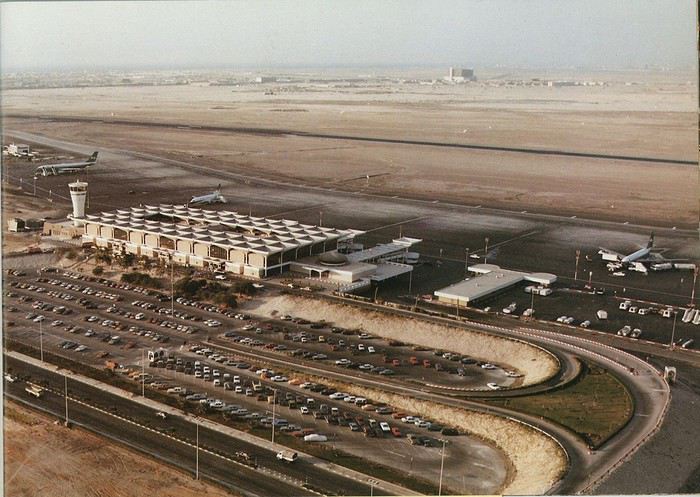
Next stop: New Delhi to drop off some Europeans and pick up a few Indians, and finally, the terminus: Manila. I don’t remember how long the trip took with its five stops—an unimaginable journey today. Despite all those stops to fill the plane, there was still enough space to stretch out on the four center seats of the 747, something that never happens these days despite all the flights in every direction.
So here we are, finally at Manila Airport around midnight.
Episode 1: Manila and Baguio To start, a quick note on the political and economic situation in the Philippines in 1984, which had consequences for us as tourists, as we’d soon realize upon arrival.
After several centuries of Spanish colonization, the Philippines became American at the start of the 20th century, then independent. In 1966, Marcos took power, and little by little, his regime sank into corruption and mismanagement, becoming a dictatorship with martial law, all for the benefit of his family and friends, who enriched themselves endlessly. The peak was the assassination of opposition leader Benigno Aquino in August 1983, which triggered harshly repressed protests. So we arrived a few months later in a very poor country, with omnipresent corruption and an extremely tense political situation, as we’d soon see for ourselves. Major protests took place in the main cities during our trip—I’ll come back to that. Two years later, Marcos fled to Hawaii after being forced out of power following rigged elections. This historical context explains a lot of the situations we found ourselves in over the following weeks.
Arriving in the middle of the night isn’t very cheerful. Manila was already a huge city with many slums, where you could find a few business hotels like the Hilton or Intercontinental—way out of our budget—and plenty of run-down hotels. Luckily, two Indians we’d chatted with on the plane offered to take us to their usual hotel. They came to Manila twice a year for business. We accepted their offer, relieved not to have to look for a place to stay in the middle of the night, figuring the address must be good since they came back every time... we were wrong 🙁
We left the airport and immediately got a taste of the local vibe when we got into the taxi: the police asked for our passports. We thought: what’s more normal than police in a dictatorship?
But that wasn’t it at all. Our two Indian friends explained that the police were noting our names along with the taxi number and time. Crime in Manila was so bad that the taxi driver would be held responsible if anything happened to us... welcome to the Philippines 😎 😎
Historically, the Philippines was a very violent country, where everything was settled with guns or machetes. Previous governments had banned carrying weapons, but Marcos later allowed the free sale and carrying of guns, and disputes were settled with pistols again (or worse, as we’d discover later). Since he’d released most of the criminals from prison to form a paramilitary militia at his service (I’ll talk about our encounter with these “heroes” later), it was pretty dangerous to go into many parts of Manila, where these “tonton macoutes” ruled.
We arrived at our hotel without incident... and then things started badly. The room was infested with big cockroaches—exactly what I hate most in those kinds of countries. No way to find another hotel at that hour. After the long flight, the urge to take a shower was so strong that we squeezed into the bathroom as best we could. After that, I don’t remember—I guess we must’ve fallen asleep exhausted under the sheets in the heat... air conditioning wasn’t widespread yet.
The next day, we just wanted to leave that dump as soon as possible. So we decided to head north right away, stopping in Baguio, and we’d visit Manila a bit on the way back.
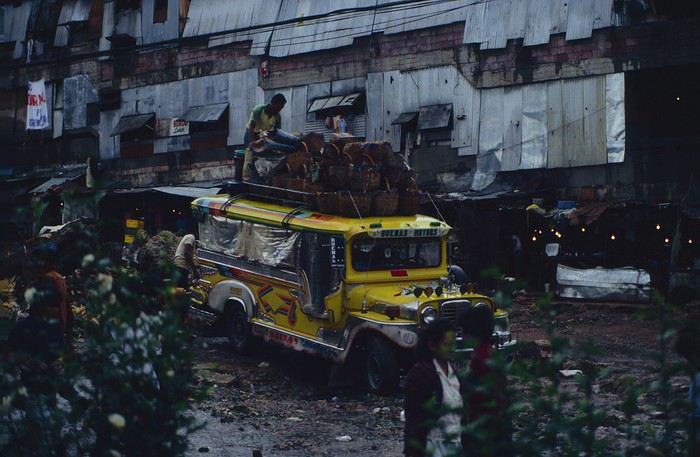
When we stepped outside, we discovered a pretty run-down neighborhood with potholed streets. But we also discovered the jeepneys. They were everywhere, flooding the streets.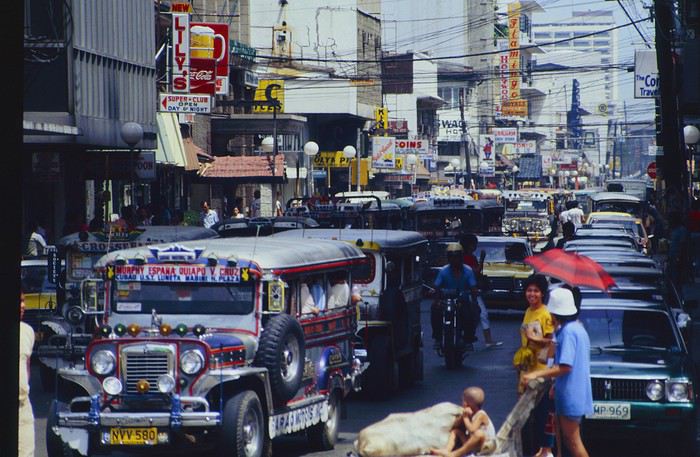
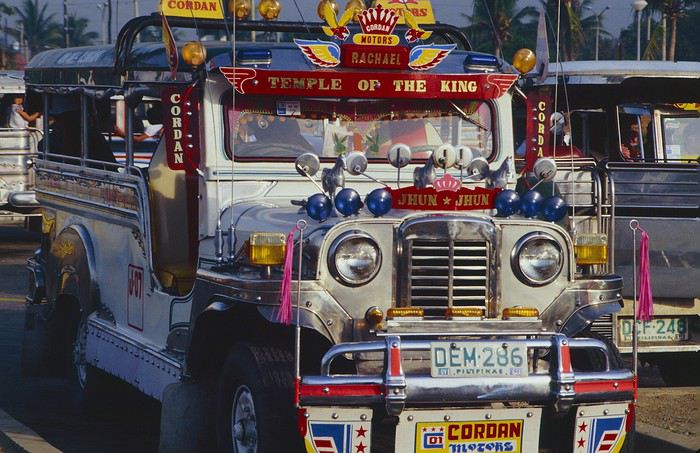
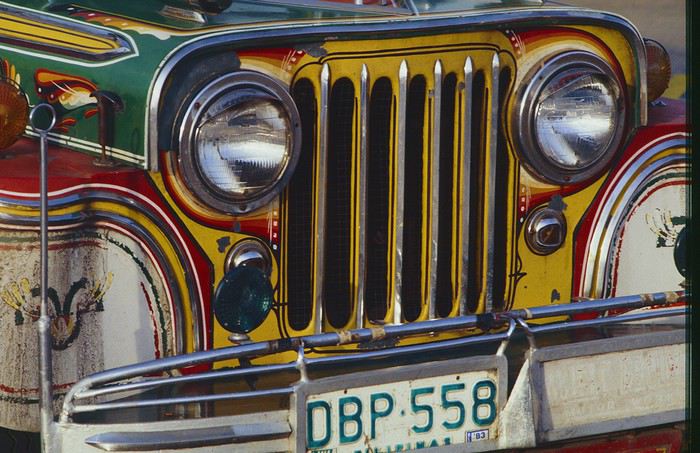
They had crazy sound systems, each one blasting louder than the last. The interiors were kitschy but fun. There weren’t many private cars—almost all transportation was by jeepney, with buses reserved for intercity trips.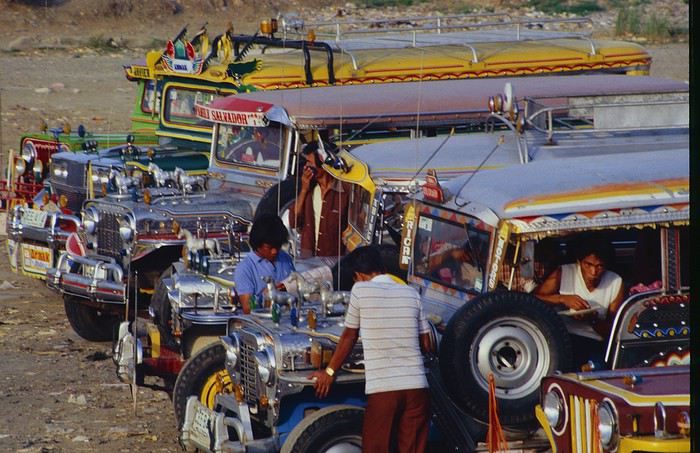
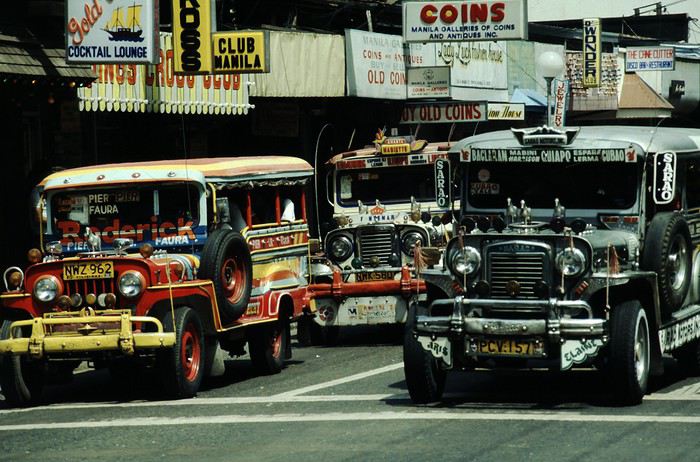
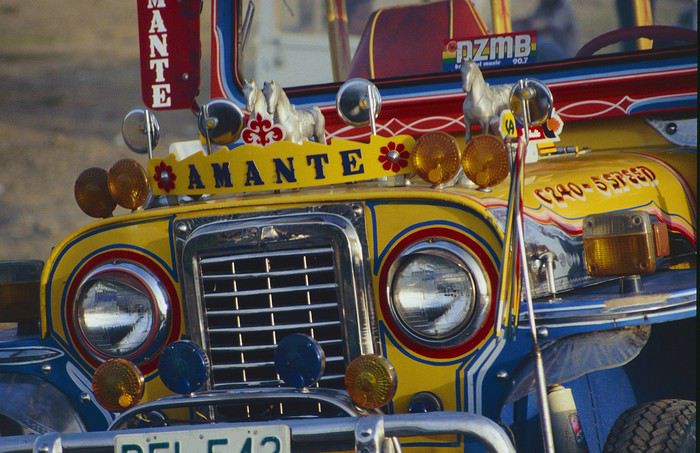
Before heading to the bus terminal for the north, somewhere on the outskirts of the city, we needed to exchange some money. I don’t remember how we ended up in a policeman’s jeep who offered his services: - Exchange money on the black market at a better rate than the banks. - Take us wherever we wanted, in this case, the bus terminal.
We accepted both offers (we’d still checked the official exchange rate from dollars to pesos). So we found ourselves in his jeep. After exchanging money, we left in his vehicle and stopped for gas. Without turning off the engine, he calmly smoked a cigarette while filling up. Since we were in a jeep with no doors or roof, we were ready to jump out if things went south, our travel bag in hand.
But we weren’t done with surprises yet. Once we left the small streets, we ended up in a neighborhood with wide avenues and not much traffic, which didn’t justify his incredible behavior. At every intersection, he made the sign of the cross, closed his eyes, and crossed without looking. I was more stunned than terrified! It wasn’t until we got out of the car later that I told Anne-Marie what had happened. I’d seen everything because the cop had put me in the front seat. Luckily, A-Marie hadn’t noticed anything from the back. Crossing Manila by trusting God rather than the rules of the road was ultimately effective. We were lucky—the trip was off to a good start. 🙂 🙂
We then passed through a neighborhood where slums stretched on for a while, and we left our policeman—friendly but a bit crazy—with relief.
A few hours by bus later, here we are in Baguio, cool in the mountains. My memories of Baguio are pretty fuzzy. I remember a small town. After some research while writing this journal, I found that the population was 120,000 in 1980. Given the population density in each home, that confirms my memory of a smallish town. Outside the “official” district with the president’s summer residence and government buildings, there were two or three paved streets with nice houses. The rest was very dirty and very poor, with lots of slums and dirt roads.
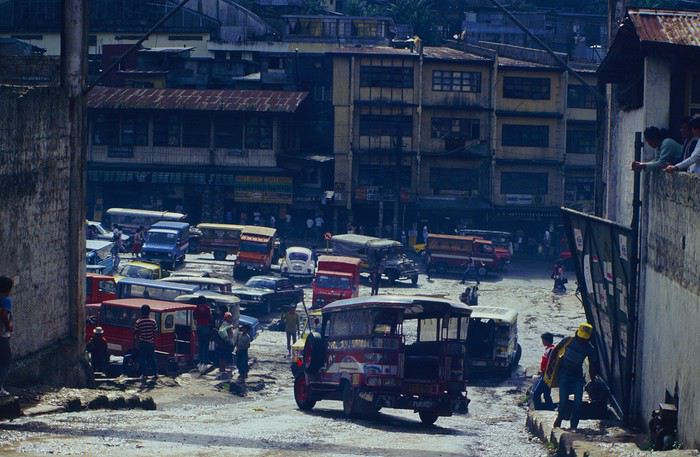
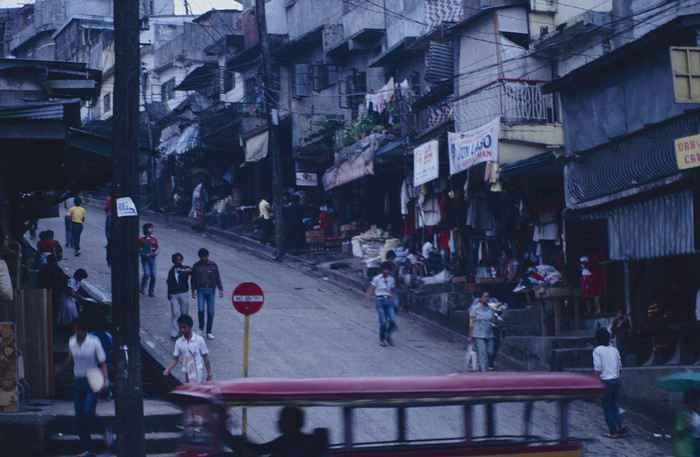
People we met on the street invited us to stay with them. These days, we wouldn’t just show up at strangers’ houses, which we should’ve done in Baguio—it would’ve saved us from an unimaginable and dangerous situation... which I won’t say anything about... !😊
The simple wooden house was on stilts at the edge of a hill with a view of the mountains. Since it was the start of the rainy season in a city that gets a lot of rain, we saw a lot of water. Our outings in town happened between downpours.
View from our lodging: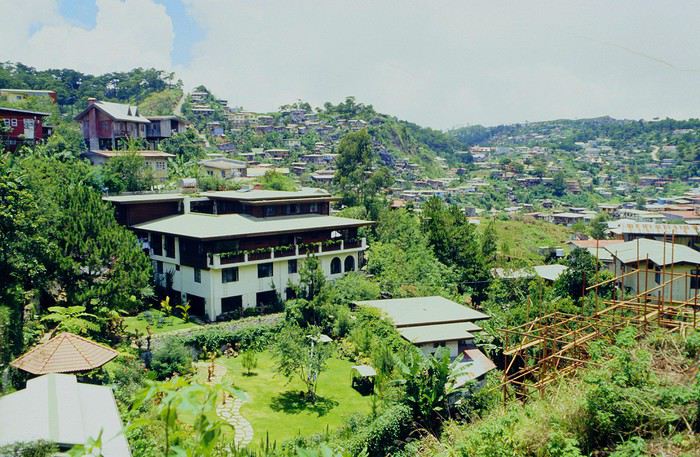
Episode 2: Baguio to Bontoc Aside from the situation briefly mentioned above, it was on the next leg to Bontoc that the adventure really began: an endless and dangerous road, a bus from another era, breathtaking landscapes, and surprising people.
We didn’t know the distance or how long it would take to get to Bontoc. When we arrived after about ten hours, we learned that Baguio to Bontoc was 140 km.
We got on a bus with wooden seats and settled in, two to a seat meant for two. As the bus filled up, passengers squeezed in three or four per seat, with chickens and baskets full of all sorts of things in the aisle. A little embarrassed, we didn’t know if we should squeeze in three on our seat. The seats were super tight (luckily, Filipinos are small), and I didn’t know where to put my legs given my height. I don’t remember if we stayed alone on our bench or if we ended up sharing with others.
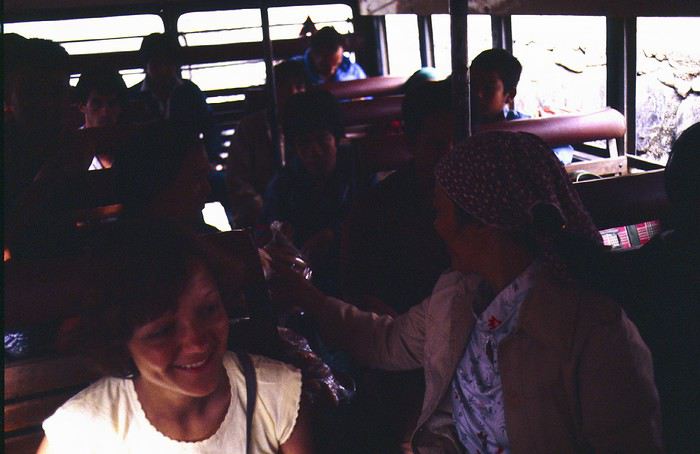
The “road” was a dirt track (or rather, a mud track) with endless turns. We held on as best we could to our slippery wooden seats—it was shaking in every direction. The woman behind us was carsick and throwing up... gross... but what were we doing there? Then we plunged into the Sierra Madre... just the name is dreamy!
Rice terraces started to appear: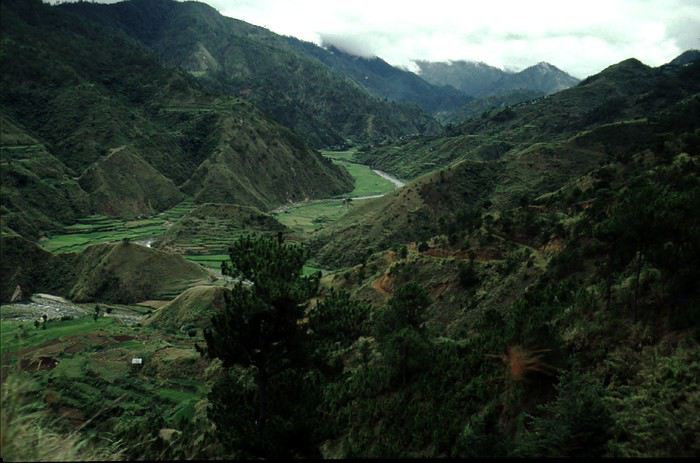
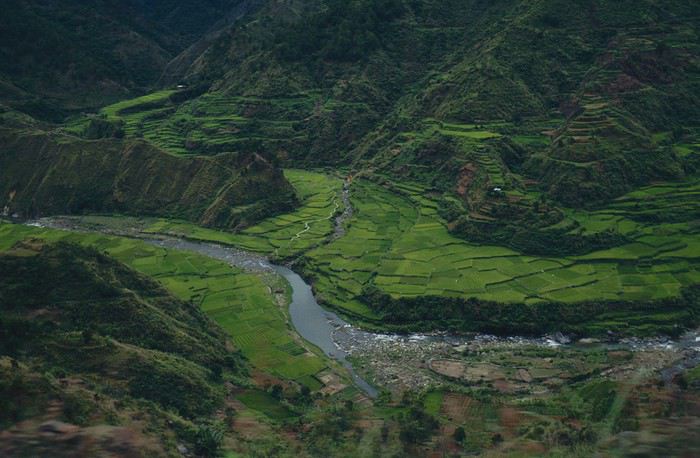
they took up more and more space along cliffs where we weren’t always reassured,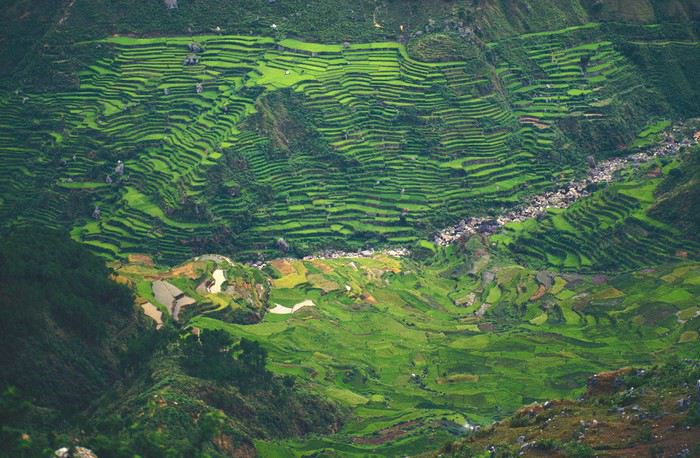
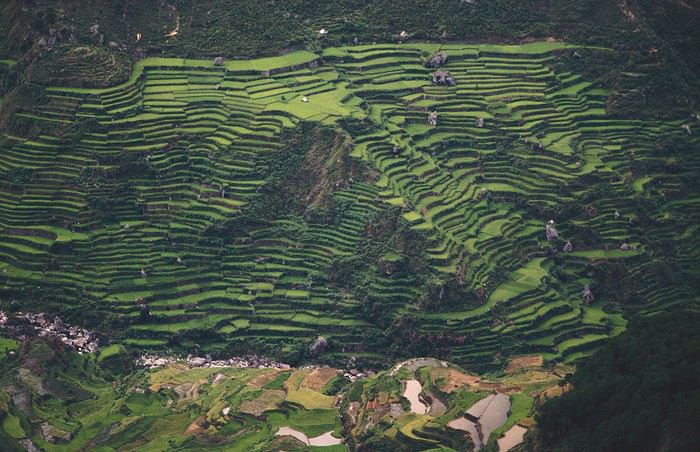
with lots of waterfalls (all that water had to go somewhere).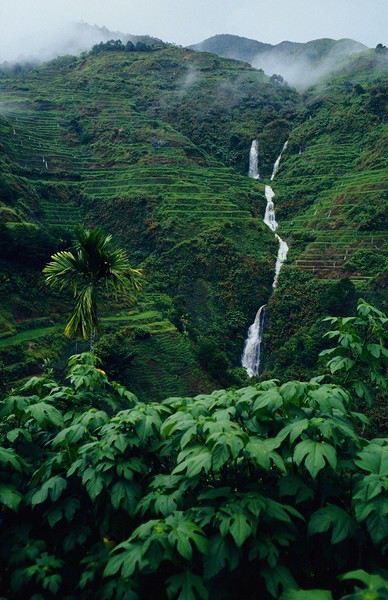
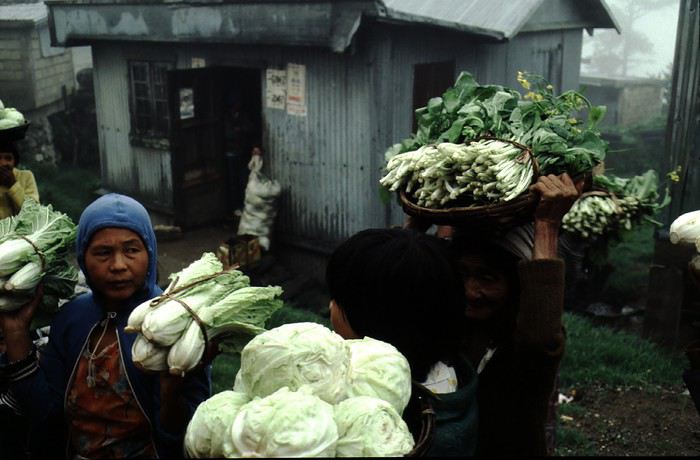
A few miserable villages stretched along the track, most often just a few houses balancing between the road and the drop. The bus stopped in every village—people got on or off and settled inside or on the roof. Street vendors offered their products to the bus passengers—a common sight in Asia, even today.
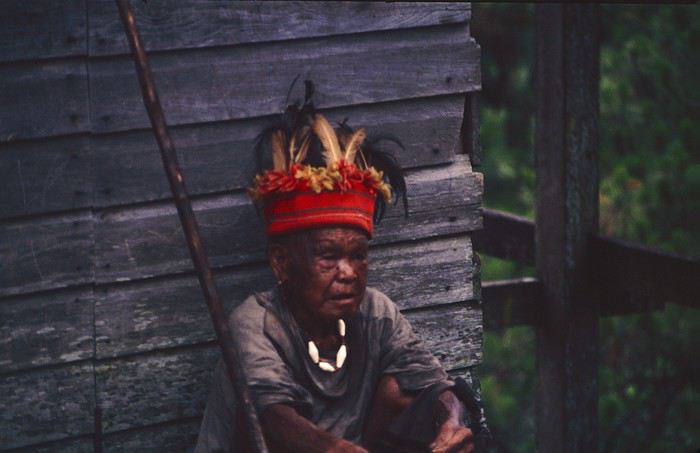
We were in another world—villagers were in loincloths, others had spears. The atmosphere was strange... but all good, we wanted exoticism, and we got it: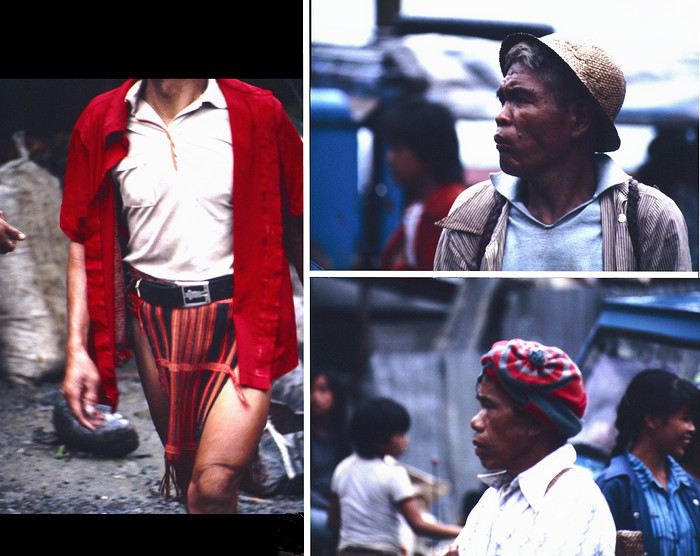
This so-called traditional outfit was everyday wear—it wasn’t for tourists since there weren’t any.
A curiosity because writing a travel journal about a trip 35 years later isn’t common, but also (mostly?) because exploring the Philippines at that time had little in common with traveling there today.
Obviously, I’ve forgotten a number of facts, most of the details, but with the help of a few notes from that time and a stack of slides (yes, there was life before digital 😊), many memories came back and added to the highlights I’d never forgotten. The scanned slides aren’t always great quality, but there are still quite a few to brighten up this chatter. Back then, we didn’t snap photos like we do now—film was too expensive—so I don’t have pictures of every place we visited... too bad, comparing some of those spots to how they look today would’ve been interesting.
Why "Adventures"? Why call it "Adventures" in the Philippines in 1984, a word so often used for a simple exotic trip? - Because the lack of information (no *Guide du Routard*, no *Lonely Planet*, no *Michelin Guide*, nothing, and obviously no internet) gave this trip what’s at the heart of adventure: the unknown. - Because the political situation made the stay sometimes dangerous. - Because transportation conditions were always epic, often perilous. - Because the question of where we’d spend the night came up almost every evening. - And for... quite a few other reasons.
That said, we weren’t exactly explorers!
Why the Philippines? First of all, why go to the Philippines in 1984—a country not exactly set up for tourism and about which we knew very little? How could we get an idea of the beauty of the Philippines and its points of interest when we had no guides or photos?
The idea came to us from Thailand a year earlier, during our first long-haul trip. After touring the north of the country, we met a Frenchman living in Phuket, where there were only a few tourists in Patong, with just a few small hotels and guesthouses. Kata and Karon had no buildings or roads, Rawai only had three palm-thatched bungalows, including ours, and the other islands were unknown to tourists. There was plenty to discover, and we wanted to return to this beautiful country... but the Frenchman made us dream about the Philippines—a country to explore, with wild landscapes.
Long evenings of discussion over multiple Sprite-Mekong cocktails (what memories of those headaches!) finally convinced us we had to go to the Philippines.
Episode 0: Before Departure The decision was made: we’d go to the Philippines in May 1984. Our friends and family were surprised when we announced we were going on vacation to the Philippines (a bit like saying today we were going paddleboarding in the Kerguelen Islands 🤪).
These days, preparing for each of our trips takes long evenings of research, planning, and noting down good addresses... etc. But for the Philippines in 1984, preparation was quick: we had very little information about the country, we were leaving almost at random, and the discovery would only be more exciting.
We still had a few bits of info gathered here and there: the rice terraces in northern Luzon, volcanoes, Negros where we were supposed to visit an acquaintance, Cebu and its marine life (we ended up going elsewhere), and absolutely avoid Mindanao, which was practically at war with the regime. That was about it, but it was already a great itinerary.
Nothing was organized in advance; we’d see day by day. We had no idea about travel times or even the existence of transportation options. The main (and sometimes only) way to connect two islands was by overloaded, rusty ferry. Only the big cities had airports.
Let’s Go: Episode 1: Paris to Manila My travel journals always start after arriving at the airport—the Europe-to-“Other Continent” trip isn’t interesting—but the flight to the Philippines was already an adventure, so I’ll make an exception.
This was the era when only a few Asian airlines were on par with Western ones: Thai, Singapore Airlines, and Philippine Airlines. They had beautiful, brand-new planes, and to attract customers (almost exclusively “businessmen”) from the usual airlines (Air France, Lufthansa, British Airways), there was opulence on board: unlimited champagne, all sorts of cocktails... Compared to today’s long-haul flights, there was still one small difference: no personal screens, just one screen at the front of the cabin with one mandatory movie. And I don’t know why, but we only got James Bond films, both ways... that must’ve been the trend at the time.
The tourism boom to Southeast Asia hadn’t started yet, and the “Asian Tigers” weren’t a thing, so there weren’t many business trips. That meant long-haul flights made stops everywhere to fill the planes. Our Philippine Airlines Boeing 747 left London, picked us up in Paris, then stopped in Frankfurt to take on a few Germans. I don’t know why we then made a stop in Dubai—a totally exotic place at the time. There was nothing to do there... things have changed a lot since. It was a small town lost in the desert. The airport was tiny, with just one or two buildings and a supermarket. During the stopover, everyone had to get off the plane and walk to the supermarket. Photo and electronic equipment were dirt cheap—I guess that was the only reason for the stop. Maybe it was their first commercial move. Emirates didn’t exist yet, as I checked online, but anyway, the idea that such a remote place could have its own airline was unthinkable.
Online, I found this photo of Dubai Airport in 1980. Anyone who’s transited through today’s massive airport with its rows of A380s will appreciate it:
Next stop: New Delhi to drop off some Europeans and pick up a few Indians, and finally, the terminus: Manila. I don’t remember how long the trip took with its five stops—an unimaginable journey today. Despite all those stops to fill the plane, there was still enough space to stretch out on the four center seats of the 747, something that never happens these days despite all the flights in every direction.
So here we are, finally at Manila Airport around midnight.
Episode 1: Manila and Baguio To start, a quick note on the political and economic situation in the Philippines in 1984, which had consequences for us as tourists, as we’d soon realize upon arrival.
After several centuries of Spanish colonization, the Philippines became American at the start of the 20th century, then independent. In 1966, Marcos took power, and little by little, his regime sank into corruption and mismanagement, becoming a dictatorship with martial law, all for the benefit of his family and friends, who enriched themselves endlessly. The peak was the assassination of opposition leader Benigno Aquino in August 1983, which triggered harshly repressed protests. So we arrived a few months later in a very poor country, with omnipresent corruption and an extremely tense political situation, as we’d soon see for ourselves. Major protests took place in the main cities during our trip—I’ll come back to that. Two years later, Marcos fled to Hawaii after being forced out of power following rigged elections. This historical context explains a lot of the situations we found ourselves in over the following weeks.
Arriving in the middle of the night isn’t very cheerful. Manila was already a huge city with many slums, where you could find a few business hotels like the Hilton or Intercontinental—way out of our budget—and plenty of run-down hotels. Luckily, two Indians we’d chatted with on the plane offered to take us to their usual hotel. They came to Manila twice a year for business. We accepted their offer, relieved not to have to look for a place to stay in the middle of the night, figuring the address must be good since they came back every time... we were wrong 🙁
We left the airport and immediately got a taste of the local vibe when we got into the taxi: the police asked for our passports. We thought: what’s more normal than police in a dictatorship?
But that wasn’t it at all. Our two Indian friends explained that the police were noting our names along with the taxi number and time. Crime in Manila was so bad that the taxi driver would be held responsible if anything happened to us... welcome to the Philippines 😎 😎
Historically, the Philippines was a very violent country, where everything was settled with guns or machetes. Previous governments had banned carrying weapons, but Marcos later allowed the free sale and carrying of guns, and disputes were settled with pistols again (or worse, as we’d discover later). Since he’d released most of the criminals from prison to form a paramilitary militia at his service (I’ll talk about our encounter with these “heroes” later), it was pretty dangerous to go into many parts of Manila, where these “tonton macoutes” ruled.
We arrived at our hotel without incident... and then things started badly. The room was infested with big cockroaches—exactly what I hate most in those kinds of countries. No way to find another hotel at that hour. After the long flight, the urge to take a shower was so strong that we squeezed into the bathroom as best we could. After that, I don’t remember—I guess we must’ve fallen asleep exhausted under the sheets in the heat... air conditioning wasn’t widespread yet.
The next day, we just wanted to leave that dump as soon as possible. So we decided to head north right away, stopping in Baguio, and we’d visit Manila a bit on the way back.
When we stepped outside, we discovered a pretty run-down neighborhood with potholed streets. But we also discovered the jeepneys. They were everywhere, flooding the streets.
They had crazy sound systems, each one blasting louder than the last. The interiors were kitschy but fun. There weren’t many private cars—almost all transportation was by jeepney, with buses reserved for intercity trips.
Before heading to the bus terminal for the north, somewhere on the outskirts of the city, we needed to exchange some money. I don’t remember how we ended up in a policeman’s jeep who offered his services: - Exchange money on the black market at a better rate than the banks. - Take us wherever we wanted, in this case, the bus terminal.
We accepted both offers (we’d still checked the official exchange rate from dollars to pesos). So we found ourselves in his jeep. After exchanging money, we left in his vehicle and stopped for gas. Without turning off the engine, he calmly smoked a cigarette while filling up. Since we were in a jeep with no doors or roof, we were ready to jump out if things went south, our travel bag in hand.
But we weren’t done with surprises yet. Once we left the small streets, we ended up in a neighborhood with wide avenues and not much traffic, which didn’t justify his incredible behavior. At every intersection, he made the sign of the cross, closed his eyes, and crossed without looking. I was more stunned than terrified! It wasn’t until we got out of the car later that I told Anne-Marie what had happened. I’d seen everything because the cop had put me in the front seat. Luckily, A-Marie hadn’t noticed anything from the back. Crossing Manila by trusting God rather than the rules of the road was ultimately effective. We were lucky—the trip was off to a good start. 🙂 🙂
We then passed through a neighborhood where slums stretched on for a while, and we left our policeman—friendly but a bit crazy—with relief.
A few hours by bus later, here we are in Baguio, cool in the mountains. My memories of Baguio are pretty fuzzy. I remember a small town. After some research while writing this journal, I found that the population was 120,000 in 1980. Given the population density in each home, that confirms my memory of a smallish town. Outside the “official” district with the president’s summer residence and government buildings, there were two or three paved streets with nice houses. The rest was very dirty and very poor, with lots of slums and dirt roads.
People we met on the street invited us to stay with them. These days, we wouldn’t just show up at strangers’ houses, which we should’ve done in Baguio—it would’ve saved us from an unimaginable and dangerous situation... which I won’t say anything about... !😊
The simple wooden house was on stilts at the edge of a hill with a view of the mountains. Since it was the start of the rainy season in a city that gets a lot of rain, we saw a lot of water. Our outings in town happened between downpours.
View from our lodging:
Episode 2: Baguio to Bontoc Aside from the situation briefly mentioned above, it was on the next leg to Bontoc that the adventure really began: an endless and dangerous road, a bus from another era, breathtaking landscapes, and surprising people.
We didn’t know the distance or how long it would take to get to Bontoc. When we arrived after about ten hours, we learned that Baguio to Bontoc was 140 km.
We got on a bus with wooden seats and settled in, two to a seat meant for two. As the bus filled up, passengers squeezed in three or four per seat, with chickens and baskets full of all sorts of things in the aisle. A little embarrassed, we didn’t know if we should squeeze in three on our seat. The seats were super tight (luckily, Filipinos are small), and I didn’t know where to put my legs given my height. I don’t remember if we stayed alone on our bench or if we ended up sharing with others.
The “road” was a dirt track (or rather, a mud track) with endless turns. We held on as best we could to our slippery wooden seats—it was shaking in every direction. The woman behind us was carsick and throwing up... gross... but what were we doing there? Then we plunged into the Sierra Madre... just the name is dreamy!
Rice terraces started to appear:
they took up more and more space along cliffs where we weren’t always reassured,
with lots of waterfalls (all that water had to go somewhere).
A few miserable villages stretched along the track, most often just a few houses balancing between the road and the drop. The bus stopped in every village—people got on or off and settled inside or on the roof. Street vendors offered their products to the bus passengers—a common sight in Asia, even today.
We were in another world—villagers were in loincloths, others had spears. The atmosphere was strange... but all good, we wanted exoticism, and we got it:
This so-called traditional outfit was everyday wear—it wasn’t for tourists since there weren’t any.
Été 2017: trois semaines en Colombie en famille
Comment la Colombie nous est venue à l’esprit ?
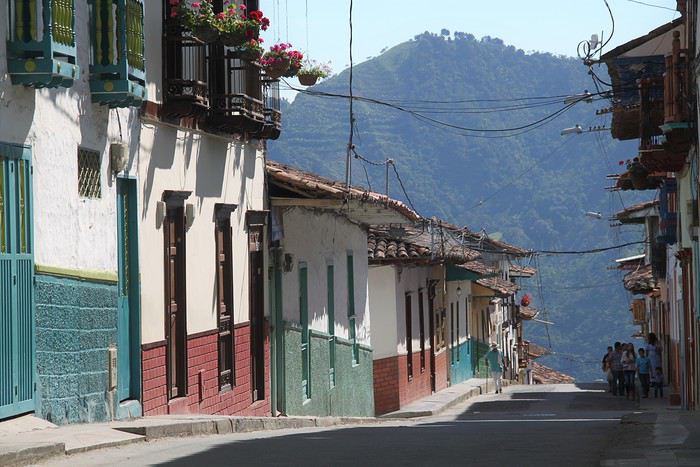
La première fois que j’ai entendu parler de la Colombie – comme destination touristique, j’entends –, c’était lors de notre voyage en Equateur au cours de notre hâlte à La Rana canto(que je recommande chaleureusement d’ailleurs pour qui voudrait faire un stop à la campagne. C’est vraiment très bien). Nadine et Pascal nous ont dit qu’ils commençaient à accueillir des backpackers venant de Colombie et que ces derniers trouvaient cela vraiment super.
Puis un podcast de Voyageurs du Monde m’a persuadée que la Colombie était le pays à visiter rapidement.
Ma fille (19 ans à l’époque) n’a pas été difficile à convaincre. Elle adore l’Amérique latine et une de ses meilleures amies a passé de nombreuses années en Colombie. Les garçons (mon tendre et cher, et notre fils - 17 ans) étaient loin d’être convaincus. Il faut dire que le site du ministère des affaires étrangères était tout sauf rassurant avec plein de rouge partout et un peu de jaune. Mais grâce à un travail de lobbying acharné et astucieux des filles, la promesse de bien rester dans les zones jaunes, ils ont fini par se laisser entraîner. (Entre notre décision et le voyage, le rouge du MAE a été largement réduit).
Restait à établir le parcours. La Colombie c’est grand, très grand. Et les routes sont lentes, très lentes. Pas question de vouloir trop en faire. Notre choix s’est porté sur la région du café, Medellin, Carthagène - parce que Carthagène a beau être très touristique, il nous paraissait difficilement envisageable de passer outre – et la Santander (avec Saint-Gil) que nous avons privilégié au parc de Tayrona (qui nous paraissait davantage semblable à ce que nous avions pu découvrir au cours de nos précédents voyages).
J’ai été guidée dans mes choix par les posts de Intothetrees -merci mille fois à lui- et le blog de Mars56 - merci aussi mille fois. Quelques blogs de voyageurs en tour du monde aussi (peu de sites évoquaient la Colombie à l’époque et j’ai découvert que les blogs de TDM étaient une bonne source d’information dans ce cas).
Pour optimiser les trajets, j’ai choisi une arrivée dans la région du café et un départ de Bogota. Trouver les billets au meilleur prix a été un peu compliqué et j’ai dû me résoudre à passer par un site de grossiste, chose que je ne fais jamais, en croisant les doigts pour ne pas avoir de problèmes. Deux vols intérieurs (Medellin – Carthagène et Carthagène – Bucaramanga) ont permis d’alléger les trajets.
Pour les hôtels, je n’ai pas eu le temps de potasser et puis à vrai dire, il n’y avait pas vraiment de quoi potasser. Je les ai choisis quelques jours à l’avance sur Booking en fonction des différents commentaires. Bien m’en a pris : en réservant depuis l’étranger – et Booking fait partie de « réserver depuis l’étranger », même nous étions déjà en Colombie lors de la réservation – on ne paye pas la TVA.
Au final, le trajet a donné cela.
5 août : trajet Paris - Perreira 6 août : Trajet pour Salamina – Salamina 7 août : Salamina - Balade aux alentours 8 août : Salamina - San Felix-vallée de Samaria 9 août : en route pour Jardin de Antoquia 10 août : Jardin de Antoquia 11 août : Jardin de Antoquia 12 août : trajet pour Medellín - musée de Antoquia 13 août : Guatape 14 août : Medellín - Free tour- Metrocable et Comuna 13 15 août : trajet pour Carthagène - Carthagène 16 août : Carthagène 17 août : Carthagène – les îles de Rosaire 18 août : Carthagène – La Boquhttp://illa 19 août : En route pour San Gil. Non ! pour Bogota ! 20 août : San Gil 21 août : Barichara- Guane 22 août : Rafting à San Gil 23 août : San Gil- Guadalupe 24 août : Guadalupe 25 août : Trajet pour Bogotá 26 août : Bogotá – bike tour – La calendelaria- musée de l’or 27 août : Bogotá - Montserrat- retour sur Paris
Tant pis pour la carte que j'ai faite sur Google earth : je ne peux pas la télécharger, pas assez de pixels!!
Nous avons donc adopté un rythme cool, nous laissant le temps de la découverte mais aussi du repos entre des trajets qui ont été souvent chaotiques voire complétement chamboulés. J’y reviendrai.
Un petit bilan, avant de passer au détail du récit : nous avons tout quatre bien apprécié la Colombie et les Colombiens. Le très bon espagnol de notre fille nous a beaucoup aidé à la fois pour nous débrouiller – mais nous aurions pu faire sans – mais aussi pour échanger avec les gens, notamment dans le bus. Le Colombie est un pays vraiment très chouette et mon seul regret, partagé par au moins un autre membre de la famille (je vous laisse deviner lequel), est de ne pas avoir eu plus de temps pour, par exemple, aller à Mompox ou encore Mongi.
Quant à la sécurité, souvent source d’interrogations, jamais nous ne nous sommes sentis menacés. Bien sûr nous avons pris les précautions d’usage et, dans les villes, Medellín et Bogotá, j’avais choisi pour nous loger les quartiers les plus sécures, peut-être moins typiques mais plus simples à gérer. Evidemment, cela ne veut pas dire qu’il n’y pas de problèmes, mais nous n’avons pas eu de soucis pour voyager. Dans la région du café, nous avons croisé maints militaires dûment armés, un peu impressionnant quand même.
La première fois que j’ai entendu parler de la Colombie – comme destination touristique, j’entends –, c’était lors de notre voyage en Equateur au cours de notre hâlte à La Rana canto(que je recommande chaleureusement d’ailleurs pour qui voudrait faire un stop à la campagne. C’est vraiment très bien). Nadine et Pascal nous ont dit qu’ils commençaient à accueillir des backpackers venant de Colombie et que ces derniers trouvaient cela vraiment super.
Puis un podcast de Voyageurs du Monde m’a persuadée que la Colombie était le pays à visiter rapidement.
Ma fille (19 ans à l’époque) n’a pas été difficile à convaincre. Elle adore l’Amérique latine et une de ses meilleures amies a passé de nombreuses années en Colombie. Les garçons (mon tendre et cher, et notre fils - 17 ans) étaient loin d’être convaincus. Il faut dire que le site du ministère des affaires étrangères était tout sauf rassurant avec plein de rouge partout et un peu de jaune. Mais grâce à un travail de lobbying acharné et astucieux des filles, la promesse de bien rester dans les zones jaunes, ils ont fini par se laisser entraîner. (Entre notre décision et le voyage, le rouge du MAE a été largement réduit).
Restait à établir le parcours. La Colombie c’est grand, très grand. Et les routes sont lentes, très lentes. Pas question de vouloir trop en faire. Notre choix s’est porté sur la région du café, Medellin, Carthagène - parce que Carthagène a beau être très touristique, il nous paraissait difficilement envisageable de passer outre – et la Santander (avec Saint-Gil) que nous avons privilégié au parc de Tayrona (qui nous paraissait davantage semblable à ce que nous avions pu découvrir au cours de nos précédents voyages).
J’ai été guidée dans mes choix par les posts de Intothetrees -merci mille fois à lui- et le blog de Mars56 - merci aussi mille fois. Quelques blogs de voyageurs en tour du monde aussi (peu de sites évoquaient la Colombie à l’époque et j’ai découvert que les blogs de TDM étaient une bonne source d’information dans ce cas).
Pour optimiser les trajets, j’ai choisi une arrivée dans la région du café et un départ de Bogota. Trouver les billets au meilleur prix a été un peu compliqué et j’ai dû me résoudre à passer par un site de grossiste, chose que je ne fais jamais, en croisant les doigts pour ne pas avoir de problèmes. Deux vols intérieurs (Medellin – Carthagène et Carthagène – Bucaramanga) ont permis d’alléger les trajets.
Pour les hôtels, je n’ai pas eu le temps de potasser et puis à vrai dire, il n’y avait pas vraiment de quoi potasser. Je les ai choisis quelques jours à l’avance sur Booking en fonction des différents commentaires. Bien m’en a pris : en réservant depuis l’étranger – et Booking fait partie de « réserver depuis l’étranger », même nous étions déjà en Colombie lors de la réservation – on ne paye pas la TVA.
Au final, le trajet a donné cela.
5 août : trajet Paris - Perreira 6 août : Trajet pour Salamina – Salamina 7 août : Salamina - Balade aux alentours 8 août : Salamina - San Felix-vallée de Samaria 9 août : en route pour Jardin de Antoquia 10 août : Jardin de Antoquia 11 août : Jardin de Antoquia 12 août : trajet pour Medellín - musée de Antoquia 13 août : Guatape 14 août : Medellín - Free tour- Metrocable et Comuna 13 15 août : trajet pour Carthagène - Carthagène 16 août : Carthagène 17 août : Carthagène – les îles de Rosaire 18 août : Carthagène – La Boquhttp://illa 19 août : En route pour San Gil. Non ! pour Bogota ! 20 août : San Gil 21 août : Barichara- Guane 22 août : Rafting à San Gil 23 août : San Gil- Guadalupe 24 août : Guadalupe 25 août : Trajet pour Bogotá 26 août : Bogotá – bike tour – La calendelaria- musée de l’or 27 août : Bogotá - Montserrat- retour sur Paris
Tant pis pour la carte que j'ai faite sur Google earth : je ne peux pas la télécharger, pas assez de pixels!!
Nous avons donc adopté un rythme cool, nous laissant le temps de la découverte mais aussi du repos entre des trajets qui ont été souvent chaotiques voire complétement chamboulés. J’y reviendrai.
Un petit bilan, avant de passer au détail du récit : nous avons tout quatre bien apprécié la Colombie et les Colombiens. Le très bon espagnol de notre fille nous a beaucoup aidé à la fois pour nous débrouiller – mais nous aurions pu faire sans – mais aussi pour échanger avec les gens, notamment dans le bus. Le Colombie est un pays vraiment très chouette et mon seul regret, partagé par au moins un autre membre de la famille (je vous laisse deviner lequel), est de ne pas avoir eu plus de temps pour, par exemple, aller à Mompox ou encore Mongi.
Quant à la sécurité, souvent source d’interrogations, jamais nous ne nous sommes sentis menacés. Bien sûr nous avons pris les précautions d’usage et, dans les villes, Medellín et Bogotá, j’avais choisi pour nous loger les quartiers les plus sécures, peut-être moins typiques mais plus simples à gérer. Evidemment, cela ne veut pas dire qu’il n’y pas de problèmes, mais nous n’avons pas eu de soucis pour voyager. Dans la région du café, nous avons croisé maints militaires dûment armés, un peu impressionnant quand même.
Istanbul et côte lycienne en famille
Merhaba ! 😎
En famille, on vient de décider une destination voyage pour cet été: la Turquie.
La période serait du 4 au 18 août grosso modo. Au départ, on pensait partir un peu avant mais du 31 juillet au 3 août c'est Aïd El Adha, c'est peut-être un peu compliqué de visiter Istanbul dans ces conditions (fermeture des monuments et autres. Mais si l'ambiance est sympa pendant ces fêtes, on put changer d'avis)
Nous sommes 5: 2 adultes et 3 garçons de 17, 12 et 6 ans. Famille franco-espagnole qui vit en Andalousie (je dis ça au moment de comparer les climats en août, à Séville on a l'hbitude des 40 à l'ombre)
En principe, l'idée serait la suivante: combiner Istambul (5 jours: 4 au début, 1 à la fin du séjour) et côte lycienne (9 jours)
le 4, vol direct depuis Málaga (dans la soirée). nuit à Istanbul
5,6,7,8 -> 4 jours à Istanbul. Trouver un logement du côté de Karakoy ou Beyoglu.
Pour éviter les grosses chaleurs, j'ai pensé concentrer sur les matinées le côté monumental (Ste Sophie, Mosquée bleue, bazars, Mosquée Suleymaniye, Topkapi, etc).
L'après-midi, je cherche des options siestes, parcs ou zones ombragées, activités détente (hamam... mixte et/ou qui accepterait enfants? ça existe?), éventuellement piscine s'il y a...
Le soir, changer de quartier: bateau sur le Bosphore (il y a des bateaux-bus bon marché à recommander?), pont de Galata, zone Taksim, etc..
le 9, vol intérieur pour Dalaman (côte turquoise, province de Mugla) pour une grosse semaine (du 9 au 15). Voiture de location.
Et ensuite répartir le temps plus ou moins comme ça : 2 nuits à Dalyan, 2 nuits à Fethiye et 3 nuits à Kas ou Demre... C'est jouable ? Des conseils?
En vrac, j'ai noté: pour la zone Dalyan: plage Istuzu, site de Kaunas (en bateau) et bourg de Dalyan. bain de boue à Sultaniye
pour la zone Fethiye: Patara plage et ruines, vestiges de Xanthos, plage Oludeniz et criques du côté de Faralya. Village fantôme de Kayakoy.
pour la zone Kas: bourgs de Kas, Kalkan et Demre (et site de Myra), plage de Kaputas, excursion à Kekova et gorges de Saklikent, éventuellement site de Termessos.
le 16, retour à Istanbul (avion). le 17, un jour entier à Istanbul et départ le 18 pour Málaga.
Voilà pour l'instant où j'en suis. Rien de très concret. Des conseils ? Recommandations ? Des coins à éviter? (j'aimerais éviter le tourisme trop massifié et le littoral bétonné)
Merci d'avance pour vos réponses.
En famille, on vient de décider une destination voyage pour cet été: la Turquie.
La période serait du 4 au 18 août grosso modo. Au départ, on pensait partir un peu avant mais du 31 juillet au 3 août c'est Aïd El Adha, c'est peut-être un peu compliqué de visiter Istanbul dans ces conditions (fermeture des monuments et autres. Mais si l'ambiance est sympa pendant ces fêtes, on put changer d'avis)
Nous sommes 5: 2 adultes et 3 garçons de 17, 12 et 6 ans. Famille franco-espagnole qui vit en Andalousie (je dis ça au moment de comparer les climats en août, à Séville on a l'hbitude des 40 à l'ombre)
En principe, l'idée serait la suivante: combiner Istambul (5 jours: 4 au début, 1 à la fin du séjour) et côte lycienne (9 jours)
le 4, vol direct depuis Málaga (dans la soirée). nuit à Istanbul
5,6,7,8 -> 4 jours à Istanbul. Trouver un logement du côté de Karakoy ou Beyoglu.
Pour éviter les grosses chaleurs, j'ai pensé concentrer sur les matinées le côté monumental (Ste Sophie, Mosquée bleue, bazars, Mosquée Suleymaniye, Topkapi, etc).
L'après-midi, je cherche des options siestes, parcs ou zones ombragées, activités détente (hamam... mixte et/ou qui accepterait enfants? ça existe?), éventuellement piscine s'il y a...
Le soir, changer de quartier: bateau sur le Bosphore (il y a des bateaux-bus bon marché à recommander?), pont de Galata, zone Taksim, etc..
le 9, vol intérieur pour Dalaman (côte turquoise, province de Mugla) pour une grosse semaine (du 9 au 15). Voiture de location.
Et ensuite répartir le temps plus ou moins comme ça : 2 nuits à Dalyan, 2 nuits à Fethiye et 3 nuits à Kas ou Demre... C'est jouable ? Des conseils?
En vrac, j'ai noté: pour la zone Dalyan: plage Istuzu, site de Kaunas (en bateau) et bourg de Dalyan. bain de boue à Sultaniye
pour la zone Fethiye: Patara plage et ruines, vestiges de Xanthos, plage Oludeniz et criques du côté de Faralya. Village fantôme de Kayakoy.
pour la zone Kas: bourgs de Kas, Kalkan et Demre (et site de Myra), plage de Kaputas, excursion à Kekova et gorges de Saklikent, éventuellement site de Termessos.
le 16, retour à Istanbul (avion). le 17, un jour entier à Istanbul et départ le 18 pour Málaga.
Voilà pour l'instant où j'en suis. Rien de très concret. Des conseils ? Recommandations ? Des coins à éviter? (j'aimerais éviter le tourisme trop massifié et le littoral bétonné)
Merci d'avance pour vos réponses.