Results for "Cuba+souvenir+artisanat"
About 28,580 results.
More options
Many results are in French, the community’s main language. English translations are added over time.
Search results
Africa: A Heartfelt Love for a Continent
“When the Whites came to Africa, we had the land and they had the Bible. They taught us to pray with our eyes closed: when we opened them, the Whites had the land and we had the Bible.” Jomo Kenyatta (p.7)
The Maggi cube, an unchallenged hegemony, and so much more
“The hopeless continent,” headlined The Economist, a British magazine, in July 2000 about Africa. Eleven years later, the same magazine headlined “Africa rising” instead. Images of Africa in the prosperous North constantly oscillate between apocalyptic scenarios and enthusiastic projections. A key issue with such images lies in the generalization they entail. If you look at the continent, considerable contrasts emerge depending on space and time. It’s no surprise that a region of the world encompassing such diverse ecological zones, maintaining such varied ties with other continents, comprising nearly fifty nation-states in sub-Saharan Africa alone, and characterized by a great diversity of languages, belief systems, and historical paths, doesn’t share a single destiny.
And yet, for many people outside Africa, as well as for many Africans, the continent constitutes a single entity, defined by criteria such as skin color, a colonial past, poverty, and the art of survival. Until now, these perspectives were generally accompanied by the idea that Africa had to—or should have—followed a single path together, sometimes called development, sometimes modernization, sometimes liberation, then a market economy. None of these paths delivered on their promises.
The two writers Alain Mabanckou and Abdourahman Waberi—one from Congo, the other raised in Djibouti, both long settled in France and now professors at renowned North American universities (Los Angeles, Washington)—have had enough of pessimistic scenarios: “We are aware that Africa is in the world and the world is in Africa. The same goes for all other continents, as our destinies are inextricably linked for better or worse. We refuse to see Africa as a reservoir of misfortunes or a continent cursed by atavistic misfortune and characterized by ethnic conflicts. [...] It’s this passionate flame we wanted to capture in a book [...] a kind of stroll through African cultures, without any demands, each letter of the alphabet leading us to a notion, a practice, a concept, a moment in history, literature, painting, politics, economics, cuisine, etc.” (p.10-11). Africa, they write, is on the verge of “imposing a signature, a style, a way of being in the world and in relation to the rest of the world.” (p.11) To put words to the continent’s diversity and dynamism, the two authors created a “rambling ABC,” a kind of portrait—or more precisely, a mythography—that lets you see and feel the pulse of a vast continent whose cultural power is unfolding before our eyes. Once marginalized or even mocked, the voice and importance of the Continent in global affairs are now undeniable” (p.11), containing over a hundred entries, mostly concise, written in a relaxed and casual style. The optimistic, even exuberant tone is set from the brief introduction. The duo of authors wants to “sing a love song to the cultures of our continent, to its inhabitants past and present, to its exceptional resources and its spectacular globalization despite a certain pollution that still clouds our skies due to the unmatched duration of dictatorships in some of our regions.” (p.12) In doing so, they don’t want to be too distracted by today’s Afewerki-Biya-Bongo-Déby & Co. ...
Of course, you’ll find tributes to great precursors like Frantz Fanon (“[...] it was a love story and admiration that wasn’t dimmed by the four decades separating his birth from ours. Let’s add that we were born while the native of Fort-de-France had left the world’s stage four years earlier, in the prime of life” p.141), Mongo Beti (“You must read and reread Mongo Beti, a genius who used his fame to support often just causes in Africa, like defending oppressed groups. His place is already in History. His oppressors, like the dictators Ahmadou Ahidjo and Paul Biya, can’t compete in the same category” p.64), the Malian Amadou Hampâté Bâ
(“Posterity remembers him mainly as an tireless defender of African cultures. His plea for the collection and preservation of traditional African knowledge remains a major event for all men and women of good will. One day in 1960, at the UNESCO podium, the native of Bandiagara sounded the alarm: ‘[...] Since we’ve admitted that the humanity of each people is the heritage of all humanity, if African traditions aren’t collected in time and written down, they’ll one day be missing from the universal archives of humanity.’” p.51),
Kwame Nkrumah, “one of the founders of Pan-Africanism, father of Ghana’s independence” (p.239), as well as the historian Cheikh Anta Diop, the writer, poet, and politician Aimé Césaire, and the economist and thinker Samir Amin, but also very warm tributes to certain contemporary African intellectuals like Souleymane Bachir Diagne and Achille Mbembe
(“A few years ago, in dominant economic circles, a rumor often resurfaced, usually disguised as a cold and scientifically proven analysis: Africa is useless. It’s a burden for the rest of the human community. With its 2% share in world trade, it would disappear from stock market radars without anyone noticing. So? Maybe it’ll be pulled up by other continents. Wanting to surpass itself is a crazy bet for Africans, they concluded. Arrogant or clueless, President Nicolas Sarkozy declared before an audience of students and teachers at Cheikh Anta Diop University in Dakar: ‘The African man hasn’t entered history enough [...] He only knows the eternal repetition of time marked by the endless repetition of the same gestures and words.’ That was in 2007. For decades, armed only with reason, an intellectual often steps up to debunk prejudices, lazy readings, and dishonest frameworks used as false fronts by those who, like Nicolas Sarkozy or former journalist Stephen Smith, out of ignorance, contempt, or condescension, distort African reality. This intellectual is none other than the historian and political scientist Achille Mbembe. This heir of Frantz Fanon, Amílcar Cabral, Jean-Marc Ela, and Fabien Eboussi-Boulaga was born in 1957 in Cameroon, in the Bassa region. Marked early by the upheavals of a fratricidal war, Achille Mbembe became the guardian of the memory of martyrs. After brilliant studies in Paris, he went on to teach at the best American universities, but the call of the Continent was stronger than anything else. In Dakar, he once directed CODESRIA (Council for the Development of Social Science Research in Africa) before joining the University of the Witwatersrand in Johannesburg, South Africa. Even though the author of *Critique of Black Reason* (Éditions La Découverte, 2015) spends a few months at Duke University in North Carolina, his observation post remains South Africa. From Johannesburg, Achille Mbembe scrutinizes Africa and the whole world. A lucid observer with an elegant and generous pen, Achille Mbembe knows how to blend big and small history: ‘I was born one day in July, as the month was drawing to a close. It was 1957, in that part of Africa recently named ‘Cameroon,’ a memory of the wonder that seized Portuguese sailors in the 15th century when, sailing up the river near Douala, they couldn’t help but note the presence of a multitude of crustaceans, and named it *Rio dos Camarões*, meaning ‘River of Shrimp.’ I grew up in the shadow of this nameless land, since, in a way, the name it bears is only the product of someone else’s astonishment: a lexical mistake, if you will.’ From this mistake or wound, he made leaven, a springboard to compose a rich work, recognized worldwide. To denounce barriers and barbarians too. But that’s not enough. Among his peers in circles of thought and action, Achille Mbembe passionately and consistently defends human dignity and the beauty of the world. In doing so, he fulfills the mission Frantz Fanon entrusted to him.” (p.227-229),
as well as entries dedicated to lesser-known artists and intellectuals, like the French journalist and activist Rokhaya Diallo, daughter of Senegalese and Gambian parents, or the Ethiopian filmmaker Haile Gerima, who has long lived in the United States. Other names from politics, sports, music, art, and literature: Kofi Annan, p.36; Barack Obama, p.243; Thomas Sankara, p.277; Ousmane Sow, p.285; Yambo Ouologuem, p.250; Léopold Sédar Senghor, p.282; Muhammad Ali, p.30; Nuruddin Farah, p.146; Salif Keita, p.203; Ahmadou Kourouma, p.206; Ngũgĩ wa Thiong’o, p.236; Winnie Mandela, p.224; Kylian Mbappé, p.226 ...
The authors, who resolutely commit to a “mythography” (p.11) of Africa, also pay special attention to local social movements, cultural events, and aspects of daily life. *Y’en a marre*, “which also meant ‘we’re fed up with sitting on our hands’” (p.320-321), emerged about a decade ago in Senegal as a citizen movement of peaceful resistance and symbolizes, the authors emphasize, the fact that African youth are increasingly fed up “with the political circus deployed in Africa since independence, as our parents would say, ‘since the White man left’...” (p.321). A full entry is dedicated to the Maggi bouillon cube, which has flooded African markets for about forty years and enjoys immense popularity (“It’s everywhere in Africa, from Dakar to Djibouti, and from Tangier to Cape Town. It’s in every pot, every stew. Little hands put it in every sauce, every local or adapted dish. An unchallenged hegemony! You’ll find it in diasporas too. The culinary strolls in Paris, in the [...] neighborhood” p.90). Critics blame it not only for impoverishing the aromatic diversity of local dishes but also for being harmful to health. And yet, “he poorest Africans, those who eat only once a day, a few spoonfuls of white beans and a ball of *foufou*, for example, are the most fervent users of the magic cube.” (p.92-93)
For *fonio*, “the new trendy cereal. [...] From the millet family, fonio is probably the oldest cereal cultivated in West Africa, and mainly in its sub-Saharan part, for millennia. [...] Easy to grow, water-efficient, fonio grows everywhere except on clay soils. Long neglected because it was considered the poor man’s crop, fonio is now a source of pride for the farmers who cultivate it and cherish it like the apple of their eye” (p.156-157), the authors immediately offer a detailed recipe, letting the reader know that “e can’t resist sharing this fonio with chicken recipe from Mali with you:
Ingredients: 1 chicken 3 large ripe red tomatoes 4 tbsp tomato paste 4 large onions 1 garlic clove 1/2 cup oil 2 Maggi cubes or salt 2 large carrots 1 turnip 1 large cabbage 2 large potatoes 1 celery stalk 1 packet pre-cooked fonio 4 okra (or okra powder) salt, pepper
Preparation: 1. Prepare the sauce: wash and cut the chicken. Peel the onions, garlic, and vegetables. 2. In a pot, fry the chicken pieces. 3. Dice the onions, tomatoes, carrots, and turnip very small and add them to the pot. 4. Add the tomato paste, salt, and pepper. 5. Simmer for 15 min, then add 2 L of water and the cooked chicken pieces. 6. Simmer for 30 min, then add the crushed garlic and celery, plus the cabbage cut into 4 and the potatoes cut in half. 7. Prepare the fonio: cover it with warm water, let it rest for 15 min, and cook it over low heat. 8. In a small pot, boil the okra and crush them. 9. Mix the crushed okra with the cooked fonio, then salt. Serve hot.” (p.158-159)
The comedy *Black Mic Mac*, released in French theaters in 1986 and addressing France’s increasingly restrictive immigration policy at the time, also gets an entry, as do *Tintin in the Congo*, the popular comic, and *Jip’s Café* (“[...] a little Africa in the heart of Paris, with passersby stopping to admire the ‘ambianceurs’ on the dance floor or attend the cultural events offered by the place” (p.194), an African establishment in Paris that Alain Mabanckou already immortalized in one of his novels.
The duo of authors also tackles thorny subjects like jihadism (p.119), the Rwandan genocide (p.272), the CFA franc (p.82), and dictatorship (p.110). While the two strike the right tone here, many entries leave a slightly bitter taste. Two examples: why doesn’t the text on Barack Obama mention the great disappointment of many people in Africa, who expected more from the African policy of the first U.S. president with African roots than just occasional warm words? Why do the comments on Winnie Mandela gloss over the fact that she was a highly controversial icon of the anti-apartheid movement due to her involvement in kidnappings, acts of torture, and murders of alleged apartheid collaborators? Instead, there’s a compassion that brings tears to the eyes: “She was often reduced to a secondary role, the wife of a great man” or “When victory came, she didn’t taste its fruits. Divorced, isolated. She would never be a ‘first lady’ in an evening gown, posing before a bed of chrysanthemums. They’d keep her far from the circles of power” (p.224-225). At this point, I would’ve liked the authors to take a slightly more critical stance...
That said, these “weaknesses” (if you can call them that) shouldn’t overshadow the book as a whole. It remains an informative, sometimes very entertaining, and often even original work in its own way.
Book information (the original French and the German translation):
Alain Mabanckou/Abdourahman Waberi. Dictionnaire enjoué des cultures africaines. Fayard, 2019. Alain Mabanckou/Abdourahman Waberi. Der Puls Afrikas. Eine Liebeserklärung von A bis Z. Reclam, 2022.
Hery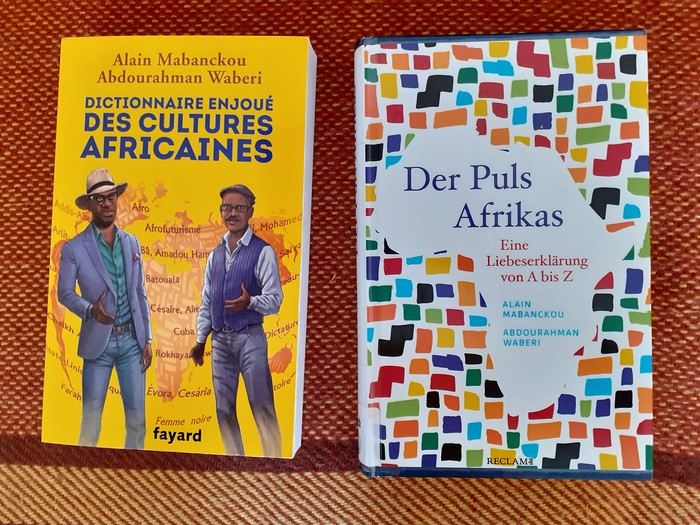
The Maggi cube, an unchallenged hegemony, and so much more
“The hopeless continent,” headlined The Economist, a British magazine, in July 2000 about Africa. Eleven years later, the same magazine headlined “Africa rising” instead. Images of Africa in the prosperous North constantly oscillate between apocalyptic scenarios and enthusiastic projections. A key issue with such images lies in the generalization they entail. If you look at the continent, considerable contrasts emerge depending on space and time. It’s no surprise that a region of the world encompassing such diverse ecological zones, maintaining such varied ties with other continents, comprising nearly fifty nation-states in sub-Saharan Africa alone, and characterized by a great diversity of languages, belief systems, and historical paths, doesn’t share a single destiny.
And yet, for many people outside Africa, as well as for many Africans, the continent constitutes a single entity, defined by criteria such as skin color, a colonial past, poverty, and the art of survival. Until now, these perspectives were generally accompanied by the idea that Africa had to—or should have—followed a single path together, sometimes called development, sometimes modernization, sometimes liberation, then a market economy. None of these paths delivered on their promises.
The two writers Alain Mabanckou and Abdourahman Waberi—one from Congo, the other raised in Djibouti, both long settled in France and now professors at renowned North American universities (Los Angeles, Washington)—have had enough of pessimistic scenarios: “We are aware that Africa is in the world and the world is in Africa. The same goes for all other continents, as our destinies are inextricably linked for better or worse. We refuse to see Africa as a reservoir of misfortunes or a continent cursed by atavistic misfortune and characterized by ethnic conflicts. [...] It’s this passionate flame we wanted to capture in a book [...] a kind of stroll through African cultures, without any demands, each letter of the alphabet leading us to a notion, a practice, a concept, a moment in history, literature, painting, politics, economics, cuisine, etc.” (p.10-11). Africa, they write, is on the verge of “imposing a signature, a style, a way of being in the world and in relation to the rest of the world.” (p.11) To put words to the continent’s diversity and dynamism, the two authors created a “rambling ABC,” a kind of portrait—or more precisely, a mythography—that lets you see and feel the pulse of a vast continent whose cultural power is unfolding before our eyes. Once marginalized or even mocked, the voice and importance of the Continent in global affairs are now undeniable” (p.11), containing over a hundred entries, mostly concise, written in a relaxed and casual style. The optimistic, even exuberant tone is set from the brief introduction. The duo of authors wants to “sing a love song to the cultures of our continent, to its inhabitants past and present, to its exceptional resources and its spectacular globalization despite a certain pollution that still clouds our skies due to the unmatched duration of dictatorships in some of our regions.” (p.12) In doing so, they don’t want to be too distracted by today’s Afewerki-Biya-Bongo-Déby & Co. ...
Of course, you’ll find tributes to great precursors like Frantz Fanon (“[...] it was a love story and admiration that wasn’t dimmed by the four decades separating his birth from ours. Let’s add that we were born while the native of Fort-de-France had left the world’s stage four years earlier, in the prime of life” p.141), Mongo Beti (“You must read and reread Mongo Beti, a genius who used his fame to support often just causes in Africa, like defending oppressed groups. His place is already in History. His oppressors, like the dictators Ahmadou Ahidjo and Paul Biya, can’t compete in the same category” p.64), the Malian Amadou Hampâté Bâ
(“Posterity remembers him mainly as an tireless defender of African cultures. His plea for the collection and preservation of traditional African knowledge remains a major event for all men and women of good will. One day in 1960, at the UNESCO podium, the native of Bandiagara sounded the alarm: ‘[...] Since we’ve admitted that the humanity of each people is the heritage of all humanity, if African traditions aren’t collected in time and written down, they’ll one day be missing from the universal archives of humanity.’” p.51),
Kwame Nkrumah, “one of the founders of Pan-Africanism, father of Ghana’s independence” (p.239), as well as the historian Cheikh Anta Diop, the writer, poet, and politician Aimé Césaire, and the economist and thinker Samir Amin, but also very warm tributes to certain contemporary African intellectuals like Souleymane Bachir Diagne and Achille Mbembe
(“A few years ago, in dominant economic circles, a rumor often resurfaced, usually disguised as a cold and scientifically proven analysis: Africa is useless. It’s a burden for the rest of the human community. With its 2% share in world trade, it would disappear from stock market radars without anyone noticing. So? Maybe it’ll be pulled up by other continents. Wanting to surpass itself is a crazy bet for Africans, they concluded. Arrogant or clueless, President Nicolas Sarkozy declared before an audience of students and teachers at Cheikh Anta Diop University in Dakar: ‘The African man hasn’t entered history enough [...] He only knows the eternal repetition of time marked by the endless repetition of the same gestures and words.’ That was in 2007. For decades, armed only with reason, an intellectual often steps up to debunk prejudices, lazy readings, and dishonest frameworks used as false fronts by those who, like Nicolas Sarkozy or former journalist Stephen Smith, out of ignorance, contempt, or condescension, distort African reality. This intellectual is none other than the historian and political scientist Achille Mbembe. This heir of Frantz Fanon, Amílcar Cabral, Jean-Marc Ela, and Fabien Eboussi-Boulaga was born in 1957 in Cameroon, in the Bassa region. Marked early by the upheavals of a fratricidal war, Achille Mbembe became the guardian of the memory of martyrs. After brilliant studies in Paris, he went on to teach at the best American universities, but the call of the Continent was stronger than anything else. In Dakar, he once directed CODESRIA (Council for the Development of Social Science Research in Africa) before joining the University of the Witwatersrand in Johannesburg, South Africa. Even though the author of *Critique of Black Reason* (Éditions La Découverte, 2015) spends a few months at Duke University in North Carolina, his observation post remains South Africa. From Johannesburg, Achille Mbembe scrutinizes Africa and the whole world. A lucid observer with an elegant and generous pen, Achille Mbembe knows how to blend big and small history: ‘I was born one day in July, as the month was drawing to a close. It was 1957, in that part of Africa recently named ‘Cameroon,’ a memory of the wonder that seized Portuguese sailors in the 15th century when, sailing up the river near Douala, they couldn’t help but note the presence of a multitude of crustaceans, and named it *Rio dos Camarões*, meaning ‘River of Shrimp.’ I grew up in the shadow of this nameless land, since, in a way, the name it bears is only the product of someone else’s astonishment: a lexical mistake, if you will.’ From this mistake or wound, he made leaven, a springboard to compose a rich work, recognized worldwide. To denounce barriers and barbarians too. But that’s not enough. Among his peers in circles of thought and action, Achille Mbembe passionately and consistently defends human dignity and the beauty of the world. In doing so, he fulfills the mission Frantz Fanon entrusted to him.” (p.227-229),
as well as entries dedicated to lesser-known artists and intellectuals, like the French journalist and activist Rokhaya Diallo, daughter of Senegalese and Gambian parents, or the Ethiopian filmmaker Haile Gerima, who has long lived in the United States. Other names from politics, sports, music, art, and literature: Kofi Annan, p.36; Barack Obama, p.243; Thomas Sankara, p.277; Ousmane Sow, p.285; Yambo Ouologuem, p.250; Léopold Sédar Senghor, p.282; Muhammad Ali, p.30; Nuruddin Farah, p.146; Salif Keita, p.203; Ahmadou Kourouma, p.206; Ngũgĩ wa Thiong’o, p.236; Winnie Mandela, p.224; Kylian Mbappé, p.226 ...
The authors, who resolutely commit to a “mythography” (p.11) of Africa, also pay special attention to local social movements, cultural events, and aspects of daily life. *Y’en a marre*, “which also meant ‘we’re fed up with sitting on our hands’” (p.320-321), emerged about a decade ago in Senegal as a citizen movement of peaceful resistance and symbolizes, the authors emphasize, the fact that African youth are increasingly fed up “with the political circus deployed in Africa since independence, as our parents would say, ‘since the White man left’...” (p.321). A full entry is dedicated to the Maggi bouillon cube, which has flooded African markets for about forty years and enjoys immense popularity (“It’s everywhere in Africa, from Dakar to Djibouti, and from Tangier to Cape Town. It’s in every pot, every stew. Little hands put it in every sauce, every local or adapted dish. An unchallenged hegemony! You’ll find it in diasporas too. The culinary strolls in Paris, in the [...] neighborhood” p.90). Critics blame it not only for impoverishing the aromatic diversity of local dishes but also for being harmful to health. And yet, “he poorest Africans, those who eat only once a day, a few spoonfuls of white beans and a ball of *foufou*, for example, are the most fervent users of the magic cube.” (p.92-93)
For *fonio*, “the new trendy cereal. [...] From the millet family, fonio is probably the oldest cereal cultivated in West Africa, and mainly in its sub-Saharan part, for millennia. [...] Easy to grow, water-efficient, fonio grows everywhere except on clay soils. Long neglected because it was considered the poor man’s crop, fonio is now a source of pride for the farmers who cultivate it and cherish it like the apple of their eye” (p.156-157), the authors immediately offer a detailed recipe, letting the reader know that “e can’t resist sharing this fonio with chicken recipe from Mali with you:
Ingredients: 1 chicken 3 large ripe red tomatoes 4 tbsp tomato paste 4 large onions 1 garlic clove 1/2 cup oil 2 Maggi cubes or salt 2 large carrots 1 turnip 1 large cabbage 2 large potatoes 1 celery stalk 1 packet pre-cooked fonio 4 okra (or okra powder) salt, pepper
Preparation: 1. Prepare the sauce: wash and cut the chicken. Peel the onions, garlic, and vegetables. 2. In a pot, fry the chicken pieces. 3. Dice the onions, tomatoes, carrots, and turnip very small and add them to the pot. 4. Add the tomato paste, salt, and pepper. 5. Simmer for 15 min, then add 2 L of water and the cooked chicken pieces. 6. Simmer for 30 min, then add the crushed garlic and celery, plus the cabbage cut into 4 and the potatoes cut in half. 7. Prepare the fonio: cover it with warm water, let it rest for 15 min, and cook it over low heat. 8. In a small pot, boil the okra and crush them. 9. Mix the crushed okra with the cooked fonio, then salt. Serve hot.” (p.158-159)
The comedy *Black Mic Mac*, released in French theaters in 1986 and addressing France’s increasingly restrictive immigration policy at the time, also gets an entry, as do *Tintin in the Congo*, the popular comic, and *Jip’s Café* (“[...] a little Africa in the heart of Paris, with passersby stopping to admire the ‘ambianceurs’ on the dance floor or attend the cultural events offered by the place” (p.194), an African establishment in Paris that Alain Mabanckou already immortalized in one of his novels.
The duo of authors also tackles thorny subjects like jihadism (p.119), the Rwandan genocide (p.272), the CFA franc (p.82), and dictatorship (p.110). While the two strike the right tone here, many entries leave a slightly bitter taste. Two examples: why doesn’t the text on Barack Obama mention the great disappointment of many people in Africa, who expected more from the African policy of the first U.S. president with African roots than just occasional warm words? Why do the comments on Winnie Mandela gloss over the fact that she was a highly controversial icon of the anti-apartheid movement due to her involvement in kidnappings, acts of torture, and murders of alleged apartheid collaborators? Instead, there’s a compassion that brings tears to the eyes: “She was often reduced to a secondary role, the wife of a great man” or “When victory came, she didn’t taste its fruits. Divorced, isolated. She would never be a ‘first lady’ in an evening gown, posing before a bed of chrysanthemums. They’d keep her far from the circles of power” (p.224-225). At this point, I would’ve liked the authors to take a slightly more critical stance...
That said, these “weaknesses” (if you can call them that) shouldn’t overshadow the book as a whole. It remains an informative, sometimes very entertaining, and often even original work in its own way.
Book information (the original French and the German translation):
Alain Mabanckou/Abdourahman Waberi. Dictionnaire enjoué des cultures africaines. Fayard, 2019. Alain Mabanckou/Abdourahman Waberi. Der Puls Afrikas. Eine Liebeserklärung von A bis Z. Reclam, 2022.
Hery
Airports in the Persian Gulf Emirates
Hi,
Right now, with the war raging in Iran and affecting all the neighboring countries of the Persian Gulf, many airports are completely closed to all traffic.
Several airlines like Qatar Airways, Emirates, and others have almost completely halted their operations.
Whether in the Middle East or Africa, many travelers are stranded—maybe for a long time... A heartfelt thought for them and the struggles this will cause.
Four months ago, I was in Kenya with a flight booked through Qatar Airways... I can’t even imagine how I’d react if I were stuck there now. ??
Wishing all these travelers courage, patience, and success in making it back home.
...
Doha Airport on October 21, 2025:

...
Right now, with the war raging in Iran and affecting all the neighboring countries of the Persian Gulf, many airports are completely closed to all traffic.
Several airlines like Qatar Airways, Emirates, and others have almost completely halted their operations.
Whether in the Middle East or Africa, many travelers are stranded—maybe for a long time... A heartfelt thought for them and the struggles this will cause.
Four months ago, I was in Kenya with a flight booked through Qatar Airways... I can’t even imagine how I’d react if I were stuck there now. ??
Wishing all these travelers courage, patience, and success in making it back home.
...
Doha Airport on October 21, 2025:
...
Societal Evolution
Hello everyone,
It’s something we often notice in this forum—and many others—this behavioral shift.
A long-time member, or even a new one, asks a question. They get one or more answers, some brief, some detailed, and then... nothing???
Not even a simple thank you!!!
From what I’ve gathered, if the answers don’t align with what they wanted to hear, it seems natural for the asker to just disappear!! 😕 Unless—(and I fear this is the case)—basic politeness is no longer part of our society????
Please forgive my little rant.
Wishing everyone all the best. Cheers,
Puma2A

...
It’s something we often notice in this forum—and many others—this behavioral shift.
A long-time member, or even a new one, asks a question. They get one or more answers, some brief, some detailed, and then... nothing???
Not even a simple thank you!!!
From what I’ve gathered, if the answers don’t align with what they wanted to hear, it seems natural for the asker to just disappear!! 😕 Unless—(and I fear this is the case)—basic politeness is no longer part of our society????
Please forgive my little rant.
Wishing everyone all the best. Cheers,
Puma2A
...
The (Almost) Tour of the Dominican Republic - April 2025
Another fresh travel journal!
The context: For my 60th birthday, I had planned to take my family (kids + partners) for a week in Gran Canaria, at an all-inclusive hotel, but with the firm intention of exploring and hiking. The deal was to meet up at least in the evenings to spend time together, if my pace didn’t suit them. Personally, I’m not into beaches and lazing around, but my daughter-in-law is pretty cool. We were going to be together, do what we liked, and all would be well. Unfortunately, five days before departure, my mother-in-law passed away, and of course, we had to cancel everything. I was able to get a refund for a lot of things, including the hotel despite missing the free cancellation deadline (really cool of them), and I got a one-year credit for the full price of the flight tickets. So, we tried to plan the same thing for my kids, but with their schedules, we couldn’t find a date. I had to find a destination served by Iberia, far enough to use up my credit. We don’t know the Caribbean, we needed sun and a bit of rest, so the Dominican Republic won out. But no way were we going to mess up by staying in an all-inclusive hotel and only visiting the island’s paradise beaches… (we’ll get back to that). So, as usual, I put together a little road trip with a rental car.
Here we go!!!!
Day 1: Crossing the Atlantic Super early departure for Lyon-Saint Exupéry Airport. A 3-hour layover in Madrid (my wife’s had enough of flight delays, so I played it safe). Flight to Santo Domingo without any issues. The luggage arrived, the driver I’d booked was there, everything went smoothly. We got to our hotel in the Zona Colonial around 4 PM. Bad luck—it’s on a cute little square where there was supposed to be neighborhood activity in the evening. It’s completely under construction! Too bad! We decided to head to the Malecón, a sort of local Promenade des Anglais, except there are no English people. It’s nice, safe, spacious, and by the ocean. We walked for a while, and as happy hour rolled around, I started my training as an intern in rum-based cocktails. A mojito, classic, but it’s amazing to be sipping the drink in the warmth, right by the big blue. On the way back to the hotel, we grabbed some bananas, ate them in the room, and then bedtime.
The plus: We actually left! The minus: There isn’t one
The context: For my 60th birthday, I had planned to take my family (kids + partners) for a week in Gran Canaria, at an all-inclusive hotel, but with the firm intention of exploring and hiking. The deal was to meet up at least in the evenings to spend time together, if my pace didn’t suit them. Personally, I’m not into beaches and lazing around, but my daughter-in-law is pretty cool. We were going to be together, do what we liked, and all would be well. Unfortunately, five days before departure, my mother-in-law passed away, and of course, we had to cancel everything. I was able to get a refund for a lot of things, including the hotel despite missing the free cancellation deadline (really cool of them), and I got a one-year credit for the full price of the flight tickets. So, we tried to plan the same thing for my kids, but with their schedules, we couldn’t find a date. I had to find a destination served by Iberia, far enough to use up my credit. We don’t know the Caribbean, we needed sun and a bit of rest, so the Dominican Republic won out. But no way were we going to mess up by staying in an all-inclusive hotel and only visiting the island’s paradise beaches… (we’ll get back to that). So, as usual, I put together a little road trip with a rental car.
Here we go!!!!
Day 1: Crossing the Atlantic Super early departure for Lyon-Saint Exupéry Airport. A 3-hour layover in Madrid (my wife’s had enough of flight delays, so I played it safe). Flight to Santo Domingo without any issues. The luggage arrived, the driver I’d booked was there, everything went smoothly. We got to our hotel in the Zona Colonial around 4 PM. Bad luck—it’s on a cute little square where there was supposed to be neighborhood activity in the evening. It’s completely under construction! Too bad! We decided to head to the Malecón, a sort of local Promenade des Anglais, except there are no English people. It’s nice, safe, spacious, and by the ocean. We walked for a while, and as happy hour rolled around, I started my training as an intern in rum-based cocktails. A mojito, classic, but it’s amazing to be sipping the drink in the warmth, right by the big blue. On the way back to the hotel, we grabbed some bananas, ate them in the room, and then bedtime.
The plus: We actually left! The minus: There isn’t one
What are the criteria that make you choose one destination over another?
Hi there,
The title might be a bit long, but I hope it’s completely understandable!
When it comes to choosing your next trip, what tips the scales in favor of Eritrea over Ibiza?
Why pick Canada over French Polynesia?
The price? A magazine or TV report, a travel journal, an Instagram ad? Ease of travel? Minimal time difference? The country that has the most in common with all the trip participants? Activities? Relaxation? The desire to push your limits?
A photo?
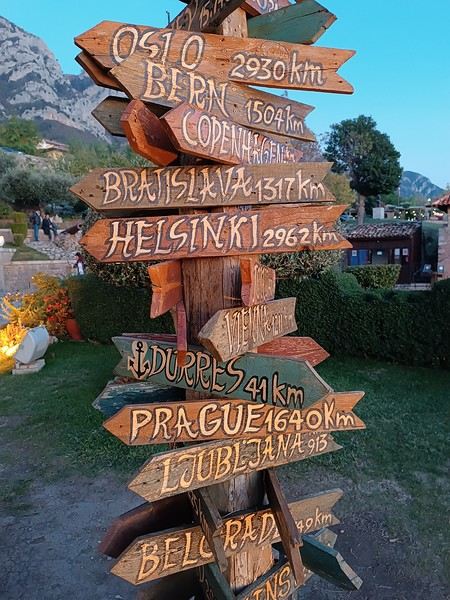
What else, I wonder...
Personally, I often prioritize simple destinations (no administrative hassles), where I’m not at risk (nothing extraordinary like getting kidnapped by Daesh or ending up in a jail cell because the current geopolitics aren’t favorable to my passport, etc.), and where I can drive.
Wide-open natural spaces are more my thing than urban anthills.
Finally, I try not to spend three days on a plane to reach my destination, and I aim for a maximum budget of 3500 € (for 3 weeks) in comfortable conditions—that means charming hotels, good meals, etc.
What about you?🙂
The title might be a bit long, but I hope it’s completely understandable!
When it comes to choosing your next trip, what tips the scales in favor of Eritrea over Ibiza?
Why pick Canada over French Polynesia?
The price? A magazine or TV report, a travel journal, an Instagram ad? Ease of travel? Minimal time difference? The country that has the most in common with all the trip participants? Activities? Relaxation? The desire to push your limits?
A photo?
What else, I wonder...
Personally, I often prioritize simple destinations (no administrative hassles), where I’m not at risk (nothing extraordinary like getting kidnapped by Daesh or ending up in a jail cell because the current geopolitics aren’t favorable to my passport, etc.), and where I can drive.
Wide-open natural spaces are more my thing than urban anthills.
Finally, I try not to spend three days on a plane to reach my destination, and I aim for a maximum budget of 3500 € (for 3 weeks) in comfortable conditions—that means charming hotels, good meals, etc.
What about you?🙂
«Je ne veux plus gueuler: "Comment va le monde?" Et qu'on me réponde: «Il va comme il va»
Dans la tiédeur d’un soir d’été, deux amies devisaient paisiblement.
Elles parlaient d’amour.
L’une de l’amour de sa compagne qui la rendait plus forte, l’autre de l’amour de son mari qui la rendait plus douce.
Elles parlaient voyages Les voyages d’autrefois où les anecdotes s’enrubannent année après année de détails sortis de leur imagination fertile et qui rendaient leurs récits plus épiques et ceux récents encore à l’état de fraîche émotion.
La bouteille de vin blanc s’embuait sur la table blanche en fer, l’herbe roussie chatouillait leurs pieds nus, elles se sentaient comblées, heureuses et libres et, sans doute pour cette raison, il leur était facile de parler du monde d’aujourd’hui, facile d’évoquer les conflits, les émeutes, les violences, les épidémies.
Epargnées, tranquilles, trempant avec gourmandise leurs lèvres dans le gewurztraminer frais, elles s’interrogeaient :
« T’as vu avec le covid on ne parle plus des guerres, c’est covid partout, encore que ça commence à ralentir, y’a le foot » « Ah oui, t’as raison, tu crois que ça pète encore en Syrie, en Lybie, au Yémen, en Somalie, au Sahel ? » « Chais pas, mais au Liban, quelle horreur cette explosion et tous ces gens morts ou sans maison » « T’as entendu les humanitaires au Niger ? » « Oui, pas les premiers pas les derniers à mourir bêtement » « Et au Brésil et en Colombie, ça c’est calmé ? » « Aucune idée » « Et à Hong-Kong et au Brésil et au Vénézuela, je me demande si ça manifeste toujours » « Chais pas, mais aux Etats-Unis entre blancs et noirs c’est pas cool, t’as vu les émeutes et ça va continuer, tu peux croire » « moi, c’qui me rend dingue c’est tous les gens dans le monde qui ont faim, qui n’ont pas de boulot ou qui l’ont perdu » « oui, c’est triste » « En tout cas, on entend plus parler des migrants, ni ceux de Lampedusa, ni ceux des jungles là-haut » « T’imagines un peu le monde entier à l’arrêt. Comment veux-tu que la terre reste en paix » « Et ceux qui se battent, qui sont en guerre, se tapent le covid en plus » « Et t’as vu en Bielorussie, pareil, ça chauffe aussi » « T’as déjà vu des révolutions pacifiques toi ? » « Ouais, c’est plus embêtant c’est pas loin d’chez nous » « Et le mec empoisonné par les russes, paraît qu’il est en Allemagne » « Chez nous ça va être chaud à la rentrée, j’te l’dis, tu verras, avec les chômeurs, le covid, les gosses à l’école, le télétravail oui et non, on va pas rire »
« Moi, j’te dis qu’il n’y a pas que les incendies de forêts qui bousillent la terre, y’a les incendies de fureur dans le coeur des hommes »
« Oh , t’as pas parlé des masques, des mesures barrières, etoussaettoussa » « Et toi de ton dada favori, l’eau, l’or du monde » « Eh ne me branche pas sur ce sujet, je suis intarissable »
« Allez, t’es pas marrante, tiens, on finit la bouteille, l’est super bon ce vin »
Ainsi, dans la tiédeur d’un soir d’été, deux amies devisaient. A l’abri sous le tilleul, comme à l’abri derrière un écran, comme sur vf, la vie défile, bouleverse, secoue, agace, exaspère ou indiffère et « passent les jours, passent les semaines.../... »
« Comment va le monde? Il est rouge sang Et à mon avis, il l'est pour longtemps Comment va la vie? Il y a des endroits Elle vaut dix dollars combien je te dois
Comment va la guerre? Elle va comme elle va Elle est planétaire, on se reverra Comment va la banque? La banque surnage Pour les grands requins y a pas de naufrage Comment va la mort? Record absolu Toujours très discrète, je n'en sais pas plus » .../… B. Lavilliers
(Vos voyages vous ont fait réfléchir sur l'art de bien voyager, de bien vivre, l'état du monde ou le sens de la vie? Partagez vos pensées et réflexions dans cette rubrique.
Euhhhh, chuis dans la bonne rubrique.)
Elles parlaient voyages Les voyages d’autrefois où les anecdotes s’enrubannent année après année de détails sortis de leur imagination fertile et qui rendaient leurs récits plus épiques et ceux récents encore à l’état de fraîche émotion.
La bouteille de vin blanc s’embuait sur la table blanche en fer, l’herbe roussie chatouillait leurs pieds nus, elles se sentaient comblées, heureuses et libres et, sans doute pour cette raison, il leur était facile de parler du monde d’aujourd’hui, facile d’évoquer les conflits, les émeutes, les violences, les épidémies.
Epargnées, tranquilles, trempant avec gourmandise leurs lèvres dans le gewurztraminer frais, elles s’interrogeaient :
« T’as vu avec le covid on ne parle plus des guerres, c’est covid partout, encore que ça commence à ralentir, y’a le foot » « Ah oui, t’as raison, tu crois que ça pète encore en Syrie, en Lybie, au Yémen, en Somalie, au Sahel ? » « Chais pas, mais au Liban, quelle horreur cette explosion et tous ces gens morts ou sans maison » « T’as entendu les humanitaires au Niger ? » « Oui, pas les premiers pas les derniers à mourir bêtement » « Et au Brésil et en Colombie, ça c’est calmé ? » « Aucune idée » « Et à Hong-Kong et au Brésil et au Vénézuela, je me demande si ça manifeste toujours » « Chais pas, mais aux Etats-Unis entre blancs et noirs c’est pas cool, t’as vu les émeutes et ça va continuer, tu peux croire » « moi, c’qui me rend dingue c’est tous les gens dans le monde qui ont faim, qui n’ont pas de boulot ou qui l’ont perdu » « oui, c’est triste » « En tout cas, on entend plus parler des migrants, ni ceux de Lampedusa, ni ceux des jungles là-haut » « T’imagines un peu le monde entier à l’arrêt. Comment veux-tu que la terre reste en paix » « Et ceux qui se battent, qui sont en guerre, se tapent le covid en plus » « Et t’as vu en Bielorussie, pareil, ça chauffe aussi » « T’as déjà vu des révolutions pacifiques toi ? » « Ouais, c’est plus embêtant c’est pas loin d’chez nous » « Et le mec empoisonné par les russes, paraît qu’il est en Allemagne » « Chez nous ça va être chaud à la rentrée, j’te l’dis, tu verras, avec les chômeurs, le covid, les gosses à l’école, le télétravail oui et non, on va pas rire »
« Moi, j’te dis qu’il n’y a pas que les incendies de forêts qui bousillent la terre, y’a les incendies de fureur dans le coeur des hommes »
« Oh , t’as pas parlé des masques, des mesures barrières, etoussaettoussa » « Et toi de ton dada favori, l’eau, l’or du monde » « Eh ne me branche pas sur ce sujet, je suis intarissable »
« Allez, t’es pas marrante, tiens, on finit la bouteille, l’est super bon ce vin »
Ainsi, dans la tiédeur d’un soir d’été, deux amies devisaient. A l’abri sous le tilleul, comme à l’abri derrière un écran, comme sur vf, la vie défile, bouleverse, secoue, agace, exaspère ou indiffère et « passent les jours, passent les semaines.../... »
« Comment va le monde? Il est rouge sang Et à mon avis, il l'est pour longtemps Comment va la vie? Il y a des endroits Elle vaut dix dollars combien je te dois
Comment va la guerre? Elle va comme elle va Elle est planétaire, on se reverra Comment va la banque? La banque surnage Pour les grands requins y a pas de naufrage Comment va la mort? Record absolu Toujours très discrète, je n'en sais pas plus » .../… B. Lavilliers
(Vos voyages vous ont fait réfléchir sur l'art de bien voyager, de bien vivre, l'état du monde ou le sens de la vie? Partagez vos pensées et réflexions dans cette rubrique.
Euhhhh, chuis dans la bonne rubrique.)
Les Cyclades en juillet: Anafi, Amorgos, Astypaléa
GENESE
Comme tous, le COVID a chamboulé nos plans. Normalement nous devions aller à Madagascar pendant un mois, projet reporté à l’année prochaine. Seulement, n’ayant jamais arrêté de travailler, malgré le confinement et le Covid j’avais réellement besoin de faire une « pause ».
Souhaitant limiter les risques de restrictions de déplacements nous ne quitterons pas l’Europe en nous centrant sur des endroits que nous avons toujours voulu visiter, mais habituellement trop fréquentés pour nous. Il y avait la Suisse avec ses montagnes et ses trains de légende, l’Islande et les îles Grecques.
Au final c’est l’attrait du soleil qui l’a emporté … enfin surtout auprès de madame ! Nous avions « entrevu » Santorin et Myconos lors d’une croisière en méditerranée en 2007 avec les enfants. Nous avions adoré … sauf la fréquentation !
Le premier élément à choisir est le point d’entrée, accessible en avion. Il y a Santorin et Myconos dans les Cyclades. Comme je rêvais de revoir la caldera de Santorin, le choix fut rapide. Ensuite je voulais des îles peu fréquentées ne nécessitant pas de trop long trajet en ferry. Sur 2 semaines 3 îles m’a paru être le bon choix. Avec le recul je confirme que c’est un bon dosage. Je me suis beaucoup servi du site Hellenica et Cycladen.be, qui sont très bien, pour faire mes choix.
La première sera Anafi, dans la catégorie « peu fréquentée » elle est très bien placée, en plus elle est petite, montagneuse et avec de belles plages. Une des raisons de sa faible fréquentation est le peu de liaison maritimes, ce sera donc à partir de cette contrainte que s’articulera le voyage.
Le second choix sera Astypalea car il y a un aéroport pour repartir, en plus c’est aussi une île peu fréquentée par les étrangers. Elle fait partie des Dodécanèse mais géographique se trouve proche des Cyclades.
Amorgos se glissera très naturellement entre les deux.
Une fois le planning établi j’ai réservé les vols chez Volotea qui a le bon goût de partir de Strasbourg … mauvais choix car les vols seront annulés 2 semaines plus tard.🏴☠️ Je me suis retourné vers Easy Jet qui part de Bâle Mulhouse, finalement tout aussi proche de chez nous que Strasbourg. Il faut dire qu’en Alsace nous avons la chance d’avoir pas mal d’aéroports dans un rayon de 3 heures autour de chez nous (en plus des deux précités il y a surtout Zurich et Frankfurt). Nous ferons donc BSL – Athènes – Santorin puis Astypalea – Athènes – BSL.
J’ai réservé par internet en direct les pensions : Villa Kalamiotissa pour Anafi Emprostiada Traditional Guest House et Pano Gitonia pour Amorgos Studio Killindra pour Astypalea Je réserve aussi une voiture à Amorgos puisque l’île est assez grande … et au final, suite à un échange avec mon logeur, également à Anafi.
Le roadbook sera assez rapide à établir … tant mieux car je n’ai que très peu de temps disponible, relancer mon entreprise suite au Covid-19 a accaparé tout mon temps.
En voiture ... pour ceux qui veulent 🙂
Comme tous, le COVID a chamboulé nos plans. Normalement nous devions aller à Madagascar pendant un mois, projet reporté à l’année prochaine. Seulement, n’ayant jamais arrêté de travailler, malgré le confinement et le Covid j’avais réellement besoin de faire une « pause ».
Souhaitant limiter les risques de restrictions de déplacements nous ne quitterons pas l’Europe en nous centrant sur des endroits que nous avons toujours voulu visiter, mais habituellement trop fréquentés pour nous. Il y avait la Suisse avec ses montagnes et ses trains de légende, l’Islande et les îles Grecques.
Au final c’est l’attrait du soleil qui l’a emporté … enfin surtout auprès de madame ! Nous avions « entrevu » Santorin et Myconos lors d’une croisière en méditerranée en 2007 avec les enfants. Nous avions adoré … sauf la fréquentation !
Le premier élément à choisir est le point d’entrée, accessible en avion. Il y a Santorin et Myconos dans les Cyclades. Comme je rêvais de revoir la caldera de Santorin, le choix fut rapide. Ensuite je voulais des îles peu fréquentées ne nécessitant pas de trop long trajet en ferry. Sur 2 semaines 3 îles m’a paru être le bon choix. Avec le recul je confirme que c’est un bon dosage. Je me suis beaucoup servi du site Hellenica et Cycladen.be, qui sont très bien, pour faire mes choix.
La première sera Anafi, dans la catégorie « peu fréquentée » elle est très bien placée, en plus elle est petite, montagneuse et avec de belles plages. Une des raisons de sa faible fréquentation est le peu de liaison maritimes, ce sera donc à partir de cette contrainte que s’articulera le voyage.
Le second choix sera Astypalea car il y a un aéroport pour repartir, en plus c’est aussi une île peu fréquentée par les étrangers. Elle fait partie des Dodécanèse mais géographique se trouve proche des Cyclades.
Amorgos se glissera très naturellement entre les deux.
Une fois le planning établi j’ai réservé les vols chez Volotea qui a le bon goût de partir de Strasbourg … mauvais choix car les vols seront annulés 2 semaines plus tard.🏴☠️ Je me suis retourné vers Easy Jet qui part de Bâle Mulhouse, finalement tout aussi proche de chez nous que Strasbourg. Il faut dire qu’en Alsace nous avons la chance d’avoir pas mal d’aéroports dans un rayon de 3 heures autour de chez nous (en plus des deux précités il y a surtout Zurich et Frankfurt). Nous ferons donc BSL – Athènes – Santorin puis Astypalea – Athènes – BSL.
J’ai réservé par internet en direct les pensions : Villa Kalamiotissa pour Anafi Emprostiada Traditional Guest House et Pano Gitonia pour Amorgos Studio Killindra pour Astypalea Je réserve aussi une voiture à Amorgos puisque l’île est assez grande … et au final, suite à un échange avec mon logeur, également à Anafi.
Le roadbook sera assez rapide à établir … tant mieux car je n’ai que très peu de temps disponible, relancer mon entreprise suite au Covid-19 a accaparé tout mon temps.
En voiture ... pour ceux qui veulent 🙂
Mais où qu'il est ce truc là (4)
L'Uruguay, pourquoi pas?
Si vous cherchez l’aventure, le dépaysement total, les paysages extraordinaires, la rando, ce n’est pas en Uruguay qu’il faut aller. Je le savais avant de partir.
Simplement l’envie de découvrir un autre pays, un autre mode de vie. Trouver de la chaleur et du soleil pour les vacances de Noël, passer des vacances cool !
Côté paysage c’est un paysage de campagne comme on peut en trouver en France. Le pays est plat, vraiment plat ! Et pas de dépaysement avec la population : c’est un peuple issu de l’émigration européenne. Dans les faciès et les tenues, aucun étonnement, on pourrait se croire en Europe. (Sauf pour le maillot de bain string, c’est comme au Brésil !)
Dans un premier temps, je dois avouer, j’ai eu un peu peur. Où trouver mon contentement dans un environnement qui ne semblait pas vraiment différent de mon quotidien. Mais si je fais maintenant le bilan, je suis très contente d’y être allée.
Voyage de 12 nuits sur place, location de voiture, et c’est parti….
Un petit récit, quelques photos pour illustrer et quelques infos pratiques pour ceux qui décideraient d'y aller ! Au fait, ce n’est pas une destination économique, à peu près les mêmes prix qu’en France !
COLONIA DEL SACRAMENTO (2 nuits)
Petite déception en arrivant en fin de journée : peu d’animation dans la vielle ville, la population ne semble plus vivre dans cette partie de la ville. Il y a beaucoup de restaurants et d’hôtels et pourtant, vraiment peu de monde dans les rues. Une grosse surprise pour moi qui m’attendait (en fonction de ce que j’avais lu) à y voir beaucoup de touristes. Et pourtant, nous étions en période de fêtes. D’un côté, je suis super contente d’éviter la foule de touristes, mais en même temps, pas de population locale, cela fait un peu triste. Par contre, le soir, avec les éclairages, la vielle ville est superbe. zut, je n'ai pas de photos 😠
Le lendemain, belle découverte sous le soleil. Nous avons été charmés par toutes ces rues bordées de magnifiques platanes, par les rues pavées avec ses vieilles maisons, vieilles voitures, tags. C’est calme, pas de circulation.
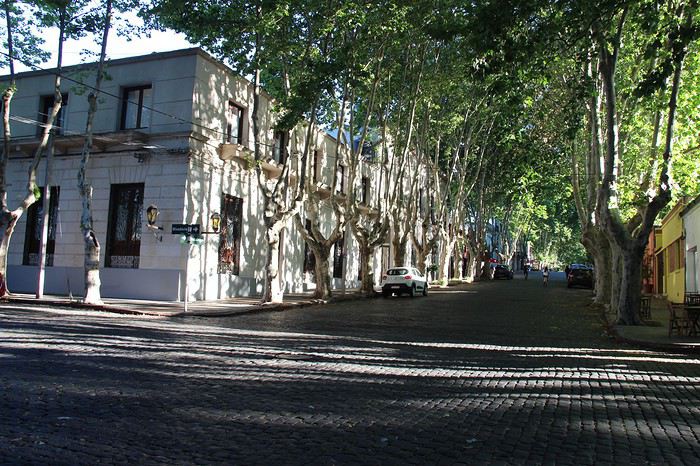
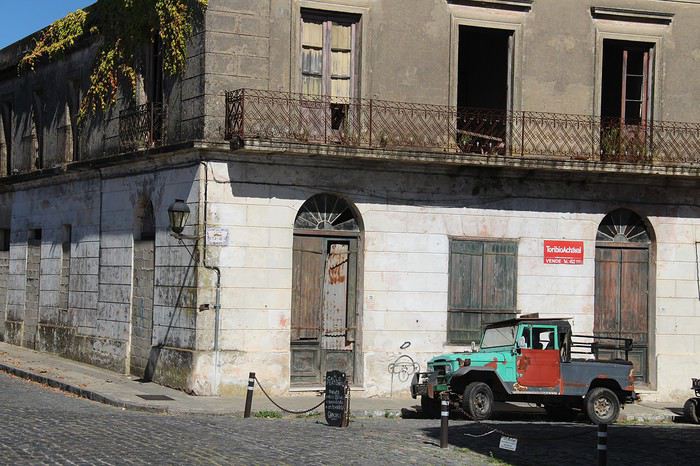
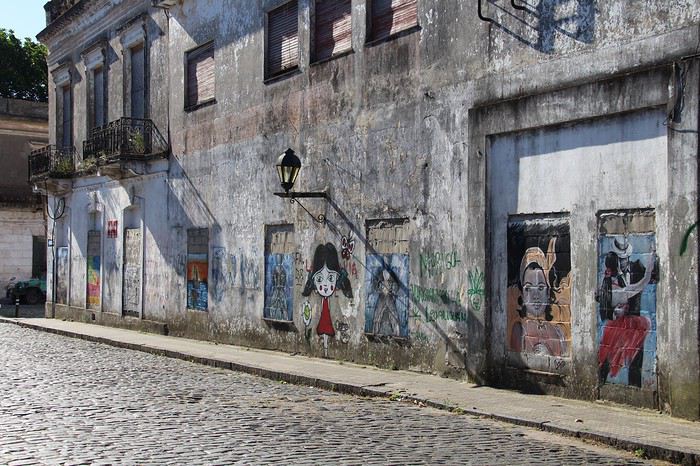
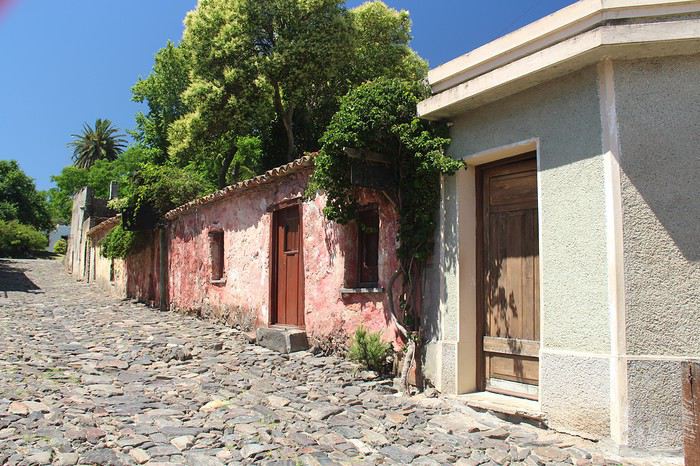
Comparé à Paraty au Brésil près de Rio, rien à voir avec le tourisme de masse et toutes ces conséquences. Nous avons arpenté plusieurs fois la vieille ville et à chaque fois de nouvelles surprises. L’après-midi, nous avons marché sur les plages aux alentours. Rien d’exceptionnel car on est dans le delta du rio de la Plata et l’eau est marron. Mais de la belle végétation par endroit. Ce n’est pas désagréable. Bilan : je pensais trouver une ville remplie de touristes : non, il y en a un peu mais aucune gêne. Bonne entrée en matière dans le pays et nous avons beaucoup apprécié cette première étape.
MERCEDES (1 nuit)
Je ne voulais pas me contenter de la côte sud et je voulais faire une incursion au centre du pays. Nous remontons donc le long du rio Negro.
Quelques arrêts sur la route à Réal de San Carlos, avec les restes d’un complexe touristique du début du XXième siècle. Des bâtiments encore en très bon état avec arène, hôtel, casino… On y trouve une plage plus grande que celles de Colonia. Arrêt à CONCHILLAS, petit village construit par les anglais avec des maisons typiques de l’époque et quelques bâtiments. Bon, on passait à côté. Pas désagréable.
Carmello : 3 étoiles dans le petit futé. Ben…. Je ne sais pas mais pour moi, rien à voir.
Plage de la agraciada : aucun intérêt
Mercedes : je dirais bof bof. Je pense que le problème vient du fait que c’était le jour de Noël, personne dans la ville, tout était fermé donc difficile d’apprécier une ville dans ces conditions.
Départ 10 h, arrivée 16 h, avec tous les arrêts. Journée sans intérêt. Paysage de campagne, monotone et rien de typique.
Bon, j’ai bien peur que vous ne continuiez pas à lire mon carnet de voyage. Pas eu l’envie de prendre des photos ce jour-là. Mais si si, accrochez-vous !
SAN GREGORIO DE PALANCO (1 nuit)
Départ 11 h, arrivée 16 h. on se dirige vers le centre du pays. Pluie torrentielle toute la route. Difficile d’apprécier un paysage ! En résumé : c’est plat, soit des plantations d’arbres, soit des champs céréaliers. De la piste, quelques haciendas. Mais on a vu personne, peu de voiture. A priori, ce n’est pas le moment du travail aux champs. Je pensais voir des troupeaux d’animaux, des gauchos. Rien. Mais nous sommes le surlendemain de Noël, c’est peut-être la raison ?
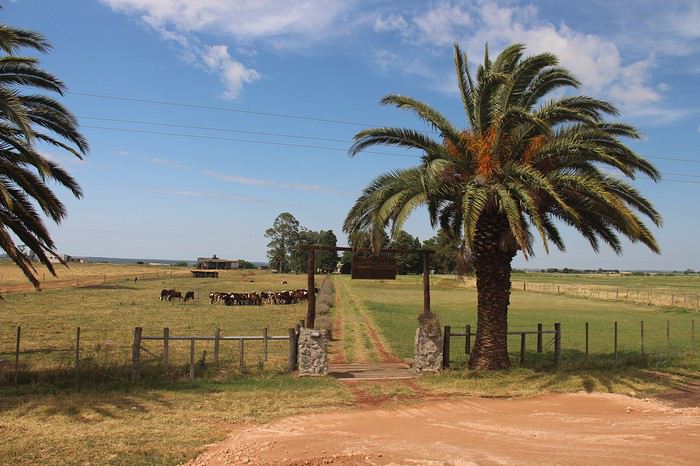
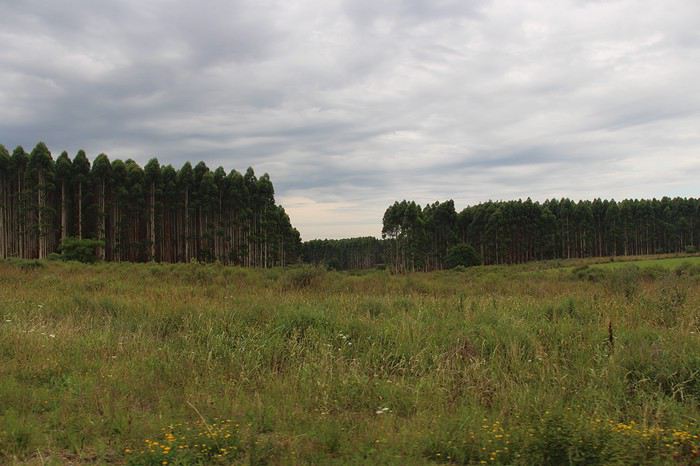
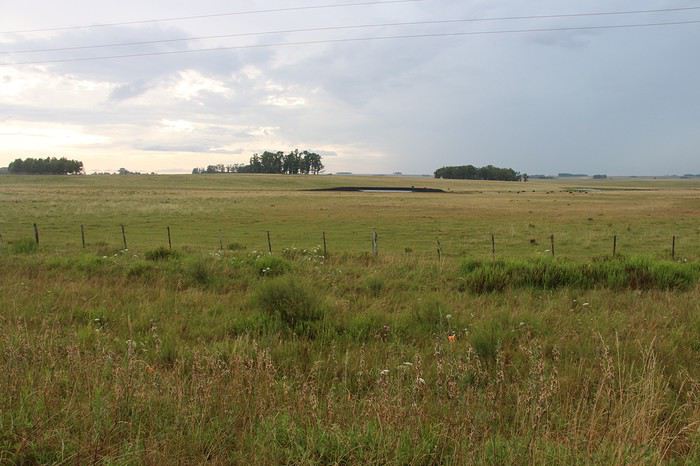
Arrivée à San Gregorio à 16 h, heure où tout est fermé et personnes dans les rues.
On s’est pris au jeu du principal centre d’intérêt de cette ville : LE STREET ART. Nous partons à la recherche des peintures murales éparpillées dans la ville. Un plan très bien fait permet de déambuler et les retrouver. L’occasion de marcher à travers les habitations et se retrouver dans un monde rural. Très diffèrent de notre approche à Colonia del Sacramento. Le niveau de vie semble ici très bas.
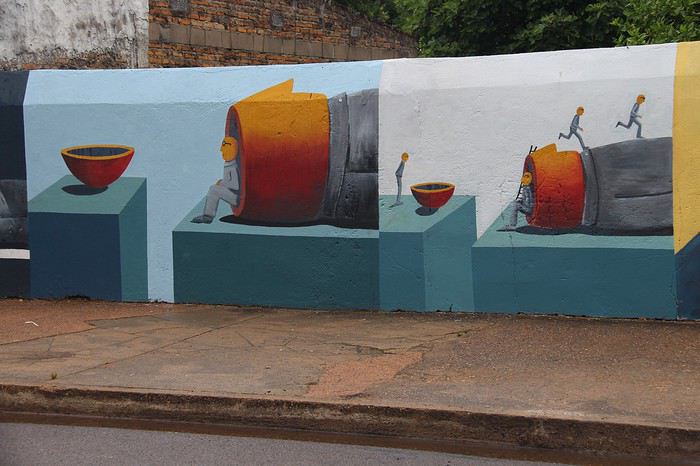
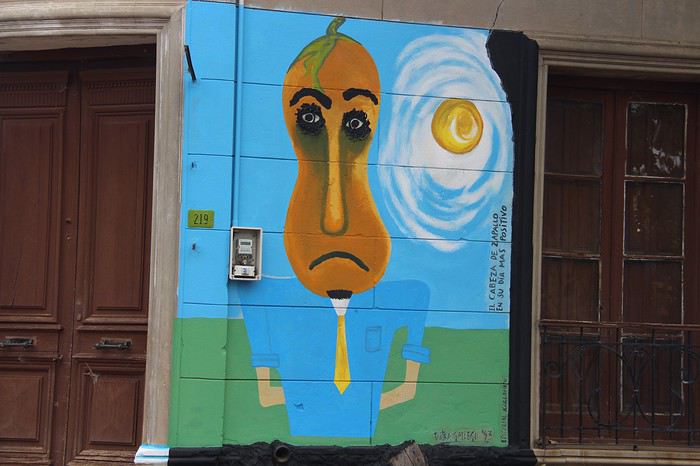
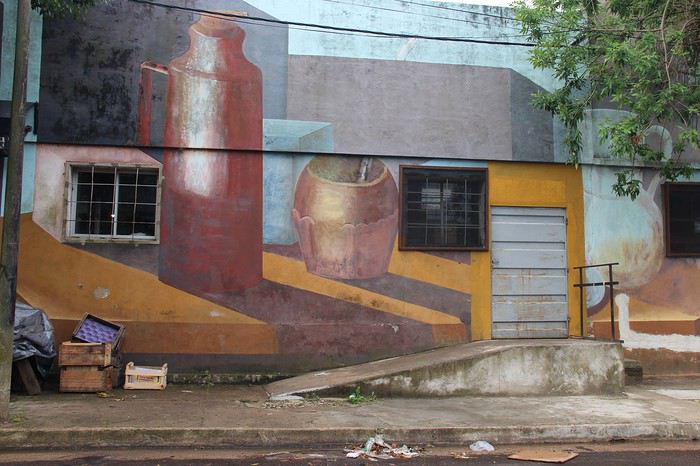
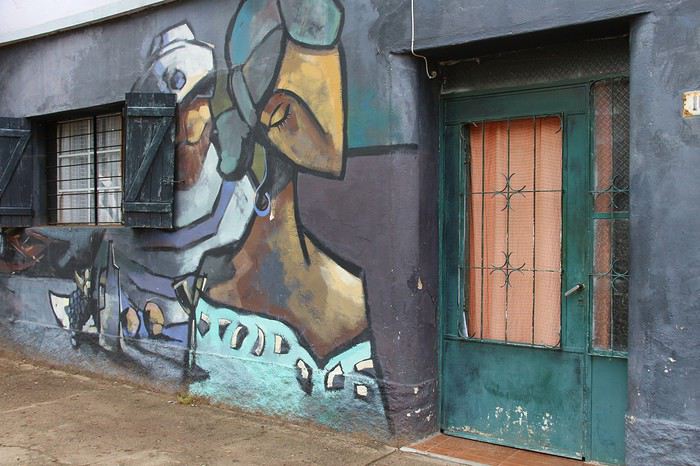
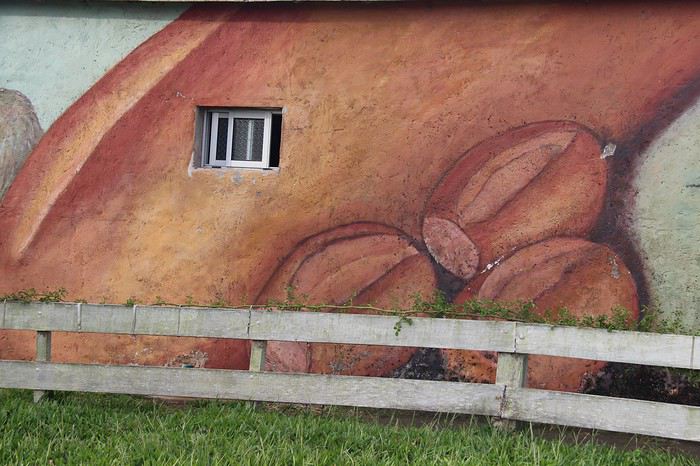
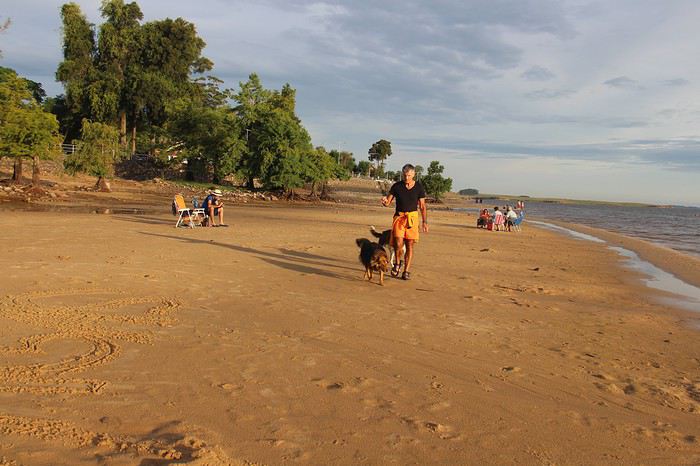
Notre déambulation nous amène en fin de journée à la belle plage de San Grégorio. Il est 18 H 30 et comme partout en Uruguay, c’est l’heure où tout le monde sort pour terminer la journée. Les couleurs sont belles. Grand malecom pour se promener, agréable.
A suivre....
Côté paysage c’est un paysage de campagne comme on peut en trouver en France. Le pays est plat, vraiment plat ! Et pas de dépaysement avec la population : c’est un peuple issu de l’émigration européenne. Dans les faciès et les tenues, aucun étonnement, on pourrait se croire en Europe. (Sauf pour le maillot de bain string, c’est comme au Brésil !)
Dans un premier temps, je dois avouer, j’ai eu un peu peur. Où trouver mon contentement dans un environnement qui ne semblait pas vraiment différent de mon quotidien. Mais si je fais maintenant le bilan, je suis très contente d’y être allée.
Voyage de 12 nuits sur place, location de voiture, et c’est parti….
Un petit récit, quelques photos pour illustrer et quelques infos pratiques pour ceux qui décideraient d'y aller ! Au fait, ce n’est pas une destination économique, à peu près les mêmes prix qu’en France !
COLONIA DEL SACRAMENTO (2 nuits)
Petite déception en arrivant en fin de journée : peu d’animation dans la vielle ville, la population ne semble plus vivre dans cette partie de la ville. Il y a beaucoup de restaurants et d’hôtels et pourtant, vraiment peu de monde dans les rues. Une grosse surprise pour moi qui m’attendait (en fonction de ce que j’avais lu) à y voir beaucoup de touristes. Et pourtant, nous étions en période de fêtes. D’un côté, je suis super contente d’éviter la foule de touristes, mais en même temps, pas de population locale, cela fait un peu triste. Par contre, le soir, avec les éclairages, la vielle ville est superbe. zut, je n'ai pas de photos 😠
Le lendemain, belle découverte sous le soleil. Nous avons été charmés par toutes ces rues bordées de magnifiques platanes, par les rues pavées avec ses vieilles maisons, vieilles voitures, tags. C’est calme, pas de circulation.
Comparé à Paraty au Brésil près de Rio, rien à voir avec le tourisme de masse et toutes ces conséquences. Nous avons arpenté plusieurs fois la vieille ville et à chaque fois de nouvelles surprises. L’après-midi, nous avons marché sur les plages aux alentours. Rien d’exceptionnel car on est dans le delta du rio de la Plata et l’eau est marron. Mais de la belle végétation par endroit. Ce n’est pas désagréable. Bilan : je pensais trouver une ville remplie de touristes : non, il y en a un peu mais aucune gêne. Bonne entrée en matière dans le pays et nous avons beaucoup apprécié cette première étape.
MERCEDES (1 nuit)
Je ne voulais pas me contenter de la côte sud et je voulais faire une incursion au centre du pays. Nous remontons donc le long du rio Negro.
Quelques arrêts sur la route à Réal de San Carlos, avec les restes d’un complexe touristique du début du XXième siècle. Des bâtiments encore en très bon état avec arène, hôtel, casino… On y trouve une plage plus grande que celles de Colonia. Arrêt à CONCHILLAS, petit village construit par les anglais avec des maisons typiques de l’époque et quelques bâtiments. Bon, on passait à côté. Pas désagréable.
Carmello : 3 étoiles dans le petit futé. Ben…. Je ne sais pas mais pour moi, rien à voir.
Plage de la agraciada : aucun intérêt
Mercedes : je dirais bof bof. Je pense que le problème vient du fait que c’était le jour de Noël, personne dans la ville, tout était fermé donc difficile d’apprécier une ville dans ces conditions.
Départ 10 h, arrivée 16 h, avec tous les arrêts. Journée sans intérêt. Paysage de campagne, monotone et rien de typique.
Bon, j’ai bien peur que vous ne continuiez pas à lire mon carnet de voyage. Pas eu l’envie de prendre des photos ce jour-là. Mais si si, accrochez-vous !
SAN GREGORIO DE PALANCO (1 nuit)
Départ 11 h, arrivée 16 h. on se dirige vers le centre du pays. Pluie torrentielle toute la route. Difficile d’apprécier un paysage ! En résumé : c’est plat, soit des plantations d’arbres, soit des champs céréaliers. De la piste, quelques haciendas. Mais on a vu personne, peu de voiture. A priori, ce n’est pas le moment du travail aux champs. Je pensais voir des troupeaux d’animaux, des gauchos. Rien. Mais nous sommes le surlendemain de Noël, c’est peut-être la raison ?
Arrivée à San Gregorio à 16 h, heure où tout est fermé et personnes dans les rues.
On s’est pris au jeu du principal centre d’intérêt de cette ville : LE STREET ART. Nous partons à la recherche des peintures murales éparpillées dans la ville. Un plan très bien fait permet de déambuler et les retrouver. L’occasion de marcher à travers les habitations et se retrouver dans un monde rural. Très diffèrent de notre approche à Colonia del Sacramento. Le niveau de vie semble ici très bas.
Notre déambulation nous amène en fin de journée à la belle plage de San Grégorio. Il est 18 H 30 et comme partout en Uruguay, c’est l’heure où tout le monde sort pour terminer la journée. Les couleurs sont belles. Grand malecom pour se promener, agréable.
A suivre....
Discussion autour du concours du mois de mars 2020: Seul(e) au monde ou la solitude
Bonjour 😉
C'est ici - et uniquement ici - qu'on discute à propos de la thématique du mois : Seul(e) au monde - concours photo du mois de Mars 2020
C'est ici - et uniquement ici - qu'on discute à propos de la thématique du mois : Seul(e) au monde - concours photo du mois de Mars 2020
Voyager sans connaître la destination? Nous voilà inscrits...
Nous sommes à un mois de notre départ et nous ne connaissons pas la destination puisque c'est un voyage mystère que nous avons réservé par l'agence CAP MYSTERE....
Nous avons donc rempli un questionnaire assez détaillé sur notre type de voyage, nos envies , nos budget...
C'est donc un voyage lointain avec une destination au soleil alliant la faune et la flore et hors des sentiers battus.
Nous allons bientôt recevoir le premier indice.
Nous sommes méga surexcités et en ce qui me concerne (moins mon conjoint plus sage) , je ne cesse de chercher les vols possibles avec les éléments que j'ai....
Arghhhh c'est horriblement dure d'attendre.
Nous avons donc rempli un questionnaire assez détaillé sur notre type de voyage, nos envies , nos budget...
C'est donc un voyage lointain avec une destination au soleil alliant la faune et la flore et hors des sentiers battus.
Nous allons bientôt recevoir le premier indice.
Nous sommes méga surexcités et en ce qui me concerne (moins mon conjoint plus sage) , je ne cesse de chercher les vols possibles avec les éléments que j'ai....
Arghhhh c'est horriblement dure d'attendre.
Voyage décevant au Sri Lanka
Bonjour,
Juste une reflexion, après 13 ans passé tous les ans au sri lanka, nous revenons juste d'un xème séjour au sri Lanka au mois de décembre.
Après un circuit avec un chauffeur local parlant Français, cela s'est très bien passé. Autant pour le circuit que pour les hébergements. Nous avons continué avec 2 semaines de balnéaire dans le sud du pays.
Constat amer : Nous constatons au fur et à mesure des années que le sri lanka change énormément. Autant les habitants, attirés par l'argent des touristes, que le pays, envahis par les touristes des pays de l'est. Le sri lanka se meurt doucement, les touristes Européens ne reviennent pas dans le pays, à cause des dégâts qu'occasionnent les touristes de l'est qui démolissent de plus en plus le pays. Des hôtels se bâtissent dans tous les sens, malgré le manque de touristes Européens. Tout est fait pour faire venir le touriste, même le visa gratuit. Mais rien y fait. Nous mêmes n'y reviendrons plus malheureusement. Chassés d'un hôtel à cause des locaux qui priment sur les touristes, malgré 2 nuits de payées, nous avons dû quitter après 1 nuit. Trop bruyant et sans respect pour le touriste. Malgré leurs dires, que les touristes sont leur priorité, cela n'a jmais été le cas. Nous avions hâte de quitter le pays après 3 semaines, cela est bien malheureux. Nous avons connu le SL il y a bien des années. Aujourd'hui nous ne le reconnaissons pas. Ce pays est merveilleux, mais fait fuir de plus en plus le touriste européens. Le SRI LANKA doit faire un choix un moment donné, les locaux ou les touristes dans les hôtels dotés d'une piscine. A chaque hôtel , nous avons eu les mêmes problèmes. Jusqu'au bout pour le prix du taxi pour l'aéroport, connaisseur du prix, il a été presque doublé à l'arrivée à l'aéroport….. QUELLE ENORME DECEPTION 🙁 Au Revoir le SRI LANKA.
Juste une reflexion, après 13 ans passé tous les ans au sri lanka, nous revenons juste d'un xème séjour au sri Lanka au mois de décembre.
Après un circuit avec un chauffeur local parlant Français, cela s'est très bien passé. Autant pour le circuit que pour les hébergements. Nous avons continué avec 2 semaines de balnéaire dans le sud du pays.
Constat amer : Nous constatons au fur et à mesure des années que le sri lanka change énormément. Autant les habitants, attirés par l'argent des touristes, que le pays, envahis par les touristes des pays de l'est. Le sri lanka se meurt doucement, les touristes Européens ne reviennent pas dans le pays, à cause des dégâts qu'occasionnent les touristes de l'est qui démolissent de plus en plus le pays. Des hôtels se bâtissent dans tous les sens, malgré le manque de touristes Européens. Tout est fait pour faire venir le touriste, même le visa gratuit. Mais rien y fait. Nous mêmes n'y reviendrons plus malheureusement. Chassés d'un hôtel à cause des locaux qui priment sur les touristes, malgré 2 nuits de payées, nous avons dû quitter après 1 nuit. Trop bruyant et sans respect pour le touriste. Malgré leurs dires, que les touristes sont leur priorité, cela n'a jmais été le cas. Nous avions hâte de quitter le pays après 3 semaines, cela est bien malheureux. Nous avons connu le SL il y a bien des années. Aujourd'hui nous ne le reconnaissons pas. Ce pays est merveilleux, mais fait fuir de plus en plus le touriste européens. Le SRI LANKA doit faire un choix un moment donné, les locaux ou les touristes dans les hôtels dotés d'une piscine. A chaque hôtel , nous avons eu les mêmes problèmes. Jusqu'au bout pour le prix du taxi pour l'aéroport, connaisseur du prix, il a été presque doublé à l'arrivée à l'aéroport….. QUELLE ENORME DECEPTION 🙁 Au Revoir le SRI LANKA.
Photo: votre best of 2019
Bonjour à tous 🙂
2019 s'achève et il est grand temps de lancer cette nouvelle discussion pour partager le meilleur de l'année.
Sur le modèle des années passées, les principes à suivre sont les suivants : - 10 photos par membre, qui devront être numérotées, et postées dans un ou plusieurs messages, - ces photos doivent avoir été prises en voyage en 2019 - edit: sur suggestion de Kate, parmi votre sélection, une poignée pourra avoir été prise hors voyage - ce n'est pas un concours, il n'y aura pas de vote à clé - c'est en revanche l'opportunité d'échanger nos impressions sur les clichés (soyez prêts à recevoir des critiques positives... ou négatives, mais toujours constructives !)
En espérant vous voir nombreux sur la discussion, et y trouver la même qualité que les années passées !
Alors, qui se lance en premier ? 😉
Pour les nostalgiques, pour ceux qui en veulent toujours plus, voici les liens vers les best of des années passées (du moins, ceux que j'ai trouvés: qu'est-il advenu de 2016 et 2017 ?) : - 2012 - 2013 - 2014 - 2015 - 2018
Joyeuses fêtes à tous !
2019 s'achève et il est grand temps de lancer cette nouvelle discussion pour partager le meilleur de l'année.
Sur le modèle des années passées, les principes à suivre sont les suivants : - 10 photos par membre, qui devront être numérotées, et postées dans un ou plusieurs messages, - ces photos doivent avoir été prises en voyage en 2019 - edit: sur suggestion de Kate, parmi votre sélection, une poignée pourra avoir été prise hors voyage - ce n'est pas un concours, il n'y aura pas de vote à clé - c'est en revanche l'opportunité d'échanger nos impressions sur les clichés (soyez prêts à recevoir des critiques positives... ou négatives, mais toujours constructives !)
En espérant vous voir nombreux sur la discussion, et y trouver la même qualité que les années passées !
Alors, qui se lance en premier ? 😉
Pour les nostalgiques, pour ceux qui en veulent toujours plus, voici les liens vers les best of des années passées (du moins, ceux que j'ai trouvés: qu'est-il advenu de 2016 et 2017 ?) : - 2012 - 2013 - 2014 - 2015 - 2018
Joyeuses fêtes à tous !
Autumn trip from Puglia to Naples via Basilicata...
Hi everyone!!!
I’m finally getting around to writing about this 20-day trip to southern Italy: we didn’t travel this summer, and luckily, we found beautiful light and dreamy weather there at the end of September.
First, here’s the context of the trip: we’re both "confirmed seniors" but still curious and alert enough to enjoy the itinerary we’d imagined! We wanted a mix of discoveries—culture, cities, and nature—with guaranteed sunshine and the occasional short hike... We’re flying to Naples, round-trip, because the flight times work better for us. We rented a car online, picked it up at the airport (details to come... and it won’t be the highlight of the trip!), and booked our hotels in advance.
A quick overview of the itinerary: leaving Naples on September 15th, early in the morning, we’ll drive straight across the boot of Italy to Bari. After 11 days in Puglia, we’ll head back toward our starting point, taking our time: Matera in Basilicata, Maratea by the sea, and finally Paestum with its incredible temples.
Day 1: Brussels-Naples flight (Brussels Airlines) went smoothly; it landed an hour early, and we were thrilled, thinking we could use that time for a quick visit or two... Everything went well until we left the airport. We took the shuttle to the car rental offices, and at first glance, we realized this wouldn’t be smooth sailing!!! In front of every office (they’re side by side), there were already lines and kids sitting on suitcases—everyone looked exhausted... We resigned ourselves to waiting: nothing moved until tempers flared at the counters, and two people nearly came to blows. Things sped up a little, and after 2 (two...) hours of waiting, we finally got our chariot: a black Fiat Tipo, dirty, with a few dents and scratches that we made sure to note in the contract... but it ran!
Off to Bari, then: no time for sightseeing along the way! From there, we headed straight to our hotel in the countryside near Polignano a Mare.
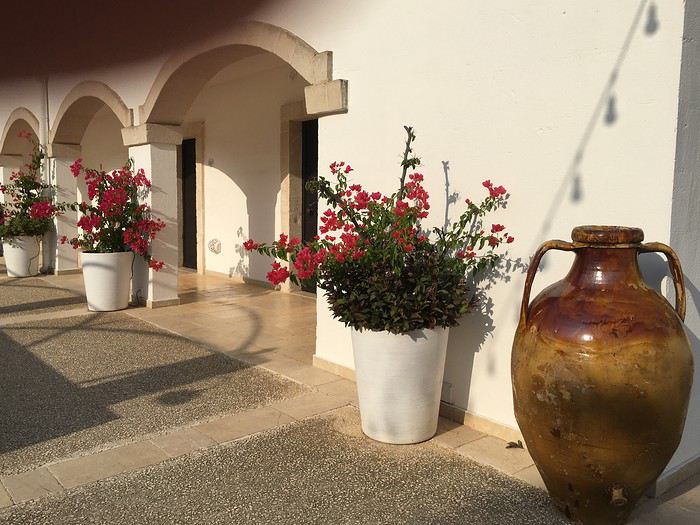
A recurring detail: this happened constantly during our travels. We’d installed our own GPS, fully updated... In recent years, many dirt roads have become drivable, and lots of hotels and hostels have opened in the outskirts of towns. It was extremely rare for our ‘guide’ to recognize the street—let alone the number—we entered. Often, we got by calling the hotel reception: it might seem like a small thing, but it happened so often it became frustrating. In hindsight, it seems like without Google Maps, we’d have been lost!
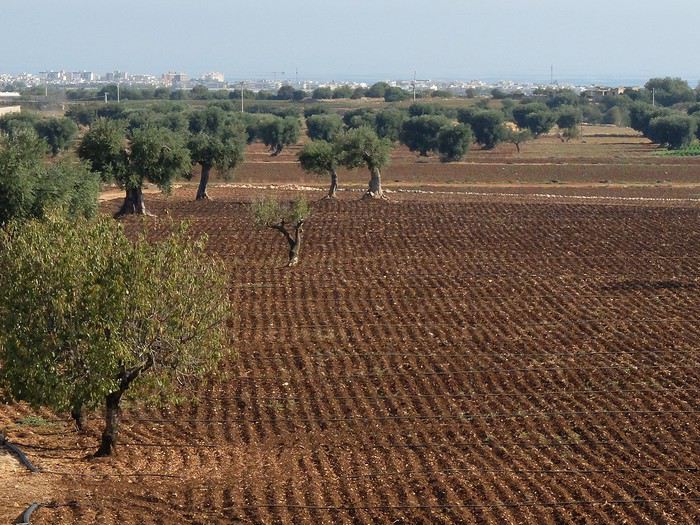
Anyway, we were beautifully settled, with a terrace overlooking olive groves and the sea in the distance: all was well.
To be continued...
I’m finally getting around to writing about this 20-day trip to southern Italy: we didn’t travel this summer, and luckily, we found beautiful light and dreamy weather there at the end of September.
First, here’s the context of the trip: we’re both "confirmed seniors" but still curious and alert enough to enjoy the itinerary we’d imagined! We wanted a mix of discoveries—culture, cities, and nature—with guaranteed sunshine and the occasional short hike... We’re flying to Naples, round-trip, because the flight times work better for us. We rented a car online, picked it up at the airport (details to come... and it won’t be the highlight of the trip!), and booked our hotels in advance.
A quick overview of the itinerary: leaving Naples on September 15th, early in the morning, we’ll drive straight across the boot of Italy to Bari. After 11 days in Puglia, we’ll head back toward our starting point, taking our time: Matera in Basilicata, Maratea by the sea, and finally Paestum with its incredible temples.
Day 1: Brussels-Naples flight (Brussels Airlines) went smoothly; it landed an hour early, and we were thrilled, thinking we could use that time for a quick visit or two... Everything went well until we left the airport. We took the shuttle to the car rental offices, and at first glance, we realized this wouldn’t be smooth sailing!!! In front of every office (they’re side by side), there were already lines and kids sitting on suitcases—everyone looked exhausted... We resigned ourselves to waiting: nothing moved until tempers flared at the counters, and two people nearly came to blows. Things sped up a little, and after 2 (two...) hours of waiting, we finally got our chariot: a black Fiat Tipo, dirty, with a few dents and scratches that we made sure to note in the contract... but it ran!
Off to Bari, then: no time for sightseeing along the way! From there, we headed straight to our hotel in the countryside near Polignano a Mare.
A recurring detail: this happened constantly during our travels. We’d installed our own GPS, fully updated... In recent years, many dirt roads have become drivable, and lots of hotels and hostels have opened in the outskirts of towns. It was extremely rare for our ‘guide’ to recognize the street—let alone the number—we entered. Often, we got by calling the hotel reception: it might seem like a small thing, but it happened so often it became frustrating. In hindsight, it seems like without Google Maps, we’d have been lost!
Anyway, we were beautifully settled, with a terrace overlooking olive groves and the sea in the distance: all was well.
To be continued...
Istanbul, Men and Cats
Sunday, October 20, 2019
Glancing at the Bosphorus through the bay window of my room, I absentmindedly scatter my things while quietly settling in. Then I turn around, looking for my passport, my cash, my camera battery, eager to join the buzz of the street below. But for the past few minutes, I’ve felt a presence—something moved on the balcony. Suddenly, I spot a black-and-white furball half-hidden behind a pot, nearby. I approach to introduce myself: "Here, kitty, kitty..." I don’t know how to say "kitty" in Turkish, but the rather rude furball hisses in my face, and its ridiculous little tail doubles in size. Okay. Not friendly. I grab what’s within reach—a cream capsule—and offer it as a peace offering. It lunges at me, swipes the object away with a quick paw, and scratches me in the process.
I’m in Istanbul *
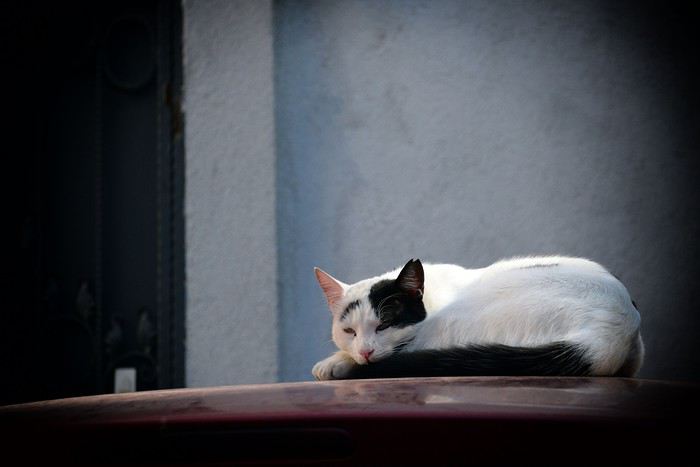
* For the title of my travel journal, I was inspired by the lovely film: "Kedi, Cats and Men" by Ceyda Torum
Glancing at the Bosphorus through the bay window of my room, I absentmindedly scatter my things while quietly settling in. Then I turn around, looking for my passport, my cash, my camera battery, eager to join the buzz of the street below. But for the past few minutes, I’ve felt a presence—something moved on the balcony. Suddenly, I spot a black-and-white furball half-hidden behind a pot, nearby. I approach to introduce myself: "Here, kitty, kitty..." I don’t know how to say "kitty" in Turkish, but the rather rude furball hisses in my face, and its ridiculous little tail doubles in size. Okay. Not friendly. I grab what’s within reach—a cream capsule—and offer it as a peace offering. It lunges at me, swipes the object away with a quick paw, and scratches me in the process.
I’m in Istanbul *
* For the title of my travel journal, I was inspired by the lovely film: "Kedi, Cats and Men" by Ceyda Torum
Programme 12 jours pour premier voyage au Japon en avril
Bonjour
Nous partons du 5 au 18 avril au Japon. Avec le voyage cela nous fera 12 jours pleins sur place.
Nous atterrissons à Osaka le 6 au matin et repartons le 18 de Tokyo.
Voilà le programme que j'envisageais
6 avril Osaka, nuit à Osaka
7 avril Départ pour Kyoto
8 avril Kyoto
9 avril Nara dans la journée
10 avril Kyoto
11 avril Départ pour Hakone
12 avril Hakone
13 avril départ pour Tokyo
14 avril Tokyo
15 avril départ pour Nikko, nuit à Nikko
16 avril retour à Tokyo
17 avril Tokyo
Cela vous semble-t-il équilibré?
Deux nuits à Hakone est-ce trop ?
Est-ce que nous voulons en faire trop sur ces 12 jours ?
Merci d'avance pour vos conseils
L'improvisation en voyage, de plus en plus difficile
Avec la multiplication des Expedia/Booking/Agoda etc., la prolifération des téléphones cellulaires et l'explosion du nombre de touristes, je trouve qu'il devient de plus en plus difficile de voyager sans avoir à tout, tout, tout planifier des mois à l'avance.
Quand je partais en voyage, J'avais l'habitude de réserver quelques nuits au lieu d'arrivée pour me remettre du décalage puis y aller au pif par la suite. Mais depuis quelques années, c'est devenu plus compliqué. Une réceptionniste d'hôtel m'a même déjà dit de réserver par Booking pour la nuit même!
Je me demande si nous ne sommes pas en train de perdre notre sens de l'improvisation, le plaisir de découvrir des lieux sans savoir à quoi nous attendre. Est-ce encore possible de partir en voyage sans avoir tout prévu?
Quand je partais en voyage, J'avais l'habitude de réserver quelques nuits au lieu d'arrivée pour me remettre du décalage puis y aller au pif par la suite. Mais depuis quelques années, c'est devenu plus compliqué. Une réceptionniste d'hôtel m'a même déjà dit de réserver par Booking pour la nuit même!
Je me demande si nous ne sommes pas en train de perdre notre sens de l'improvisation, le plaisir de découvrir des lieux sans savoir à quoi nous attendre. Est-ce encore possible de partir en voyage sans avoir tout prévu?
Les Américains n'aiment pas le foot
Lyon envahi par les supporters hollandais. Anglais. Suédois et américains.
Je discute voyage avec une famille de l' Oregon quand le fiston ado arrive portant un maillot du PSG..
What à Bad surprise !!!!;
Et on se etonne qu ils aient élu Trump!!!!
Et on se etonne qu ils aient élu Trump!!!!
Pauvre Sihanoukville!
bonjour
vous , voyageurs d'un moment , vous allez vous dire :"mais , nous on s'en fiche, on est de passage ! "
et bien , non ! parce qu'à cause d'une invasion massive , sauvage , des chinois, population essentiellement "affairistes" , TOUS les prix , à tous les niveaux ont déjà explosés !! une chambre il y a 2 ans seulement à Sihanoukville était à environ 10/15 $ , aujourd'hui elle sera à 40/50 $ !!, sale , bruyante , car TOUTE la ville est en chantier , pour construite plus de 80 casinos , et faire venir" l'élite" de chine c'est à dire les joueurs , et les mafieux avec ! ceci avec la bénédiction des plus hautes instances ...enfin décidées à réduire cette invasion , suite aux trop nombreux problêmes que cette communauté engendre ;bagarres , criminalité en hausse , cohabitation difficile avec les trop gentils khmers , égouts des nouveaux bâtiments à la mer !
bruits de chantiers , poussière sur toute la ville et le plus INCROYABLE MAIS VRAI ; IL VOUS SERA DIFFICILE DE TROUVER UN RESTAURANT , UN HOTEL , UNE GUEST HOUSE KHMER !! peut être le plus ODIEUX : dans certains quartiers , ces envahisseurs vous y INTERDISENT l'accès ....
alors que , sihanouk est la SEULE station balnéaire , qui possède de belles plages ;en ville : ocheteal , sérenpidity , soka , indépendance , puis à une dizaine de kms ; OTRES 1 et OTRES 2 la plus belle ;
hélas défigurées par le béton ;et routes défoncées ;
voilà le tableau , que TOUS les médias déplorent , en termes bien plus virulents , regardez donc sur le net !
je suis triste parce que j'aime trop ces Cambodgiens si agréables et chaleureux et que je viens d'apprendre qu' à cause de la voracité , l'appât du gain facile de ces affairistes dans un immeuble en construction , dans cette ville , sans permis , avec interdiction de construire , ont fait qu'il s'est écroulé (renseignez vous ! ) il y aurait 17 voir 25 morts !
par mal façon bien sur , pour gagner plus !
ceci sur un immeuble de 7 étages OR ils en construisent certains de plus de ...40 étages !
c'était juste un petit rappel de la triste réalité dans cette ville AVANT agréable et devenue un ENFER !
(avec des amis , j'y ai résidé 5 ans en paix jusqu'au jour , il y a 2 ans où "ILS " sont arrivés et nous ont chassés ...)
bon vent et bons voyages le plus longtemps possible !
cordialement
Jacques
Roadtrip Ouest US de 20 jours
17 et 18 juin C'est le départ ! Marseille Barstow Tout d'abord direction Turin. Pourquoi Turin? Tout simplement parce que les taxes d'aéroport sont tellement moins chères qu'en France. Nos vols Turin Los Angeles 320 euros pièce. A 6 cela nous fait 2000 euros d'économisés par rapport à un départ de Marseille. Après 4h30 de route, quelques émotions pour accéder au parking réservé à l'avance, passage de l'embarquement et nous voilà fin prêts. Mais c'était sans compter les grèves d'Air France qui ont perturbé le ciel européen. Résultats des courses notre vol Turin Madrid parti avec 2 heures de retard, un sprint de dingue à Madrid pour chopper notre vol. Malheureusement les bagages n'ont pas suivi et on se retrouve à LA sans rien. Ça commence bien!! Mais positivons, nous , nous y sommes. Après déclaration au desk bagages perdus direction Alamo pour récupérer notre véhicule. Nous quittons non sans mal Los Angeles, la circulation est dense et nous dirigeons vers Barstow pour notre première nuit au Best Western Desert Villa Inn. Nous avons décidé de quitter Los Angeles pour nous rapprocher du Grand Canyon. Avant d'arriver à l'hôtel, arrêt aux outlets à l'entrée de Barstow. Les bagages n'étant pas arrivés, American Airlines nous a autorisé à nous habiller et nous chausser. Pas de montant particulier, la consigne étant ''budget raisonnable'' ça veut dire quoi raisonnable?? Nous avons bien été remboursés de nos dépenses à peu près 1 mois après notre retour en France. Les Outlets de Barstow ne sont pas aussi spectaculaires qu'à Vegas mais nous trouvons Ralph Lauren, Calvin Klein, Levis, Nike...Séquence shopping terminée, un petit détour au supermarché, notre hôtel ne fait pas restaurant. L'hôtel est très correct, l'accueil sympathique. Un petit bain à la piscine, un casse croûte et au dodo !
Résumé https://www.youtube.com/watch?v=9n0WAuCTddc&t=9s
19 juin Barstow - Williams par la 66
Le décalage horaire ça a du bon. Lever matinal, ça tombe bien aujourd'hui nous avons une longue route.
Après avoir acheté 2 glacières, récupéré des glaçons, l'aventure peut commencer. Les gars sont au volant et nous déroulent des kilomètres, quelquefois sans âme qui vive... Notre premier arrêt sera au mythique Bagdad Café autrefois appelé Sidewinder Cafe. Au son de ''Calling You '' interprété par Jevetta Steele nous pouvons réaliser à quel point ce lieu est très prisé et en particulier par les français. Les murs sont recouverts d'autocollants de club sportif, d'associations, au plafond des écharpes, des maillots, et une multitude de billets de banque de différents pays. Pour faire comme tout le monde nous laissons notre empreinte avec une licence de basket et une ancienne carte d'électeur...
19 juin Barstow - Williams par la 66
Le décalage horaire ça a du bon. Lever matinal, ça tombe bien aujourd'hui nous avons une longue route.
Après avoir acheté 2 glacières, récupéré des glaçons, l'aventure peut commencer. Les gars sont au volant et nous déroulent des kilomètres, quelquefois sans âme qui vive... Notre premier arrêt sera au mythique Bagdad Café autrefois appelé Sidewinder Cafe. Au son de ''Calling You '' interprété par Jevetta Steele nous pouvons réaliser à quel point ce lieu est très prisé et en particulier par les français. Les murs sont recouverts d'autocollants de club sportif, d'associations, au plafond des écharpes, des maillots, et une multitude de billets de banque de différents pays. Pour faire comme tout le monde nous laissons notre empreinte avec une licence de basket et une ancienne carte d'électeur...