Results for "Leyte+|+8+>+191"
3046 results found.
Converting a heavy-duty bus/coach/truck into a motorhome
I'm currently converting a DAF/HEULIEZ MB205 bus.
Cheaper and more spacious than a regular vehicle, the paperwork (in France) isn't too difficult for approval.
I'm ready to help anyone who wants to tackle this kind of project. Those who know, help those who want to....
Cheaper and more spacious than a regular vehicle, the paperwork (in France) isn't too difficult for approval.
I'm ready to help anyone who wants to tackle this kind of project. Those who know, help those who want to....
Les photos de la soirée VF Lyon du 10 juin 2004 English translation pending
Salut tout le monde
Bon ben juste pour dire que plusieurs forumiens avaient leur appareil photo, j'ai pensé que les photographes pourraient faire leur reportage dans cette discussion (ce sera + facile à François d'en parler avec ce nouveau sujet plutot que d'ajouter les photos à la queue des 80 réponses du message de Pimpelune, non?).
La soirée était géniale, très enrichissante, très chaude aussi (je parle de la météo), nous étions environ 25 (et pourtant y avait pas mal d'absents!), chacun avait amené une spécialité (salade Tahitienne, salade Norvégienne, riz Cantonais, sushis, tarte au thon, tarte à la tartiflette, mousse au chocolat, brownies maison, j'en oublie et pourtant j'ai TOUT testé!! ).
).
On a tous été d'accord pour faire d'ici quelques temps une soirée VF Lyon n°4 ! 🙂🙂 Merci Pimpelune l'organisatrice !! 🙂🙂
Bon y a encore plein de choses à dire, alors je laisse la parole aux 25 forumiens d'hier soir pour compléter ce que j'ai dit, si possible en images!!) 🙂
Bon ben juste pour dire que plusieurs forumiens avaient leur appareil photo, j'ai pensé que les photographes pourraient faire leur reportage dans cette discussion (ce sera + facile à François d'en parler avec ce nouveau sujet plutot que d'ajouter les photos à la queue des 80 réponses du message de Pimpelune, non?).
La soirée était géniale, très enrichissante, très chaude aussi (je parle de la météo), nous étions environ 25 (et pourtant y avait pas mal d'absents!), chacun avait amené une spécialité (salade Tahitienne, salade Norvégienne, riz Cantonais, sushis, tarte au thon, tarte à la tartiflette, mousse au chocolat, brownies maison, j'en oublie et pourtant j'ai TOUT testé!!
).On a tous été d'accord pour faire d'ici quelques temps une soirée VF Lyon n°4 ! 🙂🙂 Merci Pimpelune l'organisatrice !! 🙂🙂
Bon y a encore plein de choses à dire, alors je laisse la parole aux 25 forumiens d'hier soir pour compléter ce que j'ai dit, si possible en images!!) 🙂
Circuit avec Nouvelles frontières au Laos English translation pending
le circuit "aventure" au Laos me parait pas mal et hors des sentiers battus (encore qu au Laos c'est deja trankill !!!), et ensuite aller en thailande par mes propres moyens.
qui a fait des circuits en asie avec NF ?
merci de vos commentaires.
😏
qui a fait des circuits en asie avec NF ?
merci de vos commentaires.
😏
Catastrophe écologique en Afrique Australe English translation pending
Salut à tous,
Devant le départ imminent de AFBE75 et bientôt celui de SIMBA, je viens vous parler d'un problème qui a l'air assez préoccupant et qui risque de devenir une des plus importantes catastrophes écologiques que l'Afrique est connu, et nos deux voyageurs seront les plus à mêmes de nous tenir au courant des dernières nouvelles connaissant leur passion pour ce pays.
Des premiers cas de tuberculose bovine ont été décelés ches les buffles noirs en 1990, transmise par les bovins domestiques, et la maladie étant longue à incuber, sans aucun symptôme apparent, on se retrouve maintenant avec plus des deux tiers de la population de buffles contaminés dans un parc comme le Kruger, ou toute la partie Sud du parc a été complétement isolée, et ou la partie Nord est sous haute surveillance et l'abattage de bovins malades fréquent.
Malheureusement, la maladie s'est propagée au Kafue en Zambie, Masai Mara au Kenya et Queen Elisabeth en Ouganda, fort dommageable pour ce pays qui avant le régime sanglant de Amin dada comptait les plus grands troupeaux au monde et essayait depuis de les reconstituer.
Autre conséquence catastrophique, les prédateurs du buffle tels que les lions et léopards sont également atteints, ainsi que les guépards, babouins et grands koudous. Mais la situation est catastrophique pour le lion dont prés de 90% de la population est atteinte.
Aucun vaccin n'est actuellement opérable et on essaye de confiner les animaux malades dans certaines parties des parcs, derrière des clotures électrifiées, ainsi que de procéder à l'élimination des animaux atteints. On essaye aussi de reconstituer une population saine à partir de femelles gravides à qui on enlève les petits pour les mettre en quarantaine et reconstituer dans quelques années une population saine.
On ne parle pas beaucoup de ce problème dans les médias, car inutile de vous dire les conséquences que celà auraient sur le tourisme, mais sachant que AFBE75 et SIMBA se trouveront au Kruger dans les mois qui viennent, il est bon de se pencher sur ce désastre afin que ceux ci nous ramènent des nouvelles conformes avec la réalité actuelle.
Merci et continuer de découvrir l'Afrique Australe,
Devant le départ imminent de AFBE75 et bientôt celui de SIMBA, je viens vous parler d'un problème qui a l'air assez préoccupant et qui risque de devenir une des plus importantes catastrophes écologiques que l'Afrique est connu, et nos deux voyageurs seront les plus à mêmes de nous tenir au courant des dernières nouvelles connaissant leur passion pour ce pays.
Des premiers cas de tuberculose bovine ont été décelés ches les buffles noirs en 1990, transmise par les bovins domestiques, et la maladie étant longue à incuber, sans aucun symptôme apparent, on se retrouve maintenant avec plus des deux tiers de la population de buffles contaminés dans un parc comme le Kruger, ou toute la partie Sud du parc a été complétement isolée, et ou la partie Nord est sous haute surveillance et l'abattage de bovins malades fréquent.
Malheureusement, la maladie s'est propagée au Kafue en Zambie, Masai Mara au Kenya et Queen Elisabeth en Ouganda, fort dommageable pour ce pays qui avant le régime sanglant de Amin dada comptait les plus grands troupeaux au monde et essayait depuis de les reconstituer.
Autre conséquence catastrophique, les prédateurs du buffle tels que les lions et léopards sont également atteints, ainsi que les guépards, babouins et grands koudous. Mais la situation est catastrophique pour le lion dont prés de 90% de la population est atteinte.
Aucun vaccin n'est actuellement opérable et on essaye de confiner les animaux malades dans certaines parties des parcs, derrière des clotures électrifiées, ainsi que de procéder à l'élimination des animaux atteints. On essaye aussi de reconstituer une population saine à partir de femelles gravides à qui on enlève les petits pour les mettre en quarantaine et reconstituer dans quelques années une population saine.
On ne parle pas beaucoup de ce problème dans les médias, car inutile de vous dire les conséquences que celà auraient sur le tourisme, mais sachant que AFBE75 et SIMBA se trouveront au Kruger dans les mois qui viennent, il est bon de se pencher sur ce désastre afin que ceux ci nous ramènent des nouvelles conformes avec la réalité actuelle.
Merci et continuer de découvrir l'Afrique Australe,
Travail à la ferme bio en échange de logement et nouriture (Nouvelle- Zélande) English translation pending
si le travaille a la ferme bio vous interesse contactez-nous
Nouvelle zelande wwoofing ferme bio a motueka Nelson south island
Nous aqueuillons des jeunes enthousiastes pour nous aider dans les traveaux quotidiens en echange de logement et nourriture et bien sure de l'experience de vivre avec des kiwi dans une ferme qui produit des pommes, des veaux et des chevaux!
Nouvelle zelande wwoofing ferme bio a motueka Nelson south island
Nous aqueuillons des jeunes enthousiastes pour nous aider dans les traveaux quotidiens en echange de logement et nourriture et bien sure de l'experience de vivre avec des kiwi dans une ferme qui produit des pommes, des veaux et des chevaux!
Budget au Québec English translation pending
Bonjour à tous,
Avant toutes choses, bravo pour ce site !! c'est un mine d'or!!
Bon voilà le pourquoi du comment... bon ok cet email va etre trés trés trés long... et si vous arrivez à la fin.. et bien nous vous en remercions d'avance!!
Voilà, ma petite famille et moi meme (3 enfants de 3, 6 et 9 ans et bien sur une femme ) allons surement rejoindre Montréal dans le cadre d'une mutation professionnelle.
Ma question est la suivante : Je souhaiterez savoir si notre premier budget prévisionnel tient la route?
Je vous le soumez donc à la critique
* Loyer : Nous prevoyons d'acheter une maison ( environ 4 ou 5 chambres ) entre Dorval et Boucherville, d'une valeur de 215 000$ (taxe incluse), avec un crédit de 105 000$ sur 180 mois à 6.5% (le taux vous parait il correcte?) soit donc des mensualités de 900$
* Pour chauffer cette maison : électricité 100$ / mois * L'eau : je crois qu'elle est compris dans les charges mais là je ne sais pas trop estimer les charges donc..... si quelqu'un à une info * Alimentation : 500$ ( pour 5 ça me parait pas beaucoup mais bon....) * Telephone : 50$ (bon on appellera belle maman et la famille en France quand meme) * Essence : 200$ par mois pour les 2 voitures ( le fameux 4x4 trop cher en France mais que oui monsieur je veux avoir à Montréal et la fourgonnette pour maman et les 3 enfants ) occasion bien sur * Plaque automobile : 255$ x 2 soit donc par mois 42.5$ * permis de conduire : 86x2 soit donc 7.2$ * assurance automobile : 800$ x2 soit 134$ * assurance maison : 60$ * Cable inetrnet : 30$
* taxe fonciére : ??? oups pas d'idée... * l'école pour la petite derniére de 3 ans : 3000$ par an je pense ? donc 250$ mensuel
Voilà ou j'en suis mais dites moi ce que vous en pensez et si j'ai oublié des choses...
De plus le salaire proposé est de 43 000$ annuel brut (c'est 33% de baisse par rapport à mon salaire en france !!!) mais comment cela se situe par rapport au salaire moyen ?
L'imposition est de 31% ai je pu lire à droite à gauche soit donc sur 43000$ brut annuel, un net de 29700 $ soit 2475$ mensuel ? qu'en pensez vous ?
De plus je pense que dans un premier temps afin que les enfants puissent s'intégrer (arrivée possible vers aout 2004) ma femme ne travaillerait pas avant janvier 2005.
Bon voilà, nous laissons ses données entre vos mains expertes et nous sommes impatient de vous lire...
A bientot
Virgine et Eric, Mathieu Marie et Maya
Avant toutes choses, bravo pour ce site !! c'est un mine d'or!!
Bon voilà le pourquoi du comment... bon ok cet email va etre trés trés trés long... et si vous arrivez à la fin.. et bien nous vous en remercions d'avance!!
Voilà, ma petite famille et moi meme (3 enfants de 3, 6 et 9 ans et bien sur une femme
) allons surement rejoindre Montréal dans le cadre d'une mutation professionnelle.Ma question est la suivante : Je souhaiterez savoir si notre premier budget prévisionnel tient la route?
Je vous le soumez donc à la critique
* Loyer : Nous prevoyons d'acheter une maison ( environ 4 ou 5 chambres ) entre Dorval et Boucherville, d'une valeur de 215 000$ (taxe incluse), avec un crédit de 105 000$ sur 180 mois à 6.5% (le taux vous parait il correcte?) soit donc des mensualités de 900$
* Pour chauffer cette maison : électricité 100$ / mois * L'eau : je crois qu'elle est compris dans les charges mais là je ne sais pas trop estimer les charges donc..... si quelqu'un à une info * Alimentation : 500$ ( pour 5 ça me parait pas beaucoup mais bon....) * Telephone : 50$ (bon on appellera belle maman et la famille en France quand meme) * Essence : 200$ par mois pour les 2 voitures ( le fameux 4x4 trop cher en France mais que oui monsieur je veux avoir à Montréal et la fourgonnette pour maman et les 3 enfants ) occasion bien sur * Plaque automobile : 255$ x 2 soit donc par mois 42.5$ * permis de conduire : 86x2 soit donc 7.2$ * assurance automobile : 800$ x2 soit 134$ * assurance maison : 60$ * Cable inetrnet : 30$
* taxe fonciére : ??? oups pas d'idée... * l'école pour la petite derniére de 3 ans : 3000$ par an je pense ? donc 250$ mensuel
Voilà ou j'en suis mais dites moi ce que vous en pensez et si j'ai oublié des choses...
De plus le salaire proposé est de 43 000$ annuel brut (c'est 33% de baisse par rapport à mon salaire en france !!!) mais comment cela se situe par rapport au salaire moyen ?
L'imposition est de 31% ai je pu lire à droite à gauche soit donc sur 43000$ brut annuel, un net de 29700 $ soit 2475$ mensuel ? qu'en pensez vous ?
De plus je pense que dans un premier temps afin que les enfants puissent s'intégrer (arrivée possible vers aout 2004) ma femme ne travaillerait pas avant janvier 2005.
Bon voilà, nous laissons ses données entre vos mains expertes et nous sommes impatient de vous lire...
A bientot
Virgine et Eric, Mathieu Marie et Maya
Vivre à Barcelone English translation pending
😉Bonjour à tous,
je suis nouvelle sur le sîte, je me présente: je suis sonia Gribouva (dit Soso ou gribouille), j'ai 28 ans et je vis sur Paris pour le moment. J'ai fait des études d'espagnol et souhaite partir m'installer à Barcelone pour y vivre et y travailler. J'aimerais discutter avec des français (ou Espagnols) qui y vivent déjà pour savoir comment leur intégration s'est faite, s'ils se palisent là bas, si c'est facile de trouver du travail, un appart, si l'on se fait des amis facilement... la vie au cotidien quoi !
J'éspère avoir des nouvelles de vous très prochainement, ciao à tous, Sonia.
je suis nouvelle sur le sîte, je me présente: je suis sonia Gribouva (dit Soso ou gribouille), j'ai 28 ans et je vis sur Paris pour le moment. J'ai fait des études d'espagnol et souhaite partir m'installer à Barcelone pour y vivre et y travailler. J'aimerais discutter avec des français (ou Espagnols) qui y vivent déjà pour savoir comment leur intégration s'est faite, s'ils se palisent là bas, si c'est facile de trouver du travail, un appart, si l'on se fait des amis facilement... la vie au cotidien quoi !
J'éspère avoir des nouvelles de vous très prochainement, ciao à tous, Sonia.
Vivre au Québec English translation pending
Voilà l’objet de notre démarche.
Nous sommes un couple de français (49 et 40 ans) avec un fils de 12 ans.
Nous faisons partie de la classe aisée, sans pour autant être des milliardaires…
Je travaille depuis l’âge de 17 ans, y compris lorsque j’étais étudiant.
Je suis Consultant Financier, profession libérale, et je gagne confortablement ma vie et celle de ma famille. Nous avons un correct patrimoine immobilier et financier. J’ai fait plusieurs jobs avec à chaque fois une prise maxi de risques pour rebondir et réussir…
Nous sommes très (trop) largement taxé et maintenant notre niveau de vie baisse chaque année un peu plus…
En France nous sommes victimes de 30 années de socialisme et le gouvernement actuel continue sur la même lancée…Le Nivellement par le bas…. Ceux qui sont des Assistés Professionnels ont en fin de compte un niveau de vie proche de ceux qui travaillent réellement et prennent des risques. Moins d’un français sur deux paie l’impôt sur le revenu…
Les valeurs éducatives ne sont pas axées sur le respect, la performance, le travail, la famille et la réussite, mais sur l’intégration, la solidarité, la tolérance, etc…., même dans les écoles privées…
En France, il est mal vu de travailler et de gagner de l’argent, c’est pratiquement honteux…
Le gouvernement ne s’occupe que de ceux qui ne travaillent pas…
L’insécurité est omniprésente, les policiers ne s’occupent que des excès de vitesse, et ne prennent plus la peine d’arrêter des délinquants qui seront remis en liberté le jour même.. En campagne, les gendarmeries ferment à 18h, les voyous ont le terrain libre…
Voilà donc pourquoi, nous envisageons sérieusement d’immigrer au Québec, qui nous semble être un pays dynamique, respectueux des vraies valeurs et des travailleurs, avec une priorité donnée à la réussite plutôt qu’à l’assistanat…
Après avoir réaliser notre patrimoine et payer encore une fois les impôts sur moins-values et plus-values, nous pourrons nous installer au Québec, et permettre à notre fils d’avoir des ambitions et d’essayer de les réaliser..
Grâce à Internet, je pourrai continuer à travailler sur ma clientèle française, avant de faire autre chose, mais sans grand soucis financiers…
Est ce une bonne idée ?
La vie au Québec est-elle conforme à ce que j’imagine ?
Est-il possible de s’installer réellement et d’être admis par la population locale ?
Vos avis et opinions négatives ou positives seront les bienvenus…
Nous sommes un couple de français (49 et 40 ans) avec un fils de 12 ans.
Nous faisons partie de la classe aisée, sans pour autant être des milliardaires…
Je travaille depuis l’âge de 17 ans, y compris lorsque j’étais étudiant.
Je suis Consultant Financier, profession libérale, et je gagne confortablement ma vie et celle de ma famille. Nous avons un correct patrimoine immobilier et financier. J’ai fait plusieurs jobs avec à chaque fois une prise maxi de risques pour rebondir et réussir…
Nous sommes très (trop) largement taxé et maintenant notre niveau de vie baisse chaque année un peu plus…
En France nous sommes victimes de 30 années de socialisme et le gouvernement actuel continue sur la même lancée…Le Nivellement par le bas…. Ceux qui sont des Assistés Professionnels ont en fin de compte un niveau de vie proche de ceux qui travaillent réellement et prennent des risques. Moins d’un français sur deux paie l’impôt sur le revenu…
Les valeurs éducatives ne sont pas axées sur le respect, la performance, le travail, la famille et la réussite, mais sur l’intégration, la solidarité, la tolérance, etc…., même dans les écoles privées…
En France, il est mal vu de travailler et de gagner de l’argent, c’est pratiquement honteux…
Le gouvernement ne s’occupe que de ceux qui ne travaillent pas…
L’insécurité est omniprésente, les policiers ne s’occupent que des excès de vitesse, et ne prennent plus la peine d’arrêter des délinquants qui seront remis en liberté le jour même.. En campagne, les gendarmeries ferment à 18h, les voyous ont le terrain libre…
Voilà donc pourquoi, nous envisageons sérieusement d’immigrer au Québec, qui nous semble être un pays dynamique, respectueux des vraies valeurs et des travailleurs, avec une priorité donnée à la réussite plutôt qu’à l’assistanat…
Après avoir réaliser notre patrimoine et payer encore une fois les impôts sur moins-values et plus-values, nous pourrons nous installer au Québec, et permettre à notre fils d’avoir des ambitions et d’essayer de les réaliser..
Grâce à Internet, je pourrai continuer à travailler sur ma clientèle française, avant de faire autre chose, mais sans grand soucis financiers…
Est ce une bonne idée ?
La vie au Québec est-elle conforme à ce que j’imagine ?
Est-il possible de s’installer réellement et d’être admis par la population locale ?
Vos avis et opinions négatives ou positives seront les bienvenus…
Partir vivre en République Dominicaine English translation pending
Bonsoir, je souhaiterai avoir des renseignments sur la vie en république dominicaine, plus précisemment par des personnes qui y vivent actuellement ou qui en sont revenu
Aménager une camionnette en camping-car English translation pending
Je recherche des conseils, adresses, liens, sites ... pour aménager une camionette en camping-car
Merci d'avance.
Merci d'avance.
Seule en Inde? English translation pending
Salut tout le monde! voilà, en fait je rêve de partir en inde depuis longtemps et bientôt j'aurai enfin 18 ans et je pourrai partir seule. Je voudrais savoir si il y a des dangers pour les filles étrangères seules en Inde. Et deuxième problème : j'ai la phobie des araignées! et j'ai entendu à plusieurs reprises qu'on en trouvait des énormes là-bas. Si vous y êtes déjà allées ou que vous connaissez quelque chose à ce sujet, n'hésitez pas à me répondre! Merci d'avance.
Julie
Julie
Where to go for 2 weeks in Canada during Indian summer?
Hi everyone,
I’ve got 2 weeks of vacation to take (around Sept 15–Oct 10 max).
I’m thinking of Canada since I’ve never been, to see the beautiful fall colors, mix in some sports activities (hiking or others), and a bit of city exploration...
Traveling solo, backpacker style (youth hostels), renting a car/van or using buses... (whichever is most cost-effective and practical).
Which area would you recommend?
For arrival, I can fly into Montreal, Quebec City, or Toronto at the cheapest fares.
What itinerary (big picture) or activities would you suggest? Or maybe you’d advise against it? ))
Thanks in advance!
For arrival, I can fly into Montreal, Quebec City, or Toronto at the cheapest fares.
What itinerary (big picture) or activities would you suggest? Or maybe you’d advise against it? ))
Thanks in advance!
Villages around Hazaribagh in West Bengal
Wednesday, April 1st
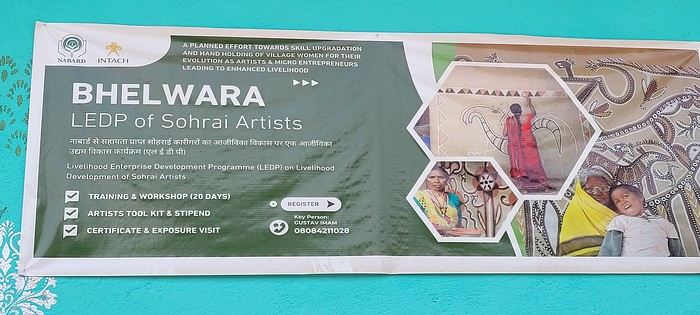
Hazaribagh I’ve got a meet-up with Adam Iman, a guide and painter. He picks me up from the hotel at 10 AM. Another traveler from Bangalore is supposed to join us, but while we wait for him to arrive, Adam takes me to see the paintings his mother and sister created at Hazaribagh station. The town became famous thanks to these murals, which can also be found in several surrounding villages. This art form has earned recognition and is now protected, a sign of its cultural importance. Once the visit is over, we go to pick up the other traveler and then head to our first village: Belwara, where Sohrai art is practiced. At the entrance, a sign proudly announces that we’re entering an artists’ village, where this art is created by women organized into micro-enterprises. Some even offer workshops for those who’d like to learn this tradition.
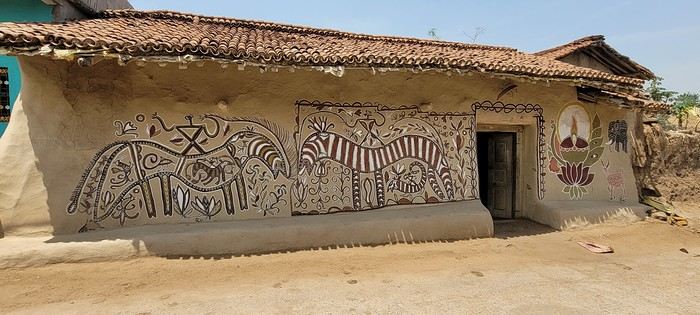
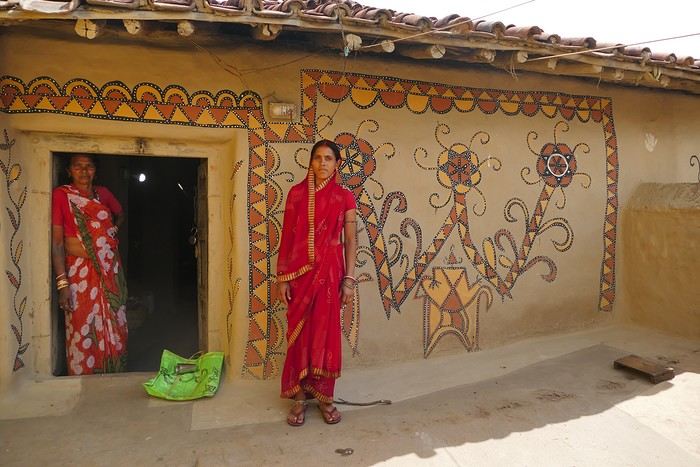
Sohrai art is tied to the harvest season, from October to mid-November. The motifs, in natural colors, celebrate fertility and abundance. The artists use pigments from the earth: red oxides, ochre, white kaolin, and black manganese. On the walls, you’ll see animals, fish, birds—all symbols of life and prosperity. As I look closer at the murals, I start to realize that each motif tells a story. Large animals like cows or bulls often take center stage. Their bodies are filled with intricate, almost hypnotic patterns. They symbolize wealth and prosperity for the household, as well as the deep respect for cattle, which are essential to daily life. On some facades, elephants stand out—massive and decorated with the same precision. They evoke quiet strength and protection. But it’s when I stop in front of one of the houses that I really take the time to look. The wall, a soft ochre, is entirely covered in murals. Two large animals stretch out on either side of the door, their elongated bodies fitting the length of the wall. Their silhouettes are filled with geometric patterns and incredibly fine curved lines, as if every space was patiently filled. Around them, stylized plants, flowers, and small decorative elements fill every gap. The door, dark and worn, becomes almost the silent center of the composition, framed by these living, protective forms. To the right, a more colorful motif catches the eye—a flower or a stylized lamp—like a touch of light on the earth. The whole thing gives an impression of perfect balance, between the rigor of the patterns and the freedom of the gesture.
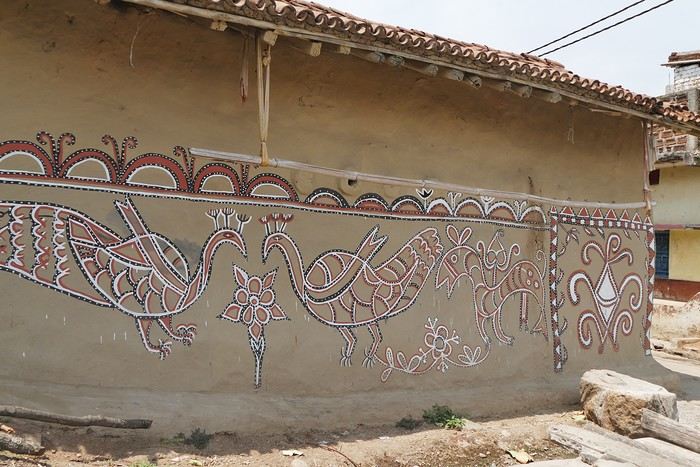
Elsewhere, birds and freer forms bring movement. Peacocks, recognizable by their stylized silhouettes, embody beauty and vitality, while fish symbolize water, fertility, and the continuity of life.
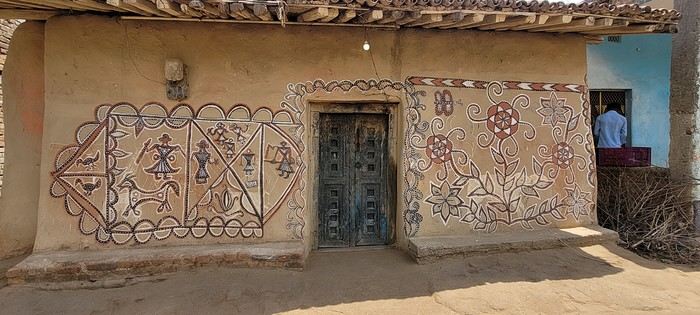
 On some paintings, the scenes become almost narrative: you can make out figures, everyday gestures, like a memory of the village inscribed in the walls. The decorative frames around the doors aren’t left to chance either—they symbolically protect the house, like a boundary between the inside and the outside world.
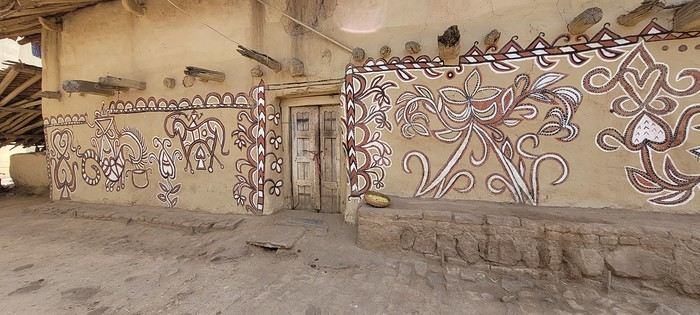
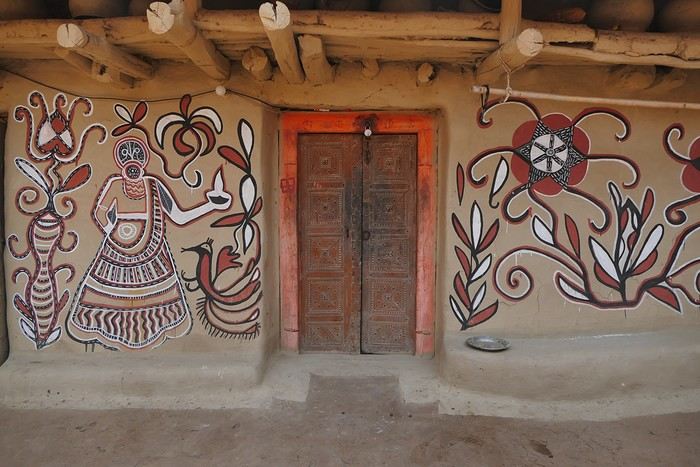
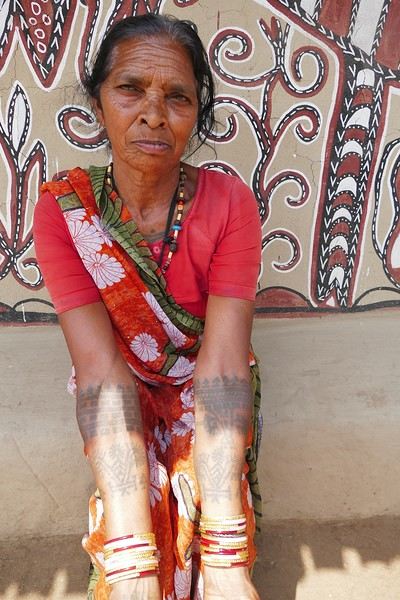
During the Sohrai festival, cattle are led into the jungle in the morning. Meanwhile, the women finish the *aripans*—these floor paintings—and continue the wall murals. Around noon, the animals return to the village, and the bulls’ horns are anointed with oil and vermilion in a gesture of gratitude, amid the vibrant colors adorning the houses. We visit several artists, including Parvat Devi, a well-known woman who has received many awards. Her arms are adorned with intriguing tattoos, which I’ll talk about in more detail later.
On another wall, the style changes completely. Here, no massive animals—just birds occupying the space, light and graceful, as if caught in mid-movement. Two silhouettes face each other, their long necks arched almost like mirrors, while their outstretched wings seem to vibrate with the patterns that compose them.
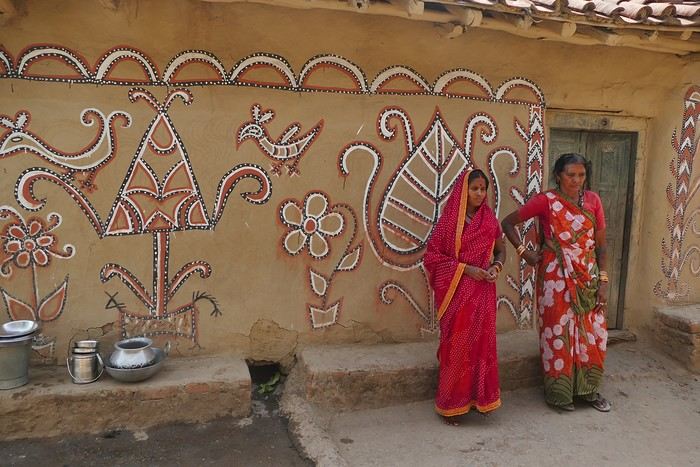
The design is more graphic, almost airy. The lines are smoother, more fluid, as if drawn in one confident stroke. The birds’ bodies aren’t solid—they’re filled with repetitive motifs like scales, stylized feathers, and spirals, giving a sense of continuous movement. Around them, everything comes to life: flowers burst open, arabesques swirl, and even the simplest shapes seem alive. What strikes me here is the sense of lightness. Where the large animals evoked stability and grounding, these birds bring something freer, almost joyful. They seem to embody movement, the circulation of life, like a breath flowing through the village.
The colors remain the same—deep reds, intense blacks, and chalky white—but the rhythm is different. Faster, more spontaneous. As if each wall had its own personality, while still speaking the same language.
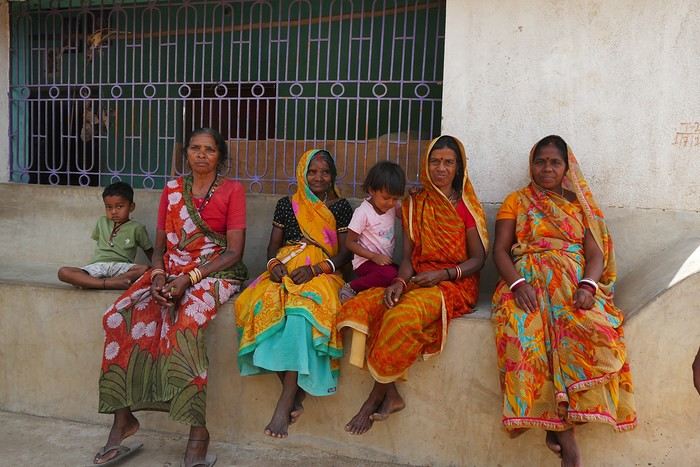
That’s probably why I’m so moved. I’d heard about these paintings from my friend Raja, and last year, I saw an exhibition in a village near my home. That first encounter made me want to come here. But seeing them in person is a whole different experience. These paintings are unique. This ancient art is passed down from mother to daughter, or mother-in-law to daughter-in-law, in a quiet, deeply living continuity. At first glance, it might seem almost childlike in its simplicity and pared-down forms. And yet, everything is thought out, balanced, mastered. Nothing is left to chance.
That apparent simplicity, combined with such rich symbolism, touches me deeply. There’s something sincere and essential in these walls—and that’s what moves me.
Hazaribagh I’ve got a meet-up with Adam Iman, a guide and painter. He picks me up from the hotel at 10 AM. Another traveler from Bangalore is supposed to join us, but while we wait for him to arrive, Adam takes me to see the paintings his mother and sister created at Hazaribagh station. The town became famous thanks to these murals, which can also be found in several surrounding villages. This art form has earned recognition and is now protected, a sign of its cultural importance. Once the visit is over, we go to pick up the other traveler and then head to our first village: Belwara, where Sohrai art is practiced. At the entrance, a sign proudly announces that we’re entering an artists’ village, where this art is created by women organized into micro-enterprises. Some even offer workshops for those who’d like to learn this tradition.
Sohrai art is tied to the harvest season, from October to mid-November. The motifs, in natural colors, celebrate fertility and abundance. The artists use pigments from the earth: red oxides, ochre, white kaolin, and black manganese. On the walls, you’ll see animals, fish, birds—all symbols of life and prosperity. As I look closer at the murals, I start to realize that each motif tells a story. Large animals like cows or bulls often take center stage. Their bodies are filled with intricate, almost hypnotic patterns. They symbolize wealth and prosperity for the household, as well as the deep respect for cattle, which are essential to daily life. On some facades, elephants stand out—massive and decorated with the same precision. They evoke quiet strength and protection. But it’s when I stop in front of one of the houses that I really take the time to look. The wall, a soft ochre, is entirely covered in murals. Two large animals stretch out on either side of the door, their elongated bodies fitting the length of the wall. Their silhouettes are filled with geometric patterns and incredibly fine curved lines, as if every space was patiently filled. Around them, stylized plants, flowers, and small decorative elements fill every gap. The door, dark and worn, becomes almost the silent center of the composition, framed by these living, protective forms. To the right, a more colorful motif catches the eye—a flower or a stylized lamp—like a touch of light on the earth. The whole thing gives an impression of perfect balance, between the rigor of the patterns and the freedom of the gesture.
Elsewhere, birds and freer forms bring movement. Peacocks, recognizable by their stylized silhouettes, embody beauty and vitality, while fish symbolize water, fertility, and the continuity of life.
On some paintings, the scenes become almost narrative: you can make out figures, everyday gestures, like a memory of the village inscribed in the walls. The decorative frames around the doors aren’t left to chance either—they symbolically protect the house, like a boundary between the inside and the outside world.During the Sohrai festival, cattle are led into the jungle in the morning. Meanwhile, the women finish the *aripans*—these floor paintings—and continue the wall murals. Around noon, the animals return to the village, and the bulls’ horns are anointed with oil and vermilion in a gesture of gratitude, amid the vibrant colors adorning the houses. We visit several artists, including Parvat Devi, a well-known woman who has received many awards. Her arms are adorned with intriguing tattoos, which I’ll talk about in more detail later.
On another wall, the style changes completely. Here, no massive animals—just birds occupying the space, light and graceful, as if caught in mid-movement. Two silhouettes face each other, their long necks arched almost like mirrors, while their outstretched wings seem to vibrate with the patterns that compose them.
The design is more graphic, almost airy. The lines are smoother, more fluid, as if drawn in one confident stroke. The birds’ bodies aren’t solid—they’re filled with repetitive motifs like scales, stylized feathers, and spirals, giving a sense of continuous movement. Around them, everything comes to life: flowers burst open, arabesques swirl, and even the simplest shapes seem alive. What strikes me here is the sense of lightness. Where the large animals evoked stability and grounding, these birds bring something freer, almost joyful. They seem to embody movement, the circulation of life, like a breath flowing through the village.
The colors remain the same—deep reds, intense blacks, and chalky white—but the rhythm is different. Faster, more spontaneous. As if each wall had its own personality, while still speaking the same language.
That’s probably why I’m so moved. I’d heard about these paintings from my friend Raja, and last year, I saw an exhibition in a village near my home. That first encounter made me want to come here. But seeing them in person is a whole different experience. These paintings are unique. This ancient art is passed down from mother to daughter, or mother-in-law to daughter-in-law, in a quiet, deeply living continuity. At first glance, it might seem almost childlike in its simplicity and pared-down forms. And yet, everything is thought out, balanced, mastered. Nothing is left to chance.
That apparent simplicity, combined with such rich symbolism, touches me deeply. There’s something sincere and essential in these walls—and that’s what moves me.
A Week in Lanzarote in Late September
Lanzarote Travel Journal
Trip Planning My partner and I are heading to the Canary Islands for a week at the end of September, specifically to Lanzarote. We chose this island over the more crowded ones for its volcanic landscape and the variety of hikes it offers. I booked everything through Expedia: our hotel stay, car rental, and Ryanair flight tickets departing from Marseille. It was the only way to get a direct flight. To make getting around easier during our stay, I picked a hotel located in the center of the island from the wide selection available. It’s part of the Barceló chain, specifically the "Barceló Teguise Beach Adults Only" in Teguise Beach, which turned out to be an excellent choice.
The Trip
Sunday, September 21 - Monday, September 22 Departure It’s 2:15 PM, and we’re at the Avignon TGV station. Danielle picked us up earlier due to the weather—thunderstorms and heavy rain all the way to the station. The TGV was on time, and it only took 30 minutes to reach Marseille Saint-Charles. The shuttle to the airport is quick and convenient, right behind the station. The bus leaves for the airport in the middle of the storm, with flooded roads and cars stuck in some spots. We get soaked making our way to the terminal. Two hours to wait before the flight. The plane finally takes off at midnight, but just before landing, the pilot announces that the destination airport is closed, and we’re being diverted to Tenerife. Ryanair will re-route us as soon as possible. We end up waiting 2 hours, and Ryanair kindly gives us a 4 € voucher. We re-board around 5:15 AM and take off at 6:00 AM. About 45 minutes to reach Lanzarote. After collecting our luggage, we head to the car rental desk. The counter in the terminal is closed, and we’re directed to parking lot P4—it takes us a while to find it. I’m a bit worried about the rental company’s reaction since the car was supposed to be picked up 7 hours earlier, but it’s not a problem. A woman next to us is furious because she’s in the same situation, and her rental was canceled. Anne-Marie translates for her, but nothing changes. We pick up a brand-new Toyota Aigo and head to the hotel. After checking in, we cross the garden, walking alongside the large pool to reach our room. A lovely first-floor room with a jacuzzi and a sea view. It’s early, so we head to breakfast—a generously stocked and varied buffet with everything you could want. Afterward, we drive to Cueva de los Verdes, but it’s packed with people and a long wait. We decide to come back another day. Next, we visit Mirador Del Rio. This rocky viewpoint at the edge of the island has breathtaking cliffs plunging 500 meters into the ocean. The view is stunning and impressive. A panoramic bar lets you cool off while enjoying the scenery. We return to the hotel for a short walk around the neighborhood and enjoy the beautiful pool with its pleasant water temperature. Relaxing by the pool, sun loungers, and all. In the evening, a very varied buffet at the restaurant. Then early to bed to recover from the sleepless night before.
Tuesday, September 23 After a restful night, we enjoy another varied and hearty breakfast. The terrace seating is very pleasant. We take an inland road leading to Timanfaya National Park. The road near the park runs alongside vineyards where the vines are surrounded by lava stone walls to protect them from the prevailing winds. Our first stop is at the visitor center, where the island’s volcanic activity is well-documented. Next, we stop at an area where you can take a short camel ride—two seats are installed on either side of the camel’s hump. This little ride offers a great view of the volcanic landscape from a higher vantage point. A fair price of 11 € per seat for a 20-minute ride. We then head to the park entrance via the road leading to the parking lot, where only authorized buses can take the winding route inside the park. It’s crowded, and we wait about 45 minutes with several stops before reaching the parking lot. We board the bus, and the route offers beautiful views of this volcanic area and its many craters. The journey is very interesting, with several stops for photos. At the parking lot, a guide shows us how the heat from the rocks beneath the surface can ignite dry vegetation. Water poured into holes in the ground immediately creates geysers and jets of steam. The building next to the parking lot has a restaurant where meat is cooked using the heat from a well dug into the volcanic rock. On our way back, we drive to Playa Blanca, a seaside town with a small sandy beach.
Back at the hotel in the late afternoon for dinner.
Wednesday, September 24 We wake up early and have a quick breakfast—few people are around at this hour. Two days ago, we booked a 10:00 AM visit to Los Verdes, lava tunnels created by eruptions and lava flows from the La Corona volcano, which extended all the way to the coast. When the lava came into contact with the air, it solidified on the surface while continuing to flow underneath. The lava tunnels stretch for 8 kilometers to the volcano, but we only walk one kilometer. The inside of the tunnel is impressive, with narrow passages and larger chambers. You can see traces left by the flowing liquid lava—varied colors and twisted shapes. At the end of the path, a large chamber has been turned into a concert hall with perfect acoustics. Next, we visit Jameo Del Agua. This is a continuation of the lava tunnel, developed by Manrique. There are beautifully designed bar and restaurant areas, as well as an underground lake where you can see small blind white crabs—a protected species in this very pure water. Higher up, there’s a lovely space with a central pool that could double as a swimming area, surrounded by beautifully designed white pathways that contrast with the blue water. Further on, you reach a large space inside the lava tunnel, set up as a performance hall with perfect acoustics. Stairs let you view this beautiful space from above. A gap in the lava landscape reveals the ocean on the horizon. We head back toward the village of Yé, at the foot of the La Corona volcano. A 160-meter walk from the church, a path crosses vineyard plots and then climbs to the top of the volcano’s crater in about 30 minutes. It’s the island’s highest volcano. When you reach the edge of the crater, you see how deep it is, with steep slopes inside forming a large circular opening. The place is breathtaking and awe-inspiring. We drive back to the hotel via a road that climbs quickly, offering a beautiful view of the island’s northern part.
Thursday, September 25 After another enjoyable and varied breakfast, we head to the center of the island toward the volcano park and stop at a roadside parking lot where a path leads to the Montana Cuervo volcano. This is a crater that opened on one side. During an eruption, an explosion created a breach in the crater. Huge blocks of rock were thrown dozens of meters away. The path goes through the breach and descends into the crater, allowing you to walk around it. It’s impressive, and you really feel small and fragile in this environment. The crater walls, with their different colors, highlight the rock formations. The crater is surrounded by a sea of lava with sharp, jagged rocks. You can walk around the outside of the crater, but it’s not very interesting. We then head to the west coast, stopping at a spot with a small green lake next to a beautiful black sand beach. Next, we stop at Salinas de Janubio, a lovely viewpoint overlooking the salt marshes with different water colors. A small shop sells various local products. We then head to the famous Papagayo beach. The road ends at a booth where they charge 3 € to continue. From here, the land is private, and you have to pay to drive down a 3-kilometer rocky dirt road. Quite a few cars are driving along it, kicking up clouds of dust. The car gets a dusty makeover. We arrive at a large parking area, with several paths leading to different small beaches. We go to Papagayo, a small blonde sand beach surrounded by red rocks. The beach slopes gently into the water, which is a pleasant temperature. The setting is charming and peaceful. We stay for a while before heading back to the hotel.
Friday, September 26 We start with a visit to the César Manrique Foundation in Tahiche. This was originally one of his homes. The modern construction spans several levels and is integrated into the lava flow, using the gaps to create living spaces. Large windows make the rooms bright and open to the scenery. The place is pleasant, with flower-filled gardens outside. It’s well worth a visit. Next, we drive to Las Grietas, where a path leads to a narrow crack in the volcanic rock, forming a tight passage where only one person can walk at a time. The passage isn’t very long, but progress is slow due to the endless selfies being taken here. We then stop at Casa Del Camposino, a renovated farm that houses several artisan shops. We taste a local wine recommended by a charming woman and buy two bottles of Lanzarote red wine on her advice. Now, we head to Tamara beach, a beautiful and wide beach at the foot of high cliffs. There are always great waves here, making it a surfer’s paradise. On the way back to the hotel, we stop at the cactus garden, César Manrique’s final creation. Designed with a great sense of aesthetics around an old windmill, it features 4,500 varieties of cacti in various shapes, all in a beautiful setting. We return to the hotel in the late afternoon for the evening.
Saturday, September 27 After another hearty breakfast, we head north to Haria. We stumble upon another of César Manrique’s homes, where he lived for a long time. This house is more traditional than the previous one but still has large, modern, and very pleasant rooms. At the back of the garden is his large studio, where he created his works. Next, we visit the craft market—this was our original plan. Various stalls offer local items, and it’s very crowded. No room at the café terraces to sit down. We then return to Famara beach for a long stay. There are always great waves here, much to the surfers’ delight. The water temperature is pleasant, and we enjoy it. On the way back to the hotel, we stop at a gas station to refill the car, which has been very fuel-efficient. Gas is also much cheaper here than in France—1.16 € per liter of SP95. We also wash the car, which was very dusty after the long dirt road to Papagayo beach. At the hotel, we enjoy a farewell cocktail before dinner.
Sunday, September 28 We spend the morning by the hotel pool before checking out at noon. For lunch, we go to a restaurant called "Dona Lola," near the hotel, with a terrace offering a view of the coast. We order tuna carpaccio, which is delicious. We then head to the airport, just 15 minutes away. We return the rental car and go to the airport. A long line to check in our luggage. The return flight is on time. A shuttle bus takes us to Saint-Charles station. We then head to our overnight rental. The boulevard slopes down, making it easier with the suitcases. The rental is between the old port and the train station. Once there, we pick up the keys and make one last effort to carry the luggage up to the third floor. The studio is nice, clean, and simply equipped—perfect for one night.
Trip Planning My partner and I are heading to the Canary Islands for a week at the end of September, specifically to Lanzarote. We chose this island over the more crowded ones for its volcanic landscape and the variety of hikes it offers. I booked everything through Expedia: our hotel stay, car rental, and Ryanair flight tickets departing from Marseille. It was the only way to get a direct flight. To make getting around easier during our stay, I picked a hotel located in the center of the island from the wide selection available. It’s part of the Barceló chain, specifically the "Barceló Teguise Beach Adults Only" in Teguise Beach, which turned out to be an excellent choice.
The Trip
Sunday, September 21 - Monday, September 22 Departure It’s 2:15 PM, and we’re at the Avignon TGV station. Danielle picked us up earlier due to the weather—thunderstorms and heavy rain all the way to the station. The TGV was on time, and it only took 30 minutes to reach Marseille Saint-Charles. The shuttle to the airport is quick and convenient, right behind the station. The bus leaves for the airport in the middle of the storm, with flooded roads and cars stuck in some spots. We get soaked making our way to the terminal. Two hours to wait before the flight. The plane finally takes off at midnight, but just before landing, the pilot announces that the destination airport is closed, and we’re being diverted to Tenerife. Ryanair will re-route us as soon as possible. We end up waiting 2 hours, and Ryanair kindly gives us a 4 € voucher. We re-board around 5:15 AM and take off at 6:00 AM. About 45 minutes to reach Lanzarote. After collecting our luggage, we head to the car rental desk. The counter in the terminal is closed, and we’re directed to parking lot P4—it takes us a while to find it. I’m a bit worried about the rental company’s reaction since the car was supposed to be picked up 7 hours earlier, but it’s not a problem. A woman next to us is furious because she’s in the same situation, and her rental was canceled. Anne-Marie translates for her, but nothing changes. We pick up a brand-new Toyota Aigo and head to the hotel. After checking in, we cross the garden, walking alongside the large pool to reach our room. A lovely first-floor room with a jacuzzi and a sea view. It’s early, so we head to breakfast—a generously stocked and varied buffet with everything you could want. Afterward, we drive to Cueva de los Verdes, but it’s packed with people and a long wait. We decide to come back another day. Next, we visit Mirador Del Rio. This rocky viewpoint at the edge of the island has breathtaking cliffs plunging 500 meters into the ocean. The view is stunning and impressive. A panoramic bar lets you cool off while enjoying the scenery. We return to the hotel for a short walk around the neighborhood and enjoy the beautiful pool with its pleasant water temperature. Relaxing by the pool, sun loungers, and all. In the evening, a very varied buffet at the restaurant. Then early to bed to recover from the sleepless night before.
Tuesday, September 23 After a restful night, we enjoy another varied and hearty breakfast. The terrace seating is very pleasant. We take an inland road leading to Timanfaya National Park. The road near the park runs alongside vineyards where the vines are surrounded by lava stone walls to protect them from the prevailing winds. Our first stop is at the visitor center, where the island’s volcanic activity is well-documented. Next, we stop at an area where you can take a short camel ride—two seats are installed on either side of the camel’s hump. This little ride offers a great view of the volcanic landscape from a higher vantage point. A fair price of 11 € per seat for a 20-minute ride. We then head to the park entrance via the road leading to the parking lot, where only authorized buses can take the winding route inside the park. It’s crowded, and we wait about 45 minutes with several stops before reaching the parking lot. We board the bus, and the route offers beautiful views of this volcanic area and its many craters. The journey is very interesting, with several stops for photos. At the parking lot, a guide shows us how the heat from the rocks beneath the surface can ignite dry vegetation. Water poured into holes in the ground immediately creates geysers and jets of steam. The building next to the parking lot has a restaurant where meat is cooked using the heat from a well dug into the volcanic rock. On our way back, we drive to Playa Blanca, a seaside town with a small sandy beach.
Back at the hotel in the late afternoon for dinner.
Wednesday, September 24 We wake up early and have a quick breakfast—few people are around at this hour. Two days ago, we booked a 10:00 AM visit to Los Verdes, lava tunnels created by eruptions and lava flows from the La Corona volcano, which extended all the way to the coast. When the lava came into contact with the air, it solidified on the surface while continuing to flow underneath. The lava tunnels stretch for 8 kilometers to the volcano, but we only walk one kilometer. The inside of the tunnel is impressive, with narrow passages and larger chambers. You can see traces left by the flowing liquid lava—varied colors and twisted shapes. At the end of the path, a large chamber has been turned into a concert hall with perfect acoustics. Next, we visit Jameo Del Agua. This is a continuation of the lava tunnel, developed by Manrique. There are beautifully designed bar and restaurant areas, as well as an underground lake where you can see small blind white crabs—a protected species in this very pure water. Higher up, there’s a lovely space with a central pool that could double as a swimming area, surrounded by beautifully designed white pathways that contrast with the blue water. Further on, you reach a large space inside the lava tunnel, set up as a performance hall with perfect acoustics. Stairs let you view this beautiful space from above. A gap in the lava landscape reveals the ocean on the horizon. We head back toward the village of Yé, at the foot of the La Corona volcano. A 160-meter walk from the church, a path crosses vineyard plots and then climbs to the top of the volcano’s crater in about 30 minutes. It’s the island’s highest volcano. When you reach the edge of the crater, you see how deep it is, with steep slopes inside forming a large circular opening. The place is breathtaking and awe-inspiring. We drive back to the hotel via a road that climbs quickly, offering a beautiful view of the island’s northern part.
Thursday, September 25 After another enjoyable and varied breakfast, we head to the center of the island toward the volcano park and stop at a roadside parking lot where a path leads to the Montana Cuervo volcano. This is a crater that opened on one side. During an eruption, an explosion created a breach in the crater. Huge blocks of rock were thrown dozens of meters away. The path goes through the breach and descends into the crater, allowing you to walk around it. It’s impressive, and you really feel small and fragile in this environment. The crater walls, with their different colors, highlight the rock formations. The crater is surrounded by a sea of lava with sharp, jagged rocks. You can walk around the outside of the crater, but it’s not very interesting. We then head to the west coast, stopping at a spot with a small green lake next to a beautiful black sand beach. Next, we stop at Salinas de Janubio, a lovely viewpoint overlooking the salt marshes with different water colors. A small shop sells various local products. We then head to the famous Papagayo beach. The road ends at a booth where they charge 3 € to continue. From here, the land is private, and you have to pay to drive down a 3-kilometer rocky dirt road. Quite a few cars are driving along it, kicking up clouds of dust. The car gets a dusty makeover. We arrive at a large parking area, with several paths leading to different small beaches. We go to Papagayo, a small blonde sand beach surrounded by red rocks. The beach slopes gently into the water, which is a pleasant temperature. The setting is charming and peaceful. We stay for a while before heading back to the hotel.
Friday, September 26 We start with a visit to the César Manrique Foundation in Tahiche. This was originally one of his homes. The modern construction spans several levels and is integrated into the lava flow, using the gaps to create living spaces. Large windows make the rooms bright and open to the scenery. The place is pleasant, with flower-filled gardens outside. It’s well worth a visit. Next, we drive to Las Grietas, where a path leads to a narrow crack in the volcanic rock, forming a tight passage where only one person can walk at a time. The passage isn’t very long, but progress is slow due to the endless selfies being taken here. We then stop at Casa Del Camposino, a renovated farm that houses several artisan shops. We taste a local wine recommended by a charming woman and buy two bottles of Lanzarote red wine on her advice. Now, we head to Tamara beach, a beautiful and wide beach at the foot of high cliffs. There are always great waves here, making it a surfer’s paradise. On the way back to the hotel, we stop at the cactus garden, César Manrique’s final creation. Designed with a great sense of aesthetics around an old windmill, it features 4,500 varieties of cacti in various shapes, all in a beautiful setting. We return to the hotel in the late afternoon for the evening.
Saturday, September 27 After another hearty breakfast, we head north to Haria. We stumble upon another of César Manrique’s homes, where he lived for a long time. This house is more traditional than the previous one but still has large, modern, and very pleasant rooms. At the back of the garden is his large studio, where he created his works. Next, we visit the craft market—this was our original plan. Various stalls offer local items, and it’s very crowded. No room at the café terraces to sit down. We then return to Famara beach for a long stay. There are always great waves here, much to the surfers’ delight. The water temperature is pleasant, and we enjoy it. On the way back to the hotel, we stop at a gas station to refill the car, which has been very fuel-efficient. Gas is also much cheaper here than in France—1.16 € per liter of SP95. We also wash the car, which was very dusty after the long dirt road to Papagayo beach. At the hotel, we enjoy a farewell cocktail before dinner.
Sunday, September 28 We spend the morning by the hotel pool before checking out at noon. For lunch, we go to a restaurant called "Dona Lola," near the hotel, with a terrace offering a view of the coast. We order tuna carpaccio, which is delicious. We then head to the airport, just 15 minutes away. We return the rental car and go to the airport. A long line to check in our luggage. The return flight is on time. A shuttle bus takes us to Saint-Charles station. We then head to our overnight rental. The boulevard slopes down, making it easier with the suitcases. The rental is between the old port and the train station. Once there, we pick up the keys and make one last effort to carry the luggage up to the third floor. The studio is nice, clean, and simply equipped—perfect for one night.
16 days with family in La Gomera (Canary Islands)
Preamble: Why La Gomera?
When we started looking for a summer destination a few months ago, our first criterion was to avoid extreme heat and heatwaves. We had already been to Norway two years ago and are considering going back in the future for other occasions. So, we had some fun asking ChatGPT which destinations enjoyed a mild climate during the summer without going too far. Among the list provided by the AI were the Canary Islands... The idea of a place we wouldn’t have thought of first, both not too far away and exotic enough, appealed to us: “Hmm, why not?”
This destination had never really attracted me, though Magali was a bit more interested. Five years earlier, COVID had caused a short break in my professional activity, and I had planned a trip because the flight price was attractive, and I was looking for a destination different from what usually appeals to me, more than out of deep interest. From a distance and with a social judgment I acknowledge (it’s not great, but it’s not completely wrong), I had the image of a destination for party-goers enjoying the sun without the slightest interest in local culture, with concrete coastlines and denatured landscapes—everything I detest the most. Still, I had done some quick research on the different islands and spotted Lanzarote for its beautiful volcanic landscapes, hiking trails, beaches, and the impression of a good balance between activity and fewer crowds than Tenerife or Gran Canaria. Then I dropped the idea of going, without ever reconsidering traveling to the Canaries...
Until now! Because we started researching the different islands of the archipelago to see which ones might appeal to us the most. It was La Gomera, the third smallest island of the archipelago, more praised for its hiking trails and preserved nature than for its beaches, away from mass tourism (fifty times fewer tourists than Tenerife) but still a bit more developed than its wild neighbor El Hierro, that caught our attention. Contrary to what might be suggested later, I’m not at all addicted to AI, but I use it from time to time to synthesize quick research or simply for experimentation. Since ChatGPT had started anticipating my tastes lately as if it had become my buddy (often successfully, sometimes off the mark), I asked which Canary Island would suit me best for a trip with my family. The tool answered first with... La Gomera. So, I tested it and teased it a bit to see if this suggestion was well-founded, as the method sometimes makes it contradict itself. But no luck: “You’d appreciate the wild nature of El Hierro, but with family, you’ll find little activity for the kids. You won’t like the touristy vibe of the big islands like Tenerife, Gran Canaria, Lanzarote, and Fuerteventura. You could consider La Palma, but it’s really La Gomera that will suit you best, based on your interests and the criteria given.” So, we dug deeper into our research and were convinced without a shadow of a doubt that this island was the one waiting for us.
Without knowing it, we had Canarians in our circle who revealed their origins when they heard about our travel plans. One from Tenerife insisted we’d be better off choosing Tenerife (obviously...) because it also has preserved spots and that La Gomera, “you can explore it in two or three days, you’ll get bored quickly...” The other, a colleague from Gran Canaria who had never visited La Gomera, still recommended it without hesitation because it turned out her parents had just gone there on vacation: they loved it and had encountered few tourists. She also tended to think this destination was usually the subject of short stays, but according to what her parents told her, taking your time there was also a great idea. However, in our research, the idea that La Gomera is an island you can explore in three or four days max kept coming up. So, we considered combining its visit with La Palma or El Hierro, the other two that caught our eye. But hopping between islands by ferry represents a significant budget for non-Canarians, even more so for a family of four. Then, scrutinizing Google Maps, it seemed obvious that two weeks were too short to discover two islands as they deserve, and that there seemed to be plenty to see in La Gomera, given its very unique culture. After all, we read that some people spend several months a year there, others never even leave... Finally, these landscapes and this atmosphere, which seemed to us a mix of Europe, North Africa, and Latin America, tempted us. So, it would be two weeks in La Gomera, deal!
La Gomera is therefore the second... well, the third smallest island of the Canaries since La Graciosa was recently recognized as a fully inhabited island. It has the shape of a rough circle about 20 to 25 kilometers in diameter and has just over 20,000 inhabitants, half of them in its capital, San Sebastián de la Gomera, the only real town. Like its Canarian sisters, La Gomera is a volcanic formation that rose about 10 million years ago. The island is very mountainous and rugged, covered with red and black rocky landscapes. Geological activity has shaped, between the sprawling massifs that end in steep cliffs in the ocean, six coastal valleys with tropical vegetation that have favored human settlement. They divide the island like slices of a cake; from the north clockwise: the agricultural Vallehermoso, the rustic Agulo, the green, humid, and fertile Hermigua, the sunny capital San Sebastián de la Gomera, the southern and isolated Alajeró-Santiago, and the seaside Valle Gran Rey. They constitute the six municipalities (more like cantons to our French understanding) of the territory.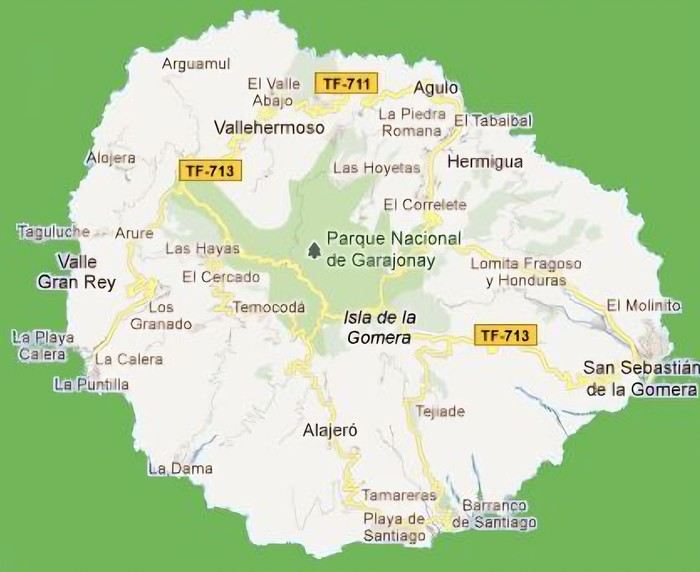 The large solidified magma massifs that shape the heart of the island have created a large depression more protected from the sun at its center, allowing the growth of a vast laurel forest, today grouped within the Garajonay National Park, La Gomera’s green lung, which has earned it the status of a World Biosphere Reserve. Its completely European appearance contrasts sharply with the rocky and tropical landscapes of the rest of the island. Thus, the climate varies greatly from one point to another on the island: in summer, you can quickly go from a dry and sunny valley at 35°C to a humid forest area at altitude at 18°C.
La Gomera was populated late. As with the rest of the Canaries, human presence is thought to have begun about 2,000 years ago. Groups of animist Berbers, probably fleeing persecution, gradually populated the archipelago, especially the western islands and La Gomera, becoming its small aboriginal population: the Guanches (or later Gomeros). The animist and pastoral civilization of the Guanches thrived until the Spanish takeover in the 15th century, which, after a short period of harmony and mixing with the indigenous people, suddenly ended in bloodshed... La Gomera later became the “Columbus Island” after Christopher Columbus’s stopover, increasing the blending of populations. In the 20th century, many Gomeros emigrated to Cuba and other Latin American countries in search of a better life, bringing back a mix of cultures and traits quite palpable in today’s Gomeran culture. It is, however, in La Gomera that the vestiges of Guanche culture seem to have left the most traces, in the language, gastronomy, social practices... Moreover, most Gomeros, especially in remote villages, have a particular identifiable type and proudly claim their ancestral roots, even making La Gomera a bit exotic in the eyes of other Canarians.
Perhaps that’s why it has never really wanted to develop its tourist infrastructure too much. If we set aside the tourists who visit for the day by bus or boat from Tenerife on a marked itinerary (and whom we ultimately rarely encounter), La Gomera has remained a hidden gem, a destination focused on nature discovery that attracts hikers, nature-loving divers, and scientists for its fauna and flora, and to a lesser extent, beachgoers who don’t seek overly developed coastlines. Tourist activity is therefore limited. Roughly speaking, you’ll find a majority of Spaniards, including a substantial number of residents from other Canary Islands, many Germans who have a particular fondness for La Gomera and spend long stays there or own second homes, to the point that the German cultural footprint is clearly noticeable in some places (it’s said to be Angela Merkel’s favorite holiday spot), and still quite a few French. The presence of other nationalities seemed negligible to us. Most travelers come mainly for hiking, but it’s also a prime spot for whale watching. Additionally, the seaside resorts of La Gomera—San Sebastián, Santiago, and especially Valle Gran Rey—are well-known destinations for hippies, especially German ones, ranging from chic boho hippies to old-school hippies who’ve been there for decades, quite similar to those you’d meet in India in Goa, Rishikesh, or Paharganj. Thus, practices like naturism, vegetarianism, and local organic production are quite well established in some areas.
Some practical info: - The round-trip flight from Paris to Tenerife cost us 365 € per person (outbound with Transavia, return with EasyJet), including checked luggage and three seats reserved side by side. - We chose two bases to explore the island: one week in Valle Gran Rey, reputed to be the most pleasant of the three seaside resorts, and one week in Hermigua, more mountainous and close to the natural park. We booked two houses with balconies and views: the first at 120 € per night, the second at 99 €. - The round-trip ferry between Tenerife and La Gomera cost us 270 € with the company Baleària Canarias, including discounts for children aged 4 and 12, but I don’t have the exact details. It was a bit cheaper than with the other company, Fred Olsen. - Finally, we rented a car through the agency Cicar for 360 € for 16 days, which comes to 22.50 € per day. - Apart from that, we didn’t plan anything and decided the day before or even the morning of what we wanted to do. We didn’t invest in any paper guide on the Canaries, as information on La Gomera was scarce, but we used the very comprehensive site La Gomera Travel, a travel guide published by the Canary Islands Tourism Council, a real goldmine of almost exhaustive information on the island.
Alright, off we go for 16 days of adventure discovering La Gomera!
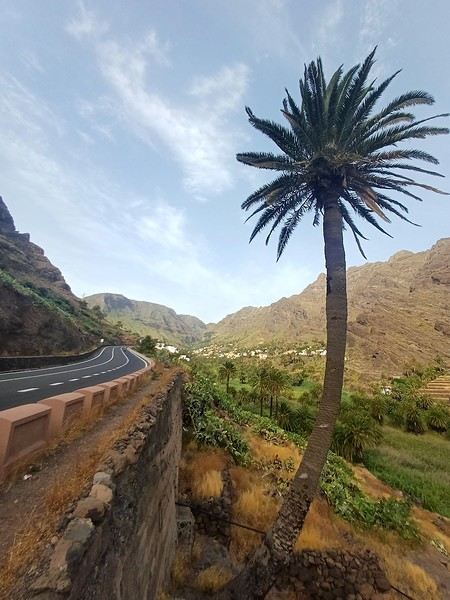
And we start the trip with music!
We start the trip with music!
When we started looking for a summer destination a few months ago, our first criterion was to avoid extreme heat and heatwaves. We had already been to Norway two years ago and are considering going back in the future for other occasions. So, we had some fun asking ChatGPT which destinations enjoyed a mild climate during the summer without going too far. Among the list provided by the AI were the Canary Islands... The idea of a place we wouldn’t have thought of first, both not too far away and exotic enough, appealed to us: “Hmm, why not?”
This destination had never really attracted me, though Magali was a bit more interested. Five years earlier, COVID had caused a short break in my professional activity, and I had planned a trip because the flight price was attractive, and I was looking for a destination different from what usually appeals to me, more than out of deep interest. From a distance and with a social judgment I acknowledge (it’s not great, but it’s not completely wrong), I had the image of a destination for party-goers enjoying the sun without the slightest interest in local culture, with concrete coastlines and denatured landscapes—everything I detest the most. Still, I had done some quick research on the different islands and spotted Lanzarote for its beautiful volcanic landscapes, hiking trails, beaches, and the impression of a good balance between activity and fewer crowds than Tenerife or Gran Canaria. Then I dropped the idea of going, without ever reconsidering traveling to the Canaries...
Until now! Because we started researching the different islands of the archipelago to see which ones might appeal to us the most. It was La Gomera, the third smallest island of the archipelago, more praised for its hiking trails and preserved nature than for its beaches, away from mass tourism (fifty times fewer tourists than Tenerife) but still a bit more developed than its wild neighbor El Hierro, that caught our attention. Contrary to what might be suggested later, I’m not at all addicted to AI, but I use it from time to time to synthesize quick research or simply for experimentation. Since ChatGPT had started anticipating my tastes lately as if it had become my buddy (often successfully, sometimes off the mark), I asked which Canary Island would suit me best for a trip with my family. The tool answered first with... La Gomera. So, I tested it and teased it a bit to see if this suggestion was well-founded, as the method sometimes makes it contradict itself. But no luck: “You’d appreciate the wild nature of El Hierro, but with family, you’ll find little activity for the kids. You won’t like the touristy vibe of the big islands like Tenerife, Gran Canaria, Lanzarote, and Fuerteventura. You could consider La Palma, but it’s really La Gomera that will suit you best, based on your interests and the criteria given.” So, we dug deeper into our research and were convinced without a shadow of a doubt that this island was the one waiting for us.
Without knowing it, we had Canarians in our circle who revealed their origins when they heard about our travel plans. One from Tenerife insisted we’d be better off choosing Tenerife (obviously...) because it also has preserved spots and that La Gomera, “you can explore it in two or three days, you’ll get bored quickly...” The other, a colleague from Gran Canaria who had never visited La Gomera, still recommended it without hesitation because it turned out her parents had just gone there on vacation: they loved it and had encountered few tourists. She also tended to think this destination was usually the subject of short stays, but according to what her parents told her, taking your time there was also a great idea. However, in our research, the idea that La Gomera is an island you can explore in three or four days max kept coming up. So, we considered combining its visit with La Palma or El Hierro, the other two that caught our eye. But hopping between islands by ferry represents a significant budget for non-Canarians, even more so for a family of four. Then, scrutinizing Google Maps, it seemed obvious that two weeks were too short to discover two islands as they deserve, and that there seemed to be plenty to see in La Gomera, given its very unique culture. After all, we read that some people spend several months a year there, others never even leave... Finally, these landscapes and this atmosphere, which seemed to us a mix of Europe, North Africa, and Latin America, tempted us. So, it would be two weeks in La Gomera, deal!
La Gomera is therefore the second... well, the third smallest island of the Canaries since La Graciosa was recently recognized as a fully inhabited island. It has the shape of a rough circle about 20 to 25 kilometers in diameter and has just over 20,000 inhabitants, half of them in its capital, San Sebastián de la Gomera, the only real town. Like its Canarian sisters, La Gomera is a volcanic formation that rose about 10 million years ago. The island is very mountainous and rugged, covered with red and black rocky landscapes. Geological activity has shaped, between the sprawling massifs that end in steep cliffs in the ocean, six coastal valleys with tropical vegetation that have favored human settlement. They divide the island like slices of a cake; from the north clockwise: the agricultural Vallehermoso, the rustic Agulo, the green, humid, and fertile Hermigua, the sunny capital San Sebastián de la Gomera, the southern and isolated Alajeró-Santiago, and the seaside Valle Gran Rey. They constitute the six municipalities (more like cantons to our French understanding) of the territory.
The large solidified magma massifs that shape the heart of the island have created a large depression more protected from the sun at its center, allowing the growth of a vast laurel forest, today grouped within the Garajonay National Park, La Gomera’s green lung, which has earned it the status of a World Biosphere Reserve. Its completely European appearance contrasts sharply with the rocky and tropical landscapes of the rest of the island. Thus, the climate varies greatly from one point to another on the island: in summer, you can quickly go from a dry and sunny valley at 35°C to a humid forest area at altitude at 18°C.La Gomera was populated late. As with the rest of the Canaries, human presence is thought to have begun about 2,000 years ago. Groups of animist Berbers, probably fleeing persecution, gradually populated the archipelago, especially the western islands and La Gomera, becoming its small aboriginal population: the Guanches (or later Gomeros). The animist and pastoral civilization of the Guanches thrived until the Spanish takeover in the 15th century, which, after a short period of harmony and mixing with the indigenous people, suddenly ended in bloodshed... La Gomera later became the “Columbus Island” after Christopher Columbus’s stopover, increasing the blending of populations. In the 20th century, many Gomeros emigrated to Cuba and other Latin American countries in search of a better life, bringing back a mix of cultures and traits quite palpable in today’s Gomeran culture. It is, however, in La Gomera that the vestiges of Guanche culture seem to have left the most traces, in the language, gastronomy, social practices... Moreover, most Gomeros, especially in remote villages, have a particular identifiable type and proudly claim their ancestral roots, even making La Gomera a bit exotic in the eyes of other Canarians.
Perhaps that’s why it has never really wanted to develop its tourist infrastructure too much. If we set aside the tourists who visit for the day by bus or boat from Tenerife on a marked itinerary (and whom we ultimately rarely encounter), La Gomera has remained a hidden gem, a destination focused on nature discovery that attracts hikers, nature-loving divers, and scientists for its fauna and flora, and to a lesser extent, beachgoers who don’t seek overly developed coastlines. Tourist activity is therefore limited. Roughly speaking, you’ll find a majority of Spaniards, including a substantial number of residents from other Canary Islands, many Germans who have a particular fondness for La Gomera and spend long stays there or own second homes, to the point that the German cultural footprint is clearly noticeable in some places (it’s said to be Angela Merkel’s favorite holiday spot), and still quite a few French. The presence of other nationalities seemed negligible to us. Most travelers come mainly for hiking, but it’s also a prime spot for whale watching. Additionally, the seaside resorts of La Gomera—San Sebastián, Santiago, and especially Valle Gran Rey—are well-known destinations for hippies, especially German ones, ranging from chic boho hippies to old-school hippies who’ve been there for decades, quite similar to those you’d meet in India in Goa, Rishikesh, or Paharganj. Thus, practices like naturism, vegetarianism, and local organic production are quite well established in some areas.
Some practical info: - The round-trip flight from Paris to Tenerife cost us 365 € per person (outbound with Transavia, return with EasyJet), including checked luggage and three seats reserved side by side. - We chose two bases to explore the island: one week in Valle Gran Rey, reputed to be the most pleasant of the three seaside resorts, and one week in Hermigua, more mountainous and close to the natural park. We booked two houses with balconies and views: the first at 120 € per night, the second at 99 €. - The round-trip ferry between Tenerife and La Gomera cost us 270 € with the company Baleària Canarias, including discounts for children aged 4 and 12, but I don’t have the exact details. It was a bit cheaper than with the other company, Fred Olsen. - Finally, we rented a car through the agency Cicar for 360 € for 16 days, which comes to 22.50 € per day. - Apart from that, we didn’t plan anything and decided the day before or even the morning of what we wanted to do. We didn’t invest in any paper guide on the Canaries, as information on La Gomera was scarce, but we used the very comprehensive site La Gomera Travel, a travel guide published by the Canary Islands Tourism Council, a real goldmine of almost exhaustive information on the island.
Alright, off we go for 16 days of adventure discovering La Gomera!
And we start the trip with music!
We start the trip with music!
Tips and feedback from our trip to China, Vietnam, and Cambodia
Here are some tips from our 6-week trip (summer 2026) to China, Vietnam, and Cambodia. We traveled as a family of four with two kids aged 15 and 12.
I hope these notes help other travelers!
CHINA General You’ll need to download and set up a few apps: - Alipay and WeChat for payments (I didn’t withdraw a single bill the entire trip) - Didi for taxis - Amap = Chinese Maps (works great, especially for subways) - A translation app (we used Papago, but it sometimes gave weird results) - Google Lens for translating menus or signs—super handy. - HelloRide for bikes - Gemini and ChatGPT for everything: understanding daily life, enhancing visits, checking the weather, finding things. - HomeExchange if you want to lower travel costs (few listings in Asia except in big cities, often expats) - Trip.com is very useful, even essential, for trains, domestic flights, and hotels. Like Booking.com, the more you book with them, the more perks you get. So I’d even suggest checking flight tickets on this site, even if it’s a bit pricier. However, buying train tickets is complicated because (1) they only open 15 days in advance, and (2) they sell out fast. Trip.com just promises to buy them as soon as they’re available but doesn’t always succeed. It’s stressful and might force you to change your plans, especially if you’re aiming for a sleeper car and there are no seats left. Watch out for station names—many cities have multiple stations, including a high-speed rail one outside the city. For internet, we got the Asia plan from Holafly. It worked but seemed much slower than Chinese internet. I regretted not buying a Chinese SIM card because without internet in China, everything is VERY complicated (money, transport, etc.).
For the firewall, we used ExpressVPN, but it wasn’t always reliable. A bit disappointing. Ask ChatGPT for tips with screenshots to improve the settings.
Since we only had one SIM card with internet, we couldn’t rent shared bikes. If I were to do it again, I’d get a SIM for each person, even the kids, because distances in cities are huge. We walked *a lot*. Same goes for buses—it’s tricky with just one internet connection. Better to have a phone per person with internet. Book your visits as far in advance as possible—they often sell out. Watch out for power banks: if they don’t explicitly say "3C," they’ll confiscate it. Even if there’s a little airplane logo.
Shanghai In the evening, the streets leading to the Bund from the metro were so crowded that police were out in force blocking roads. Arrive early. We went around the north side.
Suzhou Be careful—there are two stations (common in China), and the high-speed rail one is 45–50 minutes from the old town. The Humble Administrator’s Garden was *packed*—we don’t recommend it. It turned into a marathon day from Shanghai (almost 4 hours from our hotel to the garden).
Beijing Forbidden City: Don’t go—I know it’s a shame, but it’s too crowded. I couldn’t buy tickets on the official site because of the kids’ passports. We ended up with a guided tour, the only way to get in (tickets sell out fast). The visit was disappointing—bad guide *and* massive crowds. You’ll queue a lot to enter and see certain areas. You’ll be checked often, so pack your bags carefully. Great Wall at Mutianyu: Crowded. Two hours by bus, and even though we arrived early, people were already leaving! I really think the best option is to leave your big bags in Beijing and stay overnight near the Wall. That way, you’ll have it to yourself a bit more. For transport: get off at Tiananmen Square metro and look for buses with official guides in bright yellow-green vests. No need to buy tickets online—they made me cancel mine to rebook on the spot. Buses leave when full. Note: the cable car and chairlift are separate—if you want to go up one side and down the other, you’ll need different tickets. The endless queue for the toboggan ride put us off. Quick tip: Incredible swimming spot in Beijing—on the north shore of Houhai Lake, you can swim by crossing the barrier. We did it twice with about ten other people. Bring a swimsuit!
Shapotou Desert Amazing, but it gets *very* hot in the afternoon. We had a tent (not an air-conditioned bungalow), which was unbearable during the day. We hung out in the restaurant. The paid activities are fun, except the camels—they look sad. The real highlight is the evening and sunset. The only downside: you can’t explore the desert alone or far—they don’t rent 4x4s, for example. We stayed at "The Desert Camping Hotel of the Proprietress of Shapotou." They were lovely.
Zhongwei Gaomiao Temple and its underground: Fun and short—you’ll see quirky Buddhist hell paintings.
Xi’an Terracotta Army: We took a Didi because for four people, a car was almost the same price as four shuttle tickets. It was packed—chaotic to see properly. We visited the halls in order: 3, 2, then 1—a good choice. Hua Shan Mountains: Left before sunrise to arrive when the ticket office opened (7 AM, I think). We were shocked to see so many people already coming down. 45 minutes by bus to the west cable car, then 15 minutes up. We did the west, south, east, central, then north peaks (in that order) before taking the other cable car down (you can buy the ticket at the top). A beautiful day. In the city, check out...
Chengdu Panda Research Center: Like Hua Shan, plan to arrive when the ticket office opens. Already *tons* of people, and it moves fast to see the big pandas before their nap. Have them drop you at the west entrance (not south), or you’ll have to walk uphill. Leshan Giant Buddha: Interesting. The trip is a bit long (metro, then train, then city bus, then shuttle on-site). We didn’t take the boat option but walked. In the end, you only spend a few minutes at the Buddha’s feet, but it’s a nice day out. Hotel tip: Panda Enjoy Home Hotel Apartments (Chengdu East Railway Station Dongda Road Branch). The view is insane, and the neighborhood is super convenient and nice. 646 CNY for 2 nights. Swimming: The municipal pool is an interesting experience, but don’t expect to swim—no one does. Everyone just splashes around where they can stand. The hours are a bit odd, with a break in the late afternoon.
Kunming The bike path along Dian Lake is pretty and often well-protected from cars. But like everywhere in China, it’s *packed*. Not much to say about visits—the flower market is a wholesale market, not very interesting. The ethnic minorities museum closed right in front of us. All the big malls are good for shopping.
Dali We thought we could bike around the lake in two days. Wrong on two counts: First, the lake’s edge is blocked to traffic and reserved for bikes (or tourist mini-buses). So you’re stuck on the main road, which never gives you a view of the lake, with all the trucks and cars. Doing 120 km like that wouldn’t make sense, in our opinion. The rice fields around are nice but not as impressive as elsewhere, so Dali isn’t worth it for that. The old town, all restored, is pretty but *packed*—thousands of people, especially in the evening.
Hekou (Vietnam border) Comfortable train from Kunming. In the parking lot, a bus (not well-marked, but Didi is an option) takes you to the border in 15–20 minutes. Short wait at both border posts. Fun to see the two lampposts near the border line: the Chinese one is new, modern, with a surveillance camera (of course), while the Vietnamese one is old and a bit rusty.
VIETNAM General: - You’ll need the Grab app for taxis - Very disappointed with 12Go—it doesn’t show all buses, never connects you with the company, and refuses refunds. Try booking directly with companies like FUTA Bus instead. - Credit cards are often accepted (supermarkets and modern stores), otherwise, you’ll need cash
Lao Cai 2 km between the border and the train station. The sleeper bus to Hanoi with Sao Viet is well-organized—it works.
Hanoi Ho Chi Minh Mausoleum closes early (10:30 AM, I think). Women’s Museum: Very good, not too long Temple of Literature: Beautiful, fairly quick This is where you should buy souvenirs, clothes, and knockoffs—the prices are reasonable, and the sellers are nicer than elsewhere. We recommend Cho Dong Xuan.
Tu Long Bay We did 2 days, 1 night (so really 24 hours on the boat) with Parfum d’Automne (French-speaking agency), which put us on a Cycad Cruise boat. Cost: 300 € per person—expensive, but it was amazing, super luxurious, and the buffet meals were delicious. We don’t regret the splurge. The only downside: no swimming in the bay (but there’s a pool on the boat). To swim, you’d need a 3-day, 2-night trip to an area not protected by the maritime park.
Phong Nha If you didn’t do the northern mountains due to time or weather (like us), Phong Nha is a great stop for a motorbike ride. It’s beautiful, especially the mountains west of the city toward the caves. There are two (small) swimming spots at the Botanic Garden—a pleasant 45-minute walk without stops. Hotel tip: Sunbeam Village (very friendly, pool, breakfast by the river, motorbike rentals)
Da Nang Hotel tip: Meridians by Hsuite—you’ll have the beach almost to yourself. You’ll still need to walk 15–20 minutes to the hyper-touristy area if you want to rent surfboards (150–200k VND per hour). The beach is beautiful, and the water is 30°C—great for a break on a long trip, especially since all transport goes through Da Nang.
Hoi An 45 minutes from Da Nang, so it’s easy to visit in a day, especially since the city isn’t that big and it’s *very* hot. Cooking class: MS Hanh cooking class—great (the market tour is a bit useless). We don’t recommend the "basket boat" tour—it’s a bit sad on a big brown pond with elderly guides.
Ho Chi Minh City Ben Thanh Market is a nightmare: starting prices are exorbitant, and the vendors are aggressive. Don’t go. The War Remnants Museum can be really tough for kids.
Can Tho Avoid this city. We made the mistake of going to see the floating market—don’t.
Chau Doc No Grab in the city, but regular taxis. One day is enough if you go early to the forest and the mountain in the late afternoon. 250k VND per person for the forest and its canals (45 minutes by motorbike) The sunset at Victoria Nui Sam can be magnificent if the clouds cooperate. Cheap and good restaurant: Quan Nem Nuong Sau Hiep Hotel tip: Homestay Khoa (2,250,000 VND for 3 nights)—adorable hostess, full of tips, clean rooms.
The speedboat to Cambodia is more comfortable than a bus. Book with Hangchau a few days in advance—payment in cash on the day (1,640,000 đ).
CAMBODIA General: - Issues with the "Bakong Tourists" app—we had to go to a big bank to load money onto it. We barely used it afterward.
Phnom Penh For us, a day and a half is enough if you want to spend more time elsewhere. Markets close early (around 6 PM) and are less interesting than in Hanoi, for example. The Royal Palace has a break from 11 AM to 2 PM, but there aren’t many people in the afternoon.
Siem Reap Trip with Capitol company—the bus is basic but cheap. Departs at 10:15 AM, 7-hour ride. Angkor entrance fee: 62 USD per person for a 3-day pass. Tickets are picked up at Angkor Enterprise. Renting two 125cc motorbikes: 10 USD each, plus 7 USD for gas. By bike, it took me 25 minutes to reach Angkor Wat’s pools. A basic city bike rental was 1 USD per hour. Short circuit by motorbike (in reverse): 7 hours with stops everywhere. Grand tour by tuk-tuk: Only 5 temples, 4.5 hours. If you want to see lots of monkeys, they’re grouped west of Bayon. For the temples, we asked Gemini (AI) at each stop to point out details that might interest kids (who can get bored with the repetition). It gave fun facts and things to look for—great for the little ones. Hotel tip: The Five Senses, run by a Frenchman, Bruno, who knows Cambodia inside out and organizes tours. Restaurant tip: Wild (only spring rolls, but *so* many varieties—delicious and cheap) Watch out: 1 hour to the airport, 50 km from the city. Show tip: The Phare Circus
CHINA General You’ll need to download and set up a few apps: - Alipay and WeChat for payments (I didn’t withdraw a single bill the entire trip) - Didi for taxis - Amap = Chinese Maps (works great, especially for subways) - A translation app (we used Papago, but it sometimes gave weird results) - Google Lens for translating menus or signs—super handy. - HelloRide for bikes - Gemini and ChatGPT for everything: understanding daily life, enhancing visits, checking the weather, finding things. - HomeExchange if you want to lower travel costs (few listings in Asia except in big cities, often expats) - Trip.com is very useful, even essential, for trains, domestic flights, and hotels. Like Booking.com, the more you book with them, the more perks you get. So I’d even suggest checking flight tickets on this site, even if it’s a bit pricier. However, buying train tickets is complicated because (1) they only open 15 days in advance, and (2) they sell out fast. Trip.com just promises to buy them as soon as they’re available but doesn’t always succeed. It’s stressful and might force you to change your plans, especially if you’re aiming for a sleeper car and there are no seats left. Watch out for station names—many cities have multiple stations, including a high-speed rail one outside the city. For internet, we got the Asia plan from Holafly. It worked but seemed much slower than Chinese internet. I regretted not buying a Chinese SIM card because without internet in China, everything is VERY complicated (money, transport, etc.).
For the firewall, we used ExpressVPN, but it wasn’t always reliable. A bit disappointing. Ask ChatGPT for tips with screenshots to improve the settings.
Since we only had one SIM card with internet, we couldn’t rent shared bikes. If I were to do it again, I’d get a SIM for each person, even the kids, because distances in cities are huge. We walked *a lot*. Same goes for buses—it’s tricky with just one internet connection. Better to have a phone per person with internet. Book your visits as far in advance as possible—they often sell out. Watch out for power banks: if they don’t explicitly say "3C," they’ll confiscate it. Even if there’s a little airplane logo.
Shanghai In the evening, the streets leading to the Bund from the metro were so crowded that police were out in force blocking roads. Arrive early. We went around the north side.
Suzhou Be careful—there are two stations (common in China), and the high-speed rail one is 45–50 minutes from the old town. The Humble Administrator’s Garden was *packed*—we don’t recommend it. It turned into a marathon day from Shanghai (almost 4 hours from our hotel to the garden).
Beijing Forbidden City: Don’t go—I know it’s a shame, but it’s too crowded. I couldn’t buy tickets on the official site because of the kids’ passports. We ended up with a guided tour, the only way to get in (tickets sell out fast). The visit was disappointing—bad guide *and* massive crowds. You’ll queue a lot to enter and see certain areas. You’ll be checked often, so pack your bags carefully. Great Wall at Mutianyu: Crowded. Two hours by bus, and even though we arrived early, people were already leaving! I really think the best option is to leave your big bags in Beijing and stay overnight near the Wall. That way, you’ll have it to yourself a bit more. For transport: get off at Tiananmen Square metro and look for buses with official guides in bright yellow-green vests. No need to buy tickets online—they made me cancel mine to rebook on the spot. Buses leave when full. Note: the cable car and chairlift are separate—if you want to go up one side and down the other, you’ll need different tickets. The endless queue for the toboggan ride put us off. Quick tip: Incredible swimming spot in Beijing—on the north shore of Houhai Lake, you can swim by crossing the barrier. We did it twice with about ten other people. Bring a swimsuit!
Shapotou Desert Amazing, but it gets *very* hot in the afternoon. We had a tent (not an air-conditioned bungalow), which was unbearable during the day. We hung out in the restaurant. The paid activities are fun, except the camels—they look sad. The real highlight is the evening and sunset. The only downside: you can’t explore the desert alone or far—they don’t rent 4x4s, for example. We stayed at "The Desert Camping Hotel of the Proprietress of Shapotou." They were lovely.
Zhongwei Gaomiao Temple and its underground: Fun and short—you’ll see quirky Buddhist hell paintings.
Xi’an Terracotta Army: We took a Didi because for four people, a car was almost the same price as four shuttle tickets. It was packed—chaotic to see properly. We visited the halls in order: 3, 2, then 1—a good choice. Hua Shan Mountains: Left before sunrise to arrive when the ticket office opened (7 AM, I think). We were shocked to see so many people already coming down. 45 minutes by bus to the west cable car, then 15 minutes up. We did the west, south, east, central, then north peaks (in that order) before taking the other cable car down (you can buy the ticket at the top). A beautiful day. In the city, check out...
Chengdu Panda Research Center: Like Hua Shan, plan to arrive when the ticket office opens. Already *tons* of people, and it moves fast to see the big pandas before their nap. Have them drop you at the west entrance (not south), or you’ll have to walk uphill. Leshan Giant Buddha: Interesting. The trip is a bit long (metro, then train, then city bus, then shuttle on-site). We didn’t take the boat option but walked. In the end, you only spend a few minutes at the Buddha’s feet, but it’s a nice day out. Hotel tip: Panda Enjoy Home Hotel Apartments (Chengdu East Railway Station Dongda Road Branch). The view is insane, and the neighborhood is super convenient and nice. 646 CNY for 2 nights. Swimming: The municipal pool is an interesting experience, but don’t expect to swim—no one does. Everyone just splashes around where they can stand. The hours are a bit odd, with a break in the late afternoon.
Kunming The bike path along Dian Lake is pretty and often well-protected from cars. But like everywhere in China, it’s *packed*. Not much to say about visits—the flower market is a wholesale market, not very interesting. The ethnic minorities museum closed right in front of us. All the big malls are good for shopping.
Dali We thought we could bike around the lake in two days. Wrong on two counts: First, the lake’s edge is blocked to traffic and reserved for bikes (or tourist mini-buses). So you’re stuck on the main road, which never gives you a view of the lake, with all the trucks and cars. Doing 120 km like that wouldn’t make sense, in our opinion. The rice fields around are nice but not as impressive as elsewhere, so Dali isn’t worth it for that. The old town, all restored, is pretty but *packed*—thousands of people, especially in the evening.
Hekou (Vietnam border) Comfortable train from Kunming. In the parking lot, a bus (not well-marked, but Didi is an option) takes you to the border in 15–20 minutes. Short wait at both border posts. Fun to see the two lampposts near the border line: the Chinese one is new, modern, with a surveillance camera (of course), while the Vietnamese one is old and a bit rusty.
VIETNAM General: - You’ll need the Grab app for taxis - Very disappointed with 12Go—it doesn’t show all buses, never connects you with the company, and refuses refunds. Try booking directly with companies like FUTA Bus instead. - Credit cards are often accepted (supermarkets and modern stores), otherwise, you’ll need cash
Lao Cai 2 km between the border and the train station. The sleeper bus to Hanoi with Sao Viet is well-organized—it works.
Hanoi Ho Chi Minh Mausoleum closes early (10:30 AM, I think). Women’s Museum: Very good, not too long Temple of Literature: Beautiful, fairly quick This is where you should buy souvenirs, clothes, and knockoffs—the prices are reasonable, and the sellers are nicer than elsewhere. We recommend Cho Dong Xuan.
Tu Long Bay We did 2 days, 1 night (so really 24 hours on the boat) with Parfum d’Automne (French-speaking agency), which put us on a Cycad Cruise boat. Cost: 300 € per person—expensive, but it was amazing, super luxurious, and the buffet meals were delicious. We don’t regret the splurge. The only downside: no swimming in the bay (but there’s a pool on the boat). To swim, you’d need a 3-day, 2-night trip to an area not protected by the maritime park.
Phong Nha If you didn’t do the northern mountains due to time or weather (like us), Phong Nha is a great stop for a motorbike ride. It’s beautiful, especially the mountains west of the city toward the caves. There are two (small) swimming spots at the Botanic Garden—a pleasant 45-minute walk without stops. Hotel tip: Sunbeam Village (very friendly, pool, breakfast by the river, motorbike rentals)
Da Nang Hotel tip: Meridians by Hsuite—you’ll have the beach almost to yourself. You’ll still need to walk 15–20 minutes to the hyper-touristy area if you want to rent surfboards (150–200k VND per hour). The beach is beautiful, and the water is 30°C—great for a break on a long trip, especially since all transport goes through Da Nang.
Hoi An 45 minutes from Da Nang, so it’s easy to visit in a day, especially since the city isn’t that big and it’s *very* hot. Cooking class: MS Hanh cooking class—great (the market tour is a bit useless). We don’t recommend the "basket boat" tour—it’s a bit sad on a big brown pond with elderly guides.
Ho Chi Minh City Ben Thanh Market is a nightmare: starting prices are exorbitant, and the vendors are aggressive. Don’t go. The War Remnants Museum can be really tough for kids.
Can Tho Avoid this city. We made the mistake of going to see the floating market—don’t.
Chau Doc No Grab in the city, but regular taxis. One day is enough if you go early to the forest and the mountain in the late afternoon. 250k VND per person for the forest and its canals (45 minutes by motorbike) The sunset at Victoria Nui Sam can be magnificent if the clouds cooperate. Cheap and good restaurant: Quan Nem Nuong Sau Hiep Hotel tip: Homestay Khoa (2,250,000 VND for 3 nights)—adorable hostess, full of tips, clean rooms.
The speedboat to Cambodia is more comfortable than a bus. Book with Hangchau a few days in advance—payment in cash on the day (1,640,000 đ).
CAMBODIA General: - Issues with the "Bakong Tourists" app—we had to go to a big bank to load money onto it. We barely used it afterward.
Phnom Penh For us, a day and a half is enough if you want to spend more time elsewhere. Markets close early (around 6 PM) and are less interesting than in Hanoi, for example. The Royal Palace has a break from 11 AM to 2 PM, but there aren’t many people in the afternoon.
Siem Reap Trip with Capitol company—the bus is basic but cheap. Departs at 10:15 AM, 7-hour ride. Angkor entrance fee: 62 USD per person for a 3-day pass. Tickets are picked up at Angkor Enterprise. Renting two 125cc motorbikes: 10 USD each, plus 7 USD for gas. By bike, it took me 25 minutes to reach Angkor Wat’s pools. A basic city bike rental was 1 USD per hour. Short circuit by motorbike (in reverse): 7 hours with stops everywhere. Grand tour by tuk-tuk: Only 5 temples, 4.5 hours. If you want to see lots of monkeys, they’re grouped west of Bayon. For the temples, we asked Gemini (AI) at each stop to point out details that might interest kids (who can get bored with the repetition). It gave fun facts and things to look for—great for the little ones. Hotel tip: The Five Senses, run by a Frenchman, Bruno, who knows Cambodia inside out and organizes tours. Restaurant tip: Wild (only spring rolls, but *so* many varieties—delicious and cheap) Watch out: 1 hour to the airport, 50 km from the city. Show tip: The Phare Circus