Results for "sécurité+|+28"
51332 results found.
Need advice to finalize Malaysia itinerary
Hey everyone,
I’m over in East Borneo in mid-July.
I’m struggling to wrap up the end of my itinerary, even though it’s pretty straightforward (long but simple).
Last year, we did Malaysia (KL and the mainland + around Kuching).
Day 1 – Arrive in Kota Kinabalu early, stroll around town and hit the must-sees. Day 2 – Excursion to Tunku Abdul Rahman Park, snorkeling at 3 islands. Day 3 – Hike around Mount Kinabalu without summiting (450 per person, no way). Day 4 – Poring Hot Springs + evening flight to Sandakan. Day 5-6-7 – Kinabatangan River (still looking for the right guide). Day 8 – Sepilok for the orangutans, the Sun Bear Centre, and Rainforest Discovery Centre. Day 9 – Selingan, turtle island. Day 10 – Head to Semporna. Day 11-12-13-14 – Sipadan, Mabul, Kapalai. Day 15 – Bohey Dulang. Day 16 to Day 25: I’M STUCK.
I looked into Danum Valley, but for 3 days/2 nights, they’re quoting 650 € per person—come on, that’s ridiculous. I checked out a detour into Indonesia (still East Borneo), but I’m having trouble deciding what would be amazing. I read about Sangalaki + Kakaban (2 islands, 1 base) / Mahakam Delta - Kutai (orangutans and river) / Sungai Boh (Dayak Kayan) – jungle & culture. But honestly, I’m struggling to finalize this itinerary. If we venture that way, we’d head back to KK from Balikpapan.
What do you all think? Thanks in advance!
Day 1 – Arrive in Kota Kinabalu early, stroll around town and hit the must-sees. Day 2 – Excursion to Tunku Abdul Rahman Park, snorkeling at 3 islands. Day 3 – Hike around Mount Kinabalu without summiting (450 per person, no way). Day 4 – Poring Hot Springs + evening flight to Sandakan. Day 5-6-7 – Kinabatangan River (still looking for the right guide). Day 8 – Sepilok for the orangutans, the Sun Bear Centre, and Rainforest Discovery Centre. Day 9 – Selingan, turtle island. Day 10 – Head to Semporna. Day 11-12-13-14 – Sipadan, Mabul, Kapalai. Day 15 – Bohey Dulang. Day 16 to Day 25: I’M STUCK.
I looked into Danum Valley, but for 3 days/2 nights, they’re quoting 650 € per person—come on, that’s ridiculous. I checked out a detour into Indonesia (still East Borneo), but I’m having trouble deciding what would be amazing. I read about Sangalaki + Kakaban (2 islands, 1 base) / Mahakam Delta - Kutai (orangutans and river) / Sungai Boh (Dayak Kayan) – jungle & culture. But honestly, I’m struggling to finalize this itinerary. If we venture that way, we’d head back to KK from Balikpapan.
What do you all think? Thanks in advance!
Lisbon/Galveston Transatlantic Review – NCL Viva in The Haven
Hi everyone,
Okay, here I go—I haven’t done a cruise review in ages, and even longer since I’ve posted one on this forum. So, this is kinda your fault, Catherine, if I’m getting back into it... I just hope I haven’t lost my touch!
It’s a transatlantic cruise, so there are a lot of sea days. That means this review will mostly focus on the ship, especially the "Haven" section, which doesn’t get much coverage on this forum. There’ll definitely be some comparisons with MSC’s Yacht Club, since they’re direct competitors.
This will be my third cruise with NCL—a company I really love—but my first in The Haven.
My two previous cruises were on smaller ships: the NCL Sun for the Chilean fjords and the NCL Spirit in February 2025 in Asia, departing from Taiwan and arriving in Korea. I *loved* the Spirit.
Alright, let’s get started!
This trip was booked almost last-minute in early October for late November, after I had to cut short my August trip for medical reasons.
At first, when I looked at this cruise, I hadn’t specifically decided to go for The Haven. I wanted a relaxing cruise but still with destinations I hadn’t been to before. I kinda stumbled upon this one, and the itinerary appealed to me. I also found the balcony cabin price pretty good—around 2800 € for a balcony cabin (for two), all-inclusive package included. Not including flights, of course. In the end, we decided to try The Haven (obviously not the same price), but I think we got a great deal for the promised perks.
Itinerary: Departure from Lisbon, arrival in Galveston, Texas. Stops: St. Martin, St. Thomas, La Romana, Cabo Rojo, Falmouth in Jamaica.
It’s a transatlantic cruise, so there are a lot of sea days. That means this review will mostly focus on the ship, especially the "Haven" section, which doesn’t get much coverage on this forum. There’ll definitely be some comparisons with MSC’s Yacht Club, since they’re direct competitors.
This will be my third cruise with NCL—a company I really love—but my first in The Haven.
My two previous cruises were on smaller ships: the NCL Sun for the Chilean fjords and the NCL Spirit in February 2025 in Asia, departing from Taiwan and arriving in Korea. I *loved* the Spirit.
Alright, let’s get started!
This trip was booked almost last-minute in early October for late November, after I had to cut short my August trip for medical reasons.
At first, when I looked at this cruise, I hadn’t specifically decided to go for The Haven. I wanted a relaxing cruise but still with destinations I hadn’t been to before. I kinda stumbled upon this one, and the itinerary appealed to me. I also found the balcony cabin price pretty good—around 2800 € for a balcony cabin (for two), all-inclusive package included. Not including flights, of course. In the end, we decided to try The Haven (obviously not the same price), but I think we got a great deal for the promised perks.
Itinerary: Departure from Lisbon, arrival in Galveston, Texas. Stops: St. Martin, St. Thomas, La Romana, Cabo Rojo, Falmouth in Jamaica.
Martine from DD in Arizona and New Mexico
Good evening everyone! 🙂
We’re back from our September 2025 road trip, this time to explore Arizona and New Mexico, and it’s time for me to start my travel journal—especially since everything’s already booked for another trip in September 2026 (to California), and I need to get started on the planning.
I was a little worried this new visit to Uncle Sam’s country might not be as "wow" as the others, but we still discovered some incredible places.
For those who don’t know us, we’re a couple in our seventies who speak very little English, but that didn’t stop us from fully enjoying our stay.
For this 6th road trip in the U.S., we spent 21 nights there, drove 4,160 km by car, and walked nearly 160 km in a loop starting from Phoenix.
We’d been to Arizona before (but not this side) and never to New Mexico. This whole road trip was a huge discovery for us.
In the prices mentioned (some in euros, others in dollars), bank fees and exchange charges are included. The flights, car rental, and parking were all paid for in December 2024 when we booked.
We’d downloaded the MPC (Mobile Passport Control) app, but there wasn’t a dedicated line at Phoenix Airport. Still, we got through quickly with friendly, smiling agents.
I don’t drive at all (I hate it), so the stops were chosen based on activities but also, for some, to limit daily mileage for the sole driver. The kilometers listed in the itinerary are the daily distances.
We traveled from September 9th to 22nd, unfortunately once again without our dear friends Mimi and Maumau.
The itinerary
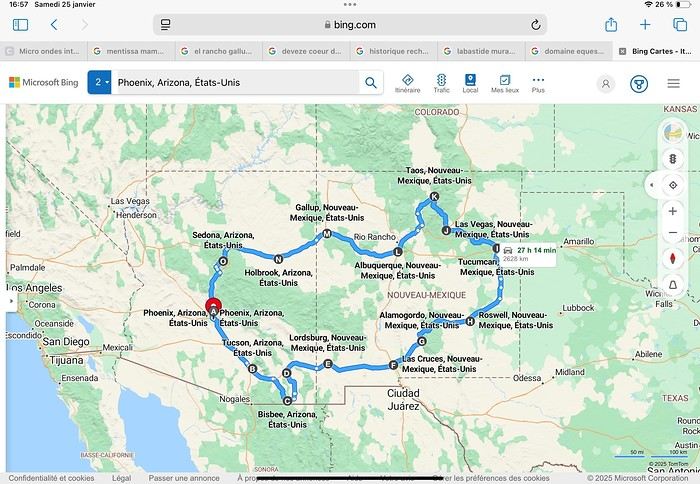
Day 1: Flight Marseille-Paris-Phoenix, then Gold Canyon (133 km) Day 2: Tucson (271 km) Lost Dutchman State Park Day 3: Tucson (155 km) Day 4: Tucson (34 km) Day 5: Bisbee (182 km) Day 6: Lordsburg (345 km) Day 7: Las Cruces (253 km) Day 8: Alamogordo (162 km) Day 9: Roswell (264 km) Day 10: Tucumcari (369 km) Day 11: Las Vegas (281 km) – the one in New Mexico Day 12: Taos (213 km) Day 13: Santa Fe (224 km) Day 14: Albuquerque (123 km) Day 15: Gallup (246 km) Day 16: Holbrook (224 km) Day 17: Flagstaff (179 km) Day 18: Sedona (118 km) Day 19: Sedona (48 km) Day 20: Sedona (41 km) Day 21: Phoenix (256 km) Day 22: Phoenix Airport (35 km)
📊 **Budget**: A little over 7,500 € for both of us, all included. The exchange rate was in our favor (1.17 dollars to 1 €). 📊 **Flights**: Marseille-Paris Charles de Gaulle-Phoenix: 1,787 € for two, with one checked bag each (Air France) 📊 **ESTA**: $42 📊 **America the Beautiful Pass**: $80 📊 **Parking**: 134 € (super eco at Marseille) 📊 **Car rental (Hertz)**: 865 €. Since there were no SUVs left in the reserved category (Nissan Rogue), we got an upgrade (4x4 Ford Explorer). We booked through Air France (15% discount). We’d originally reserved it in December for 1,140 €, but since prices dropped in March, we canceled and rebooked for 865 €. Hertz offers a free Hertz Gold Plus Rewards program, which gives you priority counter service when picking up the car. 📊 **Accommodation**: 2,400 € We stayed in hotels and motels of varying standards (from 60 to 203 € per night, depending on the city), all booked through Booking.com or Hotels.com. Out of 21 nights, only two didn’t include breakfast in the price. Booking.com sometimes offers slightly cheaper rates if you book by phone using the mobile app, and our Genius 3 status on the site also got us some preferential rates. 📊 **Supplementary insurance**: AVA 200 € for medical care if needed 📊 **Cash**: $2,078. We left with 1,000 € exchanged before departure and made two withdrawals of $500. This cash covered: - Evening restaurants and tips - Midday picnics - Gas: $298 for 4,160 km - Museum and private park entries (per person): - Lost Dutchman: $10 - Arizona-Sonora Desert Museum: $28 - Bird Cage Theater: $16 - Tombstone Shootout: $8 - New Mexico Farm & Ranch Museum: $12 - Roswell International UFO Museum: $5 - Billy the Kid Museum: $7 - Rancho de Taos: $22 - West Fork Oak Creek Trail entry: $15 We got a few discounts thanks to our senior age (+65). - Souvenirs and little treats
Like on our previous road trips, we didn’t rent a GPS. We got around using offline GPS apps Here WeGo and Organic Maps, with maps of the states we visited downloaded before we left (on our phones).
❤️❤️❤️ **Highlights** (there are so many!) 📍 Goldfield Ghost Town (even if it’s a reconstruction) 📍 The standing army of Saguaro cacti at Saguaro National Park West 📍 Diving into the cowboy universe of Tombstone 📍 The welcome from Rick and Henry at our guesthouse in Bisbee (Garden at Mile High Ranch) 📍 The tangled rocks of Chiricahua National Monument 📍 The flavored pistachios from Dwayne’s Fresh Jerky and Mac Ginnis Pistachioland 📍 Restaurants: La Posta (Las Cruces), Diner 66 (Albuquerque), and the Haunted Hamburger (Jerome) 📍 The old plazas of New Mexico 📍 The solitude and beauty of the white dunes at White Sands National Park 📍 Stepping back in time at the Billy the Kid Museum (Fort Stanton) 📍 Sections of historic Route 66 and the old motels of Tucumcari, especially at night when all the neon lights are on 📍 Taos Pueblo and diving into Native American culture 📍 After the Rio Grande Bridge, the descent via NM 567 to the very bottom of the Rio Grande Gorge, then the road along the riverbanks to Taos 📍 The tranquility of the Chimayo Sanctuary 📍 Discovering the ingenious native dwellings at Bandelier National Monument and Walnut Canyon National Park 📍 The small towns along the Turquoise Trail 📍 The red rocks of Red Rock Park and the Painted Desert 📍 The extraordinary colors of the petrified trees at Petrified Forest National Park 📍 Sedona, its red rocks, and the reward of the viewpoints at the end of hikes (Devil’s Bridge, The Subway, and West Fork Oak Creek) 📍 The immersion in Mexico when visiting Tlaquepaque 📍 The almost-ghost town of Jerome and its terraced streets 📍 The incredible kindness of Americans, always ready to help and up for a chat ❤️
☹️☹️☹️ **Flops** (there are very few) 📍 Several museums and churches being closed, so we couldn’t visit them 📍 Some museums and visitor centers opening late (10 AM) and closing early (4 PM) 📍 A 64 € phone roaming charge because we got near the Mexican border and picked up their cell tower 📍 The outrageous price ($5.99) for a gallon of gas at the Shell near Phoenix Airport
I hope this helps! Anyway, thanks for reading my long post. Don’t hesitate to reach out, even via PM, if you see I haven’t replied and you’d like more details. Have a great evening, everyone! 🙂
We’re back from our September 2025 road trip, this time to explore Arizona and New Mexico, and it’s time for me to start my travel journal—especially since everything’s already booked for another trip in September 2026 (to California), and I need to get started on the planning.
I was a little worried this new visit to Uncle Sam’s country might not be as "wow" as the others, but we still discovered some incredible places.
For those who don’t know us, we’re a couple in our seventies who speak very little English, but that didn’t stop us from fully enjoying our stay.
For this 6th road trip in the U.S., we spent 21 nights there, drove 4,160 km by car, and walked nearly 160 km in a loop starting from Phoenix.
We’d been to Arizona before (but not this side) and never to New Mexico. This whole road trip was a huge discovery for us.
In the prices mentioned (some in euros, others in dollars), bank fees and exchange charges are included. The flights, car rental, and parking were all paid for in December 2024 when we booked.
We’d downloaded the MPC (Mobile Passport Control) app, but there wasn’t a dedicated line at Phoenix Airport. Still, we got through quickly with friendly, smiling agents.
I don’t drive at all (I hate it), so the stops were chosen based on activities but also, for some, to limit daily mileage for the sole driver. The kilometers listed in the itinerary are the daily distances.
We traveled from September 9th to 22nd, unfortunately once again without our dear friends Mimi and Maumau.
The itinerary
Day 1: Flight Marseille-Paris-Phoenix, then Gold Canyon (133 km) Day 2: Tucson (271 km) Lost Dutchman State Park Day 3: Tucson (155 km) Day 4: Tucson (34 km) Day 5: Bisbee (182 km) Day 6: Lordsburg (345 km) Day 7: Las Cruces (253 km) Day 8: Alamogordo (162 km) Day 9: Roswell (264 km) Day 10: Tucumcari (369 km) Day 11: Las Vegas (281 km) – the one in New Mexico Day 12: Taos (213 km) Day 13: Santa Fe (224 km) Day 14: Albuquerque (123 km) Day 15: Gallup (246 km) Day 16: Holbrook (224 km) Day 17: Flagstaff (179 km) Day 18: Sedona (118 km) Day 19: Sedona (48 km) Day 20: Sedona (41 km) Day 21: Phoenix (256 km) Day 22: Phoenix Airport (35 km)
📊 **Budget**: A little over 7,500 € for both of us, all included. The exchange rate was in our favor (1.17 dollars to 1 €). 📊 **Flights**: Marseille-Paris Charles de Gaulle-Phoenix: 1,787 € for two, with one checked bag each (Air France) 📊 **ESTA**: $42 📊 **America the Beautiful Pass**: $80 📊 **Parking**: 134 € (super eco at Marseille) 📊 **Car rental (Hertz)**: 865 €. Since there were no SUVs left in the reserved category (Nissan Rogue), we got an upgrade (4x4 Ford Explorer). We booked through Air France (15% discount). We’d originally reserved it in December for 1,140 €, but since prices dropped in March, we canceled and rebooked for 865 €. Hertz offers a free Hertz Gold Plus Rewards program, which gives you priority counter service when picking up the car. 📊 **Accommodation**: 2,400 € We stayed in hotels and motels of varying standards (from 60 to 203 € per night, depending on the city), all booked through Booking.com or Hotels.com. Out of 21 nights, only two didn’t include breakfast in the price. Booking.com sometimes offers slightly cheaper rates if you book by phone using the mobile app, and our Genius 3 status on the site also got us some preferential rates. 📊 **Supplementary insurance**: AVA 200 € for medical care if needed 📊 **Cash**: $2,078. We left with 1,000 € exchanged before departure and made two withdrawals of $500. This cash covered: - Evening restaurants and tips - Midday picnics - Gas: $298 for 4,160 km - Museum and private park entries (per person): - Lost Dutchman: $10 - Arizona-Sonora Desert Museum: $28 - Bird Cage Theater: $16 - Tombstone Shootout: $8 - New Mexico Farm & Ranch Museum: $12 - Roswell International UFO Museum: $5 - Billy the Kid Museum: $7 - Rancho de Taos: $22 - West Fork Oak Creek Trail entry: $15 We got a few discounts thanks to our senior age (+65). - Souvenirs and little treats
Like on our previous road trips, we didn’t rent a GPS. We got around using offline GPS apps Here WeGo and Organic Maps, with maps of the states we visited downloaded before we left (on our phones).
❤️❤️❤️ **Highlights** (there are so many!) 📍 Goldfield Ghost Town (even if it’s a reconstruction) 📍 The standing army of Saguaro cacti at Saguaro National Park West 📍 Diving into the cowboy universe of Tombstone 📍 The welcome from Rick and Henry at our guesthouse in Bisbee (Garden at Mile High Ranch) 📍 The tangled rocks of Chiricahua National Monument 📍 The flavored pistachios from Dwayne’s Fresh Jerky and Mac Ginnis Pistachioland 📍 Restaurants: La Posta (Las Cruces), Diner 66 (Albuquerque), and the Haunted Hamburger (Jerome) 📍 The old plazas of New Mexico 📍 The solitude and beauty of the white dunes at White Sands National Park 📍 Stepping back in time at the Billy the Kid Museum (Fort Stanton) 📍 Sections of historic Route 66 and the old motels of Tucumcari, especially at night when all the neon lights are on 📍 Taos Pueblo and diving into Native American culture 📍 After the Rio Grande Bridge, the descent via NM 567 to the very bottom of the Rio Grande Gorge, then the road along the riverbanks to Taos 📍 The tranquility of the Chimayo Sanctuary 📍 Discovering the ingenious native dwellings at Bandelier National Monument and Walnut Canyon National Park 📍 The small towns along the Turquoise Trail 📍 The red rocks of Red Rock Park and the Painted Desert 📍 The extraordinary colors of the petrified trees at Petrified Forest National Park 📍 Sedona, its red rocks, and the reward of the viewpoints at the end of hikes (Devil’s Bridge, The Subway, and West Fork Oak Creek) 📍 The immersion in Mexico when visiting Tlaquepaque 📍 The almost-ghost town of Jerome and its terraced streets 📍 The incredible kindness of Americans, always ready to help and up for a chat ❤️
☹️☹️☹️ **Flops** (there are very few) 📍 Several museums and churches being closed, so we couldn’t visit them 📍 Some museums and visitor centers opening late (10 AM) and closing early (4 PM) 📍 A 64 € phone roaming charge because we got near the Mexican border and picked up their cell tower 📍 The outrageous price ($5.99) for a gallon of gas at the Shell near Phoenix Airport
I hope this helps! Anyway, thanks for reading my long post. Don’t hesitate to reach out, even via PM, if you see I haven’t replied and you’d like more details. Have a great evening, everyone! 🙂
"Tropical Odyssey" CFC Renaissance – November 1st to 22nd, 2025
We’ve just returned from a cruise that my wife and I will remember—unfortunately, not in a good way.
There’s so much to say that I’ll proceed chapter by chapter.
Pre-Cruise
On January 24th, 2025, I booked through a supposedly attentive cruise agent the repositioning cruise of the CFC Renaissance to the French West Indies, initially departing from Le Havre, then from Dunkirk, on November 1st, 2025.
The return flight was included in the price of this trip.
From January, right after booking, this adventure got off to a bad start.
Used to major cruise lines, I asked my agent to reserve a table for 4 at the "Vatel" restaurant for the second seating, and to link this reservation to the cabin of friends traveling with us. First brush-off: "Ask the maître d’ at the restaurant entrance on the first night."
"To govern is to foresee, and to foresee nothing is to head for disaster," as Émile de Girardin said.
Following this maxim, in February, I started looking for transportation to Le Havre, which was initially the departure port. Then, I asked the travel agent which airport the return flight would land at. I knew flights from Pointe-à-Pitre to Paris served both main Parisian airports. Here, I found myself like a ping-pong ball between the cruise agent and CFC: The cruise agent said, "Ask CFC," and CFC replied, "No, your agent is your intermediary—ask them." It went back and forth like that. Impossible to pre-book the flight that would take us back to our final destination. During the summer, we learned that the departure port was no longer Le Havre but Dunkirk. We canceled our transfers to Le Havre but, of course, lost the cost of the reservations. Meanwhile, we purchased our "Beverage" package—we chose the "Fraîcheur" option, which included all non-alcoholic cocktails, canned sodas, fruit juices, bottled water, and regular coffees. This detail is important for the rest of the story. Every month, I followed up to find out the return airport. Nothing until October 28th (3 days before departure), when CFC finally informed me it was Orly, along with the flight number and time. Of course, on top of booking at full price, I had to arrange my final transfer home. Since I had very little time before the return flight, I had to book an Uber in a rush for the Orly/CDG transfer. Right after, we were told that our first stop in Lisbon—the most anticipated for many cruisers—had been canceled due to a strike at the port of Lisbon and replaced with Vigo, Spain. A completely unremarkable stop—nothing outstanding. As you can see, the prelude was already problematic, yet we’re far from reaching the peak of our disappointments. .......... to be continued soon.
"To govern is to foresee, and to foresee nothing is to head for disaster," as Émile de Girardin said.
Following this maxim, in February, I started looking for transportation to Le Havre, which was initially the departure port. Then, I asked the travel agent which airport the return flight would land at. I knew flights from Pointe-à-Pitre to Paris served both main Parisian airports. Here, I found myself like a ping-pong ball between the cruise agent and CFC: The cruise agent said, "Ask CFC," and CFC replied, "No, your agent is your intermediary—ask them." It went back and forth like that. Impossible to pre-book the flight that would take us back to our final destination. During the summer, we learned that the departure port was no longer Le Havre but Dunkirk. We canceled our transfers to Le Havre but, of course, lost the cost of the reservations. Meanwhile, we purchased our "Beverage" package—we chose the "Fraîcheur" option, which included all non-alcoholic cocktails, canned sodas, fruit juices, bottled water, and regular coffees. This detail is important for the rest of the story. Every month, I followed up to find out the return airport. Nothing until October 28th (3 days before departure), when CFC finally informed me it was Orly, along with the flight number and time. Of course, on top of booking at full price, I had to arrange my final transfer home. Since I had very little time before the return flight, I had to book an Uber in a rush for the Orly/CDG transfer. Right after, we were told that our first stop in Lisbon—the most anticipated for many cruisers—had been canceled due to a strike at the port of Lisbon and replaced with Vigo, Spain. A completely unremarkable stop—nothing outstanding. As you can see, the prelude was already problematic, yet we’re far from reaching the peak of our disappointments. .......... to be continued soon.
Questions about visiting Guatemala in 14 days
hi there,
we’re traveling as a couple to Guatemala from Feb 8 to 22. We’ve realized that given the distances, it feels a bit short. So, we’ve decided to limit ourselves to:
- Antigua: 3 nights (from Feb 8 to 11), including the arrival day - Lake Atitlán: from Feb 11 to 14 – 3 nights in San Juan La Laguna, including the morning trip from Antigua to Lake Atitlán - Chichicastenango: from Feb 14 to 15 – 1 night to attend the Sunday market and visit the cemetery
We have 7 days left that we’re not sure how to organize to cover: Flores – Tikal – El Remate, then head back to Guatemala City for our flight on Feb 22. Actually, I have a few questions: Do you think the time in Antigua and at the lake is enough? We might do the Pacaya Volcano, which is accessible for beginners, and that’s it. Should we spend a bit more time at these two spots: Antigua and the lake? If so, we’d have to skip the Chichicastenango market. We’re also thinking of leaving Chichicastenango to head to Flores, then staying overnight in El Remate. Does that seem doable in one day? We’ve noted that the trips are long, and since we don’t want to rush, we’ve reduced the number of accommodations. Even though we know we won’t see everything, we don’t want to miss the must-sees. We’re also wondering if we’ve planned the route in the right direction, or if we should head straight to Tikal when we arrive. Anyway, I know this is long, but we’re a bit lost. Thanks so much for your help! Annick
we’re traveling as a couple to Guatemala from Feb 8 to 22. We’ve realized that given the distances, it feels a bit short. So, we’ve decided to limit ourselves to:
- Antigua: 3 nights (from Feb 8 to 11), including the arrival day - Lake Atitlán: from Feb 11 to 14 – 3 nights in San Juan La Laguna, including the morning trip from Antigua to Lake Atitlán - Chichicastenango: from Feb 14 to 15 – 1 night to attend the Sunday market and visit the cemetery
We have 7 days left that we’re not sure how to organize to cover: Flores – Tikal – El Remate, then head back to Guatemala City for our flight on Feb 22. Actually, I have a few questions: Do you think the time in Antigua and at the lake is enough? We might do the Pacaya Volcano, which is accessible for beginners, and that’s it. Should we spend a bit more time at these two spots: Antigua and the lake? If so, we’d have to skip the Chichicastenango market. We’re also thinking of leaving Chichicastenango to head to Flores, then staying overnight in El Remate. Does that seem doable in one day? We’ve noted that the trips are long, and since we don’t want to rush, we’ve reduced the number of accommodations. Even though we know we won’t see everything, we don’t want to miss the must-sees. We’re also wondering if we’ve planned the route in the right direction, or if we should head straight to Tikal when we arrive. Anyway, I know this is long, but we’re a bit lost. Thanks so much for your help! Annick
3 weeks in Bali in 2025
We’ve read it all about Bali: mass tourism, non-stop parties, ferry disasters, the kingdom of “Instagrammers,” pollution, “Bali belly”... But luckily, this island isn’t just about Kuta’s beaches and the Lempuyang Temple.
Sure, it’s not as exotic or off-the-beaten-path as other Indonesian islands (the Moluccas, Timor, Flores...), but we spent 3 weeks there and loved it!
Our (planned) itinerary in 7 stops: - Ubud (4 nights) - Sidemen (2 nights) - Gili Meno (3 nights) - Amed (2 nights) - Pemuteran (4 nights) - Munduk (2 nights) - Jatiluwih (2 nights)
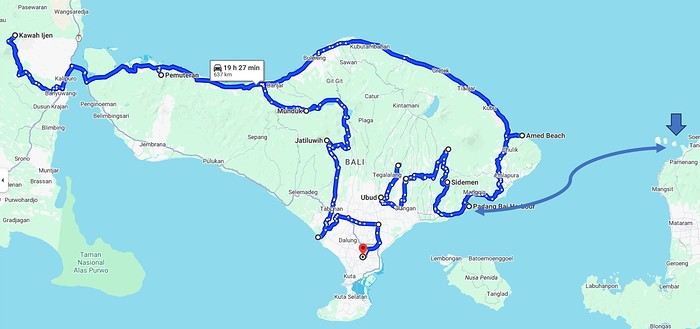
We booked our accommodations in advance, and for the rest (drivers, activities...), we took it day by day with help from the homestays (making sure to contact them a few days ahead via WhatsApp).
In the end, it’s an “easy” destination, very affordable, and one that’s managed to keep a certain authenticity.
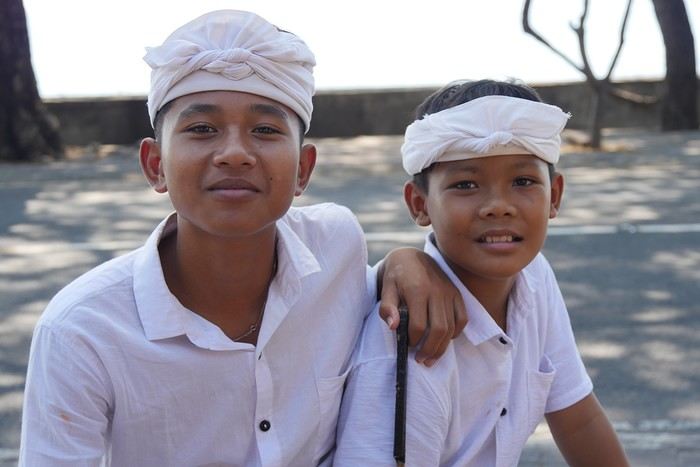
Sure, it’s not as exotic or off-the-beaten-path as other Indonesian islands (the Moluccas, Timor, Flores...), but we spent 3 weeks there and loved it!
Our (planned) itinerary in 7 stops: - Ubud (4 nights) - Sidemen (2 nights) - Gili Meno (3 nights) - Amed (2 nights) - Pemuteran (4 nights) - Munduk (2 nights) - Jatiluwih (2 nights)
We booked our accommodations in advance, and for the rest (drivers, activities...), we took it day by day with help from the homestays (making sure to contact them a few days ahead via WhatsApp).
In the end, it’s an “easy” destination, very affordable, and one that’s managed to keep a certain authenticity.
Thailand trip: What to do if visa-free stay drops from 60 to 30 days?
Hey everyone, hope you're doing well! :)
I’m planning to go back to Thailand at the start of next year—once just wasn’t enough 😅
I’ve seen that nothing’s official yet, but they’re considering reducing the visa-free stay from 60 to 30 days. If I book for 58 days like last time and they change the rules last minute, what happens?
It takes forever to get a visa—I saw you have to prove you have enough funds to cover your stay. How much money do you need in your account?
Thanks!
Review of a Norway cruise on the Emerald Princess in June 2025 (1)
Hello everyone,
I’ve wanted to take this Norway cruise for a very long time. The first time I booked it was in July 2020 with Azamara. Unfortunately, it was canceled, as everyone remembers. When I tried to book it again, the prices (already a bit high with Azamara) had simply doubled. So, since then, I’ve been keeping an eye out every year for any opportunities...
The last time we sailed with Princess was eleven years ago, and things didn’t go very well. I came back pretty unhappy with their service and quite disappointed. Despite the $600 they gave me as credit for a future cruise, I’d never set foot on one of their ships again.
But this time, the opportunity arose—a fantastic itinerary with lots of stops, a reasonable price for 16 nights (I’ll share the details in the conclusion), and a ship that’s not too big, so to speak, with only 3,000 passengers. I’m not expecting much from the cruise line this time and am boarding the ship with low expectations beyond the itinerary.
Princess has introduced an app to download before the cruise. It’s essential because online check-in is no longer available, and the agency doesn’t send a travel journal. Everything is done through the app. After completing the check-in on the app, we only know that we’ll need to pick up our key, the Medallion, at embarkation by following the blue line in the terminal and presenting our passport.

Up until our departure, the weather forecast for the coming week in Norway is disastrous—rain, rain, and more rain. It was pretty much the same two years ago before our Iceland cruise, and in the end, the weather turned out fine.
If you’re ready to embark on the Emerald Princess to discover this beautiful cruise and the stunning landscapes of Norway, let’s go!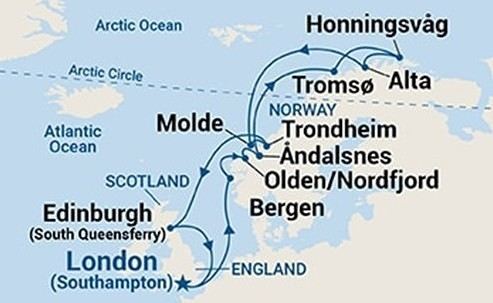
Southampton - Sea day - Bergen - Olden - Åndalsnes - Sea day - Tromsø - Honningsvåg (North Cape) - Alta - Sea day - Molde - Trondheim - Two sea days - Edinburgh - Sea day - Southampton
I’ve wanted to take this Norway cruise for a very long time. The first time I booked it was in July 2020 with Azamara. Unfortunately, it was canceled, as everyone remembers. When I tried to book it again, the prices (already a bit high with Azamara) had simply doubled. So, since then, I’ve been keeping an eye out every year for any opportunities...
The last time we sailed with Princess was eleven years ago, and things didn’t go very well. I came back pretty unhappy with their service and quite disappointed. Despite the $600 they gave me as credit for a future cruise, I’d never set foot on one of their ships again.
But this time, the opportunity arose—a fantastic itinerary with lots of stops, a reasonable price for 16 nights (I’ll share the details in the conclusion), and a ship that’s not too big, so to speak, with only 3,000 passengers. I’m not expecting much from the cruise line this time and am boarding the ship with low expectations beyond the itinerary.
Princess has introduced an app to download before the cruise. It’s essential because online check-in is no longer available, and the agency doesn’t send a travel journal. Everything is done through the app. After completing the check-in on the app, we only know that we’ll need to pick up our key, the Medallion, at embarkation by following the blue line in the terminal and presenting our passport.
Up until our departure, the weather forecast for the coming week in Norway is disastrous—rain, rain, and more rain. It was pretty much the same two years ago before our Iceland cruise, and in the end, the weather turned out fine.
If you’re ready to embark on the Emerald Princess to discover this beautiful cruise and the stunning landscapes of Norway, let’s go!
Southampton - Sea day - Bergen - Olden - Åndalsnes - Sea day - Tromsø - Honningsvåg (North Cape) - Alta - Sea day - Molde - Trondheim - Two sea days - Edinburgh - Sea day - Southampton
Madagascar - June 2025
Five years of an unintended break... The closure of VF, COVID... What a joy to rediscover the pleasure of sharing!
I’ve stayed true to my habits: the following account is a collection of practical tips rather than a travel journal...
Madagascar is as big as France and Belgium combined. In three weeks, choices have to be made! It was the Great Tsingy that inspired our trip. We decided to focus on the southwest and the RN7. We skipped the Deep South and the North. Oh well...
OUR ITINERARY IN 3 WEEKS:
Fri 6 June – Direct AF flight to Tana – Flight arrives at 10:30 PM – Tana Sat – Antsirabe Sun – Miandrivazo Mon – Drive to the Masiakampy pier – Descent of the Tsiribihina River by pirogue - Bivouac Tue – Descent of the Tsiribihina River by pirogue - Bivouac Wed – Descent of the Tsiribihina River by pirogue – Bekopaka Thu – Pirogue on the Manambolo River and Small Tsingy of Bemaraha – Bekopaka Fri – Great Tsingy of Bemaraha – Bekopaka Sat – Avenue of the Baobabs – Morondava Sun – Belo sur Mer Mon – Free day – Belo sur Mer Tue – Manja Wed – Andavadoaka Thu – Free day – Andavadoaka Fri – Salary Lagoon – Mangily Sat – Ranohira Sun – Isalo National Park - Ranohira Mon – Anja Reserve - Ambalavao - Fianarantsoa Tue – FCE train canceled – Visit to a Tanala village - Manakara Wed – Pirogue on the Pangalanes Canal – Ranomafana Thu – Ranomafana NP – Ranomafana Fri – Ambositra – Antsirabe Sat 28 June – AF flight to Paris – Flight departs at 11:55 PM
TRIP ORGANIZATION: I prepared my trip using the usual guides (LP and Rough Guide), the internet, and the Freytag & Berndt map (1:1,000,000). I’m old-school—I still love visualizing my route on a paper map, even though in Madagascar, it’s misleading because some National Roads are only national in name!...
The agency: Since we couldn’t deal directly with a driver-guide (we lacked reliable info to take the plunge), we went through an agency to organize the logistics of our trip. We didn’t feel like using bush taxis (not enough time) or driving a 4x4 ourselves (neither the skills nor the boldness). The French agency connected us with a local agency, to whom I sent my detailed itinerary by email. A few exchanges via email and WhatsApp calls allowed us to finalize everything quickly after some adjustments. As you’ve gathered... we multiplied the commissions, which inflated the budget. That said, in the end, we were thrilled with our decision and our choice. Our trip was booked by the end of 2024, and reservations were made immediately. No bad surprises: the bookings in the planned hotels were honored, often with one of the best rooms. On our last day in Tana, before departure, we were lucky enough to meet the director I’d been communicating with, who helped build and validate our circuit. A very warm debriefing.
The driver-guide: The agency assigned us Faly, 33, a driver-guide for over 10 years. He stayed with us from start to finish: he picked us up at the airport on arrival and dropped us off 23 days later. A very experienced driver (which is important here), an open and cultured guide, reliable, punctual, and a great companion. And a provider of good advice throughout the trip. We made the most of the long stretches on dirt roads or highways to listen to him talk about daily life, rituals, wildlife, and flora... No time wasted! With a great playlist in the background, we combined business with pleasure! Faly’s accommodation and meals were included (quite often, hotels offer free lodging and meals to driver-guides who bring clients), as was the fuel. That didn’t stop us from inviting Faly to share a beer or our evening meal sometimes. He didn’t always accept, wanting to let us "enjoy our romantic evenings," as he put it. Present without being intrusive! Faly is fully capable of organizing a tailor-made trip directly. I recommend him without any hesitation—we were delighted with his service. I’ll gladly share his contact details via PM to anyone who asks.
Local guides: It’s the national guide’s prerogative to choose the local guides (mandatory in the parks). Thanks to his experience, Faly always booked us amazing, competent, and interesting local guides.
Hotels: I told the agency I wanted charming, comfortable accommodations, without falling into flashy luxury. We loved all the hotels (except the Hôtel Kanto in Manja). The rooms, mostly bungalows, were always spacious and clean. Unfortunately, I can’t give the prices—I didn’t get the details. Breakfast is always included, usually fresh and hearty. Very often, a small bottle of water is provided in the room.
Tana Hôtel Les 3 Métis Power cuts are common (!) in Tana. Bring a headlamp.
Antsirabe Ecolodge – Les chambres du voyageur Maybe our favorite! A few bungalows, beautifully arranged in a splendid tropical garden. The dog Kodak welcomes us warmly.
Miandrivazo Hôtel Princesse Tsiribihina Magnificent view of the valley.
Bekopaka Hôtel Orchidée du Bemaraha 2 (yes, 2) beautiful pools, a large open common room.
Morondava Hôtel Baobab Café Brand new or at least, according to Faly, just renovated. Very comfortable but without much charm (international style).
Belo sur Mer Ecolodge du Menabe The bungalows, all made of wood, bamboo, and thatch, are set on the beach. Very spacious and fully equipped! Large open-air restaurant by the sea. No hot water from the tap—it’s available in plastic bottles heated by the sun in front of each bungalow. Actually, we never used it... Another very, very beautiful spot.
Manja Hôtel Kanto The only hotel on this leg of the journey, so no choice. The owner knows it and, as a result, doesn’t bother. It’s a real dive! Tiny, dark room, a sordid bathroom with only a trickle of water—we skipped the shower! Clean sheets, though. Obviously, no Wi-Fi. The only place where I didn’t leave a tip. We were well warned about the discomfort of this stop, both by the agency and Faly. We weren’t surprised, and it even became a running joke during the trip. On the other hand, we found a nice little market in town.
Andavadoaka Manga Lodge What bliss! Especially after the horrible Hôtel Kanto. A paradise-like spot, overlooking three beautiful deserted white-sand beaches. Meals are served on the terrace facing the sea. Stunning sunset. We loved spending a day lounging here! We were the only guests and were pampered.
Mangily (Ifaty) Mangily is the "suburb" of Ifaty. Hôtel Vovo Telo A large beachfront bungalow complex. More touristy but pleasant—we spent a lovely evening there with our feet in the sand.
Ranohira Le Relais de la Reine A splendid resort built by a Frenchman, at the foot of the rocks, very well integrated into the environment. Beautiful marked trail starting from the garden.
Fianarantsoa Villa Sylvestre Contrary to what its name suggests, it’s a hotel right in the city center. Quite decent, though.
Manakara Parthenay Club Pretty bungalows in a large garden by the sea, but swimming isn’t safe—the water is too dangerous and rough.
Ranomafana Hôtel Thermal Very spacious rooms.
Meals: Not all our meals were included. It’s really not expensive. 1 meat or fish dish: around 35,000 Ar 1 full menu (starter, main, dessert): around 70,000 Ar 1 large THB beer (65 cl): between 8,000 and 12,000 Ar 1 piña colada: 15,000 Ar 1 flavored rum: 6,000 Ar (sometimes free) 1 glass of baobab juice (!): 5,000 Ar
We always ate very well. Rice is everywhere, served in large quantities. Zebu meat is quite good if not overcooked. Personally, I prefer fish, and I feasted: grouper, captain, crab, small lobsters...
We happily discovered baobab juice (especially in Belo, on the west coast). And of course, flavored rums!
We bought 2 packs of 6 bottles of mineral water at Carrefour (!) (about 5,000 Ar per large bottle) at the start of our trip. That was enough, especially since we often got water in the bungalows.
We had a few picnics included in our trip. Instead of picking up the hotel’s lunchbox, Faly prepared delicious, fresh, and varied picnics for us: tuna pasta salad, fried rice with eggs, grilled vegetables, and avocado...
An exceptional address not to miss: Mad Zébu – Belo sur Tsiribihina A highly reputed restaurant, a favorite of LP and Rough Guide, and rightly so! Gourmet cuisine, refined and elegant. Barely more expensive than elsewhere, and it’s worth it. We stopped there on our way up to Bekopaka and the Tsingy NP. Fully booked! So Faly reserved for our return, three days later. We’re still thanking him! What a treat!
THE BUDGET: Ariary exchange rate: 5,000 Ar = 1 €
Pre-trip expenses: Direct Air France flights: 930 € per person round trip Cost of the circuit with the agency: 2,880 € per person
The visa: Issued on arrival, very quickly. 35 € per person for a stay under 30 days. Super simple. Super fast.
On-site expenses: As soon as we arrived at the airport (it was nearly midnight), Faly advised us to exchange our euros for all our needs. There are few opportunities on our route to find an ATM or an open bank with a good rate. To be more comfortable, he took us to a small office under military protection just outside the airport. I exchanged 1,200 € (I had asked the agency for advice on the amount to bring) at a rate of 4,750 Ar and became a millionaire. Faly recounted all the stacks. That covered all our expenses (meals, drinks, tips) without ever feeling deprived. Personal purchases were made at the end of the trip. Convenient—it served as an adjustment variable. We spent our last million (200 €) on marquetry and vanilla. Tip: We asked for 200,000 Ar in 5,000 Ar bills for tips. That wasn’t too much—I even ran short of small bills in the last two days.
Tips: Madagascar is a poor country where every service deserves a small reward. While not mandatory, it’s customary. But no one ever demanded or expected it openly. On the contrary, I sometimes had to remind a porter to give them my small bill. We never carried our luggage—porters were always present when the car arrived or waiting at our door to watch for our departure. I gave each of them 5,000 Ar. In restaurants, I rounded up to the nearest ten and left the change. Local guides also expect a tip: I gave around 20,000 Ar per day for the two of us. Finally, the national guide also expects a gratuity. I had read online to budget 5 € per day per person. I added more since we were so happy with his services. The tip was given at the end of the trip, in euros, outside the budget.
Total budget all included (excluding personal purchases): 8,690 € Clearly, Madagascar is a country where life isn’t expensive, but travel costs add up quickly due to the need to rent a 4x4 with a driver.
HIGHLIGHTS:
· The dirt roads Yes, I’m listing them among the highlights! We loved those long hours spent driving at 20 km/h on rocky, muddy, white, red, or gray sand tracks... surrounded by tropical vegetation, palm trees, pandanus, mango trees... The experiences were sometimes thrilling: crossing a river on a ferry (just planks of wood fixed on two motorized pirogues side by side) or crossing a river without a ferry, with just a kid running ahead of the 4x4 to show the way; soft sand where the 4x4 easily gets stuck... The tracks are quite narrow, and crossing paths with a bush taxi, a zebu cart, or a herd of goats is always epic. So many beautiful images, so many beautiful photos! Much more beautiful than on asphalt. So yes, we loved those long stretches on dirt roads. For us, it was clearly part of the journey. Faly was particularly careful, and the 4x4 was comfortable. No injuries, no fatigue, even after 7 or 8 hours on rough tracks. The national roads (including the famous RN7) are badly damaged by cyclones, huge trucks, and lack of maintenance. Potholes have turned into ostrich nests, and we didn’t drive much faster than on the dirt roads.
· The landscapes, villages, encounters... We crossed a variety of stunning landscapes: mountains with slopes covered in terraced crops, rice fields from apple green to emerald green, sugarcane fields, then tropical forests, baobab forests (they deserve a special paragraph below), traveler’s tree forests. And then coastlines with white sand dunes against a backdrop of blue hues!... Magical! We also passed through many villages with houses whose architecture varied by region. The Betsileo houses display beautiful decorative brick reliefs. On the west coast, the houses are more precarious, made of bamboo with palm-thatched roofs. In the Highlands region, we found solid houses with pastel plaster. Each region has its own landscape, crops, habitat, and clothing. Zebu carts are often the only means of transport in remote villages. We saw them very frequently. Again, the cart’s decoration depends on the region. And then, we met many villagers coming out of the bush and walking to the next market, carrying their crops on their heads or shoulders. More beautiful photos!
· The descent of the Tsiribihina River We boarded around 9 AM in a long pirogue with Gana, the local guide, and two pirogue men. So, five of us. The pirogue is long but narrow, about 65 cm wide. We sat one behind the other at the front on seats padded with what would become our mattresses during the bivouacs. We only took the bare essentials for two nights. A little goodbye to Faly, whom we’d see again in three days! Don’t forget us! The river is silty—meaning orange, opaque but clean. We glided along silently. Gana showed us the trees, birds, crocodiles (we saw five—apparently, we were lucky). The pirogue men rowed to get us as close as possible to these crocs sunbathing on the roots of big trees. Yeah, right!... as soon as we got too close, *splash*, they disappeared into the water. We marveled at the mini rice fields lining the river. Every tiny plot, no matter how small, is cultivated. Above them, banana fields. And on the water, a whole life of fishermen and villagers living with and from the river. Gana warned us we’d eat on the pirogue because the journey was long. So, I expected chips... But no—fried rice and zebu steak, cooked right in the pirogue!! Incredible! In the middle of the afternoon, we reached a small beach where we disembarked. Gana led us about a hundred meters to a sublime waterfall. We were alone there. We had time to swim. We’d brought our swimsuits and a towel (bought at the Carrefour in Antsirabe on Faly’s wise advice!). This swim in this paradise-like spot remains one of our best memories. We found our pirogue again and set off until our first bivouac. We’d sailed for 7 hours today. The tents were set up on a wide beach, without a single tree. A moment of solitude... Uh, where can we go to the bathroom?... Especially since it was a full moon, so we felt like we were in the spotlight. Anyway... we did as everyone else—walked away, dug a hole, and the others turned their backs. A hearty meal on the beach before a comfortable and silent night. The next day, same program, with slightly different landscapes. The gorges widened, the trees were different. But still many colorful birds. Again, we ate on the pirogue: grilled chicken and vegetables. 9 hours of sailing. A similar bivouac. This time, we got it. On the third day, we finished the descent with 5 hours of sailing. So, 7 hours, 9 hours, 5 hours... doing nothing. It might sound boring... but it wasn’t. Like the dirt roads, these were contemplative moments. It glides, it’s calm, relaxing, and there’s a lot of life on this river, animal and human. Contemplation. Suspended time. On arrival, we disembarked at a sort of joyful, bustling river port. Of course, Faly was already there to pick us up.
· The Tsingy de Bemaraha NP (Small and Great) I have vertigo. During my research, several agencies advised me against visiting the Great Tsingy. "Stick to the Small ones," they said. Grrr, no, not what I wanted—we’ve dreamed of this for years! The agency we chose also warned me but didn’t discourage me. So we started with the Small Tsingy, quite close to Bekopaka, guided by Alisha. This forest of sharp limestone rocks is impressive. No vertigo issues here. The day was completed with a short pirogue ride on the Manambolo River and a visit to two caves with pretty formations. The next day, Faly and Alisha drove us to the Great Tsingy (a good hour on a terrible track). Arriving at the park entrance, Alisha equipped us with harnesses, carabiners, and gave us some safety instructions. Faly was also equipped. Wait? He’s coming with us? I quickly understood he was there for me—if I got stuck, he could go back with me, and Philippe could continue with Alisha. A wise precaution that delighted and reassured me. In the end, it was unnecessary since the famous bridge crossing was fully secured by the harness and carabiners. 18 meters on planks, one by one, it didn’t sway too much—I walked looking straight ahead, not a glance down. I even managed to smile in the middle of the crossing—I have a photo to prove it! I was overjoyed! The circuit in the Great Tsingy is a loop, so we didn’t have to cross the bridge again. We climbed to viewpoints offering breathtaking panoramic views. It’s extraordinary, unique, incredible. All this to say that if you have vertigo, don’t hesitate! It’s doable! It’s completely safe and really worth pushing your limits a bit! For those who’ve done treetop adventure courses, it’s similar. Also, no need to be a great athlete—just a bit of agility to climb a few ladders and high steps. Don’t censor yourself! I even had a small regret—the loop was a bit short (about 2 hours). I would’ve liked to continue or even redo it, with less apprehension. Tip: Do the Small Tsingy before the Great ones, or not at all. And if you can only do one, do the Great ones without hesitation.
· Canoeing in the Belo mangrove The Belo sur Mer ecolodge lends small individual canoes for free to go to the mangrove. We left at high tide, paddled for about twenty minutes to reach a fairly sparse forest where we could easily venture in. Very shallow water, crystal clear—we could see the roots of all these trees, schools of tiny fish... It was quite surprising. Until then, I only knew impenetrable, tangled mangroves. Here, nothing like that—we walked through an aquatic forest. We loved this adventure so much we left a bit late. The tide had gone out, and we had to carry our canoes for the last few meters... Of course, the staff came to help (probably laughing silently!). The lodge owners gave all the necessary explanations and lent a waterproof bag for the phone (because yes, it’s worth taking photos!). A very useful precaution—the canoes are small, low in the water, and paddling quickly soaks you. Again, this isn’t just for Tony Estanguet! It didn’t cause us any problems, not even sore muscles the next day. A great experience. It’ll take about 2 hours.
· Isalo NP Big surprise when we saw this huge rocky massif appear on the RN7! A massif of colored sandstone, carved with crevasses giving it a ruined look. Le Relais de la Reine is a little gem cleverly nestled in the heart of these rocks. A small marked trail starts from the garden. We picked up the description at reception and set off. Without a guide, alone following the markers, it took us 2 hours to complete this magnificent little trail, giving us a first glimpse of the massif before the hike the next day. And we enjoyed being completely alone for this walk. It’s free, easy, and well-signposted. Don’t miss it. In the evening, Faly took us to the so-called Isalo Window site—a hole in a wall through which we could see the sunset. We met all the tourists in the area here. We weren’t blown away by the show... The next day, we left early to reach the start of the hike. We met Zozoly at the guides’ office in the small town of Ranohira. During this hike, we climbed through the rocks to a viewpoint offering stunning 360° views of the massif. Then we reached a site called the "natural pool," breathtakingly beautiful, especially since we were alone again. A sort of oasis, a cascading waterfall, palm trees and tree ferns, fine sand, all nestled at the bottom of a small canyon. Paradise-like. We resisted swimming, but it was really tempting. A long walk on the plateaus then led us to a well-equipped picnic site where a local team prepared grills. Concrete tables were tiered in a spacious, shady clearing where a whole family of ring-tailed lemurs frolicked. They knew the tourists’ habits and tried to snatch food. Playful and not very shy, they amused us with their antics! We had to resist not luring them with a piece of banana!! Thousands of photos!! After the meal, we set off again with Zozoly for another landscape. This time, we were by a small river at the bottom of a canyon with high walls covered in vegetation. The trail was narrow and slippery, on a ledge of the wall. We progressed carefully. No danger, though. We first reached the Blue Pool, which only turns blue in photos (surprise!), then the Black Pool fed by a shower of waterfalls. Two magnificent spots that showed us a completely different aspect of the massif.
· Anja Reserve This ficus forest is home to many groups of lemurs. Used to humans, whom they don’t fear, they move around us, ignoring us completely. It’s almost annoying... The best place on our trip to see lemurs.
· The FCE train To the great regret of Manakara’s inhabitants, the FCE train hasn’t reached here for over a year and a half. As a result, there are far fewer tourists—the train was part of the experience. We drove there and didn’t regret coming to this port on the east coast.
· Visit to a Tanala village This visit wasn’t part of our program—it was added by the agency to compensate for the train not running. Which was the case. Not big fans of this kind of visit, where we feel like we’re at a zoo, voyeuristic, lacking authenticity, we followed the local guide with some skepticism and exchanged dubious looks. And yet... the guide’s explanations about village life and the warm, smiling welcome from the villagers charmed us and dispelled all our concerns. We learned a lot, met smiling families, and were able to enter these beautiful bamboo houses. A very pleasant surprise, rich in lessons.
· The Pangalanes Canal Arriving in Manakara, we crossed a bridge overlooking the Pangalanes Canal. A cry of surprise: the water is turquoise! We took a short pirogue ride with a team of three pirogue men and Joël, a local guide who explained the drama caused by the train’s halt. We stopped in a fishing village where Joël bought fish for the barbecue. We ended up on a beach where the team prepared the meal while we went to watch the fishermen return on the nearby beach. We admired the fishermen’s dexterity in untangling their nets, sorting their fish, cleaning their gear. On our return, we found a small table set up on the beach, in the shade of palm trees and casuarinas. Lobsters, captain fish, grilled vegetables, sautéed potatoes. A real feast (included in the trip cost).
· Ranomafana NP A 4-5 hour hike (some climbing) in a dense secondary forest to look for lemurs. As usual, we were accompanied by a local guide who, while waiting to find our furry friends, gave us lots of info on the vegetation, birds, and Tanala ethnic rituals. In the forest, we met 4 or 5 trackers, armed with radios to alert guides of their findings. In the end, we saw several lemurs of different types. Quite far, quite high... A nice complement to our lemur encounters in Isalo. Here, it rains 200 days a year. We started the hike in thick fog, but the forest’s density protected us from the humidity. Be careful—it can be a bit frustrating to see the lemurs so far away, so high. Nothing like the Anja Reserve or Isalo NP. Here, what’s fun is the hunt.
· The baobabs We were captivated by these kings of the forest, noble, imposing, majestic. We spotted them from very far away, towering over the rest of the vegetation. Alone, in small groups, or in forests, our trip allowed us to see hundreds of them! Mainly on the west coast. All different—bald, hairy, shaggy, short and stout, tall and thin, like Laurel and Hardy. Philippe took to naming them. Respectfully!
OUR FAVORITES: · The variety of landscapes. · The Tsingy NP.
OUR DISAPPOINTMENTS: · The Avenue of the Baobabs, very overrated and the only place where we saw crowds. We saw many other "forests" of baobabs that were much more impressive. · It’s hard to approach the population calmly as swarms of children run up as soon as we arrive, asking for sweets. Without any aggression, their smiles and laughter quickly made us forget this small inconvenience. We never gave out candy, clothes, or money. We left pens at a school and clothes with Faly.
IF WE WERE TO DO IT AGAIN: · Same period, same duration, same pace, same itinerary, but if we were to do it again today, I’d go through Faly directly! · Maybe we should’ve stayed in Ambalavao instead of Fianarantsoa. · Plan a longer loop in the Great Tsingy—it felt a bit too short.
MISCELLANEOUS: The welcome: ‘Samala Vazaha,’ there are many, many kids, sometimes overwhelming, never aggressive. We were impressed by the villagers’ smiles and good humor, towards us or even among themselves—laughter was everywhere. Safety: No problems. Out of (excessive?) caution, we spread all our money across several bags that we padlocked whenever we left the hotel. Bribes: We were stopped several times on the road by police or gendarmes. They checked our papers, sometimes our passports. Faly was perfectly in order. No discussion, no bribes, a cordial greeting from the officers. However, several times we found ourselves at small "tolls" on the tracks for villagers who had leveled the road or filled a hole, or for the young guy who ran through the river to show the way... Faly complied without discussion: every service deserves a small bill. Language: French is still widely spoken. Credit card: Unused. Cash: You need it! The climate at this time: Ideal—blue skies, sunshine, and mild temperatures (20-25°C) throughout our trip. Temperatures started to drop by our departure—winter was setting in. Clothing: T-shirt or polo and a vest sometimes in the evening, sandals on our feet, hiking shoes for all the hikes. Tip: We left a bag in the car (completely safe) with things we didn’t need daily and dirty laundry. The two bags to take out at each stop were much lighter. Before leaving, we left several polos and T-shirts with Faly, which, once washed, will make a few people happy. Tourist crowds at this time: Low—we were sometimes the only guests at the hotel. Faly explained that at the Isalo picnic site, in high season, you have to queue for a table, whereas we had our pick. Photos: Lots! Too many! That’s the problem with digital—we take so many! Health issues: Nothing serious, just the usual mild traveler’s diarrhea. Mosquitoes: They’re voracious. We took anti-malaria treatment. I’m still not sure if it was the right thing to do... I’m always very skeptical about such precautions. Internet: Free Wi-Fi at the lodges’ reception (except at Hôtel Kanto!), sometimes (rarely) in the bungalows. Phone: We didn’t try to get a local SIM card—the evening Wi-Fi was enough for us to make calls and send messages via WhatsApp. Make sure to turn off mobile data and switch to airplane mode (I activated it a bit late—received calls, spam ones at that, were charged...). Electricity: French plugs. Personal purchases: Beautiful wooden objects (sculptures and marquetry) or zebu horn items in Ambositra. 1 kg of vanilla (400,000 Ar – 80 € per kg) in Tana.
IN CONCLUSION: A trip of contemplation. A pause for admiration, as our local guide in Isalo NP said. Nothing else to do but walk, look, and enjoy. Here, there are no old stones, no museums—it’s a trip where nature reigns supreme. And what nature!
I’ve stayed true to my habits: the following account is a collection of practical tips rather than a travel journal...
Madagascar is as big as France and Belgium combined. In three weeks, choices have to be made! It was the Great Tsingy that inspired our trip. We decided to focus on the southwest and the RN7. We skipped the Deep South and the North. Oh well...
OUR ITINERARY IN 3 WEEKS:
Fri 6 June – Direct AF flight to Tana – Flight arrives at 10:30 PM – Tana Sat – Antsirabe Sun – Miandrivazo Mon – Drive to the Masiakampy pier – Descent of the Tsiribihina River by pirogue - Bivouac Tue – Descent of the Tsiribihina River by pirogue - Bivouac Wed – Descent of the Tsiribihina River by pirogue – Bekopaka Thu – Pirogue on the Manambolo River and Small Tsingy of Bemaraha – Bekopaka Fri – Great Tsingy of Bemaraha – Bekopaka Sat – Avenue of the Baobabs – Morondava Sun – Belo sur Mer Mon – Free day – Belo sur Mer Tue – Manja Wed – Andavadoaka Thu – Free day – Andavadoaka Fri – Salary Lagoon – Mangily Sat – Ranohira Sun – Isalo National Park - Ranohira Mon – Anja Reserve - Ambalavao - Fianarantsoa Tue – FCE train canceled – Visit to a Tanala village - Manakara Wed – Pirogue on the Pangalanes Canal – Ranomafana Thu – Ranomafana NP – Ranomafana Fri – Ambositra – Antsirabe Sat 28 June – AF flight to Paris – Flight departs at 11:55 PM
TRIP ORGANIZATION: I prepared my trip using the usual guides (LP and Rough Guide), the internet, and the Freytag & Berndt map (1:1,000,000). I’m old-school—I still love visualizing my route on a paper map, even though in Madagascar, it’s misleading because some National Roads are only national in name!...
The agency: Since we couldn’t deal directly with a driver-guide (we lacked reliable info to take the plunge), we went through an agency to organize the logistics of our trip. We didn’t feel like using bush taxis (not enough time) or driving a 4x4 ourselves (neither the skills nor the boldness). The French agency connected us with a local agency, to whom I sent my detailed itinerary by email. A few exchanges via email and WhatsApp calls allowed us to finalize everything quickly after some adjustments. As you’ve gathered... we multiplied the commissions, which inflated the budget. That said, in the end, we were thrilled with our decision and our choice. Our trip was booked by the end of 2024, and reservations were made immediately. No bad surprises: the bookings in the planned hotels were honored, often with one of the best rooms. On our last day in Tana, before departure, we were lucky enough to meet the director I’d been communicating with, who helped build and validate our circuit. A very warm debriefing.
The driver-guide: The agency assigned us Faly, 33, a driver-guide for over 10 years. He stayed with us from start to finish: he picked us up at the airport on arrival and dropped us off 23 days later. A very experienced driver (which is important here), an open and cultured guide, reliable, punctual, and a great companion. And a provider of good advice throughout the trip. We made the most of the long stretches on dirt roads or highways to listen to him talk about daily life, rituals, wildlife, and flora... No time wasted! With a great playlist in the background, we combined business with pleasure! Faly’s accommodation and meals were included (quite often, hotels offer free lodging and meals to driver-guides who bring clients), as was the fuel. That didn’t stop us from inviting Faly to share a beer or our evening meal sometimes. He didn’t always accept, wanting to let us "enjoy our romantic evenings," as he put it. Present without being intrusive! Faly is fully capable of organizing a tailor-made trip directly. I recommend him without any hesitation—we were delighted with his service. I’ll gladly share his contact details via PM to anyone who asks.
Local guides: It’s the national guide’s prerogative to choose the local guides (mandatory in the parks). Thanks to his experience, Faly always booked us amazing, competent, and interesting local guides.
Hotels: I told the agency I wanted charming, comfortable accommodations, without falling into flashy luxury. We loved all the hotels (except the Hôtel Kanto in Manja). The rooms, mostly bungalows, were always spacious and clean. Unfortunately, I can’t give the prices—I didn’t get the details. Breakfast is always included, usually fresh and hearty. Very often, a small bottle of water is provided in the room.
Tana Hôtel Les 3 Métis Power cuts are common (!) in Tana. Bring a headlamp.
Antsirabe Ecolodge – Les chambres du voyageur Maybe our favorite! A few bungalows, beautifully arranged in a splendid tropical garden. The dog Kodak welcomes us warmly.
Miandrivazo Hôtel Princesse Tsiribihina Magnificent view of the valley.
Bekopaka Hôtel Orchidée du Bemaraha 2 (yes, 2) beautiful pools, a large open common room.
Morondava Hôtel Baobab Café Brand new or at least, according to Faly, just renovated. Very comfortable but without much charm (international style).
Belo sur Mer Ecolodge du Menabe The bungalows, all made of wood, bamboo, and thatch, are set on the beach. Very spacious and fully equipped! Large open-air restaurant by the sea. No hot water from the tap—it’s available in plastic bottles heated by the sun in front of each bungalow. Actually, we never used it... Another very, very beautiful spot.
Manja Hôtel Kanto The only hotel on this leg of the journey, so no choice. The owner knows it and, as a result, doesn’t bother. It’s a real dive! Tiny, dark room, a sordid bathroom with only a trickle of water—we skipped the shower! Clean sheets, though. Obviously, no Wi-Fi. The only place where I didn’t leave a tip. We were well warned about the discomfort of this stop, both by the agency and Faly. We weren’t surprised, and it even became a running joke during the trip. On the other hand, we found a nice little market in town.
Andavadoaka Manga Lodge What bliss! Especially after the horrible Hôtel Kanto. A paradise-like spot, overlooking three beautiful deserted white-sand beaches. Meals are served on the terrace facing the sea. Stunning sunset. We loved spending a day lounging here! We were the only guests and were pampered.
Mangily (Ifaty) Mangily is the "suburb" of Ifaty. Hôtel Vovo Telo A large beachfront bungalow complex. More touristy but pleasant—we spent a lovely evening there with our feet in the sand.
Ranohira Le Relais de la Reine A splendid resort built by a Frenchman, at the foot of the rocks, very well integrated into the environment. Beautiful marked trail starting from the garden.
Fianarantsoa Villa Sylvestre Contrary to what its name suggests, it’s a hotel right in the city center. Quite decent, though.
Manakara Parthenay Club Pretty bungalows in a large garden by the sea, but swimming isn’t safe—the water is too dangerous and rough.
Ranomafana Hôtel Thermal Very spacious rooms.
Meals: Not all our meals were included. It’s really not expensive. 1 meat or fish dish: around 35,000 Ar 1 full menu (starter, main, dessert): around 70,000 Ar 1 large THB beer (65 cl): between 8,000 and 12,000 Ar 1 piña colada: 15,000 Ar 1 flavored rum: 6,000 Ar (sometimes free) 1 glass of baobab juice (!): 5,000 Ar
We always ate very well. Rice is everywhere, served in large quantities. Zebu meat is quite good if not overcooked. Personally, I prefer fish, and I feasted: grouper, captain, crab, small lobsters...
We happily discovered baobab juice (especially in Belo, on the west coast). And of course, flavored rums!
We bought 2 packs of 6 bottles of mineral water at Carrefour (!) (about 5,000 Ar per large bottle) at the start of our trip. That was enough, especially since we often got water in the bungalows.
We had a few picnics included in our trip. Instead of picking up the hotel’s lunchbox, Faly prepared delicious, fresh, and varied picnics for us: tuna pasta salad, fried rice with eggs, grilled vegetables, and avocado...
An exceptional address not to miss: Mad Zébu – Belo sur Tsiribihina A highly reputed restaurant, a favorite of LP and Rough Guide, and rightly so! Gourmet cuisine, refined and elegant. Barely more expensive than elsewhere, and it’s worth it. We stopped there on our way up to Bekopaka and the Tsingy NP. Fully booked! So Faly reserved for our return, three days later. We’re still thanking him! What a treat!
THE BUDGET: Ariary exchange rate: 5,000 Ar = 1 €
Pre-trip expenses: Direct Air France flights: 930 € per person round trip Cost of the circuit with the agency: 2,880 € per person
The visa: Issued on arrival, very quickly. 35 € per person for a stay under 30 days. Super simple. Super fast.
On-site expenses: As soon as we arrived at the airport (it was nearly midnight), Faly advised us to exchange our euros for all our needs. There are few opportunities on our route to find an ATM or an open bank with a good rate. To be more comfortable, he took us to a small office under military protection just outside the airport. I exchanged 1,200 € (I had asked the agency for advice on the amount to bring) at a rate of 4,750 Ar and became a millionaire. Faly recounted all the stacks. That covered all our expenses (meals, drinks, tips) without ever feeling deprived. Personal purchases were made at the end of the trip. Convenient—it served as an adjustment variable. We spent our last million (200 €) on marquetry and vanilla. Tip: We asked for 200,000 Ar in 5,000 Ar bills for tips. That wasn’t too much—I even ran short of small bills in the last two days.
Tips: Madagascar is a poor country where every service deserves a small reward. While not mandatory, it’s customary. But no one ever demanded or expected it openly. On the contrary, I sometimes had to remind a porter to give them my small bill. We never carried our luggage—porters were always present when the car arrived or waiting at our door to watch for our departure. I gave each of them 5,000 Ar. In restaurants, I rounded up to the nearest ten and left the change. Local guides also expect a tip: I gave around 20,000 Ar per day for the two of us. Finally, the national guide also expects a gratuity. I had read online to budget 5 € per day per person. I added more since we were so happy with his services. The tip was given at the end of the trip, in euros, outside the budget.
Total budget all included (excluding personal purchases): 8,690 € Clearly, Madagascar is a country where life isn’t expensive, but travel costs add up quickly due to the need to rent a 4x4 with a driver.
HIGHLIGHTS:
· The dirt roads Yes, I’m listing them among the highlights! We loved those long hours spent driving at 20 km/h on rocky, muddy, white, red, or gray sand tracks... surrounded by tropical vegetation, palm trees, pandanus, mango trees... The experiences were sometimes thrilling: crossing a river on a ferry (just planks of wood fixed on two motorized pirogues side by side) or crossing a river without a ferry, with just a kid running ahead of the 4x4 to show the way; soft sand where the 4x4 easily gets stuck... The tracks are quite narrow, and crossing paths with a bush taxi, a zebu cart, or a herd of goats is always epic. So many beautiful images, so many beautiful photos! Much more beautiful than on asphalt. So yes, we loved those long stretches on dirt roads. For us, it was clearly part of the journey. Faly was particularly careful, and the 4x4 was comfortable. No injuries, no fatigue, even after 7 or 8 hours on rough tracks. The national roads (including the famous RN7) are badly damaged by cyclones, huge trucks, and lack of maintenance. Potholes have turned into ostrich nests, and we didn’t drive much faster than on the dirt roads.
· The landscapes, villages, encounters... We crossed a variety of stunning landscapes: mountains with slopes covered in terraced crops, rice fields from apple green to emerald green, sugarcane fields, then tropical forests, baobab forests (they deserve a special paragraph below), traveler’s tree forests. And then coastlines with white sand dunes against a backdrop of blue hues!... Magical! We also passed through many villages with houses whose architecture varied by region. The Betsileo houses display beautiful decorative brick reliefs. On the west coast, the houses are more precarious, made of bamboo with palm-thatched roofs. In the Highlands region, we found solid houses with pastel plaster. Each region has its own landscape, crops, habitat, and clothing. Zebu carts are often the only means of transport in remote villages. We saw them very frequently. Again, the cart’s decoration depends on the region. And then, we met many villagers coming out of the bush and walking to the next market, carrying their crops on their heads or shoulders. More beautiful photos!
· The descent of the Tsiribihina River We boarded around 9 AM in a long pirogue with Gana, the local guide, and two pirogue men. So, five of us. The pirogue is long but narrow, about 65 cm wide. We sat one behind the other at the front on seats padded with what would become our mattresses during the bivouacs. We only took the bare essentials for two nights. A little goodbye to Faly, whom we’d see again in three days! Don’t forget us! The river is silty—meaning orange, opaque but clean. We glided along silently. Gana showed us the trees, birds, crocodiles (we saw five—apparently, we were lucky). The pirogue men rowed to get us as close as possible to these crocs sunbathing on the roots of big trees. Yeah, right!... as soon as we got too close, *splash*, they disappeared into the water. We marveled at the mini rice fields lining the river. Every tiny plot, no matter how small, is cultivated. Above them, banana fields. And on the water, a whole life of fishermen and villagers living with and from the river. Gana warned us we’d eat on the pirogue because the journey was long. So, I expected chips... But no—fried rice and zebu steak, cooked right in the pirogue!! Incredible! In the middle of the afternoon, we reached a small beach where we disembarked. Gana led us about a hundred meters to a sublime waterfall. We were alone there. We had time to swim. We’d brought our swimsuits and a towel (bought at the Carrefour in Antsirabe on Faly’s wise advice!). This swim in this paradise-like spot remains one of our best memories. We found our pirogue again and set off until our first bivouac. We’d sailed for 7 hours today. The tents were set up on a wide beach, without a single tree. A moment of solitude... Uh, where can we go to the bathroom?... Especially since it was a full moon, so we felt like we were in the spotlight. Anyway... we did as everyone else—walked away, dug a hole, and the others turned their backs. A hearty meal on the beach before a comfortable and silent night. The next day, same program, with slightly different landscapes. The gorges widened, the trees were different. But still many colorful birds. Again, we ate on the pirogue: grilled chicken and vegetables. 9 hours of sailing. A similar bivouac. This time, we got it. On the third day, we finished the descent with 5 hours of sailing. So, 7 hours, 9 hours, 5 hours... doing nothing. It might sound boring... but it wasn’t. Like the dirt roads, these were contemplative moments. It glides, it’s calm, relaxing, and there’s a lot of life on this river, animal and human. Contemplation. Suspended time. On arrival, we disembarked at a sort of joyful, bustling river port. Of course, Faly was already there to pick us up.
· The Tsingy de Bemaraha NP (Small and Great) I have vertigo. During my research, several agencies advised me against visiting the Great Tsingy. "Stick to the Small ones," they said. Grrr, no, not what I wanted—we’ve dreamed of this for years! The agency we chose also warned me but didn’t discourage me. So we started with the Small Tsingy, quite close to Bekopaka, guided by Alisha. This forest of sharp limestone rocks is impressive. No vertigo issues here. The day was completed with a short pirogue ride on the Manambolo River and a visit to two caves with pretty formations. The next day, Faly and Alisha drove us to the Great Tsingy (a good hour on a terrible track). Arriving at the park entrance, Alisha equipped us with harnesses, carabiners, and gave us some safety instructions. Faly was also equipped. Wait? He’s coming with us? I quickly understood he was there for me—if I got stuck, he could go back with me, and Philippe could continue with Alisha. A wise precaution that delighted and reassured me. In the end, it was unnecessary since the famous bridge crossing was fully secured by the harness and carabiners. 18 meters on planks, one by one, it didn’t sway too much—I walked looking straight ahead, not a glance down. I even managed to smile in the middle of the crossing—I have a photo to prove it! I was overjoyed! The circuit in the Great Tsingy is a loop, so we didn’t have to cross the bridge again. We climbed to viewpoints offering breathtaking panoramic views. It’s extraordinary, unique, incredible. All this to say that if you have vertigo, don’t hesitate! It’s doable! It’s completely safe and really worth pushing your limits a bit! For those who’ve done treetop adventure courses, it’s similar. Also, no need to be a great athlete—just a bit of agility to climb a few ladders and high steps. Don’t censor yourself! I even had a small regret—the loop was a bit short (about 2 hours). I would’ve liked to continue or even redo it, with less apprehension. Tip: Do the Small Tsingy before the Great ones, or not at all. And if you can only do one, do the Great ones without hesitation.
· Canoeing in the Belo mangrove The Belo sur Mer ecolodge lends small individual canoes for free to go to the mangrove. We left at high tide, paddled for about twenty minutes to reach a fairly sparse forest where we could easily venture in. Very shallow water, crystal clear—we could see the roots of all these trees, schools of tiny fish... It was quite surprising. Until then, I only knew impenetrable, tangled mangroves. Here, nothing like that—we walked through an aquatic forest. We loved this adventure so much we left a bit late. The tide had gone out, and we had to carry our canoes for the last few meters... Of course, the staff came to help (probably laughing silently!). The lodge owners gave all the necessary explanations and lent a waterproof bag for the phone (because yes, it’s worth taking photos!). A very useful precaution—the canoes are small, low in the water, and paddling quickly soaks you. Again, this isn’t just for Tony Estanguet! It didn’t cause us any problems, not even sore muscles the next day. A great experience. It’ll take about 2 hours.
· Isalo NP Big surprise when we saw this huge rocky massif appear on the RN7! A massif of colored sandstone, carved with crevasses giving it a ruined look. Le Relais de la Reine is a little gem cleverly nestled in the heart of these rocks. A small marked trail starts from the garden. We picked up the description at reception and set off. Without a guide, alone following the markers, it took us 2 hours to complete this magnificent little trail, giving us a first glimpse of the massif before the hike the next day. And we enjoyed being completely alone for this walk. It’s free, easy, and well-signposted. Don’t miss it. In the evening, Faly took us to the so-called Isalo Window site—a hole in a wall through which we could see the sunset. We met all the tourists in the area here. We weren’t blown away by the show... The next day, we left early to reach the start of the hike. We met Zozoly at the guides’ office in the small town of Ranohira. During this hike, we climbed through the rocks to a viewpoint offering stunning 360° views of the massif. Then we reached a site called the "natural pool," breathtakingly beautiful, especially since we were alone again. A sort of oasis, a cascading waterfall, palm trees and tree ferns, fine sand, all nestled at the bottom of a small canyon. Paradise-like. We resisted swimming, but it was really tempting. A long walk on the plateaus then led us to a well-equipped picnic site where a local team prepared grills. Concrete tables were tiered in a spacious, shady clearing where a whole family of ring-tailed lemurs frolicked. They knew the tourists’ habits and tried to snatch food. Playful and not very shy, they amused us with their antics! We had to resist not luring them with a piece of banana!! Thousands of photos!! After the meal, we set off again with Zozoly for another landscape. This time, we were by a small river at the bottom of a canyon with high walls covered in vegetation. The trail was narrow and slippery, on a ledge of the wall. We progressed carefully. No danger, though. We first reached the Blue Pool, which only turns blue in photos (surprise!), then the Black Pool fed by a shower of waterfalls. Two magnificent spots that showed us a completely different aspect of the massif.
· Anja Reserve This ficus forest is home to many groups of lemurs. Used to humans, whom they don’t fear, they move around us, ignoring us completely. It’s almost annoying... The best place on our trip to see lemurs.
· The FCE train To the great regret of Manakara’s inhabitants, the FCE train hasn’t reached here for over a year and a half. As a result, there are far fewer tourists—the train was part of the experience. We drove there and didn’t regret coming to this port on the east coast.
· Visit to a Tanala village This visit wasn’t part of our program—it was added by the agency to compensate for the train not running. Which was the case. Not big fans of this kind of visit, where we feel like we’re at a zoo, voyeuristic, lacking authenticity, we followed the local guide with some skepticism and exchanged dubious looks. And yet... the guide’s explanations about village life and the warm, smiling welcome from the villagers charmed us and dispelled all our concerns. We learned a lot, met smiling families, and were able to enter these beautiful bamboo houses. A very pleasant surprise, rich in lessons.
· The Pangalanes Canal Arriving in Manakara, we crossed a bridge overlooking the Pangalanes Canal. A cry of surprise: the water is turquoise! We took a short pirogue ride with a team of three pirogue men and Joël, a local guide who explained the drama caused by the train’s halt. We stopped in a fishing village where Joël bought fish for the barbecue. We ended up on a beach where the team prepared the meal while we went to watch the fishermen return on the nearby beach. We admired the fishermen’s dexterity in untangling their nets, sorting their fish, cleaning their gear. On our return, we found a small table set up on the beach, in the shade of palm trees and casuarinas. Lobsters, captain fish, grilled vegetables, sautéed potatoes. A real feast (included in the trip cost).
· Ranomafana NP A 4-5 hour hike (some climbing) in a dense secondary forest to look for lemurs. As usual, we were accompanied by a local guide who, while waiting to find our furry friends, gave us lots of info on the vegetation, birds, and Tanala ethnic rituals. In the forest, we met 4 or 5 trackers, armed with radios to alert guides of their findings. In the end, we saw several lemurs of different types. Quite far, quite high... A nice complement to our lemur encounters in Isalo. Here, it rains 200 days a year. We started the hike in thick fog, but the forest’s density protected us from the humidity. Be careful—it can be a bit frustrating to see the lemurs so far away, so high. Nothing like the Anja Reserve or Isalo NP. Here, what’s fun is the hunt.
· The baobabs We were captivated by these kings of the forest, noble, imposing, majestic. We spotted them from very far away, towering over the rest of the vegetation. Alone, in small groups, or in forests, our trip allowed us to see hundreds of them! Mainly on the west coast. All different—bald, hairy, shaggy, short and stout, tall and thin, like Laurel and Hardy. Philippe took to naming them. Respectfully!
OUR FAVORITES: · The variety of landscapes. · The Tsingy NP.
OUR DISAPPOINTMENTS: · The Avenue of the Baobabs, very overrated and the only place where we saw crowds. We saw many other "forests" of baobabs that were much more impressive. · It’s hard to approach the population calmly as swarms of children run up as soon as we arrive, asking for sweets. Without any aggression, their smiles and laughter quickly made us forget this small inconvenience. We never gave out candy, clothes, or money. We left pens at a school and clothes with Faly.
IF WE WERE TO DO IT AGAIN: · Same period, same duration, same pace, same itinerary, but if we were to do it again today, I’d go through Faly directly! · Maybe we should’ve stayed in Ambalavao instead of Fianarantsoa. · Plan a longer loop in the Great Tsingy—it felt a bit too short.
MISCELLANEOUS: The welcome: ‘Samala Vazaha,’ there are many, many kids, sometimes overwhelming, never aggressive. We were impressed by the villagers’ smiles and good humor, towards us or even among themselves—laughter was everywhere. Safety: No problems. Out of (excessive?) caution, we spread all our money across several bags that we padlocked whenever we left the hotel. Bribes: We were stopped several times on the road by police or gendarmes. They checked our papers, sometimes our passports. Faly was perfectly in order. No discussion, no bribes, a cordial greeting from the officers. However, several times we found ourselves at small "tolls" on the tracks for villagers who had leveled the road or filled a hole, or for the young guy who ran through the river to show the way... Faly complied without discussion: every service deserves a small bill. Language: French is still widely spoken. Credit card: Unused. Cash: You need it! The climate at this time: Ideal—blue skies, sunshine, and mild temperatures (20-25°C) throughout our trip. Temperatures started to drop by our departure—winter was setting in. Clothing: T-shirt or polo and a vest sometimes in the evening, sandals on our feet, hiking shoes for all the hikes. Tip: We left a bag in the car (completely safe) with things we didn’t need daily and dirty laundry. The two bags to take out at each stop were much lighter. Before leaving, we left several polos and T-shirts with Faly, which, once washed, will make a few people happy. Tourist crowds at this time: Low—we were sometimes the only guests at the hotel. Faly explained that at the Isalo picnic site, in high season, you have to queue for a table, whereas we had our pick. Photos: Lots! Too many! That’s the problem with digital—we take so many! Health issues: Nothing serious, just the usual mild traveler’s diarrhea. Mosquitoes: They’re voracious. We took anti-malaria treatment. I’m still not sure if it was the right thing to do... I’m always very skeptical about such precautions. Internet: Free Wi-Fi at the lodges’ reception (except at Hôtel Kanto!), sometimes (rarely) in the bungalows. Phone: We didn’t try to get a local SIM card—the evening Wi-Fi was enough for us to make calls and send messages via WhatsApp. Make sure to turn off mobile data and switch to airplane mode (I activated it a bit late—received calls, spam ones at that, were charged...). Electricity: French plugs. Personal purchases: Beautiful wooden objects (sculptures and marquetry) or zebu horn items in Ambositra. 1 kg of vanilla (400,000 Ar – 80 € per kg) in Tana.
IN CONCLUSION: A trip of contemplation. A pause for admiration, as our local guide in Isalo NP said. Nothing else to do but walk, look, and enjoy. Here, there are no old stones, no museums—it’s a trip where nature reigns supreme. And what nature!
Tips for choosing a long-distance touring bike
Hi there,
I’m currently looking for a bike to do my first bike trip across France, with the ultimate goal of cycling through Latin America. I’ve got a lot of questions and I’d love to hear if you have any answers or advice to share. First off, I’ve been through this before with hiking. I want to get top-quality gear right away. When I started hiking, I ended up buying everything three times—first beginner gear, then intermediate, then expert, etc. For biking, I’d prefer to skip that process and invest right now in a bike that could ideally handle Latin America. I’ve set a total max budget of around 5000 € (roughly 4000–4500 € for the bike and the rest for accessories: panniers, helmet, cycling shorts, etc.).
So, I’ve got quite a few questions:
* I’ve read in several places that some people recommend buying the bike directly in Latin America. Since I need a first bike to train in Europe, would it be better to buy an entry-level bike in France (and sell it before the big departure)? Or is it preferable to start right away with my final bike to get used to it? Is buying it there just to save a bit of money?
* For a long-term trip (around six months) in Latin America, is it better to go for a gravel bike or a mountain bike?
* Should I buy a new bike or a refurbished one? Even more so given that I’m planning a long trip—could a refurbished bike end up causing more breakdowns?
If you have any advice on models, technical features to prioritize, or recommended sellers or resellers, I’d love to hear it. I’m a total beginner—I’ve only just started watching videos and reading up on the subject, and all the technical specs are new to me!
Thanks in advance for your help!
I’m currently looking for a bike to do my first bike trip across France, with the ultimate goal of cycling through Latin America. I’ve got a lot of questions and I’d love to hear if you have any answers or advice to share. First off, I’ve been through this before with hiking. I want to get top-quality gear right away. When I started hiking, I ended up buying everything three times—first beginner gear, then intermediate, then expert, etc. For biking, I’d prefer to skip that process and invest right now in a bike that could ideally handle Latin America. I’ve set a total max budget of around 5000 € (roughly 4000–4500 € for the bike and the rest for accessories: panniers, helmet, cycling shorts, etc.).
So, I’ve got quite a few questions:
* I’ve read in several places that some people recommend buying the bike directly in Latin America. Since I need a first bike to train in Europe, would it be better to buy an entry-level bike in France (and sell it before the big departure)? Or is it preferable to start right away with my final bike to get used to it? Is buying it there just to save a bit of money?
* For a long-term trip (around six months) in Latin America, is it better to go for a gravel bike or a mountain bike?
* Should I buy a new bike or a refurbished one? Even more so given that I’m planning a long trip—could a refurbished bike end up causing more breakdowns?
If you have any advice on models, technical features to prioritize, or recommended sellers or resellers, I’d love to hear it. I’m a total beginner—I’ve only just started watching videos and reading up on the subject, and all the technical specs are new to me!
Thanks in advance for your help!
Which countries are best for cycling with daily hotel stops?
Hello, I spent a month cycling in Thailand earlier this year with a touring bike equipped with two rear panniers. I loved being able to ride and stop at a hotel every night, and eat just about anywhere. I tried India two months ago but gave up because of the road conditions and chaotic traffic.
I’m looking for countries where I can cycle "without autonomy"—so no tent, no stove, just the bare minimum. Ideally, I’d like to stop at hotels or similar accommodations regularly, without having to cover 200 km a day!
I’d love to hear from your experiences—what countries make it easy to travel this way? Thanks!
I’m looking for countries where I can cycle "without autonomy"—so no tent, no stove, just the bare minimum. Ideally, I’d like to stop at hotels or similar accommodations regularly, without having to cover 200 km a day!
I’d love to hear from your experiences—what countries make it easy to travel this way? Thanks!
Two weeks in Bangkok: your off-the-beaten-path suggestions
Hello,
After a lot of searching, exchanging ideas, and thinking it over, I’ve decided to go back to my original plan of spending two weeks in Bangkok. From January 19th to February 2nd. I’ll also take a quick trip for one night/two days to Ayutthaya (and return to Bangkok, where I’ll have kept the apartment I booked), and possibly the same for Kanchanaburi, depending on how I feel once I’m there—whether I find something more interesting in Bangkok or nearby.
The key word is: taking my time to take photos, observe, taste, savor (in every sense of the word), and most importantly, not rushing.
Beyond the must-see tourist spots, I’d love to wander around the city and maybe within a 40 to 50 km radius for a day trip to discover unusual and lesser-known streets, houses, temples, markets, gardens, and more.
I’ll also be spending two weeks in Chiang Mai and two weeks in Nan.
I’m open to any suggestions. Thank you so much!
Kyushu between Fukuoka and Nagasaki in autumn 2024 (Japan)
Fellow travelers,
Don’t they say "never two without three"? It seems so. Here I am again on the forum to share—and let’s be honest, indulge a bit of selfish pleasure—by recounting the story of this third installment in the Land of the Rising Sun.
Where? It’s all in the title. On the island of Kyushu in southern Japan, more precisely in the northwest between Fukuoka and Nagasaki. I hope to take you along with me for 19 nights and 18 full days this autumn of 2024. On the itinerary: gastronomy, crafts, festivals, waterfalls, encounters, and leisurely strolls in all simplicity.
A last-minute flight booked just 7 days before departure, and the route evolved regularly based on whims and accommodation availability, eventually settling on this:
- 5 nights in Fukuoka: Fukuoka city, Ukiha, Itoshima, Dazaifu, Yanagawa - 4 nights in Hasami, Nagasaki Prefecture: Okawachiyama, Arita, Takeo, Kashima, Yobuko, Karatsu, Kabeshima - 6 nights in Nagasaki: Ureshino, Higashi-Sonogi, Nagasaki city, Unzen, Sotome - 4 nights in Fukuoka: Karatsu, Fukuoka city
Most of the trip was done by car for practical reasons—easier access to certain places and freedom of movement—but also for the sheer joy of it. Despite slow traffic at times, driving in rural Japan is a delight.
If the program interests you, see you soon for the start of the journey.
Don’t they say "never two without three"? It seems so. Here I am again on the forum to share—and let’s be honest, indulge a bit of selfish pleasure—by recounting the story of this third installment in the Land of the Rising Sun.
Where? It’s all in the title. On the island of Kyushu in southern Japan, more precisely in the northwest between Fukuoka and Nagasaki. I hope to take you along with me for 19 nights and 18 full days this autumn of 2024. On the itinerary: gastronomy, crafts, festivals, waterfalls, encounters, and leisurely strolls in all simplicity.
A last-minute flight booked just 7 days before departure, and the route evolved regularly based on whims and accommodation availability, eventually settling on this:
- 5 nights in Fukuoka: Fukuoka city, Ukiha, Itoshima, Dazaifu, Yanagawa - 4 nights in Hasami, Nagasaki Prefecture: Okawachiyama, Arita, Takeo, Kashima, Yobuko, Karatsu, Kabeshima - 6 nights in Nagasaki: Ureshino, Higashi-Sonogi, Nagasaki city, Unzen, Sotome - 4 nights in Fukuoka: Karatsu, Fukuoka city
Most of the trip was done by car for practical reasons—easier access to certain places and freedom of movement—but also for the sheer joy of it. Despite slow traffic at times, driving in rural Japan is a delight.
If the program interests you, see you soon for the start of the journey.
Thank You, VoyageForum
I don’t want to write an obituary for VF here; I hope it’s just a rough patch and that we can keep exchanging. But I do want to list all the great things this Forum has given me:
-Some amazing travel stories from Yangguizi, one of which led me to North Korea. Just look at the power of storytelling! And Looping, Mariecurry, Michant... Pondi will see me in the Altai one day. -Meeting a really friendly travel companion, which gave me the confidence to explore the Russian Far North. Where else could I have found a travel buddy for such a unique trip? -Meeting people on the Forum who encouraged me to write and gave me confidence. I even found my Quebecois translator and Breton translator for a few lines here on VF. A big thank you to them. -A wealth of information from reading travel journals, plus the chance to ask specific questions to prepare for a trip. Reading these journals also inspired me to visit new destinations.
And then, Voyage Forum is like a big family made up of so many different personalities. Anonymity breaks down all barriers and inhibitions. Sure, some people can be a pain and might’ve needed some help, there are the lost souls; others are all kindness and warmth; some stand out for their beautiful French; that’s not something to dismiss in these times of language impoverishment; some intellectuals share ideas that often go over my head; there are the ruthless commentators on others’ writing and thoughts. Ego battles flare up—it’s all part of the game. I can’t imagine the work it takes to manage all this. Rarely, a historical discussion takes hold with knowledgeable contributors. How cool is that! It’s fascinating and educational. Unfortunately, political correctness often shuts it down quickly. The trolls are watching!
Thank you, VF. And thank you all who owe it to yourselves. What are the most original contributions?
-Some amazing travel stories from Yangguizi, one of which led me to North Korea. Just look at the power of storytelling! And Looping, Mariecurry, Michant... Pondi will see me in the Altai one day. -Meeting a really friendly travel companion, which gave me the confidence to explore the Russian Far North. Where else could I have found a travel buddy for such a unique trip? -Meeting people on the Forum who encouraged me to write and gave me confidence. I even found my Quebecois translator and Breton translator for a few lines here on VF. A big thank you to them. -A wealth of information from reading travel journals, plus the chance to ask specific questions to prepare for a trip. Reading these journals also inspired me to visit new destinations.
And then, Voyage Forum is like a big family made up of so many different personalities. Anonymity breaks down all barriers and inhibitions. Sure, some people can be a pain and might’ve needed some help, there are the lost souls; others are all kindness and warmth; some stand out for their beautiful French; that’s not something to dismiss in these times of language impoverishment; some intellectuals share ideas that often go over my head; there are the ruthless commentators on others’ writing and thoughts. Ego battles flare up—it’s all part of the game. I can’t imagine the work it takes to manage all this. Rarely, a historical discussion takes hold with knowledgeable contributors. How cool is that! It’s fascinating and educational. Unfortunately, political correctness often shuts it down quickly. The trolls are watching!
Thank you, VF. And thank you all who owe it to yourselves. What are the most original contributions?
My Battle with Excess Weight (How I Lost 5 Kilos in 2 Days, by Bike)
New, seen on TV, you won't believe it. Click here.
During my recent trek, I found that my bike—and my luggage—were heavy. Until now, the weight of my gear hadn’t been an issue. Maybe I’m getting old, or maybe I just can’t handle the SNCF’s stairs anymore.
It hit me in Toulouse. A 3-minute stop turned into a 6-hour delay because of a fire that was hard to control between Toulouse and Montauban. Eventually, our train was canceled, and we were told to take another train that was also waiting for the same destination. It was my fourth train of the day. It was 9:30 PM, and I’d left at 9:30 AM that morning. Suddenly, exhaustion took over.
That’s when I met two bike-packers who, without hesitation, lifted their bikes with all their gear attached, carried them down the steps of the Corail train, and then down the stairs to the underground passage. They were young and fit (they smelled like warm sand), and I definitely wasn’t. It was in that scorching heat, struggling up and down all those stairs (Oh Toulouse, as Nougaro would say, may you be cursed for seven generations), that I decided to go on a diet.
It’s a diet anyone can do, it works, and it’s free. So I’m sharing it right away.
No need to exercise or restrict yourself. No, all you have to do is think and do some research. You need a chair, a table, a scale, a computer, and a spreadsheet. Make a list of everything you’ve brought and weigh it all. Set a goal based on the type of trek and your comfort level. Remove everything that doesn’t help you reach that goal.
My goal: - Trekking in France from May to September, in the plains or at most on a plateau like Mont Aubrac, where at 800 m altitude, it can drop to 10 °C at night even in the middle of summer.
- Sleeping in a tent on a good mattress in a sleeping bag (I’m not changing that). Someone suggested I could sleep under the stars on bubble wrap. No way, are you crazy?
- Not cooking. I buy lunch on the way in the morning and dinner on the way in the afternoon (I’m not changing that either). Someone suggested Ducasse delivers everywhere in France. Uh, have you been smoking lemon weed?
That’s how I lost 5 kg, going from 17.7 kg to 12.8 kg, including luggage but not food or water. But I also reduced the volume and quantity of my gear.
Here are the before photos:
https://photos.app.goo.gl/XDfKaoVvHFNxDXrq5
And after:
https://photos.app.goo.gl/STRVKaWuVcNVeCfS9
of my bike.
You can see that a duffel bag is gone, as well as the extra bags behind the panniers. I don’t even use the mesh pockets at the bottom of each pannier anymore. You can also see I’m still carrying my 1 kg U-lock. I know, it’s unforgivable. I’m on the verge of being banned.
So I might do another trek in September to validate my choices.
For the rear panniers, I can save between 1 and 1.5 kg depending on the solution: Arkel Dry-lites (28 L pair, 0.540 kg) or Vaude Aqua Light (38 L pair, 1.080 kg).
I also need to cut down on the tools I bring. I should be able to shave off about 0.5 kg.
And the bike? I’m thinking about it. Someone suggested the folding Savadeck Z2, which only weighs 10 kg. Carbon? Oh, don’t spread the word—it’s even more taboo than aluminum in some circles, and I won’t even mention the belt drive.
During my recent trek, I found that my bike—and my luggage—were heavy. Until now, the weight of my gear hadn’t been an issue. Maybe I’m getting old, or maybe I just can’t handle the SNCF’s stairs anymore.
It hit me in Toulouse. A 3-minute stop turned into a 6-hour delay because of a fire that was hard to control between Toulouse and Montauban. Eventually, our train was canceled, and we were told to take another train that was also waiting for the same destination. It was my fourth train of the day. It was 9:30 PM, and I’d left at 9:30 AM that morning. Suddenly, exhaustion took over.
That’s when I met two bike-packers who, without hesitation, lifted their bikes with all their gear attached, carried them down the steps of the Corail train, and then down the stairs to the underground passage. They were young and fit (they smelled like warm sand), and I definitely wasn’t. It was in that scorching heat, struggling up and down all those stairs (Oh Toulouse, as Nougaro would say, may you be cursed for seven generations), that I decided to go on a diet.
It’s a diet anyone can do, it works, and it’s free. So I’m sharing it right away.
No need to exercise or restrict yourself. No, all you have to do is think and do some research. You need a chair, a table, a scale, a computer, and a spreadsheet. Make a list of everything you’ve brought and weigh it all. Set a goal based on the type of trek and your comfort level. Remove everything that doesn’t help you reach that goal.
My goal: - Trekking in France from May to September, in the plains or at most on a plateau like Mont Aubrac, where at 800 m altitude, it can drop to 10 °C at night even in the middle of summer.
- Sleeping in a tent on a good mattress in a sleeping bag (I’m not changing that). Someone suggested I could sleep under the stars on bubble wrap. No way, are you crazy?
- Not cooking. I buy lunch on the way in the morning and dinner on the way in the afternoon (I’m not changing that either). Someone suggested Ducasse delivers everywhere in France. Uh, have you been smoking lemon weed?
That’s how I lost 5 kg, going from 17.7 kg to 12.8 kg, including luggage but not food or water. But I also reduced the volume and quantity of my gear.
Here are the before photos:
https://photos.app.goo.gl/XDfKaoVvHFNxDXrq5
And after:
https://photos.app.goo.gl/STRVKaWuVcNVeCfS9
of my bike.
You can see that a duffel bag is gone, as well as the extra bags behind the panniers. I don’t even use the mesh pockets at the bottom of each pannier anymore. You can also see I’m still carrying my 1 kg U-lock. I know, it’s unforgivable. I’m on the verge of being banned.
So I might do another trek in September to validate my choices.
For the rear panniers, I can save between 1 and 1.5 kg depending on the solution: Arkel Dry-lites (28 L pair, 0.540 kg) or Vaude Aqua Light (38 L pair, 1.080 kg).
I also need to cut down on the tools I bring. I should be able to shave off about 0.5 kg.
And the bike? I’m thinking about it. Someone suggested the folding Savadeck Z2, which only weighs 10 kg. Carbon? Oh, don’t spread the word—it’s even more taboo than aluminum in some circles, and I won’t even mention the belt drive.
Transat Costa Diadema vers les Émirats au départ de Marseille English translation pending
bonjour,
Est ce que certains d'entre -vous ont pris connaissance de la situation concernant le Costa Diadema qui est vendu sur le site Costa pour la Transat vers les Emirats au départ de Marseille le 26/09/2020 et également le même bateau aux mêmes dates sur le site TMR pour des croisères JAZZ en méditerranée. Costa répond sans hésitation que la transat est maintenue avec le Diadema.........TMR maintient ses affirmations relatives à leurs croisières Jazz. Merci de me renseigner si vous avez des échos sur cette situation. Bonne journée. Très sincèrement .
Retour d'expérience de Pékin à Shanghai via Wutaishan English translation pending
Il y a un an, le 17 mai 2019, nous partions en Chine trois semaines, mon épouse et moi-même. Nous avions longtemps hésité à y aller, et quand nous y repensons maintenant, vu la crise sanitaire actuelle, nous nous disons que nous avions bien fait. Pourquoi ce récit maintenant ? D’abord pour les photos (lien à la fin), qui nous rappellent des souvenirs, meilleurs aujourd’hui que juste après le retour, et qui pourraient faire rêver de futurs voyageurs. Ensuite pour quelques explications des conditions de ce voyage, même si elles sont peut-être hors de propos aujourd’hui. Et évidemment, merci à tous ceux qui nous ont aidés sur ce forum par leurs publications, ou leurs réponses directes à nos questions.
Nos impressions générales La Grande muraille et tant d'autres sites, nous en rêvions, surtout après le récit et le film d'un cousin il y a six ans. Car auparavant, mon épouse avait de gros préjugés sur les Chinois (différend historique avec les Vietnamiens, bien qu'elle ait aussi des origines chinoises !), et je m'imaginais les voyages en Chine exclusivement urbains. Ces avis ont été nuancés. Nous avons volontairement choisi un parcours culturel, avec de nombreux sites classés à l'Unesco, au nord, la région historique la plus densément peuplée. Nous avons laissé de côté le sud, en se disant que ce serait pour un éventuel autre voyage, et sachant que certains paysages devaient ressembler au nord Vietnam que nous connaissons déjà. En trois semaines, impossible de visiter un pays 17 fois plus grand que la France. Au final, nous ne sommes pas mécontents de nos choix, mais le timing était quand même serré, car nous avons sous-estimé les temps de transports, la foule, la fatigue. Surtout à Pékin, ce n'est pas 4 jours qu'il nous fallait, mais 5 ou 6, tant il y a de choses à voir. Nous nous demandons toujours comment certains tours opérateurs enchaînent la Cité interdite, la Colline du charbon, et le temple du Ciel dans la même journée, sans compter les embouteillages pour leurs cars ! Ces premières journées à Pékin ont été difficiles, mal remis du décalage horaire, et sans repères culturels. Le premier dîner a été épique pour se faire comprendre et l'accueil pas très chaleureux à notre guesthouse. À Hangzhou, nous avions un programme chargé qui aurait nécessité 2 jours au lieu de 1 seul. Nous avons finalement privilégié les rencontres aux visites. A Shanghai, alors que nous avions planifié tout notre voyage en fonction de la date, nous avons raté la course des bateaux-dragons, car elle avait été avancée d'un jour. Le matin même à la télé au petit-déjeuner, nous avions vu des images... Nous nous disions, tiens, ils se préparent pour demain... Si nous avions compris le chinois... La date n'était même pas actualisée sur les rares sites internet en anglais ! Les réceptionnistes de l'hôtel ne connaissaient même pas la manifestation ! Finalement nous sommes retournés dans la vieille ville chinoise, où la foule était beaucoup plus nombreuse que la première fois. Côté foule justement, le pire pour nous a été la Cité Interdite, malgré nos précautions, puis dans une moindre mesure, le Palais d’été à Pékin (un dimanche, mais moins monde dans les espaces avec suppléments), l’armée de terre cuite à Xi’an (bien aménagé quand même), le jardin du Humble administrateur à Suzhou (dommage, mais nous étions prévenus), le temple suspendu près de Datong (très petit). À part deux demi-journées de pluie à Xi'an (bien trempés !) et Shanghai, et le ciel parfois gris, notamment à Pékin, le temps était magnifique et les températures autour de 30 degrés. Nous avons évité un 39 degrés de justesse à Xi'an.
Notre trajet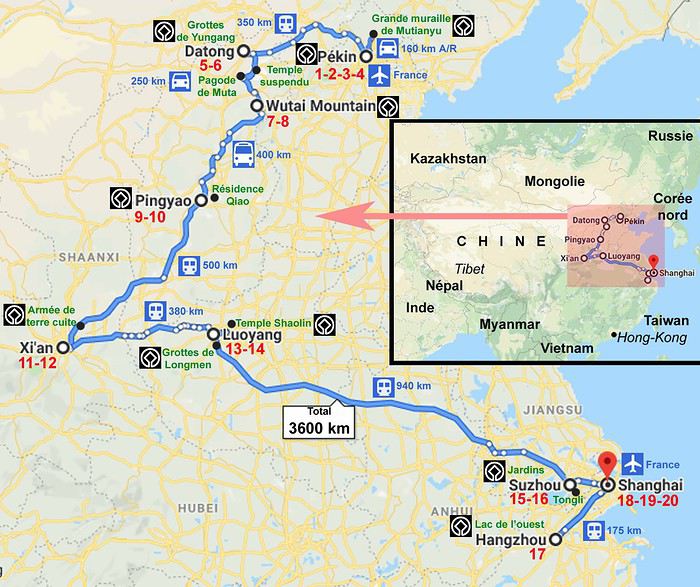
J1 # ven 17-mai # 23:20 Départ du vol Air France J2 # sam 18-mai # Arrivée 15:35 à PEKIN. Retrait des devises au DAB à l’aéroport + achat carte SIM / Transfert aéroport-hôtel en taxi (24 km, 40 mn) / Installation à l’hôtel pour 4 nuits près du temple des Lamas. J3 # dim 19-mai # Palais d'été (métro, A/S environ 1H, 20 km) J4 # lun 20-mai # Excursion aux tombeaux Ming + Grande muraille à Mutianyu (taxi A/R 160 km, 3H 30) J5 # mar 21-mai # Mat : Cité Interdite (métro) / AM : Temple du Ciel, jardin uniquement (métro) J6 # mer 22-mai # Mat : Temple des Lamas / hutongs (à pied, 400 m de l’hôtel) / AM : Taxi pour la gare. Départ du train à 14:16, arrivée à 20:43 à DATONG. Taxi pour l’hôtel (10 mn) dans le centre historique, et installation pour 2 nuits. J7 # jeu 23-mai # Mat : Excursion aux Grottes de Yungang (taxi A/R 35 km, 1H) / AM : Temple de Huayan (à pied, à 400 m de l’hôtel) J8 # ven 24-mai # Mat : Monastère suspendu (85 km, 1H15) et pagode en bois (58 km, 45 mn) / AM : Continuation en taxi vers les montagnes sacrées de WUTAISHAN (110 km, 2H 15). Installation à l’hôtel pour 2 nuits. J9 # sam 25-mai # Monastères de Wutaishan : Pusading, Xiantong, Tayuan, Nanshan (à pied/taxi) J10 # dim 26-mai # Mat : Route vers Pingyao (car, 400 km, environ 5H) / AM : Taxi et installation à l’hôtel à PINGYAO dans le centre historique pour 2 nuits. Début des visites à pied : remparts, temple de Confucius. J11 # lun 27-mai # Visite de la vieille ville de Pingyao (à pied). J12 # mar 28-mai # Mat : Excursion à la Résidence Qiao (taxi A/R, 50 km, 2H) / AM : Temple de Shuanglin (taxi, 8 km, 25 mn). Continuation vers la gare (8 km, 10 mn). Départ du train à 15:43, arrivée à XI’AN à 18:29. Taxi pour l’hôtel dans le centre historique (16 km, 45 mn), et installation pour 2 nuits. J13 # mer 29-mai # Mat : Armée en terre cuite (bus A/R 84 km, 2H) / AM : centre commercial près de l’hôtel J14 # jeu 30-mai # Mat : Musée du Shanxi, Grande pagode de l’Oie Sauvage (métro/à pied) / AM : Quartier Hui et Grande mosquée (à pied). Taxi pour la gare. Départ du train à 17:11, arrivée à 18:42 à LUOYANG. Taxi pour l’hôtel et installation pour 2 nuits. J15 # ven 31-mai # Excursion au Monastère Shaolin, puis au temple du Cheval blanc (Tour en bus, A/R 110 km) J16 # sam 01-juin # Mat : Grottes de Longmen (taxi A/R 30 km, 30 mn). Continuation pour la gare. / AM : Départ du train à 11:50 (dej à bord), arrivée à 17:13 à SUZHOU. Taxi pour l’hôtel et installation pour 2 nuits. J17 # dim 02-juin # Mat : Jardin de l’Humble Administrateur puis musée de la Soie (taxi / à pied) / AM : Excursion à Tongli (métro), bateau sur les canaux, jardins Pearl Tower et Tuisi. J18 # lun 03-juin # Mat : Marché aux fleurs, Jardin de la forêt de Lion (à pied) / AM : Canaux (à pied). Taxi pour la gare. Départ du train à 16:05, arrivée à 17:27 à HANGZHOU. Taxi pour l’hôtel et installation pour 1 seule nuit. J19 # mar 04-juin # Mat : Lac de l’Ouest (1ère visite à pied). Champs de thé de Longjin (voiture) / AM : Bateau sur le lac de l’Ouest pour l’île centrale. Centre historique avec une pharmacie de 1874. Taxi (vers 16H30) pour la gare. Départ du train à 18:06, arrivée à 19:00 à SHANGHAI. Taxi pour l’hôtel (20 km, 40 mn), et installation pour 3 nuits. J20 # mer 05-juin # Mat : Jardin Yu et vieille ville chinoise (taxi). / AM : Rue de Nankin, Bund, ferry, Pudong (métro/à pied/bateau) / Soir : Tour Jin Mao, puis Bund et rue de Nankin (taxi/ à pied/ métro) J21 # jeu 06-juin # Mat : Concession Française, dont parc Fuxing (métro/à pied/taxi) / AM : Musée de Shanghai, People square (à pied). J22 # ven 07-juin # Mat : Marché aux grillons, Suzhou creek pour la course des bateaux-dragons loupée, Temple de Jade (à pied/métro/taxi) / AM : Courses dans la vieille ville chinoise (métro/taxi/à pied) / Soir (vers 19H) : Taxi pour la gare de Longyang Road (12 km, 25 mn). Train Maglev pour l'aéroport (10 mn). Vol départ à 23:20. J23 # sam 08-juin # Arrivée à Paris à 05:40.
Notre budget final Avant de partir, nous avions contacté par internet des tours opérateurs sur place, pensant à la barrière de la langue. Les prix nous ont finalement dissuadés d'en sélectionner un. Au final, après comparaison, et même si les prestations sont forcément différentes, ils étaient plus élevés de 50 à 100% par rapport à ce que nous avons réalisé par nous-mêmes, moins de 2000 € par personne, se décomposant ainsi :
450 € pour le vol international A/R direct sur Air France. Vraiment pas cher, et un Airbus A380 au retour. 420 € pour les transports intérieurs, dont 84 € pour les métros/taxi en ville, 170 € pour 2500 km en train, et 166 € pour 1000 km en taxi/car. 38 € en moyenne (de 17 à 71 €) la chambre double. Moins de 12 € pour l’alimentaire par personne et par jour. 126 € par personne pour les frais de visa, parmi les plus chers au monde. Près de 300 € par personne pour nos visites. Presque tout est payant, et est même relativement cher par rapport au revenu moyen chinois, jusqu’à 120 ou 130 yuans certains sites, et encore nous avions des tarifs de moyenne saison. Nous nous sommes dit que c'était un moyen dissuasif de réduire la foule, que la tranquillité avait un prix. Mais dans les musées gratuits de Xi'an ou de Shanghai, il n'y avait pas vraiment plus de monde qu'ailleurs. A noter par ailleurs qu’à Mutianyu, les deux téléphériques n’appartenant pas à la même société, il faut payer deux fois pour la montée et pour la descente, et le prix est plus cher en haut qu’aux guichets en bas. Mieux vaut prévoir ! La visite de la Grande muraille nous est ainsi revenue à 560 yuans pour deux, mais sans regrets, car nous étions vraiment tranquilles. Cadeaux-souvenirs-achats « personnels » non compris.
Le taux de change nous est revenu en moyenne à 7,60 yuans par euro, hors frais bancaires.
Nos transports interurbains Pour les grandes distances, nous n’avons pris aucun vol intérieur, vu leurs coûts un peu élevés et les durées acceptables des trajets en trains.
Nous avons principalement pris des TGV en 2nde classe, réservés via le site internet fr.trip.com. Les rames sont nickel, les gares immenses comme des aéroports. Attention, il peut exister plusieurs gares dans les villes (TGV, non TGV, directions diverses). Bien revérifier sur sa réservation. Il est facile de se repérer avec les directions en caractères latins. Nous avons récupéré sans frais tous nos billets dans la première gare calme (Pingyao) pour éviter ensuite de faire la queue à chaque fois. Nous arrivions en général une heure avant le départ. Une seule fois, nous nous sommes mal placés sur les quais, à l'arrière au lieu de l'avant. Les agents nous ont alors aidés à porter nos bagages dans les couloirs de la rame. Les trains sont parfaitement à l'heure. Seul le Pékin-Datong n'était pas un TGV. Nous avions une cabine 1ère classe avec banquettes 4 lits, bien que nous circulions de jour. Nous avons eu toute la cabine pour nous seuls sur la seconde moitié du trajet, et de jeunes voisins sur la première moitié. Nous n'avons pas discuté avec eux, ils ne parlaient apparemment pas anglais. Comme plusieurs Chinois, nous avons utilisé deux fois les fontaines d'eau bouillante en bout de voiture pour nos boites de noodles. Des prises électriques étaient disponibles pour charger les smartphones.
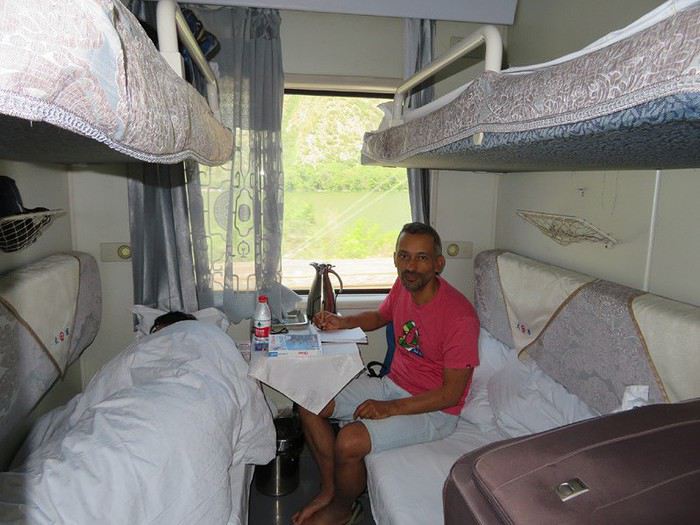 Train Pékin-Datong, où nos voisins font la sieste !
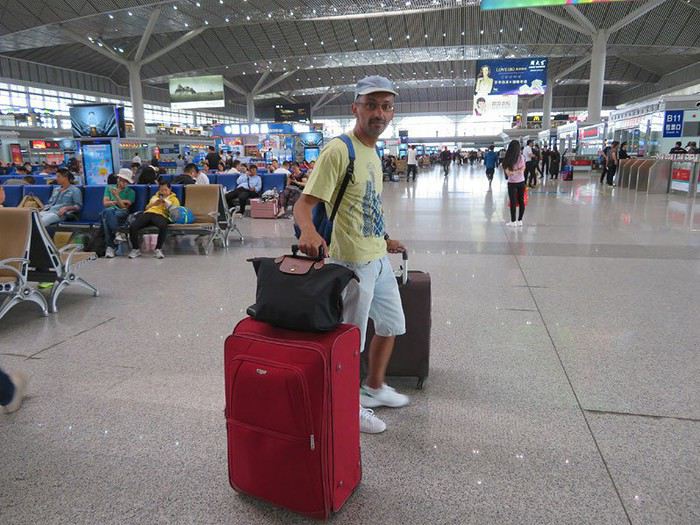 Gare de Xi'an, immense comme un aéroport.
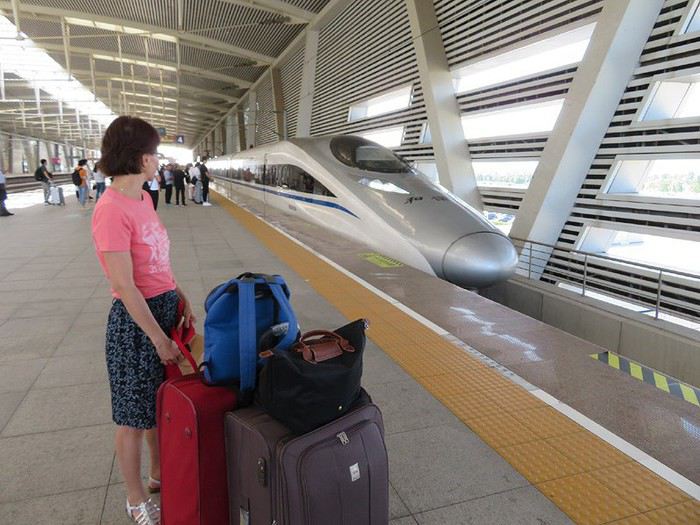 Quais à Shuzhou, prêts à monter comme tout le monde.
Entre Datong et Wutaishan, nous avons pris un taxi via notre hôtelier très sympathique. Le chauffeur ne parlait pas anglais mais nous avons réussi à nous comprendre via un traducteur. Nous avions plusieurs étapes prévues. Nous l'avons invité à déjeuner. Pour la Grande muraille, nous avons aussi trouvé notre jeune chauffeur via notre hôtelier. Il parlait anglais et nous avons eu des conversations très intéressantes. Il s'est baladé aussi avec nous et nous l'avons invité à déjeuner. C'était une très belle journée, sûrement mieux qu'avec un groupe.
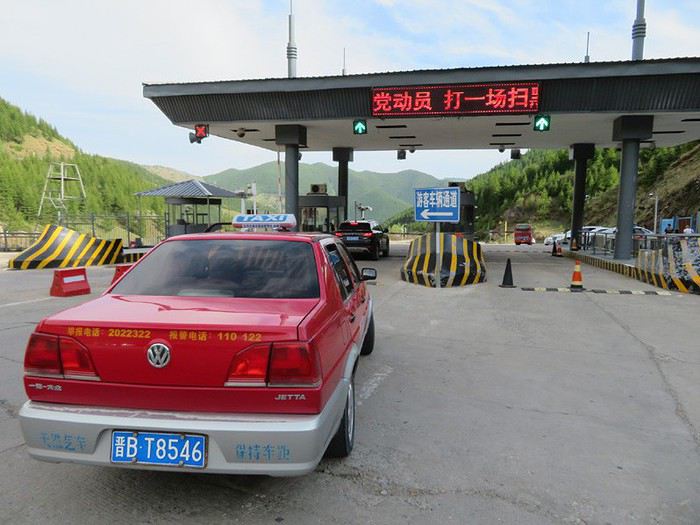 Notre taxi à la barrière de péage de la vallée de Wutaishan, où il a eu quelques problèmes administratifs.
Nous n’avons fait qu’un seul trajet en car régulier, entre Wutaishan et Pingyao. Notre hôtelier s’est occupé de la réservation, touchant sans doute une commission. Il nous a déconseillé le taxi en raison du prix, que je me suis fait confirmé directement auprès d’un chauffeur. Finalement, nous n'avons pas regretté. D'une part, nous n’avions que de l'autoroute et les paysages n’étaient pas extraordinaires. D'autre part, nous avons côtoyé un groupe sympathique de pèlerins, qui nous ont même offert à manger dans un arrêt routier. Et au terminus, une autre passagère s'est assurée que nous étions bien récupérés par un taxi avant de nous lâcher ! Nous étions les seuls occidentaux, mais certains Chinois travaillaient à l'étranger et parlaient très bien anglais.
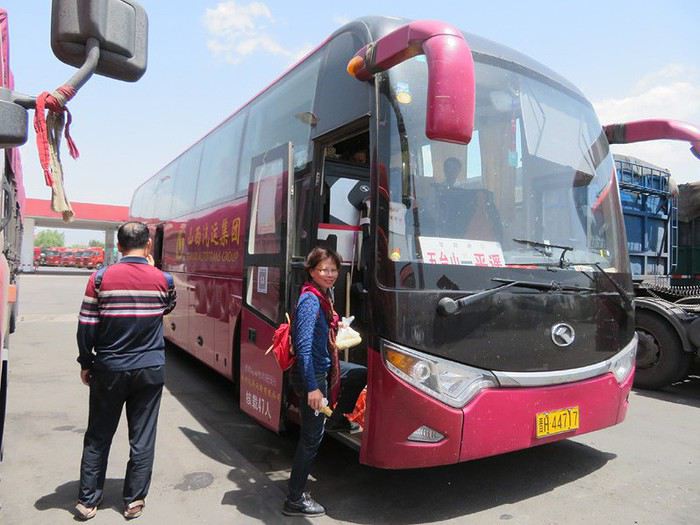 Dans un relais routier vers Pingyao.
Pour Shaolin, via notre hôtelier très sympathique, nous sommes partis en car avec un petit groupe, le seul du voyage, avec surtout des Chinois dont certains de l'étranger qui nous ont servi de traducteur... parfois... autrement dit, nous n'avons pas eu beaucoup d'explications. C'était plutôt bien organisé, avec des transferts en bus ou voiture en fonction des options, mais nous avons quand même perdu beaucoup de temps l'après-midi pour la visite du temple du Cheval blanc, qui à la limite ne méritait pas un détour : 45 mn de visite pour 3h de transports et d'attente. Nous aurions du prendre un taxi ou se contenter de Shaolin.
Nos transports urbains En ville, nous avons utilisé le métro, le taxi quand les stations étaient éloignées, et nos pieds ! Les villes ayant souvent plus d'un million d'habitants, elles disposent d'un métro (Pékin, Xi'an, Suzhou, Hangzhou, Shanghai). Nous nous sommes facilement repérés et avons pris les tickets à l'unité dans les distributeurs automatiques. Comme dans les aéroports et les gares, les voyageurs passent sous un portail électronique et les sacs passent aux rayons X. C'est quand même assez fluide, car peu de personnes ont un sac finalement. A la sortie Tiananmen, il y avait un contrôle supplémentaire des cartes d’identité ou passeports, et nous avons perdu 20 mn. Côté sécurité, pas de soucis, au moins une caméra tous les 2 mètres ! Pékin, qui doit avoir le plus ancien métro, a aussi peu d'escalators. Cela rajoute de la fatigue. Pas de PUB, peu de décoration, le métro est surtout fonctionnel et très propre.
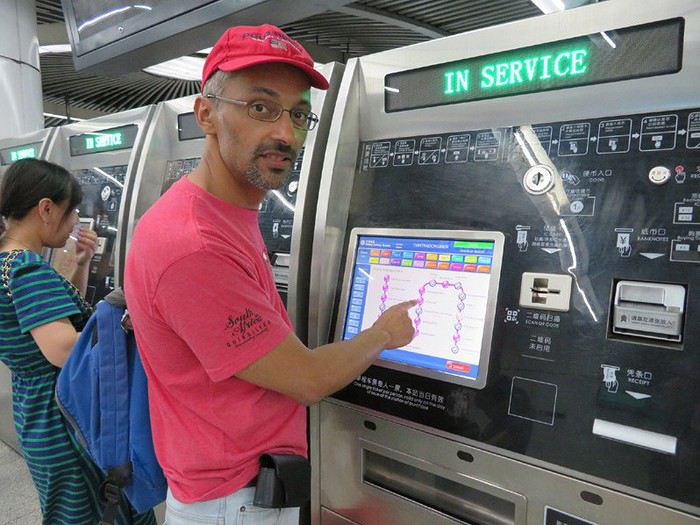 Distributeur automatique de billets dans le métro à Pékin
Le taxi n'est pas très cher, et est intéressant à partir du forfait kilométrique de 2 ou 3 km et pour deux personnes. Avec nos bagages, nous l'avons systématiquement pris entre les gares et nos hébergements, même à Luoyang où nous aurions pu marcher seulement sur 500 ou 700 m. Le chauffeur était d'ailleurs surpris, car par la route, le chemin était plus long ! Nous avons parfois eu beaucoup de difficultés à héler un taxi. Bien qu'ils soient nombreux, ceux-ci sont souvent réservés. Nous avons attendus parfois 20 à 30 mn, surtout à Xi'an, craignant même louper notre train. Certains chauffeurs n'ont pas voulu nous prendre à cause des bagages trop volumineux ou de la destination... Ils ne manquent pas de clients ! Bien que nous étions prévenus, nous avons été arnaqués une fois à Shanghai, la nuit. Le compteur ne fonctionnait pas et le chauffeur a baragouiné sans que nous lui demandions le prix de la course. Résultat : 100 yuans au lieu de sans doute 20 ou 30. Enfin, à la sortie nord de la Cité interdite, la station de métro est assez éloignée. Des bus sont disponibles, mais nous ne voulions pas nous aventurer, bien que des francophones auraient pu nous aider. Et les taxis étaient hors de prix, 100 yuans minimum. Nous sommes donc partis à pied jusqu'au métro, en faisant une pause resto.
Nos hébergements Parmi les 9, nous étions 3 fois dans des petites structures familiales (Pékin, Pingyao, Hangzhou), 3 fois en AJ ou moyennes structures (Datong, Wutaishan, Luoyang), et 3 fois en grands hôtels chinois (Xi'an, Suzhou, Shanghai). Les réservations via Booking.com étaient plutôt conformes, mais une a été annulée quelques jours avant et nous avons pu la remplacer sans soucis (Suzhou devait être une guesthouse). Nous étions plutôt dans les centres historiques. Pékin était un peu plus vieux, le reste était très propre. Les tarifs sont naturellement plus élevés dans les très grandes villes. Pour seulement 17 euros la nuit, nous avions quelques doutes sur Pingyao malgré de bons commentaires, mais c'était effectivement l'un de nos meilleurs hébergements. Les douches n'étaient généralement pas séparées des WC. Le wifi fonctionnait partout. L'accueil était plus distant dans les grands hôtels, pas beaucoup d'efforts pour nous aider ou parler en anglais, sachant que leur clientèle était surtout chinoise. Sinon nos logeurs nous ont toujours aidés pour des informations ou des déplacements. Quand nous avions le petit-déjeuner inclus, c'était chinois, et nous n'avons pas vraiment apprécié, même à Datong qui était top et où nous avions une corbeille de fruits chaque jour dans notre chambre. A Hangzhou, devant notre perplexité, la patronne nous a guidés à pied près du lac puis nous a baladés en voiture vers les champs de thé, gracieusement, avec un autre couple germano-chinois. Ce fut une matinée très sympa.
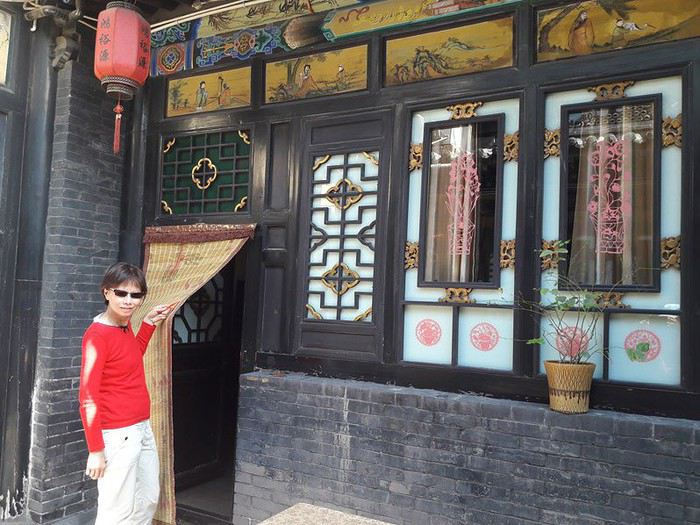 Entrée de notre chambre dans une cour carrée à Pingyao
Notre restauration Contrairement à nos habitudes, nous n'avons pas souvent cherché des restos recommandés, car ils étaient parfois éloignés. Nous avons privilégié les restos ayant des cartes avec photo à défaut de traduction anglaise (rare), des plats exposés en vitrine, ou de nombreux clients chinois. Des chinois parlant anglais des tables voisines nous ont parfois aidés à la compréhension des plats. Quelques belles surprises, comme un énorme poisson à Datong, ou le quartier Hui à Xi’an, mais nous en avons eu aussi des mauvaises entre les plats épicés ou non, le chaud-froid, le sucré-salé. Reste notre valeur sûre : les dumplings, de toutes sortes et vraiment pas chers. Nous avons aussi bien aimé les champignons très variés, avec diverses préparations en sauce, frits, sautés... Le canard laqué ? Pas gouté à Pékin, mais nous connaissons bien à Paris. Nous avons succombé une fois à une pizzeria (assez moyen et cher dans le chic quartier de Xiantidi à Shanghai), et deux fois à un Mac do (alors que nous y allons très rarement en France). En fait, c'était plus intéressant d'y voir les Chinois y manger. Côté desserts, le choix était restreint dans les restos. Dans des superettes et des épiceries fines, nous avons trouvé quelques gâteaux excellents, des bonbons et fruits confits. C’était difficile de comprendre la composition, nous hésitions beaucoup au début, moins à la fin ! Des choses que nous aimions, nous ne les avons pas retrouvées dans une autre région, et nous avons regretté. Les fruits nous ont manqué, et c'est seulement vers la fin, plus au sud, que nous en avons vu beaucoup, notamment des litchis. Nous n'avons jamais été malades, mais nous avons perdu quelques kilos, ce qui ne nous était jamais arrivé en voyage, même en Inde.
 Resto Dejuyan à Pingyo, l'un des rares recommandés que nous ayons fait.
 Les dumplings, une valeur sûre !
Nos facilités matérielles Dès l'arrivée à l'aéroport, nous avons retiré de l'argent à un DAB (retrait maxi de 3000 yuans, nous avons préféré Bank of China et ACBD), et avons pris une carte SIM dans un petit stand de China Mobile. Le forfait téléphone n'était pas élevé mais suffisant pour nos rares appels locaux. La carte SIM était aussi utile pour internet dans la rue, quoique le GPS maps.me n'en a pas besoin si les cartes sont préalablement téléchargées comme nous l’avions fait. Pour les appels internationaux (France, Etats-Unis, Vietnam), nous avons utilisé Viber avec le wifi dans les hôtels. J’avais installé l’application WeChat, mais impossible de payer avec. Elle a juste servi à quelques échanges avec deux Chinois. Nous avions aussi installé un VPN avant d’arriver dans le pays.
Nos contacts avec la population Comme beaucoup de touristes, notre crainte était la barrière de la langue, vu que très peu de Chinois parlent anglais, et que les idéogrammes remplacent notre alphabet. Alors oui, les contacts ont été limités, quoique... Nous avons eu une longue conversation avec notre jeune chauffeur qui s'est baladé avec nous sur la Grande muraille. Idem à Hangzhou. Les Chinois de l'étranger nous ont souvent bien aidé pour les traductions, sinon nous avions Google translate, et nos interlocuteurs avaient aussi une application. Le plus long échange ainsi a été avec notre hôtelier à Datong, une bonne demi-heure. Nous avons bien rigolé parfois, car les traductions n’étaient pas parfaites dans les deux sens. Mieux vaut des phrases courtes, et passer par la traduction Chinois-anglais que Chinois-français. Mais toujours être dépendant d'une machine, ne nous incitait pas à engager la conversation, nous cherchions à nous débrouiller seuls, et immanquablement, nous sommes passés à côté d'informations importantes, comme pour la fête des bateaux-dragon qui devait être le clou de notre voyage. Certains Chinois, qui voyaient bien que la conversation était impossible, nous ont même carrément tourné le dos. Pourquoi perdre son temps ? Le plus incroyable était dans un grand resto à Shanghai, qui était sûr de faire le plein. Du coup, nous sommes ressortis ! Mais en général, les Chinois ont été assez attentifs à nos attentes. Nous avons croisé très peu d'étrangers, ceux-ci étant souvent noyés dans la masse de tous les touristes chinois. Nous étions même des extraterrestres à Wutaishan. Shanghai était plus cosmopolite, mais il était trop tard pour échanger sur des expériences.
Nos cadeaux-souvenirs Nous ne sommes pas trop adeptes des objets décoratifs. Nous avons surtout ramené des produits alimentaires : champignons et fleurs de troellius (infusion) de Wutaishan, bœuf de Pingyao, bœuf séché, gâteaux divers, bonbons et fruits confits, ainsi que d’excellents litchis frais. Nous avons aussi acheté à Shanghai une paire de Feiyue, portée notamment par les moines de Shaolin.
Nos photos au cours de ce voyage C’est par ici : https://photos.google.com/share/AF1QipMbz1iSnD8-2C2FlzUyjiKaHFiHcv7YxnA7BFq0dXuLDTWOz2FeQvzF0LgIXugLFw?key=Zkt5eFNxd1pYWTFmdzZISDdZM3k5aDBNR0lNTlBB
Nos impressions générales La Grande muraille et tant d'autres sites, nous en rêvions, surtout après le récit et le film d'un cousin il y a six ans. Car auparavant, mon épouse avait de gros préjugés sur les Chinois (différend historique avec les Vietnamiens, bien qu'elle ait aussi des origines chinoises !), et je m'imaginais les voyages en Chine exclusivement urbains. Ces avis ont été nuancés. Nous avons volontairement choisi un parcours culturel, avec de nombreux sites classés à l'Unesco, au nord, la région historique la plus densément peuplée. Nous avons laissé de côté le sud, en se disant que ce serait pour un éventuel autre voyage, et sachant que certains paysages devaient ressembler au nord Vietnam que nous connaissons déjà. En trois semaines, impossible de visiter un pays 17 fois plus grand que la France. Au final, nous ne sommes pas mécontents de nos choix, mais le timing était quand même serré, car nous avons sous-estimé les temps de transports, la foule, la fatigue. Surtout à Pékin, ce n'est pas 4 jours qu'il nous fallait, mais 5 ou 6, tant il y a de choses à voir. Nous nous demandons toujours comment certains tours opérateurs enchaînent la Cité interdite, la Colline du charbon, et le temple du Ciel dans la même journée, sans compter les embouteillages pour leurs cars ! Ces premières journées à Pékin ont été difficiles, mal remis du décalage horaire, et sans repères culturels. Le premier dîner a été épique pour se faire comprendre et l'accueil pas très chaleureux à notre guesthouse. À Hangzhou, nous avions un programme chargé qui aurait nécessité 2 jours au lieu de 1 seul. Nous avons finalement privilégié les rencontres aux visites. A Shanghai, alors que nous avions planifié tout notre voyage en fonction de la date, nous avons raté la course des bateaux-dragons, car elle avait été avancée d'un jour. Le matin même à la télé au petit-déjeuner, nous avions vu des images... Nous nous disions, tiens, ils se préparent pour demain... Si nous avions compris le chinois... La date n'était même pas actualisée sur les rares sites internet en anglais ! Les réceptionnistes de l'hôtel ne connaissaient même pas la manifestation ! Finalement nous sommes retournés dans la vieille ville chinoise, où la foule était beaucoup plus nombreuse que la première fois. Côté foule justement, le pire pour nous a été la Cité Interdite, malgré nos précautions, puis dans une moindre mesure, le Palais d’été à Pékin (un dimanche, mais moins monde dans les espaces avec suppléments), l’armée de terre cuite à Xi’an (bien aménagé quand même), le jardin du Humble administrateur à Suzhou (dommage, mais nous étions prévenus), le temple suspendu près de Datong (très petit). À part deux demi-journées de pluie à Xi'an (bien trempés !) et Shanghai, et le ciel parfois gris, notamment à Pékin, le temps était magnifique et les températures autour de 30 degrés. Nous avons évité un 39 degrés de justesse à Xi'an.
Notre trajet
J1 # ven 17-mai # 23:20 Départ du vol Air France J2 # sam 18-mai # Arrivée 15:35 à PEKIN. Retrait des devises au DAB à l’aéroport + achat carte SIM / Transfert aéroport-hôtel en taxi (24 km, 40 mn) / Installation à l’hôtel pour 4 nuits près du temple des Lamas. J3 # dim 19-mai # Palais d'été (métro, A/S environ 1H, 20 km) J4 # lun 20-mai # Excursion aux tombeaux Ming + Grande muraille à Mutianyu (taxi A/R 160 km, 3H 30) J5 # mar 21-mai # Mat : Cité Interdite (métro) / AM : Temple du Ciel, jardin uniquement (métro) J6 # mer 22-mai # Mat : Temple des Lamas / hutongs (à pied, 400 m de l’hôtel) / AM : Taxi pour la gare. Départ du train à 14:16, arrivée à 20:43 à DATONG. Taxi pour l’hôtel (10 mn) dans le centre historique, et installation pour 2 nuits. J7 # jeu 23-mai # Mat : Excursion aux Grottes de Yungang (taxi A/R 35 km, 1H) / AM : Temple de Huayan (à pied, à 400 m de l’hôtel) J8 # ven 24-mai # Mat : Monastère suspendu (85 km, 1H15) et pagode en bois (58 km, 45 mn) / AM : Continuation en taxi vers les montagnes sacrées de WUTAISHAN (110 km, 2H 15). Installation à l’hôtel pour 2 nuits. J9 # sam 25-mai # Monastères de Wutaishan : Pusading, Xiantong, Tayuan, Nanshan (à pied/taxi) J10 # dim 26-mai # Mat : Route vers Pingyao (car, 400 km, environ 5H) / AM : Taxi et installation à l’hôtel à PINGYAO dans le centre historique pour 2 nuits. Début des visites à pied : remparts, temple de Confucius. J11 # lun 27-mai # Visite de la vieille ville de Pingyao (à pied). J12 # mar 28-mai # Mat : Excursion à la Résidence Qiao (taxi A/R, 50 km, 2H) / AM : Temple de Shuanglin (taxi, 8 km, 25 mn). Continuation vers la gare (8 km, 10 mn). Départ du train à 15:43, arrivée à XI’AN à 18:29. Taxi pour l’hôtel dans le centre historique (16 km, 45 mn), et installation pour 2 nuits. J13 # mer 29-mai # Mat : Armée en terre cuite (bus A/R 84 km, 2H) / AM : centre commercial près de l’hôtel J14 # jeu 30-mai # Mat : Musée du Shanxi, Grande pagode de l’Oie Sauvage (métro/à pied) / AM : Quartier Hui et Grande mosquée (à pied). Taxi pour la gare. Départ du train à 17:11, arrivée à 18:42 à LUOYANG. Taxi pour l’hôtel et installation pour 2 nuits. J15 # ven 31-mai # Excursion au Monastère Shaolin, puis au temple du Cheval blanc (Tour en bus, A/R 110 km) J16 # sam 01-juin # Mat : Grottes de Longmen (taxi A/R 30 km, 30 mn). Continuation pour la gare. / AM : Départ du train à 11:50 (dej à bord), arrivée à 17:13 à SUZHOU. Taxi pour l’hôtel et installation pour 2 nuits. J17 # dim 02-juin # Mat : Jardin de l’Humble Administrateur puis musée de la Soie (taxi / à pied) / AM : Excursion à Tongli (métro), bateau sur les canaux, jardins Pearl Tower et Tuisi. J18 # lun 03-juin # Mat : Marché aux fleurs, Jardin de la forêt de Lion (à pied) / AM : Canaux (à pied). Taxi pour la gare. Départ du train à 16:05, arrivée à 17:27 à HANGZHOU. Taxi pour l’hôtel et installation pour 1 seule nuit. J19 # mar 04-juin # Mat : Lac de l’Ouest (1ère visite à pied). Champs de thé de Longjin (voiture) / AM : Bateau sur le lac de l’Ouest pour l’île centrale. Centre historique avec une pharmacie de 1874. Taxi (vers 16H30) pour la gare. Départ du train à 18:06, arrivée à 19:00 à SHANGHAI. Taxi pour l’hôtel (20 km, 40 mn), et installation pour 3 nuits. J20 # mer 05-juin # Mat : Jardin Yu et vieille ville chinoise (taxi). / AM : Rue de Nankin, Bund, ferry, Pudong (métro/à pied/bateau) / Soir : Tour Jin Mao, puis Bund et rue de Nankin (taxi/ à pied/ métro) J21 # jeu 06-juin # Mat : Concession Française, dont parc Fuxing (métro/à pied/taxi) / AM : Musée de Shanghai, People square (à pied). J22 # ven 07-juin # Mat : Marché aux grillons, Suzhou creek pour la course des bateaux-dragons loupée, Temple de Jade (à pied/métro/taxi) / AM : Courses dans la vieille ville chinoise (métro/taxi/à pied) / Soir (vers 19H) : Taxi pour la gare de Longyang Road (12 km, 25 mn). Train Maglev pour l'aéroport (10 mn). Vol départ à 23:20. J23 # sam 08-juin # Arrivée à Paris à 05:40.
Notre budget final Avant de partir, nous avions contacté par internet des tours opérateurs sur place, pensant à la barrière de la langue. Les prix nous ont finalement dissuadés d'en sélectionner un. Au final, après comparaison, et même si les prestations sont forcément différentes, ils étaient plus élevés de 50 à 100% par rapport à ce que nous avons réalisé par nous-mêmes, moins de 2000 € par personne, se décomposant ainsi :
450 € pour le vol international A/R direct sur Air France. Vraiment pas cher, et un Airbus A380 au retour. 420 € pour les transports intérieurs, dont 84 € pour les métros/taxi en ville, 170 € pour 2500 km en train, et 166 € pour 1000 km en taxi/car. 38 € en moyenne (de 17 à 71 €) la chambre double. Moins de 12 € pour l’alimentaire par personne et par jour. 126 € par personne pour les frais de visa, parmi les plus chers au monde. Près de 300 € par personne pour nos visites. Presque tout est payant, et est même relativement cher par rapport au revenu moyen chinois, jusqu’à 120 ou 130 yuans certains sites, et encore nous avions des tarifs de moyenne saison. Nous nous sommes dit que c'était un moyen dissuasif de réduire la foule, que la tranquillité avait un prix. Mais dans les musées gratuits de Xi'an ou de Shanghai, il n'y avait pas vraiment plus de monde qu'ailleurs. A noter par ailleurs qu’à Mutianyu, les deux téléphériques n’appartenant pas à la même société, il faut payer deux fois pour la montée et pour la descente, et le prix est plus cher en haut qu’aux guichets en bas. Mieux vaut prévoir ! La visite de la Grande muraille nous est ainsi revenue à 560 yuans pour deux, mais sans regrets, car nous étions vraiment tranquilles. Cadeaux-souvenirs-achats « personnels » non compris.
Le taux de change nous est revenu en moyenne à 7,60 yuans par euro, hors frais bancaires.
Nos transports interurbains Pour les grandes distances, nous n’avons pris aucun vol intérieur, vu leurs coûts un peu élevés et les durées acceptables des trajets en trains.
Nous avons principalement pris des TGV en 2nde classe, réservés via le site internet fr.trip.com. Les rames sont nickel, les gares immenses comme des aéroports. Attention, il peut exister plusieurs gares dans les villes (TGV, non TGV, directions diverses). Bien revérifier sur sa réservation. Il est facile de se repérer avec les directions en caractères latins. Nous avons récupéré sans frais tous nos billets dans la première gare calme (Pingyao) pour éviter ensuite de faire la queue à chaque fois. Nous arrivions en général une heure avant le départ. Une seule fois, nous nous sommes mal placés sur les quais, à l'arrière au lieu de l'avant. Les agents nous ont alors aidés à porter nos bagages dans les couloirs de la rame. Les trains sont parfaitement à l'heure. Seul le Pékin-Datong n'était pas un TGV. Nous avions une cabine 1ère classe avec banquettes 4 lits, bien que nous circulions de jour. Nous avons eu toute la cabine pour nous seuls sur la seconde moitié du trajet, et de jeunes voisins sur la première moitié. Nous n'avons pas discuté avec eux, ils ne parlaient apparemment pas anglais. Comme plusieurs Chinois, nous avons utilisé deux fois les fontaines d'eau bouillante en bout de voiture pour nos boites de noodles. Des prises électriques étaient disponibles pour charger les smartphones.
Train Pékin-Datong, où nos voisins font la sieste !
Gare de Xi'an, immense comme un aéroport.
Quais à Shuzhou, prêts à monter comme tout le monde.Entre Datong et Wutaishan, nous avons pris un taxi via notre hôtelier très sympathique. Le chauffeur ne parlait pas anglais mais nous avons réussi à nous comprendre via un traducteur. Nous avions plusieurs étapes prévues. Nous l'avons invité à déjeuner. Pour la Grande muraille, nous avons aussi trouvé notre jeune chauffeur via notre hôtelier. Il parlait anglais et nous avons eu des conversations très intéressantes. Il s'est baladé aussi avec nous et nous l'avons invité à déjeuner. C'était une très belle journée, sûrement mieux qu'avec un groupe.
Notre taxi à la barrière de péage de la vallée de Wutaishan, où il a eu quelques problèmes administratifs.Nous n’avons fait qu’un seul trajet en car régulier, entre Wutaishan et Pingyao. Notre hôtelier s’est occupé de la réservation, touchant sans doute une commission. Il nous a déconseillé le taxi en raison du prix, que je me suis fait confirmé directement auprès d’un chauffeur. Finalement, nous n'avons pas regretté. D'une part, nous n’avions que de l'autoroute et les paysages n’étaient pas extraordinaires. D'autre part, nous avons côtoyé un groupe sympathique de pèlerins, qui nous ont même offert à manger dans un arrêt routier. Et au terminus, une autre passagère s'est assurée que nous étions bien récupérés par un taxi avant de nous lâcher ! Nous étions les seuls occidentaux, mais certains Chinois travaillaient à l'étranger et parlaient très bien anglais.
Dans un relais routier vers Pingyao.Pour Shaolin, via notre hôtelier très sympathique, nous sommes partis en car avec un petit groupe, le seul du voyage, avec surtout des Chinois dont certains de l'étranger qui nous ont servi de traducteur... parfois... autrement dit, nous n'avons pas eu beaucoup d'explications. C'était plutôt bien organisé, avec des transferts en bus ou voiture en fonction des options, mais nous avons quand même perdu beaucoup de temps l'après-midi pour la visite du temple du Cheval blanc, qui à la limite ne méritait pas un détour : 45 mn de visite pour 3h de transports et d'attente. Nous aurions du prendre un taxi ou se contenter de Shaolin.
Nos transports urbains En ville, nous avons utilisé le métro, le taxi quand les stations étaient éloignées, et nos pieds ! Les villes ayant souvent plus d'un million d'habitants, elles disposent d'un métro (Pékin, Xi'an, Suzhou, Hangzhou, Shanghai). Nous nous sommes facilement repérés et avons pris les tickets à l'unité dans les distributeurs automatiques. Comme dans les aéroports et les gares, les voyageurs passent sous un portail électronique et les sacs passent aux rayons X. C'est quand même assez fluide, car peu de personnes ont un sac finalement. A la sortie Tiananmen, il y avait un contrôle supplémentaire des cartes d’identité ou passeports, et nous avons perdu 20 mn. Côté sécurité, pas de soucis, au moins une caméra tous les 2 mètres ! Pékin, qui doit avoir le plus ancien métro, a aussi peu d'escalators. Cela rajoute de la fatigue. Pas de PUB, peu de décoration, le métro est surtout fonctionnel et très propre.
Distributeur automatique de billets dans le métro à PékinLe taxi n'est pas très cher, et est intéressant à partir du forfait kilométrique de 2 ou 3 km et pour deux personnes. Avec nos bagages, nous l'avons systématiquement pris entre les gares et nos hébergements, même à Luoyang où nous aurions pu marcher seulement sur 500 ou 700 m. Le chauffeur était d'ailleurs surpris, car par la route, le chemin était plus long ! Nous avons parfois eu beaucoup de difficultés à héler un taxi. Bien qu'ils soient nombreux, ceux-ci sont souvent réservés. Nous avons attendus parfois 20 à 30 mn, surtout à Xi'an, craignant même louper notre train. Certains chauffeurs n'ont pas voulu nous prendre à cause des bagages trop volumineux ou de la destination... Ils ne manquent pas de clients ! Bien que nous étions prévenus, nous avons été arnaqués une fois à Shanghai, la nuit. Le compteur ne fonctionnait pas et le chauffeur a baragouiné sans que nous lui demandions le prix de la course. Résultat : 100 yuans au lieu de sans doute 20 ou 30. Enfin, à la sortie nord de la Cité interdite, la station de métro est assez éloignée. Des bus sont disponibles, mais nous ne voulions pas nous aventurer, bien que des francophones auraient pu nous aider. Et les taxis étaient hors de prix, 100 yuans minimum. Nous sommes donc partis à pied jusqu'au métro, en faisant une pause resto.
Nos hébergements Parmi les 9, nous étions 3 fois dans des petites structures familiales (Pékin, Pingyao, Hangzhou), 3 fois en AJ ou moyennes structures (Datong, Wutaishan, Luoyang), et 3 fois en grands hôtels chinois (Xi'an, Suzhou, Shanghai). Les réservations via Booking.com étaient plutôt conformes, mais une a été annulée quelques jours avant et nous avons pu la remplacer sans soucis (Suzhou devait être une guesthouse). Nous étions plutôt dans les centres historiques. Pékin était un peu plus vieux, le reste était très propre. Les tarifs sont naturellement plus élevés dans les très grandes villes. Pour seulement 17 euros la nuit, nous avions quelques doutes sur Pingyao malgré de bons commentaires, mais c'était effectivement l'un de nos meilleurs hébergements. Les douches n'étaient généralement pas séparées des WC. Le wifi fonctionnait partout. L'accueil était plus distant dans les grands hôtels, pas beaucoup d'efforts pour nous aider ou parler en anglais, sachant que leur clientèle était surtout chinoise. Sinon nos logeurs nous ont toujours aidés pour des informations ou des déplacements. Quand nous avions le petit-déjeuner inclus, c'était chinois, et nous n'avons pas vraiment apprécié, même à Datong qui était top et où nous avions une corbeille de fruits chaque jour dans notre chambre. A Hangzhou, devant notre perplexité, la patronne nous a guidés à pied près du lac puis nous a baladés en voiture vers les champs de thé, gracieusement, avec un autre couple germano-chinois. Ce fut une matinée très sympa.
Entrée de notre chambre dans une cour carrée à PingyaoNotre restauration Contrairement à nos habitudes, nous n'avons pas souvent cherché des restos recommandés, car ils étaient parfois éloignés. Nous avons privilégié les restos ayant des cartes avec photo à défaut de traduction anglaise (rare), des plats exposés en vitrine, ou de nombreux clients chinois. Des chinois parlant anglais des tables voisines nous ont parfois aidés à la compréhension des plats. Quelques belles surprises, comme un énorme poisson à Datong, ou le quartier Hui à Xi’an, mais nous en avons eu aussi des mauvaises entre les plats épicés ou non, le chaud-froid, le sucré-salé. Reste notre valeur sûre : les dumplings, de toutes sortes et vraiment pas chers. Nous avons aussi bien aimé les champignons très variés, avec diverses préparations en sauce, frits, sautés... Le canard laqué ? Pas gouté à Pékin, mais nous connaissons bien à Paris. Nous avons succombé une fois à une pizzeria (assez moyen et cher dans le chic quartier de Xiantidi à Shanghai), et deux fois à un Mac do (alors que nous y allons très rarement en France). En fait, c'était plus intéressant d'y voir les Chinois y manger. Côté desserts, le choix était restreint dans les restos. Dans des superettes et des épiceries fines, nous avons trouvé quelques gâteaux excellents, des bonbons et fruits confits. C’était difficile de comprendre la composition, nous hésitions beaucoup au début, moins à la fin ! Des choses que nous aimions, nous ne les avons pas retrouvées dans une autre région, et nous avons regretté. Les fruits nous ont manqué, et c'est seulement vers la fin, plus au sud, que nous en avons vu beaucoup, notamment des litchis. Nous n'avons jamais été malades, mais nous avons perdu quelques kilos, ce qui ne nous était jamais arrivé en voyage, même en Inde.
Resto Dejuyan à Pingyo, l'un des rares recommandés que nous ayons fait.
Les dumplings, une valeur sûre !Nos facilités matérielles Dès l'arrivée à l'aéroport, nous avons retiré de l'argent à un DAB (retrait maxi de 3000 yuans, nous avons préféré Bank of China et ACBD), et avons pris une carte SIM dans un petit stand de China Mobile. Le forfait téléphone n'était pas élevé mais suffisant pour nos rares appels locaux. La carte SIM était aussi utile pour internet dans la rue, quoique le GPS maps.me n'en a pas besoin si les cartes sont préalablement téléchargées comme nous l’avions fait. Pour les appels internationaux (France, Etats-Unis, Vietnam), nous avons utilisé Viber avec le wifi dans les hôtels. J’avais installé l’application WeChat, mais impossible de payer avec. Elle a juste servi à quelques échanges avec deux Chinois. Nous avions aussi installé un VPN avant d’arriver dans le pays.
Nos contacts avec la population Comme beaucoup de touristes, notre crainte était la barrière de la langue, vu que très peu de Chinois parlent anglais, et que les idéogrammes remplacent notre alphabet. Alors oui, les contacts ont été limités, quoique... Nous avons eu une longue conversation avec notre jeune chauffeur qui s'est baladé avec nous sur la Grande muraille. Idem à Hangzhou. Les Chinois de l'étranger nous ont souvent bien aidé pour les traductions, sinon nous avions Google translate, et nos interlocuteurs avaient aussi une application. Le plus long échange ainsi a été avec notre hôtelier à Datong, une bonne demi-heure. Nous avons bien rigolé parfois, car les traductions n’étaient pas parfaites dans les deux sens. Mieux vaut des phrases courtes, et passer par la traduction Chinois-anglais que Chinois-français. Mais toujours être dépendant d'une machine, ne nous incitait pas à engager la conversation, nous cherchions à nous débrouiller seuls, et immanquablement, nous sommes passés à côté d'informations importantes, comme pour la fête des bateaux-dragon qui devait être le clou de notre voyage. Certains Chinois, qui voyaient bien que la conversation était impossible, nous ont même carrément tourné le dos. Pourquoi perdre son temps ? Le plus incroyable était dans un grand resto à Shanghai, qui était sûr de faire le plein. Du coup, nous sommes ressortis ! Mais en général, les Chinois ont été assez attentifs à nos attentes. Nous avons croisé très peu d'étrangers, ceux-ci étant souvent noyés dans la masse de tous les touristes chinois. Nous étions même des extraterrestres à Wutaishan. Shanghai était plus cosmopolite, mais il était trop tard pour échanger sur des expériences.
Nos cadeaux-souvenirs Nous ne sommes pas trop adeptes des objets décoratifs. Nous avons surtout ramené des produits alimentaires : champignons et fleurs de troellius (infusion) de Wutaishan, bœuf de Pingyao, bœuf séché, gâteaux divers, bonbons et fruits confits, ainsi que d’excellents litchis frais. Nous avons aussi acheté à Shanghai une paire de Feiyue, portée notamment par les moines de Shaolin.
Nos photos au cours de ce voyage C’est par ici : https://photos.google.com/share/AF1QipMbz1iSnD8-2C2FlzUyjiKaHFiHcv7YxnA7BFq0dXuLDTWOz2FeQvzF0LgIXugLFw?key=Zkt5eFNxd1pYWTFmdzZISDdZM3k5aDBNR0lNTlBB
En Inde du Sud juste avant le confinement English translation pending
Bonjour à tous,
Nous étions en Inde du Sud en février-mars 2020 (25 jours sur place). Comme nous avons passé les 70 ans nous avons pensé que nous ne reviendrons plus en Inde (il y a encore tant d'autres pays encore à aller visiter et il nous reste finalement assez peu d'années pour cela). Du coup à l'Inde du Sud nous avons rajouté Hampi ainsi que les sites d'Ajanta et Ellora. Programme ambitieux !
Le plus difficile en Inde c'est de décider de ce que l'on ne pourra pas voir parmi les "incontournables" en tous genres qui sont annoncés dans tous les guides, forums et carnets de voyage divers. Que les adeptes des "hors des sentiers battus" se rassurent, s'ils veulent aller en Inde il n'y a que ça dans tout le pays aussi.
Donc après une première liste de ce qu'il fallait absolument ne pas rater, mon estimation de la durée du voyage s'est établie à 35 jours. Trop pour nous. Deuxième liste réduite avec beaucoup de difficulté : 25 jours sur place. OK ! Il n'y a plus qu'à organiser le circuit et vérifier sa faisabilité car l'Inde du Sud c'est très grand et les endroits que nous avons choisis sont répartis sur une vaste zone :
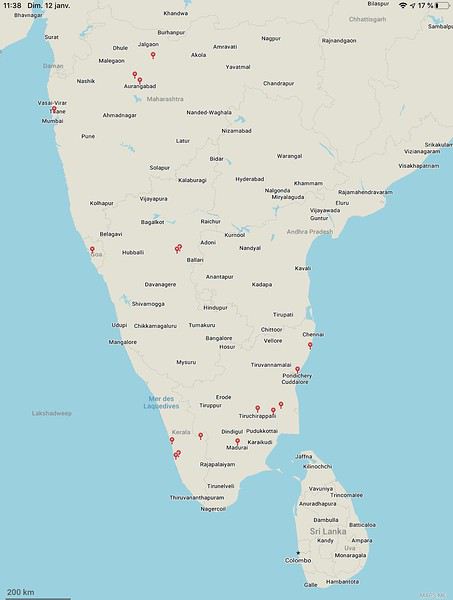
Moyens de transports : dans un premier temps j'avais pensé combiner bus de luxe, train et taxi. Compte tenu désormais de notre âge mon épouse a été catégorique : ce sera voiture avec chauffeur et si besoin avion (lignes intérieures). Effectivement les trajets en bus et en train relatés dans différents carnets de voyage le sont par des gens qui ont 15 à 20 ans de moins que nous. Et des bus et trains de toutes sortes nous les avons pratiqués un peu partout dans le monde ces dernières décennies - nous connaissons donc bien et ne le regrettons pas. Par ailleurs la formule voiture avec chauffeur est finalement assez courante en Inde et financièrement abordable.
Merci aux différents carnets de voyage de VoyageForum pour l'aide précieuse apportée, et particulièrement merci à Xiongmao, que je salue, qui nous a bien aidé à choisir notre principal prestataire. Le circuit fut donc choisi comme suit :
Arrivés à CHENNAI le 14 février 2020 (vol Air India avec escale à Delhi), Repartis de BOMBAY le 10 mars 2020 (vol Air India avec escale et contrôle immigration à Delhi), et arrivés ce même 10 mars chez nous à 21h00 . . . et confinés le 17 mars à 12h00
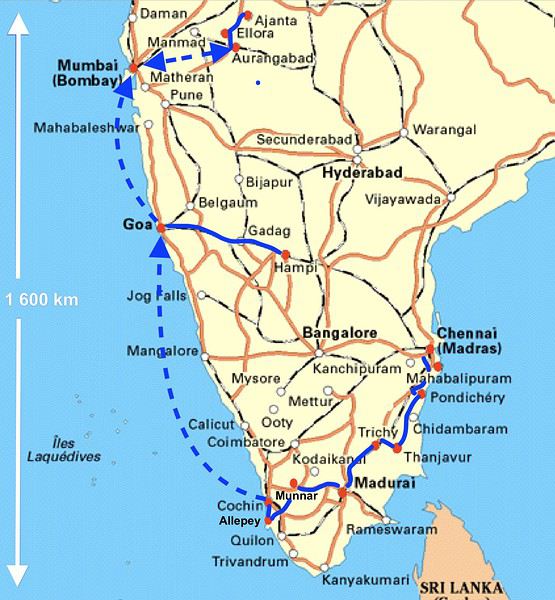
NOTA : 4 400 photos prises par ma femme et moi (un vrai délire !). On a beau se dire qu'il faut se limiter à l'essentiel, comme du temps où chaque photo était payante, il est tellement facile d'en faire avec les appareils numériques et les smartphones qui maintenant sont très corrects qu'on se laisse aller. Choix drastique, nous n'avons retenu que 250 photos pour ce carnet de voyage (et c'est déjà trop, je m'en excuse par avance).
Formalités : e-visas envoyés le 20 janvier et reçus "granted" le 21 ! Super rapide donc, mais par contre la rédaction extrêmement minutieuse du formulaire en ligne ainsi que la confection des pièces jointes selon les normes très strictes nécessite environ deux heures pour chaque demande.
Températures : pendant ces 3 ½ semaines la température moyenne en journée a été de 30°C, sauf à MUNNAR où elle est descendue vers 24°C et à HAMPI où elle était de 34°C.
Vendredi 14 février et samedi 15 Février 2020 Nous ne nous sommes pas arrêtés à CHENNAI. Nous avons immédiatement pris un taxi pour MAHABALIPURAM (nous avions demandé ce service à l'hôtel déjà réservé mais il aurait été possible facilement de prendre un "pré-paid taxi" juste à la sortie de l'aéroport). 15h15 : atterrissage à CHENNAI 16h20 : départ de notre taxi 18h00 : arrivée à l'hôtel à MAHABALIPURAM De 18h15 à 19h30 : change dans un bureau de change ( 100 € contre 7 750 INR soit 100 INR = 1,3 €) puis achat et mise en service d'une carte SIM indienne (valable dans toute l'Inde, pour appels en Inde pendant 28 jours avec 1,5 Go/jour de données internet, le tout pour 550 roupies, soit 7 € : autant dire rien pour un internet quasi illimité et une durée d'appels largement suffisante pour l'utilisation en local).
MAHABALIPURAM : Centre-ville sympa bien que très touristique. Tout peut se faire à pied (éventuellement retour en tuk-tuk de l'ensemble de temples des Cinq Rathas). Dès notre première visite au Shore Temple (Temple du rivage) nous découvrons la règle que nous verrons systématiquement par la suite : les indiens paient 15 fois moins cher que les étrangers :
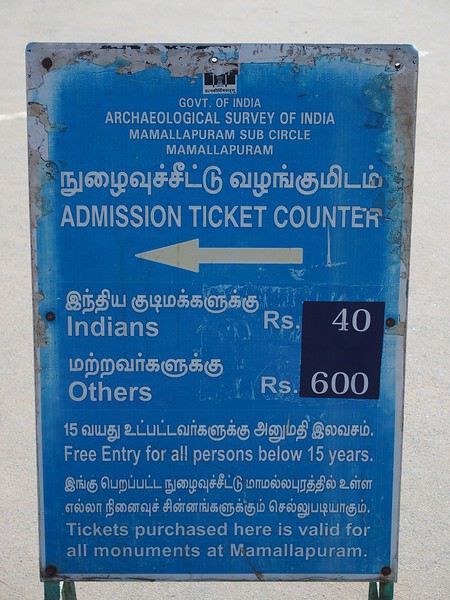
Vu notre niveau de vie comparé à celui moyen des indiens on ne va pas se plaindre. C'est juste qu'on n'est pas habitué à cette distinction (discrimination ?) en France. Le Shore Temple (temple du rivage) a un intérêt limité mais intéressant pour un premier contact avec cette culture et architecture :
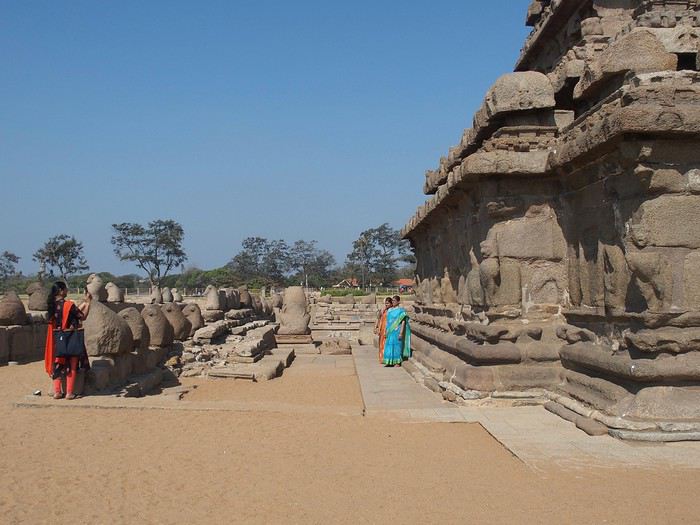
En revanche l'ensemble de temples des Cinq Rathas est vraiment intéressant. Beaucoup de touristes indiens d'ailleurs. Sur le chemin, beaucoup de magasins de sculpteurs sur pierre. C'est apparemment une activité importante de cette ville:
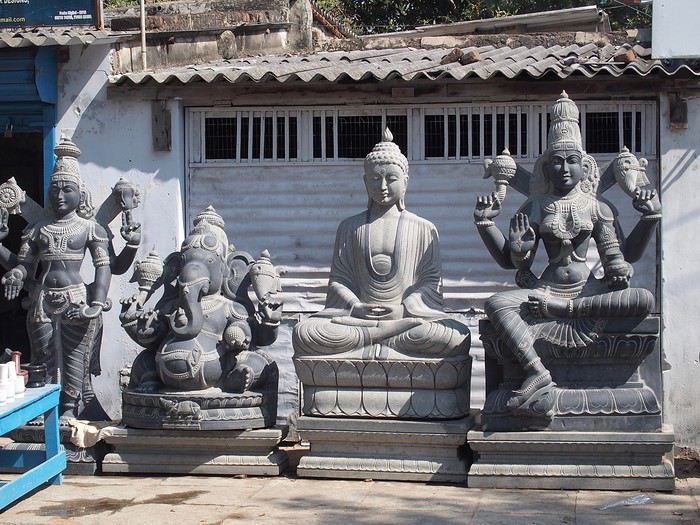
et activités touristique et scolaire importantes aussi :
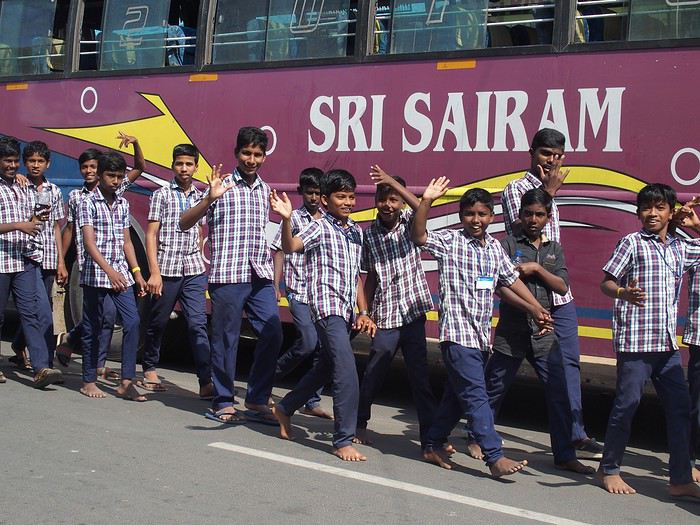
L'ensemble des temples des Cinq Rathas est assez compact mais riche en sculptures :
Nous étions en Inde du Sud en février-mars 2020 (25 jours sur place). Comme nous avons passé les 70 ans nous avons pensé que nous ne reviendrons plus en Inde (il y a encore tant d'autres pays encore à aller visiter et il nous reste finalement assez peu d'années pour cela). Du coup à l'Inde du Sud nous avons rajouté Hampi ainsi que les sites d'Ajanta et Ellora. Programme ambitieux !
Le plus difficile en Inde c'est de décider de ce que l'on ne pourra pas voir parmi les "incontournables" en tous genres qui sont annoncés dans tous les guides, forums et carnets de voyage divers. Que les adeptes des "hors des sentiers battus" se rassurent, s'ils veulent aller en Inde il n'y a que ça dans tout le pays aussi.
Donc après une première liste de ce qu'il fallait absolument ne pas rater, mon estimation de la durée du voyage s'est établie à 35 jours. Trop pour nous. Deuxième liste réduite avec beaucoup de difficulté : 25 jours sur place. OK ! Il n'y a plus qu'à organiser le circuit et vérifier sa faisabilité car l'Inde du Sud c'est très grand et les endroits que nous avons choisis sont répartis sur une vaste zone :
Moyens de transports : dans un premier temps j'avais pensé combiner bus de luxe, train et taxi. Compte tenu désormais de notre âge mon épouse a été catégorique : ce sera voiture avec chauffeur et si besoin avion (lignes intérieures). Effectivement les trajets en bus et en train relatés dans différents carnets de voyage le sont par des gens qui ont 15 à 20 ans de moins que nous. Et des bus et trains de toutes sortes nous les avons pratiqués un peu partout dans le monde ces dernières décennies - nous connaissons donc bien et ne le regrettons pas. Par ailleurs la formule voiture avec chauffeur est finalement assez courante en Inde et financièrement abordable.
Merci aux différents carnets de voyage de VoyageForum pour l'aide précieuse apportée, et particulièrement merci à Xiongmao, que je salue, qui nous a bien aidé à choisir notre principal prestataire. Le circuit fut donc choisi comme suit :
Arrivés à CHENNAI le 14 février 2020 (vol Air India avec escale à Delhi), Repartis de BOMBAY le 10 mars 2020 (vol Air India avec escale et contrôle immigration à Delhi), et arrivés ce même 10 mars chez nous à 21h00 . . . et confinés le 17 mars à 12h00
NOTA : 4 400 photos prises par ma femme et moi (un vrai délire !). On a beau se dire qu'il faut se limiter à l'essentiel, comme du temps où chaque photo était payante, il est tellement facile d'en faire avec les appareils numériques et les smartphones qui maintenant sont très corrects qu'on se laisse aller. Choix drastique, nous n'avons retenu que 250 photos pour ce carnet de voyage (et c'est déjà trop, je m'en excuse par avance).
Formalités : e-visas envoyés le 20 janvier et reçus "granted" le 21 ! Super rapide donc, mais par contre la rédaction extrêmement minutieuse du formulaire en ligne ainsi que la confection des pièces jointes selon les normes très strictes nécessite environ deux heures pour chaque demande.
Températures : pendant ces 3 ½ semaines la température moyenne en journée a été de 30°C, sauf à MUNNAR où elle est descendue vers 24°C et à HAMPI où elle était de 34°C.
Vendredi 14 février et samedi 15 Février 2020 Nous ne nous sommes pas arrêtés à CHENNAI. Nous avons immédiatement pris un taxi pour MAHABALIPURAM (nous avions demandé ce service à l'hôtel déjà réservé mais il aurait été possible facilement de prendre un "pré-paid taxi" juste à la sortie de l'aéroport). 15h15 : atterrissage à CHENNAI 16h20 : départ de notre taxi 18h00 : arrivée à l'hôtel à MAHABALIPURAM De 18h15 à 19h30 : change dans un bureau de change ( 100 € contre 7 750 INR soit 100 INR = 1,3 €) puis achat et mise en service d'une carte SIM indienne (valable dans toute l'Inde, pour appels en Inde pendant 28 jours avec 1,5 Go/jour de données internet, le tout pour 550 roupies, soit 7 € : autant dire rien pour un internet quasi illimité et une durée d'appels largement suffisante pour l'utilisation en local).
MAHABALIPURAM : Centre-ville sympa bien que très touristique. Tout peut se faire à pied (éventuellement retour en tuk-tuk de l'ensemble de temples des Cinq Rathas). Dès notre première visite au Shore Temple (Temple du rivage) nous découvrons la règle que nous verrons systématiquement par la suite : les indiens paient 15 fois moins cher que les étrangers :
Vu notre niveau de vie comparé à celui moyen des indiens on ne va pas se plaindre. C'est juste qu'on n'est pas habitué à cette distinction (discrimination ?) en France. Le Shore Temple (temple du rivage) a un intérêt limité mais intéressant pour un premier contact avec cette culture et architecture :
En revanche l'ensemble de temples des Cinq Rathas est vraiment intéressant. Beaucoup de touristes indiens d'ailleurs. Sur le chemin, beaucoup de magasins de sculpteurs sur pierre. C'est apparemment une activité importante de cette ville:
et activités touristique et scolaire importantes aussi :
L'ensemble des temples des Cinq Rathas est assez compact mais riche en sculptures :
Dix jours autour d'Erevan avec bébé English translation pending
Barev dzez !
Voici le compte-rendu d’un très beau séjour d’une dizaine de jours à Erevan. L’Arménie étant un pays aux dimensions assez restreintes il est possible de rayonner à la journée depuis Erevan pour voir les principaux sites touristiques du pays. C'est ce que nous avons fait avec note petit de 8 mois. Seul le sud et l’extrême Nord nécessitent de partir plusieurs jours loin de la capitale (ainsi que le Karabagh/Artsakh). Par exemple comptez 2h de route pour atteindre Areni à une centaine de kilomètres au sud d’Erevan. Le pays est montagneux et les routes sinueuses 😉
Nous avons donc loué un appartement pour 10 jours. C’est la solution qui nous a paru la plus pratique pour ne pas déménager touts les affaires avec bébé à chaque fois ( et aussi pour profiter à fond de la famille). En plus le centre d’Erevan est dense en sites d’intérêt et de nombreuses balades sont faisables à pied.
Je vais commencer par le bilan pratique, ensuite les lecteurs les plus assidus auront droit au dessert !
Hébergement Pour louer un appart voire une maison via Air**b, il n’y a que l’embarras du choix. Toute la gamme de prix est présente à Erevan. La principale question est le parking de l’éventuelle voiture de location. En plein centre, entre la Cascade et la place de la République ce n’est pas facile de se garer dans la rue. Dates Côté météo je dois dire que la fin septembre et le début octobre sont parfaits. Ni froid ni trop chaud, entre 22 et 28 degrés tous les jours et du soleil garanti. En fait on a eu un seul jour avec une météo vraiment moche, c’est quand on est allé au lac Sevan, pas de bol ! Vols Aller avec Air France, retour avec Aeroflot via Moscou. 550 euros par personne. Notre compagnie nationale profite de son monopole depuis la France vers l’Arménie. C’est clairement le point noir du budget. Heureusement en dessous de 2 ans bébé ne paye sa part qu’à hauteur de 10% et a droit à son propre bagage en soute et en cabine !
Transports Les taxis sont très bon marché et n’essayent pas de vous arnaquer… sauf à l’aéroport ou les prix s’envolent. Cela dit 10 euros pour un européen ça reste abordable. Une course du centre vers la banlieue coûte 2 ou 3 euros. La plupart des taxis rechignent à faire des petits trajets restants dans le centre. Attention si vous avez beaucoup de bagages ou une grande poussette pour bébé, la plupart des taxis ne peuvent rien mettre dans leur coffre car ils y ont installé un réservoir supplémentaire pour rouler au gaz ! Il vaut donc mieux commander par téléphone et demander un grand coffre si besoin. Cela n’est pas valable pour les taxis de l’aéroport heureusement 😉 La ville est très bien couverte par le réseau de bus mais ceux-ci peuvent être compliqués à prendre. Les bus de ville sont les moins chers et les horaires sont réguliers mais ils circulent dans le centre uniquement. Les mini-bus sont un peu plus chers, ils vont plus loin et vous laissent ou vous voulez sur le chemin pour connaitre la destination il faut demander au chauffeur qui souvent ne parle ni anglais ni français ! Pour sortir de Erevan je voulais louer une voiture mais sous la « pression » de la famille nous nous sommes retrouvés à chaque fois avec un chauffeur et un mini-van pour nous amener ou nous voulions. Souvent c’était un ami d’un ami d’un cousin 😉, parfois ils avaient réservé et payé taxi et guide. Il faut savoir qu’un arménien même modeste financièrement fera tout pour vous aider et rendre votre séjour mémorable.
Pour ceux qui voudraient louer une voiture les tarifs sont abordables sans être pour autant bon marché comparé au coût de la vie en Arménie. S’orienter est assez facile, le réseau de routes goudronnées (souvent en mauvais état) est assez restreint. La conduite est un peu sportive mais reste moins risquée que ce que j’ai vu dans d’autres pays d’Asie ou d’Afrique. Les panneaux de direction sont presque tous en alphabets arménien + latin. Très peu sont encore en cyrillique.
Accueil Faut-il le préciser, les visiteurs sont extrêmement bien reçus dans ce petit pays peu touristique. En dehors des arméniens de la diaspora qui viennent voir la famille et des touristes de l’ex bloc soviétique la destination reste confidentielle. Une culture authentique et un peuple chaleureux à découvrir ! Programme J’avais fait une liste de choses à voir et à faire plus qu’un programme. On s’est adapté à la disponibilité des gens (famille, amis) que l’on voulait voir à Erevan. Finalement le bilan est le suivant :
Erevan : 4 jours de visite + 1 jour consacré à une grande fête de famille Khor Virap + Areni + Noravank : 1 journée Garni + Gherard : 1 journée Etchmiadzine + Zvartnots : ½ journée Lac Sevan : 1 journée Mont Aragats : 1 après-midi
J’aurais voulu aller jusqu’à Dilidjan ou Gyumri mais ça ne s’est pas fait. Ce sera pour la prochaine fois ! 😉
Budget Au moment du voyage la conversion euro-dram était de 1 EUR=500 AMD Quelques prix moyens à Erevan : 1 ticket de bus = 100 AMD 1 taxi du centre à Erebouni = 2000 AMD 1 taxi de l’aéroport au centre = 5000 AMD 1 shawarma (càd de la viande et de la garniture dans un pain) = 1500 AMD 1 bouteille d’eau d’1L = 300 AMD 1 bière dans un bar branché = 3000 AMD
Voici le compte-rendu d’un très beau séjour d’une dizaine de jours à Erevan. L’Arménie étant un pays aux dimensions assez restreintes il est possible de rayonner à la journée depuis Erevan pour voir les principaux sites touristiques du pays. C'est ce que nous avons fait avec note petit de 8 mois. Seul le sud et l’extrême Nord nécessitent de partir plusieurs jours loin de la capitale (ainsi que le Karabagh/Artsakh). Par exemple comptez 2h de route pour atteindre Areni à une centaine de kilomètres au sud d’Erevan. Le pays est montagneux et les routes sinueuses 😉
Nous avons donc loué un appartement pour 10 jours. C’est la solution qui nous a paru la plus pratique pour ne pas déménager touts les affaires avec bébé à chaque fois ( et aussi pour profiter à fond de la famille). En plus le centre d’Erevan est dense en sites d’intérêt et de nombreuses balades sont faisables à pied.
Je vais commencer par le bilan pratique, ensuite les lecteurs les plus assidus auront droit au dessert !
Hébergement Pour louer un appart voire une maison via Air**b, il n’y a que l’embarras du choix. Toute la gamme de prix est présente à Erevan. La principale question est le parking de l’éventuelle voiture de location. En plein centre, entre la Cascade et la place de la République ce n’est pas facile de se garer dans la rue. Dates Côté météo je dois dire que la fin septembre et le début octobre sont parfaits. Ni froid ni trop chaud, entre 22 et 28 degrés tous les jours et du soleil garanti. En fait on a eu un seul jour avec une météo vraiment moche, c’est quand on est allé au lac Sevan, pas de bol ! Vols Aller avec Air France, retour avec Aeroflot via Moscou. 550 euros par personne. Notre compagnie nationale profite de son monopole depuis la France vers l’Arménie. C’est clairement le point noir du budget. Heureusement en dessous de 2 ans bébé ne paye sa part qu’à hauteur de 10% et a droit à son propre bagage en soute et en cabine !
Transports Les taxis sont très bon marché et n’essayent pas de vous arnaquer… sauf à l’aéroport ou les prix s’envolent. Cela dit 10 euros pour un européen ça reste abordable. Une course du centre vers la banlieue coûte 2 ou 3 euros. La plupart des taxis rechignent à faire des petits trajets restants dans le centre. Attention si vous avez beaucoup de bagages ou une grande poussette pour bébé, la plupart des taxis ne peuvent rien mettre dans leur coffre car ils y ont installé un réservoir supplémentaire pour rouler au gaz ! Il vaut donc mieux commander par téléphone et demander un grand coffre si besoin. Cela n’est pas valable pour les taxis de l’aéroport heureusement 😉 La ville est très bien couverte par le réseau de bus mais ceux-ci peuvent être compliqués à prendre. Les bus de ville sont les moins chers et les horaires sont réguliers mais ils circulent dans le centre uniquement. Les mini-bus sont un peu plus chers, ils vont plus loin et vous laissent ou vous voulez sur le chemin pour connaitre la destination il faut demander au chauffeur qui souvent ne parle ni anglais ni français ! Pour sortir de Erevan je voulais louer une voiture mais sous la « pression » de la famille nous nous sommes retrouvés à chaque fois avec un chauffeur et un mini-van pour nous amener ou nous voulions. Souvent c’était un ami d’un ami d’un cousin 😉, parfois ils avaient réservé et payé taxi et guide. Il faut savoir qu’un arménien même modeste financièrement fera tout pour vous aider et rendre votre séjour mémorable.
Pour ceux qui voudraient louer une voiture les tarifs sont abordables sans être pour autant bon marché comparé au coût de la vie en Arménie. S’orienter est assez facile, le réseau de routes goudronnées (souvent en mauvais état) est assez restreint. La conduite est un peu sportive mais reste moins risquée que ce que j’ai vu dans d’autres pays d’Asie ou d’Afrique. Les panneaux de direction sont presque tous en alphabets arménien + latin. Très peu sont encore en cyrillique.
Accueil Faut-il le préciser, les visiteurs sont extrêmement bien reçus dans ce petit pays peu touristique. En dehors des arméniens de la diaspora qui viennent voir la famille et des touristes de l’ex bloc soviétique la destination reste confidentielle. Une culture authentique et un peuple chaleureux à découvrir ! Programme J’avais fait une liste de choses à voir et à faire plus qu’un programme. On s’est adapté à la disponibilité des gens (famille, amis) que l’on voulait voir à Erevan. Finalement le bilan est le suivant :
Erevan : 4 jours de visite + 1 jour consacré à une grande fête de famille Khor Virap + Areni + Noravank : 1 journée Garni + Gherard : 1 journée Etchmiadzine + Zvartnots : ½ journée Lac Sevan : 1 journée Mont Aragats : 1 après-midi
J’aurais voulu aller jusqu’à Dilidjan ou Gyumri mais ça ne s’est pas fait. Ce sera pour la prochaine fois ! 😉
Budget Au moment du voyage la conversion euro-dram était de 1 EUR=500 AMD Quelques prix moyens à Erevan : 1 ticket de bus = 100 AMD 1 taxi du centre à Erebouni = 2000 AMD 1 taxi de l’aéroport au centre = 5000 AMD 1 shawarma (càd de la viande et de la garniture dans un pain) = 1500 AMD 1 bouteille d’eau d’1L = 300 AMD 1 bière dans un bar branché = 3000 AMD
Un voyage... une étape inattendue! English translation pending
Bonjour à tous,
Le voyage - pour ne pas trop sortir de VF - c'est bien sur la vie. L'étape inattendue, elle nous vient de l'orient et sans doute d' un Pangolin.
J'ai 72 ans, un peu d’hypertension, pas grand chose d'autre, alors, au delà du 11 mai je suis bon !
Bon pour continuer à voir mes petits enfants sur Skype, bon pour voir mes enfants masqués qui viennent nous voir de temps à autres à distance respectable, bon pour oublier les embrassades, les câlins, les gestes de tendresse, bon pour....un temps indéterminé à subir ces frustrations que portant je respecterait. Peu en parlent dans les médias, mais c'est une contrainte autre que de simplement porter un masque !!
Merci de m'avoir lu et belle journée confinée
Le voyage - pour ne pas trop sortir de VF - c'est bien sur la vie. L'étape inattendue, elle nous vient de l'orient et sans doute d' un Pangolin.
J'ai 72 ans, un peu d’hypertension, pas grand chose d'autre, alors, au delà du 11 mai je suis bon !
Bon pour continuer à voir mes petits enfants sur Skype, bon pour voir mes enfants masqués qui viennent nous voir de temps à autres à distance respectable, bon pour oublier les embrassades, les câlins, les gestes de tendresse, bon pour....un temps indéterminé à subir ces frustrations que portant je respecterait. Peu en parlent dans les médias, mais c'est une contrainte autre que de simplement porter un masque !!
Merci de m'avoir lu et belle journée confinée
Compatibilité roues vélo et jantes English translation pending
Bonjour à tous
Je me présente yands, j'habite dans les Pyrénées.
Je prévoie mon 1er voyage à vélo pour cet été: Traverser la France de Nord en Sud Départ Dunkerque et retour chez moi Pyrénées centrale.
Pour faire cela, ayant un seul vélo vtt Orbéa tout suspendu, je prévoie une remorque monoroue avec.
Il faut que je mette des pneus plus fin .
J'ai des roues en 26 avec freins à disque Mes jantes sont 559 / 19C (j'y comprend rien)
Est il possible de mettre des pneus à section plus fine sans changer mes jantes vtt ?
Sinon j'hésite à prendre des jantes en 26 pour disque (je sais pas si ça existe...) avec une dynamo moyeu pour produire de l'éléctricité.
Est ce vraiment fiable pour recharger téléphone et gps ? Comme E werk en sachant que je n'ai pas d'éclairage fixe sur mon vélo, est obligatoire pour être compatible ? Sinon je prends des batteries externes (mais il faudra les recharger également) Si vous avez des retours ...
Je vous remercie par avance.
Amitiés sportives
Je me présente yands, j'habite dans les Pyrénées.
Je prévoie mon 1er voyage à vélo pour cet été: Traverser la France de Nord en Sud Départ Dunkerque et retour chez moi Pyrénées centrale.
Pour faire cela, ayant un seul vélo vtt Orbéa tout suspendu, je prévoie une remorque monoroue avec.
Il faut que je mette des pneus plus fin .
J'ai des roues en 26 avec freins à disque Mes jantes sont 559 / 19C (j'y comprend rien)
Est il possible de mettre des pneus à section plus fine sans changer mes jantes vtt ?
Sinon j'hésite à prendre des jantes en 26 pour disque (je sais pas si ça existe...) avec une dynamo moyeu pour produire de l'éléctricité.
Est ce vraiment fiable pour recharger téléphone et gps ? Comme E werk en sachant que je n'ai pas d'éclairage fixe sur mon vélo, est obligatoire pour être compatible ? Sinon je prends des batteries externes (mais il faudra les recharger également) Si vous avez des retours ...
Je vous remercie par avance.
Amitiés sportives
Ladakh, deux sexagénaires à l'assaut d'un 6000. Récit d'un voyage en totale autonomie. English translation pending
L'ascension d'un 6000 m, et le plus haut col du monde à VTT ! Ce genre de défi, c'est plutôt réservé aux jeunes, mais nous, retraités sexagénaires plutôt physiquement en forme, nous nous sentons la capacité de le faire, sans passer par une agence de voyage, uniquement par nos propres moyens. Christian est plutôt vélo, moi plutôt montagne, mais comme nous sommes polyvalents et bien entraînés pour ces deux activités, c'est décidé, on y va !
Eté 2016 Après recherches, ce sera le Stok Kangri, 6154m, pour la montagne, et le Kardhung La, 5600m, pour le VTT, revendiqué comme le plus haut col carrossable du monde. Ces deux objectifs ont l'avantage d'être facilement accessibles depuis Leh, la capitale du Ladakh. Et puis il y a aussi la célèbre route impossible Manali - Leh et ses cols mythiques, dont le fameux Keylong pass, les paysages du Ladakh, sa population, ses temples et mosquées, et bien sûr la situation politique de la région, souvent tendue et bouillonnante. Serons-nous à la hauteur de notre projet ?
MENU
1- Bordeaux - Delhi - Manali: rapide prise de contact 2- Manali - Old Manali : bus de nuit et courte rando 3- Manali - Ghosol - Vashit : la vie de village 4- Manali - Jispa : la route de l'impossible, 1° jour 5- Jispa – Leh : la route de l'impossible, 2° jour. Mes amis anglais 6- Leh : cartes postales 7- Leh - Lamayuru : en route pour un premier trek d'acclimatation 8- Lamayuru – Wanla : 1° jour. Le trek pour nous seuls 9- Wanla - Phonjila - Hinju : 2° jour. Dur dur quand on est malade 10- Hinju - Sumda : 3° jour. Le point haut 12- Sumda - Ezas - Leh : 4° jour. La bonne affaire 13- Leh, vallée de l'Indus : road trip en Royal Enfield 14- Camp 2 du Stok Kangri : 1° jour, une promenade de santé 15- Camp 2 - sommet - camp 1 : 2° jour. Un 6000, c'est pas les Pyrénées ! 16- Camp 1 - Leh : 3° jour 17- Leh : et maintenant, le VTT 18- Kardhung La à VTT : une demi réussite 19 - Leh, vallée de l'Indus : carte postale en Royal Enfield 20- Leh - Delhi - Agra : en serrant les fesses 21- Agra : carte postale 22- Fatephur Sikri : carte postale 22- Agra – Delhi : Laurel et Hardi sur le quai
Eté 2016 Après recherches, ce sera le Stok Kangri, 6154m, pour la montagne, et le Kardhung La, 5600m, pour le VTT, revendiqué comme le plus haut col carrossable du monde. Ces deux objectifs ont l'avantage d'être facilement accessibles depuis Leh, la capitale du Ladakh. Et puis il y a aussi la célèbre route impossible Manali - Leh et ses cols mythiques, dont le fameux Keylong pass, les paysages du Ladakh, sa population, ses temples et mosquées, et bien sûr la situation politique de la région, souvent tendue et bouillonnante. Serons-nous à la hauteur de notre projet ?
MENU
1- Bordeaux - Delhi - Manali: rapide prise de contact 2- Manali - Old Manali : bus de nuit et courte rando 3- Manali - Ghosol - Vashit : la vie de village 4- Manali - Jispa : la route de l'impossible, 1° jour 5- Jispa – Leh : la route de l'impossible, 2° jour. Mes amis anglais 6- Leh : cartes postales 7- Leh - Lamayuru : en route pour un premier trek d'acclimatation 8- Lamayuru – Wanla : 1° jour. Le trek pour nous seuls 9- Wanla - Phonjila - Hinju : 2° jour. Dur dur quand on est malade 10- Hinju - Sumda : 3° jour. Le point haut 12- Sumda - Ezas - Leh : 4° jour. La bonne affaire 13- Leh, vallée de l'Indus : road trip en Royal Enfield 14- Camp 2 du Stok Kangri : 1° jour, une promenade de santé 15- Camp 2 - sommet - camp 1 : 2° jour. Un 6000, c'est pas les Pyrénées ! 16- Camp 1 - Leh : 3° jour 17- Leh : et maintenant, le VTT 18- Kardhung La à VTT : une demi réussite 19 - Leh, vallée de l'Indus : carte postale en Royal Enfield 20- Leh - Delhi - Agra : en serrant les fesses 21- Agra : carte postale 22- Fatephur Sikri : carte postale 22- Agra – Delhi : Laurel et Hardi sur le quai
Afrique du Sud 2019: retour en terres africaines et premier road-trip en famille English translation pending
Heureux de retrouver le forum d’Afrique australe pour me replonger dans notre voyage de l’été dernier et le partager avec vous.
Bien que ce fut déjà mon 4ème voyage en Afrique du Sud celui-ci eut, dès la préparation, une saveur toute particulière puisque ça allait être notre premier voyage en famille depuis une éternité, et cette fois-ci les rôles étaient inversés puisque c’est moi qui allais faire découvrir à mes parents ma destination de cœur, l’Afrique. 🙂
La concordance des temps dans cette dernière phrase m’a achevé… Ce carnet s’annonce compliqué. 😄
C’est un voyage que nous avons donc réalisé à 5, mes parents, mes 2 jeunes frères et moi-même. Ma sœur n’ayant pas pu se joindre à nous et Alison, ma copine, ayant gardé ses congés pour notre voyage de Septembre en Tanzanie.
C’est un rêve qui, enfin, se réalisait puisque cela faisait plusieurs années que j’essayais d’organiser quelque chose en famille et c’est en rentrant d’Alaksa en Aout 2018 que mes parents se sont motivés pour visiter l’Afrique du Sud. J’ai donc eu quasiment 1an pour préparer ce magnifique voyage en parallèle de celui en Tanzanie avec Alison.
Le circuit se voulait tant classique que magnifique. 24 jours à travers l’Afrique du Sud, à mes yeux le plus beau pays du monde, de Joburg à Capetown.
J0 (06/07/19) : Paris -> Madrid -> Johannesburg J1 (07/07/19) : OR Tambo Int Airport -> Forever Blyde Canyon J2 (08/07/19) : Blyde River Canyon J3 (09/07/19) : Forever Blyde Canyon –> Kruger National Park J4 (10/07/19) : Kruger National Park J5 (11/07/19) : Kruger National Park J6 (12/07/19) : Kruger National Park J7 (13/07/19) : Kruger National Park J8 (14/07/19) : Kruger National Park -> Santa Lucia J9 (15/07/19) : Isimangaliso wetland Park J10 (16/07/19) : Hluhluwe-iMfolozi J11 (17/07/19) : Hluhluwe-iMfolozi J12 (18/07/19) : Hluhluwe-iMfolozi -> Golden Gate NP J13 (19/07/19) : Golden Gate NP J14 (20/07/19) : Golden Gate NP -> Mountain Zebra NP J15 (21/07/19) : Mountain Zebra NP J16 (22/07/19) : Mountain Zebra NP J17 (23/07/19) : Mountain Zebra NP ->Cambedoo NP J18 (24/07/19) : Cambedoo NP -> Addo Elephant NP J19 (25/07/19) : Addo Elephant NP -> De Hoop NR J20 (26/07/19) : De Hoop NR J21 (27/07/19) : De Hoop NR - Capetown J22 (28/07/19) : Capetown J23 (29/07/19) : Capetown J24 (30/07/19) : Capetown - Johannesburg J25 (31/07/19) : Soweto – Départ
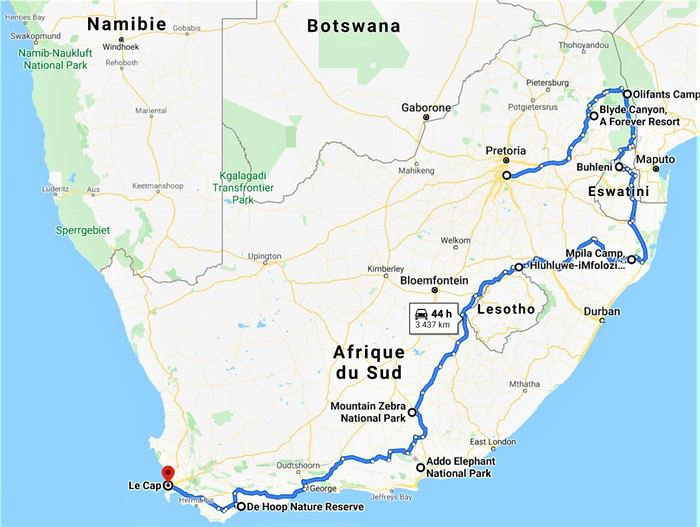
Étant 5 grands gabarits la question du véhicule était délicate puisque c’est dans ce véhicule que nous allions passer le plus de temps, en safari ou sur la route. Nous avons finalement opté pour la location d’un Hyundai H1 chez Budget, option la plus économique et la plus confortable avec 7 places et une plus haute garde au sol pour mieux voir les animaux et le paysage.
Après 11 mois d’attente, début des vacances scolaires et départ de Guadeloupe le vendredi 5 Juillet, pour mes parents et mes frères que je rejoindrai sur Paris le lendemain avant de décoller pour Madrid puis Joburg, tous ensemble, le samedi 6 au soir.
See you in the bush ! (Bilan conseils et budget en fin de carnet.)
Bien que ce fut déjà mon 4ème voyage en Afrique du Sud celui-ci eut, dès la préparation, une saveur toute particulière puisque ça allait être notre premier voyage en famille depuis une éternité, et cette fois-ci les rôles étaient inversés puisque c’est moi qui allais faire découvrir à mes parents ma destination de cœur, l’Afrique. 🙂
La concordance des temps dans cette dernière phrase m’a achevé… Ce carnet s’annonce compliqué. 😄
C’est un voyage que nous avons donc réalisé à 5, mes parents, mes 2 jeunes frères et moi-même. Ma sœur n’ayant pas pu se joindre à nous et Alison, ma copine, ayant gardé ses congés pour notre voyage de Septembre en Tanzanie.
C’est un rêve qui, enfin, se réalisait puisque cela faisait plusieurs années que j’essayais d’organiser quelque chose en famille et c’est en rentrant d’Alaksa en Aout 2018 que mes parents se sont motivés pour visiter l’Afrique du Sud. J’ai donc eu quasiment 1an pour préparer ce magnifique voyage en parallèle de celui en Tanzanie avec Alison.
Le circuit se voulait tant classique que magnifique. 24 jours à travers l’Afrique du Sud, à mes yeux le plus beau pays du monde, de Joburg à Capetown.
J0 (06/07/19) : Paris -> Madrid -> Johannesburg J1 (07/07/19) : OR Tambo Int Airport -> Forever Blyde Canyon J2 (08/07/19) : Blyde River Canyon J3 (09/07/19) : Forever Blyde Canyon –> Kruger National Park J4 (10/07/19) : Kruger National Park J5 (11/07/19) : Kruger National Park J6 (12/07/19) : Kruger National Park J7 (13/07/19) : Kruger National Park J8 (14/07/19) : Kruger National Park -> Santa Lucia J9 (15/07/19) : Isimangaliso wetland Park J10 (16/07/19) : Hluhluwe-iMfolozi J11 (17/07/19) : Hluhluwe-iMfolozi J12 (18/07/19) : Hluhluwe-iMfolozi -> Golden Gate NP J13 (19/07/19) : Golden Gate NP J14 (20/07/19) : Golden Gate NP -> Mountain Zebra NP J15 (21/07/19) : Mountain Zebra NP J16 (22/07/19) : Mountain Zebra NP J17 (23/07/19) : Mountain Zebra NP ->Cambedoo NP J18 (24/07/19) : Cambedoo NP -> Addo Elephant NP J19 (25/07/19) : Addo Elephant NP -> De Hoop NR J20 (26/07/19) : De Hoop NR J21 (27/07/19) : De Hoop NR - Capetown J22 (28/07/19) : Capetown J23 (29/07/19) : Capetown J24 (30/07/19) : Capetown - Johannesburg J25 (31/07/19) : Soweto – Départ
Étant 5 grands gabarits la question du véhicule était délicate puisque c’est dans ce véhicule que nous allions passer le plus de temps, en safari ou sur la route. Nous avons finalement opté pour la location d’un Hyundai H1 chez Budget, option la plus économique et la plus confortable avec 7 places et une plus haute garde au sol pour mieux voir les animaux et le paysage.
Après 11 mois d’attente, début des vacances scolaires et départ de Guadeloupe le vendredi 5 Juillet, pour mes parents et mes frères que je rejoindrai sur Paris le lendemain avant de décoller pour Madrid puis Joburg, tous ensemble, le samedi 6 au soir.
See you in the bush ! (Bilan conseils et budget en fin de carnet.)
Conseil cadre vélo / configuration English translation pending
Bonjour à tous,
Je suis en train de configurer un vélo qui me suivra de nombreuses années je l'espère. Je me base notamment sur le site suivant pour mes réflexions sur les dimensions du cadre : Braquet de la liberté : https://www.lebraquetdelaliberte.com/taille-position-velo
Usage : Voyage sur route, sentier (terre, cailloux) sans esprit de performance. Je cherche un vélo qui me permet d'aller partout à mon rythme sans risque de glisser à la première pluie et qui me permet de filer droit sur des routes bitumées. Je roule sur des périodes max de 2 mois (quand j'en ai l'occasion ;) )
Je lis beaucoup d'articles sur les GravelBike. J'apprécie le look sportif et la possibilité de voyager léger mais je ne sais pas si ce type de vélo conviendrait à mon usage.
Je pensais partir sur un cadre Surly LHT sur les conseils d'un ami, mais je suis ouvert à toute proposition. Le site Veloacier documente les dimensions des cadres Surly : http://www.veloacier.com/surly-long-haul-trucker-velo-de-touring-camping/
Voici mes "dimensions" :) Taille : 185cm Entrejambe : 86cm Cuisse : 61cm
D'après mon entrejambe, je devrais partir sur un 56 mais comme j'ai le buste plus grand, je me tâte à partir sur un 58. J'ai eu l'occasion de tester plusieurs vélos à droite à gauche et le confort est vraiment important pour moi (éviter d'être vouté, etc.) :)
Quel conseils avez-vous pour une première acquisition (budget entre 1000 et 1500€) sachant que je suis déjà équipé de sacoches ?
Merci d'avance pour vos retours, Bonne journée, Alexis
Je suis en train de configurer un vélo qui me suivra de nombreuses années je l'espère. Je me base notamment sur le site suivant pour mes réflexions sur les dimensions du cadre : Braquet de la liberté : https://www.lebraquetdelaliberte.com/taille-position-velo
Usage : Voyage sur route, sentier (terre, cailloux) sans esprit de performance. Je cherche un vélo qui me permet d'aller partout à mon rythme sans risque de glisser à la première pluie et qui me permet de filer droit sur des routes bitumées. Je roule sur des périodes max de 2 mois (quand j'en ai l'occasion ;) )
Je lis beaucoup d'articles sur les GravelBike. J'apprécie le look sportif et la possibilité de voyager léger mais je ne sais pas si ce type de vélo conviendrait à mon usage.
Je pensais partir sur un cadre Surly LHT sur les conseils d'un ami, mais je suis ouvert à toute proposition. Le site Veloacier documente les dimensions des cadres Surly : http://www.veloacier.com/surly-long-haul-trucker-velo-de-touring-camping/
Voici mes "dimensions" :) Taille : 185cm Entrejambe : 86cm Cuisse : 61cm
D'après mon entrejambe, je devrais partir sur un 56 mais comme j'ai le buste plus grand, je me tâte à partir sur un 58. J'ai eu l'occasion de tester plusieurs vélos à droite à gauche et le confort est vraiment important pour moi (éviter d'être vouté, etc.) :)
Quel conseils avez-vous pour une première acquisition (budget entre 1000 et 1500€) sachant que je suis déjà équipé de sacoches ?
Merci d'avance pour vos retours, Bonne journée, Alexis
L'Andalousie à vélo, le top c'est au printemps English translation pending
Printemps 2019 : De Séville à Séville par les villes et villages blancs, une Andalousie encore verte et vide de touristes. Séville, Cordoue, Gibraltar, Maroc (Tétouan, Tanger), Cadix, plus de 1500 km sur les pistes blanches de la vallée du Guadalquivir et les belles routes bosselées de montagne. Chroniques d'un sexagénaire en totale liberté.
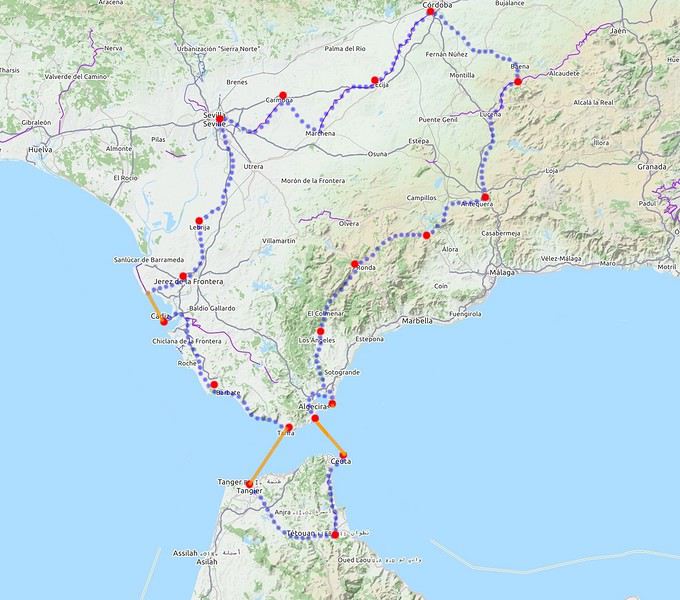
Dix jours en Croatie en août avec des enfants: des avis sur des baignades incontournables? English translation pending
Bonjour à tous,
ca y est c'est décidé, après avoir lu beaucoup de carnets de voyages, nous irons en Croatie cette année avec nos deux loulous de 10 ans ! 😎
C'est une destination particulière pour nous car nous avions parcouru les côtes croates en 2002, avec 14 copains sur deux voiliers monocoques et nous en gardons un souvenir exceptionnel : les kornati bien sûr mais aussi Vis et Korcula.
Bon nos copains skipper sont loin, peu importe : ca va être l'occasion de découvrir d'autres parties du pays et faire découvrir ce pays aux enfants (bon on a bien compris que notre petit coin de paradis a gagné en popularité depuis 17 ans et qu'on se sentira moins seuls 😛
Bon je m'égare. Nous allons donc partir avec notre voiture depuis le Var (où habitent mes parents), faire une pause en Italie sur le trajet et donc passer environ 10 jours en croatie.
Nos envies :
les enfants sont fans d'eau douce ou salée (ils tiennent de leur papa) et on rêve donc de petites criques à l'eau transparente ou de rivières bondissantes. J'ai lu qu'il y a des pontons partout, c'est top car les enfants passent leur temps à sauter dans l'eau quand ils en ont l'occasion (on revient du Yucatan et ils n'ont pas arrêté dans les cénotes, mais c'est une autre histoire) ; peu de villes ou monuments, c'est pas notre activité préférée. En particulier on ne retournera pas à Split et Dubrovnik qu'on a parcouru il y a 15 ans, une île bien sûr, mais laquelle ? en faire le tour et accéder à des petites criques pour sauter de rocher, voire même louer un petit bateau à moteur (si j'arrive à convaincre mon épouse) pour explorer en solitaire. Sinon pourquoi pas une petite expédition.
Notre projet de trajet :
comme on n'ira pas à Split et Dubrovnik on se dit qu'on a le temps de faire une pause en Istrie, un arrêt autour de Zadar (pour Krka notamment) et de se pauser un peu sur une île.
Voila l'Etat de nos réflexions (quelques questions à la fin si l'un de vous peut nous donner son avis) :
lundi 27 juillet- trajet Vidauban / Vérone (ou alentours) : 6H30. 1 nuit à Vérone
mardi 28 juillet - trajet Vérone / Plitvice 5H45. 1 nuit à Plitivitce
mercredi 29 juillet : visite plitivice puis trajet Sibenik (2H00)
3 nuits à Sibenik (alternative Zadar)
jeudi 30 juillet : visite et baignade à Krka en journée et le soir visite Sibenik (ou passage par Trodir)
vendredi 31 juillet : kayak ou baignade sur Zrmanja est d’Obrovac, 1H15 depuis Sibenik, 50 minutes depuis Zadar). Eventuel coucher de soleil, place des orgues marines à Zadar
samedi 1er août : balade / rando au parc Paklenica (1H00 de route) puis plage à Zadar - alternative journée à Trodir. Puis après midi : ferry pour Kornati (Dugi Otok ?)
3 nuits à Dugi Otok (alternative Vis)
dimanche 2 août : location bateau à moteur pour cabotage ou excursion
lundi 3 août : farniente, plage et découverte de l’ile
mardi 4 août - ferry pour Zadar puis trajet Pula / Rovinj 4H15 - visites des souterrains à Pula / ou fjord de Lim -
2 nuits à Pula - alternative Rivinj
mercredi 29 : journée mer à Cap Kamenjak + petites criques, visite Pula le soir (amphithéâtre) / alternative parc Zuma Zlatli ou ile katarina au large de Rivinj
jeudi 30 : journée parc aquatique istraldia ou seconde journée détente autour de Pula / Rivinj - puis trajet Sezana (1H40 depuis Pula ou 50 minutes depuis Istraldia) -
1 nuit Sezana Vendredi 31 : trajet Sezana - Vidauban 8H45
Voici les quelques question que je me pose :
Quelle île choisir sur les kornati pour passer 3 nuits et 2 jours pleins ? notre envie : de petites criques et pouvoir faire une excursion ou une sortie bateau moteur en indépendant. L’ile de Vis est elle préférable pour ce type d'envie ? (les nuités ont cependant l'ai d'être plus chères ?)
Vaut il mieux dormir sur Sibenik ou Zadar (ou autre) pour rayonner sur krka et la rivière zrmanja qui sont nos deux incontournables côté expérience rivière ?
aller marcher dans le parc Paklenica va t il intéresser des garçons de 10 ans et pas être trop physique (existe il des baignades ?) ?
Voyez vous d’autres lieux incontournables pour nous sur le trajet (points d’eau ou nature) ?
Merci infiniment pour tout ceux qui auront pris le temps de lire ce trop long pavé. Et encore plus pour vos retours ; ca me permettra de venir présenter à mon épouse un parcours au top, super alléchant 😊.
Laurent
ca y est c'est décidé, après avoir lu beaucoup de carnets de voyages, nous irons en Croatie cette année avec nos deux loulous de 10 ans ! 😎
C'est une destination particulière pour nous car nous avions parcouru les côtes croates en 2002, avec 14 copains sur deux voiliers monocoques et nous en gardons un souvenir exceptionnel : les kornati bien sûr mais aussi Vis et Korcula.
Bon nos copains skipper sont loin, peu importe : ca va être l'occasion de découvrir d'autres parties du pays et faire découvrir ce pays aux enfants (bon on a bien compris que notre petit coin de paradis a gagné en popularité depuis 17 ans et qu'on se sentira moins seuls 😛
Bon je m'égare. Nous allons donc partir avec notre voiture depuis le Var (où habitent mes parents), faire une pause en Italie sur le trajet et donc passer environ 10 jours en croatie.
Nos envies :
les enfants sont fans d'eau douce ou salée (ils tiennent de leur papa) et on rêve donc de petites criques à l'eau transparente ou de rivières bondissantes. J'ai lu qu'il y a des pontons partout, c'est top car les enfants passent leur temps à sauter dans l'eau quand ils en ont l'occasion (on revient du Yucatan et ils n'ont pas arrêté dans les cénotes, mais c'est une autre histoire) ; peu de villes ou monuments, c'est pas notre activité préférée. En particulier on ne retournera pas à Split et Dubrovnik qu'on a parcouru il y a 15 ans, une île bien sûr, mais laquelle ? en faire le tour et accéder à des petites criques pour sauter de rocher, voire même louer un petit bateau à moteur (si j'arrive à convaincre mon épouse) pour explorer en solitaire. Sinon pourquoi pas une petite expédition.
Notre projet de trajet :
comme on n'ira pas à Split et Dubrovnik on se dit qu'on a le temps de faire une pause en Istrie, un arrêt autour de Zadar (pour Krka notamment) et de se pauser un peu sur une île.
Voila l'Etat de nos réflexions (quelques questions à la fin si l'un de vous peut nous donner son avis) :
lundi 27 juillet- trajet Vidauban / Vérone (ou alentours) : 6H30. 1 nuit à Vérone
mardi 28 juillet - trajet Vérone / Plitvice 5H45. 1 nuit à Plitivitce
mercredi 29 juillet : visite plitivice puis trajet Sibenik (2H00)
3 nuits à Sibenik (alternative Zadar)
jeudi 30 juillet : visite et baignade à Krka en journée et le soir visite Sibenik (ou passage par Trodir)
vendredi 31 juillet : kayak ou baignade sur Zrmanja est d’Obrovac, 1H15 depuis Sibenik, 50 minutes depuis Zadar). Eventuel coucher de soleil, place des orgues marines à Zadar
samedi 1er août : balade / rando au parc Paklenica (1H00 de route) puis plage à Zadar - alternative journée à Trodir. Puis après midi : ferry pour Kornati (Dugi Otok ?)
3 nuits à Dugi Otok (alternative Vis)
dimanche 2 août : location bateau à moteur pour cabotage ou excursion
lundi 3 août : farniente, plage et découverte de l’ile
mardi 4 août - ferry pour Zadar puis trajet Pula / Rovinj 4H15 - visites des souterrains à Pula / ou fjord de Lim -
2 nuits à Pula - alternative Rivinj
mercredi 29 : journée mer à Cap Kamenjak + petites criques, visite Pula le soir (amphithéâtre) / alternative parc Zuma Zlatli ou ile katarina au large de Rivinj
jeudi 30 : journée parc aquatique istraldia ou seconde journée détente autour de Pula / Rivinj - puis trajet Sezana (1H40 depuis Pula ou 50 minutes depuis Istraldia) -
1 nuit Sezana Vendredi 31 : trajet Sezana - Vidauban 8H45
Voici les quelques question que je me pose :
Quelle île choisir sur les kornati pour passer 3 nuits et 2 jours pleins ? notre envie : de petites criques et pouvoir faire une excursion ou une sortie bateau moteur en indépendant. L’ile de Vis est elle préférable pour ce type d'envie ? (les nuités ont cependant l'ai d'être plus chères ?)
Vaut il mieux dormir sur Sibenik ou Zadar (ou autre) pour rayonner sur krka et la rivière zrmanja qui sont nos deux incontournables côté expérience rivière ?
aller marcher dans le parc Paklenica va t il intéresser des garçons de 10 ans et pas être trop physique (existe il des baignades ?) ?
Voyez vous d’autres lieux incontournables pour nous sur le trajet (points d’eau ou nature) ?
Merci infiniment pour tout ceux qui auront pris le temps de lire ce trop long pavé. Et encore plus pour vos retours ; ca me permettra de venir présenter à mon épouse un parcours au top, super alléchant 😊.
Laurent
Visas pour l'Inde suspendus pour les ressortissants de France, Espagne et Allemagne English translation pending
Tout est dans le titre...Je suis 🏴☠️ !
la mauvaise nouvelle ici
On the Silk Road: Chronicles of a Sixty-Something Traveling Completely Independently
From Beijing to Khiva: China, Kyrgyzstan, Tajikistan, Uzbekistan
Chronicle of anecdotes, highlights, and other adventures that marked this eight-week journey in 2018.
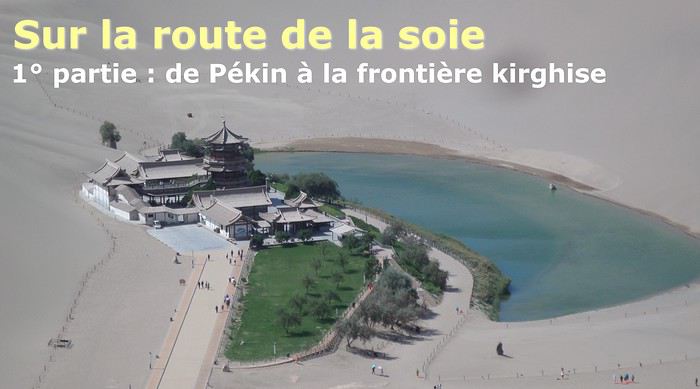
The Chinese Far West More than 30 years after my first trip to eastern China, I finally fulfilled an old dream: traveling solo from Beijing to the far west, discovering Xinjiang, the Uyghur people and the oppression they endure, the oases of Turpan and Kashgar, the Taklamakan Desert, the end of the Great Wall... The route was covered by train.
MENU PART 1: CHINA
1- Beijing (Jiankou) : the authentic Great Wall, without tourists 2- Cycling in Beijing, the best way to get around 3- Beijing : departure for the far west 4- Jiayuguan : getting by without English 5- Jiayuguan : scams and heritage 6- Dunhuang : abundance in the middle of the desert 7- Turpan : the Uyghurs under heavy surveillance 8- Kashgar : love at first sight for the old city 9- Kashgar : China’s recipe for controlling the populace 10- Tashkurgan : what on earth was I thinking going there! Kyrgyz border: a surreal epic Photo album from the 80s, contributions from other travelers (page 2)
1- JIANKOU Finding the authentic Great Wall, without tourists or a guide Friday, August 24, 2018 Thirty years later, I didn’t feel like revisiting the Great Wall at Badaling or any other overcrowded site. I chose to explore it at Jiankou, in its wildest, most authentic, and unrestored section, starting from a lost village deep in a valley—though it wasn’t *that* lost, since it had everything for communication.
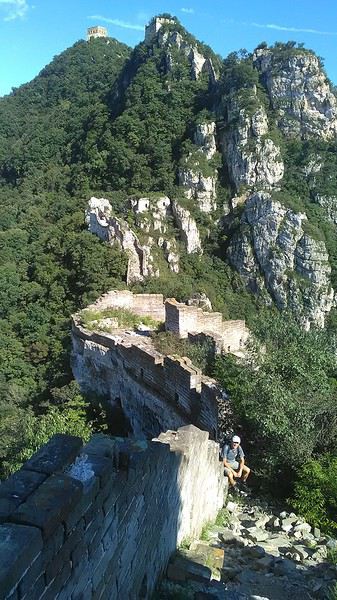
No need to pay for a taxi to get there—by timing it right, you can take the bus for just a few yuan. You have to get off at Xizhazi, the bus terminus. Be careful, there are only two buses a day in each direction. At the Xizhazi bus stop, I met a young couple who’d arrived with zero information about what to expect. We hiked the three of us toward the restored section of Mutianyu.
Still, be cautious With GPS and a topographic map (OpenTopoMap), you can set off without a problem or guide. The trail up to Jiankou is easy and well-marked. The trails down are too. But be careful—once you’re on the Wall, it’s real mountain hiking, with easy but dangerous climbing sections (over sheer drops). Not for amateurs or those afraid of heights! But what a reward. The Wall all to yourself, where it’s at its most daring. Truly mesmerizing.
More photos...
2- BEIJING The best way to get around the capital Sunday, August 26 The best way to explore the city is still by bike. Most are in a bike-share system, but you need to use an app—WeChat, the app that does everything, like monitoring your every move. No way I was installing that.
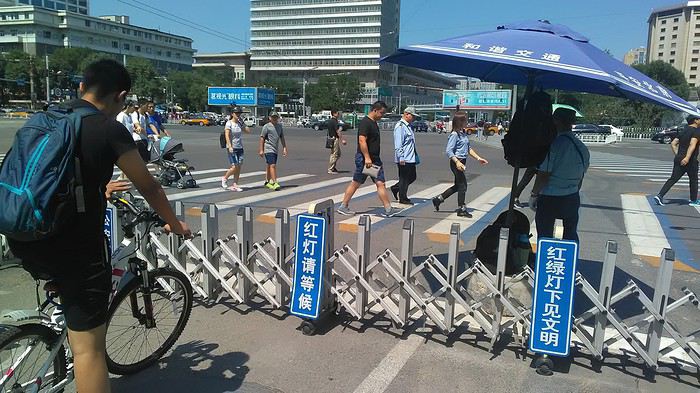
I found one at a rental shop near the hostel. The key is to quickly learn local traffic customs to minimize risks. Bike lanes are wide along the avenues.
But you still have to: - Watch out for anything parked on the bike paths—the most annoying are people napping or talking on the phone in their cars - Keep an eye on everything coming the wrong way—the list is long - The worst is right turns on red, which in Chinese traffic rules seem to have priority Once you get the hang of it, it’s fine. The city is huge but flat, so you can just wing it.
3- BEIJING By train to the far west Sunday, August 26 Beijing West Station is the size and operates like an airport. With your e-ticket from the agency, you first have to pick up your ticket at the special "English" counter, after passing through security. With your ticket in hand, you have to exit and enter through the boarding waiting area—not the platform—after a second security check.
 Then you find the right hall and wait for the sign to finally access the platform. In the end, it works pretty well given the incredible number of passengers to manage. Everywhere in Beijing, I saw that the Chinese have mastered crowd flow management.
Nice surprise: second-class carriages are clean, air-conditioned, and bright. Perfect, since I was in for 20 hours. One uniformed attendant per carriage, mobile meal service—luxury! Small downside: no luggage space. Hauling your suitcase up to the top bunk is quite a workout. I was in the middle, so it wasn’t too bad. The landscape, though, whether rural or urban, is pretty bleak. That should change once we leave the eastern plains.
Of course, I got my first police visit, with a thorough passport check and bag search. I was warned—going to the Chinese far west exposes you to this kind of hassle. But they were polite and respectful.
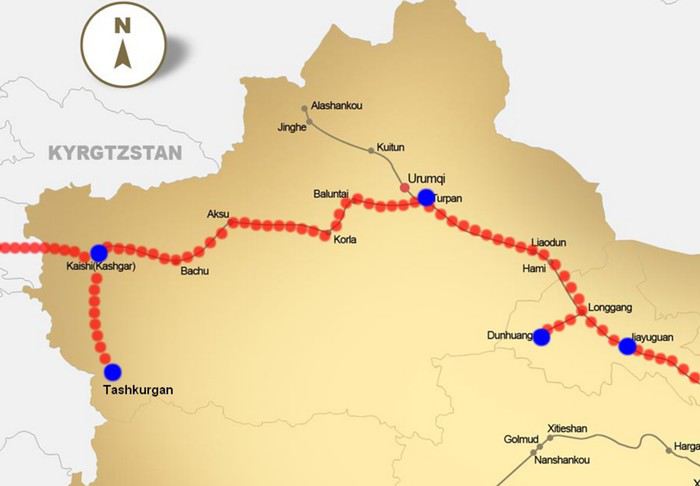 The Chinese Far West
4- JIAYUGUAN Getting by without English Monday, August 27 At the gates of two deserts (Gobi and Taklamakan) and at the foot of the Tibetan highlands, the Great Wall ends at Jiayuguan. Here, I found the deeper China I’d somewhat rediscovered during my bike ride, even if now everyone gets around on electric bikes and I’m no longer stared at like an alien.
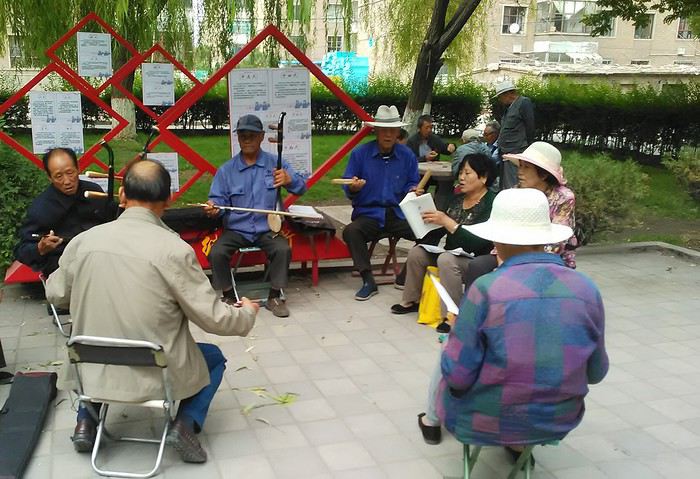
Prices are nothing like Beijing: you can find a full meal for 2 €, and my bike cost 7 € for two days. Plus, few people speak English—neither the owner of the HI hostel where I stayed, nor the ticket sellers at the sites, let alone the servers at the small eateries where I ate. Everything is written in Chinese. So I had to use the little Chinese I know to communicate about essentials. It makes the locals laugh to see a European trying to speak their language, but it earns respect. With Google Translate’s help, I managed.
Rant: With their avenues blocked for construction for kilometers without warning, and new roads not yet on maps, I must’ve taken 15 km of detours. More photos...
5- JIAYUGUAN Scams and heritage Tuesday, August 28 The Great Wall doesn’t exactly end at the fort I visited yesterday but 10 km further, at the entrance to a river gorge at the foot of the mountains. All that’s left is a badly damaged tower (more like a mound of earth) and a section of clay wall, similar to the one I biked yesterday.
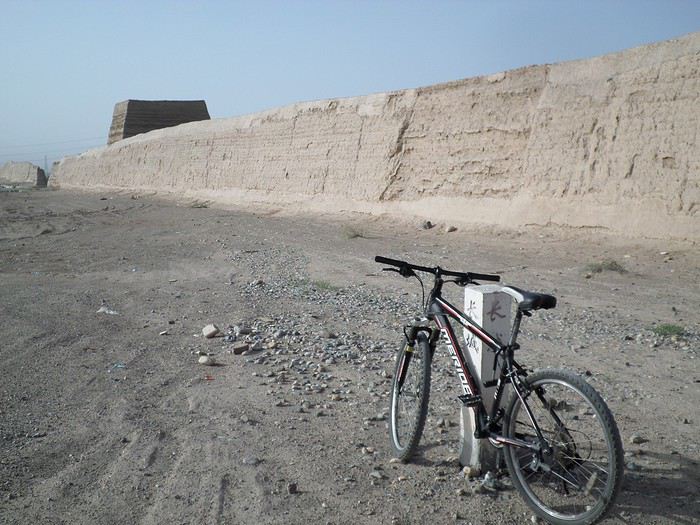
This morning, I hopped on my bike, determined to venture into the desert to see this highly symbolic site. First, you access it via a wide, brand-new road with not a soul in sight. Just before the site, I came across a grand welcome gate, very period-style, but it’s actually the inevitable toll booth.
Behind the gate, the road continues straight to the site, which you can see in the distance—at least 2 km away—the remains of the tower and wall. I had to leave my bike here. Fine. I went to the ticket counter and asked the price: 120 yuan! I couldn’t believe it—over 15 € for a simple mound of earth.
I showed my displeasure to the attendant, who couldn’t care less, and immediately turned back. 120 yuan—that’s the price for a new road, a fancy gate planted 2 km before the site just to force you to take a shuttle, and employees with nothing to do all day... Now I understand why I didn’t meet anyone!
Heritage China is a bit pricey Generally, sites are expensive for the country’s standard of living, but travelers are supposed to have money, so why hold back? I even gave up on the Forbidden City—reservations required days in advance (or on the black market at an impossible price). I prefer to keep the memory of my first visit, when entry must’ve cost a few dozen cents, and there were only a handful of visitors.
This morning, I took a taxi to see remarkable tombs of common people from the 3rd to 6th centuries. They’re small vaulted caves made of painted bricks, depicting scenes of daily life. Very pretty and moving. But even here, though the price was more reasonable, I was left wanting—only one of the 16 tombs is open to visitors, and it’s apparently not the most beautiful.
The authentic China—at least what’s left of it... Wandering the impersonal avenues of the city, you stumble upon a market. There, you still find traditional China—small shops with questionable hygiene, Go players, musicians, and even a dental prosthetist. The last refuge for those untouched by modernity. More photos...
6- DUNHUANG Abundance in the middle of the desert Wednesday, August 29 Well, I thought the landscape would be less bleak as I headed west. Nope. The only distraction in this expanse of dark, clayey sand is the forests of pylons and wind turbines, plus wild camels racing each other.
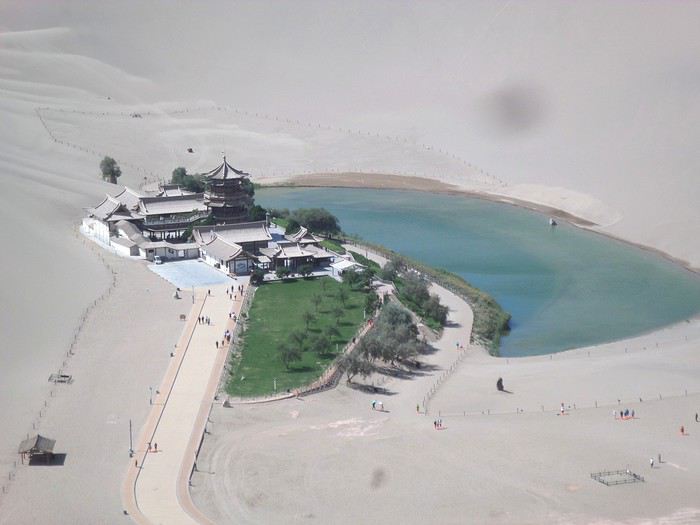 However, Dunhuang, the gateway to the Taklamakan, is by far the most pleasant Chinese city I know. There’s a real city center you can explore on foot. It’s hot but not unbearable, with a light, dry breeze. Much nicer than Beijing. The Han Chinese are still the majority, but the Muslim Uyghurs are more numerous, and the muezzin’s call to prayer echoes around the mosque.
The most surprising thing is the abundance and diversity of fruits and vegetables. You wonder how it all grows here. Well-irrigated, the desert sands are very fertile. Here, raisins have subtle, mysterious flavors, and the lamb really tastes like lamb.
Today, I visited the must-see Mingshashan, a dune complex next to which Pila is a molehill. The Basque Country, but covered in sand... More photos...
7- TURPAN The Uyghurs under heavy surveillance Friday, August 31 Surveillance cameras everywhere in the city, armed police stationed at intersections, in front of public buildings, at the entrance and inside tourist sites, police stations on every corner, patrols on foot or by car, khaki uniforms even for middle schoolers... here, the Han Chinese are in the minority, and you can feel it. Turpan feels like a city under siege.
To enter the youth hostel where I stayed, there’s even a security gate, and the receptionist (a Han, like everyone in tourism) wears a bulletproof vest! Reassuring. Still, you don’t feel particularly threatened here, especially as a European. The troublemakers are the Chinese, not the Uyghurs. Generally, China is a very safe country for visitors.
Smile, you’re on camera! I was biking on an avenue when the car in front of me got flashed for driving slowly. I quickly understood why when I got flashed too.
Here, the official time is Beijing time, but it gets dark two hours later. It’ll be even worse in Kashgar. Trickier to manage: everything is displayed in Chinese and Arabic. Nothing in English. Choosing a menu is a shot in the dark. Apart from a few young Chinese, no one here speaks English, and my Chinese doesn’t seem very understandable...
Mogao, the end of the road for the Han Yesterday, near Dunhuang, I went to Mogao, a complex of decorated caves with Buddha sculptures and paintings. Stunning, but so crowded! Luckily, here in Turpan, Chinese tourists barely venture out. So I visited a Silk Road ghost town with only a handful of other visitors and under a howling wind.
The modern Chinese city is swallowing up the old Uyghur neighborhoods—only a museum-like district remains in the center, and pockets of resistance on the outskirts are doomed to disappear soon. More photos...
8- KASHGAR A (relative) love at first sight for the old city Sunday, September 2 After three overnight trains, here I am in the far west of China, nearly 4,000 km from the capital. Despite the omnipresent police and an old city preserved UNESCO-style, Kashgar is my Chinese love at first sight.
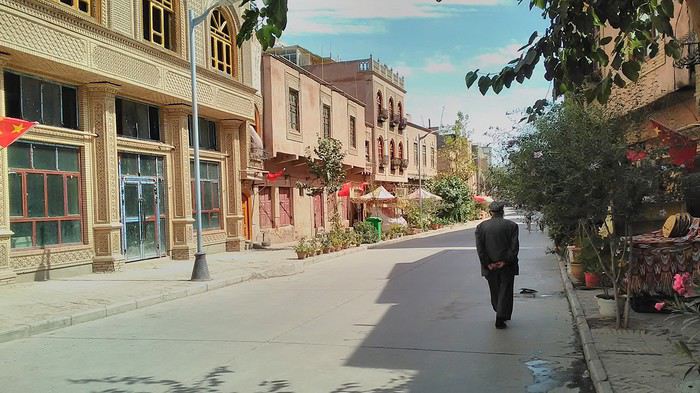
Finally, Chinese... well, sort of, because we’re in Uyghur territory here—a Turkic people with nothing culturally in common with the Han, the eastern Chinese. It started badly yesterday at Turfan station, where after three security gate passes, at least five passport checks, and a bag search, three adorable policewomen confiscated my antibacterial lotion because it had a flammable logo...
Then came the welcoming committee of armed cops at Kashgar station. Once all that was over, they left me alone—except you still have to go through security checks like everyone else to enter the old city, the bazaar, the livestock market... The further west you go, the more the siege mentality is evident. Luckily, the border isn’t far...
Despite the inevitable destruction-reconstruction, the city center has been well preserved. Thankfully, because it’s a very original style, a mix of local and colonial. I love it, even if it’s a bit too artificial, sanitized, and watered-down, and rather empty of residents. On the Silk Road, the city was famous for its great food. And it still is—rarely have I seen such richness and abundance of food! And not just scorpions or snakes. More photos...
9- KASHGAR China’s recipe for controlling the populace Saturday, September 1 Xinjiang, along with Tibet, is a "sensitive" area of rebellion in the eyes of Chinese authorities. As a result, the state has these regions and their populations under total control. Tourists also feel the consequences, even if they’re not at risk of re-education camps.
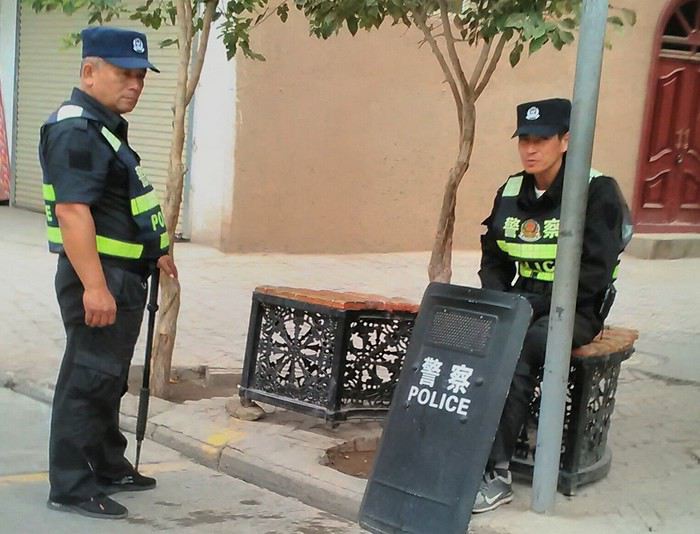 - Putting barbed wire and anti-ramming barriers around sensitive sites (schools, big hotels, government buildings...)
- Installing traffic surveillance gates with cameras and photo flashes (for all vehicles passing, including bikes) throughout the city and even in the countryside
- Posting uniformed guards with tasers, batons, or huge baseball bats every 100 meters
- Training the Han population (ethnic Chinese) in self-defense with sticks, preferably in the morning on the street. Men and women of all ages
- Starting school with the national anthem, doing military exercises, and receiving political indoctrination, all neatly lined up in the courtyard. (The dream school for any teacher)
- Placing a snitch in uniform (a pseudo-guard) in public gathering places, like youth hostels. Mine spends the day loafing around the courtyard
- Putting Chinese flags everywhere on the streets to remind everyone who’s in charge
- Installing security gates at every entrance to areas frequented by tourists (thanks for that) but not just there
- Never photographing cops, or else! I tried, but it’s not easy...
- Putting barbed wire and anti-ramming barriers around sensitive sites (schools, big hotels, government buildings...)
- Installing traffic surveillance gates with cameras and photo flashes (for all vehicles passing, including bikes) throughout the city and even in the countryside
- Posting uniformed guards with tasers, batons, or huge baseball bats every 100 meters
- Training the Han population (ethnic Chinese) in self-defense with sticks, preferably in the morning on the street. Men and women of all ages
- Starting school with the national anthem, doing military exercises, and receiving political indoctrination, all neatly lined up in the courtyard. (The dream school for any teacher)
- Placing a snitch in uniform (a pseudo-guard) in public gathering places, like youth hostels. Mine spends the day loafing around the courtyard
- Putting Chinese flags everywhere on the streets to remind everyone who’s in charge
- Installing security gates at every entrance to areas frequented by tourists (thanks for that) but not just there
- Never photographing cops, or else! I tried, but it’s not easy...
With all that, you can stroll around safely Not much crime! As for the amount the Chinese state spends to maintain such a system, it’s staggering! A third of the Han living in Xinjiang work in security. Today, I wandered freely around old Kashgar, which is quite large after all. More photos...
10- TASHKURGAN What on earth was I thinking going there! Wednesday, September 5 First, there’s the taxi—pretty crappy, with a driver who doesn’t speak a word of English and won’t stop smoking. Over six hours in that... shared with a completely out-of-it American.
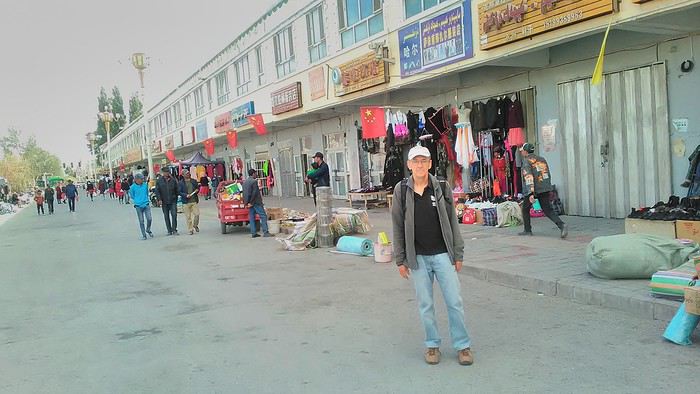
Then there are all the checkpoints along the way. I won’t go on—you know the drill by now.
After that, there’s Tashkurgan—a town with nothing to see, nothing to do. Deserted as soon as night falls. There’s this huge youth hostel and a few lost Chinese tapping away on their smartphones, chain-smoking. This lost American-European crowd, swapping tips on how to enter Pakistan or Tajikistan.
Luckily, there’s the Chinese Pamir Highway, lined with peaks over 7,000m. There’s the feeling of no longer being in China, with a population whose features are Middle Eastern. And these Tajik women with their stunning hairstyles and vibrant costumes. There’s the fact of having reached the westernmost Chinese city, far from crowds and tourist sites. A sort of end of the world. More photos...
11- KYRGYZ BORDER A surreal epic Thursday, September 6 The road from Kashgar to the Kyrgyzstan border is a little over 200 km and passes through beautiful landscapes of colorful, desert-like mountains with acrobatic folds. That’s the bucolic part of the trip.
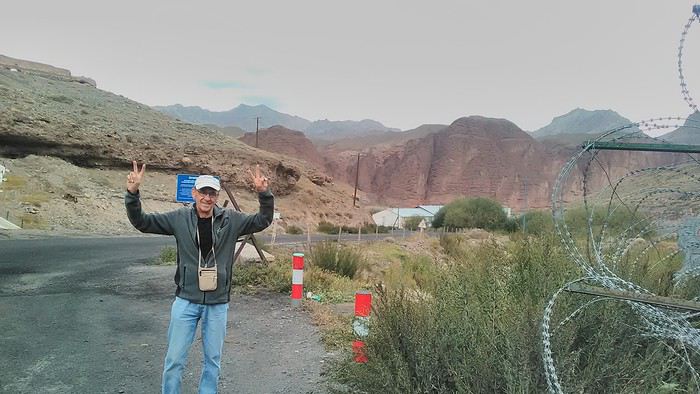 Yesterday, I managed to gather four people to rent a minibus to reach the border more easily: a Spaniard and an Argentine I’d already met in Turpan, and two New Zealanders who responded to the ad left at the hostel.
Absurdity and paranoia of Chinese authorities The highlight was crossing the town of Wuqia, 50 km past Kashgar. After tallying up with my fellow sufferers, we must’ve passed about ten checkpoints with: - Passport checks: 14 times, sometimes by two cops side by side - Bag checks: 4 times - Smartphone checks: 2 times, with deletion of "non-compliant" photos, and registration of your IMEI in the exit log!... Absurd and surreal at the same time, since my camera stayed in my bag, my apps are in French, and my photos have been online for ages...
With all that, we arrived just as the last checkpoint before the no man’s land marking the border between the two countries was on lunch break. And bam! Another 1.5-hour wait, alongside truckers who were much more used to this than we were.
What to think? The cops themselves aren’t fooled. They play the role they’re asked to, but sometimes you can coax a smile out of them—they realize how ridiculous the situation is.
What’s the point? That’s the big question my companions and I were tempted to answer with "to piss people off." To show you your place isn’t here, but with the other tourists, over there in the east, in Shanghai, Xi’an, or Guangzhou.
As for you, a traveler from a democratic country, you really experience this as aggression, humiliation, a violation of your private space. And yet, I’m respected, they speak to me properly. Today, I better understand what a Palestinian or a citizen of an occupied country might feel daily. A unique experience! Thanks, China.
And to top it off, the cherry on the cake! It’s still this glowing button you press to rate your passage after clearing the last obstacle before the exit stamp. I was so surprised it turned off before I could react. The Spaniard, with great humor and irony, had time to vote "excellent." In the end, he wasn’t wrong—you can hardly do better!
PS: I ditched my buddies at the border. They didn’t want to pay for a taxi to continue. So I took a direct taxi to Osh. The first 100 km are fabulous. I couldn’t take many photos, but I’ll be back on Monday to go to Tajikistan.
More photos...
The rest of the Silk Road, Part 2, in these travel journals: Kyrgyzstan, Tajikistan, Uzbekistan.
The Chinese Far West More than 30 years after my first trip to eastern China, I finally fulfilled an old dream: traveling solo from Beijing to the far west, discovering Xinjiang, the Uyghur people and the oppression they endure, the oases of Turpan and Kashgar, the Taklamakan Desert, the end of the Great Wall... The route was covered by train.
MENU PART 1: CHINA
1- Beijing (Jiankou) : the authentic Great Wall, without tourists 2- Cycling in Beijing, the best way to get around 3- Beijing : departure for the far west 4- Jiayuguan : getting by without English 5- Jiayuguan : scams and heritage 6- Dunhuang : abundance in the middle of the desert 7- Turpan : the Uyghurs under heavy surveillance 8- Kashgar : love at first sight for the old city 9- Kashgar : China’s recipe for controlling the populace 10- Tashkurgan : what on earth was I thinking going there! Kyrgyz border: a surreal epic Photo album from the 80s, contributions from other travelers (page 2)
1- JIANKOU Finding the authentic Great Wall, without tourists or a guide Friday, August 24, 2018 Thirty years later, I didn’t feel like revisiting the Great Wall at Badaling or any other overcrowded site. I chose to explore it at Jiankou, in its wildest, most authentic, and unrestored section, starting from a lost village deep in a valley—though it wasn’t *that* lost, since it had everything for communication.
No need to pay for a taxi to get there—by timing it right, you can take the bus for just a few yuan. You have to get off at Xizhazi, the bus terminus. Be careful, there are only two buses a day in each direction. At the Xizhazi bus stop, I met a young couple who’d arrived with zero information about what to expect. We hiked the three of us toward the restored section of Mutianyu.
Still, be cautious With GPS and a topographic map (OpenTopoMap), you can set off without a problem or guide. The trail up to Jiankou is easy and well-marked. The trails down are too. But be careful—once you’re on the Wall, it’s real mountain hiking, with easy but dangerous climbing sections (over sheer drops). Not for amateurs or those afraid of heights! But what a reward. The Wall all to yourself, where it’s at its most daring. Truly mesmerizing.
More photos...
2- BEIJING The best way to get around the capital Sunday, August 26 The best way to explore the city is still by bike. Most are in a bike-share system, but you need to use an app—WeChat, the app that does everything, like monitoring your every move. No way I was installing that.
I found one at a rental shop near the hostel. The key is to quickly learn local traffic customs to minimize risks. Bike lanes are wide along the avenues.
But you still have to: - Watch out for anything parked on the bike paths—the most annoying are people napping or talking on the phone in their cars - Keep an eye on everything coming the wrong way—the list is long - The worst is right turns on red, which in Chinese traffic rules seem to have priority Once you get the hang of it, it’s fine. The city is huge but flat, so you can just wing it.
3- BEIJING By train to the far west Sunday, August 26 Beijing West Station is the size and operates like an airport. With your e-ticket from the agency, you first have to pick up your ticket at the special "English" counter, after passing through security. With your ticket in hand, you have to exit and enter through the boarding waiting area—not the platform—after a second security check.
Then you find the right hall and wait for the sign to finally access the platform. In the end, it works pretty well given the incredible number of passengers to manage. Everywhere in Beijing, I saw that the Chinese have mastered crowd flow management.Nice surprise: second-class carriages are clean, air-conditioned, and bright. Perfect, since I was in for 20 hours. One uniformed attendant per carriage, mobile meal service—luxury! Small downside: no luggage space. Hauling your suitcase up to the top bunk is quite a workout. I was in the middle, so it wasn’t too bad. The landscape, though, whether rural or urban, is pretty bleak. That should change once we leave the eastern plains.
Of course, I got my first police visit, with a thorough passport check and bag search. I was warned—going to the Chinese far west exposes you to this kind of hassle. But they were polite and respectful.
The Chinese Far West4- JIAYUGUAN Getting by without English Monday, August 27 At the gates of two deserts (Gobi and Taklamakan) and at the foot of the Tibetan highlands, the Great Wall ends at Jiayuguan. Here, I found the deeper China I’d somewhat rediscovered during my bike ride, even if now everyone gets around on electric bikes and I’m no longer stared at like an alien.
Prices are nothing like Beijing: you can find a full meal for 2 €, and my bike cost 7 € for two days. Plus, few people speak English—neither the owner of the HI hostel where I stayed, nor the ticket sellers at the sites, let alone the servers at the small eateries where I ate. Everything is written in Chinese. So I had to use the little Chinese I know to communicate about essentials. It makes the locals laugh to see a European trying to speak their language, but it earns respect. With Google Translate’s help, I managed.
Rant: With their avenues blocked for construction for kilometers without warning, and new roads not yet on maps, I must’ve taken 15 km of detours. More photos...
5- JIAYUGUAN Scams and heritage Tuesday, August 28 The Great Wall doesn’t exactly end at the fort I visited yesterday but 10 km further, at the entrance to a river gorge at the foot of the mountains. All that’s left is a badly damaged tower (more like a mound of earth) and a section of clay wall, similar to the one I biked yesterday.
This morning, I hopped on my bike, determined to venture into the desert to see this highly symbolic site. First, you access it via a wide, brand-new road with not a soul in sight. Just before the site, I came across a grand welcome gate, very period-style, but it’s actually the inevitable toll booth.
Behind the gate, the road continues straight to the site, which you can see in the distance—at least 2 km away—the remains of the tower and wall. I had to leave my bike here. Fine. I went to the ticket counter and asked the price: 120 yuan! I couldn’t believe it—over 15 € for a simple mound of earth.
I showed my displeasure to the attendant, who couldn’t care less, and immediately turned back. 120 yuan—that’s the price for a new road, a fancy gate planted 2 km before the site just to force you to take a shuttle, and employees with nothing to do all day... Now I understand why I didn’t meet anyone!
Heritage China is a bit pricey Generally, sites are expensive for the country’s standard of living, but travelers are supposed to have money, so why hold back? I even gave up on the Forbidden City—reservations required days in advance (or on the black market at an impossible price). I prefer to keep the memory of my first visit, when entry must’ve cost a few dozen cents, and there were only a handful of visitors.
This morning, I took a taxi to see remarkable tombs of common people from the 3rd to 6th centuries. They’re small vaulted caves made of painted bricks, depicting scenes of daily life. Very pretty and moving. But even here, though the price was more reasonable, I was left wanting—only one of the 16 tombs is open to visitors, and it’s apparently not the most beautiful.
The authentic China—at least what’s left of it... Wandering the impersonal avenues of the city, you stumble upon a market. There, you still find traditional China—small shops with questionable hygiene, Go players, musicians, and even a dental prosthetist. The last refuge for those untouched by modernity. More photos...
6- DUNHUANG Abundance in the middle of the desert Wednesday, August 29 Well, I thought the landscape would be less bleak as I headed west. Nope. The only distraction in this expanse of dark, clayey sand is the forests of pylons and wind turbines, plus wild camels racing each other.
However, Dunhuang, the gateway to the Taklamakan, is by far the most pleasant Chinese city I know. There’s a real city center you can explore on foot. It’s hot but not unbearable, with a light, dry breeze. Much nicer than Beijing. The Han Chinese are still the majority, but the Muslim Uyghurs are more numerous, and the muezzin’s call to prayer echoes around the mosque.The most surprising thing is the abundance and diversity of fruits and vegetables. You wonder how it all grows here. Well-irrigated, the desert sands are very fertile. Here, raisins have subtle, mysterious flavors, and the lamb really tastes like lamb.
Today, I visited the must-see Mingshashan, a dune complex next to which Pila is a molehill. The Basque Country, but covered in sand... More photos...
7- TURPAN The Uyghurs under heavy surveillance Friday, August 31 Surveillance cameras everywhere in the city, armed police stationed at intersections, in front of public buildings, at the entrance and inside tourist sites, police stations on every corner, patrols on foot or by car, khaki uniforms even for middle schoolers... here, the Han Chinese are in the minority, and you can feel it. Turpan feels like a city under siege.
To enter the youth hostel where I stayed, there’s even a security gate, and the receptionist (a Han, like everyone in tourism) wears a bulletproof vest! Reassuring. Still, you don’t feel particularly threatened here, especially as a European. The troublemakers are the Chinese, not the Uyghurs. Generally, China is a very safe country for visitors.
Smile, you’re on camera! I was biking on an avenue when the car in front of me got flashed for driving slowly. I quickly understood why when I got flashed too.
Here, the official time is Beijing time, but it gets dark two hours later. It’ll be even worse in Kashgar. Trickier to manage: everything is displayed in Chinese and Arabic. Nothing in English. Choosing a menu is a shot in the dark. Apart from a few young Chinese, no one here speaks English, and my Chinese doesn’t seem very understandable...
Mogao, the end of the road for the Han Yesterday, near Dunhuang, I went to Mogao, a complex of decorated caves with Buddha sculptures and paintings. Stunning, but so crowded! Luckily, here in Turpan, Chinese tourists barely venture out. So I visited a Silk Road ghost town with only a handful of other visitors and under a howling wind.
The modern Chinese city is swallowing up the old Uyghur neighborhoods—only a museum-like district remains in the center, and pockets of resistance on the outskirts are doomed to disappear soon. More photos...
8- KASHGAR A (relative) love at first sight for the old city Sunday, September 2 After three overnight trains, here I am in the far west of China, nearly 4,000 km from the capital. Despite the omnipresent police and an old city preserved UNESCO-style, Kashgar is my Chinese love at first sight.
Finally, Chinese... well, sort of, because we’re in Uyghur territory here—a Turkic people with nothing culturally in common with the Han, the eastern Chinese. It started badly yesterday at Turfan station, where after three security gate passes, at least five passport checks, and a bag search, three adorable policewomen confiscated my antibacterial lotion because it had a flammable logo...
Then came the welcoming committee of armed cops at Kashgar station. Once all that was over, they left me alone—except you still have to go through security checks like everyone else to enter the old city, the bazaar, the livestock market... The further west you go, the more the siege mentality is evident. Luckily, the border isn’t far...
Despite the inevitable destruction-reconstruction, the city center has been well preserved. Thankfully, because it’s a very original style, a mix of local and colonial. I love it, even if it’s a bit too artificial, sanitized, and watered-down, and rather empty of residents. On the Silk Road, the city was famous for its great food. And it still is—rarely have I seen such richness and abundance of food! And not just scorpions or snakes. More photos...
9- KASHGAR China’s recipe for controlling the populace Saturday, September 1 Xinjiang, along with Tibet, is a "sensitive" area of rebellion in the eyes of Chinese authorities. As a result, the state has these regions and their populations under total control. Tourists also feel the consequences, even if they’re not at risk of re-education camps.
- Putting barbed wire and anti-ramming barriers around sensitive sites (schools, big hotels, government buildings...)
- Installing traffic surveillance gates with cameras and photo flashes (for all vehicles passing, including bikes) throughout the city and even in the countryside
- Posting uniformed guards with tasers, batons, or huge baseball bats every 100 meters
- Training the Han population (ethnic Chinese) in self-defense with sticks, preferably in the morning on the street. Men and women of all ages
- Starting school with the national anthem, doing military exercises, and receiving political indoctrination, all neatly lined up in the courtyard. (The dream school for any teacher)
- Placing a snitch in uniform (a pseudo-guard) in public gathering places, like youth hostels. Mine spends the day loafing around the courtyard
- Putting Chinese flags everywhere on the streets to remind everyone who’s in charge
- Installing security gates at every entrance to areas frequented by tourists (thanks for that) but not just there
- Never photographing cops, or else! I tried, but it’s not easy...With all that, you can stroll around safely Not much crime! As for the amount the Chinese state spends to maintain such a system, it’s staggering! A third of the Han living in Xinjiang work in security. Today, I wandered freely around old Kashgar, which is quite large after all. More photos...
10- TASHKURGAN What on earth was I thinking going there! Wednesday, September 5 First, there’s the taxi—pretty crappy, with a driver who doesn’t speak a word of English and won’t stop smoking. Over six hours in that... shared with a completely out-of-it American.
Then there are all the checkpoints along the way. I won’t go on—you know the drill by now.
After that, there’s Tashkurgan—a town with nothing to see, nothing to do. Deserted as soon as night falls. There’s this huge youth hostel and a few lost Chinese tapping away on their smartphones, chain-smoking. This lost American-European crowd, swapping tips on how to enter Pakistan or Tajikistan.
Luckily, there’s the Chinese Pamir Highway, lined with peaks over 7,000m. There’s the feeling of no longer being in China, with a population whose features are Middle Eastern. And these Tajik women with their stunning hairstyles and vibrant costumes. There’s the fact of having reached the westernmost Chinese city, far from crowds and tourist sites. A sort of end of the world. More photos...
11- KYRGYZ BORDER A surreal epic Thursday, September 6 The road from Kashgar to the Kyrgyzstan border is a little over 200 km and passes through beautiful landscapes of colorful, desert-like mountains with acrobatic folds. That’s the bucolic part of the trip.
Yesterday, I managed to gather four people to rent a minibus to reach the border more easily: a Spaniard and an Argentine I’d already met in Turpan, and two New Zealanders who responded to the ad left at the hostel.Absurdity and paranoia of Chinese authorities The highlight was crossing the town of Wuqia, 50 km past Kashgar. After tallying up with my fellow sufferers, we must’ve passed about ten checkpoints with: - Passport checks: 14 times, sometimes by two cops side by side - Bag checks: 4 times - Smartphone checks: 2 times, with deletion of "non-compliant" photos, and registration of your IMEI in the exit log!... Absurd and surreal at the same time, since my camera stayed in my bag, my apps are in French, and my photos have been online for ages...
With all that, we arrived just as the last checkpoint before the no man’s land marking the border between the two countries was on lunch break. And bam! Another 1.5-hour wait, alongside truckers who were much more used to this than we were.
What to think? The cops themselves aren’t fooled. They play the role they’re asked to, but sometimes you can coax a smile out of them—they realize how ridiculous the situation is.
What’s the point? That’s the big question my companions and I were tempted to answer with "to piss people off." To show you your place isn’t here, but with the other tourists, over there in the east, in Shanghai, Xi’an, or Guangzhou.
As for you, a traveler from a democratic country, you really experience this as aggression, humiliation, a violation of your private space. And yet, I’m respected, they speak to me properly. Today, I better understand what a Palestinian or a citizen of an occupied country might feel daily. A unique experience! Thanks, China.
And to top it off, the cherry on the cake! It’s still this glowing button you press to rate your passage after clearing the last obstacle before the exit stamp. I was so surprised it turned off before I could react. The Spaniard, with great humor and irony, had time to vote "excellent." In the end, he wasn’t wrong—you can hardly do better!
PS: I ditched my buddies at the border. They didn’t want to pay for a taxi to continue. So I took a direct taxi to Osh. The first 100 km are fabulous. I couldn’t take many photos, but I’ll be back on Monday to go to Tajikistan.
More photos...
The rest of the Silk Road, Part 2, in these travel journals: Kyrgyzstan, Tajikistan, Uzbekistan.
Oman, le pays des Mille moins Une Merveilles English translation pending
Bonjour à tous,
Petit clin d'oeil au carnet d'Isabelle (Rouquine 38) quant au choix du titre 😉.
Pourquoi "mille moins une"? Tout simplement parce qu'en 10 jours, on en voit moins qu'en 14 et qu'en berline on en voit (un peu) moins qu'en 4x4. Exit donc le Dhofar et le Jebel Akhdar. Pour ce qui est des 999 autres merveilles, c'est pas faute de ne pas vous avoir prévenus: il va y avoir des redites!
C'est parti.... Muriel
Petit clin d'oeil au carnet d'Isabelle (Rouquine 38) quant au choix du titre 😉.
Pourquoi "mille moins une"? Tout simplement parce qu'en 10 jours, on en voit moins qu'en 14 et qu'en berline on en voit (un peu) moins qu'en 4x4. Exit donc le Dhofar et le Jebel Akhdar. Pour ce qui est des 999 autres merveilles, c'est pas faute de ne pas vous avoir prévenus: il va y avoir des redites!
C'est parti.... Muriel
Retour du Chili et Argentine English translation pending
bonjour à tous.
Nous sommes partis le 30 octobre et rentrés le 14 décembre 2019, entre Chli et Argentine Je vais vous présenter le circuit et si vous avez des questions, je ferais au mieux pour vous aider. Nous sommes un couple de 65 et 64 ans Santiago (2 nuits) Valparaiso (2 nuits) - Nous avions prévu le trajet en bus, mais cela a été finalement en taxi. Tout était un peu compliqué avec les événements au Chili et en plus c'est aussi férié le 1er novembre. Zappalar (1 nuit) pas nécessaire de se rendre là-bas, mais avons été contraints de modifier notre circuit pour prendre le ferry à Punta Arenas pour nous rendre à Puerto Williams. Nous avions loué une voiture à Vina Del Mar pour nous rendre sur Zappalar et sommes revenus sur Santiago pour prendre l'avion pour Puerto Montt (Avons loué une voiture à l'aéroport de Puerto Montt que nous avons rendue à Punta Arenas.) De Puerto Mont, nous nous sommes rendus à Puerto Varas (1 nuit) Ensuite ferry pour nous rendre sur Chiloe (3 nuits) Retour Puerto Varas (1 nuit) Sommes partis ensuite vers l'Argentine pour faire la route des 7 lacs Villa Angostura (1 nuit) San Martin de Los Andes (2 nuits) San Carlos de Bariloche (1 nuit) Retour sur le Chili pour faire un peu de la route australe Futaleufu (2 nuits) Puyuhuapi (2 nuits) Coyhaique (1 nuit) Puerto Rio Tranquilo (2 nuits) Retour sur Argentine Los Antiguos (1 nuit) Estancia Santa Thelma (2 nuits) El Chaten (3 nuits) el Calafate (3 nuits) Retour au Chili Torres del Paine (2 nuits mais nous avons dormi à l'extérieur du parc) Puerto Natales (1 nuit) Punta Arenas (2 nuits) Avons ensuite pris le ferry pour nous rendre à Puerto Williams (le bout du monde) environ 32 heures de ferry et en plus 6h/ 8h de retard au départ) Puerto Williams (2 nuits) Ushuahia (1 nuit) Vol entre Ushuahia et Puerto Iguazu (2 nuits) pour voir les chutes. Il faut compter une journée pour celles côté Argentine et 1/2 journée pour celles côté Brésil. Vol pour Buenos Aires (1 nuit) Retour Paris
Nous avons eu une météo plutôt correcte pour cette période de l'année. Les cimes des montagnes sont encore enneigées et c'est très fleuri (lupins, genêts, et beaucoup d'arbres rouges), tout compte fait, une bonne période pour s'y rendre.
Au Chili comme en Argentine, les gens que nous avons rencontrés sont charmants, vous disent bonjour dans les villages, dans les rues.
Si je peux vous aider, n'hésitez pas
bons voyages à tous
Nous sommes partis le 30 octobre et rentrés le 14 décembre 2019, entre Chli et Argentine Je vais vous présenter le circuit et si vous avez des questions, je ferais au mieux pour vous aider. Nous sommes un couple de 65 et 64 ans Santiago (2 nuits) Valparaiso (2 nuits) - Nous avions prévu le trajet en bus, mais cela a été finalement en taxi. Tout était un peu compliqué avec les événements au Chili et en plus c'est aussi férié le 1er novembre. Zappalar (1 nuit) pas nécessaire de se rendre là-bas, mais avons été contraints de modifier notre circuit pour prendre le ferry à Punta Arenas pour nous rendre à Puerto Williams. Nous avions loué une voiture à Vina Del Mar pour nous rendre sur Zappalar et sommes revenus sur Santiago pour prendre l'avion pour Puerto Montt (Avons loué une voiture à l'aéroport de Puerto Montt que nous avons rendue à Punta Arenas.) De Puerto Mont, nous nous sommes rendus à Puerto Varas (1 nuit) Ensuite ferry pour nous rendre sur Chiloe (3 nuits) Retour Puerto Varas (1 nuit) Sommes partis ensuite vers l'Argentine pour faire la route des 7 lacs Villa Angostura (1 nuit) San Martin de Los Andes (2 nuits) San Carlos de Bariloche (1 nuit) Retour sur le Chili pour faire un peu de la route australe Futaleufu (2 nuits) Puyuhuapi (2 nuits) Coyhaique (1 nuit) Puerto Rio Tranquilo (2 nuits) Retour sur Argentine Los Antiguos (1 nuit) Estancia Santa Thelma (2 nuits) El Chaten (3 nuits) el Calafate (3 nuits) Retour au Chili Torres del Paine (2 nuits mais nous avons dormi à l'extérieur du parc) Puerto Natales (1 nuit) Punta Arenas (2 nuits) Avons ensuite pris le ferry pour nous rendre à Puerto Williams (le bout du monde) environ 32 heures de ferry et en plus 6h/ 8h de retard au départ) Puerto Williams (2 nuits) Ushuahia (1 nuit) Vol entre Ushuahia et Puerto Iguazu (2 nuits) pour voir les chutes. Il faut compter une journée pour celles côté Argentine et 1/2 journée pour celles côté Brésil. Vol pour Buenos Aires (1 nuit) Retour Paris
Nous avons eu une météo plutôt correcte pour cette période de l'année. Les cimes des montagnes sont encore enneigées et c'est très fleuri (lupins, genêts, et beaucoup d'arbres rouges), tout compte fait, une bonne période pour s'y rendre.
Au Chili comme en Argentine, les gens que nous avons rencontrés sont charmants, vous disent bonjour dans les villages, dans les rues.
Si je peux vous aider, n'hésitez pas
bons voyages à tous