Results for "Mékong+|+8+>+189"
7606 results found.
Tips for a nature-focused itinerary in Vietnam
Hello everyone,
we’re planning a trip to Vietnam at the end of June 2026 for at least two weeks.
Our goal is to avoid rushing around too much and take our time, focusing on nature, hiking, and getting to know the locals.
Here’s my first draft itinerary:
Arrival and departure from Hanoi
Sapa and its surrounding area
Tam Coc – the "land Halong Bay"
and Ninh Binh...
Halong Bay (maritime)
Cat Ba Island...
I’d love to hear your thoughts, advice, and feedback.
Looking forward to reading your replies.
Cédric
The Most Read Travel Journals on VoyageForum
I briefly set out to tally things up, having asked myself the same question, and here are some figures and my thoughts on the travel journals that have seen the greatest success over more than 22 years—the first one was posted on 04/17/2003.
Before sharing the TOP 25, I notice that the United States of America seems to have sparked the most interest among readers: 11 out of the 25 most read. The American dream is still very much alive. With passionate travelers, too, since there are often many participants (quite chatty ones), which significantly boosts the number of views. Since VF was hosted in Canada, maybe there’s also a fair number of Canadian readers adding to that?
Asia comes in second with 8 journals, confirming the appeal of these destinations. We also see 4 Europe-related journals in this best-of.
The numbers are undeniable, but they should be put into perspective. For example: - A journal published a long time ago has a better chance of being widely read than a more recent one. - A journal published all at once will get fewer visitors than one published over 30 days, recounting a month-long trip. - Some journals have renewed readability because their author or readers add information or comments.
You could also say that a journal with 5,000 views about Ireland or Iceland, for instance, doesn’t fall short compared to those about a more popular destination like the U.S., which might have tens of thousands of views.
Personally, I regret the absence from the ranking of journals I admired—both very well-written and featuring stunning photos. On the other hand, the presence of some journals in the most-read list is quite puzzling to me.
Three distinct periods stand out: - The 2000s. It took some time for the site to become known and for word-of-mouth to spread. Back then, some people, especially older travelers (who are more likely to both travel and publish journals on VF), didn’t even have internet yet. Plus, many journals from that era had few or no photos, which doesn’t attract some readers. - The early 2010s. There was probably a peak, an optimal moment, with the site being more well-known and visible, and a generation of travelers ready to share and help. With few exceptions, all the most-read journals date from 2006 to 2016. - From the late 2010s onward, there may have been a turning point. Fewer people enjoying (or knowing how to) read, more people moving to various social media platforms for their immediacy and ease?
I’m not unhappy to be in 26th place with my 2013 journal about a part of southern Thailand. I owe it largely to the photos of the adorable langur monkeys and the messages from all those who went to see them thanks to me. Those were good times that will be hard to relive.
Before sharing the TOP 25, I notice that the United States of America seems to have sparked the most interest among readers: 11 out of the 25 most read. The American dream is still very much alive. With passionate travelers, too, since there are often many participants (quite chatty ones), which significantly boosts the number of views. Since VF was hosted in Canada, maybe there’s also a fair number of Canadian readers adding to that?
Asia comes in second with 8 journals, confirming the appeal of these destinations. We also see 4 Europe-related journals in this best-of.
The numbers are undeniable, but they should be put into perspective. For example: - A journal published a long time ago has a better chance of being widely read than a more recent one. - A journal published all at once will get fewer visitors than one published over 30 days, recounting a month-long trip. - Some journals have renewed readability because their author or readers add information or comments.
You could also say that a journal with 5,000 views about Ireland or Iceland, for instance, doesn’t fall short compared to those about a more popular destination like the U.S., which might have tens of thousands of views.
Personally, I regret the absence from the ranking of journals I admired—both very well-written and featuring stunning photos. On the other hand, the presence of some journals in the most-read list is quite puzzling to me.
Three distinct periods stand out: - The 2000s. It took some time for the site to become known and for word-of-mouth to spread. Back then, some people, especially older travelers (who are more likely to both travel and publish journals on VF), didn’t even have internet yet. Plus, many journals from that era had few or no photos, which doesn’t attract some readers. - The early 2010s. There was probably a peak, an optimal moment, with the site being more well-known and visible, and a generation of travelers ready to share and help. With few exceptions, all the most-read journals date from 2006 to 2016. - From the late 2010s onward, there may have been a turning point. Fewer people enjoying (or knowing how to) read, more people moving to various social media platforms for their immediacy and ease?
I’m not unhappy to be in 26th place with my 2013 journal about a part of southern Thailand. I owe it largely to the photos of the adorable langur monkeys and the messages from all those who went to see them thanks to me. Those were good times that will be hard to relive.
Do I need a visa for Cambodia if I'm transiting at the airport?
Hi everyone,
I booked my round-trip ticket from Paris to Phnom Penh (way too quickly, of course) because I’d like to start in Laos. I’m traveling from November 5th to December 3rd. So, I’m wondering: when I arrive in Phnom Penh on the 6th and take a flight directly to Laos without leaving the airport, do I still need a visa for Cambodia? Also, which airport in Laos would you recommend—Luang Prabang or Vientiane?
Thanks so much for your advice!
I booked my round-trip ticket from Paris to Phnom Penh (way too quickly, of course) because I’d like to start in Laos. I’m traveling from November 5th to December 3rd. So, I’m wondering: when I arrive in Phnom Penh on the 6th and take a flight directly to Laos without leaving the airport, do I still need a visa for Cambodia? Also, which airport in Laos would you recommend—Luang Prabang or Vientiane?
Thanks so much for your advice!
Thailand, Cambodia, or Vietnam?
I really loved Thailand, but it was too touristy for my taste. So I'm hesitating about going back and wondering if Cambodia or Vietnam would be less crowded with tourists...
Driver for independent northern Thailand itinerary
Hello everyone,
Not long ago, I used to travel as a couple, but my husband has since passed away, and I’ve decided to set off again. The trip I took to Cambodia in January 2025 did me a world of good.
I’m now considering Thailand, a destination we never included in our plans because even 15 years ago, people said it was too touristy. Still, I’m thinking about the itinerary below, but I don’t feel up to arranging buses, trains, or guides on my own while I’m there. I’m looking for one or more drivers and have been in touch with an agency, but their offers are just copy-paste group tours that I don’t want.
So, if you have any contacts, experiences, or advice, I’d be so grateful if you’d share them with me. Here’s my rough plan:
Arrival in Bangkok
Ayutthaya (2 nights)
Kanchanaburi (2 or 3 nights)
Sangkhlaburi/Sai Yok (3 nights)
Sukhothai (2 nights)
Lampang (I’ve planned 3 nights, but that might be a bit much—it depends on what time I arrive in the city)
Chiang Mai
Chiang Dao
Pai
Chiang Rai
I was thinking about the Mae Hong Son loop—thoughts?
What do you think about staying overnight at the Golden Triangle?
When I look online, of course, I can find agencies that organize tours to national parks, etc.
I’m retired but in great physical shape. I’d rather go hiking than sit in hot springs with crowds of tourists who’ve all arranged meet-ups. I don’t want to spend a day at an elephant camp, and I don’t want to visit Karen villages.
I’d love to hear your advice.
Thank you all,
Fish. April 2025 Photo Contest Theme
Hi everyone,
Starting tomorrow (the first day of the month), the April contest kicks off with the theme "Fish."
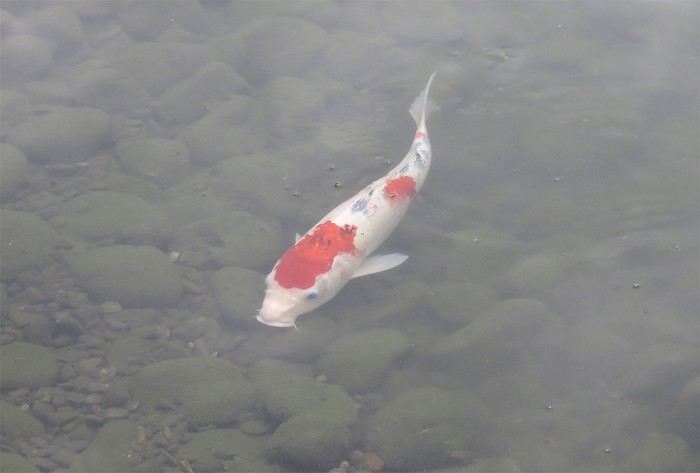
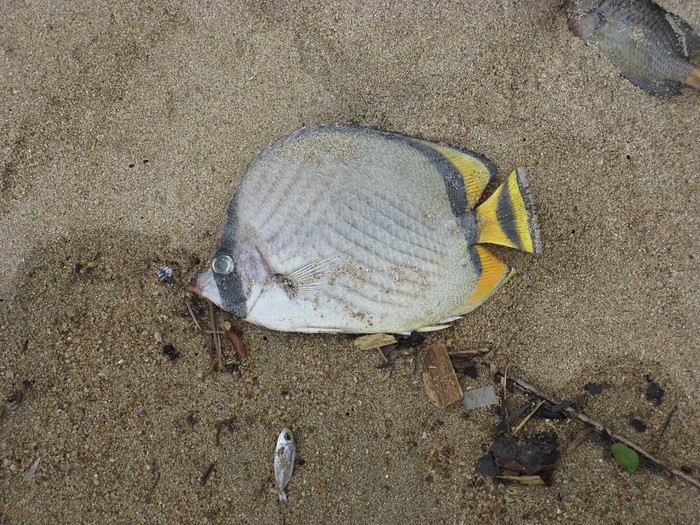
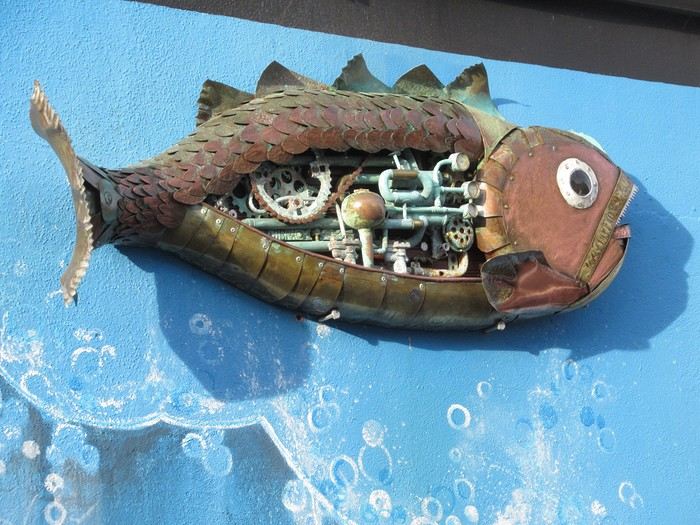
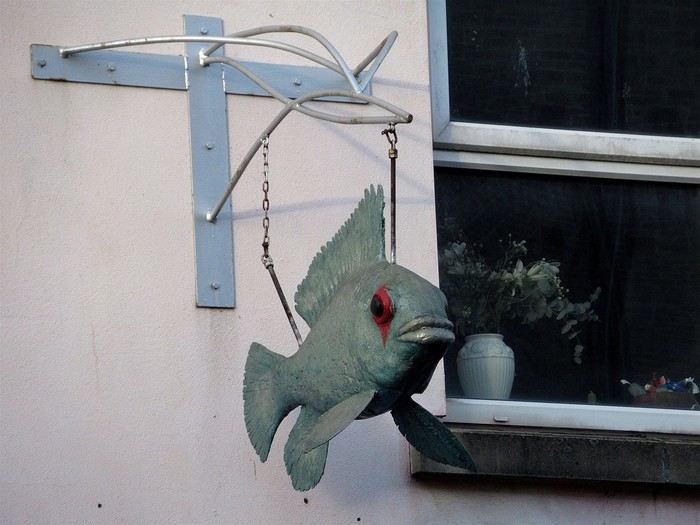
Important note: There was a contest in January 2020 on the theme "Fishing," where we hardly saw any fish. So this time, it should not be about fishing but mainly about fish. Live fish (1), dead fish (2), fish used in various artistic (3), commercial (4), or other illustrations (5).
Practical details:
Participation: Each VF member can submit up to 3 photos, until Saturday, April 26 at 11:59 PM Brussels time. Each photo should be posted in a separate message, with its number (1, 2, or 3). Don’t forget to add a little explanation (comment, location, etc.).
Voting: Each VF member can vote for the 3 photos they think are the best, based on their own criteria and the theme.
Voting will take place from Sunday, April 27 to Wednesday, April 30 at 11:59 PM Brussels time.
The selected photos will be ranked in order of preference: - 1st photo: 3 points - 2nd: 2 points - 3rd: 1 point
The winner is the photographer whose photo receives the most points.
Results will be published on May 1. In case of a tie, the number of first-place votes will decide. The winner will have the honor of organizing the May 2025 contest.
Photos that have already been nominated (1st, 2nd, or 3rd place) in another contest are not eligible for this one.
This thread is exclusively for photos submitted to the contest. All discussions, comments, and chit-chat should be posted in the thread: Discussion on the April 2025 contest theme "Fish"
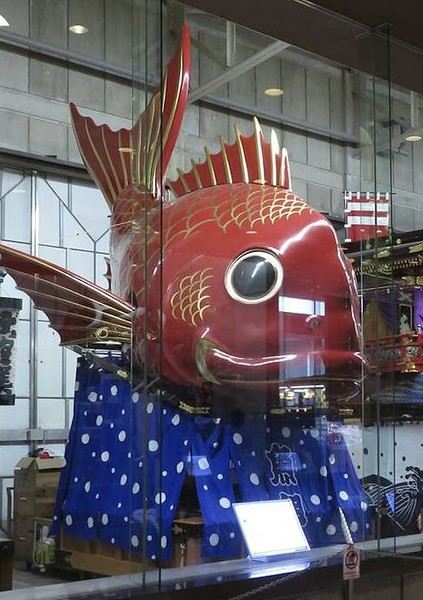
(1) Japanese fish (not yet turned into sushi 😛)
(2) Fish considered small fry and left on an Indonesian beach
(3) Street art in Bristol (England)
(4) Sign in Bristol (England)
(5) Hikiyama Exhibition Hall in Karatsu (Kyushu, Japan)
Good luck! 😛
PS: Whales, sperm whales, porpoises, and dolphins are welcome—let’s be inclusive! 😎
Starting tomorrow (the first day of the month), the April contest kicks off with the theme "Fish."
Important note: There was a contest in January 2020 on the theme "Fishing," where we hardly saw any fish. So this time, it should not be about fishing but mainly about fish. Live fish (1), dead fish (2), fish used in various artistic (3), commercial (4), or other illustrations (5).
Practical details:
Participation: Each VF member can submit up to 3 photos, until Saturday, April 26 at 11:59 PM Brussels time. Each photo should be posted in a separate message, with its number (1, 2, or 3). Don’t forget to add a little explanation (comment, location, etc.).
Voting: Each VF member can vote for the 3 photos they think are the best, based on their own criteria and the theme.
Voting will take place from Sunday, April 27 to Wednesday, April 30 at 11:59 PM Brussels time.
The selected photos will be ranked in order of preference: - 1st photo: 3 points - 2nd: 2 points - 3rd: 1 point
The winner is the photographer whose photo receives the most points.
Results will be published on May 1. In case of a tie, the number of first-place votes will decide. The winner will have the honor of organizing the May 2025 contest.
Photos that have already been nominated (1st, 2nd, or 3rd place) in another contest are not eligible for this one.
This thread is exclusively for photos submitted to the contest. All discussions, comments, and chit-chat should be posted in the thread: Discussion on the April 2025 contest theme "Fish"
(1) Japanese fish (not yet turned into sushi 😛)
(2) Fish considered small fry and left on an Indonesian beach
(3) Street art in Bristol (England)
(4) Sign in Bristol (England)
(5) Hikiyama Exhibition Hall in Karatsu (Kyushu, Japan)
Good luck! 😛
PS: Whales, sperm whales, porpoises, and dolphins are welcome—let’s be inclusive! 😎
Trekking in Laos, which agencies?
Hello,
We’re planning a 3-week trip to Laos, focusing solely on the north. Our main goal is to do two 4-day treks in two different areas of Northern Laos.
We land in Bangkok on December 12th and will head straight to Chiang Mai before crossing into northern Laos at Huay Xai. Our journey will start there, ending in Vientiane, with a stop in Luang Prabang and the surrounding area. We’ll then take a night train from Udon Thani on December 30th to catch our flight back in Bangkok.
Right now, we’re mainly looking for reliable contacts to organize our two treks. From what we’ve read so far, trekking options exist around Luang Namtha, Phongsali (if it’s not too cold during that period, since we’ll have our 3-year-old daughter with us), or near Muang Ngoi and Nong Khiaw, as we’ve seen there are possibilities in that area too.
If we can organize both treks with the same contact, that would be perfect.
We’d prefer to avoid big agencies with a high-street presence and instead work directly with a local who knows their stuff and can give us good advice. We want to combine stunning landscapes (we love hiking) with cultural encounters in local villages.
We’d love to hear your tips and experiences—maybe some areas are better than others, less crowded, or more challenging (though we’re keeping in mind our 3-year-old, who’s used to hiking but we don’t want to put her in any danger).
That’s the gist of our plans for now! Looking forward to hearing from you, fellow travelers
We’re planning a 3-week trip to Laos, focusing solely on the north. Our main goal is to do two 4-day treks in two different areas of Northern Laos.
We land in Bangkok on December 12th and will head straight to Chiang Mai before crossing into northern Laos at Huay Xai. Our journey will start there, ending in Vientiane, with a stop in Luang Prabang and the surrounding area. We’ll then take a night train from Udon Thani on December 30th to catch our flight back in Bangkok.
Right now, we’re mainly looking for reliable contacts to organize our two treks. From what we’ve read so far, trekking options exist around Luang Namtha, Phongsali (if it’s not too cold during that period, since we’ll have our 3-year-old daughter with us), or near Muang Ngoi and Nong Khiaw, as we’ve seen there are possibilities in that area too.
If we can organize both treks with the same contact, that would be perfect.
We’d prefer to avoid big agencies with a high-street presence and instead work directly with a local who knows their stuff and can give us good advice. We want to combine stunning landscapes (we love hiking) with cultural encounters in local villages.
We’d love to hear your tips and experiences—maybe some areas are better than others, less crowded, or more challenging (though we’re keeping in mind our 3-year-old, who’s used to hiking but we don’t want to put her in any danger).
That’s the gist of our plans for now! Looking forward to hearing from you, fellow travelers
Amazing 3-week trip in January 2025
Hello fellow travelers,
I spent 3 weeks in Cambodia this January, and I completely fell in love with this country—especially the Cambodian people. I took my time because it was possible, and it turned out to be a total success. Originally, this trip was planned for 2021 and 2022 with my husband, but COVID and an illness threw everything off. Now traveling solo, I went with Siem Reap à la Carte, a local agency. I can’t recommend Mélanie and Nathalie enough—they helped design the itinerary together with me, and the guides and drivers were top-notch. Since I was alone with them, the connection was incredible.
My itinerary: Phnom Penh (2 nights). I arrived at the airport at 1 PM, and everything went super smoothly—I had my E-visa and E-arrival. I had the afternoon free on arrival, a guide the next morning, and the afternoon free again. Battambang (2 nights) with a local guide for all the visits (temples, the bat flight, bamboo train, the surrounding countryside, markets, etc.). Siem Reap (6 nights). I chose to take the public boat across the Tonlé Sap—8 hours on the water, but it goes by quickly, and the scenery is stunning. Of course, in Siem Reap, it’s all about the Angkor temples—most people come for that—but Nathalie and Mélanie also arranged some unique experiences, like visiting a lacquer workshop (even though this wasn’t my first trip to Asia and I’d seen them before, this one was different). I even tried making incense sticks (I’m not very good at it), and we had lunch at a local’s home. There are, of course, the markets, and I also took a cooking class with a chef at his home, where we ate what we prepared. I also spent another day on a boat visiting a village on the Tonlé Sap. I used my free time for a massage, a stroll around town, and in the evenings, I’d head to Pub Street—guaranteed fun. I also visited the Thousand Lingas River. I won’t list all the temples I saw—you can make your own choices or follow recommendations. Either way, everything is breathtaking. Banlung and Ratanakiri, where I spent 4 nights. Because of that, I didn’t go to Mondulkiri. I loved it—jungle walks, visits to ethnic villages and cemeteries, and for those who want, there are plenty of waterfalls where you can swim. The most tourists I saw at once was 5 (a group of 4 and me a little farther away, so you can have peace and quiet). I also spent time at an elephant sanctuary. I was hesitant at first, but everything had been so perfect up to that point that I went, and I have no regrets. It was just me, the guide, and the rangers—lovely people—and the elephants were living their best lives. Next, I headed to Kratié for 2 nights: temples, the Irrawaddy dolphins, and a half-day on Koh Trong Island by bike, tasting their famous pomelos—a pure delight. No cars on the island, just calm and serenity. On my way to Kep, where I spent 4 nights, I stopped for a night in Kampong Cham, visiting temples, villages, and the bamboo bridge. With this kind of travel style, it’s easy to stop wherever you feel like it. So, I arrived in KEP to taste the famous Kep crabs—don’t miss them! The agency arranged a full-day motorbike tour (I wasn’t the one driving!), exploring the countryside and salt marshes. Of course, you should also visit Kampot, and if you love pepper, make sure to leave room in your luggage to bring some back. A full day of fishing by boat, with lunch on board (the fish we caught—though not by me, I’m terrible at that too). A kayak trip through the mangroves. In short, everything was perfect here too, and I took my time to enjoy the sunsets. Back to Phnom Penh for one last night before returning to France. A sunset cruise on the Mekong, and I visited some places I didn’t have time for when I arrived. This was my first solo trip—I usually travel with someone—but the organization was flawless, and the people were wonderful. I didn’t go to the islands near Sihanoukville, even though that was originally part of the plan. But I truly fell in love with this country. I’m considering Thailand next winter, but I’m also seriously thinking about returning to Siem Reap or even visiting those islands. If you’d like more details, I’m happy to help. Nathalie and Mélanie were incredibly patient with me—I’d been in touch with them since 2020, and in 2021, I had to cancel everything. They’re two French women who’ve lived there for a long time, know the country inside out, and—most importantly—have immense respect for the people they work with (guides, drivers). That’s a value that’s very important to me. Happy travels to all!
I spent 3 weeks in Cambodia this January, and I completely fell in love with this country—especially the Cambodian people. I took my time because it was possible, and it turned out to be a total success. Originally, this trip was planned for 2021 and 2022 with my husband, but COVID and an illness threw everything off. Now traveling solo, I went with Siem Reap à la Carte, a local agency. I can’t recommend Mélanie and Nathalie enough—they helped design the itinerary together with me, and the guides and drivers were top-notch. Since I was alone with them, the connection was incredible.
My itinerary: Phnom Penh (2 nights). I arrived at the airport at 1 PM, and everything went super smoothly—I had my E-visa and E-arrival. I had the afternoon free on arrival, a guide the next morning, and the afternoon free again. Battambang (2 nights) with a local guide for all the visits (temples, the bat flight, bamboo train, the surrounding countryside, markets, etc.). Siem Reap (6 nights). I chose to take the public boat across the Tonlé Sap—8 hours on the water, but it goes by quickly, and the scenery is stunning. Of course, in Siem Reap, it’s all about the Angkor temples—most people come for that—but Nathalie and Mélanie also arranged some unique experiences, like visiting a lacquer workshop (even though this wasn’t my first trip to Asia and I’d seen them before, this one was different). I even tried making incense sticks (I’m not very good at it), and we had lunch at a local’s home. There are, of course, the markets, and I also took a cooking class with a chef at his home, where we ate what we prepared. I also spent another day on a boat visiting a village on the Tonlé Sap. I used my free time for a massage, a stroll around town, and in the evenings, I’d head to Pub Street—guaranteed fun. I also visited the Thousand Lingas River. I won’t list all the temples I saw—you can make your own choices or follow recommendations. Either way, everything is breathtaking. Banlung and Ratanakiri, where I spent 4 nights. Because of that, I didn’t go to Mondulkiri. I loved it—jungle walks, visits to ethnic villages and cemeteries, and for those who want, there are plenty of waterfalls where you can swim. The most tourists I saw at once was 5 (a group of 4 and me a little farther away, so you can have peace and quiet). I also spent time at an elephant sanctuary. I was hesitant at first, but everything had been so perfect up to that point that I went, and I have no regrets. It was just me, the guide, and the rangers—lovely people—and the elephants were living their best lives. Next, I headed to Kratié for 2 nights: temples, the Irrawaddy dolphins, and a half-day on Koh Trong Island by bike, tasting their famous pomelos—a pure delight. No cars on the island, just calm and serenity. On my way to Kep, where I spent 4 nights, I stopped for a night in Kampong Cham, visiting temples, villages, and the bamboo bridge. With this kind of travel style, it’s easy to stop wherever you feel like it. So, I arrived in KEP to taste the famous Kep crabs—don’t miss them! The agency arranged a full-day motorbike tour (I wasn’t the one driving!), exploring the countryside and salt marshes. Of course, you should also visit Kampot, and if you love pepper, make sure to leave room in your luggage to bring some back. A full day of fishing by boat, with lunch on board (the fish we caught—though not by me, I’m terrible at that too). A kayak trip through the mangroves. In short, everything was perfect here too, and I took my time to enjoy the sunsets. Back to Phnom Penh for one last night before returning to France. A sunset cruise on the Mekong, and I visited some places I didn’t have time for when I arrived. This was my first solo trip—I usually travel with someone—but the organization was flawless, and the people were wonderful. I didn’t go to the islands near Sihanoukville, even though that was originally part of the plan. But I truly fell in love with this country. I’m considering Thailand next winter, but I’m also seriously thinking about returning to Siem Reap or even visiting those islands. If you’d like more details, I’m happy to help. Nathalie and Mélanie were incredibly patient with me—I’d been in touch with them since 2020, and in 2021, I had to cancel everything. They’re two French women who’ve lived there for a long time, know the country inside out, and—most importantly—have immense respect for the people they work with (guides, drivers). That’s a value that’s very important to me. Happy travels to all!
Back from 4 weeks in northern Laos, November 2023
Hi there,
I’m so glad the VoyageForum is back up. Reading 'Montagnard74’s' Laos trip report (which I read yesterday) made me want to share my own (which I already posted a year ago on another forum).
Here’s a little recap of our 3 weeks in northern Laos, plus a few days in Vientiane.
By the way, we could easily go back to the north—there’s so much to see and do; probably in a few years.
This was our 3rd trip to Laos after having already done:
1st trip in 2012 (3 weeks), a quick overview: Vientiane Vang Vieng Luang Prabang Plain of Jars
2nd trip in 2017 (1 month): Vientiane all the way to the 4,000 Islands via Thakhek, Kong Lor, the Bolaven Plateau, Savannakhet, Pakse...
Our 2023 itinerary (1 month): Vientiane Luang Prabang Muang Ngoi Nong Khiew Luang Namtha Muang Sing Boten Vang Vieng Vientiane
Some general info (2023): For those who’ve already been to Laos: everything has gone up a lot—I think prices have almost doubled for transport, accommodation, meals... everything. But Laos is still a budget-friendly country for us. As a couple, we spent 1,100 € for a month, all included (and we definitely didn’t skimp on massages :)).
Don’t trust the transport signs posted everywhere—at travel agencies, bus terminals, hotels... THEY’RE ALL WRONG (especially the schedules). They haven’t been updated since before Covid.
There are hardly any bikes for rent anymore, but scooters are easy to find everywhere. We switched our mode of transport toward the end of our stay: from bikes to scooters, which let us go farther. In Vientiane, we only saw one bike rental place, near Ong Teu Pagoda.
BCEL bank doesn’t charge a commission on foreign currency exchanges. Using ATMs is expensive due to fees. Outside Laos, Lao kip are basically worthless. There’s so much inflation that I couldn’t find a single bank or exchange office willing to swap the kip we had left. So, don’t exchange too much toward the end of your trip.
Some little tips from our experience (2023): The Muang Koua to Muang Ngoi boat still runs daily. At the dam, you have to get off and take a bus, then get back on the boat.
The boat from Muang Ngoi to Nong Khiew only leaves at 9:30 AM (don’t miss it or you’ll pay a lot for a private boat). From Nong Khiew to Muang Ngoi, there are at least two boats a day.
From Luang Namtha to Muang Sing: 4 to 5 buses a day, the last one leaves around 3:30 PM.
From Luang Namtha or Muang Sing to Nateuy or Boten (to catch the new train): 3 to 5 buses a day.
The new train is really hard to book—it’s often fully booked 48 hours in advance, even the local train (5 hours from Boten to Vientiane instead of 3 hours on the high-speed train). (That makes it tough to travel day by day, which we love... too bad.) For baggage checks: don’t bring anything flammable (sprays...) or sharp. My mosquito repellent (flammable but in a small plastic bottle) got through. Water bottles and a tiny pocketknife are okay. But it seems to depend on the station.
Some guesthouses prefer to be paid in dollars, otherwise the price is much higher.
If you’re entering Laos from Vietnam via Dien Bien Phu, you have to get your visa at the embassy in Hanoi—otherwise, you’ll be refused at the border (no e-visa or visa on arrival).
Apart from Luang Prabang, Vientiane, and Muang Ngoi/Nong Khiew, there are very few tourists.
Some bus prices (in addition to those mentioned in my trip report) (with pick-up) 2023: Luang Prabang to Luang Namtha: 320,000 kip per person, 9h LP to Phonesavan: 250,000 kip per person, 7h LP to Phongsaly: 450,000 kip per person, 13h LP to Huay Xai: 420,000 kip per person, 14h Train Nateuy to Vientiane: 400,000 kip per person LP to Chiang Rai: 780,000 kip per person, 18h LP to Hanoi: 900,000 kip per person, 24h LP to train station: 50,000 kip per person LP to airport: 100,000 kip per person Vientiane from train station: 180,000 kip by taxi
Boats: LP to Pak Beng: 300,000 kip per person, 1 day LP to Houay Xai: 500,000 kip per person, 2 days LP to Pak Ou: 180,000 kip per person, 5h
This was our 3rd trip to Laos after having already done:
1st trip in 2012 (3 weeks), a quick overview: Vientiane Vang Vieng Luang Prabang Plain of Jars
2nd trip in 2017 (1 month): Vientiane all the way to the 4,000 Islands via Thakhek, Kong Lor, the Bolaven Plateau, Savannakhet, Pakse...
Our 2023 itinerary (1 month): Vientiane Luang Prabang Muang Ngoi Nong Khiew Luang Namtha Muang Sing Boten Vang Vieng Vientiane
Some general info (2023): For those who’ve already been to Laos: everything has gone up a lot—I think prices have almost doubled for transport, accommodation, meals... everything. But Laos is still a budget-friendly country for us. As a couple, we spent 1,100 € for a month, all included (and we definitely didn’t skimp on massages :)).
Don’t trust the transport signs posted everywhere—at travel agencies, bus terminals, hotels... THEY’RE ALL WRONG (especially the schedules). They haven’t been updated since before Covid.
There are hardly any bikes for rent anymore, but scooters are easy to find everywhere. We switched our mode of transport toward the end of our stay: from bikes to scooters, which let us go farther. In Vientiane, we only saw one bike rental place, near Ong Teu Pagoda.
BCEL bank doesn’t charge a commission on foreign currency exchanges. Using ATMs is expensive due to fees. Outside Laos, Lao kip are basically worthless. There’s so much inflation that I couldn’t find a single bank or exchange office willing to swap the kip we had left. So, don’t exchange too much toward the end of your trip.
Some little tips from our experience (2023): The Muang Koua to Muang Ngoi boat still runs daily. At the dam, you have to get off and take a bus, then get back on the boat.
The boat from Muang Ngoi to Nong Khiew only leaves at 9:30 AM (don’t miss it or you’ll pay a lot for a private boat). From Nong Khiew to Muang Ngoi, there are at least two boats a day.
From Luang Namtha to Muang Sing: 4 to 5 buses a day, the last one leaves around 3:30 PM.
From Luang Namtha or Muang Sing to Nateuy or Boten (to catch the new train): 3 to 5 buses a day.
The new train is really hard to book—it’s often fully booked 48 hours in advance, even the local train (5 hours from Boten to Vientiane instead of 3 hours on the high-speed train). (That makes it tough to travel day by day, which we love... too bad.) For baggage checks: don’t bring anything flammable (sprays...) or sharp. My mosquito repellent (flammable but in a small plastic bottle) got through. Water bottles and a tiny pocketknife are okay. But it seems to depend on the station.
Some guesthouses prefer to be paid in dollars, otherwise the price is much higher.
If you’re entering Laos from Vietnam via Dien Bien Phu, you have to get your visa at the embassy in Hanoi—otherwise, you’ll be refused at the border (no e-visa or visa on arrival).
Apart from Luang Prabang, Vientiane, and Muang Ngoi/Nong Khiew, there are very few tourists.
Some bus prices (in addition to those mentioned in my trip report) (with pick-up) 2023: Luang Prabang to Luang Namtha: 320,000 kip per person, 9h LP to Phonesavan: 250,000 kip per person, 7h LP to Phongsaly: 450,000 kip per person, 13h LP to Huay Xai: 420,000 kip per person, 14h Train Nateuy to Vientiane: 400,000 kip per person LP to Chiang Rai: 780,000 kip per person, 18h LP to Hanoi: 900,000 kip per person, 24h LP to train station: 50,000 kip per person LP to airport: 100,000 kip per person Vientiane from train station: 180,000 kip by taxi
Boats: LP to Pak Beng: 300,000 kip per person, 1 day LP to Houay Xai: 500,000 kip per person, 2 days LP to Pak Ou: 180,000 kip per person, 5h
Feedback on Cambodia Itinerary
Hi there,
I’m planning an itinerary and would love some feedback on whether it’s doable and if the number of days per destination is enough—or too much. I was also debating whether to add an extra night on an island or spend an extra night in Kampot to visit Kep or Battambang.
March 23: Arrival in Phnom Penh in the morning March 24: Phnom Penh March 25: Phnom Penh March 26: Depart for Kampot March 27: Kampot March 28: Depart for Battambang March 29: Battambang March 30: Tonlé SAP to Siem Reap March 31: Siem Reap April 1: Siem Reap April 2: Siem Reap April 3: Siem Reap April 4: Siem Reap April 5: Departure
Thanks for any suggestions or help!
March 23: Arrival in Phnom Penh in the morning March 24: Phnom Penh March 25: Phnom Penh March 26: Depart for Kampot March 27: Kampot March 28: Depart for Battambang March 29: Battambang March 30: Tonlé SAP to Siem Reap March 31: Siem Reap April 1: Siem Reap April 2: Siem Reap April 3: Siem Reap April 4: Siem Reap April 5: Departure
Thanks for any suggestions or help!
Cities to see in the Isan region (Thailand)
Hi there,
I’m about to take a trip around the region in March. According to the "experts," which cities are really worth the detour? My key criteria: a slightly lively downtown + walkable. I’ve already been to the region a few years ago, but my memories are pretty mixed (Ubon Ratchathani, Udon Thani, Khon Kaen).
Thanks😎
I’m about to take a trip around the region in March. According to the "experts," which cities are really worth the detour? My key criteria: a slightly lively downtown + walkable. I’ve already been to the region a few years ago, but my memories are pretty mixed (Ubon Ratchathani, Udon Thani, Khon Kaen).
Thanks😎
Cambodia Information
hi there
since the forum is back up, let’s try to gather some updated info.
first off, arrival formalities are changing—starting January 1st, you’ll need to fill out an electronic form before arrival. This replaces the paperwork you used to fill out on the plane or at the airport (for air arrivals). Here’s the link: https://www.arrival.gov.kh/.
for visas, the same options remain: e-visa, visa on arrival, or visa at the embassy. The standard price is $30 on arrival, but at land borders, be prepared for a small "extra" for "cigarettes or coffee."
don’t forget your passport must be valid for at least 6 months after your return.
regarding airlines, prices are pretty high for carriers like Singapore, Qatar, Emirates, Vietnam Airlines, and Thai. EVA Air is a great Taiwanese airline with slightly lower fares, but ongoing pressure from mainland China and quasi-blockades could cause delays or issues—something to watch.
there are cheaper Chinese airlines, but friends from China advise being cautious with connections. Worth double-checking.
transport is evolving too—there’s now a highway from Phnom Penh to Kampot. Soraya, a well-known bus company, has disappeared. More highway projects are in the works. Buildings are popping up fast, just mentioning this for those who haven’t been to Cambodia in a while.
6 weeks in Cambodia in autumn 2023
We got back enchanted from a 6-week trip to Cambodia!
Our itinerary: Kampot - Kampong Chhnang - Battambang - Siem Reap - Kampong Cham - Sen Monorom (Mondulkiri) - Banlung (Ratanakiri) - Kratie - Kampong Thom - Phnom Penh.
We traveled by bus, minivan, boat (between Battambang and Siem Reap), overnight bus, scooter, tuk-tuk, and rickshaw for shorter distances. We stayed in guesthouses, homestays, and even in the jungle during a trek.
While the Angkor temples are fabulous, it’s the people you should visit Cambodia for—the "Land of Smiles" truly lives up to its nickname! Tourists gather in Angkor but are quite rare elsewhere, even though the country is easy to travel around.
I won’t describe our trip in detail but instead highlight a few favorite moments.
From Kampot, don’t hesitate to head out around 6 AM to see the fishermen return and their wives selling their catch (just 10 minutes away by the coast). Guaranteed picturesque!
In Battambang, known for its food scene, we discovered a cooking class with Smokin’ Pot (authentic Khmer cooking class). They pick you up from your guesthouse to shop for ingredients (we made fish amok and beef lok lak) at their village market, then cook and eat together. A private class—just the two of us! They also send the recipes via WhatsApp as a PDF. +855 12 821 400
In Siem Reap, I can recommend a francophone tuk-tuk driver who was very attentive to our wishes. We visited tourist spots but also more remote villages and local grilled-pork restaurants with him. He’s a wealth of information about local life, and chatting with him was a real pleasure—we left with regret! You can reach him on WhatsApp: Vung Hem, +855 96 614 0146.
We did a 2-day, 1-night trek in Mondulkiri. Don’t expect a super dense jungle—it looks more like a forest similar to ours. But Nara, our Bunong ethnic guide, made the experience adventurous and ultimately very immersive! WhatsApp +855 86 630 489
Bee Bee’s Chalets homestay: If you pass through Banlung in Ratanakiri, we *loved* this family and their budget-friendly bungalows. Playing Uno, enjoying Nita’s cooking (ask for her fish amok—amazing!), it was a true homestay experience! Contact Nita on WhatsApp: +855 88 818 5525.
In Kratie, rent a scooter and follow the Mekong north for 40 km at your own pace. Being so close to the locals was a treat! Same goes for heading south if you have time.
Kampong Thom: Head 25 km out to visit the pre-Angkorian temples of Sambor Prei Kuk. Around a hundred monuments spread across three sites… and hardly anyone there!
A few practical tips: Though prices are often listed in dollars, you can always pay in riels (1 USD = 4000 riels), which is what we preferred. PassApp: An app to book tuk-tuks or rickshaws (and most importantly, know the price upfront). Virak Buntham: A bus company connecting several cities, bookable online.
Feel free to ask me questions about places, accommodations, etc.—I’d be happy to answer!
A few practical tips: Though prices are often listed in dollars, you can always pay in riels (1 USD = 4000 riels), which is what we preferred. PassApp: An app to book tuk-tuks or rickshaws (and most importantly, know the price upfront). Virak Buntham: A bus company connecting several cities, bookable online.
Feel free to ask me questions about places, accommodations, etc.—I’d be happy to answer!
The 4000 Islands (Southern Laos)
PAKSE AND THE BOLAVENS PLATEAU
Bolavens (or "Bolovens" – "the region of the Lavens," an old tribe).
PAKSE
A sleepy town, but packed with backpackers in transit between Laos and Cambodia. The streets are numbered, but since there are no signs, you just have to figure it out (rumor has it the signs have been planned for years; luckily, the center isn’t big). Tons of small hotels, including the well-known Sabaidy 2 on Street 20, a big bazaar catering to all budgets, from dark dorms with shared bathrooms to real rooms with terraces or balconies. Since it’s so popular, booking ahead is recommended. My favorite: the Sala Champa, pricier but with two large terraces, one with a bar, and especially a terrace restaurant I consider the best in Pakse (try the divine steamed fish with lemongrass + Lao Gold beer, a rare delight; ask for room 100, with a big terrace). More upscale, the lovely Résidence Sisouk, run by the very classy and French-speaking Mme Sisouk, from the wealthy Lao Sisouk family, the country’s top coffee producer and one of those francophone families you encounter here and there around the world, where class and culture reign – and perfect French. Delicious pastries and, of course, extraordinary coffee tastings. Similar prices at the Pakse Hotel, run by French owners and famous for its rooftop bar-restaurant (great view!).
Tons of restaurants besides those at Sala Champa and Pakse Hotel: from Dao Lin and Sabaidee at the corner of Street 20 and 13, to a decent Indian place (Hassan) and a nice, cheap spot, the Lao Restaurant & Bar, where you can enjoy Lao cuisine for just a few kips, both also on Street 20. You can feast on grilled fish at the countless riverside stalls along the Mekong.
Pakse is home to the famous Yves, a Belgian married to a Lao woman, Noy, who opened the travel agency Miss Noy. He’ll go out of his way to help tourists; he’s incredible, the real tourism office for the region, with maps, endless advice, and every weekday at 6 PM, a full-blown lecture on the Bolavens and the 4000 Islands. A bunch of young travelers listen intently to his explanations about the whole area (he hands out a well-made photocopied map). He also rents bikes and has an internet café with computers that, miraculously, work perfectly. He’s so popular that in high season, you need to book a motorbike 2-3 days in advance (but if he’s out – and he has 40 – he’ll find one for you).
THE BOLAVENS PLATEAU
Plateaus just aren’t my thing – flat-lands! There are some relatively high peaks in the middle, but they’re only accessible by trekking. You can do a small loop from Pakse-Tad Lo-Thateng-Pakson-Pakse, or a big one from Tad Lo to Sekong, then head south to join the Paksong-Pakse road. Starting in the north, the Phu Xam waterfalls are okay (interesting local minority village-museum to the right of the parking lot, and a terrace restaurant above the small falls). Well, they’re on the way, so you might as well see them! After that, a boring road leads to the Tad Lo waterfalls, with tons of small hotels. I chose the big blue house by the river at the right corner of the bridge, the Sipaseth GH, with cute little bungalows in the garden, 4 rooms with balconies overlooking the river, and great food on the terrace facing the falls. **Avoid at all costs**: the Saisee GH, once nice with its little stilt houses by the falls, but now a monument to filth, indifference, and rudeness (confirmed by several people, unanimous on the issue). Luckily, the lovely Tad Lo Lodge, with its bungalows by the falls and gourmet restaurant right above them – not cheap at all – finally built small houses in the woods on the other side for $25.
The next morning, I’d had enough of plateaus, so I took a small loop heading south from Tad Lo to Thateng, and there, a wonder 5 km south of town: the Sinouk Resort. It’s like stepping into *Gone with the Wind* or the Chevalier de Leyritz’s Martinique. In the middle of the Sisouk family’s 34-hectare coffee plantation, a huge garden with three large colonial-style houses: one by the river and pond with a suite + 3 luxury rooms + a small, cozy one for $40 (that’s where I stayed), one with 4 superior rooms for $60, and a very large one overlooking everything with 6 luxury rooms ($60) + 2 huge suites for $90. Of course, it’s all decorated with antique furniture, local knick-knacks, and antiques; there’s a pool, a beautiful restaurant with two terraces, one overlooking a large pond and one by its edge. The food and service are impeccable, and the coffee: from espresso with whipped cream to green tea or wild honey cappuccino… too bad it keeps you up, or you’d sip it all evening (and morning, and afternoon, and in between). In short, a dream!
Back to Pakse via Paksong (what a dump!) and the Tad Fane waterfalls, those are spectacular – twin sisters plunging 200 meters. You can hike down to swim at the bottom (1-hour jungle trek round trip). Across the way, the nice Tad Fane Resort (small houses and a big terrace-restaurant facing the falls).
I think I missed the Katamkok waterfalls, but I don’t believe it – all these falls can’t compare to Ban Gioc Falls in northern Vietnam!!!
CHAMPASAK AND THE 4000 ISLANDS
CHAMPASAK
Even sleepier than Pakse! To avoid the ferry, cross the new Mekong bridge in Pakse, and after about 10 km, turn left at the big "Phaphinoy" sign (the first village in town). When you arrive, turn at the "River Resort" sign. A sumptuous resort on the Mekong, developed with American capital – pure luxury (they even have their own rice field and vegetable garden for the restaurant). Continuing on, you’ll come across the very pleasant Anouxa GH, where I had dinner and stayed. Small bungalows facing the river, garden rooms, and two large wooden houses with huge family rooms + a big terrace on the Mekong, and the food is great! They rent bikes and motorbikes. Further to the right, the pricey Inthira Hotel, which I found uninteresting since it’s on the road instead of by the Mekong. There’s also a Folie Lodge on Don Daeng Island, which I didn’t visit (the word "Folie" is justified: crazy prices, up to $200 and more).
A few nice wats and, of course, Wat Phou, Laos’ most important archaeological site, 10 km south of Champassak in the plains and on the mountainside (the stairs are a killer!). Watch out for the scorching heat, and it closes at 4:30 PM. It’s not Angkor Wat, but it’s still worth the detour. Plan for 2 hours. Entry is 50,000 kips + 5,000 to park your motorbike.
KHIET NGON
To continue south to the 4000 Islands, you have to take the "ferry" (actually fun little things – two canoes joined by a platform; better not mess up when loading your motorbike!). Once on the other side, turn left, and you’ll hit National Road 13 (Pakse-Siphandone, the 4000 Islands), the most boring road I’ve ever been on, like Phnom Penh-Siem Reap – flat and nothing to see. BUT there’s a real gem worth checking out: Kiet Ngon. At Km 48, take the laterite road toward Attapeu (big sign: "Attapeu 155 km") and eat red dust for 8 km (toll: 20,000 kips), then turn right (signposted) onto a good track. You enter the beautiful Xe Pian National Park, where you can still find wild elephants, leopards, and tigers. You arrive at the entrance of the small village of Ban Khiet Ngon. On your right, a small concrete building with 4 decent, cheap rooms (60,000 kips), facing an old wooden house that serves as the tourism office and its "elephant parking" garden. This village is where you can go on an elephant ride (20,000 kips) to the top of Phou Asa, one of the most unusual places I’ve ever seen. You climb through the jungle and emerge onto a flat slate summit, completely bare – it really feels like the Moon! In the distance, an astonishing site built to commemorate a victory by Lao nationalists over Siamese invaders in the 19th century (so the site isn’t 1,000 years old, as the locals claim). A vast archaeological site with an enclosure 180 m by 50 m, marked by 2-meter-high walls and columns made of slate stacked without mortar. At the back, a ruined temple and a tower. Beautiful views of the whole region. Popular with tourists arriving by minibus from Pakse. The elephant rides in a line aren’t my thing, so they tell you it’s forbidden to ride a motorbike, but I did it anyway without any issues – except for the unhappy looks from the mahouts (turn right at the village entrance, sign for "Phou Asa").
If you’ve got the funds, follow the signs for "Kingfisher Lodge" and arrive at Laos’ first ecolodge, developed by a Lao-Italian family. Lovely stilt houses (750,000 kips with breakfast) and 2 bungalows with just fans (250,000 kips). A small two-story wooden building with a restaurant and a terrace by a pond – the bonus: in the evening, wild elephants and buffalo come to drink with you. Booking ahead is recommended since it’s popular with groups from Pakse.
Paper guides also mention the more remote village of Ban Papho, deep in the jungle. There used to be elephant rides, but they’ve stopped. However, there are great treks in the national park (check with the Green Discovery agency in Pakse, which specializes in treks all over Laos).
THE 4000 ISLANDS
You continue on the mind-numbing Road 13 from Pakse and arrive at a brand-new bridge leading to Don Khong Island, where there’s nothing to see except two wats, so if you skip it, you’re not missing much. Next, the Nakasang sign, a small port with mini-ferries crossing the Mekong to Don Det Island. A celebrity, that one – one of those trashy spots for young people who think you can only have fun if you’re wasted on alcohol and drugs. A small street along the river, lined with guesthouses, restaurants, and bars – total chaos! Plus, there’s nothing to see on the island. So, take a tuk-tuk from the jetty, cross the dump, and arrive in a little paradise: Don Khone Island. I planned to stay 2 days but had to be dragged away after 6. A small main village with a dirt road, tons of guesthouses and great restaurants, and lots of beautiful things to see.
For lodging on Don Khone, it’s usually wooden bungalows with river-view terraces. Options range from the elegant and pricey Sala Done Hotel to Somphamit, Pan’s, Pakha GH, and many others. I found my haven away from everything: the little Phonvilay, 3 small bamboo buildings with 2 simple rooms each, terraces above a branch of the Mekong, and a big plus – a small path just to the right that goes down the riverbank, so 3-4 nice swims a day. All for 60,000 kips. To get there, turn right at the end of the bridge until you reach the wat, then take the small path to the river on the right of the wat’s wall.
For food, you’re spoiled for choice. I had all my dinners at the Cordon Bleu of the Fleur du Mékong. I don’t know how she does it, but even the simplest dishes have something extra. She’s famous for her curry (more like a mild stew) of duck or chicken with potatoes and sweet potatoes – a hearty treat. Go for the chicken; Asian ducks are all skin and bones. Her grilled fish is divine!
The island has quite a history: the Mekong upstream is over a kilometer wide (it’s said to reach 14 km during high water) and "falls" onto a rocky barrier. It splits into countless small branches, flowing wherever there’s a crack – hence the 4000 Islands and the impressive rapids. The French discovered this while trying to navigate the Mekong from Saigon to Luang Prabang and China – and bam, impassable! So they built a narrow-gauge railway starting from the south of the island, bypassing the rapids, and ending at the north of Don Det Island. You can see two rusted locomotives, discovered in the jungle in 1990 by a French explorer: one in the southern extension of the bridge and the other in Ban Hang Khone village at the southern tip of the island, both with large English signs and fascinating old photos explaining the whole history of the railway, abandoned when Road 13 was built along the 4000 Islands (the rails were removed, and the railway track is now an excellent trail).
Somphamit Rapids (Li Phi)
Locals call them Li Phi, meaning "the abyss of evil spirits" (the "phi" that Lao people still believe in), because they think the falls and rapids trap spirits, to the point that no one would ever swim there. It’s very dramatic. Entry fee: 35,000 kips. Small beach and a big restaurant with a terrace and thatched-roof tables.
Khon Pa Sai Rapids
A completely different kind, just as spectacular, and less crowded. Turn left at the bridge exit and go to the northern end of the island (Ban Khon Nua village), then continue south until you see a big yellow sign "Khon Pa Sai Waterfalls" pointing to a small path on the left. You arrive at a small suspension bridge with a corner restaurant and terrace where the food is great (I had most of my lunches there). Cross the bridge and follow the path to a spectacular site of falls and rapids. In the middle, you’ll see unique structures – gigantic fish traps over 10 meters long. During high water, each trap can catch up to 500 kg of fish (yes, five hundred) per day.
Ban Hang Khone
This is the "French port" at the southern tip of the island, where the Mekong, after its rapids, spreads out for kilometers – a real inland sea. This is where you can see the famous Irrawaddy dolphins in the morning or late afternoon (boat excursions). To get there, take the trail that was the old railway track, or continue south on the path past the Khon Pa Sai falls (but not by motorbike – the bridge is out). A huge concrete terrace, part of the old port facilities, with a magnificent panoramic view of the Mekong stretching into the distance. Just before, a small path leads to a big beach (with restaurants).
If you go back to Road 13 (or take a pirogue from Don Khone), further south are the Pha Peng Falls, Asia’s highest river falls (15 m). I didn’t go, but they’re said to be spectacular.
Bolavens (or "Bolovens" – "the region of the Lavens," an old tribe).
PAKSE
A sleepy town, but packed with backpackers in transit between Laos and Cambodia. The streets are numbered, but since there are no signs, you just have to figure it out (rumor has it the signs have been planned for years; luckily, the center isn’t big). Tons of small hotels, including the well-known Sabaidy 2 on Street 20, a big bazaar catering to all budgets, from dark dorms with shared bathrooms to real rooms with terraces or balconies. Since it’s so popular, booking ahead is recommended. My favorite: the Sala Champa, pricier but with two large terraces, one with a bar, and especially a terrace restaurant I consider the best in Pakse (try the divine steamed fish with lemongrass + Lao Gold beer, a rare delight; ask for room 100, with a big terrace). More upscale, the lovely Résidence Sisouk, run by the very classy and French-speaking Mme Sisouk, from the wealthy Lao Sisouk family, the country’s top coffee producer and one of those francophone families you encounter here and there around the world, where class and culture reign – and perfect French. Delicious pastries and, of course, extraordinary coffee tastings. Similar prices at the Pakse Hotel, run by French owners and famous for its rooftop bar-restaurant (great view!).
Tons of restaurants besides those at Sala Champa and Pakse Hotel: from Dao Lin and Sabaidee at the corner of Street 20 and 13, to a decent Indian place (Hassan) and a nice, cheap spot, the Lao Restaurant & Bar, where you can enjoy Lao cuisine for just a few kips, both also on Street 20. You can feast on grilled fish at the countless riverside stalls along the Mekong.
Pakse is home to the famous Yves, a Belgian married to a Lao woman, Noy, who opened the travel agency Miss Noy. He’ll go out of his way to help tourists; he’s incredible, the real tourism office for the region, with maps, endless advice, and every weekday at 6 PM, a full-blown lecture on the Bolavens and the 4000 Islands. A bunch of young travelers listen intently to his explanations about the whole area (he hands out a well-made photocopied map). He also rents bikes and has an internet café with computers that, miraculously, work perfectly. He’s so popular that in high season, you need to book a motorbike 2-3 days in advance (but if he’s out – and he has 40 – he’ll find one for you).
THE BOLAVENS PLATEAU
Plateaus just aren’t my thing – flat-lands! There are some relatively high peaks in the middle, but they’re only accessible by trekking. You can do a small loop from Pakse-Tad Lo-Thateng-Pakson-Pakse, or a big one from Tad Lo to Sekong, then head south to join the Paksong-Pakse road. Starting in the north, the Phu Xam waterfalls are okay (interesting local minority village-museum to the right of the parking lot, and a terrace restaurant above the small falls). Well, they’re on the way, so you might as well see them! After that, a boring road leads to the Tad Lo waterfalls, with tons of small hotels. I chose the big blue house by the river at the right corner of the bridge, the Sipaseth GH, with cute little bungalows in the garden, 4 rooms with balconies overlooking the river, and great food on the terrace facing the falls. **Avoid at all costs**: the Saisee GH, once nice with its little stilt houses by the falls, but now a monument to filth, indifference, and rudeness (confirmed by several people, unanimous on the issue). Luckily, the lovely Tad Lo Lodge, with its bungalows by the falls and gourmet restaurant right above them – not cheap at all – finally built small houses in the woods on the other side for $25.
The next morning, I’d had enough of plateaus, so I took a small loop heading south from Tad Lo to Thateng, and there, a wonder 5 km south of town: the Sinouk Resort. It’s like stepping into *Gone with the Wind* or the Chevalier de Leyritz’s Martinique. In the middle of the Sisouk family’s 34-hectare coffee plantation, a huge garden with three large colonial-style houses: one by the river and pond with a suite + 3 luxury rooms + a small, cozy one for $40 (that’s where I stayed), one with 4 superior rooms for $60, and a very large one overlooking everything with 6 luxury rooms ($60) + 2 huge suites for $90. Of course, it’s all decorated with antique furniture, local knick-knacks, and antiques; there’s a pool, a beautiful restaurant with two terraces, one overlooking a large pond and one by its edge. The food and service are impeccable, and the coffee: from espresso with whipped cream to green tea or wild honey cappuccino… too bad it keeps you up, or you’d sip it all evening (and morning, and afternoon, and in between). In short, a dream!
Back to Pakse via Paksong (what a dump!) and the Tad Fane waterfalls, those are spectacular – twin sisters plunging 200 meters. You can hike down to swim at the bottom (1-hour jungle trek round trip). Across the way, the nice Tad Fane Resort (small houses and a big terrace-restaurant facing the falls).
I think I missed the Katamkok waterfalls, but I don’t believe it – all these falls can’t compare to Ban Gioc Falls in northern Vietnam!!!
CHAMPASAK AND THE 4000 ISLANDS
CHAMPASAK
Even sleepier than Pakse! To avoid the ferry, cross the new Mekong bridge in Pakse, and after about 10 km, turn left at the big "Phaphinoy" sign (the first village in town). When you arrive, turn at the "River Resort" sign. A sumptuous resort on the Mekong, developed with American capital – pure luxury (they even have their own rice field and vegetable garden for the restaurant). Continuing on, you’ll come across the very pleasant Anouxa GH, where I had dinner and stayed. Small bungalows facing the river, garden rooms, and two large wooden houses with huge family rooms + a big terrace on the Mekong, and the food is great! They rent bikes and motorbikes. Further to the right, the pricey Inthira Hotel, which I found uninteresting since it’s on the road instead of by the Mekong. There’s also a Folie Lodge on Don Daeng Island, which I didn’t visit (the word "Folie" is justified: crazy prices, up to $200 and more).
A few nice wats and, of course, Wat Phou, Laos’ most important archaeological site, 10 km south of Champassak in the plains and on the mountainside (the stairs are a killer!). Watch out for the scorching heat, and it closes at 4:30 PM. It’s not Angkor Wat, but it’s still worth the detour. Plan for 2 hours. Entry is 50,000 kips + 5,000 to park your motorbike.
KHIET NGON
To continue south to the 4000 Islands, you have to take the "ferry" (actually fun little things – two canoes joined by a platform; better not mess up when loading your motorbike!). Once on the other side, turn left, and you’ll hit National Road 13 (Pakse-Siphandone, the 4000 Islands), the most boring road I’ve ever been on, like Phnom Penh-Siem Reap – flat and nothing to see. BUT there’s a real gem worth checking out: Kiet Ngon. At Km 48, take the laterite road toward Attapeu (big sign: "Attapeu 155 km") and eat red dust for 8 km (toll: 20,000 kips), then turn right (signposted) onto a good track. You enter the beautiful Xe Pian National Park, where you can still find wild elephants, leopards, and tigers. You arrive at the entrance of the small village of Ban Khiet Ngon. On your right, a small concrete building with 4 decent, cheap rooms (60,000 kips), facing an old wooden house that serves as the tourism office and its "elephant parking" garden. This village is where you can go on an elephant ride (20,000 kips) to the top of Phou Asa, one of the most unusual places I’ve ever seen. You climb through the jungle and emerge onto a flat slate summit, completely bare – it really feels like the Moon! In the distance, an astonishing site built to commemorate a victory by Lao nationalists over Siamese invaders in the 19th century (so the site isn’t 1,000 years old, as the locals claim). A vast archaeological site with an enclosure 180 m by 50 m, marked by 2-meter-high walls and columns made of slate stacked without mortar. At the back, a ruined temple and a tower. Beautiful views of the whole region. Popular with tourists arriving by minibus from Pakse. The elephant rides in a line aren’t my thing, so they tell you it’s forbidden to ride a motorbike, but I did it anyway without any issues – except for the unhappy looks from the mahouts (turn right at the village entrance, sign for "Phou Asa").
If you’ve got the funds, follow the signs for "Kingfisher Lodge" and arrive at Laos’ first ecolodge, developed by a Lao-Italian family. Lovely stilt houses (750,000 kips with breakfast) and 2 bungalows with just fans (250,000 kips). A small two-story wooden building with a restaurant and a terrace by a pond – the bonus: in the evening, wild elephants and buffalo come to drink with you. Booking ahead is recommended since it’s popular with groups from Pakse.
Paper guides also mention the more remote village of Ban Papho, deep in the jungle. There used to be elephant rides, but they’ve stopped. However, there are great treks in the national park (check with the Green Discovery agency in Pakse, which specializes in treks all over Laos).
THE 4000 ISLANDS
You continue on the mind-numbing Road 13 from Pakse and arrive at a brand-new bridge leading to Don Khong Island, where there’s nothing to see except two wats, so if you skip it, you’re not missing much. Next, the Nakasang sign, a small port with mini-ferries crossing the Mekong to Don Det Island. A celebrity, that one – one of those trashy spots for young people who think you can only have fun if you’re wasted on alcohol and drugs. A small street along the river, lined with guesthouses, restaurants, and bars – total chaos! Plus, there’s nothing to see on the island. So, take a tuk-tuk from the jetty, cross the dump, and arrive in a little paradise: Don Khone Island. I planned to stay 2 days but had to be dragged away after 6. A small main village with a dirt road, tons of guesthouses and great restaurants, and lots of beautiful things to see.
For lodging on Don Khone, it’s usually wooden bungalows with river-view terraces. Options range from the elegant and pricey Sala Done Hotel to Somphamit, Pan’s, Pakha GH, and many others. I found my haven away from everything: the little Phonvilay, 3 small bamboo buildings with 2 simple rooms each, terraces above a branch of the Mekong, and a big plus – a small path just to the right that goes down the riverbank, so 3-4 nice swims a day. All for 60,000 kips. To get there, turn right at the end of the bridge until you reach the wat, then take the small path to the river on the right of the wat’s wall.
For food, you’re spoiled for choice. I had all my dinners at the Cordon Bleu of the Fleur du Mékong. I don’t know how she does it, but even the simplest dishes have something extra. She’s famous for her curry (more like a mild stew) of duck or chicken with potatoes and sweet potatoes – a hearty treat. Go for the chicken; Asian ducks are all skin and bones. Her grilled fish is divine!
The island has quite a history: the Mekong upstream is over a kilometer wide (it’s said to reach 14 km during high water) and "falls" onto a rocky barrier. It splits into countless small branches, flowing wherever there’s a crack – hence the 4000 Islands and the impressive rapids. The French discovered this while trying to navigate the Mekong from Saigon to Luang Prabang and China – and bam, impassable! So they built a narrow-gauge railway starting from the south of the island, bypassing the rapids, and ending at the north of Don Det Island. You can see two rusted locomotives, discovered in the jungle in 1990 by a French explorer: one in the southern extension of the bridge and the other in Ban Hang Khone village at the southern tip of the island, both with large English signs and fascinating old photos explaining the whole history of the railway, abandoned when Road 13 was built along the 4000 Islands (the rails were removed, and the railway track is now an excellent trail).
Somphamit Rapids (Li Phi)
Locals call them Li Phi, meaning "the abyss of evil spirits" (the "phi" that Lao people still believe in), because they think the falls and rapids trap spirits, to the point that no one would ever swim there. It’s very dramatic. Entry fee: 35,000 kips. Small beach and a big restaurant with a terrace and thatched-roof tables.
Khon Pa Sai Rapids
A completely different kind, just as spectacular, and less crowded. Turn left at the bridge exit and go to the northern end of the island (Ban Khon Nua village), then continue south until you see a big yellow sign "Khon Pa Sai Waterfalls" pointing to a small path on the left. You arrive at a small suspension bridge with a corner restaurant and terrace where the food is great (I had most of my lunches there). Cross the bridge and follow the path to a spectacular site of falls and rapids. In the middle, you’ll see unique structures – gigantic fish traps over 10 meters long. During high water, each trap can catch up to 500 kg of fish (yes, five hundred) per day.
Ban Hang Khone
This is the "French port" at the southern tip of the island, where the Mekong, after its rapids, spreads out for kilometers – a real inland sea. This is where you can see the famous Irrawaddy dolphins in the morning or late afternoon (boat excursions). To get there, take the trail that was the old railway track, or continue south on the path past the Khon Pa Sai falls (but not by motorbike – the bridge is out). A huge concrete terrace, part of the old port facilities, with a magnificent panoramic view of the Mekong stretching into the distance. Just before, a small path leads to a big beach (with restaurants).
If you go back to Road 13 (or take a pirogue from Don Khone), further south are the Pha Peng Falls, Asia’s highest river falls (15 m). I didn’t go, but they’re said to be spectacular.
15-Day Itinerary for Cambodia
Hello,
My wife and I are planning a 15-day trip to Cambodia. Could you share some itinerary ideas with us? Thanks
25 days in southern Vietnam in February
Hello and happy to be back on this forum!
We’re planning our trip to southern Vietnam in February. We visited central Vietnam two years ago. For now, based on reading various posts, we’ve drafted the following itinerary, keeping in mind that we travel by public transport and rent bikes or motorbikes when needed. We also like to take our time!
So far, we’ve only booked our flight tickets:
1 Paris – HO CHI MINH
2 & 3 Visit HO CHI MINH
4 Day trip to Cu Chi
5 Transfer Ho Chi Minh / Cat Tien
6 & 7 Cat Tien
8 Transfer Cat Tien / Cai Be
9 & 10 Cai Be
11 Transfer Cai Be / Vinh Long or Binh Island
12 Vinh Long or Binh Island
13 Day trip to Sa Dec
14 Bus transfer Vinh Long / Can Tho
15 & 16 Can Tho
17 Transfer Can Tho / Chau Doc
18 & 19 Chau Doc
20 Transfer Chau Doc / Ha Tien
21 & 22 Ha Tien
23 Boat transfer to PHU QUOC
24, 25 & 26 PHU QUOC
27 Flight to Paris
Actually, we’re on a rhythm of 1 transfer day and 2 visit days, which doesn’t fully satisfy us. That’s why we’re wondering: Is it possible to stay in one accommodation for visits to Cai Be, Binh Island, and Vinh Long (including our day trip to Sa Dec)? Do you see any other ways to adjust the itinerary? Any oversights? We also still need to look into the transfer details. Thanks for your tips! fg
Actually, we’re on a rhythm of 1 transfer day and 2 visit days, which doesn’t fully satisfy us. That’s why we’re wondering: Is it possible to stay in one accommodation for visits to Cai Be, Binh Island, and Vinh Long (including our day trip to Sa Dec)? Do you see any other ways to adjust the itinerary? Any oversights? We also still need to look into the transfer details. Thanks for your tips! fg
Paying for a visa by credit card in Laos
Hi,
I’ve read on various semi-official websites that you can pay for the 30-day visa at the counter at the airport by credit card.
Has anyone arrived in Laos recently (I’ll be landing in Luang Prabang) and can confirm this?
If not, which currencies are accepted?
Thanks in advance.
Alain
A Month in Laos and Cambodia
Hello everyone,
At the start of November, a bit of rest before winter will be perfect to kick off this travel journal. There aren’t many recent journals about this part of the world, so I’ll take the plunge—my way of celebrating the (unexpected) return of this forum, which has been such a big part of my life for over 15 years.
So, back to Asia at the end of 2023. After Myanmar in 2015 and Vietnam in 2018, we’ve chosen Laos this time. And when talking with friends (you know how it is—everyone asks, "So, where are you going this year?"), a couple of friends asked to join us ("You see, my wife dreams of a trip to Asia, and I dream of traveling like you, independently"). We’ve spent a week with them (and other friends) in Portugal, so we know they’re easygoing and flexible. They’ll only be with us after Christmas (due to lots of grandkids), so deal—we’re bringing them along! A new experience for us.
A new experience that’ll start with tweaking the itinerary. Originally, I planned to stay a month in Laos, but what could be more magical for my friend’s wife than discovering Asia by way of Angkor! Plus, our two daughters asked for some beach time at the end of the trip! So, it’ll be Laos and Cambodia—neither of which we’ve visited before, so no complaints there.
The route will be pretty classic, though a bit scattered to fit our dates and wishes. For us, we’ll arrive in Luang Prabang (LP) to take some time to acclimate, then a few days in the northern Laos mountains, Nong Khiaw and Muang Ngoi. Back to LP for a direct flight to Pakse. Yes, I know—so many amazing places we’ll miss along the way, but as you know, choosing means letting go... From Pakse, I’m leaving a few days open (no bookings), but I’m eyeing Champassak and the 4,000 Islands. That’s where Mariel and Naty (our friends!) will join us on December 30th. I’ve tentatively added the Bolaven Plateau loop to the plan (still no bookings). Their Laos adventure will be short—by January 3rd, we’ll cross the border into Cambodia, heading straight to Siem Reap for 5 days. Then, I’ll fulfill my promise with a magical detour to Koh Rong Sanloem via a night bus (a must-do in Asia!). On to Phnom Penh for 2 days—where our trip ends, while Mariel and Naty will stop in Bangkok for 3 days before flying home.
So, fasten your seatbelts, flight attendants at the doors, and sorry for the long intro—here we go on this Asian adventure!
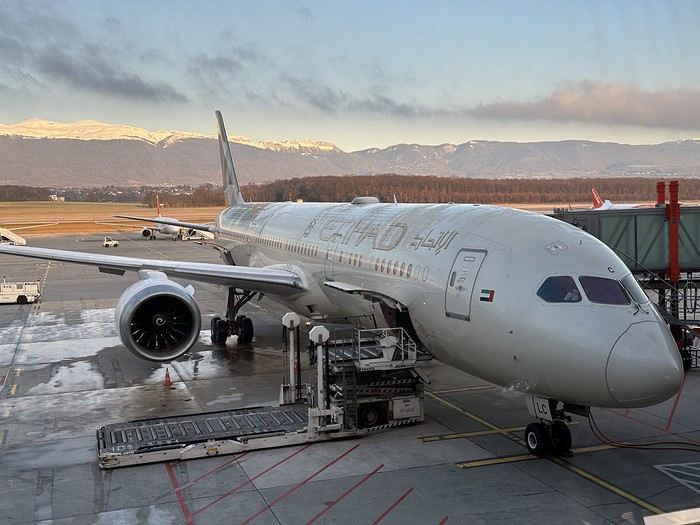
At the start of November, a bit of rest before winter will be perfect to kick off this travel journal. There aren’t many recent journals about this part of the world, so I’ll take the plunge—my way of celebrating the (unexpected) return of this forum, which has been such a big part of my life for over 15 years.
So, back to Asia at the end of 2023. After Myanmar in 2015 and Vietnam in 2018, we’ve chosen Laos this time. And when talking with friends (you know how it is—everyone asks, "So, where are you going this year?"), a couple of friends asked to join us ("You see, my wife dreams of a trip to Asia, and I dream of traveling like you, independently"). We’ve spent a week with them (and other friends) in Portugal, so we know they’re easygoing and flexible. They’ll only be with us after Christmas (due to lots of grandkids), so deal—we’re bringing them along! A new experience for us.
A new experience that’ll start with tweaking the itinerary. Originally, I planned to stay a month in Laos, but what could be more magical for my friend’s wife than discovering Asia by way of Angkor! Plus, our two daughters asked for some beach time at the end of the trip! So, it’ll be Laos and Cambodia—neither of which we’ve visited before, so no complaints there.
The route will be pretty classic, though a bit scattered to fit our dates and wishes. For us, we’ll arrive in Luang Prabang (LP) to take some time to acclimate, then a few days in the northern Laos mountains, Nong Khiaw and Muang Ngoi. Back to LP for a direct flight to Pakse. Yes, I know—so many amazing places we’ll miss along the way, but as you know, choosing means letting go... From Pakse, I’m leaving a few days open (no bookings), but I’m eyeing Champassak and the 4,000 Islands. That’s where Mariel and Naty (our friends!) will join us on December 30th. I’ve tentatively added the Bolaven Plateau loop to the plan (still no bookings). Their Laos adventure will be short—by January 3rd, we’ll cross the border into Cambodia, heading straight to Siem Reap for 5 days. Then, I’ll fulfill my promise with a magical detour to Koh Rong Sanloem via a night bus (a must-do in Asia!). On to Phnom Penh for 2 days—where our trip ends, while Mariel and Naty will stop in Bangkok for 3 days before flying home.
So, fasten your seatbelts, flight attendants at the doors, and sorry for the long intro—here we go on this Asian adventure!
Laos and Cambodia after the floods from January - February 2025
Does it seem feasible and reasonable to travel to Laos (or Cambodia) as early as January or February 2025?
I don’t have any precise information about the damage these countries have suffered.
Weather in central and northern Vietnam in February-March
Hi everyone,
The topic has already been discussed, but it was about ten years ago (I haven’t seen any more recent replies).
We’re planning to visit Vietnam for the first time from February 21 to March 7, 2025, most likely... We were thinking of exploring the central and northern regions. However, we’ve read a lot of conflicting things about the weather in the North, like Hanoi, at this time of year: “it’s quite nice, around 20-22°C” or “it’s cold, bring socks and a sweater.” But we were hoping to escape winter for a couple of months in a warm place... What do you think—those of you who live there or visit regularly?
If it’s better to focus on the Central and Southern regions during these same dates, what shouldn’t we miss?
Thanks in advance to the community!
Best regards,
Bernard
Mon circuit en Issan, qu'en pensez-vous? English translation pending
bonjour
pour cette année 2020 , et plus précisément pour le mois d'octobre ( si tout va mieux dans le monde ) j'ai 16 jours a consacré a la thailande est en particulier l'issan
je sais que l'issan est assez grand est je ne parle pas de la faire en 16 jours. apres avoir parcouru le forum, parcour en issan... je retiens ce circuit
circuit pouvez vous me dire ce que vous en pensez , le modifier, ajouter des etapes....?
merci
je sais que l'issan est assez grand est je ne parle pas de la faire en 16 jours. apres avoir parcouru le forum, parcour en issan... je retiens ce circuit
circuit pouvez vous me dire ce que vous en pensez , le modifier, ajouter des etapes....?
merci
Combiné Thaïlande – Cambodge – Laos durant 2 mois English translation pending
Combiné Thaïlande – Cambodge – Laos durant 2 mois début 2021.
Bonjour, Nous prévoyons un voyage de 2 mois, du 15 janvier au 15 mars 2021, avec un AR Nice - Bangkok. Ce voyage sera un combiné Thaïlande – Cambodge – Laos. Nous comptons commencer par la région de Koh Tao durant 15 jours environ, où nous avons de la famille. Nous avons déjà visité la Thaïlande auparavant et nous ne comptons pas le refaire, sauf, après la région de Koh Tao, Bangkok et ses alentours. Puis de Koh Tao, nous pensons remonter sur Bangkok et immédiatement nous diriger vers la frontière du Cambodge, et visiter le Cambodge, que nous ne connaissons pas. Puis ensuite remonter ensuite sur le Laos, et visiter le Laos, que nous ne connaissons pas. Enfin, peut-être prendre un vol Louang Prabang (ou Vientiane) pour Bangkok vers le 11 mars avant notre retour en France. Nous venons vers vous et ce forum pour nous aider, avec votre expérience, à composer ce voyage. Rien n’est réellement figé. Mais nous avons l’habitude de l’Asie, pour la faire depuis 5 ans en formule sacs à dos et Guesthouses (nous sommes un couple de jeunes retraités assez sportifs). Merci de nous indiquer quel circuit nous pourrions faire, avec des visites variées ; nous aimons bien la nature, les paysages, les gens, et découvrir. Comment partager notre temps entre Cambodge et Laos ? Merci beaucoup d’avance de vos conseils, suggestions, remarques et de tout ce que vous voudrez bien nous dire au sujet de ce voyage. Bien cordialement. Chris et Ève.
Bonjour, Nous prévoyons un voyage de 2 mois, du 15 janvier au 15 mars 2021, avec un AR Nice - Bangkok. Ce voyage sera un combiné Thaïlande – Cambodge – Laos. Nous comptons commencer par la région de Koh Tao durant 15 jours environ, où nous avons de la famille. Nous avons déjà visité la Thaïlande auparavant et nous ne comptons pas le refaire, sauf, après la région de Koh Tao, Bangkok et ses alentours. Puis de Koh Tao, nous pensons remonter sur Bangkok et immédiatement nous diriger vers la frontière du Cambodge, et visiter le Cambodge, que nous ne connaissons pas. Puis ensuite remonter ensuite sur le Laos, et visiter le Laos, que nous ne connaissons pas. Enfin, peut-être prendre un vol Louang Prabang (ou Vientiane) pour Bangkok vers le 11 mars avant notre retour en France. Nous venons vers vous et ce forum pour nous aider, avec votre expérience, à composer ce voyage. Rien n’est réellement figé. Mais nous avons l’habitude de l’Asie, pour la faire depuis 5 ans en formule sacs à dos et Guesthouses (nous sommes un couple de jeunes retraités assez sportifs). Merci de nous indiquer quel circuit nous pourrions faire, avec des visites variées ; nous aimons bien la nature, les paysages, les gens, et découvrir. Comment partager notre temps entre Cambodge et Laos ? Merci beaucoup d’avance de vos conseils, suggestions, remarques et de tout ce que vous voudrez bien nous dire au sujet de ce voyage. Bien cordialement. Chris et Ève.
Quelle destination choisir en novembre au Vietnam English translation pending
Je doit choisir ma destination en Novembre au Vietnam que recommendez vous Hanoi ou Saigon
Intérêt du Vietnam English translation pending
Je vous donne mon avis sincère de voyageur sur le Vietnam sachant que j'ai voyagé là-bas en février et que je ne suis pas allé au nord de Hanoï ni au sud de Nha Trang.
Pour juger un voyage, j'ai l'habitude de séparer l'aspect pratique d'un côté et l'intérêt des sites de l'autre.
Du côté « pratique », le Vietnam obtient un 19/20. Je n'entre pas dans le détail mais il est incroyablement facile et bon marché de voyager dans ce pays. Et avec des standards occidentaux voire meilleurs. Enormément de moyens de transport, hôtels d'excellente qualité et vraiment pas chers...
Entre l'aspect pratique et l'intérêt des sites, je mets la cuisine et le climat. Je ne vais pas écrire des lignes sur la cuisine qui fait tout simplement partie des tops mondiaux. Juste 2 bémols : les prix sont très élevés dans les restaus raffinés par rapport aux prix du pays. Et contrairement à la Chine, on peut tomber sur des restaus où on se moque des touristes. Résultat : un repas perdu alors que chaque repas peut se transformer en souvenir de rêve au Vietnam. Donc attention. Les guides touristiques écrits sont ici très utiles.
On est averti qu'au Vietnam le temps peu être gris. Et selon les sources, on peut reprendre espoir et se dire que finalement cette saison n'a pas l'air si mal. Pour ma part, je n'ai peut-être pas eu de chance mais alors j'en ai eu beaucoup dans les nombreux autres pays où je suis allé. Le ciel est souvent gris. Au nord, ça peut même être une attraction pour curieux de voir cette grisaille prête à vous tomber sur la tête. D'autre part, j'ai rarement vu une telle fraîcheur à une telle lattitude.
Les gens sont très sympas. Certains parlent anglais et il est très intéressant d'échanger avec les vietnamiens mais il faut savoir qu'ils ont un caractère trempé dans l'acier...
Les sites sont d'un intérêt limité. Le pays est surpeuplé et avide de développement. L'aspect traditionnel et religieux est quasi absent notamment par rapport à la Thaïlande. La nature est très très abîmée. Quand vous lisez les guides, vous vous dîtes que vous allez vous régaler à explorer les côtes ou qu'il y a des animaux à voir. C'est le problèmes des guides écrits qui ne comparent pas les pays entre eux. Ils vont utiliser les même adjectifs pour un pays moyen et pour les plus beaux pays. Oui, il y a des pays beaucoup mieux que d'autres ! En fait les côtes vietnamiennes ne sont pas terribles. Selon un guide les îles Cham sont un « époustouflant archipel ». Peut-être que si le Vietnam était le seul pays sur terre ce serait vrai mais il n'en est rien et il y a beaucoup mieux ailleurs. Les grottes de Phong Nha ouvertes au grand public sont d'un intérêt très limité et les autres sont vraiment très très chères d'accès et nécessitent souvent des réservations.
Mon but n'est pas de dénigrer le Vietnam mais d'éclairer les voyageurs car les guides ne le font pas. Je pense que le Vietnam est un pays idéal pour un retraité ou pour vivre quelques mois. Par contre si vous souhaitez découvrir ce qu'il y a de mieux en Asie du sud-est et que vous n'avez que quelques semaines par an, ne commencez pas par le Vietnam.
Pour juger un voyage, j'ai l'habitude de séparer l'aspect pratique d'un côté et l'intérêt des sites de l'autre.
Du côté « pratique », le Vietnam obtient un 19/20. Je n'entre pas dans le détail mais il est incroyablement facile et bon marché de voyager dans ce pays. Et avec des standards occidentaux voire meilleurs. Enormément de moyens de transport, hôtels d'excellente qualité et vraiment pas chers...
Entre l'aspect pratique et l'intérêt des sites, je mets la cuisine et le climat. Je ne vais pas écrire des lignes sur la cuisine qui fait tout simplement partie des tops mondiaux. Juste 2 bémols : les prix sont très élevés dans les restaus raffinés par rapport aux prix du pays. Et contrairement à la Chine, on peut tomber sur des restaus où on se moque des touristes. Résultat : un repas perdu alors que chaque repas peut se transformer en souvenir de rêve au Vietnam. Donc attention. Les guides touristiques écrits sont ici très utiles.
On est averti qu'au Vietnam le temps peu être gris. Et selon les sources, on peut reprendre espoir et se dire que finalement cette saison n'a pas l'air si mal. Pour ma part, je n'ai peut-être pas eu de chance mais alors j'en ai eu beaucoup dans les nombreux autres pays où je suis allé. Le ciel est souvent gris. Au nord, ça peut même être une attraction pour curieux de voir cette grisaille prête à vous tomber sur la tête. D'autre part, j'ai rarement vu une telle fraîcheur à une telle lattitude.
Les gens sont très sympas. Certains parlent anglais et il est très intéressant d'échanger avec les vietnamiens mais il faut savoir qu'ils ont un caractère trempé dans l'acier...
Les sites sont d'un intérêt limité. Le pays est surpeuplé et avide de développement. L'aspect traditionnel et religieux est quasi absent notamment par rapport à la Thaïlande. La nature est très très abîmée. Quand vous lisez les guides, vous vous dîtes que vous allez vous régaler à explorer les côtes ou qu'il y a des animaux à voir. C'est le problèmes des guides écrits qui ne comparent pas les pays entre eux. Ils vont utiliser les même adjectifs pour un pays moyen et pour les plus beaux pays. Oui, il y a des pays beaucoup mieux que d'autres ! En fait les côtes vietnamiennes ne sont pas terribles. Selon un guide les îles Cham sont un « époustouflant archipel ». Peut-être que si le Vietnam était le seul pays sur terre ce serait vrai mais il n'en est rien et il y a beaucoup mieux ailleurs. Les grottes de Phong Nha ouvertes au grand public sont d'un intérêt très limité et les autres sont vraiment très très chères d'accès et nécessitent souvent des réservations.
Mon but n'est pas de dénigrer le Vietnam mais d'éclairer les voyageurs car les guides ne le font pas. Je pense que le Vietnam est un pays idéal pour un retraité ou pour vivre quelques mois. Par contre si vous souhaitez découvrir ce qu'il y a de mieux en Asie du sud-est et que vous n'avez que quelques semaines par an, ne commencez pas par le Vietnam.
Adventures of a Bygone Era: The Philippines in 1984
After several discussions on VF about travel journals from the Philippines, I decided to write this curiosity: a trip report from a journey made in 1984, when traveling to the Philippines was still an adventure.
A curiosity because writing a travel journal about a trip 35 years later isn’t common, but also (mostly?) because exploring the Philippines at that time had little in common with traveling there today.
Obviously, I’ve forgotten a number of facts, most of the details, but with the help of a few notes from that time and a stack of slides (yes, there was life before digital 😊), many memories came back and added to the highlights I’d never forgotten. The scanned slides aren’t always great quality, but there are still quite a few to brighten up this chatter. Back then, we didn’t snap photos like we do now—film was too expensive—so I don’t have pictures of every place we visited... too bad, comparing some of those spots to how they look today would’ve been interesting.
Why "Adventures"? Why call it "Adventures" in the Philippines in 1984, a word so often used for a simple exotic trip? - Because the lack of information (no *Guide du Routard*, no *Lonely Planet*, no *Michelin Guide*, nothing, and obviously no internet) gave this trip what’s at the heart of adventure: the unknown. - Because the political situation made the stay sometimes dangerous. - Because transportation conditions were always epic, often perilous. - Because the question of where we’d spend the night came up almost every evening. - And for... quite a few other reasons.
That said, we weren’t exactly explorers!
Why the Philippines? First of all, why go to the Philippines in 1984—a country not exactly set up for tourism and about which we knew very little? How could we get an idea of the beauty of the Philippines and its points of interest when we had no guides or photos?
The idea came to us from Thailand a year earlier, during our first long-haul trip. After touring the north of the country, we met a Frenchman living in Phuket, where there were only a few tourists in Patong, with just a few small hotels and guesthouses. Kata and Karon had no buildings or roads, Rawai only had three palm-thatched bungalows, including ours, and the other islands were unknown to tourists. There was plenty to discover, and we wanted to return to this beautiful country... but the Frenchman made us dream about the Philippines—a country to explore, with wild landscapes.
Long evenings of discussion over multiple Sprite-Mekong cocktails (what memories of those headaches!) finally convinced us we had to go to the Philippines.
Episode 0: Before Departure The decision was made: we’d go to the Philippines in May 1984. Our friends and family were surprised when we announced we were going on vacation to the Philippines (a bit like saying today we were going paddleboarding in the Kerguelen Islands 🤪).
These days, preparing for each of our trips takes long evenings of research, planning, and noting down good addresses... etc. But for the Philippines in 1984, preparation was quick: we had very little information about the country, we were leaving almost at random, and the discovery would only be more exciting.
We still had a few bits of info gathered here and there: the rice terraces in northern Luzon, volcanoes, Negros where we were supposed to visit an acquaintance, Cebu and its marine life (we ended up going elsewhere), and absolutely avoid Mindanao, which was practically at war with the regime. That was about it, but it was already a great itinerary.
Nothing was organized in advance; we’d see day by day. We had no idea about travel times or even the existence of transportation options. The main (and sometimes only) way to connect two islands was by overloaded, rusty ferry. Only the big cities had airports.
Let’s Go: Episode 1: Paris to Manila My travel journals always start after arriving at the airport—the Europe-to-“Other Continent” trip isn’t interesting—but the flight to the Philippines was already an adventure, so I’ll make an exception.
This was the era when only a few Asian airlines were on par with Western ones: Thai, Singapore Airlines, and Philippine Airlines. They had beautiful, brand-new planes, and to attract customers (almost exclusively “businessmen”) from the usual airlines (Air France, Lufthansa, British Airways), there was opulence on board: unlimited champagne, all sorts of cocktails... Compared to today’s long-haul flights, there was still one small difference: no personal screens, just one screen at the front of the cabin with one mandatory movie. And I don’t know why, but we only got James Bond films, both ways... that must’ve been the trend at the time.
The tourism boom to Southeast Asia hadn’t started yet, and the “Asian Tigers” weren’t a thing, so there weren’t many business trips. That meant long-haul flights made stops everywhere to fill the planes. Our Philippine Airlines Boeing 747 left London, picked us up in Paris, then stopped in Frankfurt to take on a few Germans. I don’t know why we then made a stop in Dubai—a totally exotic place at the time. There was nothing to do there... things have changed a lot since. It was a small town lost in the desert. The airport was tiny, with just one or two buildings and a supermarket. During the stopover, everyone had to get off the plane and walk to the supermarket. Photo and electronic equipment were dirt cheap—I guess that was the only reason for the stop. Maybe it was their first commercial move. Emirates didn’t exist yet, as I checked online, but anyway, the idea that such a remote place could have its own airline was unthinkable.
Online, I found this photo of Dubai Airport in 1980. Anyone who’s transited through today’s massive airport with its rows of A380s will appreciate it: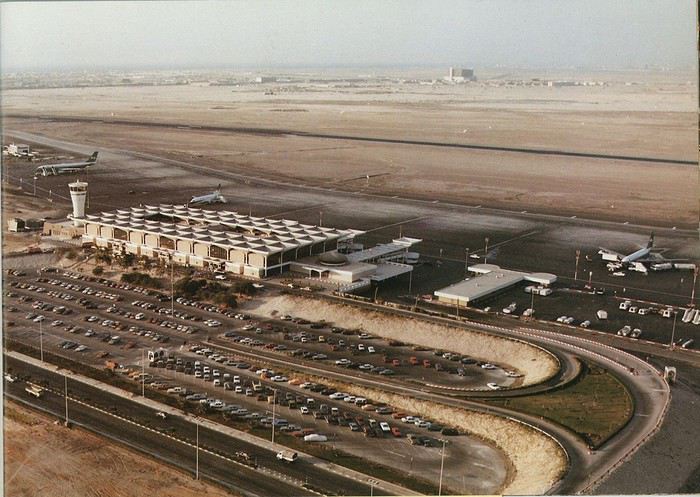
Next stop: New Delhi to drop off some Europeans and pick up a few Indians, and finally, the terminus: Manila. I don’t remember how long the trip took with its five stops—an unimaginable journey today. Despite all those stops to fill the plane, there was still enough space to stretch out on the four center seats of the 747, something that never happens these days despite all the flights in every direction.
So here we are, finally at Manila Airport around midnight.
Episode 1: Manila and Baguio To start, a quick note on the political and economic situation in the Philippines in 1984, which had consequences for us as tourists, as we’d soon realize upon arrival.
After several centuries of Spanish colonization, the Philippines became American at the start of the 20th century, then independent. In 1966, Marcos took power, and little by little, his regime sank into corruption and mismanagement, becoming a dictatorship with martial law, all for the benefit of his family and friends, who enriched themselves endlessly. The peak was the assassination of opposition leader Benigno Aquino in August 1983, which triggered harshly repressed protests. So we arrived a few months later in a very poor country, with omnipresent corruption and an extremely tense political situation, as we’d soon see for ourselves. Major protests took place in the main cities during our trip—I’ll come back to that. Two years later, Marcos fled to Hawaii after being forced out of power following rigged elections. This historical context explains a lot of the situations we found ourselves in over the following weeks.
Arriving in the middle of the night isn’t very cheerful. Manila was already a huge city with many slums, where you could find a few business hotels like the Hilton or Intercontinental—way out of our budget—and plenty of run-down hotels. Luckily, two Indians we’d chatted with on the plane offered to take us to their usual hotel. They came to Manila twice a year for business. We accepted their offer, relieved not to have to look for a place to stay in the middle of the night, figuring the address must be good since they came back every time... we were wrong 🙁
We left the airport and immediately got a taste of the local vibe when we got into the taxi: the police asked for our passports. We thought: what’s more normal than police in a dictatorship?
But that wasn’t it at all. Our two Indian friends explained that the police were noting our names along with the taxi number and time. Crime in Manila was so bad that the taxi driver would be held responsible if anything happened to us... welcome to the Philippines 😎 😎
Historically, the Philippines was a very violent country, where everything was settled with guns or machetes. Previous governments had banned carrying weapons, but Marcos later allowed the free sale and carrying of guns, and disputes were settled with pistols again (or worse, as we’d discover later). Since he’d released most of the criminals from prison to form a paramilitary militia at his service (I’ll talk about our encounter with these “heroes” later), it was pretty dangerous to go into many parts of Manila, where these “tonton macoutes” ruled.
We arrived at our hotel without incident... and then things started badly. The room was infested with big cockroaches—exactly what I hate most in those kinds of countries. No way to find another hotel at that hour. After the long flight, the urge to take a shower was so strong that we squeezed into the bathroom as best we could. After that, I don’t remember—I guess we must’ve fallen asleep exhausted under the sheets in the heat... air conditioning wasn’t widespread yet.
The next day, we just wanted to leave that dump as soon as possible. So we decided to head north right away, stopping in Baguio, and we’d visit Manila a bit on the way back.
When we stepped outside, we discovered a pretty run-down neighborhood with potholed streets. But we also discovered the jeepneys. They were everywhere, flooding the streets.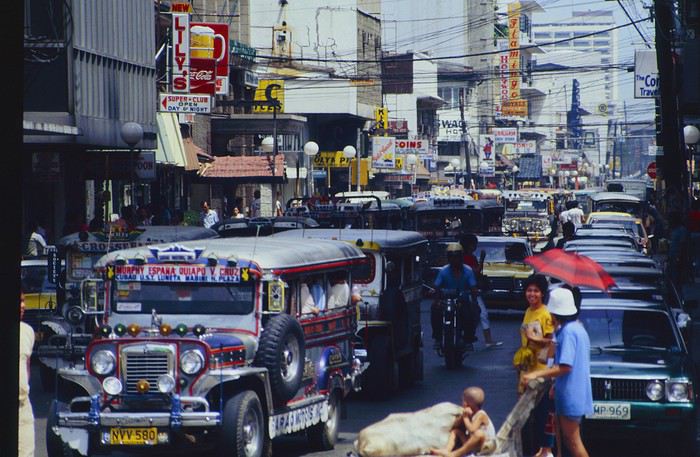
They had crazy sound systems, each one blasting louder than the last. The interiors were kitschy but fun. There weren’t many private cars—almost all transportation was by jeepney, with buses reserved for intercity trips.
Before heading to the bus terminal for the north, somewhere on the outskirts of the city, we needed to exchange some money. I don’t remember how we ended up in a policeman’s jeep who offered his services: - Exchange money on the black market at a better rate than the banks. - Take us wherever we wanted, in this case, the bus terminal.
We accepted both offers (we’d still checked the official exchange rate from dollars to pesos). So we found ourselves in his jeep. After exchanging money, we left in his vehicle and stopped for gas. Without turning off the engine, he calmly smoked a cigarette while filling up. Since we were in a jeep with no doors or roof, we were ready to jump out if things went south, our travel bag in hand.
But we weren’t done with surprises yet. Once we left the small streets, we ended up in a neighborhood with wide avenues and not much traffic, which didn’t justify his incredible behavior. At every intersection, he made the sign of the cross, closed his eyes, and crossed without looking. I was more stunned than terrified! It wasn’t until we got out of the car later that I told Anne-Marie what had happened. I’d seen everything because the cop had put me in the front seat. Luckily, A-Marie hadn’t noticed anything from the back. Crossing Manila by trusting God rather than the rules of the road was ultimately effective. We were lucky—the trip was off to a good start. 🙂 🙂
We then passed through a neighborhood where slums stretched on for a while, and we left our policeman—friendly but a bit crazy—with relief.
A few hours by bus later, here we are in Baguio, cool in the mountains. My memories of Baguio are pretty fuzzy. I remember a small town. After some research while writing this journal, I found that the population was 120,000 in 1980. Given the population density in each home, that confirms my memory of a smallish town. Outside the “official” district with the president’s summer residence and government buildings, there were two or three paved streets with nice houses. The rest was very dirty and very poor, with lots of slums and dirt roads.
People we met on the street invited us to stay with them. These days, we wouldn’t just show up at strangers’ houses, which we should’ve done in Baguio—it would’ve saved us from an unimaginable and dangerous situation... which I won’t say anything about... !😊
The simple wooden house was on stilts at the edge of a hill with a view of the mountains. Since it was the start of the rainy season in a city that gets a lot of rain, we saw a lot of water. Our outings in town happened between downpours.
View from our lodging: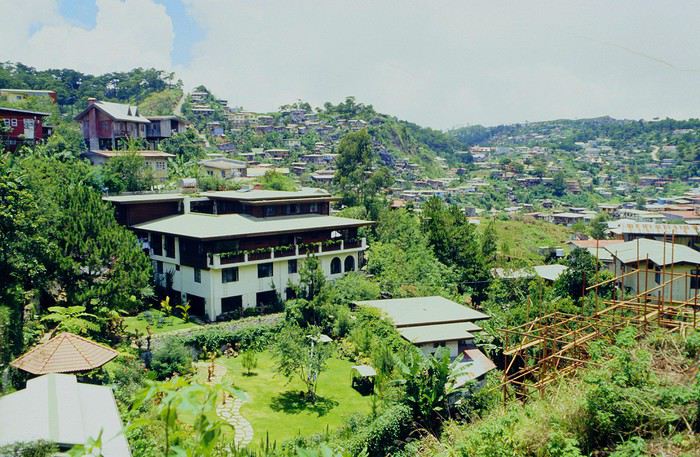
Episode 2: Baguio to Bontoc Aside from the situation briefly mentioned above, it was on the next leg to Bontoc that the adventure really began: an endless and dangerous road, a bus from another era, breathtaking landscapes, and surprising people.
We didn’t know the distance or how long it would take to get to Bontoc. When we arrived after about ten hours, we learned that Baguio to Bontoc was 140 km.
We got on a bus with wooden seats and settled in, two to a seat meant for two. As the bus filled up, passengers squeezed in three or four per seat, with chickens and baskets full of all sorts of things in the aisle. A little embarrassed, we didn’t know if we should squeeze in three on our seat. The seats were super tight (luckily, Filipinos are small), and I didn’t know where to put my legs given my height. I don’t remember if we stayed alone on our bench or if we ended up sharing with others.
The “road” was a dirt track (or rather, a mud track) with endless turns. We held on as best we could to our slippery wooden seats—it was shaking in every direction. The woman behind us was carsick and throwing up... gross... but what were we doing there? Then we plunged into the Sierra Madre... just the name is dreamy!
Rice terraces started to appear: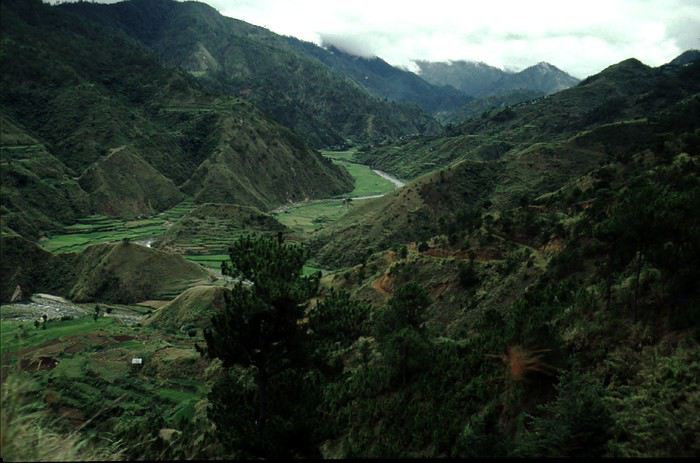
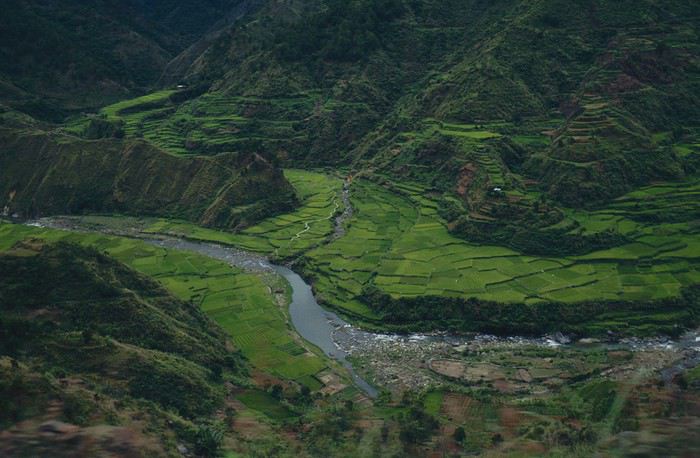
they took up more and more space along cliffs where we weren’t always reassured,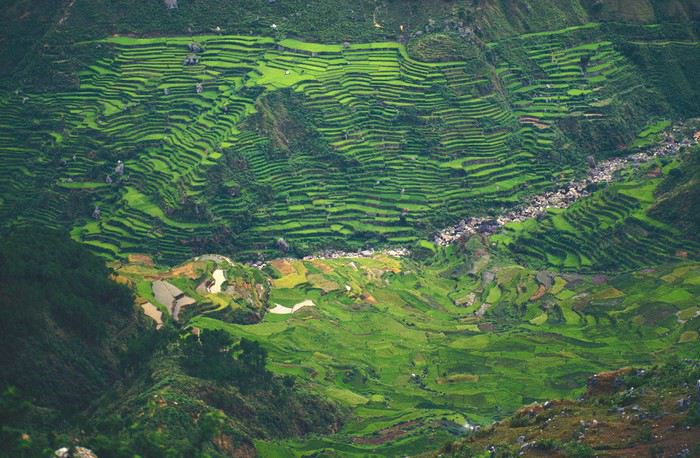
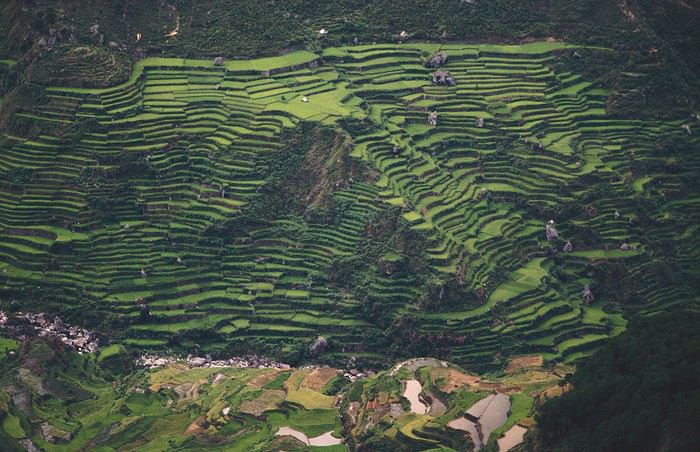
with lots of waterfalls (all that water had to go somewhere).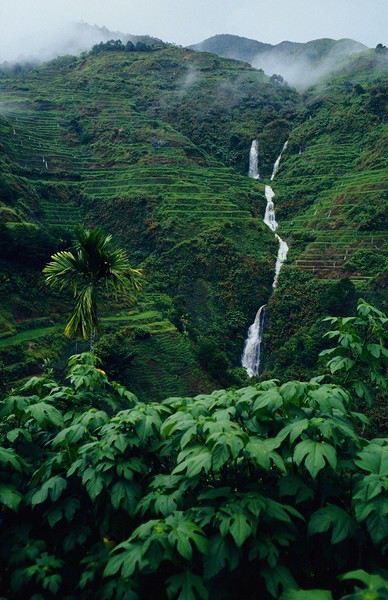
A few miserable villages stretched along the track, most often just a few houses balancing between the road and the drop. The bus stopped in every village—people got on or off and settled inside or on the roof. Street vendors offered their products to the bus passengers—a common sight in Asia, even today.
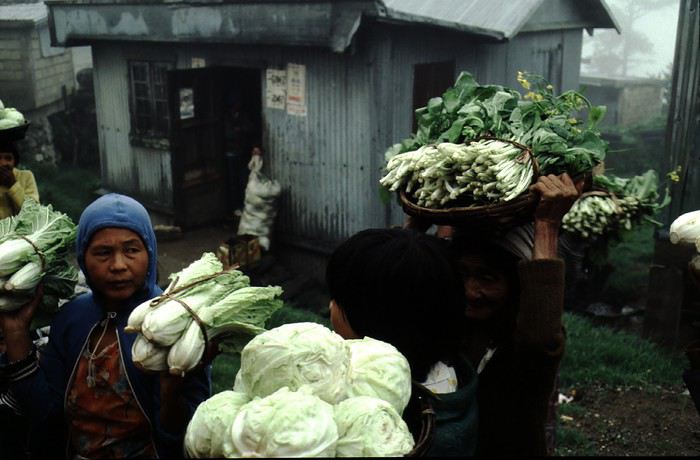
We were in another world—villagers were in loincloths, others had spears. The atmosphere was strange... but all good, we wanted exoticism, and we got it:
This so-called traditional outfit was everyday wear—it wasn’t for tourists since there weren’t any.
A curiosity because writing a travel journal about a trip 35 years later isn’t common, but also (mostly?) because exploring the Philippines at that time had little in common with traveling there today.
Obviously, I’ve forgotten a number of facts, most of the details, but with the help of a few notes from that time and a stack of slides (yes, there was life before digital 😊), many memories came back and added to the highlights I’d never forgotten. The scanned slides aren’t always great quality, but there are still quite a few to brighten up this chatter. Back then, we didn’t snap photos like we do now—film was too expensive—so I don’t have pictures of every place we visited... too bad, comparing some of those spots to how they look today would’ve been interesting.
Why "Adventures"? Why call it "Adventures" in the Philippines in 1984, a word so often used for a simple exotic trip? - Because the lack of information (no *Guide du Routard*, no *Lonely Planet*, no *Michelin Guide*, nothing, and obviously no internet) gave this trip what’s at the heart of adventure: the unknown. - Because the political situation made the stay sometimes dangerous. - Because transportation conditions were always epic, often perilous. - Because the question of where we’d spend the night came up almost every evening. - And for... quite a few other reasons.
That said, we weren’t exactly explorers!
Why the Philippines? First of all, why go to the Philippines in 1984—a country not exactly set up for tourism and about which we knew very little? How could we get an idea of the beauty of the Philippines and its points of interest when we had no guides or photos?
The idea came to us from Thailand a year earlier, during our first long-haul trip. After touring the north of the country, we met a Frenchman living in Phuket, where there were only a few tourists in Patong, with just a few small hotels and guesthouses. Kata and Karon had no buildings or roads, Rawai only had three palm-thatched bungalows, including ours, and the other islands were unknown to tourists. There was plenty to discover, and we wanted to return to this beautiful country... but the Frenchman made us dream about the Philippines—a country to explore, with wild landscapes.
Long evenings of discussion over multiple Sprite-Mekong cocktails (what memories of those headaches!) finally convinced us we had to go to the Philippines.
Episode 0: Before Departure The decision was made: we’d go to the Philippines in May 1984. Our friends and family were surprised when we announced we were going on vacation to the Philippines (a bit like saying today we were going paddleboarding in the Kerguelen Islands 🤪).
These days, preparing for each of our trips takes long evenings of research, planning, and noting down good addresses... etc. But for the Philippines in 1984, preparation was quick: we had very little information about the country, we were leaving almost at random, and the discovery would only be more exciting.
We still had a few bits of info gathered here and there: the rice terraces in northern Luzon, volcanoes, Negros where we were supposed to visit an acquaintance, Cebu and its marine life (we ended up going elsewhere), and absolutely avoid Mindanao, which was practically at war with the regime. That was about it, but it was already a great itinerary.
Nothing was organized in advance; we’d see day by day. We had no idea about travel times or even the existence of transportation options. The main (and sometimes only) way to connect two islands was by overloaded, rusty ferry. Only the big cities had airports.
Let’s Go: Episode 1: Paris to Manila My travel journals always start after arriving at the airport—the Europe-to-“Other Continent” trip isn’t interesting—but the flight to the Philippines was already an adventure, so I’ll make an exception.
This was the era when only a few Asian airlines were on par with Western ones: Thai, Singapore Airlines, and Philippine Airlines. They had beautiful, brand-new planes, and to attract customers (almost exclusively “businessmen”) from the usual airlines (Air France, Lufthansa, British Airways), there was opulence on board: unlimited champagne, all sorts of cocktails... Compared to today’s long-haul flights, there was still one small difference: no personal screens, just one screen at the front of the cabin with one mandatory movie. And I don’t know why, but we only got James Bond films, both ways... that must’ve been the trend at the time.
The tourism boom to Southeast Asia hadn’t started yet, and the “Asian Tigers” weren’t a thing, so there weren’t many business trips. That meant long-haul flights made stops everywhere to fill the planes. Our Philippine Airlines Boeing 747 left London, picked us up in Paris, then stopped in Frankfurt to take on a few Germans. I don’t know why we then made a stop in Dubai—a totally exotic place at the time. There was nothing to do there... things have changed a lot since. It was a small town lost in the desert. The airport was tiny, with just one or two buildings and a supermarket. During the stopover, everyone had to get off the plane and walk to the supermarket. Photo and electronic equipment were dirt cheap—I guess that was the only reason for the stop. Maybe it was their first commercial move. Emirates didn’t exist yet, as I checked online, but anyway, the idea that such a remote place could have its own airline was unthinkable.
Online, I found this photo of Dubai Airport in 1980. Anyone who’s transited through today’s massive airport with its rows of A380s will appreciate it:
Next stop: New Delhi to drop off some Europeans and pick up a few Indians, and finally, the terminus: Manila. I don’t remember how long the trip took with its five stops—an unimaginable journey today. Despite all those stops to fill the plane, there was still enough space to stretch out on the four center seats of the 747, something that never happens these days despite all the flights in every direction.
So here we are, finally at Manila Airport around midnight.
Episode 1: Manila and Baguio To start, a quick note on the political and economic situation in the Philippines in 1984, which had consequences for us as tourists, as we’d soon realize upon arrival.
After several centuries of Spanish colonization, the Philippines became American at the start of the 20th century, then independent. In 1966, Marcos took power, and little by little, his regime sank into corruption and mismanagement, becoming a dictatorship with martial law, all for the benefit of his family and friends, who enriched themselves endlessly. The peak was the assassination of opposition leader Benigno Aquino in August 1983, which triggered harshly repressed protests. So we arrived a few months later in a very poor country, with omnipresent corruption and an extremely tense political situation, as we’d soon see for ourselves. Major protests took place in the main cities during our trip—I’ll come back to that. Two years later, Marcos fled to Hawaii after being forced out of power following rigged elections. This historical context explains a lot of the situations we found ourselves in over the following weeks.
Arriving in the middle of the night isn’t very cheerful. Manila was already a huge city with many slums, where you could find a few business hotels like the Hilton or Intercontinental—way out of our budget—and plenty of run-down hotels. Luckily, two Indians we’d chatted with on the plane offered to take us to their usual hotel. They came to Manila twice a year for business. We accepted their offer, relieved not to have to look for a place to stay in the middle of the night, figuring the address must be good since they came back every time... we were wrong 🙁
We left the airport and immediately got a taste of the local vibe when we got into the taxi: the police asked for our passports. We thought: what’s more normal than police in a dictatorship?
But that wasn’t it at all. Our two Indian friends explained that the police were noting our names along with the taxi number and time. Crime in Manila was so bad that the taxi driver would be held responsible if anything happened to us... welcome to the Philippines 😎 😎
Historically, the Philippines was a very violent country, where everything was settled with guns or machetes. Previous governments had banned carrying weapons, but Marcos later allowed the free sale and carrying of guns, and disputes were settled with pistols again (or worse, as we’d discover later). Since he’d released most of the criminals from prison to form a paramilitary militia at his service (I’ll talk about our encounter with these “heroes” later), it was pretty dangerous to go into many parts of Manila, where these “tonton macoutes” ruled.
We arrived at our hotel without incident... and then things started badly. The room was infested with big cockroaches—exactly what I hate most in those kinds of countries. No way to find another hotel at that hour. After the long flight, the urge to take a shower was so strong that we squeezed into the bathroom as best we could. After that, I don’t remember—I guess we must’ve fallen asleep exhausted under the sheets in the heat... air conditioning wasn’t widespread yet.
The next day, we just wanted to leave that dump as soon as possible. So we decided to head north right away, stopping in Baguio, and we’d visit Manila a bit on the way back.
When we stepped outside, we discovered a pretty run-down neighborhood with potholed streets. But we also discovered the jeepneys. They were everywhere, flooding the streets.
They had crazy sound systems, each one blasting louder than the last. The interiors were kitschy but fun. There weren’t many private cars—almost all transportation was by jeepney, with buses reserved for intercity trips.
Before heading to the bus terminal for the north, somewhere on the outskirts of the city, we needed to exchange some money. I don’t remember how we ended up in a policeman’s jeep who offered his services: - Exchange money on the black market at a better rate than the banks. - Take us wherever we wanted, in this case, the bus terminal.
We accepted both offers (we’d still checked the official exchange rate from dollars to pesos). So we found ourselves in his jeep. After exchanging money, we left in his vehicle and stopped for gas. Without turning off the engine, he calmly smoked a cigarette while filling up. Since we were in a jeep with no doors or roof, we were ready to jump out if things went south, our travel bag in hand.
But we weren’t done with surprises yet. Once we left the small streets, we ended up in a neighborhood with wide avenues and not much traffic, which didn’t justify his incredible behavior. At every intersection, he made the sign of the cross, closed his eyes, and crossed without looking. I was more stunned than terrified! It wasn’t until we got out of the car later that I told Anne-Marie what had happened. I’d seen everything because the cop had put me in the front seat. Luckily, A-Marie hadn’t noticed anything from the back. Crossing Manila by trusting God rather than the rules of the road was ultimately effective. We were lucky—the trip was off to a good start. 🙂 🙂
We then passed through a neighborhood where slums stretched on for a while, and we left our policeman—friendly but a bit crazy—with relief.
A few hours by bus later, here we are in Baguio, cool in the mountains. My memories of Baguio are pretty fuzzy. I remember a small town. After some research while writing this journal, I found that the population was 120,000 in 1980. Given the population density in each home, that confirms my memory of a smallish town. Outside the “official” district with the president’s summer residence and government buildings, there were two or three paved streets with nice houses. The rest was very dirty and very poor, with lots of slums and dirt roads.
People we met on the street invited us to stay with them. These days, we wouldn’t just show up at strangers’ houses, which we should’ve done in Baguio—it would’ve saved us from an unimaginable and dangerous situation... which I won’t say anything about... !😊
The simple wooden house was on stilts at the edge of a hill with a view of the mountains. Since it was the start of the rainy season in a city that gets a lot of rain, we saw a lot of water. Our outings in town happened between downpours.
View from our lodging:
Episode 2: Baguio to Bontoc Aside from the situation briefly mentioned above, it was on the next leg to Bontoc that the adventure really began: an endless and dangerous road, a bus from another era, breathtaking landscapes, and surprising people.
We didn’t know the distance or how long it would take to get to Bontoc. When we arrived after about ten hours, we learned that Baguio to Bontoc was 140 km.
We got on a bus with wooden seats and settled in, two to a seat meant for two. As the bus filled up, passengers squeezed in three or four per seat, with chickens and baskets full of all sorts of things in the aisle. A little embarrassed, we didn’t know if we should squeeze in three on our seat. The seats were super tight (luckily, Filipinos are small), and I didn’t know where to put my legs given my height. I don’t remember if we stayed alone on our bench or if we ended up sharing with others.
The “road” was a dirt track (or rather, a mud track) with endless turns. We held on as best we could to our slippery wooden seats—it was shaking in every direction. The woman behind us was carsick and throwing up... gross... but what were we doing there? Then we plunged into the Sierra Madre... just the name is dreamy!
Rice terraces started to appear:
they took up more and more space along cliffs where we weren’t always reassured,
with lots of waterfalls (all that water had to go somewhere).
A few miserable villages stretched along the track, most often just a few houses balancing between the road and the drop. The bus stopped in every village—people got on or off and settled inside or on the roof. Street vendors offered their products to the bus passengers—a common sight in Asia, even today.
We were in another world—villagers were in loincloths, others had spears. The atmosphere was strange... but all good, we wanted exoticism, and we got it:
This so-called traditional outfit was everyday wear—it wasn’t for tourists since there weren’t any.
Concours photo du mois d'avril 2020: "En famille" English translation pending
Le monde traverse une crise éprouvante pour chacun, je vous propose donc un thème universel et optimiste: la famille.
Si une multitude de définitions peuvent s'appliquer au thème, je souhaite cependant que vous nous montriez des enfants et leurs parents (au moins un enfant, un parent). Plusieurs génération doivent-être représentées (minimum deux, vous l'aurez compris).
Ces photos peuvent être des plans larges ou serrés, prises lors de promenades, de scènes de la vie quotidienne, de voyages...
Quelques exemples:
A Bali
En Roumanie
Au Cambodge
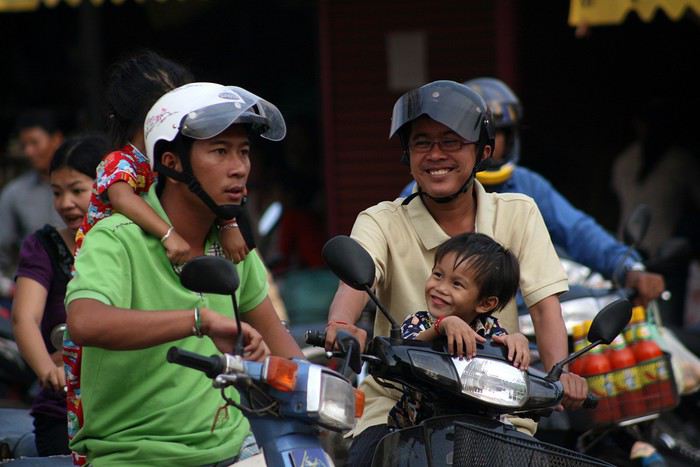
Au Maroc
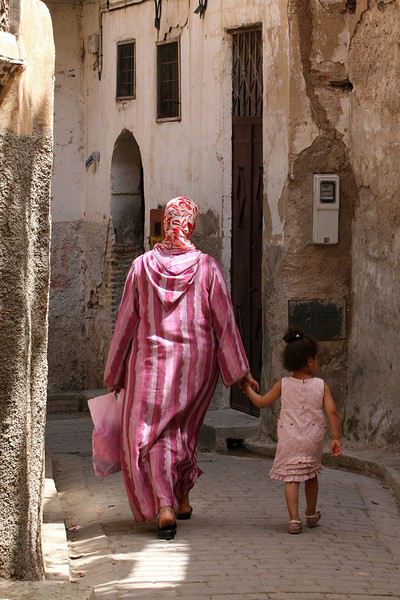
A Hong Kong
Evidemment, il ne vous sera pas demandé d'attestation sur l'honneur sur la véracité des relations familiales qui unissent les différents sujets de la photo 😉. Cette relation doit être supposée, suggérée.
Chaque participant peut proposer jusqu'à 3 photos, et ce jusqu'au mercredi 22/04 à 20h00, heure de Paris. Chaque photo sera présentée dans un seul message, en indiquant son numéro (1, 2 ou 3). Pensez à ajouter une petite explication, commentaire ou localisation.
Chaque membre VF peut voter pour les 3 photos qu'il ou elle juge les meilleures selon ses propres critères et en tenant compte du thème. Les votes se feront du jeudi 23/04 au mercredi 29/04 à 20h00, heure de Paris. Les photos choisies seront citées dans l'ordre de préférence : - la 1ère photo : 3 points - la 2ème: 2 points - la 3ème: 1 point
Un seul et unique vote pour 3 photos est accepté par membre.
Le vainqueur est l'auteur de la photo ayant reçu le plus de points. Les résultats seront publiés le 30/04. En cas d'égalité, le nombre de premières places prévaudra. Le vainqueur aura l'honneur d'organiser le concours du mois de mai. Le diaporama est ici. La discussion est là.
Une pensée à tous dans ces moments troubles et prenez soin de votre famille 🙂 C'est parti ! 🙂
Quelques exemples:
A Bali
En Roumanie
Au Cambodge
Au Maroc
A Hong Kong
Evidemment, il ne vous sera pas demandé d'attestation sur l'honneur sur la véracité des relations familiales qui unissent les différents sujets de la photo 😉. Cette relation doit être supposée, suggérée.
Chaque participant peut proposer jusqu'à 3 photos, et ce jusqu'au mercredi 22/04 à 20h00, heure de Paris. Chaque photo sera présentée dans un seul message, en indiquant son numéro (1, 2 ou 3). Pensez à ajouter une petite explication, commentaire ou localisation.
Chaque membre VF peut voter pour les 3 photos qu'il ou elle juge les meilleures selon ses propres critères et en tenant compte du thème. Les votes se feront du jeudi 23/04 au mercredi 29/04 à 20h00, heure de Paris. Les photos choisies seront citées dans l'ordre de préférence : - la 1ère photo : 3 points - la 2ème: 2 points - la 3ème: 1 point
Un seul et unique vote pour 3 photos est accepté par membre.
Le vainqueur est l'auteur de la photo ayant reçu le plus de points. Les résultats seront publiés le 30/04. En cas d'égalité, le nombre de premières places prévaudra. Le vainqueur aura l'honneur d'organiser le concours du mois de mai. Le diaporama est ici. La discussion est là.
Une pensée à tous dans ces moments troubles et prenez soin de votre famille 🙂 C'est parti ! 🙂
Compte rendu de quatre semaines en janvier 2020 en Isan et plages English translation pending
Bonjour à tous
Voila un petit CR d'un voyage à 2, au mois de janvier 2020 durant 4 semaines, entre l'ISAN et les plages. Je vous avais déjà envoyé la 1ère partie qui a été publiée, mais VF semble ne plus vouloir de CR en plusieurs parties, donc j'ai rajouté la 2em partie, qui correspond aux plages à partir de Phuket...
Voilà mon itinéraire :
Paris/Bangkok/ LoeÏ/ Chiang Kan/ Nong Kaï/ Bueng Kan / Udon Thani/ Phuket / Ko Lanta/ Klong Muang ( près de AO Nang)/ Bangkok
Départ avec Thai Airways à 600€ le vol ( acheté en juin 2019). Arrivé le matin et changement d'aéroport pour prendre un avion avec NokAir pour Loeï. Arrivés à Loeï nous prenons un taxi ( 500 bats) pour pour 1h de route pour rejoindre :
Chiang Kan, il est 18 H.... et enchainer tout d'un coup depuis Paris a été assez éprouvant. Nous avions réservé 2 nuits au Baan Suan La Moon, qui est assez loin du fleuve, mais ce sont des petits bungalows très sympas et au calme. Le proprio met à disposition des vélos, ce qui est très pratique. Le petit déj n'est pas inclus, mais il y a tout ce qu'il faut pour se faire son peti déj et manger sur sa terrasse. Endroit très cool. 46 € pour 2 nuits La ville de CK est très sympa mais le WE c'est la foule dans la rue principale. Très peu de touristes occidentaux. La ville est assez touristique car pas mal de boutiques de souvenirs ou autres mais ce ne sont que des touristes thaïs. Nous avons cherché un hotel face au Mékong pour 3 autres nuits et avons trouvé un logement avec rapport qualité/ prix assez correct juste en face le grand temple. Mais je ne vous donnerai pas le nom car tout est écrit en thaï.... 33 la nuit. Les hôtels sont assez chers sur CK. Le lundi la rue se vide et certains magasins ne rouvrent que le we suivant.... Les balades aux alentours sont très sympas à vélo ou en scooter et la campagne environnante est très agréable, reposante et paisible. Les offrandes aux moines dans la ville à 6h du mat' est très intéressante. A noter que tout est écrit en thaï, très très peu de gens parlent anglais et les quelque menus traduits en anglais ne correspondent pas complémentent à la traduction..... Le départ de CK pour Nong Kai et plus compliqué car il n'y a pas de bus directs pour Nong Kai ( 150 à 200 Kms), sinon il faut passer par Loeï, Udon Thani pour rejoindre Nong Kai avec 2 changements et ça prend la journée s'il n'y a pas de ratage pour les correspondances.... Pas de Mini Van non plus. On doit donc se résoudre à prendre un taxi (75€) pour rejoindre
Nong Kaï : Nous logeons 3 nuits à Mut Mee Guest House. Nous prenons la chambre qui s'appelle Arun qui est une très belle chambre avec terrasse balcon, donnant sur le Mékong. Elle est un peu chère( 45€) mais petit déj et apéro sur la terrasse, c'est sympa... Nous avion déjà logé dans cette GH, il y a quelques années, en revenant du Laos, et avions pris la piaule du bas, face au Mékong ( Dharuni) qui est aussi très sympa(30€). L'accueil n'est pas exceptionnel, beaucoup de touristes et quelques baba-cool mais l'ambiance est correcte. La ville est paisible, bien qu'en quelques années, il y a eu beaucoup d’aménagements le long du fleuve et NK devient de plus en plus touristique. Mais ça reste très supportable. De nombreuses balades à faire aux alentours. Facilité pour louer des vélos ou scooters.
Nous rejoignons sans difficulté Bueng Kan en mini van par une route sympa. Bueng Kan: Nous logeons à The Wisdom résidence, un hotel très propre, clair, assez calme malgré une 4 voies à proximité.... ( 3 nuits pour 48€....) On regrette un peu d'avoir réservé cet hotel car il est un peu loin de tout, la ville est à minimum 15 minutes à pied et le bord de fleuve est à 20 bonnes minutes. Mais de plus, il n'y a aucun loueur de vélo ou scooter. Donc tout se fait à pied, mais surtout sur des routes pas très agréables. Le quartier du marché est sympa en début de journée et surtout en fin d'après midi où ça grouille de partout et une ambiance très conviviale. Mais le reste du temps la ville sommeille, et est même déserte le dimanche. Notre but à partir de NK est d'aller au Phu Tok(environ 50 Kms), cet immense rocher que l'on peut gravir sur des passerelles construites par des moines... La recherche d'un taxi pour rejoindre Phu Tok est assez épique et stressante , car là encore personne ne parle anglais et même avec Google traduction, la communication est difficile. Nous réussissons à trouver une seule personne, qui conduisait son tuk tuk et qui avait aussi sa voiture perso... ( 24€ pour l'aller retour et l'attente sur place, environ 2h). La montée de ce rocher est assez exceptionnel et impressionnant. C'est magnifique, et l'on se sent de plus en plus seul au monde au fur et à mesure que l'on monte. Il faut y aller tôt( vers 8h ) pour profiter de cette quiétude, car après il y a plus de monde et les passerelles sont... étroites. A mon sens, cette montée ne demande pas d'être en excellente condition physique ( comme j''ai pu le lire). Il suffit d'être en bonne santé. Le début est peut être le plus abrupte avec ces grandes marches d'escalier, mais après , c'est plus le vertige qu'il faut gérer, surtout après le 5 em étage.... La vue est grandiose.
Nous rejoignons Udon Thani en bus où nous logeons au One résidence( 34€ pour 2 nuits..). chambre propre, assez grande et hotel bien placé par rapport au centre ville, à environ 10 à 15 minutes du marché mais par des rues très animées. Udon Thani est une grande ville avec ses encombrements, son bruit et sa pollution... Nous voulons aller le lendemain au lac aux lotus roses situé à environs 30 à 40 kms. Des amis nous avaient conseillé d'arriver directement en voiture au sud du lac car, ainsi, les bateaux arrivent au milieu de lotus roses beaucoup plus rapidement. Sinon l'embarcadère principale où tous les taxis vont, est au nord du lac et après il y a environ 20 minutes de bateau pour arriver aux lotus. Après beaucoup de recherches auprès des taxis ou autres, aucun ne veut nous emmener au sud du lac ou à des tarifs prohibitifs... Nous avons eu beaucoup de chance de dialoguer sur un réseau social avec Marco, un français qui habite la région, et qui nous a proposé son aide pour rejoindre ce fameux lac. Dés le départ du bateau, la magie opère et le lieu devient irréel..., on est en quelques instants entouré de milliers de lotus roses , les oiseaux se posent et s'envolent, le calme et la sérénité sont là, la lumière sur le lac évolue au fil des minutes... le moment est magique.... Il faut arriver tôt sur ce lac ( vers 7H 30 ) pour être presque seul et surtout qu'après 10 ou 11h les fleurs se referment. Le bateau à cet embarcadère est de 15€ pour 1h 30 à 2h de balade avec une halte sur l'ile aux moines avec une ambiance assez particulière. D'Udon Thani, nous rejoignons Phuketen avion car il n'y pas de vol direct pour Krabi( qui était notre destination première) et là l'ambiance change radicalement:
Phuket: Arrivés à l'aéroport de Phuket à 20h, nous réussissons in extrémis à prendre le dernier Smart Bus(10€ pour 2) pour rejoindre la plage de Kamala( qui est quand même à 1H de route)dont j'avais lu qu'elle était familiale et tranquille. Nous logeons au Mood Mansion pour 74 € pour 3 nuits. Ce qui est un prix très correct pour Kamala. La chambre est au 4em étage, très bien , grande, claire , propre, avec une petite cuisine séparée. La GH est située à 15 minutes de la plage, ce qui n'est pas loin, mais séparée par une immense 4 voies avec feux rouges et circulation incessante. . Mai une fois cette route traversée, c'est plus cool, enfin si on peut dire, car Kamala beach et rempli de russes et chinois avec toute l'ambiance qui va avec...... La plage est jolie mais beaucoup d'endroits sont une succession de transat sur 10 rangées.... Nous réussissons à trouver quand même quelques petits restaus le long de la plage. Nous louons un scooter pour aller visiter la ville de Phuket qui vaut son coup d'oeil par son architecture et ses petits quartiers. Nous réservons un package mini-van et bateau pour rejoindre Ko Lanta(30€ pour 2). Le 1er bateau ayant eu du retard pour rejoindre Ko phi phi, le transfert de bateau à Ko Phiphi se fait en express et on a l'impression d'être un peu du bétail transporté... . Ko Lanta: on rejoint en 45 minutes la plage de Klong Nin située environ au milieu de l'ile. Nous logeons au Lanta Février Resort pour 32€ la nuit. La chambre est petite mais claire avec balcon donnant sur une piscine. L'hotel est situé de l'autre coté d'une petite route par rapport à la plage. Cette plage est assez grande et bordée de plusieurs GH, restaurants avec une ambiance assez cool. On a fait le bon choix. Nous n'avions réservé qu'une nuit sur cette plage afin de pouvoir choisir une Gh sympa par la suite, mais c'était sans compter sur la période du nouvel an chinois, et du coup tous les logements sont complets ainsi que le notre... le lendemain nous réussissons à trouver une chambre pour 3 nuits à 36 € la nuit, au Nature Beach Resort, chambre de 3, grande, propre avec terrasse et au calme car bien retirée de la route. La plage est sympa, pas surpeuplée, mais pas de cocotiers ou autres donc peu d'ombre durant la journée. Très beaux couchers de soleil. Et le soir on a le choix de restaus les pieds dans le sable... Nous louons un scooter pour explorer l'ile et les plages du sud sont très belles mais assez isolées. Tout dépend de ce que l'on cherche. Lanta Town est sympa par ses restaurants sur pilotis et son ambiance village. Nous rejoignons Ao Nang par la formule mini-van d'hotel à hotel, car la formule bateau, nous semble plus longue et plus cher. Heureusement que nous n'avons pas logé à Ao Nang beach car c'est devenu une grande station balnéaire le long d'une plage au bord de la route avec beaucoup de circulation. Les restaus et boutiques se touchent le long de la « promenade ». On nous avait conseillé de loger à Klong Muang beach qui est à environ 10 à 15 kms de Ao Nang.
Klong Muang Beach: Nous avons logé au Klong Muang Sunset House, (83€ pour 3 nuits) GH tenu par un russe. Un peu bourru mais sympa. La chambre est petite, propre avec petit balcon, avec vue sur la mer... mais il n'était pas précisé que la mer se voyait à travers les fils électriques et surtout que cette chambre donnait sur une rue très fréquentée par des voitures et camions... donc difficile de rester sur le balcon.... Par contre, le plus est que, la plage en contrebas est à 100 mètres. Une belle petite plage très sympa avec des petits restaus et assez éloignée de la route, donc au calme. Nous avons loué un scooter à l'hotel pour 2 jours afin de faire des balades aux alentours et en autres aller à Railey à partir d'AO Nang. De Klong Muang, les longthais pour Railey demandent 60€ pour un A/R.... car on est obligé de privatiser un bateau. Du coup, nous sommes allés très tôt le matin à AoNang en scooter( 15 mn) et avons pris dés 8h un longthai pour 6€ pour 2 et la même chose pour le retour. Il faut venir le plus tôt possible sur Railey si l'on veut profiter de la quiétude et la beauté de cette plage car dès 10 h c'est fini et il y a le bruit incessant des longthais qui partent ou arrivent. De Krabi, nous rejoignons Bangkok par avion. Bangkok: nous logeons au New Siam River Side, tout près de Soï Rambuttri, notre petit plaisir de fin de voyage pour 42 €, mais avec promo sur Agoda ou Hotel.com( pris quelques mois avant), car sinon c'est environ 60€ à 70€. Chambre pas très grande mais très propre et claire. Le petit déj( buffet), compris dans le prix, est très copieux et c'est un moment très agréable, car on le prend au bord du fleuve Chaopraya. Nous n'avons pas trop visité Bangkok que nous connaissons déjà pas mal lors de nos précédents séjours, nous sommes quand même allés au Wat Saket qui vaut le coup d'oeil. On nous avait beaucoup vanté le site Grab pour nos déplacements dans Bangkok mais plusieurs expériences ont été compliquées car 3 fois le chauffeur grab ne réussissait pas à nous géolocaliser en pleine journée et en plein centre de Bangkok, et après plusieurs échanges de sms, il demandait d’annuler la course, et du coup on avait une amende de la part de Grab à chaque fois qui était reportée sur notre prochain trajet. De plus et surtout, suite à ces situations, on s'est rendu compte que pour exactement le même trajet, un taxi mettant le taxi-meter, était bien moins cher que la course avec Grab Il en a été de même le soir. Bon, voilà mes impressions, mon ressenti, mes adresses, bonnes ou moins bonnes, et si vous avez besoin de plus de précisions sur certains points, VF est là !!! Bonne préparation Guy
Voila un petit CR d'un voyage à 2, au mois de janvier 2020 durant 4 semaines, entre l'ISAN et les plages. Je vous avais déjà envoyé la 1ère partie qui a été publiée, mais VF semble ne plus vouloir de CR en plusieurs parties, donc j'ai rajouté la 2em partie, qui correspond aux plages à partir de Phuket...
Voilà mon itinéraire :
Paris/Bangkok/ LoeÏ/ Chiang Kan/ Nong Kaï/ Bueng Kan / Udon Thani/ Phuket / Ko Lanta/ Klong Muang ( près de AO Nang)/ Bangkok
Départ avec Thai Airways à 600€ le vol ( acheté en juin 2019). Arrivé le matin et changement d'aéroport pour prendre un avion avec NokAir pour Loeï. Arrivés à Loeï nous prenons un taxi ( 500 bats) pour pour 1h de route pour rejoindre :
Chiang Kan, il est 18 H.... et enchainer tout d'un coup depuis Paris a été assez éprouvant. Nous avions réservé 2 nuits au Baan Suan La Moon, qui est assez loin du fleuve, mais ce sont des petits bungalows très sympas et au calme. Le proprio met à disposition des vélos, ce qui est très pratique. Le petit déj n'est pas inclus, mais il y a tout ce qu'il faut pour se faire son peti déj et manger sur sa terrasse. Endroit très cool. 46 € pour 2 nuits La ville de CK est très sympa mais le WE c'est la foule dans la rue principale. Très peu de touristes occidentaux. La ville est assez touristique car pas mal de boutiques de souvenirs ou autres mais ce ne sont que des touristes thaïs. Nous avons cherché un hotel face au Mékong pour 3 autres nuits et avons trouvé un logement avec rapport qualité/ prix assez correct juste en face le grand temple. Mais je ne vous donnerai pas le nom car tout est écrit en thaï.... 33 la nuit. Les hôtels sont assez chers sur CK. Le lundi la rue se vide et certains magasins ne rouvrent que le we suivant.... Les balades aux alentours sont très sympas à vélo ou en scooter et la campagne environnante est très agréable, reposante et paisible. Les offrandes aux moines dans la ville à 6h du mat' est très intéressante. A noter que tout est écrit en thaï, très très peu de gens parlent anglais et les quelque menus traduits en anglais ne correspondent pas complémentent à la traduction..... Le départ de CK pour Nong Kai et plus compliqué car il n'y a pas de bus directs pour Nong Kai ( 150 à 200 Kms), sinon il faut passer par Loeï, Udon Thani pour rejoindre Nong Kai avec 2 changements et ça prend la journée s'il n'y a pas de ratage pour les correspondances.... Pas de Mini Van non plus. On doit donc se résoudre à prendre un taxi (75€) pour rejoindre
Nong Kaï : Nous logeons 3 nuits à Mut Mee Guest House. Nous prenons la chambre qui s'appelle Arun qui est une très belle chambre avec terrasse balcon, donnant sur le Mékong. Elle est un peu chère( 45€) mais petit déj et apéro sur la terrasse, c'est sympa... Nous avion déjà logé dans cette GH, il y a quelques années, en revenant du Laos, et avions pris la piaule du bas, face au Mékong ( Dharuni) qui est aussi très sympa(30€). L'accueil n'est pas exceptionnel, beaucoup de touristes et quelques baba-cool mais l'ambiance est correcte. La ville est paisible, bien qu'en quelques années, il y a eu beaucoup d’aménagements le long du fleuve et NK devient de plus en plus touristique. Mais ça reste très supportable. De nombreuses balades à faire aux alentours. Facilité pour louer des vélos ou scooters.
Nous rejoignons sans difficulté Bueng Kan en mini van par une route sympa. Bueng Kan: Nous logeons à The Wisdom résidence, un hotel très propre, clair, assez calme malgré une 4 voies à proximité.... ( 3 nuits pour 48€....) On regrette un peu d'avoir réservé cet hotel car il est un peu loin de tout, la ville est à minimum 15 minutes à pied et le bord de fleuve est à 20 bonnes minutes. Mais de plus, il n'y a aucun loueur de vélo ou scooter. Donc tout se fait à pied, mais surtout sur des routes pas très agréables. Le quartier du marché est sympa en début de journée et surtout en fin d'après midi où ça grouille de partout et une ambiance très conviviale. Mais le reste du temps la ville sommeille, et est même déserte le dimanche. Notre but à partir de NK est d'aller au Phu Tok(environ 50 Kms), cet immense rocher que l'on peut gravir sur des passerelles construites par des moines... La recherche d'un taxi pour rejoindre Phu Tok est assez épique et stressante , car là encore personne ne parle anglais et même avec Google traduction, la communication est difficile. Nous réussissons à trouver une seule personne, qui conduisait son tuk tuk et qui avait aussi sa voiture perso... ( 24€ pour l'aller retour et l'attente sur place, environ 2h). La montée de ce rocher est assez exceptionnel et impressionnant. C'est magnifique, et l'on se sent de plus en plus seul au monde au fur et à mesure que l'on monte. Il faut y aller tôt( vers 8h ) pour profiter de cette quiétude, car après il y a plus de monde et les passerelles sont... étroites. A mon sens, cette montée ne demande pas d'être en excellente condition physique ( comme j''ai pu le lire). Il suffit d'être en bonne santé. Le début est peut être le plus abrupte avec ces grandes marches d'escalier, mais après , c'est plus le vertige qu'il faut gérer, surtout après le 5 em étage.... La vue est grandiose.
Nous rejoignons Udon Thani en bus où nous logeons au One résidence( 34€ pour 2 nuits..). chambre propre, assez grande et hotel bien placé par rapport au centre ville, à environ 10 à 15 minutes du marché mais par des rues très animées. Udon Thani est une grande ville avec ses encombrements, son bruit et sa pollution... Nous voulons aller le lendemain au lac aux lotus roses situé à environs 30 à 40 kms. Des amis nous avaient conseillé d'arriver directement en voiture au sud du lac car, ainsi, les bateaux arrivent au milieu de lotus roses beaucoup plus rapidement. Sinon l'embarcadère principale où tous les taxis vont, est au nord du lac et après il y a environ 20 minutes de bateau pour arriver aux lotus. Après beaucoup de recherches auprès des taxis ou autres, aucun ne veut nous emmener au sud du lac ou à des tarifs prohibitifs... Nous avons eu beaucoup de chance de dialoguer sur un réseau social avec Marco, un français qui habite la région, et qui nous a proposé son aide pour rejoindre ce fameux lac. Dés le départ du bateau, la magie opère et le lieu devient irréel..., on est en quelques instants entouré de milliers de lotus roses , les oiseaux se posent et s'envolent, le calme et la sérénité sont là, la lumière sur le lac évolue au fil des minutes... le moment est magique.... Il faut arriver tôt sur ce lac ( vers 7H 30 ) pour être presque seul et surtout qu'après 10 ou 11h les fleurs se referment. Le bateau à cet embarcadère est de 15€ pour 1h 30 à 2h de balade avec une halte sur l'ile aux moines avec une ambiance assez particulière. D'Udon Thani, nous rejoignons Phuketen avion car il n'y pas de vol direct pour Krabi( qui était notre destination première) et là l'ambiance change radicalement:
Phuket: Arrivés à l'aéroport de Phuket à 20h, nous réussissons in extrémis à prendre le dernier Smart Bus(10€ pour 2) pour rejoindre la plage de Kamala( qui est quand même à 1H de route)dont j'avais lu qu'elle était familiale et tranquille. Nous logeons au Mood Mansion pour 74 € pour 3 nuits. Ce qui est un prix très correct pour Kamala. La chambre est au 4em étage, très bien , grande, claire , propre, avec une petite cuisine séparée. La GH est située à 15 minutes de la plage, ce qui n'est pas loin, mais séparée par une immense 4 voies avec feux rouges et circulation incessante. . Mai une fois cette route traversée, c'est plus cool, enfin si on peut dire, car Kamala beach et rempli de russes et chinois avec toute l'ambiance qui va avec...... La plage est jolie mais beaucoup d'endroits sont une succession de transat sur 10 rangées.... Nous réussissons à trouver quand même quelques petits restaus le long de la plage. Nous louons un scooter pour aller visiter la ville de Phuket qui vaut son coup d'oeil par son architecture et ses petits quartiers. Nous réservons un package mini-van et bateau pour rejoindre Ko Lanta(30€ pour 2). Le 1er bateau ayant eu du retard pour rejoindre Ko phi phi, le transfert de bateau à Ko Phiphi se fait en express et on a l'impression d'être un peu du bétail transporté... . Ko Lanta: on rejoint en 45 minutes la plage de Klong Nin située environ au milieu de l'ile. Nous logeons au Lanta Février Resort pour 32€ la nuit. La chambre est petite mais claire avec balcon donnant sur une piscine. L'hotel est situé de l'autre coté d'une petite route par rapport à la plage. Cette plage est assez grande et bordée de plusieurs GH, restaurants avec une ambiance assez cool. On a fait le bon choix. Nous n'avions réservé qu'une nuit sur cette plage afin de pouvoir choisir une Gh sympa par la suite, mais c'était sans compter sur la période du nouvel an chinois, et du coup tous les logements sont complets ainsi que le notre... le lendemain nous réussissons à trouver une chambre pour 3 nuits à 36 € la nuit, au Nature Beach Resort, chambre de 3, grande, propre avec terrasse et au calme car bien retirée de la route. La plage est sympa, pas surpeuplée, mais pas de cocotiers ou autres donc peu d'ombre durant la journée. Très beaux couchers de soleil. Et le soir on a le choix de restaus les pieds dans le sable... Nous louons un scooter pour explorer l'ile et les plages du sud sont très belles mais assez isolées. Tout dépend de ce que l'on cherche. Lanta Town est sympa par ses restaurants sur pilotis et son ambiance village. Nous rejoignons Ao Nang par la formule mini-van d'hotel à hotel, car la formule bateau, nous semble plus longue et plus cher. Heureusement que nous n'avons pas logé à Ao Nang beach car c'est devenu une grande station balnéaire le long d'une plage au bord de la route avec beaucoup de circulation. Les restaus et boutiques se touchent le long de la « promenade ». On nous avait conseillé de loger à Klong Muang beach qui est à environ 10 à 15 kms de Ao Nang.
Klong Muang Beach: Nous avons logé au Klong Muang Sunset House, (83€ pour 3 nuits) GH tenu par un russe. Un peu bourru mais sympa. La chambre est petite, propre avec petit balcon, avec vue sur la mer... mais il n'était pas précisé que la mer se voyait à travers les fils électriques et surtout que cette chambre donnait sur une rue très fréquentée par des voitures et camions... donc difficile de rester sur le balcon.... Par contre, le plus est que, la plage en contrebas est à 100 mètres. Une belle petite plage très sympa avec des petits restaus et assez éloignée de la route, donc au calme. Nous avons loué un scooter à l'hotel pour 2 jours afin de faire des balades aux alentours et en autres aller à Railey à partir d'AO Nang. De Klong Muang, les longthais pour Railey demandent 60€ pour un A/R.... car on est obligé de privatiser un bateau. Du coup, nous sommes allés très tôt le matin à AoNang en scooter( 15 mn) et avons pris dés 8h un longthai pour 6€ pour 2 et la même chose pour le retour. Il faut venir le plus tôt possible sur Railey si l'on veut profiter de la quiétude et la beauté de cette plage car dès 10 h c'est fini et il y a le bruit incessant des longthais qui partent ou arrivent. De Krabi, nous rejoignons Bangkok par avion. Bangkok: nous logeons au New Siam River Side, tout près de Soï Rambuttri, notre petit plaisir de fin de voyage pour 42 €, mais avec promo sur Agoda ou Hotel.com( pris quelques mois avant), car sinon c'est environ 60€ à 70€. Chambre pas très grande mais très propre et claire. Le petit déj( buffet), compris dans le prix, est très copieux et c'est un moment très agréable, car on le prend au bord du fleuve Chaopraya. Nous n'avons pas trop visité Bangkok que nous connaissons déjà pas mal lors de nos précédents séjours, nous sommes quand même allés au Wat Saket qui vaut le coup d'oeil. On nous avait beaucoup vanté le site Grab pour nos déplacements dans Bangkok mais plusieurs expériences ont été compliquées car 3 fois le chauffeur grab ne réussissait pas à nous géolocaliser en pleine journée et en plein centre de Bangkok, et après plusieurs échanges de sms, il demandait d’annuler la course, et du coup on avait une amende de la part de Grab à chaque fois qui était reportée sur notre prochain trajet. De plus et surtout, suite à ces situations, on s'est rendu compte que pour exactement le même trajet, un taxi mettant le taxi-meter, était bien moins cher que la course avec Grab Il en a été de même le soir. Bon, voilà mes impressions, mon ressenti, mes adresses, bonnes ou moins bonnes, et si vous avez besoin de plus de précisions sur certains points, VF est là !!! Bonne préparation Guy
Discussion autour du concours du mois de mars 2020: Seul(e) au monde ou la solitude English translation pending
Bonjour 😉
C'est ici - et uniquement ici - qu'on discute à propos de la thématique du mois : Seul(e) au monde - concours photo du mois de Mars 2020
C'est ici - et uniquement ici - qu'on discute à propos de la thématique du mois : Seul(e) au monde - concours photo du mois de Mars 2020
Circuit Cambodge du 2 au 22 février 2020 English translation pending
CIRCUIT AU CAMBODGE du 2 au 22 FEVRIER 2020
Nous sommes arrivés au CAMBODGE en bus , le 2 février , depuis la Thaïlande, BANGKOK/SIEM REAP - 9h30/17h30. Passage aux 2 postes frontières terrestres, en Thaïlande pour sortir du territoire et au Cambodge pour y entrer. du 3 au 5 février : visites d'Angkor Wat, Angkor Thom, Ta Phrom, Bantey Samne et Bantey Srei, grandioses. 3 nuits au Visoth hôtel à Siem Reap, très bon hôtel, calme et bien situé. le 6 février : bus de SIEM REAP à BATTAMBANG 8h/11h45. 3 nuits au O'Hamok Lodge, chez Ane-Lise et Sarom, famille franco-kmer très sympathique, qui nous a donné de multiples informations sur le Cambodge et son histoire, pour que nous puissions mieux appréhender ce pays et ses habitants. les 7 au 8 février : Bat caves, à 30 minutes en scooter depuis Battambang. Spectacle magique de voir ces millions de chauves-souris vous passer au-dessus de la tête au coucher du soleil. Banan Temple, temple pré-angkorien du XIème siècle, situé tout en haut d'une colline (350 marches environ à gravir) offrant un très joli panorama sur la vallée. Puis, balade en scooter, le nez au vent, dans la campagne. Le soir, spectacle de PHARE CIRCUS, troupe formée de jeunes des quartiers défavorisés de Battambang, pour leur apprendre les arts du cirque, le théatre, mais pas que, l'éducation et l'instruction en font aussi partie. Ils font un travail remarquable que je vous invite vivement à aller voir. le 9 février : bus de BATTAMBANG à KAMPONG CHHNANG 9h/13h. 2 nuits au Garden Guest House, à 5 minutes de la ville, au calme et très bien. le 10 février : balade de 2h, en barque à rames dans les villages flottants près de Battambang, balade dans la campagne en kangbei (tuk tuk Cambodgien) et visite de potiers anciens et nouveaux avec petit cours de poterie improvisé très chouette. le 11 février : minivan de KAMPONG CHHNANG à PHNOM PENH 15h30/18h. 3 nuits à l'hôtel Laluna. Très bon hôtel, mais un peu loin du centre ville (4kms) et du coup, peu de restos dans le coin. le 12 février : A Phnom Pehn, visite poignante (le mot est faible) de la prison, de Tuol Sleng, appelée Musée du Génocide ou S 21 (Epoque funeste de Pol Pot et des Kmers Rouges). Balade sur la Riverside, le grand marché, histoire de s'alléger un peu le coeur et l'esprit. le 13 février : Après avoir été torturés à la prison de Tuol Seng (S21), les prisonniers étaient emmenés à 15km de Phnom Penh, à Choeung Ek, pour y être exécutés. Nous sommes donc allés leur rendre hommage, sur le lieu baptisé " Killings Fields " . le 14 février : Minivan de PHNOM PENH à KAMPONG CHAM 9h30/12h. 3 nuits à l'hôtel 3 étoiles Lbn Asia, très luxueux, mais pas très cher (22€ avec PDJ). L'après-midi, petite balade à pied dans la bourgade. les 15 et 16 février : balade à vélo sur l'île Koh Pean, en traversant le fameux pont en bambou provisoire, qui est construit à la saison sèche pour passer de Kampong Cham à l'île Koh Pean et démonté à la saison des pluies. Visite d'un très beau wat , du IXème siècle, de l'époque pré-angkorienne, à 3,5 km du centre, le Wat Nokor. le 17 février : Bus de KAMPONG CHAM à PHNOM PENH 9h30/13h. A l'arrivée, un tuk-tuk, envoyé par Roger de la Villa Koh Dach, nous attendait, pour rejoindre sa guest house, à 15 km de Phnom Penh. du 17 au 20 février : 3 nuits à la Villa Koh Dach, guest house familiale. Accueil très convivial de la part de Roger, bien connu sur les forums de voyage. Roger nous a raconté le Cambodge, qu'il connait très bien et nous avons beaucoup appris en l'écoutant. les 20 et 21 février : 2 nuits à la Red House B&B chez Stefan. Accueil également très chaleureux de la part de Stefan, qui nous a permis de partager des moments très sympathiques avec sa famille. Au total, nous avons passé 5 jours de détente sur cette petite île, pour faire des balades à pied , à vélo, nous baigner dans le Mékong, profiter du calme, de la gentillesse de ses habitants et terminer notre circuit, ressourcés, avant de poursuivre vers le Vietnam. le 22 février : bus de PHNOM PENH à HO CHI MINH (7 heures de trajet environ) Le Cambodge est très souvent associé à Angkor, mais en dehors de ce site fabuleux, il y a tout un peuple accueillant, authentique, qui avance et se reconstruit . Je vous invite à aller le rencontrer.
PS : merci à tous les forumeurs qui m'ont aidée à construire ce voyage, grâce à leurs informations précieuses et leurs conseils.
Nous sommes arrivés au CAMBODGE en bus , le 2 février , depuis la Thaïlande, BANGKOK/SIEM REAP - 9h30/17h30. Passage aux 2 postes frontières terrestres, en Thaïlande pour sortir du territoire et au Cambodge pour y entrer. du 3 au 5 février : visites d'Angkor Wat, Angkor Thom, Ta Phrom, Bantey Samne et Bantey Srei, grandioses. 3 nuits au Visoth hôtel à Siem Reap, très bon hôtel, calme et bien situé. le 6 février : bus de SIEM REAP à BATTAMBANG 8h/11h45. 3 nuits au O'Hamok Lodge, chez Ane-Lise et Sarom, famille franco-kmer très sympathique, qui nous a donné de multiples informations sur le Cambodge et son histoire, pour que nous puissions mieux appréhender ce pays et ses habitants. les 7 au 8 février : Bat caves, à 30 minutes en scooter depuis Battambang. Spectacle magique de voir ces millions de chauves-souris vous passer au-dessus de la tête au coucher du soleil. Banan Temple, temple pré-angkorien du XIème siècle, situé tout en haut d'une colline (350 marches environ à gravir) offrant un très joli panorama sur la vallée. Puis, balade en scooter, le nez au vent, dans la campagne. Le soir, spectacle de PHARE CIRCUS, troupe formée de jeunes des quartiers défavorisés de Battambang, pour leur apprendre les arts du cirque, le théatre, mais pas que, l'éducation et l'instruction en font aussi partie. Ils font un travail remarquable que je vous invite vivement à aller voir. le 9 février : bus de BATTAMBANG à KAMPONG CHHNANG 9h/13h. 2 nuits au Garden Guest House, à 5 minutes de la ville, au calme et très bien. le 10 février : balade de 2h, en barque à rames dans les villages flottants près de Battambang, balade dans la campagne en kangbei (tuk tuk Cambodgien) et visite de potiers anciens et nouveaux avec petit cours de poterie improvisé très chouette. le 11 février : minivan de KAMPONG CHHNANG à PHNOM PENH 15h30/18h. 3 nuits à l'hôtel Laluna. Très bon hôtel, mais un peu loin du centre ville (4kms) et du coup, peu de restos dans le coin. le 12 février : A Phnom Pehn, visite poignante (le mot est faible) de la prison, de Tuol Sleng, appelée Musée du Génocide ou S 21 (Epoque funeste de Pol Pot et des Kmers Rouges). Balade sur la Riverside, le grand marché, histoire de s'alléger un peu le coeur et l'esprit. le 13 février : Après avoir été torturés à la prison de Tuol Seng (S21), les prisonniers étaient emmenés à 15km de Phnom Penh, à Choeung Ek, pour y être exécutés. Nous sommes donc allés leur rendre hommage, sur le lieu baptisé " Killings Fields " . le 14 février : Minivan de PHNOM PENH à KAMPONG CHAM 9h30/12h. 3 nuits à l'hôtel 3 étoiles Lbn Asia, très luxueux, mais pas très cher (22€ avec PDJ). L'après-midi, petite balade à pied dans la bourgade. les 15 et 16 février : balade à vélo sur l'île Koh Pean, en traversant le fameux pont en bambou provisoire, qui est construit à la saison sèche pour passer de Kampong Cham à l'île Koh Pean et démonté à la saison des pluies. Visite d'un très beau wat , du IXème siècle, de l'époque pré-angkorienne, à 3,5 km du centre, le Wat Nokor. le 17 février : Bus de KAMPONG CHAM à PHNOM PENH 9h30/13h. A l'arrivée, un tuk-tuk, envoyé par Roger de la Villa Koh Dach, nous attendait, pour rejoindre sa guest house, à 15 km de Phnom Penh. du 17 au 20 février : 3 nuits à la Villa Koh Dach, guest house familiale. Accueil très convivial de la part de Roger, bien connu sur les forums de voyage. Roger nous a raconté le Cambodge, qu'il connait très bien et nous avons beaucoup appris en l'écoutant. les 20 et 21 février : 2 nuits à la Red House B&B chez Stefan. Accueil également très chaleureux de la part de Stefan, qui nous a permis de partager des moments très sympathiques avec sa famille. Au total, nous avons passé 5 jours de détente sur cette petite île, pour faire des balades à pied , à vélo, nous baigner dans le Mékong, profiter du calme, de la gentillesse de ses habitants et terminer notre circuit, ressourcés, avant de poursuivre vers le Vietnam. le 22 février : bus de PHNOM PENH à HO CHI MINH (7 heures de trajet environ) Le Cambodge est très souvent associé à Angkor, mais en dehors de ce site fabuleux, il y a tout un peuple accueillant, authentique, qui avance et se reconstruit . Je vous invite à aller le rencontrer.
PS : merci à tous les forumeurs qui m'ont aidée à construire ce voyage, grâce à leurs informations précieuses et leurs conseils.
Circuit de 3 semaines au Vietnam avec vols HCM - Hanoï et Da Nang - HCM English translation pending
Bonjour, nous partons le 2 mars pour 3 semaines au Vietnam, pourriez vous svp me dire si ce circuit est une bonne option ?
Sachant que nous avons prévu 2 vols intérieurs , HCM Hanoï et Da Nang HCM , le reste en bus ou en train
Merci d’avance
2Bordeaux HCM 3HCM 4HCM Can Tho 5Can Tho 6Can Tho HCM 7HCM Hanoi 8Hanoi 9Hanoi Sapa 10Sapa 11Sapa 12Sapa Hanoi 13Hanoi Baie Along 14Baie Along 15Baie Along 16Ninh Binh 17Ninh Hue 18Hue hoi An 19Hoi An 20Hoi An Da Nang 21Vol Da Nang HCM 22Retour Bordeaux
2Bordeaux HCM 3HCM 4HCM Can Tho 5Can Tho 6Can Tho HCM 7HCM Hanoi 8Hanoi 9Hanoi Sapa 10Sapa 11Sapa 12Sapa Hanoi 13Hanoi Baie Along 14Baie Along 15Baie Along 16Ninh Binh 17Ninh Hue 18Hue hoi An 19Hoi An 20Hoi An Da Nang 21Vol Da Nang HCM 22Retour Bordeaux