Results for "route+ou+circulation+|+122+>+67"
167749 results found.
Bons plans au Madagascar English translation pending
Salut à tous! 😉
Je viens de complèter un dossier pour partir un mois (juillet ou aout) à Madagascar. J'espère être acceptée. Cependant, je ne connais pas du tout le pays. Avez vous des infos, des conseils (travellers cheque, carte de crédit...), des idées (vols pas cher...)...qui pourraient m'aider?!
Merci beaucoup! 😛
Etat des routes et sécurité en ex Yougoslavie English translation pending
Pour mon prochain voyage (du 10 au 30 septembre) dans les pays de l'ex Yougoslavie, (en camping car), recherche info sur conditions de circulation, acceuil, sécurité.....
Merci pour la communication de vos expériences
Merci pour la communication de vos expériences
Situation actuelle (août 2004) au Népal? English translation pending
namasté, tout le monde
je pars faire le tour des annapurnas le 15 sept 2004, si vous connaissez des guides ou personnes ayant des infos en direct sur le pays, n'hésitez pas à me laisser des infos: blocus de K, les transports en communs sont'ils touchés ou controlés... merci d'avance en espérant que la situation évolue positivement pour nos treks! a+
je pars faire le tour des annapurnas le 15 sept 2004, si vous connaissez des guides ou personnes ayant des infos en direct sur le pays, n'hésitez pas à me laisser des infos: blocus de K, les transports en communs sont'ils touchés ou controlés... merci d'avance en espérant que la situation évolue positivement pour nos treks! a+
En prison en Inde... English translation pending
Paharganj
5h du mat’, le réveil sonne. Je prends une douche, enfile ma shalwar kamiz, robe, pantalon et foulard assorti, prends les deux sacs de bonne bouffe, et je hèle un rickshaw. « Tihar Jail please » « 100 rps » « 80 ! » ok. Il n’y a pas beaucoup de circulation si tôt le matin, la ville se réveille à peine, tout comme moi. Et nous traversons la nouvelle ville, longeons des bidonvilles, traversons un fleuve. A des carrefours, je sens les regards des indiens dans leurs voitures ou autre, m’observer. Qu’est ce qu’une occidentale vient faire si loin du centre ? Leur curiosité ne sera pas assouvie, quoique parfois, l’un d’eux demande au chauffeur où je vais, enfin j’imagine, car je ne parle pas hindi, urdu, ou autre. Après bien une demi-heure de route, je suis devant la porte n°3. Il n’est pas encore 7h et déjà une trentaine d’indiens sont là, hommes, femmes, enfants, et nous attendons l’ouverture des portes. A 7h, les portes s’ouvrent, et c’est la course pour arriver à la grande cabane 200 mètres plus loin. Là, si on se trouve dans les 30 premiers à faire la queue pour s’enregistrer, on pourra ne pas attendre trop longtemps et être dans le premier groupe de visiteurs à 9h. Deux heures d’attente, j’ai de la chance d’être dans le premier groupe. Deux heures ou je suis la seule occidentale, tous les Indiens un moment ou un autre m’observe… Je ne suis pas très à mon aise… Une échoppe est installée dans le bâtiment où on peut acheter des fruits et des légumes pour les prisonniers… Je me bois chaï sur chaï… Il fait de plus en plus chaud et il n’y a quasi pas d’ombre… Un paon n’a pas l’air de crier des « léon -léon » habituels, mais plutôt des « Tihar- tihar » Il règne une ambiance froide, morne et triste, adaptée aux circonstances. Les matons portent tous la moustache sans exceptions ! Certains ont vraiment une tête à faire peur… 9h, je vais faire la queue pour la fouille et la visite. 20 minutes plus tard enfin c’est mon tour. Et merde, mes deux sacs ne bouffe m’attendront à la sortie, ils ne veulent rien savoir. Je me suis coltinée ces deux sacs lourds pour rien ! Bon il faudra que je m’arrange autrement la prochaine fois. Il fait chaud et sombre dans cette petite pièce, enfin je passe derrière les rideaux et me fait fouiller par une matonne au sourire narquois. Une fois la fouille effectuée, je rentre dans la salle des visites. Quelle foire, mon dieu c’est dingue ! Ca crie partout ! Il faut se frayer une place contre la grille, et hurler le nom de la personne qu’on vient voir ! Au bout de 10 minutes, je vois un occidental arriver dans la foule des prisonniers, derrière une grille, des barreaux, un mètre d’espace, encore des barreaux et des grilles, il n’est pas facile de se voir ! Mais il me reconnaît et vient vers moi. Mon dieu comme il a maigri… …/…
Une demi-heure après, une fois sortie de cette horrible salle de visite, qu’est ce que j’ai pleuré toutes les larmes de mon corps… Tout ça pour pouvoir fumer de la bonne qualité à son retour en Europe… J’ai été le voir plusieurs fois par semaine pendant 3 semaines, ai vu son avocat, les gens travaillant à l’Ambassade etc. J’ai pu lui fournir les sacs de bouffe et autres par la suite. Et maintenant, il est sorti.😎 Mais c’est la facette la plus horrible que j’ai jamais vu d’Inde…
5h du mat’, le réveil sonne. Je prends une douche, enfile ma shalwar kamiz, robe, pantalon et foulard assorti, prends les deux sacs de bonne bouffe, et je hèle un rickshaw. « Tihar Jail please » « 100 rps » « 80 ! » ok. Il n’y a pas beaucoup de circulation si tôt le matin, la ville se réveille à peine, tout comme moi. Et nous traversons la nouvelle ville, longeons des bidonvilles, traversons un fleuve. A des carrefours, je sens les regards des indiens dans leurs voitures ou autre, m’observer. Qu’est ce qu’une occidentale vient faire si loin du centre ? Leur curiosité ne sera pas assouvie, quoique parfois, l’un d’eux demande au chauffeur où je vais, enfin j’imagine, car je ne parle pas hindi, urdu, ou autre. Après bien une demi-heure de route, je suis devant la porte n°3. Il n’est pas encore 7h et déjà une trentaine d’indiens sont là, hommes, femmes, enfants, et nous attendons l’ouverture des portes. A 7h, les portes s’ouvrent, et c’est la course pour arriver à la grande cabane 200 mètres plus loin. Là, si on se trouve dans les 30 premiers à faire la queue pour s’enregistrer, on pourra ne pas attendre trop longtemps et être dans le premier groupe de visiteurs à 9h. Deux heures d’attente, j’ai de la chance d’être dans le premier groupe. Deux heures ou je suis la seule occidentale, tous les Indiens un moment ou un autre m’observe… Je ne suis pas très à mon aise… Une échoppe est installée dans le bâtiment où on peut acheter des fruits et des légumes pour les prisonniers… Je me bois chaï sur chaï… Il fait de plus en plus chaud et il n’y a quasi pas d’ombre… Un paon n’a pas l’air de crier des « léon -léon » habituels, mais plutôt des « Tihar- tihar » Il règne une ambiance froide, morne et triste, adaptée aux circonstances. Les matons portent tous la moustache sans exceptions ! Certains ont vraiment une tête à faire peur… 9h, je vais faire la queue pour la fouille et la visite. 20 minutes plus tard enfin c’est mon tour. Et merde, mes deux sacs ne bouffe m’attendront à la sortie, ils ne veulent rien savoir. Je me suis coltinée ces deux sacs lourds pour rien ! Bon il faudra que je m’arrange autrement la prochaine fois. Il fait chaud et sombre dans cette petite pièce, enfin je passe derrière les rideaux et me fait fouiller par une matonne au sourire narquois. Une fois la fouille effectuée, je rentre dans la salle des visites. Quelle foire, mon dieu c’est dingue ! Ca crie partout ! Il faut se frayer une place contre la grille, et hurler le nom de la personne qu’on vient voir ! Au bout de 10 minutes, je vois un occidental arriver dans la foule des prisonniers, derrière une grille, des barreaux, un mètre d’espace, encore des barreaux et des grilles, il n’est pas facile de se voir ! Mais il me reconnaît et vient vers moi. Mon dieu comme il a maigri… …/…
Une demi-heure après, une fois sortie de cette horrible salle de visite, qu’est ce que j’ai pleuré toutes les larmes de mon corps… Tout ça pour pouvoir fumer de la bonne qualité à son retour en Europe… J’ai été le voir plusieurs fois par semaine pendant 3 semaines, ai vu son avocat, les gens travaillant à l’Ambassade etc. J’ai pu lui fournir les sacs de bouffe et autres par la suite. Et maintenant, il est sorti.😎 Mais c’est la facette la plus horrible que j’ai jamais vu d’Inde…
Cycling from Assam through Nepal
Hello,
We’d like to go on a 3- to 4-month bike trip starting in December, crossing from Assam (northeast India) to New Delhi via Nepal.
Are there routes with light traffic along the Brahmaputra and through Nepal?
We’re also looking for any info on accommodations, wild camping, local interactions, etc.
Thanks,
Michel
What route to take in the Peloponnese with a rental scooter?
Hi, I’d like to take a 15-day "break" to get away from the surrounding hustle and bustle.
Why not explore the Peloponnese!
I’m not particularly drawn to museums, ruins, or monuments.
I want to experience local life—small villages, seaside spots, beaches, and the interior if the landscapes are extraordinary.
Ideally, coming from Athens, I’d take a bus or train to get as close as possible to a starting point, then rent a scooter (125cc) to explore by taking secondary roads or even coastal paths. I’d stay in 2-3 places for a few days each to discover their surroundings.
Do a loop.
What do you think would be the ideal itinerary?
From Athens, the best option would be to take either a flight or a bus to Kalamata. Rent a scooter and head either west or east. Is there a tertiary road (very lightly trafficked) or a path where I can ride slowly, take it easy, and enjoy the scenery without being bothered by traffic? I’d like to go all the way to Monemvasia, still hugging the coast. I need to find a way to avoid returning to Kalamata to drop off the scooter and catch a flight—maybe a small town where the train stops so I can head back to Athens.
Thanks in advance for your tips.
Arusha, Tanzania - October 2025
I would wish never to go to bed where I had woken up, to wander my tent from the shores of Egypt to those of the Persian Gulf; to have no goal for the evening other than the evening itself; to traverse on foot, with my eyes and my heart, all these unknown lands, all these races of people so different from my own; to contemplate humanity, God’s finest creation, in all its forms.
Lamartine in Fatalla Sayeghir’s Account (1861)
As soon as it’s about flying, I lose all willpower. Being reasonable and thoughtful, I still lose all my composure at the mere possibility of a flight—especially if it’s piloted by F.—and even more so if that flight can take me to unexplored lands. I’ve long wanted to unravel the mystery of animal tourism, and why not in Tanzania, following up on my trip from four years ago, when I was already questioning the glaring inequalities in Zanzibar: the coastal strip sacrificed to capitalism, and the inland areas, just a hundred meters from the waves, where you find—though a bit more peaceful than elsewhere on the continent—the chaos of Africa.
I’m an adventurer at heart. When it comes to the terrain, though, it’s a whole different story. I see people setting off for months at a time; I know my endurance doesn’t last beyond three days. It’s not that I’m afraid of this unfamiliar environment when it comes to embracing different realities. I’m mostly afraid of myself—of this heightened sensitivity that makes me see things I’d rather not see and understand others that sometimes overwhelm me.
After an absolutely fantastic daytime flight, I land in Zanzibar and have to resign myself—this is the whole point of the trip—to what feels like a real spacewalk. I’m alone. My lucky star, backed up by my phone, will serve as my lifeline. I step out of the airport and breathe in the scent of Africa full-on: a mix of exotic perfumes, baked earth, and poorly refined fuel, inevitably mingled with the smell of wood smoke. So many images come flooding back. So many stories. Another world.
I head to Arusha the very next day. The gateway to the country’s northern national parks, this city of half a million offers one of those rare breath-holding dives that Africa keeps secret. As the only white person walking the streets, I know I’m visible and vulnerable, yet I move forward confidently, barely bothered. But where are all my fellow Westerners? While this city draws countless tourists, I only cross paths with one white couple in nearly three hours of walking. Because you have to hold on tight to wander here. You have to stay alert. The traffic is dense and erratic—don’t even trust the fact that in Tanzania, people drive on the left. That can change from one minute to the next, especially with motorbikes. With barely centimeters between vehicles, I weave my way through the urban jungle, trying not to stumble into the huge ditch on my left or get sideswiped by cars brushing past me on the right. Speakers blare music, ads, or political speeches at will—the explosion of yellow and green tells us we’re on the eve of the presidential election—but they barely compete with the calls to prayer, nearly nonstop on this holy Friday. The vital space is as saturated as the sound. Imagine an unbroken line of shops and stalls of every kind—supermarkets haven’t made it here yet—where you can find just about anything: phones, copper pipes, Chinese-made hardware, shoes, clothes, basins, and professional tools… The luckiest own a big store; others spend their lives trying to survive on the profits from selling toothbrushes one at a time on the streets. But maybe it’s more lucrative than spending the day slumped on the sidewalk, preferably missing a limb, trusting your survival to the mercy of passersby.
I think I’ll escape the street by slipping into the narrow alleys of the central market. Here, I know I won’t run into anyone like me! The vendors’ stalls start at waist height; the sellers, perched higher up, haggle or not while discussing prices. Here, colorful fruits and vegetables; there, huge piles of dried fish. Spices, seeds, roots. Smells. Noises. Africa. Life. Further on, the fresh fish aisle makes a right angle with the butchers’. Everywhere, flies—everywhere, the same gesture from vendors swatting blindly at these relentless pests. Aware that I’ll be eating this same meat within the hour, displayed with total disregard for basic hygiene, I reassure myself that Arusha sits at 1400m altitude. Yes, we can probably do without a fridge.
*
It’s time to leave the city and go wildlife spotting in the surrounding parks. To that end, I’ve negotiated a package deal with a local agency that prides itself on grouping solo travelers into a vehicle meant for seven. We leave behind the imposing masses of Mount Meru and Kilimanjaro, peaking at 4565m and 5895m respectively, and head west to conquer Tarangire and Ngorongoro parks. I’ve been promised a spectacle; I remain cautious. I’ve read rave reviews; I know how to temper my expectations. Above all, I know what I came for—and paradoxically, my hopes are less about animals than strictly anthropological. So I’m sure I won’t go home disappointed.
I’m in the thick of it. Since 2021, tourism has been booming: I’m one of the two million tourists who come here every year seeking thrills. I also contribute, in a small way, to the 20% of the country’s GDP generated by tourism revenue. Around 3 billion € annually… Tanzania has 16 national parks, twice as many reserves; it charges meticulously for every entry, every night, every activity, to the tune of several dozen euros. I calculated that Tarangire Park alone rakes in around 15 million € a year. Mind-boggling. Yet to get there, a dusty, rickety old track is used daily by hundreds of vehicles that literally saturate the surrounding area with white dust and exhaust fumes. At the park entrance, we wait a good hour while the driver pays the entry fees. Then it’s a free-for-all: dozens of 4x4s try to enter at the same time through the single access point, to the left of the building, while the three barriers are stuck due to a computer glitch. It’s pure chaos: no way to buy your ticket in advance—the QR code revolution hasn’t arrived; no smart layout before the barriers; nothing smooth, nothing practical, everything improvised.
So, the animals? Given the time and money involved, I’d be tempted to say it’s not worth the hassle and there’s really no need to break five legs off one of the too-many zebras we pass. Hours and hours of travel to get to Tanzania, specifically Arusha; hours and hours on the road—up to 12 hours a day—to spend barely three in the parks; at least 200 € per day for the most basic option, so 400 € in my case, and up to several thousand for those wealthy couples opting for the luxury package with a private vehicle. Sure, I saw zebras and elephants in their natural habitat, wildebeest, buffalo, and a few hippos, but I didn’t feel the thrill touted in the articles or even by my two-day trip organizer. Would I have been more satisfied if I’d seen the lion, the leopard, and the rhino? Maybe. But the story won’t be rewritten in light of those assumptions.
Yet I’m not disappointed. As I said earlier: I know what I came for. I wanted to see the world as it is with my own eyes. And the safari world fascinates me more for its anthropological aspect than for what it offers. Yes, the fact that people from all over the world come here, juggling hotels and big 4x4s—while notably avoiding the streets of cities and villages—truly fascinates me. Two worlds coexist on either side of a barely porous border. As soon as the tourist sets foot in the airport, they’re whisked away, sight unseen, into a tourist vehicle. Dropped off at the hotel, they rest there, shielded from view, until the 4x4 departs. Then they speed through those same cities and villages they scorn out of fear or disdain, leaving on the roadside the Maasai herding their flocks and all those poignant or mundane scenes that make up daily African life. In the evening, in their lodge, far from the city’s pulse, they fall asleep thinking about the images they’ve collected, those long hours on the road, the wait for the animals. And the days go by… Maybe the term *luxury*, whether for food or accommodation, refers to what we experience as utterly ordinary in the West? Forgetting that you’re there, in Africa, just steps away from poverty and a certain arbitrariness. And at the end of the journey: back to the airport, back to normal life.
Maybe we need to take a broader view. All that money seems invisible, yet it must serve the population at some point, right? The main roads are passable, the power grid seems well-maintained—I can tell by the excellent condition of the high-voltage transmission towers. Is it really too expensive to significantly improve all the infrastructure? I hoped this windfall would truly serve the people’s interests. The driver taking me back to the airport on the last evening dashes my sweet illusions: « All this is bad. Africa is bad. But you have no choice. The hospitals don’t work, the schools don’t work, the roads don’t work (just as he says this, roadworks force us onto a terrible detour for several kilometers—a rutted track, in fact), and if you say anything, if you speak up too much, they come for you and then you disappear. » That’s just one opinion. Nothing empirical. But I don’t need to be a West Point graduate to realize how rampant corruption is in these regions: while the muezzin bellows the greatness of Allah, I consider the dilapidated equipment and the energy expended by the masses just to survive here. But maybe all that money keeps the country afloat by paying civil servants’ salaries? Meanwhile, one thing is certain: regardless of where the profits go, tourism supports millions of people, and I’m in no position to judge this system too harshly. Maybe I’m too much of an aesthete to appreciate the almost exclusive use of corrugated iron at its true value…
*
I’ll give this system credit for one thing: the chance to set foot in spaces impossible to visit otherwise. At one point, in the heart of the Ngorongoro Crater—a vast 20km-wide plain topped by a 600m-high caldera—I was simply happy to be there. Barely bothered by the constant ballet of 4x4s—the space is vast—I contemplate the simple life of the local animals. Buffalo, wildebeest, zebras as numerous as the flamingos patiently standing on one leg, waiting for the day to pass. Over there, you can make out a few hyenas with vultures circling above. Finally, in a large body of water, hippos surface at regular intervals. I’m aware of my luck. I’m especially aware that, unlike all the people I’ve met there, a lot of money and a little resourcefulness greatly favor the luck factor.
I’m heading home. I soak up the last images of this improbable Africa as night falls quickly over the countryside. I’m fascinated by the number of Maasai herding their livestock along the main road. Some pass the time, globalization obliges, on an old phone; others, sometimes as young as my eldest—barely 10 years old—watch us pass, indifferent. We overtake or are overtaken; the two-lane road is the stage for a majestic ballet of semi-trailers, *dalas-dalas*, and other 4x4s, as numerous as the names of their companies: Leopard Tours, Climbing Kilimanjaro, Smiling Zebra, Nomad Life Enhanced, Elephant Roaming, Mountain Warrior, Master of the Ambush… They drop me off at the hotel, where I have an hour to shower and change into clean clothes before my return flight. Already, I’m slipping back into my own world without really seeing it, leaving behind the hotel’s glass window that African life to which nothing truly binds me. Then that chaotic, suffocating nighttime drive to the airport. Check-in; the stupid questions (« Where are you going? »); the slow police officer who, in the end, stamps my passport anywhere; the idiocy of the security agent (my empty 33cl bottle is forbidden); the rather shabby lounge at Kilimanjaro Airport. Then the return to the vessel—to the Air France plane that left Zanzibar an hour earlier—after this 72-hour spacewalk without a real lifeline. I’ve never been so happy to see F. again.
As soon as it’s about flying, I lose all willpower. Being reasonable and thoughtful, I still lose all my composure at the mere possibility of a flight—especially if it’s piloted by F.—and even more so if that flight can take me to unexplored lands. I’ve long wanted to unravel the mystery of animal tourism, and why not in Tanzania, following up on my trip from four years ago, when I was already questioning the glaring inequalities in Zanzibar: the coastal strip sacrificed to capitalism, and the inland areas, just a hundred meters from the waves, where you find—though a bit more peaceful than elsewhere on the continent—the chaos of Africa.
I’m an adventurer at heart. When it comes to the terrain, though, it’s a whole different story. I see people setting off for months at a time; I know my endurance doesn’t last beyond three days. It’s not that I’m afraid of this unfamiliar environment when it comes to embracing different realities. I’m mostly afraid of myself—of this heightened sensitivity that makes me see things I’d rather not see and understand others that sometimes overwhelm me.
After an absolutely fantastic daytime flight, I land in Zanzibar and have to resign myself—this is the whole point of the trip—to what feels like a real spacewalk. I’m alone. My lucky star, backed up by my phone, will serve as my lifeline. I step out of the airport and breathe in the scent of Africa full-on: a mix of exotic perfumes, baked earth, and poorly refined fuel, inevitably mingled with the smell of wood smoke. So many images come flooding back. So many stories. Another world.
I head to Arusha the very next day. The gateway to the country’s northern national parks, this city of half a million offers one of those rare breath-holding dives that Africa keeps secret. As the only white person walking the streets, I know I’m visible and vulnerable, yet I move forward confidently, barely bothered. But where are all my fellow Westerners? While this city draws countless tourists, I only cross paths with one white couple in nearly three hours of walking. Because you have to hold on tight to wander here. You have to stay alert. The traffic is dense and erratic—don’t even trust the fact that in Tanzania, people drive on the left. That can change from one minute to the next, especially with motorbikes. With barely centimeters between vehicles, I weave my way through the urban jungle, trying not to stumble into the huge ditch on my left or get sideswiped by cars brushing past me on the right. Speakers blare music, ads, or political speeches at will—the explosion of yellow and green tells us we’re on the eve of the presidential election—but they barely compete with the calls to prayer, nearly nonstop on this holy Friday. The vital space is as saturated as the sound. Imagine an unbroken line of shops and stalls of every kind—supermarkets haven’t made it here yet—where you can find just about anything: phones, copper pipes, Chinese-made hardware, shoes, clothes, basins, and professional tools… The luckiest own a big store; others spend their lives trying to survive on the profits from selling toothbrushes one at a time on the streets. But maybe it’s more lucrative than spending the day slumped on the sidewalk, preferably missing a limb, trusting your survival to the mercy of passersby.
I think I’ll escape the street by slipping into the narrow alleys of the central market. Here, I know I won’t run into anyone like me! The vendors’ stalls start at waist height; the sellers, perched higher up, haggle or not while discussing prices. Here, colorful fruits and vegetables; there, huge piles of dried fish. Spices, seeds, roots. Smells. Noises. Africa. Life. Further on, the fresh fish aisle makes a right angle with the butchers’. Everywhere, flies—everywhere, the same gesture from vendors swatting blindly at these relentless pests. Aware that I’ll be eating this same meat within the hour, displayed with total disregard for basic hygiene, I reassure myself that Arusha sits at 1400m altitude. Yes, we can probably do without a fridge.
*
It’s time to leave the city and go wildlife spotting in the surrounding parks. To that end, I’ve negotiated a package deal with a local agency that prides itself on grouping solo travelers into a vehicle meant for seven. We leave behind the imposing masses of Mount Meru and Kilimanjaro, peaking at 4565m and 5895m respectively, and head west to conquer Tarangire and Ngorongoro parks. I’ve been promised a spectacle; I remain cautious. I’ve read rave reviews; I know how to temper my expectations. Above all, I know what I came for—and paradoxically, my hopes are less about animals than strictly anthropological. So I’m sure I won’t go home disappointed.
I’m in the thick of it. Since 2021, tourism has been booming: I’m one of the two million tourists who come here every year seeking thrills. I also contribute, in a small way, to the 20% of the country’s GDP generated by tourism revenue. Around 3 billion € annually… Tanzania has 16 national parks, twice as many reserves; it charges meticulously for every entry, every night, every activity, to the tune of several dozen euros. I calculated that Tarangire Park alone rakes in around 15 million € a year. Mind-boggling. Yet to get there, a dusty, rickety old track is used daily by hundreds of vehicles that literally saturate the surrounding area with white dust and exhaust fumes. At the park entrance, we wait a good hour while the driver pays the entry fees. Then it’s a free-for-all: dozens of 4x4s try to enter at the same time through the single access point, to the left of the building, while the three barriers are stuck due to a computer glitch. It’s pure chaos: no way to buy your ticket in advance—the QR code revolution hasn’t arrived; no smart layout before the barriers; nothing smooth, nothing practical, everything improvised.
So, the animals? Given the time and money involved, I’d be tempted to say it’s not worth the hassle and there’s really no need to break five legs off one of the too-many zebras we pass. Hours and hours of travel to get to Tanzania, specifically Arusha; hours and hours on the road—up to 12 hours a day—to spend barely three in the parks; at least 200 € per day for the most basic option, so 400 € in my case, and up to several thousand for those wealthy couples opting for the luxury package with a private vehicle. Sure, I saw zebras and elephants in their natural habitat, wildebeest, buffalo, and a few hippos, but I didn’t feel the thrill touted in the articles or even by my two-day trip organizer. Would I have been more satisfied if I’d seen the lion, the leopard, and the rhino? Maybe. But the story won’t be rewritten in light of those assumptions.
Yet I’m not disappointed. As I said earlier: I know what I came for. I wanted to see the world as it is with my own eyes. And the safari world fascinates me more for its anthropological aspect than for what it offers. Yes, the fact that people from all over the world come here, juggling hotels and big 4x4s—while notably avoiding the streets of cities and villages—truly fascinates me. Two worlds coexist on either side of a barely porous border. As soon as the tourist sets foot in the airport, they’re whisked away, sight unseen, into a tourist vehicle. Dropped off at the hotel, they rest there, shielded from view, until the 4x4 departs. Then they speed through those same cities and villages they scorn out of fear or disdain, leaving on the roadside the Maasai herding their flocks and all those poignant or mundane scenes that make up daily African life. In the evening, in their lodge, far from the city’s pulse, they fall asleep thinking about the images they’ve collected, those long hours on the road, the wait for the animals. And the days go by… Maybe the term *luxury*, whether for food or accommodation, refers to what we experience as utterly ordinary in the West? Forgetting that you’re there, in Africa, just steps away from poverty and a certain arbitrariness. And at the end of the journey: back to the airport, back to normal life.
Maybe we need to take a broader view. All that money seems invisible, yet it must serve the population at some point, right? The main roads are passable, the power grid seems well-maintained—I can tell by the excellent condition of the high-voltage transmission towers. Is it really too expensive to significantly improve all the infrastructure? I hoped this windfall would truly serve the people’s interests. The driver taking me back to the airport on the last evening dashes my sweet illusions: « All this is bad. Africa is bad. But you have no choice. The hospitals don’t work, the schools don’t work, the roads don’t work (just as he says this, roadworks force us onto a terrible detour for several kilometers—a rutted track, in fact), and if you say anything, if you speak up too much, they come for you and then you disappear. » That’s just one opinion. Nothing empirical. But I don’t need to be a West Point graduate to realize how rampant corruption is in these regions: while the muezzin bellows the greatness of Allah, I consider the dilapidated equipment and the energy expended by the masses just to survive here. But maybe all that money keeps the country afloat by paying civil servants’ salaries? Meanwhile, one thing is certain: regardless of where the profits go, tourism supports millions of people, and I’m in no position to judge this system too harshly. Maybe I’m too much of an aesthete to appreciate the almost exclusive use of corrugated iron at its true value…
*
I’ll give this system credit for one thing: the chance to set foot in spaces impossible to visit otherwise. At one point, in the heart of the Ngorongoro Crater—a vast 20km-wide plain topped by a 600m-high caldera—I was simply happy to be there. Barely bothered by the constant ballet of 4x4s—the space is vast—I contemplate the simple life of the local animals. Buffalo, wildebeest, zebras as numerous as the flamingos patiently standing on one leg, waiting for the day to pass. Over there, you can make out a few hyenas with vultures circling above. Finally, in a large body of water, hippos surface at regular intervals. I’m aware of my luck. I’m especially aware that, unlike all the people I’ve met there, a lot of money and a little resourcefulness greatly favor the luck factor.
I’m heading home. I soak up the last images of this improbable Africa as night falls quickly over the countryside. I’m fascinated by the number of Maasai herding their livestock along the main road. Some pass the time, globalization obliges, on an old phone; others, sometimes as young as my eldest—barely 10 years old—watch us pass, indifferent. We overtake or are overtaken; the two-lane road is the stage for a majestic ballet of semi-trailers, *dalas-dalas*, and other 4x4s, as numerous as the names of their companies: Leopard Tours, Climbing Kilimanjaro, Smiling Zebra, Nomad Life Enhanced, Elephant Roaming, Mountain Warrior, Master of the Ambush… They drop me off at the hotel, where I have an hour to shower and change into clean clothes before my return flight. Already, I’m slipping back into my own world without really seeing it, leaving behind the hotel’s glass window that African life to which nothing truly binds me. Then that chaotic, suffocating nighttime drive to the airport. Check-in; the stupid questions (« Where are you going? »); the slow police officer who, in the end, stamps my passport anywhere; the idiocy of the security agent (my empty 33cl bottle is forbidden); the rather shabby lounge at Kilimanjaro Airport. Then the return to the vessel—to the Air France plane that left Zanzibar an hour earlier—after this 72-hour spacewalk without a real lifeline. I’ve never been so happy to see F. again.
Tips for an 8-day van trip in Iceland
Hi there,
We're planning a full week in Iceland in April. Given the short timeframe to prepare, I’m asking for some help on the forum.
We’re considering renting a camper van to be more independent with our travel. - Is this really a good idea at this time of year due to weather conditions (cold nights, poor road conditions, etc.)? - Can we just "park" anywhere for the night to sleep, or do we absolutely have to go to a campsite? What are the approximate rates for a van with 2 people? Do we need to book in advance? - If this mode of transport is recommended, do you have any good places to rent one?
Iceland is still a big island with lots of points of interest, so I think it’ll be tough to see everything in 8 days. - Are there parts of the island we should prioritize in April? We like hiking (nothing too long—6 or 7 hours is out of the question) and unique landscapes. - Are some sites inaccessible at this time of year? - Is Reykjavik worth stopping for a day or two?
Thanks in advance for your answers!
Jeff
We're planning a full week in Iceland in April. Given the short timeframe to prepare, I’m asking for some help on the forum.
We’re considering renting a camper van to be more independent with our travel. - Is this really a good idea at this time of year due to weather conditions (cold nights, poor road conditions, etc.)? - Can we just "park" anywhere for the night to sleep, or do we absolutely have to go to a campsite? What are the approximate rates for a van with 2 people? Do we need to book in advance? - If this mode of transport is recommended, do you have any good places to rent one?
Iceland is still a big island with lots of points of interest, so I think it’ll be tough to see everything in 8 days. - Are there parts of the island we should prioritize in April? We like hiking (nothing too long—6 or 7 hours is out of the question) and unique landscapes. - Are some sites inaccessible at this time of year? - Is Reykjavik worth stopping for a day or two?
Thanks in advance for your answers!
Jeff
Cycling tour of Guadeloupe
Hi there,
I’d like to cycle around Guadeloupe during the Christmas holidays. I was wondering if it’s dangerous, if it’s easy to rent a bike, and to find accommodation along the way? Thanks!
Cycling in Liguria from Nice
Who among you has explored northern Italy along the Mediterranean, in Liguria?
I’m dreaming of cycling there from Nice, crossing through villages like Menton, Ventimiglia, Dolceacqua, Apricale, Monte Ceppo, Triora, Ponte di Nava, Ormea, Garessio, Ceva, Mondovì, and Cuneo.
Beyond that, it’s the route toward Queyras in France via the Col dell’Agnello, on the slopes of Monte Viso.
A few questions for those who know the area: Is it interesting by bike? Is the road surface decent? Is car traffic low, or at least manageable?
We had this plan back in 2009 as part of a Nice-Rome crossing, but we ended up doing it differently. I might get to revisit it this summer (solo this time, not on a tandem like we usually do).
Looking forward to your thoughts and comments!
Beyond that, it’s the route toward Queyras in France via the Col dell’Agnello, on the slopes of Monte Viso.
A few questions for those who know the area: Is it interesting by bike? Is the road surface decent? Is car traffic low, or at least manageable?
We had this plan back in 2009 as part of a Nice-Rome crossing, but we ended up doing it differently. I might get to revisit it this summer (solo this time, not on a tandem like we usually do).
Looking forward to your thoughts and comments!
Canada et USA: le north-east à vélo et transports collectifs English translation pending
Carnets de route d'un sexagénaire à vélo
Niagara, Boston, Cape Cod, Nantucket, Nouvelle Angleterre, Nouveau Brunswick, Québec, Saint Laurent, Montréal... Surprises, galères et émotions. Un voyage contrasté sur le continent des contrastes.
Partir en solo à vélo sans date de retour. Un rêve que je caressais depuis longtemps et que la retraite me permet de réaliser tant que la forme physique est là.
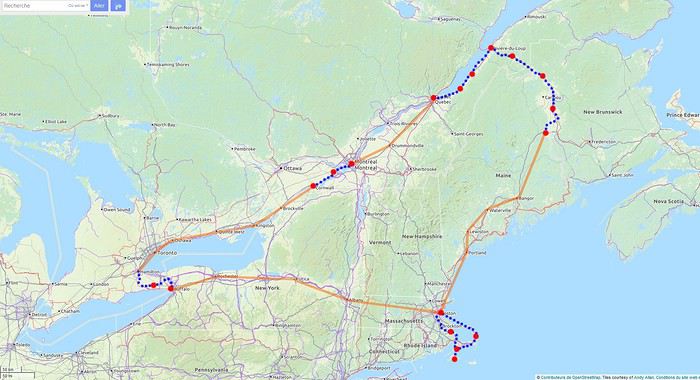 Les étapes, les portions à vélo (en bleu), les portions en bus et train (en orange)
Pour le parcours, j'utilise les tracés de la carte Open Cycle Map
Les étapes, les portions à vélo (en bleu), les portions en bus et train (en orange)
Pour le parcours, j'utilise les tracés de la carte Open Cycle Map
Les étapes, les portions à vélo (en bleu), les portions en bus et train (en orange)
Pour le parcours, j'utilise les tracés de la carte Open Cycle MapPasser du nord au sud de Tokyo en voiture English translation pending
Bonjour,
Je finalise mon voyage d'une petite douzaine de jours au Japon à la fin du mois d'octobre prochain. Et j'ai une question pratique. J'arrive à 8h du matin le lundi 28 à Narita. Je loue une voiture et souhaite dormir le soir près du Mont Fuji. J'ai trois options de route et je ne sais pas laquelle choisir. Soit je fais un grand contournement de Tokyo par le nord et l'ouest, soit je traverse Tokyo, soit je passe la journée avec une balade dans la presqu'ile de Chiba et je traverse dans l'après-midi, peut être avec un ferry s'il y en a. Avez-vous une idée de la meilleure solution ? Merci à vous Stéphan
Je finalise mon voyage d'une petite douzaine de jours au Japon à la fin du mois d'octobre prochain. Et j'ai une question pratique. J'arrive à 8h du matin le lundi 28 à Narita. Je loue une voiture et souhaite dormir le soir près du Mont Fuji. J'ai trois options de route et je ne sais pas laquelle choisir. Soit je fais un grand contournement de Tokyo par le nord et l'ouest, soit je traverse Tokyo, soit je passe la journée avec une balade dans la presqu'ile de Chiba et je traverse dans l'après-midi, peut être avec un ferry s'il y en a. Avez-vous une idée de la meilleure solution ? Merci à vous Stéphan
Escale de croisière: bus de Salerno à Positano par Amalfi English translation pending
bonjour,
en escale à salerne , nous voudrions aller en bus à amalfi puis positano et retourner en bateau- est que qqn a déjà fait cet tour? d'ou peut on prendre le bus à salerno? merci pour toute information😉
Moto plus d'une année en Grèce et douanes English translation pending
Bonjour à toutes et tous
Petite question administrative
Ma moto française est sur le territoire grecque depuis plus d'une année, je viens d'entendre que peut être si je me fesais arrêter je pourrais avoir une amende ou me l'a faire confisquer par la douane !
Est-ce vrai ? J'ai très peur!
Que faire ?
Merci d'avance pour qui pourrait me donner des informations
Voyage à vélo en famille en Guinée: est-ce raisonnable? English translation pending
Bonsoir,
Nous souhaiterions faire une balade à vélo en Afrique de l'ouest fin 2019. On pensait initialement Benin ou Togo mais avec l'actualité, on regarde une autre destination. On nous a conseillé la Guinée… qu'en est il ? est ce raisonnable d'envisager un voyage à vélo en Guinée par les temps qui courent ? y a t il des risques liés à la sécurité ? Qu'en pensez vous ? Merci bien
Corinne et François
Nous souhaiterions faire une balade à vélo en Afrique de l'ouest fin 2019. On pensait initialement Benin ou Togo mais avec l'actualité, on regarde une autre destination. On nous a conseillé la Guinée… qu'en est il ? est ce raisonnable d'envisager un voyage à vélo en Guinée par les temps qui courent ? y a t il des risques liés à la sécurité ? Qu'en pensez vous ? Merci bien
Corinne et François
À vélo dans le Wisconsin English translation pending
Je dois aller pour le boulot durant 2 jours près de Madison, Wisconsin. J'aimerais pédaler durant une semaine avant cela. Soit pédaler de Chicago vers Milwaukee, Sheboygan, Fond du Lac, Madison, soit...? Quelqu'un a t'il de bons conseils à me donner? Ou alors une boucle autour de Madison? Je roule environ 80 km par jour. Merci pour vos retours d'expérience.
Visiter le nord du Portugal en trail routier English translation pending
bonjour
nous serons deux en moto et nous partons de paris dernière semaine d'aout
pour revenir le 25 aout.
nous ne réservons jamais à l'avance pour dormir;
Est-ce problématique ou l'hébergement n'est pas trop saturé?
Y a t-il des hébergements chez l'habitant facilement?
les accès routiers sont-ils pas trop difficiles d'accès?
en un mot que vaut-il mieux faire?
Je suis preneur de toute bonne info
D'avance merci à vous
V
À vélo entre Arcachon et Sarlat English translation pending
bonjour a tous
cette année avec mon mari nous partons une fois de plus visiter la france sur nos vélos ! nous souhaitons faire les sables d'olonne arcachon sarlat mais nous n avons pas trouvés de carnet de route entre arcachon et sarlat , qui pourrait nous aider ?
Itinéraire possible pour 11 jours en Croatie en étant enceinte English translation pending
Bonjour à tous,
Après beaucoup de lectures de discussions sur ce forum et autres guide ou blog sur internet je me lance pour demander quelques conseils aux personnes connaissant ce pays.
Nous partons cet été mon conjoint et ma fille de 4 ans pour 11 jours en Croatie, et je serais enceinte de 6 mois ( billets pris avant de connaitre l'heureuse nouvelle).
Nous arrivons et partons de Dubrovnik et louerons une voiture sur place.
Le voyage s'annonce du coup un peu différent de ce à quoi nous avions pensé au préalable.
Peut être pas trop de long trajets en voiture, balades oui mais pas d'excursion trop longues sous le chaleur du mois de juillet, et peut être pas de nuit sur les iles car l'on conseille de rester pas trop loin d'une grande ville.
En lisant beaucoup de discussions on a envie de découvrir beaucoup d'iles et d'endroits qui ont l'air splendide et du coup j'ai du mal à avancer dans l'itinéraire.
Je pensais loger sur les 11 jours dans 2 endroits différents et se déplacer autour de ces 2 points de chutes. Je pensais à Split et le 2eme je ne sais pas trop...certains conseillent aussi de ne pas s'attarder sur Dubrovnik trop longtemps
je ne me connais pas non plus les possibles difficultés quant à la circulation en voiture l'été en Croatie...
Que pouvez vous me conseiller ?!
Merci d'avance !
Anaïs
Circuler à vélo à Naples English translation pending
Le vélo est-il un moyen de déplacement approprié dans la ville de Naples
Garder la voiture de location pour Cape Town? English translation pending
Bonjour, je passe plus de 3 jours au Cap en mai en revenant de la route des vignes, du coup je sais pas si je garde ma voiture de location ou la rend dès que j'arrive au Cap, sachant que ça me couterai moins de 20 euros pour la garder. Dans les choses à visiter au Cap y'a t'il des choses intéressantes à faire en voiture ou il faut mieux privilégier les TC ou Taxi ?
merci
À vélo autour du lac Inlé et lac Sagar English translation pending
Bonjour ,
quelqu ' un aurait il fait le tour des deux lacs en vélo par les petits chemins avec passage en bateau à certains endroits et pourrait nous donner des infos où dormir ou se poser où passer ?
Merci beaucoup
Kirghizistan à vélo: quels circuits? English translation pending
Bonjour
Je viens de recevoir la carte du Kirgizstan "Gizi Map" . il y a des routes en rouge, que je préfère éviter.
Puis des routes en jaunes, sont-elles goudronnées?
Et surtout une multitude de pistes sous forme de fines lignes rouges, continues ou discontinues. Lesquelles sont praticables en vélo, et lesquelles sont pour les marcheurs?
Auriez vous des circuits que vous avez effectués, et que vous me recommanderiez?
J'espère etre là bas en Juillet-août.
Merci Pierre
Ushuaïa - El Calafate en stop English translation pending
Bonjour,
Nous sommes deux à voyager en Argentine depuis une dizaine de jours et en ce moment nous sommes à Ushuaïa. Nous aimerions nous rendre à El Calafate en stop en 2 ou 3j en campant le soir. Savez-vous si cela est possible ? A-t-on le droit de camper en sauvage ? Les conditions climatiques ne sont-elles pas trop difficiles ? Y a-t-il régulièrement du passage et les gens prennent-ils facilement les autostoppeurs ? Peut-il y avoir des problèmes à la frontière chilienne ? Nous aurons aussi besoin de nous ravitailler en nourriture mais normalement ce serait possible dans les villes sur la route.
Merci de votre aide !
Clara
Nous sommes deux à voyager en Argentine depuis une dizaine de jours et en ce moment nous sommes à Ushuaïa. Nous aimerions nous rendre à El Calafate en stop en 2 ou 3j en campant le soir. Savez-vous si cela est possible ? A-t-on le droit de camper en sauvage ? Les conditions climatiques ne sont-elles pas trop difficiles ? Y a-t-il régulièrement du passage et les gens prennent-ils facilement les autostoppeurs ? Peut-il y avoir des problèmes à la frontière chilienne ? Nous aurons aussi besoin de nous ravitailler en nourriture mais normalement ce serait possible dans les villes sur la route.
Merci de votre aide !
Clara
Sortir de l'aéroport Charles-de-Gaulle (T3 Roissy) à vélo English translation pending
Bonjour,
Je voudrais savoir comment je peux sortir facilement de l'aéroport Charles de Gaulle à vélo (cyclotourisme - 4 sacs sur mon vélo). J'aimerais me procurer une carte qui me permettrait d'avoir un "back up" pour mon Garmin. En faisant ma route vers Romilly du Perche (sud de Paris) je réalise que je ne vois pas le nom des rue sur la carte que j'ai - IGN Centre R08 en ce qui a trait à la sortie de l'aéroport.
Merci beaucoup.
Je voudrais savoir comment je peux sortir facilement de l'aéroport Charles de Gaulle à vélo (cyclotourisme - 4 sacs sur mon vélo). J'aimerais me procurer une carte qui me permettrait d'avoir un "back up" pour mon Garmin. En faisant ma route vers Romilly du Perche (sud de Paris) je réalise que je ne vois pas le nom des rue sur la carte que j'ai - IGN Centre R08 en ce qui a trait à la sortie de l'aéroport.
Merci beaucoup.
Se déplacer au Costa Rica English translation pending
bonjour
est-il possible de faire tortuguero-la fortuna en 1 seule journée (bus)
est-il préferable de passer par puerto viejo de sarapiqui ou repasser par san jose (horaires, changements)
le 1er bateau à tortuguero est à quelle heure?
merçi de vos réponses
cordialement
De Oujda à Errachidia à moto par Bouarfa et les N17 et N10 English translation pending
Bonjour,
J'envisage de descendre depuis Nador à Errachidia par les N17 et N10 en janvier en moto.. Quelqu'un peut-il me renseigner sur ce trajet ? Etat des routes, essence, hébergement ?
Merci à vous.
Trajet de Angeles à Banaue English translation pending
Bonjour
Je cherche a rejoindre Banaue depuis l'aéroport international de Clark (Angeles). J'ai lu qu'il fallait rejoindre la AH26 jusqu'à San Jose, puis poursuivre jusqu'à Bagabag ou on prend la 109 pour Banaue.
J'ai lu partout qu'il faut 6H de voiture en partant de Clark alors qu'il faut 9H mini en partant de Manille et je ne tient pas spécialement à partir de Manille surtout en voiture de location avec la circulation alternée.
A l'aéroport de Clark, il y a une agence Avis de location de voiture, ils ne louent pas de 4X4.
Ma question est de savoir si on peut faire cette route avec une voiture normale. j'ai déjà conduit à Bali, en Indonésie et en Thailande donc je pense pouvoir m'en sortir.
Une autre question qui se pose est de savoir si on peut faire la route vers Kabayan avec une voiture qui n'est pas un 4X4.
J' aurais bien pris un vol pour Cauayan pour y louer une voiture, mais il n'y a aucune location la bas.
Il me reste ensuite l'option du voyage organisé mais j'ai horreur de ca et quand je lis toutes les galères avec les bus ça ne me branche pas non plus....
Merci pour vos conseils et tuyaux sur ce trajet
Formalités pour entrer en Géorgie en venant de Russie avec notre fourgon English translation pending
Bonjour,
Notre itinéraire se précise 🙂 Finalement ça sera Montpellier Moscou vi la Biélorussie ; Moscou Lac Baïkal ; Lac Baïkal Géorgie ; Géorgie Arménie, Turquie ... en 5 Ou 6 mois.
Quelqu'un pourrait-il nous renseigner sur les formalités d'entrée en Géorgie depuis la Russie ?
Mille merci 🙂
Notre itinéraire se précise 🙂 Finalement ça sera Montpellier Moscou vi la Biélorussie ; Moscou Lac Baïkal ; Lac Baïkal Géorgie ; Géorgie Arménie, Turquie ... en 5 Ou 6 mois.
Quelqu'un pourrait-il nous renseigner sur les formalités d'entrée en Géorgie depuis la Russie ?
Mille merci 🙂
Aéroport de Johannesbourg vers Blyde et Kruger English translation pending
Nous sommes 7 Québécois adultes (55 ans et plus😉) nous atterrirons soit le 30 aout ou le 1er décembre à Johannesburg pour terminer au Cape ou une ville près en location appartement pour nous nous aimerions visiter Blyde river Canyon pour nous diriger par la suite au parc Kruger. Avez-vous des suggestions d'hôtel près de Blyde pour une nuit, nous aimerions visiter le parc et le lendemain nous diriger vers Kruger... encore besoin de suggestions, nos préférences rester dans des petits bungalows, nous pouvons aussi nous faire à manger. Est-ce que la distance entre Blyde et Kruger est trop grande après une journée passé au Blyde? J'en suis au début de la préparation du voyage. Je suis consciente que nous serons en partie au Cape pendant les grandes vacances de décembre... Merci de m'aider dans mes choix