Results for "passeport+|+100"
37249 results found.
Taxe d'aéroport au départ de Punta Cana? English translation pending
bonjour
je voulais savoir si il y avait une taxe d'aeroport quand on repart de punta cana car certain disent que c'est 20 dollars et d'autres que c'est inclu dans le billet d'avion.
merci
Abandon ou vente de voiture en Russie English translation pending
bonjour à tous
Je compte aller en russie en voiture. Dans l'hypothèse où elle tombe en panne, je veux dire qu'il m'est impossible de continuer à rouler avec, est-ce qu'il est envisageable de la vendre à un garage, un particulier... et comment cela se passe à la frontière lorsqu'on ressort du pays. je suppose qu'il faut prouver quelque chose. Est-ce que quelqu'un a déjà eu une expérience de ce type.
Merci
Cromagnon
Je compte aller en russie en voiture. Dans l'hypothèse où elle tombe en panne, je veux dire qu'il m'est impossible de continuer à rouler avec, est-ce qu'il est envisageable de la vendre à un garage, un particulier... et comment cela se passe à la frontière lorsqu'on ressort du pays. je suppose qu'il faut prouver quelque chose. Est-ce que quelqu'un a déjà eu une expérience de ce type.
Merci
Cromagnon
Mexique ou Cuba: repos, belles vagues, festivités? English translation pending
Victoriaville, Québec,
Salut à tous!
Vos suggèstions et expérences seront très appréciées! Nous voulons faire un voyage de dernière minute (pas cher quand le délai de départ est court) au Mexique ou à Cuba (je vote pour le Mexique). Ce n'est pas compliqué, on veut profiter du soleil, jouer au beach volley, se faire ramasser par les vagues, aller danser, trop boire 😛 une couple de soir et finalement se reposer.
On compte sur vous Voyageurs d'expériences.
Merci d'avance pour les conseils!!!
Xéna2
Salut à tous!
Vos suggèstions et expérences seront très appréciées! Nous voulons faire un voyage de dernière minute (pas cher quand le délai de départ est court) au Mexique ou à Cuba (je vote pour le Mexique). Ce n'est pas compliqué, on veut profiter du soleil, jouer au beach volley, se faire ramasser par les vagues, aller danser, trop boire 😛 une couple de soir et finalement se reposer.
On compte sur vous Voyageurs d'expériences.
Merci d'avance pour les conseils!!!
Xéna2
Transport et durée du trajet Tunis-/Douz ou Djerba? English translation pending
Bonjour,
je pars en tunisie fin avril. J'atteris a tunis mais je souhaite aller assez vite vers le sud (voir le désert!). Nous serons avec notre petite fille de 18 mois alors je voudrais savoir combien de temps dure le trajet tunis-douz ou tunis djerba et quelle est le moyen le plus rapide (car ou train) de descendre de tunis vers djerba, tozeur ou douz. Par ailleurs est-ce que l'un d'entre vous a deja loue un 4x4 sans chauffeur une journee dans le sud si oui merci de me donner des infos.
De Montréal à Puerto Penasco (Mexique) English translation pending
Principalement pour Charles et Suzanne dont j, ai effacé le message et le...pseudo....mais qui se reconnaitront !!!
1-Je ne m'attarderai pas sur le trajet Montreal-Brownsville (Texas) archi connu et tellement facile par les highways. Pour rompre un peu la monotonie je suggere quand même de prendre la Natchez trail à partir du Tennessee. Cela vous permnettra d, éviter New-Orleans et région. 2-Le fait de vouloir passer par South Padres Island rallonge pas/ mal le trajet...pour Big Bend !!! 3-Le Benson state park de Mission est fermé depuis Mars 2003. Par contre il est encore possible de faire du free beach camping à South Padres Island.Traversez/ le pont ensuite à gauche et environ 3 km plus loin il y a une barriere(plage gardée).Il en coutera 2$ pour un stationnement bord de mer et acces aux sanitaires. 4-De là rte 283 et 83 vers FALCON (state park)-Deux nuits donc une journée entiere pour relaxer et marche-vélos. 5-Prendre la 277 vers Eagle pass 6- Direction Del Rio camping au Seminole Canyon state park. Visiter les/ grottes sans fautes. 7-Vers Marathon. Prendre la 385 pour Big Bend State Park.Il y a 3 camping dont un seul bien emménagé(celui au centre du parc) Prendre plutot le 3eme celui pres du Rio grande. A faire: observation oiseaux-marche-velos-kayak. Ce parc mérite au moins 3 jours pleins donc 5 nuits 8-Sortir de Big bend par la 118. Direction Alpine. Camper à fort Davis-peu connu mais tres tres sympa. Indian lodge state park. Mérite aussi minimum 3 nuits. 9-Continuer sur la 17 jusque Balmoral state park.A voir Musée Pancho villa. Diaporama très bien fait. Fort Alamo n'est pas tres loin!!!Piscine eau chaude au parc...(3 nuits) 10-Vers El Paso: grosse ville sans intéret .Possibilité de camper au Rockhound state park sur la 10. Pas vraiment interesant mais cela réduit l'étape. 11-Direction Tucson: bcp de choix de camping fédéraux-state park et municipaux.Nous avions choisi le Picacho State Park mais apparemment le Saguara s.p. serait bcp mieux....au choix. 12-Prendre la 86 et ensuite la 85 vers Luckville (frontiere mexicaine pour Soncita).Papiers enregistremenrt véhicule-passeport-permis conduire et carte credit et aucun probleme... 13-il reste 100km pour PUERTO PENASCO sur la mer de Cortes....(que les US s'obstinent à appeller Golfe de Californie...) 14-Bcp de camping privés à cet endroit. Malheureusement presque tous propriétés d'investisseurs américains et/ou canadiens. Aucun dépaysement mais tout confort, tout services...Un peu trop à mon gout. Mais c, est un bon endroit pour y passer une partie de l, hiver. Pour nous 3 jours ont suffi.
15-Pour le retour (en avril???) monter au nord vers Phoenix...Apache junction et surtout la petite ville de GLOBE (coup de coeur) ensuite tjs au nord vers les canyons...Utah...Colorado etc... 16-Avec votre carte Fédérale Canada il vous en coutera 6$US/nuit dans les SP donc pas besoin de prendre le passeport Texas à 50$. 17-En janvier et février il fera frais au Texas. Vous risquez de devoir chauffer la nuit au Big Bend, donc prévoir propane en suffisance. 18-Si pas fait avant de partir, vous pourriez prendre votre assurance-auto mexicaine a Tucson ou Nogales(San Javier ).Mais Tucson est une grosse ville; pas évident de s, y promener avecun 5th wheel... Bonne route. Memphré
1-Je ne m'attarderai pas sur le trajet Montreal-Brownsville (Texas) archi connu et tellement facile par les highways. Pour rompre un peu la monotonie je suggere quand même de prendre la Natchez trail à partir du Tennessee. Cela vous permnettra d, éviter New-Orleans et région. 2-Le fait de vouloir passer par South Padres Island rallonge pas/ mal le trajet...pour Big Bend !!! 3-Le Benson state park de Mission est fermé depuis Mars 2003. Par contre il est encore possible de faire du free beach camping à South Padres Island.Traversez/ le pont ensuite à gauche et environ 3 km plus loin il y a une barriere(plage gardée).Il en coutera 2$ pour un stationnement bord de mer et acces aux sanitaires. 4-De là rte 283 et 83 vers FALCON (state park)-Deux nuits donc une journée entiere pour relaxer et marche-vélos. 5-Prendre la 277 vers Eagle pass 6- Direction Del Rio camping au Seminole Canyon state park. Visiter les/ grottes sans fautes. 7-Vers Marathon. Prendre la 385 pour Big Bend State Park.Il y a 3 camping dont un seul bien emménagé(celui au centre du parc) Prendre plutot le 3eme celui pres du Rio grande. A faire: observation oiseaux-marche-velos-kayak. Ce parc mérite au moins 3 jours pleins donc 5 nuits 8-Sortir de Big bend par la 118. Direction Alpine. Camper à fort Davis-peu connu mais tres tres sympa. Indian lodge state park. Mérite aussi minimum 3 nuits. 9-Continuer sur la 17 jusque Balmoral state park.A voir Musée Pancho villa. Diaporama très bien fait. Fort Alamo n'est pas tres loin!!!Piscine eau chaude au parc...(3 nuits) 10-Vers El Paso: grosse ville sans intéret .Possibilité de camper au Rockhound state park sur la 10. Pas vraiment interesant mais cela réduit l'étape. 11-Direction Tucson: bcp de choix de camping fédéraux-state park et municipaux.Nous avions choisi le Picacho State Park mais apparemment le Saguara s.p. serait bcp mieux....au choix. 12-Prendre la 86 et ensuite la 85 vers Luckville (frontiere mexicaine pour Soncita).Papiers enregistremenrt véhicule-passeport-permis conduire et carte credit et aucun probleme... 13-il reste 100km pour PUERTO PENASCO sur la mer de Cortes....(que les US s'obstinent à appeller Golfe de Californie...) 14-Bcp de camping privés à cet endroit. Malheureusement presque tous propriétés d'investisseurs américains et/ou canadiens. Aucun dépaysement mais tout confort, tout services...Un peu trop à mon gout. Mais c, est un bon endroit pour y passer une partie de l, hiver. Pour nous 3 jours ont suffi.
15-Pour le retour (en avril???) monter au nord vers Phoenix...Apache junction et surtout la petite ville de GLOBE (coup de coeur) ensuite tjs au nord vers les canyons...Utah...Colorado etc... 16-Avec votre carte Fédérale Canada il vous en coutera 6$US/nuit dans les SP donc pas besoin de prendre le passeport Texas à 50$. 17-En janvier et février il fera frais au Texas. Vous risquez de devoir chauffer la nuit au Big Bend, donc prévoir propane en suffisance. 18-Si pas fait avant de partir, vous pourriez prendre votre assurance-auto mexicaine a Tucson ou Nogales(San Javier ).Mais Tucson est une grosse ville; pas évident de s, y promener avecun 5th wheel... Bonne route. Memphré
St Pierre et Miquelon English translation pending
Je pars au QUEBEC bientot et vers MARS mon amie a tres envie d'aller a
st pierre et miquelon.
Qui peut me donner des infos sur le cout de la vie, de l'immobilier, sante etc..
Car j'envisage de m-y installer
MERCI
MERCI
La Pensylvanie aux Etats-Unis? English translation pending
Comme je l'ai raconté dans mon précédent message qui a été déplacé(je ne sais pas pourquoi😕), je pars donc pour 2-3 mois aux USA et au Canada😎
Et j'aurais voulu avoir votre avis sur quelques régions, états...
La Pennsylvanie:j'ai entendu qu'on pouvait allez visiter des fermes Amish(ca à l'air sympa), mais j'aurais voulu savoir si c'était un peu comme les états du Missouri, du Minnesota ou de l'Iowa...Si il y avait que des fermes, des champs, des plaines, des plaines....???🙁
Et je suis intéressé par la province du Yukon au Canada, mais il doit quand même faire froid surtout en hiver??
Et pour finir, les états du Montana, du Dakota du sud et du Dakota du nord, j'ai pas beaucoup en entendu parler, mais est-ce que ca vaut la peine d'y aller?😛
Mecri d'avance pour vos conseils!
Et je suis intéressé par la province du Yukon au Canada, mais il doit quand même faire froid surtout en hiver??
Et pour finir, les états du Montana, du Dakota du sud et du Dakota du nord, j'ai pas beaucoup en entendu parler, mais est-ce que ca vaut la peine d'y aller?😛
Mecri d'avance pour vos conseils!
Myanmar: euros ou dollars? English translation pending
Bonjour,
Je pars en fin d'année faire un circuit- groupe( grands classiques) en Birmanie. L'agence recommande de prendre des dollars. Mes récentes expériences me font penser que l'euro est maintenant patout ( et on évite les frais de change avant le départ) Qui peux me conseiller ? Merci!
Je pars en fin d'année faire un circuit- groupe( grands classiques) en Birmanie. L'agence recommande de prendre des dollars. Mes récentes expériences me font penser que l'euro est maintenant patout ( et on évite les frais de change avant le départ) Qui peux me conseiller ? Merci!
Visa pour la Birmanie et achat billet Bangkok-Rangoon English translation pending
Bonjour,
Je souhaiterais me rendre en Birmanie début octobre et je me demande comment avoir le Visa d'entrée de la Belgique sans devoir aller jusque Paris ni attendre quelques jours à Bangkok pour les démarches.
Autre question, vaut-il mieux acheter le billet bangkok-rangoon d'europe ou sur place et si la dernière solution est la plus avantageuse, y a t il toujours de la place dans les vols?
Pourriez-vous me dire aussi si on peut prendre un téléphone portable et si le réseau est compatible avec le notre. Meme question pour le courant, faut-il un adaptateur pour recharger l'appareil numérique?
Merci pour votre aide,
Carole
Autre question, vaut-il mieux acheter le billet bangkok-rangoon d'europe ou sur place et si la dernière solution est la plus avantageuse, y a t il toujours de la place dans les vols?
Pourriez-vous me dire aussi si on peut prendre un téléphone portable et si le réseau est compatible avec le notre. Meme question pour le courant, faut-il un adaptateur pour recharger l'appareil numérique?
Merci pour votre aide,
Carole
Istanbul-Inde en 2CV sans carnet de passage en douane English translation pending
On est 4 francais a istanbul avec notre 2CV qui realisent de plus en plus qu ils sont bloques au niveau administratif dans leur periple.
Notre but: Aller en İnde en voiture sans carnet de passage en douane et arriver mi septembre au plus tard.
Par la route de la soie, a force d eplucher ce forum, on a le sentiment qu on a peut etre une chance de pousser Notre deuch assez loin mais par contre cela necessite bcp trop de temps et de galere visaiennes…
Par l iran Pakistan il apparait qu il faudra lacher la deuch entre la turquie et l iran a moins de suivre les indication de Lekaribu et donc payer 1000$ pour faire rentrer le vehicule illegalement… Ce soir on est assez demoralise et penchons donc d avantage pour cet itineraire ce qui sucite les question suivantes: - A quoi ressemble le no man’s land entre la Turquie et l’iran? Peut on eventuellement y confier notre vehicule si nous n’arrivons pas a le faire passer? - Si on y parvient en payant les 1000$ reussirons nous a rentrer sans CPD au Pakistan et en inde? Sont ils plus souples par la bas?
En attendant si quelques uns d entre vous sont a istanbul nous sommes desireux de vous rencontrer …
Merci Beaucoup thibault_delavigne@hotmail.com
Par la route de la soie, a force d eplucher ce forum, on a le sentiment qu on a peut etre une chance de pousser Notre deuch assez loin mais par contre cela necessite bcp trop de temps et de galere visaiennes…
Par l iran Pakistan il apparait qu il faudra lacher la deuch entre la turquie et l iran a moins de suivre les indication de Lekaribu et donc payer 1000$ pour faire rentrer le vehicule illegalement… Ce soir on est assez demoralise et penchons donc d avantage pour cet itineraire ce qui sucite les question suivantes: - A quoi ressemble le no man’s land entre la Turquie et l’iran? Peut on eventuellement y confier notre vehicule si nous n’arrivons pas a le faire passer? - Si on y parvient en payant les 1000$ reussirons nous a rentrer sans CPD au Pakistan et en inde? Sont ils plus souples par la bas?
En attendant si quelques uns d entre vous sont a istanbul nous sommes desireux de vous rencontrer …
Merci Beaucoup thibault_delavigne@hotmail.com
Félicitations à thuan English translation pending
Plus de 1 500 messages en six mois! Tu chômes-pas! Où trouves-tu le temps pour dormir?
Une encyclopédie sur deux pattes ce thuan! À lui seul une source d'infos hors pairs pour la communauté VF.
Une mention spéciale pour la qualité et la netteté des photos qui accompagent tes textes.
Laches-pas. Encore une fois mes hommages pour l'excellent travail.
Salutations,
DeCléricy
Amazonie en Colombie English translation pending
Bonjour à tous!!!
Je vais m'envoler pour la Colombie (Bogota) le 30 mai, pour rencontrer ma famille, pour la première fois 😛. On part à deux, pour un mois, donc très peu de temps. On va surement aller à Cartagena, et on aimerait surtout voir la forêt. Seulement on voudrait aller dans un endroit aussi sur que possible (même si ça n'a pas l'air si dangeureux, y'a toujours des aphrénsions). On a entendu parler de Leticia, parceque il ya de bonne structure pour les touristes. Qu'en pensez vous?
Merci d'avance.
Sarah🙂
Je vais m'envoler pour la Colombie (Bogota) le 30 mai, pour rencontrer ma famille, pour la première fois 😛. On part à deux, pour un mois, donc très peu de temps. On va surement aller à Cartagena, et on aimerait surtout voir la forêt. Seulement on voudrait aller dans un endroit aussi sur que possible (même si ça n'a pas l'air si dangeureux, y'a toujours des aphrénsions). On a entendu parler de Leticia, parceque il ya de bonne structure pour les touristes. Qu'en pensez vous?
Merci d'avance.
Sarah🙂
premiere nuit a tashkent English translation pending
j ai trouve billet pour tashkent mais je vais arriver a 01h55 du matin et vu que j ai peu d experience dans la baroude j aurai voulu avoir un conseil pour m organiser pour mon arrivée a tashkent? et aussi avoir des témoignages quand a la police la bas?? est ce que ca craint???
Voyage en Argentine English translation pending
Bonjour.
J'ai rencontré sur internet une correspondante argentinaise (confirmez moi : c'est bien comme ça qu'on dit en français?). Elle me propose de passer au mois d'août chez elle à Bahia Blanca. Quelqu'un a-t-il déjà été à Bahia Blanca ?
Moi ce qui m'inquiète le plus c'est ce que j'ai pu lire sur différents sites : vols, situation instable du pays, accidents de la route importants (141blessés par jour en moyenne et 30 morts d'après un article que j'ai lu sur le web), agressions, agressions avec arme, trafic d'organes pour les enfants(adultes?)...🏴☠️
Quelqu'un peut-il me renseigner sur Bahia Blanca et ses environs ? Y a-t-il autant d'insécurité qu'on le dit ?
Sinon je voulais savoir : par exemple au niveau de l'eau : la qualité est elle la meme qu'en France ? Y a-t-on accès facilement ? (distribution d'eau).
Désolé de poser des questions à la limite de l'idiotie mais ne connaissant que très peu ce pays (comme tous les autres pays d'Amérique Latine)je ne peux faire autrement. 😛
Je voulais savoir sinon question voyage :
j'ai vu sur les différents sites que les vols aller-retour coutaient environ 1000euro ce qui fait un peu cher pour moi....sigh...
je me demandais si l'on pouvait se faire embarquer sur un bateau en proposant son travail gratuitement (ça doit être illégal et poser un problème d'assurance, si vous avez des infos...). Connaissez vous des bateaux en partance pour l'Argentine ?
Au niveau du budget j'ai lu que le pouvoir d'achat d'un argentin annuel était de 10.000US$ sachant que le revenu annuel par habitant était de 3000US$ environ. Donc au niveau du budget combien prévoir par exemple pour un mois sachant que : je n'ai pas à payer le logement, je dois sans doute payer les repas et les sorties. (J'ai un ami qui mangeait des repas complets dans des restos en hongrie pour 1euro avec entrée plat dessert, c'est pareil en Argentine?).
Sinon ya bcp de bestioles (insectes...)en Argentine qu'il arrive souvent de voir dans sa maison?
Je suis ouvert à toute autre type d'information.
Merci.
++ 😉
J'ai rencontré sur internet une correspondante argentinaise (confirmez moi : c'est bien comme ça qu'on dit en français?). Elle me propose de passer au mois d'août chez elle à Bahia Blanca. Quelqu'un a-t-il déjà été à Bahia Blanca ?
Moi ce qui m'inquiète le plus c'est ce que j'ai pu lire sur différents sites : vols, situation instable du pays, accidents de la route importants (141blessés par jour en moyenne et 30 morts d'après un article que j'ai lu sur le web), agressions, agressions avec arme, trafic d'organes pour les enfants(adultes?)...🏴☠️
Quelqu'un peut-il me renseigner sur Bahia Blanca et ses environs ? Y a-t-il autant d'insécurité qu'on le dit ?
Sinon je voulais savoir : par exemple au niveau de l'eau : la qualité est elle la meme qu'en France ? Y a-t-on accès facilement ? (distribution d'eau).
Désolé de poser des questions à la limite de l'idiotie mais ne connaissant que très peu ce pays (comme tous les autres pays d'Amérique Latine)je ne peux faire autrement. 😛
Je voulais savoir sinon question voyage :
j'ai vu sur les différents sites que les vols aller-retour coutaient environ 1000euro ce qui fait un peu cher pour moi....sigh...
je me demandais si l'on pouvait se faire embarquer sur un bateau en proposant son travail gratuitement (ça doit être illégal et poser un problème d'assurance, si vous avez des infos...). Connaissez vous des bateaux en partance pour l'Argentine ?
Au niveau du budget j'ai lu que le pouvoir d'achat d'un argentin annuel était de 10.000US$ sachant que le revenu annuel par habitant était de 3000US$ environ. Donc au niveau du budget combien prévoir par exemple pour un mois sachant que : je n'ai pas à payer le logement, je dois sans doute payer les repas et les sorties. (J'ai un ami qui mangeait des repas complets dans des restos en hongrie pour 1euro avec entrée plat dessert, c'est pareil en Argentine?).
Sinon ya bcp de bestioles (insectes...)en Argentine qu'il arrive souvent de voir dans sa maison?
Je suis ouvert à toute autre type d'information.
Merci.
++ 😉
Trajet Phnom Penh - Siem Reap (Cambodge) English translation pending
bonjour,
ce trajet en bateau semble prendre 5 heures sur le LP et couterait 25 USD (les horaires des avions ne sont pas tres pratiques, matin tot ou soir)
qu en est il dans la realité ? besoin de reserver à l avance ? depart toutes les heures de PP ou frequence moins elevee ?
d une facon generale en GH ou hotel...rare sont les safety box dans les chambres mais à la reception, confiance absolue ?
merci
🙂
ce trajet en bateau semble prendre 5 heures sur le LP et couterait 25 USD (les horaires des avions ne sont pas tres pratiques, matin tot ou soir)
qu en est il dans la realité ? besoin de reserver à l avance ? depart toutes les heures de PP ou frequence moins elevee ?
d une facon generale en GH ou hotel...rare sont les safety box dans les chambres mais à la reception, confiance absolue ?
merci
🙂
Questions sur la recherche d'emploi en Argentine (message pour Herge) English translation pending
Bonjour Herge,
en visitant le forum, j'ai vu que tu étais pas mal pro sur la question Argentine et c'est donc à toi que je m'adresse. Vis-tu là-bas depuis longtemps, si ce n'est pas indiscret ? Sais-tu s'il est facile de trouver un job à Buenos Aires ou ailleurs en Argentine ? j'ai pas mal voyagé jusqu'à maintenant mais l'Argentine est le pays qui m'attire et ce depuis très longtemps. Comment se présente le marché de l'emploi ? Faut-un visa pour travailler en Argentine ? y a t'il des domaines plus propices à accepter des étrangers (j'ai une grande expérience ds le tourisme)? est-il préférable de trouver un boulot avant d'arriver ?
Je ne veux pas t'innonder de questions mais ce serait super gentil de ta part de me donner ton avis.
Merci beaucoup et à bientôt, j'espère
Sophie😏
en visitant le forum, j'ai vu que tu étais pas mal pro sur la question Argentine et c'est donc à toi que je m'adresse. Vis-tu là-bas depuis longtemps, si ce n'est pas indiscret ?
Sais-tu s'il est facile de trouver un job à Buenos Aires ou ailleurs en Argentine ? j'ai pas mal voyagé jusqu'à maintenant mais l'Argentine est le pays qui m'attire et ce depuis très longtemps. Comment se présente le marché de l'emploi ? Faut-un visa pour travailler en Argentine ? y a t'il des domaines plus propices à accepter des étrangers (j'ai une grande expérience ds le tourisme)? est-il préférable de trouver un boulot avant d'arriver ?Je ne veux pas t'innonder de questions mais ce serait super gentil de ta part de me donner ton avis.
Merci beaucoup et à bientôt, j'espère
Sophie😏
France-Thaïlande aller retour en 508d camping-car English translation pending
Bonjour a tous je voulai demander a ceux qui l ont deja fait ou ceut qui connaissenr des gens qui l ont fait a peut pret le budget d ont j aurai besoin pour pouvoir faire l aller retour (sur 2 ans ) sans forcement a avoir a me serrer la ceinture( je toucherai un an de chômage durant une periode de deux ans)
m erci d avance
ps:pourquoi embarquer quelqu un aussi pour reduire les frais avis au amateur ( je suis un flemmard je pourrai des fois, souvent même decider de poser le camion aupres d un beau paysage lac montagne mer ect.. pendant 1 mois dans mes periode de grandes formes 😏 lol)
m erci d avance
ps:pourquoi embarquer quelqu un aussi pour reduire les frais avis au amateur ( je suis un flemmard je pourrai des fois, souvent même decider de poser le camion aupres d un beau paysage lac montagne mer ect.. pendant 1 mois dans mes periode de grandes formes 😏 lol)
Arnaque à Pushkar en Inde English translation pending
Bonjour
Je viens de raccompagner des amis au Rajasthan ayant vecu moi meme 6 ans en Inde
L'arnaque habituelle est toujours en cours a Pushkar... et c'est assez lamentable pour qu'on essaie de s'y opposer...
Un guide pris vous emmene vers les ghats et vous met la dans les mains d'un soit disant saint homme qui vous recite des mantras... et chemin faisant vous fait promettre des donations pour des repas pour les pauvres (montants astronomiques... style 20.000 rupees minimum...) et dans la foulee demande des repas pour lui et sa famille (combien de repas tu donnes a 200 rupees.... ah non 1000 c'est pas assez car j'ai le beau pere plus ceci plus cela
Alors des qu'on vous propose ce trip en vous mettant un plateau dans la main avec les offrandes... arretez.. c'est une arnaque lamentable avec melange fric et religion... une honte tout particulierement en inde
Bon voyage a tous malgre tout cela
Je viens de raccompagner des amis au Rajasthan ayant vecu moi meme 6 ans en Inde
L'arnaque habituelle est toujours en cours a Pushkar... et c'est assez lamentable pour qu'on essaie de s'y opposer...
Un guide pris vous emmene vers les ghats et vous met la dans les mains d'un soit disant saint homme qui vous recite des mantras... et chemin faisant vous fait promettre des donations pour des repas pour les pauvres (montants astronomiques... style 20.000 rupees minimum...) et dans la foulee demande des repas pour lui et sa famille (combien de repas tu donnes a 200 rupees.... ah non 1000 c'est pas assez car j'ai le beau pere plus ceci plus cela
Alors des qu'on vous propose ce trip en vous mettant un plateau dans la main avec les offrandes... arretez.. c'est une arnaque lamentable avec melange fric et religion... une honte tout particulierement en inde
Bon voyage a tous malgre tout cela
Les francais sont des raleurs English translation pending
Je reproduis ici un article provenant du site internet du quotidien Liberation. Marrez vous bien! (j ai particulierement aime le coup des spermatozoides dans la piscine).
Araignées et spermatozoïdes... remboursez les vacances!
Par Nathalie RAULIN
lundi 09 août 2004 (Liberation - 06:00)
Tout le monde n'a pas l'âme d'un Indiana Jones. De son séjour aux Seychelles, ce couple de Stéphanois se souvient surtout d'attaques animales : «Les araignées présentes dans la chambre avaient des pattes épaisses et un corps, certes allongé, mais de un et demi à deux centimètres de long !» Pire, ils ont identifié un scorpion «petit, mais n'y en avait-il pas des plus grands à proximité ?» A moins que ce ne fut un perce-oreilles. Face à cette faune dangereuse, nos deux compatriotes dénoncent un service défectueux : «Aucune bombe insecticide à disposition dans les chambres.» Et une fois récupéré l'aérosol : «C'est nous-mêmes qui avons dû vider la bombe insecticide dans la chambre.» Bref, l'horreur.
Chaque année, ils sont ainsi près de 700 mécontents à écrire au syndicat national des agences de voyages (Snav) pour obtenir réparation pour leurs vacances gâchées. Argumentaire parfois loufoque à la clé : comme cette dame, qui s'offusque de la présence de spermatozoïdes vivants dans la piscine, son adolescente de fille étant tombée enceinte au cours du séjour en Tunisie... Ou cet homme ulcéré que son agence de voyages ait omis de lui préciser que, pour prendre l'avion, une «carte orange avec ma photo» ne remplace pas un passeport en cours de validité... Même la météo est source de récriminations. «Les conditions d'exposition de cet hôtel (en République dominicaine, ndlr) sont des plus défavorables : vu sa situation géographique, il pleut systématiquement tous les jours, voire des journées entières», écrit une Francilienne, sans se douter que sa demande de remboursement allait plonger la responsable de son agence de voyage dans le doute. Fallait-il ou non accéder au voeu de la cliente ? Qu'on ne s'y trompe pas : ces plaintes sont suffisamment récurrentes pour que Jet Tours ait eu l'idée en 2002 d'intégrer une «garantie soleil» à certaines offres de séjours.
Voyage de noces. L'an dernier, la moitié des réclamations adressées au Snav avaient pour origine des problèmes d'hébergement, des prestations non fournies ou de mauvaise qualité. A l'origine de bon nombre de désillusions : les étoiles hôtelières. «Les gens n'ont pas tous conscience qu'il s'agit d'une norme locale, qui n'autorise pas de comparaison internationale, explique Valérie Boned, responsable du service litiges du Snav. Les prestations d'un trois-étoiles français sont sans commune mesure avec celles d'un trois-étoiles au Sénégal, les prix non plus.» Ajoutez des prospectus aussi alléchants que peu réalistes, et les déceptions sont parfois cruelles. Un amoureux, ayant emmené sa dulcinée dans un cinq-étoiles en République dominicaine qualifie son voyage de noces de «véritable désastre de consternation» : «piscine HS pendant 4 jours ; WC 3 fois en panne après réparation, fuite très importante projetant de l'eau partout ; terrain de tennis digne d'un foutoir et laissé à l'abandon ; des restaurants où la nourriture est infâme»... Et de conclure avec lucidité : «Je suis certain que vous n'auriez jamais emmené votre femme dans un pareil endroit...»
Valérie Boned soupire : «Les gens qui nous contactent n'ont pas l'habitude de voyager : si leurs vacances ne ressemblent pas à une carte postale, ils s'estiment floués.» Et rêve rime souvent avec ethnocentrisme : «Dans un courrier sur dix environ, il y a une référence au trop grand nombre d'autochtones dans l'hôtel ou à l'impossibilité de parler français...», explique la responsable juridique. Plus délicat pour les professionnels, les voyageurs en herbe se conduisent désormais en consuméristes avertis. Les réclamations pour publicité mensongère (délit pénal), quasi inexistantes il y a seulement cinq ans représentent désormais 5 % du total des plaintes traitées par le Snav.
Analyse d'eau. Et les mécontents fourbissent illico leurs armes avant même la fin du séjour en vue d'un éventuel combat juridique. Des initiatives qui frisent parfois l'absurde : malade après avoir bu une bouteille d'eau non étiquetée fournie par son hôtel en République dominicaine, une touriste a ramené l'objet du délit pour analyse. Résultat : la présence de bactéries et de matière fécale rendait effectivement l'eau impropre à la consommation. Le tour operator l'a poliment envoyée promener : son rapport d'analyse n'indiquait pas «le lieu de provenance de l'eau»...
Araignées et spermatozoïdes... remboursez les vacances!
Par Nathalie RAULIN
lundi 09 août 2004 (Liberation - 06:00)
Tout le monde n'a pas l'âme d'un Indiana Jones. De son séjour aux Seychelles, ce couple de Stéphanois se souvient surtout d'attaques animales : «Les araignées présentes dans la chambre avaient des pattes épaisses et un corps, certes allongé, mais de un et demi à deux centimètres de long !» Pire, ils ont identifié un scorpion «petit, mais n'y en avait-il pas des plus grands à proximité ?» A moins que ce ne fut un perce-oreilles. Face à cette faune dangereuse, nos deux compatriotes dénoncent un service défectueux : «Aucune bombe insecticide à disposition dans les chambres.» Et une fois récupéré l'aérosol : «C'est nous-mêmes qui avons dû vider la bombe insecticide dans la chambre.» Bref, l'horreur.
Chaque année, ils sont ainsi près de 700 mécontents à écrire au syndicat national des agences de voyages (Snav) pour obtenir réparation pour leurs vacances gâchées. Argumentaire parfois loufoque à la clé : comme cette dame, qui s'offusque de la présence de spermatozoïdes vivants dans la piscine, son adolescente de fille étant tombée enceinte au cours du séjour en Tunisie... Ou cet homme ulcéré que son agence de voyages ait omis de lui préciser que, pour prendre l'avion, une «carte orange avec ma photo» ne remplace pas un passeport en cours de validité... Même la météo est source de récriminations. «Les conditions d'exposition de cet hôtel (en République dominicaine, ndlr) sont des plus défavorables : vu sa situation géographique, il pleut systématiquement tous les jours, voire des journées entières», écrit une Francilienne, sans se douter que sa demande de remboursement allait plonger la responsable de son agence de voyage dans le doute. Fallait-il ou non accéder au voeu de la cliente ? Qu'on ne s'y trompe pas : ces plaintes sont suffisamment récurrentes pour que Jet Tours ait eu l'idée en 2002 d'intégrer une «garantie soleil» à certaines offres de séjours.
Voyage de noces. L'an dernier, la moitié des réclamations adressées au Snav avaient pour origine des problèmes d'hébergement, des prestations non fournies ou de mauvaise qualité. A l'origine de bon nombre de désillusions : les étoiles hôtelières. «Les gens n'ont pas tous conscience qu'il s'agit d'une norme locale, qui n'autorise pas de comparaison internationale, explique Valérie Boned, responsable du service litiges du Snav. Les prestations d'un trois-étoiles français sont sans commune mesure avec celles d'un trois-étoiles au Sénégal, les prix non plus.» Ajoutez des prospectus aussi alléchants que peu réalistes, et les déceptions sont parfois cruelles. Un amoureux, ayant emmené sa dulcinée dans un cinq-étoiles en République dominicaine qualifie son voyage de noces de «véritable désastre de consternation» : «piscine HS pendant 4 jours ; WC 3 fois en panne après réparation, fuite très importante projetant de l'eau partout ; terrain de tennis digne d'un foutoir et laissé à l'abandon ; des restaurants où la nourriture est infâme»... Et de conclure avec lucidité : «Je suis certain que vous n'auriez jamais emmené votre femme dans un pareil endroit...»
Valérie Boned soupire : «Les gens qui nous contactent n'ont pas l'habitude de voyager : si leurs vacances ne ressemblent pas à une carte postale, ils s'estiment floués.» Et rêve rime souvent avec ethnocentrisme : «Dans un courrier sur dix environ, il y a une référence au trop grand nombre d'autochtones dans l'hôtel ou à l'impossibilité de parler français...», explique la responsable juridique. Plus délicat pour les professionnels, les voyageurs en herbe se conduisent désormais en consuméristes avertis. Les réclamations pour publicité mensongère (délit pénal), quasi inexistantes il y a seulement cinq ans représentent désormais 5 % du total des plaintes traitées par le Snav.
Analyse d'eau. Et les mécontents fourbissent illico leurs armes avant même la fin du séjour en vue d'un éventuel combat juridique. Des initiatives qui frisent parfois l'absurde : malade après avoir bu une bouteille d'eau non étiquetée fournie par son hôtel en République dominicaine, une touriste a ramené l'objet du délit pour analyse. Résultat : la présence de bactéries et de matière fécale rendait effectivement l'eau impropre à la consommation. Le tour operator l'a poliment envoyée promener : son rapport d'analyse n'indiquait pas «le lieu de provenance de l'eau»...
Retour de El Senador Cayo Coco Cuba English translation pending
Bonjour à vous tous,
Du 8 au 15 novembre 2003, papa, maman, notre fils de 10 ans et notre fille de 5 ans avons séjournés à l’hôtel El Senador de Cayo Coco à Cuba. Notre intention n’est pas de vous faire aimer ou haïr cet hôtel mais plutôt de vous décrire notre semaine, vous en tirerez vos propres conclusions.
Notre vol était un vol de nuit et sommes arrivés à l’hôtel El Senador à 00h30. Nous descendons nos bagages et se rendons à la réception, malheur, le chauffeur du bus nous a laissés au El Senador Emperador et nous sommes inscrit au El Senador Laguna Azul. Nous rembarquons les bagages et le bus nous amènent à la bonne réception. L’attitude de la préposée à la réception était froide, sans mot de bienvenu ou une brève explication du complexe elle se contente de me demander mon nom puis me remet une enveloppe avec une clef genre carte de crédit. Je lui demande où se trouve la chambre et répond avec un geste vers l’extérieur du lobby en disant par-là et à droite. La nuit dans un complexe inconnu de plus de 30 édifices de chambres et plus d’une trentaine de villas, il est difficile de trouver le bon endroit rapidement. Il est près de 00h45 et les enfants ont faim, alors je me dirige vers le Grill qui est supposé être ouvert 24 heures. Il est fermé! Arrivée finalement à la chambre je veux placer les passeports et les cartes de crédits en lieu sûr mais il n’y a pas de serrure au coffre-fort, alors je retourne au Lobby et demande pour une serrure, à la réception on me dit de revenir demain matin. Le lendemain matin je retourne à la réception pour la serrure, venez ce soir monsieur, j’y retourne le soir et on me dit demain matin! J’ai finalement su par un autre client qu’il était plus facile d’avoir les serrures à l’autre réception de l’hôtel, El Senador Emperador à l’autre extrémité du complexe, je m’y rends et enfin j’ai une serrure pour le coffre. Pour le dîner et le souper, nous avons dû traverser complètement le complexe pour rejoindre le seul buffet ouvert. Les autres qui devaient être ouvert étaient tout fermés le midi et le soir. Avec deux enfants il n’est pas toujours facile de faire 10 minutes de marche à la noirceur et ce, lorsqu’il ne pleut pas. Les batteries de la télécommande sont aplats, je me rend à la réception, on me donne une autre télécommande, arrivée à la chambre cette dernière télécommande n’est pas compatible avec la télé. Je retourne à la réception et on me donne une autre télécommande qui enfin fonctionne. Nous arrivons ;a la chambre après un après midi à la mer, mon fil à des crampes au ventre comme moi et mon épouse, j’introduit la carte clef mais n’ouvre pas la porte. Je me rends à la réception et informe la préposée, elle me répond de retourner à la chambre elle va envoyer quelqu’un. Un jardinier me dit Holla, je lui réponds et lui indique mon problème, il me fait signe une minute puis disparaît à l’arrière et sort de la chambre. Pourtant la fenêtre était barrée! Mais ils doivent avoir un truc pour entrer dans une chambre par les fenêtres de balcon. 10 minutes plus tard un membre de la maintenance arrive. C’est un problème de batteries, je reviens qu’il me dit. 10 minutes plus tard il revient avec des batteries, les changent mais aucun résultat, la porte n’ouvre toujours pas. Il change pour d’autres batteries et fait un test, voilà ça fonctionne. Nous allons à la piscine puis revenons à la chambre. La porte n’ouvre pas encore. Je retourne à la réception et l’informe du problème. La préposée reprogramme la carte clef et me dit que tout est correct, que la carte va fonctionner. J’arrive à la chambre et la carte clef ne fonctionne pas, je retourne à la réception. La préposée me dit de retourner à la chambre je vous envois quelqu’un. 5 minutes plus tard un superviseur (chemise jaune) arrive et j’explique le problème et tous ce qui a été fait. Je reviens tout de suite avec un programmeur qu’il me dit. Plus de 30 minutes plus tard il revient avec un programmeur et reprogramme la serrure, enfin nous pouvons entrer.
Le service de serviette de plage est de 09h00 à 17h00, mais c’est plutôt vers les 10h00 quand il les a reçus. Les boutiques étaient fermées du coté El Senador Laguna Azul et à l’autre extrémité du complexe, 1 ou 2 étaient ouvertes et de façon sporadique. Attention à vos enfants, il n’y a aucune surveillance aux piscines et à la plage le seul life gard que nous avons vu jasait dos à la plage avec une petite madame. Le vin est compris aux repas, mais il vaut mieux donner un tip au garçon pour avoir le privilège d’y goûter. Un soir à 21h45 un employé de maintenance est venu frapper à la porte pour savoir si l’air climatisé fonctionnait. Les murs de notre chambre étaient sales, le matelas fini et la toilette faisait continuellement du bruit. Au buffet j’ai été témoin que le garçon à l’arrière du bar du buffet vidait les soucoupes salit de café, passait un linge et remettait les soucoupes dans la pile à coté des tasses que les clients réutilisaient. Les plages du El Senador sont inutilisables le matin à la marrée haute, les villas sont situés dans un marécage plus qu’une lagune avec une senteur d’égout, des rigoles au pied des fenêtre des chambres qui débordent lorsqu’il pleut et etc. Comme ont dit qu’une photo vaut mille mots, nous avons pris quelques photos pour vous démontrer la face cachée de l’hôtel El Senador de Cayo Coco, Cuba. Voici le lien : http://community.webshots.com/user/serglo
Du 8 au 15 novembre 2003, papa, maman, notre fils de 10 ans et notre fille de 5 ans avons séjournés à l’hôtel El Senador de Cayo Coco à Cuba. Notre intention n’est pas de vous faire aimer ou haïr cet hôtel mais plutôt de vous décrire notre semaine, vous en tirerez vos propres conclusions.
Notre vol était un vol de nuit et sommes arrivés à l’hôtel El Senador à 00h30. Nous descendons nos bagages et se rendons à la réception, malheur, le chauffeur du bus nous a laissés au El Senador Emperador et nous sommes inscrit au El Senador Laguna Azul. Nous rembarquons les bagages et le bus nous amènent à la bonne réception. L’attitude de la préposée à la réception était froide, sans mot de bienvenu ou une brève explication du complexe elle se contente de me demander mon nom puis me remet une enveloppe avec une clef genre carte de crédit. Je lui demande où se trouve la chambre et répond avec un geste vers l’extérieur du lobby en disant par-là et à droite. La nuit dans un complexe inconnu de plus de 30 édifices de chambres et plus d’une trentaine de villas, il est difficile de trouver le bon endroit rapidement. Il est près de 00h45 et les enfants ont faim, alors je me dirige vers le Grill qui est supposé être ouvert 24 heures. Il est fermé! Arrivée finalement à la chambre je veux placer les passeports et les cartes de crédits en lieu sûr mais il n’y a pas de serrure au coffre-fort, alors je retourne au Lobby et demande pour une serrure, à la réception on me dit de revenir demain matin. Le lendemain matin je retourne à la réception pour la serrure, venez ce soir monsieur, j’y retourne le soir et on me dit demain matin! J’ai finalement su par un autre client qu’il était plus facile d’avoir les serrures à l’autre réception de l’hôtel, El Senador Emperador à l’autre extrémité du complexe, je m’y rends et enfin j’ai une serrure pour le coffre. Pour le dîner et le souper, nous avons dû traverser complètement le complexe pour rejoindre le seul buffet ouvert. Les autres qui devaient être ouvert étaient tout fermés le midi et le soir. Avec deux enfants il n’est pas toujours facile de faire 10 minutes de marche à la noirceur et ce, lorsqu’il ne pleut pas. Les batteries de la télécommande sont aplats, je me rend à la réception, on me donne une autre télécommande, arrivée à la chambre cette dernière télécommande n’est pas compatible avec la télé. Je retourne à la réception et on me donne une autre télécommande qui enfin fonctionne. Nous arrivons ;a la chambre après un après midi à la mer, mon fil à des crampes au ventre comme moi et mon épouse, j’introduit la carte clef mais n’ouvre pas la porte. Je me rends à la réception et informe la préposée, elle me répond de retourner à la chambre elle va envoyer quelqu’un. Un jardinier me dit Holla, je lui réponds et lui indique mon problème, il me fait signe une minute puis disparaît à l’arrière et sort de la chambre. Pourtant la fenêtre était barrée! Mais ils doivent avoir un truc pour entrer dans une chambre par les fenêtres de balcon. 10 minutes plus tard un membre de la maintenance arrive. C’est un problème de batteries, je reviens qu’il me dit. 10 minutes plus tard il revient avec des batteries, les changent mais aucun résultat, la porte n’ouvre toujours pas. Il change pour d’autres batteries et fait un test, voilà ça fonctionne. Nous allons à la piscine puis revenons à la chambre. La porte n’ouvre pas encore. Je retourne à la réception et l’informe du problème. La préposée reprogramme la carte clef et me dit que tout est correct, que la carte va fonctionner. J’arrive à la chambre et la carte clef ne fonctionne pas, je retourne à la réception. La préposée me dit de retourner à la chambre je vous envois quelqu’un. 5 minutes plus tard un superviseur (chemise jaune) arrive et j’explique le problème et tous ce qui a été fait. Je reviens tout de suite avec un programmeur qu’il me dit. Plus de 30 minutes plus tard il revient avec un programmeur et reprogramme la serrure, enfin nous pouvons entrer.
Le service de serviette de plage est de 09h00 à 17h00, mais c’est plutôt vers les 10h00 quand il les a reçus. Les boutiques étaient fermées du coté El Senador Laguna Azul et à l’autre extrémité du complexe, 1 ou 2 étaient ouvertes et de façon sporadique. Attention à vos enfants, il n’y a aucune surveillance aux piscines et à la plage le seul life gard que nous avons vu jasait dos à la plage avec une petite madame. Le vin est compris aux repas, mais il vaut mieux donner un tip au garçon pour avoir le privilège d’y goûter. Un soir à 21h45 un employé de maintenance est venu frapper à la porte pour savoir si l’air climatisé fonctionnait. Les murs de notre chambre étaient sales, le matelas fini et la toilette faisait continuellement du bruit. Au buffet j’ai été témoin que le garçon à l’arrière du bar du buffet vidait les soucoupes salit de café, passait un linge et remettait les soucoupes dans la pile à coté des tasses que les clients réutilisaient. Les plages du El Senador sont inutilisables le matin à la marrée haute, les villas sont situés dans un marécage plus qu’une lagune avec une senteur d’égout, des rigoles au pied des fenêtre des chambres qui débordent lorsqu’il pleut et etc. Comme ont dit qu’une photo vaut mille mots, nous avons pris quelques photos pour vous démontrer la face cachée de l’hôtel El Senador de Cayo Coco, Cuba. Voici le lien : http://community.webshots.com/user/serglo
Annual National Parks Pass
Hi everyone.
I assume many of you already know, but the America the Beautiful annual pass, which was $80, will increase to $250 starting January 1, 2026.
So if you're planning to travel before the end of December 2026, it's in your best interest to buy your pass in December 2025, since it will still cost $80 and be valid until the end of December 2026 if you purchase it in December 2025.
This price increase only applies to non-U.S. residents.
Additionally, for those who planned to visit just one park, a $100 surcharge per person will apply to access a list of 11 national parks... For example, if there are 4 of you in a car, you’ll have to pay $35 + $400, which comes to $435 to visit one of the 11 parks on the list (I don’t have all of them... Bryce, Zion, Grand Canyon, Yellowstone, Grand Teton, etc.). Total madness.
The goal is to push people who only visit one park into buying the annual pass.
Last point: free entry days are over for non-residents!
That’s all for now.
I assume many of you already know, but the America the Beautiful annual pass, which was $80, will increase to $250 starting January 1, 2026.
So if you're planning to travel before the end of December 2026, it's in your best interest to buy your pass in December 2025, since it will still cost $80 and be valid until the end of December 2026 if you purchase it in December 2025.
This price increase only applies to non-U.S. residents.
Additionally, for those who planned to visit just one park, a $100 surcharge per person will apply to access a list of 11 national parks... For example, if there are 4 of you in a car, you’ll have to pay $35 + $400, which comes to $435 to visit one of the 11 parks on the list (I don’t have all of them... Bryce, Zion, Grand Canyon, Yellowstone, Grand Teton, etc.). Total madness.
The goal is to push people who only visit one park into buying the annual pass.
Last point: free entry days are over for non-residents!
That’s all for now.
Bright red and a headache
Hello 🙂
I should be serving a warming drink to the participants in the discussion about gardens and parks that provide us with beautiful photos, I could mention the delicious buttery scent wafting from bakeries in the thread about returning to France, but my heart, its powerful pulse that nourishes my entire being, is elsewhere.
Dasht-e Lut, Yazd, Esfahan, Bam, Kerman, Qeshm, Hormuz—a melody, a prayer at the heart of desire.
A dream, an unattainable fantasy? No. Not anymore. A very serious Italian travel agency is organizing this trip for 6 people this winter. I’m signed up, I’m going, I’m living. Maybe.
"But you’re completely crazy!!!!"
I know... I know that every civilization, every society has a vital need to create scapegoats to define and justify itself, pathetically. And Iran is one of them, top of the list. I laugh or sigh, and it doesn’t bother me.
But that unchanging red, deep red and garnet, so beautiful in itself, in all the Western chancelleries repeats, whispers, shouts: don’t go, don’t go, don’t go, you’re putting yourself in danger and we can’t do anything for you. You’ll be turned into mere bargaining chips, into arguments for endless negotiations. Fear must be instilled, its power absolutely preserved, no concessions made to the enemy. The information (how many French hostages, real or fake, compared to the number of travelers?) is always lacking.
Traveling becomes a merciless confrontation between desire, the vital pulse, and anxiety, its ghosts.
Catherine
I should be serving a warming drink to the participants in the discussion about gardens and parks that provide us with beautiful photos, I could mention the delicious buttery scent wafting from bakeries in the thread about returning to France, but my heart, its powerful pulse that nourishes my entire being, is elsewhere.
Dasht-e Lut, Yazd, Esfahan, Bam, Kerman, Qeshm, Hormuz—a melody, a prayer at the heart of desire.
A dream, an unattainable fantasy? No. Not anymore. A very serious Italian travel agency is organizing this trip for 6 people this winter. I’m signed up, I’m going, I’m living. Maybe.
"But you’re completely crazy!!!!"
I know... I know that every civilization, every society has a vital need to create scapegoats to define and justify itself, pathetically. And Iran is one of them, top of the list. I laugh or sigh, and it doesn’t bother me.
But that unchanging red, deep red and garnet, so beautiful in itself, in all the Western chancelleries repeats, whispers, shouts: don’t go, don’t go, don’t go, you’re putting yourself in danger and we can’t do anything for you. You’ll be turned into mere bargaining chips, into arguments for endless negotiations. Fear must be instilled, its power absolutely preserved, no concessions made to the enemy. The information (how many French hostages, real or fake, compared to the number of travelers?) is always lacking.
Traveling becomes a merciless confrontation between desire, the vital pulse, and anxiety, its ghosts.
Catherine
Trip Report: Silk Road Journey in China
Hi everyone,
This trip report covers a journey along the Silk Road in China (see detailed description below) undertaken in October 2025. The goal isn’t to recount the trip but to provide information that might help those who want to take a similar journey. Much of the information is valid for any trip to China.
Who we are: a retired couple, aged 63 and 65 (age gives discounts on entry to various sites and museums in China, which is why I won’t list prices here—I don’t know them, but you can easily find them online). We’re used to traveling independently. We speak English, which is the only foreign language spoken in China, though by very few people. I speak and read a little Chinese, which helped, but you can easily get by without it (without any English at all, I think it would be more difficult).
Period: We arrived just after "Golden Week," when all of China is on vacation, and after the summer, when schools are out, so we encountered very few tourists (99.99% of whom were Chinese). Our experience with booking visits in advance (which we didn’t need to do) isn’t representative for those who want to travel in the summer! The October-November period was perfect for our trip—it wasn’t too hot or too cold (one day of snow on the Tibetan Plateau), though it was only a few degrees on the Tibetan part, with altitudes between 2,000 and 3,000 meters. The trees were beautifully colored.
General remarks: Everyone we dealt with was very kind and perfectly honest. If you order a meal without really understanding what to do and the person modifies your order, trust them—the result is what you need. If a taxi driver signals that they’ll wait for you to finish your visit and pick you up afterward, trust them. It means there aren’t many taxis where you are, and it’ll be more convenient. For prices at street vendors, we always found the right ballpark, and sometimes they even added a little extra to please us. A taxi driver treated us to lunch, and an employee drove us back to the hotel after a visit because there were no taxis. If you struggle to buy a ticket online because there’s no counter, someone will come to help. People even spontaneously ask if everything’s okay and if you need anything.
Everywhere we went was very clean, including restrooms (trains, stations, hotels, museums, tourist sites) and streets. The old stereotypes about this no longer apply.
The trip can be challenging for those who have difficulty walking. The distances to cover on foot in stations, to access sites, and within the sites themselves can sometimes be really long.
We used the Lonely Planet guide in English (published at the end of August 2025) a little for preparation, but mostly relied on the internet.
Before leaving: No visa is needed for French citizens for stays under 30 days. You get a stamp on your passport upon arrival and departure, and the formalities themselves are very quick in both directions (excluding any potential queues). Just a photo and fingerprints upon arrival, and welcome to China’s facial recognition system.
Money: All your payments (see below) will go through your Visa card—there will be hundreds, including many payments of 20 cents to a few euros. So, you need an international option that allows unlimited card transactions. Since cash is rarely needed, the allowed number of ATM withdrawals can be low. We made 3 withdrawals totaling 800 € for a month and could have managed with just 2. The exchange rate charged on our Visa card was 12 € for 100 RMB (yuan).
Install the following apps on your smartphone before leaving (otherwise, you’ll only have access to the Chinese versions, if available): - Alipay, which is used to pay everywhere in China (details below). You need to link it to your credit card, then provide proof of identity by uploading a passport photo and completing a facial recognition session. Alipay gives access to Didi (China’s Uber), public transport (metro/bus), and can also translate phrases. - WeChat (Weixin in Chinese, pronounced *weishin*), which is also used for payments but also replaces WhatsApp. Unfortunately, to activate your account, you need someone who already has WeChat to sponsor you (preferably a Chinese person). We asked someone at our first accommodations to do this—no problem. By sharing your WeChat number with accommodations, they can send you messages that are automatically translated, and you can communicate with people thanks to the translation (translation to French is very poor; it’s much better in English, but unfortunately, WeChat detects your phone’s language). Alipay and WeChat are accepted almost everywhere, but some places only accept WeChat. - Amap, the international version of Baidu Maps, which replaces Google Maps (not at all up-to-date in China). The English names of hotels often have little to do with the Chinese names except for a phonetic resemblance. To find them on Amap, it’s best to copy the Chinese name found on your Trip reservation under "show address in Chinese." - A VPN. We had CyberGhost, which didn’t work, but according to other travelers, NordVPN and Windscribe do. Without a VPN, you can’t access Google services, on WhatsApp you can send and receive text but not photos, and you can’t send or receive emails on Gmail addresses. We managed without a VPN by using Firefox as a browser and Bing as a search engine. - Trip, for booking trains and accommodations, and buying some tickets. It’s the equivalent of Booking for accommodations, but Booking has very few listings in China, while Trip has hundreds in every city. Most hotels and trains are exchangeable and refundable until the day before, with no or minimal fees.
You don’t need contactless (NFC) payment on your phone. Either you scan a barcode and enter the amount to pay, or you display a barcode, and they scan it with a scanner, and the amount is deducted directly.
Upon arrival: - Buy a Chinese SIM card: 100 RMB for 300 GB of data and several hours of talk time (we didn’t use it). Set the Chinese number as a reference on Alipay, WeChat, and Amap. - Find someone to sponsor you on WeChat.
Transportation: - **Plane**: China Eastern, Paris-Canton then Canton-Urumqi on the way out, and Xian-Canton then Canton-Paris on the way back. International flights were smooth, but the schedules for the two domestic flights were changed. It was fine on the way out because we had some leeway, but on the way back, we were notified the morning of that our flight was canceled and replaced with one that didn’t allow for the connection. We called and changed to an earlier flight (I think we were lucky to find available seats). - **Train**: Most long distances were covered by high-speed trains (called D or G in China) at 240 or 300 km/h. Second class is perfect—just as comfortable and clean as our TGVs. The only advantage of first class is the wider seats for larger people, but the downside is that seats are often booked in advance and thus less available. You can book trains long in advance on Trip, but they only go on sale in China 15 days before departure, so that’s when you’ll know if you have a ticket. Initially, we booked first class, but there were no seats available on the day, so we ended up booking everything in second class, which was perfect. There’s no paper ticket—if you’ve bought one, you go to the station, show your passport, and enter. You do the same to access the platform 15 minutes before the train, and that’s it. Our train was canceled twice, but no problem—we went to the ticket counter, got a refund, and were offered a replacement. It didn’t delay us by more than an hour (maybe it would be harder in peak season). For prices, check Trip.com, but it’s significantly cheaper than in France. - **Bus**: We took the bus between Xining and Tongren, Tongren to Xiahe, and Hezuo to Lanzhou—about 3 hours each time for 200 km, 6 € per person, and departures were right on time. - **Taxi**: For trips between the station and hotel, or hotel and visits. If you take a Didi via the Alipay app, you activate your location, enter your destination, and it offers several taxis. You accept, and you get the car’s license plate and its real-time position on the map. When you get in, the driver often asks for the last four digits of your phone number to confirm. Otherwise, you go to the taxi stand outside the station. The price per kilometer is around 20 cents, so for a 30 km trip from the station to the hotel, you’ll pay about 6 €. We never tried to save more by taking local buses, but since the metro in Xian costs 25 cents per trip, it’s probably in the same ballpark. Amap provides public transport routes like Google Maps. - **Driver**: We hired a taxi/driver for the day several times for sightseeing. Prices ranged from 350 to 1,000 RMB (the most expensive was arranged through the Sofitel Xining concierge) for trips ranging from a few hours to a full day, sometimes covering over 300 km (see the detailed trip description).
Accommodations: All booked in advance on Trip, but several were changed during the trip. Off-season, there were no issues. We mostly stayed in upscale places, but in China, that means 50 to 60 € per night in the most central or convenient neighborhood. Note: Almost all hotels have a 5/5 rating on Trip, but it seems the Chinese avoid giving lower ratings to be polite. So, you have to read the comments to realize that in France, we might have given a 2 or 3!
Food: At the table, you’re served hot water or a hot infusion, presumably made with purified water. We never got sick from drinking it, but don’t drink tap water. Purified or mineral water is easy to find.
In restaurants, you can manage by pointing to the dish you want from another diner, on the wall where there are photos, or on the menu with pictures. The food in the region isn’t often spicy, and people usually ask or signal before adding the red spicy sauce, so you should be able to handle it if you don’t like chili at all.
The "fake old quarters" in several cities are great places to find all kinds of restaurants (see detailed trip below).
Like Google Maps, Amap can show you nearby restaurants.
Shopping: For dried fruits, buy them in Turfan—you won’t find the same variety and quality even in Xian. Generally, if you like something, buy it. If you wait, you might not find it outside the region where you are.
In Xian, there’s a "Tea City" where you can find all kinds of tea (from cheap to very expensive).
The trip in more detail: I won’t dwell on the beauty or interest of the sites here since that’s a matter of personal taste. However, I will do so for lesser-known places to give an idea to those who might be interested.
For many sites, there are shuttles (sometimes not included in the ticket price but costing around 1 €) that take you to the interesting spots. We always took them—it saves you from walking past countless shops or along uninteresting paths.
- **Urumqi**: We spent only one night there, arriving in the middle of the afternoon and leaving the next morning. We stayed at the Dana Hotel in the bazaar. Given the size of the city, it’s a good option because I don’t think there are many other interesting places. The bazaar is brand new and not at all "typical" (Turfan’s bazaar is infinitely more interesting), but the dining area is very nice.
- **Turfan**: Stayed at the New Dap Hostel, which was great. The neighborhood is nice, not far from the city, and easy to find food. The museum is closed until 2026 (Amap provides museum hours and closures). We took a day trip (for the two of us) with a driver to the Bezeklik Caves, Flaming Mountains, the abandoned city of Gaochang, the Tuyuk Village Museum, and the Emin Minaret for 500 RMB from 9 AM to 8 PM (arranged by the hostel). The landscape during the excursion was quite fabulous. We also visited the Karez Museum and the abandoned city of Jiaohe on our own the next day. At this time of year, the sun sets around 6 PM, and there’s often haze after 5 PM, so for Jiaohe, for example, which takes about 3 hours to visit, it’s best to be there by 1 or 2 PM at the latest.
The Dahua Market area is perfect for dried fruits (including the famous grapes), and you can eat there among locals in their traditional costumes. Next to it, there are buildings full of shops selling made-in-China items—it kept us busy for a good half-day, if not more.
- **Dunhuang**: Stayed in a guesthouse near the dunes—the city center isn’t far but seems quite artificial. Visited the dunes, with a ticket valid for 3 days. Lots of Chinese tourists—very typical and interesting from an ethnological perspective 😊. We got up early one morning to climb the highest dune, just beyond the one everyone goes to. It’s a bit long and tiring, but the view is worth it. Visited the Mogao Caves, buying the ticket on-site (no chance in season without booking in advance). We met two other French people and got a French-speaking guide (by pretending not to understand English). It was really worth it—a group of 4 instead of 20, and they took their time (2 hours) for the visit. We took a day trip to the Yulin Caves (2.5 hours by road and 160 km one way) with a driver for 350 RMB. We liked it a lot, but if the Mogao Caves are enough for you, it’s not very different.
- **Jiayuguan**: Stayed in a city-center hotel. Visited the Wei and Jin tombs (actually just one)—that’s where we were told the taxi should wait to take us back to the city. We went down into a crypt with lots of decorated bricks from the 3rd century. We really liked it, but it’s not as spectacular as the fort if you’re not a fan. Visited the Jiayuguan Fort and, with the same ticket, climbed a small section of the Great Wall 10 km away. Plan at least 3 good hours for all this—there’s plenty to see.
- **Zhangye**: Stayed at The Silk Road Travelers Hostel, rustic but very nice and organizes excursions. Visited the Danxia (colored mountains)—just as spectacular as the photos. You can easily spend 3 hours there, so plan to finish before sunset to avoid the haze (you can always stay longer for the sunset if the weather’s nice). The next day, visited the Mati Si Temple in the cliff. The 10,000 Buddha Caves are under renovation, but the setting and the main temple are well worth the visit (the paths through the cliff tunnels must be hellish in peak season). You can probably organize these two excursions yourself by asking any taxi driver. Also visited the Giant Buddha Temple in the city center—really worth it.
- **Xining**: Stayed in a city-center hotel. Visited the Tibetan Medicine Museum to see the world’s largest thangka (1 km long), made over 40 years by renowned artists. It’s absolutely magnificent, on par with the virtuosity (but over 1 km) of the thangkas painted by famous artists in Xiahe (see below). Hired a female taxi driver for the day to visit Kumbum Monastery (Ta’er Si in Chinese) and the Danxia area in Guide, 50 km beyond the monastery. It’s less spectacular than Zhangye’s Danxia, but we really liked it (including the journey’s landscape). The next day, visited the old Ming-era Qutan Monastery—no visitors, with beautiful murals (half under renovation). Accessible by train to Haidong or Ledu, then a taxi. Xining’s mosque is of no interest, but there’s a pedestrian street with food stalls nearby that’s very nice.
- **Tongren**: Stayed near the main monastery. Visited Longwu Monastery (several hours), with lots of nice shops along the street leading to it. Then visited Wutun Monastery, which is less lively but beautiful and close to thangka workshops. You can go in and watch the painters at work. For a thangka made by a renowned artist, count about a year of work for 1 m² and around 10,000 €.
- **Xiahe**: Stayed in a city-center hotel. Visited Labrang Monastery—very nice but not as much as Tongren’s because many halls were closed. I think it’s better to go in season and take an English-guided tour (but it’s still worth the trip, even off-season).
- **Langmusi**: Took a taxi, but you can also take a bus (though very early in the morning and longer). Particularly beautiful for us because we woke up to bright sunshine and 5 cm of snow everywhere. Visited the two temples (really nice) and did the classic hike in the gorges starting at the Fairy Cave. For those interested, we continued along the canyon path, and after the meadow where marmots are clearly visible in summer, we climbed toward a pass on the left at 3,800 meters. The view of Langmusi and, above all, the vast grasslands and distant mountains was fabulous (3 hours round trip from the temple). You could probably reach the 4,000-meter summit by continuing up the valley instead of turning left, but according to guides, it’s better to count 7 hours round trip (no technical difficulty). You can leave Langmusi by bus, but off-season, you first have to take a taxi to a stop outside the city and wait for the bus. We didn’t try and took a taxi to Hezuo instead.
Note on this region: A high-speed train is under construction from Xining to Langmusi and beyond (never seen such an impressive construction site!). When it’s operational (in one or two years, I think), access to the area will be revolutionized, and perhaps some of the charm will be lost.
- **Hezuo**: Stopped on the way from Langmusi to Lanzhou. Visited the Milarepa Pagoda, entirely destroyed during the Cultural Revolution and since rebuilt. We liked it since we were passing through, but it doesn’t necessarily justify a long detour.
- **Lanzhou**: Reached by one of the many buses from Hezuo. Stayed in the "fake old quarter," which is extremely pleasant, especially in the evening with restaurants, groups of Chinese women dancing to loud music, etc. Visited Bingling Si with a driver, 120 km away—the landscape and site are absolutely magnificent, with no one around at our time of year. Visited the Gansu Museum (where the famous Flying Horse is, but it’s a replica). We bought the ticket on entry, but in season, you probably need to book in advance.
- **Yinchuan**: Stayed in the city center. A city we discovered by chance in the Lonely Planet—worth it if you have time. On the way, we stopped for a few hours in Zhongwei, where there’s an incredible Taoist temple (I’ll let you be surprised). Visited the Western Xia tombs—we took the short option, which visits Tomb 3. We think the others are similar but less impressive. The surrounding landscape and site are quite spectacular. Visited the film sets (really fun if you like Chinese movies), the short but interesting Ningxia Museum, and finally the modern art museum. The architecture is avant-garde, and there are some beautiful works (we like it, but it’s far from the center—hire a driver who waits, or you might have to wait for an employee to offer a ride back).
- **Tianshui**: Stayed in the suburbs, but you should find a hotel near the "fake old quarter" between the Fu Xi Temples and the Taoist temple—it’s a very nice area, and the two temples (especially the Taoist one) are within walking distance. Visited the Maijishan Caves—the ticket includes the shuttle to get there. Took a taxi from Lanzhou for about 10 € in 45 minutes. We found these caves fabulous.
- **Xi’an**: Stayed 500 meters from the Bell Tower at Hantang Inn—very convenient. We’d been before, so we didn’t revisit the Terracotta Army. The calligraphy district is worth it, as is the Muslim Quarter, though it’s very touristy. The area indicated on the Lonely Planet’s walking tour near the old fruit and vegetable market isn’t very interesting. To buy tea, you can go to the Northwest International Tea City, with dozens of shops. We chose one at random, tasted, and bought various teas. There’s everything from cheap to extremely expensive, but you can find reasonable prices even in seemingly luxurious shops. Along the street north of this area, there are large stores with tons of Chinese goods selling dishes, wedding items, etc. We spent hours there. In the city center, there are only malls with more or less international brands.
- **Longmen Grottoes**: Visited as a round trip by high-speed train from Xian—1 hour 15 minutes to Longmen’s high-speed train station, and the site entrance is 15 minutes by taxi.
We didn’t go to Mount Hua Shan, but there’s a high-speed train station nearby, and there were people on the train who were clearly going there. So, you can probably do this excursion in a day from Xian as well.
Conclusion: We hope this report makes you want to go or helps you if you’re already planning to. If you have questions that you can’t find the answer to by searching properly online and we can answer, don’t hesitate.
This trip report covers a journey along the Silk Road in China (see detailed description below) undertaken in October 2025. The goal isn’t to recount the trip but to provide information that might help those who want to take a similar journey. Much of the information is valid for any trip to China.
Who we are: a retired couple, aged 63 and 65 (age gives discounts on entry to various sites and museums in China, which is why I won’t list prices here—I don’t know them, but you can easily find them online). We’re used to traveling independently. We speak English, which is the only foreign language spoken in China, though by very few people. I speak and read a little Chinese, which helped, but you can easily get by without it (without any English at all, I think it would be more difficult).
Period: We arrived just after "Golden Week," when all of China is on vacation, and after the summer, when schools are out, so we encountered very few tourists (99.99% of whom were Chinese). Our experience with booking visits in advance (which we didn’t need to do) isn’t representative for those who want to travel in the summer! The October-November period was perfect for our trip—it wasn’t too hot or too cold (one day of snow on the Tibetan Plateau), though it was only a few degrees on the Tibetan part, with altitudes between 2,000 and 3,000 meters. The trees were beautifully colored.
General remarks: Everyone we dealt with was very kind and perfectly honest. If you order a meal without really understanding what to do and the person modifies your order, trust them—the result is what you need. If a taxi driver signals that they’ll wait for you to finish your visit and pick you up afterward, trust them. It means there aren’t many taxis where you are, and it’ll be more convenient. For prices at street vendors, we always found the right ballpark, and sometimes they even added a little extra to please us. A taxi driver treated us to lunch, and an employee drove us back to the hotel after a visit because there were no taxis. If you struggle to buy a ticket online because there’s no counter, someone will come to help. People even spontaneously ask if everything’s okay and if you need anything.
Everywhere we went was very clean, including restrooms (trains, stations, hotels, museums, tourist sites) and streets. The old stereotypes about this no longer apply.
The trip can be challenging for those who have difficulty walking. The distances to cover on foot in stations, to access sites, and within the sites themselves can sometimes be really long.
We used the Lonely Planet guide in English (published at the end of August 2025) a little for preparation, but mostly relied on the internet.
Before leaving: No visa is needed for French citizens for stays under 30 days. You get a stamp on your passport upon arrival and departure, and the formalities themselves are very quick in both directions (excluding any potential queues). Just a photo and fingerprints upon arrival, and welcome to China’s facial recognition system.
Money: All your payments (see below) will go through your Visa card—there will be hundreds, including many payments of 20 cents to a few euros. So, you need an international option that allows unlimited card transactions. Since cash is rarely needed, the allowed number of ATM withdrawals can be low. We made 3 withdrawals totaling 800 € for a month and could have managed with just 2. The exchange rate charged on our Visa card was 12 € for 100 RMB (yuan).
Install the following apps on your smartphone before leaving (otherwise, you’ll only have access to the Chinese versions, if available): - Alipay, which is used to pay everywhere in China (details below). You need to link it to your credit card, then provide proof of identity by uploading a passport photo and completing a facial recognition session. Alipay gives access to Didi (China’s Uber), public transport (metro/bus), and can also translate phrases. - WeChat (Weixin in Chinese, pronounced *weishin*), which is also used for payments but also replaces WhatsApp. Unfortunately, to activate your account, you need someone who already has WeChat to sponsor you (preferably a Chinese person). We asked someone at our first accommodations to do this—no problem. By sharing your WeChat number with accommodations, they can send you messages that are automatically translated, and you can communicate with people thanks to the translation (translation to French is very poor; it’s much better in English, but unfortunately, WeChat detects your phone’s language). Alipay and WeChat are accepted almost everywhere, but some places only accept WeChat. - Amap, the international version of Baidu Maps, which replaces Google Maps (not at all up-to-date in China). The English names of hotels often have little to do with the Chinese names except for a phonetic resemblance. To find them on Amap, it’s best to copy the Chinese name found on your Trip reservation under "show address in Chinese." - A VPN. We had CyberGhost, which didn’t work, but according to other travelers, NordVPN and Windscribe do. Without a VPN, you can’t access Google services, on WhatsApp you can send and receive text but not photos, and you can’t send or receive emails on Gmail addresses. We managed without a VPN by using Firefox as a browser and Bing as a search engine. - Trip, for booking trains and accommodations, and buying some tickets. It’s the equivalent of Booking for accommodations, but Booking has very few listings in China, while Trip has hundreds in every city. Most hotels and trains are exchangeable and refundable until the day before, with no or minimal fees.
You don’t need contactless (NFC) payment on your phone. Either you scan a barcode and enter the amount to pay, or you display a barcode, and they scan it with a scanner, and the amount is deducted directly.
Upon arrival: - Buy a Chinese SIM card: 100 RMB for 300 GB of data and several hours of talk time (we didn’t use it). Set the Chinese number as a reference on Alipay, WeChat, and Amap. - Find someone to sponsor you on WeChat.
Transportation: - **Plane**: China Eastern, Paris-Canton then Canton-Urumqi on the way out, and Xian-Canton then Canton-Paris on the way back. International flights were smooth, but the schedules for the two domestic flights were changed. It was fine on the way out because we had some leeway, but on the way back, we were notified the morning of that our flight was canceled and replaced with one that didn’t allow for the connection. We called and changed to an earlier flight (I think we were lucky to find available seats). - **Train**: Most long distances were covered by high-speed trains (called D or G in China) at 240 or 300 km/h. Second class is perfect—just as comfortable and clean as our TGVs. The only advantage of first class is the wider seats for larger people, but the downside is that seats are often booked in advance and thus less available. You can book trains long in advance on Trip, but they only go on sale in China 15 days before departure, so that’s when you’ll know if you have a ticket. Initially, we booked first class, but there were no seats available on the day, so we ended up booking everything in second class, which was perfect. There’s no paper ticket—if you’ve bought one, you go to the station, show your passport, and enter. You do the same to access the platform 15 minutes before the train, and that’s it. Our train was canceled twice, but no problem—we went to the ticket counter, got a refund, and were offered a replacement. It didn’t delay us by more than an hour (maybe it would be harder in peak season). For prices, check Trip.com, but it’s significantly cheaper than in France. - **Bus**: We took the bus between Xining and Tongren, Tongren to Xiahe, and Hezuo to Lanzhou—about 3 hours each time for 200 km, 6 € per person, and departures were right on time. - **Taxi**: For trips between the station and hotel, or hotel and visits. If you take a Didi via the Alipay app, you activate your location, enter your destination, and it offers several taxis. You accept, and you get the car’s license plate and its real-time position on the map. When you get in, the driver often asks for the last four digits of your phone number to confirm. Otherwise, you go to the taxi stand outside the station. The price per kilometer is around 20 cents, so for a 30 km trip from the station to the hotel, you’ll pay about 6 €. We never tried to save more by taking local buses, but since the metro in Xian costs 25 cents per trip, it’s probably in the same ballpark. Amap provides public transport routes like Google Maps. - **Driver**: We hired a taxi/driver for the day several times for sightseeing. Prices ranged from 350 to 1,000 RMB (the most expensive was arranged through the Sofitel Xining concierge) for trips ranging from a few hours to a full day, sometimes covering over 300 km (see the detailed trip description).
Accommodations: All booked in advance on Trip, but several were changed during the trip. Off-season, there were no issues. We mostly stayed in upscale places, but in China, that means 50 to 60 € per night in the most central or convenient neighborhood. Note: Almost all hotels have a 5/5 rating on Trip, but it seems the Chinese avoid giving lower ratings to be polite. So, you have to read the comments to realize that in France, we might have given a 2 or 3!
Food: At the table, you’re served hot water or a hot infusion, presumably made with purified water. We never got sick from drinking it, but don’t drink tap water. Purified or mineral water is easy to find.
In restaurants, you can manage by pointing to the dish you want from another diner, on the wall where there are photos, or on the menu with pictures. The food in the region isn’t often spicy, and people usually ask or signal before adding the red spicy sauce, so you should be able to handle it if you don’t like chili at all.
The "fake old quarters" in several cities are great places to find all kinds of restaurants (see detailed trip below).
Like Google Maps, Amap can show you nearby restaurants.
Shopping: For dried fruits, buy them in Turfan—you won’t find the same variety and quality even in Xian. Generally, if you like something, buy it. If you wait, you might not find it outside the region where you are.
In Xian, there’s a "Tea City" where you can find all kinds of tea (from cheap to very expensive).
The trip in more detail: I won’t dwell on the beauty or interest of the sites here since that’s a matter of personal taste. However, I will do so for lesser-known places to give an idea to those who might be interested.
For many sites, there are shuttles (sometimes not included in the ticket price but costing around 1 €) that take you to the interesting spots. We always took them—it saves you from walking past countless shops or along uninteresting paths.
- **Urumqi**: We spent only one night there, arriving in the middle of the afternoon and leaving the next morning. We stayed at the Dana Hotel in the bazaar. Given the size of the city, it’s a good option because I don’t think there are many other interesting places. The bazaar is brand new and not at all "typical" (Turfan’s bazaar is infinitely more interesting), but the dining area is very nice.
- **Turfan**: Stayed at the New Dap Hostel, which was great. The neighborhood is nice, not far from the city, and easy to find food. The museum is closed until 2026 (Amap provides museum hours and closures). We took a day trip (for the two of us) with a driver to the Bezeklik Caves, Flaming Mountains, the abandoned city of Gaochang, the Tuyuk Village Museum, and the Emin Minaret for 500 RMB from 9 AM to 8 PM (arranged by the hostel). The landscape during the excursion was quite fabulous. We also visited the Karez Museum and the abandoned city of Jiaohe on our own the next day. At this time of year, the sun sets around 6 PM, and there’s often haze after 5 PM, so for Jiaohe, for example, which takes about 3 hours to visit, it’s best to be there by 1 or 2 PM at the latest.
The Dahua Market area is perfect for dried fruits (including the famous grapes), and you can eat there among locals in their traditional costumes. Next to it, there are buildings full of shops selling made-in-China items—it kept us busy for a good half-day, if not more.
- **Dunhuang**: Stayed in a guesthouse near the dunes—the city center isn’t far but seems quite artificial. Visited the dunes, with a ticket valid for 3 days. Lots of Chinese tourists—very typical and interesting from an ethnological perspective 😊. We got up early one morning to climb the highest dune, just beyond the one everyone goes to. It’s a bit long and tiring, but the view is worth it. Visited the Mogao Caves, buying the ticket on-site (no chance in season without booking in advance). We met two other French people and got a French-speaking guide (by pretending not to understand English). It was really worth it—a group of 4 instead of 20, and they took their time (2 hours) for the visit. We took a day trip to the Yulin Caves (2.5 hours by road and 160 km one way) with a driver for 350 RMB. We liked it a lot, but if the Mogao Caves are enough for you, it’s not very different.
- **Jiayuguan**: Stayed in a city-center hotel. Visited the Wei and Jin tombs (actually just one)—that’s where we were told the taxi should wait to take us back to the city. We went down into a crypt with lots of decorated bricks from the 3rd century. We really liked it, but it’s not as spectacular as the fort if you’re not a fan. Visited the Jiayuguan Fort and, with the same ticket, climbed a small section of the Great Wall 10 km away. Plan at least 3 good hours for all this—there’s plenty to see.
- **Zhangye**: Stayed at The Silk Road Travelers Hostel, rustic but very nice and organizes excursions. Visited the Danxia (colored mountains)—just as spectacular as the photos. You can easily spend 3 hours there, so plan to finish before sunset to avoid the haze (you can always stay longer for the sunset if the weather’s nice). The next day, visited the Mati Si Temple in the cliff. The 10,000 Buddha Caves are under renovation, but the setting and the main temple are well worth the visit (the paths through the cliff tunnels must be hellish in peak season). You can probably organize these two excursions yourself by asking any taxi driver. Also visited the Giant Buddha Temple in the city center—really worth it.
- **Xining**: Stayed in a city-center hotel. Visited the Tibetan Medicine Museum to see the world’s largest thangka (1 km long), made over 40 years by renowned artists. It’s absolutely magnificent, on par with the virtuosity (but over 1 km) of the thangkas painted by famous artists in Xiahe (see below). Hired a female taxi driver for the day to visit Kumbum Monastery (Ta’er Si in Chinese) and the Danxia area in Guide, 50 km beyond the monastery. It’s less spectacular than Zhangye’s Danxia, but we really liked it (including the journey’s landscape). The next day, visited the old Ming-era Qutan Monastery—no visitors, with beautiful murals (half under renovation). Accessible by train to Haidong or Ledu, then a taxi. Xining’s mosque is of no interest, but there’s a pedestrian street with food stalls nearby that’s very nice.
- **Tongren**: Stayed near the main monastery. Visited Longwu Monastery (several hours), with lots of nice shops along the street leading to it. Then visited Wutun Monastery, which is less lively but beautiful and close to thangka workshops. You can go in and watch the painters at work. For a thangka made by a renowned artist, count about a year of work for 1 m² and around 10,000 €.
- **Xiahe**: Stayed in a city-center hotel. Visited Labrang Monastery—very nice but not as much as Tongren’s because many halls were closed. I think it’s better to go in season and take an English-guided tour (but it’s still worth the trip, even off-season).
- **Langmusi**: Took a taxi, but you can also take a bus (though very early in the morning and longer). Particularly beautiful for us because we woke up to bright sunshine and 5 cm of snow everywhere. Visited the two temples (really nice) and did the classic hike in the gorges starting at the Fairy Cave. For those interested, we continued along the canyon path, and after the meadow where marmots are clearly visible in summer, we climbed toward a pass on the left at 3,800 meters. The view of Langmusi and, above all, the vast grasslands and distant mountains was fabulous (3 hours round trip from the temple). You could probably reach the 4,000-meter summit by continuing up the valley instead of turning left, but according to guides, it’s better to count 7 hours round trip (no technical difficulty). You can leave Langmusi by bus, but off-season, you first have to take a taxi to a stop outside the city and wait for the bus. We didn’t try and took a taxi to Hezuo instead.
Note on this region: A high-speed train is under construction from Xining to Langmusi and beyond (never seen such an impressive construction site!). When it’s operational (in one or two years, I think), access to the area will be revolutionized, and perhaps some of the charm will be lost.
- **Hezuo**: Stopped on the way from Langmusi to Lanzhou. Visited the Milarepa Pagoda, entirely destroyed during the Cultural Revolution and since rebuilt. We liked it since we were passing through, but it doesn’t necessarily justify a long detour.
- **Lanzhou**: Reached by one of the many buses from Hezuo. Stayed in the "fake old quarter," which is extremely pleasant, especially in the evening with restaurants, groups of Chinese women dancing to loud music, etc. Visited Bingling Si with a driver, 120 km away—the landscape and site are absolutely magnificent, with no one around at our time of year. Visited the Gansu Museum (where the famous Flying Horse is, but it’s a replica). We bought the ticket on entry, but in season, you probably need to book in advance.
- **Yinchuan**: Stayed in the city center. A city we discovered by chance in the Lonely Planet—worth it if you have time. On the way, we stopped for a few hours in Zhongwei, where there’s an incredible Taoist temple (I’ll let you be surprised). Visited the Western Xia tombs—we took the short option, which visits Tomb 3. We think the others are similar but less impressive. The surrounding landscape and site are quite spectacular. Visited the film sets (really fun if you like Chinese movies), the short but interesting Ningxia Museum, and finally the modern art museum. The architecture is avant-garde, and there are some beautiful works (we like it, but it’s far from the center—hire a driver who waits, or you might have to wait for an employee to offer a ride back).
- **Tianshui**: Stayed in the suburbs, but you should find a hotel near the "fake old quarter" between the Fu Xi Temples and the Taoist temple—it’s a very nice area, and the two temples (especially the Taoist one) are within walking distance. Visited the Maijishan Caves—the ticket includes the shuttle to get there. Took a taxi from Lanzhou for about 10 € in 45 minutes. We found these caves fabulous.
- **Xi’an**: Stayed 500 meters from the Bell Tower at Hantang Inn—very convenient. We’d been before, so we didn’t revisit the Terracotta Army. The calligraphy district is worth it, as is the Muslim Quarter, though it’s very touristy. The area indicated on the Lonely Planet’s walking tour near the old fruit and vegetable market isn’t very interesting. To buy tea, you can go to the Northwest International Tea City, with dozens of shops. We chose one at random, tasted, and bought various teas. There’s everything from cheap to extremely expensive, but you can find reasonable prices even in seemingly luxurious shops. Along the street north of this area, there are large stores with tons of Chinese goods selling dishes, wedding items, etc. We spent hours there. In the city center, there are only malls with more or less international brands.
- **Longmen Grottoes**: Visited as a round trip by high-speed train from Xian—1 hour 15 minutes to Longmen’s high-speed train station, and the site entrance is 15 minutes by taxi.
We didn’t go to Mount Hua Shan, but there’s a high-speed train station nearby, and there were people on the train who were clearly going there. So, you can probably do this excursion in a day from Xian as well.
Conclusion: We hope this report makes you want to go or helps you if you’re already planning to. If you have questions that you can’t find the answer to by searching properly online and we can answer, don’t hesitate.
A little story about a layover in Istanbul.
Hi everyone,
Since it’s a hot topic, yet rarely shown, and since there’s quite a bit of criticism and prejudice around it—and since I’ve had three in ten days—I’m going to talk about layovers at Istanbul Airport, especially with Turkish Airlines. This is a common scenario for forum members planning trips to Central Asia, the Caucasus, but also Japan, China, Australia, Africa, and more.
It all starts on a plane beginning its descent, knowing that the approach to Istanbul Airport is always quite long—about thirty minutes. Through the windows, if you’re lucky, you get a view of the city. You need to know a little to get your bearings, but here we’re on the side of Sabiha Gökçen Airport, south of Istanbul on the Asian side. You can spot the Bosphorus, the Golden Horn, and Fenerbahçe’s football stadium.

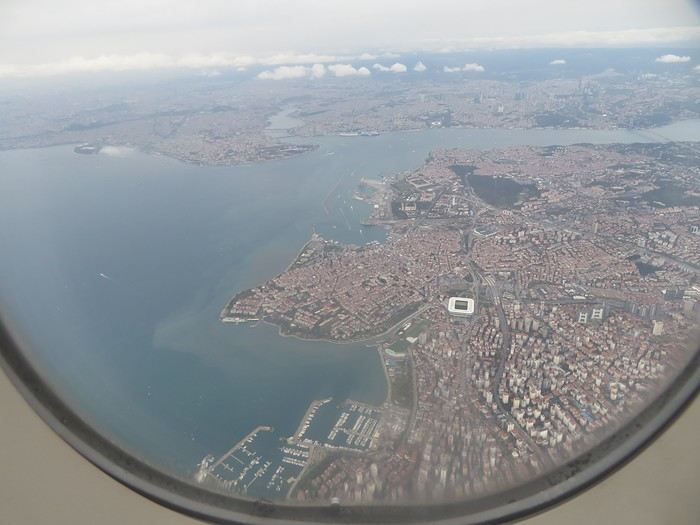
Landing over highways with three times four lanes, and then the airport tarmac for the taxi phase. This can take a while—sometimes nearly half an hour—but this morning, luck was on my side: barely more than 10 minutes. It’s rare now for Turkish Airlines planes to unload via pax buses, so we got a jet bridge. Avgeeks will immediately notice they’re not in Europe anymore but in another world: Pobeda, Belavia, and plenty of more exotic airlines. As the captain seriously put it in his final announcement after thanking the kids, it’s the “crossroads of the world.”
We suddenly step into a massive corridor, an endless, bright hall, usually deserted, and turn left or right—I think it’s always left for the flights I take, heading toward “transfers.” The walk is supposed to take a good ten minutes at worst. Watch out for airport vehicles—they come fast and don’t honk.
Here’s where it gets interesting: Istanbul has always had a bypass for short layovers, something you never hear about on forums. In the past, you had to bolt out of the jet bridge like a rocket and vaguely show your boarding pass to an attendant before sprinting. But now it’s institutionalized, and there’s signage that spares you from running all the way to the main security check. Until recently—at least the last time I did this—it even let you skip all formalities, dropping you like a wild dog into the departures area, which is spacious enough to stretch your legs!
A heads-up for the young and the not-so-young: even without the bypass, if you’re under 5 (accompanied), over 65 (alone), you get fast track. That saves you a few hundred meters and possibly some waiting time, though I’m less sure about that. The entrance honestly looks like an amusement park, though.
So, not young enough, not old enough, I keep going. I pass by dozens of passport control booths (in blue) and reach the transfer security checkpoint (in red). There’s a fast track for Business and Gold passengers—in my case, I’m both—but since it’s at the wrong end for my direction, it wouldn’t even be worth it. It’d just be a frivolous sprint. None of this is crowded at all; the wait lasted about a minute. You have to take out your laptop at this checkpoint—not all of them—but you haven’t had to take out liquids for a while in Istanbul. A hallway, an escalator, and then—bam—you’re in the Dubai-esque hall. One look says it all. Everything sparkles, everything’s expensive. *Very* expensive. Just for show, I spot a sandwich for around 12 €, and some simits for about 4 € (it’s in TL, but that’s roughly the conversion).
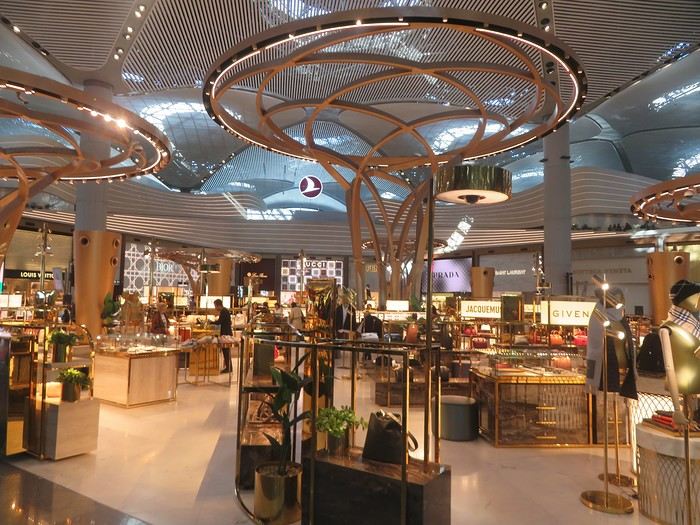
So, I head to the lounge—or one of the lounges—at Turkish Airlines, upstairs. Here too, there’s a priority entrance for families and people with reduced mobility, and an extra hundred meters for everyone else. A few of us seem to have had the same idea, and the twin lounges are under renovation for three months. One is for Business Class passengers, the other for Miles & Smiles and Gold members. They’re nearly identical. Needless to say, it’s packed—just as crowded in one as the other. There are *tons* of Business Class passengers on Turkish Airlines. I assume some other airlines’ passengers are mixed in, but not enough to explain the crowd. It’s as busy as Gare Montparnasse on a holiday departure day, and the 5 or 6 food counters, along with the salad and dessert buffets, are struggling to keep up. I didn’t dare ask to access the shower area, but I’ll admit the Wi-Fi works without the torturous maneuvers it required just a few months ago. Later, I’ll have to watch for the gate for my destination—Warsaw. With my usual luck, it’ll be in the F double-digits, the farthest ones, listed as 15 to 19 minutes away. That said, once you reach the end of that dead end, there’s plenty of quiet space with power outlets. Because here, there’s high demand for kilowatts.
My reporter’s conscience doesn’t go so far as to guide me here—I’ve covered the free access up to the iGA lounge, which has a good reputation but costs nearly 100 € for three hours. Maybe another time, on a promo day—I’ll keep an eye on their site. The piano starts playing “Bésame Mucho,” so I’ll pause my story here.
Michel
Since it’s a hot topic, yet rarely shown, and since there’s quite a bit of criticism and prejudice around it—and since I’ve had three in ten days—I’m going to talk about layovers at Istanbul Airport, especially with Turkish Airlines. This is a common scenario for forum members planning trips to Central Asia, the Caucasus, but also Japan, China, Australia, Africa, and more.
It all starts on a plane beginning its descent, knowing that the approach to Istanbul Airport is always quite long—about thirty minutes. Through the windows, if you’re lucky, you get a view of the city. You need to know a little to get your bearings, but here we’re on the side of Sabiha Gökçen Airport, south of Istanbul on the Asian side. You can spot the Bosphorus, the Golden Horn, and Fenerbahçe’s football stadium.
Landing over highways with three times four lanes, and then the airport tarmac for the taxi phase. This can take a while—sometimes nearly half an hour—but this morning, luck was on my side: barely more than 10 minutes. It’s rare now for Turkish Airlines planes to unload via pax buses, so we got a jet bridge. Avgeeks will immediately notice they’re not in Europe anymore but in another world: Pobeda, Belavia, and plenty of more exotic airlines. As the captain seriously put it in his final announcement after thanking the kids, it’s the “crossroads of the world.”
We suddenly step into a massive corridor, an endless, bright hall, usually deserted, and turn left or right—I think it’s always left for the flights I take, heading toward “transfers.” The walk is supposed to take a good ten minutes at worst. Watch out for airport vehicles—they come fast and don’t honk.
Here’s where it gets interesting: Istanbul has always had a bypass for short layovers, something you never hear about on forums. In the past, you had to bolt out of the jet bridge like a rocket and vaguely show your boarding pass to an attendant before sprinting. But now it’s institutionalized, and there’s signage that spares you from running all the way to the main security check. Until recently—at least the last time I did this—it even let you skip all formalities, dropping you like a wild dog into the departures area, which is spacious enough to stretch your legs!
A heads-up for the young and the not-so-young: even without the bypass, if you’re under 5 (accompanied), over 65 (alone), you get fast track. That saves you a few hundred meters and possibly some waiting time, though I’m less sure about that. The entrance honestly looks like an amusement park, though.
So, not young enough, not old enough, I keep going. I pass by dozens of passport control booths (in blue) and reach the transfer security checkpoint (in red). There’s a fast track for Business and Gold passengers—in my case, I’m both—but since it’s at the wrong end for my direction, it wouldn’t even be worth it. It’d just be a frivolous sprint. None of this is crowded at all; the wait lasted about a minute. You have to take out your laptop at this checkpoint—not all of them—but you haven’t had to take out liquids for a while in Istanbul. A hallway, an escalator, and then—bam—you’re in the Dubai-esque hall. One look says it all. Everything sparkles, everything’s expensive. *Very* expensive. Just for show, I spot a sandwich for around 12 €, and some simits for about 4 € (it’s in TL, but that’s roughly the conversion).
So, I head to the lounge—or one of the lounges—at Turkish Airlines, upstairs. Here too, there’s a priority entrance for families and people with reduced mobility, and an extra hundred meters for everyone else. A few of us seem to have had the same idea, and the twin lounges are under renovation for three months. One is for Business Class passengers, the other for Miles & Smiles and Gold members. They’re nearly identical. Needless to say, it’s packed—just as crowded in one as the other. There are *tons* of Business Class passengers on Turkish Airlines. I assume some other airlines’ passengers are mixed in, but not enough to explain the crowd. It’s as busy as Gare Montparnasse on a holiday departure day, and the 5 or 6 food counters, along with the salad and dessert buffets, are struggling to keep up. I didn’t dare ask to access the shower area, but I’ll admit the Wi-Fi works without the torturous maneuvers it required just a few months ago. Later, I’ll have to watch for the gate for my destination—Warsaw. With my usual luck, it’ll be in the F double-digits, the farthest ones, listed as 15 to 19 minutes away. That said, once you reach the end of that dead end, there’s plenty of quiet space with power outlets. Because here, there’s high demand for kilowatts.
My reporter’s conscience doesn’t go so far as to guide me here—I’ve covered the free access up to the iGA lounge, which has a good reputation but costs nearly 100 € for three hours. Maybe another time, on a promo day—I’ll keep an eye on their site. The piano starts playing “Bésame Mucho,” so I’ll pause my story here.
Michel
Review of a Norway cruise on the Emerald Princess in June 2025 (1)
Hello everyone,
I’ve wanted to take this Norway cruise for a very long time. The first time I booked it was in July 2020 with Azamara. Unfortunately, it was canceled, as everyone remembers. When I tried to book it again, the prices (already a bit high with Azamara) had simply doubled. So, since then, I’ve been keeping an eye out every year for any opportunities...
The last time we sailed with Princess was eleven years ago, and things didn’t go very well. I came back pretty unhappy with their service and quite disappointed. Despite the $600 they gave me as credit for a future cruise, I’d never set foot on one of their ships again.
But this time, the opportunity arose—a fantastic itinerary with lots of stops, a reasonable price for 16 nights (I’ll share the details in the conclusion), and a ship that’s not too big, so to speak, with only 3,000 passengers. I’m not expecting much from the cruise line this time and am boarding the ship with low expectations beyond the itinerary.
Princess has introduced an app to download before the cruise. It’s essential because online check-in is no longer available, and the agency doesn’t send a travel journal. Everything is done through the app. After completing the check-in on the app, we only know that we’ll need to pick up our key, the Medallion, at embarkation by following the blue line in the terminal and presenting our passport.
Up until our departure, the weather forecast for the coming week in Norway is disastrous—rain, rain, and more rain. It was pretty much the same two years ago before our Iceland cruise, and in the end, the weather turned out fine.
If you’re ready to embark on the Emerald Princess to discover this beautiful cruise and the stunning landscapes of Norway, let’s go!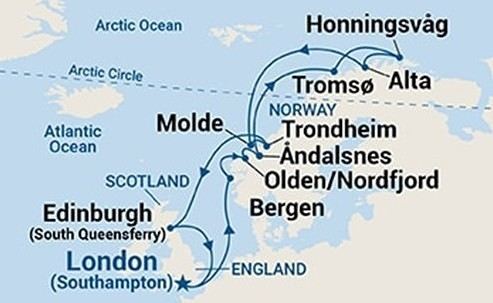
Southampton - Sea day - Bergen - Olden - Åndalsnes - Sea day - Tromsø - Honningsvåg (North Cape) - Alta - Sea day - Molde - Trondheim - Two sea days - Edinburgh - Sea day - Southampton
I’ve wanted to take this Norway cruise for a very long time. The first time I booked it was in July 2020 with Azamara. Unfortunately, it was canceled, as everyone remembers. When I tried to book it again, the prices (already a bit high with Azamara) had simply doubled. So, since then, I’ve been keeping an eye out every year for any opportunities...
The last time we sailed with Princess was eleven years ago, and things didn’t go very well. I came back pretty unhappy with their service and quite disappointed. Despite the $600 they gave me as credit for a future cruise, I’d never set foot on one of their ships again.
But this time, the opportunity arose—a fantastic itinerary with lots of stops, a reasonable price for 16 nights (I’ll share the details in the conclusion), and a ship that’s not too big, so to speak, with only 3,000 passengers. I’m not expecting much from the cruise line this time and am boarding the ship with low expectations beyond the itinerary.
Princess has introduced an app to download before the cruise. It’s essential because online check-in is no longer available, and the agency doesn’t send a travel journal. Everything is done through the app. After completing the check-in on the app, we only know that we’ll need to pick up our key, the Medallion, at embarkation by following the blue line in the terminal and presenting our passport.
Up until our departure, the weather forecast for the coming week in Norway is disastrous—rain, rain, and more rain. It was pretty much the same two years ago before our Iceland cruise, and in the end, the weather turned out fine.
If you’re ready to embark on the Emerald Princess to discover this beautiful cruise and the stunning landscapes of Norway, let’s go!
Southampton - Sea day - Bergen - Olden - Åndalsnes - Sea day - Tromsø - Honningsvåg (North Cape) - Alta - Sea day - Molde - Trondheim - Two sea days - Edinburgh - Sea day - Southampton
Bad news! Tax in Mauritius
Bad news: starting October 2025, the Mauritian tourism ministry is introducing a new tax of 3 € per night per traveler, on top of the existing 55 € fee. This could make other destinations like Madagascar—where no tourism tax is charged—more appealing.
General 2022+ Update for Russia
This forum was closed for a long time after COVID, then due to its sale by the previous owner. Since 2022, there have been notable changes for Russia. It became possible to travel to Russia as a tourist again after COVID restrictions ended in summer 2022. But before that, in March 2022, the EU and member countries cut air links with Russia, as well as train lines. They also cut Russian banks off from the Euro-American banking network—meaning cards and wire transfers.
EU-based insurers stopped offering policies for Russia. The Green Card for cars in Russia was also discontinued. Then the EU abolished the simplified visa regime agreement with Russia. All in all, a summary of the current practical aspects would be helpful.
I’ve been traveling to Russia regularly for about twenty years, and after the long COVID break, I resumed in autumn 2022.
Visa
The usual paper visa is much more expensive. On one hand, because the previous regime was scrapped, and on the other, because invitations for multi-entry visas are pricier. A single-entry 30-day visa costs 80 €. The multi-entry one is 240 €. To be sure you’ll get a 12-month multi-entry, it’s best to buy a telex invitation from the MID (Russian Ministry of Foreign Affairs), though there are few resellers. Prices vary depending on the seller.
E-visas are now available for Schengen passport holders. A big simplification for trips up to 16 days within a 60-day validity period. You can apply from 40 days up to 5 days before your desired date. Issued in up to four days. The site is https://evisa.kdmid.ru/ Cost: 50 €. Processed through an Emirati bank (United Arab Emirates).
Medical Insurance
Medical insurance with repatriation is required to get a visa. So you’ll need to buy a policy. This brings up payment methods. If you’re already familiar with Russia and have a Russian bank account, you can pay with your Russian card. Otherwise, you’ll have to buy from a site that accepts payments via a Belarusian bank—which means your bank must work with Belarus—or go through https://goingrus.com/fr/insurance
Transport from the EU
Minibus (marshrutka) from Kirkenes (Norway) to Murmansk. Schedules are coordinated with flights from Oslo, which arrive between 11:00 and 12:00. They wait on the right as you exit the airport. Some are chartered by groups and leave directly, but may have space—ask the driver. Otherwise, two companies run the route, with a stop in town at the corner of the Scandic, where they depart around 14:00 or 15:00. Payment in cash (NOK or RUB) to the driver. Main operator: https://borodinbus.com Bus from Tallinn (Estonia) to St. Petersburg. The border crossing is on the Narva River. The Russian road checkpoint has been closed since January 2024 for construction expected to last 2.5 years, so reopening is possible in summer 2026. In the meantime, it’s a two-bus journey: Tallinn-Narva, then walk across the bridge between the Estonian and Russian checkpoints at Ivangorod, followed by another bus. Several companies: Luxexpress, Ecolines, Baltic Shuttle, Anniston, СКСавто. Bus from Riga to Pskov or St. Petersburg (final destination). Departs from Riga’s bus station (behind the train station) daily between 18:00 and 19:00. Arrives in Pskov between 01:00 and 02:00 (Russian time). Company: СКСавто. There’s another bus around 21:00 with Ecolines, but it’s longer, with a long stop at the border. Bus from Gdańsk to Kaliningrad. Several buses per day. From the PKS bus station, behind Gdańsk’s central station, on the other side of the boulevard. From Kaliningrad, a 1-hour flight to St. Petersburg costs around 5000 RUB.
Basically, unless you’re planning to go to Murmansk and the Kola Peninsula—and possibly from Murmansk, flights to Arkhangelsk, then Nenetsia (Naryan-Mar), etc.—the three main crossing points with airports are Tallinn, Riga, and Gdańsk.
The Gdańsk-Kaliningrad bus is the fastest, and the ticket to St. Petersburg is very reasonable.
The Narva-Ivangorod route is the riskiest in terms of potential queues and crossing time. Holiday periods are especially risky. Last mid-June, I took a 14:00 bus from Tallinn. I’d bought a single-berth compartment on the Grand Express St. Petersburg-Moscow train, leaving at 23:00, with the idea of a good night’s rest before a Moscow-Magadan flight. A 7-hour queue at the border meant I arrived at St. Petersburg’s bus station at 23:00—missed the train, had to book a room, and spent time finding a reasonably priced flight to Moscow the next day for the same airport as my Magadan flight.
The Riga-Pskov route is a bit long but relaxed. If you get off in Pskov, you can still get decent sleep between 02:00 and 12:00. The Oktyabrskaya Hotel is cheap. I’ve also stopped in Izborsk. You ask the driver when boarding in Riga. The stop is on the federal highway—cross the road, and the main inn is 200m away. You can explore the medieval site the next morning before taking a bus to Pskov (30 km).
From Pskov, there are fast regional Lastochka trains—three or four per day—to St. Petersburg, taking 3.5 hours. Very comfortable and affordable. Also, two daily flights with Azimuth to Moscow-Vnukovo from 5000 RUB. A one-hour flight. It’s a section of Pskov’s military airfield, just a few kilometers from the city center.
Money
Cash. The EU issued a nonsensical decree: a ban on importing EU currency (euros, zloty, kroner, forints, etc.) except for personal travel use. This doesn’t make sense because as a citizen of a eurozone country, you *have* to have euros—cash or electronic (card). You can’t travel without them. The stipulation about a limit for personal use is absurd because personal use can mean anything from a hostel bed to a luxury hotel room, plus transport (flight tickets, train tickets in Russia), restaurants, etc. Estonian customs officers ask about this at the border when leaving. They ask in Estonian, then Russian, then English, depending. Since I cross with a French passport, I just say, "Sorry, I don’t understand," no matter what. Then they ask with a questioning look, "Euro?" and I shake my head. I haven’t been searched, but they do ask to glance in your bag. Russians with large suitcases often get checked. Cards and phone apps: if you have a Russian bank account.
Telephony and Internet
Roaming works but is pricey. Okay for calls and SMS, but very expensive for data. In that case, use an e-SIM with your home carrier if your phone supports it. Otherwise, look into prepaid rechargeable SIMs in Russia for data only—like SIM cards for mobile modems.
Russian SIM: Since this year (2025), as of March, it’s mandatory to be registered in the EBS (Unified Biometric System) to buy a SIM card. For a non-resident foreigner, this means first registering for a SNILS at an MFC (Multifunctional Center)—also called "My Documents." The SNILS is the pension center, which doesn’t require residency. After getting your SNILS number and certificate, you register on the public services portal, Gosuslugi. Finally, you register in the EBS system (voice sample—you read numbers—and a biometric facial photo).
Personal Car
The Green Card no longer covers Russia, and neither do EU-based insurers. But third-party liability insurance (OSAGO) is mandatory. Since the closure of the Russian checkpoint at Ivangorod for construction and the Finnish border closure, the routes are from Kirkenes in Norway, the Estonia-Pskov route, and—since the Belarus-Russia joint visa this year—the Belarus route, e.g., Poland-Terespol-Brest or Lithuania-Belarus. No OSAGO sales if you cross via Kirkenes. I didn’t see any at Shumilkino, the Russian checkpoint after Estonia toward Pskov. If you have a Russian card, you can buy online, of course. Otherwise, pay in cash on-site at certain company offices (specific forms aren’t available at all agencies) or online by paying to a third-party account outside Russia—with added fees.
EU-based insurers stopped offering policies for Russia. The Green Card for cars in Russia was also discontinued. Then the EU abolished the simplified visa regime agreement with Russia. All in all, a summary of the current practical aspects would be helpful.
I’ve been traveling to Russia regularly for about twenty years, and after the long COVID break, I resumed in autumn 2022.
Visa
The usual paper visa is much more expensive. On one hand, because the previous regime was scrapped, and on the other, because invitations for multi-entry visas are pricier. A single-entry 30-day visa costs 80 €. The multi-entry one is 240 €. To be sure you’ll get a 12-month multi-entry, it’s best to buy a telex invitation from the MID (Russian Ministry of Foreign Affairs), though there are few resellers. Prices vary depending on the seller.
E-visas are now available for Schengen passport holders. A big simplification for trips up to 16 days within a 60-day validity period. You can apply from 40 days up to 5 days before your desired date. Issued in up to four days. The site is https://evisa.kdmid.ru/ Cost: 50 €. Processed through an Emirati bank (United Arab Emirates).
Medical Insurance
Medical insurance with repatriation is required to get a visa. So you’ll need to buy a policy. This brings up payment methods. If you’re already familiar with Russia and have a Russian bank account, you can pay with your Russian card. Otherwise, you’ll have to buy from a site that accepts payments via a Belarusian bank—which means your bank must work with Belarus—or go through https://goingrus.com/fr/insurance
Transport from the EU
Minibus (marshrutka) from Kirkenes (Norway) to Murmansk. Schedules are coordinated with flights from Oslo, which arrive between 11:00 and 12:00. They wait on the right as you exit the airport. Some are chartered by groups and leave directly, but may have space—ask the driver. Otherwise, two companies run the route, with a stop in town at the corner of the Scandic, where they depart around 14:00 or 15:00. Payment in cash (NOK or RUB) to the driver. Main operator: https://borodinbus.com Bus from Tallinn (Estonia) to St. Petersburg. The border crossing is on the Narva River. The Russian road checkpoint has been closed since January 2024 for construction expected to last 2.5 years, so reopening is possible in summer 2026. In the meantime, it’s a two-bus journey: Tallinn-Narva, then walk across the bridge between the Estonian and Russian checkpoints at Ivangorod, followed by another bus. Several companies: Luxexpress, Ecolines, Baltic Shuttle, Anniston, СКСавто. Bus from Riga to Pskov or St. Petersburg (final destination). Departs from Riga’s bus station (behind the train station) daily between 18:00 and 19:00. Arrives in Pskov between 01:00 and 02:00 (Russian time). Company: СКСавто. There’s another bus around 21:00 with Ecolines, but it’s longer, with a long stop at the border. Bus from Gdańsk to Kaliningrad. Several buses per day. From the PKS bus station, behind Gdańsk’s central station, on the other side of the boulevard. From Kaliningrad, a 1-hour flight to St. Petersburg costs around 5000 RUB.
Basically, unless you’re planning to go to Murmansk and the Kola Peninsula—and possibly from Murmansk, flights to Arkhangelsk, then Nenetsia (Naryan-Mar), etc.—the three main crossing points with airports are Tallinn, Riga, and Gdańsk.
The Gdańsk-Kaliningrad bus is the fastest, and the ticket to St. Petersburg is very reasonable.
The Narva-Ivangorod route is the riskiest in terms of potential queues and crossing time. Holiday periods are especially risky. Last mid-June, I took a 14:00 bus from Tallinn. I’d bought a single-berth compartment on the Grand Express St. Petersburg-Moscow train, leaving at 23:00, with the idea of a good night’s rest before a Moscow-Magadan flight. A 7-hour queue at the border meant I arrived at St. Petersburg’s bus station at 23:00—missed the train, had to book a room, and spent time finding a reasonably priced flight to Moscow the next day for the same airport as my Magadan flight.
The Riga-Pskov route is a bit long but relaxed. If you get off in Pskov, you can still get decent sleep between 02:00 and 12:00. The Oktyabrskaya Hotel is cheap. I’ve also stopped in Izborsk. You ask the driver when boarding in Riga. The stop is on the federal highway—cross the road, and the main inn is 200m away. You can explore the medieval site the next morning before taking a bus to Pskov (30 km).
From Pskov, there are fast regional Lastochka trains—three or four per day—to St. Petersburg, taking 3.5 hours. Very comfortable and affordable. Also, two daily flights with Azimuth to Moscow-Vnukovo from 5000 RUB. A one-hour flight. It’s a section of Pskov’s military airfield, just a few kilometers from the city center.
Money
Cash. The EU issued a nonsensical decree: a ban on importing EU currency (euros, zloty, kroner, forints, etc.) except for personal travel use. This doesn’t make sense because as a citizen of a eurozone country, you *have* to have euros—cash or electronic (card). You can’t travel without them. The stipulation about a limit for personal use is absurd because personal use can mean anything from a hostel bed to a luxury hotel room, plus transport (flight tickets, train tickets in Russia), restaurants, etc. Estonian customs officers ask about this at the border when leaving. They ask in Estonian, then Russian, then English, depending. Since I cross with a French passport, I just say, "Sorry, I don’t understand," no matter what. Then they ask with a questioning look, "Euro?" and I shake my head. I haven’t been searched, but they do ask to glance in your bag. Russians with large suitcases often get checked. Cards and phone apps: if you have a Russian bank account.
Telephony and Internet
Roaming works but is pricey. Okay for calls and SMS, but very expensive for data. In that case, use an e-SIM with your home carrier if your phone supports it. Otherwise, look into prepaid rechargeable SIMs in Russia for data only—like SIM cards for mobile modems.
Russian SIM: Since this year (2025), as of March, it’s mandatory to be registered in the EBS (Unified Biometric System) to buy a SIM card. For a non-resident foreigner, this means first registering for a SNILS at an MFC (Multifunctional Center)—also called "My Documents." The SNILS is the pension center, which doesn’t require residency. After getting your SNILS number and certificate, you register on the public services portal, Gosuslugi. Finally, you register in the EBS system (voice sample—you read numbers—and a biometric facial photo).
Personal Car
The Green Card no longer covers Russia, and neither do EU-based insurers. But third-party liability insurance (OSAGO) is mandatory. Since the closure of the Russian checkpoint at Ivangorod for construction and the Finnish border closure, the routes are from Kirkenes in Norway, the Estonia-Pskov route, and—since the Belarus-Russia joint visa this year—the Belarus route, e.g., Poland-Terespol-Brest or Lithuania-Belarus. No OSAGO sales if you cross via Kirkenes. I didn’t see any at Shumilkino, the Russian checkpoint after Estonia toward Pskov. If you have a Russian card, you can buy online, of course. Otherwise, pay in cash on-site at certain company offices (specific forms aren’t available at all agencies) or online by paying to a third-party account outside Russia—with added fees.
Martine and DD in Colorado and Utah
Hello everyone! 🙂
So many silent months, and now Voyage Forum is accessible again. That’s cool because we can pick up our discussions for our mutual enjoyment.
I hope everyone is doing well and that you’ve been able to take some great trips, whether to the USA or elsewhere.
In September 2020, we had planned a round trip to explore Colorado, but unfortunately, a nasty virus messed up our plans, closing borders and keeping us stuck at home. Luckily for us, canceling the car, flights, and accommodations didn’t cost us a thing—everything was refunded.
In 2023, a loop from Las Vegas let us revisit places we’d seen in 2017 and discover new ones, this time spending more time at each stop with some lovely hikes.
In 2024, we finally revisited the 2020 plan, and I’ll start with that.
However, unforeseen circumstances mean I have much less time than before, so I’ll keep my trip reports shorter (ha ha ha—you’ll have less of my prose to endure).
Another change: for those who remember the "Gang of Four crazy sixty-somethings," it was just DD and me this time. Our dear Mimi and Maumau left the Var to focus on raising horses and can’t leave their little green paradise to join us anymore. We were unfortunately much tamer without them.
We traveled from September 11 to October 3.
The itinerary
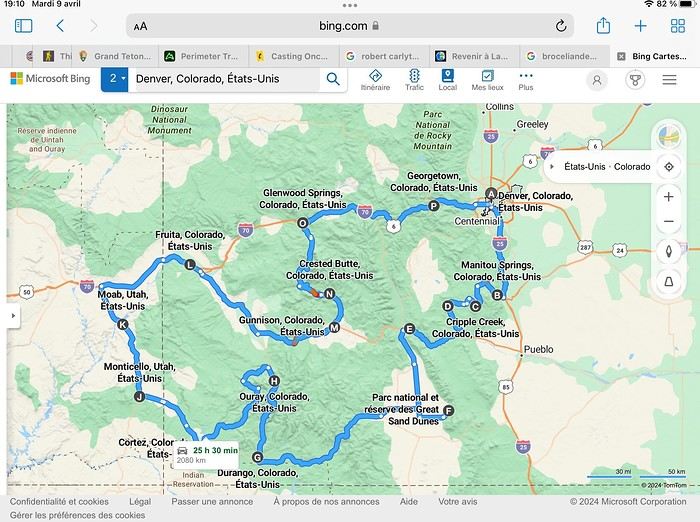
Day 1: Flight Marseille-Paris-Denver, then Manitou Springs (133 km) Day 2: Manitou Springs (49 km) Day 3: Cripple Creek (104 km) Day 4: Salida (254 km) Day 5: Great Sand Dunes (231 km) Day 6: Durango (283 km) Day 7: Durango (Durango-Silverton train) Day 8: Ouray (121 km) Day 9: Ouray (Perimeter Trail hike) Day 10: Cortez (213 km) Day 11: Cortez (Mesa Verde National Park, 134 km) Day 12: Monticello (268 km, detour to Chesler Park) Day 13: Moab (171 km, Delicate Arch) Day 14: Moab (98 km, Fisher Towers) Day 15: Moab (171 km, Canyonlands) Day 16: Fruita (210 km, Colorado National Monument) Day 17: Crested Butte (224 km via Kebler Pass) Day 18: Crested Butte (57 km) Day 19: Glenwood Springs (150 km) Day 20: Glenwood Springs (118 km, Rifle State Park) Day 21: Georgetown (258 km via Independence Pass) Day 22: Denver (123 km), then return flight
We speak very little English. We spent 21 nights there and covered a 3,400 km loop by car and 160 km on foot (we’re still trying to hike while we’re in shape) from Denver in September 2024. We wanted this road trip to help us explore Colorado a bit more—we’d only spent 6 nights there in 2019—and to see it during the fall foliage season. We also wanted to return to Utah (we love Moab) to enjoy its red rocks, which we adore.
In the prices you see (some in euros, others in dollars), I’ve included bank fees and exchange charges. The flights, car, and parking were paid by credit card when we booked in February. Usually, we book around November, but some obligations kept us from doing it earlier. We downloaded the MPC (Mobile Passport Control) app on our phone, which saved us time at immigration.
📊 **Budget: just under 8,500 € for both of us, all included**
📊 **Flights** Marseille-Paris (CDG)-Denver: 2,152 € for both of us, with one checked bag each
📊 **ESTA and America the Beautiful Pass** The ones from our 2023 road trip were still valid
📊 **Parking at Marseille airport: 122 €**
📊 **Car: Nissan Rogue (the French X-Trail) from Hertz: 1,165 €** By booking through Air France (and earning miles), we got a 15% discount. Hertz offers a free Hertz Gold Plus Rewards program, which gives us priority counter service.
📊 **Accommodation: 3,050 €** We stayed in motels and hotels of various ranges (from 100 € to 270 € per night, depending on the city), all booked through Hotels.com or Booking. Booking sometimes offers cheaper rates if you book via the "Booking mobile" app. We also got some preferential rates thanks to our Genius 2 status. Out of 21 nights, only one place didn’t include breakfast.
📊 **Other expenses (activities booked by credit card before leaving)** Durango-Silverton train: 210 € (we booked the enclosed vintage coach in March) Mesa Verde: Balcony House: 15.15 € (booked 14 days before the visit) Timed-entry passes for Arches National Park: 6 € for 3 days (booked June 1 for September entries via http://récreation.gov/). We booked three different days to play with the weather.
📊 **Supplementary insurance with AVA: 204 €** (due to our age 😅 and the high cost of medical consultations in the USA)
📊 **Cash: 1,540 €** We left with 1,000 € exchanged before departure and made two withdrawals (500 $ and 200 $). This cash was used to pay for: - Evening restaurants and tips (between 70 $ and 95 $ for two meals and two drinks) - Two state parks: Dead Horse State Park (20 $) and Rifle State Park (10 $) - The Monarch Pass gondola (24 $) - Midday picnics - Gas (slightly cheaper with cash): 204 $ for 3,400 km - Personal souvenirs and little treats.
Like in our previous road trips, we didn’t rent a GPS. We used the offline GPS app Here We Go, for which we’d downloaded maps of Colorado and Utah from France, as well as a new offline app called Organic Maps as a backup—though we didn’t end up needing it.
❤️❤️❤️ **Highlights (there are so many!)** 📍 The stunning landscapes of Colorado, especially with the fall colors 📍 A step back in time at the old farm in Florissant Fossil Beds National Monument 📍 The prairies of Cripple Creek and the mining remnants of the Vindicator Trail 📍 The cheeky chipmunks in the ghost town of St. Elmo 📍 Great Sand Dunes and its soft sand 📍 The steam train between Durango and Silverton: we’re glad we chose the round-trip because it rained heavily on the way there, but we got to enjoy the scenery on the way back when the sun came out 📍 The unexpected meet-up with Michèle from the group outside a restaurant in Durango 📍 The hot springs in Ouray 📍 Mesa Verde and its still-vibrant past 📍 The red rocks of Moab and Delicate Arch at sunset 📍 The lace-like Fisher Towers and the view from the end of the trail 📍 The gorgeous Route 128 leading to Colorado National Monument—small, easy to visit, and so beautiful 📍 The colors of the fabulous Kebler Pass, Crested Butte, and especially the hike through the golden aspens (Lower and Upper Loop) 📍 The waterfalls at Rifle State Park 📍 The tundra of Independence Pass 📍 The Halloween decorations in Georgetown and Idaho Springs
😞😞 **Flops (there are very few!)** 📍 The viewpoints we missed because they weren’t well-marked or we didn’t see the signs 📍 The closure of some hiking trails (Hanging Lake and parts of Canyonlands) and the Sal Mountain Loop road, which kept us from accessing it 📍😢 The Chesler Park hike we had to cut short due to poor time management—180 km between our stop in Cortez meant we didn’t arrive until 10:30 AM, way too late for a 17 km hike.
Hope this helps! Have a great evening, everyone, and see you soon! 😊
The itinerary
Day 1: Flight Marseille-Paris-Denver, then Manitou Springs (133 km) Day 2: Manitou Springs (49 km) Day 3: Cripple Creek (104 km) Day 4: Salida (254 km) Day 5: Great Sand Dunes (231 km) Day 6: Durango (283 km) Day 7: Durango (Durango-Silverton train) Day 8: Ouray (121 km) Day 9: Ouray (Perimeter Trail hike) Day 10: Cortez (213 km) Day 11: Cortez (Mesa Verde National Park, 134 km) Day 12: Monticello (268 km, detour to Chesler Park) Day 13: Moab (171 km, Delicate Arch) Day 14: Moab (98 km, Fisher Towers) Day 15: Moab (171 km, Canyonlands) Day 16: Fruita (210 km, Colorado National Monument) Day 17: Crested Butte (224 km via Kebler Pass) Day 18: Crested Butte (57 km) Day 19: Glenwood Springs (150 km) Day 20: Glenwood Springs (118 km, Rifle State Park) Day 21: Georgetown (258 km via Independence Pass) Day 22: Denver (123 km), then return flight
We speak very little English. We spent 21 nights there and covered a 3,400 km loop by car and 160 km on foot (we’re still trying to hike while we’re in shape) from Denver in September 2024. We wanted this road trip to help us explore Colorado a bit more—we’d only spent 6 nights there in 2019—and to see it during the fall foliage season. We also wanted to return to Utah (we love Moab) to enjoy its red rocks, which we adore.
In the prices you see (some in euros, others in dollars), I’ve included bank fees and exchange charges. The flights, car, and parking were paid by credit card when we booked in February. Usually, we book around November, but some obligations kept us from doing it earlier. We downloaded the MPC (Mobile Passport Control) app on our phone, which saved us time at immigration.
📊 **Budget: just under 8,500 € for both of us, all included**
📊 **Flights** Marseille-Paris (CDG)-Denver: 2,152 € for both of us, with one checked bag each
📊 **ESTA and America the Beautiful Pass** The ones from our 2023 road trip were still valid
📊 **Parking at Marseille airport: 122 €**
📊 **Car: Nissan Rogue (the French X-Trail) from Hertz: 1,165 €** By booking through Air France (and earning miles), we got a 15% discount. Hertz offers a free Hertz Gold Plus Rewards program, which gives us priority counter service.
📊 **Accommodation: 3,050 €** We stayed in motels and hotels of various ranges (from 100 € to 270 € per night, depending on the city), all booked through Hotels.com or Booking. Booking sometimes offers cheaper rates if you book via the "Booking mobile" app. We also got some preferential rates thanks to our Genius 2 status. Out of 21 nights, only one place didn’t include breakfast.
📊 **Other expenses (activities booked by credit card before leaving)** Durango-Silverton train: 210 € (we booked the enclosed vintage coach in March) Mesa Verde: Balcony House: 15.15 € (booked 14 days before the visit) Timed-entry passes for Arches National Park: 6 € for 3 days (booked June 1 for September entries via http://récreation.gov/). We booked three different days to play with the weather.
📊 **Supplementary insurance with AVA: 204 €** (due to our age 😅 and the high cost of medical consultations in the USA)
📊 **Cash: 1,540 €** We left with 1,000 € exchanged before departure and made two withdrawals (500 $ and 200 $). This cash was used to pay for: - Evening restaurants and tips (between 70 $ and 95 $ for two meals and two drinks) - Two state parks: Dead Horse State Park (20 $) and Rifle State Park (10 $) - The Monarch Pass gondola (24 $) - Midday picnics - Gas (slightly cheaper with cash): 204 $ for 3,400 km - Personal souvenirs and little treats.
Like in our previous road trips, we didn’t rent a GPS. We used the offline GPS app Here We Go, for which we’d downloaded maps of Colorado and Utah from France, as well as a new offline app called Organic Maps as a backup—though we didn’t end up needing it.
❤️❤️❤️ **Highlights (there are so many!)** 📍 The stunning landscapes of Colorado, especially with the fall colors 📍 A step back in time at the old farm in Florissant Fossil Beds National Monument 📍 The prairies of Cripple Creek and the mining remnants of the Vindicator Trail 📍 The cheeky chipmunks in the ghost town of St. Elmo 📍 Great Sand Dunes and its soft sand 📍 The steam train between Durango and Silverton: we’re glad we chose the round-trip because it rained heavily on the way there, but we got to enjoy the scenery on the way back when the sun came out 📍 The unexpected meet-up with Michèle from the group outside a restaurant in Durango 📍 The hot springs in Ouray 📍 Mesa Verde and its still-vibrant past 📍 The red rocks of Moab and Delicate Arch at sunset 📍 The lace-like Fisher Towers and the view from the end of the trail 📍 The gorgeous Route 128 leading to Colorado National Monument—small, easy to visit, and so beautiful 📍 The colors of the fabulous Kebler Pass, Crested Butte, and especially the hike through the golden aspens (Lower and Upper Loop) 📍 The waterfalls at Rifle State Park 📍 The tundra of Independence Pass 📍 The Halloween decorations in Georgetown and Idaho Springs
😞😞 **Flops (there are very few!)** 📍 The viewpoints we missed because they weren’t well-marked or we didn’t see the signs 📍 The closure of some hiking trails (Hanging Lake and parts of Canyonlands) and the Sal Mountain Loop road, which kept us from accessing it 📍😢 The Chesler Park hike we had to cut short due to poor time management—180 km between our stop in Cortez meant we didn’t arrive until 10:30 AM, way too late for a 17 km hike.
Hope this helps! Have a great evening, everyone, and see you soon! 😊
Review of my visit to Angkor
SIEM REAP
You can now rent scooters just about everywhere in Siem Reap, but at rip-off prices—$15–18 a day instead of $5–10 like everywhere else in Indochina. The best options are tuk-tuks or, even better, electric bikes ($12, but with a 50 km range, so they won’t let you go to Banteay Srei or the River of a Thousand Lingas in the Kulen Massif, which are too far). **WARNING:** Wear a helmet, or they *will* catch you. Scooters are banned from going from SR to the stunning temple of Koh Ker in the northeast and continuing to Battambang; no idea why!
My favorite little hotel in Siem Reap? The Neth Socheata, tucked in an alley off Thnou St near the market—lovely rooms, and the owner speaks great English. Then there’s the Ivy Guesthouse with its little garden, but it’s “always full,” according to the owner. For something upscale but still affordable, a fantastic spot is the Pavillon Indochine, tucked away on a quiet side street on the way to the airport—elegant, with incredible attention to decor, a terrace restaurant, garden, pool, etc. Everything you’d want for $70 including breakfast. I also spotted a hostel for backpackers, the Angkor Thom Hostel, with small 6-bed dorms for $4 with a fan or $6 with AC (18 Wat Bo St).
Food-wise, it’s all amazing! Pub Street has turned into a noise nightmare, with speakers blasting what’s supposed to be music but is just *boom, boom, boom, boom, boom*—run away, even though the pizzas at the Italian place Il Forno are really good. The famous and excellent Tigre de Papier has changed its name to Paper Tiger and is still just as good (lunch only, though, because across the street there’s a huge bar blasting *boom boom boom*, so you won’t be able to hear each other during dinner). On the other hand, the Italian-Cambodian El Toro on Pub Street is perfect, with fantastic pizzas and divine lasagna (go to the first-floor dining room—there’s a big bar across the street blasting *boom boom boom*, but at least you can still talk). Due to the lack of customers during COVID, all the French restaurants—Barrio (three times alas!), Les Deux Sœurs, Le Bel Air, and Le Mozart—have closed. The only one left is L’Olivier, which is pricey. I also discovered a great Moroccan restaurant (though run by a Sudanese man and his French wife), Le Tajine, on Strung Thmei St, 09 68 89 78 27. **WARNING:** For tagines and couscous, you need to order at least in the morning; wine and beer are fine. To get there, turn at the corner of the Cineplex behind the big market at the start of Sivatha Boulevard.
I finally went to the Khmer dance show. Beautiful dancers and dances, but **EAT BEFORE OR AFTER**—the meal is so awful that most Westerners leave it on their plates.
THE ANGKOR TEMPLES Use the excellent *Routard Cambodia* guide. Just a few tips: - Start with the pre-Angkorian Roluos group, 15 km before Siem Reap on the road to PP—it’s the “ancestor” of the temples.
- To avoid the big crowds at Angkor Wat, Bayon, and Ta Prohm, go between noon and 2 PM when everyone’s having lunch. - Speaking of lunch, the crowds flock to the hundred or so mediocre food stalls on the left side of Angkor Wat. Instead, head to Angkor Thom after the stunning Pre Rup temples, all the way to the small Sras Srang basin. Along the basin, there are several restaurants with terraces offering first-floor views of the water, and no crowds. Afterward, cross to the other side of the basin—you’ll end up in the countryside with charming villages where locals seem to live as they did during the temples’ golden age (at its peak, the population was estimated at 600,000–800,000, making it the largest city in the world. The theory for the abandonment is water shortages caused by overpopulation).
- I climbed Phnom Bakheng for the famous sunset, but the crowd was so ridiculous that instead of seeing the temple at sunset, you just see the heads and shoulders around you.
- There are tons of small temples that most people skip, and they’re missing out. My favorites: Thommanon, Neak Pean, Ta Som, and especially Pre Rup, an amazing brick complex with 14 towers.
**Big disappointment:** You can no longer climb to the first floor of Bayon, where you used to stand magically among the giant head statues. So, admire the beautiful bas-reliefs on the outside, but there’s no point going inside—you’ll just see a dark, square corridor with nothing interesting.
ANGKOR FURTHER AFIELD The wonderful Banteay Srei temple. A gem! I couldn’t find the bas-relief stolen by Malraux in the 1920s (fun fact: what he was doing in Indochina—stealing a bas-relief to sell for a fortune in France to cover his massive gambling debts on the stock market, where he ruined his very wealthy American wife—was an open secret. But the French authorities in Saigon, who hated him for his leftist views, decided to let him do it and catch him red-handed, which worked perfectly. He avoided jail only because all the leftist intellectuals in Saint-Germain, Sartre, Beauvoir, and co. cried scandal—though the real scandal was the looting).
30 km of excellent paved road further north, a great spot: the Kulen Massif and the River of a Thousand Lingas (at one point, you’ll come to a T-junction—turn left). Along the road at the foot of the massif, on your right, there’s a great restaurant, Bourey Sovann (where the food is excellent). The trail to the river starts just before it on the left. **Warning:** There are two sites for the River of a Thousand Lingas. One is accessible via a private road, so there’s a $20 toll, and you need to arrive before 11 AM because the road is narrow and traffic flows downhill after that. You’ll end up in a site full of shops, snack stalls, and two good restaurants, including one by a beautiful waterfall. However, the thousand lingas aren’t as spectacular there.
Banteay Srei + the River of a Thousand Lingas makes for a fantastic day. **WARNING:** You used to be able to go to the river and waterfall by scooter or tuk-tuk, but it’s now forbidden. So **go by taxi**—otherwise, you’ll be hiking 12 km round trip up a steep trail.
If you leave Siem Reap early, you can even add Beng Mealea temple on the way back, making a triangular route: SR-BS-Khulen-BM-SR (or the reverse).
If you have time, visit Banteay Samré temple, 10 km west of the Angkor Thom complex. A lovely site with very few visitors.
I’ve never been to the famous Preah Khan on a hill overlooking Thailand. There’s a big dispute between the two countries—the Thais insist the temple belongs to them because the entrance is in their country. There have been serious clashes in the recent past, and landmines are still abundant off the marked paths. They even claim the entire Siem Reap province is theirs and should be returned, arguing it was Thai in the past. It takes two days (6–7 hours each way), with an overnight stay in the nearby village (small hotels and one luxury option with a garden and pool, but it’s expensive).
TONLE SAP People talk about “floating villages,” but that’s a big mistake—these are actually villages of astonishing stilt houses, 4 meters high or more, due to the lake’s major floods. The most famous is Chong Khneas, which I skipped because it’s packed with tourists. Instead, I really liked Kampong Phluk, which is much quieter. To get there, continue on the road past the Roluos group until you reach a parking lot with pirogues lined up. They’ll take you down the river, stop at this amazing village for a walk, and then take you to the Tonle Sap, a true inland sea. At one point, you’ll pass through a flooded forest that you can explore by small boat. At the junction of the river and the Tonle Sap, and on the lake itself, there are floating restaurants where the food is great. Note that in the dry season, you can reach the village by scooter.
BACK TO PHNOM PENH AND ON TO SOUTHERN VIETNAM Since I’d planned at least 15 days in the Mekong Delta between Chau Doc and Saigon, I skipped Battambang, etc. With no desire to endure the dusty road from SR to PP again, I simply loaded my bike onto a bus with the great company Rith Monty (book at their office in SR on the small square at the start of Sivatha Boulevard—$10 for the bike and $6 for me), also known as Paramount. Their buses stop on 136 St right in the middle of PP. I’ll also mention the excellent Giant Ibis, with big modern buses that always leave on time—unlike the others.
I spent the night in PP, and the next morning took the fast boat from PP to Chau Doc with Hang Chau Tourist (buying the ticket the day before is recommended—$25—either at your hotel or the port, and they’ll pick you up at your hotel by tuk-tuk to take you to the port). Departure from PP at noon, arrival in Chau Doc around 4 PM. The boat is great—comfortable and fast. A crew member takes your passports for Cambodian exit formalities, and you handle Vietnamese immigration yourself—it all takes 15–20 minutes. The route isn’t on the Mekong but on the Bassac River to the border, then a wide north-south canal to Chau Doc (the arrival is really nice). In the Chau Doc-PP direction, the boat leaves Chau Doc at 7:30 AM.
My favorite little hotel in Siem Reap? The Neth Socheata, tucked in an alley off Thnou St near the market—lovely rooms, and the owner speaks great English. Then there’s the Ivy Guesthouse with its little garden, but it’s “always full,” according to the owner. For something upscale but still affordable, a fantastic spot is the Pavillon Indochine, tucked away on a quiet side street on the way to the airport—elegant, with incredible attention to decor, a terrace restaurant, garden, pool, etc. Everything you’d want for $70 including breakfast. I also spotted a hostel for backpackers, the Angkor Thom Hostel, with small 6-bed dorms for $4 with a fan or $6 with AC (18 Wat Bo St).
Food-wise, it’s all amazing! Pub Street has turned into a noise nightmare, with speakers blasting what’s supposed to be music but is just *boom, boom, boom, boom, boom*—run away, even though the pizzas at the Italian place Il Forno are really good. The famous and excellent Tigre de Papier has changed its name to Paper Tiger and is still just as good (lunch only, though, because across the street there’s a huge bar blasting *boom boom boom*, so you won’t be able to hear each other during dinner). On the other hand, the Italian-Cambodian El Toro on Pub Street is perfect, with fantastic pizzas and divine lasagna (go to the first-floor dining room—there’s a big bar across the street blasting *boom boom boom*, but at least you can still talk). Due to the lack of customers during COVID, all the French restaurants—Barrio (three times alas!), Les Deux Sœurs, Le Bel Air, and Le Mozart—have closed. The only one left is L’Olivier, which is pricey. I also discovered a great Moroccan restaurant (though run by a Sudanese man and his French wife), Le Tajine, on Strung Thmei St, 09 68 89 78 27. **WARNING:** For tagines and couscous, you need to order at least in the morning; wine and beer are fine. To get there, turn at the corner of the Cineplex behind the big market at the start of Sivatha Boulevard.
I finally went to the Khmer dance show. Beautiful dancers and dances, but **EAT BEFORE OR AFTER**—the meal is so awful that most Westerners leave it on their plates.
THE ANGKOR TEMPLES Use the excellent *Routard Cambodia* guide. Just a few tips: - Start with the pre-Angkorian Roluos group, 15 km before Siem Reap on the road to PP—it’s the “ancestor” of the temples.
- To avoid the big crowds at Angkor Wat, Bayon, and Ta Prohm, go between noon and 2 PM when everyone’s having lunch. - Speaking of lunch, the crowds flock to the hundred or so mediocre food stalls on the left side of Angkor Wat. Instead, head to Angkor Thom after the stunning Pre Rup temples, all the way to the small Sras Srang basin. Along the basin, there are several restaurants with terraces offering first-floor views of the water, and no crowds. Afterward, cross to the other side of the basin—you’ll end up in the countryside with charming villages where locals seem to live as they did during the temples’ golden age (at its peak, the population was estimated at 600,000–800,000, making it the largest city in the world. The theory for the abandonment is water shortages caused by overpopulation).
- I climbed Phnom Bakheng for the famous sunset, but the crowd was so ridiculous that instead of seeing the temple at sunset, you just see the heads and shoulders around you.
- There are tons of small temples that most people skip, and they’re missing out. My favorites: Thommanon, Neak Pean, Ta Som, and especially Pre Rup, an amazing brick complex with 14 towers.
**Big disappointment:** You can no longer climb to the first floor of Bayon, where you used to stand magically among the giant head statues. So, admire the beautiful bas-reliefs on the outside, but there’s no point going inside—you’ll just see a dark, square corridor with nothing interesting.
ANGKOR FURTHER AFIELD The wonderful Banteay Srei temple. A gem! I couldn’t find the bas-relief stolen by Malraux in the 1920s (fun fact: what he was doing in Indochina—stealing a bas-relief to sell for a fortune in France to cover his massive gambling debts on the stock market, where he ruined his very wealthy American wife—was an open secret. But the French authorities in Saigon, who hated him for his leftist views, decided to let him do it and catch him red-handed, which worked perfectly. He avoided jail only because all the leftist intellectuals in Saint-Germain, Sartre, Beauvoir, and co. cried scandal—though the real scandal was the looting).
30 km of excellent paved road further north, a great spot: the Kulen Massif and the River of a Thousand Lingas (at one point, you’ll come to a T-junction—turn left). Along the road at the foot of the massif, on your right, there’s a great restaurant, Bourey Sovann (where the food is excellent). The trail to the river starts just before it on the left. **Warning:** There are two sites for the River of a Thousand Lingas. One is accessible via a private road, so there’s a $20 toll, and you need to arrive before 11 AM because the road is narrow and traffic flows downhill after that. You’ll end up in a site full of shops, snack stalls, and two good restaurants, including one by a beautiful waterfall. However, the thousand lingas aren’t as spectacular there.
Banteay Srei + the River of a Thousand Lingas makes for a fantastic day. **WARNING:** You used to be able to go to the river and waterfall by scooter or tuk-tuk, but it’s now forbidden. So **go by taxi**—otherwise, you’ll be hiking 12 km round trip up a steep trail.
If you leave Siem Reap early, you can even add Beng Mealea temple on the way back, making a triangular route: SR-BS-Khulen-BM-SR (or the reverse).
If you have time, visit Banteay Samré temple, 10 km west of the Angkor Thom complex. A lovely site with very few visitors.
I’ve never been to the famous Preah Khan on a hill overlooking Thailand. There’s a big dispute between the two countries—the Thais insist the temple belongs to them because the entrance is in their country. There have been serious clashes in the recent past, and landmines are still abundant off the marked paths. They even claim the entire Siem Reap province is theirs and should be returned, arguing it was Thai in the past. It takes two days (6–7 hours each way), with an overnight stay in the nearby village (small hotels and one luxury option with a garden and pool, but it’s expensive).
TONLE SAP People talk about “floating villages,” but that’s a big mistake—these are actually villages of astonishing stilt houses, 4 meters high or more, due to the lake’s major floods. The most famous is Chong Khneas, which I skipped because it’s packed with tourists. Instead, I really liked Kampong Phluk, which is much quieter. To get there, continue on the road past the Roluos group until you reach a parking lot with pirogues lined up. They’ll take you down the river, stop at this amazing village for a walk, and then take you to the Tonle Sap, a true inland sea. At one point, you’ll pass through a flooded forest that you can explore by small boat. At the junction of the river and the Tonle Sap, and on the lake itself, there are floating restaurants where the food is great. Note that in the dry season, you can reach the village by scooter.
BACK TO PHNOM PENH AND ON TO SOUTHERN VIETNAM Since I’d planned at least 15 days in the Mekong Delta between Chau Doc and Saigon, I skipped Battambang, etc. With no desire to endure the dusty road from SR to PP again, I simply loaded my bike onto a bus with the great company Rith Monty (book at their office in SR on the small square at the start of Sivatha Boulevard—$10 for the bike and $6 for me), also known as Paramount. Their buses stop on 136 St right in the middle of PP. I’ll also mention the excellent Giant Ibis, with big modern buses that always leave on time—unlike the others.
I spent the night in PP, and the next morning took the fast boat from PP to Chau Doc with Hang Chau Tourist (buying the ticket the day before is recommended—$25—either at your hotel or the port, and they’ll pick you up at your hotel by tuk-tuk to take you to the port). Departure from PP at noon, arrival in Chau Doc around 4 PM. The boat is great—comfortable and fast. A crew member takes your passports for Cambodian exit formalities, and you handle Vietnamese immigration yourself—it all takes 15–20 minutes. The route isn’t on the Mekong but on the Bassac River to the border, then a wide north-south canal to Chau Doc (the arrival is really nice). In the Chau Doc-PP direction, the boat leaves Chau Doc at 7:30 AM.
Biking Across New York State on the Empire State Trail
From Buffalo to New York City, the Empire State Trail is a 900 km route specifically designed for biking, with 75% on dedicated bike paths.
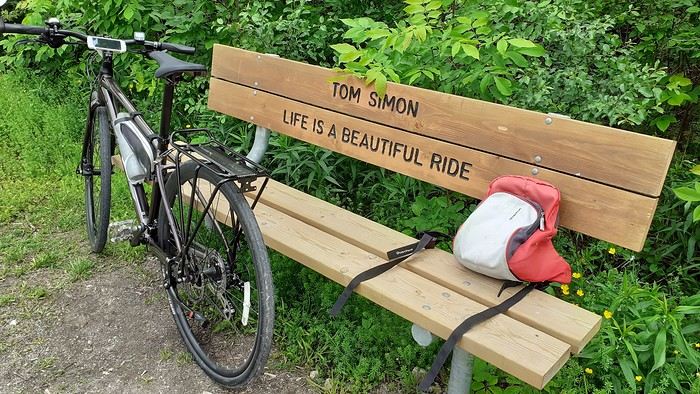
A special train with bike spaces runs almost the entire route. First along the Erie Canal to Albany, then through the Hudson Valley all the way to the tip of Manhattan. This lets you skip sections and also return to your starting point without having to take a flight. Just be aware that bike spaces need to be reserved and can fill up during peak times. In June, no problem though.
This aspect really appealed to me, since my last trip had kinda put me off biking in the US. But here, 75% on dedicated paths, plus that legendary finish in NYC with your bike—I couldn’t resist celebrating my 70th birthday this way.
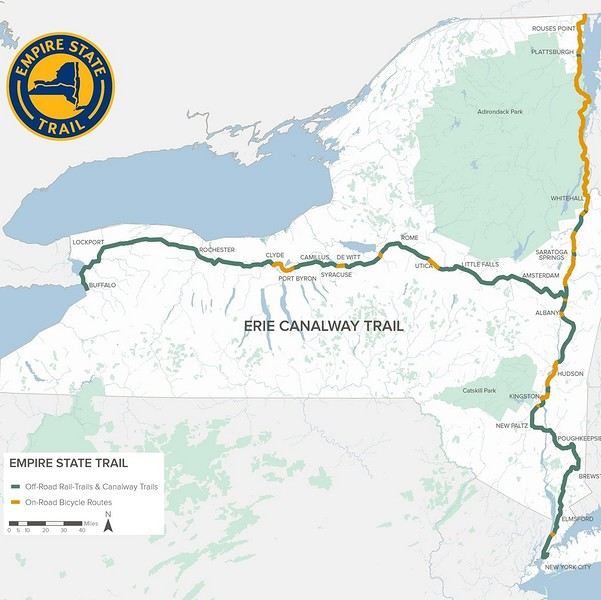 https://empiretrail.ny.gov/map
Two branches to reach NYC: from Buffalo (mostly on dedicated paths) or from Montreal (mostly on roads)
The route was developed in just three years. While it’s popular with cyclists on certain stretches near cities, those who bike the whole thing are still pretty rare.
It’s true that the scenery isn’t exactly breathtaking, and some sections—especially along the Erie Canal—can feel a bit tedious, though they’re very easy since there’s no elevation.
https://empiretrail.ny.gov/map
Two branches to reach NYC: from Buffalo (mostly on dedicated paths) or from Montreal (mostly on roads)
The route was developed in just three years. While it’s popular with cyclists on certain stretches near cities, those who bike the whole thing are still pretty rare.
It’s true that the scenery isn’t exactly breathtaking, and some sections—especially along the Erie Canal—can feel a bit tedious, though they’re very easy since there’s no elevation.
The trail starts in Buffalo, but since my bus from Toronto goes straight to Niagara, I’ll be starting at the falls instead. Plus, that’s where the direct train to NYC departs from (and arrives at).
A special train with bike spaces runs almost the entire route. First along the Erie Canal to Albany, then through the Hudson Valley all the way to the tip of Manhattan. This lets you skip sections and also return to your starting point without having to take a flight. Just be aware that bike spaces need to be reserved and can fill up during peak times. In June, no problem though.
This aspect really appealed to me, since my last trip had kinda put me off biking in the US. But here, 75% on dedicated paths, plus that legendary finish in NYC with your bike—I couldn’t resist celebrating my 70th birthday this way.
https://empiretrail.ny.gov/map
Two branches to reach NYC: from Buffalo (mostly on dedicated paths) or from Montreal (mostly on roads)
The route was developed in just three years. While it’s popular with cyclists on certain stretches near cities, those who bike the whole thing are still pretty rare.
It’s true that the scenery isn’t exactly breathtaking, and some sections—especially along the Erie Canal—can feel a bit tedious, though they’re very easy since there’s no elevation.The trail starts in Buffalo, but since my bus from Toronto goes straight to Niagara, I’ll be starting at the falls instead. Plus, that’s where the direct train to NYC departs from (and arrives at).