Results for "Sam+Neua+|+8+>+189"
4983 results found.
Paris-Athènes en train, puis ferry? English translation pending
Bonsoir !
j'hesite pour aller jusqu'en grece entre l'avion, et la solution train + ferry.
Comment joindre les ports italiens depuis paris, quels trains, quelles gares, combien de temps??
merci d'avance
Sam
merci d'avance
Sam
Belle plage dans le Péloponèse en Grèce? English translation pending
Bonjour! je pars trois semaine en grece cet été et une partie du voyage se deroule dans le peloponnese. si vous pouviez me conseiller des plages sympas, et si possible sans une masse de touristes...
merci d'avance😉! Sam😄
Hôtel à Chengde (province Hebei) en Chine English translation pending
bonjour a tous,
je souhaite aller a chengde (hebei province) pour 2/3 jours et je voudrais trouver un hotel pas cher genre backpacker!!!!! vos suggestions me seraient tres utiles, merci beaucoup....
Qui connaît à Bangkok l'hôtel REX et le Madarin? English translation pending
je voudrais savoir si ces 2 hotels sont agreable :
L'hotel REX et le madarin
ils m'ont l'air pas cher et pas trop mal pour le prix, le REX est près de la station Thong Lor et le madarin près de la station de Métro sAm yan
http://www.hotels2thailand.com/bangkok-hotels/Rex-Hotel.asp
http://www.hotels2thailand.com/bangkok-hotels/Mandarin-Hotel.asp
Merci
ils m'ont l'air pas cher et pas trop mal pour le prix, le REX est près de la station Thong Lor et le madarin près de la station de Métro sAm yan
http://www.hotels2thailand.com/bangkok-hotels/Rex-Hotel.asp
http://www.hotels2thailand.com/bangkok-hotels/Mandarin-Hotel.asp
Merci
Avis sur itinéraire de trois semaines en Thaïlande English translation pending
Bonjour,
je pars 3 semaines en Thailande fin novembre et nous avons commencé à établir un itinéraire.... cela vus semble-t-il réalisabe?
sam 26/11/2005 Bangkok dim 27/11/2005 Bangkok lun 28/11/2005 Ban Pa In Ayutthaya mar 29/11/2005 Lopburi Wat Phra Phutthabbat mer 30/11/2005 Phitsanulok Kamphaeng Phet jeu 01/12/2005 Sukhotai ven 02/12/2005 Si Satchanalai Chialang Thuriang sam 03/12/2005 Lampang dim 04/12/2005 Chiang Mai lun 05/12/2005 Chiang Rai Triangle d'or mar 06/12/2005 Chiang Rai Triangle d'or mer 07/12/2005 Chiang Rai Triangle d'or jeu 08/12/2005 Chiang Rai Triangle d'or ven 09/12/2005 Phuket sam 10/12/2005 Phuket dim 11/12/2005 Ko Samui Ko Pha Nga lun 12/12/2005 Ko Samui Ko Pha Nga mar 13/12/2005 Ko Samui Ko Pha Nga mer 14/12/2005 Ko Tao jeu 15/12/2005 Bangkok ven 16/12/2005 Bangkok
je pars 3 semaines en Thailande fin novembre et nous avons commencé à établir un itinéraire.... cela vus semble-t-il réalisabe?
sam 26/11/2005 Bangkok dim 27/11/2005 Bangkok lun 28/11/2005 Ban Pa In Ayutthaya mar 29/11/2005 Lopburi Wat Phra Phutthabbat mer 30/11/2005 Phitsanulok Kamphaeng Phet jeu 01/12/2005 Sukhotai ven 02/12/2005 Si Satchanalai Chialang Thuriang sam 03/12/2005 Lampang dim 04/12/2005 Chiang Mai lun 05/12/2005 Chiang Rai Triangle d'or mar 06/12/2005 Chiang Rai Triangle d'or mer 07/12/2005 Chiang Rai Triangle d'or jeu 08/12/2005 Chiang Rai Triangle d'or ven 09/12/2005 Phuket sam 10/12/2005 Phuket dim 11/12/2005 Ko Samui Ko Pha Nga lun 12/12/2005 Ko Samui Ko Pha Nga mar 13/12/2005 Ko Samui Ko Pha Nga mer 14/12/2005 Ko Tao jeu 15/12/2005 Bangkok ven 16/12/2005 Bangkok
Vos avis sur mon itinéraire en Thaïlande English translation pending
Bonjours à tous,
Voilà Je prépare mon premier "grand voyage". On part avec un pote, on a choisi la Thaïlande pour ce baptême. Au dire de tous un pays ou il fait bon voyager. Nous partons à la fin de la semaine pour 21 jours 🙂 départ Sam. 8 Oct et retour Sam. 29 Oct. Je me suis pas mal servi de ce site afin d'ébaucher une feuille de route ainsi que du Lonely. Voici le résultats, Pouvez vous me faire un maximum de critique/Suggestion sur l'itinéraire que j'ai choisi ainsi que le temps de mes étapes. On part pour la première fois donc, on à envie d'avoir un large aperçu de ce pays et de ses habitants.
Bangkok Arrivée Dim matin ( 1j) Train de nuit pour Chang Mai CM (3j) Sukhothai (1j) Khao Yai (3j) Ayuthaya (1j) Passage par Chumphon pour Kotao (1j) Ko Pha Ngan (1j) Ko Samui (4j) Ko Phi Phi Don/Puket (3j) Bangkok et banlieu (3j)
Voilà mon idée, avec cet itinéraire je pense voir un peu tout les visages de ce pays.
Merci pour votre aide
Gaël.
Voilà Je prépare mon premier "grand voyage". On part avec un pote, on a choisi la Thaïlande pour ce baptême. Au dire de tous un pays ou il fait bon voyager. Nous partons à la fin de la semaine pour 21 jours 🙂 départ Sam. 8 Oct et retour Sam. 29 Oct. Je me suis pas mal servi de ce site afin d'ébaucher une feuille de route ainsi que du Lonely. Voici le résultats, Pouvez vous me faire un maximum de critique/Suggestion sur l'itinéraire que j'ai choisi ainsi que le temps de mes étapes. On part pour la première fois donc, on à envie d'avoir un large aperçu de ce pays et de ses habitants.
Bangkok Arrivée Dim matin ( 1j) Train de nuit pour Chang Mai CM (3j) Sukhothai (1j) Khao Yai (3j) Ayuthaya (1j) Passage par Chumphon pour Kotao (1j) Ko Pha Ngan (1j) Ko Samui (4j) Ko Phi Phi Don/Puket (3j) Bangkok et banlieu (3j)
Voilà mon idée, avec cet itinéraire je pense voir un peu tout les visages de ce pays.
Merci pour votre aide
Gaël.
Une phrase en serbe à traduire! English translation pending
salut à tous
je suis nouvelle sur le forum et je souhaiterais que vous m'apportiez votre aide afin de traduire une petite phrase qu'un homme rencontré m'a laissée en partant . son refus de me le traduire titille ma curiosité !!
la voici :" izvini za malopre sto sam ti napiso prisca "
prisca c mon prénom inutile de me le traduire lol
merci d'avance
🙂
Le Cambodge accueillera 1,5 millions de touristes en 2010 English translation pending
il y auras du monde a Ankor Watt, ,
“Durant le premier semestre de cette année, le Cambodge a enregistré à son actif 682 431 touristes étrangers, soit une augmentation de 34, 40% par rapport à la même période de l’année précédente”, a affirmé Sâm Prumnea, secrétaire d’Etat au Tourisme, lors de la cérémonie d’ouverture, le 5 septembre à Phnom Penh, d’une formation sur la gestion du marché touristique et sur l’utilisation de la technologie informatique dans le commerce touristique.
Sâm Prumnea a précisé que ces visiteurs étrangers venaient de la Corée, du Japon, des Etats-Unis, de l’Angleterre, de la France, de la Thaïlande, de Taïwan, de la Chine, du Vietnam et des Philippines.
En 2004, 1 054 202 touristes étrangers ont visité le Cambodge, dépassant ainsi à 50, 53% par rapport à l'année 2003.
Selon les estimations du ministère du Tourisme, 1, 5 millions de touristes seront enregistrés en 2006 et 3 millions en 2010, créant quelque 360 000 emplois et rapportant 2 300 millions de dollars à l'économie nationale.- source AKP Phnom Penh, 07 septembre 2006 --
“Durant le premier semestre de cette année, le Cambodge a enregistré à son actif 682 431 touristes étrangers, soit une augmentation de 34, 40% par rapport à la même période de l’année précédente”, a affirmé Sâm Prumnea, secrétaire d’Etat au Tourisme, lors de la cérémonie d’ouverture, le 5 septembre à Phnom Penh, d’une formation sur la gestion du marché touristique et sur l’utilisation de la technologie informatique dans le commerce touristique.
Sâm Prumnea a précisé que ces visiteurs étrangers venaient de la Corée, du Japon, des Etats-Unis, de l’Angleterre, de la France, de la Thaïlande, de Taïwan, de la Chine, du Vietnam et des Philippines.
En 2004, 1 054 202 touristes étrangers ont visité le Cambodge, dépassant ainsi à 50, 53% par rapport à l'année 2003.
Selon les estimations du ministère du Tourisme, 1, 5 millions de touristes seront enregistrés en 2006 et 3 millions en 2010, créant quelque 360 000 emplois et rapportant 2 300 millions de dollars à l'économie nationale.- source AKP Phnom Penh, 07 septembre 2006 --
Cherche destination octobre English translation pending
bonjour,
nous cherchons à partir 8 jours en octobre. on arrive pas à se décider sur le destination: on aimerait du soleil, du repos mais où on peut bouger un peu pour voir des trucs sympas. Le budget est de 1500 euros pour 2 grand max. si vous avez la destination parfaite merci de nous le signaler!! merci estelle et sam
nous cherchons à partir 8 jours en octobre. on arrive pas à se décider sur le destination: on aimerait du soleil, du repos mais où on peut bouger un peu pour voir des trucs sympas. Le budget est de 1500 euros pour 2 grand max. si vous avez la destination parfaite merci de nous le signaler!! merci estelle et sam
Hôtel Iberostar Tucan - Playa del carmen - passage d'Emily English translation pending
Bonjour à tous 🙂
Je pars au Tucan début septembre. J'aurais juste voulu avoir quelques infos voir quelques photos sur cet hôtel et surtout savoir si Emily n'avait pas fait trop de dégâts lors de son passage.
merci d'avance 😎
Je pars au Tucan début septembre. J'aurais juste voulu avoir quelques infos voir quelques photos sur cet hôtel et surtout savoir si Emily n'avait pas fait trop de dégâts lors de son passage.
merci d'avance 😎
Belgique: un week-end à Bruges et Bruxelles English translation pending
Bonjour,
Je vais passer le week-end du 14 juilet en Belgique, je compte faire 2 nuits à Bruges et 1 à Bruxelles. Qu'en pensez vous ? J'ai déjà trouvé une chambre d'hôte à Bruges mais je cherche toujours un hébergement pour la nuit du sam 16 juillet à Bruxelles, en centre ville de préférence, et pour petit budget, chambre d'hôtes avec plaisir...
Si quelqu'un à des conseils, merci... Je suis preneuse de tous types d'infos... 😉
Je vais passer le week-end du 14 juilet en Belgique, je compte faire 2 nuits à Bruges et 1 à Bruxelles. Qu'en pensez vous ? J'ai déjà trouvé une chambre d'hôte à Bruges mais je cherche toujours un hébergement pour la nuit du sam 16 juillet à Bruxelles, en centre ville de préférence, et pour petit budget, chambre d'hôtes avec plaisir...
Si quelqu'un à des conseils, merci... Je suis preneuse de tous types d'infos... 😉
Budget New York English translation pending
Bonjour à tous!
J'suis actuellement étudiant, et j'ai un rève, c'est d'aller poser les pieds quelques jours sur la terre de l'Oncle Sam! J'pense que ma destination va être New-York... J'ai pas mal de questions qui me trottent dans la tête: Combien de temps me conseillez-vous d'y rester ? 1 semaine ? 10 jours ? Plus ça risque de faire cher je pense... Si on part sur une base de 10 jours, quel budget dois-je envisager, sachant que je ne vais pas aller dans des hotels de luxe, mais plus dans des trucs style auberges de jeunesse, dortoires etc... Est-ce que un budget de 1500 euros (AR en avion, logements, bouffe, visites ect...) est raisonnable? Est-ce qu'il faut tabler sur plus, ou est-ce qu'il y a possibilités de descendre en dessous de 1500 euros ? A New-York, qu'est-ce qui est le plus interessant pour un ou plusieurs étudiants pour se deplacer? Les transports en commun (metro, bus de la ville) seront-ils suffisant ? Ou alors il faut envisager la location d'une voiture ?
Je vous remercie d'avance pour vos réponses!
A++
BNS
J'suis actuellement étudiant, et j'ai un rève, c'est d'aller poser les pieds quelques jours sur la terre de l'Oncle Sam! J'pense que ma destination va être New-York... J'ai pas mal de questions qui me trottent dans la tête: Combien de temps me conseillez-vous d'y rester ? 1 semaine ? 10 jours ? Plus ça risque de faire cher je pense... Si on part sur une base de 10 jours, quel budget dois-je envisager, sachant que je ne vais pas aller dans des hotels de luxe, mais plus dans des trucs style auberges de jeunesse, dortoires etc... Est-ce que un budget de 1500 euros (AR en avion, logements, bouffe, visites ect...) est raisonnable? Est-ce qu'il faut tabler sur plus, ou est-ce qu'il y a possibilités de descendre en dessous de 1500 euros ? A New-York, qu'est-ce qui est le plus interessant pour un ou plusieurs étudiants pour se deplacer? Les transports en commun (metro, bus de la ville) seront-ils suffisant ? Ou alors il faut envisager la location d'une voiture ?
Je vous remercie d'avance pour vos réponses!
A++
BNS
Manifestation à Paris pour la démocratie au Cambodge English translation pending
MANIFESTATION POUR ARRETER LA DERIVE TOTALITAIRE AU CAMBODGE
Les Cambodgiens de France et leurs amis de toutes nationalités sont invités à participer à une manifestation pacifique à Paris pour Protester contre la dérive totalitaire au Cambodge Demander la libération du député Cheam Channy Réclamer le rétablissement de l’immunité parlementaire des députés Sam Rainsy, Cheam Channy et Chea Poch Exiger l’arrêt des mesures répressives contre l’opposition démocratique par le biais d’un système judiciaire aux ordres du gouvernement.
Les manifestants demanderont au gouvernement français de veiller au respect des Accords de Paris de 1991 qui garantissent un véritable processus de démocratisation au Cambodge. Ils lanceront un appel à la communauté internationale et à tous les pays donateurs pour aider au renforcement de la démocratie sans laquelle le Cambodge continuera de sombrer dans une pauvreté croissante en dépit d’une aide internationale massive mais mal utilisée à cause de la corruption.
Plus que de charité le Cambodge a besoin de bonne gouvernance. La bonne gouvernance – qui signifie notamment Etat de droit, transparence des décisions publiques, redevabilité des dirigeants envers les représentants élus du peuple, lutte systématique contre la corruption – va de pair avec la démocratie. La démocratie implique nécessairement un système de pouvoirs et contre-pouvoirs, ce qui suppose l’existence d’une opposition forte et vigilante. En cherchant à museler ou à éliminer l’opposition, le gouvernement actuel de Phnom Penh ne fait pas que détruire la démocratie: il encourage et perpétue la corruption, accélère le pillage du Cambodge et prolonge les souffrances du peuple khmer.
TOUS ENSEMBLE ALLONS MANIFESTER
Dimanche 20 février 2005, à 14 heures 30 Place du Trocadéro (Paris 16 ème)
Les Cambodgiens de France et leurs amis de toutes nationalités sont invités à participer à une manifestation pacifique à Paris pour Protester contre la dérive totalitaire au Cambodge Demander la libération du député Cheam Channy Réclamer le rétablissement de l’immunité parlementaire des députés Sam Rainsy, Cheam Channy et Chea Poch Exiger l’arrêt des mesures répressives contre l’opposition démocratique par le biais d’un système judiciaire aux ordres du gouvernement.
Les manifestants demanderont au gouvernement français de veiller au respect des Accords de Paris de 1991 qui garantissent un véritable processus de démocratisation au Cambodge. Ils lanceront un appel à la communauté internationale et à tous les pays donateurs pour aider au renforcement de la démocratie sans laquelle le Cambodge continuera de sombrer dans une pauvreté croissante en dépit d’une aide internationale massive mais mal utilisée à cause de la corruption.
Plus que de charité le Cambodge a besoin de bonne gouvernance. La bonne gouvernance – qui signifie notamment Etat de droit, transparence des décisions publiques, redevabilité des dirigeants envers les représentants élus du peuple, lutte systématique contre la corruption – va de pair avec la démocratie. La démocratie implique nécessairement un système de pouvoirs et contre-pouvoirs, ce qui suppose l’existence d’une opposition forte et vigilante. En cherchant à museler ou à éliminer l’opposition, le gouvernement actuel de Phnom Penh ne fait pas que détruire la démocratie: il encourage et perpétue la corruption, accélère le pillage du Cambodge et prolonge les souffrances du peuple khmer.
TOUS ENSEMBLE ALLONS MANIFESTER
Dimanche 20 février 2005, à 14 heures 30 Place du Trocadéro (Paris 16 ème)
Meilleur tarif Paris-Bangkok aller/retour sur un an? English translation pending
Bonjour
on est à la recherche du meilleur tarif possible pour un vol aller-retour
Paris/Bangkok départ début Octobre 2004 retour 10 mois plus tard
Pour l'instant on est au environ de 850 euro si quelqu'un connait un bon tuyau merci par avance.
Sam - Ben
on est à la recherche du meilleur tarif possible pour un vol aller-retour
Paris/Bangkok départ début Octobre 2004 retour 10 mois plus tard
Pour l'instant on est au environ de 850 euro si quelqu'un connait un bon tuyau merci par avance.
Sam - Ben
Le grand bleu australien... English translation pending
Le « Rum Runner » est un splendide voilier aux voiles blanches déployées, comme les ailes d’un superbe oiseau prêt à prendre son envol.
L'équipage se présente, Peter, l'instructeur de plongée, Kévin, le capitaine, Sam, le cuisinier, et Guy, le matelot. 16 heures, nous quittons Cairns, le petit port et les nombreux bateaux presque aussi beaux les uns que les autres, et nous dirigeons vers l'horizon de la mer…
Les collines verdoyantes de chaque côté, nous apercevons un vol de cacatoès hurlant leurs cris perçants, quelques pélicans, et l'on observe le soleil couchant...
Cairns est déjà loin. Les couleurs du ciel sont magnifiques, hallucinantes...../...
Nous sommes arrivés au récif d’Holmes. Le site de plongée se nomme « Amazing » (stupéfiant) . C’est ici que l’on viendra assister au fameux « Sharks Feeding » après demain.
En attendant, nous hallucinons à chaque plongée sur une tortue que l’on voit de temps à autre, un requin endormi, des poissons « sweet lips », jaunes à pois noirs, ou d’autres papillons plus colorés les uns que les autres…
Enfin aujourd’hui est le grand jour…
Peter, notre instructeur de plongée, vient de finir le briefing sur la prochaine plongée que nous attendons tous avec impatience… Kévin, notre skipper, a une longue perche en main, une carcasse de poisson est attachée au bout de la perche, terminée par un crochet. «Alors, vous venez ? Le sharks feeding, c'est ici que ça se passe ! » On va tous à l'avant gauche du bateau, et nous regardons l'eau tumultueuse... Il y a de grosses bêtes là-dessous.. WAAAAAAAAOUH... Une dizaine de requins se battent à la surface pour attraper leur dîner.... Je prends une photo, au moment où un gros requin à pointe blanche, a la tête hors de l'eau, et se bat pour arracher la grosse carcasse au crochet. Nous restons là ébahis, avec la peur de tomber à la flotte. Avec tout le monde du même côté, le bateau penche vers les requins... « Bon, on s'équipe... et on y va, pour la plongée de votre vie!!! » 🤪(mais non, il rigole, là, on va pas aller plonger dans le banc de requins quand même ??? C't'une blague... ? Mais ça n'en a pas l'air...) 🤪 Tout le monde s'équipe en silence, on se regarde, 😮 et nous nous apprêtons pour peut-être la dernière plongée de notre vie!!! 🏴☠️😉😎Peter saute à l'eau le premier... « Ohé, j'vous attends » ! Bon, ben euh, allons-y... 🤪 Je suis une des dernières à sauter, dans le banc de requins! On est fou, complètement fou !!! Il n'y en a pas 10, ni 20 de requins, ni même trente, mais une cinquantaine ! ! ! Où sont mes coéquipiers ? Ah, je les vois assis sur le fond sableux, à 10 mètres de profondeur. Je les rejoins, le plus vite possible, et m'installe à genoux sur le sable. Cette fois-ci, un grand triangle, accroché par une corde au bateau, est rempli de carcasses de poissons, et les requins se battent presque pour pouvoir se remplir la panse. Le triangle vide, il remonte au bateau, Kévin, le remplit, et le renvoie sous l'eau. Le courant est relativement fort. Le triangle et les carcasses viennent plus près de nous, les requins suivent.. Il y en a partout ! A pointes blanches pour la plupart, mais aussi à pointes grises, quelques requins tigres, un nurse, etc... Je chuchote dans mon détendeur « Mamaaaan ! Je vis mais pour combien de temps encore ??? .. » Quelques pointes blanches sont couchés sur le sable à trois mètres de moi maximum. Quand ils vous regardent, c'est droit dans les yeux... Il y en a un justement, passant à ma gauche, son aileron à 20 cm de moi, les yeux dans les yeux, je ne le quitte pas du regard, oooh, je sens un autre qui frôle mes cheveux, juste au-dessus... Peter, sa caméra sous-marine en main, filme nos têtes apeurées.. Ma voisine, une française de 23 ans, plongeuse, oui, mais débutante, s'accroche à ma main... Comme pour se rassurer, mais je suis autant rassurée qu’elle... Nous restons là bien 35 minutes, 35 très longues minutes !!! Et déjà, Peter nous fait signe de remonter. En état de choc, nous nous déséquipons, et allons à notre tour nous régaler du festin que Sam, le cuisinier hollandais nous a préparé. Il nous a fallu plusieurs jours pour encaisser la montée d'adrénaline que nous avons eue…
Vivement que j'y retourne!!! 😎
Peter, notre instructeur de plongée, vient de finir le briefing sur la prochaine plongée que nous attendons tous avec impatience… Kévin, notre skipper, a une longue perche en main, une carcasse de poisson est attachée au bout de la perche, terminée par un crochet. «Alors, vous venez ? Le sharks feeding, c'est ici que ça se passe ! » On va tous à l'avant gauche du bateau, et nous regardons l'eau tumultueuse... Il y a de grosses bêtes là-dessous.. WAAAAAAAAOUH... Une dizaine de requins se battent à la surface pour attraper leur dîner.... Je prends une photo, au moment où un gros requin à pointe blanche, a la tête hors de l'eau, et se bat pour arracher la grosse carcasse au crochet. Nous restons là ébahis, avec la peur de tomber à la flotte. Avec tout le monde du même côté, le bateau penche vers les requins... « Bon, on s'équipe... et on y va, pour la plongée de votre vie!!! » 🤪(mais non, il rigole, là, on va pas aller plonger dans le banc de requins quand même ??? C't'une blague... ? Mais ça n'en a pas l'air...) 🤪 Tout le monde s'équipe en silence, on se regarde, 😮 et nous nous apprêtons pour peut-être la dernière plongée de notre vie!!! 🏴☠️😉😎Peter saute à l'eau le premier... « Ohé, j'vous attends » ! Bon, ben euh, allons-y... 🤪 Je suis une des dernières à sauter, dans le banc de requins! On est fou, complètement fou !!! Il n'y en a pas 10, ni 20 de requins, ni même trente, mais une cinquantaine ! ! ! Où sont mes coéquipiers ? Ah, je les vois assis sur le fond sableux, à 10 mètres de profondeur. Je les rejoins, le plus vite possible, et m'installe à genoux sur le sable. Cette fois-ci, un grand triangle, accroché par une corde au bateau, est rempli de carcasses de poissons, et les requins se battent presque pour pouvoir se remplir la panse. Le triangle vide, il remonte au bateau, Kévin, le remplit, et le renvoie sous l'eau. Le courant est relativement fort. Le triangle et les carcasses viennent plus près de nous, les requins suivent.. Il y en a partout ! A pointes blanches pour la plupart, mais aussi à pointes grises, quelques requins tigres, un nurse, etc... Je chuchote dans mon détendeur « Mamaaaan ! Je vis mais pour combien de temps encore ??? .. » Quelques pointes blanches sont couchés sur le sable à trois mètres de moi maximum. Quand ils vous regardent, c'est droit dans les yeux... Il y en a un justement, passant à ma gauche, son aileron à 20 cm de moi, les yeux dans les yeux, je ne le quitte pas du regard, oooh, je sens un autre qui frôle mes cheveux, juste au-dessus... Peter, sa caméra sous-marine en main, filme nos têtes apeurées.. Ma voisine, une française de 23 ans, plongeuse, oui, mais débutante, s'accroche à ma main... Comme pour se rassurer, mais je suis autant rassurée qu’elle... Nous restons là bien 35 minutes, 35 très longues minutes !!! Et déjà, Peter nous fait signe de remonter. En état de choc, nous nous déséquipons, et allons à notre tour nous régaler du festin que Sam, le cuisinier hollandais nous a préparé. Il nous a fallu plusieurs jours pour encaisser la montée d'adrénaline que nous avons eue…
Vivement que j'y retourne!!! 😎
Off on a winter adventure in the American West!
Day 1 – February 14
We all have two lives. And the second one kicks off the day you realize you only have one, with the determination to spend the time you have left on what truly adds sparkle to your life, Kevin! I like to elegantly introduce a trip with a philosophical quote. First, it gives you the illusion that I’m some kind of deep thinker, and second, it lets me fill up the first few lines of my blank page when I don’t know how to tell you I’m diving back into what really lights up my life: another adventure beyond the horizon! And nearly every other year, like a toxic relationship, my horizon tends to take shape in Uncle Sam’s backyard. And this, despite his cousin Donald calling the shots. Speaking of which, it was partly that impulsive guy who pushed us to be just as impulsive and snag our four flight tickets at a ridiculously low price—a direct result of foreign tourism taking a hit from BetaMax’s repeated antics... Four tickets? Who are the other lucky ones? In this case, our lucky ones are actually lucky ladies: My Flo, always up for exploring the world with me on foot, camelback, or scooter, is obviously in on the fun. The other two seats went to our daughters, Sasha and Luna, both thrilled to be part of this new American adventure...
But what’s the American West like in February?... A gamble. Let’s call it Russian roulette since we’re not landing during peak weather season. That’s why we encouraged our transportation and accommodation to get cozy and produce a little camper van, so we can stay ultra-flexible in the face of any weather tantrums. We’ll be roaming in Kara the van with the motto "Follow the sun!" Bad weather? We bolt. Snow? We speed up. Sunny? We act like it was the plan all along and soak it up.
"Okay, but why keep coming back to the same corner of the globe? After ten American adventures, you must be tired of seeing the same things, right?" But I’m not crazy, you know!... The American West is like making love to your gorgeous wife over and over, always enjoying it just as much. And contrary to what you might think, the American West isn’t just the Grand Canyon, Monument Valley, Las Vegas, and Bryce Canyon. Proof is, after ten trips to the U.S., my retinas are still untouched by three-quarters of the places I scribbled on a napkin for this adventure... Oh, and add to that my wife, who I’ve easily converted to my religion, and boom... relapse is even easier! Because yes, we’ve landed in Los Angeles after a sunny flight over Greenland, still under Danish flag for now. And we’re already heading east through the XXL traffic of L.A.’s eight-lane highways, eager to dive into our first discoveries. But first, night is taking over the sky, and second, we’ve been officially awake for 24 hours, so I suggest wrapping up this intro. I’ll tell you more tomorrow morning. Sound good?

We all have two lives. And the second one kicks off the day you realize you only have one, with the determination to spend the time you have left on what truly adds sparkle to your life, Kevin! I like to elegantly introduce a trip with a philosophical quote. First, it gives you the illusion that I’m some kind of deep thinker, and second, it lets me fill up the first few lines of my blank page when I don’t know how to tell you I’m diving back into what really lights up my life: another adventure beyond the horizon! And nearly every other year, like a toxic relationship, my horizon tends to take shape in Uncle Sam’s backyard. And this, despite his cousin Donald calling the shots. Speaking of which, it was partly that impulsive guy who pushed us to be just as impulsive and snag our four flight tickets at a ridiculously low price—a direct result of foreign tourism taking a hit from BetaMax’s repeated antics... Four tickets? Who are the other lucky ones? In this case, our lucky ones are actually lucky ladies: My Flo, always up for exploring the world with me on foot, camelback, or scooter, is obviously in on the fun. The other two seats went to our daughters, Sasha and Luna, both thrilled to be part of this new American adventure...
But what’s the American West like in February?... A gamble. Let’s call it Russian roulette since we’re not landing during peak weather season. That’s why we encouraged our transportation and accommodation to get cozy and produce a little camper van, so we can stay ultra-flexible in the face of any weather tantrums. We’ll be roaming in Kara the van with the motto "Follow the sun!" Bad weather? We bolt. Snow? We speed up. Sunny? We act like it was the plan all along and soak it up.
"Okay, but why keep coming back to the same corner of the globe? After ten American adventures, you must be tired of seeing the same things, right?" But I’m not crazy, you know!... The American West is like making love to your gorgeous wife over and over, always enjoying it just as much. And contrary to what you might think, the American West isn’t just the Grand Canyon, Monument Valley, Las Vegas, and Bryce Canyon. Proof is, after ten trips to the U.S., my retinas are still untouched by three-quarters of the places I scribbled on a napkin for this adventure... Oh, and add to that my wife, who I’ve easily converted to my religion, and boom... relapse is even easier! Because yes, we’ve landed in Los Angeles after a sunny flight over Greenland, still under Danish flag for now. And we’re already heading east through the XXL traffic of L.A.’s eight-lane highways, eager to dive into our first discoveries. But first, night is taking over the sky, and second, we’ve been officially awake for 24 hours, so I suggest wrapping up this intro. I’ll tell you more tomorrow morning. Sound good?
Martine from DD in Arizona and New Mexico
Good evening everyone! 🙂
We’re back from our September 2025 road trip, this time to explore Arizona and New Mexico, and it’s time for me to start my travel journal—especially since everything’s already booked for another trip in September 2026 (to California), and I need to get started on the planning.
I was a little worried this new visit to Uncle Sam’s country might not be as "wow" as the others, but we still discovered some incredible places.
For those who don’t know us, we’re a couple in our seventies who speak very little English, but that didn’t stop us from fully enjoying our stay.
For this 6th road trip in the U.S., we spent 21 nights there, drove 4,160 km by car, and walked nearly 160 km in a loop starting from Phoenix.
We’d been to Arizona before (but not this side) and never to New Mexico. This whole road trip was a huge discovery for us.
In the prices mentioned (some in euros, others in dollars), bank fees and exchange charges are included. The flights, car rental, and parking were all paid for in December 2024 when we booked.
We’d downloaded the MPC (Mobile Passport Control) app, but there wasn’t a dedicated line at Phoenix Airport. Still, we got through quickly with friendly, smiling agents.
I don’t drive at all (I hate it), so the stops were chosen based on activities but also, for some, to limit daily mileage for the sole driver. The kilometers listed in the itinerary are the daily distances.
We traveled from September 9th to 22nd, unfortunately once again without our dear friends Mimi and Maumau.
The itinerary
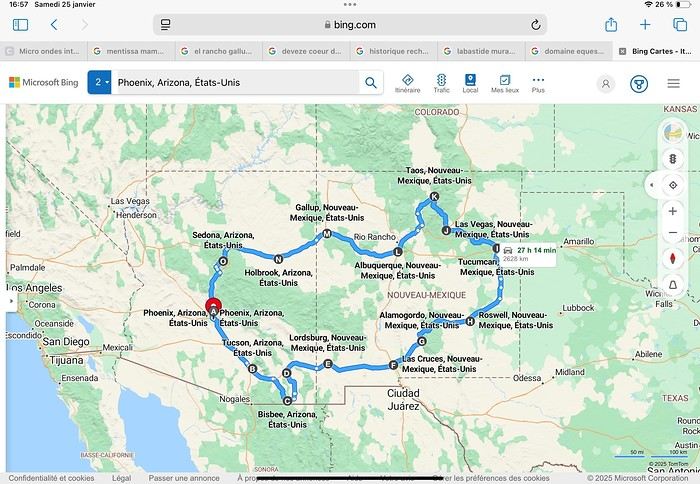
Day 1: Flight Marseille-Paris-Phoenix, then Gold Canyon (133 km) Day 2: Tucson (271 km) Lost Dutchman State Park Day 3: Tucson (155 km) Day 4: Tucson (34 km) Day 5: Bisbee (182 km) Day 6: Lordsburg (345 km) Day 7: Las Cruces (253 km) Day 8: Alamogordo (162 km) Day 9: Roswell (264 km) Day 10: Tucumcari (369 km) Day 11: Las Vegas (281 km) – the one in New Mexico Day 12: Taos (213 km) Day 13: Santa Fe (224 km) Day 14: Albuquerque (123 km) Day 15: Gallup (246 km) Day 16: Holbrook (224 km) Day 17: Flagstaff (179 km) Day 18: Sedona (118 km) Day 19: Sedona (48 km) Day 20: Sedona (41 km) Day 21: Phoenix (256 km) Day 22: Phoenix Airport (35 km)
📊 **Budget**: A little over 7,500 € for both of us, all included. The exchange rate was in our favor (1.17 dollars to 1 €). 📊 **Flights**: Marseille-Paris Charles de Gaulle-Phoenix: 1,787 € for two, with one checked bag each (Air France) 📊 **ESTA**: $42 📊 **America the Beautiful Pass**: $80 📊 **Parking**: 134 € (super eco at Marseille) 📊 **Car rental (Hertz)**: 865 €. Since there were no SUVs left in the reserved category (Nissan Rogue), we got an upgrade (4x4 Ford Explorer). We booked through Air France (15% discount). We’d originally reserved it in December for 1,140 €, but since prices dropped in March, we canceled and rebooked for 865 €. Hertz offers a free Hertz Gold Plus Rewards program, which gives you priority counter service when picking up the car. 📊 **Accommodation**: 2,400 € We stayed in hotels and motels of varying standards (from 60 to 203 € per night, depending on the city), all booked through Booking.com or Hotels.com. Out of 21 nights, only two didn’t include breakfast in the price. Booking.com sometimes offers slightly cheaper rates if you book by phone using the mobile app, and our Genius 3 status on the site also got us some preferential rates. 📊 **Supplementary insurance**: AVA 200 € for medical care if needed 📊 **Cash**: $2,078. We left with 1,000 € exchanged before departure and made two withdrawals of $500. This cash covered: - Evening restaurants and tips - Midday picnics - Gas: $298 for 4,160 km - Museum and private park entries (per person): - Lost Dutchman: $10 - Arizona-Sonora Desert Museum: $28 - Bird Cage Theater: $16 - Tombstone Shootout: $8 - New Mexico Farm & Ranch Museum: $12 - Roswell International UFO Museum: $5 - Billy the Kid Museum: $7 - Rancho de Taos: $22 - West Fork Oak Creek Trail entry: $15 We got a few discounts thanks to our senior age (+65). - Souvenirs and little treats
Like on our previous road trips, we didn’t rent a GPS. We got around using offline GPS apps Here WeGo and Organic Maps, with maps of the states we visited downloaded before we left (on our phones).
❤️❤️❤️ **Highlights** (there are so many!) 📍 Goldfield Ghost Town (even if it’s a reconstruction) 📍 The standing army of Saguaro cacti at Saguaro National Park West 📍 Diving into the cowboy universe of Tombstone 📍 The welcome from Rick and Henry at our guesthouse in Bisbee (Garden at Mile High Ranch) 📍 The tangled rocks of Chiricahua National Monument 📍 The flavored pistachios from Dwayne’s Fresh Jerky and Mac Ginnis Pistachioland 📍 Restaurants: La Posta (Las Cruces), Diner 66 (Albuquerque), and the Haunted Hamburger (Jerome) 📍 The old plazas of New Mexico 📍 The solitude and beauty of the white dunes at White Sands National Park 📍 Stepping back in time at the Billy the Kid Museum (Fort Stanton) 📍 Sections of historic Route 66 and the old motels of Tucumcari, especially at night when all the neon lights are on 📍 Taos Pueblo and diving into Native American culture 📍 After the Rio Grande Bridge, the descent via NM 567 to the very bottom of the Rio Grande Gorge, then the road along the riverbanks to Taos 📍 The tranquility of the Chimayo Sanctuary 📍 Discovering the ingenious native dwellings at Bandelier National Monument and Walnut Canyon National Park 📍 The small towns along the Turquoise Trail 📍 The red rocks of Red Rock Park and the Painted Desert 📍 The extraordinary colors of the petrified trees at Petrified Forest National Park 📍 Sedona, its red rocks, and the reward of the viewpoints at the end of hikes (Devil’s Bridge, The Subway, and West Fork Oak Creek) 📍 The immersion in Mexico when visiting Tlaquepaque 📍 The almost-ghost town of Jerome and its terraced streets 📍 The incredible kindness of Americans, always ready to help and up for a chat ❤️
☹️☹️☹️ **Flops** (there are very few) 📍 Several museums and churches being closed, so we couldn’t visit them 📍 Some museums and visitor centers opening late (10 AM) and closing early (4 PM) 📍 A 64 € phone roaming charge because we got near the Mexican border and picked up their cell tower 📍 The outrageous price ($5.99) for a gallon of gas at the Shell near Phoenix Airport
I hope this helps! Anyway, thanks for reading my long post. Don’t hesitate to reach out, even via PM, if you see I haven’t replied and you’d like more details. Have a great evening, everyone! 🙂
We’re back from our September 2025 road trip, this time to explore Arizona and New Mexico, and it’s time for me to start my travel journal—especially since everything’s already booked for another trip in September 2026 (to California), and I need to get started on the planning.
I was a little worried this new visit to Uncle Sam’s country might not be as "wow" as the others, but we still discovered some incredible places.
For those who don’t know us, we’re a couple in our seventies who speak very little English, but that didn’t stop us from fully enjoying our stay.
For this 6th road trip in the U.S., we spent 21 nights there, drove 4,160 km by car, and walked nearly 160 km in a loop starting from Phoenix.
We’d been to Arizona before (but not this side) and never to New Mexico. This whole road trip was a huge discovery for us.
In the prices mentioned (some in euros, others in dollars), bank fees and exchange charges are included. The flights, car rental, and parking were all paid for in December 2024 when we booked.
We’d downloaded the MPC (Mobile Passport Control) app, but there wasn’t a dedicated line at Phoenix Airport. Still, we got through quickly with friendly, smiling agents.
I don’t drive at all (I hate it), so the stops were chosen based on activities but also, for some, to limit daily mileage for the sole driver. The kilometers listed in the itinerary are the daily distances.
We traveled from September 9th to 22nd, unfortunately once again without our dear friends Mimi and Maumau.
The itinerary
Day 1: Flight Marseille-Paris-Phoenix, then Gold Canyon (133 km) Day 2: Tucson (271 km) Lost Dutchman State Park Day 3: Tucson (155 km) Day 4: Tucson (34 km) Day 5: Bisbee (182 km) Day 6: Lordsburg (345 km) Day 7: Las Cruces (253 km) Day 8: Alamogordo (162 km) Day 9: Roswell (264 km) Day 10: Tucumcari (369 km) Day 11: Las Vegas (281 km) – the one in New Mexico Day 12: Taos (213 km) Day 13: Santa Fe (224 km) Day 14: Albuquerque (123 km) Day 15: Gallup (246 km) Day 16: Holbrook (224 km) Day 17: Flagstaff (179 km) Day 18: Sedona (118 km) Day 19: Sedona (48 km) Day 20: Sedona (41 km) Day 21: Phoenix (256 km) Day 22: Phoenix Airport (35 km)
📊 **Budget**: A little over 7,500 € for both of us, all included. The exchange rate was in our favor (1.17 dollars to 1 €). 📊 **Flights**: Marseille-Paris Charles de Gaulle-Phoenix: 1,787 € for two, with one checked bag each (Air France) 📊 **ESTA**: $42 📊 **America the Beautiful Pass**: $80 📊 **Parking**: 134 € (super eco at Marseille) 📊 **Car rental (Hertz)**: 865 €. Since there were no SUVs left in the reserved category (Nissan Rogue), we got an upgrade (4x4 Ford Explorer). We booked through Air France (15% discount). We’d originally reserved it in December for 1,140 €, but since prices dropped in March, we canceled and rebooked for 865 €. Hertz offers a free Hertz Gold Plus Rewards program, which gives you priority counter service when picking up the car. 📊 **Accommodation**: 2,400 € We stayed in hotels and motels of varying standards (from 60 to 203 € per night, depending on the city), all booked through Booking.com or Hotels.com. Out of 21 nights, only two didn’t include breakfast in the price. Booking.com sometimes offers slightly cheaper rates if you book by phone using the mobile app, and our Genius 3 status on the site also got us some preferential rates. 📊 **Supplementary insurance**: AVA 200 € for medical care if needed 📊 **Cash**: $2,078. We left with 1,000 € exchanged before departure and made two withdrawals of $500. This cash covered: - Evening restaurants and tips - Midday picnics - Gas: $298 for 4,160 km - Museum and private park entries (per person): - Lost Dutchman: $10 - Arizona-Sonora Desert Museum: $28 - Bird Cage Theater: $16 - Tombstone Shootout: $8 - New Mexico Farm & Ranch Museum: $12 - Roswell International UFO Museum: $5 - Billy the Kid Museum: $7 - Rancho de Taos: $22 - West Fork Oak Creek Trail entry: $15 We got a few discounts thanks to our senior age (+65). - Souvenirs and little treats
Like on our previous road trips, we didn’t rent a GPS. We got around using offline GPS apps Here WeGo and Organic Maps, with maps of the states we visited downloaded before we left (on our phones).
❤️❤️❤️ **Highlights** (there are so many!) 📍 Goldfield Ghost Town (even if it’s a reconstruction) 📍 The standing army of Saguaro cacti at Saguaro National Park West 📍 Diving into the cowboy universe of Tombstone 📍 The welcome from Rick and Henry at our guesthouse in Bisbee (Garden at Mile High Ranch) 📍 The tangled rocks of Chiricahua National Monument 📍 The flavored pistachios from Dwayne’s Fresh Jerky and Mac Ginnis Pistachioland 📍 Restaurants: La Posta (Las Cruces), Diner 66 (Albuquerque), and the Haunted Hamburger (Jerome) 📍 The old plazas of New Mexico 📍 The solitude and beauty of the white dunes at White Sands National Park 📍 Stepping back in time at the Billy the Kid Museum (Fort Stanton) 📍 Sections of historic Route 66 and the old motels of Tucumcari, especially at night when all the neon lights are on 📍 Taos Pueblo and diving into Native American culture 📍 After the Rio Grande Bridge, the descent via NM 567 to the very bottom of the Rio Grande Gorge, then the road along the riverbanks to Taos 📍 The tranquility of the Chimayo Sanctuary 📍 Discovering the ingenious native dwellings at Bandelier National Monument and Walnut Canyon National Park 📍 The small towns along the Turquoise Trail 📍 The red rocks of Red Rock Park and the Painted Desert 📍 The extraordinary colors of the petrified trees at Petrified Forest National Park 📍 Sedona, its red rocks, and the reward of the viewpoints at the end of hikes (Devil’s Bridge, The Subway, and West Fork Oak Creek) 📍 The immersion in Mexico when visiting Tlaquepaque 📍 The almost-ghost town of Jerome and its terraced streets 📍 The incredible kindness of Americans, always ready to help and up for a chat ❤️
☹️☹️☹️ **Flops** (there are very few) 📍 Several museums and churches being closed, so we couldn’t visit them 📍 Some museums and visitor centers opening late (10 AM) and closing early (4 PM) 📍 A 64 € phone roaming charge because we got near the Mexican border and picked up their cell tower 📍 The outrageous price ($5.99) for a gallon of gas at the Shell near Phoenix Airport
I hope this helps! Anyway, thanks for reading my long post. Don’t hesitate to reach out, even via PM, if you see I haven’t replied and you’d like more details. Have a great evening, everyone! 🙂
You Don't Eat Cannibals (book)
Take a step back, forget your bearings, and momentarily set aside the boxes we use to categorize life: humans on one side, animals on the other. Immerse yourself in that unsettling zone where man, stripped of his humanity, and the beast—capable of emotions and sensitivity—stand face to face.
Who is the predator, who is the prey? Where do fear, barbarism, or extreme violence lie, and where do compassion and philosophy reside?
In this book steeped in anthropomorphism, Stéphanie Artarit weaves a cruel plot and pushes the boundaries of darkness without ever wallowing in the grim or sordid.
A story of love and vengeance, of fierce beasts and humans, where the abominable, the unbearable, and the unthinkable are pierced by the candor and fragile luminosity of the heroine, Bambi, around whom (very) dark passions rage.
The action takes place in the Pyrenees in the mid-1970s. A dilapidated, isolated house, the theater of the unthinkable, where a shattered family ignored by social services lives—or survives: a missing father, a helpless mother, two degenerate twins, Sam and Valerien, a violent older brother, Martin, an absolute bastard, a dog... and a young adolescent, Bambi, the precarious pillar of this teetering balance. To escape this hopeless daily life, she regularly finds refuge in a nearby zoo. Caught during yet another sneaky visit, she is taken to the owner of the place, Noel Rivière, who, moved by her misery (and her ethereal, unreal beauty...), hires her as an apprentice.
This could have been the start of a fairy tale, redemption through love, the bastard permanently neutralized... and a breather for the reader.
But no.
The zoo serves as the backdrop for the second part of the story, which introduces new characters... a little girl, Feline, and a chimpanzee, Adam, placed in an isolated enclosure upon arrival because he was aggressive and unable to live among his own kind.
Humans with primitive animality, animals with astonishing humanity... a deranged, fierce, and heartbreaking Jungle Book. A noir novel with fluid, poetic writing.
A breathless read, almost devoured in one go (in two sittings) because it’s impossible to catch your breath before finding out how far the author will push the limits and what fate she has in store for her characters...
You Don’t Eat Cannibals Stéphanie ARTARIT Belfond Noir
In this book steeped in anthropomorphism, Stéphanie Artarit weaves a cruel plot and pushes the boundaries of darkness without ever wallowing in the grim or sordid.
A story of love and vengeance, of fierce beasts and humans, where the abominable, the unbearable, and the unthinkable are pierced by the candor and fragile luminosity of the heroine, Bambi, around whom (very) dark passions rage.
The action takes place in the Pyrenees in the mid-1970s. A dilapidated, isolated house, the theater of the unthinkable, where a shattered family ignored by social services lives—or survives: a missing father, a helpless mother, two degenerate twins, Sam and Valerien, a violent older brother, Martin, an absolute bastard, a dog... and a young adolescent, Bambi, the precarious pillar of this teetering balance. To escape this hopeless daily life, she regularly finds refuge in a nearby zoo. Caught during yet another sneaky visit, she is taken to the owner of the place, Noel Rivière, who, moved by her misery (and her ethereal, unreal beauty...), hires her as an apprentice.
This could have been the start of a fairy tale, redemption through love, the bastard permanently neutralized... and a breather for the reader.
But no.
The zoo serves as the backdrop for the second part of the story, which introduces new characters... a little girl, Feline, and a chimpanzee, Adam, placed in an isolated enclosure upon arrival because he was aggressive and unable to live among his own kind.
Humans with primitive animality, animals with astonishing humanity... a deranged, fierce, and heartbreaking Jungle Book. A noir novel with fluid, poetic writing.
A breathless read, almost devoured in one go (in two sittings) because it’s impossible to catch your breath before finding out how far the author will push the limits and what fate she has in store for her characters...
You Don’t Eat Cannibals Stéphanie ARTARIT Belfond Noir
Thailand in March: What itinerary for the south?
Hi everyone,
So excited to be back on this forum of fellow travel enthusiasts to ask for advice about my upcoming two-week trip to Thailand in March 2026.
Given that it’ll be the start of the intense heat and burning season, I’m wondering about my itinerary, which would focus on the central/southern part of the country.
Ideally, I’d like a mix of relaxation in a nice setting, culture (temples or old palaces), and I’m keeping six days in Bangkok, which I love :)
I’m planning to get around by train, car (through an agency), or plane if it’s easier.
Option 1: HUA HIN – 3/4 days (day trips to PHETCHABURI + SAM ROI YOT + ARTISAN MARKETS) KANCHANABURI – 3/4 days NAKHON PATHOM – 1 day BANGKOK – 6 days
My doubts: -Will the sky be too hazy (from smoke) for good photos? -Will Kanchanaburi and its surroundings be less enchanting during this period (dry landscapes)?
Option 2: PHUKET (4 days): exploring the island + PHANG NGA Bay HUA HIN (3/4 days) BANGKOK (7 days)
My doubts: -How do I get from Phuket to Hua Hin? It seems like flying isn’t an option, and I’d have to take a long trip up the southern coast or return to Bangkok to catch the train. -Is Phuket even remotely pleasant during this ultra-touristy period? -Is Karon a good base for exploring Phuket?
Option 3: PHUKET KAO SOK SURAT THANI? BANGKOK
My doubts: -I’d like to add a destination with beautiful temples in this area, but maybe Surat Thani isn’t the best idea.
Option 4: SURAT THANI >> HUA HIN (6/7 days) BANGKOK
Doubts: -I’m worried this route might be too tiring if I have to move every two days.
I’m open to any tips—or even a completely different itinerary if you have other ideas.
Thanks so much / Khob Khun Krap :)
So excited to be back on this forum of fellow travel enthusiasts to ask for advice about my upcoming two-week trip to Thailand in March 2026.
Given that it’ll be the start of the intense heat and burning season, I’m wondering about my itinerary, which would focus on the central/southern part of the country.
Ideally, I’d like a mix of relaxation in a nice setting, culture (temples or old palaces), and I’m keeping six days in Bangkok, which I love :)
I’m planning to get around by train, car (through an agency), or plane if it’s easier.
Option 1: HUA HIN – 3/4 days (day trips to PHETCHABURI + SAM ROI YOT + ARTISAN MARKETS) KANCHANABURI – 3/4 days NAKHON PATHOM – 1 day BANGKOK – 6 days
My doubts: -Will the sky be too hazy (from smoke) for good photos? -Will Kanchanaburi and its surroundings be less enchanting during this period (dry landscapes)?
Option 2: PHUKET (4 days): exploring the island + PHANG NGA Bay HUA HIN (3/4 days) BANGKOK (7 days)
My doubts: -How do I get from Phuket to Hua Hin? It seems like flying isn’t an option, and I’d have to take a long trip up the southern coast or return to Bangkok to catch the train. -Is Phuket even remotely pleasant during this ultra-touristy period? -Is Karon a good base for exploring Phuket?
Option 3: PHUKET KAO SOK SURAT THANI? BANGKOK
My doubts: -I’d like to add a destination with beautiful temples in this area, but maybe Surat Thani isn’t the best idea.
Option 4: SURAT THANI >> HUA HIN (6/7 days) BANGKOK
Doubts: -I’m worried this route might be too tiring if I have to move every two days.
I’m open to any tips—or even a completely different itinerary if you have other ideas.
Thanks so much / Khob Khun Krap :)
Your recommendations for a 2-week trip to Thailand
Hi there,
We have the opportunity to get away for a little two-week trip at the very beginning of January, just the two of us, without our kids. Because of the kids, we haven’t traveled much in Asia, so we’d love to take advantage of their absence to explore Thailand. Even though I’m used to planning our trips, I’m feeling a bit overwhelmed this time.
We’d like to visit Bangkok and head south by renting a car (we have an international driver’s license, and my husband has driven on the left before). I’ve managed to sketch out a rough itinerary that might work for us, and I’d love to hear your thoughts.
To set the scene: we haven’t booked anything yet, we don’t like spending hours on the beach (though a little time at the end of the day is fine), we love walking and sightseeing, and what we enjoy most is being independent (so if we can avoid group tours, that’s ideal).
After that intro, here’s the rough outline of our itinerary: Day 0: Paris-Bangkok flight Days 1, 2, and 3: Bangkok (Wat Pho, Grand Palace, Wat Arun, markets, boat ride through the khlongs, Jim Thompson House) Day 4: Ayutthaya Day 5: Pick up a rental car and head to Sam Roi Yot Day 6: Sam Roi Yot and Prachuap Khiri Khan Day 7: Drive south – overnight near Surat Thani Day 8: Uthayan Tham Khao Na Nai, then drive to Ao Nang (staying near Tubkaek) Days 9 and 10: Boat trips (Railay, Ko Hong, etc.) Day 11: Drive to Phang Nga with a few stops along the way Day 12: Boat tour (mangroves and Ko Tapu) Day 13: Drive to Phuket Airport and return flight
A few questions and doubts: - I’d considered Cheow Lan Lake but read some not-so-great reviews (crowds, just 3 viewpoints, and the rest was meh). What do you think? - Can we start from Ao Thalane Pier for trips to Ko Hong and Ko Tapu? - I’m not thrilled about driving through Bangkok, but I’m not sure where to rent a car west of the city (since we won’t return it to the same place, I assume it’s best to target rental companies at airports).
Thanks in advance for any tips or feedback you can share to help me (or not 😛) refine this plan before I start booking!
We have the opportunity to get away for a little two-week trip at the very beginning of January, just the two of us, without our kids. Because of the kids, we haven’t traveled much in Asia, so we’d love to take advantage of their absence to explore Thailand. Even though I’m used to planning our trips, I’m feeling a bit overwhelmed this time.
We’d like to visit Bangkok and head south by renting a car (we have an international driver’s license, and my husband has driven on the left before). I’ve managed to sketch out a rough itinerary that might work for us, and I’d love to hear your thoughts.
To set the scene: we haven’t booked anything yet, we don’t like spending hours on the beach (though a little time at the end of the day is fine), we love walking and sightseeing, and what we enjoy most is being independent (so if we can avoid group tours, that’s ideal).
After that intro, here’s the rough outline of our itinerary: Day 0: Paris-Bangkok flight Days 1, 2, and 3: Bangkok (Wat Pho, Grand Palace, Wat Arun, markets, boat ride through the khlongs, Jim Thompson House) Day 4: Ayutthaya Day 5: Pick up a rental car and head to Sam Roi Yot Day 6: Sam Roi Yot and Prachuap Khiri Khan Day 7: Drive south – overnight near Surat Thani Day 8: Uthayan Tham Khao Na Nai, then drive to Ao Nang (staying near Tubkaek) Days 9 and 10: Boat trips (Railay, Ko Hong, etc.) Day 11: Drive to Phang Nga with a few stops along the way Day 12: Boat tour (mangroves and Ko Tapu) Day 13: Drive to Phuket Airport and return flight
A few questions and doubts: - I’d considered Cheow Lan Lake but read some not-so-great reviews (crowds, just 3 viewpoints, and the rest was meh). What do you think? - Can we start from Ao Thalane Pier for trips to Ko Hong and Ko Tapu? - I’m not thrilled about driving through Bangkok, but I’m not sure where to rent a car west of the city (since we won’t return it to the same place, I assume it’s best to target rental companies at airports).
Thanks in advance for any tips or feedback you can share to help me (or not 😛) refine this plan before I start booking!
What to see and do in Battambang in August for a photography enthusiast?
Hi there,
It’s all in the title. I’m starting to think about my destination for summer 2026, and Cambodia is currently at the top of my list. Among the spots frequently mentioned for a 2- or 3-week trip to Cambodia, Battambang comes up often. However, so far, I haven’t found any truly remarkable features that would justify spending 2 or 3 days (including travel and visits) in this city during a 3-week stay, especially since I’m primarily looking for stunning photography spots—whether natural landscapes, urban scenes, or architecture. Where can I find some enlightening documentation on Battambang to help shift my perspective? Sorry for exposing my ignorance about this city like this, but all the photos I’ve seen online and the travel journals I’ve read don’t really showcase what makes it appealing, even though the descriptions suggest it’s very charming.
Thanks for any insights you can share!
Gollum ;-)
It’s all in the title. I’m starting to think about my destination for summer 2026, and Cambodia is currently at the top of my list. Among the spots frequently mentioned for a 2- or 3-week trip to Cambodia, Battambang comes up often. However, so far, I haven’t found any truly remarkable features that would justify spending 2 or 3 days (including travel and visits) in this city during a 3-week stay, especially since I’m primarily looking for stunning photography spots—whether natural landscapes, urban scenes, or architecture. Where can I find some enlightening documentation on Battambang to help shift my perspective? Sorry for exposing my ignorance about this city like this, but all the photos I’ve seen online and the travel journals I’ve read don’t really showcase what makes it appealing, even though the descriptions suggest it’s very charming.
Thanks for any insights you can share!
Gollum ;-)
Madagascar - June 2025
Five years of an unintended break... The closure of VF, COVID... What a joy to rediscover the pleasure of sharing!
I’ve stayed true to my habits: the following account is a collection of practical tips rather than a travel journal...
Madagascar is as big as France and Belgium combined. In three weeks, choices have to be made! It was the Great Tsingy that inspired our trip. We decided to focus on the southwest and the RN7. We skipped the Deep South and the North. Oh well...
OUR ITINERARY IN 3 WEEKS:
Fri 6 June – Direct AF flight to Tana – Flight arrives at 10:30 PM – Tana Sat – Antsirabe Sun – Miandrivazo Mon – Drive to the Masiakampy pier – Descent of the Tsiribihina River by pirogue - Bivouac Tue – Descent of the Tsiribihina River by pirogue - Bivouac Wed – Descent of the Tsiribihina River by pirogue – Bekopaka Thu – Pirogue on the Manambolo River and Small Tsingy of Bemaraha – Bekopaka Fri – Great Tsingy of Bemaraha – Bekopaka Sat – Avenue of the Baobabs – Morondava Sun – Belo sur Mer Mon – Free day – Belo sur Mer Tue – Manja Wed – Andavadoaka Thu – Free day – Andavadoaka Fri – Salary Lagoon – Mangily Sat – Ranohira Sun – Isalo National Park - Ranohira Mon – Anja Reserve - Ambalavao - Fianarantsoa Tue – FCE train canceled – Visit to a Tanala village - Manakara Wed – Pirogue on the Pangalanes Canal – Ranomafana Thu – Ranomafana NP – Ranomafana Fri – Ambositra – Antsirabe Sat 28 June – AF flight to Paris – Flight departs at 11:55 PM
TRIP ORGANIZATION: I prepared my trip using the usual guides (LP and Rough Guide), the internet, and the Freytag & Berndt map (1:1,000,000). I’m old-school—I still love visualizing my route on a paper map, even though in Madagascar, it’s misleading because some National Roads are only national in name!...
The agency: Since we couldn’t deal directly with a driver-guide (we lacked reliable info to take the plunge), we went through an agency to organize the logistics of our trip. We didn’t feel like using bush taxis (not enough time) or driving a 4x4 ourselves (neither the skills nor the boldness). The French agency connected us with a local agency, to whom I sent my detailed itinerary by email. A few exchanges via email and WhatsApp calls allowed us to finalize everything quickly after some adjustments. As you’ve gathered... we multiplied the commissions, which inflated the budget. That said, in the end, we were thrilled with our decision and our choice. Our trip was booked by the end of 2024, and reservations were made immediately. No bad surprises: the bookings in the planned hotels were honored, often with one of the best rooms. On our last day in Tana, before departure, we were lucky enough to meet the director I’d been communicating with, who helped build and validate our circuit. A very warm debriefing.
The driver-guide: The agency assigned us Faly, 33, a driver-guide for over 10 years. He stayed with us from start to finish: he picked us up at the airport on arrival and dropped us off 23 days later. A very experienced driver (which is important here), an open and cultured guide, reliable, punctual, and a great companion. And a provider of good advice throughout the trip. We made the most of the long stretches on dirt roads or highways to listen to him talk about daily life, rituals, wildlife, and flora... No time wasted! With a great playlist in the background, we combined business with pleasure! Faly’s accommodation and meals were included (quite often, hotels offer free lodging and meals to driver-guides who bring clients), as was the fuel. That didn’t stop us from inviting Faly to share a beer or our evening meal sometimes. He didn’t always accept, wanting to let us "enjoy our romantic evenings," as he put it. Present without being intrusive! Faly is fully capable of organizing a tailor-made trip directly. I recommend him without any hesitation—we were delighted with his service. I’ll gladly share his contact details via PM to anyone who asks.
Local guides: It’s the national guide’s prerogative to choose the local guides (mandatory in the parks). Thanks to his experience, Faly always booked us amazing, competent, and interesting local guides.
Hotels: I told the agency I wanted charming, comfortable accommodations, without falling into flashy luxury. We loved all the hotels (except the Hôtel Kanto in Manja). The rooms, mostly bungalows, were always spacious and clean. Unfortunately, I can’t give the prices—I didn’t get the details. Breakfast is always included, usually fresh and hearty. Very often, a small bottle of water is provided in the room.
Tana Hôtel Les 3 Métis Power cuts are common (!) in Tana. Bring a headlamp.
Antsirabe Ecolodge – Les chambres du voyageur Maybe our favorite! A few bungalows, beautifully arranged in a splendid tropical garden. The dog Kodak welcomes us warmly.
Miandrivazo Hôtel Princesse Tsiribihina Magnificent view of the valley.
Bekopaka Hôtel Orchidée du Bemaraha 2 (yes, 2) beautiful pools, a large open common room.
Morondava Hôtel Baobab Café Brand new or at least, according to Faly, just renovated. Very comfortable but without much charm (international style).
Belo sur Mer Ecolodge du Menabe The bungalows, all made of wood, bamboo, and thatch, are set on the beach. Very spacious and fully equipped! Large open-air restaurant by the sea. No hot water from the tap—it’s available in plastic bottles heated by the sun in front of each bungalow. Actually, we never used it... Another very, very beautiful spot.
Manja Hôtel Kanto The only hotel on this leg of the journey, so no choice. The owner knows it and, as a result, doesn’t bother. It’s a real dive! Tiny, dark room, a sordid bathroom with only a trickle of water—we skipped the shower! Clean sheets, though. Obviously, no Wi-Fi. The only place where I didn’t leave a tip. We were well warned about the discomfort of this stop, both by the agency and Faly. We weren’t surprised, and it even became a running joke during the trip. On the other hand, we found a nice little market in town.
Andavadoaka Manga Lodge What bliss! Especially after the horrible Hôtel Kanto. A paradise-like spot, overlooking three beautiful deserted white-sand beaches. Meals are served on the terrace facing the sea. Stunning sunset. We loved spending a day lounging here! We were the only guests and were pampered.
Mangily (Ifaty) Mangily is the "suburb" of Ifaty. Hôtel Vovo Telo A large beachfront bungalow complex. More touristy but pleasant—we spent a lovely evening there with our feet in the sand.
Ranohira Le Relais de la Reine A splendid resort built by a Frenchman, at the foot of the rocks, very well integrated into the environment. Beautiful marked trail starting from the garden.
Fianarantsoa Villa Sylvestre Contrary to what its name suggests, it’s a hotel right in the city center. Quite decent, though.
Manakara Parthenay Club Pretty bungalows in a large garden by the sea, but swimming isn’t safe—the water is too dangerous and rough.
Ranomafana Hôtel Thermal Very spacious rooms.
Meals: Not all our meals were included. It’s really not expensive. 1 meat or fish dish: around 35,000 Ar 1 full menu (starter, main, dessert): around 70,000 Ar 1 large THB beer (65 cl): between 8,000 and 12,000 Ar 1 piña colada: 15,000 Ar 1 flavored rum: 6,000 Ar (sometimes free) 1 glass of baobab juice (!): 5,000 Ar
We always ate very well. Rice is everywhere, served in large quantities. Zebu meat is quite good if not overcooked. Personally, I prefer fish, and I feasted: grouper, captain, crab, small lobsters...
We happily discovered baobab juice (especially in Belo, on the west coast). And of course, flavored rums!
We bought 2 packs of 6 bottles of mineral water at Carrefour (!) (about 5,000 Ar per large bottle) at the start of our trip. That was enough, especially since we often got water in the bungalows.
We had a few picnics included in our trip. Instead of picking up the hotel’s lunchbox, Faly prepared delicious, fresh, and varied picnics for us: tuna pasta salad, fried rice with eggs, grilled vegetables, and avocado...
An exceptional address not to miss: Mad Zébu – Belo sur Tsiribihina A highly reputed restaurant, a favorite of LP and Rough Guide, and rightly so! Gourmet cuisine, refined and elegant. Barely more expensive than elsewhere, and it’s worth it. We stopped there on our way up to Bekopaka and the Tsingy NP. Fully booked! So Faly reserved for our return, three days later. We’re still thanking him! What a treat!
THE BUDGET: Ariary exchange rate: 5,000 Ar = 1 €
Pre-trip expenses: Direct Air France flights: 930 € per person round trip Cost of the circuit with the agency: 2,880 € per person
The visa: Issued on arrival, very quickly. 35 € per person for a stay under 30 days. Super simple. Super fast.
On-site expenses: As soon as we arrived at the airport (it was nearly midnight), Faly advised us to exchange our euros for all our needs. There are few opportunities on our route to find an ATM or an open bank with a good rate. To be more comfortable, he took us to a small office under military protection just outside the airport. I exchanged 1,200 € (I had asked the agency for advice on the amount to bring) at a rate of 4,750 Ar and became a millionaire. Faly recounted all the stacks. That covered all our expenses (meals, drinks, tips) without ever feeling deprived. Personal purchases were made at the end of the trip. Convenient—it served as an adjustment variable. We spent our last million (200 €) on marquetry and vanilla. Tip: We asked for 200,000 Ar in 5,000 Ar bills for tips. That wasn’t too much—I even ran short of small bills in the last two days.
Tips: Madagascar is a poor country where every service deserves a small reward. While not mandatory, it’s customary. But no one ever demanded or expected it openly. On the contrary, I sometimes had to remind a porter to give them my small bill. We never carried our luggage—porters were always present when the car arrived or waiting at our door to watch for our departure. I gave each of them 5,000 Ar. In restaurants, I rounded up to the nearest ten and left the change. Local guides also expect a tip: I gave around 20,000 Ar per day for the two of us. Finally, the national guide also expects a gratuity. I had read online to budget 5 € per day per person. I added more since we were so happy with his services. The tip was given at the end of the trip, in euros, outside the budget.
Total budget all included (excluding personal purchases): 8,690 € Clearly, Madagascar is a country where life isn’t expensive, but travel costs add up quickly due to the need to rent a 4x4 with a driver.
HIGHLIGHTS:
· The dirt roads Yes, I’m listing them among the highlights! We loved those long hours spent driving at 20 km/h on rocky, muddy, white, red, or gray sand tracks... surrounded by tropical vegetation, palm trees, pandanus, mango trees... The experiences were sometimes thrilling: crossing a river on a ferry (just planks of wood fixed on two motorized pirogues side by side) or crossing a river without a ferry, with just a kid running ahead of the 4x4 to show the way; soft sand where the 4x4 easily gets stuck... The tracks are quite narrow, and crossing paths with a bush taxi, a zebu cart, or a herd of goats is always epic. So many beautiful images, so many beautiful photos! Much more beautiful than on asphalt. So yes, we loved those long stretches on dirt roads. For us, it was clearly part of the journey. Faly was particularly careful, and the 4x4 was comfortable. No injuries, no fatigue, even after 7 or 8 hours on rough tracks. The national roads (including the famous RN7) are badly damaged by cyclones, huge trucks, and lack of maintenance. Potholes have turned into ostrich nests, and we didn’t drive much faster than on the dirt roads.
· The landscapes, villages, encounters... We crossed a variety of stunning landscapes: mountains with slopes covered in terraced crops, rice fields from apple green to emerald green, sugarcane fields, then tropical forests, baobab forests (they deserve a special paragraph below), traveler’s tree forests. And then coastlines with white sand dunes against a backdrop of blue hues!... Magical! We also passed through many villages with houses whose architecture varied by region. The Betsileo houses display beautiful decorative brick reliefs. On the west coast, the houses are more precarious, made of bamboo with palm-thatched roofs. In the Highlands region, we found solid houses with pastel plaster. Each region has its own landscape, crops, habitat, and clothing. Zebu carts are often the only means of transport in remote villages. We saw them very frequently. Again, the cart’s decoration depends on the region. And then, we met many villagers coming out of the bush and walking to the next market, carrying their crops on their heads or shoulders. More beautiful photos!
· The descent of the Tsiribihina River We boarded around 9 AM in a long pirogue with Gana, the local guide, and two pirogue men. So, five of us. The pirogue is long but narrow, about 65 cm wide. We sat one behind the other at the front on seats padded with what would become our mattresses during the bivouacs. We only took the bare essentials for two nights. A little goodbye to Faly, whom we’d see again in three days! Don’t forget us! The river is silty—meaning orange, opaque but clean. We glided along silently. Gana showed us the trees, birds, crocodiles (we saw five—apparently, we were lucky). The pirogue men rowed to get us as close as possible to these crocs sunbathing on the roots of big trees. Yeah, right!... as soon as we got too close, *splash*, they disappeared into the water. We marveled at the mini rice fields lining the river. Every tiny plot, no matter how small, is cultivated. Above them, banana fields. And on the water, a whole life of fishermen and villagers living with and from the river. Gana warned us we’d eat on the pirogue because the journey was long. So, I expected chips... But no—fried rice and zebu steak, cooked right in the pirogue!! Incredible! In the middle of the afternoon, we reached a small beach where we disembarked. Gana led us about a hundred meters to a sublime waterfall. We were alone there. We had time to swim. We’d brought our swimsuits and a towel (bought at the Carrefour in Antsirabe on Faly’s wise advice!). This swim in this paradise-like spot remains one of our best memories. We found our pirogue again and set off until our first bivouac. We’d sailed for 7 hours today. The tents were set up on a wide beach, without a single tree. A moment of solitude... Uh, where can we go to the bathroom?... Especially since it was a full moon, so we felt like we were in the spotlight. Anyway... we did as everyone else—walked away, dug a hole, and the others turned their backs. A hearty meal on the beach before a comfortable and silent night. The next day, same program, with slightly different landscapes. The gorges widened, the trees were different. But still many colorful birds. Again, we ate on the pirogue: grilled chicken and vegetables. 9 hours of sailing. A similar bivouac. This time, we got it. On the third day, we finished the descent with 5 hours of sailing. So, 7 hours, 9 hours, 5 hours... doing nothing. It might sound boring... but it wasn’t. Like the dirt roads, these were contemplative moments. It glides, it’s calm, relaxing, and there’s a lot of life on this river, animal and human. Contemplation. Suspended time. On arrival, we disembarked at a sort of joyful, bustling river port. Of course, Faly was already there to pick us up.
· The Tsingy de Bemaraha NP (Small and Great) I have vertigo. During my research, several agencies advised me against visiting the Great Tsingy. "Stick to the Small ones," they said. Grrr, no, not what I wanted—we’ve dreamed of this for years! The agency we chose also warned me but didn’t discourage me. So we started with the Small Tsingy, quite close to Bekopaka, guided by Alisha. This forest of sharp limestone rocks is impressive. No vertigo issues here. The day was completed with a short pirogue ride on the Manambolo River and a visit to two caves with pretty formations. The next day, Faly and Alisha drove us to the Great Tsingy (a good hour on a terrible track). Arriving at the park entrance, Alisha equipped us with harnesses, carabiners, and gave us some safety instructions. Faly was also equipped. Wait? He’s coming with us? I quickly understood he was there for me—if I got stuck, he could go back with me, and Philippe could continue with Alisha. A wise precaution that delighted and reassured me. In the end, it was unnecessary since the famous bridge crossing was fully secured by the harness and carabiners. 18 meters on planks, one by one, it didn’t sway too much—I walked looking straight ahead, not a glance down. I even managed to smile in the middle of the crossing—I have a photo to prove it! I was overjoyed! The circuit in the Great Tsingy is a loop, so we didn’t have to cross the bridge again. We climbed to viewpoints offering breathtaking panoramic views. It’s extraordinary, unique, incredible. All this to say that if you have vertigo, don’t hesitate! It’s doable! It’s completely safe and really worth pushing your limits a bit! For those who’ve done treetop adventure courses, it’s similar. Also, no need to be a great athlete—just a bit of agility to climb a few ladders and high steps. Don’t censor yourself! I even had a small regret—the loop was a bit short (about 2 hours). I would’ve liked to continue or even redo it, with less apprehension. Tip: Do the Small Tsingy before the Great ones, or not at all. And if you can only do one, do the Great ones without hesitation.
· Canoeing in the Belo mangrove The Belo sur Mer ecolodge lends small individual canoes for free to go to the mangrove. We left at high tide, paddled for about twenty minutes to reach a fairly sparse forest where we could easily venture in. Very shallow water, crystal clear—we could see the roots of all these trees, schools of tiny fish... It was quite surprising. Until then, I only knew impenetrable, tangled mangroves. Here, nothing like that—we walked through an aquatic forest. We loved this adventure so much we left a bit late. The tide had gone out, and we had to carry our canoes for the last few meters... Of course, the staff came to help (probably laughing silently!). The lodge owners gave all the necessary explanations and lent a waterproof bag for the phone (because yes, it’s worth taking photos!). A very useful precaution—the canoes are small, low in the water, and paddling quickly soaks you. Again, this isn’t just for Tony Estanguet! It didn’t cause us any problems, not even sore muscles the next day. A great experience. It’ll take about 2 hours.
· Isalo NP Big surprise when we saw this huge rocky massif appear on the RN7! A massif of colored sandstone, carved with crevasses giving it a ruined look. Le Relais de la Reine is a little gem cleverly nestled in the heart of these rocks. A small marked trail starts from the garden. We picked up the description at reception and set off. Without a guide, alone following the markers, it took us 2 hours to complete this magnificent little trail, giving us a first glimpse of the massif before the hike the next day. And we enjoyed being completely alone for this walk. It’s free, easy, and well-signposted. Don’t miss it. In the evening, Faly took us to the so-called Isalo Window site—a hole in a wall through which we could see the sunset. We met all the tourists in the area here. We weren’t blown away by the show... The next day, we left early to reach the start of the hike. We met Zozoly at the guides’ office in the small town of Ranohira. During this hike, we climbed through the rocks to a viewpoint offering stunning 360° views of the massif. Then we reached a site called the "natural pool," breathtakingly beautiful, especially since we were alone again. A sort of oasis, a cascading waterfall, palm trees and tree ferns, fine sand, all nestled at the bottom of a small canyon. Paradise-like. We resisted swimming, but it was really tempting. A long walk on the plateaus then led us to a well-equipped picnic site where a local team prepared grills. Concrete tables were tiered in a spacious, shady clearing where a whole family of ring-tailed lemurs frolicked. They knew the tourists’ habits and tried to snatch food. Playful and not very shy, they amused us with their antics! We had to resist not luring them with a piece of banana!! Thousands of photos!! After the meal, we set off again with Zozoly for another landscape. This time, we were by a small river at the bottom of a canyon with high walls covered in vegetation. The trail was narrow and slippery, on a ledge of the wall. We progressed carefully. No danger, though. We first reached the Blue Pool, which only turns blue in photos (surprise!), then the Black Pool fed by a shower of waterfalls. Two magnificent spots that showed us a completely different aspect of the massif.
· Anja Reserve This ficus forest is home to many groups of lemurs. Used to humans, whom they don’t fear, they move around us, ignoring us completely. It’s almost annoying... The best place on our trip to see lemurs.
· The FCE train To the great regret of Manakara’s inhabitants, the FCE train hasn’t reached here for over a year and a half. As a result, there are far fewer tourists—the train was part of the experience. We drove there and didn’t regret coming to this port on the east coast.
· Visit to a Tanala village This visit wasn’t part of our program—it was added by the agency to compensate for the train not running. Which was the case. Not big fans of this kind of visit, where we feel like we’re at a zoo, voyeuristic, lacking authenticity, we followed the local guide with some skepticism and exchanged dubious looks. And yet... the guide’s explanations about village life and the warm, smiling welcome from the villagers charmed us and dispelled all our concerns. We learned a lot, met smiling families, and were able to enter these beautiful bamboo houses. A very pleasant surprise, rich in lessons.
· The Pangalanes Canal Arriving in Manakara, we crossed a bridge overlooking the Pangalanes Canal. A cry of surprise: the water is turquoise! We took a short pirogue ride with a team of three pirogue men and Joël, a local guide who explained the drama caused by the train’s halt. We stopped in a fishing village where Joël bought fish for the barbecue. We ended up on a beach where the team prepared the meal while we went to watch the fishermen return on the nearby beach. We admired the fishermen’s dexterity in untangling their nets, sorting their fish, cleaning their gear. On our return, we found a small table set up on the beach, in the shade of palm trees and casuarinas. Lobsters, captain fish, grilled vegetables, sautéed potatoes. A real feast (included in the trip cost).
· Ranomafana NP A 4-5 hour hike (some climbing) in a dense secondary forest to look for lemurs. As usual, we were accompanied by a local guide who, while waiting to find our furry friends, gave us lots of info on the vegetation, birds, and Tanala ethnic rituals. In the forest, we met 4 or 5 trackers, armed with radios to alert guides of their findings. In the end, we saw several lemurs of different types. Quite far, quite high... A nice complement to our lemur encounters in Isalo. Here, it rains 200 days a year. We started the hike in thick fog, but the forest’s density protected us from the humidity. Be careful—it can be a bit frustrating to see the lemurs so far away, so high. Nothing like the Anja Reserve or Isalo NP. Here, what’s fun is the hunt.
· The baobabs We were captivated by these kings of the forest, noble, imposing, majestic. We spotted them from very far away, towering over the rest of the vegetation. Alone, in small groups, or in forests, our trip allowed us to see hundreds of them! Mainly on the west coast. All different—bald, hairy, shaggy, short and stout, tall and thin, like Laurel and Hardy. Philippe took to naming them. Respectfully!
OUR FAVORITES: · The variety of landscapes. · The Tsingy NP.
OUR DISAPPOINTMENTS: · The Avenue of the Baobabs, very overrated and the only place where we saw crowds. We saw many other "forests" of baobabs that were much more impressive. · It’s hard to approach the population calmly as swarms of children run up as soon as we arrive, asking for sweets. Without any aggression, their smiles and laughter quickly made us forget this small inconvenience. We never gave out candy, clothes, or money. We left pens at a school and clothes with Faly.
IF WE WERE TO DO IT AGAIN: · Same period, same duration, same pace, same itinerary, but if we were to do it again today, I’d go through Faly directly! · Maybe we should’ve stayed in Ambalavao instead of Fianarantsoa. · Plan a longer loop in the Great Tsingy—it felt a bit too short.
MISCELLANEOUS: The welcome: ‘Samala Vazaha,’ there are many, many kids, sometimes overwhelming, never aggressive. We were impressed by the villagers’ smiles and good humor, towards us or even among themselves—laughter was everywhere. Safety: No problems. Out of (excessive?) caution, we spread all our money across several bags that we padlocked whenever we left the hotel. Bribes: We were stopped several times on the road by police or gendarmes. They checked our papers, sometimes our passports. Faly was perfectly in order. No discussion, no bribes, a cordial greeting from the officers. However, several times we found ourselves at small "tolls" on the tracks for villagers who had leveled the road or filled a hole, or for the young guy who ran through the river to show the way... Faly complied without discussion: every service deserves a small bill. Language: French is still widely spoken. Credit card: Unused. Cash: You need it! The climate at this time: Ideal—blue skies, sunshine, and mild temperatures (20-25°C) throughout our trip. Temperatures started to drop by our departure—winter was setting in. Clothing: T-shirt or polo and a vest sometimes in the evening, sandals on our feet, hiking shoes for all the hikes. Tip: We left a bag in the car (completely safe) with things we didn’t need daily and dirty laundry. The two bags to take out at each stop were much lighter. Before leaving, we left several polos and T-shirts with Faly, which, once washed, will make a few people happy. Tourist crowds at this time: Low—we were sometimes the only guests at the hotel. Faly explained that at the Isalo picnic site, in high season, you have to queue for a table, whereas we had our pick. Photos: Lots! Too many! That’s the problem with digital—we take so many! Health issues: Nothing serious, just the usual mild traveler’s diarrhea. Mosquitoes: They’re voracious. We took anti-malaria treatment. I’m still not sure if it was the right thing to do... I’m always very skeptical about such precautions. Internet: Free Wi-Fi at the lodges’ reception (except at Hôtel Kanto!), sometimes (rarely) in the bungalows. Phone: We didn’t try to get a local SIM card—the evening Wi-Fi was enough for us to make calls and send messages via WhatsApp. Make sure to turn off mobile data and switch to airplane mode (I activated it a bit late—received calls, spam ones at that, were charged...). Electricity: French plugs. Personal purchases: Beautiful wooden objects (sculptures and marquetry) or zebu horn items in Ambositra. 1 kg of vanilla (400,000 Ar – 80 € per kg) in Tana.
IN CONCLUSION: A trip of contemplation. A pause for admiration, as our local guide in Isalo NP said. Nothing else to do but walk, look, and enjoy. Here, there are no old stones, no museums—it’s a trip where nature reigns supreme. And what nature!
I’ve stayed true to my habits: the following account is a collection of practical tips rather than a travel journal...
Madagascar is as big as France and Belgium combined. In three weeks, choices have to be made! It was the Great Tsingy that inspired our trip. We decided to focus on the southwest and the RN7. We skipped the Deep South and the North. Oh well...
OUR ITINERARY IN 3 WEEKS:
Fri 6 June – Direct AF flight to Tana – Flight arrives at 10:30 PM – Tana Sat – Antsirabe Sun – Miandrivazo Mon – Drive to the Masiakampy pier – Descent of the Tsiribihina River by pirogue - Bivouac Tue – Descent of the Tsiribihina River by pirogue - Bivouac Wed – Descent of the Tsiribihina River by pirogue – Bekopaka Thu – Pirogue on the Manambolo River and Small Tsingy of Bemaraha – Bekopaka Fri – Great Tsingy of Bemaraha – Bekopaka Sat – Avenue of the Baobabs – Morondava Sun – Belo sur Mer Mon – Free day – Belo sur Mer Tue – Manja Wed – Andavadoaka Thu – Free day – Andavadoaka Fri – Salary Lagoon – Mangily Sat – Ranohira Sun – Isalo National Park - Ranohira Mon – Anja Reserve - Ambalavao - Fianarantsoa Tue – FCE train canceled – Visit to a Tanala village - Manakara Wed – Pirogue on the Pangalanes Canal – Ranomafana Thu – Ranomafana NP – Ranomafana Fri – Ambositra – Antsirabe Sat 28 June – AF flight to Paris – Flight departs at 11:55 PM
TRIP ORGANIZATION: I prepared my trip using the usual guides (LP and Rough Guide), the internet, and the Freytag & Berndt map (1:1,000,000). I’m old-school—I still love visualizing my route on a paper map, even though in Madagascar, it’s misleading because some National Roads are only national in name!...
The agency: Since we couldn’t deal directly with a driver-guide (we lacked reliable info to take the plunge), we went through an agency to organize the logistics of our trip. We didn’t feel like using bush taxis (not enough time) or driving a 4x4 ourselves (neither the skills nor the boldness). The French agency connected us with a local agency, to whom I sent my detailed itinerary by email. A few exchanges via email and WhatsApp calls allowed us to finalize everything quickly after some adjustments. As you’ve gathered... we multiplied the commissions, which inflated the budget. That said, in the end, we were thrilled with our decision and our choice. Our trip was booked by the end of 2024, and reservations were made immediately. No bad surprises: the bookings in the planned hotels were honored, often with one of the best rooms. On our last day in Tana, before departure, we were lucky enough to meet the director I’d been communicating with, who helped build and validate our circuit. A very warm debriefing.
The driver-guide: The agency assigned us Faly, 33, a driver-guide for over 10 years. He stayed with us from start to finish: he picked us up at the airport on arrival and dropped us off 23 days later. A very experienced driver (which is important here), an open and cultured guide, reliable, punctual, and a great companion. And a provider of good advice throughout the trip. We made the most of the long stretches on dirt roads or highways to listen to him talk about daily life, rituals, wildlife, and flora... No time wasted! With a great playlist in the background, we combined business with pleasure! Faly’s accommodation and meals were included (quite often, hotels offer free lodging and meals to driver-guides who bring clients), as was the fuel. That didn’t stop us from inviting Faly to share a beer or our evening meal sometimes. He didn’t always accept, wanting to let us "enjoy our romantic evenings," as he put it. Present without being intrusive! Faly is fully capable of organizing a tailor-made trip directly. I recommend him without any hesitation—we were delighted with his service. I’ll gladly share his contact details via PM to anyone who asks.
Local guides: It’s the national guide’s prerogative to choose the local guides (mandatory in the parks). Thanks to his experience, Faly always booked us amazing, competent, and interesting local guides.
Hotels: I told the agency I wanted charming, comfortable accommodations, without falling into flashy luxury. We loved all the hotels (except the Hôtel Kanto in Manja). The rooms, mostly bungalows, were always spacious and clean. Unfortunately, I can’t give the prices—I didn’t get the details. Breakfast is always included, usually fresh and hearty. Very often, a small bottle of water is provided in the room.
Tana Hôtel Les 3 Métis Power cuts are common (!) in Tana. Bring a headlamp.
Antsirabe Ecolodge – Les chambres du voyageur Maybe our favorite! A few bungalows, beautifully arranged in a splendid tropical garden. The dog Kodak welcomes us warmly.
Miandrivazo Hôtel Princesse Tsiribihina Magnificent view of the valley.
Bekopaka Hôtel Orchidée du Bemaraha 2 (yes, 2) beautiful pools, a large open common room.
Morondava Hôtel Baobab Café Brand new or at least, according to Faly, just renovated. Very comfortable but without much charm (international style).
Belo sur Mer Ecolodge du Menabe The bungalows, all made of wood, bamboo, and thatch, are set on the beach. Very spacious and fully equipped! Large open-air restaurant by the sea. No hot water from the tap—it’s available in plastic bottles heated by the sun in front of each bungalow. Actually, we never used it... Another very, very beautiful spot.
Manja Hôtel Kanto The only hotel on this leg of the journey, so no choice. The owner knows it and, as a result, doesn’t bother. It’s a real dive! Tiny, dark room, a sordid bathroom with only a trickle of water—we skipped the shower! Clean sheets, though. Obviously, no Wi-Fi. The only place where I didn’t leave a tip. We were well warned about the discomfort of this stop, both by the agency and Faly. We weren’t surprised, and it even became a running joke during the trip. On the other hand, we found a nice little market in town.
Andavadoaka Manga Lodge What bliss! Especially after the horrible Hôtel Kanto. A paradise-like spot, overlooking three beautiful deserted white-sand beaches. Meals are served on the terrace facing the sea. Stunning sunset. We loved spending a day lounging here! We were the only guests and were pampered.
Mangily (Ifaty) Mangily is the "suburb" of Ifaty. Hôtel Vovo Telo A large beachfront bungalow complex. More touristy but pleasant—we spent a lovely evening there with our feet in the sand.
Ranohira Le Relais de la Reine A splendid resort built by a Frenchman, at the foot of the rocks, very well integrated into the environment. Beautiful marked trail starting from the garden.
Fianarantsoa Villa Sylvestre Contrary to what its name suggests, it’s a hotel right in the city center. Quite decent, though.
Manakara Parthenay Club Pretty bungalows in a large garden by the sea, but swimming isn’t safe—the water is too dangerous and rough.
Ranomafana Hôtel Thermal Very spacious rooms.
Meals: Not all our meals were included. It’s really not expensive. 1 meat or fish dish: around 35,000 Ar 1 full menu (starter, main, dessert): around 70,000 Ar 1 large THB beer (65 cl): between 8,000 and 12,000 Ar 1 piña colada: 15,000 Ar 1 flavored rum: 6,000 Ar (sometimes free) 1 glass of baobab juice (!): 5,000 Ar
We always ate very well. Rice is everywhere, served in large quantities. Zebu meat is quite good if not overcooked. Personally, I prefer fish, and I feasted: grouper, captain, crab, small lobsters...
We happily discovered baobab juice (especially in Belo, on the west coast). And of course, flavored rums!
We bought 2 packs of 6 bottles of mineral water at Carrefour (!) (about 5,000 Ar per large bottle) at the start of our trip. That was enough, especially since we often got water in the bungalows.
We had a few picnics included in our trip. Instead of picking up the hotel’s lunchbox, Faly prepared delicious, fresh, and varied picnics for us: tuna pasta salad, fried rice with eggs, grilled vegetables, and avocado...
An exceptional address not to miss: Mad Zébu – Belo sur Tsiribihina A highly reputed restaurant, a favorite of LP and Rough Guide, and rightly so! Gourmet cuisine, refined and elegant. Barely more expensive than elsewhere, and it’s worth it. We stopped there on our way up to Bekopaka and the Tsingy NP. Fully booked! So Faly reserved for our return, three days later. We’re still thanking him! What a treat!
THE BUDGET: Ariary exchange rate: 5,000 Ar = 1 €
Pre-trip expenses: Direct Air France flights: 930 € per person round trip Cost of the circuit with the agency: 2,880 € per person
The visa: Issued on arrival, very quickly. 35 € per person for a stay under 30 days. Super simple. Super fast.
On-site expenses: As soon as we arrived at the airport (it was nearly midnight), Faly advised us to exchange our euros for all our needs. There are few opportunities on our route to find an ATM or an open bank with a good rate. To be more comfortable, he took us to a small office under military protection just outside the airport. I exchanged 1,200 € (I had asked the agency for advice on the amount to bring) at a rate of 4,750 Ar and became a millionaire. Faly recounted all the stacks. That covered all our expenses (meals, drinks, tips) without ever feeling deprived. Personal purchases were made at the end of the trip. Convenient—it served as an adjustment variable. We spent our last million (200 €) on marquetry and vanilla. Tip: We asked for 200,000 Ar in 5,000 Ar bills for tips. That wasn’t too much—I even ran short of small bills in the last two days.
Tips: Madagascar is a poor country where every service deserves a small reward. While not mandatory, it’s customary. But no one ever demanded or expected it openly. On the contrary, I sometimes had to remind a porter to give them my small bill. We never carried our luggage—porters were always present when the car arrived or waiting at our door to watch for our departure. I gave each of them 5,000 Ar. In restaurants, I rounded up to the nearest ten and left the change. Local guides also expect a tip: I gave around 20,000 Ar per day for the two of us. Finally, the national guide also expects a gratuity. I had read online to budget 5 € per day per person. I added more since we were so happy with his services. The tip was given at the end of the trip, in euros, outside the budget.
Total budget all included (excluding personal purchases): 8,690 € Clearly, Madagascar is a country where life isn’t expensive, but travel costs add up quickly due to the need to rent a 4x4 with a driver.
HIGHLIGHTS:
· The dirt roads Yes, I’m listing them among the highlights! We loved those long hours spent driving at 20 km/h on rocky, muddy, white, red, or gray sand tracks... surrounded by tropical vegetation, palm trees, pandanus, mango trees... The experiences were sometimes thrilling: crossing a river on a ferry (just planks of wood fixed on two motorized pirogues side by side) or crossing a river without a ferry, with just a kid running ahead of the 4x4 to show the way; soft sand where the 4x4 easily gets stuck... The tracks are quite narrow, and crossing paths with a bush taxi, a zebu cart, or a herd of goats is always epic. So many beautiful images, so many beautiful photos! Much more beautiful than on asphalt. So yes, we loved those long stretches on dirt roads. For us, it was clearly part of the journey. Faly was particularly careful, and the 4x4 was comfortable. No injuries, no fatigue, even after 7 or 8 hours on rough tracks. The national roads (including the famous RN7) are badly damaged by cyclones, huge trucks, and lack of maintenance. Potholes have turned into ostrich nests, and we didn’t drive much faster than on the dirt roads.
· The landscapes, villages, encounters... We crossed a variety of stunning landscapes: mountains with slopes covered in terraced crops, rice fields from apple green to emerald green, sugarcane fields, then tropical forests, baobab forests (they deserve a special paragraph below), traveler’s tree forests. And then coastlines with white sand dunes against a backdrop of blue hues!... Magical! We also passed through many villages with houses whose architecture varied by region. The Betsileo houses display beautiful decorative brick reliefs. On the west coast, the houses are more precarious, made of bamboo with palm-thatched roofs. In the Highlands region, we found solid houses with pastel plaster. Each region has its own landscape, crops, habitat, and clothing. Zebu carts are often the only means of transport in remote villages. We saw them very frequently. Again, the cart’s decoration depends on the region. And then, we met many villagers coming out of the bush and walking to the next market, carrying their crops on their heads or shoulders. More beautiful photos!
· The descent of the Tsiribihina River We boarded around 9 AM in a long pirogue with Gana, the local guide, and two pirogue men. So, five of us. The pirogue is long but narrow, about 65 cm wide. We sat one behind the other at the front on seats padded with what would become our mattresses during the bivouacs. We only took the bare essentials for two nights. A little goodbye to Faly, whom we’d see again in three days! Don’t forget us! The river is silty—meaning orange, opaque but clean. We glided along silently. Gana showed us the trees, birds, crocodiles (we saw five—apparently, we were lucky). The pirogue men rowed to get us as close as possible to these crocs sunbathing on the roots of big trees. Yeah, right!... as soon as we got too close, *splash*, they disappeared into the water. We marveled at the mini rice fields lining the river. Every tiny plot, no matter how small, is cultivated. Above them, banana fields. And on the water, a whole life of fishermen and villagers living with and from the river. Gana warned us we’d eat on the pirogue because the journey was long. So, I expected chips... But no—fried rice and zebu steak, cooked right in the pirogue!! Incredible! In the middle of the afternoon, we reached a small beach where we disembarked. Gana led us about a hundred meters to a sublime waterfall. We were alone there. We had time to swim. We’d brought our swimsuits and a towel (bought at the Carrefour in Antsirabe on Faly’s wise advice!). This swim in this paradise-like spot remains one of our best memories. We found our pirogue again and set off until our first bivouac. We’d sailed for 7 hours today. The tents were set up on a wide beach, without a single tree. A moment of solitude... Uh, where can we go to the bathroom?... Especially since it was a full moon, so we felt like we were in the spotlight. Anyway... we did as everyone else—walked away, dug a hole, and the others turned their backs. A hearty meal on the beach before a comfortable and silent night. The next day, same program, with slightly different landscapes. The gorges widened, the trees were different. But still many colorful birds. Again, we ate on the pirogue: grilled chicken and vegetables. 9 hours of sailing. A similar bivouac. This time, we got it. On the third day, we finished the descent with 5 hours of sailing. So, 7 hours, 9 hours, 5 hours... doing nothing. It might sound boring... but it wasn’t. Like the dirt roads, these were contemplative moments. It glides, it’s calm, relaxing, and there’s a lot of life on this river, animal and human. Contemplation. Suspended time. On arrival, we disembarked at a sort of joyful, bustling river port. Of course, Faly was already there to pick us up.
· The Tsingy de Bemaraha NP (Small and Great) I have vertigo. During my research, several agencies advised me against visiting the Great Tsingy. "Stick to the Small ones," they said. Grrr, no, not what I wanted—we’ve dreamed of this for years! The agency we chose also warned me but didn’t discourage me. So we started with the Small Tsingy, quite close to Bekopaka, guided by Alisha. This forest of sharp limestone rocks is impressive. No vertigo issues here. The day was completed with a short pirogue ride on the Manambolo River and a visit to two caves with pretty formations. The next day, Faly and Alisha drove us to the Great Tsingy (a good hour on a terrible track). Arriving at the park entrance, Alisha equipped us with harnesses, carabiners, and gave us some safety instructions. Faly was also equipped. Wait? He’s coming with us? I quickly understood he was there for me—if I got stuck, he could go back with me, and Philippe could continue with Alisha. A wise precaution that delighted and reassured me. In the end, it was unnecessary since the famous bridge crossing was fully secured by the harness and carabiners. 18 meters on planks, one by one, it didn’t sway too much—I walked looking straight ahead, not a glance down. I even managed to smile in the middle of the crossing—I have a photo to prove it! I was overjoyed! The circuit in the Great Tsingy is a loop, so we didn’t have to cross the bridge again. We climbed to viewpoints offering breathtaking panoramic views. It’s extraordinary, unique, incredible. All this to say that if you have vertigo, don’t hesitate! It’s doable! It’s completely safe and really worth pushing your limits a bit! For those who’ve done treetop adventure courses, it’s similar. Also, no need to be a great athlete—just a bit of agility to climb a few ladders and high steps. Don’t censor yourself! I even had a small regret—the loop was a bit short (about 2 hours). I would’ve liked to continue or even redo it, with less apprehension. Tip: Do the Small Tsingy before the Great ones, or not at all. And if you can only do one, do the Great ones without hesitation.
· Canoeing in the Belo mangrove The Belo sur Mer ecolodge lends small individual canoes for free to go to the mangrove. We left at high tide, paddled for about twenty minutes to reach a fairly sparse forest where we could easily venture in. Very shallow water, crystal clear—we could see the roots of all these trees, schools of tiny fish... It was quite surprising. Until then, I only knew impenetrable, tangled mangroves. Here, nothing like that—we walked through an aquatic forest. We loved this adventure so much we left a bit late. The tide had gone out, and we had to carry our canoes for the last few meters... Of course, the staff came to help (probably laughing silently!). The lodge owners gave all the necessary explanations and lent a waterproof bag for the phone (because yes, it’s worth taking photos!). A very useful precaution—the canoes are small, low in the water, and paddling quickly soaks you. Again, this isn’t just for Tony Estanguet! It didn’t cause us any problems, not even sore muscles the next day. A great experience. It’ll take about 2 hours.
· Isalo NP Big surprise when we saw this huge rocky massif appear on the RN7! A massif of colored sandstone, carved with crevasses giving it a ruined look. Le Relais de la Reine is a little gem cleverly nestled in the heart of these rocks. A small marked trail starts from the garden. We picked up the description at reception and set off. Without a guide, alone following the markers, it took us 2 hours to complete this magnificent little trail, giving us a first glimpse of the massif before the hike the next day. And we enjoyed being completely alone for this walk. It’s free, easy, and well-signposted. Don’t miss it. In the evening, Faly took us to the so-called Isalo Window site—a hole in a wall through which we could see the sunset. We met all the tourists in the area here. We weren’t blown away by the show... The next day, we left early to reach the start of the hike. We met Zozoly at the guides’ office in the small town of Ranohira. During this hike, we climbed through the rocks to a viewpoint offering stunning 360° views of the massif. Then we reached a site called the "natural pool," breathtakingly beautiful, especially since we were alone again. A sort of oasis, a cascading waterfall, palm trees and tree ferns, fine sand, all nestled at the bottom of a small canyon. Paradise-like. We resisted swimming, but it was really tempting. A long walk on the plateaus then led us to a well-equipped picnic site where a local team prepared grills. Concrete tables were tiered in a spacious, shady clearing where a whole family of ring-tailed lemurs frolicked. They knew the tourists’ habits and tried to snatch food. Playful and not very shy, they amused us with their antics! We had to resist not luring them with a piece of banana!! Thousands of photos!! After the meal, we set off again with Zozoly for another landscape. This time, we were by a small river at the bottom of a canyon with high walls covered in vegetation. The trail was narrow and slippery, on a ledge of the wall. We progressed carefully. No danger, though. We first reached the Blue Pool, which only turns blue in photos (surprise!), then the Black Pool fed by a shower of waterfalls. Two magnificent spots that showed us a completely different aspect of the massif.
· Anja Reserve This ficus forest is home to many groups of lemurs. Used to humans, whom they don’t fear, they move around us, ignoring us completely. It’s almost annoying... The best place on our trip to see lemurs.
· The FCE train To the great regret of Manakara’s inhabitants, the FCE train hasn’t reached here for over a year and a half. As a result, there are far fewer tourists—the train was part of the experience. We drove there and didn’t regret coming to this port on the east coast.
· Visit to a Tanala village This visit wasn’t part of our program—it was added by the agency to compensate for the train not running. Which was the case. Not big fans of this kind of visit, where we feel like we’re at a zoo, voyeuristic, lacking authenticity, we followed the local guide with some skepticism and exchanged dubious looks. And yet... the guide’s explanations about village life and the warm, smiling welcome from the villagers charmed us and dispelled all our concerns. We learned a lot, met smiling families, and were able to enter these beautiful bamboo houses. A very pleasant surprise, rich in lessons.
· The Pangalanes Canal Arriving in Manakara, we crossed a bridge overlooking the Pangalanes Canal. A cry of surprise: the water is turquoise! We took a short pirogue ride with a team of three pirogue men and Joël, a local guide who explained the drama caused by the train’s halt. We stopped in a fishing village where Joël bought fish for the barbecue. We ended up on a beach where the team prepared the meal while we went to watch the fishermen return on the nearby beach. We admired the fishermen’s dexterity in untangling their nets, sorting their fish, cleaning their gear. On our return, we found a small table set up on the beach, in the shade of palm trees and casuarinas. Lobsters, captain fish, grilled vegetables, sautéed potatoes. A real feast (included in the trip cost).
· Ranomafana NP A 4-5 hour hike (some climbing) in a dense secondary forest to look for lemurs. As usual, we were accompanied by a local guide who, while waiting to find our furry friends, gave us lots of info on the vegetation, birds, and Tanala ethnic rituals. In the forest, we met 4 or 5 trackers, armed with radios to alert guides of their findings. In the end, we saw several lemurs of different types. Quite far, quite high... A nice complement to our lemur encounters in Isalo. Here, it rains 200 days a year. We started the hike in thick fog, but the forest’s density protected us from the humidity. Be careful—it can be a bit frustrating to see the lemurs so far away, so high. Nothing like the Anja Reserve or Isalo NP. Here, what’s fun is the hunt.
· The baobabs We were captivated by these kings of the forest, noble, imposing, majestic. We spotted them from very far away, towering over the rest of the vegetation. Alone, in small groups, or in forests, our trip allowed us to see hundreds of them! Mainly on the west coast. All different—bald, hairy, shaggy, short and stout, tall and thin, like Laurel and Hardy. Philippe took to naming them. Respectfully!
OUR FAVORITES: · The variety of landscapes. · The Tsingy NP.
OUR DISAPPOINTMENTS: · The Avenue of the Baobabs, very overrated and the only place where we saw crowds. We saw many other "forests" of baobabs that were much more impressive. · It’s hard to approach the population calmly as swarms of children run up as soon as we arrive, asking for sweets. Without any aggression, their smiles and laughter quickly made us forget this small inconvenience. We never gave out candy, clothes, or money. We left pens at a school and clothes with Faly.
IF WE WERE TO DO IT AGAIN: · Same period, same duration, same pace, same itinerary, but if we were to do it again today, I’d go through Faly directly! · Maybe we should’ve stayed in Ambalavao instead of Fianarantsoa. · Plan a longer loop in the Great Tsingy—it felt a bit too short.
MISCELLANEOUS: The welcome: ‘Samala Vazaha,’ there are many, many kids, sometimes overwhelming, never aggressive. We were impressed by the villagers’ smiles and good humor, towards us or even among themselves—laughter was everywhere. Safety: No problems. Out of (excessive?) caution, we spread all our money across several bags that we padlocked whenever we left the hotel. Bribes: We were stopped several times on the road by police or gendarmes. They checked our papers, sometimes our passports. Faly was perfectly in order. No discussion, no bribes, a cordial greeting from the officers. However, several times we found ourselves at small "tolls" on the tracks for villagers who had leveled the road or filled a hole, or for the young guy who ran through the river to show the way... Faly complied without discussion: every service deserves a small bill. Language: French is still widely spoken. Credit card: Unused. Cash: You need it! The climate at this time: Ideal—blue skies, sunshine, and mild temperatures (20-25°C) throughout our trip. Temperatures started to drop by our departure—winter was setting in. Clothing: T-shirt or polo and a vest sometimes in the evening, sandals on our feet, hiking shoes for all the hikes. Tip: We left a bag in the car (completely safe) with things we didn’t need daily and dirty laundry. The two bags to take out at each stop were much lighter. Before leaving, we left several polos and T-shirts with Faly, which, once washed, will make a few people happy. Tourist crowds at this time: Low—we were sometimes the only guests at the hotel. Faly explained that at the Isalo picnic site, in high season, you have to queue for a table, whereas we had our pick. Photos: Lots! Too many! That’s the problem with digital—we take so many! Health issues: Nothing serious, just the usual mild traveler’s diarrhea. Mosquitoes: They’re voracious. We took anti-malaria treatment. I’m still not sure if it was the right thing to do... I’m always very skeptical about such precautions. Internet: Free Wi-Fi at the lodges’ reception (except at Hôtel Kanto!), sometimes (rarely) in the bungalows. Phone: We didn’t try to get a local SIM card—the evening Wi-Fi was enough for us to make calls and send messages via WhatsApp. Make sure to turn off mobile data and switch to airplane mode (I activated it a bit late—received calls, spam ones at that, were charged...). Electricity: French plugs. Personal purchases: Beautiful wooden objects (sculptures and marquetry) or zebu horn items in Ambositra. 1 kg of vanilla (400,000 Ar – 80 € per kg) in Tana.
IN CONCLUSION: A trip of contemplation. A pause for admiration, as our local guide in Isalo NP said. Nothing else to do but walk, look, and enjoy. Here, there are no old stones, no museums—it’s a trip where nature reigns supreme. And what nature!
15 days in Texas in October 2022
Ah! This trip to Texas, postponed so many times because of Covid. I wanted to discover this state, but not in the summer due to the temperatures.
I’ll try to dig into my memories since I didn’t take any notes.
Day 1: Departure
Early morning flight from Lyon to Frankfurt (I often fly with Lufthansa). We only have a 50-minute layover, but I trust German organization—it’s not just talk, since it took us only 30 minutes to get to the boarding gate. Arriving in Houston, we’re excited because it’s been 3 years since we last visited the USA, and we’ve missed it.
Everything goes smoothly with the formalities and the car rental, so 1.5 hours after landing, I park near Sam Houston Park to start our discovery. The park is pretty, clean, and has the unique feature of housing some well-preserved Victorian houses. The sun is shining, and it’s always fun to see old wooden houses surrounded by gleaming skyscrapers. A quick drive to the Rothko Chapel, which is dedicated to all faiths. There are also modern artworks in an annex building and outside. Then we head to Pasadena to reach our hotel and go to bed since we’ve been awake for a while!
Hotel: A classic Days Inn. It’s standard, but the beds are comfortable, and it’s a quiet place. The + of the day: We're back in the USA The -: Nothing
Day 2: NASA and then Galveston
Of course, we wake up super early. A quick trip to the nearby Walmart for the usual small purchases. Surprise—I can’t buy a bottle of California white wine because in Texas, there are set hours for buying alcohol. Talk about a bummer for my apéro! Next, we head to Kemah, a small, hyper-touristy port where everything is kitschy but clean and nice. It’s a bit overdone, but since NASA doesn’t open until 10 AM and it’s still early, we might as well enjoy the good weather in a pleasant spot.
We arrive at the NASA Houston center without any issues. It’s smaller than the one in Florida and organized a bit differently. There are trains that take passengers to the different sites, but you need to get tickets (included in the price), and once you’ve finished visiting one site, you have to return to the center to get a ticket for another. Not very practical.
We choose to visit the training center and the rockets, skipping the control room, which, based on the photos, looks like the one at Cape Canaveral. The training center is a cool place because it’s still in use. Engineers are working on machines and computers. We don’t see any astronauts training, but we see the space chair, the shuttle’s robotic arm, and lots of gadgets—this hangar is like Gyro Gearloose’s or Doc’s domain!
Next, we head to the rocket hangar, featuring the Saturn V, the same one as at Cape Canaveral. Finally, we wrap up our tour by returning to the center, where a Boeing 747 with a shuttle attached to its back dominates the outside. We can visit the shuttle, and we don’t miss the chance.
A few exhibits inside complete the experience and satisfy our thirst for knowledge. I love the space exploration era, and gotta say, the Americans do it right. Then we drive to Galveston, about 100 km away. Why Galveston? It’s by the sea, so swimming in late October isn’t unpleasant, and there’s a neighborhood called East End Historic District filled with stunning Victorian houses, each more beautiful than the last. Plus, it’s Halloween season, so the decorations are over the top! They really go all out!
Madame takes a swim, but I find the water too cold for my taste. Apéro (they didn’t trick me twice—I had time to go back to another Walmart!) Dinner + bedtime
Hotel: A classic Quality Inn. No issues. The +: NASA, even if it’s smaller than Cape Canaveral The -: I would’ve preferred the water in the Gulf of Mexico to be a bit warmer
Day 1: Departure
Early morning flight from Lyon to Frankfurt (I often fly with Lufthansa). We only have a 50-minute layover, but I trust German organization—it’s not just talk, since it took us only 30 minutes to get to the boarding gate. Arriving in Houston, we’re excited because it’s been 3 years since we last visited the USA, and we’ve missed it.
Everything goes smoothly with the formalities and the car rental, so 1.5 hours after landing, I park near Sam Houston Park to start our discovery. The park is pretty, clean, and has the unique feature of housing some well-preserved Victorian houses. The sun is shining, and it’s always fun to see old wooden houses surrounded by gleaming skyscrapers. A quick drive to the Rothko Chapel, which is dedicated to all faiths. There are also modern artworks in an annex building and outside. Then we head to Pasadena to reach our hotel and go to bed since we’ve been awake for a while!
Hotel: A classic Days Inn. It’s standard, but the beds are comfortable, and it’s a quiet place. The + of the day: We're back in the USA The -: Nothing
Day 2: NASA and then Galveston
Of course, we wake up super early. A quick trip to the nearby Walmart for the usual small purchases. Surprise—I can’t buy a bottle of California white wine because in Texas, there are set hours for buying alcohol. Talk about a bummer for my apéro! Next, we head to Kemah, a small, hyper-touristy port where everything is kitschy but clean and nice. It’s a bit overdone, but since NASA doesn’t open until 10 AM and it’s still early, we might as well enjoy the good weather in a pleasant spot.
We arrive at the NASA Houston center without any issues. It’s smaller than the one in Florida and organized a bit differently. There are trains that take passengers to the different sites, but you need to get tickets (included in the price), and once you’ve finished visiting one site, you have to return to the center to get a ticket for another. Not very practical.
We choose to visit the training center and the rockets, skipping the control room, which, based on the photos, looks like the one at Cape Canaveral. The training center is a cool place because it’s still in use. Engineers are working on machines and computers. We don’t see any astronauts training, but we see the space chair, the shuttle’s robotic arm, and lots of gadgets—this hangar is like Gyro Gearloose’s or Doc’s domain!
Next, we head to the rocket hangar, featuring the Saturn V, the same one as at Cape Canaveral. Finally, we wrap up our tour by returning to the center, where a Boeing 747 with a shuttle attached to its back dominates the outside. We can visit the shuttle, and we don’t miss the chance.
A few exhibits inside complete the experience and satisfy our thirst for knowledge. I love the space exploration era, and gotta say, the Americans do it right. Then we drive to Galveston, about 100 km away. Why Galveston? It’s by the sea, so swimming in late October isn’t unpleasant, and there’s a neighborhood called East End Historic District filled with stunning Victorian houses, each more beautiful than the last. Plus, it’s Halloween season, so the decorations are over the top! They really go all out!
Madame takes a swim, but I find the water too cold for my taste. Apéro (they didn’t trick me twice—I had time to go back to another Walmart!) Dinner + bedtime
Hotel: A classic Quality Inn. No issues. The +: NASA, even if it’s smaller than Cape Canaveral The -: I would’ve preferred the water in the Gulf of Mexico to be a bit warmer
Thailand with family: a few practical questions
Hi there,
As mentioned earlier, we're heading off for a month to explore some parts of Thailand in July/August, and I’ve got a few practical questions I’m hoping you can help with based on your experiences. Thanks in advance!
- Can you choose the denominations at exchange bureaus/ATMs? How do you avoid ending up with only 1000-baht notes when exchanging large sums? - If not, is there an easy way to get change? Any alternatives to buying stuff at 7-Eleven? - Can you buy train tickets from Thonburi to Kanchanaburi in advance? Is there usually space available, considering some people do the Death Railway day trip from Bangkok to Sai Yok Noi? - Is there room for luggage on the trains to Kanchanaburi? We’ll be traveling as a group of four with two large checked-baggage-sized suitcases (25 kg each). - Kanchanaburi: Most day tours allow around 3 hours at Erawan Falls. Is that enough, or is it worth spending the whole day there, especially at the start of the rainy season when it’s a bit greener? - In Sam Roi Yot, are there taxis/Grab/Bolt available for exploring the surrounding areas? I’d appreciate any numbers or addresses. - Does True (7-Eleven) have good coverage across Thailand, from Sam Roi Yot to Chiang Rai, or should we go with AIS? - In Bangkok, if you need to switch BTS lines, do you need a new ticket, or can you change lines as long as you don’t exit the station?
Happy to provide any additional details if needed.
- Can you choose the denominations at exchange bureaus/ATMs? How do you avoid ending up with only 1000-baht notes when exchanging large sums? - If not, is there an easy way to get change? Any alternatives to buying stuff at 7-Eleven? - Can you buy train tickets from Thonburi to Kanchanaburi in advance? Is there usually space available, considering some people do the Death Railway day trip from Bangkok to Sai Yok Noi? - Is there room for luggage on the trains to Kanchanaburi? We’ll be traveling as a group of four with two large checked-baggage-sized suitcases (25 kg each). - Kanchanaburi: Most day tours allow around 3 hours at Erawan Falls. Is that enough, or is it worth spending the whole day there, especially at the start of the rainy season when it’s a bit greener? - In Sam Roi Yot, are there taxis/Grab/Bolt available for exploring the surrounding areas? I’d appreciate any numbers or addresses. - Does True (7-Eleven) have good coverage across Thailand, from Sam Roi Yot to Chiang Rai, or should we go with AIS? - In Bangkok, if you need to switch BTS lines, do you need a new ticket, or can you change lines as long as you don’t exit the station?
Happy to provide any additional details if needed.
South Korea: Finding a guitar while there
Hi everyone,
I’m spending 15 days in South Korea.
I’d like to know how I can get a guitar while I’m there.
Since I’m a guitarist, I’d love to keep playing while I travel around the country.
Thanks for your help!
Have a great day,
Titi
Which to choose: Bikaner or Jaisalmer (India)?
Hello and happy travels for 2025!
Reading through the discussions, I’m wondering what to pick between Bikaner and Jaisalmer for spending a few days in the desert without running into too many tour groups. Should I skip Jaisalmer? Rent a motorcycle and go solo? I’d love to hear any tips. Thanks
First family trip to Tokyo
Hi everyone,
We’re planning a family trip to Tokyo for late October 2026, and I’d love your advice on organizing this stay. Here’s some info to give you a better idea of our situation: • There’ll be two adults (one with a mild mobility impairment, which makes long walks tricky) and a child who’ll be 13 at the time. • We’d like to spend around 15 days there to explore temples, traditional Japanese culture, and, of course, the world of manga and video games.
My questions: 1. Weather in October: What’s the climate like during that period? Should we pack any specific clothing? 2. Flight bookings: When’s the best time to book? And, in your opinion, is it better to fly from Paris or Brussels? 3. Accommodation: We prefer Airbnb-style rentals or similar. Which neighborhoods do you recommend for good location without too much commuting? 4. Trip duration: Are 15 days enough for a first trip? 5. Accessibility: Any specific tips for someone who struggles with long walks (accessible transport, routes, etc.)? 6. Other recommendations: Must-visit spots in Tokyo (or nearby) for a family that loves manga, temples, and Japanese culture?
I’m feeling a bit overwhelmed starting the preparations, so any advice or personal experiences would be super helpful. Thanks in advance for your help!
Looking forward to reading your replies, Sam
We’re planning a family trip to Tokyo for late October 2026, and I’d love your advice on organizing this stay. Here’s some info to give you a better idea of our situation: • There’ll be two adults (one with a mild mobility impairment, which makes long walks tricky) and a child who’ll be 13 at the time. • We’d like to spend around 15 days there to explore temples, traditional Japanese culture, and, of course, the world of manga and video games.
My questions: 1. Weather in October: What’s the climate like during that period? Should we pack any specific clothing? 2. Flight bookings: When’s the best time to book? And, in your opinion, is it better to fly from Paris or Brussels? 3. Accommodation: We prefer Airbnb-style rentals or similar. Which neighborhoods do you recommend for good location without too much commuting? 4. Trip duration: Are 15 days enough for a first trip? 5. Accessibility: Any specific tips for someone who struggles with long walks (accessible transport, routes, etc.)? 6. Other recommendations: Must-visit spots in Tokyo (or nearby) for a family that loves manga, temples, and Japanese culture?
I’m feeling a bit overwhelmed starting the preparations, so any advice or personal experiences would be super helpful. Thanks in advance for your help!
Looking forward to reading your replies, Sam
My 3-week Nepal itinerary and questions about the Poon Hill trek
Hi everyone,
I'm heading to Nepal solo for over 3 weeks at the beginning of March and wanted to get your thoughts on this itinerary:
Mon 03/03: Visit Kathmandu in the afternoon (night in Kathmandu) Tue 04/03: Kathmandu (night in Kathmandu) Wed 05/03: Swayambunath – Pashupatinath (night in Kathmandu) Thu 06/03: Kathmandu in the morning then go to Boudhanath (night in Boudhanath) Fri 07/03: Shechen - Patan (night in Boudhanath) Sat 08/03: Bhaktapur (night in Bhaktapur) Sun 09/03: Changu Narayan (night in Bhaktapur) Mon 10/03: Bhaktapur (night in Bhaktapur) Tue 11/03: Panauti – Namo Buddha (night in Dhulikhel – drop off my bag at the hotel in the morning) Wed 12/03: Dhulikhel (night in Dhulikhel) Thu 13/03: Nagarkot (night in Nagarkot) Fri 14/03: Kathmandu Airport – Flight to Chitwan Park (night in Chitwan) Sat 15/03: Chitwan Park (night in Chitwan) Sun 16/03: Chitwan Park (night in Chitwan) Mon 17/03: Departure to Pokhara (6-hour bus ride) (night in Pokhara) Tue 18/03: Pokhara (Poon Hill trek) Wed 19/03: Pokhara (Poon Hill trek) Thu 20/03: Pokhara (Poon Hill trek) Fri 21/03: Pokhara (Poon Hill trek) Sat 22/03: Pokhara (Paragliding or Sarangkot? Is it possible to do both in one day?)
Sun 23/03: Bandipur (night in Bandipur) Mon 24/03: Kathmandu (night in Kathmandu)
I plan to travel mostly by bus and taxi (for destinations where I can’t take the bus), except for the trip from Kathmandu to Chitwan Park, where I’ll take a flight. Should I book the flight now, or can I do it once I arrive in Nepal? Is a trekking permit required for the hike from Panauti to Namo Buddha Monastery? And is it required for the trek from Dhulikhel to Nagarkot?
Is it better to book the Poon Hill trek in advance through an agency, or is it best to do it independently (without an agency) without a guide or porter? Is it easy to do this trek without getting lost? What’s the typical price for the Poon Hill trek when going through an agency? Is it better to book accommodations for the Poon Hill trek before leaving for Nepal, or can I easily find places to stay on the same day without prior booking? Is it possible to do both the sunrise excursion to Sarangkot and paragliding over the lake in one day (on my fifth and final day there)? Thanks in advance for your help!
I'm heading to Nepal solo for over 3 weeks at the beginning of March and wanted to get your thoughts on this itinerary:
Mon 03/03: Visit Kathmandu in the afternoon (night in Kathmandu) Tue 04/03: Kathmandu (night in Kathmandu) Wed 05/03: Swayambunath – Pashupatinath (night in Kathmandu) Thu 06/03: Kathmandu in the morning then go to Boudhanath (night in Boudhanath) Fri 07/03: Shechen - Patan (night in Boudhanath) Sat 08/03: Bhaktapur (night in Bhaktapur) Sun 09/03: Changu Narayan (night in Bhaktapur) Mon 10/03: Bhaktapur (night in Bhaktapur) Tue 11/03: Panauti – Namo Buddha (night in Dhulikhel – drop off my bag at the hotel in the morning) Wed 12/03: Dhulikhel (night in Dhulikhel) Thu 13/03: Nagarkot (night in Nagarkot) Fri 14/03: Kathmandu Airport – Flight to Chitwan Park (night in Chitwan) Sat 15/03: Chitwan Park (night in Chitwan) Sun 16/03: Chitwan Park (night in Chitwan) Mon 17/03: Departure to Pokhara (6-hour bus ride) (night in Pokhara) Tue 18/03: Pokhara (Poon Hill trek) Wed 19/03: Pokhara (Poon Hill trek) Thu 20/03: Pokhara (Poon Hill trek) Fri 21/03: Pokhara (Poon Hill trek) Sat 22/03: Pokhara (Paragliding or Sarangkot? Is it possible to do both in one day?)
Sun 23/03: Bandipur (night in Bandipur) Mon 24/03: Kathmandu (night in Kathmandu)
I plan to travel mostly by bus and taxi (for destinations where I can’t take the bus), except for the trip from Kathmandu to Chitwan Park, where I’ll take a flight. Should I book the flight now, or can I do it once I arrive in Nepal? Is a trekking permit required for the hike from Panauti to Namo Buddha Monastery? And is it required for the trek from Dhulikhel to Nagarkot?
Is it better to book the Poon Hill trek in advance through an agency, or is it best to do it independently (without an agency) without a guide or porter? Is it easy to do this trek without getting lost? What’s the typical price for the Poon Hill trek when going through an agency? Is it better to book accommodations for the Poon Hill trek before leaving for Nepal, or can I easily find places to stay on the same day without prior booking? Is it possible to do both the sunrise excursion to Sarangkot and paragliding over the lake in one day (on my fifth and final day there)? Thanks in advance for your help!
Tour de la Thaïlande en voiture English translation pending
Bonjour - Mon mari et moi même vivons en Thailande depuis qqs années. Cette année, du au Covid, nous avons décidé de ne pas rentrer en Europe pour diverses raisons. Nous avons donc décidé de faire le tour de Thailande pendant 3 semaines ou 4 semaines au départ de Krabi où nous avons notre résidence secondaire.
J'ai préparé un trajet, mais j aimerais avoir vos conseils
Tout d abord conseillez vous de réserver les hotels ou BB au jour le jour - Nous avons envie de visiter à notre rythme, et rester sur place plus de nuits que prévues si le coeur nous en dit.
Pouvez vous aussi, si vous êtes golfeur me dire où nous devrions nous poser plus longtemps afin de faire un petit parcours de golf.
Voici le trajet auquel j ai pensé
KRABI - Bang Saphan (2 nuits) - Sam Roi Yot - (2 nuits) - Kanchanaburi (2 nuits) - Chainat (1 nuit) - Mae Sot (2 nuits) - Lampang (1nuit) - Chiang Mai (3 nuits) - Chiang Rai (2 nuits) - Nan - (1 nuit) - Phitsalunok (3 nuits) - Loei (2 nuits) - Petchabun ou Chian Khan ou Sri Chiangmai (je suis un peu perdue par là ...... (2 nuits) - Hua Hin (qqs nuits) avant de reprendre la route vers Krabi.
Est ce envisageable ? Le nombre de nuits est il correct par rapport aux visites sur place
Je vous remercie Sabine
Est ce envisageable ? Le nombre de nuits est il correct par rapport aux visites sur place
Je vous remercie Sabine
Société très fiable pour nous faire découvrir l'île Maurice English translation pending
bonjour nous allons a flic en flac en janvier
nous cherchons une societe tres fiable et de confiance pour nous faire decouvrir l ile maurice sans etre arnaque