Results for "frontière+|+4+>+132"
51250 results found.
Patagonia Itinerary with a 2.5-Year-Old Baby
Hi there,
We’re a couple traveling with our 2.5-year-old baby. We’re heading to Patagonia in March or April 2026. We don’t have exact dates yet because this will be the start of a long trip around Latin America. We’ll be traveling by public transport, with our backpacks and a baby carrier for support. We’ll take a domestic flight from Buenos Aires to Ushuaia, and the rest will be by bus.
Here’s the itinerary we’ve planned: - Buenos Aires (5 days) - Ushuaia (5 days or more) - El Calafate (3 days) - El Chaltén (5 days) - Los Antiguos + border crossing at Chile Chico - Puerto Río Tranquilo (Chile) (5 days) - Coyhaique (Chile) (3 days) - Chiloé Island (Chile) (10 days) - Puerto Varas (Chile) (3 days) - Bariloche (5 days) - San Martín de los Andes (3 days) - Mendoza (5 days)
After that, we’re thinking of spending a few days in Córdoba, then a month in Salta. We plan to head back down to Santiago (Chile) and then head north along the Chilean side toward Peru.
What do you think of this itinerary (especially the Patagonia part)? Is it doable with a young child just over 2.5 years old? I’d also love to include Esquel and El Bolsón in Argentina, but I’m not sure how to fit them in or if they’re really worth it. The durations are approximate, depending on what there is to do in each place... Do you have any suggestions for improving it or any tips?
We want to do some easy hikes or half-day walks since we won’t be able to carry him all day. That’s why we’ve intentionally left out Torres del Paine National Park (very expensive and not very baby-friendly, I think). Do you know of any hikes that are accessible with a little one?
Thanks in advance! !
We’re a couple traveling with our 2.5-year-old baby. We’re heading to Patagonia in March or April 2026. We don’t have exact dates yet because this will be the start of a long trip around Latin America. We’ll be traveling by public transport, with our backpacks and a baby carrier for support. We’ll take a domestic flight from Buenos Aires to Ushuaia, and the rest will be by bus.
Here’s the itinerary we’ve planned: - Buenos Aires (5 days) - Ushuaia (5 days or more) - El Calafate (3 days) - El Chaltén (5 days) - Los Antiguos + border crossing at Chile Chico - Puerto Río Tranquilo (Chile) (5 days) - Coyhaique (Chile) (3 days) - Chiloé Island (Chile) (10 days) - Puerto Varas (Chile) (3 days) - Bariloche (5 days) - San Martín de los Andes (3 days) - Mendoza (5 days)
After that, we’re thinking of spending a few days in Córdoba, then a month in Salta. We plan to head back down to Santiago (Chile) and then head north along the Chilean side toward Peru.
What do you think of this itinerary (especially the Patagonia part)? Is it doable with a young child just over 2.5 years old? I’d also love to include Esquel and El Bolsón in Argentina, but I’m not sure how to fit them in or if they’re really worth it. The durations are approximate, depending on what there is to do in each place... Do you have any suggestions for improving it or any tips?
We want to do some easy hikes or half-day walks since we won’t be able to carry him all day. That’s why we’ve intentionally left out Torres del Paine National Park (very expensive and not very baby-friendly, I think). Do you know of any hikes that are accessible with a little one?
Thanks in advance! !
Looking for feedback and advice on a Thailand-Laos-Cambodia itinerary plan
Hi everyone,
I’m starting to plan my next trip to Southeast Asia this winter (2.5 months, leaving in early December), and here’s a rough outline of my route—I’d love to share it with you and hear your thoughts and tips.
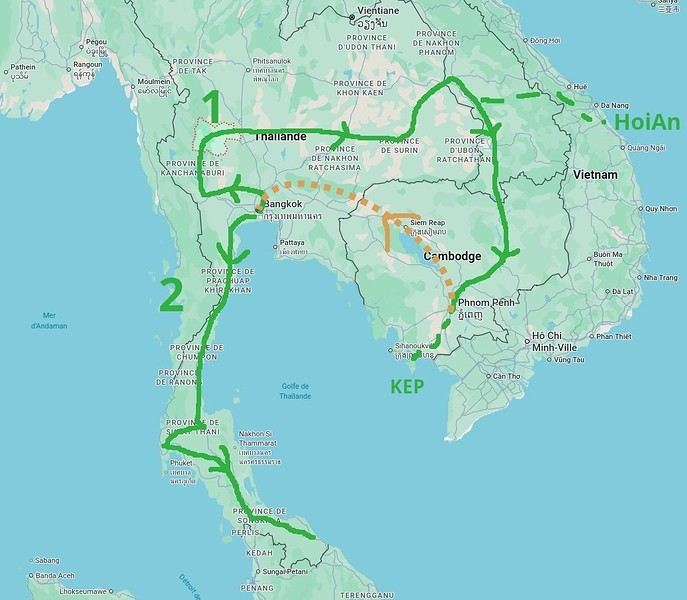
- I’ll start in Bangkok and already have three spots I’ve marked: Ayutthaya, Kanchanaburi, and Uthai Thani (I haven’t been to any of these places yet). - Next, I’d like to cross the country from west to east to reach the Laos border. I’d love suggestions for any interesting stops along this route—I don’t know this part of Thailand at all... - Then I’ll head into Laos, probably at Savannakhet (you can usually get a visa at the border). - > I’m tempted to spend a week in Hoi An, Vietnam, since I loved that city and the area when I visited two years ago. No visa needed for Vietnam now, so it could be a nice little detour. On the map, it doesn’t look too far, but I know you’ve got to be careful with these things, and I’m not sure if it’s a good idea. Any opinions on this? - Back to Laos (maybe via Dakta), and I’ll head south along the Mekong, probably doing the Bolaven Plateau loop that I missed last time. Then Paksé, the 4,000 Islands... I’ve been before, but I’d happily go back. - Crossing into Cambodia, I’ll follow the Mekong down to Phnom Penh (I know this area and love how untouristy it is). From there, I’ll probably spend a few days in Kep (quieter than Kampot). Still undecided, though. - Then back to Thailand (BKK), likely by plane from Phnom Penh since the borders between the two countries are currently closed (plus, let’s be honest, Cambodian roads... ;-). We’ll see how things look when the time comes. - After that, I’d like to explore southern Thailand, taking it slow with short hops. I’ve got my eye on Khao Sok National Park, and I’ve heard good things about Krabi... Again, I don’t know this region well, so any info or tips would be great.
So, I think this should be doable in 2.5 months, especially since I prefer short hops of 300 km max to avoid getting too tired, and I like staying 2-3 days in each place to explore. Plus, I’ll take a week off to relax if I find a spot I love—maybe by the sea for some real downtime.
Thanks for your feedback and for sharing your favorite spots! Pascal
- I’ll start in Bangkok and already have three spots I’ve marked: Ayutthaya, Kanchanaburi, and Uthai Thani (I haven’t been to any of these places yet). - Next, I’d like to cross the country from west to east to reach the Laos border. I’d love suggestions for any interesting stops along this route—I don’t know this part of Thailand at all... - Then I’ll head into Laos, probably at Savannakhet (you can usually get a visa at the border). - > I’m tempted to spend a week in Hoi An, Vietnam, since I loved that city and the area when I visited two years ago. No visa needed for Vietnam now, so it could be a nice little detour. On the map, it doesn’t look too far, but I know you’ve got to be careful with these things, and I’m not sure if it’s a good idea. Any opinions on this? - Back to Laos (maybe via Dakta), and I’ll head south along the Mekong, probably doing the Bolaven Plateau loop that I missed last time. Then Paksé, the 4,000 Islands... I’ve been before, but I’d happily go back. - Crossing into Cambodia, I’ll follow the Mekong down to Phnom Penh (I know this area and love how untouristy it is). From there, I’ll probably spend a few days in Kep (quieter than Kampot). Still undecided, though. - Then back to Thailand (BKK), likely by plane from Phnom Penh since the borders between the two countries are currently closed (plus, let’s be honest, Cambodian roads... ;-). We’ll see how things look when the time comes. - After that, I’d like to explore southern Thailand, taking it slow with short hops. I’ve got my eye on Khao Sok National Park, and I’ve heard good things about Krabi... Again, I don’t know this region well, so any info or tips would be great.
So, I think this should be doable in 2.5 months, especially since I prefer short hops of 300 km max to avoid getting too tired, and I like staying 2-3 days in each place to explore. Plus, I’ll take a week off to relax if I find a spot I love—maybe by the sea for some real downtime.
Thanks for your feedback and for sharing your favorite spots! Pascal
Safety in Tajikistan, Kyrgyzstan, and Kazakhstan
Hi there,
We're planning a trip from Astana to Dushanbe. By train across Kazakhstan, then using public transport in Kyrgyzstan (circling Lake Issyk-Kul) and Tajikistan, taking the northern route in the latter (from Khujand to Dushanbe).
Have any of you been to these regions recently, and what do you think about the safety aspect?
Thanks in advance! :)
Recap of 17 days between São Paulo, Rio de Janeiro, and Iguaçu/Puerto Iguazu
I’ll repost here the comments I gave in reply to Camidav – see their post https://voyageforum.com/forum/partir-10-jours-bresil-en-autonomie-d10702249/.
As we’ve said several times, 10 days is short for Brazil! But it’s still enough for a “little introduction.” My very recent experience (April 2025) with a 2½-week itinerary might give you some ideas. To start, here’s the route:
- - Saturday, March 29: departure from Lisbon and arrival in São Paulo with LATAM
- - 2 nights in São Paulo
- - Monday, March 31: bus from São Paulo to Paraty
- - Monday 31, Tuesday 1st, and Wednesday, April 2: 3 nights in Paraty
- - Thursday, April 3: bus from Paraty to Angra dos Reis, then ferry > Ilha Grande
- - Thursday 3, Friday 4, and Saturday, April 5: 3 nights in Abraão, on Ilha Grande
- - Sunday, April 6: speedboat > Conceição de Jacareí, then bus > Rio de Janeiro
- - Sunday 6, Monday 7, Tuesday 8, and Wednesday, April 9: 4 nights in Rio
- - Thursday, April 10: flight with LATAM from Rio to Foz do Iguaçu
- - Thursday, April 10: one night in Foz do Iguaçu
- - Friday, April 11: visit to Iguaçu Falls on the Brazilian side, then crossing the border to Puerto Iguazu
- - Friday 11 and Saturday, April 12: 2 nights in Puerto Iguazu
- - Saturday, April 12: visit to the falls on the Argentine side
- - Sunday, April 13: return to Brazil, LATAM flight > São Paulo
- - Sunday 13 and Monday, April 14: 2 nights in São Paulo
- - Tuesday, April 15: flight from São Paulo > Lisbon with LATAM, arriving Wednesday the 16th.
So, it’s clear I’m writing this now from Puerto Iguazu (Argentina), and the end of the trip is near: back to São Paulo and then the flight to Lisbon. I’ll of course share more about all this in the following messages.
Driving to Senegal with 2 dogs
Hi everyone, I’d like to travel to Senegal with my two dogs—an Amstaff and a French Bulldog (who can’t fly). I’m wondering if you think it’ll be complicated or if the formalities are easy to sort out.
I’m giving myself a year to prepare for this trip.
Thanks in advance for your replies
Thanks in advance for your replies
Ladakh: Is it possible to sleep near Hanle? (India)
Hi everyone,
I’ve browsed this forum a lot about Ladakh and haven’t found answers to my questions... so here’s my post.
I’m heading there next July with a friend for a solid ten days of cycling (no e-bikes) in Ladakh. The flight to Leh is booked for both of us and our bikes.
I’ve got my route planned out pretty precisely; the main goal is to climb Umling La, which is currently the world’s highest motorable road at 5,798 m. We’re also planning to tackle 3 or 4 other passes over 5,000 m, including Photila, just next door at a little over 5,500 m.
I’ve read accounts from Europeans saying it’s impossible for foreigners to spend a night in Hanle... that the closest accommodation to the Chinese border would be in Nyoma. What do you think about that?
Also, some say the road between Hanle and Chushul (the one via Tsaga) is off-limits to non-Indians... Is the parallel route, the one via Mahé and Kaksang La (5,400 m), open to foreigners?
Is the road along Pangong Lake (the one through Merak and Man) also off-limits to foreigners?
Thanks for your feedback!
I’ve read accounts from Europeans saying it’s impossible for foreigners to spend a night in Hanle... that the closest accommodation to the Chinese border would be in Nyoma. What do you think about that?
Also, some say the road between Hanle and Chushul (the one via Tsaga) is off-limits to non-Indians... Is the parallel route, the one via Mahé and Kaksang La (5,400 m), open to foreigners?
Is the road along Pangong Lake (the one through Merak and Man) also off-limits to foreigners?
Thanks for your feedback!
Feedback on Livingston-Cape Town itinerary (Africa)
My partner and I are planning a 21-day self-drive trip from Victoria Falls to Cape Town, flying from Montreal to Victoria Falls and renting a 4x4. I’d love to hear members’ thoughts on our itinerary and its feasibility, along with your recommendations for must-see spots, essential parks, lodges, etc.
Our ideal is to start our stay at the falls and head south to South Africa, finishing in Cape Town by the sea for two days of relaxation before returning to Canada. We’re big on photography, not so much on cities, and we usually book accommodations where we can prepare our own dinner. Is this itinerary too ambitious? I’ve read a lot of travel journals and sometimes it seems very doable, other times completely the opposite...
Proposed itinerary: 17 October: Montreal-Livingstone, Zambia (Z) 18-19 Oct.: Victoria Falls, Z 20 Oct.: Kasane, Botswana (BO) 21-22 Oct.: Chobe Park, BO 23 Oct.: Francistown, BO 24 Oct.: Khama Rhino Sanctuary, BO 25 Oct.: Palapye, BO 26 Oct.: Polokwane, South Africa (SA) 27 Oct.: Phalaborwa, SA 28-29 Oct.: Kruger Park, SA 30 Oct.: Malelane Gate, SA 31 Oct.: Winburg, SA 1 November: Bloemfontein, SA 2 November: Beaufort West, SA 3-5 November: Cape Town, SA
Our ideal is to start our stay at the falls and head south to South Africa, finishing in Cape Town by the sea for two days of relaxation before returning to Canada. We’re big on photography, not so much on cities, and we usually book accommodations where we can prepare our own dinner. Is this itinerary too ambitious? I’ve read a lot of travel journals and sometimes it seems very doable, other times completely the opposite...
Proposed itinerary: 17 October: Montreal-Livingstone, Zambia (Z) 18-19 Oct.: Victoria Falls, Z 20 Oct.: Kasane, Botswana (BO) 21-22 Oct.: Chobe Park, BO 23 Oct.: Francistown, BO 24 Oct.: Khama Rhino Sanctuary, BO 25 Oct.: Palapye, BO 26 Oct.: Polokwane, South Africa (SA) 27 Oct.: Phalaborwa, SA 28-29 Oct.: Kruger Park, SA 30 Oct.: Malelane Gate, SA 31 Oct.: Winburg, SA 1 November: Bloemfontein, SA 2 November: Beaufort West, SA 3-5 November: Cape Town, SA
Feedback on 3-week itinerary: Atlantic Coast - Spanish Basque Country - Northern Spain
Hello everyone,
So, summer 2025 is when I turn 40, and to mark the occasion, I had the idea of doing a road trip through Northern Spain. Since I’ll be traveling with my two kids (9 and 6½ years old), I’m tied to school holidays, but I’m hoping the northern regions of Spain are a little less crowded than the Costa Brava.
We’d leave from Lyon to reach the Atlantic coast, head down to the Basque Country, cross the Spanish border, and then visit: Cantabria - Asturias - Galicia. It’s not exactly around the corner—I’ve seen that it’s about 1,500 km (one way) from Lyon to Galicia. But for this adventure, I’ve got 3 to 3½ weeks. The twist would be doing it in an electric car, stopping for 2-3 days here and there before moving on (alternating between wild camping and hotels). Why electric? Because it’s my company car, and my employer covers the charging and toll costs. Over 3 weeks of vacation, that adds up to big savings.
Question: Do you think this plan is doable? Aside from the charging stops, does the route seem too ambitious for 3 weeks with two kids? And in July/August, are these regions not too packed?
Thanks for your feedback and experiences!
So, summer 2025 is when I turn 40, and to mark the occasion, I had the idea of doing a road trip through Northern Spain. Since I’ll be traveling with my two kids (9 and 6½ years old), I’m tied to school holidays, but I’m hoping the northern regions of Spain are a little less crowded than the Costa Brava.
We’d leave from Lyon to reach the Atlantic coast, head down to the Basque Country, cross the Spanish border, and then visit: Cantabria - Asturias - Galicia. It’s not exactly around the corner—I’ve seen that it’s about 1,500 km (one way) from Lyon to Galicia. But for this adventure, I’ve got 3 to 3½ weeks. The twist would be doing it in an electric car, stopping for 2-3 days here and there before moving on (alternating between wild camping and hotels). Why electric? Because it’s my company car, and my employer covers the charging and toll costs. Over 3 weeks of vacation, that adds up to big savings.
Question: Do you think this plan is doable? Aside from the charging stops, does the route seem too ambitious for 3 weeks with two kids? And in July/August, are these regions not too packed?
Thanks for your feedback and experiences!
22-day itinerary in Bosnia and Herzegovina and Croatia: your thoughts and advice?
Hello,
After spending some time reading through the forum posts, I’m finally taking the plunge to ask for your help. We’re planning a family trip—a couple with two kids aged 10 and 12—and we’ll be driving from the Paris region. Flying isn’t an option for us. We’ll pass through Munich on the way out and Mantua on the way back. I’ve tried to design an itinerary that suits our preferences: moving at a relaxed pace, avoiding constant packing and unpacking, and keeping the kids engaged. To give you an idea, our oldest wasn’t too impressed with Corsica because "it was meh, just pretty landscapes to look at." Our youngest is only happy when she can dip her feet in the water, and the parents aren’t fans of lounging on a towel for too long.
After all my research, I’ll admit I’m feeling a bit overwhelmed. Is this itinerary doable without turning into a mad dash? Am I missing any must-see spots? Is the Croatia leg realistic? Is it worth staying 4 nights on Brač, given we’re not big beach fans? Have I accounted for enough time at the border crossings? I’d love to hear your thoughts and advice.
Here’s the planned itinerary from July 21 to August 17: Day 1 to 4: Munich Day 5: Depart Munich for Plitvice Lakes (overnight there) Day 6: Visit Plitvice Lakes (overnight there) Day 7: Drive to Una (overnight in Cardaklije) Day 8: Visit Una (overnight in Cardaklije) Day 9: Rafting? (overnight in Cardaklije) Day 10: Drive to Sarajevo. Visit Jajce and Travnik? (overnight in Sarajevo) Day 11: Visit Sarajevo (overnight in Sarajevo) Day 12: Skakavac Waterfalls or other points of interest in the area (overnight in Sarajevo) Day 13: Drive to Mostar. Visit Konjic and Jablanica (overnight in Mostar or Blagaj?) Day 14: Kravica Waterfalls (overnight in Mostar or Blagaj?) Day 15: Visit Blagaj (overnight in Mostar or Blagaj?) Day 16: Visit Počitelj—drive to Hutovo Blato (overnight where???) Day 17: Visit (overnight where??) Day 18: Visit Split (and Trogir?) (overnight in Split or nearby) Day 19: Ferry to Brač (4 nights on Brač) Day 23: Ferry back to Split—drive to Šibenik (overnight in Šibenik or nearby) Day 24: Day trip to the Kornati Islands? (overnight in Šibenik) Day 25: Krka National Park (overnight in Šibenik) Day 26: Depart for Mantua
What do you think? I’m eagerly awaiting your responses. Thanks so much for your help!
After spending some time reading through the forum posts, I’m finally taking the plunge to ask for your help. We’re planning a family trip—a couple with two kids aged 10 and 12—and we’ll be driving from the Paris region. Flying isn’t an option for us. We’ll pass through Munich on the way out and Mantua on the way back. I’ve tried to design an itinerary that suits our preferences: moving at a relaxed pace, avoiding constant packing and unpacking, and keeping the kids engaged. To give you an idea, our oldest wasn’t too impressed with Corsica because "it was meh, just pretty landscapes to look at." Our youngest is only happy when she can dip her feet in the water, and the parents aren’t fans of lounging on a towel for too long.
After all my research, I’ll admit I’m feeling a bit overwhelmed. Is this itinerary doable without turning into a mad dash? Am I missing any must-see spots? Is the Croatia leg realistic? Is it worth staying 4 nights on Brač, given we’re not big beach fans? Have I accounted for enough time at the border crossings? I’d love to hear your thoughts and advice.
Here’s the planned itinerary from July 21 to August 17: Day 1 to 4: Munich Day 5: Depart Munich for Plitvice Lakes (overnight there) Day 6: Visit Plitvice Lakes (overnight there) Day 7: Drive to Una (overnight in Cardaklije) Day 8: Visit Una (overnight in Cardaklije) Day 9: Rafting? (overnight in Cardaklije) Day 10: Drive to Sarajevo. Visit Jajce and Travnik? (overnight in Sarajevo) Day 11: Visit Sarajevo (overnight in Sarajevo) Day 12: Skakavac Waterfalls or other points of interest in the area (overnight in Sarajevo) Day 13: Drive to Mostar. Visit Konjic and Jablanica (overnight in Mostar or Blagaj?) Day 14: Kravica Waterfalls (overnight in Mostar or Blagaj?) Day 15: Visit Blagaj (overnight in Mostar or Blagaj?) Day 16: Visit Počitelj—drive to Hutovo Blato (overnight where???) Day 17: Visit (overnight where??) Day 18: Visit Split (and Trogir?) (overnight in Split or nearby) Day 19: Ferry to Brač (4 nights on Brač) Day 23: Ferry back to Split—drive to Šibenik (overnight in Šibenik or nearby) Day 24: Day trip to the Kornati Islands? (overnight in Šibenik) Day 25: Krka National Park (overnight in Šibenik) Day 26: Depart for Mantua
What do you think? I’m eagerly awaiting your responses. Thanks so much for your help!
Discovering Mongolia authentically: your tips
Hi everyone,
Happy to be back on our travel exchange and advice site.
There are four of us heading to Mongolia from June 22 to July 15, 2025.
We’ve wanted to visit Mongolia for a long time, but for various reasons, the trip kept getting postponed.
This year is the one. The flight tickets are booked, and we’re in touch with several agencies to organize what seems like a classic itinerary (Gobi, Khangai, and Lake Khuvsgul), including attending a Naadam festival outside the capital.
Yes, but here’s the thing—with so much hope riding on this destination, I’m afraid of being disappointed by what we’ll find.
Let me explain. The way we travel has changed over time. Discovering a country these days seems to be more about influencers than travel guides. Consumer-focused travel seems to have taken over from genuine exploration.
So, if you have any tips for helping us discover authentic sites and avoid certain mistakes… we’re all ears.
Thanks in advance for your replies, and happy holidays to everyone.
Cambodia Information
hi there
since the forum is back up, let’s try to gather some updated info.
first off, arrival formalities are changing—starting January 1st, you’ll need to fill out an electronic form before arrival. This replaces the paperwork you used to fill out on the plane or at the airport (for air arrivals). Here’s the link: https://www.arrival.gov.kh/.
for visas, the same options remain: e-visa, visa on arrival, or visa at the embassy. The standard price is $30 on arrival, but at land borders, be prepared for a small "extra" for "cigarettes or coffee."
don’t forget your passport must be valid for at least 6 months after your return.
regarding airlines, prices are pretty high for carriers like Singapore, Qatar, Emirates, Vietnam Airlines, and Thai. EVA Air is a great Taiwanese airline with slightly lower fares, but ongoing pressure from mainland China and quasi-blockades could cause delays or issues—something to watch.
there are cheaper Chinese airlines, but friends from China advise being cautious with connections. Worth double-checking.
transport is evolving too—there’s now a highway from Phnom Penh to Kampot. Soraya, a well-known bus company, has disappeared. More highway projects are in the works. Buildings are popping up fast, just mentioning this for those who haven’t been to Cambodia in a while.
Travel: A Right for All? Reflections on Global Freedoms and Inequalities
Hello fellow travel enthusiasts! 🌍
As a traveler and blogger, I’ve often been struck by the huge inequalities tied to freedom of movement. While some cross borders with ease, others face major obstacles due to their nationality, background, or the restrictive policies of certain countries.
On the occasion of International Human Rights Day, I wrote an article reflecting on this issue: 📖 Travelers' Rights: A Reflection on Freedom of Movement and Global Inequalities
In this article, I cover topics like:
Inequalities between passports ("strong" vs. "weak" passports). The specific challenges faced by travelers from marginalized communities. How to take action to promote more inclusive and equitable travel.
I’d love to hear your thoughts! 😊 Have you ever experienced these inequalities while traveling? How do you think we could raise more awareness about this issue? Feel free to share your experiences or ask questions in this thread. I can’t wait to discuss this with you!
Travel is also about building bridges between cultures. So let’s make sure it becomes a reality for everyone. ✈️🌎 Thanks for reading, and I look forward to exchanging ideas with you!
On the occasion of International Human Rights Day, I wrote an article reflecting on this issue: 📖 Travelers' Rights: A Reflection on Freedom of Movement and Global Inequalities
In this article, I cover topics like:
Inequalities between passports ("strong" vs. "weak" passports). The specific challenges faced by travelers from marginalized communities. How to take action to promote more inclusive and equitable travel.
I’d love to hear your thoughts! 😊 Have you ever experienced these inequalities while traveling? How do you think we could raise more awareness about this issue? Feel free to share your experiences or ask questions in this thread. I can’t wait to discuss this with you!
Travel is also about building bridges between cultures. So let’s make sure it becomes a reality for everyone. ✈️🌎 Thanks for reading, and I look forward to exchanging ideas with you!
My immersion experience with a Peruvian Amazon family
Hi everyone,
For those of you who might be planning to explore the Amazon on the Peruvian side, I wanted to share a little feedback about my own experience, which I had back in 2018. It was honestly one of the most amazing travel experiences of my life—I’d dreamed of discovering the Amazon since I was a kid!
I’m sharing this now, in 2024, because I’ve just finished putting together a short documentary about the family’s ecotourism project. This gave me the chance to reconnect with them, and thanks to the magic of social media, even though they’d had to pause their activities after COVID and the closure of international borders, our reunion helped me put them in touch with the association ARUTAM Zero Deforestation, which has allowed them to restart their ecotourism. That’s why I’m posting here! :)
You can find all the details of my experience in this immersive adventure via this link: http://kikienvadrouille.com/?p=7939
Here are some key highlights from this adventure:
I spent 5 days with Wilder and Jessica’s family, along the banks of the Tahuayo River, a 7-hour slow boat ride from Iquitos <3
I arranged this experience through a French association (Latitud Sur at the time), which fights against deforestation and works to promote and protect the culture of Indigenous peoples in South America.
This is an experience far from the "clichés" you might have about the Amazon—simple yet authentic, with a focus on funding projects that preserve biodiversity and support the well-being of local communities.
The stay is completely customizable in terms of duration and activities (you can ask to go on a hike in the Amazon rainforest, learn about medicinal plants, fish in the river, make necklaces, baskets, or other Amazonian handicrafts, understand the Amazonian agroforestry system, and meet local producers, etc.)—everything is open for discussion! :)
The cost is calculated per day per person: 50 USD per person per day (down from 90 USD previously).
This price includes the 7-hour boat trip from Iquitos (an adventure in itself!), as well as food, accommodation, and activities. If you buy any handicrafts on-site, you’ll obviously need to budget a little extra.
It’s essential to speak and understand at least some Spanish :)
The intercultural exchanges with the family are what truly make this stay special.
Don’t hesitate to ask me any questions! I can also put you directly in touch with Wilder. Happy travels, everyone! Christelle
For those of you who might be planning to explore the Amazon on the Peruvian side, I wanted to share a little feedback about my own experience, which I had back in 2018. It was honestly one of the most amazing travel experiences of my life—I’d dreamed of discovering the Amazon since I was a kid!
I’m sharing this now, in 2024, because I’ve just finished putting together a short documentary about the family’s ecotourism project. This gave me the chance to reconnect with them, and thanks to the magic of social media, even though they’d had to pause their activities after COVID and the closure of international borders, our reunion helped me put them in touch with the association ARUTAM Zero Deforestation, which has allowed them to restart their ecotourism. That’s why I’m posting here! :)
You can find all the details of my experience in this immersive adventure via this link: http://kikienvadrouille.com/?p=7939
Here are some key highlights from this adventure:
I spent 5 days with Wilder and Jessica’s family, along the banks of the Tahuayo River, a 7-hour slow boat ride from Iquitos <3
I arranged this experience through a French association (Latitud Sur at the time), which fights against deforestation and works to promote and protect the culture of Indigenous peoples in South America.
This is an experience far from the "clichés" you might have about the Amazon—simple yet authentic, with a focus on funding projects that preserve biodiversity and support the well-being of local communities.
The stay is completely customizable in terms of duration and activities (you can ask to go on a hike in the Amazon rainforest, learn about medicinal plants, fish in the river, make necklaces, baskets, or other Amazonian handicrafts, understand the Amazonian agroforestry system, and meet local producers, etc.)—everything is open for discussion! :)
The cost is calculated per day per person: 50 USD per person per day (down from 90 USD previously).
This price includes the 7-hour boat trip from Iquitos (an adventure in itself!), as well as food, accommodation, and activities. If you buy any handicrafts on-site, you’ll obviously need to budget a little extra.
It’s essential to speak and understand at least some Spanish :)
The intercultural exchanges with the family are what truly make this stay special.
Don’t hesitate to ask me any questions! I can also put you directly in touch with Wilder. Happy travels, everyone! Christelle
Romania with the wind in my face
Hi there,
In spring 2023, I headed to Romania by motorcycle. I’ve been going there for over 20 years—by car, bike, and plane—and I’ve really fallen for this country. I feel so at home there. The big difference this time? I had all the time in the world, no constraints at all.
I left the Paris region (IDF) and headed for the Sundgau, avoiding the motorways. I know a little hotel tucked away in the countryside there. The next day, I followed the Swiss border on a small road along the Lucelle River, which acts as the frontier. Around a bend, you cross to the other side and then back into France—kind of fun.

I crossed Switzerland via the motorway—I know the route well, so no sightseeing. I arrived in Austria, which I also know pretty well, and took the Arlberg Pass. It was deserted, everything was closed, and there was still snow.

The weather wasn’t great—it was raining—so I stopped for the night at a remote inn. Perfect for drying off! I set off in the rain the next morning and kept going. Gradually, the rain stopped. I took a detour through the Trentino-Alto Adige region and the Sella Pass. Up there, it was rain, snow, and a bit of black ice in a tunnel (wind + rain + sub-zero temps = skating rink).

I arrived in Burgenland to see the famous giant glass-and-metal grape cluster, the largest in Europe. The region is hilly, full of tiny roads, and covered in vineyards.

Burgenland

Then into Slovenia.

I stopped for the night at a winegrower’s B&B perched on a ridge straddling the Croatian border. The welcome was fantastic—I spent the evening with the owners and their friends who arrived later. The white wine was amazing! The next day, I hit the road again.

I headed for Vukovar, on the Danube, a symbol of resistance during the Balkan War. I found a really comfortable B&B by the river and stayed for two nights to explore. What a strange monument!

I visited the water tower, which you can go inside—it’s riddled with bullet holes. There’s an exhibition inside. I also checked out a museum of equipment used during the Balkan War. Since it’s in a barracks, it’s guarded. I asked if I could bring my motorcycle in, and a Croatian officer came to meet me and gave me permission, along with a sticker to put on the bike. I met some fellow bikers from Marseille riding beautiful vintage bikes.

I left Vukovar following the Danube toward Serbia. The rain caught up with me. The roads were busy, with construction causing mud everywhere and crazy truck drivers. At one point, I cut through the construction zone! I stopped for coffee in a village—it had a *Deliverance* vibe. Total silence when I walked in, and the owner gave me a suspicious look. Finally, the Romanian border... and the sun came out! The Romanian customs officer asked if I had anything to declare. "Yes—just happy to be back in Romania!" I stopped for the night at a *cabana* (mountain hut) lost in the forest. Chaos ensued—a tourist! So they rushed to get supplies, quench my thirst, give me a room, and then the owner took charge: țuică (plum brandy), omelette, beers... Everyone bent over backwards to make me happy.
I love these Romanian roads!


I passed through Băile Herculane, which isn’t as beautiful as it once was—everything’s run-down. What are they waiting for to restore this *Mittel Europa*-style spa town that’s still active?
I stopped at the birthplace of Constantin Brâncuși.

Keep your eyes peeled on the roads!

Via the Jiu Valley, I arrived in Craiova to visit my in-laws. A few days of laughs and outings. I picked up my wife at the airport.
My favorite brand

We took a trip to Horezu, a village famous for its beautiful ceramics.


After those few days together, I dropped my wife off at the airport, and the next day, I set off for Dobrogea, a region split in two after the war with Bulgaria. The road was dull—flat as far as the eye could see—but the sun was out. I followed a military convoy of about fifty vehicles, with orders not to overtake. I stopped by the roadside for some homemade *ciorbă* (sour soup). That evening, I stopped in Călărași. The next day, I crossed the Danube by ferry. There are two ferries—one goes to Bulgaria, the other stays in Romania.

A priest on board came over to bless the motorcycle, the rider, and the ferry. I arrived on the other side with some traffic. Dobrogea

It’s like that all the way to the Bulgarian border—no restaurants, hotels, or gas stations, just old collective farms. And it’s the same in Bulgaria! I stopped at Adamclisi, site of a major battle in Moesia (now Dobrogea) in 101–102 BC, one of Trajan’s most important Dacian Wars.

An oasis in the agricultural steppe.

I arrived at the Bulgarian border.

A customs officer—built like a weightlifter, shaved head, thick neck, and as square as a truck—saw me take this photo and came over to ask me to delete it. I did... but I didn’t empty the trash! The weather turned stormy. I arrived in Balchik, a resort town where the last queen of Romania, Maria, used to vacation.
The Black Sea and the Bulgarian coast

The weather wasn’t great, so I headed back to Romania to follow the coastline. Constanța and its casino

Then came the seaside resorts—just as ugly as each other: Neptun, Mangalia, Eforie Nord, Eforie Sud. I stopped at a B&B near the Danube Delta, in some random village. The welcome was nice. The next day, I headed for Dunavățu de Jos, the last stretch of tarmac in Romania. After that, it’s the Danube Delta. The area is flat and sandy, with typical houses featuring reed roofs.

Now, I’m following the Ukrainian border. I passed the last active quarantine station in Europe. I came across a funeral procession—it’s customary to honk as you pass. If you’re on foot, you cross yourself. When I arrived in Galați, it was raining. I boarded the ferry in a downpour. On board, we were packed in like sardines. As soon as the ramp hit land, the drivers rushed out, revving their engines and honking. I let them go and exited calmly. I continued toward the Székely Land. These are Hungarians who, back in the day, were border guards for the king. They’ve kept their own script (it looks like runes), their flag, and their independence streak. For them, Romania is Hungarian, despite the Treaty of Sèvres in 1920. There are still clashes between Romanians and Székely Hungarians now and then. Since I speak a bit of Romanian, I used it—logical, since it’s the language there—and it put everyone in a good mood! Székely flag

I passed through Bicaz Chei, arriving via one of my favorite kinds of roads. During a break, a bear came to check me out from a distance.

Bicaz Chei

I arrived at the "Heart of Jesus" monument, built by public subscription to thank God for sparing the village from severe flooding.

Now, I’m heading west—next stop, Transylvania, with the in-laws. On the road

Roma house

Bozorka—a Hungarian specialty... 450 grams of meat!
I made it back to France without any issues, already thinking about my next trip. Actually, I just got back from one!
I left the Paris region (IDF) and headed for the Sundgau, avoiding the motorways. I know a little hotel tucked away in the countryside there. The next day, I followed the Swiss border on a small road along the Lucelle River, which acts as the frontier. Around a bend, you cross to the other side and then back into France—kind of fun.
I crossed Switzerland via the motorway—I know the route well, so no sightseeing. I arrived in Austria, which I also know pretty well, and took the Arlberg Pass. It was deserted, everything was closed, and there was still snow.
The weather wasn’t great—it was raining—so I stopped for the night at a remote inn. Perfect for drying off! I set off in the rain the next morning and kept going. Gradually, the rain stopped. I took a detour through the Trentino-Alto Adige region and the Sella Pass. Up there, it was rain, snow, and a bit of black ice in a tunnel (wind + rain + sub-zero temps = skating rink).
I arrived in Burgenland to see the famous giant glass-and-metal grape cluster, the largest in Europe. The region is hilly, full of tiny roads, and covered in vineyards.
Burgenland
Then into Slovenia.
I stopped for the night at a winegrower’s B&B perched on a ridge straddling the Croatian border. The welcome was fantastic—I spent the evening with the owners and their friends who arrived later. The white wine was amazing! The next day, I hit the road again.
I headed for Vukovar, on the Danube, a symbol of resistance during the Balkan War. I found a really comfortable B&B by the river and stayed for two nights to explore. What a strange monument!
I visited the water tower, which you can go inside—it’s riddled with bullet holes. There’s an exhibition inside. I also checked out a museum of equipment used during the Balkan War. Since it’s in a barracks, it’s guarded. I asked if I could bring my motorcycle in, and a Croatian officer came to meet me and gave me permission, along with a sticker to put on the bike. I met some fellow bikers from Marseille riding beautiful vintage bikes.
I left Vukovar following the Danube toward Serbia. The rain caught up with me. The roads were busy, with construction causing mud everywhere and crazy truck drivers. At one point, I cut through the construction zone! I stopped for coffee in a village—it had a *Deliverance* vibe. Total silence when I walked in, and the owner gave me a suspicious look. Finally, the Romanian border... and the sun came out! The Romanian customs officer asked if I had anything to declare. "Yes—just happy to be back in Romania!" I stopped for the night at a *cabana* (mountain hut) lost in the forest. Chaos ensued—a tourist! So they rushed to get supplies, quench my thirst, give me a room, and then the owner took charge: țuică (plum brandy), omelette, beers... Everyone bent over backwards to make me happy.
I love these Romanian roads!
I passed through Băile Herculane, which isn’t as beautiful as it once was—everything’s run-down. What are they waiting for to restore this *Mittel Europa*-style spa town that’s still active?
I stopped at the birthplace of Constantin Brâncuși.
Keep your eyes peeled on the roads!
Via the Jiu Valley, I arrived in Craiova to visit my in-laws. A few days of laughs and outings. I picked up my wife at the airport.
My favorite brand
We took a trip to Horezu, a village famous for its beautiful ceramics.
After those few days together, I dropped my wife off at the airport, and the next day, I set off for Dobrogea, a region split in two after the war with Bulgaria. The road was dull—flat as far as the eye could see—but the sun was out. I followed a military convoy of about fifty vehicles, with orders not to overtake. I stopped by the roadside for some homemade *ciorbă* (sour soup). That evening, I stopped in Călărași. The next day, I crossed the Danube by ferry. There are two ferries—one goes to Bulgaria, the other stays in Romania.
A priest on board came over to bless the motorcycle, the rider, and the ferry. I arrived on the other side with some traffic. Dobrogea
It’s like that all the way to the Bulgarian border—no restaurants, hotels, or gas stations, just old collective farms. And it’s the same in Bulgaria! I stopped at Adamclisi, site of a major battle in Moesia (now Dobrogea) in 101–102 BC, one of Trajan’s most important Dacian Wars.
An oasis in the agricultural steppe.
I arrived at the Bulgarian border.
A customs officer—built like a weightlifter, shaved head, thick neck, and as square as a truck—saw me take this photo and came over to ask me to delete it. I did... but I didn’t empty the trash! The weather turned stormy. I arrived in Balchik, a resort town where the last queen of Romania, Maria, used to vacation.
The Black Sea and the Bulgarian coast
The weather wasn’t great, so I headed back to Romania to follow the coastline. Constanța and its casino
Then came the seaside resorts—just as ugly as each other: Neptun, Mangalia, Eforie Nord, Eforie Sud. I stopped at a B&B near the Danube Delta, in some random village. The welcome was nice. The next day, I headed for Dunavățu de Jos, the last stretch of tarmac in Romania. After that, it’s the Danube Delta. The area is flat and sandy, with typical houses featuring reed roofs.
Now, I’m following the Ukrainian border. I passed the last active quarantine station in Europe. I came across a funeral procession—it’s customary to honk as you pass. If you’re on foot, you cross yourself. When I arrived in Galați, it was raining. I boarded the ferry in a downpour. On board, we were packed in like sardines. As soon as the ramp hit land, the drivers rushed out, revving their engines and honking. I let them go and exited calmly. I continued toward the Székely Land. These are Hungarians who, back in the day, were border guards for the king. They’ve kept their own script (it looks like runes), their flag, and their independence streak. For them, Romania is Hungarian, despite the Treaty of Sèvres in 1920. There are still clashes between Romanians and Székely Hungarians now and then. Since I speak a bit of Romanian, I used it—logical, since it’s the language there—and it put everyone in a good mood! Székely flag
I passed through Bicaz Chei, arriving via one of my favorite kinds of roads. During a break, a bear came to check me out from a distance.
Bicaz Chei
I arrived at the "Heart of Jesus" monument, built by public subscription to thank God for sparing the village from severe flooding.
Now, I’m heading west—next stop, Transylvania, with the in-laws. On the road
Roma house
Bozorka—a Hungarian specialty... 450 grams of meat!
I made it back to France without any issues, already thinking about my next trip. Actually, I just got back from one!
Trans-Mongolian Railway trip, post-2022 info?
Hi,
I’m supposed to be going on a university exchange in Shanghai from February to June 2025, and I’d love to return to Europe afterward via the Trans-Mongolian Railway. My plan was to fly from China to Mongolia’s capital and maybe spend 3-4 days exploring the country. Then, I could take the train, with a stop in Irkutsk before heading to Moscow for a two-day visit, followed by two days in Saint Petersburg. After that, I’d take a bus to Tallinn and possibly fly home from there due to time constraints. I was thinking this whole trip would take about two weeks. This site: Russian Train Tickets - Online Booking for Russian Train Tickets seems useful for buying tickets (though the ones that go through Mongolia need to be booked via a form or on tutu.travel), and this one for the bus from Russia to Estonia: St. Petersburg - Tallinn buses and tickets.
From what I’ve gathered, Russia now offers an e-visa, and Mongolia has suspended visas for Europeans until the end of next year.
Would anyone have any info or advice? Given the current situation in Russia, everything is pretty complicated to research, and most of the information is outdated.
Thanks in advance, Alicia
I’m supposed to be going on a university exchange in Shanghai from February to June 2025, and I’d love to return to Europe afterward via the Trans-Mongolian Railway. My plan was to fly from China to Mongolia’s capital and maybe spend 3-4 days exploring the country. Then, I could take the train, with a stop in Irkutsk before heading to Moscow for a two-day visit, followed by two days in Saint Petersburg. After that, I’d take a bus to Tallinn and possibly fly home from there due to time constraints. I was thinking this whole trip would take about two weeks. This site: Russian Train Tickets - Online Booking for Russian Train Tickets seems useful for buying tickets (though the ones that go through Mongolia need to be booked via a form or on tutu.travel), and this one for the bus from Russia to Estonia: St. Petersburg - Tallinn buses and tickets.
From what I’ve gathered, Russia now offers an e-visa, and Mongolia has suspended visas for Europeans until the end of next year.
Would anyone have any info or advice? Given the current situation in Russia, everything is pretty complicated to research, and most of the information is outdated.
Thanks in advance, Alicia
Taking a boat down the Mekong from Luang Prabang to Vientiane
Hi there, We’re in Laos in March 2025,
does anyone know if it’s possible to travel down the Mekong from Luang Prabang to Vientiane?
Can you find a private boat? How long does it take?
Thanks for your replies_
Petit tour dans le Péloponnèse English translation pending
Tous nos séjours en Grèce nous ont enchantées alors, après un séjour en Crète, à Rhodes, à Zakynthos et en Grèce centrale, pourquoi pas un tour du Péloponnèse?
Nous avons quelques hésitations quant à la chaleur possible (notamment pour les randonnées) mais finalement, hop! la réservation des billets d'avion est faite fin janvier: ce sera un départ de Bruxelles (avec Brussels airlines) le 05/07 à 7h30. Puis arrive le (la) Covid avec son lot d'incertitudes: partira? Partira pas? Partira? Partira pas? Faut-il tout annuler, reporter? Au mois de juin les règles d'ouverture des frontières changent en permanence mais il arrive un moment où il faut bien se décider car certains hébergements ne sont plus annulables. Les frontières de la Grèce doivent théoriquement ouvrir totalement le 1er juillet (sous réserve de...) on doit partir le 5 ...alors, c'est décidé, on part! ...enfin, si tout se passe comme prévu!
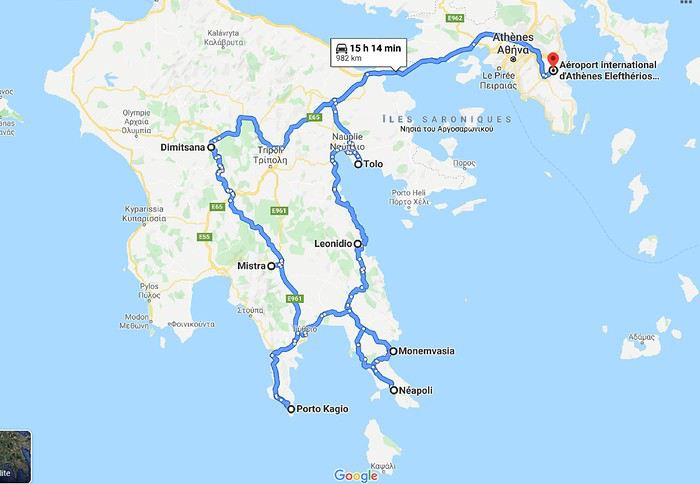
L'ouest du Péloponnèse ne m'inspire pas plus que ça. Par contre Cythère me tente bien, alors voilà à quoi ressemblera notre circuit (on prendra le bateau pour Cythère à Neapoli):
 Muriel
Nous avons quelques hésitations quant à la chaleur possible (notamment pour les randonnées) mais finalement, hop! la réservation des billets d'avion est faite fin janvier: ce sera un départ de Bruxelles (avec Brussels airlines) le 05/07 à 7h30. Puis arrive le (la) Covid avec son lot d'incertitudes: partira? Partira pas? Partira? Partira pas? Faut-il tout annuler, reporter? Au mois de juin les règles d'ouverture des frontières changent en permanence mais il arrive un moment où il faut bien se décider car certains hébergements ne sont plus annulables. Les frontières de la Grèce doivent théoriquement ouvrir totalement le 1er juillet (sous réserve de...) on doit partir le 5 ...alors, c'est décidé, on part! ...enfin, si tout se passe comme prévu!
L'ouest du Péloponnèse ne m'inspire pas plus que ça. Par contre Cythère me tente bien, alors voilà à quoi ressemblera notre circuit (on prendra le bateau pour Cythère à Neapoli):
MurielRetour de croisière sur la Belle des océans 26 juillet-2 août (est-ce bien raisonnable...) English translation pending
Bonjour
Je dois être l'une des dernières à avoir fait une croisière en février-mars et l'une des 1res à en refaire une cet été. Je sais donc parfaitement à quoi m'attendre et suis consciente des risques encourus, puisque j'ai subi l'épidémie et le confinement sur le Luminosa en mars dernier. 🤪
Après ce retour calamiteux, j'ai vécu une longue période de sidération suivie d'une non moins longue période de torpeur ; je me suis donc décidée à réagir. D'habitude l'été est consacré aux retrouvailles avec la famille qui vit à l'étranger mais ils ont craint les fermetures de frontières et donc ne sont pas venus en France. Du coup gros coup de blues... A la lecture du forum j'ai découvert l'existence de Croisieurope (merci Hyerois83) qui proposait le tour de la Corse en une semaine. Comme beaucoup de gens, je me disais que la Corse ce n'était pas loin et que j'avais le temps de la découvrir... et les années passent. Bref c'était une opportunité d'autant que voyageant seule c'est compliqué et onéreux d'obtenir une cabine single à un tarif "démocratique". Et cette année les promotions sont intéressantes. Le départ depuis Nice où je réside était également un argument séduisant. Toujours est il que je me suis décidée sur un coup de tête ; il y a une agence croisieurope à Nice, réservation faite le mardi pour un départ le dimanche suivant ; je leur demande s'ils ont de bons retours et j'apprends que ce sera la 1re rotation ; donc aucun risque d'annulation et de perspective de vouchers si près du départ.
On va passer rapidement sur l'aspect médical longuement évoqué sur un autre post ; on nous a fait remplir un questionnaire médical que l'on remet à l'embarquement ; personnellement j'avais subi un test sanguin dans le cadre du dépistage organisé par la ville de Nice. C'est tout. Prise de température à l'entrée du bateau pour la forme. (Sur le Luminosa on nous prenait aussi la température et on sait les suites tragiques de cette croisière.)
Résidant à Nice j'ai pris les transports en commun ; la ligne 2 du tram arrive directement sur le port. Ma voisine de table a pris le taxi depuis la gare et a payé 26 euros : je crois que les taxis niçois sont les plus chers du monde.
Embarquement donc au port Lympia de Nice à 17 h. Aucune attente. La valise est prise en charge et nettoyée et je la retrouverai devant la cabine ; j'ai une jolie cabine de 17 m2 avec un sabord, taille similaire aux cabines extérieures de chez Costa. Une petite entrée pourvue d'un spacieux placard en face une salle d'eau avec une grande douche ; un lit de 160, 2 tables de chevet un canapé, un fauteuil, une table, un bureau, un réfrigérateur. Sur le lit 2 chocolats, 2 masques et 2 fioles de gel désinfectant. Il y en a en permanence à la réception car nous devons bien sûr nous masquer pour circuler à l'intérieur suivant un parcours qui doit permettre la fameuse distanciation sociale. Il y a 72 passagers. (Capacité 128 pour 62 cabines.) Prises de courant américaines mais un adaptateur est fourni.
Je dois être l'une des dernières à avoir fait une croisière en février-mars et l'une des 1res à en refaire une cet été. Je sais donc parfaitement à quoi m'attendre et suis consciente des risques encourus, puisque j'ai subi l'épidémie et le confinement sur le Luminosa en mars dernier. 🤪
Après ce retour calamiteux, j'ai vécu une longue période de sidération suivie d'une non moins longue période de torpeur ; je me suis donc décidée à réagir. D'habitude l'été est consacré aux retrouvailles avec la famille qui vit à l'étranger mais ils ont craint les fermetures de frontières et donc ne sont pas venus en France. Du coup gros coup de blues... A la lecture du forum j'ai découvert l'existence de Croisieurope (merci Hyerois83) qui proposait le tour de la Corse en une semaine. Comme beaucoup de gens, je me disais que la Corse ce n'était pas loin et que j'avais le temps de la découvrir... et les années passent. Bref c'était une opportunité d'autant que voyageant seule c'est compliqué et onéreux d'obtenir une cabine single à un tarif "démocratique". Et cette année les promotions sont intéressantes. Le départ depuis Nice où je réside était également un argument séduisant. Toujours est il que je me suis décidée sur un coup de tête ; il y a une agence croisieurope à Nice, réservation faite le mardi pour un départ le dimanche suivant ; je leur demande s'ils ont de bons retours et j'apprends que ce sera la 1re rotation ; donc aucun risque d'annulation et de perspective de vouchers si près du départ.
On va passer rapidement sur l'aspect médical longuement évoqué sur un autre post ; on nous a fait remplir un questionnaire médical que l'on remet à l'embarquement ; personnellement j'avais subi un test sanguin dans le cadre du dépistage organisé par la ville de Nice. C'est tout. Prise de température à l'entrée du bateau pour la forme. (Sur le Luminosa on nous prenait aussi la température et on sait les suites tragiques de cette croisière.)
Résidant à Nice j'ai pris les transports en commun ; la ligne 2 du tram arrive directement sur le port. Ma voisine de table a pris le taxi depuis la gare et a payé 26 euros : je crois que les taxis niçois sont les plus chers du monde.
Embarquement donc au port Lympia de Nice à 17 h. Aucune attente. La valise est prise en charge et nettoyée et je la retrouverai devant la cabine ; j'ai une jolie cabine de 17 m2 avec un sabord, taille similaire aux cabines extérieures de chez Costa. Une petite entrée pourvue d'un spacieux placard en face une salle d'eau avec une grande douche ; un lit de 160, 2 tables de chevet un canapé, un fauteuil, une table, un bureau, un réfrigérateur. Sur le lit 2 chocolats, 2 masques et 2 fioles de gel désinfectant. Il y en a en permanence à la réception car nous devons bien sûr nous masquer pour circuler à l'intérieur suivant un parcours qui doit permettre la fameuse distanciation sociale. Il y a 72 passagers. (Capacité 128 pour 62 cabines.) Prises de courant américaines mais un adaptateur est fourni.
Les racines du besoin de voyager English translation pending
Certains ne quittent jamais leur ville ou leur province et ne le souhaitent pas.
Nous autres voyageurs avons un beau jour attrapé le virus de la decouverte et il nous faut voir l Ailleurs.
il y a eu une fois une petite semence qui a germé : un voyage de classe, un pays decouvert avec des amis, des vacances avec les parents, un passage de frontiere. un moment qui nous a donné le goût, un moment qu on veut revivre à tout jamais, a chaque fois.
il y a eu une fois une petite semence qui a germé : un voyage de classe, un pays decouvert avec des amis, des vacances avec les parents, un passage de frontiere. un moment qui nous a donné le goût, un moment qu on veut revivre à tout jamais, a chaque fois.
Un test est-il obligatoire pour rentrer au Portugal en provenance d'Espagne? English translation pending
Bonjour à tous.
Mon fils vient de trouver un boulot, logé, assuré ... à Lisbonne !!! Formidable en ces temps difficiles.
Il vit actuellement avec moi en Andalousie et vs n'êtes pas sans ignorer que l'Espagne est montrée du doigt en moment à cause du Covid.
Savez vous si le Portugal exige un test ??
Merci à ceux qui sont déjà passé par là, rentrer au Portugal en provenance d'Espagne...
Merci à ceux qui sont déjà passé par là, rentrer au Portugal en provenance d'Espagne...
La Norvège réautorise les croisières mais sans débarquement English translation pending
La Norvège autorise les bateaux de croisière à naviguer le long des côtes norvégiennes, mais sans débarquement possible des passagers : https://www.regjeringen.no/no/aktuelt/apner-for-cruise-langs-norskekysten/id2715823/ (traduction Google ici) .
Celà va permettre en particulier à Hurtigruten de lancer des croisières (uniquement je crois pour les passagers de nationalité allemande) au départ de Hambourg avec navigation scénique le long de la côte norvégienne, et sorties en zodiac ou kayak (sur un bateau de 530 places rempli a mi-capacité, donc environ 250 passagers). Ça me semble difficilement intéressant avec des bateaux plus gros comme ceux de MSC ou Costa, qui misent essentiellement sur les excursions.
Les rotations "normales" de l'Express-Cotier d'Hurtigruten ont repris mi-juin, avec seulement 4 bateaux pour l'instant, et uniquement avec des passagers autorisés à entrer en Norvège (donc Norvégiens, Danois, Islandais, Finlandais).
La Norvège va ré-ouvrir ses frontières le 15 juillet à des pays de l'UE/Schengen avec un taux d'infection acceptable, la liste de ces pays sera donnée le 10 juillet, à suivre ici : https://www.visitnorway.fr/planifier-voyage-norvege/coronavirus-et-voyages-en-norvege/ Je ne suis pas sûre que la France sera dans la liste...
Celà va permettre en particulier à Hurtigruten de lancer des croisières (uniquement je crois pour les passagers de nationalité allemande) au départ de Hambourg avec navigation scénique le long de la côte norvégienne, et sorties en zodiac ou kayak (sur un bateau de 530 places rempli a mi-capacité, donc environ 250 passagers). Ça me semble difficilement intéressant avec des bateaux plus gros comme ceux de MSC ou Costa, qui misent essentiellement sur les excursions.
Les rotations "normales" de l'Express-Cotier d'Hurtigruten ont repris mi-juin, avec seulement 4 bateaux pour l'instant, et uniquement avec des passagers autorisés à entrer en Norvège (donc Norvégiens, Danois, Islandais, Finlandais).
La Norvège va ré-ouvrir ses frontières le 15 juillet à des pays de l'UE/Schengen avec un taux d'infection acceptable, la liste de ces pays sera donnée le 10 juillet, à suivre ici : https://www.visitnorway.fr/planifier-voyage-norvege/coronavirus-et-voyages-en-norvege/ Je ne suis pas sûre que la France sera dans la liste...
Vol Turkish Airlines pour New Delhi juillet 2020: annulation impossible, remboursement... English translation pending
Bonjour à tous, après de nombreuses tentatives pour joindre les différentes hotlines de la compagnie (0825800902 ou 0157979849) et après de nombreux cliccccs et recherches sur leur site je m'en remets à vous car c'est un peu l'impasse.
J'avais réservé un vol de Marseille à Delhi pour le 2 juillet (retour 2 sept). La situation est telle en Inde que ses frontières, aux dernières nouvelles, sont fermées. Il semblerait cependant que Turkish airlines maintienne mon vol (aucun mail/message à ce sujet, ils parlent juste de nouvelles mesures sanitaires à bord des avions..) De fait, vous imaginez que l'idée de remboursement est déjà mal engagée.
Sur leur site une fois dans mes réservations, je clique sur annuler mon vol, mais une erreur apparaît :
Erreur Nous ne pouvons pas traiter votre transaction en raison d'une erreur technique. Vous pouvez contacter nos bureaux de vente ou notre centre d'appels pour effectuer votre transaction. SER-TBOS-10002-ef131cac
Bien entendu, contacter les bureaux de vente ou les centre d'appels est une mission très irritante, encore faut-il que ça réponde..
Bref, savez-vous si ces numéros fonctionnent correctement encore ? (un post récent sur le forum me dirait que oui). Ou que me conseillez-vous de faire ? C'est déjà dans 15 jours :o
Merci à tous pour vos bons conseils
J'avais réservé un vol de Marseille à Delhi pour le 2 juillet (retour 2 sept). La situation est telle en Inde que ses frontières, aux dernières nouvelles, sont fermées. Il semblerait cependant que Turkish airlines maintienne mon vol (aucun mail/message à ce sujet, ils parlent juste de nouvelles mesures sanitaires à bord des avions..) De fait, vous imaginez que l'idée de remboursement est déjà mal engagée.
Sur leur site une fois dans mes réservations, je clique sur annuler mon vol, mais une erreur apparaît :
Erreur Nous ne pouvons pas traiter votre transaction en raison d'une erreur technique. Vous pouvez contacter nos bureaux de vente ou notre centre d'appels pour effectuer votre transaction. SER-TBOS-10002-ef131cac
Bien entendu, contacter les bureaux de vente ou les centre d'appels est une mission très irritante, encore faut-il que ça réponde..
Bref, savez-vous si ces numéros fonctionnent correctement encore ? (un post récent sur le forum me dirait que oui). Ou que me conseillez-vous de faire ? C'est déjà dans 15 jours :o
Merci à tous pour vos bons conseils
Tubeless ou chambre à air? (à vélo) English translation pending
Je commence ce sujet suite a la lecture de plusieurs récits de personnes ayant parcourus des itinéraires longs et difficiles avec des pneus montés en Tubeless.
L'un sur la Great Divide , itinéraire TT sur les rocheuses de la frontière canadienne à celle du Mexique : 0 crevaisons !
L'autre de Tanger à Dakar 1 crevaison
Cela fait bien longtemps que j'ai adopté cette technique sur mon VTT , avec beaucoup de bonheur (crevaisons rarissimes, confort supérieur) Du coup je tenterais bien le coup en voyage...
Qui l'a déjà fait ? Quel bilan en tirez vous ?
Au plaisir de partager nos expériences
Cela fait bien longtemps que j'ai adopté cette technique sur mon VTT , avec beaucoup de bonheur (crevaisons rarissimes, confort supérieur) Du coup je tenterais bien le coup en voyage...
Qui l'a déjà fait ? Quel bilan en tirez vous ?
Au plaisir de partager nos expériences
Camp de base Nord de l'Annapurna, boucle Thorung/Tilicho English translation pending
Allez, je me lance aussi dans un petit CR du trek réalisé du 4 au 24 septembre 2019.
2 parties distinctes dans l'itinéraire :
1. Le Camp de base Nord de l'Annapurna
Un projet prévu depuis longtemps, je souhaitais voir de mes yeux l'itinéraire emprunté par l'expédition française de 1950. En ajoutant la difficulté d'une reconnaissance sur un itinéraire imaginé par Pierre Martin via la Kalte Danda, une large crête qui remonte de la Kali Gandaki et qui poursuit sur l'arête SW des Nilgiris).
2. La boucle des 2(3) cols entre Manang et Jomsom
Un itinéraire sur un sentier classique mais qui n'est pas ou peu fait car l'acclimatation est indispensable avant de s'engager directement vers le plus haut-col du secteur. Le Mesokanto La (2e col) est plus sauvage et moins emprunté, mais y étant déjà passé 3 fois, je le connais assez bien. Ce 2e itinéraire me permettait d'allonger un peu mon séjour dans les Annapurnas en établissant une boucle intéressante.
L'itinéraire suivi fut celui-ci :
Première partie (Camp de base N de l'Annapurna)
Jour 1 : Transfert en bus de Pokhara à Tatopani Jour 2 : Tatopani (1250) - Kalte Danda Camp 1 (2500) Jour 3 : Kalte Danda Camp 1 - Kalte Danda Camp 2 (4000) Jour 4 : Kalte Danda Camp 2 - Thulobugin Pass (4450) - Nilgiri BC (4230) Jour 5 : Nilgiri BC - North Annapurna BC (4050) Jour 6 : North Annapurna BC - Miristi Khola Camp (3560) Jour 7 : Miristi Khola Camp - Nilgiri BC (4230) Jour 8 : Nilgiri BC - Thulobugin Pass - Kalopani (2520) Jour 9 : Kalopani - Jomsom (2740)
Séparation avec l'équipe. La première partie dédiée au camp de base N est réalisée, je n'ai donc plus besoin de l'équipe. Je poursuis seul sur des sentiers bien tracés, évidents et "relativement safe".
Deuxième Partie (boucle des 2 cols du Tour des Annapurnas)
Jour 10 : Jomsom - Jharkot (3520) en bus Jour 11 : Jharkot - Thorung La Camp (5000) Jour 12 : Thorung La Camp - Thorung La - Ledar (4220) Jour 13 : Ledar - Manang - Khangsar (3750) Jour 14 : Khangsar - Tilicho BC (4150) Jour 15 : Tilicho BC - Tilicho Lake Teahouse (5000) Jour 16 : Tilicho Lake Teahouse - Eastern Pass - Mesokanto La - Thinigaon (2870) Jour 17 : Thinigaon - Kagbeni (2840) Jour 18 : Kagbeni - Lupra - Kagbeni Jour 19 : Kagbeni - Jomsom Jour 20 : Vol Jomsom - Pokhara

2 parties distinctes dans l'itinéraire :
1. Le Camp de base Nord de l'Annapurna
Un projet prévu depuis longtemps, je souhaitais voir de mes yeux l'itinéraire emprunté par l'expédition française de 1950. En ajoutant la difficulté d'une reconnaissance sur un itinéraire imaginé par Pierre Martin via la Kalte Danda, une large crête qui remonte de la Kali Gandaki et qui poursuit sur l'arête SW des Nilgiris).
2. La boucle des 2(3) cols entre Manang et Jomsom
Un itinéraire sur un sentier classique mais qui n'est pas ou peu fait car l'acclimatation est indispensable avant de s'engager directement vers le plus haut-col du secteur. Le Mesokanto La (2e col) est plus sauvage et moins emprunté, mais y étant déjà passé 3 fois, je le connais assez bien. Ce 2e itinéraire me permettait d'allonger un peu mon séjour dans les Annapurnas en établissant une boucle intéressante.
L'itinéraire suivi fut celui-ci :
Première partie (Camp de base N de l'Annapurna)
Jour 1 : Transfert en bus de Pokhara à Tatopani Jour 2 : Tatopani (1250) - Kalte Danda Camp 1 (2500) Jour 3 : Kalte Danda Camp 1 - Kalte Danda Camp 2 (4000) Jour 4 : Kalte Danda Camp 2 - Thulobugin Pass (4450) - Nilgiri BC (4230) Jour 5 : Nilgiri BC - North Annapurna BC (4050) Jour 6 : North Annapurna BC - Miristi Khola Camp (3560) Jour 7 : Miristi Khola Camp - Nilgiri BC (4230) Jour 8 : Nilgiri BC - Thulobugin Pass - Kalopani (2520) Jour 9 : Kalopani - Jomsom (2740)
Séparation avec l'équipe. La première partie dédiée au camp de base N est réalisée, je n'ai donc plus besoin de l'équipe. Je poursuis seul sur des sentiers bien tracés, évidents et "relativement safe".
Deuxième Partie (boucle des 2 cols du Tour des Annapurnas)
Jour 10 : Jomsom - Jharkot (3520) en bus Jour 11 : Jharkot - Thorung La Camp (5000) Jour 12 : Thorung La Camp - Thorung La - Ledar (4220) Jour 13 : Ledar - Manang - Khangsar (3750) Jour 14 : Khangsar - Tilicho BC (4150) Jour 15 : Tilicho BC - Tilicho Lake Teahouse (5000) Jour 16 : Tilicho Lake Teahouse - Eastern Pass - Mesokanto La - Thinigaon (2870) Jour 17 : Thinigaon - Kagbeni (2840) Jour 18 : Kagbeni - Lupra - Kagbeni Jour 19 : Kagbeni - Jomsom Jour 20 : Vol Jomsom - Pokhara
Avis sur voyage depuis la Namibie (Etosha est) jusqu'aux chutes Victoria English translation pending
Bonjour à tous :)
besoin de vos avis et conseils svp.
nous reportons par la force des choses notre séjour en namibie prévu initialement fin juin cette année à l'été prochain.
et histoire de positiver... on aimerait rajouter une semaine à notre voyage prévu :
Nous devions partir 3 semaines et demi. nos dernières nuitées sont à onguma tree top soit partie Est d'etosha.
en rajoutant une semaine, nous aimerions rallier les chutes victoria, que pensez vous de cet itinéraire :
vendredi J22etosha est300samedi J23mahangu safari lodge150dimanche J24mahangu safari lodge150lundi J25camp kwando220mardi J26senyati safari camp250mercredi J27senyati safari camp250jeudi J28chute victoria100vendredi J29chute victoria100samedi J30depart dimanche J31arrivee
sachant que s'il le faut, on peut supprimer la nuit à J22 à onguma ( nous y dormons déjà les 2 nuits précentes ) , donc nuit utilisable ailleurs s'il le faut
colonne tout à droite, le budget estimé pour les lodges.
en terme de budget, pensez vous cela cohérent :
environ 1500 euros concernant les lodges ( et parfois les diners sont inclus )
la location du 4*4 ( à vérifier...) 150 euros pour 8 jours supplémentaires : 1200 euros
j'imagine qu'on aura les billets d'avion un peu plus cher aussi avec un vol multi destination
activités : à la louche : 800 euros ( pas encore regardé ça )
et nourriture, sachant que dans certains lodges certains repas du soir sont compris : 300 euros
soit environ 3800 euros en plus
il faut que je regarde ce qu'il en est pour le passage des différentes frontières ....
l'idée, c'est déjà de savoir si pour vous, c'est réalisable ?
Avez vous des suggestions ? :)
merci :)
besoin de vos avis et conseils svp.
nous reportons par la force des choses notre séjour en namibie prévu initialement fin juin cette année à l'été prochain.
et histoire de positiver... on aimerait rajouter une semaine à notre voyage prévu :
Nous devions partir 3 semaines et demi. nos dernières nuitées sont à onguma tree top soit partie Est d'etosha.
en rajoutant une semaine, nous aimerions rallier les chutes victoria, que pensez vous de cet itinéraire :
vendredi J22etosha est300samedi J23mahangu safari lodge150dimanche J24mahangu safari lodge150lundi J25camp kwando220mardi J26senyati safari camp250mercredi J27senyati safari camp250jeudi J28chute victoria100vendredi J29chute victoria100samedi J30depart dimanche J31arrivee
sachant que s'il le faut, on peut supprimer la nuit à J22 à onguma ( nous y dormons déjà les 2 nuits précentes ) , donc nuit utilisable ailleurs s'il le faut
colonne tout à droite, le budget estimé pour les lodges.
en terme de budget, pensez vous cela cohérent :
environ 1500 euros concernant les lodges ( et parfois les diners sont inclus )
la location du 4*4 ( à vérifier...) 150 euros pour 8 jours supplémentaires : 1200 euros
j'imagine qu'on aura les billets d'avion un peu plus cher aussi avec un vol multi destination
activités : à la louche : 800 euros ( pas encore regardé ça )
et nourriture, sachant que dans certains lodges certains repas du soir sont compris : 300 euros
soit environ 3800 euros en plus
il faut que je regarde ce qu'il en est pour le passage des différentes frontières ....
l'idée, c'est déjà de savoir si pour vous, c'est réalisable ?
Avez vous des suggestions ? :)
merci :)
Boucle de 11 jours au départ de Montréal incluant la Gaspésie English translation pending
Bonjour,
Je reviens vers vous pour vous présenter une ébauche d’itinéraire que nous souhaitons parcourir à deux à partir du 25 mai au départ de Montréal où nous serons depuis 3 jours...si bien sûr d’ici là les canadiens ne ferment pas leur frontière aux européens comme viennent de le faire les étasuniens.
Comme je l’ai déjà écrit, dans cette discussion, que j’ai ouverte sur la présence des bibittes en cette période, nous sommes conscients que le programme et dense et qu’il y aura beaucoup de route.
Le point positif c'est que les journées sont plutôt longues à cette époque de l’année. De plus, par rapport au programme initial, nous avons pu ajouter une journée, que nous avons placée dans le Charlevoix.
Ça donne donc : J1 : départ matinal de Montréal pour le parc de la Mauricie (route panoramique + rando facile si le temps le permet), soirée et nuit à Québec J2 : chute Montmorency, Isle-aux-Coudres, route 362 et nuit vers St-Siméon J3 : Saguenay : rive sud puis nord et nuit à Tadoussac J4 : Charlevoix : parc des Hautes Gorges ou celui des Grands Jardins, nuit vers St-Siméon J5 : traversier St-Siméon-Rivière-du-Loup, parc du Bic, nuit entre Matane et Cap-Chat J6 : route 132 jusqu’au Cap de Rosiers ou Gaspé et 2 nuits dans le coin J7 : parc du Forillon J8 : route jusqu’à Carleton sur mer ou Matapédia : Percé (île Bonaventure non programmée), baie des chaleurs, Miguasha J9 : route pour dormir entre Notre-Dame-du-Portage et Kamouraska : par le Lac Matapédia si on souhaite de nouveau longer la rive sud du fleuve à partir de Mont-joli, par Témiscouata sinon J10 : route vers Québec nuit sur place J11 : Québec et route vers Montréal où on restera 2 jours de plus avant de rentrer en France
Je sais que dormir 2 nuits à St-Siméon de façon non continue n’est pas ce qu’il y a de plus optimisé, mais je ne vois pas comment faire autrement. Initialement nous souhaitions, à partir de Tadoussac, prendre le traversier Les Escoumins-Trois-Pistoles mais ce dernier ne reprendra son service qu’à compter du 24 juin (j’ai eu confirmation par mail). Quant au traversier Baie-Comeau-Matane ses horaires ne conviennent pas, sans parler du trajet jusqu’à Baie-Comeau qui ne nous tente pas plus que ça. Il ne reste donc plus que le traversier St-Siméon-Rivière-du-Loup pour passer sur la rive sud.
Une fois le parcours bouclé nous commencerons à nous occuper de réserver les hébergements, ceux pour lesquels l’annulation est possible en tout cas...
Toutes vos remarques sont les bienvenues. 🙂
Je reviens vers vous pour vous présenter une ébauche d’itinéraire que nous souhaitons parcourir à deux à partir du 25 mai au départ de Montréal où nous serons depuis 3 jours...si bien sûr d’ici là les canadiens ne ferment pas leur frontière aux européens comme viennent de le faire les étasuniens.
Comme je l’ai déjà écrit, dans cette discussion, que j’ai ouverte sur la présence des bibittes en cette période, nous sommes conscients que le programme et dense et qu’il y aura beaucoup de route.
Le point positif c'est que les journées sont plutôt longues à cette époque de l’année. De plus, par rapport au programme initial, nous avons pu ajouter une journée, que nous avons placée dans le Charlevoix.
Ça donne donc : J1 : départ matinal de Montréal pour le parc de la Mauricie (route panoramique + rando facile si le temps le permet), soirée et nuit à Québec J2 : chute Montmorency, Isle-aux-Coudres, route 362 et nuit vers St-Siméon J3 : Saguenay : rive sud puis nord et nuit à Tadoussac J4 : Charlevoix : parc des Hautes Gorges ou celui des Grands Jardins, nuit vers St-Siméon J5 : traversier St-Siméon-Rivière-du-Loup, parc du Bic, nuit entre Matane et Cap-Chat J6 : route 132 jusqu’au Cap de Rosiers ou Gaspé et 2 nuits dans le coin J7 : parc du Forillon J8 : route jusqu’à Carleton sur mer ou Matapédia : Percé (île Bonaventure non programmée), baie des chaleurs, Miguasha J9 : route pour dormir entre Notre-Dame-du-Portage et Kamouraska : par le Lac Matapédia si on souhaite de nouveau longer la rive sud du fleuve à partir de Mont-joli, par Témiscouata sinon J10 : route vers Québec nuit sur place J11 : Québec et route vers Montréal où on restera 2 jours de plus avant de rentrer en France
Je sais que dormir 2 nuits à St-Siméon de façon non continue n’est pas ce qu’il y a de plus optimisé, mais je ne vois pas comment faire autrement. Initialement nous souhaitions, à partir de Tadoussac, prendre le traversier Les Escoumins-Trois-Pistoles mais ce dernier ne reprendra son service qu’à compter du 24 juin (j’ai eu confirmation par mail). Quant au traversier Baie-Comeau-Matane ses horaires ne conviennent pas, sans parler du trajet jusqu’à Baie-Comeau qui ne nous tente pas plus que ça. Il ne reste donc plus que le traversier St-Siméon-Rivière-du-Loup pour passer sur la rive sud.
Une fois le parcours bouclé nous commencerons à nous occuper de réserver les hébergements, ceux pour lesquels l’annulation est possible en tout cas...
Toutes vos remarques sont les bienvenues. 🙂
Péninsule de Dawei (Birmanie) English translation pending
Bonjour;
Nous venons de terminer notre séjour en Birmanie par la péninsule de Dawei.
Nous avons tellement aimé que nous y sommes restés 8 jours.
Les plages sont magnifiques et sauvages.
Nous avons loué un scooter et nous sommes partis tels les explorateurs d'un nouveau monde à la découverte de la péninsule. Nous avons passé trois nuits à See View Beach Bungalows et deux à Paradise Beach c'était super !
Nous avons loué notre scooter chez Hello Dawei. Le staff est très sympa, ils ont passé deux heures à nous expliquer toutes les astuces et les petits coins cachés de la région. Le dernier jour nous avons décidé de faire du snorkling dans les iles Moscos en réservant le tour en bateau avec la même agence. C'était magique !
Hello Dawei nous a également organisé le transfer pour notre retour à Bangkok via la frontière terrestre de Htee Khee.
En conclusion Dawei est une de nos destinations préférées en Birmanie pour sa beauté, son authenticité, le charme de la ville et ses maisons coloniales. Dawei reste un lieu préservé du tourisme. Pour profiter un maximum de Dawei et sa région je vous conseil de rester au moins 4-5 jours
Bon voyage à tous
Nous avons loué un scooter et nous sommes partis tels les explorateurs d'un nouveau monde à la découverte de la péninsule. Nous avons passé trois nuits à See View Beach Bungalows et deux à Paradise Beach c'était super !
Nous avons loué notre scooter chez Hello Dawei. Le staff est très sympa, ils ont passé deux heures à nous expliquer toutes les astuces et les petits coins cachés de la région. Le dernier jour nous avons décidé de faire du snorkling dans les iles Moscos en réservant le tour en bateau avec la même agence. C'était magique !
Hello Dawei nous a également organisé le transfer pour notre retour à Bangkok via la frontière terrestre de Htee Khee.
En conclusion Dawei est une de nos destinations préférées en Birmanie pour sa beauté, son authenticité, le charme de la ville et ses maisons coloniales. Dawei reste un lieu préservé du tourisme. Pour profiter un maximum de Dawei et sa région je vous conseil de rester au moins 4-5 jours
Bon voyage à tous
Trek dans le Wadi Rum sans guide et autonome (Jordanie) English translation pending
Bonjour,
Je vois que le jordan trail traverse le wadi rum.
Avant de partir j'aimerais m'assurer que c'est possible de partir à pied et en autonomie dans le wadi rum?
L'idée serait de faire une boucle de 3-4 jours dans le wadi rum avec bivouac (depuis rum village).
Est-ce possible? j'ai vu qu'il y 'avait des points d'eau.
Pour info, c'est pour aller à Noel ou en février.
Yoann
Pour info, c'est pour aller à Noel ou en février.
Yoann
On the Silk Road: Chronicles of a Sixty-Something Traveling Completely Independently
From Beijing to Khiva: China, Kyrgyzstan, Tajikistan, Uzbekistan
Chronicle of anecdotes, highlights, and other adventures that marked this eight-week journey in 2018.
The Chinese Far West More than 30 years after my first trip to eastern China, I finally fulfilled an old dream: traveling solo from Beijing to the far west, discovering Xinjiang, the Uyghur people and the oppression they endure, the oases of Turpan and Kashgar, the Taklamakan Desert, the end of the Great Wall... The route was covered by train.
MENU PART 1: CHINA
1- Beijing (Jiankou) : the authentic Great Wall, without tourists 2- Cycling in Beijing, the best way to get around 3- Beijing : departure for the far west 4- Jiayuguan : getting by without English 5- Jiayuguan : scams and heritage 6- Dunhuang : abundance in the middle of the desert 7- Turpan : the Uyghurs under heavy surveillance 8- Kashgar : love at first sight for the old city 9- Kashgar : China’s recipe for controlling the populace 10- Tashkurgan : what on earth was I thinking going there! Kyrgyz border: a surreal epic Photo album from the 80s, contributions from other travelers (page 2)
1- JIANKOU Finding the authentic Great Wall, without tourists or a guide Friday, August 24, 2018 Thirty years later, I didn’t feel like revisiting the Great Wall at Badaling or any other overcrowded site. I chose to explore it at Jiankou, in its wildest, most authentic, and unrestored section, starting from a lost village deep in a valley—though it wasn’t *that* lost, since it had everything for communication.
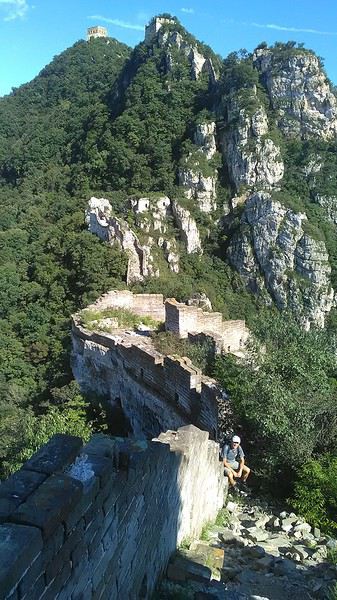
No need to pay for a taxi to get there—by timing it right, you can take the bus for just a few yuan. You have to get off at Xizhazi, the bus terminus. Be careful, there are only two buses a day in each direction. At the Xizhazi bus stop, I met a young couple who’d arrived with zero information about what to expect. We hiked the three of us toward the restored section of Mutianyu.
Still, be cautious With GPS and a topographic map (OpenTopoMap), you can set off without a problem or guide. The trail up to Jiankou is easy and well-marked. The trails down are too. But be careful—once you’re on the Wall, it’s real mountain hiking, with easy but dangerous climbing sections (over sheer drops). Not for amateurs or those afraid of heights! But what a reward. The Wall all to yourself, where it’s at its most daring. Truly mesmerizing.
More photos...
2- BEIJING The best way to get around the capital Sunday, August 26 The best way to explore the city is still by bike. Most are in a bike-share system, but you need to use an app—WeChat, the app that does everything, like monitoring your every move. No way I was installing that.
I found one at a rental shop near the hostel. The key is to quickly learn local traffic customs to minimize risks. Bike lanes are wide along the avenues.
But you still have to: - Watch out for anything parked on the bike paths—the most annoying are people napping or talking on the phone in their cars - Keep an eye on everything coming the wrong way—the list is long - The worst is right turns on red, which in Chinese traffic rules seem to have priority Once you get the hang of it, it’s fine. The city is huge but flat, so you can just wing it.
3- BEIJING By train to the far west Sunday, August 26 Beijing West Station is the size and operates like an airport. With your e-ticket from the agency, you first have to pick up your ticket at the special "English" counter, after passing through security. With your ticket in hand, you have to exit and enter through the boarding waiting area—not the platform—after a second security check.
 Then you find the right hall and wait for the sign to finally access the platform. In the end, it works pretty well given the incredible number of passengers to manage. Everywhere in Beijing, I saw that the Chinese have mastered crowd flow management.
Nice surprise: second-class carriages are clean, air-conditioned, and bright. Perfect, since I was in for 20 hours. One uniformed attendant per carriage, mobile meal service—luxury! Small downside: no luggage space. Hauling your suitcase up to the top bunk is quite a workout. I was in the middle, so it wasn’t too bad. The landscape, though, whether rural or urban, is pretty bleak. That should change once we leave the eastern plains.
Of course, I got my first police visit, with a thorough passport check and bag search. I was warned—going to the Chinese far west exposes you to this kind of hassle. But they were polite and respectful.
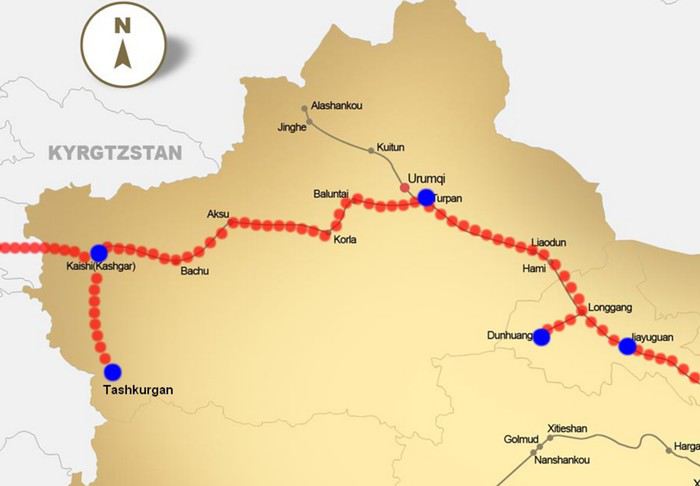 The Chinese Far West
4- JIAYUGUAN Getting by without English Monday, August 27 At the gates of two deserts (Gobi and Taklamakan) and at the foot of the Tibetan highlands, the Great Wall ends at Jiayuguan. Here, I found the deeper China I’d somewhat rediscovered during my bike ride, even if now everyone gets around on electric bikes and I’m no longer stared at like an alien.
Prices are nothing like Beijing: you can find a full meal for 2 €, and my bike cost 7 € for two days. Plus, few people speak English—neither the owner of the HI hostel where I stayed, nor the ticket sellers at the sites, let alone the servers at the small eateries where I ate. Everything is written in Chinese. So I had to use the little Chinese I know to communicate about essentials. It makes the locals laugh to see a European trying to speak their language, but it earns respect. With Google Translate’s help, I managed.
Rant: With their avenues blocked for construction for kilometers without warning, and new roads not yet on maps, I must’ve taken 15 km of detours. More photos...
5- JIAYUGUAN Scams and heritage Tuesday, August 28 The Great Wall doesn’t exactly end at the fort I visited yesterday but 10 km further, at the entrance to a river gorge at the foot of the mountains. All that’s left is a badly damaged tower (more like a mound of earth) and a section of clay wall, similar to the one I biked yesterday.
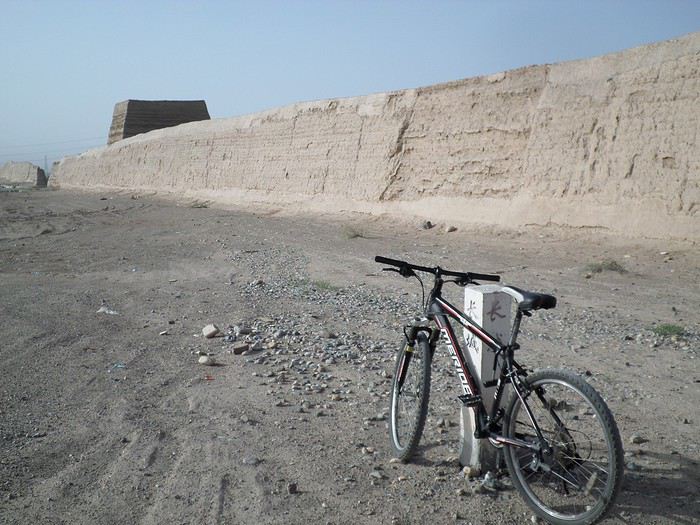
This morning, I hopped on my bike, determined to venture into the desert to see this highly symbolic site. First, you access it via a wide, brand-new road with not a soul in sight. Just before the site, I came across a grand welcome gate, very period-style, but it’s actually the inevitable toll booth.
Behind the gate, the road continues straight to the site, which you can see in the distance—at least 2 km away—the remains of the tower and wall. I had to leave my bike here. Fine. I went to the ticket counter and asked the price: 120 yuan! I couldn’t believe it—over 15 € for a simple mound of earth.
I showed my displeasure to the attendant, who couldn’t care less, and immediately turned back. 120 yuan—that’s the price for a new road, a fancy gate planted 2 km before the site just to force you to take a shuttle, and employees with nothing to do all day... Now I understand why I didn’t meet anyone!
Heritage China is a bit pricey Generally, sites are expensive for the country’s standard of living, but travelers are supposed to have money, so why hold back? I even gave up on the Forbidden City—reservations required days in advance (or on the black market at an impossible price). I prefer to keep the memory of my first visit, when entry must’ve cost a few dozen cents, and there were only a handful of visitors.
This morning, I took a taxi to see remarkable tombs of common people from the 3rd to 6th centuries. They’re small vaulted caves made of painted bricks, depicting scenes of daily life. Very pretty and moving. But even here, though the price was more reasonable, I was left wanting—only one of the 16 tombs is open to visitors, and it’s apparently not the most beautiful.
The authentic China—at least what’s left of it... Wandering the impersonal avenues of the city, you stumble upon a market. There, you still find traditional China—small shops with questionable hygiene, Go players, musicians, and even a dental prosthetist. The last refuge for those untouched by modernity. More photos...
6- DUNHUANG Abundance in the middle of the desert Wednesday, August 29 Well, I thought the landscape would be less bleak as I headed west. Nope. The only distraction in this expanse of dark, clayey sand is the forests of pylons and wind turbines, plus wild camels racing each other.
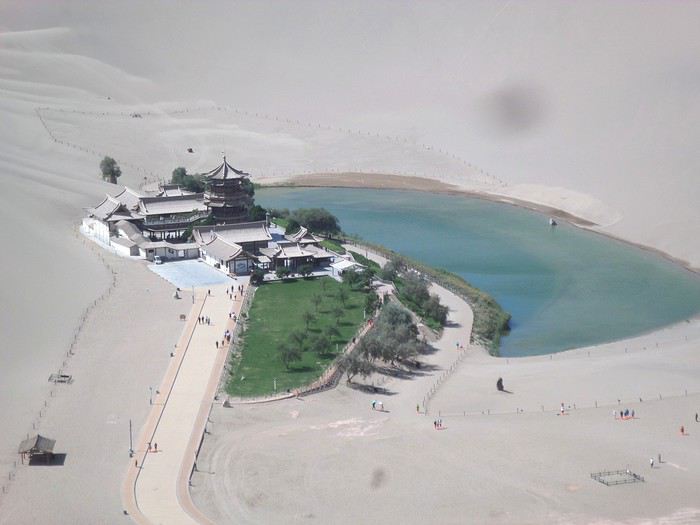 However, Dunhuang, the gateway to the Taklamakan, is by far the most pleasant Chinese city I know. There’s a real city center you can explore on foot. It’s hot but not unbearable, with a light, dry breeze. Much nicer than Beijing. The Han Chinese are still the majority, but the Muslim Uyghurs are more numerous, and the muezzin’s call to prayer echoes around the mosque.
The most surprising thing is the abundance and diversity of fruits and vegetables. You wonder how it all grows here. Well-irrigated, the desert sands are very fertile. Here, raisins have subtle, mysterious flavors, and the lamb really tastes like lamb.
Today, I visited the must-see Mingshashan, a dune complex next to which Pila is a molehill. The Basque Country, but covered in sand... More photos...
7- TURPAN The Uyghurs under heavy surveillance Friday, August 31 Surveillance cameras everywhere in the city, armed police stationed at intersections, in front of public buildings, at the entrance and inside tourist sites, police stations on every corner, patrols on foot or by car, khaki uniforms even for middle schoolers... here, the Han Chinese are in the minority, and you can feel it. Turpan feels like a city under siege.
To enter the youth hostel where I stayed, there’s even a security gate, and the receptionist (a Han, like everyone in tourism) wears a bulletproof vest! Reassuring. Still, you don’t feel particularly threatened here, especially as a European. The troublemakers are the Chinese, not the Uyghurs. Generally, China is a very safe country for visitors.
Smile, you’re on camera! I was biking on an avenue when the car in front of me got flashed for driving slowly. I quickly understood why when I got flashed too.
Here, the official time is Beijing time, but it gets dark two hours later. It’ll be even worse in Kashgar. Trickier to manage: everything is displayed in Chinese and Arabic. Nothing in English. Choosing a menu is a shot in the dark. Apart from a few young Chinese, no one here speaks English, and my Chinese doesn’t seem very understandable...
Mogao, the end of the road for the Han Yesterday, near Dunhuang, I went to Mogao, a complex of decorated caves with Buddha sculptures and paintings. Stunning, but so crowded! Luckily, here in Turpan, Chinese tourists barely venture out. So I visited a Silk Road ghost town with only a handful of other visitors and under a howling wind.
The modern Chinese city is swallowing up the old Uyghur neighborhoods—only a museum-like district remains in the center, and pockets of resistance on the outskirts are doomed to disappear soon. More photos...
8- KASHGAR A (relative) love at first sight for the old city Sunday, September 2 After three overnight trains, here I am in the far west of China, nearly 4,000 km from the capital. Despite the omnipresent police and an old city preserved UNESCO-style, Kashgar is my Chinese love at first sight.
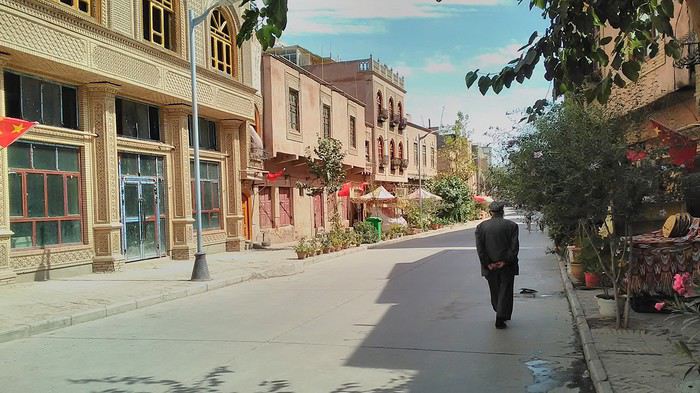
Finally, Chinese... well, sort of, because we’re in Uyghur territory here—a Turkic people with nothing culturally in common with the Han, the eastern Chinese. It started badly yesterday at Turfan station, where after three security gate passes, at least five passport checks, and a bag search, three adorable policewomen confiscated my antibacterial lotion because it had a flammable logo...
Then came the welcoming committee of armed cops at Kashgar station. Once all that was over, they left me alone—except you still have to go through security checks like everyone else to enter the old city, the bazaar, the livestock market... The further west you go, the more the siege mentality is evident. Luckily, the border isn’t far...
Despite the inevitable destruction-reconstruction, the city center has been well preserved. Thankfully, because it’s a very original style, a mix of local and colonial. I love it, even if it’s a bit too artificial, sanitized, and watered-down, and rather empty of residents. On the Silk Road, the city was famous for its great food. And it still is—rarely have I seen such richness and abundance of food! And not just scorpions or snakes. More photos...
9- KASHGAR China’s recipe for controlling the populace Saturday, September 1 Xinjiang, along with Tibet, is a "sensitive" area of rebellion in the eyes of Chinese authorities. As a result, the state has these regions and their populations under total control. Tourists also feel the consequences, even if they’re not at risk of re-education camps.
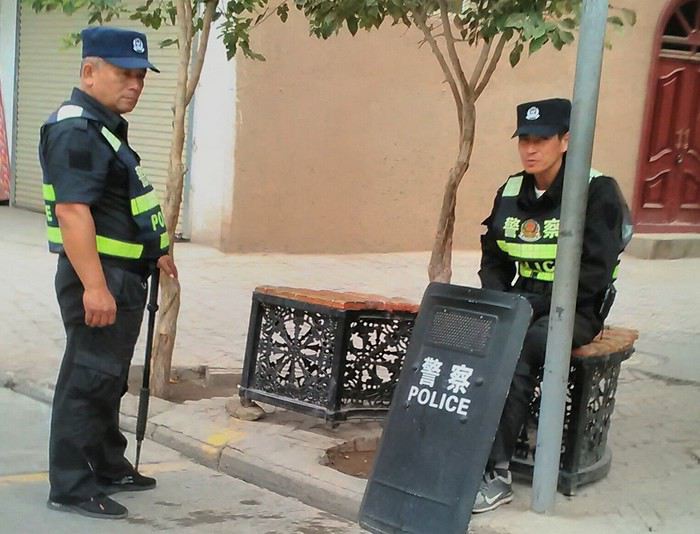 - Putting barbed wire and anti-ramming barriers around sensitive sites (schools, big hotels, government buildings...)
- Installing traffic surveillance gates with cameras and photo flashes (for all vehicles passing, including bikes) throughout the city and even in the countryside
- Posting uniformed guards with tasers, batons, or huge baseball bats every 100 meters
- Training the Han population (ethnic Chinese) in self-defense with sticks, preferably in the morning on the street. Men and women of all ages
- Starting school with the national anthem, doing military exercises, and receiving political indoctrination, all neatly lined up in the courtyard. (The dream school for any teacher)
- Placing a snitch in uniform (a pseudo-guard) in public gathering places, like youth hostels. Mine spends the day loafing around the courtyard
- Putting Chinese flags everywhere on the streets to remind everyone who’s in charge
- Installing security gates at every entrance to areas frequented by tourists (thanks for that) but not just there
- Never photographing cops, or else! I tried, but it’s not easy...
- Putting barbed wire and anti-ramming barriers around sensitive sites (schools, big hotels, government buildings...)
- Installing traffic surveillance gates with cameras and photo flashes (for all vehicles passing, including bikes) throughout the city and even in the countryside
- Posting uniformed guards with tasers, batons, or huge baseball bats every 100 meters
- Training the Han population (ethnic Chinese) in self-defense with sticks, preferably in the morning on the street. Men and women of all ages
- Starting school with the national anthem, doing military exercises, and receiving political indoctrination, all neatly lined up in the courtyard. (The dream school for any teacher)
- Placing a snitch in uniform (a pseudo-guard) in public gathering places, like youth hostels. Mine spends the day loafing around the courtyard
- Putting Chinese flags everywhere on the streets to remind everyone who’s in charge
- Installing security gates at every entrance to areas frequented by tourists (thanks for that) but not just there
- Never photographing cops, or else! I tried, but it’s not easy...
With all that, you can stroll around safely Not much crime! As for the amount the Chinese state spends to maintain such a system, it’s staggering! A third of the Han living in Xinjiang work in security. Today, I wandered freely around old Kashgar, which is quite large after all. More photos...
10- TASHKURGAN What on earth was I thinking going there! Wednesday, September 5 First, there’s the taxi—pretty crappy, with a driver who doesn’t speak a word of English and won’t stop smoking. Over six hours in that... shared with a completely out-of-it American.
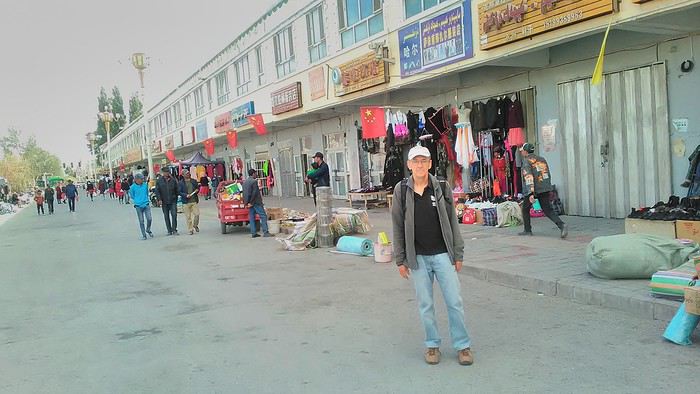
Then there are all the checkpoints along the way. I won’t go on—you know the drill by now.
After that, there’s Tashkurgan—a town with nothing to see, nothing to do. Deserted as soon as night falls. There’s this huge youth hostel and a few lost Chinese tapping away on their smartphones, chain-smoking. This lost American-European crowd, swapping tips on how to enter Pakistan or Tajikistan.
Luckily, there’s the Chinese Pamir Highway, lined with peaks over 7,000m. There’s the feeling of no longer being in China, with a population whose features are Middle Eastern. And these Tajik women with their stunning hairstyles and vibrant costumes. There’s the fact of having reached the westernmost Chinese city, far from crowds and tourist sites. A sort of end of the world. More photos...
11- KYRGYZ BORDER A surreal epic Thursday, September 6 The road from Kashgar to the Kyrgyzstan border is a little over 200 km and passes through beautiful landscapes of colorful, desert-like mountains with acrobatic folds. That’s the bucolic part of the trip.
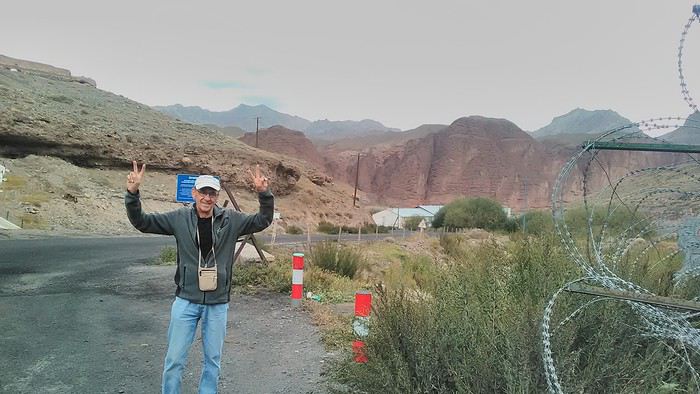 Yesterday, I managed to gather four people to rent a minibus to reach the border more easily: a Spaniard and an Argentine I’d already met in Turpan, and two New Zealanders who responded to the ad left at the hostel.
Absurdity and paranoia of Chinese authorities The highlight was crossing the town of Wuqia, 50 km past Kashgar. After tallying up with my fellow sufferers, we must’ve passed about ten checkpoints with: - Passport checks: 14 times, sometimes by two cops side by side - Bag checks: 4 times - Smartphone checks: 2 times, with deletion of "non-compliant" photos, and registration of your IMEI in the exit log!... Absurd and surreal at the same time, since my camera stayed in my bag, my apps are in French, and my photos have been online for ages...
With all that, we arrived just as the last checkpoint before the no man’s land marking the border between the two countries was on lunch break. And bam! Another 1.5-hour wait, alongside truckers who were much more used to this than we were.
What to think? The cops themselves aren’t fooled. They play the role they’re asked to, but sometimes you can coax a smile out of them—they realize how ridiculous the situation is.
What’s the point? That’s the big question my companions and I were tempted to answer with "to piss people off." To show you your place isn’t here, but with the other tourists, over there in the east, in Shanghai, Xi’an, or Guangzhou.
As for you, a traveler from a democratic country, you really experience this as aggression, humiliation, a violation of your private space. And yet, I’m respected, they speak to me properly. Today, I better understand what a Palestinian or a citizen of an occupied country might feel daily. A unique experience! Thanks, China.
And to top it off, the cherry on the cake! It’s still this glowing button you press to rate your passage after clearing the last obstacle before the exit stamp. I was so surprised it turned off before I could react. The Spaniard, with great humor and irony, had time to vote "excellent." In the end, he wasn’t wrong—you can hardly do better!
PS: I ditched my buddies at the border. They didn’t want to pay for a taxi to continue. So I took a direct taxi to Osh. The first 100 km are fabulous. I couldn’t take many photos, but I’ll be back on Monday to go to Tajikistan.
More photos...
The rest of the Silk Road, Part 2, in these travel journals: Kyrgyzstan, Tajikistan, Uzbekistan.
The Chinese Far West More than 30 years after my first trip to eastern China, I finally fulfilled an old dream: traveling solo from Beijing to the far west, discovering Xinjiang, the Uyghur people and the oppression they endure, the oases of Turpan and Kashgar, the Taklamakan Desert, the end of the Great Wall... The route was covered by train.
MENU PART 1: CHINA
1- Beijing (Jiankou) : the authentic Great Wall, without tourists 2- Cycling in Beijing, the best way to get around 3- Beijing : departure for the far west 4- Jiayuguan : getting by without English 5- Jiayuguan : scams and heritage 6- Dunhuang : abundance in the middle of the desert 7- Turpan : the Uyghurs under heavy surveillance 8- Kashgar : love at first sight for the old city 9- Kashgar : China’s recipe for controlling the populace 10- Tashkurgan : what on earth was I thinking going there! Kyrgyz border: a surreal epic Photo album from the 80s, contributions from other travelers (page 2)
1- JIANKOU Finding the authentic Great Wall, without tourists or a guide Friday, August 24, 2018 Thirty years later, I didn’t feel like revisiting the Great Wall at Badaling or any other overcrowded site. I chose to explore it at Jiankou, in its wildest, most authentic, and unrestored section, starting from a lost village deep in a valley—though it wasn’t *that* lost, since it had everything for communication.
No need to pay for a taxi to get there—by timing it right, you can take the bus for just a few yuan. You have to get off at Xizhazi, the bus terminus. Be careful, there are only two buses a day in each direction. At the Xizhazi bus stop, I met a young couple who’d arrived with zero information about what to expect. We hiked the three of us toward the restored section of Mutianyu.
Still, be cautious With GPS and a topographic map (OpenTopoMap), you can set off without a problem or guide. The trail up to Jiankou is easy and well-marked. The trails down are too. But be careful—once you’re on the Wall, it’s real mountain hiking, with easy but dangerous climbing sections (over sheer drops). Not for amateurs or those afraid of heights! But what a reward. The Wall all to yourself, where it’s at its most daring. Truly mesmerizing.
More photos...
2- BEIJING The best way to get around the capital Sunday, August 26 The best way to explore the city is still by bike. Most are in a bike-share system, but you need to use an app—WeChat, the app that does everything, like monitoring your every move. No way I was installing that.
I found one at a rental shop near the hostel. The key is to quickly learn local traffic customs to minimize risks. Bike lanes are wide along the avenues.
But you still have to: - Watch out for anything parked on the bike paths—the most annoying are people napping or talking on the phone in their cars - Keep an eye on everything coming the wrong way—the list is long - The worst is right turns on red, which in Chinese traffic rules seem to have priority Once you get the hang of it, it’s fine. The city is huge but flat, so you can just wing it.
3- BEIJING By train to the far west Sunday, August 26 Beijing West Station is the size and operates like an airport. With your e-ticket from the agency, you first have to pick up your ticket at the special "English" counter, after passing through security. With your ticket in hand, you have to exit and enter through the boarding waiting area—not the platform—after a second security check.
Then you find the right hall and wait for the sign to finally access the platform. In the end, it works pretty well given the incredible number of passengers to manage. Everywhere in Beijing, I saw that the Chinese have mastered crowd flow management.Nice surprise: second-class carriages are clean, air-conditioned, and bright. Perfect, since I was in for 20 hours. One uniformed attendant per carriage, mobile meal service—luxury! Small downside: no luggage space. Hauling your suitcase up to the top bunk is quite a workout. I was in the middle, so it wasn’t too bad. The landscape, though, whether rural or urban, is pretty bleak. That should change once we leave the eastern plains.
Of course, I got my first police visit, with a thorough passport check and bag search. I was warned—going to the Chinese far west exposes you to this kind of hassle. But they were polite and respectful.
The Chinese Far West4- JIAYUGUAN Getting by without English Monday, August 27 At the gates of two deserts (Gobi and Taklamakan) and at the foot of the Tibetan highlands, the Great Wall ends at Jiayuguan. Here, I found the deeper China I’d somewhat rediscovered during my bike ride, even if now everyone gets around on electric bikes and I’m no longer stared at like an alien.
Prices are nothing like Beijing: you can find a full meal for 2 €, and my bike cost 7 € for two days. Plus, few people speak English—neither the owner of the HI hostel where I stayed, nor the ticket sellers at the sites, let alone the servers at the small eateries where I ate. Everything is written in Chinese. So I had to use the little Chinese I know to communicate about essentials. It makes the locals laugh to see a European trying to speak their language, but it earns respect. With Google Translate’s help, I managed.
Rant: With their avenues blocked for construction for kilometers without warning, and new roads not yet on maps, I must’ve taken 15 km of detours. More photos...
5- JIAYUGUAN Scams and heritage Tuesday, August 28 The Great Wall doesn’t exactly end at the fort I visited yesterday but 10 km further, at the entrance to a river gorge at the foot of the mountains. All that’s left is a badly damaged tower (more like a mound of earth) and a section of clay wall, similar to the one I biked yesterday.
This morning, I hopped on my bike, determined to venture into the desert to see this highly symbolic site. First, you access it via a wide, brand-new road with not a soul in sight. Just before the site, I came across a grand welcome gate, very period-style, but it’s actually the inevitable toll booth.
Behind the gate, the road continues straight to the site, which you can see in the distance—at least 2 km away—the remains of the tower and wall. I had to leave my bike here. Fine. I went to the ticket counter and asked the price: 120 yuan! I couldn’t believe it—over 15 € for a simple mound of earth.
I showed my displeasure to the attendant, who couldn’t care less, and immediately turned back. 120 yuan—that’s the price for a new road, a fancy gate planted 2 km before the site just to force you to take a shuttle, and employees with nothing to do all day... Now I understand why I didn’t meet anyone!
Heritage China is a bit pricey Generally, sites are expensive for the country’s standard of living, but travelers are supposed to have money, so why hold back? I even gave up on the Forbidden City—reservations required days in advance (or on the black market at an impossible price). I prefer to keep the memory of my first visit, when entry must’ve cost a few dozen cents, and there were only a handful of visitors.
This morning, I took a taxi to see remarkable tombs of common people from the 3rd to 6th centuries. They’re small vaulted caves made of painted bricks, depicting scenes of daily life. Very pretty and moving. But even here, though the price was more reasonable, I was left wanting—only one of the 16 tombs is open to visitors, and it’s apparently not the most beautiful.
The authentic China—at least what’s left of it... Wandering the impersonal avenues of the city, you stumble upon a market. There, you still find traditional China—small shops with questionable hygiene, Go players, musicians, and even a dental prosthetist. The last refuge for those untouched by modernity. More photos...
6- DUNHUANG Abundance in the middle of the desert Wednesday, August 29 Well, I thought the landscape would be less bleak as I headed west. Nope. The only distraction in this expanse of dark, clayey sand is the forests of pylons and wind turbines, plus wild camels racing each other.
However, Dunhuang, the gateway to the Taklamakan, is by far the most pleasant Chinese city I know. There’s a real city center you can explore on foot. It’s hot but not unbearable, with a light, dry breeze. Much nicer than Beijing. The Han Chinese are still the majority, but the Muslim Uyghurs are more numerous, and the muezzin’s call to prayer echoes around the mosque.The most surprising thing is the abundance and diversity of fruits and vegetables. You wonder how it all grows here. Well-irrigated, the desert sands are very fertile. Here, raisins have subtle, mysterious flavors, and the lamb really tastes like lamb.
Today, I visited the must-see Mingshashan, a dune complex next to which Pila is a molehill. The Basque Country, but covered in sand... More photos...
7- TURPAN The Uyghurs under heavy surveillance Friday, August 31 Surveillance cameras everywhere in the city, armed police stationed at intersections, in front of public buildings, at the entrance and inside tourist sites, police stations on every corner, patrols on foot or by car, khaki uniforms even for middle schoolers... here, the Han Chinese are in the minority, and you can feel it. Turpan feels like a city under siege.
To enter the youth hostel where I stayed, there’s even a security gate, and the receptionist (a Han, like everyone in tourism) wears a bulletproof vest! Reassuring. Still, you don’t feel particularly threatened here, especially as a European. The troublemakers are the Chinese, not the Uyghurs. Generally, China is a very safe country for visitors.
Smile, you’re on camera! I was biking on an avenue when the car in front of me got flashed for driving slowly. I quickly understood why when I got flashed too.
Here, the official time is Beijing time, but it gets dark two hours later. It’ll be even worse in Kashgar. Trickier to manage: everything is displayed in Chinese and Arabic. Nothing in English. Choosing a menu is a shot in the dark. Apart from a few young Chinese, no one here speaks English, and my Chinese doesn’t seem very understandable...
Mogao, the end of the road for the Han Yesterday, near Dunhuang, I went to Mogao, a complex of decorated caves with Buddha sculptures and paintings. Stunning, but so crowded! Luckily, here in Turpan, Chinese tourists barely venture out. So I visited a Silk Road ghost town with only a handful of other visitors and under a howling wind.
The modern Chinese city is swallowing up the old Uyghur neighborhoods—only a museum-like district remains in the center, and pockets of resistance on the outskirts are doomed to disappear soon. More photos...
8- KASHGAR A (relative) love at first sight for the old city Sunday, September 2 After three overnight trains, here I am in the far west of China, nearly 4,000 km from the capital. Despite the omnipresent police and an old city preserved UNESCO-style, Kashgar is my Chinese love at first sight.
Finally, Chinese... well, sort of, because we’re in Uyghur territory here—a Turkic people with nothing culturally in common with the Han, the eastern Chinese. It started badly yesterday at Turfan station, where after three security gate passes, at least five passport checks, and a bag search, three adorable policewomen confiscated my antibacterial lotion because it had a flammable logo...
Then came the welcoming committee of armed cops at Kashgar station. Once all that was over, they left me alone—except you still have to go through security checks like everyone else to enter the old city, the bazaar, the livestock market... The further west you go, the more the siege mentality is evident. Luckily, the border isn’t far...
Despite the inevitable destruction-reconstruction, the city center has been well preserved. Thankfully, because it’s a very original style, a mix of local and colonial. I love it, even if it’s a bit too artificial, sanitized, and watered-down, and rather empty of residents. On the Silk Road, the city was famous for its great food. And it still is—rarely have I seen such richness and abundance of food! And not just scorpions or snakes. More photos...
9- KASHGAR China’s recipe for controlling the populace Saturday, September 1 Xinjiang, along with Tibet, is a "sensitive" area of rebellion in the eyes of Chinese authorities. As a result, the state has these regions and their populations under total control. Tourists also feel the consequences, even if they’re not at risk of re-education camps.
- Putting barbed wire and anti-ramming barriers around sensitive sites (schools, big hotels, government buildings...)
- Installing traffic surveillance gates with cameras and photo flashes (for all vehicles passing, including bikes) throughout the city and even in the countryside
- Posting uniformed guards with tasers, batons, or huge baseball bats every 100 meters
- Training the Han population (ethnic Chinese) in self-defense with sticks, preferably in the morning on the street. Men and women of all ages
- Starting school with the national anthem, doing military exercises, and receiving political indoctrination, all neatly lined up in the courtyard. (The dream school for any teacher)
- Placing a snitch in uniform (a pseudo-guard) in public gathering places, like youth hostels. Mine spends the day loafing around the courtyard
- Putting Chinese flags everywhere on the streets to remind everyone who’s in charge
- Installing security gates at every entrance to areas frequented by tourists (thanks for that) but not just there
- Never photographing cops, or else! I tried, but it’s not easy...With all that, you can stroll around safely Not much crime! As for the amount the Chinese state spends to maintain such a system, it’s staggering! A third of the Han living in Xinjiang work in security. Today, I wandered freely around old Kashgar, which is quite large after all. More photos...
10- TASHKURGAN What on earth was I thinking going there! Wednesday, September 5 First, there’s the taxi—pretty crappy, with a driver who doesn’t speak a word of English and won’t stop smoking. Over six hours in that... shared with a completely out-of-it American.
Then there are all the checkpoints along the way. I won’t go on—you know the drill by now.
After that, there’s Tashkurgan—a town with nothing to see, nothing to do. Deserted as soon as night falls. There’s this huge youth hostel and a few lost Chinese tapping away on their smartphones, chain-smoking. This lost American-European crowd, swapping tips on how to enter Pakistan or Tajikistan.
Luckily, there’s the Chinese Pamir Highway, lined with peaks over 7,000m. There’s the feeling of no longer being in China, with a population whose features are Middle Eastern. And these Tajik women with their stunning hairstyles and vibrant costumes. There’s the fact of having reached the westernmost Chinese city, far from crowds and tourist sites. A sort of end of the world. More photos...
11- KYRGYZ BORDER A surreal epic Thursday, September 6 The road from Kashgar to the Kyrgyzstan border is a little over 200 km and passes through beautiful landscapes of colorful, desert-like mountains with acrobatic folds. That’s the bucolic part of the trip.
Yesterday, I managed to gather four people to rent a minibus to reach the border more easily: a Spaniard and an Argentine I’d already met in Turpan, and two New Zealanders who responded to the ad left at the hostel.Absurdity and paranoia of Chinese authorities The highlight was crossing the town of Wuqia, 50 km past Kashgar. After tallying up with my fellow sufferers, we must’ve passed about ten checkpoints with: - Passport checks: 14 times, sometimes by two cops side by side - Bag checks: 4 times - Smartphone checks: 2 times, with deletion of "non-compliant" photos, and registration of your IMEI in the exit log!... Absurd and surreal at the same time, since my camera stayed in my bag, my apps are in French, and my photos have been online for ages...
With all that, we arrived just as the last checkpoint before the no man’s land marking the border between the two countries was on lunch break. And bam! Another 1.5-hour wait, alongside truckers who were much more used to this than we were.
What to think? The cops themselves aren’t fooled. They play the role they’re asked to, but sometimes you can coax a smile out of them—they realize how ridiculous the situation is.
What’s the point? That’s the big question my companions and I were tempted to answer with "to piss people off." To show you your place isn’t here, but with the other tourists, over there in the east, in Shanghai, Xi’an, or Guangzhou.
As for you, a traveler from a democratic country, you really experience this as aggression, humiliation, a violation of your private space. And yet, I’m respected, they speak to me properly. Today, I better understand what a Palestinian or a citizen of an occupied country might feel daily. A unique experience! Thanks, China.
And to top it off, the cherry on the cake! It’s still this glowing button you press to rate your passage after clearing the last obstacle before the exit stamp. I was so surprised it turned off before I could react. The Spaniard, with great humor and irony, had time to vote "excellent." In the end, he wasn’t wrong—you can hardly do better!
PS: I ditched my buddies at the border. They didn’t want to pay for a taxi to continue. So I took a direct taxi to Osh. The first 100 km are fabulous. I couldn’t take many photos, but I’ll be back on Monday to go to Tajikistan.
More photos...
The rest of the Silk Road, Part 2, in these travel journals: Kyrgyzstan, Tajikistan, Uzbekistan.
Séjour de 3 semaines en voiture au départ de Paphos (Chypre ) English translation pending
bonjour,
nous envisageons de partir 3 semaines à Chypre. Arrivons et repartirons de Paphos. Nous souhaiterions effectuer un circuit et donc louer plusieurs locations afin de pouvoir rayonner autour. Pouvez-vous nous guider dans le choix des régions où nous pourrions nous poser? Nous aimons allier visites et plages. Est il facile de louer dans la partie nord? Nous louons une voiture à Paphos, peut on passer dans la partie nord sans problème ou y a t'il des démarches particulières?
merci pour votre aide