Results for "Mombasa+|+55+>+59"
826 results found.
Orphelinat au Kenya English translation pending
>Bonjour,
>Nous sommes 2 belges, Florence 28 ans et Fred, 31 ans qui partont au Kenya en Février, nous avons pris contact avec un orphelinat tenu par 1 belge(sa femme est massai) et sommes occupés à organiser une collectes de différents objets matériels dont ils ont besoin. Nous nous rendrons sur place et y restons quelques jours.
>L'orphelinat s'appelle Masaja Kenya, est situé à Isynia et receuille 60 orphelins. Nous sommes en contact régulierement avec eux, et nous avons appris ce matin le déces d'une petite fille de 2 ans victime de la malaria.
Auriez-vous des conseils sur la possibilité de se procurer des médicaments ? Pourriez-vous nous en proposer ?
Pouriez-vous nous aider ou conseiller pour le transport de notre récolte ?
>Nous sommes 2 belges, Florence 28 ans et Fred, 31 ans qui partont au Kenya en Février, nous avons pris contact avec un orphelinat tenu par 1 belge(sa femme est massai) et sommes occupés à organiser une collectes de différents objets matériels dont ils ont besoin. Nous nous rendrons sur place et y restons quelques jours.
>L'orphelinat s'appelle Masaja Kenya, est situé à Isynia et receuille 60 orphelins. Nous sommes en contact régulierement avec eux, et nous avons appris ce matin le déces d'une petite fille de 2 ans victime de la malaria.
Auriez-vous des conseils sur la possibilité de se procurer des médicaments ? Pourriez-vous nous en proposer ?
Pouriez-vous nous aider ou conseiller pour le transport de notre récolte ?
L'Afrique en sac à dos English translation pending
Salut à toutes et à tous
Nous souhaiterions mon amie et moi, partir en afrique (Burkina, Namibie, Botswana, Kenya...) en sac à dos, mais elle est un peu inquiète quant à voyager à l'aventure.
D'après vos différentes expèriences, pourriez-vous me dire si cela représente un danger ou quelques soucis particuliers de partir ainsi (hormis les problèmes similaires à ceux que nous rencontrons chez nous).
Aidez-moi à la convaincre😛
Merci
Karlos
Nous souhaiterions mon amie et moi, partir en afrique (Burkina, Namibie, Botswana, Kenya...) en sac à dos, mais elle est un peu inquiète quant à voyager à l'aventure.
D'après vos différentes expèriences, pourriez-vous me dire si cela représente un danger ou quelques soucis particuliers de partir ainsi (hormis les problèmes similaires à ceux que nous rencontrons chez nous).
Aidez-moi à la convaincre😛
Merci
Karlos
Deux étrangers ont été lapidés et poignardés en Afghanistan English translation pending
Agence Reuters
Dimanche 09 mai 2004
KABOUL - Deux étrangers, dont un Suisse, ont été lapidés et poignardés à mort à Kaboul, a-t-on appris dimanche auprès d'un responsable gouvernemental afghan.
"Il y avait différentes blessures visibles au visage provoquées par des jets de pierres et des briques", a déclaré un médecin qui a examiné les corps des deux hommes.
"Et il y a aussi des coups de couteau à la tête. Et sur l'un des corps, une corde semble avoir été serrée autour du cou", a-t-il ajouté.
Des médecins légistes examinent encore les dépouilles.
Les corps de ces deux hommes ont été retrouvés à Baghe Chilstone, un jardin situé près du centre-ville, a indiqué le porte-parole du ministère de l'Intérieur Lufullah Mashal.
"Des habitants du quartier ont contacté les policiers et leur ont montré les corps", a déclaré Mashal, ajoutant qu'une enquête avait été ouverte.
"L'un d'entre eux avait un passeport suisse, et on ignore la nationalité de l'autre."
Tous deux étaient arrivés du Pakistan voisin neuf jours auparavant, a déclaré Khalil Aminzada, chef adjoint de la police de Kaboul.
Il a ajouté que les deux hommes portaient des "shalwar" - pantalons bouffants typiques de la région - et des tuniques, ainsi que des bonnets de laine.
Un responsable de l'ambassade de Suisse à Kaboul a déclaré que ses services tentaient actuellement d'obtenir plus de détails auprès des autorités locales.
http://afgha.com/?af=article&sid=43193
http://afgha.com/?af=article&sid=43193
Cherche agence pour safari au Kenya English translation pending
Bonjour,
Nous avons decidé de partir en janvier au kenya, et je cherche desespérement une agence qui me monte un safari camping de 15 jours à prix doux! Si vous avez des adresses en France ou directement sur Nairobi merci de me les communiquer avec vos appreciations.
Merci d'avance
Nous avons decidé de partir en janvier au kenya, et je cherche desespérement une agence qui me monte un safari camping de 15 jours à prix doux! Si vous avez des adresses en France ou directement sur Nairobi merci de me les communiquer avec vos appreciations.
Merci d'avance
Love at First Sight in Kenya
Hello,
After several years, I’ve finally decided to repost a travel journal on the forum. We returned a few weeks ago from an incredible trip to Kenya, and it’s reignited my desire to share our emotions in the face of these animals.
Kenya wasn’t originally a priority for us in terms of safari—we had the impression it was too touristy. So, we started with other destinations: Namibia, Tanzania, Botswana, and South Africa. But as I did more research, especially on the forum (thanks in part to Sylvie’s many trips), I eventually convinced myself that Kenya could be magnificent, as long as we chose our itinerary carefully and avoided peak seasons.
We ended up going in January, from the 17th to the 31st. We worked with a travel agency (TP) that crafted a custom itinerary for us: Samburu-Ol Pejeta-Naivasha-Maji Moto-Maasai Mara-Diani. They partnered with a local French-speaking agency, and everything was perfectly organized. Our trip exceeded all our expectations, and none of it would’ve been as amazing without our guide, Alfred. He accompanied us for 10 days and was a fantastic travel companion—professional, respectful of the animals, and always in good spirits. We formed a great bond with him in such a short time.
- **January 17th** After meeting up with Juliette and Charlotte in Rennes the night before, we left at 4 AM for Roissy Charles de Gaulle Airport. The thick fog made the drive pretty rough, but we arrived safely around 7:45 AM. A Blue Valet driver was waiting to take our car. Check-in went smoothly, and we waited patiently for our 10:40 AM flight. Unfortunately, despite boarding on time, a passenger was missing, and we had to find a replacement last minute. Then, another passenger who had checked in and dropped off their luggage wasn’t on the plane, so they had to unload their bags. After a long period of uncertainty and spotty communication from the crew, we finally took off over an hour late.
We arrived in Nairobi in the late afternoon, 45 minutes behind schedule. The administrative formalities were endless—it took nearly 1.5 hours from landing to leaving the airport with our luggage. When we stepped out, Alfred, our guide, was waiting with a big smile and drove us to the Eka Hotel, not far from the airport. Exhausted from the long journey, we fell asleep quickly.
- **January 18th** Alfred met us at 7 AM for a long drive to Samburu Reserve. We had a peaceful night, unlike the girls, who barely slept because their neighbors were talking loudly all night. Things even escalated when Charlotte started shouting insults to get them to quiet down, but it didn’t work.
It was Sunday, so traffic around Nairobi and along the route was light. Aside from a quick "technical stop," we drove straight through and arrived in Samburu after just under 6 hours. Because of the lower altitude (around 1,000m on average), it was hot—over 30°C in mid-January.
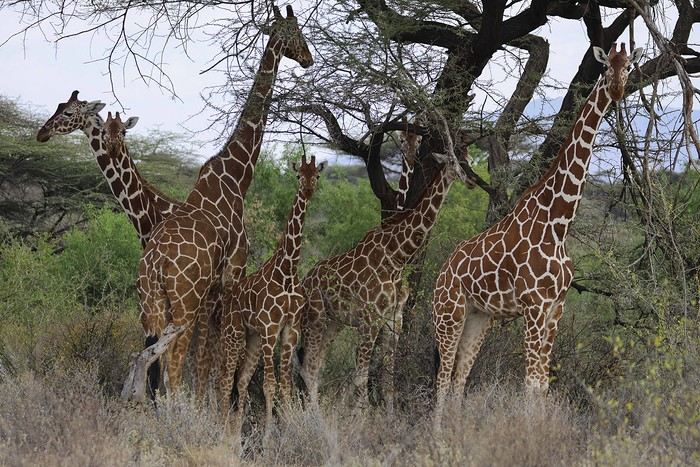
As soon as we entered the reserve, we spotted some impalas and quickly came across one of the region’s endemic species: the reticulated giraffe, which is absolutely stunning.
While heading to our camp for lunch, Alfred crossed paths with another vehicle and learned that a leopard was nearby. We started searching, and a few minutes later, Anny spotted a shape in a tree—it was our leopard!
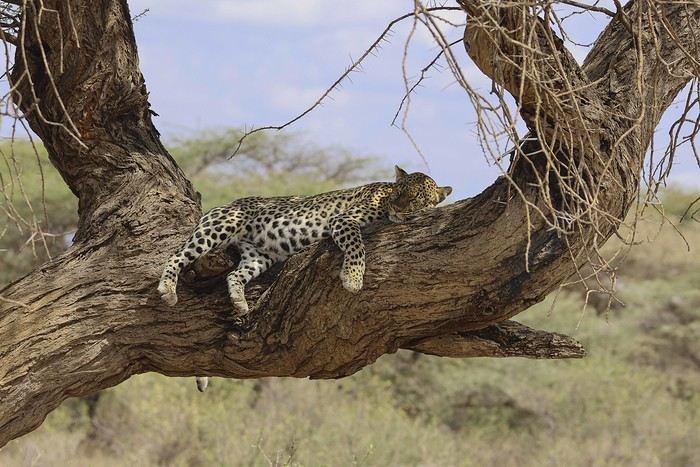
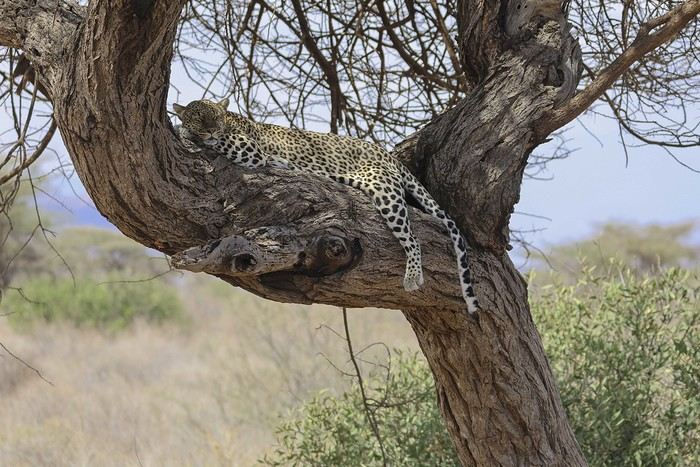
There were actually two of them—a mother and her adolescent. The young one was perched high in the tree, in the shade. We got to observe them for a good half-hour in excellent conditions, with just one other vehicle nearby.
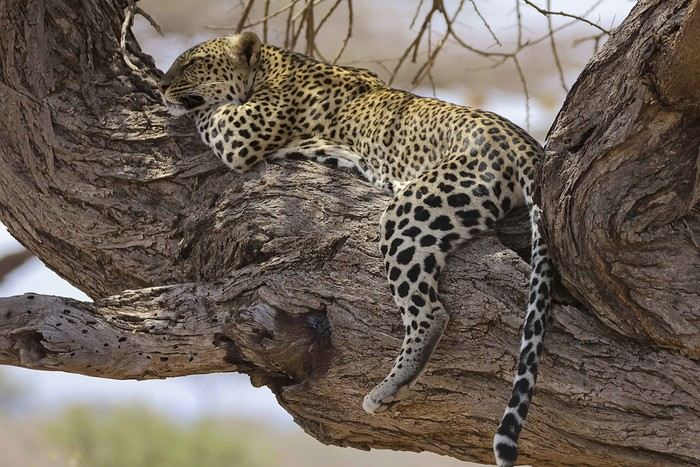
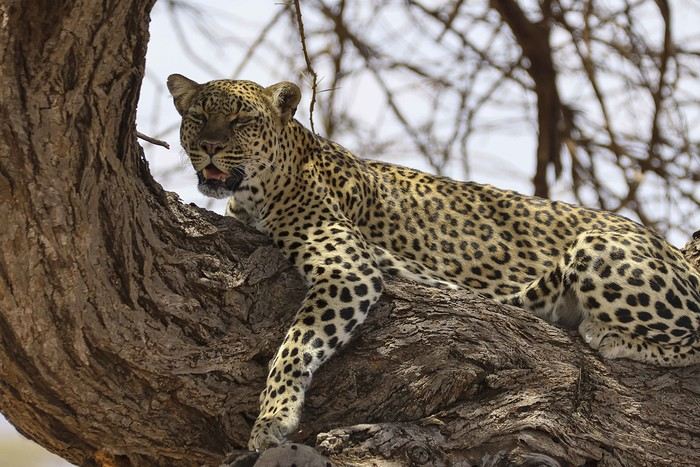
Alfred also noticed that the mother had hidden prey (a gerenuk gazelle) in the vegetation, away from prying eyes.
It was time to head to our camp, the Ashnil Samburu Camp, located in the Buffalo Springs area, by the river, in an idyllic setting surrounded by the region’s typical vegetation.
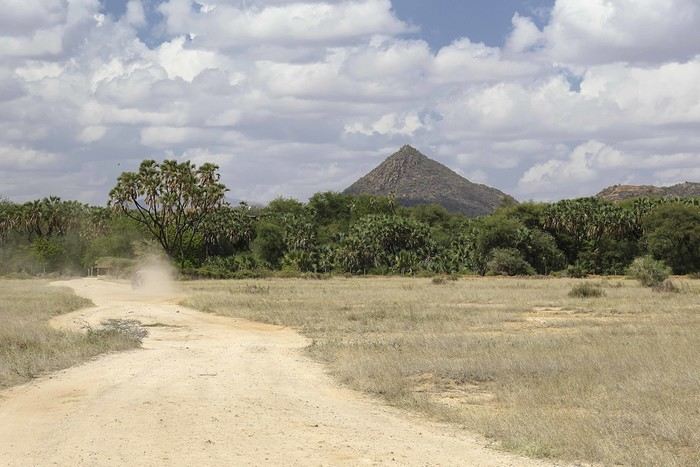
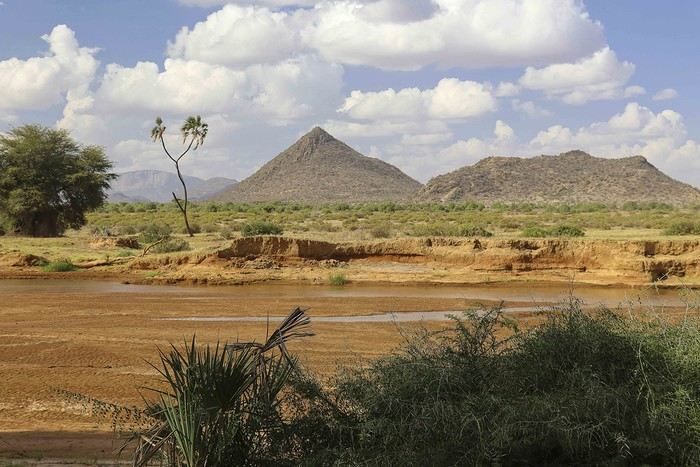
The welcome was fantastic—we immediately felt at home, and that feeling lasted throughout our 3-day stay in the reserve. It was 2 PM, but no one rushed us to the table. Our waitress, Sheila, who took care of us the whole time, was as lovely as the rest of the team. Barely seated, we were invited to watch an elephant passing right by the camp, in front of the restaurant. This trip was off to a great start!
After lunch, we relaxed by the pool. Monkeys, especially vervets, were everywhere, and a camp employee was assigned to keep an eye on them and shoo them away if needed (especially the baboons).
A little before 4 PM, we met up with Alfred for our first game drive. Just outside the camp, a few elephants were in the valley near the river.
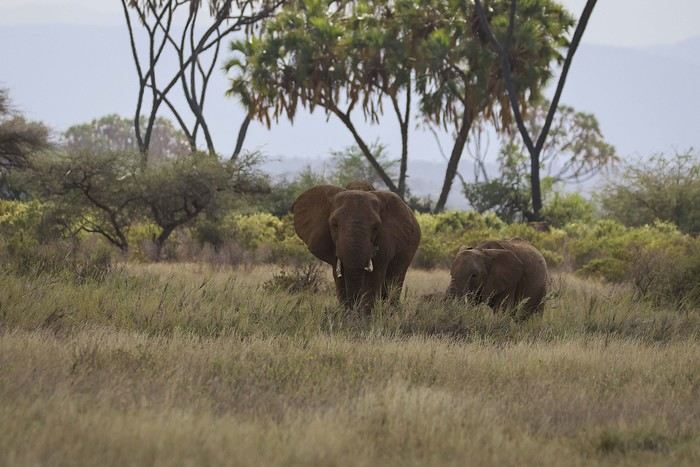
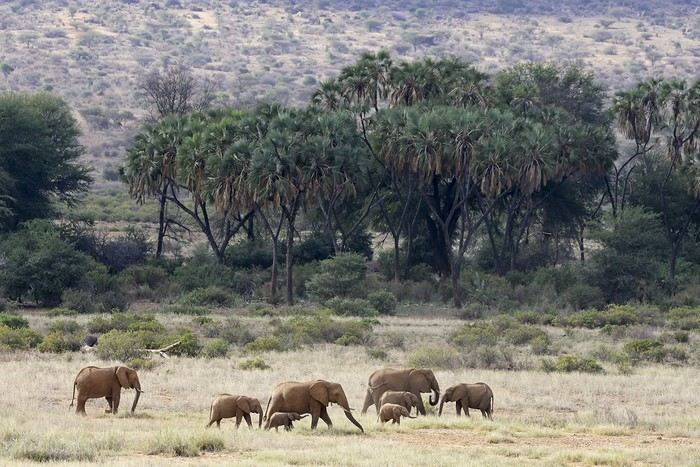
We’d see them in the same area almost every day. We also spotted some gazelles.
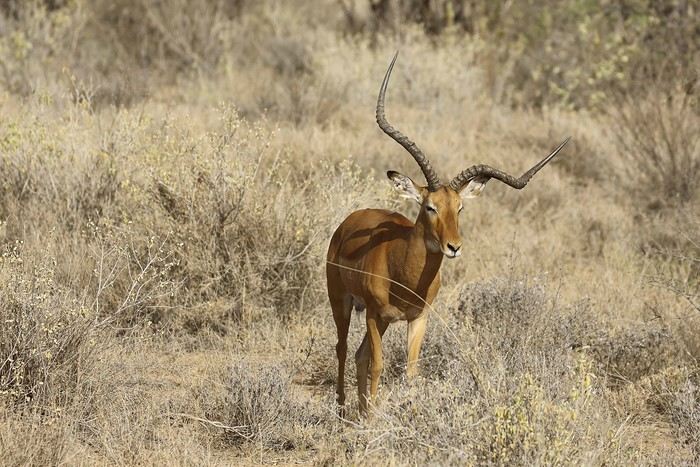
After several years, I’ve finally decided to repost a travel journal on the forum. We returned a few weeks ago from an incredible trip to Kenya, and it’s reignited my desire to share our emotions in the face of these animals.
Kenya wasn’t originally a priority for us in terms of safari—we had the impression it was too touristy. So, we started with other destinations: Namibia, Tanzania, Botswana, and South Africa. But as I did more research, especially on the forum (thanks in part to Sylvie’s many trips), I eventually convinced myself that Kenya could be magnificent, as long as we chose our itinerary carefully and avoided peak seasons.
We ended up going in January, from the 17th to the 31st. We worked with a travel agency (TP) that crafted a custom itinerary for us: Samburu-Ol Pejeta-Naivasha-Maji Moto-Maasai Mara-Diani. They partnered with a local French-speaking agency, and everything was perfectly organized. Our trip exceeded all our expectations, and none of it would’ve been as amazing without our guide, Alfred. He accompanied us for 10 days and was a fantastic travel companion—professional, respectful of the animals, and always in good spirits. We formed a great bond with him in such a short time.
- **January 17th** After meeting up with Juliette and Charlotte in Rennes the night before, we left at 4 AM for Roissy Charles de Gaulle Airport. The thick fog made the drive pretty rough, but we arrived safely around 7:45 AM. A Blue Valet driver was waiting to take our car. Check-in went smoothly, and we waited patiently for our 10:40 AM flight. Unfortunately, despite boarding on time, a passenger was missing, and we had to find a replacement last minute. Then, another passenger who had checked in and dropped off their luggage wasn’t on the plane, so they had to unload their bags. After a long period of uncertainty and spotty communication from the crew, we finally took off over an hour late.
We arrived in Nairobi in the late afternoon, 45 minutes behind schedule. The administrative formalities were endless—it took nearly 1.5 hours from landing to leaving the airport with our luggage. When we stepped out, Alfred, our guide, was waiting with a big smile and drove us to the Eka Hotel, not far from the airport. Exhausted from the long journey, we fell asleep quickly.
- **January 18th** Alfred met us at 7 AM for a long drive to Samburu Reserve. We had a peaceful night, unlike the girls, who barely slept because their neighbors were talking loudly all night. Things even escalated when Charlotte started shouting insults to get them to quiet down, but it didn’t work.
It was Sunday, so traffic around Nairobi and along the route was light. Aside from a quick "technical stop," we drove straight through and arrived in Samburu after just under 6 hours. Because of the lower altitude (around 1,000m on average), it was hot—over 30°C in mid-January.
As soon as we entered the reserve, we spotted some impalas and quickly came across one of the region’s endemic species: the reticulated giraffe, which is absolutely stunning.
While heading to our camp for lunch, Alfred crossed paths with another vehicle and learned that a leopard was nearby. We started searching, and a few minutes later, Anny spotted a shape in a tree—it was our leopard!
There were actually two of them—a mother and her adolescent. The young one was perched high in the tree, in the shade. We got to observe them for a good half-hour in excellent conditions, with just one other vehicle nearby.
Alfred also noticed that the mother had hidden prey (a gerenuk gazelle) in the vegetation, away from prying eyes.
It was time to head to our camp, the Ashnil Samburu Camp, located in the Buffalo Springs area, by the river, in an idyllic setting surrounded by the region’s typical vegetation.
The welcome was fantastic—we immediately felt at home, and that feeling lasted throughout our 3-day stay in the reserve. It was 2 PM, but no one rushed us to the table. Our waitress, Sheila, who took care of us the whole time, was as lovely as the rest of the team. Barely seated, we were invited to watch an elephant passing right by the camp, in front of the restaurant. This trip was off to a great start!
After lunch, we relaxed by the pool. Monkeys, especially vervets, were everywhere, and a camp employee was assigned to keep an eye on them and shoo them away if needed (especially the baboons).
A little before 4 PM, we met up with Alfred for our first game drive. Just outside the camp, a few elephants were in the valley near the river.
We’d see them in the same area almost every day. We also spotted some gazelles.
Do travel encounters matter to you?
Hi there,
My name’s Emilie, and my view of travel has changed. I used to travel just to tick off the "places and things to do/see" boxes. But lately, I’ve realized that encounters have become really important to me while traveling. In fact, the people I’ve met and what they’ve brought to my life are now my best travel memories. What do you think? Have you had a similar shift in perspective? Are you more interested in meeting people while traveling now?
To be totally honest, I’m training to become a travel planner (a trip organizer), and I was thinking of focusing on organizing trips that are more centered around encounters. So I’d love to know if this makes sense—if travelers are interested in this kind of experience. Just to be clear, I’m not selling anything; I just want to chat and hear your thoughts.
Have a lovely evening, everyone! :)
My name’s Emilie, and my view of travel has changed. I used to travel just to tick off the "places and things to do/see" boxes. But lately, I’ve realized that encounters have become really important to me while traveling. In fact, the people I’ve met and what they’ve brought to my life are now my best travel memories. What do you think? Have you had a similar shift in perspective? Are you more interested in meeting people while traveling now?
To be totally honest, I’m training to become a travel planner (a trip organizer), and I was thinking of focusing on organizing trips that are more centered around encounters. So I’d love to know if this makes sense—if travelers are interested in this kind of experience. Just to be clear, I’m not selling anything; I just want to chat and hear your thoughts.
Have a lovely evening, everyone! :)
Madagascar - June 2025
Five years of an unintended break... The closure of VF, COVID... What a joy to rediscover the pleasure of sharing!
I’ve stayed true to my habits: the following account is a collection of practical tips rather than a travel journal...
Madagascar is as big as France and Belgium combined. In three weeks, choices have to be made! It was the Great Tsingy that inspired our trip. We decided to focus on the southwest and the RN7. We skipped the Deep South and the North. Oh well...
OUR ITINERARY IN 3 WEEKS:
Fri 6 June – Direct AF flight to Tana – Flight arrives at 10:30 PM – Tana Sat – Antsirabe Sun – Miandrivazo Mon – Drive to the Masiakampy pier – Descent of the Tsiribihina River by pirogue - Bivouac Tue – Descent of the Tsiribihina River by pirogue - Bivouac Wed – Descent of the Tsiribihina River by pirogue – Bekopaka Thu – Pirogue on the Manambolo River and Small Tsingy of Bemaraha – Bekopaka Fri – Great Tsingy of Bemaraha – Bekopaka Sat – Avenue of the Baobabs – Morondava Sun – Belo sur Mer Mon – Free day – Belo sur Mer Tue – Manja Wed – Andavadoaka Thu – Free day – Andavadoaka Fri – Salary Lagoon – Mangily Sat – Ranohira Sun – Isalo National Park - Ranohira Mon – Anja Reserve - Ambalavao - Fianarantsoa Tue – FCE train canceled – Visit to a Tanala village - Manakara Wed – Pirogue on the Pangalanes Canal – Ranomafana Thu – Ranomafana NP – Ranomafana Fri – Ambositra – Antsirabe Sat 28 June – AF flight to Paris – Flight departs at 11:55 PM
TRIP ORGANIZATION: I prepared my trip using the usual guides (LP and Rough Guide), the internet, and the Freytag & Berndt map (1:1,000,000). I’m old-school—I still love visualizing my route on a paper map, even though in Madagascar, it’s misleading because some National Roads are only national in name!...
The agency: Since we couldn’t deal directly with a driver-guide (we lacked reliable info to take the plunge), we went through an agency to organize the logistics of our trip. We didn’t feel like using bush taxis (not enough time) or driving a 4x4 ourselves (neither the skills nor the boldness). The French agency connected us with a local agency, to whom I sent my detailed itinerary by email. A few exchanges via email and WhatsApp calls allowed us to finalize everything quickly after some adjustments. As you’ve gathered... we multiplied the commissions, which inflated the budget. That said, in the end, we were thrilled with our decision and our choice. Our trip was booked by the end of 2024, and reservations were made immediately. No bad surprises: the bookings in the planned hotels were honored, often with one of the best rooms. On our last day in Tana, before departure, we were lucky enough to meet the director I’d been communicating with, who helped build and validate our circuit. A very warm debriefing.
The driver-guide: The agency assigned us Faly, 33, a driver-guide for over 10 years. He stayed with us from start to finish: he picked us up at the airport on arrival and dropped us off 23 days later. A very experienced driver (which is important here), an open and cultured guide, reliable, punctual, and a great companion. And a provider of good advice throughout the trip. We made the most of the long stretches on dirt roads or highways to listen to him talk about daily life, rituals, wildlife, and flora... No time wasted! With a great playlist in the background, we combined business with pleasure! Faly’s accommodation and meals were included (quite often, hotels offer free lodging and meals to driver-guides who bring clients), as was the fuel. That didn’t stop us from inviting Faly to share a beer or our evening meal sometimes. He didn’t always accept, wanting to let us "enjoy our romantic evenings," as he put it. Present without being intrusive! Faly is fully capable of organizing a tailor-made trip directly. I recommend him without any hesitation—we were delighted with his service. I’ll gladly share his contact details via PM to anyone who asks.
Local guides: It’s the national guide’s prerogative to choose the local guides (mandatory in the parks). Thanks to his experience, Faly always booked us amazing, competent, and interesting local guides.
Hotels: I told the agency I wanted charming, comfortable accommodations, without falling into flashy luxury. We loved all the hotels (except the Hôtel Kanto in Manja). The rooms, mostly bungalows, were always spacious and clean. Unfortunately, I can’t give the prices—I didn’t get the details. Breakfast is always included, usually fresh and hearty. Very often, a small bottle of water is provided in the room.
Tana Hôtel Les 3 Métis Power cuts are common (!) in Tana. Bring a headlamp.
Antsirabe Ecolodge – Les chambres du voyageur Maybe our favorite! A few bungalows, beautifully arranged in a splendid tropical garden. The dog Kodak welcomes us warmly.
Miandrivazo Hôtel Princesse Tsiribihina Magnificent view of the valley.
Bekopaka Hôtel Orchidée du Bemaraha 2 (yes, 2) beautiful pools, a large open common room.
Morondava Hôtel Baobab Café Brand new or at least, according to Faly, just renovated. Very comfortable but without much charm (international style).
Belo sur Mer Ecolodge du Menabe The bungalows, all made of wood, bamboo, and thatch, are set on the beach. Very spacious and fully equipped! Large open-air restaurant by the sea. No hot water from the tap—it’s available in plastic bottles heated by the sun in front of each bungalow. Actually, we never used it... Another very, very beautiful spot.
Manja Hôtel Kanto The only hotel on this leg of the journey, so no choice. The owner knows it and, as a result, doesn’t bother. It’s a real dive! Tiny, dark room, a sordid bathroom with only a trickle of water—we skipped the shower! Clean sheets, though. Obviously, no Wi-Fi. The only place where I didn’t leave a tip. We were well warned about the discomfort of this stop, both by the agency and Faly. We weren’t surprised, and it even became a running joke during the trip. On the other hand, we found a nice little market in town.
Andavadoaka Manga Lodge What bliss! Especially after the horrible Hôtel Kanto. A paradise-like spot, overlooking three beautiful deserted white-sand beaches. Meals are served on the terrace facing the sea. Stunning sunset. We loved spending a day lounging here! We were the only guests and were pampered.
Mangily (Ifaty) Mangily is the "suburb" of Ifaty. Hôtel Vovo Telo A large beachfront bungalow complex. More touristy but pleasant—we spent a lovely evening there with our feet in the sand.
Ranohira Le Relais de la Reine A splendid resort built by a Frenchman, at the foot of the rocks, very well integrated into the environment. Beautiful marked trail starting from the garden.
Fianarantsoa Villa Sylvestre Contrary to what its name suggests, it’s a hotel right in the city center. Quite decent, though.
Manakara Parthenay Club Pretty bungalows in a large garden by the sea, but swimming isn’t safe—the water is too dangerous and rough.
Ranomafana Hôtel Thermal Very spacious rooms.
Meals: Not all our meals were included. It’s really not expensive. 1 meat or fish dish: around 35,000 Ar 1 full menu (starter, main, dessert): around 70,000 Ar 1 large THB beer (65 cl): between 8,000 and 12,000 Ar 1 piña colada: 15,000 Ar 1 flavored rum: 6,000 Ar (sometimes free) 1 glass of baobab juice (!): 5,000 Ar
We always ate very well. Rice is everywhere, served in large quantities. Zebu meat is quite good if not overcooked. Personally, I prefer fish, and I feasted: grouper, captain, crab, small lobsters...
We happily discovered baobab juice (especially in Belo, on the west coast). And of course, flavored rums!
We bought 2 packs of 6 bottles of mineral water at Carrefour (!) (about 5,000 Ar per large bottle) at the start of our trip. That was enough, especially since we often got water in the bungalows.
We had a few picnics included in our trip. Instead of picking up the hotel’s lunchbox, Faly prepared delicious, fresh, and varied picnics for us: tuna pasta salad, fried rice with eggs, grilled vegetables, and avocado...
An exceptional address not to miss: Mad Zébu – Belo sur Tsiribihina A highly reputed restaurant, a favorite of LP and Rough Guide, and rightly so! Gourmet cuisine, refined and elegant. Barely more expensive than elsewhere, and it’s worth it. We stopped there on our way up to Bekopaka and the Tsingy NP. Fully booked! So Faly reserved for our return, three days later. We’re still thanking him! What a treat!
THE BUDGET: Ariary exchange rate: 5,000 Ar = 1 €
Pre-trip expenses: Direct Air France flights: 930 € per person round trip Cost of the circuit with the agency: 2,880 € per person
The visa: Issued on arrival, very quickly. 35 € per person for a stay under 30 days. Super simple. Super fast.
On-site expenses: As soon as we arrived at the airport (it was nearly midnight), Faly advised us to exchange our euros for all our needs. There are few opportunities on our route to find an ATM or an open bank with a good rate. To be more comfortable, he took us to a small office under military protection just outside the airport. I exchanged 1,200 € (I had asked the agency for advice on the amount to bring) at a rate of 4,750 Ar and became a millionaire. Faly recounted all the stacks. That covered all our expenses (meals, drinks, tips) without ever feeling deprived. Personal purchases were made at the end of the trip. Convenient—it served as an adjustment variable. We spent our last million (200 €) on marquetry and vanilla. Tip: We asked for 200,000 Ar in 5,000 Ar bills for tips. That wasn’t too much—I even ran short of small bills in the last two days.
Tips: Madagascar is a poor country where every service deserves a small reward. While not mandatory, it’s customary. But no one ever demanded or expected it openly. On the contrary, I sometimes had to remind a porter to give them my small bill. We never carried our luggage—porters were always present when the car arrived or waiting at our door to watch for our departure. I gave each of them 5,000 Ar. In restaurants, I rounded up to the nearest ten and left the change. Local guides also expect a tip: I gave around 20,000 Ar per day for the two of us. Finally, the national guide also expects a gratuity. I had read online to budget 5 € per day per person. I added more since we were so happy with his services. The tip was given at the end of the trip, in euros, outside the budget.
Total budget all included (excluding personal purchases): 8,690 € Clearly, Madagascar is a country where life isn’t expensive, but travel costs add up quickly due to the need to rent a 4x4 with a driver.
HIGHLIGHTS:
· The dirt roads Yes, I’m listing them among the highlights! We loved those long hours spent driving at 20 km/h on rocky, muddy, white, red, or gray sand tracks... surrounded by tropical vegetation, palm trees, pandanus, mango trees... The experiences were sometimes thrilling: crossing a river on a ferry (just planks of wood fixed on two motorized pirogues side by side) or crossing a river without a ferry, with just a kid running ahead of the 4x4 to show the way; soft sand where the 4x4 easily gets stuck... The tracks are quite narrow, and crossing paths with a bush taxi, a zebu cart, or a herd of goats is always epic. So many beautiful images, so many beautiful photos! Much more beautiful than on asphalt. So yes, we loved those long stretches on dirt roads. For us, it was clearly part of the journey. Faly was particularly careful, and the 4x4 was comfortable. No injuries, no fatigue, even after 7 or 8 hours on rough tracks. The national roads (including the famous RN7) are badly damaged by cyclones, huge trucks, and lack of maintenance. Potholes have turned into ostrich nests, and we didn’t drive much faster than on the dirt roads.
· The landscapes, villages, encounters... We crossed a variety of stunning landscapes: mountains with slopes covered in terraced crops, rice fields from apple green to emerald green, sugarcane fields, then tropical forests, baobab forests (they deserve a special paragraph below), traveler’s tree forests. And then coastlines with white sand dunes against a backdrop of blue hues!... Magical! We also passed through many villages with houses whose architecture varied by region. The Betsileo houses display beautiful decorative brick reliefs. On the west coast, the houses are more precarious, made of bamboo with palm-thatched roofs. In the Highlands region, we found solid houses with pastel plaster. Each region has its own landscape, crops, habitat, and clothing. Zebu carts are often the only means of transport in remote villages. We saw them very frequently. Again, the cart’s decoration depends on the region. And then, we met many villagers coming out of the bush and walking to the next market, carrying their crops on their heads or shoulders. More beautiful photos!
· The descent of the Tsiribihina River We boarded around 9 AM in a long pirogue with Gana, the local guide, and two pirogue men. So, five of us. The pirogue is long but narrow, about 65 cm wide. We sat one behind the other at the front on seats padded with what would become our mattresses during the bivouacs. We only took the bare essentials for two nights. A little goodbye to Faly, whom we’d see again in three days! Don’t forget us! The river is silty—meaning orange, opaque but clean. We glided along silently. Gana showed us the trees, birds, crocodiles (we saw five—apparently, we were lucky). The pirogue men rowed to get us as close as possible to these crocs sunbathing on the roots of big trees. Yeah, right!... as soon as we got too close, *splash*, they disappeared into the water. We marveled at the mini rice fields lining the river. Every tiny plot, no matter how small, is cultivated. Above them, banana fields. And on the water, a whole life of fishermen and villagers living with and from the river. Gana warned us we’d eat on the pirogue because the journey was long. So, I expected chips... But no—fried rice and zebu steak, cooked right in the pirogue!! Incredible! In the middle of the afternoon, we reached a small beach where we disembarked. Gana led us about a hundred meters to a sublime waterfall. We were alone there. We had time to swim. We’d brought our swimsuits and a towel (bought at the Carrefour in Antsirabe on Faly’s wise advice!). This swim in this paradise-like spot remains one of our best memories. We found our pirogue again and set off until our first bivouac. We’d sailed for 7 hours today. The tents were set up on a wide beach, without a single tree. A moment of solitude... Uh, where can we go to the bathroom?... Especially since it was a full moon, so we felt like we were in the spotlight. Anyway... we did as everyone else—walked away, dug a hole, and the others turned their backs. A hearty meal on the beach before a comfortable and silent night. The next day, same program, with slightly different landscapes. The gorges widened, the trees were different. But still many colorful birds. Again, we ate on the pirogue: grilled chicken and vegetables. 9 hours of sailing. A similar bivouac. This time, we got it. On the third day, we finished the descent with 5 hours of sailing. So, 7 hours, 9 hours, 5 hours... doing nothing. It might sound boring... but it wasn’t. Like the dirt roads, these were contemplative moments. It glides, it’s calm, relaxing, and there’s a lot of life on this river, animal and human. Contemplation. Suspended time. On arrival, we disembarked at a sort of joyful, bustling river port. Of course, Faly was already there to pick us up.
· The Tsingy de Bemaraha NP (Small and Great) I have vertigo. During my research, several agencies advised me against visiting the Great Tsingy. "Stick to the Small ones," they said. Grrr, no, not what I wanted—we’ve dreamed of this for years! The agency we chose also warned me but didn’t discourage me. So we started with the Small Tsingy, quite close to Bekopaka, guided by Alisha. This forest of sharp limestone rocks is impressive. No vertigo issues here. The day was completed with a short pirogue ride on the Manambolo River and a visit to two caves with pretty formations. The next day, Faly and Alisha drove us to the Great Tsingy (a good hour on a terrible track). Arriving at the park entrance, Alisha equipped us with harnesses, carabiners, and gave us some safety instructions. Faly was also equipped. Wait? He’s coming with us? I quickly understood he was there for me—if I got stuck, he could go back with me, and Philippe could continue with Alisha. A wise precaution that delighted and reassured me. In the end, it was unnecessary since the famous bridge crossing was fully secured by the harness and carabiners. 18 meters on planks, one by one, it didn’t sway too much—I walked looking straight ahead, not a glance down. I even managed to smile in the middle of the crossing—I have a photo to prove it! I was overjoyed! The circuit in the Great Tsingy is a loop, so we didn’t have to cross the bridge again. We climbed to viewpoints offering breathtaking panoramic views. It’s extraordinary, unique, incredible. All this to say that if you have vertigo, don’t hesitate! It’s doable! It’s completely safe and really worth pushing your limits a bit! For those who’ve done treetop adventure courses, it’s similar. Also, no need to be a great athlete—just a bit of agility to climb a few ladders and high steps. Don’t censor yourself! I even had a small regret—the loop was a bit short (about 2 hours). I would’ve liked to continue or even redo it, with less apprehension. Tip: Do the Small Tsingy before the Great ones, or not at all. And if you can only do one, do the Great ones without hesitation.
· Canoeing in the Belo mangrove The Belo sur Mer ecolodge lends small individual canoes for free to go to the mangrove. We left at high tide, paddled for about twenty minutes to reach a fairly sparse forest where we could easily venture in. Very shallow water, crystal clear—we could see the roots of all these trees, schools of tiny fish... It was quite surprising. Until then, I only knew impenetrable, tangled mangroves. Here, nothing like that—we walked through an aquatic forest. We loved this adventure so much we left a bit late. The tide had gone out, and we had to carry our canoes for the last few meters... Of course, the staff came to help (probably laughing silently!). The lodge owners gave all the necessary explanations and lent a waterproof bag for the phone (because yes, it’s worth taking photos!). A very useful precaution—the canoes are small, low in the water, and paddling quickly soaks you. Again, this isn’t just for Tony Estanguet! It didn’t cause us any problems, not even sore muscles the next day. A great experience. It’ll take about 2 hours.
· Isalo NP Big surprise when we saw this huge rocky massif appear on the RN7! A massif of colored sandstone, carved with crevasses giving it a ruined look. Le Relais de la Reine is a little gem cleverly nestled in the heart of these rocks. A small marked trail starts from the garden. We picked up the description at reception and set off. Without a guide, alone following the markers, it took us 2 hours to complete this magnificent little trail, giving us a first glimpse of the massif before the hike the next day. And we enjoyed being completely alone for this walk. It’s free, easy, and well-signposted. Don’t miss it. In the evening, Faly took us to the so-called Isalo Window site—a hole in a wall through which we could see the sunset. We met all the tourists in the area here. We weren’t blown away by the show... The next day, we left early to reach the start of the hike. We met Zozoly at the guides’ office in the small town of Ranohira. During this hike, we climbed through the rocks to a viewpoint offering stunning 360° views of the massif. Then we reached a site called the "natural pool," breathtakingly beautiful, especially since we were alone again. A sort of oasis, a cascading waterfall, palm trees and tree ferns, fine sand, all nestled at the bottom of a small canyon. Paradise-like. We resisted swimming, but it was really tempting. A long walk on the plateaus then led us to a well-equipped picnic site where a local team prepared grills. Concrete tables were tiered in a spacious, shady clearing where a whole family of ring-tailed lemurs frolicked. They knew the tourists’ habits and tried to snatch food. Playful and not very shy, they amused us with their antics! We had to resist not luring them with a piece of banana!! Thousands of photos!! After the meal, we set off again with Zozoly for another landscape. This time, we were by a small river at the bottom of a canyon with high walls covered in vegetation. The trail was narrow and slippery, on a ledge of the wall. We progressed carefully. No danger, though. We first reached the Blue Pool, which only turns blue in photos (surprise!), then the Black Pool fed by a shower of waterfalls. Two magnificent spots that showed us a completely different aspect of the massif.
· Anja Reserve This ficus forest is home to many groups of lemurs. Used to humans, whom they don’t fear, they move around us, ignoring us completely. It’s almost annoying... The best place on our trip to see lemurs.
· The FCE train To the great regret of Manakara’s inhabitants, the FCE train hasn’t reached here for over a year and a half. As a result, there are far fewer tourists—the train was part of the experience. We drove there and didn’t regret coming to this port on the east coast.
· Visit to a Tanala village This visit wasn’t part of our program—it was added by the agency to compensate for the train not running. Which was the case. Not big fans of this kind of visit, where we feel like we’re at a zoo, voyeuristic, lacking authenticity, we followed the local guide with some skepticism and exchanged dubious looks. And yet... the guide’s explanations about village life and the warm, smiling welcome from the villagers charmed us and dispelled all our concerns. We learned a lot, met smiling families, and were able to enter these beautiful bamboo houses. A very pleasant surprise, rich in lessons.
· The Pangalanes Canal Arriving in Manakara, we crossed a bridge overlooking the Pangalanes Canal. A cry of surprise: the water is turquoise! We took a short pirogue ride with a team of three pirogue men and Joël, a local guide who explained the drama caused by the train’s halt. We stopped in a fishing village where Joël bought fish for the barbecue. We ended up on a beach where the team prepared the meal while we went to watch the fishermen return on the nearby beach. We admired the fishermen’s dexterity in untangling their nets, sorting their fish, cleaning their gear. On our return, we found a small table set up on the beach, in the shade of palm trees and casuarinas. Lobsters, captain fish, grilled vegetables, sautéed potatoes. A real feast (included in the trip cost).
· Ranomafana NP A 4-5 hour hike (some climbing) in a dense secondary forest to look for lemurs. As usual, we were accompanied by a local guide who, while waiting to find our furry friends, gave us lots of info on the vegetation, birds, and Tanala ethnic rituals. In the forest, we met 4 or 5 trackers, armed with radios to alert guides of their findings. In the end, we saw several lemurs of different types. Quite far, quite high... A nice complement to our lemur encounters in Isalo. Here, it rains 200 days a year. We started the hike in thick fog, but the forest’s density protected us from the humidity. Be careful—it can be a bit frustrating to see the lemurs so far away, so high. Nothing like the Anja Reserve or Isalo NP. Here, what’s fun is the hunt.
· The baobabs We were captivated by these kings of the forest, noble, imposing, majestic. We spotted them from very far away, towering over the rest of the vegetation. Alone, in small groups, or in forests, our trip allowed us to see hundreds of them! Mainly on the west coast. All different—bald, hairy, shaggy, short and stout, tall and thin, like Laurel and Hardy. Philippe took to naming them. Respectfully!
OUR FAVORITES: · The variety of landscapes. · The Tsingy NP.
OUR DISAPPOINTMENTS: · The Avenue of the Baobabs, very overrated and the only place where we saw crowds. We saw many other "forests" of baobabs that were much more impressive. · It’s hard to approach the population calmly as swarms of children run up as soon as we arrive, asking for sweets. Without any aggression, their smiles and laughter quickly made us forget this small inconvenience. We never gave out candy, clothes, or money. We left pens at a school and clothes with Faly.
IF WE WERE TO DO IT AGAIN: · Same period, same duration, same pace, same itinerary, but if we were to do it again today, I’d go through Faly directly! · Maybe we should’ve stayed in Ambalavao instead of Fianarantsoa. · Plan a longer loop in the Great Tsingy—it felt a bit too short.
MISCELLANEOUS: The welcome: ‘Samala Vazaha,’ there are many, many kids, sometimes overwhelming, never aggressive. We were impressed by the villagers’ smiles and good humor, towards us or even among themselves—laughter was everywhere. Safety: No problems. Out of (excessive?) caution, we spread all our money across several bags that we padlocked whenever we left the hotel. Bribes: We were stopped several times on the road by police or gendarmes. They checked our papers, sometimes our passports. Faly was perfectly in order. No discussion, no bribes, a cordial greeting from the officers. However, several times we found ourselves at small "tolls" on the tracks for villagers who had leveled the road or filled a hole, or for the young guy who ran through the river to show the way... Faly complied without discussion: every service deserves a small bill. Language: French is still widely spoken. Credit card: Unused. Cash: You need it! The climate at this time: Ideal—blue skies, sunshine, and mild temperatures (20-25°C) throughout our trip. Temperatures started to drop by our departure—winter was setting in. Clothing: T-shirt or polo and a vest sometimes in the evening, sandals on our feet, hiking shoes for all the hikes. Tip: We left a bag in the car (completely safe) with things we didn’t need daily and dirty laundry. The two bags to take out at each stop were much lighter. Before leaving, we left several polos and T-shirts with Faly, which, once washed, will make a few people happy. Tourist crowds at this time: Low—we were sometimes the only guests at the hotel. Faly explained that at the Isalo picnic site, in high season, you have to queue for a table, whereas we had our pick. Photos: Lots! Too many! That’s the problem with digital—we take so many! Health issues: Nothing serious, just the usual mild traveler’s diarrhea. Mosquitoes: They’re voracious. We took anti-malaria treatment. I’m still not sure if it was the right thing to do... I’m always very skeptical about such precautions. Internet: Free Wi-Fi at the lodges’ reception (except at Hôtel Kanto!), sometimes (rarely) in the bungalows. Phone: We didn’t try to get a local SIM card—the evening Wi-Fi was enough for us to make calls and send messages via WhatsApp. Make sure to turn off mobile data and switch to airplane mode (I activated it a bit late—received calls, spam ones at that, were charged...). Electricity: French plugs. Personal purchases: Beautiful wooden objects (sculptures and marquetry) or zebu horn items in Ambositra. 1 kg of vanilla (400,000 Ar – 80 € per kg) in Tana.
IN CONCLUSION: A trip of contemplation. A pause for admiration, as our local guide in Isalo NP said. Nothing else to do but walk, look, and enjoy. Here, there are no old stones, no museums—it’s a trip where nature reigns supreme. And what nature!
I’ve stayed true to my habits: the following account is a collection of practical tips rather than a travel journal...
Madagascar is as big as France and Belgium combined. In three weeks, choices have to be made! It was the Great Tsingy that inspired our trip. We decided to focus on the southwest and the RN7. We skipped the Deep South and the North. Oh well...
OUR ITINERARY IN 3 WEEKS:
Fri 6 June – Direct AF flight to Tana – Flight arrives at 10:30 PM – Tana Sat – Antsirabe Sun – Miandrivazo Mon – Drive to the Masiakampy pier – Descent of the Tsiribihina River by pirogue - Bivouac Tue – Descent of the Tsiribihina River by pirogue - Bivouac Wed – Descent of the Tsiribihina River by pirogue – Bekopaka Thu – Pirogue on the Manambolo River and Small Tsingy of Bemaraha – Bekopaka Fri – Great Tsingy of Bemaraha – Bekopaka Sat – Avenue of the Baobabs – Morondava Sun – Belo sur Mer Mon – Free day – Belo sur Mer Tue – Manja Wed – Andavadoaka Thu – Free day – Andavadoaka Fri – Salary Lagoon – Mangily Sat – Ranohira Sun – Isalo National Park - Ranohira Mon – Anja Reserve - Ambalavao - Fianarantsoa Tue – FCE train canceled – Visit to a Tanala village - Manakara Wed – Pirogue on the Pangalanes Canal – Ranomafana Thu – Ranomafana NP – Ranomafana Fri – Ambositra – Antsirabe Sat 28 June – AF flight to Paris – Flight departs at 11:55 PM
TRIP ORGANIZATION: I prepared my trip using the usual guides (LP and Rough Guide), the internet, and the Freytag & Berndt map (1:1,000,000). I’m old-school—I still love visualizing my route on a paper map, even though in Madagascar, it’s misleading because some National Roads are only national in name!...
The agency: Since we couldn’t deal directly with a driver-guide (we lacked reliable info to take the plunge), we went through an agency to organize the logistics of our trip. We didn’t feel like using bush taxis (not enough time) or driving a 4x4 ourselves (neither the skills nor the boldness). The French agency connected us with a local agency, to whom I sent my detailed itinerary by email. A few exchanges via email and WhatsApp calls allowed us to finalize everything quickly after some adjustments. As you’ve gathered... we multiplied the commissions, which inflated the budget. That said, in the end, we were thrilled with our decision and our choice. Our trip was booked by the end of 2024, and reservations were made immediately. No bad surprises: the bookings in the planned hotels were honored, often with one of the best rooms. On our last day in Tana, before departure, we were lucky enough to meet the director I’d been communicating with, who helped build and validate our circuit. A very warm debriefing.
The driver-guide: The agency assigned us Faly, 33, a driver-guide for over 10 years. He stayed with us from start to finish: he picked us up at the airport on arrival and dropped us off 23 days later. A very experienced driver (which is important here), an open and cultured guide, reliable, punctual, and a great companion. And a provider of good advice throughout the trip. We made the most of the long stretches on dirt roads or highways to listen to him talk about daily life, rituals, wildlife, and flora... No time wasted! With a great playlist in the background, we combined business with pleasure! Faly’s accommodation and meals were included (quite often, hotels offer free lodging and meals to driver-guides who bring clients), as was the fuel. That didn’t stop us from inviting Faly to share a beer or our evening meal sometimes. He didn’t always accept, wanting to let us "enjoy our romantic evenings," as he put it. Present without being intrusive! Faly is fully capable of organizing a tailor-made trip directly. I recommend him without any hesitation—we were delighted with his service. I’ll gladly share his contact details via PM to anyone who asks.
Local guides: It’s the national guide’s prerogative to choose the local guides (mandatory in the parks). Thanks to his experience, Faly always booked us amazing, competent, and interesting local guides.
Hotels: I told the agency I wanted charming, comfortable accommodations, without falling into flashy luxury. We loved all the hotels (except the Hôtel Kanto in Manja). The rooms, mostly bungalows, were always spacious and clean. Unfortunately, I can’t give the prices—I didn’t get the details. Breakfast is always included, usually fresh and hearty. Very often, a small bottle of water is provided in the room.
Tana Hôtel Les 3 Métis Power cuts are common (!) in Tana. Bring a headlamp.
Antsirabe Ecolodge – Les chambres du voyageur Maybe our favorite! A few bungalows, beautifully arranged in a splendid tropical garden. The dog Kodak welcomes us warmly.
Miandrivazo Hôtel Princesse Tsiribihina Magnificent view of the valley.
Bekopaka Hôtel Orchidée du Bemaraha 2 (yes, 2) beautiful pools, a large open common room.
Morondava Hôtel Baobab Café Brand new or at least, according to Faly, just renovated. Very comfortable but without much charm (international style).
Belo sur Mer Ecolodge du Menabe The bungalows, all made of wood, bamboo, and thatch, are set on the beach. Very spacious and fully equipped! Large open-air restaurant by the sea. No hot water from the tap—it’s available in plastic bottles heated by the sun in front of each bungalow. Actually, we never used it... Another very, very beautiful spot.
Manja Hôtel Kanto The only hotel on this leg of the journey, so no choice. The owner knows it and, as a result, doesn’t bother. It’s a real dive! Tiny, dark room, a sordid bathroom with only a trickle of water—we skipped the shower! Clean sheets, though. Obviously, no Wi-Fi. The only place where I didn’t leave a tip. We were well warned about the discomfort of this stop, both by the agency and Faly. We weren’t surprised, and it even became a running joke during the trip. On the other hand, we found a nice little market in town.
Andavadoaka Manga Lodge What bliss! Especially after the horrible Hôtel Kanto. A paradise-like spot, overlooking three beautiful deserted white-sand beaches. Meals are served on the terrace facing the sea. Stunning sunset. We loved spending a day lounging here! We were the only guests and were pampered.
Mangily (Ifaty) Mangily is the "suburb" of Ifaty. Hôtel Vovo Telo A large beachfront bungalow complex. More touristy but pleasant—we spent a lovely evening there with our feet in the sand.
Ranohira Le Relais de la Reine A splendid resort built by a Frenchman, at the foot of the rocks, very well integrated into the environment. Beautiful marked trail starting from the garden.
Fianarantsoa Villa Sylvestre Contrary to what its name suggests, it’s a hotel right in the city center. Quite decent, though.
Manakara Parthenay Club Pretty bungalows in a large garden by the sea, but swimming isn’t safe—the water is too dangerous and rough.
Ranomafana Hôtel Thermal Very spacious rooms.
Meals: Not all our meals were included. It’s really not expensive. 1 meat or fish dish: around 35,000 Ar 1 full menu (starter, main, dessert): around 70,000 Ar 1 large THB beer (65 cl): between 8,000 and 12,000 Ar 1 piña colada: 15,000 Ar 1 flavored rum: 6,000 Ar (sometimes free) 1 glass of baobab juice (!): 5,000 Ar
We always ate very well. Rice is everywhere, served in large quantities. Zebu meat is quite good if not overcooked. Personally, I prefer fish, and I feasted: grouper, captain, crab, small lobsters...
We happily discovered baobab juice (especially in Belo, on the west coast). And of course, flavored rums!
We bought 2 packs of 6 bottles of mineral water at Carrefour (!) (about 5,000 Ar per large bottle) at the start of our trip. That was enough, especially since we often got water in the bungalows.
We had a few picnics included in our trip. Instead of picking up the hotel’s lunchbox, Faly prepared delicious, fresh, and varied picnics for us: tuna pasta salad, fried rice with eggs, grilled vegetables, and avocado...
An exceptional address not to miss: Mad Zébu – Belo sur Tsiribihina A highly reputed restaurant, a favorite of LP and Rough Guide, and rightly so! Gourmet cuisine, refined and elegant. Barely more expensive than elsewhere, and it’s worth it. We stopped there on our way up to Bekopaka and the Tsingy NP. Fully booked! So Faly reserved for our return, three days later. We’re still thanking him! What a treat!
THE BUDGET: Ariary exchange rate: 5,000 Ar = 1 €
Pre-trip expenses: Direct Air France flights: 930 € per person round trip Cost of the circuit with the agency: 2,880 € per person
The visa: Issued on arrival, very quickly. 35 € per person for a stay under 30 days. Super simple. Super fast.
On-site expenses: As soon as we arrived at the airport (it was nearly midnight), Faly advised us to exchange our euros for all our needs. There are few opportunities on our route to find an ATM or an open bank with a good rate. To be more comfortable, he took us to a small office under military protection just outside the airport. I exchanged 1,200 € (I had asked the agency for advice on the amount to bring) at a rate of 4,750 Ar and became a millionaire. Faly recounted all the stacks. That covered all our expenses (meals, drinks, tips) without ever feeling deprived. Personal purchases were made at the end of the trip. Convenient—it served as an adjustment variable. We spent our last million (200 €) on marquetry and vanilla. Tip: We asked for 200,000 Ar in 5,000 Ar bills for tips. That wasn’t too much—I even ran short of small bills in the last two days.
Tips: Madagascar is a poor country where every service deserves a small reward. While not mandatory, it’s customary. But no one ever demanded or expected it openly. On the contrary, I sometimes had to remind a porter to give them my small bill. We never carried our luggage—porters were always present when the car arrived or waiting at our door to watch for our departure. I gave each of them 5,000 Ar. In restaurants, I rounded up to the nearest ten and left the change. Local guides also expect a tip: I gave around 20,000 Ar per day for the two of us. Finally, the national guide also expects a gratuity. I had read online to budget 5 € per day per person. I added more since we were so happy with his services. The tip was given at the end of the trip, in euros, outside the budget.
Total budget all included (excluding personal purchases): 8,690 € Clearly, Madagascar is a country where life isn’t expensive, but travel costs add up quickly due to the need to rent a 4x4 with a driver.
HIGHLIGHTS:
· The dirt roads Yes, I’m listing them among the highlights! We loved those long hours spent driving at 20 km/h on rocky, muddy, white, red, or gray sand tracks... surrounded by tropical vegetation, palm trees, pandanus, mango trees... The experiences were sometimes thrilling: crossing a river on a ferry (just planks of wood fixed on two motorized pirogues side by side) or crossing a river without a ferry, with just a kid running ahead of the 4x4 to show the way; soft sand where the 4x4 easily gets stuck... The tracks are quite narrow, and crossing paths with a bush taxi, a zebu cart, or a herd of goats is always epic. So many beautiful images, so many beautiful photos! Much more beautiful than on asphalt. So yes, we loved those long stretches on dirt roads. For us, it was clearly part of the journey. Faly was particularly careful, and the 4x4 was comfortable. No injuries, no fatigue, even after 7 or 8 hours on rough tracks. The national roads (including the famous RN7) are badly damaged by cyclones, huge trucks, and lack of maintenance. Potholes have turned into ostrich nests, and we didn’t drive much faster than on the dirt roads.
· The landscapes, villages, encounters... We crossed a variety of stunning landscapes: mountains with slopes covered in terraced crops, rice fields from apple green to emerald green, sugarcane fields, then tropical forests, baobab forests (they deserve a special paragraph below), traveler’s tree forests. And then coastlines with white sand dunes against a backdrop of blue hues!... Magical! We also passed through many villages with houses whose architecture varied by region. The Betsileo houses display beautiful decorative brick reliefs. On the west coast, the houses are more precarious, made of bamboo with palm-thatched roofs. In the Highlands region, we found solid houses with pastel plaster. Each region has its own landscape, crops, habitat, and clothing. Zebu carts are often the only means of transport in remote villages. We saw them very frequently. Again, the cart’s decoration depends on the region. And then, we met many villagers coming out of the bush and walking to the next market, carrying their crops on their heads or shoulders. More beautiful photos!
· The descent of the Tsiribihina River We boarded around 9 AM in a long pirogue with Gana, the local guide, and two pirogue men. So, five of us. The pirogue is long but narrow, about 65 cm wide. We sat one behind the other at the front on seats padded with what would become our mattresses during the bivouacs. We only took the bare essentials for two nights. A little goodbye to Faly, whom we’d see again in three days! Don’t forget us! The river is silty—meaning orange, opaque but clean. We glided along silently. Gana showed us the trees, birds, crocodiles (we saw five—apparently, we were lucky). The pirogue men rowed to get us as close as possible to these crocs sunbathing on the roots of big trees. Yeah, right!... as soon as we got too close, *splash*, they disappeared into the water. We marveled at the mini rice fields lining the river. Every tiny plot, no matter how small, is cultivated. Above them, banana fields. And on the water, a whole life of fishermen and villagers living with and from the river. Gana warned us we’d eat on the pirogue because the journey was long. So, I expected chips... But no—fried rice and zebu steak, cooked right in the pirogue!! Incredible! In the middle of the afternoon, we reached a small beach where we disembarked. Gana led us about a hundred meters to a sublime waterfall. We were alone there. We had time to swim. We’d brought our swimsuits and a towel (bought at the Carrefour in Antsirabe on Faly’s wise advice!). This swim in this paradise-like spot remains one of our best memories. We found our pirogue again and set off until our first bivouac. We’d sailed for 7 hours today. The tents were set up on a wide beach, without a single tree. A moment of solitude... Uh, where can we go to the bathroom?... Especially since it was a full moon, so we felt like we were in the spotlight. Anyway... we did as everyone else—walked away, dug a hole, and the others turned their backs. A hearty meal on the beach before a comfortable and silent night. The next day, same program, with slightly different landscapes. The gorges widened, the trees were different. But still many colorful birds. Again, we ate on the pirogue: grilled chicken and vegetables. 9 hours of sailing. A similar bivouac. This time, we got it. On the third day, we finished the descent with 5 hours of sailing. So, 7 hours, 9 hours, 5 hours... doing nothing. It might sound boring... but it wasn’t. Like the dirt roads, these were contemplative moments. It glides, it’s calm, relaxing, and there’s a lot of life on this river, animal and human. Contemplation. Suspended time. On arrival, we disembarked at a sort of joyful, bustling river port. Of course, Faly was already there to pick us up.
· The Tsingy de Bemaraha NP (Small and Great) I have vertigo. During my research, several agencies advised me against visiting the Great Tsingy. "Stick to the Small ones," they said. Grrr, no, not what I wanted—we’ve dreamed of this for years! The agency we chose also warned me but didn’t discourage me. So we started with the Small Tsingy, quite close to Bekopaka, guided by Alisha. This forest of sharp limestone rocks is impressive. No vertigo issues here. The day was completed with a short pirogue ride on the Manambolo River and a visit to two caves with pretty formations. The next day, Faly and Alisha drove us to the Great Tsingy (a good hour on a terrible track). Arriving at the park entrance, Alisha equipped us with harnesses, carabiners, and gave us some safety instructions. Faly was also equipped. Wait? He’s coming with us? I quickly understood he was there for me—if I got stuck, he could go back with me, and Philippe could continue with Alisha. A wise precaution that delighted and reassured me. In the end, it was unnecessary since the famous bridge crossing was fully secured by the harness and carabiners. 18 meters on planks, one by one, it didn’t sway too much—I walked looking straight ahead, not a glance down. I even managed to smile in the middle of the crossing—I have a photo to prove it! I was overjoyed! The circuit in the Great Tsingy is a loop, so we didn’t have to cross the bridge again. We climbed to viewpoints offering breathtaking panoramic views. It’s extraordinary, unique, incredible. All this to say that if you have vertigo, don’t hesitate! It’s doable! It’s completely safe and really worth pushing your limits a bit! For those who’ve done treetop adventure courses, it’s similar. Also, no need to be a great athlete—just a bit of agility to climb a few ladders and high steps. Don’t censor yourself! I even had a small regret—the loop was a bit short (about 2 hours). I would’ve liked to continue or even redo it, with less apprehension. Tip: Do the Small Tsingy before the Great ones, or not at all. And if you can only do one, do the Great ones without hesitation.
· Canoeing in the Belo mangrove The Belo sur Mer ecolodge lends small individual canoes for free to go to the mangrove. We left at high tide, paddled for about twenty minutes to reach a fairly sparse forest where we could easily venture in. Very shallow water, crystal clear—we could see the roots of all these trees, schools of tiny fish... It was quite surprising. Until then, I only knew impenetrable, tangled mangroves. Here, nothing like that—we walked through an aquatic forest. We loved this adventure so much we left a bit late. The tide had gone out, and we had to carry our canoes for the last few meters... Of course, the staff came to help (probably laughing silently!). The lodge owners gave all the necessary explanations and lent a waterproof bag for the phone (because yes, it’s worth taking photos!). A very useful precaution—the canoes are small, low in the water, and paddling quickly soaks you. Again, this isn’t just for Tony Estanguet! It didn’t cause us any problems, not even sore muscles the next day. A great experience. It’ll take about 2 hours.
· Isalo NP Big surprise when we saw this huge rocky massif appear on the RN7! A massif of colored sandstone, carved with crevasses giving it a ruined look. Le Relais de la Reine is a little gem cleverly nestled in the heart of these rocks. A small marked trail starts from the garden. We picked up the description at reception and set off. Without a guide, alone following the markers, it took us 2 hours to complete this magnificent little trail, giving us a first glimpse of the massif before the hike the next day. And we enjoyed being completely alone for this walk. It’s free, easy, and well-signposted. Don’t miss it. In the evening, Faly took us to the so-called Isalo Window site—a hole in a wall through which we could see the sunset. We met all the tourists in the area here. We weren’t blown away by the show... The next day, we left early to reach the start of the hike. We met Zozoly at the guides’ office in the small town of Ranohira. During this hike, we climbed through the rocks to a viewpoint offering stunning 360° views of the massif. Then we reached a site called the "natural pool," breathtakingly beautiful, especially since we were alone again. A sort of oasis, a cascading waterfall, palm trees and tree ferns, fine sand, all nestled at the bottom of a small canyon. Paradise-like. We resisted swimming, but it was really tempting. A long walk on the plateaus then led us to a well-equipped picnic site where a local team prepared grills. Concrete tables were tiered in a spacious, shady clearing where a whole family of ring-tailed lemurs frolicked. They knew the tourists’ habits and tried to snatch food. Playful and not very shy, they amused us with their antics! We had to resist not luring them with a piece of banana!! Thousands of photos!! After the meal, we set off again with Zozoly for another landscape. This time, we were by a small river at the bottom of a canyon with high walls covered in vegetation. The trail was narrow and slippery, on a ledge of the wall. We progressed carefully. No danger, though. We first reached the Blue Pool, which only turns blue in photos (surprise!), then the Black Pool fed by a shower of waterfalls. Two magnificent spots that showed us a completely different aspect of the massif.
· Anja Reserve This ficus forest is home to many groups of lemurs. Used to humans, whom they don’t fear, they move around us, ignoring us completely. It’s almost annoying... The best place on our trip to see lemurs.
· The FCE train To the great regret of Manakara’s inhabitants, the FCE train hasn’t reached here for over a year and a half. As a result, there are far fewer tourists—the train was part of the experience. We drove there and didn’t regret coming to this port on the east coast.
· Visit to a Tanala village This visit wasn’t part of our program—it was added by the agency to compensate for the train not running. Which was the case. Not big fans of this kind of visit, where we feel like we’re at a zoo, voyeuristic, lacking authenticity, we followed the local guide with some skepticism and exchanged dubious looks. And yet... the guide’s explanations about village life and the warm, smiling welcome from the villagers charmed us and dispelled all our concerns. We learned a lot, met smiling families, and were able to enter these beautiful bamboo houses. A very pleasant surprise, rich in lessons.
· The Pangalanes Canal Arriving in Manakara, we crossed a bridge overlooking the Pangalanes Canal. A cry of surprise: the water is turquoise! We took a short pirogue ride with a team of three pirogue men and Joël, a local guide who explained the drama caused by the train’s halt. We stopped in a fishing village where Joël bought fish for the barbecue. We ended up on a beach where the team prepared the meal while we went to watch the fishermen return on the nearby beach. We admired the fishermen’s dexterity in untangling their nets, sorting their fish, cleaning their gear. On our return, we found a small table set up on the beach, in the shade of palm trees and casuarinas. Lobsters, captain fish, grilled vegetables, sautéed potatoes. A real feast (included in the trip cost).
· Ranomafana NP A 4-5 hour hike (some climbing) in a dense secondary forest to look for lemurs. As usual, we were accompanied by a local guide who, while waiting to find our furry friends, gave us lots of info on the vegetation, birds, and Tanala ethnic rituals. In the forest, we met 4 or 5 trackers, armed with radios to alert guides of their findings. In the end, we saw several lemurs of different types. Quite far, quite high... A nice complement to our lemur encounters in Isalo. Here, it rains 200 days a year. We started the hike in thick fog, but the forest’s density protected us from the humidity. Be careful—it can be a bit frustrating to see the lemurs so far away, so high. Nothing like the Anja Reserve or Isalo NP. Here, what’s fun is the hunt.
· The baobabs We were captivated by these kings of the forest, noble, imposing, majestic. We spotted them from very far away, towering over the rest of the vegetation. Alone, in small groups, or in forests, our trip allowed us to see hundreds of them! Mainly on the west coast. All different—bald, hairy, shaggy, short and stout, tall and thin, like Laurel and Hardy. Philippe took to naming them. Respectfully!
OUR FAVORITES: · The variety of landscapes. · The Tsingy NP.
OUR DISAPPOINTMENTS: · The Avenue of the Baobabs, very overrated and the only place where we saw crowds. We saw many other "forests" of baobabs that were much more impressive. · It’s hard to approach the population calmly as swarms of children run up as soon as we arrive, asking for sweets. Without any aggression, their smiles and laughter quickly made us forget this small inconvenience. We never gave out candy, clothes, or money. We left pens at a school and clothes with Faly.
IF WE WERE TO DO IT AGAIN: · Same period, same duration, same pace, same itinerary, but if we were to do it again today, I’d go through Faly directly! · Maybe we should’ve stayed in Ambalavao instead of Fianarantsoa. · Plan a longer loop in the Great Tsingy—it felt a bit too short.
MISCELLANEOUS: The welcome: ‘Samala Vazaha,’ there are many, many kids, sometimes overwhelming, never aggressive. We were impressed by the villagers’ smiles and good humor, towards us or even among themselves—laughter was everywhere. Safety: No problems. Out of (excessive?) caution, we spread all our money across several bags that we padlocked whenever we left the hotel. Bribes: We were stopped several times on the road by police or gendarmes. They checked our papers, sometimes our passports. Faly was perfectly in order. No discussion, no bribes, a cordial greeting from the officers. However, several times we found ourselves at small "tolls" on the tracks for villagers who had leveled the road or filled a hole, or for the young guy who ran through the river to show the way... Faly complied without discussion: every service deserves a small bill. Language: French is still widely spoken. Credit card: Unused. Cash: You need it! The climate at this time: Ideal—blue skies, sunshine, and mild temperatures (20-25°C) throughout our trip. Temperatures started to drop by our departure—winter was setting in. Clothing: T-shirt or polo and a vest sometimes in the evening, sandals on our feet, hiking shoes for all the hikes. Tip: We left a bag in the car (completely safe) with things we didn’t need daily and dirty laundry. The two bags to take out at each stop were much lighter. Before leaving, we left several polos and T-shirts with Faly, which, once washed, will make a few people happy. Tourist crowds at this time: Low—we were sometimes the only guests at the hotel. Faly explained that at the Isalo picnic site, in high season, you have to queue for a table, whereas we had our pick. Photos: Lots! Too many! That’s the problem with digital—we take so many! Health issues: Nothing serious, just the usual mild traveler’s diarrhea. Mosquitoes: They’re voracious. We took anti-malaria treatment. I’m still not sure if it was the right thing to do... I’m always very skeptical about such precautions. Internet: Free Wi-Fi at the lodges’ reception (except at Hôtel Kanto!), sometimes (rarely) in the bungalows. Phone: We didn’t try to get a local SIM card—the evening Wi-Fi was enough for us to make calls and send messages via WhatsApp. Make sure to turn off mobile data and switch to airplane mode (I activated it a bit late—received calls, spam ones at that, were charged...). Electricity: French plugs. Personal purchases: Beautiful wooden objects (sculptures and marquetry) or zebu horn items in Ambositra. 1 kg of vanilla (400,000 Ar – 80 € per kg) in Tana.
IN CONCLUSION: A trip of contemplation. A pause for admiration, as our local guide in Isalo NP said. Nothing else to do but walk, look, and enjoy. Here, there are no old stones, no museums—it’s a trip where nature reigns supreme. And what nature!
That's Kenya too...
Hey fellow travelers,
I'm back in the "travel journal" section to share our 15-day adventure in Kenya in November 2024. It was pretty much our first time in East Africa (since Zanzibar doesn’t really count 😜).
As usual, I’m sharing the journal I made for our loved ones—still as casual and cheerful as ever, just to give them a little break from their tough workdays 😄.
We organized the whole trip ourselves, and to be original here LOL, we took some *very* well-trodden paths: Naivasha, Tsavo, and Diani. But what I loved about this country is that it’s so easy to go off the beaten track—even on the "tourist highways" 😉.
So, if you're a safari fanatic or after stunning wildlife photos, you might be disappointed. But if you want to discover other sides of Kenya, you might just find what you're looking for 😉.
Looking forward to sharing this fun journey with you all 😊.
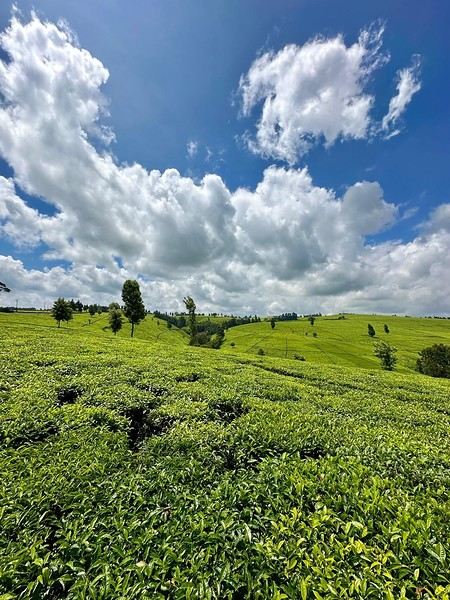
I'm back in the "travel journal" section to share our 15-day adventure in Kenya in November 2024. It was pretty much our first time in East Africa (since Zanzibar doesn’t really count 😜).
As usual, I’m sharing the journal I made for our loved ones—still as casual and cheerful as ever, just to give them a little break from their tough workdays 😄.
We organized the whole trip ourselves, and to be original here LOL, we took some *very* well-trodden paths: Naivasha, Tsavo, and Diani. But what I loved about this country is that it’s so easy to go off the beaten track—even on the "tourist highways" 😉.
So, if you're a safari fanatic or after stunning wildlife photos, you might be disappointed. But if you want to discover other sides of Kenya, you might just find what you're looking for 😉.
Looking forward to sharing this fun journey with you all 😊.
Various ideas to revive/improve the site
Hello,
After 20 years of operation and a 4-year hiatus, we were happy to rediscover this forum following its acquisition by Myatlas.
At the very beginning of the adventure, there was a section allowing members to share their ideas—good or bad, feasible or not—with the team in charge to help perfect the forum.
So, to help VoyageForum regain its momentum and adapt to new audiences and a new environment, why not put our heads together and suggest some improvement ideas in this thread?
I’ll get the ball rolling!
Travel journals are limited to 300 photos because photo storage is expensive. This limitation is completely understandable, and Myatlas found a solution by offering a paid subscription for those who wanted to exceed the free photo limit. Maybe this approach could be adapted here? Limiting without offering an alternative is a reason members leave.
After 20 years of operation and a 4-year hiatus, we were happy to rediscover this forum following its acquisition by Myatlas.
At the very beginning of the adventure, there was a section allowing members to share their ideas—good or bad, feasible or not—with the team in charge to help perfect the forum.
So, to help VoyageForum regain its momentum and adapt to new audiences and a new environment, why not put our heads together and suggest some improvement ideas in this thread?
I’ll get the ball rolling!
Travel journals are limited to 300 photos because photo storage is expensive. This limitation is completely understandable, and Myatlas found a solution by offering a paid subscription for those who wanted to exceed the free photo limit. Maybe this approach could be adapted here? Limiting without offering an alternative is a reason members leave.
On remonte le temps: Tanzanie - Kenya 1992 English translation pending
Le carnet de Christian alias Eiger m'a donné une idée. Pourquoi ne pas moi aussi vous raconter mon premier grand voyage qui remonte à 1992 ? Mon premier safari et la découverte de l'Afrique de l'est à jamais enraciné dans mon cœur avec l'Afrique Australe.
Bon à l'époque je débutais dans la photographie, donc c'est pas spécialement brillant et mot est faible ! Les photos ont été à l'époque directement scannées et transférées sur CD par Kodak.
Il restera ancré à tout jamais dans ma mémoire comme mon premier grand voyage ! Ma grand mère, ma mère me traitent de fou 🤪 Mon père ancien marin dans la marchande qui a fait plus de deux fois le tour du monde, m'encourage 🙂
N'ayant pas l'esprit aventureux de certain, un niveau d'anglais moyen et pas de temps à perdre en recherche d'information sur place, je passe par une agence de voyage qui a toujours pignon sur rue et qui organise des voyages en groupe.
Le voyage durera 23 jours et sur la fin les relations furent un peux compliquées.
Le voyage sera découpé comme cela :
Kilimandjaro Safari - Ngorongoro et Serengeti Zanzibar Retour par le Kenya
Bon à l'époque je débutais dans la photographie, donc c'est pas spécialement brillant et mot est faible ! Les photos ont été à l'époque directement scannées et transférées sur CD par Kodak.
Il restera ancré à tout jamais dans ma mémoire comme mon premier grand voyage ! Ma grand mère, ma mère me traitent de fou 🤪 Mon père ancien marin dans la marchande qui a fait plus de deux fois le tour du monde, m'encourage 🙂
N'ayant pas l'esprit aventureux de certain, un niveau d'anglais moyen et pas de temps à perdre en recherche d'information sur place, je passe par une agence de voyage qui a toujours pignon sur rue et qui organise des voyages en groupe.
Le voyage durera 23 jours et sur la fin les relations furent un peux compliquées.
Le voyage sera découpé comme cela :
Kilimandjaro Safari - Ngorongoro et Serengeti Zanzibar Retour par le Kenya
Mais où qu'il est ce truc là (4) English translation pending
Discussions du concours "Les édifices religieux dans le monde" English translation pending
C'est ici que l'on discute dans la bonne humeur et le respect de l'autre du concours du mois de novembre.😏
C'est aussi ici que l'on partage des photos en "OFF du concours" avant d'avoir trouver "la" bonne photo pour le concours.
Retour au concours de novembre:
voyageforum.com/...5795;live=1;#9805795
Masai Mara and Melting Pot Safari... So disappointed!
Hello everyone,
I imagine many of you have been captivated by the Masai Mara park and/or your safari experience with Tony Crocetta/Melting Pot Safari. Still, I’d like to share my perspective. First, I’m an avid traveler, especially in love with Africa, which my partner and I have explored a bit (Zambia, South Africa, Botswana, Kenya, Zimbabwe, Namibia...). That said, I want to express my deep disappointment with both the Masai Mara and Tony Crocetta’s camp, Melting Pot Safari, where we stayed last year.
First, about the park: it’s stunning, no doubt. But what a highly touristy place! I can’t find the words to describe the horror of being among 30 4x4 vehicles lined up in front of a lioness hunt, let alone encircling her right after her kill while her prey is still alive in her jaws... no respect for wildlife. The same goes for surrounding a young leopard playing with its small prey, a moment when I counted over 50 vehicles, most with their engines running... sickening. I turned away, both my gaze and my camera. What a disaster to see this natural wonder of Africa turned into a tourist hotspot.
Yes, I loved this place on Earth, but no, I won’t "promote" it anywhere or to anyone.
Next, I also wanted to share my dissatisfaction with Tony Crocetta’s famous camp, Melting Pot Safari: where to begin? We booked a private vehicle for four with two friends, and I have no complaints about the vehicle itself (though it obviously came at a cost). The windows and the vehicle weren’t very photo-friendly, but let’s move on. The trip between the sisters’ guesthouse (which was fine) and the camp went smoothly, except we arrived a bit too late. Result: "We’ll leave for the safari an hour later today because the driver has to respect his rest hours." Perfect—with park formalities, we only spent about an hour in the park that evening. The safari got off to a great start... During our 12-day stay, we saw some amazing things. Tony wasn’t at the camp—I don’t know what the atmosphere is like when he’s there, but it was rather cold during our trip. Sylvie, his wife, barely looked at us, never asking how our day, night, or game drive went (I think she spoke to us once during the stay, plus the day we arrived, of course). We felt invisible... (if I were mean, I’d say the money had already been deposited into Melting Pot’s bank account.) The evening meals, if I may say so, were a joke: not enough dessert (aside from fruit, but the few elaborate desserts—like 10 for 18 guests) for everyone, barely enough meat or sides. If you were unlucky like us and ended up with a group of 15 people who decided to skip the starter, you’d better hurry to get your main course, or there might not be any left—and no refills... We always ate our fill, but sometimes we had to serve ourselves in advance. Finally, I want to correct something about the quality of the meals: seriously, this buffet was really mediocre and far from the culinary standards I’d read about in my pre-trip research (see their Facebook page). Anyway, let’s move past the food—after all, the avocados were sublime, and we’re not there primarily to eat.
About the tent: the river views were beautiful, and the beds were very comfortable. No running water, individual showers outside the tent, and dry toilets—but it’s Africa, so we weren’t shocked. However, I’m disappointed that for this "modest" price, I wasn’t warned there’d be no soap (and no, I don’t travel with my own soap—and for the price, a little bar in the tent wouldn’t be a luxury). But let’s move on—the hippo views were fantastic. Oh, and to preserve the Masai Mara’s water (which makes sense) and for hygiene reasons, underwear isn’t washed by the camp staff—fair enough. But then what’s that little sign next to the bed? Oh right, for a hefty sum, underwear suddenly becomes "washable"...
Finally, my biggest gripe is about the essential part: the game drives. In France, they sell you a dream with a "photo safari" (what’s the difference, really? A room with a few more electrical outlets?). They promise guides especially suited for photography (not a given, sorry) and vehicles that can get close to animals and go off-road... but here’s the catch: the guides are bound by park laws and hounded by rangers looking to fine rule-breakers. Result: as soon as a white ranger vehicle is spotted, we have to abandon our spot for a wild chase through the grass. Fun once... The next day, we learned that another group’s guide got caught and had to pay $100 for breaking the rules—a sum he casually asked the travelers in his vehicle to cover... because of course, Melting Pot lures tourists with dreams, the poor rangers try to get close, all while breaking park laws... and they break those laws for Crocetta’s company, which, of course, won’t dip into its profits to pay the fines. Basically, it’s "keep the clients happy, but don’t get fined—or the fines are on you or you’ll have to ask the clients directly." Nice boss! Anyway, there were long discussions about this last year, especially among the guests in the fined vehicle. My partner and I found these practices unacceptable, and we were deeply disappointed by this attitude.
I know many people adore this park and/or this company—maybe you were luckier... or maybe you’re less demanding than we are when it comes to respecting rules, nature, and clients. But after traveling through much of southern Africa, I can tell you we personally came back frustrated from this experience and aren’t eager to return... You’ve been warned.
I imagine many of you have been captivated by the Masai Mara park and/or your safari experience with Tony Crocetta/Melting Pot Safari. Still, I’d like to share my perspective. First, I’m an avid traveler, especially in love with Africa, which my partner and I have explored a bit (Zambia, South Africa, Botswana, Kenya, Zimbabwe, Namibia...). That said, I want to express my deep disappointment with both the Masai Mara and Tony Crocetta’s camp, Melting Pot Safari, where we stayed last year.
First, about the park: it’s stunning, no doubt. But what a highly touristy place! I can’t find the words to describe the horror of being among 30 4x4 vehicles lined up in front of a lioness hunt, let alone encircling her right after her kill while her prey is still alive in her jaws... no respect for wildlife. The same goes for surrounding a young leopard playing with its small prey, a moment when I counted over 50 vehicles, most with their engines running... sickening. I turned away, both my gaze and my camera. What a disaster to see this natural wonder of Africa turned into a tourist hotspot.
Yes, I loved this place on Earth, but no, I won’t "promote" it anywhere or to anyone.
Next, I also wanted to share my dissatisfaction with Tony Crocetta’s famous camp, Melting Pot Safari: where to begin? We booked a private vehicle for four with two friends, and I have no complaints about the vehicle itself (though it obviously came at a cost). The windows and the vehicle weren’t very photo-friendly, but let’s move on. The trip between the sisters’ guesthouse (which was fine) and the camp went smoothly, except we arrived a bit too late. Result: "We’ll leave for the safari an hour later today because the driver has to respect his rest hours." Perfect—with park formalities, we only spent about an hour in the park that evening. The safari got off to a great start... During our 12-day stay, we saw some amazing things. Tony wasn’t at the camp—I don’t know what the atmosphere is like when he’s there, but it was rather cold during our trip. Sylvie, his wife, barely looked at us, never asking how our day, night, or game drive went (I think she spoke to us once during the stay, plus the day we arrived, of course). We felt invisible... (if I were mean, I’d say the money had already been deposited into Melting Pot’s bank account.) The evening meals, if I may say so, were a joke: not enough dessert (aside from fruit, but the few elaborate desserts—like 10 for 18 guests) for everyone, barely enough meat or sides. If you were unlucky like us and ended up with a group of 15 people who decided to skip the starter, you’d better hurry to get your main course, or there might not be any left—and no refills... We always ate our fill, but sometimes we had to serve ourselves in advance. Finally, I want to correct something about the quality of the meals: seriously, this buffet was really mediocre and far from the culinary standards I’d read about in my pre-trip research (see their Facebook page). Anyway, let’s move past the food—after all, the avocados were sublime, and we’re not there primarily to eat.
About the tent: the river views were beautiful, and the beds were very comfortable. No running water, individual showers outside the tent, and dry toilets—but it’s Africa, so we weren’t shocked. However, I’m disappointed that for this "modest" price, I wasn’t warned there’d be no soap (and no, I don’t travel with my own soap—and for the price, a little bar in the tent wouldn’t be a luxury). But let’s move on—the hippo views were fantastic. Oh, and to preserve the Masai Mara’s water (which makes sense) and for hygiene reasons, underwear isn’t washed by the camp staff—fair enough. But then what’s that little sign next to the bed? Oh right, for a hefty sum, underwear suddenly becomes "washable"...
Finally, my biggest gripe is about the essential part: the game drives. In France, they sell you a dream with a "photo safari" (what’s the difference, really? A room with a few more electrical outlets?). They promise guides especially suited for photography (not a given, sorry) and vehicles that can get close to animals and go off-road... but here’s the catch: the guides are bound by park laws and hounded by rangers looking to fine rule-breakers. Result: as soon as a white ranger vehicle is spotted, we have to abandon our spot for a wild chase through the grass. Fun once... The next day, we learned that another group’s guide got caught and had to pay $100 for breaking the rules—a sum he casually asked the travelers in his vehicle to cover... because of course, Melting Pot lures tourists with dreams, the poor rangers try to get close, all while breaking park laws... and they break those laws for Crocetta’s company, which, of course, won’t dip into its profits to pay the fines. Basically, it’s "keep the clients happy, but don’t get fined—or the fines are on you or you’ll have to ask the clients directly." Nice boss! Anyway, there were long discussions about this last year, especially among the guests in the fined vehicle. My partner and I found these practices unacceptable, and we were deeply disappointed by this attitude.
I know many people adore this park and/or this company—maybe you were luckier... or maybe you’re less demanding than we are when it comes to respecting rules, nature, and clients. But after traveling through much of southern Africa, I can tell you we personally came back frustrated from this experience and aren’t eager to return... You’ve been warned.
Un mois en Tanzanie en "self-drive" English translation pending
Bonjour,
Nous partons en couple en septembre prochain pour découvrir la Tanzanie :) J'avais prévu un voyage de 3 semaines afin de découvrir les parcs du nord mais au final après reflexion (et la lecture de récit d'autres personnes sur le forum qui l'ont fait) j'ai pu ajouter une semaine supplémentaire à mon circuit afin d'avoir la possibilité de combiner les parcs du nord et du sud, Avec encore beaucoup d'interrogations ... les distances étant longues et difficiles à calculer (google maps ayant ses limites) je n'arrive pas toujours à voir si c'est réalisable où s'il faut rajouter des nuits d'étapes supplémentaires en limitant du coup le temps passé dans les parcs :( Je me pose également la question concernant le lac natron qui a l'air magnifique mais qui fait faire un grand détour (par contre cela permet de rentrer dans le serengeti par le nord et éviter ensuite de faire l'aller retour dans le parc) et où les conditions sont parfois difficiles (route en mauvais état, nombreux péages), Concernant le temps passé dans chaque parc cela est-il bien réparti ? Je me suis inspirée des récits de Francky et de Girardinpho (et d'autres personnes dont je n'ai pas les noms et tête) que je remercie encore pour leur retour d'expérience bien utiles pour tous :) Pour les hébergements nous logerons essentiellement en camping (4x4 avec tente sur le toit) avec parfois éventuellement des hébergements en "dur", pour avoir un "vrai lit" 😉
J1 Arrivée à Arusha - nuit J2 Arusha/Lake Natron - Maasai Giraffe Eco Lodge J3 Lake Natron - Maasai Giraffe Eco Lodge J4 Lake Natron/Wasso J5 Wasso/Serengeti - Lobo campsite ? 5 nuits à répartir au Serengeti (1 nuit au bord du cratère, camping en fonction des dispos) J6 Serengeti - Lobo campsite ? J7 Serengeti - Lobo campsite ? J8 Serengeti - Seronera ? J9 Serengeti - Ngorogorong - Simba A Campsite ? J10 Serengeti - visite du cratère/Fanaka Campsite J11 Fanaka Campsite/Tarangire public Campsite3 nuits à Tarangire J12 Tarangire public Campsite J13 Tarangire public Campsite/Amarula Campsite J14 Amarula Campsite/ Isimila African Garden J15 Isimila African Garden/Chogela Campsite J16 Chogela Campsite - Ruaha National Park5 nuits à Ruaha J17 Ruaha National Park J18 Ruaha National Park J19 Ruaha National Park J20 Ruaha National Park J21 : Crocodile Camp (Kidayi) - Selous3 nuits à Selous J22: Selous National Park J23 : Selous National Park J24 : Selous/Lake Tagala Campsite J25 : Lake Tagala/Dar es salaam
Et nous finirons par 4/5 nuits sur l’ile de Mafia... Vos avis sont les bienvenus :) Bonne journée, Nathalie
Nous partons en couple en septembre prochain pour découvrir la Tanzanie :) J'avais prévu un voyage de 3 semaines afin de découvrir les parcs du nord mais au final après reflexion (et la lecture de récit d'autres personnes sur le forum qui l'ont fait) j'ai pu ajouter une semaine supplémentaire à mon circuit afin d'avoir la possibilité de combiner les parcs du nord et du sud, Avec encore beaucoup d'interrogations ... les distances étant longues et difficiles à calculer (google maps ayant ses limites) je n'arrive pas toujours à voir si c'est réalisable où s'il faut rajouter des nuits d'étapes supplémentaires en limitant du coup le temps passé dans les parcs :( Je me pose également la question concernant le lac natron qui a l'air magnifique mais qui fait faire un grand détour (par contre cela permet de rentrer dans le serengeti par le nord et éviter ensuite de faire l'aller retour dans le parc) et où les conditions sont parfois difficiles (route en mauvais état, nombreux péages), Concernant le temps passé dans chaque parc cela est-il bien réparti ? Je me suis inspirée des récits de Francky et de Girardinpho (et d'autres personnes dont je n'ai pas les noms et tête) que je remercie encore pour leur retour d'expérience bien utiles pour tous :) Pour les hébergements nous logerons essentiellement en camping (4x4 avec tente sur le toit) avec parfois éventuellement des hébergements en "dur", pour avoir un "vrai lit" 😉
J1 Arrivée à Arusha - nuit J2 Arusha/Lake Natron - Maasai Giraffe Eco Lodge J3 Lake Natron - Maasai Giraffe Eco Lodge J4 Lake Natron/Wasso J5 Wasso/Serengeti - Lobo campsite ? 5 nuits à répartir au Serengeti (1 nuit au bord du cratère, camping en fonction des dispos) J6 Serengeti - Lobo campsite ? J7 Serengeti - Lobo campsite ? J8 Serengeti - Seronera ? J9 Serengeti - Ngorogorong - Simba A Campsite ? J10 Serengeti - visite du cratère/Fanaka Campsite J11 Fanaka Campsite/Tarangire public Campsite3 nuits à Tarangire J12 Tarangire public Campsite J13 Tarangire public Campsite/Amarula Campsite J14 Amarula Campsite/ Isimila African Garden J15 Isimila African Garden/Chogela Campsite J16 Chogela Campsite - Ruaha National Park5 nuits à Ruaha J17 Ruaha National Park J18 Ruaha National Park J19 Ruaha National Park J20 Ruaha National Park J21 : Crocodile Camp (Kidayi) - Selous3 nuits à Selous J22: Selous National Park J23 : Selous National Park J24 : Selous/Lake Tagala Campsite J25 : Lake Tagala/Dar es salaam
Et nous finirons par 4/5 nuits sur l’ile de Mafia... Vos avis sont les bienvenus :) Bonne journée, Nathalie
Le Festival International du film de Marrakech dévoile les 80 films de sa sélection officielle... English translation pending
Enfin Marrakech ouvrira ses portes aux cinéphiles à l'occasion du Festival International du Film qui a été créé en 2001 par Sa Majesté le Roi Mohammed VI pour promouvoir les arts et le cinéma au Maroc. Annulée en 2017, la 17e édition du Festival International du Film de Marrakech (FIFM) aura lieu cette année, Le festival se tiendra du vendredi 30 novembre au 8 décembre 2018.
Robert De Niro sera l'invité d'honneur, décrit comme le "monstre sacré du cinéma mondial" est un acteur, producteur et réalisateur américain. Reconnu pour ses nombreux films tels que Mean Streets, Taxi Driver, The Godfather 2, Il était une fois en Amérique, Brésil, Heat, Backdraft, The Untouchables, Angel Heart, Mission, Raging Bull, The Free, Casino, The Naked Nerves, Frankenstein, Jackie Brown, Mafia Blues, Sleepers, Voyage au bout de l'enfer, 1900, The Irishman.
De Niro a remporté de nombreux prix tels que l'Oscar du meilleur acteur, l'Oscar du meilleur second rôle et deux Golden Globe (dont un pour toute sa carrière en 2011).
Reconnu pour ses nombreux films tels que Mean Streets, Taxi Driver, The Godfather 2, Il était une fois en Amérique, Brésil, Heat, Backdraft, The Untouchables, Angel Heart, Mission, Raging Bull, The Free, Casino, The Naked Nerves, Frankenstein, Jackie Brown, Mafia Blues, Sleepers, 1900 or The Irishman. De Niro a remporté de nombreux prix tels que l'Oscar du meilleur acteur, l'Oscar du meilleur second rôle et deux Golden Globe (dont un pour toute sa carrière en 2011).
FILMS HOLLYWOODIENS ONT ÉTÉ TOURNÉS AU MAROC?
De nombreux cinéphiles du monde entier ont vu une partie considérable du territoire et des paysages marocains dans les films hollywoodiens. Le pays est devenu un lieu de tournage majeur, c'est partout dans les films américains.
OTHELLO (1951)
L'adaptation cinématographique d'Othello de William Shakespeare par Orson Welles est l'un des premiers classiques tournés au Maroc. Le film s'ouvre sur une scène à Essaouira, combinant forteresses et forteresses aux murs et remparts fortifiés. La Tragédie d'Othello : Le Maure de Venise comprend d'autres scènes qui ont été tournées dans les ruelles labyrinthiques et les passages étroits de ce lieu côtier populaire. Aujourd'hui, l'une des places de la ville porte le nom du célèbre directeur ; il y a même une plaque au milieu de la place dédiée à sa mémoire.
L'HOMME QUI EN SAVAIT TROP (1956)
Le meilleur réalisateur anglais, Alfred Hitchcock, ouvre son film à suspense L'homme qui en savait trop avec une scène d'un bus entrant dans le portail de Bab Doukkkala, un repère historique dans la ville de Marrakech. Hitchcock montre le même bus qui passe par Bab El Khemis, un marché aux puces très animé rempli d'un tas de vieux déchets et de trésors cachés. Durant leur séjour, le Dr Benjamin (James Stewart) et son épouse Joséphine "Jo" (Doris Day) séjournent dans le luxueux hôtel La Mamounia. (Winston Churchill séjournait toujours dans cet hôtel et passait beaucoup de temps à Marrakech.) Le "maître du suspense", Alfred Hitchcock, a également utilisé la charmante place Jemaa el-Fnaa comme décor pour son film. Le film montre comment la famille McKenna tombe accidentellement sur un assassinat sur la place mondialement connue et animée.
LAWRENCE D'ARABIE (1962) Lawrence d'Arabie est un chef-d'œuvre basé sur la vie de T. E. Lawrence. Le film est réalisé par David Lean et met en vedette les deux acteurs légendaires, Peter O'Toole et Omar Sharif. Certaines des scènes du film ont été tournées dans le magnifique village marocain d'Ait Benhaddou, classé au patrimoine mondial de l'UNESCO. Une autre scène épique filmée au Maroc est le massacre de l'armée turque. L'HOMME QUI SERAIT ROI (1975) The Man Who Would Be King est l'adaptation en 1975 par John Huston de la nouvelle éponyme de Rudyard Kipling. Le film met en vedette Sir Sean Connery, le meilleur James Bond de tous les temps, et l'icône du cinéma britannique, Sir Michael Caine. Ce film extraordinaire a été tourné principalement au Maroc. La scène où Danny et Peachy offrent leurs services en tant que conseillers au chef du village fictif'Er-Heb' a été filmée à Tagadirt n'Bour, un village dans la région d'Al-Haouz. La bataille avec le village'Bashkai' se déroule à Tifoultoute, une arène désertique près de Ouarzazate.
LE JOYAU DU NIL (1985) The Jewel of the Nile est un film d'aventure, d'action, d'amour et de comédie mettant en vedette Michael Douglas, Kathleen Turner et Danny DeVito. Certaines scènes du film ont été tournées dans la ville de Meknès et dans les environs de Ouarzazate. L'avion de chasse F-16 que Jack Colton (Michael Douglas), Joan Wilder (Kathleen Turner) et Al-Julhara (Avner Eisenberg) utilisent pour fuir dans le désert, est toujours exposé aux studios Atlas Corporation à Ouarzazate. La scène du jet a été filmée dans un village fortifié à Ait Benhaddou.
LA MOMIE (1999) The Mummy, mettant en vedette Brendan Fraser et Rachel Weisz, lauréate d'un Oscar, est un remake du film d'horreur classique de 1932 du même nom. Le film se passe en Egypte, mais tourné principalement au Maroc. Dans le sud-est du désert marocain, tout un décor a été construit pour la ville égyptienne fictive, Hamunaptra. Le décor de cette ville fictive a été construit dans un cratère volcanique endormi près de la ville oasis de la vie réelle, Erfoud. Deux ans plus tard, deux ans plus tard, "La momie revient" au Maroc, la suite du film à succès de Stephen Sommers en 1999. Non loin d'Erfoud, les dunes du désert de l'Erg Chebbi sont utilisées comme un double pour le désert égyptien. ALEXANDER (2004) Alexander d'Oliver Stone est un drame historique mettant en vedette Colin Farrell, Angelina Jolie, Anthony Hopkins, Jared Leto et Val Kilmer. Les zones autour d'Essaouira ont servi de toile de fond pittoresque aux montagnes macédoniennes, aux petits bassins, aux terres agricoles et aux rivières. La scène du marché aux chevaux macédonien où le jeune Alexandre (Connor Paolo) surprend tout le monde en apprivoisant et soumettant Bucephalus, a été tournée près d'Essaouira. La grande bataille de Gaugamela où Alexandre (Colin Farrell) bat l'empereur persan Darius III a été filmé dans un désert près de Marrakech. Les portes majestueuses par lesquelles Alexandre le Grand fait son entrée triomphale dans Babylone ont été construites à Marrakech. BABEL (2006) Babel est un drame multi-narratif réalisé par Alejandro González Iñárritu et écrit par Guillermo Arriaga. Il met en vedette un mélange éclectique d'acteurs de différentes parties du monde ; Brad Pitt, Cate Blanchett, Adriana Barraza, Gael Garcia Bernal, Rinko Kikuchi, Koji Yakusho et Driss Roukhe. La production cinématographique est elle-même une sorte de tour Babel tournée dans de nombreux endroits dans le monde. Une partie du film a été tournée au Maroc, dans un lointain village berbère situé dans les montagnes de l'Atlas, Taguenzalt. PRINCE DE PERSE : LES SABLES DU TEMPS (2010) Prince of Persia : The Sands of Time est réalisé par Mike Newell et produit par Jerry Bruckheimer. Penny Rose, qui a également été la créatrice des costumes de Pirates des Caraïbes, a travaillé sur cette adaptation de jeu vidéo-franchise. Le film met en vedette Jake Gyllenhaal, Gemma Arterton, Ben Kingsley et Alfred Molina. Les paysages spectaculaires des montagnes, vallées et déserts marocains ont servi de toile de fond à un plus grand nombre de scènes. Une grande partie du plateau de tournage a été construite dans des endroits du Maroc, notamment à Merzouga, Erfoud, Ouarzazate, Tameslouht, Oukaimeden et Marrakech. De nombreux artisans et artistes locaux ont participé à la création et à la fabrication d'accessoires et de costumes, dont le poignard qui libère les sables du temps et l'armure du Prince Dastan. CRÉATION (2010) Inception, la superproduction de science-fiction de Christopher Nolan, est un thriller à la fois époustouflant et époustouflant de "rêve dans un rêve". Nolan assemble une distribution très remarquable comprenant Leonardo DiCaprio, Joseph Gordon-Levitt, Tom Hardy, Ellen Page, Ken Watanabe, Marion Cotillard et Michael Caine. La séquence de poursuite à pied avec Cobb (Leonardo DiCaprio) a été filmée dans les ruelles étroites et les souks animés de Tanger. La ville du nord du Maroc a doublé sous le nom de Mombasa, au Kenya SNIPER AMÉRICAIN (2014) American Sniper est un biopic de 2014 basé sur les mémoires du sniper le plus meurtrier de l'histoire militaire américaine. Ce film de guerre qui a généré les revenus les plus élevés de tous les temps a été réalisé par Clint Eastwood et a mis en vedette Bradley Cooper dans le rôle de feu Chris Kyle. Les scènes en Irak sont en fait tournées à Rabat, la capitale du Maroc. Certaines parties des quartiers de la ville sont transformées pour ressembler à la ville irakienne dévastée et délabrée de Fallujah, car il était trop dangereux pour l'équipe de production de tourner en Irak. MISSION : IMPOSSIBLE - NATION VOYOU (2015) Mission : Impossible - Rogue Nation est un film d'action, d'aventure et d'espionnage mettant en vedette Tom Cruise, agent du FMI, Ethan Hunt. Le film a des séquences spectaculaires tournées dans de nombreux endroits à travers le Maroc. La scène de chasse où l'agent Hunt (Tom Cruise) et Benji (Simon Pegg) conduisent une BMW M3 et sont poursuivis par des membres du Syndicat a été tournée près de la Kasbah des Udayas à Rabat, un monument du 12ème siècle. La poursuite se poursuit dans les rues étroites du quartier Derb Sultan à Casablanca et se termine par un saut périlleux BMW M3 juste en face de la célèbre mosquée Hassan II, la plus grande du Maroc. L'autre scène où Ethan Hunt poursuit Ilsa sur l'autoroute a été filmée sur l'autoroute A7 Casablanca-Agadir et dans les virages serrés de l'Atlas près de Marrakech.
LAWRENCE D'ARABIE (1962) Lawrence d'Arabie est un chef-d'œuvre basé sur la vie de T. E. Lawrence. Le film est réalisé par David Lean et met en vedette les deux acteurs légendaires, Peter O'Toole et Omar Sharif. Certaines des scènes du film ont été tournées dans le magnifique village marocain d'Ait Benhaddou, classé au patrimoine mondial de l'UNESCO. Une autre scène épique filmée au Maroc est le massacre de l'armée turque. L'HOMME QUI SERAIT ROI (1975) The Man Who Would Be King est l'adaptation en 1975 par John Huston de la nouvelle éponyme de Rudyard Kipling. Le film met en vedette Sir Sean Connery, le meilleur James Bond de tous les temps, et l'icône du cinéma britannique, Sir Michael Caine. Ce film extraordinaire a été tourné principalement au Maroc. La scène où Danny et Peachy offrent leurs services en tant que conseillers au chef du village fictif'Er-Heb' a été filmée à Tagadirt n'Bour, un village dans la région d'Al-Haouz. La bataille avec le village'Bashkai' se déroule à Tifoultoute, une arène désertique près de Ouarzazate.
LE JOYAU DU NIL (1985) The Jewel of the Nile est un film d'aventure, d'action, d'amour et de comédie mettant en vedette Michael Douglas, Kathleen Turner et Danny DeVito. Certaines scènes du film ont été tournées dans la ville de Meknès et dans les environs de Ouarzazate. L'avion de chasse F-16 que Jack Colton (Michael Douglas), Joan Wilder (Kathleen Turner) et Al-Julhara (Avner Eisenberg) utilisent pour fuir dans le désert, est toujours exposé aux studios Atlas Corporation à Ouarzazate. La scène du jet a été filmée dans un village fortifié à Ait Benhaddou.
LA MOMIE (1999) The Mummy, mettant en vedette Brendan Fraser et Rachel Weisz, lauréate d'un Oscar, est un remake du film d'horreur classique de 1932 du même nom. Le film se passe en Egypte, mais tourné principalement au Maroc. Dans le sud-est du désert marocain, tout un décor a été construit pour la ville égyptienne fictive, Hamunaptra. Le décor de cette ville fictive a été construit dans un cratère volcanique endormi près de la ville oasis de la vie réelle, Erfoud. Deux ans plus tard, deux ans plus tard, "La momie revient" au Maroc, la suite du film à succès de Stephen Sommers en 1999. Non loin d'Erfoud, les dunes du désert de l'Erg Chebbi sont utilisées comme un double pour le désert égyptien. ALEXANDER (2004) Alexander d'Oliver Stone est un drame historique mettant en vedette Colin Farrell, Angelina Jolie, Anthony Hopkins, Jared Leto et Val Kilmer. Les zones autour d'Essaouira ont servi de toile de fond pittoresque aux montagnes macédoniennes, aux petits bassins, aux terres agricoles et aux rivières. La scène du marché aux chevaux macédonien où le jeune Alexandre (Connor Paolo) surprend tout le monde en apprivoisant et soumettant Bucephalus, a été tournée près d'Essaouira. La grande bataille de Gaugamela où Alexandre (Colin Farrell) bat l'empereur persan Darius III a été filmé dans un désert près de Marrakech. Les portes majestueuses par lesquelles Alexandre le Grand fait son entrée triomphale dans Babylone ont été construites à Marrakech. BABEL (2006) Babel est un drame multi-narratif réalisé par Alejandro González Iñárritu et écrit par Guillermo Arriaga. Il met en vedette un mélange éclectique d'acteurs de différentes parties du monde ; Brad Pitt, Cate Blanchett, Adriana Barraza, Gael Garcia Bernal, Rinko Kikuchi, Koji Yakusho et Driss Roukhe. La production cinématographique est elle-même une sorte de tour Babel tournée dans de nombreux endroits dans le monde. Une partie du film a été tournée au Maroc, dans un lointain village berbère situé dans les montagnes de l'Atlas, Taguenzalt. PRINCE DE PERSE : LES SABLES DU TEMPS (2010) Prince of Persia : The Sands of Time est réalisé par Mike Newell et produit par Jerry Bruckheimer. Penny Rose, qui a également été la créatrice des costumes de Pirates des Caraïbes, a travaillé sur cette adaptation de jeu vidéo-franchise. Le film met en vedette Jake Gyllenhaal, Gemma Arterton, Ben Kingsley et Alfred Molina. Les paysages spectaculaires des montagnes, vallées et déserts marocains ont servi de toile de fond à un plus grand nombre de scènes. Une grande partie du plateau de tournage a été construite dans des endroits du Maroc, notamment à Merzouga, Erfoud, Ouarzazate, Tameslouht, Oukaimeden et Marrakech. De nombreux artisans et artistes locaux ont participé à la création et à la fabrication d'accessoires et de costumes, dont le poignard qui libère les sables du temps et l'armure du Prince Dastan. CRÉATION (2010) Inception, la superproduction de science-fiction de Christopher Nolan, est un thriller à la fois époustouflant et époustouflant de "rêve dans un rêve". Nolan assemble une distribution très remarquable comprenant Leonardo DiCaprio, Joseph Gordon-Levitt, Tom Hardy, Ellen Page, Ken Watanabe, Marion Cotillard et Michael Caine. La séquence de poursuite à pied avec Cobb (Leonardo DiCaprio) a été filmée dans les ruelles étroites et les souks animés de Tanger. La ville du nord du Maroc a doublé sous le nom de Mombasa, au Kenya SNIPER AMÉRICAIN (2014) American Sniper est un biopic de 2014 basé sur les mémoires du sniper le plus meurtrier de l'histoire militaire américaine. Ce film de guerre qui a généré les revenus les plus élevés de tous les temps a été réalisé par Clint Eastwood et a mis en vedette Bradley Cooper dans le rôle de feu Chris Kyle. Les scènes en Irak sont en fait tournées à Rabat, la capitale du Maroc. Certaines parties des quartiers de la ville sont transformées pour ressembler à la ville irakienne dévastée et délabrée de Fallujah, car il était trop dangereux pour l'équipe de production de tourner en Irak. MISSION : IMPOSSIBLE - NATION VOYOU (2015) Mission : Impossible - Rogue Nation est un film d'action, d'aventure et d'espionnage mettant en vedette Tom Cruise, agent du FMI, Ethan Hunt. Le film a des séquences spectaculaires tournées dans de nombreux endroits à travers le Maroc. La scène de chasse où l'agent Hunt (Tom Cruise) et Benji (Simon Pegg) conduisent une BMW M3 et sont poursuivis par des membres du Syndicat a été tournée près de la Kasbah des Udayas à Rabat, un monument du 12ème siècle. La poursuite se poursuit dans les rues étroites du quartier Derb Sultan à Casablanca et se termine par un saut périlleux BMW M3 juste en face de la célèbre mosquée Hassan II, la plus grande du Maroc. L'autre scène où Ethan Hunt poursuit Ilsa sur l'autoroute a été filmée sur l'autoroute A7 Casablanca-Agadir et dans les virages serrés de l'Atlas près de Marrakech.
Récit de voyage: 8 jours au Kenya en octobre/novembre 2018 English translation pending
30/10/2018 - 9h30 : Ah ce voyage, rêve d’enfant qui se réalise. Hier soir, E. et moi sommes parties de Roissy. Direction finale : le Kenya !!
10 jours pour profiter de magnifiques paysages, faire plusieurs safaris et finir en se prélassant au bord d’une plage paradisiaque. Voyage coup de tête, décidé début août, après un début d’été difficile moralement pour moi.
Quoi de mieux qu’un voyage de rêve pour remonter le moral, se couper de ses problèmes et être heureuse.
Voilà, après un vol jusqu’à Addis Abeba, nous voilà dans l’avion suivant qui devrait atterrir dans 2h sur Nairobi. Je suis heureuse :)
17h15 – Arrivées à l’aéroport, un mec de l’agence nous attendais. Tout de suite, il commence à nous dire qu’on doit aller faire du change dans une agence à l’aéroport. Oh toi, mon coco, tu vas pas me la faire c’est plus cher que dans une banque, et je le sais ! Donc, ta petite com’ elle va te passer sous le nez. Très vite, il nous annonce qu’on sera 6 le lendemain au safari, alors qu’à Paris, on nous a indiqué que les 4 autres se joindraient à nous qu’au repas du midi. Ensuite, je vois qu’il veut écourter le safari et nous endormir. Nous essayons de mettre les choses au point : nous devons être seule au safari, il ne l'écourtera pas et je préviens au passage qu’ils n’ont pas intérêt de nous emmener dans leurs boutiques à touristes que le temps doit être consacré uniquement au safari et que nous sommes assez grandes pour faire les boutiques nous-même.….en espérant qu’après cette mise au point, tout se passer bien. Arrivées à l’hôtel, nous décidons de consacrer notre après-midi de libre à visiter le centre de Nairobi. Longues discussions encore : le gars de l’agence et les réceptionnistes nous annoncent 50€ pour aller dans le centre en taxi!! Je prends mon guide du routard et leur demande d’appeler une agence de taxis : nous arrivons à négocier 1 tarif d’environ 13€ aller-retour, en fonction du trafic.
Nous voilà parties. Nous passons devant le parlement, la Court House. Nous montons en haut de la Kenyatta Conference Centre, tour la plus haute de Nairobi. Je brave ma peur et mon vertige et apprécie la vue sur tout la ville qui est très étendue. Nous continuons notre chemin en passant devant des édifices coloniaux tels que la Pan Africa House ou la McMilan Library. Nous finissons sur le marché central qui est de plus en plus malheureusement rempli de boutiques touristiques. Nous tombons toutefois sur des échoppes, un peu à l’écart, qui offrent des salades de fruits frais, et d’autres, de poissons frits. Çà sent bon, çà donne envie, mais je vois qu’E. est réticente. C’est tout nouveau pour elle.
Nous retournons au point de rdv avec notre chauffeur, mais c’est devant le ministère de la justice et les militaires nous virent à longueur de temps. Notre chauffeur à 10mn de retard, cela devient flippant, surtout qu’il a gardé une avance sur le montant du retour car il n’avait pas de monnaie à l’aller. Je demande à des passants d’appeler la compagnie de taxie et le chauffeur arriver avec 20mn de retard. Ouf, car les militaires commençaient vraiment à nous gonfler.
Heureusement, nous avions trouvé refuge sur le trottoir d’en face, auprès de femmes adorables, souriantes, avenantes qui chantaient des chants chrétiens. Une belle rencontre :) Nairobi est contrastée : les immeubles poussent comme des champignons, sans aucune logique architecturale. Les vieux bâtiments magnifiques sont grimés d’affiches publicitaires grotesques sur leurs belles façades la pollution et le trafic intenses les gens, malgré les recommandations de l’hôtel, me paraissent adorables, serviables et souriant pour la plupart. Beaucoup sont heureux de communiquer avec nous. Certes, vous rencontrez des rabatteurs pour safaris, visite de la ville, etc...Mais pas plus que dans d’autre pays.
Nairobi est une ville dynamique, en plein boum, où pauvreté et jeunesse instruite se côtoient.
17h15 – Arrivées à l’aéroport, un mec de l’agence nous attendais. Tout de suite, il commence à nous dire qu’on doit aller faire du change dans une agence à l’aéroport. Oh toi, mon coco, tu vas pas me la faire c’est plus cher que dans une banque, et je le sais ! Donc, ta petite com’ elle va te passer sous le nez. Très vite, il nous annonce qu’on sera 6 le lendemain au safari, alors qu’à Paris, on nous a indiqué que les 4 autres se joindraient à nous qu’au repas du midi. Ensuite, je vois qu’il veut écourter le safari et nous endormir. Nous essayons de mettre les choses au point : nous devons être seule au safari, il ne l'écourtera pas et je préviens au passage qu’ils n’ont pas intérêt de nous emmener dans leurs boutiques à touristes que le temps doit être consacré uniquement au safari et que nous sommes assez grandes pour faire les boutiques nous-même.….en espérant qu’après cette mise au point, tout se passer bien. Arrivées à l’hôtel, nous décidons de consacrer notre après-midi de libre à visiter le centre de Nairobi. Longues discussions encore : le gars de l’agence et les réceptionnistes nous annoncent 50€ pour aller dans le centre en taxi!! Je prends mon guide du routard et leur demande d’appeler une agence de taxis : nous arrivons à négocier 1 tarif d’environ 13€ aller-retour, en fonction du trafic.
Nous voilà parties. Nous passons devant le parlement, la Court House. Nous montons en haut de la Kenyatta Conference Centre, tour la plus haute de Nairobi. Je brave ma peur et mon vertige et apprécie la vue sur tout la ville qui est très étendue. Nous continuons notre chemin en passant devant des édifices coloniaux tels que la Pan Africa House ou la McMilan Library. Nous finissons sur le marché central qui est de plus en plus malheureusement rempli de boutiques touristiques. Nous tombons toutefois sur des échoppes, un peu à l’écart, qui offrent des salades de fruits frais, et d’autres, de poissons frits. Çà sent bon, çà donne envie, mais je vois qu’E. est réticente. C’est tout nouveau pour elle.
Nous retournons au point de rdv avec notre chauffeur, mais c’est devant le ministère de la justice et les militaires nous virent à longueur de temps. Notre chauffeur à 10mn de retard, cela devient flippant, surtout qu’il a gardé une avance sur le montant du retour car il n’avait pas de monnaie à l’aller. Je demande à des passants d’appeler la compagnie de taxie et le chauffeur arriver avec 20mn de retard. Ouf, car les militaires commençaient vraiment à nous gonfler.
Heureusement, nous avions trouvé refuge sur le trottoir d’en face, auprès de femmes adorables, souriantes, avenantes qui chantaient des chants chrétiens. Une belle rencontre :) Nairobi est contrastée : les immeubles poussent comme des champignons, sans aucune logique architecturale. Les vieux bâtiments magnifiques sont grimés d’affiches publicitaires grotesques sur leurs belles façades la pollution et le trafic intenses les gens, malgré les recommandations de l’hôtel, me paraissent adorables, serviables et souriant pour la plupart. Beaucoup sont heureux de communiquer avec nous. Certes, vous rencontrez des rabatteurs pour safaris, visite de la ville, etc...Mais pas plus que dans d’autre pays.
Nairobi est une ville dynamique, en plein boum, où pauvreté et jeunesse instruite se côtoient.
Pénurie d'essence et sécurité au Zimbabwe (en 4x4) English translation pending
Bonjour à tous,
nous partons dans une semaine pour un self drive de 20 jours au Zimbabwe mais les nouvelles qui nous proviennent du pays nous font un peu douter, sinon de notre destination, du moins de notre timing. Pénurie d'essence, de devises et de biens de consommation courante comment peut-on prévoir traverser le pays si les stations services sont à sec?? En plus, cette crise de liquidité, la nouvelle taxe imposée aux transactions électroniques auront-elles un effet négatif sur la population et demeure-t-il sécuritaire de visiter le pays. Sans être complètement parano, ca nous inquiète tout de même un peu.
Si quelqu'un a de l'info, svp, manifestez-vous.
nous partons dans une semaine pour un self drive de 20 jours au Zimbabwe mais les nouvelles qui nous proviennent du pays nous font un peu douter, sinon de notre destination, du moins de notre timing. Pénurie d'essence, de devises et de biens de consommation courante comment peut-on prévoir traverser le pays si les stations services sont à sec?? En plus, cette crise de liquidité, la nouvelle taxe imposée aux transactions électroniques auront-elles un effet négatif sur la population et demeure-t-il sécuritaire de visiter le pays. Sans être complètement parano, ca nous inquiète tout de même un peu.
Si quelqu'un a de l'info, svp, manifestez-vous.
Dollars et euros pour le Kenya English translation pending
Est t il nécessaire de prendre des dollars ? Les Euros suffisent t ils ?
L'entrée des parcs en quelle monnaie, ou CB ? Et les campings et hôtel?
Merci pour vos conseils.
Merci pour vos conseils.
En camping-car sur le sol africain: projet ou rêve? English translation pending
Bonjour
Nous désirons partir en sol africain depuis la suisse pour 3 ou 4 mois en début d'année 2020 (ça nous laisse le temps de bien préparer)
notre camping car est un Iveco 35.12 de 1998 (moins d’électronique) avec un cellule Laika
quelques solutions s'offre a nous :
- Suisse Espagne Maroc et rejoindre le sud via l’Algérie Mali Burkina Faso .... - Suisse Italie bateau Egypte et rejoindre le sud via le soudan ....
quel son les pays a éviter actuellement ?
merci déjà de vos prochaine proposition et réponse
Nous désirons partir en sol africain depuis la suisse pour 3 ou 4 mois en début d'année 2020 (ça nous laisse le temps de bien préparer)
notre camping car est un Iveco 35.12 de 1998 (moins d’électronique) avec un cellule Laika
quelques solutions s'offre a nous :
- Suisse Espagne Maroc et rejoindre le sud via l’Algérie Mali Burkina Faso .... - Suisse Italie bateau Egypte et rejoindre le sud via le soudan ....
quel son les pays a éviter actuellement ?
merci déjà de vos prochaine proposition et réponse
Voyager seul en Afrique (Rwanda, Mozambique, Cap Vert ou autres) English translation pending
Bonsoir,
Voilà je prépare un voyage en solitaire de 3 à 6 mois à partir d'octobre et je suis très hésitant sur les destinations. Je suis très attiré par l'Afrique en général mais je me questionne concernant le fait de partir seul.
En fait, j'avais plus ou moins décidé de partir en Asie du sud-est car c'est peu cher, on y trouve beaucoup de moyen de se loger et rencontrer des gens y est aisé (car je pars seul mais il est vrai que je n'aime pas non plus rester seul).
Je dois rejoindre ma mère au Rwanda en janvier 2018 et du coup je suis en plein questionnement sur les autres pays que je pourrais visiter avec un budget de 1000e/mois tous frais inclus.
Je suis à la recherche de retour d'expérience sur divers pays d'Afrique, sur le fait de partir seul, sur le fait de rencontrer des gens sur place et sur la manière de se loger avec ce budget.
Merci d'avance pour vos réponses :)
Voilà je prépare un voyage en solitaire de 3 à 6 mois à partir d'octobre et je suis très hésitant sur les destinations. Je suis très attiré par l'Afrique en général mais je me questionne concernant le fait de partir seul.
En fait, j'avais plus ou moins décidé de partir en Asie du sud-est car c'est peu cher, on y trouve beaucoup de moyen de se loger et rencontrer des gens y est aisé (car je pars seul mais il est vrai que je n'aime pas non plus rester seul).
Je dois rejoindre ma mère au Rwanda en janvier 2018 et du coup je suis en plein questionnement sur les autres pays que je pourrais visiter avec un budget de 1000e/mois tous frais inclus.
Je suis à la recherche de retour d'expérience sur divers pays d'Afrique, sur le fait de partir seul, sur le fait de rencontrer des gens sur place et sur la manière de se loger avec ce budget.
Merci d'avance pour vos réponses :)
Assez de spray anti-moustiques pour le voyage au Kenya? English translation pending
Bonjour,
Je suis allé cherché hier à la pharmacie de l'anti-moustique en spray. Je pars 9 jours au Kenya où je fais un circuit classique finissant à Diani.
La pharmacienne m'a dit qu'un seul spray pour la peau et un seul spray pour les vêtements suffisaient pour la durée du séjour et pour deux personnes.
Mais j'ai un doute car sur le spray (insect écran), il est marqué qu'à hauteur de deux pulvérisations par jour, une personne tient 15 jours.
Alors que faire? Reprendre un spray de chaque pour qu'il y en ai un par personne? Ou est-ce que ceux que j'ai me suffiront?
Merci d'avance pour vos réponses😎
Je suis allé cherché hier à la pharmacie de l'anti-moustique en spray. Je pars 9 jours au Kenya où je fais un circuit classique finissant à Diani.
La pharmacienne m'a dit qu'un seul spray pour la peau et un seul spray pour les vêtements suffisaient pour la durée du séjour et pour deux personnes.
Mais j'ai un doute car sur le spray (insect écran), il est marqué qu'à hauteur de deux pulvérisations par jour, une personne tient 15 jours.
Alors que faire? Reprendre un spray de chaque pour qu'il y en ai un par personne? Ou est-ce que ceux que j'ai me suffiront?
Merci d'avance pour vos réponses😎
Premier voyage en Afrique subsaharienne English translation pending
Bonjour,
Je souhaite partir un mois, entre juillet et aout, en Afrique subsaharienne et j'essai de déterminer ma/mes destinations (2 max). Sans pour autant me limiter à ces pays je pense plus particulièrement au Sénégal, Mali, Burkina Faso, Cameroun, Kenya, Côte d'Ivoire.
J'ai un peu parcouru le forum, j'ai quelques question par rapport à ce que j'ai pu lire : Est-ce que le Burkina Faso est toujours aussi accueillant? Est-ce que le Kenya se fait bien en trip backpacker? Apparemment le tourisme indépendant (sans guide) fonctionne mal au Mali, qu'est-ce que vous en pensez? C'est le cas d'autres pays? Le Cameroun est-il tjr aussi peu accueillant?
Pour un un voyageur indépendant (trip backpacker) qui préfère l'animations des grandes villes, les rencontres avec les locaux et la fête plutôt que les visites des sites touristiques qu'est-ce que vous me conseilleriez?
Merci
Je souhaite partir un mois, entre juillet et aout, en Afrique subsaharienne et j'essai de déterminer ma/mes destinations (2 max). Sans pour autant me limiter à ces pays je pense plus particulièrement au Sénégal, Mali, Burkina Faso, Cameroun, Kenya, Côte d'Ivoire.
J'ai un peu parcouru le forum, j'ai quelques question par rapport à ce que j'ai pu lire : Est-ce que le Burkina Faso est toujours aussi accueillant? Est-ce que le Kenya se fait bien en trip backpacker? Apparemment le tourisme indépendant (sans guide) fonctionne mal au Mali, qu'est-ce que vous en pensez? C'est le cas d'autres pays? Le Cameroun est-il tjr aussi peu accueillant?
Pour un un voyageur indépendant (trip backpacker) qui préfère l'animations des grandes villes, les rencontres avec les locaux et la fête plutôt que les visites des sites touristiques qu'est-ce que vous me conseilleriez?
Merci
Compagnies aériennes pour Los Angeles et Las Vegas English translation pending
Bonjour
Je regarde les prix pour les vols pour los angeles et las vegas pour octobre mais en direcr c est introuvable ou tres cher..je souhaiterais atterir a los angeles et repartir de las vegas mais j ai l impression que c est mission impossible..quelles compagnies me conseillez vous? Merci d avance
Je regarde les prix pour les vols pour los angeles et las vegas pour octobre mais en direcr c est introuvable ou tres cher..je souhaiterais atterir a los angeles et repartir de las vegas mais j ai l impression que c est mission impossible..quelles compagnies me conseillez vous? Merci d avance
Concours photos VF mai 2016: Être vieux English translation pending
Bonsoir,
Je lance le 70e concours de photos VF dès maintenant car j'ai un weekend bien chargé qui s'annonce (avec de la photo de concert, au combien difficile à faire) donc voilà le thème :
« Etre vieux » Regards profonds plein de sagesses, cheveux enneigés, sculptures de rides, lenteur des mouvements. Vous avez tous croisé lors de vos pérégrinations à travers le monde ces magnifiques vieux et vieilles semblant détenir tout le savoir des sociétés visitées. Vous avez peut être partagé un moment avec eux et apprécié ce temps comme suspendu par un fil. Peut être parce que j’ai basculé depuis quelques années dans la 2ème partie d’une vie, je suis souvent très sensible à ces rencontres et je vous propose un concours où ces personnages magnifiques auront toute leur place. Donc portraits, personnages sur pieds, immobiles ou en action, seul ou plusieurs : peu importe tant que la (les) personnes est (sont) bien visible(s) et sujet principal de votre photo. Le voyage devra bien sur être présent et un des éléments forts de votre photo. Chaque photo aura son titre et au minimum le lieu de prise de vue. Un texte racontant une anecdote, une situation sera apprécié. Soignez votre cadrage. Jeux de lumières, bokeh, beau noir et blanc contrasté ou jeux d’opposition de couleurs : à vous de jouer !
Si vous avez des questions à poser, un fil consacré au thème est à votre disposition. Pour participer, merci de poster jusqu'à trois photos prises par vous chacune dans un message différent, en indiquant leur numéro (1, 2 ou 3).
Vous avez jusqu'au dimanche 22 mai 2016, minuit (heure de Paris et d’Ardèche) pour présenter vos œuvres. Le vote aura lieu à partir du lendemain, lundi 23 mai 2016, zéro heure au lundi 30 mai 2016, 23h59. Vous voterez pour trois photos maximum (et minimum), en indiquant le plus clairement possible le numéro de la photo (1, 2 ou 3) et le nom du participant. Il sera apprécié de reposter les photos que vous aurez choisies afin de les remettre en valeur. Citer les photos non choisies mais appréciées, fait plaisir aux gens qui les ont postées, ne vous en privez pas. Il n'est nul besoin de participer au concours pour voter et bien entendu, on ne vote pas pour soi même. La première photo de votre vote se verra attribuer trois points, la seconde deux et la troisième un seul. Les votes comportant plus de trois photos ne seront pas pris en compte. Le gagnant est celui qui aura proposé la photo obtenant le plus de points. En cas d'ex aequo, le vainqueur sera celui qui aura obtenu le plus grand nombre de premières places, à défaut, de secondes. Enfin, en cas d'égalité parfaite, le gagnant sera celui ou celle qui aura obtenu son score avant l'autre. Aucun demi-point ne sera attribué en cas d’hésitation, il faudra trancher. Les ex-æquo à une autre place que la première ne seront pas départagés. Le vainqueur aura alors la lourde tâche et l’honneur de choisir un thème à son tour pour le concours de juin qu'il organisera. Merci de ne poster sur ce fil que des photos pour le concours, et à compter du lundi 23 mai, seulement les votes. Un fil discussions a été ouvert ici: http://voyageforum.com/v.f?post=7464839;live=1; Le diaporama est ici (Herikles si tu sais comment récupérer ce diaporama, dis moi comment faire) : https://picasaweb.google.com/113161845917521703988/6279016774749633249 Bon concours !
« Etre vieux » Regards profonds plein de sagesses, cheveux enneigés, sculptures de rides, lenteur des mouvements. Vous avez tous croisé lors de vos pérégrinations à travers le monde ces magnifiques vieux et vieilles semblant détenir tout le savoir des sociétés visitées. Vous avez peut être partagé un moment avec eux et apprécié ce temps comme suspendu par un fil. Peut être parce que j’ai basculé depuis quelques années dans la 2ème partie d’une vie, je suis souvent très sensible à ces rencontres et je vous propose un concours où ces personnages magnifiques auront toute leur place. Donc portraits, personnages sur pieds, immobiles ou en action, seul ou plusieurs : peu importe tant que la (les) personnes est (sont) bien visible(s) et sujet principal de votre photo. Le voyage devra bien sur être présent et un des éléments forts de votre photo. Chaque photo aura son titre et au minimum le lieu de prise de vue. Un texte racontant une anecdote, une situation sera apprécié. Soignez votre cadrage. Jeux de lumières, bokeh, beau noir et blanc contrasté ou jeux d’opposition de couleurs : à vous de jouer !
Si vous avez des questions à poser, un fil consacré au thème est à votre disposition. Pour participer, merci de poster jusqu'à trois photos prises par vous chacune dans un message différent, en indiquant leur numéro (1, 2 ou 3).
Vous avez jusqu'au dimanche 22 mai 2016, minuit (heure de Paris et d’Ardèche) pour présenter vos œuvres. Le vote aura lieu à partir du lendemain, lundi 23 mai 2016, zéro heure au lundi 30 mai 2016, 23h59. Vous voterez pour trois photos maximum (et minimum), en indiquant le plus clairement possible le numéro de la photo (1, 2 ou 3) et le nom du participant. Il sera apprécié de reposter les photos que vous aurez choisies afin de les remettre en valeur. Citer les photos non choisies mais appréciées, fait plaisir aux gens qui les ont postées, ne vous en privez pas. Il n'est nul besoin de participer au concours pour voter et bien entendu, on ne vote pas pour soi même. La première photo de votre vote se verra attribuer trois points, la seconde deux et la troisième un seul. Les votes comportant plus de trois photos ne seront pas pris en compte. Le gagnant est celui qui aura proposé la photo obtenant le plus de points. En cas d'ex aequo, le vainqueur sera celui qui aura obtenu le plus grand nombre de premières places, à défaut, de secondes. Enfin, en cas d'égalité parfaite, le gagnant sera celui ou celle qui aura obtenu son score avant l'autre. Aucun demi-point ne sera attribué en cas d’hésitation, il faudra trancher. Les ex-æquo à une autre place que la première ne seront pas départagés. Le vainqueur aura alors la lourde tâche et l’honneur de choisir un thème à son tour pour le concours de juin qu'il organisera. Merci de ne poster sur ce fil que des photos pour le concours, et à compter du lundi 23 mai, seulement les votes. Un fil discussions a été ouvert ici: http://voyageforum.com/v.f?post=7464839;live=1; Le diaporama est ici (Herikles si tu sais comment récupérer ce diaporama, dis moi comment faire) : https://picasaweb.google.com/113161845917521703988/6279016774749633249 Bon concours !
Faites un effort, apprenez ou parlez la langue des pays visités English translation pending
Pourquoi ne recommander que les société d'expatrié et non les société des habitants du pays
Vous rétorquez toujours parce qu'il parlent français , faites un effort apprenez ou parlez la langue des pays visités.
Nous malgré un age avancé nous l'avons fait et a nous deux avons visités plusieurs parties du monde ; c'est donc faisable ; surtout avec toutes les méthodes de langues par ordinateur
Bonne continuation et bonne journée
Vous rétorquez toujours parce qu'il parlent français , faites un effort apprenez ou parlez la langue des pays visités.
Nous malgré un age avancé nous l'avons fait et a nous deux avons visités plusieurs parties du monde ; c'est donc faisable ; surtout avec toutes les méthodes de langues par ordinateur
Bonne continuation et bonne journée
Safari au Kenya avec agence English translation pending
Bonjour, nous planifions notre voyage au Kenya pour septembre 2016 et nous avons été mis en relation avec l'agence pollman's Tours & safari. En avez vous déjà entendu parlé? Nous aimerions éviter tout type d'arnaque.
Merci d'avance pour vos retours
Aurelie
Merci d'avance pour vos retours
Aurelie
Partage d'un container pour l'Afrique du Sud English translation pending
Nous sommes en train de préparer notre voyage pour l'automne prochain, destination : Afrique du Sud avec notre propre véhicule au départ de Marseille et arrivée au Cap avec une réception fin septembre.
Le 4X4 tient dans un container 20 pieds.
Afin d'optimiser le transport, nous cherchons un co-locataire pour un container 40 pieds.
Nous sommes en relation avec SDV ( transitaire à Marseille )
Safari privé au Kenya English translation pending
Bonjour !!
J'aurai besoin d'avis pour enfin réaliser un rêve de grosses !! J'ai 29ans et avec un copain nous voudrions faire un safari "privé", ne pas partir avec des agences comme look voyages et autres qu'ils sont juste la pour prendre des sous et faire le meme circuit bien rodé avec des tonnes de touristes !!
On voudrai partir pour un budget ne pouvant pas dépasser les 2800-3000€ tous compris par personne, à ce prix peut on faire un safari privé juste nous avec chauffeur et guide francophone ? Si on peut trouver moins cher pour aussi bien je suis preneur !
On aimerai partir fin septembre début octobre, j'ai lu sur internet qu'il était conseillé de partir entre le 15aout et le 30 octobre !!
Concernant le safari, pour l'instant nous avons opté pour partir avec Kenya safari magique en choisissant cette formule : http://www.safari-kenya-magique.com/index.php?page=includes/descriptif-safari&id=koudou-magique
Avez vous des retours sur ce site ? C'est sérieux ? J'aurai voulu faire le parc de meru mais il n'est pas inclus... Le parcours choisi m'a l'air intéressant mais je trouve que les visites annoncées sont assez courtes, je m'attendais à passer tout une journée dans les réserves!!
Voilà j'aimerai avoir des avis, c'est quand même quelques economies qui sont en jeux !!
Merci de m'avoir lu !
J'aurai besoin d'avis pour enfin réaliser un rêve de grosses !! J'ai 29ans et avec un copain nous voudrions faire un safari "privé", ne pas partir avec des agences comme look voyages et autres qu'ils sont juste la pour prendre des sous et faire le meme circuit bien rodé avec des tonnes de touristes !!
On voudrai partir pour un budget ne pouvant pas dépasser les 2800-3000€ tous compris par personne, à ce prix peut on faire un safari privé juste nous avec chauffeur et guide francophone ? Si on peut trouver moins cher pour aussi bien je suis preneur !
On aimerai partir fin septembre début octobre, j'ai lu sur internet qu'il était conseillé de partir entre le 15aout et le 30 octobre !!
Concernant le safari, pour l'instant nous avons opté pour partir avec Kenya safari magique en choisissant cette formule : http://www.safari-kenya-magique.com/index.php?page=includes/descriptif-safari&id=koudou-magique
Avez vous des retours sur ce site ? C'est sérieux ? J'aurai voulu faire le parc de meru mais il n'est pas inclus... Le parcours choisi m'a l'air intéressant mais je trouve que les visites annoncées sont assez courtes, je m'attendais à passer tout une journée dans les réserves!!
Voilà j'aimerai avoir des avis, c'est quand même quelques economies qui sont en jeux !!
Merci de m'avoir lu !
Retour d'expérience avec Terres d'Aventure au Kilimandjaro English translation pending
Bonjour à tous,
Après des années d'absences sur le forum, je reprend la plume pour donner mes conseils aux voyageurs de ce site.
Je viens ici vous faire part de notre expérience de l'ascension du Kilimandjaro en décembre 2015 avec l'agence Terres d'Aventure. Nous avions choisi ce qui pour nous était la meilleure agence pour ce genre de prestations, nous avons donc mis quelques centaines d'Euros de plus (Terres d'aventure était l'agence la plus chère toute agences confondus) pour choisir soi-disant le meilleur et encore quelques centaines d'Euros pour souscrire une assurance "intermédiaire", complémentaire à l'assurance carte Visa Premier comme cela été présenté par Terres d'aventures et comme ils nous ont conseillés.
L'ascension de la montagne en elle-même s'est bien passée pour l'ensemble du groupe avec les 2/3 des participants au sommet, mais certaines agences moins cher annoncent un taux de réussite plus important. La logistique prévue au contrat a été respecté par l'agence a qui Terres d'aventures soustraite sur place.
En revanche, Terres d'aventures fait d'importantes économies sur les prestations aériennes. Notre voyage retour s'est déroulé dans des conditions inacceptables et nous avons été contraints de revenir chez nous par nos propres moyens!! A nos frais!!
Il aurait pu s'agir d'un simple incident de voyage (très regrettable tout de même) si l'agence Terres d'aventures avait assumé ses responsabilités, celles d'une agence de voyages qui vends un forfait vol+prestations sur place, mais il en est rien...
Le samedi de notre retour en France, le timing est très serré entre notre descente de la montagne le matin, notre transfert à l’hôtel pour prendre une douche rapidement avant l'embarquement dans l’après-midi... Pour cause de surbooking, l’accès au vol nous est refusé. Nous embarquons finalement quelques heures plus tard sur un autre vol censé nous faire arriver à Paris à un horaire globalement similaire, nous voilà rassuré.
Mais l'avion de la compagnie Keynians Airways décolle avec 3 heures et trente minutes de retard... Et alors qu'il est en phase d’atterrissage vers Paris-CDG, il redécolle pour aller se poser ... à Amsterdam où nous sommes bloqués 3 heures sur la piste sans pouvoir sortir, ni mangé, boire... La raison officielle du déroutage (brouillard) ne tient pas la route, il n'y a eu aucunes perturbations de ce type ce matin à Roissy.
A Amsterdam, la situation atteint son paroxysme. Après avoir été retenu plusieurs heures sans vivre dans l'avion, les hotesses évoquent la mise en place de bus pour rallier Paris le lendemain ou surlendemain! Le reclassement sur des vols vers paris est compliqué car nous sommes plus de 300.
Nous sommes absolument exténués, fatigué de la descente du Kilimandjaro, malade avec toux et fiévre et ma compagne a un hématome important à l'orteil qui la gêne beaucoup pour marcher... Nous sommes livrés avec d'autres dans l'aéroport de Schipol...
Nous décidons finalement de rentrer à Paris par nos propres moyens (sans bagages qu'ils étaient impossibles de récupérer). Nous rallions la gare en taxi (réglé par nos soins), nous achetons 2 billets Thalys encore réglé par nos soins et nous arrivons à Paris en soirée avec plus de 12 heures de retards et une facture supplémentaire qui se monte à plus de 544 € pour deux personnes...
Nous mettrons 2 semaines pour récupérer nos bagages, et malgré nos plaintes et demande de remboursement auprès du voyagiste Terres d'aventures qui nous a vendu le séjour, ce dernier n'assume pas ses responsabilités et argue défendre notre dossier auprès de la compagnie incriminée... Seulement, quand on achète un séjour vol+forfait chez une agence de voyage, cette dernière est responsable de l'ensemble des prestations vendus (et c'est normal puisque l'agence est rémunérée pour cela), c'est comme si vous achetiez un fruit pourri sur le marché et que le commerçant vous dise d'aller vous plaindre au producteur!
Malheureusement, face à cette agence de voyage malhonnête (Terres d'aventure), nous avons dû saisir le juge de proximité pour faire valoir nos droits, conformément à l'article L211 - 16 du code du tourisme.
Il est absolument anormal d'avoir recours à la justice pour faire valoir des droits simples, être remboursé et indemnisé pour le préjudice subit, nous avons quand même dus sortir sur le champs plus de 500€ pour simplement rentrer chez nous alors que nous avions acheté cette prestation à Terres d'aventure!
Alors malgré nous, nous allons aller encore engorger les tribunaux (qui n'ont pas besoin de ça) pour des bêtises parce qu'une agence pas sérieuse refuse d'assumer ses responsabilités. Mes parents qui ont connu un problème similaire mais pourtant moins impactant, ont été totalement indemnisé par leur agence de voyage sans être obligé de tomber dans cette situation ridicule.
Vous comprendrez que je vous conseille à tous de ne pas choisir Terres d'aventures pour n'importe quelle destination car cette agence n'est pas (ou plus) du tout sérieuse et crédible. Ce n'est que mon expérience mais si elle peut avoir le mérite de vous éviter les ennuis que nous avons connus, j'aurai pleinement joué mon rôle de conseil.
Après des années d'absences sur le forum, je reprend la plume pour donner mes conseils aux voyageurs de ce site.
Je viens ici vous faire part de notre expérience de l'ascension du Kilimandjaro en décembre 2015 avec l'agence Terres d'Aventure. Nous avions choisi ce qui pour nous était la meilleure agence pour ce genre de prestations, nous avons donc mis quelques centaines d'Euros de plus (Terres d'aventure était l'agence la plus chère toute agences confondus) pour choisir soi-disant le meilleur et encore quelques centaines d'Euros pour souscrire une assurance "intermédiaire", complémentaire à l'assurance carte Visa Premier comme cela été présenté par Terres d'aventures et comme ils nous ont conseillés.
L'ascension de la montagne en elle-même s'est bien passée pour l'ensemble du groupe avec les 2/3 des participants au sommet, mais certaines agences moins cher annoncent un taux de réussite plus important. La logistique prévue au contrat a été respecté par l'agence a qui Terres d'aventures soustraite sur place.
En revanche, Terres d'aventures fait d'importantes économies sur les prestations aériennes. Notre voyage retour s'est déroulé dans des conditions inacceptables et nous avons été contraints de revenir chez nous par nos propres moyens!! A nos frais!!
Il aurait pu s'agir d'un simple incident de voyage (très regrettable tout de même) si l'agence Terres d'aventures avait assumé ses responsabilités, celles d'une agence de voyages qui vends un forfait vol+prestations sur place, mais il en est rien...
Le samedi de notre retour en France, le timing est très serré entre notre descente de la montagne le matin, notre transfert à l’hôtel pour prendre une douche rapidement avant l'embarquement dans l’après-midi... Pour cause de surbooking, l’accès au vol nous est refusé. Nous embarquons finalement quelques heures plus tard sur un autre vol censé nous faire arriver à Paris à un horaire globalement similaire, nous voilà rassuré.
Mais l'avion de la compagnie Keynians Airways décolle avec 3 heures et trente minutes de retard... Et alors qu'il est en phase d’atterrissage vers Paris-CDG, il redécolle pour aller se poser ... à Amsterdam où nous sommes bloqués 3 heures sur la piste sans pouvoir sortir, ni mangé, boire... La raison officielle du déroutage (brouillard) ne tient pas la route, il n'y a eu aucunes perturbations de ce type ce matin à Roissy.
A Amsterdam, la situation atteint son paroxysme. Après avoir été retenu plusieurs heures sans vivre dans l'avion, les hotesses évoquent la mise en place de bus pour rallier Paris le lendemain ou surlendemain! Le reclassement sur des vols vers paris est compliqué car nous sommes plus de 300.
Nous sommes absolument exténués, fatigué de la descente du Kilimandjaro, malade avec toux et fiévre et ma compagne a un hématome important à l'orteil qui la gêne beaucoup pour marcher... Nous sommes livrés avec d'autres dans l'aéroport de Schipol...
Nous décidons finalement de rentrer à Paris par nos propres moyens (sans bagages qu'ils étaient impossibles de récupérer). Nous rallions la gare en taxi (réglé par nos soins), nous achetons 2 billets Thalys encore réglé par nos soins et nous arrivons à Paris en soirée avec plus de 12 heures de retards et une facture supplémentaire qui se monte à plus de 544 € pour deux personnes...
Nous mettrons 2 semaines pour récupérer nos bagages, et malgré nos plaintes et demande de remboursement auprès du voyagiste Terres d'aventures qui nous a vendu le séjour, ce dernier n'assume pas ses responsabilités et argue défendre notre dossier auprès de la compagnie incriminée... Seulement, quand on achète un séjour vol+forfait chez une agence de voyage, cette dernière est responsable de l'ensemble des prestations vendus (et c'est normal puisque l'agence est rémunérée pour cela), c'est comme si vous achetiez un fruit pourri sur le marché et que le commerçant vous dise d'aller vous plaindre au producteur!
Malheureusement, face à cette agence de voyage malhonnête (Terres d'aventure), nous avons dû saisir le juge de proximité pour faire valoir nos droits, conformément à l'article L211 - 16 du code du tourisme.
Il est absolument anormal d'avoir recours à la justice pour faire valoir des droits simples, être remboursé et indemnisé pour le préjudice subit, nous avons quand même dus sortir sur le champs plus de 500€ pour simplement rentrer chez nous alors que nous avions acheté cette prestation à Terres d'aventure!
Alors malgré nous, nous allons aller encore engorger les tribunaux (qui n'ont pas besoin de ça) pour des bêtises parce qu'une agence pas sérieuse refuse d'assumer ses responsabilités. Mes parents qui ont connu un problème similaire mais pourtant moins impactant, ont été totalement indemnisé par leur agence de voyage sans être obligé de tomber dans cette situation ridicule.
Vous comprendrez que je vous conseille à tous de ne pas choisir Terres d'aventures pour n'importe quelle destination car cette agence n'est pas (ou plus) du tout sérieuse et crédible. Ce n'est que mon expérience mais si elle peut avoir le mérite de vous éviter les ennuis que nous avons connus, j'aurai pleinement joué mon rôle de conseil.
Vol Emirates pour Bangkok via Dubaï (photos) English translation pending
Je reviens de ce pays avec une seule envie: Repartir le plus vite possible. Chaque année nous essayons de découvrir un nouveau coin et jamais nous n'avons été déçu. Mais tout d'abord Bangkok que j'adore, cette capitale grouille et à chaque coin de rue quelque chose a découvrir.
Donc nous avons pris l'avion a paris Gros très gros

impressionnant Pour un vol via Dubai. A Dubai nous avons eu la chance d'être surclassé en classe affaire
 Le luxe, champagne, petites mignardises, sieges qui s'allongent complètement, le rêve

De la place, un grand écran,
 Des verrines, des toasts succulents
 Des hôtesses charmantes


Petits sandwichs et vin fin.En atterrissant a Bangkok nous nous sommes demandés si nous n'avion pas rêvés. Nous avons pris le "airport rail link" pour rejoindre notre hotel situé dans le quartier animé de Pratunam. A bientôt pour la suite
Donc nous avons pris l'avion a paris
Gros très gros
impressionnant
Pour un vol via Dubai. A Dubai nous avons eu la chance d'être surclassé en classe affaire
Le luxe, champagne, petites mignardises, sieges qui s'allongent complètement, le rêve
De la place, un grand écran,
Des verrines, des toasts succulents
Des hôtesses charmantes
Petits sandwichs et vin fin.En atterrissant a Bangkok nous nous sommes demandés si nous n'avion pas rêvés. Nous avons pris le "airport rail link" pour rejoindre notre hotel situé dans le quartier animé de Pratunam. A bientôt pour la suite