Results for "ONU+ou+Nations+Unies+|+3+>+99"
1279 results found.
Tensions dans les Balkans pour août? English translation pending
Bonjour,
Avec mon ami nous pensions partir pour les Balkans au mois d'aout y présenter un spectacle de rue. Slovénie, Bosnie-Herzégovine, Serbie-Montenegro...aujourd'hui nous nous interrogeons, les medias nous parlant d'une tension en recrudescence. Bien sûr nous sommes conscients que ces pays sont marqués par la guerre, que ce ne sont pas les destinations touristiques les plus prisées par les agences de voyage, mais qu'en est-il vraiment ? Quels pays seraient éventuellement à éviter, quelles régions à visiter ?
Nous voulions faire une représentation à Sarajevo, qu'en pensez-vous ?
Merci pour vos conseils.
Problème de visa américain sur le passeport pour entrer à Cuba? English translation pending
Bonjour. J'aimerais savoir s'il y a un risque de se faire refuser l'entrée à Cuba si on a un visa américain sur une page de son passeport. Je suis également intéressé par la réciproque (j'ai entendu que les cubains ne tamponnaient pas le passeport mais donnaient une carte touristique séparée). Mais les US peuvent-ils vous refouler à la fontière sous prétexte que vous êtes allés à Cuba ?
Merci d'avance.
Recherche partenaires/associés pour projet au Cambodge English translation pending
Bonjour,
je recherche des partenaires, associés pour monter ensemble un projet culturel et humanitaire au Cambodge.
Je voudrais construire ou acheter une grande maison à Khompong Thom et en faire une guest-house et un foyer pour enfants démunis.
Voilà mon idée de base, je connais un peu le Cambodge, j'y ai travaillé pendant 1 mois en partenariat avec une ONG Française.
Je voudrais m'y installer car je suis tombée amoureuse de ce merveilleux pays et l'aide envers les enfants des rues ou en danger me préoccupe beaucoup.
Je ne peux pas élaborer ce projet seule car c'est trop difficile et il me faut des collaborateurs.
J'ai besoin de soutien, apportez moi vos idées, vos suggestions.
Je vis pour l'instant en Thailande mais je dois rentrer en France avant novembre 2007 pour présenter mon projet, et mon budget prévisionnel auprès d'associations et d'organisations de soutien de projets de jeunes en France comme par exemple la Direction Régionale de la Jeunesse et des Sports qui m'ont déja versée une bourse l'année dernière pour une expo photo sur les conditions de vie des jeunes en Asie du Sud Est et un échange de dessins interculturel entre enfants Français et enfants défavorisés d'Asie du SE.
N'hésitez pas à me demander + de renseignements si vous êtes intéressé.
A bientot
Aurélia
Est des Etats-Unis + Canada en août 2007 English translation pending
Bonjour 🙂
Nous envisageons un voyage aux EU + canada en août 2007 et nous aimerions avoir votre avis sur notre projet.
USA = en train + YMCA Canada = voiture de location + motel
Le nombre de jour indiqué correspond aux jours de visite (hors trajet)
WASHINGTON (2 jours)
Le Capitole (visite ?) Maison blanche (voir) Le Washington Monument (voir) Le Musée National de l'Air et de l'Espace (visite) Le Musée National d'Histoire Américaine (visite) Le Mémorial de Lincoln Le mémorial de Jefferson.
PHILADELPHIE (1 jour)
City Hall, Broad Street et Market Street Cloche de la liberté Hall de l’indépendance Elfreth’s Alley / Mantua Maker’s Museum House, 126 Elfreth’s Alley
New york (3 jours)
Staten Island Ferry : pour statue South street seaport Chrysler building St patrick cathedral 5 avenue Trump tower (voir) Time square Empire state building (visite) Rockfeller center Roosevelt island greenwich village Madison square Central Park Cathedrale st john Siège de l’ONU Site du world trade center Brooklyn bridge Flatiron Guggenheim museum ??
BOSTON (1 jour)
Freedom trail
NIAGARA FALLS (1/2 jour)
Quel est le « meilleur » moyen de voir les chutes : scenic tunnel ou maid of the mist ? Feu d’artifice le vendredi et dimanche soir : ça vaut le coup ? Illumination des chutes : ça vaut le coup ?
TORONTO ( 1 jour)
- royal ontario museum (visiter) : - toronto city hall (voir) - Canadian national tower (visite) - Black creek pionner’s village : intéressant ?
OTTAWA (1 jour)
- colline du parlement - + relève de la garde : vaut le coup ?- Cérémonie de la retraite : vaut le coup ?
- son et lumière les soirs d’été ? - musée canadien des civilisations ? - canal rideau
sur la route :
le parc oméga ? ? faut il prévoir des jumelles ? Balade des 1000 îles ?
Prendre la parkway
MONTREAL (3 jours)
QUEBEC (2 jours)
Dont les chutes de montmorency
TADOUSSAC (1 jour)
Zodiac + baleines
Quel est le musée le plus intéressant concernant l’histoire des indiens ?
Connaissez vous le tarif des consignes dans les gares ?
Ce qui m'angoisse c'est le train à cause des horaires à respecter et des bagages à trimbaler...
Tous vos commentaires, conseils ou autre sont bienvenus. N’hésitez pas à nous indiquer les visites à ne surtout pas manquer et celles qui vous paraissent inintéressantes !
Merci par avance
Bonne après-midi et
bonnes fêtes à tous
Nyne
Nous envisageons un voyage aux EU + canada en août 2007 et nous aimerions avoir votre avis sur notre projet.
USA = en train + YMCA Canada = voiture de location + motel
Le nombre de jour indiqué correspond aux jours de visite (hors trajet)
WASHINGTON (2 jours)
Le Capitole (visite ?) Maison blanche (voir) Le Washington Monument (voir) Le Musée National de l'Air et de l'Espace (visite) Le Musée National d'Histoire Américaine (visite) Le Mémorial de Lincoln Le mémorial de Jefferson.
PHILADELPHIE (1 jour)
City Hall, Broad Street et Market Street Cloche de la liberté Hall de l’indépendance Elfreth’s Alley / Mantua Maker’s Museum House, 126 Elfreth’s Alley
New york (3 jours)
Staten Island Ferry : pour statue South street seaport Chrysler building St patrick cathedral 5 avenue Trump tower (voir) Time square Empire state building (visite) Rockfeller center Roosevelt island greenwich village Madison square Central Park Cathedrale st john Siège de l’ONU Site du world trade center Brooklyn bridge Flatiron Guggenheim museum ??
BOSTON (1 jour)
Freedom trail
NIAGARA FALLS (1/2 jour)
Quel est le « meilleur » moyen de voir les chutes : scenic tunnel ou maid of the mist ? Feu d’artifice le vendredi et dimanche soir : ça vaut le coup ? Illumination des chutes : ça vaut le coup ?
TORONTO ( 1 jour)
- royal ontario museum (visiter) : - toronto city hall (voir) - Canadian national tower (visite) - Black creek pionner’s village : intéressant ?
OTTAWA (1 jour)
- colline du parlement - + relève de la garde : vaut le coup ?- Cérémonie de la retraite : vaut le coup ?
- son et lumière les soirs d’été ? - musée canadien des civilisations ? - canal rideau
sur la route :
le parc oméga ? ? faut il prévoir des jumelles ? Balade des 1000 îles ?
Prendre la parkway
MONTREAL (3 jours)
QUEBEC (2 jours)
Dont les chutes de montmorency
TADOUSSAC (1 jour)
Zodiac + baleines
Quel est le musée le plus intéressant concernant l’histoire des indiens ?
Connaissez vous le tarif des consignes dans les gares ?
Ce qui m'angoisse c'est le train à cause des horaires à respecter et des bagages à trimbaler...
Tous vos commentaires, conseils ou autre sont bienvenus. N’hésitez pas à nous indiquer les visites à ne surtout pas manquer et celles qui vous paraissent inintéressantes !
Merci par avance
Bonne après-midi et
bonnes fêtes à tous
Nyne
Travailler à Madagascar English translation pending
Je souhaite partir vivre à Madagascar et pour cela j'aurai besoin de quelques tuyaux et des adresses afin d'avoir un travail sur l'ile.
A qui puis-je m adresser pour la recherche de travail, y a t il des A N P E comme en France ou des administrations similaires ?
Quel budjet doit on prévoir pour s'installer à Madagascar?
Avoir des avis de personnes qui ont tentés cette experience ?
Merci de me répondre.
L'étoile du soldat (film) English translation pending
... je n'ai pas encore vu ce film, qui sort demain 22/11/06 sur nos écrans ...
... comme il est peu probable qu'on en entende beaucoup parler (si ce n'est jeudi soir dans Envoyé Spécial) car l'Afghanistan fait partie de ces pays que le monde occidental (et la France en particulier) regarde se détruire sans lever le petit doigt, je voudrais juste rappeler que ce film a été réalisé par Christophe de Ponfilly
... et qu'il également l'auteur de nombreux reportages sur l'Afghanistan, dont le très beau Vies clandestines, nos années afghanes http://www.interscoop.com/cata/viesclan.html, un film exceptionnel d'humanité
...
... comme il est peu probable qu'on en entende beaucoup parler (si ce n'est jeudi soir dans Envoyé Spécial) car l'Afghanistan fait partie de ces pays que le monde occidental (et la France en particulier) regarde se détruire sans lever le petit doigt, je voudrais juste rappeler que ce film a été réalisé par Christophe de Ponfilly
... et qu'il également l'auteur de nombreux reportages sur l'Afghanistan, dont le très beau Vies clandestines, nos années afghanes http://www.interscoop.com/cata/viesclan.html, un film exceptionnel d'humanité
...
New York: trajet JFK-Penn Station English translation pending
bonjour a tous
je prépare actuellement mon voyage pour une semaine a new york qui se deroulera du 23 avril au 29 avril 2007. en etudiant le plan du metro newyorkais et le site de l'hotel ou l'on devrait séjourner ils indiquent de prendre le air train à jfk pour rejoindre la station: howard beach (5 dollars), prendre la ligne A ou C et de s'arreter a PENN STATION.
cependant en regardant ce fameux plan de métro il me semble plus logique et moins long de prendre la ligne E à JAMAIQUA (dans l'autre sens) et de s'arreter à PENN STATION. (a moins que cela ne marche pas dans les 2 sens).
quelqu'un peut il me donner le renseignement ?
je cherche également d'eventuels avis sur les moyens de voir les sites les plus touristiques classiques de new york sans tomber dans des arnaques a touriste.
merci de votre aide.
je prépare actuellement mon voyage pour une semaine a new york qui se deroulera du 23 avril au 29 avril 2007. en etudiant le plan du metro newyorkais et le site de l'hotel ou l'on devrait séjourner ils indiquent de prendre le air train à jfk pour rejoindre la station: howard beach (5 dollars), prendre la ligne A ou C et de s'arreter a PENN STATION.
cependant en regardant ce fameux plan de métro il me semble plus logique et moins long de prendre la ligne E à JAMAIQUA (dans l'autre sens) et de s'arreter à PENN STATION. (a moins que cela ne marche pas dans les 2 sens).
quelqu'un peut il me donner le renseignement ?
je cherche également d'eventuels avis sur les moyens de voir les sites les plus touristiques classiques de new york sans tomber dans des arnaques a touriste.
merci de votre aide.
L'aéroport de Beyrouth bientôt réouvert? English translation pending
j'ai entendu parler de cette rumeur certaines personnes peuvent elles confirmer?
Politique française africaine English translation pending
J'ai envie d'apprendre plus sur la politique francaise africaine. J'ai fait quelques recherches sur Amazon, et certains oevres surgissent: "Noir Silence" et "Franceafrique" (de Verschave) et "l'Innoubliable" de (St. Exupery). Que-est ce que vous recommendriez pour une premiere lecture? St. Exupery est journaliste du Figaro, mais qui est Verschave, et que-est ce que c'est, son mouvement "Survie"?
J'habite Bruxelles - connaitriez-vous une librarire (pref. de second main) qui aurait ces livres? Et ou pourrais-je trouver un video/DVD de "Congo: White King, Red Rubber, Black Death"?
Que-est ce qu'il devient de la plainte depose au tribunal il y a 2 ans sur la complicite francaise dans le genocide Rwandais?
Merci a tous
J'habite Bruxelles - connaitriez-vous une librarire (pref. de second main) qui aurait ces livres? Et ou pourrais-je trouver un video/DVD de "Congo: White King, Red Rubber, Black Death"?
Que-est ce qu'il devient de la plainte depose au tribunal il y a 2 ans sur la complicite francaise dans le genocide Rwandais?
Merci a tous
Etre français et vivre aux Comores English translation pending
Bonjour à tous,
Voilà je serai peut-être amené à partir quelques mois aux Comores (à Moroni). J'ai donc cherché sur des sites internet quelques informations, et la plupart du temps, je suis tombé sur des témoignages de rencoeur vis-à-vis des autorités françaises, donc surtout l'ambassade, dues à l'administration par la France de l'île de Mayotte, condamnée par l'ONU, et par l'attitude des autorités françaises plus généralement sur les îles comoriennes.
Mais je me rends bien compte qu'il ne s'agit que d'une dizaine de témoignages déposés sur internet, et qu'ils ne reflètent peut-être pas l'ambiance générale. C'est pour cela que je demande aux français qui vivent aux Comores si l'ambiance est plutôt tendue vis-à-vis des français, ou tout cela n'est que très minoritaire?
Merci beaucoup pour vos réponses !
Billet d'avion/charter pas cher pour Istanbul English translation pending
Je cherche un billet pas cher pour Istanbul mi-juin. Aller-simple... Et si possible de Lyon (mais faut pas rêver)
Quelle sont les compagnies charters depuis l'Europe? J'ai trouvé Marmara (Paris) et Conrendon (Bruxelles)...
Quelle sont les compagnies charters depuis l'Europe? J'ai trouvé Marmara (Paris) et Conrendon (Bruxelles)...
À lire avant de partir pour Cuba English translation pending
Bonjour,
A lire absolument: FIDEL DOIT MOURIR de Miguel Martinez - éditions Les Intouchables.
Je suis allée dans un tout-compris l'an passé: CE N EST PAS LE VRAI CUBA !
Je reviens d'un séjour d'un mois à la Havane, Trinidad et les environs. Nous avons vécu différents problèmes là-bas mais après avoir lu ce bouquin, j'ai eu la confirmation que c'est un système pourri.
Malgré la gentillesse des Cubains, la beauté de l'ile, CASTRO N'AURA PLUS UN SOU DE MOI, d'autres magnifiques endroits existent encore.
Les touristes nuisent au peuple d'une facon, l'argent laissé profite à Fidel qui ne vit pas dans un taudis et dans la misère.
C'est un peuple très fier malgré tout et après plusieurs discussions, on arrive à vraiment savoir ce qu'ils pensent de ce système.
Documentaire en Côte d'Ivoire English translation pending
Bonjour à tous et à toutes!
J'ai entrepris il y a quelques temps la réalisation d'un documentaire en Côte d'Ivoire du 28 mai au 5 juillet 2006. Grâce au concours de gens rencontrés notamment via ce site, mon projet avance bien. Je cherche néanmoins toujours à agrandir mon réseau de contacts. Je cherche donc toute personne concernée par ce pays, vivant en France ou sur place, qui voudra bien discuter de la situation actuelle et m'enrichir d'anecdotes et points de vue nouveaux. De plus, j'ai déjà établi mon itinéraire: Abidjan – Yamoussoukro – Bouaké - Korhogo – Odienné – Man – Tai - San Pedro – Abidjan. Il me faudrait donc connaître des gens dans chacune de ces villes. Je vous remercie d'avance de toute l'aide que vous pourrez m'apporter!
Samir
J'ai entrepris il y a quelques temps la réalisation d'un documentaire en Côte d'Ivoire du 28 mai au 5 juillet 2006. Grâce au concours de gens rencontrés notamment via ce site, mon projet avance bien. Je cherche néanmoins toujours à agrandir mon réseau de contacts. Je cherche donc toute personne concernée par ce pays, vivant en France ou sur place, qui voudra bien discuter de la situation actuelle et m'enrichir d'anecdotes et points de vue nouveaux. De plus, j'ai déjà établi mon itinéraire: Abidjan – Yamoussoukro – Bouaké - Korhogo – Odienné – Man – Tai - San Pedro – Abidjan. Il me faudrait donc connaître des gens dans chacune de ces villes. Je vous remercie d'avance de toute l'aide que vous pourrez m'apporter!
Samir
Mon site sur le Cambodge English translation pending
Bonjour,
J'ai effectué en juillet 2004 un voyage inoubliable au Cambodge. Depuis plusieurs mois, j'alimente et je mets à jour (pas aussi régulièrement que je le souhaiterais, malheureusement !) un site internet pour présenter le pays, son histoire, sa géographie, présenter aussi mon voyage à travers certaines photos que j'ai prises là bas... et plein d'autres choses qui, je l'espère, vous seront utiles pour vous aider à préparer votre voyage, vous donner envie d'y aller, ou tout simplement vous faire découvrir ce pays magnifique. J'espère y retourner dans un avenir pas trop lointain ! Si vous souhaitez venir voir mon site, il se trouve là : http://fredee.club.fr/cambodgeternel A bientôt, Frédée
J'ai effectué en juillet 2004 un voyage inoubliable au Cambodge. Depuis plusieurs mois, j'alimente et je mets à jour (pas aussi régulièrement que je le souhaiterais, malheureusement !) un site internet pour présenter le pays, son histoire, sa géographie, présenter aussi mon voyage à travers certaines photos que j'ai prises là bas... et plein d'autres choses qui, je l'espère, vous seront utiles pour vous aider à préparer votre voyage, vous donner envie d'y aller, ou tout simplement vous faire découvrir ce pays magnifique. J'espère y retourner dans un avenir pas trop lointain ! Si vous souhaitez venir voir mon site, il se trouve là : http://fredee.club.fr/cambodgeternel A bientôt, Frédée
Infirmière désire faire bénévolat à l'étranger (janvier 2006) English translation pending
Bonjour à tous, je suis une infirmière québécoise de 21 ans et je suis actuellement désespérée, car cela fait 2 semaines que je cherche un organisme humanitaire qui oeuvre dans le domaine de la santé et qui voudrait de mon aide, mais je ne trouve rien. La destination m'importe peu tant que l'organisme est sérieux et que j'aurai la possibilité de rester au moins 6 mois. Merci d'avance à quiconque pourra m'aider à me trouver un projet. 😎
Bons plans pour le Kosovo English translation pending
bonjour,
KOSOVO : envie d'aller voir là-bas comment c'est :
dans quelles villes peut-on attérir? quelles compagnies proposent des vols pas chers?
où puis-je me renseigner en France pour avoir des infos générales sur les hôtels, les sites artististiques, les lieux à ne pas manquer?
Enfin, connaîtriez-vous une association ou des gens pour organiser un contact sur place?
Par avance, merci pour votre aide!😎
Bateau de Cuba à Haiti English translation pending
Coucou,
Est-ce que quelqu'un sait si il y a un moyen de traverser en bateau depuis cuba pour se rendre à Haiti (gonaives p. ex) ? Que cela soit de Santiago, Baracoa ou autre.
Je trouve des billets d'avion pour Santiago - Port au Prince, mais 13h de trajet car il y a toujours d'autres escales entre deux....😠
Merci d'avance, F.
Est-ce que quelqu'un sait si il y a un moyen de traverser en bateau depuis cuba pour se rendre à Haiti (gonaives p. ex) ? Que cela soit de Santiago, Baracoa ou autre.
Je trouve des billets d'avion pour Santiago - Port au Prince, mais 13h de trajet car il y a toujours d'autres escales entre deux....😠
Merci d'avance, F.
Six mois après le Tsunami d'Asie, une faible part de l'aide internationale a été utilisée English translation pending
ix mois après le tsunami d'Asie du Sud et du Sud-Est, qui a coûté la vie à environ 180 000 personnes (quelque 50 000 sont toujours portées disparues), le bilan de l'exceptionnel élan de générosité internationale fait apparaître un constat troublant : le taux d'utilisation des fonds mobilisés est faible. Les évaluations émanant de plusieurs sources se recoupent. Si l'on en croit Interaction, une coalition d'ONG américaines, 20 % seulement de l'aide privée mondiale récoltée après la catastrophe ont été effectivement dépensés. En France, les ONG fournissent une fourchette comparable : entre 10 % et 30 % des sommes reçues ont été consommées sur le terrain. Pour sa part, l'ONU estime que ses différentes agences ont utilisé 35 % des dons, mêlant contributions d'Etats et privées...
Pour plus d'infos : lemonde.fr
Grippe aviaire en Thaïlande English translation pending
nous allons partir dans 2 semaines pour 1 mois en thailande.on est un peu inquiets par les nouvelles au sujet de la grippe aviaire.il y a t'il quelqu'un sur place actuellement(ou qui en revient) pour nous donner des infos?
qu'est ce qui se dit là bas?
merci d'avance
jpzémimi
qu'est ce qui se dit là bas?
merci d'avance
jpzémimi
Remontée d'Abidjan English translation pending
Nous souhaitons remonter d'Abidjan vers la France début 2005.
Suite à divers échanges j'ai cru comprendre que la route Nouadhibou Nouakchott sera terminée.
Par contre quelqu'un peut il me donner des conseils sur le trajet Bamako Kayes, ou même Bamako Dakar?
Merci d'avance
Pierre
Suite à divers échanges j'ai cru comprendre que la route Nouadhibou Nouakchott sera terminée.
Par contre quelqu'un peut il me donner des conseils sur le trajet Bamako Kayes, ou même Bamako Dakar?
Merci d'avance
Pierre
Havana, Cuba / January 2026
I got into music with the will
To light up many hearths like Che could do,
To circulate ideas, to advance utopia
Alternating barricades, sharp thought, and poetry.
Mc Solaar, Guérilla
Subscribing without a fight to the slightest line of my itinerary sometimes feels like an illusion. Because there are countries where, despite the fever and enthusiasm, despite the triumphant revolution, certain elements block my path. And if I had planned, for F. and me, a beautiful ascent up Tabouret Hill (Loma del Taburete, 453m), it was without accounting for vegetation as dense as it was thorny, which barred our way after just a few quarters of an hour of walking. Exhausted, I had to face the facts: we wouldn’t go any further. I needed to come up with some kind of Plan B.
But what is this country, an unwitting laboratory of the worst that white civilization has done during its reign? What is this magnificent place—yet another—entrusted to the care of oblivion, just 150 km from the land of freedom? According to Donald Trump, a country supporting terrorism; according to the locals, the vast battlefield of 20th-century ideologies; according to the average tourist, a hot country, a beautiful country, a country where the last illusions of a lost paradise are dying.
On the other side of Havana Bay, we love that statue of Christ blessing the city. There’s something gentle, soothing, in that patriarchal gesture. You’d almost be tempted to forget that at the dawn of the 16th century, those who claimed to represent the Church had no scruples about eradicating the Ciboney and Taíno populations. Worse, you’ll find magnificent this cathedral dedicated to the Virgin Mary, right in the heart of the old city. Under the guise of a civilizing necessity, Havana became, like so many other places, the gilded seat of European pretensions, at the expense of local populations doomed to extermination, then enslaved populations—more or less indigenous—who, you can imagine, didn’t often set foot in this holy place.
Lost in my thoughts, I try to push through this tangled vegetation. Nature reclaims its rights; nature abhors a vacuum. Yes, the well-trodden path of revolution couldn’t stay free of weeds! The road is buried. We give up and turn back, until that fork I’d noted before leaving, which would let us reach the top of the hill by skirting its northern slope.
So the white man arrives, settles, and gets rid of everything that bothers him. He has two unstoppable forces at his disposal: gunpowder and the spiritual certainty of being on the side of an all-powerful god. While the first gives him an unmatched material advantage over his new enemy, the second lets him use the first without feeling too guilty. That’s the magic of this supreme Church: it condemns all forms of pleasure—calling them impurity—while promoting plunder and crime under the cover of evangelization.
Walking through the city, you find a bit of Algiers, except that here, the decay is almost irreversible. You feel the splendor of the past, a disconcerting image of all vanity, from an era when men knew how to build beauty—especially if they didn’t have to share it. We’ll debate the benefits of colonialism for a long time, while glossing over the fact that those benefits often stopped at the city limits, limits all too obvious to the indigenous people. Havana isn’t just one or a few buildings; it’s an impressive collection of works of art built one after another, in what I think was a spirit of healthy competition. Yes, you find Algiers in this exuberance. As if these distant cities were the receptacle of everything that was best in the lands of origin. Atlantes and lintels, golds, blues, ogives, and monumental windows—exceptional architecture in an exceptional place.
Some streets are clean, swept with care; others are not, scattered here and there with potholes filled with water. A rather persistent smell of urine invades us regularly. We move on. And we look up: Havana is visited with your nose in the air. Because the beauty is truly up there, on those magnificent balconies and terracotta arches. Also because it’s not impossible that a piece of that balcony might suddenly detach, hurling our ends into an overseas tragedy we’d rather avoid. On the ground, here and there, rubble. Inexorably, this city is returning to dust.
My Plan B turns out to be no more successful than the first attempt. After a cheerful progression of a few hundred meters, same outcome, same struggle—the vegetation opposes any revolution: impossible to go around the hill! Once again, we have to turn back. We’ll try Plan C. I reassure myself by convincing myself to stay in the logic of this country: Cuba has been searching for itself for five centuries.
Coffee, tobacco, and sugarcane—the green gold of the colonies—so that money could flow and Europe could enjoy itself. Cuba’s history isn’t original. In reality, all the hot lands at these latitudes suffer the same fate: to serve the white man. While waiting for the awakening of consciences, UN Resolution 1514 and more or less affirmed revolutionary desires. Except that—and this reflection is just my own—if the awakening of consciences and the revolutionary will don’t play into what Resolution 1514 hides, there’s a good chance the said state will become a pariah. Those who don’t follow the American doctrine risk a lot; those who decide to follow Moscow risk everything. Independence was only the barely discreet instrument of American views. Patrice Lumumba will gladly enlighten us on the subject.
Turning back is good. Setting up Plan C is better. I won’t deviate from my goal: we will reach the top of Tabouret, whatever the cost! Near a small country road, I hesitate to change the program. Time is ticking—is it really reasonable to attempt the ascent? Then a tricycle taxi appears, a kind of tuk-tuk powered by an electric moped. I take it as a sign from fate, and we board for the starting point of Plan C.
In Cuba, even before Resolution 1514, independence was assured by a pawn of the United States, Fulgencio Batista. There’s no need to go over the whole history here; we’ll just remember that if you know how to give without counting to your former masters, you can enjoy a facade of freedom. Fidel Castro, on the other hand, didn’t know how to give. It never even occurred to him. That’s why the United States harbors such terrible hatred for this rebellious state, opposed to capitalist values and political prostitution. From there to slowly killing its people for nearly seventy years, one can legitimately cry injustice. But there are other priorities. Oh yes! Greenland...
Do Cubans eat their fill? Does seeing overweight people mean opulence? Food grows, no doubt about it. The soil is fertile, the climate favorable. No, what shocks here is the absolute precarity, the feeling of a people living in survival mode, and the decay of both goods and hope. Where to go? What’s the point? The stubbornness of the United States in wanting to impose its views on the Cuban government is felt much more by an overwhelmed people than by those few elites—caricatures of communism—who instill their vision of happiness with a crowbar. The embargo imposed in 1960; the false-flag attacks—American planes flying the colors of the Cuban revolution during the Bay of Pigs invasion in 1961—the exasperation of placing Cuba on the list of countries supporting terrorism. More recently, Donald Trump decided to heavily tax countries supplying Cuba with fuel. The last time I saw such long lines near gas stations was during my first trip to Romania... in 1991. It’s not for me to judge whether Raúl and his clique are playing fair by thumbing their noses at the West. I don’t hold the ins and outs of this war of egos that keeps the world’s great powers awake. I only caught a glimpse of the poverty of an island in 2026, while we in Europe are buried under an avalanche of the useless and superficial.
At the start of the San Juan baths, we find the trailhead. It climbs steeply. But the weather is relatively mild, thanks to a cold wave hitting higher up in the United States. Dallas is under snow; we’re walking in 16°C, a stroke of luck. We climb over rocks, under fairly decent vegetation, sometimes low but passable. And we succeed in the ascent in an hour. Up there, the top of the hill is somewhat maintained, at a minimum, but maintained, as if to honor Che through an awful monument erected in his glory—a stubborn specimen from those years when good taste was inversely proportional to the delusional ideas of those being honored. Birds of prey (raptors?) circle overhead; the monument is dying, crumbling, falling into ruin. *Hasta siempre*—forever—will be for the words. Nature, erosion, life itself will have the last word over all revolutions.
Back at the foot of the hill, just before a memorable swim, we talk with a family living there in miserable shacks whose stability wasn’t unlike that of the Leaning Tower of Pisa. The grandmother holds an animal, a rodent, by its feet. The grandfather has just killed it; she’s plucking its fur. A few steps away, water boils in a pot. She plunges the beast into the container. Tonight, the family will eat ragondin stew. Further on, another shack where, in a disorder rivaling the filth, a mother breastfeeds while sitting on the edge of a bed. Then, on the way down, we’ll meet a middle-aged man carrying a large jerrycan of water on his shoulder. Are these people happy here, far from the cities and their stakes? Is it too much to ask that they at least have access to electricity, running water, and decent, safe housing?
Outside the old city, Havana reveals wide avenues serving imposing institutions here and there. But whether in the colorful alleys of the old town or on the majestic and austere Plaza de la Revolución, the same feeling moves me: sadness. Seeing that only chaos has come from ideas crushes me. We praise, we sing the revolution—above all, we impose it in people’s minds as a necessity, when it’s nothing of the sort. Revolution is just the fruit of a few tortured minds who, once in power, do nothing better than all those before them. Enjoy power. Impose their views. It’s just a matter of color. Fidel saw red and knew how to persuade—or silence forever—his many detractors. The West sees everything in white, through the prism of human rights, and also knows how to persuade and silence its slightest detractors forever.
Paradoxically, Cuba survives largely thanks to tourism, a key element—let’s not be afraid to say it—of capitalism. And when a few players pick up the crumbs from transactions, the lion’s share and the foreign currency go to the government. So we won’t go to Varadero, the high place of relaxation overrun by Canadians. Instead, we’ll limit ourselves to crossing the ocean 30 minutes from the capital, at Santa María del Mar, to get an idea of cheaper tourism and to splash around for a few minutes in turquoise water invaded by sargassum. At the heart of the tourist season, we’ll meet few people. Like Havana, and according to its inhabitants, the high season is rather dead. But we won’t have come for nothing: we particularly love this return where, feverish, the taxi driver pushes his Moskvitch 2140 to the max on the highway, singing karaoke versions of hits at the top of his lungs from an onboard DVD player. East/West, the culture clash with a hint of Latino.
It’s time to leave this country of resourcefulness where extremes are very present. We’re leaving a 5-star hotel in front of yet another crumbling building. We’ve known restaurants at 40,000 pesos while in the street people eat for 400. We’ve seen those countless cars from another era and another culture—Pontiac, Lada, Chevrolet, Moskvitch—being overtaken by gleaming Mercedes and other Porsche Cayennes, the prerogative—if it still needed to be demonstrated—of the newly rich in search of recognition. Boarding the plane, we also understand that we’re not just traveling with tourists: there’s undoubtedly a rich and prosperous diaspora, just as there are relatively wealthy Cubans—well, wealthy enough to travel comfortably in the front of the aircraft. Meanwhile, on all the country’s roads, other Cubans try hitchhiking, their wives and children perched on a suitcase by the roadside. The father holds out his arm and holds a few bills in his hand like a card game. Where are they going? Who will pick them up?
Behind me, the gold of the Capitol. I’m told this gold comes from Russia. Like Marx and Lenin’s smoky theories? Like Stalin’s subtle and delicate paternalism? Let’s bet that, like the other buildings crumbling around it, the Capitol will also collapse one day, to avenge the Indians who perished from the diseases and guns of the whites, to avenge the Africans who obliterated their lives so Europeans could enjoy themselves, finally, to avenge all this abandoned people, left to the arbitrariness of democratic or non-democratic elections.
A sign in the street: We understand history. This is the revolution! We understand history. That’s the revolution.
No comment.
Subscribing without a fight to the slightest line of my itinerary sometimes feels like an illusion. Because there are countries where, despite the fever and enthusiasm, despite the triumphant revolution, certain elements block my path. And if I had planned, for F. and me, a beautiful ascent up Tabouret Hill (Loma del Taburete, 453m), it was without accounting for vegetation as dense as it was thorny, which barred our way after just a few quarters of an hour of walking. Exhausted, I had to face the facts: we wouldn’t go any further. I needed to come up with some kind of Plan B.
But what is this country, an unwitting laboratory of the worst that white civilization has done during its reign? What is this magnificent place—yet another—entrusted to the care of oblivion, just 150 km from the land of freedom? According to Donald Trump, a country supporting terrorism; according to the locals, the vast battlefield of 20th-century ideologies; according to the average tourist, a hot country, a beautiful country, a country where the last illusions of a lost paradise are dying.
On the other side of Havana Bay, we love that statue of Christ blessing the city. There’s something gentle, soothing, in that patriarchal gesture. You’d almost be tempted to forget that at the dawn of the 16th century, those who claimed to represent the Church had no scruples about eradicating the Ciboney and Taíno populations. Worse, you’ll find magnificent this cathedral dedicated to the Virgin Mary, right in the heart of the old city. Under the guise of a civilizing necessity, Havana became, like so many other places, the gilded seat of European pretensions, at the expense of local populations doomed to extermination, then enslaved populations—more or less indigenous—who, you can imagine, didn’t often set foot in this holy place.
Lost in my thoughts, I try to push through this tangled vegetation. Nature reclaims its rights; nature abhors a vacuum. Yes, the well-trodden path of revolution couldn’t stay free of weeds! The road is buried. We give up and turn back, until that fork I’d noted before leaving, which would let us reach the top of the hill by skirting its northern slope.
So the white man arrives, settles, and gets rid of everything that bothers him. He has two unstoppable forces at his disposal: gunpowder and the spiritual certainty of being on the side of an all-powerful god. While the first gives him an unmatched material advantage over his new enemy, the second lets him use the first without feeling too guilty. That’s the magic of this supreme Church: it condemns all forms of pleasure—calling them impurity—while promoting plunder and crime under the cover of evangelization.
Walking through the city, you find a bit of Algiers, except that here, the decay is almost irreversible. You feel the splendor of the past, a disconcerting image of all vanity, from an era when men knew how to build beauty—especially if they didn’t have to share it. We’ll debate the benefits of colonialism for a long time, while glossing over the fact that those benefits often stopped at the city limits, limits all too obvious to the indigenous people. Havana isn’t just one or a few buildings; it’s an impressive collection of works of art built one after another, in what I think was a spirit of healthy competition. Yes, you find Algiers in this exuberance. As if these distant cities were the receptacle of everything that was best in the lands of origin. Atlantes and lintels, golds, blues, ogives, and monumental windows—exceptional architecture in an exceptional place.
Some streets are clean, swept with care; others are not, scattered here and there with potholes filled with water. A rather persistent smell of urine invades us regularly. We move on. And we look up: Havana is visited with your nose in the air. Because the beauty is truly up there, on those magnificent balconies and terracotta arches. Also because it’s not impossible that a piece of that balcony might suddenly detach, hurling our ends into an overseas tragedy we’d rather avoid. On the ground, here and there, rubble. Inexorably, this city is returning to dust.
My Plan B turns out to be no more successful than the first attempt. After a cheerful progression of a few hundred meters, same outcome, same struggle—the vegetation opposes any revolution: impossible to go around the hill! Once again, we have to turn back. We’ll try Plan C. I reassure myself by convincing myself to stay in the logic of this country: Cuba has been searching for itself for five centuries.
Coffee, tobacco, and sugarcane—the green gold of the colonies—so that money could flow and Europe could enjoy itself. Cuba’s history isn’t original. In reality, all the hot lands at these latitudes suffer the same fate: to serve the white man. While waiting for the awakening of consciences, UN Resolution 1514 and more or less affirmed revolutionary desires. Except that—and this reflection is just my own—if the awakening of consciences and the revolutionary will don’t play into what Resolution 1514 hides, there’s a good chance the said state will become a pariah. Those who don’t follow the American doctrine risk a lot; those who decide to follow Moscow risk everything. Independence was only the barely discreet instrument of American views. Patrice Lumumba will gladly enlighten us on the subject.
Turning back is good. Setting up Plan C is better. I won’t deviate from my goal: we will reach the top of Tabouret, whatever the cost! Near a small country road, I hesitate to change the program. Time is ticking—is it really reasonable to attempt the ascent? Then a tricycle taxi appears, a kind of tuk-tuk powered by an electric moped. I take it as a sign from fate, and we board for the starting point of Plan C.
In Cuba, even before Resolution 1514, independence was assured by a pawn of the United States, Fulgencio Batista. There’s no need to go over the whole history here; we’ll just remember that if you know how to give without counting to your former masters, you can enjoy a facade of freedom. Fidel Castro, on the other hand, didn’t know how to give. It never even occurred to him. That’s why the United States harbors such terrible hatred for this rebellious state, opposed to capitalist values and political prostitution. From there to slowly killing its people for nearly seventy years, one can legitimately cry injustice. But there are other priorities. Oh yes! Greenland...
Do Cubans eat their fill? Does seeing overweight people mean opulence? Food grows, no doubt about it. The soil is fertile, the climate favorable. No, what shocks here is the absolute precarity, the feeling of a people living in survival mode, and the decay of both goods and hope. Where to go? What’s the point? The stubbornness of the United States in wanting to impose its views on the Cuban government is felt much more by an overwhelmed people than by those few elites—caricatures of communism—who instill their vision of happiness with a crowbar. The embargo imposed in 1960; the false-flag attacks—American planes flying the colors of the Cuban revolution during the Bay of Pigs invasion in 1961—the exasperation of placing Cuba on the list of countries supporting terrorism. More recently, Donald Trump decided to heavily tax countries supplying Cuba with fuel. The last time I saw such long lines near gas stations was during my first trip to Romania... in 1991. It’s not for me to judge whether Raúl and his clique are playing fair by thumbing their noses at the West. I don’t hold the ins and outs of this war of egos that keeps the world’s great powers awake. I only caught a glimpse of the poverty of an island in 2026, while we in Europe are buried under an avalanche of the useless and superficial.
At the start of the San Juan baths, we find the trailhead. It climbs steeply. But the weather is relatively mild, thanks to a cold wave hitting higher up in the United States. Dallas is under snow; we’re walking in 16°C, a stroke of luck. We climb over rocks, under fairly decent vegetation, sometimes low but passable. And we succeed in the ascent in an hour. Up there, the top of the hill is somewhat maintained, at a minimum, but maintained, as if to honor Che through an awful monument erected in his glory—a stubborn specimen from those years when good taste was inversely proportional to the delusional ideas of those being honored. Birds of prey (raptors?) circle overhead; the monument is dying, crumbling, falling into ruin. *Hasta siempre*—forever—will be for the words. Nature, erosion, life itself will have the last word over all revolutions.
Back at the foot of the hill, just before a memorable swim, we talk with a family living there in miserable shacks whose stability wasn’t unlike that of the Leaning Tower of Pisa. The grandmother holds an animal, a rodent, by its feet. The grandfather has just killed it; she’s plucking its fur. A few steps away, water boils in a pot. She plunges the beast into the container. Tonight, the family will eat ragondin stew. Further on, another shack where, in a disorder rivaling the filth, a mother breastfeeds while sitting on the edge of a bed. Then, on the way down, we’ll meet a middle-aged man carrying a large jerrycan of water on his shoulder. Are these people happy here, far from the cities and their stakes? Is it too much to ask that they at least have access to electricity, running water, and decent, safe housing?
Outside the old city, Havana reveals wide avenues serving imposing institutions here and there. But whether in the colorful alleys of the old town or on the majestic and austere Plaza de la Revolución, the same feeling moves me: sadness. Seeing that only chaos has come from ideas crushes me. We praise, we sing the revolution—above all, we impose it in people’s minds as a necessity, when it’s nothing of the sort. Revolution is just the fruit of a few tortured minds who, once in power, do nothing better than all those before them. Enjoy power. Impose their views. It’s just a matter of color. Fidel saw red and knew how to persuade—or silence forever—his many detractors. The West sees everything in white, through the prism of human rights, and also knows how to persuade and silence its slightest detractors forever.
Paradoxically, Cuba survives largely thanks to tourism, a key element—let’s not be afraid to say it—of capitalism. And when a few players pick up the crumbs from transactions, the lion’s share and the foreign currency go to the government. So we won’t go to Varadero, the high place of relaxation overrun by Canadians. Instead, we’ll limit ourselves to crossing the ocean 30 minutes from the capital, at Santa María del Mar, to get an idea of cheaper tourism and to splash around for a few minutes in turquoise water invaded by sargassum. At the heart of the tourist season, we’ll meet few people. Like Havana, and according to its inhabitants, the high season is rather dead. But we won’t have come for nothing: we particularly love this return where, feverish, the taxi driver pushes his Moskvitch 2140 to the max on the highway, singing karaoke versions of hits at the top of his lungs from an onboard DVD player. East/West, the culture clash with a hint of Latino.
It’s time to leave this country of resourcefulness where extremes are very present. We’re leaving a 5-star hotel in front of yet another crumbling building. We’ve known restaurants at 40,000 pesos while in the street people eat for 400. We’ve seen those countless cars from another era and another culture—Pontiac, Lada, Chevrolet, Moskvitch—being overtaken by gleaming Mercedes and other Porsche Cayennes, the prerogative—if it still needed to be demonstrated—of the newly rich in search of recognition. Boarding the plane, we also understand that we’re not just traveling with tourists: there’s undoubtedly a rich and prosperous diaspora, just as there are relatively wealthy Cubans—well, wealthy enough to travel comfortably in the front of the aircraft. Meanwhile, on all the country’s roads, other Cubans try hitchhiking, their wives and children perched on a suitcase by the roadside. The father holds out his arm and holds a few bills in his hand like a card game. Where are they going? Who will pick them up?
Behind me, the gold of the Capitol. I’m told this gold comes from Russia. Like Marx and Lenin’s smoky theories? Like Stalin’s subtle and delicate paternalism? Let’s bet that, like the other buildings crumbling around it, the Capitol will also collapse one day, to avenge the Indians who perished from the diseases and guns of the whites, to avenge the Africans who obliterated their lives so Europeans could enjoy themselves, finally, to avenge all this abandoned people, left to the arbitrariness of democratic or non-democratic elections.
A sign in the street: We understand history. This is the revolution! We understand history. That’s the revolution.
No comment.
Comprendre la Biélorussie actuelle English translation pending
Bonjour
Je vous partage cette belle interview avec Anais Marin, politologue, specialiste du pays. Un bel apercu pour comprendre ce qu'il se passe actuellement en Bielorussie (Belarus)
https://www.youtube.com/watch?v=OtZOUgkfFg4&t
Excursion Long Neck Village à partir de Chiang Rai avec agence English translation pending
Bonjour, J'ai vu sur le site «Trip Advisor» une excursion à Chiang Rai organisée par « Yada travel Chiang Rai » pour 1000 Baths. Visite du Temple Blanc, Black house, et surtout, Long Neck village qui m'intéresse particulièrement. J'aimerais savoir si cette agence est fiable. Habituellement, je passe par Expédia pour mes excursions, mais ce n'est pas offert sur leur site. Y a-t-il d'autres activités intéressantes à Chiang Rai en novembre. Merci.
Changement de pays (Cambodge) et visa thaïlandais English translation pending
Bonjour,
Je pars en voyage humanitaire en Thaïlande pour une durée de 5 semaines. Mon groupe et moi souhaiterions passer quelques jours au Cambodge durant notre voyage.
Cependant, j'ai vu que si nous quittions le territoire Thaïlandais, notre visa était directement annulé.
Comment pouvons nous faire ?
Merci par avance !
Je pars en voyage humanitaire en Thaïlande pour une durée de 5 semaines. Mon groupe et moi souhaiterions passer quelques jours au Cambodge durant notre voyage.
Cependant, j'ai vu que si nous quittions le territoire Thaïlandais, notre visa était directement annulé.
Comment pouvons nous faire ?
Merci par avance !
Nicaragua sous tension? English translation pending
Bonjour,
Compte tenu de la situation actuelle au Nicaragua, est ce que le pays est sur ? Surtout que j'aimerais y aller avec de jeunes enfants.
Merci,
Paucar
Compte tenu de la situation actuelle au Nicaragua, est ce que le pays est sur ? Surtout que j'aimerais y aller avec de jeunes enfants.
Merci,
Paucar
Que faire à New York en une semaine English translation pending
Bonsoir tout le monde,
Comment organiseriez-vous votre séjour 'une semaine à New York?
Que voir en rue?
Quels musées ne pas rater?
Que faire le soir (je ne suis pas vraiment "sorteur")?
Merci pour vos suggestions
Barcelona with kids
Hi,
I’m spending a week in Barcelona in March with two kids aged 10 and 13. Which neighborhood would you recommend for renting an apartment? If you’ve got any great tips or tested apartments, I’d love to hear them!
Thanks in advance
Israël 2018 English translation pending
Hello tutti !
De retour de Terre Promise (du 27/07 au 14/08), voici un carnet de vécu et de menus conseils éventuels pour le pauvre futur pèlerin.
Comme d'habitude, merci de ne pas commenter la situation politique locale, les errements des uns et des autres, le trop plein d'huile d'olive dans le houmous de ma'Hane yehuda ou l'absence de basilic dans les pâtes servies dans quelques restaurants locaux.
Ceci posé, voici donc les premiers éléments.
Le Vol :
El Al encore et toujours. Cette année, la résa du parking longue durée donnait lieu à une réduction sur le salon VIP. Pour 16 euros x 2, nous en avons profité, et c'est bien sympatoche de déjeuner à ce tarif.
Mais d'abord, départ des environs de Montpellier, deux heures de route pour Marseille Provence, les contrôles de sécurité, le lounge VIP et on embarque pour un take-off prévu à 10h30....pour un prévisionnel à 10h05. Le retard sera rattrapé en vol.
Les bagages :
deux valises 21 et 19 kilos (faut prévoir pour le retour); deux bagages cabines, un trés petit sac à dos et le sac à main de la patronne. Sièges achetés second rang derrière la classe affaire.
Le matos photos et informatique :
les iphones de circonstances avec waze et roaming pour les appels; Les ipads; un panasonic tz 101; et cette année, une caméra DJI Pro + ! on se lance dans la vidéo et c'est pas gagné !! Il y a du taf en perspective.
Le vol se passe bien, le breakfast est correct. Un peu de sommeil entre la Grèce et Israël et l'avion se pose à l'heure prévue soit 14h30 France et 15h30 locale. C'est Vendredi, donc il faut se bouger un peu.
Nous sommes parqués à l'autre bout du tarmac de l’aéroport et l'entrée se fera en bus.
Passage aux contrôles sans problèmes et toujours avec le sourire des portes de prisons des jeunes filles dans leurs cabines.
Pour les bagages, si vous prenez un chariot, il faut insérer votre carte bancaire pour payer 10 shekels et récupérer le caddie. Ne pas oublier de faire la manip inverse lorsque vous quittez l'aéroport.
Nous arrivons au second niveau pour la voiture. Encore cette année Budget.... Cela risque d'être la fin avec cette bande d'escrocs.
Voiture réservée et payée. Jamais de soucis avec eux. Et ça commence bien !! Je regard la fiche de contrôle de la voiture, elle est pleine de croix de marquage de coups ! Je m’inquiète !
Dont worry ! No problem for you !
OK. Kilométres ?
Just 7500...
OK.
Je prends les clés et nous descendons au parking. Et là, la poubelle nous attends. Une merde de chez merde. Le kilométrage affiché est de 75 000 kilomètres...
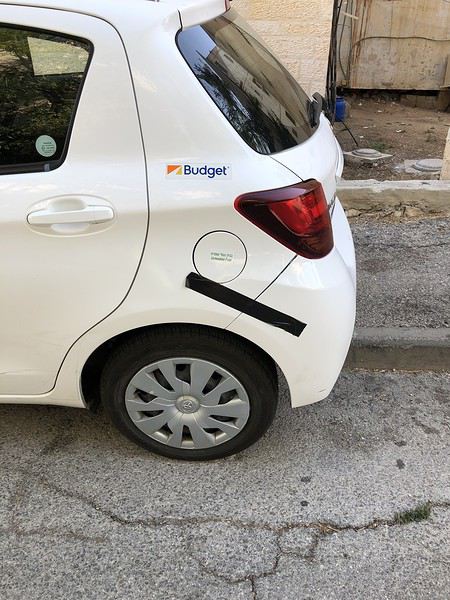
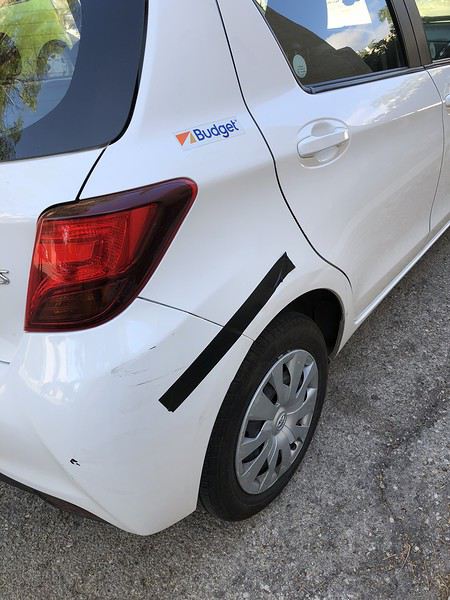
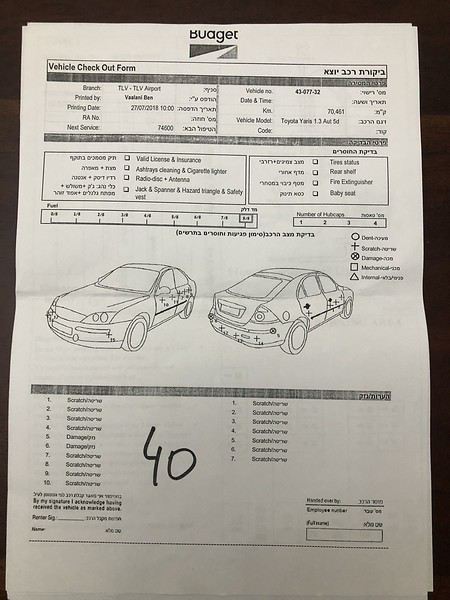
Le dimanche, j'irai au bureau Budget situé king david street pour réclamer. Le gus regarde la voiture et me dit OK, c'est pas grave. en fait, il n'en a rien à secouer et continue son café. Dans la laps d'attente dans le bureau, je me prends un manche de 250 shekels (60 euros) pour stationnement illicite, sur le parking Budget. Le gars me dit, c'est pour vous !!
Donc je n'ose pas lui répondre en italien et je me barre. J'attends une réponse au courrier envoyé à mon retour. Sachant que Budget n'est qu'une filiale d'Avis....
Pour revenir à vendredi, sortie rapide de l'aéroport, on monte sur Jérusalem, un arrêt à l'épicerie du coin pour acheter de quoi manger un peu, un quart de pastèque au vendeur ambulant et roule ma poule pour l'appartement loué pour la semaine, quartier moshava germanit. Le chardonnay est déposé au frais, on pousse la clim et direction la douche car ça commence à sentir le fennec.
Demain est un autre jour.
De retour de Terre Promise (du 27/07 au 14/08), voici un carnet de vécu et de menus conseils éventuels pour le pauvre futur pèlerin.
Comme d'habitude, merci de ne pas commenter la situation politique locale, les errements des uns et des autres, le trop plein d'huile d'olive dans le houmous de ma'Hane yehuda ou l'absence de basilic dans les pâtes servies dans quelques restaurants locaux.
Ceci posé, voici donc les premiers éléments.
Le Vol :
El Al encore et toujours. Cette année, la résa du parking longue durée donnait lieu à une réduction sur le salon VIP. Pour 16 euros x 2, nous en avons profité, et c'est bien sympatoche de déjeuner à ce tarif.
Mais d'abord, départ des environs de Montpellier, deux heures de route pour Marseille Provence, les contrôles de sécurité, le lounge VIP et on embarque pour un take-off prévu à 10h30....pour un prévisionnel à 10h05. Le retard sera rattrapé en vol.
Les bagages :
deux valises 21 et 19 kilos (faut prévoir pour le retour); deux bagages cabines, un trés petit sac à dos et le sac à main de la patronne. Sièges achetés second rang derrière la classe affaire.
Le matos photos et informatique :
les iphones de circonstances avec waze et roaming pour les appels; Les ipads; un panasonic tz 101; et cette année, une caméra DJI Pro + ! on se lance dans la vidéo et c'est pas gagné !! Il y a du taf en perspective.
Le vol se passe bien, le breakfast est correct. Un peu de sommeil entre la Grèce et Israël et l'avion se pose à l'heure prévue soit 14h30 France et 15h30 locale. C'est Vendredi, donc il faut se bouger un peu.
Nous sommes parqués à l'autre bout du tarmac de l’aéroport et l'entrée se fera en bus.
Passage aux contrôles sans problèmes et toujours avec le sourire des portes de prisons des jeunes filles dans leurs cabines.
Pour les bagages, si vous prenez un chariot, il faut insérer votre carte bancaire pour payer 10 shekels et récupérer le caddie. Ne pas oublier de faire la manip inverse lorsque vous quittez l'aéroport.
Nous arrivons au second niveau pour la voiture. Encore cette année Budget.... Cela risque d'être la fin avec cette bande d'escrocs.
Voiture réservée et payée. Jamais de soucis avec eux. Et ça commence bien !! Je regard la fiche de contrôle de la voiture, elle est pleine de croix de marquage de coups ! Je m’inquiète !
Dont worry ! No problem for you !
OK. Kilométres ?
Just 7500...
OK.
Je prends les clés et nous descendons au parking. Et là, la poubelle nous attends. Une merde de chez merde. Le kilométrage affiché est de 75 000 kilomètres...
Le dimanche, j'irai au bureau Budget situé king david street pour réclamer. Le gus regarde la voiture et me dit OK, c'est pas grave. en fait, il n'en a rien à secouer et continue son café. Dans la laps d'attente dans le bureau, je me prends un manche de 250 shekels (60 euros) pour stationnement illicite, sur le parking Budget. Le gars me dit, c'est pour vous !!
Donc je n'ose pas lui répondre en italien et je me barre. J'attends une réponse au courrier envoyé à mon retour. Sachant que Budget n'est qu'une filiale d'Avis....
Pour revenir à vendredi, sortie rapide de l'aéroport, on monte sur Jérusalem, un arrêt à l'épicerie du coin pour acheter de quoi manger un peu, un quart de pastèque au vendeur ambulant et roule ma poule pour l'appartement loué pour la semaine, quartier moshava germanit. Le chardonnay est déposé au frais, on pousse la clim et direction la douche car ça commence à sentir le fennec.
Demain est un autre jour.
Vos coups de coeur à New York English translation pending
Bonjour, nous partons à new york 5 jours en septembre. Nous nous renseignons sur les brochures mais si vous pouvez nous dire vos coups de coeurs et ce qu'il ne faut absolument pas manquer
Merci
Gorilles et chimpanzés en Ouganda: qualité / prix English translation pending
Bonjour a tous!
Actuellement en tour du monde, je prepare mon sejour en Ouganda en septembre prochain.
Je me rends en Ouganda en solo (j'ai 25 ans), et ma tante vient me rejoindre environ a la moitie de mon parcours dans le pays afin d'aller voir les gorilles avec moi. Elle ne sera la que pour une semaine.
Je me suis deja bien renseignee sur les prix des permis pour aller voir les gorilles (600$), et il semblerait que le tarif minimum pour une formule trek proposee par une agence soit d'environ 1500$ pour 5 jours. tres cher pour mon budget de backpackeuse au long cours! Je savais que ce ne serait pas donne, mais je ne m'etais pas rendue compte de l'ampleur des couts...
Ma question est la suivante: ce prix est il vraiment le prix a payer pour voir les gorilles, ou y a t il une alternative moins onereuse? Selon vous, quel est le meilleur rapport qualite prix?
Avez vous des bons plans a partager? Un organisme, une agence que vous avez trouve(e) particulierement bien?
Par ailleurs, je serai en Ouganda pour environ 3 semaines, et je cherche ce que je ferai le reste du temps. Donc si vous avez des idees de bons plans caches, d'activites extraordinaires (et pas cheres, pour rattraper le prix des gorilles...), etc, je suis preneuse! J'aime voyager simplement, dans les transprts locaux, pensions basiques, a la decouverte des endroits non touristiques ou je pourrai vivre des aventures un peu a l'abri des sentiers battus et rencontrer des locaux. J'aime la nature, la culture, la bonne cuisine, mais avant toutt: l'AUTHENTICITE!
Merci d'avance a ceux qui auront la gentillesse de me repondre :)
Au plaisir de vous lire!
Hanae