Results for "escalade+|+128"
10413 results found.
Transsibérien Moscou-Pékin: obtention des visas English translation pending
salut
Je dois me rendre chez un ami à Taian en Chine ( 500 kms de Pékin)
Je ferais la liaison Paris-Moscou par autocar
Ensuite, je souhaite emprunter le transsibérien Moscou-Pékin
Le but de mon voyage n’est pas pour l'instant de faire des stops en divers endroits, mais d’enquiller d’une traite les 9000 kms qui mènent à Pékin
J’ai déjà pas mal voyagé en Europe, mais je ne suis pas familier des procédures de visa Première question d’ingénu : lorsqu’on ne séjourne pas dans un pays, mais que l’on se contente de le traverser en quelques heures ou quelques jours quelque soit le moyen de transport, doit-on tout autant se munir d’un visa ? est-ce ce que l’on appelle le « visa de transit » ? 2eme question : de France, à combien s’élèvent environ les frais de visa si l’on cumule le visa pour entrer en Biélorussie vers Moscou, le visa russe, le visa mongol, et enfin le visa chinois ? il me semble qu’il existe la possibilité de prendre un visa à l’arrivée à la frontière mongole, non ? 3eme question : les délais d’obtention sont-ils longs ? y’a-t-il des difficultés d’obtention particulières, je pense surtout au visa russe ? 4eme question : où et comment acheter son billet transsibérien à Moscou ? Moscou-Irkoutsk, puis Irkoutsk-Pékin, c’est ça ? le fait de ne parler que l’anglais, et pas un mot de russe, peut-il poser problème ? combien y’a t-il de départ hebdomadaire à partir de Moscou ?
bon je sais, toutes ces questions, c’est un peu lourd mes amis... merci de votre aide
à bientôt
Land of smiles... Thaïlande English translation pending
Sawat Dee Kha !
Debut du voyage : Prendre le bus, c'est facile !
On arrive tant bien que mal (tant bien que mal fait partie d'une autre histoire !) a la gare routiere Nord-Nord-Est de Bangkok. Objectif "Khorat" (qui s'appelle aussi Nakhon Ratchasima, mais bon, on va choisir le nom le plus simple!).
Un panneau Nord-Est au troisieme etage. Ca commence facile. On grimpe, on debouche dans une immense salle et la... le debut du cauchemar !
Un hall interminable, des guichets et des guichets et des guichets a n'en plus finir dans les quatre directions. Des gens qui attendent patiemment au centre, charges de sacs et de paquets.
Et alors?
Ben, sur les guichets, comme dans toute gare qui se respecte, y'a les destinations, les prix, les horaires. Nous on veut aller a Khorat, rien de bien complique. Oui, mais imagine, les guichets, avec les petites fenetres, les bonhommes derriere le comptoir, les inscriptions en haut.
Imagine maintenant, au lieu des bons vieux caracteres latins si durement appris et gribouilles en classe, au lieu des A bien droits et des Z bien pointus…
Imagine des lettres toutes en rondeurs, toutes en courbes, avec des symboles au dessus (les voyelles), des mots longs comme ca, qui n'arrivent pas a accrocher nos yeux…
Oui, mais nous on veut aller a Khorat !
Alors, armee de sa patience legendaire, et d'un guide papier a tout faire, la blonde aventuriere ouvre le Lonely a la bonne page, il est bien ce guide, les villes sont aussi ecrites en Thai. Et commence l'essai de comparer le gribouillis sur le premier guichet avec le gribouillis sur le livre. Il y a au moins une cinquantaine de guichets, et les gribouillis sur le livre ne veulent pas s'imprimer sur les yeux !
Bon, on ne va pas y arriver comme ca! Comme McGyver, sortons le couteau-suisse numero deux.
Direction le bureau des renseignements.
"Bonjour on voudrait aller a Khorat, svp" (en version originale ca donnerait quelque chose comme : "Sawat Dee Kha, we'll like to go to Khorat please", par commodite de lecture, tous les dialogues qui vont suivre seront donnes en VF).
"ou?"
"Khorat"
"Ah Khorat, c'est juste la-bas" (vous l'aurez compris, notre accent thai n'est pas encore au point en ce premier jour de vadrouille ! mais au bout de 3 semaines, je peux vous assurer que tout le monde comprend mon Khorat !)
Apres, ce n'est que transaction financiere, optimisation du trajet jusqu'au car, gestion des bagages, selection de la place libre et adequate...
Mission numero 1 accomplie sans emcombre ! Trop facile la Thailande !...
Mais ce n'est point assez d'adversite pour cette premiere escapade. Le deuxieme objectif du jour, si vous le voulez bien (autrement vous finirez maillons faible-au revoir !), est une petite ville qui ne presente peu d'interet en elle meme sinon de se trouver non loin d'un certain temple Khmer construit du Xeme au XIII eme siecle, epoque des grandeurs d'Angkor Vat au Cambodge.
Cette ville, Nang-Rong, se trouve au milieu de la ligne de bus Khorat - Buriram.
Deja a Khorat, on a pige le truc et les locaux aussi ! A peine sorties du bus de Bangkok, les gens nous demandent ou on veut aller et nous montrent en deux temps trois mouvement le bus adequat. Avec le sourire, tout va !
La on se sent vraiment en Asie. Autant le premier bus avait encore des airs de modernite, si peu different des criteres occidentaux et meme equipe d'une climatisation, autant ce deuxieme bus nous renvoie a ce que nous cherchons, tout backpacker que nous sommes. Un truc sur 4 roues, tout rouge-orange pour etre repere au milieu de la route en cas de panne, des sieges a moitie instables pour deux personnes selon les normes europeennes, trois personnes selon les normes thaies. Et des ventillos au dessus de nos tetes, qui ne manquent de nous decapiter a chaque fois qu'on se leve.
Le peuple voyageur n'est plus le meme. Des petits vieux charges de victuailles qui rentrent dans leur campagne, des jeunes de retour dans leur famille...
15 minutes pour parcourir le premier kilometre, entre les escales pour recuperer des voyageurs et les escales pour faire descendre les vendeurs ambulant de nourriture plus ou moins bizarre. Le bus est deja plein, tous les sieges sont occupes de 2 ou 3 personnes. Nos sacs a dos sont caches par des caisses, des valises et meme un velo.
Et nous partons, au travers des campagne, les rizieres, les villages, les gens a pied ou a velo. Une personne au bout du chemin, le bus stoppe, et que les gens montent et que les gens descendent. Si si y'a toujours de la place, juste 2 personnes debout.
Et Nang-Rong dans tout ca? On ne sait pas ou c'est et quand le bus va s'arreter. Comme l'arret est au milieu du trajet, on ne sait pas trop quand il faut descendre.
L'aventuriere blonde (toujours elle !), repart a l'attaque, toujours armee de son livre (trop bien le Lonely, non non, je n'ai pas d'action chez eux!) et traverse toute l'allee centrale encore peu encombree pour demander a la vieille dame qui vend les tickets de nous indiquer quand nous arriverons a Nang-Rong.
Rien a faire, primo Nang-Rong, c'est encore plus difficile a prononcer que Khorat. Et deuxio, la seule phrase que je connais en thai c'est "Nam Plao Song Kha" (quelque chose comme "2 bouteilles d'eau svp"), et la dame ne parle pas anglais. Je lui montre donc mon guide pour lui montrer Nang-Rong, mais elle ne sait pas lire les caracteres latins (et manque de bol, Nang-Rong n'etait pas ecrit en thai dans mon guide - va falloir que je me plaigne a l'auteur!).
Bon, tant pis, rebrousse chemin pour cogiter un peu. A chaque embranchement, on essaye de lire les panneaux -heureusement ecris en thai et caractere latin- pour se reperer sur la carte.
Le bus s'arrete a cote d'une ecole, 20 collegiens et collegiennes (au moins!) qui veulent monter. Venez, venez donc, il y a de la place. Et que tout le monde se serre, et que l'allee se remplisse (et je n'ose imaginer l'etat des roues et des amortisseurs avec cette charge).
Les ecoliers sont tous en uniforme, chemisier blanc, violet, vert, bleu ou rouge...
Et nous, toujours a nous demander comment descendre a Nang-Rong. Mais, que voyons-nous dans l'allee, parmis ces sourires, ces cartables, ces uniformes?... Un dictionaire Thai-Anglais ainsi que sa jeune proprietaire. Je pense qu'elle a du regretter avoir tenu ce dictionaire a la main, car la voila harcelee par deux jeunes farangs qui commencent a lui parler dans la langue de Shakespeare que apparement elle ne maitrise par encore. On essaye desesperement de lui expliquer notre probleme dantesque : on veut juste savoir quand descendre, on veut Nang-Rong! Quand apres 10 minutes d'english nous voyons que nous l'embarrassons plus que tout autre chose, nous capitulons une derniere fois.
Mais comme l'a si bien dit le general, nous avons perdu une bataille mais pas la guerre.
Il y a encore des gens dans le bus qui ne savent pas que nous voulons descendre a Nang-Rong.
Nous demandons donc a tous nos voisins et aux voisins des voisins, jeunes, vieux qui dort sur l'epaule de Sophie, femme avec son bebe, couple...Nang-Rong, Nang-Rong, Nang-Rong!
Et quand la terre promise enfin arrive, ou plutot la petite gare routiere de Nang-Rong, tout le bus (ou presque) se tourne vers nous pour nous dire que c'est ici la fin de notre premier vrai periple au pays de Siam. Ils s'en souviendront un bon moment, ces voyageurs locaux, des deux tetes blondes de Nang-Rong !
Amazing Thailand : A travers la campagne et le temple de Phanom Rung.
Pour aller au temple khmer de Phanom Rung (autrement que par une moto de location), il faut tout d’abord prendre un bus pour 10 km a la gare routiere de Nang-Rong, puis normalement des songtaews (taxi collectifs) conduisent au sommet du volcan pour 20 baths par personne.
Point de songtaews a la descente du bus, mais un moto-taxi qui n’a rien d’autre a faire que de tourner autour des deux seules voyageuses du coin.
« 100 bath aller-retour par personne, j’en conduis une puis je viens chercher l’autre »
« non merci »
re-discours du chauffeur, mot pour mot
« non merci, on attend le songtaew »
« pas de songtaew ici, que le week-end (on etait mardi)… Je vous fais 80 baths par personne, 40 pour aller, 40 pour revenir »
« non merci »
Que fait-on ? On attend ? On bouge parce qu’il commence a m’enerver le chauffeur, surtout qu’en voila un deuxieme qui rapplique ! Ok, on bouge !
Et nous voila de commencer a marcher. Le temple n’est que a 8km, il est 11h sous le soleil, ce n’est pas ca qui va effrayer les deux randonneuses que nous sommes.
Et comme pour retribuer notre courage, a peine parties, voila un songtaew qui arrive. On demande Phanom Rung, 20 baths, le chauffeur dit ok (on paye a la fin dans ces vehicules). Deux femmes sont deja a l’interieur, une des femmes a un bebe, qu’elle nous montre et qu’elle nous demande de faire coucou au bambin, et que nous faisons des sourires et des pseudo-grimaces…
3 kilometres plus loin, les deux femmes descendent. Et 5 minutes plus tard, juste avant la montee de la colline, voila le taxi qui s’arrete.
Le chauffeur : « 20 baths jusqu’ici, 100 baths pour monter au Phanom Rung ». Et nous de discuter, de refuser de se faire avoir, rien a faire, c’est le seul taxi, nous sommes les seuls touristes... La loi du marche ou plutot la loi de la jungle! Peu nous importe, nous voulions aller a pied, nous irons a pied, que diantre !!
Nous voila donc a l’assaut de la montagne, euh de la colline (le sommet est quand meme a 383 m !). Un kilometre a pied, ca use, ca use… Nous croisons un troupeau de buffles, puis une famille qui apporte des offrandes sur un autel au bord de la route, echanges de wai (salutations mains jointes) et de sourires. Scenes de vie, scenes de joie.
Ca commence a bien grimper, le soleil cogne, la bouteille d’eau passe de main en main.
Soudain un pick-up s’arrete. « Bonjour, on voudrait aller au Phanom Rung ». Et nous voici, a l’avant avec un conducteur que nous ne connaissons pas et qui ne nous demande rien. Il nous laissera devant le temple et refusera meme l’argent que nous voulions lui laisser en dedommagement. Quel contraste avec le chauffeur de la moto et le taxi 30 minutes plus tot.
L’entree dans le temple de Prasat Hin Khao Phanom Rung (« sanctuaire en pierre en haut de la grande colline »), se fait en longeant une longue allee dallee puis en franchissant trois ponts gardes de terribles nagas (serpents a 5 ou 7 tetes). A l’origine un monument hindou, le temple est couvert de sculpture en pierres de Vishnu et autres Shiva. Autant l’exterieur est incroyablement charge, de scenes de vie, de motifs floraux, de personnages epiques, autant l’interieur est petit et sobre. Les lieux respirent le calme et la serenite de la foret alentour.
Pour le retour, n’ayant marche que 1 ou 2 kilometres a l’aller, nous decidons de faire les 8 km jusqu’au bus a pied. Nous avons le temps, nous avons besoin de nous degourdir les jambes apres une journee entiere de bus, nous voulons profiter du paysage…
Nous voila donc gaiement sur les chemins, a travers la foret de Thailande. Et tres vite, les gens nous klaxonnent allegrement, etonnes de voir deux blanches a pied dans la campagne. Les motos nous doublent, les conducteurs se retournent, manquant finir dans le paysage. Et nous tout sourire, de descendre joyeusement le long de la route. Une voiture qui s’arrete propose nous emmener. Nous refusons gentiment et expliquons que nous voulons marcher. Une moto a present, merci bien, on continue a pied. La campagne est belle, paree d’un habit d’or, decoree de colliers verts, entouree d’un ciel bleu. Un etal au bord de la route propose des petites bananes, cela va nous tenir compagnie sur le chemin. En passant devant une ecole, des garcons assis sur un mur, nous lancent «I like banana », nous leur repondons « you want banana ? » et tout le monde se met a rire a cœur joie. Voici maintenant un groupe de jeunes a moto, eux devant, elles derriere. Que ne font-ils pas les garcons thais pour prendre en stop des occidentales ? Tout simplement demander a leur copines de descendre de moto et de laisser place ! Si si si ! Mais a pied nous continuons inlassablement. Et a se faire accoster, et a refuser les innombrables offres, et a rigoler avec les motards qui se retournent dangereusement, et a sourire a tout les enfants le long de la route, le chemin est trop court, l’arrivee deja approche, les moment de fous-rires toutes les deux au milieu de la campagne trop vite s’achevent.
De cette journee a Phanom Rung, curieusement, nous nous rappelons beaucoup plus cette escapade au milieu de la nature et de la population de ce coin de Thailande, que le temple Khmer, qui vaut quand meme largement le detour (ou les 8 km a pied !) pour sa beaute et son charme.
Fin du voyage : Prendre le bus, c'est toujours facile
On pensait avoir tout fait en terme de transport, bus de toutes les sortes (VIP avec rideaux en dentelle rose et boisson gratuite toutes les 3 minutes, bus avec clim ou avec ventilo, bus a la traine dans les routes de montagne, bus deglinge tenant encore debout par miracle), train couchette a l'ambiance de colonie de vacances, songtaew (camionette-taxis), tuk-tuk (taxi a 3 roues) et meme elephant (ca bouge vraiment beaucoup quand on est assis derriere la tete !) et bamboo rafting, sans oublier nos inusables pieds.
On croyait etre rodes dans la gestion des destinations, ou comment reussir a monter dans le bon bus en ne comprenant rien a l'ecriture thaie.
Mais une derniere epreuve nous attendait !
Les bus publics de Bangkok !!
Simple comme Sawat Dee Kah diriez vous !
Detrompez vous, le cauchemar recommence !
Operation numero 1 : trouver le bon bus, tirer le bon numero quoi ! Pas de plan, pas d'itineraire, pas d'indication, tout juste si on trouve les arrets le long de la route !
Les bus s'arretent a peine, juste le temps pour les voyageurs d'enjamber le marche pied avant de se faire happer par la bete.
Si une fois on arrive a trouver le temps de parler au chauffeur ou a la personne qui encaisse les 3 ou 10 baths de service, ceux-ci ne comprennent ou font semblant de ne pas comprendre l'anglais.
Nous voila donc coinces au sud de Bangkok, de retour de pelerinage. Nous voulons juste aller dans le centre, ou arriver a cote d'une station de skytrain (metro aerien). Rien de bien sorcier !
Et pourtant, un bus, deux bus, trois bus, ...10 bus. Tiens, ce numero la est deja passe il y a 10 minutes, 12 bus, 14 bus (c'est comme compter les moutons ca!)
Bon, passons a l'attaque, lancons la grande offensive.. ouvrons le guide ! ;-)
Manque de bol, il ne dit rien, il est devenu muet, aphone, epuise par 3 semaines de vadrouille dans tous les coins du pays...
Mais le guide a une aura benefique, voila qu'une jeune fille s'approche de nous et nous demande ou nous voulons aller. Bangkok Noi please. Elle ne sait pas trop comment y aller (ce n'est pas direct de l'endroit ou nous sommes), et la voila qui demande a une autre inconnue qui attend elle aussi a l'arret. Et toutes les deux, de discuter, de selectionner les bons numeros et les bons arrets.
Nous voici donc avec un bout de papier, 3 numeros dessus, un arret ecrit en thai et en anglais. Avec ca, nous sommes pares et arriverons a bon port.
Que la gentillesse, et la spontaneite des thais m'enchanteront toujours !!
Et d'autres souvenirs de bus, a Bangkok toujours, comme cette dame qui s'assied a cote de moi et me demande "where from" (une des questions favorite la-bas !). De lui repondre que je suis francaise et elle de me dire qu'elle parle allemand ! Mais vous avez de la chance ! Roger a cote de moi est suisse-allemand ! Et les voila engage dans une conversation que je ne decrypte pas, et moi d'y mettre mon grain de sel en anglais.... Vive le monde !
Et Land of Smiles, c'est aussi : "of temples and monks" : des temples partout, en bois ou en pierres, art deco ou art lanna, couverts d'or ou de mosaiques, sobres ou plein de scupltures.. Des moines aussi, cranes razes, tenues ocre/jaune reconnaissables de loin. Et nous les femmes qui devont nous ecarter sur la route pour eviter de les toucher. du ble ou du riz? Des rizieres assechees, des champs jaunes paille, des epis coupes a la faucille et entoures de ficelles, pour ensuite etre battus au sol pour separer le riz de l'ivraie. Pas vraiment l'image que nous avons des rizieres humides, des epis tout vert et des buffles qui labourent paisiblement. des karens, des lissus, des lazus, des chinois... Tribus des montagnes, magies des couleurs. Tuniques noires, rouges, bleues. Villages perdus au creux de la vallee, cabanes de bamboo et de bois, salles de bain sous les cascades. faire ses achats en bateau, au milieu des klongs (canaux) de Damnoen Sadduak. Un marche flottant, des femmes en bleu coiffees de leur chapeau de paille, sur des freles embarcations chargees de victuailles. et encore en vrac: Loy Kratong- la fete de la lumiere-, les bouddhas dans toutes les positions, des marches ou on trouve de tout et surtout a manger pour pas cher des tom kha kai, tom yam kung ou pad thai, le monde qui est surpris de nous voir baragouiner 2 mots de thai, un spectacle de danses traditionnelles by night devant le temple de Prasat Hin Phimai, des long boats au milieu de la riviere, un vieux monsieur qui discute avec nous pendant 1 heure pendant que nous savourons un the dans sa boutique... et tant de chose dans la tete, images eternelles mais qui ne peuvent s'exprimer avec nos si pauvres mots.
Et Land of Smiles (le surnom de la Thailande), c'est surtout et avant tout, les sourires et la generosite de ses habitants. Que je desire a present prolonger cette pleniture, d'avoir pendant 20 jours, toujours eu chaud au coeur.
Jungle au Mexique English translation pending
Bonjour
Nous partons 3 semaines parcourir le Yucatan à Noel et souhaitons passer 1 semaine dans la jungle. Quelqu'un a t"il deja fait ca ? Avez vous des references d'agence ou de guide sur place ? Merci d'avance.
Sô
Nous partons 3 semaines parcourir le Yucatan à Noel et souhaitons passer 1 semaine dans la jungle. Quelqu'un a t"il deja fait ca ? Avez vous des references d'agence ou de guide sur place ? Merci d'avance.
Sô
Donne infos sur Barcelone English translation pending
Cela fait deux ans que j'habite a Barcelona et je trouve cet ville genial.
Si ca te dit et que tu as des questions n'hesite pas a me les poser.
😛
Si ca te dit et que tu as des questions n'hesite pas a me les poser.
😛
Hôtel Melia Caribe Tropical avec la Fram ou autre TO? English translation pending
Nous comptons visiter la RD en mai 2004 et envisageons de partir avec Fram, 1 semaine en circuit et une semaine au mélia caribe tropical.
Si vous avez des info des conseils ou le nom d'un autre tour operateur proposant la même formule nous sommes preneurs.
Merci d'avance.
Avons des renseignements sur le xpu-ha riviera maya au mexique
Si vous avez des info des conseils ou le nom d'un autre tour operateur proposant la même formule nous sommes preneurs.
Merci d'avance.
Avons des renseignements sur le xpu-ha riviera maya au mexique
Itinéraire en Thaïlande? English translation pending
Bonjour!
Je suis en train de plannifier mon voyage en Thailande pour l'an prochain, mais j'aurais besoin de votre avis. 🙂 J'ai l'intention d'arriver à Bangkok et de monter jusqu'à Chang Mai en train (ou autobus), mais avez-vous des suggestions de villes intéressantes que je pourrais visiter entre ces deux destinations?
De plus, j'ai l'intention de séjourner sur une île à la fin de ce périple et je suis encore embêtée à savoir laquelle que je devrais choisir. Koh Tarutao, Koh Phangan ou Koh Phi Phi.... Laquelle me suggérez-vous? Ou, si vous avez d'autres idées...
Un gros merci!
Mari
Etat des route et faisabilité Bangkok-Siam Reap? English translation pending
Par la route . est ce que quelqu'un a une idée de la faisabilité.
L'état des routes et la sécurité. Peut on loué une voiture jusqu'a la frontiere.
Le train, est ce une solution adoc ?
Merci de me répondre si vous avez une petite idée
Mon voyage en Egypte en avril 2000 English translation pending
Vacances de pâques, avril 2000.
Tout d'abord une semaine de croisière. Nous étions un groupe de 20 personnes.
En attendant le passage de l'écluse d'Esna, nous avons été distraits par des vendeurs en barques qui s'arrêtent le long des bateaux de touristes et envoient leur marchandise (nappes et djellabas) par-dessus bord. Original...
Première visite pour le temple de Philae à Assouan. Ah ! Belle Isis, que ton destin fut tragique mais grandiose ! Notre guide nous a raconté son histoire grâce à un petit jeu de rôle.
Passage par le haut barrage - impressionnant ! et par la carrière où gît toujours l'obélisque inachevé d'Hatshepsout . Bizarre de se dire qu'il y a 3500 ans qu'il existe et de penser aux ouvriers qui se sont échinés longtemps pour rien, que dalle !
Après-midi, départ en felouque pour la visite du jardin botanique de l'île Kitchener, escortés par des enfants en barquette propulsée à force d'huile de bras, qui nous chantent" Il était un petit navire" et se réjouissent de recevoir quelques bics en cadeau...
Lendemain petit matin, départ en avion pour le site d'Abou Simbel. Tout simplement FABULEUX !!! Dans le grand temple, j'étais carrément 3250 ans en arrière, sur les traces de Ramsès et sa chère Néfertari (elle a eu de la chance d'être aimée au point de se voir dédier un si beau temple...) Dire qu'ils ont été creusés à même la roche et 3200 ans plus tard, démontés en 1036 blocs et remontés 64 mètres plus haut...
Petit détour par la classique école de papyrus où l'on ne peut que se laisser tenter par une de ses créations que l'on pourrait croire d'époque pharaonique.
Profitons du soleil sur le bateau pendant que l'on nous conduit à Kom Ombo où l'on visite le temple à la tombée de la nuit. Je crois que c'est le seul temple double : 2 divinités - Sobek et Haroeris - salle d'attente pour la visite du peuple au prêtre-médecin de l'époque et ses momies de crocodiles.
Sur le bateau, soirée djellaba et dans les cabines, les stewards - tout le personnel est masculin - fabriquent des animaux à l'aide de serviettes de bain (crocodiles, singes etc)... super bien fait !
Départ en calèche pour le temple d'Edfou dédié à Horus, un des temples les mieux conservés car longtemps enfoui dans le sable.
Ensuite navigation vers Esna où l'on visite le temple de Khnoum qui a gardé quelques jolies couleurs.
Enfin LOUXOR et ses merveilles : Karnak (visite de jour et son et lumière le soir comme à Philae) où l'on se sent tout petit au milieu de la salle hypostyle avec ses 134 colonnes de 23 mètres, l'obélisque d'Hatshepsout ma reine préférée, le scarabée d'Aménophis III autour duquel les célibataires doivent tourner 7 fois pour trouver l'âme soeur, le lac sacré, la chapelle blanche dédiée surtout à Amon Min. Escapade à la bijouterie Radwan pour acheter un ankh, un cartouche et autres babioles. Temple de Louxor où subsiste une partie du dromos (allée de sphinx qui jadis le reliait à Karnak) Musée de Louxor qui recèle de vrais trésors, notamment une tête d'Akhenaton devant laquelle je suis restée pantoise. Etre ainsi face à face avec ce drôle de pharaon... troublant...Cinq heures du mat pour éviter les grosses chaleurs, direction la vallée des rois (tombes de Ramsès III, IX et Aménophis II - indescriptibles je vous renvoie aux illustrations) ; très jolies aussi les tombes dans la vallée des artisans, près des ruines du village de Deir el Medineh, peut-être les plus colorées, ainsi que la vallée des reines. Malheureusement, personne n'allait voir Néfertari et nous nous sommes seulement arrêtés devant le temple d'Hatshepsout sans le visiter. D'après notre guide, il est très abîmé à l'intérieur. Temple de millions d'années de Ramsès III à Medinet Abou et salutations aux colosses de Memnon ont clôturé cette croisière puis nous avons quitté le groupe.Repos bien mérité à l'hôtel Mövenpick sur l'île du crocodile à Louxor. Au bord du Nil, petits bungalows disséminés dans un jardin luxuriant, super piscine, navette gratuite pour le centre ville, couchers de soleil imprenables... Le paradis pendant 3 jours... Changement de décor : mégalopole du Caire - mais une guide rien que pour nous : citadelle de Salah al Din, mosquée du sultan Hassan, visite trop rapide au musée (masque d'or du roi Tout bien sûr incontournable et très émouvant- le contenu de sa tombe occupe tout le premier étage - Akhenaton et Néfertiti, Aménophis III et Tiyi, Khephren...)
Pyramides de Gizeh avec leur gardien sphinx (impressionnant !). Je ne suis pas entrée dans la pyramide, j'ai préféré voir la barque solaire de Kheops découverte en 1955 (grandiose !).
Memphis et son colosse couché de Ramsès II (il est vraiment partout !)
Et pour terminer, la pyramide de Djoser et le temple de Saqqarah.
Malheureusement, les plus belles choses ont une fin - et c'est le coeur lourd que je suis rentrée en Belgique car j'ignore si j'aurai encore la chance de retourner là-bas... Tout ce que j'ai vu dépassait de loin mes espérances les plus folles. Les Egyptiens malgré leur relative misère sont très souriants, accueillants, jamais pots de colle, et paraissent plus heureux que nous.
Grâce à ce récit, j'ai pu un peu revivre 2 semaines idylliques. J'espère que la longueur de mon message ne vous a paru rébarbative et que ceux qui ont déjà visité l'Egypte ont pu retrouver des souvenirs ; quant à ceux qui n'y sont pas encore allés, ils puissent avoir eu un avant-goût de cette superbe aventure qu'ils vivront peut-être un jour.
Distances au Mexique English translation pending
Ola a todos !
Je pars au Mexique en juillet pour un tour en voiture de loc. J'ai un peu du mal à estimer les distances. Sur le net j'ai vu qu'il fallait 7 heures pour Villahermosa / San Cristobal de las casas (alors qu'il n'y a que 300 km !!😮😕) ; idem pour Campeche / Villahermosa ; ou bien 4 heures pour faire San Cristobal / Palenque. Les durées me paraissent hallucinantes !! Quelques peut-il me donner des infos (confirmation ou pas ...)
Merci a tous
Croisière sur le Nil: vos conseils English translation pending
je souhaite vite faire une croisière sur le Nil. Pouvez vous me donner quelques conseils pour profiter de ce merveilleux voyage en perspective: 4 ou 5 *, tour opérator, tarif, visites a ne pas rater, agence qui offrent le meilleur rapport qualité prix....Merci.
Merci English translation pending
Ce site est une merveilleuse découverte. Je l'ai souvent consulté sans oser m'y inscrire mais je tenais juste à vous dire que vous faites un excellent boulot!
Je ne suis pas vraiment une voyageuse, enfin pas encore... En fait si, mais pas une backpacker. Quand je lis ce que des "jeunes" de mon age ont déjà entrepris, j'en suis envieuse. Réaliser un tel reve semble si simple et en fait non. On sort des sentiers battus car nos priorités ne rentrent pas dans le cadre "métro-boulot-dodo", nos proches ne comprennent pas "la folie qui nous prend", ce n'est qu'un "caprice de jeunesse" et n'attendent de vous que l'échec, de rentrer dans les rangs.
Je ne cherche pas à me plaindre ni à juger ceux qui me jugent. C'est juste parfois un peu dur et c'est pour ca que ce site est une aide. Merci d'etre comme vous etes, la motivation vient avec cette impression que tout est possible quand on y croit vraiment. Et j'y crois.
Feasibility of Japan itinerary: Kyoto - Iya - Honshu
Hi there,
We’re arriving as a group of three in Tokyo on Saturday, October 17th, then heading straight to Kyoto by direct train. On Sunday and Monday, we’ll explore Kyoto, and in the evening, we’ll take a train to Osaka to spend the night. On Tuesday, we’ll pick up a rental car at Itami Airport for a 6-day/5-night road trip around Shikoku: - 2 nights in the Iya Valley - Thursday morning, we’ll head to Matsuyama for 2 nights. - Saturday, we’ll visit Mima (town, a few temples + overnight stay) and return on Sunday to drop off the car in Osaka. We’ll leave very early on Monday the 26th by plane for Aomori in northern Honshu, where we’ll pick up another rental car at the airport for a 5-day/4-night trip: - Day 1: Tsugaru Peninsula (Takayam Inari, Cape Tappi, Kanita); overnight in Kanita - Day 2: Ferry transfer to the Mutsu Peninsula (cliffs, Lake Usori); overnight in Shimofuro - Day 3: Head to the Hakkoda Mountains and onsens galore; overnight TBD - Day 4: Return the car in Aomori by noon and explore the city before taking the train to Tokyo in the evening We’ll spend Friday night in Tokyo, wander around on Saturday, and head home on Sunday.
Thoughts on the road feasibility of this trip? We’ll be there right in the middle of Koyo season, so it’ll be busy... I know it’s a lot of driving, but there are two of us who can take turns. We’re not afraid of driving, even in the mountains and on the left side! Just wondering, are we going to be rushing, or is this manageable? AI says it’s all good, but it’s not the one driving... Any tips for booking accommodations in the Iya Valley? Not many places have email addresses or websites (I know Booking.com exists, but not all listings are on there... and given the season, I think it’s better to book ahead!). Same question applies for northern Honshu. For the rental car, I’m thinking of going with Alamo since at least it’s in French and straightforward, but are there any direct rental companies with user-friendly websites (Toyota Rentacar, ugh... 🏴☠️)? Another question: With so many trains, is it even necessary to book them in advance? Can we just go to the ticket counter and grab seats on the spot? For paying for the rental car, do we need a credit or debit card?
Thanks for your help!
A little piece of Sulawesi with the family: Rantepao and Selayar
I’d been wanting to discover Sulawesi for years. But then life happened—COVID, the cost of flight tickets, you name it. Long story short, years went by, but we finally set off as a family for a three-week trip in southern Sulawesi: Rammang Rammang, Rantepao, Sengkang, Bira, and Selayar.
I like to spend a good amount of time in the places I visit, giving myself the chance to really get to know the area and meet locals. So no island-hopping this time—just the south. But when I say "just," it’s not restrictive at all, given how rich this island is in landscapes, little encounters, and magical moments.
Wednesday 07/08 - Thursday 07/09: We left Montpellier for what was supposed to be five flights, though we only took four to start, landing in Jakarta. We picked up our luggage there to catch a flight to Makassar the next day. That’s the only way we could get an affordable ticket (702 €). I won’t bore you with the flight details—there’s not much to say. We arrived at 7 PM and considered heading straight to Makassar that evening. But we opted for a recovery night before taking off again. Good thing we did, because my son’s suitcase was missing... First contact with the locals was a bit stressful—a trip without your luggage isn’t exactly fun. But right away, a woman reassured us: the suitcase was just enjoying some extra time in Singapore. Maybe it was doing some last-minute shopping. Anyway, nothing serious—it was supposed to arrive at 9 AM the next day. That gave us some breathing room since our flight wasn’t until noon. So off we went to our hotel (Days Hotel & Suites) near the airport. It was cheap (40 € for three rooms—my kids are older and need their space), but it wasn’t worth much more. The place had definitely seen better days. But no big deal—we were only there for the night, and... we got to watch France beat Morocco in the World Cup live at 3 AM. That’s what really mattered!
Friday 07/10: In search of the lost suitcase First challenge of the morning: finding our missing suitcase. They sent us to the airport basement, to the staff entrance. We were greeted with smiles, and an airport employee led me through the underground corridors back to the baggage claim. Right on time at 9 AM, the suitcase arrived, just like they’d promised. We were finally complete! Off we went to change terminals, grab a well-deserved meal, and board our fifth flight to Makassar. Little side note: I struggled for a while trying to book domestic flights directly on the airlines’ websites with no luck. Without meaning to advertise (though I guess I am a little), I realized it’d be easier to use sites like tiket.com or Traveloka. That turned out to be a great choice—I even ended up booking hotels through them later in the trip. 12:40 PM: We were on our way to Makassar. First good news: we were the only tourists. Well, the only European tourists on the flight, anyway. No, you’re not dreaming—the bag is full of... potato chip packets. To each their own souvenirs, I guess...
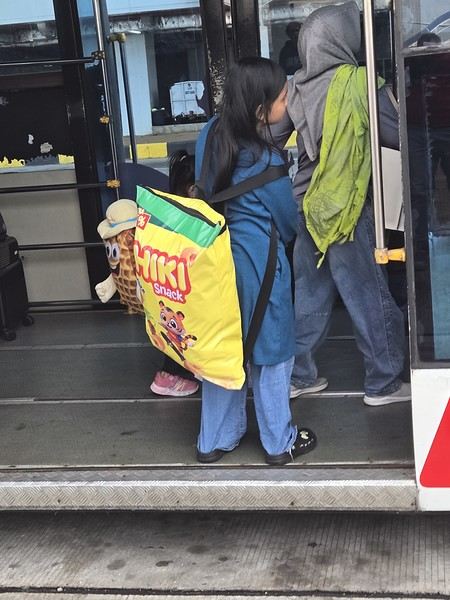
When we arrived in Makassar, a driver was waiting to take us straight to Rammang Rammang: 250,000 IDR (12 €) to our guesthouse (Rammang Rammang House). Forget about meeting people on the bus—we were headed straight to the first stop of our trip, and it was already stunning.
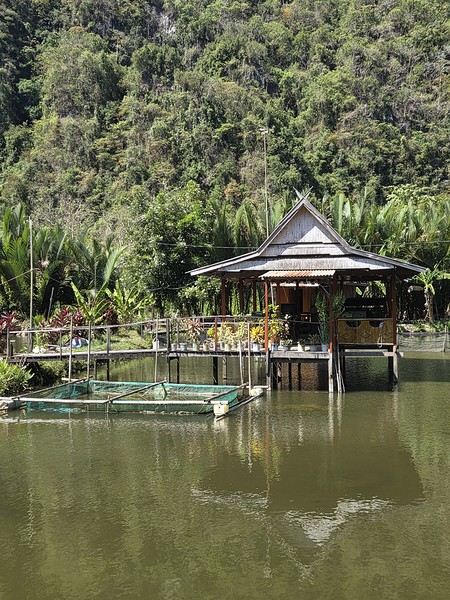
My kids’ guesthouse: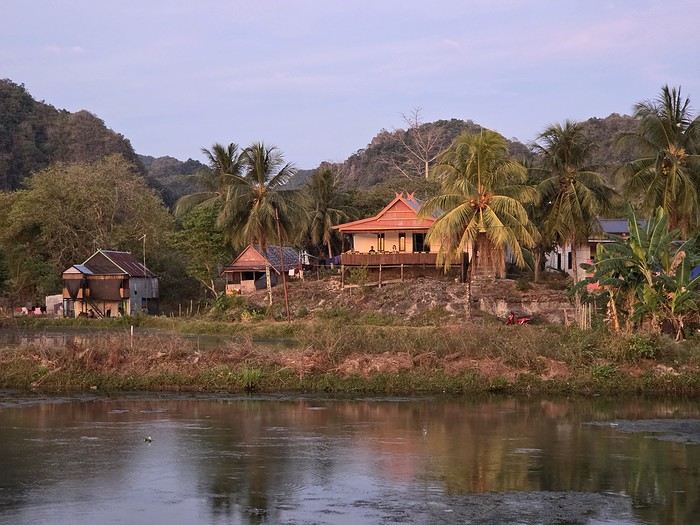
Ours: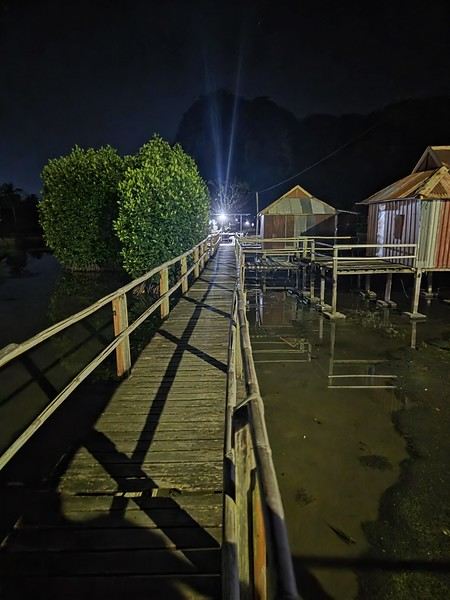
View of the little lake: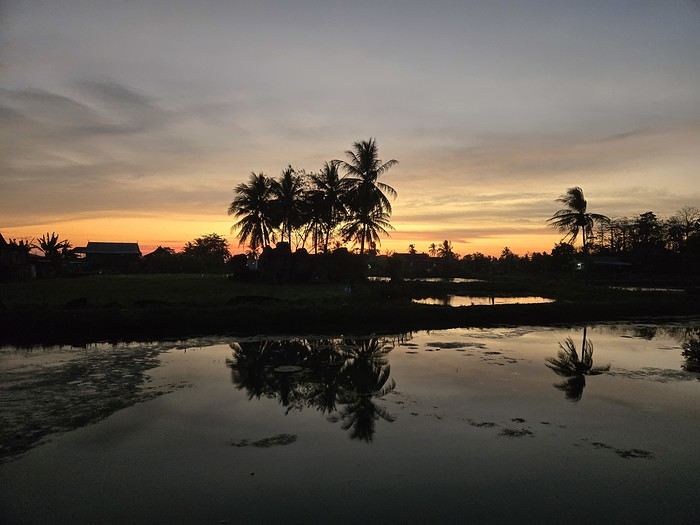
But not everything is straightforward around here. I wanted to get a local SIM card for internet and calls. I found them expensive at Jakarta’s airport (20 € for 20 GB), so I decided to wait. Well, no luck in Rammang Rammang either. You can’t just buy one from the local shop—you need a Telkomsat store (they have the best coverage). So we’d have to wait for Rantepao to get Wi-Fi... When I say "local shop," I mean the little shack around the corner. No big deal—we’d find one easily in Rantepao for 5 € and 25 GB. So there we were, offline, just the four of us enjoying the amazing view.
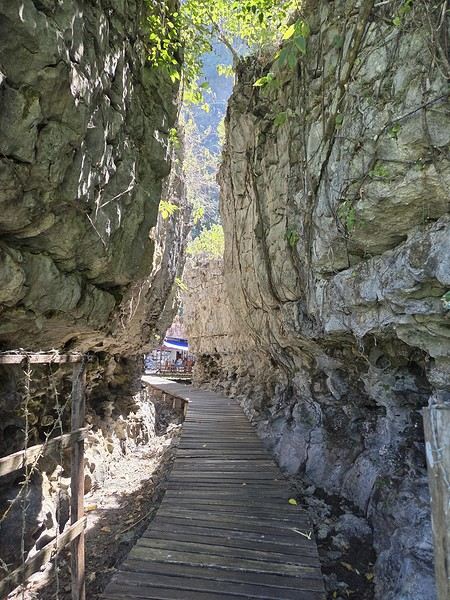
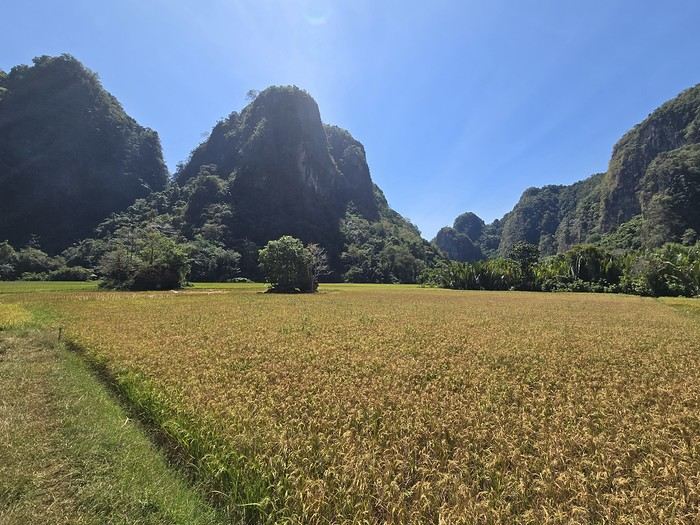
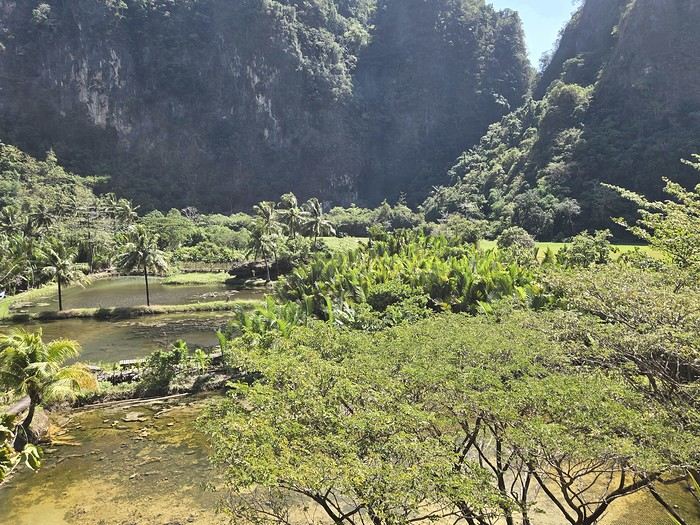
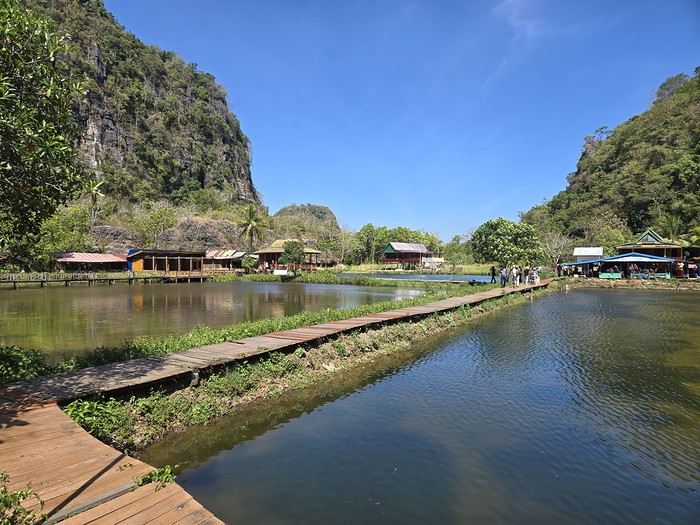
Saturday 07/11: Rammang Rammang We woke up early to the sound of wedding music blasting through the village (everyone’s invited!). Off we went to explore the area. A little walking, a little boat ride (shared with a French tourist and a Polish one—yes, there *are* tourists here, just not many; 750,000 IDR for up to 8 people) through a lovely canal, and we discovered the karst site. It was peaceful and beautiful. The river: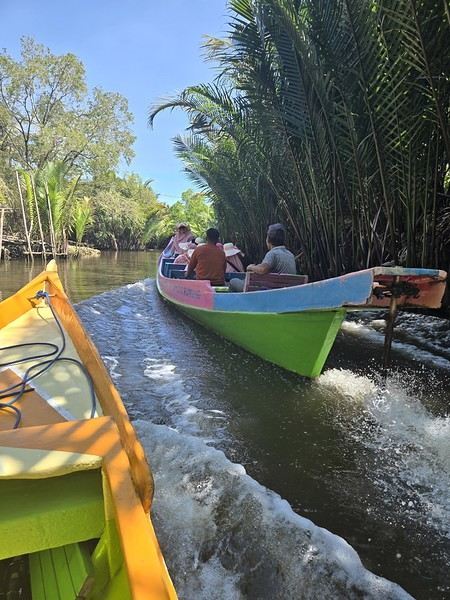 The karst site:
Wednesday 07/08 - Thursday 07/09: We left Montpellier for what was supposed to be five flights, though we only took four to start, landing in Jakarta. We picked up our luggage there to catch a flight to Makassar the next day. That’s the only way we could get an affordable ticket (702 €). I won’t bore you with the flight details—there’s not much to say. We arrived at 7 PM and considered heading straight to Makassar that evening. But we opted for a recovery night before taking off again. Good thing we did, because my son’s suitcase was missing... First contact with the locals was a bit stressful—a trip without your luggage isn’t exactly fun. But right away, a woman reassured us: the suitcase was just enjoying some extra time in Singapore. Maybe it was doing some last-minute shopping. Anyway, nothing serious—it was supposed to arrive at 9 AM the next day. That gave us some breathing room since our flight wasn’t until noon. So off we went to our hotel (Days Hotel & Suites) near the airport. It was cheap (40 € for three rooms—my kids are older and need their space), but it wasn’t worth much more. The place had definitely seen better days. But no big deal—we were only there for the night, and... we got to watch France beat Morocco in the World Cup live at 3 AM. That’s what really mattered!
Friday 07/10: In search of the lost suitcase First challenge of the morning: finding our missing suitcase. They sent us to the airport basement, to the staff entrance. We were greeted with smiles, and an airport employee led me through the underground corridors back to the baggage claim. Right on time at 9 AM, the suitcase arrived, just like they’d promised. We were finally complete! Off we went to change terminals, grab a well-deserved meal, and board our fifth flight to Makassar. Little side note: I struggled for a while trying to book domestic flights directly on the airlines’ websites with no luck. Without meaning to advertise (though I guess I am a little), I realized it’d be easier to use sites like tiket.com or Traveloka. That turned out to be a great choice—I even ended up booking hotels through them later in the trip. 12:40 PM: We were on our way to Makassar. First good news: we were the only tourists. Well, the only European tourists on the flight, anyway. No, you’re not dreaming—the bag is full of... potato chip packets. To each their own souvenirs, I guess...
When we arrived in Makassar, a driver was waiting to take us straight to Rammang Rammang: 250,000 IDR (12 €) to our guesthouse (Rammang Rammang House). Forget about meeting people on the bus—we were headed straight to the first stop of our trip, and it was already stunning.
My kids’ guesthouse:
Ours:
View of the little lake:
But not everything is straightforward around here. I wanted to get a local SIM card for internet and calls. I found them expensive at Jakarta’s airport (20 € for 20 GB), so I decided to wait. Well, no luck in Rammang Rammang either. You can’t just buy one from the local shop—you need a Telkomsat store (they have the best coverage). So we’d have to wait for Rantepao to get Wi-Fi... When I say "local shop," I mean the little shack around the corner. No big deal—we’d find one easily in Rantepao for 5 € and 25 GB. So there we were, offline, just the four of us enjoying the amazing view.
Saturday 07/11: Rammang Rammang We woke up early to the sound of wedding music blasting through the village (everyone’s invited!). Off we went to explore the area. A little walking, a little boat ride (shared with a French tourist and a Polish one—yes, there *are* tourists here, just not many; 750,000 IDR for up to 8 people) through a lovely canal, and we discovered the karst site. It was peaceful and beautiful. The river:
The karst site:
Two weeks in Cambodia solo after Christmas
Hi dear community,
I'm planning to visit Cambodia this winter, right after Christmas, for my first solo trip and my first trip to Asia. For two weeks (yes, I know it's short, but I really can't do more...). I have two main desires: Siem Reap and the countryside, the villages, the Mekong...
What do you think of this itinerary? Arrival in Siem Reap, departure from Phnom Penh.
SR: 5 days (1 day for arrival, 3 for the temples, 1 for the lake and its villages)
Kratie (stop on the way to Mondolkiri): 3 days (1 day of travel, 2 days there)
Mondolkiri/Sen Monorom: 4 days (1 day of travel, 1 day there, 2 days of treks)
PP: 3 days (1 day of travel, 2 days of sightseeing)
I think I need to cut one day somewhere if I travel from Saturday to Saturday or Sunday to Sunday. In Kratie, maybe? Or in PP? And I'll miss the boat trip that everyone recommends (SR-Battambang), but I don't see where to fit it in. Unless I do a PP-PP loop starting in the east, skip Kratie or just stay one night, then SR, then PP.
In my timing, Mondolkiri seems closer than Ratanakiri, which also tempted me a lot! Will it be too complicated alone? I'm thinking of using local guides or a small local agency for a nature and village getaway.
I've read that Siem Reap is very crowded between Christmas and New Year's. I could also do the circuit in the opposite direction. But I thought it would be easier to get familiar with the country by arriving in a touristy area—I might be wrong...
Thanks for your advice and opinions!
Off on an adventure in Réunion!
Week 1 - July 2026
Traveling with just one spare pair of underwear, considering a hot shower a miracle, never staying in the same place too long by sleeping wherever night catches us, taking whatever local, improbable, and rickety transport we can find—this is the DNA of us wanderers. Except this time, the script for our movie is going to be a whole different genre. On paper, the destination doesn’t exactly scream epic adventure: Réunion! And what’s more... we won’t be two, or four, or even ten. We’ll be a solid thirty. All from the same family. Yes, thirty. At this point, it’s not just a trip—it’s a summer camp on the move! Why inflict this on such a peaceful island? Because my brother decided to get married there with his lovely bride. A great idea, you might say... especially when it involves relocating the equivalent of a small Ardennes village 10,000 kilometers from home for three weeks! So who’s stepping up to be the guide and wave the little flag?
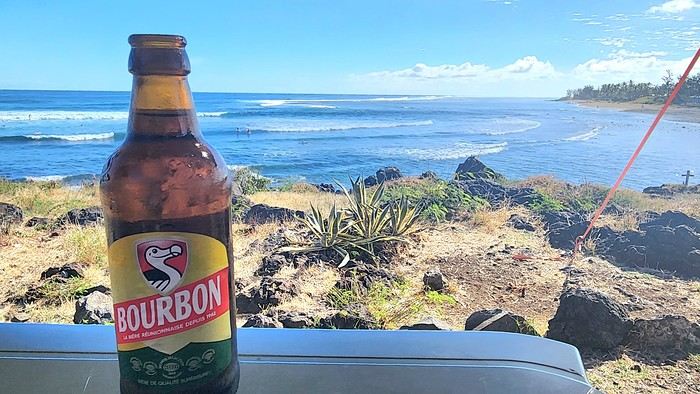
So, for an exceptional trip, exceptional stories! Don’t worry, the debates at the supermarket over whether to choose plain chips or roast chicken chips, the beach picnics washed down with ti’ punch, and other rougail sausages to digest by the pool will only make it into the family archives. Here, I’ll stick to the tales of our beautiful escapes, the ones where we explore the wild corners of this little volcanic rock planted in the middle of the Indian Ocean. So where exactly are we headed?
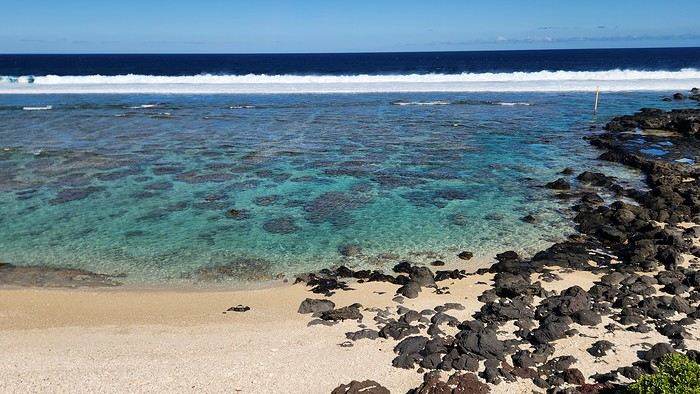
For the first week—the subject of this first installment—we’re taking it easy. We’ll start by rediscovering the coastline, from the Souffleur in Saint-Leu to the Hermitage lagoon, before a little trip to the Cirque de Cilaos and its legendary road with 400 turns, just to get our legs warmed up.
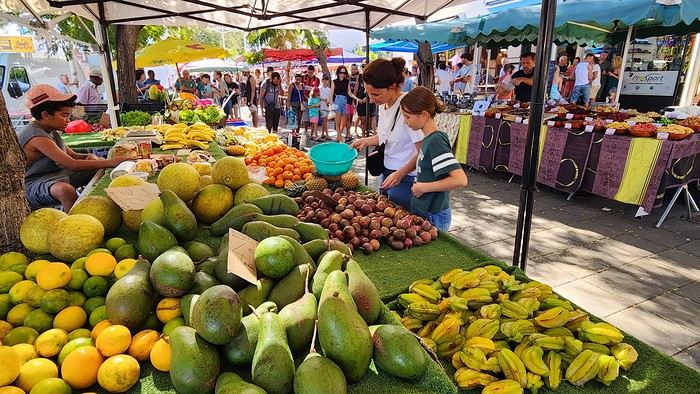
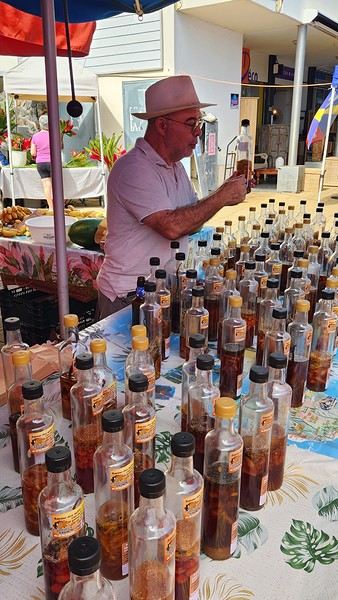
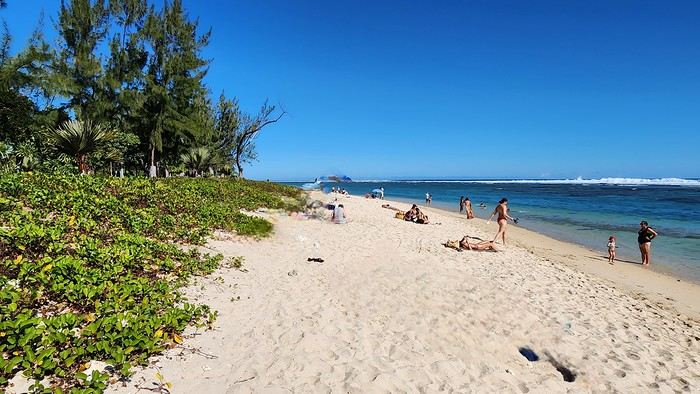
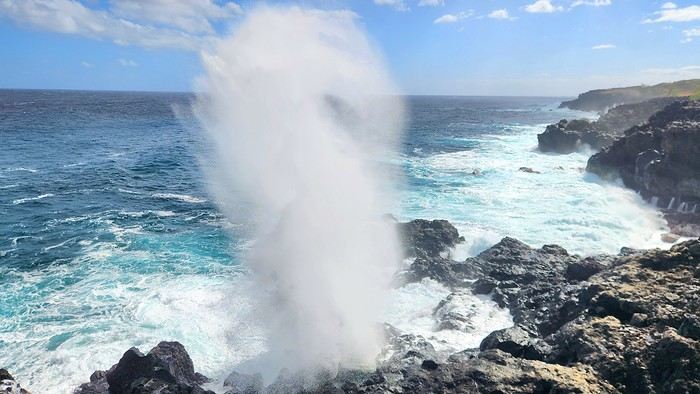
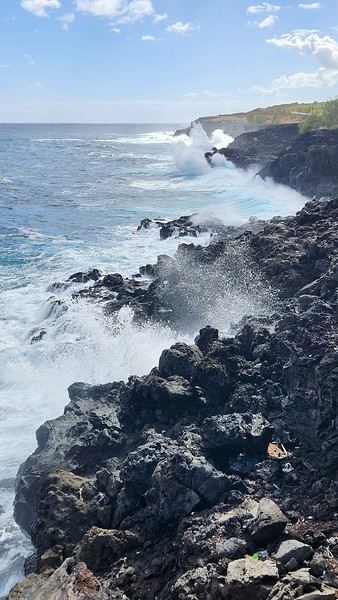
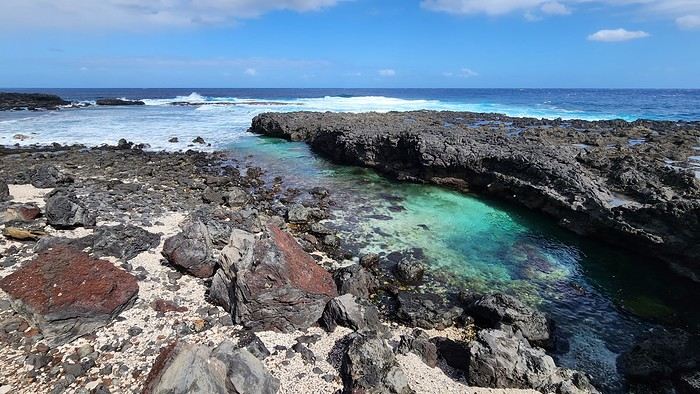
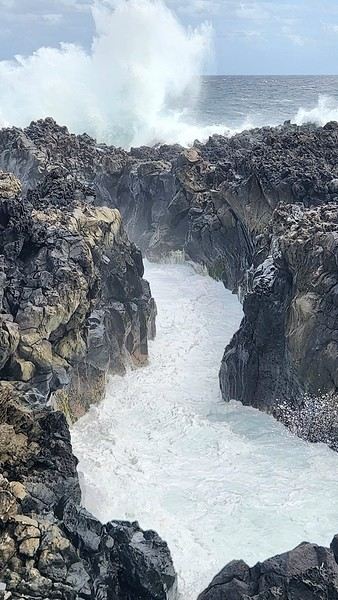
Traveling with just one spare pair of underwear, considering a hot shower a miracle, never staying in the same place too long by sleeping wherever night catches us, taking whatever local, improbable, and rickety transport we can find—this is the DNA of us wanderers. Except this time, the script for our movie is going to be a whole different genre. On paper, the destination doesn’t exactly scream epic adventure: Réunion! And what’s more... we won’t be two, or four, or even ten. We’ll be a solid thirty. All from the same family. Yes, thirty. At this point, it’s not just a trip—it’s a summer camp on the move! Why inflict this on such a peaceful island? Because my brother decided to get married there with his lovely bride. A great idea, you might say... especially when it involves relocating the equivalent of a small Ardennes village 10,000 kilometers from home for three weeks! So who’s stepping up to be the guide and wave the little flag?
So, for an exceptional trip, exceptional stories! Don’t worry, the debates at the supermarket over whether to choose plain chips or roast chicken chips, the beach picnics washed down with ti’ punch, and other rougail sausages to digest by the pool will only make it into the family archives. Here, I’ll stick to the tales of our beautiful escapes, the ones where we explore the wild corners of this little volcanic rock planted in the middle of the Indian Ocean. So where exactly are we headed?
For the first week—the subject of this first installment—we’re taking it easy. We’ll start by rediscovering the coastline, from the Souffleur in Saint-Leu to the Hermitage lagoon, before a little trip to the Cirque de Cilaos and its legendary road with 400 turns, just to get our legs warmed up.
3 weeks in Laos, stress-free
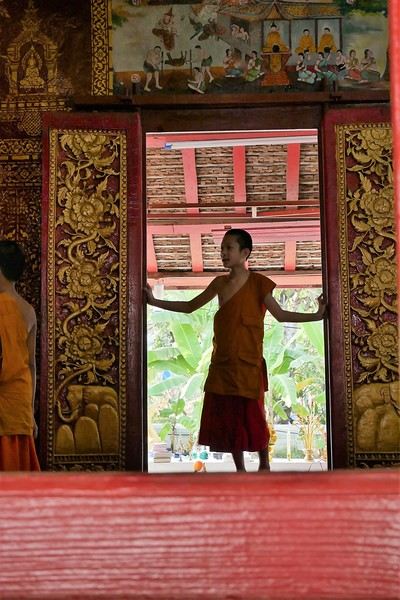 Come along, I'm taking you to this country where it's so nice to wander and slow down...
This trip was in 2023, but when I wanted to write my travel journal, VF was still closed to contributions... So, now that I've just finished my Japan travel journal here, I figured it was high time to honor this destination we came back from so enchanted. Disclaimer 1: This is a written travel journal. There’ll be text! Too much, for some! Disclaimer 2: This is an illustrated travel journal. There’ll be photos! Too many, for some!
I have to say, every time I try to discipline myself, to keep it shorter, to include fewer photos... I end up adding more. It feels like my dear Aunt Nicole, who exhausted us with her slide-show evenings in the 70s/80s, decided to take her revenge. The upside for you, readers, is that you can slip away anytime without offending Aunt Nicole. I won’t even notice!
Anyway, since I love maps, here’s one to give you an idea of where I’m taking you. As you can see, we only saw a tiny part of Laos (the areas circled in red); we only had 3 weeks for ourselves (my husband’s newly retired, I still work), and we prefer taking our time over rushing around like crazy.
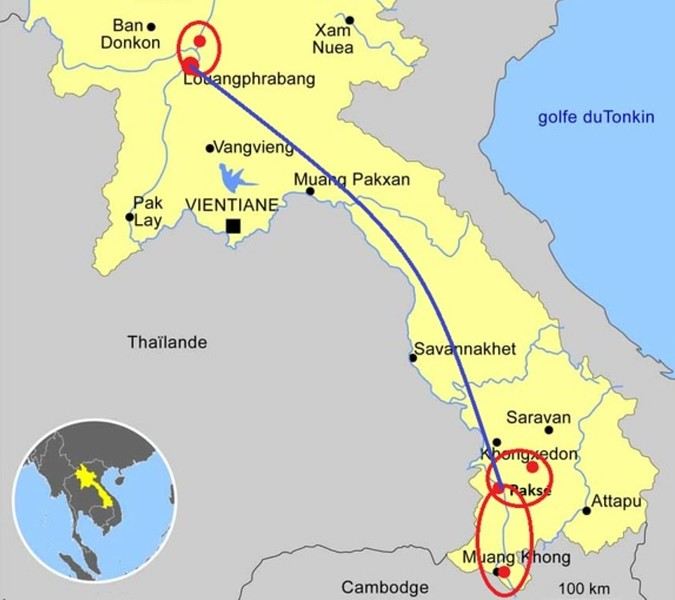
In broad strokes, it was very classic:
First, we “settled in” at Luang Prabang (8 days), because we wanted and needed to. From there, we took three days to venture a little further north—not far in kilometers, but as we know, distances aren’t just about km! Then we flew south to Paksé, letting ourselves drift down to the 4,000 Islands while stopping by the pre-Angkorian archaeological sites. We wrapped up with the Bolaven Plateau.
A few practical notes: We arrived via Bangkok, then took a Bangkok-Luang Prabang flight, having picked up our luggage in Bangkok to check it in for Luang Prabang. No issues—the Bangkok airport, which many of you know, is very well organized. We got our visas on arrival in Luang Prabang. Quick, but to be fair, we were on a “small” plane, and the big flights had arrived earlier, so we weren’t too crowded in line! At the end of our trip, we didn’t fly out of Paksé but from the nearby airport in Thailand, Ubon Ratchathani (a 2.5-hour drive from Paksé), then Bangkok and Paris. You’ll notice we skipped Vientiane to stay longer in Luang Prabang. That said, there’s now a high-speed train between Vientiane and Luang Prabang—good to know—and soon the (Chinese) train will go all the way to Bangkok and even Kuala Lumpur!
With that intro out of the way, let’s dive into the heart of the matter. To be continued: Slowing down the pace... in Luang Prabang
From Avignon to Casamance Without Flying
Hi there,
Last February, I made a trip using "public transport" from France to southern Senegal via Spain, Morocco, Western Sahara, and Mauritania.
It’s a journey of about 5,000 km, where I took trains (as far as Marrakech), ferries (to cross Gibraltar and then to reach Casamance from Dakar), and mostly buses on the long desert straightaways. I hadn’t planned any stops in advance or booked any hotels, except for the very first train to Spain, which left plenty of room for the unexpected. Why travel by land and sea? In recent years, flight-free travel has been gaining popularity. On social media, posts explaining how to cross Europe by train as quickly as possible go viral. Traveling without flying—and making sure people know about it—has become a great way to earn a badge of eco-responsibility: an essential totem for anyone wanting to prove both their dedication to the ecological cause and the wisdom of slow travel. I haven’t flown in years, and this journey to West Africa could easily be filed under "responsible travel." But it wouldn’t be honest to say that: in reality, it wasn’t really my aversion to flying that motivated this long trek. I see overland travel primarily as a way to experience the world’s geography at a grounded, earthly pace—the pace of the locals. Besides, I’ll be flying back, which disqualifies any claim to being a model of sustainability. So no eco-badge, and no adventurer’s badge either: you won’t find any heroic tales of camel rides in lost lands or mineral train wagons in this account (popular with influencers, the Mauritania iron ore train now attracts tourists from all over the world, turning "the experience" into something you "have to do at least once in your life"). This five-part story, written on the road, has no other ambition than to recount a journey through places and people, and to share the thoughts they inspire in me. As simply and, I hope, as humbly as possible.
I’m posting the episodes here, which you can also find on my blog (with more photos) at the following links:
Episode 1: Spain, from Avignon to Algeciras
Episode 2: Morocco, from Tangier to Tarfaya
Episode 3: Western Sahara, from Tarfaya to Guerguerat
Episode 4: Mauritania, from Guerguerat to Nouakchott
Episode 5: Senegal, from Rosso to Saloulou
To help those who might want to make the same trip, I’ve also put together a summary of the route with recommendations—you can read it at the end of the story and on the blog: From France to Senegal Without Flying: Route and Itinerary Recommendations
Happy reading, and safe travels!
What are your suggestions for visiting Naples and the Amalfi Coast?
Hi there,
We’re planning a trip for October to visit Naples (6 nights) and the Amalfi Coast (5 nights). We’ve already got the historic center and the Lapis Museum in Naples, Pompeii, Herculaneum, Procida, Sorrento, and Ravello on our list. Any suggestions, addresses, or tips?
Thanks for your help.
Discussion around March 2026's Theme: Metal, Metallic
This is where we share stories (or post extra photos) around March’s theme Metal, Metallic.
Back to the March 2026 contest: HERE
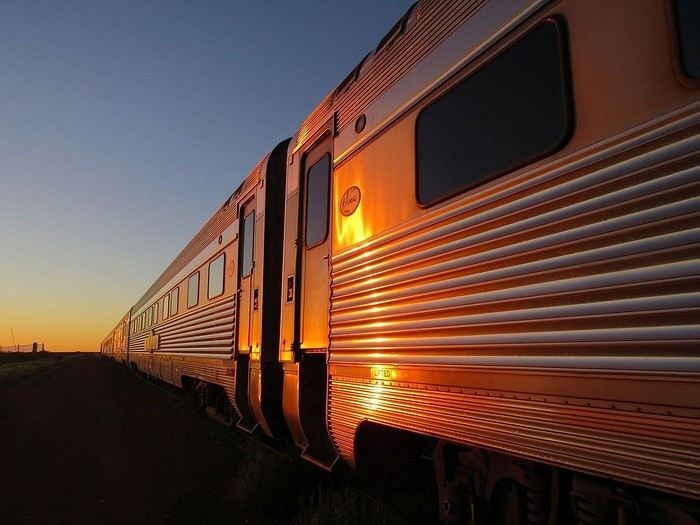
The Ghan (train connecting Adelaide to Darwin), at dawn.
Back to the March 2026 contest: HERE
The Ghan (train connecting Adelaide to Darwin), at dawn.
Naha & Osaka, Japan - June 2025
It’s an understatement to say that Japan is a world apart. All around me, people exclaim: "How lucky you are to be able to go there! I’ve always dreamed of visiting, of finding myself in that culture blending tradition and technology!" Yes, they’re right. Until the moment their dreams become reality and things appear as they truly are, without the filter of fantasized preconceptions. Because in the collective unconscious, Japan indeed seems like a civilization—if not neutral—at least stripped of any social maturation. As if it had emerged all at once from its canonical ages, offering only the best of its traditions, and as if those traditions were undoubtedly the foundation of its extraordinary discipline. Yet, as always, the truth is far more complex. Modern Japan is likely shaped by its millennia-old traditions. But that Japan is also the result of its own uncertainties and contradictions. I’ve always been wary. I’ve never understood why the cleaning women on the platform bow when the train arrives. At some point, too much discipline, too much deference—it makes you smile, it raises questions.
Finally, thanks to F., a dream is coming true! Not the dream of going to Japan—a country I’ve visited more than any other, except for Réunion and the UK—but the dream of completing the fastest round-the-world trip of my career. Indeed, due to the restrictions imposed by the Russians*, the plane flies over the Caucasus and China on the way there; on the return, it gracefully heads toward the Arctic after skirting the Aleutian Islands, Alaska, and Greenland. So, in nearly 26 hours of flight, I complete my 6th round-the-world trip. A round-the-world trip with just one stopover. Or two, if you count our impromptu detour to Okinawa.
(* In response to Western sanctions, Russia closed its airspace to Western airlines on February 28, 2022, except for Air Serbia, Turkish Airlines, Pegasus, and Belavia. This decision adds 2 to 3 hours to flight times and, incidentally, increases operating costs.)
The empire of noise. The empire that dazzles. In Japan, the auditory and visual space is constantly fed. No respite. You have to be strong. Navigating public transport feels like playing the most advanced video game: moving between language barriers and a different organization, the hero tries to ignore the numerous visual and auditory distractions. Mostly auditory, though. Because in Japan, there’s a culture of noise that has undoubtedly inspired our national railways. Everything must be announced. So, here and there, all along the route, we find agents whose sole role is to endlessly repeat safety messages through megaphones more or less suited to the situation. The result is a constant murmur, a kind of tinnitus, a subtle but incessant buzz that fades only at bedtime and returns with a vengeance at first light, when we descend back into the supposedly sterile depths of Osaka’s subway. "To go right, please turn right, kudasaï. When descending the stairs, please mind the steps, kudasaï. To go straight, please take the left corridor, kudasaï." That *kudasaï* ("please" in Japanese), I assure you, has permanently lodged itself in my auditory cells.
Screens are no exception; the brain is constantly stimulated. But paradoxically, passengers massively retreat into their own worlds via their screens. Literally glued to their phones, earbuds firmly in place, people escape into the virtual aisles of a furniture store, a game, a movie... In the train cars, raised voices are rare. The field is clear for announcements and other jingles. Each stop is announced by a little tune unique to each station. Simply incredible.
If we usually judge a country by the welcome its inhabitants offer, in Japan, we’re left wanting. Indeed, the Lost in Translation* spirit doesn’t just apply to verbal exchanges—it applies to everything, especially non-verbal communication. In Japan, me, the slightly North African Corsican, I’m at a loss. I speak loudly, I gesture, in front of a hotel concierge just as lost. Each for our own reasons. Yes, he speaks some English, but we can’t seem to connect. It’s a losing battle trying to find a bit of compassion from a local who’s far from familiar with Western concerns. I try to buy tickets for the World Expo? I run into a systematization as rigid as it is abrupt, which the concierge can’t seem to navigate. While we might still have a shred of common sense, here in Japan, everything is digitized. Soon, no one will be surprised that a QR code becomes essential just to go to the bathroom.
(* Film by Sofia Coppola, released in 2003, which explores isolation, unease, Japanese culture, and language through the experiences of two protagonists.)
In the end, we get that ticket for the Expo. After providing personal information on yet another account created for the occasion, we buy electronic tickets—a QR code, then—to regulate the comings and goings, the souls and aspirations of all these wandering beings scattered across the globe. And it’s probably for the best... Because we’ll be tens of thousands of visitors—100,000 to 150,000 per day—walking the aisles of this enormous improvised amusement park, a kind of delirious superstructure surrounded by the Grand Ring, the largest wooden construction in the world. Inside the park, the pavilions, flagship vessels of their respective countries, compete in ingenuity, proportionate to their GDP, to attract visitors. But you have to wait up to two hours to visit the most popular ones! Fortunately, about a hundred countries can be explored without waiting in shared, more spacious areas. What will I remember from this adventure? The beauty of that wooden structure, despite any environmental or financial considerations—200M € for barely renewable elements; a certain poetry, even magic, in the expression of this event—conversing with Juliette Petit, the splendid representative of Vanuatu, had something indescribable; a close-up experience of Japanese discipline when it came time to return to the subway after that epic evening—thousands upon thousands of people converging at the same time toward a single place without any interruption in the flow.
But my real passion is the countryside. So, I’ll especially remember that brief escape, on the very first day, to the Mino-o waterfall, where the journey itself was already enchanting. Quickly leaving the underground lines, our train speeds through the city’s endless expanse and drops us at the foot of a hill, the abrupt edge of the urban sprawl. The slope was too steep to build anything? We leave behind an impressive hotel, a capitalist eyesore defying the laws of elevation to tackle the climb toward the waterfall. A bucolic walk where the stroller can choose between a paved path or more epic trails. Here and there, stalls, temples, everywhere, a certain serenity. The city’s pulse gives way to a magnificent spectacle magnified by giant sequoias. From the depths of a ravine, we try to glimpse the sky beyond the foliage. Everything is oversized. Here, you can breathe.
***
In reality, Japan has never undertaken any real work of memory. Aside from a few feeble gestures to appease Washington in its choice of Asian partners, one wonders if the Japanese have ever truly grasped the horror they were forced to participate in. While our Judeo-Christian society has more or less assimilated the notions of forgiveness and self-questioning, where does Japanese society stand, juggling a millennia-old Zen philosophy and the unabashed Machiavellianism of an emperor utterly possessed? Is it just me, or does there float in the atmosphere a kind of unease, a malaise, an awkward relationship with reality? For me, bowing to a train as it enters the station is just the result of a poorly directed moral dilemma...
Ah, how distant is the time of sakoku, that closure of the country—both concrete and ideological—that was in vogue for two centuries. Because if no one could enter, no one could leave either! A boon for neighboring countries. But from 1854, following the skirmishes of Commodore Matthew Perry, who demanded Japan’s participation in trade, the country suddenly became aware of the disparities separating it from the West. Bring Japan up to the level of other nations? Industrialization, competition, search for raw materials... Hirohito (1901–1989) emerges on the scene, a bit expansionist and willing to stop at nothing to achieve his goals. Above all, he knew how to use, in his own way, the incredible capacity for self-sacrifice of his people...
We protest, we condemn, we all rally behind an acceptable discourse when it comes to discussing the use of the atomic bomb. Yet, we forget one essential thing: Hiroshima wasn’t enough to make Hirohito yield. While we’re bombarded with anti-fascist elements, as if the sole purpose of school curricula were to prevent us from voting for the National Rally, we completely overlook those events of rare cruelty that took place on the other side of the globe at a time contemporary with Nazi atrocities. Why? Because it was farther away, on the other side of the world? Because we must both condemn the use of nuclear weapons and Nazism? What a dangerous game. Killing civilians is beyond comprehension, everyone agrees on that. But hasn’t Japan ever been guilty of such atrocities? Our empathy is legitimate; it won’t, however, remove from my mind the idea that there was no other solution. Nagasaki is the most telling proof of that.
At least in France, in school textbooks, Hitler will have completely overshadowed the existence of people crueler and more abject than him. Certainly, Adolf was a deeply disturbed man whom events propelled to power. But I’m justified in believing that his approach was probably more humane than that of Joseph Stalin at the height of his art*. And if Hirohito followed the same line as Hitler, in the sense that he represented the superior race, he would apply with conviction what was Stalin’s credo: contempt for his own people when sending them to slaughter, and an even fiercer contempt for the human race when it didn’t have the good fortune to be Japanese. Just look at how China was invaded and by what means millions of Chinese were annihilated, burned, deported, buried alive! Operation Scorched Earth or Three Alls Policy for kill all, burn all, loot all? No comment. Even today, the Japanese are convinced they waged a patriotic war, when clearly, that war served only vague ideological (and certainly economic) interests.
(* "In many ways, Hitler’s National Socialism was far more humane than Communism: it wasn’t unthinkable to speak to the SS or the Gestapo, and dissuading them from sending you to a prison camp wasn’t utopian. To some extent (compared to the Communists), you could still expect a semblance of justice. All those who lived under Hitler and under Communism will tell you: as the front lines shifted, they always managed to end up in Germany, where, though it was a strange place ruled by a madman, life went on. Under Communism, there was no life; totalitarianism was absolute. Probably, Hitler’s conservatism prevented him from fully imitating Bolshevism." Seraphim Rose in The Revolutions of the 19th and 20th Centuries (circa 1970))
In Naha, we visit two strategic sites: the Imperial Navy headquarters and Maeda Escarpment, in Urasoe, better known as Hacksaw Ridge. I love this confrontation with history. In the hand-dug tunnels of the headquarters, we meet Japanese people seeking information. They’re not responsible for this tragedy. Neither are we. I would have liked to tell them that, to hug them, to move on. To finally believe in those peace messages displayed here and there. Yes, it’s curious to read those calls for peace* when no real work of memory** has been undertaken. Two civilizations, two perspectives, a profound misunderstanding. When I analyze the waste of that war—and particularly the waste of those Pacific battles—like Peleliu in autumn 1944 and Okinawa in spring 1945—I can’t bring myself to share in the pathological patriotism that reigns within these walls. There, the room where the last message of Admiral Minoru Ōta was transmitted in Morse, praising the merits of the archipelago’s people. A tangled mix that, yes, is charged with positive emotions but, no, won’t remove from my mind the idea that this people was completely conditioned, completely disconnected from reality. Allying with the Axis powers? Invading the South Pacific? And finding that noble! Everyone sees things through their own lens.
(* Peace Declaration by Denny Tamaki, Governor of Okinawa, June 2020. ** "Recognizing the atrocities committed by one’s country requires a mix of democratic culture and self-confidence that is more the exception than the rule." Dominique Moïsi in Les Échos, April 30, 2015)
Okinawa. 200,000 dead. Stemming from bushido, the way of the warrior, this conditioning reached its peak with the kamikaze philosophy in particular and suicide in general. So, schematically, here’s how things went: as the island was encircled—Peleliu, Iwo Jima, Okinawa—and all hope was lost, the order was given to kill ten American soldiers before taking one’s own life. The deceit of this system, where surrender is synonymous with dishonor, involves creating tunnels and secret pockets where Japanese soldiers hide and from which they emerge. Long before the atomic bomb, the knell of their war had sounded. Hiroshima and Nagasaki are just the result of human pride, of which Hirohito’s reign is the finest example. Why was this henchman of Satan left in place until his death? I don’t understand. While the humiliation inflicted on Germany repeatedly was abject, especially for its people, the absence of any real and pressing accountability for Hirohito in this large-scale carnage he instigated leaves room for the wildest interpretations. As if to underscore my point, Emperor Naruhito visited Okinawa the same day we did, paying his respects to the inhabitants who fell in battle. I looked at the faces in the monorail serving the south of the island. There were elderly people who undoubtedly lost their parents eighty years ago. To what extent can they blame this tragedy on the delusional visions of their leaders?
On Maeda Escarpment, I salute the courage of Desmond Doss, that conscientious objector who fought to serve his country while refusing to ever carry a weapon. There, at the top of a steep ridge, you can see to the north the Allies’ advance, while to the south, the slope is gentler down to Shuri, in front of the headquarters. The underground is a Swiss cheese filled with enemies. Desmond works as a medic. He manages to save 75 wounded from certain death by evacuating them at night from the battlefield using makeshift ropes. Back in Osaka, far from the somewhat dilapidated tropical islands, I rediscover the splendor and grandeur of Japan’s second-largest city. To tell the truth, and this applies to Okinawa too, the density is so insane on this archipelago that you sometimes wonder if it’s not just one giant city spread across the vast territory. Because between Tokyo and Osaka, while there are some mountains and forests, it’s the city that dominates; during rush hour, a rapid train connects the two cities every five minutes. We get lost in rather quiet alleys parallel to the main streets, only to find ourselves in the covered and lively galleries of Dōtonbori. We’re looking for a place to eat—above all, we’re trying to navigate the unlimited options stretching endlessly along the sidewalks. It’s absolutely mind-blowing. And while I introduce F. to a part of history that our Western societies have quickly forgotten, he initiates me into Japanese gastronomy despite my well-known aversion to Asian food. But nothing beats having a master in the field! We feast on okonomiyaki, Japanese pancakes expertly prepared and served on a teppan embedded in our table.
Night falls on Japan, and I still haven’t found the answer. Like in Singapore, one can praise the calm and serenity of human relationships, the delicacy that may just be hypocrisy, the politeness, the discipline. But above all, we notice that in the absence of freedom, in the absence of madness, poetry struggles to take root, boredom looms, as does real madness. Bushido still exists, honor is there and must be preserved. But the youth drowns in electronics and in willingly sterile cults (otaku), unable to discern what’s essential, failing to believe in their dreams. You have to succeed? Young people commit suicide because of school bullying, the slightly older ones because of work-related difficulties or marital problems. Nothing exceptional, we might say—average*—but you’d expect better from a country so well-organized, a country that makes so many Westerners dream. Yes, night falls on Japan. Empire of noise, empire of the senses, a very strange land where you find clean toilets in subway corridors but where the very meaning of life seems stifled by the mirages of technology. Above all, a civilization deprived of a penance that would prove salutary. We’re caught between two waters. Those of a shallow modernity without depth or anchor; those of a past that was majestic but irreparably tainted by the demonic madness of an overly adored emperor.
How can one fully thrive when guilt has no outlet?
(* France and Japan share a common statistic of 17 suicides per 100,000 inhabitants, which, depending on density, means 30 per day in France and 70 in Japan...)
From Nan to Chiang Rai: itinerary ideas?
Hi, just a quick note mainly for Samsong, even if he’s still giving me the silent treatment.
I’ve been in Nan since yesterday and... I love it! So thanks, Thierry. It’s exactly the kind of place I’d been dreaming of... Even if communication is a bit tough, it’s not impossible. They don’t even know the most basic English words! Everyone laughs and they’re the first to pull out their phones to... translate. They’re even quicker on the uptake than I am.
And then there’s the time I say Nan (pronounced "Nane"). They don’t understand me. After a while (sometimes a long one), they reply: "Ah, Nan?" (pronounced "Nane") 😵🤳😃
The town is exactly how you described it back in 2022. Though I’m surprised to find so many trendy, slightly intellectual "Cafés." Apparently, coffee—excellent everywhere—is king in Nan. It feels like a university town. And it seems pretty lively at night! But for now, I’m going to bed early. I caught a nasty cold, which didn’t stop me from walking 12 km this morning. But I came back to my accommodation by 3 PM (gorgeous and luxurious with top-notch service for 800 baht—even a cute local welcome gift this morning, plus other unexpected touches like a bottle of honey and chrysanthemum flowers for tea. The lady must’ve guessed I was coming down with something yesterday). I thought about going out for dinner but didn’t have the energy. I think I’ve got at least 39°C fever...
Anyway, I’m sending you this message, Thierry, because you mentioned a daily bus to Chiang Rai, so I didn’t look into it. But now it’s a real problem—no buses to Chiang Rai, only taxis. At least 2,500 baht for the cheapest one! I’ll check the bus station directly tomorrow. Online, it’s all taxis, no buses. I’d like to explore the countryside/mountains if I can find an affordable driver. Any ideas for destinations or itineraries? Thanks.
Three weeks in Albania with two older teens
We went to Albania in August 2025.
Our itinerary included adventure (sporty activities, site visits), naps on the beach interspersed with swims, incredible natural sites, and a bit of culture.
I booked all our accommodations on Booking.com. Note: almost all places ask to be paid in cash!! You can obviously withdraw from banks, but the fees are pretty high. Luckily, we had plenty of cash, and the country is very safe. You can pay in euros most of the time, which avoids exchange fees. We started in Tirana. I’d read a really interesting post about Albania’s bunkers (link in my profile). We chose to visit Bunk’Art with a guide from the agency that wrote the post. It was fascinating—not only to better understand the country’s history but also because her grandfather was repressed by the regime, and she shared her family’s experience with us.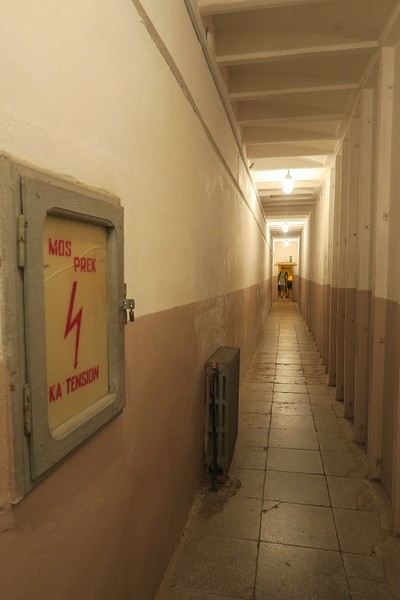
Bunkers are everywhere! In Tirana, Bunk’Art is the most interesting and largest. You’ll see the dictator Enver Hoxha’s office, where he would’ve taken refuge in case of an attack on the country. Bring a sweater—it’s really cold in the underground tunnels and their huge corridors. You can visit other bunkers around the country, in Tirana and elsewhere. Almost all are just abandoned. The cable car up Mount Dajti is right next to Bunk’Art. The view is stunning—you realize Tirana is so close to the mountains and the sea... But otherwise, it’s not that exciting for older teens (17 and 19) and their parents. We picked up a rental car in Tirana—it’d be ours for the next three weeks. We used Goalbania’s agency to avoid any hassles. First, there aren’t many cars available in Albania in summer. Second, French credit cards can be a nightmare abroad. So we preferred to sort that out in advance. After Tirana, we headed to Permet. Just a heads-up: the roads are in great condition except in the mountains. And Albanian drivers aren’t stressful to deal with. Though you might suddenly encounter a herd of goats crossing the road—haha—but if you’re not going too fast, it’s fine. In Permet, I’d been dreaming of rafting on the Vjosa, one of Europe’s last wild rivers. And we did it with a local agency! It’s beautiful, accessible to everyone, not too physical but still a bit lively—just how we like it. You can even jump into the river in some spots. In Permet, we also hiked through a canyon and visited a lovely little church.
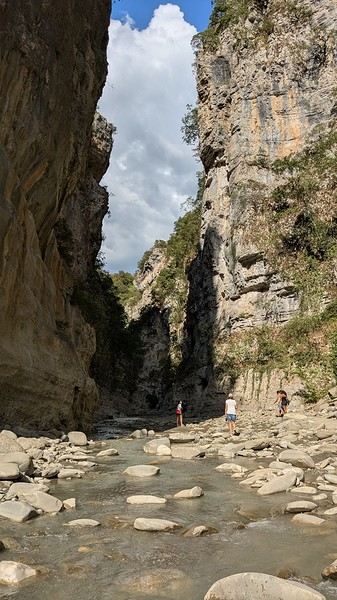
And we took a workshop to make their local culinary pride: gliko. It’s a jam with whole fruits inside. We’d seen it on Goalbania’s site, and it was really fun. We were with a family where the secret to making gliko has been passed down for generations... Next, we headed to Gjirokastër. A city we loved: its old traditional houses (Skendulli and Zekate), its grand castle, the Ali Pasha Bridge. Along the way, we stopped for artisanal ice cream at a little shop run by a grandmother who’s been making it herself for ages.
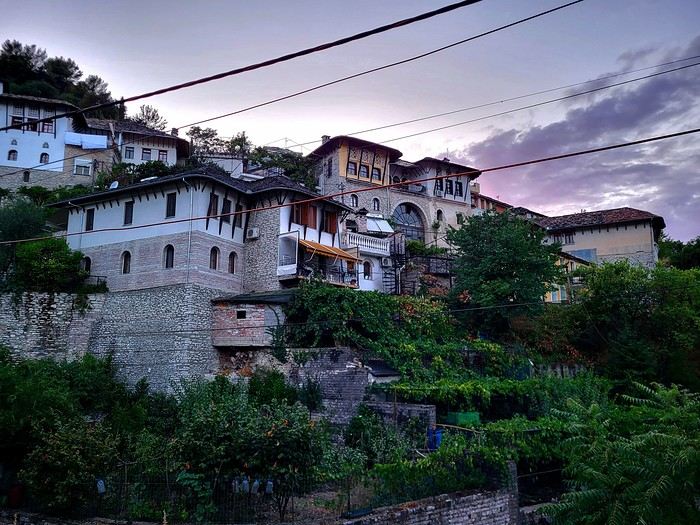
One afternoon, my husband *had* to go to the coast in the south, to Ksamil (he’d read it was better than Sarandë). Verdict: we didn’t like it. Parking is a nightmare, the beaches are super noisy and crowded. The sea is packed with jet skis, boats, pedalos, and ropes. Avoid it.
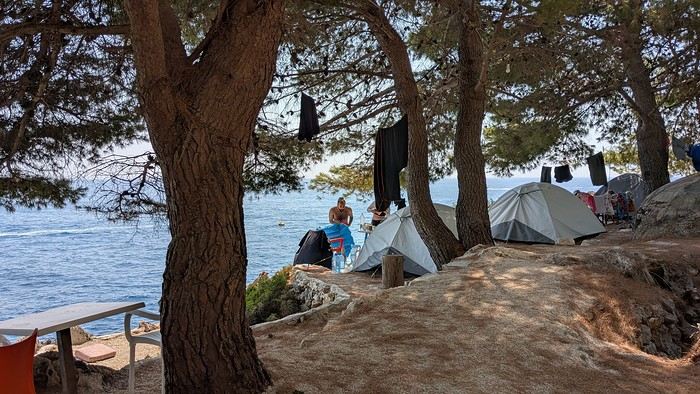
On the other hand, we really liked Himarë, where we went next. We stayed at a campsite where we rented tents with mattresses and sheets inside. Right by the sea, on a low cliff (about 2 meters high). You can hear the waves at night... Magical!! To swim, you either jump straight into the sea (almost from the tent) or climb down a ladder, which you’ll need to climb back up to get out.
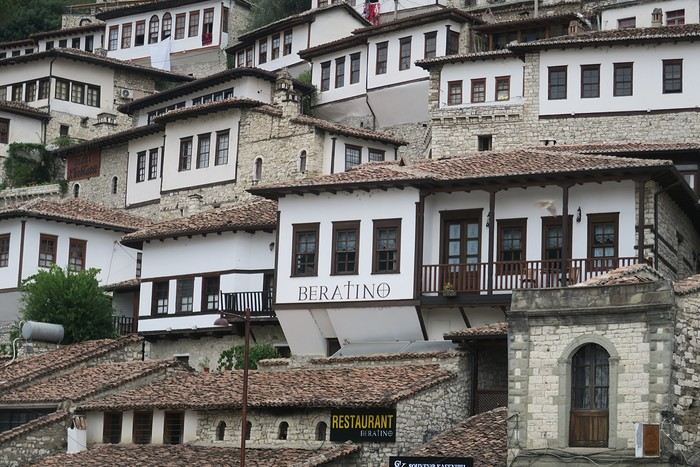
I was a little worried the campsite wouldn’t be very comfortable, so afterward, I’d booked a small place in Gjilek. Turns out, the place was really tiny (one room for four, no kitchen) and pretty expensive (over 100 € a night). We’d drive to the beach or restaurants—it’s on a steep slope, so not very accessible. Parking near the sea is tricky. But the (private) beaches were nice—we’d rent an umbrella not too close to the music and spend the day there. We also went to a wilder beach, harder to reach, via a long path. Behind the beach, there’s an amazing canyon where we’d sometimes climb using ropes (already in place, no need to bring your own) over big boulders rolled around by the stream, which must swell a lot in spring. So, the sea in Albania: it’s nice if you like swimming and relaxing, but it’s not the most interesting part of the country. There are so many other amazing things to see and discover—so many stunning sites! Maybe an agency could’ve helped us find more practical accommodations and avoid Ksamil and its surroundings. We left the coast to head to the beautiful city of Berat and its "thousand windows." We explored the city, its fortress, and its icon museum.
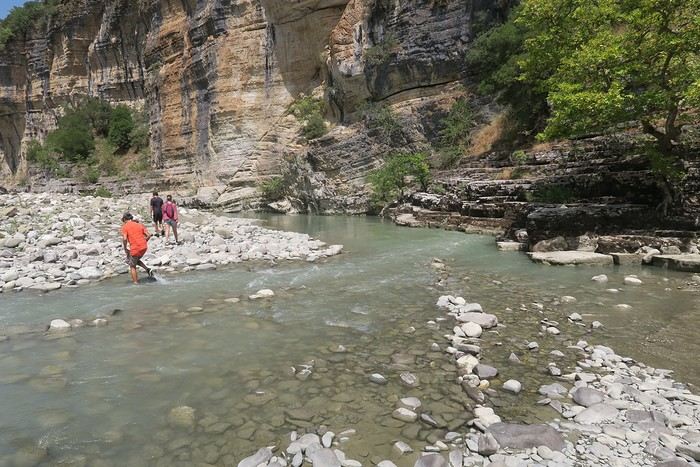
Then we discovered the Osum Canyon—it’s incredible. The view from the top is breathtaking. And at the bottom, it’s magical. There’s little water in summer, so rafting isn’t an option. We weren’t tempted by the big-tube descent offered by an agency—it looked fun, but the group had 40 people. We preferred hiking on our own as a family of four. We scouted the area on Google Maps... and found where to descend. We walked in the water, then it rose to our waists, then our shoulders... We weren’t moving fast. And how to get back up?? Eventually, we followed a group with a guide—the path was hard to find.
After that unforgettable hike, we visited the Bogovë Waterfalls. It’s pretty, and we swam, but the water was *really* cold. We passed through Tirana again and then headed to Shkodër. We explored a bit—its charming little streets, the Rozafa Fortress. There’s a tiny museum where you can see *huge* Ottoman stone cannonballs. And they tell you the (charming) story of the young woman who was walled alive in the castle’s foundations to ensure its strength... Shkodër is mostly a stopover to head into the mountains and discover Theth. Our goal: hiking in the Valbona Valley, from Valbona to Theth. We organized the trip ourselves, without an agency, but it took some time to figure everything out. So I’ll save you the trouble—haha. Book your tickets on the Komanilakeferry website. The ticket includes: 🙂 minibus transfer from downtown Shkodër to Koman 🙂 ferry ticket from Koman to Fierze. This ferry ride is *gorgeous*—between mountain slopes covered in pine trees, and sometimes a little house with a few fields...
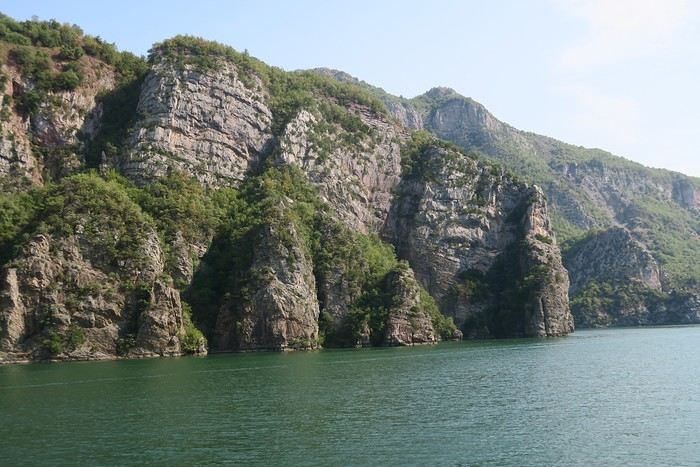
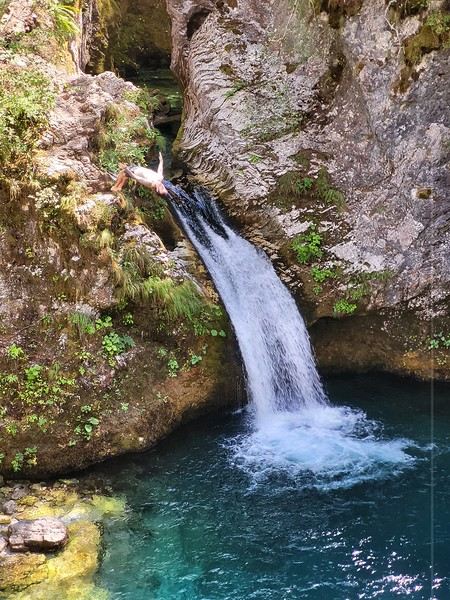
🙂 minibus ticket from Fierze to Valbona. Now you’re in the mountains! The minibus drops you off near your accommodation—pick one as close as possible to the start of the hike (if that’s your goal!). The ones at the far end of the village add up to 1.5 hours of walking. Our choice: Guesthouse Dioni. The host is really lovely, it’s in the woods, and it’s basic but great. After a day of hiking, we arrived in Theth. What beautiful mountains! Then we explored Theth and the surrounding area. It’s pretty busy, but you can still enjoy the Blue Eye of Theth and its swim. It’s *so* cold! But so beautiful!
🙂 minibus ticket from Theth back to Shkodër. After a night in Shkodër, we drove to Kepi i Rodonit. A guidebook (I forget which one) raved about its beauty. And it *is* beautiful!
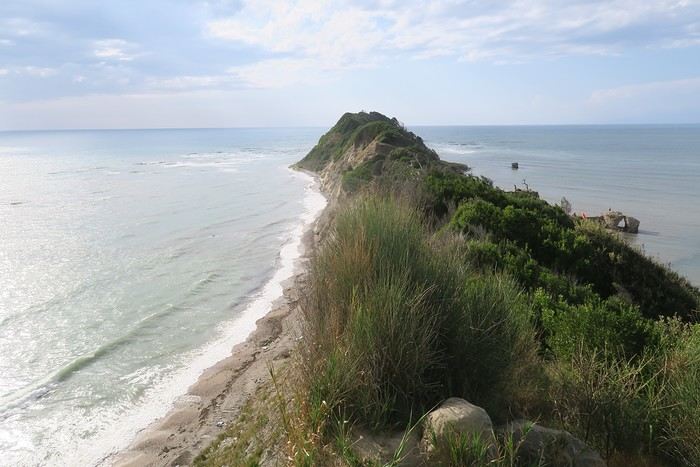
But the view is ruined by plastic bottles and other trash in the bushes, along the paths, and of course on the beaches. The only peaceful spot: the private beach at Kepi i Rodonit, which is cleaned. You can rent an umbrella and have lunch there. That’s where we spent our last few days—very relaxing. In short... Albania turned out to be perfect for us and our teens!
I booked all our accommodations on Booking.com. Note: almost all places ask to be paid in cash!! You can obviously withdraw from banks, but the fees are pretty high. Luckily, we had plenty of cash, and the country is very safe. You can pay in euros most of the time, which avoids exchange fees. We started in Tirana. I’d read a really interesting post about Albania’s bunkers (link in my profile). We chose to visit Bunk’Art with a guide from the agency that wrote the post. It was fascinating—not only to better understand the country’s history but also because her grandfather was repressed by the regime, and she shared her family’s experience with us.
Bunkers are everywhere! In Tirana, Bunk’Art is the most interesting and largest. You’ll see the dictator Enver Hoxha’s office, where he would’ve taken refuge in case of an attack on the country. Bring a sweater—it’s really cold in the underground tunnels and their huge corridors. You can visit other bunkers around the country, in Tirana and elsewhere. Almost all are just abandoned. The cable car up Mount Dajti is right next to Bunk’Art. The view is stunning—you realize Tirana is so close to the mountains and the sea... But otherwise, it’s not that exciting for older teens (17 and 19) and their parents. We picked up a rental car in Tirana—it’d be ours for the next three weeks. We used Goalbania’s agency to avoid any hassles. First, there aren’t many cars available in Albania in summer. Second, French credit cards can be a nightmare abroad. So we preferred to sort that out in advance. After Tirana, we headed to Permet. Just a heads-up: the roads are in great condition except in the mountains. And Albanian drivers aren’t stressful to deal with. Though you might suddenly encounter a herd of goats crossing the road—haha—but if you’re not going too fast, it’s fine. In Permet, I’d been dreaming of rafting on the Vjosa, one of Europe’s last wild rivers. And we did it with a local agency! It’s beautiful, accessible to everyone, not too physical but still a bit lively—just how we like it. You can even jump into the river in some spots. In Permet, we also hiked through a canyon and visited a lovely little church.
And we took a workshop to make their local culinary pride: gliko. It’s a jam with whole fruits inside. We’d seen it on Goalbania’s site, and it was really fun. We were with a family where the secret to making gliko has been passed down for generations... Next, we headed to Gjirokastër. A city we loved: its old traditional houses (Skendulli and Zekate), its grand castle, the Ali Pasha Bridge. Along the way, we stopped for artisanal ice cream at a little shop run by a grandmother who’s been making it herself for ages.
One afternoon, my husband *had* to go to the coast in the south, to Ksamil (he’d read it was better than Sarandë). Verdict: we didn’t like it. Parking is a nightmare, the beaches are super noisy and crowded. The sea is packed with jet skis, boats, pedalos, and ropes. Avoid it.
On the other hand, we really liked Himarë, where we went next. We stayed at a campsite where we rented tents with mattresses and sheets inside. Right by the sea, on a low cliff (about 2 meters high). You can hear the waves at night... Magical!! To swim, you either jump straight into the sea (almost from the tent) or climb down a ladder, which you’ll need to climb back up to get out.
I was a little worried the campsite wouldn’t be very comfortable, so afterward, I’d booked a small place in Gjilek. Turns out, the place was really tiny (one room for four, no kitchen) and pretty expensive (over 100 € a night). We’d drive to the beach or restaurants—it’s on a steep slope, so not very accessible. Parking near the sea is tricky. But the (private) beaches were nice—we’d rent an umbrella not too close to the music and spend the day there. We also went to a wilder beach, harder to reach, via a long path. Behind the beach, there’s an amazing canyon where we’d sometimes climb using ropes (already in place, no need to bring your own) over big boulders rolled around by the stream, which must swell a lot in spring. So, the sea in Albania: it’s nice if you like swimming and relaxing, but it’s not the most interesting part of the country. There are so many other amazing things to see and discover—so many stunning sites! Maybe an agency could’ve helped us find more practical accommodations and avoid Ksamil and its surroundings. We left the coast to head to the beautiful city of Berat and its "thousand windows." We explored the city, its fortress, and its icon museum.
Then we discovered the Osum Canyon—it’s incredible. The view from the top is breathtaking. And at the bottom, it’s magical. There’s little water in summer, so rafting isn’t an option. We weren’t tempted by the big-tube descent offered by an agency—it looked fun, but the group had 40 people. We preferred hiking on our own as a family of four. We scouted the area on Google Maps... and found where to descend. We walked in the water, then it rose to our waists, then our shoulders... We weren’t moving fast. And how to get back up?? Eventually, we followed a group with a guide—the path was hard to find.
After that unforgettable hike, we visited the Bogovë Waterfalls. It’s pretty, and we swam, but the water was *really* cold. We passed through Tirana again and then headed to Shkodër. We explored a bit—its charming little streets, the Rozafa Fortress. There’s a tiny museum where you can see *huge* Ottoman stone cannonballs. And they tell you the (charming) story of the young woman who was walled alive in the castle’s foundations to ensure its strength... Shkodër is mostly a stopover to head into the mountains and discover Theth. Our goal: hiking in the Valbona Valley, from Valbona to Theth. We organized the trip ourselves, without an agency, but it took some time to figure everything out. So I’ll save you the trouble—haha. Book your tickets on the Komanilakeferry website. The ticket includes: 🙂 minibus transfer from downtown Shkodër to Koman 🙂 ferry ticket from Koman to Fierze. This ferry ride is *gorgeous*—between mountain slopes covered in pine trees, and sometimes a little house with a few fields...
🙂 minibus ticket from Fierze to Valbona. Now you’re in the mountains! The minibus drops you off near your accommodation—pick one as close as possible to the start of the hike (if that’s your goal!). The ones at the far end of the village add up to 1.5 hours of walking. Our choice: Guesthouse Dioni. The host is really lovely, it’s in the woods, and it’s basic but great. After a day of hiking, we arrived in Theth. What beautiful mountains! Then we explored Theth and the surrounding area. It’s pretty busy, but you can still enjoy the Blue Eye of Theth and its swim. It’s *so* cold! But so beautiful!
🙂 minibus ticket from Theth back to Shkodër. After a night in Shkodër, we drove to Kepi i Rodonit. A guidebook (I forget which one) raved about its beauty. And it *is* beautiful!
But the view is ruined by plastic bottles and other trash in the bushes, along the paths, and of course on the beaches. The only peaceful spot: the private beach at Kepi i Rodonit, which is cleaned. You can rent an umbrella and have lunch there. That’s where we spent our last few days—very relaxing. In short... Albania turned out to be perfect for us and our teens!
Berlin impressions (live)
Hi there,
I arrived in Berlin last night. In another discussion, I shared how much of a "nightmare" the flights from Nice were.
I’ll be posting some impressions here—what I liked and what I didn’t like as much.
This is my first time in Berlin. I’m staying for two weeks. For now, I’m alone, but I’ll be joined by someone in a few days.
Just to clarify, I won’t be posting any photos because my camera gave up the ghost the day before I left. It refused to read memory cards, and I don’t have a smartphone—just a tablet that I leave at the hotel.
Speaking of photos, a few years ago, at the Ducasse d’Ath in Belgium, I met a retired teacher who wasn’t taking any pictures of the festival. I asked her, "You’re not taking any photos?" She told me that during a trip to Nicaragua, she’d photographed howler monkeys and only noticed when looking at the pictures later that the males had huge testicles—something she hadn’t realized in person. She said, "Since then, I don’t bother with photos anymore!" I’ve thought about that often and wonder if I should do the same and stop taking pictures. Still, I’ll probably get a smartphone since it’s hard to go without one these days.
Nisyros: Greece’s most beautiful island?
Hi everyone,
I hesitated for a long time before publishing this travel journal since it’s been 8 months now since I left Nisyros. But in the end, I found it too beautiful to keep quiet about. So here we go—I finally got around to writing it. Nisyros is a stunning little Greek island, and luckily, it’s well hidden. Located a good twenty hours by boat from Athens, its distance from the Greek mainland deters most tourists from visiting. That’s what makes it an off-the-beaten-path destination. So much for the general info.
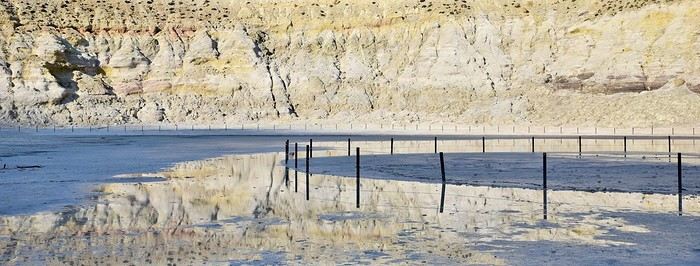
Before diving into the details, I should mention that I visited by bike (despite its severe and constant volcanic elevation) as part of a solo trip from France to Turkey. Why this detail? Because out of the ten countries I crossed and the dozens of sites I saw, Nisyros is one of my top three favorites (along with Pag Island, off-season, in Croatia, and Albania for its overall beauty—stunning natural landscapes and the incredible hospitality of its people). Anyway, welcome to this travel journal dedicated to the lovely little volcanic island of Nisyros…
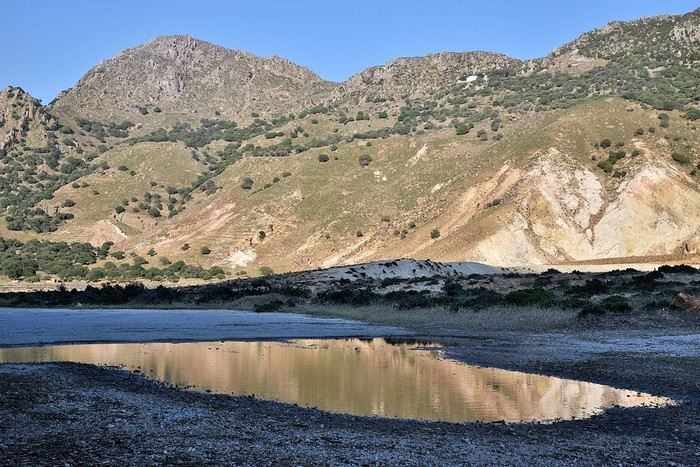
I arrived one beautiful morning in Mandraki, the island’s main port. The twenty-hour boat ride from Athens went by like a breeze. I slept on the deck for three or four hours, sprawled on a bench that was more or less sheltered from the wind. At this time of year (it’s May 2nd), tourists aren’t exactly flocking here, so the boat was far from full. My first glimpse of Nisyros is classic Greek island scenery: blazing sun, an azure sky, and an even deeper blue sea. The trip is off to a great start. I quickly found a small, out-of-the-way hotel (I’m one of those people who avoids crowds as much as possible when traveling, which is getting harder and harder to do). While everyone else from the boat turned right out of the port toward the center of Mandraki, I went left! My nice little hotel was just a hundred meters away, facing a pretty little Orthodox church whose red color contrasted beautifully with the deep blue sea.
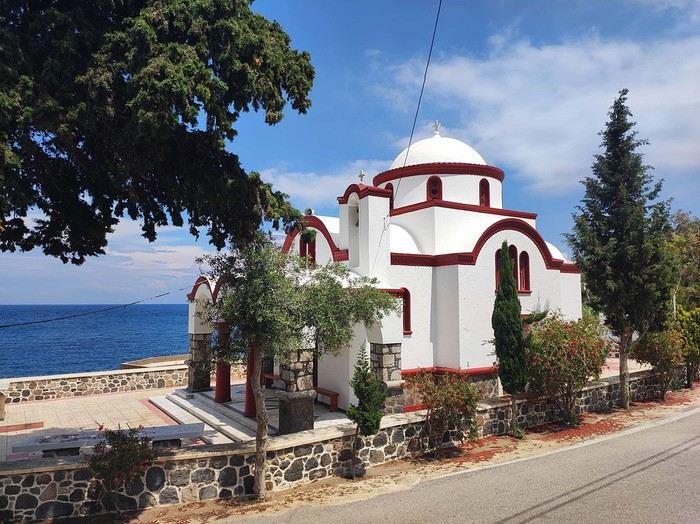
I dropped off my panniers in my room so I could ride light for once, then headed toward the next village: Pali. It’s a small fishing village that apparently comes to life a bit in the summer with a few tourists.
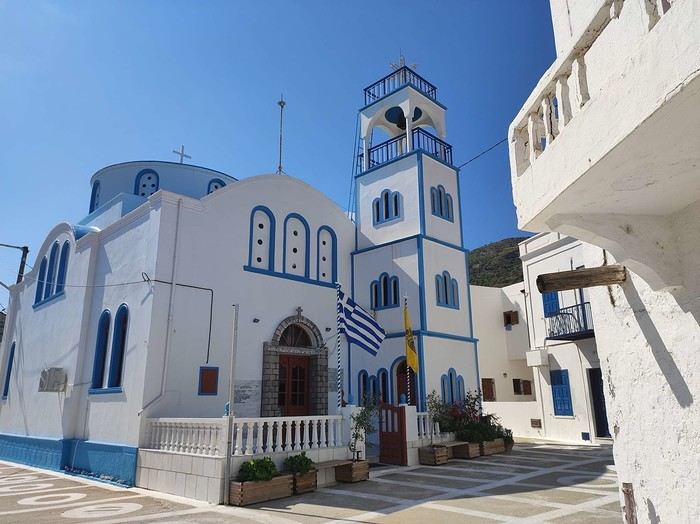
As I pedaled along the dock, I passed right by a guy sitting in a chair in full sun. Unfazed despite the sweat pouring down his forehead, he untangled his fishing net with a precision that commanded respect. I gave him the obligatory kalimera (good morning), but he reacted like a deaf-mute—no response at all. On the other hand, his employee answered me kindly from the trawler docked right next to him. Standing on deck, he was also untangling a mess of nets and invited me aboard to chat. That’s Mohamed.
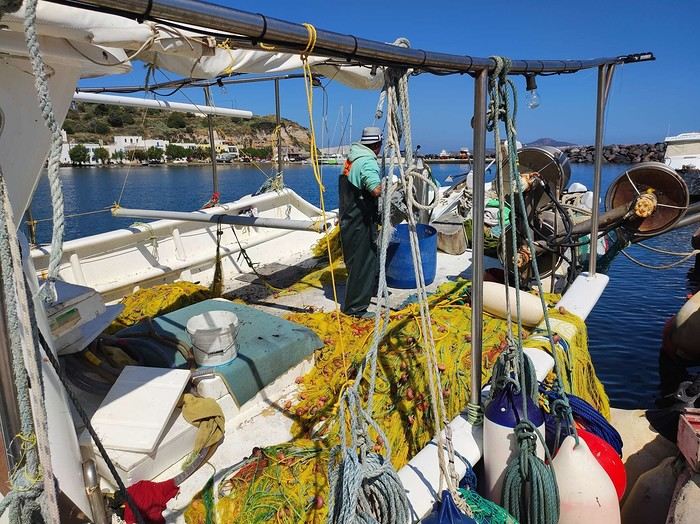
Communication wasn’t easy since he only spoke Greek and I didn’t, but he was cheerful, and his joy was contagious. He proudly showed off their catch of the day: two beautiful rays and a few brightly colored fish. We chatted like that for about fifteen minutes.
When it was time to hit the road again, I said goodbye to Mohamed, who smiled back. But this time, his boss—still dripping sweat in his chair under the scorching sun—greeted me too. Turns out he wasn’t deaf or mute after all.
I continued along the coast since that’s where most of Nisyros’ beaches are. They start lining up just outside Pali. These are black sand beaches, which can’t hide their volcanic origins.
Yesterday afternoon in Athens, I met Peter and Michelle, a Dutch-French couple, while we were waiting for the ferry to depart. The Greek sailors were on strike, so we ended up waiting about twelve hours before setting off. Anyway, we had plenty of time to chat, and Peter, who’s lived on Tilos—a small island near Nisyros—for about twenty years, told me that many migrants pass through these two islands. Most come from Afghanistan and Syria, fleeing authoritarian regimes and the massacres that come with them. They’re looking for *anywhere* else where the future can’t possibly be worse. Peter explained that you often find their belongings on the local beaches. And sure enough, I didn’t have to look far to spot some—clothes, life jackets…
I glanced around, hoping to see one of them to maybe exchange a few words, but no—no one. I was completely alone.
I got back on my bike and spent the rest of the day wandering aimlessly, just exploring this beautiful part of Nisyros. I also picked up some supplies because tomorrow, I’d be heading inland for two days, deep into its four-kilometer-wide caldera to explore the volcano. I’d be sleeping in a tent, so I needed to stock up on food. After a restful night in a real bed—something rare on this bike trip (and I won’t even mention the shower…)—I finally set off for the volcano (I’ll share details about that charming little hotel with the amazing breakfasts at the end of the journal). To reach Stefanos (the name of the main crater), I had to climb to the top of the caldera. It was hot, and some of the slopes were between 10 and 15%, which is steep, especially with a 54 kg bike. But who cares? I was admiring the scenery, and I have to say, I was surprised by how green it was. The higher I climbed, the more beautiful the vegetation became. It stood out against the blue of the sea, and the landscapes inside the island were truly stunning. So, I stopped every five minutes to take photos. Every now and then, I’d come across cows in the middle of the road—or goats in the trees! They climbed with the agility of monkeys to munch on the leaves. I couldn’t get a photo of them because they’d all scatter before I got close. It was actually the noise they made climbing down that tipped me off to their presence. Two villages sit at the top of the caldera: Emporios and Nikia. I passed the first one without climbing up to it, then continued to the second. And let me tell you, Nikia was love at first sight! I found myself pedaling through tiny streets, some barely wider than my bike with its panniers. The walls were white, and the doors were painted in all sorts of colors—green, blue, red… The streets were empty, and silence reigned. But it wasn’t a dead silence. It was more like the kind you find in small, secret, peaceful places. The village exuded tranquility, calm, and well-being. I leaned my bike—with all its gear—against a wall without locking it. It was the first time on this trip that I’d done that. Sure, its weight made it more like a tank than a bike, so you’d have to be *really* motivated to steal it, but here, for some reason, I felt completely at ease. Maybe it wasn’t the smartest move, but I go a lot by instinct, and here, it felt right. So I left my bike there and went to eat a little farther away, at a small restaurant on the village’s main square. It’s famous all over Greece for the beautiful mosaic that covers and decorates the floor. Once I’d eaten and drunk my fill, I hopped back on my bike, which had waited patiently without running off. And the best part? After riding uphill all morning to reach the top of the caldera, all I had to do now was coast downhill to the volcano. Pure bliss in such breathtaking scenery.
I hesitated for a long time before publishing this travel journal since it’s been 8 months now since I left Nisyros. But in the end, I found it too beautiful to keep quiet about. So here we go—I finally got around to writing it. Nisyros is a stunning little Greek island, and luckily, it’s well hidden. Located a good twenty hours by boat from Athens, its distance from the Greek mainland deters most tourists from visiting. That’s what makes it an off-the-beaten-path destination. So much for the general info.
Before diving into the details, I should mention that I visited by bike (despite its severe and constant volcanic elevation) as part of a solo trip from France to Turkey. Why this detail? Because out of the ten countries I crossed and the dozens of sites I saw, Nisyros is one of my top three favorites (along with Pag Island, off-season, in Croatia, and Albania for its overall beauty—stunning natural landscapes and the incredible hospitality of its people). Anyway, welcome to this travel journal dedicated to the lovely little volcanic island of Nisyros…
I arrived one beautiful morning in Mandraki, the island’s main port. The twenty-hour boat ride from Athens went by like a breeze. I slept on the deck for three or four hours, sprawled on a bench that was more or less sheltered from the wind. At this time of year (it’s May 2nd), tourists aren’t exactly flocking here, so the boat was far from full. My first glimpse of Nisyros is classic Greek island scenery: blazing sun, an azure sky, and an even deeper blue sea. The trip is off to a great start. I quickly found a small, out-of-the-way hotel (I’m one of those people who avoids crowds as much as possible when traveling, which is getting harder and harder to do). While everyone else from the boat turned right out of the port toward the center of Mandraki, I went left! My nice little hotel was just a hundred meters away, facing a pretty little Orthodox church whose red color contrasted beautifully with the deep blue sea.
I dropped off my panniers in my room so I could ride light for once, then headed toward the next village: Pali. It’s a small fishing village that apparently comes to life a bit in the summer with a few tourists.
As I pedaled along the dock, I passed right by a guy sitting in a chair in full sun. Unfazed despite the sweat pouring down his forehead, he untangled his fishing net with a precision that commanded respect. I gave him the obligatory kalimera (good morning), but he reacted like a deaf-mute—no response at all. On the other hand, his employee answered me kindly from the trawler docked right next to him. Standing on deck, he was also untangling a mess of nets and invited me aboard to chat. That’s Mohamed.
Communication wasn’t easy since he only spoke Greek and I didn’t, but he was cheerful, and his joy was contagious. He proudly showed off their catch of the day: two beautiful rays and a few brightly colored fish. We chatted like that for about fifteen minutes.
When it was time to hit the road again, I said goodbye to Mohamed, who smiled back. But this time, his boss—still dripping sweat in his chair under the scorching sun—greeted me too. Turns out he wasn’t deaf or mute after all.
I continued along the coast since that’s where most of Nisyros’ beaches are. They start lining up just outside Pali. These are black sand beaches, which can’t hide their volcanic origins.
Yesterday afternoon in Athens, I met Peter and Michelle, a Dutch-French couple, while we were waiting for the ferry to depart. The Greek sailors were on strike, so we ended up waiting about twelve hours before setting off. Anyway, we had plenty of time to chat, and Peter, who’s lived on Tilos—a small island near Nisyros—for about twenty years, told me that many migrants pass through these two islands. Most come from Afghanistan and Syria, fleeing authoritarian regimes and the massacres that come with them. They’re looking for *anywhere* else where the future can’t possibly be worse. Peter explained that you often find their belongings on the local beaches. And sure enough, I didn’t have to look far to spot some—clothes, life jackets…
I glanced around, hoping to see one of them to maybe exchange a few words, but no—no one. I was completely alone.
I got back on my bike and spent the rest of the day wandering aimlessly, just exploring this beautiful part of Nisyros. I also picked up some supplies because tomorrow, I’d be heading inland for two days, deep into its four-kilometer-wide caldera to explore the volcano. I’d be sleeping in a tent, so I needed to stock up on food. After a restful night in a real bed—something rare on this bike trip (and I won’t even mention the shower…)—I finally set off for the volcano (I’ll share details about that charming little hotel with the amazing breakfasts at the end of the journal). To reach Stefanos (the name of the main crater), I had to climb to the top of the caldera. It was hot, and some of the slopes were between 10 and 15%, which is steep, especially with a 54 kg bike. But who cares? I was admiring the scenery, and I have to say, I was surprised by how green it was. The higher I climbed, the more beautiful the vegetation became. It stood out against the blue of the sea, and the landscapes inside the island were truly stunning. So, I stopped every five minutes to take photos. Every now and then, I’d come across cows in the middle of the road—or goats in the trees! They climbed with the agility of monkeys to munch on the leaves. I couldn’t get a photo of them because they’d all scatter before I got close. It was actually the noise they made climbing down that tipped me off to their presence. Two villages sit at the top of the caldera: Emporios and Nikia. I passed the first one without climbing up to it, then continued to the second. And let me tell you, Nikia was love at first sight! I found myself pedaling through tiny streets, some barely wider than my bike with its panniers. The walls were white, and the doors were painted in all sorts of colors—green, blue, red… The streets were empty, and silence reigned. But it wasn’t a dead silence. It was more like the kind you find in small, secret, peaceful places. The village exuded tranquility, calm, and well-being. I leaned my bike—with all its gear—against a wall without locking it. It was the first time on this trip that I’d done that. Sure, its weight made it more like a tank than a bike, so you’d have to be *really* motivated to steal it, but here, for some reason, I felt completely at ease. Maybe it wasn’t the smartest move, but I go a lot by instinct, and here, it felt right. So I left my bike there and went to eat a little farther away, at a small restaurant on the village’s main square. It’s famous all over Greece for the beautiful mosaic that covers and decorates the floor. Once I’d eaten and drunk my fill, I hopped back on my bike, which had waited patiently without running off. And the best part? After riding uphill all morning to reach the top of the caldera, all I had to do now was coast downhill to the volcano. Pure bliss in such breathtaking scenery.
Quebec road trip: questions about travel distances and accommodation prices
Hi there,
We’re planning a trip to Quebec from June 15 to 28, 2025, specifically along the St. Lawrence River. As I’ve been looking into it, I’ve got two main questions:
First, about our route—I feel like I might be biting off more than we can chew by wanting to follow the left bank downstream from Quebec City (including the Saguenay Fjord and Lac Saint-Jean), then heading to Gaspésie by ferry, and finally returning along the right bank. We’re flying into Montreal and will likely stop in Quebec City too. Over about ten days, is that too much? Would it be better to stick to the left bank, enjoy the coast and the lake, and maybe explore Mauricie or Mont-Tremblant on the way back instead?
Second, about prices. Since we’re thinking of renting a car and booking accommodations at each stop, I was a bit surprised by hotel and motel rates. I’ve always heard Canada is a pretty expensive destination, but I’m seeing average prices very similar to France—between 60 € and 90 €. Am I missing something? Is service not included? Meanwhile, on platforms like Airbnb, the prices seem exorbitant.
This second question is a bit generic, but as I’m trying to budget, I don’t feel like there’s a huge difference compared to France, even for meals. Am I way off base?
Have a great evening! !
30 days, 3 provinces in this China that fascinates me...
We’ve just returned from a 30-day trip to China, 20 years after our last visit to this vast country.
What a transformation! So many new highways, high-speed trains, clean public restrooms, very comfortable and affordable hotels, and queues before boarding public transport… Has China really changed this much?
Language Technology has helped overcome—on a very small scale, of course—the language barrier thanks to translation apps on our phones. Unfortunately, very few Chinese people speak English, even in international hotels, which we find baffling, even frustrating, but that’s just how it is, and it’s up to us to adapt. It’s a shame, too, because no one makes an effort to communicate any other way than through their phone, which wasn’t the case when we were there 20 years ago. In restaurants, hotels, and some shops, they’ll show you a voice translation—usually in English—on a phone, and all you have to do is respond.
Payments We never withdrew cash in China. It’s possible to do so, but we never looked for an ATM. On the other hand, we tried to exchange 100 € as soon as we arrived in Xi’an, and it was a real ordeal. We had to do it at a specific bank, The Bank of China, and the administrative process took… an hour! So, no cash. Like everyone else, we used Alipay, one of the most popular online payment systems, and it’s super easy to use. WeChat also works well but is a bit more complicated to set up. It’s so convenient and used absolutely everywhere, even for purchases of 5 yuan, which is roughly the equivalent of about 55 euro cents. 10 yuan equals 1.22 €.
Phone As for the internet, I had installed a VPN before leaving—Let’s VPN—but it was completely useless since we had subscribed to an international plan with our carrier before the trip, which gave us 35 GB of data. No need to ask hotels for Wi-Fi; we only used roaming. It worked perfectly, no matter where we were. So, no VPN or SIM card for us.
TWO ESSENTIAL TOOLS FOR TRAVELING: your passport and your phone Traveling to China is much simpler than you might think. And let’s add that the Chinese, despite the language barrier, are very open and always ready to help.
The itinerary After carefully planning our route and considering the length of our stay (I had initially thought about applying for a visa longer than 30 days to stay for 6 weeks in China), we decided to take advantage of the recent option to stay for 30 days. Of course, we had to make some choices. I booked a one-way ticket from Paris to Xi’an and a return from Kunming to Paris once the itinerary was set: 9 days in northern Gansu 4 days in Hunan, specifically the well-known Zhangjiajie 15 days in Yunnan
Organization, transport, hotels This wasn’t a "backpacker" trip, as the hotels we booked were generally comfortable. I had arranged a car with a driver for the Yunnan portion through the Ciel Yunnan agency. Excellent choice—it allowed us to optimize our route. For the Gansu and Hunan portions, after much deliberation, we decided against hiring a driver. All our travel was by train and taxi. Taxis are available near train stations, airports, and some hotels in big cities. We also used "Didi," the Chinese equivalent of Uber. The app is available through Alipay. Getting around China by train is extremely easy. You just need to book your tickets on a travel site. I used trip.com and travelchina. Since we weren’t traveling during peak season, it was easy to get the tickets we wanted. You can buy train tickets up to 15 days before departure. You can book earlier, but there’s no guarantee you’ll get the time you want, especially during tourist seasons (usually the first week of October or May). Once at the station, you only need to show your passport, and you’ll need it again when leaving the station. Taxis are easy to find and not expensive. For day trips, we usually went through the hotel. Like everyone else, I had checked the prices of online tour agencies beforehand, and they were all overpriced. It’s better to wait until the last minute or, if possible, contact the hotel and ask them. I did this twice. We took domestic flights three times: Xi’an to Dunhuang Lanzhou to Changsha Changsha to Lijiang It’s best to buy flights shortly before departure, as prices are quite low then. There’s no point in booking months in advance. Often, flights only appear 2 months before departure. All hotel reservations were made on trip.com, except for three booked on Booking. Almost all exceeded our expectations in terms of comfort. Rooms were usually spacious, and new technology even makes its way into the rooms with "smart" toilets and automatic curtains… All for a very reasonable price.
The "attractions" That’s the term used on travel sites like trip.com for visits and activities, and it fits perfectly! Don’t expect to move freely around a natural tourist site. Cars aren’t allowed. The process is more or less the same everywhere: you arrive at the visitor center, pay the entrance fee, then, with your ticket or passport (always keep them on you!), you board a bus that takes you to the various viewpoints. The duration of the "tour" is usually indicated. It might seem confusing or even unnatural, but no one can avoid it unless you go to very remote, non-touristy places. Generally, the further west you go, the less this type of visit exists. The upside is that these places are better preserved since access is only by electric shuttle. On the downside, you sometimes have to deal with noisy tourist groups, their guides’ loudspeakers, and their non-stop chatter. But if you move a little further away, you’ll often find yourself alone.
Highlights of this trip:🙂 A 2-day escape to the Badan Jaran Desert—absolutely stunning. The colorful mountains near Zhangye. The Buddhist caves in Gansu. The breathtaking Hani and Yi rice terraces in Yuanyang. The architecture of the old towns, even if they sometimes feel a bit overdone. The warm welcome from the locals.
A little disappointed by: Zhangjiajie, despite its beauty. It was way too crowded, even though we were there in the off-season. And that’s nothing compared to the Stone Forest near Kunming… I also struggled with the food after a while. 😕
A few photos to come…
Discussion for October's Theme (Doors)
Hello again!
If you'd like to post non-contest photos or chat about this month's theme, this is the place! 🙂
If you'd like to post non-contest photos or chat about this month's theme, this is the place! 🙂
The Two of Us in Istanbul: A Turkish Blue Round
Hello everyone,
I’m not really a regular contributor to VoyageForum, but every time Kate and I travel, she encourages me to write a travel journal and publish it. And I must admit, it’s a very enjoyable intellectual exercise, though not always easy. As a VF contributor whose journals I’ve read once said, this retrospective work not only helps preserve memories but also provides a fruitful moment of introspection by bringing back emotions and feelings.
Kate and I spent a week in Istanbul. For her, who had already visited, it was a return; for me, it was a discovery.
As we’ve now made a habit of, I write the texts, and she posts her photos. We hope this illustrated story, crafted together, will revive beautiful sensations for those who know the city and inspire others to discover it. Here we go!
I’m not really a regular contributor to VoyageForum, but every time Kate and I travel, she encourages me to write a travel journal and publish it. And I must admit, it’s a very enjoyable intellectual exercise, though not always easy. As a VF contributor whose journals I’ve read once said, this retrospective work not only helps preserve memories but also provides a fruitful moment of introspection by bringing back emotions and feelings.
Kate and I spent a week in Istanbul. For her, who had already visited, it was a return; for me, it was a discovery.
As we’ve now made a habit of, I write the texts, and she posts her photos. We hope this illustrated story, crafted together, will revive beautiful sensations for those who know the city and inspire others to discover it. Here we go!
Preparing for a trip to Sri Lanka
Hi everyone.
The tickets for SRI LANKA are booked—arriving in COLOMBO on 12/21 and returning from the same place on 01/17. I’ve read here and there that it’ll be high season, but we don’t have a choice, so we’ll make do...
My first question is obviously about the itinerary: Most of the ones I’ve seen go clockwise, and I’m wondering if I should do it the other way: - To avoid the cultural triangle between Christmas and New Year’s - To start with a bit of rest (we’re really wiped out) Does that make sense?
My second question is about the time allocated to each stop, which you’ll find below. Is it balanced? Too much here and not enough there?
My third question will be about Jaffna: yes or no? How long is the trip from Anuradhapura? Where can I fit in the 3 days needed?
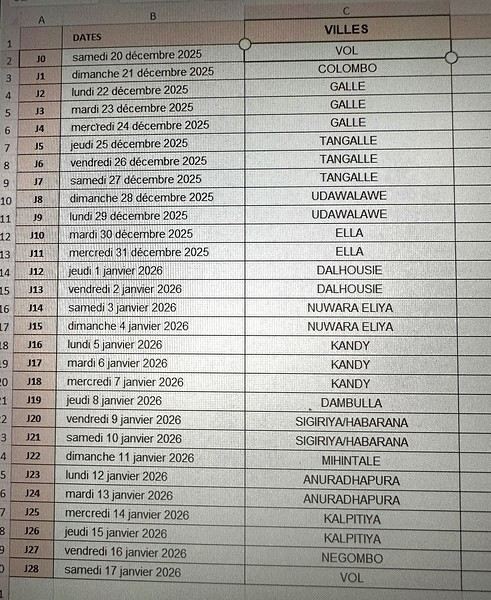
Thanks for your replies. A few details: ultra-independent travelers, using public transport, hikers, minimum 2 nights per accommodation. First time in Sri Lanka! !
The tickets for SRI LANKA are booked—arriving in COLOMBO on 12/21 and returning from the same place on 01/17. I’ve read here and there that it’ll be high season, but we don’t have a choice, so we’ll make do...
My first question is obviously about the itinerary: Most of the ones I’ve seen go clockwise, and I’m wondering if I should do it the other way: - To avoid the cultural triangle between Christmas and New Year’s - To start with a bit of rest (we’re really wiped out) Does that make sense?
My second question is about the time allocated to each stop, which you’ll find below. Is it balanced? Too much here and not enough there?
My third question will be about Jaffna: yes or no? How long is the trip from Anuradhapura? Where can I fit in the 3 days needed?
Thanks for your replies. A few details: ultra-independent travelers, using public transport, hikers, minimum 2 nights per accommodation. First time in Sri Lanka! !
Day-hike guide in Northern Vietnam
My husband and I are planning a 10-day trip to Northern Vietnam in November, traveling independently (no agency organizing everything) and using local buses. We’d like to spend at least 3 days in each place (including Meo Vac). We’re wondering if it’s possible to find local guides for day hikes, and if so, in which towns/villages (Meo Vac plus one or two other spots to explore the surrounding area).
Thanks!