Results for "Collonges+|+127"
8838 results found.
Argentine and Chilean Patagonia from El Calafate to Ushuaia
This travel journal summarizes a trip I took in March to Argentine and Chilean Patagonia. It starts in El Calafate and ends in Ushuaia. During my planning, I considered looking into the Australis cruise from Punta Arenas to Ushuaia, as well as the W trek in Torres del Paine National Park. In both cases, I was put off by the prices. Instead of the cruise, I found two interesting wildlife excursions from Punta Arenas: whale watching in the Strait of Magellan and observing king penguins in Tierra del Fuego. The journey to Ushuaia was by bus. For Torres del Paine, things were a bit confusing, so I reached out to two agencies. In the end, I went with a rental car option, overnight stays on-site, and day hikes. I shared my full itinerary with the agency and ended up being taken care of by a local Argentine agency and a Chilean one.
So, here we go...
Villages around Hazaribagh in West Bengal
Wednesday, April 1st
Hazaribagh I’ve got a meet-up with Adam Iman, a guide and painter. He picks me up from the hotel at 10 AM. Another traveler from Bangalore is supposed to join us, but while we wait for him to arrive, Adam takes me to see the paintings his mother and sister created at Hazaribagh station. The town became famous thanks to these murals, which can also be found in several surrounding villages. This art form has earned recognition and is now protected, a sign of its cultural importance. Once the visit is over, we go to pick up the other traveler and then head to our first village: Belwara, where Sohrai art is practiced. At the entrance, a sign proudly announces that we’re entering an artists’ village, where this art is created by women organized into micro-enterprises. Some even offer workshops for those who’d like to learn this tradition.
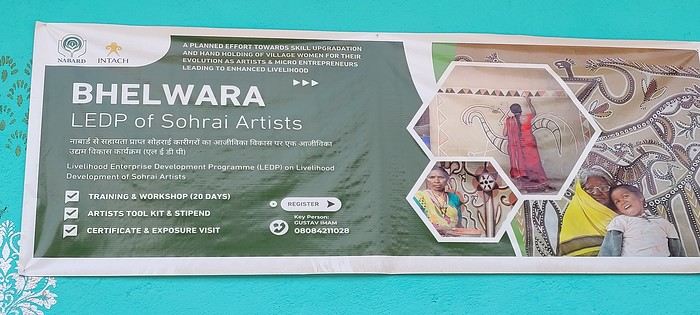
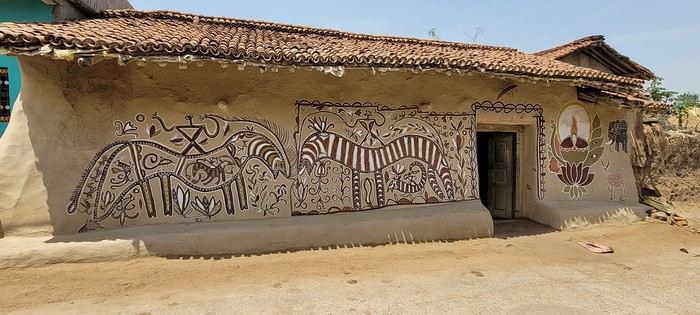
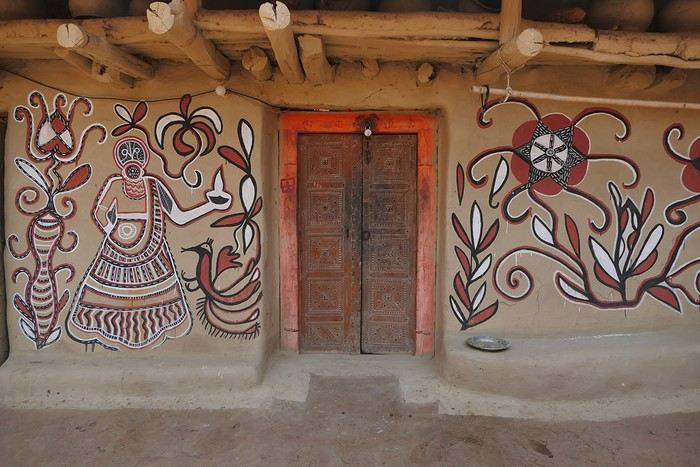
Sohrai art is tied to the harvest season, from October to mid-November. The motifs, in natural colors, celebrate fertility and abundance. The artists use pigments from the earth: red oxides, ochre, white kaolin, and black manganese. On the walls, you’ll see animals, fish, birds—all symbols of life and prosperity. As I look closer at the murals, I start to realize that each motif tells a story. Large animals like cows or bulls often take center stage. Their bodies are filled with intricate, almost hypnotic patterns. They symbolize wealth and prosperity for the household, as well as the deep respect for cattle, which are essential to daily life. On some facades, elephants stand out—massive and decorated with the same precision. They evoke quiet strength and protection. But it’s when I stop in front of one of the houses that I really take the time to look. The wall, a soft ochre, is entirely covered in murals. Two large animals stretch out on either side of the door, their elongated bodies fitting the length of the wall. Their silhouettes are filled with geometric patterns and incredibly fine curved lines, as if every space was patiently filled. Around them, stylized plants, flowers, and small decorative elements fill every gap. The door, dark and worn, becomes almost the silent center of the composition, framed by these living, protective forms. To the right, a more colorful motif catches the eye—a flower or a stylized lamp—like a touch of light on the earth. The whole thing gives an impression of perfect balance, between the rigor of the patterns and the freedom of the gesture.
Elsewhere, birds and freer forms bring movement. Peacocks, recognizable by their stylized silhouettes, embody beauty and vitality, while fish symbolize water, fertility, and the continuity of life.
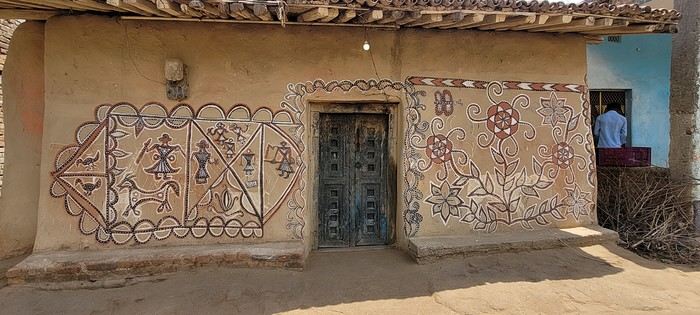
 On some paintings, the scenes become almost narrative: you can make out figures, everyday gestures, like a memory of the village inscribed in the walls. The decorative frames around the doors aren’t left to chance either—they symbolically protect the house, like a boundary between the inside and the outside world.
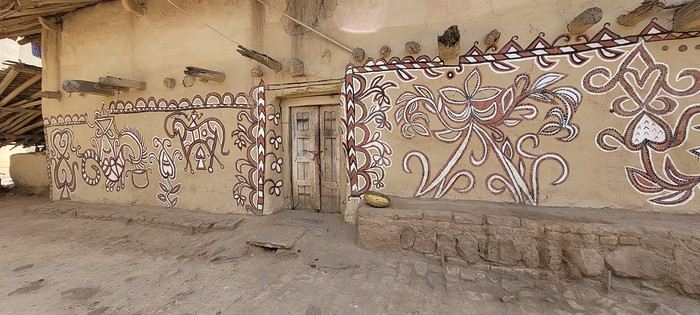
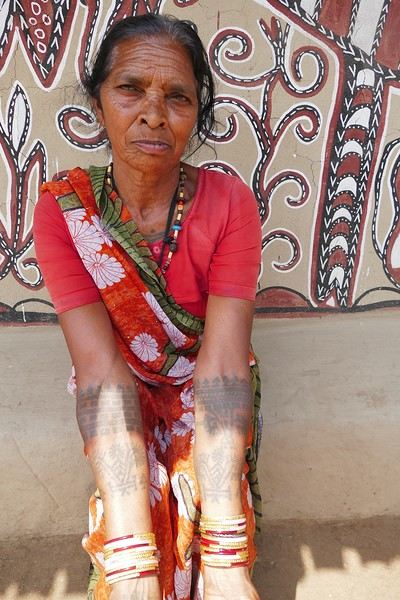
During the Sohrai festival, cattle are led into the jungle in the morning. Meanwhile, the women finish the *aripans*—these floor paintings—and continue the wall murals. Around noon, the animals return to the village, and the bulls’ horns are anointed with oil and vermilion in a gesture of gratitude, amid the vibrant colors adorning the houses. We visit several artists, including Parvat Devi, a well-known woman who has received many awards. Her arms are adorned with intriguing tattoos, which I’ll talk about in more detail later.
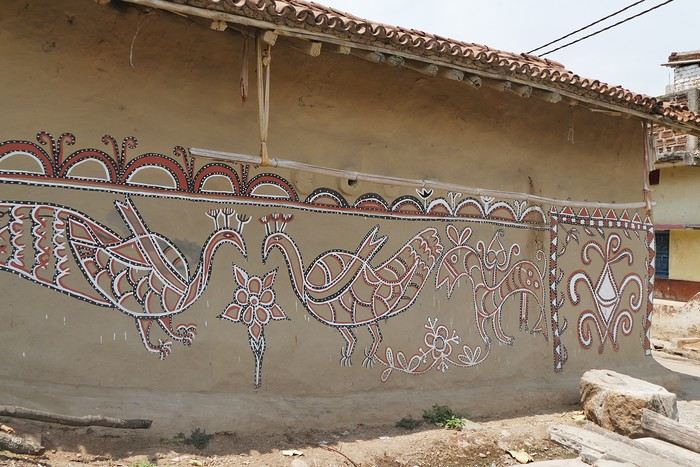
On another wall, the style changes completely. Here, no massive animals—just birds occupying the space, light and graceful, as if caught in mid-movement. Two silhouettes face each other, their long necks arched almost like mirrors, while their outstretched wings seem to vibrate with the patterns that compose them.
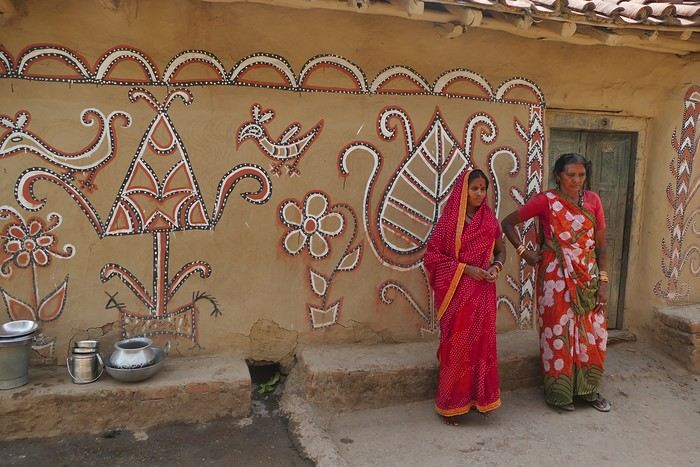
The design is more graphic, almost airy. The lines are smoother, more fluid, as if drawn in one confident stroke. The birds’ bodies aren’t solid—they’re filled with repetitive motifs like scales, stylized feathers, and spirals, giving a sense of continuous movement. Around them, everything comes to life: flowers burst open, arabesques swirl, and even the simplest shapes seem alive. What strikes me here is the sense of lightness. Where the large animals evoked stability and grounding, these birds bring something freer, almost joyful. They seem to embody movement, the circulation of life, like a breath flowing through the village.
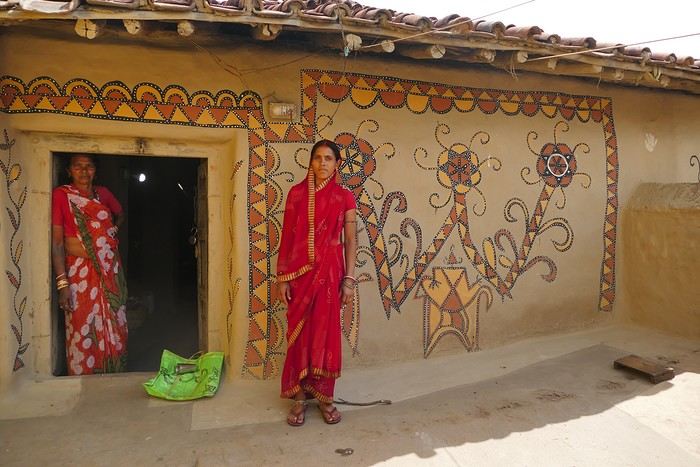
The colors remain the same—deep reds, intense blacks, and chalky white—but the rhythm is different. Faster, more spontaneous. As if each wall had its own personality, while still speaking the same language.
That’s probably why I’m so moved. I’d heard about these paintings from my friend Raja, and last year, I saw an exhibition in a village near my home. That first encounter made me want to come here. But seeing them in person is a whole different experience. These paintings are unique. This ancient art is passed down from mother to daughter, or mother-in-law to daughter-in-law, in a quiet, deeply living continuity. At first glance, it might seem almost childlike in its simplicity and pared-down forms. And yet, everything is thought out, balanced, mastered. Nothing is left to chance.
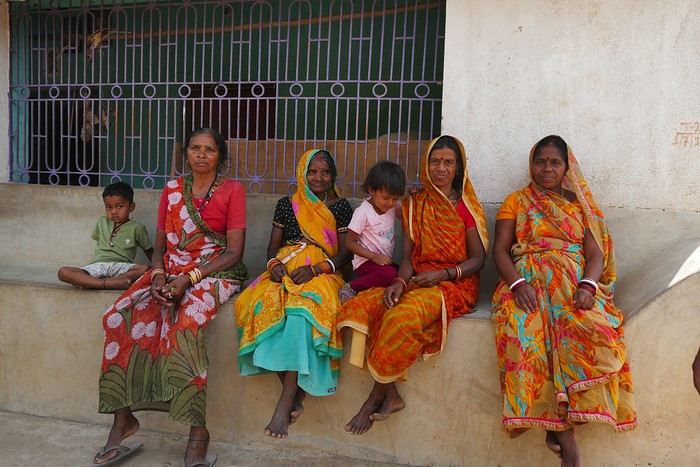
That apparent simplicity, combined with such rich symbolism, touches me deeply. There’s something sincere and essential in these walls—and that’s what moves me.
Hazaribagh I’ve got a meet-up with Adam Iman, a guide and painter. He picks me up from the hotel at 10 AM. Another traveler from Bangalore is supposed to join us, but while we wait for him to arrive, Adam takes me to see the paintings his mother and sister created at Hazaribagh station. The town became famous thanks to these murals, which can also be found in several surrounding villages. This art form has earned recognition and is now protected, a sign of its cultural importance. Once the visit is over, we go to pick up the other traveler and then head to our first village: Belwara, where Sohrai art is practiced. At the entrance, a sign proudly announces that we’re entering an artists’ village, where this art is created by women organized into micro-enterprises. Some even offer workshops for those who’d like to learn this tradition.
Sohrai art is tied to the harvest season, from October to mid-November. The motifs, in natural colors, celebrate fertility and abundance. The artists use pigments from the earth: red oxides, ochre, white kaolin, and black manganese. On the walls, you’ll see animals, fish, birds—all symbols of life and prosperity. As I look closer at the murals, I start to realize that each motif tells a story. Large animals like cows or bulls often take center stage. Their bodies are filled with intricate, almost hypnotic patterns. They symbolize wealth and prosperity for the household, as well as the deep respect for cattle, which are essential to daily life. On some facades, elephants stand out—massive and decorated with the same precision. They evoke quiet strength and protection. But it’s when I stop in front of one of the houses that I really take the time to look. The wall, a soft ochre, is entirely covered in murals. Two large animals stretch out on either side of the door, their elongated bodies fitting the length of the wall. Their silhouettes are filled with geometric patterns and incredibly fine curved lines, as if every space was patiently filled. Around them, stylized plants, flowers, and small decorative elements fill every gap. The door, dark and worn, becomes almost the silent center of the composition, framed by these living, protective forms. To the right, a more colorful motif catches the eye—a flower or a stylized lamp—like a touch of light on the earth. The whole thing gives an impression of perfect balance, between the rigor of the patterns and the freedom of the gesture.
Elsewhere, birds and freer forms bring movement. Peacocks, recognizable by their stylized silhouettes, embody beauty and vitality, while fish symbolize water, fertility, and the continuity of life.
On some paintings, the scenes become almost narrative: you can make out figures, everyday gestures, like a memory of the village inscribed in the walls. The decorative frames around the doors aren’t left to chance either—they symbolically protect the house, like a boundary between the inside and the outside world.During the Sohrai festival, cattle are led into the jungle in the morning. Meanwhile, the women finish the *aripans*—these floor paintings—and continue the wall murals. Around noon, the animals return to the village, and the bulls’ horns are anointed with oil and vermilion in a gesture of gratitude, amid the vibrant colors adorning the houses. We visit several artists, including Parvat Devi, a well-known woman who has received many awards. Her arms are adorned with intriguing tattoos, which I’ll talk about in more detail later.
On another wall, the style changes completely. Here, no massive animals—just birds occupying the space, light and graceful, as if caught in mid-movement. Two silhouettes face each other, their long necks arched almost like mirrors, while their outstretched wings seem to vibrate with the patterns that compose them.
The design is more graphic, almost airy. The lines are smoother, more fluid, as if drawn in one confident stroke. The birds’ bodies aren’t solid—they’re filled with repetitive motifs like scales, stylized feathers, and spirals, giving a sense of continuous movement. Around them, everything comes to life: flowers burst open, arabesques swirl, and even the simplest shapes seem alive. What strikes me here is the sense of lightness. Where the large animals evoked stability and grounding, these birds bring something freer, almost joyful. They seem to embody movement, the circulation of life, like a breath flowing through the village.
The colors remain the same—deep reds, intense blacks, and chalky white—but the rhythm is different. Faster, more spontaneous. As if each wall had its own personality, while still speaking the same language.
That’s probably why I’m so moved. I’d heard about these paintings from my friend Raja, and last year, I saw an exhibition in a village near my home. That first encounter made me want to come here. But seeing them in person is a whole different experience. These paintings are unique. This ancient art is passed down from mother to daughter, or mother-in-law to daughter-in-law, in a quiet, deeply living continuity. At first glance, it might seem almost childlike in its simplicity and pared-down forms. And yet, everything is thought out, balanced, mastered. Nothing is left to chance.
That apparent simplicity, combined with such rich symbolism, touches me deeply. There’s something sincere and essential in these walls—and that’s what moves me.
Peru: A Childhood Dream Finally Fulfilled
Preamble
I could have titled my travel journal like Carmen: "Some trips are born twice." Indeed, we had considered this destination back in February 2020. However, an honest tour operator advised us against traveling at that time due to the climate. So, we gave up and opted for Guatemala instead (see "On the Mayan Lands" on this site).
So, why this title? When I was in primary school, over 65 years ago, the illustrations in my history books (Machu Picchu) and geography books (Lake Titicaca) made me dream, and those images stayed in my mind. It took until 2026 to finally make this dream come true!
We prepared our trip with Tout Pérou, a French-speaking "agency." Everything was handled via email and WhatsApp exchanges with our contact: Laurent, who was both competent, friendly, and full of good advice. For 200 €, Tout Pérou provided us with drivers and guides whenever we wanted, helped us buy our domestic flights (cheaper when purchased in Peru), booked shuttles between airports and hotels, and got us a discount on the train ride to Aguas Calientes, as well as on the buses between Chivay and Puno and between Puno and Cusco. In short, Laurent took care of all the logistics and the Machu Picchu tickets. It was up to us to book our hotels. Tout Pérou provided a list, but we weren’t obliged to follow it. Another advantage of the package: we didn’t have to pay in advance; we paid the service providers directly day by day.
We didn’t meet Laurent in person because he was on vacation in Europe. Before his departure, he gave us a briefing, provided a summary table with the entire program, the service providers, their phone numbers, their fees, the schedules, and gave us plenty of advice (money, exchange, safety, etc.). After returning at the end of our stay, he kept checking in on us.
Lastly, we had also gathered information from Arnaud Lagadec, who runs a hotel in Cusco and offers tours of the region. He gave us a lot of useful information. Another contact: Thomas Montaigne, very friendly, who runs an agency in Arequipa (Agence Pérou Exclusif).
Day 1 – Paris to Lima
Foreword I’ll share our trip without any pretension—I don’t have the talent of some contributors on this forum—and I’ll illustrate it with a few photos (taken with an ordinary smartphone). My comments are personal and only reflect my own views. So, please be kind! Feel free to comment on my story as you like, but let’s avoid pointless debates.
Even though we live in the south of the Paris region, true to our habits when the flight is in the morning, we chose to spend the night before our departure in a hotel near CDG and parked our car in a parking lot in Garches. This way, we avoid the stress that often comes with traveling around Paris (accidents, roadworks, traffic jams, etc.).
Check-in and border control went smoothly on that Sunday morning. Our Air France flight was uneventful. In Lima, border control took a particularly long time, and for the first time, we didn’t get an entry visa stamped in our passports.
As planned, a driver took us to the Miraflores district, where our hotel was located. We were surprised by the numerous signs about possible tsunamis, having forgotten that Peru is prone to such events and regularly experiences earthquakes. We’d see the consequences of these during our journey.
Exhausted from the early wake-up, the 13-hour flight, and the 7-hour time difference, we had dinner at the hotel before a restful night.
Note that this day was Peru’s presidential election day. As a result, we weren’t served beer—the sale of alcohol was banned that Sunday.
Off on an adventure in Namibia!
April 11 – Day 1
It was winter, a winter with beautiful weather, A season that only exists in the southwest of America, I remember very well what I told you that morning A month ago... A century ago, an eternity ago... We’ll go... wherever you want, whenever you want...
Well, yeah, back from our adventure in our enchanting American West just a month ago, we’re already taking a bite out of one of its lesser-known competitors. "Flo, if you had to pick just one reason to justify your love for the U.S., what would it be?" The greasy, dripping burgers? No, I don’t think I’m going out on a limb by saying it’d be the wide-open spaces... And that’s exactly what our new quest is taking us to—a land on the other side of the globe where the horizon also seems endless, where silence tastes like salty wind and sand, where freedom is measured in kilometers of desert tracks, where the GPS is mostly there to confirm you’re lost in the middle of nowhere... Add to that magic formula the fact that you’ll see more zebras, giraffes, wildebeest, and elephants than people per square kilometer, and you can imagine us setting foot in Southern Africa for the first time, more precisely at the small airport in Windhoek, capital of... of...? Brush up on your geography, damn it! We’re landing in Namibia!!!
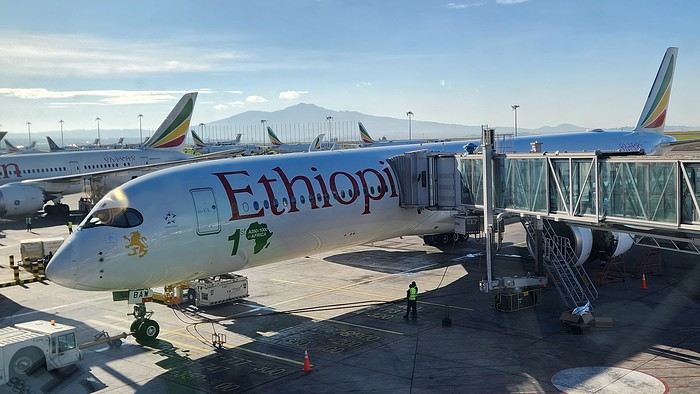
To be honest, Namibian landscapes have been flirting with me for ages. So how did I resist this island of temptation for so long? First, the budget. Let’s just say that for the same amount of effort (and kidneys), the bank lets you choose two other adventures almost anywhere else on the planet. Then there were my girls. Yeah, back then, they were too little to dose up on Malarone, the only malaria remedy at the time... Long story short, ten years later, all the planets have aligned. First, I won the Euromillions! Well, almost... Let’s just say my girls are now old enough... not to take Malarone, but to stop following me on all my adventures! Jackpot! "Flo, how about a little two-person caprice, just the two of us, tackling the Namibian tracks?"
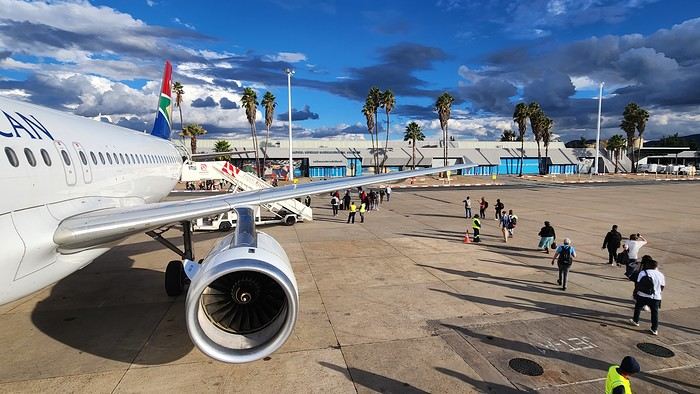
As we landed on the runway, first wow effect: The horizon is immense. It’s flat as can be, incredibly flat... So much flat space! Did I mention it was flat?... Looking into the distance, it feels like your gaze could circle the Earth without hitting a single obstacle—until you end up staring at your own backside. "Oh, what a nice view!" Well, it’s the first time I’ve seen my butt from this angle! Touching moment... Sorry, I’m rambling—must be the exhaustion from the three-flight marathon we just powered through via Ethiopia and South Africa... And yet, no time to philosophize about my anatomy. As usual, we want to rack up our first kilometers to be front and center at dawn tomorrow. After wrapping up the tedious Namibian immigration formalities and meeting the 4x4 that’ll be our companion day and night for the next fifteen days, we’re off! We’re not exactly fresh, but we’re ready to tackle the next five hundred kilometers in night mode, cruise control set due south! Just outside Windhoek, the local wildlife—a jackal—welcomes us with a smile: "Welcome to Namibia!" That’s what it said! Honest... Okay, first endless straight road, first flaming sunset, first corrugated dirt track, first Milky Way with zero light pollution... You get it—it’s definitely the day of firsts... First night camping, too, in the big trunk of our Toyota Fortuner parked by the side of the track... The real adventure, the kind that smells under the arms, can finally begin...
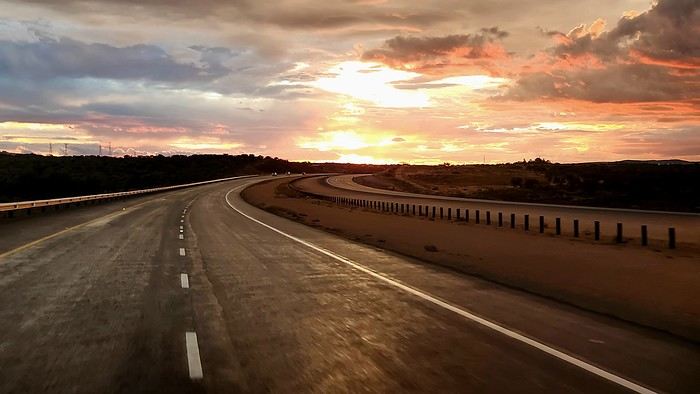
It was winter, a winter with beautiful weather, A season that only exists in the southwest of America, I remember very well what I told you that morning A month ago... A century ago, an eternity ago... We’ll go... wherever you want, whenever you want...
Well, yeah, back from our adventure in our enchanting American West just a month ago, we’re already taking a bite out of one of its lesser-known competitors. "Flo, if you had to pick just one reason to justify your love for the U.S., what would it be?" The greasy, dripping burgers? No, I don’t think I’m going out on a limb by saying it’d be the wide-open spaces... And that’s exactly what our new quest is taking us to—a land on the other side of the globe where the horizon also seems endless, where silence tastes like salty wind and sand, where freedom is measured in kilometers of desert tracks, where the GPS is mostly there to confirm you’re lost in the middle of nowhere... Add to that magic formula the fact that you’ll see more zebras, giraffes, wildebeest, and elephants than people per square kilometer, and you can imagine us setting foot in Southern Africa for the first time, more precisely at the small airport in Windhoek, capital of... of...? Brush up on your geography, damn it! We’re landing in Namibia!!!
To be honest, Namibian landscapes have been flirting with me for ages. So how did I resist this island of temptation for so long? First, the budget. Let’s just say that for the same amount of effort (and kidneys), the bank lets you choose two other adventures almost anywhere else on the planet. Then there were my girls. Yeah, back then, they were too little to dose up on Malarone, the only malaria remedy at the time... Long story short, ten years later, all the planets have aligned. First, I won the Euromillions! Well, almost... Let’s just say my girls are now old enough... not to take Malarone, but to stop following me on all my adventures! Jackpot! "Flo, how about a little two-person caprice, just the two of us, tackling the Namibian tracks?"
As we landed on the runway, first wow effect: The horizon is immense. It’s flat as can be, incredibly flat... So much flat space! Did I mention it was flat?... Looking into the distance, it feels like your gaze could circle the Earth without hitting a single obstacle—until you end up staring at your own backside. "Oh, what a nice view!" Well, it’s the first time I’ve seen my butt from this angle! Touching moment... Sorry, I’m rambling—must be the exhaustion from the three-flight marathon we just powered through via Ethiopia and South Africa... And yet, no time to philosophize about my anatomy. As usual, we want to rack up our first kilometers to be front and center at dawn tomorrow. After wrapping up the tedious Namibian immigration formalities and meeting the 4x4 that’ll be our companion day and night for the next fifteen days, we’re off! We’re not exactly fresh, but we’re ready to tackle the next five hundred kilometers in night mode, cruise control set due south! Just outside Windhoek, the local wildlife—a jackal—welcomes us with a smile: "Welcome to Namibia!" That’s what it said! Honest... Okay, first endless straight road, first flaming sunset, first corrugated dirt track, first Milky Way with zero light pollution... You get it—it’s definitely the day of firsts... First night camping, too, in the big trunk of our Toyota Fortuner parked by the side of the track... The real adventure, the kind that smells under the arms, can finally begin...
Tanzania Classics (Safari & Zanzibar)
I hesitated about writing this travel journal...
This summer, we only did the classics (the 3 northern parks and Zanzibar) and let a local agency take care of everything from start to finish.
No craziness, no risks, no sleeping under the stars, no self-drive, no venturing off the beaten path, no incidents, and not even any delays in the pre-planned itinerary...
But don’t think we were disappointed! The whole family (there were 6 of us) came back with smiles and memories of great moments spent together. So, if you're looking for a "classic" way to discover Tanzania, this is the place to be.
Our 2-week itinerary: - Arusha (1 night upon arrival) - Tarangire (1 night) - Ngorongoro (2 nights in Karatu then Irmisigiyo) - Serengeti (3 nights in Robanda, Togoro Plains, and Seronera) - Zanzibar Stone Town (1 night) - Zanzibar Matemwe (3 nights) - Zanzibar Jambiani (3 nights)
Hakuna matata!
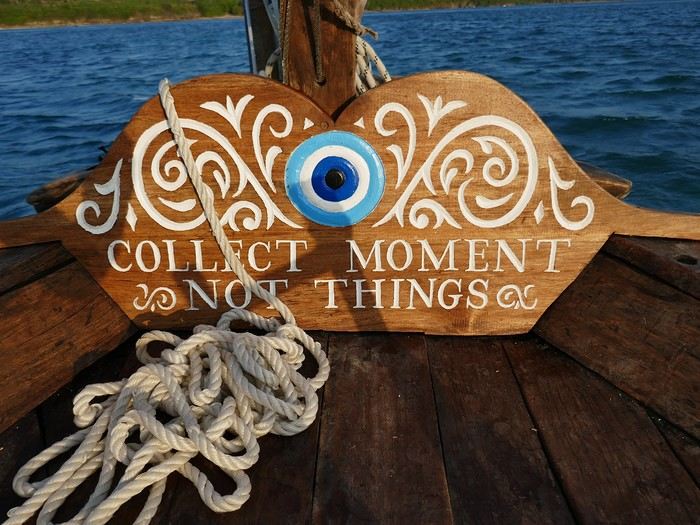
No craziness, no risks, no sleeping under the stars, no self-drive, no venturing off the beaten path, no incidents, and not even any delays in the pre-planned itinerary...
But don’t think we were disappointed! The whole family (there were 6 of us) came back with smiles and memories of great moments spent together. So, if you're looking for a "classic" way to discover Tanzania, this is the place to be.
Our 2-week itinerary: - Arusha (1 night upon arrival) - Tarangire (1 night) - Ngorongoro (2 nights in Karatu then Irmisigiyo) - Serengeti (3 nights in Robanda, Togoro Plains, and Seronera) - Zanzibar Stone Town (1 night) - Zanzibar Matemwe (3 nights) - Zanzibar Jambiani (3 nights)
Hakuna matata!
July 2026 Photo Contest Theme: Bridges of the World
The theme for this July’s photo contest is:
Bridges of the World
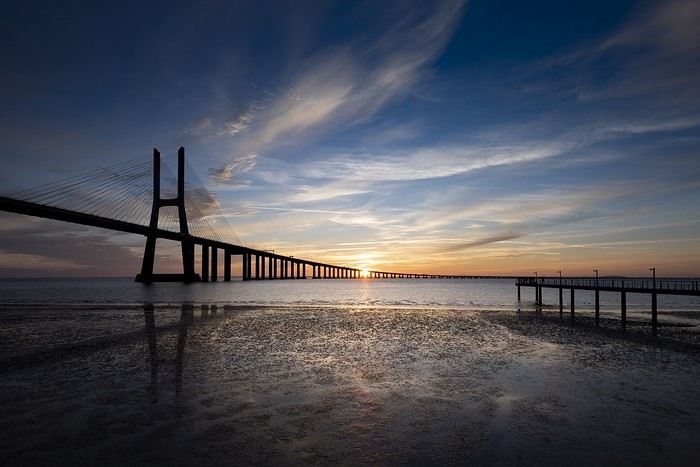 Vasco da Gama Bridge in Lisbon
Here’s the definition of a bridge: “A structure, typically made of stone, wood, or metal, that spans a depression or obstacle (such as a transportation route or waterway) by connecting the two sides or crossing over the obstacle.”
Viaducts, aqueducts, and footbridges will all be accepted.
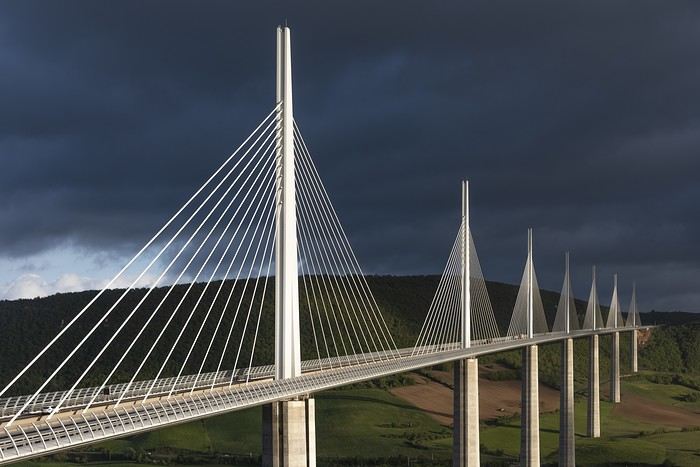 Millau Viaduct
To allow for as many original photos as possible, the bridge can be photographed from the side, below, or above—the main thing is that it’s the focal point of the image.
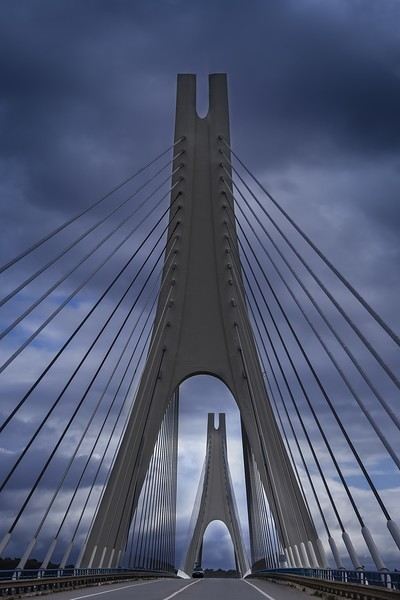 Bridge in the Algarve
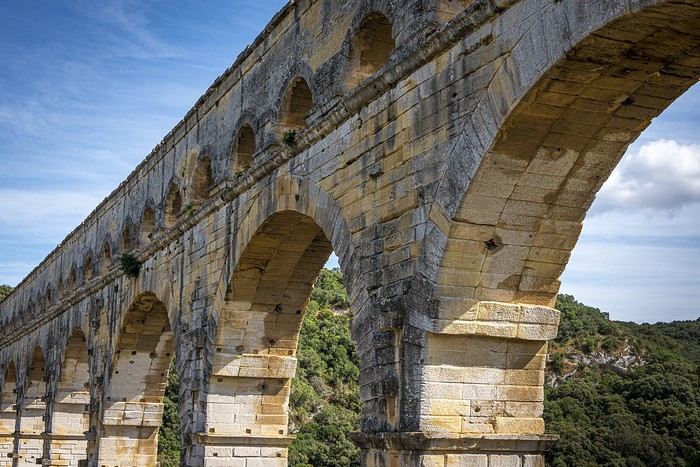 Pont du Gard from below
Details are also welcome, as long as you can still recognize it’s a bridge 😊
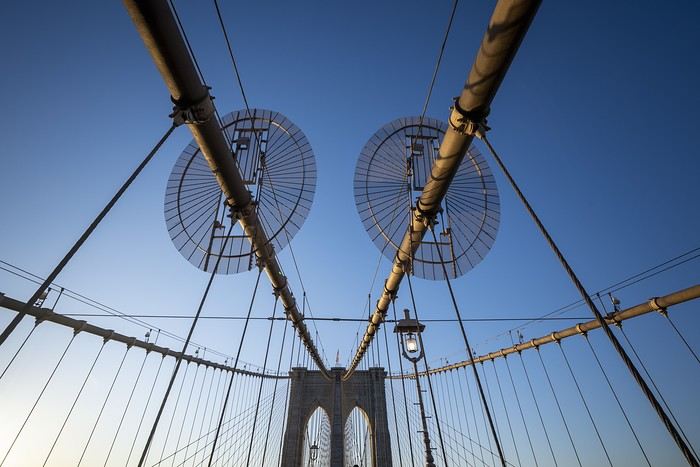 Brooklyn Bridge
Practical details:
Participation: Each VF member can submit up to 3 photos, until Sunday, 26/07 at 11:59 PM Paris time. Each photo must be posted in a separate message, with its number (1, 2, or 3). Don’t forget to add a little explanation (comment, location, etc.).
Voting: Each VF member can vote for the 3 photos they consider the best, based on their own criteria and the theme.
Voting will take place from Monday, 27/07 to Friday, 31/07 at 11:59 PM Paris time.
Selected photos should be listed in order of preference: - 1st photo: 3 points - 2nd photo: 2 points - 3rd photo: 1 point
The winner is the photographer whose photo receives the most points.
Results will be announced on 01/08. In case of a tie, the number of first-place votes will decide. The winner will have the honor of organizing August 2026’s contest.
Photos that have already been nominated (1st, 2nd, or 3rd place) in another contest are not eligible to participate in this one.
This thread is exclusively for contest submissions. Any discussions or comments should be posted in the following thread: Here
Vasco da Gama Bridge in LisbonHere’s the definition of a bridge: “A structure, typically made of stone, wood, or metal, that spans a depression or obstacle (such as a transportation route or waterway) by connecting the two sides or crossing over the obstacle.”
Viaducts, aqueducts, and footbridges will all be accepted.
Millau ViaductTo allow for as many original photos as possible, the bridge can be photographed from the side, below, or above—the main thing is that it’s the focal point of the image.
Bridge in the Algarve
Pont du Gard from belowDetails are also welcome, as long as you can still recognize it’s a bridge 😊
Brooklyn BridgePractical details:
Participation: Each VF member can submit up to 3 photos, until Sunday, 26/07 at 11:59 PM Paris time. Each photo must be posted in a separate message, with its number (1, 2, or 3). Don’t forget to add a little explanation (comment, location, etc.).
Voting: Each VF member can vote for the 3 photos they consider the best, based on their own criteria and the theme.
Voting will take place from Monday, 27/07 to Friday, 31/07 at 11:59 PM Paris time.
Selected photos should be listed in order of preference: - 1st photo: 3 points - 2nd photo: 2 points - 3rd photo: 1 point
The winner is the photographer whose photo receives the most points.
Results will be announced on 01/08. In case of a tie, the number of first-place votes will decide. The winner will have the honor of organizing August 2026’s contest.
Photos that have already been nominated (1st, 2nd, or 3rd place) in another contest are not eligible to participate in this one.
This thread is exclusively for contest submissions. Any discussions or comments should be posted in the following thread: Here
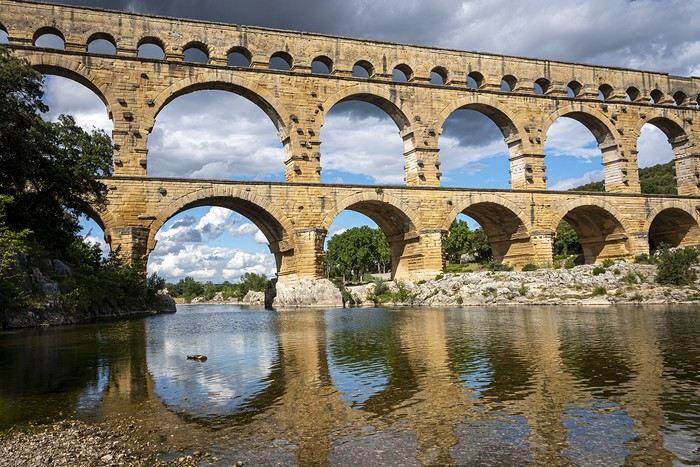
Discussion: Bridges of the World July 2026
This is where you can chat about bridges... let’s get the conversation started! 😊
Off to explore Egypt!
February 9 - Day 1
"So, my little wanderers, back at the decks? What’s this mystery destination you’ve got in store for us at the start of the year?"
Yes, the schoolyard bell’s ringing again! We’re hitting the road... or rather, the skies! At first glance, our destination might surprise more than a few. First off, simply because I was here exactly twenty years ago, and I don’t usually like retracing my own footsteps. Secondly, because the name of this place screams mass tourism—basically the opposite of what Flo and I look for.
Despite that, in this land of backsheesh, I’d promised myself I’d come back one day to experience it my way. And since Flo told me, during our wanderer chats, that this destination straddling Africa and the Middle East was in her top 2 travel dreams, the stars aligned for this roots-style trip to quickly make it onto our pharaonic festivities program! Unless you’re totally clueless in general knowledge, you’ve probably guessed by now—we’re off to Egypt! Of course, a few classics will be on our itinerary, but above all, we want to soak up a culture that can’t be appreciated in four-star resorts or on a Nile cruise boat. And let’s be clear, these next two weeks won’t be a walk in the park—neither for our two daughters who are joining us, nor for our bodies!
And that’s clear from the get-go: after our first flight, eight hours of trying (and failing) to sleep on Milan airport’s metal seats, our second flight, landing, passport stamps, our Uber ride, and our first Cairo kilometers, we finally drop our exhaustion at the little guesthouse we booked in Giza. Doesn’t all that energy deserve a little reward?
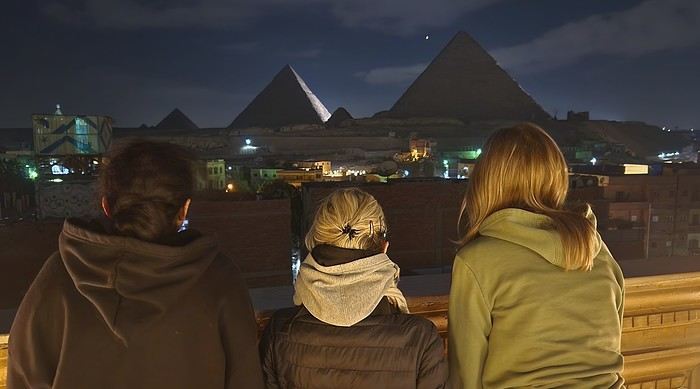
Oh, absolutely! And here it is: a full-on slap in the face for everyone! But just look at this view from our hotel terrace? For 20 € a night for four, even with this incredible view, I figured the room must be pretty shabby, right? Nope... Is the staff rude, then? Nope... Okay, so what’s the catch? You’re gonna tell me breakfast is included too? Well, yes! Honestly, this Egypt trip is off to a great start.
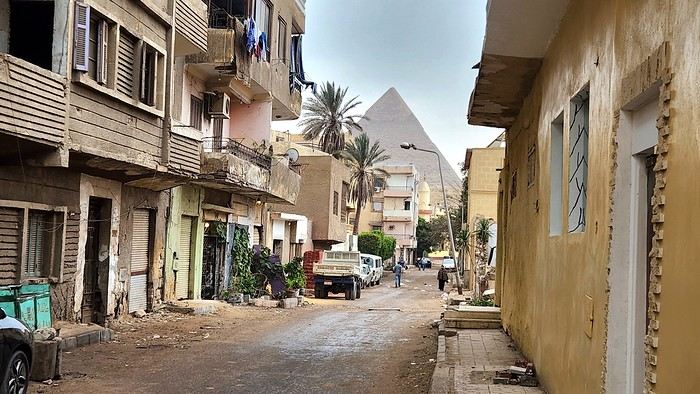
And the rest of the afternoon, spent rubbing shoulders with locals, only confirmed this vibe. After digesting our pyramid view, we dove into the hustle and bustle of our neighborhood with the goal of exchanging money, eating at street stalls, and testing the hospitality of the locals. Ten out of ten!
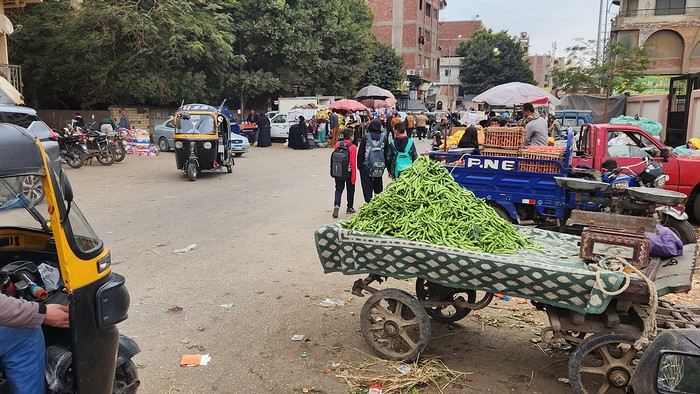
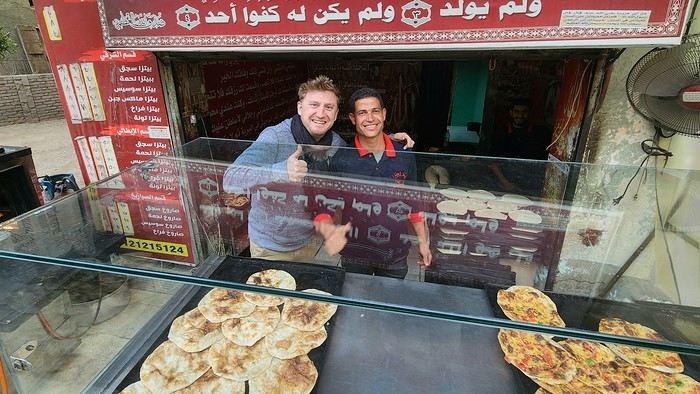
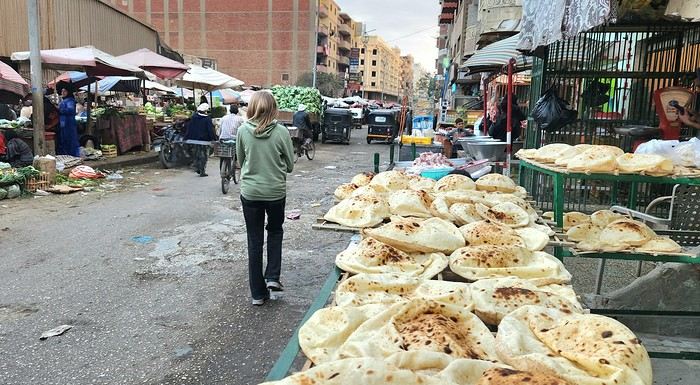
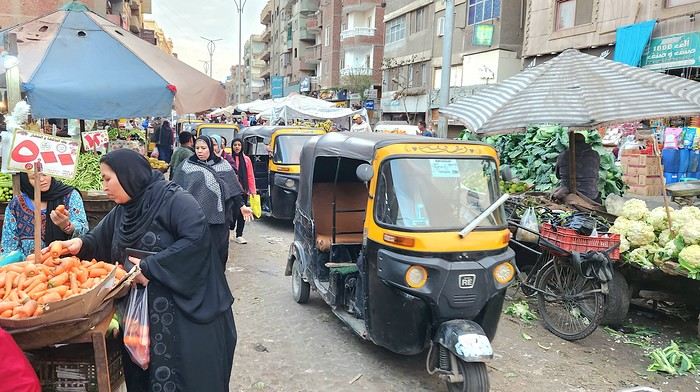
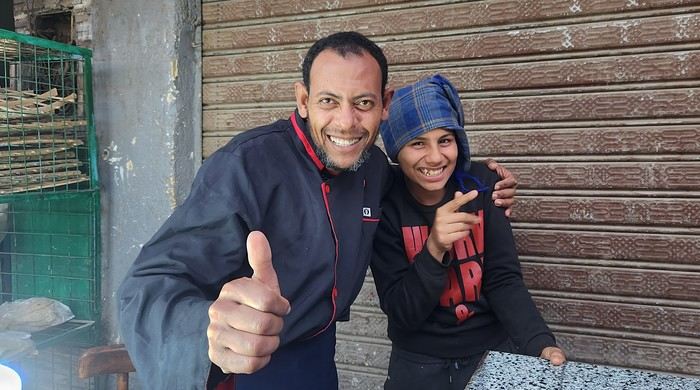
Eight little sun breads with baba ganoush and falafel? 80 pounds, or 1.5 €. A dozen Middle Eastern pastries? Same! 80 pounds! Two hawawshis, those little pita breads stuffed with meat and spices? 10 pounds each, or about twenty cents! Not to mention all those smiles and free "welcomes" left and right!!!
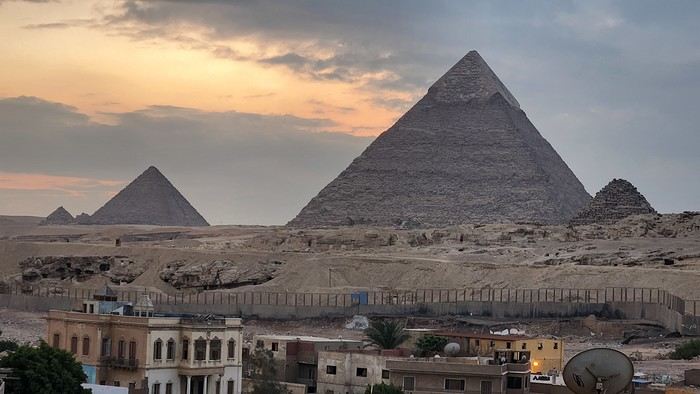
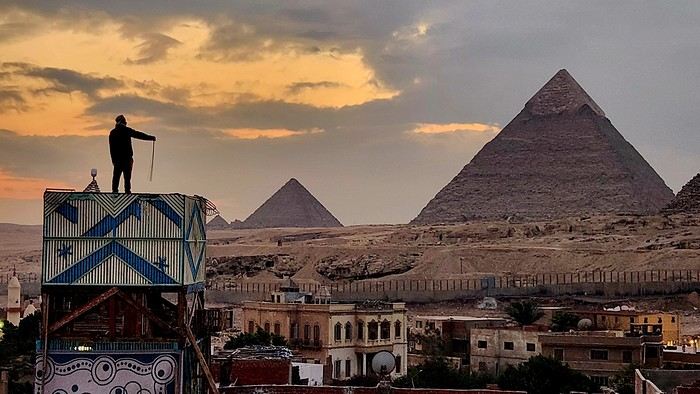
What a welcome! We end this first day with a sunset over the three sisters of Giza—where we’ll obviously be gawking tomorrow...
https://voyageforum.com/images/posts/small/1789072399-cCyLDYuFwPLAZTY.jpg
"So, my little wanderers, back at the decks? What’s this mystery destination you’ve got in store for us at the start of the year?"
Yes, the schoolyard bell’s ringing again! We’re hitting the road... or rather, the skies! At first glance, our destination might surprise more than a few. First off, simply because I was here exactly twenty years ago, and I don’t usually like retracing my own footsteps. Secondly, because the name of this place screams mass tourism—basically the opposite of what Flo and I look for.
Despite that, in this land of backsheesh, I’d promised myself I’d come back one day to experience it my way. And since Flo told me, during our wanderer chats, that this destination straddling Africa and the Middle East was in her top 2 travel dreams, the stars aligned for this roots-style trip to quickly make it onto our pharaonic festivities program! Unless you’re totally clueless in general knowledge, you’ve probably guessed by now—we’re off to Egypt! Of course, a few classics will be on our itinerary, but above all, we want to soak up a culture that can’t be appreciated in four-star resorts or on a Nile cruise boat. And let’s be clear, these next two weeks won’t be a walk in the park—neither for our two daughters who are joining us, nor for our bodies!
And that’s clear from the get-go: after our first flight, eight hours of trying (and failing) to sleep on Milan airport’s metal seats, our second flight, landing, passport stamps, our Uber ride, and our first Cairo kilometers, we finally drop our exhaustion at the little guesthouse we booked in Giza. Doesn’t all that energy deserve a little reward?
Oh, absolutely! And here it is: a full-on slap in the face for everyone! But just look at this view from our hotel terrace? For 20 € a night for four, even with this incredible view, I figured the room must be pretty shabby, right? Nope... Is the staff rude, then? Nope... Okay, so what’s the catch? You’re gonna tell me breakfast is included too? Well, yes! Honestly, this Egypt trip is off to a great start.
And the rest of the afternoon, spent rubbing shoulders with locals, only confirmed this vibe. After digesting our pyramid view, we dove into the hustle and bustle of our neighborhood with the goal of exchanging money, eating at street stalls, and testing the hospitality of the locals. Ten out of ten!
Eight little sun breads with baba ganoush and falafel? 80 pounds, or 1.5 €. A dozen Middle Eastern pastries? Same! 80 pounds! Two hawawshis, those little pita breads stuffed with meat and spices? 10 pounds each, or about twenty cents! Not to mention all those smiles and free "welcomes" left and right!!!
What a welcome! We end this first day with a sunset over the three sisters of Giza—where we’ll obviously be gawking tomorrow...
https://voyageforum.com/images/posts/small/1789072399-cCyLDYuFwPLAZTY.jpg
Getting around in the Dominican Republic: is renting a car possible or too risky?
hi there,
I’m heading to the Dominican Republic (Punta Cana) at the end of October for 10 days at an all-inclusive hotel with my wife and kids (ages 8 and 10). Since I’m not a fan of spending entire days at the hotel, I was wondering what the best way(s) to explore the area might be.
Last year, I went to Mexico and rented a car, so I initially thought about doing the same here—but this time, I’d get full-coverage insurance, which I didn’t do in Mexico. After checking a few forums and reviews, though, I’m really second-guessing it because some posts make it sound completely crazy to drive there.
So, I’d love to hear from anyone who’s been there recently and rented a car, as well as the different ways to get around while you’re there.
Thanks everyone! !
Southwest USA Road Trip Part II
Here we go with this second travel journal dedicated to the American West! It’s a must when you love it! 😊
We had left off in the charming town of Bisbee, which once thrived thanks to its copper mines. Today, mining is a thing of the past, and the town seems a bit sleepy.
Unfortunately, I didn’t dig deep enough on-site to answer all the questions my observations raised. Guess I’ll have to *dig* into the subject a bit more... no pun intended! 😊
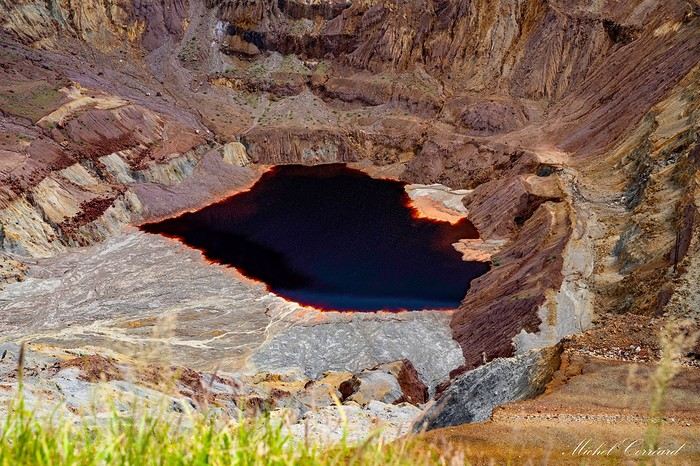
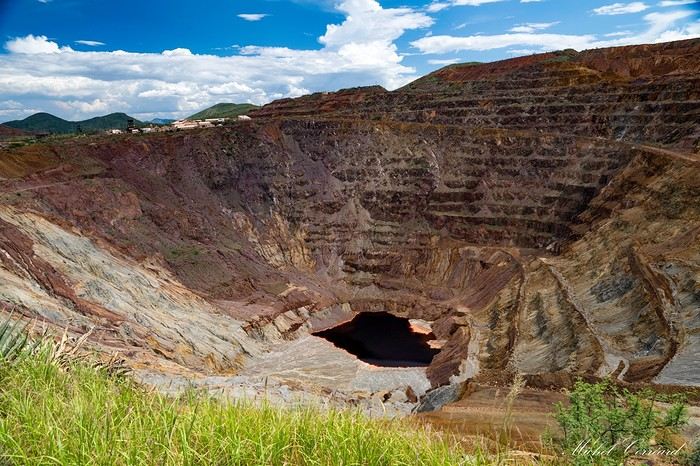
Let’s hop back in the car and head a little further south to check out the esplanade that offers a view—if you can call it that—of the impressive open-pit mine. Then, it’s off to the Lowell neighborhood.
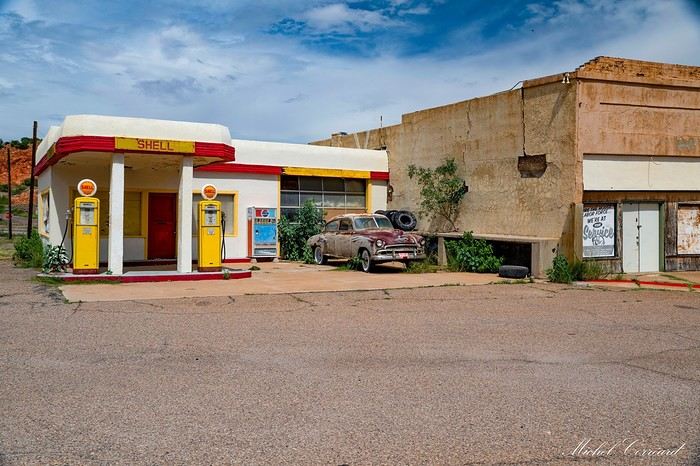
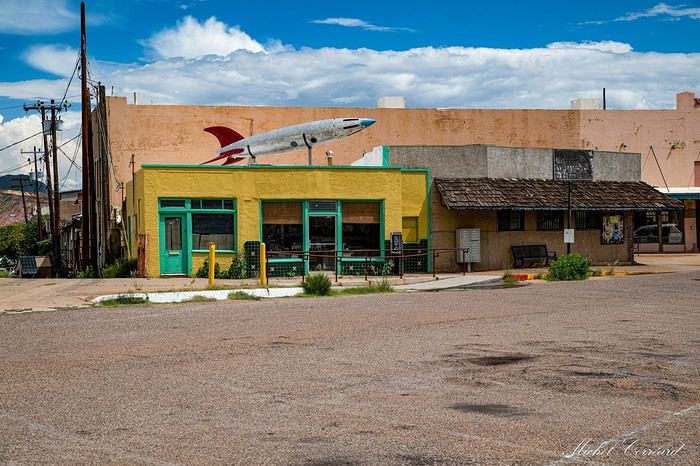
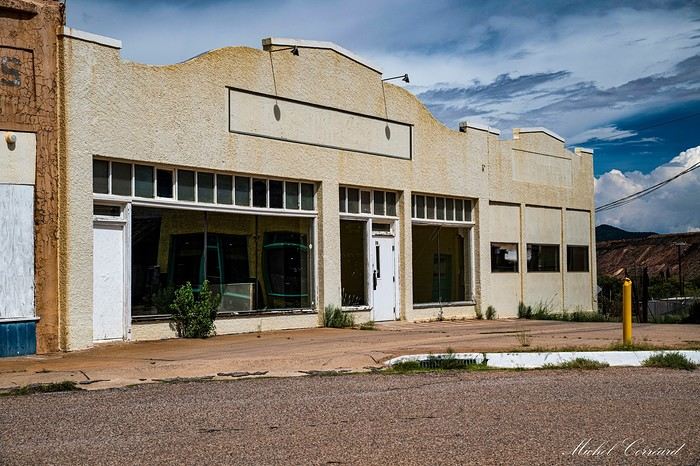
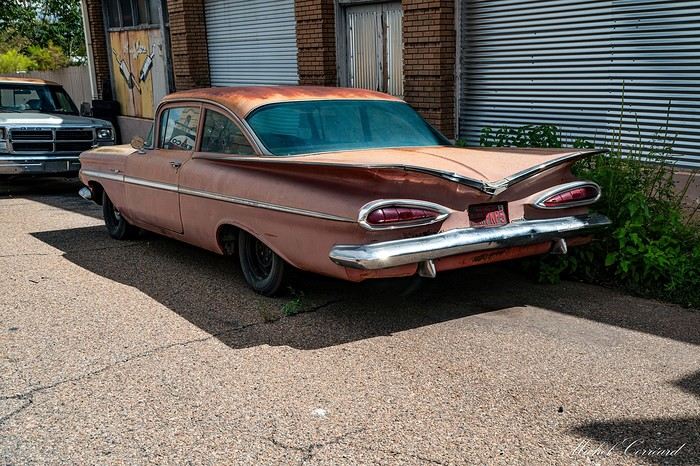
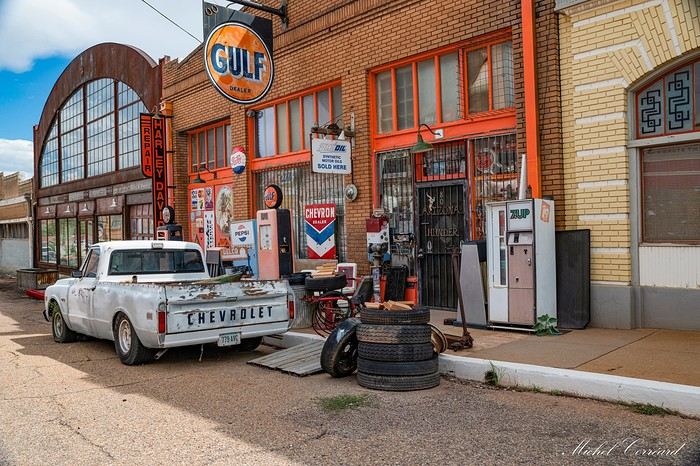
Preserved almost exactly as it was, this area must’ve been bustling in its heyday. The vintage cars are still around, storefronts and signs look like they’re straight out of another era, and the whole place has a pretty amazing vibe. You’d almost think you were on Route 66!
Here, we’re not just discovering an old neighborhood—it’s a little slice of American history. And, a detail that’s great for my physical health: the area isn’t too spread out. Lucky me! 😊
I won’t post too many photos here since I think I can turn them into a future photo exhibit. Between these and some shots from Route 66, I should have more than enough material! So, let’s keep a few under wraps... to preserve the surprise. 😊
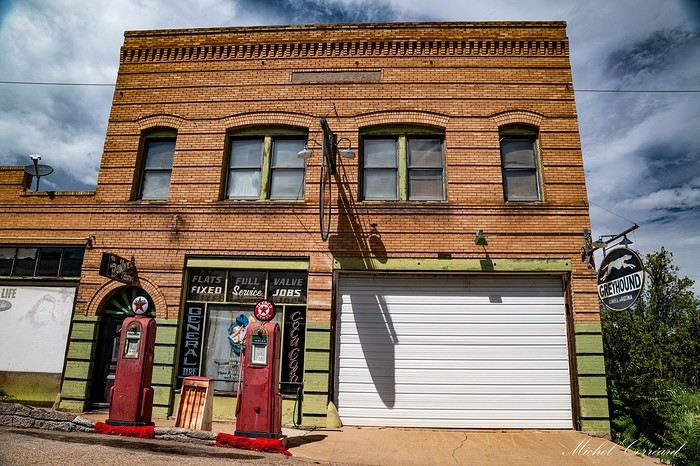
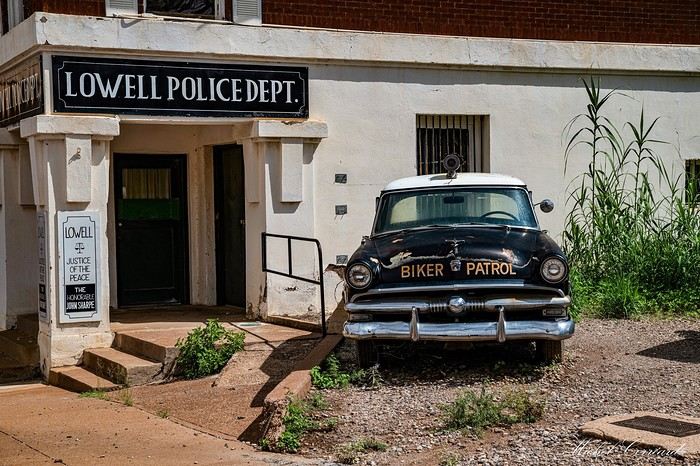
We had left off in the charming town of Bisbee, which once thrived thanks to its copper mines. Today, mining is a thing of the past, and the town seems a bit sleepy.
Unfortunately, I didn’t dig deep enough on-site to answer all the questions my observations raised. Guess I’ll have to *dig* into the subject a bit more... no pun intended! 😊
Let’s hop back in the car and head a little further south to check out the esplanade that offers a view—if you can call it that—of the impressive open-pit mine. Then, it’s off to the Lowell neighborhood.
Preserved almost exactly as it was, this area must’ve been bustling in its heyday. The vintage cars are still around, storefronts and signs look like they’re straight out of another era, and the whole place has a pretty amazing vibe. You’d almost think you were on Route 66!
Here, we’re not just discovering an old neighborhood—it’s a little slice of American history. And, a detail that’s great for my physical health: the area isn’t too spread out. Lucky me! 😊
I won’t post too many photos here since I think I can turn them into a future photo exhibit. Between these and some shots from Route 66, I should have more than enough material! So, let’s keep a few under wraps... to preserve the surprise. 😊
Road Trip to the Yukon: The Adventure of a Lifetime Across Canada
For a long time, the Yukon had been one of those dream travel destinations for us. Its vast wilderness, majestic mountains, and fascinating history tied to the gold rush irresistibly drew us in.
We finally made this ambitious project a reality: a road trip across Canada heading toward the Yukon.
Since the journey from Quebec is considerable, we chose to turn the trip itself into a series of adventures.
Instead of just racking up the kilometers, we made plenty of stops to discover several tourist attractions spread across different provinces.
Along the way, each province offered its share of landscapes and discoveries. We crossed vast forests, admired beautiful lakes, explored historic sites, and visited several local attractions that helped us better appreciate Canada’s diversity.
These breaks made the trip much more enjoyable and allowed us to take the time to fully enjoy each region we visited.
One of the great pleasures of a road trip is the freedom it provides. We could adjust our itinerary based on our mood, extend a visit we particularly enjoyed, or stop spontaneously at a spectacular viewpoint.
Often, it’s these unexpected discoveries that become the best memories.
As we moved northwest, the landscapes became more and more impressive. The roads seemed endless, the mountains drew closer, and nature took on an even greater presence. Traffic gradually thinned out, giving way to a sense of freedom that’s hard to describe.
Arriving in the Yukon marked the culmination of several days of travel. From the first kilometers, we were amazed by the vastness of the territory.
The breathtaking panoramas, the wildlife everywhere, and the unique atmosphere of the Canadian North more than made up for all the kilometers we’d covered.
This road trip to the Yukon reminded us that the destination is important, but the journey is just as much a part of it.
The many stops we made along the way allowed us to discover extraordinary places we probably never would’ve visited otherwise.
Every province we crossed helped make this adventure even more memorable.
The Yukon will certainly remain one of the highlights of our travels, but the memories we gathered along the way hold a special place in our hearts too.
That’s what makes a great Canadian road trip so magical: every kilometer tells a story.
In the upcoming posts, you’ll discover the places that caught our attention throughout this road trip.
Don’t hesitate to watch the videos to complete the experience and explore these attractions as if you were there.
To jump to a specific post, here are the appropriate links:
Roland Lake Falls - Lac-Pythonga (Quebec) | First Stop on the Way to the Yukon Must-See Stops in Ontario Stop at the Center of Canada | Manitoba Stop in Winnipeg (Manitoba) Discovering Regina (Saskatchewan) Stops in Moose Jaw, Chaplin & Saskatoon (Saskatchewan) Stops in Vegreville & Edmonton (Alberta) Stop at West Edmonton Mall, a World of Attractions Under One Roof Stops in Beaverlodge (AB) & Dawson Creek (BC) Adventure on the Alaska Highway: Between Dawson Creek and Liard River (BC) Discovering Liard River Hot Springs (BC) The Sign Post Forest (Watson Lake) Stops at Rancheria Falls, Teslin, and Tagish Discovering Carcross and Its Must-See Spots Carcross Desert Yukon: A Surprising Desert in the Heart of Canada Must-See Stop at Emerald Lake (Yukon) Hike at Miles Canyon (Whitehorse) - Yukon Discovering Whitehorse Spectacular Northern Lights - Fish Lake - Whitehorse (Yukon) Must-See Stops Between Whitehorse and Dawson City Road Trip on the Dempster Highway (Yukon) - 100 km of Adventure Complete Visit of the Historic Town of Dawson City in the Yukon Midnight Dome Dawson City - Magical Northern Lights in the Yukon
Northern Morocco, the kingdom of kif?
My first trip to Morocco dates back to the early 90s.
Four more followed...
I’d never gone further north than Casablanca, Volubilis, or Fez—it was time to fix that!
So I planned a route that would fill in the gaps while revisiting a few places.
This route is pretty classic—if you’re looking for something original, you might want to skip it!
The starting point of the trip: the city of Rabat.
The stops?
Azrou, Fez, Al Hoceïma, Akchour, Tetouan, Tangier, Asilah, and finally Rabat.
Mostly an urban trip, then.
Too much?
We’ll see at the end of the travel journal!
Four more followed...
I’d never gone further north than Casablanca, Volubilis, or Fez—it was time to fix that!
So I planned a route that would fill in the gaps while revisiting a few places.
This route is pretty classic—if you’re looking for something original, you might want to skip it!
The starting point of the trip: the city of Rabat.
The stops?
Azrou, Fez, Al Hoceïma, Akchour, Tetouan, Tangier, Asilah, and finally Rabat.
Mostly an urban trip, then.
Too much?
We’ll see at the end of the travel journal!
Road Trip - Canadian West
After exploring Dawson City, the final stop on our incredible road trip to the Yukon (see travel journal), it was time to head back to Quebec.
Instead of returning directly, we took advantage of this cross-country drive to make several stops in British Columbia and Alberta.
This part of the trip allowed us to discover some of the most beautiful attractions in Western Canada, from breathtaking landscapes to iconic natural sites that are must-sees in Canada.
Between majestic mountains, turquoise lakes, and jaw-dropping panoramas, every stop added a memorable touch to this already exceptional adventure.
A wonderful way to wrap up this journey across Canada while fully enjoying the richness and diversity of its vast landscapes.
In the upcoming posts, you’ll discover the highlights that marked our journey through Western Canada.
I invite you to watch the associated videos to fully experience the atmosphere, landscapes, and attractions we were lucky enough to explore.
To navigate to a specific post, here are the appropriate links:
Adventure on the Alaska Highway: Bald Eagles, Bison & Moose Adventure on the Alaska Highway: Bison, Caribou & Bears Yellowhead Highway (Alberta): Roche Miette, Jasper Lake & Emerald Pond Maligne Lake Road (Jasper) | Moose and Elk Exploring Mount Robson Provincial Park (BC) Must-Sees on the Icefields Parkway - Alberta David Thompson Highway11 (AB): A Stunning Scenic Route What to See in Yoho National Park (BC) Johnston Canyon: Hike to the Lower & Upper Falls Iconic Sites of East Kootenay, BC Lundbreck Falls - A Spectacular Waterfall in Southern Alberta Trails of Red Rock Canyon & Blakiston Falls - Waterton Waterton Village Under the Snow - A Unique Place Writing-on-Stone: A Park Famous for Its Hoodoos Red Rock Coulee Natural Area Alberta – A Supernatural Landscape Dinosaur Provincial Park Alberta - Mysterious Badlands Drumheller: Dinos, Hoodoos & Badlands Interpretive Trail Hike at Horsethief Canyon | Drumheller Badlands Red Deer: Public Art & Murals Downtown Calgary | Public Art, Skyline & Iconic Spots Medicine Hat | Public Art & Iconic Spots
Markets: The Beating Heart of Local Gastronomy and Cuisine
I don’t know about you, but I’m a huge fan of markets. No matter where I go, in every country or city I visit, I won’t leave without having seen one. I’m mostly talking about food markets. I love the smells, the colors, and watching people from all walks of life stroll around. It’s like a mirror of a country’s culture, and I love soaking it all in.
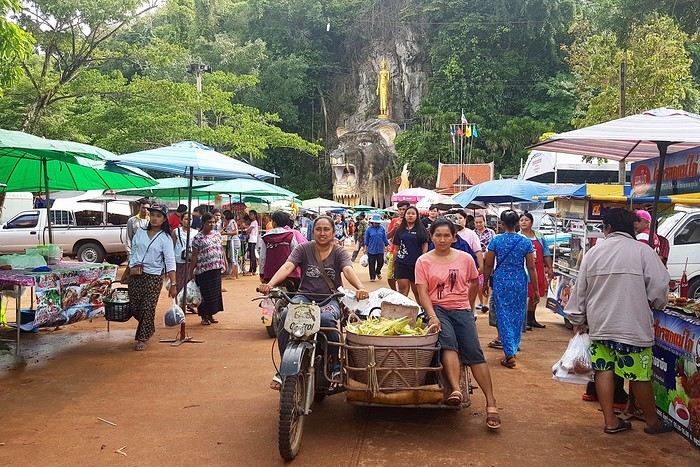
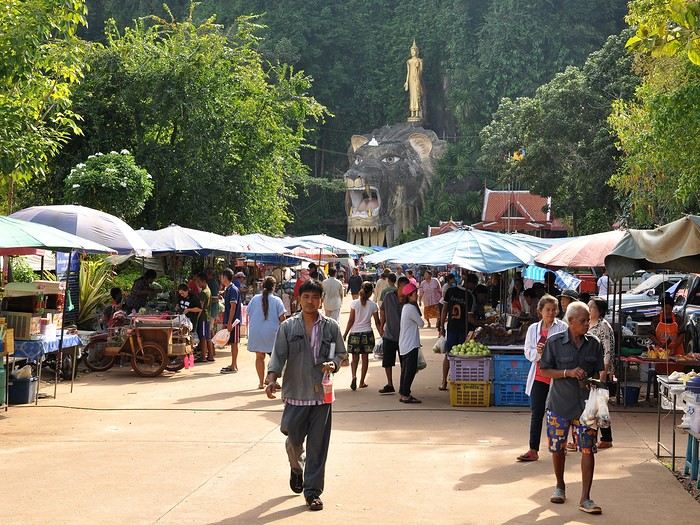
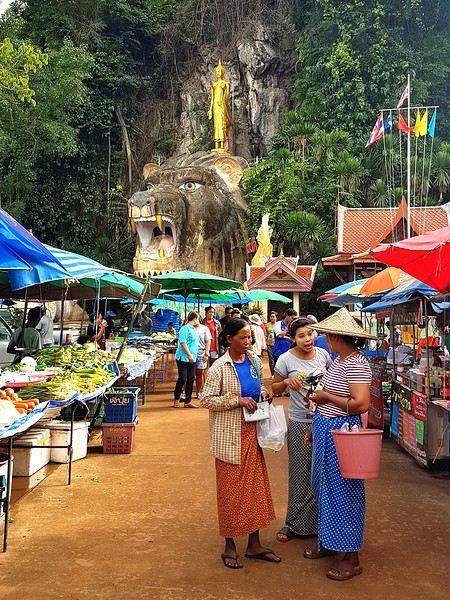
Thai markets are particularly appealing to me. In my province, there are so many. Maybe more than elsewhere—I’m not sure—but every day, you can find a "Talat Nat." These are traveling markets that set up in specific places on specific days. They only stay open for a few hours. Some attract more shoppers than others because they have more stalls and a wider variety of products. Sometimes, they’re set up in pretty unusual spots: temples, roadside, even on train tracks...
On top of these, there are also markets in the city that stay open all day.
I’d love for you to share your photos of markets, local product stalls, and why not, let’s talk about gastronomy and cuisine too!
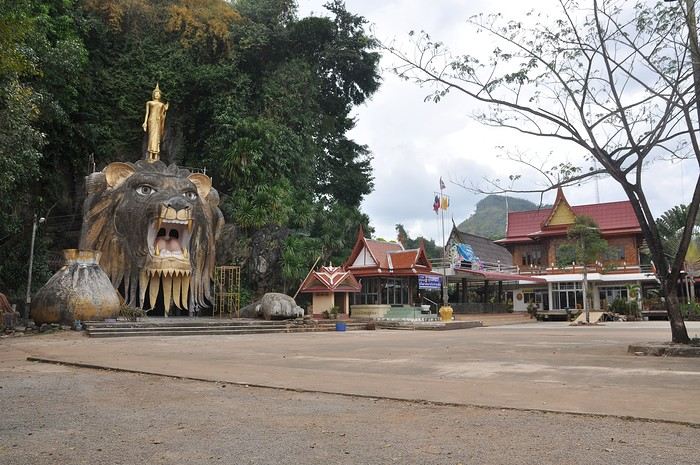
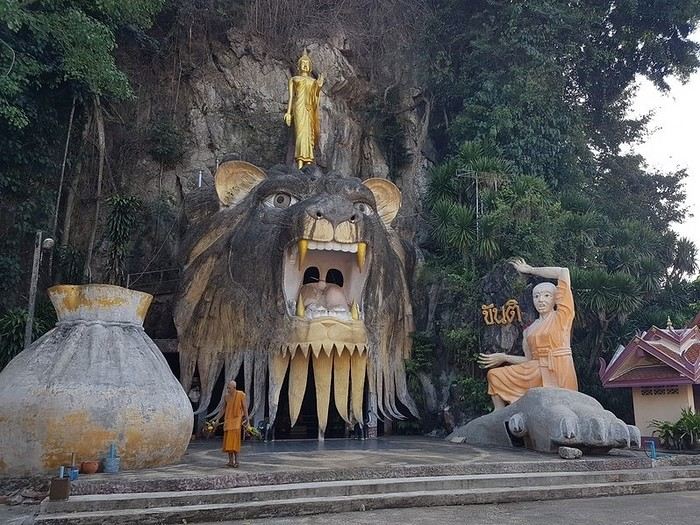
I’ll start with my favorite market—it’s 8 kilometers from my place and happens every Tuesday from 2 PM to 5 PM. I never miss a Tuesday unless there’s a downpour... 😉 It’s located in the countryside, in a village famous for its coffee (ThamSing), and inside the grounds of a slightly unusual temple. It’s easy to get to—over the past 10 years, the roads have been paved, which wasn’t the case before and made the trip a bit risky when it rained...
In the first two photos, you’ll see the temple courtyard on a normal day, without the market.
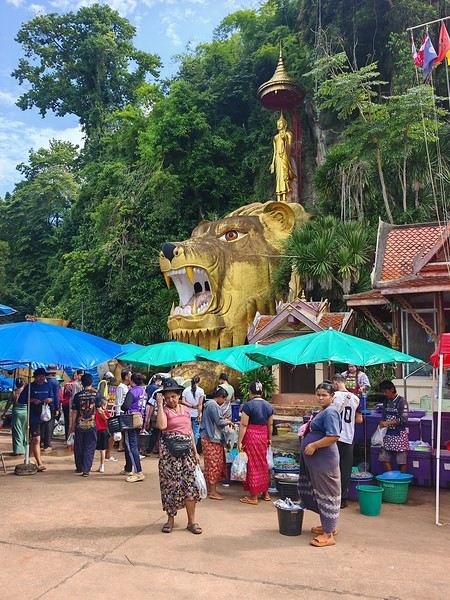
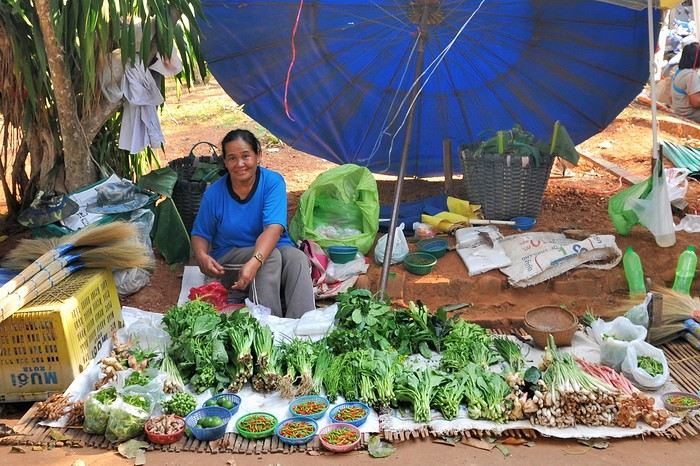
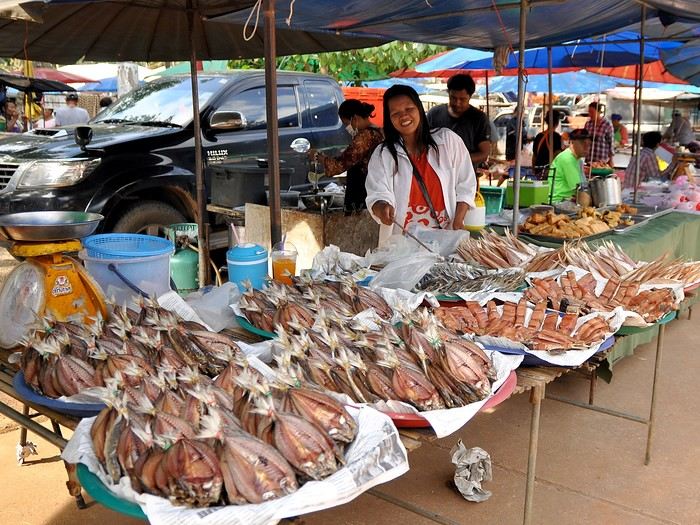
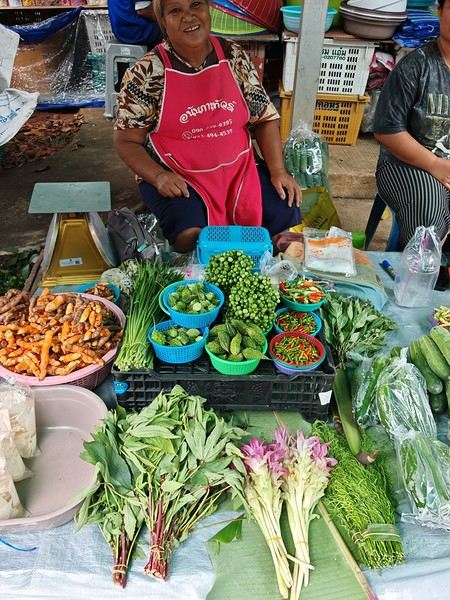
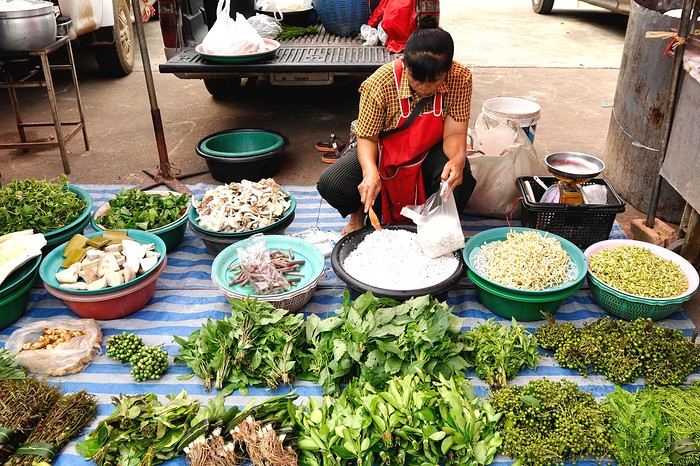
Thai markets are particularly appealing to me. In my province, there are so many. Maybe more than elsewhere—I’m not sure—but every day, you can find a "Talat Nat." These are traveling markets that set up in specific places on specific days. They only stay open for a few hours. Some attract more shoppers than others because they have more stalls and a wider variety of products. Sometimes, they’re set up in pretty unusual spots: temples, roadside, even on train tracks...
On top of these, there are also markets in the city that stay open all day.
I’d love for you to share your photos of markets, local product stalls, and why not, let’s talk about gastronomy and cuisine too!
I’ll start with my favorite market—it’s 8 kilometers from my place and happens every Tuesday from 2 PM to 5 PM. I never miss a Tuesday unless there’s a downpour... 😉 It’s located in the countryside, in a village famous for its coffee (ThamSing), and inside the grounds of a slightly unusual temple. It’s easy to get to—over the past 10 years, the roads have been paved, which wasn’t the case before and made the trip a bit risky when it rained...
In the first two photos, you’ll see the temple courtyard on a normal day, without the market.
14 Days in Japan – September-October 2026
I had to leave Thailand as my 60-day visa was coming to an end, and this time I opted for a 14-day visit to Japan. I’d already spent 3 days in Tokyo a few years ago on a business trip, which left me with a great impression. Y, my Thai partner, had never been there. That’s why we chose a fairly classic itinerary, including a few castles and Kyoto among other things.
Before diving into the details of our trip, I’d like to recap the expenses we incurred. This will be useful for some of you, and it’ll help us prepare for our next trip to Japan.
I’ve categorized our expenses into 5 groups: - Hotels: 1150 € (breakfast included) - Transportation: 278 € (trains, buses) - Big expenses: 487 € (souvenirs and a few necessary items) - Excursions: 116 € (museum visits, temples, castles) - Daily expenses: 1125 € (meals, small purchases) Total = 3194 €, or 228 € per day on average. I’m excluding flights, as those depend on everyone’s arrangements (departure location, travel dates, etc.).
Jpeg below: apologies for “hotel” without a circumflex—my software isn’t French!

For hotels, we always chose decent but not luxurious places, well-located to let us walk to and from transportation hubs. We systematically avoided taxis, which are notoriously expensive in Japan. We’ve also gotten into the habit over several trips of traveling with minimal luggage: one duffel bag each (7-8 kg) plus the small carry-on allowed on planes (2-3 kg). This lets us travel with three sets of clothes (what we’re wearing plus two changes). We add a checked bag for the return trip to accommodate the things we buy along the way.
‘Transportation’ and ‘Big expenses’: I’ll give more details in the day-by-day account.
We didn’t do any extravagant excursions, like safaris or sports activities.
Meals and food make up the bulk of our daily expenses. We often ate at izakayas, which offer great value—between 2000 and 6000 yen for two (about 11-12 to 33-34 € for two, usually around 20-25 €). We didn’t hold back, but we also didn’t go to high-end restaurants.
More to come while I gather my photos: General Remarks.
Before diving into the details of our trip, I’d like to recap the expenses we incurred. This will be useful for some of you, and it’ll help us prepare for our next trip to Japan.
I’ve categorized our expenses into 5 groups: - Hotels: 1150 € (breakfast included) - Transportation: 278 € (trains, buses) - Big expenses: 487 € (souvenirs and a few necessary items) - Excursions: 116 € (museum visits, temples, castles) - Daily expenses: 1125 € (meals, small purchases) Total = 3194 €, or 228 € per day on average. I’m excluding flights, as those depend on everyone’s arrangements (departure location, travel dates, etc.).
Jpeg below: apologies for “hotel” without a circumflex—my software isn’t French!
For hotels, we always chose decent but not luxurious places, well-located to let us walk to and from transportation hubs. We systematically avoided taxis, which are notoriously expensive in Japan. We’ve also gotten into the habit over several trips of traveling with minimal luggage: one duffel bag each (7-8 kg) plus the small carry-on allowed on planes (2-3 kg). This lets us travel with three sets of clothes (what we’re wearing plus two changes). We add a checked bag for the return trip to accommodate the things we buy along the way.
‘Transportation’ and ‘Big expenses’: I’ll give more details in the day-by-day account.
We didn’t do any extravagant excursions, like safaris or sports activities.
Meals and food make up the bulk of our daily expenses. We often ate at izakayas, which offer great value—between 2000 and 6000 yen for two (about 11-12 to 33-34 € for two, usually around 20-25 €). We didn’t hold back, but we also didn’t go to high-end restaurants.
More to come while I gather my photos: General Remarks.
CARIBBEAN: The island of SAINT-MARTIN, a different perspective
 When it comes to the Caribbean island of Saint-Martin, it's customary to praise its coastline and dreamy beaches—and they certainly deserve it.
But in this story, I’d like to highlight other memories, aspects, and impressions for a slightly different change of scenery.
Enjoy the read—some text and, above all, lots of photos.
« Byenveni sou zile Sen Maten! » (Welcome to the island of Saint-Martin)
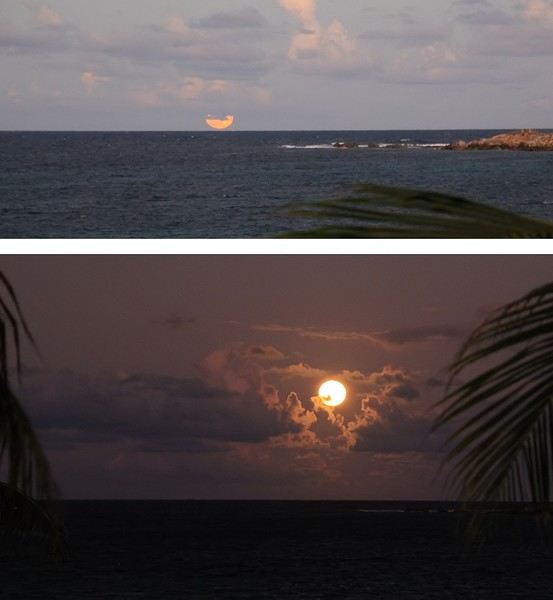
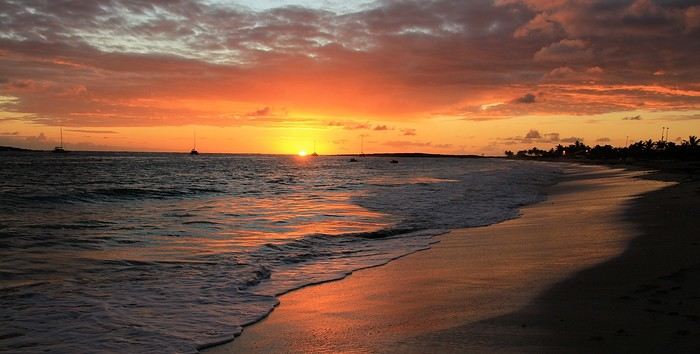
-- -- Full and luminous To avoid seeming too conventional at the start of this alternative take on Saint-Martin... here’s not a stunning sunrise over the sea but rather a moonrise—a less "typical" choice. And when you get to witness it, it’s a truly unique moment of contemplation. However, three conditions are essential for this spectacle: a full moon phase, a cloud-free horizon, and—most importantly—a moonrise at twilight. That early evening, all the conditions aligned—lucky us! Just above the sea, a strange glow gradually appeared. A huge moon was about to shine against a deep blue night sky.
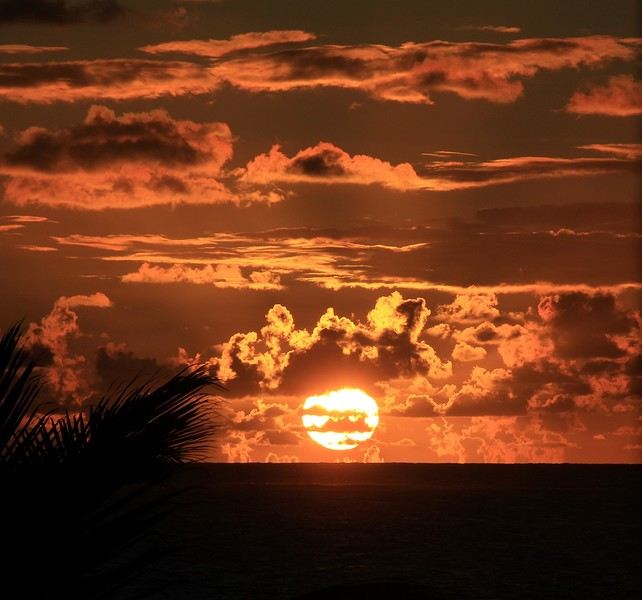
What’s more, its light sparkled on the water’s surface—gorgeous! But so fleeting. We’re on the east coast of the island, by the wide stretch of light sand at Baie Orientale, Saint-Martin’s own. Now, just because I wanted to start with something a little different doesn’t mean we should overlook the bright sunrises you can see on this bay. They’re far more common than a beautiful full moonrise, but they also require two things: being an early riser and a clear horizon without misty clouds. Views to soak in without restraint...
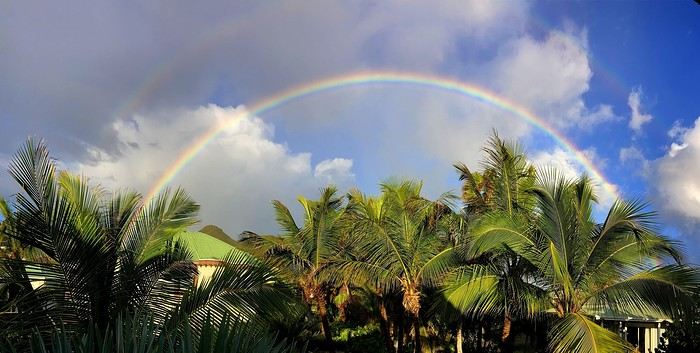
Other memories of beautiful lights and lovely colors—a morning when the sun had a brief meet-up with the rain, creating a stunning rainbow.
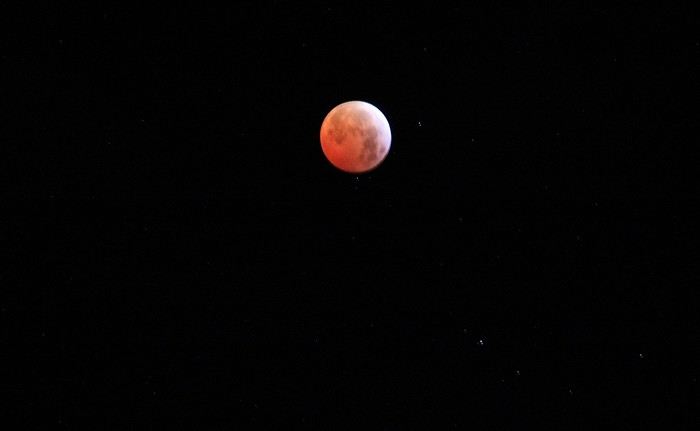
And let’s talk about the moon again... On a clear night, a "blood moon," the result of a lunar eclipse that had turned our familiar satellite red.
-- --
A butterfly with golden wings! In the tropics, swarms of butterflies flutter everywhere, from flower to flower. They sip the sweet nectar from stamens and blooming corollas with delight.
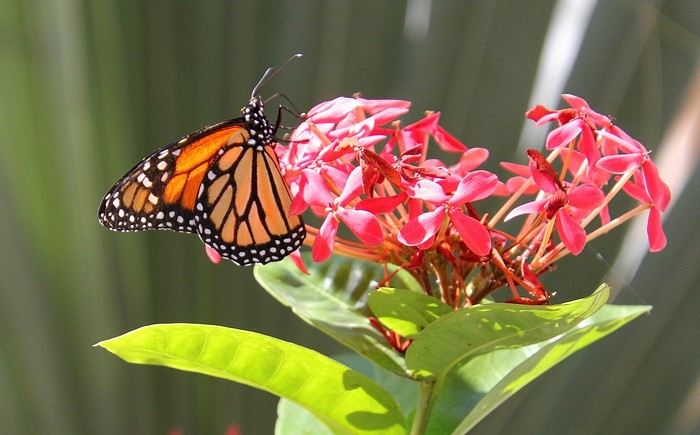
Here, a monarch, one of the great migratory butterflies, taking its time to enjoy the pollen of this Ixora coccinea—or Japanese hydrangea, but let’s stick to Saint-Martin.
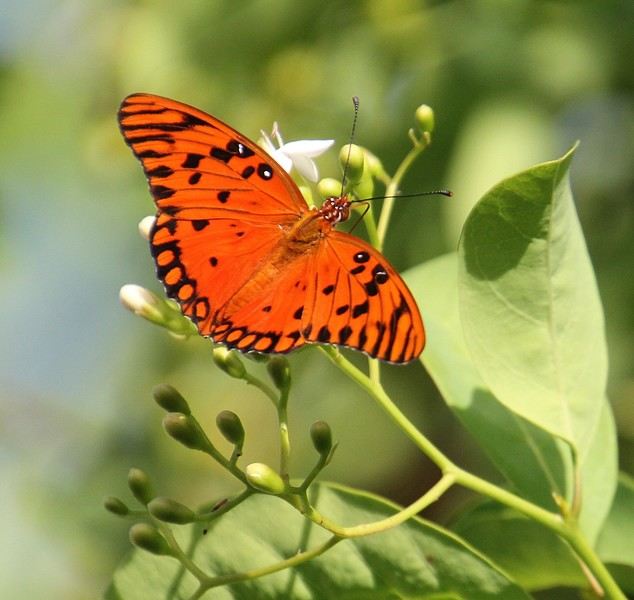
This one is an *Agraulis vanillae*, to be precise—and thanks to the internet for the ID. Photographing them isn’t always easy; these fearless butterflies often fly off before you can get a good focus, challenging both the framing eye and the autofocus! But on the island, I noticed some butterflies were much easier to shoot—those decorating a few murals. ;)
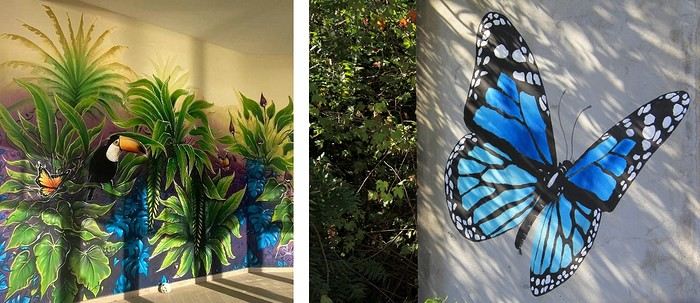
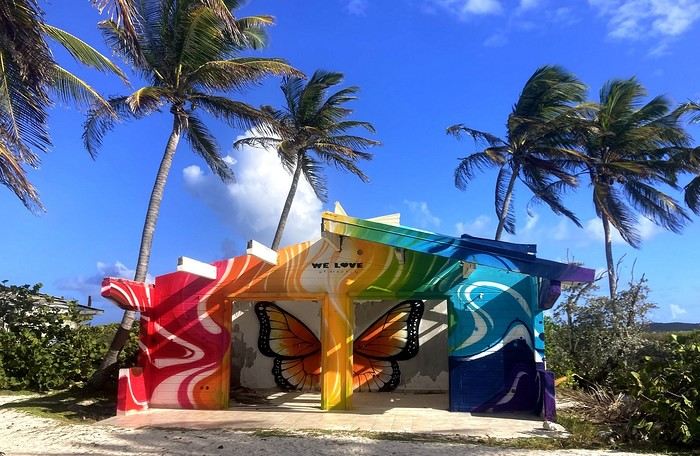
One of the graffiti artists behind several Saint-Martin murals has made it his signature. The talented Jimmy Sheik slips a little butterfly into each of his works, even if it’s not the main subject. It’s a nod to his home island, Guadeloupe, whose territory—with Basse-Terre and Grande-Terre—looks uncannily like a giant butterfly. In the photo above, a great initiative: turning this beach bungalow, abandoned after Hurricane Irma’s (2017) devastation, into a mural canvas—it’s a real success. Well done, artist!
To be continued >>>>>>
Morocco: Four Medinas for One Enchantment
Hello everyone! 🙂
No wonder Tangier has inspired so many artists, writers, painters, and musicians… The "Pearl of the North" will be the first stop on a 12-day journey that will take us through Rabat, Fez, and Meknes.
This is my 15th trip to Morocco, and I’d never been to Tangier before! A round-trip flight from Carcassonne for just 55 € sealed the deal, and here we are, landing two hours later.
Four medinas, four perspectives—an enchantment that remains untouched. Once again, Richard and I will combine our viewpoints in a travel journal, sharing them with you—his through words, mine through images.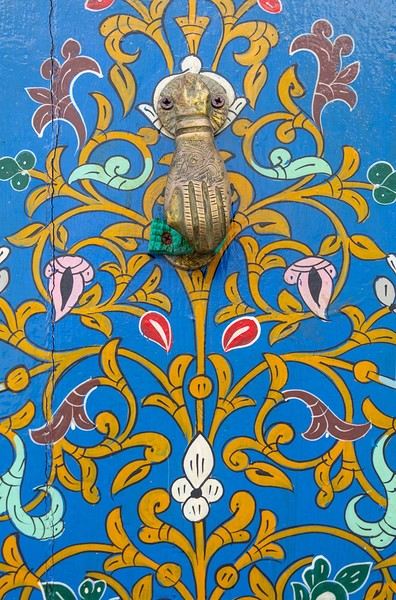
No wonder Tangier has inspired so many artists, writers, painters, and musicians… The "Pearl of the North" will be the first stop on a 12-day journey that will take us through Rabat, Fez, and Meknes.
This is my 15th trip to Morocco, and I’d never been to Tangier before! A round-trip flight from Carcassonne for just 55 € sealed the deal, and here we are, landing two hours later.
Four medinas, four perspectives—an enchantment that remains untouched. Once again, Richard and I will combine our viewpoints in a travel journal, sharing them with you—his through words, mine through images.
Martine et DD en Californie English translation pending
Bonsoir à tous 🙂
En septembre 2026, pour notre 7 eme RT au pays de l’oncle Sam, nous avions choisi la Californie et une nouvelle fois cette boucle depuis San Francisco aura été bien au delà de nos attentes, en nous offrant de fabuleux paysages et des américains toujours aussi sympathiques et désireux d’échanger quelques mots avec nous .
Nous avions dejà séjourné quelques jours dans cet état lors de notre tout premier RT mais nous n’étions pas allés voir les séquoias, et une tempête de neige venue du Yellowstone le 20 septembre 2017 nous avait empêché de découvrir le Yosemite puisque la Tioga Road était fermée à la circulation. De plus c’est avec grand plaisir que nous avons revu certains coins et nous en avons découvert d’autres tout aussi « waouh » que les précédents.
Nous sommes un couple de « jeunes sexagénaires « et malgré le temps qui passe depuis notre premier RT je parle toujours aussi mal l’anglais ce qui ne nous a pas empêché de profiter pleinement de notre séjour.
Nous avons passé 21 nuits sur place et parcouru 3935 km en voiture et un peu plus de 140 km à pieds .
L’avion, la voiture et le parking de Marseille ont été réservés et payés en décembre 2025.
Malgré l’absence de file dédiée aux possesseurs du MPC ( Mobile Passeport Control ) à S F nous sommes passés rapidement à l’immigration et notre agent était souriant et nous a même dit quelques mots en français
Le circuit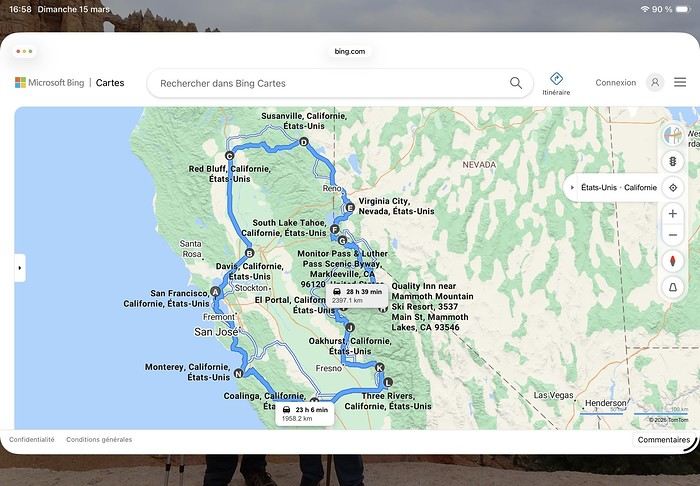 Nous sommes partis du 6 au 22 septembre
J1 Vol Marseille -Paris- San Francisco puis Davis ( 166 km)
J2 Red Bluff ( 397 km avec visite du Lassen National parc )
J3 Susanville (246 km avec visite du Lassen National parc )
J4 Susanville (158 km avec rando au Cinder cône )
J5 Susanville (182 km avec rando Warner Valley )
J6 South Lake Tahoe ( 271 km en passant par Virginia City )
J7 South Lake Tahoe ( 150 km : tour du lac )
J8 Mammoth Lake (299 km en passant par Monitor Pass )
J9 Mammoth Lake ( 152 km Mono Lake )
J10 El Portal ( 206 km incursion Yosemite )
J 11 El Portal ( 134 km Glacier Point et rando Taft point )
J 12 El Portal ( 70 km rando Vernal Falls )
J13 Oakhurst ( 106 km : visite Mariposa Grove )
J 14 Miramonte ( 297 km visite King canyon national parc )
J15 Three Rivers ( 160 km visite Séquoia National parc )
J16 Three Rivers ( 112 km visite Sequoia National parc )
J 17 Coalinga ( 166 km )
J18 Monterey ( 249 km visite East Pinnacles National parc )
J19 Monterey ( 186 km : Pacific coast hwy jusqu’à Mc way water fall )
J 20 San Francisco ( 206 km par la côte )
J21 San Francisco ( à pieds )
J 22 aéroport ( 22 km )
Le budget
📌 le budget : un peu plus de 8640 euros pour nous deux tout compris. Nous avons bénéficié d’un change entre 1,13 et 1,17 pour un euro
📌 l’avion : Marseille- Paris Charles de Gaulle - San Francisco 2052 € pour deux avec un bagage en soute chacun ( Air France )
📌 ESTA : acheté en 2025 et encore validé
📌 Carte America the Beautiful : acheté en 2025 et encore validé
📌 Parking : 128 € (super eco à Marseille )
📌 Voiture Hertz : 837 € pour un SUV Chevrolet Trailblazer ( même catégorie que le Nissan Rogue). Nous sommes passés par Air France pour la réservation ( 15 % de réduction) et avons récupéré quelques miles. On l’avait réservée en décembre pour 1270 € mais en surveillant la baisse des prix on a pu annuler l’annuler et refaire la réservation en mars pour 837 €. Hertz propose un programme gratuit Hertz Plus Rewards qui permet d’avoir un comptoir prioritaire pour la réceptionner nous faisant gagner beaucoup de temps à l’aéroport.
📌 Hébergement : 3746 €
Nous avons dormi dans des hôtels et motels de différentes gammes ( de 112 à 244 € la nuitée ). Sur 21 nuits réservées avec Booking , nous en avons eu 11 avec petits déjeuners compris.
Booking propose parfois des hébergements moins chers si on les réserve par le téléphone sur l’application « Booking Mobile «
Notre statut de Genius 3 nous a aussi permis d’avoir des tarifs préférentiels sur certaines nuitées
📌 Assurance : 200 € pour nous deux pour une assurance complémentaire pour le cas où nous aurions besoin de soins médicaux
📌 Argent liquide : 50O euros changés avant le départ et 2 retraits sur place ( 1000 $ et 500 $). La banque Wells Fargo prend 5 dollars de frais quelle que soit la somme retirée mais propose le choix de la langue pour la transaction ( très pratique pour ceux qui parle mal l’anglais comme nous. 
Cet cash nous aura permis de payer:
Les restaurants du soir et leurs tips et les pique nique du midi
L’essence : 403 $ pour 3935 km avec un gallon entre 5,39 et 6,79 $ selon les endroits. C’est le double de ce que nous avions payé en 2025 pour un peu moins de km . Le site Gasbuddy est assez fiable pour nous donner les prix des différentes stations .
. Les parkings et les entrées des States Park
 Parking Virginia City ( 10 $)
Parking Donner Mémorial Park (10 $)
Bodie State Park ( 8 dollars par personne )
17 Miles Road à Monterey ( 12,50 $ pour la voiture )
Pass illimité pour le câble car à SF ( 15 dollars par personne pour la journée
Les souvenirs et les petits plaisirs notamment leurs excellentes glaces et fudges .
Comme lors de nos précédents RT nous n’avons pas loué de GPS . Nous avons circulé grâce aux deux GPS hors connexion Here We Go et Organics Maps dont nous avions téléchargé les cartes des deux états traversés ( Californie et Nevada )
❤️❤️❤️ les coups de cœur ( ils sont nombreux ) 📌Lassen Volcanic parc et ses phénomènes géothermiques 📌le Cinder cône et sa vue sur les Painted hills depuis le sommet 📌Virginia City et son côté Far West 📌 Eagle Lake au lac Tahoe 📌 la route scénique par le Monitor Pass pour rejoindre Bridgeport 📌 l’émouvante ville fantôme de Bodie et son retour dans le passé 📌 les sources chaudes en pleine nature de Travertine Hot Springs 📌 les extraordinaires et étranges formations rocheuses du South Tufa trail et tous les oiseaux qu’on y découvre 📌 l’expérience de flottaison extrême dans les eaux hyper salées de Mono Lake 📌 la fabuleuse Tioga Road ses lacs, ses dalles et ses falaises de granit, ses pics et ses prairies d’altitude 📌 Yosemite et ses monolithes de granit, ses cascades et ses rando extraordinaires. 📌 la rencontre avec les séquoias dans les forêts de Yosemite et du Séquoias national parc , ces géants de bois qui auraient tant de choses à raconter 📌 le Moro Rock si bien aménagé pour une vue sans danger à 360 degrés sur la Sierra Nevada ses montagnes et ses canyons 📌les grottes et le petit lac de la Mose Spring Loop au Pinnacles National parc monument ( entrée Est ) 📌 la vie tranquille de Monterey avec ses jolies maisons, sa faune et son littoral sauvage 📌 les Fisherman’s Wharf de Monterey et San Francisco où nos papilles peuvent s’en donner à coeur joie au milieu des effluves iodées et sous l’œil des oiseaux et des aboiements des lions de mer 📌 les extraordinaires paysages que nos rando nous ont offerts 📌 les restau le Lumberjack ’s restaurant ( Susanville ) et le Pier market sea food ( Pier 39 de San Francisco ) 📌 nos aller retour avec le Câble car à SF 📌 ❤️❤️ et bien sûr la grande gentillesse des américains que nous avons rencontré toujours prêts à rendre service et partant pour échanger quelques mots
🙁🙁🙁 les flops ( il y en a très peu ) 📌 la côte privatisée par les riches demeures de l’ouest du lac Tahoe et les parkings bondés et payants de ses States parc de l’est nous les rendant inaccessibles tout comme au Point Lobos .📌 le prix exorbitant des hébergements a l’intérieur des parcs ce qui nous a obligé à faire de nombreux aller retour très chronophages et avaleurs de kms de route 📌 l’absence d’indications des points d’intérêts de la Ca 1 📌 les fermes géantes où les pauvres vaches passent leur vie, parquées dans des hangars en tôle sans accès aux prairies 📌et surtout la vision quotidienne sur les versants (certaines randonnées ) des cicatrices des forêts detruites par tous ces feux dont souffre la Californie depuis des années .
J’espère que ça pourra vous aider un peu. N’hésitez pas à me contacter si vous voulez des précisions, même en MP si vous voyez que je ne vous réponds pas. Bonne journée à tous et surtout prenez soin de vous
Le circuit
Nous sommes partis du 6 au 22 septembre
J1 Vol Marseille -Paris- San Francisco puis Davis ( 166 km)
J2 Red Bluff ( 397 km avec visite du Lassen National parc )
J3 Susanville (246 km avec visite du Lassen National parc )
J4 Susanville (158 km avec rando au Cinder cône )
J5 Susanville (182 km avec rando Warner Valley )
J6 South Lake Tahoe ( 271 km en passant par Virginia City )
J7 South Lake Tahoe ( 150 km : tour du lac )
J8 Mammoth Lake (299 km en passant par Monitor Pass )
J9 Mammoth Lake ( 152 km Mono Lake )
J10 El Portal ( 206 km incursion Yosemite )
J 11 El Portal ( 134 km Glacier Point et rando Taft point )
J 12 El Portal ( 70 km rando Vernal Falls )
J13 Oakhurst ( 106 km : visite Mariposa Grove )
J 14 Miramonte ( 297 km visite King canyon national parc )
J15 Three Rivers ( 160 km visite Séquoia National parc )
J16 Three Rivers ( 112 km visite Sequoia National parc )
J 17 Coalinga ( 166 km )
J18 Monterey ( 249 km visite East Pinnacles National parc )
J19 Monterey ( 186 km : Pacific coast hwy jusqu’à Mc way water fall )
J 20 San Francisco ( 206 km par la côte )
J21 San Francisco ( à pieds )
J 22 aéroport ( 22 km )
Le budget
📌 le budget : un peu plus de 8640 euros pour nous deux tout compris. Nous avons bénéficié d’un change entre 1,13 et 1,17 pour un euro
📌 l’avion : Marseille- Paris Charles de Gaulle - San Francisco 2052 € pour deux avec un bagage en soute chacun ( Air France )
📌 ESTA : acheté en 2025 et encore validé
📌 Carte America the Beautiful : acheté en 2025 et encore validé
📌 Parking : 128 € (super eco à Marseille )
📌 Voiture Hertz : 837 € pour un SUV Chevrolet Trailblazer ( même catégorie que le Nissan Rogue). Nous sommes passés par Air France pour la réservation ( 15 % de réduction) et avons récupéré quelques miles. On l’avait réservée en décembre pour 1270 € mais en surveillant la baisse des prix on a pu annuler l’annuler et refaire la réservation en mars pour 837 €. Hertz propose un programme gratuit Hertz Plus Rewards qui permet d’avoir un comptoir prioritaire pour la réceptionner nous faisant gagner beaucoup de temps à l’aéroport.
📌 Hébergement : 3746 €
Nous avons dormi dans des hôtels et motels de différentes gammes ( de 112 à 244 € la nuitée ). Sur 21 nuits réservées avec Booking , nous en avons eu 11 avec petits déjeuners compris.
Booking propose parfois des hébergements moins chers si on les réserve par le téléphone sur l’application « Booking Mobile «
Notre statut de Genius 3 nous a aussi permis d’avoir des tarifs préférentiels sur certaines nuitées
📌 Assurance : 200 € pour nous deux pour une assurance complémentaire pour le cas où nous aurions besoin de soins médicaux
📌 Argent liquide : 50O euros changés avant le départ et 2 retraits sur place ( 1000 $ et 500 $). La banque Wells Fargo prend 5 dollars de frais quelle que soit la somme retirée mais propose le choix de la langue pour la transaction ( très pratique pour ceux qui parle mal l’anglais comme nous. 
Cet cash nous aura permis de payer:
Les restaurants du soir et leurs tips et les pique nique du midi
L’essence : 403 $ pour 3935 km avec un gallon entre 5,39 et 6,79 $ selon les endroits. C’est le double de ce que nous avions payé en 2025 pour un peu moins de km . Le site Gasbuddy est assez fiable pour nous donner les prix des différentes stations .
. Les parkings et les entrées des States Park
 Parking Virginia City ( 10 $)
Parking Donner Mémorial Park (10 $)
Bodie State Park ( 8 dollars par personne )
17 Miles Road à Monterey ( 12,50 $ pour la voiture )
Pass illimité pour le câble car à SF ( 15 dollars par personne pour la journée
Les souvenirs et les petits plaisirs notamment leurs excellentes glaces et fudges .Comme lors de nos précédents RT nous n’avons pas loué de GPS . Nous avons circulé grâce aux deux GPS hors connexion Here We Go et Organics Maps dont nous avions téléchargé les cartes des deux états traversés ( Californie et Nevada )
❤️❤️❤️ les coups de cœur ( ils sont nombreux ) 📌Lassen Volcanic parc et ses phénomènes géothermiques 📌le Cinder cône et sa vue sur les Painted hills depuis le sommet 📌Virginia City et son côté Far West 📌 Eagle Lake au lac Tahoe 📌 la route scénique par le Monitor Pass pour rejoindre Bridgeport 📌 l’émouvante ville fantôme de Bodie et son retour dans le passé 📌 les sources chaudes en pleine nature de Travertine Hot Springs 📌 les extraordinaires et étranges formations rocheuses du South Tufa trail et tous les oiseaux qu’on y découvre 📌 l’expérience de flottaison extrême dans les eaux hyper salées de Mono Lake 📌 la fabuleuse Tioga Road ses lacs, ses dalles et ses falaises de granit, ses pics et ses prairies d’altitude 📌 Yosemite et ses monolithes de granit, ses cascades et ses rando extraordinaires. 📌 la rencontre avec les séquoias dans les forêts de Yosemite et du Séquoias national parc , ces géants de bois qui auraient tant de choses à raconter 📌 le Moro Rock si bien aménagé pour une vue sans danger à 360 degrés sur la Sierra Nevada ses montagnes et ses canyons 📌les grottes et le petit lac de la Mose Spring Loop au Pinnacles National parc monument ( entrée Est ) 📌 la vie tranquille de Monterey avec ses jolies maisons, sa faune et son littoral sauvage 📌 les Fisherman’s Wharf de Monterey et San Francisco où nos papilles peuvent s’en donner à coeur joie au milieu des effluves iodées et sous l’œil des oiseaux et des aboiements des lions de mer 📌 les extraordinaires paysages que nos rando nous ont offerts 📌 les restau le Lumberjack ’s restaurant ( Susanville ) et le Pier market sea food ( Pier 39 de San Francisco ) 📌 nos aller retour avec le Câble car à SF 📌 ❤️❤️ et bien sûr la grande gentillesse des américains que nous avons rencontré toujours prêts à rendre service et partant pour échanger quelques mots
🙁🙁🙁 les flops ( il y en a très peu ) 📌 la côte privatisée par les riches demeures de l’ouest du lac Tahoe et les parkings bondés et payants de ses States parc de l’est nous les rendant inaccessibles tout comme au Point Lobos .📌 le prix exorbitant des hébergements a l’intérieur des parcs ce qui nous a obligé à faire de nombreux aller retour très chronophages et avaleurs de kms de route 📌 l’absence d’indications des points d’intérêts de la Ca 1 📌 les fermes géantes où les pauvres vaches passent leur vie, parquées dans des hangars en tôle sans accès aux prairies 📌et surtout la vision quotidienne sur les versants (certaines randonnées ) des cicatrices des forêts detruites par tous ces feux dont souffre la Californie depuis des années .
J’espère que ça pourra vous aider un peu. N’hésitez pas à me contacter si vous voulez des précisions, même en MP si vous voyez que je ne vous réponds pas. Bonne journée à tous et surtout prenez soin de vous