Results for "île+Orléans+|+128"
90294 results found.
Retour de New York English translation pending
Nous sommes rentrés de New York (9 jours logés à Times square) et pouvons donner tous les conseils que vous souhaitez avoir.
Ondine 14
Que faire depuis Phoenix? English translation pending
Bonjour,
Je vais à un mariage à Phoenix la semaine prochaine (14-17), ce serait idiot de ne pas profiter pour rester queques jours de plus (disons 6/8 jours), mais je ne sais pas dans quel sens aller, j'ai déjà fait un circuit entre Las Vegas et Yellowstone il y a quelques années, je me contenterai de Monument Valley, Zion et Grand Canyon par exemple.
fin octobre est-ce faisable ? et dans quel sens ? Après je pars direction New Orleans où j'ai rendez-vous début novembre.
J'en appelle aux pro, est-ce possible d'aller jusqu'à Mesa Verde ou est-ce trop en 8 jours ?
Merci, j'ai une idée, mais elle doit être creusée.
Je vais à un mariage à Phoenix la semaine prochaine (14-17), ce serait idiot de ne pas profiter pour rester queques jours de plus (disons 6/8 jours), mais je ne sais pas dans quel sens aller, j'ai déjà fait un circuit entre Las Vegas et Yellowstone il y a quelques années, je me contenterai de Monument Valley, Zion et Grand Canyon par exemple.
fin octobre est-ce faisable ? et dans quel sens ? Après je pars direction New Orleans où j'ai rendez-vous début novembre.
J'en appelle aux pro, est-ce possible d'aller jusqu'à Mesa Verde ou est-ce trop en 8 jours ?
Merci, j'ai une idée, mais elle doit être creusée.
Professeur des écoles muté en Guadeloupe English translation pending
bonjour, je suis mutée sur le département de la guadeloupe pour la rentrée 2009, donc, le départ aura lieu cet été.
Nous partons à 3 (un mari à la recherche d'un emploi, un futur collégien et moi-même) et 2 chiens... Je voudrais savoir comment sont les collèges sur l'île( surtout niveau respect des différences ), car l'accueil et le bien être de mon fils est la chose la plus importante à mes yeux. Donc, si vous connaissez des collèges "mélangés", merci de me donner toutes les infos possibles.
Et à saint martin?(c'est une autre possibilité)
Et dans les petites îles? (mais y a-t-il des "transports réguliers" au cas où mon mari trouve du travail sur la guadeloupe?)
merci beaucoup...
pour moi aussi, je dois choisir mes voeux de poste dès le 14 avril!!!!! alors, vite à vos claviers!!!!!!
merci encore
Et à saint martin?(c'est une autre possibilité)
Et dans les petites îles? (mais y a-t-il des "transports réguliers" au cas où mon mari trouve du travail sur la guadeloupe?)
merci beaucoup...
pour moi aussi, je dois choisir mes voeux de poste dès le 14 avril!!!!! alors, vite à vos claviers!!!!!!
merci encore
Votre avis sur quinze jours aux États-Unis et au Canada de l'Est? English translation pending
Bonjour, j’ai besoin de votre aide une fois de plus pour connaître votre avis sur l’itinéraire suivant, en 15 jours, soit 2100 miles, mais je tiens à vous préciser que les étapes n’ont pas encore été établies, mais en gros, le circuit sera le suivant :
- Boston - Acadias NP - Alma (N. Brunswick) - Bouctouche - Caraquet - Percé - Forillon NP - Matane - Rimouski - Trois pistoles - + Traversier pour les Escoumins - Tadoussac - Chicoutimi - Chutes Montmorency - Iles d’Orléans - Inverness - Montgomery (Vermont) - Montpelier (Vermont) - Boston
Boston, Salem, etc ont déjà été visités ainsi que Cap Cod lors d’un précédent voyage, mais je vous remercie d’avance pour toutes idées que vous pourriez me donner.
- Boston - Acadias NP - Alma (N. Brunswick) - Bouctouche - Caraquet - Percé - Forillon NP - Matane - Rimouski - Trois pistoles - + Traversier pour les Escoumins - Tadoussac - Chicoutimi - Chutes Montmorency - Iles d’Orléans - Inverness - Montgomery (Vermont) - Montpelier (Vermont) - Boston
Boston, Salem, etc ont déjà été visités ainsi que Cap Cod lors d’un précédent voyage, mais je vous remercie d’avance pour toutes idées que vous pourriez me donner.
Photos de transports à travers le monde English translation pending
les différents transports que l'on utilise en voyage, un hommage à tous ceux qui nous véhiculent et nous font découvrir leur pays😎
faites-nous profiter de vos expériences 😐
faites-nous profiter de vos expériences 😐
Retour de l'Iberostar Paraiso Maya English translation pending
Nous revenons d'avoir passé les fêtes à l'Iberostar Paraiso Maya. En fait, on avait réservé le Lindo. Bon rapport qualité prix (dixit notre agent de voyage!). On n'a pas été déçu. J'ai envoyé un mail à l'hôtel que nous fêtions nos dix ans de mariage et que j'avais mon anniversaire le 29 décembre et à notre arrivée, on nous a proposé un "upgrade" for free (oui, oui, gratuit) pour le Paraiso Maya pour nous et les enfants. En fait ces deux hôtels utilisent la meme infrastructure (piscine, restos hormis 2 restos à la carte que je conseille, le japonais et le français où nos enfants n'étaient pas admis, juste un bémol parce qu'ils apprécient la cuisine française et qu'ils savent se tenir correctement à table 🙁 ). En fait, tout était génial! Ce sont nos plus belles vacances et on a déjà bien voyagé. On avait fait notre lune de miel à l'île maurice avec la chaïne Beachcomber. La chaîne Iberostar a bien le niveau qu'elle prétend. On peut y aller les yeux fermés. Tout y est splendide, on ne sent pas que c'est grand et le personnel est très amical et serviable, à condition de les respecter (pas comme certains américains débarquant avec leurs "gros sabots").
Le cadre est splendide, on ne sent pas qu'on est nombreux et les différents bâtiments sont tels qu'on peut être au calme pour dormir. Et il y a meme des animaux (Koati, paon, flamands roses, etc).
Les buffets sont splendides et variés mais on a envie de goûter à tout. N'hésite pas à faire tous les restos à la carte (cuisine italienne, nouvelle-orléans, méditerranéenne, française, steak house, japonaise, mexicaine). S'y prendre à l'avance pour réserver, les bonnes places aux "bonnes" heures sont vite prises (cela dépend de tes heures 😉).
Les animations de l'hôtel sont impeccables (ils sont toujours actifs et pleins d'énergie) et les spectacles du soir sont "pro" (on est danseurs et on voit la qualité).
Suivre les cours de Merengue et de salsa en couple ou seule, cela bouge!!!
En étant au Lindo, Vous avez accès à toute l'infrastructure aussi du Paraiso Beach et Grand Paraiso (mais pas le Grand Hotel). Ils sont juste à côté mais cela ne se sent pas.
JH
JH
Projet de voyage d'un mois aux États-Unis English translation pending
Bonjour, 🙂🙂
Nous avons un projet de voyage pour le mois de mai ou juin 2009.
Paris New York Philadelphie Washington Nashville Memphis Vicksburg Natchez Lafayette Baton Rouge Vacherie New Orléans Miami Key Largo Key West, autotour avec location de voiture.
Nous partons un mois et je souhaiterai avoir une aide sur les étapes et les visites. Est il vrai aussi que les frais d'abandon sont monstrueux d'un état à un autre? En dehors de Miami, Key Largo et Key West que faire ou voir en Floride? En Louisiane et au Tennessee, y'a t il autre chose à faire ou voir?
Merci à tous pour votre aide.
Saphir😏
Climat à Nassau et Bahamas fin décembre/début janvier? English translation pending
Bonjour,
Nous serons à Nassau du 25 décembre 2008 au 6 janvier 2009. Nous serions intéressés à recevoir vos suggestions pour les hôtels-motels; les endroits à visiter et tout autre conseil utilitaire ou ludique. Nous sommes amateurs autant de plages que de découvertes. Merci!
Nous serons à Nassau du 25 décembre 2008 au 6 janvier 2009. Nous serions intéressés à recevoir vos suggestions pour les hôtels-motels; les endroits à visiter et tout autre conseil utilitaire ou ludique. Nous sommes amateurs autant de plages que de découvertes. Merci!
Escales: que visiter à Cozumel, Costa Maya et Honduras? English translation pending
Bonjour...Y'a-t-il des choses à ne pas manquer sur ces îles???🙂
Boucle New York - New York en allant au Québec English translation pending
Bonjour à tous,
je vais passer 3 semaines au mois de septembre dans le Nord des Etats Unis. J'ai d'abord prévu d'aller une semaine de NewYork (dont un jour ou deux peut-être à Washington) puis ensuite, j'ai 2 semaines pas encore définies durant lesquelles je souhaite visiter le Quebec. Je suis tout seul, pas de moyen de locomotion pour l'instant, et je souhaite faire du camping, et sinon des auberges de jeunesse dans les villes (Montreal, Toronto)
Dans les grandes lignes, voilà ce que je compte faire : Relier la ville de Quebec depuis NY (en train ou bus de nuit, par Greyhound ?) j'hésite à faire une étape d'un jour à Boston, je ne sais pas si la ville en vaut le coup (j'ai lu pas mal d'avis contraires sur Boston) Rester 2 jours à Quebec. Me diriger (en bus ?) vers le Parc de la Gaspesie, pour y rester 3 jours Redescendre ensuite au sud, en passant par Charlevoix. Est-ce possible de rejoindre Charlevoix depuis le Parc de la Gaspesie sans passer par Quebec (en traversant le bras de mer en bateau, au niveau de l'Ile aux Coudres par exemple ?) Rester un jour à Charlevoix. Faire Charlevoix - Montreal (Bus, train ?) Rester 3 jours à Montreal (dont une journée au Mont Tremblant peut-être ?) Rejoindre Toronto, en faisant une halte d'un jour au Parc de Sandbanks (plage magnifique parait-il ...) Rester un jour et une nuit à Toronto. Aller aux Chutes du Niagara, puis ensuite, reprendre un bus (ou un avion ?) pour rejoindre NY, étape finale .
Je suis tout seul, je pense utiliser le bus au maximum (compagnie Intercar ?), mais peut-être le train est il plus rapide ou moins cher ?
Cela vous semble-til possible en 14 jours ? Y'a t il des etapes à eviter dans mon circuit ? ou au contraire des choses à faire que je n'ai pas listées ?
Merci merci beaucoup d'avance pour votre aide !!
je vais passer 3 semaines au mois de septembre dans le Nord des Etats Unis. J'ai d'abord prévu d'aller une semaine de NewYork (dont un jour ou deux peut-être à Washington) puis ensuite, j'ai 2 semaines pas encore définies durant lesquelles je souhaite visiter le Quebec. Je suis tout seul, pas de moyen de locomotion pour l'instant, et je souhaite faire du camping, et sinon des auberges de jeunesse dans les villes (Montreal, Toronto)
Dans les grandes lignes, voilà ce que je compte faire : Relier la ville de Quebec depuis NY (en train ou bus de nuit, par Greyhound ?) j'hésite à faire une étape d'un jour à Boston, je ne sais pas si la ville en vaut le coup (j'ai lu pas mal d'avis contraires sur Boston) Rester 2 jours à Quebec. Me diriger (en bus ?) vers le Parc de la Gaspesie, pour y rester 3 jours Redescendre ensuite au sud, en passant par Charlevoix. Est-ce possible de rejoindre Charlevoix depuis le Parc de la Gaspesie sans passer par Quebec (en traversant le bras de mer en bateau, au niveau de l'Ile aux Coudres par exemple ?) Rester un jour à Charlevoix. Faire Charlevoix - Montreal (Bus, train ?) Rester 3 jours à Montreal (dont une journée au Mont Tremblant peut-être ?) Rejoindre Toronto, en faisant une halte d'un jour au Parc de Sandbanks (plage magnifique parait-il ...) Rester un jour et une nuit à Toronto. Aller aux Chutes du Niagara, puis ensuite, reprendre un bus (ou un avion ?) pour rejoindre NY, étape finale .
Je suis tout seul, je pense utiliser le bus au maximum (compagnie Intercar ?), mais peut-être le train est il plus rapide ou moins cher ?
Cela vous semble-til possible en 14 jours ? Y'a t il des etapes à eviter dans mon circuit ? ou au contraire des choses à faire que je n'ai pas listées ?
Merci merci beaucoup d'avance pour votre aide !!
Bons plans pour un voyage au Québec du 28 août au 8 septembre? English translation pending
avec 3 amis nous partons à new york du 24 aout au 28 aout puis au quebec jusqu'au 8 septembre date de notre depart de montreal.plusieurs questions et des suggestions nous seraient utiles svp. 1:voulant aller en gaspesie pendant notre sejjour au quebec pourriez vous me suggerer un parcours sur 9jours en sachant que notre priorité c'est la nature, ensuite nous pensions prendre le bus pour aller de new york à montreal mais nous voudrions savoir s'il n'y a pas d'autres arrivees qu'à montreal plus proches de la gaspesie ce qui nous eviterai de passer par montreal etant donné qu'on va y terminer le voyage .merci de vos renseignements par avance.
Trois semaines en France au mois de septembre English translation pending
Voila je viens de faire l'acquisition🙂 de mon billet d'avion pour le mois de septembre. Du 6 au 27 septembre, ma mere et moi partirons a notre premiere découverte de la France. Étant en charge de l'itinéraire et de tous les bons plans à trouver, j'ai pensé qu'il serait bon de demander un peu de votre aide!!!😉.
Voici un peu le topo ... Nous débarquons à Charles de Gaulle et resterons a Paris pour 4 ou 5 jours(suggestions d'hotel bons prix s.v.p.) * **N.B. nous ne ferons aucune location de voiture tout le long de notre voyage alors nous dependons des trains... Ensuite c'est la que ca ce corse, le choix est tellement multiples et chaque place mérite sa visite mais bon... Jai pense Val de Loire pour 3-4 jours questions de visiter quelques chateaux puis ensuite aller vers la Bretagne (je veux voir Belle ile sur mer) (la temperature est elle belle au mois de septembre?!).. et voila pour le reste je ne sais trop me decider entre l'aquitaine ou le sud
🤪🤪...
Attention attention toutes suggestion bons plans sera étudié avec le plus grand plaisir! Budget 3500 CDN a dépenser, 3 semaines de découvertes, jattend de vos nouvelles avec impatience. Merci
Voici un peu le topo ... Nous débarquons à Charles de Gaulle et resterons a Paris pour 4 ou 5 jours(suggestions d'hotel bons prix s.v.p.) * **N.B. nous ne ferons aucune location de voiture tout le long de notre voyage alors nous dependons des trains... Ensuite c'est la que ca ce corse, le choix est tellement multiples et chaque place mérite sa visite mais bon... Jai pense Val de Loire pour 3-4 jours questions de visiter quelques chateaux puis ensuite aller vers la Bretagne (je veux voir Belle ile sur mer) (la temperature est elle belle au mois de septembre?!).. et voila pour le reste je ne sais trop me decider entre l'aquitaine ou le sud
🤪🤪...
Attention attention toutes suggestion bons plans sera étudié avec le plus grand plaisir! Budget 3500 CDN a dépenser, 3 semaines de découvertes, jattend de vos nouvelles avec impatience. Merci
Rome-Naples-Capri English translation pending
Nous aimerions aller de Rome à Capri...Nous savons que nous devons prendre un ferry de Naples...
Quel est le chemin le plus économique pour se rendre à Naples de rome???
Ensuite, comment pouvons-nous visiter la cote amalfit...positano, etc...en bus, train???
Merci!
Karine
Ensuite, comment pouvons-nous visiter la cote amalfit...positano, etc...en bus, train???
Merci!
Karine
Trois semaines au Sénégal en septembre English translation pending
Salut,
Je pars au Sénégal au mois de septembre, pour trois semaines, avec deux amis.
Nous voyageons plutot "roots" mais pas trop quand meme, genre sac à dos et budget pour hotel moyen de gamme..
Je n'ai pas trop d'idée quand à l'itinéraire à prévoir, sachant que je rejoins mes amis à Dakar.
On aimerais voir saint Louis (ca vaut le coup ?), et moi je suis assez partant pour aller en Casamance...
Le problème dans tout ca, c'est que nous devons repasser par Dakar pour déposer une amie au bout de deux semaines...
Quelqu'un a une idée ? Les temps de parcours sont-ils vraiment long ?
Merci de vos idées et conseils.
Je pars au Sénégal au mois de septembre, pour trois semaines, avec deux amis.
Nous voyageons plutot "roots" mais pas trop quand meme, genre sac à dos et budget pour hotel moyen de gamme..
Je n'ai pas trop d'idée quand à l'itinéraire à prévoir, sachant que je rejoins mes amis à Dakar.
On aimerais voir saint Louis (ca vaut le coup ?), et moi je suis assez partant pour aller en Casamance...
Le problème dans tout ca, c'est que nous devons repasser par Dakar pour déposer une amie au bout de deux semaines...
Quelqu'un a une idée ? Les temps de parcours sont-ils vraiment long ?
Merci de vos idées et conseils.
Vélo-camping en famille le long de la Loire English translation pending
Bonjour
Nous ferons la Loire à vélo avec nos 3 enfants (9, 12 et 15 ans) du 14 au 24 juillet 2007, partant de Angers jusqu'à Blois. Nous comptons camper autant que possible. Y en a-t-il qui sont au courant de la disponibilité des emplacement de camping? Idéalement nous préférerions éviter de faire des réservations à l'avance pour conserver la flexibilité de modifier l'itinéraire. Y a-t-il des chances de trouver de l'hébergement de dernière minute en cas de mauvais temps? Des formules telles que 'Bed & Breakfast' ('Couette et Café') sont-elles disponibles?
Yvan et Andrée
Nous ferons la Loire à vélo avec nos 3 enfants (9, 12 et 15 ans) du 14 au 24 juillet 2007, partant de Angers jusqu'à Blois. Nous comptons camper autant que possible. Y en a-t-il qui sont au courant de la disponibilité des emplacement de camping? Idéalement nous préférerions éviter de faire des réservations à l'avance pour conserver la flexibilité de modifier l'itinéraire. Y a-t-il des chances de trouver de l'hébergement de dernière minute en cas de mauvais temps? Des formules telles que 'Bed & Breakfast' ('Couette et Café') sont-elles disponibles?
Yvan et Andrée
Mutation pour deux ans en collège ou lycée en Polynésie-Française: déménagement et vie quotidienne English translation pending
Bonjour,
Je vais demander ma mutation en polynésie française, en novembre. Si elle est acceptée, je ferai les rentrées d'août 2008 et 2009. Pour deux ans, je viendrai avec mon mari et mes 3 garçons ( rentrée en CP, en CM2 et en 5ème, normalement) sur une île ayant un collège ou un lycée. Un autre mode de vie, la vie chère et le manque de certains produits à certains moments me font me poser beaucoup de questions.
Je sais que cela fait beaucoup de questions! En plus, je crains d'en avoir encore plein d'autres au fur et à mesure où je collectes des renseignements. Alors, je remercie par avance ceux qui auront l'envie et la patience de répondre.
Nous pensons louer une maison meublée. Qui contacter? Y-a-t-il des critères spécifiques auxquels un métropolitain ne penserait pas? La climatisation est-elle hors de prix?
D'après ce que j'ai lu, une voiture semble indispensable. Est-ce vrai? Si oui, quel budget faut-il prévoir pour acheter une voiture d'occasion? Quelles sont les formalités? Quels sont les prix du carburant, des produits pour l'entretien courant (vidange)? Y a-t-il des marques dont les pièces détachées sont moins chères et/ou qui se revendent mieux? Comment assure-t-on un véhicule? Y a-t-il un contrôle technique?
Peut-on facilement circuler en vélo? Est-ce réellement peu risqué pour les enfants? Est-il préférable de venir avec nos vélos? Faut-il venir avec des pièces d'usure?
Pour le déménagement, je commence à me faire une liste de ce qui est indispensable compte-tenu de nos goûts, puis de ce qui est souhaitable. Nous aimerions profiter des loisirs liés à la mer: pêche, plongée, baignades, voile... Nous souhaitons découvrir la flore ( Peut-on ramener un herbier? Où existe-il des promenades découvertes?), des techniques artisanales ( Où existe-t-il des cours de découverte de type loisir créatif: sculture bois, tressage, ...?). Nous lisons beaucoup. Y-a-t-il des bibliothèques sur toutes les îles? Nous aimerions visiter plusieurs îles. Comment se passent les transports entre les îles? Dans ces conditions, que faut-il prévoir pour deux ans: pharmacie? type de vêtements et chaussures? équipement maison? équipement loisirs, équipement loisirs créatifs (fournitures peinture, mosaïque, création bijou, ...)? équipement jardinage? équipement bricolage? livres? fourniture scolaire? ordinateur avec pièces détachées? vélos? jouets? cadeaux si nous sommes invités quelque part...
Du point de vue santé, j'ai vu sur différents sites qu'il y avait trois hôpitaux. Ai-je mal vu? Y-a-t-il des médecins généralistes sur toutes les îles habitées? Faut-il, comme en métropole, 6 à 8 mois pour un rendez-vous avec un ophtalmo? un gynéco?
Du point de vue de l'alimentation, mes chérubins sont prêts à tout goûter. Néanmoins, ils se demandent s'ils doivent emmener leur chocolat en poudre préféré( N......) et leur pâte à tartiner préférée (N.......). Mon mari a déjà repèré que le fromage était hors de prix et prévu d'emmener quelques boîtes de conserve de son plat favori. Moi, je me demande si c'est autoirisé. Qu'en est-il? Quelqun pourrait-il me conseiller un livre me permettant de reconnaître les différents fruits et légumes des marchés, comment les choisir et comment les cuisiner?
Du point de vue de l'intégration, je suppose que les enfants en tant que nouveaux venus et timides auront un peu de mal à se faire des amis dans l'immédiat. Risquent-ils de se heurter à une franche hostilité en tant que métropolitain? Quels sont les jeux de cours de récréation? Dans leur école, ce sont les cartes de dessins animés, le foot ou "loup-glacé". Existe-t-il des codes vestimentaires? Dois-je prévoir d'apporter les fournitures scolaires ou sont-elles fournies? En ce qui me concerne, existe-t-il des associations ou "patronages" ( du genre familles rurales) à recommander pour pouvoir lier plus vite des connaissances? En ce qui concerne mon mari, dans un premier temps, il supervisera l'adaptation des enfants. Puis, il souhaite travailler en indépendant en tant que dépanneur informatique (Il semble peu probable qu'une entreprise soit interessée par ses compétences pour une durée restreinte). Cela paraît-il possible? J'ai l'impression qu'internet est peu développé. Est-ce vrai? Les ordinateurs familiaux sont-ils répendus? Est-il préférable de venir avec des pièces détachées d'ordinateurs?
Du point de vue de mon travail, j'ai lu sur un site que "les professeurs et les élèves ne sont pas motivés. Les taux de réussite sont bas". Ce site conseille même de prendre des cours par le CNED! Est-ce à ce point? Je souhaiterais savoir quoi emmener par rapport à ce qu'il y a sur place: documentations, matériel pédagogique, instruments de géométrie, ardoises, logiciels, calculatrices, ordinateurs, ... Un professeur de mathématiques pourrait-il m'éclairer? Des parents pourraient-ils me faire part de leurs expériences: liste de fournitures, quantité de devoirs à la maison, supports de travail, ...?
Merci pour vos réponses.
Je vais demander ma mutation en polynésie française, en novembre. Si elle est acceptée, je ferai les rentrées d'août 2008 et 2009. Pour deux ans, je viendrai avec mon mari et mes 3 garçons ( rentrée en CP, en CM2 et en 5ème, normalement) sur une île ayant un collège ou un lycée. Un autre mode de vie, la vie chère et le manque de certains produits à certains moments me font me poser beaucoup de questions.
Je sais que cela fait beaucoup de questions! En plus, je crains d'en avoir encore plein d'autres au fur et à mesure où je collectes des renseignements. Alors, je remercie par avance ceux qui auront l'envie et la patience de répondre.
Nous pensons louer une maison meublée. Qui contacter? Y-a-t-il des critères spécifiques auxquels un métropolitain ne penserait pas? La climatisation est-elle hors de prix?
D'après ce que j'ai lu, une voiture semble indispensable. Est-ce vrai? Si oui, quel budget faut-il prévoir pour acheter une voiture d'occasion? Quelles sont les formalités? Quels sont les prix du carburant, des produits pour l'entretien courant (vidange)? Y a-t-il des marques dont les pièces détachées sont moins chères et/ou qui se revendent mieux? Comment assure-t-on un véhicule? Y a-t-il un contrôle technique?
Peut-on facilement circuler en vélo? Est-ce réellement peu risqué pour les enfants? Est-il préférable de venir avec nos vélos? Faut-il venir avec des pièces d'usure?
Pour le déménagement, je commence à me faire une liste de ce qui est indispensable compte-tenu de nos goûts, puis de ce qui est souhaitable. Nous aimerions profiter des loisirs liés à la mer: pêche, plongée, baignades, voile... Nous souhaitons découvrir la flore ( Peut-on ramener un herbier? Où existe-il des promenades découvertes?), des techniques artisanales ( Où existe-t-il des cours de découverte de type loisir créatif: sculture bois, tressage, ...?). Nous lisons beaucoup. Y-a-t-il des bibliothèques sur toutes les îles? Nous aimerions visiter plusieurs îles. Comment se passent les transports entre les îles? Dans ces conditions, que faut-il prévoir pour deux ans: pharmacie? type de vêtements et chaussures? équipement maison? équipement loisirs, équipement loisirs créatifs (fournitures peinture, mosaïque, création bijou, ...)? équipement jardinage? équipement bricolage? livres? fourniture scolaire? ordinateur avec pièces détachées? vélos? jouets? cadeaux si nous sommes invités quelque part...
Du point de vue santé, j'ai vu sur différents sites qu'il y avait trois hôpitaux. Ai-je mal vu? Y-a-t-il des médecins généralistes sur toutes les îles habitées? Faut-il, comme en métropole, 6 à 8 mois pour un rendez-vous avec un ophtalmo? un gynéco?
Du point de vue de l'alimentation, mes chérubins sont prêts à tout goûter. Néanmoins, ils se demandent s'ils doivent emmener leur chocolat en poudre préféré( N......) et leur pâte à tartiner préférée (N.......). Mon mari a déjà repèré que le fromage était hors de prix et prévu d'emmener quelques boîtes de conserve de son plat favori. Moi, je me demande si c'est autoirisé. Qu'en est-il? Quelqun pourrait-il me conseiller un livre me permettant de reconnaître les différents fruits et légumes des marchés, comment les choisir et comment les cuisiner?
Du point de vue de l'intégration, je suppose que les enfants en tant que nouveaux venus et timides auront un peu de mal à se faire des amis dans l'immédiat. Risquent-ils de se heurter à une franche hostilité en tant que métropolitain? Quels sont les jeux de cours de récréation? Dans leur école, ce sont les cartes de dessins animés, le foot ou "loup-glacé". Existe-t-il des codes vestimentaires? Dois-je prévoir d'apporter les fournitures scolaires ou sont-elles fournies? En ce qui me concerne, existe-t-il des associations ou "patronages" ( du genre familles rurales) à recommander pour pouvoir lier plus vite des connaissances? En ce qui concerne mon mari, dans un premier temps, il supervisera l'adaptation des enfants. Puis, il souhaite travailler en indépendant en tant que dépanneur informatique (Il semble peu probable qu'une entreprise soit interessée par ses compétences pour une durée restreinte). Cela paraît-il possible? J'ai l'impression qu'internet est peu développé. Est-ce vrai? Les ordinateurs familiaux sont-ils répendus? Est-il préférable de venir avec des pièces détachées d'ordinateurs?
Du point de vue de mon travail, j'ai lu sur un site que "les professeurs et les élèves ne sont pas motivés. Les taux de réussite sont bas". Ce site conseille même de prendre des cours par le CNED! Est-ce à ce point? Je souhaiterais savoir quoi emmener par rapport à ce qu'il y a sur place: documentations, matériel pédagogique, instruments de géométrie, ardoises, logiciels, calculatrices, ordinateurs, ... Un professeur de mathématiques pourrait-il m'éclairer? Des parents pourraient-ils me faire part de leurs expériences: liste de fournitures, quantité de devoirs à la maison, supports de travail, ...?
Merci pour vos réponses.
Où est l'embargo à Cuba? English translation pending
je tiens à signaler que l'embargo tel que nous l'imaginons n'existe pas à Cuba, je tiens à rappeller que Cuba achète directement des denrées alimentaires dans 30 états américains et que Castro paie cash...
A propos d'Israël durant de nombres années jusqu'en 2005, l'électricité de l'Ile de la Juventud était fournie par l'état hébreux.
L'industrie cubaine est à l'abandon du fait de son économie planifiée et de la corruption qui sévissent à tous les "étages".
Il est plus facile de critiquer la "mafia de Miami", les USA, Israël, que la mafia de "Miramar" de Lahavane.
Il est vrai que l'embargo est complet sur l'information : les kiosques à journaux sont limités...dû sans doute à l'embargo sur la pâte à papier...
un autre exemple parmi tant d'autres : pourquoi ne trouvent
on pas de lecteur dvd, magnétoscopes, paraboles en magasin à Cuba, sans doute que Fidel n'aime pas les films autres que les siens...
Noël à Nassau (Bahamas) avec deux adolescentes English translation pending
Bonjour,
Je débute mes recherches pour nos prochaines vacances. J'aimerais connaître votre avis sur ce qu'il y a à faire et à voir à Nassau. Nous y serons pour 2 semaines. Nous apprécions les beautés naturelles et les lieux historiques. N'hésitez pas à me donner votre avis. Si quelqu'un a déjà émis un commentaire, j'apprécierais que vous renchérissiez sur celui-ci car ça donne du poids lorsque plusieurs personnes sont du même avis. Sur un site, j'ai lu qu'il y avait plusieurs tours de ville. Lequel est le meilleur? Avez-vous un site de plongée en apnée à me conseiller? Y a-t-il des incontounables? Nous voyageons avec deux adolescentes de 14 et 12 ans. Des suggestions pour elles? Est-il facile et/ou dispendieux de voyager d'une île à l'autre?
Merci à l'avance pour vos précieux conseils.
Je débute mes recherches pour nos prochaines vacances. J'aimerais connaître votre avis sur ce qu'il y a à faire et à voir à Nassau. Nous y serons pour 2 semaines. Nous apprécions les beautés naturelles et les lieux historiques. N'hésitez pas à me donner votre avis. Si quelqu'un a déjà émis un commentaire, j'apprécierais que vous renchérissiez sur celui-ci car ça donne du poids lorsque plusieurs personnes sont du même avis. Sur un site, j'ai lu qu'il y avait plusieurs tours de ville. Lequel est le meilleur? Avez-vous un site de plongée en apnée à me conseiller? Y a-t-il des incontounables? Nous voyageons avec deux adolescentes de 14 et 12 ans. Des suggestions pour elles? Est-il facile et/ou dispendieux de voyager d'une île à l'autre?
Merci à l'avance pour vos précieux conseils.
Budget pour dix jours en Thaïlande au mois de novembre? English translation pending
Bonjour à tous, nous partons en voyage de noce en Thailande au mois de novembre, nous allons à Bkk 2 jrs, hotel Siam et ensuite 7 jrs au Novotel de Phuket.
Nous avons déja payé notre voyage (hotel, avion, transfert..)
Nous aimerions savoir quel budget prendre pour les repas (midi et soir), le shopping, les massages et des excursions, enfin ne se priver de rien ... pourriez vous nous aider??
Si vous connaissez les hotels ou nous allons séjourner, merci de nous donner votre avis?
que peut-on faire comme excursions a Phuket? faut-il prendre avec l'hotel ou à l'exterieur est ce moin cher?
Merci d'avance de votre aide..
Merci d'avance de votre aide..
Conseils sur Sanibel et Fort Myers en Floride? English translation pending
Bonjour,
Quelqu'un pourrait me donner des informations concernant ces destinations? Les plages et les choses èa voir.
Merci beaucoup!😉
Quelqu'un pourrait me donner des informations concernant ces destinations? Les plages et les choses èa voir.
Merci beaucoup!😉
Chikungunya à Maurice English translation pending
Je réside à la Réunion où l'épidemie de Chikunguya, largement relayée par les médias, prend en effet une ampleur conséquente.
Les médias locaux commencent également à se faire l'écho du développpement de la maladie sur l'île soeur Maurice.
Ceci n'a rien d'étonnant car les 2 iles sont proches géographiquement avec de nombreux échanges entre elles et des climats identiques. Officiellement le gouvernement mauricien fait état d'une quizaine de malades à ce jour mais ce chiffre serait très largement sous évalué avec en particulier des foyers d'épidémie dans le sud de l'île. Il ne faut pas oublié que les médias mauriciens sont verouillés par un gouvernement pour qui la manne touristique est une ressource vitale et que le développement du pays et le système de santé ne permettent également pas une perception très juste de l'étendue des dégats.
Donc même si actuellement les informations filtrent peu, Maurice est et sera affecté par le Chikunguya pour les mois à venir
Hitchhiking in the 70s-80s
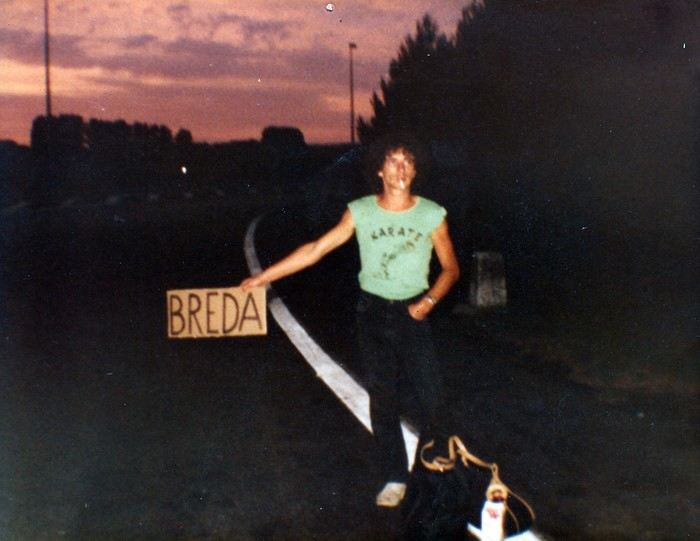
“Hey, your Marker... - My Marker? - The one you used to make hitchhiking signs.”
The marker in question is sitting proudly on the kitchen table. Marielle found it at the bottom of a moving box.
I’ve been meaning to tell the long story of my love affair with hitchhiking for years. Here we go.
To be honest, I’m not quite sure when it started. My earliest memory goes back to a fair with a bike race in my maternal grandparents’ village. I was with my cousin, my little sister, and three girl cousins. There were six of us, ages ranging from six or seven to thirteen or fourteen. Our parents stayed at the fair, and we’d had enough. So we decided to walk home. Only it was four kilometers away. So we hitchhiked. A guy driving an old car picked us all up and dropped us off at the farm. He probably found it amusing to see us thumbing a ride by the side of the road, but maybe it also worried him a bit. With everything you read in the papers...
Around fifteen or sixteen, I started hitchhiking regularly, alone or with a friend, to go to the nearby town. But it was especially when I started boarding school in Orléans that it became more regular. The first year, I’d leave Monday morning and come back Saturday noon by bus. It was an old, uncomfortable bus where we froze in winter. To make matters worse, I often got motion sickness if, as was too often the case, I ended up sitting in the back. In the spring, a high school friend suggested I hitchhike back. It meant a slight detour, but the advantage was taking only national roads.
So that’s how, from the end of tenth grade to twelfth grade, I’d thumb a ride every Saturday on the Pont de Bourgogne. Drivers were used to seeing young people hitchhiking, and it worked pretty well. Our biggest fear? Soldiers! At that time, military service was still mandatory, and on weekends, it wasn’t rare to see them competing with us. They’d keep their uniforms on to go home. That gave people confidence—with everything you read in the papers—and they’d rarely wait more than five minutes. We, with our long hair, were definitely less popular. From time to time, three big red-faced guys in a van coming back from a construction site would flip us off, yelling things like “go get a haircut, you bums!” Those were the good old days.
We still had a good laugh, though. Patrice, the friend I’d hitchhike back from school with on Saturdays, is a musician—I’d later discover he’s an excellent composer. A die-hard Beatles fan, he knows their repertoire by heart and spends his time singing at the top of his lungs while we thumb a ride. One Saturday late morning, we’d been waiting for a while at the exit of Châteauneuf-sur-Loire when a little lady came up to him and asked if he could please sing a little quieter: a baby was sleeping in the house. He put on the most sorry face: “Oh, sorry ma’am, we didn’t realize.” No sooner had the lady gone back inside than he started again. Luckily, a car stopped just then, sparing me the embarrassment of seeing the lady come back out.
Saturday was also the day when the cigarette pack was dangerously low. So before leaving, we’d go buy some “Parisiennes,” the “P4s” as we called them back then. They were slightly thinner cigarettes with a mix of tobacco scraps. Sometimes they tasted like light tobacco, sometimes like dark. Not great, but by the end of the week, our pocket money was gone. They were sold in small packs of four, hence the name P4. We’d only pay 20 centimes. On Saturdays, it was rare for the two of us to manage to scrape together 1.50 F to buy a whole pack of Gauloises...
The last twenty kilometers, I’d usually do alone, Patrice having reached his destination. From time to time, luck would smile on me: an acquaintance would just happen to pass by and stop. One January Saturday, at the exit of Gien, I ran into another guy from Argenton whom I knew a little. That day, the weather was nice, but the temperature was well below zero. It was around noon, and it was the off-peak hour. We were shivering, stamping our feet by the side of the road, when a Citroën “Tube” arrived: it was his father’s boss’s, a mason. They were both sitting in the front, but since they were obese, they had us climb onto the open back. Even though we huddled against the cab to shelter from the wind, the twenty kilometers felt very long, especially since we were only going sixty kilometers an hour. Our hands and cheeks were blue when we finally arrived.
The year I took my baccalaureate, a friend with a 2CV would take me Monday mornings with one or two others we’d pick up in nearby villages. We’d share the gas costs, but it was still cheaper than the bus. And in winter, the bus was my nightmare. You had to get up at five to catch it at six. Not enough sleep, and outside it was freezing or raining—or both. The 2CV was luxury. Plus, Philippe would pick me up at home. On the other hand, since I didn’t have class Saturday mornings—well, I did, but we only had PE the first two hours and nothing after—I’d skip class and slip out right after breakfast to thumb a ride at the Pont de Bourgogne.
Those three high school years were formative in this optional subject that was hitchhiking. Little by little, I learned the rules of the game. First, you shouldn’t walk along the road while thumbing. Cars go too fast and can’t stop easily. Accepting a ride that’s too short is also a no-go. The guy who offers to take you a little way but drops you off at some vague crossroads in the middle of nowhere? No thanks. You need to get dropped off in a town. If it’s a fairly big city, you often have to cross it from one end to the other, but it’s better. At the exit, you have to choose your spot well. Actually, you have to put yourself in the driver’s shoes: they need to see you early enough, not be going too fast, and be able to stop easily without risking an accident. So when leaving a city, it’s better not to go too far. It’s wiser to find a spot where cars go slowly and can stop easily. And preferably near a café. The café is for when you still have a few coins for a coffee and need to warm up. From time to time, you’d run into someone nice who’d make a detour to drop you off at a better spot to start again. Finally, if possible, avoid hitchhiking on Sundays. Cars are packed with whole families who, most of the time, aren’t going far. And then there’s the little worry of those people who rarely leave home: with everything you read in the papers...
During those high school years, it was only short trips, rarely exceeding a hundred kilometers. Later, I aimed bigger, and things were a bit different. In 1973-74, I crossed part of France for the first time on two or three occasions, coming back from the German border or returning to Bordeaux, where we lived briefly. Since there weren’t many highways back then, we took national roads. It was during these trips that I realized it was better to leave in the evening. As I said earlier, Sunday is to be avoided, but on weekdays, there’s another problem: if you leave in the morning, you only make short hops. First, it often takes longer to get going because drivers are people going to work nearby. Which brings us back to those who drop you off in a bad spot, far from everything. There, you have to know how to refuse. You thank the driver for stopping—oh, if only everyone could be like you—while explaining why you’d rather stay put. People don’t take offense, by the way. Those who pick up hitchhikers often hitchhiked themselves when they were in the military or before they had a car. In the late afternoon, you’d often run into salespeople or truckers, in other words, people who drive a lot. At that time, salespeople no longer had appointments and were more relaxed. They wanted to talk about something other than the merits of their products. On the radio, it was time for *Les Grosses Têtes*. You’d also quite often run into small business owners, professionals, or even hippies. The conversations were pleasant and often enriching. A little later in the evening, truckers would take over. They’d already driven a few hundred kilometers, and the depot or customs was still far away. So they’d gladly take a hitchhiker to stay awake at the wheel and chat. The radio with Max Ménier’s show *Les routiers sont sympas*, you’d eventually get tired of it. So a hitchhiker was a change. Others, who’d hit the road at midnight to be at their destination by morning, were nice and offered to let you lie down on the bunk while they drove. When you’d been hitchhiking since six in the evening, freezing in the wind between two vehicles, you weren’t unhappy to take a little nap.
Speaking of Max Ménier, he’d often make announcements for hitchhikers. One evening, I called him. It was getting late, and I still had quite a way to go. No luck: the show had ended for good the day before!
In short, it’s better not to rush, sleep in, and leave after lunch, or better yet, in the late afternoon. Obviously, I’m talking about when you have several hundred kilometers to cover. That’s when you have to play it pro.
First thing, especially at night, but it also applies in the middle of summer when the light is blinding: dress to be seen from far away. I’ll admit I have an advantage over most other hitchhikers: I’m small and don’t scare people. To balance that out, racist drivers often take me for an Arab and are less likely to pick me up, but overall, the balance tips in my favor. Back to the need to be seen: at night, I wear light-colored clothes. In headlights, you can see me from far away.
Second thing: travel light. Forget the big backpack with a frame. Drivers don’t always have room in the trunk or on the back seat, especially if it’s rained and the ground is wet. Plus, it forces them to get out of the car. If they’re nice enough to pick up a hitchhiker, you shouldn’t ask for too much either.
Third thing: bring a cardboard sign and a big marker—like the ones in the photo at the start of this post—to write the name of your destination. In the early 80s, I ran a tourist house in the Cher, but I lived in the Netherlands. In the off-season, it was only open on weekends. On Fridays, I’d leave Holland and return on Mondays. 1200 km round trip. On the way there, in Paris, I’d stand at Porte de la Chapelle. At that spot, the road is very wide, and drivers could stop easily. Obviously, on the sign, I didn’t write Eindhoven, which not everyone knows, and even less Amsterdam because of its seedy reputation. In that case, you’d expect to see a police car stop and two officers in kepis ask for your papers. So as a first destination, I’d write Compiègne. We were well out of Paris, and since it wasn’t too far, a trucker or salesperson was less reluctant to stop. Once past Compiègne, I’d take out my Lille sign. Once in Belgium, it wasn’t really necessary to use a sign anymore, since everyone was going in the same direction. Usually, the guy who picked me up at Porte de la Chapelle would say he wasn’t going far but could take me a little way. Before that, I’d still ask if there was a gas station on the highway where he could drop me off before exiting. While talking, the guy would realize he wasn’t dealing with a dangerous criminal. He’d pretend to check his watch, think for a moment, then say that actually, he was going to Belgium and could take me to the border or a little beyond. To leave Paris on the way back, I’d take the train to Melun, where it was easier to hitchhike than at Porte d’Italie.
Over all those years, I think I was pretty lucky. Or maybe philosophical enough not to imagine a car would stop after a few minutes. An hour’s wait was average. Sure, I sometimes waited three, four, or five hours. Most often at odd hours and in terrible weather. When it doesn’t work, it doesn’t work. But there’s always a moment when things pick up. Sure, when you’re soaked in freezing rain in the early morning after a sleepless night, you’re less philosophical than when I’m writing these lines comfortably at my computer, but it still holds true.
Earlier, I mentioned clothing and the importance of being well-rested before leaving. When you’ve eaten well and just gotten out of the shower, shaved, you’re in a better mood. And somehow, drivers sense it. Or at least, that’s the impression I’ve always had. It’s better to look in shape than disgusted at standing there, half-heartedly thumbing a ride. In short, when I’d start to get fed up with waiting, I’d go into the first café I saw for a coffee. Coming back out, I’d be refreshed, and most of the time, a car would stop within minutes. I’ve often said that when I stood by the side of the road thumbing a ride, I felt a bit like a gambler in front of a slot machine. It was a matter of giving luck a chance. And well, it worked out pretty well.
Then, there are countries where hitchhiking works really well and others where it’s harder. In the 70s-80s, it worked best in Germany and England. In the late afternoon, it wasn’t rare to be invited for tea. Well, that was in England. Tea meant being offered room and board. In Germany, they’d offer you coffee. Once there, they’d first show you the guest room and point out the bathroom before sitting you down in front of a big plate of cold cuts. In the evening, they’d go out in town, and the next morning, they’d usually drop you off at a good spot for hitchhiking. On the other hand, in Mediterranean and Scandinavian countries, you’d better be patient. In Spain or Italy, it’s better to take the train, which was dirt cheap back then. However, if you’re a couple traveling light, it’s already easier in most countries.
In 1982, I went on a trip around Turkey with my girlfriend. We only had two small bags, which was plenty. It was November-December, and we wore our warm, bulky clothes. Leaving Eindhoven at nine in the morning, we arrived in Graz, near the Yugoslav border, at eleven at night. 1300 km in a day! In just four or five vehicles. One to the German border, about fifty kilometers from Eindhoven, the second to Hagen in the Ruhr, the third to Salzburg, and the last to Graz at the Yugoslav border. Record broken. During the night crossing of Yugoslavia, we ran into a trucker close to retirement who lent us the truck’s bunk. So we arrived fresh and rested near Skopje the next morning. We continued to Thessaloniki in northern Greece before taking the train to Istanbul. In Turkey, we traveled a good part of the country by hitchhiking too. With truckers in old, overloaded, slow trucks that climbed hills at fifteen kilometers an hour, but also in cars where five or six people were already crammed in. And every time, we were invited for tea. Once, we were even picked up by a big shot in his Mercedes with a chauffeur. Until then, the average speed was around fifty kilometers an hour. There, we were going two hundred. On a national road, not a nice European highway.
I’ve also hitchhiked in Nepal, from Lumbini, Buddha’s birthplace, to a village on the way to Pokhara. It must have been midday. No bus until the next day. I gave it a try. A small truck overloaded with rice sacks, with two or three young people already perched on top, stopped. I rode on the roof of the cab. At fifty kilometers an hour when it was going well, with a breathtaking view. Coming back from India, I also crossed part of Iran by hitchhiking, from Tehran to the Turkish border. I did this trip with an Austrian I met at the hotel who, like me, had to watch his pennies. We gave it a shot. There was almost no traffic, but to our great surprise, the first car that passed in the area would always stop. They’d just ask for a modest contribution for gas, and it cost next to nothing.
Sometimes, you get scared too. After leaving Turkey in early December 82, we spent about two weeks in the southern Peloponnese harvesting olives. A few days before Christmas, we hitchhiked back to Holland. A girl picked us up in her little Fiat 500. We were driving on a mountain road, and that morning there was a bit of black ice. After crossing a pass, we saw the old Ford Taunus ahead of us at fifty meters start to skid. The driver let out a “heeee!” while grabbing my knees. I reflexively grabbed the wheel. Finally, the Taunus got back on track. And we didn’t swerve. But those few seconds felt very long.
In January 77, while I’d been living in Germany for a few months, I decided to spend a few days in Italy. By hitchhiking, of course. I left in the early afternoon, and by ten at night, I wasn’t far from Frankfurt. I saw a big Mercedes stop. The four or five young people crammed inside were listening to Schlager at full volume. Beer cans littered the floor. They didn’t have a precise destination, and as long as they were going south, that was fine with me. They’d finished their military service that very day and had clearly already celebrated their discharge. The driver was going 160, zigzagging dangerously from one side of the highway to the other. I should have realized he wasn’t entirely sober either. Luckily, there was almost no traffic. Finally, I managed to get dropped off at a gas station just before Frankfurt, relieved. I hope their trip didn’t end tragically.
Another time, coming back from Holland with my wife, we were picked up early in the morning near Senlis by two guys from Lille. They were going to work near Tours and could drop us off at Porte d’Italie. Apparently, they were coworkers but barely knew each other. The driver offered us a beer—at six in the morning, sure!—before opening another can for himself. He was clearly having trouble staying in the right lane. We politely declined, the passenger too. Everyone was tense. Luckily, it was rush hour on the ring road, and we were going slowly. When we got out of the car, the passenger said goodbye with the look of a guy being offered the condemned man’s rum and cigarette.
Finally, there are the annoying remarks from drivers who are either gay when you’re alone or turned on by the sight of your girlfriend when you’re a couple. In those cases, I’d get in the back so the guy wouldn’t feel too confident. And if the conversation got a little too suggestive, we’d deflect until we got dropped off.
And luckily, there are the times, not so rare after all, when you run into really nice people who invite you to eat and sleep at their place and drive you to a good spot the next morning. In Germany and England, that was common. And then there are the big strokes of luck, like during our trip to Turkey when we crossed most of Germany in one car, or that other time when some Germans drove me from the exit of Geneva all the way to the Costa Brava.
Going back to “with everything you read in the papers” and its variant “with everything you see on TV”—and now on the internet—it’s always left me perplexed. Personally, I’ve never heard of hitchhikers assaulting drivers, even if it may have happened. On the other hand, what was most common were hitchhikers being assaulted, especially girls. Anyway, even armed, it seems a bit stupid to assault the driver—wouldn’t that risk causing an accident?
Finally, since that time, I’ve occasionally wanted to hitchhike somewhere far away in France. Most often, too busy with work, it never happened, but the nostalgia hasn’t completely disappeared.
* * *
Other Hitchhikers
And then one day, I... settled down to become a driver myself. Ten years had passed, and you saw fewer and fewer hitchhikers. Or maybe I saw fewer because I had a regular job and wasn’t traveling the same way. And then I understood a few things.
Several times, I was tempted to pick up a hitchhiker, but they didn’t meet the required conditions. They were walking along the road instead of staying at the exit of the previous town. Hard to stop without risking an accident. Or the guy looked really scruffy. Or he was sulking, if not both. Then you think of that famous “with everything you read in the papers.” Not that I was scared, but unfortunately, the few hitchhikers I did pick up later were rarely interesting.
A few years ago, we picked up a young guy at the exit of a small town in Sologne. Not an easy spot for hitchhiking. Bad luck, he was a pretentious little jerk. He was barely 20 or 25 and talked like a bitter old man. He was a waiter in a restaurant. According to him, it was lucky he was there, otherwise the boss would have closed up shop long ago. You’d think he had thirty or forty years of professional experience behind him. As we approached Blois, he started ranting about Arabs, blaming them for all evils. And he laid it on thick. That morning, we were going to a teenager’s funeral who had just committed suicide, so he really got on our nerves, Mr. Know-It-All. Out of anger, I dropped him off next to a shopping center a few kilometers from downtown. Not nice, but it felt good.
Some time ago, we were driving around the Limousin on a Sunday to try out the used Twingo we’d just bought. We picked up a guy in his forties. A German who spoke French well. He started talking about the environment. He was a green Khmer. He got worked up all by himself with his pseudo-eco rant and, after a few kilometers, was almost yelling at us. As we were about to leave the main road for a small one, I dropped him off at a crossroads in the middle of nowhere. Normally, I would have made a little detour to take him to a better spot, but this time, I didn’t feel like doing the... eco-warrior a favor.
On the other hand, I’ve still done my good deed a few times. One June morning, coming back from Orléans, I saw a man in his sixties hitchhiking. The poor guy had had a rough time. He was from Montpellier and was coming back from Caen, where he’d been promised a job. Once there, they bluntly told him the position was already taken, and he had to go back. Except he didn’t have enough money left for the train. He’d spent the night hitchhiking without success. I could only take him as far as Lamotte-Beuvron, where I dropped him off near the fire station. Apparently, there was some vague shelter there or something, but it only opened a few hours later. In the meantime, he settled on the grass in a corner to sleep a little. While he was doing that, I quickly went to the train station to check the price of a ticket to Montpellier. It was within my means. Since he was sound asleep, I slipped the train ticket and 100 francs into his pocket. I couldn’t imagine him continuing to hitchhike all the way to Montpellier. And I bet he didn’t even have a piece of cardboard and a marker!
When we go to Brazil, we usually rent a small car. One day, we were coming back from Paracuru to Fortaleza when we saw a whole family hitchhiking. Two adults and two or three small children. Here near the equator, the sun sets very quickly, and it would soon be night. There was little traffic, and trucks wouldn’t stop because there was no room in the cab. As for the rich people driving big 4x4s, they wouldn’t stoop to picking up the lower classes. The only hope for this kind of family was usually a farmer or artisan who’d let them ride in the back of his pickup. Obviously, they were a bit surprised to see us. Everyone crammed in as best they could in the back of our little car. When we dropped them off, we got a whole string of “Deus lhes abençõe”—God bless you.
Still in Brazil, we were on the road from Barreirinhas to São Luís do Maranhão. About 150 km of deserted road with an isolated mud house here and there. A young woman flagged us down. She was very pregnant and had to get to the clinic twenty or thirty kilometers away to give birth. Someone was supposed to drive her, but the first signs of labor started earlier than expected, and the driver was unavailable. Even driving fast, we weren’t feeling great: it would be just our luck if she gave birth in the car!
Today, we’re in the age of smartphones and carpooling apps. Safety. With everything you see on TV... Three or four years ago, we signed up on a platform. Our first, and only, “client” was a little jerk who didn’t say a word the whole trip. No hello, no goodbye, and certainly no thank you. The next day, we found his Ray-Bans in the car. We didn’t run after him to give them back. Ha!
USA 2022 Road Trip
During our first road trip across the United States, we covered 23,000 km and crossed 28 states in 53 days.
Originally, we had planned to drive Route 66 all the way to Oatman in Arizona and visit various national parks in the American West over a two-month period.
This itinerary was planned before our departure, and all the relevant information had been gathered to stick to the schedule.
Everything went so smoothly that we finished visiting the national parks well ahead of our planned return date.
It helped that having a bed, a portable toilet, and a cooler in our vehicle gave us some autonomy since we didn’t have to worry about accommodation.
So, we decided to extend our road trip to the cities of Nashville and Memphis in Tennessee.
We then headed to Louisiana to visit Baton Rouge and New Orleans.
We crossed Mississippi and Alabama before driving along Florida’s west coast all the way to Key West.
We returned via Florida’s east coast and then crossed the eastern U.S. states to get back to Quebec through the Jackman border crossing in Maine.
So, I invite you to keep reading this long recap, which will let you discover the different attractions we visited throughout this amazing journey.
Videos are included throughout the recap. Click on the image to start the video.
To jump to a specific post, here are the relevant links:
Route 66 - Illinois & Missouri Route 66 - St. Louis (Missouri) - Gateway Arch National Park Route 66 - Cuba (Missouri) - City Murals Route 66 - Springfield (Missouri) - Fantastic Caverns Route 66 - Kansas & Oklahoma Route 66 - Texas & Arizona Route 66 - Texas - The Stations of the Cross in Groom Route 66 - Texas - Panhandle - VW Slug Bug Ranch Texas - Palo Duro Canyon State Park - Juniper Trails Texas - Palo Duro Canyon State Park - The Lighthouse Trail Route 66 - Texas - Amarillo - Cadillac Ranch Route 66 - New Mexico - Santa Rosa Blue Hole New Mexico - Bandelier National Monument - Alcove House Trail via Main Loop Trail New Mexico - Bandelier National Monument - Tsankawi Ruins Trail New Mexico - White Rock Overlook Route 66 - New Mexico - Albuquerque - Old Town New Mexico - White Sands National Park New Mexico - White Sands National Park - Dune Life Nature Trail New Mexico - White Sands National Park - Playa Trail New Mexico - White Sands National Park - Interdune Boardwalk New Mexico - Gila Cliff Dwellings National Monument New Mexico - Grants - Ice Cave & Bandera Volcano New Mexico - Gallup - Pyramide Rock Trail & Church Rock Trail Arizona - Holbrook - Painted Desert Arizona - Petrified Forest National Park - Puerco Pueblo & Newspaper Rock Viewpoint Arizona - Petrified Forest National Park - Blue Mesa Arizona - Petrified Forest National Park - The Teepees, Agate Bridge & Jasper Forest Overlook Arizona - Petrified Forest National Park - Crystal Forest Trail Arizona - Petrified Forest National Park - Giant Logs Trail Arizona - Winslow - Two Guns Ghost Town Arizona - Cameron - Little Colorado River Gorge Overlooks Arizona - Grand Canyon National Park - Shoshone Point Trail Arizona - Grand Canyon National Park - Desert View Drive Arizona - Grand Canyon National Park - Rim Route (Orange) & Village Route (Blue) Arizona - Grand Canyon National Park - Hermit Route (Red Line) Route 66 - Arizona - Historic Town of Oatman Arizona - Bullhead City Community Park Nevada - Red Rock Canyon - Calico I & II & Sandstone Quarry Nevada - Red Rock Canyon - Willow Springs Nevada - Red Rock Canyon Lookouts Nevada - Valley of Fire State Park - White Domes Trail Nevada - Valley of Fire State Park - Seven Wonders Trail, Pink Canyon, Fire Wave Nevada - Valley of Fire State Park - Rainbow Vista Trail Nevada - Valley of Fire State Park - Mouse's Tank Trail Nevada - Valley of Fire State Park - Rock Formations Nevada - Valley of Fire State Park - Scenic Routes Nevada - Cathedral Gorge State Park - Slot Canyons Nevada - Cathedral Gorge State Park - Eagle Point & Miller Point Utah - Bryce Canyon National Park - Mossy Cave & Tropic Ditch Waterfall Trail Utah - Bryce Canyon National Park - Scenic Drive Utah - Zion National Park - Pa'rus Trail Utah - Zion National Park - Sand Bench Trail Utah - Zion National Park - Emerald Pools Trail Utah - Zion National Park - West Rim Trail (Trail connecting to Angels Landing) Utah - Zion National Park - Riverside Walk Utah - Zion National Park - Court of The Patriarchs & Big Bend Utah - Zion National Park - Mount Carmel Highway Scenic Drive Utah - Kanab - Jackson Flat Reservoir Utah - Toadstools Trail in Grand Staircase-Escalante National Monument Arizona - Page - Glen Canyon Dam Overlook Arizona - Page - Glen Canyon National Recreation Area Arizona - Page - Horseshoe Bend Overlook Arizona - Page - Upper Antelope Canyon Arizona - Page - Navajo Canyon Boat Tour at Lake Powell Arizona - Page - Antelope Canyon X Arizona - Canyon de Chelly National Monument - Chelly Canyon Arizona - Canyon de Chelly National Monument - Canyon del Muerto Arizona - Monument Valley Navajo Tribal Park Utah - Mexican Hat Utah - Mexican Hat - Goosenecks State Park Utah - Mexican Hat - Valley of the Gods Utah - The Moki Dugway Scenic Backway Utah - Blanding - Natural Bridges National Monument Utah - Lake Powell - Hite Crossing Bridge Utah - Lake Powell - Glen Canyon National Recreation Area - Hite Overlook Utah - Capitol Reef National Park - Chimney Rock Loop Trail Utah - Capitol Reef National Park - Hickman Bridge Trail Utah - Capitol Reef National Park - Grand Wash Trail Utah - Capitol Reef National Park - Sunset Point Trail Utah - Capitol Reef National Park - Goosenecks Trail Utah - Capitol Reef National Park - Viewpoints - Fruita Area Utah - Capitol Reef National Park - Viewpoints - Scenic Drive Utah - Capitol Reef National Park - Cassidy Arch Trail Utah - Capitol Reef National Park - On the way to Capitol Gorge Trailhead Utah - Capitol Reef National Park - Capitol Gorge Trailhead Utah - Monroe - Mystic Hot Springs Utah - Scenic Overlooks on UT-24, UT-119 & I-70 Utah - Arches National Park - Park Avenue Trail Utah - Arches National Park - Courthouse Towers Section's Viewpoints Utah - Arches National Park - Balanced Rock, Pothole Arch, Ham Rock & Garden of Eden Utah - Arches National Park - Double Arch Trail, Cove Arch, Cove of Caves & Panorama Point Utah - Arches National Park - Windows Loop & Turret Arch Trail Utah - Arches National Park - Delicate Arch Trail Utah - Arches National Park - Upper Delicate Arch Viewpoint Trail Utah - Arches National Park - Fiery Furnace Section - Viewpoints Utah - Arches National Park - Sand Dune Arch Trail Utah - Arches National Park - Skyline Arch Trail Utah - Arches National Park - Devils Garden Trail Utah - Dead Horse Point State Park - West Rim Trail Utah - Dead Horse Point State Park - East Rim Trail Utah - Moab - Utah State Route 279 (Potash Road) Utah - Moab - Shafer Trail - Potash Evaporation Ponds Utah - Moab - Potash Road Dinosaur Tracks and Petroglyphs Utah - Moab - Potash Road - Corona, Bowtie & Pinto Arches Trail Utah - Moab - Potash Road - Wall Street Climbing Area Utah - Moab - Kane Springs Road Utah - Moab - Kane Springs Road - Side By Side Adventure Utah - Moab - Kane Springs Road to Moab Utah - Canyonlands National Park - Island in the Sky - Mesa Arch Trail Utah - Canyonlands National Park - Island in the Sky - Aztec Butte Trail Utah - Canyonlands National Park - Island in the Sky - Whale Rock Trail Utah - Canyonlands National Park - Island in the Sky - Upheaval Dome Trail Utah - Canyonlands National Park - Island in the Sky - Grand View Point Overlook Trail Utah - Canyonlands National Park - Island in the Sky - White Rim Overlook Trail Utah - Canyonlands National Park - Island in the Sky - Overlooks Utah - Moab - Wilson Arch Utah - Monticello - Newspaper Rock State Historical Monument Utah - Canyonlands National Park - The Needles - Road Side Ruin Trail Utah - Canyonlands National Park - The Needles - Cave Spring Trail Utah - Canyonlands National Park - The Needles - Pothole Point Trail Utah - Canyonlands National Park - The Needles - Big Spring Canyon Overlook Trail Utah - Canyonlands National Park - The Needles - Overlooks Colorado - Mesa Verde National Park - Mesa Top Ruins Road Colorado - Mesa Verde National Park - Chapin Mesa Road Colorado - Mesa Verde National Park - Mesa Top Loop Colorado - Mesa Verde National Park - Wetherill Mesa Road Colorado - Great Sand Dunes National Park Colorado - Mosca - Zapata Falls Colorado - Colorado Springs - Garden of the Gods Colorado - Black Canyon of the Gunnison National Park Colorado - Gunnison - Curecanti National Recreation Area Colorado - Gunnison - Blue Mesa Dam & Reservoir Colorado - Lake Pueblo State Park (Pueblo Reservoir) Kentucky - Mayfield, 5 months after an EF4 tornado Tennessee - Nashville - Downtown Walking Tour Tennessee - Graceland Mansion - Home of Elvis Presley Tennessee - Graceland - Lisa Marie & Hound Dog II Jets Tennessee - Graceland - Elvis Presley Automobile Museum & Exhibits Tennessee - Exploring Memphis Louisiana - Exploring Baton Rouge Louisiana - Exploring Lafayette Louisiana - Exploring Houma Louisiana - New Orleans - French Quarter Tour Louisiana - New Orleans - Garden District Tour Louisiana - New Orleans - Creole Queen Mississippi River Cruise Florida - Clearwater Beach Florida - Sanibel Island - Bowman's Beach Florida - Siesta Key Beach Florida - Captiva Island - Turner Beach Florida - Key Largo - Sunset Florida - Key West - Smathers Beach Florida - Miami Beach - Art Deco District Florida - Miami Beach South Carolina - Myrtle Beach Virginia - Virginia Beach Maine - Scarborough - Pine Point Beach
Originally, we had planned to drive Route 66 all the way to Oatman in Arizona and visit various national parks in the American West over a two-month period.
This itinerary was planned before our departure, and all the relevant information had been gathered to stick to the schedule.
Everything went so smoothly that we finished visiting the national parks well ahead of our planned return date.
It helped that having a bed, a portable toilet, and a cooler in our vehicle gave us some autonomy since we didn’t have to worry about accommodation.
So, we decided to extend our road trip to the cities of Nashville and Memphis in Tennessee.
We then headed to Louisiana to visit Baton Rouge and New Orleans.
We crossed Mississippi and Alabama before driving along Florida’s west coast all the way to Key West.
We returned via Florida’s east coast and then crossed the eastern U.S. states to get back to Quebec through the Jackman border crossing in Maine.
So, I invite you to keep reading this long recap, which will let you discover the different attractions we visited throughout this amazing journey.
Videos are included throughout the recap. Click on the image to start the video.
To jump to a specific post, here are the relevant links:
Route 66 - Illinois & Missouri Route 66 - St. Louis (Missouri) - Gateway Arch National Park Route 66 - Cuba (Missouri) - City Murals Route 66 - Springfield (Missouri) - Fantastic Caverns Route 66 - Kansas & Oklahoma Route 66 - Texas & Arizona Route 66 - Texas - The Stations of the Cross in Groom Route 66 - Texas - Panhandle - VW Slug Bug Ranch Texas - Palo Duro Canyon State Park - Juniper Trails Texas - Palo Duro Canyon State Park - The Lighthouse Trail Route 66 - Texas - Amarillo - Cadillac Ranch Route 66 - New Mexico - Santa Rosa Blue Hole New Mexico - Bandelier National Monument - Alcove House Trail via Main Loop Trail New Mexico - Bandelier National Monument - Tsankawi Ruins Trail New Mexico - White Rock Overlook Route 66 - New Mexico - Albuquerque - Old Town New Mexico - White Sands National Park New Mexico - White Sands National Park - Dune Life Nature Trail New Mexico - White Sands National Park - Playa Trail New Mexico - White Sands National Park - Interdune Boardwalk New Mexico - Gila Cliff Dwellings National Monument New Mexico - Grants - Ice Cave & Bandera Volcano New Mexico - Gallup - Pyramide Rock Trail & Church Rock Trail Arizona - Holbrook - Painted Desert Arizona - Petrified Forest National Park - Puerco Pueblo & Newspaper Rock Viewpoint Arizona - Petrified Forest National Park - Blue Mesa Arizona - Petrified Forest National Park - The Teepees, Agate Bridge & Jasper Forest Overlook Arizona - Petrified Forest National Park - Crystal Forest Trail Arizona - Petrified Forest National Park - Giant Logs Trail Arizona - Winslow - Two Guns Ghost Town Arizona - Cameron - Little Colorado River Gorge Overlooks Arizona - Grand Canyon National Park - Shoshone Point Trail Arizona - Grand Canyon National Park - Desert View Drive Arizona - Grand Canyon National Park - Rim Route (Orange) & Village Route (Blue) Arizona - Grand Canyon National Park - Hermit Route (Red Line) Route 66 - Arizona - Historic Town of Oatman Arizona - Bullhead City Community Park Nevada - Red Rock Canyon - Calico I & II & Sandstone Quarry Nevada - Red Rock Canyon - Willow Springs Nevada - Red Rock Canyon Lookouts Nevada - Valley of Fire State Park - White Domes Trail Nevada - Valley of Fire State Park - Seven Wonders Trail, Pink Canyon, Fire Wave Nevada - Valley of Fire State Park - Rainbow Vista Trail Nevada - Valley of Fire State Park - Mouse's Tank Trail Nevada - Valley of Fire State Park - Rock Formations Nevada - Valley of Fire State Park - Scenic Routes Nevada - Cathedral Gorge State Park - Slot Canyons Nevada - Cathedral Gorge State Park - Eagle Point & Miller Point Utah - Bryce Canyon National Park - Mossy Cave & Tropic Ditch Waterfall Trail Utah - Bryce Canyon National Park - Scenic Drive Utah - Zion National Park - Pa'rus Trail Utah - Zion National Park - Sand Bench Trail Utah - Zion National Park - Emerald Pools Trail Utah - Zion National Park - West Rim Trail (Trail connecting to Angels Landing) Utah - Zion National Park - Riverside Walk Utah - Zion National Park - Court of The Patriarchs & Big Bend Utah - Zion National Park - Mount Carmel Highway Scenic Drive Utah - Kanab - Jackson Flat Reservoir Utah - Toadstools Trail in Grand Staircase-Escalante National Monument Arizona - Page - Glen Canyon Dam Overlook Arizona - Page - Glen Canyon National Recreation Area Arizona - Page - Horseshoe Bend Overlook Arizona - Page - Upper Antelope Canyon Arizona - Page - Navajo Canyon Boat Tour at Lake Powell Arizona - Page - Antelope Canyon X Arizona - Canyon de Chelly National Monument - Chelly Canyon Arizona - Canyon de Chelly National Monument - Canyon del Muerto Arizona - Monument Valley Navajo Tribal Park Utah - Mexican Hat Utah - Mexican Hat - Goosenecks State Park Utah - Mexican Hat - Valley of the Gods Utah - The Moki Dugway Scenic Backway Utah - Blanding - Natural Bridges National Monument Utah - Lake Powell - Hite Crossing Bridge Utah - Lake Powell - Glen Canyon National Recreation Area - Hite Overlook Utah - Capitol Reef National Park - Chimney Rock Loop Trail Utah - Capitol Reef National Park - Hickman Bridge Trail Utah - Capitol Reef National Park - Grand Wash Trail Utah - Capitol Reef National Park - Sunset Point Trail Utah - Capitol Reef National Park - Goosenecks Trail Utah - Capitol Reef National Park - Viewpoints - Fruita Area Utah - Capitol Reef National Park - Viewpoints - Scenic Drive Utah - Capitol Reef National Park - Cassidy Arch Trail Utah - Capitol Reef National Park - On the way to Capitol Gorge Trailhead Utah - Capitol Reef National Park - Capitol Gorge Trailhead Utah - Monroe - Mystic Hot Springs Utah - Scenic Overlooks on UT-24, UT-119 & I-70 Utah - Arches National Park - Park Avenue Trail Utah - Arches National Park - Courthouse Towers Section's Viewpoints Utah - Arches National Park - Balanced Rock, Pothole Arch, Ham Rock & Garden of Eden Utah - Arches National Park - Double Arch Trail, Cove Arch, Cove of Caves & Panorama Point Utah - Arches National Park - Windows Loop & Turret Arch Trail Utah - Arches National Park - Delicate Arch Trail Utah - Arches National Park - Upper Delicate Arch Viewpoint Trail Utah - Arches National Park - Fiery Furnace Section - Viewpoints Utah - Arches National Park - Sand Dune Arch Trail Utah - Arches National Park - Skyline Arch Trail Utah - Arches National Park - Devils Garden Trail Utah - Dead Horse Point State Park - West Rim Trail Utah - Dead Horse Point State Park - East Rim Trail Utah - Moab - Utah State Route 279 (Potash Road) Utah - Moab - Shafer Trail - Potash Evaporation Ponds Utah - Moab - Potash Road Dinosaur Tracks and Petroglyphs Utah - Moab - Potash Road - Corona, Bowtie & Pinto Arches Trail Utah - Moab - Potash Road - Wall Street Climbing Area Utah - Moab - Kane Springs Road Utah - Moab - Kane Springs Road - Side By Side Adventure Utah - Moab - Kane Springs Road to Moab Utah - Canyonlands National Park - Island in the Sky - Mesa Arch Trail Utah - Canyonlands National Park - Island in the Sky - Aztec Butte Trail Utah - Canyonlands National Park - Island in the Sky - Whale Rock Trail Utah - Canyonlands National Park - Island in the Sky - Upheaval Dome Trail Utah - Canyonlands National Park - Island in the Sky - Grand View Point Overlook Trail Utah - Canyonlands National Park - Island in the Sky - White Rim Overlook Trail Utah - Canyonlands National Park - Island in the Sky - Overlooks Utah - Moab - Wilson Arch Utah - Monticello - Newspaper Rock State Historical Monument Utah - Canyonlands National Park - The Needles - Road Side Ruin Trail Utah - Canyonlands National Park - The Needles - Cave Spring Trail Utah - Canyonlands National Park - The Needles - Pothole Point Trail Utah - Canyonlands National Park - The Needles - Big Spring Canyon Overlook Trail Utah - Canyonlands National Park - The Needles - Overlooks Colorado - Mesa Verde National Park - Mesa Top Ruins Road Colorado - Mesa Verde National Park - Chapin Mesa Road Colorado - Mesa Verde National Park - Mesa Top Loop Colorado - Mesa Verde National Park - Wetherill Mesa Road Colorado - Great Sand Dunes National Park Colorado - Mosca - Zapata Falls Colorado - Colorado Springs - Garden of the Gods Colorado - Black Canyon of the Gunnison National Park Colorado - Gunnison - Curecanti National Recreation Area Colorado - Gunnison - Blue Mesa Dam & Reservoir Colorado - Lake Pueblo State Park (Pueblo Reservoir) Kentucky - Mayfield, 5 months after an EF4 tornado Tennessee - Nashville - Downtown Walking Tour Tennessee - Graceland Mansion - Home of Elvis Presley Tennessee - Graceland - Lisa Marie & Hound Dog II Jets Tennessee - Graceland - Elvis Presley Automobile Museum & Exhibits Tennessee - Exploring Memphis Louisiana - Exploring Baton Rouge Louisiana - Exploring Lafayette Louisiana - Exploring Houma Louisiana - New Orleans - French Quarter Tour Louisiana - New Orleans - Garden District Tour Louisiana - New Orleans - Creole Queen Mississippi River Cruise Florida - Clearwater Beach Florida - Sanibel Island - Bowman's Beach Florida - Siesta Key Beach Florida - Captiva Island - Turner Beach Florida - Key Largo - Sunset Florida - Key West - Smathers Beach Florida - Miami Beach - Art Deco District Florida - Miami Beach South Carolina - Myrtle Beach Virginia - Virginia Beach Maine - Scarborough - Pine Point Beach
I Walked Across France on Foot – 1,600 km in 52 Days, Here’s My Video Travel Journal
Hi everyone!
As a video enthusiast, I took on two challenges: walking all the way across France from north to south and filming the entire journey.
The result shows, first, that this kind of adventure is within reach for anyone, and second, how and where I camped along the way.
There are 53 videos in a single playlist for anyone who loves walking. https://youtube.com/playlist?list=PL8LBGy77HQwpKy4qVakVTykpakdmpeZc1&si=6lHPmpa_00dan8YX
I also loved the daily encounters—nothing but wonderful people who wanted to help.
If you have any questions, I’d be happy to answer! !
As a video enthusiast, I took on two challenges: walking all the way across France from north to south and filming the entire journey.
The result shows, first, that this kind of adventure is within reach for anyone, and second, how and where I camped along the way.
There are 53 videos in a single playlist for anyone who loves walking. https://youtube.com/playlist?list=PL8LBGy77HQwpKy4qVakVTykpakdmpeZc1&si=6lHPmpa_00dan8YX
I also loved the daily encounters—nothing but wonderful people who wanted to help.
If you have any questions, I’d be happy to answer! !
Bike Route and AI
I'm currently exploring how to create a travel itinerary using AI, specifically ChatGPT.
Question: Bike route from Bordeaux to Paris.
Rough response:
A bike route between Bordeaux and Paris is an incredible adventure, typically around 600 to 650 km depending on the chosen path. Here’s an example of an itinerary with key points:Main Option: La Scandibérique (EuroVelo 3) La Scandibérique is the French section of EuroVelo 3, connecting Bordeaux to Paris through stunning landscapes. This route is well-marked and takes you through small roads and greenways.Main Stages
Bordeaux → Libourne (about 40 km)
Follow the Garonne River, cross the vineyards of Entre-deux-Mers, and reach Libourne, a charming wine town. Greenways available.
Libourne → Périgueux (about 100 km)
Cross the Dordogne with stops in villages like Montpon-Ménestérol. Mix of quiet small roads and trails.
Périgueux → Châteauroux (about 160 km, in several stages)
Through the Parc Naturel Régional de la Brenne. This stage is longer but rich in nature and heritage.
Châteauroux → Orléans (about 110 km)
Reach the banks of the Loire to enjoy the famous Loire à Vélo, a beautiful section with châteaux.
Orléans → Paris (about 140 km)
Pass through the Forêt de Fontainebleau before joining the bike paths along the Seine all the way to Paris.
Question: Bike route from Bordeaux to Paris.
Rough response:
A bike route between Bordeaux and Paris is an incredible adventure, typically around 600 to 650 km depending on the chosen path. Here’s an example of an itinerary with key points:Main Option: La Scandibérique (EuroVelo 3) La Scandibérique is the French section of EuroVelo 3, connecting Bordeaux to Paris through stunning landscapes. This route is well-marked and takes you through small roads and greenways.Main Stages
Bordeaux → Libourne (about 40 km)
Follow the Garonne River, cross the vineyards of Entre-deux-Mers, and reach Libourne, a charming wine town. Greenways available.
Libourne → Périgueux (about 100 km)
Cross the Dordogne with stops in villages like Montpon-Ménestérol. Mix of quiet small roads and trails.
Périgueux → Châteauroux (about 160 km, in several stages)
Through the Parc Naturel Régional de la Brenne. This stage is longer but rich in nature and heritage.
Châteauroux → Orléans (about 110 km)
Reach the banks of the Loire to enjoy the famous Loire à Vélo, a beautiful section with châteaux.
Orléans → Paris (about 140 km)
Pass through the Forêt de Fontainebleau before joining the bike paths along the Seine all the way to Paris.
Quel coin en Martinique avec enfant? English translation pending
bonjour
notre décision de partir en Martinique est prise pour Février 2021 🙂 actuellement dans mes recherches de logement, j'hésite à prendre une location aux 3 ilets ou sainte Luce ou vers le diamant ! nous sommes un couple avec un fils de 11 ans qui adore l'eau et les poissons, donc je pense privilégier une location proche de la mer ...et des tortues🙂 auriez vous des conseils et peut être des bons plans à partager ? idéalement on aimerait la piscine, beaucoup nous le conseille !
merci à vous Delphine
notre décision de partir en Martinique est prise pour Février 2021 🙂 actuellement dans mes recherches de logement, j'hésite à prendre une location aux 3 ilets ou sainte Luce ou vers le diamant ! nous sommes un couple avec un fils de 11 ans qui adore l'eau et les poissons, donc je pense privilégier une location proche de la mer ...et des tortues🙂 auriez vous des conseils et peut être des bons plans à partager ? idéalement on aimerait la piscine, beaucoup nous le conseille !
merci à vous Delphine
Idées de stops, visites, curiosités... sur le trajet Vancouver-Inuvik-Jasper? (en camping-car) English translation pending
Bonjour à tous,
Nous sommes une famille de 3 (avec une petite fille qui aura 2 ans lors du voyage)
Nous partons dans 1 mois pour réaliser un road trip de 7 mois en camping car pour faire le tour de l'Amérique du Nord.
Le trajet prévu est (en résumé, sinon je vous écris 2 pages de nom de ville ;-) )
Halifax-New York-New Orleans-Houston-Salt lake city-Denver-Las Vegas-Los Angeles-San Francisco-Vancouver-Whitehorse-Inuvik-haines-Jasper-Banff-Ottawa-Halifax
Pour définir le trajet côté USA, je me suis inspiré du forum et aussi du site roadtrippin qui est vraiment très bien fait. Hélas, il n'existe pas de site équivalent pour la Canada et la recherche d'informations est un peu plus laborieuse.
Donc, sur les portions de trajet Vancouver-Inuvik-Jasper, avez-vous des idées de stop, visites, curiosités...? on prend tous! :-) Merci et bonne fin de WE
Pour définir le trajet côté USA, je me suis inspiré du forum et aussi du site roadtrippin qui est vraiment très bien fait. Hélas, il n'existe pas de site équivalent pour la Canada et la recherche d'informations est un peu plus laborieuse.
Donc, sur les portions de trajet Vancouver-Inuvik-Jasper, avez-vous des idées de stop, visites, curiosités...? on prend tous! :-) Merci et bonne fin de WE
Itinéraire Chicago - les Grands Lacs - chutes du Niagara English translation pending
Bonjour à tous
Nous partons 3 semaines en Juillet aux ETATS UNIS
Nous sommes partis plusieurs fois dans cet immense pays, nous partons visiter Chicago, les grands lacs et pourquoi pas les chutes du Niagara.
J'ai déjà acheté les billets d'avions France-Chicago/Chicago-France.
J'aimerais connaître votre avis sur les 2 circuits ci-dessous
Je n'arrive pas à me décider. Ou m'orienter sur Chicago et la régions des grands ou partir vers Detroit, les chutes du Niagara et remonter vers les lacs. Je sais (en ayant potasser le forum )que la route de Chicago à Détroit est monotone. J'ai vu aussi que la douane entre les USA et le Canada peut être longue. J'ai vu aussi que pour la location de la voiture il faut s'orienter sur les compagnies connues pour avoir le droit de traverser la frontières. Mais, est ce un bon choix de rester sur la région des grands lacs ??? Nous aimons la nature et moins les villes.
Qu'en penses-vous ? merci par avance
CIRCUIT 1 CHICAGO/TORONTO/NIAGARA
Jour 1 France / CHICAGO Jour 2 CHICAGO Jour 3 CHICAGO Jour 4 CHICAGO-INDIANA DUNES (80 km) Jour 5 INDIANA DUNES-DETROIT (400 km) Jour 6 DETROIT (visite du musée Ford) Jour 7 DETROIT-NIAGARA Jour 8 Chutes du NIAGARA Jour 9 NIAGARA-TORONTO (200 km) Jour 10 TORONTO visite de la ville Jour 11 TORONTO-PENINSULE DE BRUCE à TOBERMORY (300km) Jour 12 PENINSULE DE BRUCE Jour 13 : PENINSULE DE BRUCE-ILE DE MANITOULIN en FERRY Jour 14 ILE DE MANITOULIN Jour 15 : ILE DE MANITOULIN-SAULT SAINTE MARINE (350 km) Jour 16 : SAULT SAINTE MARIE-MUNISING (200 km) Jour 17 : VISITE DU PARC PICTURED ROCKS NATIONAL LAKESHORE Jour 18 MUNISING-COMTE DE DOOR à EPHRAIM (350km) Jour 19 COMTE DE DOOR- MILWAUKEE (250 km) Jour 20 MILWAUKEE visite de la ville Jour 21 MILWAUKEE-CHICAGO (150 km) VOL en soirée
CIRCUIT 2 CHICAGO ET LES GRANDS LACS
Jour 1: FRANCE-CHICAGO Jour 2 CHICAGO Jour 3 CHICAGO Jour 4 CHICAGO-MILWAUKEE (150 km) Récupérer la voiture de location Jour 5 MIWAUKEE visite de la ville Jour 6 MILWAUKEE-EPHRAIM (3h de route) Jour 7 EPHRAIM Cave Point County Park et Peninsula State Park Peninsula State Park : Visiter le parc à vélo. Belle piste cyclable à travers la forêt en Bord de lac. Halte au phare Eagle Bluff par le Sunset Bike tour en une heure environ Jour 8 EPHRAIM-MARQUETTE (5h de route) Jour 9 PARC PICTURED ROCKS NATIONAL LAKESHORE Dormir à DULUTH Jour 10 DULUTH-GRAND MARAIS (2h de route) Jour 11 GRAND MARAIS-TERACE BAY (3h) Jour 12 TERACE BAY-SAULT SAINTE MARIE 500 km en 2 jours Jour 13 SAULT SAINTE MARIE-SAINT IGNACE (80 km) Jour 14 SAINT IGNACE-MAKINAC ISLAND Ferry Jour 16 MACKINAC ISLAND Jour17 MACKINAC ISLAND-TRAVERSE CITY ferry retour Jour 18 Sleeping Bear Dunes National Park Jour 19 TRAVERSE CITY-SAUGATUCK (3h30) Jour 20 WARREN DUNES STATE PARK Jour 21 WARREN DUNES-CHICAGO (1h30) VOL EN SOIREE
Je n'arrive pas à me décider. Ou m'orienter sur Chicago et la régions des grands ou partir vers Detroit, les chutes du Niagara et remonter vers les lacs. Je sais (en ayant potasser le forum )que la route de Chicago à Détroit est monotone. J'ai vu aussi que la douane entre les USA et le Canada peut être longue. J'ai vu aussi que pour la location de la voiture il faut s'orienter sur les compagnies connues pour avoir le droit de traverser la frontières. Mais, est ce un bon choix de rester sur la région des grands lacs ??? Nous aimons la nature et moins les villes.
Qu'en penses-vous ? merci par avance
CIRCUIT 1 CHICAGO/TORONTO/NIAGARA
Jour 1 France / CHICAGO Jour 2 CHICAGO Jour 3 CHICAGO Jour 4 CHICAGO-INDIANA DUNES (80 km) Jour 5 INDIANA DUNES-DETROIT (400 km) Jour 6 DETROIT (visite du musée Ford) Jour 7 DETROIT-NIAGARA Jour 8 Chutes du NIAGARA Jour 9 NIAGARA-TORONTO (200 km) Jour 10 TORONTO visite de la ville Jour 11 TORONTO-PENINSULE DE BRUCE à TOBERMORY (300km) Jour 12 PENINSULE DE BRUCE Jour 13 : PENINSULE DE BRUCE-ILE DE MANITOULIN en FERRY Jour 14 ILE DE MANITOULIN Jour 15 : ILE DE MANITOULIN-SAULT SAINTE MARINE (350 km) Jour 16 : SAULT SAINTE MARIE-MUNISING (200 km) Jour 17 : VISITE DU PARC PICTURED ROCKS NATIONAL LAKESHORE Jour 18 MUNISING-COMTE DE DOOR à EPHRAIM (350km) Jour 19 COMTE DE DOOR- MILWAUKEE (250 km) Jour 20 MILWAUKEE visite de la ville Jour 21 MILWAUKEE-CHICAGO (150 km) VOL en soirée
CIRCUIT 2 CHICAGO ET LES GRANDS LACS
Jour 1: FRANCE-CHICAGO Jour 2 CHICAGO Jour 3 CHICAGO Jour 4 CHICAGO-MILWAUKEE (150 km) Récupérer la voiture de location Jour 5 MIWAUKEE visite de la ville Jour 6 MILWAUKEE-EPHRAIM (3h de route) Jour 7 EPHRAIM Cave Point County Park et Peninsula State Park Peninsula State Park : Visiter le parc à vélo. Belle piste cyclable à travers la forêt en Bord de lac. Halte au phare Eagle Bluff par le Sunset Bike tour en une heure environ Jour 8 EPHRAIM-MARQUETTE (5h de route) Jour 9 PARC PICTURED ROCKS NATIONAL LAKESHORE Dormir à DULUTH Jour 10 DULUTH-GRAND MARAIS (2h de route) Jour 11 GRAND MARAIS-TERACE BAY (3h) Jour 12 TERACE BAY-SAULT SAINTE MARIE 500 km en 2 jours Jour 13 SAULT SAINTE MARIE-SAINT IGNACE (80 km) Jour 14 SAINT IGNACE-MAKINAC ISLAND Ferry Jour 16 MACKINAC ISLAND Jour17 MACKINAC ISLAND-TRAVERSE CITY ferry retour Jour 18 Sleeping Bear Dunes National Park Jour 19 TRAVERSE CITY-SAUGATUCK (3h30) Jour 20 WARREN DUNES STATE PARK Jour 21 WARREN DUNES-CHICAGO (1h30) VOL EN SOIREE
Idées choses à voir et activités de grand air au Tennessee, Alabama et Géorgie English translation pending
Hello les amis,
Je suis à la recherche de choses à voir et activités de grand air à faire entre la Géorgie, le Tennessee et l'Alabama...
J'ai déjà parcouru pas mal de guides et de sites, mais j'avoue ne pas être super emballé pour le moment... Je précise que les musées c'est vraiment pas mon trip. Je préfère une bonne rando VTT ou Kayak, une ballade sur une belle plage, la découverte d'un lieu insolite. Des lieux cultes (déjà repéré Graceland et L'hotel loraine...
Ouais je sais j'en demande beaucoup et je ne pense pas que ce type de destination soit très courue. Mais je tente ma chance.
Je prends toute idée originale 😉
Sinon, je ferais comme d'hab, zéro préparation, 100% AVENTURE 😎
Saint-Malo et la côte d'Emeraude English translation pending
Je poursuis ma visite de la Bretagne par une semaine sur la côte d'Emeraude avec Saint-Malo comme point de chute, du 22 au 29 juin 2019.
Arrivé par le train je découvre progressivement la ville historique ceinturée d'impressionnants remparts d'où émerge une forêt de toits ardoisés.
Mon logement en plein cœur de la ville de Chateaubriand me laissera le loisir de flâner dans les rues qui ont conservé le pittoresque du Moyen-Âge.
C'est pendant cette période contemporaine de la découverte des Amériques que la cité prend son essor : Jacques Cartier est natif d'ici.
Les armateurs de la compagnie des Indes apporteront la prospérité encore visible aujourd'hui à travers les nombreux hôtels particuliers où ils négociaient leurs affaires.
Saint-Malo intra-muros.
Erigés au fil des siècles, les remparts de Saint-Malo constituent une ceinture de fortifications parfaitement hermétique en vue de conjurer l'invasion de celui qui a longtemps été l'ennemi héréditaire : l'Anglais. La porte Saint-Vincent constitue l'entrée principale dans la cité. Deux écussons apparaissent sur la façade de la porte : à gauche, une herse surmontée de l’hermine des ducs de Bretagne qui représente les armoiries de la ville et à droite les hermines surmontées d’une couronne symbolisant le Duché de Bretagne.
Le château dresse fièrement ses tours et donjon à l'entrée de la cité. Il abrite la mairie et le musée d'histoire.
Un peu plus loin, un escalier taillé dans les remparts permet d'accéder au chemin de ronde, offrant une vue panoramique sur l'océan et sur l'agglomération. Il suffit de se pencher entre deux créneaux pour apercevoir la plage du Sillon dont la largeur est réglée par le rythme des marées.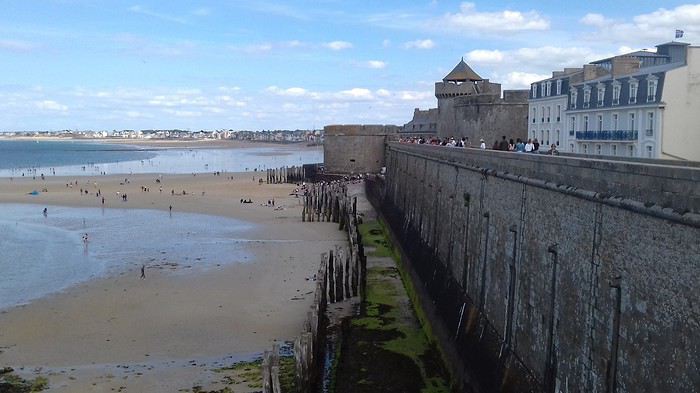
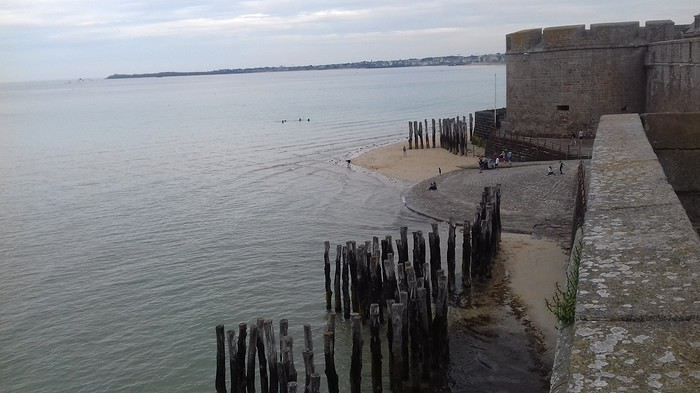
Les remparts, restés intacts après les bombardements de 1944 ceinturent la ville et permettent d'en faire le tour avec en permanence un double paysage intra et extra-muros. Dés le départ le fort de la Reine s'impose par sa masse est ses formes arrondies. Construit par Vauban après le bombardement de la ville par les Ango-Hollandais.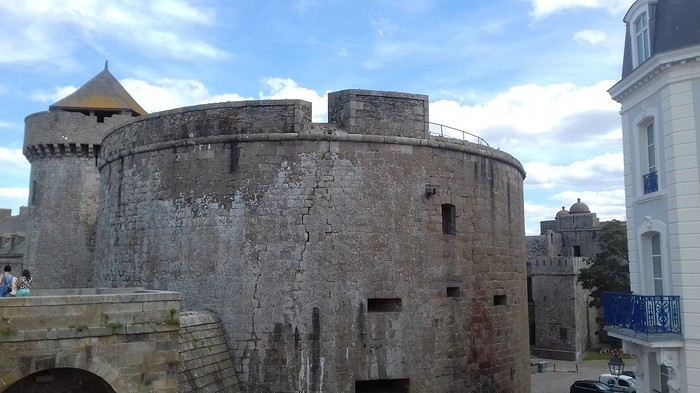
Vis-à-vis du fort de la reine, le fort national est un ouvrage impressionnant, œuvre de vauban, uniquement accessible à marée basse.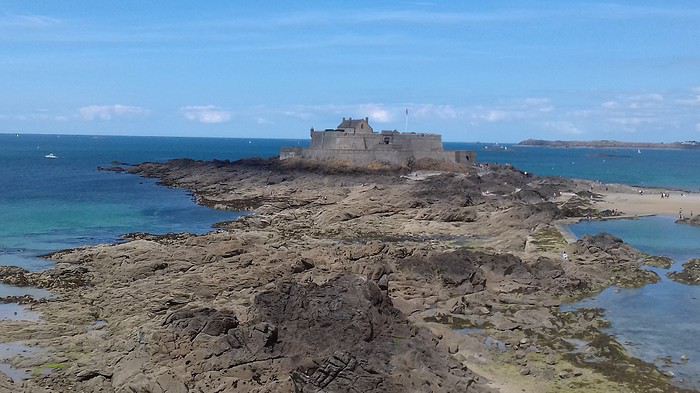
Il devient une île à marée haute.
Autre élément des fortifications, le fort du Petit Bé. Sur l'ilot du Grand Bé, se trouve la tombe de Chateaubriand, natif de Saint-malo. Ils forment un archipel à marée haute.
La baie de Saint-Malo offre les grandes marées d'Europe avec 14 mètres d'amplitude. La tour Bidouane, située près de la maison du Québec offre un beau paysage sur les îles.
Juste en face, sur un terre plein, siège la statue de Surcouf pointant son doigt vers l'Angleterre.
Symétrique de la tour Bidouane, le bastion de Hollande offre une belle terrasse surplombant la plage de Bon Secours et sa piscine d'eau de mer. La statue de jacques Cartier en assure la garde aujourd'hui alors qu'autrefois, 24 chiens affamés interdisaient l'approche de ce bastion stratégique.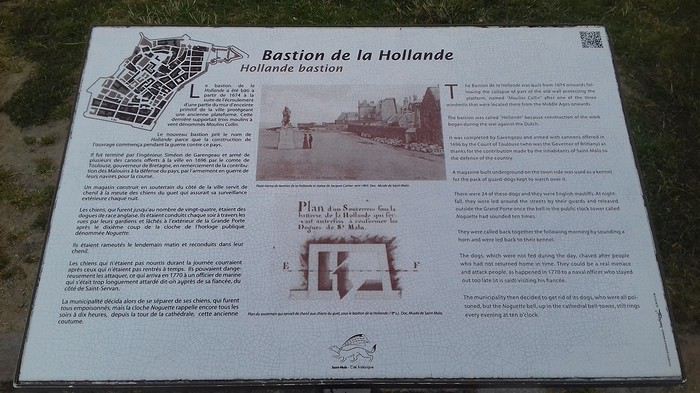
La façade ouest des remparts débouche sur le port où cohabitent ferries et voiliers. Le tourisme a remplacé le commerce.
Rue d'Orléans, les remparts voisinent avec les riches hôtels particuliers des armateurs qui y menaient leurs affaires. Largement détruits en 1944, ils furent reconstruits à l'identique.
Au rond point de l'île Maurice, trône la statue de Mahé de Bourdonnais, gouverneur de îles Mascareignes (aujourd'hui : la Réunion, Maurice et Rodrigues).
Du haut des remparts, son contemporain Duguay-Trouin semble le saluer.
La frégate, l'Etoile du Roy (autrefois commandée par Robert Surcouf) semble parée pour la course dans le bassin qui porte son nom.
Le bassin Vauban accueille un port de plaisance.
La cathédrale Saint-Vincent, héritée du XIIéme siècle s'illumine de ses magnifiques vitraux.
Saint-Malo intra-muros.
Erigés au fil des siècles, les remparts de Saint-Malo constituent une ceinture de fortifications parfaitement hermétique en vue de conjurer l'invasion de celui qui a longtemps été l'ennemi héréditaire : l'Anglais. La porte Saint-Vincent constitue l'entrée principale dans la cité. Deux écussons apparaissent sur la façade de la porte : à gauche, une herse surmontée de l’hermine des ducs de Bretagne qui représente les armoiries de la ville et à droite les hermines surmontées d’une couronne symbolisant le Duché de Bretagne.
Le château dresse fièrement ses tours et donjon à l'entrée de la cité. Il abrite la mairie et le musée d'histoire.
Un peu plus loin, un escalier taillé dans les remparts permet d'accéder au chemin de ronde, offrant une vue panoramique sur l'océan et sur l'agglomération. Il suffit de se pencher entre deux créneaux pour apercevoir la plage du Sillon dont la largeur est réglée par le rythme des marées.
Les remparts, restés intacts après les bombardements de 1944 ceinturent la ville et permettent d'en faire le tour avec en permanence un double paysage intra et extra-muros. Dés le départ le fort de la Reine s'impose par sa masse est ses formes arrondies. Construit par Vauban après le bombardement de la ville par les Ango-Hollandais.
Vis-à-vis du fort de la reine, le fort national est un ouvrage impressionnant, œuvre de vauban, uniquement accessible à marée basse.
Il devient une île à marée haute.
Autre élément des fortifications, le fort du Petit Bé. Sur l'ilot du Grand Bé, se trouve la tombe de Chateaubriand, natif de Saint-malo. Ils forment un archipel à marée haute.
La baie de Saint-Malo offre les grandes marées d'Europe avec 14 mètres d'amplitude. La tour Bidouane, située près de la maison du Québec offre un beau paysage sur les îles.
Juste en face, sur un terre plein, siège la statue de Surcouf pointant son doigt vers l'Angleterre.
Symétrique de la tour Bidouane, le bastion de Hollande offre une belle terrasse surplombant la plage de Bon Secours et sa piscine d'eau de mer. La statue de jacques Cartier en assure la garde aujourd'hui alors qu'autrefois, 24 chiens affamés interdisaient l'approche de ce bastion stratégique.
La façade ouest des remparts débouche sur le port où cohabitent ferries et voiliers. Le tourisme a remplacé le commerce.
Rue d'Orléans, les remparts voisinent avec les riches hôtels particuliers des armateurs qui y menaient leurs affaires. Largement détruits en 1944, ils furent reconstruits à l'identique.
Au rond point de l'île Maurice, trône la statue de Mahé de Bourdonnais, gouverneur de îles Mascareignes (aujourd'hui : la Réunion, Maurice et Rodrigues).
Du haut des remparts, son contemporain Duguay-Trouin semble le saluer.
La frégate, l'Etoile du Roy (autrefois commandée par Robert Surcouf) semble parée pour la course dans le bassin qui porte son nom.
Le bassin Vauban accueille un port de plaisance.
La cathédrale Saint-Vincent, héritée du XIIéme siècle s'illumine de ses magnifiques vitraux.