Results for "Copenhague+|+38+>+205"
2006 results found.
Layover in Kuala Lumpur
Hi,
Flight from Phu Quoc to Langkawi via Kuala Lumpur with a self-transfer layover of 2H10.
No terminal change, but you’ll need to collect your carry-on luggage, recheck in for the second flight (same airline, AirAsia), go through customs and security...
I’m not familiar with this airport, which I’ve read is quite large.
For those who’ve done this before—is the layover time enough?
Thanks for your reply.
CFC Cruise: Is the Sandnes/Stavanger stop still planned?
Hi everyone,
From March 31 to April 10, I took the Viking Lands cruise with CFC.
Out of curiosity, I checked the Renaissance’s route yesterday and noticed it didn’t make the Sandnes/Stavanger stop that we had.
Maybe the itinerary was planned that way?
Best regards,
Review of our first experience with CFC
Hi there,
By sheer chance, a family housewarming in Brussels gave us the opportunity to depart from Zeebrugge for our first experience with CFC, allowing us to discover ports we didn’t know (which has become rare).
After some questions before departure while browsing the forums, we discovered this company with great pleasure. Of course, luck may have played a particularly favorable part: dream weather, a sea as calm as a lake, and boarding and disembarking almost as if the ship were reserved just for us, since during our departure from Zeebrugge, only a small number of passengers were taking advantage of the unoccupied cabins from the previous cruise ending in Le Havre.
As a result, we couldn’t get a suite, but our balcony cabin was very functional, with plenty of storage and a whirlpool bath we thoroughly enjoyed.
Admittedly, the carpet was a bit worn, but it wasn’t a big deal. Having a large enough table allowed us to have breakfast in the cabin (our usual habit) in excellent conditions.
The ship, a reasonable size, was pleasant, in great condition, and had many comfortable lounges.
A large enclosed and heated space with a pool, jacuzzi, and deck chairs offered a calm atmosphere without intrusive activities (which is rare).
I won’t mention the entertainment since we barely participated, but I think there was plenty of choice, including a "special bridge" activity.
The restaurant had a lovely setting, with quick service and particularly attentive staff, reminding us of cruises from the past.
The food was good quality and well-presented, though portions were quite small—something big eaters might regret.
We loved the charm of an old-fashioned theater with comfortable seats and a table for drinks.
The shows were fairly high quality, though opinions may vary. They catered mainly to a French-speaking audience, which is quite rare, and featured a live orchestra.
The excursions seemed reasonably priced for what they offered, but we didn’t participate since we prefer organizing things ourselves.
To sum up, we were pleasantly surprised by this "old little ship" with a mostly French-speaking, very attentive staff, all in a great atmosphere.
CFC Cruises Reviews
Hi everyone,
I'm really tempted by the idea of French-style cruises on smaller vessels, and I'm looking into CFC. I’d love to hear your experiences and feedback.
Thanks, and have a great day!
Road-trip en Suède en septembre English translation pending
Bonsoir,
Après un projet de voyage au Canada, puis en Norvège... Nous avons finalement prit nos billets pour la Suède pour un départ la semaine prochaine.
Nous serons 19 jours sur place et nous ne connaissons absolument rien de ce pays hormis le fait qu'il n'y a pas de quatorzaine et qu'il y a des animaux en liberté. 🙂
Nous pensions louer une sorte de campervan pour notre séjour. Auriez vous des conseils d'agence de location ? Des immanquables à ne pas rater ou tout autre conseil ? Merci beaucoup !
Après un projet de voyage au Canada, puis en Norvège... Nous avons finalement prit nos billets pour la Suède pour un départ la semaine prochaine.
Nous serons 19 jours sur place et nous ne connaissons absolument rien de ce pays hormis le fait qu'il n'y a pas de quatorzaine et qu'il y a des animaux en liberté. 🙂
Nous pensions louer une sorte de campervan pour notre séjour. Auriez vous des conseils d'agence de location ? Des immanquables à ne pas rater ou tout autre conseil ? Merci beaucoup !
Recours pour un vol au Groenland maintenu mais inutilisable English translation pending
Bonjour,
Je vous soumets une question. Un ami et moi avons réservé avant le Covid des vols pour le Danemark et le Groenland pour juillet-août. Malgré l'épidémie, Greenland Air a maintenu ces vols (à 3 semaines du départ) alors que, dans la pratique, les autorités danoises, du fait de l'épidémie, ne nous autorisent pas, en tant qu'étrangers, à entrer au Danemark et au Groenland pour y faire du tourisme.
Savez-vous quelles règles s'appliquent dans ce cas précis ? Les compagnies aériennes peuvent-elles maintenir des vols en sachant que nous serons refoulés à la frontière ? Quels sont les recours éventuels possibles ?
Est-ce que d'autres personnes que nous sont dans la même situation ?
Merci de votre attention et de vos éventuels éclairages.
Cdt
Je vous soumets une question. Un ami et moi avons réservé avant le Covid des vols pour le Danemark et le Groenland pour juillet-août. Malgré l'épidémie, Greenland Air a maintenu ces vols (à 3 semaines du départ) alors que, dans la pratique, les autorités danoises, du fait de l'épidémie, ne nous autorisent pas, en tant qu'étrangers, à entrer au Danemark et au Groenland pour y faire du tourisme.
Savez-vous quelles règles s'appliquent dans ce cas précis ? Les compagnies aériennes peuvent-elles maintenir des vols en sachant que nous serons refoulés à la frontière ? Quels sont les recours éventuels possibles ?
Est-ce que d'autres personnes que nous sont dans la même situation ?
Merci de votre attention et de vos éventuels éclairages.
Cdt
Location de vélos à Tonder pour les déposer à Helsingor (Danemark) English translation pending
Bonsoir,
Nous avons prévu de faire un road trip en vélo au Danemark. Nous pensions louer les vélos dans la première ville de notre voyage, à Tonder, et de les déposer lors de notre dernière étape, à Helsingor, une semaine plus tard. Toutefois nous ne parvenons pas à trouver de réponse à notre question : Est il possible de louer un vélo dans une ville et de le déposer dans une autre ville une semaine après ? Quelle compagnie offre cette possibilité ? L'un d'entre vous a t'il déjà été dans cette situation ?
Merci de vos retours 🙂
Nous avons prévu de faire un road trip en vélo au Danemark. Nous pensions louer les vélos dans la première ville de notre voyage, à Tonder, et de les déposer lors de notre dernière étape, à Helsingor, une semaine plus tard. Toutefois nous ne parvenons pas à trouver de réponse à notre question : Est il possible de louer un vélo dans une ville et de le déposer dans une autre ville une semaine après ? Quelle compagnie offre cette possibilité ? L'un d'entre vous a t'il déjà été dans cette situation ?
Merci de vos retours 🙂
Itinéraire 10 jours en Suède English translation pending
Bonjour,
Je pars avec mon mari et notre fils de 5ans, en Suède fin août durant 10j (du 15 au 25). Nous atterirons et repartirons de Göteborg et aurons une voiture de location pour les déplacements.
Je serais ravie d'avoir votre avis sur les grandes étapes de prévues et votre aide sur les questions que je me pose.
J'envisage 4 étapes : - 3j Région du dalarna (lac siljan, rättvik, tällberg, falun...) - 2j Région du dalsland (parc tresticklan, canal...) - 3j Région du Bohuslän - 1j Göteborg
En terme d'objectif on aimerait : - profiter de la nature : petite randonnée, canoë sur les lacs ... - visiter des villages typiques - découvrir la côte Et on préfère les petites villes typiques plus rurales aux villes urbaines.
J'ai deux questions : 1/ Ma crainte est d'avoir trop d'étapes en seulement 10j, j'hésite à supprimer le dalarna ou le dalsland. J'ai dû mal à identifier la différence en terme de paysages et d'activités entre ces deux régions. Est ce quelqu'un aurait un avis, une recommandation ?
2/ Dans la région du Bohulsän pensez vous que l'on peut avoir un seul point de chute pour rayonner sur les villes et îles principales ou bien on doit/peut se permettre d'en avoir deux ?
Merci beaucoup par avance pour l'aide que vous pourrez m'apporter.
Nathalie
Je pars avec mon mari et notre fils de 5ans, en Suède fin août durant 10j (du 15 au 25). Nous atterirons et repartirons de Göteborg et aurons une voiture de location pour les déplacements.
Je serais ravie d'avoir votre avis sur les grandes étapes de prévues et votre aide sur les questions que je me pose.
J'envisage 4 étapes : - 3j Région du dalarna (lac siljan, rättvik, tällberg, falun...) - 2j Région du dalsland (parc tresticklan, canal...) - 3j Région du Bohuslän - 1j Göteborg
En terme d'objectif on aimerait : - profiter de la nature : petite randonnée, canoë sur les lacs ... - visiter des villages typiques - découvrir la côte Et on préfère les petites villes typiques plus rurales aux villes urbaines.
J'ai deux questions : 1/ Ma crainte est d'avoir trop d'étapes en seulement 10j, j'hésite à supprimer le dalarna ou le dalsland. J'ai dû mal à identifier la différence en terme de paysages et d'activités entre ces deux régions. Est ce quelqu'un aurait un avis, une recommandation ?
2/ Dans la région du Bohulsän pensez vous que l'on peut avoir un seul point de chute pour rayonner sur les villes et îles principales ou bien on doit/peut se permettre d'en avoir deux ?
Merci beaucoup par avance pour l'aide que vous pourrez m'apporter.
Nathalie
Conseils sur parcours deux semaines en Suède English translation pending
Qui peut me conseiller ?
Avec mon compagnon, nous partons 2 semaines et pensons faire stockholm, la cote du bohulsan et goteborg, mais avant le bohulsan on hésite à faire le crochet par la dalécarlie (lac siljan) ou passer plus directement entre stockholm et goteborg par le lac vanerm... voir zapper les lacs du milieu, passer plus de temps sur les îles autour de stockholm et prendre le train de stockholm à goteborg. Le sujet étant que je ne peux pas faire des heures de voiture car serai enceinte de 4 mois 1/2, sauf beaucoup d'étapes, or c'est un peu long entre la dalécarlie et le bohulsan mais peut-être qu'une belle étape au milieu suffira, à karlstadt par exemple.
Qu'en pensez vous?
Escale Hellesylt - Geiranger English translation pending
Bonjour
Nous partons en Croisière cet été en Norvège et j’ai une grosse hésitation pour l’escale au Geiranger Fjord.
A tarif égal, il est possible de faire :
1/ débarquer à 8h du bateau à Hellisylt et faire l’excursion vues époustouflantes d’Hellesylt à Geiranger pour rejoindre le bateau dans l’apres midi
2/ rester sur le bateau pour pénétrer dans le Geiranger fjord puis faire un survol de 20 minutes en hélicoptère et balader un peu par nous même.
Auriez vous des conseils ou retours sur cette escale
Merci d’avance
Nous partons en Croisière cet été en Norvège et j’ai une grosse hésitation pour l’escale au Geiranger Fjord.
A tarif égal, il est possible de faire :
1/ débarquer à 8h du bateau à Hellisylt et faire l’excursion vues époustouflantes d’Hellesylt à Geiranger pour rejoindre le bateau dans l’apres midi
2/ rester sur le bateau pour pénétrer dans le Geiranger fjord puis faire un survol de 20 minutes en hélicoptère et balader un peu par nous même.
Auriez vous des conseils ou retours sur cette escale
Merci d’avance
Hésitation sur 3 destinations à vélo English translation pending
Bonjour
Je réfléchis à mon prochain voyage à vélo cet été (de mi-juillet à mi-août). J'hésite entre deux destinations : - l'Irlande : que je connais pour l'avoir sillonnée à plusieurs reprises il y a quelques années sur toute la côte ouest, toujours au mois de mai ; - le sud de la Scandinavie : Danemark + sud de la Suède et les iles d'Äland et Götland, que je ne connais pas du tout.
Problème principal de l'Irlande à mes yeux : est-ce devenu aussi touristique que l’Écosse ? En 2017, circuler sur Skye à vélo ou sur certaines routes était dangereux du fait de l'affluence des automobilistes et de leur méconnaissance des "passing places". Je garde un très mauvais souvenir de certains tronçons.
Le sud de la Scandinavie semble riche en itinéraires cyclables mais ça me semble d'une désespérante platitude (le Danemark surtout) et peu "sauvage". Ceci étant les Pays Bas sont également plats et charmants, de même que les Pays Baltes 😇.
En dehors des belles villes et des jolis villages, quels sont les attraits principaux de cette région selon vous ?
Merci 🙂
Je réfléchis à mon prochain voyage à vélo cet été (de mi-juillet à mi-août). J'hésite entre deux destinations : - l'Irlande : que je connais pour l'avoir sillonnée à plusieurs reprises il y a quelques années sur toute la côte ouest, toujours au mois de mai ; - le sud de la Scandinavie : Danemark + sud de la Suède et les iles d'Äland et Götland, que je ne connais pas du tout.
Problème principal de l'Irlande à mes yeux : est-ce devenu aussi touristique que l’Écosse ? En 2017, circuler sur Skye à vélo ou sur certaines routes était dangereux du fait de l'affluence des automobilistes et de leur méconnaissance des "passing places". Je garde un très mauvais souvenir de certains tronçons.
Le sud de la Scandinavie semble riche en itinéraires cyclables mais ça me semble d'une désespérante platitude (le Danemark surtout) et peu "sauvage". Ceci étant les Pays Bas sont également plats et charmants, de même que les Pays Baltes 😇.
En dehors des belles villes et des jolis villages, quels sont les attraits principaux de cette région selon vous ?
Merci 🙂
Itinéraire en Norvège en solitaire (au féminin) English translation pending
Bonjour,
J'ai choisi ma destination pour cet été, qui finalement s'est transformé en deux destinations : la Norvège et l'Islande. Pour le moment, je me concentre sur la Norvège qui est la plus grosse partie de mon séjour. J'aimerais avoir quelques conseils sur mon itinéraire, il faut savoir que je pars seule (pour la première fois) et sans voiture. (pour le moment, je n'ai que mes billets pour aller en Norvège, en Islande et revenir en France).
- 4 juillet : vol Paris-Oslo, arrivé à 23h30 - 5 juillet : vol Olso-bodo, arrivé à 10h30 - du 5 au 10 juillet : découverte des iles lofoten - 10 juillet : ferry de Moskenes à Bodo / journée Bodo / train de nuit de bodo à Trondheim - 11 juillet : train de Trondheim à Andalsnes / bus åndalsnes-trollstigen-geiranger - 12 juillet : journée à Geiranger - 13 juillet : aller à bergen (et c'est ici que j'ai besoin de vous) - 14 juillet : journée à Bergen - 15 juillet : train Bergen-Oslo - 16 juillet : vol Oslo-Reykjavik
Je n'ai pas le moindre idée de comment aller de Geiranger jusqu'à Bergen, il n'y a pas de train et je suis restreinte car je n'ai pas de voiture. Avez vous une idée ? peut être en combinant ferry et bus...
Sinon, que pensez vous de mon itinéraire ? J'ai tenté d'y mettre les lofoten et au moins un fjord.. Trouvez vous ça judicieux de rester quatre jours dans les iles lofoten ? n'est-il pas préférable de visiter davantage les fjords ? Il y a tellement plus de choses que j'aurai aimé faire, comme le parc de Jotunheime, voir des églises en bois..
Merci pour vos réponses
- 4 juillet : vol Paris-Oslo, arrivé à 23h30 - 5 juillet : vol Olso-bodo, arrivé à 10h30 - du 5 au 10 juillet : découverte des iles lofoten - 10 juillet : ferry de Moskenes à Bodo / journée Bodo / train de nuit de bodo à Trondheim - 11 juillet : train de Trondheim à Andalsnes / bus åndalsnes-trollstigen-geiranger - 12 juillet : journée à Geiranger - 13 juillet : aller à bergen (et c'est ici que j'ai besoin de vous) - 14 juillet : journée à Bergen - 15 juillet : train Bergen-Oslo - 16 juillet : vol Oslo-Reykjavik
Je n'ai pas le moindre idée de comment aller de Geiranger jusqu'à Bergen, il n'y a pas de train et je suis restreinte car je n'ai pas de voiture. Avez vous une idée ? peut être en combinant ferry et bus...
Sinon, que pensez vous de mon itinéraire ? J'ai tenté d'y mettre les lofoten et au moins un fjord.. Trouvez vous ça judicieux de rester quatre jours dans les iles lofoten ? n'est-il pas préférable de visiter davantage les fjords ? Il y a tellement plus de choses que j'aurai aimé faire, comme le parc de Jotunheime, voir des églises en bois..
Merci pour vos réponses
Rejoindre la Norvège sans prendre l'avion et avec vélo English translation pending
Bonjour. Je vais aller rouler quelques semaines en Norvège (#dream) et je chercher la combine la plus simple ou la moins cher ou la plus rapide pour rejoindre la Norvège (Oslo ou autre, qu'importe) depuis la France sans prendre l'avion. Quelles sont vos idées ? Merci
Reroutage et indémnisation English translation pending
Hello à tous,
Je vais préparer une demande d’indemnisation pour une arrivée avec 5h de retard.
Nous avions 2 correspondances. L’avion de premier vol était prévu avec 50’ de retard au départ (parti avec 30’ de chez lui) et on nous a annulé nos billets et reroutés via 2 autres escales mais le dernier vol en stand by. Finalement on a pas pu embarquer car vol plein, 2ème chance standby aussi et finalement c’était en ordre.
Pour l’indemnisation, je crois que tout va se jouer sur la raison du départ du premier vol. Je crains qu’ils disent météo pour se dédouaner. Je suivais la situation en temps réel sur les sites et d’autres vols partaient à l’heure (d’autres un peu retardés) d’Amsterdam (1er février vers 06h30/7h). Comment prouver que ce n’est pas une circonstance exceptionnelle due à la météo.
Merci pour votre aide :)
Je vais préparer une demande d’indemnisation pour une arrivée avec 5h de retard.
Nous avions 2 correspondances. L’avion de premier vol était prévu avec 50’ de retard au départ (parti avec 30’ de chez lui) et on nous a annulé nos billets et reroutés via 2 autres escales mais le dernier vol en stand by. Finalement on a pas pu embarquer car vol plein, 2ème chance standby aussi et finalement c’était en ordre.
Pour l’indemnisation, je crois que tout va se jouer sur la raison du départ du premier vol. Je crains qu’ils disent météo pour se dédouaner. Je suivais la situation en temps réel sur les sites et d’autres vols partaient à l’heure (d’autres un peu retardés) d’Amsterdam (1er février vers 06h30/7h). Comment prouver que ce n’est pas une circonstance exceptionnelle due à la météo.
Merci pour votre aide :)
Royal Caribbean, croisière Serenade of the Seas English translation pending
Bonjour,
Je vais prendre le Serenade of the Seas au printemps.
J'ai lu sur ce forum qu'avec Royal Carribean il était possible d'acheter au bar un forfait de 10 drink.
J'aimerais savoir s'il y a des personnes qui connaissent ce forfait ou qui l'on acheté.
Je viens de faire le Symphony et je n'ai rien constaté à cet effet.
Merci Nine
Je vais prendre le Serenade of the Seas au printemps.
J'ai lu sur ce forum qu'avec Royal Carribean il était possible d'acheter au bar un forfait de 10 drink.
J'aimerais savoir s'il y a des personnes qui connaissent ce forfait ou qui l'on acheté.
Je viens de faire le Symphony et je n'ai rien constaté à cet effet.
Merci Nine
Manger danois pour un premier voyage au Danemark English translation pending
Bonjour moi je pars en juillet du 15 juillet au 22 juillet 2019
c la premiere fois ,
on ta déja repondu lol Macdo , Burger King mais lol je suis mort de rire
non on va pas dans un pays qu'on connais pas
pour la premiere fois pour manger macdo mais on veut manger local !
n'importe quoi la reponse
non moi je veux manger danois une spécialité danoise
merci bon voyage , joyeuses fetes , joyeux noel , bonne fin d'année a tout le monde .
non on va pas dans un pays qu'on connais pas
pour la premiere fois pour manger macdo mais on veut manger local !
n'importe quoi la reponse
non moi je veux manger danois une spécialité danoise
merci bon voyage , joyeuses fetes , joyeux noel , bonne fin d'année a tout le monde .
Conseils pour Oslo en novembre? English translation pending
Bonjour
Besoin de vos conseils
Nous partons en amoureux du 1 au 4 à Oslo ! On a hâte de découvrir Oslo et ses alentours
On aimerait savoir comment on doit s'équiper (après ski ou non ? Par exemple)
On sait que les journées sont courtes que conseillez vous comme visites ?
Merci beaucoup
Kayaking in Greenland - Disko Bay: Circumnavigation of Arve Princess Island
After two rather rainy kayaking experiences in Alaska at the end of summer in recent years, we chose a slightly drier destination for this late August 2018: the west coast of Greenland. The temperature will certainly be a bit colder, especially at this time of year, but we’re betting on a beautiful end to the season. According to temperature charts, it should be around 5 to 10°C with a few night frosts. The tundra will already have its autumn colors, and by the end of the trip, we might be lucky enough to see the northern lights when the nights get darker.
We’re setting off as a group of three in two inflatable double-seater kayaks (Gumotex) brought from France. The plan is to spend two weeks circumnavigating Arve Princess Island, located north of Ilulissat in Disko Bay, with a possible boat drop-off at the southern tip of the island.
This seems like a fairly classic route in the area—we found several descriptions online (thanks to the authors). With their help and Google Earth, we identified all potential campsites and entered their coordinates into a GPS. The western part of the island, facing the bay, seems ideal for whale watching, while the more rugged eastern side offers access to several glacial walls. We’re somewhat familiar with the area from two winter expeditions on skis and pulkas.
Plus, the commitment is limited due to the island’s proximity to several small villages, including Qeqertaq, Oqaatsut, and even Ilulissat. In fact, we saw fishing boats almost every day. The distance suits us well: 200 kilometers in 16 full days on site, which should leave some leeway in case of bad weather or for hiking.
We booked our flights in June with Air Greenland to Ilulissat for the last week of August and the first week of September. On both the outbound and return trips, we stayed overnight in Copenhagen. The France-Copenhagen flight was with Air France.
We were allowed 3 x 20 kg in the hold. Each kayak with its accessories fits into a 20 kg bag; the last hold bag is for shared gear: tent, stoves, dry bags… We only brought 1.5 kg of semolina for food. In the end, we had 61 kg of gear, and no excess baggage was charged.
Individual gear (clothes and sleeping bags…) was distributed in the cabin luggage.
For the boat transfer, we contacted an agency: Blue Jay, which gave us a number to call upon arrival.
Day 0: Wednesday, August 22 Departure day. After work, I drove from Gap to Marseille’s Marignane Airport for the first leg of the trip to Copenhagen. I enjoyed the rather mild local temperatures: 35°C in the shade. After a layover in Paris, I arrived at the Copenhagen hotel, located two train stops from the airport, where my companions were already settled. No issues—everyone was on time with their luggage.
Day 1 The flight to Greenland was at 9 AM. We had a layover in Kangerlussuaq, where we changed planes, then stopped in Aasiaat before reaching Ilulissat Airport at 3 PM under beautiful sunshine.
We called Blue Jay for the boat transfer: they could take us to the island as early as 6 PM; otherwise, we’d have to wait until the next day. That left us 3 hours to prepare our gear and, most importantly, do our shopping for the two-week trip—it seemed tight, but we gave it a shot.
A quick taxi ride took us to Pisiffik, where we easily found everything we needed: bread, butter, cheese, cold cuts, rice, pasta, jam, muesli… There was no C fuel or methylated spirits for the stoves, but this time we knew the trick: at Stark, a bit uphill from the town, we found the precious liquids. Two hours later, we filled our dry bags and containers with our purchases, and by 5:30 PM, we met Klaus, the Blue Jay manager, directly at the port.
The vacation seemed to truly begin as we sped by boat through the icebergs toward Arve Princess Island. Forty-five minutes later, we spotted a beach lined with rocks where Klaus dropped us off quickly (he had another transfer to make right after).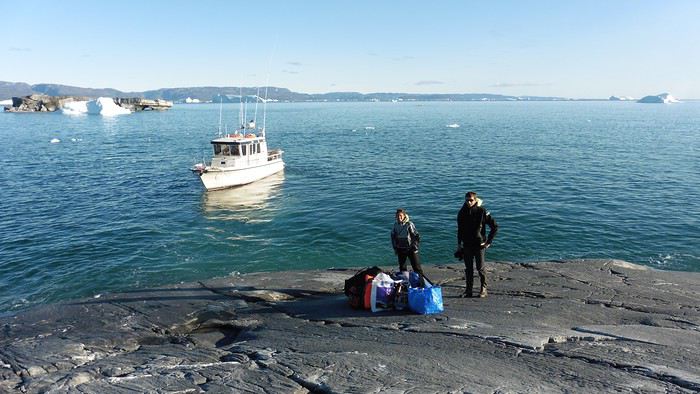
Here we were on the island, in the middle of nowhere, with all our luggage and food to organize, the tent to set up, and the kayaks to inflate—just 10 hours after leaving the Copenhagen hotel. We got to work, bothered by the flies. Despite our head nets, it was barely tolerable—there were so many of them. They swarmed by the dozens into every bag we opened. It was quite mild: 10°C.
Everything was ready by evening, and we were very happy to have completed all these transfers (planes and boat in a single day) as we slipped into our sleeping bags.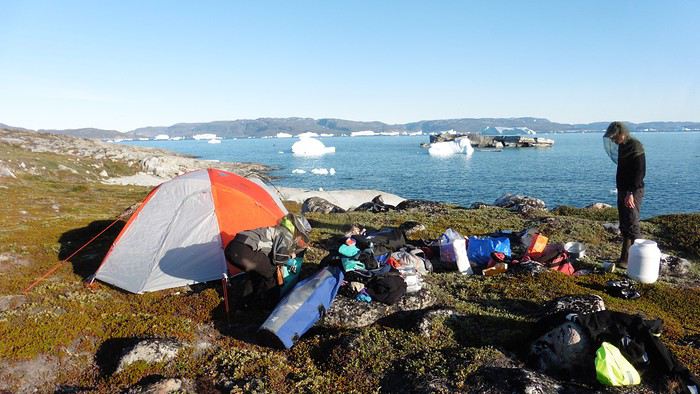
During the night, the wind picked up, and we went out several times to check the tent and kayak anchors. We noticed how bright it was—it was still quite twilight even at 1 AM.
Day 2 5:30 AM wake-up—the south wind was still strong, but since we were heading north, we decided to give it a try anyway.
This was also the moment we loaded the kayaks: since there were only three of us for two double-seater kayaks, we filled the hatch of one kayak, which allowed us to fit all our food. It would have been very difficult if there had been four of us for two kayaks.
Finally, we set off north along the western coast of the island. The conditions were far from ideal—the sea was rough, and the kayaks had a lot of wind resistance. But the main problem was the spray skirt: the gear on deck weighed it down, and the skirt kept coming off… We’d have to deal with it. Barely underway, and whales were already breaking the surface—it was our first time seeing them, and we were very impressed. Too bad the wind didn’t allow for longer contemplation; stopping paddling was impossible with such strong gusts.
We passed a few headlands and even considered stopping due to the conditions. To find some semblance of shelter, we had to hug the coast closely without cutting across the numerous bays, which significantly lengthened the journey. But as the morning went on, the wind died down, and the sea calmed. We spotted several whales and our first seals. It was almost pleasant during the picnic break. By late afternoon, we reached Kangerup Sarqâ Bay, where we had identified a great campsite with a very large beach and a river. But the wind had shifted—it was now coming from the north, making the last hour difficult due to fatigue and headwinds.
The campsite was ideal and beautiful, facing numerous icebergs grounded in the bay.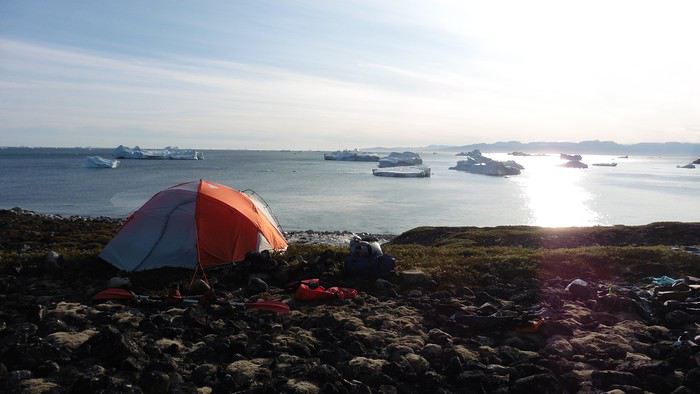
The GPS alerted us to another major drawback of inflatable kayaks: their slowness. It took us 7.5 hours of actual paddling (excluding breaks) to cover 28 km, averaging 3.7 km/h—somewhat disappointing. But we knew this before leaving, and once again, we’d have to make do!
Day 3 Surprise: at 6 AM wake-up, it was raining, foggy, with a south wind, and the sea was choppy even in the bay. It seemed wise to skip paddling, even though stopping on the second day was tough on morale. We went back to sleep, especially since the travel fatigue and the harsh conditions of the previous day had taken their toll.
At 11 AM, the navigation conditions weren’t any better—at the ends of the bay, we saw huge waves crashing onto the rocks, and giving up for the day became obvious. However, the rain had stopped, so we set off for a hike along the large lake bordering the bay. The wind hadn’t let up, and it was quite cold.
The tundra was starting to take on its autumn colors, and the contrast between the white lichens and the red vegetation was stunning. At the lake, we took out the fishing rods and quickly caught two beautiful Arctic char over 50 cm long.
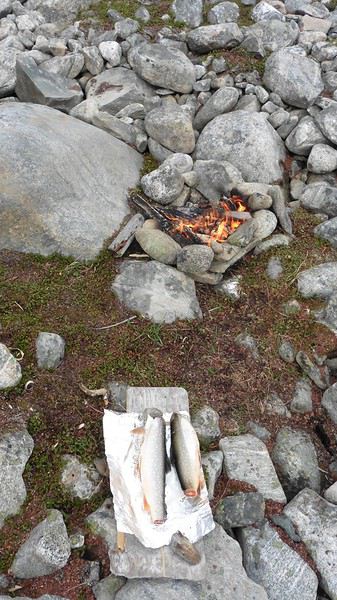
As the afternoon wore on, the sun seemed closer. Along the beach, we gathered driftwood (mostly old planks) to cook our catch in foil over a fire. Eating our own food in such a beautiful place next to a good fire was comforting after the day’s setback.
In the middle of the night, an Arctic fox entered the tent’s rear awning. It seemed barely intimidated when we shooed it away with loud shouts and then with stones.
Day 4 6:15 AM wake-up—3°C. We were on the water by 8 AM. The wind had dropped significantly, but the sea was shrouded in fog, and it was very cold in these damp conditions.
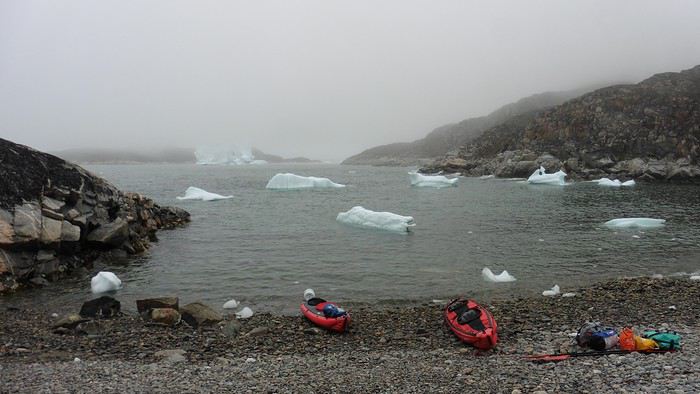
We passed the bay’s headland, Kangea, and headed toward the abandoned village of Agpat. The atmosphere was very austere—we hugged black rocks in fog that limited visibility to 50 meters, revealing large icebergs as we went.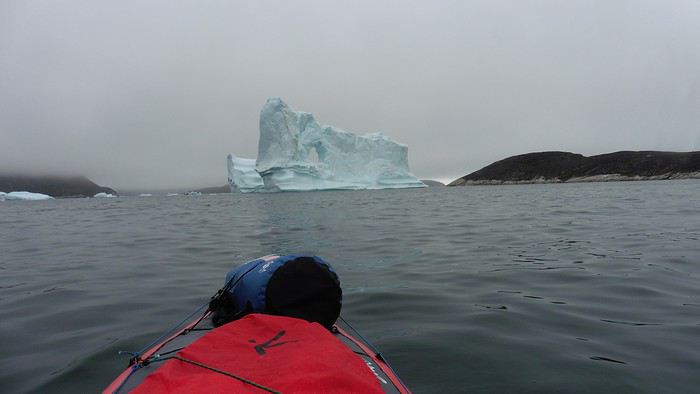
Suddenly, the water’s surface stirred in front of my kayak, and a huge gray back emerged from the sea. The collision was inevitable, but the whale seemed to understand and dove immediately, passing under the kayak and resurfacing a few meters away. I felt the kayak rock in the white foam and quickly paddled to escape the turbulence. What an emotion!
A light wind began to clear the fog, and the sun made beautiful appearances. Despite the cold, we stopped to visit the abandoned village, which left a strange impression. All the houses were still in good condition and wide open—some must have been very spacious in their time. We went back to sea, and in front of the large Kaangerdluk Bay, we hesitated—the headwind was strong, and large waves split the water. The next beach, from the island of Nua where we stopped to think, was over 8 km away. It was barely 2 PM, but caution led us to stop here for the day. We had covered 12 km—exactly the distance needed to stay on schedule. The afternoon was spent hiking on the island’s hills and gathering mussels and wood.
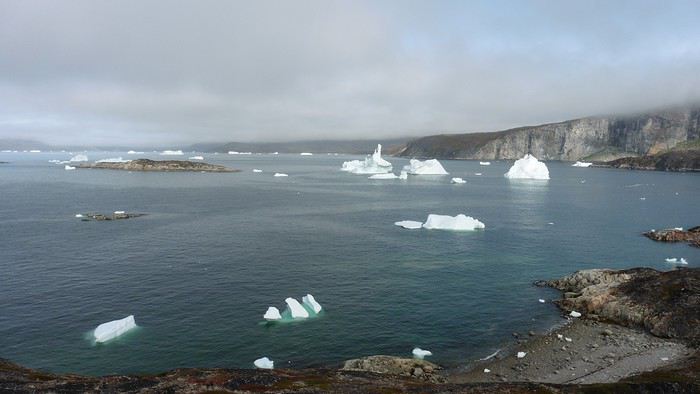
In the evening, we cooked these large Greenlandic mussels over a wood fire and savored them under the beautiful evening light. The weather was now fine, but the thermometer read -5°C in the sun…
Day 5 Bright sunshine, a glassy sea, and -8°C at 6 AM. Everything was green for setting off, even if putting on damp kayaking gear was a bit unpleasant in the cold. It was the first time we’d paddled on a flat sea since the start of the trip, and our average speed increased slightly.
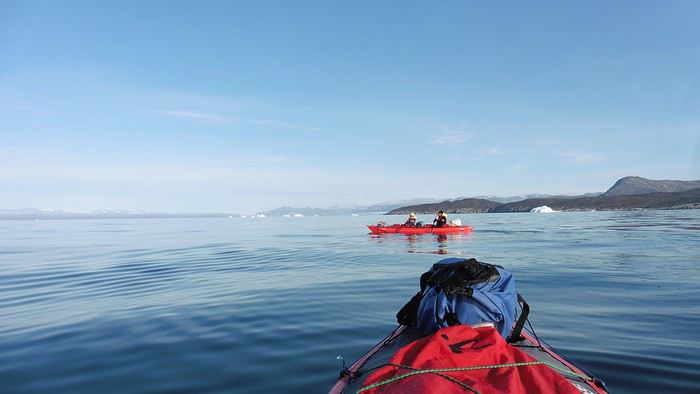
We entered the Smallesund Strait, marking the end of the island’s west coast. We were close to the large Torssukatak Fjord, where two glaciers flow. The access pass to the fjord was very narrow, and numerous ice chunks blocked access to the beaches. The wind had picked up and was now hitting us head-on (again). Just before entering the fjord, we landed on a steep beach made of large pebbles on Oqaitsut Island. It was very cold with the wind, and moving forward became difficult. We decided to stop for the day both because of the conditions and because the next campsite was far away, given how rugged the fjord was.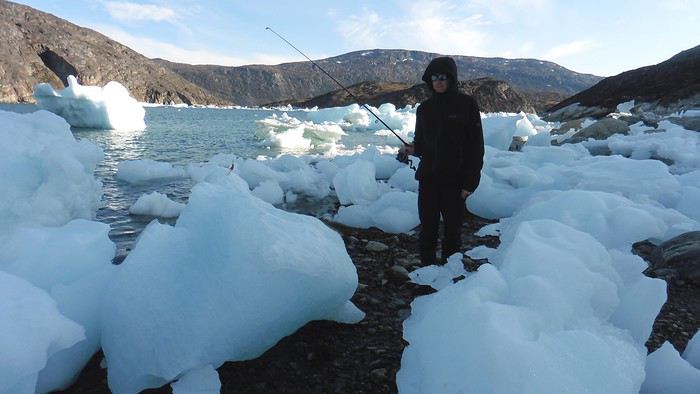
We eventually found a flat spot for the tent despite the steep slope. Even with the wind, the weather was beautiful, and we set off on foot for the northeastern cape of the island, overlooking the fjord. The view was far-reaching and exceptional—up close, the large fjord filled with ice and its steep granite cliffs, and in the distance, the ice cap and glacial walls.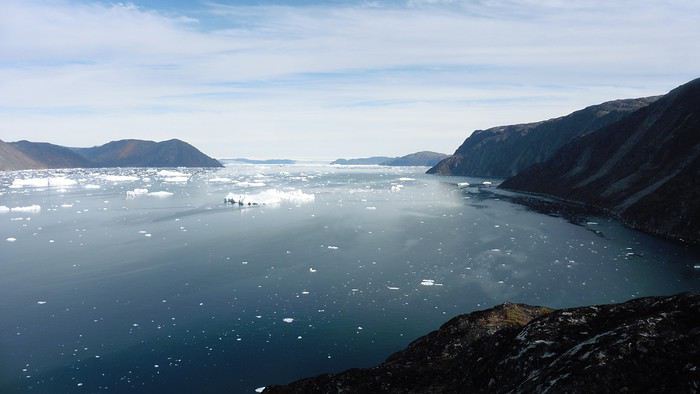
We spotted the village of Qeqertaq, whose network we could pick up, allowing us to check the weather forecast, which was rather good. While securing the kayaks in the evening, I noticed the strange behavior of one kayak at the end of the stage was due to the loss of the skeg—impossible to know where it detached. We’d have to do without it.
Day 6 Still that icy headwind from the northeast. We set off anyway for a long stage to reach the large pass connecting the Torssukatak and Ata Fjords.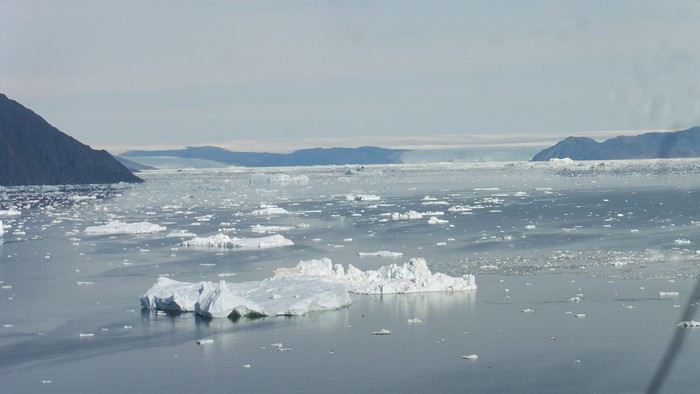
We advanced laboriously along the high cliffs of the fjord’s southern shore. They faced due north and blocked the sun. We felt the cold and dampness of the rock. It was really cold, especially in the extremities. We picnicked on the western cape of Qeqertakavasak Island. The cold didn’t allow us to stop for more than 20 minutes… But the wind dropped, and the sea was now very smooth. It was heavily cluttered with ice between the icebergs and old pack ice. The goal was to reach the large rocky promontory of Anapnuna, wedged between the Kujatdleq and Kangilerngata Glaciers, but the ice made progress difficult. We stopped to gain height on a small island and spot a passage of open water, but all we saw was white—passing seemed impossible. The currents were very complex, and entire sections of ice were being swept in one direction and then another at an impressive speed.
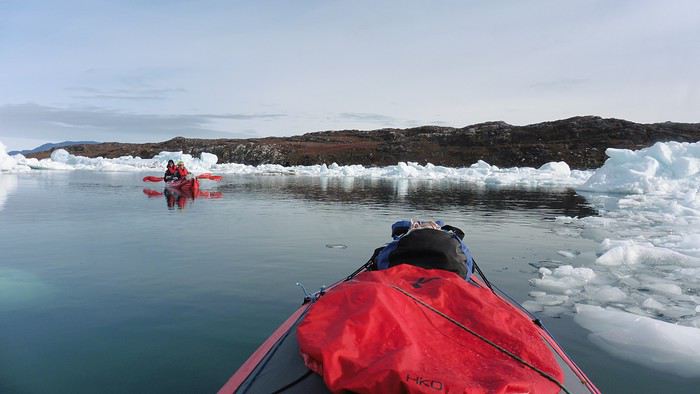
We wandered through this labyrinth until landing on a beach on the small island of Takissut, where we set up camp, exhausted from the 30 km covered and the vigilance required by the abundance of ice. The place was sublime under the evening sun—we were surrounded by ice and mountains, with the Kangilerngata Glacier in the distance. The summer contrasts were striking between the water, icebergs, sky, and flaming tundra—all colors were represented. Absolute calm reigned.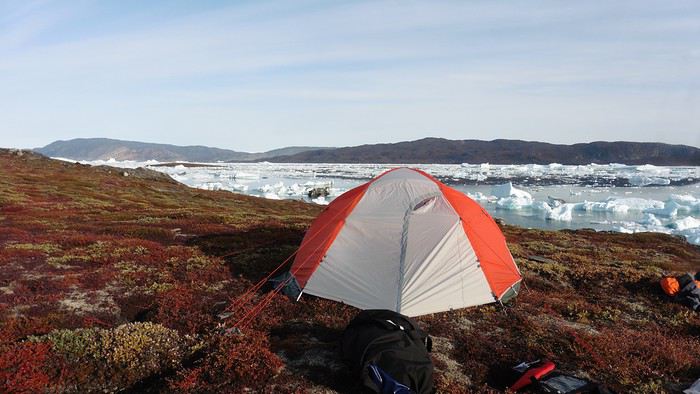
The lack of drinking water at this spot wasn’t too much of a constraint: as soon as we arrived on the beach, we placed containers under the icebergs stranded in the intertidal zone. They were all full by the time we finished setting up.
Day 7 We had to change our plans: we wouldn’t reach the rocky promontory, too well protected by the ice. We set off under the sun for Igdluluarssuit Island. Although we had spotted a passage just before launching, we quickly found ourselves surrounded by ice. It was everywhere, and finding water to paddle became complicated. We tried to force our way in every direction, even retracing our steps. Everything moved at an impressive speed—we were in the middle of a whirlpool of ice.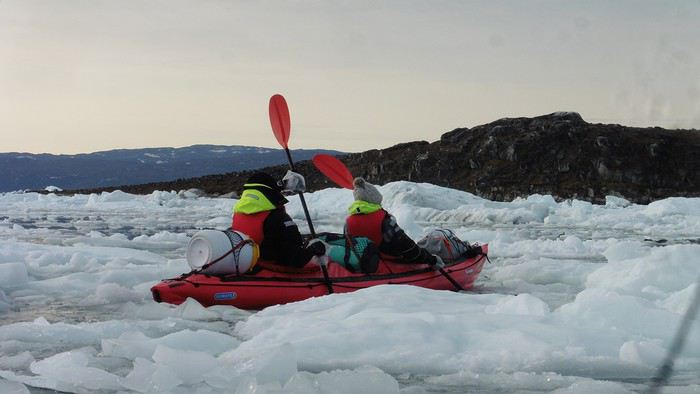
The tension rose, and each boat had its share of big scares. I was trapped against ice floes that dragged me toward an iceberg—the pressure on the kayak was enormous; it was going to capsize or puncture! But with a few strong strokes and paddling against the ice, I managed to free myself from the trap. Barely 10 minutes later, my companions were sandwiched perpendicularly between two icebergs that were closing in. The situation was desperate—the kayak was bending and twisting more and more, but with some strong paddle strokes, it finally freed itself. After these particularly unpleasant moments, we were completely blocked. The drifting ice floes had tightened, and the kayaks were no longer even in the water… The only solution: wait with the kayaks on these floes, which were too thin to walk on (even though we didn’t try). Within minutes, the situation cleared—a waterway opened, and we rushed into it. We paddled with one goal: find a larger pool of water. After going back and forth, our path took shape—we had to force the passage several times, attacking the ice directly with the kayaks, and finally, we escaped the worst of the labyrinth. We reached land on the west side of the island and saw that the rest would be easier. To reach the island, we just had to cross the Arsiviup Ikera Strait, which was lightly cluttered. We reached the eastern cape of the island, ideal for camping, even though we had only paddled for 3 hours. We set up camp and hiked to the island’s summit, which overlooks the entire pass and the glaciers.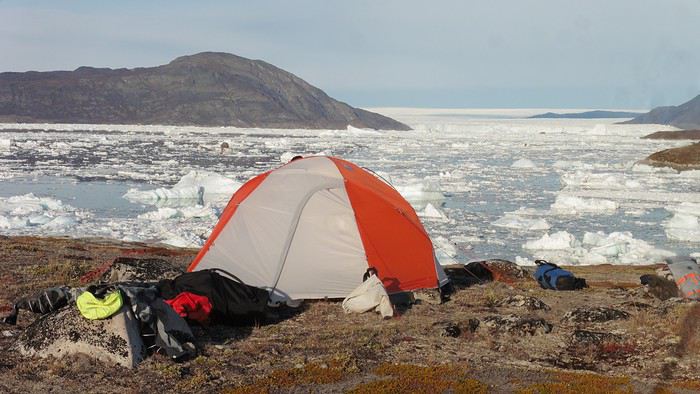
Everything was magnificent, no matter the direction. At 2 PM, we were at the summit—the beauty of the place and the picnic facing the glacier in the sun without wind made us forget the near-disaster from a few hours earlier. It would be impossible to approach the glacier by kayak, but from our summit on foot, it seemed so close, and contemplating it safely on solid ground was a great moment.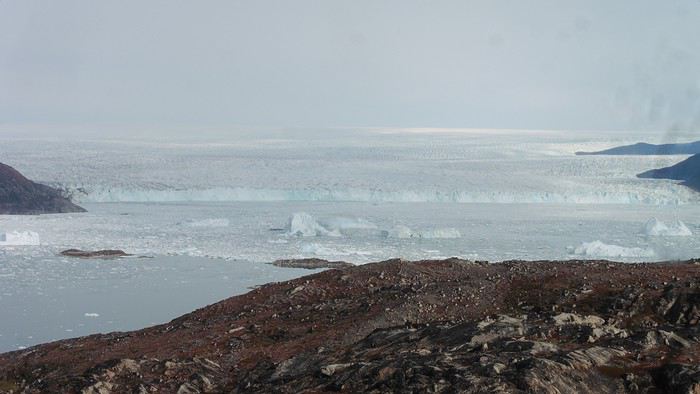
The pass was incredibly complex—everything was in motion, and an impassable passage could become open water within minutes. We were delighted when we returned to camp. A slightly lost whale among the ice accompanied us along the shore. The place was truly beautiful, but the temperature dropped again under the clear sky, preventing us from eating outside.
Day 8 Clear and cold at wake-up: -9°C. The sea had frozen in many places. We hesitated about the rest of the trip—should we start heading back to Ilulissat or linger in the pass, especially to approach the Eqi Glacier? After the incidents of the previous day, we decided to think carefully and paddled to the southern cape of our island to check the ice conditions toward Eqi. The weather had clouded over in the meantime, and the sky was quite gray. At the cape, we spotted the glacier’s wall, still 15 km away.
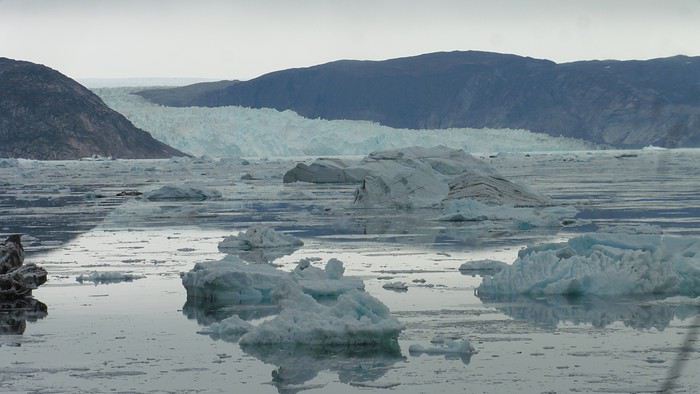
The fjord was quite cluttered, but it seemed passable. However, there was no guarantee the view would be much better 1 km from the glacier than 15 km away, especially since the front was quite active and therefore dangerous. We decided to head south without passing by the glacier. The cold temperatures encountered in the pass also motivated us to move away from the glaciers and the ice cap. We navigated under a threatening sky but without wind. The kayaks cut through the thin layer of ice on the surface with a crinkling paper sound. We reached the Ata campsite in the late afternoon after 5 hours of rowing without a single break…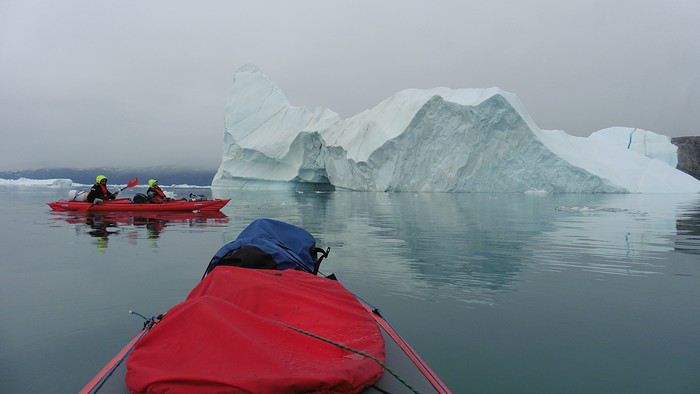
The wind had picked up, and we discovered a nice surprise: a refuge with a table and a comfortable bench lined with mattresses. Facing the worsening weather, we settled in comfortably. The kerosene stove was too complex for our three brains—we couldn’t get it started, too bad, as it was 0°C inside. The rest of the afternoon was spent fishing in the large lake, where we landed a beautiful Arctic char, more than enough for three. A good night’s sleep without the risk of foxes or the sound of a tent shaking in the wind.
Day 9 6 AM wake-up to the sound of rain hitting the cabin. The decision was made looking out the window—wind, rain, and fog obscured the sea: we went back to sleep.
New wake-up, and the rain had stopped—we could go out and stock up on fish. We set off on foot toward the lake, following its western shore. It was very overcast, and the wind encouraged us to keep moving. We made our way to a smaller lake at the end of the large one, where we caught a huge Arctic char. A small clearing brightened the picnic, and we headed back to our cabin.
This 20 km hike kept us busy all day: walking on slippery scree and the micro-relief of the peat bogs took time.
Day 10 The sky was clear, but a light south wind made paddling intense. We set off southeast to reach the opposite shore of the fjord. It was very cold, and it was impossible to stop paddling for even a moment without immediately losing ground due to the wind. We crossed the Kangerluarsuk Fjord. I recognized the cape I had reached on skis in the winter of 2017. We found a nice campsite on the southern shore of the fjord: Uiartag. It wasn’t even noon, but facing this headwind, we preferred to stop here rather than exhaust ourselves for a few extra kilometers. Like the previous ones, this campsite was very comfortable: the ground was covered with a thick layer of lichens and mosses, very pleasant to lie on.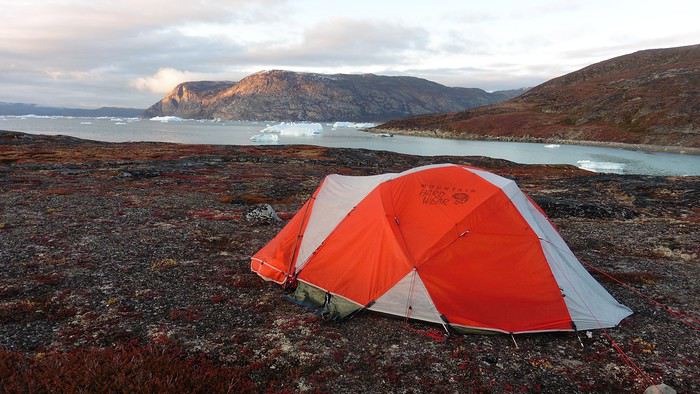
We set off on a hike to the heights of the cape, where the weather alternated between large clearings and snow showers. We noticed the loss of the thermometer, poorly attached to the backpack. On the way back, in the small bay of our beach, a whale swam calmly 10 meters from the shore—a beautiful surprise.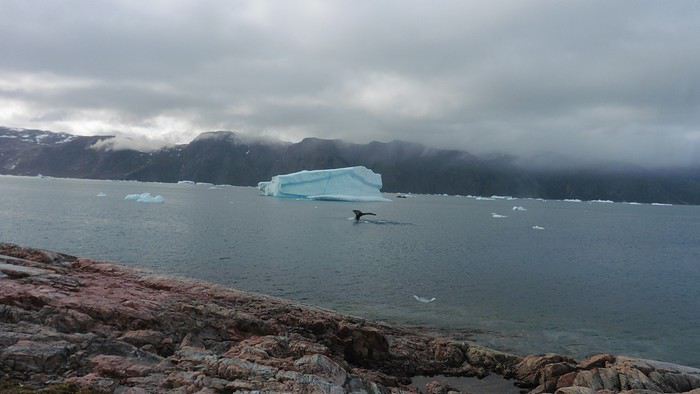
The sky cleared completely, and the temperature dropped as night approached.
We’re setting off as a group of three in two inflatable double-seater kayaks (Gumotex) brought from France. The plan is to spend two weeks circumnavigating Arve Princess Island, located north of Ilulissat in Disko Bay, with a possible boat drop-off at the southern tip of the island.
This seems like a fairly classic route in the area—we found several descriptions online (thanks to the authors). With their help and Google Earth, we identified all potential campsites and entered their coordinates into a GPS. The western part of the island, facing the bay, seems ideal for whale watching, while the more rugged eastern side offers access to several glacial walls. We’re somewhat familiar with the area from two winter expeditions on skis and pulkas.
Plus, the commitment is limited due to the island’s proximity to several small villages, including Qeqertaq, Oqaatsut, and even Ilulissat. In fact, we saw fishing boats almost every day. The distance suits us well: 200 kilometers in 16 full days on site, which should leave some leeway in case of bad weather or for hiking.
We booked our flights in June with Air Greenland to Ilulissat for the last week of August and the first week of September. On both the outbound and return trips, we stayed overnight in Copenhagen. The France-Copenhagen flight was with Air France.
We were allowed 3 x 20 kg in the hold. Each kayak with its accessories fits into a 20 kg bag; the last hold bag is for shared gear: tent, stoves, dry bags… We only brought 1.5 kg of semolina for food. In the end, we had 61 kg of gear, and no excess baggage was charged.
Individual gear (clothes and sleeping bags…) was distributed in the cabin luggage.
For the boat transfer, we contacted an agency: Blue Jay, which gave us a number to call upon arrival.
Day 0: Wednesday, August 22 Departure day. After work, I drove from Gap to Marseille’s Marignane Airport for the first leg of the trip to Copenhagen. I enjoyed the rather mild local temperatures: 35°C in the shade. After a layover in Paris, I arrived at the Copenhagen hotel, located two train stops from the airport, where my companions were already settled. No issues—everyone was on time with their luggage.
Day 1 The flight to Greenland was at 9 AM. We had a layover in Kangerlussuaq, where we changed planes, then stopped in Aasiaat before reaching Ilulissat Airport at 3 PM under beautiful sunshine.
We called Blue Jay for the boat transfer: they could take us to the island as early as 6 PM; otherwise, we’d have to wait until the next day. That left us 3 hours to prepare our gear and, most importantly, do our shopping for the two-week trip—it seemed tight, but we gave it a shot.
A quick taxi ride took us to Pisiffik, where we easily found everything we needed: bread, butter, cheese, cold cuts, rice, pasta, jam, muesli… There was no C fuel or methylated spirits for the stoves, but this time we knew the trick: at Stark, a bit uphill from the town, we found the precious liquids. Two hours later, we filled our dry bags and containers with our purchases, and by 5:30 PM, we met Klaus, the Blue Jay manager, directly at the port.
The vacation seemed to truly begin as we sped by boat through the icebergs toward Arve Princess Island. Forty-five minutes later, we spotted a beach lined with rocks where Klaus dropped us off quickly (he had another transfer to make right after).
Here we were on the island, in the middle of nowhere, with all our luggage and food to organize, the tent to set up, and the kayaks to inflate—just 10 hours after leaving the Copenhagen hotel. We got to work, bothered by the flies. Despite our head nets, it was barely tolerable—there were so many of them. They swarmed by the dozens into every bag we opened. It was quite mild: 10°C.
Everything was ready by evening, and we were very happy to have completed all these transfers (planes and boat in a single day) as we slipped into our sleeping bags.
During the night, the wind picked up, and we went out several times to check the tent and kayak anchors. We noticed how bright it was—it was still quite twilight even at 1 AM.
Day 2 5:30 AM wake-up—the south wind was still strong, but since we were heading north, we decided to give it a try anyway.
This was also the moment we loaded the kayaks: since there were only three of us for two double-seater kayaks, we filled the hatch of one kayak, which allowed us to fit all our food. It would have been very difficult if there had been four of us for two kayaks.
Finally, we set off north along the western coast of the island. The conditions were far from ideal—the sea was rough, and the kayaks had a lot of wind resistance. But the main problem was the spray skirt: the gear on deck weighed it down, and the skirt kept coming off… We’d have to deal with it. Barely underway, and whales were already breaking the surface—it was our first time seeing them, and we were very impressed. Too bad the wind didn’t allow for longer contemplation; stopping paddling was impossible with such strong gusts.
We passed a few headlands and even considered stopping due to the conditions. To find some semblance of shelter, we had to hug the coast closely without cutting across the numerous bays, which significantly lengthened the journey. But as the morning went on, the wind died down, and the sea calmed. We spotted several whales and our first seals. It was almost pleasant during the picnic break. By late afternoon, we reached Kangerup Sarqâ Bay, where we had identified a great campsite with a very large beach and a river. But the wind had shifted—it was now coming from the north, making the last hour difficult due to fatigue and headwinds.
The campsite was ideal and beautiful, facing numerous icebergs grounded in the bay.
The GPS alerted us to another major drawback of inflatable kayaks: their slowness. It took us 7.5 hours of actual paddling (excluding breaks) to cover 28 km, averaging 3.7 km/h—somewhat disappointing. But we knew this before leaving, and once again, we’d have to make do!
Day 3 Surprise: at 6 AM wake-up, it was raining, foggy, with a south wind, and the sea was choppy even in the bay. It seemed wise to skip paddling, even though stopping on the second day was tough on morale. We went back to sleep, especially since the travel fatigue and the harsh conditions of the previous day had taken their toll.
At 11 AM, the navigation conditions weren’t any better—at the ends of the bay, we saw huge waves crashing onto the rocks, and giving up for the day became obvious. However, the rain had stopped, so we set off for a hike along the large lake bordering the bay. The wind hadn’t let up, and it was quite cold.
The tundra was starting to take on its autumn colors, and the contrast between the white lichens and the red vegetation was stunning. At the lake, we took out the fishing rods and quickly caught two beautiful Arctic char over 50 cm long.
As the afternoon wore on, the sun seemed closer. Along the beach, we gathered driftwood (mostly old planks) to cook our catch in foil over a fire. Eating our own food in such a beautiful place next to a good fire was comforting after the day’s setback.
In the middle of the night, an Arctic fox entered the tent’s rear awning. It seemed barely intimidated when we shooed it away with loud shouts and then with stones.
Day 4 6:15 AM wake-up—3°C. We were on the water by 8 AM. The wind had dropped significantly, but the sea was shrouded in fog, and it was very cold in these damp conditions.
We passed the bay’s headland, Kangea, and headed toward the abandoned village of Agpat. The atmosphere was very austere—we hugged black rocks in fog that limited visibility to 50 meters, revealing large icebergs as we went.
Suddenly, the water’s surface stirred in front of my kayak, and a huge gray back emerged from the sea. The collision was inevitable, but the whale seemed to understand and dove immediately, passing under the kayak and resurfacing a few meters away. I felt the kayak rock in the white foam and quickly paddled to escape the turbulence. What an emotion!
A light wind began to clear the fog, and the sun made beautiful appearances. Despite the cold, we stopped to visit the abandoned village, which left a strange impression. All the houses were still in good condition and wide open—some must have been very spacious in their time. We went back to sea, and in front of the large Kaangerdluk Bay, we hesitated—the headwind was strong, and large waves split the water. The next beach, from the island of Nua where we stopped to think, was over 8 km away. It was barely 2 PM, but caution led us to stop here for the day. We had covered 12 km—exactly the distance needed to stay on schedule. The afternoon was spent hiking on the island’s hills and gathering mussels and wood.
In the evening, we cooked these large Greenlandic mussels over a wood fire and savored them under the beautiful evening light. The weather was now fine, but the thermometer read -5°C in the sun…
Day 5 Bright sunshine, a glassy sea, and -8°C at 6 AM. Everything was green for setting off, even if putting on damp kayaking gear was a bit unpleasant in the cold. It was the first time we’d paddled on a flat sea since the start of the trip, and our average speed increased slightly.
We entered the Smallesund Strait, marking the end of the island’s west coast. We were close to the large Torssukatak Fjord, where two glaciers flow. The access pass to the fjord was very narrow, and numerous ice chunks blocked access to the beaches. The wind had picked up and was now hitting us head-on (again). Just before entering the fjord, we landed on a steep beach made of large pebbles on Oqaitsut Island. It was very cold with the wind, and moving forward became difficult. We decided to stop for the day both because of the conditions and because the next campsite was far away, given how rugged the fjord was.
We eventually found a flat spot for the tent despite the steep slope. Even with the wind, the weather was beautiful, and we set off on foot for the northeastern cape of the island, overlooking the fjord. The view was far-reaching and exceptional—up close, the large fjord filled with ice and its steep granite cliffs, and in the distance, the ice cap and glacial walls.
We spotted the village of Qeqertaq, whose network we could pick up, allowing us to check the weather forecast, which was rather good. While securing the kayaks in the evening, I noticed the strange behavior of one kayak at the end of the stage was due to the loss of the skeg—impossible to know where it detached. We’d have to do without it.
Day 6 Still that icy headwind from the northeast. We set off anyway for a long stage to reach the large pass connecting the Torssukatak and Ata Fjords.
We advanced laboriously along the high cliffs of the fjord’s southern shore. They faced due north and blocked the sun. We felt the cold and dampness of the rock. It was really cold, especially in the extremities. We picnicked on the western cape of Qeqertakavasak Island. The cold didn’t allow us to stop for more than 20 minutes… But the wind dropped, and the sea was now very smooth. It was heavily cluttered with ice between the icebergs and old pack ice. The goal was to reach the large rocky promontory of Anapnuna, wedged between the Kujatdleq and Kangilerngata Glaciers, but the ice made progress difficult. We stopped to gain height on a small island and spot a passage of open water, but all we saw was white—passing seemed impossible. The currents were very complex, and entire sections of ice were being swept in one direction and then another at an impressive speed.
We wandered through this labyrinth until landing on a beach on the small island of Takissut, where we set up camp, exhausted from the 30 km covered and the vigilance required by the abundance of ice. The place was sublime under the evening sun—we were surrounded by ice and mountains, with the Kangilerngata Glacier in the distance. The summer contrasts were striking between the water, icebergs, sky, and flaming tundra—all colors were represented. Absolute calm reigned.
The lack of drinking water at this spot wasn’t too much of a constraint: as soon as we arrived on the beach, we placed containers under the icebergs stranded in the intertidal zone. They were all full by the time we finished setting up.
Day 7 We had to change our plans: we wouldn’t reach the rocky promontory, too well protected by the ice. We set off under the sun for Igdluluarssuit Island. Although we had spotted a passage just before launching, we quickly found ourselves surrounded by ice. It was everywhere, and finding water to paddle became complicated. We tried to force our way in every direction, even retracing our steps. Everything moved at an impressive speed—we were in the middle of a whirlpool of ice.
The tension rose, and each boat had its share of big scares. I was trapped against ice floes that dragged me toward an iceberg—the pressure on the kayak was enormous; it was going to capsize or puncture! But with a few strong strokes and paddling against the ice, I managed to free myself from the trap. Barely 10 minutes later, my companions were sandwiched perpendicularly between two icebergs that were closing in. The situation was desperate—the kayak was bending and twisting more and more, but with some strong paddle strokes, it finally freed itself. After these particularly unpleasant moments, we were completely blocked. The drifting ice floes had tightened, and the kayaks were no longer even in the water… The only solution: wait with the kayaks on these floes, which were too thin to walk on (even though we didn’t try). Within minutes, the situation cleared—a waterway opened, and we rushed into it. We paddled with one goal: find a larger pool of water. After going back and forth, our path took shape—we had to force the passage several times, attacking the ice directly with the kayaks, and finally, we escaped the worst of the labyrinth. We reached land on the west side of the island and saw that the rest would be easier. To reach the island, we just had to cross the Arsiviup Ikera Strait, which was lightly cluttered. We reached the eastern cape of the island, ideal for camping, even though we had only paddled for 3 hours. We set up camp and hiked to the island’s summit, which overlooks the entire pass and the glaciers.
Everything was magnificent, no matter the direction. At 2 PM, we were at the summit—the beauty of the place and the picnic facing the glacier in the sun without wind made us forget the near-disaster from a few hours earlier. It would be impossible to approach the glacier by kayak, but from our summit on foot, it seemed so close, and contemplating it safely on solid ground was a great moment.
The pass was incredibly complex—everything was in motion, and an impassable passage could become open water within minutes. We were delighted when we returned to camp. A slightly lost whale among the ice accompanied us along the shore. The place was truly beautiful, but the temperature dropped again under the clear sky, preventing us from eating outside.
Day 8 Clear and cold at wake-up: -9°C. The sea had frozen in many places. We hesitated about the rest of the trip—should we start heading back to Ilulissat or linger in the pass, especially to approach the Eqi Glacier? After the incidents of the previous day, we decided to think carefully and paddled to the southern cape of our island to check the ice conditions toward Eqi. The weather had clouded over in the meantime, and the sky was quite gray. At the cape, we spotted the glacier’s wall, still 15 km away.
The fjord was quite cluttered, but it seemed passable. However, there was no guarantee the view would be much better 1 km from the glacier than 15 km away, especially since the front was quite active and therefore dangerous. We decided to head south without passing by the glacier. The cold temperatures encountered in the pass also motivated us to move away from the glaciers and the ice cap. We navigated under a threatening sky but without wind. The kayaks cut through the thin layer of ice on the surface with a crinkling paper sound. We reached the Ata campsite in the late afternoon after 5 hours of rowing without a single break…
The wind had picked up, and we discovered a nice surprise: a refuge with a table and a comfortable bench lined with mattresses. Facing the worsening weather, we settled in comfortably. The kerosene stove was too complex for our three brains—we couldn’t get it started, too bad, as it was 0°C inside. The rest of the afternoon was spent fishing in the large lake, where we landed a beautiful Arctic char, more than enough for three. A good night’s sleep without the risk of foxes or the sound of a tent shaking in the wind.
Day 9 6 AM wake-up to the sound of rain hitting the cabin. The decision was made looking out the window—wind, rain, and fog obscured the sea: we went back to sleep.
New wake-up, and the rain had stopped—we could go out and stock up on fish. We set off on foot toward the lake, following its western shore. It was very overcast, and the wind encouraged us to keep moving. We made our way to a smaller lake at the end of the large one, where we caught a huge Arctic char. A small clearing brightened the picnic, and we headed back to our cabin.
This 20 km hike kept us busy all day: walking on slippery scree and the micro-relief of the peat bogs took time.
Day 10 The sky was clear, but a light south wind made paddling intense. We set off southeast to reach the opposite shore of the fjord. It was very cold, and it was impossible to stop paddling for even a moment without immediately losing ground due to the wind. We crossed the Kangerluarsuk Fjord. I recognized the cape I had reached on skis in the winter of 2017. We found a nice campsite on the southern shore of the fjord: Uiartag. It wasn’t even noon, but facing this headwind, we preferred to stop here rather than exhaust ourselves for a few extra kilometers. Like the previous ones, this campsite was very comfortable: the ground was covered with a thick layer of lichens and mosses, very pleasant to lie on.
We set off on a hike to the heights of the cape, where the weather alternated between large clearings and snow showers. We noticed the loss of the thermometer, poorly attached to the backpack. On the way back, in the small bay of our beach, a whale swam calmly 10 meters from the shore—a beautiful surprise.
The sky cleared completely, and the temperature dropped as night approached.
Deux semaines en famille en Suède et au Danemark en juillet 2018 English translation pending
Après avoir tant bénéficié du contenu de VoyageForum pour préparer notre voyage en Floride (un autre sujet, carnet de voyage à venir... ;-) ), je vais tenter de "rendre un peu à la communauté" en partageant ici le récit de notre voyage en Scandinavie.
De retour de notre périple de deux semaines en Suède et au Danemark en juillet-août 2018, c’est le moment de tenter de tourner les quelques notes prises au fil de l’eau en récit cohérent… 1’522km en sept étapes sont fort peu de choses au regard de la surface combinée de ces deux pays, et pourtant nous avons la tête pleine d’images, d’impressions et de souvenirs. Il y aurait encore tellement à voir plus au nord, en hiver, ou encore dans des pays voisins comme la Finlande ou la Norvège. Mais c’est sans regrets que nous commençons à trier les photos de ce voyage entrepris en famille – deux adultes et trois enfants/ados de 7, 11 et 14 ans. C’est seulement en décembre 2017 que nous commençons sérieusement les préparatifs. En raison d’une année chargée, nous prenons le parti de nous adresser à une agence « spécialisée dans le grand nord » pour lui déléguer l’organisation. Une fausse-bonne idée car rien ne remplace une préparation méthodique pour tirer le meilleur parti du temps sur place. Nous finirons par passer tout de même du temps à préparer l’itinéraire mais pas autant qu’en faisant tout nous-mêmes et donc au prix de petites frustrations une fois sur place. Mais rien de bien grave… Nous avons adopté l’itinéraire suivant. Un itinéraire « à nous », pas tiré d’un catalogue :
Vol Genève - Stockholm Stockholm (3 nuits) - jour 1 - jour 2 Traversée d’Est en ouest avec étape à Karlstadt(1 nuit) vers la région côtière du Bohuslän Fjällbacka (3 nuits) - jour 1 - jour 2 Göteborg (2 nuits) Traversée en ferry vers le Danemark et étape à Aalborg (1 nuit) Lego House à Billund (1 nuit) Copenhague (3 nuits) Vol Copenhague – Genève
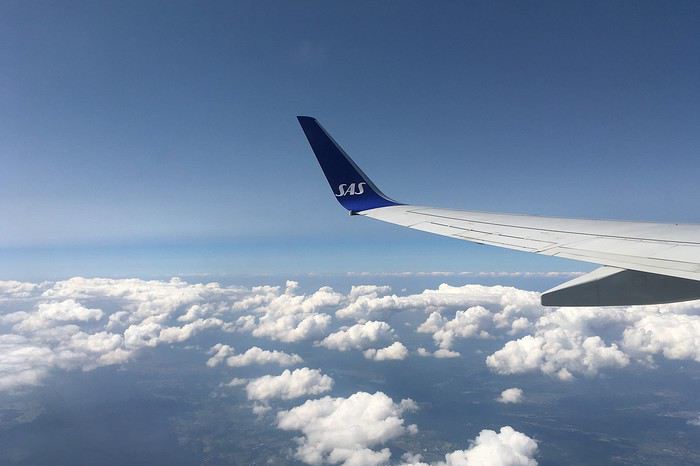
De retour de notre périple de deux semaines en Suède et au Danemark en juillet-août 2018, c’est le moment de tenter de tourner les quelques notes prises au fil de l’eau en récit cohérent… 1’522km en sept étapes sont fort peu de choses au regard de la surface combinée de ces deux pays, et pourtant nous avons la tête pleine d’images, d’impressions et de souvenirs. Il y aurait encore tellement à voir plus au nord, en hiver, ou encore dans des pays voisins comme la Finlande ou la Norvège. Mais c’est sans regrets que nous commençons à trier les photos de ce voyage entrepris en famille – deux adultes et trois enfants/ados de 7, 11 et 14 ans. C’est seulement en décembre 2017 que nous commençons sérieusement les préparatifs. En raison d’une année chargée, nous prenons le parti de nous adresser à une agence « spécialisée dans le grand nord » pour lui déléguer l’organisation. Une fausse-bonne idée car rien ne remplace une préparation méthodique pour tirer le meilleur parti du temps sur place. Nous finirons par passer tout de même du temps à préparer l’itinéraire mais pas autant qu’en faisant tout nous-mêmes et donc au prix de petites frustrations une fois sur place. Mais rien de bien grave… Nous avons adopté l’itinéraire suivant. Un itinéraire « à nous », pas tiré d’un catalogue :
Vol Genève - Stockholm Stockholm (3 nuits) - jour 1 - jour 2 Traversée d’Est en ouest avec étape à Karlstadt(1 nuit) vers la région côtière du Bohuslän Fjällbacka (3 nuits) - jour 1 - jour 2 Göteborg (2 nuits) Traversée en ferry vers le Danemark et étape à Aalborg (1 nuit) Lego House à Billund (1 nuit) Copenhague (3 nuits) Vol Copenhague – Genève
Excursions lors croisière à Saint-Pétersbourg English translation pending
Bonjour , nous partons avec MSC le Meraviglia le 13 septembre 2018 destinations St Petersbourg et souhaitons dialoguer avec des personnes ayant fait cette croisière afin de nous aider à mieux gérer nos excursions.
Merci pour vos réponses
Vélo dans le train entre Oslo et Bergen? English translation pending
Bonjour, je pars pour la Norvège. En principe, je prends le ferry au nord du DK pour arriver directement à Bergen.
Mais si je décide de passer par Oslo, est-ce qu’on peut mettre le vélo dans le train entre Oslo et Bergen?
Si quelqu’un l’a déjà fait, merci de me donner des renseignements.
Bonne journée
Projet de croisière en mer Baltique English translation pending
🙂 Je cherche des personnes qui ont déja fait une croisière en mer Baltique.
Des conseils sur lea compagnie de croisière idéale, le nombre de jours en croislère et aussi lde quel port de départ est-il préférable de sélectioner.
Merco .
Pierre.
Trajet de Puttgarden à Malmo English translation pending
Je vais me rendre en Suède avec ma propre voiture de fin Avril à mi-Juin. Je traverserai l'Allemagne et le Danemark pour m'y rendre. Je souhaiterai prendre le ferry de Puttgarden à Rodbyhavn. Ensuite je prendrai le pont de l'Oresund qui relie le Danemark à Malmo.
Seulement, en regardant les traversées de ferrys de Puttgarden à Rodby sur Internet, j'en ai trouvé que très peu. Est-il nécessaire de réserver pour effectuer cette traversée, ou bien y a-t-il des départs très réguliers qui ne nécessitent pas de réservation ? (je suis un peu inquiet car je pars le 27 Avril).
Et si j'ai bien compris, en traversant le Danemark je devrais payer environ 70€ de ferry (Puttgarden-Rodby) ainsi que 50€ pour traverser le pont de l'Oresund (j'ai un véhicule de taille moyenne). N'ai-je pas oublié d'autres ponts à péage à tenir compte sur ma route ?
Merci d'avance pour vos réponses.
Seulement, en regardant les traversées de ferrys de Puttgarden à Rodby sur Internet, j'en ai trouvé que très peu. Est-il nécessaire de réserver pour effectuer cette traversée, ou bien y a-t-il des départs très réguliers qui ne nécessitent pas de réservation ? (je suis un peu inquiet car je pars le 27 Avril).
Et si j'ai bien compris, en traversant le Danemark je devrais payer environ 70€ de ferry (Puttgarden-Rodby) ainsi que 50€ pour traverser le pont de l'Oresund (j'ai un véhicule de taille moyenne). N'ai-je pas oublié d'autres ponts à péage à tenir compte sur ma route ?
Merci d'avance pour vos réponses.
Croisière Costa Favolosa pour 15 jours dans les fjords norvégiens English translation pending
Bonjour,
J'aimerai échanger sur cette croisière car je ne connais pas du tout cette destination. Vos conseils et expériences sont les bienvenus et j'espère que des participants se manifesteront.
A bientôt de vous lire Cordialement C@therine
J'aimerai échanger sur cette croisière car je ne connais pas du tout cette destination. Vos conseils et expériences sont les bienvenus et j'espère que des participants se manifesteront.
A bientôt de vous lire Cordialement C@therine
Quitter le bateau de croisière à la dernière escale English translation pending
Bonsoir
Pour ma prochaine croisière en mars prochain de Miami à Gênes , je désire descendre lors de la dernière escale à Marseille . Ce sera plus simple pour moi de rejoindre mon domicile .
Faut il le signaler avant la croisière ? Au début de la croisiere ? La veille ? Le jour même ? Il me semble avoir lu qu'il fallait signer une décharge .
Merci d'avance a ceux qui ont tenté cette expérience et qui pourront me donner des informations .
Cordialement Claudine
Pour ma prochaine croisière en mars prochain de Miami à Gênes , je désire descendre lors de la dernière escale à Marseille . Ce sera plus simple pour moi de rejoindre mon domicile .
Faut il le signaler avant la croisière ? Au début de la croisiere ? La veille ? Le jour même ? Il me semble avoir lu qu'il fallait signer une décharge .
Merci d'avance a ceux qui ont tenté cette expérience et qui pourront me donner des informations .
Cordialement Claudine
Voyage InterRail avec enfants English translation pending
Bonjour,
Je souhaite faire avec mes enfants de 8 et 10 ans un interrail l'été prochain. On trouve assez peu d'infos sur les projets en famille, certains d'entre vous l'ont ils faits ? Quel trajet et pour quel budget ?
Merci d'avance
Hélène
Concours Photo du mois d'octobre 2017: "Le vent et ses effets" English translation pending
Voici le thème que je vous propose ce mois-ci :
LE VENT ET SES EFFETS
Ce que j'attends de vous ? c'est tout simple : des photos où l'on peut voir, ressentir la présence du vent, que ce soit par l'envolée d'une écharpe, le mouvement d'une chevelure, un nuage de poussière, etc... je laisse libre cours à votre imagination.
J'accepte aussi les effets indirects du vent, comme le résultat de son érosion. La présence humaine n'est pas obligatoire.
Le thème des intempéries ayant déjà été traité, je refuserai toute photo ayant trait aux catastrophes naturelles.
Pour ma part, je ne répondrai pas aux commentaires s'ils contiennent des propos non constructifs qui pourraient polluer la discussion (ou alors en MP). Cela n'exclut en aucun cas les critiques sur les photos des uns et des autres, critiques qui, même si elles ne font pas toujours plaisir à lire, nous aident à avancer, à progresser, à pointer le doigt sur des aspects artistiques et/ou photographiques que nous ne connaissons pas forcément.
Je compte sur vous pour me surprendre. Faites-moi rêver et voyager ! le tout, avec le civisme et la bonne humeur que nous connaissons tous !!
Pour participer : Dépôt des photos jusqu’au Dimanche 22 Octobre à 21h
Vous pouvez poster jusqu’à 3 photos, numérotées et postées dans des messages différents, accompagnées d’un petit descriptif (lieu, anecdote...)
Pour voter : du Lundi 23 Octobre au Vendredi 27 Octobre à 18h00
Pourquoi 18h ? parce que sinon, je ne pourrais comptabiliser les points que 1er novembre...
Merci d’indiquer le numéro de la photo, le pseudo et le nombre de points attribués.
Photo n°1 = 3 pts
Photo n°2 = 2 pts
Photo n°3 = 1 pt
Tous les membres de VF peuvent voter (même ceux qui n’ont pas déposé de photos).
En cas d’égalité de points pour la première position, la photo gagnante sera celle ayant obtenu le plus grand nombre de 1ères places, puis de secondes places !
L’heureux gagnant pourra organiser le concours photo du mois de Novembre.
Pour les discussions autour du thème, c'est ici :
https://voyageforum.com/v.f?post=8263507;live=1;
Diaporama bientôt en ligne !
Projet cap Nord, Norvège, Suède, Laponie en camping-car entre mai, juin et juillet 2018 English translation pending
Nous envisageons un circuit de 2 mois vers le Nord, sans tracé précis pour le moment, entre mai, juin, juillet 2018. Nous souhaiterions partir avec un autre CC (ou plusieurs) ou au moins, faire une partie du voyage à 2 ou plusieurs équipages, pour le plaisir de voyager accompagnés. Nous sommes randonneurs (à pied et en vélo) et emmenons nos vélos. Rien n'est fixé quant au circuit. Si quelqu'un a de judicieux conseils à ce sujet, nous sommes preneurs.
Dominique
Perturbations dans les aéroports parisiens English translation pending
Les files d'attente s'allongent à Orly et Roissy, officiellement pour cause de contrôle de police renforcé à la douane...vols retardés parfois de 3 à 4h, correspondances ratées en perspective... on a même parlé d'émeutes etc...
Avez-vous un retour d'expérience? ... comment cela se passe-t-il? ...conseils?
C'est que je pars ce week-end😇
Avez-vous un retour d'expérience? ... comment cela se passe-t-il? ...conseils?
C'est que je pars ce week-end😇
Concours Photo du mois de juin 2017: "Un c'est bien mais 2 c'est mieux et 3 c'est trop..." English translation pending
Bonjour,
J'ai l'honneur de lancer le concours photo n°84.
Je propose le prochain thème d'une grande latitude et banalité mais qui peut aussi limiter l'inspiration 😎 Le gars en plein doute quoi !
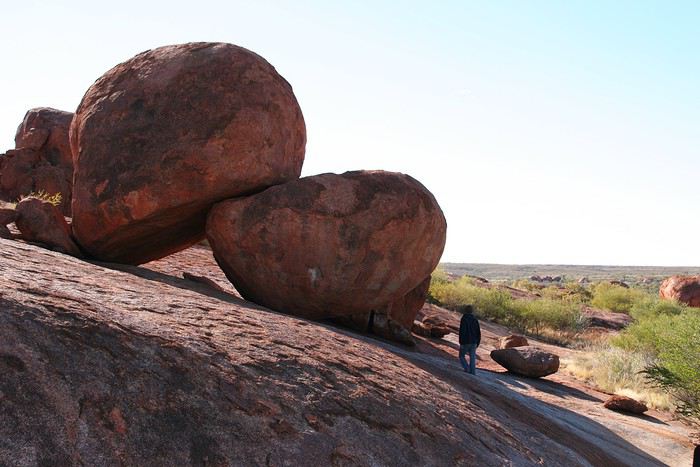
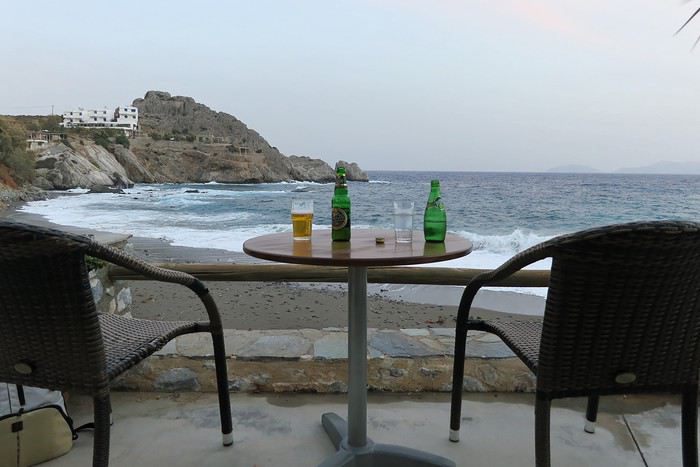
Bref, j'attends des paires, des couples de tout, des binômes, des parallèles, des 2 bidules, des machins ensemble ... et tout ce que vous allez trouver encore.
Là c'est du classique par exemple mais le sujet sort de l'ordinaire
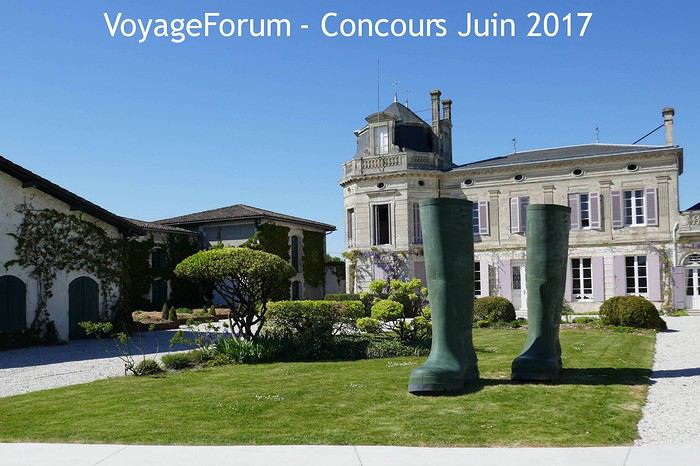
Basique aussi mais de beaux spécimens dont le cadrage est bâclé d'ailleurs 🤪
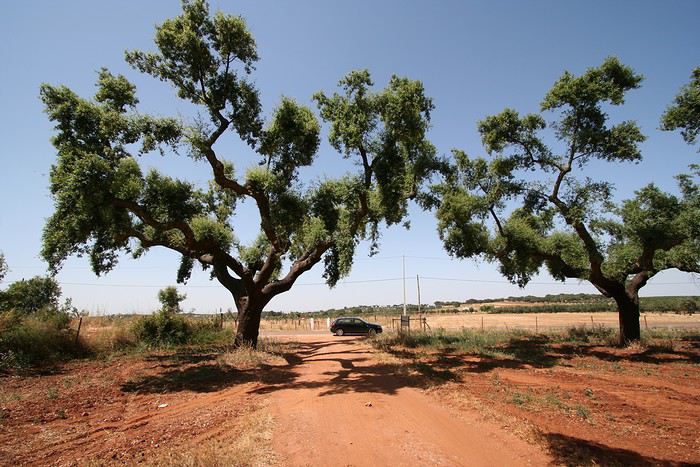
Un peu plus original et intéressant
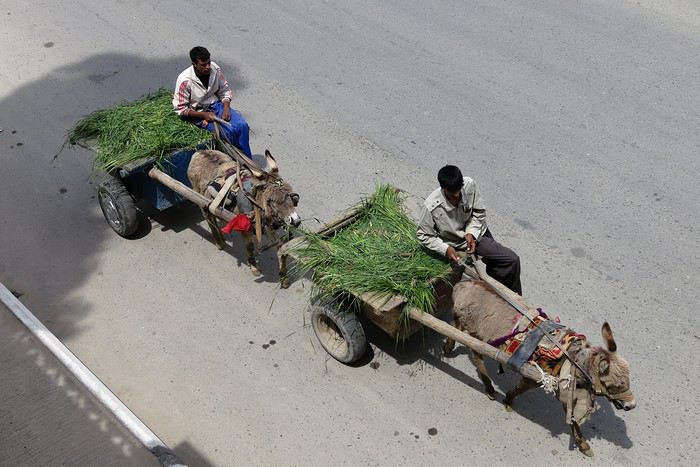
Un soupçon de Waouh ...
2+2+2 : bref, on était 2
Vous allez en trouver d'autres et 2 trucs au milieu d'une photo n'a jamais fait rêver d'où le risque de banalité ... qui sera sévèrement puni par une totale indifférence 😎
Je vous raconte ma vie 😛 car je suis dans une période professionnelle de réorganisation qui implique des réunions et des formations pendant tout le mois de Juin et donc un suivi irrégulier sans doute. NB : Rien de tendu ou grave 😉 mais juste une mise en place assez chronophage selon les semaines. Donc, je ne bouderai pas, je serai juste en déplacement !
Résumé : dépôt des photos jusqu'au Vendredi 23 Juin à 23h59 ( heure de Bordeaux ), puis vote jusqu'au Jeudi 29 Juin à 23h59. Toujours pareil, 3 photos maxi par personne et 3, 2 ou 1 point pour vos votes.
Le diaporama sera sur Google Photo.
J'ouvre un fil de discussion également et bonne chance à tous.
Jean-Luc
J'ai l'honneur de lancer le concours photo n°84.
Je propose le prochain thème d'une grande latitude et banalité mais qui peut aussi limiter l'inspiration 😎 Le gars en plein doute quoi !
Bref, j'attends des paires, des couples de tout, des binômes, des parallèles, des 2 bidules, des machins ensemble ... et tout ce que vous allez trouver encore.
Là c'est du classique par exemple mais le sujet sort de l'ordinaire
Basique aussi mais de beaux spécimens dont le cadrage est bâclé d'ailleurs 🤪
Un peu plus original et intéressant
Un soupçon de Waouh ...
2+2+2 : bref, on était 2
Vous allez en trouver d'autres et 2 trucs au milieu d'une photo n'a jamais fait rêver d'où le risque de banalité ... qui sera sévèrement puni par une totale indifférence 😎
Je vous raconte ma vie 😛 car je suis dans une période professionnelle de réorganisation qui implique des réunions et des formations pendant tout le mois de Juin et donc un suivi irrégulier sans doute. NB : Rien de tendu ou grave 😉 mais juste une mise en place assez chronophage selon les semaines. Donc, je ne bouderai pas, je serai juste en déplacement !
Résumé : dépôt des photos jusqu'au Vendredi 23 Juin à 23h59 ( heure de Bordeaux ), puis vote jusqu'au Jeudi 29 Juin à 23h59. Toujours pareil, 3 photos maxi par personne et 3, 2 ou 1 point pour vos votes.
Le diaporama sera sur Google Photo.
J'ouvre un fil de discussion également et bonne chance à tous.
Jean-Luc