Results for "Churu+|+7+>+8"
2077 results found.
Off we go on an adventure in Puglia!
Hey there, VF crew!
After wrapping up our travel journal on Java (link below), we’re now diving into our recent adventure in Puglia! Happy reading... Off we go on an adventure in Java (and a bit of Bali) | Travel journal > Indonesia | Voyage Forum
Day 1 - October 19
When you tell your friends and family you’re itching to escape to the other side of the planet to mingle with the Mongols, you can usually expect a barrage of questionable jokes and terrible puns. For this new adventure, it’s a different destination but the same old story—this time, we’re visiting the "pouilleux" (the "scruffy" ones). We’re taking off straight for Puglia! If you need a cheat sheet to remember where this oddly named place is on a world map, just think of it this way: Puglia is the maiden name on the ID card of the heel of the Italian boot! Personally, I prefer to remember it as the land of creamy burrata, the smell of focaccia fresh from the oven, orecchiette shaped by mamas, golden olive oil that shines like the sun (which beams down here 300 days a year), amaretto that makes you happy, and those famous trulli—those little hobbit-like dry-stone houses straight out of a movie set...
But I’ll stop spoiling the rest of our trip and focus on a factual rundown of this first Puglian day. So, are you joining us on this new adventure beyond our Gallic borders? Either way, Sasha (my youngest) and Luna (Flo’s daughter) didn’t need much convincing to stick with us and keep up the pace!
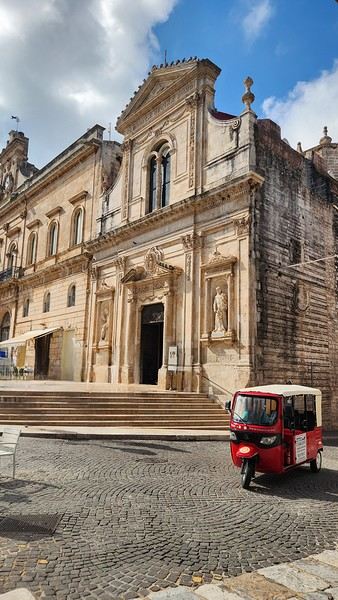
Our plane drops our little crew in Bari, the site of a famously tragic battle lost in 1991. But revenge is sweet! After renting a motorized carriage, we escape the landing zone and head to our military base of operations: Ostuni, a strategic little town where we’ll set up camp for the next four days. Why Ostuni? First, for its central location, which lets us explore a region packed with must-see gems. Second, for its vibe and beauty, which have earned it quite the reputation. Perched high on a hill, the *città bianca* (the "White City") lives up to its nickname. It literally dazzles visitors. The reason? The whitewashed facades of its houses, a testament to the region’s rich architectural heritage.
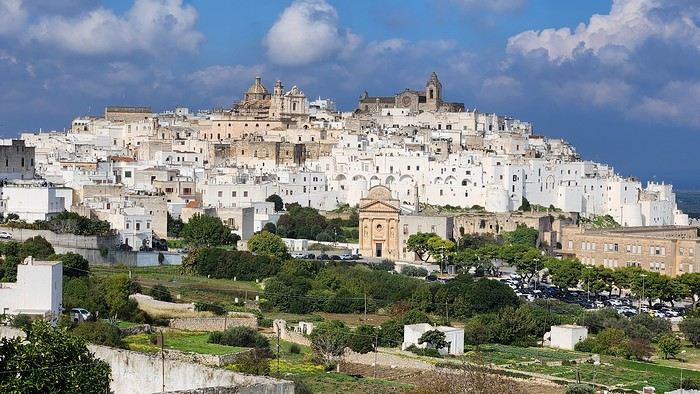
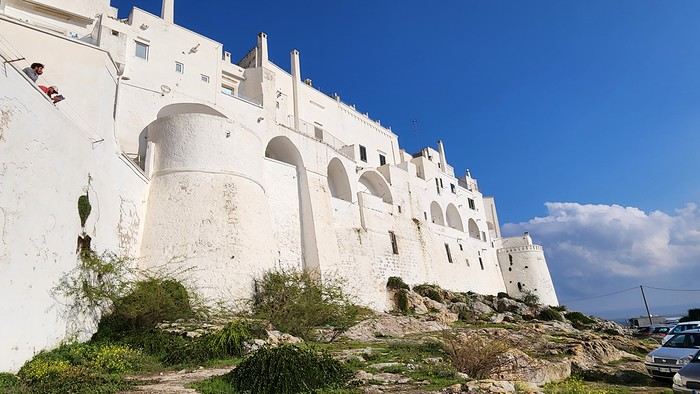
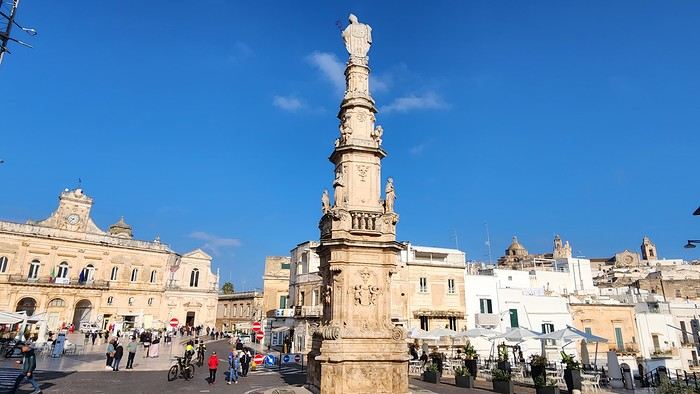
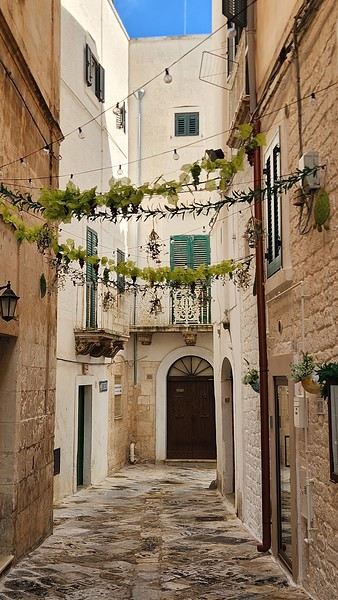
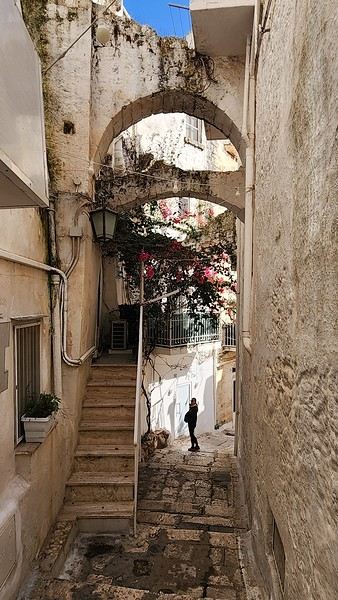
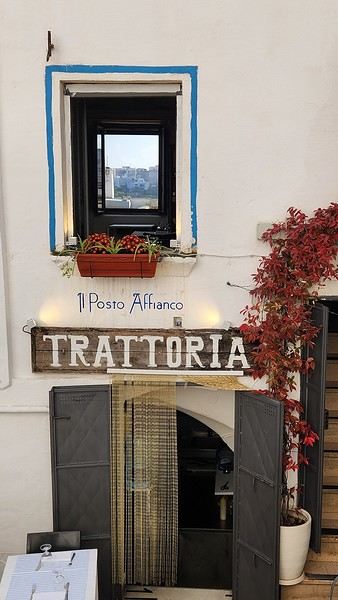
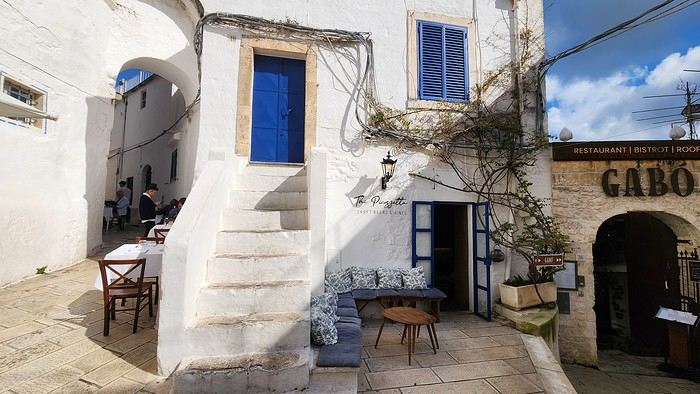
We arrived late last night, so only the two bravest soldiers volunteered to scout ahead at dawn, while the younger recruits stayed behind—for now. But not for long! After the first wave of streets and the next round of exploration, headquarters made the inevitable call to retreat. Reinforcements were needed! A few strategic errands, a breakfast ration, and our battalion marched in tight formation, flag held high, to conquer Ostuni the White! *Charge!* In my squadron leader’s memoirs, I’ll write that I didn’t expect Ostuni to put up such a fight. What I thought would take two hours to conquer turned into a humbling experience—we could only bow in respect to its beauty, its relentless charm. The alleys are whiter, more labyrinthine, narrower, and more photogenic than the last. *Veni, vidi, vici*—but what an entrance, my troops!
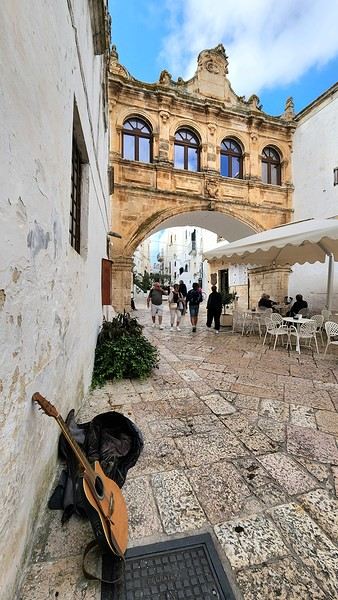
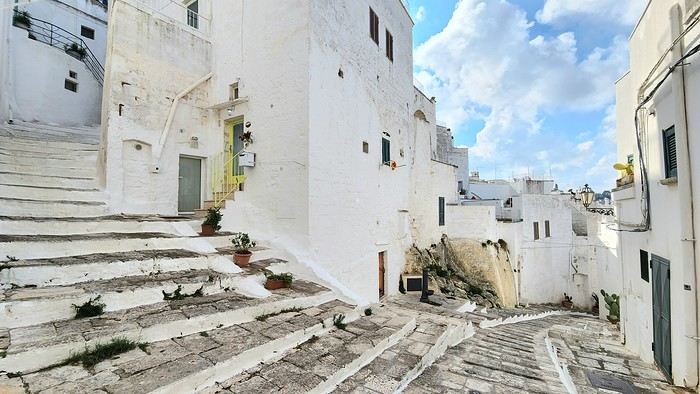
After wrapping up our travel journal on Java (link below), we’re now diving into our recent adventure in Puglia! Happy reading... Off we go on an adventure in Java (and a bit of Bali) | Travel journal > Indonesia | Voyage Forum
Day 1 - October 19
When you tell your friends and family you’re itching to escape to the other side of the planet to mingle with the Mongols, you can usually expect a barrage of questionable jokes and terrible puns. For this new adventure, it’s a different destination but the same old story—this time, we’re visiting the "pouilleux" (the "scruffy" ones). We’re taking off straight for Puglia! If you need a cheat sheet to remember where this oddly named place is on a world map, just think of it this way: Puglia is the maiden name on the ID card of the heel of the Italian boot! Personally, I prefer to remember it as the land of creamy burrata, the smell of focaccia fresh from the oven, orecchiette shaped by mamas, golden olive oil that shines like the sun (which beams down here 300 days a year), amaretto that makes you happy, and those famous trulli—those little hobbit-like dry-stone houses straight out of a movie set...
But I’ll stop spoiling the rest of our trip and focus on a factual rundown of this first Puglian day. So, are you joining us on this new adventure beyond our Gallic borders? Either way, Sasha (my youngest) and Luna (Flo’s daughter) didn’t need much convincing to stick with us and keep up the pace!
Our plane drops our little crew in Bari, the site of a famously tragic battle lost in 1991. But revenge is sweet! After renting a motorized carriage, we escape the landing zone and head to our military base of operations: Ostuni, a strategic little town where we’ll set up camp for the next four days. Why Ostuni? First, for its central location, which lets us explore a region packed with must-see gems. Second, for its vibe and beauty, which have earned it quite the reputation. Perched high on a hill, the *città bianca* (the "White City") lives up to its nickname. It literally dazzles visitors. The reason? The whitewashed facades of its houses, a testament to the region’s rich architectural heritage.
We arrived late last night, so only the two bravest soldiers volunteered to scout ahead at dawn, while the younger recruits stayed behind—for now. But not for long! After the first wave of streets and the next round of exploration, headquarters made the inevitable call to retreat. Reinforcements were needed! A few strategic errands, a breakfast ration, and our battalion marched in tight formation, flag held high, to conquer Ostuni the White! *Charge!* In my squadron leader’s memoirs, I’ll write that I didn’t expect Ostuni to put up such a fight. What I thought would take two hours to conquer turned into a humbling experience—we could only bow in respect to its beauty, its relentless charm. The alleys are whiter, more labyrinthine, narrower, and more photogenic than the last. *Veni, vidi, vici*—but what an entrance, my troops!
Review of Renaissance Cruise (Iberian Flavors) from October 18 to 29, 2025
Hi there,
Here’s a little review of our cruise on the Renaissance from October 18 to 29, 2025 (11 nights). It was our first experience with CFC.
Some other forum members were on board too, so we can probably compare notes and correct me if I’m wrong!
The stops were as follows: 10/18 departure from Marseille 10/19 at sea 10/20 Cartagena 10/21 Almería 10/22 Gibraltar 10/23 Cádiz 10/24 at sea 10/25 Leixões (Porto) 10/26 Vigo 10/27 at sea 10/28 at sea 10/29 Dunkirk
First, a quick intro. We’re a family of four with two kids, ages 8 and 11. We booked this cruise in January 2025, right when it went on sale. At the time, it was priced at 763 € per adult (+ 99 € in tips) and 114.45 € per child (under 12, no tips to pay) for an ocean-view cabin (all ocean-view categories were the same price). Since there was also a single-parent offer (meaning one paying adult in the cabin was enough to get the child rate for the accompanying kid), I asked if we could take advantage of this offer to get two double cabins at the same price as one quadruple cabin (to have more space), and yes, it was possible. So we booked two premium ocean-view double cabins side by side. It was the same price as a quadruple. We booked directly through CFC because my husband had a promotional code from his works council. In total, for the four of us, we paid 1830 €, tips included. It’s true we booked early, but the rate was good, and we had the constraint of traveling as a family of four, so cabin choices were more limited. It’s also worth noting that the single-parent offer is limited.
Now, about embarkation: 10/18 Marseille Coming from the north, we took the direct TGV that morning at 7:22 AM, scheduled to arrive in Marseille at 12:24 PM. The trip went smoothly, great weather, and we arrived just one minute late. I had planned to get to the port using the free 35T shuttle from Joliette. To get to the bus stop, there were two options: the metro or walking. Since the weather was beautiful and the kids needed to stretch their legs, we opted for the second option. The route is all downhill, so it was pretty easy even with the suitcases. But I wouldn’t do it the other way around! We arrived at Joliette around 12:50 PM, just in time for the 1:00 PM shuttle, which arrived a few minutes late. Other cruisers got on board too. That day, there were two Costa ships and one MSC ship at the port as well. Traffic was heavy, and the shuttle arrived at the port entrance at 1:30 PM. We were scheduled for 2:30 PM. We were lucky to be at the closest embarkation terminal. So we were among those who had the least walking to do. We dropped off our suitcases and headed to the check-in counter. There were plenty of desks and almost no passengers. So we quickly completed the embarkation formalities—in just a few minutes—and when we boarded, it wasn’t even 2:00 PM yet. We headed to the buffet, where there weren’t many people. As we finished lunch, it was around 3:00 PM when they announced the cabins were ready. We went down to drop off our luggage in the cabins and then went up to the top deck to take some photos. The ship’s daily program said the safety drill would be at 4:00 PM. So we went to deck 6 at the scheduled time. But later, they announced it would actually be at 4:30 PM! In short, we waited 30 minutes for nothing because of a difference between the scheduled and actual time! The drill itself was long. Gathering everyone took about 20 minutes, I think. Just as we finished, they announced the departure, originally scheduled for 5:00 PM, was delayed until 9:00 PM due to latecomers. We went to check out the library, which had tons of board games and books—more than we’d ever seen. What stood out on this first day was that, for the first time, we had a French-speaking embarkation, announcements only in French (except for the safety drill), French-speaking servers, a paper daily program in French, books in French (which we’d never find on another ship), and menus in French. To wrap up the day, we had dinner at Vatel. I had requested the first seating (6:30 PM) and a table for four, and we got it. We were seated upstairs near the window—a very pleasant table that we’d occupy every evening. What was a little surprising, but we got used to it, was that you had to order everything you wanted at once. The portions weren’t big, but you could choose what you wanted. The cheese was French and excellent.
To be continued...
The stops were as follows: 10/18 departure from Marseille 10/19 at sea 10/20 Cartagena 10/21 Almería 10/22 Gibraltar 10/23 Cádiz 10/24 at sea 10/25 Leixões (Porto) 10/26 Vigo 10/27 at sea 10/28 at sea 10/29 Dunkirk
First, a quick intro. We’re a family of four with two kids, ages 8 and 11. We booked this cruise in January 2025, right when it went on sale. At the time, it was priced at 763 € per adult (+ 99 € in tips) and 114.45 € per child (under 12, no tips to pay) for an ocean-view cabin (all ocean-view categories were the same price). Since there was also a single-parent offer (meaning one paying adult in the cabin was enough to get the child rate for the accompanying kid), I asked if we could take advantage of this offer to get two double cabins at the same price as one quadruple cabin (to have more space), and yes, it was possible. So we booked two premium ocean-view double cabins side by side. It was the same price as a quadruple. We booked directly through CFC because my husband had a promotional code from his works council. In total, for the four of us, we paid 1830 €, tips included. It’s true we booked early, but the rate was good, and we had the constraint of traveling as a family of four, so cabin choices were more limited. It’s also worth noting that the single-parent offer is limited.
Now, about embarkation: 10/18 Marseille Coming from the north, we took the direct TGV that morning at 7:22 AM, scheduled to arrive in Marseille at 12:24 PM. The trip went smoothly, great weather, and we arrived just one minute late. I had planned to get to the port using the free 35T shuttle from Joliette. To get to the bus stop, there were two options: the metro or walking. Since the weather was beautiful and the kids needed to stretch their legs, we opted for the second option. The route is all downhill, so it was pretty easy even with the suitcases. But I wouldn’t do it the other way around! We arrived at Joliette around 12:50 PM, just in time for the 1:00 PM shuttle, which arrived a few minutes late. Other cruisers got on board too. That day, there were two Costa ships and one MSC ship at the port as well. Traffic was heavy, and the shuttle arrived at the port entrance at 1:30 PM. We were scheduled for 2:30 PM. We were lucky to be at the closest embarkation terminal. So we were among those who had the least walking to do. We dropped off our suitcases and headed to the check-in counter. There were plenty of desks and almost no passengers. So we quickly completed the embarkation formalities—in just a few minutes—and when we boarded, it wasn’t even 2:00 PM yet. We headed to the buffet, where there weren’t many people. As we finished lunch, it was around 3:00 PM when they announced the cabins were ready. We went down to drop off our luggage in the cabins and then went up to the top deck to take some photos. The ship’s daily program said the safety drill would be at 4:00 PM. So we went to deck 6 at the scheduled time. But later, they announced it would actually be at 4:30 PM! In short, we waited 30 minutes for nothing because of a difference between the scheduled and actual time! The drill itself was long. Gathering everyone took about 20 minutes, I think. Just as we finished, they announced the departure, originally scheduled for 5:00 PM, was delayed until 9:00 PM due to latecomers. We went to check out the library, which had tons of board games and books—more than we’d ever seen. What stood out on this first day was that, for the first time, we had a French-speaking embarkation, announcements only in French (except for the safety drill), French-speaking servers, a paper daily program in French, books in French (which we’d never find on another ship), and menus in French. To wrap up the day, we had dinner at Vatel. I had requested the first seating (6:30 PM) and a table for four, and we got it. We were seated upstairs near the window—a very pleasant table that we’d occupy every evening. What was a little surprising, but we got used to it, was that you had to order everything you wanted at once. The portions weren’t big, but you could choose what you wanted. The cheese was French and excellent.
To be continued...
Langtang – Trekking in the Rain
We did the Langtang trek (hike) from September 10th to 17th, with the first and last days being the trip from Kathmandu and back—so 6 days of actual walking. It’s a fairly well-known trek but certainly not as famous or crowded as those in the Annapurna or Everest regions, which is why we chose it.
In theory, it’s mandatory to have a guide for this trek. In reality, it seems there are ways to bypass the regulations: we met at least two people hiking without a guide—a South Korean, a New Zealander, and possibly also a couple of English women and an American couple, though we’re not sure if they had a guide.
The agency we booked with had told us it was an affordable trek for relatively older people in good shape—which is our case (I’m 72 myself). I have to say upfront that we found it quite challenging, maybe because we didn’t have good weather—it was the end of the monsoon season. To be clear, no matter your fitness level, I’d say doing this trek in the middle of the monsoon season would be suicidal.
Day 1 – Journey from Kathmandu to Syapru Besi
On Monday, September 8th, there had been violent protests in Kathmandu against the government, which had, among other things, blocked access to social media and been accused of nepotism and corruption. There were 19 deaths. The situation was very tense on the day of our departure, Wednesday the 10th. The agency warned us that public transport was very unreliable. So, we decided to take a jeep, at an additional cost of $100 ($160 minus what was already budgeted for the bus).
We left a little before 7 a.m. and it took us a good hour just to reach the outskirts of Kathmandu. Along the way, we saw several houses and vehicles set on fire by protesters.
The road to Syapru Besi is only 120 km, but it’s frankly awful. It’s always narrow, winds through endless mountains, and the shoulders range from bad to confusing to nonexistent. Several sections are just dirt tracks. We didn’t regret opting for the jeep, as we could stop several times at our convenience—if only to let Y (my Thai partner) throw up everything she had. She’d taken her usual motion sickness medication, but the constant turns, accelerations, and braking eventually made her terribly carsick.
In Nuwakot, we stopped for breakfast at a nice little restaurant, Jimbu. It was around 8:30 a.m., and we’d barely covered 60 km. The restaurant has a lovely garden overlooking the Trishuli Ganga, the river flowing down from Syapru Besi. First photo: the river in the bottom right corner, mist and clouds over the mountain on the other side.
An hour later, my second photo: the hills along the Trishuli Ganga. You can see the different crops—lush green rice paddies in the lower right and corn, already yellowed and likely harvested, in the foreground on the left. And of course, the mist and clouds through which you can glimpse the mountain on the other side of the river.
In theory, it’s mandatory to have a guide for this trek. In reality, it seems there are ways to bypass the regulations: we met at least two people hiking without a guide—a South Korean, a New Zealander, and possibly also a couple of English women and an American couple, though we’re not sure if they had a guide.
The agency we booked with had told us it was an affordable trek for relatively older people in good shape—which is our case (I’m 72 myself). I have to say upfront that we found it quite challenging, maybe because we didn’t have good weather—it was the end of the monsoon season. To be clear, no matter your fitness level, I’d say doing this trek in the middle of the monsoon season would be suicidal.
Day 1 – Journey from Kathmandu to Syapru Besi
On Monday, September 8th, there had been violent protests in Kathmandu against the government, which had, among other things, blocked access to social media and been accused of nepotism and corruption. There were 19 deaths. The situation was very tense on the day of our departure, Wednesday the 10th. The agency warned us that public transport was very unreliable. So, we decided to take a jeep, at an additional cost of $100 ($160 minus what was already budgeted for the bus).
We left a little before 7 a.m. and it took us a good hour just to reach the outskirts of Kathmandu. Along the way, we saw several houses and vehicles set on fire by protesters.
The road to Syapru Besi is only 120 km, but it’s frankly awful. It’s always narrow, winds through endless mountains, and the shoulders range from bad to confusing to nonexistent. Several sections are just dirt tracks. We didn’t regret opting for the jeep, as we could stop several times at our convenience—if only to let Y (my Thai partner) throw up everything she had. She’d taken her usual motion sickness medication, but the constant turns, accelerations, and braking eventually made her terribly carsick.
In Nuwakot, we stopped for breakfast at a nice little restaurant, Jimbu. It was around 8:30 a.m., and we’d barely covered 60 km. The restaurant has a lovely garden overlooking the Trishuli Ganga, the river flowing down from Syapru Besi. First photo: the river in the bottom right corner, mist and clouds over the mountain on the other side.
An hour later, my second photo: the hills along the Trishuli Ganga. You can see the different crops—lush green rice paddies in the lower right and corn, already yellowed and likely harvested, in the foreground on the left. And of course, the mist and clouds through which you can glimpse the mountain on the other side of the river.
Hitchhiking in the 70s-80s
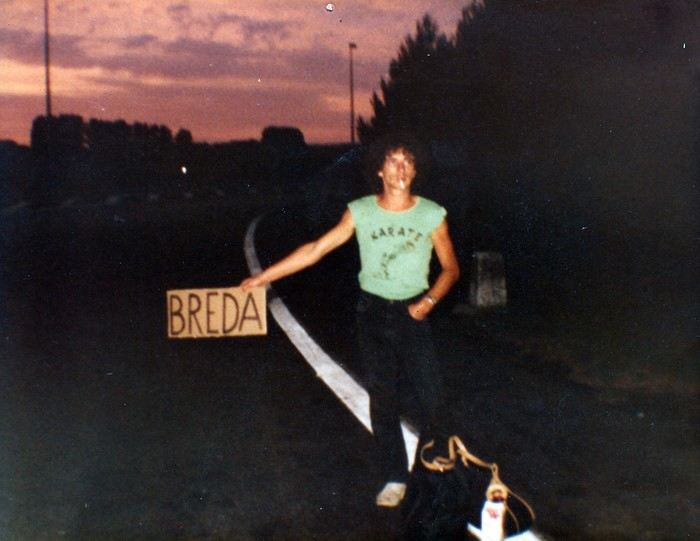
“Hey, your Marker... - My Marker? - The one you used to make hitchhiking signs.”
The marker in question is sitting proudly on the kitchen table. Marielle found it at the bottom of a moving box.
I’ve been meaning to tell the long story of my love affair with hitchhiking for years. Here we go.
To be honest, I’m not quite sure when it started. My earliest memory goes back to a fair with a bike race in my maternal grandparents’ village. I was with my cousin, my little sister, and three girl cousins. There were six of us, ages ranging from six or seven to thirteen or fourteen. Our parents stayed at the fair, and we’d had enough. So we decided to walk home. Only it was four kilometers away. So we hitchhiked. A guy driving an old car picked us all up and dropped us off at the farm. He probably found it amusing to see us thumbing a ride by the side of the road, but maybe it also worried him a bit. With everything you read in the papers...
Around fifteen or sixteen, I started hitchhiking regularly, alone or with a friend, to go to the nearby town. But it was especially when I started boarding school in Orléans that it became more regular. The first year, I’d leave Monday morning and come back Saturday noon by bus. It was an old, uncomfortable bus where we froze in winter. To make matters worse, I often got motion sickness if, as was too often the case, I ended up sitting in the back. In the spring, a high school friend suggested I hitchhike back. It meant a slight detour, but the advantage was taking only national roads.
So that’s how, from the end of tenth grade to twelfth grade, I’d thumb a ride every Saturday on the Pont de Bourgogne. Drivers were used to seeing young people hitchhiking, and it worked pretty well. Our biggest fear? Soldiers! At that time, military service was still mandatory, and on weekends, it wasn’t rare to see them competing with us. They’d keep their uniforms on to go home. That gave people confidence—with everything you read in the papers—and they’d rarely wait more than five minutes. We, with our long hair, were definitely less popular. From time to time, three big red-faced guys in a van coming back from a construction site would flip us off, yelling things like “go get a haircut, you bums!” Those were the good old days.
We still had a good laugh, though. Patrice, the friend I’d hitchhike back from school with on Saturdays, is a musician—I’d later discover he’s an excellent composer. A die-hard Beatles fan, he knows their repertoire by heart and spends his time singing at the top of his lungs while we thumb a ride. One Saturday late morning, we’d been waiting for a while at the exit of Châteauneuf-sur-Loire when a little lady came up to him and asked if he could please sing a little quieter: a baby was sleeping in the house. He put on the most sorry face: “Oh, sorry ma’am, we didn’t realize.” No sooner had the lady gone back inside than he started again. Luckily, a car stopped just then, sparing me the embarrassment of seeing the lady come back out.
Saturday was also the day when the cigarette pack was dangerously low. So before leaving, we’d go buy some “Parisiennes,” the “P4s” as we called them back then. They were slightly thinner cigarettes with a mix of tobacco scraps. Sometimes they tasted like light tobacco, sometimes like dark. Not great, but by the end of the week, our pocket money was gone. They were sold in small packs of four, hence the name P4. We’d only pay 20 centimes. On Saturdays, it was rare for the two of us to manage to scrape together 1.50 F to buy a whole pack of Gauloises...
The last twenty kilometers, I’d usually do alone, Patrice having reached his destination. From time to time, luck would smile on me: an acquaintance would just happen to pass by and stop. One January Saturday, at the exit of Gien, I ran into another guy from Argenton whom I knew a little. That day, the weather was nice, but the temperature was well below zero. It was around noon, and it was the off-peak hour. We were shivering, stamping our feet by the side of the road, when a Citroën “Tube” arrived: it was his father’s boss’s, a mason. They were both sitting in the front, but since they were obese, they had us climb onto the open back. Even though we huddled against the cab to shelter from the wind, the twenty kilometers felt very long, especially since we were only going sixty kilometers an hour. Our hands and cheeks were blue when we finally arrived.
The year I took my baccalaureate, a friend with a 2CV would take me Monday mornings with one or two others we’d pick up in nearby villages. We’d share the gas costs, but it was still cheaper than the bus. And in winter, the bus was my nightmare. You had to get up at five to catch it at six. Not enough sleep, and outside it was freezing or raining—or both. The 2CV was luxury. Plus, Philippe would pick me up at home. On the other hand, since I didn’t have class Saturday mornings—well, I did, but we only had PE the first two hours and nothing after—I’d skip class and slip out right after breakfast to thumb a ride at the Pont de Bourgogne.
Those three high school years were formative in this optional subject that was hitchhiking. Little by little, I learned the rules of the game. First, you shouldn’t walk along the road while thumbing. Cars go too fast and can’t stop easily. Accepting a ride that’s too short is also a no-go. The guy who offers to take you a little way but drops you off at some vague crossroads in the middle of nowhere? No thanks. You need to get dropped off in a town. If it’s a fairly big city, you often have to cross it from one end to the other, but it’s better. At the exit, you have to choose your spot well. Actually, you have to put yourself in the driver’s shoes: they need to see you early enough, not be going too fast, and be able to stop easily without risking an accident. So when leaving a city, it’s better not to go too far. It’s wiser to find a spot where cars go slowly and can stop easily. And preferably near a café. The café is for when you still have a few coins for a coffee and need to warm up. From time to time, you’d run into someone nice who’d make a detour to drop you off at a better spot to start again. Finally, if possible, avoid hitchhiking on Sundays. Cars are packed with whole families who, most of the time, aren’t going far. And then there’s the little worry of those people who rarely leave home: with everything you read in the papers...
During those high school years, it was only short trips, rarely exceeding a hundred kilometers. Later, I aimed bigger, and things were a bit different. In 1973-74, I crossed part of France for the first time on two or three occasions, coming back from the German border or returning to Bordeaux, where we lived briefly. Since there weren’t many highways back then, we took national roads. It was during these trips that I realized it was better to leave in the evening. As I said earlier, Sunday is to be avoided, but on weekdays, there’s another problem: if you leave in the morning, you only make short hops. First, it often takes longer to get going because drivers are people going to work nearby. Which brings us back to those who drop you off in a bad spot, far from everything. There, you have to know how to refuse. You thank the driver for stopping—oh, if only everyone could be like you—while explaining why you’d rather stay put. People don’t take offense, by the way. Those who pick up hitchhikers often hitchhiked themselves when they were in the military or before they had a car. In the late afternoon, you’d often run into salespeople or truckers, in other words, people who drive a lot. At that time, salespeople no longer had appointments and were more relaxed. They wanted to talk about something other than the merits of their products. On the radio, it was time for *Les Grosses Têtes*. You’d also quite often run into small business owners, professionals, or even hippies. The conversations were pleasant and often enriching. A little later in the evening, truckers would take over. They’d already driven a few hundred kilometers, and the depot or customs was still far away. So they’d gladly take a hitchhiker to stay awake at the wheel and chat. The radio with Max Ménier’s show *Les routiers sont sympas*, you’d eventually get tired of it. So a hitchhiker was a change. Others, who’d hit the road at midnight to be at their destination by morning, were nice and offered to let you lie down on the bunk while they drove. When you’d been hitchhiking since six in the evening, freezing in the wind between two vehicles, you weren’t unhappy to take a little nap.
Speaking of Max Ménier, he’d often make announcements for hitchhikers. One evening, I called him. It was getting late, and I still had quite a way to go. No luck: the show had ended for good the day before!
In short, it’s better not to rush, sleep in, and leave after lunch, or better yet, in the late afternoon. Obviously, I’m talking about when you have several hundred kilometers to cover. That’s when you have to play it pro.
First thing, especially at night, but it also applies in the middle of summer when the light is blinding: dress to be seen from far away. I’ll admit I have an advantage over most other hitchhikers: I’m small and don’t scare people. To balance that out, racist drivers often take me for an Arab and are less likely to pick me up, but overall, the balance tips in my favor. Back to the need to be seen: at night, I wear light-colored clothes. In headlights, you can see me from far away.
Second thing: travel light. Forget the big backpack with a frame. Drivers don’t always have room in the trunk or on the back seat, especially if it’s rained and the ground is wet. Plus, it forces them to get out of the car. If they’re nice enough to pick up a hitchhiker, you shouldn’t ask for too much either.
Third thing: bring a cardboard sign and a big marker—like the ones in the photo at the start of this post—to write the name of your destination. In the early 80s, I ran a tourist house in the Cher, but I lived in the Netherlands. In the off-season, it was only open on weekends. On Fridays, I’d leave Holland and return on Mondays. 1200 km round trip. On the way there, in Paris, I’d stand at Porte de la Chapelle. At that spot, the road is very wide, and drivers could stop easily. Obviously, on the sign, I didn’t write Eindhoven, which not everyone knows, and even less Amsterdam because of its seedy reputation. In that case, you’d expect to see a police car stop and two officers in kepis ask for your papers. So as a first destination, I’d write Compiègne. We were well out of Paris, and since it wasn’t too far, a trucker or salesperson was less reluctant to stop. Once past Compiègne, I’d take out my Lille sign. Once in Belgium, it wasn’t really necessary to use a sign anymore, since everyone was going in the same direction. Usually, the guy who picked me up at Porte de la Chapelle would say he wasn’t going far but could take me a little way. Before that, I’d still ask if there was a gas station on the highway where he could drop me off before exiting. While talking, the guy would realize he wasn’t dealing with a dangerous criminal. He’d pretend to check his watch, think for a moment, then say that actually, he was going to Belgium and could take me to the border or a little beyond. To leave Paris on the way back, I’d take the train to Melun, where it was easier to hitchhike than at Porte d’Italie.
Over all those years, I think I was pretty lucky. Or maybe philosophical enough not to imagine a car would stop after a few minutes. An hour’s wait was average. Sure, I sometimes waited three, four, or five hours. Most often at odd hours and in terrible weather. When it doesn’t work, it doesn’t work. But there’s always a moment when things pick up. Sure, when you’re soaked in freezing rain in the early morning after a sleepless night, you’re less philosophical than when I’m writing these lines comfortably at my computer, but it still holds true.
Earlier, I mentioned clothing and the importance of being well-rested before leaving. When you’ve eaten well and just gotten out of the shower, shaved, you’re in a better mood. And somehow, drivers sense it. Or at least, that’s the impression I’ve always had. It’s better to look in shape than disgusted at standing there, half-heartedly thumbing a ride. In short, when I’d start to get fed up with waiting, I’d go into the first café I saw for a coffee. Coming back out, I’d be refreshed, and most of the time, a car would stop within minutes. I’ve often said that when I stood by the side of the road thumbing a ride, I felt a bit like a gambler in front of a slot machine. It was a matter of giving luck a chance. And well, it worked out pretty well.
Then, there are countries where hitchhiking works really well and others where it’s harder. In the 70s-80s, it worked best in Germany and England. In the late afternoon, it wasn’t rare to be invited for tea. Well, that was in England. Tea meant being offered room and board. In Germany, they’d offer you coffee. Once there, they’d first show you the guest room and point out the bathroom before sitting you down in front of a big plate of cold cuts. In the evening, they’d go out in town, and the next morning, they’d usually drop you off at a good spot for hitchhiking. On the other hand, in Mediterranean and Scandinavian countries, you’d better be patient. In Spain or Italy, it’s better to take the train, which was dirt cheap back then. However, if you’re a couple traveling light, it’s already easier in most countries.
In 1982, I went on a trip around Turkey with my girlfriend. We only had two small bags, which was plenty. It was November-December, and we wore our warm, bulky clothes. Leaving Eindhoven at nine in the morning, we arrived in Graz, near the Yugoslav border, at eleven at night. 1300 km in a day! In just four or five vehicles. One to the German border, about fifty kilometers from Eindhoven, the second to Hagen in the Ruhr, the third to Salzburg, and the last to Graz at the Yugoslav border. Record broken. During the night crossing of Yugoslavia, we ran into a trucker close to retirement who lent us the truck’s bunk. So we arrived fresh and rested near Skopje the next morning. We continued to Thessaloniki in northern Greece before taking the train to Istanbul. In Turkey, we traveled a good part of the country by hitchhiking too. With truckers in old, overloaded, slow trucks that climbed hills at fifteen kilometers an hour, but also in cars where five or six people were already crammed in. And every time, we were invited for tea. Once, we were even picked up by a big shot in his Mercedes with a chauffeur. Until then, the average speed was around fifty kilometers an hour. There, we were going two hundred. On a national road, not a nice European highway.
I’ve also hitchhiked in Nepal, from Lumbini, Buddha’s birthplace, to a village on the way to Pokhara. It must have been midday. No bus until the next day. I gave it a try. A small truck overloaded with rice sacks, with two or three young people already perched on top, stopped. I rode on the roof of the cab. At fifty kilometers an hour when it was going well, with a breathtaking view. Coming back from India, I also crossed part of Iran by hitchhiking, from Tehran to the Turkish border. I did this trip with an Austrian I met at the hotel who, like me, had to watch his pennies. We gave it a shot. There was almost no traffic, but to our great surprise, the first car that passed in the area would always stop. They’d just ask for a modest contribution for gas, and it cost next to nothing.
Sometimes, you get scared too. After leaving Turkey in early December 82, we spent about two weeks in the southern Peloponnese harvesting olives. A few days before Christmas, we hitchhiked back to Holland. A girl picked us up in her little Fiat 500. We were driving on a mountain road, and that morning there was a bit of black ice. After crossing a pass, we saw the old Ford Taunus ahead of us at fifty meters start to skid. The driver let out a “heeee!” while grabbing my knees. I reflexively grabbed the wheel. Finally, the Taunus got back on track. And we didn’t swerve. But those few seconds felt very long.
In January 77, while I’d been living in Germany for a few months, I decided to spend a few days in Italy. By hitchhiking, of course. I left in the early afternoon, and by ten at night, I wasn’t far from Frankfurt. I saw a big Mercedes stop. The four or five young people crammed inside were listening to Schlager at full volume. Beer cans littered the floor. They didn’t have a precise destination, and as long as they were going south, that was fine with me. They’d finished their military service that very day and had clearly already celebrated their discharge. The driver was going 160, zigzagging dangerously from one side of the highway to the other. I should have realized he wasn’t entirely sober either. Luckily, there was almost no traffic. Finally, I managed to get dropped off at a gas station just before Frankfurt, relieved. I hope their trip didn’t end tragically.
Another time, coming back from Holland with my wife, we were picked up early in the morning near Senlis by two guys from Lille. They were going to work near Tours and could drop us off at Porte d’Italie. Apparently, they were coworkers but barely knew each other. The driver offered us a beer—at six in the morning, sure!—before opening another can for himself. He was clearly having trouble staying in the right lane. We politely declined, the passenger too. Everyone was tense. Luckily, it was rush hour on the ring road, and we were going slowly. When we got out of the car, the passenger said goodbye with the look of a guy being offered the condemned man’s rum and cigarette.
Finally, there are the annoying remarks from drivers who are either gay when you’re alone or turned on by the sight of your girlfriend when you’re a couple. In those cases, I’d get in the back so the guy wouldn’t feel too confident. And if the conversation got a little too suggestive, we’d deflect until we got dropped off.
And luckily, there are the times, not so rare after all, when you run into really nice people who invite you to eat and sleep at their place and drive you to a good spot the next morning. In Germany and England, that was common. And then there are the big strokes of luck, like during our trip to Turkey when we crossed most of Germany in one car, or that other time when some Germans drove me from the exit of Geneva all the way to the Costa Brava.
Going back to “with everything you read in the papers” and its variant “with everything you see on TV”—and now on the internet—it’s always left me perplexed. Personally, I’ve never heard of hitchhikers assaulting drivers, even if it may have happened. On the other hand, what was most common were hitchhikers being assaulted, especially girls. Anyway, even armed, it seems a bit stupid to assault the driver—wouldn’t that risk causing an accident?
Finally, since that time, I’ve occasionally wanted to hitchhike somewhere far away in France. Most often, too busy with work, it never happened, but the nostalgia hasn’t completely disappeared.
* * *
Other Hitchhikers
And then one day, I... settled down to become a driver myself. Ten years had passed, and you saw fewer and fewer hitchhikers. Or maybe I saw fewer because I had a regular job and wasn’t traveling the same way. And then I understood a few things.
Several times, I was tempted to pick up a hitchhiker, but they didn’t meet the required conditions. They were walking along the road instead of staying at the exit of the previous town. Hard to stop without risking an accident. Or the guy looked really scruffy. Or he was sulking, if not both. Then you think of that famous “with everything you read in the papers.” Not that I was scared, but unfortunately, the few hitchhikers I did pick up later were rarely interesting.
A few years ago, we picked up a young guy at the exit of a small town in Sologne. Not an easy spot for hitchhiking. Bad luck, he was a pretentious little jerk. He was barely 20 or 25 and talked like a bitter old man. He was a waiter in a restaurant. According to him, it was lucky he was there, otherwise the boss would have closed up shop long ago. You’d think he had thirty or forty years of professional experience behind him. As we approached Blois, he started ranting about Arabs, blaming them for all evils. And he laid it on thick. That morning, we were going to a teenager’s funeral who had just committed suicide, so he really got on our nerves, Mr. Know-It-All. Out of anger, I dropped him off next to a shopping center a few kilometers from downtown. Not nice, but it felt good.
Some time ago, we were driving around the Limousin on a Sunday to try out the used Twingo we’d just bought. We picked up a guy in his forties. A German who spoke French well. He started talking about the environment. He was a green Khmer. He got worked up all by himself with his pseudo-eco rant and, after a few kilometers, was almost yelling at us. As we were about to leave the main road for a small one, I dropped him off at a crossroads in the middle of nowhere. Normally, I would have made a little detour to take him to a better spot, but this time, I didn’t feel like doing the... eco-warrior a favor.
On the other hand, I’ve still done my good deed a few times. One June morning, coming back from Orléans, I saw a man in his sixties hitchhiking. The poor guy had had a rough time. He was from Montpellier and was coming back from Caen, where he’d been promised a job. Once there, they bluntly told him the position was already taken, and he had to go back. Except he didn’t have enough money left for the train. He’d spent the night hitchhiking without success. I could only take him as far as Lamotte-Beuvron, where I dropped him off near the fire station. Apparently, there was some vague shelter there or something, but it only opened a few hours later. In the meantime, he settled on the grass in a corner to sleep a little. While he was doing that, I quickly went to the train station to check the price of a ticket to Montpellier. It was within my means. Since he was sound asleep, I slipped the train ticket and 100 francs into his pocket. I couldn’t imagine him continuing to hitchhike all the way to Montpellier. And I bet he didn’t even have a piece of cardboard and a marker!
When we go to Brazil, we usually rent a small car. One day, we were coming back from Paracuru to Fortaleza when we saw a whole family hitchhiking. Two adults and two or three small children. Here near the equator, the sun sets very quickly, and it would soon be night. There was little traffic, and trucks wouldn’t stop because there was no room in the cab. As for the rich people driving big 4x4s, they wouldn’t stoop to picking up the lower classes. The only hope for this kind of family was usually a farmer or artisan who’d let them ride in the back of his pickup. Obviously, they were a bit surprised to see us. Everyone crammed in as best they could in the back of our little car. When we dropped them off, we got a whole string of “Deus lhes abençõe”—God bless you.
Still in Brazil, we were on the road from Barreirinhas to São Luís do Maranhão. About 150 km of deserted road with an isolated mud house here and there. A young woman flagged us down. She was very pregnant and had to get to the clinic twenty or thirty kilometers away to give birth. Someone was supposed to drive her, but the first signs of labor started earlier than expected, and the driver was unavailable. Even driving fast, we weren’t feeling great: it would be just our luck if she gave birth in the car!
Today, we’re in the age of smartphones and carpooling apps. Safety. With everything you see on TV... Three or four years ago, we signed up on a platform. Our first, and only, “client” was a little jerk who didn’t say a word the whole trip. No hello, no goodbye, and certainly no thank you. The next day, we found his Ray-Bans in the car. We didn’t run after him to give them back. Ha!
From Southern Shikoku, between land and sea, to the blue waters of Miyakojima and finally the Tokyo metropolis
From Southern Shikoku, between land and sea, to the blue waters of Miyakojima and finally Tokyo’s megacity
Hi everyone,
I have to admit, I really hesitated before deciding to write this travel journal... Writing one takes a lot of time and energy, and since this is my 4th trip, I wondered if it would even interest anyone other than myself (both for the discovery and the writing). But after a few people asked, "Are you going to write a journal?" and especially after rediscovering the joy of reading other travelers’ journals about Japan or elsewhere on this forum, I’ve decided to share my 4th installment in the Land of the Rising Sun here.
The itinerary: 27 full days, from late May to late June 2025, right in the middle of the rainy season, including:
-->13 days in Shikoku, from Kochi (Kochi Prefecture) to Matsuyama (Ehime Prefecture)
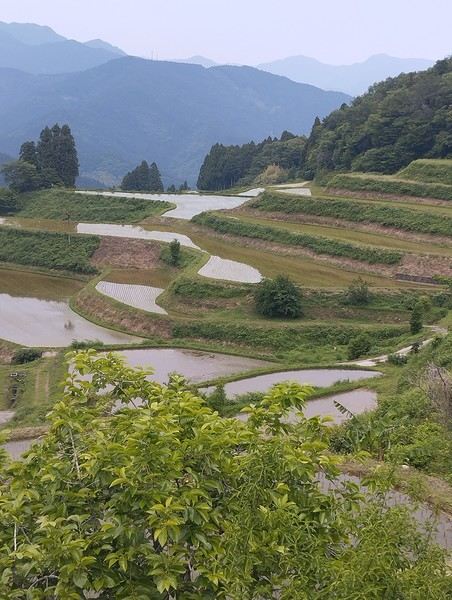
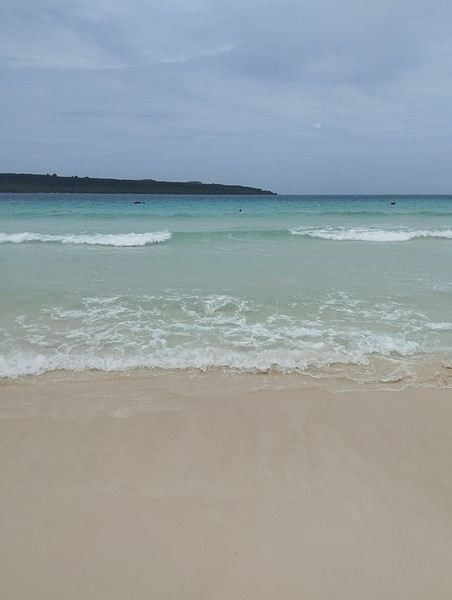
-->7 days in Miyakojima (Okinawa Prefecture)
-->7 days in Tokyo
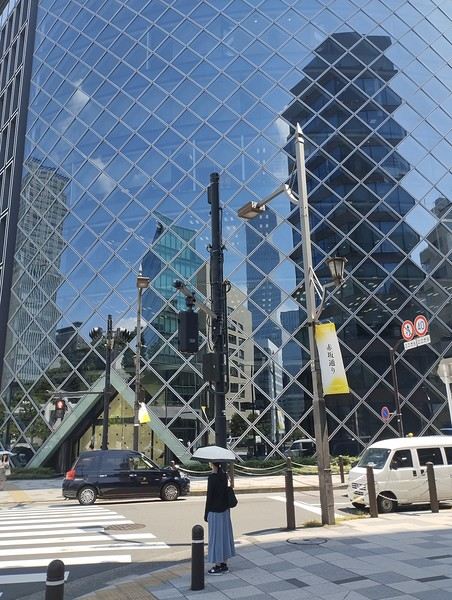
The trip was decided on fairly last-minute again this year.
Since I regularly check flight prices to track fluctuations for this destination even without concrete plans, stumbling upon a slightly cheaper direct flight (900 €) than what I’d seen in previous months (around 1,200–1,400 € on average) for a Paris-Tokyo route with Japanese airline ANA was too tempting to resist the urge to return to this enchanting country. After much hesitation between exploring the San’in region (Matsue, Tottori, Yamaguchi) and Southern Shikoku, the decision was made—I took the plunge! The ticket is booked: Paris to Kochi with a layover in Tokyo, all with ANA, the airline I’d been dreaming of... for 1,120 € per person. Okay, it’s not cheap, but it’s better than in 2023.
Departure in 2 weeks! Now I just have to get everything ready!
Intense prep work over these next 2 weeks to:
finalize a more precise itinerary and reach an agreement—yep, because even though we both love Japan, our preferences differ slightly, and we have to choose between exploring new places or revisiting beloved spots... decide how much time to spend in each area without rushing while still exploring research places that might interest us and watch videos about Japan book accommodations: yes, it’s possible to do this on the spot, but last year, we realized that last-minute options were pretty expensive, so we’re booking ahead—though we’ll keep a few options open in case better deals pop up later reserve rental cars order yen check the weather regularly and wonder if choosing the *tsuyu* (rainy season) was really a good idea—are we going to be drenched the whole time???
"What hard work," you might say! Going to Japan for a month—what a tough life! Despite this being my 4th trip, the excitement is just as intense as the first time.
The only small downside is that when we booked the flight, there weren’t many seats left, so we’re only sitting together on the international return flight. Plus, on the way there, we have middle seats. Another lingering question: what French-language films will be available? According to the internet, the selection seems limited. Oh well, these are just minor details—it’s already time to fly! PS: I’ll be posting slowly and irregularly... so for those interested, be patient, and maybe set an alert...
Hi everyone,
I have to admit, I really hesitated before deciding to write this travel journal... Writing one takes a lot of time and energy, and since this is my 4th trip, I wondered if it would even interest anyone other than myself (both for the discovery and the writing). But after a few people asked, "Are you going to write a journal?" and especially after rediscovering the joy of reading other travelers’ journals about Japan or elsewhere on this forum, I’ve decided to share my 4th installment in the Land of the Rising Sun here.
The itinerary: 27 full days, from late May to late June 2025, right in the middle of the rainy season, including:
-->13 days in Shikoku, from Kochi (Kochi Prefecture) to Matsuyama (Ehime Prefecture)
-->7 days in Miyakojima (Okinawa Prefecture)
-->7 days in Tokyo
The trip was decided on fairly last-minute again this year.
Since I regularly check flight prices to track fluctuations for this destination even without concrete plans, stumbling upon a slightly cheaper direct flight (900 €) than what I’d seen in previous months (around 1,200–1,400 € on average) for a Paris-Tokyo route with Japanese airline ANA was too tempting to resist the urge to return to this enchanting country. After much hesitation between exploring the San’in region (Matsue, Tottori, Yamaguchi) and Southern Shikoku, the decision was made—I took the plunge! The ticket is booked: Paris to Kochi with a layover in Tokyo, all with ANA, the airline I’d been dreaming of... for 1,120 € per person. Okay, it’s not cheap, but it’s better than in 2023.
Departure in 2 weeks! Now I just have to get everything ready!
Intense prep work over these next 2 weeks to:
finalize a more precise itinerary and reach an agreement—yep, because even though we both love Japan, our preferences differ slightly, and we have to choose between exploring new places or revisiting beloved spots... decide how much time to spend in each area without rushing while still exploring research places that might interest us and watch videos about Japan book accommodations: yes, it’s possible to do this on the spot, but last year, we realized that last-minute options were pretty expensive, so we’re booking ahead—though we’ll keep a few options open in case better deals pop up later reserve rental cars order yen check the weather regularly and wonder if choosing the *tsuyu* (rainy season) was really a good idea—are we going to be drenched the whole time???
"What hard work," you might say! Going to Japan for a month—what a tough life! Despite this being my 4th trip, the excitement is just as intense as the first time.
The only small downside is that when we booked the flight, there weren’t many seats left, so we’re only sitting together on the international return flight. Plus, on the way there, we have middle seats. Another lingering question: what French-language films will be available? According to the internet, the selection seems limited. Oh well, these are just minor details—it’s already time to fly! PS: I’ll be posting slowly and irregularly... so for those interested, be patient, and maybe set an alert...
Madagascar - June 2025
Five years of an unintended break... The closure of VF, COVID... What a joy to rediscover the pleasure of sharing!
I’ve stayed true to my habits: the following account is a collection of practical tips rather than a travel journal...
Madagascar is as big as France and Belgium combined. In three weeks, choices have to be made! It was the Great Tsingy that inspired our trip. We decided to focus on the southwest and the RN7. We skipped the Deep South and the North. Oh well...
OUR ITINERARY IN 3 WEEKS:
Fri 6 June – Direct AF flight to Tana – Flight arrives at 10:30 PM – Tana Sat – Antsirabe Sun – Miandrivazo Mon – Drive to the Masiakampy pier – Descent of the Tsiribihina River by pirogue - Bivouac Tue – Descent of the Tsiribihina River by pirogue - Bivouac Wed – Descent of the Tsiribihina River by pirogue – Bekopaka Thu – Pirogue on the Manambolo River and Small Tsingy of Bemaraha – Bekopaka Fri – Great Tsingy of Bemaraha – Bekopaka Sat – Avenue of the Baobabs – Morondava Sun – Belo sur Mer Mon – Free day – Belo sur Mer Tue – Manja Wed – Andavadoaka Thu – Free day – Andavadoaka Fri – Salary Lagoon – Mangily Sat – Ranohira Sun – Isalo National Park - Ranohira Mon – Anja Reserve - Ambalavao - Fianarantsoa Tue – FCE train canceled – Visit to a Tanala village - Manakara Wed – Pirogue on the Pangalanes Canal – Ranomafana Thu – Ranomafana NP – Ranomafana Fri – Ambositra – Antsirabe Sat 28 June – AF flight to Paris – Flight departs at 11:55 PM
TRIP ORGANIZATION: I prepared my trip using the usual guides (LP and Rough Guide), the internet, and the Freytag & Berndt map (1:1,000,000). I’m old-school—I still love visualizing my route on a paper map, even though in Madagascar, it’s misleading because some National Roads are only national in name!...
The agency: Since we couldn’t deal directly with a driver-guide (we lacked reliable info to take the plunge), we went through an agency to organize the logistics of our trip. We didn’t feel like using bush taxis (not enough time) or driving a 4x4 ourselves (neither the skills nor the boldness). The French agency connected us with a local agency, to whom I sent my detailed itinerary by email. A few exchanges via email and WhatsApp calls allowed us to finalize everything quickly after some adjustments. As you’ve gathered... we multiplied the commissions, which inflated the budget. That said, in the end, we were thrilled with our decision and our choice. Our trip was booked by the end of 2024, and reservations were made immediately. No bad surprises: the bookings in the planned hotels were honored, often with one of the best rooms. On our last day in Tana, before departure, we were lucky enough to meet the director I’d been communicating with, who helped build and validate our circuit. A very warm debriefing.
The driver-guide: The agency assigned us Faly, 33, a driver-guide for over 10 years. He stayed with us from start to finish: he picked us up at the airport on arrival and dropped us off 23 days later. A very experienced driver (which is important here), an open and cultured guide, reliable, punctual, and a great companion. And a provider of good advice throughout the trip. We made the most of the long stretches on dirt roads or highways to listen to him talk about daily life, rituals, wildlife, and flora... No time wasted! With a great playlist in the background, we combined business with pleasure! Faly’s accommodation and meals were included (quite often, hotels offer free lodging and meals to driver-guides who bring clients), as was the fuel. That didn’t stop us from inviting Faly to share a beer or our evening meal sometimes. He didn’t always accept, wanting to let us "enjoy our romantic evenings," as he put it. Present without being intrusive! Faly is fully capable of organizing a tailor-made trip directly. I recommend him without any hesitation—we were delighted with his service. I’ll gladly share his contact details via PM to anyone who asks.
Local guides: It’s the national guide’s prerogative to choose the local guides (mandatory in the parks). Thanks to his experience, Faly always booked us amazing, competent, and interesting local guides.
Hotels: I told the agency I wanted charming, comfortable accommodations, without falling into flashy luxury. We loved all the hotels (except the Hôtel Kanto in Manja). The rooms, mostly bungalows, were always spacious and clean. Unfortunately, I can’t give the prices—I didn’t get the details. Breakfast is always included, usually fresh and hearty. Very often, a small bottle of water is provided in the room.
Tana Hôtel Les 3 Métis Power cuts are common (!) in Tana. Bring a headlamp.
Antsirabe Ecolodge – Les chambres du voyageur Maybe our favorite! A few bungalows, beautifully arranged in a splendid tropical garden. The dog Kodak welcomes us warmly.
Miandrivazo Hôtel Princesse Tsiribihina Magnificent view of the valley.
Bekopaka Hôtel Orchidée du Bemaraha 2 (yes, 2) beautiful pools, a large open common room.
Morondava Hôtel Baobab Café Brand new or at least, according to Faly, just renovated. Very comfortable but without much charm (international style).
Belo sur Mer Ecolodge du Menabe The bungalows, all made of wood, bamboo, and thatch, are set on the beach. Very spacious and fully equipped! Large open-air restaurant by the sea. No hot water from the tap—it’s available in plastic bottles heated by the sun in front of each bungalow. Actually, we never used it... Another very, very beautiful spot.
Manja Hôtel Kanto The only hotel on this leg of the journey, so no choice. The owner knows it and, as a result, doesn’t bother. It’s a real dive! Tiny, dark room, a sordid bathroom with only a trickle of water—we skipped the shower! Clean sheets, though. Obviously, no Wi-Fi. The only place where I didn’t leave a tip. We were well warned about the discomfort of this stop, both by the agency and Faly. We weren’t surprised, and it even became a running joke during the trip. On the other hand, we found a nice little market in town.
Andavadoaka Manga Lodge What bliss! Especially after the horrible Hôtel Kanto. A paradise-like spot, overlooking three beautiful deserted white-sand beaches. Meals are served on the terrace facing the sea. Stunning sunset. We loved spending a day lounging here! We were the only guests and were pampered.
Mangily (Ifaty) Mangily is the "suburb" of Ifaty. Hôtel Vovo Telo A large beachfront bungalow complex. More touristy but pleasant—we spent a lovely evening there with our feet in the sand.
Ranohira Le Relais de la Reine A splendid resort built by a Frenchman, at the foot of the rocks, very well integrated into the environment. Beautiful marked trail starting from the garden.
Fianarantsoa Villa Sylvestre Contrary to what its name suggests, it’s a hotel right in the city center. Quite decent, though.
Manakara Parthenay Club Pretty bungalows in a large garden by the sea, but swimming isn’t safe—the water is too dangerous and rough.
Ranomafana Hôtel Thermal Very spacious rooms.
Meals: Not all our meals were included. It’s really not expensive. 1 meat or fish dish: around 35,000 Ar 1 full menu (starter, main, dessert): around 70,000 Ar 1 large THB beer (65 cl): between 8,000 and 12,000 Ar 1 piña colada: 15,000 Ar 1 flavored rum: 6,000 Ar (sometimes free) 1 glass of baobab juice (!): 5,000 Ar
We always ate very well. Rice is everywhere, served in large quantities. Zebu meat is quite good if not overcooked. Personally, I prefer fish, and I feasted: grouper, captain, crab, small lobsters...
We happily discovered baobab juice (especially in Belo, on the west coast). And of course, flavored rums!
We bought 2 packs of 6 bottles of mineral water at Carrefour (!) (about 5,000 Ar per large bottle) at the start of our trip. That was enough, especially since we often got water in the bungalows.
We had a few picnics included in our trip. Instead of picking up the hotel’s lunchbox, Faly prepared delicious, fresh, and varied picnics for us: tuna pasta salad, fried rice with eggs, grilled vegetables, and avocado...
An exceptional address not to miss: Mad Zébu – Belo sur Tsiribihina A highly reputed restaurant, a favorite of LP and Rough Guide, and rightly so! Gourmet cuisine, refined and elegant. Barely more expensive than elsewhere, and it’s worth it. We stopped there on our way up to Bekopaka and the Tsingy NP. Fully booked! So Faly reserved for our return, three days later. We’re still thanking him! What a treat!
THE BUDGET: Ariary exchange rate: 5,000 Ar = 1 €
Pre-trip expenses: Direct Air France flights: 930 € per person round trip Cost of the circuit with the agency: 2,880 € per person
The visa: Issued on arrival, very quickly. 35 € per person for a stay under 30 days. Super simple. Super fast.
On-site expenses: As soon as we arrived at the airport (it was nearly midnight), Faly advised us to exchange our euros for all our needs. There are few opportunities on our route to find an ATM or an open bank with a good rate. To be more comfortable, he took us to a small office under military protection just outside the airport. I exchanged 1,200 € (I had asked the agency for advice on the amount to bring) at a rate of 4,750 Ar and became a millionaire. Faly recounted all the stacks. That covered all our expenses (meals, drinks, tips) without ever feeling deprived. Personal purchases were made at the end of the trip. Convenient—it served as an adjustment variable. We spent our last million (200 €) on marquetry and vanilla. Tip: We asked for 200,000 Ar in 5,000 Ar bills for tips. That wasn’t too much—I even ran short of small bills in the last two days.
Tips: Madagascar is a poor country where every service deserves a small reward. While not mandatory, it’s customary. But no one ever demanded or expected it openly. On the contrary, I sometimes had to remind a porter to give them my small bill. We never carried our luggage—porters were always present when the car arrived or waiting at our door to watch for our departure. I gave each of them 5,000 Ar. In restaurants, I rounded up to the nearest ten and left the change. Local guides also expect a tip: I gave around 20,000 Ar per day for the two of us. Finally, the national guide also expects a gratuity. I had read online to budget 5 € per day per person. I added more since we were so happy with his services. The tip was given at the end of the trip, in euros, outside the budget.
Total budget all included (excluding personal purchases): 8,690 € Clearly, Madagascar is a country where life isn’t expensive, but travel costs add up quickly due to the need to rent a 4x4 with a driver.
HIGHLIGHTS:
· The dirt roads Yes, I’m listing them among the highlights! We loved those long hours spent driving at 20 km/h on rocky, muddy, white, red, or gray sand tracks... surrounded by tropical vegetation, palm trees, pandanus, mango trees... The experiences were sometimes thrilling: crossing a river on a ferry (just planks of wood fixed on two motorized pirogues side by side) or crossing a river without a ferry, with just a kid running ahead of the 4x4 to show the way; soft sand where the 4x4 easily gets stuck... The tracks are quite narrow, and crossing paths with a bush taxi, a zebu cart, or a herd of goats is always epic. So many beautiful images, so many beautiful photos! Much more beautiful than on asphalt. So yes, we loved those long stretches on dirt roads. For us, it was clearly part of the journey. Faly was particularly careful, and the 4x4 was comfortable. No injuries, no fatigue, even after 7 or 8 hours on rough tracks. The national roads (including the famous RN7) are badly damaged by cyclones, huge trucks, and lack of maintenance. Potholes have turned into ostrich nests, and we didn’t drive much faster than on the dirt roads.
· The landscapes, villages, encounters... We crossed a variety of stunning landscapes: mountains with slopes covered in terraced crops, rice fields from apple green to emerald green, sugarcane fields, then tropical forests, baobab forests (they deserve a special paragraph below), traveler’s tree forests. And then coastlines with white sand dunes against a backdrop of blue hues!... Magical! We also passed through many villages with houses whose architecture varied by region. The Betsileo houses display beautiful decorative brick reliefs. On the west coast, the houses are more precarious, made of bamboo with palm-thatched roofs. In the Highlands region, we found solid houses with pastel plaster. Each region has its own landscape, crops, habitat, and clothing. Zebu carts are often the only means of transport in remote villages. We saw them very frequently. Again, the cart’s decoration depends on the region. And then, we met many villagers coming out of the bush and walking to the next market, carrying their crops on their heads or shoulders. More beautiful photos!
· The descent of the Tsiribihina River We boarded around 9 AM in a long pirogue with Gana, the local guide, and two pirogue men. So, five of us. The pirogue is long but narrow, about 65 cm wide. We sat one behind the other at the front on seats padded with what would become our mattresses during the bivouacs. We only took the bare essentials for two nights. A little goodbye to Faly, whom we’d see again in three days! Don’t forget us! The river is silty—meaning orange, opaque but clean. We glided along silently. Gana showed us the trees, birds, crocodiles (we saw five—apparently, we were lucky). The pirogue men rowed to get us as close as possible to these crocs sunbathing on the roots of big trees. Yeah, right!... as soon as we got too close, *splash*, they disappeared into the water. We marveled at the mini rice fields lining the river. Every tiny plot, no matter how small, is cultivated. Above them, banana fields. And on the water, a whole life of fishermen and villagers living with and from the river. Gana warned us we’d eat on the pirogue because the journey was long. So, I expected chips... But no—fried rice and zebu steak, cooked right in the pirogue!! Incredible! In the middle of the afternoon, we reached a small beach where we disembarked. Gana led us about a hundred meters to a sublime waterfall. We were alone there. We had time to swim. We’d brought our swimsuits and a towel (bought at the Carrefour in Antsirabe on Faly’s wise advice!). This swim in this paradise-like spot remains one of our best memories. We found our pirogue again and set off until our first bivouac. We’d sailed for 7 hours today. The tents were set up on a wide beach, without a single tree. A moment of solitude... Uh, where can we go to the bathroom?... Especially since it was a full moon, so we felt like we were in the spotlight. Anyway... we did as everyone else—walked away, dug a hole, and the others turned their backs. A hearty meal on the beach before a comfortable and silent night. The next day, same program, with slightly different landscapes. The gorges widened, the trees were different. But still many colorful birds. Again, we ate on the pirogue: grilled chicken and vegetables. 9 hours of sailing. A similar bivouac. This time, we got it. On the third day, we finished the descent with 5 hours of sailing. So, 7 hours, 9 hours, 5 hours... doing nothing. It might sound boring... but it wasn’t. Like the dirt roads, these were contemplative moments. It glides, it’s calm, relaxing, and there’s a lot of life on this river, animal and human. Contemplation. Suspended time. On arrival, we disembarked at a sort of joyful, bustling river port. Of course, Faly was already there to pick us up.
· The Tsingy de Bemaraha NP (Small and Great) I have vertigo. During my research, several agencies advised me against visiting the Great Tsingy. "Stick to the Small ones," they said. Grrr, no, not what I wanted—we’ve dreamed of this for years! The agency we chose also warned me but didn’t discourage me. So we started with the Small Tsingy, quite close to Bekopaka, guided by Alisha. This forest of sharp limestone rocks is impressive. No vertigo issues here. The day was completed with a short pirogue ride on the Manambolo River and a visit to two caves with pretty formations. The next day, Faly and Alisha drove us to the Great Tsingy (a good hour on a terrible track). Arriving at the park entrance, Alisha equipped us with harnesses, carabiners, and gave us some safety instructions. Faly was also equipped. Wait? He’s coming with us? I quickly understood he was there for me—if I got stuck, he could go back with me, and Philippe could continue with Alisha. A wise precaution that delighted and reassured me. In the end, it was unnecessary since the famous bridge crossing was fully secured by the harness and carabiners. 18 meters on planks, one by one, it didn’t sway too much—I walked looking straight ahead, not a glance down. I even managed to smile in the middle of the crossing—I have a photo to prove it! I was overjoyed! The circuit in the Great Tsingy is a loop, so we didn’t have to cross the bridge again. We climbed to viewpoints offering breathtaking panoramic views. It’s extraordinary, unique, incredible. All this to say that if you have vertigo, don’t hesitate! It’s doable! It’s completely safe and really worth pushing your limits a bit! For those who’ve done treetop adventure courses, it’s similar. Also, no need to be a great athlete—just a bit of agility to climb a few ladders and high steps. Don’t censor yourself! I even had a small regret—the loop was a bit short (about 2 hours). I would’ve liked to continue or even redo it, with less apprehension. Tip: Do the Small Tsingy before the Great ones, or not at all. And if you can only do one, do the Great ones without hesitation.
· Canoeing in the Belo mangrove The Belo sur Mer ecolodge lends small individual canoes for free to go to the mangrove. We left at high tide, paddled for about twenty minutes to reach a fairly sparse forest where we could easily venture in. Very shallow water, crystal clear—we could see the roots of all these trees, schools of tiny fish... It was quite surprising. Until then, I only knew impenetrable, tangled mangroves. Here, nothing like that—we walked through an aquatic forest. We loved this adventure so much we left a bit late. The tide had gone out, and we had to carry our canoes for the last few meters... Of course, the staff came to help (probably laughing silently!). The lodge owners gave all the necessary explanations and lent a waterproof bag for the phone (because yes, it’s worth taking photos!). A very useful precaution—the canoes are small, low in the water, and paddling quickly soaks you. Again, this isn’t just for Tony Estanguet! It didn’t cause us any problems, not even sore muscles the next day. A great experience. It’ll take about 2 hours.
· Isalo NP Big surprise when we saw this huge rocky massif appear on the RN7! A massif of colored sandstone, carved with crevasses giving it a ruined look. Le Relais de la Reine is a little gem cleverly nestled in the heart of these rocks. A small marked trail starts from the garden. We picked up the description at reception and set off. Without a guide, alone following the markers, it took us 2 hours to complete this magnificent little trail, giving us a first glimpse of the massif before the hike the next day. And we enjoyed being completely alone for this walk. It’s free, easy, and well-signposted. Don’t miss it. In the evening, Faly took us to the so-called Isalo Window site—a hole in a wall through which we could see the sunset. We met all the tourists in the area here. We weren’t blown away by the show... The next day, we left early to reach the start of the hike. We met Zozoly at the guides’ office in the small town of Ranohira. During this hike, we climbed through the rocks to a viewpoint offering stunning 360° views of the massif. Then we reached a site called the "natural pool," breathtakingly beautiful, especially since we were alone again. A sort of oasis, a cascading waterfall, palm trees and tree ferns, fine sand, all nestled at the bottom of a small canyon. Paradise-like. We resisted swimming, but it was really tempting. A long walk on the plateaus then led us to a well-equipped picnic site where a local team prepared grills. Concrete tables were tiered in a spacious, shady clearing where a whole family of ring-tailed lemurs frolicked. They knew the tourists’ habits and tried to snatch food. Playful and not very shy, they amused us with their antics! We had to resist not luring them with a piece of banana!! Thousands of photos!! After the meal, we set off again with Zozoly for another landscape. This time, we were by a small river at the bottom of a canyon with high walls covered in vegetation. The trail was narrow and slippery, on a ledge of the wall. We progressed carefully. No danger, though. We first reached the Blue Pool, which only turns blue in photos (surprise!), then the Black Pool fed by a shower of waterfalls. Two magnificent spots that showed us a completely different aspect of the massif.
· Anja Reserve This ficus forest is home to many groups of lemurs. Used to humans, whom they don’t fear, they move around us, ignoring us completely. It’s almost annoying... The best place on our trip to see lemurs.
· The FCE train To the great regret of Manakara’s inhabitants, the FCE train hasn’t reached here for over a year and a half. As a result, there are far fewer tourists—the train was part of the experience. We drove there and didn’t regret coming to this port on the east coast.
· Visit to a Tanala village This visit wasn’t part of our program—it was added by the agency to compensate for the train not running. Which was the case. Not big fans of this kind of visit, where we feel like we’re at a zoo, voyeuristic, lacking authenticity, we followed the local guide with some skepticism and exchanged dubious looks. And yet... the guide’s explanations about village life and the warm, smiling welcome from the villagers charmed us and dispelled all our concerns. We learned a lot, met smiling families, and were able to enter these beautiful bamboo houses. A very pleasant surprise, rich in lessons.
· The Pangalanes Canal Arriving in Manakara, we crossed a bridge overlooking the Pangalanes Canal. A cry of surprise: the water is turquoise! We took a short pirogue ride with a team of three pirogue men and Joël, a local guide who explained the drama caused by the train’s halt. We stopped in a fishing village where Joël bought fish for the barbecue. We ended up on a beach where the team prepared the meal while we went to watch the fishermen return on the nearby beach. We admired the fishermen’s dexterity in untangling their nets, sorting their fish, cleaning their gear. On our return, we found a small table set up on the beach, in the shade of palm trees and casuarinas. Lobsters, captain fish, grilled vegetables, sautéed potatoes. A real feast (included in the trip cost).
· Ranomafana NP A 4-5 hour hike (some climbing) in a dense secondary forest to look for lemurs. As usual, we were accompanied by a local guide who, while waiting to find our furry friends, gave us lots of info on the vegetation, birds, and Tanala ethnic rituals. In the forest, we met 4 or 5 trackers, armed with radios to alert guides of their findings. In the end, we saw several lemurs of different types. Quite far, quite high... A nice complement to our lemur encounters in Isalo. Here, it rains 200 days a year. We started the hike in thick fog, but the forest’s density protected us from the humidity. Be careful—it can be a bit frustrating to see the lemurs so far away, so high. Nothing like the Anja Reserve or Isalo NP. Here, what’s fun is the hunt.
· The baobabs We were captivated by these kings of the forest, noble, imposing, majestic. We spotted them from very far away, towering over the rest of the vegetation. Alone, in small groups, or in forests, our trip allowed us to see hundreds of them! Mainly on the west coast. All different—bald, hairy, shaggy, short and stout, tall and thin, like Laurel and Hardy. Philippe took to naming them. Respectfully!
OUR FAVORITES: · The variety of landscapes. · The Tsingy NP.
OUR DISAPPOINTMENTS: · The Avenue of the Baobabs, very overrated and the only place where we saw crowds. We saw many other "forests" of baobabs that were much more impressive. · It’s hard to approach the population calmly as swarms of children run up as soon as we arrive, asking for sweets. Without any aggression, their smiles and laughter quickly made us forget this small inconvenience. We never gave out candy, clothes, or money. We left pens at a school and clothes with Faly.
IF WE WERE TO DO IT AGAIN: · Same period, same duration, same pace, same itinerary, but if we were to do it again today, I’d go through Faly directly! · Maybe we should’ve stayed in Ambalavao instead of Fianarantsoa. · Plan a longer loop in the Great Tsingy—it felt a bit too short.
MISCELLANEOUS: The welcome: ‘Samala Vazaha,’ there are many, many kids, sometimes overwhelming, never aggressive. We were impressed by the villagers’ smiles and good humor, towards us or even among themselves—laughter was everywhere. Safety: No problems. Out of (excessive?) caution, we spread all our money across several bags that we padlocked whenever we left the hotel. Bribes: We were stopped several times on the road by police or gendarmes. They checked our papers, sometimes our passports. Faly was perfectly in order. No discussion, no bribes, a cordial greeting from the officers. However, several times we found ourselves at small "tolls" on the tracks for villagers who had leveled the road or filled a hole, or for the young guy who ran through the river to show the way... Faly complied without discussion: every service deserves a small bill. Language: French is still widely spoken. Credit card: Unused. Cash: You need it! The climate at this time: Ideal—blue skies, sunshine, and mild temperatures (20-25°C) throughout our trip. Temperatures started to drop by our departure—winter was setting in. Clothing: T-shirt or polo and a vest sometimes in the evening, sandals on our feet, hiking shoes for all the hikes. Tip: We left a bag in the car (completely safe) with things we didn’t need daily and dirty laundry. The two bags to take out at each stop were much lighter. Before leaving, we left several polos and T-shirts with Faly, which, once washed, will make a few people happy. Tourist crowds at this time: Low—we were sometimes the only guests at the hotel. Faly explained that at the Isalo picnic site, in high season, you have to queue for a table, whereas we had our pick. Photos: Lots! Too many! That’s the problem with digital—we take so many! Health issues: Nothing serious, just the usual mild traveler’s diarrhea. Mosquitoes: They’re voracious. We took anti-malaria treatment. I’m still not sure if it was the right thing to do... I’m always very skeptical about such precautions. Internet: Free Wi-Fi at the lodges’ reception (except at Hôtel Kanto!), sometimes (rarely) in the bungalows. Phone: We didn’t try to get a local SIM card—the evening Wi-Fi was enough for us to make calls and send messages via WhatsApp. Make sure to turn off mobile data and switch to airplane mode (I activated it a bit late—received calls, spam ones at that, were charged...). Electricity: French plugs. Personal purchases: Beautiful wooden objects (sculptures and marquetry) or zebu horn items in Ambositra. 1 kg of vanilla (400,000 Ar – 80 € per kg) in Tana.
IN CONCLUSION: A trip of contemplation. A pause for admiration, as our local guide in Isalo NP said. Nothing else to do but walk, look, and enjoy. Here, there are no old stones, no museums—it’s a trip where nature reigns supreme. And what nature!
I’ve stayed true to my habits: the following account is a collection of practical tips rather than a travel journal...
Madagascar is as big as France and Belgium combined. In three weeks, choices have to be made! It was the Great Tsingy that inspired our trip. We decided to focus on the southwest and the RN7. We skipped the Deep South and the North. Oh well...
OUR ITINERARY IN 3 WEEKS:
Fri 6 June – Direct AF flight to Tana – Flight arrives at 10:30 PM – Tana Sat – Antsirabe Sun – Miandrivazo Mon – Drive to the Masiakampy pier – Descent of the Tsiribihina River by pirogue - Bivouac Tue – Descent of the Tsiribihina River by pirogue - Bivouac Wed – Descent of the Tsiribihina River by pirogue – Bekopaka Thu – Pirogue on the Manambolo River and Small Tsingy of Bemaraha – Bekopaka Fri – Great Tsingy of Bemaraha – Bekopaka Sat – Avenue of the Baobabs – Morondava Sun – Belo sur Mer Mon – Free day – Belo sur Mer Tue – Manja Wed – Andavadoaka Thu – Free day – Andavadoaka Fri – Salary Lagoon – Mangily Sat – Ranohira Sun – Isalo National Park - Ranohira Mon – Anja Reserve - Ambalavao - Fianarantsoa Tue – FCE train canceled – Visit to a Tanala village - Manakara Wed – Pirogue on the Pangalanes Canal – Ranomafana Thu – Ranomafana NP – Ranomafana Fri – Ambositra – Antsirabe Sat 28 June – AF flight to Paris – Flight departs at 11:55 PM
TRIP ORGANIZATION: I prepared my trip using the usual guides (LP and Rough Guide), the internet, and the Freytag & Berndt map (1:1,000,000). I’m old-school—I still love visualizing my route on a paper map, even though in Madagascar, it’s misleading because some National Roads are only national in name!...
The agency: Since we couldn’t deal directly with a driver-guide (we lacked reliable info to take the plunge), we went through an agency to organize the logistics of our trip. We didn’t feel like using bush taxis (not enough time) or driving a 4x4 ourselves (neither the skills nor the boldness). The French agency connected us with a local agency, to whom I sent my detailed itinerary by email. A few exchanges via email and WhatsApp calls allowed us to finalize everything quickly after some adjustments. As you’ve gathered... we multiplied the commissions, which inflated the budget. That said, in the end, we were thrilled with our decision and our choice. Our trip was booked by the end of 2024, and reservations were made immediately. No bad surprises: the bookings in the planned hotels were honored, often with one of the best rooms. On our last day in Tana, before departure, we were lucky enough to meet the director I’d been communicating with, who helped build and validate our circuit. A very warm debriefing.
The driver-guide: The agency assigned us Faly, 33, a driver-guide for over 10 years. He stayed with us from start to finish: he picked us up at the airport on arrival and dropped us off 23 days later. A very experienced driver (which is important here), an open and cultured guide, reliable, punctual, and a great companion. And a provider of good advice throughout the trip. We made the most of the long stretches on dirt roads or highways to listen to him talk about daily life, rituals, wildlife, and flora... No time wasted! With a great playlist in the background, we combined business with pleasure! Faly’s accommodation and meals were included (quite often, hotels offer free lodging and meals to driver-guides who bring clients), as was the fuel. That didn’t stop us from inviting Faly to share a beer or our evening meal sometimes. He didn’t always accept, wanting to let us "enjoy our romantic evenings," as he put it. Present without being intrusive! Faly is fully capable of organizing a tailor-made trip directly. I recommend him without any hesitation—we were delighted with his service. I’ll gladly share his contact details via PM to anyone who asks.
Local guides: It’s the national guide’s prerogative to choose the local guides (mandatory in the parks). Thanks to his experience, Faly always booked us amazing, competent, and interesting local guides.
Hotels: I told the agency I wanted charming, comfortable accommodations, without falling into flashy luxury. We loved all the hotels (except the Hôtel Kanto in Manja). The rooms, mostly bungalows, were always spacious and clean. Unfortunately, I can’t give the prices—I didn’t get the details. Breakfast is always included, usually fresh and hearty. Very often, a small bottle of water is provided in the room.
Tana Hôtel Les 3 Métis Power cuts are common (!) in Tana. Bring a headlamp.
Antsirabe Ecolodge – Les chambres du voyageur Maybe our favorite! A few bungalows, beautifully arranged in a splendid tropical garden. The dog Kodak welcomes us warmly.
Miandrivazo Hôtel Princesse Tsiribihina Magnificent view of the valley.
Bekopaka Hôtel Orchidée du Bemaraha 2 (yes, 2) beautiful pools, a large open common room.
Morondava Hôtel Baobab Café Brand new or at least, according to Faly, just renovated. Very comfortable but without much charm (international style).
Belo sur Mer Ecolodge du Menabe The bungalows, all made of wood, bamboo, and thatch, are set on the beach. Very spacious and fully equipped! Large open-air restaurant by the sea. No hot water from the tap—it’s available in plastic bottles heated by the sun in front of each bungalow. Actually, we never used it... Another very, very beautiful spot.
Manja Hôtel Kanto The only hotel on this leg of the journey, so no choice. The owner knows it and, as a result, doesn’t bother. It’s a real dive! Tiny, dark room, a sordid bathroom with only a trickle of water—we skipped the shower! Clean sheets, though. Obviously, no Wi-Fi. The only place where I didn’t leave a tip. We were well warned about the discomfort of this stop, both by the agency and Faly. We weren’t surprised, and it even became a running joke during the trip. On the other hand, we found a nice little market in town.
Andavadoaka Manga Lodge What bliss! Especially after the horrible Hôtel Kanto. A paradise-like spot, overlooking three beautiful deserted white-sand beaches. Meals are served on the terrace facing the sea. Stunning sunset. We loved spending a day lounging here! We were the only guests and were pampered.
Mangily (Ifaty) Mangily is the "suburb" of Ifaty. Hôtel Vovo Telo A large beachfront bungalow complex. More touristy but pleasant—we spent a lovely evening there with our feet in the sand.
Ranohira Le Relais de la Reine A splendid resort built by a Frenchman, at the foot of the rocks, very well integrated into the environment. Beautiful marked trail starting from the garden.
Fianarantsoa Villa Sylvestre Contrary to what its name suggests, it’s a hotel right in the city center. Quite decent, though.
Manakara Parthenay Club Pretty bungalows in a large garden by the sea, but swimming isn’t safe—the water is too dangerous and rough.
Ranomafana Hôtel Thermal Very spacious rooms.
Meals: Not all our meals were included. It’s really not expensive. 1 meat or fish dish: around 35,000 Ar 1 full menu (starter, main, dessert): around 70,000 Ar 1 large THB beer (65 cl): between 8,000 and 12,000 Ar 1 piña colada: 15,000 Ar 1 flavored rum: 6,000 Ar (sometimes free) 1 glass of baobab juice (!): 5,000 Ar
We always ate very well. Rice is everywhere, served in large quantities. Zebu meat is quite good if not overcooked. Personally, I prefer fish, and I feasted: grouper, captain, crab, small lobsters...
We happily discovered baobab juice (especially in Belo, on the west coast). And of course, flavored rums!
We bought 2 packs of 6 bottles of mineral water at Carrefour (!) (about 5,000 Ar per large bottle) at the start of our trip. That was enough, especially since we often got water in the bungalows.
We had a few picnics included in our trip. Instead of picking up the hotel’s lunchbox, Faly prepared delicious, fresh, and varied picnics for us: tuna pasta salad, fried rice with eggs, grilled vegetables, and avocado...
An exceptional address not to miss: Mad Zébu – Belo sur Tsiribihina A highly reputed restaurant, a favorite of LP and Rough Guide, and rightly so! Gourmet cuisine, refined and elegant. Barely more expensive than elsewhere, and it’s worth it. We stopped there on our way up to Bekopaka and the Tsingy NP. Fully booked! So Faly reserved for our return, three days later. We’re still thanking him! What a treat!
THE BUDGET: Ariary exchange rate: 5,000 Ar = 1 €
Pre-trip expenses: Direct Air France flights: 930 € per person round trip Cost of the circuit with the agency: 2,880 € per person
The visa: Issued on arrival, very quickly. 35 € per person for a stay under 30 days. Super simple. Super fast.
On-site expenses: As soon as we arrived at the airport (it was nearly midnight), Faly advised us to exchange our euros for all our needs. There are few opportunities on our route to find an ATM or an open bank with a good rate. To be more comfortable, he took us to a small office under military protection just outside the airport. I exchanged 1,200 € (I had asked the agency for advice on the amount to bring) at a rate of 4,750 Ar and became a millionaire. Faly recounted all the stacks. That covered all our expenses (meals, drinks, tips) without ever feeling deprived. Personal purchases were made at the end of the trip. Convenient—it served as an adjustment variable. We spent our last million (200 €) on marquetry and vanilla. Tip: We asked for 200,000 Ar in 5,000 Ar bills for tips. That wasn’t too much—I even ran short of small bills in the last two days.
Tips: Madagascar is a poor country where every service deserves a small reward. While not mandatory, it’s customary. But no one ever demanded or expected it openly. On the contrary, I sometimes had to remind a porter to give them my small bill. We never carried our luggage—porters were always present when the car arrived or waiting at our door to watch for our departure. I gave each of them 5,000 Ar. In restaurants, I rounded up to the nearest ten and left the change. Local guides also expect a tip: I gave around 20,000 Ar per day for the two of us. Finally, the national guide also expects a gratuity. I had read online to budget 5 € per day per person. I added more since we were so happy with his services. The tip was given at the end of the trip, in euros, outside the budget.
Total budget all included (excluding personal purchases): 8,690 € Clearly, Madagascar is a country where life isn’t expensive, but travel costs add up quickly due to the need to rent a 4x4 with a driver.
HIGHLIGHTS:
· The dirt roads Yes, I’m listing them among the highlights! We loved those long hours spent driving at 20 km/h on rocky, muddy, white, red, or gray sand tracks... surrounded by tropical vegetation, palm trees, pandanus, mango trees... The experiences were sometimes thrilling: crossing a river on a ferry (just planks of wood fixed on two motorized pirogues side by side) or crossing a river without a ferry, with just a kid running ahead of the 4x4 to show the way; soft sand where the 4x4 easily gets stuck... The tracks are quite narrow, and crossing paths with a bush taxi, a zebu cart, or a herd of goats is always epic. So many beautiful images, so many beautiful photos! Much more beautiful than on asphalt. So yes, we loved those long stretches on dirt roads. For us, it was clearly part of the journey. Faly was particularly careful, and the 4x4 was comfortable. No injuries, no fatigue, even after 7 or 8 hours on rough tracks. The national roads (including the famous RN7) are badly damaged by cyclones, huge trucks, and lack of maintenance. Potholes have turned into ostrich nests, and we didn’t drive much faster than on the dirt roads.
· The landscapes, villages, encounters... We crossed a variety of stunning landscapes: mountains with slopes covered in terraced crops, rice fields from apple green to emerald green, sugarcane fields, then tropical forests, baobab forests (they deserve a special paragraph below), traveler’s tree forests. And then coastlines with white sand dunes against a backdrop of blue hues!... Magical! We also passed through many villages with houses whose architecture varied by region. The Betsileo houses display beautiful decorative brick reliefs. On the west coast, the houses are more precarious, made of bamboo with palm-thatched roofs. In the Highlands region, we found solid houses with pastel plaster. Each region has its own landscape, crops, habitat, and clothing. Zebu carts are often the only means of transport in remote villages. We saw them very frequently. Again, the cart’s decoration depends on the region. And then, we met many villagers coming out of the bush and walking to the next market, carrying their crops on their heads or shoulders. More beautiful photos!
· The descent of the Tsiribihina River We boarded around 9 AM in a long pirogue with Gana, the local guide, and two pirogue men. So, five of us. The pirogue is long but narrow, about 65 cm wide. We sat one behind the other at the front on seats padded with what would become our mattresses during the bivouacs. We only took the bare essentials for two nights. A little goodbye to Faly, whom we’d see again in three days! Don’t forget us! The river is silty—meaning orange, opaque but clean. We glided along silently. Gana showed us the trees, birds, crocodiles (we saw five—apparently, we were lucky). The pirogue men rowed to get us as close as possible to these crocs sunbathing on the roots of big trees. Yeah, right!... as soon as we got too close, *splash*, they disappeared into the water. We marveled at the mini rice fields lining the river. Every tiny plot, no matter how small, is cultivated. Above them, banana fields. And on the water, a whole life of fishermen and villagers living with and from the river. Gana warned us we’d eat on the pirogue because the journey was long. So, I expected chips... But no—fried rice and zebu steak, cooked right in the pirogue!! Incredible! In the middle of the afternoon, we reached a small beach where we disembarked. Gana led us about a hundred meters to a sublime waterfall. We were alone there. We had time to swim. We’d brought our swimsuits and a towel (bought at the Carrefour in Antsirabe on Faly’s wise advice!). This swim in this paradise-like spot remains one of our best memories. We found our pirogue again and set off until our first bivouac. We’d sailed for 7 hours today. The tents were set up on a wide beach, without a single tree. A moment of solitude... Uh, where can we go to the bathroom?... Especially since it was a full moon, so we felt like we were in the spotlight. Anyway... we did as everyone else—walked away, dug a hole, and the others turned their backs. A hearty meal on the beach before a comfortable and silent night. The next day, same program, with slightly different landscapes. The gorges widened, the trees were different. But still many colorful birds. Again, we ate on the pirogue: grilled chicken and vegetables. 9 hours of sailing. A similar bivouac. This time, we got it. On the third day, we finished the descent with 5 hours of sailing. So, 7 hours, 9 hours, 5 hours... doing nothing. It might sound boring... but it wasn’t. Like the dirt roads, these were contemplative moments. It glides, it’s calm, relaxing, and there’s a lot of life on this river, animal and human. Contemplation. Suspended time. On arrival, we disembarked at a sort of joyful, bustling river port. Of course, Faly was already there to pick us up.
· The Tsingy de Bemaraha NP (Small and Great) I have vertigo. During my research, several agencies advised me against visiting the Great Tsingy. "Stick to the Small ones," they said. Grrr, no, not what I wanted—we’ve dreamed of this for years! The agency we chose also warned me but didn’t discourage me. So we started with the Small Tsingy, quite close to Bekopaka, guided by Alisha. This forest of sharp limestone rocks is impressive. No vertigo issues here. The day was completed with a short pirogue ride on the Manambolo River and a visit to two caves with pretty formations. The next day, Faly and Alisha drove us to the Great Tsingy (a good hour on a terrible track). Arriving at the park entrance, Alisha equipped us with harnesses, carabiners, and gave us some safety instructions. Faly was also equipped. Wait? He’s coming with us? I quickly understood he was there for me—if I got stuck, he could go back with me, and Philippe could continue with Alisha. A wise precaution that delighted and reassured me. In the end, it was unnecessary since the famous bridge crossing was fully secured by the harness and carabiners. 18 meters on planks, one by one, it didn’t sway too much—I walked looking straight ahead, not a glance down. I even managed to smile in the middle of the crossing—I have a photo to prove it! I was overjoyed! The circuit in the Great Tsingy is a loop, so we didn’t have to cross the bridge again. We climbed to viewpoints offering breathtaking panoramic views. It’s extraordinary, unique, incredible. All this to say that if you have vertigo, don’t hesitate! It’s doable! It’s completely safe and really worth pushing your limits a bit! For those who’ve done treetop adventure courses, it’s similar. Also, no need to be a great athlete—just a bit of agility to climb a few ladders and high steps. Don’t censor yourself! I even had a small regret—the loop was a bit short (about 2 hours). I would’ve liked to continue or even redo it, with less apprehension. Tip: Do the Small Tsingy before the Great ones, or not at all. And if you can only do one, do the Great ones without hesitation.
· Canoeing in the Belo mangrove The Belo sur Mer ecolodge lends small individual canoes for free to go to the mangrove. We left at high tide, paddled for about twenty minutes to reach a fairly sparse forest where we could easily venture in. Very shallow water, crystal clear—we could see the roots of all these trees, schools of tiny fish... It was quite surprising. Until then, I only knew impenetrable, tangled mangroves. Here, nothing like that—we walked through an aquatic forest. We loved this adventure so much we left a bit late. The tide had gone out, and we had to carry our canoes for the last few meters... Of course, the staff came to help (probably laughing silently!). The lodge owners gave all the necessary explanations and lent a waterproof bag for the phone (because yes, it’s worth taking photos!). A very useful precaution—the canoes are small, low in the water, and paddling quickly soaks you. Again, this isn’t just for Tony Estanguet! It didn’t cause us any problems, not even sore muscles the next day. A great experience. It’ll take about 2 hours.
· Isalo NP Big surprise when we saw this huge rocky massif appear on the RN7! A massif of colored sandstone, carved with crevasses giving it a ruined look. Le Relais de la Reine is a little gem cleverly nestled in the heart of these rocks. A small marked trail starts from the garden. We picked up the description at reception and set off. Without a guide, alone following the markers, it took us 2 hours to complete this magnificent little trail, giving us a first glimpse of the massif before the hike the next day. And we enjoyed being completely alone for this walk. It’s free, easy, and well-signposted. Don’t miss it. In the evening, Faly took us to the so-called Isalo Window site—a hole in a wall through which we could see the sunset. We met all the tourists in the area here. We weren’t blown away by the show... The next day, we left early to reach the start of the hike. We met Zozoly at the guides’ office in the small town of Ranohira. During this hike, we climbed through the rocks to a viewpoint offering stunning 360° views of the massif. Then we reached a site called the "natural pool," breathtakingly beautiful, especially since we were alone again. A sort of oasis, a cascading waterfall, palm trees and tree ferns, fine sand, all nestled at the bottom of a small canyon. Paradise-like. We resisted swimming, but it was really tempting. A long walk on the plateaus then led us to a well-equipped picnic site where a local team prepared grills. Concrete tables were tiered in a spacious, shady clearing where a whole family of ring-tailed lemurs frolicked. They knew the tourists’ habits and tried to snatch food. Playful and not very shy, they amused us with their antics! We had to resist not luring them with a piece of banana!! Thousands of photos!! After the meal, we set off again with Zozoly for another landscape. This time, we were by a small river at the bottom of a canyon with high walls covered in vegetation. The trail was narrow and slippery, on a ledge of the wall. We progressed carefully. No danger, though. We first reached the Blue Pool, which only turns blue in photos (surprise!), then the Black Pool fed by a shower of waterfalls. Two magnificent spots that showed us a completely different aspect of the massif.
· Anja Reserve This ficus forest is home to many groups of lemurs. Used to humans, whom they don’t fear, they move around us, ignoring us completely. It’s almost annoying... The best place on our trip to see lemurs.
· The FCE train To the great regret of Manakara’s inhabitants, the FCE train hasn’t reached here for over a year and a half. As a result, there are far fewer tourists—the train was part of the experience. We drove there and didn’t regret coming to this port on the east coast.
· Visit to a Tanala village This visit wasn’t part of our program—it was added by the agency to compensate for the train not running. Which was the case. Not big fans of this kind of visit, where we feel like we’re at a zoo, voyeuristic, lacking authenticity, we followed the local guide with some skepticism and exchanged dubious looks. And yet... the guide’s explanations about village life and the warm, smiling welcome from the villagers charmed us and dispelled all our concerns. We learned a lot, met smiling families, and were able to enter these beautiful bamboo houses. A very pleasant surprise, rich in lessons.
· The Pangalanes Canal Arriving in Manakara, we crossed a bridge overlooking the Pangalanes Canal. A cry of surprise: the water is turquoise! We took a short pirogue ride with a team of three pirogue men and Joël, a local guide who explained the drama caused by the train’s halt. We stopped in a fishing village where Joël bought fish for the barbecue. We ended up on a beach where the team prepared the meal while we went to watch the fishermen return on the nearby beach. We admired the fishermen’s dexterity in untangling their nets, sorting their fish, cleaning their gear. On our return, we found a small table set up on the beach, in the shade of palm trees and casuarinas. Lobsters, captain fish, grilled vegetables, sautéed potatoes. A real feast (included in the trip cost).
· Ranomafana NP A 4-5 hour hike (some climbing) in a dense secondary forest to look for lemurs. As usual, we were accompanied by a local guide who, while waiting to find our furry friends, gave us lots of info on the vegetation, birds, and Tanala ethnic rituals. In the forest, we met 4 or 5 trackers, armed with radios to alert guides of their findings. In the end, we saw several lemurs of different types. Quite far, quite high... A nice complement to our lemur encounters in Isalo. Here, it rains 200 days a year. We started the hike in thick fog, but the forest’s density protected us from the humidity. Be careful—it can be a bit frustrating to see the lemurs so far away, so high. Nothing like the Anja Reserve or Isalo NP. Here, what’s fun is the hunt.
· The baobabs We were captivated by these kings of the forest, noble, imposing, majestic. We spotted them from very far away, towering over the rest of the vegetation. Alone, in small groups, or in forests, our trip allowed us to see hundreds of them! Mainly on the west coast. All different—bald, hairy, shaggy, short and stout, tall and thin, like Laurel and Hardy. Philippe took to naming them. Respectfully!
OUR FAVORITES: · The variety of landscapes. · The Tsingy NP.
OUR DISAPPOINTMENTS: · The Avenue of the Baobabs, very overrated and the only place where we saw crowds. We saw many other "forests" of baobabs that were much more impressive. · It’s hard to approach the population calmly as swarms of children run up as soon as we arrive, asking for sweets. Without any aggression, their smiles and laughter quickly made us forget this small inconvenience. We never gave out candy, clothes, or money. We left pens at a school and clothes with Faly.
IF WE WERE TO DO IT AGAIN: · Same period, same duration, same pace, same itinerary, but if we were to do it again today, I’d go through Faly directly! · Maybe we should’ve stayed in Ambalavao instead of Fianarantsoa. · Plan a longer loop in the Great Tsingy—it felt a bit too short.
MISCELLANEOUS: The welcome: ‘Samala Vazaha,’ there are many, many kids, sometimes overwhelming, never aggressive. We were impressed by the villagers’ smiles and good humor, towards us or even among themselves—laughter was everywhere. Safety: No problems. Out of (excessive?) caution, we spread all our money across several bags that we padlocked whenever we left the hotel. Bribes: We were stopped several times on the road by police or gendarmes. They checked our papers, sometimes our passports. Faly was perfectly in order. No discussion, no bribes, a cordial greeting from the officers. However, several times we found ourselves at small "tolls" on the tracks for villagers who had leveled the road or filled a hole, or for the young guy who ran through the river to show the way... Faly complied without discussion: every service deserves a small bill. Language: French is still widely spoken. Credit card: Unused. Cash: You need it! The climate at this time: Ideal—blue skies, sunshine, and mild temperatures (20-25°C) throughout our trip. Temperatures started to drop by our departure—winter was setting in. Clothing: T-shirt or polo and a vest sometimes in the evening, sandals on our feet, hiking shoes for all the hikes. Tip: We left a bag in the car (completely safe) with things we didn’t need daily and dirty laundry. The two bags to take out at each stop were much lighter. Before leaving, we left several polos and T-shirts with Faly, which, once washed, will make a few people happy. Tourist crowds at this time: Low—we were sometimes the only guests at the hotel. Faly explained that at the Isalo picnic site, in high season, you have to queue for a table, whereas we had our pick. Photos: Lots! Too many! That’s the problem with digital—we take so many! Health issues: Nothing serious, just the usual mild traveler’s diarrhea. Mosquitoes: They’re voracious. We took anti-malaria treatment. I’m still not sure if it was the right thing to do... I’m always very skeptical about such precautions. Internet: Free Wi-Fi at the lodges’ reception (except at Hôtel Kanto!), sometimes (rarely) in the bungalows. Phone: We didn’t try to get a local SIM card—the evening Wi-Fi was enough for us to make calls and send messages via WhatsApp. Make sure to turn off mobile data and switch to airplane mode (I activated it a bit late—received calls, spam ones at that, were charged...). Electricity: French plugs. Personal purchases: Beautiful wooden objects (sculptures and marquetry) or zebu horn items in Ambositra. 1 kg of vanilla (400,000 Ar – 80 € per kg) in Tana.
IN CONCLUSION: A trip of contemplation. A pause for admiration, as our local guide in Isalo NP said. Nothing else to do but walk, look, and enjoy. Here, there are no old stones, no museums—it’s a trip where nature reigns supreme. And what nature!
Grand Teton National Park
Every day, I look back at my 2022 trip to Wyoming. And every day, I tell myself I need to start getting ready to go back. Don’t agree? 😎
Skyscrapers, Markets, Ice Cubes, Tourism, and Waterfalls... Thailand's Excesses
A somewhat lengthy title... I could have simply written: from Bangkok to Chiang Rai, via Chiang Mai, since that was my route. But when poets embellish our travel journals with their verbal flourishes, you’ve got to try not to be too ordinary.
Skyscrapers of excess? You’ll have gathered that from the photo illustrating this journal—though it might change as the trip goes on.
The excess of markets—not so much in their size, though... Chatuchak... But in their sheer number. Day markets, night markets, floating markets, fresh produce markets, fish markets, meat markets, spice markets, fabric markets... and even... amulet markets... For luck, good fortune, protection. Not to mention, sadly, the market for girls—and boys, incidentally. I’ve even heard they’re displayed in windows. I’ve heard about that one, like you have, but I didn’t set foot in it, so I can’t say anything about it. Some even claim there’s a black-market trade in children. Disgusting! It reminded me of the book *The Parcel* by Anosh Irani, which I recommended in another journal. The story is set in India, but I’ve been told it exists in Thailand too. So, the "famous Thai markets" we’re bombarded with in paper and online guides—sure, they amazed me in the first few days, and I don’t regret visiting them. But no matter how big they were, I quickly got my fill since you saw the same things at every stall...
I had a market overdose.
Excess of tourism? I should say *tourists*, since I saw them literally swarming in the streets and those famous markets. I’d forgotten about them. I’d lost the habit, living in an Indian city for so long...
Waterfalls are a bit like markets. At this time of year, they’re not particularly spectacular, but they’re everywhere. There are the ones everyone goes to see. For example, Erawan, which I decided to skip even though it was in my original itinerary—I guessed it’d be a nightmare with the selfie circus. On the other hand, you come across them all over the place, hidden in the mountains and forests, not listed in any guide. Not to mention the ones you can find in temples or even private homes... Yes, really! Thais love waterfalls, so they install them in their gardens—and I even saw one in the middle of the city, right on the street! Sometimes they’re tiny, but very photogenic.
But what do ice cubes have to do with this? Why the excess of ice cubes? Not only are they everywhere by the ton, but they put them in *everything* you drink. You’d think they’d even put them in soup! And it’s not just one or two ice cubes—no! They fill the container to the brim, whatever it is, then pour the liquid on top to fill the gaps. They’ll make you an excellent coffee right in front of you, piping hot, then—bam! An avalanche of ice cubes in the glass. Okay, I’m exaggerating a little. They *do* sometimes ask if you prefer your coffee—or tea—hot. Everything edible, and especially everything drinkable, is refrigerated: vegetables, fruit, hot drinks (I mean, drinks that are *usually* hot), but meat and fish are left out in the open. They just wave a little whisk to shoo away the flies when they get too eager. Mind you, I never put fruit, cheese, eggs, or water in the fridge in France, but I do in India. And I refrigerate meat and fish too... Though sometimes one of those little flies sneaks into the fridge...
You won’t find practical or technical details in this journal, like addresses or prices. Others do that better than me. You also won’t find the names of obscure or unknown places I discovered, or directions to get there.
I don’t really feel like recounting what I saw day by day, following my schedule and route. There might be flashbacks, projections into the future. It’ll depend on my memories, what I felt, what I hated, what comes back to me—and maybe your questions and our exchanges. And for those who’ve never read me before, you’ll have to get used to my parentheses and digressions, maybe on a completely different subject, as my thoughts wander. Stories within stories. There’ll also be long, endless sentences—but still punctuated, so you can follow along. Though I used to curse Proust and his sentences that started on one page and ended on the next, sometimes even further. I’d have to reread them twenty times to follow and understand what he was saying. I hated Proust. But hey, I was 20. Maybe I’d like him now?
See? The digressions are starting already. Forgive me.
You’ll find few photos here. First, the number is limited, and second, photos aren’t the main purpose of either VF or a travel journal. They’re too often used to mask the poverty of the text. And, sorry to say it, but so many of them are just plain ugly! If you really want to see photos, I’ll share some links where you can browse them at your leisure
Looking for feedback on Japan itinerary
Hi there,
I’m planning a trip to Japan with my three grown-up kids, who aren’t exactly keen on rushing from one place to another with heavy luggage. I’ve tried to balance things so we can see as much as possible while still giving them time to enjoy the evenings.
Here’s what I’ve come up with:
- Arrival in Tokyo on May 17
- Staying in Tokyo from May 17 to 22, exploring the city,
with a day trip to Nikko (round trip in one day): is it worth it, considering it’s a 2-hour train ride each way?
- Sending our big suitcases directly to Osaka
- Traveling to Kamakura on May 23: 1 night (with small luggage)
- Traveling to Hakone on May 24: 1 night (with small luggage)
- Heading to Osaka on May 25: staying from May 25 to June 2 in Osaka, where we’ll pick up our big suitcases
Day trips from Osaka:
- Kyoto: 2 days (round trip in one day)
- Nara: 1 day (round trip in one day)
My son would prefer to stay in Osaka for all 8 days, but I’m wondering if it’s a good idea to spend at least one night in Kyoto. What do you think?
- Leaving for Himeji on June 3: is it possible to leave both big and small luggage in a coin locker to visit the castle, or is it better to do a round trip from Osaka?
- Traveling to Hiroshima: 3 nights from June 3 to 5:
- Hiroshima: 1 day
- Miyajima: 1 day
- Okayama and Kurashiki: 1 day: is it better to do a round trip from Hiroshima and return to Tokyo from there, or spend the night of June 5 in Okayama and head to Tokyo from there?
- Back to Tokyo from June 6 to 9, with departure on the morning of June 9.
Since I’ve never been to Japan, I’ve tried to focus on the most interesting spots. Are there any places I’ve missed that you think we should add, or others that might not be as worthwhile?
About the luggage: is it a hassle to forward it to Kamakura, Hakone, and Kyoto? How much do coin lockers usually cost?
My son says the JR Pass isn’t worth it—what’s your take?
For accommodations, we’re leaning toward mid-range hotels with good value rather than apartments. Any great tips?
I know I’m asking a lot of questions—I really appreciate anyone who can point me in the right direction.
Thanks in advance!
7-day mini road trip in Corsica: your thoughts?
Hi everyone, after a stay in the South and one in the North, I’m planning a mini road trip in Corsica (Bastia-Bastia) in June to explore places I haven’t seen yet. Since we’re heading to the mountains later this year, we’ve deliberately skipped the Corsican mountains. Could you share your thoughts and, most importantly, suggest things to see? We love nature, reasonable hikes, peaceful spots, and small villages. No cities. No boat excursions (yes, that includes Piana and Scandola). We already know the area between Bastia and Calvi.
June 7 Flight arrival in Bastia and night at the hotel
June 8 Drive to Calvi (beach and/or fortress) Meal at Les Boucaniers restaurant Night in Calvi
June 9 Walk from Calvi fortress to Alga beach Charcuterie platter at A Casetta Calvi Night in Calvi
June 10 Drive from Calvi to Piana Buvette du col de la Croix and visit the orientation table Chemin des muletiers (Muleteers’ Path) Or Sentier de la source des roches bleues (Blue Rocks Spring Trail) counterclockwise Or (less scenic) Tête du chien (Dog’s Head, starting at the parking lot) Dinner at Épicerie Castellani in Piana Night in Piana
June 11 Drive from Piana to Propriano Arone beach and meal at Le Café de la plage Drive along the coast, stopping wherever we like Night in Propriano
June 12 Hike starting from Campomoro in the Jardin du Vent (Wind Garden), and visit the Genoese tower of Campomoro Meal in Campomoro: restaurant Chez Pierre Paul U spuntinu Night in Propriano
June 13 Around Propriano (avoid Capu Laurosu beach—sewage treatment plant...) Night in Propriano
June 14 Drive from Propriano to Bastia airport Meal at L’Éternisula in Zonza Aiguilles de Bavella (Hole of the Bomb) Night at the same hotel as arrival
June 15 Departure
June 7 Flight arrival in Bastia and night at the hotel
June 8 Drive to Calvi (beach and/or fortress) Meal at Les Boucaniers restaurant Night in Calvi
June 9 Walk from Calvi fortress to Alga beach Charcuterie platter at A Casetta Calvi Night in Calvi
June 10 Drive from Calvi to Piana Buvette du col de la Croix and visit the orientation table Chemin des muletiers (Muleteers’ Path) Or Sentier de la source des roches bleues (Blue Rocks Spring Trail) counterclockwise Or (less scenic) Tête du chien (Dog’s Head, starting at the parking lot) Dinner at Épicerie Castellani in Piana Night in Piana
June 11 Drive from Piana to Propriano Arone beach and meal at Le Café de la plage Drive along the coast, stopping wherever we like Night in Propriano
June 12 Hike starting from Campomoro in the Jardin du Vent (Wind Garden), and visit the Genoese tower of Campomoro Meal in Campomoro: restaurant Chez Pierre Paul U spuntinu Night in Propriano
June 13 Around Propriano (avoid Capu Laurosu beach—sewage treatment plant...) Night in Propriano
June 14 Drive from Propriano to Bastia airport Meal at L’Éternisula in Zonza Aiguilles de Bavella (Hole of the Bomb) Night at the same hotel as arrival
June 15 Departure
Accommodation near the beach in Koh Samui
Hi there, We're thinking of spending 3 weeks in Koh Samui at the start of 2026. Where can we find accommodation close to a pretty beach that's not too touristy but not isolated either, near a small town or village? We've already been to Surin Beach on Phuket Island. We really liked that spot, but we've heard Koh Samui is great too. Thanks for your tips!
Family trip to Quebec: checking our itinerary
Hi everyone,
We’re heading out as a family from July 2nd to 16th on a loop from Montreal to Montreal. We’re a couple with a little girl who’ll be turning 7 in July, plus my in-laws (one of whom uses a wheelchair).
Here’s our itinerary:
Wednesday, July 2: Arrival in Montreal in the early afternoon – picking up the car at the airport – exploring the city and overnight in Montreal Thursday, July 3: Montreal – overnight in Montreal Friday, July 4: Visit to Parc Omega – overnight in Saint-Jérôme Saturday, July 5: Heading to Trois-Rivières – visit to a sugar shack (Chez Dany? or another name?) – exploring the old town – overnight in Trois-Rivières Sunday, July 6: Shawinigan – Le Village du Bûcheron in Grandes-Piles? – black bear watching (probably not doable for wheelchair users, I think?!) – overnight in Trois-Rivières Monday, July 7: Heading to Chicoutimi – Saguenay – day at Lac Saint-Jean / Val-Jabert – overnight in Saguenay Tuesday, July 8: L’Anse-Saint-Jean – Saguenay Fjord National Park – overnight in Saguenay Wednesday, July 9: Tadoussac – exploring the area and the town – overnight in Tadoussac Thursday, July 10: Whale watching – Baie-Sainte-Catherine – overnight in Tadoussac Friday, July 11: La Malbaie – Baie-Saint-Paul – overnight on Île aux Coudres Saturday, July 12: Exploring the area? – overnight on Île aux Coudres Sunday, July 13: Montmorency Falls – overnight in Quebec City Monday, July 14: Quebec City – overnight in Quebec City Tuesday, July 15: Quebec City and return to Montreal – overnight in Beloeil Wednesday, July 16: Montreal – evening flight
We’ve booked our rooms to ensure a wheelchair-accessible room is available. When searching on Expedia or Booking, few hotels have rooms with a shower accessible for wheelchairs (so a real PMR room). However, these are cancelable, so if something really stands out, I’m all ears 😉.
We’ve booked our car through BSP Auto and we’re flying with Air Transat.
Thanks for any feedback and tips for the visits.
See you soon 🙂 Jennifer
We’re heading out as a family from July 2nd to 16th on a loop from Montreal to Montreal. We’re a couple with a little girl who’ll be turning 7 in July, plus my in-laws (one of whom uses a wheelchair).
Here’s our itinerary:
Wednesday, July 2: Arrival in Montreal in the early afternoon – picking up the car at the airport – exploring the city and overnight in Montreal Thursday, July 3: Montreal – overnight in Montreal Friday, July 4: Visit to Parc Omega – overnight in Saint-Jérôme Saturday, July 5: Heading to Trois-Rivières – visit to a sugar shack (Chez Dany? or another name?) – exploring the old town – overnight in Trois-Rivières Sunday, July 6: Shawinigan – Le Village du Bûcheron in Grandes-Piles? – black bear watching (probably not doable for wheelchair users, I think?!) – overnight in Trois-Rivières Monday, July 7: Heading to Chicoutimi – Saguenay – day at Lac Saint-Jean / Val-Jabert – overnight in Saguenay Tuesday, July 8: L’Anse-Saint-Jean – Saguenay Fjord National Park – overnight in Saguenay Wednesday, July 9: Tadoussac – exploring the area and the town – overnight in Tadoussac Thursday, July 10: Whale watching – Baie-Sainte-Catherine – overnight in Tadoussac Friday, July 11: La Malbaie – Baie-Saint-Paul – overnight on Île aux Coudres Saturday, July 12: Exploring the area? – overnight on Île aux Coudres Sunday, July 13: Montmorency Falls – overnight in Quebec City Monday, July 14: Quebec City – overnight in Quebec City Tuesday, July 15: Quebec City and return to Montreal – overnight in Beloeil Wednesday, July 16: Montreal – evening flight
We’ve booked our rooms to ensure a wheelchair-accessible room is available. When searching on Expedia or Booking, few hotels have rooms with a shower accessible for wheelchairs (so a real PMR room). However, these are cancelable, so if something really stands out, I’m all ears 😉.
We’ve booked our car through BSP Auto and we’re flying with Air Transat.
Thanks for any feedback and tips for the visits.
See you soon 🙂 Jennifer
A Trip to Australia: Tasmania
Sunday, November 26, 2023
Melbourne - Hobart
Flawless journey to Hobart. Our stay in the southernmost land we’ve ever visited. And indeed, everything’s different. The climate—14°C, rain that varies in intensity but never stops, the landscapes… It’s a shock! But, apart from the bad weather, Dom is thrilled.
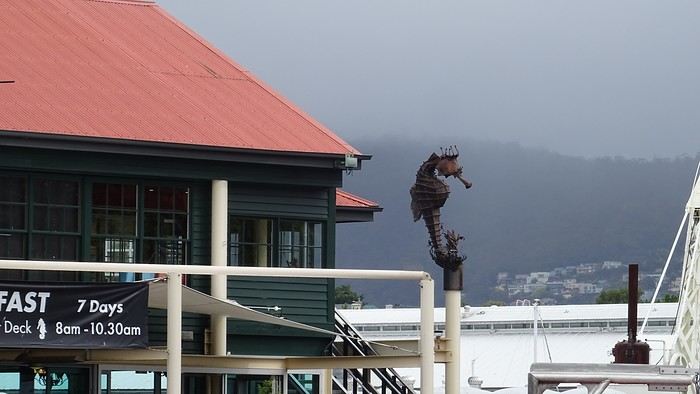
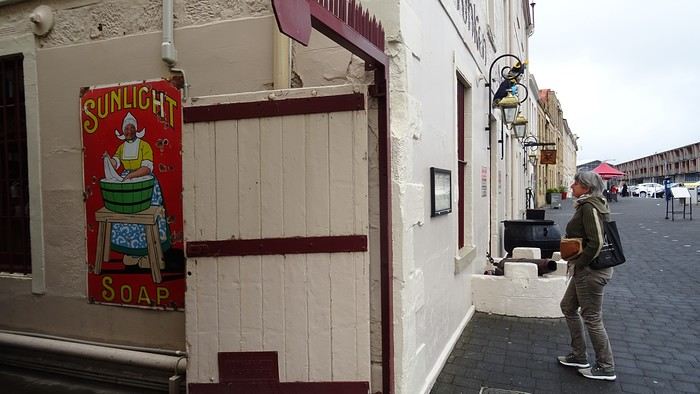
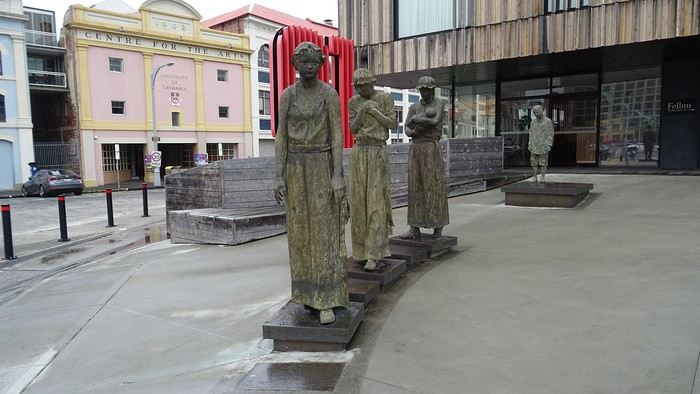
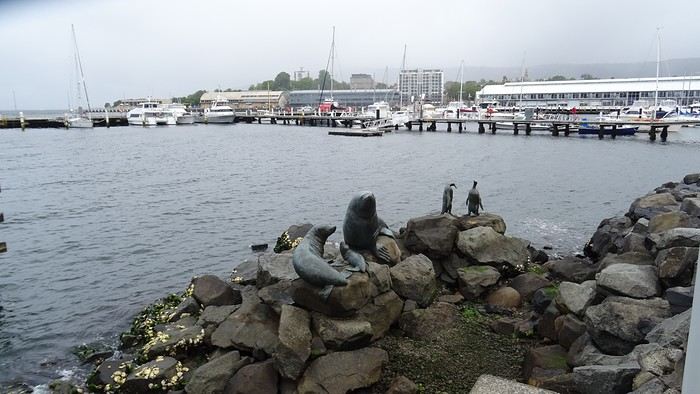
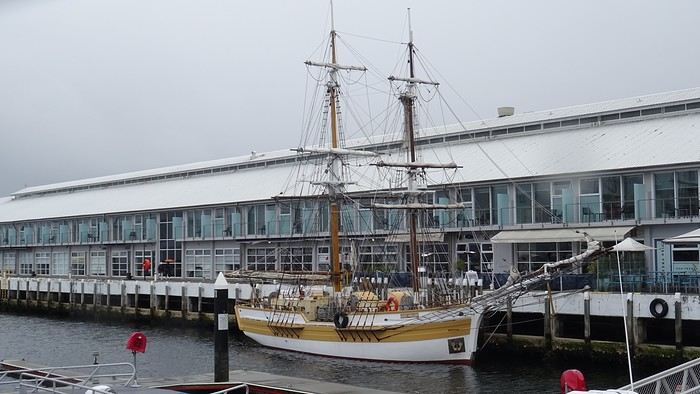
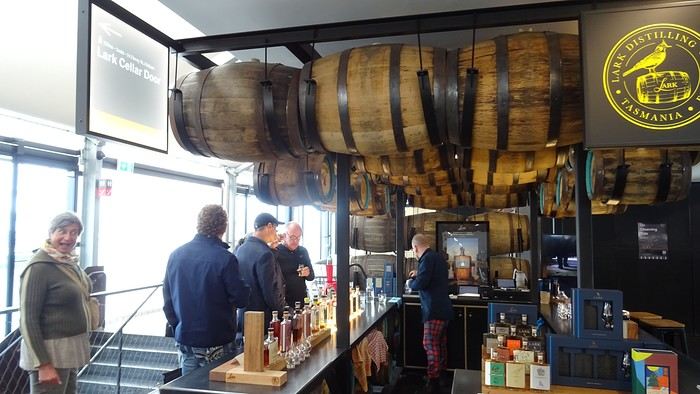
We’ve also downgraded our accommodations. We’ve got a tiny room, and the bathroom—private, at least—is two hallways away… But the price is reasonable (under 100 €) and the location is central.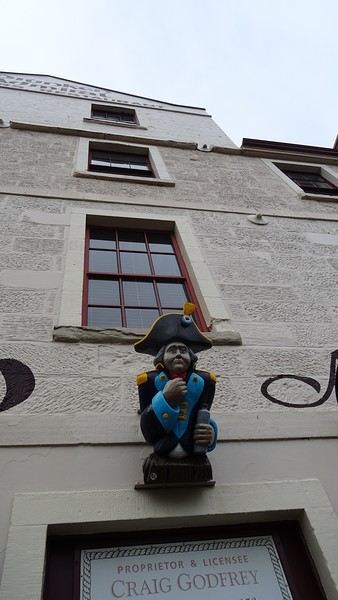
We cheered ourselves up by dining at *The Drunken Admiral* (reservations are a must—we barely snagged a table for 8 PM!). The decor is straight out of an old ship, complete with cheeky statues in the style of *Pirates of the Caribbean*… We had fun! The food was decent, but pricey. Dom loved it; I was less impressed.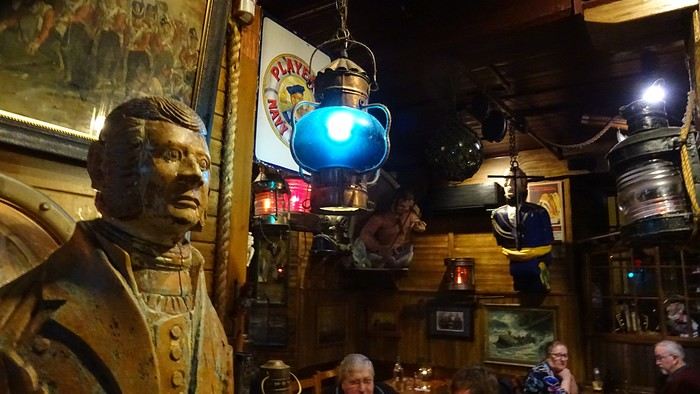
We bailed on the British series *Emma*, based on Jane Austen. We couldn’t take it anymore. The boredom was so intense that the specter of a collective suicide loomed over us. This show, where the world’s most insufferable bourgeoisie—the English nobility—lives out love stories with such improbable naivety that I wanted to scream, is pure torture. Mercy, I surrender! I’ll tell you anything you want, just make it stop! We got rid of it. We’re safe now!
We’ve also downgraded our accommodations. We’ve got a tiny room, and the bathroom—private, at least—is two hallways away… But the price is reasonable (under 100 €) and the location is central.
We cheered ourselves up by dining at *The Drunken Admiral* (reservations are a must—we barely snagged a table for 8 PM!). The decor is straight out of an old ship, complete with cheeky statues in the style of *Pirates of the Caribbean*… We had fun! The food was decent, but pricey. Dom loved it; I was less impressed.
We bailed on the British series *Emma*, based on Jane Austen. We couldn’t take it anymore. The boredom was so intense that the specter of a collective suicide loomed over us. This show, where the world’s most insufferable bourgeoisie—the English nobility—lives out love stories with such improbable naivety that I wanted to scream, is pure torture. Mercy, I surrender! I’ll tell you anything you want, just make it stop! We got rid of it. We’re safe now!
A lovely wander at the mercy of the wind in this amazing Rajasthan
Hey there, forum friends 😉
Some of you have mentioned missing the activity on this Indian "page," so let’s try to liven things up a bit—with joy and good vibes (mandatory with me 😜). Plus, it’ll make Jojoone happy 😊.
As big lovers of India—we’ve been six times—my co-traveler husband and I decided to explore Rajasthan this time around. The reason we waited so long to come here? We were dreading the tourist crowds in this state. But thanks to the timing (late March to early April 2024, which is starting to get pretty hot) and Aleph’s great tips, we were *very* far from mass tourism.
We spent three weeks getting around on our own for transport: mostly taxis and trains.
And I’ll admit, we had a rather "Arabian Nights" experience, far from the "real" India (Marien, if you’re reading this 😉). So this travel journal makes no claims other than to share what we saw, experienced, and felt—with all our ignorance about this country (which I’m fully aware of).
But fair warning: I go overboard with emojis, and this journal is super casual because it’s the one I share, almost in "live" mode, with our loved ones.
So, if you’re here, consider yourself almost part of the family 😄.
See you soon and....
Some of you have mentioned missing the activity on this Indian "page," so let’s try to liven things up a bit—with joy and good vibes (mandatory with me 😜). Plus, it’ll make Jojoone happy 😊.
As big lovers of India—we’ve been six times—my co-traveler husband and I decided to explore Rajasthan this time around. The reason we waited so long to come here? We were dreading the tourist crowds in this state. But thanks to the timing (late March to early April 2024, which is starting to get pretty hot) and Aleph’s great tips, we were *very* far from mass tourism.
We spent three weeks getting around on our own for transport: mostly taxis and trains.
And I’ll admit, we had a rather "Arabian Nights" experience, far from the "real" India (Marien, if you’re reading this 😉). So this travel journal makes no claims other than to share what we saw, experienced, and felt—with all our ignorance about this country (which I’m fully aware of).
But fair warning: I go overboard with emojis, and this journal is super casual because it’s the one I share, almost in "live" mode, with our loved ones.
So, if you’re here, consider yourself almost part of the family 😄.
See you soon and....
A Turquoise Dream Come True in Uzbekistan - 2022
We took this trip from September 12 to October 7, 2022. I didn’t post this travel journal earlier in Voyage Forum because the site wasn’t back up yet (and also because I was short on time).
Then, at the end of 2024, I made a promise to a friend: to publish my travel journal on VF. So here it is!
 We took off from Paris in the late afternoon on September 12 and arrived in Tashkent around 7:15 AM on the 13th.
This trip was the result of long contemplation and preparation (it was originally planned for the year of the lockdown (2020) and was prepared with the help and advice of Nasrullo Jumanov from Turquoise Travel.
Stages and Itinerary
Stage 1: Tashkent - September 13 and 14
Stage 2: Ferghana Valley – September 15 to 17
Stage 3: Nukus and Moynaq - September 18 and 19
Stage 4: Mysterious Khiva - September 20 to 22
Stage 5: Holy Bukhara - September 23 to 26
Stage 6: Asraf - September 27 and 28
Stage 7: Mythical Samarkand - September 29 to October 2
Stage 8: Tersak (via Shakhrisabz and Urgut) – October 3 and 4
Stage 9: Samarkand – October 5 and 6
Stage 10: Tashkent/Istanbul/Paris – October 6 and 7
Stage 1: Tashkent
September 13
At the airport exit, we were greeted by the owner of our B&B (B&B Gulnara).
Today was all about recovery and our first steps in the capital. Our first currency exchange made us feel like sudden millionaires.
Our first stroll down the avenue leading to Chorsu Market introduced us to the fact that 80 to 90% of the cars here are white Chevrolets.
A walk under the arcades facing Chorsu: hardware stores, cabinetmakers, lute makers (one of them gave me a little concert/demo of a few string instruments).
We took off from Paris in the late afternoon on September 12 and arrived in Tashkent around 7:15 AM on the 13th.
This trip was the result of long contemplation and preparation (it was originally planned for the year of the lockdown (2020) and was prepared with the help and advice of Nasrullo Jumanov from Turquoise Travel.
Stages and Itinerary
Stage 1: Tashkent - September 13 and 14
Stage 2: Ferghana Valley – September 15 to 17
Stage 3: Nukus and Moynaq - September 18 and 19
Stage 4: Mysterious Khiva - September 20 to 22
Stage 5: Holy Bukhara - September 23 to 26
Stage 6: Asraf - September 27 and 28
Stage 7: Mythical Samarkand - September 29 to October 2
Stage 8: Tersak (via Shakhrisabz and Urgut) – October 3 and 4
Stage 9: Samarkand – October 5 and 6
Stage 10: Tashkent/Istanbul/Paris – October 6 and 7
Stage 1: Tashkent
September 13
At the airport exit, we were greeted by the owner of our B&B (B&B Gulnara).
Today was all about recovery and our first steps in the capital. Our first currency exchange made us feel like sudden millionaires.
Our first stroll down the avenue leading to Chorsu Market introduced us to the fact that 80 to 90% of the cars here are white Chevrolets.
A walk under the arcades facing Chorsu: hardware stores, cabinetmakers, lute makers (one of them gave me a little concert/demo of a few string instruments).
As we entered the market, many vendors called out to us, including this florist who asked where we were from: ‘France? Ah! Macron! PSG!’ He then recited a list of players from the Parisian team as well as past (Platini, Zidane, etc.) and current (Giroud, Griezmann, Mbappé, etc.) French national team players. Since we’re more into rugby (we live near Toulouse), he knew more players than I did!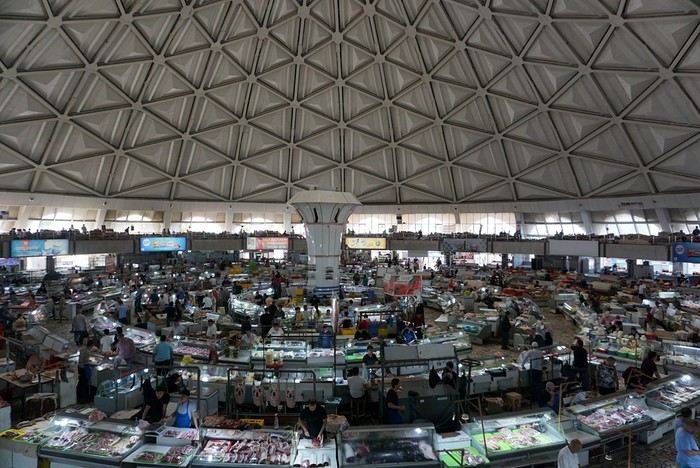
The market sprawls outside around the large circular, multi-story hall. We bought some grapes and bottles of freshly squeezed pomegranate juice for just a few sums. This evening, we had a meet-up with Nasrullo. The reunion was very warm: we’d been exchanging messages for over two years, and I’d been ‘torturing’ him with changes to our itinerary and trip duration. We were finally eager to meet, and honestly, I wasn’t disappointed—in fact, it was the opposite. Nasrullo was very attentive throughout our trip and always made sure, even from a distance (and most often from a distance!), that everything went smoothly. His goal was for us to leave delighted with our trip and, why not, indirectly become ambassadors for this destination. September 14 Breakfast with Nasrullo, then we set off with him by taxi to explore some of the capital’s sites.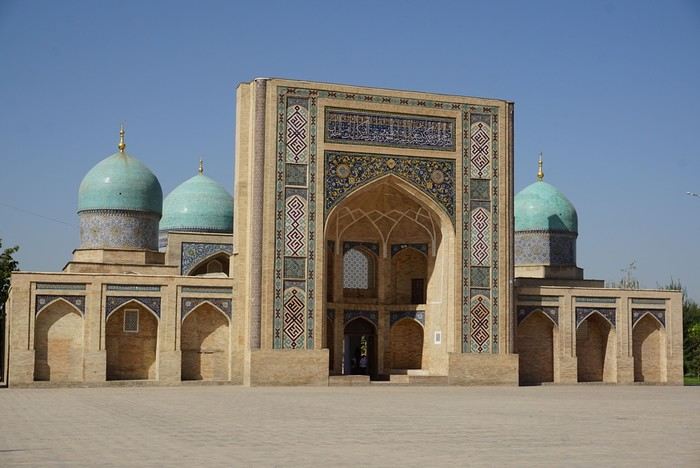
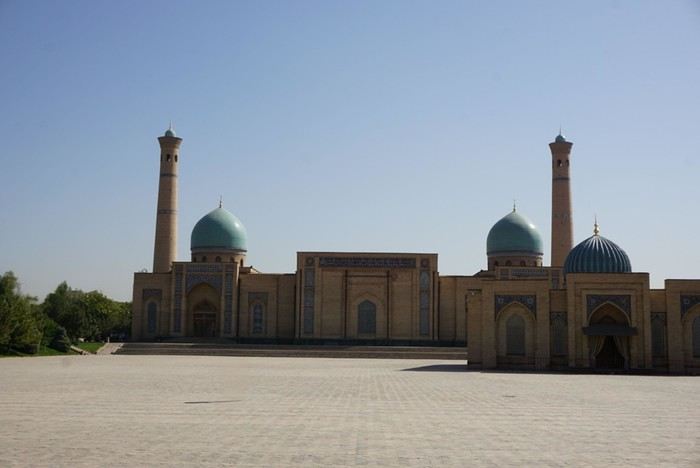
We started by visiting the Khazrati Imam complex, which includes the mausoleum of Kaffal Shashi, the Barak Khan and Muyi Muborak madrasas, and the great Khazrati Imam Mosque with its immense prayer hall.
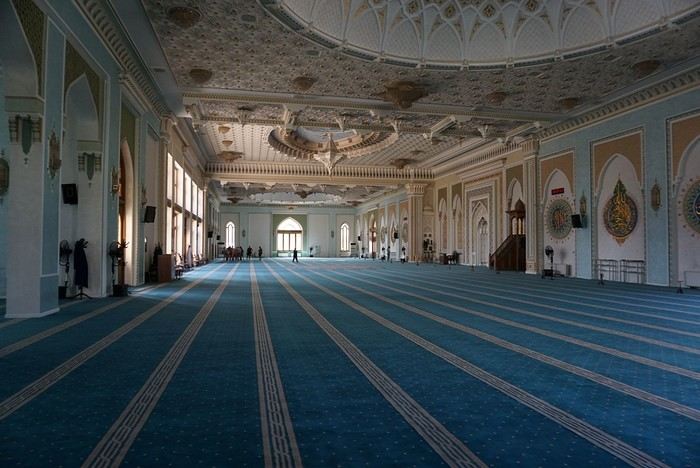
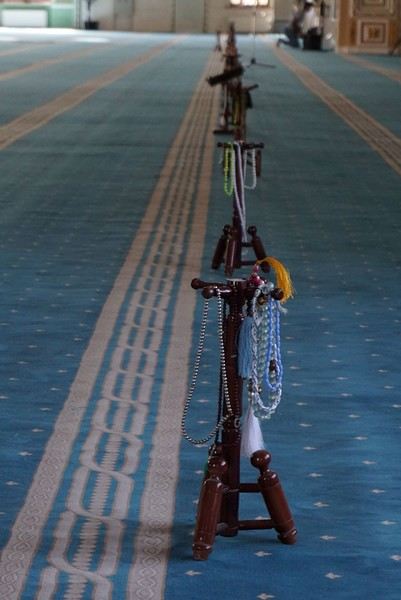
In the Muyi Muborak madrasa, now a museum, you can see the oldest Quran in the world. It was written by three religious scholars, including the secretary of the Prophet Muhammad, on large ‘pages’ made of antelope skin. Next, we explored Soviet-era Tashkent, discovering its parks, canals, and squares: Independence Square with its storks and phoenixes, Amir Temur Square with its large statue and, in the background, the massive Soviet-era hotel that has become one of Tashkent’s iconic buildings. Nasrullo took us through Broadway Boulevard and along what he calls ‘Tashkent’s Montmartre’… Well, it’s far, very far from Montmartre (in every sense of the word!). Then we took the metro to Chorsu station. Rush hour is pretty much the same everywhere in the metro… When we arrived at Chorsu, it was time to say goodbye. Nasrullo had to head back to Samarkand. Before leaving, he recommended some chaikhanas at the end of the galleries facing the market. We ate there for just a few euros (2 or 3 € for two people). After eating, we headed back to our room to cool off (our B&B is about a 10-minute walk away).
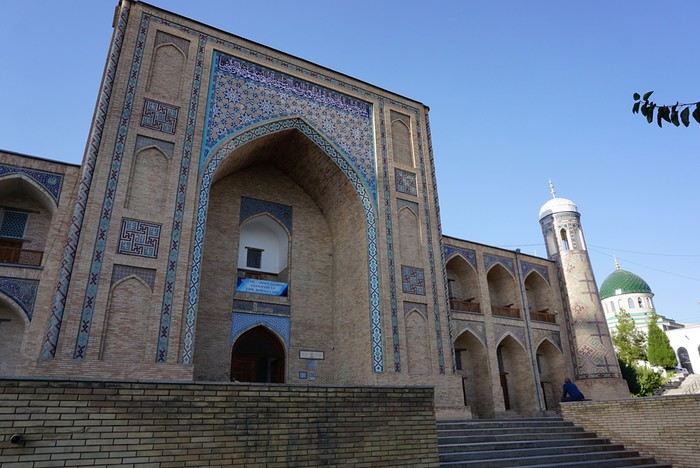
Around 4 PM, we set off to visit the Kokeldash Madrasa, which is still active. On the way, we stopped to watch some bread vendors and take a few photos. We were hesitating about buying some for our evening picnic when a young woman approached us. In perfect English, she asked: ‘Are you looking for something? Do you want to buy bread? Which one? How much?’ She then spoke to one of the vendors and negotiated the price. ‘Do you want one?’ And she took two. She paid directly. I took out my wallet to reimburse her, but she refused. It’s on the house! Then the vendor asked where we were from. And off we went again: Macron, PSG, football players… We’ll have to get used to it. The young woman smiled at the questions and comments, barely gave us time to thank her, and left as quickly as she had approached us.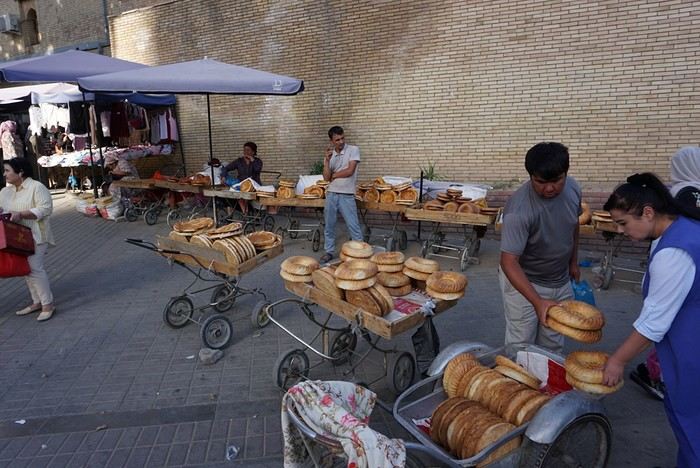
We continued our walk. Visited the madrasa. Then we crossed the boulevard to see the Tashkent Circus. I would’ve loved to go in and visit, but the ticket seller wouldn’t hear of it. We carried on around what should’ve been a park with old-fashioned rides and attractions. All we found was a construction site. Oh well! Back at our hotel, a message from Nasrullo was waiting for us. He had managed to change our train ticket for the next day. Instead of taking the 6:00 AM train, we’d take the 8:00 AM one. And instead of second class, we’d be in first class! Great! This evening, we had a picnic at one of the breakfast tables in the B&B courtyard. Under a shelter, the owner and his family were celebrating a birthday. The owner started by offering us some tea. Then they brought us some fruit (watermelon and melon). Finally, after the song, candles, and cake cutting, they brought us two generous slices of that beautiful birthday cake. Delicious!
We took off from Paris in the late afternoon on September 12 and arrived in Tashkent around 7:15 AM on the 13th.
This trip was the result of long contemplation and preparation (it was originally planned for the year of the lockdown (2020) and was prepared with the help and advice of Nasrullo Jumanov from Turquoise Travel.
Stages and Itinerary
Stage 1: Tashkent - September 13 and 14
Stage 2: Ferghana Valley – September 15 to 17
Stage 3: Nukus and Moynaq - September 18 and 19
Stage 4: Mysterious Khiva - September 20 to 22
Stage 5: Holy Bukhara - September 23 to 26
Stage 6: Asraf - September 27 and 28
Stage 7: Mythical Samarkand - September 29 to October 2
Stage 8: Tersak (via Shakhrisabz and Urgut) – October 3 and 4
Stage 9: Samarkand – October 5 and 6
Stage 10: Tashkent/Istanbul/Paris – October 6 and 7
Stage 1: Tashkent
September 13
At the airport exit, we were greeted by the owner of our B&B (B&B Gulnara).
Today was all about recovery and our first steps in the capital. Our first currency exchange made us feel like sudden millionaires.
Our first stroll down the avenue leading to Chorsu Market introduced us to the fact that 80 to 90% of the cars here are white Chevrolets.
A walk under the arcades facing Chorsu: hardware stores, cabinetmakers, lute makers (one of them gave me a little concert/demo of a few string instruments).As we entered the market, many vendors called out to us, including this florist who asked where we were from: ‘France? Ah! Macron! PSG!’ He then recited a list of players from the Parisian team as well as past (Platini, Zidane, etc.) and current (Giroud, Griezmann, Mbappé, etc.) French national team players. Since we’re more into rugby (we live near Toulouse), he knew more players than I did!
The market sprawls outside around the large circular, multi-story hall. We bought some grapes and bottles of freshly squeezed pomegranate juice for just a few sums. This evening, we had a meet-up with Nasrullo. The reunion was very warm: we’d been exchanging messages for over two years, and I’d been ‘torturing’ him with changes to our itinerary and trip duration. We were finally eager to meet, and honestly, I wasn’t disappointed—in fact, it was the opposite. Nasrullo was very attentive throughout our trip and always made sure, even from a distance (and most often from a distance!), that everything went smoothly. His goal was for us to leave delighted with our trip and, why not, indirectly become ambassadors for this destination. September 14 Breakfast with Nasrullo, then we set off with him by taxi to explore some of the capital’s sites.
We started by visiting the Khazrati Imam complex, which includes the mausoleum of Kaffal Shashi, the Barak Khan and Muyi Muborak madrasas, and the great Khazrati Imam Mosque with its immense prayer hall.
In the Muyi Muborak madrasa, now a museum, you can see the oldest Quran in the world. It was written by three religious scholars, including the secretary of the Prophet Muhammad, on large ‘pages’ made of antelope skin. Next, we explored Soviet-era Tashkent, discovering its parks, canals, and squares: Independence Square with its storks and phoenixes, Amir Temur Square with its large statue and, in the background, the massive Soviet-era hotel that has become one of Tashkent’s iconic buildings. Nasrullo took us through Broadway Boulevard and along what he calls ‘Tashkent’s Montmartre’… Well, it’s far, very far from Montmartre (in every sense of the word!). Then we took the metro to Chorsu station. Rush hour is pretty much the same everywhere in the metro… When we arrived at Chorsu, it was time to say goodbye. Nasrullo had to head back to Samarkand. Before leaving, he recommended some chaikhanas at the end of the galleries facing the market. We ate there for just a few euros (2 or 3 € for two people). After eating, we headed back to our room to cool off (our B&B is about a 10-minute walk away).
Around 4 PM, we set off to visit the Kokeldash Madrasa, which is still active. On the way, we stopped to watch some bread vendors and take a few photos. We were hesitating about buying some for our evening picnic when a young woman approached us. In perfect English, she asked: ‘Are you looking for something? Do you want to buy bread? Which one? How much?’ She then spoke to one of the vendors and negotiated the price. ‘Do you want one?’ And she took two. She paid directly. I took out my wallet to reimburse her, but she refused. It’s on the house! Then the vendor asked where we were from. And off we went again: Macron, PSG, football players… We’ll have to get used to it. The young woman smiled at the questions and comments, barely gave us time to thank her, and left as quickly as she had approached us.
We continued our walk. Visited the madrasa. Then we crossed the boulevard to see the Tashkent Circus. I would’ve loved to go in and visit, but the ticket seller wouldn’t hear of it. We carried on around what should’ve been a park with old-fashioned rides and attractions. All we found was a construction site. Oh well! Back at our hotel, a message from Nasrullo was waiting for us. He had managed to change our train ticket for the next day. Instead of taking the 6:00 AM train, we’d take the 8:00 AM one. And instead of second class, we’d be in first class! Great! This evening, we had a picnic at one of the breakfast tables in the B&B courtyard. Under a shelter, the owner and his family were celebrating a birthday. The owner started by offering us some tea. Then they brought us some fruit (watermelon and melon). Finally, after the song, candles, and cake cutting, they brought us two generous slices of that beautiful birthday cake. Delicious!
Three weeks in Norway (July 2022): fantastic memories despite the rain
Our trip to Norway was two years ago already, but I thought it might still be of interest—and it’ll let me relive it a bit by proxy.
Before booking our flight tickets, we debated the route: should we prioritize the north with the Lofoten and Senja islands, or the south with its countless fjords? I was tempted to stay in the south—the country is so vast, and the drive north is long... but my husband really didn’t want to miss the Lofoten. In the end, we figured that since Norway is known for being expensive, we might only visit once (funny how we said the same thing before our first trip to the American West, and look how that turned out 😎), so we didn’t want to skip anything. That meant a 2–3 day drive up north. With 22 days on the ground, it was doable. Especially since, as usual, we skip big cities and gave Oslo a pass.
Practical details: - Flight tickets: 1195 € for 4 with Air France (Paris–Oslo outbound, Tromsø–Bergen–Paris return) - Car rental: 2020 € for 21 days (including the outrageous drop-off fee between Oslo and Tromsø—about 1000 €) - Tolls and ferries: 250 € for the portion billed directly by the rental company. Some ferries required advance booking and payment at the time of reservation—I’ll note their prices as I go through the story. - Hotels: 4135 €, averaging 188 € per night. We blew past our usual budgets from trips to the U.S., but oh well... - Food: 1570 €, averaging 71 € per day for 4 in a country where everything’s expensive... How’d we manage? We rarely ate out, mostly grocery shopped, and even packed half a suitcase with non-perishables: pasta, rice, a few cans, and even some cured sausage! We also stayed 3 nights at Clarion Collection hotels, where an evening buffet was included in the room rate.
Before booking our flight tickets, we debated the route: should we prioritize the north with the Lofoten and Senja islands, or the south with its countless fjords? I was tempted to stay in the south—the country is so vast, and the drive north is long... but my husband really didn’t want to miss the Lofoten. In the end, we figured that since Norway is known for being expensive, we might only visit once (funny how we said the same thing before our first trip to the American West, and look how that turned out 😎), so we didn’t want to skip anything. That meant a 2–3 day drive up north. With 22 days on the ground, it was doable. Especially since, as usual, we skip big cities and gave Oslo a pass.
Practical details: - Flight tickets: 1195 € for 4 with Air France (Paris–Oslo outbound, Tromsø–Bergen–Paris return) - Car rental: 2020 € for 21 days (including the outrageous drop-off fee between Oslo and Tromsø—about 1000 €) - Tolls and ferries: 250 € for the portion billed directly by the rental company. Some ferries required advance booking and payment at the time of reservation—I’ll note their prices as I go through the story. - Hotels: 4135 €, averaging 188 € per night. We blew past our usual budgets from trips to the U.S., but oh well... - Food: 1570 €, averaging 71 € per day for 4 in a country where everything’s expensive... How’d we manage? We rarely ate out, mostly grocery shopped, and even packed half a suitcase with non-perishables: pasta, rice, a few cans, and even some cured sausage! We also stayed 3 nights at Clarion Collection hotels, where an evening buffet was included in the room rate.
Mexico: The Magic of the Yucatán
Hello everyone,
What a pleasure to be back on VF after a few difficult years 😎 So, before diving into the topic, welcome back to VF and above all... keep going!
Well, I’m finally picking up my old habit of posting a new travel journal.
Before heading to Mexico in the summer of 2023 with my family (my partner and our two boys, aged 18 and 16), I had somehow convinced myself—though I can’t even remember why—that the Yucatán was too touristy, too cliché, too expensive, and overrated!
The country didn’t particularly appeal to me, but faced with my wife’s insistence—she’d been there years ago, before we met, and had promised to show our sons this incredible place—my arguments didn’t hold much weight.
And thank goodness, because I have to admit she was absolutely right to take us there! In the end, we encountered far fewer tourists than we’d feared (except at a few sites), and the prices, which we’d been told were geared toward American neighbors (US), turned out to be quite affordable. In short, it was pure joy on both counts. All that was left was for the trip itself to be beautiful and memorable—and it was...
1st stop: Isla Holbox and the whale sharks
Holbox (pronounced “Hol-bosh”) is a stunning island where you can relax in an enchanting setting.
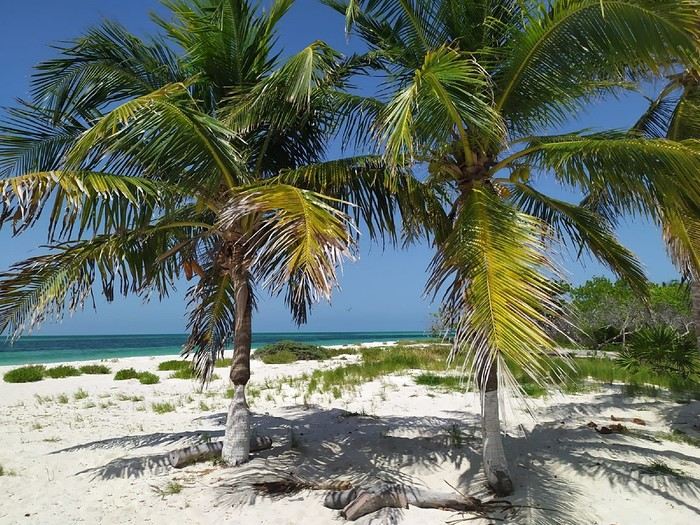
Our main goal in coming to Holbox was to swim with whale sharks. So, the first thing we told our hotel, Los Arcos Holbox, upon arrival was to arrange an excursion with one of the island’s many tour operators: Glendy Tours Holbox. We set off the next morning, bright and early.
The itinerary for this outing is the same for all tour operators (and there are about thirty of them!): roughly two hours by speedboat, then snorkeling with the whale sharks, followed by another boat ride to Cabo Catoche for lunch, then more boating to a fish-filled snorkeling spot before heading back. In total, the excursion can take eight hours—or even longer.
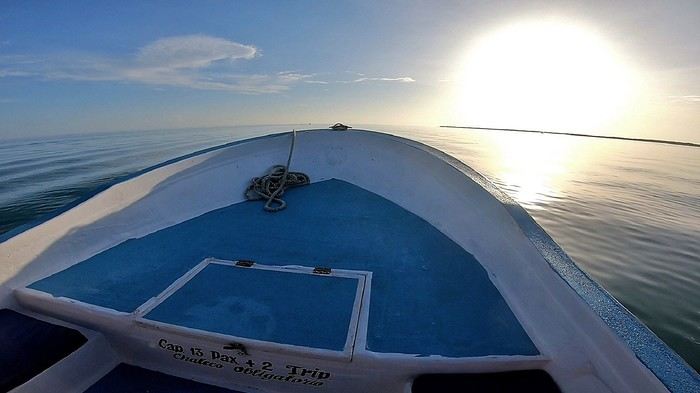
Besides my two sons and me, there were only two other clients on board—a French couple. Our boat was one of the very first to leave, but after ten minutes, the pilot got a radio call. We turned back without any explanation, returning to the departure dock.
There, a young woman who clearly fancied herself a diva was waiting for us. She was Mexican and boarded the boat, snubbing all five of us while flirting with the pilot and guide, who were suddenly all eyes for her. We couldn’t understand how this diva had convinced our tour operator to turn the boat around just to pick her up when she hadn’t even booked and we were already far out. We left 20 minutes late.
The two-hour journey passed surprisingly quickly, and for good reason: we spotted dolphins six times! They were leaping out of the water as they moved. Pure joy. We stopped whenever they were near the boat.
The photo isn’t great—the ultra-wide-angle lens on my GoPro makes the dolphins look smaller—but at least I got a souvenir.
A few flying fish (exocets) also glided a meter or two above the water as we sped along. The false start was forgotten, and the day was off to a fantastic start in this stunning marine environment...
When we reached the area where the whale sharks were supposed to be, the guide explained that we’d now have to scan the sea until we spotted one. It could take five minutes or forty-five, he said, and if we were unlucky, we might not see any at all!
An hour and a half later—still nothing! The captain then headed toward a distant area where about twenty other boats were already gathered.
Sure enough, there was a juvenile whale shark (still a good eight meters long) there, and all the boats were lining up to approach it slowly, one by one, so as not to scare the animal. Each boat got about thirty seconds within a few meters of it, engine idling, before making way for the next. We were allowed to approach three times, but we weren’t permitted to dive in. That’s normal—such a crowd of divers around a single animal would stress it out, and here, whale sharks are protected by regulations: swimming with them is strictly controlled. There was even a coast guard boat with us at all times, monitoring everyone’s behavior.
We were torn between the luck of seeing such a magnificent animal, even from the surface, and the discomfort we felt about the absurd situation. All those boats lined up just to catch a fleeting glimpse of the shark for a few seconds—let’s be honest, it was ridiculous. In short, the whole thing was unpleasant, and probably even more so for the shark than for us, though it did keep gulping down kilos of plankton as if nothing were happening...
When it was our turn to approach, I dipped my GoPro into the water at arm’s length and framed the shot blindly, hoping for a decent image of the shark.
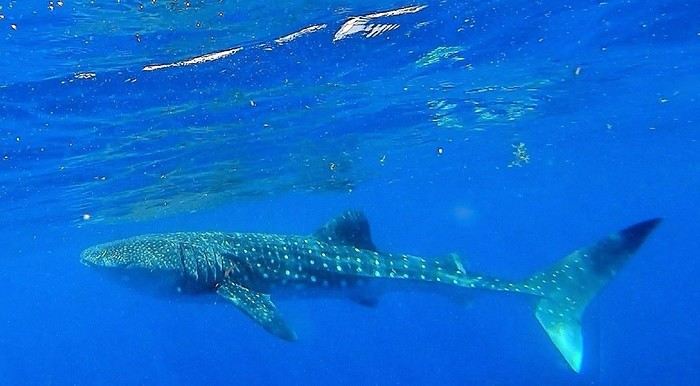
On the third and final approach, the sixth passenger on board—the one we’d had to turn back for ten minutes after departure—quietly spoke to the guide and captain after putting on her flippers (even though, I’ll remind you, no one was allowed to dive). She wanted them to ask the coast guard for permission to dive with the shark—just her! She whispered so we couldn’t hear what she was offering in exchange.
The two lackeys complied and shouted the request to the officials in front of all the other boats, with no shame whatsoever. With so many witnesses, the coast guard had no choice but to refuse. The diva wouldn’t let it go and asked them to insist, which they did, but the refusal was firm and final.
On the nearest boats, everyone had heard and was stunned. They openly mocked this bimbo who clearly had no shame. Hidden behind her star sunglasses, she responded with a dismissive smile. Pathetic.
The encounter with the shark ended, and we set off for Cabo Catoche, a site on Holbox Island where we were to have lunch.
We were a little disappointed not to have had the chance to see the usual school of whale sharks (they’re often dozens swimming together!), but that’s nature’s way, and we knew it.
And then, an unlikely stroke of luck: a boat ahead of us was putting divers in the water with a pair of adult whale sharks. We joined them, and while we were putting on our masks and snorkels, the guide briefed us. He said my sons and I would go first, followed by the French couple and the diva.
But Miss World, clearly unhappy with this order, quietly complained to the guide, who eventually switched the order. It didn’t bother us since we’d only get a minute in the water anyway—what’s a minute more or less?
So the three of them got in the water, and a moment later, they were done. My two sons and I, sitting on the edge of the boat with masks on and snorkels in our mouths, were ready to finally take the plunge. But instead of continuing to follow the shark, the captain was suddenly all eyes for Miss Silicone! He even let go of the wheel for a moment to help her back on board.
One of the two sharks had already left minutes earlier, and the second was swimming farther away. Other boats were arriving, and the captain went to join the queue 100 meters from the shark. Soon, even more boats showed up. There were way too many people, the shark left, and diving was no longer possible.
I was, of course, a little disappointed not to have fulfilled my long-time dream of swimming with a whale shark, even briefly. But I was mostly disgusted for my two boys, who had been so excited about it. I told the guide exactly what I thought and asked for compensation—not for missing out on swimming with the shark (you can never guarantee seeing one, nature isn’t at our beck and call), but for clearly skipping our turn to dive. He promised a refund.
At the end of the day, back on land, he dropped us all off, and as he was about to leave, I reminded him about the refund. He agreed again, calmly got back on board, and sped off as if nothing had happened—just him and the captain, two total cowards. I couldn’t believe it.
Of course, back at our hotel (which had booked this tour operator—Glendy Tours), I explained the situation and asked for my refund again. The receptionist called the manager, who arrived with the guide. Our runaway wasn’t so cocky anymore. Inside, I was fuming, but I kept my cool during the discussion that followed.
Right off the bat, I made a point of looking the so-called guide in the eyes while telling him he’d run off like a coward. I did my best to stay calm, speaking clearly, staring him down the whole time, and repeating several times that he was a coward, in front of the manager, who didn’t say a word. The guide had clearly been told by his boss to keep quiet because he didn’t utter a word during the entire twenty-minute conversation.
Anyway, I’ll spare you the details, but in the end, the manager only offered us another excursion the next day as compensation for the “inconvenience.” It was just snorkeling with fish, not another whale shark trip. He admitted their fault, but since we had to leave early the next morning and had other bookings for the rest of the trip, we couldn’t accept. And he refused to refund us.
On Tripadvisor, Glendy Tours has a mediocre rating (3 out of 5), but more importantly, it ranks 29th out of 36 nautical tour operators rated by customers. I was pretty upset with the hotel for booking such an amateur for us.

If you want to swim with whale sharks in Holbox, you might end up with Glendy Tours. And it might go well—I certainly hope so. But given the price of such an excursion (3,000 pesos per person, about 160 €!), I’d still suggest quickly checking online before you go to see which providers have the best ratings. You’ll have a much better chance of things going smoothly with the top-rated ones than with those as poorly ranked as Glendy Tours.
On the other hand, if you’re a beautiful young woman, you can choose them without worry—you’ll get better treatment than the rest of us...
To wrap up this excursion, I have to mention the “respect for nature” angle that all these tour operators highlight. They tell us they respect the whale sharks: only two or three people can dive at a time, and only for a few minutes, so as not to disturb these gentle giants...
We believed them before we left, but that’s not what we saw. When the sharks are hard to find except for one, everyone rushes it, and only the constant presence of the coast guard prevents the tour operators from putting their clients in the water.
Because for the second shark we saw, when the divers from our boat got out of the water and we left to join the queue while it was our turn to dive, other boats quickly arrived and started swarming the poor shark, which eventually left.
In other words, it’s clear these companies only respect the sharks when they’re being watched.
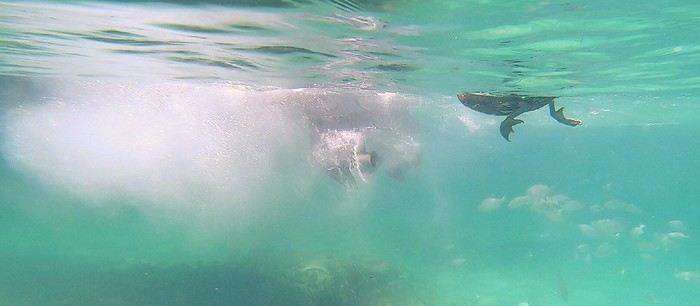 Boat reversing a meter away from a pelican
And for the snorkeling near Cabo Catoche, they attract fish daily by feeding them—a practice that’s normally discouraged. Afterward, these fish can’t feed naturally anymore and become dependent on Glendy Tours and its competitors.
A quick note on the rest of the excursion: Cabo Catoche (the site where we had lunch, on Holbox Island) is the northernmost point of the entire Yucatán. The place is paradise.
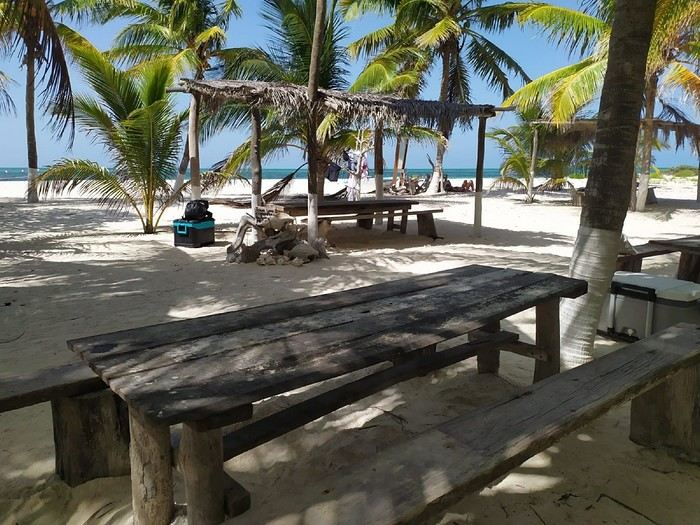
On the way back, we spent half an hour snorkeling at a site that turned out to be fish-filled only because the tour operators had the bad habit of feeding the fish. But this practice, which isn’t respectful of nature, is normally discouraged.
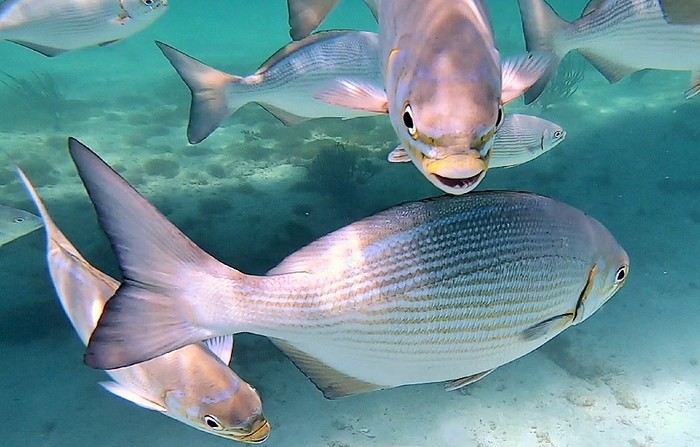
Plus, life jackets—like in many places in the Yucatán—are mandatory!!
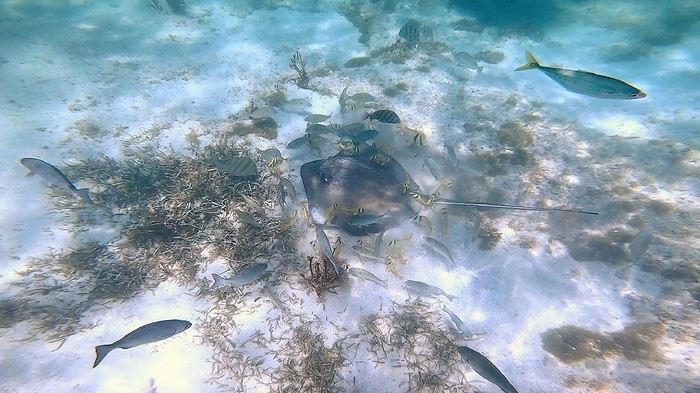
As divers, we didn’t find the site very interesting, but objectively, it should delight those who aren’t used to putting their heads underwater in beautiful dive spots.
We hated feeling trapped in those life jackets, stuck at the surface, and for me, the highlight was swimming next to a pelican that wasn’t too shy—it was paddling right beside me in green water.
Anyway, it seems we can’t post more than 10 photos at once on VF, so I’ll come back with the rest of the journal in another message. Because after these early trip mishaps, the rest of the journey turned out to be magnificent...
What a pleasure to be back on VF after a few difficult years 😎 So, before diving into the topic, welcome back to VF and above all... keep going!
Well, I’m finally picking up my old habit of posting a new travel journal.
Before heading to Mexico in the summer of 2023 with my family (my partner and our two boys, aged 18 and 16), I had somehow convinced myself—though I can’t even remember why—that the Yucatán was too touristy, too cliché, too expensive, and overrated!
The country didn’t particularly appeal to me, but faced with my wife’s insistence—she’d been there years ago, before we met, and had promised to show our sons this incredible place—my arguments didn’t hold much weight.
And thank goodness, because I have to admit she was absolutely right to take us there! In the end, we encountered far fewer tourists than we’d feared (except at a few sites), and the prices, which we’d been told were geared toward American neighbors (US), turned out to be quite affordable. In short, it was pure joy on both counts. All that was left was for the trip itself to be beautiful and memorable—and it was...
1st stop: Isla Holbox and the whale sharks
Holbox (pronounced “Hol-bosh”) is a stunning island where you can relax in an enchanting setting.
Our main goal in coming to Holbox was to swim with whale sharks. So, the first thing we told our hotel, Los Arcos Holbox, upon arrival was to arrange an excursion with one of the island’s many tour operators: Glendy Tours Holbox. We set off the next morning, bright and early.
The itinerary for this outing is the same for all tour operators (and there are about thirty of them!): roughly two hours by speedboat, then snorkeling with the whale sharks, followed by another boat ride to Cabo Catoche for lunch, then more boating to a fish-filled snorkeling spot before heading back. In total, the excursion can take eight hours—or even longer.
Besides my two sons and me, there were only two other clients on board—a French couple. Our boat was one of the very first to leave, but after ten minutes, the pilot got a radio call. We turned back without any explanation, returning to the departure dock.
There, a young woman who clearly fancied herself a diva was waiting for us. She was Mexican and boarded the boat, snubbing all five of us while flirting with the pilot and guide, who were suddenly all eyes for her. We couldn’t understand how this diva had convinced our tour operator to turn the boat around just to pick her up when she hadn’t even booked and we were already far out. We left 20 minutes late.
The two-hour journey passed surprisingly quickly, and for good reason: we spotted dolphins six times! They were leaping out of the water as they moved. Pure joy. We stopped whenever they were near the boat.
The photo isn’t great—the ultra-wide-angle lens on my GoPro makes the dolphins look smaller—but at least I got a souvenir.
A few flying fish (exocets) also glided a meter or two above the water as we sped along. The false start was forgotten, and the day was off to a fantastic start in this stunning marine environment...
When we reached the area where the whale sharks were supposed to be, the guide explained that we’d now have to scan the sea until we spotted one. It could take five minutes or forty-five, he said, and if we were unlucky, we might not see any at all!
An hour and a half later—still nothing! The captain then headed toward a distant area where about twenty other boats were already gathered.
Sure enough, there was a juvenile whale shark (still a good eight meters long) there, and all the boats were lining up to approach it slowly, one by one, so as not to scare the animal. Each boat got about thirty seconds within a few meters of it, engine idling, before making way for the next. We were allowed to approach three times, but we weren’t permitted to dive in. That’s normal—such a crowd of divers around a single animal would stress it out, and here, whale sharks are protected by regulations: swimming with them is strictly controlled. There was even a coast guard boat with us at all times, monitoring everyone’s behavior.
We were torn between the luck of seeing such a magnificent animal, even from the surface, and the discomfort we felt about the absurd situation. All those boats lined up just to catch a fleeting glimpse of the shark for a few seconds—let’s be honest, it was ridiculous. In short, the whole thing was unpleasant, and probably even more so for the shark than for us, though it did keep gulping down kilos of plankton as if nothing were happening...
When it was our turn to approach, I dipped my GoPro into the water at arm’s length and framed the shot blindly, hoping for a decent image of the shark.
On the third and final approach, the sixth passenger on board—the one we’d had to turn back for ten minutes after departure—quietly spoke to the guide and captain after putting on her flippers (even though, I’ll remind you, no one was allowed to dive). She wanted them to ask the coast guard for permission to dive with the shark—just her! She whispered so we couldn’t hear what she was offering in exchange.
The two lackeys complied and shouted the request to the officials in front of all the other boats, with no shame whatsoever. With so many witnesses, the coast guard had no choice but to refuse. The diva wouldn’t let it go and asked them to insist, which they did, but the refusal was firm and final.
On the nearest boats, everyone had heard and was stunned. They openly mocked this bimbo who clearly had no shame. Hidden behind her star sunglasses, she responded with a dismissive smile. Pathetic.
The encounter with the shark ended, and we set off for Cabo Catoche, a site on Holbox Island where we were to have lunch.
We were a little disappointed not to have had the chance to see the usual school of whale sharks (they’re often dozens swimming together!), but that’s nature’s way, and we knew it.
And then, an unlikely stroke of luck: a boat ahead of us was putting divers in the water with a pair of adult whale sharks. We joined them, and while we were putting on our masks and snorkels, the guide briefed us. He said my sons and I would go first, followed by the French couple and the diva.
But Miss World, clearly unhappy with this order, quietly complained to the guide, who eventually switched the order. It didn’t bother us since we’d only get a minute in the water anyway—what’s a minute more or less?
So the three of them got in the water, and a moment later, they were done. My two sons and I, sitting on the edge of the boat with masks on and snorkels in our mouths, were ready to finally take the plunge. But instead of continuing to follow the shark, the captain was suddenly all eyes for Miss Silicone! He even let go of the wheel for a moment to help her back on board.
One of the two sharks had already left minutes earlier, and the second was swimming farther away. Other boats were arriving, and the captain went to join the queue 100 meters from the shark. Soon, even more boats showed up. There were way too many people, the shark left, and diving was no longer possible.
I was, of course, a little disappointed not to have fulfilled my long-time dream of swimming with a whale shark, even briefly. But I was mostly disgusted for my two boys, who had been so excited about it. I told the guide exactly what I thought and asked for compensation—not for missing out on swimming with the shark (you can never guarantee seeing one, nature isn’t at our beck and call), but for clearly skipping our turn to dive. He promised a refund.
At the end of the day, back on land, he dropped us all off, and as he was about to leave, I reminded him about the refund. He agreed again, calmly got back on board, and sped off as if nothing had happened—just him and the captain, two total cowards. I couldn’t believe it.
Of course, back at our hotel (which had booked this tour operator—Glendy Tours), I explained the situation and asked for my refund again. The receptionist called the manager, who arrived with the guide. Our runaway wasn’t so cocky anymore. Inside, I was fuming, but I kept my cool during the discussion that followed.
Right off the bat, I made a point of looking the so-called guide in the eyes while telling him he’d run off like a coward. I did my best to stay calm, speaking clearly, staring him down the whole time, and repeating several times that he was a coward, in front of the manager, who didn’t say a word. The guide had clearly been told by his boss to keep quiet because he didn’t utter a word during the entire twenty-minute conversation.
Anyway, I’ll spare you the details, but in the end, the manager only offered us another excursion the next day as compensation for the “inconvenience.” It was just snorkeling with fish, not another whale shark trip. He admitted their fault, but since we had to leave early the next morning and had other bookings for the rest of the trip, we couldn’t accept. And he refused to refund us.
On Tripadvisor, Glendy Tours has a mediocre rating (3 out of 5), but more importantly, it ranks 29th out of 36 nautical tour operators rated by customers. I was pretty upset with the hotel for booking such an amateur for us.
If you want to swim with whale sharks in Holbox, you might end up with Glendy Tours. And it might go well—I certainly hope so. But given the price of such an excursion (3,000 pesos per person, about 160 €!), I’d still suggest quickly checking online before you go to see which providers have the best ratings. You’ll have a much better chance of things going smoothly with the top-rated ones than with those as poorly ranked as Glendy Tours.
On the other hand, if you’re a beautiful young woman, you can choose them without worry—you’ll get better treatment than the rest of us...
To wrap up this excursion, I have to mention the “respect for nature” angle that all these tour operators highlight. They tell us they respect the whale sharks: only two or three people can dive at a time, and only for a few minutes, so as not to disturb these gentle giants...
We believed them before we left, but that’s not what we saw. When the sharks are hard to find except for one, everyone rushes it, and only the constant presence of the coast guard prevents the tour operators from putting their clients in the water.
Because for the second shark we saw, when the divers from our boat got out of the water and we left to join the queue while it was our turn to dive, other boats quickly arrived and started swarming the poor shark, which eventually left.
In other words, it’s clear these companies only respect the sharks when they’re being watched.
Boat reversing a meter away from a pelicanAnd for the snorkeling near Cabo Catoche, they attract fish daily by feeding them—a practice that’s normally discouraged. Afterward, these fish can’t feed naturally anymore and become dependent on Glendy Tours and its competitors.
A quick note on the rest of the excursion: Cabo Catoche (the site where we had lunch, on Holbox Island) is the northernmost point of the entire Yucatán. The place is paradise.
On the way back, we spent half an hour snorkeling at a site that turned out to be fish-filled only because the tour operators had the bad habit of feeding the fish. But this practice, which isn’t respectful of nature, is normally discouraged.
Plus, life jackets—like in many places in the Yucatán—are mandatory!!
As divers, we didn’t find the site very interesting, but objectively, it should delight those who aren’t used to putting their heads underwater in beautiful dive spots.
We hated feeling trapped in those life jackets, stuck at the surface, and for me, the highlight was swimming next to a pelican that wasn’t too shy—it was paddling right beside me in green water.
Anyway, it seems we can’t post more than 10 photos at once on VF, so I’ll come back with the rest of the journal in another message. Because after these early trip mishaps, the rest of the journey turned out to be magnificent...
4 friends discover a piece of North India
Hello fellow travelers!
I’m adding my small contribution to the reopening celebration by posting this travel journal from India, made in January 2024. We’re 4 friends (2 couples), and we did a 3-week loop in Rajasthan, stopping by Delhi and Agra (which, as everyone knows, aren’t in Rajasthan 😛). Delhi - Agra - Jaipur - Bundi - Udaipur - Jodhpur - Jaisalmer - Delhi
We rented a car with a driver from Agra to Jaisalmer, 550 € for 14 days. https://chauffeurpriveeninde.com/fr/
We took the train from Delhi to Agra and the plane (Spicejet) from Jaisalmer to Delhi.
Most of the accommodations were booked on Booking before we left.
I’m sharing this story written by Richard and illustrated by me. We dedicate it to Nathalie and Bruno, our amazing travel companions.
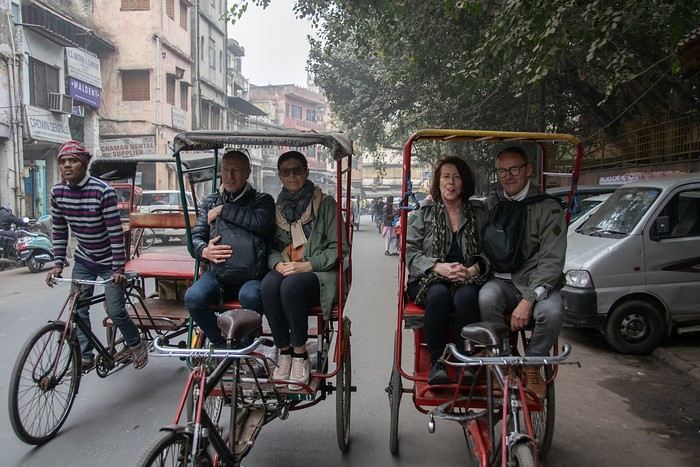
I’m adding my small contribution to the reopening celebration by posting this travel journal from India, made in January 2024. We’re 4 friends (2 couples), and we did a 3-week loop in Rajasthan, stopping by Delhi and Agra (which, as everyone knows, aren’t in Rajasthan 😛). Delhi - Agra - Jaipur - Bundi - Udaipur - Jodhpur - Jaisalmer - Delhi
We rented a car with a driver from Agra to Jaisalmer, 550 € for 14 days. https://chauffeurpriveeninde.com/fr/
We took the train from Delhi to Agra and the plane (Spicejet) from Jaisalmer to Delhi.
Most of the accommodations were booked on Booking before we left.
I’m sharing this story written by Richard and illustrated by me. We dedicate it to Nathalie and Bruno, our amazing travel companions.
Bordeaux - Biarritz - San Sebastian à pied English translation pending
Bonjour,
Dans deux semaines, nous souhaiterions partir randonner de Bordeaux à San Sebastian. Je préfère passer par ce site avant de me lancer ds l'achat de guides...et les infos, pas évidentes à trouver sur internet pour cette portion du trajet.
Bref... je souhaiterais savoir quel est le chemin le plus chouette de Bordeaux à Biarritz, car il existe plusieurs itinéraires. Quel niveau de difficulté? Durée?
En vous remerciant par avance
Dans deux semaines, nous souhaiterions partir randonner de Bordeaux à San Sebastian. Je préfère passer par ce site avant de me lancer ds l'achat de guides...et les infos, pas évidentes à trouver sur internet pour cette portion du trajet.
Bref... je souhaiterais savoir quel est le chemin le plus chouette de Bordeaux à Biarritz, car il existe plusieurs itinéraires. Quel niveau de difficulté? Durée?
En vous remerciant par avance
My Battle with Excess Weight (How I Lost 5 Kilos in 2 Days, by Bike)
New, seen on TV, you won't believe it. Click here.
During my recent trek, I found that my bike—and my luggage—were heavy. Until now, the weight of my gear hadn’t been an issue. Maybe I’m getting old, or maybe I just can’t handle the SNCF’s stairs anymore.
It hit me in Toulouse. A 3-minute stop turned into a 6-hour delay because of a fire that was hard to control between Toulouse and Montauban. Eventually, our train was canceled, and we were told to take another train that was also waiting for the same destination. It was my fourth train of the day. It was 9:30 PM, and I’d left at 9:30 AM that morning. Suddenly, exhaustion took over.
That’s when I met two bike-packers who, without hesitation, lifted their bikes with all their gear attached, carried them down the steps of the Corail train, and then down the stairs to the underground passage. They were young and fit (they smelled like warm sand), and I definitely wasn’t. It was in that scorching heat, struggling up and down all those stairs (Oh Toulouse, as Nougaro would say, may you be cursed for seven generations), that I decided to go on a diet.
It’s a diet anyone can do, it works, and it’s free. So I’m sharing it right away.
No need to exercise or restrict yourself. No, all you have to do is think and do some research. You need a chair, a table, a scale, a computer, and a spreadsheet. Make a list of everything you’ve brought and weigh it all. Set a goal based on the type of trek and your comfort level. Remove everything that doesn’t help you reach that goal.
My goal: - Trekking in France from May to September, in the plains or at most on a plateau like Mont Aubrac, where at 800 m altitude, it can drop to 10 °C at night even in the middle of summer.
- Sleeping in a tent on a good mattress in a sleeping bag (I’m not changing that). Someone suggested I could sleep under the stars on bubble wrap. No way, are you crazy?
- Not cooking. I buy lunch on the way in the morning and dinner on the way in the afternoon (I’m not changing that either). Someone suggested Ducasse delivers everywhere in France. Uh, have you been smoking lemon weed?
That’s how I lost 5 kg, going from 17.7 kg to 12.8 kg, including luggage but not food or water. But I also reduced the volume and quantity of my gear.
Here are the before photos:
https://photos.app.goo.gl/XDfKaoVvHFNxDXrq5
And after:
https://photos.app.goo.gl/STRVKaWuVcNVeCfS9
of my bike.
You can see that a duffel bag is gone, as well as the extra bags behind the panniers. I don’t even use the mesh pockets at the bottom of each pannier anymore. You can also see I’m still carrying my 1 kg U-lock. I know, it’s unforgivable. I’m on the verge of being banned.
So I might do another trek in September to validate my choices.
For the rear panniers, I can save between 1 and 1.5 kg depending on the solution: Arkel Dry-lites (28 L pair, 0.540 kg) or Vaude Aqua Light (38 L pair, 1.080 kg).
I also need to cut down on the tools I bring. I should be able to shave off about 0.5 kg.
And the bike? I’m thinking about it. Someone suggested the folding Savadeck Z2, which only weighs 10 kg. Carbon? Oh, don’t spread the word—it’s even more taboo than aluminum in some circles, and I won’t even mention the belt drive.
During my recent trek, I found that my bike—and my luggage—were heavy. Until now, the weight of my gear hadn’t been an issue. Maybe I’m getting old, or maybe I just can’t handle the SNCF’s stairs anymore.
It hit me in Toulouse. A 3-minute stop turned into a 6-hour delay because of a fire that was hard to control between Toulouse and Montauban. Eventually, our train was canceled, and we were told to take another train that was also waiting for the same destination. It was my fourth train of the day. It was 9:30 PM, and I’d left at 9:30 AM that morning. Suddenly, exhaustion took over.
That’s when I met two bike-packers who, without hesitation, lifted their bikes with all their gear attached, carried them down the steps of the Corail train, and then down the stairs to the underground passage. They were young and fit (they smelled like warm sand), and I definitely wasn’t. It was in that scorching heat, struggling up and down all those stairs (Oh Toulouse, as Nougaro would say, may you be cursed for seven generations), that I decided to go on a diet.
It’s a diet anyone can do, it works, and it’s free. So I’m sharing it right away.
No need to exercise or restrict yourself. No, all you have to do is think and do some research. You need a chair, a table, a scale, a computer, and a spreadsheet. Make a list of everything you’ve brought and weigh it all. Set a goal based on the type of trek and your comfort level. Remove everything that doesn’t help you reach that goal.
My goal: - Trekking in France from May to September, in the plains or at most on a plateau like Mont Aubrac, where at 800 m altitude, it can drop to 10 °C at night even in the middle of summer.
- Sleeping in a tent on a good mattress in a sleeping bag (I’m not changing that). Someone suggested I could sleep under the stars on bubble wrap. No way, are you crazy?
- Not cooking. I buy lunch on the way in the morning and dinner on the way in the afternoon (I’m not changing that either). Someone suggested Ducasse delivers everywhere in France. Uh, have you been smoking lemon weed?
That’s how I lost 5 kg, going from 17.7 kg to 12.8 kg, including luggage but not food or water. But I also reduced the volume and quantity of my gear.
Here are the before photos:
https://photos.app.goo.gl/XDfKaoVvHFNxDXrq5
And after:
https://photos.app.goo.gl/STRVKaWuVcNVeCfS9
of my bike.
You can see that a duffel bag is gone, as well as the extra bags behind the panniers. I don’t even use the mesh pockets at the bottom of each pannier anymore. You can also see I’m still carrying my 1 kg U-lock. I know, it’s unforgivable. I’m on the verge of being banned.
So I might do another trek in September to validate my choices.
For the rear panniers, I can save between 1 and 1.5 kg depending on the solution: Arkel Dry-lites (28 L pair, 0.540 kg) or Vaude Aqua Light (38 L pair, 1.080 kg).
I also need to cut down on the tools I bring. I should be able to shave off about 0.5 kg.
And the bike? I’m thinking about it. Someone suggested the folding Savadeck Z2, which only weighs 10 kg. Carbon? Oh, don’t spread the word—it’s even more taboo than aluminum in some circles, and I won’t even mention the belt drive.
Identité de genre et orientations sexuelles en voyage English translation pending
Bonjour à toutes et à tous!
J'aimerais bien avoir votre opinion sur la façon dont les questions du genre et de l'orientation sexuelle sont perçues dans les différentes régions du monde que vous avez visitées.
En Occident, ces questions sont débattues et les différences de mieux en mieux acceptées, même s'il y a encore beaucoup de chemin à faire. Mais comment ça se passe ailleurs ? En Afrique par exemple, ou en Asie ?
Si je pose ma question sur ce forum c'est parce que j'aimerais avoir des avis de première main. Par exemple, qui d'entre vous a parlé à des hijras (Inde) ou à des Katoï (Thaïlande) de leurs conditions de vie? Savez-vous comment elles/ils sont vu.e.s par leurs compatriotes? Sont-elles/ils admis.e.s ou rejeté.e.s?
Une autre de mes questions tourne autour des touristes occidentales/aux LGBT. Y a-t-il des pays ou des régions où on peut en toute tranquillité afficher ses préférences? Par exemple, est-ce que deux lesbiennes peuvent marcher main dans la main dans le centre de Marrakech ou est-ce qu'il y a des bars LGBT en Chine?
Si vous êtes vous-même concerné.e.s par ces questions, pouvez-vous raconter des anecdotes et bien entendu donner des conseils sur où aller et où ne pas aller?
Merci d'avance 😎
PS:Pourquoi n'a-t-on le choix qu'entre deux sexes dans le formulaire d'inscription du site ?

PS:Pourquoi n'a-t-on le choix qu'entre deux sexes dans le formulaire d'inscription du site ?
Évasion en Thaïlande English translation pending
J'ai déjà expliqué ici le contexte de mes publications et pourquoi je remonte à ce point dans le temps. Cette fois-ci, on est en 2014. Je pars du présupposé que les choses n'ont pas considérablement changées et que ces voyages peuvent encore, malgré le temps passsé, en inspirer d'autres...
dimanche 30 novembre 2014 Mulhouse - Amsterdam
Bien sûr, tu le sais, ça fait des mois que j’en parle, ce matin on part vers Bangkok, Thaïlande. Pour Dom et moi, la voyago-thérapie : le must pour réduire à rien les agressions du moment, essentiellement liées à des histoires de boulot; mais je vais pas m'égarer là-dedans, ce n'est pas l'endroit!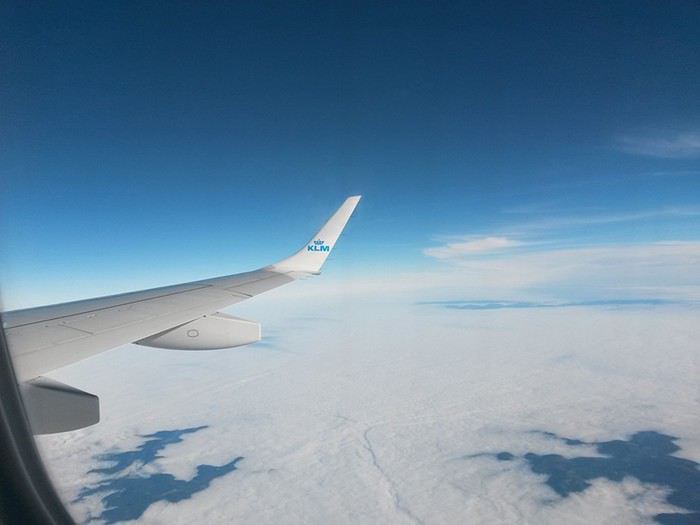
Escale à Amsterdam...
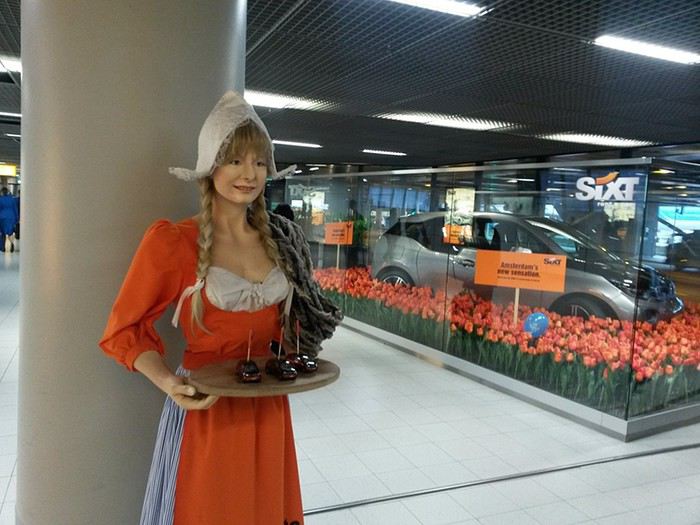
Lundi 1 décembre 2014 Bangkok
Même si c’est hautement probablement faux, on arrive à Bangkok alors qu’il m’a semblé n’avoir, à aucun moment, fermé l’œil. Les habituelles files d’attente à la douane présentent, il faut le souligner, des visages aimables… les bagages...Le taxi (rigolard comme ce n’est plus permis en occident :), l’hôtel...Nickel avec une magnifique terrasse au bord de la Navalaï River...Tous les flags sont au vert ! Tu nous connais, on traîne pas trop avant d’aller découvrir la ville ! On demande notre chemin à un type super accueillant qui hèle aussitôt un môme avec un « tuk tuk », une sorte de mobylette encarénée très appréciée des touristes because costless en diable ! Notre mentor négocie pour 40 baths (1 euro !), un tour des temples du nord. On se laisse driver sans discuter...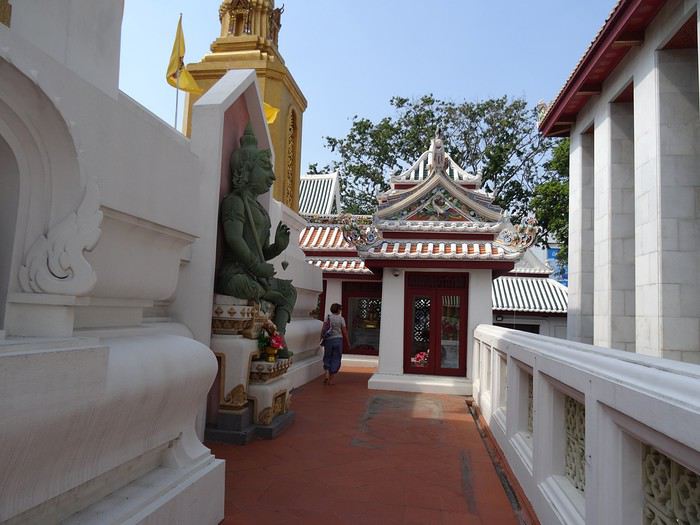
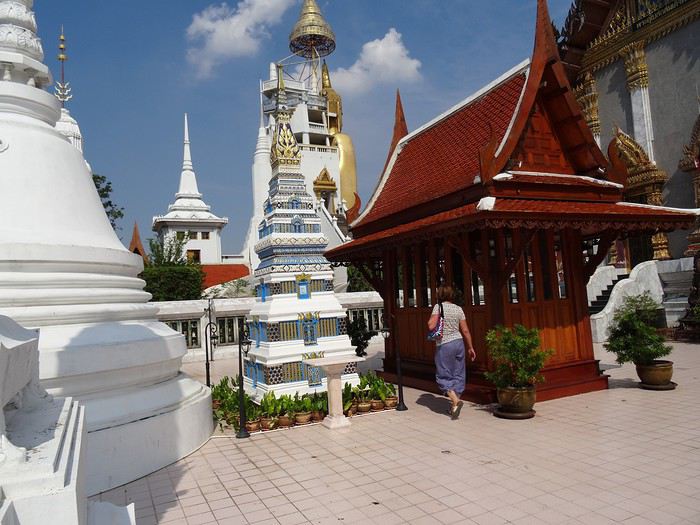
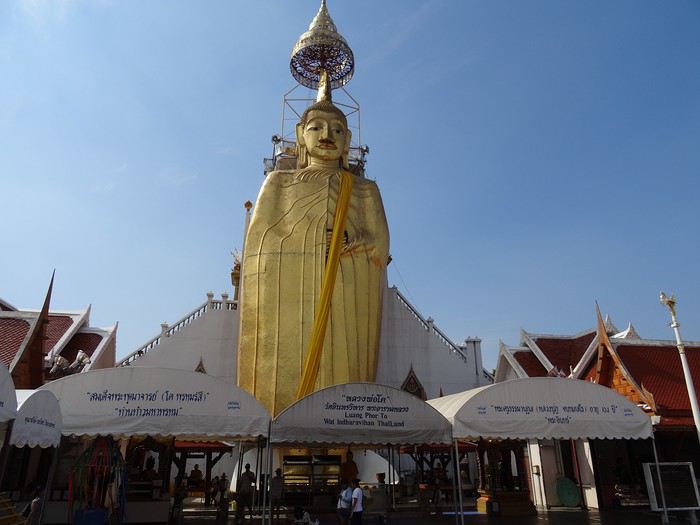
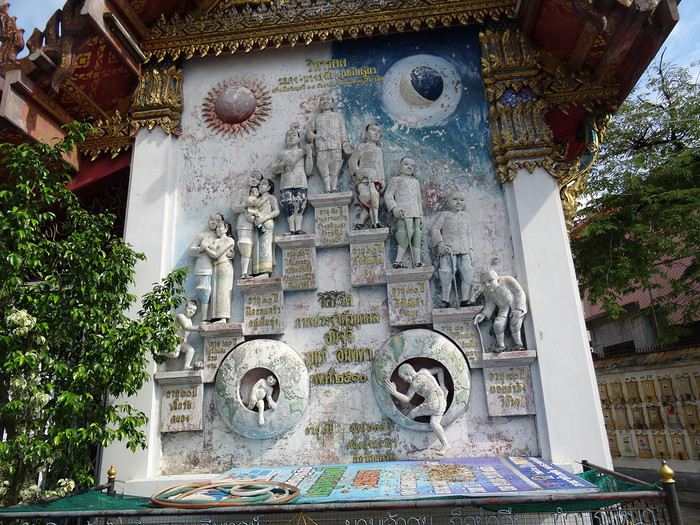
Après le troisième temple, le môme tourne bizarre. Il a arrêté d’être juste aimable. Nous presse. Puis, au milieu d’une visite, nous enjoint de le suivre, il veut nous montrer, dans une certaine urgence, quelque chose. Il nous emmène vers un homme d’âge respectable, une sorte de bonze aimable, affable, qui nous raconte, dans un français correct, sa jeunesse à Bordeaux, puis glisse insensiblement sur la théorie économique et ses inconstances, de la difficulté induite à placer le fruit de notre dur labeur dans quelque chose de pérenne. On le sentait venir. Devine où il est le plus sûr de placer son argent ? Dans la pierre précieuse, naturellement ! Et là, le monde est quand même bien fichu, figure toi que notre interlocuteur connait justement quelques joailliers d’art qui accepteraient de nous vendre à prix coûtant des saphirs de la région, et sans taxes encore! Bon. Le môme nous a embarqués dans un traquenard. On réussit cependant sans trop de difficulté à se débarrasser du fâcheux et reprenons l’expédition où nous l’avions laissée. Quand je demande au môme où se trouve la prochaine destination, je l’oblige à répéter plusieurs fois tant la chose me semble incongrue, mais c’est bien ça, sa réponse s’entend : « Thaï export !». On décide aussitôt d’abandonner la virée. On lâche 40 baths au gamin et sautons de sa mobylette au premier feu rouge. Ensuite, on a agité nos petites mains pour tenter d’attirer un taxi sous le cagnard, un Thaï d’un âge plus que respectable, nous a embarqué dans un véhicule qu’il a eu toute les peines du monde à maintenir sur la route, propulsés dans une sorte de jeu vidéo mortel, un grand thief auto à travers une circulation en délire… Mais ça va. Pour une poignée d’euros il nous a ramené à notre hôtel, sains et saufs ! Là, faut se remettre, pot au bord de la rivière... « Ça doit être possible de faire une ballade sur le fleuve, tu crois pas? » J’en parle à notre hôte à l’accueil, le truc est organisé dans la foulée ! Une efficacité qui laisse ébahi ! On a un bateau pour une virée d’une heure à travers la ville.
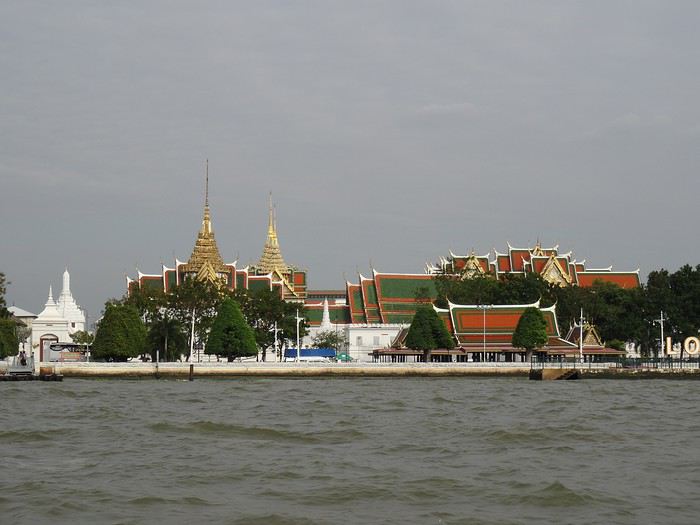
En traversant un petit village sur pilotis, je vois nager un drôle de truc, comme un chien. A force d’écarquiller les yeux, on distingue tout un groupe de Varans!
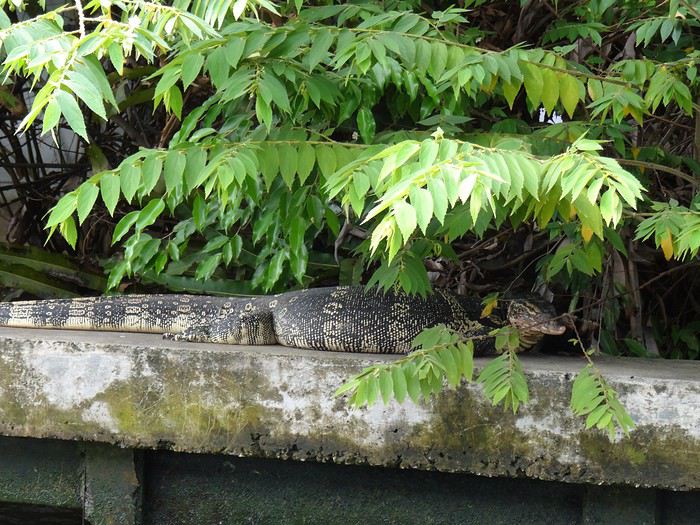
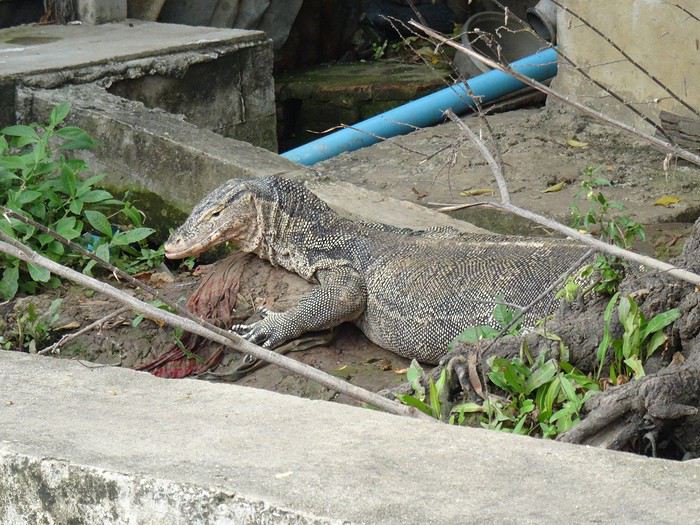
dimanche 30 novembre 2014 Mulhouse - Amsterdam
Bien sûr, tu le sais, ça fait des mois que j’en parle, ce matin on part vers Bangkok, Thaïlande. Pour Dom et moi, la voyago-thérapie : le must pour réduire à rien les agressions du moment, essentiellement liées à des histoires de boulot; mais je vais pas m'égarer là-dedans, ce n'est pas l'endroit!
Escale à Amsterdam...
Lundi 1 décembre 2014 Bangkok
Même si c’est hautement probablement faux, on arrive à Bangkok alors qu’il m’a semblé n’avoir, à aucun moment, fermé l’œil. Les habituelles files d’attente à la douane présentent, il faut le souligner, des visages aimables… les bagages...Le taxi (rigolard comme ce n’est plus permis en occident :), l’hôtel...Nickel avec une magnifique terrasse au bord de la Navalaï River...Tous les flags sont au vert ! Tu nous connais, on traîne pas trop avant d’aller découvrir la ville ! On demande notre chemin à un type super accueillant qui hèle aussitôt un môme avec un « tuk tuk », une sorte de mobylette encarénée très appréciée des touristes because costless en diable ! Notre mentor négocie pour 40 baths (1 euro !), un tour des temples du nord. On se laisse driver sans discuter...
Après le troisième temple, le môme tourne bizarre. Il a arrêté d’être juste aimable. Nous presse. Puis, au milieu d’une visite, nous enjoint de le suivre, il veut nous montrer, dans une certaine urgence, quelque chose. Il nous emmène vers un homme d’âge respectable, une sorte de bonze aimable, affable, qui nous raconte, dans un français correct, sa jeunesse à Bordeaux, puis glisse insensiblement sur la théorie économique et ses inconstances, de la difficulté induite à placer le fruit de notre dur labeur dans quelque chose de pérenne. On le sentait venir. Devine où il est le plus sûr de placer son argent ? Dans la pierre précieuse, naturellement ! Et là, le monde est quand même bien fichu, figure toi que notre interlocuteur connait justement quelques joailliers d’art qui accepteraient de nous vendre à prix coûtant des saphirs de la région, et sans taxes encore! Bon. Le môme nous a embarqués dans un traquenard. On réussit cependant sans trop de difficulté à se débarrasser du fâcheux et reprenons l’expédition où nous l’avions laissée. Quand je demande au môme où se trouve la prochaine destination, je l’oblige à répéter plusieurs fois tant la chose me semble incongrue, mais c’est bien ça, sa réponse s’entend : « Thaï export !». On décide aussitôt d’abandonner la virée. On lâche 40 baths au gamin et sautons de sa mobylette au premier feu rouge. Ensuite, on a agité nos petites mains pour tenter d’attirer un taxi sous le cagnard, un Thaï d’un âge plus que respectable, nous a embarqué dans un véhicule qu’il a eu toute les peines du monde à maintenir sur la route, propulsés dans une sorte de jeu vidéo mortel, un grand thief auto à travers une circulation en délire… Mais ça va. Pour une poignée d’euros il nous a ramené à notre hôtel, sains et saufs ! Là, faut se remettre, pot au bord de la rivière... « Ça doit être possible de faire une ballade sur le fleuve, tu crois pas? » J’en parle à notre hôte à l’accueil, le truc est organisé dans la foulée ! Une efficacité qui laisse ébahi ! On a un bateau pour une virée d’une heure à travers la ville.
En traversant un petit village sur pilotis, je vois nager un drôle de truc, comme un chien. A force d’écarquiller les yeux, on distingue tout un groupe de Varans!
Il est grand temps de rallumer les étoiles! English translation pending
Bonjour à tous
Le Vietnam pays magique multiculturel aux paysages diversifiés et époustouflants. Voilà ce que je vous invite à partager sans aborder s'il vous plaît ce qui aujourd'hui empêche la planète de vivre... Essayons d'être constructifs et positivons! Il est grand temps de rallumer les étoiles!
Pour commencer avec légèreté: La médecine des Dao, le bain aux herbes. C'est un moment délicieux après une journée de marche et de visites rien de tel pour vous requinquer! Ce bain est très souvent proposé aux touristes dans le nord, spécialité de l'ethnie Dao il est "accommodé" dans plusieurs maisons d'hôtes et hôtels aux besoins des touristes.
Traditionnellement les recettes sont destinées à chaque cas et en fonction de la pathologie: femmes enceintes ou qui viennent d'accoucher, nouveau-nés, malades, vieillards…les herbes seront donc choisies en fonction des besoins et du type de médication (orale, en bain, en emplâtre...). C'est dès l'aube que les femmes, les hommes, les chamanes iront cueillir ces plantes, racines et écorces dans la forêt, le tout sera combiné à un régime adapté (on ne mange pas de tout..) et souvent suivi d'un massage spécifique.
Nous en avons testé plusieurs à plusieurs endroits mais celui de la chamane Dao d'un petit village au nord de Muong Lay restera sans doute le plus authentique et le plus insolite.. On nous prend en main dès notre arrivée dans la maison de la chamane. Elle y vit avec sa fille et son gendre... Maison, je devrai plus dire assemblage de planches et de tôles et quand on connaît les rigueurs de l'hivers on peut rêver mieux. La pièce principale est bourrée de pots en tout genre remplis de décoctions plus ou moins troubles...ces sont les médications à avaler, beurk.. Il y a aussi de gros sacs (plastique) d'herbes, de racines, d'écorces, un vrai magasin d'herboriste (l'ordre et la propreté en moins) sans oublier bien sur l'hôtel des ancêtres. Derrière des rideaux, les couches des habitants, nous ne dormirons pas là, ouf.. Puis attenantes, les deux salles des bains avec 2 baquets chacune et entre les deux sous une pergola un énorme foyer construit en ciment surmonté d'une aussi énorme bassine où l'eau et les herbes "cuisent" jusqu'à parfois 12 heures...c'est là que l'on fait aussi cuire la soupe des cochons... Le feu est alimenté de poupée de maïs et de bois. C'est dans ces baquets que nous tromperont plus ou moins longtemps...le temps de "cuisson" est décidé par la chamane en fonction de chacun, jamais plus de 30 mm...et les herbes qui seront rajoutée dans les baquets seront aussi choisies en fonction de chaque "malade". C'est très très chaud, il faut vraiment se faire violence pour entrer là dedans et c'est sans compter qu'une fois immergés la dame ajoute de l'eau chaude bien sur...ouille. Une fois "les touristes bien cuits" on nous sort de là, inutile de préciser que nous ressemblons plus à des homards qu'à des visages pâles... Après cuisson, nous serons conduits ensuite vers le silo à grains, où une pièce spéciale massage à été aménagée à son top, on l'atteint via une échelle de bois...au sol deux couches. Ici commence le moment le plus douloureux de tous les massages faits au Vietnam par le gendre et la fille de la maison.. Pas de douces caresses, non, non, mais un pétrissage et un battage en bonne et due forme suivis de torsion, j'ai cru ma dernière heure arrivée... Pour clore la séance nous dînerons chez la chamane d'un souper spécial, la couleur des mets est importante, nous ne mangerons que du blanc et du vert....des légumes et des herbes inconnues de nous et un peu de poulet bouilli, élastique à souhait, sans doute celui que nous avons croisé sur le chemin en arrivant et des petits poissons frits (très bons). C'est sans conteste le meilleur soin reçu au Vietnam si l'on fait abstraction de la propreté des lieux, des serviettes (surtout apporter les siennes) et des moments douloureux.
Le Vietnam pays magique multiculturel aux paysages diversifiés et époustouflants. Voilà ce que je vous invite à partager sans aborder s'il vous plaît ce qui aujourd'hui empêche la planète de vivre... Essayons d'être constructifs et positivons! Il est grand temps de rallumer les étoiles!
Pour commencer avec légèreté: La médecine des Dao, le bain aux herbes. C'est un moment délicieux après une journée de marche et de visites rien de tel pour vous requinquer! Ce bain est très souvent proposé aux touristes dans le nord, spécialité de l'ethnie Dao il est "accommodé" dans plusieurs maisons d'hôtes et hôtels aux besoins des touristes.
Traditionnellement les recettes sont destinées à chaque cas et en fonction de la pathologie: femmes enceintes ou qui viennent d'accoucher, nouveau-nés, malades, vieillards…les herbes seront donc choisies en fonction des besoins et du type de médication (orale, en bain, en emplâtre...). C'est dès l'aube que les femmes, les hommes, les chamanes iront cueillir ces plantes, racines et écorces dans la forêt, le tout sera combiné à un régime adapté (on ne mange pas de tout..) et souvent suivi d'un massage spécifique.
Nous en avons testé plusieurs à plusieurs endroits mais celui de la chamane Dao d'un petit village au nord de Muong Lay restera sans doute le plus authentique et le plus insolite.. On nous prend en main dès notre arrivée dans la maison de la chamane. Elle y vit avec sa fille et son gendre... Maison, je devrai plus dire assemblage de planches et de tôles et quand on connaît les rigueurs de l'hivers on peut rêver mieux. La pièce principale est bourrée de pots en tout genre remplis de décoctions plus ou moins troubles...ces sont les médications à avaler, beurk.. Il y a aussi de gros sacs (plastique) d'herbes, de racines, d'écorces, un vrai magasin d'herboriste (l'ordre et la propreté en moins) sans oublier bien sur l'hôtel des ancêtres. Derrière des rideaux, les couches des habitants, nous ne dormirons pas là, ouf.. Puis attenantes, les deux salles des bains avec 2 baquets chacune et entre les deux sous une pergola un énorme foyer construit en ciment surmonté d'une aussi énorme bassine où l'eau et les herbes "cuisent" jusqu'à parfois 12 heures...c'est là que l'on fait aussi cuire la soupe des cochons... Le feu est alimenté de poupée de maïs et de bois. C'est dans ces baquets que nous tromperont plus ou moins longtemps...le temps de "cuisson" est décidé par la chamane en fonction de chacun, jamais plus de 30 mm...et les herbes qui seront rajoutée dans les baquets seront aussi choisies en fonction de chaque "malade". C'est très très chaud, il faut vraiment se faire violence pour entrer là dedans et c'est sans compter qu'une fois immergés la dame ajoute de l'eau chaude bien sur...ouille. Une fois "les touristes bien cuits" on nous sort de là, inutile de préciser que nous ressemblons plus à des homards qu'à des visages pâles... Après cuisson, nous serons conduits ensuite vers le silo à grains, où une pièce spéciale massage à été aménagée à son top, on l'atteint via une échelle de bois...au sol deux couches. Ici commence le moment le plus douloureux de tous les massages faits au Vietnam par le gendre et la fille de la maison.. Pas de douces caresses, non, non, mais un pétrissage et un battage en bonne et due forme suivis de torsion, j'ai cru ma dernière heure arrivée... Pour clore la séance nous dînerons chez la chamane d'un souper spécial, la couleur des mets est importante, nous ne mangerons que du blanc et du vert....des légumes et des herbes inconnues de nous et un peu de poulet bouilli, élastique à souhait, sans doute celui que nous avons croisé sur le chemin en arrivant et des petits poissons frits (très bons). C'est sans conteste le meilleur soin reçu au Vietnam si l'on fait abstraction de la propreté des lieux, des serviettes (surtout apporter les siennes) et des moments douloureux.
Préparation d'un voyage de deux semaines en Bulgarie English translation pending
Bonjour,
A la recherche d'une destination pendant cette période très particulière de crise du Covid-19, mon choix s'est arrêté sur la Bulgarie. Départ le 25 juillet et retour en toute fin de journée le 9 août, soit 15 jours au total. Seule et en transport en commun.
J'envisage pour l'instant un parcours assez classique. Exploration de la région au sud de Sofia (Rila, Melnik, ...) puis remontée vers Plovdiv, Veliko Tarnovo et retour à Sofia. Mon objectif est de trouver quelques lieux où me poser et explorer les environs. Je ne suis intéressée par les églises, monastères, etc.. que s'ils se trouvent dans des environnements qui ont eux aussi un intérêt. Et je voudrais faire de belles balades, mais rien de trop difficile...
Mes questions : 1) la principale concerne la région au sud de Sofia (Pirin, Rhodopes, ...). Je n'arrive pas à me projeter dans un itinéraire qui fasse du sens. Je voudrais visiter Rila, bien sûr, mais aussi peut-être Melnik ainsi que les 7 lacs à partir du télé-siège à proximité de Panichishte. Où me poser ? Où loger pour visiter Rila ? Des villages sympas où se poser ?
2) quid également d'autres villages particulièrement sympas sur cette "diagonale" ?
3) je suis surtout habituée de voyager dans des pays (Asie, Afrique, Amérique Latine) où je ne me pose jamais trop de questions sur les transports. Une majorité de la population n'étant pas motorisée, il est toujours possible de trouver un moyen de transport (minibus, camion, moto, stop, taxi partagé ou individuel pas trop cher...) pour aller un peu partout. Est-ce que ce sera également le cas en Bulgarie, au-delà des bus ou trains dont il est fait mention dans les guides ???
4) Je n'ai pas prévu de réserver mes hébergements à l'avance. Particulièrement en cette période de Covid, je ne crois pas que cela posera un problème. Ok à cette période de l'année ?
5) Et une dernière question plus ouverte : si vous avez des hébergements, en particulier à la campagne, que vous auriez particulièrement apprécié, je suis à votre écoute. Je serais particulièrement heureuse de me dénicher une jolie petite pension avec deux arbres où accrocher mon hamac... 🙂
Bon voyage à toutes et tous...
A la recherche d'une destination pendant cette période très particulière de crise du Covid-19, mon choix s'est arrêté sur la Bulgarie. Départ le 25 juillet et retour en toute fin de journée le 9 août, soit 15 jours au total. Seule et en transport en commun.
J'envisage pour l'instant un parcours assez classique. Exploration de la région au sud de Sofia (Rila, Melnik, ...) puis remontée vers Plovdiv, Veliko Tarnovo et retour à Sofia. Mon objectif est de trouver quelques lieux où me poser et explorer les environs. Je ne suis intéressée par les églises, monastères, etc.. que s'ils se trouvent dans des environnements qui ont eux aussi un intérêt. Et je voudrais faire de belles balades, mais rien de trop difficile...
Mes questions : 1) la principale concerne la région au sud de Sofia (Pirin, Rhodopes, ...). Je n'arrive pas à me projeter dans un itinéraire qui fasse du sens. Je voudrais visiter Rila, bien sûr, mais aussi peut-être Melnik ainsi que les 7 lacs à partir du télé-siège à proximité de Panichishte. Où me poser ? Où loger pour visiter Rila ? Des villages sympas où se poser ?
2) quid également d'autres villages particulièrement sympas sur cette "diagonale" ?
3) je suis surtout habituée de voyager dans des pays (Asie, Afrique, Amérique Latine) où je ne me pose jamais trop de questions sur les transports. Une majorité de la population n'étant pas motorisée, il est toujours possible de trouver un moyen de transport (minibus, camion, moto, stop, taxi partagé ou individuel pas trop cher...) pour aller un peu partout. Est-ce que ce sera également le cas en Bulgarie, au-delà des bus ou trains dont il est fait mention dans les guides ???
4) Je n'ai pas prévu de réserver mes hébergements à l'avance. Particulièrement en cette période de Covid, je ne crois pas que cela posera un problème. Ok à cette période de l'année ?
5) Et une dernière question plus ouverte : si vous avez des hébergements, en particulier à la campagne, que vous auriez particulièrement apprécié, je suis à votre écoute. Je serais particulièrement heureuse de me dénicher une jolie petite pension avec deux arbres où accrocher mon hamac... 🙂
Bon voyage à toutes et tous...
Brazil 2020: Amazon, Northeast, Chapada, and Boipeba – a winning combo!
Hello everyone.
Preamble:
Sooner or later, you’ve got to take the plunge! I thought lockdown would be the perfect time to start this travel journal, but between working from home and gardening, I just didn’t have the time (or the motivation). Plus, long-haul trips weren’t really on the cards back then... But then I stumbled upon my photos and thought, "I’ve got to share my latest adventure in Brazil—you guessed it!"
First, a little flashback: some of you (yes, really, in DMs!) pointed out the big gaps in my travel journals—India in 2019, Vietnam in 2018, so many missed opportunities!
Truth is, for India, I traveled with a private guide and honestly didn’t have much to add to the tons of well-documented journals already out there. Plus, I still haven’t decided if I love or hate India... So, how do you share your feelings when you’re not even sure yourself? As for Vietnam, I had plenty to say—even though the itinerary was pretty classic—but I’ll admit the vibe on this part of the forum at the time kinda put me off for a while... And time flies, and memories fade... Anyway, just wanted to clear that up for my (many or few) readers. *Tudo bem*, let’s get started!!
Preamble:
Sooner or later, you’ve got to take the plunge! I thought lockdown would be the perfect time to start this travel journal, but between working from home and gardening, I just didn’t have the time (or the motivation). Plus, long-haul trips weren’t really on the cards back then... But then I stumbled upon my photos and thought, "I’ve got to share my latest adventure in Brazil—you guessed it!"
First, a little flashback: some of you (yes, really, in DMs!) pointed out the big gaps in my travel journals—India in 2019, Vietnam in 2018, so many missed opportunities!
Truth is, for India, I traveled with a private guide and honestly didn’t have much to add to the tons of well-documented journals already out there. Plus, I still haven’t decided if I love or hate India... So, how do you share your feelings when you’re not even sure yourself? As for Vietnam, I had plenty to say—even though the itinerary was pretty classic—but I’ll admit the vibe on this part of the forum at the time kinda put me off for a while... And time flies, and memories fade... Anyway, just wanted to clear that up for my (many or few) readers. *Tudo bem*, let’s get started!!
Suisse, pays de lacs et montagnes du 16 au 28 mai 2020 English translation pending
Bonjour,
Comme pour beaucoup de voyageurs, le Coronavirus a perturbé nos plans pour cette année. Notre road trip au Pérou est tombé à l’eau et la fermeture des frontières ne nous permettait pas de quitter la Suisse.
Heureusement, en Suisse, nous n’avons pas subi un confinement strict et nous pouvions nous déplacer librement dans le pays, en respectant certaines règles (distance de 2 mètres entres les personnes, rassemblements de maximum 5 personnes). De plus, une semaine avant notre départ, les magasins, restaurants et musées pouvaient ouvrir. Par contre, les campings, télécabines et télésièges sont restés fermés jusqu’au 6 juin.
Nous avons décidé de ne pas préparer un itinéraire fixe. Le but principal était le canton des Grisons que nous connaissions très peu. Pour y aller et pour revenir, nous avons traversé d’autres cantons où nous avons profité de faire des visites et randonnées. Certains endroits nous étaient bien connus, mais les voir sans les touristes habituels, asiatiques, indiens et américains, change complètement la perception des lieux. Imaginez, le fameux pont de la Chapelle à Lucerne, sans les hordes de touristes asiatiques qui l’envahissent tous les jours.
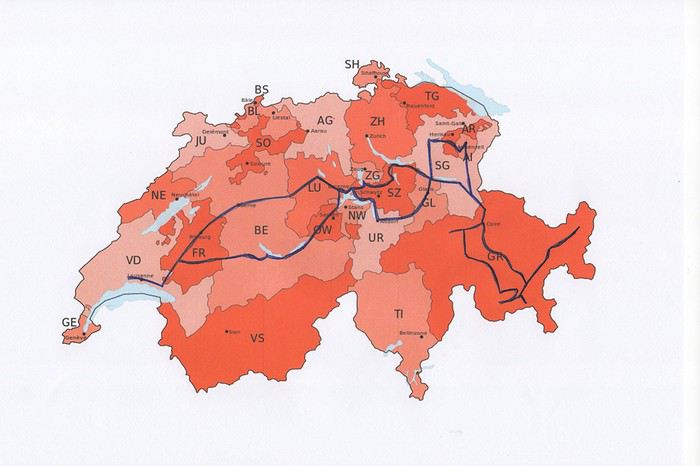
Nous avons loué un van, afin d’être autonome et libre. Notre choix s’est porté sur le VW California Ocean. Ce van est passe-partout, on peut facilement emprunter toutes les petites routes de montagnes et se parquer partout. Seul inconvénient, il n’a pas de salle de bain. La douche se fait à l’extérieur (eau froide), mais nous avons des toilettes portables. Le California Ocean est équipé avec une petite cuisine (un réchaud à gaz avec deux feux, un frigo de 42 litres, un petit évier). Il y a des placards sous la cuisine, au-dessus de la banquette et à l’arrière, ainsi qu’un grand tiroir sous la banquette. Les sièges avant se tournent, il y a deux tables, une à l’intérieur et une autre, encastrée dans la portière, pour l’extérieur. Les deux chaises pour l’extérieur sont encastrées dans la porte du coffre. Le toit se lève, on peut donc se mettre debout à l’intérieur du van. Le lit sous le toit est confortable, avec son sommier sur lequel sont fixé des ressorts. Un store extérieur nous protège du soleil lorsqu’on est à l’arrêt. Le chauffage stationnaire est bien agréable pour chauffer l’habitacle lorsqu’il fait froid. Il y a aussi plusieurs prises, dont une qui fonctionne avec la deuxième batterie et permet de charger le téléphone, tablette, etc. la nuit. Bref, ce petit van est vraiment fonctionnel.
Au dernier moment, nous avons décidé de prendre notre chien Tidou avec nous. Il a fallu adapter nos randonnées et visites. Eh oui, notre Tidou n’est plus tout jeune et il a des soucis avec son dos. Nous avons acheté un sac à dos spécifique, pour pouvoir le porter en terrain abrupte et lorsqu’il sera trop fatigué.
Nous avons chargé l’application park4night sur nos iPhones. Cette application est bien utile pour trouver des emplacements pour passer la nuit. Contrairement, à ce que l’on peut souvent lire, nous n’avons rencontré aucune difficulté pour passer la nuit. Le camping sauvage est donc possible en Suisse, si on ne s’installe pas pour plusieurs jours au même endroit. Concernant l’eau potable, on trouve de nombreuses fontaines, le plus souvent avec de l’eau potable.
Comme pour beaucoup de voyageurs, le Coronavirus a perturbé nos plans pour cette année. Notre road trip au Pérou est tombé à l’eau et la fermeture des frontières ne nous permettait pas de quitter la Suisse.
Heureusement, en Suisse, nous n’avons pas subi un confinement strict et nous pouvions nous déplacer librement dans le pays, en respectant certaines règles (distance de 2 mètres entres les personnes, rassemblements de maximum 5 personnes). De plus, une semaine avant notre départ, les magasins, restaurants et musées pouvaient ouvrir. Par contre, les campings, télécabines et télésièges sont restés fermés jusqu’au 6 juin.
Nous avons décidé de ne pas préparer un itinéraire fixe. Le but principal était le canton des Grisons que nous connaissions très peu. Pour y aller et pour revenir, nous avons traversé d’autres cantons où nous avons profité de faire des visites et randonnées. Certains endroits nous étaient bien connus, mais les voir sans les touristes habituels, asiatiques, indiens et américains, change complètement la perception des lieux. Imaginez, le fameux pont de la Chapelle à Lucerne, sans les hordes de touristes asiatiques qui l’envahissent tous les jours.
Nous avons loué un van, afin d’être autonome et libre. Notre choix s’est porté sur le VW California Ocean. Ce van est passe-partout, on peut facilement emprunter toutes les petites routes de montagnes et se parquer partout. Seul inconvénient, il n’a pas de salle de bain. La douche se fait à l’extérieur (eau froide), mais nous avons des toilettes portables. Le California Ocean est équipé avec une petite cuisine (un réchaud à gaz avec deux feux, un frigo de 42 litres, un petit évier). Il y a des placards sous la cuisine, au-dessus de la banquette et à l’arrière, ainsi qu’un grand tiroir sous la banquette. Les sièges avant se tournent, il y a deux tables, une à l’intérieur et une autre, encastrée dans la portière, pour l’extérieur. Les deux chaises pour l’extérieur sont encastrées dans la porte du coffre. Le toit se lève, on peut donc se mettre debout à l’intérieur du van. Le lit sous le toit est confortable, avec son sommier sur lequel sont fixé des ressorts. Un store extérieur nous protège du soleil lorsqu’on est à l’arrêt. Le chauffage stationnaire est bien agréable pour chauffer l’habitacle lorsqu’il fait froid. Il y a aussi plusieurs prises, dont une qui fonctionne avec la deuxième batterie et permet de charger le téléphone, tablette, etc. la nuit. Bref, ce petit van est vraiment fonctionnel.
Au dernier moment, nous avons décidé de prendre notre chien Tidou avec nous. Il a fallu adapter nos randonnées et visites. Eh oui, notre Tidou n’est plus tout jeune et il a des soucis avec son dos. Nous avons acheté un sac à dos spécifique, pour pouvoir le porter en terrain abrupte et lorsqu’il sera trop fatigué.
Nous avons chargé l’application park4night sur nos iPhones. Cette application est bien utile pour trouver des emplacements pour passer la nuit. Contrairement, à ce que l’on peut souvent lire, nous n’avons rencontré aucune difficulté pour passer la nuit. Le camping sauvage est donc possible en Suisse, si on ne s’installe pas pour plusieurs jours au même endroit. Concernant l’eau potable, on trouve de nombreuses fontaines, le plus souvent avec de l’eau potable.
Faut-il organiser le tour de France en 2020? English translation pending
c'est un peu en dehors de notre mouvement, mais la question peut se poser
https://www.cyclismactu.net/news-tour-de-france-une-epidemiologiste-tire-la-sonnette-d-alarme-90384.html
Et vous qu'en pensez vous ?
Off to explore Jordan!
Well, since the lockdown is dragging on, I’m starting a new travel journal following the one I finished publishing yesterday:
https://voyageforum.com/discussion/voyage-pays-perles-voyage-dans-ouest-americain-d9943984/
This time, after the U.S., we’re heading to the Middle East—Jordan!
And we’re keeping up the good habits: one day’s entry published every day at 5:30 PM! Happy reading, and feel free to leave a comment, question, or remark...
Franck
Franck
Ladakh, deux sexagénaires à l'assaut d'un 6000. Récit d'un voyage en totale autonomie. English translation pending
L'ascension d'un 6000 m, et le plus haut col du monde à VTT ! Ce genre de défi, c'est plutôt réservé aux jeunes, mais nous, retraités sexagénaires plutôt physiquement en forme, nous nous sentons la capacité de le faire, sans passer par une agence de voyage, uniquement par nos propres moyens. Christian est plutôt vélo, moi plutôt montagne, mais comme nous sommes polyvalents et bien entraînés pour ces deux activités, c'est décidé, on y va !
Eté 2016 Après recherches, ce sera le Stok Kangri, 6154m, pour la montagne, et le Kardhung La, 5600m, pour le VTT, revendiqué comme le plus haut col carrossable du monde. Ces deux objectifs ont l'avantage d'être facilement accessibles depuis Leh, la capitale du Ladakh. Et puis il y a aussi la célèbre route impossible Manali - Leh et ses cols mythiques, dont le fameux Keylong pass, les paysages du Ladakh, sa population, ses temples et mosquées, et bien sûr la situation politique de la région, souvent tendue et bouillonnante. Serons-nous à la hauteur de notre projet ?
MENU
1- Bordeaux - Delhi - Manali: rapide prise de contact 2- Manali - Old Manali : bus de nuit et courte rando 3- Manali - Ghosol - Vashit : la vie de village 4- Manali - Jispa : la route de l'impossible, 1° jour 5- Jispa – Leh : la route de l'impossible, 2° jour. Mes amis anglais 6- Leh : cartes postales 7- Leh - Lamayuru : en route pour un premier trek d'acclimatation 8- Lamayuru – Wanla : 1° jour. Le trek pour nous seuls 9- Wanla - Phonjila - Hinju : 2° jour. Dur dur quand on est malade 10- Hinju - Sumda : 3° jour. Le point haut 12- Sumda - Ezas - Leh : 4° jour. La bonne affaire 13- Leh, vallée de l'Indus : road trip en Royal Enfield 14- Camp 2 du Stok Kangri : 1° jour, une promenade de santé 15- Camp 2 - sommet - camp 1 : 2° jour. Un 6000, c'est pas les Pyrénées ! 16- Camp 1 - Leh : 3° jour 17- Leh : et maintenant, le VTT 18- Kardhung La à VTT : une demi réussite 19 - Leh, vallée de l'Indus : carte postale en Royal Enfield 20- Leh - Delhi - Agra : en serrant les fesses 21- Agra : carte postale 22- Fatephur Sikri : carte postale 22- Agra – Delhi : Laurel et Hardi sur le quai
Eté 2016 Après recherches, ce sera le Stok Kangri, 6154m, pour la montagne, et le Kardhung La, 5600m, pour le VTT, revendiqué comme le plus haut col carrossable du monde. Ces deux objectifs ont l'avantage d'être facilement accessibles depuis Leh, la capitale du Ladakh. Et puis il y a aussi la célèbre route impossible Manali - Leh et ses cols mythiques, dont le fameux Keylong pass, les paysages du Ladakh, sa population, ses temples et mosquées, et bien sûr la situation politique de la région, souvent tendue et bouillonnante. Serons-nous à la hauteur de notre projet ?
MENU
1- Bordeaux - Delhi - Manali: rapide prise de contact 2- Manali - Old Manali : bus de nuit et courte rando 3- Manali - Ghosol - Vashit : la vie de village 4- Manali - Jispa : la route de l'impossible, 1° jour 5- Jispa – Leh : la route de l'impossible, 2° jour. Mes amis anglais 6- Leh : cartes postales 7- Leh - Lamayuru : en route pour un premier trek d'acclimatation 8- Lamayuru – Wanla : 1° jour. Le trek pour nous seuls 9- Wanla - Phonjila - Hinju : 2° jour. Dur dur quand on est malade 10- Hinju - Sumda : 3° jour. Le point haut 12- Sumda - Ezas - Leh : 4° jour. La bonne affaire 13- Leh, vallée de l'Indus : road trip en Royal Enfield 14- Camp 2 du Stok Kangri : 1° jour, une promenade de santé 15- Camp 2 - sommet - camp 1 : 2° jour. Un 6000, c'est pas les Pyrénées ! 16- Camp 1 - Leh : 3° jour 17- Leh : et maintenant, le VTT 18- Kardhung La à VTT : une demi réussite 19 - Leh, vallée de l'Indus : carte postale en Royal Enfield 20- Leh - Delhi - Agra : en serrant les fesses 21- Agra : carte postale 22- Fatephur Sikri : carte postale 22- Agra – Delhi : Laurel et Hardi sur le quai
Compte rendu de 15 jours en croisière aux Emirats et au Qatar English translation pending
Voici le compte rendu d'une croisière effectuée à bord du Jewel of the seas (compagnie Royal Caribbean), du 24 février au 9 mars 2020 (deux croisières consécutives 7 jours + 7 jours) au départ de Dubai.
Les escales, lors de notre réservation, étaient les suivantes : - DUBAI (EAU) - DUBAI (EAU) - KHASAB (Oman) - MASCATE (Oman) - en mer - ABOU DHABI (EAU) - SIR BANI YAS (EAU) - DUBAI (EAU), fin de la première croisière, début de la deuxième - SIR BANI YAS (EAU) - DOHA (QATAR) - en mer - ABOU DHABI (EAU) (overnight) - ABOU DHABI (EAU) - DUBAI (EAU) (overnight) - DUBAI (EAU)
Il faut savoir que la deuxième croisière prévoyait une escale à Bahreïn qui a été annulée fin janvier 2020, avant que nous achetions les deux croisières.
Finalement, une fois à bord, à cause d’une suspicion d’un cas de coronavirus à bord (jour 2) puis de la fermeture du port de Doha suite au coronavirus (dans la nuit entre le jour 9 et 10), voici notre itinéraire réel (sans passer par le sultanat d'Oman 🙁 !) :
- DUBAI (EAU) - DUBAI (EAU) - KHASAB (Oman) à en mer - MASCATE (Oman) -> DOHA (QATAR) - en mer - ABOU DHABI (EAU) - SIR BANI YAS (EAU) - DUBAI (EAU), fin de la première croisière, début de la deuxième - SIR BANI YAS (EAU) - DOHA (QATAR) -> en mer - en mer -> ABOU DHABI (EAU) - ABOU DHABI (EAU) (overnight) - ABOU DHABI (EAU) -> en mer le matin + DUBAI (EAU) à partir de 12h30 (overnight) - DUBAI (EAU) (overnight) - DUBAI (EAU)
C’est notre deuxième passage dans cette région du monde, voici le lien pour le compte rendu de la première croisière si vous voulez des informations complémentaires sur les escales (notamment pour Oman…) : https://voyageforum.com/discussion/compte-rendu-croisiere-eau-oman-vision-of-the-seas-royal-caribbean-12-19-decembre-2016-d7731808/
Comme toujours, le but de ce compte rendu est d’aider les personnes qui, comme nous, préparent les visites avant le départ pour faire le maximum de choses par soi-même (sans acheter les visites proposées par le bateau) pour passer de belles vacances tout en restant relativement raisonnable côté budget et en gardant une grande liberté pour avancer à notre rythme ! Bien entendu la compagnie de croisière propose des excursions pour ceux qui préfèrent se laisser guider et qui acceptent de payer le prix fort.
Le compte rendu est organisé par partie : - quelques mots sur nous - explication pour les visas - précisions sur l'avant croisière - détails de toutes les escales - précisions sur le bateau (restauration, excursions, spectacles...), - précisions sur la fin de croisière (débarquement) - précision sur le fait d’enchainer deux croisières - le retour - une partie budget.
Je souligne que ce compte rendu n’engage que nous et n’est le reflet que de notre voyage et de nos centres d’intérêt. Voyageant avec des enfants nous consacrons aussi des moments « jeux » dans nos journées…
QUELQUES MOTS SUR NOUS Après plus d’une bonne dizaine de croisières sur Royal Caribbean en amoureux, nous avons voyagé pour la quatrième fois avec nos deux enfants (5 et 7 ans). Nous avons l’habitude (quand c’est possible…) d’effectuer les visites par nous-même en utilisant les moyens de déplacements locaux, question de budget et surtout de liberté ! On apprécie les croisières pour le côté découverte sans avoir l’inconvénient de la fatigue ni du ménage et de la vaisselle (pour moi !)… Bien entendu il faut accepter l’idée de ne pas tout découvrir en une journée sinon vous serez frustrés. Nous aimons le calme et finir la journée par un bon repas. Nous avons souvent l’habitude de nous lever tôt pour profiter au mieux des escales, ce qui n’a pas du tout était le cas pour ce voyage ! Ayant visité la plupart des escales il y a trois ans, nous avons fait le choix de profiter des spectacles et de se reposer. Nous avons parfois visité en deux jours ce que certains peuvent faire en une seule journée… !
VISA Pour un français arrivant en bateau, pas besoin de visa ni pour les EAU ni pour le Qatar. Vos passeports sont conservés par RCCL puis redistribués à la fin de la croisière.
PRECISIONS SUR L'AVANT CROISIERE Départ le dimanche 23 février. Après 2h de voiture nous avons déposé notre voiture au parking de l’hôtel B and B Rumlang à Zurich (Suisse) pour 125€ les 16 jours, la navette vient vous chercher (toutes les 20-25 minutes environ) et vous dépose en 10 minutes à l’aéroport. Pratique, rapide, pas très cher et efficace ! Réservation préalable sur Internet obligatoire.
Vol Zurich- Muscat puis Muscat-Dubaï via Oman air. Vol de nuit à l’aller, départ après 21h, pour les enfants c’est idéal car ils dorment dans l’avion. Il y a deux zones pour les enfants (jeux, wc, zone de sieste, table à langer, micro-ondes…) à l’aéroport de Zurich. C’est une salle à part, un peu cachée ! C'est vraiment sympathique de proposer ce genre d'endroit pour défouler les petits monstres gratuitement. On a trouvé un grand labyrinthe avec des jeux à l’aéroport de Muscat (parfait car 3h d’escale, c’est un choix de notre part il y a avait plus court mais on prend toujours 3h pour ne pas stresser si jamais le premier vol est en retard). A Dubaï, seul un terminal (le trois de mémoire) a une zone de jeux pour les enfants… Oman air est une bonne compagnie, qui propose des couvertures, oreillers, chaussettes, casques, des films en français, une pochette pour les enfants avec des activités, un repas correct et un encas même sur des vols très courts. Les 4 avions étaient récents, l’espacement entre les sièges est bien plus important que sur la plupart des compagnies aériennes. Le choix des sièges est payant même 48h avant le vol, mais il y a souvent moyen de s’arranger. Nous étions placés deux personnes sur la rangée de droite et deux personnes sur la rangée du milieu et nous avons été finalement mis tous les 4 sur la rangée du milieu (première rangée avec beaucoup de place pour les jambes mais avec des séparateurs ce qui rend impossible le fait que les enfants s’allongent et posent la tête sur les genoux de papa ou maman…). Le vol Muscat-Dubai était quasi-vide : 28 passagers au lieu d’environ 160. Pour le côté pratique, dans l’aéroport de Muscat vous trouverez des ATM pour retirer des rials omanais au pied des escalators menant aux salons privatifs.
Arrivée à Dubai vers midi, nous avons retiré des AED à l’aéroport sur un ATM puis nous avons pris un taxi car entre les bagages, les enfants et le faible cout des taxis, cela reste la meilleure option. Il y a aussi le métro mais il ne va de toute façon pas jusqu’au port… Le cout de la prise en charge est de 20 (petit taxi) ou 25 AED (grand taxi), le cout de la course est de 65 AED (prise en charge comprise). Ce n’est pas un prix fixe, cela dépend du trafic, très dense à notre arrivée. On a vu des personnes, tirant des valises, entrer dans le port à pieds, c’est vraiment une mauvaise idée, les taxis dépassent les 100km/h dans la zone du port, et c’est immense, et pas toujours avec des trottoirs, le tout sous un soleil écrasant…
Il n’y a plus de contrôle pour rentrer dans le port de Dubaï, pas besoin de montrer le passeport ou les documents du bateau.
On s’enregistre très rapidement, il y a de nombreux comptoirs, vous pouvez enregistrez votre carte bancaire ou pas, puis on vous demande si vous avez été malade (formulaire papier) puis on vous distribue votre sea pass. Et on monte à bord ! Distribution de deux bracelets pour nos enfants en cas d’évacuation.
On passe voir où se situe notre table de 4 au restaurant pour le diner, puis nous montons manger au buffet tout en haut, au 11ème pont. La cabine sera disponible à 13h.
Pour une fois pas d’exercice le premier jour car le bateau reste à quai pour cette première nuit à bord. D’ailleurs certains passagers ne monteront à bord que pendant la nuit ou le lendemain (selon les heures des vols).
L’après-midi passe rapidement, le temps d’installer les affaires dans la cabine puis de faire une petite sieste, il est déjà 17h ! Nous avons fait le choix de rester à bord mais vous pouvez quitter le bateau pour visiter.
LES ESCALES
🙂DUBAI … - 17h Le bateau est amarré à port Rashid, terminal 3. météo : Très beau, très chaud, un peu de vent, plus de 25°C ça c’est certain… !
Le programme de la journée était le suivant : visiter le Dubaï Museum (également connu sous le nom de Al fahidi fort), prendre un abra et déguster un shawarma puis revenir au bateau en abra puis en taxi.
Nous sommes descendus du bateau vers 11h. Comme dis plus haut, l’idée était aussi de prendre du temps pour se reposer… Pour sortir du port de Dubai il y a plusieurs options : - le big bus : environ 75US$ par personne. - la navette gratuite mais qui ne passe que toutes les deux heures et qui vous dépose au pied de la Burj Khalifa pour le mall. - les taxis qui facturent 20 ou 25 AED la prise en charge + le cout du trajet.
Nous avons pris un taxi qui ne semblait pas connaitre le Dubaï Museum, un peu compliqué (mieux vaut avoir un plan sur soi !) mais finalement on a été déposé au bon endroit. Prix du trajet :35 AED. Le petit fort est un site intéressant avec un souterrain permettant de retracer la vie des Dubaïotes autrefois. C’était notre deuxième visite, nos enfants ont pris plaisir à découvrir ce site. L’entrée est de 3 AED pour les enfants de plus de 6 ans et les adultes et 1 AED pour les moins de 6 ans, soit environ2€50 pour nous quatre, tout n’est pas cher à Dubaï !
A la sortie du site, nous avons traversé rapidement le souk pour rejoindre le quai des abras situés à proximité, c’est toujours aussi usant et pénible de se faire « sauter dessus » par les vendeurs même si on comprend bien qu’ils ont besoin de vendre pour vivre. Le quai des abras est nommé « Dubaï old souk » et nous sommes descendus à « Sabkha ». On paie 1 AED par adulte par traversée, c’est gratuit pour les enfants. La traversée est agréable et courte, les mouettes nous accompagnent ! C’est une expérience sympathique.
Nous partons à la recherche de notre excellent restaurant trouvé il y a trois ans, mais la boutique est définitivement close. Très déçus nous prenons le chemin du retour, et reprenons un abra puis un taxi pour rejoindre le bateau et profiter de notre après-midi à bord.
bilan de notre journée à terre : Une belle journée ensoleillée où nous avons pris le temps de flâner tranquillement. Le fort est vraiment à voir, la traversée en abra est également typique.
🙂DOHA, QATAR 8h00 – 20h00 Le bateau est à quai, il est amarré à Doha port, à côté du musée islamique. météo : chaud, beau, sans vent, que du bonheur… ! mais impossible ici de faire de la plage …
Il faut savoir que Doha n’est pas dans le même créneau horaire que les émirats arabes unis, et que les passagers doivent rester à l’heure du bateau, et pas à celle de Doha !
Au programme de la journée : visiter le musée national du Qatar puis remonter à bord pour manger et finir la journée par visiter les souks puis se poser dans le parc Mia à côté du port disposant d’une énorme aire de jeux et d’une vue magnifique sur la skyline de Doha.
Il faut déjà prendre la navette gratuite qui vous dépose sur le parking situé à côté du parking du musée de l’art islamique. Le service est assez rapide, il faut compter 10 bonnes minutes de trajet.
Arrivés sur le parking, nous cherchons un chauffeur de taxi pour nous faire déposer au musée mais aucun n’accepte le paiement par carte, et sans monnaie locale ni distributeur juste à côté de nous, nous nous décidons finalement à faire le trajet à pied. Il faut compter 30 minutes dont au moins 5 à 10 minutes simplement pour traverser, sur les passages piétons, l’énorme boulevard à la sortir du port, cette ville n’est pas conçue pour les piétons. Le trafic est intense et certains feux piétons affichaient toujours rouge même après 5 minutes d’attente !
Le musée national du Qatar est un bâtiment magnifique en forme de rose des sables, le contenu du musée est très intéressant et aborde le thème de la faune, de la flore du pays, la façon de vivre des habitants entre l’époque préhistorique et l’époque actuelle (la pèche des perles, la vie des bédouins, les costumes, le pétrole…). Il y a aussi un grand bateau à l’extérieur comme aire de jeux pour les enfants et une mini-grotte très intéressante. Nous y sommes restés quasiment trois heures. C’est un site intéressant pour les adultes et les enfants. Le prix est de 25 par personne, soit environ 7€ par personne, c’est gratuit pour les enfants.
Nous prenons le chemin du retour, toujours à pied car le distributeur ATM du musée n’a pas voulu que je retire de l’argent avec ma visa… ! Il a déjà eu la gentillesse de me la rendre, c’est déjà ça ! Arrivé au port nous faisons signe à la navette qui a déjà entamé le chemin du retour et qui a la gentillesse de nous prendre au passage !
Nous reprenons des forces en passant par le buffet puis nous ressortons et nous montons dans une navette.
Le parc Mia est un énorme espace vert où il y a des zones de jeux pour tous les âges. La vue sur Doha est magnifique. Nous avons pris une golfette pour se déplacer dans le parc, le service est gratuit et permet de voir le parc en entier. On y croise des locaux, venus ici pour se détendre en famille, l’ambiance est agréable.
18h, nous reprenons la navette pour revenir au bateau et prendre l’apéritif au diamond lounge, c’est les vacances !
bilan de notre journée à terre : Un arrêt à Doha, contraints et forcés à la place d’Oman… mais heureusement qu’on a visité le musée puisque finalement la semaine d’après nous n’y sommes pas retournés ! Initialement, on devait faire les souks avant d’aller au parc Mia, mais le timing aurait été un peu court donc plutôt que de courir nous avons privilégié le parc pour les enfants plutôt que le shopping. Si cela vous intéresse il y a dans les souks l’hôpital des faucons à voir. Des amis ont visité le musée d’art islamique et ne l’ont pas trouvé transcendant.
🙂ABOU DHABI, EAU 8H – 20H Le bateau est amarré à port Zayed, à proximité de la ville. Il y a une nouvelle aire de jeux au pied du bateau avec des food-truc, c’est très animé le soir avec les locaux.
météo : Ensoleillé mais pas très chaud, entre 20 et 25°C au soleil. Pas de vent.
Pour sortir du port d’Abou Dhabi, il existe plusieurs options : - prendre un taxi : il chargera 20 EAD pour sortir du port (ou 25 si c’est un grand taxi) - prendre le free shuttle : c’est un mini-bus rouge qui vous dépose Al Amtar street, en ville. C’est une navette d’environ 20 places, qui passe toutes les 20 minutes voire 30 parfois… Le chauffeur n’hésite pas à demander de l’argent pour partir plus vite ce qui n’est pas honnête car RCCL paie déjà cette navette. Arrêt pratique pour aller en ville ou sur la corniche pour la plage, ou tout simplement pour prendre le taxi sans payer les 20EAD de prise en charge, pour aller vers le palais présidentiel par exemple si on a le temps. - prendre le hop on hop off : en payant 75$ par personne OU gratuitement pour aller jusqu’au Abou dhabi Mall. Attention cela ne fonctionne qu’en étant sur RCCL, les chauffeurs demandent la carte lorsqu’il y a plusieurs bateaux. C’est très pratique pour aller à la mosquée car cela est vraiment dans la bonne direction et vous avance un peu réduisant le coût du trajet en taxi.
En sachant que nous avions 3 jours entiers sur Abou Dhabi, nous avons privilégié la culture, la plage et les aires de jeux.
Jour 1 : le Louvre, retour au bateau pour manger, la plage. Jour 2 (deuxième semaine) : la plage, retour au bateau pour manger, le palais présidentiel au coucher du soleil. Jour 3 (troisième semaine) : la plage, retour au bateau pour manger, la mosquée en fin d’après-midi.
Nous sommes remontés à bord pour manger car cela permet surtout de ne pas se trainer un énorme sac à dos contenant les serviettes et tout le nécessaire pour la plage…. Et permet de changer de tenue car pour la plage ou le musée bien climatisé ou une mosquée, la tenue n’est pas la même…
Le matin, en sortant du bateau, nous devons passer l’immigration car nous avons visité un autre pays que les EAU, c’est un processus un peu long et chronophage mais bien organisé.
Nous prenons ensuite le taxi dans le port, car le Louvre est à proximité et les deux navettes vous éloignent du musée. Prix du taxi à l’aller environ 40 EAD (dont 20 de prise en charge). Il faut compter 20 minutes de trajet.
Le Louvre est un musée intéressant, on vous offre le café local à l’arrivée, c’est finalement peu courant dans notre pays. Le billet d’entrée est de 63AED pour les adultes, gratuit pour les enfants. Vous pouvez louer un audio guide français en supplément. Nous avons pris le temps de lire les explications (en français), nombreuses et explicites sous les œuvres d’art. Le début de la visite est très intéressant car on nous montre les similitudes entre les civilisations pourtant très éloignées géographiquement. Il y a à mon sens peu d’œuvres majeures en comparaison à notre Louvre à Paris mais la visite reste intéressante y compris pour des enfants. Le bâtiment est sublime. La partie pour les enfants est vraiment géniale, il y a beaucoup d’activités à faire (costumes à enfiler, jeux sur tablettes, coin bibliothèque…).
Après un retour au bateau pour se restaurer, nous prenons 4 serviettes, nos maillots et le free shuttle pour se rendre en centre-ville. Après 20 minutes de marche nous arrivons sur la corniche, nous nous posons sur la plage au niveau de Urban park. La plage est belle, propre, il y a peu d’hommes seuls. Elle est idéale pour les enfants car peu profonde au début et surveillée. La température de l’eau est fraiche, on le savait par avance donc pas de déception. Un bon moment de détente sous le soleil… Il y a sur la corniche un système de trottinette empruntable pour se déplacer, il suffit d’avoir téléchargé l’application avant de partir. La corniche est longue, et large, ça doit vraiment être sympa entre adultes ou avec des enfants plus grands. On trouve aussi des stands de location de véhicules à roues (vélo, tricycle, vélo pour 4 personnes…) avec des prix abordables.
Retour au port en shuttle gratuit après avoir fait le trajet à pied dans l’autre sens tranquillement. Forcément le shuttle en fin d’après midi est assez demandé, il y avait tout juste assez de places.
Petite pause aire de jeux au pied du bateau puis nous remontons à bord pour une bonne douche.
bilan de la journée : Une matinée à la découverte des autres cultures et une pause plage pour la détente : une belle journée de plus sous le soleil des EAU !
🙂SIR BANI YAS, EAU 8H – 18H Le bateau n’est pas à quai, et pour cause il n’y a qu’un petit quai pour les bateaux de sauvetage qui servent à faire les navettes entre le bateau et l’ile.
météo : Ensoleillé mais pas très chaud, entre 20 et 25°C au soleil. Pas de vent et heureusement !
Pour sortir du navire, il faut prendre un ticket avec un numéro, il y a seulement quatre tenders et c’est un vrai bazar. On vous conseille de prendre un numéro de tender 1 ou 2, car même si vous dépassez le créneau horaire, vous pourrez embarquer. A l’inverse si vous prenez le numéro 10 prévu par exemple entre 11h et 11h30, non seulement vous risquez de sortir bien plus tard (car les horaires ne sont pas respectées notamment selon la météo, et pour cause, de 8h à 10h il y avait un épais brouillard rendant impossible la manœuvre en tender) mais en plus vous allez devoir laisser passer tous les retardataires qui auront des numéros inférieurs à 10. Le système est mal conçu… Ils ne peuvent pas descendre plus de 4 tenders pour des raisons de sécurité, au cas où il faudrait évacuer le navire. Les personnes qui achètent une excursion sont prioritaires pour descendre, ce qui était notre cas.
Sir Bani Yas est une ile où il est impossible de faire des visites par soi-même. L’ile est en résumé partagée en trois parties : - une zone où il y a des hôtels. - une zone où il y a une réserve naturelle abritant notamment des oryx, des gazelles, des girafes... - une longue bande de plage aménagée pour les croisiéristes le temps d’une escale.
Vous ne trouverez pas de taxis pour vous faire sortir de cette bande de plage.
Voyageant avec des enfants, nous avons choisi de prendre l’excursion safari qui dure 1h15 pour la modique somme de 235€ environ pour nous quatre. C’est cher, et encore nous avions bénéficié d’une petite réduction car nous l’avions achetée avant le départ. RCLL vendait aussi des excursions pour faire le safari à pied (à partir de 6 ans), du kayak, du snorkeling, du VTT…
Nous avions réservé le tour de 8h30 qui a finalement commencé à 10h15 ! C’est une expérience unique, nous avons vu beaucoup d’animaux en liberté (oryx, girafes, autruches, gazelles, paons, nombreux oiseaux…), et cela correspond à nos idéaux. Nous privilégions de montrer à nos enfants, des animaux libres de se déplacer là où ils veulent, ou presque. La réserve est partagée en zones, mais des très grandes zones. L’avantage de la visite matinale est de pouvoir voir beaucoup d’animaux car ils sont nourris le matin donc rassemblés en masse. Certaines personnes critiquent cette réserve car 3 millions de végétaux ont été plantés mais dans un milieu aride, l’arrosage est inévitable. D’un point de vue écologique, cela rend le projet discutable…
Retour sur la bande de plage, vers midi. Nous déposons nos serviettes sur les transats à proximité de l’aire de jeux ombragée pour les enfants. Pensez à prendre les serviettes à bord du navire avant de prendre les tenders, RCCL n’en met pas à disposition sur l’ile. Il y a énormément de parasols fixes avec une petite table et deux chaises longues en bois. Côté arbres, visiblement ils ont beau être arrosés, ils poussent peu… Il y a plusieurs plages, à vous de choisir celle qui vous convient. On trouve aussi des wc propres, et une zone ombragée pour se restaurer. L’offre de restauration est un peu limitée mais cela se comprend car tout passe par les tenders ce qui rend compliqué l’approvisionnement. Ce n’est pas Cococay ou Labadee, iles privées qui appartiennent à RCCL, où la compagnie a pu investir pour mieux s’installer et répondre aux besoins des clients. Il faut avoir conscience que Sir Bani Yas accueille toutes les compagnies, donc les installations sont correctes mais tout de même limitées. Sur cette bande de plage, il y a aussi des terrains de jeux collectifs, et également une structure gonflable aquatique gratuite.
Après un repas rapide, nous avons emprunté un gilet de sauvetage pour la plus jeune et après s’être mouillés nous nous sommes vraiment amusés sur cette structure très très glissante... L’eau est fraiche, très fraiche comparé à Miami, aux Caraïbes ou à la Thaïlande. Si vous pouvez : apporter vos aquashoes car cette plage artificielle est faite avec des coquillages plus ou moins concassés. Là aussi c’est loin d’être Miami beach… !
Le retour au bateau en tender a lui aussi été laborieux, dernier tender prévu à 16h, on a pris celui de 17h30, et ce n’était pas le dernier ! Tous les passagers veulent remonter à bord en fin de journée afin de profiter au maximum de la plage, et vu qu’il y a bien 20 minutes de traversée, l’attente est longue… En sachant qu’il faut aussi remonter à bord, tout le personnel et le matériel nécessaire au buffet du midi. Nous sommes restés près de l’aire de jeux plutôt que de faire la queue. Enfin arrivés sur le tender, les dauphins nous ont accompagnés jusqu’au navire, jouant dans l’écume formée par le tender. En étant attentif, on peut les voir depuis la plage, c’est toujours sympathique…
bilan de la journée : Une magnifique journée pour toute la famille, avec notre plus beau coup de cœur des vacances : le safari !
🙂DUBAI 8H – 17H Le bateau est à quai.
météo : Ensoleillé et tiède en début de journée puis chaud l’apprès-midi, entre 20 et 25°C au soleil puis plutôt 30 °C vers 15h. Pas de vent.
Profitant d’effectuer deux croisières consécutives, pendant que tout le monde descend du bateau tristement, nous avions décidé de profiter de la visite guidée de la mosquée Jumeirah.
Pour nous rendre à la mosquée et profiter de la visite guidée de 10h, il est impératif de ne pas perdre de temps. Nous avons choisi de prendre un taxi, mais l’attente a été longue (20 minutes presque) pour en avoir un et nous n’étions qu’au début de nos péripéties… Avec plusieurs bateaux débarquant le même jour, il y avait de très nombreuses personnes qui attendaient un taxi avec ses valises. Quand enfin ce fut notre tour, nous sommes tombés sur un chauffeur qui ne voulait pas nous prendre (forcément la course n’est pas intéressante financièrement pour lui contrairement à l’aéroport…). Le régulateur des taxis au port a insisté, le chauffeur n’a pas le droit de refuser le client. Une fois dans le taxi, il n’a pas voulu allumer son compteur, et après 200 mètres, il nous demandait 60 EAD. J’ai refusé et il nous a dit de quitter sa voiture, qu’il refusait de nous déposer à la mosquée. J’ai couru jusqu’au régulateur et je lui ai expliqué la situation, il était furieux, et il s’est excusé et nous a de suite orienté vers un autre taxi plus honnête. 9h30 nous arrivons enfin à la mosquée, après avoir payé 38 EAD pour le grand taxi, payé par carte car le chauffeur n’avait pas de monnaie, c’est bien pratique comme option.
La visite de la mosquée commence par un accueil avec un petit lunch pour faire découvrir quelques produits locaux et un local avec son faucon qui propose de porter le faucon, même aux enfants. C’était vraiment impressionnant car l’oiseau n’est ni petit, ni léger… ! La visite coute 35 AED et est gratuite pour les enfants. Nous devons nous couvrir les cheveux, les jambes, les bras… ils prêtent des tenues si vous n’en n’avez pas. Les explications sont très intéressantes et nous permettent d’aborder une culture et des pratiques qui ne sont pas les nôtres. Nos enfants ont même eu le droit de jouer là où les enfants musulmans jouent dans une partie de la mosquée réservée aux femmes et aux enfants. Nous recommandons cette visite.
Nous reprenons vers 11h le chemin du retour vers le port. Prix de la course au retour 18EAD, forcément avec 5EAD de prise en charge contre 25 le total est plus léger.
Nous montrons nos nouvelles seapass et nous montons à bord. Direction le buffet pour se restaurer. Nous profitons de notre après-midi à bord du bateau : piscine avec les enfants, nous n’étions que tous les quatre ou presque, les autres passagers étant pour la plupart occupés à s’installer dans les cabines. Puis à partir de 15h nous migrons vers la piscine des enfants et son toboggan (ouvert uniquement de 15h à 17h).
bilan de la journée : Une belle journée mixant parfaitement découverte culturelle et farniente !
🙁SIR BANI YAS 10h– 18h Le bateau n’est toujours pas à quai… en 2 jours ils n’ont pas eu le temps de le construire ! météo : un soleil timide et un vent de plus en plus fort au fur et à mesure de la journée.
L’idée était de simplement profiter de la plage, de l’aire de jeux et de la zone gonflable aquatique. Nous avions pris la veille des billets de tender numéro 8 pour pouvoir trainer un peu sous la couette et l’idée était mauvaise… vu qu’à cause du vent les horaires n’étaient pas respectés ! Nous sommes repassés par la réception pour avoir une idée de l’heure approximative de sortie et on nous on a donné des billets de tender numéro 4. Nous avons attendu moins de 10 minutes puis finalement nous avons embarqués. Le concept est totalement à revoir, il devrait être impossible de récupérer des numéros qui sont déjà partis… Cela n’encourage pas l’honnêteté !
Arrivés sur la plage, les enfants ont filé vers l’aire de jeux puis après 2h de bronzette et d’aire de jeux, nous nous sommes décidés à quitter l’ile afin de manger à bord du navire et surtout d’éviter la cohue pour regagner le navire en fin d’après-midi.
Nous avons profité du toboggan et de la piscine pour les enfants entre 15h et 17h.
bilan de la journée : Une escale pas terrible, en fait on aurait fait un jour en mer cela aurait été pareil… Sir Bani Yas oui mais, avec du vent non !
Prochaine escale : Doha ! Et en fait non… Et on s’en doutait dès notre réveil, car cela bougeait bien trop pour un bateau étant à quai, même sans fenêtre (cabine intérieure) on se doutait bien qu’on était en mer. Et en ouvrant la porte, j’ai vu le programme du jour accroché à cette dernière « at sea » : direction le « guest service » pour aller chercher des nouvelles fraiches !
🙂ABOU DHABI 8h – … (overnight) Le bateau est amarré à port Zayed. météo : soleil, aucun nuage et environ 25°C.
Le programme de la journée prévoyait d’aller à la plage le matin puis de remonter à bord pour manger et se changer puis d’aller visiter le palais présidentiel.
En mode détente, nous n’étions pas pressés, nous avons donc pris le hop on hop off gratuitement pour sortir du port. Arrivés au Abu dhabi mall, nous avons pris un taxi pour aller jusqu’à la plage sur la corniche pour 12 EAD, elle est située un peu plus bas que l’énorme parc family park. Le family park est un parc avec de très nombreuses zones de jeux pour les enfants pour tous les âges.
L’accès à la plage est gratuit (il y a aussi des plages privées sur la corniche). La plage est belle et propre, surveillée. Un vrai moment de détente… !
Vers 13h, nous quittons la plage pour se diriger à pied vers le family park. Nous y passerons une bonne heure pour le plus grand bonheur de nos enfants.
Retour au port en taxi pour se changer et se restaurer rapidement.
Vers 16h, nous sortons du port en taxi, direction le palais présidentiel. Le but était de visiter le palais puis de rester pour le son et lumière qui commence à 19h30. Prix de la course 45 EAD, et un chauffeur lourd qui voulait à tout prix nous faire faire un tour de toutes les attractions d’ Abou Dhabi. Au port, il a refusé de mettre la prise en charge à 20, il a mis que 5, mais forcément après on a eu droit à 20 minutes de discussion pour lui expliquer que nous souhaitions simplement aller au palais… et arrivés au palais, il voulait encore ajouter 20 à la note en me disant qu’il ne les avait pas compté au départ (au lieu de 15 en réalité car 5 de prise en charge réelle). Bref, une fois de plus, il y a de tout parmi les chauffeurs de taxi…
Le palais présidentiel se visite, le prix d’entrée est de 60 EAD par adulte et 30 par enfant. Les contrôles de sécurité sont stricts, j’avais un paquet de bonbon dans le sac, j’ai dû le mettre en consigne. On peut garder sur nous les bouteilles d’eau mais il est interdit de boire dans les bâtiments. Le palais est magnifique, merveilleux, d’une finesse incomparable, démesuré… à voir absolument ! Le spectacle son et lumière est beau aussi car il est projeté sur la façade principale. Prévoir la petite laine pour le soir, avec un peu de vent, la sensation de froid est vite présente.
20h : Retour au port en taxi pour 30 EAD, avec un chauffeur souriant et honnête !
bilan de la journée : Encore une belle journée sans se presser, entre détente et découverte architecturale.
🙂ABOU DHABI …- 20h Très pratique l’overnight ! météo : soleil, toujours aucun nuage, 25 °C, pas de vent !
Le programme de la journée : aller à la plage le matin, revenir à bord pour la pause déjeuner, se changer et aller voir la grande mosquée pour profiter de la visite guidée gratuite.
Nous prenons le free-shuttle puis nous nous dirigeons en taxi vers la même plage que la veille (à proximité du family park). Nous nous posons sur la plage pendant 2h puis nous reprenons un taxi pour revenir au bateau.
15h30 : Après avoir mangé, et surtout s’être changés, nous prenons le hop on hop off jusqu’au mall. La situation géographique du mall est parfaite pour se rendre à la mosquée. Nous montons ensuite dans un taxi (38EAD).
Arrivée à la mosquée vers 16h30, ce n’est plus la même entrée qu’il y a trois ans. Nous marchons un long moment et finalement nous arrivons devant le panneau pour les visites guidées vers 16h55 pour une visite à 17h ! Seule visite possible car nous y étions un vendredi (vendredi matin, pas de tour guidé). Prévoir une tenue adaptée, y compris le foulard pour les enfants. La visite est intéressante et permet de poser ses pieds sur le grand tapis en passant sous les lustres. Ici aussi c’est la démesure, nous conseillons vraiment de faire cette visite guidée. Elle est très enrichissante et même pour nos enfants ne parlant pas l’anglais, j’ai traduit l’essentiel et c’était vraiment abordable. Fin de la visite à 18h.
Retour en taxi au port pour 46AED. Petite pause jeux au pied du bateau puis nous remontons à bord.
Bilan de la journée : Journée alliant enrichissement culturel et détente, le tout sous un soleil bien agréable en février !
🙂DUBAI 12h30– … overnight Le bateau est toujours à quai à port Rashid. météo : un beau soleil et pas de vent, très agréable.
Le programme de l’après-midi était le suivant : visiter le miracle garden, puis se rendre à la burj khalifa pour assister au son et lumière en soirée.
Nous sommes sortis du port avec un chauffeur de taxi qui râlait parce qu’on lui demandait de nous déposer à la station de métro burjuman. Une fois de plus, la course ne lui semblait pas assez longue… Finalement il nous a déposés à l’arrêt juste à côté : ACDB station. Prix de la course 33EAD.
Nous achetons 4 pass (nol red pass) à 22 EAD, c’est un pass illimité pour une journée. Le prix est le même pour les adultes et les enfants. On peut aussi acheter les tickets à l’unité. Le métro de Dubai est très simple à utiliser, tout est bien indiqué en anglais, y compris dans les wagons. Je me suis mise avec mes filles dans un wagon famille, mon mari était dans un wagon juste à côté du mien (sans séparation) essentiellement peuplé par des hommes seuls. C’est très sécurisant de pouvoir se poser dans un wagon « femmes et enfants ». Pour aller jusqu’au jardin il faut prendre le métro, ligne rouge, jusqu’au mall puis le bus 105 (qui ne commence son service qu’à midi). Nous arrivons au jardin vers 14h30, il y a beaucoup de circulation, si vous préférez prendre le taxi au lieu du bus, vous ne gagnerez que peu de temps voire pas du tout.
Le miracle garden à Dubai est un endroit très fleuri, vous trouverez un peu de tout (animaux, figures de dessins animés…) réalisé avec des fleurs. Attention, ne venez pas ici pour voir une diversité de fleurs, vous serez déçus. Ils utilisent en majorité des pétunias et des géraniums. Le site est assez vaste, nous y avons passé 2h en flânant. L’entrée est de 190 AED pour deux adultes et deux enfants.
Nous reprenons le bus 105, puis nous entrons dans le mall pour voir la fameuse piste de ski… Si déjà on est sur place ! Le mall est atrocement grand…
Nous reprenons ensuite le métro, direction la burj Khakifa. Nous passons un moment devant l’aquarium du mall à observer les requins, les raies, les poissons… pour le plus grand bonheur de nos enfants ! Puis direction le bassin des fontaines pour essayer de se trouver une place correcte, sans se faire arroser. Nous connaissions ce show mais ce fut un plaisir de le revoir.
20h : nous quittons le mall, nous reprenons le métro jusqu’à la station ACDB puis le taxi (19AED)pour rentrer au port vers 20h45.
bilan de la journée : Une journée à Dubaï = une journée dans un autre monde où la démesure est la norme. On aime ou pas !
Nous sommes restés à bord pour notre dernier jour à Dubai, car nous avons privilégié le repos de nos enfants le matin, puis nous avons profité des piscines (quasi-vides !) et du toboggan. Nous avons également profité d’une activité famille au club enfant. La fin d’après-midi a été consacrée à faire nos valises.
Bilan des différentes escales : un mix parfait entre découverte culturelle et plage ! Nous avons apprécié le côté culturel, entre musées et mosquées. La météo n’a pas toujours été favorable pour une pause à la plage (parfois un peu frais ou avec un léger vent). Soyons honnêtes : d’une manière générale, en Asie du sud-est ou en Floride, en février, l’eau de mer est plus chaude, la température extérieure aussi !
DETAILS SUR LE BATEAU
Côté restauration... Nous avons mangé au : - windjammer (buffet) : testé au petit déjeuner, déjeuner et diner. C’est très varié (le plus varié des buffets après 18 croisières : même des spaetzles pour les alsaciens qui liront ce compte-rendu), côté sucré, côté salé… Et surtout c’est toujours très propre, il n’y a rien qui traine à côté des plats, ni par terre. On vous invite à vous laver les mains en rentrant à l’aide de plusieurs distributeurs de gel hydroalcoolique (virus oblige…) C’est respecté plus que d’habitude. Chaque soir, il y a un petit truc qui change et c’est toujours bon. Le premier soir par exemple on pouvait avoir un wok à la demande, un autre soir des crêpes, puis des churos… Certains plats servis dans la salle de restaurant le sont le soir au buffet également. Par exemple : les escargots, les côtelettes d’agneau, du poulet au marsala, la tarte à l’oignon, le beignet de crabe, les arancinis…. Pour votre petit déjeuner, vous pouvez prendre des muffins toastés à la demande, vous faire faire une omelette, des œufs à la poêle, manger un donut à la canelle ou au chocolat, du muesli, des fruits découpés… ou de la saucisse et du bacon ! On trouve du lait chaud et des dosettes de chocolat pour préparer des chocolats au lait même pour le gouter, c’est une première ! Franchement je pense que toutes les personnes peuvent trouver leur bonheur (y compris les végétariens, les musulmans, les allergiques…) Nous avons sympathisé avec un couple pratiquant musulman, et le serveur au restaurant le soir allait demander en cuisine si dans les sauces une viande avait été utilisée ou pas… Seul bémol au buffet : les desserts sont très variés mais pas franchement bons, heureusement parfois on se laisse tenter par une glace à l’italienne… Pour manger, vous avez le choix entre la salle principale et une grande zone ouverte à l’arrière du bateau avec une vue imprenable. - salle de restaurant : Testée et approuvée tous les soirs ! C’est très très bon, sans fausse note… et servis avec soin. Dans les entrées : escargots, saumon, bisque de homard, tartare de poisson, feuilleté aux fruits de mer, salade ceasar... Pour les plats : steack, carré d’agneau, poulet au marsala, saumon grillé, souris d’agneau, et queue de homard ! J’en oublie forcément… Pour le dessert, que du bonheur aussi, l’apple pie est excellente ! Les desserts sont bons, largement meilleurs qu’au buffet. Le tout à volonté bien entendu… !
Côté excursions... Nous avons l’habitude de programmer nos excursions par nous-même. Nous avons acheté seulement une excursion pour Sir Bani Yas pour pouvoir voir les animaux dans la réserve naturelle.
Côté spectacles... Nous avons vu de nombreux spectacles malgré l’heure tardive des représentations : 22h15. Nous mangeons au deuxième service, le spectacle pour le deuxième service est proposé la plupart du temps après le repas. Nous sommes très satisfaits des shows proposés. - jongleur : François Borie, un français qu’on avait eu la chance de voir à bord du Rhapsody OTS en méditerranée en octobre dernier ! Son show est magique, vraiment sympa, c’est un vrai one-man show et pour une fois on comprend l’anglais J . L’artiste en lui-même est une personne accessible et agréable avec qui nous avons discuté. - duo art motion : c’est un couple ukrainien, qui propose des portés, des acrobaties… Un très bon moment également. - des shows des danseurs et chanteurs de la compagnie : plusieurs shows vivants et beaux, mention spéciale pour « tango » (impressionnant !) et « dream » Ce dernier est un spectacle qui permet de voyager dans différents pays et proposent des costumes magnifiques ! Les spectacles sont accompagnés en musique par un véritable orchestre, pas une bande son, ce qui forcément est un plaisir supplémentaire. - un quatuor de chanteurs : nous n’avons pas accroché, je ne remets pas en cause les artistes ! - un trio de danseuses locales, avec différentes tenues traditionnelles dans le centrum pour le dernier soir à bord. Spectacle court mais beau et coloré. Le centrum n’est pas forcément le lieu idéal pour que tout le monde puisse trouver une place pour voir les danseuses.
Pour les enfants Un club gratuit existe pour les enfants propres à partir de 3 ans : ocean adventure. Ils sont partagés en plusieurs groupes selon l’âge (de 3 à 5 puis de 6 à 8 ans…). Il faut s’inscrire le premier jour (de 13h à 15h ou à 19h) et après on peut les déposer et les reprendre un peu comme on veut. Chaque jour il y a plusieurs plages horaires comme 19h-22h par exemple et on peut déposer l’enfant à 20h15 et le reprendre à 22h. Un enfant ne peut pas rester plus de deux plages horaires, on ne peut pas « abandonner » son enfant au club, c’est logique je trouve. Après 22h, c’est payant. Un programme est donné chaque jour dans la cabine, nos enfants ont beaucoup aimé (comme d’habitude !) et cela nous a permis d’avoir des repas calmes et d’en profiter pleinement sans culpabiliser. Nous les faisons manger à 19h au buffet puis nous les déposons au club vers 20h15 pour les récupérer à 22h ou un peu avant.
D’habitude les animateurs proposent beaucoup d’activités : coloriage, maquillage sur le visage, mise en couleurs de bandanas pour devenir un pirate… mais là, j’avoue que l’équipe n’était pas forcément avenante. Ok nos enfants ne parlent pas anglais, mais le programme n’était pas respecté, l’envie de travailler n’y était pas, le sourire non plus… Certains soirs nous avons été accueillis par des soupirs d’un air de dire « et mince ils nous déposent les gamines ! ». Il faut bien avouer que certains soir elles étaient seules ou presque pour la première semaine. La deuxième semaine, il y avait une autre famille qui avait le même système que nous donc dans les 3-5 ans, il y avait tous les soirs 2 enfants (dont un à nous) et chez les 6-8 ans 3 enfants (dont un à nous). Les enfants n’ont pas ressenti ce manque d’envie de bien faire et sans parler un seul mot d’anglais elles étaient demandeuses pour y retourner tous les soirs ! Point important aussi, la première chose que les animateurs font faire aux enfants en arrivant au club : enlever les chaussures et lavage des mains ! Nos enfants de 5 et 7 ans n’ont pas pu être ensemble dans le même groupe mais cela n’a pas posé problème. Une dernière information invérifiable, nos enfants nous ont souvent dit avoir regardé la reine des neiges et le roi lion après les activités. Sur les 3 autres mini-club testés à bord de 3 navires RCCL différents, jamais elle n’avait vu un écran (et cela me convenait d’avantage)… ! Tous les jours, vers 17h15 une activité famille est proposée, le but est de rester avec ses enfants dans le club et de concevoir quelque chose avec eux : fabrication de slime, chercheur de pierres « précieuses », dessiner en suivant le programme TV « muffalo potatoes »… C’est toujours sympathique mais peu utilisé par les clients. Là aussi, parfois l’ambiance n’était pas au rendez-vous. Une fois nous sommes arrivés avec une minute de retard, la porte était déjà close. On sait bien que travailler à bord n’est pas toujours simple mais tout de même…
Côté activités sportives sur le bateau... - mur d'escalade : testé deux fois, c’est toujours plus simple de regarder que de grimper ! Accessible à partir de 6 ans. - piste de marche et course : pas franchement utilisée, on marche déjà toute la journée - piscines extérieures : -- la centrale avec 2 jacuzzis et souvent occupée les jours en mer mais sinon c’est plutôt désertée. Testé et approuvé, un vrai régal ! On peut emprunter des gilets de sauvetage gratuitement pour les enfants si besoin. -- La piscine pour les enfants est à part, un pont au-dessus de l’autre, elle accueille également un grand toboggan ouvert. La piscine est séparée et a un accès pour les tout-petits avec un petit toboggan également. Le grand toboggan est accessible aux enfants mesurant 1m15 environ mais en-dessous ils peuvent quand même le faire mais avec un adulte. Testé par toute la famille ! Ouvert de 15h à 17h, c’est trop court. En mer, ouvert de 11h à 16h, même remarque ! - jacuzzi : testé après la piscine centrale pour se détendre pendant quelques minutes… ! - mini-golf : testé et validé par toute la famille, c’est toujours sympathique. Par vent fort, vous pouvez oublier…
Le bateau en lui-même... en vrac ! Cabine intérieure très agréable, finalement plus grande que la moyenne des cabines intérieures. On avait beaucoup de rangements, un canapé entier, un petit réfrigérateur (pratique pour les bouteilles d’eau)… La salle d’eau est récente, elle a dû être changée lors d’un rafraichissement, ce n’est pas celle d’origine. Le fil à linge au-dessus de la douche est toujours là, c’est bien utile pour faire sécher les maillots notamment. Pensez à prendre vos pince-à-linge !
Le bateau propose des endroits agréables pour se poser, pour jouer en famille ou tout simplement colorier. Notamment le safari club, à l’arrière du bateau avec vue sur mer ou le viking crown lounge (à moitié privatisé pour les membres diamond + diamond plus + pinacle tous les soirs à partir de 17h30 pour des boissons et un buffet gratuit jusqu’à 20h30). C’est un avantage en plus des trois boissons par personne gratuite de 16h30 à 20h qu’on peut avoir en étant diamond. C’était très agréable de pouvoir s’y poser avec les jeux et des coloriages tout en grignotant des petites mignardises et en admirant le magnifique panorama. Le bateau propose également un bar à vins avec une belle table haute (pour jouer aux cartes ou faire les devoirs… !) des canapés et des fauteuils ultra-confortables ! Testé par notre plus petite pour faire la sieste sur maman.
Pour le côté pratique, quand vous êtes en « back to back », vous pouvez prendre des serviettes la veille de votre arrivée à Dubai avant 22h au pool deck (avec la première sea pass) et les ramener le lendemain soir (avec la deuxième sea pass) sans être facturés.
Le navire est très agréable, il est facile de se trouver un coin calme pour se détendre, jouer ou lire sans être collé aux autres passagers.
Pour les francophones, il y avait environ 40 francophones la première semaine et nous étions 17 lors de la deuxième semaine. Nous avons la carte au restaurant principal en français et un mauricien comme homme de chambre (parlant français correctement). Cela nous suffit, surtout que nous avons eu la chance de retrouver au guest service une mauricienne rencontrée à bord du Majesty OTS en février dernier : Kamna, une personne adorable.
DEBARQUEMENT Nous avons pu sortir du bateau assez rapidement et facilement. Nous avions choisi de mettre deux de nos valises devant notre porte la veille après le diner et d’en conserver une pour ranger les affaires comme les trousses de toilettes, les pyjamas des enfants
PRECISIONS SUR LE FAIT D’ENCHAINER DEUX CROISIERES, A l’enregistrement, le premier jour, on s’enregistre en réalité pour les deux croisières en même temps. Les sea pass sont données la veille de l’arrivée à Dubai pour la deuxième semaine. Si vous voulez garder la même cabine pour les deux semaines il faut choisir deux fois la même cabine lors des deux réservations.
VOL RETOUR Vol retour effectué sur Oman air, avec un premier vol Dubai-Muscat à bord d’un appareil quasi-vide. Le deuxième vol était un peu plus rempli, mais nous avons réussi à obtenir 7 sièges pour 4 personnes (une rangée complète : 2 + 3 au milieu + 2) pour dormir. Arrivé à Zurich à 19h, sans retard. C’est une compagnie que nous recommandons.
BUDGET Côté budget : -1951€ pour les deux croisières pour nous quatre, une bonne affaire ! - 125€ de parking à l’aéroport de Zurich -1641€ pour les vols entre Zurich et Dubai via Muscat - 429€ pour les transports, les visites (dont 235€ pour l’excursion RCCL).
RCCL a fait un geste commercial par rapport à l’annulation des deux escales au sultanat d’Oman et a remboursé environ 1/7 du prix total de la croisière (semaine 1). RCCL a remboursé également les taxes de Doha, environ 15$US par personne.
Soit un total d’environ 4060 € pour 16 jours de vacances à 4 au soleil. Ce prix tient compte des remboursements liés à Oman et à Doha.
Initialement le 24 février nous étions censés être à bord du Quantum OTS au départ de Hong-Kong avec pour port d’arrivée 10 jours plus tard Singapour. Nous avions réservé cette croisière en mars 2019. Le 30 janvier 2020, suite à la propagation du virus, RCCL a modifié l’itinéraire mais surtout plus dérangeant le port de départ. Le bateau est parti (sans nous !) de Singapour. La compagnie de croisière a immédiatement proposé d’annuler sans frais la croisière et ce fut notre décision : les taxes et 25% du prix payé nous ont étés remboursés. Le restant (sous forme d’un avoir) sera à utiliser pour acheter une autre croisière dans les un an. Nous avons annulé les nuits d’hôtels sur Singapour et Hong-Kong, un hôtel a remboursé, pas l’autre. Pour nous, il était impossible de rejoindre Singapour sans transiter par Hong-Kong dans les 15 jours précédents l’embarquement (exigé par RCCL pour monter à bord) car nos vols étaient sur la compagnie aérienne Cathay Pacific. Cette dernière a pour hub Hong-Kong… Nous avons été remboursés intégralement par la compagnie aérienne, sans frais, deux jours avant notre départ pour Dubaï car notre vol a été reprogrammé le jour d’après… ! Miracle… Début février, nous avons regardé les destinations en promotion, et le prix des vols et voilà comment nous nous sommes retrouvés à bord du Jewel OTS. Compte tenu de la situation actuelle, nous avons été très chanceux de pouvoir faire ce voyage !
Parce que voyager c’est aussi faire des belles rencontres, nous passons le bonjour à un couple de Belges, nos voisins d’en face, avec qui nous avons passé d’excellents moments !
N'hésitez pas si vous avez des questions, même si aujourd’hui voyager n’est pas une priorité… ! Prenez soin de vous, en espérant vous avoir fait voyager le temps d’un instant pour s’évader, en cette période de confinement, au moins par la pensée.
Prochain compte-rendu prévu en novembre 2020 (selon la situation sanitaire !) : 11 jours au départ de Southampton à bord de l’Anthem OTS en direction des Canaries avec papy et mamie…
Les escales, lors de notre réservation, étaient les suivantes : - DUBAI (EAU) - DUBAI (EAU) - KHASAB (Oman) - MASCATE (Oman) - en mer - ABOU DHABI (EAU) - SIR BANI YAS (EAU) - DUBAI (EAU), fin de la première croisière, début de la deuxième - SIR BANI YAS (EAU) - DOHA (QATAR) - en mer - ABOU DHABI (EAU) (overnight) - ABOU DHABI (EAU) - DUBAI (EAU) (overnight) - DUBAI (EAU)
Il faut savoir que la deuxième croisière prévoyait une escale à Bahreïn qui a été annulée fin janvier 2020, avant que nous achetions les deux croisières.
Finalement, une fois à bord, à cause d’une suspicion d’un cas de coronavirus à bord (jour 2) puis de la fermeture du port de Doha suite au coronavirus (dans la nuit entre le jour 9 et 10), voici notre itinéraire réel (sans passer par le sultanat d'Oman 🙁 !) :
- DUBAI (EAU) - DUBAI (EAU) - KHASAB (Oman) à en mer - MASCATE (Oman) -> DOHA (QATAR) - en mer - ABOU DHABI (EAU) - SIR BANI YAS (EAU) - DUBAI (EAU), fin de la première croisière, début de la deuxième - SIR BANI YAS (EAU) - DOHA (QATAR) -> en mer - en mer -> ABOU DHABI (EAU) - ABOU DHABI (EAU) (overnight) - ABOU DHABI (EAU) -> en mer le matin + DUBAI (EAU) à partir de 12h30 (overnight) - DUBAI (EAU) (overnight) - DUBAI (EAU)
C’est notre deuxième passage dans cette région du monde, voici le lien pour le compte rendu de la première croisière si vous voulez des informations complémentaires sur les escales (notamment pour Oman…) : https://voyageforum.com/discussion/compte-rendu-croisiere-eau-oman-vision-of-the-seas-royal-caribbean-12-19-decembre-2016-d7731808/
Comme toujours, le but de ce compte rendu est d’aider les personnes qui, comme nous, préparent les visites avant le départ pour faire le maximum de choses par soi-même (sans acheter les visites proposées par le bateau) pour passer de belles vacances tout en restant relativement raisonnable côté budget et en gardant une grande liberté pour avancer à notre rythme ! Bien entendu la compagnie de croisière propose des excursions pour ceux qui préfèrent se laisser guider et qui acceptent de payer le prix fort.
Le compte rendu est organisé par partie : - quelques mots sur nous - explication pour les visas - précisions sur l'avant croisière - détails de toutes les escales - précisions sur le bateau (restauration, excursions, spectacles...), - précisions sur la fin de croisière (débarquement) - précision sur le fait d’enchainer deux croisières - le retour - une partie budget.
Je souligne que ce compte rendu n’engage que nous et n’est le reflet que de notre voyage et de nos centres d’intérêt. Voyageant avec des enfants nous consacrons aussi des moments « jeux » dans nos journées…
QUELQUES MOTS SUR NOUS Après plus d’une bonne dizaine de croisières sur Royal Caribbean en amoureux, nous avons voyagé pour la quatrième fois avec nos deux enfants (5 et 7 ans). Nous avons l’habitude (quand c’est possible…) d’effectuer les visites par nous-même en utilisant les moyens de déplacements locaux, question de budget et surtout de liberté ! On apprécie les croisières pour le côté découverte sans avoir l’inconvénient de la fatigue ni du ménage et de la vaisselle (pour moi !)… Bien entendu il faut accepter l’idée de ne pas tout découvrir en une journée sinon vous serez frustrés. Nous aimons le calme et finir la journée par un bon repas. Nous avons souvent l’habitude de nous lever tôt pour profiter au mieux des escales, ce qui n’a pas du tout était le cas pour ce voyage ! Ayant visité la plupart des escales il y a trois ans, nous avons fait le choix de profiter des spectacles et de se reposer. Nous avons parfois visité en deux jours ce que certains peuvent faire en une seule journée… !
VISA Pour un français arrivant en bateau, pas besoin de visa ni pour les EAU ni pour le Qatar. Vos passeports sont conservés par RCCL puis redistribués à la fin de la croisière.
PRECISIONS SUR L'AVANT CROISIERE Départ le dimanche 23 février. Après 2h de voiture nous avons déposé notre voiture au parking de l’hôtel B and B Rumlang à Zurich (Suisse) pour 125€ les 16 jours, la navette vient vous chercher (toutes les 20-25 minutes environ) et vous dépose en 10 minutes à l’aéroport. Pratique, rapide, pas très cher et efficace ! Réservation préalable sur Internet obligatoire.
Vol Zurich- Muscat puis Muscat-Dubaï via Oman air. Vol de nuit à l’aller, départ après 21h, pour les enfants c’est idéal car ils dorment dans l’avion. Il y a deux zones pour les enfants (jeux, wc, zone de sieste, table à langer, micro-ondes…) à l’aéroport de Zurich. C’est une salle à part, un peu cachée ! C'est vraiment sympathique de proposer ce genre d'endroit pour défouler les petits monstres gratuitement. On a trouvé un grand labyrinthe avec des jeux à l’aéroport de Muscat (parfait car 3h d’escale, c’est un choix de notre part il y a avait plus court mais on prend toujours 3h pour ne pas stresser si jamais le premier vol est en retard). A Dubaï, seul un terminal (le trois de mémoire) a une zone de jeux pour les enfants… Oman air est une bonne compagnie, qui propose des couvertures, oreillers, chaussettes, casques, des films en français, une pochette pour les enfants avec des activités, un repas correct et un encas même sur des vols très courts. Les 4 avions étaient récents, l’espacement entre les sièges est bien plus important que sur la plupart des compagnies aériennes. Le choix des sièges est payant même 48h avant le vol, mais il y a souvent moyen de s’arranger. Nous étions placés deux personnes sur la rangée de droite et deux personnes sur la rangée du milieu et nous avons été finalement mis tous les 4 sur la rangée du milieu (première rangée avec beaucoup de place pour les jambes mais avec des séparateurs ce qui rend impossible le fait que les enfants s’allongent et posent la tête sur les genoux de papa ou maman…). Le vol Muscat-Dubai était quasi-vide : 28 passagers au lieu d’environ 160. Pour le côté pratique, dans l’aéroport de Muscat vous trouverez des ATM pour retirer des rials omanais au pied des escalators menant aux salons privatifs.
Arrivée à Dubai vers midi, nous avons retiré des AED à l’aéroport sur un ATM puis nous avons pris un taxi car entre les bagages, les enfants et le faible cout des taxis, cela reste la meilleure option. Il y a aussi le métro mais il ne va de toute façon pas jusqu’au port… Le cout de la prise en charge est de 20 (petit taxi) ou 25 AED (grand taxi), le cout de la course est de 65 AED (prise en charge comprise). Ce n’est pas un prix fixe, cela dépend du trafic, très dense à notre arrivée. On a vu des personnes, tirant des valises, entrer dans le port à pieds, c’est vraiment une mauvaise idée, les taxis dépassent les 100km/h dans la zone du port, et c’est immense, et pas toujours avec des trottoirs, le tout sous un soleil écrasant…
Il n’y a plus de contrôle pour rentrer dans le port de Dubaï, pas besoin de montrer le passeport ou les documents du bateau.
On s’enregistre très rapidement, il y a de nombreux comptoirs, vous pouvez enregistrez votre carte bancaire ou pas, puis on vous demande si vous avez été malade (formulaire papier) puis on vous distribue votre sea pass. Et on monte à bord ! Distribution de deux bracelets pour nos enfants en cas d’évacuation.
On passe voir où se situe notre table de 4 au restaurant pour le diner, puis nous montons manger au buffet tout en haut, au 11ème pont. La cabine sera disponible à 13h.
Pour une fois pas d’exercice le premier jour car le bateau reste à quai pour cette première nuit à bord. D’ailleurs certains passagers ne monteront à bord que pendant la nuit ou le lendemain (selon les heures des vols).
L’après-midi passe rapidement, le temps d’installer les affaires dans la cabine puis de faire une petite sieste, il est déjà 17h ! Nous avons fait le choix de rester à bord mais vous pouvez quitter le bateau pour visiter.
LES ESCALES
🙂DUBAI … - 17h Le bateau est amarré à port Rashid, terminal 3. météo : Très beau, très chaud, un peu de vent, plus de 25°C ça c’est certain… !
Le programme de la journée était le suivant : visiter le Dubaï Museum (également connu sous le nom de Al fahidi fort), prendre un abra et déguster un shawarma puis revenir au bateau en abra puis en taxi.
Nous sommes descendus du bateau vers 11h. Comme dis plus haut, l’idée était aussi de prendre du temps pour se reposer… Pour sortir du port de Dubai il y a plusieurs options : - le big bus : environ 75US$ par personne. - la navette gratuite mais qui ne passe que toutes les deux heures et qui vous dépose au pied de la Burj Khalifa pour le mall. - les taxis qui facturent 20 ou 25 AED la prise en charge + le cout du trajet.
Nous avons pris un taxi qui ne semblait pas connaitre le Dubaï Museum, un peu compliqué (mieux vaut avoir un plan sur soi !) mais finalement on a été déposé au bon endroit. Prix du trajet :35 AED. Le petit fort est un site intéressant avec un souterrain permettant de retracer la vie des Dubaïotes autrefois. C’était notre deuxième visite, nos enfants ont pris plaisir à découvrir ce site. L’entrée est de 3 AED pour les enfants de plus de 6 ans et les adultes et 1 AED pour les moins de 6 ans, soit environ2€50 pour nous quatre, tout n’est pas cher à Dubaï !
A la sortie du site, nous avons traversé rapidement le souk pour rejoindre le quai des abras situés à proximité, c’est toujours aussi usant et pénible de se faire « sauter dessus » par les vendeurs même si on comprend bien qu’ils ont besoin de vendre pour vivre. Le quai des abras est nommé « Dubaï old souk » et nous sommes descendus à « Sabkha ». On paie 1 AED par adulte par traversée, c’est gratuit pour les enfants. La traversée est agréable et courte, les mouettes nous accompagnent ! C’est une expérience sympathique.
Nous partons à la recherche de notre excellent restaurant trouvé il y a trois ans, mais la boutique est définitivement close. Très déçus nous prenons le chemin du retour, et reprenons un abra puis un taxi pour rejoindre le bateau et profiter de notre après-midi à bord.
bilan de notre journée à terre : Une belle journée ensoleillée où nous avons pris le temps de flâner tranquillement. Le fort est vraiment à voir, la traversée en abra est également typique.
🙂DOHA, QATAR 8h00 – 20h00 Le bateau est à quai, il est amarré à Doha port, à côté du musée islamique. météo : chaud, beau, sans vent, que du bonheur… ! mais impossible ici de faire de la plage …
Il faut savoir que Doha n’est pas dans le même créneau horaire que les émirats arabes unis, et que les passagers doivent rester à l’heure du bateau, et pas à celle de Doha !
Au programme de la journée : visiter le musée national du Qatar puis remonter à bord pour manger et finir la journée par visiter les souks puis se poser dans le parc Mia à côté du port disposant d’une énorme aire de jeux et d’une vue magnifique sur la skyline de Doha.
Il faut déjà prendre la navette gratuite qui vous dépose sur le parking situé à côté du parking du musée de l’art islamique. Le service est assez rapide, il faut compter 10 bonnes minutes de trajet.
Arrivés sur le parking, nous cherchons un chauffeur de taxi pour nous faire déposer au musée mais aucun n’accepte le paiement par carte, et sans monnaie locale ni distributeur juste à côté de nous, nous nous décidons finalement à faire le trajet à pied. Il faut compter 30 minutes dont au moins 5 à 10 minutes simplement pour traverser, sur les passages piétons, l’énorme boulevard à la sortir du port, cette ville n’est pas conçue pour les piétons. Le trafic est intense et certains feux piétons affichaient toujours rouge même après 5 minutes d’attente !
Le musée national du Qatar est un bâtiment magnifique en forme de rose des sables, le contenu du musée est très intéressant et aborde le thème de la faune, de la flore du pays, la façon de vivre des habitants entre l’époque préhistorique et l’époque actuelle (la pèche des perles, la vie des bédouins, les costumes, le pétrole…). Il y a aussi un grand bateau à l’extérieur comme aire de jeux pour les enfants et une mini-grotte très intéressante. Nous y sommes restés quasiment trois heures. C’est un site intéressant pour les adultes et les enfants. Le prix est de 25 par personne, soit environ 7€ par personne, c’est gratuit pour les enfants.
Nous prenons le chemin du retour, toujours à pied car le distributeur ATM du musée n’a pas voulu que je retire de l’argent avec ma visa… ! Il a déjà eu la gentillesse de me la rendre, c’est déjà ça ! Arrivé au port nous faisons signe à la navette qui a déjà entamé le chemin du retour et qui a la gentillesse de nous prendre au passage !
Nous reprenons des forces en passant par le buffet puis nous ressortons et nous montons dans une navette.
Le parc Mia est un énorme espace vert où il y a des zones de jeux pour tous les âges. La vue sur Doha est magnifique. Nous avons pris une golfette pour se déplacer dans le parc, le service est gratuit et permet de voir le parc en entier. On y croise des locaux, venus ici pour se détendre en famille, l’ambiance est agréable.
18h, nous reprenons la navette pour revenir au bateau et prendre l’apéritif au diamond lounge, c’est les vacances !
bilan de notre journée à terre : Un arrêt à Doha, contraints et forcés à la place d’Oman… mais heureusement qu’on a visité le musée puisque finalement la semaine d’après nous n’y sommes pas retournés ! Initialement, on devait faire les souks avant d’aller au parc Mia, mais le timing aurait été un peu court donc plutôt que de courir nous avons privilégié le parc pour les enfants plutôt que le shopping. Si cela vous intéresse il y a dans les souks l’hôpital des faucons à voir. Des amis ont visité le musée d’art islamique et ne l’ont pas trouvé transcendant.
🙂ABOU DHABI, EAU 8H – 20H Le bateau est amarré à port Zayed, à proximité de la ville. Il y a une nouvelle aire de jeux au pied du bateau avec des food-truc, c’est très animé le soir avec les locaux.
météo : Ensoleillé mais pas très chaud, entre 20 et 25°C au soleil. Pas de vent.
Pour sortir du port d’Abou Dhabi, il existe plusieurs options : - prendre un taxi : il chargera 20 EAD pour sortir du port (ou 25 si c’est un grand taxi) - prendre le free shuttle : c’est un mini-bus rouge qui vous dépose Al Amtar street, en ville. C’est une navette d’environ 20 places, qui passe toutes les 20 minutes voire 30 parfois… Le chauffeur n’hésite pas à demander de l’argent pour partir plus vite ce qui n’est pas honnête car RCCL paie déjà cette navette. Arrêt pratique pour aller en ville ou sur la corniche pour la plage, ou tout simplement pour prendre le taxi sans payer les 20EAD de prise en charge, pour aller vers le palais présidentiel par exemple si on a le temps. - prendre le hop on hop off : en payant 75$ par personne OU gratuitement pour aller jusqu’au Abou dhabi Mall. Attention cela ne fonctionne qu’en étant sur RCCL, les chauffeurs demandent la carte lorsqu’il y a plusieurs bateaux. C’est très pratique pour aller à la mosquée car cela est vraiment dans la bonne direction et vous avance un peu réduisant le coût du trajet en taxi.
En sachant que nous avions 3 jours entiers sur Abou Dhabi, nous avons privilégié la culture, la plage et les aires de jeux.
Jour 1 : le Louvre, retour au bateau pour manger, la plage. Jour 2 (deuxième semaine) : la plage, retour au bateau pour manger, le palais présidentiel au coucher du soleil. Jour 3 (troisième semaine) : la plage, retour au bateau pour manger, la mosquée en fin d’après-midi.
Nous sommes remontés à bord pour manger car cela permet surtout de ne pas se trainer un énorme sac à dos contenant les serviettes et tout le nécessaire pour la plage…. Et permet de changer de tenue car pour la plage ou le musée bien climatisé ou une mosquée, la tenue n’est pas la même…
Le matin, en sortant du bateau, nous devons passer l’immigration car nous avons visité un autre pays que les EAU, c’est un processus un peu long et chronophage mais bien organisé.
Nous prenons ensuite le taxi dans le port, car le Louvre est à proximité et les deux navettes vous éloignent du musée. Prix du taxi à l’aller environ 40 EAD (dont 20 de prise en charge). Il faut compter 20 minutes de trajet.
Le Louvre est un musée intéressant, on vous offre le café local à l’arrivée, c’est finalement peu courant dans notre pays. Le billet d’entrée est de 63AED pour les adultes, gratuit pour les enfants. Vous pouvez louer un audio guide français en supplément. Nous avons pris le temps de lire les explications (en français), nombreuses et explicites sous les œuvres d’art. Le début de la visite est très intéressant car on nous montre les similitudes entre les civilisations pourtant très éloignées géographiquement. Il y a à mon sens peu d’œuvres majeures en comparaison à notre Louvre à Paris mais la visite reste intéressante y compris pour des enfants. Le bâtiment est sublime. La partie pour les enfants est vraiment géniale, il y a beaucoup d’activités à faire (costumes à enfiler, jeux sur tablettes, coin bibliothèque…).
Après un retour au bateau pour se restaurer, nous prenons 4 serviettes, nos maillots et le free shuttle pour se rendre en centre-ville. Après 20 minutes de marche nous arrivons sur la corniche, nous nous posons sur la plage au niveau de Urban park. La plage est belle, propre, il y a peu d’hommes seuls. Elle est idéale pour les enfants car peu profonde au début et surveillée. La température de l’eau est fraiche, on le savait par avance donc pas de déception. Un bon moment de détente sous le soleil… Il y a sur la corniche un système de trottinette empruntable pour se déplacer, il suffit d’avoir téléchargé l’application avant de partir. La corniche est longue, et large, ça doit vraiment être sympa entre adultes ou avec des enfants plus grands. On trouve aussi des stands de location de véhicules à roues (vélo, tricycle, vélo pour 4 personnes…) avec des prix abordables.
Retour au port en shuttle gratuit après avoir fait le trajet à pied dans l’autre sens tranquillement. Forcément le shuttle en fin d’après midi est assez demandé, il y avait tout juste assez de places.
Petite pause aire de jeux au pied du bateau puis nous remontons à bord pour une bonne douche.
bilan de la journée : Une matinée à la découverte des autres cultures et une pause plage pour la détente : une belle journée de plus sous le soleil des EAU !
🙂SIR BANI YAS, EAU 8H – 18H Le bateau n’est pas à quai, et pour cause il n’y a qu’un petit quai pour les bateaux de sauvetage qui servent à faire les navettes entre le bateau et l’ile.
météo : Ensoleillé mais pas très chaud, entre 20 et 25°C au soleil. Pas de vent et heureusement !
Pour sortir du navire, il faut prendre un ticket avec un numéro, il y a seulement quatre tenders et c’est un vrai bazar. On vous conseille de prendre un numéro de tender 1 ou 2, car même si vous dépassez le créneau horaire, vous pourrez embarquer. A l’inverse si vous prenez le numéro 10 prévu par exemple entre 11h et 11h30, non seulement vous risquez de sortir bien plus tard (car les horaires ne sont pas respectées notamment selon la météo, et pour cause, de 8h à 10h il y avait un épais brouillard rendant impossible la manœuvre en tender) mais en plus vous allez devoir laisser passer tous les retardataires qui auront des numéros inférieurs à 10. Le système est mal conçu… Ils ne peuvent pas descendre plus de 4 tenders pour des raisons de sécurité, au cas où il faudrait évacuer le navire. Les personnes qui achètent une excursion sont prioritaires pour descendre, ce qui était notre cas.
Sir Bani Yas est une ile où il est impossible de faire des visites par soi-même. L’ile est en résumé partagée en trois parties : - une zone où il y a des hôtels. - une zone où il y a une réserve naturelle abritant notamment des oryx, des gazelles, des girafes... - une longue bande de plage aménagée pour les croisiéristes le temps d’une escale.
Vous ne trouverez pas de taxis pour vous faire sortir de cette bande de plage.
Voyageant avec des enfants, nous avons choisi de prendre l’excursion safari qui dure 1h15 pour la modique somme de 235€ environ pour nous quatre. C’est cher, et encore nous avions bénéficié d’une petite réduction car nous l’avions achetée avant le départ. RCLL vendait aussi des excursions pour faire le safari à pied (à partir de 6 ans), du kayak, du snorkeling, du VTT…
Nous avions réservé le tour de 8h30 qui a finalement commencé à 10h15 ! C’est une expérience unique, nous avons vu beaucoup d’animaux en liberté (oryx, girafes, autruches, gazelles, paons, nombreux oiseaux…), et cela correspond à nos idéaux. Nous privilégions de montrer à nos enfants, des animaux libres de se déplacer là où ils veulent, ou presque. La réserve est partagée en zones, mais des très grandes zones. L’avantage de la visite matinale est de pouvoir voir beaucoup d’animaux car ils sont nourris le matin donc rassemblés en masse. Certaines personnes critiquent cette réserve car 3 millions de végétaux ont été plantés mais dans un milieu aride, l’arrosage est inévitable. D’un point de vue écologique, cela rend le projet discutable…
Retour sur la bande de plage, vers midi. Nous déposons nos serviettes sur les transats à proximité de l’aire de jeux ombragée pour les enfants. Pensez à prendre les serviettes à bord du navire avant de prendre les tenders, RCCL n’en met pas à disposition sur l’ile. Il y a énormément de parasols fixes avec une petite table et deux chaises longues en bois. Côté arbres, visiblement ils ont beau être arrosés, ils poussent peu… Il y a plusieurs plages, à vous de choisir celle qui vous convient. On trouve aussi des wc propres, et une zone ombragée pour se restaurer. L’offre de restauration est un peu limitée mais cela se comprend car tout passe par les tenders ce qui rend compliqué l’approvisionnement. Ce n’est pas Cococay ou Labadee, iles privées qui appartiennent à RCCL, où la compagnie a pu investir pour mieux s’installer et répondre aux besoins des clients. Il faut avoir conscience que Sir Bani Yas accueille toutes les compagnies, donc les installations sont correctes mais tout de même limitées. Sur cette bande de plage, il y a aussi des terrains de jeux collectifs, et également une structure gonflable aquatique gratuite.
Après un repas rapide, nous avons emprunté un gilet de sauvetage pour la plus jeune et après s’être mouillés nous nous sommes vraiment amusés sur cette structure très très glissante... L’eau est fraiche, très fraiche comparé à Miami, aux Caraïbes ou à la Thaïlande. Si vous pouvez : apporter vos aquashoes car cette plage artificielle est faite avec des coquillages plus ou moins concassés. Là aussi c’est loin d’être Miami beach… !
Le retour au bateau en tender a lui aussi été laborieux, dernier tender prévu à 16h, on a pris celui de 17h30, et ce n’était pas le dernier ! Tous les passagers veulent remonter à bord en fin de journée afin de profiter au maximum de la plage, et vu qu’il y a bien 20 minutes de traversée, l’attente est longue… En sachant qu’il faut aussi remonter à bord, tout le personnel et le matériel nécessaire au buffet du midi. Nous sommes restés près de l’aire de jeux plutôt que de faire la queue. Enfin arrivés sur le tender, les dauphins nous ont accompagnés jusqu’au navire, jouant dans l’écume formée par le tender. En étant attentif, on peut les voir depuis la plage, c’est toujours sympathique…
bilan de la journée : Une magnifique journée pour toute la famille, avec notre plus beau coup de cœur des vacances : le safari !
🙂DUBAI 8H – 17H Le bateau est à quai.
météo : Ensoleillé et tiède en début de journée puis chaud l’apprès-midi, entre 20 et 25°C au soleil puis plutôt 30 °C vers 15h. Pas de vent.
Profitant d’effectuer deux croisières consécutives, pendant que tout le monde descend du bateau tristement, nous avions décidé de profiter de la visite guidée de la mosquée Jumeirah.
Pour nous rendre à la mosquée et profiter de la visite guidée de 10h, il est impératif de ne pas perdre de temps. Nous avons choisi de prendre un taxi, mais l’attente a été longue (20 minutes presque) pour en avoir un et nous n’étions qu’au début de nos péripéties… Avec plusieurs bateaux débarquant le même jour, il y avait de très nombreuses personnes qui attendaient un taxi avec ses valises. Quand enfin ce fut notre tour, nous sommes tombés sur un chauffeur qui ne voulait pas nous prendre (forcément la course n’est pas intéressante financièrement pour lui contrairement à l’aéroport…). Le régulateur des taxis au port a insisté, le chauffeur n’a pas le droit de refuser le client. Une fois dans le taxi, il n’a pas voulu allumer son compteur, et après 200 mètres, il nous demandait 60 EAD. J’ai refusé et il nous a dit de quitter sa voiture, qu’il refusait de nous déposer à la mosquée. J’ai couru jusqu’au régulateur et je lui ai expliqué la situation, il était furieux, et il s’est excusé et nous a de suite orienté vers un autre taxi plus honnête. 9h30 nous arrivons enfin à la mosquée, après avoir payé 38 EAD pour le grand taxi, payé par carte car le chauffeur n’avait pas de monnaie, c’est bien pratique comme option.
La visite de la mosquée commence par un accueil avec un petit lunch pour faire découvrir quelques produits locaux et un local avec son faucon qui propose de porter le faucon, même aux enfants. C’était vraiment impressionnant car l’oiseau n’est ni petit, ni léger… ! La visite coute 35 AED et est gratuite pour les enfants. Nous devons nous couvrir les cheveux, les jambes, les bras… ils prêtent des tenues si vous n’en n’avez pas. Les explications sont très intéressantes et nous permettent d’aborder une culture et des pratiques qui ne sont pas les nôtres. Nos enfants ont même eu le droit de jouer là où les enfants musulmans jouent dans une partie de la mosquée réservée aux femmes et aux enfants. Nous recommandons cette visite.
Nous reprenons vers 11h le chemin du retour vers le port. Prix de la course au retour 18EAD, forcément avec 5EAD de prise en charge contre 25 le total est plus léger.
Nous montrons nos nouvelles seapass et nous montons à bord. Direction le buffet pour se restaurer. Nous profitons de notre après-midi à bord du bateau : piscine avec les enfants, nous n’étions que tous les quatre ou presque, les autres passagers étant pour la plupart occupés à s’installer dans les cabines. Puis à partir de 15h nous migrons vers la piscine des enfants et son toboggan (ouvert uniquement de 15h à 17h).
bilan de la journée : Une belle journée mixant parfaitement découverte culturelle et farniente !
🙁SIR BANI YAS 10h– 18h Le bateau n’est toujours pas à quai… en 2 jours ils n’ont pas eu le temps de le construire ! météo : un soleil timide et un vent de plus en plus fort au fur et à mesure de la journée.
L’idée était de simplement profiter de la plage, de l’aire de jeux et de la zone gonflable aquatique. Nous avions pris la veille des billets de tender numéro 8 pour pouvoir trainer un peu sous la couette et l’idée était mauvaise… vu qu’à cause du vent les horaires n’étaient pas respectés ! Nous sommes repassés par la réception pour avoir une idée de l’heure approximative de sortie et on nous on a donné des billets de tender numéro 4. Nous avons attendu moins de 10 minutes puis finalement nous avons embarqués. Le concept est totalement à revoir, il devrait être impossible de récupérer des numéros qui sont déjà partis… Cela n’encourage pas l’honnêteté !
Arrivés sur la plage, les enfants ont filé vers l’aire de jeux puis après 2h de bronzette et d’aire de jeux, nous nous sommes décidés à quitter l’ile afin de manger à bord du navire et surtout d’éviter la cohue pour regagner le navire en fin d’après-midi.
Nous avons profité du toboggan et de la piscine pour les enfants entre 15h et 17h.
bilan de la journée : Une escale pas terrible, en fait on aurait fait un jour en mer cela aurait été pareil… Sir Bani Yas oui mais, avec du vent non !
Prochaine escale : Doha ! Et en fait non… Et on s’en doutait dès notre réveil, car cela bougeait bien trop pour un bateau étant à quai, même sans fenêtre (cabine intérieure) on se doutait bien qu’on était en mer. Et en ouvrant la porte, j’ai vu le programme du jour accroché à cette dernière « at sea » : direction le « guest service » pour aller chercher des nouvelles fraiches !
🙂ABOU DHABI 8h – … (overnight) Le bateau est amarré à port Zayed. météo : soleil, aucun nuage et environ 25°C.
Le programme de la journée prévoyait d’aller à la plage le matin puis de remonter à bord pour manger et se changer puis d’aller visiter le palais présidentiel.
En mode détente, nous n’étions pas pressés, nous avons donc pris le hop on hop off gratuitement pour sortir du port. Arrivés au Abu dhabi mall, nous avons pris un taxi pour aller jusqu’à la plage sur la corniche pour 12 EAD, elle est située un peu plus bas que l’énorme parc family park. Le family park est un parc avec de très nombreuses zones de jeux pour les enfants pour tous les âges.
L’accès à la plage est gratuit (il y a aussi des plages privées sur la corniche). La plage est belle et propre, surveillée. Un vrai moment de détente… !
Vers 13h, nous quittons la plage pour se diriger à pied vers le family park. Nous y passerons une bonne heure pour le plus grand bonheur de nos enfants.
Retour au port en taxi pour se changer et se restaurer rapidement.
Vers 16h, nous sortons du port en taxi, direction le palais présidentiel. Le but était de visiter le palais puis de rester pour le son et lumière qui commence à 19h30. Prix de la course 45 EAD, et un chauffeur lourd qui voulait à tout prix nous faire faire un tour de toutes les attractions d’ Abou Dhabi. Au port, il a refusé de mettre la prise en charge à 20, il a mis que 5, mais forcément après on a eu droit à 20 minutes de discussion pour lui expliquer que nous souhaitions simplement aller au palais… et arrivés au palais, il voulait encore ajouter 20 à la note en me disant qu’il ne les avait pas compté au départ (au lieu de 15 en réalité car 5 de prise en charge réelle). Bref, une fois de plus, il y a de tout parmi les chauffeurs de taxi…
Le palais présidentiel se visite, le prix d’entrée est de 60 EAD par adulte et 30 par enfant. Les contrôles de sécurité sont stricts, j’avais un paquet de bonbon dans le sac, j’ai dû le mettre en consigne. On peut garder sur nous les bouteilles d’eau mais il est interdit de boire dans les bâtiments. Le palais est magnifique, merveilleux, d’une finesse incomparable, démesuré… à voir absolument ! Le spectacle son et lumière est beau aussi car il est projeté sur la façade principale. Prévoir la petite laine pour le soir, avec un peu de vent, la sensation de froid est vite présente.
20h : Retour au port en taxi pour 30 EAD, avec un chauffeur souriant et honnête !
bilan de la journée : Encore une belle journée sans se presser, entre détente et découverte architecturale.
🙂ABOU DHABI …- 20h Très pratique l’overnight ! météo : soleil, toujours aucun nuage, 25 °C, pas de vent !
Le programme de la journée : aller à la plage le matin, revenir à bord pour la pause déjeuner, se changer et aller voir la grande mosquée pour profiter de la visite guidée gratuite.
Nous prenons le free-shuttle puis nous nous dirigeons en taxi vers la même plage que la veille (à proximité du family park). Nous nous posons sur la plage pendant 2h puis nous reprenons un taxi pour revenir au bateau.
15h30 : Après avoir mangé, et surtout s’être changés, nous prenons le hop on hop off jusqu’au mall. La situation géographique du mall est parfaite pour se rendre à la mosquée. Nous montons ensuite dans un taxi (38EAD).
Arrivée à la mosquée vers 16h30, ce n’est plus la même entrée qu’il y a trois ans. Nous marchons un long moment et finalement nous arrivons devant le panneau pour les visites guidées vers 16h55 pour une visite à 17h ! Seule visite possible car nous y étions un vendredi (vendredi matin, pas de tour guidé). Prévoir une tenue adaptée, y compris le foulard pour les enfants. La visite est intéressante et permet de poser ses pieds sur le grand tapis en passant sous les lustres. Ici aussi c’est la démesure, nous conseillons vraiment de faire cette visite guidée. Elle est très enrichissante et même pour nos enfants ne parlant pas l’anglais, j’ai traduit l’essentiel et c’était vraiment abordable. Fin de la visite à 18h.
Retour en taxi au port pour 46AED. Petite pause jeux au pied du bateau puis nous remontons à bord.
Bilan de la journée : Journée alliant enrichissement culturel et détente, le tout sous un soleil bien agréable en février !
🙂DUBAI 12h30– … overnight Le bateau est toujours à quai à port Rashid. météo : un beau soleil et pas de vent, très agréable.
Le programme de l’après-midi était le suivant : visiter le miracle garden, puis se rendre à la burj khalifa pour assister au son et lumière en soirée.
Nous sommes sortis du port avec un chauffeur de taxi qui râlait parce qu’on lui demandait de nous déposer à la station de métro burjuman. Une fois de plus, la course ne lui semblait pas assez longue… Finalement il nous a déposés à l’arrêt juste à côté : ACDB station. Prix de la course 33EAD.
Nous achetons 4 pass (nol red pass) à 22 EAD, c’est un pass illimité pour une journée. Le prix est le même pour les adultes et les enfants. On peut aussi acheter les tickets à l’unité. Le métro de Dubai est très simple à utiliser, tout est bien indiqué en anglais, y compris dans les wagons. Je me suis mise avec mes filles dans un wagon famille, mon mari était dans un wagon juste à côté du mien (sans séparation) essentiellement peuplé par des hommes seuls. C’est très sécurisant de pouvoir se poser dans un wagon « femmes et enfants ». Pour aller jusqu’au jardin il faut prendre le métro, ligne rouge, jusqu’au mall puis le bus 105 (qui ne commence son service qu’à midi). Nous arrivons au jardin vers 14h30, il y a beaucoup de circulation, si vous préférez prendre le taxi au lieu du bus, vous ne gagnerez que peu de temps voire pas du tout.
Le miracle garden à Dubai est un endroit très fleuri, vous trouverez un peu de tout (animaux, figures de dessins animés…) réalisé avec des fleurs. Attention, ne venez pas ici pour voir une diversité de fleurs, vous serez déçus. Ils utilisent en majorité des pétunias et des géraniums. Le site est assez vaste, nous y avons passé 2h en flânant. L’entrée est de 190 AED pour deux adultes et deux enfants.
Nous reprenons le bus 105, puis nous entrons dans le mall pour voir la fameuse piste de ski… Si déjà on est sur place ! Le mall est atrocement grand…
Nous reprenons ensuite le métro, direction la burj Khakifa. Nous passons un moment devant l’aquarium du mall à observer les requins, les raies, les poissons… pour le plus grand bonheur de nos enfants ! Puis direction le bassin des fontaines pour essayer de se trouver une place correcte, sans se faire arroser. Nous connaissions ce show mais ce fut un plaisir de le revoir.
20h : nous quittons le mall, nous reprenons le métro jusqu’à la station ACDB puis le taxi (19AED)pour rentrer au port vers 20h45.
bilan de la journée : Une journée à Dubaï = une journée dans un autre monde où la démesure est la norme. On aime ou pas !
Nous sommes restés à bord pour notre dernier jour à Dubai, car nous avons privilégié le repos de nos enfants le matin, puis nous avons profité des piscines (quasi-vides !) et du toboggan. Nous avons également profité d’une activité famille au club enfant. La fin d’après-midi a été consacrée à faire nos valises.
Bilan des différentes escales : un mix parfait entre découverte culturelle et plage ! Nous avons apprécié le côté culturel, entre musées et mosquées. La météo n’a pas toujours été favorable pour une pause à la plage (parfois un peu frais ou avec un léger vent). Soyons honnêtes : d’une manière générale, en Asie du sud-est ou en Floride, en février, l’eau de mer est plus chaude, la température extérieure aussi !
DETAILS SUR LE BATEAU
Côté restauration... Nous avons mangé au : - windjammer (buffet) : testé au petit déjeuner, déjeuner et diner. C’est très varié (le plus varié des buffets après 18 croisières : même des spaetzles pour les alsaciens qui liront ce compte-rendu), côté sucré, côté salé… Et surtout c’est toujours très propre, il n’y a rien qui traine à côté des plats, ni par terre. On vous invite à vous laver les mains en rentrant à l’aide de plusieurs distributeurs de gel hydroalcoolique (virus oblige…) C’est respecté plus que d’habitude. Chaque soir, il y a un petit truc qui change et c’est toujours bon. Le premier soir par exemple on pouvait avoir un wok à la demande, un autre soir des crêpes, puis des churos… Certains plats servis dans la salle de restaurant le sont le soir au buffet également. Par exemple : les escargots, les côtelettes d’agneau, du poulet au marsala, la tarte à l’oignon, le beignet de crabe, les arancinis…. Pour votre petit déjeuner, vous pouvez prendre des muffins toastés à la demande, vous faire faire une omelette, des œufs à la poêle, manger un donut à la canelle ou au chocolat, du muesli, des fruits découpés… ou de la saucisse et du bacon ! On trouve du lait chaud et des dosettes de chocolat pour préparer des chocolats au lait même pour le gouter, c’est une première ! Franchement je pense que toutes les personnes peuvent trouver leur bonheur (y compris les végétariens, les musulmans, les allergiques…) Nous avons sympathisé avec un couple pratiquant musulman, et le serveur au restaurant le soir allait demander en cuisine si dans les sauces une viande avait été utilisée ou pas… Seul bémol au buffet : les desserts sont très variés mais pas franchement bons, heureusement parfois on se laisse tenter par une glace à l’italienne… Pour manger, vous avez le choix entre la salle principale et une grande zone ouverte à l’arrière du bateau avec une vue imprenable. - salle de restaurant : Testée et approuvée tous les soirs ! C’est très très bon, sans fausse note… et servis avec soin. Dans les entrées : escargots, saumon, bisque de homard, tartare de poisson, feuilleté aux fruits de mer, salade ceasar... Pour les plats : steack, carré d’agneau, poulet au marsala, saumon grillé, souris d’agneau, et queue de homard ! J’en oublie forcément… Pour le dessert, que du bonheur aussi, l’apple pie est excellente ! Les desserts sont bons, largement meilleurs qu’au buffet. Le tout à volonté bien entendu… !
Côté excursions... Nous avons l’habitude de programmer nos excursions par nous-même. Nous avons acheté seulement une excursion pour Sir Bani Yas pour pouvoir voir les animaux dans la réserve naturelle.
Côté spectacles... Nous avons vu de nombreux spectacles malgré l’heure tardive des représentations : 22h15. Nous mangeons au deuxième service, le spectacle pour le deuxième service est proposé la plupart du temps après le repas. Nous sommes très satisfaits des shows proposés. - jongleur : François Borie, un français qu’on avait eu la chance de voir à bord du Rhapsody OTS en méditerranée en octobre dernier ! Son show est magique, vraiment sympa, c’est un vrai one-man show et pour une fois on comprend l’anglais J . L’artiste en lui-même est une personne accessible et agréable avec qui nous avons discuté. - duo art motion : c’est un couple ukrainien, qui propose des portés, des acrobaties… Un très bon moment également. - des shows des danseurs et chanteurs de la compagnie : plusieurs shows vivants et beaux, mention spéciale pour « tango » (impressionnant !) et « dream » Ce dernier est un spectacle qui permet de voyager dans différents pays et proposent des costumes magnifiques ! Les spectacles sont accompagnés en musique par un véritable orchestre, pas une bande son, ce qui forcément est un plaisir supplémentaire. - un quatuor de chanteurs : nous n’avons pas accroché, je ne remets pas en cause les artistes ! - un trio de danseuses locales, avec différentes tenues traditionnelles dans le centrum pour le dernier soir à bord. Spectacle court mais beau et coloré. Le centrum n’est pas forcément le lieu idéal pour que tout le monde puisse trouver une place pour voir les danseuses.
Pour les enfants Un club gratuit existe pour les enfants propres à partir de 3 ans : ocean adventure. Ils sont partagés en plusieurs groupes selon l’âge (de 3 à 5 puis de 6 à 8 ans…). Il faut s’inscrire le premier jour (de 13h à 15h ou à 19h) et après on peut les déposer et les reprendre un peu comme on veut. Chaque jour il y a plusieurs plages horaires comme 19h-22h par exemple et on peut déposer l’enfant à 20h15 et le reprendre à 22h. Un enfant ne peut pas rester plus de deux plages horaires, on ne peut pas « abandonner » son enfant au club, c’est logique je trouve. Après 22h, c’est payant. Un programme est donné chaque jour dans la cabine, nos enfants ont beaucoup aimé (comme d’habitude !) et cela nous a permis d’avoir des repas calmes et d’en profiter pleinement sans culpabiliser. Nous les faisons manger à 19h au buffet puis nous les déposons au club vers 20h15 pour les récupérer à 22h ou un peu avant.
D’habitude les animateurs proposent beaucoup d’activités : coloriage, maquillage sur le visage, mise en couleurs de bandanas pour devenir un pirate… mais là, j’avoue que l’équipe n’était pas forcément avenante. Ok nos enfants ne parlent pas anglais, mais le programme n’était pas respecté, l’envie de travailler n’y était pas, le sourire non plus… Certains soirs nous avons été accueillis par des soupirs d’un air de dire « et mince ils nous déposent les gamines ! ». Il faut bien avouer que certains soir elles étaient seules ou presque pour la première semaine. La deuxième semaine, il y avait une autre famille qui avait le même système que nous donc dans les 3-5 ans, il y avait tous les soirs 2 enfants (dont un à nous) et chez les 6-8 ans 3 enfants (dont un à nous). Les enfants n’ont pas ressenti ce manque d’envie de bien faire et sans parler un seul mot d’anglais elles étaient demandeuses pour y retourner tous les soirs ! Point important aussi, la première chose que les animateurs font faire aux enfants en arrivant au club : enlever les chaussures et lavage des mains ! Nos enfants de 5 et 7 ans n’ont pas pu être ensemble dans le même groupe mais cela n’a pas posé problème. Une dernière information invérifiable, nos enfants nous ont souvent dit avoir regardé la reine des neiges et le roi lion après les activités. Sur les 3 autres mini-club testés à bord de 3 navires RCCL différents, jamais elle n’avait vu un écran (et cela me convenait d’avantage)… ! Tous les jours, vers 17h15 une activité famille est proposée, le but est de rester avec ses enfants dans le club et de concevoir quelque chose avec eux : fabrication de slime, chercheur de pierres « précieuses », dessiner en suivant le programme TV « muffalo potatoes »… C’est toujours sympathique mais peu utilisé par les clients. Là aussi, parfois l’ambiance n’était pas au rendez-vous. Une fois nous sommes arrivés avec une minute de retard, la porte était déjà close. On sait bien que travailler à bord n’est pas toujours simple mais tout de même…
Côté activités sportives sur le bateau... - mur d'escalade : testé deux fois, c’est toujours plus simple de regarder que de grimper ! Accessible à partir de 6 ans. - piste de marche et course : pas franchement utilisée, on marche déjà toute la journée - piscines extérieures : -- la centrale avec 2 jacuzzis et souvent occupée les jours en mer mais sinon c’est plutôt désertée. Testé et approuvé, un vrai régal ! On peut emprunter des gilets de sauvetage gratuitement pour les enfants si besoin. -- La piscine pour les enfants est à part, un pont au-dessus de l’autre, elle accueille également un grand toboggan ouvert. La piscine est séparée et a un accès pour les tout-petits avec un petit toboggan également. Le grand toboggan est accessible aux enfants mesurant 1m15 environ mais en-dessous ils peuvent quand même le faire mais avec un adulte. Testé par toute la famille ! Ouvert de 15h à 17h, c’est trop court. En mer, ouvert de 11h à 16h, même remarque ! - jacuzzi : testé après la piscine centrale pour se détendre pendant quelques minutes… ! - mini-golf : testé et validé par toute la famille, c’est toujours sympathique. Par vent fort, vous pouvez oublier…
Le bateau en lui-même... en vrac ! Cabine intérieure très agréable, finalement plus grande que la moyenne des cabines intérieures. On avait beaucoup de rangements, un canapé entier, un petit réfrigérateur (pratique pour les bouteilles d’eau)… La salle d’eau est récente, elle a dû être changée lors d’un rafraichissement, ce n’est pas celle d’origine. Le fil à linge au-dessus de la douche est toujours là, c’est bien utile pour faire sécher les maillots notamment. Pensez à prendre vos pince-à-linge !
Le bateau propose des endroits agréables pour se poser, pour jouer en famille ou tout simplement colorier. Notamment le safari club, à l’arrière du bateau avec vue sur mer ou le viking crown lounge (à moitié privatisé pour les membres diamond + diamond plus + pinacle tous les soirs à partir de 17h30 pour des boissons et un buffet gratuit jusqu’à 20h30). C’est un avantage en plus des trois boissons par personne gratuite de 16h30 à 20h qu’on peut avoir en étant diamond. C’était très agréable de pouvoir s’y poser avec les jeux et des coloriages tout en grignotant des petites mignardises et en admirant le magnifique panorama. Le bateau propose également un bar à vins avec une belle table haute (pour jouer aux cartes ou faire les devoirs… !) des canapés et des fauteuils ultra-confortables ! Testé par notre plus petite pour faire la sieste sur maman.
Pour le côté pratique, quand vous êtes en « back to back », vous pouvez prendre des serviettes la veille de votre arrivée à Dubai avant 22h au pool deck (avec la première sea pass) et les ramener le lendemain soir (avec la deuxième sea pass) sans être facturés.
Le navire est très agréable, il est facile de se trouver un coin calme pour se détendre, jouer ou lire sans être collé aux autres passagers.
Pour les francophones, il y avait environ 40 francophones la première semaine et nous étions 17 lors de la deuxième semaine. Nous avons la carte au restaurant principal en français et un mauricien comme homme de chambre (parlant français correctement). Cela nous suffit, surtout que nous avons eu la chance de retrouver au guest service une mauricienne rencontrée à bord du Majesty OTS en février dernier : Kamna, une personne adorable.
DEBARQUEMENT Nous avons pu sortir du bateau assez rapidement et facilement. Nous avions choisi de mettre deux de nos valises devant notre porte la veille après le diner et d’en conserver une pour ranger les affaires comme les trousses de toilettes, les pyjamas des enfants
PRECISIONS SUR LE FAIT D’ENCHAINER DEUX CROISIERES, A l’enregistrement, le premier jour, on s’enregistre en réalité pour les deux croisières en même temps. Les sea pass sont données la veille de l’arrivée à Dubai pour la deuxième semaine. Si vous voulez garder la même cabine pour les deux semaines il faut choisir deux fois la même cabine lors des deux réservations.
VOL RETOUR Vol retour effectué sur Oman air, avec un premier vol Dubai-Muscat à bord d’un appareil quasi-vide. Le deuxième vol était un peu plus rempli, mais nous avons réussi à obtenir 7 sièges pour 4 personnes (une rangée complète : 2 + 3 au milieu + 2) pour dormir. Arrivé à Zurich à 19h, sans retard. C’est une compagnie que nous recommandons.
BUDGET Côté budget : -1951€ pour les deux croisières pour nous quatre, une bonne affaire ! - 125€ de parking à l’aéroport de Zurich -1641€ pour les vols entre Zurich et Dubai via Muscat - 429€ pour les transports, les visites (dont 235€ pour l’excursion RCCL).
RCCL a fait un geste commercial par rapport à l’annulation des deux escales au sultanat d’Oman et a remboursé environ 1/7 du prix total de la croisière (semaine 1). RCCL a remboursé également les taxes de Doha, environ 15$US par personne.
Soit un total d’environ 4060 € pour 16 jours de vacances à 4 au soleil. Ce prix tient compte des remboursements liés à Oman et à Doha.
Initialement le 24 février nous étions censés être à bord du Quantum OTS au départ de Hong-Kong avec pour port d’arrivée 10 jours plus tard Singapour. Nous avions réservé cette croisière en mars 2019. Le 30 janvier 2020, suite à la propagation du virus, RCCL a modifié l’itinéraire mais surtout plus dérangeant le port de départ. Le bateau est parti (sans nous !) de Singapour. La compagnie de croisière a immédiatement proposé d’annuler sans frais la croisière et ce fut notre décision : les taxes et 25% du prix payé nous ont étés remboursés. Le restant (sous forme d’un avoir) sera à utiliser pour acheter une autre croisière dans les un an. Nous avons annulé les nuits d’hôtels sur Singapour et Hong-Kong, un hôtel a remboursé, pas l’autre. Pour nous, il était impossible de rejoindre Singapour sans transiter par Hong-Kong dans les 15 jours précédents l’embarquement (exigé par RCCL pour monter à bord) car nos vols étaient sur la compagnie aérienne Cathay Pacific. Cette dernière a pour hub Hong-Kong… Nous avons été remboursés intégralement par la compagnie aérienne, sans frais, deux jours avant notre départ pour Dubaï car notre vol a été reprogrammé le jour d’après… ! Miracle… Début février, nous avons regardé les destinations en promotion, et le prix des vols et voilà comment nous nous sommes retrouvés à bord du Jewel OTS. Compte tenu de la situation actuelle, nous avons été très chanceux de pouvoir faire ce voyage !
Parce que voyager c’est aussi faire des belles rencontres, nous passons le bonjour à un couple de Belges, nos voisins d’en face, avec qui nous avons passé d’excellents moments !
N'hésitez pas si vous avez des questions, même si aujourd’hui voyager n’est pas une priorité… ! Prenez soin de vous, en espérant vous avoir fait voyager le temps d’un instant pour s’évader, en cette période de confinement, au moins par la pensée.
Prochain compte-rendu prévu en novembre 2020 (selon la situation sanitaire !) : 11 jours au départ de Southampton à bord de l’Anthem OTS en direction des Canaries avec papy et mamie…