Results for "Maison+Carrée+|+127"
101328 results found.
Intéressant le bts tourisme? English translation pending
voila je souhaite faire un bts tourisme, et j aimerais qqles conseils sur les cours les galeres ou sont les bonnes ecoles, enfin si qqlun a une experience dans ce domaine... merci d avance
Un p'tit tour en Australie? English translation pending
"Alentours de Cairns, Queensland, juillet 98...
 Je me suis levée tôt ce matin, après un super p'tit dej' sur la terrasse, où j'ai encore eu droit aux cris des cacatoès blancs à crêtes jaunes passant sans arrêt, je suis partie aux « Boulders » de Babinda, à une vingtaine de kilomètres au sud de Cairns. Au milieu de la jungle, au pied du « Mount Battle Frere », la plus haute montagne du Queensland, s'étend les « Boulders », l'eau claire et transparente comme du cristal, cascade au dessus de ces rochers, et forme une rivière bien dangereuse pour qui ose s'aventurer dans ses eaux.
La nature avoisinante contient une multitude de plantes, d'arbres, qui font la richesse et la beauté de cette forêt tropicale humide. La faune est très diversifiée aussi, j'ai déjà aperçu un papillon « Ulysse », très grand, et d'un bleu flashant, ainsi qu'un possum, sorte de petit marsupial...
 Ces boulders, gros rochers, sont sur un territoire aborigène, j'aime beaucoup la légende qui s'y rapporte.. Une tribu, les « Yindinji » vivait dans la vallée de Babinda. Oolana était une très jolie jeune femme de la tribu, et Waroonoo, un vieux sage très respecté. Il fut décider de les marier. Une autre tribu vint à passer, et les Yindinji les acceuilla, et les invita à rester. Un très beau jeune homme, Dyga, faisait partie de l'autre tribu. Dès le premier regard, Dyga et Oolana tombèrent amoureux. Sachant que leurs tribus ne permettrait jamais leur amour, ils s'enfuirent, et connurent d'heureux moments... jusqu'au jour où les tribus les retrouva... Ils bannirent Dyga, et forcèrent Oolana à revenir près de son vieux mari. Sur le chemin, elle s'échappa, et se jeta dans la rivière, elle appela désespérément Dyga, mais il fut contraint de partir. Alors Oolana frappa la rivière de colère, et un formidable bouleversement advint. La terre trembla de colère et de chagrin, ses cris d'angoisses fit déborder l'eau tranquille devenant furie, et cascada à travers la région, la terre jeta de gros rochers, et Oolana disparut...Elle semble devenue une part des rochers comme gardienne de cet endroit, et il est dit qu'on peut parfois entendre encore ses cris d'angoisses, appelant son amour perdu... Cette légende est d'autant plus vivante suite à de nombreuses morts relativement récentes de jeunes hommes, noyés dans ses eaux turbulentes...
 Je remonte la rivière, m'extasie devant un superbe billabong, (petit étang) observe les oiseaux, les papillons, les arbres... J'adore cette sorte de palmiers, aux feuilles comme des fougères... Je continue ma promenade à travers la "Rainforest", et regarde avec délice une dizaine de petites tortues d'eau douce, absolument pas farouches. Il fait beau, le soleil lance des jolis rayons à travers la jungle, je me balade sur les petits sentiers, et m'imprègne des odeurs, de l'endroit, du moment... Je m'arrête, j'écoute les sons, ils sont prodigieux, je reconnaît le cri très spécial comme un rire éclatant du « kookaburra », un oiseau typiquement australien, il est trop délirant... J'aperçois une « giant tree frog », grenouille d'un vert brillant, d'une moyenne de 10cm, son croassement est très particulier aussi..
 Je continue mon chemin en faisant le moins de bruit possible, et je stoppe encore à tous les dix pas, la nature est vraiment fabuleuse... Je m'installe sur un petit rocher, les pieds dans l'eau d'un ruisseau, le dos contre les racines toutes tordues des arbres, j'observe encore deux trois petites tortues qui nagent entre les racines... Je n'ose bouger les pieds, de peur de les faire fuir... La lumière à travers la jungle donne une ambiance surréaliste..
 J'ai l'impression d'être seule au monde au milieu de nulle part, un autre papillon jaune et orange tourne autour de moi... Un mini marsupial dont je ne sais le nom, me regarde de ses yeux ronds.. Il est gris clair, gros comme un rat, et juste quand je veux prendre une photo, il s'en va au milieu des buissons, faisant des bonds comme son grand frère le kangourou. Bien une heure après, j'ai dû partir, mes fesses ne supportant plus le rocher, alors je me suis baladée en remontant la rivière, les pieds dans l'eau, j'ai trouvé un autre billabong, le soleil tapant, j'ai pris un bain au milieu de cette jungle, de cette nature magique.. Qu'est ce que l'Australie est belle... "
Je me suis levée tôt ce matin, après un super p'tit dej' sur la terrasse, où j'ai encore eu droit aux cris des cacatoès blancs à crêtes jaunes passant sans arrêt, je suis partie aux « Boulders » de Babinda, à une vingtaine de kilomètres au sud de Cairns. Au milieu de la jungle, au pied du « Mount Battle Frere », la plus haute montagne du Queensland, s'étend les « Boulders », l'eau claire et transparente comme du cristal, cascade au dessus de ces rochers, et forme une rivière bien dangereuse pour qui ose s'aventurer dans ses eaux.La nature avoisinante contient une multitude de plantes, d'arbres, qui font la richesse et la beauté de cette forêt tropicale humide. La faune est très diversifiée aussi, j'ai déjà aperçu un papillon « Ulysse », très grand, et d'un bleu flashant, ainsi qu'un possum, sorte de petit marsupial...
Ces boulders, gros rochers, sont sur un territoire aborigène, j'aime beaucoup la légende qui s'y rapporte.. Une tribu, les « Yindinji » vivait dans la vallée de Babinda. Oolana était une très jolie jeune femme de la tribu, et Waroonoo, un vieux sage très respecté. Il fut décider de les marier. Une autre tribu vint à passer, et les Yindinji les acceuilla, et les invita à rester. Un très beau jeune homme, Dyga, faisait partie de l'autre tribu. Dès le premier regard, Dyga et Oolana tombèrent amoureux. Sachant que leurs tribus ne permettrait jamais leur amour, ils s'enfuirent, et connurent d'heureux moments... jusqu'au jour où les tribus les retrouva... Ils bannirent Dyga, et forcèrent Oolana à revenir près de son vieux mari. Sur le chemin, elle s'échappa, et se jeta dans la rivière, elle appela désespérément Dyga, mais il fut contraint de partir. Alors Oolana frappa la rivière de colère, et un formidable bouleversement advint. La terre trembla de colère et de chagrin, ses cris d'angoisses fit déborder l'eau tranquille devenant furie, et cascada à travers la région, la terre jeta de gros rochers, et Oolana disparut...Elle semble devenue une part des rochers comme gardienne de cet endroit, et il est dit qu'on peut parfois entendre encore ses cris d'angoisses, appelant son amour perdu... Cette légende est d'autant plus vivante suite à de nombreuses morts relativement récentes de jeunes hommes, noyés dans ses eaux turbulentes...Je remonte la rivière, m'extasie devant un superbe billabong, (petit étang) observe les oiseaux, les papillons, les arbres... J'adore cette sorte de palmiers, aux feuilles comme des fougères... Je continue ma promenade à travers la "Rainforest", et regarde avec délice une dizaine de petites tortues d'eau douce, absolument pas farouches. Il fait beau, le soleil lance des jolis rayons à travers la jungle, je me balade sur les petits sentiers, et m'imprègne des odeurs, de l'endroit, du moment... Je m'arrête, j'écoute les sons, ils sont prodigieux, je reconnaît le cri très spécial comme un rire éclatant du « kookaburra », un oiseau typiquement australien, il est trop délirant... J'aperçois une « giant tree frog », grenouille d'un vert brillant, d'une moyenne de 10cm, son croassement est très particulier aussi..Je continue mon chemin en faisant le moins de bruit possible, et je stoppe encore à tous les dix pas, la nature est vraiment fabuleuse... Je m'installe sur un petit rocher, les pieds dans l'eau d'un ruisseau, le dos contre les racines toutes tordues des arbres, j'observe encore deux trois petites tortues qui nagent entre les racines... Je n'ose bouger les pieds, de peur de les faire fuir... La lumière à travers la jungle donne une ambiance surréaliste..J'ai l'impression d'être seule au monde au milieu de nulle part, un autre papillon jaune et orange tourne autour de moi... Un mini marsupial dont je ne sais le nom, me regarde de ses yeux ronds.. Il est gris clair, gros comme un rat, et juste quand je veux prendre une photo, il s'en va au milieu des buissons, faisant des bonds comme son grand frère le kangourou. Bien une heure après, j'ai dû partir, mes fesses ne supportant plus le rocher, alors je me suis baladée en remontant la rivière, les pieds dans l'eau, j'ai trouvé un autre billabong, le soleil tapant, j'ai pris un bain au milieu de cette jungle, de cette nature magique.. Qu'est ce que l'Australie est belle... "Inde: Calcutta - Orissa - Darjeeling - Vallée du Gange English translation pending
Partis de Paris-Roissy le dimanche 29 décembre 1996 par un froid glacial, nous atterrissons enfin à Delhi, au petit matin. C'est l'hiver en Inde, aussi, les indiens ont l'air frigorifié, tout entortillés dans leurs châles, il fait 18°...Au bout de longues heures d'attente dans une salle sinistre de l'aéroport, nous embarquons à nouveau dans un Boeing Air-India à destination de Calcutta.
L'avion a plongé dans un épais nuage de pollution jaunâtre qui recouvre la ville comme un édredon géant. Horreur. La circulation vers le centre-ville est étonnamment fluide, et la ville elle-même semble propre : nous sommes surpris et décontenancés : cela contredit tout ce qu'on a pu lire sur Calcutta... L'hôtel Kenilworth a bien enregistré la réservation faite par Miss Air-India de Nice. On s'écroule sur nos lits extra-planches pour récupérer de cet interminable voyage.
Le "Times of India" annonce la venue prochaine de Sir John Major, premier ministre britannique. Tout s'explique ! Les miséreux qui campent d'habitude le long des rues ont été ramassés et parqués au loin, hors de la vue du cortège officiel qui passera par-là dans quelques jours.
Mais la voici, la vraie Calcutta, crasseuse, grouillante et authentique, fidèle à sa mauvaise image : car nous sommes plongés dans le quartier New-Market, aux ruelles encombrées de charrettes, camions, motos, vélos, qui arrivent autour des halles surpeuplées. Odeurs pestilentielles des tas d'ordures amoncelés sur les trottoirs. Et voici les "hommes-chevaux", ces pauvres bougres attelés aux brancards de leur pousse-pousse. Ils cavalent pieds nus pour transporter humains ou ballots énormes au milieu des embouteillages terrifiants. Ce sont les derniers survivants de cette corporation en voie de disparition.
Ce soir, grand dîner de fin d'année au Kenilworth. Un repas "ourdou" au Marble room, mets traditionnels et orchestre moghol qui joue des musiques nostalgiques. Bel adieu à 1996, bonjour 1997.
Promenade dans le quartier chinois, surpeuplé, où nous pouvons circuler sans être abordés par les mendiants qui grouillent autour de notre hôtel. Ici, c'est la vie des travailleurs qui nous saluent en souriant, sans nous considérer comme des "porte-monnaie à pattes". Un passant indien nous guide vers le Marble Palace, bien caché dans un parc, en refusant énergiquement la moindre pièce. Cette grande bâtisse un peu écroulée, témoin des anciennes splendeurs, renferme une foule d'objets collectionnés à travers le monde, ensevelis sous une poussière et des toiles d'araignées séculaires... Curieux et très émouvant.
Tout près, le grand poète bengali Rabindranah Tagore a vécu dans une maison transformée en musée. Nous sommes exceptionnellement admis à entrer dans la belle mosquée Nakhoda, aux coupoles vernissées de céramique verte qui dominent le vieux quartier musulman. Tout en haut d'un interminable escalier de pierre, on a une vue plongeante sur les toits environnants, couverts d'immondices.
Une bonne adresse : Sudder street, le restaurant Zaranj, avec sa cascade d'eau fraîche qui serpente entre les tables. Délicieux plats de cuisine bengalie.
Le chauffeur sikh en grande tenue nous pilote vers le Pont Howrah qui traverse la rivière Hooghly, jusqu'à la gare principale de Calcutta. Il a garé la belle limousine, tandis qu'on pénètre dans la vieille station ferroviaire où une foule de voyageurs court vers les trains en partance. Assis ou couchés sur le sol crasseux, des familles entières se sont réfugiées sous les verrières, chassées de leurs villages à la recherche d'un improbable avenir.
Un curieux édifice situé au nord-ouest de la ville, sur les bords de l'Hooghly, le Belur Math, où se rejoignent les trois principales religions indiennes : hindouisme, islam et christianisme. Nous roulons sur la Grand Trunk road, qui relie Calcutta à Delhi, traversant le sous-continent dans toute sa largeur. Trafic d'une intensité supra-indienne, une marée d'énormes véhicules dans les deux sens, occupant tout l'espace, dans un nuage de fumées nauséabondes qui stagne à quelques mètres du sol. Les camions déglingués, surchargés de marchandises entassées en montagnes débordantes, menacent de verser dans le profond fossé. A l'arrière de chaque monstre, on peut lire "Horn, please" ainsi que la marque TATA, constructeur richissime des poids lourds indiens. C'est le marquis de Carabas, ce Mr. TATA possède des paquets d'actions phénoménales dans de nombreuses sociétés internationales.
Les milliers de voitures garées devant les grilles du Belur font présager de la foule qui piétine autour du temple baroque édifié sur la colline. Un cortège incessant de pélerins défile à l'intérieur de la basilique oecuménique qui ressemble vaguement au Sacré-Coeur de Montmartre. Sous des tentes bariolées, on aperçoit des personnages enveloppés de toges jaunes ou orangées, crâne rasé à l'exception d'une mèche de cheveux tortillée au sommet, cascades de colliers autour du cou. Assis sur les tapis, un auditoire subjugué par un gourou peinturluré qui psalmodie de lancinantes onomatopées amplifiées par un puissant micro. Invocations à Ramakrishna...
L'avion a plongé dans un épais nuage de pollution jaunâtre qui recouvre la ville comme un édredon géant. Horreur. La circulation vers le centre-ville est étonnamment fluide, et la ville elle-même semble propre : nous sommes surpris et décontenancés : cela contredit tout ce qu'on a pu lire sur Calcutta... L'hôtel Kenilworth a bien enregistré la réservation faite par Miss Air-India de Nice. On s'écroule sur nos lits extra-planches pour récupérer de cet interminable voyage.
Le "Times of India" annonce la venue prochaine de Sir John Major, premier ministre britannique. Tout s'explique ! Les miséreux qui campent d'habitude le long des rues ont été ramassés et parqués au loin, hors de la vue du cortège officiel qui passera par-là dans quelques jours.
Mais la voici, la vraie Calcutta, crasseuse, grouillante et authentique, fidèle à sa mauvaise image : car nous sommes plongés dans le quartier New-Market, aux ruelles encombrées de charrettes, camions, motos, vélos, qui arrivent autour des halles surpeuplées. Odeurs pestilentielles des tas d'ordures amoncelés sur les trottoirs. Et voici les "hommes-chevaux", ces pauvres bougres attelés aux brancards de leur pousse-pousse. Ils cavalent pieds nus pour transporter humains ou ballots énormes au milieu des embouteillages terrifiants. Ce sont les derniers survivants de cette corporation en voie de disparition.
Ce soir, grand dîner de fin d'année au Kenilworth. Un repas "ourdou" au Marble room, mets traditionnels et orchestre moghol qui joue des musiques nostalgiques. Bel adieu à 1996, bonjour 1997.
Promenade dans le quartier chinois, surpeuplé, où nous pouvons circuler sans être abordés par les mendiants qui grouillent autour de notre hôtel. Ici, c'est la vie des travailleurs qui nous saluent en souriant, sans nous considérer comme des "porte-monnaie à pattes". Un passant indien nous guide vers le Marble Palace, bien caché dans un parc, en refusant énergiquement la moindre pièce. Cette grande bâtisse un peu écroulée, témoin des anciennes splendeurs, renferme une foule d'objets collectionnés à travers le monde, ensevelis sous une poussière et des toiles d'araignées séculaires... Curieux et très émouvant.
Tout près, le grand poète bengali Rabindranah Tagore a vécu dans une maison transformée en musée. Nous sommes exceptionnellement admis à entrer dans la belle mosquée Nakhoda, aux coupoles vernissées de céramique verte qui dominent le vieux quartier musulman. Tout en haut d'un interminable escalier de pierre, on a une vue plongeante sur les toits environnants, couverts d'immondices.
Une bonne adresse : Sudder street, le restaurant Zaranj, avec sa cascade d'eau fraîche qui serpente entre les tables. Délicieux plats de cuisine bengalie.
Le chauffeur sikh en grande tenue nous pilote vers le Pont Howrah qui traverse la rivière Hooghly, jusqu'à la gare principale de Calcutta. Il a garé la belle limousine, tandis qu'on pénètre dans la vieille station ferroviaire où une foule de voyageurs court vers les trains en partance. Assis ou couchés sur le sol crasseux, des familles entières se sont réfugiées sous les verrières, chassées de leurs villages à la recherche d'un improbable avenir.
Un curieux édifice situé au nord-ouest de la ville, sur les bords de l'Hooghly, le Belur Math, où se rejoignent les trois principales religions indiennes : hindouisme, islam et christianisme. Nous roulons sur la Grand Trunk road, qui relie Calcutta à Delhi, traversant le sous-continent dans toute sa largeur. Trafic d'une intensité supra-indienne, une marée d'énormes véhicules dans les deux sens, occupant tout l'espace, dans un nuage de fumées nauséabondes qui stagne à quelques mètres du sol. Les camions déglingués, surchargés de marchandises entassées en montagnes débordantes, menacent de verser dans le profond fossé. A l'arrière de chaque monstre, on peut lire "Horn, please" ainsi que la marque TATA, constructeur richissime des poids lourds indiens. C'est le marquis de Carabas, ce Mr. TATA possède des paquets d'actions phénoménales dans de nombreuses sociétés internationales.
Les milliers de voitures garées devant les grilles du Belur font présager de la foule qui piétine autour du temple baroque édifié sur la colline. Un cortège incessant de pélerins défile à l'intérieur de la basilique oecuménique qui ressemble vaguement au Sacré-Coeur de Montmartre. Sous des tentes bariolées, on aperçoit des personnages enveloppés de toges jaunes ou orangées, crâne rasé à l'exception d'une mèche de cheveux tortillée au sommet, cascades de colliers autour du cou. Assis sur les tapis, un auditoire subjugué par un gourou peinturluré qui psalmodie de lancinantes onomatopées amplifiées par un puissant micro. Invocations à Ramakrishna...
Bonnes stations de ski au Canada? English translation pending
salut à tous,
si jamais par hasard y'avait des quebequois ou des canadiens sur forum qui connaissent des bonnes stations de ski au canada (freeride off-pist et freestyle park), merci à eux de m'aider à les découvrir!
c'est cool, merci!
si jamais par hasard y'avait des quebequois ou des canadiens sur forum qui connaissent des bonnes stations de ski au canada (freeride off-pist et freestyle park), merci à eux de m'aider à les découvrir!
c'est cool, merci!
Les plus belles Eglises et Cathédrales! English translation pending
... Puisque les sondages sont à la mode sur VF, je me lance !!!
Quels sont vos plus beaux souvenirs d' Eglises ou de Cathédrales de par le monde. Les Mosquées, Synagogues et Temples, sont bienvenues aussi of course !!!
Pour moi, la plus petite et la plus secrète : En plein coeur du Begijnhof à Amsterdam, l'Eglise catholique clandestine, installée dans 2 résidences privées. Elle abrita des reliques du Miracle d'Amsterdam.
Nawal auréolée .
.
Quels sont vos plus beaux souvenirs d' Eglises ou de Cathédrales de par le monde. Les Mosquées, Synagogues et Temples, sont bienvenues aussi of course !!!
Pour moi, la plus petite et la plus secrète : En plein coeur du Begijnhof à Amsterdam, l'Eglise catholique clandestine, installée dans 2 résidences privées. Elle abrita des reliques du Miracle d'Amsterdam.
Nawal auréolée
.Artisanat et anti moustiques en Thaïlande English translation pending
salut à tous
on part en thailande très prochainement et je voudrais connaître vos expériences sur des sujets très différents. A savoir : quel est le produit anti moustique le plus efficace et surtout un produit qu'on puisse utiliser dans le cas d'une éventuelle grossesse?? que peut on ramener de thailande . bel artisanat??? ( ou l'acheter et les prix indicatifs ) et est ce qu'il est interessant d'achet un appreil photo numérique ???
MERCI POUR VOTRE REPONSE
on part en thailande très prochainement et je voudrais connaître vos expériences sur des sujets très différents. A savoir : quel est le produit anti moustique le plus efficace et surtout un produit qu'on puisse utiliser dans le cas d'une éventuelle grossesse?? que peut on ramener de thailande . bel artisanat??? ( ou l'acheter et les prix indicatifs ) et est ce qu'il est interessant d'achet un appreil photo numérique ???
MERCI POUR VOTRE REPONSE
Commentaires sur la vie à Sherbrook? English translation pending
hello! ma soeur part vivre un an a sherbrook et on aurait voulu avoir quelques renseignement sur la ville. on lui a dit que ça n'etait pas une belle ville mais que ça bougeait bien.. des commentaires?
est il facile de trouver des logements? la vie est elle chere? merci pour vos renseignements et tte suggestions st la bien venu..
Qu'avez-vous déjà mangé de particulier? English translation pending
Juste une petite question de curiosité.
On entend toujours à travers le monde que les français mangent des choses "ragoutantes" comme les escargots ou les cuisses de grenouilles.
Mais vous, n'avez vous pas eu à manger, à l'occasion d'un voyage, quelque viande ou spécialité un peu "particulière" voire "ragoutante" au premier abord ?
A vos souvenirs et si vous avez en plus une façon de la cuisiner ....
nathalie
Mais vous, n'avez vous pas eu à manger, à l'occasion d'un voyage, quelque viande ou spécialité un peu "particulière" voire "ragoutante" au premier abord ?
A vos souvenirs et si vous avez en plus une façon de la cuisiner ....
nathalie
Aménager une camionnette en camping-car English translation pending
Je recherche des conseils, adresses, liens, sites ... pour aménager une camionette en camping-car
Merci d'avance.
Merci d'avance.
Vendanges en France - septembre English translation pending
Bonjour,
Je ferai un voyage de 3 mois cet automne. Départ prévu 30 août, retour au début décembre.
J'aimerais possiblement débuter mon voyage en faisant les vendanges quelque part en France. J'aimerais obtenir toute information pertinente afin de m'aider dans ce projet. Par exemple, est-ce mieux de trouver un vignoble avant d'arriver? Où chercher? Y a-t-il une bonne demande?
Si je prévois faire les vendanges au début septembre, quelles régions sont recommandées?
Vous avez déjà fait les vendanges : des commentaires, impressions, suggestions?
Merci à l'avance!!!! 🙂
Je ferai un voyage de 3 mois cet automne. Départ prévu 30 août, retour au début décembre.
J'aimerais possiblement débuter mon voyage en faisant les vendanges quelque part en France. J'aimerais obtenir toute information pertinente afin de m'aider dans ce projet. Par exemple, est-ce mieux de trouver un vignoble avant d'arriver? Où chercher? Y a-t-il une bonne demande?
Si je prévois faire les vendanges au début septembre, quelles régions sont recommandées?
Vous avez déjà fait les vendanges : des commentaires, impressions, suggestions?
Merci à l'avance!!!! 🙂
Villages around Hazaribagh in West Bengal
Wednesday, April 1st
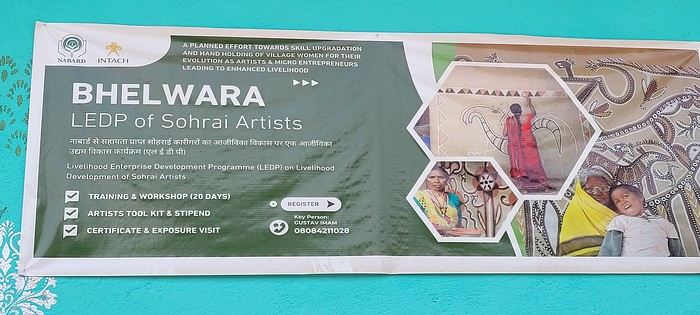
Hazaribagh I’ve got a meet-up with Adam Iman, a guide and painter. He picks me up from the hotel at 10 AM. Another traveler from Bangalore is supposed to join us, but while we wait for him to arrive, Adam takes me to see the paintings his mother and sister created at Hazaribagh station. The town became famous thanks to these murals, which can also be found in several surrounding villages. This art form has earned recognition and is now protected, a sign of its cultural importance. Once the visit is over, we go to pick up the other traveler and then head to our first village: Belwara, where Sohrai art is practiced. At the entrance, a sign proudly announces that we’re entering an artists’ village, where this art is created by women organized into micro-enterprises. Some even offer workshops for those who’d like to learn this tradition.
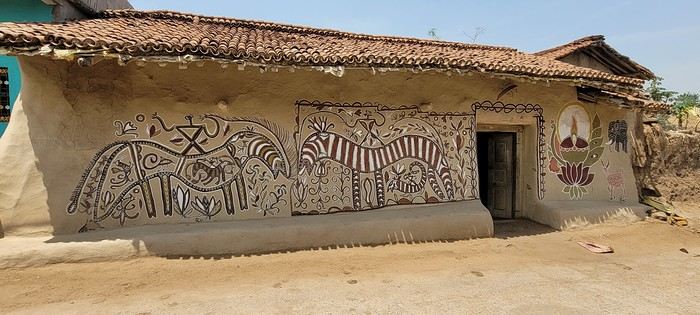
Sohrai art is tied to the harvest season, from October to mid-November. The motifs, in natural colors, celebrate fertility and abundance. The artists use pigments from the earth: red oxides, ochre, white kaolin, and black manganese. On the walls, you’ll see animals, fish, birds—all symbols of life and prosperity. As I look closer at the murals, I start to realize that each motif tells a story. Large animals like cows or bulls often take center stage. Their bodies are filled with intricate, almost hypnotic patterns. They symbolize wealth and prosperity for the household, as well as the deep respect for cattle, which are essential to daily life. On some facades, elephants stand out—massive and decorated with the same precision. They evoke quiet strength and protection. But it’s when I stop in front of one of the houses that I really take the time to look. The wall, a soft ochre, is entirely covered in murals. Two large animals stretch out on either side of the door, their elongated bodies fitting the length of the wall. Their silhouettes are filled with geometric patterns and incredibly fine curved lines, as if every space was patiently filled. Around them, stylized plants, flowers, and small decorative elements fill every gap. The door, dark and worn, becomes almost the silent center of the composition, framed by these living, protective forms. To the right, a more colorful motif catches the eye—a flower or a stylized lamp—like a touch of light on the earth. The whole thing gives an impression of perfect balance, between the rigor of the patterns and the freedom of the gesture.
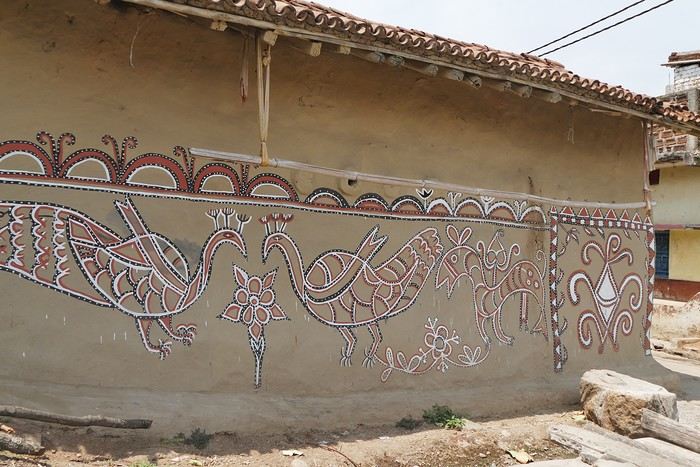
Elsewhere, birds and freer forms bring movement. Peacocks, recognizable by their stylized silhouettes, embody beauty and vitality, while fish symbolize water, fertility, and the continuity of life.
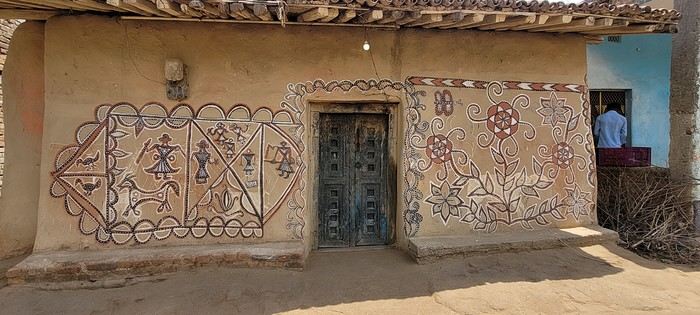
 On some paintings, the scenes become almost narrative: you can make out figures, everyday gestures, like a memory of the village inscribed in the walls. The decorative frames around the doors aren’t left to chance either—they symbolically protect the house, like a boundary between the inside and the outside world.
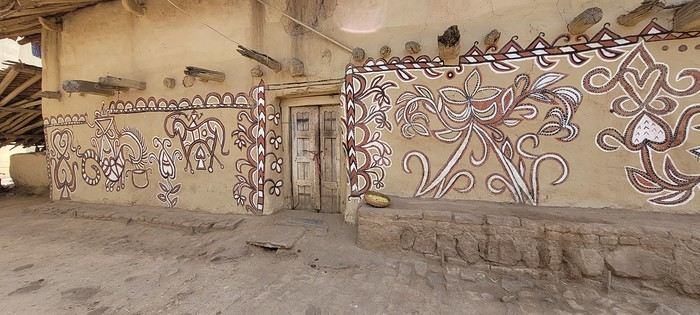
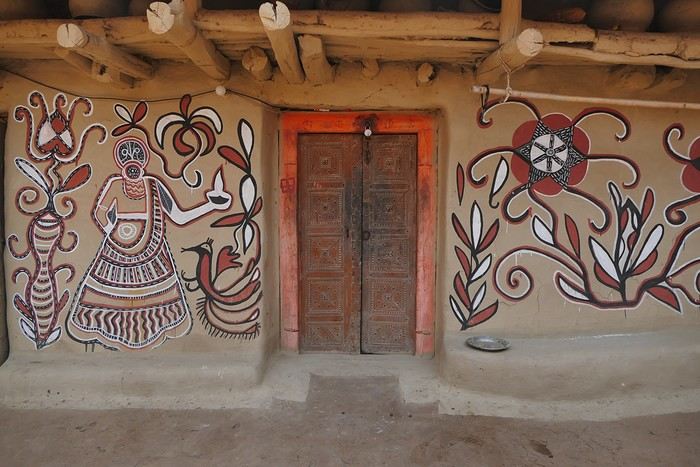
During the Sohrai festival, cattle are led into the jungle in the morning. Meanwhile, the women finish the *aripans*—these floor paintings—and continue the wall murals. Around noon, the animals return to the village, and the bulls’ horns are anointed with oil and vermilion in a gesture of gratitude, amid the vibrant colors adorning the houses. We visit several artists, including Parvat Devi, a well-known woman who has received many awards. Her arms are adorned with intriguing tattoos, which I’ll talk about in more detail later.
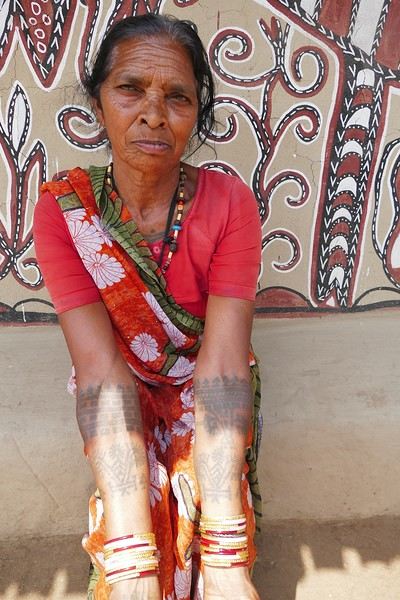
On another wall, the style changes completely. Here, no massive animals—just birds occupying the space, light and graceful, as if caught in mid-movement. Two silhouettes face each other, their long necks arched almost like mirrors, while their outstretched wings seem to vibrate with the patterns that compose them.
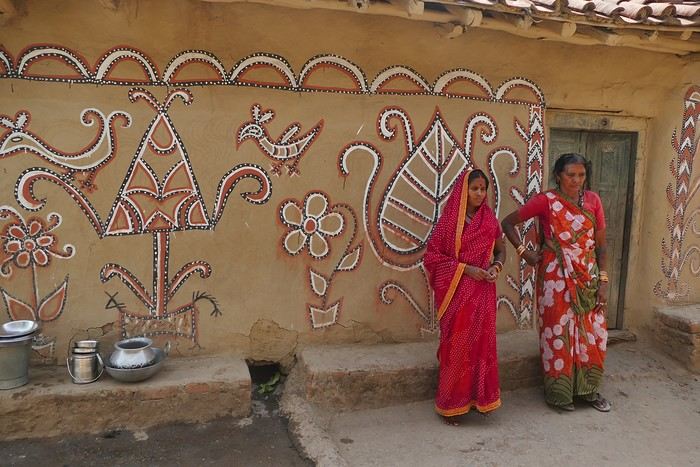
The design is more graphic, almost airy. The lines are smoother, more fluid, as if drawn in one confident stroke. The birds’ bodies aren’t solid—they’re filled with repetitive motifs like scales, stylized feathers, and spirals, giving a sense of continuous movement. Around them, everything comes to life: flowers burst open, arabesques swirl, and even the simplest shapes seem alive. What strikes me here is the sense of lightness. Where the large animals evoked stability and grounding, these birds bring something freer, almost joyful. They seem to embody movement, the circulation of life, like a breath flowing through the village.
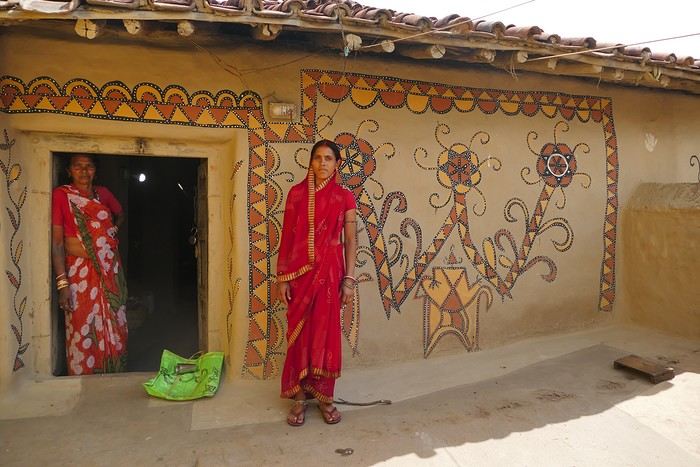
The colors remain the same—deep reds, intense blacks, and chalky white—but the rhythm is different. Faster, more spontaneous. As if each wall had its own personality, while still speaking the same language.
That’s probably why I’m so moved. I’d heard about these paintings from my friend Raja, and last year, I saw an exhibition in a village near my home. That first encounter made me want to come here. But seeing them in person is a whole different experience. These paintings are unique. This ancient art is passed down from mother to daughter, or mother-in-law to daughter-in-law, in a quiet, deeply living continuity. At first glance, it might seem almost childlike in its simplicity and pared-down forms. And yet, everything is thought out, balanced, mastered. Nothing is left to chance.
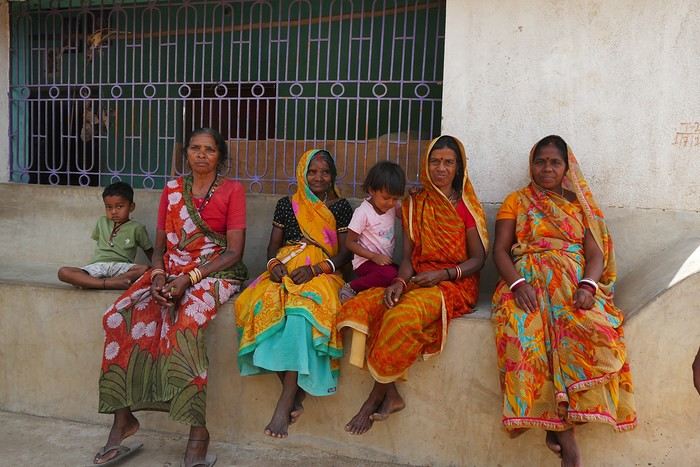
That apparent simplicity, combined with such rich symbolism, touches me deeply. There’s something sincere and essential in these walls—and that’s what moves me.
Hazaribagh I’ve got a meet-up with Adam Iman, a guide and painter. He picks me up from the hotel at 10 AM. Another traveler from Bangalore is supposed to join us, but while we wait for him to arrive, Adam takes me to see the paintings his mother and sister created at Hazaribagh station. The town became famous thanks to these murals, which can also be found in several surrounding villages. This art form has earned recognition and is now protected, a sign of its cultural importance. Once the visit is over, we go to pick up the other traveler and then head to our first village: Belwara, where Sohrai art is practiced. At the entrance, a sign proudly announces that we’re entering an artists’ village, where this art is created by women organized into micro-enterprises. Some even offer workshops for those who’d like to learn this tradition.
Sohrai art is tied to the harvest season, from October to mid-November. The motifs, in natural colors, celebrate fertility and abundance. The artists use pigments from the earth: red oxides, ochre, white kaolin, and black manganese. On the walls, you’ll see animals, fish, birds—all symbols of life and prosperity. As I look closer at the murals, I start to realize that each motif tells a story. Large animals like cows or bulls often take center stage. Their bodies are filled with intricate, almost hypnotic patterns. They symbolize wealth and prosperity for the household, as well as the deep respect for cattle, which are essential to daily life. On some facades, elephants stand out—massive and decorated with the same precision. They evoke quiet strength and protection. But it’s when I stop in front of one of the houses that I really take the time to look. The wall, a soft ochre, is entirely covered in murals. Two large animals stretch out on either side of the door, their elongated bodies fitting the length of the wall. Their silhouettes are filled with geometric patterns and incredibly fine curved lines, as if every space was patiently filled. Around them, stylized plants, flowers, and small decorative elements fill every gap. The door, dark and worn, becomes almost the silent center of the composition, framed by these living, protective forms. To the right, a more colorful motif catches the eye—a flower or a stylized lamp—like a touch of light on the earth. The whole thing gives an impression of perfect balance, between the rigor of the patterns and the freedom of the gesture.
Elsewhere, birds and freer forms bring movement. Peacocks, recognizable by their stylized silhouettes, embody beauty and vitality, while fish symbolize water, fertility, and the continuity of life.
On some paintings, the scenes become almost narrative: you can make out figures, everyday gestures, like a memory of the village inscribed in the walls. The decorative frames around the doors aren’t left to chance either—they symbolically protect the house, like a boundary between the inside and the outside world.During the Sohrai festival, cattle are led into the jungle in the morning. Meanwhile, the women finish the *aripans*—these floor paintings—and continue the wall murals. Around noon, the animals return to the village, and the bulls’ horns are anointed with oil and vermilion in a gesture of gratitude, amid the vibrant colors adorning the houses. We visit several artists, including Parvat Devi, a well-known woman who has received many awards. Her arms are adorned with intriguing tattoos, which I’ll talk about in more detail later.
On another wall, the style changes completely. Here, no massive animals—just birds occupying the space, light and graceful, as if caught in mid-movement. Two silhouettes face each other, their long necks arched almost like mirrors, while their outstretched wings seem to vibrate with the patterns that compose them.
The design is more graphic, almost airy. The lines are smoother, more fluid, as if drawn in one confident stroke. The birds’ bodies aren’t solid—they’re filled with repetitive motifs like scales, stylized feathers, and spirals, giving a sense of continuous movement. Around them, everything comes to life: flowers burst open, arabesques swirl, and even the simplest shapes seem alive. What strikes me here is the sense of lightness. Where the large animals evoked stability and grounding, these birds bring something freer, almost joyful. They seem to embody movement, the circulation of life, like a breath flowing through the village.
The colors remain the same—deep reds, intense blacks, and chalky white—but the rhythm is different. Faster, more spontaneous. As if each wall had its own personality, while still speaking the same language.
That’s probably why I’m so moved. I’d heard about these paintings from my friend Raja, and last year, I saw an exhibition in a village near my home. That first encounter made me want to come here. But seeing them in person is a whole different experience. These paintings are unique. This ancient art is passed down from mother to daughter, or mother-in-law to daughter-in-law, in a quiet, deeply living continuity. At first glance, it might seem almost childlike in its simplicity and pared-down forms. And yet, everything is thought out, balanced, mastered. Nothing is left to chance.
That apparent simplicity, combined with such rich symbolism, touches me deeply. There’s something sincere and essential in these walls—and that’s what moves me.
Discussion: Bridges of the World July 2026
This is where you can chat about bridges... let’s get the conversation started! 😊
Single Russia-Belarus visa and new train routes
Since last year, the unification of the Russian visa with Belarus has been in effect.
For reference, EU citizens haven’t needed a visa for Belarus for two years. However, it wasn’t possible to travel to Russia. Only Belarusian and Russian citizens could move freely within the union.
With the unified system, if you enter one of the two countries with a visa from either, you can now travel between them freely.
In the case of a Russian visa, it must be a paper visa glued into your passport—not an electronic visa.
This opens up the possibility of traveling to Russia from Lithuania via Minsk, for example, starting from Vilnius.
It also allows for travel circuits that would otherwise be difficult, despite the proximity of the cities.
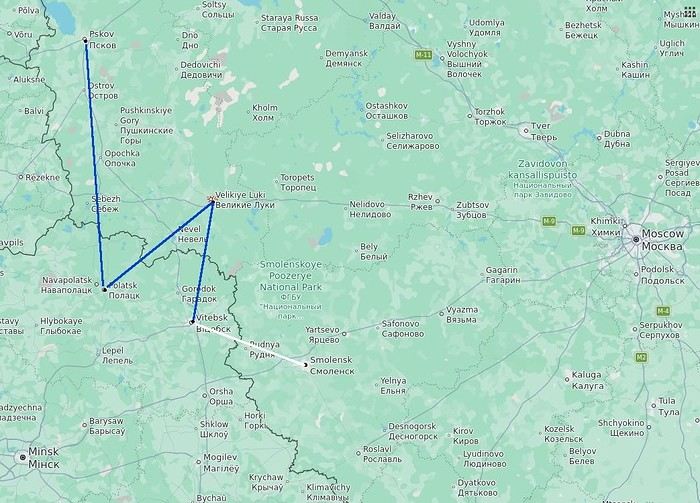
So, I’m leaving on June 12th for Vilnius. A one-hour flight for around thirty euros with a carry-on bag, and from Vilnius Airport, there’s a bus to Minsk. My planned route for now is Vilnius-Minsk-Smolensk-Vitebsk-Polotsk-Pskov-Riga.
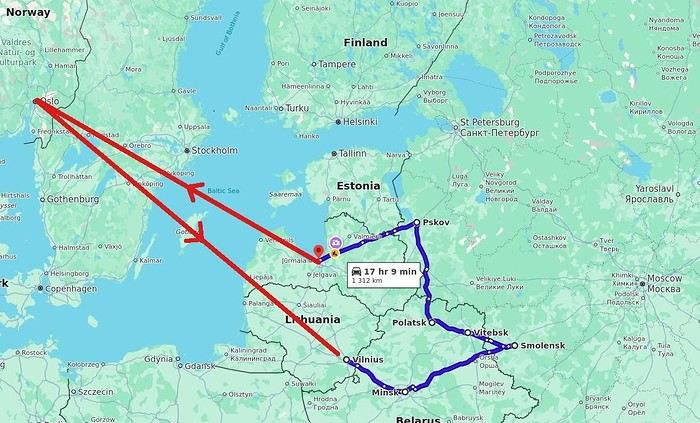
This crosses the Belarus-Russia border three times: from Minsk to Smolensk, then from Smolensk to Vitebsk, and finally from Polotsk to Pskov.
The region of this itinerary was, a thousand years ago, essentially that of the Krivichs, a local Slavic political entity. The term comes from "blood," *krew* in Polish, *krov* in Russian—basically "blood brothers." In Latvian, the word for Russians is *krievu*, by the way. Historically, the region corresponds to some of the old Russian principalities. Later, what marks Belarusian regions in general is, after the Great Schism of 1054, the division between Catholic and Orthodox zones, particularly as the Polish-Lithuanian Commonwealth expanded and contracted. In architecture, this corresponds to variations in Baroque styles, for example.
Vitebsk is known in France as the birthplace of Chagall. Born Russian, he first trained at the art school in Vitebsk, which was also attended by Malevich and Lissitzky, before completing his studies in Saint Petersburg, then moving to Berlin and later Paris. In Paris, Chagall met Cendrars, who had spent three years in Russia before and spoke enough Russian to help the newcomer get by a bit.
Back to the practical travel aspects: a local Pskov newspaper mentions that the Russian and Belarusian governments have a project for a Pskov-Polotsk train line. Previously, there were also plans for lines between Veliky Luki and Vitebsk, and Polotsk. A recently launched railway is Smolensk-Vitebsk, shown in white on the map, with projected lines in blue. https://pln-pskov.ru/society/583817.html https://pln-pskov.ru/society/578335.html
These will likely be "Hirondelle"—that is, *Lastochka*—the fast, spacious regional trains in Russia. Currently, all of this is done by bus, so the train is a very appealing and comfortable option. We’ll see how it goes.
With the unified system, if you enter one of the two countries with a visa from either, you can now travel between them freely.
In the case of a Russian visa, it must be a paper visa glued into your passport—not an electronic visa.
This opens up the possibility of traveling to Russia from Lithuania via Minsk, for example, starting from Vilnius.
It also allows for travel circuits that would otherwise be difficult, despite the proximity of the cities.
So, I’m leaving on June 12th for Vilnius. A one-hour flight for around thirty euros with a carry-on bag, and from Vilnius Airport, there’s a bus to Minsk. My planned route for now is Vilnius-Minsk-Smolensk-Vitebsk-Polotsk-Pskov-Riga.
This crosses the Belarus-Russia border three times: from Minsk to Smolensk, then from Smolensk to Vitebsk, and finally from Polotsk to Pskov.
The region of this itinerary was, a thousand years ago, essentially that of the Krivichs, a local Slavic political entity. The term comes from "blood," *krew* in Polish, *krov* in Russian—basically "blood brothers." In Latvian, the word for Russians is *krievu*, by the way. Historically, the region corresponds to some of the old Russian principalities. Later, what marks Belarusian regions in general is, after the Great Schism of 1054, the division between Catholic and Orthodox zones, particularly as the Polish-Lithuanian Commonwealth expanded and contracted. In architecture, this corresponds to variations in Baroque styles, for example.
Vitebsk is known in France as the birthplace of Chagall. Born Russian, he first trained at the art school in Vitebsk, which was also attended by Malevich and Lissitzky, before completing his studies in Saint Petersburg, then moving to Berlin and later Paris. In Paris, Chagall met Cendrars, who had spent three years in Russia before and spoke enough Russian to help the newcomer get by a bit.
Back to the practical travel aspects: a local Pskov newspaper mentions that the Russian and Belarusian governments have a project for a Pskov-Polotsk train line. Previously, there were also plans for lines between Veliky Luki and Vitebsk, and Polotsk. A recently launched railway is Smolensk-Vitebsk, shown in white on the map, with projected lines in blue. https://pln-pskov.ru/society/583817.html https://pln-pskov.ru/society/578335.html
These will likely be "Hirondelle"—that is, *Lastochka*—the fast, spacious regional trains in Russia. Currently, all of this is done by bus, so the train is a very appealing and comfortable option. We’ll see how it goes.
Discussion thread on the May 2026 theme: Staircases
If you’ve already posted your three photos in the contest thread Staircases: May 2026 Photo Contest Theme and a fourth one comes to mind, you can ease your staircase obsession here.
A few examples of staircases:
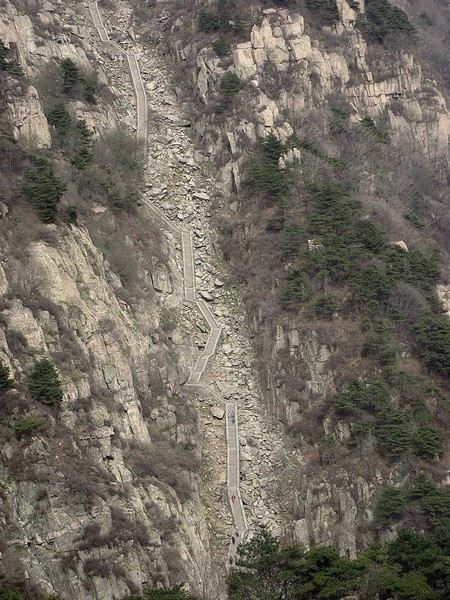
Some of the 6,600 steps on the staircase leading to the summit of Jade Emperor Peak at 1,545 meters.
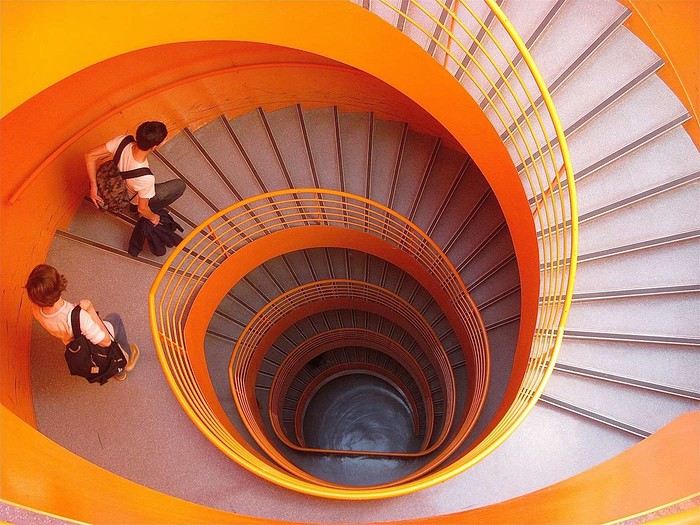
Emergency staircase at the Orléans library (France).
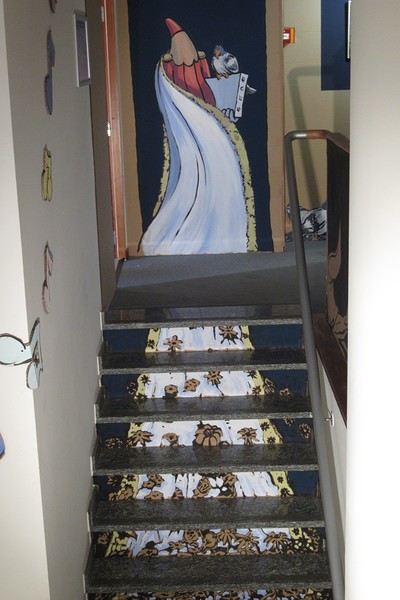
Brussels street artist Créons incorporates the staircase into the dress design of his character.
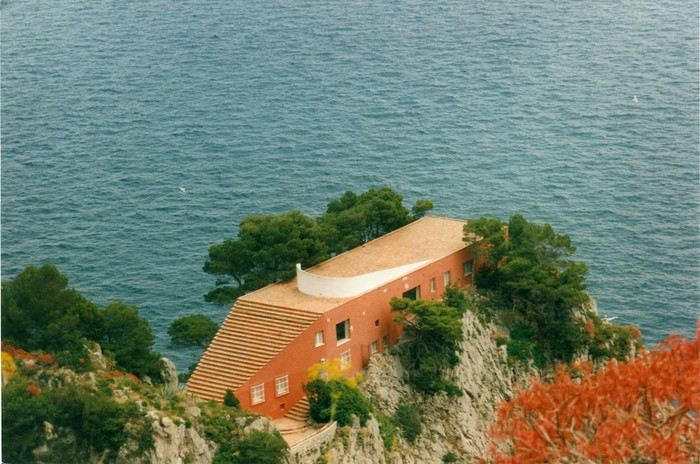
The staircase is part of the roof of Villa Malaparte (Adalberto Libera) on the island of Capri (Italy).
A few examples of staircases:
Some of the 6,600 steps on the staircase leading to the summit of Jade Emperor Peak at 1,545 meters.
Emergency staircase at the Orléans library (France).
Brussels street artist Créons incorporates the staircase into the dress design of his character.
The staircase is part of the roof of Villa Malaparte (Adalberto Libera) on the island of Capri (Italy).
Discussion around March 2026's Theme: Metal, Metallic
This is where we share stories (or post extra photos) around March’s theme Metal, Metallic.
Back to the March 2026 contest: HERE
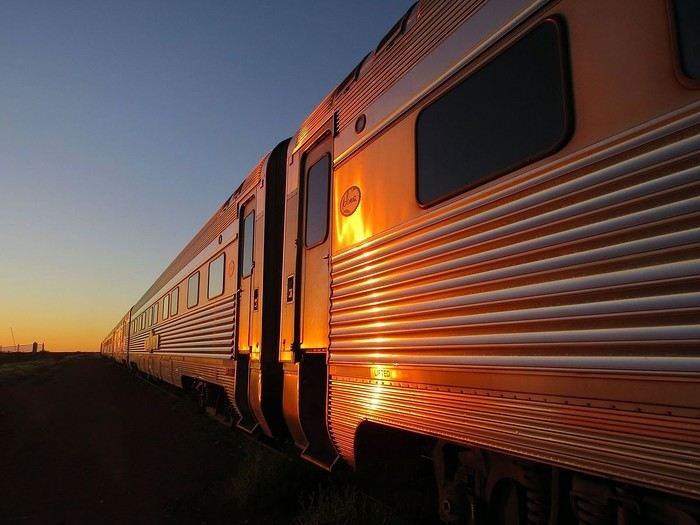
The Ghan (train connecting Adelaide to Darwin), at dawn.
Back to the March 2026 contest: HERE
The Ghan (train connecting Adelaide to Darwin), at dawn.
Review of an expedition cruise to the Seychelles with Ponant from January 25 to February 2, 2026
Hi everyone,
It was totally by chance that I found this cruise while chatting with Alfred in November 2024. It wasn’t planned, but the price was attractive—one of those "great deals" from Ponant that I love and that don’t exist anymore. Since everyone’s wondering, here’s the answer without waiting for the end of the story: after my various loyalty discounts, I paid **3,250 € per person** for 8 nights/9 days on the expedition cruise *The Essentials of the Seychelles*.
Expedition cruises are by far our favorites. The outings are done by Zodiac with the ship’s naturalist guides, everything’s included, and there’s no need to add any excursions or prepare anything.
We’re liking long flights less and less, so to break up the trip, we decided to stop over in Doha for four days on the way there and one day on the way back.
I’m happy to share the good and not-so-good moments, the great surprises, and the disappointments of this trip with you.
It was totally by chance that I found this cruise while chatting with Alfred in November 2024. It wasn’t planned, but the price was attractive—one of those "great deals" from Ponant that I love and that don’t exist anymore. Since everyone’s wondering, here’s the answer without waiting for the end of the story: after my various loyalty discounts, I paid **3,250 € per person** for 8 nights/9 days on the expedition cruise *The Essentials of the Seychelles*.
Expedition cruises are by far our favorites. The outings are done by Zodiac with the ship’s naturalist guides, everything’s included, and there’s no need to add any excursions or prepare anything.
We’re liking long flights less and less, so to break up the trip, we decided to stop over in Doha for four days on the way there and one day on the way back.
I’m happy to share the good and not-so-good moments, the great surprises, and the disappointments of this trip with you.
Trip to Morocco in September-October 2025, in our camper van
Hi everyone,
We’re just back from a month-long trip to Morocco in our camper van.
After crossing France (we left from the Nantes area) and Spain, we arrived in Algeciras where we bought our boat tickets to Tangier. When we got to Tangier, as we were going through customs, you can imagine our surprise when the customs officer took our road map of Morocco and pointed out the label "Western Sahara" (just like in the forum’s destination section, by the way!).
He wanted it to say "Moroccan Sahara" instead!!! But there was nothing we could do—it was an old map... He wouldn’t listen, and after long discussions with the other (younger) customs officers, he finally gave it back and let us through... Unbelievable! Later, we heard that other travelers had their maps confiscated outright.
So, hide it well if you want to keep yours!!!
Anyway, we skirted around Tangier’s suburbs—pretty grim—and finally arrived in Asilah.
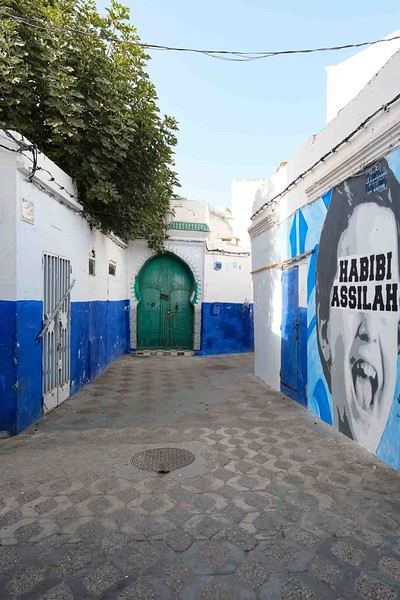
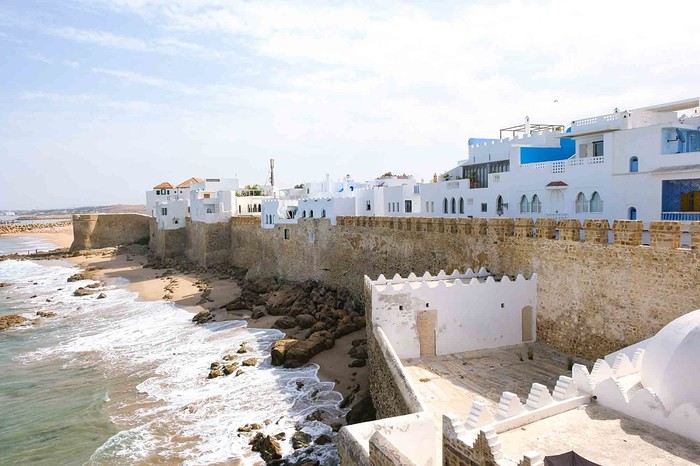
Following the coast and the long promenade along the beach, we reached the campsite. It was a bit crowded, not much shade, but it wasn’t far from the medina or the beach, and it wasn’t expensive. There’s some life here: Moroccan families seem to live on-site, in tents or basic bungalows. A woman was cooking tagine on a brazier—we were right in the atmosphere! The night was quiet, and we slept well. We set off on foot, walking along the seafront to the medina... We’d already been here in 2009. It was less touristy back then! Still, at this early hour, the little streets inside were very quiet. The walls had been freshly whitewashed, and there were even more murals than before. Around 11:30 AM, we strolled along the ramparts by the sea. There was a nice breeze! And a lot more people around. We enjoyed a milkshake on the terrace of a café overlooking the beach that stretches out at the foot of the medina. Some young guys were having fun diving off the rocks—and even off the top of the wall!
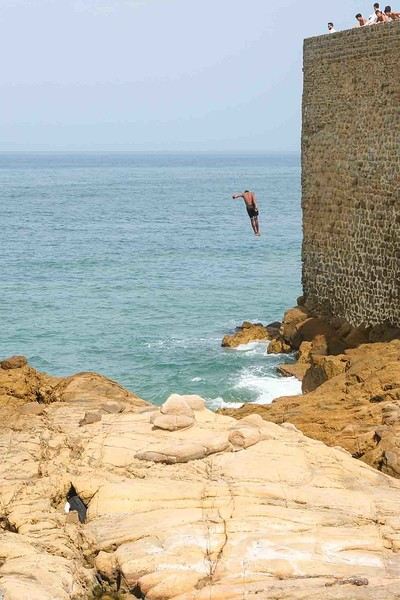
Anyway, we skirted around Tangier’s suburbs—pretty grim—and finally arrived in Asilah.
Following the coast and the long promenade along the beach, we reached the campsite. It was a bit crowded, not much shade, but it wasn’t far from the medina or the beach, and it wasn’t expensive. There’s some life here: Moroccan families seem to live on-site, in tents or basic bungalows. A woman was cooking tagine on a brazier—we were right in the atmosphere! The night was quiet, and we slept well. We set off on foot, walking along the seafront to the medina... We’d already been here in 2009. It was less touristy back then! Still, at this early hour, the little streets inside were very quiet. The walls had been freshly whitewashed, and there were even more murals than before. Around 11:30 AM, we strolled along the ramparts by the sea. There was a nice breeze! And a lot more people around. We enjoyed a milkshake on the terrace of a café overlooking the beach that stretches out at the foot of the medina. Some young guys were having fun diving off the rocks—and even off the top of the wall!
Trip to Israel / Holy Land in 2022
For once, given the destination, the author can’t set aside their religious beliefs, which inevitably shape this kind of journey.
The Trip
Early in the morning at Orly Airport, in the departure lounge for Tel Aviv, a group of about forty young men arrives, all looking identical! The same neatly trimmed beards, the same identical haircuts, the same outfits with a touch of whimsy… The effect of seeing these forty “clones” is striking and raises questions! Why such perfect uniformity among this group of guys? Do they belong to the same family, sports club, cultural association, or religious group? A mystery! At the same time, the waiting area fills up with men who are more expected, given our destination: they wear large felt hats and dress in black suits with white shirts—Hassidim? The ones I’ve glimpsed fleetingly in Paris or New York, who have always been a mystery to me. More discreet-looking women accompany them.
I’m already in Israel without even setting foot there! Plus, I witness the preparations for an improvised show.
The “clones” start a flash mob at seven in the morning in a Paris airport departure lounge! Some pull out musical instruments, others begin singing and dancing. A music with strange, unfamiliar sounds enchants the waiting passengers.
The flight crew finally arrives, cutting through the flash mob, bringing us back to the reality of the moment: waiting to take off soon for this so troubling and mysterious Middle East. We go through passport control, presenting our faces to the scanners that operate the exit gate. The group of “identical” young men gets held up by the system: logically, a scanner let the first one through but blocked the second because of his perfect resemblance to the first. To the machine, the same person shouldn’t be able to cross the border twice? But eventually, the whole group makes it through the glass doors, leaving the Republic behind. My simplistic explanation is left looking ridiculous.
At every new destination, I ask myself countless questions, revealing a certain anxiety tied to the unknown: fear of attacks (one just happened at a bus station in Jerusalem), possible police pressure, unexpected events. Israel isn’t known for being a relaxing destination. In reality, if I did face a serious difficulty in this country, it wasn’t one I had anticipated—and it wasn’t particularly tied to Israel!
I take my seat by the window, which is already occupied by a little girl. Her father, a Hassidic man, politely asks if I’d be willing to give up my seat for his daughter. I tell him I’d be happy to make her happy. Seeing me masked, he asks if I’d like him and his daughter to wear masks too. In response, I take off my mask so as not to impose any constraints on them and wish them a good flight.
It was the first time I’d approached and spoken to a Hassidic man. He didn’t speak the way I might have expected after watching *Rabbi Jacob* with Louis de Funès; he spoke perfectly without an accent, just like you and me! Beware of stereotypes! Throughout the flight, I sneak glances at my strange neighbor: he prayed silently without stopping for a minute. His daughter, as good as gold, never interrupted him. He used several religious accessories during his three-hour continuous prayer: a kippa, a prayer shawl, and a rosary?… I left that plane deeply impressed, me, who has a very distant relationship with my Creator and only prays now and then.
The Trip
Early in the morning at Orly Airport, in the departure lounge for Tel Aviv, a group of about forty young men arrives, all looking identical! The same neatly trimmed beards, the same identical haircuts, the same outfits with a touch of whimsy… The effect of seeing these forty “clones” is striking and raises questions! Why such perfect uniformity among this group of guys? Do they belong to the same family, sports club, cultural association, or religious group? A mystery! At the same time, the waiting area fills up with men who are more expected, given our destination: they wear large felt hats and dress in black suits with white shirts—Hassidim? The ones I’ve glimpsed fleetingly in Paris or New York, who have always been a mystery to me. More discreet-looking women accompany them.
I’m already in Israel without even setting foot there! Plus, I witness the preparations for an improvised show.
The “clones” start a flash mob at seven in the morning in a Paris airport departure lounge! Some pull out musical instruments, others begin singing and dancing. A music with strange, unfamiliar sounds enchants the waiting passengers.
The flight crew finally arrives, cutting through the flash mob, bringing us back to the reality of the moment: waiting to take off soon for this so troubling and mysterious Middle East. We go through passport control, presenting our faces to the scanners that operate the exit gate. The group of “identical” young men gets held up by the system: logically, a scanner let the first one through but blocked the second because of his perfect resemblance to the first. To the machine, the same person shouldn’t be able to cross the border twice? But eventually, the whole group makes it through the glass doors, leaving the Republic behind. My simplistic explanation is left looking ridiculous.
At every new destination, I ask myself countless questions, revealing a certain anxiety tied to the unknown: fear of attacks (one just happened at a bus station in Jerusalem), possible police pressure, unexpected events. Israel isn’t known for being a relaxing destination. In reality, if I did face a serious difficulty in this country, it wasn’t one I had anticipated—and it wasn’t particularly tied to Israel!
I take my seat by the window, which is already occupied by a little girl. Her father, a Hassidic man, politely asks if I’d be willing to give up my seat for his daughter. I tell him I’d be happy to make her happy. Seeing me masked, he asks if I’d like him and his daughter to wear masks too. In response, I take off my mask so as not to impose any constraints on them and wish them a good flight.
It was the first time I’d approached and spoken to a Hassidic man. He didn’t speak the way I might have expected after watching *Rabbi Jacob* with Louis de Funès; he spoke perfectly without an accent, just like you and me! Beware of stereotypes! Throughout the flight, I sneak glances at my strange neighbor: he prayed silently without stopping for a minute. His daughter, as good as gold, never interrupted him. He used several religious accessories during his three-hour continuous prayer: a kippa, a prayer shawl, and a rosary?… I left that plane deeply impressed, me, who has a very distant relationship with my Creator and only prays now and then.
Travel Journal - 28 Days in China in August 2025
Hi everyone! I’m sharing a modest travel journal from my trip to China in August 2025.
There wasn’t much room for improvisation on this trip—everything was planned in advance. Since August is peak season, I decided to book train tickets early, and once that was set, I reserved all the accommodations too. I got everything on Trip.com.
I bought the flight tickets back in March from Hainan Airlines. They were super expensive, but with these travel dates, I couldn’t exactly dream of a bargain!
I picked up e-SIMs valid for a month from Free just before departure: 10 € for the e-SIM + 19.90 € for a one-month plan with 35 GB of data abroad.
No need for a VPN with these e-SIMs, but D. still got one—a multi-device plan for 5 € with a discount from Let’s VPN, valid for a month. It was for evenings at the hotel on Wi-Fi to avoid burning through the 35 GB with video.
I downloaded Alipay, WeChat, Amap (Baidu Maps), and Trip.com. We also have Google Translate and Maps.me—absolute must-haves.
We’re ready to go!
I’ve been waiting for this day for nearly 15 years!! I travel a lot, but this one—this is MY TRIP 🙂 It’s been postponed so many times: because I wanted to do it with the right person, because I have a Turkish stamp in my passport and heard they don’t issue visas with that, because of COVID... and then China introduced a 30-day visa exemption, and that was the green light! Ugh, they forced us to take our vacation in August this year—far from ideal—but no more delays. Saturday, August 2, 2025: it’s finally the big day!
Days 1 and 2: We got dropped off at Charles de Gaulle at 9:30 AM. I supposedly checked in online, but only for the first flight and without getting the boarding pass... Might as well scrap online check-in in that case. So, we spent over an hour in line at the counter to get them. We didn’t have any checked luggage—just our backpacks as carry-ons—so this was a step we’d never had to deal with before, but whatever, it’s done. No wait at passport control, 5 minutes through security, a quick walk around the terminal, 10 minutes in the boarding area, and it was already time to board. Departure around 12:45 PM, arrival in Chongqing at 4:50 AM. We had a few hours of layover before our next flight. Went through immigration, connecting flight control, and security. Pro tip: check your next flight’s boarding gate right after immigration. We never saw it displayed again anywhere in the terminal.
The Free e-SIMs work—phew!
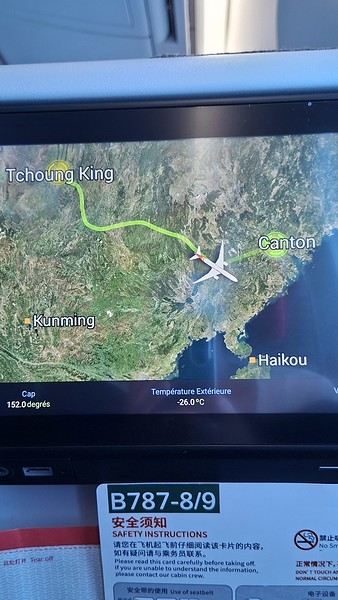
Took off at 9:30 AM, arrived in Guangzhou (Canton) at 11:20 AM in the rain. I love how Chongqing is translated as "Tchoung King" on the screens in the plane—very French!
During my first two trips to China, we paid for everything in cash, but this time, we’re going all-in on Alipay and WeChat. I still brought the leftover change from previous trips—it might come in handy. At the metro station, they showed us a QR code to buy tickets via WeChat. There were probably machines and even a ticket counter, but we didn’t see them, and buying via WeChat was pretty simple. 8 yuan to Changshu Lu, which is 22 stops. So far, so good. Then, we had to find the hotel, which wasn’t on Google Maps, Maps.me, or Amap... Easy 😎! We found it without too much hassle, though. Dropped off our stuff and went out to eat. 55 yuan for two claypots with fish/eel, rice, cabbage, and purple eggplant. When we left, it was pouring. We grabbed our umbrellas and set off to explore the neighborhood: Enning Road (we’ll come back later to check out a specific spot), Shangxiajiu (the pedestrian shopping street), Baohua Road... The area is pretty diverse—one street to the next, it’s like stepping into a different world.

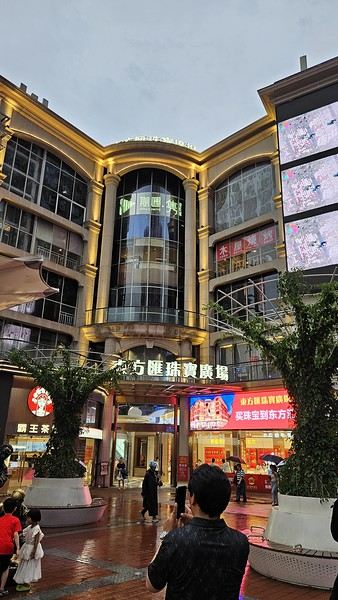
There weren’t many people around, probably because of the rain. We grabbed a quick street food dinner and went to bed—we were exhausted. We struggled to stay awake until 11 PM to adjust to the time change as quickly as possible. There’s a 6-hour time difference.
There wasn’t much room for improvisation on this trip—everything was planned in advance. Since August is peak season, I decided to book train tickets early, and once that was set, I reserved all the accommodations too. I got everything on Trip.com.
I bought the flight tickets back in March from Hainan Airlines. They were super expensive, but with these travel dates, I couldn’t exactly dream of a bargain!
I picked up e-SIMs valid for a month from Free just before departure: 10 € for the e-SIM + 19.90 € for a one-month plan with 35 GB of data abroad.
No need for a VPN with these e-SIMs, but D. still got one—a multi-device plan for 5 € with a discount from Let’s VPN, valid for a month. It was for evenings at the hotel on Wi-Fi to avoid burning through the 35 GB with video.
I downloaded Alipay, WeChat, Amap (Baidu Maps), and Trip.com. We also have Google Translate and Maps.me—absolute must-haves.
We’re ready to go!
I’ve been waiting for this day for nearly 15 years!! I travel a lot, but this one—this is MY TRIP 🙂 It’s been postponed so many times: because I wanted to do it with the right person, because I have a Turkish stamp in my passport and heard they don’t issue visas with that, because of COVID... and then China introduced a 30-day visa exemption, and that was the green light! Ugh, they forced us to take our vacation in August this year—far from ideal—but no more delays. Saturday, August 2, 2025: it’s finally the big day!
Days 1 and 2: We got dropped off at Charles de Gaulle at 9:30 AM. I supposedly checked in online, but only for the first flight and without getting the boarding pass... Might as well scrap online check-in in that case. So, we spent over an hour in line at the counter to get them. We didn’t have any checked luggage—just our backpacks as carry-ons—so this was a step we’d never had to deal with before, but whatever, it’s done. No wait at passport control, 5 minutes through security, a quick walk around the terminal, 10 minutes in the boarding area, and it was already time to board. Departure around 12:45 PM, arrival in Chongqing at 4:50 AM. We had a few hours of layover before our next flight. Went through immigration, connecting flight control, and security. Pro tip: check your next flight’s boarding gate right after immigration. We never saw it displayed again anywhere in the terminal.
The Free e-SIMs work—phew!
Took off at 9:30 AM, arrived in Guangzhou (Canton) at 11:20 AM in the rain. I love how Chongqing is translated as "Tchoung King" on the screens in the plane—very French!
During my first two trips to China, we paid for everything in cash, but this time, we’re going all-in on Alipay and WeChat. I still brought the leftover change from previous trips—it might come in handy. At the metro station, they showed us a QR code to buy tickets via WeChat. There were probably machines and even a ticket counter, but we didn’t see them, and buying via WeChat was pretty simple. 8 yuan to Changshu Lu, which is 22 stops. So far, so good. Then, we had to find the hotel, which wasn’t on Google Maps, Maps.me, or Amap... Easy 😎! We found it without too much hassle, though. Dropped off our stuff and went out to eat. 55 yuan for two claypots with fish/eel, rice, cabbage, and purple eggplant. When we left, it was pouring. We grabbed our umbrellas and set off to explore the neighborhood: Enning Road (we’ll come back later to check out a specific spot), Shangxiajiu (the pedestrian shopping street), Baohua Road... The area is pretty diverse—one street to the next, it’s like stepping into a different world.
There weren’t many people around, probably because of the rain. We grabbed a quick street food dinner and went to bed—we were exhausted. We struggled to stay awake until 11 PM to adjust to the time change as quickly as possible. There’s a 6-hour time difference.
Off on an adventure to Java (and a bit of Bali)
Hey there, community! Back this weekend, below is my travel journal from my adventure in Indonesia. Enjoy the read!!!
Day 1 - August 10, 2025 New life downloading for three weeks! And for that, Flo and I launched a public tender... A public tender? What’s that got to do with a travel journal???... Well, when you think about it, few destinations tick all the boxes for an August adventure: Meaning, finding a place that’s exotic in the middle of August, not too expensive, not too packed with tourists, warm but not *too* warm, with postcard-perfect landscapes, dreamy beaches, tasty cuisine with a hint of exoticism, friendly and welcoming locals, where you’re free to sleep under the stars among the mosquitos, take transport surrounded by chickens, and even eat from a pig trough if you feel like it—well, turns out it’s not that easy to find! I’d even say, given how thick the list of requirements is, there’s a big risk the tender could be declared unsuccessful for failing to meet just one criterion. Let’s just say the candidates better submit a rock-solid proposal!
After reviewing all the responses and presentations from the candidates, the obvious choice for us is... Indonesia! Except that trying to explore a country as vast as Indonesia and its 17,504 islands in less than five years is a bit like reading the summary of a Proust novel without taking the time to savor each of its 950 pages! Don’t worry, I won’t name them all here. Besides, do they even all have names? No! Only 7,870 have been named—their parents clearly ran out of ideas for the rest. Anyway, our society, which worships the "work more to earn more" mantra, unfortunately limits our adventure time. So we’ll only get to see a small part of Indonesia, and we’ll have to make a tough choice to head for the best of the best in this archipelago of over seventeen thousand islands. Each one has its own selling points: Sumatra, Sulawesi, Java, the Celebes, Bali, Borneo, Papua, Timor, the Moluccas... So many names that smell of adventure... Another tender, another list of requirements, another review of proposals... Drumroll... Splash splash... And the lucky winner is... Ta-da... Java, Bali’s big sister, where I’ve already been eight years ago... Java the programming language. The Java of Broadway. We’re gonna *do* the Java. Java the coffee. And yes, Java is also an island!
This island, four times smaller than France, is home to 136 million people, making it the most populated island in the world! Fun fact: Indonesia, with its 260 million inhabitants, is just shy of the podium for the world’s most populated countries, after the winning trio of India, China, and the United States. And it’s on this island of Java that you’ll find Jakarta, the (soon-to-be-former) capital and main airport of the country, where we’ll soon land after our nineteen-hour flight! Yep, nineteen hours! I mean, Indonesia in general—and Java in particular—is a *tad* farther than going on vacation to Grandma Yoyo’s! Not sure where it is? Easy. Grab a map. Plant your finger on the big island at the bottom right—aka Australia for those who struggle with geography—move it up two centimeters, and bam, welcome to Indonesia!
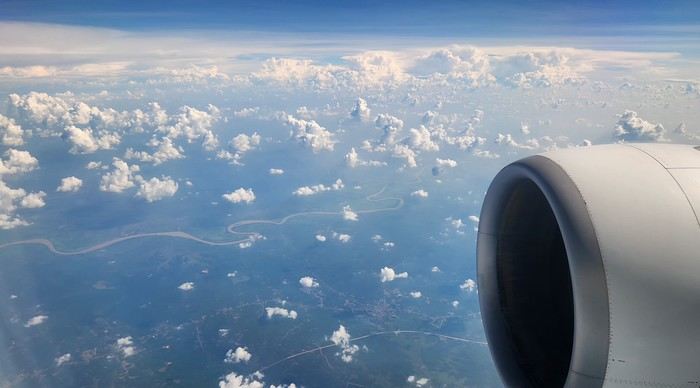
Nice transition, right? Because "Welcome to Indonesia" is exactly what the friendly flight attendant just said to me as we got off the plane! That’s it, our chakras are open, we’ve arrived at our (air)port. Time for rest, pool, cocktails, and a beach with our toes spread out... Wait, if you bought that, you clearly don’t know us yet! Since we still have energy to burn and need to adjust to the flight and time difference, we tackle the long administrative formalities to enter Indonesia, just to earn the right to hop in a 45-minute Grab taxi to the train station. The train station? What train station?... What do you usually do at a train station? Take a train, of course! Off we go for a three-hour train ride to Bandung, where we’ll officially start our adventure tomorrow after our first Indonesian night...
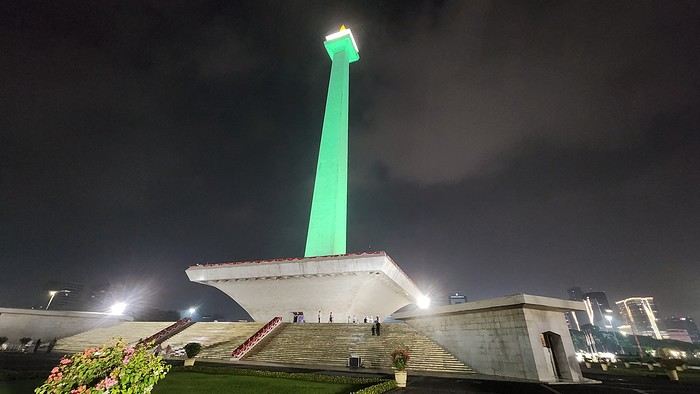
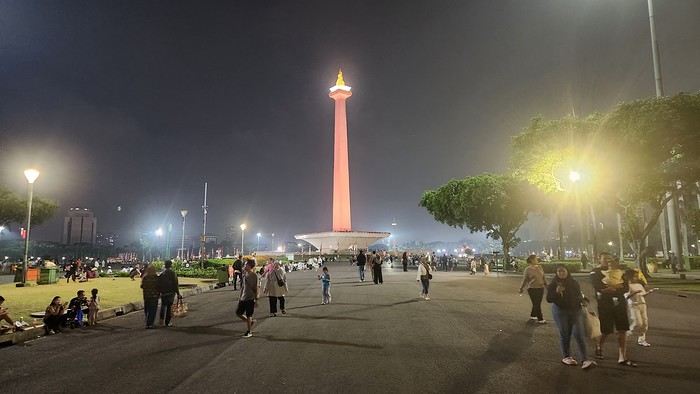
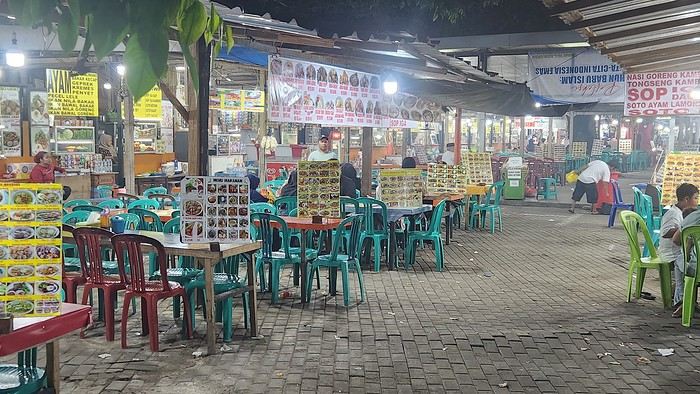
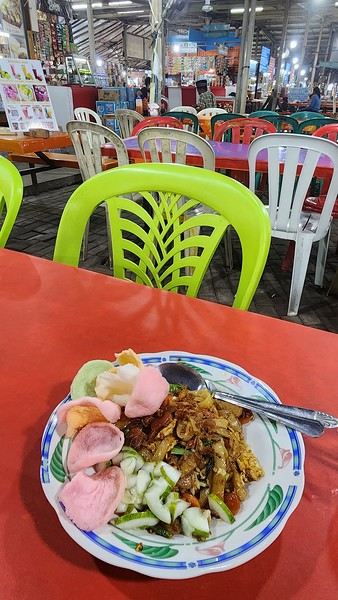
Unfortunately, we were a bit slow off the mark, which meant we missed the 6:25 PM train by two minutes. Oh well, we’ll have to wait until 11 PM. We take the opportunity to stretch our legs in Jakarta, soak up the atmosphere, and enjoy the delicious smells wafting from the *warungs*—those little typical street restaurants. A quick stop at the National Monument, a detour to a night market to devour our first *kwetiaw goreng* and *teh manis* for 60,000 rupiahs (that’s 3 € for two), and just like that, our penalty is lifted, and we’re allowed to hit the road again. Off to Bandung, where we arrive at 2 AM for... a *very* short night...
Day 1 - August 10, 2025 New life downloading for three weeks! And for that, Flo and I launched a public tender... A public tender? What’s that got to do with a travel journal???... Well, when you think about it, few destinations tick all the boxes for an August adventure: Meaning, finding a place that’s exotic in the middle of August, not too expensive, not too packed with tourists, warm but not *too* warm, with postcard-perfect landscapes, dreamy beaches, tasty cuisine with a hint of exoticism, friendly and welcoming locals, where you’re free to sleep under the stars among the mosquitos, take transport surrounded by chickens, and even eat from a pig trough if you feel like it—well, turns out it’s not that easy to find! I’d even say, given how thick the list of requirements is, there’s a big risk the tender could be declared unsuccessful for failing to meet just one criterion. Let’s just say the candidates better submit a rock-solid proposal!
After reviewing all the responses and presentations from the candidates, the obvious choice for us is... Indonesia! Except that trying to explore a country as vast as Indonesia and its 17,504 islands in less than five years is a bit like reading the summary of a Proust novel without taking the time to savor each of its 950 pages! Don’t worry, I won’t name them all here. Besides, do they even all have names? No! Only 7,870 have been named—their parents clearly ran out of ideas for the rest. Anyway, our society, which worships the "work more to earn more" mantra, unfortunately limits our adventure time. So we’ll only get to see a small part of Indonesia, and we’ll have to make a tough choice to head for the best of the best in this archipelago of over seventeen thousand islands. Each one has its own selling points: Sumatra, Sulawesi, Java, the Celebes, Bali, Borneo, Papua, Timor, the Moluccas... So many names that smell of adventure... Another tender, another list of requirements, another review of proposals... Drumroll... Splash splash... And the lucky winner is... Ta-da... Java, Bali’s big sister, where I’ve already been eight years ago... Java the programming language. The Java of Broadway. We’re gonna *do* the Java. Java the coffee. And yes, Java is also an island!
This island, four times smaller than France, is home to 136 million people, making it the most populated island in the world! Fun fact: Indonesia, with its 260 million inhabitants, is just shy of the podium for the world’s most populated countries, after the winning trio of India, China, and the United States. And it’s on this island of Java that you’ll find Jakarta, the (soon-to-be-former) capital and main airport of the country, where we’ll soon land after our nineteen-hour flight! Yep, nineteen hours! I mean, Indonesia in general—and Java in particular—is a *tad* farther than going on vacation to Grandma Yoyo’s! Not sure where it is? Easy. Grab a map. Plant your finger on the big island at the bottom right—aka Australia for those who struggle with geography—move it up two centimeters, and bam, welcome to Indonesia!
Nice transition, right? Because "Welcome to Indonesia" is exactly what the friendly flight attendant just said to me as we got off the plane! That’s it, our chakras are open, we’ve arrived at our (air)port. Time for rest, pool, cocktails, and a beach with our toes spread out... Wait, if you bought that, you clearly don’t know us yet! Since we still have energy to burn and need to adjust to the flight and time difference, we tackle the long administrative formalities to enter Indonesia, just to earn the right to hop in a 45-minute Grab taxi to the train station. The train station? What train station?... What do you usually do at a train station? Take a train, of course! Off we go for a three-hour train ride to Bandung, where we’ll officially start our adventure tomorrow after our first Indonesian night...
Unfortunately, we were a bit slow off the mark, which meant we missed the 6:25 PM train by two minutes. Oh well, we’ll have to wait until 11 PM. We take the opportunity to stretch our legs in Jakarta, soak up the atmosphere, and enjoy the delicious smells wafting from the *warungs*—those little typical street restaurants. A quick stop at the National Monument, a detour to a night market to devour our first *kwetiaw goreng* and *teh manis* for 60,000 rupiahs (that’s 3 € for two), and just like that, our penalty is lifted, and we’re allowed to hit the road again. Off to Bandung, where we arrive at 2 AM for... a *very* short night...
Two weeks in Corfu with the family – our feedback
Hi everyone,
Here’s a little account of our two-week family trip (with two boys aged 7 and 10) to Corfu. I hope it helps other travelers! We chose Corfu because there are direct flights from Paris, and we were looking for a destination where it’d be easy to swim with the kids. We were there from August 14 to 28.
Since I wasn’t sure about the distances and had read quite a bit about Greek driving and the state of the roads, I decided to split the trip into three parts: Corfu Town, the North, and the South.
Corfu Town (3 nights) Day 1: We landed in the late afternoon. Booked three nights via Booking on the edge of the old town (Sueno Garden Apartment), which is walkable from the airport—no need to rent a car for the first few days or stay in Corfu Town. First evening in the old town, dinner at Pane e Souvlaki on Dimarchiou Square. Touristy, but good vibes.
Day 2: Visited the Old Fort. Nice for the Church of St. George, which looks like an ancient Greek temple, and especially for the 360° view from the top. By 11 a.m., the sun was already beating down. Left the fort and strolled through the People’s Gardens. Lunch at Mouragia a bit further away, then backtracked to let the kids swim at Faliraki Bathing Beach.
Day 3: We took bus line 2A from Spinada (in front of the Old Fort) to the end of the runway (stop ΚΑΛΟΚΑΙΡΙ Ε). Poorly signposted when you’re at the top—you have to go down via the bar. Not well set up, which is a shame. The Panagia Vlacherna Monastery is pretty on its little island, but don’t turn around—the landings are impressive. Returned via the 2A with a stop at Mon Repos Beach, where the kids loved jumping off the pier.
North (6 nights) Day 4: Headed to Sidari, rented a small Fiat Panda from Europcar—no issues with this rental company (I booked late, so it’s probably possible to find cheaper). We’d also booked via Booking at Blue Dreams Apartment, just south of Sidari. A family-run hotel with a nice pool, we had a great stay (it’s just been taken over by Belgians who speak French). We wandered around Sidari to the Canal d’Amour. Not easy to access—you have to walk through all the bars, and the tiny beach is pretty dirty. Still, it’s fun for a swim and exploring the cave.
Day 5: Quick breakfast to be at Cap Drastis by 9 a.m. Parked at the top, but there’s very little space (we couldn’t park on the way back), and it’s a dirt road. The signs saying “To the sea” actually lead to a boat dock for a cape tour. You only see the cape from above, not below. A bit of a letdown, but since it was early and no one was down there yet, we treated ourselves to a quick swim. Brunch back in Sidari at Eviva—I recommend it: not Greek at all, but high quality. Agios Stefanos in the late afternoon after the heat. The port is awful (dirty and uninteresting), but there’s a swimming spot just before the beach, near the old port (park above, by the church). No one was there—great moment with the kids.
Day 6: Left around 9 a.m. for Mount Pantokrator. A bit of a climb at the end in the Fiat Panda—it’s steep! The road is long, but I think it’s worth it for the lunar landscape at the top, the monastery-antenna, and the 360° view. Then down to Kassiopi (we paid 5 euros for the Kassiopi Car Park—I think it’s the best option, as there’s no big free parking like in Sidari) and a swim at Paralia Mpataria (small but nice). Really relaxing in the late afternoon. Walked around the peninsula and saw several dolphin pods with amazing jumps. Unforgettable. Kassiopi is more family-friendly than Sidari and has more charm (Sidari has none, so that’s easy!).
Day 7: Morning off at the hotel, then afternoon at Paralia Kalamaki for the inflatable playground the kids had spotted on the way back from Kassiopi. 10 euros per person for an hour, not many people around 4 p.m., and we had a blast. Shallow sandy beach. Not much marine life, but safe for young kids. Note: free freshwater shower. Dinner at Nikos Family Restaurant in Roda. Great welcome and atmosphere. The stifado and soutzoukakia were delicious, and the Greek desserts were amazing too. Next door, at Roda Park restaurant, there was a Greek party with traditional dancing and plaster plate-smashing. Even though we didn’t eat there, everyone was invited to join in the street—it was fun. Probably touristy, but pretty spontaneous, and it was a good time.
Day 8: I’d booked two dives in Paleokastritsa with Achilleon Diving Center, directly via WhatsApp. Great international vibe, two easy but interesting dives (a barracuda school and a “cow” nudibranch at Colovri Reefs, cool crevasses and holes at Donald’s Place). In the afternoon, we visited the Paleokastritsa Monastery (well-maintained, pretty nice) and spent some time at the beach (very crowded).
Day 9: Day off—we enjoyed the hotel pool and went to Olea next door to buy a small olive wood souvenir. Note that the old man who works the wood doesn’t have many fingers left…
South (5 nights) Day 10: Headed to Lefkimmi. Stopped at Achilleion on the way. I knew from reviews that only the gardens were accessible, but I think it’s worth it, even at 7 euros. We passed by the French military cemetery nearby (nothing special, poorly signposted but quiet and peaceful) and ate at Elia Tavern right next door: super good, best calamari of the trip. We’d booked our accommodation at Villa Rosa South Corfu, a bit outside Lefkimmi, near Alikes. Pretty isolated, but the beach is a 3-minute walk away, right next to the old salt pans. On the way, we saw a poster (use Google Lens to translate) for a local festival near Linia. We went that evening: barbecue, concert, and local dancing. Lots of people, but only locals—it was a great time.
Day 11: Short “hike” to Arkoudilas. We parked at the exit of Kavos, just before The Rose Tree restaurant. Some people drive all the way to the beach, but it’s very rocky. We followed the “Monastery” path to see Cape Asprokavos and the ruins of the monastery nearby. To avoid backtracking, we continued through the woods after the monastery to reach Arkoudilas Beach. Nice shaded walk, but dusty road. Dinner at Agali on the Potami Canal (friendly family vibe, but long wait).
Day 12: Boat trip to Sivota with Pegasus. A wooden boat, human-sized. Crowded, but not cramped. Two swimming stops (Blue Lagoon in the morning and a beach in the afternoon) and a 2-hour stop at noon in Sivota. We knew it’d be touristy, but the vibe was good, with some dancing on the way back. Not too many people at the swimming stops.
Day 13: Kouris Museum in Lefkimmi. Okay, don’t go for the history—the guide cracks more jokes than gives rational explanations. Still, we laughed a lot and had a great time. Lunch at The Village on the main road: very fresh, very good. Perfect homemade dip platter. Not the best location since it’s right on the road, but it’s worth it. Free ice cream for the kids, super-friendly owner. Fresh ratatouille (finally, some veggies!). Afternoon at Paralia Issos. View of Korission Lagoon and a walk through the sand dunes, a bit like the Sahara in places (hard to do before 5 p.m., even 6 p.m., because of the heat).
Day 14: I’d booked a visit/tasting at Pontiglio Winery. Short tour of the small site and tasting of the 4 wines produced there: 2 whites, 1 red, 1 rosé. Fresh homemade snacks, fruit for the kids, great welcome. Then to Paralia Kanoula Beach. Mikro Nisi Bar, sunbeds at 20 euros—expensive. But a nice beach with some rocks, so a bit of marine life. We saw octopuses while snorkeling with the kids—great moment.
Honest take on Corfu The island is dirty—not just at the garbage sites, which aren’t collected often enough and overflow constantly, but everywhere. Not a single square meter without cigarette butts, even if you get off the main paths. Stray cats everywhere, wasps everywhere, sewage smells often.
The natural heritage is stunning but ruined by private encroachment on the coastline. Bars and restaurants take over the land right up to the sea. I’d only been to Santorini and Paros about ten years ago, and I don’t remember it being like this at all. Maybe the Cyclades are different now. From talking to a few tourists here and there, it seems Crete is better managed. We still had a good vacation, even if it was sometimes hard to overlook the dirtiness.
Here’s a little account of our two-week family trip (with two boys aged 7 and 10) to Corfu. I hope it helps other travelers! We chose Corfu because there are direct flights from Paris, and we were looking for a destination where it’d be easy to swim with the kids. We were there from August 14 to 28.
Since I wasn’t sure about the distances and had read quite a bit about Greek driving and the state of the roads, I decided to split the trip into three parts: Corfu Town, the North, and the South.
Corfu Town (3 nights) Day 1: We landed in the late afternoon. Booked three nights via Booking on the edge of the old town (Sueno Garden Apartment), which is walkable from the airport—no need to rent a car for the first few days or stay in Corfu Town. First evening in the old town, dinner at Pane e Souvlaki on Dimarchiou Square. Touristy, but good vibes.
Day 2: Visited the Old Fort. Nice for the Church of St. George, which looks like an ancient Greek temple, and especially for the 360° view from the top. By 11 a.m., the sun was already beating down. Left the fort and strolled through the People’s Gardens. Lunch at Mouragia a bit further away, then backtracked to let the kids swim at Faliraki Bathing Beach.
Day 3: We took bus line 2A from Spinada (in front of the Old Fort) to the end of the runway (stop ΚΑΛΟΚΑΙΡΙ Ε). Poorly signposted when you’re at the top—you have to go down via the bar. Not well set up, which is a shame. The Panagia Vlacherna Monastery is pretty on its little island, but don’t turn around—the landings are impressive. Returned via the 2A with a stop at Mon Repos Beach, where the kids loved jumping off the pier.
North (6 nights) Day 4: Headed to Sidari, rented a small Fiat Panda from Europcar—no issues with this rental company (I booked late, so it’s probably possible to find cheaper). We’d also booked via Booking at Blue Dreams Apartment, just south of Sidari. A family-run hotel with a nice pool, we had a great stay (it’s just been taken over by Belgians who speak French). We wandered around Sidari to the Canal d’Amour. Not easy to access—you have to walk through all the bars, and the tiny beach is pretty dirty. Still, it’s fun for a swim and exploring the cave.
Day 5: Quick breakfast to be at Cap Drastis by 9 a.m. Parked at the top, but there’s very little space (we couldn’t park on the way back), and it’s a dirt road. The signs saying “To the sea” actually lead to a boat dock for a cape tour. You only see the cape from above, not below. A bit of a letdown, but since it was early and no one was down there yet, we treated ourselves to a quick swim. Brunch back in Sidari at Eviva—I recommend it: not Greek at all, but high quality. Agios Stefanos in the late afternoon after the heat. The port is awful (dirty and uninteresting), but there’s a swimming spot just before the beach, near the old port (park above, by the church). No one was there—great moment with the kids.
Day 6: Left around 9 a.m. for Mount Pantokrator. A bit of a climb at the end in the Fiat Panda—it’s steep! The road is long, but I think it’s worth it for the lunar landscape at the top, the monastery-antenna, and the 360° view. Then down to Kassiopi (we paid 5 euros for the Kassiopi Car Park—I think it’s the best option, as there’s no big free parking like in Sidari) and a swim at Paralia Mpataria (small but nice). Really relaxing in the late afternoon. Walked around the peninsula and saw several dolphin pods with amazing jumps. Unforgettable. Kassiopi is more family-friendly than Sidari and has more charm (Sidari has none, so that’s easy!).
Day 7: Morning off at the hotel, then afternoon at Paralia Kalamaki for the inflatable playground the kids had spotted on the way back from Kassiopi. 10 euros per person for an hour, not many people around 4 p.m., and we had a blast. Shallow sandy beach. Not much marine life, but safe for young kids. Note: free freshwater shower. Dinner at Nikos Family Restaurant in Roda. Great welcome and atmosphere. The stifado and soutzoukakia were delicious, and the Greek desserts were amazing too. Next door, at Roda Park restaurant, there was a Greek party with traditional dancing and plaster plate-smashing. Even though we didn’t eat there, everyone was invited to join in the street—it was fun. Probably touristy, but pretty spontaneous, and it was a good time.
Day 8: I’d booked two dives in Paleokastritsa with Achilleon Diving Center, directly via WhatsApp. Great international vibe, two easy but interesting dives (a barracuda school and a “cow” nudibranch at Colovri Reefs, cool crevasses and holes at Donald’s Place). In the afternoon, we visited the Paleokastritsa Monastery (well-maintained, pretty nice) and spent some time at the beach (very crowded).
Day 9: Day off—we enjoyed the hotel pool and went to Olea next door to buy a small olive wood souvenir. Note that the old man who works the wood doesn’t have many fingers left…
South (5 nights) Day 10: Headed to Lefkimmi. Stopped at Achilleion on the way. I knew from reviews that only the gardens were accessible, but I think it’s worth it, even at 7 euros. We passed by the French military cemetery nearby (nothing special, poorly signposted but quiet and peaceful) and ate at Elia Tavern right next door: super good, best calamari of the trip. We’d booked our accommodation at Villa Rosa South Corfu, a bit outside Lefkimmi, near Alikes. Pretty isolated, but the beach is a 3-minute walk away, right next to the old salt pans. On the way, we saw a poster (use Google Lens to translate) for a local festival near Linia. We went that evening: barbecue, concert, and local dancing. Lots of people, but only locals—it was a great time.
Day 11: Short “hike” to Arkoudilas. We parked at the exit of Kavos, just before The Rose Tree restaurant. Some people drive all the way to the beach, but it’s very rocky. We followed the “Monastery” path to see Cape Asprokavos and the ruins of the monastery nearby. To avoid backtracking, we continued through the woods after the monastery to reach Arkoudilas Beach. Nice shaded walk, but dusty road. Dinner at Agali on the Potami Canal (friendly family vibe, but long wait).
Day 12: Boat trip to Sivota with Pegasus. A wooden boat, human-sized. Crowded, but not cramped. Two swimming stops (Blue Lagoon in the morning and a beach in the afternoon) and a 2-hour stop at noon in Sivota. We knew it’d be touristy, but the vibe was good, with some dancing on the way back. Not too many people at the swimming stops.
Day 13: Kouris Museum in Lefkimmi. Okay, don’t go for the history—the guide cracks more jokes than gives rational explanations. Still, we laughed a lot and had a great time. Lunch at The Village on the main road: very fresh, very good. Perfect homemade dip platter. Not the best location since it’s right on the road, but it’s worth it. Free ice cream for the kids, super-friendly owner. Fresh ratatouille (finally, some veggies!). Afternoon at Paralia Issos. View of Korission Lagoon and a walk through the sand dunes, a bit like the Sahara in places (hard to do before 5 p.m., even 6 p.m., because of the heat).
Day 14: I’d booked a visit/tasting at Pontiglio Winery. Short tour of the small site and tasting of the 4 wines produced there: 2 whites, 1 red, 1 rosé. Fresh homemade snacks, fruit for the kids, great welcome. Then to Paralia Kanoula Beach. Mikro Nisi Bar, sunbeds at 20 euros—expensive. But a nice beach with some rocks, so a bit of marine life. We saw octopuses while snorkeling with the kids—great moment.
Honest take on Corfu The island is dirty—not just at the garbage sites, which aren’t collected often enough and overflow constantly, but everywhere. Not a single square meter without cigarette butts, even if you get off the main paths. Stray cats everywhere, wasps everywhere, sewage smells often.
The natural heritage is stunning but ruined by private encroachment on the coastline. Bars and restaurants take over the land right up to the sea. I’d only been to Santorini and Paros about ten years ago, and I don’t remember it being like this at all. Maybe the Cyclades are different now. From talking to a few tourists here and there, it seems Crete is better managed. We still had a good vacation, even if it was sometimes hard to overlook the dirtiness.
Yet Another Travel Journal in this (Too) Familiar Rajasthan, But with Family and Kids
Prologue
This journal recounts a trip to Rajasthan that’s already over a year old and that I’ve only now found the chance to write about. The summer of 2024 marked my return to India—my tenth trip—after six long years away since my last solo wanderings in Tamil Nadu in 2018 (the journal of which is published on this site). That absence was partly (but not only) due to the long COVID and post-COVID period, which saw a complete halt and then a major slowdown in global tourism. To top it off, Voyage Forum announced its closure in an end-of-the-world atmosphere. A sad time for our favorite social activity…
A few weeks after returning from Rajasthan, I tried to motivate myself to start writing a journal to publish on a forum claiming to be VF’s successor, which I’d eventually signed up for out of desperation. But I kept hesitating and putting the project off because, for one, I no longer have the time I used to. For another, the vibe wasn’t really taking off on that forum—it was overrun with ads and not very active, contrary to what its host’s name suggested. Despite its good intentions and commendable role as a stopgap, it also turned out to be very impractical to use, especially when you don’t have much time like me. I’ll admit I’d occasionally check back on VF to see if anything was happening. But all the discussions remained frozen in time, stuck in that fateful year, 2020. Then, rumors swirled online about shady reasons behind its closure, leaving little room for hope.
And then, one fine morning, I got a message at work from Marien informing me that VF had reopened. What a huge surprise! Even though the forum’s “end” had played out in a somewhat apocalyptic atmosphere, the memories of passionate and heated discussions, the frank debates, and the useful exchanges that made this site a traveler’s goldmine and a unique hub of conviviality all came rushing back to me like a breath of fresh air. I finally saw a sign and tried to motivate myself to find the time to publish the journal of this tenth trip to India and fifth to Rajasthan. But in the end, I got bogged down in professional and family obligations and never managed to find the time to get started. That’s now fixed, though, because I had two reasons for wanting to do it: I find that looking back on a trip to tell others about it is a highly beneficial introspective exercise. Also, I thought this journal could be useful to other travelers on a few points.
Because, “do we really need yet another journal about Rajasthan?” you might rightly ask! Especially in a time when so many journals about the “Land of Kings” have been published since VF’s return, not to mention the countless stories you can already find online about this region, one of India’s most touristy. And I’d add, why go back to Rajasthan for a fifth time, where I’ve already dragged my feet more than enough—through its forts, deserts, temples, cities, villages, bumpy roads, train stations, tasty street food stalls, cheap guesthouses, and more? Where some might see just another overhyped tourist destination full of the same old *Arabian Nights* clichés, worn to a thread, that I mentioned earlier, when there’s so much else to see in India? Well, first because it’s a magnificent country I never tire of, where I started an academic study and made so many connections. It’s also packed with places where you won’t find a single tourist (right, Marie-Jo?), even in the heart of well-trodden paths and classic itineraries. And most importantly, as I said earlier, things have changed in recent years. First, after six years without traveling far, the urge to go back to India was getting stronger. But this time, no more solo trips (often) or duo adventures (sometimes)—now it’s a team of four that has to come along! And even if you can argue with that, what better place than Rajasthan to introduce India to people who’ve never seen it? To kids you want to amaze? Plus, traveling with your new little family to your favorite country isn’t the same as going solo in often spartan conditions that only affect you. It’s a different challenge, but ultimately probably much harder. So, is it really reasonable to take two kids to India, including a two-year-old baby? That’s one of the main goals of this journal (but not the only one)—to try to answer that question.
As you can tell, it’s not so much the destination but the slightly unusual setup of this trip that, in my opinion, will make this journal interesting. Despite my experience and expertise (yes, I dare say it) in India, there were plenty of questions before we finalized the plan and said, “Alright, let’s go!” The questions were flying for us parents. Is it wise to travel to India with a two-year-old? What would we do (it happened) if the kids got very sick? Would they be able to handle a road trip on Rajasthan’s bumpy, dusty roads using public transport? Could they handle the shock of such a different world—the dirt, poverty, pollution, noise (…and the smell, as they say), the spicy food, monkeys, mosquitoes, snakes, tigers, leopards, and so on? In short, all the clichés that I usually joke about suddenly became potential realities. Another concern: as a mixed Franco-African family (not me, but my partner and her oldest), wouldn’t we risk not always being well received, given what you sometimes hear about that in India? How would Indians react to seeing a mixed-race family, the ultimate taboo in a country of purity and social segregation, which would undoubtedly raise many questions for them? Of course, not everything went as expected… Because, as you know, with India—and what makes it charming for some—there are always complications: sometimes where you don’t expect them… and sometimes where you do. I’ll go into detail about that in the journal to come (not right away) and in the final review (even later). These experiences could be useful to travelers who find themselves in similar situations and have the same questions we did before embarking on such a journey. And maybe it’ll spark the curiosity of those who aren’t concerned and will read yet another Rajasthan journal, but with its own unique twists.
Despite my unchanged constraints, which mean I have little time to write this, I don’t want to rush the story, so I’ll take my time. There will probably be lulls. I hope that won’t stop people from coming to react, debate, share their impressions, or ask for information.
This journal recounts a trip to Rajasthan that’s already over a year old and that I’ve only now found the chance to write about. The summer of 2024 marked my return to India—my tenth trip—after six long years away since my last solo wanderings in Tamil Nadu in 2018 (the journal of which is published on this site). That absence was partly (but not only) due to the long COVID and post-COVID period, which saw a complete halt and then a major slowdown in global tourism. To top it off, Voyage Forum announced its closure in an end-of-the-world atmosphere. A sad time for our favorite social activity…
A few weeks after returning from Rajasthan, I tried to motivate myself to start writing a journal to publish on a forum claiming to be VF’s successor, which I’d eventually signed up for out of desperation. But I kept hesitating and putting the project off because, for one, I no longer have the time I used to. For another, the vibe wasn’t really taking off on that forum—it was overrun with ads and not very active, contrary to what its host’s name suggested. Despite its good intentions and commendable role as a stopgap, it also turned out to be very impractical to use, especially when you don’t have much time like me. I’ll admit I’d occasionally check back on VF to see if anything was happening. But all the discussions remained frozen in time, stuck in that fateful year, 2020. Then, rumors swirled online about shady reasons behind its closure, leaving little room for hope.
And then, one fine morning, I got a message at work from Marien informing me that VF had reopened. What a huge surprise! Even though the forum’s “end” had played out in a somewhat apocalyptic atmosphere, the memories of passionate and heated discussions, the frank debates, and the useful exchanges that made this site a traveler’s goldmine and a unique hub of conviviality all came rushing back to me like a breath of fresh air. I finally saw a sign and tried to motivate myself to find the time to publish the journal of this tenth trip to India and fifth to Rajasthan. But in the end, I got bogged down in professional and family obligations and never managed to find the time to get started. That’s now fixed, though, because I had two reasons for wanting to do it: I find that looking back on a trip to tell others about it is a highly beneficial introspective exercise. Also, I thought this journal could be useful to other travelers on a few points.
Because, “do we really need yet another journal about Rajasthan?” you might rightly ask! Especially in a time when so many journals about the “Land of Kings” have been published since VF’s return, not to mention the countless stories you can already find online about this region, one of India’s most touristy. And I’d add, why go back to Rajasthan for a fifth time, where I’ve already dragged my feet more than enough—through its forts, deserts, temples, cities, villages, bumpy roads, train stations, tasty street food stalls, cheap guesthouses, and more? Where some might see just another overhyped tourist destination full of the same old *Arabian Nights* clichés, worn to a thread, that I mentioned earlier, when there’s so much else to see in India? Well, first because it’s a magnificent country I never tire of, where I started an academic study and made so many connections. It’s also packed with places where you won’t find a single tourist (right, Marie-Jo?), even in the heart of well-trodden paths and classic itineraries. And most importantly, as I said earlier, things have changed in recent years. First, after six years without traveling far, the urge to go back to India was getting stronger. But this time, no more solo trips (often) or duo adventures (sometimes)—now it’s a team of four that has to come along! And even if you can argue with that, what better place than Rajasthan to introduce India to people who’ve never seen it? To kids you want to amaze? Plus, traveling with your new little family to your favorite country isn’t the same as going solo in often spartan conditions that only affect you. It’s a different challenge, but ultimately probably much harder. So, is it really reasonable to take two kids to India, including a two-year-old baby? That’s one of the main goals of this journal (but not the only one)—to try to answer that question.
As you can tell, it’s not so much the destination but the slightly unusual setup of this trip that, in my opinion, will make this journal interesting. Despite my experience and expertise (yes, I dare say it) in India, there were plenty of questions before we finalized the plan and said, “Alright, let’s go!” The questions were flying for us parents. Is it wise to travel to India with a two-year-old? What would we do (it happened) if the kids got very sick? Would they be able to handle a road trip on Rajasthan’s bumpy, dusty roads using public transport? Could they handle the shock of such a different world—the dirt, poverty, pollution, noise (…and the smell, as they say), the spicy food, monkeys, mosquitoes, snakes, tigers, leopards, and so on? In short, all the clichés that I usually joke about suddenly became potential realities. Another concern: as a mixed Franco-African family (not me, but my partner and her oldest), wouldn’t we risk not always being well received, given what you sometimes hear about that in India? How would Indians react to seeing a mixed-race family, the ultimate taboo in a country of purity and social segregation, which would undoubtedly raise many questions for them? Of course, not everything went as expected… Because, as you know, with India—and what makes it charming for some—there are always complications: sometimes where you don’t expect them… and sometimes where you do. I’ll go into detail about that in the journal to come (not right away) and in the final review (even later). These experiences could be useful to travelers who find themselves in similar situations and have the same questions we did before embarking on such a journey. And maybe it’ll spark the curiosity of those who aren’t concerned and will read yet another Rajasthan journal, but with its own unique twists.
Despite my unchanged constraints, which mean I have little time to write this, I don’t want to rush the story, so I’ll take my time. There will probably be lulls. I hope that won’t stop people from coming to react, debate, share their impressions, or ask for information.
From Southern Shikoku, between land and sea, to the blue waters of Miyakojima and finally the Tokyo metropolis
From Southern Shikoku, between land and sea, to the blue waters of Miyakojima and finally Tokyo’s megacity
Hi everyone,
I have to admit, I really hesitated before deciding to write this travel journal... Writing one takes a lot of time and energy, and since this is my 4th trip, I wondered if it would even interest anyone other than myself (both for the discovery and the writing). But after a few people asked, "Are you going to write a journal?" and especially after rediscovering the joy of reading other travelers’ journals about Japan or elsewhere on this forum, I’ve decided to share my 4th installment in the Land of the Rising Sun here.
The itinerary: 27 full days, from late May to late June 2025, right in the middle of the rainy season, including:
-->13 days in Shikoku, from Kochi (Kochi Prefecture) to Matsuyama (Ehime Prefecture)
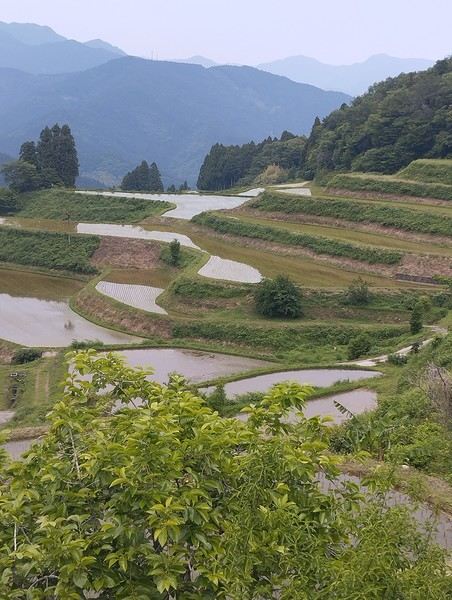
-->7 days in Miyakojima (Okinawa Prefecture)
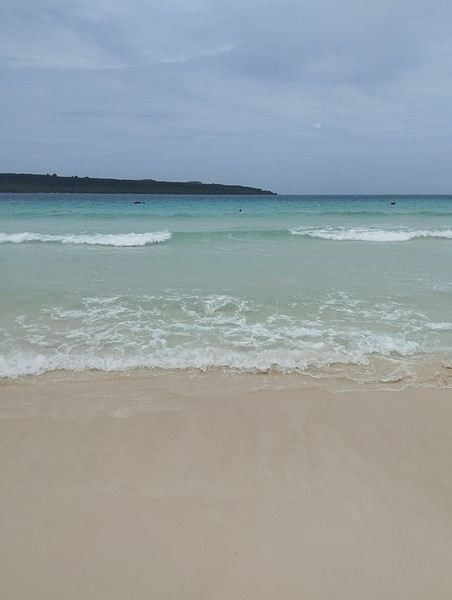
-->7 days in Tokyo
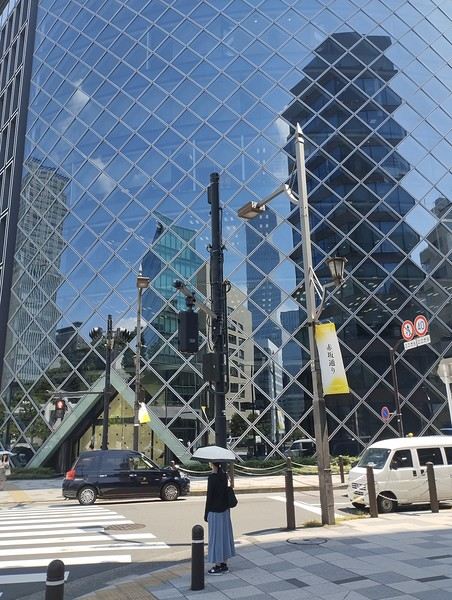
The trip was decided on fairly last-minute again this year.
Since I regularly check flight prices to track fluctuations for this destination even without concrete plans, stumbling upon a slightly cheaper direct flight (900 €) than what I’d seen in previous months (around 1,200–1,400 € on average) for a Paris-Tokyo route with Japanese airline ANA was too tempting to resist the urge to return to this enchanting country. After much hesitation between exploring the San’in region (Matsue, Tottori, Yamaguchi) and Southern Shikoku, the decision was made—I took the plunge! The ticket is booked: Paris to Kochi with a layover in Tokyo, all with ANA, the airline I’d been dreaming of... for 1,120 € per person. Okay, it’s not cheap, but it’s better than in 2023.
Departure in 2 weeks! Now I just have to get everything ready!
Intense prep work over these next 2 weeks to:
finalize a more precise itinerary and reach an agreement—yep, because even though we both love Japan, our preferences differ slightly, and we have to choose between exploring new places or revisiting beloved spots... decide how much time to spend in each area without rushing while still exploring research places that might interest us and watch videos about Japan book accommodations: yes, it’s possible to do this on the spot, but last year, we realized that last-minute options were pretty expensive, so we’re booking ahead—though we’ll keep a few options open in case better deals pop up later reserve rental cars order yen check the weather regularly and wonder if choosing the *tsuyu* (rainy season) was really a good idea—are we going to be drenched the whole time???
"What hard work," you might say! Going to Japan for a month—what a tough life! Despite this being my 4th trip, the excitement is just as intense as the first time.
The only small downside is that when we booked the flight, there weren’t many seats left, so we’re only sitting together on the international return flight. Plus, on the way there, we have middle seats. Another lingering question: what French-language films will be available? According to the internet, the selection seems limited. Oh well, these are just minor details—it’s already time to fly! PS: I’ll be posting slowly and irregularly... so for those interested, be patient, and maybe set an alert...
Hi everyone,
I have to admit, I really hesitated before deciding to write this travel journal... Writing one takes a lot of time and energy, and since this is my 4th trip, I wondered if it would even interest anyone other than myself (both for the discovery and the writing). But after a few people asked, "Are you going to write a journal?" and especially after rediscovering the joy of reading other travelers’ journals about Japan or elsewhere on this forum, I’ve decided to share my 4th installment in the Land of the Rising Sun here.
The itinerary: 27 full days, from late May to late June 2025, right in the middle of the rainy season, including:
-->13 days in Shikoku, from Kochi (Kochi Prefecture) to Matsuyama (Ehime Prefecture)
-->7 days in Miyakojima (Okinawa Prefecture)
-->7 days in Tokyo
The trip was decided on fairly last-minute again this year.
Since I regularly check flight prices to track fluctuations for this destination even without concrete plans, stumbling upon a slightly cheaper direct flight (900 €) than what I’d seen in previous months (around 1,200–1,400 € on average) for a Paris-Tokyo route with Japanese airline ANA was too tempting to resist the urge to return to this enchanting country. After much hesitation between exploring the San’in region (Matsue, Tottori, Yamaguchi) and Southern Shikoku, the decision was made—I took the plunge! The ticket is booked: Paris to Kochi with a layover in Tokyo, all with ANA, the airline I’d been dreaming of... for 1,120 € per person. Okay, it’s not cheap, but it’s better than in 2023.
Departure in 2 weeks! Now I just have to get everything ready!
Intense prep work over these next 2 weeks to:
finalize a more precise itinerary and reach an agreement—yep, because even though we both love Japan, our preferences differ slightly, and we have to choose between exploring new places or revisiting beloved spots... decide how much time to spend in each area without rushing while still exploring research places that might interest us and watch videos about Japan book accommodations: yes, it’s possible to do this on the spot, but last year, we realized that last-minute options were pretty expensive, so we’re booking ahead—though we’ll keep a few options open in case better deals pop up later reserve rental cars order yen check the weather regularly and wonder if choosing the *tsuyu* (rainy season) was really a good idea—are we going to be drenched the whole time???
"What hard work," you might say! Going to Japan for a month—what a tough life! Despite this being my 4th trip, the excitement is just as intense as the first time.
The only small downside is that when we booked the flight, there weren’t many seats left, so we’re only sitting together on the international return flight. Plus, on the way there, we have middle seats. Another lingering question: what French-language films will be available? According to the internet, the selection seems limited. Oh well, these are just minor details—it’s already time to fly! PS: I’ll be posting slowly and irregularly... so for those interested, be patient, and maybe set an alert...
USA Road Trip 2023 - Part 1
In January 2023, we started our second road trip across the United States. We stayed from January to mid-March, which gave us plenty of time to visit several cities, attractions, and parks in multiple states.
This travel journal will be split into two parts due to the considerable number of places we visited.
This first journal covers the following states: Ohio, Indiana, Missouri, Oklahoma, Texas, New Mexico, Arizona, Nevada, and California, and takes you through the outbound leg of our road trip.
The second journal will showcase the attractions we visited on the return trip, which mainly follows the famous Highway 1 along the Pacific coast.
So, I invite you to keep reading this first journal, which serves as a long recap to help you discover the various attractions we explored throughout this road trip.
Videos are included throughout the recap. Please click on the image to start the video.
Here are the links to jump to a specific post:
OHIO:
WinterLand - Christmas Lights at Cleveland Public Square Lake View Cemetery - Cleveland - Part 1 Lake View Cemetery - Cleveland - Part 2 Stroll through Columbus Upper Falls to Lower Falls via Buckeye Trail - Hocking Hills State Park – Logan Cedar Falls & Whispering Falls Hiking Trail - Hocking Hills State Park – Logan Ash Cave Hiking Trail - Hocking Hills State Park – Logan Exploring Cincinnati
INDIANA:
Visiting Indianapolis
MISSOURI:
Exploring St. Louis
OKLAHOMA:
Catoosa Blue Whale Discovering Tulsa Exploring Oklahoma City
TEXAS:
Exploring Shamrock Discovering McLean Exploring Amarillo
NEW MEXICO:
Ancestral Sites Trail - Pecos National Historical Park Discovering Santa Fe The Santuario de Chimayó Stroll through Los Cerrillos Walk through the village of Madrid San Francisco de Asis Catholic Church & The Bottle House - Golden Albuquerque Murals 66 Diner - Albuquerque Stroll through Old Town (Albuquerque) Rinconada Canyon Trail - Petroglyph National Monument Mesa Point Trail - Boca Negra Canyon - Petroglyph National Monument Macaw Trail - Boca Negra Canyon - Petroglyph National Monument Cliff Base Trail - Boca Negra Canyon - Petroglyph National Monument Piedras Marcadas Canyon - Petroglyph National Monument Sandstone Bluffs & Ventana Natural Arch - El Malpais National Monument
ARIZONA:
Stewart's Petrified Wood Shop – Holbrook Stroll through Holbrook Discovering Joseph City Exploring Winslow Grand Falls (The "Chocolate Falls") – Leupp Island Trail - Walnut Canyon National Monument Rim Trail - Walnut Canyon National Monument Wukoki Pueblo Trail – Wupatki National Monument Wupatki Pueblo Trail – Wupatki National Monument Doney Mountain Trail – Wupatki National Monument Citadel & Nalakihu Pueblos Trail – Wupatki National Monument Lomaki & Box Canyon Pueblos Trail – Wupatki National Monument Discovering Flagstaff On the way to Sedona Slide Rock State Park – Sedona Midgley Bridge Trail – Wilson Canyon – Sedona Tlaquepaque Arts & Shopping Village Walking Tour - Sedona Chapel of the Holy Cross - Sedona Hiking at Cathedral Rock - Sedona Hiking the Bell Rock Trail - Sedona Hiking the Airport Loop Trail - Sedona Amitabha Stupa and Peace Park - Sedona Hiking the Boynton Canyon Vortex Trail - Sedona Hiking the Devil's Bridge Trail - Sedona Hiking the Birthing Cave Trail - Sedona Bell Rock Inn - Sedona On the roads of Sedona - Part 1 On the roads of Sedona - Part 2 Keyhole Sink Hiking Trail - Kaibab National Forest Discovering Williams Exploring Ash Fork Discovering Kingman Ramada by Wyndham Kingman Davis Camp Park - Bullhead City Discovering Yucca Lake Havasu Boardwalk Tour A duck catches a lobster – Lake Havasu Boardwalk
CALIFORNIA:
Exploring Needles Discovering Goffs Discovering Amboy Visiting the famous Bagdad Cafe - Newberry Springs Exploring Barstow Vehicles from Hell (Mad Max Cars) - Barstow Peggy Sue's 50's Diner - Yermo Liberty Sculpture Park - Yermo Lake Dolores Water Park - Newberry Springs ZZYZX Road - Mojave National Preserve Alien Fresh Jerky - Baker Kelso Dunes Trail - Mojave National Preserve Hole-in-the-Wall Rings Trail - Mojave National Preserve Visiting Mitchell Caverns - Mojave National Preserve Dante's View - Death Valley National Park Zabriskie Point - Death Valley National Park Golden Canyon - Death Valley National Park Artists Drive & Artists Palette - Death Valley National Park Devil's Golf Course - Death Valley National Park Natural Bridge Trail - Death Valley National Park Badwater Basin - Death Valley National Park Harmony Borax Works - Death Valley National Park Devil's Cornfield - Death Valley National Park Mesquite Flat Sand Dunes - Death Valley National Park Mosaic Canyon Trail - Death Valley National Park On the road - Death Valley National Park
NEVADA:
Cleveland Clinic Lou Ruvo Center for Brain Health - Las Vegas Exploring Downtown Las Vegas SlotZilla Zipline - Fremont Street Experience – Downtown Las Vegas Viva Vision Light Show 1 - Fremont Street Experience - Downtown Las Vegas Viva Vision Light Show 2 - Fremont Street Experience - Downtown Las Vegas Viva Vision Light Show 3 - Fremont Street Experience - Downtown Las Vegas Viva Vision Light Show 4 - Fremont Street Experience - Downtown Las Vegas Free Live Music – Fremont Street Experience - Downtown Las Vegas Chucky – Fremont Street Experience - Downtown Las Vegas Las Vegas Strip - Part 1 Las Vegas Strip - Part 2 Las Vegas Strip - Part 3 Las Vegas Strip - Part 4 Las Vegas Strip - Part 5 Tom Devlin's Monster Museum - Boulder City Hoover Dam Lake Mead - Lakeview Overlook - Boulder City Nelson Ghost Town - Searchlight
CALIFORNIA:
Scenic Route through Joshua Tree National Park via the North Entrance Hidden Valley Trail - Joshua Tree National Park Barker Dam Trail - Joshua Tree National Park Cap Rock Trail - Joshua Tree National Park Keys View Trail - Joshua Tree National Park Hall of Horrors Trail - Joshua Tree National Park Skull Rock Trail - Joshua Tree National Park Arch Rock Trail - Joshua Tree National Park Cholla Cactus Garden Trail - Joshua Tree National Park Lone Pine - Owens Valley Miss Alabama & Shark Fin - Alabama Hills - Owens Valley Lone Ranger Canyon - Alabama Hills - Owens Valley Mobius Arch Loop Trail (Heart Arch & Lathe Arch) - Alabama Hills - Owens Valley Eye of the Alabama Hills Arch - Alabama Hills - Owens Valley Boot & Cyclops Arches - Alabama Hills - Owens Valley One Mile Arch, Bowling Ball and Pins & Gunga Din Area - Alabama Hills - Owens Valley Whitney Portal Arch Trailhead - Alabama Hills - Owens Valley Fish Rocks & Trona Pinnacles - Mojave Desert Red Cliffs Trail - Red Rock Canyon State Park Hagen Canyon Nature Trail - Red Rock Canyon State Park Tour of Historic Downtown Tehachapi View of the Tehachapi Loop – Monolith César E. Chávez National Monument – Keene Discovering Bakersfield Kern County Museum – Bakersfield Bravo Farms, Tree House & Petting Zoo - Traver Walking Tour of Kingsburg Exploring Fresno Simonian Farms & Soul Consoling Japanese Internment Tower - Fresno Duncan Ceramic Products (iLoveToCreate) - Fresno Walking Tour of Modesto Wat Dhammararam Buddhist Temple - Stockton Walking Tour of Stockton Discovering Stockton University of the Pacific - Stockton Visiting Lodi Sutter's Fort State Historic Park - Sacramento California State Capitol - Sacramento Walking Tour - Sacramento Walking Tour - Winters Walking Tour - Napa The Chandelier Tree In Drive-Thru Tree Park - Leggett One Log House - Garberville Grandfather Tree - Piercy The Living Chimney Tree - Avenue of the Giants Stephens Grove Loop Trail - Avenue of the Giants Gould Grove Nature Loop Trail - Avenue of the Giants Fleishmann Grove Trail - Avenue of the Giants Mahan Plaque Trail - Avenue of the Giants Founders Grove Nature Loop Trail - Avenue of the Giants Eternal Tree House & Immortal Tree - Avenue of the Giants Drury-Chaney Loop Trail - Avenue of the Giants Walking Tour - Redcrest
COMING UP NEXT:
USA Road Trip 2023 - Part 2
This travel journal will be split into two parts due to the considerable number of places we visited.
This first journal covers the following states: Ohio, Indiana, Missouri, Oklahoma, Texas, New Mexico, Arizona, Nevada, and California, and takes you through the outbound leg of our road trip.
The second journal will showcase the attractions we visited on the return trip, which mainly follows the famous Highway 1 along the Pacific coast.
So, I invite you to keep reading this first journal, which serves as a long recap to help you discover the various attractions we explored throughout this road trip.
Videos are included throughout the recap. Please click on the image to start the video.
Here are the links to jump to a specific post:
OHIO:
WinterLand - Christmas Lights at Cleveland Public Square Lake View Cemetery - Cleveland - Part 1 Lake View Cemetery - Cleveland - Part 2 Stroll through Columbus Upper Falls to Lower Falls via Buckeye Trail - Hocking Hills State Park – Logan Cedar Falls & Whispering Falls Hiking Trail - Hocking Hills State Park – Logan Ash Cave Hiking Trail - Hocking Hills State Park – Logan Exploring Cincinnati
INDIANA:
Visiting Indianapolis
MISSOURI:
Exploring St. Louis
OKLAHOMA:
Catoosa Blue Whale Discovering Tulsa Exploring Oklahoma City
TEXAS:
Exploring Shamrock Discovering McLean Exploring Amarillo
NEW MEXICO:
Ancestral Sites Trail - Pecos National Historical Park Discovering Santa Fe The Santuario de Chimayó Stroll through Los Cerrillos Walk through the village of Madrid San Francisco de Asis Catholic Church & The Bottle House - Golden Albuquerque Murals 66 Diner - Albuquerque Stroll through Old Town (Albuquerque) Rinconada Canyon Trail - Petroglyph National Monument Mesa Point Trail - Boca Negra Canyon - Petroglyph National Monument Macaw Trail - Boca Negra Canyon - Petroglyph National Monument Cliff Base Trail - Boca Negra Canyon - Petroglyph National Monument Piedras Marcadas Canyon - Petroglyph National Monument Sandstone Bluffs & Ventana Natural Arch - El Malpais National Monument
ARIZONA:
Stewart's Petrified Wood Shop – Holbrook Stroll through Holbrook Discovering Joseph City Exploring Winslow Grand Falls (The "Chocolate Falls") – Leupp Island Trail - Walnut Canyon National Monument Rim Trail - Walnut Canyon National Monument Wukoki Pueblo Trail – Wupatki National Monument Wupatki Pueblo Trail – Wupatki National Monument Doney Mountain Trail – Wupatki National Monument Citadel & Nalakihu Pueblos Trail – Wupatki National Monument Lomaki & Box Canyon Pueblos Trail – Wupatki National Monument Discovering Flagstaff On the way to Sedona Slide Rock State Park – Sedona Midgley Bridge Trail – Wilson Canyon – Sedona Tlaquepaque Arts & Shopping Village Walking Tour - Sedona Chapel of the Holy Cross - Sedona Hiking at Cathedral Rock - Sedona Hiking the Bell Rock Trail - Sedona Hiking the Airport Loop Trail - Sedona Amitabha Stupa and Peace Park - Sedona Hiking the Boynton Canyon Vortex Trail - Sedona Hiking the Devil's Bridge Trail - Sedona Hiking the Birthing Cave Trail - Sedona Bell Rock Inn - Sedona On the roads of Sedona - Part 1 On the roads of Sedona - Part 2 Keyhole Sink Hiking Trail - Kaibab National Forest Discovering Williams Exploring Ash Fork Discovering Kingman Ramada by Wyndham Kingman Davis Camp Park - Bullhead City Discovering Yucca Lake Havasu Boardwalk Tour A duck catches a lobster – Lake Havasu Boardwalk
CALIFORNIA:
Exploring Needles Discovering Goffs Discovering Amboy Visiting the famous Bagdad Cafe - Newberry Springs Exploring Barstow Vehicles from Hell (Mad Max Cars) - Barstow Peggy Sue's 50's Diner - Yermo Liberty Sculpture Park - Yermo Lake Dolores Water Park - Newberry Springs ZZYZX Road - Mojave National Preserve Alien Fresh Jerky - Baker Kelso Dunes Trail - Mojave National Preserve Hole-in-the-Wall Rings Trail - Mojave National Preserve Visiting Mitchell Caverns - Mojave National Preserve Dante's View - Death Valley National Park Zabriskie Point - Death Valley National Park Golden Canyon - Death Valley National Park Artists Drive & Artists Palette - Death Valley National Park Devil's Golf Course - Death Valley National Park Natural Bridge Trail - Death Valley National Park Badwater Basin - Death Valley National Park Harmony Borax Works - Death Valley National Park Devil's Cornfield - Death Valley National Park Mesquite Flat Sand Dunes - Death Valley National Park Mosaic Canyon Trail - Death Valley National Park On the road - Death Valley National Park
NEVADA:
Cleveland Clinic Lou Ruvo Center for Brain Health - Las Vegas Exploring Downtown Las Vegas SlotZilla Zipline - Fremont Street Experience – Downtown Las Vegas Viva Vision Light Show 1 - Fremont Street Experience - Downtown Las Vegas Viva Vision Light Show 2 - Fremont Street Experience - Downtown Las Vegas Viva Vision Light Show 3 - Fremont Street Experience - Downtown Las Vegas Viva Vision Light Show 4 - Fremont Street Experience - Downtown Las Vegas Free Live Music – Fremont Street Experience - Downtown Las Vegas Chucky – Fremont Street Experience - Downtown Las Vegas Las Vegas Strip - Part 1 Las Vegas Strip - Part 2 Las Vegas Strip - Part 3 Las Vegas Strip - Part 4 Las Vegas Strip - Part 5 Tom Devlin's Monster Museum - Boulder City Hoover Dam Lake Mead - Lakeview Overlook - Boulder City Nelson Ghost Town - Searchlight
CALIFORNIA:
Scenic Route through Joshua Tree National Park via the North Entrance Hidden Valley Trail - Joshua Tree National Park Barker Dam Trail - Joshua Tree National Park Cap Rock Trail - Joshua Tree National Park Keys View Trail - Joshua Tree National Park Hall of Horrors Trail - Joshua Tree National Park Skull Rock Trail - Joshua Tree National Park Arch Rock Trail - Joshua Tree National Park Cholla Cactus Garden Trail - Joshua Tree National Park Lone Pine - Owens Valley Miss Alabama & Shark Fin - Alabama Hills - Owens Valley Lone Ranger Canyon - Alabama Hills - Owens Valley Mobius Arch Loop Trail (Heart Arch & Lathe Arch) - Alabama Hills - Owens Valley Eye of the Alabama Hills Arch - Alabama Hills - Owens Valley Boot & Cyclops Arches - Alabama Hills - Owens Valley One Mile Arch, Bowling Ball and Pins & Gunga Din Area - Alabama Hills - Owens Valley Whitney Portal Arch Trailhead - Alabama Hills - Owens Valley Fish Rocks & Trona Pinnacles - Mojave Desert Red Cliffs Trail - Red Rock Canyon State Park Hagen Canyon Nature Trail - Red Rock Canyon State Park Tour of Historic Downtown Tehachapi View of the Tehachapi Loop – Monolith César E. Chávez National Monument – Keene Discovering Bakersfield Kern County Museum – Bakersfield Bravo Farms, Tree House & Petting Zoo - Traver Walking Tour of Kingsburg Exploring Fresno Simonian Farms & Soul Consoling Japanese Internment Tower - Fresno Duncan Ceramic Products (iLoveToCreate) - Fresno Walking Tour of Modesto Wat Dhammararam Buddhist Temple - Stockton Walking Tour of Stockton Discovering Stockton University of the Pacific - Stockton Visiting Lodi Sutter's Fort State Historic Park - Sacramento California State Capitol - Sacramento Walking Tour - Sacramento Walking Tour - Winters Walking Tour - Napa The Chandelier Tree In Drive-Thru Tree Park - Leggett One Log House - Garberville Grandfather Tree - Piercy The Living Chimney Tree - Avenue of the Giants Stephens Grove Loop Trail - Avenue of the Giants Gould Grove Nature Loop Trail - Avenue of the Giants Fleishmann Grove Trail - Avenue of the Giants Mahan Plaque Trail - Avenue of the Giants Founders Grove Nature Loop Trail - Avenue of the Giants Eternal Tree House & Immortal Tree - Avenue of the Giants Drury-Chaney Loop Trail - Avenue of the Giants Walking Tour - Redcrest
COMING UP NEXT:
USA Road Trip 2023 - Part 2
Join me in discovering Gran Canaria
Introduction
We stayed on the island of Gran Canaria during the first three months of 2024. It’s the third Canary Island we’ve visited, after Tenerife and Lanzarote.
We rented an apartment in Temisas. By staying in the same place for such a long period, the total price dropped by 50%.
We also rented a vehicle to make getting around the island easier.
Why the Canary Islands, and Gran Canaria in particular? For its pleasant climate, the nature and diversity of its landscapes, the charming villages, and especially the beauty of its many beaches.
In this travel journal, you’ll find a list of the many activities we did during our stay to explore the different attractions of this island.
These attractions are categorized to make it easier to find what interests you.
Videos are included throughout the summary. Click on the image to start the video.
To jump to a specific post, here are the relevant links:
HIKES:
Roque Nublo Maspalomas Dunes - Part 1 Maspalomas Dunes - Part 2 Los Azulejos de Veneguera Barranco de Las Vacas Ventana del Bentayga (Arco del Aserrador) Caves of the King Ventana de Morro (Ventana de la Ganifa) The Dog of Bentayga Cave of the Four Doors Ventana del Nublo Artenera - Caves of Acusa Seca Temisas - El Gigante Cave Fortress of Ansite Puerto de Las Nieves - Roque de Las Nieves Temisas - Cuevas de la Audiencia Roque Bentayga Guayadeque Ravine (Guayadeque Hermitage) Guayadeque Ravine (Cueva de Bartalo) El Zumacal - Barranco Tauco Casablanca Dam (Los Dolores Dam) Ayagaures - La Angostura Dam & Gambuesa Dam Santa Brígida - Alonso Ravine & Centennial Dragon Tree Pino Santo Hike in the Azuaje Ravine Gáldar - Red Lands of Samarrita Tejeda - Charco de La Paloma Bandama Boiler (Camino Borde de Caldera Bandama) Teror - Alamo Ravine Trail – SL-4 Telde - Calasio Caves Special Natural Reserve of Los Tilos de Moya Los Azulejos - Charco de Las Aneas Fataga Ravine Arinaga Military Battery Trail Maspalomas - Las Fuentes and del Canizo Ravines Mogán - Tauro Mountain Trail Tamabada - Llanos de La Mimbre & Sobre la Cueva Viewpoints Trail Hike to the Coronadero Arch via Barranco Hondo Barranco de Silva - Hike to the Jerez Caves Gáldar - Samson Cave - La Atalaya Peak Agaete - Roque Guayedra and Guayedra Ravine Artenara - Caballero Caves Arucas - Bufadero Salt Flats Barranco de Pino Gordo - Natural Pools Telde - Los Cernícalos Ravine Las Cruces - Toba Caves & Picón Puerto de Las Nieves - Moro Cave Agüimes - Morros de Ávila Caves Juncalillo del Sur - Laguna & Salinas de Abajo Caves of Camino de San Felipe Cruz de Tejeda, Cruz Chico and Degollada Viewpoint Hike on the Patalavaca Circuit Motor Grande - Puerto Rico Arch El Montañón - Los Hornos Dam Seafront Walk - Amadores Beach – Puerto Rico Beach Las Niñas Dam El Hornillo - Omega & Omicron Caves Arteara Necropolis Mogán - El Mulato Dam Las Garzas - El Regante Dam La Plata Route - Cho Flores Dam & El Charco Hondo Vega de Acusa - La Candelaria Dam Candelaria Hermitage – Acusa Seca Viewpoint Valsequillo de Gran Canaria – Roque La Vela Ayagaures Dam – GC-602 Lomo del Palo - Monte Pavón Trail Lugar La Laguna - Levada Fataga Dam & Ravine
BEACHES:
Mogán Beach Taurito Beach Tauro Beach Amadores Beach Puerto Rico Beach Anfi del Mar Beach Patalavaca Beach Meloneras Beach Maspalomas Beach English Beach (Playa del Inglés) Las Burras Beach San Agustin Beach Las Alcaravaneras Beach Las Canteras Beach (La Cicer) Las Canteras Beach (La Puntilla) Las Canteras Beach (Santa Catalina) Aquamarina Beach El Agujero - Bocabarranco Beach Hoya Del Pozo Beach Hoya Del Pozo Beach - Lizard with amputated tail El Cabron Beach Ojos de Garza Beach El Burrero Beach
NATURAL POOLS:
Charco Azul - El Risco Agaete Salt Flats Charco de Los Espejos - Sardina del Norte Natural Pools of Punta de Gáldar Snorkeling in the natural pool of Punta de Gáldar Natural Pool La Furnia o El Clavo - Gáldar Natural Pool of Los Dos Roques Emiliano Natural Pool - El Agujero Natural Pool of El Agujero Natural Pools of Roque Prieto Natural Pool El Altillo Los Charcones de Bañaderos – Arucas Natural Pools of El Charco de Las Palomas – Arucas Natural Pools of La Laja - Las Palmas de Gran Canaria Cueva de la Reina Mora - La Garita Natural Pools of Castillo del Romeral
TOWNS:
Center
Santa Brigida Vega de San Mateo Tejeda Artenara Vallesco Teror
Southwest
Santa Lucia de Tirajana Fataga San Bartolomé de Tirajana Puerto de Mogán La Aldea de San Nicolas
North
Arucas Firgas Moya Santa Maria de Guia Gáldar Agaete Puerto de Las Nieves
East
Vegueta - Las Palmas de Gran Canaria Triana - Las Palmas de Gran Canaria Ciudad Jardin - Las Palmas de Gran Canaria Canteras - Las Palmas de Gran Canaria Telde Valsequillo de Gran Canaria Ingenio Agüimes Temisas
VIEWPOINTS:
GC-60 Route (or nearby) GC-210 Route (or nearby) GC-210 Route between the tunnel and La Aldea de San Nicolás GC-215 & GC-65 Routes (or nearby) GC-200 Route (or nearby) GC-130 Route (or nearby) & GC-605 GC-70 Route (or nearby) & GC-21 Sheep herd on GC-70 Route GC-150, GC-240, GC-305, GC-350 & GC-301 Routes GC-606, GC-295, GC-231 and GC-41 Routes (or nearby) Viewpoints – GC-1 Route (or nearby) Viewpoints - Las Palmas de Gran Canaria Viewpoints - GC-2, GC-21, GC-15, GC-216 and GC-132 Routes (or nearby) Viewpoints - GC-503 & GC-217 Routes Viewpoints - GC-604, GC-505, GC-132, GC-42 and GC-802 Routes
MISCELLANEOUS:
San Rafael Aqueduct - Telde Abandoned San Rafael Estate - La Higuera Cenobio de Valerón La Cesta - Tejeda Puerto de la Aldea Scenic Route GC-671 to El Espinillo Scenic Route GC-607 to El Chorrillo The Galdar Cube (Santiago Quarry) Scenic Route GC-504 to Ayagaures Abandoned seaside resort in the Azuaje Ravine El Bufadero de La Garita – Telde GC-505 Route Abandoned Finca Las Haciendas (Los Mocanes) – Las Vegas de Valsequillo Ruins of San Juan Battery - Las Palmas de Gran Canaria Viera y Clavijo Canarian Botanical Garden - Las Palmas de Gran Canaria Tenefé Salt Flats Los Pérez, Lugarejos & Las Hoyas Dams Monte Pavón, Gran Canaria’s little Ireland Valleseco Lagoon Recreational Area Climbing - Fataga Ravine Surfing – El Agujero El Cairete Restaurant - Carrizal de Tejeda Paragliding flight observation - Los Giles La Cuevita Ayagaures Restaurant Statues and Murals - Cruce de Arinaga Aviation Monument (Las Majoreras) & Murals – Carrizal Artistic recycling by Antonio Peñita - Ojos de Garza Rainbows
We stayed on the island of Gran Canaria during the first three months of 2024. It’s the third Canary Island we’ve visited, after Tenerife and Lanzarote.
We rented an apartment in Temisas. By staying in the same place for such a long period, the total price dropped by 50%.
We also rented a vehicle to make getting around the island easier.
Why the Canary Islands, and Gran Canaria in particular? For its pleasant climate, the nature and diversity of its landscapes, the charming villages, and especially the beauty of its many beaches.
In this travel journal, you’ll find a list of the many activities we did during our stay to explore the different attractions of this island.
These attractions are categorized to make it easier to find what interests you.
Videos are included throughout the summary. Click on the image to start the video.
To jump to a specific post, here are the relevant links:
HIKES:
Roque Nublo Maspalomas Dunes - Part 1 Maspalomas Dunes - Part 2 Los Azulejos de Veneguera Barranco de Las Vacas Ventana del Bentayga (Arco del Aserrador) Caves of the King Ventana de Morro (Ventana de la Ganifa) The Dog of Bentayga Cave of the Four Doors Ventana del Nublo Artenera - Caves of Acusa Seca Temisas - El Gigante Cave Fortress of Ansite Puerto de Las Nieves - Roque de Las Nieves Temisas - Cuevas de la Audiencia Roque Bentayga Guayadeque Ravine (Guayadeque Hermitage) Guayadeque Ravine (Cueva de Bartalo) El Zumacal - Barranco Tauco Casablanca Dam (Los Dolores Dam) Ayagaures - La Angostura Dam & Gambuesa Dam Santa Brígida - Alonso Ravine & Centennial Dragon Tree Pino Santo Hike in the Azuaje Ravine Gáldar - Red Lands of Samarrita Tejeda - Charco de La Paloma Bandama Boiler (Camino Borde de Caldera Bandama) Teror - Alamo Ravine Trail – SL-4 Telde - Calasio Caves Special Natural Reserve of Los Tilos de Moya Los Azulejos - Charco de Las Aneas Fataga Ravine Arinaga Military Battery Trail Maspalomas - Las Fuentes and del Canizo Ravines Mogán - Tauro Mountain Trail Tamabada - Llanos de La Mimbre & Sobre la Cueva Viewpoints Trail Hike to the Coronadero Arch via Barranco Hondo Barranco de Silva - Hike to the Jerez Caves Gáldar - Samson Cave - La Atalaya Peak Agaete - Roque Guayedra and Guayedra Ravine Artenara - Caballero Caves Arucas - Bufadero Salt Flats Barranco de Pino Gordo - Natural Pools Telde - Los Cernícalos Ravine Las Cruces - Toba Caves & Picón Puerto de Las Nieves - Moro Cave Agüimes - Morros de Ávila Caves Juncalillo del Sur - Laguna & Salinas de Abajo Caves of Camino de San Felipe Cruz de Tejeda, Cruz Chico and Degollada Viewpoint Hike on the Patalavaca Circuit Motor Grande - Puerto Rico Arch El Montañón - Los Hornos Dam Seafront Walk - Amadores Beach – Puerto Rico Beach Las Niñas Dam El Hornillo - Omega & Omicron Caves Arteara Necropolis Mogán - El Mulato Dam Las Garzas - El Regante Dam La Plata Route - Cho Flores Dam & El Charco Hondo Vega de Acusa - La Candelaria Dam Candelaria Hermitage – Acusa Seca Viewpoint Valsequillo de Gran Canaria – Roque La Vela Ayagaures Dam – GC-602 Lomo del Palo - Monte Pavón Trail Lugar La Laguna - Levada Fataga Dam & Ravine
BEACHES:
Mogán Beach Taurito Beach Tauro Beach Amadores Beach Puerto Rico Beach Anfi del Mar Beach Patalavaca Beach Meloneras Beach Maspalomas Beach English Beach (Playa del Inglés) Las Burras Beach San Agustin Beach Las Alcaravaneras Beach Las Canteras Beach (La Cicer) Las Canteras Beach (La Puntilla) Las Canteras Beach (Santa Catalina) Aquamarina Beach El Agujero - Bocabarranco Beach Hoya Del Pozo Beach Hoya Del Pozo Beach - Lizard with amputated tail El Cabron Beach Ojos de Garza Beach El Burrero Beach
NATURAL POOLS:
Charco Azul - El Risco Agaete Salt Flats Charco de Los Espejos - Sardina del Norte Natural Pools of Punta de Gáldar Snorkeling in the natural pool of Punta de Gáldar Natural Pool La Furnia o El Clavo - Gáldar Natural Pool of Los Dos Roques Emiliano Natural Pool - El Agujero Natural Pool of El Agujero Natural Pools of Roque Prieto Natural Pool El Altillo Los Charcones de Bañaderos – Arucas Natural Pools of El Charco de Las Palomas – Arucas Natural Pools of La Laja - Las Palmas de Gran Canaria Cueva de la Reina Mora - La Garita Natural Pools of Castillo del Romeral
TOWNS:
Center
Santa Brigida Vega de San Mateo Tejeda Artenara Vallesco Teror
Southwest
Santa Lucia de Tirajana Fataga San Bartolomé de Tirajana Puerto de Mogán La Aldea de San Nicolas
North
Arucas Firgas Moya Santa Maria de Guia Gáldar Agaete Puerto de Las Nieves
East
Vegueta - Las Palmas de Gran Canaria Triana - Las Palmas de Gran Canaria Ciudad Jardin - Las Palmas de Gran Canaria Canteras - Las Palmas de Gran Canaria Telde Valsequillo de Gran Canaria Ingenio Agüimes Temisas
VIEWPOINTS:
GC-60 Route (or nearby) GC-210 Route (or nearby) GC-210 Route between the tunnel and La Aldea de San Nicolás GC-215 & GC-65 Routes (or nearby) GC-200 Route (or nearby) GC-130 Route (or nearby) & GC-605 GC-70 Route (or nearby) & GC-21 Sheep herd on GC-70 Route GC-150, GC-240, GC-305, GC-350 & GC-301 Routes GC-606, GC-295, GC-231 and GC-41 Routes (or nearby) Viewpoints – GC-1 Route (or nearby) Viewpoints - Las Palmas de Gran Canaria Viewpoints - GC-2, GC-21, GC-15, GC-216 and GC-132 Routes (or nearby) Viewpoints - GC-503 & GC-217 Routes Viewpoints - GC-604, GC-505, GC-132, GC-42 and GC-802 Routes
MISCELLANEOUS:
San Rafael Aqueduct - Telde Abandoned San Rafael Estate - La Higuera Cenobio de Valerón La Cesta - Tejeda Puerto de la Aldea Scenic Route GC-671 to El Espinillo Scenic Route GC-607 to El Chorrillo The Galdar Cube (Santiago Quarry) Scenic Route GC-504 to Ayagaures Abandoned seaside resort in the Azuaje Ravine El Bufadero de La Garita – Telde GC-505 Route Abandoned Finca Las Haciendas (Los Mocanes) – Las Vegas de Valsequillo Ruins of San Juan Battery - Las Palmas de Gran Canaria Viera y Clavijo Canarian Botanical Garden - Las Palmas de Gran Canaria Tenefé Salt Flats Los Pérez, Lugarejos & Las Hoyas Dams Monte Pavón, Gran Canaria’s little Ireland Valleseco Lagoon Recreational Area Climbing - Fataga Ravine Surfing – El Agujero El Cairete Restaurant - Carrizal de Tejeda Paragliding flight observation - Los Giles La Cuevita Ayagaures Restaurant Statues and Murals - Cruce de Arinaga Aviation Monument (Las Majoreras) & Murals – Carrizal Artistic recycling by Antonio Peñita - Ojos de Garza Rainbows
USA 2022 Road Trip
During our first road trip across the United States, we covered 23,000 km and crossed 28 states in 53 days.
Originally, we had planned to drive Route 66 all the way to Oatman in Arizona and visit various national parks in the American West over a two-month period.
This itinerary was planned before our departure, and all the relevant information had been gathered to stick to the schedule.
Everything went so smoothly that we finished visiting the national parks well ahead of our planned return date.
It helped that having a bed, a portable toilet, and a cooler in our vehicle gave us some autonomy since we didn’t have to worry about accommodation.
So, we decided to extend our road trip to the cities of Nashville and Memphis in Tennessee.
We then headed to Louisiana to visit Baton Rouge and New Orleans.
We crossed Mississippi and Alabama before driving along Florida’s west coast all the way to Key West.
We returned via Florida’s east coast and then crossed the eastern U.S. states to get back to Quebec through the Jackman border crossing in Maine.
So, I invite you to keep reading this long recap, which will let you discover the different attractions we visited throughout this amazing journey.
Videos are included throughout the recap. Click on the image to start the video.
To jump to a specific post, here are the relevant links:
Route 66 - Illinois & Missouri Route 66 - St. Louis (Missouri) - Gateway Arch National Park Route 66 - Cuba (Missouri) - City Murals Route 66 - Springfield (Missouri) - Fantastic Caverns Route 66 - Kansas & Oklahoma Route 66 - Texas & Arizona Route 66 - Texas - The Stations of the Cross in Groom Route 66 - Texas - Panhandle - VW Slug Bug Ranch Texas - Palo Duro Canyon State Park - Juniper Trails Texas - Palo Duro Canyon State Park - The Lighthouse Trail Route 66 - Texas - Amarillo - Cadillac Ranch Route 66 - New Mexico - Santa Rosa Blue Hole New Mexico - Bandelier National Monument - Alcove House Trail via Main Loop Trail New Mexico - Bandelier National Monument - Tsankawi Ruins Trail New Mexico - White Rock Overlook Route 66 - New Mexico - Albuquerque - Old Town New Mexico - White Sands National Park New Mexico - White Sands National Park - Dune Life Nature Trail New Mexico - White Sands National Park - Playa Trail New Mexico - White Sands National Park - Interdune Boardwalk New Mexico - Gila Cliff Dwellings National Monument New Mexico - Grants - Ice Cave & Bandera Volcano New Mexico - Gallup - Pyramide Rock Trail & Church Rock Trail Arizona - Holbrook - Painted Desert Arizona - Petrified Forest National Park - Puerco Pueblo & Newspaper Rock Viewpoint Arizona - Petrified Forest National Park - Blue Mesa Arizona - Petrified Forest National Park - The Teepees, Agate Bridge & Jasper Forest Overlook Arizona - Petrified Forest National Park - Crystal Forest Trail Arizona - Petrified Forest National Park - Giant Logs Trail Arizona - Winslow - Two Guns Ghost Town Arizona - Cameron - Little Colorado River Gorge Overlooks Arizona - Grand Canyon National Park - Shoshone Point Trail Arizona - Grand Canyon National Park - Desert View Drive Arizona - Grand Canyon National Park - Rim Route (Orange) & Village Route (Blue) Arizona - Grand Canyon National Park - Hermit Route (Red Line) Route 66 - Arizona - Historic Town of Oatman Arizona - Bullhead City Community Park Nevada - Red Rock Canyon - Calico I & II & Sandstone Quarry Nevada - Red Rock Canyon - Willow Springs Nevada - Red Rock Canyon Lookouts Nevada - Valley of Fire State Park - White Domes Trail Nevada - Valley of Fire State Park - Seven Wonders Trail, Pink Canyon, Fire Wave Nevada - Valley of Fire State Park - Rainbow Vista Trail Nevada - Valley of Fire State Park - Mouse's Tank Trail Nevada - Valley of Fire State Park - Rock Formations Nevada - Valley of Fire State Park - Scenic Routes Nevada - Cathedral Gorge State Park - Slot Canyons Nevada - Cathedral Gorge State Park - Eagle Point & Miller Point Utah - Bryce Canyon National Park - Mossy Cave & Tropic Ditch Waterfall Trail Utah - Bryce Canyon National Park - Scenic Drive Utah - Zion National Park - Pa'rus Trail Utah - Zion National Park - Sand Bench Trail Utah - Zion National Park - Emerald Pools Trail Utah - Zion National Park - West Rim Trail (Trail connecting to Angels Landing) Utah - Zion National Park - Riverside Walk Utah - Zion National Park - Court of The Patriarchs & Big Bend Utah - Zion National Park - Mount Carmel Highway Scenic Drive Utah - Kanab - Jackson Flat Reservoir Utah - Toadstools Trail in Grand Staircase-Escalante National Monument Arizona - Page - Glen Canyon Dam Overlook Arizona - Page - Glen Canyon National Recreation Area Arizona - Page - Horseshoe Bend Overlook Arizona - Page - Upper Antelope Canyon Arizona - Page - Navajo Canyon Boat Tour at Lake Powell Arizona - Page - Antelope Canyon X Arizona - Canyon de Chelly National Monument - Chelly Canyon Arizona - Canyon de Chelly National Monument - Canyon del Muerto Arizona - Monument Valley Navajo Tribal Park Utah - Mexican Hat Utah - Mexican Hat - Goosenecks State Park Utah - Mexican Hat - Valley of the Gods Utah - The Moki Dugway Scenic Backway Utah - Blanding - Natural Bridges National Monument Utah - Lake Powell - Hite Crossing Bridge Utah - Lake Powell - Glen Canyon National Recreation Area - Hite Overlook Utah - Capitol Reef National Park - Chimney Rock Loop Trail Utah - Capitol Reef National Park - Hickman Bridge Trail Utah - Capitol Reef National Park - Grand Wash Trail Utah - Capitol Reef National Park - Sunset Point Trail Utah - Capitol Reef National Park - Goosenecks Trail Utah - Capitol Reef National Park - Viewpoints - Fruita Area Utah - Capitol Reef National Park - Viewpoints - Scenic Drive Utah - Capitol Reef National Park - Cassidy Arch Trail Utah - Capitol Reef National Park - On the way to Capitol Gorge Trailhead Utah - Capitol Reef National Park - Capitol Gorge Trailhead Utah - Monroe - Mystic Hot Springs Utah - Scenic Overlooks on UT-24, UT-119 & I-70 Utah - Arches National Park - Park Avenue Trail Utah - Arches National Park - Courthouse Towers Section's Viewpoints Utah - Arches National Park - Balanced Rock, Pothole Arch, Ham Rock & Garden of Eden Utah - Arches National Park - Double Arch Trail, Cove Arch, Cove of Caves & Panorama Point Utah - Arches National Park - Windows Loop & Turret Arch Trail Utah - Arches National Park - Delicate Arch Trail Utah - Arches National Park - Upper Delicate Arch Viewpoint Trail Utah - Arches National Park - Fiery Furnace Section - Viewpoints Utah - Arches National Park - Sand Dune Arch Trail Utah - Arches National Park - Skyline Arch Trail Utah - Arches National Park - Devils Garden Trail Utah - Dead Horse Point State Park - West Rim Trail Utah - Dead Horse Point State Park - East Rim Trail Utah - Moab - Utah State Route 279 (Potash Road) Utah - Moab - Shafer Trail - Potash Evaporation Ponds Utah - Moab - Potash Road Dinosaur Tracks and Petroglyphs Utah - Moab - Potash Road - Corona, Bowtie & Pinto Arches Trail Utah - Moab - Potash Road - Wall Street Climbing Area Utah - Moab - Kane Springs Road Utah - Moab - Kane Springs Road - Side By Side Adventure Utah - Moab - Kane Springs Road to Moab Utah - Canyonlands National Park - Island in the Sky - Mesa Arch Trail Utah - Canyonlands National Park - Island in the Sky - Aztec Butte Trail Utah - Canyonlands National Park - Island in the Sky - Whale Rock Trail Utah - Canyonlands National Park - Island in the Sky - Upheaval Dome Trail Utah - Canyonlands National Park - Island in the Sky - Grand View Point Overlook Trail Utah - Canyonlands National Park - Island in the Sky - White Rim Overlook Trail Utah - Canyonlands National Park - Island in the Sky - Overlooks Utah - Moab - Wilson Arch Utah - Monticello - Newspaper Rock State Historical Monument Utah - Canyonlands National Park - The Needles - Road Side Ruin Trail Utah - Canyonlands National Park - The Needles - Cave Spring Trail Utah - Canyonlands National Park - The Needles - Pothole Point Trail Utah - Canyonlands National Park - The Needles - Big Spring Canyon Overlook Trail Utah - Canyonlands National Park - The Needles - Overlooks Colorado - Mesa Verde National Park - Mesa Top Ruins Road Colorado - Mesa Verde National Park - Chapin Mesa Road Colorado - Mesa Verde National Park - Mesa Top Loop Colorado - Mesa Verde National Park - Wetherill Mesa Road Colorado - Great Sand Dunes National Park Colorado - Mosca - Zapata Falls Colorado - Colorado Springs - Garden of the Gods Colorado - Black Canyon of the Gunnison National Park Colorado - Gunnison - Curecanti National Recreation Area Colorado - Gunnison - Blue Mesa Dam & Reservoir Colorado - Lake Pueblo State Park (Pueblo Reservoir) Kentucky - Mayfield, 5 months after an EF4 tornado Tennessee - Nashville - Downtown Walking Tour Tennessee - Graceland Mansion - Home of Elvis Presley Tennessee - Graceland - Lisa Marie & Hound Dog II Jets Tennessee - Graceland - Elvis Presley Automobile Museum & Exhibits Tennessee - Exploring Memphis Louisiana - Exploring Baton Rouge Louisiana - Exploring Lafayette Louisiana - Exploring Houma Louisiana - New Orleans - French Quarter Tour Louisiana - New Orleans - Garden District Tour Louisiana - New Orleans - Creole Queen Mississippi River Cruise Florida - Clearwater Beach Florida - Sanibel Island - Bowman's Beach Florida - Siesta Key Beach Florida - Captiva Island - Turner Beach Florida - Key Largo - Sunset Florida - Key West - Smathers Beach Florida - Miami Beach - Art Deco District Florida - Miami Beach South Carolina - Myrtle Beach Virginia - Virginia Beach Maine - Scarborough - Pine Point Beach
Originally, we had planned to drive Route 66 all the way to Oatman in Arizona and visit various national parks in the American West over a two-month period.
This itinerary was planned before our departure, and all the relevant information had been gathered to stick to the schedule.
Everything went so smoothly that we finished visiting the national parks well ahead of our planned return date.
It helped that having a bed, a portable toilet, and a cooler in our vehicle gave us some autonomy since we didn’t have to worry about accommodation.
So, we decided to extend our road trip to the cities of Nashville and Memphis in Tennessee.
We then headed to Louisiana to visit Baton Rouge and New Orleans.
We crossed Mississippi and Alabama before driving along Florida’s west coast all the way to Key West.
We returned via Florida’s east coast and then crossed the eastern U.S. states to get back to Quebec through the Jackman border crossing in Maine.
So, I invite you to keep reading this long recap, which will let you discover the different attractions we visited throughout this amazing journey.
Videos are included throughout the recap. Click on the image to start the video.
To jump to a specific post, here are the relevant links:
Route 66 - Illinois & Missouri Route 66 - St. Louis (Missouri) - Gateway Arch National Park Route 66 - Cuba (Missouri) - City Murals Route 66 - Springfield (Missouri) - Fantastic Caverns Route 66 - Kansas & Oklahoma Route 66 - Texas & Arizona Route 66 - Texas - The Stations of the Cross in Groom Route 66 - Texas - Panhandle - VW Slug Bug Ranch Texas - Palo Duro Canyon State Park - Juniper Trails Texas - Palo Duro Canyon State Park - The Lighthouse Trail Route 66 - Texas - Amarillo - Cadillac Ranch Route 66 - New Mexico - Santa Rosa Blue Hole New Mexico - Bandelier National Monument - Alcove House Trail via Main Loop Trail New Mexico - Bandelier National Monument - Tsankawi Ruins Trail New Mexico - White Rock Overlook Route 66 - New Mexico - Albuquerque - Old Town New Mexico - White Sands National Park New Mexico - White Sands National Park - Dune Life Nature Trail New Mexico - White Sands National Park - Playa Trail New Mexico - White Sands National Park - Interdune Boardwalk New Mexico - Gila Cliff Dwellings National Monument New Mexico - Grants - Ice Cave & Bandera Volcano New Mexico - Gallup - Pyramide Rock Trail & Church Rock Trail Arizona - Holbrook - Painted Desert Arizona - Petrified Forest National Park - Puerco Pueblo & Newspaper Rock Viewpoint Arizona - Petrified Forest National Park - Blue Mesa Arizona - Petrified Forest National Park - The Teepees, Agate Bridge & Jasper Forest Overlook Arizona - Petrified Forest National Park - Crystal Forest Trail Arizona - Petrified Forest National Park - Giant Logs Trail Arizona - Winslow - Two Guns Ghost Town Arizona - Cameron - Little Colorado River Gorge Overlooks Arizona - Grand Canyon National Park - Shoshone Point Trail Arizona - Grand Canyon National Park - Desert View Drive Arizona - Grand Canyon National Park - Rim Route (Orange) & Village Route (Blue) Arizona - Grand Canyon National Park - Hermit Route (Red Line) Route 66 - Arizona - Historic Town of Oatman Arizona - Bullhead City Community Park Nevada - Red Rock Canyon - Calico I & II & Sandstone Quarry Nevada - Red Rock Canyon - Willow Springs Nevada - Red Rock Canyon Lookouts Nevada - Valley of Fire State Park - White Domes Trail Nevada - Valley of Fire State Park - Seven Wonders Trail, Pink Canyon, Fire Wave Nevada - Valley of Fire State Park - Rainbow Vista Trail Nevada - Valley of Fire State Park - Mouse's Tank Trail Nevada - Valley of Fire State Park - Rock Formations Nevada - Valley of Fire State Park - Scenic Routes Nevada - Cathedral Gorge State Park - Slot Canyons Nevada - Cathedral Gorge State Park - Eagle Point & Miller Point Utah - Bryce Canyon National Park - Mossy Cave & Tropic Ditch Waterfall Trail Utah - Bryce Canyon National Park - Scenic Drive Utah - Zion National Park - Pa'rus Trail Utah - Zion National Park - Sand Bench Trail Utah - Zion National Park - Emerald Pools Trail Utah - Zion National Park - West Rim Trail (Trail connecting to Angels Landing) Utah - Zion National Park - Riverside Walk Utah - Zion National Park - Court of The Patriarchs & Big Bend Utah - Zion National Park - Mount Carmel Highway Scenic Drive Utah - Kanab - Jackson Flat Reservoir Utah - Toadstools Trail in Grand Staircase-Escalante National Monument Arizona - Page - Glen Canyon Dam Overlook Arizona - Page - Glen Canyon National Recreation Area Arizona - Page - Horseshoe Bend Overlook Arizona - Page - Upper Antelope Canyon Arizona - Page - Navajo Canyon Boat Tour at Lake Powell Arizona - Page - Antelope Canyon X Arizona - Canyon de Chelly National Monument - Chelly Canyon Arizona - Canyon de Chelly National Monument - Canyon del Muerto Arizona - Monument Valley Navajo Tribal Park Utah - Mexican Hat Utah - Mexican Hat - Goosenecks State Park Utah - Mexican Hat - Valley of the Gods Utah - The Moki Dugway Scenic Backway Utah - Blanding - Natural Bridges National Monument Utah - Lake Powell - Hite Crossing Bridge Utah - Lake Powell - Glen Canyon National Recreation Area - Hite Overlook Utah - Capitol Reef National Park - Chimney Rock Loop Trail Utah - Capitol Reef National Park - Hickman Bridge Trail Utah - Capitol Reef National Park - Grand Wash Trail Utah - Capitol Reef National Park - Sunset Point Trail Utah - Capitol Reef National Park - Goosenecks Trail Utah - Capitol Reef National Park - Viewpoints - Fruita Area Utah - Capitol Reef National Park - Viewpoints - Scenic Drive Utah - Capitol Reef National Park - Cassidy Arch Trail Utah - Capitol Reef National Park - On the way to Capitol Gorge Trailhead Utah - Capitol Reef National Park - Capitol Gorge Trailhead Utah - Monroe - Mystic Hot Springs Utah - Scenic Overlooks on UT-24, UT-119 & I-70 Utah - Arches National Park - Park Avenue Trail Utah - Arches National Park - Courthouse Towers Section's Viewpoints Utah - Arches National Park - Balanced Rock, Pothole Arch, Ham Rock & Garden of Eden Utah - Arches National Park - Double Arch Trail, Cove Arch, Cove of Caves & Panorama Point Utah - Arches National Park - Windows Loop & Turret Arch Trail Utah - Arches National Park - Delicate Arch Trail Utah - Arches National Park - Upper Delicate Arch Viewpoint Trail Utah - Arches National Park - Fiery Furnace Section - Viewpoints Utah - Arches National Park - Sand Dune Arch Trail Utah - Arches National Park - Skyline Arch Trail Utah - Arches National Park - Devils Garden Trail Utah - Dead Horse Point State Park - West Rim Trail Utah - Dead Horse Point State Park - East Rim Trail Utah - Moab - Utah State Route 279 (Potash Road) Utah - Moab - Shafer Trail - Potash Evaporation Ponds Utah - Moab - Potash Road Dinosaur Tracks and Petroglyphs Utah - Moab - Potash Road - Corona, Bowtie & Pinto Arches Trail Utah - Moab - Potash Road - Wall Street Climbing Area Utah - Moab - Kane Springs Road Utah - Moab - Kane Springs Road - Side By Side Adventure Utah - Moab - Kane Springs Road to Moab Utah - Canyonlands National Park - Island in the Sky - Mesa Arch Trail Utah - Canyonlands National Park - Island in the Sky - Aztec Butte Trail Utah - Canyonlands National Park - Island in the Sky - Whale Rock Trail Utah - Canyonlands National Park - Island in the Sky - Upheaval Dome Trail Utah - Canyonlands National Park - Island in the Sky - Grand View Point Overlook Trail Utah - Canyonlands National Park - Island in the Sky - White Rim Overlook Trail Utah - Canyonlands National Park - Island in the Sky - Overlooks Utah - Moab - Wilson Arch Utah - Monticello - Newspaper Rock State Historical Monument Utah - Canyonlands National Park - The Needles - Road Side Ruin Trail Utah - Canyonlands National Park - The Needles - Cave Spring Trail Utah - Canyonlands National Park - The Needles - Pothole Point Trail Utah - Canyonlands National Park - The Needles - Big Spring Canyon Overlook Trail Utah - Canyonlands National Park - The Needles - Overlooks Colorado - Mesa Verde National Park - Mesa Top Ruins Road Colorado - Mesa Verde National Park - Chapin Mesa Road Colorado - Mesa Verde National Park - Mesa Top Loop Colorado - Mesa Verde National Park - Wetherill Mesa Road Colorado - Great Sand Dunes National Park Colorado - Mosca - Zapata Falls Colorado - Colorado Springs - Garden of the Gods Colorado - Black Canyon of the Gunnison National Park Colorado - Gunnison - Curecanti National Recreation Area Colorado - Gunnison - Blue Mesa Dam & Reservoir Colorado - Lake Pueblo State Park (Pueblo Reservoir) Kentucky - Mayfield, 5 months after an EF4 tornado Tennessee - Nashville - Downtown Walking Tour Tennessee - Graceland Mansion - Home of Elvis Presley Tennessee - Graceland - Lisa Marie & Hound Dog II Jets Tennessee - Graceland - Elvis Presley Automobile Museum & Exhibits Tennessee - Exploring Memphis Louisiana - Exploring Baton Rouge Louisiana - Exploring Lafayette Louisiana - Exploring Houma Louisiana - New Orleans - French Quarter Tour Louisiana - New Orleans - Garden District Tour Louisiana - New Orleans - Creole Queen Mississippi River Cruise Florida - Clearwater Beach Florida - Sanibel Island - Bowman's Beach Florida - Siesta Key Beach Florida - Captiva Island - Turner Beach Florida - Key Largo - Sunset Florida - Key West - Smathers Beach Florida - Miami Beach - Art Deco District Florida - Miami Beach South Carolina - Myrtle Beach Virginia - Virginia Beach Maine - Scarborough - Pine Point Beach
Recap of 17 days between São Paulo, Rio de Janeiro, and Iguaçu/Puerto Iguazu
I’ll repost here the comments I gave in reply to Camidav – see their post https://voyageforum.com/forum/partir-10-jours-bresil-en-autonomie-d10702249/.
As we’ve said several times, 10 days is short for Brazil! But it’s still enough for a “little introduction.” My very recent experience (April 2025) with a 2½-week itinerary might give you some ideas. To start, here’s the route:
- - Saturday, March 29: departure from Lisbon and arrival in São Paulo with LATAM
- - 2 nights in São Paulo
- - Monday, March 31: bus from São Paulo to Paraty
- - Monday 31, Tuesday 1st, and Wednesday, April 2: 3 nights in Paraty
- - Thursday, April 3: bus from Paraty to Angra dos Reis, then ferry > Ilha Grande
- - Thursday 3, Friday 4, and Saturday, April 5: 3 nights in Abraão, on Ilha Grande
- - Sunday, April 6: speedboat > Conceição de Jacareí, then bus > Rio de Janeiro
- - Sunday 6, Monday 7, Tuesday 8, and Wednesday, April 9: 4 nights in Rio
- - Thursday, April 10: flight with LATAM from Rio to Foz do Iguaçu
- - Thursday, April 10: one night in Foz do Iguaçu
- - Friday, April 11: visit to Iguaçu Falls on the Brazilian side, then crossing the border to Puerto Iguazu
- - Friday 11 and Saturday, April 12: 2 nights in Puerto Iguazu
- - Saturday, April 12: visit to the falls on the Argentine side
- - Sunday, April 13: return to Brazil, LATAM flight > São Paulo
- - Sunday 13 and Monday, April 14: 2 nights in São Paulo
- - Tuesday, April 15: flight from São Paulo > Lisbon with LATAM, arriving Wednesday the 16th.
So, it’s clear I’m writing this now from Puerto Iguazu (Argentina), and the end of the trip is near: back to São Paulo and then the flight to Lisbon. I’ll of course share more about all this in the following messages.
3 weeks in Kazakhstan and Kyrgyzstan, preliminary travel questions
Hi there, 🙂
I’m thinking of taking a trip to these two countries in 2026 (late spring to early summer).
I’d arrive in Almaty and leave from Bishkek, and I’d be driving myself.
I plan to spend 1 week in Kazakhstan and 2 in Kyrgyzstan. The itinerary isn’t set yet.
My preliminary questions are about formalities, hassle levels, and the car.
From what I understand, no visa is needed, the passport must be valid for 6 months after entry, and there’s no longer a requirement to register with the authorities at each stop. In short, once you’re in, no administrative headaches.
Except for permits needed to drive in certain regions?
---/---
About crossing between the two countries:
- On foot - In a rental car
Quick? Easy?
---/---
Are both countries safe? (Meaning you don’t have to stay on guard all the time.) Are the cops corrupt? (A little, a lot, passionately, not at all?)
---/---
Is it better to rent a car for both countries or rent a vehicle in each country?
A 4x4 or something else?
Is accommodation plentiful enough that I can skip a rooftop tent, or is it better to rent a 4x4 with one?
I’ll definitely have more questions later...😉
Thanks for your answers !
I’m thinking of taking a trip to these two countries in 2026 (late spring to early summer).
I’d arrive in Almaty and leave from Bishkek, and I’d be driving myself.
I plan to spend 1 week in Kazakhstan and 2 in Kyrgyzstan. The itinerary isn’t set yet.
My preliminary questions are about formalities, hassle levels, and the car.
From what I understand, no visa is needed, the passport must be valid for 6 months after entry, and there’s no longer a requirement to register with the authorities at each stop. In short, once you’re in, no administrative headaches.
Except for permits needed to drive in certain regions?
---/---
About crossing between the two countries:
- On foot - In a rental car
Quick? Easy?
---/---
Are both countries safe? (Meaning you don’t have to stay on guard all the time.) Are the cops corrupt? (A little, a lot, passionately, not at all?)
---/---
Is it better to rent a car for both countries or rent a vehicle in each country?
A 4x4 or something else?
Is accommodation plentiful enough that I can skip a rooftop tent, or is it better to rent a 4x4 with one?
I’ll definitely have more questions later...😉
Thanks for your answers !
From Delhi to Agra and the extraordinary stay in Chhattisgarh
My train to Mathura is at 2 PM, and we’ll arrive an hour late—all good. I booked a hotel on booking, but unfortunately, it’s really far from the ghats. Walking there is out of the question—what a shame.
The hotel itself is fine, and there are several restaurants right across the street, which will be handy for dinner. This won’t be an exception, though—starting at 10 PM, they must wake up because I can hear them talking loudly, and music is playing along. My room faces the entrance, so it’s going to be tough. At midnight, I ask them to lower the volume, but they don’t listen. By 1 AM, I lose my temper, and this time, everything stops. Finally, I can get some sleep—until 4 AM, when they start up again for a little while before quiet returns until 6 AM. But when do they sleep? The noise never seems to bother them—it’s unbelievable, and I’m finding it harder and harder to tolerate. It makes a huge difference.
The next morning, as I leave, they tell me they’ll give me another room for the following night. Oh, two nights like that wouldn’t be possible—I’m exhausted.
I head out to explore the ghats and take a rickshaw, which I share with a family, to Vrindavan, a city of temples dedicated to Krishna. I visit several while wandering through the lively streets, surrounded by a crowd of devotees. By 1 PM, I’m near the Bankey Bihari Temple, but I can’t go in—it just closed. Nearby, there are restaurants, so I take the opportunity to grab my usual aloo paratha with a lassi.

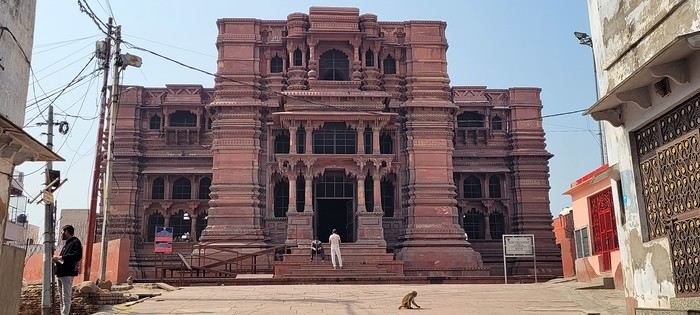
The work women do here is incredibly hard, and their pay must be miserable.

I want to leave Vrindavan for Govardhan. Two young guys on a motorcycle in front of the temple approach me, and the driver offers to take me part of the way. I’m pretty skeptical, but he insists, and I eventually agree. I didn’t fully understand what was happening. Once on the bike, his friend hops on too, and suddenly I’m sandwiched between them for a multi-kilometer ride—*travel Indian-style*. We quickly drop off the friend, and I breathe easier for the rest of the trip. At an intersection, he stops—Govardhan is straight ahead, but to get to his village, he needs to turn right. We wait for the bus for a few minutes, and he flags it down so I can hop on and continue my journey. What an adventure.
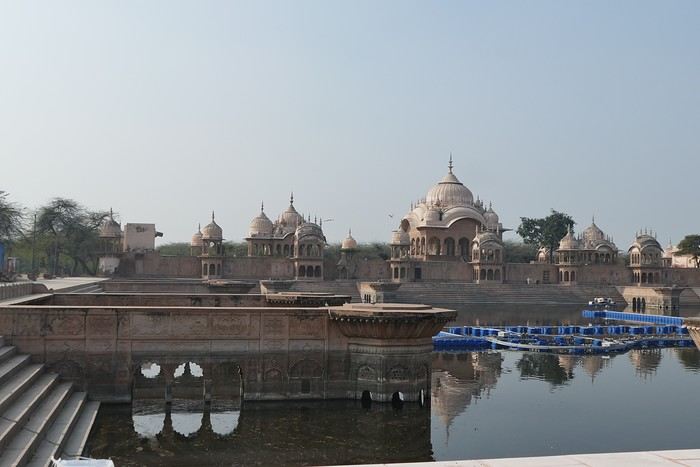
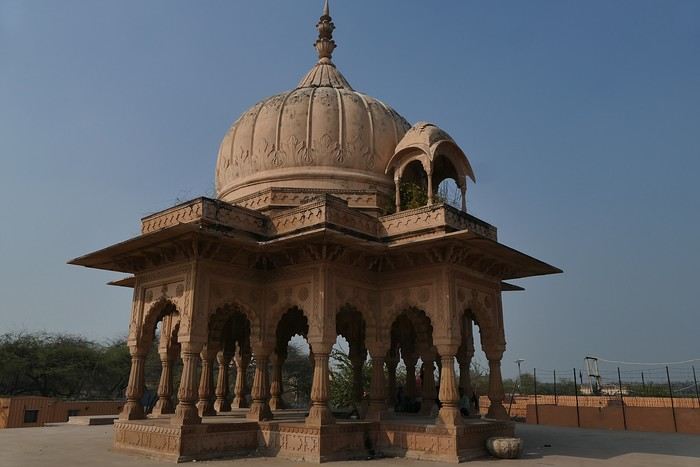
the neighbor with its beautiful dome.
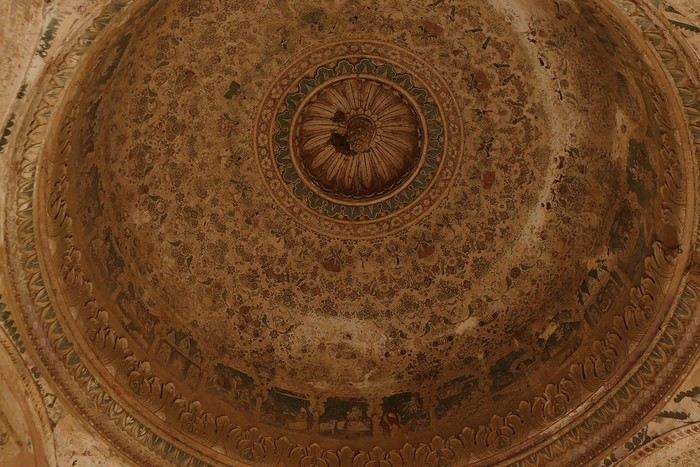
The work women do here is incredibly hard, and their pay must be miserable.
I want to leave Vrindavan for Govardhan. Two young guys on a motorcycle in front of the temple approach me, and the driver offers to take me part of the way. I’m pretty skeptical, but he insists, and I eventually agree. I didn’t fully understand what was happening. Once on the bike, his friend hops on too, and suddenly I’m sandwiched between them for a multi-kilometer ride—*travel Indian-style*. We quickly drop off the friend, and I breathe easier for the rest of the trip. At an intersection, he stops—Govardhan is straight ahead, but to get to his village, he needs to turn right. We wait for the bus for a few minutes, and he flags it down so I can hop on and continue my journey. What an adventure.
the neighbor with its beautiful dome.
Unusual trip to Rajasthan November 2022
Friday, November 4
My flight Barcelona - Abu Dhabi - Delhi went smoothly, it’s on time, and here I am back in India after 3 long years.
As I step off the plane, we head toward customs. It’s 3 AM, I’m tired but happy. The huge customs hall is below ground level and buzzing with people who’ve just arrived. In the end, they’re well organized—Indians to the left, foreigners to the right, and all along the hall, the customs officers’ posts, who remain very zen despite the crowd. It took me less than 2 hours to get out of the airport, which was pretty quick.
For this return trip, I got in touch with a driver from the "Lovers of India" group who was supposed to take me from the airport to Udaipur, passing through non-touristy villages like I love. This French-speaking driver had convinced me to travel by car, which was supposed to make moving from village to village easier. Two or three days before departure, I receive a message from the driver saying he was sick with a cold and sending another driver, his very kind brother who knows Rajasthan well but doesn’t speak French. I’m a bit disappointed by this message and doubtful about the driver’s sincerity, but I don’t have time to find another driver, so I stick to my plans, though I’m not at ease.
At the exit, the driver hasn’t arrived, and I wait half an hour before seeing him show up with a big smile, "Namaste." We don’t waste time and head to the car, which is clean and new.
We get to know each other in the car and hit the road toward Alwar. Along the way, we stop for lunch and to taste my first masala chai, which wakes up my taste buds.
I doze off during the drive, and we arrive at the Atlantic Hotel in Alwar at 10:30 AM. My room is on the ground floor, and I settle in quickly. The Wi-Fi isn’t working, but the staff do everything they can to fix it. At noon, Gajender, the driver, suggests visiting the Qila Fort, which is on the heights of Alwar. The fort is closed for restoration, but safari tours are offered—jeep, guide, driver, and visit for 1600 Rs.
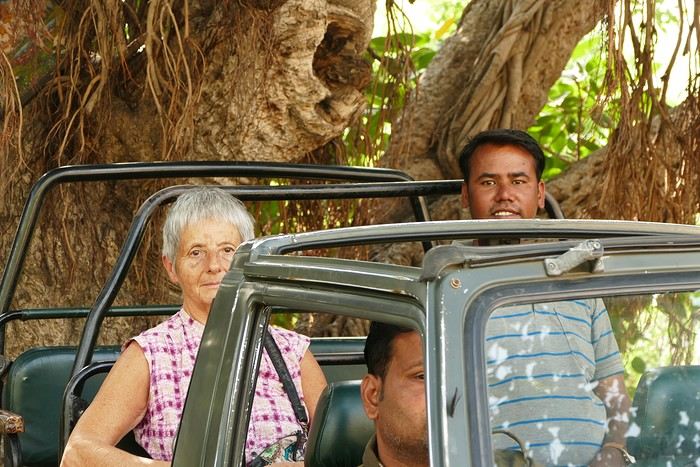
We follow the great wall, which is impressive—the second largest in India and the third in the world.
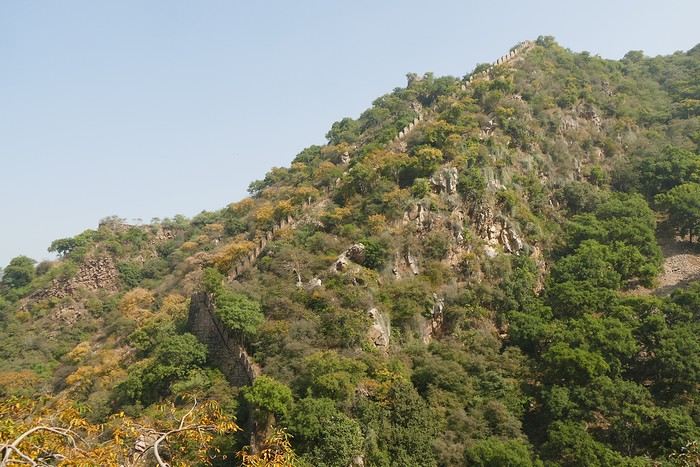
We spot peacocks and monkeys.
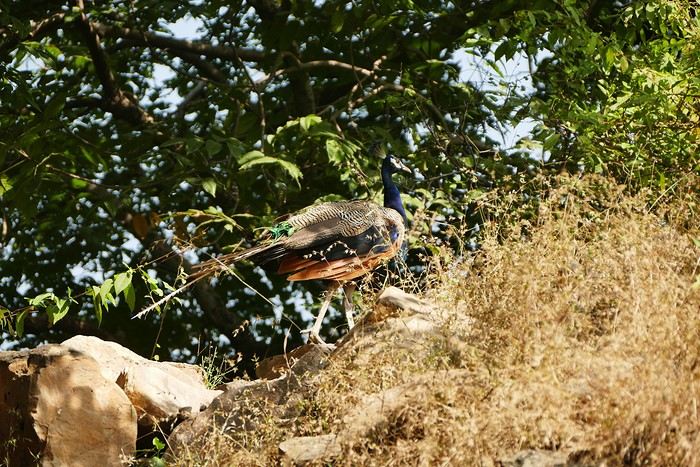
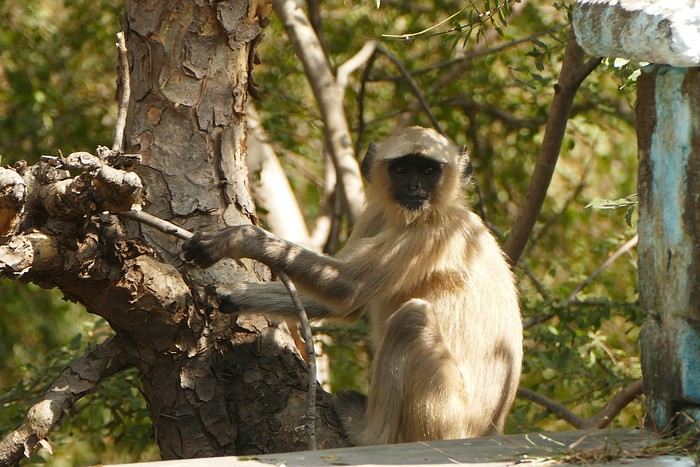
The guide shows me an old stepwell lost in nature. It’s always my thing to check out these baoris, which can be stunning, but this one isn’t anything special. We arrive at the palace overlooking the city.
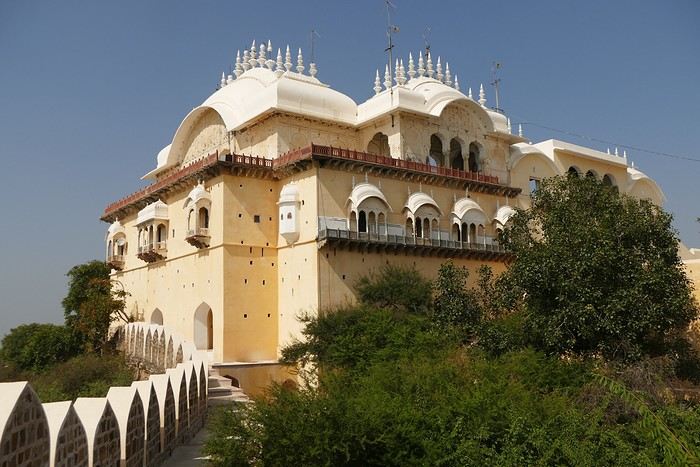
We walk around the palace, and I discover another stepwell that’s not worth lingering over.
The tour is over, and I had a great time despite the fatigue. We head back down to Alwar, near the City Palace, which has been turned into administrative offices. Gaju (the driver’s nickname) finds a parking spot near a dhaba where we have lunch (paneer masala, chapatis, chai)—it’s delicious. With my energy restored, we head to the palace. On the top floor is a museum that I visit.
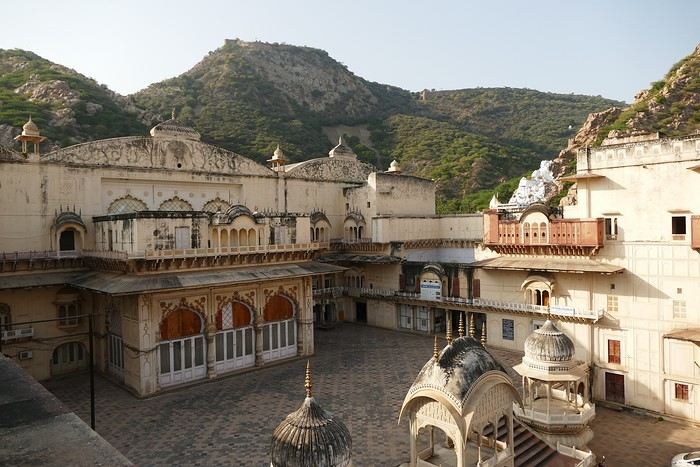
At the exit of the museum, we have to go back down and walk around the palace to get to the Moosi Maharani Chhatri. I’ve been here once before and really liked it, and the place is still the same—calm and relaxing.
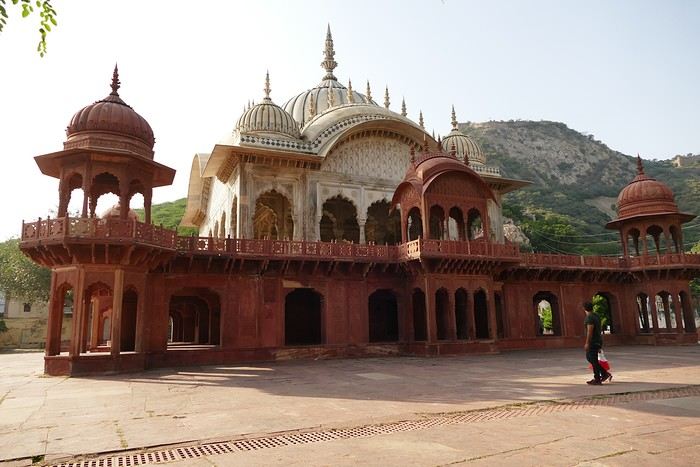
"This monument is the most artistic in Alwar and also the most royal, filled with fascinating history. Maharaja Vinay Singh of Alwar built this two-story cenotaph in 1815 in memory of his father, Maharaja Bakhtawar Singh. It’s also known as Moosi Maharani ki Chhatri, named after the king’s mistress, who performed sati upon his death. After the sati, she was accepted as the king’s wife. It’s an elegant monument, shaped like a flower and built with a mix of brown sandstone and white marble. The first floor is made of sandstone, while the upper floor and the chhatris (cenotaphs) are in white marble. Its sculpted pavilion has dome-shaped arches with intricate lace-like and exquisite floral patterns. There are complex motifs that shine brightly in the sunlight. The colorful circular ceiling is an important part of Moosi Maharani Ki Chhatri and is adorned with faded gold-leaf paintings of mythological figures and scenes. The footprints of Maharaja and Moosi Rani are engraved in marble inside the cenotaph, and locals pay their respects to them."
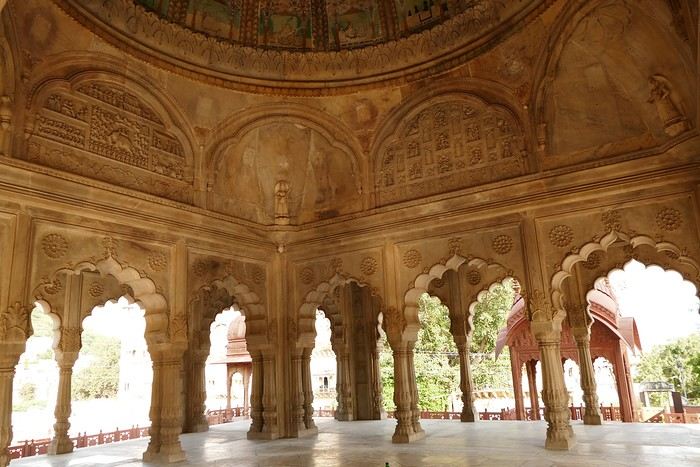
Near the chhatri, there’s a large water reservoir with a magnificent view. The place is peaceful and relaxing, and I stay here for a while, contemplating and daydreaming before heading back to the hotel for some well-deserved rest. The Wi-Fi is working now. I’m the only foreign guest, and since my room is near the entrance, I’ll be well taken care of throughout my stay.
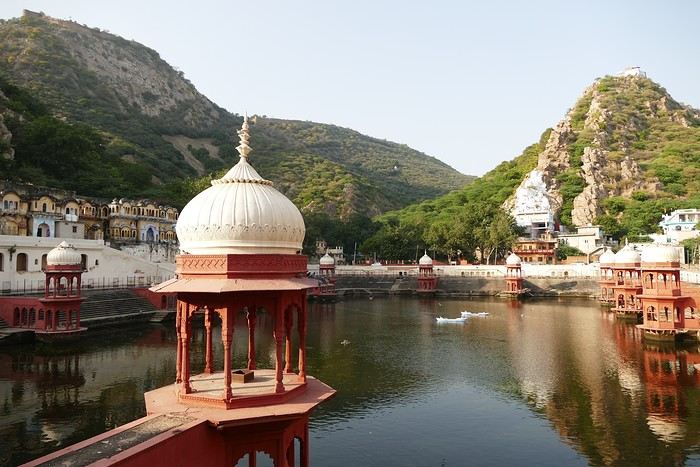
I doze off during the drive, and we arrive at the Atlantic Hotel in Alwar at 10:30 AM. My room is on the ground floor, and I settle in quickly. The Wi-Fi isn’t working, but the staff do everything they can to fix it. At noon, Gajender, the driver, suggests visiting the Qila Fort, which is on the heights of Alwar. The fort is closed for restoration, but safari tours are offered—jeep, guide, driver, and visit for 1600 Rs.
We follow the great wall, which is impressive—the second largest in India and the third in the world.
We spot peacocks and monkeys.
The guide shows me an old stepwell lost in nature. It’s always my thing to check out these baoris, which can be stunning, but this one isn’t anything special. We arrive at the palace overlooking the city.
We walk around the palace, and I discover another stepwell that’s not worth lingering over.
The tour is over, and I had a great time despite the fatigue. We head back down to Alwar, near the City Palace, which has been turned into administrative offices. Gaju (the driver’s nickname) finds a parking spot near a dhaba where we have lunch (paneer masala, chapatis, chai)—it’s delicious. With my energy restored, we head to the palace. On the top floor is a museum that I visit.
At the exit of the museum, we have to go back down and walk around the palace to get to the Moosi Maharani Chhatri. I’ve been here once before and really liked it, and the place is still the same—calm and relaxing.
"This monument is the most artistic in Alwar and also the most royal, filled with fascinating history. Maharaja Vinay Singh of Alwar built this two-story cenotaph in 1815 in memory of his father, Maharaja Bakhtawar Singh. It’s also known as Moosi Maharani ki Chhatri, named after the king’s mistress, who performed sati upon his death. After the sati, she was accepted as the king’s wife. It’s an elegant monument, shaped like a flower and built with a mix of brown sandstone and white marble. The first floor is made of sandstone, while the upper floor and the chhatris (cenotaphs) are in white marble. Its sculpted pavilion has dome-shaped arches with intricate lace-like and exquisite floral patterns. There are complex motifs that shine brightly in the sunlight. The colorful circular ceiling is an important part of Moosi Maharani Ki Chhatri and is adorned with faded gold-leaf paintings of mythological figures and scenes. The footprints of Maharaja and Moosi Rani are engraved in marble inside the cenotaph, and locals pay their respects to them."
Near the chhatri, there’s a large water reservoir with a magnificent view. The place is peaceful and relaxing, and I stay here for a while, contemplating and daydreaming before heading back to the hotel for some well-deserved rest. The Wi-Fi is working now. I’m the only foreign guest, and since my room is near the entrance, I’ll be well taken care of throughout my stay.