Results for "Barre+Monts+ou+Fromentine+|+127"
12220 results found.
Attention à Buenos Aires on caille! English translation pending
Bonjour a tous et surtout a ceux qui vont debarquer a Bsas ces jours ci ( et ceux juste debarqués : Laetibou ) .
L hiver est installé a Bsas et sur l Argentine !
Ce matin mercredi record de froid a Bsas depuis le debut de l annee : a 8h00 du mat : +1, 9 C seulement !
Donc ne croyez pas que l Amerique du sud est chaude en hiver !
En tout cas, on a du soleil jusqu'au Week end ..( dimanche de la pluie a nouveau ) ....
Donc toujours les memes recommandations, evitez de descendre au sud de la ligne Santiago de Chile - Bsas, il y fait tres froid ............... quand vous commencez a monter en altitude, c'est la neige qui est de mise, donc si voua s avez dans l intention de louer un vehicule, n oubliez pas les chaines !
Photo de Bsas ce matin : http://www.clarin.com/diario/2005/07/06/um/fotos/frio.jpg et cet apres midi : http://www.lanacion.com.ar/anexos/imagen/05/411434.JPG
 Temperatures minimales en Argentine aujourd'hui, les 2/3 du pays sous la barre du 0 C au petit matin ! Bonne nouvelle : la route entre Mendoza et Santiago de Chile est reouverte ! depuis hier mardi, les camions ( 800 au total ) ont pu passer la frontiere, il y a beaucoup de neige, mais ca passe ! Unique passage dans la zone entre le Chili et l Argentine. Dans la province de Cordoba, il y a aussi beaucoup de neige dans la Sierra Cordobesa, la route de Altas Cumbres, entre Villa Carlos Paz et Mina Clavero, a ete reouverte hier a midi. Au niveau de la Patagonie ( provinces de Santa Cruz, Neuquen, Chubut, et Rio Negro ), les autorites des provinces mettent en garde les automobilistes de la presence de plaque de glace sur les routes. Dans la province de Neuquen, une centaine de communes on ete isolees pendant une semaine, ( les helicopteres ayant meme du faire un pont aerien pour approvisioner ces villages )....dans ce coin, les routes autour de Chos Malal et Zapala sont toujours coupees A bientot ! Herge !
Ce matin mercredi record de froid a Bsas depuis le debut de l annee : a 8h00 du mat : +1, 9 C seulement !
Donc ne croyez pas que l Amerique du sud est chaude en hiver !
En tout cas, on a du soleil jusqu'au Week end ..( dimanche de la pluie a nouveau ) ....
Donc toujours les memes recommandations, evitez de descendre au sud de la ligne Santiago de Chile - Bsas, il y fait tres froid ............... quand vous commencez a monter en altitude, c'est la neige qui est de mise, donc si voua s avez dans l intention de louer un vehicule, n oubliez pas les chaines !
Photo de Bsas ce matin : http://www.clarin.com/diario/2005/07/06/um/fotos/frio.jpg et cet apres midi : http://www.lanacion.com.ar/anexos/imagen/05/411434.JPG
Temperatures minimales en Argentine aujourd'hui, les 2/3 du pays sous la barre du 0 C au petit matin ! Bonne nouvelle : la route entre Mendoza et Santiago de Chile est reouverte ! depuis hier mardi, les camions ( 800 au total ) ont pu passer la frontiere, il y a beaucoup de neige, mais ca passe ! Unique passage dans la zone entre le Chili et l Argentine. Dans la province de Cordoba, il y a aussi beaucoup de neige dans la Sierra Cordobesa, la route de Altas Cumbres, entre Villa Carlos Paz et Mina Clavero, a ete reouverte hier a midi. Au niveau de la Patagonie ( provinces de Santa Cruz, Neuquen, Chubut, et Rio Negro ), les autorites des provinces mettent en garde les automobilistes de la presence de plaque de glace sur les routes. Dans la province de Neuquen, une centaine de communes on ete isolees pendant une semaine, ( les helicopteres ayant meme du faire un pont aerien pour approvisioner ces villages )....dans ce coin, les routes autour de Chos Malal et Zapala sont toujours coupees A bientot ! Herge !Quel pays en Afrique? English translation pending
salut à vous tous.
je rêve d'afrique....mais il y a tant de diversité je ne sais comment débuter ma recherche. vous qui y avez été pouvez-vous m'aider dans un choix en partant de mes critères...
alors voila:
* afrique noire... * les tams-tams, percussions et la danse africaine y sont omniprésentes * le cout de la vie y est très bas, je peux y faire du camping et vivre en backpaker pauvre... * je n'ai pas besoin de me louer un véhicule pour tout voir * j'ai accès à la mer et y trouve de merveilleux coin apnée * je suis seule je veux un pays 'safe', j'adore faire du pouce (utopique) * je veux pas un endroit trop touristique si possible ( harcèlement 🤪 ) * je veux de la nature, du vert, du tropical, une faune et flore unique, après l'australie je ne veux plus de désert et de région aride ou les distances sont interminables...
suis-je trop difficile....je veux connaitre une culture africaine ou l'on parle francais ou l'on danse dans la rue, ou la communauté est une valeur de base, je veux un choc culturel, je veux du vrai, je veux voir des paysages grandioses, je veux connaitre une Afrique que je suis certaine avoir déjà connue dans une autre vie, je sais juste pas dans quel pays....
j'attends vos réponses avec impatience. merci
ps) pour ceux qui me proposerais madagascar pour sa faune et flore unique, j'ai entendu dire que ce n'est pas tres représentatif de l'Afrique car trop différent, unique....vrai...ou faux...
je rêve d'afrique....mais il y a tant de diversité je ne sais comment débuter ma recherche. vous qui y avez été pouvez-vous m'aider dans un choix en partant de mes critères...
alors voila:
* afrique noire... * les tams-tams, percussions et la danse africaine y sont omniprésentes * le cout de la vie y est très bas, je peux y faire du camping et vivre en backpaker pauvre... * je n'ai pas besoin de me louer un véhicule pour tout voir * j'ai accès à la mer et y trouve de merveilleux coin apnée * je suis seule je veux un pays 'safe', j'adore faire du pouce (utopique) * je veux pas un endroit trop touristique si possible ( harcèlement 🤪 ) * je veux de la nature, du vert, du tropical, une faune et flore unique, après l'australie je ne veux plus de désert et de région aride ou les distances sont interminables...
suis-je trop difficile....je veux connaitre une culture africaine ou l'on parle francais ou l'on danse dans la rue, ou la communauté est une valeur de base, je veux un choc culturel, je veux du vrai, je veux voir des paysages grandioses, je veux connaitre une Afrique que je suis certaine avoir déjà connue dans une autre vie, je sais juste pas dans quel pays....
j'attends vos réponses avec impatience. merci
ps) pour ceux qui me proposerais madagascar pour sa faune et flore unique, j'ai entendu dire que ce n'est pas tres représentatif de l'Afrique car trop différent, unique....vrai...ou faux...
Situation en Bolivie ( Part II le retour ) English translation pending
Bonjour a tous .....
Ben voila, on reprend les memes et on recommence !
Apres le bazar des deux premieres semaines de mars dernier en Bolivie pour une histoire d'hydrocarbure ...les syndicat voulant forcer le gouvernement a taxer plus durement les compagnies multinationales qui ont le control de l extraction du gaz et du petrole en Bolivie ! Histoire d avoir un peu plus d argent dans les caisses de l Etat, alors que le president de la republique bolivienne Carlos Mesa (tout comme ses predecesseurs) se montre tres laxiste envers ces compagnies privees qui pompent ( au propre comme au figuré ) le pays sans rien trop lacher ! Mais bon l opposition etant aussi ( bien ) corrompu et pour la plupart le nez dans la culture de la feuille de coca, qui n est pas uniquement cultivée pour la macher ! ...on ne peut s'attendre qu'a avoir sans cesse des conflits sporadiques qui tous les 2 ou 3 mois bloquent le pays pour quelques semaines !
Bref ca recommence depuis une semaine !
Donc, NON je ne veux pas vous faire peur !, pas de touristes tabassés par les flics, pas non plus de gros deplacement de masse a vouloir lincher le premier bus a neuneus qui passerait dans l altiplano !
Mais comme toujours, ce sont les routes qui sont bloquees par des baricades, donc on ne pas se deplacer, certains coins ne sont pas approvisioner en gas oil, donc pas de bus, pas de voiture et donc moins de touristes !
Pour les neuneus ayant leur timing dans l agenda, et ben c'est mal barré ! Pour les voyageurs qui ont compris que le temps n'a ici aucune importance, et bien c'est meme peut etre le moment de voir un peu ce qui se passe reellement en Bolivie, une fois qu on a vu les carte postales !
La situation en ce moment : 6 eme jour de greve generale dans la province de Tarija. Potosi a ete bloqué quelques heures hier par des mineurs A Santa Cruz ( comme d hab ! ) il commence a manquer de gas oil, normal puisque la route Yacuiba - Santa Cruz est coupée. un melange de pas mal de contestations ( surtout dans la province de santa Cruz ) chacun allant de son slogan dans une bonne pagaille ....les uns veulent le bitumage de la route reliant Santa Cruz a la frontiere du Paraguay ( ca serait d'ailleurs une bonne chose ! ), d'autres ont pris en otages 66 personnes a Los Yuquises ( un bled paumé a 250 km au nord de Santa Cruz ) par le mouvement des sans Terre, MST ...histoire de reclamer des terres .....donc c est un peu le b.... en ce moment !
En fait la vapeur monte en ce moment car le president veux faire passer une nouvelle loi ( sur les hydrocarbures ) avec 142 articles dedans, et il a 10 jours pour la promulguer, , , donc il faut s attendre a encore a 10 jours de bazar en Bolivie ! ( ca se termine mardi 17 mai ).
Et puis il y a les durs de durs de la contestation, d'une part le MAS ( Mouvement Au Socialisme ) qui prepare une marche lundi 16 mai de 200 km entre Caracollo et la Paz pour exiger une augmentation des "regalias" des multinationales ( c'est a dire de l impot les taxant ). Et puis il y a la Central Obrera Regional qui elle demande une nationalisation pure et dure de tous les gisements et en plus la demission du president Carlos Mesa ( rien que ca ! ) ....donc lundi 16 mai, rendez vous tous a La Paz ca va etre annimé !!!!!!!!!!!!! ( juré vous aurez les photos ! ) .
A bientot !
Herge !
Ben voila, on reprend les memes et on recommence !
Apres le bazar des deux premieres semaines de mars dernier en Bolivie pour une histoire d'hydrocarbure ...les syndicat voulant forcer le gouvernement a taxer plus durement les compagnies multinationales qui ont le control de l extraction du gaz et du petrole en Bolivie ! Histoire d avoir un peu plus d argent dans les caisses de l Etat, alors que le president de la republique bolivienne Carlos Mesa (tout comme ses predecesseurs) se montre tres laxiste envers ces compagnies privees qui pompent ( au propre comme au figuré ) le pays sans rien trop lacher ! Mais bon l opposition etant aussi ( bien ) corrompu et pour la plupart le nez dans la culture de la feuille de coca, qui n est pas uniquement cultivée pour la macher ! ...on ne peut s'attendre qu'a avoir sans cesse des conflits sporadiques qui tous les 2 ou 3 mois bloquent le pays pour quelques semaines !
Bref ca recommence depuis une semaine !
Donc, NON je ne veux pas vous faire peur !, pas de touristes tabassés par les flics, pas non plus de gros deplacement de masse a vouloir lincher le premier bus a neuneus qui passerait dans l altiplano !
Mais comme toujours, ce sont les routes qui sont bloquees par des baricades, donc on ne pas se deplacer, certains coins ne sont pas approvisioner en gas oil, donc pas de bus, pas de voiture et donc moins de touristes !
Pour les neuneus ayant leur timing dans l agenda, et ben c'est mal barré ! Pour les voyageurs qui ont compris que le temps n'a ici aucune importance, et bien c'est meme peut etre le moment de voir un peu ce qui se passe reellement en Bolivie, une fois qu on a vu les carte postales !
La situation en ce moment : 6 eme jour de greve generale dans la province de Tarija. Potosi a ete bloqué quelques heures hier par des mineurs A Santa Cruz ( comme d hab ! ) il commence a manquer de gas oil, normal puisque la route Yacuiba - Santa Cruz est coupée. un melange de pas mal de contestations ( surtout dans la province de santa Cruz ) chacun allant de son slogan dans une bonne pagaille ....les uns veulent le bitumage de la route reliant Santa Cruz a la frontiere du Paraguay ( ca serait d'ailleurs une bonne chose ! ), d'autres ont pris en otages 66 personnes a Los Yuquises ( un bled paumé a 250 km au nord de Santa Cruz ) par le mouvement des sans Terre, MST ...histoire de reclamer des terres .....donc c est un peu le b.... en ce moment !
En fait la vapeur monte en ce moment car le president veux faire passer une nouvelle loi ( sur les hydrocarbures ) avec 142 articles dedans, et il a 10 jours pour la promulguer, , , donc il faut s attendre a encore a 10 jours de bazar en Bolivie ! ( ca se termine mardi 17 mai ).
Et puis il y a les durs de durs de la contestation, d'une part le MAS ( Mouvement Au Socialisme ) qui prepare une marche lundi 16 mai de 200 km entre Caracollo et la Paz pour exiger une augmentation des "regalias" des multinationales ( c'est a dire de l impot les taxant ). Et puis il y a la Central Obrera Regional qui elle demande une nationalisation pure et dure de tous les gisements et en plus la demission du president Carlos Mesa ( rien que ca ! ) ....donc lundi 16 mai, rendez vous tous a La Paz ca va etre annimé !!!!!!!!!!!!! ( juré vous aurez les photos ! ) .
A bientot !
Herge !
conseil achat billets transsibérien English translation pending
un conseil enfin pour tous : ACHETEZ VOS BILLETS SUR PLACE, les agences de partout dans le monde se prenne une commision de 100 a 200 %, le prix triple rapidement, c'est honteux...
ALLEZ ACHETER VOS TICKETS A L AGENCE CENTRALE DES CHEMINS DE FER MENTIONNEE DANS LE LONELY< METRO CHISTYE PRUDY OU TURGENEVSKAYA
parce qu'il n'y a personne, donc meme si vous ne parlez pas un mot de russe, comme moi, la fille a le temps, alors il est toujorus possible de franchir la barriere du Niet et de s'expliquer avec les mains...
possible de payer en Visa mastercard and co
autre conseil : voyagez en plastkartny, deux fois moins cher que le kupe, 3eme classe et non 2nde, plus facile de rencontrer des gens, et quasimment le meme confort relatif... la difference de prix entre les deux classes ne s'explique pas a mon avis !
cela ne vaut peut-etre pas pour l'ete, ou les prix grimpent et ou les trains se remplissent plus vite
perso, j'ai paye mon ticket a 14h pour partir a minuit le meme jour, moskva-irkutsk pour 1700 roubles en 3eme classe, soit 45 euros, trajet vendu 200 ou meme 250 euros pour un billet 2nde par des agences sans scrupules
a vous de voir !!
a votre disposition
tom
Il etait une fois Parvat en Iran... English translation pending
Tout d'abord, un enoooorme merci pour vos supers messages qui me font chaud au coeur (voir il etait une fois en Turquie, puis mes mails prives que je ne sais repondre personnellement a tous car ca prend 5 minutes pour ouvrir une page dans ces contrees) Je n'oublierai pas le bonjour a Iraj JL, et continuez de m'envoyer des mails, c'est si agreable de vous lire...
Donc, arrives a Dogubayazit en Turquie, nous avons suivi les traces de Trekkerbeub, et avons visiter le palais d'Ishak Pasa, avec le mont Ararat enneige en arriere plan... MONUMENTAL!!! Vraiment grandiose!
L'apres midi, en route pour l'Iran border... Je mets mon foulard sur la tete (je sens qu'il va m'emmerder ce foulard...) et comme nous sommes dimanche, le passage se fait rapidement, specialement pour nous touristes occidentaux 🙂
(break clop dehors qui ne dure pas longtemps car comme je suis E.T. c'est parfois derangeant;))
🙂
(break clop dehors qui ne dure pas longtemps car comme je suis E.T. c'est parfois derangeant;))
Donc nous voila en Iran!!! Taxi collectif pour Bazargan, et retaxi pour Maku, ou nous décidons de nous arrêter une nuit pour nous reposer de la nuit précédente en bus. On trouve un hôtel, pas cher du tout... L'équivalent d'un euro par pers. mais euh... Quelle affreuse chambre, et quelle puanteur dans la salle d’eau ! Pas de douche, juste un évier et deux "tuvalet" à l’odeur épouvantable. Pour se laver, toute une histoire, heureusement que je ne voyage pas seule, Pili vient tenir la porte de la salle d’eau vu qu’elle ne ferme pas. Dorénavant je crois qu’on s'offrira un hôtel au double du prix !Petite balade dans Maku… Je m'achète un fin manteau noir et long pour être en accord avec la loi du pays, puis petit dîner... Kebab et pain, et dodo.
18/4
Bus pour Tabriz. Enfin l'hotel est bien clean, (6 euros pour nous trois) avec des douches bien chaudes. On se balade dans la ville, je m'achete un foulard tout fin et pas chaud dans le bazar (superbe avec ses 35 km de galeries) ou nous nous arretons dans un bui bui pour que je puisse gouter enfin un qaylan. (narguileh) L'endroit est minuscule, serres comme des baudets, on essaie de boire le chai comme ici, avec un morceau de sucre en bouche, on sirote le the brulant. Pas mal le qaylan, mais je prefere le tabac a la pomme. Je regle l'adition, 50 centimes d'euros pour le narguileh et 6 thes...
Petit bonjour a Nasser de l'office du tourisme, qui fait merveilleusement son boulot... Au soir dans un resto, nous faisons connaissance de Shalaleh et Majit qui parlent bien l'anglais. Nous quittons le resto ensemble, et avant d'aller se balader dans le parc Elboli, Shalaleh passe en vitesse chez elle mettre un chador, car comme elle et Majit n'ont aucun lien de parente, elle a peur de se faire prendre, ils risquent gros tous les deux... Cela fait 6 ans qu'ils sont amis, mais ils ne pourront jamais se marier, le pere de Shalaleh ne veut pas de Majit comme gendre... Alors tant qu'elle etudie, elle habite Tabriz alors que ses parents vivent a Orumiyeh, elle continue a voir son cher et tendre, elle a presque fini ses etudes d'ingenieur en electronique, et va commencer l'informatique... On se boit un the en fumant un qaylan a la pomme, et grimpons au point de vue. La ville toute illuminee, le palais converti en resto au milieu de l'étang, les fontaines eclairees de spots verts jaunes ou oranges, on passe vraiment une délicieuse soiree...
Donc, arrives a Dogubayazit en Turquie, nous avons suivi les traces de Trekkerbeub, et avons visiter le palais d'Ishak Pasa, avec le mont Ararat enneige en arriere plan... MONUMENTAL!!! Vraiment grandiose!
L'apres midi, en route pour l'Iran border... Je mets mon foulard sur la tete (je sens qu'il va m'emmerder ce foulard...) et comme nous sommes dimanche, le passage se fait rapidement, specialement pour nous touristes occidentaux
🙂
(break clop dehors qui ne dure pas longtemps car comme je suis E.T. c'est parfois derangeant;))Donc nous voila en Iran!!! Taxi collectif pour Bazargan, et retaxi pour Maku, ou nous décidons de nous arrêter une nuit pour nous reposer de la nuit précédente en bus. On trouve un hôtel, pas cher du tout... L'équivalent d'un euro par pers. mais euh... Quelle affreuse chambre, et quelle puanteur dans la salle d’eau ! Pas de douche, juste un évier et deux "tuvalet" à l’odeur épouvantable. Pour se laver, toute une histoire, heureusement que je ne voyage pas seule, Pili vient tenir la porte de la salle d’eau vu qu’elle ne ferme pas. Dorénavant je crois qu’on s'offrira un hôtel au double du prix !Petite balade dans Maku… Je m'achète un fin manteau noir et long pour être en accord avec la loi du pays, puis petit dîner... Kebab et pain, et dodo.
18/4
Bus pour Tabriz. Enfin l'hotel est bien clean, (6 euros pour nous trois) avec des douches bien chaudes. On se balade dans la ville, je m'achete un foulard tout fin et pas chaud dans le bazar (superbe avec ses 35 km de galeries) ou nous nous arretons dans un bui bui pour que je puisse gouter enfin un qaylan. (narguileh) L'endroit est minuscule, serres comme des baudets, on essaie de boire le chai comme ici, avec un morceau de sucre en bouche, on sirote le the brulant. Pas mal le qaylan, mais je prefere le tabac a la pomme. Je regle l'adition, 50 centimes d'euros pour le narguileh et 6 thes...
Petit bonjour a Nasser de l'office du tourisme, qui fait merveilleusement son boulot... Au soir dans un resto, nous faisons connaissance de Shalaleh et Majit qui parlent bien l'anglais. Nous quittons le resto ensemble, et avant d'aller se balader dans le parc Elboli, Shalaleh passe en vitesse chez elle mettre un chador, car comme elle et Majit n'ont aucun lien de parente, elle a peur de se faire prendre, ils risquent gros tous les deux... Cela fait 6 ans qu'ils sont amis, mais ils ne pourront jamais se marier, le pere de Shalaleh ne veut pas de Majit comme gendre... Alors tant qu'elle etudie, elle habite Tabriz alors que ses parents vivent a Orumiyeh, elle continue a voir son cher et tendre, elle a presque fini ses etudes d'ingenieur en electronique, et va commencer l'informatique... On se boit un the en fumant un qaylan a la pomme, et grimpons au point de vue. La ville toute illuminee, le palais converti en resto au milieu de l'étang, les fontaines eclairees de spots verts jaunes ou oranges, on passe vraiment une délicieuse soiree...
la toute nouvelle loi Bibine en thailande .. English translation pending
scoop exclusif VF
la dernière trouvaille .. en matière de répression thaïlandaise ..
c'est placarde en grand dans toute les rues de bkk .. ( hélas en thai ... )
je traduit ... VENDREDI ...... TU TE FAIT ATTRAPER EN ÉTAT D'IVRESSE ..
SAMEDI .. ........ TU TE REPOSE ....
DIMANCHE ....... TU PEINT LES RUES ( le marquage blanc ou rouge )
OU TU RAMASSE LES CADAVRES ...--
je crois que l'on va avoir des plates Bandes neuves très rapidement ..
c'est bien pour la sécurité routière ..
J'aime l'asie ..
Porte bagage avant pour fourche suspendue. English translation pending
Salut,
Je sais que le sujet a déjà été lancé mais je me dis que peut être vous avez connaissance d'autres infos, peut etre peut être 😮
En effet je cherche un porte bagage avant pour fourche suspendue pas trop chère ce qui n'a pas l'air simple à trouver mis à part les tubus de chez Worden.com à 100E ou ceux de chez Arkel (http://www.arkel-od.com/racks/ultLR/features.asp?fl=1&site=eu) qui avec les frais de Port reviennent à 92E (du coup mieux vault prendre les Tubus)
Alors si quelqu'un connait des plans sympa, des bricoles à faire sur un porte bagage fourche rigide ou qui ne voudrait plus de son Tubus (On peut rever😛) je suis tres interressé.
Merci d'avance 😎
Je sais que le sujet a déjà été lancé mais je me dis que peut être vous avez connaissance d'autres infos, peut etre peut être 😮
En effet je cherche un porte bagage avant pour fourche suspendue pas trop chère ce qui n'a pas l'air simple à trouver mis à part les tubus de chez Worden.com à 100E ou ceux de chez Arkel (http://www.arkel-od.com/racks/ultLR/features.asp?fl=1&site=eu) qui avec les frais de Port reviennent à 92E (du coup mieux vault prendre les Tubus)
Alors si quelqu'un connait des plans sympa, des bricoles à faire sur un porte bagage fourche rigide ou qui ne voudrait plus de son Tubus (On peut rever😛) je suis tres interressé.
Merci d'avance 😎
Air Algérie...pourquoi? English translation pending
Je suis un utilisateur habituel de la ligne Alger-Barcelone, comme aucune compagnie aerienne espagnole n'a pas encore retourné en Algérie Air Algérie fait ce qu'ils veulent avec nous (des avions sovietiques et des rétards constants, la derniere fois rétard de quatre heures!!!).
Le weekend dérnier j'ai fait le trajet Alger-Tunis-Alger, j'imagine que c'est a cause de la concurrence de Tunisair mais le voyage s'est bien passé sans rétard, sans conneries, parfaitement, dans des avions très très moderns.
J'ai dans la tête aller à Paris le prochain mois d'avril mais...arret! Le billet est très très cher et avant l'acheter je veux demander aux utilisateurs habituels de la ligne Alger-Paris si Air Algérie offre des services serieux vers la France car à cause de mes horaires Air Algérie m'arrange mieux que Air France ou Aigle Azur.
Une autre question, quelqu'n peut m'expliquer pourqoui un billet Barcelona-Alger-Barcelone ou bien Tunis-Alger-Tunis coute 180 Euros tandis que si on fait le voyage dans le sens invers (Alger-Barcelone-Alger....) ça monte à 300 Euros?????
Le weekend dérnier j'ai fait le trajet Alger-Tunis-Alger, j'imagine que c'est a cause de la concurrence de Tunisair mais le voyage s'est bien passé sans rétard, sans conneries, parfaitement, dans des avions très très moderns.
J'ai dans la tête aller à Paris le prochain mois d'avril mais...arret! Le billet est très très cher et avant l'acheter je veux demander aux utilisateurs habituels de la ligne Alger-Paris si Air Algérie offre des services serieux vers la France car à cause de mes horaires Air Algérie m'arrange mieux que Air France ou Aigle Azur.
Une autre question, quelqu'n peut m'expliquer pourqoui un billet Barcelona-Alger-Barcelone ou bien Tunis-Alger-Tunis coute 180 Euros tandis que si on fait le voyage dans le sens invers (Alger-Barcelone-Alger....) ça monte à 300 Euros?????
10 jours en Argentine English translation pending
Bonjour à tous!
Nous partons pour l'Argentine dans un mois, nous serons 10 jours sur place.
Nous voulons voir BA, la péninsule de Valdes, El Calafate et Ushuaia (dans cet ordre) C'est court, je sais....
Déjà ce sera l'avion pour circuler dans le pays. Mais nous souhaitons tout de même louer une voiture dans un des sites, histoire de se ballader un peu. En lisant les guides, j'ai bien envie de prendre une voiture pour silloner la péninsule de Valdes et les environs si c'est réalisable. C'est une bonne idée ou pas?
D'autre part, nous allons de voir faire des choix: 3 destinations à deux jours et une à trois jour. Qu'en pensez vous, où faut-il rester trois jours?
Autre question: 600 euros pour BA-Trelew, Trelew-El Calafate, Elcalafate-Ushuaia, Ushuaia-BA. Ca vous semble honnête ou on peut chercher moins cher?
Merci.
15 jours à Mayotte English translation pending
Bonjour, bonjour
Je prevois de partir 15 jours sur l'ile de Mayotte aux alentours du mois d'avril.
Je suis à la recherche de bons plans (nature, rando, ...) à ne pas manquer durant mon sejour.
Merci
Je prevois de partir 15 jours sur l'ile de Mayotte aux alentours du mois d'avril.
Je suis à la recherche de bons plans (nature, rando, ...) à ne pas manquer durant mon sejour.
Merci
Fourche suspendue et porte bagages? English translation pending
Bien, je commence à avoir les idées un peu plus claires sur les equipements de mon futur vélo mais et il me reste un point assez flou : le porte bagage avant....
Un vélociste m'a affirmé que de monter un porte bagage sur une fourche suspendue ne pose aucun problème, un autre me l'a vivement déconseillé... qui croire ???
Est ce qu'une fourche suspendue "vérouillable" peu être une solution ??
J'ai envisagé la solution remorque qui semble très séduisante mais qui risque être un handicap lors du transport à l'étranger (avion, train, bus)
Merci d'avance
Un vélociste m'a affirmé que de monter un porte bagage sur une fourche suspendue ne pose aucun problème, un autre me l'a vivement déconseillé... qui croire ???
Est ce qu'une fourche suspendue "vérouillable" peu être une solution ??
J'ai envisagé la solution remorque qui semble très séduisante mais qui risque être un handicap lors du transport à l'étranger (avion, train, bus)
Merci d'avance
Barbecue dans la banquise English translation pending
18 juillet 2004 - Nous sommes au Spitzberg, par 80° de latitude Nord. Un archipel perdu à la marge du monde, au Nord-Est du Groenland, la dernière terre avant le pôle.
Après un voyage d’approche en avion depuis la Norvège, nous avons embarqué il y a quelques jours à bord du Grigoriy Mikheev, un navire scientifique russe de l’institut de recherche polaire de Mourmansk.
Le Grigoriy Mikheev est conçu pour naviguer dans la glace, mais ce soir, tout espoir de passer le détroit d’Hinlopen est définitivement abandonné. La progression dans la banquise est devenue extrêmement lente. Trop lente … Trop de glace … Trop épaisse ...
Le réchauffement de la planète est une réalité, mais le phénomène semble avoir des ratées … Il paraît qu’il n’y a pas eu autant de banquise ici en juillet depuis quinze ans !
Youriy Gorodnik, le capitaine, sait d'ores et déjà que nous allons être bloqués par les glaces flottantes qui couvrent maintenant les 9/10èmes de la surface de la mer. En effet, un quart d'heure plus tard, nous voici carrément coincés. Tout autour de nous, ce n'est pratiquement que de la glace. Devant l’étrave, quelques plaques cassées et basculées par notre dernière avancée montrent leur tranche qui fait plus d'un mètre d'épaisseur ...
Quand on parle de Youriy Gorodnik, n’imaginez pas un « capitaine » en tenue bleu marine et galons dorés ! Youriy c’est un grand gars simple et cordial, toujours en T-shirt à son poste de pilotage ou en gros pull de camionneur s’il doit faire un tour dehors.
Le jour où nous avons embarqué, Youriy nous a dit que nous serions toujours les bienvenus à la passerelle de commande du navire, à n'importe quelle heure du jour ou de la nuit. La seule exception peut-être, avait-il ajouté, ce serait au moment de manoeuvres un peu délicates ou dans certaines circonstances exceptionnelles, lorsque l'équipe de quart aurait besoin de toute sa concentration pour faire son travail, par exemple, avait-il dit, « s'il y avait vraiment trop de glace ... »
Depuis que nous sommes partis, nous sommes montés maintes fois à la passerelle, toujours accueillis cordialement. Sommes-nous aujourd'hui dans le genre de circonstances dont parlait Youriy ... ? Vaudrait-il mieux s'abstenir ? Ça se pourrait bien en effet, mais en même temps la tentation est vraiment énorme d'aller voir là-haut comment ça se passe !
Nous montons donc en nous promettant de ne pas déranger, de nous faire aussi petits que possible, mais avec l'espoir de partager avec les deux marins de quart ces moments exceptionnels.
A la porte de la passerelle, nous entrons sur la pointe des pieds ... façon « panthère rose » ! Andreï est debout à la barre et Youriy aux commandes moteur. Andreï nous a vus mais il ne se retourne pas. Nous refermons vite la porte pour ne pas laisser entrer le froid, mais nous restons sur le seuil comme des gamins qui savent confusément qu'ils abusent.
Youriy tourne la tête et nous voit près de la porte. Il nous fait un grand sourire et d'un signe de la main il nous dit d'approcher !
On s'avance à ses côtés, jusqu'au pupitre de commande. Le radar, tout en jaune et noir, montre la côte, les îles du détroit, et la mer saturée de glaces flottantes qui ressemblent à un puzzle anarchique. D’ici, à travers les vitres de la passerelle, à quelques mètres de hauteur, le paysage prend une nouvelle dimension. On reste fascinés, les yeux rivés sur le décor blanc dont les lointains s'évanouissent dans une vapeur glacée. La marge du monde ! C’est ici …
Après avoir tenté à deux reprises de reculer pour reprendre de l'élan et essayer de repartir de toute la puissance des deux moteurs, Youriy renonce, il abaisse les manettes et arrête tout ! On entend le régime des moteurs qui chute et s’évanouit … Le navire s'immobilise dans le grand blanc, en vue de la petite île de Nyströmøya. L'écran du GPS indique 79°40’ Nord.
Aucune inquiétude cependant : ce sont les courants de marée qui ont provoqué cette densité de glace flottante. Les grandes plaques de banquise (les "floes", comme on dit entre initiés), parfois de la taille d'un terrain de foot, se sont accumulés les uns contre les autres jusqu'à tout recouvrir. Youriy est serein : il nous explique qu'on va devoir attendre quelques heures que la marée s'inverse pour nous dégager. En effet, avec l'inversion de la marée, les courants vont "détendre" tout ce pack, les "floes" vont s'écarter, et nous pourrons alors repartir, remonter vers le Nord, vers les eaux libres de l’entrée du détroit où nous avons prévu, demain, de débarquer en zodiac sur l'île de Lågøya, à la rencontre d'une colonie de morses.
Ce blocage était prévisible depuis un moment, et puisque le navire va être à l'arrêt forcé, Youriy a demandé à Clare et Beverley, les deux jeunes cuisinières du Grigoriy Mikheev, de prévoir un barbecue sur le pont à l'avant du bateau, pour le repas du soir !
Clare et Beverley ne sont pas russes, vous l’auriez deviné, non ? Elles sont respectivement anglaise et néo-zélandaise. Quant au maître de la cambuse du bord, le très sympathique Phil, il est australien. C’est très international, l’arctique !
Tout le monde est invité à 20 heures sur le pont avant. Beverley a mis une affichette dans la coursive : « Tonight at 20, special arctic BBQ on foredeck. Don’t forget your party dress and dancing shoes ! »
Soirée surréaliste ! A 20 heures, navire arrêté en pleine banquise et sous un soleil superbe, nous nous retrouvons tous sur le pont, non pas en "party dress" ni en "dancing shoes", mais en anoraks et chaussures tout-terrains. Les trois marins ont empilé les zodiacs pour faire de la place. Ils ont installé des tréteaux et allumé un grand barbecue qui commence à faire rougir ses braises de charbon de bois.
Ce soir, les apéritifs sont offerts : Kir, Whisky ou … Pastis ! (je rassure la ligue anti-alcoolique : il y a aussi des jus de fruits !). Pour les glaçons, on n’est pas allé les chercher bien loin !
En guise d’apéro, certains préfèrent goûter un verre de vin. Phil en épate plus d’un : il a sorti de sa cambuse une caisse de vin rouge du Gers, proche cousin du Madiran ! Excellent, mais à ne pas laisser trop longtemps rafraîchir (la température n’est que de 4 degrés !). Du vin français à bord d’un navire russe au Spitzberg norvégien, servi par un sommelier australien, ce n’est pas vraiment commun ! Ambiance de fête : Tchin-Tchin ! On trinque à la banquise, aux phoques, aux morses, aux ours blancs et à la passion de l’arctique qui nous réunit ici !
Sur les tréteaux, un sympathique buffet d’entrées (froides !) nous attend. Juste à côté, près du bastingage tribord, Beverley armée d’une grande fourchette officie au barbecue : cuisses et ailes de poulet marinées aux épices, saucisses norvégiennes et côtelettes grillées apportent une note olfactive insolite dans l’air pur de l’arctique ! Les ours polaires doivent en être tout émoustillés dans un rayon de 15 km ! (il paraît que c’est à cette distance qu’ils sont capables de sentir la nourriture … )
Nataliya et Olga, les serveuses russes, ne sont pas en reste ! Ce soir pour elles, c’est relâche car tout est en self avec assiettes en carton et gobelets. Et relâche n’est pas un vain mot : la blonde Nataliya, en super forme, entonne son répertoire de chansons russes ! Ce ne sont pas les chœurs de l’Armée Rouge mais bien celui des mordus de l’arctique qui ne tarde pas à lui répondre en reprenant avec un bel ensemble les standards éternels du folklore : « Dans les plaines d’Ukraine », « Kalinka », « Le temps du muguet » … tout y passe, dans une ambiance de fous-rires auxquels les premiers verres de Madiran ne sont peut-être pas totalement étrangers !
Si de là-haut des extra-terrestres nous observent, ils doivent se poser bien des questions en voyant ce navire hérissé d’antennes et de radars, petit point perdu dans la banquise, si loin de toute vie humaine, avec sur le pont des hommes et des femmes de tous âges et de toutes origines qui se marrent en dévorant des cuisses de poulet, en picolant du vin rouge et en chantant des chansons russes !
Chanter, c’est bien, mais Beverley avait dit : « Don’t forget your dancing shoes ! » … Les marins ont apporté leur « sound machine » portatif et, avec l’arrivée des gâteaux et du « champagne », le pont avant se transforme en piste de danse !
En fait de « dancing shoes », c'est une joyeuse troupe en Pataugas, Tecnica ou Aigle qui improvise un « kazatchok » endiablé sous la conduite d’une Nataliya déchaînée !
Au beau milieu de la banquise, c'est une scène incroyable et bon enfant où tout le monde s'amuse, où farandoles et chorégraphies improvisées provoquent des fous rires à se tenir les côtes, le tout ponctué de puissants « Hhaï! Hhaï ! Hhaï ! Ka-zat-chok ! » scandés par le « choeur arctique » complètement déjanté !
Qui a dit qu’il faisait froid dans l’arctique ? C'est à une heure avancée de la nuit et toujours sous un beau soleil doré que s'achève la «boum polaire» ! Une scène inoubliable, vécue au premier degré (et même au degré zéro … !) par des gens simples et vrais.
C’était un dimanche soir dans la banquise, en juillet 2004, à la marge du monde.
Si ça vous dit de repartir dans le détroit d'Hinlopen (Spitzberg) ... mais cette fois-ci en zodiac et avec nos petits amis les pingouins guillemots qui sont au rendez-vous, par milliers ! C'est au pied des falaises d'Alkefjellet et c'est ici http://voyageforum.com/v.f?post=94799#94799
Après un voyage d’approche en avion depuis la Norvège, nous avons embarqué il y a quelques jours à bord du Grigoriy Mikheev, un navire scientifique russe de l’institut de recherche polaire de Mourmansk.
Le Grigoriy Mikheev est conçu pour naviguer dans la glace, mais ce soir, tout espoir de passer le détroit d’Hinlopen est définitivement abandonné. La progression dans la banquise est devenue extrêmement lente. Trop lente … Trop de glace … Trop épaisse ...
Le réchauffement de la planète est une réalité, mais le phénomène semble avoir des ratées … Il paraît qu’il n’y a pas eu autant de banquise ici en juillet depuis quinze ans !
Youriy Gorodnik, le capitaine, sait d'ores et déjà que nous allons être bloqués par les glaces flottantes qui couvrent maintenant les 9/10èmes de la surface de la mer. En effet, un quart d'heure plus tard, nous voici carrément coincés. Tout autour de nous, ce n'est pratiquement que de la glace. Devant l’étrave, quelques plaques cassées et basculées par notre dernière avancée montrent leur tranche qui fait plus d'un mètre d'épaisseur ...
Quand on parle de Youriy Gorodnik, n’imaginez pas un « capitaine » en tenue bleu marine et galons dorés ! Youriy c’est un grand gars simple et cordial, toujours en T-shirt à son poste de pilotage ou en gros pull de camionneur s’il doit faire un tour dehors.
Le jour où nous avons embarqué, Youriy nous a dit que nous serions toujours les bienvenus à la passerelle de commande du navire, à n'importe quelle heure du jour ou de la nuit. La seule exception peut-être, avait-il ajouté, ce serait au moment de manoeuvres un peu délicates ou dans certaines circonstances exceptionnelles, lorsque l'équipe de quart aurait besoin de toute sa concentration pour faire son travail, par exemple, avait-il dit, « s'il y avait vraiment trop de glace ... »
Depuis que nous sommes partis, nous sommes montés maintes fois à la passerelle, toujours accueillis cordialement. Sommes-nous aujourd'hui dans le genre de circonstances dont parlait Youriy ... ? Vaudrait-il mieux s'abstenir ? Ça se pourrait bien en effet, mais en même temps la tentation est vraiment énorme d'aller voir là-haut comment ça se passe !
Nous montons donc en nous promettant de ne pas déranger, de nous faire aussi petits que possible, mais avec l'espoir de partager avec les deux marins de quart ces moments exceptionnels.
A la porte de la passerelle, nous entrons sur la pointe des pieds ... façon « panthère rose » ! Andreï est debout à la barre et Youriy aux commandes moteur. Andreï nous a vus mais il ne se retourne pas. Nous refermons vite la porte pour ne pas laisser entrer le froid, mais nous restons sur le seuil comme des gamins qui savent confusément qu'ils abusent.
Youriy tourne la tête et nous voit près de la porte. Il nous fait un grand sourire et d'un signe de la main il nous dit d'approcher !
On s'avance à ses côtés, jusqu'au pupitre de commande. Le radar, tout en jaune et noir, montre la côte, les îles du détroit, et la mer saturée de glaces flottantes qui ressemblent à un puzzle anarchique. D’ici, à travers les vitres de la passerelle, à quelques mètres de hauteur, le paysage prend une nouvelle dimension. On reste fascinés, les yeux rivés sur le décor blanc dont les lointains s'évanouissent dans une vapeur glacée. La marge du monde ! C’est ici …
Après avoir tenté à deux reprises de reculer pour reprendre de l'élan et essayer de repartir de toute la puissance des deux moteurs, Youriy renonce, il abaisse les manettes et arrête tout ! On entend le régime des moteurs qui chute et s’évanouit … Le navire s'immobilise dans le grand blanc, en vue de la petite île de Nyströmøya. L'écran du GPS indique 79°40’ Nord.
Aucune inquiétude cependant : ce sont les courants de marée qui ont provoqué cette densité de glace flottante. Les grandes plaques de banquise (les "floes", comme on dit entre initiés), parfois de la taille d'un terrain de foot, se sont accumulés les uns contre les autres jusqu'à tout recouvrir. Youriy est serein : il nous explique qu'on va devoir attendre quelques heures que la marée s'inverse pour nous dégager. En effet, avec l'inversion de la marée, les courants vont "détendre" tout ce pack, les "floes" vont s'écarter, et nous pourrons alors repartir, remonter vers le Nord, vers les eaux libres de l’entrée du détroit où nous avons prévu, demain, de débarquer en zodiac sur l'île de Lågøya, à la rencontre d'une colonie de morses.
Ce blocage était prévisible depuis un moment, et puisque le navire va être à l'arrêt forcé, Youriy a demandé à Clare et Beverley, les deux jeunes cuisinières du Grigoriy Mikheev, de prévoir un barbecue sur le pont à l'avant du bateau, pour le repas du soir !
Clare et Beverley ne sont pas russes, vous l’auriez deviné, non ? Elles sont respectivement anglaise et néo-zélandaise. Quant au maître de la cambuse du bord, le très sympathique Phil, il est australien. C’est très international, l’arctique !
Tout le monde est invité à 20 heures sur le pont avant. Beverley a mis une affichette dans la coursive : « Tonight at 20, special arctic BBQ on foredeck. Don’t forget your party dress and dancing shoes ! »
Soirée surréaliste ! A 20 heures, navire arrêté en pleine banquise et sous un soleil superbe, nous nous retrouvons tous sur le pont, non pas en "party dress" ni en "dancing shoes", mais en anoraks et chaussures tout-terrains. Les trois marins ont empilé les zodiacs pour faire de la place. Ils ont installé des tréteaux et allumé un grand barbecue qui commence à faire rougir ses braises de charbon de bois.
Ce soir, les apéritifs sont offerts : Kir, Whisky ou … Pastis ! (je rassure la ligue anti-alcoolique : il y a aussi des jus de fruits !). Pour les glaçons, on n’est pas allé les chercher bien loin !
En guise d’apéro, certains préfèrent goûter un verre de vin. Phil en épate plus d’un : il a sorti de sa cambuse une caisse de vin rouge du Gers, proche cousin du Madiran ! Excellent, mais à ne pas laisser trop longtemps rafraîchir (la température n’est que de 4 degrés !). Du vin français à bord d’un navire russe au Spitzberg norvégien, servi par un sommelier australien, ce n’est pas vraiment commun ! Ambiance de fête : Tchin-Tchin ! On trinque à la banquise, aux phoques, aux morses, aux ours blancs et à la passion de l’arctique qui nous réunit ici !
Sur les tréteaux, un sympathique buffet d’entrées (froides !) nous attend. Juste à côté, près du bastingage tribord, Beverley armée d’une grande fourchette officie au barbecue : cuisses et ailes de poulet marinées aux épices, saucisses norvégiennes et côtelettes grillées apportent une note olfactive insolite dans l’air pur de l’arctique ! Les ours polaires doivent en être tout émoustillés dans un rayon de 15 km ! (il paraît que c’est à cette distance qu’ils sont capables de sentir la nourriture … )
Nataliya et Olga, les serveuses russes, ne sont pas en reste ! Ce soir pour elles, c’est relâche car tout est en self avec assiettes en carton et gobelets. Et relâche n’est pas un vain mot : la blonde Nataliya, en super forme, entonne son répertoire de chansons russes ! Ce ne sont pas les chœurs de l’Armée Rouge mais bien celui des mordus de l’arctique qui ne tarde pas à lui répondre en reprenant avec un bel ensemble les standards éternels du folklore : « Dans les plaines d’Ukraine », « Kalinka », « Le temps du muguet » … tout y passe, dans une ambiance de fous-rires auxquels les premiers verres de Madiran ne sont peut-être pas totalement étrangers !
Si de là-haut des extra-terrestres nous observent, ils doivent se poser bien des questions en voyant ce navire hérissé d’antennes et de radars, petit point perdu dans la banquise, si loin de toute vie humaine, avec sur le pont des hommes et des femmes de tous âges et de toutes origines qui se marrent en dévorant des cuisses de poulet, en picolant du vin rouge et en chantant des chansons russes !
Chanter, c’est bien, mais Beverley avait dit : « Don’t forget your dancing shoes ! » … Les marins ont apporté leur « sound machine » portatif et, avec l’arrivée des gâteaux et du « champagne », le pont avant se transforme en piste de danse !
En fait de « dancing shoes », c'est une joyeuse troupe en Pataugas, Tecnica ou Aigle qui improvise un « kazatchok » endiablé sous la conduite d’une Nataliya déchaînée !
Au beau milieu de la banquise, c'est une scène incroyable et bon enfant où tout le monde s'amuse, où farandoles et chorégraphies improvisées provoquent des fous rires à se tenir les côtes, le tout ponctué de puissants « Hhaï! Hhaï ! Hhaï ! Ka-zat-chok ! » scandés par le « choeur arctique » complètement déjanté !
Qui a dit qu’il faisait froid dans l’arctique ? C'est à une heure avancée de la nuit et toujours sous un beau soleil doré que s'achève la «boum polaire» ! Une scène inoubliable, vécue au premier degré (et même au degré zéro … !) par des gens simples et vrais.
C’était un dimanche soir dans la banquise, en juillet 2004, à la marge du monde.
Si ça vous dit de repartir dans le détroit d'Hinlopen (Spitzberg) ... mais cette fois-ci en zodiac et avec nos petits amis les pingouins guillemots qui sont au rendez-vous, par milliers ! C'est au pied des falaises d'Alkefjellet et c'est ici http://voyageforum.com/v.f?post=94799#94799
Plus belles photos de montagne! English translation pending
Bonjour à toutes et à tous !
Je n'ai pas encore vu de sujet des photographes amoureux de la montagne =) ! Je vous propose quelques photos prises dans les Pyrénées (Pont d'Espagne, Cirque de Gavarnie...), ma chaîne de montagne préférée (il y fait si doux et c'est si joli, et de plus je suis née là-bas 😉 !!), et à vous de faire partager vos plus beaux clichés montagneux !
@+
Vélo de voyage à quel prix? English translation pending
Bonjour, 😛
n'ayant fait que de brèves randonnées d'une journée en VTT, donc sans équipement ni bagages, j'aimerais savoir s'il est necessaire d'acheter un "vrai" vélo de cyclotourisme, pour voyager (plus loin et plus longtemps) ou est-ce qu'un vélo "classique" qu'on trouve dans le commerce est suffisant pour faire de la route ?
j'ai regardé quelques sites de voyageurs en vélo, (j'ai aussi lu récemment le beau tour du monde en 7 ans de Claude Marthaler )et certains ont choisi de s'équiper "surement" comme chez rando cycle, d'un vélo fait sur mesure (ou pas) dans un ordre de prix de 2000 euros environ, ce que je trouve assez cher... pour un vélo...
Alors que la plupart des VTT dans le commerce sont autour de 300 à 500 euros, ce qui est plus abordable pour moi, mais biensur certainement de moins bonne qualité..
j'ai un Vtt Orbéa, qui date de 1995 environ, encore en très bon état, alors je me demande s'il est nécessaire d'investir dans un autre plus cher et specifique, ou s'il suffit pour voyager, avec chargement, équipement (tente, camping etc.. ) ?
mon intention n'est pas de faire le tour du monde pour le moment lol, mais est-ce qu'un vélo de ce genre "réussirait à voyager" de france en asie, vietnam, par exemple ?🙂
Si vous avez un avis ou des conseils là dessus
Merci d'avance😉
n'ayant fait que de brèves randonnées d'une journée en VTT, donc sans équipement ni bagages, j'aimerais savoir s'il est necessaire d'acheter un "vrai" vélo de cyclotourisme, pour voyager (plus loin et plus longtemps) ou est-ce qu'un vélo "classique" qu'on trouve dans le commerce est suffisant pour faire de la route ?
j'ai regardé quelques sites de voyageurs en vélo, (j'ai aussi lu récemment le beau tour du monde en 7 ans de Claude Marthaler )et certains ont choisi de s'équiper "surement" comme chez rando cycle, d'un vélo fait sur mesure (ou pas) dans un ordre de prix de 2000 euros environ, ce que je trouve assez cher... pour un vélo...
Alors que la plupart des VTT dans le commerce sont autour de 300 à 500 euros, ce qui est plus abordable pour moi, mais biensur certainement de moins bonne qualité..
j'ai un Vtt Orbéa, qui date de 1995 environ, encore en très bon état, alors je me demande s'il est nécessaire d'investir dans un autre plus cher et specifique, ou s'il suffit pour voyager, avec chargement, équipement (tente, camping etc.. ) ?
mon intention n'est pas de faire le tour du monde pour le moment lol, mais est-ce qu'un vélo de ce genre "réussirait à voyager" de france en asie, vietnam, par exemple ?🙂
Si vous avez un avis ou des conseils là dessus
Merci d'avance😉
Remorque vélo pour voyager avec bébé English translation pending
Bonjour,
Nous avons un petit garçon de 6 mois et souhaitons voyager avec lui à vélo.
Nous souhaitons avoir des retours d'expérience de parents ayant trimbalé leur enfant comme ça (sur de longs parcours). à partir de quel âge y avez-vous mis votre enfant, et avez-vous prévu un adaptateur pour un bébé qui ne tient pas encore bien assis ? votre remorque comporte-t-elle des amortisseurs, pour diminuer les vibrations ? est-ce mieux que l'ouverture regarde face ou dos à la route (poussières)? remorque tout tissu (légèreté) ou coque plastique (plus sécuritaire ?) ? quelle est la marque/modèle de votre remorque et à quel prix avez-vous déniché votre merveille ? quels inconvénients avez-vous noté : par temps de pluie, par grosses chaleurs... BB s'est-il ennuyé, et combien de temps rouliez-vous par jour ?
Merci beaucoup pour vos réponses.
Nous avons un petit garçon de 6 mois et souhaitons voyager avec lui à vélo.
Nous souhaitons avoir des retours d'expérience de parents ayant trimbalé leur enfant comme ça (sur de longs parcours). à partir de quel âge y avez-vous mis votre enfant, et avez-vous prévu un adaptateur pour un bébé qui ne tient pas encore bien assis ? votre remorque comporte-t-elle des amortisseurs, pour diminuer les vibrations ? est-ce mieux que l'ouverture regarde face ou dos à la route (poussières)? remorque tout tissu (légèreté) ou coque plastique (plus sécuritaire ?) ? quelle est la marque/modèle de votre remorque et à quel prix avez-vous déniché votre merveille ? quels inconvénients avez-vous noté : par temps de pluie, par grosses chaleurs... BB s'est-il ennuyé, et combien de temps rouliez-vous par jour ?
Merci beaucoup pour vos réponses.
Les plus belles Eglises et Cathédrales! English translation pending
... Puisque les sondages sont à la mode sur VF, je me lance !!!
Quels sont vos plus beaux souvenirs d' Eglises ou de Cathédrales de par le monde. Les Mosquées, Synagogues et Temples, sont bienvenues aussi of course !!!
Pour moi, la plus petite et la plus secrète : En plein coeur du Begijnhof à Amsterdam, l'Eglise catholique clandestine, installée dans 2 résidences privées. Elle abrita des reliques du Miracle d'Amsterdam.
Nawal auréolée .
.
Quels sont vos plus beaux souvenirs d' Eglises ou de Cathédrales de par le monde. Les Mosquées, Synagogues et Temples, sont bienvenues aussi of course !!!
Pour moi, la plus petite et la plus secrète : En plein coeur du Begijnhof à Amsterdam, l'Eglise catholique clandestine, installée dans 2 résidences privées. Elle abrita des reliques du Miracle d'Amsterdam.
Nawal auréolée
.Pépins en chemin English translation pending
Bonjour à tous!😉
Alors voilà je démarre une nouvelle discussion: je voudrais savoir que vous est-il déjà arrivé de facheux en route? Des petits ou gros pépins: crevaison, panne de voiture, rater l'avion, perdu en plein desert...........
Racontez nous ce qu'il a pu vous arriver, grave ou pas grave, drôle ou pas mais dites nous ce qu'il a pu vous arriver en route!!!!!!
Bisous🙂
Alors voilà je démarre une nouvelle discussion: je voudrais savoir que vous est-il déjà arrivé de facheux en route? Des petits ou gros pépins: crevaison, panne de voiture, rater l'avion, perdu en plein desert...........
Racontez nous ce qu'il a pu vous arriver, grave ou pas grave, drôle ou pas mais dites nous ce qu'il a pu vous arriver en route!!!!!!
Bisous🙂
Qu'avez-vous déjà mangé de particulier? English translation pending
Juste une petite question de curiosité.
On entend toujours à travers le monde que les français mangent des choses "ragoutantes" comme les escargots ou les cuisses de grenouilles.
Mais vous, n'avez vous pas eu à manger, à l'occasion d'un voyage, quelque viande ou spécialité un peu "particulière" voire "ragoutante" au premier abord ?
A vos souvenirs et si vous avez en plus une façon de la cuisiner ....
nathalie
Mais vous, n'avez vous pas eu à manger, à l'occasion d'un voyage, quelque viande ou spécialité un peu "particulière" voire "ragoutante" au premier abord ?
A vos souvenirs et si vous avez en plus une façon de la cuisiner ....
nathalie
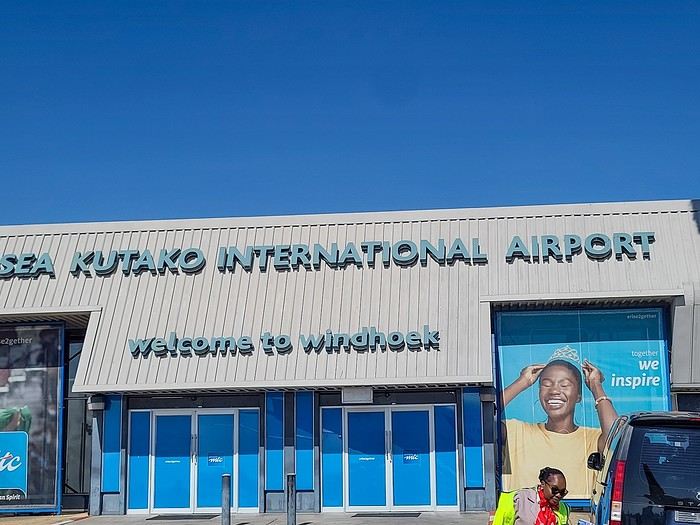
One-month road trip in Namibia
Here we go—finally, the big day has arrived! A trip the whole family (my two kids, my husband, and me) had been looking forward to for so long.
To keep it short, we left from Nice, arrived in Namibia on June 25, 2025, and left again on the 21st—four weeks later.
We used an agency for all the camping reservations, activities, and the car rental. At least that side of things was taken care of. Michaël was our contact throughout the planning and the trip itself.
We spent our first night at Londiningi BB. A bit out of the city center but very quiet. The rooms were spacious and clean, and we could eat on-site that evening. Perfect for recovering from the flight.
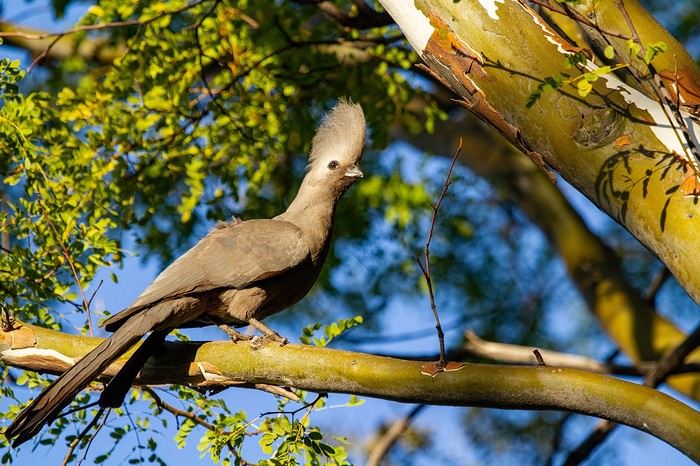
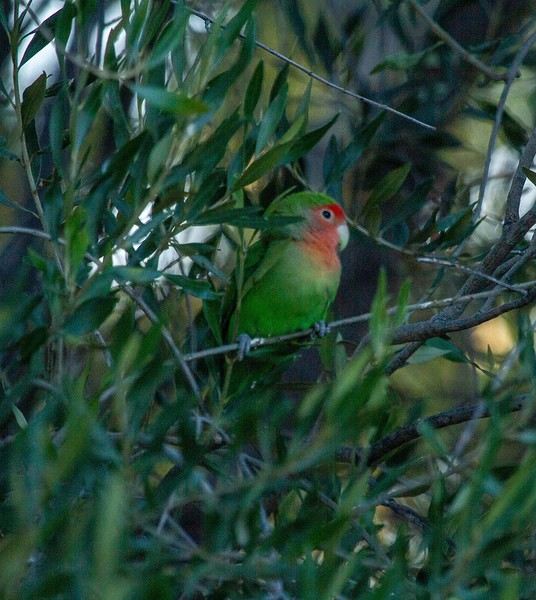
We spent our first night at Londiningi BB. A bit out of the city center but very quiet. The rooms were spacious and clean, and we could eat on-site that evening. Perfect for recovering from the flight.
A month in the French Alps: suggestions for camping and short hikes?
Hi there,
We’re flying from Montreal to Lyon this August to go hiking in the French Alps. We’ve rented a car and will be staying at campgrounds. We’re planning to do day hikes and want to stay a few days in one spot, do a few hikes, then move on to our next camping spot. Could you share your favorite spots or any recommendations for places to spend a few days with great hikes?
A few details: We arrive in early August and leave in early September. We’re looking for day hikes (or shorter), moderate difficulty, with a cumulative elevation gain of no more than 1000m, and of course, beautiful scenery! We’d prefer not to drive too much—maybe it’s best not to head too far south and deal with unnecessary heat? Along the same lines, if you know of any great campgrounds where we can start our hike directly without needing the car, we’d love to hear your suggestions!
Thanks! :-)
A few details: We arrive in early August and leave in early September. We’re looking for day hikes (or shorter), moderate difficulty, with a cumulative elevation gain of no more than 1000m, and of course, beautiful scenery! We’d prefer not to drive too much—maybe it’s best not to head too far south and deal with unnecessary heat? Along the same lines, if you know of any great campgrounds where we can start our hike directly without needing the car, we’d love to hear your suggestions!
Thanks! :-)
Off on an adventure in Sri Lanka
Day 1 – December 6
Our decision is our decision. And it’s firm and final. Next winter, our plane will spread its great wings toward the island of Ceylon! "Wait a minute... Ceylon... Ceylon... that name rings a bell, but I can’t quite place it on the globe Grandma gave me for Christmas! Ceylon... Oh right, I’ve got it: Ceylon is the name of my tea!" Exactly. But the name on your pretty tea box is also the one used until 1972 for this island nation, a speck on the Indian Ocean at the southern tip of the Indian subcontinent: Sri Lanka!
For this new adventure, I’m exceptionally leaving my Flo behind, cowardly replaced by a double dose of testosterone. To write the book of this journey with me, I’m bringing along my brother, who’s used to this kind of thing, and... a guest star: My model of resilience. My dad! All aboard! Or rather, all aboard our tuk-tuk! Yes, you read that right: A real tuk-tuk, a little colorful rolling box that putters along at two miles an hour. The idea? Well, Sri Lanka and its winding roads overlooking the vastness of lush nature are tailor-made for this kind of vehicle. And since it’s one of only two countries in the world that allow foreigners to rent and drive these mini speedsters, we’ll be crisscrossing the island in our two-square-meter rolling box. Plus, adopting this mode of transport is a surefire way to connect directly with the locals, who’ll surely be curious to see a foreigner driving their iconic vehicle. Not to mention the... let’s say... spicy anecdotes it might generate. I mean, heading into a subtropical zone with my jet-black dad and his unpredictable digestive flora while deliberately choosing the tuk-tuk as our *only* means of transport? That’s the winning combo for an unforgettable adventure! "More seriously, Dad, Sullivan, I’m already loving the idea of living this adventure together, the three of us—brothers and father..."
So, does the intro to this new adventure get your salivary glands going? Yes? Too bad. Because unfortunately, the program handed out by the lady at the entrance has been slightly... let’s say *crumpled*. Some might even say "scrunched up and nearly tossed in the trash." First, six days ago, as the countdown echoed in us like a call to adventure, Cyclone Ditwah grabbed Sri Lanka, played with it like a rag doll, and left it battered on the ground. The toll is devastating: over a thousand dead, thousands of homes wiped out by relentless rains, roads and railways swallowed by massive mudslides. A country wounded once again, after the civil war, the 2004 tsunami, and the post-Covid economic crisis.
But as if this weather disaster wasn’t enough to shake our unbreakable adventurer spirit, fate decided to mess with us further by cutting our trio down to two. The victim? My brother, violently turned away because of a simple date on his passport that didn’t match the border officials’ expectations. Return to sender!
So now it’s just the two of us allowed to board the Qatar Airways Airbus A380 for this trip. If he were here, Denis Brognart would say, "And in the end, only one remains!" Except I know you’ll be with us, following our adventures! Right?
Our decision is our decision. And it’s firm and final. Next winter, our plane will spread its great wings toward the island of Ceylon! "Wait a minute... Ceylon... Ceylon... that name rings a bell, but I can’t quite place it on the globe Grandma gave me for Christmas! Ceylon... Oh right, I’ve got it: Ceylon is the name of my tea!" Exactly. But the name on your pretty tea box is also the one used until 1972 for this island nation, a speck on the Indian Ocean at the southern tip of the Indian subcontinent: Sri Lanka!
For this new adventure, I’m exceptionally leaving my Flo behind, cowardly replaced by a double dose of testosterone. To write the book of this journey with me, I’m bringing along my brother, who’s used to this kind of thing, and... a guest star: My model of resilience. My dad! All aboard! Or rather, all aboard our tuk-tuk! Yes, you read that right: A real tuk-tuk, a little colorful rolling box that putters along at two miles an hour. The idea? Well, Sri Lanka and its winding roads overlooking the vastness of lush nature are tailor-made for this kind of vehicle. And since it’s one of only two countries in the world that allow foreigners to rent and drive these mini speedsters, we’ll be crisscrossing the island in our two-square-meter rolling box. Plus, adopting this mode of transport is a surefire way to connect directly with the locals, who’ll surely be curious to see a foreigner driving their iconic vehicle. Not to mention the... let’s say... spicy anecdotes it might generate. I mean, heading into a subtropical zone with my jet-black dad and his unpredictable digestive flora while deliberately choosing the tuk-tuk as our *only* means of transport? That’s the winning combo for an unforgettable adventure! "More seriously, Dad, Sullivan, I’m already loving the idea of living this adventure together, the three of us—brothers and father..."
So, does the intro to this new adventure get your salivary glands going? Yes? Too bad. Because unfortunately, the program handed out by the lady at the entrance has been slightly... let’s say *crumpled*. Some might even say "scrunched up and nearly tossed in the trash." First, six days ago, as the countdown echoed in us like a call to adventure, Cyclone Ditwah grabbed Sri Lanka, played with it like a rag doll, and left it battered on the ground. The toll is devastating: over a thousand dead, thousands of homes wiped out by relentless rains, roads and railways swallowed by massive mudslides. A country wounded once again, after the civil war, the 2004 tsunami, and the post-Covid economic crisis.
But as if this weather disaster wasn’t enough to shake our unbreakable adventurer spirit, fate decided to mess with us further by cutting our trio down to two. The victim? My brother, violently turned away because of a simple date on his passport that didn’t match the border officials’ expectations. Return to sender!
So now it’s just the two of us allowed to board the Qatar Airways Airbus A380 for this trip. If he were here, Denis Brognart would say, "And in the end, only one remains!" Except I know you’ll be with us, following our adventures! Right?
Havana, Cuba / January 2026
I got into music with the will
To light up many hearths like Che could do,
To circulate ideas, to advance utopia
Alternating barricades, sharp thought, and poetry.
Mc Solaar, Guérilla
Subscribing without a fight to the slightest line of my itinerary sometimes feels like an illusion. Because there are countries where, despite the fever and enthusiasm, despite the triumphant revolution, certain elements block my path. And if I had planned, for F. and me, a beautiful ascent up Tabouret Hill (Loma del Taburete, 453m), it was without accounting for vegetation as dense as it was thorny, which barred our way after just a few quarters of an hour of walking. Exhausted, I had to face the facts: we wouldn’t go any further. I needed to come up with some kind of Plan B.
But what is this country, an unwitting laboratory of the worst that white civilization has done during its reign? What is this magnificent place—yet another—entrusted to the care of oblivion, just 150 km from the land of freedom? According to Donald Trump, a country supporting terrorism; according to the locals, the vast battlefield of 20th-century ideologies; according to the average tourist, a hot country, a beautiful country, a country where the last illusions of a lost paradise are dying.
On the other side of Havana Bay, we love that statue of Christ blessing the city. There’s something gentle, soothing, in that patriarchal gesture. You’d almost be tempted to forget that at the dawn of the 16th century, those who claimed to represent the Church had no scruples about eradicating the Ciboney and Taíno populations. Worse, you’ll find magnificent this cathedral dedicated to the Virgin Mary, right in the heart of the old city. Under the guise of a civilizing necessity, Havana became, like so many other places, the gilded seat of European pretensions, at the expense of local populations doomed to extermination, then enslaved populations—more or less indigenous—who, you can imagine, didn’t often set foot in this holy place.
Lost in my thoughts, I try to push through this tangled vegetation. Nature reclaims its rights; nature abhors a vacuum. Yes, the well-trodden path of revolution couldn’t stay free of weeds! The road is buried. We give up and turn back, until that fork I’d noted before leaving, which would let us reach the top of the hill by skirting its northern slope.
So the white man arrives, settles, and gets rid of everything that bothers him. He has two unstoppable forces at his disposal: gunpowder and the spiritual certainty of being on the side of an all-powerful god. While the first gives him an unmatched material advantage over his new enemy, the second lets him use the first without feeling too guilty. That’s the magic of this supreme Church: it condemns all forms of pleasure—calling them impurity—while promoting plunder and crime under the cover of evangelization.
Walking through the city, you find a bit of Algiers, except that here, the decay is almost irreversible. You feel the splendor of the past, a disconcerting image of all vanity, from an era when men knew how to build beauty—especially if they didn’t have to share it. We’ll debate the benefits of colonialism for a long time, while glossing over the fact that those benefits often stopped at the city limits, limits all too obvious to the indigenous people. Havana isn’t just one or a few buildings; it’s an impressive collection of works of art built one after another, in what I think was a spirit of healthy competition. Yes, you find Algiers in this exuberance. As if these distant cities were the receptacle of everything that was best in the lands of origin. Atlantes and lintels, golds, blues, ogives, and monumental windows—exceptional architecture in an exceptional place.
Some streets are clean, swept with care; others are not, scattered here and there with potholes filled with water. A rather persistent smell of urine invades us regularly. We move on. And we look up: Havana is visited with your nose in the air. Because the beauty is truly up there, on those magnificent balconies and terracotta arches. Also because it’s not impossible that a piece of that balcony might suddenly detach, hurling our ends into an overseas tragedy we’d rather avoid. On the ground, here and there, rubble. Inexorably, this city is returning to dust.
My Plan B turns out to be no more successful than the first attempt. After a cheerful progression of a few hundred meters, same outcome, same struggle—the vegetation opposes any revolution: impossible to go around the hill! Once again, we have to turn back. We’ll try Plan C. I reassure myself by convincing myself to stay in the logic of this country: Cuba has been searching for itself for five centuries.
Coffee, tobacco, and sugarcane—the green gold of the colonies—so that money could flow and Europe could enjoy itself. Cuba’s history isn’t original. In reality, all the hot lands at these latitudes suffer the same fate: to serve the white man. While waiting for the awakening of consciences, UN Resolution 1514 and more or less affirmed revolutionary desires. Except that—and this reflection is just my own—if the awakening of consciences and the revolutionary will don’t play into what Resolution 1514 hides, there’s a good chance the said state will become a pariah. Those who don’t follow the American doctrine risk a lot; those who decide to follow Moscow risk everything. Independence was only the barely discreet instrument of American views. Patrice Lumumba will gladly enlighten us on the subject.
Turning back is good. Setting up Plan C is better. I won’t deviate from my goal: we will reach the top of Tabouret, whatever the cost! Near a small country road, I hesitate to change the program. Time is ticking—is it really reasonable to attempt the ascent? Then a tricycle taxi appears, a kind of tuk-tuk powered by an electric moped. I take it as a sign from fate, and we board for the starting point of Plan C.
In Cuba, even before Resolution 1514, independence was assured by a pawn of the United States, Fulgencio Batista. There’s no need to go over the whole history here; we’ll just remember that if you know how to give without counting to your former masters, you can enjoy a facade of freedom. Fidel Castro, on the other hand, didn’t know how to give. It never even occurred to him. That’s why the United States harbors such terrible hatred for this rebellious state, opposed to capitalist values and political prostitution. From there to slowly killing its people for nearly seventy years, one can legitimately cry injustice. But there are other priorities. Oh yes! Greenland...
Do Cubans eat their fill? Does seeing overweight people mean opulence? Food grows, no doubt about it. The soil is fertile, the climate favorable. No, what shocks here is the absolute precarity, the feeling of a people living in survival mode, and the decay of both goods and hope. Where to go? What’s the point? The stubbornness of the United States in wanting to impose its views on the Cuban government is felt much more by an overwhelmed people than by those few elites—caricatures of communism—who instill their vision of happiness with a crowbar. The embargo imposed in 1960; the false-flag attacks—American planes flying the colors of the Cuban revolution during the Bay of Pigs invasion in 1961—the exasperation of placing Cuba on the list of countries supporting terrorism. More recently, Donald Trump decided to heavily tax countries supplying Cuba with fuel. The last time I saw such long lines near gas stations was during my first trip to Romania... in 1991. It’s not for me to judge whether Raúl and his clique are playing fair by thumbing their noses at the West. I don’t hold the ins and outs of this war of egos that keeps the world’s great powers awake. I only caught a glimpse of the poverty of an island in 2026, while we in Europe are buried under an avalanche of the useless and superficial.
At the start of the San Juan baths, we find the trailhead. It climbs steeply. But the weather is relatively mild, thanks to a cold wave hitting higher up in the United States. Dallas is under snow; we’re walking in 16°C, a stroke of luck. We climb over rocks, under fairly decent vegetation, sometimes low but passable. And we succeed in the ascent in an hour. Up there, the top of the hill is somewhat maintained, at a minimum, but maintained, as if to honor Che through an awful monument erected in his glory—a stubborn specimen from those years when good taste was inversely proportional to the delusional ideas of those being honored. Birds of prey (raptors?) circle overhead; the monument is dying, crumbling, falling into ruin. *Hasta siempre*—forever—will be for the words. Nature, erosion, life itself will have the last word over all revolutions.
Back at the foot of the hill, just before a memorable swim, we talk with a family living there in miserable shacks whose stability wasn’t unlike that of the Leaning Tower of Pisa. The grandmother holds an animal, a rodent, by its feet. The grandfather has just killed it; she’s plucking its fur. A few steps away, water boils in a pot. She plunges the beast into the container. Tonight, the family will eat ragondin stew. Further on, another shack where, in a disorder rivaling the filth, a mother breastfeeds while sitting on the edge of a bed. Then, on the way down, we’ll meet a middle-aged man carrying a large jerrycan of water on his shoulder. Are these people happy here, far from the cities and their stakes? Is it too much to ask that they at least have access to electricity, running water, and decent, safe housing?
Outside the old city, Havana reveals wide avenues serving imposing institutions here and there. But whether in the colorful alleys of the old town or on the majestic and austere Plaza de la Revolución, the same feeling moves me: sadness. Seeing that only chaos has come from ideas crushes me. We praise, we sing the revolution—above all, we impose it in people’s minds as a necessity, when it’s nothing of the sort. Revolution is just the fruit of a few tortured minds who, once in power, do nothing better than all those before them. Enjoy power. Impose their views. It’s just a matter of color. Fidel saw red and knew how to persuade—or silence forever—his many detractors. The West sees everything in white, through the prism of human rights, and also knows how to persuade and silence its slightest detractors forever.
Paradoxically, Cuba survives largely thanks to tourism, a key element—let’s not be afraid to say it—of capitalism. And when a few players pick up the crumbs from transactions, the lion’s share and the foreign currency go to the government. So we won’t go to Varadero, the high place of relaxation overrun by Canadians. Instead, we’ll limit ourselves to crossing the ocean 30 minutes from the capital, at Santa María del Mar, to get an idea of cheaper tourism and to splash around for a few minutes in turquoise water invaded by sargassum. At the heart of the tourist season, we’ll meet few people. Like Havana, and according to its inhabitants, the high season is rather dead. But we won’t have come for nothing: we particularly love this return where, feverish, the taxi driver pushes his Moskvitch 2140 to the max on the highway, singing karaoke versions of hits at the top of his lungs from an onboard DVD player. East/West, the culture clash with a hint of Latino.
It’s time to leave this country of resourcefulness where extremes are very present. We’re leaving a 5-star hotel in front of yet another crumbling building. We’ve known restaurants at 40,000 pesos while in the street people eat for 400. We’ve seen those countless cars from another era and another culture—Pontiac, Lada, Chevrolet, Moskvitch—being overtaken by gleaming Mercedes and other Porsche Cayennes, the prerogative—if it still needed to be demonstrated—of the newly rich in search of recognition. Boarding the plane, we also understand that we’re not just traveling with tourists: there’s undoubtedly a rich and prosperous diaspora, just as there are relatively wealthy Cubans—well, wealthy enough to travel comfortably in the front of the aircraft. Meanwhile, on all the country’s roads, other Cubans try hitchhiking, their wives and children perched on a suitcase by the roadside. The father holds out his arm and holds a few bills in his hand like a card game. Where are they going? Who will pick them up?
Behind me, the gold of the Capitol. I’m told this gold comes from Russia. Like Marx and Lenin’s smoky theories? Like Stalin’s subtle and delicate paternalism? Let’s bet that, like the other buildings crumbling around it, the Capitol will also collapse one day, to avenge the Indians who perished from the diseases and guns of the whites, to avenge the Africans who obliterated their lives so Europeans could enjoy themselves, finally, to avenge all this abandoned people, left to the arbitrariness of democratic or non-democratic elections.
A sign in the street: We understand history. This is the revolution! We understand history. That’s the revolution.
No comment.
Subscribing without a fight to the slightest line of my itinerary sometimes feels like an illusion. Because there are countries where, despite the fever and enthusiasm, despite the triumphant revolution, certain elements block my path. And if I had planned, for F. and me, a beautiful ascent up Tabouret Hill (Loma del Taburete, 453m), it was without accounting for vegetation as dense as it was thorny, which barred our way after just a few quarters of an hour of walking. Exhausted, I had to face the facts: we wouldn’t go any further. I needed to come up with some kind of Plan B.
But what is this country, an unwitting laboratory of the worst that white civilization has done during its reign? What is this magnificent place—yet another—entrusted to the care of oblivion, just 150 km from the land of freedom? According to Donald Trump, a country supporting terrorism; according to the locals, the vast battlefield of 20th-century ideologies; according to the average tourist, a hot country, a beautiful country, a country where the last illusions of a lost paradise are dying.
On the other side of Havana Bay, we love that statue of Christ blessing the city. There’s something gentle, soothing, in that patriarchal gesture. You’d almost be tempted to forget that at the dawn of the 16th century, those who claimed to represent the Church had no scruples about eradicating the Ciboney and Taíno populations. Worse, you’ll find magnificent this cathedral dedicated to the Virgin Mary, right in the heart of the old city. Under the guise of a civilizing necessity, Havana became, like so many other places, the gilded seat of European pretensions, at the expense of local populations doomed to extermination, then enslaved populations—more or less indigenous—who, you can imagine, didn’t often set foot in this holy place.
Lost in my thoughts, I try to push through this tangled vegetation. Nature reclaims its rights; nature abhors a vacuum. Yes, the well-trodden path of revolution couldn’t stay free of weeds! The road is buried. We give up and turn back, until that fork I’d noted before leaving, which would let us reach the top of the hill by skirting its northern slope.
So the white man arrives, settles, and gets rid of everything that bothers him. He has two unstoppable forces at his disposal: gunpowder and the spiritual certainty of being on the side of an all-powerful god. While the first gives him an unmatched material advantage over his new enemy, the second lets him use the first without feeling too guilty. That’s the magic of this supreme Church: it condemns all forms of pleasure—calling them impurity—while promoting plunder and crime under the cover of evangelization.
Walking through the city, you find a bit of Algiers, except that here, the decay is almost irreversible. You feel the splendor of the past, a disconcerting image of all vanity, from an era when men knew how to build beauty—especially if they didn’t have to share it. We’ll debate the benefits of colonialism for a long time, while glossing over the fact that those benefits often stopped at the city limits, limits all too obvious to the indigenous people. Havana isn’t just one or a few buildings; it’s an impressive collection of works of art built one after another, in what I think was a spirit of healthy competition. Yes, you find Algiers in this exuberance. As if these distant cities were the receptacle of everything that was best in the lands of origin. Atlantes and lintels, golds, blues, ogives, and monumental windows—exceptional architecture in an exceptional place.
Some streets are clean, swept with care; others are not, scattered here and there with potholes filled with water. A rather persistent smell of urine invades us regularly. We move on. And we look up: Havana is visited with your nose in the air. Because the beauty is truly up there, on those magnificent balconies and terracotta arches. Also because it’s not impossible that a piece of that balcony might suddenly detach, hurling our ends into an overseas tragedy we’d rather avoid. On the ground, here and there, rubble. Inexorably, this city is returning to dust.
My Plan B turns out to be no more successful than the first attempt. After a cheerful progression of a few hundred meters, same outcome, same struggle—the vegetation opposes any revolution: impossible to go around the hill! Once again, we have to turn back. We’ll try Plan C. I reassure myself by convincing myself to stay in the logic of this country: Cuba has been searching for itself for five centuries.
Coffee, tobacco, and sugarcane—the green gold of the colonies—so that money could flow and Europe could enjoy itself. Cuba’s history isn’t original. In reality, all the hot lands at these latitudes suffer the same fate: to serve the white man. While waiting for the awakening of consciences, UN Resolution 1514 and more or less affirmed revolutionary desires. Except that—and this reflection is just my own—if the awakening of consciences and the revolutionary will don’t play into what Resolution 1514 hides, there’s a good chance the said state will become a pariah. Those who don’t follow the American doctrine risk a lot; those who decide to follow Moscow risk everything. Independence was only the barely discreet instrument of American views. Patrice Lumumba will gladly enlighten us on the subject.
Turning back is good. Setting up Plan C is better. I won’t deviate from my goal: we will reach the top of Tabouret, whatever the cost! Near a small country road, I hesitate to change the program. Time is ticking—is it really reasonable to attempt the ascent? Then a tricycle taxi appears, a kind of tuk-tuk powered by an electric moped. I take it as a sign from fate, and we board for the starting point of Plan C.
In Cuba, even before Resolution 1514, independence was assured by a pawn of the United States, Fulgencio Batista. There’s no need to go over the whole history here; we’ll just remember that if you know how to give without counting to your former masters, you can enjoy a facade of freedom. Fidel Castro, on the other hand, didn’t know how to give. It never even occurred to him. That’s why the United States harbors such terrible hatred for this rebellious state, opposed to capitalist values and political prostitution. From there to slowly killing its people for nearly seventy years, one can legitimately cry injustice. But there are other priorities. Oh yes! Greenland...
Do Cubans eat their fill? Does seeing overweight people mean opulence? Food grows, no doubt about it. The soil is fertile, the climate favorable. No, what shocks here is the absolute precarity, the feeling of a people living in survival mode, and the decay of both goods and hope. Where to go? What’s the point? The stubbornness of the United States in wanting to impose its views on the Cuban government is felt much more by an overwhelmed people than by those few elites—caricatures of communism—who instill their vision of happiness with a crowbar. The embargo imposed in 1960; the false-flag attacks—American planes flying the colors of the Cuban revolution during the Bay of Pigs invasion in 1961—the exasperation of placing Cuba on the list of countries supporting terrorism. More recently, Donald Trump decided to heavily tax countries supplying Cuba with fuel. The last time I saw such long lines near gas stations was during my first trip to Romania... in 1991. It’s not for me to judge whether Raúl and his clique are playing fair by thumbing their noses at the West. I don’t hold the ins and outs of this war of egos that keeps the world’s great powers awake. I only caught a glimpse of the poverty of an island in 2026, while we in Europe are buried under an avalanche of the useless and superficial.
At the start of the San Juan baths, we find the trailhead. It climbs steeply. But the weather is relatively mild, thanks to a cold wave hitting higher up in the United States. Dallas is under snow; we’re walking in 16°C, a stroke of luck. We climb over rocks, under fairly decent vegetation, sometimes low but passable. And we succeed in the ascent in an hour. Up there, the top of the hill is somewhat maintained, at a minimum, but maintained, as if to honor Che through an awful monument erected in his glory—a stubborn specimen from those years when good taste was inversely proportional to the delusional ideas of those being honored. Birds of prey (raptors?) circle overhead; the monument is dying, crumbling, falling into ruin. *Hasta siempre*—forever—will be for the words. Nature, erosion, life itself will have the last word over all revolutions.
Back at the foot of the hill, just before a memorable swim, we talk with a family living there in miserable shacks whose stability wasn’t unlike that of the Leaning Tower of Pisa. The grandmother holds an animal, a rodent, by its feet. The grandfather has just killed it; she’s plucking its fur. A few steps away, water boils in a pot. She plunges the beast into the container. Tonight, the family will eat ragondin stew. Further on, another shack where, in a disorder rivaling the filth, a mother breastfeeds while sitting on the edge of a bed. Then, on the way down, we’ll meet a middle-aged man carrying a large jerrycan of water on his shoulder. Are these people happy here, far from the cities and their stakes? Is it too much to ask that they at least have access to electricity, running water, and decent, safe housing?
Outside the old city, Havana reveals wide avenues serving imposing institutions here and there. But whether in the colorful alleys of the old town or on the majestic and austere Plaza de la Revolución, the same feeling moves me: sadness. Seeing that only chaos has come from ideas crushes me. We praise, we sing the revolution—above all, we impose it in people’s minds as a necessity, when it’s nothing of the sort. Revolution is just the fruit of a few tortured minds who, once in power, do nothing better than all those before them. Enjoy power. Impose their views. It’s just a matter of color. Fidel saw red and knew how to persuade—or silence forever—his many detractors. The West sees everything in white, through the prism of human rights, and also knows how to persuade and silence its slightest detractors forever.
Paradoxically, Cuba survives largely thanks to tourism, a key element—let’s not be afraid to say it—of capitalism. And when a few players pick up the crumbs from transactions, the lion’s share and the foreign currency go to the government. So we won’t go to Varadero, the high place of relaxation overrun by Canadians. Instead, we’ll limit ourselves to crossing the ocean 30 minutes from the capital, at Santa María del Mar, to get an idea of cheaper tourism and to splash around for a few minutes in turquoise water invaded by sargassum. At the heart of the tourist season, we’ll meet few people. Like Havana, and according to its inhabitants, the high season is rather dead. But we won’t have come for nothing: we particularly love this return where, feverish, the taxi driver pushes his Moskvitch 2140 to the max on the highway, singing karaoke versions of hits at the top of his lungs from an onboard DVD player. East/West, the culture clash with a hint of Latino.
It’s time to leave this country of resourcefulness where extremes are very present. We’re leaving a 5-star hotel in front of yet another crumbling building. We’ve known restaurants at 40,000 pesos while in the street people eat for 400. We’ve seen those countless cars from another era and another culture—Pontiac, Lada, Chevrolet, Moskvitch—being overtaken by gleaming Mercedes and other Porsche Cayennes, the prerogative—if it still needed to be demonstrated—of the newly rich in search of recognition. Boarding the plane, we also understand that we’re not just traveling with tourists: there’s undoubtedly a rich and prosperous diaspora, just as there are relatively wealthy Cubans—well, wealthy enough to travel comfortably in the front of the aircraft. Meanwhile, on all the country’s roads, other Cubans try hitchhiking, their wives and children perched on a suitcase by the roadside. The father holds out his arm and holds a few bills in his hand like a card game. Where are they going? Who will pick them up?
Behind me, the gold of the Capitol. I’m told this gold comes from Russia. Like Marx and Lenin’s smoky theories? Like Stalin’s subtle and delicate paternalism? Let’s bet that, like the other buildings crumbling around it, the Capitol will also collapse one day, to avenge the Indians who perished from the diseases and guns of the whites, to avenge the Africans who obliterated their lives so Europeans could enjoy themselves, finally, to avenge all this abandoned people, left to the arbitrariness of democratic or non-democratic elections.
A sign in the street: We understand history. This is the revolution! We understand history. That’s the revolution.
No comment.
What about crossing the Lofoten Islands on foot?
While planning a trip to the LOFOTEN for summer 2023 using the excellent guide *Hiking in the Lofoten*, we discovered this trek.
Sure, it’s rated as difficult, but it lets you cross the LOFOTEN on foot from north to south in 11 stages, covering 160 km and 9,193 m of elevation gain (or the reverse, of course).
So, it’s a multi-day hike, with wild camping, and no need to rent a car. Perfect...
What’s making us hesitate a bit are the island transfers (okay, I’ll admit, the difficulty is also a factor for me). These transfers require taking public transport and/or hitchhiking. But the stages are designed with this in mind, and the transfers are well explained. Plus, water isn’t an issue, and you can resupply several times, which helps keep the pack weight down.
For Jean Marie, my partner, this will be his first multi-day trek, but he’s an experienced and hardy hiker. As for me, even though I’m not as tough, I’ve already done some multi-day hikes. So, we should complement each other well.
So, are we going for it? Sold!!
Here’s the trek map: HERE
03/08 – Day 1 - Delp – Sandsletta 04/08 - Day 2 – Sandsletta – Svolvaer 05/08 - Day 3 – Svolvaer – Kleppstad + transfer to the start of Day 4 06/08 – Day 4 – Vikjorda hamlet – Store Lake 07/08 – Day 5 – Store Lake – Leknes - Transfer to Napp on Flakstadøya Island 08/08 – Day 6 – Napp – Nusfjord 09/08 – Day 7 – Nusfjord – Ramberg 10/08 – Day 8 – Ramberg – Selfjord Bay (Moskenesøya Island) 11/08 – Day 9 - Selfjord – Bunes Beach 12/08 – Day 10 - Bunes Beach - Krokvatnet Lake 13/08 – Day 11 - Krokvatnet Lake – Moskenes (campsite) and round trip to Å by bus 14/08 – Day 12 – Hike up Reinebringen – Reine – Tour of Agvatnet Lake 15/08 – Return to Bodø - flight back to France on 16/08 And here’s the inevitable recap
Sure, it’s rated as difficult, but it lets you cross the LOFOTEN on foot from north to south in 11 stages, covering 160 km and 9,193 m of elevation gain (or the reverse, of course).
So, it’s a multi-day hike, with wild camping, and no need to rent a car. Perfect...
What’s making us hesitate a bit are the island transfers (okay, I’ll admit, the difficulty is also a factor for me). These transfers require taking public transport and/or hitchhiking. But the stages are designed with this in mind, and the transfers are well explained. Plus, water isn’t an issue, and you can resupply several times, which helps keep the pack weight down.
For Jean Marie, my partner, this will be his first multi-day trek, but he’s an experienced and hardy hiker. As for me, even though I’m not as tough, I’ve already done some multi-day hikes. So, we should complement each other well.
So, are we going for it? Sold!!
Here’s the trek map: HERE
03/08 – Day 1 - Delp – Sandsletta 04/08 - Day 2 – Sandsletta – Svolvaer 05/08 - Day 3 – Svolvaer – Kleppstad + transfer to the start of Day 4 06/08 – Day 4 – Vikjorda hamlet – Store Lake 07/08 – Day 5 – Store Lake – Leknes - Transfer to Napp on Flakstadøya Island 08/08 – Day 6 – Napp – Nusfjord 09/08 – Day 7 – Nusfjord – Ramberg 10/08 – Day 8 – Ramberg – Selfjord Bay (Moskenesøya Island) 11/08 – Day 9 - Selfjord – Bunes Beach 12/08 – Day 10 - Bunes Beach - Krokvatnet Lake 13/08 – Day 11 - Krokvatnet Lake – Moskenes (campsite) and round trip to Å by bus 14/08 – Day 12 – Hike up Reinebringen – Reine – Tour of Agvatnet Lake 15/08 – Return to Bodø - flight back to France on 16/08 And here’s the inevitable recap
Turbulence on planes will become more and more frequent and more violent than before.
Hey everyone! 😊
Aircraft manufacturers will probably adapt in the coming years, but until future planes are designed to handle severe turbulence directly linked to climate change, personally, I’ll only unbuckle my seatbelt to go to the bathroom and take a few steps to keep my blood circulating.
I already made it a habit to stay buckled up during my flights.
My only issue is my preference for aisle seats—getting hit in the face with luggage isn’t great 😅.
What about you?
Off on an adventure to Java (and a bit of Bali)
Hey there, community! Back this weekend, below is my travel journal from my adventure in Indonesia. Enjoy the read!!!
Day 1 - August 10, 2025 New life downloading for three weeks! And for that, Flo and I launched a public tender... A public tender? What’s that got to do with a travel journal???... Well, when you think about it, few destinations tick all the boxes for an August adventure: Meaning, finding a place that’s exotic in the middle of August, not too expensive, not too packed with tourists, warm but not *too* warm, with postcard-perfect landscapes, dreamy beaches, tasty cuisine with a hint of exoticism, friendly and welcoming locals, where you’re free to sleep under the stars among the mosquitos, take transport surrounded by chickens, and even eat from a pig trough if you feel like it—well, turns out it’s not that easy to find! I’d even say, given how thick the list of requirements is, there’s a big risk the tender could be declared unsuccessful for failing to meet just one criterion. Let’s just say the candidates better submit a rock-solid proposal!
After reviewing all the responses and presentations from the candidates, the obvious choice for us is... Indonesia! Except that trying to explore a country as vast as Indonesia and its 17,504 islands in less than five years is a bit like reading the summary of a Proust novel without taking the time to savor each of its 950 pages! Don’t worry, I won’t name them all here. Besides, do they even all have names? No! Only 7,870 have been named—their parents clearly ran out of ideas for the rest. Anyway, our society, which worships the "work more to earn more" mantra, unfortunately limits our adventure time. So we’ll only get to see a small part of Indonesia, and we’ll have to make a tough choice to head for the best of the best in this archipelago of over seventeen thousand islands. Each one has its own selling points: Sumatra, Sulawesi, Java, the Celebes, Bali, Borneo, Papua, Timor, the Moluccas... So many names that smell of adventure... Another tender, another list of requirements, another review of proposals... Drumroll... Splash splash... And the lucky winner is... Ta-da... Java, Bali’s big sister, where I’ve already been eight years ago... Java the programming language. The Java of Broadway. We’re gonna *do* the Java. Java the coffee. And yes, Java is also an island!
This island, four times smaller than France, is home to 136 million people, making it the most populated island in the world! Fun fact: Indonesia, with its 260 million inhabitants, is just shy of the podium for the world’s most populated countries, after the winning trio of India, China, and the United States. And it’s on this island of Java that you’ll find Jakarta, the (soon-to-be-former) capital and main airport of the country, where we’ll soon land after our nineteen-hour flight! Yep, nineteen hours! I mean, Indonesia in general—and Java in particular—is a *tad* farther than going on vacation to Grandma Yoyo’s! Not sure where it is? Easy. Grab a map. Plant your finger on the big island at the bottom right—aka Australia for those who struggle with geography—move it up two centimeters, and bam, welcome to Indonesia!
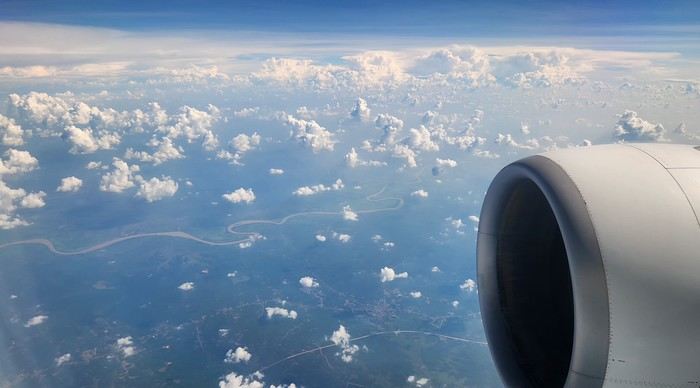
Nice transition, right? Because "Welcome to Indonesia" is exactly what the friendly flight attendant just said to me as we got off the plane! That’s it, our chakras are open, we’ve arrived at our (air)port. Time for rest, pool, cocktails, and a beach with our toes spread out... Wait, if you bought that, you clearly don’t know us yet! Since we still have energy to burn and need to adjust to the flight and time difference, we tackle the long administrative formalities to enter Indonesia, just to earn the right to hop in a 45-minute Grab taxi to the train station. The train station? What train station?... What do you usually do at a train station? Take a train, of course! Off we go for a three-hour train ride to Bandung, where we’ll officially start our adventure tomorrow after our first Indonesian night...
Unfortunately, we were a bit slow off the mark, which meant we missed the 6:25 PM train by two minutes. Oh well, we’ll have to wait until 11 PM. We take the opportunity to stretch our legs in Jakarta, soak up the atmosphere, and enjoy the delicious smells wafting from the *warungs*—those little typical street restaurants. A quick stop at the National Monument, a detour to a night market to devour our first *kwetiaw goreng* and *teh manis* for 60,000 rupiahs (that’s 3 € for two), and just like that, our penalty is lifted, and we’re allowed to hit the road again. Off to Bandung, where we arrive at 2 AM for... a *very* short night...
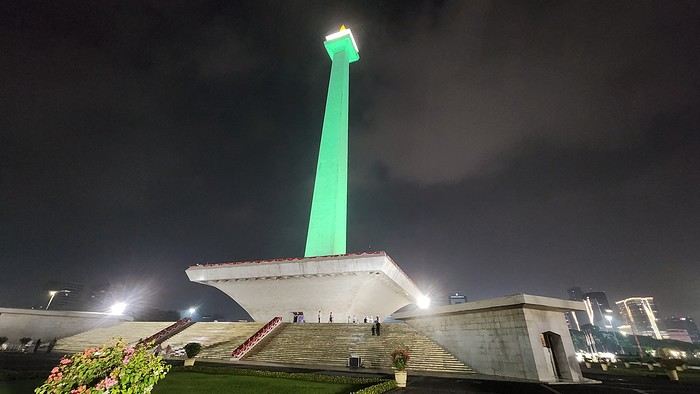
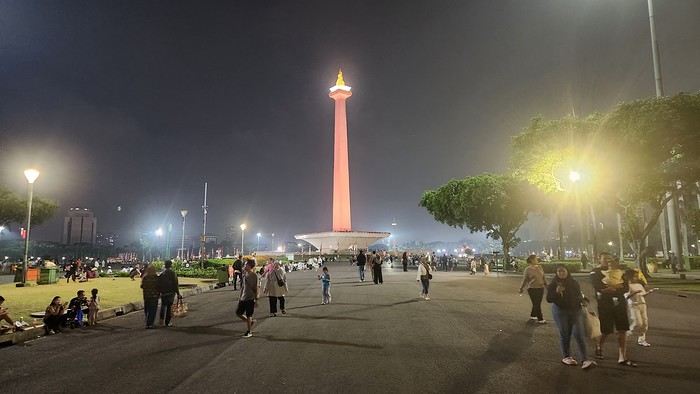
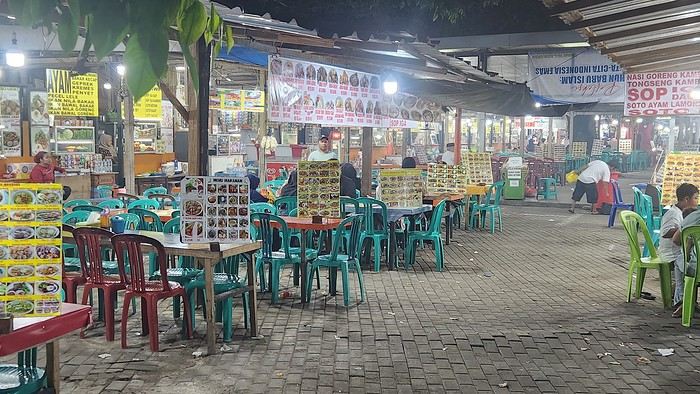
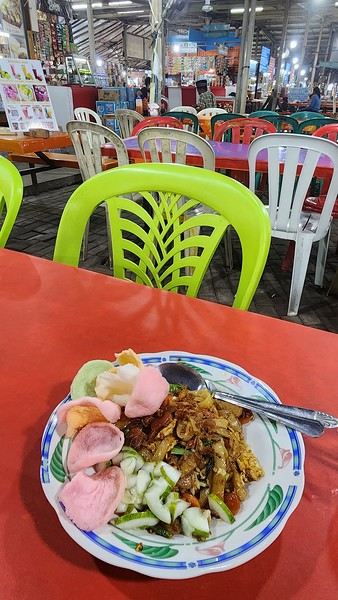
Day 1 - August 10, 2025 New life downloading for three weeks! And for that, Flo and I launched a public tender... A public tender? What’s that got to do with a travel journal???... Well, when you think about it, few destinations tick all the boxes for an August adventure: Meaning, finding a place that’s exotic in the middle of August, not too expensive, not too packed with tourists, warm but not *too* warm, with postcard-perfect landscapes, dreamy beaches, tasty cuisine with a hint of exoticism, friendly and welcoming locals, where you’re free to sleep under the stars among the mosquitos, take transport surrounded by chickens, and even eat from a pig trough if you feel like it—well, turns out it’s not that easy to find! I’d even say, given how thick the list of requirements is, there’s a big risk the tender could be declared unsuccessful for failing to meet just one criterion. Let’s just say the candidates better submit a rock-solid proposal!
After reviewing all the responses and presentations from the candidates, the obvious choice for us is... Indonesia! Except that trying to explore a country as vast as Indonesia and its 17,504 islands in less than five years is a bit like reading the summary of a Proust novel without taking the time to savor each of its 950 pages! Don’t worry, I won’t name them all here. Besides, do they even all have names? No! Only 7,870 have been named—their parents clearly ran out of ideas for the rest. Anyway, our society, which worships the "work more to earn more" mantra, unfortunately limits our adventure time. So we’ll only get to see a small part of Indonesia, and we’ll have to make a tough choice to head for the best of the best in this archipelago of over seventeen thousand islands. Each one has its own selling points: Sumatra, Sulawesi, Java, the Celebes, Bali, Borneo, Papua, Timor, the Moluccas... So many names that smell of adventure... Another tender, another list of requirements, another review of proposals... Drumroll... Splash splash... And the lucky winner is... Ta-da... Java, Bali’s big sister, where I’ve already been eight years ago... Java the programming language. The Java of Broadway. We’re gonna *do* the Java. Java the coffee. And yes, Java is also an island!
This island, four times smaller than France, is home to 136 million people, making it the most populated island in the world! Fun fact: Indonesia, with its 260 million inhabitants, is just shy of the podium for the world’s most populated countries, after the winning trio of India, China, and the United States. And it’s on this island of Java that you’ll find Jakarta, the (soon-to-be-former) capital and main airport of the country, where we’ll soon land after our nineteen-hour flight! Yep, nineteen hours! I mean, Indonesia in general—and Java in particular—is a *tad* farther than going on vacation to Grandma Yoyo’s! Not sure where it is? Easy. Grab a map. Plant your finger on the big island at the bottom right—aka Australia for those who struggle with geography—move it up two centimeters, and bam, welcome to Indonesia!
Nice transition, right? Because "Welcome to Indonesia" is exactly what the friendly flight attendant just said to me as we got off the plane! That’s it, our chakras are open, we’ve arrived at our (air)port. Time for rest, pool, cocktails, and a beach with our toes spread out... Wait, if you bought that, you clearly don’t know us yet! Since we still have energy to burn and need to adjust to the flight and time difference, we tackle the long administrative formalities to enter Indonesia, just to earn the right to hop in a 45-minute Grab taxi to the train station. The train station? What train station?... What do you usually do at a train station? Take a train, of course! Off we go for a three-hour train ride to Bandung, where we’ll officially start our adventure tomorrow after our first Indonesian night...
Unfortunately, we were a bit slow off the mark, which meant we missed the 6:25 PM train by two minutes. Oh well, we’ll have to wait until 11 PM. We take the opportunity to stretch our legs in Jakarta, soak up the atmosphere, and enjoy the delicious smells wafting from the *warungs*—those little typical street restaurants. A quick stop at the National Monument, a detour to a night market to devour our first *kwetiaw goreng* and *teh manis* for 60,000 rupiahs (that’s 3 € for two), and just like that, our penalty is lifted, and we’re allowed to hit the road again. Off to Bandung, where we arrive at 2 AM for... a *very* short night...
A Scandinavian Tour - Summer 2025
Off on new adventures!!!
For my wife’s 60th birthday, I’m really making her happy. While I usually pick warm, sunny destinations, she’s more tempted by places where you don’t suffer from the heat.
So, it’s off to Norway!! A real challenge for me—a southern guy who’s as cold-sensitive as they come.
I keep telling anyone who’ll listen (well, just myself, really) that these aren’t the countries for me, that rain will be our travel companion, that we’ll have to face polar bears, navigate between icebergs, that there are still Vikings around, and all sorts of other things.
Of course, not wanting to make it easy, we’re driving from the Lyon area where we live.
Friends who’ve visited the country told us it’s pretty expensive to eat out (among other things), so we’re bringing supplies—especially enough for apéritifs the whole trip!!!
It’s not a camper van, but a "hotel-car" we’ll be doing! We’ll see how it goes!
As usual, I’ll try to narrate the journey with my two-cent comments, plus some little tips to avoid our mistakes—assuming I don’t lose any fingers to the cold!
Every night, I’ll count them to make sure I still have all ten! We’re not in *Ch’tis* territory but even farther Noooorth (as Galabru would say).
Note that I’m traveling with a synovial effusion in my knee! The old man’s not in great shape!!
Here we go!!
PS: As always, I’m a filmmaker, so I’ve made an effort with a few photos from my phone.
PS: As always, I’m a filmmaker, so I’ve made an effort with a few photos from my phone.
2 weeks in the Cyclades
Hi everyone!
Blue skies (lots of them), whitewashed villages with steep alleyways, hundreds of churches, and... thousands of stairs? Welcome to the Cyclades! 🙂
We’d been dreaming about this for a while, but in July-August—with the crowds—no way! Now that I can travel outside school holidays, the Cyclades are back on the agenda. And so begins a loooong period of planning and second-guessing, with countless itinerary changes: the Cyclades, yes, but which ones? I was fixated on Folegandros (we won’t be going after all) and really wanted to visit Delos. So, for this first trip, it’ll be: Mykonos (and Delos)-Naxos-Amorgos-Santorini.
Saturday 24/05: Departure from Orly on a Transavia flight, arriving in Mykonos in the late afternoon. We found a hotel that offers free transfers (pretty rare and not insignificant—it’s 25 € each way for just a few kilometers 😠) and at a reasonable price (83 € per night for B&B). Time for dinner already: Greek salad and souvlaki (we’re in Greece, right?)
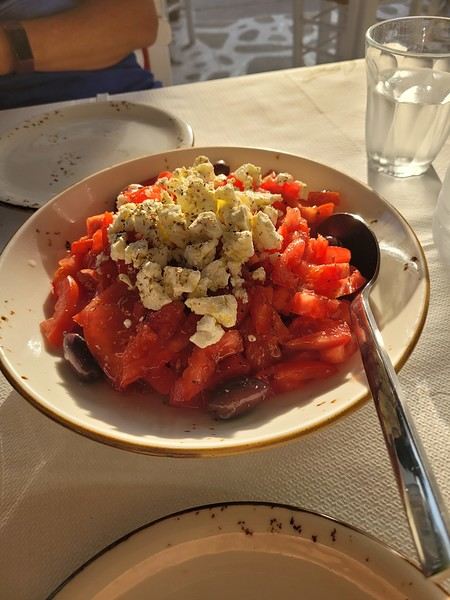 (Okay, this is actually a dakos with Naxos cheese, but I don’t have a photo of a Greek salad 😏).
Blue skies (lots of them), whitewashed villages with steep alleyways, hundreds of churches, and... thousands of stairs? Welcome to the Cyclades! 🙂
We’d been dreaming about this for a while, but in July-August—with the crowds—no way! Now that I can travel outside school holidays, the Cyclades are back on the agenda. And so begins a loooong period of planning and second-guessing, with countless itinerary changes: the Cyclades, yes, but which ones? I was fixated on Folegandros (we won’t be going after all) and really wanted to visit Delos. So, for this first trip, it’ll be: Mykonos (and Delos)-Naxos-Amorgos-Santorini.
Saturday 24/05: Departure from Orly on a Transavia flight, arriving in Mykonos in the late afternoon. We found a hotel that offers free transfers (pretty rare and not insignificant—it’s 25 € each way for just a few kilometers 😠) and at a reasonable price (83 € per night for B&B). Time for dinner already: Greek salad and souvlaki (we’re in Greece, right?)
(Okay, this is actually a dakos with Naxos cheese, but I don’t have a photo of a Greek salad 😏).West USA Road Trip August 2022
Hello everyone,
I’m starting a travel journal about the amazing round trip I took in August 2022 with a big circuit through the US West.
Here’s what I posted on another travel forum back when VoyageForum hadn’t yet regained its freedom. 😉
Hello!
We got back yesterday in the middle of the afternoon, and here’s a quick first take on the 2022 round trip.
Has America changed? You could say that, yeah. For better? For worse? Who knows. A massive circuit—nearly 8,000 kilometers, actually around 5,000–6,000 miles.
Round-trip flights went smoothly, except for Air France on the way back, which let a rather large dog in the cabin with an owner who let it roam around the plane. Cool, Air France... Outrageous!
The rough itinerary: Salt Lake City. Jackson Hole–Grand Teton. Yellowstone. Cody. Rock Springs. Moab–Arches–Canyonlands. Monument Valley. Grand Canyon. Bryce Canyon. Zion Park. Las Vegas. Death Valley. Mammoth Lakes. Tioga Road. Mariposa. Yosemite Valley. San Francisco.
Tourists on site—a sociological study:
Italians: Always nice but just as loud as ever! Hispanics: Same as the Italians, just a different language. Germans: *Ein, zwei, ach mein Gott!* Order and discipline! Americans: Still no manners whatsoever. Pathetic. I’m only talking about the tourists, not the locals who work there. Quebecers: Pure joy! English-speaking Canadians: Same as the Americans. Asians: For the Japanese, it’s perfect. But the others from the Middle Kingdom... Let’s not start a war over this. There’s already Ukraine going on. And yet... Israelis: Still no manners. The Kibbutz kids are the bane of this country. French: Some excellent, some very good, some good, and some... not much.
Note that tourists in the northern part of the trip were much better behaved than those in the south. "Hello," "Goodbye," offering a hand? Etc. Few Asians in Grand Teton and Yellowstone. Lots of locals. The same goes for hotel staff in the northern part—more attentive. Really cool!
On the other hand, we were pretty surprised not to encounter any African-American locals in Montana, Wyoming, Utah, or even Arizona—whether tourists or employees. It’s quite striking, to be honest.
The Hotels:
Holiday Inn - 206 South West Temple, Salt Lake City, UT 84101, United States. A modern but soulless hotel. Basically, a place to pass through. Minimal breakfast.
Miller Park Lodge - 155 North Jackson Street - Jackson Hole, Wyoming. Not a hotel but a luxury motel. 750 € for two nights!! No breakfast. Huge room where you could hold a tea dance!! Well-located. No staff. Only room of the month-long stay that was fully redone during those two days.
Best Western Weston Inn. 103 Gibbon Avenue, West Yellowstone, MT 59758 Well-located, not far from the park entrance. Minimal breakfast. Friendly staff. Room refreshed every two days.
Best Western Sunset Inn. 1601 8th St, Cody, 82414-4134 Very good. Quiet. Good breakfast. Friendly staff.
Baymont by Wyndham 2717 Dewar Drive, Rock Springs, WY 82901 Very good. Quiet. Good breakfast. Friendly staff. Too many pets that should be "not allowed." Hello, hygiene!
Wingate by Wyndham Moab. 126 South Highway 191, Moab, 84532 End of the "family" hotels. Start of the tourist hotels. Too many pets that should be "not allowed." Hello, hygiene! Minimal breakfast.
Hampton Inn Kayenta. US Highway 160, Kayenta, AZ 86033, United States A stopover hotel run by the Navajos. Friendly staff wearing masks. Lots of people. Too many pets that should be "not allowed." Hello, hygiene! Minimal breakfast.
La Quinta by Wyndham Williams. 1100 Cataract Lake Rd, Williams, AZ 86046, United States Finally, Route 66 for 500 meters! The staff is there. Nothing more. Too many pets that should be "not allowed." Hello, hygiene! Minimal breakfast.
BEST WESTERN PLUS Ruby's Inn. 26 South Main Street, Bryce Canyon City, UT 84764, United States A factory!!! Great Hispanic or Romanian staff! A liquor store in the hotel! Awesome! Very good breakfast, but go early because the crowd—and the jerks—are there! Too many pets that should be "not allowed." Hello, hygiene!
BEST WESTERN Casino Royale - 3411 Las Vegas Boulevard South, Strip, Las Vegas Good hotel at a reasonable price. No breakfast, but Denny’s is next door. Quiet hotel despite the casino. Friendly staff. No memory of seeing any pets!
Shilo Inn Mammoth Lake. 2963 Main Street, Mammoth Lake Disastrous! Ineffective security system. Fire doors propped open with wooden wedges. Tiny breakfast room. No staff in the room. Tables not cleaned. Minimal breakfast. Gross pool. Rooms need work. No, the whole hotel needs to be redone. They say they’re renovating. They’d be better off tearing it down. Too many pets that should be "not allowed." Hello, hygiene! Very bad memory. Apparently, there’s supposed to be staff in this hotel.
Quality Inn Yosemite Valley Gateway. 4994 Bullion Street, Mariposa, CA 95338 Hotel or motel? Booking should clean up its listings! No room refresh! Minimal breakfast. The staff is there. Nothing more.
Comfort Inn by the Bay. 775 Van Ness Avenue, Marina District, San Francisco No room refresh in four days! Minimal breakfast. Friendly and helpful staff. Well-located. Depends on what for, but well-located.
And then there are those who steal apples from the breakfast to put in their bags in the morning, those who fill up their famous US water bottles with orange juice from the breakfast pump, those who don’t clear their tables—I could go on. And also, those who don’t say hello or respond to a greeting!
Met some super nice French people (in the northern parks)! They’ll recognize themselves!
And the magic phrase that opens doors with Americans: "Do you speak French? OK, good!" Laughter guaranteed!
Don’t try that with Asians who run souvenir shops in big cities—they have no sense of humor unless it’s about the color of the green bill.
The park rangers are always available! Great!
And 5,000 photos to sort and organize, plus a few hours of dashcam videos!
See you soon.
Until the next update...
I’m starting a travel journal about the amazing round trip I took in August 2022 with a big circuit through the US West.
Here’s what I posted on another travel forum back when VoyageForum hadn’t yet regained its freedom. 😉
Hello!
We got back yesterday in the middle of the afternoon, and here’s a quick first take on the 2022 round trip.
Has America changed? You could say that, yeah. For better? For worse? Who knows. A massive circuit—nearly 8,000 kilometers, actually around 5,000–6,000 miles.
Round-trip flights went smoothly, except for Air France on the way back, which let a rather large dog in the cabin with an owner who let it roam around the plane. Cool, Air France... Outrageous!
The rough itinerary: Salt Lake City. Jackson Hole–Grand Teton. Yellowstone. Cody. Rock Springs. Moab–Arches–Canyonlands. Monument Valley. Grand Canyon. Bryce Canyon. Zion Park. Las Vegas. Death Valley. Mammoth Lakes. Tioga Road. Mariposa. Yosemite Valley. San Francisco.
Tourists on site—a sociological study:
Italians: Always nice but just as loud as ever! Hispanics: Same as the Italians, just a different language. Germans: *Ein, zwei, ach mein Gott!* Order and discipline! Americans: Still no manners whatsoever. Pathetic. I’m only talking about the tourists, not the locals who work there. Quebecers: Pure joy! English-speaking Canadians: Same as the Americans. Asians: For the Japanese, it’s perfect. But the others from the Middle Kingdom... Let’s not start a war over this. There’s already Ukraine going on. And yet... Israelis: Still no manners. The Kibbutz kids are the bane of this country. French: Some excellent, some very good, some good, and some... not much.
Note that tourists in the northern part of the trip were much better behaved than those in the south. "Hello," "Goodbye," offering a hand? Etc. Few Asians in Grand Teton and Yellowstone. Lots of locals. The same goes for hotel staff in the northern part—more attentive. Really cool!
On the other hand, we were pretty surprised not to encounter any African-American locals in Montana, Wyoming, Utah, or even Arizona—whether tourists or employees. It’s quite striking, to be honest.
The Hotels:
Holiday Inn - 206 South West Temple, Salt Lake City, UT 84101, United States. A modern but soulless hotel. Basically, a place to pass through. Minimal breakfast.
Miller Park Lodge - 155 North Jackson Street - Jackson Hole, Wyoming. Not a hotel but a luxury motel. 750 € for two nights!! No breakfast. Huge room where you could hold a tea dance!! Well-located. No staff. Only room of the month-long stay that was fully redone during those two days.
Best Western Weston Inn. 103 Gibbon Avenue, West Yellowstone, MT 59758 Well-located, not far from the park entrance. Minimal breakfast. Friendly staff. Room refreshed every two days.
Best Western Sunset Inn. 1601 8th St, Cody, 82414-4134 Very good. Quiet. Good breakfast. Friendly staff.
Baymont by Wyndham 2717 Dewar Drive, Rock Springs, WY 82901 Very good. Quiet. Good breakfast. Friendly staff. Too many pets that should be "not allowed." Hello, hygiene!
Wingate by Wyndham Moab. 126 South Highway 191, Moab, 84532 End of the "family" hotels. Start of the tourist hotels. Too many pets that should be "not allowed." Hello, hygiene! Minimal breakfast.
Hampton Inn Kayenta. US Highway 160, Kayenta, AZ 86033, United States A stopover hotel run by the Navajos. Friendly staff wearing masks. Lots of people. Too many pets that should be "not allowed." Hello, hygiene! Minimal breakfast.
La Quinta by Wyndham Williams. 1100 Cataract Lake Rd, Williams, AZ 86046, United States Finally, Route 66 for 500 meters! The staff is there. Nothing more. Too many pets that should be "not allowed." Hello, hygiene! Minimal breakfast.
BEST WESTERN PLUS Ruby's Inn. 26 South Main Street, Bryce Canyon City, UT 84764, United States A factory!!! Great Hispanic or Romanian staff! A liquor store in the hotel! Awesome! Very good breakfast, but go early because the crowd—and the jerks—are there! Too many pets that should be "not allowed." Hello, hygiene!
BEST WESTERN Casino Royale - 3411 Las Vegas Boulevard South, Strip, Las Vegas Good hotel at a reasonable price. No breakfast, but Denny’s is next door. Quiet hotel despite the casino. Friendly staff. No memory of seeing any pets!
Shilo Inn Mammoth Lake. 2963 Main Street, Mammoth Lake Disastrous! Ineffective security system. Fire doors propped open with wooden wedges. Tiny breakfast room. No staff in the room. Tables not cleaned. Minimal breakfast. Gross pool. Rooms need work. No, the whole hotel needs to be redone. They say they’re renovating. They’d be better off tearing it down. Too many pets that should be "not allowed." Hello, hygiene! Very bad memory. Apparently, there’s supposed to be staff in this hotel.
Quality Inn Yosemite Valley Gateway. 4994 Bullion Street, Mariposa, CA 95338 Hotel or motel? Booking should clean up its listings! No room refresh! Minimal breakfast. The staff is there. Nothing more.
Comfort Inn by the Bay. 775 Van Ness Avenue, Marina District, San Francisco No room refresh in four days! Minimal breakfast. Friendly and helpful staff. Well-located. Depends on what for, but well-located.
And then there are those who steal apples from the breakfast to put in their bags in the morning, those who fill up their famous US water bottles with orange juice from the breakfast pump, those who don’t clear their tables—I could go on. And also, those who don’t say hello or respond to a greeting!
Met some super nice French people (in the northern parks)! They’ll recognize themselves!
And the magic phrase that opens doors with Americans: "Do you speak French? OK, good!" Laughter guaranteed!
Don’t try that with Asians who run souvenir shops in big cities—they have no sense of humor unless it’s about the color of the green bill.
The park rangers are always available! Great!
And 5,000 photos to sort and organize, plus a few hours of dashcam videos!
See you soon.
Until the next update...
Warm January in Kerala (and a bit of Karnataka)
Hi everyone,
We're back in India for the 7th time (for the other trips, check here:
https://www.unendroitoualler.fr/asie/) ... But this time, no more exploring or trekking! With age, we're just spending a quiet month in southern India, a country we particularly love...
Our journey starts in Kovalam, then Monroe Island, Varkala, Kochi, Kannur, Udupi, and finally, as in recent years, Gokarna.
No problem getting around—there’s the train all along the coast...
Night in Trivandrum
Prepaid taxi to the « Safire Residency », where we stayed last year. This hotel is still just as nice and welcoming (980 INR). Then, dinner at the restaurant « Ariya Niwas » where we enjoyed those delicious dosas again! (We missed them!)
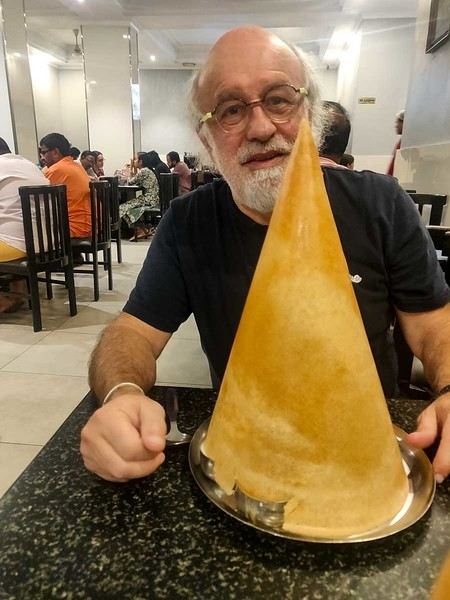
Night in Trivandrum
Prepaid taxi to the « Safire Residency », where we stayed last year. This hotel is still just as nice and welcoming (980 INR). Then, dinner at the restaurant « Ariya Niwas » where we enjoyed those delicious dosas again! (We missed them!)
White as snow, let's chat here!
And nowhere else...😉