Results for "Caldera+|+4+>+127"
1419 results found.
Une autre peur des avions! English translation pending
Bonjour,
J'ai lu pas mal de posts sur la peur des avions. J'ai vu aussi les réponses et les arguments.
J'ai bcp lu sur la securité aerienne, les contrôles, la maintenance, comment un avion vole, les turbulences, les statistiques des crash etc. les 99, 999999 de fiabilité, les avions qui peuvent voler 160 Km sans aucun moteur et atterir en planeur.. le feu qui peut être eteint avec du gaz...
Rien n'y fait, je suis dans l'impossibilité de prendre un avion depuis quasiment 3 ans. J'ai pris l'avion une trentaine de fois en 5 ans.. des fois pour 8H de vol..
Mais depuis 2002, et un voyage juste un peu mouvementé mais avec une alarme critique qui s'affichait pdt tt le voyage (côté rangement de la bouffe) en A... (pourtant c'était un B767 flambant noeuf !!!) qcq chose s'est passée:
1- arrivé à destination, je laissé tomber le vole de correspondance, à la place j'ai pris le train pr 12 H
2- Le vol retour, j'ai essayé de l'eviter No Way... je me suis ecrasé ! je l'ai pris ! Je vous assure pendant tout le vol, je n'ai cessé de vérifier les ailes, les moteurs, faire attention aux bruits 'train atter', ... pire que ça, les sénarios les plus catastrophiques passaient devant moi: explosion des tanker, feu, l'avion qui saute à 10 000 m...)
Depuis, je n'ai pu remettre les pieds dans un avion !!! c'était le point de non-retour chez moi.
Pire que ça, je trouve souvent des solutions alternatives (trains, bus, voiture, bateau..) chose qui n'arrange pas ma maladie !
Aujourd'hui, je dois prendre l'avion pour une superbe opportuinité de carrière à 5000 Km : pas de beateau/train/bus/voiture.
Et je vous avoue que depuis 2 mois je suis perdu entre mon desaroi, mes larmes, mon angoisse, ...je ne trouve pas les mots pour exprimer tt ca...
🙁
Voilà, si qcq un à une proposition à me faire ... je suis preneur !
J'ai lu pas mal de posts sur la peur des avions. J'ai vu aussi les réponses et les arguments.
J'ai bcp lu sur la securité aerienne, les contrôles, la maintenance, comment un avion vole, les turbulences, les statistiques des crash etc. les 99, 999999 de fiabilité, les avions qui peuvent voler 160 Km sans aucun moteur et atterir en planeur.. le feu qui peut être eteint avec du gaz...
Rien n'y fait, je suis dans l'impossibilité de prendre un avion depuis quasiment 3 ans. J'ai pris l'avion une trentaine de fois en 5 ans.. des fois pour 8H de vol..
Mais depuis 2002, et un voyage juste un peu mouvementé mais avec une alarme critique qui s'affichait pdt tt le voyage (côté rangement de la bouffe) en A... (pourtant c'était un B767 flambant noeuf !!!) qcq chose s'est passée:
1- arrivé à destination, je laissé tomber le vole de correspondance, à la place j'ai pris le train pr 12 H
2- Le vol retour, j'ai essayé de l'eviter No Way... je me suis ecrasé ! je l'ai pris ! Je vous assure pendant tout le vol, je n'ai cessé de vérifier les ailes, les moteurs, faire attention aux bruits 'train atter', ... pire que ça, les sénarios les plus catastrophiques passaient devant moi: explosion des tanker, feu, l'avion qui saute à 10 000 m...)
Depuis, je n'ai pu remettre les pieds dans un avion !!! c'était le point de non-retour chez moi.
Pire que ça, je trouve souvent des solutions alternatives (trains, bus, voiture, bateau..) chose qui n'arrange pas ma maladie !
Aujourd'hui, je dois prendre l'avion pour une superbe opportuinité de carrière à 5000 Km : pas de beateau/train/bus/voiture.
Et je vous avoue que depuis 2 mois je suis perdu entre mon desaroi, mes larmes, mon angoisse, ...je ne trouve pas les mots pour exprimer tt ca...
🙁
Voilà, si qcq un à une proposition à me faire ... je suis preneur !
Vos plus beaux levers de soleil English translation pending
Réservés à ceux qui se lèvent tôt ! Vus de ma fenêtre, en novembre...
Compagnie Swiss English translation pending
Bonjour, j
je suis nouveau ici... si quelqu'un pouvait témoigner sur la compagnie SWISS... j'ai vu leur site mais j'aimerai savoir si cette compagnie est bien ou pas : je dois aller au japon et j'envisage de prendre la compagnie des banques !!
Merci beaucoup
😉
Merci beaucoup
😉
Petit tour en Mauritanie et puis s'en vont English translation pending
Comme plusieurs personnes m'ont demandé le recit de mon voyage en mauritanie avec mon ami et president de l'assos je vous en livre une toute petite partie:
Journal du voyage en Mauritanie Jeudi 09 Septembre 2004 : Départ
Le réveil sonne vers 8h30, une courte très courte nuit vient de se présenter à nous. En effet, nous n’avons pas encore nos visas nous ne savons pas si nous partons aujourd’hui…L’attente est longue en espérant le coup de téléphone magique qui nous délivrerai de notre stress. 9h30….10h30… toujours rien. Nous décidons donc de se rejoindre à l’agence en espérant recevoir les visas avant le départ prévu à 13h45 à l’aéroport de Marseille.
Vers 11h, nous commençons à désespérer quand une camionnette blanche, toute anodine, nous apporte nos trésors….enfin… la délivrance.
Arrivés à l’aéroport, l’esprit est beaucoup plus libéré qu’au réveil… nous partons vraiment pour un projet que l’on espérait depuis plusieurs mois.
Vers 15h, nous sommes à Casablanca, l’attente est une fois de plus très longue pour atteindre Nouakchott mais bon… nous sommes là et c’est l’essentiel.
A peine l’avion posé à Nouakchott, toutes les personnes se précipitent vers la sortie de l’avion et le hangar qui sert d’aéroport international. Etrange…
Nous avons vite compris… d’abord soufflés par le réacteur d’un avion de Tunis air qui venait d’arriver, étouffés par la chaleur oppressante, nous arrivons dans la salle de douane. Petite salle, beaucoup de monde. Les douaniers sont dépassés. Il nous faut remplir un papier permettant l’entrée sur le territoire mauritanien mais il n’y en a plus. Nous devons attendre 45 minutes pour enfin les apercevoir. Passés la douane… maintenant l’épreuve des bagages… Tout le monde est agglutiné autour du tapis roulant, les porteurs marchent dessus : ils l’arrêtent ; les bagages tombent de tous les côtés, les cries fusent, la chaleur augmente…puis une demie heure passant nous apercevons enfin… nos bagages…ouf ! La douane se passe facilement, le douanier nous fouille même pas nos sacs, nous sommes dans le hall un peu perdu. Le temps de ranger nos passeports et notre caméra avait disparu. Si nous la perdons : c’est la fin du projet. Pendant notre recherche, une jeune fille s’approche de nous, c’est Kania qui est venue nous chercher après avoir eu le mail de Fabrice. Par chance, alors que nous cherchions toujours cette camera, nous tombons sur un enfant qui jouait avec … nous sommes soulagés.
Nous arrivons à l’auberge Sahara à Nouakchott, très sympa, convivial. Nous rencontrons d’autres personnes formant une association orientée vers la diffusion de film au Burkina .Après une petite heure de lecture, nous partons se coucher.
Si vous souhaitez la suite il vaudra attendre et etre convaincant dans vos arguments 😛
L'association NE POUR VIVRE pour le developpement social et medical dans les pays en voie de developpement ne-pour-vivre@wanadoo.fr
Journal du voyage en Mauritanie Jeudi 09 Septembre 2004 : Départ
Le réveil sonne vers 8h30, une courte très courte nuit vient de se présenter à nous. En effet, nous n’avons pas encore nos visas nous ne savons pas si nous partons aujourd’hui…L’attente est longue en espérant le coup de téléphone magique qui nous délivrerai de notre stress. 9h30….10h30… toujours rien. Nous décidons donc de se rejoindre à l’agence en espérant recevoir les visas avant le départ prévu à 13h45 à l’aéroport de Marseille.
Vers 11h, nous commençons à désespérer quand une camionnette blanche, toute anodine, nous apporte nos trésors….enfin… la délivrance.
Arrivés à l’aéroport, l’esprit est beaucoup plus libéré qu’au réveil… nous partons vraiment pour un projet que l’on espérait depuis plusieurs mois.
Vers 15h, nous sommes à Casablanca, l’attente est une fois de plus très longue pour atteindre Nouakchott mais bon… nous sommes là et c’est l’essentiel.
A peine l’avion posé à Nouakchott, toutes les personnes se précipitent vers la sortie de l’avion et le hangar qui sert d’aéroport international. Etrange…
Nous avons vite compris… d’abord soufflés par le réacteur d’un avion de Tunis air qui venait d’arriver, étouffés par la chaleur oppressante, nous arrivons dans la salle de douane. Petite salle, beaucoup de monde. Les douaniers sont dépassés. Il nous faut remplir un papier permettant l’entrée sur le territoire mauritanien mais il n’y en a plus. Nous devons attendre 45 minutes pour enfin les apercevoir. Passés la douane… maintenant l’épreuve des bagages… Tout le monde est agglutiné autour du tapis roulant, les porteurs marchent dessus : ils l’arrêtent ; les bagages tombent de tous les côtés, les cries fusent, la chaleur augmente…puis une demie heure passant nous apercevons enfin… nos bagages…ouf ! La douane se passe facilement, le douanier nous fouille même pas nos sacs, nous sommes dans le hall un peu perdu. Le temps de ranger nos passeports et notre caméra avait disparu. Si nous la perdons : c’est la fin du projet. Pendant notre recherche, une jeune fille s’approche de nous, c’est Kania qui est venue nous chercher après avoir eu le mail de Fabrice. Par chance, alors que nous cherchions toujours cette camera, nous tombons sur un enfant qui jouait avec … nous sommes soulagés.
Nous arrivons à l’auberge Sahara à Nouakchott, très sympa, convivial. Nous rencontrons d’autres personnes formant une association orientée vers la diffusion de film au Burkina .Après une petite heure de lecture, nous partons se coucher.
Si vous souhaitez la suite il vaudra attendre et etre convaincant dans vos arguments 😛
L'association NE POUR VIVRE pour le developpement social et medical dans les pays en voie de developpement ne-pour-vivre@wanadoo.fr
Bons plans à Bali-Flores-Sulawesi-Jogyakarta (Indonésie) English translation pending
Selamat malam,
Tout d'abord, merci à tous pour ces informations précieuses, nous partons en Indonesie au mois de juillet, j'ai lu pas mal de bons plans sur ce forum, c'est tres sympa.
Voici, grosso modo, notre programme; Bali (dodo à Ubud, Mont Batur, Amed), Flores (Ende, Moni, escension Kelimutu), Sulawesi (pays toraja-rantepao, lac Poso), et enfin Jogyakarta (Borodubur, Prambanan, volcan Merapi). C'est peut-être un peu optimiste mais c'est difficile d'être sélectif... tout à l'air tellement intéressant. Nous avons juste le vol aller-retour (aller Bali, retour de Jakarta).
Plusieurs personnes semblent bien connaître la région, tous vos conseils, adresses de losmen, nom ou adresse de guides, itineraires, plans de vols, ... sont donc les bienvenus (J'ai lu notament que les vols internes sont bcp plus intéressants au départ de Jakarta ue de Bali, de même les fréquences peuvent être très différentes et j'ai peu d'infos à ce sujet)
Merci beaucouo pour toutes vos réponses, même s'il y a beaucoup de questions... Et bonne route à tous
Tout d'abord, merci à tous pour ces informations précieuses, nous partons en Indonesie au mois de juillet, j'ai lu pas mal de bons plans sur ce forum, c'est tres sympa.
Voici, grosso modo, notre programme; Bali (dodo à Ubud, Mont Batur, Amed), Flores (Ende, Moni, escension Kelimutu), Sulawesi (pays toraja-rantepao, lac Poso), et enfin Jogyakarta (Borodubur, Prambanan, volcan Merapi). C'est peut-être un peu optimiste mais c'est difficile d'être sélectif... tout à l'air tellement intéressant. Nous avons juste le vol aller-retour (aller Bali, retour de Jakarta).
Plusieurs personnes semblent bien connaître la région, tous vos conseils, adresses de losmen, nom ou adresse de guides, itineraires, plans de vols, ... sont donc les bienvenus (J'ai lu notament que les vols internes sont bcp plus intéressants au départ de Jakarta ue de Bali, de même les fréquences peuvent être très différentes et j'ai peu d'infos à ce sujet)
Merci beaucouo pour toutes vos réponses, même s'il y a beaucoup de questions... Et bonne route à tous
Questions sur voyage au Brésil en juillet English translation pending
Bien le bonjour a tt le monde,
Donc voila je pars pour le Brésil avec un pote pendant un mois et de poussieres!!!!!! Donc beaucoup de questions se posent a moi!!!
Nous avons pris le Brazil Air Pass de 5coupons, nous avons vu chez TAM(compagnie aerienne bresilienne) que c t eux les moins cher!!
J'aurais aimé savoir s'il excitait moins cher pour 5coupons sachant que nous allons faire: SAO PAULO-Iguacu, Iguacu-Manaus, Manaus-Belem, Belem-Recife et Recife-Rio. De plus si ya des plans pour avoir juste un vol supplémentaire soit 6 coupons pour le meme prix cité au dessus!!!!
Par rapport a Manaus, nous allons pouvoir y rester 4 a 5jours donc peu de temps, si kelkun connait un plan dans l'amazonie facon "Aventure-Nature" remontée de l'amazonie etc....pour la durée citée ca serait bien cool!!!
Sachant que le Nordeste est une zone du brésil a voir absolument mais que le temps est compté pour nous, je souhaiterai savoir si ya des imperatifs a faire.Nous allons certainement sur Fortaleza et Bahia, REcife donc, mais nous sommes pas trop accros du tourisme de masse!!!donc si kelkun pouvait nous donner un plan genre une ile magnifique ou ya personne(le reve si ca existe) ou autre, un trip original et depaysant. Un endroit typiquement Bresilien ou on fait la fete et on vit com les gens du pays!!!! Peut etre que je reve un peu mais les voyages c fait pour ça!!
Pour Rio on recherche un endroit trankil pour dormir, sympa, sur, pas tres cher non plus, c qd meme "le nerf de la guerre".Si possible des endroits inconnus du tourisme de masse mais avec une beauté certaine!!!!!!
BREF nous on cherche les bons plans sur les villes dites au debut, tt conseil est bienvenu!!!!si d'autres personnes ont besoin d'infos kil me laisse un message, nous aussi on a kelkes bons plans a donner.
donc je vous laisse repondre
Meerci.Bye
Donc voila je pars pour le Brésil avec un pote pendant un mois et de poussieres!!!!!! Donc beaucoup de questions se posent a moi!!!
Nous avons pris le Brazil Air Pass de 5coupons, nous avons vu chez TAM(compagnie aerienne bresilienne) que c t eux les moins cher!!
J'aurais aimé savoir s'il excitait moins cher pour 5coupons sachant que nous allons faire: SAO PAULO-Iguacu, Iguacu-Manaus, Manaus-Belem, Belem-Recife et Recife-Rio. De plus si ya des plans pour avoir juste un vol supplémentaire soit 6 coupons pour le meme prix cité au dessus!!!!
Par rapport a Manaus, nous allons pouvoir y rester 4 a 5jours donc peu de temps, si kelkun connait un plan dans l'amazonie facon "Aventure-Nature" remontée de l'amazonie etc....pour la durée citée ca serait bien cool!!!
Sachant que le Nordeste est une zone du brésil a voir absolument mais que le temps est compté pour nous, je souhaiterai savoir si ya des imperatifs a faire.Nous allons certainement sur Fortaleza et Bahia, REcife donc, mais nous sommes pas trop accros du tourisme de masse!!!donc si kelkun pouvait nous donner un plan genre une ile magnifique ou ya personne(le reve si ca existe) ou autre, un trip original et depaysant. Un endroit typiquement Bresilien ou on fait la fete et on vit com les gens du pays!!!! Peut etre que je reve un peu mais les voyages c fait pour ça!!
Pour Rio on recherche un endroit trankil pour dormir, sympa, sur, pas tres cher non plus, c qd meme "le nerf de la guerre".Si possible des endroits inconnus du tourisme de masse mais avec une beauté certaine!!!!!!
BREF nous on cherche les bons plans sur les villes dites au debut, tt conseil est bienvenu!!!!si d'autres personnes ont besoin d'infos kil me laisse un message, nous aussi on a kelkes bons plans a donner.
donc je vous laisse repondre
Meerci.Bye
Visiter les gorges de Samaria en Crète English translation pending
Salut🙂!!
Je pars en avril en Crète avec des amis!!
Quelqu'un peut-il me dire si c'est possible de faire les gorges de Samaria à cette période de l'année (certains sites parlent d'une ouverture en ami) ?,
Y-a-t-il des internautes qui ont déjà visité la Crete en Avril et quels sont leurs conseils
Merci BCp😉
Je pars en avril en Crète avec des amis!!
Quelqu'un peut-il me dire si c'est possible de faire les gorges de Samaria à cette période de l'année (certains sites parlent d'une ouverture en ami) ?,
Y-a-t-il des internautes qui ont déjà visité la Crete en Avril et quels sont leurs conseils
Merci BCp😉
Advice on a classic Indonesia itinerary for summer 2026
I’d love to get some feedback on our itinerary—it’s probably pretty basic! This is our second trip to Asia and our first to Indonesia. We have three kids aged 20, 18, and 12. We land in Jakarta at 4 PM, spend 3 nights/2 days there, then take the train to Yogyakarta for 3 nights/2 days, followed by the train to Surabaya for 2 nights/1 day, then the train to Bromo for 1 day/1 night, a private driver to Ijen for 2 nights/2 days, then on to Bali (Ubud) for 4 nights/3 days, followed by Gili Air for 3 nights/2 days, Senggigi (Lombok) for 2 nights, and finally 5 nights in Kuta. I’m considering cutting the 2 nights in Senggigi to just keep Kuta and extend it to 7 nights. In Lombok, I’m not sure how to get around since I’m not comfortable with scooters... Your thoughts on all of this, and any advice, are more than welcome—don’t hesitate!
For those wondering why cities like Jakarta and Surabaya: we don’t often get the chance to visit big Asian cities, so we wanted to include that discovery in our trip. The trains between Jakarta and Yogyakarta, Surabaya and Probolinggo are booked. The return flight from Lombok to Jakarta is also set. Accommodations are booked but flexible (same for the trains).
Thanks!
For those wondering why cities like Jakarta and Surabaya: we don’t often get the chance to visit big Asian cities, so we wanted to include that discovery in our trip. The trains between Jakarta and Yogyakarta, Surabaya and Probolinggo are booked. The return flight from Lombok to Jakarta is also set. Accommodations are booked but flexible (same for the trains).
Thanks!
16 days with the family in La Gomera (Canary Islands)
Preamble
When we started looking for a summer destination a few months ago, our first criterion was to avoid extreme heat and heatwaves. We had already been to Norway two years ago and are considering going back in the future for other occasions. So, we had some fun asking ChatGPT which destinations enjoyed a mild climate during the summer without going too far. Among the list provided by the AI were the Canary Islands... The idea of a place we wouldn’t have considered first, both not too far away and exotic enough, appealed to us: “Hmm, why not?”
This destination had never really attracted me, though Magali was a bit more interested. Five years earlier, COVID had caused a short break in my professional activity, and I had planned a trip because the flight price was attractive, and I was looking for a destination different from what usually appeals to me—more out of curiosity than deep interest. From a distance and with a social judgment I acknowledge (it’s not great, but not entirely wrong), I had the image of a destination for party-goers flocking to the sun with no interest in local culture, concrete coastlines, and denatured landscapes—everything I detest the most. Still, I had done some quick research on the different islands and spotted Lanzarote for its beautiful volcanic landscapes, hiking trails, beaches, and the impression of a good balance between activity and fewer crowds than Tenerife or Gran Canaria. Then I dropped the idea of going, without ever reconsidering traveling to the Canaries...
Until now! Because we started researching the different islands in the archipelago to see which ones might appeal to us the most. It was La Gomera, the third smallest island in the archipelago, more praised for its hiking trails and preserved nature than for its beaches, away from mass tourism (fifty times fewer tourists than Tenerife) but still a bit more developed than its wild neighbor El Hierro, that caught our attention. Contrary to what the rest might suggest, I’m not at all addicted to AI, but I use it from time to time to synthesize quick research or just experimentally. Since ChatGPT had started anticipating my tastes lately as if it had become my buddy (often successfully, sometimes off the mark), I asked which Canary Island would suit me best for a family trip. The tool answered first with... La Gomera. So, I tested it and teased it a bit to see if the suggestion was solidly grounded, as the method sometimes makes it contradict itself. But no luck: “You’d appreciate the wild nature of El Hierro, but with family, you’d find little activity for the kids. You won’t like the touristy vibe of the big islands like Tenerife, Gran Canaria, Lanzarote, and Fuerteventura. You could consider La Palma, but it’s really La Gomera that will suit you best, based on your interests and the criteria given.” So, we dug deeper into our research and were convinced without a shadow of a doubt that this island was the one waiting for us.
Without knowing it, we had Canarians in our circle who revealed their origins when they heard about our travel plans. One from Tenerife insisted we’d be better off choosing Tenerife (obviously...) because it also has preserved spots, and La Gomera, “you can see it all in two or three days, you’ll get bored quickly...” The other, a colleague from Gran Canaria who had never visited La Gomera, still recommended it without hesitation because her parents had just been there on vacation: they loved it and had encountered few tourists. She also tended to think this destination was usually the subject of short stays, but according to what her parents told her, taking your time there was also a great idea. However, in our research, the idea that La Gomera is an island you can see in three or four days max kept coming up. So, we considered combining its visit with La Palma or El Hierro, the other two that caught our eye. But hopping between islands by ferry in the Canaries is a significant budget for non-Canarians, even more so for a family of four. Then, scrutinizing Google Maps, it seemed obvious that two weeks were too short to discover two islands as they deserve, and there seemed to be plenty to see in La Gomera due to its very unique culture. After all, we read that some people spend several months a year there, while others never even leave... Finally, these landscapes and this atmosphere, which seemed to us like a mix of Europe, North Africa, and Latin America, tempted us. So, it would be two weeks in La Gomera—deal!
La Gomera is therefore the second... well, the third smallest island in the Canaries since La Graciosa was recently recognized as a fully inhabited island. It’s roughly round, 20 to 25 kilometers in diameter, and has just over 20,000 inhabitants, half of whom live in its capital, San Sebastián de la Gomera, the only real town. Like its Canarian sisters, La Gomera is a volcanic formation that rose about 10 million years ago. The island is very mountainous and rugged, covered in red and black rocky landscapes. Geological activity has shaped the sprawling massifs that end in steep cliffs plunging into the ocean, creating six coastal valleys with tropical vegetation that have fostered human activity. They divide the island like slices of a cake; starting from the north and moving clockwise: the agricultural Vallehermoso, the rustic Agulo, the green, humid, and fertile Hermigua, the sunny capital San Sebastián de la Gomera, the southern and isolated Alajeró-Santiago, and the beachside Valle Gran Rey. These make up the six municipalities (more like cantons to our French sensibilities) of the territory.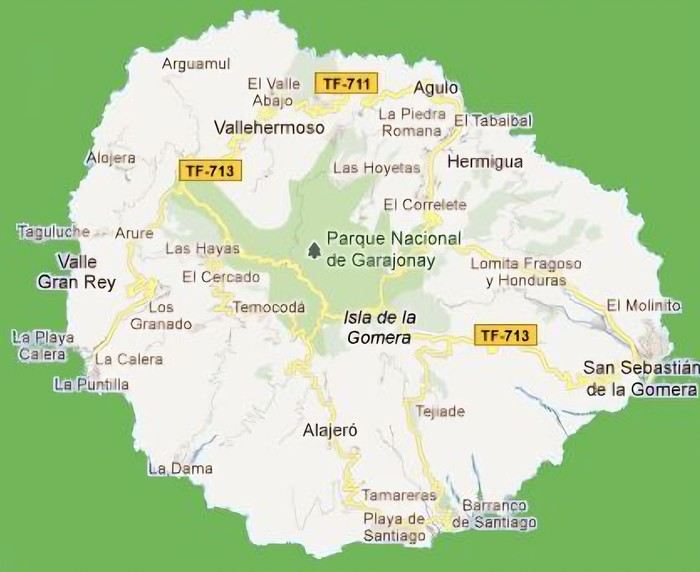 The large solidified magma massifs that form the heart of the island have created a large depression more protected from the sun at its center, allowing the growth of a vast laurisilva, a forest mainly composed of laurels, now grouped within the Garajonay National Park, La Gomera’s green lung, which has earned it the status of a UNESCO World Biosphere Reserve. Its distinctly European appearance contrasts sharply with the rocky and tropical landscapes of the rest of the island. Thus, the climate varies greatly from one part of the island to another: in summer, you can quickly go from a dry, sunny valley at 35°C to a humid forest area at 18°C in the highlands.
La Gomera was populated late. As with the rest of the Canaries, human presence likely began about 2,000 years ago. Groups of animist Berbers, probably fleeing persecution, gradually populated the archipelago, especially the western islands and La Gomera, becoming its small aboriginal population: the Guanches (or later Gomeros). The animist and pastoral civilization of the Guanches thrived until the Spanish conquest in the 15th century, which, after a short period of harmony and mixing with the indigenous people, suddenly ended in bloodshed... La Gomera later became the “Columbus Island” after Christopher Columbus’s stopover, increasing the blending of populations. In the 20th century, many Gomeros emigrated to Cuba and other Latin American countries in search of a better life, bringing back a mix of cultures and traits that are still very palpable in Gomeran culture today. It’s in La Gomera, however, that the remnants of Guanche culture seem to have left the most traces—in language, gastronomy, social practices... Moreover, most Gomeros, especially in remote villages, have a distinct and identifiable look and proudly claim their ancestral roots, even making La Gomera seem a bit exotic to other Canarians.
Maybe that’s why it never really wanted to develop its tourist infrastructure too much. If you set aside the tourists who visit for the day by bus or boat from Tenerife on a marked itinerary (and whom you ultimately encounter rarely), La Gomera has remained a hidden gem, a destination focused on nature discovery that attracts hikers, nature-loving divers, and scientists for its fauna and flora, and to a lesser extent, beachgoers who aren’t looking for overly developed coastlines. Tourism is therefore limited. Roughly speaking, you’ll find mostly Spaniards, including a substantial number of residents from other Canary Islands, many Germans who have a particular fondness for La Gomera and spend long stays there or own second homes (to the point that the German cultural imprint is clearly noticeable in some places—it’s said to be Angela Merkel’s favorite holiday spot), and quite a few French. The presence of other nationalities seemed negligible. Most travelers come mainly for hiking, but it’s also a prime spot for whale watching. Additionally, the beach resorts of La Gomera—San Sebastián, Santiago, and especially Valle Gran Rey—are famously popular with hippies, especially German ones, ranging from chic boho hippies to old-school vagabonds who’ve been there for decades, much like those you’d find in Goa, Rishikesh, or Paharganj in India. As a result, practices like naturism, vegetarianism, and local organic production are quite well established in some areas.
Some practical info: - The round-trip flight from Paris to Tenerife cost us 365 € per person (outbound with Transavia, return with EasyJet), including one checked bag and three seats reserved side by side. - We chose two bases to explore the island: one week in Valle Gran Rey, known as the most pleasant of the three beach resorts, and one week in Hermigua, which is more mountainous and close to the natural park. We booked two houses with balconies and views: the first at 120 € per night, the second at 99 €. - The round-trip ferry between Tenerife and La Gomera cost us 270 € with Baleària Canarias, including discounts for children aged 4 and 12, though I don’t have the exact details. It was a bit cheaper than with the other company, Fred Olsen. - Finally, we rented a car through the Cicar agency for 360 € for 16 days, which comes to 22.50 € per day. - Apart from that, we didn’t plan anything and decided the day before or even the morning of what we wanted to do. We didn’t invest in any paper guides on the Canaries, as there’s little information on La Gomera, but we used the very comprehensive travel guide published by the Canary Islands Tourism Board, a real goldmine of almost exhaustive information on the island.
Alright, off we go for 16 days of adventure discovering La Gomera!
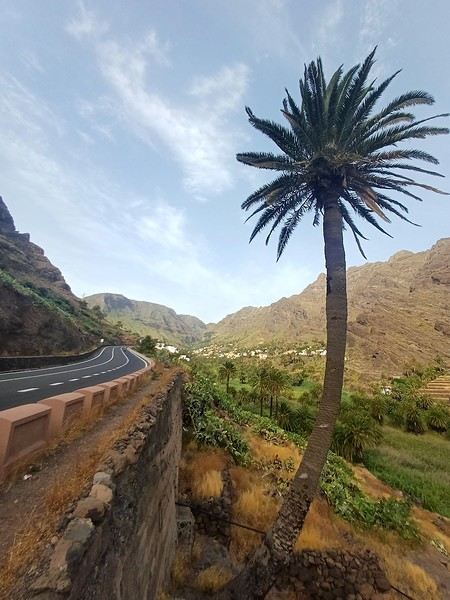
And we start the trip with music!
We start the trip with music!
When we started looking for a summer destination a few months ago, our first criterion was to avoid extreme heat and heatwaves. We had already been to Norway two years ago and are considering going back in the future for other occasions. So, we had some fun asking ChatGPT which destinations enjoyed a mild climate during the summer without going too far. Among the list provided by the AI were the Canary Islands... The idea of a place we wouldn’t have considered first, both not too far away and exotic enough, appealed to us: “Hmm, why not?”
This destination had never really attracted me, though Magali was a bit more interested. Five years earlier, COVID had caused a short break in my professional activity, and I had planned a trip because the flight price was attractive, and I was looking for a destination different from what usually appeals to me—more out of curiosity than deep interest. From a distance and with a social judgment I acknowledge (it’s not great, but not entirely wrong), I had the image of a destination for party-goers flocking to the sun with no interest in local culture, concrete coastlines, and denatured landscapes—everything I detest the most. Still, I had done some quick research on the different islands and spotted Lanzarote for its beautiful volcanic landscapes, hiking trails, beaches, and the impression of a good balance between activity and fewer crowds than Tenerife or Gran Canaria. Then I dropped the idea of going, without ever reconsidering traveling to the Canaries...
Until now! Because we started researching the different islands in the archipelago to see which ones might appeal to us the most. It was La Gomera, the third smallest island in the archipelago, more praised for its hiking trails and preserved nature than for its beaches, away from mass tourism (fifty times fewer tourists than Tenerife) but still a bit more developed than its wild neighbor El Hierro, that caught our attention. Contrary to what the rest might suggest, I’m not at all addicted to AI, but I use it from time to time to synthesize quick research or just experimentally. Since ChatGPT had started anticipating my tastes lately as if it had become my buddy (often successfully, sometimes off the mark), I asked which Canary Island would suit me best for a family trip. The tool answered first with... La Gomera. So, I tested it and teased it a bit to see if the suggestion was solidly grounded, as the method sometimes makes it contradict itself. But no luck: “You’d appreciate the wild nature of El Hierro, but with family, you’d find little activity for the kids. You won’t like the touristy vibe of the big islands like Tenerife, Gran Canaria, Lanzarote, and Fuerteventura. You could consider La Palma, but it’s really La Gomera that will suit you best, based on your interests and the criteria given.” So, we dug deeper into our research and were convinced without a shadow of a doubt that this island was the one waiting for us.
Without knowing it, we had Canarians in our circle who revealed their origins when they heard about our travel plans. One from Tenerife insisted we’d be better off choosing Tenerife (obviously...) because it also has preserved spots, and La Gomera, “you can see it all in two or three days, you’ll get bored quickly...” The other, a colleague from Gran Canaria who had never visited La Gomera, still recommended it without hesitation because her parents had just been there on vacation: they loved it and had encountered few tourists. She also tended to think this destination was usually the subject of short stays, but according to what her parents told her, taking your time there was also a great idea. However, in our research, the idea that La Gomera is an island you can see in three or four days max kept coming up. So, we considered combining its visit with La Palma or El Hierro, the other two that caught our eye. But hopping between islands by ferry in the Canaries is a significant budget for non-Canarians, even more so for a family of four. Then, scrutinizing Google Maps, it seemed obvious that two weeks were too short to discover two islands as they deserve, and there seemed to be plenty to see in La Gomera due to its very unique culture. After all, we read that some people spend several months a year there, while others never even leave... Finally, these landscapes and this atmosphere, which seemed to us like a mix of Europe, North Africa, and Latin America, tempted us. So, it would be two weeks in La Gomera—deal!
La Gomera is therefore the second... well, the third smallest island in the Canaries since La Graciosa was recently recognized as a fully inhabited island. It’s roughly round, 20 to 25 kilometers in diameter, and has just over 20,000 inhabitants, half of whom live in its capital, San Sebastián de la Gomera, the only real town. Like its Canarian sisters, La Gomera is a volcanic formation that rose about 10 million years ago. The island is very mountainous and rugged, covered in red and black rocky landscapes. Geological activity has shaped the sprawling massifs that end in steep cliffs plunging into the ocean, creating six coastal valleys with tropical vegetation that have fostered human activity. They divide the island like slices of a cake; starting from the north and moving clockwise: the agricultural Vallehermoso, the rustic Agulo, the green, humid, and fertile Hermigua, the sunny capital San Sebastián de la Gomera, the southern and isolated Alajeró-Santiago, and the beachside Valle Gran Rey. These make up the six municipalities (more like cantons to our French sensibilities) of the territory.
The large solidified magma massifs that form the heart of the island have created a large depression more protected from the sun at its center, allowing the growth of a vast laurisilva, a forest mainly composed of laurels, now grouped within the Garajonay National Park, La Gomera’s green lung, which has earned it the status of a UNESCO World Biosphere Reserve. Its distinctly European appearance contrasts sharply with the rocky and tropical landscapes of the rest of the island. Thus, the climate varies greatly from one part of the island to another: in summer, you can quickly go from a dry, sunny valley at 35°C to a humid forest area at 18°C in the highlands.La Gomera was populated late. As with the rest of the Canaries, human presence likely began about 2,000 years ago. Groups of animist Berbers, probably fleeing persecution, gradually populated the archipelago, especially the western islands and La Gomera, becoming its small aboriginal population: the Guanches (or later Gomeros). The animist and pastoral civilization of the Guanches thrived until the Spanish conquest in the 15th century, which, after a short period of harmony and mixing with the indigenous people, suddenly ended in bloodshed... La Gomera later became the “Columbus Island” after Christopher Columbus’s stopover, increasing the blending of populations. In the 20th century, many Gomeros emigrated to Cuba and other Latin American countries in search of a better life, bringing back a mix of cultures and traits that are still very palpable in Gomeran culture today. It’s in La Gomera, however, that the remnants of Guanche culture seem to have left the most traces—in language, gastronomy, social practices... Moreover, most Gomeros, especially in remote villages, have a distinct and identifiable look and proudly claim their ancestral roots, even making La Gomera seem a bit exotic to other Canarians.
Maybe that’s why it never really wanted to develop its tourist infrastructure too much. If you set aside the tourists who visit for the day by bus or boat from Tenerife on a marked itinerary (and whom you ultimately encounter rarely), La Gomera has remained a hidden gem, a destination focused on nature discovery that attracts hikers, nature-loving divers, and scientists for its fauna and flora, and to a lesser extent, beachgoers who aren’t looking for overly developed coastlines. Tourism is therefore limited. Roughly speaking, you’ll find mostly Spaniards, including a substantial number of residents from other Canary Islands, many Germans who have a particular fondness for La Gomera and spend long stays there or own second homes (to the point that the German cultural imprint is clearly noticeable in some places—it’s said to be Angela Merkel’s favorite holiday spot), and quite a few French. The presence of other nationalities seemed negligible. Most travelers come mainly for hiking, but it’s also a prime spot for whale watching. Additionally, the beach resorts of La Gomera—San Sebastián, Santiago, and especially Valle Gran Rey—are famously popular with hippies, especially German ones, ranging from chic boho hippies to old-school vagabonds who’ve been there for decades, much like those you’d find in Goa, Rishikesh, or Paharganj in India. As a result, practices like naturism, vegetarianism, and local organic production are quite well established in some areas.
Some practical info: - The round-trip flight from Paris to Tenerife cost us 365 € per person (outbound with Transavia, return with EasyJet), including one checked bag and three seats reserved side by side. - We chose two bases to explore the island: one week in Valle Gran Rey, known as the most pleasant of the three beach resorts, and one week in Hermigua, which is more mountainous and close to the natural park. We booked two houses with balconies and views: the first at 120 € per night, the second at 99 €. - The round-trip ferry between Tenerife and La Gomera cost us 270 € with Baleària Canarias, including discounts for children aged 4 and 12, though I don’t have the exact details. It was a bit cheaper than with the other company, Fred Olsen. - Finally, we rented a car through the Cicar agency for 360 € for 16 days, which comes to 22.50 € per day. - Apart from that, we didn’t plan anything and decided the day before or even the morning of what we wanted to do. We didn’t invest in any paper guides on the Canaries, as there’s little information on La Gomera, but we used the very comprehensive travel guide published by the Canary Islands Tourism Board, a real goldmine of almost exhaustive information on the island.
Alright, off we go for 16 days of adventure discovering La Gomera!
And we start the trip with music!
We start the trip with music!