Results for "Place+Rouge+|+6+>+177"
262667 results found.
Conseils pour voyage en Egypte de trois semaines fin juillet English translation pending
J'aimerais avoir des conseils concernant un voyage en Égypte. Je dois partir avec deux enfants (18 ans et 14 ans), nous ne voulons pas d'un voyage tout organisé. qu'en pensez-vous? vous avez des conseils? des suggestions? ou une autres destinations à me conseiller? Nous voulons un voyage moitié culturel moitié repos, nous avons trois semaines à compter du 26 juillet.
Toujours dans le quasi continent Indien... English translation pending
Re,
Les réponses ne seront pas nombreuses.
A votre avis, quelle est à votre avis, à part Delhi (trop cher pour moi), la meilleure place pour ne parler que hindi ?
Merci du fond du coeur!
Les réponses ne seront pas nombreuses.
A votre avis, quelle est à votre avis, à part Delhi (trop cher pour moi), la meilleure place pour ne parler que hindi ?
Merci du fond du coeur!
Excursions au départ de Djerba? English translation pending
🙂 Bonjour,
J'envisage d'aller à Djerba en tunisie cet été ou lété prochain par l'intermédiaire de FRAM mais je souhaite conaitrre d'avance le detail des excursions possibles sur place car dans le catalogue les explications ne sont pas tres "parlantes", et à l'agence de voyage on m'a dit qu'on ne pouvait pas en savoir plus . Quelqu'un dans ce forum aurait 'il deja fait ce voyage ?
En effet, je reve de voir les dunes de sable dans le desert mais je me demande si cela est possible en excursion d'une journée au depart de Djerba.
Merci d'avance de vos aides et bon voyage à tous cet été 😉
J'envisage d'aller à Djerba en tunisie cet été ou lété prochain par l'intermédiaire de FRAM mais je souhaite conaitrre d'avance le detail des excursions possibles sur place car dans le catalogue les explications ne sont pas tres "parlantes", et à l'agence de voyage on m'a dit qu'on ne pouvait pas en savoir plus . Quelqu'un dans ce forum aurait 'il deja fait ce voyage ?
En effet, je reve de voir les dunes de sable dans le desert mais je me demande si cela est possible en excursion d'une journée au depart de Djerba.
Merci d'avance de vos aides et bon voyage à tous cet été 😉
Tarif du trajet Bombay-Benares (Inde) English translation pending
salut a vous, j' aimerai connaitre au plus vite les tarifs de train pour parcourir bombay-benares.pour dans 4 jours alors ca urge . merci merci.
Trains pour Manakara à Madagascar? English translation pending
je souhaite emprunter le train de Fianarantsoa à Manakara et ensuite rejoindre Manandjary et même Toamasina. Pouvez vous me donner les différentes solutions et le temps nécessaire. Peut-on s'organiser sur place à Manakara ? Quels sont les hébergements possibles sur ce parcours des Pangalanes.
Merci d'avance. Mathé
Conseils pour voyage de 4 semaines en Australie English translation pending
Salut à tous,
Congés négociés vendredi + destination choisie ce matin = organisation à l'arrache. 🙂 Mais bon, ça serait dommage de faire simple quand on peut faire ....
Je souhaites donc partir en Australie pour 4 semaines début Mars. J'ai rapidement feuilleté le Lonely aujourd'hui et .... c'est grand l'Australie ! J'espère donc glaner ici quelques infos pour me concocter un petit voyage sympa.
1) La compagnie ! Y-en a plusieurs ... Je compte arriver à Sydney. Gagne-t-on vraiment à prendre un vol Quantas pour profiter des pass locaux ? Sinon la Malaysian Airlines m'a l'air pas mal, z'êtes d'accord ?
2) J'envisageais un passage vers Cairns pour des randos dans l' "arrière-pays" ("Rainforest"). Le mois de Mars est-il (encore) trop pluvieux pour ce type de randos?
3) Les méduses ! Traînent-elles du du côté des plages de la côte Est (de Cairns à Sydney)? J'ai quand même envie de profiter de la plage et de la grande barrière ...
4) La Tasmanie, c'est sûr, c'est bien au Sud. Est-ce trop tard pour des randos sur place (trop froid, trop pluvieux) ?
5) Le Centre Rouge .... rien que le nom et le mystère est déjà là.🙂 J'ai un objectif (peut-être utopique): profiter des merveilles du coin (rando dans les McDonnell Ranges, Uluru) sans pour autant suivre des hordes de touriste. Y-en a-t-il un(e) parmi vous qui détienne le secret ?
6) Pour l'instant je voyage seul. Mais c'est aussi sympa de pouvoir partager les frais et les expériences. Trouve-t-on facilement des routards ou backpackers dans les auberges de jeunesse pour organiser une sortie / rando / visite, une fois arrivé dans un coin.
Bon, je m'arrête là car sinon, j'y serai encore demain....
En tout cas, je passerai sur Sydney ... donc si un soir y en a qui veulent des nouvelles fraîches du pays ou juste boire un coup, je paie ma tournée (limite fixée par mon banquier qui rit jaune ... déjà) 😉
Merci à vous et surtout bon voyage !
Pilou
Congés négociés vendredi + destination choisie ce matin = organisation à l'arrache. 🙂 Mais bon, ça serait dommage de faire simple quand on peut faire ....
Je souhaites donc partir en Australie pour 4 semaines début Mars. J'ai rapidement feuilleté le Lonely aujourd'hui et .... c'est grand l'Australie ! J'espère donc glaner ici quelques infos pour me concocter un petit voyage sympa.
1) La compagnie ! Y-en a plusieurs ... Je compte arriver à Sydney. Gagne-t-on vraiment à prendre un vol Quantas pour profiter des pass locaux ? Sinon la Malaysian Airlines m'a l'air pas mal, z'êtes d'accord ?
2) J'envisageais un passage vers Cairns pour des randos dans l' "arrière-pays" ("Rainforest"). Le mois de Mars est-il (encore) trop pluvieux pour ce type de randos?
3) Les méduses ! Traînent-elles du du côté des plages de la côte Est (de Cairns à Sydney)? J'ai quand même envie de profiter de la plage et de la grande barrière ...
4) La Tasmanie, c'est sûr, c'est bien au Sud. Est-ce trop tard pour des randos sur place (trop froid, trop pluvieux) ?
5) Le Centre Rouge .... rien que le nom et le mystère est déjà là.🙂 J'ai un objectif (peut-être utopique): profiter des merveilles du coin (rando dans les McDonnell Ranges, Uluru) sans pour autant suivre des hordes de touriste. Y-en a-t-il un(e) parmi vous qui détienne le secret ?
6) Pour l'instant je voyage seul. Mais c'est aussi sympa de pouvoir partager les frais et les expériences. Trouve-t-on facilement des routards ou backpackers dans les auberges de jeunesse pour organiser une sortie / rando / visite, une fois arrivé dans un coin.
Bon, je m'arrête là car sinon, j'y serai encore demain....
En tout cas, je passerai sur Sydney ... donc si un soir y en a qui veulent des nouvelles fraîches du pays ou juste boire un coup, je paie ma tournée (limite fixée par mon banquier qui rit jaune ... déjà) 😉
Merci à vous et surtout bon voyage !
Pilou
Bons plans pour les Atlas au Maroc English translation pending
Nous envisageons d'aller au Maroc au mois de mai avec un enfant de 5 ans pour découvrir la région de Azilal, vallée de la Tessaout, les Ait Bou goumez ... (C'est dans l'atlas à environ 100kms de Marrakech).
Pour cela nous aimerions quelques informations :
1 – Est il facile de trouver sur place guides et muletiers et organiser au pied levé un petit trek de 2 ou 3 jours (avec notre enfant) dans le secteur. Si quelqu'un à des coordonnées ou des références conseillables ?
2 – Nous aimerions également nous poser 2 ou3 jours dans un petit village chez l'habitant ou dans un petit hotel simple petit budget. Puis faire des petites balades à la journée sans forcément cette fois l'aide d'un guide ...
Est ce jouable . Y 'a t'il un coin ou un village bien propice à ce genre de chose.
3- Enfin j'aimerais connaitre votre point de vu sur ce projet en général sachant qu'il y a un enfant . Si quelqu'un connais éventuellement une région plus propice que celle-ci pour ce genre de projet, nous sommes preneurs (sauf le désert car on connais déja)
Merci pour vos conseils.
Pour cela nous aimerions quelques informations :
1 – Est il facile de trouver sur place guides et muletiers et organiser au pied levé un petit trek de 2 ou 3 jours (avec notre enfant) dans le secteur. Si quelqu'un à des coordonnées ou des références conseillables ?
2 – Nous aimerions également nous poser 2 ou3 jours dans un petit village chez l'habitant ou dans un petit hotel simple petit budget. Puis faire des petites balades à la journée sans forcément cette fois l'aide d'un guide ...
Est ce jouable . Y 'a t'il un coin ou un village bien propice à ce genre de chose.
3- Enfin j'aimerais connaitre votre point de vu sur ce projet en général sachant qu'il y a un enfant . Si quelqu'un connais éventuellement une région plus propice que celle-ci pour ce genre de projet, nous sommes preneurs (sauf le désert car on connais déja)
Merci pour vos conseils.
Conseils pour 7 filles en Inde English translation pending
Nous sommes un groupe de 7filles on est assez jeune (entre 17 et 18ans).Nous partons en Inde pendant 1 moi(mi juillet mi aout)cette été dans le Kerala pres de Triandrum.
On part dans une association pour s'occuper d'enfants pandant 3 semaines et nous partons visité la region pendant une semaine.
Si queleque personnes pourrait me donner quelques conseils, des choses à visiter leur impression, les choses à faire et à ne pas faire, les consignes, temps, conditions de vie..............car en plus nous preparons des dossiers qui doivent etre assez precis.
merci bcp
j'attends avec impression vos impressions sur la region!!!merci
On part dans une association pour s'occuper d'enfants pandant 3 semaines et nous partons visité la region pendant une semaine.
Si queleque personnes pourrait me donner quelques conseils, des choses à visiter leur impression, les choses à faire et à ne pas faire, les consignes, temps, conditions de vie..............car en plus nous preparons des dossiers qui doivent etre assez precis.
merci bcp
j'attends avec impression vos impressions sur la region!!!merci
Mini trek en Jordanie ou Tunisie? English translation pending
Salut,
Je souhaite partir en Février pour faire 1 semaine de treck: je souhaite faire du désert mais aussi découvrir des monuments locaux. Que me conseillez-vous comme pays et quel orgnanisme ( terre d'av, atalante...) ?
Merci
Je souhaite partir en Février pour faire 1 semaine de treck: je souhaite faire du désert mais aussi découvrir des monuments locaux. Que me conseillez-vous comme pays et quel orgnanisme ( terre d'av, atalante...) ?
Merci
Que peut-on apporter et donner à Cuba? English translation pending
Je lis souvent que de donner des t-shirts, dentifrice, shampooing, etc est beaucoup apprécié.
Est-ce vrai ?
Quoi apporter ?
Commment ça marche ?
Est-ce vrai ?
Quoi apporter ?
Commment ça marche ?
Torture de milliers d'ours en Chine English translation pending
🙁Prenez quelques minutes SVP pour lire ce message de la plus grande importance.
Des ours sont sous torture dans 247 « fermes » mises en place par le gouvernement chinois depuis 20 ans pour extraire 7 000 litres de leur bile par an. La bile d’ours est utilisée dans des remèdes, du vin, des shampooings et des aphrodisiaques. Pourtant, il existe des produits de substitution. Plus de 100 000 litres de bile de synthèse sont commercialisés chaque année.
Une preuve de la grande détresse des ours dans ces fermes est le comportement des mères ourses qui vont jusqu’à tuer leurs bébés dès la naissance. Cette mortalité n’empêche pas les fermiers de continuer leur commerce ignoble avec des oursons capturés dans la nature.
😕Les braconniers profitent de l’absence de la mère, partie en quête de nourriture, pour enlever les oursons âgés de quelques jours. Parfois la mère est tuée et un grand nombre de bébés meurent de ce traumatisme
Les survivants sont parqués dans un enclos pour les habituer à leur futur enfermement dans une cage étroite. Puis, à l’âge de 3 ans, ils subissent une opération qui les mutile à vie. Les fermiers implantent un cathéter dans la vésicule biliaire pour drainer leur bile. Ce tube reste en permanence, et laisse une plaie à vif qui s’infecte et n’est jamais soignée. Quatre ours sur cinq meurent pendant ou après l’opération d’implantation.
🙁Les ours qui survivent sont transférés dans des cages si petites qu’ils ne peuvent ni bouger, ni même se coucher. Pour exprimer leur angoisse et leur souffrance, ils n’ont pas d’autres choix que de se cogner la tête contre les barreaux et de se mordre les pattes jusqu’au sang. Ces gestes de grande détresse entraînent de graves infections.Comprimés dans les cages, parfois jusqu’à l’écrasement de leurs organes, les ours subissent deux fois par jour la torture de l’extraction. Elle est effectuée pendant qu’ils sont nourris et abreuvés, pour stimuler la bile. Les ours gémissent, hurlent et se tordent de douleur, en se tenant l’estomac.
Pour voyager intelligement et ne pas etre le complice d'une torture immonde, prenez quelques minutes pour visiter ce site :
http://www.onevoice-ear.org/
Merci beaucoup. Mon seul but est de vous informer.
David😐
Des ours sont sous torture dans 247 « fermes » mises en place par le gouvernement chinois depuis 20 ans pour extraire 7 000 litres de leur bile par an. La bile d’ours est utilisée dans des remèdes, du vin, des shampooings et des aphrodisiaques. Pourtant, il existe des produits de substitution. Plus de 100 000 litres de bile de synthèse sont commercialisés chaque année.
Une preuve de la grande détresse des ours dans ces fermes est le comportement des mères ourses qui vont jusqu’à tuer leurs bébés dès la naissance. Cette mortalité n’empêche pas les fermiers de continuer leur commerce ignoble avec des oursons capturés dans la nature.
😕Les braconniers profitent de l’absence de la mère, partie en quête de nourriture, pour enlever les oursons âgés de quelques jours. Parfois la mère est tuée et un grand nombre de bébés meurent de ce traumatisme
Les survivants sont parqués dans un enclos pour les habituer à leur futur enfermement dans une cage étroite. Puis, à l’âge de 3 ans, ils subissent une opération qui les mutile à vie. Les fermiers implantent un cathéter dans la vésicule biliaire pour drainer leur bile. Ce tube reste en permanence, et laisse une plaie à vif qui s’infecte et n’est jamais soignée.
Quatre ours sur cinq meurent pendant ou après l’opération d’implantation.🙁Les ours qui survivent sont transférés dans des cages si petites qu’ils ne peuvent ni bouger, ni même se coucher. Pour exprimer leur angoisse et leur souffrance, ils n’ont pas d’autres choix que de se cogner la tête contre les barreaux et de se mordre les pattes jusqu’au sang. Ces gestes de grande détresse entraînent de graves infections.
Comprimés dans les cages, parfois jusqu’à l’écrasement de leurs organes, les ours subissent deux fois par jour la torture de l’extraction. Elle est effectuée pendant qu’ils sont nourris et abreuvés, pour stimuler la bile. Les ours gémissent, hurlent et se tordent de douleur, en se tenant l’estomac.Pour voyager intelligement et ne pas etre le complice d'une torture immonde, prenez quelques minutes pour visiter ce site :
http://www.onevoice-ear.org/
Merci beaucoup. Mon seul but est de vous informer.
David😐
5 years on the road by motorcycle
Hello everyone! ✌️
I just realized I’ve been registered on VoyageForum since... March 28, 2012 😊. Yet, I’ve barely participated until now.
August 1, 2026, will mark a somewhat special milestone: 5 years on the road.
We left Switzerland on August 1, 2021 with a simple idea: let chance decide our direction. We placed a bottle of wine on a world map, spun it... and it chose our first destination.
A year later, when we arrived in Morocco, we faced a new choice: continue toward Africa or head to Asia. This time, a tarot card game made the decision. Since then, we’ve tried to keep this journey as open to the unexpected as possible.
Today, that adds up to about 120,000 km, 46 countries, and over 1,800 days on the road—mostly by motorcycle, but also by sailboat, train, bus, hitchhiking, or on foot when adventure calls.
Our guiding thread isn’t just the motorcycle, but service exchanges. Instead of simply passing through countries, we try to stop regularly to lend a hand to the people we meet. So far, that’s about 600 days of volunteering.
Over the years, we’ve:
renovated a house in Croatia made earth bricks in the Moroccan desert helped sail a boat through the Greek islands looked after houses, dogs, horses, a camel... and lots of other animals worked at a street art festival in Morocco created videos for local associations and projects worked the grape harvest on the Tibetan plateau been accredited as "media" for the World Nomad Games in Central Asia
Some of the moments that have stuck with us the most include six months in China, a night spent on the Great Wall, the Pamir Highway, the Silk Road, three months in Taiwan, and the incredible encounters in the mountains of Central Asia.
We travel on Falkor, our lucky dragon—a 2014 BMW F800GS that’s been with us since the start and is starting to have some great stories of its own.
While we share our adventure on Instagram, Polarsteps, and YouTube, that’s not why we’re here. The forum’s rules about promotion are clear, and I totally get them. If I’m finally taking the time to write, it’s mostly because after five years on the road, I thought our experience might be useful to other travelers.
Happy to chat about:
preparing for a long motorcycle trip visas and borders the Silk Road and Central Asia riding in China (with or without a motorcycle) volunteering and service exchanges while traveling gear, daily life on the road... or just the unexpected moments that make long-term travel so special
Looking forward to swapping stories and hearing about your adventures too! 😊 Greetings from Thailand, and happy to chat! ✌️
Vincent, Nathalia & Falkor
I just realized I’ve been registered on VoyageForum since... March 28, 2012 😊. Yet, I’ve barely participated until now.
August 1, 2026, will mark a somewhat special milestone: 5 years on the road.
We left Switzerland on August 1, 2021 with a simple idea: let chance decide our direction. We placed a bottle of wine on a world map, spun it... and it chose our first destination.
A year later, when we arrived in Morocco, we faced a new choice: continue toward Africa or head to Asia. This time, a tarot card game made the decision. Since then, we’ve tried to keep this journey as open to the unexpected as possible.
Today, that adds up to about 120,000 km, 46 countries, and over 1,800 days on the road—mostly by motorcycle, but also by sailboat, train, bus, hitchhiking, or on foot when adventure calls.
Our guiding thread isn’t just the motorcycle, but service exchanges. Instead of simply passing through countries, we try to stop regularly to lend a hand to the people we meet. So far, that’s about 600 days of volunteering.
Over the years, we’ve:
renovated a house in Croatia made earth bricks in the Moroccan desert helped sail a boat through the Greek islands looked after houses, dogs, horses, a camel... and lots of other animals worked at a street art festival in Morocco created videos for local associations and projects worked the grape harvest on the Tibetan plateau been accredited as "media" for the World Nomad Games in Central Asia
Some of the moments that have stuck with us the most include six months in China, a night spent on the Great Wall, the Pamir Highway, the Silk Road, three months in Taiwan, and the incredible encounters in the mountains of Central Asia.
We travel on Falkor, our lucky dragon—a 2014 BMW F800GS that’s been with us since the start and is starting to have some great stories of its own.
While we share our adventure on Instagram, Polarsteps, and YouTube, that’s not why we’re here. The forum’s rules about promotion are clear, and I totally get them. If I’m finally taking the time to write, it’s mostly because after five years on the road, I thought our experience might be useful to other travelers.
Happy to chat about:
preparing for a long motorcycle trip visas and borders the Silk Road and Central Asia riding in China (with or without a motorcycle) volunteering and service exchanges while traveling gear, daily life on the road... or just the unexpected moments that make long-term travel so special
Looking forward to swapping stories and hearing about your adventures too! 😊 Greetings from Thailand, and happy to chat! ✌️
Vincent, Nathalia & Falkor
3 weeks in Laos, stress-free
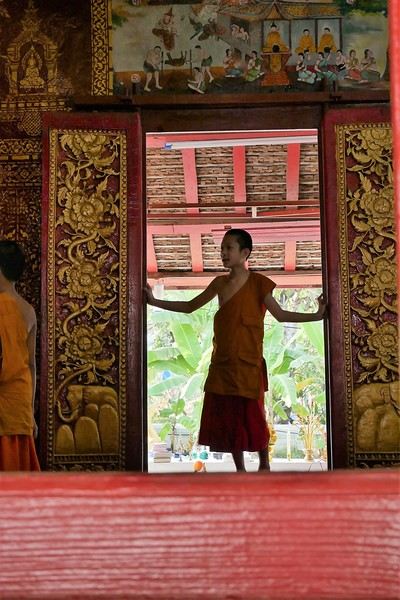 Come along, I'm taking you to this country where it's so nice to wander and slow down...
This trip was in 2023, but when I wanted to write my travel journal, VF was still closed to contributions... So, now that I've just finished my Japan travel journal here, I figured it was high time to honor this destination we came back from so enchanted. Disclaimer 1: This is a written travel journal. There’ll be text! Too much, for some! Disclaimer 2: This is an illustrated travel journal. There’ll be photos! Too many, for some!
I have to say, every time I try to discipline myself, to keep it shorter, to include fewer photos... I end up adding more. It feels like my dear Aunt Nicole, who exhausted us with her slide-show evenings in the 70s/80s, decided to take her revenge. The upside for you, readers, is that you can slip away anytime without offending Aunt Nicole. I won’t even notice!
Anyway, since I love maps, here’s one to give you an idea of where I’m taking you. As you can see, we only saw a tiny part of Laos (the areas circled in red); we only had 3 weeks for ourselves (my husband’s newly retired, I still work), and we prefer taking our time over rushing around like crazy.
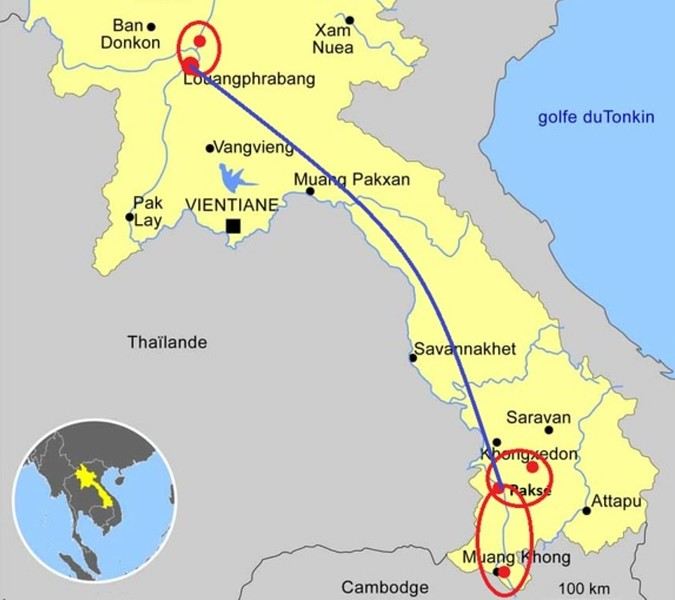
In broad strokes, it was very classic:
First, we “settled in” at Luang Prabang (8 days), because we wanted and needed to. From there, we took three days to venture a little further north—not far in kilometers, but as we know, distances aren’t just about km! Then we flew south to Paksé, letting ourselves drift down to the 4,000 Islands while stopping by the pre-Angkorian archaeological sites. We wrapped up with the Bolaven Plateau.
A few practical notes: We arrived via Bangkok, then took a Bangkok-Luang Prabang flight, having picked up our luggage in Bangkok to check it in for Luang Prabang. No issues—the Bangkok airport, which many of you know, is very well organized. We got our visas on arrival in Luang Prabang. Quick, but to be fair, we were on a “small” plane, and the big flights had arrived earlier, so we weren’t too crowded in line! At the end of our trip, we didn’t fly out of Paksé but from the nearby airport in Thailand, Ubon Ratchathani (a 2.5-hour drive from Paksé), then Bangkok and Paris. You’ll notice we skipped Vientiane to stay longer in Luang Prabang. That said, there’s now a high-speed train between Vientiane and Luang Prabang—good to know—and soon the (Chinese) train will go all the way to Bangkok and even Kuala Lumpur!
With that intro out of the way, let’s dive into the heart of the matter. To be continued: Slowing down the pace... in Luang Prabang
3-Week Itinerary - Santiago, Fogo & Maio - Family of 5
Hello,
We’re a family of 5 (2 adults and 3 kids who’ll be 2, 7, and 10 years old) planning to visit the islands of Santiago, Fogo, and Maio this summer. We’ll have 22 full days on the ground. It’s a shame (financially, logistically, and environmentally speaking!), but we’ll be taking 4 flights: a round-trip from Santiago to Fogo and another from Santiago to Maio. We’d like to position Maio toward the end of our stay since we enjoy ending our trips with a quieter beach phase.
For now, based on flight schedules and dates, we’re thinking of doing: 23/07: Arrival in Santiago 24/07 – 30/07: Fogo (5 full days) 30/07 – 05/08: Santiago (5 full days) 05/08 – 11/08: Maio (5 full days) 11/08 – 15/08: Santiago (3 full days) 15/08: Return to France
FOGO: Of course, we want to visit Cha das Caldeiras, where we’d like to spend 3 nights. We’d love to explore the valley and are also considering hiking the smaller Pico (the taller one seems too ambitious for us with the kids). Do you have any info on that hike? What else do you recommend doing on the other days? Where can we go for other walks? I’ve seen that it’s possible to descend from Cha das Caldeiras to Monteiros, but I’m worried it might still be too challenging. It looks amazing!! But how do we manage with our luggage? Otherwise, the north of the island intrigues me, though we’re not thrilled about São Filipe, even though we know we’ll have to spend at least one night there before returning to Santiago.
On this island, we initially thought about not renting a car, but I’m wondering if that’s a good idea for us with all the luggage. If we do rent one, is it easy to reach Cha das Caldeiras by car? Any advice is welcome!
MAIO: Here, I think renting a car will be essential for us to get around easily. We’d like to do an excursion to observe turtle nesting. I haven’t found much info on this—where and with whom should we go? Otherwise, the plan is to do some snorkeling directly from the beach, independently, since we’ll need to take turns so one adult can stay with our 2-year-old. Any spots you’d recommend?
Which towns would you suggest staying in? All options work for us—we’re fine with settling in one place or splitting our time (e.g., 3 nights in one spot and 3 nights elsewhere).
Basically, I’m open to all tips and recommendations for this little week on Maio (short walks, places to relax, beaches, etc.)!
SANTIAGO: Nothing too original, but for Santiago, we’re considering visiting Cidade Velha, Tarrafal, and Ribeira da Prata (for the black sand beach and natural pools), as well as Serra Malagueta for a hike. There must be so much more to do, especially with the time we have. What else would you recommend?
I’m struggling to figure out how to organize our time there since we’ll have 5 full days first, then 3 more. How would you do it?
Thanks,
For now, based on flight schedules and dates, we’re thinking of doing: 23/07: Arrival in Santiago 24/07 – 30/07: Fogo (5 full days) 30/07 – 05/08: Santiago (5 full days) 05/08 – 11/08: Maio (5 full days) 11/08 – 15/08: Santiago (3 full days) 15/08: Return to France
FOGO: Of course, we want to visit Cha das Caldeiras, where we’d like to spend 3 nights. We’d love to explore the valley and are also considering hiking the smaller Pico (the taller one seems too ambitious for us with the kids). Do you have any info on that hike? What else do you recommend doing on the other days? Where can we go for other walks? I’ve seen that it’s possible to descend from Cha das Caldeiras to Monteiros, but I’m worried it might still be too challenging. It looks amazing!! But how do we manage with our luggage? Otherwise, the north of the island intrigues me, though we’re not thrilled about São Filipe, even though we know we’ll have to spend at least one night there before returning to Santiago.
On this island, we initially thought about not renting a car, but I’m wondering if that’s a good idea for us with all the luggage. If we do rent one, is it easy to reach Cha das Caldeiras by car? Any advice is welcome!
MAIO: Here, I think renting a car will be essential for us to get around easily. We’d like to do an excursion to observe turtle nesting. I haven’t found much info on this—where and with whom should we go? Otherwise, the plan is to do some snorkeling directly from the beach, independently, since we’ll need to take turns so one adult can stay with our 2-year-old. Any spots you’d recommend?
Which towns would you suggest staying in? All options work for us—we’re fine with settling in one place or splitting our time (e.g., 3 nights in one spot and 3 nights elsewhere).
Basically, I’m open to all tips and recommendations for this little week on Maio (short walks, places to relax, beaches, etc.)!
SANTIAGO: Nothing too original, but for Santiago, we’re considering visiting Cidade Velha, Tarrafal, and Ribeira da Prata (for the black sand beach and natural pools), as well as Serra Malagueta for a hike. There must be so much more to do, especially with the time we have. What else would you recommend?
I’m struggling to figure out how to organize our time there since we’ll have 5 full days first, then 3 more. How would you do it?
Thanks,
Upcoming Jet Fuel Shortage in Vietnam and Sri Lanka
Hi!
Sri Lanka has announced it could run out of fuel in the coming weeks if the Strait of Hormuz remains blocked. The government has implemented a mandatory four-day workweek to save oil, and there are long lines at gas stations due to fears of an early shortage.
In Vietnam, the government has warned all airlines that flights will need to be reduced due to a lack of kerosene. The country imports two-thirds of its jet fuel from China and Thailand, but both countries have now banned exports out of fear of domestic shortages.
The state is asking airlines to plan ahead and park aircraft to drastically reduce operations, starting with domestic flights and then international ones. International carriers will also need to cut back on their rotations.
This will begin in the coming days. 🙁
What foods can I bring to Kyrgyzstan?
Hi there! 🙂
I’m not planning to bring all my meals for the 3 weeks of travel, but I’d like to spice up my picnic lunches and a few dinners in this country that’s not exactly known for its cuisine...
I’ve seen that fruits and vegetables are easy to find. Bread is also no problem.
I’m a bit unsure about the local cheese, but I’ll manage.
Actually, it’s what I’d put in my sandwiches that I’d like to pack: cured sausage, pâtés.
Are these foods allowed through customs?
Also, I’m thinking that bringing 3-4 freeze-dried meals could be a good option. I’ve never bought any before. Which brands are the most flavorful?
I’ve also noticed that real coffee is rare. (Meaning Kyrgyz people drink Nescafé. Sacrilege!) Can I easily find coffee there to make my own?
Finally, which supermarket chain is the best? (Meaning the one with the most variety and, above all, quality!)
Last question: where can I buy a gas stove in Bishkek? (I’ve heard that local gas canisters aren’t compatible with the stove I already own)
Thanks!
I’m not planning to bring all my meals for the 3 weeks of travel, but I’d like to spice up my picnic lunches and a few dinners in this country that’s not exactly known for its cuisine...
I’ve seen that fruits and vegetables are easy to find. Bread is also no problem.
I’m a bit unsure about the local cheese, but I’ll manage.
Actually, it’s what I’d put in my sandwiches that I’d like to pack: cured sausage, pâtés.
Are these foods allowed through customs?
Also, I’m thinking that bringing 3-4 freeze-dried meals could be a good option. I’ve never bought any before. Which brands are the most flavorful?
I’ve also noticed that real coffee is rare. (Meaning Kyrgyz people drink Nescafé. Sacrilege!) Can I easily find coffee there to make my own?
Finally, which supermarket chain is the best? (Meaning the one with the most variety and, above all, quality!)
Last question: where can I buy a gas stove in Bishkek? (I’ve heard that local gas canisters aren’t compatible with the stove I already own)
Thanks!
Shows and facilities on the MSC World Europa
Hi everyone,
I’m leaving at the end of March 2026 with 8 friends to celebrate an event on the MSC World Europa. I’ve been cruising for over 20 years with all kinds of companies and under many skies, but I’ve never traveled on a ship this size (6,800 people), and some specific info about this ship would be really helpful.
So, to those who’ve been on this boat before—thanks in advance!
SHOWS: Is it true that you have to book the evening show?... Just to secure a spot, or is it an internal rule?
THE SPA: Are the saunas and hammams mixed-gender? Are there several of them? Which pools are available?
SPORTS: Are there any “spaces” where ball sports like volleyball or basketball can be played?
Finally, is the management of passengers flexible and friendly, or quite strict?
Thanks!
Happy cruising.
Francis.
Too much info: which quiet island to choose in Thailand for beach time and snorkeling?
Hi there,
We're heading to Thailand with our two kids (9 years old) for two weeks next February (2026). We plan to rent a car to stay independent and explore a bit off the beaten path. Still, we'd like to spend 1 or 2 nights on a nice, quiet island—just for some relaxation and especially snorkeling (even though I know it's not the best country for beautiful corals).
I've read dozens of forum pages and travel journals, but I'm still overwhelmed and can't decide where to go for a peaceful paradise-like beach with good snorkeling opportunities. We don’t need comfort—Robinson Crusoe-style camping or hammock nights work perfectly for us. No electricity or signal is totally fine. We just don’t want to pay 1000 € for a family of four to go to the Surin Islands, even if they do look like paradise.
Any suggestions?
I've read dozens of forum pages and travel journals, but I'm still overwhelmed and can't decide where to go for a peaceful paradise-like beach with good snorkeling opportunities. We don’t need comfort—Robinson Crusoe-style camping or hammock nights work perfectly for us. No electricity or signal is totally fine. We just don’t want to pay 1000 € for a family of four to go to the Surin Islands, even if they do look like paradise.
Any suggestions?
Exploring Senja Island and the Lofoten Archipelago
Hi everyone,
We traveled to Norway in the summer of 2025, from July 17 to 29, to visit Senja Island and the Lofoten archipelago with a rental car. The common thread of these twelve days was clearly hiking, along with a few visits and experiences, and nights spent in a tent or in the car (which made it possible). We chose Narvik Airport for both arrival and departure for several complementary reasons: the desire to visit nearby Senja Island, slightly more affordable airfare, and finally, the rental price of the vehicle—especially the car model we were looking for. We only made one reservation, for the first campsite, as sleeping in a tent made things much easier. But we had the whole structure of the trip planned, a flexible outline that could adapt to the weather conditions we’d encounter. Senja Island isn’t part of the Lofoten archipelago, and during the early stages of planning this trip, we hadn’t planned to visit it. But its relative proximity to Narvik Airport and, above all, its unique geography definitely made us change our minds. We arrived in Evenes, where Narvik Airport is located, nearly 60 km from the city itself. Our first stop was 40 km further in Bjerkvik on the way to Senja, where there’s a Rema 1000 (a very common supermarket chain in Norway). We needed to buy some food and a gas cartridge for our stove. I’d emailed the store manager beforehand, who told me they didn’t sell them but that the two gas stations in the village were likely to have some in stock.
It was only at the Esso station that I found what I needed, but unfortunately, only one cartridge. Luckily, we quickly realized that most campsites (like in Iceland) have a shared kitchen with hotplates. That single small cartridge was just enough for the few nights we spent outside of campsites... We got our first taste of Norway’s characteristic landscapes: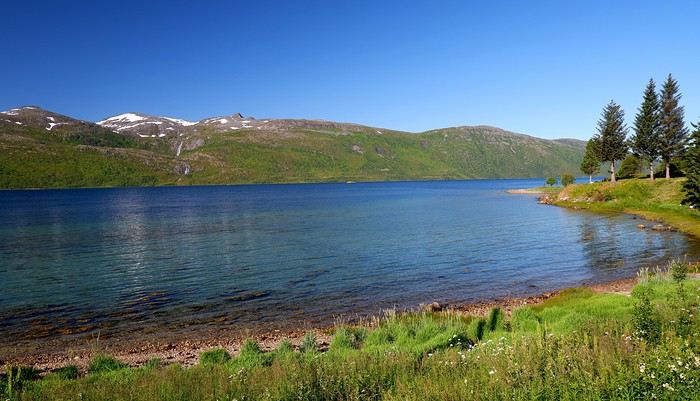
When we arrived at the Senja campsite, it was already 9:30 PM. A sign announced it was full, but luckily, I’d booked it 10 days earlier. By 10:30 PM, as we settled in to eat, it was still broad daylight, and the thermometer read 25°C—despite being at a latitude of 69° North! We went to bed around midnight, exhausted but under the light of a sun that was still very much present. Thanks to Earth’s tilted axis. We’d anticipated this by buying opaque sleep masks because, yes, at this time of year, it’s daylight all the time.
Friday, July 18:
Today, we planned two hikes on the island and a few stops along the way. The map clearly shows that the deepest fjords are in the north and west. Due to time and accessibility, we focused on the northern part of the island. Our first stop was at the viewing platform in Bergbotn:
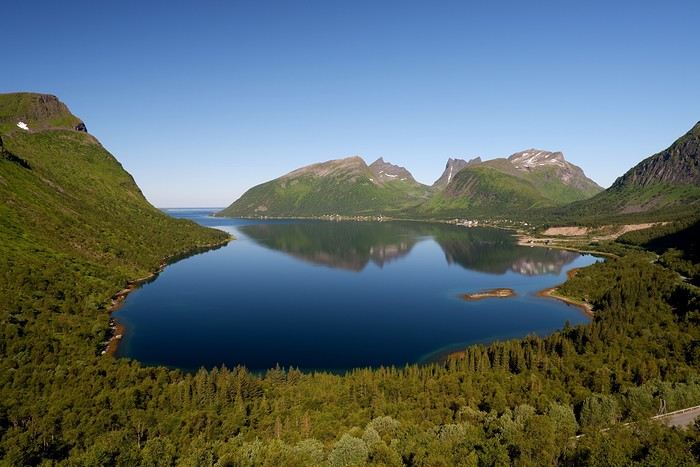
Then we headed toward Skaland, the starting point for our first hike. Along the way, we found plenty of reasons to stop—especially since, on this first day of travel, our thirst for Nordic landscapes was far from quenched.
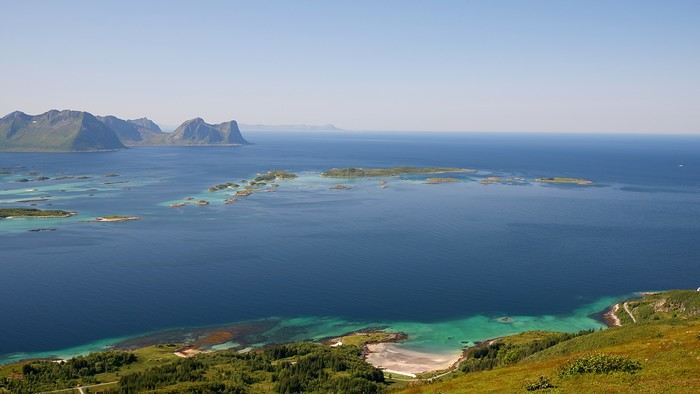
The town of Skaland is very practical: free parking, picnic tables for after the hike, and a Joker convenience store right next door. Our goal was the summit of Husfjellet: 670 m of elevation gain, between 8 and 9 km in length, and an estimated 4 hours and 30 minutes.
This hike offers two major viewpoints. The first overlooks the Bergsoyan islands to the west:
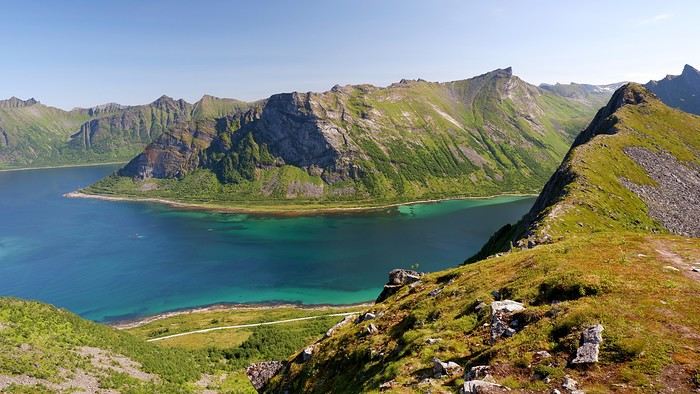
At the summit, the view shifts to the Steinfjorden fjord:
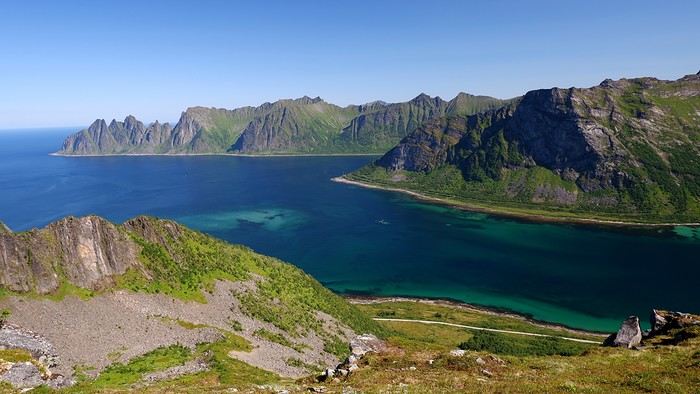
You can even clearly see the "Devil’s Teeth," which we’d see from below later:
In total, the hike took us 4 hours and 30 minutes, including all the breaks. We treated ourselves to an ice cream in Skaland to recharge for the next hike. We hit the road again and stopped at Tungeneset to get a closer look at the Devil’s Teeth:
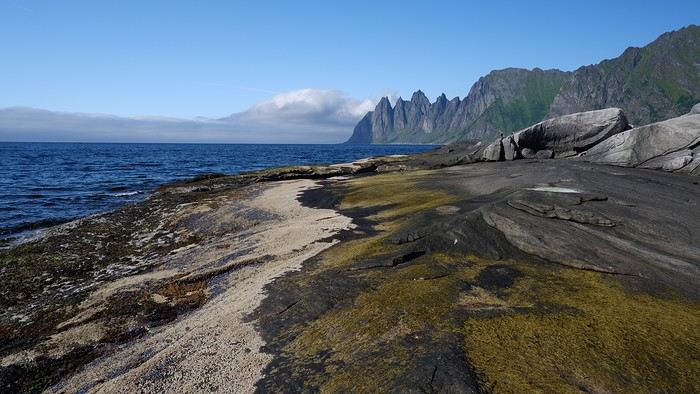
We continued to Fjordgard, the starting point for our second hike. Fjordgard isn’t very welcoming. There was a time when you could park right at the start of the hike up Mount Segla. Now, everything’s blocked off, and locals have even taken to blocking all possible parking spots nearby. You now have to park outside the town at a paid parking lot (90 NOK for 3 hours), adding an extra 2 km (round trip) of walking. Still, that was just a minor inconvenience because the hike that followed quickly made us forget all about it. The hike is fairly short (2 hours) but still has 520 m of elevation gain. This hike was a stark contrast to the first. This morning, we had sweeping views of the vast landscape. Here, Mount Segla, perched on the edge of the cliff, dominates the foreground:
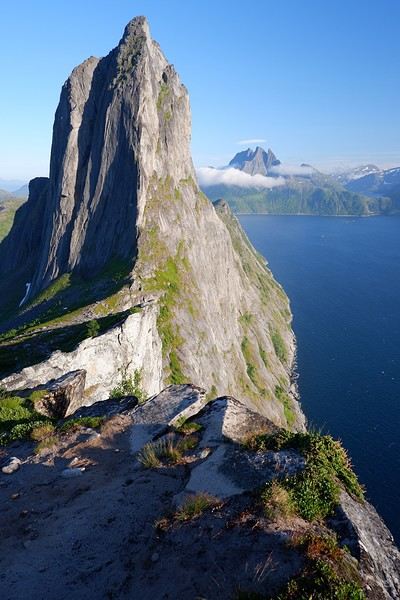
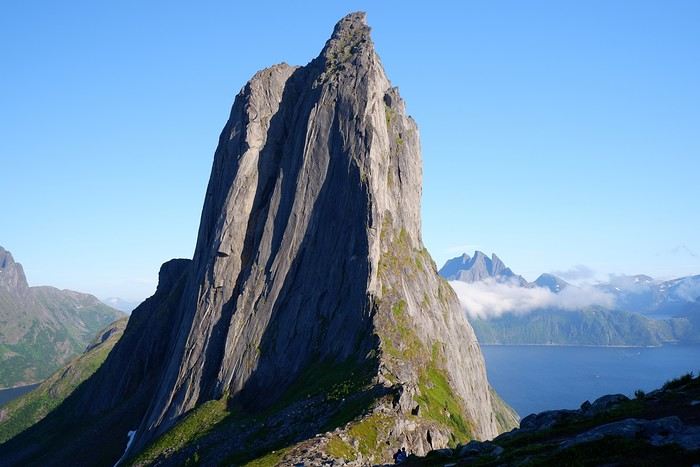
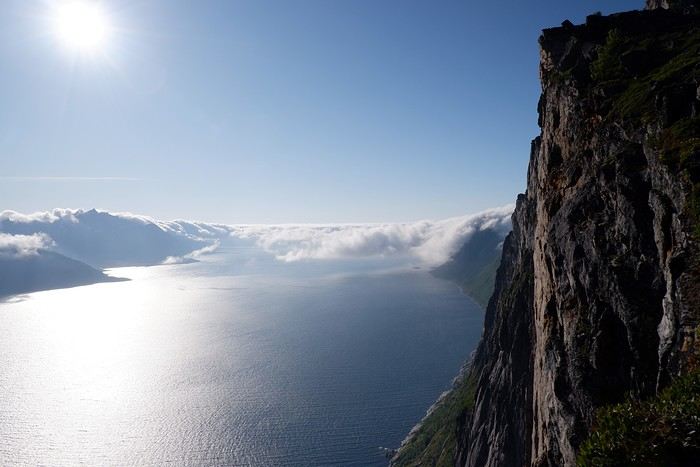
For those prone to vertigo, it might be best to stay at the foot of the mountain, as the trail climbs right along the cliff edge. And from that point on, you quickly understand what verticality really means...
In total, we took 2 hours and 50 minutes, including breaks and the extra walk to the parking lot. The day was already well underway, and with 1,200 m of cumulative elevation gain, it was time to find a spot to eat and sleep. Since we hadn’t made any reservations, we’d planned to bivouac for the night. We weren’t too picky—just practical—so we decided to sleep in the car at the parking lot for tomorrow morning’s hike, just 5 km from Fjordgard.
We traveled to Norway in the summer of 2025, from July 17 to 29, to visit Senja Island and the Lofoten archipelago with a rental car. The common thread of these twelve days was clearly hiking, along with a few visits and experiences, and nights spent in a tent or in the car (which made it possible). We chose Narvik Airport for both arrival and departure for several complementary reasons: the desire to visit nearby Senja Island, slightly more affordable airfare, and finally, the rental price of the vehicle—especially the car model we were looking for. We only made one reservation, for the first campsite, as sleeping in a tent made things much easier. But we had the whole structure of the trip planned, a flexible outline that could adapt to the weather conditions we’d encounter. Senja Island isn’t part of the Lofoten archipelago, and during the early stages of planning this trip, we hadn’t planned to visit it. But its relative proximity to Narvik Airport and, above all, its unique geography definitely made us change our minds. We arrived in Evenes, where Narvik Airport is located, nearly 60 km from the city itself. Our first stop was 40 km further in Bjerkvik on the way to Senja, where there’s a Rema 1000 (a very common supermarket chain in Norway). We needed to buy some food and a gas cartridge for our stove. I’d emailed the store manager beforehand, who told me they didn’t sell them but that the two gas stations in the village were likely to have some in stock.
It was only at the Esso station that I found what I needed, but unfortunately, only one cartridge. Luckily, we quickly realized that most campsites (like in Iceland) have a shared kitchen with hotplates. That single small cartridge was just enough for the few nights we spent outside of campsites... We got our first taste of Norway’s characteristic landscapes:
When we arrived at the Senja campsite, it was already 9:30 PM. A sign announced it was full, but luckily, I’d booked it 10 days earlier. By 10:30 PM, as we settled in to eat, it was still broad daylight, and the thermometer read 25°C—despite being at a latitude of 69° North! We went to bed around midnight, exhausted but under the light of a sun that was still very much present. Thanks to Earth’s tilted axis. We’d anticipated this by buying opaque sleep masks because, yes, at this time of year, it’s daylight all the time.
Friday, July 18:
Today, we planned two hikes on the island and a few stops along the way. The map clearly shows that the deepest fjords are in the north and west. Due to time and accessibility, we focused on the northern part of the island. Our first stop was at the viewing platform in Bergbotn:
Then we headed toward Skaland, the starting point for our first hike. Along the way, we found plenty of reasons to stop—especially since, on this first day of travel, our thirst for Nordic landscapes was far from quenched.
The town of Skaland is very practical: free parking, picnic tables for after the hike, and a Joker convenience store right next door. Our goal was the summit of Husfjellet: 670 m of elevation gain, between 8 and 9 km in length, and an estimated 4 hours and 30 minutes.
This hike offers two major viewpoints. The first overlooks the Bergsoyan islands to the west:
At the summit, the view shifts to the Steinfjorden fjord:
You can even clearly see the "Devil’s Teeth," which we’d see from below later:
In total, the hike took us 4 hours and 30 minutes, including all the breaks. We treated ourselves to an ice cream in Skaland to recharge for the next hike. We hit the road again and stopped at Tungeneset to get a closer look at the Devil’s Teeth:
We continued to Fjordgard, the starting point for our second hike. Fjordgard isn’t very welcoming. There was a time when you could park right at the start of the hike up Mount Segla. Now, everything’s blocked off, and locals have even taken to blocking all possible parking spots nearby. You now have to park outside the town at a paid parking lot (90 NOK for 3 hours), adding an extra 2 km (round trip) of walking. Still, that was just a minor inconvenience because the hike that followed quickly made us forget all about it. The hike is fairly short (2 hours) but still has 520 m of elevation gain. This hike was a stark contrast to the first. This morning, we had sweeping views of the vast landscape. Here, Mount Segla, perched on the edge of the cliff, dominates the foreground:
For those prone to vertigo, it might be best to stay at the foot of the mountain, as the trail climbs right along the cliff edge. And from that point on, you quickly understand what verticality really means...
In total, we took 2 hours and 50 minutes, including breaks and the extra walk to the parking lot. The day was already well underway, and with 1,200 m of cumulative elevation gain, it was time to find a spot to eat and sleep. Since we hadn’t made any reservations, we’d planned to bivouac for the night. We weren’t too picky—just practical—so we decided to sleep in the car at the parking lot for tomorrow morning’s hike, just 5 km from Fjordgard.
24 Days in Réunion/Mauritius: Feedback on My Itinerary
Hello!
My wife and I (Quebecers, 63 years old, retired, celebrating our 45 years together this year, including 20 years of marriage) have chosen to mark the occasion with a trip to Dubai, Réunion, and Mauritius (4 days in Dubai, then 24 days on the islands).
We have a lot of experience planning road trips (scouting routes, visits, hotels, and restaurants of interest), but we travel without reservations to keep the freedom to follow our instincts and tips we get on the spot. We’re moderately active physically and prefer the countryside and beaches over big cities. Our only fixed dates: arrival in Réunion on October 5th and departure from Mauritius on October 29th.
After lots of reading and with the help of an AI (super useful for drafting a first outline!), here’s a possible itinerary framework. Nothing is set in stone—I’d love your suggestions, comments, and thoughts on what’s worth adding or avoiding. Are the proposed bases optimal? Also, if you have recommendations for hotels (mid-range budget of 100–200 euros per night), restaurants, etc., I’m all ears! ;-)
Thanks! 😊
🌴 Réunion (October 5–13, 9 days) Base 1 – Saint-Gilles / L’Hermitage (October 5–8, 3 nights) Oct 5 (Sun): Settle in, relax at L’Hermitage beach. Oct 6 (Mon): Saint-Paul market (morning), beach + sunset at Boucan Canot. Oct 7 (Tue): Excursion to Maïdo (view of Mafate), return via Saint-Leu (Stella Matutina). Oct 8 (Wed): Beach + dolphin/whale-watching boat trip.
Base 2 – Cilaos (October 8–10, 2 nights) Oct 9 (Thu): Route des 400 virages, stroll through the village and Roche Merveilleuse. Oct 10 (Fri): Hike to Bras Rouge (3–4h) or the Chapelle canyon. Creole inn evening.
Base 3 – Plaine des Cafres / Bourg-Murat (October 10–13, 3 nights) Oct 11 (Sat): Road to the volcano → Plaine des Sables → Piton de la Fournaise. Oct 12 (Sun): Wild south coast at Cap Méchant, lava flows, Jardin Parfums, Grande Anse beach. Oct 13 (Mon): Relaxed morning, flight from Réunion to Mauritius.
🏝️ Mauritius (October 13–29, 16 days) Base 1 – Grand Baie / Pereybère (October 13–18, 5 nights) Oct 13 (Mon): Settle in, swim at Mont Choisy. Oct 14 (Tue): Boat excursion to Île Plate & Coin de Mire. Oct 15 (Wed): Pamplemousses Garden + L’Aventure du Sucre. Evening in Grand Baie. Oct 16 (Thu): Trou aux Biches beach, snorkeling. Oct 17 (Fri): Free day, relaxation/shopping.
Base 2 – Flic-en-Flac / Tamarin (October 18–23, 5 nights) Oct 18 (Sat): Drive to the west, settle in, beach. Oct 19 (Sun): Dolphin excursion in Tamarin, relax in the afternoon. Oct 20 (Mon): Chamarel: Terres 7 Couleurs + rum distillery. Oct 21 (Tue): Black River Gorges (hike + waterfalls). Oct 22 (Wed): Snorkeling + sunset.
Base 3 – Belle Mare / Trou d’Eau Douce (October 23–26, 3 nights) Oct 23 (Thu): Settle in, Belle Mare beach. Oct 24 (Fri): Catamaran excursion to Île aux Cerfs. Oct 25 (Sat): Flacq market (morning), beach in the afternoon.
Base 4 – Mahébourg / Blue Bay (October 26–29, 3 nights) Oct 26 (Sun): Settle in, snorkeling at Blue Bay Marine Park. Oct 27 (Mon): Pointe d’Esny + Île aux Aigrettes. Oct 28 (Tue): Free beach day + Mahébourg village. Oct 29 (Wed): Morning swim, return flight at 4 PM (airport is 15 min away).
My wife and I (Quebecers, 63 years old, retired, celebrating our 45 years together this year, including 20 years of marriage) have chosen to mark the occasion with a trip to Dubai, Réunion, and Mauritius (4 days in Dubai, then 24 days on the islands).
We have a lot of experience planning road trips (scouting routes, visits, hotels, and restaurants of interest), but we travel without reservations to keep the freedom to follow our instincts and tips we get on the spot. We’re moderately active physically and prefer the countryside and beaches over big cities. Our only fixed dates: arrival in Réunion on October 5th and departure from Mauritius on October 29th.
After lots of reading and with the help of an AI (super useful for drafting a first outline!), here’s a possible itinerary framework. Nothing is set in stone—I’d love your suggestions, comments, and thoughts on what’s worth adding or avoiding. Are the proposed bases optimal? Also, if you have recommendations for hotels (mid-range budget of 100–200 euros per night), restaurants, etc., I’m all ears! ;-)
Thanks! 😊
🌴 Réunion (October 5–13, 9 days) Base 1 – Saint-Gilles / L’Hermitage (October 5–8, 3 nights) Oct 5 (Sun): Settle in, relax at L’Hermitage beach. Oct 6 (Mon): Saint-Paul market (morning), beach + sunset at Boucan Canot. Oct 7 (Tue): Excursion to Maïdo (view of Mafate), return via Saint-Leu (Stella Matutina). Oct 8 (Wed): Beach + dolphin/whale-watching boat trip.
Base 2 – Cilaos (October 8–10, 2 nights) Oct 9 (Thu): Route des 400 virages, stroll through the village and Roche Merveilleuse. Oct 10 (Fri): Hike to Bras Rouge (3–4h) or the Chapelle canyon. Creole inn evening.
Base 3 – Plaine des Cafres / Bourg-Murat (October 10–13, 3 nights) Oct 11 (Sat): Road to the volcano → Plaine des Sables → Piton de la Fournaise. Oct 12 (Sun): Wild south coast at Cap Méchant, lava flows, Jardin Parfums, Grande Anse beach. Oct 13 (Mon): Relaxed morning, flight from Réunion to Mauritius.
🏝️ Mauritius (October 13–29, 16 days) Base 1 – Grand Baie / Pereybère (October 13–18, 5 nights) Oct 13 (Mon): Settle in, swim at Mont Choisy. Oct 14 (Tue): Boat excursion to Île Plate & Coin de Mire. Oct 15 (Wed): Pamplemousses Garden + L’Aventure du Sucre. Evening in Grand Baie. Oct 16 (Thu): Trou aux Biches beach, snorkeling. Oct 17 (Fri): Free day, relaxation/shopping.
Base 2 – Flic-en-Flac / Tamarin (October 18–23, 5 nights) Oct 18 (Sat): Drive to the west, settle in, beach. Oct 19 (Sun): Dolphin excursion in Tamarin, relax in the afternoon. Oct 20 (Mon): Chamarel: Terres 7 Couleurs + rum distillery. Oct 21 (Tue): Black River Gorges (hike + waterfalls). Oct 22 (Wed): Snorkeling + sunset.
Base 3 – Belle Mare / Trou d’Eau Douce (October 23–26, 3 nights) Oct 23 (Thu): Settle in, Belle Mare beach. Oct 24 (Fri): Catamaran excursion to Île aux Cerfs. Oct 25 (Sat): Flacq market (morning), beach in the afternoon.
Base 4 – Mahébourg / Blue Bay (October 26–29, 3 nights) Oct 26 (Sun): Settle in, snorkeling at Blue Bay Marine Park. Oct 27 (Mon): Pointe d’Esny + Île aux Aigrettes. Oct 28 (Tue): Free beach day + Mahébourg village. Oct 29 (Wed): Morning swim, return flight at 4 PM (airport is 15 min away).
6-Day Tokyo Visit Itinerary
Hi there! 😉
I’ve already created a post for our entire trip to Japan, but I’d love to focus specifically on our stay in Tokyo here. We (two couples of friends) will be spending 6 full days there in early November. Here’s what we’ve planned so far. We’d really appreciate your feedback to validate—or not—our schedule, and especially to hear your tips. Thanks in advance! 😉
DAY 0: Arrival in Tokyo in the evening, so rest and dinner near the hotel.
DAY 1:
09:00 – Shinjuku Gyoen Park
Must-see: ✔ Japanese garden (red bridge, pond) ✔ French garden (perspective and rose garden) ✔ English garden (lawns and maple trees) Photo spot: Red bridge + red maples (koyo).
11:00 – Harajuku & Takeshita Street
Walking route:
Start with Takeshita-dori (kawaii fashion, Japanese crepes). Walk up to Omotesandō (designer architecture: Dior, Prada).
Don’t miss: ✔ Kiddy Land (toys, souvenirs) ✔ Tokyu Plaza Omotesandō (entrance with escalators and mirrors → iconic photo)
12:30 – Lunch
Afuri Harajuku (yuzu ramen, light and fragrant). Alternative: Uogashi Nihon-Ichi (standing sushi, quick and fresh).
14:00 – Meiji-jingū (optional but recommended)
Access: From Omotesandō, enter through the large wooden torii. Must-see: ✔ Decorative sake barrels ✔ Forest path (zen atmosphere) ✔ Main pavilion (respect the purification ritual at the entrance). Duration: 45 min.
16:30 – Return to hotel / rest
JR Yamanote Line from Harajuku → Shinjuku (5 min).
18:30 – Evening in Yurakucho (Gado-shita)
DAY 2 09:00 – Visit to Asakusa
Walking route:
Kaminarimon Gate → photo under the large red lantern. Nakamise-dori → shopping street (souvenirs, snacks: melon pan, senbei). Sensō-ji Temple → main pavilion, five-story pagoda.
Don’t miss: ✔ Omikuji (fortune-telling draw) ✔ Photo with the pagoda and Tokyo Skytree in the background.
11:30 – Akihabara
Walking route: ✔ Yodobashi Camera (gadgets, electronics) ✔ Mandarake (figurines, manga) ✔ Super Potato (retro games)
13:00 – Lunch
Quick option: Ichiran Ramen (Akihabara). Local option: Tendon Tenya (affordable tempura).
14:30 – Free time / shopping
Explore the small alleys for anime shops, figurines, gashapon.
16:30 – Departure for Toyosu (teamLab Planets)
Transport:
JR Yamanote Line from Akihabara → Shimbashi (15 min) Yurikamome Line from Shimbashi → Shin-Toyosu (15 min)
Tip: Book a 6:30 PM slot to enjoy the evening atmosphere.
18:30 – teamLab Planets
Duration: 1.5 to 2 hours. Tip: Bring a towel (barefoot experience in water). Mandatory reservation: (official website).
20:30 – Dinner
Option on-site: DMM Café (Toyosu). Option back in Shinjuku: Izakaya (Torikizoku or Teyandei).
DAY 3:
Excursion to Mount Fuji (Kawaguchiko)
DAY 4:
09:00 – East Gardens of the Imperial Palace
Must-see: ✔ Ruins of Edo Castle ✔ Nijubashi Bridge (iconic photo) ✔ Museum of the Imperial Collections (free) Duration: 1h15. Tip: Open exceptionally this day (public holiday).
10:30 – Walk to Ginza
Walk: 15 min via Marunouchi Naka-dori (chic street with shops and cafés). Tip: Enjoy the autumn decorations and designer façades.
11:00 – Ginza
Must-see: ✔ Ginza Six (modern shopping center) ✔ Nissan Crossing (futuristic car exhibit) ✔ Wako Clock Tower (iconic photo)
14:30 – Shibuya
Walking route: ✔ Shibuya Crossing (photo from Starbucks Tsutaya) ✔ Hachikō Statue ✔ Shibuya Scramble Square → Shibuya Sky (panoramic view of Tokyo and Mount Fuji if the sky is clear). Shopping: Loft, Tokyu Hands, Shibuya 109 (fashion).
17:30 – Return to hotel / rest
JR Yamanote Line from Shibuya → Shinjuku (7 min).
19:30 – Dinner
Izakaya option: Izakaya Tofuro Shinjuku (traditional atmosphere). Modern option: Nabezo Shinjuku (all-you-can-eat shabu-shabu).
DAY 5:
10:00 – Ghibli Museum
Duration: 2 hours. Must-see: ✔ Permanent exhibits (Totoro, My Neighbor Totoro, Spirited Away) ✔ Exclusive short films (Saturn Theater) Tip: Photos are not allowed inside, but there are beautiful spots outside.
12:00 – Stroll in Inokashira Park
Must-see: ✔ Central pond (boat rental available) ✔ Benzaiten Shrine Duration: 30 min.
14:30 – Nakameguro & Daikanyama
Transport: JR Chuo Line from Mitaka → Shibuya, then Tokyu Toyoko Line → Nakameguro (40 min). Must-see: ✔ Walk along the Meguro River (trendy cafés, design shops) ✔ T-Site Daikanyama (magnificent architecture) Coffee break: Onibus Coffee Nakameguro (artisanal coffee).
17:30 – Return to Shinjuku
Transport: Tokyu Toyoko Line → Shibuya → JR Yamanote Line → Shinjuku.
DAY 6:
Free morning (shopping or relaxation)
Suggestions: ✔ Shopping at Lumine Shinjuku or Isetan ✔ Stop by Don Quijote for souvenirs ✔ Or Thermae-Yu Onsen (if you want a relaxing morning before departure).
14:45 – Arrival in Odaiba
Walking route: ✔ Aqua City (shopping, bay view) ✔ Statue of Liberty (photo with Rainbow Bridge) ✔ DiverCity Tokyo Plaza (giant Gundam statue) Immersive option: Immersive Fort Tokyo (if you want a fun indoor activity).
16:30 – Sunset over Rainbow Bridge
Best spot: Esplanade in front of Aqua City or Odaiba Beach. Photo tip: Wait for the bridge lights to turn on (around 5 PM).
18:30 – Dinner in Odaiba 20:00 – Departure for Tokyo Tower
Transport:
Yurikamome Line from Daiba → Shimbashi → Oedo Line → Akabanebashi (30 min).
Tokyo Tower: ✔ Incredible night view of illuminated Tokyo. ✔ Duration: 45 min to 1 hour.
21:30 – Return to Shinjuku
Transport: Oedo Line → Shinjuku (15 min).
And there you have it—I hope I didn’t go on too long! 😉 Thanks everyone for your advice....
I’ve already created a post for our entire trip to Japan, but I’d love to focus specifically on our stay in Tokyo here. We (two couples of friends) will be spending 6 full days there in early November. Here’s what we’ve planned so far. We’d really appreciate your feedback to validate—or not—our schedule, and especially to hear your tips. Thanks in advance! 😉
DAY 0: Arrival in Tokyo in the evening, so rest and dinner near the hotel.
DAY 1:
09:00 – Shinjuku Gyoen Park
Must-see: ✔ Japanese garden (red bridge, pond) ✔ French garden (perspective and rose garden) ✔ English garden (lawns and maple trees) Photo spot: Red bridge + red maples (koyo).
11:00 – Harajuku & Takeshita Street
Walking route:
Start with Takeshita-dori (kawaii fashion, Japanese crepes). Walk up to Omotesandō (designer architecture: Dior, Prada).
Don’t miss: ✔ Kiddy Land (toys, souvenirs) ✔ Tokyu Plaza Omotesandō (entrance with escalators and mirrors → iconic photo)
12:30 – Lunch
Afuri Harajuku (yuzu ramen, light and fragrant). Alternative: Uogashi Nihon-Ichi (standing sushi, quick and fresh).
14:00 – Meiji-jingū (optional but recommended)
Access: From Omotesandō, enter through the large wooden torii. Must-see: ✔ Decorative sake barrels ✔ Forest path (zen atmosphere) ✔ Main pavilion (respect the purification ritual at the entrance). Duration: 45 min.
16:30 – Return to hotel / rest
JR Yamanote Line from Harajuku → Shinjuku (5 min).
18:30 – Evening in Yurakucho (Gado-shita)
DAY 2 09:00 – Visit to Asakusa
Walking route:
Kaminarimon Gate → photo under the large red lantern. Nakamise-dori → shopping street (souvenirs, snacks: melon pan, senbei). Sensō-ji Temple → main pavilion, five-story pagoda.
Don’t miss: ✔ Omikuji (fortune-telling draw) ✔ Photo with the pagoda and Tokyo Skytree in the background.
11:30 – Akihabara
Walking route: ✔ Yodobashi Camera (gadgets, electronics) ✔ Mandarake (figurines, manga) ✔ Super Potato (retro games)
13:00 – Lunch
Quick option: Ichiran Ramen (Akihabara). Local option: Tendon Tenya (affordable tempura).
14:30 – Free time / shopping
Explore the small alleys for anime shops, figurines, gashapon.
16:30 – Departure for Toyosu (teamLab Planets)
Transport:
JR Yamanote Line from Akihabara → Shimbashi (15 min) Yurikamome Line from Shimbashi → Shin-Toyosu (15 min)
Tip: Book a 6:30 PM slot to enjoy the evening atmosphere.
18:30 – teamLab Planets
Duration: 1.5 to 2 hours. Tip: Bring a towel (barefoot experience in water). Mandatory reservation: (official website).
20:30 – Dinner
Option on-site: DMM Café (Toyosu). Option back in Shinjuku: Izakaya (Torikizoku or Teyandei).
DAY 3:
Excursion to Mount Fuji (Kawaguchiko)
DAY 4:
09:00 – East Gardens of the Imperial Palace
Must-see: ✔ Ruins of Edo Castle ✔ Nijubashi Bridge (iconic photo) ✔ Museum of the Imperial Collections (free) Duration: 1h15. Tip: Open exceptionally this day (public holiday).
10:30 – Walk to Ginza
Walk: 15 min via Marunouchi Naka-dori (chic street with shops and cafés). Tip: Enjoy the autumn decorations and designer façades.
11:00 – Ginza
Must-see: ✔ Ginza Six (modern shopping center) ✔ Nissan Crossing (futuristic car exhibit) ✔ Wako Clock Tower (iconic photo)
14:30 – Shibuya
Walking route: ✔ Shibuya Crossing (photo from Starbucks Tsutaya) ✔ Hachikō Statue ✔ Shibuya Scramble Square → Shibuya Sky (panoramic view of Tokyo and Mount Fuji if the sky is clear). Shopping: Loft, Tokyu Hands, Shibuya 109 (fashion).
17:30 – Return to hotel / rest
JR Yamanote Line from Shibuya → Shinjuku (7 min).
19:30 – Dinner
Izakaya option: Izakaya Tofuro Shinjuku (traditional atmosphere). Modern option: Nabezo Shinjuku (all-you-can-eat shabu-shabu).
DAY 5:
10:00 – Ghibli Museum
Duration: 2 hours. Must-see: ✔ Permanent exhibits (Totoro, My Neighbor Totoro, Spirited Away) ✔ Exclusive short films (Saturn Theater) Tip: Photos are not allowed inside, but there are beautiful spots outside.
12:00 – Stroll in Inokashira Park
Must-see: ✔ Central pond (boat rental available) ✔ Benzaiten Shrine Duration: 30 min.
14:30 – Nakameguro & Daikanyama
Transport: JR Chuo Line from Mitaka → Shibuya, then Tokyu Toyoko Line → Nakameguro (40 min). Must-see: ✔ Walk along the Meguro River (trendy cafés, design shops) ✔ T-Site Daikanyama (magnificent architecture) Coffee break: Onibus Coffee Nakameguro (artisanal coffee).
17:30 – Return to Shinjuku
Transport: Tokyu Toyoko Line → Shibuya → JR Yamanote Line → Shinjuku.
DAY 6:
Free morning (shopping or relaxation)
Suggestions: ✔ Shopping at Lumine Shinjuku or Isetan ✔ Stop by Don Quijote for souvenirs ✔ Or Thermae-Yu Onsen (if you want a relaxing morning before departure).
14:45 – Arrival in Odaiba
Walking route: ✔ Aqua City (shopping, bay view) ✔ Statue of Liberty (photo with Rainbow Bridge) ✔ DiverCity Tokyo Plaza (giant Gundam statue) Immersive option: Immersive Fort Tokyo (if you want a fun indoor activity).
16:30 – Sunset over Rainbow Bridge
Best spot: Esplanade in front of Aqua City or Odaiba Beach. Photo tip: Wait for the bridge lights to turn on (around 5 PM).
18:30 – Dinner in Odaiba 20:00 – Departure for Tokyo Tower
Transport:
Yurikamome Line from Daiba → Shimbashi → Oedo Line → Akabanebashi (30 min).
Tokyo Tower: ✔ Incredible night view of illuminated Tokyo. ✔ Duration: 45 min to 1 hour.
21:30 – Return to Shinjuku
Transport: Oedo Line → Shinjuku (15 min).
And there you have it—I hope I didn’t go on too long! 😉 Thanks everyone for your advice....
Your tips for things to visit during a one-month trip to Martinique
Hi fellow travelers,
We're heading to Martinique for a month from mid-January to mid-February.
Our plan is to explore the island by staying in three different spots for 10 days each, on both sides of the island...
Could you share some great tips on where to stay for an authentic experience and what we absolutely must see?!
Thanks for your help! Voyamie.
Thanks for your help! Voyamie.
3 weeks in Colombia (August 2023)
Why Colombia?
It's quite simple. For the past few years, my daughter has been living with a Colombian from Bogotá. The idea was to discover his country, meet his family, and do part of the trip all four of us together.
We’re heading out first as scouts, then they’ll join us to continue the journey.
The itinerary was shared in another post—now it’s time for the impressions.
No photos, as for me, it’s video and nothing more!
Day 1: The big departure What was planned: A flight from Lyon Saint-Exupéry late morning heading to Frankfurt. Two hours of waiting in Frankfurt (just enough time to eat a pretzel!!) and then off to Bogotá for an arrival around 7 PM local time. I hadn’t done the Check-Mig (to be done 72 hours before the flight). I did it on my phone, giving a fake arrival date in Colombia, and the attendant told me there wouldn’t be any issues in Bogotá. Actually, two hours of delay at departure in Lyon because a sick passenger was on the plane—they had to evacuate him, and the ambulance that was supposed to be there didn’t have permission to come near the plane. Ah, French administrative formalities!!!!! Flight to Frankfurt with Lufthansa went smoothly. A sprint through the airport—very well organized. Connection secured, so we boarded the plane, and two hours later than scheduled, we took off for an 11-hour flight! Arrival in Bogotá, and the immigration process took over an hour and a half because of the crowds. However, no issues with the Check-Mig—they barely glanced at it. Our daughter’s father-in-law ended up waiting over 3 hours at the airport because of this!!! Surprise: No luggage. Luckily, we had packed essentials in our carry-ons! Quick administrative paperwork, and Lufthansa informed me our bags would be on the next flight, so no big deal. Off to our hotel in La Candelaria and a good night’s rest.
The plus: We’re in Bogotá! The minus: Flight delays are becoming more and more common.
Day 1: The big departure What was planned: A flight from Lyon Saint-Exupéry late morning heading to Frankfurt. Two hours of waiting in Frankfurt (just enough time to eat a pretzel!!) and then off to Bogotá for an arrival around 7 PM local time. I hadn’t done the Check-Mig (to be done 72 hours before the flight). I did it on my phone, giving a fake arrival date in Colombia, and the attendant told me there wouldn’t be any issues in Bogotá. Actually, two hours of delay at departure in Lyon because a sick passenger was on the plane—they had to evacuate him, and the ambulance that was supposed to be there didn’t have permission to come near the plane. Ah, French administrative formalities!!!!! Flight to Frankfurt with Lufthansa went smoothly. A sprint through the airport—very well organized. Connection secured, so we boarded the plane, and two hours later than scheduled, we took off for an 11-hour flight! Arrival in Bogotá, and the immigration process took over an hour and a half because of the crowds. However, no issues with the Check-Mig—they barely glanced at it. Our daughter’s father-in-law ended up waiting over 3 hours at the airport because of this!!! Surprise: No luggage. Luckily, we had packed essentials in our carry-ons! Quick administrative paperwork, and Lufthansa informed me our bags would be on the next flight, so no big deal. Off to our hotel in La Candelaria and a good night’s rest.
The plus: We’re in Bogotá! The minus: Flight delays are becoming more and more common.
What to see in Madagascar in 10 days with kids?
Hello,
A few months ago, I posted a message in the Southern Africa section about a family trip in July/August. In the end, since I had too much trouble deciding on the destination and procrastinated too much with the planning 😎, I changed my mind and we’re going for a completely different trip—to Madagascar, a country we already know a bit since we’ve traveled there several times for 4 to 6 months each time, though our last visit was back in 2012!
The tickets are booked: 19 days on the ground (excluding arrival and departure days in Tana), spanning July and August.
We’re not looking to rack up landscapes (and kilometers). The kids really want to see lots of animals, while we mostly want to show them what daily life is like in Malagasy villages. So ideally, we’d like a trip split into two parts: - For 8/10 days, a hiking portion. The idea isn’t to do a tough trek in very remote areas but rather to walk from one village to another. Let’s say 3-4 hours a day. And when we arrive in each village, we’d have time to explore a bit, chat with the locals, let our kids play with the village children, etc. Stay with locals when possible. Move to a new village every day or every 2-3 days. - A few days visiting 1 or 2 national parks (with lemurs if possible to keep everyone happy!) - With the inevitable travel days, we’ll quickly hit 19 days.
Does this kind of trip sound doable (and fun) to you? Do you know of any villages that would fit our hiking plans?
I don’t have a preferred region yet, except that very dry landscapes appeal to me less. My real love from past trips was the highlands and their bright green rice paddies against red earth, but I’m a bit worried about the cold at this time of year.
After my initial research (thanks to this forum), I get the impression that the Ambalavao/Ambohimahamasina area might meet our criteria. I saw there are "accueil paysan" (farm stays) in that area, which could match what we’re looking for and would let us visit Andringitra National Park and Ranomafana on the way there or back.
But I’m open to all your more original ideas!
For logistical questions (transport, guides, accommodations, etc.), I’ll tackle those later—it’ll depend on the area we choose.
Thanks in advance for your suggestions
A few months ago, I posted a message in the Southern Africa section about a family trip in July/August. In the end, since I had too much trouble deciding on the destination and procrastinated too much with the planning 😎, I changed my mind and we’re going for a completely different trip—to Madagascar, a country we already know a bit since we’ve traveled there several times for 4 to 6 months each time, though our last visit was back in 2012!
The tickets are booked: 19 days on the ground (excluding arrival and departure days in Tana), spanning July and August.
We’re not looking to rack up landscapes (and kilometers). The kids really want to see lots of animals, while we mostly want to show them what daily life is like in Malagasy villages. So ideally, we’d like a trip split into two parts: - For 8/10 days, a hiking portion. The idea isn’t to do a tough trek in very remote areas but rather to walk from one village to another. Let’s say 3-4 hours a day. And when we arrive in each village, we’d have time to explore a bit, chat with the locals, let our kids play with the village children, etc. Stay with locals when possible. Move to a new village every day or every 2-3 days. - A few days visiting 1 or 2 national parks (with lemurs if possible to keep everyone happy!) - With the inevitable travel days, we’ll quickly hit 19 days.
Does this kind of trip sound doable (and fun) to you? Do you know of any villages that would fit our hiking plans?
I don’t have a preferred region yet, except that very dry landscapes appeal to me less. My real love from past trips was the highlands and their bright green rice paddies against red earth, but I’m a bit worried about the cold at this time of year.
After my initial research (thanks to this forum), I get the impression that the Ambalavao/Ambohimahamasina area might meet our criteria. I saw there are "accueil paysan" (farm stays) in that area, which could match what we’re looking for and would let us visit Andringitra National Park and Ranomafana on the way there or back.
But I’m open to all your more original ideas!
For logistical questions (transport, guides, accommodations, etc.), I’ll tackle those later—it’ll depend on the area we choose.
Thanks in advance for your suggestions
Visiting Bologna in Photos
Since I didn’t have time to write a proper travel journal, I thought I’d share a few photos of Bologna—a really lovely city I discovered in 2017 while stopping on my way to Tuscany.
Around Piazza Maggiore, which was packed with a stage and chairs for a show, stands the Basilica of San Petronio, massive and Gothic in style, with an unfinished façade (a common sight in Italy).

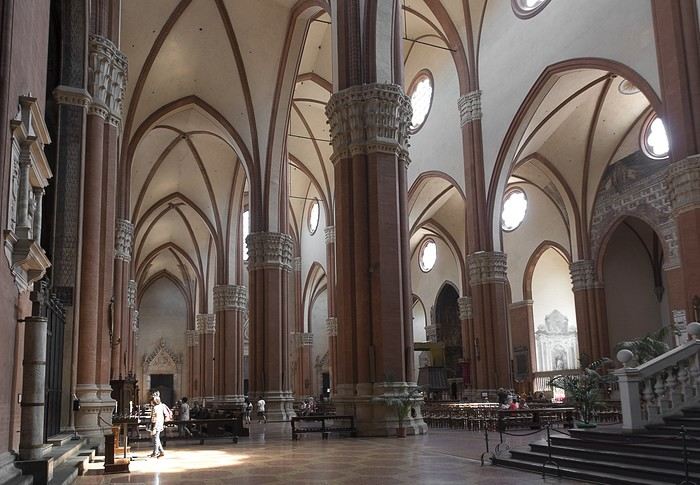
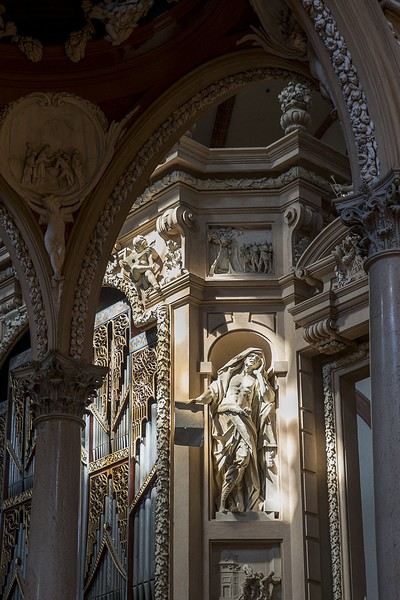
Another building near the square:
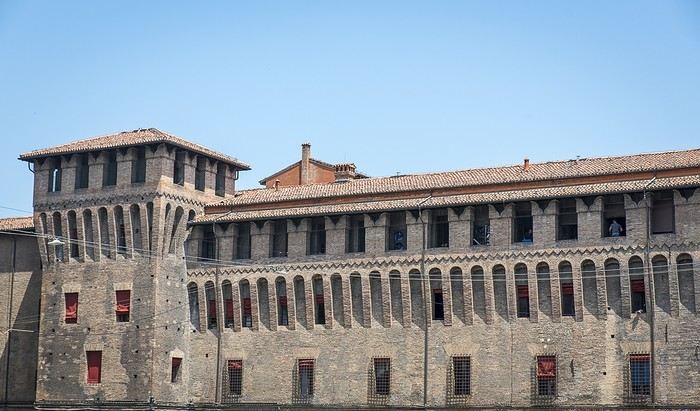 But Bologna’s real charm lies in its porticoes, which were added to the UNESCO World Heritage list in 2021: 62 km of arcades running along buildings, letting you walk sheltered from the sun or rain. Back in 1288, the city required houses to include private arcades for public use. In the city center, you can stroll under 32 km of porticoes in all sorts of styles—some plain, some ornate—with a strong presence of red tones.
Another building near the square:
But Bologna’s real charm lies in its porticoes, which were added to the UNESCO World Heritage list in 2021: 62 km of arcades running along buildings, letting you walk sheltered from the sun or rain. Back in 1288, the city required houses to include private arcades for public use. In the city center, you can stroll under 32 km of porticoes in all sorts of styles—some plain, some ornate—with a strong presence of red tones.Summer in Egypt: questions about guided tours, cruises, and the Cairo Museum
Hi there! I’m planning a 15-day trip to Egypt in the second half of July. Yeah, I know it’s not the best time, but we don’t really have a choice. Plus, we’ve traveled a lot and feel like we handle the heat pretty well.
We’re thinking of a classic itinerary: Cairo (pyramids and museum) Aswan-Luxor or Luxor-Aswan cruise + hot-air balloon in Luxor +/- Abu Simbel (not sure if it’ll be too rushed) 3-4 days by the Red Sea
I’ve got a few questions (I might have more later—I went to Egypt 15 years ago, so things have changed!):
1) Do we know the opening dates for the new Grand Egyptian Museum in Cairo? 2) Can we book a French-speaking guided tour for Cairo in advance? I assume the cruise part is easier to arrange through an agency. 3) We see cruises going both Aswan-Luxor and Luxor-Aswan. Is one direction better than the other? Intuitively, it seems more logical to fly Cairo-Aswan, cruise up to Luxor, then take a bus from Luxor to the Red Sea rather than the other way around. But when I was in Egypt before, I remember going *down* the Nile (and didn’t visit the Red Sea).
Thanks in advance!!
We’re thinking of a classic itinerary: Cairo (pyramids and museum) Aswan-Luxor or Luxor-Aswan cruise + hot-air balloon in Luxor +/- Abu Simbel (not sure if it’ll be too rushed) 3-4 days by the Red Sea
I’ve got a few questions (I might have more later—I went to Egypt 15 years ago, so things have changed!):
1) Do we know the opening dates for the new Grand Egyptian Museum in Cairo? 2) Can we book a French-speaking guided tour for Cairo in advance? I assume the cruise part is easier to arrange through an agency. 3) We see cruises going both Aswan-Luxor and Luxor-Aswan. Is one direction better than the other? Intuitively, it seems more logical to fly Cairo-Aswan, cruise up to Luxor, then take a bus from Luxor to the Red Sea rather than the other way around. But when I was in Egypt before, I remember going *down* the Nile (and didn’t visit the Red Sea).
Thanks in advance!!
Traveling to Mongolia in Winter: Practical Info and Experience Feedback
Hi everyone, here are some practical tips from my 5 weeks in Mongolia in February.
The famous Lonely Planet paper guide mostly gives wrong information—we often got let down.
From the airport to the city center (25 km), there are normally buses, but it’s not straightforward, especially for your return trip. Check with the tourism office on Genghis Khan Square.
If you need to stay more than 30 days, your hotel can request an extension for you online. Do this immediately because it can take time. At customs, you’ll get an extra stamp. Each day costs a very small fee, and no photo is needed.
I only travel by public transport. Don’t follow the paper guide, and remember there are buses running daily between Ulaanbaatar and Ölgii (and other routes).
The main issue is finding out the departure time and location. Insist strongly with your hotel—the bus might pass in the middle of the night. Locals have the drivers’ numbers and will let them know there are passengers to pick up. You pay on the bus.
From Karakorum Monastery, if you want to reach Arvaikheer via the mountains, the route is truly stunning. The postal service has a 6-seater van that leaves around 1 PM from the post office—ask around. This avoids going back to Ulaanbaatar. Plus, the van stops right in the center of Arvaikheer, next to a hotel that’s a really ugly red but has good rooms, great prices, and friendly staff.
The Black Market isn’t far, and neither are the city’s two museums.
The yurt camp next to the monastery is well-maintained, with very kind people. It gets too hot in winter, so you’ll have to sleep with the door open.
Ulaanbaatar There are two main long-distance bus stations: "Dragon Station." They’re far from the city center, so take a bus or a taxi—allow plenty of time to get there.
The city is constantly congested and polluted. Climate change is a very visible issue here.
To see a wrestling match in Ulaanbaatar, go directly to the "stadium" on Peace Avenue. Matches often take place at 11 AM, and tickets are sold on-site. Bus No. 1 goes there, among others.
For the Black Market, taking the bus is faster. You’ll find everything for daily life—fabrics, dishes, etc. But be careful: the "antique dealers" don’t provide authenticity papers, and you could get stopped at customs. Stick to the antique dealers in the city center.
I was really disappointed by the Lunar New Year—nothing happens outside, shops and banks are closed. Make sure to bring food, though ATMs work.
To exchange money, go to the 4th floor of the "state store" across from Beatles Park on Peace Avenue. The exchange rate seems good.
There are many great museums in Ulaanbaatar and smaller towns—worth a visit, even if you sometimes have to hunt for the keys and lights. However, the art galleries in Ulaanbaatar no longer exist (at least not when I was there).
I stayed at GoldenGobi Guesthouse—very family-like atmosphere, right in the center, and budget-friendly. They can also help organize things. There’s a kitchen and a terrace for summer, and it’s just a short walk from the "state store" and museums.
The Thousand Camel Festival in Dalanzadgad takes place at the end of January—check the dates, as climate change may shift them.
There’s a direct bus from "Dragon Station" very early in the morning. For accommodation, I stayed at "Happy Bee Hostel," which is well-located on the festival route. It has 3 nice dorms and a small kitchen, and the owner is very friendly. The place was clean.
The festival is 5 km away, but hitchhiking works really well. It lasts 3 days and is free. Day 1: Introductions, networking, and handicrafts. Day 2: Archery (men’s and women’s), camel presentations, and camel polo. Day 3: Camel races, beauty contests, and training demonstrations. There are several yurts where you can enjoy culinary tastings—very pleasant when it’s a bit windy and cold.
You can eat on-site throughout the festival.
There’s also the Ice Festival in the north, which lasts 3 weeks—look into it.
Alcohol (vodka and very strong Mongolian alcohol—cheap) I never encountered any issues on the road—there are lots of police checks. However, I did witness several nighttime fights in hotels. I always made sure my door locked and let the shouting and punches fly. I only took out my whistle if I heard a woman screaming, but usually, it’s just men drinking in their rooms.
I didn’t experience any specific issues as a woman.
Health: Don’t forget your prescriptions. I used SMECTA (a digestive aid), which helped when I couldn’t refuse mutton dumplings—I’m not a big meat eater.
That’s all—I’m sure I forgot some things. I chose winter to attend the Camel Festival and also because there are no tourists or 4x4s everywhere. The downside is that there’s a lot of snow, especially near the Kazakh region, and sometimes it’s impossible to go off the beaten path. Near Ölgii, summer must offer some great hikes. Marie
The famous Lonely Planet paper guide mostly gives wrong information—we often got let down.
From the airport to the city center (25 km), there are normally buses, but it’s not straightforward, especially for your return trip. Check with the tourism office on Genghis Khan Square.
If you need to stay more than 30 days, your hotel can request an extension for you online. Do this immediately because it can take time. At customs, you’ll get an extra stamp. Each day costs a very small fee, and no photo is needed.
I only travel by public transport. Don’t follow the paper guide, and remember there are buses running daily between Ulaanbaatar and Ölgii (and other routes).
The main issue is finding out the departure time and location. Insist strongly with your hotel—the bus might pass in the middle of the night. Locals have the drivers’ numbers and will let them know there are passengers to pick up. You pay on the bus.
From Karakorum Monastery, if you want to reach Arvaikheer via the mountains, the route is truly stunning. The postal service has a 6-seater van that leaves around 1 PM from the post office—ask around. This avoids going back to Ulaanbaatar. Plus, the van stops right in the center of Arvaikheer, next to a hotel that’s a really ugly red but has good rooms, great prices, and friendly staff.
The Black Market isn’t far, and neither are the city’s two museums.
The yurt camp next to the monastery is well-maintained, with very kind people. It gets too hot in winter, so you’ll have to sleep with the door open.
Ulaanbaatar There are two main long-distance bus stations: "Dragon Station." They’re far from the city center, so take a bus or a taxi—allow plenty of time to get there.
The city is constantly congested and polluted. Climate change is a very visible issue here.
To see a wrestling match in Ulaanbaatar, go directly to the "stadium" on Peace Avenue. Matches often take place at 11 AM, and tickets are sold on-site. Bus No. 1 goes there, among others.
For the Black Market, taking the bus is faster. You’ll find everything for daily life—fabrics, dishes, etc. But be careful: the "antique dealers" don’t provide authenticity papers, and you could get stopped at customs. Stick to the antique dealers in the city center.
I was really disappointed by the Lunar New Year—nothing happens outside, shops and banks are closed. Make sure to bring food, though ATMs work.
To exchange money, go to the 4th floor of the "state store" across from Beatles Park on Peace Avenue. The exchange rate seems good.
There are many great museums in Ulaanbaatar and smaller towns—worth a visit, even if you sometimes have to hunt for the keys and lights. However, the art galleries in Ulaanbaatar no longer exist (at least not when I was there).
I stayed at GoldenGobi Guesthouse—very family-like atmosphere, right in the center, and budget-friendly. They can also help organize things. There’s a kitchen and a terrace for summer, and it’s just a short walk from the "state store" and museums.
The Thousand Camel Festival in Dalanzadgad takes place at the end of January—check the dates, as climate change may shift them.
There’s a direct bus from "Dragon Station" very early in the morning. For accommodation, I stayed at "Happy Bee Hostel," which is well-located on the festival route. It has 3 nice dorms and a small kitchen, and the owner is very friendly. The place was clean.
The festival is 5 km away, but hitchhiking works really well. It lasts 3 days and is free. Day 1: Introductions, networking, and handicrafts. Day 2: Archery (men’s and women’s), camel presentations, and camel polo. Day 3: Camel races, beauty contests, and training demonstrations. There are several yurts where you can enjoy culinary tastings—very pleasant when it’s a bit windy and cold.
You can eat on-site throughout the festival.
There’s also the Ice Festival in the north, which lasts 3 weeks—look into it.
Alcohol (vodka and very strong Mongolian alcohol—cheap) I never encountered any issues on the road—there are lots of police checks. However, I did witness several nighttime fights in hotels. I always made sure my door locked and let the shouting and punches fly. I only took out my whistle if I heard a woman screaming, but usually, it’s just men drinking in their rooms.
I didn’t experience any specific issues as a woman.
Health: Don’t forget your prescriptions. I used SMECTA (a digestive aid), which helped when I couldn’t refuse mutton dumplings—I’m not a big meat eater.
That’s all—I’m sure I forgot some things. I chose winter to attend the Camel Festival and also because there are no tourists or 4x4s everywhere. The downside is that there’s a lot of snow, especially near the Kazakh region, and sometimes it’s impossible to go off the beaten path. Near Ölgii, summer must offer some great hikes. Marie
My experience in Sharm El Sheikh, Egypt – things I wish I’d known
I’m stuck in the airport on a layover, so here’s what I wish I’d known before I left! :)
When I arrived, I got scammed right away at the VODAFONE stand in the airport. They sold me a 20 GB SIM card for 10 €—cash only because their terminal wasn’t working—and it stopped working the next day… After that, I got an Orange SIM in town for 10 €, and it worked perfectly.
I’d booked my airport transfer online with B… for 7 €, but it’s even cheaper on the spot with Indrive—I paid 4 € for the return trip. Indrive helps you avoid getting ripped off, because scamming is basically the national sport here…
Naama Bay, along with Old Sharm, is the heart of the nightlife: a few bars with music and shisha, and tons of shops selling knockoffs. The beach is nice, but there aren’t any corals.
Watch out: the beaches are all paid, costing around 2 to 3 € each time, and you’ll be packed in like sardines on sun loungers that are all squished together! Only hotels have private beaches, often with a shuttle running once or twice a day. Good to know if you’re thinking of renting an apartment…
Another issue with apartments is the food—there’s not much variety in the small supermarkets.
There’s apparently a free beach in Hadaba, but I couldn’t find it. I did find Shark Bay, which is amazing… but it’s a bit far.
At first, I rented an apartment, but I ended up switching to all-inclusive stays at different hotels for the same price…
AVOID booking with STAYFORLONG!!! I booked an all-inclusive stay through them, and when I arrived, the hotel told me it was only half-board! I couldn’t get in touch with them at all… That site is a total scam.
In early February, it’s chilly at night but hot in the sun during the day. The pool water is pretty cold, but the sea is fine for swimming.
The corals are incredible! Take advantage of them!!!
That said, once you’re out of the water, there’s not much else to do…
When I arrived, I got scammed right away at the VODAFONE stand in the airport. They sold me a 20 GB SIM card for 10 €—cash only because their terminal wasn’t working—and it stopped working the next day… After that, I got an Orange SIM in town for 10 €, and it worked perfectly.
I’d booked my airport transfer online with B… for 7 €, but it’s even cheaper on the spot with Indrive—I paid 4 € for the return trip. Indrive helps you avoid getting ripped off, because scamming is basically the national sport here…
Naama Bay, along with Old Sharm, is the heart of the nightlife: a few bars with music and shisha, and tons of shops selling knockoffs. The beach is nice, but there aren’t any corals.
Watch out: the beaches are all paid, costing around 2 to 3 € each time, and you’ll be packed in like sardines on sun loungers that are all squished together! Only hotels have private beaches, often with a shuttle running once or twice a day. Good to know if you’re thinking of renting an apartment…
Another issue with apartments is the food—there’s not much variety in the small supermarkets.
There’s apparently a free beach in Hadaba, but I couldn’t find it. I did find Shark Bay, which is amazing… but it’s a bit far.
At first, I rented an apartment, but I ended up switching to all-inclusive stays at different hotels for the same price…
AVOID booking with STAYFORLONG!!! I booked an all-inclusive stay through them, and when I arrived, the hotel told me it was only half-board! I couldn’t get in touch with them at all… That site is a total scam.
In early February, it’s chilly at night but hot in the sun during the day. The pool water is pretty cold, but the sea is fine for swimming.
The corals are incredible! Take advantage of them!!!
That said, once you’re out of the water, there’s not much else to do…
CFC Viking Legends Cruise
Hi there,
We’ve booked the CFC Viking Legends cruise (departing on 03/31/25), and the excursions have just been posted on the CFC website. What a disappointment... Stop in Copenhagen: 2 excursions offered, one of which includes +1.5 hours of walking Stop in Oslo: 2 excursions, one of which is a hike Stop in Sandnes (Stavanger): 2 excursions, one of which is a hike Lysekil (Sweden): 1 excursion, same as in Kristiansand and Zeebrugge.
We hesitated to book without knowing the excursions in advance, but the itinerary interested us. We were expecting more options for excursions... Since the ship leaves the day before from Zeebrugge, let’s hope there’s still space for the excursions. I’ll share our experience after we return from this first CFC discovery. MUM49
We’ve booked the CFC Viking Legends cruise (departing on 03/31/25), and the excursions have just been posted on the CFC website. What a disappointment... Stop in Copenhagen: 2 excursions offered, one of which includes +1.5 hours of walking Stop in Oslo: 2 excursions, one of which is a hike Stop in Sandnes (Stavanger): 2 excursions, one of which is a hike Lysekil (Sweden): 1 excursion, same as in Kristiansand and Zeebrugge.
We hesitated to book without knowing the excursions in advance, but the itinerary interested us. We were expecting more options for excursions... Since the ship leaves the day before from Zeebrugge, let’s hope there’s still space for the excursions. I’ll share our experience after we return from this first CFC discovery. MUM49
Cambodia E-visa Problem
Hi there,
We’re heading to Southeast Asia for several months as a family with two teens (10 and 13). The first country we’re visiting is Cambodia. I’m having an issue with the e-visa—it won’t accept any of the documents I’m attaching. I’ve validated all four e-visas and received the registration numbers, but when I check the application, it shows no attachments. I’ve tried multiple times in different formats (PDF, JPEG, PNG), whether compressed or not, but there’s always a red cross next to the documents.
Has anyone else run into this problem?
Thanks for your help—I’m losing patience, and our departure is in 15 DAYS 😕
Magos
We’re heading to Southeast Asia for several months as a family with two teens (10 and 13). The first country we’re visiting is Cambodia. I’m having an issue with the e-visa—it won’t accept any of the documents I’m attaching. I’ve validated all four e-visas and received the registration numbers, but when I check the application, it shows no attachments. I’ve tried multiple times in different formats (PDF, JPEG, PNG), whether compressed or not, but there’s always a red cross next to the documents.
Has anyone else run into this problem?
Thanks for your help—I’m losing patience, and our departure is in 15 DAYS 😕
Magos