Results for "Canal+Midi+|+127"
21022 results found.
Birmanie - Novembre 2004 English translation pending
Je rentre d'un voyage de 3 semaines en Birmanie.
Voici quelques infos pratiques qui vous aideront peut-être à préparer votre voyage. Je répondrai avec plaisir à toutes vos questions complémentaires.
NOTRE PERIPLE EN 3 SEMAINES :
Comme souvent, nous avons pris l'option d'en faire moins (ni MraukU, ni trek, ni plage ...) pour bénéficier de longues étapes et visiter chaque région tranquillement. Ce rythme nous a permis d'encaisser facilement les très longs transferts en bus et de quitter chaque région avec nostalgie mais sans regret.
Ven 5 Nov - Vols Singapore Airlines et SilkAir Paris/Yangon via Singapour - Sam - Arrivée à Yangon vers midi Départ pour Mandalay à 18h00 (bus : 7$ - durée 15 heures) - Nuit dans le bus Dim - Arrivée à Mandalay à 8h40 Petit tour en ville et monastère de Shwé Nan Daw (vélo : 1 500 Ks) - Nuit à Mandalay Lun - Pagode Maha Muni - Amarapura (vélo) - Nuit à Mandalay Mar - Pagode Shwé Inbin - Inwa - Sagaing (taxi bleu : 10 000 Ks) - Nuit à Mandalay Mer - Po Win Daung (taxi : 50 $) - Nuit à Mandalay Jeu - Mingun (bateau : 1 500 Ks) - Pagodes au Nord de Mandalay (vélo) - Nuit à Mandalay Ven - Descente de l'Irrawady (Express Boat : 16 $ - durée 10 heures) - Nuit à Bagan Sam - Bagan (vélo : 1 000 Ks) - Nuit à Bagan Dim - Bagan (vélo) - Nuit à Bagan Lun - Bagan (vélo) - Nuit à Bagan Mar - Départ pour le lac Inlé à 5h00 (taxi : 100$ à 4 - durée 9 heures) - Mont Popa - Nuit à Nyaung Shwé Mer - Nyaung Shwé (vélo : 1 400 Ks) - Balade sur les canaux (canoë à rames : 1 500 Ks/h) - Nuit à Nyaung Shwé Jeu - Pindaya (taxi : 30 $) - Nuit à Nyaung Shwé Ven - Journée sur le lac (pirogue à moteur : 11 000 Ks) - Nuit à Nyaung Shwé Sam - Kakku - Festival de Taungyi (taxi : 35 $) - Nuit à Nyaung Shwé Dim - Départ pour Yangon à 13h (bus : 7 000 Ks - durée 20 heures) - Nuit dans le bus Lun - Arrivée à Yangon (downtown) vers 8h00 - Nuit à Yangon Mar - Rocher d'Or (bus : 2 500 Ks + camion-bus : 500 Ks/p) - Nuit à Kin Pun Camp Mer - Départ pour Yangon à 11h30 (bus : 2 500 Ks) - Nuit à Yangon Jeu - Marché Bogyoke - Musée - Pagode Shwé Dagon - Nuit à Yangon Ven - Marché indien - Pagode Shwé Dagon bis ... - Nuit à Yangon Sam 27 Nov - Vols SilkAir et Singapore Airlines Yangon/Paris via Singapour -
BUDGET :
Rappel : à ce jour, pas d'obligation de changer des US$ en FEC à l'arrivée toujours aucune transaction possible par carte bancaire (ni paiement, ni retrait) pas de change possible avec les traveler cheques. Vous l'avez compris, il faut venir avec du cash et rien que du cash ... Cela dit, rassurez-vous, on voyage serein tant le risque de vol est faible (soyez quand même attentifs mais ne vous inquiétez pas outre mesure ...) Nous n'avions pris que des $ en billets neufs : quelques grosses coupures de 100 $ pour le change et un bon paquet de petites coupures (20, 10 et 1$) pour le "quotidien". Je ne peux pas dire si l'Euro est facilement changeable, je ne m'en suis pas préoccupée ...
Nous avons changé 200 US$ à Mandalay et 100 US$ à Bagan au cours de 900 Kyats (Ks, prononcez tchiat) pour 1 US$. Change effectué à l'hôtel à chaque fois. Ca a couvert nos 3 semaines, les grosses dépenses (hôtels et taxi) étant payées directement en US$.
Sur place (et pour nous 2) 995 $ dépensés, répartis en 341 $ d'hôtel pour 19 nuits 120 $ d'entrée de sites 534 $ de repas, boissons, transport ... (je ne compte pas les achats de souvenirs)
GUIDES :
Guide du Routard 2004 - logistique - Très à jour. Pour une fois ! Lonely Planet version française 4è édition (Rocher d'Or en couverture) - N'est plus du tout à jour quant aux tarifs et aux informations générales : quasiment inutilisé. Guide Bleu Evasion 2002 - culturel - De bonnes infos logistiques également.
TRANSPORTS :
1 - Vols
Nous avons fait le choix de Singapore Airlines : bonne compagnie, fiable et confortable (écran individuel, grand choix de films, documentaires, jeux ...). L'escale à Singapour est toujours un vrai bonheur. Billets d'avion achetés en Juin sur Internet auprès de Go Voyages : http://www.govoyages.comRécupérés sans frais à leur agence rue de Cléry à Paris. Prix = 787 Euros l'A/R Taxe d'aéroport au retour : 10 $/p
2 - Bus
Yangon-Mandalay : 7$ par la compagnie Mann Shwe Pyi Express (durée 14, 5 heures) Achat du billet directement à la gare le jour même grâce à l'aide précieuse du chauffeur de taxi. Départ à 18h00 - Arrivée à 8h40 à la gare routière de Mandalay, à 11km du centre (3 000Ks en taxi bleu pour se rendre au centre) Bon confort - A/C - Bouteille d'eau fournie - Pas de vidéo ni de cassette à tue tête - Nous avons bien dormi et n'avons eu ni chaud, ni froid. Plusieurs arrêts pour se restaurer et se soulager.
Nous avons enchaîné le transfert en bus Yangon-Mandalay dès notre arrivée à Yangon. Pour éviter une nuit à Yangon, parce que nos bagages étaient déjà tout prêts, parce qu'on avait le rythme ... bref, ce qui sur le papier nous avait paru un peu fou s'est finalement fait tout seul ! On a dormi dans le bus, plutôt bien, et le dimanche à 9h, on était à l'hôtel, à Mandalay. On ne regrette pas cet effort qui finalement n'en fut un que dans la tête : celui de se dire, à l'atterrissage à Yangon, qu'on n'était pas encore arrivés ... Pour ce faire, nous avons demandé au chauffeur de taxi de nous emmener à la gare routière pour Mandalay. Il nous annonce que la gare routière proche de l'aéroport de Yangon est désormais fermée et qu'elle a été déplacée à l'Aung Mingalar Bus Stadium. Beaucoup plus loin. C'est cela, oui !... Très dubitatifs au départ, nous avons fini par nous laisser emmener quand même et, il s'est avéré que toutes nos arrivées à Yangon (de Inlé ou de Golden Rock) nous ont finalement ramenés dans cette "nouvelle" gare routière (qui n'a rien de neuf, d'ailleurs). On n'a jamais vu de gare routière près de l'aéroport ... On a donc fini par y croire 😛... N'ayant que des $ en poche, le chauffeur de taxi a payé nos billets de bus en Ks et nous l'avons remboursé en $.
Inlé-Yangon : 7 000 Ks par la compagnie Eastern State Express (durée 19 heures) Achat du billet par notre hôtel Départ à 13h00 à Shwé Nyaung, à qq km de Nyaung Shwé (5 000 Ks en taxi pour s'y rendre) Arrivée à Yangon, downtown, après s'être arrêté à l'Aung Mingalar Bus Stadium qu'on a reconnu (2 000 Ks en taxi pour se rendre à l'hôtel). Plus rustique - A/C - Bouteille d'eau - Vidéo assommante - Pas de pb de chaud ou de froid non plus. Plusieurs arrêts aussi bien sûr.
Yangon-Kin Pun Camp (Rocher d'Or) : 2 500 Ks par la compagnie Win Express (durée 4 heures) Achat du billet directement à la gare routière le jour même, juste avant d'embarquer. Départ à 7h00 de l'Aung Mingalar Bus Stadium (3 500 Ks de taxi depuis le centre ville) - Arrivée à KPC à 11h00 devant le Sea Sar, sympathique petit restaurant qui fait aussi guesthouse. Bon confort - A/C - Vidéos de karaoké assourdissantes (j'ai mis des boules Quiès !) Attention au retour. (Même prix - Achat du billet effectué par le jeune patron de notre guesthouse plein d'attentions). Nous sommes partis à 11h30. Nous avions choisi cet horaire pour pouvoir encore profiter de ce petit village avant de rentrer vers la bruyante capitale. Or, le bus ne disposait pas de rideaux aux fenêtres et nous avons énormément souffert. En plus, il a été plus lent qu'à l'alller, il a mis 4h30. Ce fut assez pénible.
PS1 - Les places des bus sont numérotées. Si vous le pouvez, évitez d'aller trop à l'arrière où l'on est davantage secoué. Pas d'embrouille, les réservations sont respectées. PS2. N'oubliez pas de prévoir votre papier toilette pour les arrêts, il n'y en a jamais 😛. Une lampe de poche peut aussi être utile ...
3 - Express Boat
Mandalay-Bagan : 16 $ (durée 10 heures) Achat du billet par l'hôtel Départ à 6h00 (transfert gracieux depuis l'hôtel) - Arrivée à 16h00 (transfert gracieux à l'hôtel puisqu'il était réservé) On n'a pas aimé ce transfert 🙁... Sans intérêt, bateau de touristes, quelques rares birmans, isolés. De plus, le voyage a peu d'intérêt, les paysages sont quelconques. Grosse, grosse déception ... Si c'était à refaire, on prendrait le bus depuis Mandalay ou peut-être depuis Po Win Daung (encore qu'il parait que l'hébergement à Po Win Daung est vraiment très spartiate). Bref, ça ne vaut pas les 16 $ investis ! Le bus, c'est beaucoup plus sympa.
4 - Taxi longue distance
Attention, pour les grandes distances, ça revient vite assez cher . Excursion à Po Win Daung depuis Mandalay : 50 $ (8 heures de route A/R) Bagan-Inlé via Mont Popa (arrêt de 2 heures) : 100 $ (9 heures de route) à partager, nous étions 2 couples - Partis à 5h00, arrivés à Nyaung Shwé vers 18h. Voiture genre microbus (7 places) -désolée, je suis nulle en marque de voiture, je n'ai pas noté ...- Confortable. Lors de nos périples dans Bagan, des rabatteurs nous proposaient ce même périple pour 70 $ ... Mais peut-être pas pour 4 personnes ce qui revient au même .... à vérifier ... Excursion Pindaya depuis Nyaung Shwé (Inlé) : 30 $ (7 heures de route A/R) Excursion Kakku depuis Nyaung Shwé (Inlé) : 35 $ (6 heures de route A/R) Partis à 11h, de retour à 19h car nous avons raté le festival de Taungyi (il nous a semblé (?) que le chauffeur ne savait pas vraiment où se tenaient les attractions de ballons, ou peut-être n'était-ce pas encore commencé ...) Bref, beaucoup de monde, trop à notre goût, trop longtemps à attendre avant ... on ne savait pas trop quoi ... un feu d'artifice peut-être ?... Bôf, on rentre ... Sans le festival deTaungyi, l'excursion aurait dû coûter moins cher (20$ peut-être ...) Un beau raté 😕 !
5 - Taxi en ville
A Yangon, ce sont des voitures avec enseigne sur le toit. Pas de compteur bien sûr ... Se mettre d'accord sur le prix avant la course. Aéroport - Gare routière (Aung Mingalar Bus Stadium) : 3 $ - Sortez de l'aéroport, évitez les prépaid et négociez bien à l'arrivée. Les chauffeurs proposent du change mais il n'est pas intéressant (enfin, ce n'est pas une grosse arnaque non plus : 850 Ks le $) - Bien sûr, ils acceptent d'être payés en $ mais du coup, la négociation est moins fine ... Centre ville - gare routière (Aung Mingalar Bus Stadium) : 3 500 Ks Centre ville - Aéroport : 3 000 Ks Course en ville : entre 800 et 2 000 Ks selon la distance
A Mandalay, ce sont des camionnettes bleues (blue taxi) où l'on monte à l'arrière Gare routière - centre ville (11 km) : 3 000 Ks Journée Inwa, Sagaing ... avec autant d'arrêts que l'on souhaite : 11 000 Ks Course en ville : 1 800 Ks Course Trishaw : 500 Ks (on a pris un trishaw chacun, ayant des scrupules ... nous sommes un peu plus lourds qu'eux ...)
A Nyaung Shwé, voiture particulière de l'hôtel Nyaung Shwé à Shwé Nyaung (pour prendre le bus vers Yangon) : 5 000 Ks. On n'a pas discuté mais, ça me parait beaucoup trop cher ...
6 - Vélo
1 500 Ks/j à Mandalay (loué à l'hôtel) 1 000 Ks/j à Bagan (loué à l'hôtel) 1 400 Ks/j à Nyaung Shwé (loué en ville) - Ceux-ci étaient tout neufs ! Nous avons crevé régulièrement (1 fois par jour). Ce qui n'est pas un problème, on trouve partout des petits ateliers qui vous réparent votre vélo pour 50 ou 100 Ks (à votre bon coeur). Même en ville ... Pas de problème ! Les Birmans sont tellement serviables que l'un d'eux a été jusqu'à emmener notre vélo en camionnette auprès du mécano à quelques centaines de mètres. Gracieusement .... Ces petits inconvénients laissent vraiment de bons souvenirs !
HEBERGEMENT :
Nous avons recherché des hôtels en gamme de prix moyens. Chambres toujours spacieuses, sanitaires (douches et wc) privés, eau chaude, A/C sauf à Nyaung Shwé (où c'est inutile). Nous avons toujours payé en US$, les prix indiqués sont par nuit, ttc et petit déjeuner inclus. Sans doute à tort, nous n'avons jamais cherché à négocier les prix annoncés.
Mandalay : Le Golden Mandalay Hotel (20 $) - ref GDR 🙂🙂 Anciennement le Yadanar Su Pon. Tenu par U Ko Ko et son adorable fille Tanzy (je ne suis pas sûre de l'orthographe ...). Un vrai coup de coeur. Petit ensemble de quelques bungalows, face à une mare couverte de nénuphars et gardée bruyamment par Amélie et Amélia 😉, 2 oies blanches et jacassantes. Chambre très spacieuse et très joliment décorée de bambou. Petit déjeuner servi dans le jardin face à la mare. Eau en bouteille à volonté, offerte. Petite assiette de fruits frais au retour. Accueil et service très familial, sans lourdeur. Tanzy est souriante du matin au soir et se met en 4 pour répondre à tous vos besoins. Elle s'occupe de tout : elle vous trouve des vélos, elle vous réserve les taxis, le bateau, vous fait du change ... Un vrai bonheur. Elle fut notre premier contact avec la Birmanie (après nos 16 heures de bus depuis Yangon) et a illuminé notre séjour à Mandalay. La famille de U Ko Ko mérite de beaucoup la pub que je me suis promise de leur faire !
Bagan : Golden Express Hotel (20 $) à Wet Kyi Inn - recommandé et réservé par Tanzy. Grand complexe sans aucun charme (bungalows et hotel) avec plusieurs niveaux de chambre : 18, 20, 24 et 30 $. Nous avons choisi une chambre en bungalow. Literie et sanitaires propres. Petite piscine agréable. Location de vélos. Service d'e-mail (1$ par mail envoyé). Excellente situation pour visiter les temples.
Nyaung Shwé (Lac Inlé) : View Point Inn (12 $) - ref GDR 🙂 Sur le canal, 4 bungalows sur pilotis de 2 chambres chaque. Chambre spacieuse mais spartiate, sanitaires vétustes ... Petite terrasse devant la chambre donnant sur le canal. Petit déj (pancakes absolument délicieux !) servi sur une terrasse haute dominant le canal où il fait bon observer l'animation naissante du matin. Beaucoup de charme - Bien situé - Tour du lac organisé par l'hôtel très très bien. Beaucoup d'animation (donc de bruit dès 5h30) sur le canal ... Ça ne nous a pas gêné mais je préviens ... C'est pas là qu'il faut prévoir de faire des grasses mat'!
Kin Pun Camp (Rocher d'Or) : Sea Sar Guesthouse (13 $) - ref GDR 🙂 Restaurant du même nom face à l'arrêt du bus qui arrive de Yangon. On va manger et on repart avec une chambre ... C'est pratique. Le jeune patron est sympa. La chambre est très très propre et spacieuse. A/C ! Rien à redire ! Une bonne adresse. En plus, le petit village est très vivant. Etape bien agréable.
Yangon : Queen's Park Hotel (22 $) Grand hotel sans charme. Situé downtown à 25 minutes de Paya Sulé et de Bogyoke Market. Les 2 hôtels dans le coin cités par le GDR étaient complets ... Accueil chaleureux et serviable - Ils nous ont gardé nos bagages (gratuitement bien sûr) lors de notre excursion au Rocher d'Or) Propre - A/C - Eau chaude, très très chaude - Ici, nous avons payé notre eau ... (raisonnable 200Ks). C'est une bonne adresse à défaut ...
REPAS :
On trouve très facilement, en plus de la cuisine birmane, de la cuisine chinoise et parfois de la cuisine indienne.
Un repas birman est constitué de riz (à volonté), éventuellement d'un petit curry de viande (nous sommes toujours restés au poulet) : 3 ou 4 morceaux cuisinés dans une sauce parfumée et épicée (mais pas pimentée), d'un bouillon et d'une quantité impressionnante de petites assiettes garnies de légumes, d'épices, de condiments divers et variés. Certains sont délicieux, d'autres plus surprenants ... Attention à la pâte de crevettes, forte en goût et en odeur ! Dès qu'une assiette est vide, elle est regarnie ... Finalement, seule la viande n'est pas à volonté. C'est très sympathique et très convivial. Ce genre de repas est très économique, autour de 1 000 Ks. Le thé birman est gratuit, à disposition sur les tables. Bonne adresse : dans Old Bagan, le Mar Lar Thein Gi (GDR) ...
Les cartes chinoises proposent les traditionnels Fried Rice et Fried Noddles avec ou sans viande. C'est toujours extrêment copieux, parfois garnis d'un oeuf. Vous y trouverez aussi des légumes fris délicieux (brocolis, choux-fleurs, pois gourmands ...) Bonnes adresses : à Mandalay, le Myanmar Lion Restaurant ; à Wet Kyi Inn (Bagan), le Pyi Sone (juste à côté du Golden Express Hotel), goûtez le Coconut Rice 🙂 au poulet à commander la veille (2 500 Ks), c'est divin !
Enfin, vous trouverez de bons restaurants indiens proposant thali, biryanis, chapatis ... avec toujours le riz à volonté. Bonnes adresses : à Yangon, le New Dehli (GDR) ; à Nyaung Shwé, l'Aroma(GDR)
En résumé, on mange facilement, bien, (sans se régaler comme en Indonésie) et à un prix dérisoire. Clairement, ce qui coûte le plus cher dans les repas, ce sont les boissons (Coca ou bière - la Myanmar à la pression est une merveille de douceur et de fraîcheur ! Je suis sûre que Parvat ne me contredira pas 😉!!).
Nous n'avons jamais discuté les prix des plats dans les petites gargottes. Ils sont indiqués sur les cartes et sont relativement les mêmes partout :
1 canette de Coca : 450 (en superette) à 700 (dans la rue, au restau) Ks 1 bouteille de Star Cola (leur Coca Cola local) : 100 Ks (c'est plus sirupeux que le Coca mais pas mauvais du tout) 1 litre d'eau en bouteille : 100 (en superette) à 200 Ks (dans la rue, dans les gargottes) - La marque Alpine est bonne. 1 demi de Myanmar pression : 325 Ks (Amateurs de bière, ne la ratez pas, elle est vraiment bonne. Elle m'a rappelé la Grimbergen). 1 bouteille de bière Mandalay (620 ml !! Attention !) : 1200 à 2000 Ks 1 assiette de riz blanc (quand il est payant ...) : 100 à 200 Ks 1 fried rice ou fried noddle au poulet : 700 Ks 1 chicken curry : 500 à 1 700 Ks (selon la préparation et le type du restaurant) Ainsi, un repas simple dans une petite gargotte nous revenait pour nous 2, hors boisson à 1 500-2 000 Ks. Un "repas de fête" à Yangon, pour mon anniv, nous a couté 11 000 Ks (au Shan Kan (GDR) - très sympa le soir, vue sur Shwé Dagon - Excellent Roasted Duck) avec 2 bouteilles de bière (anniv oblige 😊!) incluses.
Pour un petit encas, vous trouverez dans les rues des vendeurs de fruits : pastèques, ananas, papaye (pas testé, on déteste tous les 2 la papaye ...). Ils découpent votre portion en petits quartiers et les servent dans une petite poche plastique avec un pic en bois. Pratique, rafraîchissant et délicieux. Vous trouverez aussi des vendeurs de noix de coco fraîches (buvez d'abord le lait, puis mangez la pulpe). Essayez aussi le jus de canne à sucre servis avec du citron vert et, à la demande, de la glace. C'est dynamisant. Toutes ces petites douceurs tournent toujours autour de 100 à 200 Ks ...
Dans les maisons de thé, vous trouverez ... du thé (au lait ou nature) et encore des petites gâteries. Des samossas, aux légumes ou aux oignons, des beignets à tremper dans une sauce pimentée ... Tout ça est très bon. Seul inconvénient : pour les grands et gros que nous sommes, la pause peut s'avérer compliquée car les tabourets sont miniatures et il faut être adroits pour s'y asseoir et s'en relever sans s'étaler 😛 ... C'est bien connu : nous n'avons pas leur souplesse pour nous accroupir ... ce qui d'ailleurs les amuse beaucoup ...
SITES :
En Birmanie, il ne s'agit plus d'aimer seulement les vieilles pierres ... il faut aimer ... les pagodes !! Car, vous allez en voir ! Des anciennes, des récentes, des sobres, des moins sobres, des vraiment trop kitsches, des dorées ... Et des bouddhas !... Assis, dans la position de prise de la terre à témoin, parfois couchés, rarement debout ... Blancs, rouges, dorés ... voire boursouflés pour certains tellement ils sont couverts d'or ... Et c'est pieds nus que vous devrez voir toutes ces merveilles. Chaussez-vous en conséquence. Nous avions des sandales à scratch. Pratique tant pour faire du vélo que pour se déchausser facilement. Vous trouverez parfois des consignes à l'entrée des pagodes. On ne les a jamais utilisées : on laissait nos chaussures avec les tongs des Birmans, on les a toujours retrouvées.
Budget total entrées des sites : 60 $/p - Aucun supplément n'est demandé pour les appareils photo (sauf Pindaya).
Mandalay et ses environs Pass Mandalay : 10$ (validité 5 jours)dont Inwa Pass Sagaing/Mingun : 3 $ Mandalay : à ne pas rater, monastères Shwé Nandaw et Shwé Inbin et pagode Maha Muni. Nous n'avons pas visité le palais ... On s'est contenté d'admirer ses murailles. Nous ne sommes pas non plus monté en haut de la colline. J'ai bien aimé me promener en vélo dans cette ville facile et calme. Amarapura : prévoir 1 journée de vélo - Facile depuis Mandalay - La journée est d'ailleurs, à mon goût, plus intéressante pour la balade que pour les pagodes ... Nous avons déjeuné près du Pont U Bein dans une petite gargotte installée au bord du lac. Magnifique et reposant. Ne manquez pas la traversée du pont à pied (pas pieds nus !!). Nous y sommes revenus le lendemain (lors de notre excursion Inwa/Sagaing avec notre taxi bleu) en fin de journée pour profiter d'une plus belle lumière. Très photogénique. Inwa : on y a va en taxi bleu, puis on prend une barge qui traverse le fleuve (500 Ks/p) et accoste sur l'ile. Là, il faut négocier une calèche pour faire le tour. Nous avons demandé le grand tour (2h30) et payé 5 000 Ks pour nous 2. Belle promenade dans cette île très vivante et couverte de ... pagodes. Là encore, la balade au rythme du trot du cheval dans cette campagne enjouée est aussi intéressante si ce n'est plus que les pagodes en elles-mêmes. A ne pas rater. Sagaing : dans la même journée, on va en taxi bleu à Sagaing pour gravir un long escalier (à couvert) aboutissant à une pagode moderne et vraiment trop kitsch ! Certes, le panorama 360° est très beau mais ... on peut se passer de cette visite. Mingun : un bateau part à 9h et revient à 13h (1 heure à l'aller, 45 minutes au retour) : 1500 Ks/p Mingun est un beau site, présentant une pagode inachevée gigantesque et une autre éclatante de blancheur et d'une grande originalité. De nombreux artisans vous permettent de patienter jusqu'à 13h. Belles peintures (aquarelle, huile, pastel) à tous les prix (de qq milliers de Ks à plusieurs dizaines de $), certaines absolument magnifiques. Comme on regrette aujourd'hui de ne pas s'être laissés tenter !...
Po Win Daung Entrée = 2$ Excursion en taxi depuis Mandalay - 8 heures de taxi - 50 $ Attirés par un article paru dans un vieil exemplaire de Géo Magazine, nous tenions absolument à voir ce site. Des dizaines de grottes, plus ou moins grandes et dans chacune d'elles, des bouddhas, mais surtout des peintures murales magnifiques, très très bien conservées. La visite se fait avec un guide. J'aime mon autonomie mais là, je reconnais qu'il est indispensable. Trop de grottes pour savoir laquelle aller voir, laquelle ne pas rater, laquelle négliger. Lui sait les choisir avec un intérêt crescendo, la visite est bien menée. Anglais approximatif mais suffisant. Et comme toujours une grande sollicitude et une grande gentillesse. En 2 heures, on voit le principal. Organisée depuis Mandalay en taxi, c'est une excursion coûteuse en temps et en argent. Difficile de dire si ça les vaut ... nous, on n'a pas regretté mais c'est encore des bouddhas ...vous voila avertis.
Bagan Pass illimité 10$Musée 3$ Comme pour Angkor, nous avons loué des vélos ... Quel bonheur de visiter à son rythme, de prendre les chemins de traverse, de piocher dans ce champ de pagodes celle qui retient un peu plus notre attention et dont on va s'approcher ... Un bus de touristes ? Passons à la suivante, on y reviendra ! Mauvaise lumière ? On y repassera ce soir ! J'adore ces visites à vélo qui vous offrent cette liberté totale. Un bon plan (on en trouve partout à 500 Ks), une boussole (et encore !) et on trouve toutes les pagodes qu'on cherche. On n'a jamais eu aucune difficulté. On a même pris des raccourcis à travers les rizières. C'est fabuleux !... Les vélos possèdent un petit panier à l'avant, un antivol intégré, ils sont vieux et couinent beaucoup mais ils roulent. On crève ? Et alors ? Là, juste à côté, il y a un petit atelier en plein air qui va réparer en 10 minutes et 50 Ks la chambre à air ! Et c'est reparti ! "A demain, ami mécano pour la roue arrière !..." Nous avons passé 3 jours pleins à Bagan. 3 jours de bonheur. Nous avons vu le principal ... Mais Bagan a cela de commun avec Angkor qu'au dela de "voir le principal", il y a, après, l'envie de profiter de l'atmosphère. Et là on ne voit plus, on ressent ... Nous avions prévu d'y passer 1 jour de plus, pour le plaisir, pour l'ancrage comme je dis. Une opportunité de partager un taxi nous a fait revoir nos plans ... Un petit regret quand même ... je serais bien restée encore 1 jour ... La plus belle lumière, à mon goût (avis personnel !), était vers 16h00. Là le bleu du ciel, le rouge des briques des pagodes et le vert des rizières claquent vraiment ! Le matin, l'ambiance est magique mais c'est un peu voilé pour les photos. La nuit tombe vite, attention, à 18h00, il fait nuit noire ... Comme pour les pagodes en activité, il faut se déchausser. Les marchands du temple envahissent de plus en plus les pagodes. Ils vont maintenant jusqu'à l'intérieur. C'est un peu dommage ... Ils sont un peu collants, il faut l'avouer mais toujours souriants et très aimables. Aucune agressivité, jamais. Et puis, l'artisanat est beau, un artisanat de laques notamment pas mal du tout !... C'est ici, à Bagan que vous aurez le plus grand choix : achetez ici ! Nous on a trop attendu (toujours dans l'idée de voyager léger le plus longtemps possible) et on a regretté ! Boissons fraîches partout sur le site. Par contre, pas de toilettes.
Mont Popa Entrée = ?? Je n'ai rien noté et ne me souviens plus s'il s'agit ou non d'un oubli ... Bôf ... peut-être y sommes nous arrivés trop tôt (il était 6h30) ... les chappelles ouvraient à peine, personne en haut ... pas d'ambiance. Dans ces conditions, 1h30 nous ont largement suffi mais, encore une fois, je pense qu'on n'y était pas au meilleur moment. Tout au long de l'ascension (escalier facile, à couvert), vous serez accompagnés de dizaines de singes vifs et malicieux. Scènes de jeux très amusantes. Restez néanmoins sur vos gardes ... Il était donc 8h00 environ quand nous sommes redescendus et, là, nous avons adoré la vie, l'animation de début de journée de ce petit bourg. Les moines qui font leur tournée du matin, les boutiques de racines et d'herbes qui ouvrent ... Moment très agréable.
Pindaya Entrée = 3 $ + 200 Ks / app photos Une grande grotte (avec stalactites et stalacmites comme il se doit) encombrée de bouddhas dorés de toute taille. 8093 il parait. Excursion organisée depuis Nyaung Shwé à défaut d'avoir passé la nuit à Kalaw. Il me semble plus simple de passer la nuit à Kalaw et de faire Pindaya en allant de Kalaw à Nyaung Shwé. On y gagne en temps et en fatigue. C'est ce que nous avions prévu initialement (le chauffeur acceptait de passer la nuit à Kalaw en majorant son prix de 20$) mais l'opportunité de partager le taxi avec un autre couple nous a amenés à changer nos plans. Je reste convaincue que l'option "étape à Kalaw" aurait été plus confortable et moins redondante ... 1 bonne heure suffit pour compter les 8093 bouddhas.
Lac Inlé Accès : 3 $ (validité illimitée) Ah, quel régal ! Ah, quel bonheur ! Ah, quelle beauté, quelle sérénité ! Nous avons passé 5 nuits à Nyaung Shwé, petit bourg au Nord du lac. Là encore, j'aurais aimé y passer 1 journée de plus, pour le plaisir des yeux. Cette petite localité, à fleur d'eau, vit du tourisme : restau, quelques boutiques, guesthouses et hôtels, embarcadère pour les balades sur les canaux et sur le lac, location de vélo ... tout est facile. De Nyaung Shwé, nous avons aussi organisé les excursions vers Pindaya et Kakku. Nous avons passé 1 journée à nous promener dans Nyaung Shwé. Ne ratez pas le superbe monastère en bois Shwé Yan Pyay, qui abrite une communauté de bonzes jeunes et gais, à 2 km de la ville sur la route d'Hého et surtout la pagode juste à côté, toute décorée de motifs en pâte de verre et de bouddhas d'albâtre. On la dirait à l'abandon mais elle a une âme comme nous en avons rarement trouvé dans les pagodes. En vélo, c'est facile et tout plat. En plus, on longe des canaux où les familles se baignent. Belles images. Petite balade très sympa. Petits vendeurs de souvenirs en face où on a trouvé de jolies gravures sur bambous. Balade sur les canaux en canoë à rames : 1 500 Ks/h - On a fait 2h ... ça ne nous a pas transportés mais on aurait peut-ête dû mieux expliquer ce qu'on voulait : juste glisser sur des canaux entre les maisons sur pilotis pour profiter de la fin de journée. En fait, nous sommes passés d'une fabrique de cheerots, à un vieux stupas, à un monastère ... Nous avons passé autant de temps sur la terre ferme que dans la barque. Ce n'était pas l'idée que je m'en faisais .... Je n'avais qu'à le dire ! Pas grave, ce n'était quand même pas une galère non plus .... Et nous avons fait le tour du lac, en pirogue à moteur. Départ à 7h15 de l'hôtel (qui donne sur le canal), retour à 17h45 après le coucher du soleil - Grand tour avec Inn Dein : 11 000 Ks pour nous 2. Excursion réservée et organisée par l'hôtel (nous avions bien expliqué ce qu'on voulait voir et il n'y a eu aucune embrouille). Alors là, une journée magique !! La plus belle du voyage ! La plus esthétique, la plus sereine, la plus dépaysante ! Nous n'étions que tous les 2 dans la longue pirogue, petit luxe bien agréable ... La balade a duré toute la journée, à travers les villages de pêcheurs aux magnifiques maisons sur pilotis se réflétant dans une eau claire, à travers les lotus, à travers les jardins flottants et avec les arrêts chez les artisans que nous avions demandé à voir : ombelles, soie, bronze, argent, ... Un arrêt également à un marché semi-touristique semi-local où les locaux portent de beaux kramas (c'est le nom au Cambodge, peut-être n'est-ce pas le bon vocable ici) oranges sur la tête ... Le soir un arrêt au monastère des chats sauteurs, petite attraction amusante que nous avons ratée de peu tellement nous avions flâné ailleurs mais qu'un gentil bonze nous a montrée, pour nous, tout seuls : les chats sont dressés à sauter dans un cerceau. C'est mignon .... On rentre au soleil couchant, en ne manquant pas de photographier les Inthas qui rament en enroulant leur jambe autour de leur gaffe, en un geste à la fois gracieux et puissant. Une journée, en plein air (prévoyez la crème solaire, avec la réverbération sur la lac, ça tape !), dans un cadre naturel magnifique. C'est incontournable !!
Kakku Entrée = 3 $/p + 5 $ pour le guide obligatoire ... Ma petite excursion préférée ! Excursion organisée depuis Nyaung Shwé. ½ journée peut suffire. Sur la route, on s'arrête à Taungyi pour payer le droit d'entrée à Kakku et pour emmener un guide Pa O, obligatoire que l'on paye 5$ (pour nous 2). Le guide ne sert strictement à rien mais Kakku est géré par les PaO et le guide obligatoire fut la condition qu'ils ont posée pour ouvrir le site au plublic. Qu'importe. Nous voila en route pour 1h30 depuis Taungyi avec un guide qui, pensant nous plaire, parlait à moitié anglais, à moitié français ... Ce qui rendait son discours totalement incompréhensible ! Allez comprendre un mot mal prononcé en français quand vous supposez que c'est de l'anglais 🤪 !!... Arrivés à Kakku, ils nous a donné 2 mots d'explication et nous a lâchés sur ce site. Tant mieux finalement ... Des centaines de stupas alignés, plus ou moins décorés ... Certaines statues gardent encore de jolies traces de peintures. C'est vraiment fabuleux et on se promène dans ce dédale de stupas (pieds nus bien sûr) avec délices. La route pour y arriver traverse des villages de maisons de teck et de bambous harmonieusement tressés. On devine une région agricole un peu plus riche qu'ailleurs ... Ne ratez pas ça, c'est fabuleux et bien moins touristique que Pindaya.
Rocher d'Or Entrée = 6 $ En préparant notre voyage, nous avions hésité ... Cette excursion depuis Yangon nous paraissait bien galère pour ... peu de chose ... Au final, c'est ultra simple et intéressant. Pour y aller depuis Yangon, bus (voir § bus plus haut) puis à Kin Pun Camp, on s'installe confortablement 😛 dans la benne de ce qu'ils appellent le camion-bus, serrés avec 50 autres passagers ... Et c'est parti pour 30 minutes de montagnes russes ! Mieux qu'à Disney : ça dure plus longtemps et c'est moins cher mais je vous assure que les sensations y sont très semblables, les éclats de rire aussi ! Cette douce folie coûte 500 Ks. Le camion nous déverse au pied du Rocher que l'on gravit péniblement (c'est la montée la plus dure qu'on ait eu à faire) en 30-40 minutes. Là haut : le Rocher et toute la foule de pélerins venus s'y recueillir. L'ambiance y est très enjouée : les gamins jouent, les adultes rient, mangent, prient. Grande ferveur n'excluant pas une grande bonne humeur (mais ça c'est vrai partout en Birmanie : ils s'autorisent à prier et à rire dans un même lieu, mélange impie inconnu chez nous). Retour par le même manège à Kin Pun Camp vers 18h (la dernière benne -décidément, je n'arrive pas à appeler ça un camion-bus ! - part à 19h) où nous avions réservé notre petite chambre. Petite soirée agréable dans le petit bourg animé comme d'une fête foraine. Nuit au calme ... Le bilan : c'est une excursion qui prend du temps, certes (pas beaucoup d'argent) mais qui est intéressante. Le Rocher vaut d'être vu ... La vie dans le petit village est authentique. Cela dit, en tout honnêteté, je n'ai pas ressenti une grosse émotion. Si vous avez le temps (et en 3 semaines, on a le temps ! ), ne le manquez pas ; sinon ... Mais si c'était à refaire, n'aurais-je pas préféré passer 1 journée de plus à Bagan et 1 journée de plus à Inlé ?... Difficile ... Les durs choix des voyages ! Allez, il y a des décisions plus dures que ça dans la vie ! Haut les coeurs 🙂 !
Yangon Pagode Botahtaung : 2 $ Pagode Shwé Dagon : 5 $ Musée de Yangon : 5 $ Yangon, c'est la capitale ... Après 15 jours dans les champs, dans les villages, sur l'eau ... C'est moins agréable ... néanmoins, la vie n'y est pas stressante. Ne ratez pas la pagode Shwé Dagon et le marché Bogyoke, couvert, aéré, agréable. Le musée n'intéressera que les passionnés.
DIVERS :
Logistique : n'hésitez pas à vous adresser à votre hôtel pour tous vos besoins. Ils ont un sens du service hors du commun. Les photos : trop faciles ! Aucun pb pour les portraits, tous s'y prêtent volontiers, enfants, hommes, femmes, bonzes ... Sourire aux lèvres et nous remerciant après coup ! Du coup, tout le monde se remercie, c'est vraiment sympa ! Un vrai bonheur. Et personne n'a jamais réclamé de bakchich ... D'un point de vue pratique, je suis encore à l'argentique. J'ai pris du 200 Asa et aucun filtre. Je suis très satisfaite du résultat, la Birmanie est très photogénique et les couleurs pètent ! Le palu : après de longues hésitations et pour éviter le Lariam, nous avons fini par prendre de la Doxycycline, recommandé par l'institut Pasteur. C'est en fait un antibiotique (il faut donc une ordonnance médicale et s'y prendre à l'avance, la pharmacie renâclant à fournir toutes les boites d'un seul coup). Aucun effet secondaire (pour l'instant !). Consultez le site de l'Institut Pasteur pour plus de détails : http://www.pasteur.fr/externe L'artisanat : attention, n'attendez pas Yangon pour faire vos achats, vous le regretteriez. Nous avons vu les plus belles marionnettes à Mandalay (en face de la Shwé NanDaw ou sur la route d'Inwa) ; les plus belles laques à Bagan (visitez un workshop dans New Bagan, c'est instructif et sympa) ; les plus belles aquarelles à Mingun et près du Pont Ubein. Nous avons trouvé de jolies sculptures sur bois à Yangon, dans la pagode Shwé Dagon. Et des tas de bricoles partout, pour 3 francs 6 sous ... On est revenu avec un sac plein !! Prévoyez de la place ! C'est un régal. Globalement, nous avons payé nos achats 1/3 de moins que le prix initial. Marchandage facile et sans agressivité. Gardez toujours le sourire, ça facilite énormément la négociation. Petite astuce : si les ombrelles en papier vous intéressent (vous en verrez de jolies à Pindaya et sur le lac Inlé), sachez que j'ai trouvé (totalement par hasard !) dans une superette à Yangon une authentique ombrelle de moine, rouge, grande, pour 800 Ks ... A acheter sans doute en dernier car c'est un peu pénible à transporter ....mais quel effet dans le salon ! Info de toute dernière minute ... J'ai porté ce week end un petit ensemble en coton que j'ai acheté à Bagan (petite tunique col mao et pantalon à ceinture coulissante). Pas de mauvaise surprise au lavage et je confirme qu'ils disent vrai quand ils affirment que le coton s'assouplit au lavage. Agréable à porter, pour 4 000 Ks, c'est du plus bel effet !
On a beaucoup aimé : Leur jovialité, leur amabilité, leur gentillesse et leur sollicitude vis à vis de nous ... Pouvoir se promener dans les villages ou dans les villes, à pied ou à vélo, à toute heure, en toute sécurité et en toute sérénité. La beauté du Lac Inlé. Les nombreux chiens et chats, qui vivent en bonne entente avec les gens. Les chevaux et les buffles sont également bien traités. La Myanmar Beer à la pression !
On a moins aimé : Les crachats rouges dûs au bétel. L'odeur et le goût de la pâte de crevette.
En conclusion ... La junte militaire a eu raison de l'évolution économique de ce pays mais pas du sourire des gens ! Un accueil, une serviabilité, une sollicitude, rencontrées nulle part ailleurs, ont rendu ce voyage facile et émouvant. Un voyage où l'on partage, un court instant, leur mode vie et où l'on profite de leurs richesses culturelles et naturelles. Pagodes, maisons sur pilotis et éclats de rire sont désormais, pour moi, associés au Myanmar. Un des voyages les plus enrichissants et les plus dépaysants qu'on ait faits.
NOTRE PERIPLE EN 3 SEMAINES :
Comme souvent, nous avons pris l'option d'en faire moins (ni MraukU, ni trek, ni plage ...) pour bénéficier de longues étapes et visiter chaque région tranquillement. Ce rythme nous a permis d'encaisser facilement les très longs transferts en bus et de quitter chaque région avec nostalgie mais sans regret.
Ven 5 Nov - Vols Singapore Airlines et SilkAir Paris/Yangon via Singapour - Sam - Arrivée à Yangon vers midi Départ pour Mandalay à 18h00 (bus : 7$ - durée 15 heures) - Nuit dans le bus Dim - Arrivée à Mandalay à 8h40 Petit tour en ville et monastère de Shwé Nan Daw (vélo : 1 500 Ks) - Nuit à Mandalay Lun - Pagode Maha Muni - Amarapura (vélo) - Nuit à Mandalay Mar - Pagode Shwé Inbin - Inwa - Sagaing (taxi bleu : 10 000 Ks) - Nuit à Mandalay Mer - Po Win Daung (taxi : 50 $) - Nuit à Mandalay Jeu - Mingun (bateau : 1 500 Ks) - Pagodes au Nord de Mandalay (vélo) - Nuit à Mandalay Ven - Descente de l'Irrawady (Express Boat : 16 $ - durée 10 heures) - Nuit à Bagan Sam - Bagan (vélo : 1 000 Ks) - Nuit à Bagan Dim - Bagan (vélo) - Nuit à Bagan Lun - Bagan (vélo) - Nuit à Bagan Mar - Départ pour le lac Inlé à 5h00 (taxi : 100$ à 4 - durée 9 heures) - Mont Popa - Nuit à Nyaung Shwé Mer - Nyaung Shwé (vélo : 1 400 Ks) - Balade sur les canaux (canoë à rames : 1 500 Ks/h) - Nuit à Nyaung Shwé Jeu - Pindaya (taxi : 30 $) - Nuit à Nyaung Shwé Ven - Journée sur le lac (pirogue à moteur : 11 000 Ks) - Nuit à Nyaung Shwé Sam - Kakku - Festival de Taungyi (taxi : 35 $) - Nuit à Nyaung Shwé Dim - Départ pour Yangon à 13h (bus : 7 000 Ks - durée 20 heures) - Nuit dans le bus Lun - Arrivée à Yangon (downtown) vers 8h00 - Nuit à Yangon Mar - Rocher d'Or (bus : 2 500 Ks + camion-bus : 500 Ks/p) - Nuit à Kin Pun Camp Mer - Départ pour Yangon à 11h30 (bus : 2 500 Ks) - Nuit à Yangon Jeu - Marché Bogyoke - Musée - Pagode Shwé Dagon - Nuit à Yangon Ven - Marché indien - Pagode Shwé Dagon bis ... - Nuit à Yangon Sam 27 Nov - Vols SilkAir et Singapore Airlines Yangon/Paris via Singapour -
BUDGET :
Rappel : à ce jour, pas d'obligation de changer des US$ en FEC à l'arrivée toujours aucune transaction possible par carte bancaire (ni paiement, ni retrait) pas de change possible avec les traveler cheques. Vous l'avez compris, il faut venir avec du cash et rien que du cash ... Cela dit, rassurez-vous, on voyage serein tant le risque de vol est faible (soyez quand même attentifs mais ne vous inquiétez pas outre mesure ...) Nous n'avions pris que des $ en billets neufs : quelques grosses coupures de 100 $ pour le change et un bon paquet de petites coupures (20, 10 et 1$) pour le "quotidien". Je ne peux pas dire si l'Euro est facilement changeable, je ne m'en suis pas préoccupée ...
Nous avons changé 200 US$ à Mandalay et 100 US$ à Bagan au cours de 900 Kyats (Ks, prononcez tchiat) pour 1 US$. Change effectué à l'hôtel à chaque fois. Ca a couvert nos 3 semaines, les grosses dépenses (hôtels et taxi) étant payées directement en US$.
Sur place (et pour nous 2) 995 $ dépensés, répartis en 341 $ d'hôtel pour 19 nuits 120 $ d'entrée de sites 534 $ de repas, boissons, transport ... (je ne compte pas les achats de souvenirs)
GUIDES :
Guide du Routard 2004 - logistique - Très à jour. Pour une fois ! Lonely Planet version française 4è édition (Rocher d'Or en couverture) - N'est plus du tout à jour quant aux tarifs et aux informations générales : quasiment inutilisé. Guide Bleu Evasion 2002 - culturel - De bonnes infos logistiques également.
TRANSPORTS :
1 - Vols
Nous avons fait le choix de Singapore Airlines : bonne compagnie, fiable et confortable (écran individuel, grand choix de films, documentaires, jeux ...). L'escale à Singapour est toujours un vrai bonheur. Billets d'avion achetés en Juin sur Internet auprès de Go Voyages : http://www.govoyages.comRécupérés sans frais à leur agence rue de Cléry à Paris. Prix = 787 Euros l'A/R Taxe d'aéroport au retour : 10 $/p
2 - Bus
Yangon-Mandalay : 7$ par la compagnie Mann Shwe Pyi Express (durée 14, 5 heures) Achat du billet directement à la gare le jour même grâce à l'aide précieuse du chauffeur de taxi. Départ à 18h00 - Arrivée à 8h40 à la gare routière de Mandalay, à 11km du centre (3 000Ks en taxi bleu pour se rendre au centre) Bon confort - A/C - Bouteille d'eau fournie - Pas de vidéo ni de cassette à tue tête - Nous avons bien dormi et n'avons eu ni chaud, ni froid. Plusieurs arrêts pour se restaurer et se soulager.
Nous avons enchaîné le transfert en bus Yangon-Mandalay dès notre arrivée à Yangon. Pour éviter une nuit à Yangon, parce que nos bagages étaient déjà tout prêts, parce qu'on avait le rythme ... bref, ce qui sur le papier nous avait paru un peu fou s'est finalement fait tout seul ! On a dormi dans le bus, plutôt bien, et le dimanche à 9h, on était à l'hôtel, à Mandalay. On ne regrette pas cet effort qui finalement n'en fut un que dans la tête : celui de se dire, à l'atterrissage à Yangon, qu'on n'était pas encore arrivés ... Pour ce faire, nous avons demandé au chauffeur de taxi de nous emmener à la gare routière pour Mandalay. Il nous annonce que la gare routière proche de l'aéroport de Yangon est désormais fermée et qu'elle a été déplacée à l'Aung Mingalar Bus Stadium. Beaucoup plus loin. C'est cela, oui !... Très dubitatifs au départ, nous avons fini par nous laisser emmener quand même et, il s'est avéré que toutes nos arrivées à Yangon (de Inlé ou de Golden Rock) nous ont finalement ramenés dans cette "nouvelle" gare routière (qui n'a rien de neuf, d'ailleurs). On n'a jamais vu de gare routière près de l'aéroport ... On a donc fini par y croire 😛... N'ayant que des $ en poche, le chauffeur de taxi a payé nos billets de bus en Ks et nous l'avons remboursé en $.
Inlé-Yangon : 7 000 Ks par la compagnie Eastern State Express (durée 19 heures) Achat du billet par notre hôtel Départ à 13h00 à Shwé Nyaung, à qq km de Nyaung Shwé (5 000 Ks en taxi pour s'y rendre) Arrivée à Yangon, downtown, après s'être arrêté à l'Aung Mingalar Bus Stadium qu'on a reconnu (2 000 Ks en taxi pour se rendre à l'hôtel). Plus rustique - A/C - Bouteille d'eau - Vidéo assommante - Pas de pb de chaud ou de froid non plus. Plusieurs arrêts aussi bien sûr.
Yangon-Kin Pun Camp (Rocher d'Or) : 2 500 Ks par la compagnie Win Express (durée 4 heures) Achat du billet directement à la gare routière le jour même, juste avant d'embarquer. Départ à 7h00 de l'Aung Mingalar Bus Stadium (3 500 Ks de taxi depuis le centre ville) - Arrivée à KPC à 11h00 devant le Sea Sar, sympathique petit restaurant qui fait aussi guesthouse. Bon confort - A/C - Vidéos de karaoké assourdissantes (j'ai mis des boules Quiès !) Attention au retour. (Même prix - Achat du billet effectué par le jeune patron de notre guesthouse plein d'attentions). Nous sommes partis à 11h30. Nous avions choisi cet horaire pour pouvoir encore profiter de ce petit village avant de rentrer vers la bruyante capitale. Or, le bus ne disposait pas de rideaux aux fenêtres et nous avons énormément souffert. En plus, il a été plus lent qu'à l'alller, il a mis 4h30. Ce fut assez pénible.
PS1 - Les places des bus sont numérotées. Si vous le pouvez, évitez d'aller trop à l'arrière où l'on est davantage secoué. Pas d'embrouille, les réservations sont respectées. PS2. N'oubliez pas de prévoir votre papier toilette pour les arrêts, il n'y en a jamais 😛. Une lampe de poche peut aussi être utile ...
3 - Express Boat
Mandalay-Bagan : 16 $ (durée 10 heures) Achat du billet par l'hôtel Départ à 6h00 (transfert gracieux depuis l'hôtel) - Arrivée à 16h00 (transfert gracieux à l'hôtel puisqu'il était réservé) On n'a pas aimé ce transfert 🙁... Sans intérêt, bateau de touristes, quelques rares birmans, isolés. De plus, le voyage a peu d'intérêt, les paysages sont quelconques. Grosse, grosse déception ... Si c'était à refaire, on prendrait le bus depuis Mandalay ou peut-être depuis Po Win Daung (encore qu'il parait que l'hébergement à Po Win Daung est vraiment très spartiate). Bref, ça ne vaut pas les 16 $ investis ! Le bus, c'est beaucoup plus sympa.
4 - Taxi longue distance
Attention, pour les grandes distances, ça revient vite assez cher . Excursion à Po Win Daung depuis Mandalay : 50 $ (8 heures de route A/R) Bagan-Inlé via Mont Popa (arrêt de 2 heures) : 100 $ (9 heures de route) à partager, nous étions 2 couples - Partis à 5h00, arrivés à Nyaung Shwé vers 18h. Voiture genre microbus (7 places) -désolée, je suis nulle en marque de voiture, je n'ai pas noté ...- Confortable. Lors de nos périples dans Bagan, des rabatteurs nous proposaient ce même périple pour 70 $ ... Mais peut-être pas pour 4 personnes ce qui revient au même .... à vérifier ... Excursion Pindaya depuis Nyaung Shwé (Inlé) : 30 $ (7 heures de route A/R) Excursion Kakku depuis Nyaung Shwé (Inlé) : 35 $ (6 heures de route A/R) Partis à 11h, de retour à 19h car nous avons raté le festival de Taungyi (il nous a semblé (?) que le chauffeur ne savait pas vraiment où se tenaient les attractions de ballons, ou peut-être n'était-ce pas encore commencé ...) Bref, beaucoup de monde, trop à notre goût, trop longtemps à attendre avant ... on ne savait pas trop quoi ... un feu d'artifice peut-être ?... Bôf, on rentre ... Sans le festival deTaungyi, l'excursion aurait dû coûter moins cher (20$ peut-être ...) Un beau raté 😕 !
5 - Taxi en ville
A Yangon, ce sont des voitures avec enseigne sur le toit. Pas de compteur bien sûr ... Se mettre d'accord sur le prix avant la course. Aéroport - Gare routière (Aung Mingalar Bus Stadium) : 3 $ - Sortez de l'aéroport, évitez les prépaid et négociez bien à l'arrivée. Les chauffeurs proposent du change mais il n'est pas intéressant (enfin, ce n'est pas une grosse arnaque non plus : 850 Ks le $) - Bien sûr, ils acceptent d'être payés en $ mais du coup, la négociation est moins fine ... Centre ville - gare routière (Aung Mingalar Bus Stadium) : 3 500 Ks Centre ville - Aéroport : 3 000 Ks Course en ville : entre 800 et 2 000 Ks selon la distance
A Mandalay, ce sont des camionnettes bleues (blue taxi) où l'on monte à l'arrière Gare routière - centre ville (11 km) : 3 000 Ks Journée Inwa, Sagaing ... avec autant d'arrêts que l'on souhaite : 11 000 Ks Course en ville : 1 800 Ks Course Trishaw : 500 Ks (on a pris un trishaw chacun, ayant des scrupules ... nous sommes un peu plus lourds qu'eux ...)
A Nyaung Shwé, voiture particulière de l'hôtel Nyaung Shwé à Shwé Nyaung (pour prendre le bus vers Yangon) : 5 000 Ks. On n'a pas discuté mais, ça me parait beaucoup trop cher ...
6 - Vélo
1 500 Ks/j à Mandalay (loué à l'hôtel) 1 000 Ks/j à Bagan (loué à l'hôtel) 1 400 Ks/j à Nyaung Shwé (loué en ville) - Ceux-ci étaient tout neufs ! Nous avons crevé régulièrement (1 fois par jour). Ce qui n'est pas un problème, on trouve partout des petits ateliers qui vous réparent votre vélo pour 50 ou 100 Ks (à votre bon coeur). Même en ville ... Pas de problème ! Les Birmans sont tellement serviables que l'un d'eux a été jusqu'à emmener notre vélo en camionnette auprès du mécano à quelques centaines de mètres. Gracieusement .... Ces petits inconvénients laissent vraiment de bons souvenirs !
HEBERGEMENT :
Nous avons recherché des hôtels en gamme de prix moyens. Chambres toujours spacieuses, sanitaires (douches et wc) privés, eau chaude, A/C sauf à Nyaung Shwé (où c'est inutile). Nous avons toujours payé en US$, les prix indiqués sont par nuit, ttc et petit déjeuner inclus. Sans doute à tort, nous n'avons jamais cherché à négocier les prix annoncés.
Mandalay : Le Golden Mandalay Hotel (20 $) - ref GDR 🙂🙂 Anciennement le Yadanar Su Pon. Tenu par U Ko Ko et son adorable fille Tanzy (je ne suis pas sûre de l'orthographe ...). Un vrai coup de coeur. Petit ensemble de quelques bungalows, face à une mare couverte de nénuphars et gardée bruyamment par Amélie et Amélia 😉, 2 oies blanches et jacassantes. Chambre très spacieuse et très joliment décorée de bambou. Petit déjeuner servi dans le jardin face à la mare. Eau en bouteille à volonté, offerte. Petite assiette de fruits frais au retour. Accueil et service très familial, sans lourdeur. Tanzy est souriante du matin au soir et se met en 4 pour répondre à tous vos besoins. Elle s'occupe de tout : elle vous trouve des vélos, elle vous réserve les taxis, le bateau, vous fait du change ... Un vrai bonheur. Elle fut notre premier contact avec la Birmanie (après nos 16 heures de bus depuis Yangon) et a illuminé notre séjour à Mandalay. La famille de U Ko Ko mérite de beaucoup la pub que je me suis promise de leur faire !
Bagan : Golden Express Hotel (20 $) à Wet Kyi Inn - recommandé et réservé par Tanzy. Grand complexe sans aucun charme (bungalows et hotel) avec plusieurs niveaux de chambre : 18, 20, 24 et 30 $. Nous avons choisi une chambre en bungalow. Literie et sanitaires propres. Petite piscine agréable. Location de vélos. Service d'e-mail (1$ par mail envoyé). Excellente situation pour visiter les temples.
Nyaung Shwé (Lac Inlé) : View Point Inn (12 $) - ref GDR 🙂 Sur le canal, 4 bungalows sur pilotis de 2 chambres chaque. Chambre spacieuse mais spartiate, sanitaires vétustes ... Petite terrasse devant la chambre donnant sur le canal. Petit déj (pancakes absolument délicieux !) servi sur une terrasse haute dominant le canal où il fait bon observer l'animation naissante du matin. Beaucoup de charme - Bien situé - Tour du lac organisé par l'hôtel très très bien. Beaucoup d'animation (donc de bruit dès 5h30) sur le canal ... Ça ne nous a pas gêné mais je préviens ... C'est pas là qu'il faut prévoir de faire des grasses mat'!
Kin Pun Camp (Rocher d'Or) : Sea Sar Guesthouse (13 $) - ref GDR 🙂 Restaurant du même nom face à l'arrêt du bus qui arrive de Yangon. On va manger et on repart avec une chambre ... C'est pratique. Le jeune patron est sympa. La chambre est très très propre et spacieuse. A/C ! Rien à redire ! Une bonne adresse. En plus, le petit village est très vivant. Etape bien agréable.
Yangon : Queen's Park Hotel (22 $) Grand hotel sans charme. Situé downtown à 25 minutes de Paya Sulé et de Bogyoke Market. Les 2 hôtels dans le coin cités par le GDR étaient complets ... Accueil chaleureux et serviable - Ils nous ont gardé nos bagages (gratuitement bien sûr) lors de notre excursion au Rocher d'Or) Propre - A/C - Eau chaude, très très chaude - Ici, nous avons payé notre eau ... (raisonnable 200Ks). C'est une bonne adresse à défaut ...
REPAS :
On trouve très facilement, en plus de la cuisine birmane, de la cuisine chinoise et parfois de la cuisine indienne.
Un repas birman est constitué de riz (à volonté), éventuellement d'un petit curry de viande (nous sommes toujours restés au poulet) : 3 ou 4 morceaux cuisinés dans une sauce parfumée et épicée (mais pas pimentée), d'un bouillon et d'une quantité impressionnante de petites assiettes garnies de légumes, d'épices, de condiments divers et variés. Certains sont délicieux, d'autres plus surprenants ... Attention à la pâte de crevettes, forte en goût et en odeur ! Dès qu'une assiette est vide, elle est regarnie ... Finalement, seule la viande n'est pas à volonté. C'est très sympathique et très convivial. Ce genre de repas est très économique, autour de 1 000 Ks. Le thé birman est gratuit, à disposition sur les tables. Bonne adresse : dans Old Bagan, le Mar Lar Thein Gi (GDR) ...
Les cartes chinoises proposent les traditionnels Fried Rice et Fried Noddles avec ou sans viande. C'est toujours extrêment copieux, parfois garnis d'un oeuf. Vous y trouverez aussi des légumes fris délicieux (brocolis, choux-fleurs, pois gourmands ...) Bonnes adresses : à Mandalay, le Myanmar Lion Restaurant ; à Wet Kyi Inn (Bagan), le Pyi Sone (juste à côté du Golden Express Hotel), goûtez le Coconut Rice 🙂 au poulet à commander la veille (2 500 Ks), c'est divin !
Enfin, vous trouverez de bons restaurants indiens proposant thali, biryanis, chapatis ... avec toujours le riz à volonté. Bonnes adresses : à Yangon, le New Dehli (GDR) ; à Nyaung Shwé, l'Aroma(GDR)
En résumé, on mange facilement, bien, (sans se régaler comme en Indonésie) et à un prix dérisoire. Clairement, ce qui coûte le plus cher dans les repas, ce sont les boissons (Coca ou bière - la Myanmar à la pression est une merveille de douceur et de fraîcheur ! Je suis sûre que Parvat ne me contredira pas 😉!!).
Nous n'avons jamais discuté les prix des plats dans les petites gargottes. Ils sont indiqués sur les cartes et sont relativement les mêmes partout :
1 canette de Coca : 450 (en superette) à 700 (dans la rue, au restau) Ks 1 bouteille de Star Cola (leur Coca Cola local) : 100 Ks (c'est plus sirupeux que le Coca mais pas mauvais du tout) 1 litre d'eau en bouteille : 100 (en superette) à 200 Ks (dans la rue, dans les gargottes) - La marque Alpine est bonne. 1 demi de Myanmar pression : 325 Ks (Amateurs de bière, ne la ratez pas, elle est vraiment bonne. Elle m'a rappelé la Grimbergen). 1 bouteille de bière Mandalay (620 ml !! Attention !) : 1200 à 2000 Ks 1 assiette de riz blanc (quand il est payant ...) : 100 à 200 Ks 1 fried rice ou fried noddle au poulet : 700 Ks 1 chicken curry : 500 à 1 700 Ks (selon la préparation et le type du restaurant) Ainsi, un repas simple dans une petite gargotte nous revenait pour nous 2, hors boisson à 1 500-2 000 Ks. Un "repas de fête" à Yangon, pour mon anniv, nous a couté 11 000 Ks (au Shan Kan (GDR) - très sympa le soir, vue sur Shwé Dagon - Excellent Roasted Duck) avec 2 bouteilles de bière (anniv oblige 😊!) incluses.
Pour un petit encas, vous trouverez dans les rues des vendeurs de fruits : pastèques, ananas, papaye (pas testé, on déteste tous les 2 la papaye ...). Ils découpent votre portion en petits quartiers et les servent dans une petite poche plastique avec un pic en bois. Pratique, rafraîchissant et délicieux. Vous trouverez aussi des vendeurs de noix de coco fraîches (buvez d'abord le lait, puis mangez la pulpe). Essayez aussi le jus de canne à sucre servis avec du citron vert et, à la demande, de la glace. C'est dynamisant. Toutes ces petites douceurs tournent toujours autour de 100 à 200 Ks ...
Dans les maisons de thé, vous trouverez ... du thé (au lait ou nature) et encore des petites gâteries. Des samossas, aux légumes ou aux oignons, des beignets à tremper dans une sauce pimentée ... Tout ça est très bon. Seul inconvénient : pour les grands et gros que nous sommes, la pause peut s'avérer compliquée car les tabourets sont miniatures et il faut être adroits pour s'y asseoir et s'en relever sans s'étaler 😛 ... C'est bien connu : nous n'avons pas leur souplesse pour nous accroupir ... ce qui d'ailleurs les amuse beaucoup ...
SITES :
En Birmanie, il ne s'agit plus d'aimer seulement les vieilles pierres ... il faut aimer ... les pagodes !! Car, vous allez en voir ! Des anciennes, des récentes, des sobres, des moins sobres, des vraiment trop kitsches, des dorées ... Et des bouddhas !... Assis, dans la position de prise de la terre à témoin, parfois couchés, rarement debout ... Blancs, rouges, dorés ... voire boursouflés pour certains tellement ils sont couverts d'or ... Et c'est pieds nus que vous devrez voir toutes ces merveilles. Chaussez-vous en conséquence. Nous avions des sandales à scratch. Pratique tant pour faire du vélo que pour se déchausser facilement. Vous trouverez parfois des consignes à l'entrée des pagodes. On ne les a jamais utilisées : on laissait nos chaussures avec les tongs des Birmans, on les a toujours retrouvées.
Budget total entrées des sites : 60 $/p - Aucun supplément n'est demandé pour les appareils photo (sauf Pindaya).
Mandalay et ses environs Pass Mandalay : 10$ (validité 5 jours)dont Inwa Pass Sagaing/Mingun : 3 $ Mandalay : à ne pas rater, monastères Shwé Nandaw et Shwé Inbin et pagode Maha Muni. Nous n'avons pas visité le palais ... On s'est contenté d'admirer ses murailles. Nous ne sommes pas non plus monté en haut de la colline. J'ai bien aimé me promener en vélo dans cette ville facile et calme. Amarapura : prévoir 1 journée de vélo - Facile depuis Mandalay - La journée est d'ailleurs, à mon goût, plus intéressante pour la balade que pour les pagodes ... Nous avons déjeuné près du Pont U Bein dans une petite gargotte installée au bord du lac. Magnifique et reposant. Ne manquez pas la traversée du pont à pied (pas pieds nus !!). Nous y sommes revenus le lendemain (lors de notre excursion Inwa/Sagaing avec notre taxi bleu) en fin de journée pour profiter d'une plus belle lumière. Très photogénique. Inwa : on y a va en taxi bleu, puis on prend une barge qui traverse le fleuve (500 Ks/p) et accoste sur l'ile. Là, il faut négocier une calèche pour faire le tour. Nous avons demandé le grand tour (2h30) et payé 5 000 Ks pour nous 2. Belle promenade dans cette île très vivante et couverte de ... pagodes. Là encore, la balade au rythme du trot du cheval dans cette campagne enjouée est aussi intéressante si ce n'est plus que les pagodes en elles-mêmes. A ne pas rater. Sagaing : dans la même journée, on va en taxi bleu à Sagaing pour gravir un long escalier (à couvert) aboutissant à une pagode moderne et vraiment trop kitsch ! Certes, le panorama 360° est très beau mais ... on peut se passer de cette visite. Mingun : un bateau part à 9h et revient à 13h (1 heure à l'aller, 45 minutes au retour) : 1500 Ks/p Mingun est un beau site, présentant une pagode inachevée gigantesque et une autre éclatante de blancheur et d'une grande originalité. De nombreux artisans vous permettent de patienter jusqu'à 13h. Belles peintures (aquarelle, huile, pastel) à tous les prix (de qq milliers de Ks à plusieurs dizaines de $), certaines absolument magnifiques. Comme on regrette aujourd'hui de ne pas s'être laissés tenter !...
Po Win Daung Entrée = 2$ Excursion en taxi depuis Mandalay - 8 heures de taxi - 50 $ Attirés par un article paru dans un vieil exemplaire de Géo Magazine, nous tenions absolument à voir ce site. Des dizaines de grottes, plus ou moins grandes et dans chacune d'elles, des bouddhas, mais surtout des peintures murales magnifiques, très très bien conservées. La visite se fait avec un guide. J'aime mon autonomie mais là, je reconnais qu'il est indispensable. Trop de grottes pour savoir laquelle aller voir, laquelle ne pas rater, laquelle négliger. Lui sait les choisir avec un intérêt crescendo, la visite est bien menée. Anglais approximatif mais suffisant. Et comme toujours une grande sollicitude et une grande gentillesse. En 2 heures, on voit le principal. Organisée depuis Mandalay en taxi, c'est une excursion coûteuse en temps et en argent. Difficile de dire si ça les vaut ... nous, on n'a pas regretté mais c'est encore des bouddhas ...vous voila avertis.
Bagan Pass illimité 10$Musée 3$ Comme pour Angkor, nous avons loué des vélos ... Quel bonheur de visiter à son rythme, de prendre les chemins de traverse, de piocher dans ce champ de pagodes celle qui retient un peu plus notre attention et dont on va s'approcher ... Un bus de touristes ? Passons à la suivante, on y reviendra ! Mauvaise lumière ? On y repassera ce soir ! J'adore ces visites à vélo qui vous offrent cette liberté totale. Un bon plan (on en trouve partout à 500 Ks), une boussole (et encore !) et on trouve toutes les pagodes qu'on cherche. On n'a jamais eu aucune difficulté. On a même pris des raccourcis à travers les rizières. C'est fabuleux !... Les vélos possèdent un petit panier à l'avant, un antivol intégré, ils sont vieux et couinent beaucoup mais ils roulent. On crève ? Et alors ? Là, juste à côté, il y a un petit atelier en plein air qui va réparer en 10 minutes et 50 Ks la chambre à air ! Et c'est reparti ! "A demain, ami mécano pour la roue arrière !..." Nous avons passé 3 jours pleins à Bagan. 3 jours de bonheur. Nous avons vu le principal ... Mais Bagan a cela de commun avec Angkor qu'au dela de "voir le principal", il y a, après, l'envie de profiter de l'atmosphère. Et là on ne voit plus, on ressent ... Nous avions prévu d'y passer 1 jour de plus, pour le plaisir, pour l'ancrage comme je dis. Une opportunité de partager un taxi nous a fait revoir nos plans ... Un petit regret quand même ... je serais bien restée encore 1 jour ... La plus belle lumière, à mon goût (avis personnel !), était vers 16h00. Là le bleu du ciel, le rouge des briques des pagodes et le vert des rizières claquent vraiment ! Le matin, l'ambiance est magique mais c'est un peu voilé pour les photos. La nuit tombe vite, attention, à 18h00, il fait nuit noire ... Comme pour les pagodes en activité, il faut se déchausser. Les marchands du temple envahissent de plus en plus les pagodes. Ils vont maintenant jusqu'à l'intérieur. C'est un peu dommage ... Ils sont un peu collants, il faut l'avouer mais toujours souriants et très aimables. Aucune agressivité, jamais. Et puis, l'artisanat est beau, un artisanat de laques notamment pas mal du tout !... C'est ici, à Bagan que vous aurez le plus grand choix : achetez ici ! Nous on a trop attendu (toujours dans l'idée de voyager léger le plus longtemps possible) et on a regretté ! Boissons fraîches partout sur le site. Par contre, pas de toilettes.
Mont Popa Entrée = ?? Je n'ai rien noté et ne me souviens plus s'il s'agit ou non d'un oubli ... Bôf ... peut-être y sommes nous arrivés trop tôt (il était 6h30) ... les chappelles ouvraient à peine, personne en haut ... pas d'ambiance. Dans ces conditions, 1h30 nous ont largement suffi mais, encore une fois, je pense qu'on n'y était pas au meilleur moment. Tout au long de l'ascension (escalier facile, à couvert), vous serez accompagnés de dizaines de singes vifs et malicieux. Scènes de jeux très amusantes. Restez néanmoins sur vos gardes ... Il était donc 8h00 environ quand nous sommes redescendus et, là, nous avons adoré la vie, l'animation de début de journée de ce petit bourg. Les moines qui font leur tournée du matin, les boutiques de racines et d'herbes qui ouvrent ... Moment très agréable.
Pindaya Entrée = 3 $ + 200 Ks / app photos Une grande grotte (avec stalactites et stalacmites comme il se doit) encombrée de bouddhas dorés de toute taille. 8093 il parait. Excursion organisée depuis Nyaung Shwé à défaut d'avoir passé la nuit à Kalaw. Il me semble plus simple de passer la nuit à Kalaw et de faire Pindaya en allant de Kalaw à Nyaung Shwé. On y gagne en temps et en fatigue. C'est ce que nous avions prévu initialement (le chauffeur acceptait de passer la nuit à Kalaw en majorant son prix de 20$) mais l'opportunité de partager le taxi avec un autre couple nous a amenés à changer nos plans. Je reste convaincue que l'option "étape à Kalaw" aurait été plus confortable et moins redondante ... 1 bonne heure suffit pour compter les 8093 bouddhas.
Lac Inlé Accès : 3 $ (validité illimitée) Ah, quel régal ! Ah, quel bonheur ! Ah, quelle beauté, quelle sérénité ! Nous avons passé 5 nuits à Nyaung Shwé, petit bourg au Nord du lac. Là encore, j'aurais aimé y passer 1 journée de plus, pour le plaisir des yeux. Cette petite localité, à fleur d'eau, vit du tourisme : restau, quelques boutiques, guesthouses et hôtels, embarcadère pour les balades sur les canaux et sur le lac, location de vélo ... tout est facile. De Nyaung Shwé, nous avons aussi organisé les excursions vers Pindaya et Kakku. Nous avons passé 1 journée à nous promener dans Nyaung Shwé. Ne ratez pas le superbe monastère en bois Shwé Yan Pyay, qui abrite une communauté de bonzes jeunes et gais, à 2 km de la ville sur la route d'Hého et surtout la pagode juste à côté, toute décorée de motifs en pâte de verre et de bouddhas d'albâtre. On la dirait à l'abandon mais elle a une âme comme nous en avons rarement trouvé dans les pagodes. En vélo, c'est facile et tout plat. En plus, on longe des canaux où les familles se baignent. Belles images. Petite balade très sympa. Petits vendeurs de souvenirs en face où on a trouvé de jolies gravures sur bambous. Balade sur les canaux en canoë à rames : 1 500 Ks/h - On a fait 2h ... ça ne nous a pas transportés mais on aurait peut-ête dû mieux expliquer ce qu'on voulait : juste glisser sur des canaux entre les maisons sur pilotis pour profiter de la fin de journée. En fait, nous sommes passés d'une fabrique de cheerots, à un vieux stupas, à un monastère ... Nous avons passé autant de temps sur la terre ferme que dans la barque. Ce n'était pas l'idée que je m'en faisais .... Je n'avais qu'à le dire ! Pas grave, ce n'était quand même pas une galère non plus .... Et nous avons fait le tour du lac, en pirogue à moteur. Départ à 7h15 de l'hôtel (qui donne sur le canal), retour à 17h45 après le coucher du soleil - Grand tour avec Inn Dein : 11 000 Ks pour nous 2. Excursion réservée et organisée par l'hôtel (nous avions bien expliqué ce qu'on voulait voir et il n'y a eu aucune embrouille). Alors là, une journée magique !! La plus belle du voyage ! La plus esthétique, la plus sereine, la plus dépaysante ! Nous n'étions que tous les 2 dans la longue pirogue, petit luxe bien agréable ... La balade a duré toute la journée, à travers les villages de pêcheurs aux magnifiques maisons sur pilotis se réflétant dans une eau claire, à travers les lotus, à travers les jardins flottants et avec les arrêts chez les artisans que nous avions demandé à voir : ombelles, soie, bronze, argent, ... Un arrêt également à un marché semi-touristique semi-local où les locaux portent de beaux kramas (c'est le nom au Cambodge, peut-être n'est-ce pas le bon vocable ici) oranges sur la tête ... Le soir un arrêt au monastère des chats sauteurs, petite attraction amusante que nous avons ratée de peu tellement nous avions flâné ailleurs mais qu'un gentil bonze nous a montrée, pour nous, tout seuls : les chats sont dressés à sauter dans un cerceau. C'est mignon .... On rentre au soleil couchant, en ne manquant pas de photographier les Inthas qui rament en enroulant leur jambe autour de leur gaffe, en un geste à la fois gracieux et puissant. Une journée, en plein air (prévoyez la crème solaire, avec la réverbération sur la lac, ça tape !), dans un cadre naturel magnifique. C'est incontournable !!
Kakku Entrée = 3 $/p + 5 $ pour le guide obligatoire ... Ma petite excursion préférée ! Excursion organisée depuis Nyaung Shwé. ½ journée peut suffire. Sur la route, on s'arrête à Taungyi pour payer le droit d'entrée à Kakku et pour emmener un guide Pa O, obligatoire que l'on paye 5$ (pour nous 2). Le guide ne sert strictement à rien mais Kakku est géré par les PaO et le guide obligatoire fut la condition qu'ils ont posée pour ouvrir le site au plublic. Qu'importe. Nous voila en route pour 1h30 depuis Taungyi avec un guide qui, pensant nous plaire, parlait à moitié anglais, à moitié français ... Ce qui rendait son discours totalement incompréhensible ! Allez comprendre un mot mal prononcé en français quand vous supposez que c'est de l'anglais 🤪 !!... Arrivés à Kakku, ils nous a donné 2 mots d'explication et nous a lâchés sur ce site. Tant mieux finalement ... Des centaines de stupas alignés, plus ou moins décorés ... Certaines statues gardent encore de jolies traces de peintures. C'est vraiment fabuleux et on se promène dans ce dédale de stupas (pieds nus bien sûr) avec délices. La route pour y arriver traverse des villages de maisons de teck et de bambous harmonieusement tressés. On devine une région agricole un peu plus riche qu'ailleurs ... Ne ratez pas ça, c'est fabuleux et bien moins touristique que Pindaya.
Rocher d'Or Entrée = 6 $ En préparant notre voyage, nous avions hésité ... Cette excursion depuis Yangon nous paraissait bien galère pour ... peu de chose ... Au final, c'est ultra simple et intéressant. Pour y aller depuis Yangon, bus (voir § bus plus haut) puis à Kin Pun Camp, on s'installe confortablement 😛 dans la benne de ce qu'ils appellent le camion-bus, serrés avec 50 autres passagers ... Et c'est parti pour 30 minutes de montagnes russes ! Mieux qu'à Disney : ça dure plus longtemps et c'est moins cher mais je vous assure que les sensations y sont très semblables, les éclats de rire aussi ! Cette douce folie coûte 500 Ks. Le camion nous déverse au pied du Rocher que l'on gravit péniblement (c'est la montée la plus dure qu'on ait eu à faire) en 30-40 minutes. Là haut : le Rocher et toute la foule de pélerins venus s'y recueillir. L'ambiance y est très enjouée : les gamins jouent, les adultes rient, mangent, prient. Grande ferveur n'excluant pas une grande bonne humeur (mais ça c'est vrai partout en Birmanie : ils s'autorisent à prier et à rire dans un même lieu, mélange impie inconnu chez nous). Retour par le même manège à Kin Pun Camp vers 18h (la dernière benne -décidément, je n'arrive pas à appeler ça un camion-bus ! - part à 19h) où nous avions réservé notre petite chambre. Petite soirée agréable dans le petit bourg animé comme d'une fête foraine. Nuit au calme ... Le bilan : c'est une excursion qui prend du temps, certes (pas beaucoup d'argent) mais qui est intéressante. Le Rocher vaut d'être vu ... La vie dans le petit village est authentique. Cela dit, en tout honnêteté, je n'ai pas ressenti une grosse émotion. Si vous avez le temps (et en 3 semaines, on a le temps ! ), ne le manquez pas ; sinon ... Mais si c'était à refaire, n'aurais-je pas préféré passer 1 journée de plus à Bagan et 1 journée de plus à Inlé ?... Difficile ... Les durs choix des voyages ! Allez, il y a des décisions plus dures que ça dans la vie ! Haut les coeurs 🙂 !
Yangon Pagode Botahtaung : 2 $ Pagode Shwé Dagon : 5 $ Musée de Yangon : 5 $ Yangon, c'est la capitale ... Après 15 jours dans les champs, dans les villages, sur l'eau ... C'est moins agréable ... néanmoins, la vie n'y est pas stressante. Ne ratez pas la pagode Shwé Dagon et le marché Bogyoke, couvert, aéré, agréable. Le musée n'intéressera que les passionnés.
DIVERS :
Logistique : n'hésitez pas à vous adresser à votre hôtel pour tous vos besoins. Ils ont un sens du service hors du commun. Les photos : trop faciles ! Aucun pb pour les portraits, tous s'y prêtent volontiers, enfants, hommes, femmes, bonzes ... Sourire aux lèvres et nous remerciant après coup ! Du coup, tout le monde se remercie, c'est vraiment sympa ! Un vrai bonheur. Et personne n'a jamais réclamé de bakchich ... D'un point de vue pratique, je suis encore à l'argentique. J'ai pris du 200 Asa et aucun filtre. Je suis très satisfaite du résultat, la Birmanie est très photogénique et les couleurs pètent ! Le palu : après de longues hésitations et pour éviter le Lariam, nous avons fini par prendre de la Doxycycline, recommandé par l'institut Pasteur. C'est en fait un antibiotique (il faut donc une ordonnance médicale et s'y prendre à l'avance, la pharmacie renâclant à fournir toutes les boites d'un seul coup). Aucun effet secondaire (pour l'instant !). Consultez le site de l'Institut Pasteur pour plus de détails : http://www.pasteur.fr/externe L'artisanat : attention, n'attendez pas Yangon pour faire vos achats, vous le regretteriez. Nous avons vu les plus belles marionnettes à Mandalay (en face de la Shwé NanDaw ou sur la route d'Inwa) ; les plus belles laques à Bagan (visitez un workshop dans New Bagan, c'est instructif et sympa) ; les plus belles aquarelles à Mingun et près du Pont Ubein. Nous avons trouvé de jolies sculptures sur bois à Yangon, dans la pagode Shwé Dagon. Et des tas de bricoles partout, pour 3 francs 6 sous ... On est revenu avec un sac plein !! Prévoyez de la place ! C'est un régal. Globalement, nous avons payé nos achats 1/3 de moins que le prix initial. Marchandage facile et sans agressivité. Gardez toujours le sourire, ça facilite énormément la négociation. Petite astuce : si les ombrelles en papier vous intéressent (vous en verrez de jolies à Pindaya et sur le lac Inlé), sachez que j'ai trouvé (totalement par hasard !) dans une superette à Yangon une authentique ombrelle de moine, rouge, grande, pour 800 Ks ... A acheter sans doute en dernier car c'est un peu pénible à transporter ....mais quel effet dans le salon ! Info de toute dernière minute ... J'ai porté ce week end un petit ensemble en coton que j'ai acheté à Bagan (petite tunique col mao et pantalon à ceinture coulissante). Pas de mauvaise surprise au lavage et je confirme qu'ils disent vrai quand ils affirment que le coton s'assouplit au lavage. Agréable à porter, pour 4 000 Ks, c'est du plus bel effet !
On a beaucoup aimé : Leur jovialité, leur amabilité, leur gentillesse et leur sollicitude vis à vis de nous ... Pouvoir se promener dans les villages ou dans les villes, à pied ou à vélo, à toute heure, en toute sécurité et en toute sérénité. La beauté du Lac Inlé. Les nombreux chiens et chats, qui vivent en bonne entente avec les gens. Les chevaux et les buffles sont également bien traités. La Myanmar Beer à la pression !
On a moins aimé : Les crachats rouges dûs au bétel. L'odeur et le goût de la pâte de crevette.
En conclusion ... La junte militaire a eu raison de l'évolution économique de ce pays mais pas du sourire des gens ! Un accueil, une serviabilité, une sollicitude, rencontrées nulle part ailleurs, ont rendu ce voyage facile et émouvant. Un voyage où l'on partage, un court instant, leur mode vie et où l'on profite de leurs richesses culturelles et naturelles. Pagodes, maisons sur pilotis et éclats de rire sont désormais, pour moi, associés au Myanmar. Un des voyages les plus enrichissants et les plus dépaysants qu'on ait faits.
Argentine: Une manif comme les autres a Buenos Aires! English translation pending
Ah comme j aime Buenos Aires, quand l action commence a se faire sentir....
Ici les piqueteros s en donnent a coeur joie ! Une manif par jour a Buenos Aires, d une part ceux qui reclament leurs dollars depuis la devaluation ( la classe moyenne ) et puis les piqueteros de la classes basses qui par depit, par ennuis mais aussi par interet car payé par des partis politiques ou des syndicats viennent "travailler a la manif", de veritables professionels de la manifs.
Certains viennent avec les tambours, d autres, specialistes des banderolles, ou alors les specialistes de la matraques (les memes d'ailleurs que vous retrouvez dans les villas miserias ou a Boca toujours a l affut d'une victime a depouiller, touriste ou non ! ) . Ils sont la, debarquent le matin de leurs villas par cars entiers ( payes par les syndicats....), souvent accompagnes par toute la famille ( l epouse, la mama, le pépé et les momes en landeau ....pour faire masse ) afin d'arriver ensuite a un chiffre fabuleux edité dans le Clarin ou la Nacion du lendemain avec 20.000 manifestants ou plus ! .
En fait, bien souvent vous pouvez leur demander ( je l'ai fait ), pour quelle raison ou contre quoi sont ils presents ce jour la et contre quoi manifestent ils ? . Ils n en savent rien ! Le bus est gratuit aller retour des Villas de Florencio Varrela jusqu a Plaza de Mayo dans le centre, il fait beau, il y a du soleil, des fois une canasta de produits alimentaires promis pour le retour a la famille ( surtout en periode electorale ) ou tout simplement un billet de 10 pesos a la famille. mercredi Plaza de Mayo
Alors en premiere lignes, les durs de durs, les batons, les megaphones, les syndicalistes ( les vrais ), le service d ordre cagoulé ( car deja tous recherché par la police par leur casier judiciaire et les dernieres attaques de la semaine..........a ce sujet, en passant, dernieres statistiques : 91 attaques a main armee sur Buenos Aires par jour !), et puis derriere les vieux, nonas et nonos, landeaux, ados bien souvent fatigué et assis sur trottoirs chahutant (en buvant une bonne Quilmes) ou simplement se raccontant la novela du moment avec les bebes au bras brayant !
Il est midi, 14h00, ca gueule dans le megaphone.......contre qquechose que de toute facon la masse derriere ne comprend pas ...leurs preoccupations est plutot d'ordre du ventre, du lait pour les bebes et de quoi se rouler un petard ce soir. Alors le discours de devant sur le retablissement d'une loi ou la liberation d'un syndicaliste "betement capturé lors de la manif de la veille", ca leur passe vraiment au dessus de la tete ! 15h00-16h00, ca y est tout le monde derriere est assis ou fait la manche ( apres tout les gamins de 5-6 ans sont la aussi), alors autant ne pas perdre non plus de temps et faire la manche autour de la manif aupres des passants qui eux aussi se foutent de la manifs et qui tellement habitués a ce vacarme quotidiens ne regardent meme plus les banderolles, ni s affolent par les cagoulés au batton ..ils font tellement partis du paysage de la semaine . ( pas de manifs le samedi ou le dimanche...il y a foot ! )
17h00, on remballe ...direction les cars ( en general de ramassages scolaires de banlieue de couleur orange ...peut etre que quelques municipalites de banlieue les ont "loues" aux syndicats pour la journee !). ca remonte dans les bus stationnes sur les avenues depuis le matin, derrieres quelques cagoules tappent sur des flics, histoire de ne pas etre venus pour rien, ca defoule un peu surtout lorsque la nuit derniere, c'etaient les memes qui se faisaient bastonner dans les commissariat pour un "interrogatoire" !
18h00 les flics chargent pour "disperser" les dernieres cagoules, les boutiques ou bars ont baissé les rideaux de fer pour "laisser passer" avec qq clients dedans impertubables qui finissent leurs capuccinos tout en regardant in vivo a travers la vitre et en parallele sur le canal "TeleNoticias" du vieux televiseur du bar la meme ruée.
19h00 c est fini, les bus oranges sont sur l'autoroute pour relier la villa miseria, les flics remontent dans leurs fourgons "accompagnés" par quelques cagoules qui ne courraient pas assez vite. Les bars ressortent leur tables et leurs chaises en terrasse sur les trottoirs, c est le debut de la soiree sur Plaza congreso et Callao, les resto et confiterias se remplissent ! et moi je termine mon cafe ! C'etait mercredi dernier, un mercredi comme un autre ! Herge!
Ici les piqueteros s en donnent a coeur joie ! Une manif par jour a Buenos Aires, d une part ceux qui reclament leurs dollars depuis la devaluation ( la classe moyenne ) et puis les piqueteros de la classes basses qui par depit, par ennuis mais aussi par interet car payé par des partis politiques ou des syndicats viennent "travailler a la manif", de veritables professionels de la manifs.
Certains viennent avec les tambours, d autres, specialistes des banderolles, ou alors les specialistes de la matraques (les memes d'ailleurs que vous retrouvez dans les villas miserias ou a Boca toujours a l affut d'une victime a depouiller, touriste ou non ! ) . Ils sont la, debarquent le matin de leurs villas par cars entiers ( payes par les syndicats....), souvent accompagnes par toute la famille ( l epouse, la mama, le pépé et les momes en landeau ....pour faire masse ) afin d'arriver ensuite a un chiffre fabuleux edité dans le Clarin ou la Nacion du lendemain avec 20.000 manifestants ou plus ! .
En fait, bien souvent vous pouvez leur demander ( je l'ai fait ), pour quelle raison ou contre quoi sont ils presents ce jour la et contre quoi manifestent ils ? . Ils n en savent rien ! Le bus est gratuit aller retour des Villas de Florencio Varrela jusqu a Plaza de Mayo dans le centre, il fait beau, il y a du soleil, des fois une canasta de produits alimentaires promis pour le retour a la famille ( surtout en periode electorale ) ou tout simplement un billet de 10 pesos a la famille.
mercredi Plaza de MayoAlors en premiere lignes, les durs de durs, les batons, les megaphones, les syndicalistes ( les vrais ), le service d ordre cagoulé ( car deja tous recherché par la police par leur casier judiciaire et les dernieres attaques de la semaine..........a ce sujet, en passant, dernieres statistiques : 91 attaques a main armee sur Buenos Aires par jour !), et puis derriere les vieux, nonas et nonos, landeaux, ados bien souvent fatigué et assis sur trottoirs chahutant (en buvant une bonne Quilmes) ou simplement se raccontant la novela du moment avec les bebes au bras brayant !
Il est midi, 14h00, ca gueule dans le megaphone.......contre qquechose que de toute facon la masse derriere ne comprend pas ...leurs preoccupations est plutot d'ordre du ventre, du lait pour les bebes et de quoi se rouler un petard ce soir. Alors le discours de devant sur le retablissement d'une loi ou la liberation d'un syndicaliste "betement capturé lors de la manif de la veille", ca leur passe vraiment au dessus de la tete ! 15h00-16h00, ca y est tout le monde derriere est assis ou fait la manche ( apres tout les gamins de 5-6 ans sont la aussi), alors autant ne pas perdre non plus de temps et faire la manche autour de la manif aupres des passants qui eux aussi se foutent de la manifs et qui tellement habitués a ce vacarme quotidiens ne regardent meme plus les banderolles, ni s affolent par les cagoulés au batton ..ils font tellement partis du paysage de la semaine . ( pas de manifs le samedi ou le dimanche...il y a foot ! )
17h00, on remballe ...direction les cars ( en general de ramassages scolaires de banlieue de couleur orange ...peut etre que quelques municipalites de banlieue les ont "loues" aux syndicats pour la journee !). ca remonte dans les bus stationnes sur les avenues depuis le matin, derrieres quelques cagoules tappent sur des flics, histoire de ne pas etre venus pour rien, ca defoule un peu surtout lorsque la nuit derniere, c'etaient les memes qui se faisaient bastonner dans les commissariat pour un "interrogatoire" !
18h00 les flics chargent pour "disperser" les dernieres cagoules, les boutiques ou bars ont baissé les rideaux de fer pour "laisser passer" avec qq clients dedans impertubables qui finissent leurs capuccinos tout en regardant in vivo a travers la vitre et en parallele sur le canal "TeleNoticias" du vieux televiseur du bar la meme ruée.
19h00 c est fini, les bus oranges sont sur l'autoroute pour relier la villa miseria, les flics remontent dans leurs fourgons "accompagnés" par quelques cagoules qui ne courraient pas assez vite. Les bars ressortent leur tables et leurs chaises en terrasse sur les trottoirs, c est le debut de la soiree sur Plaza congreso et Callao, les resto et confiterias se remplissent ! et moi je termine mon cafe ! C'etait mercredi dernier, un mercredi comme un autre ! Herge!
Cuba avec de jeunes enfants English translation pending
😊Bonjour à vous tous,
Nous prévoyons retourner à Cuba en Avril 2005 avec nos enfants de 3 ans et 6 ans. Nous cherchons une formule-club, avec des commodités pour les enfants. Quels sont vos suggestions ???????????????????
Pour les excursions, ce n'est pas une priorité car nous en avons fait beaucoup à Cuba, et pour les sorties le soir, ce n'est pas necessaire non plus, car pas questions de faire garder les enfants le soir...............
Merci, Mamilauve.
Nous prévoyons retourner à Cuba en Avril 2005 avec nos enfants de 3 ans et 6 ans. Nous cherchons une formule-club, avec des commodités pour les enfants. Quels sont vos suggestions ???????????????????
Pour les excursions, ce n'est pas une priorité car nous en avons fait beaucoup à Cuba, et pour les sorties le soir, ce n'est pas necessaire non plus, car pas questions de faire garder les enfants le soir...............
Merci, Mamilauve.
Arnaques en tout genre! English translation pending
 Nous avons tous été victime un jour ou l'autre d'arnaque au cours d'un voyage
je propose donc un petit messages ou chacun relaterais comment il c'est fait avoir afin que les plus jeunes (ou les plus naif, ne tombe pas dans le piege )
Pour commencé, je vais livrer une annecdote
ATHENES, juillet 91
mon "dépucelage" de routard, nous sommes tous les 2 un peu perdu au centre d'athenes a la recherche d'une banque pour faire du change.Samedi apres midi tous est fermé lorsqu'un type s'approche de nous ca va ?
oui !!
vous voulez changer de l'argent
oui
ba voila, je suis italien (ce qui devait etre vrai), j'ai gagner beaucoup d'argnet au casino et comme je n'est pas le droit de sortir tous ses drachmes, je vous propose de les echanger contre des francs, en contre partis je vous donne le double du cours !!!!!!!!!
bien sur nous savons que ce n'est pas vrai et nous pensons plutot qu'il a cambriller une banque, mais bon dans 2 minutes nous aurons gagner 2000 balles alors nous lui remettons 10 beau billet de 200 fr.
bien sur qu'il y a arnaque, elle consiste en 2 paquet de billets, le "magicien vous remets une liasse contenant 4 000 fr, compter, a ce moment la il vous redemande la liasse pour mettre un elastique et detourne votre attention avec un complice qui crie au loin, quand il vous redonne la liasse le billet de 1000 est toujours visible mais les billets de 5000 a l'interieur on été remplacé par des billets de 100.
resultat 70 fr au lieu des 4000 espéré,
cela faisait 1 heure que nous etions en grece!!!!!!!mais l'histoire est belle car la fin est magique..............
dégouté, nous décidons de filer directement pour la crete, nous prenons le metro en maudissant ce mec;une heure plus tard nous sommes au pirée.le bateau est dans 6 heures, casquettes, lunettes de soleil, walk man pour oublier cet incident qui compromet nos vacances, voici 5 minutes que nous sommes instaler quand un gars me tape sur l'épaule:would you change money ?!!!!!!!!!!
instantanément je reconais le type qui nous a arnaquer 2 heures avant a 10 kilometre de la
je me leve et sans refléchir lui balance un pain dans la téte puis le chope par les cheveux (le gars doit avoir 50 ans et il est petit), la une mercedes arrive a fond, frein a main, la vitre electrique se baisse et la un gars type mafioso discute avec l'autre en italien........... et sort 4 billets de 500 francs, je lache le type, attape les billets, la porte s'ouvre le gars saute dans la voiture, un complice qui faisait le guet fais de méme et la voiture démarre sur les chapeau de roues (imatriculé en france dans le 06 !!!!!)
voila mes 2 premieres heures de ma vie de routard !!!!!!!!!!!!!
depuis j'ai souvant changer des sous dans les rues, je ne donne jamais mon billet ou mes billets avant d'avoir la sommes dans mes mains et je sais toujours exactement quel sommes je vais avoir (150 euro a 3264 brouzouf par exemple!!!tu as interet a avoir compter avant.
une des conbines des changeur vietnamien par exemple est de te donner 808 500par exemple a la place de 880 500 .
j'attend vos histoire, si non moi j'en aurais au moins une dizaine......
a plus
Paris: Où sortir en soirée? Quoi voir? English translation pending
Bonjour à tous !
Voilà que mes billets d'avion sont achetés et que je pars (avec une amie) à Paris du 1er au 10 juillet. C'est notre première visite à Paris (et en Europe) ! Nous nous consacrerons à la visite de la ville.
Que doit-on voir, ou manger, ou acheter..🙂qui seraient un peu à l'écart des circuits touristiques ? Allez !! Vous devez avoir vos petits secrets, vous qui habitez Paris ?? 😉
Nous aimerions aussi sortir le soir pour aller prendre un verre et même danser. À quel endroit peut-on aller qui soit quand même sécuritaire pour 2 filles qui ne connaissent pas la ville ?
Merci beaucoup à l'avance pour vos réponses.
Voilà que mes billets d'avion sont achetés et que je pars (avec une amie) à Paris du 1er au 10 juillet. C'est notre première visite à Paris (et en Europe) ! Nous nous consacrerons à la visite de la ville.
Que doit-on voir, ou manger, ou acheter..🙂qui seraient un peu à l'écart des circuits touristiques ? Allez !! Vous devez avoir vos petits secrets, vous qui habitez Paris ?? 😉
Nous aimerions aussi sortir le soir pour aller prendre un verre et même danser. À quel endroit peut-on aller qui soit quand même sécuritaire pour 2 filles qui ne connaissent pas la ville ?
Merci beaucoup à l'avance pour vos réponses.
Royal Decameron Panama English translation pending
salut,
je dois partir pour le royal decameron de panama le 2 février 2004. Si d'autres personnes font le même voyage, ca serait le fun de le savoir. si il y en a qui en reviennent, dites moi vos impressions et si c'est aussi beau qu'on le dit.
soly
je dois partir pour le royal decameron de panama le 2 février 2004. Si d'autres personnes font le même voyage, ca serait le fun de le savoir. si il y en a qui en reviennent, dites moi vos impressions et si c'est aussi beau qu'on le dit.
soly
Donnes conseils sur Madagascar English translation pending
j ai fait une quinzaine de voyage a mada depuis 12 ans le dernier entre nov 02 & janv 03 j ai circule un peu partout et j ai qqes bon plan dans plusieurs (hors Nosy Be destination tour operator) secteurs de l ile
pres a vous repondre
pres a vous repondre
A little piece of Sulawesi with the family: Rantepao and Selayar
I’d been wanting to discover Sulawesi for years. But then life happened—COVID, the cost of flight tickets, you name it. Long story short, years went by, but we finally set off as a family for a three-week trip in southern Sulawesi: Rammang Rammang, Rantepao, Sengkang, Bira, and Selayar.
I like to spend a good amount of time in the places I visit, giving myself the chance to really get to know the area and meet locals. So no island-hopping this time—just the south. But when I say "just," it’s not restrictive at all, given how rich this island is in landscapes, little encounters, and magical moments.
Wednesday 07/08 - Thursday 07/09: We left Montpellier for what was supposed to be five flights, though we only took four to start, landing in Jakarta. We picked up our luggage there to catch a flight to Makassar the next day. That’s the only way we could get an affordable ticket (702 €). I won’t bore you with the flight details—there’s not much to say. We arrived at 7 PM and considered heading straight to Makassar that evening. But we opted for a recovery night before taking off again. Good thing we did, because my son’s suitcase was missing... First contact with the locals was a bit stressful—a trip without your luggage isn’t exactly fun. But right away, a woman reassured us: the suitcase was just enjoying some extra time in Singapore. Maybe it was doing some last-minute shopping. Anyway, nothing serious—it was supposed to arrive at 9 AM the next day. That gave us some breathing room since our flight wasn’t until noon. So off we went to our hotel (Days Hotel & Suites) near the airport. It was cheap (40 € for three rooms—my kids are older and need their space), but it wasn’t worth much more. The place had definitely seen better days. But no big deal—we were only there for the night, and... we got to watch France beat Morocco in the World Cup live at 3 AM. That’s what really mattered!
Friday 07/10: In search of the lost suitcase First challenge of the morning: finding our missing suitcase. They sent us to the airport basement, to the staff entrance. We were greeted with smiles, and an airport employee led me through the underground corridors back to the baggage claim. Right on time at 9 AM, the suitcase arrived, just like they’d promised. We were finally complete! Off we went to change terminals, grab a well-deserved meal, and board our fifth flight to Makassar. Little side note: I struggled for a while trying to book domestic flights directly on the airlines’ websites with no luck. Without meaning to advertise (though I guess I am a little), I realized it’d be easier to use sites like tiket.com or Traveloka. That turned out to be a great choice—I even ended up booking hotels through them later in the trip. 12:40 PM: We were on our way to Makassar. First good news: we were the only tourists. Well, the only European tourists on the flight, anyway. No, you’re not dreaming—the bag is full of... potato chip packets. To each their own souvenirs, I guess...
When we arrived in Makassar, a driver was waiting to take us straight to Rammang Rammang: 250,000 IDR (12 €) to our guesthouse (Rammang Rammang House). Forget about meeting people on the bus—we were headed straight to the first stop of our trip, and it was already stunning.
My kids’ guesthouse: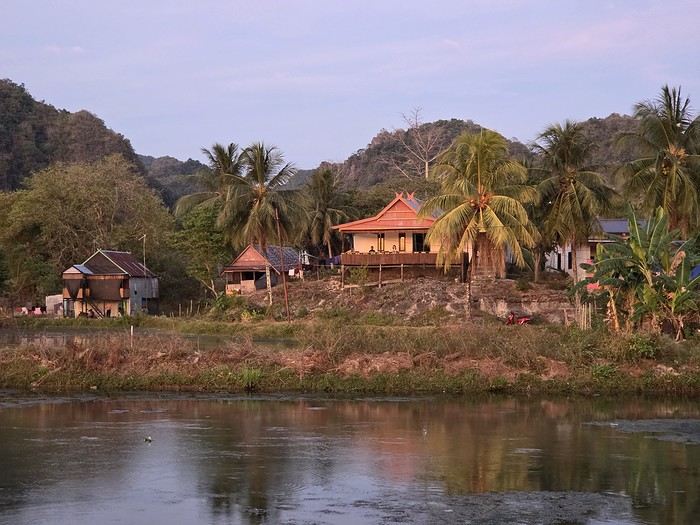
Ours: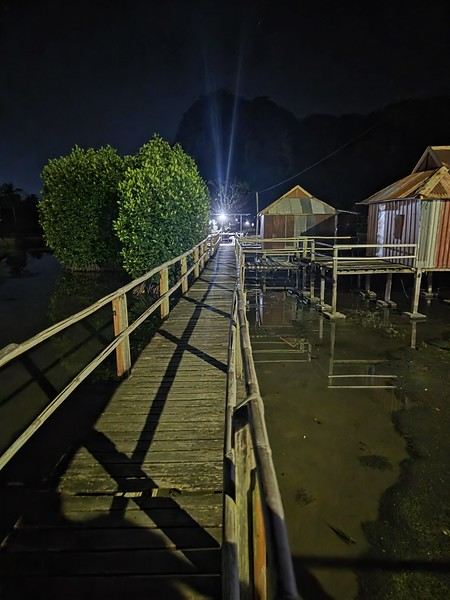
View of the little lake:
But not everything is straightforward around here. I wanted to get a local SIM card for internet and calls. I found them expensive at Jakarta’s airport (20 € for 20 GB), so I decided to wait. Well, no luck in Rammang Rammang either. You can’t just buy one from the local shop—you need a Telkomsat store (they have the best coverage). So we’d have to wait for Rantepao to get Wi-Fi... When I say "local shop," I mean the little shack around the corner. No big deal—we’d find one easily in Rantepao for 5 € and 25 GB. So there we were, offline, just the four of us enjoying the amazing view.
Saturday 07/11: Rammang Rammang We woke up early to the sound of wedding music blasting through the village (everyone’s invited!). Off we went to explore the area. A little walking, a little boat ride (shared with a French tourist and a Polish one—yes, there *are* tourists here, just not many; 750,000 IDR for up to 8 people) through a lovely canal, and we discovered the karst site. It was peaceful and beautiful. The river: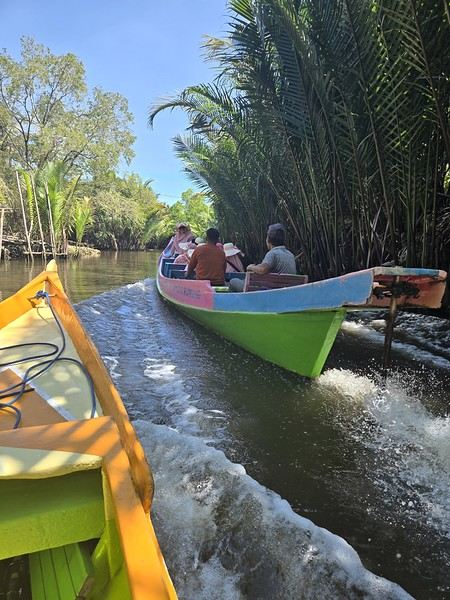 The karst site:
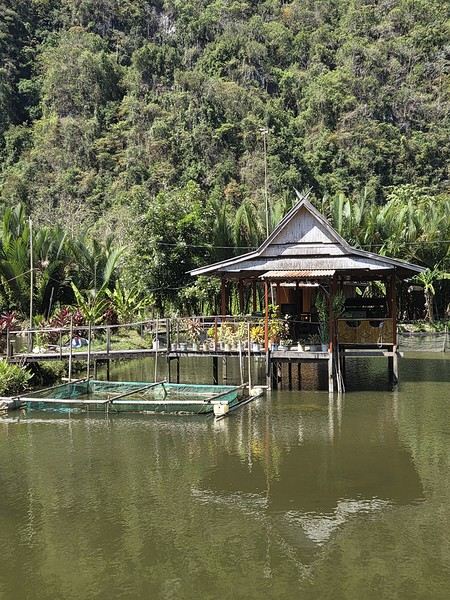
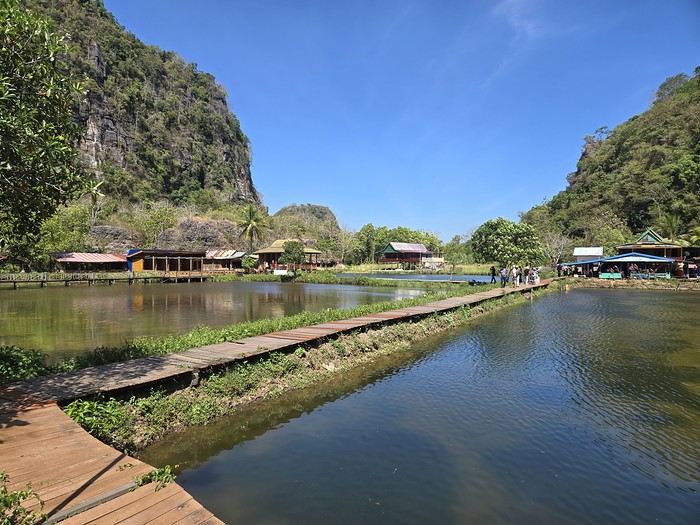
Wednesday 07/08 - Thursday 07/09: We left Montpellier for what was supposed to be five flights, though we only took four to start, landing in Jakarta. We picked up our luggage there to catch a flight to Makassar the next day. That’s the only way we could get an affordable ticket (702 €). I won’t bore you with the flight details—there’s not much to say. We arrived at 7 PM and considered heading straight to Makassar that evening. But we opted for a recovery night before taking off again. Good thing we did, because my son’s suitcase was missing... First contact with the locals was a bit stressful—a trip without your luggage isn’t exactly fun. But right away, a woman reassured us: the suitcase was just enjoying some extra time in Singapore. Maybe it was doing some last-minute shopping. Anyway, nothing serious—it was supposed to arrive at 9 AM the next day. That gave us some breathing room since our flight wasn’t until noon. So off we went to our hotel (Days Hotel & Suites) near the airport. It was cheap (40 € for three rooms—my kids are older and need their space), but it wasn’t worth much more. The place had definitely seen better days. But no big deal—we were only there for the night, and... we got to watch France beat Morocco in the World Cup live at 3 AM. That’s what really mattered!
Friday 07/10: In search of the lost suitcase First challenge of the morning: finding our missing suitcase. They sent us to the airport basement, to the staff entrance. We were greeted with smiles, and an airport employee led me through the underground corridors back to the baggage claim. Right on time at 9 AM, the suitcase arrived, just like they’d promised. We were finally complete! Off we went to change terminals, grab a well-deserved meal, and board our fifth flight to Makassar. Little side note: I struggled for a while trying to book domestic flights directly on the airlines’ websites with no luck. Without meaning to advertise (though I guess I am a little), I realized it’d be easier to use sites like tiket.com or Traveloka. That turned out to be a great choice—I even ended up booking hotels through them later in the trip. 12:40 PM: We were on our way to Makassar. First good news: we were the only tourists. Well, the only European tourists on the flight, anyway. No, you’re not dreaming—the bag is full of... potato chip packets. To each their own souvenirs, I guess...
When we arrived in Makassar, a driver was waiting to take us straight to Rammang Rammang: 250,000 IDR (12 €) to our guesthouse (Rammang Rammang House). Forget about meeting people on the bus—we were headed straight to the first stop of our trip, and it was already stunning.
My kids’ guesthouse:
Ours:
View of the little lake:
But not everything is straightforward around here. I wanted to get a local SIM card for internet and calls. I found them expensive at Jakarta’s airport (20 € for 20 GB), so I decided to wait. Well, no luck in Rammang Rammang either. You can’t just buy one from the local shop—you need a Telkomsat store (they have the best coverage). So we’d have to wait for Rantepao to get Wi-Fi... When I say "local shop," I mean the little shack around the corner. No big deal—we’d find one easily in Rantepao for 5 € and 25 GB. So there we were, offline, just the four of us enjoying the amazing view.
Saturday 07/11: Rammang Rammang We woke up early to the sound of wedding music blasting through the village (everyone’s invited!). Off we went to explore the area. A little walking, a little boat ride (shared with a French tourist and a Polish one—yes, there *are* tourists here, just not many; 750,000 IDR for up to 8 people) through a lovely canal, and we discovered the karst site. It was peaceful and beautiful. The river:
The karst site:
Prices in Albania
I’ve got some new questions about Albania!
My boyfriend and I are going there for just 9 days, including the two travel days… It’s not much, but oh well!
Looking at prices online, I get the impression everything’s more expensive than I thought 😅 So, I wanted to get your feedback on a few things:
* Is hitchhiking common, easy, and generally safe in Albania? * Is it possible to find day-to-day accommodations without booking ahead? If so, are they usually cheaper than the ones you find online? * Is wild camping allowed or at least tolerated?
If any of you have traveled there recently, I’d love all the tips and great deals you’ve got!
Thanks ☺️
My boyfriend and I are going there for just 9 days, including the two travel days… It’s not much, but oh well!
Looking at prices online, I get the impression everything’s more expensive than I thought 😅 So, I wanted to get your feedback on a few things:
* Is hitchhiking common, easy, and generally safe in Albania? * Is it possible to find day-to-day accommodations without booking ahead? If so, are they usually cheaper than the ones you find online? * Is wild camping allowed or at least tolerated?
If any of you have traveled there recently, I’d love all the tips and great deals you’ve got!
Thanks ☺️
Draw Me Your Japan...
Hi there!
 I’m inviting you on a stroll through my drawings—a completely subjective, far from exhaustive, and totally personal take, since it’s based on my own sketches. I put this travel journal together after returning in late 2024, mostly using felt-tip pens and pencils, with a few collages thrown in. I worked from our personal photos.
Let’s start with the shotengai...
Our first "wow" moment came as we stepped out of the subway in Asakusa, the Tokyo neighborhood where we’d booked our hotel for our first five nights. Exhausted after our long flight, we finally arrived and took an exit that led straight into a shotengai—one of those covered shopping streets that pop up in city centers and flourished between the 1950s and 1980s.
It was an instant aesthetic shock, like a close encounter of the third kind between the modern city, a typical Asian market with its street stalls, the vintage vibe of the arcade, the sheer abundance of goods, and the bustling crowd—a mix of tourists, pilgrims (thanks to nearby Senso-ji Temple), and locals (it’s a very working-class area). In the end, it set the tone for a feeling we’d experience throughout the trip. Wherever we went, shotengai turned out to be fantastic spots for finding little restaurants, shops, or even fresh produce. Some are like real mazes, like in Kyoto, where we spent ages trying to relocate a restaurant we’d loved ;-)
In Kanazawa, the Omicho Market: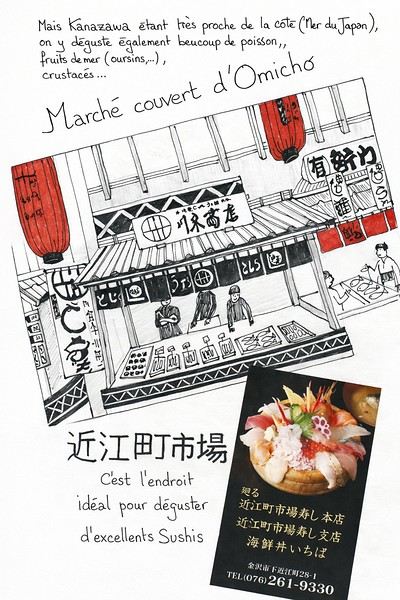 And in Kyoto, Nishiki Market:
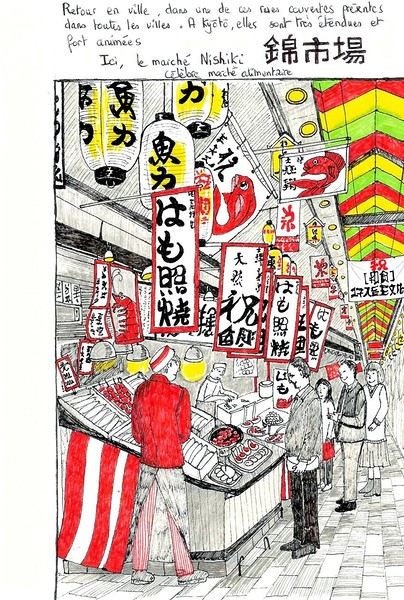
To be continued...
I’m inviting you on a stroll through my drawings—a completely subjective, far from exhaustive, and totally personal take, since it’s based on my own sketches. I put this travel journal together after returning in late 2024, mostly using felt-tip pens and pencils, with a few collages thrown in. I worked from our personal photos.Let’s start with the shotengai...
Our first "wow" moment came as we stepped out of the subway in Asakusa, the Tokyo neighborhood where we’d booked our hotel for our first five nights. Exhausted after our long flight, we finally arrived and took an exit that led straight into a shotengai—one of those covered shopping streets that pop up in city centers and flourished between the 1950s and 1980s.
It was an instant aesthetic shock, like a close encounter of the third kind between the modern city, a typical Asian market with its street stalls, the vintage vibe of the arcade, the sheer abundance of goods, and the bustling crowd—a mix of tourists, pilgrims (thanks to nearby Senso-ji Temple), and locals (it’s a very working-class area). In the end, it set the tone for a feeling we’d experience throughout the trip. Wherever we went, shotengai turned out to be fantastic spots for finding little restaurants, shops, or even fresh produce. Some are like real mazes, like in Kyoto, where we spent ages trying to relocate a restaurant we’d loved ;-)
In Kanazawa, the Omicho Market:
And in Kyoto, Nishiki Market:
To be continued...
Trip to Thailand and Laos
Hello! 🙂
January 2026 Here we go again for new adventures and the pleasure of sharing them with you here! First of all, I’d like to thank everyone who helped me with the preparations, even with some last-minute improvisations just days before departure. Thanks to Montagnard74, Jojoone1, Songsam, Attila, Dennis2, NadegerFERM, and the authors whose travel journals about Laos inspired me (Montagnard74, Muriel18, Mavietongs...).
In this story, written by Richard and illustrated by me, we’ll tell you about the journey of four friends: Catherine, Richard, Nathalie, and Bruno. A reinvented but overall successful trip, filled with discoveries and surprises, the scents of spices and frangipani flowers, (too) spicy food, sunsets, and... one big mess.
January 2026 Here we go again for new adventures and the pleasure of sharing them with you here! First of all, I’d like to thank everyone who helped me with the preparations, even with some last-minute improvisations just days before departure. Thanks to Montagnard74, Jojoone1, Songsam, Attila, Dennis2, NadegerFERM, and the authors whose travel journals about Laos inspired me (Montagnard74, Muriel18, Mavietongs...).
In this story, written by Richard and illustrated by me, we’ll tell you about the journey of four friends: Catherine, Richard, Nathalie, and Bruno. A reinvented but overall successful trip, filled with discoveries and surprises, the scents of spices and frangipani flowers, (too) spicy food, sunsets, and... one big mess.
Feedback on a road trip in Greece
Hi there,
We’re planning a 12-day trip to Greece next February.
It’s our first time, so we’ll be hitting the "Must-Sees"—that should keep us busy enough! 😎
The itinerary isn’t set in stone yet, but we’re already wondering if it’s doable or just crazy, if some stops are essential or a waste of time...
Here’s the plan: Day 1-2-3: Athens (we arrive midday on Day 1) Day 4: Southern Athens (Temple of Neptune) then overnight in Corinth (we’re renting a car from the airport) Day 5-6-7: Western/Southern Peloponnese (one or two places to stay, and the iconic spots: Acrocorinth, Cargo, Mycenae, Sanctuary of Epidaurus, Nafplio, Nemea...) Day 8: Transit to Delphi via Olympia Day 9-10: Delphi, Monastery of Osios Loukas... Day 11: Return to Athens via Thermopylae We were wondering if it’s feasible to add the Meteora monasteries? And Mount Olympus, just for fun?
For accommodations, do you have any recommendations for Athens? Peloponnese? Delphi? In Athens, I think it’s best to stay near the metro line that connects to the airport. But which neighborhood is good? It’s hard to navigate such a big city...
Two more questions: - Is Piraeus worth a visit? - We know February is a quieter time than peak tourist season, and that’s what we like. But there must be consequences—do all sites/museums close by 5 PM (except in Athens, maybe)? What do you do in the evenings once it’s dark?
Thanks in advance for your tips and advice!
We’re planning a 12-day trip to Greece next February.
It’s our first time, so we’ll be hitting the "Must-Sees"—that should keep us busy enough! 😎
The itinerary isn’t set in stone yet, but we’re already wondering if it’s doable or just crazy, if some stops are essential or a waste of time...
Here’s the plan: Day 1-2-3: Athens (we arrive midday on Day 1) Day 4: Southern Athens (Temple of Neptune) then overnight in Corinth (we’re renting a car from the airport) Day 5-6-7: Western/Southern Peloponnese (one or two places to stay, and the iconic spots: Acrocorinth, Cargo, Mycenae, Sanctuary of Epidaurus, Nafplio, Nemea...) Day 8: Transit to Delphi via Olympia Day 9-10: Delphi, Monastery of Osios Loukas... Day 11: Return to Athens via Thermopylae We were wondering if it’s feasible to add the Meteora monasteries? And Mount Olympus, just for fun?
For accommodations, do you have any recommendations for Athens? Peloponnese? Delphi? In Athens, I think it’s best to stay near the metro line that connects to the airport. But which neighborhood is good? It’s hard to navigate such a big city...
Two more questions: - Is Piraeus worth a visit? - We know February is a quieter time than peak tourist season, and that’s what we like. But there must be consequences—do all sites/museums close by 5 PM (except in Athens, maybe)? What do you do in the evenings once it’s dark?
Thanks in advance for your tips and advice!
Three weeks in Yunnan in October 2025
We just spent three weeks in Yunnan.
I’ve started writing up a travel journal about the trip.
Malagasy visa: cost and procedure
Hey Fellow Travelers,
I was caught off guard when the Malagasy consulate in Scandinavia informed me they don’t issue entry visas for Madagascar—what’s the point of a consulate, I wonder! They advised me to apply at the Malagasy embassy in London. So, I started filling out the online form, but the price for the visa made me do a double-take: nearly 200 €!
But apparently, you can also get it on arrival! Has anyone tried this before? I’d love to know if the process takes a long time (I’ll be landing in Nosy Be, exhausted after nearly 15 hours of travel), what the cost is, and—since corruption isn’t just a word—whether you absolutely have to grease the palm of the official(s). This is because I almost took the next flight back when I arrived in a country I won’t name. Even though all my documents were in order—passport, visa, vaccinations, hotel reservation—the immigration officer initially refused to stamp my passport. I later found out I was supposed to slip at least $10 into the document when presenting it... Thanks! /d
I was caught off guard when the Malagasy consulate in Scandinavia informed me they don’t issue entry visas for Madagascar—what’s the point of a consulate, I wonder! They advised me to apply at the Malagasy embassy in London. So, I started filling out the online form, but the price for the visa made me do a double-take: nearly 200 €!
But apparently, you can also get it on arrival! Has anyone tried this before? I’d love to know if the process takes a long time (I’ll be landing in Nosy Be, exhausted after nearly 15 hours of travel), what the cost is, and—since corruption isn’t just a word—whether you absolutely have to grease the palm of the official(s). This is because I almost took the next flight back when I arrived in a country I won’t name. Even though all my documents were in order—passport, visa, vaccinations, hotel reservation—the immigration officer initially refused to stamp my passport. I later found out I was supposed to slip at least $10 into the document when presenting it... Thanks! /d
A Scandinavian Tour - Summer 2025
Off on new adventures!!!
For my wife’s 60th birthday, I’m really making her happy. While I usually pick warm, sunny destinations, she’s more tempted by places where you don’t suffer from the heat.
So, it’s off to Norway!! A real challenge for me—a southern guy who’s as cold-sensitive as they come.
I keep telling anyone who’ll listen (well, just myself, really) that these aren’t the countries for me, that rain will be our travel companion, that we’ll have to face polar bears, navigate between icebergs, that there are still Vikings around, and all sorts of other things.
Of course, not wanting to make it easy, we’re driving from the Lyon area where we live.
Friends who’ve visited the country told us it’s pretty expensive to eat out (among other things), so we’re bringing supplies—especially enough for apéritifs the whole trip!!!
It’s not a camper van, but a "hotel-car" we’ll be doing! We’ll see how it goes!
As usual, I’ll try to narrate the journey with my two-cent comments, plus some little tips to avoid our mistakes—assuming I don’t lose any fingers to the cold!
Every night, I’ll count them to make sure I still have all ten! We’re not in *Ch’tis* territory but even farther Noooorth (as Galabru would say).
Note that I’m traveling with a synovial effusion in my knee! The old man’s not in great shape!!
Here we go!!
PS: As always, I’m a filmmaker, so I’ve made an effort with a few photos from my phone.
PS: As always, I’m a filmmaker, so I’ve made an effort with a few photos from my phone.
Madagascar - June 2025
Five years of an unintended break... The closure of VF, COVID... What a joy to rediscover the pleasure of sharing!
I’ve stayed true to my habits: the following account is a collection of practical tips rather than a travel journal...
Madagascar is as big as France and Belgium combined. In three weeks, choices have to be made! It was the Great Tsingy that inspired our trip. We decided to focus on the southwest and the RN7. We skipped the Deep South and the North. Oh well...
OUR ITINERARY IN 3 WEEKS:
Fri 6 June – Direct AF flight to Tana – Flight arrives at 10:30 PM – Tana Sat – Antsirabe Sun – Miandrivazo Mon – Drive to the Masiakampy pier – Descent of the Tsiribihina River by pirogue - Bivouac Tue – Descent of the Tsiribihina River by pirogue - Bivouac Wed – Descent of the Tsiribihina River by pirogue – Bekopaka Thu – Pirogue on the Manambolo River and Small Tsingy of Bemaraha – Bekopaka Fri – Great Tsingy of Bemaraha – Bekopaka Sat – Avenue of the Baobabs – Morondava Sun – Belo sur Mer Mon – Free day – Belo sur Mer Tue – Manja Wed – Andavadoaka Thu – Free day – Andavadoaka Fri – Salary Lagoon – Mangily Sat – Ranohira Sun – Isalo National Park - Ranohira Mon – Anja Reserve - Ambalavao - Fianarantsoa Tue – FCE train canceled – Visit to a Tanala village - Manakara Wed – Pirogue on the Pangalanes Canal – Ranomafana Thu – Ranomafana NP – Ranomafana Fri – Ambositra – Antsirabe Sat 28 June – AF flight to Paris – Flight departs at 11:55 PM
TRIP ORGANIZATION: I prepared my trip using the usual guides (LP and Rough Guide), the internet, and the Freytag & Berndt map (1:1,000,000). I’m old-school—I still love visualizing my route on a paper map, even though in Madagascar, it’s misleading because some National Roads are only national in name!...
The agency: Since we couldn’t deal directly with a driver-guide (we lacked reliable info to take the plunge), we went through an agency to organize the logistics of our trip. We didn’t feel like using bush taxis (not enough time) or driving a 4x4 ourselves (neither the skills nor the boldness). The French agency connected us with a local agency, to whom I sent my detailed itinerary by email. A few exchanges via email and WhatsApp calls allowed us to finalize everything quickly after some adjustments. As you’ve gathered... we multiplied the commissions, which inflated the budget. That said, in the end, we were thrilled with our decision and our choice. Our trip was booked by the end of 2024, and reservations were made immediately. No bad surprises: the bookings in the planned hotels were honored, often with one of the best rooms. On our last day in Tana, before departure, we were lucky enough to meet the director I’d been communicating with, who helped build and validate our circuit. A very warm debriefing.
The driver-guide: The agency assigned us Faly, 33, a driver-guide for over 10 years. He stayed with us from start to finish: he picked us up at the airport on arrival and dropped us off 23 days later. A very experienced driver (which is important here), an open and cultured guide, reliable, punctual, and a great companion. And a provider of good advice throughout the trip. We made the most of the long stretches on dirt roads or highways to listen to him talk about daily life, rituals, wildlife, and flora... No time wasted! With a great playlist in the background, we combined business with pleasure! Faly’s accommodation and meals were included (quite often, hotels offer free lodging and meals to driver-guides who bring clients), as was the fuel. That didn’t stop us from inviting Faly to share a beer or our evening meal sometimes. He didn’t always accept, wanting to let us "enjoy our romantic evenings," as he put it. Present without being intrusive! Faly is fully capable of organizing a tailor-made trip directly. I recommend him without any hesitation—we were delighted with his service. I’ll gladly share his contact details via PM to anyone who asks.
Local guides: It’s the national guide’s prerogative to choose the local guides (mandatory in the parks). Thanks to his experience, Faly always booked us amazing, competent, and interesting local guides.
Hotels: I told the agency I wanted charming, comfortable accommodations, without falling into flashy luxury. We loved all the hotels (except the Hôtel Kanto in Manja). The rooms, mostly bungalows, were always spacious and clean. Unfortunately, I can’t give the prices—I didn’t get the details. Breakfast is always included, usually fresh and hearty. Very often, a small bottle of water is provided in the room.
Tana Hôtel Les 3 Métis Power cuts are common (!) in Tana. Bring a headlamp.
Antsirabe Ecolodge – Les chambres du voyageur Maybe our favorite! A few bungalows, beautifully arranged in a splendid tropical garden. The dog Kodak welcomes us warmly.
Miandrivazo Hôtel Princesse Tsiribihina Magnificent view of the valley.
Bekopaka Hôtel Orchidée du Bemaraha 2 (yes, 2) beautiful pools, a large open common room.
Morondava Hôtel Baobab Café Brand new or at least, according to Faly, just renovated. Very comfortable but without much charm (international style).
Belo sur Mer Ecolodge du Menabe The bungalows, all made of wood, bamboo, and thatch, are set on the beach. Very spacious and fully equipped! Large open-air restaurant by the sea. No hot water from the tap—it’s available in plastic bottles heated by the sun in front of each bungalow. Actually, we never used it... Another very, very beautiful spot.
Manja Hôtel Kanto The only hotel on this leg of the journey, so no choice. The owner knows it and, as a result, doesn’t bother. It’s a real dive! Tiny, dark room, a sordid bathroom with only a trickle of water—we skipped the shower! Clean sheets, though. Obviously, no Wi-Fi. The only place where I didn’t leave a tip. We were well warned about the discomfort of this stop, both by the agency and Faly. We weren’t surprised, and it even became a running joke during the trip. On the other hand, we found a nice little market in town.
Andavadoaka Manga Lodge What bliss! Especially after the horrible Hôtel Kanto. A paradise-like spot, overlooking three beautiful deserted white-sand beaches. Meals are served on the terrace facing the sea. Stunning sunset. We loved spending a day lounging here! We were the only guests and were pampered.
Mangily (Ifaty) Mangily is the "suburb" of Ifaty. Hôtel Vovo Telo A large beachfront bungalow complex. More touristy but pleasant—we spent a lovely evening there with our feet in the sand.
Ranohira Le Relais de la Reine A splendid resort built by a Frenchman, at the foot of the rocks, very well integrated into the environment. Beautiful marked trail starting from the garden.
Fianarantsoa Villa Sylvestre Contrary to what its name suggests, it’s a hotel right in the city center. Quite decent, though.
Manakara Parthenay Club Pretty bungalows in a large garden by the sea, but swimming isn’t safe—the water is too dangerous and rough.
Ranomafana Hôtel Thermal Very spacious rooms.
Meals: Not all our meals were included. It’s really not expensive. 1 meat or fish dish: around 35,000 Ar 1 full menu (starter, main, dessert): around 70,000 Ar 1 large THB beer (65 cl): between 8,000 and 12,000 Ar 1 piña colada: 15,000 Ar 1 flavored rum: 6,000 Ar (sometimes free) 1 glass of baobab juice (!): 5,000 Ar
We always ate very well. Rice is everywhere, served in large quantities. Zebu meat is quite good if not overcooked. Personally, I prefer fish, and I feasted: grouper, captain, crab, small lobsters...
We happily discovered baobab juice (especially in Belo, on the west coast). And of course, flavored rums!
We bought 2 packs of 6 bottles of mineral water at Carrefour (!) (about 5,000 Ar per large bottle) at the start of our trip. That was enough, especially since we often got water in the bungalows.
We had a few picnics included in our trip. Instead of picking up the hotel’s lunchbox, Faly prepared delicious, fresh, and varied picnics for us: tuna pasta salad, fried rice with eggs, grilled vegetables, and avocado...
An exceptional address not to miss: Mad Zébu – Belo sur Tsiribihina A highly reputed restaurant, a favorite of LP and Rough Guide, and rightly so! Gourmet cuisine, refined and elegant. Barely more expensive than elsewhere, and it’s worth it. We stopped there on our way up to Bekopaka and the Tsingy NP. Fully booked! So Faly reserved for our return, three days later. We’re still thanking him! What a treat!
THE BUDGET: Ariary exchange rate: 5,000 Ar = 1 €
Pre-trip expenses: Direct Air France flights: 930 € per person round trip Cost of the circuit with the agency: 2,880 € per person
The visa: Issued on arrival, very quickly. 35 € per person for a stay under 30 days. Super simple. Super fast.
On-site expenses: As soon as we arrived at the airport (it was nearly midnight), Faly advised us to exchange our euros for all our needs. There are few opportunities on our route to find an ATM or an open bank with a good rate. To be more comfortable, he took us to a small office under military protection just outside the airport. I exchanged 1,200 € (I had asked the agency for advice on the amount to bring) at a rate of 4,750 Ar and became a millionaire. Faly recounted all the stacks. That covered all our expenses (meals, drinks, tips) without ever feeling deprived. Personal purchases were made at the end of the trip. Convenient—it served as an adjustment variable. We spent our last million (200 €) on marquetry and vanilla. Tip: We asked for 200,000 Ar in 5,000 Ar bills for tips. That wasn’t too much—I even ran short of small bills in the last two days.
Tips: Madagascar is a poor country where every service deserves a small reward. While not mandatory, it’s customary. But no one ever demanded or expected it openly. On the contrary, I sometimes had to remind a porter to give them my small bill. We never carried our luggage—porters were always present when the car arrived or waiting at our door to watch for our departure. I gave each of them 5,000 Ar. In restaurants, I rounded up to the nearest ten and left the change. Local guides also expect a tip: I gave around 20,000 Ar per day for the two of us. Finally, the national guide also expects a gratuity. I had read online to budget 5 € per day per person. I added more since we were so happy with his services. The tip was given at the end of the trip, in euros, outside the budget.
Total budget all included (excluding personal purchases): 8,690 € Clearly, Madagascar is a country where life isn’t expensive, but travel costs add up quickly due to the need to rent a 4x4 with a driver.
HIGHLIGHTS:
· The dirt roads Yes, I’m listing them among the highlights! We loved those long hours spent driving at 20 km/h on rocky, muddy, white, red, or gray sand tracks... surrounded by tropical vegetation, palm trees, pandanus, mango trees... The experiences were sometimes thrilling: crossing a river on a ferry (just planks of wood fixed on two motorized pirogues side by side) or crossing a river without a ferry, with just a kid running ahead of the 4x4 to show the way; soft sand where the 4x4 easily gets stuck... The tracks are quite narrow, and crossing paths with a bush taxi, a zebu cart, or a herd of goats is always epic. So many beautiful images, so many beautiful photos! Much more beautiful than on asphalt. So yes, we loved those long stretches on dirt roads. For us, it was clearly part of the journey. Faly was particularly careful, and the 4x4 was comfortable. No injuries, no fatigue, even after 7 or 8 hours on rough tracks. The national roads (including the famous RN7) are badly damaged by cyclones, huge trucks, and lack of maintenance. Potholes have turned into ostrich nests, and we didn’t drive much faster than on the dirt roads.
· The landscapes, villages, encounters... We crossed a variety of stunning landscapes: mountains with slopes covered in terraced crops, rice fields from apple green to emerald green, sugarcane fields, then tropical forests, baobab forests (they deserve a special paragraph below), traveler’s tree forests. And then coastlines with white sand dunes against a backdrop of blue hues!... Magical! We also passed through many villages with houses whose architecture varied by region. The Betsileo houses display beautiful decorative brick reliefs. On the west coast, the houses are more precarious, made of bamboo with palm-thatched roofs. In the Highlands region, we found solid houses with pastel plaster. Each region has its own landscape, crops, habitat, and clothing. Zebu carts are often the only means of transport in remote villages. We saw them very frequently. Again, the cart’s decoration depends on the region. And then, we met many villagers coming out of the bush and walking to the next market, carrying their crops on their heads or shoulders. More beautiful photos!
· The descent of the Tsiribihina River We boarded around 9 AM in a long pirogue with Gana, the local guide, and two pirogue men. So, five of us. The pirogue is long but narrow, about 65 cm wide. We sat one behind the other at the front on seats padded with what would become our mattresses during the bivouacs. We only took the bare essentials for two nights. A little goodbye to Faly, whom we’d see again in three days! Don’t forget us! The river is silty—meaning orange, opaque but clean. We glided along silently. Gana showed us the trees, birds, crocodiles (we saw five—apparently, we were lucky). The pirogue men rowed to get us as close as possible to these crocs sunbathing on the roots of big trees. Yeah, right!... as soon as we got too close, *splash*, they disappeared into the water. We marveled at the mini rice fields lining the river. Every tiny plot, no matter how small, is cultivated. Above them, banana fields. And on the water, a whole life of fishermen and villagers living with and from the river. Gana warned us we’d eat on the pirogue because the journey was long. So, I expected chips... But no—fried rice and zebu steak, cooked right in the pirogue!! Incredible! In the middle of the afternoon, we reached a small beach where we disembarked. Gana led us about a hundred meters to a sublime waterfall. We were alone there. We had time to swim. We’d brought our swimsuits and a towel (bought at the Carrefour in Antsirabe on Faly’s wise advice!). This swim in this paradise-like spot remains one of our best memories. We found our pirogue again and set off until our first bivouac. We’d sailed for 7 hours today. The tents were set up on a wide beach, without a single tree. A moment of solitude... Uh, where can we go to the bathroom?... Especially since it was a full moon, so we felt like we were in the spotlight. Anyway... we did as everyone else—walked away, dug a hole, and the others turned their backs. A hearty meal on the beach before a comfortable and silent night. The next day, same program, with slightly different landscapes. The gorges widened, the trees were different. But still many colorful birds. Again, we ate on the pirogue: grilled chicken and vegetables. 9 hours of sailing. A similar bivouac. This time, we got it. On the third day, we finished the descent with 5 hours of sailing. So, 7 hours, 9 hours, 5 hours... doing nothing. It might sound boring... but it wasn’t. Like the dirt roads, these were contemplative moments. It glides, it’s calm, relaxing, and there’s a lot of life on this river, animal and human. Contemplation. Suspended time. On arrival, we disembarked at a sort of joyful, bustling river port. Of course, Faly was already there to pick us up.
· The Tsingy de Bemaraha NP (Small and Great) I have vertigo. During my research, several agencies advised me against visiting the Great Tsingy. "Stick to the Small ones," they said. Grrr, no, not what I wanted—we’ve dreamed of this for years! The agency we chose also warned me but didn’t discourage me. So we started with the Small Tsingy, quite close to Bekopaka, guided by Alisha. This forest of sharp limestone rocks is impressive. No vertigo issues here. The day was completed with a short pirogue ride on the Manambolo River and a visit to two caves with pretty formations. The next day, Faly and Alisha drove us to the Great Tsingy (a good hour on a terrible track). Arriving at the park entrance, Alisha equipped us with harnesses, carabiners, and gave us some safety instructions. Faly was also equipped. Wait? He’s coming with us? I quickly understood he was there for me—if I got stuck, he could go back with me, and Philippe could continue with Alisha. A wise precaution that delighted and reassured me. In the end, it was unnecessary since the famous bridge crossing was fully secured by the harness and carabiners. 18 meters on planks, one by one, it didn’t sway too much—I walked looking straight ahead, not a glance down. I even managed to smile in the middle of the crossing—I have a photo to prove it! I was overjoyed! The circuit in the Great Tsingy is a loop, so we didn’t have to cross the bridge again. We climbed to viewpoints offering breathtaking panoramic views. It’s extraordinary, unique, incredible. All this to say that if you have vertigo, don’t hesitate! It’s doable! It’s completely safe and really worth pushing your limits a bit! For those who’ve done treetop adventure courses, it’s similar. Also, no need to be a great athlete—just a bit of agility to climb a few ladders and high steps. Don’t censor yourself! I even had a small regret—the loop was a bit short (about 2 hours). I would’ve liked to continue or even redo it, with less apprehension. Tip: Do the Small Tsingy before the Great ones, or not at all. And if you can only do one, do the Great ones without hesitation.
· Canoeing in the Belo mangrove The Belo sur Mer ecolodge lends small individual canoes for free to go to the mangrove. We left at high tide, paddled for about twenty minutes to reach a fairly sparse forest where we could easily venture in. Very shallow water, crystal clear—we could see the roots of all these trees, schools of tiny fish... It was quite surprising. Until then, I only knew impenetrable, tangled mangroves. Here, nothing like that—we walked through an aquatic forest. We loved this adventure so much we left a bit late. The tide had gone out, and we had to carry our canoes for the last few meters... Of course, the staff came to help (probably laughing silently!). The lodge owners gave all the necessary explanations and lent a waterproof bag for the phone (because yes, it’s worth taking photos!). A very useful precaution—the canoes are small, low in the water, and paddling quickly soaks you. Again, this isn’t just for Tony Estanguet! It didn’t cause us any problems, not even sore muscles the next day. A great experience. It’ll take about 2 hours.
· Isalo NP Big surprise when we saw this huge rocky massif appear on the RN7! A massif of colored sandstone, carved with crevasses giving it a ruined look. Le Relais de la Reine is a little gem cleverly nestled in the heart of these rocks. A small marked trail starts from the garden. We picked up the description at reception and set off. Without a guide, alone following the markers, it took us 2 hours to complete this magnificent little trail, giving us a first glimpse of the massif before the hike the next day. And we enjoyed being completely alone for this walk. It’s free, easy, and well-signposted. Don’t miss it. In the evening, Faly took us to the so-called Isalo Window site—a hole in a wall through which we could see the sunset. We met all the tourists in the area here. We weren’t blown away by the show... The next day, we left early to reach the start of the hike. We met Zozoly at the guides’ office in the small town of Ranohira. During this hike, we climbed through the rocks to a viewpoint offering stunning 360° views of the massif. Then we reached a site called the "natural pool," breathtakingly beautiful, especially since we were alone again. A sort of oasis, a cascading waterfall, palm trees and tree ferns, fine sand, all nestled at the bottom of a small canyon. Paradise-like. We resisted swimming, but it was really tempting. A long walk on the plateaus then led us to a well-equipped picnic site where a local team prepared grills. Concrete tables were tiered in a spacious, shady clearing where a whole family of ring-tailed lemurs frolicked. They knew the tourists’ habits and tried to snatch food. Playful and not very shy, they amused us with their antics! We had to resist not luring them with a piece of banana!! Thousands of photos!! After the meal, we set off again with Zozoly for another landscape. This time, we were by a small river at the bottom of a canyon with high walls covered in vegetation. The trail was narrow and slippery, on a ledge of the wall. We progressed carefully. No danger, though. We first reached the Blue Pool, which only turns blue in photos (surprise!), then the Black Pool fed by a shower of waterfalls. Two magnificent spots that showed us a completely different aspect of the massif.
· Anja Reserve This ficus forest is home to many groups of lemurs. Used to humans, whom they don’t fear, they move around us, ignoring us completely. It’s almost annoying... The best place on our trip to see lemurs.
· The FCE train To the great regret of Manakara’s inhabitants, the FCE train hasn’t reached here for over a year and a half. As a result, there are far fewer tourists—the train was part of the experience. We drove there and didn’t regret coming to this port on the east coast.
· Visit to a Tanala village This visit wasn’t part of our program—it was added by the agency to compensate for the train not running. Which was the case. Not big fans of this kind of visit, where we feel like we’re at a zoo, voyeuristic, lacking authenticity, we followed the local guide with some skepticism and exchanged dubious looks. And yet... the guide’s explanations about village life and the warm, smiling welcome from the villagers charmed us and dispelled all our concerns. We learned a lot, met smiling families, and were able to enter these beautiful bamboo houses. A very pleasant surprise, rich in lessons.
· The Pangalanes Canal Arriving in Manakara, we crossed a bridge overlooking the Pangalanes Canal. A cry of surprise: the water is turquoise! We took a short pirogue ride with a team of three pirogue men and Joël, a local guide who explained the drama caused by the train’s halt. We stopped in a fishing village where Joël bought fish for the barbecue. We ended up on a beach where the team prepared the meal while we went to watch the fishermen return on the nearby beach. We admired the fishermen’s dexterity in untangling their nets, sorting their fish, cleaning their gear. On our return, we found a small table set up on the beach, in the shade of palm trees and casuarinas. Lobsters, captain fish, grilled vegetables, sautéed potatoes. A real feast (included in the trip cost).
· Ranomafana NP A 4-5 hour hike (some climbing) in a dense secondary forest to look for lemurs. As usual, we were accompanied by a local guide who, while waiting to find our furry friends, gave us lots of info on the vegetation, birds, and Tanala ethnic rituals. In the forest, we met 4 or 5 trackers, armed with radios to alert guides of their findings. In the end, we saw several lemurs of different types. Quite far, quite high... A nice complement to our lemur encounters in Isalo. Here, it rains 200 days a year. We started the hike in thick fog, but the forest’s density protected us from the humidity. Be careful—it can be a bit frustrating to see the lemurs so far away, so high. Nothing like the Anja Reserve or Isalo NP. Here, what’s fun is the hunt.
· The baobabs We were captivated by these kings of the forest, noble, imposing, majestic. We spotted them from very far away, towering over the rest of the vegetation. Alone, in small groups, or in forests, our trip allowed us to see hundreds of them! Mainly on the west coast. All different—bald, hairy, shaggy, short and stout, tall and thin, like Laurel and Hardy. Philippe took to naming them. Respectfully!
OUR FAVORITES: · The variety of landscapes. · The Tsingy NP.
OUR DISAPPOINTMENTS: · The Avenue of the Baobabs, very overrated and the only place where we saw crowds. We saw many other "forests" of baobabs that were much more impressive. · It’s hard to approach the population calmly as swarms of children run up as soon as we arrive, asking for sweets. Without any aggression, their smiles and laughter quickly made us forget this small inconvenience. We never gave out candy, clothes, or money. We left pens at a school and clothes with Faly.
IF WE WERE TO DO IT AGAIN: · Same period, same duration, same pace, same itinerary, but if we were to do it again today, I’d go through Faly directly! · Maybe we should’ve stayed in Ambalavao instead of Fianarantsoa. · Plan a longer loop in the Great Tsingy—it felt a bit too short.
MISCELLANEOUS: The welcome: ‘Samala Vazaha,’ there are many, many kids, sometimes overwhelming, never aggressive. We were impressed by the villagers’ smiles and good humor, towards us or even among themselves—laughter was everywhere. Safety: No problems. Out of (excessive?) caution, we spread all our money across several bags that we padlocked whenever we left the hotel. Bribes: We were stopped several times on the road by police or gendarmes. They checked our papers, sometimes our passports. Faly was perfectly in order. No discussion, no bribes, a cordial greeting from the officers. However, several times we found ourselves at small "tolls" on the tracks for villagers who had leveled the road or filled a hole, or for the young guy who ran through the river to show the way... Faly complied without discussion: every service deserves a small bill. Language: French is still widely spoken. Credit card: Unused. Cash: You need it! The climate at this time: Ideal—blue skies, sunshine, and mild temperatures (20-25°C) throughout our trip. Temperatures started to drop by our departure—winter was setting in. Clothing: T-shirt or polo and a vest sometimes in the evening, sandals on our feet, hiking shoes for all the hikes. Tip: We left a bag in the car (completely safe) with things we didn’t need daily and dirty laundry. The two bags to take out at each stop were much lighter. Before leaving, we left several polos and T-shirts with Faly, which, once washed, will make a few people happy. Tourist crowds at this time: Low—we were sometimes the only guests at the hotel. Faly explained that at the Isalo picnic site, in high season, you have to queue for a table, whereas we had our pick. Photos: Lots! Too many! That’s the problem with digital—we take so many! Health issues: Nothing serious, just the usual mild traveler’s diarrhea. Mosquitoes: They’re voracious. We took anti-malaria treatment. I’m still not sure if it was the right thing to do... I’m always very skeptical about such precautions. Internet: Free Wi-Fi at the lodges’ reception (except at Hôtel Kanto!), sometimes (rarely) in the bungalows. Phone: We didn’t try to get a local SIM card—the evening Wi-Fi was enough for us to make calls and send messages via WhatsApp. Make sure to turn off mobile data and switch to airplane mode (I activated it a bit late—received calls, spam ones at that, were charged...). Electricity: French plugs. Personal purchases: Beautiful wooden objects (sculptures and marquetry) or zebu horn items in Ambositra. 1 kg of vanilla (400,000 Ar – 80 € per kg) in Tana.
IN CONCLUSION: A trip of contemplation. A pause for admiration, as our local guide in Isalo NP said. Nothing else to do but walk, look, and enjoy. Here, there are no old stones, no museums—it’s a trip where nature reigns supreme. And what nature!
I’ve stayed true to my habits: the following account is a collection of practical tips rather than a travel journal...
Madagascar is as big as France and Belgium combined. In three weeks, choices have to be made! It was the Great Tsingy that inspired our trip. We decided to focus on the southwest and the RN7. We skipped the Deep South and the North. Oh well...
OUR ITINERARY IN 3 WEEKS:
Fri 6 June – Direct AF flight to Tana – Flight arrives at 10:30 PM – Tana Sat – Antsirabe Sun – Miandrivazo Mon – Drive to the Masiakampy pier – Descent of the Tsiribihina River by pirogue - Bivouac Tue – Descent of the Tsiribihina River by pirogue - Bivouac Wed – Descent of the Tsiribihina River by pirogue – Bekopaka Thu – Pirogue on the Manambolo River and Small Tsingy of Bemaraha – Bekopaka Fri – Great Tsingy of Bemaraha – Bekopaka Sat – Avenue of the Baobabs – Morondava Sun – Belo sur Mer Mon – Free day – Belo sur Mer Tue – Manja Wed – Andavadoaka Thu – Free day – Andavadoaka Fri – Salary Lagoon – Mangily Sat – Ranohira Sun – Isalo National Park - Ranohira Mon – Anja Reserve - Ambalavao - Fianarantsoa Tue – FCE train canceled – Visit to a Tanala village - Manakara Wed – Pirogue on the Pangalanes Canal – Ranomafana Thu – Ranomafana NP – Ranomafana Fri – Ambositra – Antsirabe Sat 28 June – AF flight to Paris – Flight departs at 11:55 PM
TRIP ORGANIZATION: I prepared my trip using the usual guides (LP and Rough Guide), the internet, and the Freytag & Berndt map (1:1,000,000). I’m old-school—I still love visualizing my route on a paper map, even though in Madagascar, it’s misleading because some National Roads are only national in name!...
The agency: Since we couldn’t deal directly with a driver-guide (we lacked reliable info to take the plunge), we went through an agency to organize the logistics of our trip. We didn’t feel like using bush taxis (not enough time) or driving a 4x4 ourselves (neither the skills nor the boldness). The French agency connected us with a local agency, to whom I sent my detailed itinerary by email. A few exchanges via email and WhatsApp calls allowed us to finalize everything quickly after some adjustments. As you’ve gathered... we multiplied the commissions, which inflated the budget. That said, in the end, we were thrilled with our decision and our choice. Our trip was booked by the end of 2024, and reservations were made immediately. No bad surprises: the bookings in the planned hotels were honored, often with one of the best rooms. On our last day in Tana, before departure, we were lucky enough to meet the director I’d been communicating with, who helped build and validate our circuit. A very warm debriefing.
The driver-guide: The agency assigned us Faly, 33, a driver-guide for over 10 years. He stayed with us from start to finish: he picked us up at the airport on arrival and dropped us off 23 days later. A very experienced driver (which is important here), an open and cultured guide, reliable, punctual, and a great companion. And a provider of good advice throughout the trip. We made the most of the long stretches on dirt roads or highways to listen to him talk about daily life, rituals, wildlife, and flora... No time wasted! With a great playlist in the background, we combined business with pleasure! Faly’s accommodation and meals were included (quite often, hotels offer free lodging and meals to driver-guides who bring clients), as was the fuel. That didn’t stop us from inviting Faly to share a beer or our evening meal sometimes. He didn’t always accept, wanting to let us "enjoy our romantic evenings," as he put it. Present without being intrusive! Faly is fully capable of organizing a tailor-made trip directly. I recommend him without any hesitation—we were delighted with his service. I’ll gladly share his contact details via PM to anyone who asks.
Local guides: It’s the national guide’s prerogative to choose the local guides (mandatory in the parks). Thanks to his experience, Faly always booked us amazing, competent, and interesting local guides.
Hotels: I told the agency I wanted charming, comfortable accommodations, without falling into flashy luxury. We loved all the hotels (except the Hôtel Kanto in Manja). The rooms, mostly bungalows, were always spacious and clean. Unfortunately, I can’t give the prices—I didn’t get the details. Breakfast is always included, usually fresh and hearty. Very often, a small bottle of water is provided in the room.
Tana Hôtel Les 3 Métis Power cuts are common (!) in Tana. Bring a headlamp.
Antsirabe Ecolodge – Les chambres du voyageur Maybe our favorite! A few bungalows, beautifully arranged in a splendid tropical garden. The dog Kodak welcomes us warmly.
Miandrivazo Hôtel Princesse Tsiribihina Magnificent view of the valley.
Bekopaka Hôtel Orchidée du Bemaraha 2 (yes, 2) beautiful pools, a large open common room.
Morondava Hôtel Baobab Café Brand new or at least, according to Faly, just renovated. Very comfortable but without much charm (international style).
Belo sur Mer Ecolodge du Menabe The bungalows, all made of wood, bamboo, and thatch, are set on the beach. Very spacious and fully equipped! Large open-air restaurant by the sea. No hot water from the tap—it’s available in plastic bottles heated by the sun in front of each bungalow. Actually, we never used it... Another very, very beautiful spot.
Manja Hôtel Kanto The only hotel on this leg of the journey, so no choice. The owner knows it and, as a result, doesn’t bother. It’s a real dive! Tiny, dark room, a sordid bathroom with only a trickle of water—we skipped the shower! Clean sheets, though. Obviously, no Wi-Fi. The only place where I didn’t leave a tip. We were well warned about the discomfort of this stop, both by the agency and Faly. We weren’t surprised, and it even became a running joke during the trip. On the other hand, we found a nice little market in town.
Andavadoaka Manga Lodge What bliss! Especially after the horrible Hôtel Kanto. A paradise-like spot, overlooking three beautiful deserted white-sand beaches. Meals are served on the terrace facing the sea. Stunning sunset. We loved spending a day lounging here! We were the only guests and were pampered.
Mangily (Ifaty) Mangily is the "suburb" of Ifaty. Hôtel Vovo Telo A large beachfront bungalow complex. More touristy but pleasant—we spent a lovely evening there with our feet in the sand.
Ranohira Le Relais de la Reine A splendid resort built by a Frenchman, at the foot of the rocks, very well integrated into the environment. Beautiful marked trail starting from the garden.
Fianarantsoa Villa Sylvestre Contrary to what its name suggests, it’s a hotel right in the city center. Quite decent, though.
Manakara Parthenay Club Pretty bungalows in a large garden by the sea, but swimming isn’t safe—the water is too dangerous and rough.
Ranomafana Hôtel Thermal Very spacious rooms.
Meals: Not all our meals were included. It’s really not expensive. 1 meat or fish dish: around 35,000 Ar 1 full menu (starter, main, dessert): around 70,000 Ar 1 large THB beer (65 cl): between 8,000 and 12,000 Ar 1 piña colada: 15,000 Ar 1 flavored rum: 6,000 Ar (sometimes free) 1 glass of baobab juice (!): 5,000 Ar
We always ate very well. Rice is everywhere, served in large quantities. Zebu meat is quite good if not overcooked. Personally, I prefer fish, and I feasted: grouper, captain, crab, small lobsters...
We happily discovered baobab juice (especially in Belo, on the west coast). And of course, flavored rums!
We bought 2 packs of 6 bottles of mineral water at Carrefour (!) (about 5,000 Ar per large bottle) at the start of our trip. That was enough, especially since we often got water in the bungalows.
We had a few picnics included in our trip. Instead of picking up the hotel’s lunchbox, Faly prepared delicious, fresh, and varied picnics for us: tuna pasta salad, fried rice with eggs, grilled vegetables, and avocado...
An exceptional address not to miss: Mad Zébu – Belo sur Tsiribihina A highly reputed restaurant, a favorite of LP and Rough Guide, and rightly so! Gourmet cuisine, refined and elegant. Barely more expensive than elsewhere, and it’s worth it. We stopped there on our way up to Bekopaka and the Tsingy NP. Fully booked! So Faly reserved for our return, three days later. We’re still thanking him! What a treat!
THE BUDGET: Ariary exchange rate: 5,000 Ar = 1 €
Pre-trip expenses: Direct Air France flights: 930 € per person round trip Cost of the circuit with the agency: 2,880 € per person
The visa: Issued on arrival, very quickly. 35 € per person for a stay under 30 days. Super simple. Super fast.
On-site expenses: As soon as we arrived at the airport (it was nearly midnight), Faly advised us to exchange our euros for all our needs. There are few opportunities on our route to find an ATM or an open bank with a good rate. To be more comfortable, he took us to a small office under military protection just outside the airport. I exchanged 1,200 € (I had asked the agency for advice on the amount to bring) at a rate of 4,750 Ar and became a millionaire. Faly recounted all the stacks. That covered all our expenses (meals, drinks, tips) without ever feeling deprived. Personal purchases were made at the end of the trip. Convenient—it served as an adjustment variable. We spent our last million (200 €) on marquetry and vanilla. Tip: We asked for 200,000 Ar in 5,000 Ar bills for tips. That wasn’t too much—I even ran short of small bills in the last two days.
Tips: Madagascar is a poor country where every service deserves a small reward. While not mandatory, it’s customary. But no one ever demanded or expected it openly. On the contrary, I sometimes had to remind a porter to give them my small bill. We never carried our luggage—porters were always present when the car arrived or waiting at our door to watch for our departure. I gave each of them 5,000 Ar. In restaurants, I rounded up to the nearest ten and left the change. Local guides also expect a tip: I gave around 20,000 Ar per day for the two of us. Finally, the national guide also expects a gratuity. I had read online to budget 5 € per day per person. I added more since we were so happy with his services. The tip was given at the end of the trip, in euros, outside the budget.
Total budget all included (excluding personal purchases): 8,690 € Clearly, Madagascar is a country where life isn’t expensive, but travel costs add up quickly due to the need to rent a 4x4 with a driver.
HIGHLIGHTS:
· The dirt roads Yes, I’m listing them among the highlights! We loved those long hours spent driving at 20 km/h on rocky, muddy, white, red, or gray sand tracks... surrounded by tropical vegetation, palm trees, pandanus, mango trees... The experiences were sometimes thrilling: crossing a river on a ferry (just planks of wood fixed on two motorized pirogues side by side) or crossing a river without a ferry, with just a kid running ahead of the 4x4 to show the way; soft sand where the 4x4 easily gets stuck... The tracks are quite narrow, and crossing paths with a bush taxi, a zebu cart, or a herd of goats is always epic. So many beautiful images, so many beautiful photos! Much more beautiful than on asphalt. So yes, we loved those long stretches on dirt roads. For us, it was clearly part of the journey. Faly was particularly careful, and the 4x4 was comfortable. No injuries, no fatigue, even after 7 or 8 hours on rough tracks. The national roads (including the famous RN7) are badly damaged by cyclones, huge trucks, and lack of maintenance. Potholes have turned into ostrich nests, and we didn’t drive much faster than on the dirt roads.
· The landscapes, villages, encounters... We crossed a variety of stunning landscapes: mountains with slopes covered in terraced crops, rice fields from apple green to emerald green, sugarcane fields, then tropical forests, baobab forests (they deserve a special paragraph below), traveler’s tree forests. And then coastlines with white sand dunes against a backdrop of blue hues!... Magical! We also passed through many villages with houses whose architecture varied by region. The Betsileo houses display beautiful decorative brick reliefs. On the west coast, the houses are more precarious, made of bamboo with palm-thatched roofs. In the Highlands region, we found solid houses with pastel plaster. Each region has its own landscape, crops, habitat, and clothing. Zebu carts are often the only means of transport in remote villages. We saw them very frequently. Again, the cart’s decoration depends on the region. And then, we met many villagers coming out of the bush and walking to the next market, carrying their crops on their heads or shoulders. More beautiful photos!
· The descent of the Tsiribihina River We boarded around 9 AM in a long pirogue with Gana, the local guide, and two pirogue men. So, five of us. The pirogue is long but narrow, about 65 cm wide. We sat one behind the other at the front on seats padded with what would become our mattresses during the bivouacs. We only took the bare essentials for two nights. A little goodbye to Faly, whom we’d see again in three days! Don’t forget us! The river is silty—meaning orange, opaque but clean. We glided along silently. Gana showed us the trees, birds, crocodiles (we saw five—apparently, we were lucky). The pirogue men rowed to get us as close as possible to these crocs sunbathing on the roots of big trees. Yeah, right!... as soon as we got too close, *splash*, they disappeared into the water. We marveled at the mini rice fields lining the river. Every tiny plot, no matter how small, is cultivated. Above them, banana fields. And on the water, a whole life of fishermen and villagers living with and from the river. Gana warned us we’d eat on the pirogue because the journey was long. So, I expected chips... But no—fried rice and zebu steak, cooked right in the pirogue!! Incredible! In the middle of the afternoon, we reached a small beach where we disembarked. Gana led us about a hundred meters to a sublime waterfall. We were alone there. We had time to swim. We’d brought our swimsuits and a towel (bought at the Carrefour in Antsirabe on Faly’s wise advice!). This swim in this paradise-like spot remains one of our best memories. We found our pirogue again and set off until our first bivouac. We’d sailed for 7 hours today. The tents were set up on a wide beach, without a single tree. A moment of solitude... Uh, where can we go to the bathroom?... Especially since it was a full moon, so we felt like we were in the spotlight. Anyway... we did as everyone else—walked away, dug a hole, and the others turned their backs. A hearty meal on the beach before a comfortable and silent night. The next day, same program, with slightly different landscapes. The gorges widened, the trees were different. But still many colorful birds. Again, we ate on the pirogue: grilled chicken and vegetables. 9 hours of sailing. A similar bivouac. This time, we got it. On the third day, we finished the descent with 5 hours of sailing. So, 7 hours, 9 hours, 5 hours... doing nothing. It might sound boring... but it wasn’t. Like the dirt roads, these were contemplative moments. It glides, it’s calm, relaxing, and there’s a lot of life on this river, animal and human. Contemplation. Suspended time. On arrival, we disembarked at a sort of joyful, bustling river port. Of course, Faly was already there to pick us up.
· The Tsingy de Bemaraha NP (Small and Great) I have vertigo. During my research, several agencies advised me against visiting the Great Tsingy. "Stick to the Small ones," they said. Grrr, no, not what I wanted—we’ve dreamed of this for years! The agency we chose also warned me but didn’t discourage me. So we started with the Small Tsingy, quite close to Bekopaka, guided by Alisha. This forest of sharp limestone rocks is impressive. No vertigo issues here. The day was completed with a short pirogue ride on the Manambolo River and a visit to two caves with pretty formations. The next day, Faly and Alisha drove us to the Great Tsingy (a good hour on a terrible track). Arriving at the park entrance, Alisha equipped us with harnesses, carabiners, and gave us some safety instructions. Faly was also equipped. Wait? He’s coming with us? I quickly understood he was there for me—if I got stuck, he could go back with me, and Philippe could continue with Alisha. A wise precaution that delighted and reassured me. In the end, it was unnecessary since the famous bridge crossing was fully secured by the harness and carabiners. 18 meters on planks, one by one, it didn’t sway too much—I walked looking straight ahead, not a glance down. I even managed to smile in the middle of the crossing—I have a photo to prove it! I was overjoyed! The circuit in the Great Tsingy is a loop, so we didn’t have to cross the bridge again. We climbed to viewpoints offering breathtaking panoramic views. It’s extraordinary, unique, incredible. All this to say that if you have vertigo, don’t hesitate! It’s doable! It’s completely safe and really worth pushing your limits a bit! For those who’ve done treetop adventure courses, it’s similar. Also, no need to be a great athlete—just a bit of agility to climb a few ladders and high steps. Don’t censor yourself! I even had a small regret—the loop was a bit short (about 2 hours). I would’ve liked to continue or even redo it, with less apprehension. Tip: Do the Small Tsingy before the Great ones, or not at all. And if you can only do one, do the Great ones without hesitation.
· Canoeing in the Belo mangrove The Belo sur Mer ecolodge lends small individual canoes for free to go to the mangrove. We left at high tide, paddled for about twenty minutes to reach a fairly sparse forest where we could easily venture in. Very shallow water, crystal clear—we could see the roots of all these trees, schools of tiny fish... It was quite surprising. Until then, I only knew impenetrable, tangled mangroves. Here, nothing like that—we walked through an aquatic forest. We loved this adventure so much we left a bit late. The tide had gone out, and we had to carry our canoes for the last few meters... Of course, the staff came to help (probably laughing silently!). The lodge owners gave all the necessary explanations and lent a waterproof bag for the phone (because yes, it’s worth taking photos!). A very useful precaution—the canoes are small, low in the water, and paddling quickly soaks you. Again, this isn’t just for Tony Estanguet! It didn’t cause us any problems, not even sore muscles the next day. A great experience. It’ll take about 2 hours.
· Isalo NP Big surprise when we saw this huge rocky massif appear on the RN7! A massif of colored sandstone, carved with crevasses giving it a ruined look. Le Relais de la Reine is a little gem cleverly nestled in the heart of these rocks. A small marked trail starts from the garden. We picked up the description at reception and set off. Without a guide, alone following the markers, it took us 2 hours to complete this magnificent little trail, giving us a first glimpse of the massif before the hike the next day. And we enjoyed being completely alone for this walk. It’s free, easy, and well-signposted. Don’t miss it. In the evening, Faly took us to the so-called Isalo Window site—a hole in a wall through which we could see the sunset. We met all the tourists in the area here. We weren’t blown away by the show... The next day, we left early to reach the start of the hike. We met Zozoly at the guides’ office in the small town of Ranohira. During this hike, we climbed through the rocks to a viewpoint offering stunning 360° views of the massif. Then we reached a site called the "natural pool," breathtakingly beautiful, especially since we were alone again. A sort of oasis, a cascading waterfall, palm trees and tree ferns, fine sand, all nestled at the bottom of a small canyon. Paradise-like. We resisted swimming, but it was really tempting. A long walk on the plateaus then led us to a well-equipped picnic site where a local team prepared grills. Concrete tables were tiered in a spacious, shady clearing where a whole family of ring-tailed lemurs frolicked. They knew the tourists’ habits and tried to snatch food. Playful and not very shy, they amused us with their antics! We had to resist not luring them with a piece of banana!! Thousands of photos!! After the meal, we set off again with Zozoly for another landscape. This time, we were by a small river at the bottom of a canyon with high walls covered in vegetation. The trail was narrow and slippery, on a ledge of the wall. We progressed carefully. No danger, though. We first reached the Blue Pool, which only turns blue in photos (surprise!), then the Black Pool fed by a shower of waterfalls. Two magnificent spots that showed us a completely different aspect of the massif.
· Anja Reserve This ficus forest is home to many groups of lemurs. Used to humans, whom they don’t fear, they move around us, ignoring us completely. It’s almost annoying... The best place on our trip to see lemurs.
· The FCE train To the great regret of Manakara’s inhabitants, the FCE train hasn’t reached here for over a year and a half. As a result, there are far fewer tourists—the train was part of the experience. We drove there and didn’t regret coming to this port on the east coast.
· Visit to a Tanala village This visit wasn’t part of our program—it was added by the agency to compensate for the train not running. Which was the case. Not big fans of this kind of visit, where we feel like we’re at a zoo, voyeuristic, lacking authenticity, we followed the local guide with some skepticism and exchanged dubious looks. And yet... the guide’s explanations about village life and the warm, smiling welcome from the villagers charmed us and dispelled all our concerns. We learned a lot, met smiling families, and were able to enter these beautiful bamboo houses. A very pleasant surprise, rich in lessons.
· The Pangalanes Canal Arriving in Manakara, we crossed a bridge overlooking the Pangalanes Canal. A cry of surprise: the water is turquoise! We took a short pirogue ride with a team of three pirogue men and Joël, a local guide who explained the drama caused by the train’s halt. We stopped in a fishing village where Joël bought fish for the barbecue. We ended up on a beach where the team prepared the meal while we went to watch the fishermen return on the nearby beach. We admired the fishermen’s dexterity in untangling their nets, sorting their fish, cleaning their gear. On our return, we found a small table set up on the beach, in the shade of palm trees and casuarinas. Lobsters, captain fish, grilled vegetables, sautéed potatoes. A real feast (included in the trip cost).
· Ranomafana NP A 4-5 hour hike (some climbing) in a dense secondary forest to look for lemurs. As usual, we were accompanied by a local guide who, while waiting to find our furry friends, gave us lots of info on the vegetation, birds, and Tanala ethnic rituals. In the forest, we met 4 or 5 trackers, armed with radios to alert guides of their findings. In the end, we saw several lemurs of different types. Quite far, quite high... A nice complement to our lemur encounters in Isalo. Here, it rains 200 days a year. We started the hike in thick fog, but the forest’s density protected us from the humidity. Be careful—it can be a bit frustrating to see the lemurs so far away, so high. Nothing like the Anja Reserve or Isalo NP. Here, what’s fun is the hunt.
· The baobabs We were captivated by these kings of the forest, noble, imposing, majestic. We spotted them from very far away, towering over the rest of the vegetation. Alone, in small groups, or in forests, our trip allowed us to see hundreds of them! Mainly on the west coast. All different—bald, hairy, shaggy, short and stout, tall and thin, like Laurel and Hardy. Philippe took to naming them. Respectfully!
OUR FAVORITES: · The variety of landscapes. · The Tsingy NP.
OUR DISAPPOINTMENTS: · The Avenue of the Baobabs, very overrated and the only place where we saw crowds. We saw many other "forests" of baobabs that were much more impressive. · It’s hard to approach the population calmly as swarms of children run up as soon as we arrive, asking for sweets. Without any aggression, their smiles and laughter quickly made us forget this small inconvenience. We never gave out candy, clothes, or money. We left pens at a school and clothes with Faly.
IF WE WERE TO DO IT AGAIN: · Same period, same duration, same pace, same itinerary, but if we were to do it again today, I’d go through Faly directly! · Maybe we should’ve stayed in Ambalavao instead of Fianarantsoa. · Plan a longer loop in the Great Tsingy—it felt a bit too short.
MISCELLANEOUS: The welcome: ‘Samala Vazaha,’ there are many, many kids, sometimes overwhelming, never aggressive. We were impressed by the villagers’ smiles and good humor, towards us or even among themselves—laughter was everywhere. Safety: No problems. Out of (excessive?) caution, we spread all our money across several bags that we padlocked whenever we left the hotel. Bribes: We were stopped several times on the road by police or gendarmes. They checked our papers, sometimes our passports. Faly was perfectly in order. No discussion, no bribes, a cordial greeting from the officers. However, several times we found ourselves at small "tolls" on the tracks for villagers who had leveled the road or filled a hole, or for the young guy who ran through the river to show the way... Faly complied without discussion: every service deserves a small bill. Language: French is still widely spoken. Credit card: Unused. Cash: You need it! The climate at this time: Ideal—blue skies, sunshine, and mild temperatures (20-25°C) throughout our trip. Temperatures started to drop by our departure—winter was setting in. Clothing: T-shirt or polo and a vest sometimes in the evening, sandals on our feet, hiking shoes for all the hikes. Tip: We left a bag in the car (completely safe) with things we didn’t need daily and dirty laundry. The two bags to take out at each stop were much lighter. Before leaving, we left several polos and T-shirts with Faly, which, once washed, will make a few people happy. Tourist crowds at this time: Low—we were sometimes the only guests at the hotel. Faly explained that at the Isalo picnic site, in high season, you have to queue for a table, whereas we had our pick. Photos: Lots! Too many! That’s the problem with digital—we take so many! Health issues: Nothing serious, just the usual mild traveler’s diarrhea. Mosquitoes: They’re voracious. We took anti-malaria treatment. I’m still not sure if it was the right thing to do... I’m always very skeptical about such precautions. Internet: Free Wi-Fi at the lodges’ reception (except at Hôtel Kanto!), sometimes (rarely) in the bungalows. Phone: We didn’t try to get a local SIM card—the evening Wi-Fi was enough for us to make calls and send messages via WhatsApp. Make sure to turn off mobile data and switch to airplane mode (I activated it a bit late—received calls, spam ones at that, were charged...). Electricity: French plugs. Personal purchases: Beautiful wooden objects (sculptures and marquetry) or zebu horn items in Ambositra. 1 kg of vanilla (400,000 Ar – 80 € per kg) in Tana.
IN CONCLUSION: A trip of contemplation. A pause for admiration, as our local guide in Isalo NP said. Nothing else to do but walk, look, and enjoy. Here, there are no old stones, no museums—it’s a trip where nature reigns supreme. And what nature!
What to see in Madagascar in 10 days with kids?
Hello,
A few months ago, I posted a message in the Southern Africa section about a family trip in July/August. In the end, since I had too much trouble deciding on the destination and procrastinated too much with the planning 😎, I changed my mind and we’re going for a completely different trip—to Madagascar, a country we already know a bit since we’ve traveled there several times for 4 to 6 months each time, though our last visit was back in 2012!
The tickets are booked: 19 days on the ground (excluding arrival and departure days in Tana), spanning July and August.
We’re not looking to rack up landscapes (and kilometers). The kids really want to see lots of animals, while we mostly want to show them what daily life is like in Malagasy villages. So ideally, we’d like a trip split into two parts: - For 8/10 days, a hiking portion. The idea isn’t to do a tough trek in very remote areas but rather to walk from one village to another. Let’s say 3-4 hours a day. And when we arrive in each village, we’d have time to explore a bit, chat with the locals, let our kids play with the village children, etc. Stay with locals when possible. Move to a new village every day or every 2-3 days. - A few days visiting 1 or 2 national parks (with lemurs if possible to keep everyone happy!) - With the inevitable travel days, we’ll quickly hit 19 days.
Does this kind of trip sound doable (and fun) to you? Do you know of any villages that would fit our hiking plans?
I don’t have a preferred region yet, except that very dry landscapes appeal to me less. My real love from past trips was the highlands and their bright green rice paddies against red earth, but I’m a bit worried about the cold at this time of year.
After my initial research (thanks to this forum), I get the impression that the Ambalavao/Ambohimahamasina area might meet our criteria. I saw there are "accueil paysan" (farm stays) in that area, which could match what we’re looking for and would let us visit Andringitra National Park and Ranomafana on the way there or back.
But I’m open to all your more original ideas!
For logistical questions (transport, guides, accommodations, etc.), I’ll tackle those later—it’ll depend on the area we choose.
Thanks in advance for your suggestions
A few months ago, I posted a message in the Southern Africa section about a family trip in July/August. In the end, since I had too much trouble deciding on the destination and procrastinated too much with the planning 😎, I changed my mind and we’re going for a completely different trip—to Madagascar, a country we already know a bit since we’ve traveled there several times for 4 to 6 months each time, though our last visit was back in 2012!
The tickets are booked: 19 days on the ground (excluding arrival and departure days in Tana), spanning July and August.
We’re not looking to rack up landscapes (and kilometers). The kids really want to see lots of animals, while we mostly want to show them what daily life is like in Malagasy villages. So ideally, we’d like a trip split into two parts: - For 8/10 days, a hiking portion. The idea isn’t to do a tough trek in very remote areas but rather to walk from one village to another. Let’s say 3-4 hours a day. And when we arrive in each village, we’d have time to explore a bit, chat with the locals, let our kids play with the village children, etc. Stay with locals when possible. Move to a new village every day or every 2-3 days. - A few days visiting 1 or 2 national parks (with lemurs if possible to keep everyone happy!) - With the inevitable travel days, we’ll quickly hit 19 days.
Does this kind of trip sound doable (and fun) to you? Do you know of any villages that would fit our hiking plans?
I don’t have a preferred region yet, except that very dry landscapes appeal to me less. My real love from past trips was the highlands and their bright green rice paddies against red earth, but I’m a bit worried about the cold at this time of year.
After my initial research (thanks to this forum), I get the impression that the Ambalavao/Ambohimahamasina area might meet our criteria. I saw there are "accueil paysan" (farm stays) in that area, which could match what we’re looking for and would let us visit Andringitra National Park and Ranomafana on the way there or back.
But I’m open to all your more original ideas!
For logistical questions (transport, guides, accommodations, etc.), I’ll tackle those later—it’ll depend on the area we choose.
Thanks in advance for your suggestions
In MIKUMI and SELOUS, Southern Tanzania (June 2024)
Hi everyone,
I’m a newbie to this forum, passionate about wildlife, the landscapes of East Africa, and Tanzania in particular. This June 2024 trip/safari is our 7th visit to Tanzania and our 5th in the south, which has drawn us more than the north ever since we discovered it in 2015.
In 2024, the entrance fees for the reserves and services have gone up again since our last visit. I chose to return first to Mikumi Reserve, which was the very first one we visited in the south. Then, we’ll head to Selous (J. Nyerere N. P.) as usual. Initially, we wanted to spend 2/3 days on Mafia Island at the end of the trip, but it made the total cost too high, so we gave up... We usually go to Ruaha and Selous, but I wanted to mix it up a bit—also to save some money...
As for the timing, June is a new experience for us. I thought it might be interesting to come just after the lodges reopen... hoping for some great wildlife encounters??
The trip starts in Marseille with our first flight on Ethiopian Airlines to Addis Ababa, then continues to Dar es Salaam, where we’ll finally set foot on Tanzanian soil again.
In Addis... "our" A-350.
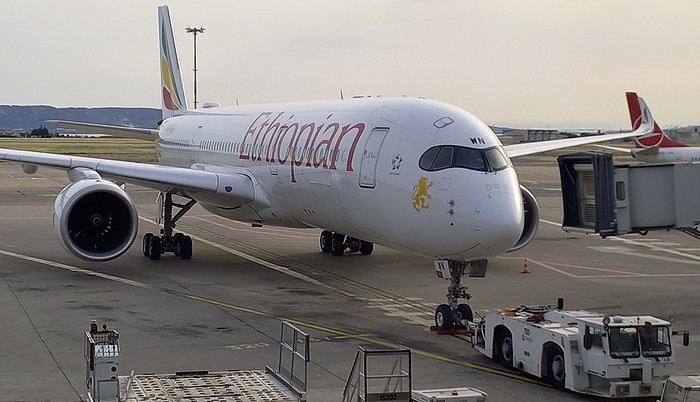
.....
After arriving in Dar, we spent one night at a hotel near the airport. The next morning, we headed to the domestic flights terminal, which hasn’t changed in years.
By mid-morning, we boarded a Cessna 208B Caravan with Safari Air Link, heading to the Kikoboga bush airstrip in Mikumi, which we reached 45 minutes later. Fun fact: the pilot was the same one as on our return flight two years ago.
Welcome on board:
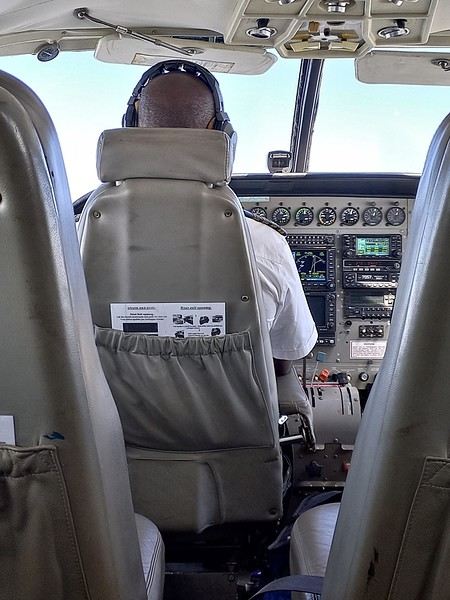
Of course, a driver/guide team from our chosen lodge was waiting for us upon arrival:
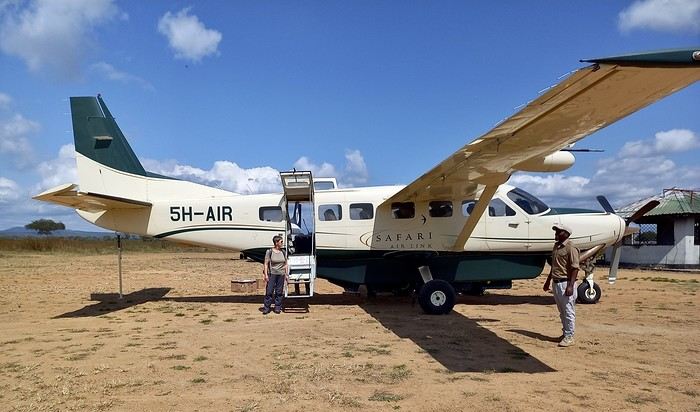
I was surprised to see so many aircraft parked there... even twin-engine Embraer Brasilias?? As a fan of vintage planes, I loved it...
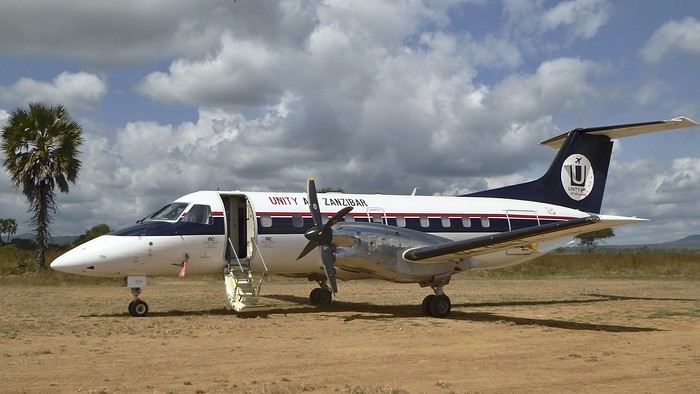
On the other hand, the light was incredibly harsh.....!! Our guides only speak English. We knew that in advance. In the south, it’s very rare to find someone who speaks French. This’ll force us to dig into our high school English memories... from 60 years ago... at least.
It’s noon, and we head toward the lodge. Near the airstrip, next to the Mikumi rangers’ base, there are quite a few herbivores. They find a bit more peace here—the big cats don’t venture this way...
Our first encounter was a group of Masai giraffes.
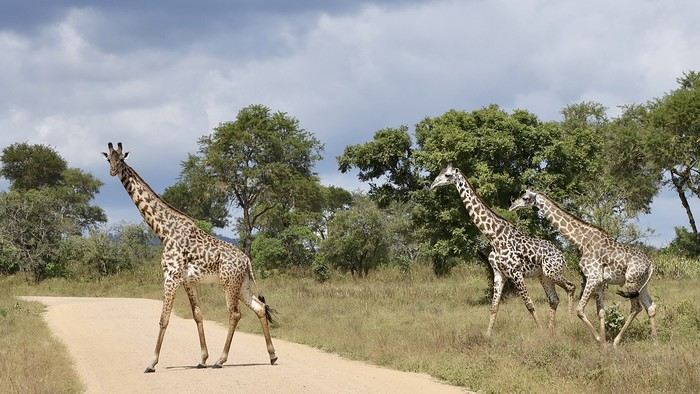
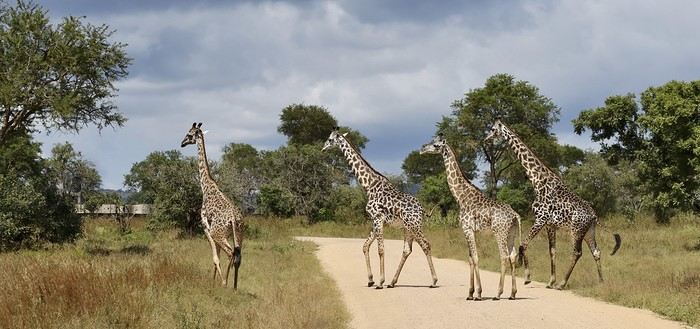
Rarer (for us), a savanna monitor lizard basking in the sun right in the middle of the track...??
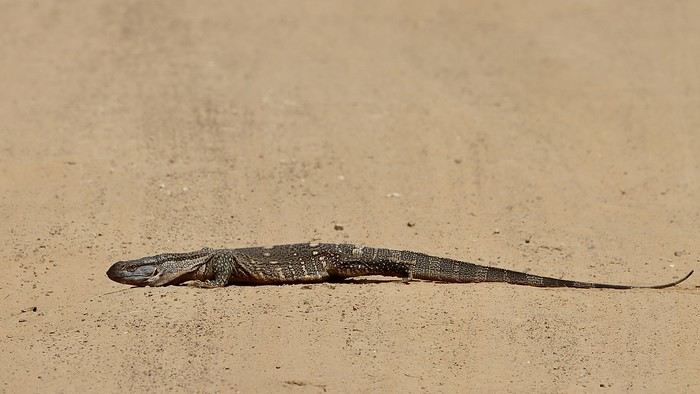
A large gathering of impalas (mostly males) along with a few blue wildebeest:
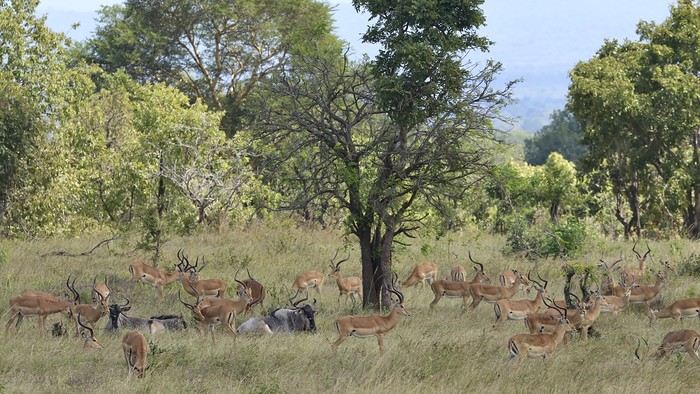

Also unusual: a African crowned hornbill taking a dust bath in the middle of the track...!!
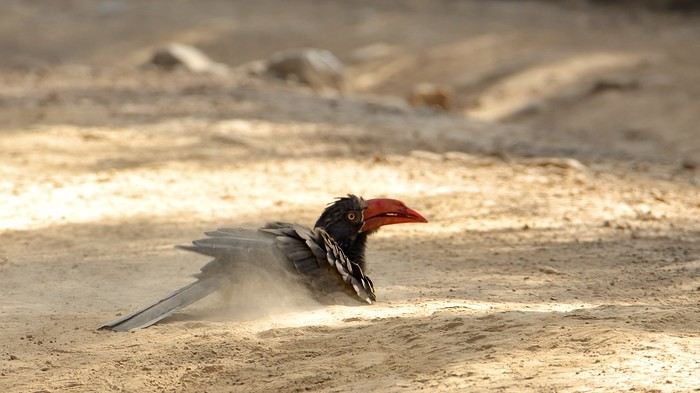
When it comes to identifying mammals or birds, I don’t know everything... so I might make mistakes. Please forgive me. I’m counting on my friend Blesl’s active participation... 😉
...
I’m a newbie to this forum, passionate about wildlife, the landscapes of East Africa, and Tanzania in particular. This June 2024 trip/safari is our 7th visit to Tanzania and our 5th in the south, which has drawn us more than the north ever since we discovered it in 2015.
In 2024, the entrance fees for the reserves and services have gone up again since our last visit. I chose to return first to Mikumi Reserve, which was the very first one we visited in the south. Then, we’ll head to Selous (J. Nyerere N. P.) as usual. Initially, we wanted to spend 2/3 days on Mafia Island at the end of the trip, but it made the total cost too high, so we gave up... We usually go to Ruaha and Selous, but I wanted to mix it up a bit—also to save some money...
As for the timing, June is a new experience for us. I thought it might be interesting to come just after the lodges reopen... hoping for some great wildlife encounters??
The trip starts in Marseille with our first flight on Ethiopian Airlines to Addis Ababa, then continues to Dar es Salaam, where we’ll finally set foot on Tanzanian soil again.
In Addis... "our" A-350.
.....
After arriving in Dar, we spent one night at a hotel near the airport. The next morning, we headed to the domestic flights terminal, which hasn’t changed in years.
By mid-morning, we boarded a Cessna 208B Caravan with Safari Air Link, heading to the Kikoboga bush airstrip in Mikumi, which we reached 45 minutes later. Fun fact: the pilot was the same one as on our return flight two years ago.
Welcome on board:
Of course, a driver/guide team from our chosen lodge was waiting for us upon arrival:
I was surprised to see so many aircraft parked there... even twin-engine Embraer Brasilias?? As a fan of vintage planes, I loved it...
On the other hand, the light was incredibly harsh.....!! Our guides only speak English. We knew that in advance. In the south, it’s very rare to find someone who speaks French. This’ll force us to dig into our high school English memories... from 60 years ago... at least.
It’s noon, and we head toward the lodge. Near the airstrip, next to the Mikumi rangers’ base, there are quite a few herbivores. They find a bit more peace here—the big cats don’t venture this way...
Our first encounter was a group of Masai giraffes.
Rarer (for us), a savanna monitor lizard basking in the sun right in the middle of the track...??
A large gathering of impalas (mostly males) along with a few blue wildebeest:
Also unusual: a African crowned hornbill taking a dust bath in the middle of the track...!!
When it comes to identifying mammals or birds, I don’t know everything... so I might make mistakes. Please forgive me. I’m counting on my friend Blesl’s active participation... 😉
...
Discovering South India: Tamil Nadu and Kerala
Hello everyone!
We're off! After exploring the north, the four friends have now discovered the south. We’re excited to share this new travel journal, dedicated to our little group and our strong friendship, written by Richard and illustrated with Kate’s photos. I’ll chime in from time to time with practical tips.
First of all, a big thank you to everyone on VoyageForum who helped us plan this trip. It would’ve been quite different if we’d just relied on guidebooks.
The itinerary lasted just over 3 weeks: Mahabalipuram, Pondicherry, Thanjavur, the Chettinad region, Madurai, Munnar, Munroe Island, Cochin, and Chennai. We traveled by train, taxi, and private car with a driver, took a domestic flight, and stayed in guesthouses, Airbnb apartments, and hotels. For each of us, including flights, the total budget barely reached 2000 €, and we didn’t hold back—knowing we avoid resorts and love street food and small Indian restaurants.
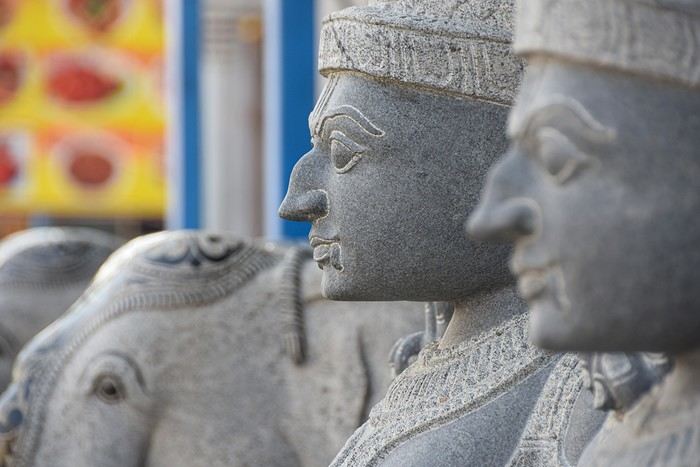
We're off! After exploring the north, the four friends have now discovered the south. We’re excited to share this new travel journal, dedicated to our little group and our strong friendship, written by Richard and illustrated with Kate’s photos. I’ll chime in from time to time with practical tips.
First of all, a big thank you to everyone on VoyageForum who helped us plan this trip. It would’ve been quite different if we’d just relied on guidebooks.
The itinerary lasted just over 3 weeks: Mahabalipuram, Pondicherry, Thanjavur, the Chettinad region, Madurai, Munnar, Munroe Island, Cochin, and Chennai. We traveled by train, taxi, and private car with a driver, took a domestic flight, and stayed in guesthouses, Airbnb apartments, and hotels. For each of us, including flights, the total budget barely reached 2000 €, and we didn’t hold back—knowing we avoid resorts and love street food and small Indian restaurants.
A month in Cambodia in November 2024
Here we go!!!
I left home at 4 AM on October 31st and headed to Barcelona. Driving through Barcelona on the ring road stresses me out a bit, but at 6 AM the traffic is smooth, and I arrive at the airport without any issues. I call the valet, who quickly comes to pick up my car. He takes photos of it from all angles before letting me go.
Baggage check-in hasn’t started yet, and there are already several of us waiting.
Once free, everything happens very quickly. The flight to Abu Dhabi is on time and goes smoothly. I’ve never had any problems with this airline, which I’ve been using for several years.
The flight to Bangkok arrives at 7 AM as scheduled. This is my first time in Thailand and Bangkok. I’m used to traveling in India, and I notice that everything here is well organized—the customs process is quick, and the luggage is already on the carousel.
I booked a taxi on Booking. All I have to do is find the right exit and door based on the agency’s instructions. A large sign with the names of people who booked is posted on a wall. A hostess greets me and calls the taxi, which arrives 5 minutes later. I booked one night at the Lost Inn BKK hotel in the Phra Nakhon district, and we arrive at 9 AM. The welcome isn’t warm, and I have to wait until noon, sitting on a chair, before I can check into my room. I’m exhausted, and sleeping sitting up isn’t ideal. Noon finally arrives—the room is small but clean, which is fine for one night. I quickly take a shower to wake up because I plan to spend the afternoon visiting the Grand Palace. First, I need to exchange some money, and the banks are all close together on the same street, which is very convenient. When I enter one, a hostess gives me a ticket and invites me to sit down. There are about twenty counters, and I wait quietly until my number is called. The exchange is quick, so I can head out to find the Royal Palace. It’s actually very easy, and the walk is pleasant.
Entry to the Royal Palace (500 baht).
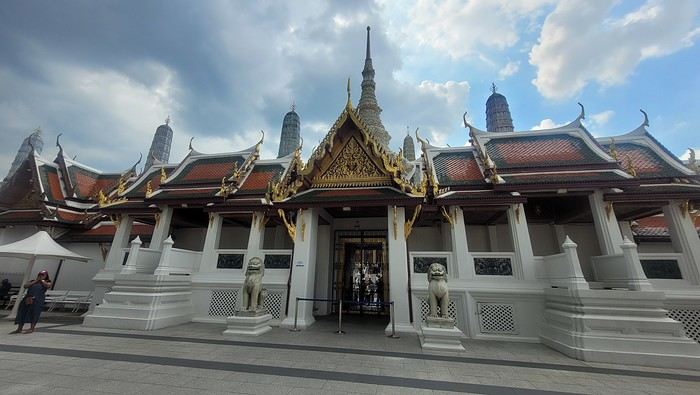
It’s magnificent and grand, and there are quite a few of us visiting. The sky is gray, it’s very humid, and a shower interrupts the visit. It’s a vast complex of temples and palaces. The buildings are colorful and sparkling, with a great sense of serenity (without the tourists, of course). I quietly enjoy the place and try to take photos without tourists, which isn’t easy.
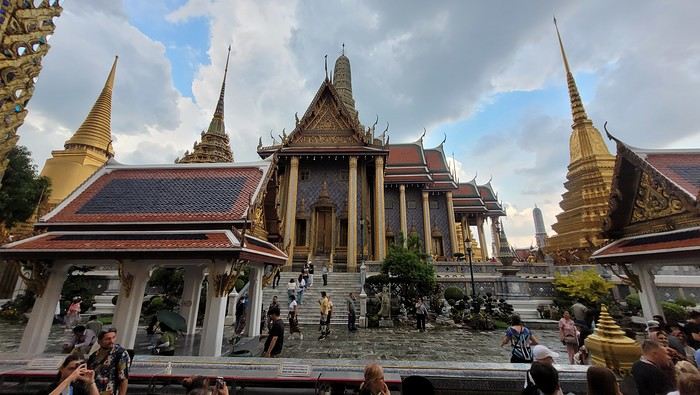
Very close to the Grand Palace is Wat Pho, one of the oldest Buddhist temples in the capital.
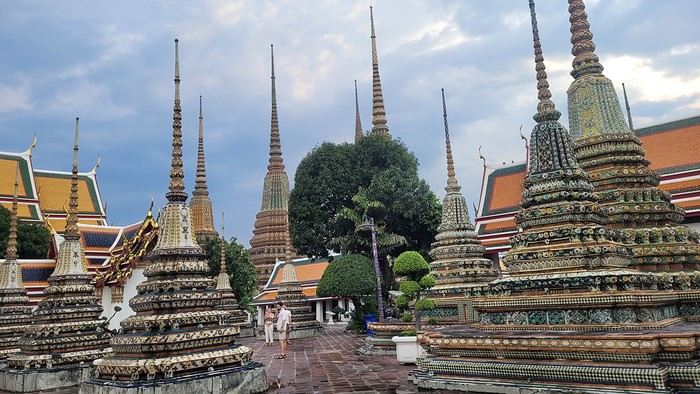
It’s very famous for its 46-meter-long reclining Buddha statue.
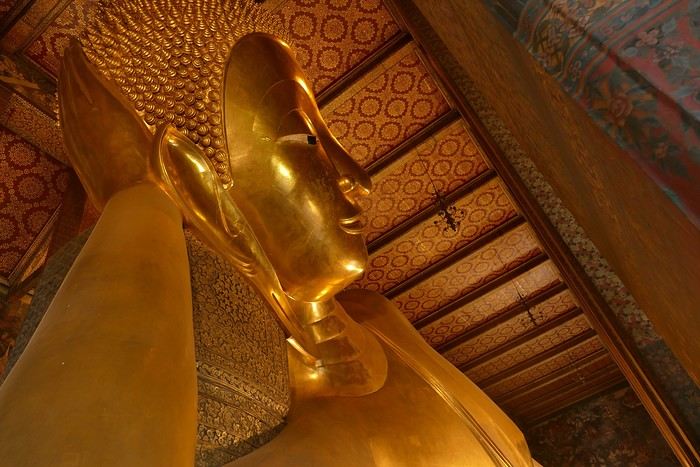
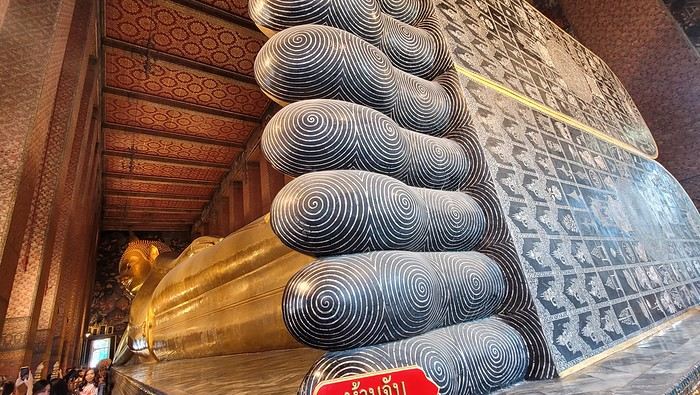
Walking around the temple, you can see different representations of Buddha, all covered in gold leaf.
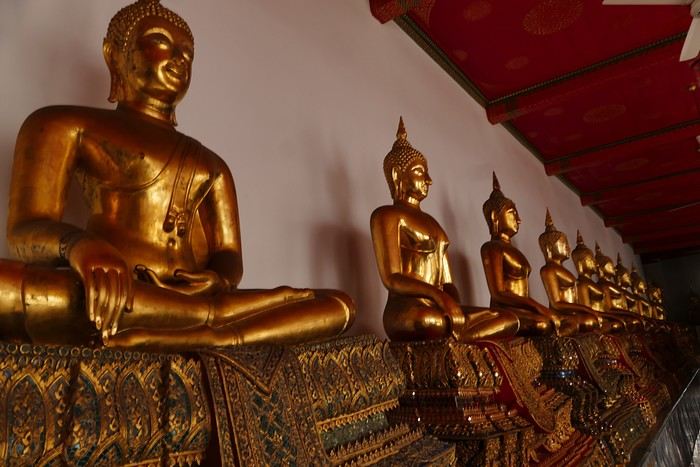
Inside the temple, on one side, monks recite their prayers, while the other side is reserved for tourists who come to meditate in silence.
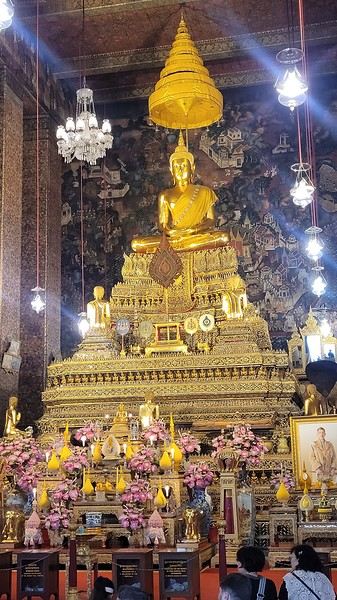
Before returning to the hotel, I have dinner at an Indian restaurant. I go to bed early because tomorrow’s wake-up call will be very early again.
Saturday, November 2nd Wake-up at 4 AM, departure from the hotel at 4:30 AM. The taxi I booked via Booking is waiting for me and takes me to the airport. The trip is fairly quick—he takes small roads, and at this hour, there’s no traffic.
The flight to Phnom Penh is on time. Before boarding, I realize I left my fleece jacket on the carousel, but it’s too late to go back for it.
The flight goes well, and customs is quick.
At the exit, I take a tuk-tuk to Julieka’s GH near the museum. The welcome is friendly. I won’t be able to check into my room until noon, so I take the opportunity to exchange some euros on the market street. The street is lined with restaurants, and I’ll have my first meal there.
The museum is right across the street, so I don’t waste any time visiting it.
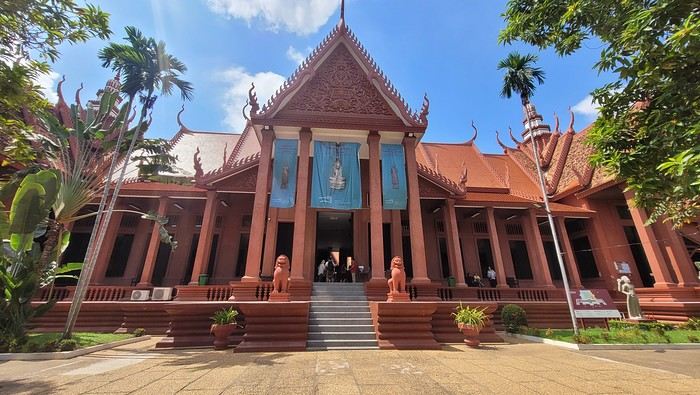
The representations of Hindu deities are very different from those in India, and I don’t recognize them. Many beautiful Buddhas are on display.
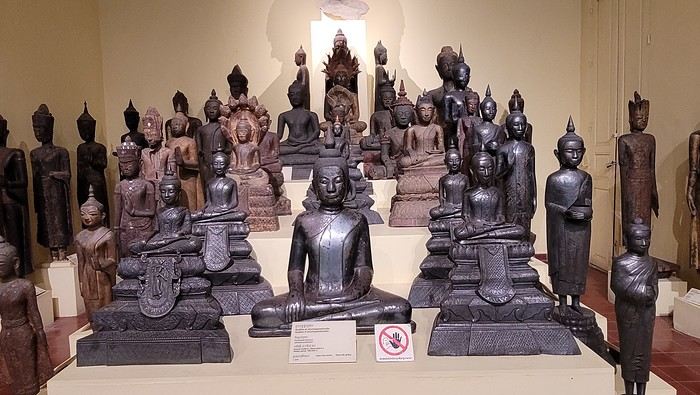
The museum is very pleasant, and there aren’t too many people, which is a plus.
At the exit, I return to the GH, settle into my room—which is decent and clean.
The Royal Palace is 1 km away. I walk along a garden, and at the end of the street is the Tonlé Sap, but I turn right. I arrive at a large esplanade and see the buildings with tiered roofs and glazed tiles. The entrance to the palace is a little further away.
At the entrance, I notice there isn’t the same crowd as at the one in BKK.
Khmer architecture is magnificent. The complex consists of gardens, palaces, pagodas with golden roofs, and slender spires.
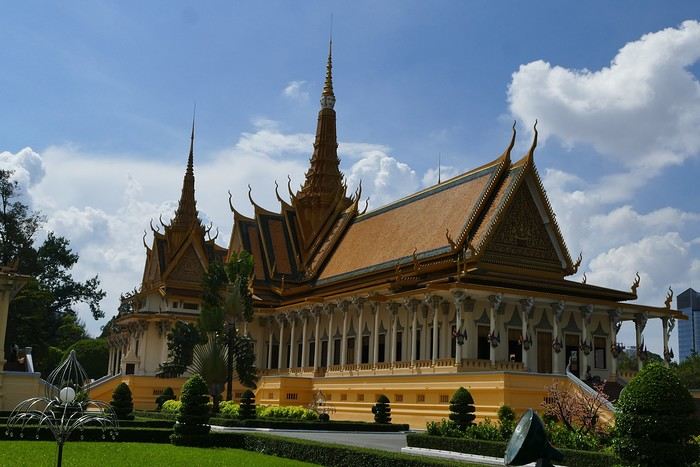
The Silver Pagoda houses the small Emerald Buddha, which is actually made of jade. The silver flooring is covered with carpets. Photos are not allowed.
The walls surrounding the pagoda are covered with frescoes depicting scenes from the Ramayana.
Baggage check-in hasn’t started yet, and there are already several of us waiting.
Once free, everything happens very quickly. The flight to Abu Dhabi is on time and goes smoothly. I’ve never had any problems with this airline, which I’ve been using for several years.
The flight to Bangkok arrives at 7 AM as scheduled. This is my first time in Thailand and Bangkok. I’m used to traveling in India, and I notice that everything here is well organized—the customs process is quick, and the luggage is already on the carousel.
I booked a taxi on Booking. All I have to do is find the right exit and door based on the agency’s instructions. A large sign with the names of people who booked is posted on a wall. A hostess greets me and calls the taxi, which arrives 5 minutes later. I booked one night at the Lost Inn BKK hotel in the Phra Nakhon district, and we arrive at 9 AM. The welcome isn’t warm, and I have to wait until noon, sitting on a chair, before I can check into my room. I’m exhausted, and sleeping sitting up isn’t ideal. Noon finally arrives—the room is small but clean, which is fine for one night. I quickly take a shower to wake up because I plan to spend the afternoon visiting the Grand Palace. First, I need to exchange some money, and the banks are all close together on the same street, which is very convenient. When I enter one, a hostess gives me a ticket and invites me to sit down. There are about twenty counters, and I wait quietly until my number is called. The exchange is quick, so I can head out to find the Royal Palace. It’s actually very easy, and the walk is pleasant.
Entry to the Royal Palace (500 baht).
It’s magnificent and grand, and there are quite a few of us visiting. The sky is gray, it’s very humid, and a shower interrupts the visit. It’s a vast complex of temples and palaces. The buildings are colorful and sparkling, with a great sense of serenity (without the tourists, of course). I quietly enjoy the place and try to take photos without tourists, which isn’t easy.
Very close to the Grand Palace is Wat Pho, one of the oldest Buddhist temples in the capital.
It’s very famous for its 46-meter-long reclining Buddha statue.
Walking around the temple, you can see different representations of Buddha, all covered in gold leaf.
Inside the temple, on one side, monks recite their prayers, while the other side is reserved for tourists who come to meditate in silence.
Before returning to the hotel, I have dinner at an Indian restaurant. I go to bed early because tomorrow’s wake-up call will be very early again.
Saturday, November 2nd Wake-up at 4 AM, departure from the hotel at 4:30 AM. The taxi I booked via Booking is waiting for me and takes me to the airport. The trip is fairly quick—he takes small roads, and at this hour, there’s no traffic.
The flight to Phnom Penh is on time. Before boarding, I realize I left my fleece jacket on the carousel, but it’s too late to go back for it.
The flight goes well, and customs is quick.
At the exit, I take a tuk-tuk to Julieka’s GH near the museum. The welcome is friendly. I won’t be able to check into my room until noon, so I take the opportunity to exchange some euros on the market street. The street is lined with restaurants, and I’ll have my first meal there.
The museum is right across the street, so I don’t waste any time visiting it.
The representations of Hindu deities are very different from those in India, and I don’t recognize them. Many beautiful Buddhas are on display.
The museum is very pleasant, and there aren’t too many people, which is a plus.
At the exit, I return to the GH, settle into my room—which is decent and clean.
The Royal Palace is 1 km away. I walk along a garden, and at the end of the street is the Tonlé Sap, but I turn right. I arrive at a large esplanade and see the buildings with tiered roofs and glazed tiles. The entrance to the palace is a little further away.
At the entrance, I notice there isn’t the same crowd as at the one in BKK.
Khmer architecture is magnificent. The complex consists of gardens, palaces, pagodas with golden roofs, and slender spires.
The Silver Pagoda houses the small Emerald Buddha, which is actually made of jade. The silver flooring is covered with carpets. Photos are not allowed.
The walls surrounding the pagoda are covered with frescoes depicting scenes from the Ramayana.
Tuscany: Arezzo province and the Siena area
So happy the forum reopened last October!!!
I’ve started reading again (posts, travel journals) and chiming in on a few discussions. Now I’m stepping it up by writing a new travel journal—I’ve already posted a few between 2018 and 2020.
My latest trip was to Italy from August 27 to September 26, 2024. As the title says, it was a wander through Tuscany in parts of the region that aren’t the most visited. No Firenze-Siena-Pisa trilogy, no San Gimignano; there’ll be a quick detour into Siena, but I’ll skip the best-known sights. That choice, plus traveling in September, should help dodge overtourism. It worked out—crowds were light, sometimes very light, the whole way. Here’s the practical rundown: - a long trip outside peak season (ah, retirees!) - solo camping (caravan) - a mix of activities (hiking, mountain biking, sightseeing) in places that aren’t always packed with tourists. Still, I don’t feel like I ended up in some hidden-away spots. Not sure if this will draw any readers.
DAY 1: Tuesday, August 27, 2024 The heat was intense on the drive in across the plain; two big storms—more rain and hail than lightning and thunder—threw the weather off, the first near Imola, the second on the four-lane road up the Savio valley. I left the Cesena-Roma four-lane at the Verghereto exit and climbed up to Balze (1,100 meters). The campsite is even higher (1,200 meters), in the forest near the source of the Tevere (Tiber). Staying up here will cut down on driving for the first part of the trip: a route through the Appennino (Apennines) on the border between Toscana and Emilia-Romagna. The temperature was surprisingly mild for the altitude, the air thick with moisture by late afternoon. I drove back down from the campsite to Balze (2 km on the road) to grab groceries (it’s doable) and scout tomorrow’s hike. .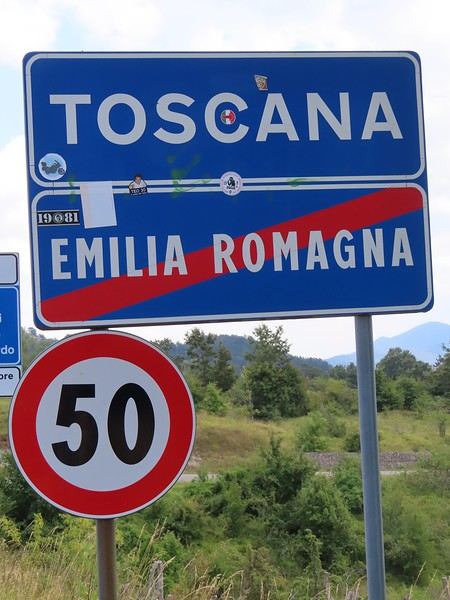
The endpoint of the planned hike is just a few meters from this sign (the trail crosses this road about 3 km from Balze). I realized Balze and the source of the Tevere (Tiber) are actually in Emilia-Romagna, not Toscana. I always thought the Tevere (Tiber), which flows toward Roma (Tyrrhenian side), started in Toscana! I’ll come back to this quirk in Day 3’s write-up.
My latest trip was to Italy from August 27 to September 26, 2024. As the title says, it was a wander through Tuscany in parts of the region that aren’t the most visited. No Firenze-Siena-Pisa trilogy, no San Gimignano; there’ll be a quick detour into Siena, but I’ll skip the best-known sights. That choice, plus traveling in September, should help dodge overtourism. It worked out—crowds were light, sometimes very light, the whole way. Here’s the practical rundown: - a long trip outside peak season (ah, retirees!) - solo camping (caravan) - a mix of activities (hiking, mountain biking, sightseeing) in places that aren’t always packed with tourists. Still, I don’t feel like I ended up in some hidden-away spots. Not sure if this will draw any readers.
DAY 1: Tuesday, August 27, 2024 The heat was intense on the drive in across the plain; two big storms—more rain and hail than lightning and thunder—threw the weather off, the first near Imola, the second on the four-lane road up the Savio valley. I left the Cesena-Roma four-lane at the Verghereto exit and climbed up to Balze (1,100 meters). The campsite is even higher (1,200 meters), in the forest near the source of the Tevere (Tiber). Staying up here will cut down on driving for the first part of the trip: a route through the Appennino (Apennines) on the border between Toscana and Emilia-Romagna. The temperature was surprisingly mild for the altitude, the air thick with moisture by late afternoon. I drove back down from the campsite to Balze (2 km on the road) to grab groceries (it’s doable) and scout tomorrow’s hike. .
The endpoint of the planned hike is just a few meters from this sign (the trail crosses this road about 3 km from Balze). I realized Balze and the source of the Tevere (Tiber) are actually in Emilia-Romagna, not Toscana. I always thought the Tevere (Tiber), which flows toward Roma (Tyrrhenian side), started in Toscana! I’ll come back to this quirk in Day 3’s write-up.
Texas, Louisiana, and a Touch of Florida
After five trips to the American West, we had planned to switch countries and continents to visit Turkey. However, by the time we made up our minds, flight ticket prices had nearly doubled, reaching 400 € for a round-trip ticket. A bit disappointed, I started looking at transatlantic flight prices and stumbled upon discounted tickets from Basel-Mulhouse to Dallas—at the same price as our tickets to Turkey!
No hesitation needed; we bought the five tickets for a total of 1,860 € excluding baggage!
From Fort Worth Airport, we had two options: - Head west on a loop through Texas, New Mexico, and southern Colorado - Head east to change the scenery and explore East Texas, Louisiana, with a possible detour into Florida.
The latter option won unanimously, so here we are, off to discover new states, mainly Louisiana and Texas.
One of the main post-COVID challenges is finding a reasonably priced car rental. After an initial booking around 1,300 €, we kept an eye on prices a few weeks before departure and managed to snag a better deal at around 900 € for a comfortable sedan.
Yes, this summer will also be a first: no 4x4, no camping, and plenty of restaurants!
As always, I’ve planned a packed itinerary, ready to adjust on the go. A few weeks before departure, we learned we’d be at full capacity—our eldest son, Maxime, got his first-year med school results. By finishing as a top admit, he avoided the mandatory July-August internship that would’ve kept him from joining us. Instead, he wrapped up his internship at the last minute the night before our big departure.
We’ll get to savor these special moments together.
The itinerary: Day 1 - 07/15: Fort Worth Day 2: Dallas Day 3: Jefferson - Caddo Lake Day 4: Black Bayou Lake - Natchez - Stanton Hall and Rosalie Mansion Day 5: St. Francisville - Rosedown Plantation - Cat Island Wildlife Refuge Day 6: Mobile - USS Alabama Battleship Memorial Park Day 7 - 8: Pensacola Beach Day 9: Bellingrath Gardens - New Orleans Day 10 - 11: New Orleans Day 12: Plantation Route Day 13: Jungle Gardens - Tabasco Factory - Vermilionville - Lake Martin Day 14: Baton Rouge - USS Kidd Day 15: Houma - Cajun Man's Swamp Tour Day 16: Galveston, Texas Day 17: Space Center Houston - Painted Churches Day 18: San Antonio Day 19: Texas Hill Country Day 20: Texas Hill Country and evening in San Antonio Day 21: Austin and Waco
Day 0 - 07/14: The departure timing isn’t exactly relaxing. On Thursday late afternoon, we hit the road to Alsace, aiming to drop off our two cockers with family before reaching the airport at 2 AM for a 3-hour power nap. Not exactly fresh, we arrive at the terminal looking for a British Airways counter. None in sight, so we try our luck at a United Airlines counter—who knows, maybe it’ll work out. And bingo! The agent checks us in. We didn’t quite understand why, but maybe there’s some agreement between airlines. For the first time, we’re traveling without checked baggage, so no extra fees. Not a huge feat, given the scorching temperatures awaiting us!
The connecting flight to London goes smoothly.
During the layover, liquid checks get stricter—now requiring small bottles to be in a pre-approved clear bag, with only one bag allowed per passenger. Normally, no big deal, but between deodorant, sunscreen, after-sun lotion, hand sanitizer, contact lens solution, etc., we spend 20 minutes optimizing the arrangement! When we finally succeed, one of the security staff bursts out laughing and congratulates us!
With our stomachs growling, we grab an American breakfast before browsing the airport shops.
We then discover our plane for the long-haul flight and are thrilled to see it’s an A380—a first for Laetitia, though the rest of the family experienced it during our winter getaway. Still just as impressive!
With a hint of uncertainty, we take off for the States—my third trip in barely 12 months. This time, no endless badlands, canyons, slot canyons, hoodoos, or brain rocks, but a journey through five states (Texas, Louisiana, a quick stop in Mississippi, Alabama, and the northwest tip of Florida), where we hope to soak up a unique vibe... with a packed schedule of diverse visits.
Arrival at Fort Worth Airport and customs go smoothly. Since we have no checked baggage, we’re first in line at the Dollar counter. In just 3 minutes, the formalities are done. We decline the Toll Pass, which I don’t think we’ll need based on my "calculations," and head to the Dollar parking lot, where an employee tells us we can pick any car we want!
There are about thirty cars waiting. Too many choices!
After last year’s mishap in Oakland, where our 4x4’s trunk was broken into, we’re looking for a sedan to hide our luggage this time. Unfortunately, there are none—only SUVs. We finally settle on a comfortable 7-seater Ford SUV with a massive trunk when set up for five.
On the road from Fort Worth to Dallas, we accidentally take a toll highway without realizing until it’s too late to exit. Let’s hope Dollar doesn’t charge us a week’s worth of their pricey Toll Pass for a $2 toll. We’ll see... In the meantime, Maxime sets up Google Maps to avoid toll roads.
Since it’s not too late, we stop by the nearest Walmart for groceries before checking into our hotel room for three nights in East Dallas suburb.
No hesitation needed; we bought the five tickets for a total of 1,860 € excluding baggage!
From Fort Worth Airport, we had two options: - Head west on a loop through Texas, New Mexico, and southern Colorado - Head east to change the scenery and explore East Texas, Louisiana, with a possible detour into Florida.
The latter option won unanimously, so here we are, off to discover new states, mainly Louisiana and Texas.
One of the main post-COVID challenges is finding a reasonably priced car rental. After an initial booking around 1,300 €, we kept an eye on prices a few weeks before departure and managed to snag a better deal at around 900 € for a comfortable sedan.
Yes, this summer will also be a first: no 4x4, no camping, and plenty of restaurants!
As always, I’ve planned a packed itinerary, ready to adjust on the go. A few weeks before departure, we learned we’d be at full capacity—our eldest son, Maxime, got his first-year med school results. By finishing as a top admit, he avoided the mandatory July-August internship that would’ve kept him from joining us. Instead, he wrapped up his internship at the last minute the night before our big departure.
We’ll get to savor these special moments together.
The itinerary: Day 1 - 07/15: Fort Worth Day 2: Dallas Day 3: Jefferson - Caddo Lake Day 4: Black Bayou Lake - Natchez - Stanton Hall and Rosalie Mansion Day 5: St. Francisville - Rosedown Plantation - Cat Island Wildlife Refuge Day 6: Mobile - USS Alabama Battleship Memorial Park Day 7 - 8: Pensacola Beach Day 9: Bellingrath Gardens - New Orleans Day 10 - 11: New Orleans Day 12: Plantation Route Day 13: Jungle Gardens - Tabasco Factory - Vermilionville - Lake Martin Day 14: Baton Rouge - USS Kidd Day 15: Houma - Cajun Man's Swamp Tour Day 16: Galveston, Texas Day 17: Space Center Houston - Painted Churches Day 18: San Antonio Day 19: Texas Hill Country Day 20: Texas Hill Country and evening in San Antonio Day 21: Austin and Waco
Day 0 - 07/14: The departure timing isn’t exactly relaxing. On Thursday late afternoon, we hit the road to Alsace, aiming to drop off our two cockers with family before reaching the airport at 2 AM for a 3-hour power nap. Not exactly fresh, we arrive at the terminal looking for a British Airways counter. None in sight, so we try our luck at a United Airlines counter—who knows, maybe it’ll work out. And bingo! The agent checks us in. We didn’t quite understand why, but maybe there’s some agreement between airlines. For the first time, we’re traveling without checked baggage, so no extra fees. Not a huge feat, given the scorching temperatures awaiting us!
The connecting flight to London goes smoothly.
During the layover, liquid checks get stricter—now requiring small bottles to be in a pre-approved clear bag, with only one bag allowed per passenger. Normally, no big deal, but between deodorant, sunscreen, after-sun lotion, hand sanitizer, contact lens solution, etc., we spend 20 minutes optimizing the arrangement! When we finally succeed, one of the security staff bursts out laughing and congratulates us!
With our stomachs growling, we grab an American breakfast before browsing the airport shops.
We then discover our plane for the long-haul flight and are thrilled to see it’s an A380—a first for Laetitia, though the rest of the family experienced it during our winter getaway. Still just as impressive!
With a hint of uncertainty, we take off for the States—my third trip in barely 12 months. This time, no endless badlands, canyons, slot canyons, hoodoos, or brain rocks, but a journey through five states (Texas, Louisiana, a quick stop in Mississippi, Alabama, and the northwest tip of Florida), where we hope to soak up a unique vibe... with a packed schedule of diverse visits.
Arrival at Fort Worth Airport and customs go smoothly. Since we have no checked baggage, we’re first in line at the Dollar counter. In just 3 minutes, the formalities are done. We decline the Toll Pass, which I don’t think we’ll need based on my "calculations," and head to the Dollar parking lot, where an employee tells us we can pick any car we want!
There are about thirty cars waiting. Too many choices!
After last year’s mishap in Oakland, where our 4x4’s trunk was broken into, we’re looking for a sedan to hide our luggage this time. Unfortunately, there are none—only SUVs. We finally settle on a comfortable 7-seater Ford SUV with a massive trunk when set up for five.
On the road from Fort Worth to Dallas, we accidentally take a toll highway without realizing until it’s too late to exit. Let’s hope Dollar doesn’t charge us a week’s worth of their pricey Toll Pass for a $2 toll. We’ll see... In the meantime, Maxime sets up Google Maps to avoid toll roads.
Since it’s not too late, we stop by the nearest Walmart for groceries before checking into our hotel room for three nights in East Dallas suburb.
West American Itinerary
Hello Everyone!!
Is this American West dream finally going to come true? Illness and the loss of loved ones have forced us to cancel this trip several times over the past few years...
Here’s the rough outline I’m sharing with you—feel free to give constructive feedback!!
From April 20, 2025, to May 5, 2025, that’s 14 days on-site excluding flights.
D20: Flight from Lyon to Phoenix, night in Phoenix L21: Phoenix (visit the zoo, city, Apache Trail? The road is apparently closed??) night in Sedona M22: Sedona, night in Sedona M23: Depart for GC, visit GC, night in GC (no accommodation booked yet, same goes for the following visits) J24: Drive to MV, visit MV, night in Mexican Hat or? V25: End of MV, drive to Page, night in Page S26: Page—Antelope Canyon, Horseshoe Bend, Lake Powell, night in Page D27: Drive to Bryce, visit Bryce, night? L28: End of Bryce, depart for Zion (I’m wondering if it’s worth visiting Zion at the end of April—since the park is at high altitude, is there a risk of snow? Temperatures?) If we skip Zion, could we plan 2 days for Arches before heading to Bryce? Night in Springdale if Zion, otherwise drive to Valley of Fire, night? M29: Valley of Fire, then drive to LV, night in LV M30: Morning in LV, then drive to Death Valley, night in Furnace Creek? J1: Visit Death Valley, return to LV, night in LV And then we have 3 days left... where should we add them? More time in Arches and Zion? An extra day in Sedona? In Page? We’re not big hikers, so we won’t spend more than a day in each park.
Just to clarify: passports and ESTA are all set!!
Thanks for your advice! Best regards, Christophe
Is this American West dream finally going to come true? Illness and the loss of loved ones have forced us to cancel this trip several times over the past few years...
Here’s the rough outline I’m sharing with you—feel free to give constructive feedback!!
From April 20, 2025, to May 5, 2025, that’s 14 days on-site excluding flights.
D20: Flight from Lyon to Phoenix, night in Phoenix L21: Phoenix (visit the zoo, city, Apache Trail? The road is apparently closed??) night in Sedona M22: Sedona, night in Sedona M23: Depart for GC, visit GC, night in GC (no accommodation booked yet, same goes for the following visits) J24: Drive to MV, visit MV, night in Mexican Hat or? V25: End of MV, drive to Page, night in Page S26: Page—Antelope Canyon, Horseshoe Bend, Lake Powell, night in Page D27: Drive to Bryce, visit Bryce, night? L28: End of Bryce, depart for Zion (I’m wondering if it’s worth visiting Zion at the end of April—since the park is at high altitude, is there a risk of snow? Temperatures?) If we skip Zion, could we plan 2 days for Arches before heading to Bryce? Night in Springdale if Zion, otherwise drive to Valley of Fire, night? M29: Valley of Fire, then drive to LV, night in LV M30: Morning in LV, then drive to Death Valley, night in Furnace Creek? J1: Visit Death Valley, return to LV, night in LV And then we have 3 days left... where should we add them? More time in Arches and Zion? An extra day in Sedona? In Page? We’re not big hikers, so we won’t spend more than a day in each park.
Just to clarify: passports and ESTA are all set!!
Thanks for your advice! Best regards, Christophe
Review of my visit to Angkor
SIEM REAP
You can now rent scooters just about everywhere in Siem Reap, but at rip-off prices—$15–18 a day instead of $5–10 like everywhere else in Indochina. The best options are tuk-tuks or, even better, electric bikes ($12, but with a 50 km range, so they won’t let you go to Banteay Srei or the River of a Thousand Lingas in the Kulen Massif, which are too far). **WARNING:** Wear a helmet, or they *will* catch you. Scooters are banned from going from SR to the stunning temple of Koh Ker in the northeast and continuing to Battambang; no idea why!
My favorite little hotel in Siem Reap? The Neth Socheata, tucked in an alley off Thnou St near the market—lovely rooms, and the owner speaks great English. Then there’s the Ivy Guesthouse with its little garden, but it’s “always full,” according to the owner. For something upscale but still affordable, a fantastic spot is the Pavillon Indochine, tucked away on a quiet side street on the way to the airport—elegant, with incredible attention to decor, a terrace restaurant, garden, pool, etc. Everything you’d want for $70 including breakfast. I also spotted a hostel for backpackers, the Angkor Thom Hostel, with small 6-bed dorms for $4 with a fan or $6 with AC (18 Wat Bo St).
Food-wise, it’s all amazing! Pub Street has turned into a noise nightmare, with speakers blasting what’s supposed to be music but is just *boom, boom, boom, boom, boom*—run away, even though the pizzas at the Italian place Il Forno are really good. The famous and excellent Tigre de Papier has changed its name to Paper Tiger and is still just as good (lunch only, though, because across the street there’s a huge bar blasting *boom boom boom*, so you won’t be able to hear each other during dinner). On the other hand, the Italian-Cambodian El Toro on Pub Street is perfect, with fantastic pizzas and divine lasagna (go to the first-floor dining room—there’s a big bar across the street blasting *boom boom boom*, but at least you can still talk). Due to the lack of customers during COVID, all the French restaurants—Barrio (three times alas!), Les Deux Sœurs, Le Bel Air, and Le Mozart—have closed. The only one left is L’Olivier, which is pricey. I also discovered a great Moroccan restaurant (though run by a Sudanese man and his French wife), Le Tajine, on Strung Thmei St, 09 68 89 78 27. **WARNING:** For tagines and couscous, you need to order at least in the morning; wine and beer are fine. To get there, turn at the corner of the Cineplex behind the big market at the start of Sivatha Boulevard.
I finally went to the Khmer dance show. Beautiful dancers and dances, but **EAT BEFORE OR AFTER**—the meal is so awful that most Westerners leave it on their plates.
THE ANGKOR TEMPLES Use the excellent *Routard Cambodia* guide. Just a few tips: - Start with the pre-Angkorian Roluos group, 15 km before Siem Reap on the road to PP—it’s the “ancestor” of the temples.
- To avoid the big crowds at Angkor Wat, Bayon, and Ta Prohm, go between noon and 2 PM when everyone’s having lunch. - Speaking of lunch, the crowds flock to the hundred or so mediocre food stalls on the left side of Angkor Wat. Instead, head to Angkor Thom after the stunning Pre Rup temples, all the way to the small Sras Srang basin. Along the basin, there are several restaurants with terraces offering first-floor views of the water, and no crowds. Afterward, cross to the other side of the basin—you’ll end up in the countryside with charming villages where locals seem to live as they did during the temples’ golden age (at its peak, the population was estimated at 600,000–800,000, making it the largest city in the world. The theory for the abandonment is water shortages caused by overpopulation).
- I climbed Phnom Bakheng for the famous sunset, but the crowd was so ridiculous that instead of seeing the temple at sunset, you just see the heads and shoulders around you.
- There are tons of small temples that most people skip, and they’re missing out. My favorites: Thommanon, Neak Pean, Ta Som, and especially Pre Rup, an amazing brick complex with 14 towers.
**Big disappointment:** You can no longer climb to the first floor of Bayon, where you used to stand magically among the giant head statues. So, admire the beautiful bas-reliefs on the outside, but there’s no point going inside—you’ll just see a dark, square corridor with nothing interesting.
ANGKOR FURTHER AFIELD The wonderful Banteay Srei temple. A gem! I couldn’t find the bas-relief stolen by Malraux in the 1920s (fun fact: what he was doing in Indochina—stealing a bas-relief to sell for a fortune in France to cover his massive gambling debts on the stock market, where he ruined his very wealthy American wife—was an open secret. But the French authorities in Saigon, who hated him for his leftist views, decided to let him do it and catch him red-handed, which worked perfectly. He avoided jail only because all the leftist intellectuals in Saint-Germain, Sartre, Beauvoir, and co. cried scandal—though the real scandal was the looting).
30 km of excellent paved road further north, a great spot: the Kulen Massif and the River of a Thousand Lingas (at one point, you’ll come to a T-junction—turn left). Along the road at the foot of the massif, on your right, there’s a great restaurant, Bourey Sovann (where the food is excellent). The trail to the river starts just before it on the left. **Warning:** There are two sites for the River of a Thousand Lingas. One is accessible via a private road, so there’s a $20 toll, and you need to arrive before 11 AM because the road is narrow and traffic flows downhill after that. You’ll end up in a site full of shops, snack stalls, and two good restaurants, including one by a beautiful waterfall. However, the thousand lingas aren’t as spectacular there.
Banteay Srei + the River of a Thousand Lingas makes for a fantastic day. **WARNING:** You used to be able to go to the river and waterfall by scooter or tuk-tuk, but it’s now forbidden. So **go by taxi**—otherwise, you’ll be hiking 12 km round trip up a steep trail.
If you leave Siem Reap early, you can even add Beng Mealea temple on the way back, making a triangular route: SR-BS-Khulen-BM-SR (or the reverse).
If you have time, visit Banteay Samré temple, 10 km west of the Angkor Thom complex. A lovely site with very few visitors.
I’ve never been to the famous Preah Khan on a hill overlooking Thailand. There’s a big dispute between the two countries—the Thais insist the temple belongs to them because the entrance is in their country. There have been serious clashes in the recent past, and landmines are still abundant off the marked paths. They even claim the entire Siem Reap province is theirs and should be returned, arguing it was Thai in the past. It takes two days (6–7 hours each way), with an overnight stay in the nearby village (small hotels and one luxury option with a garden and pool, but it’s expensive).
TONLE SAP People talk about “floating villages,” but that’s a big mistake—these are actually villages of astonishing stilt houses, 4 meters high or more, due to the lake’s major floods. The most famous is Chong Khneas, which I skipped because it’s packed with tourists. Instead, I really liked Kampong Phluk, which is much quieter. To get there, continue on the road past the Roluos group until you reach a parking lot with pirogues lined up. They’ll take you down the river, stop at this amazing village for a walk, and then take you to the Tonle Sap, a true inland sea. At one point, you’ll pass through a flooded forest that you can explore by small boat. At the junction of the river and the Tonle Sap, and on the lake itself, there are floating restaurants where the food is great. Note that in the dry season, you can reach the village by scooter.
BACK TO PHNOM PENH AND ON TO SOUTHERN VIETNAM Since I’d planned at least 15 days in the Mekong Delta between Chau Doc and Saigon, I skipped Battambang, etc. With no desire to endure the dusty road from SR to PP again, I simply loaded my bike onto a bus with the great company Rith Monty (book at their office in SR on the small square at the start of Sivatha Boulevard—$10 for the bike and $6 for me), also known as Paramount. Their buses stop on 136 St right in the middle of PP. I’ll also mention the excellent Giant Ibis, with big modern buses that always leave on time—unlike the others.
I spent the night in PP, and the next morning took the fast boat from PP to Chau Doc with Hang Chau Tourist (buying the ticket the day before is recommended—$25—either at your hotel or the port, and they’ll pick you up at your hotel by tuk-tuk to take you to the port). Departure from PP at noon, arrival in Chau Doc around 4 PM. The boat is great—comfortable and fast. A crew member takes your passports for Cambodian exit formalities, and you handle Vietnamese immigration yourself—it all takes 15–20 minutes. The route isn’t on the Mekong but on the Bassac River to the border, then a wide north-south canal to Chau Doc (the arrival is really nice). In the Chau Doc-PP direction, the boat leaves Chau Doc at 7:30 AM.
My favorite little hotel in Siem Reap? The Neth Socheata, tucked in an alley off Thnou St near the market—lovely rooms, and the owner speaks great English. Then there’s the Ivy Guesthouse with its little garden, but it’s “always full,” according to the owner. For something upscale but still affordable, a fantastic spot is the Pavillon Indochine, tucked away on a quiet side street on the way to the airport—elegant, with incredible attention to decor, a terrace restaurant, garden, pool, etc. Everything you’d want for $70 including breakfast. I also spotted a hostel for backpackers, the Angkor Thom Hostel, with small 6-bed dorms for $4 with a fan or $6 with AC (18 Wat Bo St).
Food-wise, it’s all amazing! Pub Street has turned into a noise nightmare, with speakers blasting what’s supposed to be music but is just *boom, boom, boom, boom, boom*—run away, even though the pizzas at the Italian place Il Forno are really good. The famous and excellent Tigre de Papier has changed its name to Paper Tiger and is still just as good (lunch only, though, because across the street there’s a huge bar blasting *boom boom boom*, so you won’t be able to hear each other during dinner). On the other hand, the Italian-Cambodian El Toro on Pub Street is perfect, with fantastic pizzas and divine lasagna (go to the first-floor dining room—there’s a big bar across the street blasting *boom boom boom*, but at least you can still talk). Due to the lack of customers during COVID, all the French restaurants—Barrio (three times alas!), Les Deux Sœurs, Le Bel Air, and Le Mozart—have closed. The only one left is L’Olivier, which is pricey. I also discovered a great Moroccan restaurant (though run by a Sudanese man and his French wife), Le Tajine, on Strung Thmei St, 09 68 89 78 27. **WARNING:** For tagines and couscous, you need to order at least in the morning; wine and beer are fine. To get there, turn at the corner of the Cineplex behind the big market at the start of Sivatha Boulevard.
I finally went to the Khmer dance show. Beautiful dancers and dances, but **EAT BEFORE OR AFTER**—the meal is so awful that most Westerners leave it on their plates.
THE ANGKOR TEMPLES Use the excellent *Routard Cambodia* guide. Just a few tips: - Start with the pre-Angkorian Roluos group, 15 km before Siem Reap on the road to PP—it’s the “ancestor” of the temples.
- To avoid the big crowds at Angkor Wat, Bayon, and Ta Prohm, go between noon and 2 PM when everyone’s having lunch. - Speaking of lunch, the crowds flock to the hundred or so mediocre food stalls on the left side of Angkor Wat. Instead, head to Angkor Thom after the stunning Pre Rup temples, all the way to the small Sras Srang basin. Along the basin, there are several restaurants with terraces offering first-floor views of the water, and no crowds. Afterward, cross to the other side of the basin—you’ll end up in the countryside with charming villages where locals seem to live as they did during the temples’ golden age (at its peak, the population was estimated at 600,000–800,000, making it the largest city in the world. The theory for the abandonment is water shortages caused by overpopulation).
- I climbed Phnom Bakheng for the famous sunset, but the crowd was so ridiculous that instead of seeing the temple at sunset, you just see the heads and shoulders around you.
- There are tons of small temples that most people skip, and they’re missing out. My favorites: Thommanon, Neak Pean, Ta Som, and especially Pre Rup, an amazing brick complex with 14 towers.
**Big disappointment:** You can no longer climb to the first floor of Bayon, where you used to stand magically among the giant head statues. So, admire the beautiful bas-reliefs on the outside, but there’s no point going inside—you’ll just see a dark, square corridor with nothing interesting.
ANGKOR FURTHER AFIELD The wonderful Banteay Srei temple. A gem! I couldn’t find the bas-relief stolen by Malraux in the 1920s (fun fact: what he was doing in Indochina—stealing a bas-relief to sell for a fortune in France to cover his massive gambling debts on the stock market, where he ruined his very wealthy American wife—was an open secret. But the French authorities in Saigon, who hated him for his leftist views, decided to let him do it and catch him red-handed, which worked perfectly. He avoided jail only because all the leftist intellectuals in Saint-Germain, Sartre, Beauvoir, and co. cried scandal—though the real scandal was the looting).
30 km of excellent paved road further north, a great spot: the Kulen Massif and the River of a Thousand Lingas (at one point, you’ll come to a T-junction—turn left). Along the road at the foot of the massif, on your right, there’s a great restaurant, Bourey Sovann (where the food is excellent). The trail to the river starts just before it on the left. **Warning:** There are two sites for the River of a Thousand Lingas. One is accessible via a private road, so there’s a $20 toll, and you need to arrive before 11 AM because the road is narrow and traffic flows downhill after that. You’ll end up in a site full of shops, snack stalls, and two good restaurants, including one by a beautiful waterfall. However, the thousand lingas aren’t as spectacular there.
Banteay Srei + the River of a Thousand Lingas makes for a fantastic day. **WARNING:** You used to be able to go to the river and waterfall by scooter or tuk-tuk, but it’s now forbidden. So **go by taxi**—otherwise, you’ll be hiking 12 km round trip up a steep trail.
If you leave Siem Reap early, you can even add Beng Mealea temple on the way back, making a triangular route: SR-BS-Khulen-BM-SR (or the reverse).
If you have time, visit Banteay Samré temple, 10 km west of the Angkor Thom complex. A lovely site with very few visitors.
I’ve never been to the famous Preah Khan on a hill overlooking Thailand. There’s a big dispute between the two countries—the Thais insist the temple belongs to them because the entrance is in their country. There have been serious clashes in the recent past, and landmines are still abundant off the marked paths. They even claim the entire Siem Reap province is theirs and should be returned, arguing it was Thai in the past. It takes two days (6–7 hours each way), with an overnight stay in the nearby village (small hotels and one luxury option with a garden and pool, but it’s expensive).
TONLE SAP People talk about “floating villages,” but that’s a big mistake—these are actually villages of astonishing stilt houses, 4 meters high or more, due to the lake’s major floods. The most famous is Chong Khneas, which I skipped because it’s packed with tourists. Instead, I really liked Kampong Phluk, which is much quieter. To get there, continue on the road past the Roluos group until you reach a parking lot with pirogues lined up. They’ll take you down the river, stop at this amazing village for a walk, and then take you to the Tonle Sap, a true inland sea. At one point, you’ll pass through a flooded forest that you can explore by small boat. At the junction of the river and the Tonle Sap, and on the lake itself, there are floating restaurants where the food is great. Note that in the dry season, you can reach the village by scooter.
BACK TO PHNOM PENH AND ON TO SOUTHERN VIETNAM Since I’d planned at least 15 days in the Mekong Delta between Chau Doc and Saigon, I skipped Battambang, etc. With no desire to endure the dusty road from SR to PP again, I simply loaded my bike onto a bus with the great company Rith Monty (book at their office in SR on the small square at the start of Sivatha Boulevard—$10 for the bike and $6 for me), also known as Paramount. Their buses stop on 136 St right in the middle of PP. I’ll also mention the excellent Giant Ibis, with big modern buses that always leave on time—unlike the others.
I spent the night in PP, and the next morning took the fast boat from PP to Chau Doc with Hang Chau Tourist (buying the ticket the day before is recommended—$25—either at your hotel or the port, and they’ll pick you up at your hotel by tuk-tuk to take you to the port). Departure from PP at noon, arrival in Chau Doc around 4 PM. The boat is great—comfortable and fast. A crew member takes your passports for Cambodian exit formalities, and you handle Vietnamese immigration yourself—it all takes 15–20 minutes. The route isn’t on the Mekong but on the Bassac River to the border, then a wide north-south canal to Chau Doc (the arrival is really nice). In the Chau Doc-PP direction, the boat leaves Chau Doc at 7:30 AM.
Review of a Mediterranean cruise on the Splendida and 24 hours in Venice – October 2024
Hi everyone,
What a joy to be back here and pick up where we left off after all these months of hiatus.
I hope you’ll enjoy the story of this little trip around the Eastern Mediterranean. This cruise was the perfect way to satisfy our longing to return to Greece and Istanbul. The end of the season, until late November, is the best time to visit the Mediterranean in my opinion—when climate disruptions don’t get in the way.
Departing from Trieste, our stops were Katakolon, Piraeus, Kusadasi, Istanbul, Corfu, and Bari, before returning to Trieste and then Venice, where we planned a very short 24-hour stay.
We left home at 6:15 AM—our first cruise departure since moving to Normandy. What I miss most about living in the Gard is how close we were to Marseille Airport. No more hopping over to Marignane in an hour; now we have to plan for a three-hour trip to CDG, even under the best conditions on an early Sunday morning.
It was impossible to book a hotel night before our flight because, starting in April, the Ibis was priced at 450 € per night, and the Mercure was flirting with 800 €—breakfast not included, of course. 😏
I had a feeling there must’ve been a conference or something going on… Turns out, it was just the auto show. They simply adjusted the room prices to match the cost of the cars. 😛
Our flight took us to Venice, where we caught a FlixBus to Trieste. We arrived at Trieste’s train station in the afternoon and walked to our hotel in the city center.
After treating ourselves to an amazing pizza at a restaurant (Di Napoli Maestri Pizzaioli, Via Armando Diaz 10) for a very reasonable price, we enjoyed the mild evening temperature while exploring the stunning buildings of this charming city by night. These magnificent structures are a testament to the city’s past. Trieste became Austrian in 1382 due to its complicated relationship with Venice, and it wasn’t until 1918, at the end of World War I, that it became Italian again. The city’s lighting beautifully highlights the architecture of the buildings.
The terraces were lively, and the atmosphere was so warm and inviting that we wanted to stay out even longer.
But we’d been up since 4 AM, so we were happy to retreat to the quiet of our hotel, located in the pedestrian center just a few steps from the port (Urban Hotel Design—highly recommended).
More to come soon.
What a joy to be back here and pick up where we left off after all these months of hiatus.
I hope you’ll enjoy the story of this little trip around the Eastern Mediterranean. This cruise was the perfect way to satisfy our longing to return to Greece and Istanbul. The end of the season, until late November, is the best time to visit the Mediterranean in my opinion—when climate disruptions don’t get in the way.
Departing from Trieste, our stops were Katakolon, Piraeus, Kusadasi, Istanbul, Corfu, and Bari, before returning to Trieste and then Venice, where we planned a very short 24-hour stay.
We left home at 6:15 AM—our first cruise departure since moving to Normandy. What I miss most about living in the Gard is how close we were to Marseille Airport. No more hopping over to Marignane in an hour; now we have to plan for a three-hour trip to CDG, even under the best conditions on an early Sunday morning.
It was impossible to book a hotel night before our flight because, starting in April, the Ibis was priced at 450 € per night, and the Mercure was flirting with 800 €—breakfast not included, of course. 😏
I had a feeling there must’ve been a conference or something going on… Turns out, it was just the auto show. They simply adjusted the room prices to match the cost of the cars. 😛
Our flight took us to Venice, where we caught a FlixBus to Trieste. We arrived at Trieste’s train station in the afternoon and walked to our hotel in the city center.
After treating ourselves to an amazing pizza at a restaurant (Di Napoli Maestri Pizzaioli, Via Armando Diaz 10) for a very reasonable price, we enjoyed the mild evening temperature while exploring the stunning buildings of this charming city by night. These magnificent structures are a testament to the city’s past. Trieste became Austrian in 1382 due to its complicated relationship with Venice, and it wasn’t until 1918, at the end of World War I, that it became Italian again. The city’s lighting beautifully highlights the architecture of the buildings.
The terraces were lively, and the atmosphere was so warm and inviting that we wanted to stay out even longer.
But we’d been up since 4 AM, so we were happy to retreat to the quiet of our hotel, located in the pedestrian center just a few steps from the port (Urban Hotel Design—highly recommended).
More to come soon.
Eastern Crete in September 2024
Travel journal in Eastern Crete from September 8th to 29th, 2024
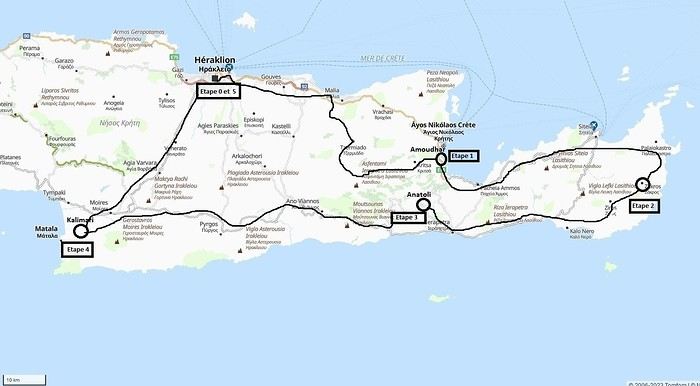 Our 21-day itinerary
Sunday, 08/09: Once again—and this is the eighth time—we’re setting off, the four of us: Patrick, Michelle, Jacques, and Monique, for the Greek islands. This time, we’ve chosen Crete. No need to wake up at 3 or 4 a.m. to reach Basel-Mulhouse Airport at dawn to catch the first flight to Greece at 6 a.m.! Given the prohibitive prices charged by EasyJet, we found flights that were half the price from Zurich Airport, which is accessible in 3 hours by train from Colmar. Pierre-Paul drives all four of us to Colmar train station, where we take the train to Basel and then, 20 minutes later, the direct train to Zurich Airport. After wandering around the airport, we go for a coffee at 6 € each! We’re in Switzerland, after all. The other dining areas all have vending machines for selecting and paying for meals—soon, there won’t be anyone left to serve you! After a short wait, we take off at 7:45 p.m. (20 minutes late) in an Aegean Airbus A321. Free in-flight meal service isn’t bad either! We land in Heraklion around 11:15 p.m. We pick up our rental car (a red Seat Ibiza) at the airport and head straight to our apartment, located 2 km from the city center. Thanks to the GPS, we find it quickly. It’s a beautiful, fully renovated apartment with all the comforts and well-equipped. On the table, there’s wine, bottles of water, jam, coffee, etc. Given the late hour, we won’t stay up long.
Monday, 09/09: To enhance our breakfast, Michelle and Monique set off to find a bakery nearby. They return with croissants and donuts—yum... Then we head to the west coast. The highway follows the coastline, but we prefer taking the old road to Malia, our first stop. We visit the major archaeological site of this Minoan city under the hot sun. The site covers a vast area, but the ruins aren’t very evocative except for a few beautiful amphorae scattered around. The explanations in a small house at the entrance are interesting and help us better understand the organization of the ancient city with its different districts. From there, we head toward the nearby mountains to see the thousand-year-old plane tree in the village of Krasi. We take the opportunity to enjoy an excellent lunch of moussaka and delicious gemista at the Krassopsychia taverna in the village center. Pleasant surprise: the prices are still reasonable, with a bill of 70 € for four, including wine and water. The friendly tradition of complimentary dessert and glasses of raki continues—great! We’ve set the bar high right away! Let’s hope the rest lives up to it! On the way back toward the Lassithi Plateau, we stop at the Kardiotisa Monastery perched high on the mountain to enjoy a magnificent view of the entire region. Just a little further, we arrive at the Lassithi Plateau: the presence of small windmills used to pump water from the ground is the typical feature of this plateau. We complete a full loop around the plateau, passing by numerous orchards and vegetable gardens that occupy the entire space. At the end of the plateau, we once again cross mountain passes via winding roads that bring us near Agios Nikolaos. Our apartment is located about ten kilometers further south in Amoudhara. The owner, who was notified, waits for us and shows us her superb apartment, whose large terrace overlooks the entire Mirabello Bay. She then gives us valuable information about the different beaches in the area. Dinner will be frugal, given our hearty lunch in Krasi!
 Sunset over Mirabello Bay
Tuesday, 10/09: A bit of a gray sky when we wake up around 8 a.m., but the sun will soon triumph over the scattered clouds. For our first swim, we opt for Voulisma Beach, even though our host warned us it was a bit “crowdy.” That’s understandable given the beautiful emerald color of the sea and the lovely curve of the beach. To avoid the big crowds, we move toward the eastern part of the beach, accessible via a steep staircase. The water is very warm, and this first dip is very pleasant. Before returning to the apartment, we stop at the bakery to buy spinach pies, essential ingredients to accompany our Greek salad for lunch. Of course, everything will be washed down with ouzo, which will remain our favorite drink for the next three weeks—but in moderation!!! A nap is in order after all that effort. In the late afternoon, we drive to Agios Nikolaos, the main seaside resort in Crete. We’re not too enthusiastic about visiting this mass-tourism resort, but the center of Agios, concentrated around the small inner harbor, is pleasant to see despite the plethora of shops and restaurants. We dine a little outside the harbor in the shaded courtyard of the Avli taverna: the oven-baked lamb, squid with spinach, and cuttlefish ink orzo pasta are all highly appreciated. We still stay under a 75 € bill for four.
 Mirabello Bay seen from our terrace
Wednesday, 11/09: At 8 a.m., the terrace is already bathed in sunlight, and it’s already quite hot. The small parasol barely gives us enough shade, but we’re not complaining! For our second swim, we head to a tiny beach recommended by our host, just 3 minutes by car from our place. The path leading to it is very discreet, and we don’t find it right away! It’s a small sandy cove with a few welcome tamarisk trees for shade. When we arrive, there are two swimmers, and there won’t be more than five or six in the morning. After lunch and a nap, we head to the beautiful village of Kritsa, just a few kilometers away. It’s too late to visit the beautiful church of Kera Panagia, which is already closed. We settle for the exterior, which is worth a look. The weather is clouding over, and big clouds are gathering. Upon arriving in Kritsa, a heavy shower forces us to take shelter in the Platanos taverna in the village center, and since it’s nearly 7 p.m., we decide to stay and dine there. Good choice—excellent meze: croquettes and stuffed zucchini flowers, gigantes beans, grilled tomatoes and feta, and pancetta as the main dish. The rain stops just as we decide to head back.
 Village of Kritsa
Thursday, 12/09: Our terrace faces east, so we get to watch the sunrise around 7 a.m.—it’s truly a beautiful sight we never tire of. Around 9 a.m., we head to the village of Plaka, where boats depart for the island of Spinalonga, located north of Agios Nikolaos. We board the first boat, which sets sail at 10 a.m., and we’re not alone—the boat is practically full. After 10 minutes, we land on the island at the same time as several other boats from Elounda or Agios. Needless to say, there are already quite a few people walking through the streets of the leper village. The visit remains interesting and moving as we read the explanatory panels recounting the island’s history under Byzantine and then Turkish rule, followed by its transformation into a leper colony. As soon as we climb toward the top of the island via more or less maintained paths, there’s almost no one left. The 360° view from up there is stunning.
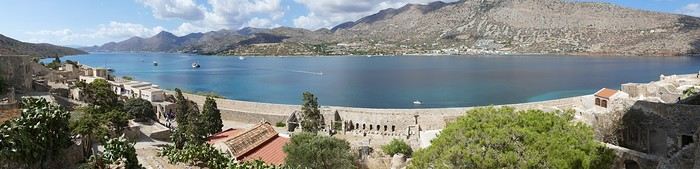
Spinalonga Island
The heat is now unbearable, and we can’t wait to get back home to have lunch on our terrace and rest. In the late afternoon, we go grocery shopping at the AB supermarket at the entrance of Agios. We had spotted another nice restaurant in our guide, but unfortunately, there’s a different one at the indicated location that doesn’t inspire us. So, we return to the Avli taverna for another dinner just as good as the first.
Friday, 13/09: We repeat yesterday’s successful program: a swim in our little cove, lunch on the terrace, a nap, and then, in the late afternoon, we discover another nearby village, Kroustas, nestled in the olive groves near Kritsa. Much less touristy than Kritsa, it’s mostly inhabited by locals, especially the elderly who are enjoying the cool air on their chairs—if you can call it cool given the still-high temperatures in the late afternoon! We then return to visit Kritsa, which we hadn’t been able to explore due to the rain. Dinner at a taverna in the village center at a very reasonable price.
Saturday, 14/09: Today, we move to our new base further east. We start with a high viewpoint at the Faneromeni Monastery, which overlooks Mirabello Bay. The monastery itself is of little interest as it’s under renovation with excessive concrete work. We continue to the village of Kavoussi to see another exceptional tree after a few kilometers on a dusty, bumpy track. It’s an olive tree said to be about 3,200 years old—impressive, and the countryside is very beautiful. It’s time to find a place for lunch. We find one in the charming little port of Mohlos, where a few tavernas surround a very nice small beach. Our choice falls on the Bogazzi taverna, where we enjoy fried fish. To reach our new base in Zakros, we still have to drive through the mountains before reaching Sitia, Paleokastro, and finally Zakros. The region is beautiful, with olive groves and rows of wind turbines taking advantage of the strong wind near the northern tip of the island. In Zakros, we’re greeted by our very friendly host. Here too, we have all the comforts and a beautiful terrace overlooking the village. The apartment has reversible air conditioners, but the overly simple instructions leave us puzzled. Thinking we’ve set it correctly, we realize a little too late that it’s blowing hot air over 30°C! After numerous attempts and testing several confusing programs, we finally succeed! Dinner on our new terrace.
Sunday, 15/09: This morning, we get up early to hike in the “Gorge of the Dead” while it’s still cool. The sky is blue as usual! We park in the nearest parking lot and start our descent via a beautiful path winding through the olive groves. A little further on, the landscape opens up, and the path, now a stony trail, begins the descent to the dry riverbed. On either side of the riverbed rise beautiful reddish cliffs.
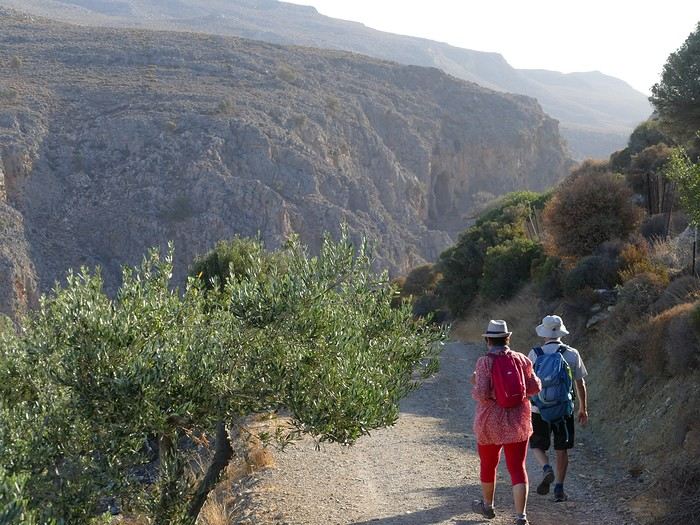
Gorge of the Dead
The trail winds its way through this narrow gorge with difficulty. It was in the many caves visible halfway up the slope that the Minoans buried their dead, hence the name “Gorge of the Dead.” The gorge opens onto a beautiful small pebble beach. A swim is welcome after this hike that made us sweat. The hike took us 1 hour and 25 minutes, and a little less on the way back. Meanwhile, Monique did some shopping and prepared an excellent lunch. In the late afternoon, we go down to dine at Platanakis, a taverna in the small village of Kato Zakros.
Monday, 16/09: This morning, we explore the northern part of the east coast near Palekastro. We start with a dip at the beautiful Hionia Beach near Palekastro. The water is still just as nice, but a light breeze is blowing—not enough to spoil our fun! Seeing all the wind turbines lining the ridges, it’s no surprise.
 Grocery shopping in Palekastro and return to Zakros. A little rain in the late afternoon and an excellent dinner at Iannis Mitsakakis’ Taverna in Adravastis. These are the kind of small tavernas we love—unpretentious, a few tables on a terrace, a warm welcome, a short menu guaranteeing freshness, tasty dishes prepared by the server’s mom, and a light bill. What more could you ask for!
Tuesday, 17/09: We head back toward Palekastro to do some shopping, but it’s also the road to the Toplou Monastery. There, we see a collection of magnificent icons dating from the 15th to the 20th century. We can also admire drawings of Orthodox religious architecture. We continue toward the Mavros Akrotiri headland to enjoy the view of the sea and rocky capes. On the way back to our place, we make a small detour to see the famous Vai palm grove. Meh... As for Vai Beach, it’s filled with paid umbrellas and sunbeds, and there are so many people that we flee. Plus, having to pay for parking is another reason to snub this trendy beach. We prefer our Hionia Beach, which we already appreciated the other day. In the late afternoon, Pat and I start the trail that begins at Kato Zakros Beach heading south. The poorly marked path crosses a plateau of sharp limestone. The paint and cairn markings are no longer very visible, and with dusk approaching, we turn back toward Kato Zakros. Dinner at the Platanakis taverna—less good than last time.
Wednesday, 18/09: To avoid the scorching sun, Pat, Mimi, and I get up earlier than usual to hike the Hohlakies Gorge. At this early hour, the sky is quite cloudy, and it’s drizzling. When we arrive in the village of Hohlakies, we park in front of a small chapel, the start of the hike. The sky is now completely clear. The trail starts among the olive groves, then after passing through a gate, we descend into the gorge filled with large rocks. We’re alone in the world, and the landscape is magnificent. A few wild goats clinging to the cliff watch us from above. After 1 hour and 15 minutes, we emerge onto the wonderful Karoumès Beach. A pleasant swim, then back to civilization! A walk in the late afternoon in Zakros to discover the beautiful springs route. Dinner in Adravastis.
Thursday, 19/09: Another move: Before heading to our next stop, we make a detour to see the beautiful Keratokampos Beach and can’t resist a swim in the still-warm, clear water. We continue our journey via Ziros, then reach the south coast and have lunch at the Stephi taverna in Ferma—excellent meal! The south coast is quite urbanized and has much less charm than the east coast we’ve just left! The numerous plastic greenhouses are partly to blame. We stop for groceries in Ierapetra. Around 3 p.m., we arrive at our destination in the small perched village of Anatoli. Our lodging is at the top of the village, and from the path leading to it, we have a magnificent view of the coastal plain, unfortunately overloaded with plastic greenhouses. It reminds us of the landscapes of El Ejido in Andalusia.
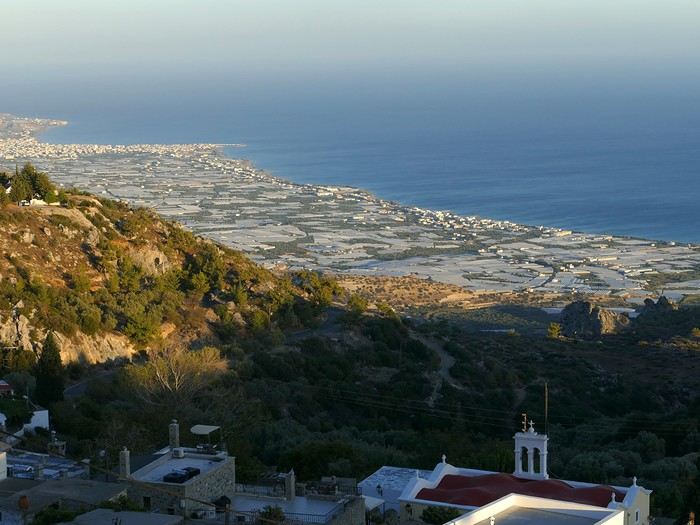 View of the Ierapetra coast from Anatoli
Friday, 20/09: A walk and discovery of the hamlet of Anatoli. There are few services—a tiny grocery store, a taverna, and that’s it. Fortunately, the traveling baker arrives and honks. We take the opportunity to buy fresh bread. Leaving the village, we take a path that should lead us to the hamlet of Drygies. The landscape is beautiful. We walk through a lovely pine forest before arriving at the hamlet. The path continues to a taverna that’s closed today, with a superb terrace overlooking the coast. Luckily, the owner arrives and informs us that the taverna will be open next Sunday and that we can enjoy barbecued meat. Noted! We head back to Anatoli via the small paved road with, fortunately, very limited traffic. Lunch on our terrace, then a dip in our private pool! The water is noticeably cooler than at the beach. Dinner at the village taverna: there’s only one menu—meze starters, souvlaki, water, wine, and bread—all for 35 €! We think we’re dreaming—was there a mistake? No.
Saturday, 21/09: We discover the beach of the village of Myrtos, a small seaside resort that’s quite touristy but on a human scale. We swim in the western part of the beach, and once again, we’re alone in the water. The best part: warm water and tamarisk trees for welcome shade. There’s even a shower to rinse off! In the late afternoon, Pat and I decide to go for a hike in the Selakano pine forest. To get there, we take a narrow, winding, and poorly paved road after the village of Christos. Plus, at this altitude, we encounter clouds clinging to the mountain, so it’s drizzling, and visibility is reduced. We decide to turn back and return to Anatoli. As compensation, we take the path that passes in front of the lodging and leads us to the Timios Stavros chapel, which crowns the summit of the nearby mountain. We arrive at the summit just in time for the sunset at 7 p.m. Breathtaking 360° panorama and magnificent colors!
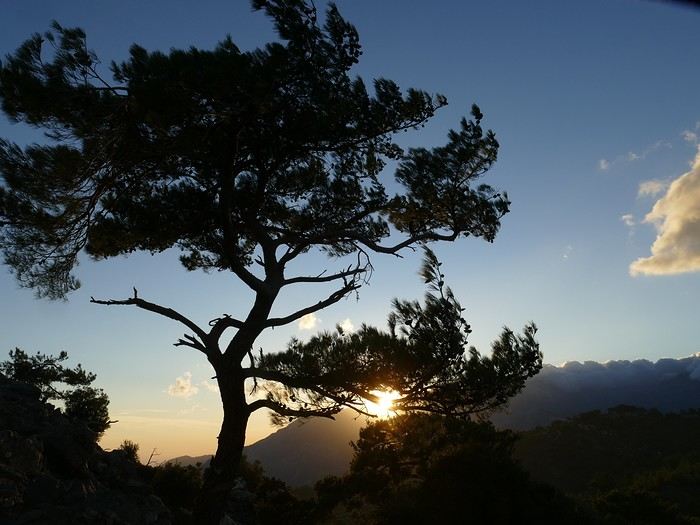 Sunset from Anatoli
Sunday, 22/09: This morning, Pat, Mimi, and I go for a hike in the Sarakina Gorge, located about 12 km from Anatoli via a beautiful road winding through irrigated olive groves. We park in the small parking lot before the trail. At the start, the path follows a levada (small irrigation canal) and quickly enters a very narrow gorge flanked by high cliffs. The riverbed is cluttered with huge rocks blocking the passage. No matter—in the technical sections, ropes or ladders allow us to overcome these obstacles with a bit of skill. You can imagine how quickly the riverbed must rise during a storm, given the narrowness of the gorge!
We progress slowly through this magnificent and impressive rocky chaos. At the exit of the gorge, we take another return path that partly follows the paved road. Back in Anatoli, we go to lunch at the Drygies taverna. We sit at the edge of the terrace under a huge tree that covers almost the entire terrace and order grilled lamb dishes prepared according to the ancient “antikristo” method.
Monday, 23/09: Departure for our last stop before Heraklion. We thought about swimming at Tertsa Beach, but it turns out to be less pleasant than expected, with pebbles and an uneven rocky plateau. So, we return to Myrtos Beach, which we know well and suits us perfectly. We head west, leaving the coast a bit. Around 3:30 p.m., we arrive at our destination in the village of Kamilari, near the famous Matala spot. We’ve rented a beautiful, modern, well-equipped apartment with a lovely shaded terrace. The owner is very friendly and explains everything necessary for a good stay. We explore the quite touristy village with its few tavernas, all full of tourists, mostly Germans.
Tuesday, 24/09: Visit to the village of Sivas, well restored thanks to the Germans, who have invested a lot here. We take the opportunity to scout out “friendly” tavernas, then go for a swim at Kalamaki Beach. Apart from a small sandy access, you have to enter the water via a chaotic limestone plateau—proof of this is that Monique trips slightly when entering the water. A group of very unfriendly German women blocks the sandy passage and doesn’t hesitate to push swimmers they deem too close. Back home, lunch, and a nap. In the late afternoon, we drive to visit the nearby Phaistos site. We benefit from very beautiful lighting. From the elevated site, we overlook the Messara Plain with a beautiful view of the olive grove checkerboards highlighted by the late afternoon sun. The site itself is quite vast, but to appreciate it, it’s better to read the explanatory panels placed throughout the different quarters. At this hour, the site is almost empty, and the beautiful light adds charm to the visit.
Wednesday, 25/09: Departure for the village of Matala, which doesn’t interest us in itself, having been there during the “hippie” era in 1976. However, going to Red Beach, only accessible by taking a path overlooking this area, appeals to us much more. We park in the large parking lot just outside the village and start our climb, which brings us to a pass from where we can admire this beautiful red-sand beach framed by beautiful cliffs plunging into the sea. The weather is magnificent, and at this early hour, there aren’t many people yet. We swim in the free part located near the cliff on the right when arriving at the beach. The sea is like glass, warm, and without a single ripple—a real treat! After half an hour, we turn back, and now there are many people rushing on this path, not at all made for feet in sandals or flip-flops, yet many vacationers venture out like this! Matala lives up to its image—a trendy place, full of shops, bars, and restaurants. You could be in any seaside resort with a standard global urbanism, lacking particular charm. Back home. In the late afternoon, a walk through the olive groves surrounding Kamilari, then dinner at Evangelina’s, who runs the Minoan Parassies taverna in the middle of the olive groves. Evangelina is quite a character: we came to reserve a table for 8 p.m. when it was only 7 p.m., but since we lingered near her restaurant, she prepares a table for us and urges us to sit down! And there she takes our order, and a little later, the meze arrive, followed by the main dishes. We finish this good dinner with several generous glasses of raki, accompanied by Evangelina’s encouragements, repeating “poya poya bravo bravo” in a loop. We’re in great shape too, by the way! We return in the middle of the night, on foot, fortunately, with the path vaguely lit by our phones...
Thursday, 26/09: This morning, we discover a new beach, Kommos Beach, not far from Kamilari either. It’s a long sandy beach, a small part of which is dedicated to paid umbrellas and sunbeds, and the rest is free. We spot a tamarisk tree to take shelter from the still-hot sun, and once again, we enjoy clear, warm water. The few swimmers spread out easily over nearly 500 meters of beach. In the late afternoon, Pat and I go to admire the sunset from the hill near our lodging. The hill, covered with olive trees, is threatened by a planned housing development of large cubic villas—trends dictate. Concrete never stops...
Friday, 27/09: We thought about leaving the car at the Odiyitria Monastery, the end of the paved road, but since the track descending to the cave remains drivable, we park 3 km further at the junction of the track leading to Kali Limenes Beach. We still have to walk for half an hour on a less drivable track, and then we’re at the entrance of the Farango Gorge. It’s a beautiful, easy hike since we follow the dry pebble riverbed. Before arriving at the beach, there’s a very beautiful small chapel sheltered under a large cliff, beautifully lit at this early hour.
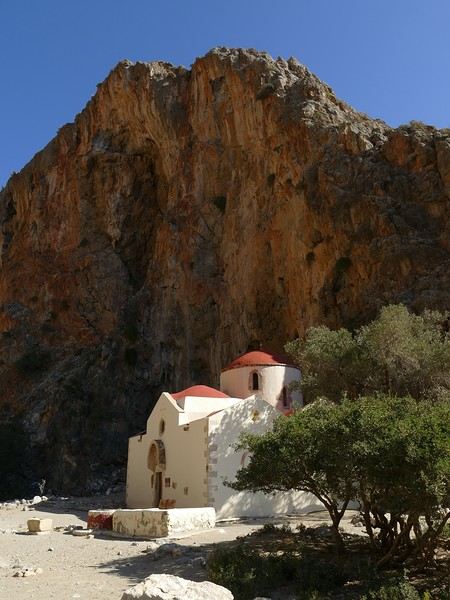
Agio Farango Chapel
A few climbers are scaling the cliff, and about ten swimmers are enjoying the sea. Return to the car under the hot sun. In the late afternoon, we all return to visit the interesting Odiyitria Monastery. Last swim at Kommos Beach and an excellent dinner at the Sigelakis taverna in Sivas.
Saturday, 28/09: There’s an end-of-vacation atmosphere... We pack our bags and head north. A short stop to see the village of Vorri, and a little over an hour later, we arrive in the big city of Heraklion. Since it’s too early to check into the apartment, we park in the city center to visit the famous archaeological museum. It’s indeed a must-see highlight of our stay in Crete. All four of us are amazed by the quantity and quality of the objects presented from the Minoan civilization. After more than 2 hours, we come out without having seen everything, but we’re a bit overwhelmed by all these wonders. Lunch at a nice little taverna very close to the Titus Church. We go to take possession of our apartment—the same as on the way there, still just as satisfying. In the late afternoon, I go alone for a walk in the historic district of the city, passing by the Morosini Fountain, which is bustling with people—some seated at café terraces, others standing and chatting. There’s a lively atmosphere here. A little further on are the Venetian loggia and the Agios Titos Church. I walk down to the old Venetian port to stroll along the jetty and admire the fortifications under beautiful late-afternoon lighting, then return to the apartment. Dinner near our place at Kiriakis, a “chic” restaurant but with very reasonable prices and excellent cuisine.
Sunday, 29/09: Wake-up at 3:30 a.m., quick coffee, and drive to the nearby airport. We leave the car in the parking lot. Already a lot of people at this early hour. Since we don’t have checked luggage, we go straight to security, which goes fairly quickly, then it’s waiting time and takeoff on time in an Airbus A321 for a 45-minute flight to Athens. We take off again in another Airbus A321 with a 50-minute delay to arrive in Zurich at 11:10 a.m. local time. Then we have to take the train to Basel and then the one to Colmar. With fewer Sunday services, we won’t arrive in Colmar until around 4 p.m.
Conclusion All four of us returned very satisfied with this stay in Crete for several reasons: - We found superb beaches with clear, warm water and often very few vacationers. - The few hikes we did were magnificent, especially those where the trails went through gorges leading to deserted beaches. - We greatly appreciated Cretan gastronomy—there were so few disappointments that we can count them on one hand. - All the accommodations we booked turned out to be superb, with the icing on the cake being the very friendly welcome from our hosts. - Generally, contacts with Cretans were always very warm despite the language barrier—we speak a little Greek. - We also appreciated the diversity of landscapes in this eastern part of Crete, with plateaus and mountains with splendid rugged reliefs.
Note: The photo album is available by clicking on this link: https://photos.app.goo.gl/hfdjQndA5eXkL5k7 Captions are only visible per photo by clicking on the circled “i” in the top right. Budget: approximately 3,300 € per couple for 21 days, including train and flights Budget details per couple: - Flight Zurich-Heraklion: 440 € - Trains Colmar-Basel-Zurich round trip for 4: 442.40 € (221 € per couple) - Accommodation: 2,431 € / 21 = 115.80 € per night for 4 (1,216 € per couple) - Car rental for 21 days: 684 € + 145 € fuel (1,150 km) (414 € per couple) - Restaurants, food, etc.: 1,009 €
Our 21-day itinerarySunday, 08/09: Once again—and this is the eighth time—we’re setting off, the four of us: Patrick, Michelle, Jacques, and Monique, for the Greek islands. This time, we’ve chosen Crete. No need to wake up at 3 or 4 a.m. to reach Basel-Mulhouse Airport at dawn to catch the first flight to Greece at 6 a.m.! Given the prohibitive prices charged by EasyJet, we found flights that were half the price from Zurich Airport, which is accessible in 3 hours by train from Colmar. Pierre-Paul drives all four of us to Colmar train station, where we take the train to Basel and then, 20 minutes later, the direct train to Zurich Airport. After wandering around the airport, we go for a coffee at 6 € each! We’re in Switzerland, after all. The other dining areas all have vending machines for selecting and paying for meals—soon, there won’t be anyone left to serve you! After a short wait, we take off at 7:45 p.m. (20 minutes late) in an Aegean Airbus A321. Free in-flight meal service isn’t bad either! We land in Heraklion around 11:15 p.m. We pick up our rental car (a red Seat Ibiza) at the airport and head straight to our apartment, located 2 km from the city center. Thanks to the GPS, we find it quickly. It’s a beautiful, fully renovated apartment with all the comforts and well-equipped. On the table, there’s wine, bottles of water, jam, coffee, etc. Given the late hour, we won’t stay up long.
Monday, 09/09: To enhance our breakfast, Michelle and Monique set off to find a bakery nearby. They return with croissants and donuts—yum... Then we head to the west coast. The highway follows the coastline, but we prefer taking the old road to Malia, our first stop. We visit the major archaeological site of this Minoan city under the hot sun. The site covers a vast area, but the ruins aren’t very evocative except for a few beautiful amphorae scattered around. The explanations in a small house at the entrance are interesting and help us better understand the organization of the ancient city with its different districts. From there, we head toward the nearby mountains to see the thousand-year-old plane tree in the village of Krasi. We take the opportunity to enjoy an excellent lunch of moussaka and delicious gemista at the Krassopsychia taverna in the village center. Pleasant surprise: the prices are still reasonable, with a bill of 70 € for four, including wine and water. The friendly tradition of complimentary dessert and glasses of raki continues—great! We’ve set the bar high right away! Let’s hope the rest lives up to it! On the way back toward the Lassithi Plateau, we stop at the Kardiotisa Monastery perched high on the mountain to enjoy a magnificent view of the entire region. Just a little further, we arrive at the Lassithi Plateau: the presence of small windmills used to pump water from the ground is the typical feature of this plateau. We complete a full loop around the plateau, passing by numerous orchards and vegetable gardens that occupy the entire space. At the end of the plateau, we once again cross mountain passes via winding roads that bring us near Agios Nikolaos. Our apartment is located about ten kilometers further south in Amoudhara. The owner, who was notified, waits for us and shows us her superb apartment, whose large terrace overlooks the entire Mirabello Bay. She then gives us valuable information about the different beaches in the area. Dinner will be frugal, given our hearty lunch in Krasi!
Sunset over Mirabello BayTuesday, 10/09: A bit of a gray sky when we wake up around 8 a.m., but the sun will soon triumph over the scattered clouds. For our first swim, we opt for Voulisma Beach, even though our host warned us it was a bit “crowdy.” That’s understandable given the beautiful emerald color of the sea and the lovely curve of the beach. To avoid the big crowds, we move toward the eastern part of the beach, accessible via a steep staircase. The water is very warm, and this first dip is very pleasant. Before returning to the apartment, we stop at the bakery to buy spinach pies, essential ingredients to accompany our Greek salad for lunch. Of course, everything will be washed down with ouzo, which will remain our favorite drink for the next three weeks—but in moderation!!! A nap is in order after all that effort. In the late afternoon, we drive to Agios Nikolaos, the main seaside resort in Crete. We’re not too enthusiastic about visiting this mass-tourism resort, but the center of Agios, concentrated around the small inner harbor, is pleasant to see despite the plethora of shops and restaurants. We dine a little outside the harbor in the shaded courtyard of the Avli taverna: the oven-baked lamb, squid with spinach, and cuttlefish ink orzo pasta are all highly appreciated. We still stay under a 75 € bill for four.
Mirabello Bay seen from our terraceWednesday, 11/09: At 8 a.m., the terrace is already bathed in sunlight, and it’s already quite hot. The small parasol barely gives us enough shade, but we’re not complaining! For our second swim, we head to a tiny beach recommended by our host, just 3 minutes by car from our place. The path leading to it is very discreet, and we don’t find it right away! It’s a small sandy cove with a few welcome tamarisk trees for shade. When we arrive, there are two swimmers, and there won’t be more than five or six in the morning. After lunch and a nap, we head to the beautiful village of Kritsa, just a few kilometers away. It’s too late to visit the beautiful church of Kera Panagia, which is already closed. We settle for the exterior, which is worth a look. The weather is clouding over, and big clouds are gathering. Upon arriving in Kritsa, a heavy shower forces us to take shelter in the Platanos taverna in the village center, and since it’s nearly 7 p.m., we decide to stay and dine there. Good choice—excellent meze: croquettes and stuffed zucchini flowers, gigantes beans, grilled tomatoes and feta, and pancetta as the main dish. The rain stops just as we decide to head back.
Village of KritsaThursday, 12/09: Our terrace faces east, so we get to watch the sunrise around 7 a.m.—it’s truly a beautiful sight we never tire of. Around 9 a.m., we head to the village of Plaka, where boats depart for the island of Spinalonga, located north of Agios Nikolaos. We board the first boat, which sets sail at 10 a.m., and we’re not alone—the boat is practically full. After 10 minutes, we land on the island at the same time as several other boats from Elounda or Agios. Needless to say, there are already quite a few people walking through the streets of the leper village. The visit remains interesting and moving as we read the explanatory panels recounting the island’s history under Byzantine and then Turkish rule, followed by its transformation into a leper colony. As soon as we climb toward the top of the island via more or less maintained paths, there’s almost no one left. The 360° view from up there is stunning.
Spinalonga Island
The heat is now unbearable, and we can’t wait to get back home to have lunch on our terrace and rest. In the late afternoon, we go grocery shopping at the AB supermarket at the entrance of Agios. We had spotted another nice restaurant in our guide, but unfortunately, there’s a different one at the indicated location that doesn’t inspire us. So, we return to the Avli taverna for another dinner just as good as the first.
Friday, 13/09: We repeat yesterday’s successful program: a swim in our little cove, lunch on the terrace, a nap, and then, in the late afternoon, we discover another nearby village, Kroustas, nestled in the olive groves near Kritsa. Much less touristy than Kritsa, it’s mostly inhabited by locals, especially the elderly who are enjoying the cool air on their chairs—if you can call it cool given the still-high temperatures in the late afternoon! We then return to visit Kritsa, which we hadn’t been able to explore due to the rain. Dinner at a taverna in the village center at a very reasonable price.
Saturday, 14/09: Today, we move to our new base further east. We start with a high viewpoint at the Faneromeni Monastery, which overlooks Mirabello Bay. The monastery itself is of little interest as it’s under renovation with excessive concrete work. We continue to the village of Kavoussi to see another exceptional tree after a few kilometers on a dusty, bumpy track. It’s an olive tree said to be about 3,200 years old—impressive, and the countryside is very beautiful. It’s time to find a place for lunch. We find one in the charming little port of Mohlos, where a few tavernas surround a very nice small beach. Our choice falls on the Bogazzi taverna, where we enjoy fried fish. To reach our new base in Zakros, we still have to drive through the mountains before reaching Sitia, Paleokastro, and finally Zakros. The region is beautiful, with olive groves and rows of wind turbines taking advantage of the strong wind near the northern tip of the island. In Zakros, we’re greeted by our very friendly host. Here too, we have all the comforts and a beautiful terrace overlooking the village. The apartment has reversible air conditioners, but the overly simple instructions leave us puzzled. Thinking we’ve set it correctly, we realize a little too late that it’s blowing hot air over 30°C! After numerous attempts and testing several confusing programs, we finally succeed! Dinner on our new terrace.
Sunday, 15/09: This morning, we get up early to hike in the “Gorge of the Dead” while it’s still cool. The sky is blue as usual! We park in the nearest parking lot and start our descent via a beautiful path winding through the olive groves. A little further on, the landscape opens up, and the path, now a stony trail, begins the descent to the dry riverbed. On either side of the riverbed rise beautiful reddish cliffs.
Gorge of the Dead
The trail winds its way through this narrow gorge with difficulty. It was in the many caves visible halfway up the slope that the Minoans buried their dead, hence the name “Gorge of the Dead.” The gorge opens onto a beautiful small pebble beach. A swim is welcome after this hike that made us sweat. The hike took us 1 hour and 25 minutes, and a little less on the way back. Meanwhile, Monique did some shopping and prepared an excellent lunch. In the late afternoon, we go down to dine at Platanakis, a taverna in the small village of Kato Zakros.
Monday, 16/09: This morning, we explore the northern part of the east coast near Palekastro. We start with a dip at the beautiful Hionia Beach near Palekastro. The water is still just as nice, but a light breeze is blowing—not enough to spoil our fun! Seeing all the wind turbines lining the ridges, it’s no surprise.
Grocery shopping in Palekastro and return to Zakros. A little rain in the late afternoon and an excellent dinner at Iannis Mitsakakis’ Taverna in Adravastis. These are the kind of small tavernas we love—unpretentious, a few tables on a terrace, a warm welcome, a short menu guaranteeing freshness, tasty dishes prepared by the server’s mom, and a light bill. What more could you ask for!Tuesday, 17/09: We head back toward Palekastro to do some shopping, but it’s also the road to the Toplou Monastery. There, we see a collection of magnificent icons dating from the 15th to the 20th century. We can also admire drawings of Orthodox religious architecture. We continue toward the Mavros Akrotiri headland to enjoy the view of the sea and rocky capes. On the way back to our place, we make a small detour to see the famous Vai palm grove. Meh... As for Vai Beach, it’s filled with paid umbrellas and sunbeds, and there are so many people that we flee. Plus, having to pay for parking is another reason to snub this trendy beach. We prefer our Hionia Beach, which we already appreciated the other day. In the late afternoon, Pat and I start the trail that begins at Kato Zakros Beach heading south. The poorly marked path crosses a plateau of sharp limestone. The paint and cairn markings are no longer very visible, and with dusk approaching, we turn back toward Kato Zakros. Dinner at the Platanakis taverna—less good than last time.
Wednesday, 18/09: To avoid the scorching sun, Pat, Mimi, and I get up earlier than usual to hike the Hohlakies Gorge. At this early hour, the sky is quite cloudy, and it’s drizzling. When we arrive in the village of Hohlakies, we park in front of a small chapel, the start of the hike. The sky is now completely clear. The trail starts among the olive groves, then after passing through a gate, we descend into the gorge filled with large rocks. We’re alone in the world, and the landscape is magnificent. A few wild goats clinging to the cliff watch us from above. After 1 hour and 15 minutes, we emerge onto the wonderful Karoumès Beach. A pleasant swim, then back to civilization! A walk in the late afternoon in Zakros to discover the beautiful springs route. Dinner in Adravastis.
Thursday, 19/09: Another move: Before heading to our next stop, we make a detour to see the beautiful Keratokampos Beach and can’t resist a swim in the still-warm, clear water. We continue our journey via Ziros, then reach the south coast and have lunch at the Stephi taverna in Ferma—excellent meal! The south coast is quite urbanized and has much less charm than the east coast we’ve just left! The numerous plastic greenhouses are partly to blame. We stop for groceries in Ierapetra. Around 3 p.m., we arrive at our destination in the small perched village of Anatoli. Our lodging is at the top of the village, and from the path leading to it, we have a magnificent view of the coastal plain, unfortunately overloaded with plastic greenhouses. It reminds us of the landscapes of El Ejido in Andalusia.
View of the Ierapetra coast from AnatoliFriday, 20/09: A walk and discovery of the hamlet of Anatoli. There are few services—a tiny grocery store, a taverna, and that’s it. Fortunately, the traveling baker arrives and honks. We take the opportunity to buy fresh bread. Leaving the village, we take a path that should lead us to the hamlet of Drygies. The landscape is beautiful. We walk through a lovely pine forest before arriving at the hamlet. The path continues to a taverna that’s closed today, with a superb terrace overlooking the coast. Luckily, the owner arrives and informs us that the taverna will be open next Sunday and that we can enjoy barbecued meat. Noted! We head back to Anatoli via the small paved road with, fortunately, very limited traffic. Lunch on our terrace, then a dip in our private pool! The water is noticeably cooler than at the beach. Dinner at the village taverna: there’s only one menu—meze starters, souvlaki, water, wine, and bread—all for 35 €! We think we’re dreaming—was there a mistake? No.
Saturday, 21/09: We discover the beach of the village of Myrtos, a small seaside resort that’s quite touristy but on a human scale. We swim in the western part of the beach, and once again, we’re alone in the water. The best part: warm water and tamarisk trees for welcome shade. There’s even a shower to rinse off! In the late afternoon, Pat and I decide to go for a hike in the Selakano pine forest. To get there, we take a narrow, winding, and poorly paved road after the village of Christos. Plus, at this altitude, we encounter clouds clinging to the mountain, so it’s drizzling, and visibility is reduced. We decide to turn back and return to Anatoli. As compensation, we take the path that passes in front of the lodging and leads us to the Timios Stavros chapel, which crowns the summit of the nearby mountain. We arrive at the summit just in time for the sunset at 7 p.m. Breathtaking 360° panorama and magnificent colors!
Sunset from AnatoliSunday, 22/09: This morning, Pat, Mimi, and I go for a hike in the Sarakina Gorge, located about 12 km from Anatoli via a beautiful road winding through irrigated olive groves. We park in the small parking lot before the trail. At the start, the path follows a levada (small irrigation canal) and quickly enters a very narrow gorge flanked by high cliffs. The riverbed is cluttered with huge rocks blocking the passage. No matter—in the technical sections, ropes or ladders allow us to overcome these obstacles with a bit of skill. You can imagine how quickly the riverbed must rise during a storm, given the narrowness of the gorge!
We progress slowly through this magnificent and impressive rocky chaos. At the exit of the gorge, we take another return path that partly follows the paved road. Back in Anatoli, we go to lunch at the Drygies taverna. We sit at the edge of the terrace under a huge tree that covers almost the entire terrace and order grilled lamb dishes prepared according to the ancient “antikristo” method.
Monday, 23/09: Departure for our last stop before Heraklion. We thought about swimming at Tertsa Beach, but it turns out to be less pleasant than expected, with pebbles and an uneven rocky plateau. So, we return to Myrtos Beach, which we know well and suits us perfectly. We head west, leaving the coast a bit. Around 3:30 p.m., we arrive at our destination in the village of Kamilari, near the famous Matala spot. We’ve rented a beautiful, modern, well-equipped apartment with a lovely shaded terrace. The owner is very friendly and explains everything necessary for a good stay. We explore the quite touristy village with its few tavernas, all full of tourists, mostly Germans.
Tuesday, 24/09: Visit to the village of Sivas, well restored thanks to the Germans, who have invested a lot here. We take the opportunity to scout out “friendly” tavernas, then go for a swim at Kalamaki Beach. Apart from a small sandy access, you have to enter the water via a chaotic limestone plateau—proof of this is that Monique trips slightly when entering the water. A group of very unfriendly German women blocks the sandy passage and doesn’t hesitate to push swimmers they deem too close. Back home, lunch, and a nap. In the late afternoon, we drive to visit the nearby Phaistos site. We benefit from very beautiful lighting. From the elevated site, we overlook the Messara Plain with a beautiful view of the olive grove checkerboards highlighted by the late afternoon sun. The site itself is quite vast, but to appreciate it, it’s better to read the explanatory panels placed throughout the different quarters. At this hour, the site is almost empty, and the beautiful light adds charm to the visit.
Wednesday, 25/09: Departure for the village of Matala, which doesn’t interest us in itself, having been there during the “hippie” era in 1976. However, going to Red Beach, only accessible by taking a path overlooking this area, appeals to us much more. We park in the large parking lot just outside the village and start our climb, which brings us to a pass from where we can admire this beautiful red-sand beach framed by beautiful cliffs plunging into the sea. The weather is magnificent, and at this early hour, there aren’t many people yet. We swim in the free part located near the cliff on the right when arriving at the beach. The sea is like glass, warm, and without a single ripple—a real treat! After half an hour, we turn back, and now there are many people rushing on this path, not at all made for feet in sandals or flip-flops, yet many vacationers venture out like this! Matala lives up to its image—a trendy place, full of shops, bars, and restaurants. You could be in any seaside resort with a standard global urbanism, lacking particular charm. Back home. In the late afternoon, a walk through the olive groves surrounding Kamilari, then dinner at Evangelina’s, who runs the Minoan Parassies taverna in the middle of the olive groves. Evangelina is quite a character: we came to reserve a table for 8 p.m. when it was only 7 p.m., but since we lingered near her restaurant, she prepares a table for us and urges us to sit down! And there she takes our order, and a little later, the meze arrive, followed by the main dishes. We finish this good dinner with several generous glasses of raki, accompanied by Evangelina’s encouragements, repeating “poya poya bravo bravo” in a loop. We’re in great shape too, by the way! We return in the middle of the night, on foot, fortunately, with the path vaguely lit by our phones...
Thursday, 26/09: This morning, we discover a new beach, Kommos Beach, not far from Kamilari either. It’s a long sandy beach, a small part of which is dedicated to paid umbrellas and sunbeds, and the rest is free. We spot a tamarisk tree to take shelter from the still-hot sun, and once again, we enjoy clear, warm water. The few swimmers spread out easily over nearly 500 meters of beach. In the late afternoon, Pat and I go to admire the sunset from the hill near our lodging. The hill, covered with olive trees, is threatened by a planned housing development of large cubic villas—trends dictate. Concrete never stops...
Friday, 27/09: We thought about leaving the car at the Odiyitria Monastery, the end of the paved road, but since the track descending to the cave remains drivable, we park 3 km further at the junction of the track leading to Kali Limenes Beach. We still have to walk for half an hour on a less drivable track, and then we’re at the entrance of the Farango Gorge. It’s a beautiful, easy hike since we follow the dry pebble riverbed. Before arriving at the beach, there’s a very beautiful small chapel sheltered under a large cliff, beautifully lit at this early hour.
Agio Farango Chapel
A few climbers are scaling the cliff, and about ten swimmers are enjoying the sea. Return to the car under the hot sun. In the late afternoon, we all return to visit the interesting Odiyitria Monastery. Last swim at Kommos Beach and an excellent dinner at the Sigelakis taverna in Sivas.
Saturday, 28/09: There’s an end-of-vacation atmosphere... We pack our bags and head north. A short stop to see the village of Vorri, and a little over an hour later, we arrive in the big city of Heraklion. Since it’s too early to check into the apartment, we park in the city center to visit the famous archaeological museum. It’s indeed a must-see highlight of our stay in Crete. All four of us are amazed by the quantity and quality of the objects presented from the Minoan civilization. After more than 2 hours, we come out without having seen everything, but we’re a bit overwhelmed by all these wonders. Lunch at a nice little taverna very close to the Titus Church. We go to take possession of our apartment—the same as on the way there, still just as satisfying. In the late afternoon, I go alone for a walk in the historic district of the city, passing by the Morosini Fountain, which is bustling with people—some seated at café terraces, others standing and chatting. There’s a lively atmosphere here. A little further on are the Venetian loggia and the Agios Titos Church. I walk down to the old Venetian port to stroll along the jetty and admire the fortifications under beautiful late-afternoon lighting, then return to the apartment. Dinner near our place at Kiriakis, a “chic” restaurant but with very reasonable prices and excellent cuisine.
Sunday, 29/09: Wake-up at 3:30 a.m., quick coffee, and drive to the nearby airport. We leave the car in the parking lot. Already a lot of people at this early hour. Since we don’t have checked luggage, we go straight to security, which goes fairly quickly, then it’s waiting time and takeoff on time in an Airbus A321 for a 45-minute flight to Athens. We take off again in another Airbus A321 with a 50-minute delay to arrive in Zurich at 11:10 a.m. local time. Then we have to take the train to Basel and then the one to Colmar. With fewer Sunday services, we won’t arrive in Colmar until around 4 p.m.
Conclusion All four of us returned very satisfied with this stay in Crete for several reasons: - We found superb beaches with clear, warm water and often very few vacationers. - The few hikes we did were magnificent, especially those where the trails went through gorges leading to deserted beaches. - We greatly appreciated Cretan gastronomy—there were so few disappointments that we can count them on one hand. - All the accommodations we booked turned out to be superb, with the icing on the cake being the very friendly welcome from our hosts. - Generally, contacts with Cretans were always very warm despite the language barrier—we speak a little Greek. - We also appreciated the diversity of landscapes in this eastern part of Crete, with plateaus and mountains with splendid rugged reliefs.
Note: The photo album is available by clicking on this link: https://photos.app.goo.gl/hfdjQndA5eXkL5k7 Captions are only visible per photo by clicking on the circled “i” in the top right. Budget: approximately 3,300 € per couple for 21 days, including train and flights Budget details per couple: - Flight Zurich-Heraklion: 440 € - Trains Colmar-Basel-Zurich round trip for 4: 442.40 € (221 € per couple) - Accommodation: 2,431 € / 21 = 115.80 € per night for 4 (1,216 € per couple) - Car rental for 21 days: 684 € + 145 € fuel (1,150 km) (414 € per couple) - Restaurants, food, etc.: 1,009 €
Bike trip: from Carcans Maubuisson to Plaisir (Yvelines)
Monday, August 21, 2023 - Rochefort - Marans
No journal for the first two days. Day 1 - CARCANS-ROYAN Day 2 - ROYAN - ROCHEFORT Tonight I'm in MARANS in the "dry marsh" according to the campsite manager—it’s the first time I’ve heard of a "dry marsh"?!
Photos from the first two days
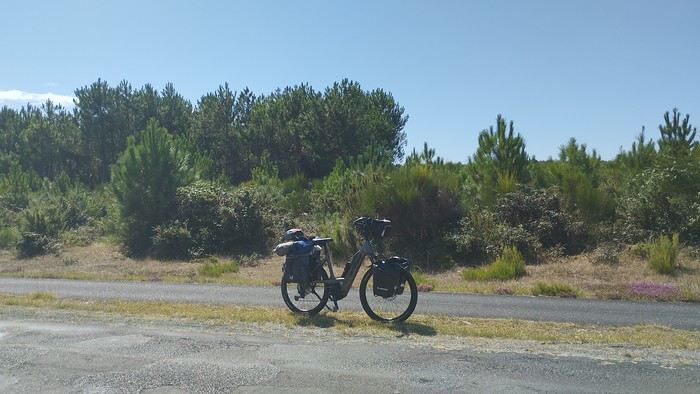 My gear
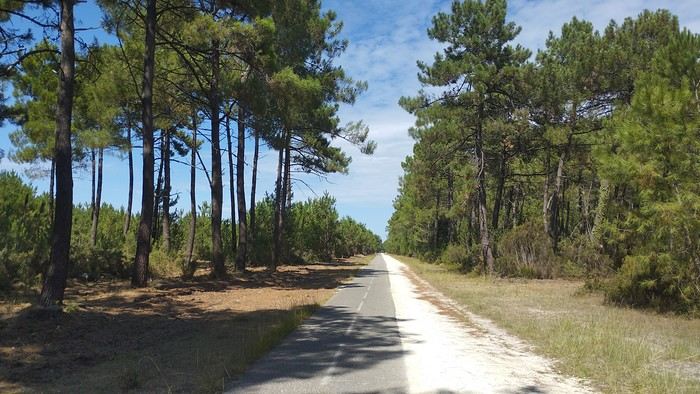
The Landes region—nothing extraordinary, but the calm and serenity are nice.

Le Verdon
The wild coast
This marsh isn’t dry, though.
Today is the third day of my trip, and I’m writing to you from a campsite in Marans. I’ve set out to bike from Carcans Maubuisson back to Plaisir. Why Carcans? Because we spent a week there as a family—a great week that lets everyone reconnect for a long stretch. Also, on Saturday, we all headed home—some by car, and me by bike. This journey is about 850 km via bike paths and small cycling roads. It’s not a sporting feat, just a nice long ride for fun. As the old Chinese sage says, "The destination doesn’t matter—it’s the journey that counts." But he also told me, "Traveling is great, but what’s the point if you don’t share it?" You see, this old sage has told me a lot of things—he often keeps me company when I’m biking. Of course, he doesn’t pedal, but we travel in harmony. Sure, he can be a bit annoying sometimes, but we still get along. All this to say I’ve created a group to share my story. I’d be happy to share this experience with you—it’s an adventure for me. On Saturday, I wasn’t sure I’d even leave because I’d been dealing with sciatica for days. Luckily, Juliette, a friend of the old Chinese sage, recommended a lifesaving remedy: Alternately stretching your legs with an elastic band under your foot. Obviously, a jam jar rubber band won’t cut it.
From Marans - The mosquitoes are attacking; time to head back to shelter.
The first two legs took me to Royan and then Rochefort. The Sèvre Niortaise flows nearby, and I followed a canal from La Rochelle. You could say the area is as dry as the marsh, judging by the state of the crops.
As I mentioned, it’s the third day, and if Jesus rose again on this day, for me it was more like the crucifixion. The scorching heat—only bearable when you’re moving—combined with rough trail conditions, and the old Chinese sage says, "Terrible roads, slow speed, and watch your limbs." I set out to do 60 km but ended up doing 80, and the last 20 were tough. I kept checking the GPS to see how much farther until the campsite. Today: Rochefort to Marans, sticking to the coast until La Rochelle, then no notable towns after that—just a constant canal. But since the sky isn’t too low, it hasn’t gotten lost. I’ve still got plenty of anecdotes to share, but it’s pitch black out, and the mosquitoes are still around. This morning, I counted ten in my tent, all full of my blood. Yesterday, at the end of the leg to Rochefort, I was really looking forward to crossing the Charente using the transporter bridge, but a sneaky GPS conspiracy led me far from it. I ended up crossing the Charente on a completely ordinary bridge, watching the transporter bridge in the distance with disappointment.
End of the first episode. Until tomorrow, if you’d like!
No journal for the first two days. Day 1 - CARCANS-ROYAN Day 2 - ROYAN - ROCHEFORT Tonight I'm in MARANS in the "dry marsh" according to the campsite manager—it’s the first time I’ve heard of a "dry marsh"?!
Photos from the first two days
My gearThe Landes region—nothing extraordinary, but the calm and serenity are nice.
Le Verdon
The wild coast
This marsh isn’t dry, though.
Today is the third day of my trip, and I’m writing to you from a campsite in Marans. I’ve set out to bike from Carcans Maubuisson back to Plaisir. Why Carcans? Because we spent a week there as a family—a great week that lets everyone reconnect for a long stretch. Also, on Saturday, we all headed home—some by car, and me by bike. This journey is about 850 km via bike paths and small cycling roads. It’s not a sporting feat, just a nice long ride for fun. As the old Chinese sage says, "The destination doesn’t matter—it’s the journey that counts." But he also told me, "Traveling is great, but what’s the point if you don’t share it?" You see, this old sage has told me a lot of things—he often keeps me company when I’m biking. Of course, he doesn’t pedal, but we travel in harmony. Sure, he can be a bit annoying sometimes, but we still get along. All this to say I’ve created a group to share my story. I’d be happy to share this experience with you—it’s an adventure for me. On Saturday, I wasn’t sure I’d even leave because I’d been dealing with sciatica for days. Luckily, Juliette, a friend of the old Chinese sage, recommended a lifesaving remedy: Alternately stretching your legs with an elastic band under your foot. Obviously, a jam jar rubber band won’t cut it.
From Marans - The mosquitoes are attacking; time to head back to shelter.
The first two legs took me to Royan and then Rochefort. The Sèvre Niortaise flows nearby, and I followed a canal from La Rochelle. You could say the area is as dry as the marsh, judging by the state of the crops.
As I mentioned, it’s the third day, and if Jesus rose again on this day, for me it was more like the crucifixion. The scorching heat—only bearable when you’re moving—combined with rough trail conditions, and the old Chinese sage says, "Terrible roads, slow speed, and watch your limbs." I set out to do 60 km but ended up doing 80, and the last 20 were tough. I kept checking the GPS to see how much farther until the campsite. Today: Rochefort to Marans, sticking to the coast until La Rochelle, then no notable towns after that—just a constant canal. But since the sky isn’t too low, it hasn’t gotten lost. I’ve still got plenty of anecdotes to share, but it’s pitch black out, and the mosquitoes are still around. This morning, I counted ten in my tent, all full of my blood. Yesterday, at the end of the leg to Rochefort, I was really looking forward to crossing the Charente using the transporter bridge, but a sneaky GPS conspiracy led me far from it. I ended up crossing the Charente on a completely ordinary bridge, watching the transporter bridge in the distance with disappointment.
End of the first episode. Until tomorrow, if you’d like!
Cruise departing from Le Havre: what to see?
Hi everyone, I’m so happy Voyage Forum is back online.
This is perfect timing since we’re leaving on November 28th for a cruise departing from Le Havre (Southampton, Zeebrugge, Rotterdam, Hamburg). Could you share some info on the distances from the ports to the city centers, sights to see, etc.?
Thanks so much, and see you soon!
Itinerary in Kyushu (Japan) from north to west
Departure imminent on 10/27. The trip will be a full 18 days.
I still have a few questions about transportation for certain legs:
Day 1: Arrival in Fukuoka in the evening at 7:30 PM
Day 2: Fukuoka city
Day 3: Ukiha (car or train?)
Day 4: Itoshima
Day 5: 11/01/2024: Okawa, Omuta (forge), and Yanagawa for the Yanagawa Hakushu Matsuri. A bit ambitious for a single day?
Day 6: Arita / Owakachiyama / rice fields in the evening: Is it better to go from Fukuoka to Arita by car or train?
Day 7: Sasebo + Kujukushima Pearl + fireworks show Day 8: Karatsu (Yobuko market + cave + cape) + Matsuri Kanchi Day 9: Kashima + garden + Tara Day 10: Higashi Sonogi, overnight in Nagasaki. Is it better to return the car in Arita or Nagasaki? Day 11: Nagasaki Day 12: Nagasaki, overnight in Fukuoka, so departure by train from Nagasaki Day 13: Munakata and Oshima, and in the evening, Hanabi Kama
Day 14: Mount Hiko, Toho, Soeda. Is there a pottery village? With or without hands-on experience?
Day 15: Yame (Hoshino tea visit) and Kurume Masure workshop
Days 16, 17, 18, 19: Fukuoka city and maybe Nokonoshima or Kitakyushu
Any suggestions? Does this seem balanced?
Thanks and have a great day
Day 1: Arrival in Fukuoka in the evening at 7:30 PM
Day 2: Fukuoka city
Day 3: Ukiha (car or train?)
Day 4: Itoshima
Day 5: 11/01/2024: Okawa, Omuta (forge), and Yanagawa for the Yanagawa Hakushu Matsuri. A bit ambitious for a single day?
Day 6: Arita / Owakachiyama / rice fields in the evening: Is it better to go from Fukuoka to Arita by car or train?
Day 7: Sasebo + Kujukushima Pearl + fireworks show Day 8: Karatsu (Yobuko market + cave + cape) + Matsuri Kanchi Day 9: Kashima + garden + Tara Day 10: Higashi Sonogi, overnight in Nagasaki. Is it better to return the car in Arita or Nagasaki? Day 11: Nagasaki Day 12: Nagasaki, overnight in Fukuoka, so departure by train from Nagasaki Day 13: Munakata and Oshima, and in the evening, Hanabi Kama
Day 14: Mount Hiko, Toho, Soeda. Is there a pottery village? With or without hands-on experience?
Day 15: Yame (Hoshino tea visit) and Kurume Masure workshop
Days 16, 17, 18, 19: Fukuoka city and maybe Nokonoshima or Kitakyushu
Any suggestions? Does this seem balanced?
Thanks and have a great day
Petit tour à vélo dans des départements du bout du monde août 2020 English translation pending
Le voyage pourquoi ? Chacun sa définition en fonction de ses envies et de ses aspirations. Le plaisir, le bonheur de la découverte, aller regarder les grandes merveilles du monde, dont on nous dit qu’il faut les avoir vues dans sa vie au moins une fois, un peu à la manière de la Rolex de Séguéla. Certes, au cours d’une interview plusieurs années plus tard, il a répondu que ce jour-là, il avait dit la plus grosse connerie de sa vie !
Le cyclo-voyageur ajoute une dimension particulière au voyage. En quelque sorte son déplacement constitue son voyage. Il ne se rend pas en un lieu pour le visiter, il pérégrine en recherchant les routes, les chemins ou les pistes les moins courues, et il en fait son voyage. L’itinéraire, lorsqu’on le parcourt à la force de ses mollets, on change l’esprit du déplacement. Bien sûr l’idée de challenge est toujours, plus ou moins, sous-jacente.
Ce type de réflexion, tout naturellement m’a conduit à envisager de partir à la découverte de la France profonde à travers les départements suivants, la Haute-Marne, la Meuse et la Meurthe-et-Moselle. Bien évidemment, nous sommes nombreux à y être passés, mais en voiture dans nos traversées browniennes, où l’on ne souffre pas le moindre retard, les yeux rivés sur le compteur, en essayant d’être toujours un peu au-dessus de la limite, à l’orée de déclencher les radars. Entre le compteur optimiste et la petite tolérance, sur route 90 affiché au compteur et 140 sur autoroute, généralement tout se passe bien. Mais les grands axes sont devenus une jungle, où toute notre attention est absorbée. Donc, même si nous avons traversé ces départements 52, 55 ou 54 que connaissons nous des campagnes profondes qui s’y cachent ? C’est justement à leur découverte, hors des voies habituelles du tourisme, que je veux m’aventurer quelques jours. Certes, les départements agricoles j’en ai une petite idée, ayant habité en Haute-Saône et ayant beaucoup parcouru à pied tout le sud-ouest de la France, en particulier le département du Gers, très impressionnant par ses moutonnements de terres cultivées qui se succèdent jusqu’à l’infini. Mais voilà, tous les départements ne se ressemblant pas, c’est donc plein de curiosité et aussi d’attentes que je me lance dans un « petit tour » de 400 kilomètres à partir de chez moi.
Je vais renouer avec le bikepacking, terme barbare qui signifie que l’on part avec un matériel allégé, avec des sacoches au look futuriste qui n’ont pas besoin de porte-bagages pour être accrochées. Bien évidemment la contenance en est moindre. Mais on se déplace toujours avec beaucoup trop d’affaires, qu’il s’agisse d’habits ou d’appareils électroniques en tous genres, sans parler des matériels de bivouac trop volumineux. Evidemment, ces derniers il en existe de poids et volume réduits, mais il faut oser passer le pas et mettre au rebus un équipement que l’on considère toujours efficace. Et puis, il faut s’adapter aux saisons et aux lieux. Cela conduit à avoir une tente pour l’été en Europe, une pour l’hiver, éventuellement celle de l’été suffit, mais pour les voyages lointains dans des pays au climat très hostile, là pas le choix du très costaud s’impose. Le voyage à vélo, afin de s’équiper de façon optimale selon les différentes options demande des moyens financiers.
Comme à chaque fois, que je pars pour un voyage engagé de longue durée sur un autre continent ou pour un petit tour de côté de chez moi, alors l’appel de la route s’impose. J’ai perdu l’habitude (à vrai dire je ne l’ai jamais eue) d’organiser mes affaires en bikepacking, il s’agit seulement de ma deuxième expérience, et de plus je pars dans l’euphorie de la première. En effet, j’avais effectué le premier jour 230 kilomètres, alors j’envisage avec un esprit tranquille mon étape initiale de 130 kilomètres. Quelle erreur ! 6h30, je prends la piste cyclable direction Remiremont. Les 25 premiers kilomètres sont rapidement expédiés. Les bosses apparaissent dès la sortie ouest de la ville et elles vont être nombreuses. Je ne serai pas en mesure d’en faire la somme des dénivelés cumulés, mon compteur va me lâcher aux environs des 80 kilomètres. Je prends la direction de Bains-les -Bains. Tout va bien, la forme semble bonne, la circulation est peu dense. Je me fais doubler au moment où je m’arrête par un couple de voyageurs équipés de vélos électriques. Evidemment je ne les rattraperai pas.
Pause-café, plutôt capuccino à Bains-les -Bains. Sur la terrasse on est autorisé à s’installer sans porter le masque. Sur mon vélo au milieu de la campagne déserte j’oublie rapidement la présence de la pandémie, mais dès que je pénètre dans une agglomération, les visages masqués me rappellent la situation que nous subissons à l’échelle mondiale. Sur cette terrasse, un homme m’aborde et me pose quelques questions sur mon périple. Il me donne une information intéressante concernant la piste cyclable qui longe le canal de l’est et qui passe à proximité. Je ne le savais pas et ma carte Michelin au 1/150 000ème couvrant les départements Haute-Saône et Vosges ne la mentionne pas.
Je vais la suivre une dizaine de kilomètres, parcours très agréable où je croise plusieurs voyageurs à vélo, dont deux familles lourdement équipées. Je rencontre aussi plusieurs bateaux, certains dans mon sens donc je les dépasse. J’éprouve toujours un grand plaisir à suivre les berges d’un cours d’eau ou d’un canal. Ce dernier insuffle la sérénité. Parfois la piste est cernée par l’eau. Mais tout a une fin, je reprends la route au village de Selle. En traversant des villages du bout du monde ou presque, tels que Regnévelle, Godoncourt ou Ainville je me dirige vers mon point de chute la ville de Montigny-le-Roy.
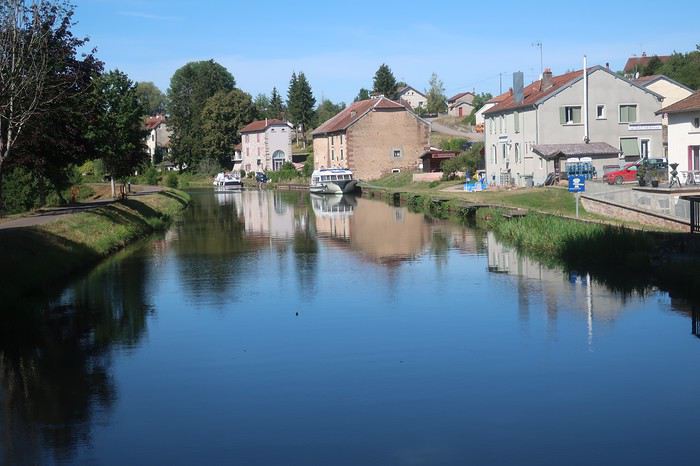
A vélo on passe rapidement de tout va bien à rien ne va plus. Mais il y a une explication à toutes choses. Sans doute l’absence d’entraînement depuis 18 mois, mais je ne me suis jamais entraîné avant de partir en balade. Peut-être l’âge ? mais plus probablement un mixte entre grosse chaleur et une très mauvaise gestion boisson nourriture. Il faut dire que dans ces coins durant les cinq jours de mon périple je ne rencontrerai quasiment aucun commerce ni bistrot. On a beau avoir une longue expérience en matière de voyage à vélo, les conneries de base on les fait encore parfois. Eh oui, cette idée de faire « seulement » 130 kilomètres m’a mis dans un état d’imprévoyance, m’imaginant que cela serait facile, et boum le coup de barre.
Je m’arrête dans un village asphyxié sous une chappe de chaleur, et à l’abri d’un mur, installé sur un petit carré de pelouse grillée je mange les deux œufs durs que j’ai pris la précaution d’emmener, ainsi que l’une des deux bananes que je possède. Je remplis mes bidons au magnifique lavoir.
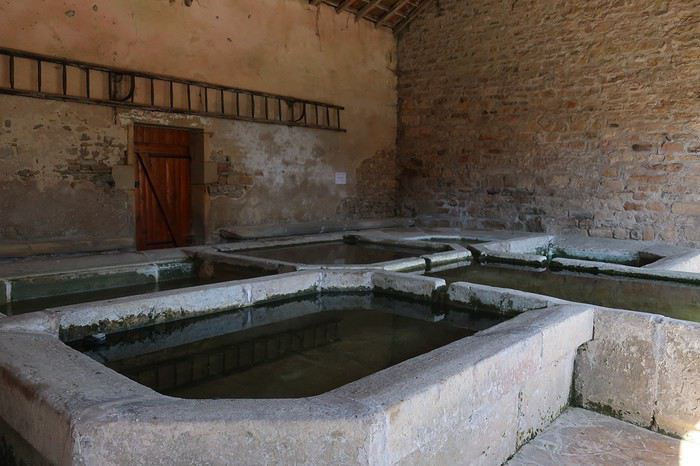
Je sens la déshydratation assécher mon corps. En France, je n’avais jamais ressenti cela. Je ne crains pas le soleil, sans doute du fait de mon atavisme du sud de la Méditerranée, mais aujourd’hui je me sentirais presque en danger. Il me reste une trentaine de kilomètres pour boucler mon étape prévue. Généralement, je ne suis pas à cheval quant au respect de la planification, je peux sortir ma tente et m’installer dans le premier bosquet un peu à l’abri des regards. Mais aujourd’hui j’ai l’impression de cuire et je crains que sous la tente ce soit l’enfer. Donc je vais m’astreindre à rejoindre la ville afin de chercher un hôtel, en quête d’un peu de fraîcheur. Les derniers kilomètres sont un calvaire comme je n’en avais jamais connu. Les ultimes côtes, même pas très raides, je suis dans l’obligation de pousser mon vélo, bien qu’il soit en carbone et hyper léger, et même de m’arrêter sur le bas-côté et me vautrer dans l’herbe du talus à l’abri de l’ombre d’un arbre.
Cette première journée me laisse un peu dubitatif. J’ai eu l’impression de pédaler dans quelque pays exotique. Les jours à venir ne seront pas plus cléments, les prévisions météorologiques annoncent des pics de chaleur encore plus importants. Bon, nous verrons bien. Première mesure essayer de continuer à rouler très tôt et puis limiter les étapes à 70 kilomètres. Voilà il faut s’adapter, le corps commande et surtout rester à son écoute, ce que je n’ai pas vraiment fait aujourd’hui.
J’ai plusieurs amis qui sont des spécialistes du déplacement à vélo de nuit, en particulier au moment de la pleine lune, ils en parlent avec des trémolos dans la voix. Ce serait bien le moment d’essayer, la configuration actuelle de notre satellite s’y prête. Mais dans un premier temps j’aspire à une bonne nuit et, surtout à réhydrater mon corps. Ma devise « toujours pisser blanc » est mise à mal, mes urines sont d’un jaune plus que prononcé malgré les 4 litres d’eau de la journée. Je ne me souviens pas avoir subi de telles difficultés à avancer, conjonction d’erreurs et de canicule. Toujours très intéressant d’aller assez prêt de ses limites physiques, je me rends compte qu’il ne faut pas grand-chose pour dérègler la machine.
De la terrasse de l’hôtel, je regarde vers le nord, tout est jaune, desséché. Cela est presque inquiétant, on pourrait se croire quelque part au sud de l’Espagne, mais non il s’agit bien de la Haute-Marne. Demain je vais me contenter d’une étape de 60 kilomètres en rejoignant Neufchâteau, qui se trouve dans le département des Vosges.

Après une nuit correcte, au réveil je constate que la journée d’hier a laissé quelques traces et, contrairement à mon habitude, je ne démarre pas au lever du jour mais vers les 9 heures du matin. Très vite, la ville située sur une bosse est quittée et devant moi s’ouvrent à l’infini des prairies et des terres agricoles grillées par la sécheresse et les rayons ardents du soleil. Prendre une carte IGN ou Michelin, qu’elle soit au 1/100 00, 1/150 000 ou 1/175 000 -ème et y tracer son itinéraire le long de départementales matérialisées par un trait blanc bordé de deux lignes noires, alors vous êtes certain du résultat. Vous vous lancez dans une belle aventure loin des voitures, mais proche d’une nature et d’une vie locale que l’on a tendance à ne plus voir. Cette incursion dans le département 52, va me conduire de minuscule village en minuscule village, qui s’égrènent, de bosses en creux, tout au long d’une terre ondulante. Je ne vais y voir pratiquement aucun des êtres vivants que l’on s’attend à rencontrer, ni homme, ni chien, ni chat. Si, une fois, dans l’un de ces hameaux apparemment abandonnés, je vais croiser un homme seul, et il me rappelle que nous sommes en pandémie car il porte le masque, le fameux masque qui fait couler tant d’encre et de salive chez les Gaulois récalcitrants.
A vrai dire je vais côtoyer de nombreuses vaches, qui lorsqu’elles le peuvent s’agglutinent à l’ombre d’un arbre de leur pâture. Elles sont comme de gros points blancs dans cet environnement couleur blond, couleur paille. Les ondulations permanentes de cette terre procurent des contrastes du plus bel effet entre le doré du sol et le bleu du ciel. L’une et l’autre des couleurs ne se mélangent pas comme sur une aquarelle, au contraire elles se maintiennent bien séparées par une ligne horizontale sans accroc. Cette matinée me fait une impression étrange. Ce décor de villages déserts alanguis dans un autre temps, de champs, de vaches, d’odeur de purin et de présence de traces de bouses un peu partout me remémore ma traversée de la Pologne par ses grandes plaines, il y a maintenant une dizaine d’années. Certes, en Pologne l’environnement, les habitations les matériels agricoles étaient plus vétustes, mais je m’y vois presque dans ces immenses plaines où les Allemands livrèrent de dures batailles avant de reculer devant le rouleau compresseur soviétique. D’ailleurs, ironie du sort dans ces hameaux de Haute-Marne, la présence humaine est surtout représentée par les monuments aux morts rappelant les soldats tombés au champ d’honneur pour la France.
Au village de Pompierre je m’arrête vers midi, la température a déjà largement dépassé les 30 degrés, et cela va continuer à monter jusque vers 15 heures. Allongé au bout d’un pont à l’ombre d’un arbre je savoure la brise très ténue créée par le cours d’eau pas encore asséché, mais qui cependant a des airs de moribond qui ne devrait pas tarder à rendre les armes. Un coureur, plus très jeune, passe à trois reprises, suant et harassé sous le soleil vertical le dardant sans pitié. Au troisième passage je l’interroge. Il me répond qu’il vient d’effectuer par 3 fois un parcours de 2,5 kilomètres. Chapeau, car à part l’ombre de mon arbre son circuit se déroule en plein champ. Il me donnerait presque de la vaillance. Après trois quarts d’heure de station allongée, je prends à deux mains, sinon mon courage, du moins mon guidon et j’accomplis les 11 derniers kilomètres qui me séparent de Neufchâteau.
L’ambiance dans les villes est quand même un peu étrange, tout le monde ou presque est masqué. Dès que je descends de vélo je dégaine le mien. Il fait tellement chaud que je n’ai même pas faim. Je me force cependant à ingurgiter les différents éléments du menu que fort gentiment le propriétaire de l’hôtel me propose alors qu’il est déjà 14 heures. En ce troisième jour je compte rejoindre la ville de Commercy dans la Meuse, encore un département très agricole. Vu les conditions de forme pas au top et les conditions météorologiques par contre au top de la chaleur, ce sera le point le plus haut de mon parcours pour une sortie de 5 jours. Dans mon euphorie initiale je me serais bien vu monter au moins jusqu’à la frontière du Luxembourg. Mais voilà, entre ce que l’on désirerait et la réalité, cette dernière gagne généralement.
Comme hier, la même campagne assoiffée se déroule de part et d’autre de mon chemin. Je traverse le village natal de Jeanne-d ’Arc, Domremy-la -Pucelle. Il n’a pas de privilège particulier, lui aussi crie à boire. Puis je traverse une route plus importante et reprends mon itinérance au gré de départementales confidentielles. Je vais croiser quelques voyageurs à vélo, deux solitaires et un couple à vélo électrique. Généralement lorsque je croise d’autres adeptes du voyage à vélo je les intercepte pour discuter. Mais aujourd’hui non, d’ailleurs le bikepacker, bien qu’il se traîne, est-il considéré comme faisant partie de la même tribu ? Le deuxième solitaire rencontré est terriblement chargé, quatre énormes sacoches. Où va-t-il donc, quelle est la durée de son périple ? Tel que je suis équipé, je pourrais continuer beaucoup plus que les cinq jours prévus. J’ai tout pour être autonome, même 250 grammes de riz en cas de bivouac improvisé à la dernière extrémité. Apprendre à être minimaliste n’est pas facile. Je garde en mémoire les conseils d’un camarade spécialiste des grandes traversées en courant, du style Australie ou autre immenses étendues hostiles. Son slogan « si tu oublies quelque chose tu t’en passes ». Je me souviens aussi de ce Chamoniard rencontré au nord de la Thaïlande, qui roulait depuis 7 mois avec deux petites sacoches. Nous avions fait route ensemble quelques centaines de kilomètres et j’avais pu observer son fonctionnement. J’avais beaucoup appris en quelques jours.

En fin de parcours je traverse la Meuse à plusieurs reprises. Non seulement la végétation manque d’eau, mais la rivière aussi souffre de la sécheresse. Son débit est faible, partout affleurent de grands bancs d’algues aux couleurs diverses, mais son eau reste claire. Des différents ponts sur lesquels je m’arrête j’observe des multitudes de poissons. Je n’avais jamais vu une rivière aussi poissonneuse. A mon regard se dévoilent des chevennes, gardons et autres ablettes. Mais s’ils sont si nombreux, à n’en pas douter les carnassiers, comme brochets, sandres ou perches voire truites sont tapis quelque part en attente de les dévorer.

Avant d’atteindre mon but je me perds et fais des détours dans le village de Sorcy-Saint-Martin qui me permettent quelques contacts intéressants avec les rares personnes qui osent affronter le soleil de tout début d’après-midi. Commercy, petite ville avec un centre qui rappelle la place Stanislas de Nancy. Ce soir va s’y dérouler un concert en l’honneur de Johnny. Le chanteur est très bon, on s’y croirait tout à fait. Le contrôle de la police sera effectif en matière de distanciation. En ce quatrième jour je pars à huit heures du matin. Après un kilomètre je passe devant une pharmacie, déjà 28 degrés, il faut s’attendre encore une fois à une grosse attaque de la canicule. Pour le moment il est très agréable de pédaler. Aujourd’hui encore l’eau reste présente sur mon itinéraire. Entre le canal et la Meuse j’ai tout loisir d’observer l’eau et bien évidemment j’y vois des poissons de toutes tailles. Mes lunettes de soleil polarisantes m’aident grandement du fait qu’elles font disparaître les reflets. Je suis comme un intrus voyeur, j’adore ! Les trois premières heures sont un véritable plaisir. J’effectue une cinquantaine de kilomètres. Puis vers les 11 heures la chape de plomb comme les jours précédents s’abat. La moyenne tombe, les efforts deviennent pénibles. Je ne passe pas très loin de la colline de Sion « la colline inspirée » de Maurice Barrès. Le détour à vélo, agrémenté d’une belle côte par une température frisant les 40 degrés, me semble surhumain. Je vais rejoindre rapidement et au plus court la petite ville de Charmes et aller me planquer au frais dans un hôtel un peu au sud. Le soir, discussion sur la terrasse d’une pizzeria avec une Hollandaise qui parcourt à vélo l’itinéraire d’Achern aux Saintes-Maries-de-la Mer. Elle effectue de courtes étapes de l’ordre de 30 à 40 kilomètres, mais elle affronte le bivouac, ce que je n’ai pas le courage de faire.
En ce cinquième et dernier jour, une matinée plus propice au vélo, car un ciel légèrement voilé protège un peu du soleil, par la route au plus court je rejoins Remiremont. De là par la piste cyclable empruntant l’ancienne voie ferrée en 25 kilomètres je remonte la vallée de la Moselotte. Au cours de ce périple qui avoisine les 400 kilomètres les bistrots auront pratiquement été absents du bord de la route. Pour me rattraper, alors que je ne suis plus qu’à 6 kilomètres de chez moi, je m’arrête à l’ancienne gare de Saulxures, transformée en bar-restaurant et je déguste deux panachés. Ce coin m’est particulièrement familier, car souvent j’y laisse ma voiture pour partir assouvir l’une de mes passions la pêche à la mouche.
 Belle brochette de vaches vosgiennes en remontant la vallée de la Moselotte, retour chez moi
Cinq jours sur la route, j’ai beaucoup apprécié de me déplacer sur ces routes hors des axes de circulation et aussi un peu hors du temps, ma curiosité toujours aiguisée par ces coins de France déserts. Mais malheureusement, je n’ai pratiquement jamais eu l’impression de me sentir à l’aise, le grand plaisir des kilomètres qui défilent comme si je volais. J’ai toujours ressenti cette impression de forcer excessivement comparativement aux distances accomplies. Espérons qu’il ne s’agisse que de l’effet de la canicule !
Le cyclo-voyageur ajoute une dimension particulière au voyage. En quelque sorte son déplacement constitue son voyage. Il ne se rend pas en un lieu pour le visiter, il pérégrine en recherchant les routes, les chemins ou les pistes les moins courues, et il en fait son voyage. L’itinéraire, lorsqu’on le parcourt à la force de ses mollets, on change l’esprit du déplacement. Bien sûr l’idée de challenge est toujours, plus ou moins, sous-jacente.
Ce type de réflexion, tout naturellement m’a conduit à envisager de partir à la découverte de la France profonde à travers les départements suivants, la Haute-Marne, la Meuse et la Meurthe-et-Moselle. Bien évidemment, nous sommes nombreux à y être passés, mais en voiture dans nos traversées browniennes, où l’on ne souffre pas le moindre retard, les yeux rivés sur le compteur, en essayant d’être toujours un peu au-dessus de la limite, à l’orée de déclencher les radars. Entre le compteur optimiste et la petite tolérance, sur route 90 affiché au compteur et 140 sur autoroute, généralement tout se passe bien. Mais les grands axes sont devenus une jungle, où toute notre attention est absorbée. Donc, même si nous avons traversé ces départements 52, 55 ou 54 que connaissons nous des campagnes profondes qui s’y cachent ? C’est justement à leur découverte, hors des voies habituelles du tourisme, que je veux m’aventurer quelques jours. Certes, les départements agricoles j’en ai une petite idée, ayant habité en Haute-Saône et ayant beaucoup parcouru à pied tout le sud-ouest de la France, en particulier le département du Gers, très impressionnant par ses moutonnements de terres cultivées qui se succèdent jusqu’à l’infini. Mais voilà, tous les départements ne se ressemblant pas, c’est donc plein de curiosité et aussi d’attentes que je me lance dans un « petit tour » de 400 kilomètres à partir de chez moi.
Je vais renouer avec le bikepacking, terme barbare qui signifie que l’on part avec un matériel allégé, avec des sacoches au look futuriste qui n’ont pas besoin de porte-bagages pour être accrochées. Bien évidemment la contenance en est moindre. Mais on se déplace toujours avec beaucoup trop d’affaires, qu’il s’agisse d’habits ou d’appareils électroniques en tous genres, sans parler des matériels de bivouac trop volumineux. Evidemment, ces derniers il en existe de poids et volume réduits, mais il faut oser passer le pas et mettre au rebus un équipement que l’on considère toujours efficace. Et puis, il faut s’adapter aux saisons et aux lieux. Cela conduit à avoir une tente pour l’été en Europe, une pour l’hiver, éventuellement celle de l’été suffit, mais pour les voyages lointains dans des pays au climat très hostile, là pas le choix du très costaud s’impose. Le voyage à vélo, afin de s’équiper de façon optimale selon les différentes options demande des moyens financiers.
Comme à chaque fois, que je pars pour un voyage engagé de longue durée sur un autre continent ou pour un petit tour de côté de chez moi, alors l’appel de la route s’impose. J’ai perdu l’habitude (à vrai dire je ne l’ai jamais eue) d’organiser mes affaires en bikepacking, il s’agit seulement de ma deuxième expérience, et de plus je pars dans l’euphorie de la première. En effet, j’avais effectué le premier jour 230 kilomètres, alors j’envisage avec un esprit tranquille mon étape initiale de 130 kilomètres. Quelle erreur ! 6h30, je prends la piste cyclable direction Remiremont. Les 25 premiers kilomètres sont rapidement expédiés. Les bosses apparaissent dès la sortie ouest de la ville et elles vont être nombreuses. Je ne serai pas en mesure d’en faire la somme des dénivelés cumulés, mon compteur va me lâcher aux environs des 80 kilomètres. Je prends la direction de Bains-les -Bains. Tout va bien, la forme semble bonne, la circulation est peu dense. Je me fais doubler au moment où je m’arrête par un couple de voyageurs équipés de vélos électriques. Evidemment je ne les rattraperai pas.
Pause-café, plutôt capuccino à Bains-les -Bains. Sur la terrasse on est autorisé à s’installer sans porter le masque. Sur mon vélo au milieu de la campagne déserte j’oublie rapidement la présence de la pandémie, mais dès que je pénètre dans une agglomération, les visages masqués me rappellent la situation que nous subissons à l’échelle mondiale. Sur cette terrasse, un homme m’aborde et me pose quelques questions sur mon périple. Il me donne une information intéressante concernant la piste cyclable qui longe le canal de l’est et qui passe à proximité. Je ne le savais pas et ma carte Michelin au 1/150 000ème couvrant les départements Haute-Saône et Vosges ne la mentionne pas.
Je vais la suivre une dizaine de kilomètres, parcours très agréable où je croise plusieurs voyageurs à vélo, dont deux familles lourdement équipées. Je rencontre aussi plusieurs bateaux, certains dans mon sens donc je les dépasse. J’éprouve toujours un grand plaisir à suivre les berges d’un cours d’eau ou d’un canal. Ce dernier insuffle la sérénité. Parfois la piste est cernée par l’eau. Mais tout a une fin, je reprends la route au village de Selle. En traversant des villages du bout du monde ou presque, tels que Regnévelle, Godoncourt ou Ainville je me dirige vers mon point de chute la ville de Montigny-le-Roy.
A vélo on passe rapidement de tout va bien à rien ne va plus. Mais il y a une explication à toutes choses. Sans doute l’absence d’entraînement depuis 18 mois, mais je ne me suis jamais entraîné avant de partir en balade. Peut-être l’âge ? mais plus probablement un mixte entre grosse chaleur et une très mauvaise gestion boisson nourriture. Il faut dire que dans ces coins durant les cinq jours de mon périple je ne rencontrerai quasiment aucun commerce ni bistrot. On a beau avoir une longue expérience en matière de voyage à vélo, les conneries de base on les fait encore parfois. Eh oui, cette idée de faire « seulement » 130 kilomètres m’a mis dans un état d’imprévoyance, m’imaginant que cela serait facile, et boum le coup de barre.
Je m’arrête dans un village asphyxié sous une chappe de chaleur, et à l’abri d’un mur, installé sur un petit carré de pelouse grillée je mange les deux œufs durs que j’ai pris la précaution d’emmener, ainsi que l’une des deux bananes que je possède. Je remplis mes bidons au magnifique lavoir.
Je sens la déshydratation assécher mon corps. En France, je n’avais jamais ressenti cela. Je ne crains pas le soleil, sans doute du fait de mon atavisme du sud de la Méditerranée, mais aujourd’hui je me sentirais presque en danger. Il me reste une trentaine de kilomètres pour boucler mon étape prévue. Généralement, je ne suis pas à cheval quant au respect de la planification, je peux sortir ma tente et m’installer dans le premier bosquet un peu à l’abri des regards. Mais aujourd’hui j’ai l’impression de cuire et je crains que sous la tente ce soit l’enfer. Donc je vais m’astreindre à rejoindre la ville afin de chercher un hôtel, en quête d’un peu de fraîcheur. Les derniers kilomètres sont un calvaire comme je n’en avais jamais connu. Les ultimes côtes, même pas très raides, je suis dans l’obligation de pousser mon vélo, bien qu’il soit en carbone et hyper léger, et même de m’arrêter sur le bas-côté et me vautrer dans l’herbe du talus à l’abri de l’ombre d’un arbre.
Cette première journée me laisse un peu dubitatif. J’ai eu l’impression de pédaler dans quelque pays exotique. Les jours à venir ne seront pas plus cléments, les prévisions météorologiques annoncent des pics de chaleur encore plus importants. Bon, nous verrons bien. Première mesure essayer de continuer à rouler très tôt et puis limiter les étapes à 70 kilomètres. Voilà il faut s’adapter, le corps commande et surtout rester à son écoute, ce que je n’ai pas vraiment fait aujourd’hui.
J’ai plusieurs amis qui sont des spécialistes du déplacement à vélo de nuit, en particulier au moment de la pleine lune, ils en parlent avec des trémolos dans la voix. Ce serait bien le moment d’essayer, la configuration actuelle de notre satellite s’y prête. Mais dans un premier temps j’aspire à une bonne nuit et, surtout à réhydrater mon corps. Ma devise « toujours pisser blanc » est mise à mal, mes urines sont d’un jaune plus que prononcé malgré les 4 litres d’eau de la journée. Je ne me souviens pas avoir subi de telles difficultés à avancer, conjonction d’erreurs et de canicule. Toujours très intéressant d’aller assez prêt de ses limites physiques, je me rends compte qu’il ne faut pas grand-chose pour dérègler la machine.
De la terrasse de l’hôtel, je regarde vers le nord, tout est jaune, desséché. Cela est presque inquiétant, on pourrait se croire quelque part au sud de l’Espagne, mais non il s’agit bien de la Haute-Marne. Demain je vais me contenter d’une étape de 60 kilomètres en rejoignant Neufchâteau, qui se trouve dans le département des Vosges.
Après une nuit correcte, au réveil je constate que la journée d’hier a laissé quelques traces et, contrairement à mon habitude, je ne démarre pas au lever du jour mais vers les 9 heures du matin. Très vite, la ville située sur une bosse est quittée et devant moi s’ouvrent à l’infini des prairies et des terres agricoles grillées par la sécheresse et les rayons ardents du soleil. Prendre une carte IGN ou Michelin, qu’elle soit au 1/100 00, 1/150 000 ou 1/175 000 -ème et y tracer son itinéraire le long de départementales matérialisées par un trait blanc bordé de deux lignes noires, alors vous êtes certain du résultat. Vous vous lancez dans une belle aventure loin des voitures, mais proche d’une nature et d’une vie locale que l’on a tendance à ne plus voir. Cette incursion dans le département 52, va me conduire de minuscule village en minuscule village, qui s’égrènent, de bosses en creux, tout au long d’une terre ondulante. Je ne vais y voir pratiquement aucun des êtres vivants que l’on s’attend à rencontrer, ni homme, ni chien, ni chat. Si, une fois, dans l’un de ces hameaux apparemment abandonnés, je vais croiser un homme seul, et il me rappelle que nous sommes en pandémie car il porte le masque, le fameux masque qui fait couler tant d’encre et de salive chez les Gaulois récalcitrants.
A vrai dire je vais côtoyer de nombreuses vaches, qui lorsqu’elles le peuvent s’agglutinent à l’ombre d’un arbre de leur pâture. Elles sont comme de gros points blancs dans cet environnement couleur blond, couleur paille. Les ondulations permanentes de cette terre procurent des contrastes du plus bel effet entre le doré du sol et le bleu du ciel. L’une et l’autre des couleurs ne se mélangent pas comme sur une aquarelle, au contraire elles se maintiennent bien séparées par une ligne horizontale sans accroc. Cette matinée me fait une impression étrange. Ce décor de villages déserts alanguis dans un autre temps, de champs, de vaches, d’odeur de purin et de présence de traces de bouses un peu partout me remémore ma traversée de la Pologne par ses grandes plaines, il y a maintenant une dizaine d’années. Certes, en Pologne l’environnement, les habitations les matériels agricoles étaient plus vétustes, mais je m’y vois presque dans ces immenses plaines où les Allemands livrèrent de dures batailles avant de reculer devant le rouleau compresseur soviétique. D’ailleurs, ironie du sort dans ces hameaux de Haute-Marne, la présence humaine est surtout représentée par les monuments aux morts rappelant les soldats tombés au champ d’honneur pour la France.
Au village de Pompierre je m’arrête vers midi, la température a déjà largement dépassé les 30 degrés, et cela va continuer à monter jusque vers 15 heures. Allongé au bout d’un pont à l’ombre d’un arbre je savoure la brise très ténue créée par le cours d’eau pas encore asséché, mais qui cependant a des airs de moribond qui ne devrait pas tarder à rendre les armes. Un coureur, plus très jeune, passe à trois reprises, suant et harassé sous le soleil vertical le dardant sans pitié. Au troisième passage je l’interroge. Il me répond qu’il vient d’effectuer par 3 fois un parcours de 2,5 kilomètres. Chapeau, car à part l’ombre de mon arbre son circuit se déroule en plein champ. Il me donnerait presque de la vaillance. Après trois quarts d’heure de station allongée, je prends à deux mains, sinon mon courage, du moins mon guidon et j’accomplis les 11 derniers kilomètres qui me séparent de Neufchâteau.
L’ambiance dans les villes est quand même un peu étrange, tout le monde ou presque est masqué. Dès que je descends de vélo je dégaine le mien. Il fait tellement chaud que je n’ai même pas faim. Je me force cependant à ingurgiter les différents éléments du menu que fort gentiment le propriétaire de l’hôtel me propose alors qu’il est déjà 14 heures. En ce troisième jour je compte rejoindre la ville de Commercy dans la Meuse, encore un département très agricole. Vu les conditions de forme pas au top et les conditions météorologiques par contre au top de la chaleur, ce sera le point le plus haut de mon parcours pour une sortie de 5 jours. Dans mon euphorie initiale je me serais bien vu monter au moins jusqu’à la frontière du Luxembourg. Mais voilà, entre ce que l’on désirerait et la réalité, cette dernière gagne généralement.
Comme hier, la même campagne assoiffée se déroule de part et d’autre de mon chemin. Je traverse le village natal de Jeanne-d ’Arc, Domremy-la -Pucelle. Il n’a pas de privilège particulier, lui aussi crie à boire. Puis je traverse une route plus importante et reprends mon itinérance au gré de départementales confidentielles. Je vais croiser quelques voyageurs à vélo, deux solitaires et un couple à vélo électrique. Généralement lorsque je croise d’autres adeptes du voyage à vélo je les intercepte pour discuter. Mais aujourd’hui non, d’ailleurs le bikepacker, bien qu’il se traîne, est-il considéré comme faisant partie de la même tribu ? Le deuxième solitaire rencontré est terriblement chargé, quatre énormes sacoches. Où va-t-il donc, quelle est la durée de son périple ? Tel que je suis équipé, je pourrais continuer beaucoup plus que les cinq jours prévus. J’ai tout pour être autonome, même 250 grammes de riz en cas de bivouac improvisé à la dernière extrémité. Apprendre à être minimaliste n’est pas facile. Je garde en mémoire les conseils d’un camarade spécialiste des grandes traversées en courant, du style Australie ou autre immenses étendues hostiles. Son slogan « si tu oublies quelque chose tu t’en passes ». Je me souviens aussi de ce Chamoniard rencontré au nord de la Thaïlande, qui roulait depuis 7 mois avec deux petites sacoches. Nous avions fait route ensemble quelques centaines de kilomètres et j’avais pu observer son fonctionnement. J’avais beaucoup appris en quelques jours.
En fin de parcours je traverse la Meuse à plusieurs reprises. Non seulement la végétation manque d’eau, mais la rivière aussi souffre de la sécheresse. Son débit est faible, partout affleurent de grands bancs d’algues aux couleurs diverses, mais son eau reste claire. Des différents ponts sur lesquels je m’arrête j’observe des multitudes de poissons. Je n’avais jamais vu une rivière aussi poissonneuse. A mon regard se dévoilent des chevennes, gardons et autres ablettes. Mais s’ils sont si nombreux, à n’en pas douter les carnassiers, comme brochets, sandres ou perches voire truites sont tapis quelque part en attente de les dévorer.
Avant d’atteindre mon but je me perds et fais des détours dans le village de Sorcy-Saint-Martin qui me permettent quelques contacts intéressants avec les rares personnes qui osent affronter le soleil de tout début d’après-midi. Commercy, petite ville avec un centre qui rappelle la place Stanislas de Nancy. Ce soir va s’y dérouler un concert en l’honneur de Johnny. Le chanteur est très bon, on s’y croirait tout à fait. Le contrôle de la police sera effectif en matière de distanciation. En ce quatrième jour je pars à huit heures du matin. Après un kilomètre je passe devant une pharmacie, déjà 28 degrés, il faut s’attendre encore une fois à une grosse attaque de la canicule. Pour le moment il est très agréable de pédaler. Aujourd’hui encore l’eau reste présente sur mon itinéraire. Entre le canal et la Meuse j’ai tout loisir d’observer l’eau et bien évidemment j’y vois des poissons de toutes tailles. Mes lunettes de soleil polarisantes m’aident grandement du fait qu’elles font disparaître les reflets. Je suis comme un intrus voyeur, j’adore ! Les trois premières heures sont un véritable plaisir. J’effectue une cinquantaine de kilomètres. Puis vers les 11 heures la chape de plomb comme les jours précédents s’abat. La moyenne tombe, les efforts deviennent pénibles. Je ne passe pas très loin de la colline de Sion « la colline inspirée » de Maurice Barrès. Le détour à vélo, agrémenté d’une belle côte par une température frisant les 40 degrés, me semble surhumain. Je vais rejoindre rapidement et au plus court la petite ville de Charmes et aller me planquer au frais dans un hôtel un peu au sud. Le soir, discussion sur la terrasse d’une pizzeria avec une Hollandaise qui parcourt à vélo l’itinéraire d’Achern aux Saintes-Maries-de-la Mer. Elle effectue de courtes étapes de l’ordre de 30 à 40 kilomètres, mais elle affronte le bivouac, ce que je n’ai pas le courage de faire.
En ce cinquième et dernier jour, une matinée plus propice au vélo, car un ciel légèrement voilé protège un peu du soleil, par la route au plus court je rejoins Remiremont. De là par la piste cyclable empruntant l’ancienne voie ferrée en 25 kilomètres je remonte la vallée de la Moselotte. Au cours de ce périple qui avoisine les 400 kilomètres les bistrots auront pratiquement été absents du bord de la route. Pour me rattraper, alors que je ne suis plus qu’à 6 kilomètres de chez moi, je m’arrête à l’ancienne gare de Saulxures, transformée en bar-restaurant et je déguste deux panachés. Ce coin m’est particulièrement familier, car souvent j’y laisse ma voiture pour partir assouvir l’une de mes passions la pêche à la mouche.
Belle brochette de vaches vosgiennes en remontant la vallée de la Moselotte, retour chez moiCinq jours sur la route, j’ai beaucoup apprécié de me déplacer sur ces routes hors des axes de circulation et aussi un peu hors du temps, ma curiosité toujours aiguisée par ces coins de France déserts. Mais malheureusement, je n’ai pratiquement jamais eu l’impression de me sentir à l’aise, le grand plaisir des kilomètres qui défilent comme si je volais. J’ai toujours ressenti cette impression de forcer excessivement comparativement aux distances accomplies. Espérons qu’il ne s’agisse que de l’effet de la canicule !